EP0905134B1 - Piperidine derivatives as LTD4 and H1 antagonists - Google Patents
Piperidine derivatives as LTD4 and H1 antagonists Download PDFInfo
- Publication number
- EP0905134B1 EP0905134B1 EP98118065A EP98118065A EP0905134B1 EP 0905134 B1 EP0905134 B1 EP 0905134B1 EP 98118065 A EP98118065 A EP 98118065A EP 98118065 A EP98118065 A EP 98118065A EP 0905134 B1 EP0905134 B1 EP 0905134B1
- Authority
- EP
- European Patent Office
- Prior art keywords
- compound
- group
- salt
- medicine
- piperidine derivative
- Prior art date
- Legal status (The legal status is an assumption and is not a legal conclusion. Google has not performed a legal analysis and makes no representation as to the accuracy of the status listed.)
- Expired - Lifetime
Links
Classifications
-
- C—CHEMISTRY; METALLURGY
- C07—ORGANIC CHEMISTRY
- C07D—HETEROCYCLIC COMPOUNDS
- C07D401/00—Heterocyclic compounds containing two or more hetero rings, having nitrogen atoms as the only ring hetero atoms, at least one ring being a six-membered ring with only one nitrogen atom
- C07D401/14—Heterocyclic compounds containing two or more hetero rings, having nitrogen atoms as the only ring hetero atoms, at least one ring being a six-membered ring with only one nitrogen atom containing three or more hetero rings
-
- A—HUMAN NECESSITIES
- A61—MEDICAL OR VETERINARY SCIENCE; HYGIENE
- A61K—PREPARATIONS FOR MEDICAL, DENTAL OR TOILETRY PURPOSES
- A61K31/00—Medicinal preparations containing organic active ingredients
- A61K31/33—Heterocyclic compounds
- A61K31/395—Heterocyclic compounds having nitrogen as a ring hetero atom, e.g. guanethidine or rifamycins
- A61K31/435—Heterocyclic compounds having nitrogen as a ring hetero atom, e.g. guanethidine or rifamycins having six-membered rings with one nitrogen as the only ring hetero atom
- A61K31/44—Non condensed pyridines; Hydrogenated derivatives thereof
- A61K31/445—Non condensed piperidines, e.g. piperocaine
-
- C—CHEMISTRY; METALLURGY
- C07—ORGANIC CHEMISTRY
- C07D—HETEROCYCLIC COMPOUNDS
- C07D417/00—Heterocyclic compounds containing two or more hetero rings, at least one ring having nitrogen and sulfur atoms as the only ring hetero atoms, not provided for by group C07D415/00
- C07D417/14—Heterocyclic compounds containing two or more hetero rings, at least one ring having nitrogen and sulfur atoms as the only ring hetero atoms, not provided for by group C07D415/00 containing three or more hetero rings
-
- C—CHEMISTRY; METALLURGY
- C07—ORGANIC CHEMISTRY
- C07D—HETEROCYCLIC COMPOUNDS
- C07D487/00—Heterocyclic compounds containing nitrogen atoms as the only ring hetero atoms in the condensed system, not provided for by groups C07D451/00 - C07D477/00
- C07D487/02—Heterocyclic compounds containing nitrogen atoms as the only ring hetero atoms in the condensed system, not provided for by groups C07D451/00 - C07D477/00 in which the condensed system contains two hetero rings
- C07D487/04—Ortho-condensed systems
Definitions
- a compound which exhibits antagonism against both a histamine H 1 receptor and an LTD 4 receptor and which minimally migrates into the brain can serve as a medicine having reduced side effects and is effective for the prevention and treatment of a variety of symptoms from the immediate asthma response phase to the delayed response phase of a broad range of allergic diseases, in particular asthma and rhinitis.
- an object of the present invention is to provide a novel compound which has antihistaminic activity and anti-leukotriene activity, which minimally migrates into the brain, and which has no acid group in the molecule.
- a method for the treatment of a disease selected from the group consisting of asthma, allergic rhinitis, allergic conjunctivitis, atopic dermatitis, urticaria, psoriasis, rheumatism, inflammatory colitis, cerebral ischemia, and cerebral apoplexy, which method comprises administering to a patient in need thereof an effective amount of a piperidine derivative represented by the above-described formula (1) or a salt thereof.
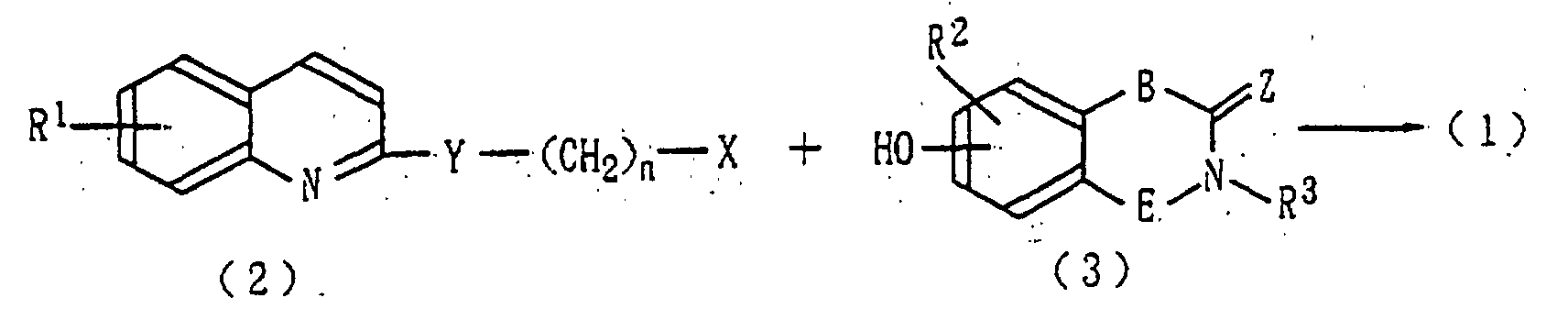
- the compound (1) of the present invention may be prepared by causing a reaction between a haloalkylated piperidine derivative (2) and a phenolic compound (3), or between a piperidien derivative (4) and a haloalkylated phenolic compound (5), in an inert gas stream, without use of any solvent or in the presence of an aprotic solvent such as acetone, 2-butanone, dimethylformamide (DMF), dimethylsulfoxide (DMSO), or hexamethylphosphoramide (HMPA) with the application of heat (preferably 100-200°C) for 1-24 hours.
- an aprotic solvent such as acetone, 2-butanone, dimethylformamide (DMF), dimethylsulfoxide (DMSO), or hexamethylphosphoramide (HMPA)
- a compound (6) and triphenylphosphine are caused to react with each other in the presence of a nonpolar solvent such as toluene, benzene, etc. at a temperature between 0°C and a reflux temperature, preferably at a reflux temperature, for one night to several days, to thereby obtain a phosphonium salt (7).
- the phosphonium salt (7) is transformed into a compound (9) by the following process. First, butyl lithium is added to the phosphonium salt (7) in a polar solvent such as tetrahydrofuran, dioxane, or a similar solvent at a temperature between -78°C and room temperature, preferably at 0°C.
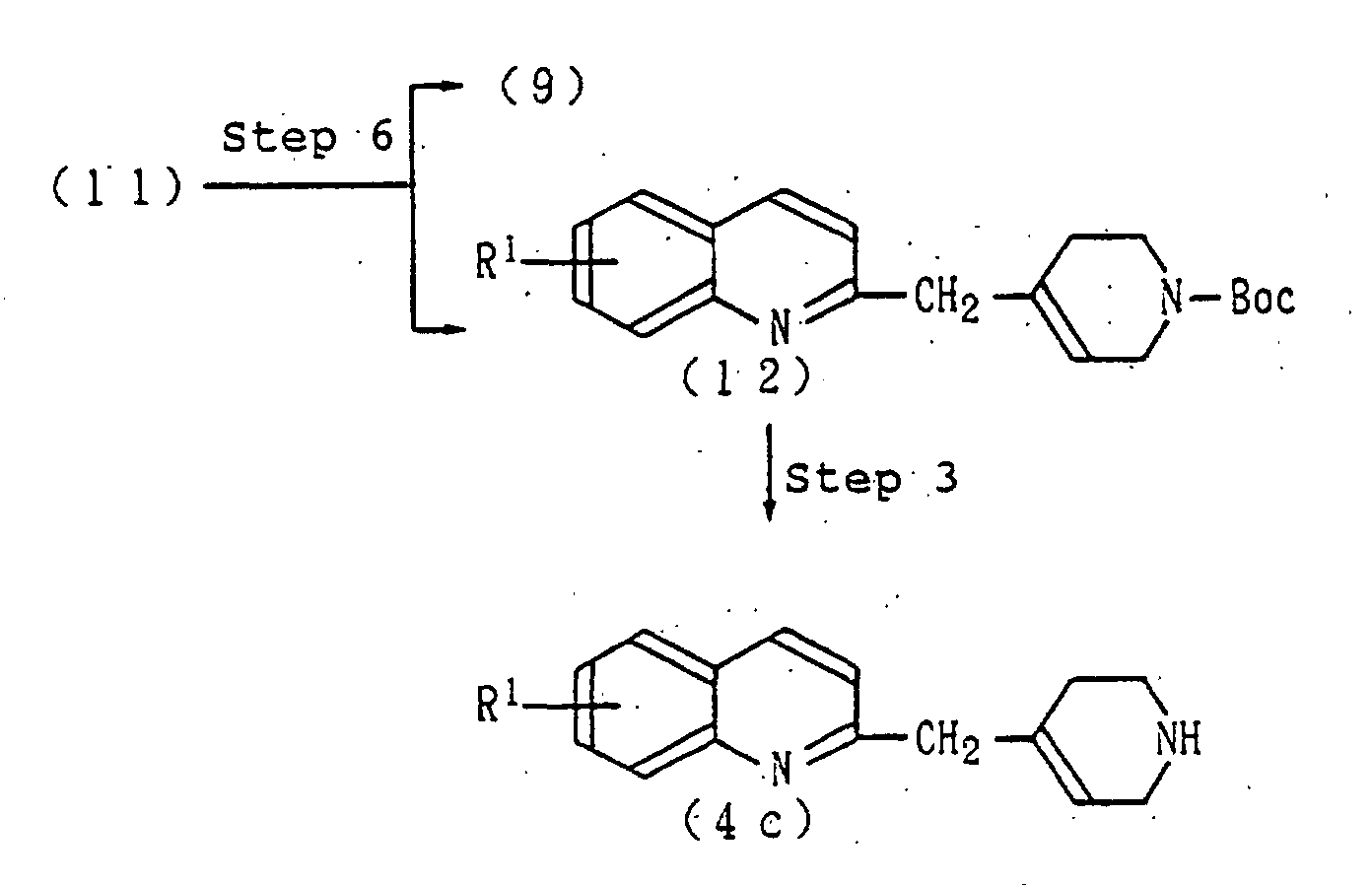
- the compound (11) is allowed to react with a sulfonyl chloride such as methane sulfonyl chloride or toluene sulfonyl chloride for several hours to several days in a polar solvent such as tetrahydrofuran or dioxane, at a temperature between 0°C and a reflux temperature, preferably at room temperature, and then with a base such as 1,8-diazabicyclo[5.4.0]undec-7-ene (DBU) at a temperature between 0°C and a reflux temperature, preferably at room temperature, in a nonpolar solvent such as toluene or benzene for one night to several days, to thereby obtain a compound (12) having an unsaturated bond in the piperidine ring, and the aforementioned compound (9).
- a sulfonyl chloride such as methane sulfonyl chloride or toluene sulfonyl chloride for several hours to
- the compound (12) When the compound (12) is subjected to acid treatment by use of a hydrochloride solution of ethyl acetate or trifluoroacetic acid at a temperature between 0°C and a reflux temperature, preferably at room temperature, the compound (12) can be transformed to the compound (4c).
- the thus-obtained compounds (1) and their salts of the present invention exhibit excellent anti-leukotriene activity and excellent antihistaminic activity, as demonstrated by the below-described examples. Moreover, they transfer to the centrum in lesser amounts as compared with terfenadine.
- the present compounds are useful as a medicine for a broad range of allergic diseases such as asthma, allergic rhinitis, and allergic dermatitis such as atopic dermatitis, allergic conjunctivitis, urticaria, psoriasis, rheumatism, and inflammatory colitis; as well as cerebral ischemia and cerebral apoplexy.
- 2-quinolylmethyltriphenylphosphonium chloride (8.72 g) was dissolved in anhydrous THF (60 ml), and a 1.6N solution (15 ml) of butyllithium was added dropwise over 20 minutes under cooling on ice. The mixture was then stirred for 10 minutes at room temperature.
- an anhydrous THF (24 ml) solution of 1-tert-butoxycarbonyl-4-ketopiperidine (4.29 g) was added dropwise over 15 minutes under cooling on ice. The mixture was stirred for 30 minutes under cooling on ice and further stirred overnight at room temperature. Water (200 ml) was added to the reaction mixture, then the resultant mixture was extracted with ether.
Landscapes
- Chemical & Material Sciences (AREA)
- Organic Chemistry (AREA)
- Health & Medical Sciences (AREA)
- Medicinal Chemistry (AREA)
- Pharmacology & Pharmacy (AREA)
- Epidemiology (AREA)
- Life Sciences & Earth Sciences (AREA)
- Animal Behavior & Ethology (AREA)
- General Health & Medical Sciences (AREA)
- Public Health (AREA)
- Veterinary Medicine (AREA)
- Pharmaceuticals Containing Other Organic And Inorganic Compounds (AREA)
- Plural Heterocyclic Compounds (AREA)
- Hydrogenated Pyridines (AREA)
Abstract
Description




Yield: 59.4 g (81%)
- NMR (CDCl3):
- δ 1.49(9H, s), 2.44(4H, t, J=6.2Hz),
3.71(4H,t,J=6.2Hz)
Yield: 18.44 g (83%)
- NMR (DMSO) :
- δ 5.71(2H, d, J=5.1Hz), 7.53-7.61 (3H, m),
7.66-7.75 (7H, m), 7.80-7.96(10H, m),
8.34(1H, d, J=8.3Hz)
Yield: 5.19 g (80%)
- NMR (CDCl3) :
- δ 1.48 (9H, s), 2.43(2H, t, J=5.7Hz),
2.94(2H, t, J=5.7Hz), 3.48 (2H, t, J=5.7Hz),
3.55(2H, t, J=5.7Hz), 6.58(1H, s),
7.29(1H, d, J=8.5Hz), 7.45-7.52 (1H, m),
7.65-7.11(1H, m), 7.77(1H, dd, J=8.0, 1.3Hz),
8.03(1H, dd, J=8.0, 0.7Hz), 8.09(1H, d, J=8.3Hz),
Yield: 9.62 g (89%)
- NMR (CDCl3) :
- δ 2.65 (2H, t, J=5.4Hz), 3.13-3.33 (6H, m),
6.57 (1H, s), 7.27 (1H, d, J=8.5Hz),
7.47-7.54(1H, m), 7.65-7.73(1H, m),
7.77(1H, dd, J=8.0, 1.0Hz),
8.02 (1H, dd, J=8.0, 0.7Hz), 8.10 (1H, d, J=8.3Hz),
Yield: 9.02 g (92%)
- NMR (CDCl3) :
- δ 1.70 (2H, dd, J=13. 5, 4.0Hz),
1.89 (2H, br d, J=13.5Hz), 2.19-2.36 (1H, m),
2.86 (2H, dt, J=13. 5, 3. 0Hz),
2.95 (2H, d, J=7.3Hz), 3.39 (2H, br d, J=13.5Hz),
7.23 (1H, d, J=8.3Hz),
7.48-7.54(1H, m), 7.67-7.74(1H, m),
7.80(1H, dd, J=8.0, 1.0Hz),
8.03(1H, d, J=8.5Hz), 8.09 (1H, d, J=8.3Hz)
Yield: 5.95 g (34%)
- NMR (CDCl3) :
- δ 1.45 (9H, s), 1.50-1.68 (4H, m), 3.07 (2H, s),
3.26 (2H, br t, J=10.0Hz),
3.82 (2H, br d, J=10.0Hz), 7.23 (1H, d, J=8.5Hz),
7.49-7.56 (1H, m), 7.68-7.75 (1H, m),
7.81 (1H, d, J=8.3Hz), 8.00 (1H, d, J=8.5Hz),
8.12(1H, d, J=8.3Hz).
Yield: 2.59 g (45%)
- NMR (CDCl3) :
- δ 1.44(9H, s), 2.10 (2H, br s),
3.43 (2H, t, J=5.7Hz), 3.70(2H, s),
3.90(2H, br s), 5.45(1H, br s),
7.31(1H, d, J=8.5Hz), 7.47-7.54(1H, m),
7.66-7.73 (1H, m), 7.79 (1H, dd, J=8.0, 1.2Hz),
8.06(1H, dd, J=7.8, 0.5Hz),
8.09 (1H, d, J=8.0Hz)
Yield: 1.07 g (78%)
- NMR (CDCl3) :
- δ 1.99-2.12 (3H, m), 2.94 (2H, t, J=5.7Hz),
3.36 (2H, s), 3.66 (2H, s), 5.54(1H, s),
7.34 (1H, d, J=8.55Hz), 7.47-7.54(1H, m),
7.65-7.73 (1H, m), 7.79(1H, d, J=8.1Hz),
8.06 (1H, d, J=8.3Hz), 8.07(1H, d, J=8.3Hz)
Yield: 298 mg (65%)
- NMR (CDCl3) :
- δ 1.46 (6H, s), 1.97-2.09 (2H, m), 2.18(3H, s),
2.48-2.68 (8H, m), 3.01(2H, t, J=5.4Hz),
4.06 (2H, t, J=6.0Hz), 6.49(1H, d, J=8.0Hz),
6.52 (1H, s), 6.94 (1H, d, J=8.0Hz),
7.31(1H, d, J=8.0Hz), 7.44-7.51(1H, m),
7.56(1H, br s), 7.64-7.71(1H, m),
7.76(1H, dd, J=8.0, 1.0Hz),
8.03 (1H, d, J=8.5Hz), 8.7(1H, d, J=8.7Hz)
| Ex. | Compound | m.p. |
| 2 | 7-[3-[4-(2-Quinolylmethylene)piperidino]propoxy]-3,4-dihydro-2H-1,4-benzothiazin-3-one | 177∼179°C |
| 3 | 8-Methyl-5-[3-[4-(2-quinolylmethylene)piperidino] propoxy]-1,2,3,4-tetrahydroquinolin-2-one | 147∼149°C |
| 4 | 6-[2-[4-(2-Quinolylmethylene)piperidino]ethoxy]-1,2,3,4-tetrahydroquinolin-2-one | 190∼193°C (decomposed) |
| 5 | 6-[3-[4-(2-Quinolylmethylene)piperidino]propoxy]-1,2,3,4-tetrahydroquinolin-2-one | 160∼163°C (decomposed) |
| 6 | 6-[4-[4-(2-Quinolylmethylene)piperidino]butoxy]-1,2,3,4-tetrahydroquinolin-2-one | 168∼170°C (decomposed) |
| 7 | 6-[5-[4-(2-Quinolylmethylene)piperidino]pentoxy]-1,2,3,4-tetrahydroquinolin-2-one | 105∼108°C (decomposed) |
| 8 | 8-[3-[4-(2-Quinolylmethylene)piperidino]propoxy]-1,2,3,4-tetrahydroquinolin-2-one oxalate | 157∼160°C (decomposed) |
| 9 | 7-[3-[4-(2-Quinolylmethylene)piperidino]propoxy]-1,2,3,4-tetrahydroquinolin-2-one oxalate | 163∼164°C (decomposed) |
| 10 | 8-Methyl-5-[2-[4-(2-quinolylmethylene)-piperidino]ethoxy]carbostyryl | 192∼194°C (decomposed) |
| 11 | 8-Methyl-5-[3-[4-(2-quinolylmethylene)-piperidino]propoxy]carbostyryl | 170∼173°C (decomposed) |
| 12 | 7-[3-[4-(2-Quinolylmethylene)piperidino]propoxy]-2,3,4,5-tetrahydro-1H-benz[b]azepin-2-one oxalate | 180∼183°C (decomposed) |
| 13 | 7-[3-[4-(2-Quinolylmethylene)piperidino]propoxy]-2,3,4,5-tetrahydro-1H-benz[c]azepin-1-one oxalate | 118∼120°C (decomposed) |
| 14 | 8-[3-[4-(2-Quinolylmethylene)piperidino]propoxy]-5,6-dihydro-4H-tetrazolo[1,5-a]benz[b]azepine oxalate | 164∼166°C (decomposed) |
Yield: 544 mg (59%)
- NMR (CDCl3) :
- δ 1.45(6H, m), 1.34-1.63(2H, m), 1.63-1.76(2H, m),
1.84-2.05(5H, m), 2.19(3H, s),
2.51(2H, t, J=6.8Hz), 2.86-2.97 (4H, m),
4.01 (2H, t, J=5.9Hz), 6.47(1H, d, J=8.3Hz),
6.92(1H, d, J=8.3Hz), 7.26 (1H, d, J=8.3Hz),
7.49(1H, t, J=6.8Hz), 7.64-7.74(1H, m, Ar-H),
7.78(1H, d, J=8.3Hz), 8.02-8.12(3H, m)
| Ex. | Compound | m.p. |
| 16 | 7-[3-[4-(2-Quinolylmethyl)piperidino]propoxy]-3,4-dihydro-2H-1,4-benzothiazin-3-one | 124∼125°C |
| 17 | 8-Methyl-5-[2-[4-(2-quinolylmethyl)piperidino] ethoxy]-1,2,3,4-tetrahydroquinolin-2-one | 125∼126°C |
| 18 | 8-Methyl-5-[3-[4-(2-quinolylmethyl)piperidino] propoxy]-1,2,3,4-tetrahydroquinolin-2-one | 145∼147°C |
| 19 | 6-[2-[4-(2-Quinolylmethyl)piperidino]ethoxy]-1,2,3,4-tetrahydroquinolin-2-one | 165∼166°C |
| 20 | 6-[3-[4-(2-Quinolylmethyl)piperidino]propoxy]-1,2,3,4-tetrahydroquinolin-2-one | 136∼137°C |
| 21 | 6-[4-[4-(2-Quinolylmethyl)piperidino]butoxy]-1,2,3,4-tetrahydroquinolin-2-one | 165∼166°C |
| 22 | 6-[5-[4-(2-Quinolylmethyl)piperidino]pentoxy]-1,2,3,4-tetrahydroquinolin-2-one | 124∼125°C |
| 23 | 7-[3-[4-(2-Quinolylmethyl)piperidino]propoxy]-1,2,3,4-tetrahydroquinolin-2-one | 120∼121°C |
| 24 | 8-[3-[4-(2-Quinolylmethyl)piperidino]propoxy]-1,2,3,4-tetrahydroquinolin-2-one oxalate | 152∼154°C |
| 25 | 8-Methyl-5-[2-[4-(2-quinolylmethyl)-piperidino]ethoxy]carbostyryl | 151∼154°C |
| 26 | 8-Methyl-5-[3-[4-(2-quinolylmethyl)-piperidino]propoxy]carbostyryl | 161∼163°C (decomposed) |
| 27 | 7-[3-[4-(2-Quinolylmethyl)piperidino]propoxy]-2,3,4,5-tetrahydro-1H-benz[b]azepin-2-one oxalate | 108∼111°C |
| 28 | 7-[3-[4-(2-Quinolylmethyl)piperidino]propoxy]-2,3,4,5-tetrahydro-1H-benz[c]azepin-1-one | 118∼120°C |
Yield: 284 mg (66%)
- NMR (DMSO-d6) :
- δ 2.03-2.16(2H, m), 2.29-2.38(2H, m),
2.41 (2H, dd, J=8. 0, 6.2Hz),
2.79(2H, t, J=8.0Hz), 3.14-3.32 (4H, m),
3.64-3.76 (4H, m), 3.96 (2H, t, J=5. 5Hz),
5.55(1H, br s), 6.42(1H, d, J=2.5Hz),
6.48 (1H, dd, J=8.3, 2.5Hz),
7.04(1H, d, J=8.3Hz), 7.45(1H, d, J=8.3Hz),
7.53-7.61 (1H, m), 7.69-7.77(1H, m),
7.95(2H, d, J=8.5Hz), 8.31 (1H, d, J=8.5Hz),
10.0(1H, s)
induced with 10-8 M LTD4 was investigated.. In Table 3, antihistaminic action is indicated by pA2 or pD'2, whereas antileukotriene action is indicated by inhibition exerted by a test compound at a concentration of 10-5 M, or by IC50.
| Example | Anti-histaminic action | LTD4 action(%) (10-5M) |
| 2 | pD'2 8.22 | 21 |
| 3 | pA2 9.85 | 77 |
| 8 | pA2 9.65 | 30 |
| 9 | pA2 8.53 | 15 |
| 10 | pA2 10.08 | 61 |
| 11 | pA2 9.66 | 39 |
| 12 | pA2 9.75 | 12 |
| 13 | pA2 9.76 | 39 |
| 14 | pA2 10.28 | 40 |
| 15 | pA2 9.49 | 19 |
| 16 | pD'2 8.01 | 15 |
| 17 | pA2 9.78 | 23 |
| 25 | pA2 9.33 | 88 3.4 × 10⁻⁶M(IC50) |
| 26 | pA2 9.79 | 29 |
| Example | H1 Receptor KD(M) | LTD4 Receptor KD(M) |
| 3 | 4.31 × 0-12 | 5.50 × 10⁻⁵ |
| 4 | 1.64 × 10⁻⁷ | 1.27 × 10⁻⁵ |
| 5 | 4.69 × 10⁻¹¹ | 5.44 × 10⁻⁵ |
| 10 | 3.51 × 10⁻¹¹ | 9.86 × 10⁻⁶ |
| 11 | 5.95 × 10⁻¹² | 2.00 × 10⁻⁵ |
| 12 | 2.38 × 10⁻¹¹ | 1.58 × 10⁻⁵ |
| 13 | 1.15 × 10⁻⁹ | 1.90 × 10⁻⁵ |
| 14 | 3.96 × 10⁻¹² | 9.89 × 10⁻⁵ |
| 15 | 3.10 × 10⁻⁹ | 8.06 × 10⁻⁶ |
| Compound | IC50(mg/kg.ex vivo) | BP index |
| Example 10 | 33 | 930 |
| Terfenadine | 26 | 0.17 |
Claims (8)
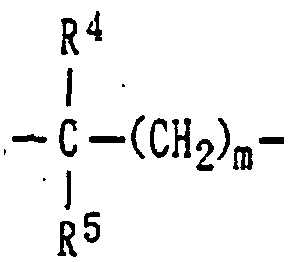
- A piperidine derivative represented by the following formula (1) or a salt thereof:wherein R1 represents a hydrogen atom or a halogen atom, R2 represents a hydrogen atom or a C1-C6 alkyl group, Y represents
 or
or B represents a single bond,
 (wherein each of R4 and R5, which are identical to or different from each other, represents a hydrogen atom or a C1-C6 alkyl group, and m represents a number between 0 and 2 inclusive), -S-CH2-, or -CH=CH-, n represents a number between 2 and 5 inclusive, Z is an oxygen atom and R3 is a hydrogen atom, or R3 and Z may join with the adjacent nitrogen atom to form a tetrazolyl group, and E represents a single bond or a trimethylene group, provided that when B is a single bond, E is a trimethylene group, and when B is a group other than a single bond, E is a single bond.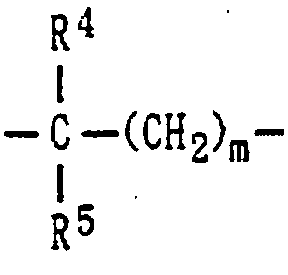
- A medicine comprising as an active ingredient a piperidine derivative as described in Claim 1 or a salt thereof.
- The medicine according to Claim 2, which is a preventive or therapeutic drug for an allergic disease.
- The medicine according to Claim 2, which is a preventive or therapeutic drug for a disease selected from the group consisting of asthma, allergic rhinitis, allergic conjunctivitis, atopic dermatitis, urticaria, psoriasis, rheumatism, inflammatory colitis, cerebral ischemia, and cerebral apoplexy.
- A pharmaceutical composition comprising a piperidine derivative as described in Claim 1 or a salt thereof, and a pharmacologically acceptable carrier.
- Use of a piperidine derivative as described in Claim 1 or a salt thereof for the manufacture of a medicine.
- Use according to claim 6 wherein the medicine is used in a method for the treatment of an allergic disease, which method comprises administering to a patient in need thereof an effective amount of a piperidine derivative as described in Claim 1 or a salt thereof.
- Use according to claim 6 wherein the medicine is used in a method for the treatment of a disease selected from the group consisting of asthma, allergic rhinitis, allergic conjunctivitis, atopic dermatitis, urticaria, psoriasis, rheumatism, inflammatory colitis, cerebral ischemia, and cerebral apoplexy, which method comprises administering to a patient in need thereof an effective amount of a piperidine derivative as described in Claim 1 or a salt thereof.
Applications Claiming Priority (6)
| Application Number | Priority Date | Filing Date | Title |
|---|---|---|---|
| JP25984897 | 1997-09-25 | ||
| JP259848/97 | 1997-09-25 | ||
| JP25984897 | 1997-09-25 | ||
| JP26159997 | 1997-09-26 | ||
| JP261599/97 | 1997-09-26 | ||
| JP26159997 | 1997-09-26 |
Publications (2)
| Publication Number | Publication Date |
|---|---|
| EP0905134A1 EP0905134A1 (en) | 1999-03-31 |
| EP0905134B1 true EP0905134B1 (en) | 2002-01-16 |
Family
ID=26544316
Family Applications (1)
| Application Number | Title | Priority Date | Filing Date |
|---|---|---|---|
| EP98118065A Expired - Lifetime EP0905134B1 (en) | 1997-09-25 | 1998-09-23 | Piperidine derivatives as LTD4 and H1 antagonists |
Country Status (6)
| Country | Link |
|---|---|
| US (1) | US6107308A (en) |
| EP (1) | EP0905134B1 (en) |
| KR (1) | KR100535324B1 (en) |
| AT (1) | ATE212021T1 (en) |
| DE (1) | DE69803151T2 (en) |
| ES (1) | ES2172071T3 (en) |
Family Cites Families (3)
| Publication number | Priority date | Publication date | Assignee | Title |
|---|---|---|---|---|
| JP3193508B2 (en) * | 1993-03-05 | 2001-07-30 | 興和株式会社 | Piperidine derivative |
| US5756518A (en) * | 1996-04-02 | 1998-05-26 | Kowa Co., Ltd. | Phenylene derivatives |
| DE19629670A1 (en) * | 1996-07-23 | 1998-01-29 | Friedolf Mutschler | Method and device for directing sunlight and temperature control |
-
1998
- 1998-09-18 KR KR1019980038720A patent/KR100535324B1/en not_active Expired - Fee Related
- 1998-09-23 AT AT98118065T patent/ATE212021T1/en not_active IP Right Cessation
- 1998-09-23 US US09/158,775 patent/US6107308A/en not_active Expired - Fee Related
- 1998-09-23 EP EP98118065A patent/EP0905134B1/en not_active Expired - Lifetime
- 1998-09-23 DE DE69803151T patent/DE69803151T2/en not_active Expired - Lifetime
- 1998-09-23 ES ES98118065T patent/ES2172071T3/en not_active Expired - Lifetime
Also Published As
| Publication number | Publication date |
|---|---|
| EP0905134A1 (en) | 1999-03-31 |
| US6107308A (en) | 2000-08-22 |
| DE69803151D1 (en) | 2002-02-21 |
| ATE212021T1 (en) | 2002-02-15 |
| KR100535324B1 (en) | 2006-04-21 |
| DE69803151T2 (en) | 2002-08-14 |
| KR19990029946A (en) | 1999-04-26 |
| ES2172071T3 (en) | 2002-09-16 |
Similar Documents
| Publication | Publication Date | Title |
|---|---|---|
| CN104470898B (en) | Cycloalkyl formic acid analog derivative, its preparation method and in application pharmaceutically | |
| JP2852659B2 (en) | Piperazine derivatives and their salts | |
| EP0540604A1 (en) | Substituted bicyclic bis-aryl compounds exhibiting selective leukotriene b 4? antagonist activity, their preparation and use in pharmaceutical compositions | |
| KR100424935B1 (en) | Phenylene derivatives | |
| JPH0687856A (en) | 8-Chloro-11- [1-[(5-methyl-3-pyridyl) methyl] -4-piperidylidene] -6,11-dihydro-5H-benzo [5,6] cyclohepta [1,2-b] pyridine | |
| US20110124666A1 (en) | 3,4-dihydropyrimidine trpa1 antagonists | |
| EP3821947A1 (en) | Heterocyclic trpml1 agonists | |
| US20070088021A1 (en) | 4-haloisoquinoline derivative and drug containing the same | |
| KR100538152B1 (en) | Diamine derivatives and pharmaceutical containing the same | |
| KR920003116B1 (en) | Method for preparing 2,3-dihydro-1H-indene derivative | |
| EP0905133B1 (en) | Tetrazole derivatives as LTD4 and H1 antagonists | |
| JPS60185780A (en) | Tetrahydropyridoindole nerve relaxant | |
| JPWO1999002520A1 (en) | Diamine derivatives and medicines containing the same | |
| US6107308A (en) | Piperidine derivatives | |
| CN114436985B (en) | Tetraazole derivatives, preparation, pharmaceutical compositions containing them and their applications | |
| JP3413109B2 (en) | Piperidine derivative | |
| WO1994011355A1 (en) | 3,4-dihydro-1-(2-hydroxyphenyl)-2(1h)-quinoxalinone derivative and related compound | |
| WO1998030559A1 (en) | Process for the production of tetrazolylbenzopyrans | |
| JP2837318B2 (en) | Angiotensin II antagonistic pyridine derivative | |
| WO2000078758A1 (en) | Novel imidazole derivatives | |
| JPH07145152A (en) | 3,4-dihydro-1-(2-hydroxyphenyl)-2(1h)-quinoxalinone derivative and its related compound | |
| PL198759B1 (en) | Novel benzimidazoles and benzoxazoles | |
| JPH11158175A (en) | Tetrazole derivative | |
| WO2002053157A1 (en) | Thiazolidine derivative | |
| JPH0633255B2 (en) | Tetrahydroquinoline derivative |
Legal Events
| Date | Code | Title | Description |
|---|---|---|---|
| PUAI | Public reference made under article 153(3) epc to a published international application that has entered the european phase |
Free format text: ORIGINAL CODE: 0009012 |
|
| AK | Designated contracting states |
Kind code of ref document: A1 Designated state(s): AT BE CH CY DE DK ES FI FR GB GR IE IT LI LU MC NL PT SE |
|
| AX | Request for extension of the european patent |
Free format text: AL;LT;LV;MK;RO;SI |
|
| 17P | Request for examination filed |
Effective date: 19990723 |
|
| AKX | Designation fees paid |
Free format text: AT BE CH CY DE DK ES FI FR GB GR IE IT LI LU MC NL PT SE |
|
| GRAG | Despatch of communication of intention to grant |
Free format text: ORIGINAL CODE: EPIDOS AGRA |
|
| 17Q | First examination report despatched |
Effective date: 20010509 |
|
| GRAG | Despatch of communication of intention to grant |
Free format text: ORIGINAL CODE: EPIDOS AGRA |
|
| GRAH | Despatch of communication of intention to grant a patent |
Free format text: ORIGINAL CODE: EPIDOS IGRA |
|
| GRAH | Despatch of communication of intention to grant a patent |
Free format text: ORIGINAL CODE: EPIDOS IGRA |
|
| GRAA | (expected) grant |
Free format text: ORIGINAL CODE: 0009210 |
|
| REG | Reference to a national code |
Ref country code: GB Ref legal event code: IF02 |
|
| AK | Designated contracting states |
Kind code of ref document: B1 Designated state(s): AT BE CH CY DE DK ES FI FR GB GR IE IT LI LU MC NL PT SE |
|
| PG25 | Lapsed in a contracting state [announced via postgrant information from national office to epo] |
Ref country code: GR Free format text: LAPSE BECAUSE OF FAILURE TO SUBMIT A TRANSLATION OF THE DESCRIPTION OR TO PAY THE FEE WITHIN THE PRESCRIBED TIME-LIMIT Effective date: 20020116 Ref country code: FI Free format text: LAPSE BECAUSE OF FAILURE TO SUBMIT A TRANSLATION OF THE DESCRIPTION OR TO PAY THE FEE WITHIN THE PRESCRIBED TIME-LIMIT Effective date: 20020116 Ref country code: AT Free format text: LAPSE BECAUSE OF FAILURE TO SUBMIT A TRANSLATION OF THE DESCRIPTION OR TO PAY THE FEE WITHIN THE PRESCRIBED TIME-LIMIT Effective date: 20020116 |
|
| REF | Corresponds to: |
Ref document number: 212021 Country of ref document: AT Date of ref document: 20020215 Kind code of ref document: T |
|
| REG | Reference to a national code |
Ref country code: CH Ref legal event code: EP |
|
| REG | Reference to a national code |
Ref country code: IE Ref legal event code: FG4D |
|
| REF | Corresponds to: |
Ref document number: 69803151 Country of ref document: DE Date of ref document: 20020221 |
|
| REG | Reference to a national code |
Ref country code: CH Ref legal event code: NV Representative=s name: BOVARD AG PATENTANWAELTE |
|
| PG25 | Lapsed in a contracting state [announced via postgrant information from national office to epo] |
Ref country code: SE Free format text: LAPSE BECAUSE OF FAILURE TO SUBMIT A TRANSLATION OF THE DESCRIPTION OR TO PAY THE FEE WITHIN THE PRESCRIBED TIME-LIMIT Effective date: 20020416 Ref country code: PT Free format text: LAPSE BECAUSE OF FAILURE TO SUBMIT A TRANSLATION OF THE DESCRIPTION OR TO PAY THE FEE WITHIN THE PRESCRIBED TIME-LIMIT Effective date: 20020416 Ref country code: DK Free format text: LAPSE BECAUSE OF FAILURE TO SUBMIT A TRANSLATION OF THE DESCRIPTION OR TO PAY THE FEE WITHIN THE PRESCRIBED TIME-LIMIT Effective date: 20020416 |
|
| ET | Fr: translation filed | ||
| REG | Reference to a national code |
Ref country code: ES Ref legal event code: FG2A Ref document number: 2172071 Country of ref document: ES Kind code of ref document: T3 |
|
| PG25 | Lapsed in a contracting state [announced via postgrant information from national office to epo] |
Ref country code: LU Free format text: LAPSE BECAUSE OF NON-PAYMENT OF DUE FEES Effective date: 20020923 Ref country code: IE Free format text: LAPSE BECAUSE OF NON-PAYMENT OF DUE FEES Effective date: 20020923 |
|
| PG25 | Lapsed in a contracting state [announced via postgrant information from national office to epo] |
Ref country code: CY Free format text: LAPSE BECAUSE OF FAILURE TO SUBMIT A TRANSLATION OF THE DESCRIPTION OR TO PAY THE FEE WITHIN THE PRESCRIBED TIME-LIMIT Effective date: 20020930 |
|
| PLBE | No opposition filed within time limit |
Free format text: ORIGINAL CODE: 0009261 |
|
| STAA | Information on the status of an ep patent application or granted ep patent |
Free format text: STATUS: NO OPPOSITION FILED WITHIN TIME LIMIT |
|
| 26N | No opposition filed | ||
| PG25 | Lapsed in a contracting state [announced via postgrant information from national office to epo] |
Ref country code: MC Free format text: LAPSE BECAUSE OF NON-PAYMENT OF DUE FEES Effective date: 20030401 |
|
| REG | Reference to a national code |
Ref country code: IE Ref legal event code: MM4A |
|
| PGFP | Annual fee paid to national office [announced via postgrant information from national office to epo] |
Ref country code: DE Payment date: 20090930 Year of fee payment: 12 |
|
| PGFP | Annual fee paid to national office [announced via postgrant information from national office to epo] |
Ref country code: ES Payment date: 20100921 Year of fee payment: 13 Ref country code: CH Payment date: 20100923 Year of fee payment: 13 |
|
| PGFP | Annual fee paid to national office [announced via postgrant information from national office to epo] |
Ref country code: IT Payment date: 20100923 Year of fee payment: 13 Ref country code: FR Payment date: 20100930 Year of fee payment: 13 |
|
| PGFP | Annual fee paid to national office [announced via postgrant information from national office to epo] |
Ref country code: GB Payment date: 20100924 Year of fee payment: 13 |
|
| PGFP | Annual fee paid to national office [announced via postgrant information from national office to epo] |
Ref country code: NL Payment date: 20100921 Year of fee payment: 13 |
|
| PGFP | Annual fee paid to national office [announced via postgrant information from national office to epo] |
Ref country code: BE Payment date: 20100921 Year of fee payment: 13 |
|
| REG | Reference to a national code |
Ref country code: CH Ref legal event code: PFA Owner name: KOWA COMPANY, LTD. Free format text: KOWA COMPANY, LTD.#6-29, 3-CHOME NISHIKI#NAKA-KU NAGOYA-SHI AICHI-KEN (JP) -TRANSFER TO- KOWA COMPANY, LTD.#6-29, 3-CHOME NISHIKI#NAKA-KU NAGOYA-SHI AICHI-KEN (JP) |
|
| REG | Reference to a national code |
Ref country code: DE Ref legal event code: R119 Ref document number: 69803151 Country of ref document: DE Effective date: 20110401 |
|
| PG25 | Lapsed in a contracting state [announced via postgrant information from national office to epo] |
Ref country code: DE Free format text: LAPSE BECAUSE OF NON-PAYMENT OF DUE FEES Effective date: 20110401 |
|
| BERE | Be: lapsed |
Owner name: *KOWA CY LTD Effective date: 20110930 |
|
| REG | Reference to a national code |
Ref country code: NL Ref legal event code: V1 Effective date: 20120401 |
|
| REG | Reference to a national code |
Ref country code: CH Ref legal event code: PL |
|
| GBPC | Gb: european patent ceased through non-payment of renewal fee |
Effective date: 20110923 |
|
| PG25 | Lapsed in a contracting state [announced via postgrant information from national office to epo] |
Ref country code: IT Free format text: LAPSE BECAUSE OF NON-PAYMENT OF DUE FEES Effective date: 20110923 |
|
| REG | Reference to a national code |
Ref country code: FR Ref legal event code: ST Effective date: 20120531 |
|
| PG25 | Lapsed in a contracting state [announced via postgrant information from national office to epo] |
Ref country code: BE Free format text: LAPSE BECAUSE OF NON-PAYMENT OF DUE FEES Effective date: 20110930 |
|
| PG25 | Lapsed in a contracting state [announced via postgrant information from national office to epo] |
Ref country code: NL Free format text: LAPSE BECAUSE OF NON-PAYMENT OF DUE FEES Effective date: 20120401 Ref country code: CH Free format text: LAPSE BECAUSE OF NON-PAYMENT OF DUE FEES Effective date: 20110930 Ref country code: LI Free format text: LAPSE BECAUSE OF NON-PAYMENT OF DUE FEES Effective date: 20110930 |
|
| PG25 | Lapsed in a contracting state [announced via postgrant information from national office to epo] |
Ref country code: FR Free format text: LAPSE BECAUSE OF NON-PAYMENT OF DUE FEES Effective date: 20110930 Ref country code: GB Free format text: LAPSE BECAUSE OF NON-PAYMENT OF DUE FEES Effective date: 20110923 |
|
| PG25 | Lapsed in a contracting state [announced via postgrant information from national office to epo] |
Ref country code: ES Free format text: LAPSE BECAUSE OF NON-PAYMENT OF DUE FEES Effective date: 20110924 |
|
| REG | Reference to a national code |
Ref country code: ES Ref legal event code: FD2A Effective date: 20130530 |