EP0902083B1 - Fabric care method - Google Patents
Fabric care method Download PDFInfo
- Publication number
- EP0902083B1 EP0902083B1 EP98810870A EP98810870A EP0902083B1 EP 0902083 B1 EP0902083 B1 EP 0902083B1 EP 98810870 A EP98810870 A EP 98810870A EP 98810870 A EP98810870 A EP 98810870A EP 0902083 B1 EP0902083 B1 EP 0902083B1
- Authority
- EP
- European Patent Office
- Prior art keywords
- alkyl
- linear
- formula
- branched
- hydrogen
- Prior art date
- Legal status (The legal status is an assumption and is not a legal conclusion. Google has not performed a legal analysis and makes no representation as to the accuracy of the status listed.)
- Expired - Lifetime
Links
- 238000000034 method Methods 0.000 title claims description 31
- 239000004744 fabric Substances 0.000 title claims description 5
- 229910052739 hydrogen Inorganic materials 0.000 claims description 35
- 239000001257 hydrogen Substances 0.000 claims description 35
- 239000000975 dye Substances 0.000 claims description 30
- 239000003599 detergent Substances 0.000 claims description 27
- 150000001875 compounds Chemical class 0.000 claims description 25
- 239000000203 mixture Substances 0.000 claims description 22
- 238000012546 transfer Methods 0.000 claims description 18
- 125000004178 (C1-C4) alkyl group Chemical group 0.000 claims description 17
- -1 halide anion Chemical class 0.000 claims description 17
- 125000004093 cyano group Chemical group *C#N 0.000 claims description 15
- 150000002431 hydrogen Chemical group 0.000 claims description 14
- 125000000449 nitro group Chemical group [O-][N+](*)=O 0.000 claims description 14
- 150000002696 manganese Chemical class 0.000 claims description 13
- UFHFLCQGNIYNRP-UHFFFAOYSA-N Hydrogen Chemical compound [H][H] UFHFLCQGNIYNRP-UHFFFAOYSA-N 0.000 claims description 12
- 125000003118 aryl group Chemical group 0.000 claims description 12
- 150000002978 peroxides Chemical class 0.000 claims description 12
- 229910052783 alkali metal Inorganic materials 0.000 claims description 11
- 125000004209 (C1-C8) alkyl group Chemical group 0.000 claims description 10
- 150000001340 alkali metals Chemical group 0.000 claims description 10
- 239000000843 powder Substances 0.000 claims description 10
- 125000004435 hydrogen atom Chemical group [H]* 0.000 claims description 9
- 125000000843 phenylene group Chemical group C1(=C(C=CC=C1)*)* 0.000 claims description 9
- 150000001450 anions Chemical class 0.000 claims description 8
- 125000004432 carbon atom Chemical group C* 0.000 claims description 8
- 150000001768 cations Chemical class 0.000 claims description 8
- 125000002887 hydroxy group Chemical group [H]O* 0.000 claims description 8
- 125000001997 phenyl group Chemical group [H]C1=C([H])C([H])=C(*)C([H])=C1[H] 0.000 claims description 8
- 239000002002 slurry Substances 0.000 claims description 8
- XXJGBENTLXFVFI-UHFFFAOYSA-N 1-amino-methylene Chemical group N[CH2] XXJGBENTLXFVFI-UHFFFAOYSA-N 0.000 claims description 7
- QGZKDVFQNNGYKY-UHFFFAOYSA-O Ammonium Chemical compound [NH4+] QGZKDVFQNNGYKY-UHFFFAOYSA-O 0.000 claims description 7
- 125000002947 alkylene group Chemical group 0.000 claims description 7
- 150000001412 amines Chemical class 0.000 claims description 7
- CBOIHMRHGLHBPB-UHFFFAOYSA-N hydroxymethyl Chemical group O[CH2] CBOIHMRHGLHBPB-UHFFFAOYSA-N 0.000 claims description 7
- 238000004519 manufacturing process Methods 0.000 claims description 7
- 125000004400 (C1-C12) alkyl group Chemical group 0.000 claims description 6
- 239000002585 base Substances 0.000 claims description 6
- 229910052736 halogen Inorganic materials 0.000 claims description 6
- 150000002367 halogens Chemical group 0.000 claims description 6
- 239000002736 nonionic surfactant Substances 0.000 claims description 6
- 229920000642 polymer Polymers 0.000 claims description 6
- 125000002924 primary amino group Chemical group [H]N([H])* 0.000 claims description 6
- GRHZLQBPAJAHDM-SPRQWYLLSA-N [(3as,4r,6ar)-2,3,3a,4,5,6a-hexahydrofuro[2,3-b]furan-4-yl] n-[(2s,4s,5s)-5-[[2-(2,6-dimethylphenoxy)acetyl]amino]-4-hydroxy-1,6-diphenylhexan-2-yl]carbamate Chemical group CC1=CC=CC(C)=C1OCC(=O)N[C@H]([C@@H](O)C[C@H](CC=1C=CC=CC=1)NC(=O)O[C@@H]1[C@@H]2CCO[C@@H]2OC1)CC1=CC=CC=C1 GRHZLQBPAJAHDM-SPRQWYLLSA-N 0.000 claims description 5
- 125000000217 alkyl group Chemical group 0.000 claims description 5
- 239000003945 anionic surfactant Substances 0.000 claims description 5
- XLYOFNOQVPJJNP-UHFFFAOYSA-N water Substances O XLYOFNOQVPJJNP-UHFFFAOYSA-N 0.000 claims description 5
- 238000010521 absorption reaction Methods 0.000 claims description 4
- 150000007942 carboxylates Chemical class 0.000 claims description 4
- 230000002401 inhibitory effect Effects 0.000 claims description 4
- 238000002156 mixing Methods 0.000 claims description 4
- 238000001694 spray drying Methods 0.000 claims description 4
- 238000005406 washing Methods 0.000 claims description 4
- QAOWNCQODCNURD-UHFFFAOYSA-L Sulfate Chemical compound [O-]S([O-])(=O)=O QAOWNCQODCNURD-UHFFFAOYSA-L 0.000 claims description 3
- BGRWYDHXPHLNKA-UHFFFAOYSA-N Tetraacetylethylenediamine Chemical compound CC(=O)N(C(C)=O)CCN(C(C)=O)C(C)=O BGRWYDHXPHLNKA-UHFFFAOYSA-N 0.000 claims description 3
- 239000008187 granular material Substances 0.000 claims description 3
- 239000007788 liquid Substances 0.000 claims description 3
- 229910021653 sulphate ion Inorganic materials 0.000 claims description 3
- QTBSBXVTEAMEQO-UHFFFAOYSA-M Acetate Chemical compound CC([O-])=O QTBSBXVTEAMEQO-UHFFFAOYSA-M 0.000 claims description 2
- VEXZGXHMUGYJMC-UHFFFAOYSA-M Chloride anion Chemical compound [Cl-] VEXZGXHMUGYJMC-UHFFFAOYSA-M 0.000 claims description 2
- 229910002651 NO3 Inorganic materials 0.000 claims description 2
- NHNBFGGVMKEFGY-UHFFFAOYSA-N Nitrate Chemical compound [O-][N+]([O-])=O NHNBFGGVMKEFGY-UHFFFAOYSA-N 0.000 claims description 2
- 125000000129 anionic group Chemical group 0.000 claims description 2
- 150000004820 halides Chemical class 0.000 claims description 2
- XLYOFNOQVPJJNP-UHFFFAOYSA-M hydroxide Chemical compound [OH-] XLYOFNOQVPJJNP-UHFFFAOYSA-M 0.000 claims description 2
- 125000002496 methyl group Chemical group [H]C([H])([H])* 0.000 claims description 2
- VLTRZXGMWDSKGL-UHFFFAOYSA-M perchlorate Inorganic materials [O-]Cl(=O)(=O)=O VLTRZXGMWDSKGL-UHFFFAOYSA-M 0.000 claims description 2
- VLTRZXGMWDSKGL-UHFFFAOYSA-N perchloric acid Chemical compound OCl(=O)(=O)=O VLTRZXGMWDSKGL-UHFFFAOYSA-N 0.000 claims description 2
- 229920000036 polyvinylpyrrolidone Polymers 0.000 claims description 2
- 235000013855 polyvinylpyrrolidone Nutrition 0.000 claims description 2
- JOXIMZWYDAKGHI-UHFFFAOYSA-N toluene-4-sulfonic acid Chemical compound CC1=CC=C(S(O)(=O)=O)C=C1 JOXIMZWYDAKGHI-UHFFFAOYSA-N 0.000 claims description 2
- ITMCEJHCFYSIIV-UHFFFAOYSA-M triflate Chemical compound [O-]S(=O)(=O)C(F)(F)F ITMCEJHCFYSIIV-UHFFFAOYSA-M 0.000 claims description 2
- 239000001267 polyvinylpyrrolidone Substances 0.000 claims 1
- 239000003112 inhibitor Substances 0.000 description 14
- 239000003446 ligand Substances 0.000 description 10
- 238000012360 testing method Methods 0.000 description 8
- 239000011572 manganese Substances 0.000 description 5
- PWHULOQIROXLJO-UHFFFAOYSA-N Manganese Chemical compound [Mn] PWHULOQIROXLJO-UHFFFAOYSA-N 0.000 description 4
- 229910052748 manganese Inorganic materials 0.000 description 4
- 239000011734 sodium Substances 0.000 description 4
- DGAQECJNVWCQMB-PUAWFVPOSA-M Ilexoside XXIX Chemical compound C[C@@H]1CC[C@@]2(CC[C@@]3(C(=CC[C@H]4[C@]3(CC[C@@H]5[C@@]4(CC[C@@H](C5(C)C)OS(=O)(=O)[O-])C)C)[C@@H]2[C@]1(C)O)C)C(=O)O[C@H]6[C@@H]([C@H]([C@@H]([C@H](O6)CO)O)O)O.[Na+] DGAQECJNVWCQMB-PUAWFVPOSA-M 0.000 description 3
- PMZURENOXWZQFD-UHFFFAOYSA-L Sodium Sulfate Chemical compound [Na+].[Na+].[O-]S([O-])(=O)=O PMZURENOXWZQFD-UHFFFAOYSA-L 0.000 description 3
- 239000002253 acid Substances 0.000 description 3
- HNPSIPDUKPIQMN-UHFFFAOYSA-N dioxosilane;oxo(oxoalumanyloxy)alumane Chemical compound O=[Si]=O.O=[Al]O[Al]=O HNPSIPDUKPIQMN-UHFFFAOYSA-N 0.000 description 3
- 230000000694 effects Effects 0.000 description 3
- 239000000463 material Substances 0.000 description 3
- 150000003839 salts Chemical class 0.000 description 3
- 229910052708 sodium Inorganic materials 0.000 description 3
- 239000010457 zeolite Substances 0.000 description 3
- 0 **(c(cccc1)c1O)=* Chemical compound **(c(cccc1)c1O)=* 0.000 description 2
- 229920000742 Cotton Polymers 0.000 description 2
- KCXVZYZYPLLWCC-UHFFFAOYSA-N EDTA Chemical compound OC(=O)CN(CC(O)=O)CCN(CC(O)=O)CC(O)=O KCXVZYZYPLLWCC-UHFFFAOYSA-N 0.000 description 2
- LFQSCWFLJHTTHZ-UHFFFAOYSA-N Ethanol Chemical compound CCO LFQSCWFLJHTTHZ-UHFFFAOYSA-N 0.000 description 2
- IAYPIBMASNFSPL-UHFFFAOYSA-N Ethylene oxide Chemical compound C1CO1 IAYPIBMASNFSPL-UHFFFAOYSA-N 0.000 description 2
- VYPSYNLAJGMNEJ-UHFFFAOYSA-N Silicium dioxide Chemical compound O=[Si]=O VYPSYNLAJGMNEJ-UHFFFAOYSA-N 0.000 description 2
- CDBYLPFSWZWCQE-UHFFFAOYSA-L Sodium Carbonate Chemical compound [Na+].[Na+].[O-]C([O-])=O CDBYLPFSWZWCQE-UHFFFAOYSA-L 0.000 description 2
- 239000004115 Sodium Silicate Substances 0.000 description 2
- FAPWRFPIFSIZLT-UHFFFAOYSA-M Sodium chloride Chemical compound [Na+].[Cl-] FAPWRFPIFSIZLT-UHFFFAOYSA-M 0.000 description 2
- 229910021536 Zeolite Inorganic materials 0.000 description 2
- 150000007513 acids Chemical class 0.000 description 2
- 229910000323 aluminium silicate Inorganic materials 0.000 description 2
- 238000004061 bleaching Methods 0.000 description 2
- 239000001768 carboxy methyl cellulose Substances 0.000 description 2
- 239000003795 chemical substances by application Substances 0.000 description 2
- 229920001577 copolymer Polymers 0.000 description 2
- 238000011156 evaluation Methods 0.000 description 2
- 239000006081 fluorescent whitening agent Substances 0.000 description 2
- 239000006260 foam Substances 0.000 description 2
- 238000009472 formulation Methods 0.000 description 2
- 230000005764 inhibitory process Effects 0.000 description 2
- 229920005646 polycarboxylate Polymers 0.000 description 2
- 238000012216 screening Methods 0.000 description 2
- 239000000344 soap Substances 0.000 description 2
- 159000000000 sodium salts Chemical class 0.000 description 2
- 229910052938 sodium sulfate Inorganic materials 0.000 description 2
- 235000011152 sodium sulphate Nutrition 0.000 description 2
- 238000010561 standard procedure Methods 0.000 description 2
- 238000003786 synthesis reaction Methods 0.000 description 2
- ZMLPKJYZRQZLDA-UHFFFAOYSA-N 1-(2-phenylethenyl)-4-[4-(2-phenylethenyl)phenyl]benzene Chemical group C=1C=CC=CC=1C=CC(C=C1)=CC=C1C(C=C1)=CC=C1C=CC1=CC=CC=C1 ZMLPKJYZRQZLDA-UHFFFAOYSA-N 0.000 description 1
- SMZOUWXMTYCWNB-UHFFFAOYSA-N 2-(2-methoxy-5-methylphenyl)ethanamine Chemical compound COC1=CC=C(C)C=C1CCN SMZOUWXMTYCWNB-UHFFFAOYSA-N 0.000 description 1
- NIXOWILDQLNWCW-UHFFFAOYSA-N 2-Propenoic acid Natural products OC(=O)C=C NIXOWILDQLNWCW-UHFFFAOYSA-N 0.000 description 1
- NRKPWTQKZGMMEW-UHFFFAOYSA-N 2-[4-[4-(1-benzofuran-2-yl)phenyl]phenyl]-1-benzofuran Chemical group C1=CC=C2OC(C3=CC=C(C=C3)C3=CC=C(C=C3)C3=CC4=CC=CC=C4O3)=CC2=C1 NRKPWTQKZGMMEW-UHFFFAOYSA-N 0.000 description 1
- 102000013142 Amylases Human genes 0.000 description 1
- 108010065511 Amylases Proteins 0.000 description 1
- BVKZGUZCCUSVTD-UHFFFAOYSA-M Bicarbonate Chemical compound OC([O-])=O BVKZGUZCCUSVTD-UHFFFAOYSA-M 0.000 description 1
- WKBOTKDWSSQWDR-UHFFFAOYSA-N Bromine atom Chemical compound [Br] WKBOTKDWSSQWDR-UHFFFAOYSA-N 0.000 description 1
- BVKZGUZCCUSVTD-UHFFFAOYSA-L Carbonate Chemical compound [O-]C([O-])=O BVKZGUZCCUSVTD-UHFFFAOYSA-L 0.000 description 1
- 229920002134 Carboxymethyl cellulose Polymers 0.000 description 1
- ZAMOUSCENKQFHK-UHFFFAOYSA-N Chlorine atom Chemical compound [Cl] ZAMOUSCENKQFHK-UHFFFAOYSA-N 0.000 description 1
- 102000004190 Enzymes Human genes 0.000 description 1
- 108090000790 Enzymes Proteins 0.000 description 1
- XTRXBOSGRMJASM-UHFFFAOYSA-N N1=NN=C(C=C1)NC(=C(C1=C(C(=CC=C1)S(=O)(=O)O)S(=O)(=O)O)NC1=NN=NC=C1)C1=CC=CC=C1 Chemical compound N1=NN=C(C=C1)NC(=C(C1=C(C(=CC=C1)S(=O)(=O)O)S(=O)(=O)O)NC1=NN=NC=C1)C1=CC=CC=C1 XTRXBOSGRMJASM-UHFFFAOYSA-N 0.000 description 1
- FPMFMXSSJXIJEC-UHFFFAOYSA-N N1N=NC(=C1)C(=C(C1=C(C(=CC=C1)S(=O)(=O)O)S(=O)(=O)O)C=1N=NNC1)C1=CC=CC=C1 Chemical compound N1N=NC(=C1)C(=C(C1=C(C(=CC=C1)S(=O)(=O)O)S(=O)(=O)O)C=1N=NNC1)C1=CC=CC=C1 FPMFMXSSJXIJEC-UHFFFAOYSA-N 0.000 description 1
- KKCBUQHMOMHUOY-UHFFFAOYSA-N Na2O Inorganic materials [O-2].[Na+].[Na+] KKCBUQHMOMHUOY-UHFFFAOYSA-N 0.000 description 1
- BPQQTUXANYXVAA-UHFFFAOYSA-N Orthosilicate Chemical compound [O-][Si]([O-])([O-])[O-] BPQQTUXANYXVAA-UHFFFAOYSA-N 0.000 description 1
- 102000035195 Peptidases Human genes 0.000 description 1
- 108091005804 Peptidases Proteins 0.000 description 1
- ABLZXFCXXLZCGV-UHFFFAOYSA-N Phosphorous acid Chemical class OP(O)=O ABLZXFCXXLZCGV-UHFFFAOYSA-N 0.000 description 1
- 239000004952 Polyamide Substances 0.000 description 1
- OFOBLEOULBTSOW-UHFFFAOYSA-N Propanedioic acid Natural products OC(=O)CC(O)=O OFOBLEOULBTSOW-UHFFFAOYSA-N 0.000 description 1
- XUIMIQQOPSSXEZ-UHFFFAOYSA-N Silicon Chemical compound [Si] XUIMIQQOPSSXEZ-UHFFFAOYSA-N 0.000 description 1
- 239000004902 Softening Agent Substances 0.000 description 1
- DPXJVFZANSGRMM-UHFFFAOYSA-N acetic acid;2,3,4,5,6-pentahydroxyhexanal;sodium Chemical compound [Na].CC(O)=O.OCC(O)C(O)C(O)C(O)C=O DPXJVFZANSGRMM-UHFFFAOYSA-N 0.000 description 1
- 239000012190 activator Substances 0.000 description 1
- 239000000654 additive Substances 0.000 description 1
- 239000003513 alkali Substances 0.000 description 1
- 229910000318 alkali metal phosphate Inorganic materials 0.000 description 1
- 229910052910 alkali metal silicate Inorganic materials 0.000 description 1
- 229910052915 alkaline earth metal silicate Inorganic materials 0.000 description 1
- 125000003342 alkenyl group Chemical group 0.000 description 1
- 150000004996 alkyl benzenes Chemical class 0.000 description 1
- 229940115440 aluminum sodium silicate Drugs 0.000 description 1
- 235000019418 amylase Nutrition 0.000 description 1
- 229940025131 amylases Drugs 0.000 description 1
- 239000002216 antistatic agent Substances 0.000 description 1
- QVGXLLKOCUKJST-UHFFFAOYSA-N atomic oxygen Chemical compound [O] QVGXLLKOCUKJST-UHFFFAOYSA-N 0.000 description 1
- JXLHNMVSKXFWAO-UHFFFAOYSA-N azane;7-fluoro-2,1,3-benzoxadiazole-4-sulfonic acid Chemical compound N.OS(=O)(=O)C1=CC=C(F)C2=NON=C12 JXLHNMVSKXFWAO-UHFFFAOYSA-N 0.000 description 1
- 230000015572 biosynthetic process Effects 0.000 description 1
- GDTBXPJZTBHREO-UHFFFAOYSA-N bromine Substances BrBr GDTBXPJZTBHREO-UHFFFAOYSA-N 0.000 description 1
- 229910052794 bromium Inorganic materials 0.000 description 1
- 235000010948 carboxy methyl cellulose Nutrition 0.000 description 1
- 239000008112 carboxymethyl-cellulose Substances 0.000 description 1
- 230000015556 catabolic process Effects 0.000 description 1
- 239000003054 catalyst Substances 0.000 description 1
- 238000006243 chemical reaction Methods 0.000 description 1
- 229910052801 chlorine Inorganic materials 0.000 description 1
- 239000000460 chlorine Substances 0.000 description 1
- 150000001860 citric acid derivatives Chemical class 0.000 description 1
- 229910052681 coesite Inorganic materials 0.000 description 1
- 239000000470 constituent Substances 0.000 description 1
- ZYGHJZDHTFUPRJ-UHFFFAOYSA-N coumarin Chemical class C1=CC=C2OC(=O)C=CC2=C1 ZYGHJZDHTFUPRJ-UHFFFAOYSA-N 0.000 description 1
- 229910052906 cristobalite Inorganic materials 0.000 description 1
- 125000004956 cyclohexylene group Chemical group 0.000 description 1
- 238000006731 degradation reaction Methods 0.000 description 1
- VTIIJXUACCWYHX-UHFFFAOYSA-L disodium;carboxylatooxy carbonate Chemical compound [Na+].[Na+].[O-]C(=O)OOC([O-])=O VTIIJXUACCWYHX-UHFFFAOYSA-L 0.000 description 1
- 229960001484 edetic acid Drugs 0.000 description 1
- 238000004453 electron probe microanalysis Methods 0.000 description 1
- 229940088598 enzyme Drugs 0.000 description 1
- UFZOPKFMKMAWLU-UHFFFAOYSA-N ethoxy(methyl)phosphinic acid Chemical compound CCOP(C)(O)=O UFZOPKFMKMAWLU-UHFFFAOYSA-N 0.000 description 1
- 229940071087 ethylenediamine disuccinate Drugs 0.000 description 1
- 150000002191 fatty alcohols Chemical class 0.000 description 1
- 239000000835 fiber Substances 0.000 description 1
- 125000001153 fluoro group Chemical group F* 0.000 description 1
- 125000005843 halogen group Chemical group 0.000 description 1
- 230000036571 hydration Effects 0.000 description 1
- 238000006703 hydration reaction Methods 0.000 description 1
- 239000011976 maleic acid Substances 0.000 description 1
- FPYJFEHAWHCUMM-UHFFFAOYSA-N maleic anhydride Chemical compound O=C1OC(=O)C=C1 FPYJFEHAWHCUMM-UHFFFAOYSA-N 0.000 description 1
- 150000002736 metal compounds Chemical class 0.000 description 1
- MGFYIUFZLHCRTH-UHFFFAOYSA-N nitrilotriacetic acid Chemical compound OC(=O)CN(CC(O)=O)CC(O)=O MGFYIUFZLHCRTH-UHFFFAOYSA-N 0.000 description 1
- 150000001451 organic peroxides Chemical class 0.000 description 1
- 230000003647 oxidation Effects 0.000 description 1
- 238000007254 oxidation reaction Methods 0.000 description 1
- 229910052760 oxygen Inorganic materials 0.000 description 1
- 239000001301 oxygen Substances 0.000 description 1
- 239000002304 perfume Substances 0.000 description 1
- JRKICGRDRMAZLK-UHFFFAOYSA-L persulfate group Chemical group S(=O)(=O)([O-])OOS(=O)(=O)[O-] JRKICGRDRMAZLK-UHFFFAOYSA-L 0.000 description 1
- UEZVMMHDMIWARA-UHFFFAOYSA-M phosphonate Chemical compound [O-]P(=O)=O UEZVMMHDMIWARA-UHFFFAOYSA-M 0.000 description 1
- 239000000049 pigment Substances 0.000 description 1
- 229920000058 polyacrylate Polymers 0.000 description 1
- 229920002647 polyamide Polymers 0.000 description 1
- 229920000728 polyester Polymers 0.000 description 1
- 239000002244 precipitate Substances 0.000 description 1
- 238000002360 preparation method Methods 0.000 description 1
- 150000003138 primary alcohols Chemical class 0.000 description 1
- 239000000047 product Substances 0.000 description 1
- 150000003219 pyrazolines Chemical class 0.000 description 1
- 150000004760 silicates Chemical class 0.000 description 1
- 229910052710 silicon Inorganic materials 0.000 description 1
- 239000010703 silicon Substances 0.000 description 1
- 239000000377 silicon dioxide Substances 0.000 description 1
- 229910021647 smectite Inorganic materials 0.000 description 1
- 239000000429 sodium aluminium silicate Substances 0.000 description 1
- 235000012217 sodium aluminium silicate Nutrition 0.000 description 1
- 229910000029 sodium carbonate Inorganic materials 0.000 description 1
- 235000019812 sodium carboxymethyl cellulose Nutrition 0.000 description 1
- 229920001027 sodium carboxymethylcellulose Polymers 0.000 description 1
- 239000011780 sodium chloride Substances 0.000 description 1
- 229940045872 sodium percarbonate Drugs 0.000 description 1
- NTHWMYGWWRZVTN-UHFFFAOYSA-N sodium silicate Chemical compound [Na+].[Na+].[O-][Si]([O-])=O NTHWMYGWWRZVTN-UHFFFAOYSA-N 0.000 description 1
- 229910052911 sodium silicate Inorganic materials 0.000 description 1
- 235000019351 sodium silicates Nutrition 0.000 description 1
- 235000019832 sodium triphosphate Nutrition 0.000 description 1
- MWNQXXOSWHCCOZ-UHFFFAOYSA-L sodium;oxido carbonate Chemical compound [Na+].[O-]OC([O-])=O MWNQXXOSWHCCOZ-UHFFFAOYSA-L 0.000 description 1
- 239000002689 soil Substances 0.000 description 1
- 239000007787 solid Substances 0.000 description 1
- 238000001228 spectrum Methods 0.000 description 1
- 229910052682 stishovite Inorganic materials 0.000 description 1
- 238000003860 storage Methods 0.000 description 1
- 239000000126 substance Substances 0.000 description 1
- 125000001273 sulfonato group Chemical group [O-]S(*)(=O)=O 0.000 description 1
- 150000003467 sulfuric acid derivatives Chemical class 0.000 description 1
- 239000004094 surface-active agent Substances 0.000 description 1
- 239000000375 suspending agent Substances 0.000 description 1
- 239000000725 suspension Substances 0.000 description 1
- 229920002994 synthetic fiber Polymers 0.000 description 1
- 239000004753 textile Substances 0.000 description 1
- VZCYOOQTPOCHFL-UHFFFAOYSA-N trans-butenedioic acid Natural products OC(=O)C=CC(O)=O VZCYOOQTPOCHFL-UHFFFAOYSA-N 0.000 description 1
- 229910052905 tridymite Inorganic materials 0.000 description 1
- UNXRWKVEANCORM-UHFFFAOYSA-I triphosphate(5-) Chemical compound [O-]P([O-])(=O)OP([O-])(=O)OP([O-])([O-])=O UNXRWKVEANCORM-UHFFFAOYSA-I 0.000 description 1
Classifications
-
- C—CHEMISTRY; METALLURGY
- C07—ORGANIC CHEMISTRY
- C07F—ACYCLIC, CARBOCYCLIC OR HETEROCYCLIC COMPOUNDS CONTAINING ELEMENTS OTHER THAN CARBON, HYDROGEN, HALOGEN, OXYGEN, NITROGEN, SULFUR, SELENIUM OR TELLURIUM
- C07F13/00—Compounds containing elements of Groups 7 or 17 of the Periodic Table
- C07F13/005—Compounds without a metal-carbon linkage
-
- C—CHEMISTRY; METALLURGY
- C07—ORGANIC CHEMISTRY
- C07C—ACYCLIC OR CARBOCYCLIC COMPOUNDS
- C07C251/00—Compounds containing nitrogen atoms doubly-bound to a carbon skeleton
- C07C251/02—Compounds containing nitrogen atoms doubly-bound to a carbon skeleton containing imino groups
- C07C251/24—Compounds containing nitrogen atoms doubly-bound to a carbon skeleton containing imino groups having carbon atoms of imino groups bound to carbon atoms of six-membered aromatic rings
-
- C—CHEMISTRY; METALLURGY
- C11—ANIMAL OR VEGETABLE OILS, FATS, FATTY SUBSTANCES OR WAXES; FATTY ACIDS THEREFROM; DETERGENTS; CANDLES
- C11D—DETERGENT COMPOSITIONS; USE OF SINGLE SUBSTANCES AS DETERGENTS; SOAP OR SOAP-MAKING; RESIN SOAPS; RECOVERY OF GLYCEROL
- C11D1/00—Detergent compositions based essentially on surface-active compounds; Use of these compounds as a detergent
- C11D1/66—Non-ionic compounds
- C11D1/83—Mixtures of non-ionic with anionic compounds
-
- C—CHEMISTRY; METALLURGY
- C11—ANIMAL OR VEGETABLE OILS, FATS, FATTY SUBSTANCES OR WAXES; FATTY ACIDS THEREFROM; DETERGENTS; CANDLES
- C11D—DETERGENT COMPOSITIONS; USE OF SINGLE SUBSTANCES AS DETERGENTS; SOAP OR SOAP-MAKING; RESIN SOAPS; RECOVERY OF GLYCEROL
- C11D11/00—Special methods for preparing compositions containing mixtures of detergents
- C11D11/02—Preparation in the form of powder by spray drying
-
- C—CHEMISTRY; METALLURGY
- C11—ANIMAL OR VEGETABLE OILS, FATS, FATTY SUBSTANCES OR WAXES; FATTY ACIDS THEREFROM; DETERGENTS; CANDLES
- C11D—DETERGENT COMPOSITIONS; USE OF SINGLE SUBSTANCES AS DETERGENTS; SOAP OR SOAP-MAKING; RESIN SOAPS; RECOVERY OF GLYCEROL
- C11D3/00—Other compounding ingredients of detergent compositions covered in group C11D1/00
- C11D3/0005—Other compounding ingredients characterised by their effect
- C11D3/0021—Dye-stain or dye-transfer inhibiting compositions
-
- C—CHEMISTRY; METALLURGY
- C11—ANIMAL OR VEGETABLE OILS, FATS, FATTY SUBSTANCES OR WAXES; FATTY ACIDS THEREFROM; DETERGENTS; CANDLES
- C11D—DETERGENT COMPOSITIONS; USE OF SINGLE SUBSTANCES AS DETERGENTS; SOAP OR SOAP-MAKING; RESIN SOAPS; RECOVERY OF GLYCEROL
- C11D3/00—Other compounding ingredients of detergent compositions covered in group C11D1/00
- C11D3/16—Organic compounds
- C11D3/168—Organometallic compounds or orgometallic complexes
-
- C—CHEMISTRY; METALLURGY
- C11—ANIMAL OR VEGETABLE OILS, FATS, FATTY SUBSTANCES OR WAXES; FATTY ACIDS THEREFROM; DETERGENTS; CANDLES
- C11D—DETERGENT COMPOSITIONS; USE OF SINGLE SUBSTANCES AS DETERGENTS; SOAP OR SOAP-MAKING; RESIN SOAPS; RECOVERY OF GLYCEROL
- C11D3/00—Other compounding ingredients of detergent compositions covered in group C11D1/00
- C11D3/16—Organic compounds
- C11D3/26—Organic compounds containing nitrogen
-
- C—CHEMISTRY; METALLURGY
- C11—ANIMAL OR VEGETABLE OILS, FATS, FATTY SUBSTANCES OR WAXES; FATTY ACIDS THEREFROM; DETERGENTS; CANDLES
- C11D—DETERGENT COMPOSITIONS; USE OF SINGLE SUBSTANCES AS DETERGENTS; SOAP OR SOAP-MAKING; RESIN SOAPS; RECOVERY OF GLYCEROL
- C11D3/00—Other compounding ingredients of detergent compositions covered in group C11D1/00
- C11D3/39—Organic or inorganic per-compounds
-
- C—CHEMISTRY; METALLURGY
- C11—ANIMAL OR VEGETABLE OILS, FATS, FATTY SUBSTANCES OR WAXES; FATTY ACIDS THEREFROM; DETERGENTS; CANDLES
- C11D—DETERGENT COMPOSITIONS; USE OF SINGLE SUBSTANCES AS DETERGENTS; SOAP OR SOAP-MAKING; RESIN SOAPS; RECOVERY OF GLYCEROL
- C11D3/00—Other compounding ingredients of detergent compositions covered in group C11D1/00
- C11D3/39—Organic or inorganic per-compounds
- C11D3/3902—Organic or inorganic per-compounds combined with specific additives
- C11D3/3905—Bleach activators or bleach catalysts
- C11D3/3932—Inorganic compounds or complexes
Definitions
- the present invention relates to a process for inhibiting the re-absorption of migrating dyes in the wash liquor.
- manganese complexes are useful in detergents as catalysts for oxidation with peroxygen compounds such as perborate or peroxides. It is also known that certain other manganese complexes cause enhanced bleaching effects on dirt or dyes in the wash bath. Moreover, these manganese complexes do not exhaust at all on to cotton, polyamide or polyester fibres so that the complexes cannot lead to fibre discolouration problems.
- Y is a 1,2-cyclohexylene residue
- this residue may be in any of its cis/trans stereoisomeric forms.
- Preferred halogen atoms R or R' are chlorine, bromine and fluorine atoms.
- n 1, preferably the group R or R' respectively is in the 4-position of the respective benzene ring, with the exceptions that when R or R' is nitro or CO 2 R 2 , the group R or R' is preferably in the 5-position of the respective benzene ring.
- n 2 preferably the groups R or R' are in the 4,6-positions of the respective benzene ring, with the exceptions that when R or R' is nitro or CO 2 R 2 the groups R or R' are preferably in the 3,5-positions of the respective benzene ring.
- R and R' are hydroxy, or nitro.
- Anions A include halide, especially chloride, perchlorate, sulphate, nitrate, hydroxide, BF 4 - , PF 6 - , carboxylate, especially acetate, triflate or tosylate.
- the present invention also provides a detergent composition comprising:
- the detergent may be formulated as a solid; or as a non-aqueous liquid detergent, containing not more than 5, preferably 0-1 wt.% of water, and based on a suspension of a builder in a non-ionic surfactant, as described, e.g., in GB-A-2158454.
- the detergent is in powder or granulate form.
- Such powder or granulate forms may be produced by firstly forming a base powder by spray-drying an aqueous slurry containing all the said components , apart from the components D) and E); then adding the components D) and E) by dry-blending them into the base powder.
- the component E) may be added to an aqueous slurry containing components A), B) and C), followed by spray-drying the slurry prior to dry-blending component D) into the mixture.
- component B) is not present, or is only partly present in an aqueous slurry containing components A) and C); component E) is incorporated into component B), which is then added to the spray-dried base powder; and finally component D) is dry-blended into the mixture.
- the anionic surfactant component A) may be, e.g., a sulphate, sulphonate or carboxylate surfactant, or a mixture of these.
- Preferred sulphates are alkyl sulphates having 12-22 carbon atoms in the alkyl radical, optionally in combination with alkyl ethoxy sulphates having 10-20 carbon atoms in the alkyl radical.
- Preferred sulphonates include alkyl benzene sulphonates having 9-15 carbon atoms in the alkyl radical.
- the cation is preferably an alkali metal, especially sodium.
- Preferred carboxylates are alkali metal sarcosinates of formula R-CO-N(R 1 )-CH 2 COOM 1 in which R is alkyl or alkenyl having 9-17 carbon atoms in the alkyl or alkenyl radical, R 1 is hydrogen or C 1 -C 4 alkyl and M 1 is alkali metal.
- the nonionic surfactant component B) may be, e.g., a condensate of ethylene oxide with a C 9 -C 15 primary alcohol having 3-8 moles of ethylene oxide per mole.
- the builder component C) may be an alkali metal phosphate, especially a tripolyphosphate; a carbonate or bicarbonate, especially the sodium salts thereof; a silicate; an aluminosilicate; a polycarboxylate; a polycarboxylic acid; an organic phosphonate; or an aminoalkylene poly (alkylene phosphonate); or a mixture of these.
- Preferred silicates are crystalline layered sodium silicates of the formula NaHSi m O 2m+1 .pH 2 O or Na 2 Si m O 2m+1 .pH 2 O in which m is a number from 1.9 to 4 and p is 0 to 20.
- aluminosilicates are the commercially-available synthetic materials designated as Zeolites A, B, X, and HS, or mixtures of these. Zeolite A is preferred.
- Preferred polycarboxylates include hydroxypolycarboxylates, in particular citrates, polyacrylates and their copolymers with maleic anhydride.
- Preferred polycarboxylic acids include nitrilotriacetic acid and ethylene diamine tetra-acetic acid, ethylenediaminedisuccinate in racemic form as well as the enantiomeric S,S-form
- Preferred organic phosphonates or aminoalkylene poly (alkylene phosphonates) are alkali metal ethane 1-hydroxy diphosphonates, nitrilo trimethylene phosphonates, ethylene diamine tetra methylene phosphonates and diethylene triamine penta methylene phosphonates.
- the peroxide component D) may be any organic or inorganic peroxide compound, described in the literature or available on the market, which bleaches textiles at conventional washing temperatures, e.g. temperatures in the range of from 30°C to 90°C.
- the organic peroxides are, for example, monoperoxides or polyperoxides having alkyl chains of at least 3, preferably 6 to 20, carbon atoms; in particular diperoxydicarboxylates having 6 to 12 C atoms, such as diperoxyperazelates, diperoxypersebacates, diperoxyphthalates and/or diperoxydodecanedioates, especially their corresponding free acids, are of interest.
- Peroxides can have different crystalline forms and/or different degrees of hydration. They may be used in admixture with other organic or inorganic salts, thereby improving their stability to storage.
- the addition of the peroxides to the detergent is effected, in particular, by mixing the components, for example by means of screw-metering systems and/or fluidized bed mixers.
- the detergents may contain, in addition to the combination according to the invention, one or more of fluorescent whitening agents, such as a bis-triazinylamino-stilbene-disulphonic acid, a bis-triazolyl-stilbene-disulphonic acid, a bis-styryl-biphenyl, a bis-benzofuranylbiphenyl, a bis-benzoxalyl derivative, a bis-benzimidazolyl derivative, a coumarine derivative or a pyrazoline derivative; soil suspending agents, for example sodium carboxymethylcellulose; salts for adjusting the pH, for example alkali or alkaline earth metal silicates; foam regulators, for example soap; salts for adjusting the spray drying and granulating properties, for example sodium sulphate; perfumes; and also, if appropriate, antistatic and softening agents; such as smectite clays; enzymes, such as amylases; photobleaching agents; pigments; and/or
- a particularly preferred detergent co-additive is a polymer known to be useful in preventing the transfer of labile dyes between fabrics during the washing cycle.
- Preferred examples of such polymers are polyvinyl pyrrolidones, optionally modified by the inclusion of an anionic or cationic substituent, especially those having a molecular weight in the range from 5000 to 60,000, in particular from 10,00 to 50,000.
- such polymer is used in an amount ranging from 0.05 to 5%, preferably 0.2-1.7% by weight, based on the weight of the detergent.
- the detergents may additionally contain so-called perborate-activators, e.g. TAGU or, preferably TAED. This is preferably used in an amount of 0,05 through 5 % by weight, especially 0,2 through 1,7 % by weight, relative to the total weight of the detergent.
- perborate-activators e.g. TAGU or, preferably TAED. This is preferably used in an amount of 0,05 through 5 % by weight, especially 0,2 through 1,7 % by weight, relative to the total weight of the detergent.
- the manganese complexes of formula (2) are new compounds and some of the manganese complexes of formula (1) are new too.
- the ligands of formulae (4) which are contained in the manganese complexes are new themselves and these ligands are also part of the instant invention.
- test compounds are then evaluated to determine its activity as a dye transfer inhibitor according to the following method.
- 7.5 g of white cotton are washed in 80 ml of wash liquor.
- the washing is conducted in beakers in a LINITEST apparatus at 40°C. over 30 minutes.
- the test dye transfer inhibitor is added at a level of 50 ⁇ mol/l.
- the commercially available test dye used is either Cuprophenyl Brown 2GL (Dye 1) used at a level of 10 mg/l of the 250% formulation, or Reactive Blue 238 (Dye 2) used at a level of 6 mg/l of the 100% formulation.
- the reflection spectra of the respective test samples are measured with a SPECTRAFLASH 2000 instrument and are transformed into brightness values according to the CIE standard procedure.
- a zero percent value for the a-value denotes a completely ineffective dye transfer inhibitor, that is a compound, the addition of which to a wash liquor allows full dye transfer on to the white material.
- a 100 percent value for a denotes a perfect dye transfer inhibitor, that is a compound, the addition of which to a wash liquor allows no dye transfer on to the white material.
- Test dye transfer inhibitor DTI effectivity (a) Dye 1 Dye 2 inhibitor 1(C) 80 85 DTI-effiency of manganese complexes derived from known ligands Test dye transfer inhibitor DTI effectivity (a) 3d 61 3e 78 3g (Ligand for Mn complex 1c) cf. table 1 3j 97
Landscapes
- Chemical & Material Sciences (AREA)
- Organic Chemistry (AREA)
- Life Sciences & Earth Sciences (AREA)
- Engineering & Computer Science (AREA)
- Chemical Kinetics & Catalysis (AREA)
- Oil, Petroleum & Natural Gas (AREA)
- Wood Science & Technology (AREA)
- Inorganic Chemistry (AREA)
- Detergent Compositions (AREA)
- Organic Low-Molecular-Weight Compounds And Preparation Thereof (AREA)
- Nitrogen Condensed Heterocyclic Rings (AREA)
- Treatments For Attaching Organic Compounds To Fibrous Goods (AREA)
Description
- The present invention relates to a process for inhibiting the re-absorption of migrating dyes in the wash liquor.
- It is well known that various metal compounds, e.g. manganese complexes, are useful in detergents as catalysts for oxidation with peroxygen compounds such as perborate or peroxides. It is also known that certain other manganese complexes cause enhanced bleaching effects on dirt or dyes in the wash bath. Moreover, these manganese complexes do not exhaust at all on to cotton, polyamide or polyester fibres so that the complexes cannot lead to fibre discolouration problems.
- One problem associated with the evaluation of a compound as a candidate for use in a process for inhibiting the re-absorption of migrating dyes in the wash liquor, is the lack of a sufficiently reliable and comprehensive screening technique. Such a technique has now been developed and used to quantify the dye transfer inhibition performance of potential substances. This screening procedure comprises a variety of tests which makes it possible to determine the usefulness/damage balance of any candidates on a quantitative basis. A product is characterised in terms of its specific effectivity, scope of use, compatibility with the most important system components, oxygen demand and its fibre- and dyestuff degradation potential. Moreover, the precision of the data is such that structure/effect relationships can be developed. The application of the new evaluation technique to manganese complexes has resulted in the identification of further manganese complexes which exhibit excellent performance as dye transfer inhibitors, which are of relatively low molecular weight and the effectiveness of which is substantial even at low levels of addition.
- Accordingly, the present invention provides a process for inhibiting the re-absorption of migrating dyes in the wash liquor, comprising introducing into a wash liquor containing a peroxide-containing detergent, from 0.5 to 150, preferably from 1.5 to 75, especially from 7.5 to 40 mg, per litre of wash liquor, of one or more compounds having the formula:in which n is 1, 2 or 3;

A is an anion;
R1 is hydrogen or C1-C4-alkyl,
Y is linear or branched alkylene of the formula -[C(R1)2]m in which m is an integer ranging from 1 to 8 and each R1 independently from the other has its previous significance;
-CX=CX- in which X is cyano, linear or branched C1-C8-alkyl or di(linear or branched C1-C8-alkyl-amino;
- (CH2)q-NR1-(CH2)q- in which R1 has its previous significance and q is 1, 2, 3 or 4; or a 1,2-cyclohexylene or phenylene residue having the formula:in which R7 is hydrogen, CH2OH or CH2NH2 or SO3M, where M is hydrogen, an alkali metal atom, ammonium or a cation formed from an amine,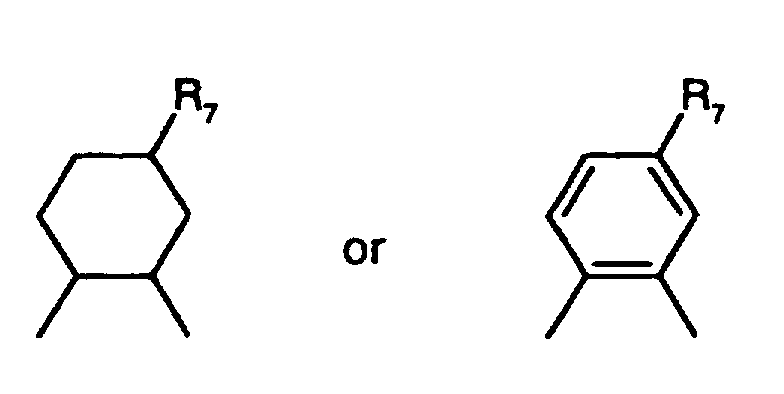
R and R' are each independently from the other hydroxy; COOR1 in which R1 has its previous significance; nitro;
R5 and R6 are each independently from the other hydrogen; linear or branched C1-C4-alkyl; unsubstituted aryl or aryl which is substituted by cyano, halogen, OR1 or COOR1, nitro, linear or branched C1-C8-alkyl, NR3R4 in which R3 and R4 are the same or different and each is hydrogen or linear or branched C1-C12-alkyl; -N⊕R1R3R4 in which R1, R3 and R4 have their previous significance or linear or branched C1-C8-alkylene-R2 in which R2 is OR1, COOR1 or NR3R4. - When Y is a 1,2-cyclohexylene residue, this residue may be in any of its cis/trans stereoisomeric forms.
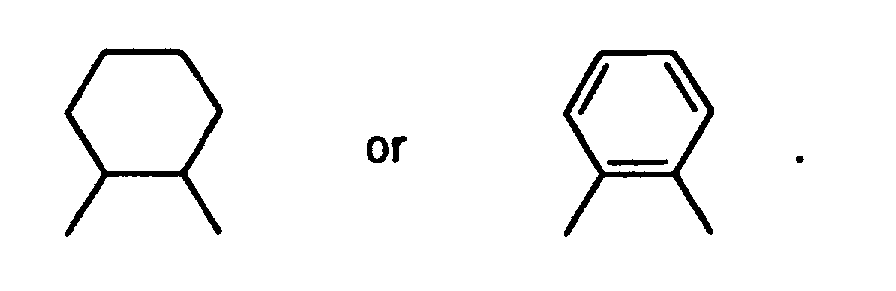
- Y is preferably -[C(R8)2]2 wherein R8 is hydrogen or methyl, -CX=CX- in which X is cyano, -(CH2)q-NR8-(CH2)q- in which R8 has its previous significance and q is 1, 2, 3 or 4; or a 1,2-cyclohexylene or phenylene residue having the formula:
- Preferred halogen atoms R or R' are chlorine, bromine and fluorine atoms.
- When n is 1, preferably the group R or R' respectively is in the 4-position of the respective benzene ring, with the exceptions that when R or R' is nitro or CO2R2, the group R or R' is preferably in the 5-position of the respective benzene ring. When n is 2, preferably the groups R or R' are in the 4,6-positions of the respective benzene ring, with the exceptions that when R or R' is nitro or CO2R2 the groups R or R' are preferably in the 3,5-positions of the respective benzene ring.
- Preferred groups R and R' are hydroxy, or nitro.
- Anions A include halide, especially chloride, perchlorate, sulphate, nitrate, hydroxide, BF4 -, PF6 -, carboxylate, especially acetate, triflate or tosylate.
- Some of the compounds of formula (1) and the ligands from which they are derived are known compounds. For example, in US Patent 5,281,578 there is described the preparation of N,N-bis(4-dimethylaminosalicylidene)diiminoethylene; in EP-A-0 693 550 there is disclosed the production of the manganese complex of N,N-bis(4-diethylaminosalicylidene)diiminoethylene; and in Bernado et.al., Inorg. Chem. 35 (2) 387 (1996), there is disclosed the production of N,N-bis(4-diethylaminosalicylidene)diiminocyclohexylene as well as the production of the manganese complex N,N-bis(4-diethylaminosalicylidene)diiminocyclohexylene. New compounds of formula (1) and new ligands from which they are derived form further aspects of the present invention.
- Moreover, the use, as dye transfer inhibitors, of those compounds of formula (1) in which A is an anion and a) Y is -CH2CH2- each R is di-(C1-C2alkyl)amino; or b) Y is cyclohexylene and each R is di-(C1-C2alkyl)amino has been broadly indicated, but not specifically described, in GB-A-2,296,015. On the other hand, the use, as dye transfer inhibitors, of those compounds of formula (1) in which A is an anion, Y is -CH2CH2- and each R is hydroxy, is believed to be completely new.
- Of particular interest for use in in the method of the present invention is the compound of formula:

- The present invention also provides a detergent composition comprising:
- i) 5-90%,preferably 5-70% of A) an anionic surfactant and/or B) a nonionic surfactant;
- ii) 5-70%, preferably 5-50%, especially 5-40% of C) a builder;
- iii) 0.1-30%, preferably 1-12% of D) a peroxide; and
- iv) 0.005-2%, preferably 0.02-1 %, especially 0.1-0.5% of E) a compound of formula (1) as defined above, each by weight, based on the total weight of the detergent.
-
- The detergent may be formulated as a solid; or as a non-aqueous liquid detergent, containing not more than 5, preferably 0-1 wt.% of water, and based on a suspension of a builder in a non-ionic surfactant, as described, e.g., in GB-A-2158454.
- Preferably, the detergent is in powder or granulate form.
- Such powder or granulate forms may be produced by firstly forming a base powder by spray-drying an aqueous slurry containing all the said components , apart from the components D) and E); then adding the components D) and E) by dry-blending them into the base powder. In a further process, the component E) may be added to an aqueous slurry containing components A), B) and C), followed by spray-drying the slurry prior to dry-blending component D) into the mixture. In a still further process, component B) is not present, or is only partly present in an aqueous slurry containing components A) and C); component E) is incorporated into component B), which is then added to the spray-dried base powder; and finally component D) is dry-blended into the mixture.
- The anionic surfactant component A) may be, e.g., a sulphate, sulphonate or carboxylate surfactant, or a mixture of these.
Preferred sulphates are alkyl sulphates having 12-22 carbon atoms in the alkyl radical, optionally in combination with alkyl ethoxy sulphates having 10-20 carbon atoms in the alkyl radical. - Preferred sulphonates include alkyl benzene sulphonates having 9-15 carbon atoms in the alkyl radical.
In each case, the cation is preferably an alkali metal, especially sodium. - Preferred carboxylates are alkali metal sarcosinates of formula R-CO-N(R1)-CH2COOM1 in which R is alkyl or alkenyl having 9-17 carbon atoms in the alkyl or alkenyl radical, R1 is hydrogen or C1-C4 alkyl and M1 is alkali metal.
- The nonionic surfactant component B) may be, e.g., a condensate of ethylene oxide with a C9-C15 primary alcohol having 3-8 moles of ethylene oxide per mole.
- The builder component C) may be an alkali metal phosphate, especially a tripolyphosphate; a carbonate or bicarbonate, especially the sodium salts thereof; a silicate; an aluminosilicate; a polycarboxylate; a polycarboxylic acid; an organic phosphonate; or an aminoalkylene poly (alkylene phosphonate); or a mixture of these.
- Preferred silicates are crystalline layered sodium silicates of the formula NaHSimO2m+1.pH2O or Na2SimO2m+1.pH2O in which m is a number from 1.9 to 4 and p is 0 to 20.
- Preferred aluminosilicates are the commercially-available synthetic materials designated as Zeolites A, B, X, and HS, or mixtures of these. Zeolite A is preferred.
- Preferred polycarboxylates include hydroxypolycarboxylates, in particular citrates, polyacrylates and their copolymers with maleic anhydride.
- Preferred polycarboxylic acids include nitrilotriacetic acid and ethylene diamine tetra-acetic acid, ethylenediaminedisuccinate in racemic form as well as the enantiomeric S,S-form
- Preferred organic phosphonates or aminoalkylene poly (alkylene phosphonates) are alkali metal ethane 1-hydroxy diphosphonates, nitrilo trimethylene phosphonates, ethylene diamine tetra methylene phosphonates and diethylene triamine penta methylene phosphonates.
- The peroxide component D) may be any organic or inorganic peroxide compound, described in the literature or available on the market, which bleaches textiles at conventional washing temperatures, e.g. temperatures in the range of from 30°C to 90°C. In particular, the organic peroxides are, for example, monoperoxides or polyperoxides having alkyl chains of at least 3, preferably 6 to 20, carbon atoms; in particular diperoxydicarboxylates having 6 to 12 C atoms, such as diperoxyperazelates, diperoxypersebacates, diperoxyphthalates and/or diperoxydodecanedioates, especially their corresponding free acids, are of interest. It is preferred, however, to employ very active inorganic peroxides, such as persulphate, perborate and/or percarbonate. It is, of course, also possible to employ mixtures of organic and/or inorganic peroxides. Peroxides can have different crystalline forms and/or different degrees of hydration. They may be used in admixture with other organic or inorganic salts, thereby improving their stability to storage.
- The addition of the peroxides to the detergent is effected, in particular, by mixing the components, for example by means of screw-metering systems and/or fluidized bed mixers.
- The detergents may contain, in addition to the combination according to the invention, one or more of fluorescent whitening agents, such as a bis-triazinylamino-stilbene-disulphonic acid, a bis-triazolyl-stilbene-disulphonic acid, a bis-styryl-biphenyl, a bis-benzofuranylbiphenyl, a bis-benzoxalyl derivative, a bis-benzimidazolyl derivative, a coumarine derivative or a pyrazoline derivative; soil suspending agents, for example sodium carboxymethylcellulose; salts for adjusting the pH, for example alkali or alkaline earth metal silicates; foam regulators, for example soap; salts for adjusting the spray drying and granulating properties, for example sodium sulphate; perfumes; and also, if appropriate, antistatic and softening agents; such as smectite clays; enzymes, such as amylases; photobleaching agents; pigments; and/or shading agents. These constituents should, of course, be stable to the bleaching system employed.
A particularly preferred detergent co-additive is a polymer known to be useful in preventing the transfer of labile dyes between fabrics during the washing cycle. Preferred examples of such polymers are polyvinyl pyrrolidones, optionally modified by the inclusion of an anionic or cationic substituent, especially those having a molecular weight in the range from 5000 to 60,000, in particular from 10,00 to 50,000. Preferably, such polymer is used in an amount ranging from 0.05 to 5%, preferably 0.2-1.7% by weight, based on the weight of the detergent. - The detergents may additionally contain so-called perborate-activators, e.g. TAGU or, preferably TAED. This is preferably used in an amount of 0,05 through 5 % by weight, especially 0,2 through 1,7 % by weight, relative to the total weight of the detergent.
- The manganese complexes of formula (2) are new compounds and some of the manganese complexes of formula (1) are new too.
- The invention consequently also relates to manganese complexes of formula (3)in which n is 1, 2 or 3;

A is an anion;
R and R' are each independently from the other hydroxy; COOR1 in which R1 has its previous significance;
R1 is hydrogen or C1-C4-alkyl,
Y1 is -CX=CX- in which X is cyano, -(CH2)q-NR1-(CH2)q- in which R1 has its previous significance and q is 1, 2, 3 or 4; linear or branched alkylene of the formula -[C(R1)2]m in which m is an integer ranging from 1 to 8 and each R1 independently from the other has its previous significance, with the proviso that at least one R1 is C1-C4-alkyl; or a 1,2-cyclohexylene or phenylene residue having the formula:in which R7 is hydrogen, CH2OH or CH2NH2 or SO3M, where M is hydrogen, an alkali metal atom, ammonium or a cation formed from an amine,
Y is linear or branched alkylene of the formula -[C(R1)2]m in which m is an integer ranging from 1 to 8 and each R1 independently from the other has its previous significance; CX=CX- in which X is cyano, linear or branched C1-C8-alkyl or di(linear or branched C1-C8-alkyl)-amino; -(CH2)q-NR1-(CH2)q- in which R1 has its previous significance and q is 1, 2, 3 or 4; or a 1,2-cyclohexylene or phenylene residue having the formula:in which R7 is hydrogen, CH2OH or CH2NH2 or SO3M, where M is hydrogen, an alkali metal atom, ammonium or a cation formed from an amine,
R5 and R6 are each independently from the other hydrogen; linear or branched C1-C4-alkyl; unsubstituted aryl or aryl which is substituted by cyano, halogen, OR1 or COOR1, nitro, linear or branched C1-C8-alkyl, NR3R4 in which R3 and R4 are the same or different and each is hydrogen or linear or branched C1-C12-alkyl; -N⊕R1R3R4 in which R1, R3 and R4 have their previous significance or linear or branched C1-C8-alkylene-R2 in which R2 is OR1, COOR1 or NR3R4. - The ligands of formulae (4) which are contained in the manganese complexes are new themselves and these ligands are also part of the instant invention. The invention consequently also relates to compounds of the formula (4)in which n is 1, 2 or 3;

R and R' are each independently from the other hydroxy; COOR1 in which R1 has its previous significance;
R1 is hydrogen or C1-C4-alkyl,
Y1 is -CX=CX- in which X is cyano, -(CH2)q-NR1-(CH2)q- in which R1 has its previous significance and q is 1, 2, 3 or 4; linear or branched alkylene of the formula -[C(R1)2]m in which m is an integer ranging from 1 to 8 and each R1 independently from the other has its previous significance, with the proviso that at least one R1 is C1-C4-alkyl or phenylene residue having the formula:in which R7 is hydrogen, CH2OH or CH2NH2 or SO3M, where M is hydrogen, an alkali metal atom, ammonium or a cation formed from an amine,
R5 and R6 are each independently from the other hydrogen; linear or branched C1-C4-alkyl; unsubstituted aryl or aryl which is substituted by cyano, halogen, OR, or COOR1, nitro, linear or branched C1-C8-alkyl, NR3R4 in which R3 and R4 are the same or different and each is hydrogen or linear or branched C1-C12-alkyl; -N⊕R1R3R4 in which R1, R3 and R4 have their previous significance or linear or branched C1-C8-alkylene-R2 in which R2 is OR1, COOR1 or NR3R4. - The following ligands are known compounds.

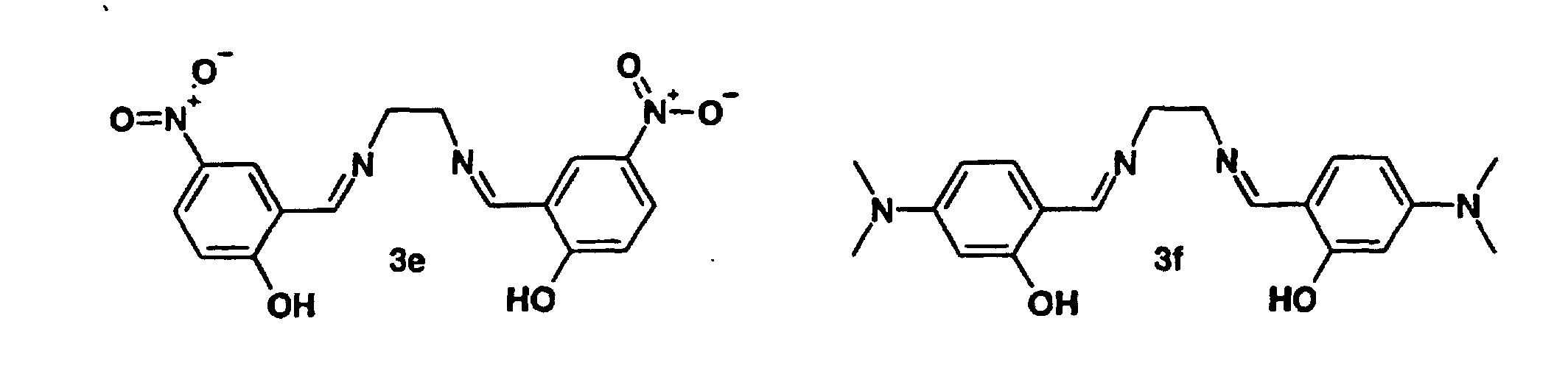
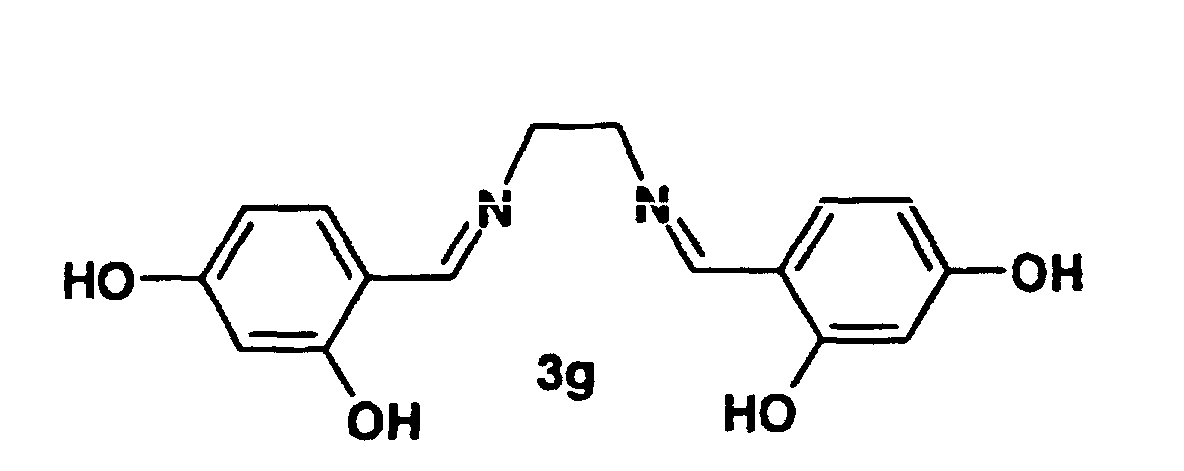
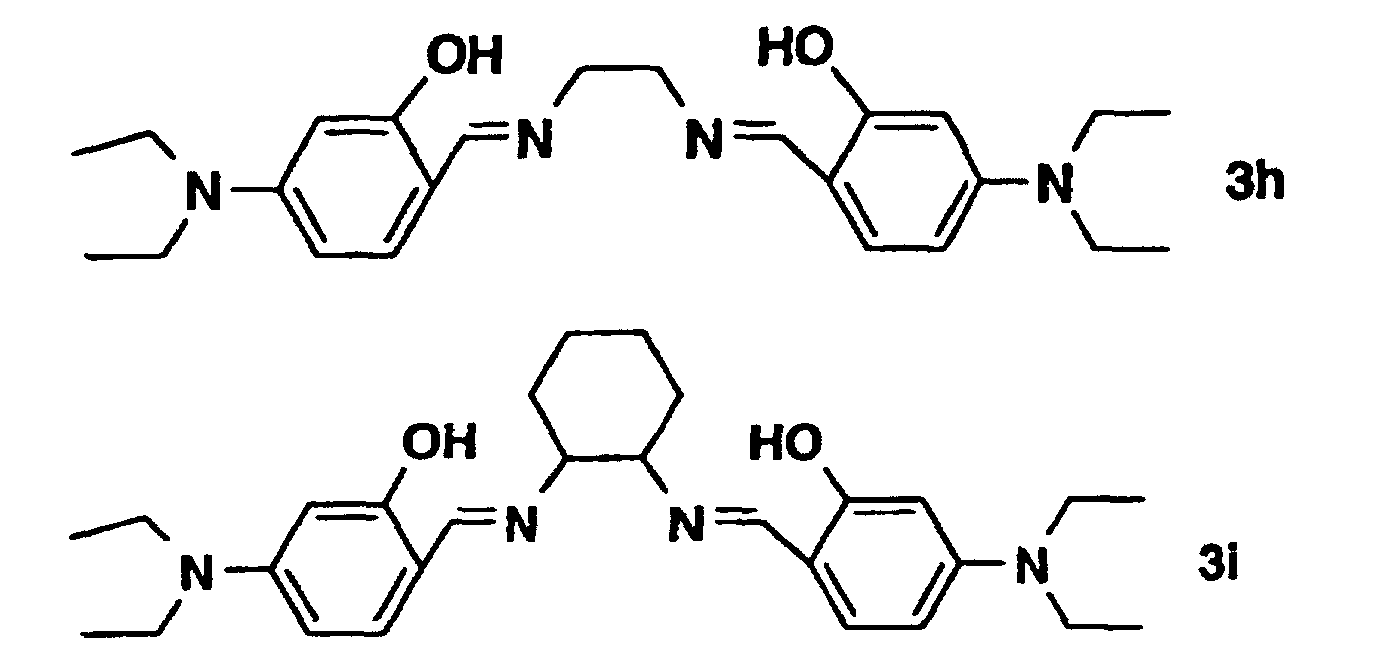
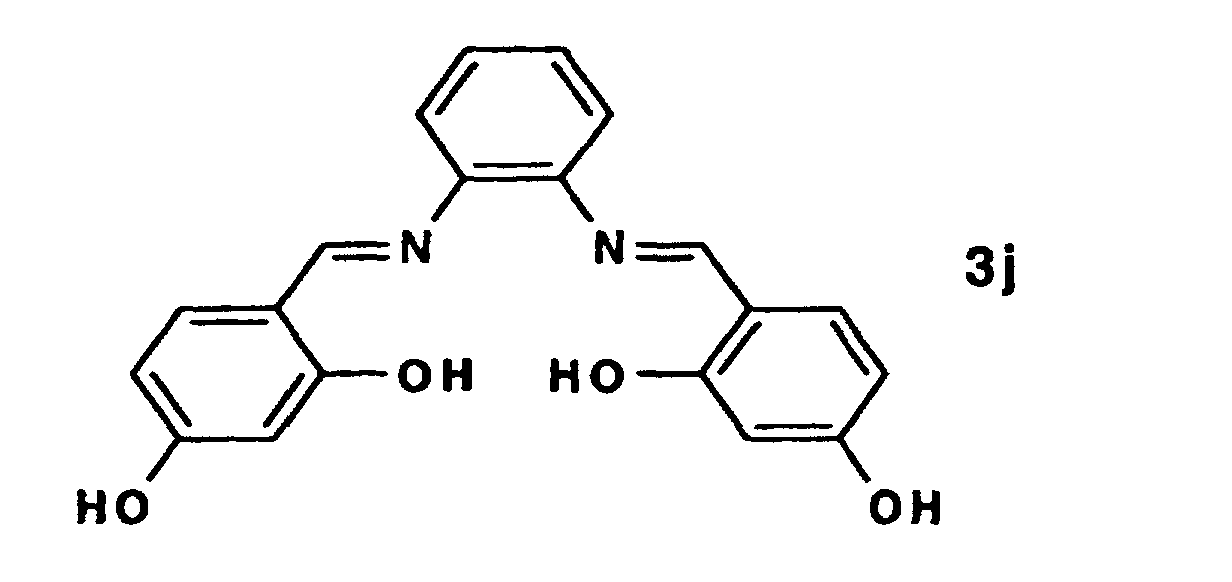
- These ligands were prepared according to known literature procedures:
- All described ligands were transformed into its manganese complexes. The syntheses of these complexes were performed according to the literature as described by E. N. Jacobsen et al. J. Org. Chem., 59 (1994) 1939 or in Patent GB-A-2,296,015. As an example for the standard procedure, the synthesis of the manganese complex 1b is described: To a stirred solution of 667 mg of ligand 3f dissolved in 10 ml of ethanol was added 465 mg manganese-II-acetate-tetrahydrate. The reaction solution was heated at 65 - 70 °C for 4 h. Afterwards, the solution was evaporated and the residue was dissolved in 40 ml of water. The solution were treated with 3.7 g of sodium chloride. The resulting precipitate was filtered and dried in vacuo. The manganese complex was obtained as red-brown powder (820 mg, 86 %).
- Each of the test compounds is then evaluated to determine its activity as a dye transfer inhibitor according to the following method.
- 7.5 g of white cotton are washed in 80 ml of wash liquor. The wash liquor contains 8.6 mmol/l H2O2, a solution of a test dyestuff and 7.5 g/l of the standard detergent ECE phosphate-free (456 IEC) EMPA, Switzerland:
9.74 % Sodium linear alkylbenzenesulfonate ('Marlon A375); 5.19 % Ethoxylated C12-C18 fatty alcohol (7 moles EO); 3.64 % Sodium soap; 6.49% Silicon foam inhibitor; 32.47 % Sodium aluminium silicate Zeolite 4A; 11.82 % Sodium carbonate; 5.19% Sodium salt of acrylic acid/maleic acid copolymer (Sokolan CP 5) 3.38 % Sodium silicate (SiO2:Na2O = 3.3:1); 1.30% Carboxymethylcellulose; 0.26% EDTA; 7.40% Sodium sulfate; 12.21% Water; 0.65% Proteolytic enzyme prills; 0.26% Fluorescent whitening agent; 20.0% Sodium percarbonate; and 3.0% TAED. - The washing is conducted in beakers in a LINITEST apparatus at 40°C. over 30 minutes. The test dye transfer inhibitor is added at a level of 50 µmol/l. The commercially available test dye used is either Cuprophenyl Brown 2GL (Dye 1) used at a level of 10 mg/l of the 250% formulation, or Reactive Blue 238 (Dye 2) used at a level of 6 mg/l of the 100% formulation. The reflection spectra of the respective test samples are measured with a SPECTRAFLASH 2000 instrument and are transformed into brightness values according to the CIE standard procedure.
The percentage DTI (dye transfer inhibition) effectivity (a) is then calculated in accordance with the following equation: - The results obtained are set out in the following Table 1.
Test dye transfer inhibitor DTI effectivity (a) Dye 1 Dye 2 inhibitor 1(C) 80 85 DTI-effiency of manganese complexes derived from known ligands Test dye transfer inhibitor DTI effectivity (a) 3d 61 3e 78 3g (Ligand for Mn complex 1c) cf. table 1 3j 97 - The results in Table 1 clearly demonstrate that claimed manganese complexes exhibit excellent performance as dye transfer inhibitors.
Claims (31)
- A process for inhibiting the re-absorption of migrating dyes in the wash liquor, comprising introducing into a wash liquor containing a peroxide-containing detergent, from 0.5 to 150 mg, per litre of wash liquor, of one or more compounds having the formula:in which n is 1, 2 or 3;
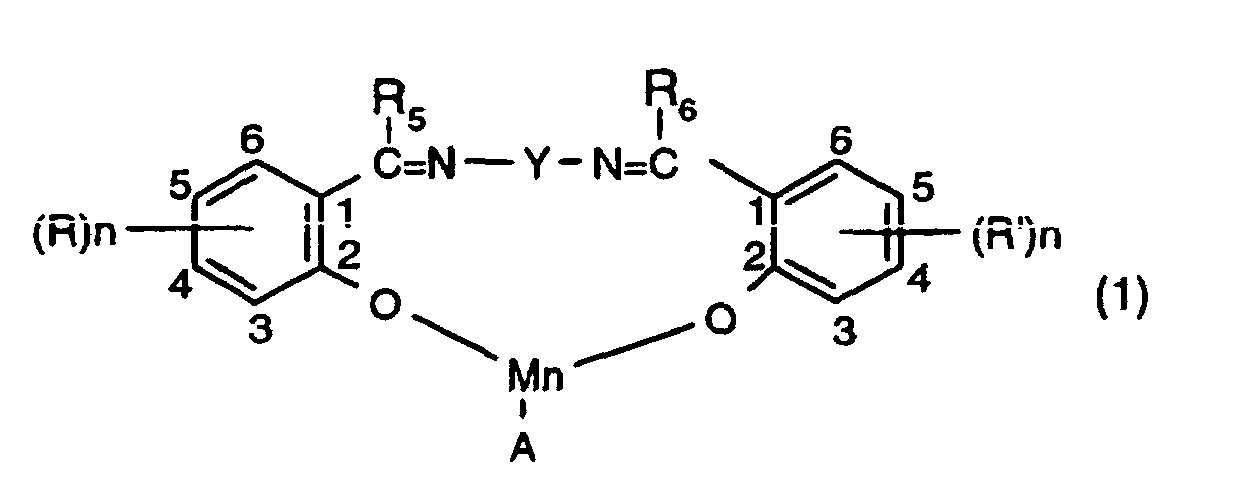
A is an anion;
R1 is hydrogen or C1-C4-alkyl,
Y is linear or branched alkylene of the formula -[C(R1)2]m in which m is an integer ranging from 1 to 8 and each R1 independently from the others has its previous significance;
- CX=CX- in which X is cyano, linear or branched C1-C8-alkyl or di(linear or branched C1-C8-alkyl-amino;
- (CH2)q-NR1-(CH2)q- in which R1 has its previous significance and q is 1, 2, 3 or 4; or a 1,2-cyclohexylene or phenylene residue having the formula:in which R7 is hydrogen, CH2OH or CH2NH2 or SO3M, where M is hydrogen, an alkali metal atom, ammonium or a cation formed from an amine,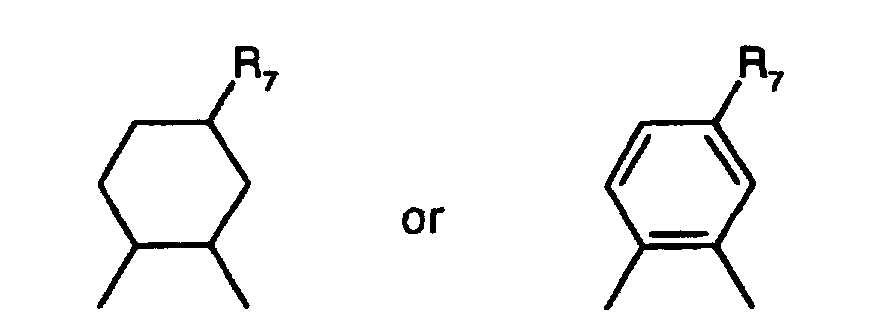
R and R' are each independently from the other hydroxy; COOR1 in which R1 has its previous significance; nitro;
R5 and R6 are each independently from the other hydrogen; linear or branched C1-C4-alkyl; unsubstituted aryl or aryl which is substituted by cyano, halogen, OR1 or COOR1, nitro, linear or branched C1-C8-alkyl, NR3R4 in which R3 and R4 are the same or different and each is hydrogen or linear or branched C1-C12-alkyl; -N⊕R1R3R4 in which R1, R3 and R4 have their previous significance or linear or branched C1-C8-alkylene-R2 in which R2 is OR1, COOR1 or NR3R4. - A process according to claim 1 in which from 1.5 to 75 mg, per litre of wash liquor, of one or more compounds having the formula (1) is introduced into the wash liquor.
- A process according to claim 2 in which from 7.5 to 40 mg, per litre of wash liquor, of one or more compounds having the formula (1) is introduced into the wash liquor.
- A process according to any of the preceding claims in which anion A is halide, perchlorate, sulphate, nitrate, hydroxide, BF4 -, PF6 - or a carboxylate.
- A process according to claim 4 in which the halide anion A is chloride.
- A process according to claim 4 in which the carboxylate anion A is acetate, triflate or tosylate.
- A process according to any of the preceding claims in which Y is -[C(R8)2]2 wherein R8 is hydrogen or methyl, -CX=CX- in which X is cyano, -(CH2)q-NR8-(CH2)q- in which R8 has its previous significance and q is 1, 2, 3 or 4; or a 1,2-cyclohexylene or phenylene residue having the formula:

- A process according to any of the preceding claims in which R and R' are dimethylamino, diethylamino, hydroxy or nitro.
- A process according to any of the preceding claims in which when n is 1, the group R or R' is in the 4-position of the respective benzene ring, with the exceptions that when R or R' is nitro or CO2R2, the group R or R' is in the 5-position of the respective benzene ring.
- A process according to any of claims 1 to 8 in which when n is 2, the groups R or R' are in the 4,6-positions of the respective benzene ring, with the exceptions that when R or R' is nitro or CO2R2 the groups R or R' are in the 3,5-positions of the respective benzene ring.
- A process according to any of the preceding claims in which R or R' is di-(C1-C12alkyl)amino, preferably di-(C1-C8alkyl)amino.
- A process according to claim 11 in which the alkyl moiety in the group di-(C1-C12alkyl)amino contains from 1 to 4 carbon atoms.
- A process according to claim 12 in which the alkyl moiety in the group di-(C1-C12alkyl)amino contains 1 or 2 carbon atoms.
- A process according to any of the preceding claims in which the compound of formula (1) is

- A detergent composition comprising:i) 5-90% of A) an anionic surfactant and/or B) a nonionic surfactant;ii) 5-70% of C) a builder;iii) 0.1-30% of D) a peroxide; andiv) 0.005-2% of E) a compound of formula (1) as defined in claim 1, each by weight, based on the total weight of the detergent.
- A composition according to claim 15 comprising:i) 5-70% of A) an anionic surfactant and/or B) a nonionic surfactant;ii) 5-50% of C) a builder;iii) 1-12% of D) a peroxide; andiv) 0.02-1 % of E) a compound of formula (1) as defined in claim 1, each by weight, based on the total weight of the detergent.
- A composition according to claim 16 comprising:i) 5-70% of A) an anionic surfactant and/or B) a nonionic surfactant;ii) 5-40% of C) a builder;iii) 1-12% of D) a peroxide; andiv) 0.1-0.5% of E) a compound of formula (1) as defined in claim 1, each by weight, based on the total weight of the detergent.
- A composition according to claim 15 comprising a combination of two or more of the compounds of formula (1) as defined in claim 1.
- A composition according to any of claims 15 to 18 comprising 0.5-5% by weight of a polymer useful in preventing the transfer of labile dyes between fabrics during a washing cycle.
- A composition according to claim 19 comprising 0.2-1.7% of the polymer.
- A composition according to claim 19 or 20 in which the polymer is a polyvinylpyrrolidone optionally containing an anionic or cationic substituent.
- A composition according to any of claims 15 to 21 in which the detergent is in powder or granulate form.
- A composition according to any of claims 15 to 21 in which the detergent is in liquid form and contains 0-5% water.
- A composition according to claim 23 in which the detergent is in liquid form and contains 0-1 % water.
- A composition according to claim 15, containing additionally TAGU or TAED:
- A process for the production of a detergent as claimed in claim 22 in which the components of the detergent are mixed in dry form.
- A process for the production of a detergent as claimed in claim 22 in which a base powder is produced by spray-drying an aqueous slurry which contains all the components defined in claim 22, apart from the components D) and E); and then adding the components D) and E) by dry-blending them into the base powder.
- A process for the production of a detergent as claimed in claim 22 in which the component E) is added to the slurry containing components A), B) and C), which slurry is then spray-dried before component D) is dry-blended into the mixture.
- A process for the production of a detergent as claimed in claim 22 in which component B) is not present, or is only partly present in a slurry containing components A) and C); the component E) is incorporated into component B), which is then added to the spray-dried base powder;and finally component D) is dry-blended into the mixture.
- Manganese complexes of formula (3)in which n is 1, 2 or 3;

A is an anion;
R and R' are each independently from the other hydroxy; COOR1 in which R1 has its previous significance;
R1 is hydrogen or C1-C4-alkyl,
Y1 is -CX=CX- in which X is cyano, -(CH2)q-NR1-(CH2)q- in which R1 has its previous significance and q is 1, 2, 3 or 4; linear or branched alkylene of the formula -[C(R1)2]m in which m is an integer ranging from 1 to 8 and each R1 independently from the other has its previous significance, with the proviso that at least one R1 is C1-C4-alkyl; or a 1,2-cyclohexylene or phenylene residue having the formula:in which R7 is hydrogen, CH2OH or CH2NH2 or SO3M, where M is hydrogen, an alkali metal atom, ammonium or a cation formed from an amine,
R5 and R6 are each independently from the other hydrogen; linear or branched C1-C4-alkyl; unsubstituted aryl or aryl which is substituted by cyano, halogen, OR1 or COOR1, nitro, linear or branched C1-C8-alkyl, NR3R4 in which R3 and R4 are the same or different and each is hydrogen or linear or branched C1-C12-alkyl; -N⊕R1R3R4 in which R1, R3 and R4 have their previous significance or linear or branched C1-C8-alkylene-R2 in which R2 is OR1, COOR1 or NR3R4. - Compounds of the formula (4)in which n is 1, 2 or 3;

R and R' are each independently from the other hydroxy; COOR1 in which R1 has its previous significance;
R1 is hydrogen or C1-C4-alkyl,
Y1 is -CX=CX- in which X is cyano, -(CH2)q-NR1-(CH2)q- in which R1 has its previous significance and q is 1, 2, 3 or 4; linear or branched alkylene of the formula -[C(R1)2]m in which m is an integer ranging from 1 to 8 and each R1 independently from the other has its previous significance, with the proviso that at least one R1 is C1-C4-alkyl; phenylene residue having the formula:in which R7 is hydrogen, CH2OH or CH2NH2 or SO3M, where M is hydrogen, an alkali metal atom, ammonium or a cation formed from an amine,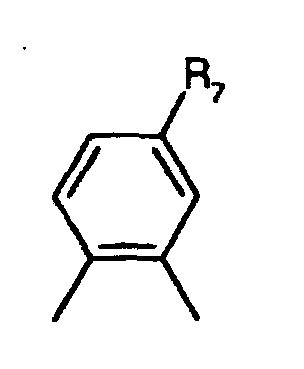
R5 and R6 are each independently from the other hydrogen; linear or branched C1-C4-alkyl; unsubstituted aryl or aryl which is substituted by cyano, halogen, OR1 or COOR1, nitro, linear or branched C1-C8-alkyl, NR3R4 in which R3 and R4 are the same or different and each is hydrogen or linear or branched C1-C12-alkyl; -N⊕R1R3R4 in which R1, R3 and R4 have their previous significance or linear or branched C1-C8-alkylene-R2 in which R2 is OR1, COOR1 or NR3R4.
Applications Claiming Priority (4)
| Application Number | Priority Date | Filing Date | Title |
|---|---|---|---|
| GBGB9719009.4A GB9719009D0 (en) | 1997-09-09 | 1997-09-09 | Fabric care method |
| GB9719009 | 1997-09-09 | ||
| GBGB9816928.7A GB9816928D0 (en) | 1998-08-05 | 1998-08-05 | Fabric care method |
| GB9816928 | 1998-08-05 |
Publications (2)
| Publication Number | Publication Date |
|---|---|
| EP0902083A1 EP0902083A1 (en) | 1999-03-17 |
| EP0902083B1 true EP0902083B1 (en) | 2004-10-13 |
Family
ID=26312203
Family Applications (1)
| Application Number | Title | Priority Date | Filing Date |
|---|---|---|---|
| EP98810870A Expired - Lifetime EP0902083B1 (en) | 1997-09-09 | 1998-09-02 | Fabric care method |
Country Status (13)
| Country | Link |
|---|---|
| US (3) | US6486110B2 (en) |
| EP (1) | EP0902083B1 (en) |
| JP (1) | JPH11171893A (en) |
| KR (1) | KR100601736B1 (en) |
| CN (1) | CN1140664C (en) |
| AR (2) | AR015720A1 (en) |
| AT (1) | ATE279502T1 (en) |
| AU (1) | AU751675B2 (en) |
| BR (1) | BR9803397A (en) |
| CA (1) | CA2246551A1 (en) |
| DE (1) | DE69826951T2 (en) |
| ES (1) | ES2229466T3 (en) |
| ID (1) | ID21053A (en) |
Families Citing this family (18)
| Publication number | Priority date | Publication date | Assignee | Title |
|---|---|---|---|---|
| TW408203B (en) * | 1998-04-06 | 2000-10-11 | Ciba Sc Holding Ag | Process for treating textile materials and the relevant compounds |
| WO2000011129A1 (en) * | 1998-08-19 | 2000-03-02 | Ciba Specialty Chemicals Holding Inc. | Manganese complexes as catalysts for peroxygenated compounds to clean hard surfaces, especially dishes |
| DE60013562D1 (en) | 1999-03-08 | 2004-10-14 | Ciba Sc Holding Ag | METHOD FOR TREATING TEXTILES |
| AU2914300A (en) | 1999-03-08 | 2000-09-28 | Ciba Specialty Chemicals Holding Inc. | Manganese complexes of salen ligands and the use thereof |
| KR20010102518A (en) | 1999-03-08 | 2001-11-15 | 에프. 아. 프라저, 에른스트 알테르 (에. 알테르), 한스 페터 비틀린 (하. 페. 비틀린), 피. 랍 보프, 브이. 스펜글러, 페. 아에글러 | Washing and cleaning process |
| KR100638069B1 (en) * | 1999-07-14 | 2006-10-25 | 시바 스페셜티 케미칼스 홀딩 인크. | Metal Complexes of Trivalent Ligands |
| WO2001009276A1 (en) * | 1999-07-28 | 2001-02-08 | Ciba Specialty Chemicals Holding Inc. | Water-soluble granules of salen-type manganese complexes |
| GB0005089D0 (en) * | 2000-03-01 | 2000-04-26 | Unilever Plc | Bleaching and dye transfer inhibiting composition and method for laundry fabrics |
| BR0112228A (en) | 2000-07-05 | 2003-05-06 | Ciba Sc Holding Ag | Process for the preparation of manganese saline compound complexes |
| KR20030074734A (en) | 2001-01-26 | 2003-09-19 | 시바 스페셜티 케미칼스 홀딩 인크. | Process for the preparation of water-soluble granules or particles of saldimine-type manganese complexes |
| US20030148909A1 (en) * | 2001-09-19 | 2003-08-07 | Valerio Del Duca | Bleaching compositions for dark colored fabric and articles comprising same |
| DE10257279A1 (en) * | 2002-12-07 | 2004-06-24 | Clariant Gmbh | Liquid bleaching agent components containing amphiphilic polymers |
| EP1585721A2 (en) | 2003-01-24 | 2005-10-19 | Ciba SC Holding AG | Crystalline modification of a manganese complex |
| US6833202B2 (en) * | 2003-03-13 | 2004-12-21 | City University Of Hong Kong | Electroluminescent devices |
| AU2004241037B2 (en) * | 2003-05-21 | 2010-07-08 | Basf Se | Stable particulate composition comprising bleach catalysts |
| DE102006012018B3 (en) * | 2006-03-14 | 2007-11-15 | Henkel Kgaa | Color protecting detergent |
| US8822403B2 (en) * | 2011-01-20 | 2014-09-02 | Ecolab Usa Inc. | Detergent composition including a saccharide or sugar alcohol |
| EP3382004A1 (en) | 2017-03-28 | 2018-10-03 | Basf Se | Acylhydrazone granules for use in laundry detergents |
Family Cites Families (11)
| Publication number | Priority date | Publication date | Assignee | Title |
|---|---|---|---|---|
| DE3871462D1 (en) * | 1987-08-22 | 1992-07-02 | Agency Ind Science Techn | GAS SEPARATION MEMBRANE. |
| US5637739A (en) * | 1990-03-21 | 1997-06-10 | Research Corporation Technologies, Inc. | Chiral catalysts and catalytic epoxidation catalyzed thereby |
| CA2077541C (en) * | 1990-03-21 | 1998-08-18 | Eric N. Jacobsen | Chiral catalysts and epoxidation reactions catalyzed thereby |
| ES2121174T3 (en) * | 1993-06-19 | 1998-11-16 | Ciba Geigy Ag | INHIBITION OF REABSORPTION OF MIGRANT DYES IN WASHING LIQUOR. |
| BR9506864A (en) * | 1994-02-04 | 1997-09-09 | Smithkline Beecham Plc | Process to epoxide proqual olefins and a catalyst for them and intermediates to produce the catalyst |
| ATE269392T1 (en) * | 1994-07-21 | 2004-07-15 | Ciba Sc Holding Ag | BLEACHING AGENT COMPOSITION FOR FABRIC |
| GB9425296D0 (en) * | 1994-12-15 | 1995-02-15 | Ciba Geigy Ag | Inhibition of dye migration |
| WO1996024601A1 (en) * | 1995-02-10 | 1996-08-15 | University College Dublin | Complexes, processes for their preparation and their use |
| DE19529905A1 (en) * | 1995-08-15 | 1997-02-20 | Henkel Kgaa | Activator complexes for peroxygen compounds |
| GB9523654D0 (en) | 1995-11-18 | 1996-01-17 | Ciba Geigy Ag | Fabric bleaching composition |
| EP1014996B1 (en) * | 1997-08-28 | 2003-05-28 | University of Washington | Saccharide-containing compositions for treating alzheimer's disease and other amyloidoses |
-
1998
- 1998-09-02 DE DE69826951T patent/DE69826951T2/en not_active Expired - Lifetime
- 1998-09-02 AT AT98810870T patent/ATE279502T1/en not_active IP Right Cessation
- 1998-09-02 EP EP98810870A patent/EP0902083B1/en not_active Expired - Lifetime
- 1998-09-02 ES ES98810870T patent/ES2229466T3/en not_active Expired - Lifetime
- 1998-09-04 CA CA002246551A patent/CA2246551A1/en not_active Abandoned
- 1998-09-07 AR ARP980104454A patent/AR015720A1/en not_active Application Discontinuation
- 1998-09-07 ID IDP981204A patent/ID21053A/en unknown
- 1998-09-08 CN CNB981191134A patent/CN1140664C/en not_active Expired - Fee Related
- 1998-09-08 KR KR1019980036887A patent/KR100601736B1/en not_active Expired - Fee Related
- 1998-09-08 AU AU83184/98A patent/AU751675B2/en not_active Ceased
- 1998-09-09 JP JP10255250A patent/JPH11171893A/en active Pending
- 1998-09-09 BR BR9803397-2A patent/BR9803397A/en not_active IP Right Cessation
-
1999
- 1999-11-11 AR ARP990105746A patent/AR021242A2/en not_active Application Discontinuation
-
2001
- 2001-04-13 US US09/835,176 patent/US6486110B2/en not_active Expired - Fee Related
-
2002
- 2002-02-04 US US10/067,001 patent/US6562775B2/en not_active Expired - Fee Related
-
2003
- 2003-03-12 US US10/386,840 patent/US20030203828A1/en not_active Abandoned
Also Published As
| Publication number | Publication date |
|---|---|
| AU751675B2 (en) | 2002-08-22 |
| CA2246551A1 (en) | 1999-03-09 |
| US20030203828A1 (en) | 2003-10-30 |
| AR021242A2 (en) | 2002-07-03 |
| KR19990029614A (en) | 1999-04-26 |
| CN1140664C (en) | 2004-03-03 |
| DE69826951D1 (en) | 2004-11-18 |
| US20020119899A1 (en) | 2002-08-29 |
| BR9803397A (en) | 1999-12-07 |
| ATE279502T1 (en) | 2004-10-15 |
| ID21053A (en) | 1999-04-08 |
| KR100601736B1 (en) | 2006-12-01 |
| AU8318498A (en) | 1999-03-25 |
| AR015720A1 (en) | 2001-05-16 |
| ES2229466T3 (en) | 2005-04-16 |
| US20010053755A1 (en) | 2001-12-20 |
| CN1210919A (en) | 1999-03-17 |
| US6562775B2 (en) | 2003-05-13 |
| EP0902083A1 (en) | 1999-03-17 |
| JPH11171893A (en) | 1999-06-29 |
| DE69826951T2 (en) | 2006-02-23 |
| US6486110B2 (en) | 2002-11-26 |
Similar Documents
| Publication | Publication Date | Title |
|---|---|---|
| US5741920A (en) | Inhibition of re-absorption of migrating dyes in the wash liquor | |
| US5965506A (en) | Fabric bleaching composition | |
| US6562775B2 (en) | Fabric care method | |
| EP0717103B1 (en) | Inhibition of dye migration | |
| US6528469B2 (en) | Fabric bleaching composition | |
| US6228127B1 (en) | Bleaching or washing composition | |
| US20020183228A1 (en) | Process for treating textile materials | |
| US6399558B1 (en) | Washing and cleaning process | |
| MXPA98007313A (en) | Method for caring for te | |
| GB2322129A (en) | Polyazabicyclic compounds | |
| GB2325001A (en) | Manganese complexes | |
| MXPA99003156A (en) | Method of treatment of textiles |
Legal Events
| Date | Code | Title | Description |
|---|---|---|---|
| PUAI | Public reference made under article 153(3) epc to a published international application that has entered the european phase |
Free format text: ORIGINAL CODE: 0009012 |
|
| AK | Designated contracting states |
Kind code of ref document: A1 Designated state(s): AT BE CH DE DK ES FR GB GR IT LI NL PT SE |
|
| AX | Request for extension of the european patent |
Free format text: AL;LT;LV;MK;RO;SI |
|
| AKX | Designation fees paid | ||
| 17P | Request for examination filed |
Effective date: 19990729 |
|
| RBV | Designated contracting states (corrected) |
Designated state(s): AT BE CH DE DK ES FR GB GR IT LI NL PT SE |
|
| 17Q | First examination report despatched |
Effective date: 20021230 |
|
| GRAP | Despatch of communication of intention to grant a patent |
Free format text: ORIGINAL CODE: EPIDOSNIGR1 |
|
| GRAS | Grant fee paid |
Free format text: ORIGINAL CODE: EPIDOSNIGR3 |
|
| GRAA | (expected) grant |
Free format text: ORIGINAL CODE: 0009210 |
|
| AK | Designated contracting states |
Kind code of ref document: B1 Designated state(s): AT BE CH DE DK ES FR GB GR IT LI NL PT SE |
|
| PG25 | Lapsed in a contracting state [announced via postgrant information from national office to epo] |
Ref country code: NL Free format text: LAPSE BECAUSE OF FAILURE TO SUBMIT A TRANSLATION OF THE DESCRIPTION OR TO PAY THE FEE WITHIN THE PRESCRIBED TIME-LIMIT Effective date: 20041013 Ref country code: BE Free format text: LAPSE BECAUSE OF FAILURE TO SUBMIT A TRANSLATION OF THE DESCRIPTION OR TO PAY THE FEE WITHIN THE PRESCRIBED TIME-LIMIT Effective date: 20041013 Ref country code: AT Free format text: LAPSE BECAUSE OF FAILURE TO SUBMIT A TRANSLATION OF THE DESCRIPTION OR TO PAY THE FEE WITHIN THE PRESCRIBED TIME-LIMIT Effective date: 20041013 |
|
| REG | Reference to a national code |
Ref country code: GB Ref legal event code: FG4D |
|
| REG | Reference to a national code |
Ref country code: CH Ref legal event code: EP |
|
| REF | Corresponds to: |
Ref document number: 69826951 Country of ref document: DE Date of ref document: 20041118 Kind code of ref document: P |
|
| PG25 | Lapsed in a contracting state [announced via postgrant information from national office to epo] |
Ref country code: SE Free format text: LAPSE BECAUSE OF FAILURE TO SUBMIT A TRANSLATION OF THE DESCRIPTION OR TO PAY THE FEE WITHIN THE PRESCRIBED TIME-LIMIT Effective date: 20050113 Ref country code: GR Free format text: LAPSE BECAUSE OF FAILURE TO SUBMIT A TRANSLATION OF THE DESCRIPTION OR TO PAY THE FEE WITHIN THE PRESCRIBED TIME-LIMIT Effective date: 20050113 Ref country code: DK Free format text: LAPSE BECAUSE OF FAILURE TO SUBMIT A TRANSLATION OF THE DESCRIPTION OR TO PAY THE FEE WITHIN THE PRESCRIBED TIME-LIMIT Effective date: 20050113 |
|
| NLV1 | Nl: lapsed or annulled due to failure to fulfill the requirements of art. 29p and 29m of the patents act | ||
| REG | Reference to a national code |
Ref country code: ES Ref legal event code: FG2A Ref document number: 2229466 Country of ref document: ES Kind code of ref document: T3 |
|
| PLBE | No opposition filed within time limit |
Free format text: ORIGINAL CODE: 0009261 |
|
| STAA | Information on the status of an ep patent application or granted ep patent |
Free format text: STATUS: NO OPPOSITION FILED WITHIN TIME LIMIT |
|
| ET | Fr: translation filed | ||
| 26N | No opposition filed |
Effective date: 20050714 |
|
| PG25 | Lapsed in a contracting state [announced via postgrant information from national office to epo] |
Ref country code: PT Free format text: LAPSE BECAUSE OF NON-PAYMENT OF DUE FEES Effective date: 20050313 |
|
| REG | Reference to a national code |
Ref country code: CH Ref legal event code: PFA Owner name: CIBA HOLDING INC. Free format text: CIBA SPECIALTY CHEMICALS HOLDING INC.#KLYBECKSTRASSE 141#4057 BASEL (CH) -TRANSFER TO- CIBA HOLDING INC.#KLYBECKSTRASSE 141#4057 BASEL (CH) |
|
| PGFP | Annual fee paid to national office [announced via postgrant information from national office to epo] |
Ref country code: ES Payment date: 20090924 Year of fee payment: 12 |
|
| PGFP | Annual fee paid to national office [announced via postgrant information from national office to epo] |
Ref country code: GB Payment date: 20090807 Year of fee payment: 12 Ref country code: CH Payment date: 20090731 Year of fee payment: 12 |
|
| PGFP | Annual fee paid to national office [announced via postgrant information from national office to epo] |
Ref country code: DE Payment date: 20090922 Year of fee payment: 12 |
|
| PGFP | Annual fee paid to national office [announced via postgrant information from national office to epo] |
Ref country code: IT Payment date: 20090908 Year of fee payment: 12 |
|
| REG | Reference to a national code |
Ref country code: CH Ref legal event code: PL |
|
| GBPC | Gb: european patent ceased through non-payment of renewal fee |
Effective date: 20100902 |
|
| PG25 | Lapsed in a contracting state [announced via postgrant information from national office to epo] |
Ref country code: IT Free format text: LAPSE BECAUSE OF NON-PAYMENT OF DUE FEES Effective date: 20100902 |
|
| REG | Reference to a national code |
Ref country code: FR Ref legal event code: ST Effective date: 20110531 |
|
| REG | Reference to a national code |
Ref country code: DE Ref legal event code: R119 Ref document number: 69826951 Country of ref document: DE Effective date: 20110401 |
|
| PG25 | Lapsed in a contracting state [announced via postgrant information from national office to epo] |
Ref country code: LI Free format text: LAPSE BECAUSE OF NON-PAYMENT OF DUE FEES Effective date: 20100930 Ref country code: CH Free format text: LAPSE BECAUSE OF NON-PAYMENT OF DUE FEES Effective date: 20100930 Ref country code: FR Free format text: LAPSE BECAUSE OF NON-PAYMENT OF DUE FEES Effective date: 20100930 Ref country code: DE Free format text: LAPSE BECAUSE OF NON-PAYMENT OF DUE FEES Effective date: 20110401 |
|
| PG25 | Lapsed in a contracting state [announced via postgrant information from national office to epo] |
Ref country code: GB Free format text: LAPSE BECAUSE OF NON-PAYMENT OF DUE FEES Effective date: 20100902 |
|
| PGFP | Annual fee paid to national office [announced via postgrant information from national office to epo] |
Ref country code: FR Payment date: 20091001 Year of fee payment: 12 |
|
| REG | Reference to a national code |
Ref country code: ES Ref legal event code: FD2A Effective date: 20111019 |
|
| PG25 | Lapsed in a contracting state [announced via postgrant information from national office to epo] |
Ref country code: ES Free format text: LAPSE BECAUSE OF NON-PAYMENT OF DUE FEES Effective date: 20100903 |