EP0901453B1 - Method for organic reactions - Google Patents
Method for organic reactions Download PDFInfo
- Publication number
- EP0901453B1 EP0901453B1 EP97923387A EP97923387A EP0901453B1 EP 0901453 B1 EP0901453 B1 EP 0901453B1 EP 97923387 A EP97923387 A EP 97923387A EP 97923387 A EP97923387 A EP 97923387A EP 0901453 B1 EP0901453 B1 EP 0901453B1
- Authority
- EP
- European Patent Office
- Prior art keywords
- org
- organic
- reaction
- reactions
- mmol
- Prior art date
- Legal status (The legal status is an assumption and is not a legal conclusion. Google has not performed a legal analysis and makes no representation as to the accuracy of the status listed.)
- Expired - Lifetime
Links
- 238000000034 method Methods 0.000 title claims abstract description 48
- 238000006053 organic reaction Methods 0.000 title claims abstract description 28
- 238000006243 chemical reaction Methods 0.000 claims abstract description 65
- KDLHZDBZIXYQEI-UHFFFAOYSA-N Palladium Chemical compound [Pd] KDLHZDBZIXYQEI-UHFFFAOYSA-N 0.000 claims abstract description 29
- 238000005859 coupling reaction Methods 0.000 claims abstract description 13
- 229910052763 palladium Inorganic materials 0.000 claims abstract description 8
- 239000011203 carbon fibre reinforced carbon Substances 0.000 claims abstract description 4
- 239000007787 solid Substances 0.000 claims description 18
- -1 acetylenyl Chemical group 0.000 claims description 14
- 125000001072 heteroaryl group Chemical group 0.000 claims description 12
- 125000000217 alkyl group Chemical group 0.000 claims description 10
- 125000003118 aryl group Chemical group 0.000 claims description 9
- 125000003903 2-propenyl group Chemical group [H]C([*])([H])C([H])=C([H])[H] 0.000 claims description 8
- 125000000391 vinyl group Chemical group [H]C([*])=C([H])[H] 0.000 claims description 8
- 229920002554 vinyl polymer Polymers 0.000 claims description 8
- 150000001336 alkenes Chemical class 0.000 claims description 6
- 125000001797 benzyl group Chemical group [H]C1=C([H])C([H])=C(C([H])=C1[H])C([H])([H])* 0.000 claims description 6
- 150000003839 salts Chemical class 0.000 claims description 5
- 125000003236 benzoyl group Chemical group [H]C1=C([H])C([H])=C(C([H])=C1[H])C(*)=O 0.000 claims description 4
- 125000003107 substituted aryl group Chemical group 0.000 claims description 4
- 150000004820 halides Chemical class 0.000 claims description 3
- JRZJOMJEPLMPRA-UHFFFAOYSA-N olefin Natural products CCCCCCCC=C JRZJOMJEPLMPRA-UHFFFAOYSA-N 0.000 claims description 3
- 125000002252 acyl group Chemical group 0.000 claims description 2
- 125000003545 alkoxy group Chemical group 0.000 claims description 2
- 125000004104 aryloxy group Chemical group 0.000 claims description 2
- CREMABGTGYGIQB-UHFFFAOYSA-N carbon carbon Chemical compound C.C CREMABGTGYGIQB-UHFFFAOYSA-N 0.000 claims description 2
- 239000012954 diazonium Substances 0.000 claims description 2
- 150000001989 diazonium salts Chemical class 0.000 claims description 2
- 125000005553 heteroaryloxy group Chemical group 0.000 claims description 2
- 125000004435 hydrogen atom Chemical group [H]* 0.000 claims description 2
- 125000002887 hydroxy group Chemical group [H]O* 0.000 claims description 2
- 239000000126 substance Substances 0.000 claims description 2
- 125000000547 substituted alkyl group Chemical group 0.000 claims description 2
- 150000003461 sulfonyl halides Chemical class 0.000 claims description 2
- ITMCEJHCFYSIIV-UHFFFAOYSA-M triflate Chemical compound [O-]S(=O)(=O)C(F)(F)F ITMCEJHCFYSIIV-UHFFFAOYSA-M 0.000 claims description 2
- 238000006069 Suzuki reaction reaction Methods 0.000 abstract description 15
- 238000010438 heat treatment Methods 0.000 abstract description 13
- 238000006619 Stille reaction Methods 0.000 abstract description 12
- 230000035484 reaction time Effects 0.000 abstract description 12
- 238000007341 Heck reaction Methods 0.000 abstract description 10
- IJGRMHOSHXDMSA-UHFFFAOYSA-N Atomic nitrogen Chemical compound N#N IJGRMHOSHXDMSA-UHFFFAOYSA-N 0.000 description 30
- 239000000047 product Substances 0.000 description 28
- XLYOFNOQVPJJNP-UHFFFAOYSA-N water Substances O XLYOFNOQVPJJNP-UHFFFAOYSA-N 0.000 description 26
- RTZKZFJDLAIYFH-UHFFFAOYSA-N Diethyl ether Chemical compound CCOCC RTZKZFJDLAIYFH-UHFFFAOYSA-N 0.000 description 24
- AFABGHUZZDYHJO-UHFFFAOYSA-N 2-Methylpentane Chemical compound CCCC(C)C AFABGHUZZDYHJO-UHFFFAOYSA-N 0.000 description 18
- ZMANZCXQSJIPKH-UHFFFAOYSA-N Triethylamine Chemical compound CCN(CC)CC ZMANZCXQSJIPKH-UHFFFAOYSA-N 0.000 description 18
- 239000000203 mixture Substances 0.000 description 17
- 229910052757 nitrogen Inorganic materials 0.000 description 15
- 238000001816 cooling Methods 0.000 description 14
- 230000000694 effects Effects 0.000 description 14
- YMWUJEATGCHHMB-UHFFFAOYSA-N Dichloromethane Chemical compound ClCCl YMWUJEATGCHHMB-UHFFFAOYSA-N 0.000 description 12
- 239000012043 crude product Substances 0.000 description 12
- 239000011347 resin Substances 0.000 description 12
- 229920005989 resin Polymers 0.000 description 12
- VYPSYNLAJGMNEJ-UHFFFAOYSA-N Silicium dioxide Chemical compound O=[Si]=O VYPSYNLAJGMNEJ-UHFFFAOYSA-N 0.000 description 11
- 239000000284 extract Substances 0.000 description 11
- YJVFFLUZDVXJQI-UHFFFAOYSA-L palladium(ii) acetate Chemical compound [Pd+2].CC([O-])=O.CC([O-])=O YJVFFLUZDVXJQI-UHFFFAOYSA-L 0.000 description 11
- BAPJBEWLBFYGME-UHFFFAOYSA-N Methyl acrylate Chemical compound COC(=O)C=C BAPJBEWLBFYGME-UHFFFAOYSA-N 0.000 description 10
- 238000004440 column chromatography Methods 0.000 description 10
- 239000003480 eluent Substances 0.000 description 10
- 239000000741 silica gel Substances 0.000 description 10
- 229910002027 silica gel Inorganic materials 0.000 description 10
- RIOQSEWOXXDEQQ-UHFFFAOYSA-N triphenylphosphine Chemical compound C1=CC=CC=C1P(C=1C=CC=CC=1)C1=CC=CC=C1 RIOQSEWOXXDEQQ-UHFFFAOYSA-N 0.000 description 10
- OFBQJSOFQDEBGM-UHFFFAOYSA-N Pentane Chemical compound CCCCC OFBQJSOFQDEBGM-UHFFFAOYSA-N 0.000 description 8
- PPBRXRYQALVLMV-UHFFFAOYSA-N Styrene Chemical compound C=CC1=CC=CC=C1 PPBRXRYQALVLMV-UHFFFAOYSA-N 0.000 description 8
- 238000006254 arylation reaction Methods 0.000 description 8
- 239000007790 solid phase Substances 0.000 description 8
- WEVYAHXRMPXWCK-UHFFFAOYSA-N Acetonitrile Chemical compound CC#N WEVYAHXRMPXWCK-UHFFFAOYSA-N 0.000 description 7
- 238000006555 catalytic reaction Methods 0.000 description 7
- LFQSCWFLJHTTHZ-UHFFFAOYSA-N Ethanol Chemical compound CCO LFQSCWFLJHTTHZ-UHFFFAOYSA-N 0.000 description 6
- OKKJLVBELUTLKV-UHFFFAOYSA-N Methanol Chemical compound OC OKKJLVBELUTLKV-UHFFFAOYSA-N 0.000 description 6
- 230000003197 catalytic effect Effects 0.000 description 6
- 230000008878 coupling Effects 0.000 description 6
- 238000010168 coupling process Methods 0.000 description 6
- BWHMMNNQKKPAPP-UHFFFAOYSA-L potassium carbonate Chemical compound [K+].[K+].[O-]C([O-])=O BWHMMNNQKKPAPP-UHFFFAOYSA-L 0.000 description 6
- 241000894007 species Species 0.000 description 6
- 239000012267 brine Substances 0.000 description 5
- 239000003054 catalyst Substances 0.000 description 5
- 239000000376 reactant Substances 0.000 description 5
- HPALAKNZSZLMCH-UHFFFAOYSA-M sodium;chloride;hydrate Chemical compound O.[Na+].[Cl-] HPALAKNZSZLMCH-UHFFFAOYSA-M 0.000 description 5
- 238000003786 synthesis reaction Methods 0.000 description 5
- KZPYGQFFRCFCPP-UHFFFAOYSA-N 1,1'-bis(diphenylphosphino)ferrocene Chemical compound [Fe+2].C1=CC=C[C-]1P(C=1C=CC=CC=1)C1=CC=CC=C1.C1=CC=C[C-]1P(C=1C=CC=CC=1)C1=CC=CC=C1 KZPYGQFFRCFCPP-UHFFFAOYSA-N 0.000 description 4
- UZKWTJUDCOPSNM-UHFFFAOYSA-N 1-ethenoxybutane Chemical compound CCCCOC=C UZKWTJUDCOPSNM-UHFFFAOYSA-N 0.000 description 4
- RZVAJINKPMORJF-UHFFFAOYSA-N Acetaminophen Chemical compound CC(=O)NC1=CC=C(O)C=C1 RZVAJINKPMORJF-UHFFFAOYSA-N 0.000 description 4
- 125000001246 bromo group Chemical group Br* 0.000 description 4
- 239000003153 chemical reaction reagent Substances 0.000 description 4
- 238000005516 engineering process Methods 0.000 description 4
- 239000003446 ligand Substances 0.000 description 4
- HXITXNWTGFUOAU-UHFFFAOYSA-N phenylboronic acid Chemical compound OB(O)C1=CC=CC=C1 HXITXNWTGFUOAU-UHFFFAOYSA-N 0.000 description 4
- 239000005297 pyrex Substances 0.000 description 4
- 238000012552 review Methods 0.000 description 4
- 239000002904 solvent Substances 0.000 description 4
- COIOYMYWGDAQPM-UHFFFAOYSA-N tris(2-methylphenyl)phosphane Chemical compound CC1=CC=CC=C1P(C=1C(=CC=CC=1)C)C1=CC=CC=C1C COIOYMYWGDAQPM-UHFFFAOYSA-N 0.000 description 4
- NLHHRLWOUZZQLW-UHFFFAOYSA-N Acrylonitrile Chemical compound C=CC#N NLHHRLWOUZZQLW-UHFFFAOYSA-N 0.000 description 3
- IAZDPXIOMUYVGZ-UHFFFAOYSA-N Dimethylsulphoxide Chemical compound CS(C)=O IAZDPXIOMUYVGZ-UHFFFAOYSA-N 0.000 description 3
- XEKOWRVHYACXOJ-UHFFFAOYSA-N Ethyl acetate Chemical compound CCOC(C)=O XEKOWRVHYACXOJ-UHFFFAOYSA-N 0.000 description 3
- CDBYLPFSWZWCQE-UHFFFAOYSA-L Sodium Carbonate Chemical compound [Na+].[Na+].[O-]C([O-])=O CDBYLPFSWZWCQE-UHFFFAOYSA-L 0.000 description 3
- HEMHJVSKTPXQMS-UHFFFAOYSA-M Sodium hydroxide Chemical compound [OH-].[Na+] HEMHJVSKTPXQMS-UHFFFAOYSA-M 0.000 description 3
- 239000002253 acid Substances 0.000 description 3
- 150000007513 acids Chemical class 0.000 description 3
- 238000007792 addition Methods 0.000 description 3
- YCOXTKKNXUZSKD-UHFFFAOYSA-N as-o-xylenol Natural products CC1=CC=C(O)C=C1C YCOXTKKNXUZSKD-UHFFFAOYSA-N 0.000 description 3
- 239000006227 byproduct Substances 0.000 description 3
- 239000013078 crystal Substances 0.000 description 3
- 238000000354 decomposition reaction Methods 0.000 description 3
- 238000002474 experimental method Methods 0.000 description 3
- 150000008282 halocarbons Chemical class 0.000 description 3
- SNHMUERNLJLMHN-UHFFFAOYSA-N iodobenzene Chemical compound IC1=CC=CC=C1 SNHMUERNLJLMHN-UHFFFAOYSA-N 0.000 description 3
- 238000011068 loading method Methods 0.000 description 3
- GBCKRQRXNXQQPW-UHFFFAOYSA-N n,n-dimethylprop-2-en-1-amine Chemical compound CN(C)CC=C GBCKRQRXNXQQPW-UHFFFAOYSA-N 0.000 description 3
- MDWRQYBWVTXIIJ-UHFFFAOYSA-N naphthalen-2-yl trifluoromethanesulfonate Chemical compound C1=CC=CC2=CC(OS(=O)(=O)C(F)(F)F)=CC=C21 MDWRQYBWVTXIIJ-UHFFFAOYSA-N 0.000 description 3
- 229910000027 potassium carbonate Inorganic materials 0.000 description 3
- 239000000243 solution Substances 0.000 description 3
- 238000006467 substitution reaction Methods 0.000 description 3
- 150000008648 triflates Chemical class 0.000 description 3
- BPLUKJNHPBNVQL-UHFFFAOYSA-N triphenylarsine Chemical compound C1=CC=CC=C1[As](C=1C=CC=CC=1)C1=CC=CC=C1 BPLUKJNHPBNVQL-UHFFFAOYSA-N 0.000 description 3
- CYPYTURSJDMMMP-WVCUSYJESA-N (1e,4e)-1,5-diphenylpenta-1,4-dien-3-one;palladium Chemical compound [Pd].[Pd].C=1C=CC=CC=1\C=C\C(=O)\C=C\C1=CC=CC=C1.C=1C=CC=CC=1\C=C\C(=O)\C=C\C1=CC=CC=C1.C=1C=CC=CC=1\C=C\C(=O)\C=C\C1=CC=CC=C1 CYPYTURSJDMMMP-WVCUSYJESA-N 0.000 description 2
- RUMMIUOXQGFCEP-UHFFFAOYSA-N (4-acetylphenyl) trifluoromethanesulfonate Chemical compound CC(=O)C1=CC=C(OS(=O)(=O)C(F)(F)F)C=C1 RUMMIUOXQGFCEP-UHFFFAOYSA-N 0.000 description 2
- LVEYOSJUKRVCCF-UHFFFAOYSA-N 1,3-bis(diphenylphosphino)propane Chemical compound C=1C=CC=CC=1P(C=1C=CC=CC=1)CCCP(C=1C=CC=CC=1)C1=CC=CC=C1 LVEYOSJUKRVCCF-UHFFFAOYSA-N 0.000 description 2
- UCCUXODGPMAHRL-UHFFFAOYSA-N 1-bromo-4-iodobenzene Chemical compound BrC1=CC=C(I)C=C1 UCCUXODGPMAHRL-UHFFFAOYSA-N 0.000 description 2
- ZBTMRBYMKUEVEU-UHFFFAOYSA-N 1-bromo-4-methylbenzene Chemical compound CC1=CC=C(Br)C=C1 ZBTMRBYMKUEVEU-UHFFFAOYSA-N 0.000 description 2
- NHPPIJMARIVBGU-UHFFFAOYSA-N 1-iodonaphthalene Chemical compound C1=CC=C2C(I)=CC=CC2=C1 NHPPIJMARIVBGU-UHFFFAOYSA-N 0.000 description 2
- JKTCBAGSMQIFNL-UHFFFAOYSA-N 2,3-dihydrofuran Chemical compound C1CC=CO1 JKTCBAGSMQIFNL-UHFFFAOYSA-N 0.000 description 2
- JWCDUUFOAZFFMX-UHFFFAOYSA-N 2-ethenoxy-n,n-dimethylethanamine Chemical compound CN(C)CCOC=C JWCDUUFOAZFFMX-UHFFFAOYSA-N 0.000 description 2
- PQHIJMWKRKSDNQ-UHFFFAOYSA-N 2-phenyl-2,3-dihydrofuran Chemical compound C1C=COC1C1=CC=CC=C1 PQHIJMWKRKSDNQ-UHFFFAOYSA-N 0.000 description 2
- ZZLCFHIKESPLTH-UHFFFAOYSA-N 4-Methylbiphenyl Chemical group C1=CC(C)=CC=C1C1=CC=CC=C1 ZZLCFHIKESPLTH-UHFFFAOYSA-N 0.000 description 2
- KWOLFJPFCHCOCG-UHFFFAOYSA-N Acetophenone Chemical compound CC(=O)C1=CC=CC=C1 KWOLFJPFCHCOCG-UHFFFAOYSA-N 0.000 description 2
- OKTJSMMVPCPJKN-UHFFFAOYSA-N Carbon Chemical group [C] OKTJSMMVPCPJKN-UHFFFAOYSA-N 0.000 description 2
- 241000819038 Chichester Species 0.000 description 2
- 238000000023 Kugelrohr distillation Methods 0.000 description 2
- NFHFRUOZVGFOOS-UHFFFAOYSA-N Pd(PPh3)4 Substances [Pd].C1=CC=CC=C1P(C=1C=CC=CC=1)C1=CC=CC=C1.C1=CC=CC=C1P(C=1C=CC=CC=1)C1=CC=CC=C1.C1=CC=CC=C1P(C=1C=CC=CC=1)C1=CC=CC=C1.C1=CC=CC=C1P(C=1C=CC=CC=1)C1=CC=CC=C1 NFHFRUOZVGFOOS-UHFFFAOYSA-N 0.000 description 2
- 239000008346 aqueous phase Substances 0.000 description 2
- 150000001502 aryl halides Chemical class 0.000 description 2
- 150000001503 aryl iodides Chemical class 0.000 description 2
- MUALRAIOVNYAIW-UHFFFAOYSA-N binap Chemical compound C1=CC=CC=C1P(C=1C(=C2C=CC=CC2=CC=1)C=1C2=CC=CC=C2C=CC=1P(C=1C=CC=CC=1)C=1C=CC=CC=1)C1=CC=CC=C1 MUALRAIOVNYAIW-UHFFFAOYSA-N 0.000 description 2
- 229910052799 carbon Inorganic materials 0.000 description 2
- 238000000605 extraction Methods 0.000 description 2
- 239000000706 filtrate Substances 0.000 description 2
- 238000013537 high throughput screening Methods 0.000 description 2
- KWGKDLIKAYFUFQ-UHFFFAOYSA-M lithium chloride Chemical compound [Li+].[Cl-] KWGKDLIKAYFUFQ-UHFFFAOYSA-M 0.000 description 2
- 229910052751 metal Inorganic materials 0.000 description 2
- 239000002184 metal Substances 0.000 description 2
- WXHIJDCHNDBCNY-UHFFFAOYSA-N palladium dihydride Chemical compound [PdH2] WXHIJDCHNDBCNY-UHFFFAOYSA-N 0.000 description 2
- SCVFZCLFOSHCOH-UHFFFAOYSA-M potassium acetate Chemical compound [K+].CC([O-])=O SCVFZCLFOSHCOH-UHFFFAOYSA-M 0.000 description 2
- 239000011541 reaction mixture Substances 0.000 description 2
- 125000001424 substituent group Chemical group 0.000 description 2
- 239000000758 substrate Substances 0.000 description 2
- NHGXDBSUJJNIRV-UHFFFAOYSA-M tetrabutylammonium chloride Chemical compound [Cl-].CCCC[N+](CCCC)(CCCC)CCCC NHGXDBSUJJNIRV-UHFFFAOYSA-M 0.000 description 2
- 230000009466 transformation Effects 0.000 description 2
- 229910052723 transition metal Inorganic materials 0.000 description 2
- 150000003624 transition metals Chemical class 0.000 description 2
- SYUVAXDZVWPKSI-UHFFFAOYSA-N tributyl(phenyl)stannane Chemical compound CCCC[Sn](CCCC)(CCCC)C1=CC=CC=C1 SYUVAXDZVWPKSI-UHFFFAOYSA-N 0.000 description 2
- IMFACGCPASFAPR-UHFFFAOYSA-N tributylamine Chemical compound CCCCN(CCCC)CCCC IMFACGCPASFAPR-UHFFFAOYSA-N 0.000 description 2
- HYWCXWRMUZYRPH-UHFFFAOYSA-N trimethyl(prop-2-enyl)silane Chemical compound C[Si](C)(C)CC=C HYWCXWRMUZYRPH-UHFFFAOYSA-N 0.000 description 2
- QBLFZIBJXUQVRF-UHFFFAOYSA-N (4-bromophenyl)boronic acid Chemical compound OB(O)C1=CC=C(Br)C=C1 QBLFZIBJXUQVRF-UHFFFAOYSA-N 0.000 description 1
- KKETVWGQXANCHL-UHFFFAOYSA-N (4-cyanophenyl) trifluoromethanesulfonate Chemical compound FC(F)(F)S(=O)(=O)OC1=CC=C(C#N)C=C1 KKETVWGQXANCHL-UHFFFAOYSA-N 0.000 description 1
- LNLGXWZOBTUQSC-UHFFFAOYSA-N (4-tert-butylphenyl) trifluoromethanesulfonate Chemical compound CC(C)(C)C1=CC=C(OS(=O)(=O)C(F)(F)F)C=C1 LNLGXWZOBTUQSC-UHFFFAOYSA-N 0.000 description 1
- SYSZENVIJHPFNL-UHFFFAOYSA-N (alpha-D-mannosyl)7-beta-D-mannosyl-diacetylchitobiosyl-L-asparagine, isoform B (protein) Chemical compound COC1=CC=C(I)C=C1 SYSZENVIJHPFNL-UHFFFAOYSA-N 0.000 description 1
- 125000003088 (fluoren-9-ylmethoxy)carbonyl group Chemical group 0.000 description 1
- WBYWAXJHAXSJNI-VOTSOKGWSA-M .beta-Phenylacrylic acid Natural products [O-]C(=O)\C=C\C1=CC=CC=C1 WBYWAXJHAXSJNI-VOTSOKGWSA-M 0.000 description 1
- QCZZSANNLWPGEA-UHFFFAOYSA-N 1-(4-phenylphenyl)ethanone Chemical compound C1=CC(C(=O)C)=CC=C1C1=CC=CC=C1 QCZZSANNLWPGEA-UHFFFAOYSA-N 0.000 description 1
- ZZMMKLVIBZWGPK-VOTSOKGWSA-N 1-bromo-4-[(e)-2-phenylethenyl]benzene Chemical compound C1=CC(Br)=CC=C1\C=C\C1=CC=CC=C1 ZZMMKLVIBZWGPK-VOTSOKGWSA-N 0.000 description 1
- 238000005160 1H NMR spectroscopy Methods 0.000 description 1
- IQHSSYROJYPFDV-UHFFFAOYSA-N 2-bromo-1,3-dichloro-5-(trifluoromethyl)benzene Chemical group FC(F)(F)C1=CC(Cl)=C(Br)C(Cl)=C1 IQHSSYROJYPFDV-UHFFFAOYSA-N 0.000 description 1
- YRMNVFBIHPFVOS-UHFFFAOYSA-N 2-naphthalen-1-ylprop-2-enenitrile Chemical compound C1=CC=C2C(C(C#N)=C)=CC=CC2=C1 YRMNVFBIHPFVOS-UHFFFAOYSA-N 0.000 description 1
- KDLKBGSWBWYFCA-UHFFFAOYSA-N 4-(3-trimethylsilylprop-1-en-2-yl)benzonitrile Chemical compound C[Si](C)(C)CC(=C)C1=CC=C(C#N)C=C1 KDLKBGSWBWYFCA-UHFFFAOYSA-N 0.000 description 1
- TUXYZHVUPGXXQG-UHFFFAOYSA-N 4-bromobenzoic acid Chemical compound OC(=O)C1=CC=C(Br)C=C1 TUXYZHVUPGXXQG-UHFFFAOYSA-N 0.000 description 1
- HQSCPPCMBMFJJN-UHFFFAOYSA-N 4-bromobenzonitrile Chemical compound BrC1=CC=C(C#N)C=C1 HQSCPPCMBMFJJN-UHFFFAOYSA-N 0.000 description 1
- GHICCUXQJBDNRN-UHFFFAOYSA-N 4-iodobenzoic acid Chemical group OC(=O)C1=CC=C(I)C=C1 GHICCUXQJBDNRN-UHFFFAOYSA-N 0.000 description 1
- 238000010485 C−C bond formation reaction Methods 0.000 description 1
- 238000003540 Heck arylation reaction Methods 0.000 description 1
- JGFZNNIVVJXRND-UHFFFAOYSA-N N,N-Diisopropylethylamine (DIPEA) Chemical compound CCN(C(C)C)C(C)C JGFZNNIVVJXRND-UHFFFAOYSA-N 0.000 description 1
- PXHVJJICTQNCMI-UHFFFAOYSA-N Nickel Chemical compound [Ni] PXHVJJICTQNCMI-UHFFFAOYSA-N 0.000 description 1
- 239000004698 Polyethylene Substances 0.000 description 1
- QYKIQEUNHZKYBP-UHFFFAOYSA-N Vinyl ether Chemical class C=COC=C QYKIQEUNHZKYBP-UHFFFAOYSA-N 0.000 description 1
- 230000021736 acetylation Effects 0.000 description 1
- 238000006640 acetylation reaction Methods 0.000 description 1
- 125000003277 amino group Chemical group 0.000 description 1
- 239000006286 aqueous extract Substances 0.000 description 1
- 150000001543 aryl boronic acids Chemical class 0.000 description 1
- 150000001499 aryl bromides Chemical class 0.000 description 1
- 150000005347 biaryls Chemical group 0.000 description 1
- 230000015572 biosynthetic process Effects 0.000 description 1
- 125000000484 butyl group Chemical group [H]C([*])([H])C([H])([H])C([H])([H])C([H])([H])[H] 0.000 description 1
- 230000009920 chelation Effects 0.000 description 1
- 239000007795 chemical reaction product Substances 0.000 description 1
- 239000003795 chemical substances by application Substances 0.000 description 1
- 229930016911 cinnamic acid Natural products 0.000 description 1
- 235000013985 cinnamic acid Nutrition 0.000 description 1
- 239000007819 coupling partner Substances 0.000 description 1
- 238000010790 dilution Methods 0.000 description 1
- 239000012895 dilution Substances 0.000 description 1
- 239000004205 dimethyl polysiloxane Substances 0.000 description 1
- 235000013870 dimethyl polysiloxane Nutrition 0.000 description 1
- 238000006073 displacement reaction Methods 0.000 description 1
- 238000007876 drug discovery Methods 0.000 description 1
- 150000002148 esters Chemical class 0.000 description 1
- 238000001704 evaporation Methods 0.000 description 1
- 230000008020 evaporation Effects 0.000 description 1
- 238000001914 filtration Methods 0.000 description 1
- 238000002290 gas chromatography-mass spectrometry Methods 0.000 description 1
- 229930195733 hydrocarbon Natural products 0.000 description 1
- 150000002430 hydrocarbons Chemical class 0.000 description 1
- 238000005984 hydrogenation reaction Methods 0.000 description 1
- 238000003780 insertion Methods 0.000 description 1
- 230000037431 insertion Effects 0.000 description 1
- 239000000543 intermediate Substances 0.000 description 1
- 125000002346 iodo group Chemical group I* 0.000 description 1
- 150000002500 ions Chemical class 0.000 description 1
- 238000002955 isolation Methods 0.000 description 1
- 238000006317 isomerization reaction Methods 0.000 description 1
- 238000004949 mass spectrometry Methods 0.000 description 1
- CDZMIJFSAZPYEZ-VOTSOKGWSA-N methyl (e)-3-(4-cyanophenyl)prop-2-enoate Chemical compound COC(=O)\C=C\C1=CC=C(C#N)C=C1 CDZMIJFSAZPYEZ-VOTSOKGWSA-N 0.000 description 1
- VEZIKIAGFYZTCI-VMPITWQZSA-N methyl 4-methoxycinnamate Chemical compound COC(=O)\C=C\C1=CC=C(OC)C=C1 VEZIKIAGFYZTCI-VMPITWQZSA-N 0.000 description 1
- WBYWAXJHAXSJNI-UHFFFAOYSA-N methyl p-hydroxycinnamate Natural products OC(=O)C=CC1=CC=CC=C1 WBYWAXJHAXSJNI-UHFFFAOYSA-N 0.000 description 1
- VBDYDRFRTIITQL-UHFFFAOYSA-N n,n-dimethyl-2-(2-naphthalen-2-ylethenoxy)ethanamine Chemical compound C1=CC=CC2=CC(C=COCCN(C)C)=CC=C21 VBDYDRFRTIITQL-UHFFFAOYSA-N 0.000 description 1
- COCAUCFPFHUGAA-MGNBDDOMSA-N n-[3-[(1s,7s)-5-amino-4-thia-6-azabicyclo[5.1.0]oct-5-en-7-yl]-4-fluorophenyl]-5-chloropyridine-2-carboxamide Chemical compound C=1C=C(F)C([C@@]23N=C(SCC[C@@H]2C3)N)=CC=1NC(=O)C1=CC=C(Cl)C=N1 COCAUCFPFHUGAA-MGNBDDOMSA-N 0.000 description 1
- CXQXSVUQTKDNFP-UHFFFAOYSA-N octamethyltrisiloxane Chemical compound C[Si](C)(C)O[Si](C)(C)O[Si](C)(C)C CXQXSVUQTKDNFP-UHFFFAOYSA-N 0.000 description 1
- 239000012074 organic phase Substances 0.000 description 1
- 150000002940 palladium Chemical class 0.000 description 1
- 125000001997 phenyl group Chemical group [H]C1=C([H])C([H])=C(*)C([H])=C1[H] 0.000 description 1
- 238000004987 plasma desorption mass spectroscopy Methods 0.000 description 1
- 229920000435 poly(dimethylsiloxane) Polymers 0.000 description 1
- 229920000573 polyethylene Polymers 0.000 description 1
- 235000011056 potassium acetate Nutrition 0.000 description 1
- 239000012041 precatalyst Substances 0.000 description 1
- 238000000425 proton nuclear magnetic resonance spectrum Methods 0.000 description 1
- 239000012429 reaction media Substances 0.000 description 1
- 238000012216 screening Methods 0.000 description 1
- 239000004065 semiconductor Substances 0.000 description 1
- 229910000029 sodium carbonate Inorganic materials 0.000 description 1
- 238000003756 stirring Methods 0.000 description 1
- PJANXHGTPQOBST-VAWYXSNFSA-N trans-stilbene Chemical compound C=1C=CC=CC=1/C=C/C1=CC=CC=C1 PJANXHGTPQOBST-VAWYXSNFSA-N 0.000 description 1
- 238000012546 transfer Methods 0.000 description 1
- 238000000844 transformation Methods 0.000 description 1
- DLQYXUGCCKQSRJ-UHFFFAOYSA-N tris(furan-2-yl)phosphane Chemical compound C1=COC(P(C=2OC=CC=2)C=2OC=CC=2)=C1 DLQYXUGCCKQSRJ-UHFFFAOYSA-N 0.000 description 1
- 125000002348 vinylic group Chemical group 0.000 description 1
Classifications
-
- C—CHEMISTRY; METALLURGY
- C07—ORGANIC CHEMISTRY
- C07D—HETEROCYCLIC COMPOUNDS
- C07D333/00—Heterocyclic compounds containing five-membered rings having one sulfur atom as the only ring hetero atom
- C07D333/02—Heterocyclic compounds containing five-membered rings having one sulfur atom as the only ring hetero atom not condensed with other rings
- C07D333/04—Heterocyclic compounds containing five-membered rings having one sulfur atom as the only ring hetero atom not condensed with other rings not substituted on the ring sulphur atom
- C07D333/06—Heterocyclic compounds containing five-membered rings having one sulfur atom as the only ring hetero atom not condensed with other rings not substituted on the ring sulphur atom with only hydrogen atoms, hydrocarbon or substituted hydrocarbon radicals, directly attached to the ring carbon atoms
- C07D333/08—Hydrogen atoms or radicals containing only hydrogen and carbon atoms
-
- B—PERFORMING OPERATIONS; TRANSPORTING
- B01—PHYSICAL OR CHEMICAL PROCESSES OR APPARATUS IN GENERAL
- B01J—CHEMICAL OR PHYSICAL PROCESSES, e.g. CATALYSIS OR COLLOID CHEMISTRY; THEIR RELEVANT APPARATUS
- B01J19/00—Chemical, physical or physico-chemical processes in general; Their relevant apparatus
- B01J19/08—Processes employing the direct application of electric or wave energy, or particle radiation; Apparatus therefor
- B01J19/12—Processes employing the direct application of electric or wave energy, or particle radiation; Apparatus therefor employing electromagnetic waves
- B01J19/122—Incoherent waves
- B01J19/126—Microwaves
-
- C—CHEMISTRY; METALLURGY
- C07—ORGANIC CHEMISTRY
- C07B—GENERAL METHODS OF ORGANIC CHEMISTRY; APPARATUS THEREFOR
- C07B37/00—Reactions without formation or introduction of functional groups containing hetero atoms, involving either the formation of a carbon-to-carbon bond between two carbon atoms not directly linked already or the disconnection of two directly linked carbon atoms
-
- C—CHEMISTRY; METALLURGY
- C07—ORGANIC CHEMISTRY
- C07C—ACYCLIC OR CARBOCYCLIC COMPOUNDS
- C07C1/00—Preparation of hydrocarbons from one or more compounds, none of them being a hydrocarbon
- C07C1/32—Preparation of hydrocarbons from one or more compounds, none of them being a hydrocarbon starting from compounds containing hetero-atoms other than or in addition to oxygen or halogen
- C07C1/321—Preparation of hydrocarbons from one or more compounds, none of them being a hydrocarbon starting from compounds containing hetero-atoms other than or in addition to oxygen or halogen the hetero-atom being a non-metal atom
-
- C—CHEMISTRY; METALLURGY
- C07—ORGANIC CHEMISTRY
- C07C—ACYCLIC OR CARBOCYCLIC COMPOUNDS
- C07C17/00—Preparation of halogenated hydrocarbons
- C07C17/26—Preparation of halogenated hydrocarbons by reactions involving an increase in the number of carbon atoms in the skeleton
- C07C17/263—Preparation of halogenated hydrocarbons by reactions involving an increase in the number of carbon atoms in the skeleton by condensation reactions
- C07C17/266—Preparation of halogenated hydrocarbons by reactions involving an increase in the number of carbon atoms in the skeleton by condensation reactions of hydrocarbons and halogenated hydrocarbons
-
- C—CHEMISTRY; METALLURGY
- C07—ORGANIC CHEMISTRY
- C07C—ACYCLIC OR CARBOCYCLIC COMPOUNDS
- C07C2/00—Preparation of hydrocarbons from hydrocarbons containing a smaller number of carbon atoms
- C07C2/86—Preparation of hydrocarbons from hydrocarbons containing a smaller number of carbon atoms by condensation between a hydrocarbon and a non-hydrocarbon
- C07C2/861—Preparation of hydrocarbons from hydrocarbons containing a smaller number of carbon atoms by condensation between a hydrocarbon and a non-hydrocarbon the non-hydrocarbon contains only halogen as hetero-atoms
-
- C—CHEMISTRY; METALLURGY
- C07—ORGANIC CHEMISTRY
- C07C—ACYCLIC OR CARBOCYCLIC COMPOUNDS
- C07C209/00—Preparation of compounds containing amino groups bound to a carbon skeleton
- C07C209/68—Preparation of compounds containing amino groups bound to a carbon skeleton from amines, by reactions not involving amino groups, e.g. reduction of unsaturated amines, aromatisation, or substitution of the carbon skeleton
-
- C—CHEMISTRY; METALLURGY
- C07—ORGANIC CHEMISTRY
- C07C—ACYCLIC OR CARBOCYCLIC COMPOUNDS
- C07C213/00—Preparation of compounds containing amino and hydroxy, amino and etherified hydroxy or amino and esterified hydroxy groups bound to the same carbon skeleton
- C07C213/08—Preparation of compounds containing amino and hydroxy, amino and etherified hydroxy or amino and esterified hydroxy groups bound to the same carbon skeleton by reactions not involving the formation of amino groups, hydroxy groups or etherified or esterified hydroxy groups
-
- C—CHEMISTRY; METALLURGY
- C07—ORGANIC CHEMISTRY
- C07C—ACYCLIC OR CARBOCYCLIC COMPOUNDS
- C07C231/00—Preparation of carboxylic acid amides
- C07C231/12—Preparation of carboxylic acid amides by reactions not involving the formation of carboxamide groups
-
- C—CHEMISTRY; METALLURGY
- C07—ORGANIC CHEMISTRY
- C07C—ACYCLIC OR CARBOCYCLIC COMPOUNDS
- C07C253/00—Preparation of carboxylic acid nitriles
- C07C253/30—Preparation of carboxylic acid nitriles by reactions not involving the formation of cyano groups
-
- C—CHEMISTRY; METALLURGY
- C07—ORGANIC CHEMISTRY
- C07C—ACYCLIC OR CARBOCYCLIC COMPOUNDS
- C07C45/00—Preparation of compounds having >C = O groups bound only to carbon or hydrogen atoms; Preparation of chelates of such compounds
- C07C45/51—Preparation of compounds having >C = O groups bound only to carbon or hydrogen atoms; Preparation of chelates of such compounds by pyrolysis, rearrangement or decomposition
- C07C45/511—Preparation of compounds having >C = O groups bound only to carbon or hydrogen atoms; Preparation of chelates of such compounds by pyrolysis, rearrangement or decomposition involving transformation of singly bound oxygen functional groups to >C = O groups
- C07C45/515—Preparation of compounds having >C = O groups bound only to carbon or hydrogen atoms; Preparation of chelates of such compounds by pyrolysis, rearrangement or decomposition involving transformation of singly bound oxygen functional groups to >C = O groups the singly bound functional group being an acetalised, ketalised hemi-acetalised, or hemi-ketalised hydroxyl group
-
- C—CHEMISTRY; METALLURGY
- C07—ORGANIC CHEMISTRY
- C07C—ACYCLIC OR CARBOCYCLIC COMPOUNDS
- C07C45/00—Preparation of compounds having >C = O groups bound only to carbon or hydrogen atoms; Preparation of chelates of such compounds
- C07C45/61—Preparation of compounds having >C = O groups bound only to carbon or hydrogen atoms; Preparation of chelates of such compounds by reactions not involving the formation of >C = O groups
- C07C45/67—Preparation of compounds having >C = O groups bound only to carbon or hydrogen atoms; Preparation of chelates of such compounds by reactions not involving the formation of >C = O groups by isomerisation; by change of size of the carbon skeleton
- C07C45/68—Preparation of compounds having >C = O groups bound only to carbon or hydrogen atoms; Preparation of chelates of such compounds by reactions not involving the formation of >C = O groups by isomerisation; by change of size of the carbon skeleton by increase in the number of carbon atoms
-
- C—CHEMISTRY; METALLURGY
- C07—ORGANIC CHEMISTRY
- C07C—ACYCLIC OR CARBOCYCLIC COMPOUNDS
- C07C67/00—Preparation of carboxylic acid esters
- C07C67/30—Preparation of carboxylic acid esters by modifying the acid moiety of the ester, such modification not being an introduction of an ester group
- C07C67/333—Preparation of carboxylic acid esters by modifying the acid moiety of the ester, such modification not being an introduction of an ester group by isomerisation; by change of size of the carbon skeleton
- C07C67/343—Preparation of carboxylic acid esters by modifying the acid moiety of the ester, such modification not being an introduction of an ester group by isomerisation; by change of size of the carbon skeleton by increase in the number of carbon atoms
-
- C—CHEMISTRY; METALLURGY
- C07—ORGANIC CHEMISTRY
- C07D—HETEROCYCLIC COMPOUNDS
- C07D209/00—Heterocyclic compounds containing five-membered rings, condensed with other rings, with one nitrogen atom as the only ring hetero atom
- C07D209/02—Heterocyclic compounds containing five-membered rings, condensed with other rings, with one nitrogen atom as the only ring hetero atom condensed with one carbocyclic ring
- C07D209/04—Indoles; Hydrogenated indoles
- C07D209/10—Indoles; Hydrogenated indoles with substituted hydrocarbon radicals attached to carbon atoms of the hetero ring
- C07D209/18—Radicals substituted by carbon atoms having three bonds to hetero atoms with at the most one bond to halogen, e.g. ester or nitrile radicals
-
- C—CHEMISTRY; METALLURGY
- C07—ORGANIC CHEMISTRY
- C07D—HETEROCYCLIC COMPOUNDS
- C07D307/00—Heterocyclic compounds containing five-membered rings having one oxygen atom as the only ring hetero atom
- C07D307/02—Heterocyclic compounds containing five-membered rings having one oxygen atom as the only ring hetero atom not condensed with other rings
- C07D307/26—Heterocyclic compounds containing five-membered rings having one oxygen atom as the only ring hetero atom not condensed with other rings having one double bond between ring members or between a ring member and a non-ring member
- C07D307/28—Heterocyclic compounds containing five-membered rings having one oxygen atom as the only ring hetero atom not condensed with other rings having one double bond between ring members or between a ring member and a non-ring member with only hydrogen atoms, hydrocarbon or substituted hydrocarbon radicals, directly attached to ring carbon atoms
-
- C—CHEMISTRY; METALLURGY
- C40—COMBINATORIAL TECHNOLOGY
- C40B—COMBINATORIAL CHEMISTRY; LIBRARIES, e.g. CHEMICAL LIBRARIES
- C40B40/00—Libraries per se, e.g. arrays, mixtures
- C40B40/04—Libraries containing only organic compounds
-
- C—CHEMISTRY; METALLURGY
- C40—COMBINATORIAL TECHNOLOGY
- C40B—COMBINATORIAL CHEMISTRY; LIBRARIES, e.g. CHEMICAL LIBRARIES
- C40B50/00—Methods of creating libraries, e.g. combinatorial synthesis
- C40B50/14—Solid phase synthesis, i.e. wherein one or more library building blocks are bound to a solid support during library creation; Particular methods of cleavage from the solid support
Definitions
- the present invention relates to a method for transition metal catalyzed organic reactions comprising a heating step. More precisely, the invention relates to organic reactions catalyzed with palladium, except Pd/C, under microwave energy.
- One type of organic reactions concerned are coupling reactions, in which new carbon-carbon bonds are formed.
- Couplings of organotin reagents with organo halides or triflates are named Stille reactions.
- the related couplings of organoboronic acids and/or organoboronic esters with organo halides or triflates are named Suzuki reactions. These reaction are of outmost importance in organic synthesis and have all found use in Combinatorial Chemistry (CC), sometimes as key reactions in the creation of chemical libraries 4 .
- Combinatorial Chemistry is conducted either in solution or preferably on solid phase.
- Combinatorial Chemistry combined with High Throughput Screening (HTS) has revolutionised the Drug Discovery Programmes in the pharmaceutical industry during the last few years 5 .
- reaction time factor is of importance. Rapid reactions are desired. The long reaction times often required in the palladium-catalyzed coupling reactions presented above is therefore in this respect a severe limitation. While some combinations of reactants allow fast conversions, and efficient use in Combinatorial Chemistry have been demonstrated, the majority of reactant combinations require unacceptable reaction times for completion. With regard to the palladium-catalyzed Heck, Stille or Suzuki reactions, attempted enhancement of the conversion rate by increasing the reaction temperature to over 130-150°C most often leads to collapse of the catalytic system before a full conversion is achieved. Product decomposition is frequently observed and a mixture of undesired side products are formed.
- Microwave assisted transiton-metal catalyzed reactions of double bonds including hydrogenation, catalyzed by RaNi or Pd/C, 6 and addition of chloronated hydrocarbons to double bonds, catalyzed by Cul 7 have been reported.
- the present invention provides a method for performing an organic reaction catalysed with palladium except Pd/C, the organic reaction being a carbon-carbon coupling reaction selected from
- Microwave assisted methodology 8 is based on a fast heating of the reaction mixtures to high temperatures.
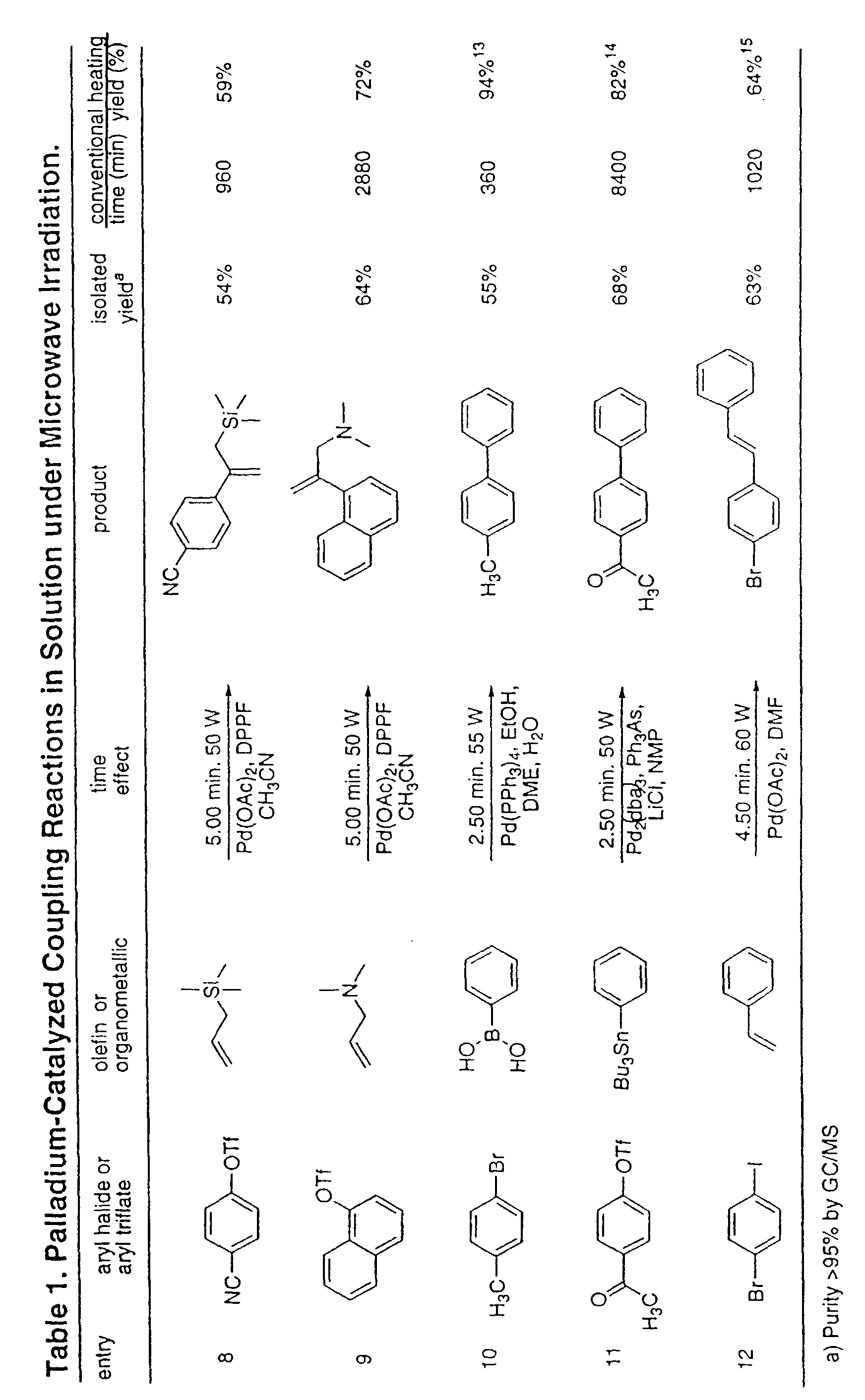
- the inventors surprisingly found that the Heck, Stille and Suzuki reactions in which labile organotransition metal intermediates play a pivotal role in the catatalytic cycle, was compatible with the extreme temperatures used in these reactions. It was found that the Heck, Stille and Suzuki reactions, after very short reaction times (2-7 minutes) when applying microwave assisted technology, allowed isolation of reaction products in high yields and also with high purity, see TABLE 1 below.
- the corresponding reactions performed with standard heating required hours to reach satisfactory yields according to literature, as denoted in TABLE 1. While an increase of the reaction temperature in the latter cases often provided complex reaction mixtures, the microwave assisted reactions were leading to essentially no undesired side products.
- the microwave energy is solely or predominantly in the form of a standing wave.
- the inventors have reacted aryl iodides, aryl bromides and aryl triflates with various olefins (Heck reactions). These olefins were chosen to permit comparison of microwave-assisted reactions with conventionally heated reactions, with respect to regio- and stereoselectivity, as well as double bond isomerization.
- the reactions were conducted in sealed pyrex vessels and a commercially available reactor producing continuous irradiation was used.
- Our initial screening experiments, with different solvents suggested that DMF was suitable for all reactant combinations tested.
- Acetonitril, ethanol, water, DME and NMP are examples of other suitable solvents.
- reaction scale solvent and heating procedure the reactions were performed under reaction conditions identical to the original procedures as described in the references cited, in order to enable an accurate comparison.
- the inventors intended to utilize microwave assisted reactions in Combinatorial Chemistry and the primary objective was minimization of the reaction times. Irradiation effects were altered to allow full conversions of the arylating agents in less than seven minutes.
- Arylation of styrene with iodobenzene delivered a terminal/internal ratio of 19/1, in accordance with the original procedure.
- Microwave assisted arylation of dihydrofuran according to Larock's original procedure furnished a mixture of double bond isomers.
- 2-Phenyl-2, 3-dihydrofuran was isolated in fair yield.
- a reaction time of 6 min at 30 W was needed in this case, to be compared with 24 hours at 80° C when standard heating was employed.
- alkyl vinyl ethers were used as substrates.
- Arylation of styrene with 4-bromo-1-iodobenzene delivered a terminal/internal ratio of 15/1 in accordance with the original procedure.
- the result from this reaction shows that the microwave irradiation provides the same selectivity, with respect to halide displacement as compared to the original reaction and substitution of the iodoatom occurs exclusively. No products derived from bromo substitution were formed, demonstrating the potential of microwave irradiation technology for combinatorial chemistry. The bromo atom remains intact and provides a handle for further consecutive palladium-catalyzed transformations.
- the inventors have found that palladium-catalyzed reactions on polymer-support were compatible with the microwave assisted methodology.
- the microwave energy is solely or predominantly in the form of a standing wave.
- High yields of products with high purity were isolated after short reaction times. No or very limited decomposition of the solid phase was observed. Examples of microwave-assisted Suzuki couplings on solid phase are demonstrated in TABLE 2 below.
- Entry 15 in TABLE 2 demonstrates that the microwave technology permits selective coupling of 4-bromophenylboronic acid to aryl iodide attached to the resin.
- the organoiodide is more reactive and the bromo atom is not displaced.
- a high chemoselectivity is achieved and the bromo atom constitutes a handle for consecutive reactions.
- the product mixture was diluted with 50 ml pentane, transferred to a separatory funnel and washed with 2 x 25 ml water. Additional extraction of the aqueous phases was performed with 25 ml pentane. The combined organic portions were then treated 5 times with 20 ml of 0.1 M HCI. The aqueous extracts were combined, poured into a flask containing excess NaOH (1.0 M) and was extracted with 2 x 50 ml pentane. The combined organic phases were dried (K 2 CO 3 ) and concentrated by evaporation. The yield was 87% (yellow oil, trans/cis 1/1).
- the resin was transferred thereafter to a 3-ml disposable syringe equipped with a porous polyethylene filter using H 2 O/ DME, washed with successive portions of H 2 O, DME, DMF, sat. KCN/DMSO, MeOH, H 2 O, MeOH and DCM (2 x 3 ml each) and dried.
- the resin was treated with 99% aq. TFA for 1 h, filtered and washed with 0.5 ml TFA and 2 x 0.5 ml DCM.
- the filtrates were combined and evaporated to dryness to yield the biaryl. All products gave satisfactory 1 H NMR spectra as well as appropriate ion identification by mass spectrometry (El or PDMS) and had purity >95% by GC/MS.
- PPh 3 AsPh 3 , tri(2-furyl)phosphine, tri (o-tolyl) phosphine, DPPF (1,1'-bis(diphenylphosphino)ferrocene or BINAP (2,2'-bis(diphenylphosphino)-1,1'-binaphtyl) Pd(O) 2 (dba) 3 -CHCI 3 or Pd(O)(dba) 2 + ligand as above
- the microwave energy used in the method according to the present invention can be generated in different ways.
- the microwaves should be generated in a controlled and most of all reproducible way. For large volumes (>0.2 mL), this can be achieved by using magnetrons or clystrons. For small reaction volumes (approx. 100 ⁇ l) semiconductor generated microwaves are preferably used.
- the standing wave, single mode, performance of the applied microwaves makes it possible to focus and optimise the coupling of the microwaves to the reaction samples in a highly reproducible way.
Landscapes
- Chemical & Material Sciences (AREA)
- Organic Chemistry (AREA)
- Chemical Kinetics & Catalysis (AREA)
- Health & Medical Sciences (AREA)
- Life Sciences & Earth Sciences (AREA)
- Molecular Biology (AREA)
- Medicinal Chemistry (AREA)
- General Chemical & Material Sciences (AREA)
- Biochemistry (AREA)
- Electromagnetism (AREA)
- Structural Engineering (AREA)
- Engineering & Computer Science (AREA)
- Toxicology (AREA)
- General Health & Medical Sciences (AREA)
- Physics & Mathematics (AREA)
- Organic Low-Molecular-Weight Compounds And Preparation Thereof (AREA)
- Low-Molecular Organic Synthesis Reactions Using Catalysts (AREA)
Abstract
Description
- The present invention relates to a method for transition metal catalyzed organic reactions comprising a heating step. More precisely, the invention relates to organic reactions catalyzed with palladium, except Pd/C, under microwave energy. One type of organic reactions concerned are coupling reactions, in which new carbon-carbon bonds are formed.
- Transition metal catalyzed reactions have played a role in organic synthesis for a very long time. Twenty five years ago the first examples on the use of palladium as a catalyst for coupling reactions were disclosed. Since then enormous efforts have been devoted to extend the scope of palladium-catalyzed reactions. Among these, the Heck reaction1, the Stille reaction2 and the Suzuki reaction3 probably represent the most applied and most reliable reactions considering the reactions delivering new carbon-carbon bond formation. These reactions allow presence of a wide variety of substituents attached to the reactants and merits special attention due to the simplicity of the experimental procedures. The Heck reaction, which is a vinylic substitution reaction is most frequently conducted with olefins and organo halides or triflates as reactants. Couplings of organotin reagents with organo halides or triflates are named Stille reactions. The related couplings of organoboronic acids and/or organoboronic esters with organo halides or triflates are named Suzuki reactions. These reaction are of outmost importance in organic synthesis and have all found use in Combinatorial Chemistry (CC), sometimes as key reactions in the creation of chemical libraries4. Combinatorial Chemistry is conducted either in solution or preferably on solid phase. Combinatorial Chemistry combined with High Throughput Screening (HTS) has revolutionised the Drug Discovery Programmes in the pharmaceutical industry during the last few years5.
- In Combinatorial Chemistry the reaction time factor is of importance. Rapid reactions are desired. The long reaction times often required in the palladium-catalyzed coupling reactions presented above is therefore in this respect a severe limitation. While some combinations of reactants allow fast conversions, and efficient use in Combinatorial Chemistry have been demonstrated, the majority of reactant combinations require unacceptable reaction times for completion. With regard to the palladium-catalyzed Heck, Stille or Suzuki reactions, attempted enhancement of the conversion rate by increasing the reaction temperature to over 130-150°C most often leads to collapse of the catalytic system before a full conversion is achieved. Product decomposition is frequently observed and a mixture of undesired side products are formed.
- Microwave assisted transiton-metal catalyzed reactions of double bonds, including hydrogenation, catalyzed by RaNi or Pd/C,6 and addition of chloronated hydrocarbons to double bonds, catalyzed by Cul7 have been reported.
- The present invention provides a method for performing an organic reaction catalysed with palladium except Pd/C, the organic reaction being a carbon-carbon coupling reaction selected from
- i) Heck-type reactions in which a first organic species, Org1X, is reacted with a second organic species, H-Olefin, in order to provide a product, Org1-Olefin,
- ii) Stille-type reactions in which a first organic species, Org1X, is reacted with a second organic species, R1 3Sn-Org2, in order to provide a product, Org1-Org2, and
- iii) Suzuki-type reactions in which a first organic species, Org1X, is reacted with a second organic species, R2 2B-Org3, in order to provide a product, Org1-Org3, in which reactions:
- Org1 is selected from aryl, heteroaryl, vinyl, acetylenyl, alkyl, allyl, benzyl, acyl, and benzoyl, and from mono- or poly-substituted aryl, heteroaryl, vinyl, acetylenyl, alkyl, allyl, and benzoyl;
- X is selected from a halide, triflate, mesitylate, nonaflate, carbonylhalide, sulfonylhalide, perfluoroalkylsulfonate, arylphosphate, alkylphosphate, diarylarsine, diarylphosphine, diarylstibine, aryliodonium salt and diazonium salt;
- H-Olefin is an olefin having a double bond and an olefinic hydrogen atom, the double bond in the H-Olefin being unsubstituted or mono-, di- or tri-substituted;
- R1 is selected from alkyl, aryl and heteroaryl, and from mono- or poly-substituted alkyl, aryl and heteroaryl;
- Org2 and Org3 are both selected from aryl, heteroaryl, vinyl, acetylenyl, alkyl, allyl and benzyl, and from mono- or poly-substituted aryl, heteroaryl, vinyl, acetylenyl, alkyl, allyl and benzyl; and
- R2 is selected from hydroxy, alkoxy, aryloxy and heteroaryloxy;
-
- Microwave assisted methodology8 is based on a fast heating of the reaction mixtures to high temperatures. The inventors surprisingly found that the Heck, Stille and Suzuki reactions in which labile organotransition metal intermediates play a pivotal role in the catatalytic cycle, was compatible with the extreme temperatures used in these reactions. It was found that the Heck, Stille and Suzuki reactions, after very short reaction times (2-7 minutes) when applying microwave assisted technology, allowed isolation of reaction products in high yields and also with high purity, see TABLE 1 below. The corresponding reactions performed with standard heating required hours to reach satisfactory yields according to literature, as denoted in TABLE 1. While an increase of the reaction temperature in the latter cases often provided complex reaction mixtures, the microwave assisted reactions were leading to essentially no undesired side products. Preferably the microwave energy is solely or predominantly in the form of a standing wave.
- The inventors have reacted aryl iodides, aryl bromides and aryl triflates with various olefins (Heck reactions). These olefins were chosen to permit comparison of microwave-assisted reactions with conventionally heated reactions, with respect to regio- and stereoselectivity, as well as double bond isomerization. The reactions were conducted in sealed pyrex vessels and a commercially available reactor producing continuous irradiation was used. Our initial screening experiments, with different solvents suggested that DMF was suitable for all reactant combinations tested. Acetonitril, ethanol, water, DME and NMP are examples of other suitable solvents. With the exception of reaction scale, solvent and heating procedure the reactions were performed under reaction conditions identical to the original procedures as described in the references cited, in order to enable an accurate comparison. The inventors intended to utilize microwave assisted reactions in Combinatorial Chemistry and the primary objective was minimization of the reaction times. Irradiation effects were altered to allow full conversions of the arylating agents in less than seven minutes.
- Methyl acrylate was smoothly converted in 3.5 min at 60 W, to the corresponding cinnamic acid ester in a standard Heck reaction medium. The same transformation could be conducted at a lower power although a longer reaction time was required. In order to achieve a full consumption of 1-iodonaphtalene in a reaction with acrylonitrile in the same reaction time, a power of 80 W was used. While methyl acrylate provided the E isomer exclusively, the reaction with acrylonitrile produced a mixture of the E and Z isomers (E/Z = 4/1) as expected from related standard reactions with this olefin. Arylation of styrene with iodobenzene delivered a terminal/internal ratio of 19/1, in accordance with the original procedure. Microwave assisted arylation of dihydrofuran according to Larock's original procedure furnished a mixture of double bond isomers. 2-Phenyl-2, 3-dihydrofuran was isolated in fair yield. A reaction time of 6 min at 30 W was needed in this case, to be compared with 24 hours at 80° C when standard heating was employed. For studies of the regioselectivity with regard to the direction of insertion, alkyl vinyl ethers were used as substrates. Procedures have been developed that allow either electronically controlled internal arylation by application of bidentate ligands or alternatively, chelation-controlled terminal arylation. Microwave assisted arylation of butyl vinyl ether with aryl triflate provided a mixture of α-arylated vinyl ether and the corresponding acetophenone. 4-Acetyl tert. butylbenzene could be isolated in good yield after conducting the reaction in presence of a minor amount of water. The reactions of dimethylaminoethyl vinyl ether with 2-naphthyl triflate as the substrate constitutes an example of a sluggish reaction that requires 9 hours at 60° C to afford fair yields of coupled product. In the microwave assisted reaction, it was essential to employ a low effect, 35W, to avoid decomposition of the catalytic system. A longer reaction time, 7 min, was therefore needed. A highly regioselective arylation at the terminal carbon occurred, and equal amount of the E and Z isomers were formed, in full agreement with the reference procedures. Allyldimethylamine and allyltrimethylsilane were both successfully arylated at the internal olefinic carbon with high regioselectivity after 5 minutes.
- Suzuki coupling of phenyl boronic acid with 4-bromotoluene as well as Stille coupling of 4-acetyl phenyl triflate occurred smoothly with microwave irradiation.
- Arylation of styrene with 4-bromo-1-iodobenzene delivered a terminal/internal ratio of 15/1 in accordance with the original procedure. The result from this reaction shows that the microwave irradiation provides the same selectivity, with respect to halide displacement as compared to the original reaction and substitution of the iodoatom occurs exclusively. No products derived from bromo substitution were formed, demonstrating the potential of microwave irradiation technology for combinatorial chemistry. The bromo atom remains intact and provides a handle for further consecutive palladium-catalyzed transformations.
- The inventors have found that palladium-catalyzed reactions on polymer-support were compatible with the microwave assisted methodology. Preferably the microwave energy is solely or predominantly in the form of a standing wave. High yields of products with high purity were isolated after short reaction times. No or very limited decomposition of the solid phase was observed. Examples of microwave-assisted Suzuki couplings on solid phase are demonstrated in TABLE 2 below. We coupled 4-iodo and 4-bromo- benzoic acid to Rink resin18(Tentagel19) and conducted the palladium-catalyzed reactions with aryl and heteroaryl boronic acids substituted with a variety of substituents. Both arylbromo and aryliodo groups on the resin are good coupling partners with organoboronic acids.
- One example of a Stille coupling on solid phase and one example of a Heck coupling on solid phase are shown in TABLE 3.
- Entry 15 in TABLE 2 demonstrates that the microwave technology permits selective coupling of 4-bromophenylboronic acid to aryl iodide attached to the resin. The organoiodide is more reactive and the bromo atom is not displaced. A high chemoselectivity is achieved and the bromo atom constitutes a handle for consecutive reactions.
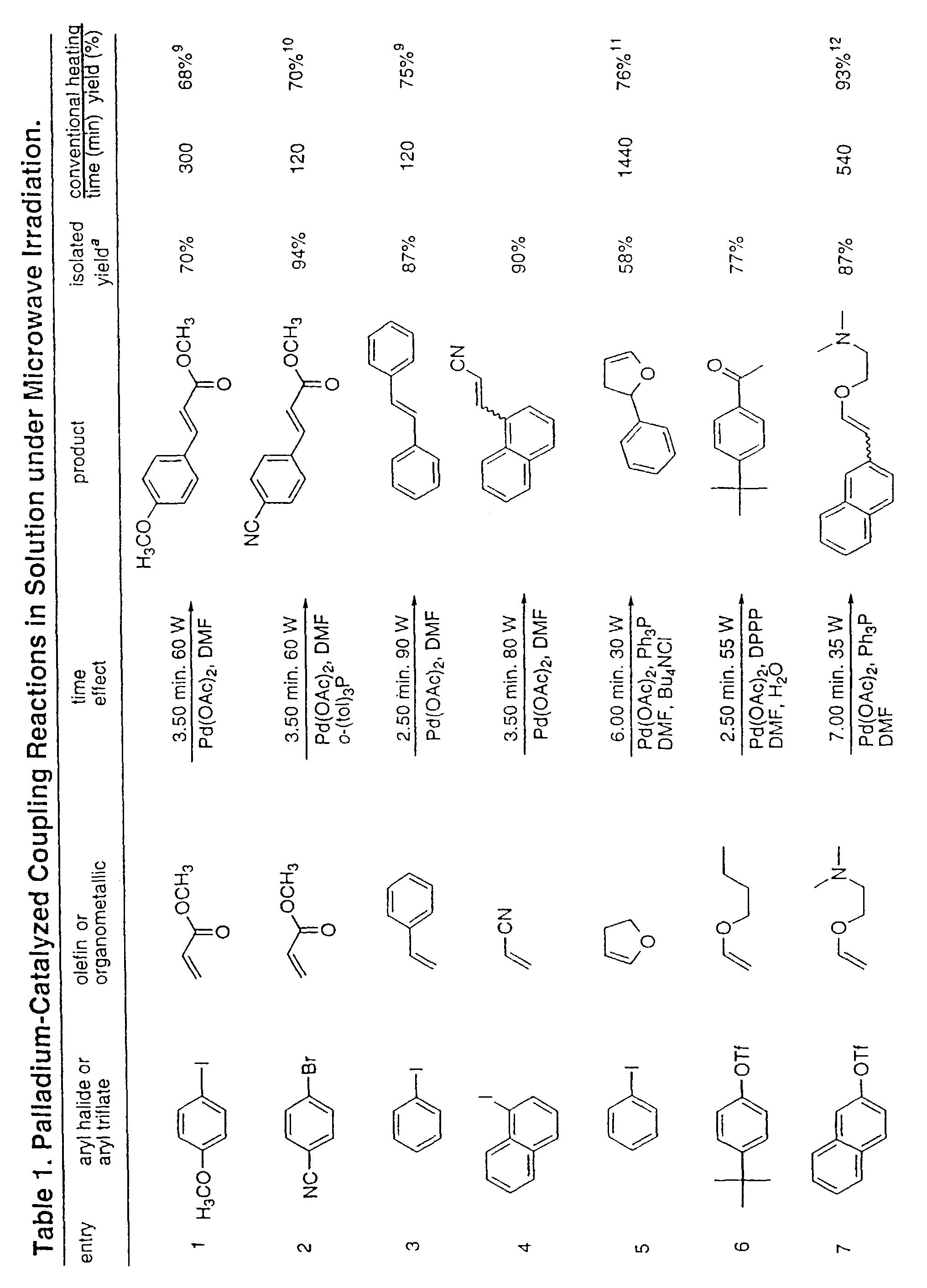


- IN SOLUTION: The product pattern after microwave assisted palladium-catalyzed reactions and after standard heating was compared. For the reactions, entry 4 and entry 5 ( see TABLE 1 above), were selected for more detailed studies. For the standard heating experiments, there was an optimal initial conversion rate of the arylhalides at 150-170°C. The reaction in entry 4, which represents the most simple system in TABLE 1, is performed with no added ligand and produces a stable product, can be conducted at 150°C in approximately the same reaction times as with microwave technology. A minimum amount of side products are formed with both heating techniques. The reaction in entry 5 represents a more complex system. Standard heating procedures (125-150°C) produces here a very complex product mixture containing less than 20% of the desired product.
- ON SOLID SUPPORT: We have compared the product pattern after microwave assisted palladium-catalyzed reactions and after standard heating. Standard heating over 170°C is not compatible with the solid support.
- (E)-Methyl-4-methoxycinnamate. Table 1, Entry 1. In the reaction tube were mixed 4-iodoanisole (0.234 g, 1.0 mmol), methyl acrylate (0.108 g, 1.25 mmol), palladium acetate (0.00225 g, 0.01 mmol), tri-n-butylamine (0.185 g, 1.0 mmol) and 0.50 ml DMF.under nitrogen. The contents of the flask were irradiated for 3.50 min with an effect of 60 W. After cooling, the product mixture was poured into 25 ml water and was extracted three times with 25 ml DCM. The combined extracts were washed with 25 ml water and concentrated to an oil. The crude product was purified by column chromatography on silica gel using i-hexane/diethyl ether (4/1) as the eluent. The yield was 70% (white solid).
- (E)-Methyl-4-cyanocinnamate. Table 1, Entry 2. In the reaction tube were mixed 4-bromobenzonitrile (0.182 g, 1.0 mmol), methyl acrylate (0.108 g, 1.25 mmol), palladium acetate (0.00225 g, 0.01 mmol), tri-o-tolylphosphine (0.0122 g, 0.04 mmol), triethylamine (0.127 g, 1.25 mmol) and 0.50 ml DMF under nitrogen. The contents of the flask were irradiated for 3.50 min with an effect of 60 W. After cooling, the product mixture was poured into 25 ml water and was extracted three times with 25 ml DCM. The combined extracts were washed with 25 ml water and concentrated to an oil. The crude product was purified by column chromatography on silica gel using i-hexane/diethyl ether (1/1) as the eluent. The yield was 94% (pale yellow crystals).
- (E)-Stilbene. Table 1, Entry 3. In the reaction tube were mixed iodobenzene (0.204 g, 1.0 mmol), styrene (0.130 g, 1.25 mmol), palladium acetate (0.00225 g, 0.01 mmol), tri-n-butylamine (0.185 g, 1.0 mmol) and 0.50 ml DMF under nitrogen. The contents of the flask were irradiated for 2.50 min with an effect of 90 W. After cooling, the product mixture was poured into 25 ml water and was extracted three times with 25 ml DCM. The combined extracts were washed with 25 ml water and concentrated to an oil. The crude product was purified by column chromatography on silica gel using i-hexane as the eluent. The yield was 87% (white crystals, terminal/internal arylation 19/1).
- 1-Naphthylacrylonitrile. Table 1, Entry 4. In the reaction tube were mixed 1-iodonaphthalene (0.254 g, 1.0 mmol), acrylonitrile (0.066 g, 1.25 mmol), palladium acetate (0.00225 g, 0.01 mmol), triethylamine (0.50 ml) and 0.50 ml DMF under nitrogen. The contents of the flask were irradiated for 3.50 min with an effect of 80 W. After cooling, the product mixture was poured into 25 ml water and was extracted three times with 25 ml DCM. The combined extracts were washed with 25 ml water and concentrated to an oil. The crude product was purified by column chromatography on silica gel using i-hexane/diethyl ether (2/1) as the eluent. The yield was 90% (white solid, trans/cis 4/1).
- 2-Phenyl-2,3-dihydrofuran. Table 1, Entry 5. In the reaction tube were mixed iodobenzene (0.102 g, 0.5 mmol), dihydrofuran (0.350 g, 5.0 mmol), palladium acetate (0.00281 g, 0.0125 mmol), potassium acetate (0.147 g, 1.5 mmol), n-Bu4NCl (0.139 g, 0.5 mmol), triphenylphosphine (0.00328 g, 0.0125 mmol) and 1.0 ml DMF.under nitrogen. The contents of the flask were irradiated for 6.00 min with an effect of 60 W. After cooling, the product mixture was poured into 25 ml water and was extracted three times with 25 ml DCM. The combined extracts were washed with 25 ml water and concentrated to an oil. The crude product was purified by column chromatography on silica gel using pentane/diethyl ether (19/1) as the eluent. The yield was 58% (yellow oil).
- 4-t-Butylacetophenone. Table 1, Entry 6. In the reaction tube were mixed 4-t-butylphenyl triflate (0.282 g, 1.0 mmol), butyl vinyl ether (0.25 g, 2.5 mmol), palladium acetate (0.00561 g, 0.025 mmol), DPPP (0.0206 g, 0.050 mmol) triethylamine (0.121 g, 1.2 mmol) 0.075 ml water and 0.75 ml DMF.under nitrogen. The contents of the flask were irradiated for 2.50 min with an effect of 55 W. After cooling, the product mixture was poured into 25 ml water and was extracted three times with 25 ml diethyl ether. The combined extracts were washed two times with 25 ml brine and concentrated to an oil. The crude product was purified by column chromatography on silica gel using i-hexane/diethyl ether (7/1) as the eluent. The yield was 77% (clear oil).
- N,N-Dimethyl-2-[2-(2-naphthyl)ethenyloxy]ethanamine. Table 1, Entry 7. In the reaction tube were mixed 2-naphthyl triflate (0.276 g, 1.0 mmol), [2-(dimethylamino)ethoxy]ethene (0.23 g, 2.0 mmol), palladium acetate (0.00673 g, 0.030 mmol), triphenylphosphine (0.0173 g, 0.066 mmol) triethylamine (0.202 g, 2.0 mmol) and 0.75 ml DMF.under nitrogen. The contents of the flask were irradiated for 7.00 min with an effect of 35 W. After cooling, the product mixture was diluted with 50 ml pentane, transferred to a separatory funnel and washed with 2 x 25 ml water. Additional extraction of the aqueous phases was performed with 25 ml pentane. The combined organic portions were then treated 5 times with 20 ml of 0.1 M HCI. The aqueous extracts were combined, poured into a flask containing excess NaOH (1.0 M) and was extracted with 2 x 50 ml pentane. The combined organic phases were dried (K2CO3) and concentrated by evaporation. The yield was 87% (yellow oil, trans/cis 1/1).
- 2-(4-Cyanophenyl)allyltrimethylsilane. Table 1, Entry 8. In the reaction tube were mixed 4-cyanophenyl triflate (0.251 g, 1.0 mmol), allyltrimethylsilane (0.571 g, 5.0 mmol), palladium acetate (0.00673 g, 0.030 mmol), DPPF (0.0366 g, 0.066 mmol), potassium carbonate (0.207 g, 1.5 mmol) and 1.0 ml acetonitrile.under nitrogen. The contents of the flask were irradiated for 5.00 min with an effect of 50 W. After cooling, the product mixture was poured into 25 ml water and was extracted three times with 25 ml diethyl ether. The combined extracts were washed two times with 25 ml brine and concentrated to an oil. The crude product was purified by repeated Kugelrohr distillation. The yield was 54% (clear oil).
- 2-(2-Naphthyl)N-allyldimethylamine. Table 1, Entry 9. In the reaction tube were mixed 2-naphthyl triflate (0.276 g, 1.0 mmol), N-allyldimethylamine (0.426 g, 5.0 mmol), palladium acetate (0.00673 g, 0.030 mmol), DPPF (0.0366 g, 0.066 mmol), potassium carbonate (0.207 g, 1.5 mmol) and 1.0 ml acetonitrile.under nitrogen. The contents of the flask were irradiated for 5.00 min with an effect of 50 W. After cooling, the product mixture was poured into 25 ml water and was extracted three times with 25 ml diethyl ether. The combined extracts were washed two times with 25 ml brine and concentrated to an oil. The crude product was purified by repeated Kugelrohr distillation. The yield was 64% (clear oil).
- 4-Methylbiphenyl. Table 1, Entry 10. In the reaction tube were mixed 4-bromotoluene (0.171 g, 1.0 mmol), phenylboronic acid (0.134 g, 1.1 mmol), Pd(PPh3)4 (0.0347 g, 0.030 mmol), sodium cabonate (0.212 g, 2.0 mmol), 0.187 ml 95% ethanol, 0.375 ml water and 0.75 ml DME.under nitrogen. The contents of the flask were irradiated for 2.50 min with an effect of 55 W. After cooling, the product mixture was poured into 25 ml water and was extracted three times with 25 ml DCM. The combined extracts were washed with 25 ml brine and concentrated to an oil. The crude product was purified by column chromatography on silica gel using i-hexane as the eluent. The yield was 55% (white solid).
- 4'-Phenylacetophenone. Table 1, Entry 11. In the reaction tube were mixed 4-acetylphenyl triflate (0.268 g, 1.0 mmol), phenyltributyltin (0.441 g, 1.2 mmol), Pd2dba3 (0.00916 g, 0.010 mmol), triphenylarsine (0.0245 g, 0.080 mmol), lithium chloride (0.127 g, 3.0 mmol) and 1.0 ml NMP.under nitrogen. The contents of the flask were irradiated for 2.50 min with an effect of 50 W. After cooling, addition of 1 M aqueous KF (4 ml) with stirring for 120 min, were followed by dilution (DCM) and filtration through a pad of celite. The filtrate was washed with water (25 ml). Additional extraction of the aqueous phase was performed with DCM (2x25 ml). The combined extracts were washed with 25 ml brine and concentrated to an oil. The crude product was purified by column chromatography on silica gel using i-hexane/ethyl acetate (10/1) as the eluent. The yield was 68% (white solid).
- (E)-4-Bromostilbene. Table 1, Entry 12. In the reaction tube were mixed 4-bromoiodobenzene (0.283 g, 1.0 mmol), styrene (0.115 g, 1.1 mmol), palladium acetate (0.00225 g, 0.01 mmol), triethylamine (0.111 g, 1.1 mmol) and 0.50 ml DMF.under nitrogen. The contents of the flask were irradiated for 4.50 min with an effect of 60 W. After cooling, the product mixture was poured into 25 ml water and was extracted three times with 25 ml DCM. The combined extracts were washed with 25 ml water and concentrated to an oil. The crude product was purified by column chromatography on silica gel using i-hexane as the eluent. The yield was 63% (white crystals).
- General procedure for Suzuki coupling reactions on solid phase. Table 2. A sealed Pyrex tube was charged, under nitrogen, with 4-iodo or 4-bromo functionalised resin (100 mg, loading ~0.23 mmol/g), Pd(PPh3)4 (1.15 mg, 0.0010 mmol), aryl boronic acid (0.20 mmol), 2M Na2CO3 (0.10 ml, 0.20 mmol), H2O (0.30 ml), ethanol (0.19 ml) and DME (0.75 ml). After irradiation, the mixture was cooled to room temperature. The resin was transferred thereafter to a 3-ml disposable syringe equipped with a porous polyethylene filter using H2O/ DME, washed with successive portions of H2O, DME, DMF, sat. KCN/DMSO, MeOH, H2O, MeOH and DCM (2 x 3 ml each) and dried. The resin was treated with 99% aq. TFA for 1 h, filtered and washed with 0.5 ml TFA and 2 x 0.5 ml DCM. The filtrates were combined and evaporated to dryness to yield the biaryl. All products gave satisfactory 1H NMR spectra as well as appropriate ion identification by mass spectrometry (El or PDMS) and had purity >95% by GC/MS.
- Procedure for the Stille coupling reaction on solid phase. Table 3.
4-lodo functionalised resin (100 mg, loading ~0,23 mmol/g), Pd2dba3 (1.05 mg, 0.00115 mmol), AsPh3 (1.41 mg, 0.0046 mmol), phenyltributyltin (73.4 mg, 0.20 mmol) and dry NMP (1.0 ml) were placed in a Pyrex tube under nitrogen. The tube was closed, placed in the microwave cavity and irradiated for 5.00 min. at 40 W. After cooling, the product was washed and cleaved from the resin as described for the Suzuki coupling reactions. The ratio of phenyl vs. butyl transfer in the isolated product was 9:1 according to 1H-NMR (75% yield, white solid). - Procedure for the Heck coupling reaction on solid phase. Table 3.
4-lodo functionalised resin (50 mg, loading ~0.23 mmol/g), methyl acrylate (0.046 g, 0.53 mmol), palladium acetate (0.00074 g, 0.0033 mmol), tri-o-tolylphosphine (0.00322 g, 0.0106 mmol), triethylamine (0.011 g, 0.11 mmol) and 1.0 ml DMF were placed in a Pyrex tube under nitrogen. The tube was closed, placed in the microwave cavity and irradiated for 5.00 min. at 35 W. After cooling, the product was washed and cleaved from the resin as described for the Suzuki coupling reactions. The crude product was purified by column chromatography on silica gel using i-hexane/DCM (1/1) as the eluent. The yield was 71% (white solid). - In the Heck, Suzuki and Stille reactions performed with microwave energy according to the invention catalytic systems commonly used in these reactions are employed. Below a listing of suitable catalytic systems of soluble palladium complexes will follow. The listed catalytic systems are not the active catalysts in the reactions but rather precatalysts generating the active catalyst.
Pd(O)(PPh3) 4
Pd(II)Cl2(PPh3)2
Pd(II)OAc2 + ligand (eg. PPh3, AsPh3, tri(2-furyl)phosphine, tri (o-tolyl) phosphine, DPPF (1,1'-bis(diphenylphosphino)ferrocene or BINAP (2,2'-bis(diphenylphosphino)-1,1'-binaphtyl)
Pd(O)2(dba)3-CHCI3 or Pd(O)(dba)2 + ligand as above - Often additions are made to the catalytic systems, such as LiCI, Bu4NCl, Cu salts, Ag salts, or Tl salts.
- Furthermore, it is to be understood that the microwave energy used in the method according to the present invention can be generated in different ways. The microwaves should be generated in a controlled and most of all reproducible way. For large volumes (>0.2 mL), this can be achieved by using magnetrons or clystrons. For small reaction volumes (approx. 100 µl) semiconductor generated microwaves are preferably used.
- The standing wave, single mode, performance of the applied microwaves makes it possible to focus and optimise the coupling of the microwaves to the reaction samples in a highly reproducible way.
-
- 1. For reviews on the Heck reaction see;
- a) Heck, R. F. Org React. 1982, 27, 345,
- b) Trost, B. M. and Verhoeven, T. R. Comprehensive Organometallic Chemistry, Wilkinson, G.; Stone, F. G. A.; Abel, E. W. Eds.; Pergamon Press: Oxford 1982; vol 8, pp. 854, c) Heck, R. F. Palladium Reagents in Organic Synthesis; Academic Press; London. 1985; pp 276,
- d) Heck, R. F. Comprehensive Organic Synthesis; Trost, B. M.; Flemming, I. Eds.; Pergamon Press: Oxford 1991; vol. 4, pp. 833,
- e) de Meijere, A.; Meyer, F. E. Angew. Chem. Int. Ed. Engl. 1994, 33, 2379,
- f) Cabri, W.; Candiani, I. Acc. Chem. Res. 1995, 28, 2,
- g) Tsuji, J. Palladium Reagents and Catalysts: Innovations in Organic Chemistry, John Wiley & Sons, Chichester 1995; pp. 125. For Heck arylation of heteroatom-substituted double bonds see;
- h) Daves, G. D. Jr.; Hallberg, A. Chem. Rev. 1989, 89, 1433.
- 2. For reviews on the Stille reaction see: a) Stille, J. K. Angew. Chem. Int. Ed. Engl. 1986, 25, 508, b)Ritter, K. Synthesis 1993, 735,.c) Tsuji, J. Palladium Reagents and Catalysts: Innovations in Organic Chemistry, John Wiley & Sons, Chichester 1995; pp. 228.
- 3. For reviews on the Suzuki reaction see:
- a) Miyaura, N.; Suzuki, A. Chem. Rev. 1995, 95, 2457,
- b) Martin, A. R.; Yang, Y. Acta Chem. Scand. 1993, 47, 221.
- 4. Examples of Suzuki couplings in Combinatorial Chemistry:
- a) Frenette, R.; Friesen, R. W. Tetrahedron Lett. 1994, 35, 9177,
- b) Backes, B. J.; Ellman, J. A. J. Am. Chem. Soc. 1994, 116, 11171,
- c) Han, Y.; Walker, S. D.; Young, R. N. Tetrahedron Lett. 1996, 37, 2703. Examples of Heck couplings in Combinatorial Chemistry:
- d) Young, J. K.; Nelson, J. C.; Moore, J. S. J. Am. Chem. Soc. 1994, 116, 10841,
- e) Yu, K. L.; Deshpande, M. S.; Vyas, D. Tetrahedron Lett. 1994, 35, 8919,
- f) Hiroshige, M.; Hauske, J. R.; Zhou, P. Tetrahedron Lett. 1995, 36, 4567,
- g) Goff, D. A.; Zuckermann, R.N. J. Org. Chem. 1995, 60, 5748.
- h) Deshpande, M. S. Tetrahedron Lett. 1994, 35, 5613,
- i) Forman, F. W.; Sucholeiki, I. J. Org. Chem. 1995, 60, 523.
- 5. For recent reviews, see:
- a) Hermkens, P. H. H.; Ottenheijm, H. C. J.; Rees, D. Tetrahedron 1996, 52, 4527,
- b) Früchtel, J. S.; Jung, G. Angew. Chem. Int. Ed. Engl. 1996, 35, 17,
- c) DeWitt, S. H.; Czarnik, A. W. Acc. Chem. Res. 1996, 29, 114,
- d) Armstrong, R. W.; Combs, A. P.; Tempest, P. A.; Brown, S. D.; Keating, T. A. ibid. 1996, 29, 123,
- e) Ellman, J. A. ibid. 1996, 29, 132,
- f) Gordon, E. M.; Gallop, M. A.; Patel, D. V. ibid. 1996, 29, 144,
- g) Thompson, L. A.; Ellman, J. A. Chem. Rev. 1996, 96, 555, h) Lowe, G. Chem. Soc. Rev. 1995, 24, 309.
- 6. Bose, A. K.; Banik, B. K.; Barakat, K. J.; Manhas, M. S.; Synlett., 1993, 575.
- 7. Adamek, F.; Hajek, M. Tetrahedron Lett. 1992, 33, 2039.
- 8. Caddick, S. Tetrahedron 1995, 51, 10403.
- 9. Heck, R. F.; Nolley, Jr., J. P.J. Org. Chem. 1972, 37, 2320.
- 10. Patel, B. A.; Ziegler, C. B.; Cortese, N. A.; Plevyak, J. E.; Zebovitz, T. C.; Terpko, M.; Heck, R. F.J. Org. Chem. 1977, 42, 3903.
- 11. Larock, R. C.; Gong, W. H.; Baker, B. E. Tetrahedron Lett. 1989, 30, 2603.
- 12.
- a) Andersson, C.-M.; Larsson, J.; Hallberg, A. J. Org. Chem. 1990, 55, 5757,
- b) Larhed, M.; Andersson, C.-M.; Hallberg, A. Acta. Chem. Scand. 1993, 47, 212,
- c) Larhed, M.; Andersson, C.-M.; Hallberg, A. Tetrahedron 1994, 50, 285.
- 13.
- a) Miyaura, N.; Yanagi, T.; Suzuki, A. Synth.Commun., 1981, 11, 513,
- b) DME was introduced as solvent in the Suzuki reaction by Gronowitz. Gronowitz, S.; Bobosik, V.; Lawitz, K. Chem. Scr. 1984, 23, 120.
- 14. Farina, V.; Krishnan, B.; Marshall, D. R.; Roth, G. P. J. Org. Chem. 1993, 58, 5434.
- 15. Plevyak, J. E.; Dickerson, J. E.; Heck, R. F.J. Org. Chem. 1979, 44, 4078.
- 16. Melpolder, J. B.; Heck, R. F.J. Org. Chem. 1976, 41, 265.
- 17. a) Cabri, W.; Candiani, I.; Bedeschi, A.; Penco, S.; Santi, R. J. Org. Chem. 1992, 57, 1481, b) Cabri, W.; Candiani, I.; Bedeschi, A.; Santi, R. J. Org. Chem. 1990, 55, 3654.
- 18. The 4-halobenzoic acids (4 eq.) were coupled to deprotected resin using 2-(1H-benzotriazole-1-yl)-1,1,3,3-tetramethyl-uronium hexafluorophosphate (HBTU, 4 eq.) and DIEA (8 eq.) for 2 h. Remaining amino groups were then capped by acetylation
- 19. 90 mm Fmoc TentaGel S RAM-resin (S30 023, 0.23 mmol/g capacity) purchased from Rapp Polymere.
-
Claims (22)
- A method for performing an organic reaction catalysed with palladium except Pd/C, the organic reaction being a carbon-carbon coupling reaction selected fromsaid method comprising the step of providing microwave energy to the organic reaction in order to heat said organic reaction.i) Heck-type reactions in which a first organic species, Org1X, is reacted with a second organic species, H-Olefin, in order to provide a product, Org1-Olefin,ii) Stille-type reactions in which a first organic species, Org1X, is reacted with a second organic species, R1 3Sn-Org2, in order to provide a product, Org1-Org2, andiii) Suzuki-type reactions in which a first organic species, Org1X, is reacted with a second organic species, R2 2B-Org3, in order to provide a product, Org1-Org3,
in which reactions:Org1 is selected from aryl, heteroaryl, vinyl, acetylenyl, alkyl, allyl, benzyl, acyl, and benzoyl, and from mono- or poly-substituted aryl, heteroaryl, vinyl, acetylenyl, alkyl, allyl, and benzoyl;X is selected from a halide, triflate, mesitylate, nonaflate, carbonylhalide, sulfonylhalide, perfluoroalkylsulfonate, arylphosphate, alkylphosphate, diarylarsine, diarylphosphine, diarylstibine, aryliodonium salt and diazonium salt;H-Olefin is an olefin having a double bond and an olefinic hydrogen atom, the double bond in the H-Olefin being unsubstituted or mono-, di- or tri-substituted;R1 is selected from alkyl, aryl and heteroaryl, and from mono- or poly-substituted alkyl, aryl and heteroaryl;Org2 and Org3 are both selected from aryl, heteroaryl, vinyl, acetylenyl, alkyl, allyl and benzyl, and from mono- or poly-substituted aryl, heteroaryl, vinyl, acetylenyl, alkyl, allyl and benzyl; andR2 is selected from hydroxy, alkoxy, aryloxy and heteroaryloxy; - A method according to claim 1, wherein the organic reaction is the Heck-type reaction.
- A method according to claim 1, wherein the organic reaction is the Stille-type reaction.
- A method according to claim 1, wherein the organic reaction is the Suzuki-type reaction.
- A method according to claim 2, wherein the organic reaction is performed in solution.
- A method according to claim 2, wherein the organic reaction is performed on a solid support.
- A method according to claim 6, wherein Org1 of the first organic species, or the second organic species, H-Olefin, is attached to the solid support.
- A method according to claim 7, wherein Org1 of the first organic species, or the second organic species, H-Olefin, is attached to the solid support via a linker.
- A method according to claim 2, wherein the organic reaction is part of a combinatorial chemistry process.
- A method according to claim 3, wherein the organic reaction is performed in solution.
- A method according to claim 3, wherein the organic reaction is performed on a solid support.
- A method according to claim 11, wherein Org1 of the first organic species, or Org2 of the second organic species is attached to the solid support.
- A method according to claim 12, wherein Org1 of the first organic species, or Org2 of the second organic species is attached to the solid support via a linker.
- A method according to claim 3, wherein the organic reaction is part of a combinatorial chemistry process.
- A method according to claim 4, wherein the organic reaction is performed in solution.
- A method according to claim 4, wherein the organic reaction is performed on a solid support.
- A method according to claim 16, wherein Org1 of the first organic species, is attached to the solid support.
- A method according to claim 17, wherein Org1 of the first organic species is attached to the solid support via a linker.
- A method according to claim 4, wherein the organic reaction is part of a combinatorial chemistry process.
- A method according to any of the preceding claims, wherein the microwave energy is solely or predominantly provided in the form of a standing wave.
- A method according to any of the preceding claims, wherein the organic reaction is used in the creation of a chemical library.
- A method according to any of the preceding claims, wherein the microwave energy is provided for a period of 2-7 minutes.
Applications Claiming Priority (5)
| Application Number | Priority Date | Filing Date | Title |
|---|---|---|---|
| SE9601856 | 1996-05-14 | ||
| SE9601856A SE9601856D0 (en) | 1996-05-14 | 1996-05-14 | Method for organic reactions |
| SE9603913A SE509731C2 (en) | 1996-05-14 | 1996-10-25 | Method of palladium-catalyzed organic reactions comprising a heating step performed with microwave energy |
| SE9603913 | 1996-10-25 | ||
| PCT/SE1997/000794 WO1997043230A1 (en) | 1996-05-14 | 1997-05-14 | Method for organic reactions |
Publications (2)
| Publication Number | Publication Date |
|---|---|
| EP0901453A1 EP0901453A1 (en) | 1999-03-17 |
| EP0901453B1 true EP0901453B1 (en) | 2000-11-15 |
Family
ID=26662617
Family Applications (1)
| Application Number | Title | Priority Date | Filing Date |
|---|---|---|---|
| EP97923387A Expired - Lifetime EP0901453B1 (en) | 1996-05-14 | 1997-05-14 | Method for organic reactions |
Country Status (9)
| Country | Link |
|---|---|
| US (1) | US6136157A (en) |
| EP (1) | EP0901453B1 (en) |
| JP (1) | JP3457329B2 (en) |
| AU (1) | AU723303B2 (en) |
| DE (1) | DE69703543T2 (en) |
| DK (1) | DK0901453T3 (en) |
| ES (1) | ES2154044T3 (en) |
| SE (1) | SE509731C2 (en) |
| WO (1) | WO1997043230A1 (en) |
Families Citing this family (33)
| Publication number | Priority date | Publication date | Assignee | Title |
|---|---|---|---|---|
| EP1115680B1 (en) * | 1998-09-04 | 2003-05-07 | Personal Chemistry i Uppsala AB | Allylic substitution reactions |
| US7603685B2 (en) | 1998-11-03 | 2009-10-13 | United Video Properties, Inc. | Program guide system with combination category search |
| RU2266163C2 (en) | 1999-03-25 | 2005-12-20 | Альфахиликс Аб | Method for homogenizing small volumes of mixtures by centrifuging and heating and apparatus for performing the same |
| US6673214B1 (en) * | 1999-04-09 | 2004-01-06 | Rocky Mountain Biosystems, Inc. | Energy enhanced reaction catalysis and uses thereof |
| ATE276043T1 (en) * | 1999-05-26 | 2004-10-15 | Biotage Ab | PREPARATION AND USE OF IONIC LIQUIDS IN MICROWAVE-ASSISTED CHEMICAL CONVERSIONS |
| DE10051316A1 (en) * | 2000-10-17 | 2002-04-25 | Omg Ag & Co Kg | Process for the production of mono-, bi- or polyfunctional biarylene |
| WO2003000690A1 (en) * | 2001-06-25 | 2003-01-03 | Aventis Pharmaceuticals Inc. | Synthesis of heterocyclic compounds employing microwave technology |
| DE10219201A1 (en) * | 2002-04-29 | 2003-11-06 | Basf Ag | Process for the preparation of organic alkyne compounds |
| US6744024B1 (en) | 2002-06-26 | 2004-06-01 | Cem Corporation | Reaction and temperature control for high power microwave-assisted chemistry techniques |
| US6867400B2 (en) * | 2002-07-31 | 2005-03-15 | Cem Corporation | Method and apparatus for continuous flow microwave-assisted chemistry techniques |
| US7169265B1 (en) | 2002-12-31 | 2007-01-30 | Albany International Corp. | Method for manufacturing resin-impregnated endless belt and a belt for papermaking machines and similar industrial applications |
| US7005043B2 (en) * | 2002-12-31 | 2006-02-28 | Albany International Corp. | Method of fabrication of a dryer fabric and a dryer fabric with backside venting for improved sheet stability |
| US7166196B1 (en) | 2002-12-31 | 2007-01-23 | Albany International Corp. | Method for manufacturing resin-impregnated endless belt structures for papermaking machines and similar industrial applications and belt |
| US7919173B2 (en) * | 2002-12-31 | 2011-04-05 | Albany International Corp. | Method for controlling a functional property of an industrial fabric and industrial fabric |
| US7014735B2 (en) | 2002-12-31 | 2006-03-21 | Albany International Corp. | Method of fabricating a belt and a belt used to make bulk tissue and towel, and nonwoven articles and fabrics |
| US7005044B2 (en) * | 2002-12-31 | 2006-02-28 | Albany International Corp. | Method of fabricating a belt and a belt used to make bulk tissue and towel, and nonwoven articles and fabrics |
| US7008513B2 (en) * | 2002-12-31 | 2006-03-07 | Albany International Corp. | Method of making a papermaking roll cover and roll cover produced thereby |
| US7022208B2 (en) * | 2002-12-31 | 2006-04-04 | Albany International Corp. | Methods for bonding structural elements of paper machine and industrial fabrics to one another and fabrics produced thereby |
| KR20080023296A (en) * | 2005-05-09 | 2008-03-13 | 마이크로비아 인코포레이티드 | Organometallic Benzenephosphonate Coupling Agent |
| JP2007261960A (en) * | 2006-03-01 | 2007-10-11 | Tokyo Electric Power Co Inc:The | Process for continuously producing higher fatty acid methyl esters from CO 2 |
| WO2008118097A1 (en) * | 2007-03-23 | 2008-10-02 | Agency For Science, Technology And Research | Palladium catalysts |
| JP4777373B2 (en) | 2008-02-14 | 2011-09-21 | 独立行政法人科学技術振興機構 | Method for producing photoresponsive nucleic acid |
| CA2761287A1 (en) * | 2009-05-12 | 2010-11-18 | Board Of Regents The University Of Texas System | Synthesis of morphine and related derivatives |
| US8786702B2 (en) | 2009-08-31 | 2014-07-22 | Behavioral Recognition Systems, Inc. | Visualizing and updating long-term memory percepts in a video surveillance system |
| US9718781B2 (en) | 2012-04-17 | 2017-08-01 | University College Dublin, National University Of Ireland, Dublin | Methods and compounds for treating proliferative disorders and viral infections |
| EP2838520B1 (en) | 2012-04-17 | 2017-12-13 | University College Dublin National University Of Ireland, Dublin | Thromboxane receptor antagonists |
| CN102942429A (en) * | 2012-11-26 | 2013-02-27 | 大连理工大学 | A palladium-carbon catalyzed method for preparing aza or thiaaryl biaryl compounds |
| WO2015131100A1 (en) * | 2014-02-28 | 2015-09-03 | The Scripps Research Institute | Ligand-controlled c(sp3)-h arylation and olefination in synthesis of unnatural chiral alpha amino acids |
| TN2016000501A1 (en) | 2014-05-15 | 2018-04-04 | Iteos Therapeutics | Pyrrolidine-2,5-dione derivatives, pharmaceutical compositions and methods for use as ido1 inhibitors. |
| US9873690B2 (en) | 2015-03-17 | 2018-01-23 | Pfizer Inc | 3-indol substituted derivatives, pharmaceutical compositions and methods for use |
| ES2858551T3 (en) | 2015-06-16 | 2021-09-30 | Atxa Therapeutics Ltd | Thromboxane receptor antagonists |
| US10544095B2 (en) | 2015-08-10 | 2020-01-28 | Pfizer Inc. | 3-indol substituted derivatives, pharmaceutical compositions and methods for use |
| CN119350937B (en) * | 2024-10-30 | 2025-08-12 | 广东豪之盛新材料有限公司 | Double-component aerosol spray paint and preparation method thereof |
Family Cites Families (2)
| Publication number | Priority date | Publication date | Assignee | Title |
|---|---|---|---|---|
| US4574038A (en) | 1985-08-01 | 1986-03-04 | Alberta Oil Sands Technology And Research Authority | Microwave induced catalytic conversion of methane to ethylene and hydrogen |
| GB8715333D0 (en) * | 1987-06-30 | 1987-08-05 | Glaxo Group Ltd | Process |
-
1996
- 1996-10-25 SE SE9603913A patent/SE509731C2/en not_active IP Right Cessation
-
1997
- 1997-05-14 DK DK97923387T patent/DK0901453T3/en active
- 1997-05-14 EP EP97923387A patent/EP0901453B1/en not_active Expired - Lifetime
- 1997-05-14 JP JP54080497A patent/JP3457329B2/en not_active Expired - Fee Related
- 1997-05-14 AU AU29201/97A patent/AU723303B2/en not_active Ceased
- 1997-05-14 ES ES97923387T patent/ES2154044T3/en not_active Expired - Lifetime
- 1997-05-14 US US09/180,673 patent/US6136157A/en not_active Expired - Fee Related
- 1997-05-14 DE DE69703543T patent/DE69703543T2/en not_active Expired - Fee Related
- 1997-05-14 WO PCT/SE1997/000794 patent/WO1997043230A1/en not_active Ceased
Also Published As
| Publication number | Publication date |
|---|---|
| DE69703543T2 (en) | 2001-05-31 |
| EP0901453A1 (en) | 1999-03-17 |
| JP2000510145A (en) | 2000-08-08 |
| ES2154044T3 (en) | 2001-03-16 |
| DE69703543D1 (en) | 2000-12-21 |
| WO1997043230A1 (en) | 1997-11-20 |
| SE9603913L (en) | 1998-01-14 |
| SE9603913D0 (en) | 1996-10-25 |
| US6136157A (en) | 2000-10-24 |
| SE509731C2 (en) | 1999-03-01 |
| JP3457329B2 (en) | 2003-10-14 |
| AU2920197A (en) | 1997-12-05 |
| DK0901453T3 (en) | 2001-05-14 |
| AU723303B2 (en) | 2000-08-24 |
Similar Documents
| Publication | Publication Date | Title |
|---|---|---|
| AU723303B2 (en) | Method for organic reactions | |
| Raders et al. | Trineopentylphosphine: a conformationally flexible ligand for the coupling of sterically demanding substrates in the Buchwald–hartwig amination and Suzuki–miyaura reaction | |
| Bai et al. | Environmentally friendly Suzuki aryl-aryl cross-coupling reaction | |
| CN100569713C (en) | A kind of preparation method of biphenyl compound | |
| Dawood et al. | Combining enabling techniques in organic synthesis: solid-phase-assisted catalysis under microwave conditions using a stable Pd (II)-precatalyst | |
| JP5244399B2 (en) | Carbon-nitrogen bonds and carbon-carbon bond formation reactions catalyzed by transition metals | |
| Zhang et al. | C–C Activation by Retro-Aldol Reaction of Two β-Hydroxy Carbonyl Compounds: Synergy with Pd-Catalyzed Cross-Coupling To Access Mono-α-arylated Ketones and Esters | |
| Kalek et al. | Efficient synthesis of mono-and diarylphosphinic acids: a microwave-assisted palladium-catalyzed cross-coupling of aryl halides with phosphinate | |
| Cera et al. | Bi-directional alkyne tandem isomerization via Pd (0)/carboxylic acid joint catalysis: expedient access to 1, 3-dienes | |
| Wu et al. | Pd‐Catalyzed Difluoromethylthiolation of Aryl Chlorides, Bromides and Triflates | |
| Chang et al. | Pd-Catalyzed decarboxylative alkynylation of alkynyl carboxylic acids with arylsulfonyl hydrazides via a desulfinative process | |
| Bai et al. | Rapid Microwave‐Promoted Cross‐Coupling Reaction of Aryl Bromides with Aryl Boronic Acids and Sodium Tetraphenylborate Catalyzed by a Reusable Polymer‐Supported Palladium Complex | |
| Renzi et al. | Synthetic methodologies to access skipped dienes: a focus on the catalytic systems | |
| CN107935802A (en) | A kind of method that biaryl compound is prepared using arylsulfonyl fluorine as raw material | |
| Wang et al. | Decarboxylative amination of benzoic acids bearing electron-donating substituents and nonactivated amines | |
| CN114956952A (en) | Synthetic method of copper-catalyzed polychlorinated alkyne compound | |
| Huang et al. | Nanopalladium immobilized on aminoethanol-functionalized poly (vinyl chloride): an easily prepared, air and moisture stable catalyst for Heck reactions | |
| Skraba-Joiner et al. | Acid-catalyzed rearrangements in arenes: interconversions in the quaterphenyl series | |
| CN116354857B (en) | A preparation method of β-aminosulfone and its derivatives | |
| CN114539097A (en) | A kind of polysubstituted alkenyl cyanide and synthetic method thereof | |
| Fang et al. | Palladium-catalyzed sequential three-component cross-coupling to 1, 3-dienes: Employing alkenes as hydride and alkenyl donors | |
| CN113548965B (en) | Preparation method of 1,4 eneyne compound | |
| Patel et al. | Synthesis of alkyloxy stilbenes by one-pot O-alkylation-Wittig and O-alkylation-Wittig–Heck reaction sequence | |
| Fairlamb | Transition metals in organic synthesis: cross-coupling and C–H activation processes | |
| CN104003827A (en) | Terminal alkyne synthesizing method |
Legal Events
| Date | Code | Title | Description |
|---|---|---|---|
| PUAI | Public reference made under article 153(3) epc to a published international application that has entered the european phase |
Free format text: ORIGINAL CODE: 0009012 |
|
| 17P | Request for examination filed |
Effective date: 19981121 |
|
| AK | Designated contracting states |
Kind code of ref document: A1 Designated state(s): BE DE DK ES FR GB IT NL SE |
|
| 17Q | First examination report despatched |
Effective date: 20000119 |
|
| GRAG | Despatch of communication of intention to grant |
Free format text: ORIGINAL CODE: EPIDOS AGRA |
|
| GRAG | Despatch of communication of intention to grant |
Free format text: ORIGINAL CODE: EPIDOS AGRA |
|
| GRAH | Despatch of communication of intention to grant a patent |
Free format text: ORIGINAL CODE: EPIDOS IGRA |
|
| GRAH | Despatch of communication of intention to grant a patent |
Free format text: ORIGINAL CODE: EPIDOS IGRA |
|
| GRAA | (expected) grant |
Free format text: ORIGINAL CODE: 0009210 |
|
| AK | Designated contracting states |
Kind code of ref document: B1 Designated state(s): BE DE DK ES FR GB IT NL SE |
|
| RAP2 | Party data changed (patent owner data changed or rights of a patent transferred) |
Owner name: PERSONAL CHEMISTRY I UPPSALA AB |
|
| REF | Corresponds to: |
Ref document number: 69703543 Country of ref document: DE Date of ref document: 20001221 |
|
| ET | Fr: translation filed | ||
| NLT2 | Nl: modifications (of names), taken from the european patent patent bulletin |
Owner name: PERSONAL CHEMISTRY I UPPSALA AB |
|
| ITF | It: translation for a ep patent filed | ||
| REG | Reference to a national code |
Ref country code: ES Ref legal event code: FG2A Ref document number: 2154044 Country of ref document: ES Kind code of ref document: T3 |
|
| REG | Reference to a national code |
Ref country code: DK Ref legal event code: T3 |
|
| PLBE | No opposition filed within time limit |
Free format text: ORIGINAL CODE: 0009261 |
|
| STAA | Information on the status of an ep patent application or granted ep patent |
Free format text: STATUS: NO OPPOSITION FILED WITHIN TIME LIMIT |
|
| 26N | No opposition filed | ||
| REG | Reference to a national code |
Ref country code: GB Ref legal event code: IF02 |
|
| PGFP | Annual fee paid to national office [announced via postgrant information from national office to epo] |
Ref country code: ES Payment date: 20070521 Year of fee payment: 11 |
|
| PGFP | Annual fee paid to national office [announced via postgrant information from national office to epo] |
Ref country code: NL Payment date: 20070522 Year of fee payment: 11 |
|
| PGFP | Annual fee paid to national office [announced via postgrant information from national office to epo] |
Ref country code: DK Payment date: 20070523 Year of fee payment: 11 Ref country code: BE Payment date: 20070523 Year of fee payment: 11 |
|
| PGFP | Annual fee paid to national office [announced via postgrant information from national office to epo] |
Ref country code: DE Payment date: 20070524 Year of fee payment: 11 Ref country code: SE Payment date: 20070524 Year of fee payment: 11 |
|
| PGFP | Annual fee paid to national office [announced via postgrant information from national office to epo] |
Ref country code: GB Payment date: 20070521 Year of fee payment: 11 |
|
| PGFP | Annual fee paid to national office [announced via postgrant information from national office to epo] |
Ref country code: IT Payment date: 20070530 Year of fee payment: 11 |
|
| PGFP | Annual fee paid to national office [announced via postgrant information from national office to epo] |
Ref country code: FR Payment date: 20070430 Year of fee payment: 11 |
|
| BERE | Be: lapsed |
Owner name: *PERSONAL CHEMISTRY I UPPSALA A.B. Effective date: 20080531 |
|
| REG | Reference to a national code |
Ref country code: DK Ref legal event code: EBP |
|
| GBPC | Gb: european patent ceased through non-payment of renewal fee |
Effective date: 20080514 |
|
| PG25 | Lapsed in a contracting state [announced via postgrant information from national office to epo] |
Ref country code: NL Free format text: LAPSE BECAUSE OF NON-PAYMENT OF DUE FEES Effective date: 20081201 |
|
| REG | Reference to a national code |
Ref country code: FR Ref legal event code: ST Effective date: 20090119 |
|
| PG25 | Lapsed in a contracting state [announced via postgrant information from national office to epo] |
Ref country code: BE Free format text: LAPSE BECAUSE OF NON-PAYMENT OF DUE FEES Effective date: 20080531 |
|
| PG25 | Lapsed in a contracting state [announced via postgrant information from national office to epo] |
Ref country code: FR Free format text: LAPSE BECAUSE OF NON-PAYMENT OF DUE FEES Effective date: 20080602 Ref country code: DK Free format text: LAPSE BECAUSE OF NON-PAYMENT OF DUE FEES Effective date: 20080531 Ref country code: DE Free format text: LAPSE BECAUSE OF NON-PAYMENT OF DUE FEES Effective date: 20081202 |
|
| PG25 | Lapsed in a contracting state [announced via postgrant information from national office to epo] |
Ref country code: GB Free format text: LAPSE BECAUSE OF NON-PAYMENT OF DUE FEES Effective date: 20080514 |
|
| REG | Reference to a national code |
Ref country code: ES Ref legal event code: FD2A Effective date: 20080516 |
|
| PG25 | Lapsed in a contracting state [announced via postgrant information from national office to epo] |
Ref country code: IT Free format text: LAPSE BECAUSE OF NON-PAYMENT OF DUE FEES Effective date: 20080514 |
|
| PG25 | Lapsed in a contracting state [announced via postgrant information from national office to epo] |
Ref country code: ES Free format text: LAPSE BECAUSE OF NON-PAYMENT OF DUE FEES Effective date: 20080516 |
|
| PG25 | Lapsed in a contracting state [announced via postgrant information from national office to epo] |
Ref country code: SE Free format text: LAPSE BECAUSE OF NON-PAYMENT OF DUE FEES Effective date: 20080515 |