EP0900772B1 - Method for production of fluorine-containing aromatic compound - Google Patents
Method for production of fluorine-containing aromatic compound Download PDFInfo
- Publication number
- EP0900772B1 EP0900772B1 EP98306939A EP98306939A EP0900772B1 EP 0900772 B1 EP0900772 B1 EP 0900772B1 EP 98306939 A EP98306939 A EP 98306939A EP 98306939 A EP98306939 A EP 98306939A EP 0900772 B1 EP0900772 B1 EP 0900772B1
- Authority
- EP
- European Patent Office
- Prior art keywords
- compound
- reaction
- fluorine
- amount
- product
- Prior art date
- Legal status (The legal status is an assumption and is not a legal conclusion. Google has not performed a legal analysis and makes no representation as to the accuracy of the status listed.)
- Expired - Lifetime
Links
- 239000011737 fluorine Substances 0.000 title claims description 30
- 229910052731 fluorine Inorganic materials 0.000 title claims description 30
- YCKRFDGAMUMZLT-UHFFFAOYSA-N Fluorine atom Chemical compound [F] YCKRFDGAMUMZLT-UHFFFAOYSA-N 0.000 title claims description 28
- 150000001491 aromatic compounds Chemical class 0.000 title claims description 27
- 238000004519 manufacturing process Methods 0.000 title claims description 16
- 150000001875 compounds Chemical class 0.000 claims description 139
- 238000006243 chemical reaction Methods 0.000 claims description 74
- 238000000034 method Methods 0.000 claims description 34
- 125000004432 carbon atom Chemical group C* 0.000 claims description 20
- UHOVQNZJYSORNB-UHFFFAOYSA-N Benzene Chemical compound C1=CC=CC=C1 UHOVQNZJYSORNB-UHFFFAOYSA-N 0.000 claims description 18
- 125000004435 hydrogen atom Chemical group [H]* 0.000 claims description 14
- 125000005843 halogen group Chemical group 0.000 claims description 13
- 125000004122 cyclic group Chemical group 0.000 claims description 12
- ZUOUZKKEUPVFJK-UHFFFAOYSA-N diphenyl Chemical compound C1=CC=CC=C1C1=CC=CC=C1 ZUOUZKKEUPVFJK-UHFFFAOYSA-N 0.000 claims description 12
- 125000000217 alkyl group Chemical group 0.000 claims description 11
- UFWIBTONFRDIAS-UHFFFAOYSA-N Naphthalene Chemical compound C1=CC=CC2=CC=CC=C21 UFWIBTONFRDIAS-UHFFFAOYSA-N 0.000 claims description 10
- XLYOFNOQVPJJNP-UHFFFAOYSA-N water Substances O XLYOFNOQVPJJNP-UHFFFAOYSA-N 0.000 claims description 10
- 239000004305 biphenyl Substances 0.000 claims description 6
- 235000010290 biphenyl Nutrition 0.000 claims description 6
- 239000007792 gaseous phase Substances 0.000 claims description 6
- WKBOTKDWSSQWDR-UHFFFAOYSA-N Bromine atom Chemical compound [Br] WKBOTKDWSSQWDR-UHFFFAOYSA-N 0.000 claims description 5
- ZAMOUSCENKQFHK-UHFFFAOYSA-N Chlorine atom Chemical compound [Cl] ZAMOUSCENKQFHK-UHFFFAOYSA-N 0.000 claims description 5
- GDTBXPJZTBHREO-UHFFFAOYSA-N bromine Substances BrBr GDTBXPJZTBHREO-UHFFFAOYSA-N 0.000 claims description 5
- 229910052794 bromium Inorganic materials 0.000 claims description 5
- 239000000460 chlorine Substances 0.000 claims description 5
- 229910052801 chlorine Inorganic materials 0.000 claims description 5
- 125000001997 phenyl group Chemical group [H]C1=C([H])C([H])=C(*)C([H])=C1[H] 0.000 claims description 5
- 125000003709 fluoroalkyl group Chemical group 0.000 claims description 4
- 229910052736 halogen Inorganic materials 0.000 claims description 4
- 150000002367 halogens Chemical class 0.000 claims description 4
- 125000001153 fluoro group Chemical group F* 0.000 claims description 3
- 239000000047 product Substances 0.000 description 41
- 239000000243 solution Substances 0.000 description 37
- YMWUJEATGCHHMB-UHFFFAOYSA-N Dichloromethane Chemical compound ClCCl YMWUJEATGCHHMB-UHFFFAOYSA-N 0.000 description 32
- CSJLBAMHHLJAAS-UHFFFAOYSA-N diethylaminosulfur trifluoride Chemical compound CCN(CC)S(F)(F)F CSJLBAMHHLJAAS-UHFFFAOYSA-N 0.000 description 32
- XKRFYHLGVUSROY-UHFFFAOYSA-N Argon Chemical compound [Ar] XKRFYHLGVUSROY-UHFFFAOYSA-N 0.000 description 18
- 239000002904 solvent Substances 0.000 description 18
- 239000007789 gas Substances 0.000 description 13
- -1 naphthelene Chemical compound 0.000 description 11
- MWPLVEDNUUSJAV-UHFFFAOYSA-N anthracene Chemical compound C1=CC=CC2=CC3=CC=CC=C3C=C21 MWPLVEDNUUSJAV-UHFFFAOYSA-N 0.000 description 10
- 229910052786 argon Inorganic materials 0.000 description 9
- 239000002994 raw material Substances 0.000 description 7
- YXFVVABEGXRONW-UHFFFAOYSA-N Toluene Chemical compound CC1=CC=CC=C1 YXFVVABEGXRONW-UHFFFAOYSA-N 0.000 description 6
- GVEPBJHOBDJJJI-UHFFFAOYSA-N fluoranthene Chemical compound C1=CC(C2=CC=CC=C22)=C3C2=CC=CC3=C1 GVEPBJHOBDJJJI-UHFFFAOYSA-N 0.000 description 6
- 238000002290 gas chromatography-mass spectrometry Methods 0.000 description 6
- 239000011521 glass Substances 0.000 description 6
- QHMQWEPBXSHHLH-UHFFFAOYSA-N sulfur tetrafluoride Chemical compound FS(F)(F)F QHMQWEPBXSHHLH-UHFFFAOYSA-N 0.000 description 6
- 238000004817 gas chromatography Methods 0.000 description 5
- IQDQMRZGMILNMQ-UHFFFAOYSA-N naphthalene-2,6-dicarbaldehyde Chemical compound C1=C(C=O)C=CC2=CC(C=O)=CC=C21 IQDQMRZGMILNMQ-UHFFFAOYSA-N 0.000 description 5
- 229920005989 resin Polymers 0.000 description 5
- 239000011347 resin Substances 0.000 description 5
- VWKMZVCSRVFUGW-UHFFFAOYSA-N 1,4-bis(difluoromethyl)benzene Chemical compound FC(F)C1=CC=C(C(F)F)C=C1 VWKMZVCSRVFUGW-UHFFFAOYSA-N 0.000 description 4
- TURIHPLQSRVWHU-UHFFFAOYSA-N 2-phenylnaphthalene Chemical compound C1=CC=CC=C1C1=CC=C(C=CC=C2)C2=C1 TURIHPLQSRVWHU-UHFFFAOYSA-N 0.000 description 4
- CSCPPACGZOOCGX-UHFFFAOYSA-N Acetone Chemical compound CC(C)=O CSCPPACGZOOCGX-UHFFFAOYSA-N 0.000 description 4
- IJGRMHOSHXDMSA-UHFFFAOYSA-N Atomic nitrogen Chemical compound N#N IJGRMHOSHXDMSA-UHFFFAOYSA-N 0.000 description 4
- HEDRZPFGACZZDS-UHFFFAOYSA-N Chloroform Chemical compound ClC(Cl)Cl HEDRZPFGACZZDS-UHFFFAOYSA-N 0.000 description 4
- 239000011261 inert gas Substances 0.000 description 4
- 239000000463 material Substances 0.000 description 4
- 125000002496 methyl group Chemical group [H]C([H])([H])* 0.000 description 4
- 239000000203 mixture Substances 0.000 description 4
- YNPNZTXNASCQKK-UHFFFAOYSA-N phenanthrene Chemical compound C1=CC=C2C3=CC=CC=C3C=CC2=C1 YNPNZTXNASCQKK-UHFFFAOYSA-N 0.000 description 4
- BBEAQIROQSPTKN-UHFFFAOYSA-N pyrene Chemical compound C1=CC=C2C=CC3=CC=CC4=CC=C1C2=C43 BBEAQIROQSPTKN-UHFFFAOYSA-N 0.000 description 4
- KUCOHFSKRZZVRO-UHFFFAOYSA-N terephthalaldehyde Chemical compound O=CC1=CC=C(C=O)C=C1 KUCOHFSKRZZVRO-UHFFFAOYSA-N 0.000 description 4
- UMZKSQJPDSRGJG-UHFFFAOYSA-N 4-(difluoromethyl)benzaldehyde Chemical compound FC(F)C1=CC=C(C=O)C=C1 UMZKSQJPDSRGJG-UHFFFAOYSA-N 0.000 description 3
- 0 C*c1cc2cc(ccc(*=C)c3)c3cc2cc1 Chemical compound C*c1cc2cc(ccc(*=C)c3)c3cc2cc1 0.000 description 3
- RTZKZFJDLAIYFH-UHFFFAOYSA-N Diethyl ether Chemical compound CCOCC RTZKZFJDLAIYFH-UHFFFAOYSA-N 0.000 description 3
- 238000004458 analytical method Methods 0.000 description 3
- 238000000354 decomposition reaction Methods 0.000 description 3
- 125000001495 ethyl group Chemical group [H]C([H])([H])C([H])([H])* 0.000 description 3
- 239000001307 helium Substances 0.000 description 3
- 229910052734 helium Inorganic materials 0.000 description 3
- SWQJXJOGLNCZEY-UHFFFAOYSA-N helium atom Chemical compound [He] SWQJXJOGLNCZEY-UHFFFAOYSA-N 0.000 description 3
- VLKZOEOYAKHREP-UHFFFAOYSA-N n-Hexane Chemical compound CCCCCC VLKZOEOYAKHREP-UHFFFAOYSA-N 0.000 description 3
- 125000000999 tert-butyl group Chemical group [H]C([H])([H])C(*)(C([H])([H])[H])C([H])([H])[H] 0.000 description 3
- CXWXQJXEFPUFDZ-UHFFFAOYSA-N tetralin Chemical compound C1=CC=C2CCCCC2=C1 CXWXQJXEFPUFDZ-UHFFFAOYSA-N 0.000 description 3
- QPFMBZIOSGYJDE-UHFFFAOYSA-N 1,1,2,2-tetrachloroethane Chemical compound ClC(Cl)C(Cl)Cl QPFMBZIOSGYJDE-UHFFFAOYSA-N 0.000 description 2
- WSLDOOZREJYCGB-UHFFFAOYSA-N 1,2-Dichloroethane Chemical compound ClCCCl WSLDOOZREJYCGB-UHFFFAOYSA-N 0.000 description 2
- IYDMICQAKLQHLA-UHFFFAOYSA-N 1-phenylnaphthalene Chemical compound C1=CC=CC=C1C1=CC=CC2=CC=CC=C12 IYDMICQAKLQHLA-UHFFFAOYSA-N 0.000 description 2
- YBYIRNPNPLQARY-UHFFFAOYSA-N 1H-indene Chemical compound C1=CC=C2CC=CC2=C1 YBYIRNPNPLQARY-UHFFFAOYSA-N 0.000 description 2
- OFBQJSOFQDEBGM-UHFFFAOYSA-N Pentane Chemical compound CCCCC OFBQJSOFQDEBGM-UHFFFAOYSA-N 0.000 description 2
- 239000004698 Polyethylene Substances 0.000 description 2
- 239000004743 Polypropylene Substances 0.000 description 2
- WYURNTSHIVDZCO-UHFFFAOYSA-N Tetrahydrofuran Chemical compound C1CCOC1 WYURNTSHIVDZCO-UHFFFAOYSA-N 0.000 description 2
- 125000004054 acenaphthylenyl group Chemical group C1(=CC2=CC=CC3=CC=CC1=C23)* 0.000 description 2
- HXGDTGSAIMULJN-UHFFFAOYSA-N acetnaphthylene Natural products C1=CC(C=C2)=C3C2=CC=CC3=C1 HXGDTGSAIMULJN-UHFFFAOYSA-N 0.000 description 2
- 150000001299 aldehydes Chemical class 0.000 description 2
- 150000001338 aliphatic hydrocarbons Chemical class 0.000 description 2
- 150000004945 aromatic hydrocarbons Chemical class 0.000 description 2
- 230000015572 biosynthetic process Effects 0.000 description 2
- 125000002529 biphenylenyl group Chemical group C1(=CC=CC=2C3=CC=CC=C3C12)* 0.000 description 2
- 239000006227 byproduct Substances 0.000 description 2
- 230000000052 comparative effect Effects 0.000 description 2
- 238000007796 conventional method Methods 0.000 description 2
- 125000006371 dihalo methyl group Chemical group 0.000 description 2
- USIUVYZYUHIAEV-UHFFFAOYSA-N diphenyl ether Chemical compound C=1C=CC=CC=1OC1=CC=CC=C1 USIUVYZYUHIAEV-UHFFFAOYSA-N 0.000 description 2
- 125000004051 hexyl group Chemical group [H]C([H])([H])C([H])([H])C([H])([H])C([H])([H])C([H])([H])C([H])([H])* 0.000 description 2
- 239000005457 ice water Substances 0.000 description 2
- PQNFLJBBNBOBRQ-UHFFFAOYSA-N indane Chemical compound C1=CC=C2CCCC2=C1 PQNFLJBBNBOBRQ-UHFFFAOYSA-N 0.000 description 2
- PNDPGZBMCMUPRI-UHFFFAOYSA-N iodine Chemical compound II PNDPGZBMCMUPRI-UHFFFAOYSA-N 0.000 description 2
- 125000001449 isopropyl group Chemical group [H]C([H])([H])C([H])(*)C([H])([H])[H] 0.000 description 2
- 239000007788 liquid Substances 0.000 description 2
- 239000011259 mixed solution Substances 0.000 description 2
- 125000004108 n-butyl group Chemical group [H]C([H])([H])C([H])([H])C([H])([H])C([H])([H])* 0.000 description 2
- 125000004123 n-propyl group Chemical group [H]C([H])([H])C([H])([H])C([H])([H])* 0.000 description 2
- ZIPLKLQPLOWLTM-UHFFFAOYSA-N naphthalene-2,3-dicarbaldehyde Chemical compound C1=CC=C2C=C(C=O)C(C=O)=CC2=C1 ZIPLKLQPLOWLTM-UHFFFAOYSA-N 0.000 description 2
- NZZGQZMNFCTNAM-UHFFFAOYSA-N naphthalene-2,6-dicarbonyl chloride Chemical compound C1=C(C(Cl)=O)C=CC2=CC(C(=O)Cl)=CC=C21 NZZGQZMNFCTNAM-UHFFFAOYSA-N 0.000 description 2
- 229910052757 nitrogen Inorganic materials 0.000 description 2
- 125000001147 pentyl group Chemical group C(CCCC)* 0.000 description 2
- 229920000573 polyethylene Polymers 0.000 description 2
- 229920001155 polypropylene Polymers 0.000 description 2
- 238000000746 purification Methods 0.000 description 2
- 230000035484 reaction time Effects 0.000 description 2
- 238000000926 separation method Methods 0.000 description 2
- 239000000126 substance Substances 0.000 description 2
- VZGDMQKNWNREIO-UHFFFAOYSA-N tetrachloromethane Chemical compound ClC(Cl)(Cl)Cl VZGDMQKNWNREIO-UHFFFAOYSA-N 0.000 description 2
- 238000004809 thin layer chromatography Methods 0.000 description 2
- FYSNRJHAOHDILO-UHFFFAOYSA-N thionyl chloride Chemical compound ClS(Cl)=O FYSNRJHAOHDILO-UHFFFAOYSA-N 0.000 description 2
- FUPIVZHYVSCYLX-UHFFFAOYSA-N 1,4-dihydronaphthalene Chemical compound C1=CC=C2CC=CCC2=C1 FUPIVZHYVSCYLX-UHFFFAOYSA-N 0.000 description 1
- ZQXCQTAELHSNAT-UHFFFAOYSA-N 1-chloro-3-nitro-5-(trifluoromethyl)benzene Chemical compound [O-][N+](=O)C1=CC(Cl)=CC(C(F)(F)F)=C1 ZQXCQTAELHSNAT-UHFFFAOYSA-N 0.000 description 1
- MFEPBCQSEQOIGP-UHFFFAOYSA-N 2,3-bis(difluoromethyl)naphthalene Chemical compound C1=CC=C2C=C(C(F)F)C(C(F)F)=CC2=C1 MFEPBCQSEQOIGP-UHFFFAOYSA-N 0.000 description 1
- MTSWJPCNTGVULT-UHFFFAOYSA-N 2,6-bis(fluoromethyl)naphthalene Chemical compound C1=C(CF)C=CC2=CC(CF)=CC=C21 MTSWJPCNTGVULT-UHFFFAOYSA-N 0.000 description 1
- HVFXAIHOZQBMBB-UHFFFAOYSA-N 3-(difluoromethyl)naphthalene-2-carbaldehyde Chemical compound C1=CC=C2C=C(C=O)C(C(F)F)=CC2=C1 HVFXAIHOZQBMBB-UHFFFAOYSA-N 0.000 description 1
- ONBFABKBMNVRHD-UHFFFAOYSA-N 6-(difluoromethyl)naphthalene-2-carbaldehyde Chemical compound C1=C(C=O)C=CC2=CC(C(F)F)=CC=C21 ONBFABKBMNVRHD-UHFFFAOYSA-N 0.000 description 1
- FUZOGGADTFOZTQ-UHFFFAOYSA-N C#Cc(c(c(c(C=O)c1F)c2F)c(C=O)c(F)c2F)c1F Chemical compound C#Cc(c(c(c(C=O)c1F)c2F)c(C=O)c(F)c2F)c1F FUZOGGADTFOZTQ-UHFFFAOYSA-N 0.000 description 1
- XTAHYROJKCXMOF-UHFFFAOYSA-N Dihydroaceanthrylene Chemical compound C1=CC=C2C(CCC3=CC=C4)=C3C4=CC2=C1 XTAHYROJKCXMOF-UHFFFAOYSA-N 0.000 description 1
- 229910003296 Ni-Mo Inorganic materials 0.000 description 1
- CTQNGGLPUBDAKN-UHFFFAOYSA-N O-Xylene Chemical compound CC1=CC=CC=C1C CTQNGGLPUBDAKN-UHFFFAOYSA-N 0.000 description 1
- WJHRAPYKYJKACM-UHFFFAOYSA-N O=Cc(c(F)c(c(C=O)c1F)F)c1F Chemical compound O=Cc(c(F)c(c(C=O)c1F)F)c1F WJHRAPYKYJKACM-UHFFFAOYSA-N 0.000 description 1
- YAELIZGEEWGECG-UHFFFAOYSA-N O=Cc1cccc2c(C=O)cccc12 Chemical compound O=Cc1cccc2c(C=O)cccc12 YAELIZGEEWGECG-UHFFFAOYSA-N 0.000 description 1
- VYPSYNLAJGMNEJ-UHFFFAOYSA-N Silicium dioxide Chemical compound O=[Si]=O VYPSYNLAJGMNEJ-UHFFFAOYSA-N 0.000 description 1
- 101100020289 Xenopus laevis koza gene Proteins 0.000 description 1
- CWRYPZZKDGJXCA-UHFFFAOYSA-N acenaphthene Chemical compound C1=CC(CC2)=C3C2=CC=CC3=C1 CWRYPZZKDGJXCA-UHFFFAOYSA-N 0.000 description 1
- 229910001413 alkali metal ion Inorganic materials 0.000 description 1
- KCXMKQUNVWSEMD-UHFFFAOYSA-N benzyl chloride Chemical compound ClCC1=CC=CC=C1 KCXMKQUNVWSEMD-UHFFFAOYSA-N 0.000 description 1
- 230000005587 bubbling Effects 0.000 description 1
- 238000004364 calculation method Methods 0.000 description 1
- 125000002915 carbonyl group Chemical group [*:2]C([*:1])=O 0.000 description 1
- 238000004440 column chromatography Methods 0.000 description 1
- 238000011109 contamination Methods 0.000 description 1
- 125000000113 cyclohexyl group Chemical group [H]C1([H])C([H])([H])C([H])([H])C([H])(*)C([H])([H])C1([H])[H] 0.000 description 1
- 125000002704 decyl group Chemical group [H]C([H])([H])C([H])([H])C([H])([H])C([H])([H])C([H])([H])C([H])([H])C([H])([H])C([H])([H])C([H])([H])C([H])([H])* 0.000 description 1
- SBZXBUIDTXKZTM-UHFFFAOYSA-N diglyme Chemical compound COCCOCCOC SBZXBUIDTXKZTM-UHFFFAOYSA-N 0.000 description 1
- 238000007598 dipping method Methods 0.000 description 1
- 238000004821 distillation Methods 0.000 description 1
- 230000000694 effects Effects 0.000 description 1
- 238000010828 elution Methods 0.000 description 1
- 238000000605 extraction Methods 0.000 description 1
- RMBPEFMHABBEKP-UHFFFAOYSA-N fluorene Chemical compound C1=CC=C2C3=C[CH]C=CC3=CC2=C1 RMBPEFMHABBEKP-UHFFFAOYSA-N 0.000 description 1
- 239000012025 fluorinating agent Substances 0.000 description 1
- 238000003682 fluorination reaction Methods 0.000 description 1
- LEQAOMBKQFMDFZ-UHFFFAOYSA-N glyoxal Chemical compound O=CC=O LEQAOMBKQFMDFZ-UHFFFAOYSA-N 0.000 description 1
- 229910000856 hastalloy Inorganic materials 0.000 description 1
- 229920006015 heat resistant resin Polymers 0.000 description 1
- 229910001385 heavy metal Inorganic materials 0.000 description 1
- 150000002500 ions Chemical class 0.000 description 1
- 231100000053 low toxicity Toxicity 0.000 description 1
- DDTIGTPWGISMKL-UHFFFAOYSA-N molybdenum nickel Chemical compound [Ni].[Mo] DDTIGTPWGISMKL-UHFFFAOYSA-N 0.000 description 1
- SAVQQRYWWAGSQW-UHFFFAOYSA-N n-methyl-n-(trifluoro-$l^{4}-sulfanyl)methanamine Chemical compound CN(C)S(F)(F)F SAVQQRYWWAGSQW-UHFFFAOYSA-N 0.000 description 1
- RXOHFPCZGPKIRD-UHFFFAOYSA-N naphthalene-2,6-dicarboxylic acid Chemical compound C1=C(C(O)=O)C=CC2=CC(C(=O)O)=CC=C21 RXOHFPCZGPKIRD-UHFFFAOYSA-N 0.000 description 1
- 125000001400 nonyl group Chemical group [H]C([*])([H])C([H])([H])C([H])([H])C([H])([H])C([H])([H])C([H])([H])C([H])([H])C([H])([H])C([H])([H])[H] 0.000 description 1
- NIHNNTQXNPWCJQ-UHFFFAOYSA-N o-biphenylenemethane Natural products C1=CC=C2CC3=CC=CC=C3C2=C1 NIHNNTQXNPWCJQ-UHFFFAOYSA-N 0.000 description 1
- TVMXDCGIABBOFY-UHFFFAOYSA-N octane Chemical compound CCCCCCCC TVMXDCGIABBOFY-UHFFFAOYSA-N 0.000 description 1
- 125000002347 octyl group Chemical group [H]C([*])([H])C([H])([H])C([H])([H])C([H])([H])C([H])([H])C([H])([H])C([H])([H])C([H])([H])[H] 0.000 description 1
- 239000012071 phase Substances 0.000 description 1
- 230000009257 reactivity Effects 0.000 description 1
- 238000001953 recrystallisation Methods 0.000 description 1
- 238000005057 refrigeration Methods 0.000 description 1
- 238000007789 sealing Methods 0.000 description 1
- 239000000741 silica gel Substances 0.000 description 1
- 229910002027 silica gel Inorganic materials 0.000 description 1
- 238000010898 silica gel chromatography Methods 0.000 description 1
- 229910001256 stainless steel alloy Inorganic materials 0.000 description 1
- 125000001424 substituent group Chemical group 0.000 description 1
- 238000006467 substitution reaction Methods 0.000 description 1
- 238000003786 synthesis reaction Methods 0.000 description 1
- YLQBMQCUIZJEEH-UHFFFAOYSA-N tetrahydrofuran Natural products C=1C=COC=1 YLQBMQCUIZJEEH-UHFFFAOYSA-N 0.000 description 1
- 231100000419 toxicity Toxicity 0.000 description 1
- 230000001988 toxicity Effects 0.000 description 1
- CYRMSUTZVYGINF-UHFFFAOYSA-N trichlorofluoromethane Chemical compound FC(Cl)(Cl)Cl CYRMSUTZVYGINF-UHFFFAOYSA-N 0.000 description 1
- 229940029284 trichlorofluoromethane Drugs 0.000 description 1
- 125000004950 trifluoroalkyl group Chemical group 0.000 description 1
- 239000008096 xylene Substances 0.000 description 1
Classifications
-
- C—CHEMISTRY; METALLURGY
- C07—ORGANIC CHEMISTRY
- C07C—ACYCLIC OR CARBOCYCLIC COMPOUNDS
- C07C45/00—Preparation of compounds having >C = O groups bound only to carbon or hydrogen atoms; Preparation of chelates of such compounds
- C07C45/41—Preparation of compounds having >C = O groups bound only to carbon or hydrogen atoms; Preparation of chelates of such compounds by hydrogenolysis or reduction of carboxylic groups or functional derivatives thereof
-
- C—CHEMISTRY; METALLURGY
- C07—ORGANIC CHEMISTRY
- C07B—GENERAL METHODS OF ORGANIC CHEMISTRY; APPARATUS THEREFOR
- C07B39/00—Halogenation
-
- C—CHEMISTRY; METALLURGY
- C07—ORGANIC CHEMISTRY
- C07C—ACYCLIC OR CARBOCYCLIC COMPOUNDS
- C07C17/00—Preparation of halogenated hydrocarbons
- C07C17/093—Preparation of halogenated hydrocarbons by replacement by halogens
- C07C17/18—Preparation of halogenated hydrocarbons by replacement by halogens of oxygen atoms of carbonyl groups
-
- C—CHEMISTRY; METALLURGY
- C07—ORGANIC CHEMISTRY
- C07C—ACYCLIC OR CARBOCYCLIC COMPOUNDS
- C07C45/00—Preparation of compounds having >C = O groups bound only to carbon or hydrogen atoms; Preparation of chelates of such compounds
- C07C45/61—Preparation of compounds having >C = O groups bound only to carbon or hydrogen atoms; Preparation of chelates of such compounds by reactions not involving the formation of >C = O groups
- C07C45/63—Preparation of compounds having >C = O groups bound only to carbon or hydrogen atoms; Preparation of chelates of such compounds by reactions not involving the formation of >C = O groups by introduction of halogen; by substitution of halogen atoms by other halogen atoms
Definitions
- This invention relates to a method for the production of a fluorine-containing aromatic compound which is useful as a raw material for a resin excelling in various properties such as, for example, heat-resistance, chemical-resistance, and water-repellency.
- a fluorine-containing aromatic compound having a fluoroalkyl group is useful as a raw material for a resin excelling in various properties such as, for example, heat-resistance, chemical-resistance, and water-repellency.
- Methods for the production of such a fluorine-containing aromatic compound have been known in two types, i.e., the reaction of aldehyde with sulfur tetrafluoride (SF 4 ) [J. Am. Chem. Soc., 82, pp. 543-551 (1960)] and the halogen-exchanging reaction with a dihalomethyl group-containing compound.
- the former method relying on the reaction of aldehyde with sulfur tetrafluoride requires provision of a special equipment including a reaction vessel excelling in heat-resistance, pressure-resistance and corrosion-resistance, such as a vessel formed of Hastelloy, a stainless steel alloy (Ni-Mo type), because sulfur tetrafluoride has strong toxicity and corrosiveness and the reaction of terephthalaldehyde with sulfur tetrafluoride, for example, must be carried out under such harsh conditions as high temperature and high pressure like 150 °C and 80 MPa.
- the former method therefore, not only suffers an undue rise in the cost of production of a fluorine-containing aromatic compound but also entails the problem of a high risk in view of the production using a highly corrosive fluorinating agent at a high temperature under a high pressure and of allowing no easy commercialization of the production.
- US 3 976 691 discloses a process wherein one equivalent of dialkylaminosulfur trifluoride is used per each equivalent of carbonyl group.
- An object of this invention is to provide a method for the production of a fluorine-containing aromatic compound which can be carried out in a standard reaction vessel such as, for example, a vessel made of glass at room temperature under normal pressure unlike a conventional method which requires provision of a special equipment or use of harsh reaction conditions.
- a standard reaction vessel such as, for example, a vessel made of glass at room temperature under normal pressure unlike a conventional method which requires provision of a special equipment or use of harsh reaction conditions.
- Another object of this invention is to provide a method for the production of a fluorine-containing aromatic compound which is capable of producing a fluorine-containing aromatic compound having a fluoroalkyl group at low costs.
- the method of this invention can be carried out in a standard reaction vessel such as a vessel made of glass at room temperature under an ambient pressure unlike a conventional method which requires provision of a special equipment or use of harsh reaction conditions.
- a fluorine-containing aromatic compound useful as a raw material for a resin excelling in various properties such as heat-resistance, chemical-resistance, and water-repellency at low costs.
- X stands for a hydrogen atom, a halogen atom, or an alkyl group of 1 to 10 carbon atoms
- the cyclic skeletal part of such a compound (A) is not particularly restricted so far as the carbon atoms thereof be in the range of 6 to 16.
- benzene, biphenyl, phenyl ether, indene, indan, naphthalene, 1,4-dihydronaphthalene, tetralin, biphenylene, acenaphthylene, acenaphthene, fluorene, phenanthrene, anthracene, fluoranthene, aceanthrene, pyrene, 1-phenyl naphthalene, and 2-phenyl naphthalene may be cited.
- cyclic skeletal parts of the compound (A) cited above those having a continuous conjugated system such as, for example, benzene, biphenyl, naphthalene, biphenylene, acenaphthylene, phenanthrene, anthracene, fluoranthene, pyrene, 1-phenyl naphthalene, and 2-phenyl naphthalene are favorably used and benzene, naphthelene, biphenyl, phenyl ether, and anthracene are particularly favorably used.
- X represents a hydrogen atom, a halogen atom such as, for example, fluorine, chlorine, bromine, or iodine, preferably fluorine, chlorine, or bromine, and more preferably fluorine, or an alkyl group of 1 to 10 carbon atoms such as, for example, methyl, ethyl, n-propyl, isopropyl, n-butyl, tert-butyl, pentyl, hexyl, octyl, nonyl, decyl, cyclohexyl, 2-ethylhexyl, or 1,1-diisopropyl-2-methylpropyl, preferably tert-butyl or 1,1-diisopropyl-2-methylpropyl.
- the position (1,4) in benzene, the positions (2,6) and (1,5) in naphthalene, the position (4,4') in biphenyl, and the positions (9,10), (2,6), and (1,5) in anthracene, namely the positions allowed to assume an axis of symmetry in a molecular configuration prove particularly advantageous.
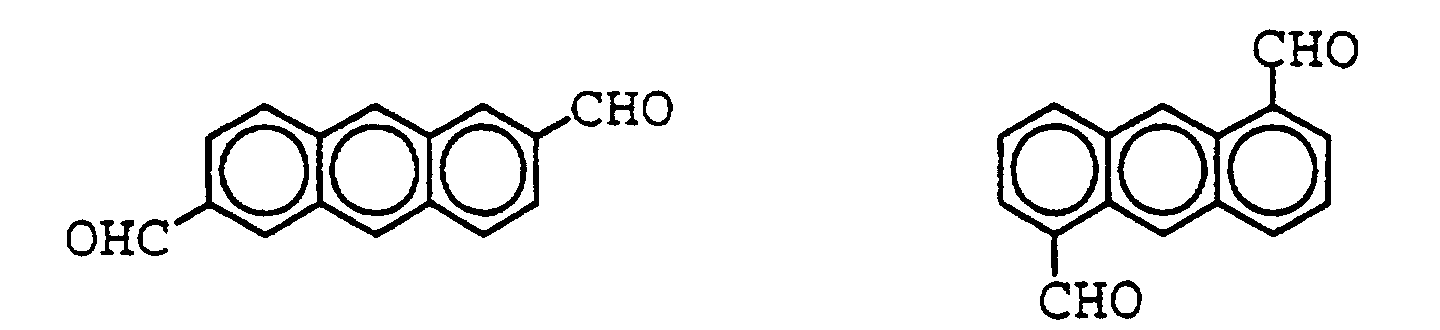
- the examples of the compound (A) which may be preferably used herein are as follows:
- the halogen atoms as the substituent may be fluorine, chlorine, bromine, or iodine, preferably fluorine, chlorine, or bromine, and more preferably fluorine.
- the halogens which are involved in the substitution may be either identical or different with one another. Examples of the compound (A) according to this embodiment which may be particularly used in this invention are as following:
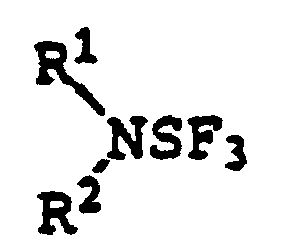
- the compound (B) to be used in this invention may be any of the compounds represented by the formula: wherein R 1 and R 2 independently represent an alkyl group of 1 to 6, preferably 1 to 3, carbon atoms such as, for example, methyl, ethyl, n-propyl, isopropyl, n-butyl, tert-butyl, pentyl and hexyl, or a phenyl group.
- diethylaminosulfur trifluoride [(C 2 H 3 ) 2 NSF 3 ] (hereinafter referred to briefly as "DAST") which has ethyl for both R 1 and R 2 in the formula mentioned above and dimethylaminosulfur trifluoride [(CH 3 ) 2 NSF 3 ] which has methyl for both R 1 and R 2 are preferably used in this invention in the sense that they excel in reactivity.
- the reaction is preferred to form a diffuoroalkyl group.
- the amount of the compound (B) to be used is preferably 1.5 to 2.5 mol equivalents, based on the amount of the compound (A) used. If the amount of the compound (B) to be used is less than 1.2 mol equivalents, the reaction of the compound (A) with the compound (B) will not proceed thoroughly and the fluorine-containing aromatic compound aimed at by the reaction will be produced in a low yield.
- a three-neck flask is vacuumized and then filled with such an inert gas as argon gas or helium gas to deprive the flask interior of the water content such as moisture. Further, the flask is charged with a compound (B) and a solvent to prepare a solution of compound (B).
- the compound (B) and the solvent may be mixed in advance and then introduced in a mixed state into the flask or alternatively they may be introduced separately of each other into the flask and then mixed inside the flask.
- this solution of compound (B) is stirred at a temperature lower than the reaction temperature and the compound (A) which has been dissolved in a solvent is added to the stirred solution.
- the solution of compound (A) may be added either collectively or dropwise.
- the mixed solution is continuously stirred at a humidity (water content) falling within a prescribed range and at a prescribed reaction temperature, to effect the reaction of the compound (A) with the compound (B).
- the compound (A) and the compound (B) can be directly reacted with each other by being mixed (stirred) instead of performing such a preliminary mixture as is depicted in the embodiment described above. It, however, is preferable for the compound (A) and the compound (B) to be mixed prior to their reaction at a temperature lower by at least 2 °C, more preferably at least 5 °C, and most preferably at least 15 °C, than the reaction temperature until attaining an uniform mixture. If the compound (A) and the compound (B) are mixed and caused to react at a temperature equal to or higher than their reaction temperature, the disadvantage ensues that they would generate heat excessively, promote self-decomposition of the compound (B), and lower the yield of the product aimed at.
- the reaction conditions according to this invention are as follows.
- the reaction temperature is preferred to be a temperature which is lower than the decomposition temperature of the compound (B) and allows the reaction to proceed efficiently. It is generally in the range of 0° to 50 °C, preferably in the range of 5° to 30 °C.
- the reaction temperature can be controlled within the range mentioned above by such a process as of dipping the reaction vessel in a refrigeration medium, introducing into the reaction vessel a stream of an inert gas like argon gas or helium gas cooled as with liquid nitrogen, or bubbling the inert gas through the reaction solution.
- the reaction time is generally in the range of 1 to 24 hours, preferably in the range of 1 to 8 hours.
- the reaction of the compound (A) with the compound (B) according to this invention is preferably carried out in an atmosphere in which the water content of the gaseous phase is not more than 100 vol.ppm, more preferably not more than 60 vol.ppm, and most preferably not more than 20 vol.ppm. If the compound (A) and the compound (B) are caused to react in an atmosphere in which the water content of the gaseous phase exceeds 100 vol.ppm, the disadvantage arises that they will promote self-decomposition of the compound (B) and lower the yield of the product aimed at.
- the water content of the gaseous phase during the course of the reaction of the compound (A) with the compound (B) can be maintained within the range mentioned above by sealing the flask tightly or introducing into the flask such an inert gas as argon gas or helium gas which has been dried by being passed through liquid nitrogen.
- the material for the reaction vessel such as a three-neck flask imposes no particular restriction but only requires to be incapable of reacting with (fluorinating) the compounds (A) and (B) and the solvent.
- glass, polyethylene, polypropylene, and fluorine resin maybe cited.
- polyethylene, polypropylene, and fluorine resin may be preferably used.
- each the compound (A) and the compound (B) uses a solvent
- the present invention allows each the compound (A) and the compound (B) to be used either in intact form or as dissolved in a solvent.
- the compounds (A) and (B) it is preferable for the compounds (A) and (B) to be dissolved in a suitable solvent.
- This invention does not discriminate the solvent to be used therein on account of its kind so long as the solvent itself is incapable of being fluorinated.
- aliphatic or aromatic hydrocarbons such as pentane, hexane, octane, and xylene; halogen-containing aliphatic or aromatic hydrocarbons such as dichloromethane, chloroform, 1,2-dichloroethane, 1,1,2,2-tetrachloroethane, carbon tetrachloride, trichlorofluoromethane, and chlorotoluene; and diglyme, and tetrahydrofuran may be cited.
- dichloromethane, chloroform, and 1,2-dichloroethane may be used particularly advantageously.
- the solvents mentioned above are preferred to be subjected to the known dehydrogenating treatment before they are put to use in the reaction of this invention.
- the amount of the solvent is preferred to be such that the concentration of the compound (A) in the reaction solution [compound (A) + compound (B) + solvent] may fall within the range of 1 to 30% by weight, preferably 3 to 20% by weight.
- the solvent may be mixed in advance with the raw material [compound (A) or compound (B)] and then added to the reaction vessel or alternatively it may be added together with the raw material [compound (A) or compound (B)] to the reaction vessel while stirred.
- the fluorine-containing aromatic compound aimed at can be separated and purified from the reaction solution (i.e., the solution having undergone the reaction until completion) by subjecting this reaction solution to such a well-known treatment as extraction, separation, and concentration.
- the fluorine-containing aromatic compound aimed at may be separated and purified from the reaction solution by such known means as silica gel or reversed-phase column chromatography, thin-layer chromatography (TLC), distillation, and recrystallization.
- the yield of the target product obtained by the method of this invention can be calculated and rated by subjecting the reaction solution to gas chromatographic (GC) analysis using a flame ionization detector.
- GC gas chromatographic
- the use of this procedure allows the content of the target product to be found in terms of peak strength which is proportional to the number of carbon atoms. It also allows the analysis to be attained quantitatively because the peak strength is proportional to the content of the target product for a fixed number of carbon atoms.
- the ratio of the amount of the by-product (referred to as “product 1" in the following examples) to that of the target product (referred to as “product 2" in the following examples) is calculated by using a peak area which is proportional to a peak strength thereby rating the yield of the fluorine-containing aromatic compound as a target product.
- a three-neck glass flask (reaction vessel), 100 ml in inner volume, was tightly sealed, vacuumized to 10 mmHg by means of a vacuum rotary pump, and then filled with argon gas (water content of 18 vol.ppm) to normal pressure (an ambient pressure) . Then, the three-neck flask was fitted with a stirrer as kept swept with argon gas and was charged with 5.06 g (0.0314 mol) of DAST (produced by Aldrich Chemical Co., Inc.) as a compound (B) and 10 ml of dichloromethane (produced by Kanto Chemical Co., Inc.) to prepare a solution of compound (B).
- DAST produced by Aldrich Chemical Co., Inc.
- dichloromethane produced by Kanto Chemical Co., Inc.
- the three-neck flask was dipped in ice water at 1.0 °C and kept at this temperature and a solution of compound (A) obtained by dissolving 1.06 g (0.00789 mol) of terephthalaldehyde (produced by Tokyo Kasei Organic Chemicals and referred to briefly as "TPA" hereinafter) as a compound (A) in 15 ml of dichloromethane was drip-fed into the solution of compound (B) as kept stirred through a dropping funnel over a period of five minutes.
- TPA terephthalaldehyde
- the reaction of a compound (A) with a compound (B) was attained by following the procedure of Example 1 while changing the amount of DAST as the compound (B) to 2.17 g (0.0135 mol), using 5 ml of toluene in place of 10 ml of dichloromethane, and using as the solution of compound (A) a solution of 0.50 g (0.00271 mol) of 2,3-naphthalenedicarbaldehyde [C 10 H 6 (CHO) 2 , produced by Aldrich Chemical Co., Inc., hereinafter referred to briefly as "NDA"] in 5 ml of dichloromethane.
- NDA 2,3-naphthalenedicarbaldehyde
- the amount of the compound (B) used was 2.5 mol equivalents based on the amount of the compound (A) used.
- the reaction of a compound (a) with a compound (B) was performed by following the procedure of Example 1 except changing the amount of DAST as the compound (B) to 4.83 g (0.030 mol) and using as the solution of compound (A) a solution of 1.34 g (0.01 mol) of TPA as the compound (A) in 30ml of dichloromethane.
- the amount of the compound (B) used was 1.5 mol equivalents based on the amount of the compound (A) used.
- the reaction of a compound (a) with a compound (B) was performed by following the procedure of Example 1 except changing the amount of DAST as the compound (B) to 4.86 g (0.0302 mol) and using as the solution of compound (A) a solution of 2.02 g (0.015 mol) of TPA as the compound (A) in 30 ml of dichloromethane.
- the amount of the compound (B) used was 1.0 mol equivalent based on the amount of the compound (A) used.
- 2,6-Naphthalene dicarbonyl chloride was synthesized by causing 2,6-naphthalene dicarboxylic acid to react with thionyl chloride by adopting the method described in Shin-jikken Kagaku Koza [sic.] (Vol. 14, page 1107, Maruzen Co., Ltd.),
- a solution C was prepared by dissolving 10.9g (43m.mols) of the 2,6-naphthalene dicarbonyl chloride synthesized as described above in 50ml of acetone.
- a solution D was prepared by dissolving 27.4g (45m.mols) of Bis(triphenylphosphine) copper (I) tetrahydroborate (produced by Tokyo Kasei Organic Chemicals) in 150 ml of acetone. Then, the solution D was added to the solution C prepared as described above at a rate of 10 ml/min while the solution C was stirred, and the mixed solution was continuously stirred for additional two hours. By extracting the reaction solution from diethyl ether, 5.0 g of 2,6-diformyl naphthalene was obtained (yield: 63%).
- a three-neck glass flask 100 ml in inner volume, was tightly sealed, vacuumized to 1 mmHg using a vacuum rotary pump, and then filled with argon gas (water content of 18 vol.ppm) to normal pressure (an ambient pressure). Then, the three-neck flask was fitted with a stirrer as kept swept with argon gas and was charged with 9.3 g (0.058 mol) of DAST (produced by Aldrich Chemical Co., Inc.) as a compound (B) and 20 g of dichloromethane to prepare a solution of compound (B).
- DAST produced by Aldrich Chemical Co., Inc.
- the three-neck flask was dipped in ice water at 0 °C. At the time when the internal temperature thereof reached 0 °C, it was maintained at this temperature and the solution of compound (A) of 3.0 g (0.016 mol) of the 2,6-diformyl naphthalene obtained in Reference Example 1 in 30 g of dichloromethane was drip-fed into the solution of compound (B) as kept stirred through a dropping funnel over a period of five minutes.
- the amount of the compound (B) used was 1.8 mol equivalents based on the amount of the compound (A) used.
- the reaction for fluorination can be simply carried out at room temperature under an ambient pressure and DAST to be used as a raw material exhibits appreciably low corrosiveness as compared with sulfur tetrafluoride which has been conventionally used. Therefore, the method of this invention obviates the necessity of using a reaction vessel made of such a special material as has been found necessary heretofore or adopting harsh reaction conditions and instead permits use of a reaction vessel made of such an ordinary material as glass. Furthermore, the fluorine-containing aromatic compound aimed at can be manufactured safely at low costs because DAST has low toxicity.
Landscapes
- Chemical & Material Sciences (AREA)
- Organic Chemistry (AREA)
- Chemical Kinetics & Catalysis (AREA)
- Organic Low-Molecular-Weight Compounds And Preparation Thereof (AREA)
Description







| Example | Compound (A) | Compound (B) | B/A (Mol equivalent) | Product 1 | Product 2 |
| 1 | TPA 1.06g (0.00789 mol) | DAST 5.06g (0.0314 mol) | 2.0 | 7 | 93 |
| 2 | TPA 0.05g (0.00271 mol) | DAST 2.17g (0.0135 mol) | 2.5 | 5 | 95 |
| 3 | TPA 1.34g (0.01 mol) | DAST 4.83g (0.030 mol) | 1.5 | 25 | 75 |
| 4 (Comparative) | TPA 2.02g (0.015 mol) | DAST 4.86g (0.0302 mol) | 1.0 | 73 | 27 |
| 5 | 2,6-diformyl naphthalene 3.0g (0.016 mol) | DAST 9.3g (0.058 mol) | 1.8 | 10 | 90 |
| TPA: Terephthalaldehyde | |||||
| NDA: 2,3-Naphthalenedicarbaldehyde | |||||
| DAST: Diethylaminosulfur trifluoride | |||||
| B/A: This numerical value calculated by the formula: [Number of mols of the compound (B)] / {[Number of mols of the compound (A)] X [Number of -C(=O)X groups in the compound (A)]} | |||||
| Reaction time: 5 hours in Examples 1 to 4; 6 hours in Example 5 | |||||
| Reaction temperature: 23°C in Examples 1 to 4; 30°C in Example 5 | |||||
| Solvent: CH2Cl2 or toluene |
Claims (12)
- A method for the production of a fluorine-containing aromatic compound which comprises causing an aromatic compound (A) having a cyclic skeletal part of 6 to 16 carbon atoms containing a plurality of -C(=O) X groups (wherein X stands for a hydrogen atom, a halogen atom, or an alkyl group of 1 to 10 carbon atoms) and having the remaining hydrogen atoms unsubstituted or partly or wholly substituted with at least one species of halogen atom to react with a compound (B) represented by the formula:wherein R1 and R2 independently stand for an alkyl group of 1 to 6 carbon atoms or a phenyl group; characterised in that the amount of the compound (B) used is in the range of 1.5 to 3.0 mol equivalents based on the amount of the compound (A) used, whereby the aromatic compound produced has a plurality of fluoroalkyl groups.

- A method as claimed in Claim 1, characterised in that the cyclic skeletal part is benzene, naphthalene, or biphenyl.
- A method as claimed in Claim 1 or Claim 2, characterised in that the halogen for substituting the remaining hydrogen atom is fluorine, chlorine, or bromine.
- A method as claimed in Claim 3, characterised in that the halogen for substituting the remaining hydrogen atom is fluorine.
- A method as claimed in any preceding claim, characterised in that the amount of compound (B) used is in the range of 1.5 to 2.5 mol equivalents based on the amount of the compound (A) used.
- A method as claimed in any preceding claim, characterised in that the compound (A) and the compound (B) are preliminarily mixed at a temperature lower than the reaction temperature prior to the reaction of the compound (A) with the compound (B).
- A method as claimed in Claim 6, characterised in that the compound (A) and the compound (B) are preliminarily mixed at a temperature lower than the reaction temperature by at least 2°C prior to the reaction of the compound (A) with the compound (B).
- A method as claimed in any preceding claim, characterised in that the reaction of the compound (A) with the compound (B) is carried out in an atmosphere in which the water content of the gaseous phase is not more than 100 vol. ppm.
- A method as claimed in Claim 8, characterised in that the reaction of the compound (A) with the compound (B) is carried out in an atmosphere in which the water content of the gaseous phase is not more than 60 vol. ppm.
- A method as claimed in Claim 8, characterised in that the reaction of the compound (A) with the compound (B) is carried out in an atmosphere in which the water content of the gaseous phase is not more than 20 vol. ppm.
- A method as claimed in Claim 7, characterised in that the compound (A) and the compound (B) are preliminarily mixed at a temperature lower than the reaction temperature by at least 15°C prior to the reaction of the compound (A) with the compound (B).
- A method as claimed in any preceding claim, characterised in that the reaction is carried out at a temperature in the range of 5° to 30°C.
Applications Claiming Priority (3)
| Application Number | Priority Date | Filing Date | Title |
|---|---|---|---|
| JP23514997 | 1997-08-29 | ||
| JP23514997 | 1997-08-29 | ||
| JP235149/97 | 1997-08-29 |
Publications (2)
| Publication Number | Publication Date |
|---|---|
| EP0900772A1 EP0900772A1 (en) | 1999-03-10 |
| EP0900772B1 true EP0900772B1 (en) | 2002-04-03 |
Family
ID=16981784
Family Applications (1)
| Application Number | Title | Priority Date | Filing Date |
|---|---|---|---|
| EP98306939A Expired - Lifetime EP0900772B1 (en) | 1997-08-29 | 1998-08-28 | Method for production of fluorine-containing aromatic compound |
Country Status (4)
| Country | Link |
|---|---|
| US (1) | US6043397A (en) |
| EP (1) | EP0900772B1 (en) |
| DE (1) | DE69804555T2 (en) |
| TW (1) | TW466228B (en) |
Families Citing this family (5)
| Publication number | Priority date | Publication date | Assignee | Title |
|---|---|---|---|---|
| US6080886A (en) * | 1997-09-29 | 2000-06-27 | Air Products And Chemicals, Inc. | Fluorination with aminosulfur trifluorides |
| TWI222433B (en) * | 1998-10-20 | 2004-10-21 | Nippon Catalytic Chem Ind | Method for production of halogen-containing aromatic compound |
| TW200633958A (en) * | 2005-03-21 | 2006-10-01 | Yuan Shin Machinery Co Ltd | Method for transferring TCPX into TFPX |
| TW200633959A (en) * | 2005-03-21 | 2006-10-01 | Yuan Shin Machinery Co Ltd | Method for the synthesis of TFPX |
| CN117447298A (en) * | 2023-08-29 | 2024-01-26 | 上海泰坦科技股份有限公司 | A kind of synthesis method of halomethyldifluoromethylbenzene |
Family Cites Families (3)
| Publication number | Priority date | Publication date | Assignee | Title |
|---|---|---|---|---|
| US2859245A (en) * | 1956-11-14 | 1958-11-04 | Du Pont | Reaction of sf4 with organic compounds containing a carbonyl radical |
| US3976691A (en) * | 1972-12-11 | 1976-08-24 | E. I. Du Pont De Nemours And Company | Dialkylaminosulfur trifluorides as fluorinating agents |
| US3914265A (en) * | 1972-12-11 | 1975-10-21 | Du Pont | Dialkylaminosulfur trifluorides as fluorinating agents |
-
1998
- 1998-08-25 US US09/139,422 patent/US6043397A/en not_active Expired - Fee Related
- 1998-08-28 DE DE69804555T patent/DE69804555T2/en not_active Expired - Fee Related
- 1998-08-28 EP EP98306939A patent/EP0900772B1/en not_active Expired - Lifetime
-
1999
- 1999-03-02 TW TW088103192A patent/TW466228B/en not_active IP Right Cessation
Also Published As
| Publication number | Publication date |
|---|---|
| DE69804555D1 (en) | 2002-05-08 |
| DE69804555T2 (en) | 2002-09-26 |
| TW466228B (en) | 2001-12-01 |
| US6043397A (en) | 2000-03-28 |
| EP0900772A1 (en) | 1999-03-10 |
Similar Documents
| Publication | Publication Date | Title |
|---|---|---|
| Umemoto et al. | Discovery of practical production processes for arylsulfur pentafluorides and their higher homologues, bis-and tris (sulfur pentafluorides): Beginning of a new era of “super-trifluoromethyl” arene chemistry and its industry | |
| US6066768A (en) | Perhalofluorinated butanes and hexanes | |
| US2671799A (en) | Perhalocarbon compounds and method of preparing them | |
| Johri et al. | Comparison of the reactivity of CF3OX (X= Cl, F) with some simple alkenes | |
| US7812202B2 (en) | Process for producing hexafluoro-1,3-butadiene | |
| Wiberg et al. | Formation and reactions of bicyclo [1.1. 1] pentyl-1 cations | |
| KR840001980B1 (en) | Method for preparing acid fluoride monomer | |
| US4782148A (en) | Method for production of perfluoro N-(vinyl)amines | |
| US6043397A (en) | Method for production of fluorine-containing aromatic compounds | |
| US6093860A (en) | Method for producing perfluoro(n-pentane) | |
| Lambert et al. | Polar bromination and chlorination of cyclopropane | |
| Zupan et al. | Fluorination with xenon difluoride. Stereochemistry of fluorine addition to phenyl-substituted olefins | |
| US20030149315A1 (en) | Synthesis of vicinal difluoro aromatics and intermediates thereof | |
| Law et al. | Fluorinated cyclopropenes and cyclopropenium ions | |
| Olah et al. | Organic fluorine compounds. XXXIII. Electrophilic additions to fluoro olefins in superacids | |
| US5847241A (en) | Process for the preparation of p-bromofluorobenzene | |
| Hudlicky | Dehydrohalogenations of cis-and trans-1-bromo-2-flourocyclohexanes | |
| JPH11130707A (en) | Production of fluorine-containing aromatic compound | |
| JPH11508893A (en) | Addition of trifluoromethane to fluoroolefins and isomerization of monohaloperfluoroalkanes | |
| KR20000059311A (en) | Method for preparing aromatic compounds containing fluorine | |
| US5557020A (en) | High-purity perfluoro-4-methyl-2-pentene and its preparation and use | |
| US5789630A (en) | Process for the synthesis of hexafluoropropanes | |
| Rabasco et al. | Stereoselectivity in 1, 4-elimination reactions. The gas-phase reactivity of deuterium-labeled 1-methoxy-2-cyclohexene and 6, 6-dimethyl-1-methoxy-2-cyclohexene | |
| EP4234529A1 (en) | Method for producing composition containing purified fluorine-containing ether compound | |
| Dailey et al. | 5, 6-Dichlorohexafluorocyclohexa-1, 3-dienes: hexafluorobenzene synthons |
Legal Events
| Date | Code | Title | Description |
|---|---|---|---|
| PUAI | Public reference made under article 153(3) epc to a published international application that has entered the european phase |
Free format text: ORIGINAL CODE: 0009012 |
|
| AK | Designated contracting states |
Kind code of ref document: A1 Designated state(s): DE FR GB |
|
| AX | Request for extension of the european patent |
Free format text: AL;LT;LV;MK;RO;SI |
|
| RAP1 | Party data changed (applicant data changed or rights of an application transferred) |
Owner name: NIPPON SHOKUBAI CO., LTD. |
|
| 17P | Request for examination filed |
Effective date: 19990316 |
|
| AKX | Designation fees paid |
Free format text: DE FR GB |
|
| 17Q | First examination report despatched |
Effective date: 20000317 |
|
| GRAG | Despatch of communication of intention to grant |
Free format text: ORIGINAL CODE: EPIDOS AGRA |
|
| GRAG | Despatch of communication of intention to grant |
Free format text: ORIGINAL CODE: EPIDOS AGRA |
|
| GRAH | Despatch of communication of intention to grant a patent |
Free format text: ORIGINAL CODE: EPIDOS IGRA |
|
| GRAH | Despatch of communication of intention to grant a patent |
Free format text: ORIGINAL CODE: EPIDOS IGRA |
|
| REG | Reference to a national code |
Ref country code: GB Ref legal event code: IF02 |
|
| GRAA | (expected) grant |
Free format text: ORIGINAL CODE: 0009210 |
|
| AK | Designated contracting states |
Kind code of ref document: B1 Designated state(s): DE FR GB |
|
| REF | Corresponds to: |
Ref document number: 69804555 Country of ref document: DE Date of ref document: 20020508 |
|
| ET | Fr: translation filed | ||
| PLBE | No opposition filed within time limit |
Free format text: ORIGINAL CODE: 0009261 |
|
| STAA | Information on the status of an ep patent application or granted ep patent |
Free format text: STATUS: NO OPPOSITION FILED WITHIN TIME LIMIT |
|
| 26N | No opposition filed |
Effective date: 20030106 |
|
| PGFP | Annual fee paid to national office [announced via postgrant information from national office to epo] |
Ref country code: DE Payment date: 20070823 Year of fee payment: 10 |
|
| PGFP | Annual fee paid to national office [announced via postgrant information from national office to epo] |
Ref country code: GB Payment date: 20070822 Year of fee payment: 10 |
|
| PGFP | Annual fee paid to national office [announced via postgrant information from national office to epo] |
Ref country code: FR Payment date: 20070808 Year of fee payment: 10 |
|
| GBPC | Gb: european patent ceased through non-payment of renewal fee |
Effective date: 20080828 |
|
| REG | Reference to a national code |
Ref country code: FR Ref legal event code: ST Effective date: 20090430 |
|
| PG25 | Lapsed in a contracting state [announced via postgrant information from national office to epo] |
Ref country code: FR Free format text: LAPSE BECAUSE OF NON-PAYMENT OF DUE FEES Effective date: 20080901 Ref country code: DE Free format text: LAPSE BECAUSE OF NON-PAYMENT OF DUE FEES Effective date: 20090303 |
|
| PG25 | Lapsed in a contracting state [announced via postgrant information from national office to epo] |
Ref country code: GB Free format text: LAPSE BECAUSE OF NON-PAYMENT OF DUE FEES Effective date: 20080828 |