EP0898317B1 - Cathode comprising a mixed phase metal oxide, method of preparation and electrochemical cell therefor - Google Patents
Cathode comprising a mixed phase metal oxide, method of preparation and electrochemical cell therefor Download PDFInfo
- Publication number
- EP0898317B1 EP0898317B1 EP98306235A EP98306235A EP0898317B1 EP 0898317 B1 EP0898317 B1 EP 0898317B1 EP 98306235 A EP98306235 A EP 98306235A EP 98306235 A EP98306235 A EP 98306235A EP 0898317 B1 EP0898317 B1 EP 0898317B1
- Authority
- EP
- European Patent Office
- Prior art keywords
- cathode
- anode
- metal oxide
- mixed phase
- electrochemical cell
- Prior art date
- Legal status (The legal status is an assumption and is not a legal conclusion. Google has not performed a legal analysis and makes no representation as to the accuracy of the status listed.)
- Expired - Lifetime
Links
- 229910044991 metal oxide Inorganic materials 0.000 title claims description 37
- 150000004706 metal oxides Chemical class 0.000 title claims description 35
- 238000000034 method Methods 0.000 title claims description 16
- 238000002360 preparation method Methods 0.000 title description 14
- 229910052751 metal Inorganic materials 0.000 claims description 24
- 239000002184 metal Substances 0.000 claims description 24
- 239000000203 mixture Substances 0.000 claims description 23
- 239000000463 material Substances 0.000 claims description 22
- -1 alkali metal salt Chemical class 0.000 claims description 17
- 238000000354 decomposition reaction Methods 0.000 claims description 15
- 229910052744 lithium Inorganic materials 0.000 claims description 15
- WHXSMMKQMYFTQS-UHFFFAOYSA-N Lithium Chemical compound [Li] WHXSMMKQMYFTQS-UHFFFAOYSA-N 0.000 claims description 13
- 229910052783 alkali metal Inorganic materials 0.000 claims description 13
- 239000000470 constituent Substances 0.000 claims description 13
- 239000003792 electrolyte Substances 0.000 claims description 13
- 238000010438 heat treatment Methods 0.000 claims description 12
- 239000007858 starting material Substances 0.000 claims description 12
- 239000011149 active material Substances 0.000 claims description 11
- PXHVJJICTQNCMI-UHFFFAOYSA-N Nickel Chemical compound [Ni] PXHVJJICTQNCMI-UHFFFAOYSA-N 0.000 claims description 9
- 150000001340 alkali metals Chemical class 0.000 claims description 9
- 229910001935 vanadium oxide Inorganic materials 0.000 claims description 9
- RYGMFSIKBFXOCR-UHFFFAOYSA-N Copper Chemical compound [Cu] RYGMFSIKBFXOCR-UHFFFAOYSA-N 0.000 claims description 8
- BQCADISMDOOEFD-UHFFFAOYSA-N Silver Chemical compound [Ag] BQCADISMDOOEFD-UHFFFAOYSA-N 0.000 claims description 8
- 239000010949 copper Substances 0.000 claims description 8
- 229910052802 copper Inorganic materials 0.000 claims description 8
- 150000003839 salts Chemical class 0.000 claims description 8
- 229910052709 silver Inorganic materials 0.000 claims description 8
- 239000004332 silver Substances 0.000 claims description 8
- XTHFKEDIFFGKHM-UHFFFAOYSA-N Dimethoxyethane Chemical compound COCCOC XTHFKEDIFFGKHM-UHFFFAOYSA-N 0.000 claims description 7
- WEVYAHXRMPXWCK-UHFFFAOYSA-N Acetonitrile Chemical compound CC#N WEVYAHXRMPXWCK-UHFFFAOYSA-N 0.000 claims description 6
- OKTJSMMVPCPJKN-UHFFFAOYSA-N Carbon Chemical group [C] OKTJSMMVPCPJKN-UHFFFAOYSA-N 0.000 claims description 6
- ZMXDDKWLCZADIW-UHFFFAOYSA-N N,N-Dimethylformamide Chemical compound CN(C)C=O ZMXDDKWLCZADIW-UHFFFAOYSA-N 0.000 claims description 6
- SECXISVLQFMRJM-UHFFFAOYSA-N N-Methylpyrrolidone Chemical compound CN1CCCC1=O SECXISVLQFMRJM-UHFFFAOYSA-N 0.000 claims description 6
- WYURNTSHIVDZCO-UHFFFAOYSA-N Tetrahydrofuran Chemical compound C1CCOC1 WYURNTSHIVDZCO-UHFFFAOYSA-N 0.000 claims description 6
- XHCLAFWTIXFWPH-UHFFFAOYSA-N [O-2].[O-2].[O-2].[O-2].[O-2].[V+5].[V+5] Chemical compound [O-2].[O-2].[O-2].[O-2].[O-2].[V+5].[V+5] XHCLAFWTIXFWPH-UHFFFAOYSA-N 0.000 claims description 6
- 150000003863 ammonium salts Chemical class 0.000 claims description 6
- 238000002156 mixing Methods 0.000 claims description 6
- 239000002904 solvent Substances 0.000 claims description 6
- 239000011230 binding agent Substances 0.000 claims description 5
- 239000000843 powder Substances 0.000 claims description 5
- RUOJZAUFBMNUDX-UHFFFAOYSA-N propylene carbonate Chemical compound CC1COC(=O)O1 RUOJZAUFBMNUDX-UHFFFAOYSA-N 0.000 claims description 5
- IAZDPXIOMUYVGZ-UHFFFAOYSA-N Dimethylsulphoxide Chemical compound CS(C)=O IAZDPXIOMUYVGZ-UHFFFAOYSA-N 0.000 claims description 4
- 229910052782 aluminium Inorganic materials 0.000 claims description 4
- XAGFODPZIPBFFR-UHFFFAOYSA-N aluminium Chemical compound [Al] XAGFODPZIPBFFR-UHFFFAOYSA-N 0.000 claims description 4
- 150000004649 carbonic acid derivatives Chemical class 0.000 claims description 4
- 229910052759 nickel Inorganic materials 0.000 claims description 4
- 150000002823 nitrates Chemical group 0.000 claims description 4
- 150000002826 nitrites Chemical class 0.000 claims description 4
- 239000010935 stainless steel Substances 0.000 claims description 4
- 229910001220 stainless steel Inorganic materials 0.000 claims description 4
- 239000010936 titanium Substances 0.000 claims description 4
- 229910018075 AgxV2Oy Inorganic materials 0.000 claims description 3
- 229910016390 CuxAgyV2Oz Inorganic materials 0.000 claims description 3
- KMTRUDSVKNLOMY-UHFFFAOYSA-N Ethylene carbonate Chemical compound O=C1OCCO1 KMTRUDSVKNLOMY-UHFFFAOYSA-N 0.000 claims description 3
- PWHULOQIROXLJO-UHFFFAOYSA-N Manganese Chemical compound [Mn] PWHULOQIROXLJO-UHFFFAOYSA-N 0.000 claims description 3
- XBDQKXXYIPTUBI-UHFFFAOYSA-M Propionate Chemical compound CCC([O-])=O XBDQKXXYIPTUBI-UHFFFAOYSA-M 0.000 claims description 3
- RTAQQCXQSZGOHL-UHFFFAOYSA-N Titanium Chemical compound [Ti] RTAQQCXQSZGOHL-UHFFFAOYSA-N 0.000 claims description 3
- KXKVLQRXCPHEJC-UHFFFAOYSA-N acetic acid trimethyl ester Natural products COC(C)=O KXKVLQRXCPHEJC-UHFFFAOYSA-N 0.000 claims description 3
- QVGXLLKOCUKJST-UHFFFAOYSA-N atomic oxygen Chemical compound [O] QVGXLLKOCUKJST-UHFFFAOYSA-N 0.000 claims description 3
- 239000002482 conductive additive Substances 0.000 claims description 3
- 229910001540 lithium hexafluoroarsenate(V) Inorganic materials 0.000 claims description 3
- 239000011572 manganese Substances 0.000 claims description 3
- 229910052748 manganese Inorganic materials 0.000 claims description 3
- 239000001301 oxygen Substances 0.000 claims description 3
- 229910052760 oxygen Inorganic materials 0.000 claims description 3
- YLQBMQCUIZJEEH-UHFFFAOYSA-N tetrahydrofuran Natural products C=1C=COC=1 YLQBMQCUIZJEEH-UHFFFAOYSA-N 0.000 claims description 3
- 229910017646 Cu0.16Ag0.67V2Oz Inorganic materials 0.000 claims description 2
- 229910017651 Cu0.5Ag0.5V2Oz Inorganic materials 0.000 claims description 2
- OIFBSDVPJOWBCH-UHFFFAOYSA-N Diethyl carbonate Chemical compound CCOC(=O)OCC OIFBSDVPJOWBCH-UHFFFAOYSA-N 0.000 claims description 2
- 229910015044 LiB Inorganic materials 0.000 claims description 2
- 229910000552 LiCF3SO3 Inorganic materials 0.000 claims description 2
- 229910010937 LiGaCl4 Inorganic materials 0.000 claims description 2
- 229910013406 LiN(SO2CF3)2 Inorganic materials 0.000 claims description 2
- 229910001290 LiPF6 Inorganic materials 0.000 claims description 2
- 229910012423 LiSO3F Inorganic materials 0.000 claims description 2
- FXHOOIRPVKKKFG-UHFFFAOYSA-N N,N-Dimethylacetamide Chemical compound CN(C)C(C)=O FXHOOIRPVKKKFG-UHFFFAOYSA-N 0.000 claims description 2
- 239000006230 acetylene black Substances 0.000 claims description 2
- SBZXBUIDTXKZTM-UHFFFAOYSA-N diglyme Chemical compound COCCOCCOC SBZXBUIDTXKZTM-UHFFFAOYSA-N 0.000 claims description 2
- IEJIGPNLZYLLBP-UHFFFAOYSA-N dimethyl carbonate Chemical compound COC(=O)OC IEJIGPNLZYLLBP-UHFFFAOYSA-N 0.000 claims description 2
- 229940113088 dimethylacetamide Drugs 0.000 claims description 2
- 238000009472 formulation Methods 0.000 claims description 2
- MHCFAGZWMAWTNR-UHFFFAOYSA-M lithium perchlorate Chemical compound [Li+].[O-]Cl(=O)(=O)=O MHCFAGZWMAWTNR-UHFFFAOYSA-M 0.000 claims description 2
- 229910001486 lithium perchlorate Inorganic materials 0.000 claims description 2
- 229910001537 lithium tetrachloroaluminate Inorganic materials 0.000 claims description 2
- QSZMZKBZAYQGRS-UHFFFAOYSA-N lithium;bis(trifluoromethylsulfonyl)azanide Chemical compound [Li+].FC(F)(F)S(=O)(=O)[N-]S(=O)(=O)C(F)(F)F QSZMZKBZAYQGRS-UHFFFAOYSA-N 0.000 claims description 2
- 239000003960 organic solvent Substances 0.000 claims description 2
- 239000011347 resin Substances 0.000 claims description 2
- 229920005989 resin Polymers 0.000 claims description 2
- 229910052719 titanium Inorganic materials 0.000 claims description 2
- YEJRWHAVMIAJKC-UHFFFAOYSA-N 4-Butyrolactone Chemical compound O=C1CCCO1 YEJRWHAVMIAJKC-UHFFFAOYSA-N 0.000 claims 2
- 230000003213 activating effect Effects 0.000 claims 2
- FUJCRWPEOMXPAD-UHFFFAOYSA-N Li2O Inorganic materials [Li+].[Li+].[O-2] FUJCRWPEOMXPAD-UHFFFAOYSA-N 0.000 claims 1
- 239000003125 aqueous solvent Substances 0.000 claims 1
- 229910052799 carbon Inorganic materials 0.000 claims 1
- XUCJHNOBJLKZNU-UHFFFAOYSA-M dilithium;hydroxide Chemical compound [Li+].[Li+].[OH-] XUCJHNOBJLKZNU-UHFFFAOYSA-M 0.000 claims 1
- 239000008240 homogeneous mixture Substances 0.000 claims 1
- 238000000265 homogenisation Methods 0.000 claims 1
- 229910001547 lithium hexafluoroantimonate(V) Inorganic materials 0.000 claims 1
- 229910001500 lithium hexafluoroborate Inorganic materials 0.000 claims 1
- ZUHZGEOKBKGPSW-UHFFFAOYSA-N tetraglyme Chemical compound COCCOCCOCCOCCOC ZUHZGEOKBKGPSW-UHFFFAOYSA-N 0.000 claims 1
- YFNKIDBQEZZDLK-UHFFFAOYSA-N triglyme Chemical compound COCCOCCOCCOC YFNKIDBQEZZDLK-UHFFFAOYSA-N 0.000 claims 1
- RAVDHKVWJUPFPT-UHFFFAOYSA-N silver;oxido(dioxo)vanadium Chemical compound [Ag+].[O-][V](=O)=O RAVDHKVWJUPFPT-UHFFFAOYSA-N 0.000 description 31
- 238000012360 testing method Methods 0.000 description 20
- 239000000376 reactant Substances 0.000 description 14
- 239000010406 cathode material Substances 0.000 description 13
- SQGYOTSLMSWVJD-UHFFFAOYSA-N silver(1+) nitrate Chemical compound [Ag+].[O-]N(=O)=O SQGYOTSLMSWVJD-UHFFFAOYSA-N 0.000 description 10
- MWUXSHHQAYIFBG-UHFFFAOYSA-N Nitric oxide Chemical compound O=[N] MWUXSHHQAYIFBG-UHFFFAOYSA-N 0.000 description 9
- 239000006182 cathode active material Substances 0.000 description 9
- 150000001875 compounds Chemical class 0.000 description 6
- 239000010405 anode material Substances 0.000 description 5
- GNTDGMZSJNCJKK-UHFFFAOYSA-N divanadium pentaoxide Chemical compound O=[V](=O)O[V](=O)=O GNTDGMZSJNCJKK-UHFFFAOYSA-N 0.000 description 5
- 238000006243 chemical reaction Methods 0.000 description 4
- 239000002131 composite material Substances 0.000 description 4
- 230000003247 decreasing effect Effects 0.000 description 4
- 238000013461 design Methods 0.000 description 4
- 238000003487 electrochemical reaction Methods 0.000 description 4
- 150000002500 ions Chemical class 0.000 description 4
- 150000002736 metal compounds Chemical class 0.000 description 4
- 150000002739 metals Chemical class 0.000 description 4
- 229920001343 polytetrafluoroethylene Polymers 0.000 description 4
- 239000004810 polytetrafluoroethylene Substances 0.000 description 4
- 229910002651 NO3 Inorganic materials 0.000 description 3
- NHNBFGGVMKEFGY-UHFFFAOYSA-N Nitrate Chemical compound [O-][N+]([O-])=O NHNBFGGVMKEFGY-UHFFFAOYSA-N 0.000 description 3
- IOVCWXUNBOPUCH-UHFFFAOYSA-M Nitrite anion Chemical compound [O-]N=O IOVCWXUNBOPUCH-UHFFFAOYSA-M 0.000 description 3
- 229910045601 alloy Inorganic materials 0.000 description 3
- 239000000956 alloy Substances 0.000 description 3
- 230000015572 biosynthetic process Effects 0.000 description 3
- 230000000747 cardiac effect Effects 0.000 description 3
- 239000003085 diluting agent Substances 0.000 description 3
- 239000012528 membrane Substances 0.000 description 3
- 230000000737 periodic effect Effects 0.000 description 3
- 238000003786 synthesis reaction Methods 0.000 description 3
- 229910017988 AgVO3 Inorganic materials 0.000 description 2
- CURLTUGMZLYLDI-UHFFFAOYSA-N Carbon dioxide Chemical compound O=C=O CURLTUGMZLYLDI-UHFFFAOYSA-N 0.000 description 2
- DGAQECJNVWCQMB-PUAWFVPOSA-M Ilexoside XXIX Chemical compound C[C@@H]1CC[C@@]2(CC[C@@]3(C(=CC[C@H]4[C@]3(CC[C@@H]5[C@@]4(CC[C@@H](C5(C)C)OS(=O)(=O)[O-])C)C)[C@@H]2[C@]1(C)O)C)C(=O)O[C@H]6[C@@H]([C@H]([C@@H]([C@H](O6)CO)O)O)O.[Na+] DGAQECJNVWCQMB-PUAWFVPOSA-M 0.000 description 2
- 239000002033 PVDF binder Substances 0.000 description 2
- 239000004743 Polypropylene Substances 0.000 description 2
- 229910000831 Steel Inorganic materials 0.000 description 2
- YALCWJZSJOMTCG-UHFFFAOYSA-N [O--].[O--].[O--].[O--].[V+5].[Cu++].[Ag+] Chemical compound [O--].[O--].[O--].[O--].[V+5].[Cu++].[Ag+] YALCWJZSJOMTCG-UHFFFAOYSA-N 0.000 description 2
- 239000006229 carbon black Substances 0.000 description 2
- 230000001627 detrimental effect Effects 0.000 description 2
- 238000009826 distribution Methods 0.000 description 2
- 230000000694 effects Effects 0.000 description 2
- 239000007772 electrode material Substances 0.000 description 2
- 239000000835 fiber Substances 0.000 description 2
- 239000007789 gas Substances 0.000 description 2
- 229910002804 graphite Inorganic materials 0.000 description 2
- 239000010439 graphite Substances 0.000 description 2
- 238000010348 incorporation Methods 0.000 description 2
- 229910000765 intermetallic Inorganic materials 0.000 description 2
- 230000005012 migration Effects 0.000 description 2
- 238000013508 migration Methods 0.000 description 2
- 239000002245 particle Substances 0.000 description 2
- 229920001155 polypropylene Polymers 0.000 description 2
- 229920002981 polyvinylidene fluoride Polymers 0.000 description 2
- 229910001961 silver nitrate Inorganic materials 0.000 description 2
- NDVLTYZPCACLMA-UHFFFAOYSA-N silver oxide Chemical compound [O-2].[Ag+].[Ag+] NDVLTYZPCACLMA-UHFFFAOYSA-N 0.000 description 2
- 229910000108 silver(I,III) oxide Inorganic materials 0.000 description 2
- 229910052708 sodium Inorganic materials 0.000 description 2
- 239000011734 sodium Substances 0.000 description 2
- 239000010959 steel Substances 0.000 description 2
- 239000000126 substance Substances 0.000 description 2
- 238000005979 thermal decomposition reaction Methods 0.000 description 2
- 230000007704 transition Effects 0.000 description 2
- 238000003466 welding Methods 0.000 description 2
- GEWWCWZGHNIUBW-UHFFFAOYSA-N 1-(4-nitrophenyl)propan-2-one Chemical compound CC(=O)CC1=CC=C([N+]([O-])=O)C=C1 GEWWCWZGHNIUBW-UHFFFAOYSA-N 0.000 description 1
- 229910017748 AgV2O5.5 Inorganic materials 0.000 description 1
- 229910017747 AgV2O5.5 (SVO) Inorganic materials 0.000 description 1
- 229910000838 Al alloy Inorganic materials 0.000 description 1
- ZOXJGFHDIHLPTG-UHFFFAOYSA-N Boron Chemical compound [B] ZOXJGFHDIHLPTG-UHFFFAOYSA-N 0.000 description 1
- BVKZGUZCCUSVTD-UHFFFAOYSA-L Carbonate Chemical compound [O-]C([O-])=O BVKZGUZCCUSVTD-UHFFFAOYSA-L 0.000 description 1
- 229920013683 Celanese Polymers 0.000 description 1
- QPLDLSVMHZLSFG-UHFFFAOYSA-N Copper oxide Chemical compound [Cu]=O QPLDLSVMHZLSFG-UHFFFAOYSA-N 0.000 description 1
- 239000005751 Copper oxide Substances 0.000 description 1
- 229910001200 Ferrotitanium Inorganic materials 0.000 description 1
- KRHYYFGTRYWZRS-UHFFFAOYSA-M Fluoride anion Chemical compound [F-] KRHYYFGTRYWZRS-UHFFFAOYSA-M 0.000 description 1
- 229910000733 Li alloy Inorganic materials 0.000 description 1
- 229910007857 Li-Al Inorganic materials 0.000 description 1
- 229910013375 LiC Inorganic materials 0.000 description 1
- 229910008447 Li—Al Inorganic materials 0.000 description 1
- 229910008290 Li—B Inorganic materials 0.000 description 1
- 229910006742 Li—Si—B Inorganic materials 0.000 description 1
- ZLMJMSJWJFRBEC-UHFFFAOYSA-N Potassium Chemical compound [K] ZLMJMSJWJFRBEC-UHFFFAOYSA-N 0.000 description 1
- JFBZPFYRPYOZCQ-UHFFFAOYSA-N [Li].[Al] Chemical compound [Li].[Al] JFBZPFYRPYOZCQ-UHFFFAOYSA-N 0.000 description 1
- JKLVRIRNLLAISP-UHFFFAOYSA-N [O-2].[V+5].[Cu+2] Chemical compound [O-2].[V+5].[Cu+2] JKLVRIRNLLAISP-UHFFFAOYSA-N 0.000 description 1
- 230000004913 activation Effects 0.000 description 1
- 238000007259 addition reaction Methods 0.000 description 1
- 239000006183 anode active material Substances 0.000 description 1
- 229910052787 antimony Inorganic materials 0.000 description 1
- WATWJIUSRGPENY-UHFFFAOYSA-N antimony atom Chemical compound [Sb] WATWJIUSRGPENY-UHFFFAOYSA-N 0.000 description 1
- 229910052785 arsenic Inorganic materials 0.000 description 1
- RQNWIZPPADIBDY-UHFFFAOYSA-N arsenic atom Chemical compound [As] RQNWIZPPADIBDY-UHFFFAOYSA-N 0.000 description 1
- UNTBPXHCXVWYOI-UHFFFAOYSA-O azanium;oxido(dioxo)vanadium Chemical compound [NH4+].[O-][V](=O)=O UNTBPXHCXVWYOI-UHFFFAOYSA-O 0.000 description 1
- 229910052796 boron Inorganic materials 0.000 description 1
- 239000001569 carbon dioxide Substances 0.000 description 1
- 229910002092 carbon dioxide Inorganic materials 0.000 description 1
- 229910010293 ceramic material Inorganic materials 0.000 description 1
- 239000004020 conductor Substances 0.000 description 1
- 229910000431 copper oxide Inorganic materials 0.000 description 1
- XTVVROIMIGLXTD-UHFFFAOYSA-N copper(II) nitrate Chemical compound [Cu+2].[O-][N+]([O-])=O.[O-][N+]([O-])=O XTVVROIMIGLXTD-UHFFFAOYSA-N 0.000 description 1
- XNEQAVYOCNWYNZ-UHFFFAOYSA-L copper;dinitrite Chemical compound [Cu+2].[O-]N=O.[O-]N=O XNEQAVYOCNWYNZ-UHFFFAOYSA-L 0.000 description 1
- 238000005260 corrosion Methods 0.000 description 1
- 230000007797 corrosion Effects 0.000 description 1
- 150000003950 cyclic amides Chemical class 0.000 description 1
- 150000005676 cyclic carbonates Chemical class 0.000 description 1
- 125000004122 cyclic group Chemical group 0.000 description 1
- 238000009831 deintercalation Methods 0.000 description 1
- 238000000113 differential scanning calorimetry Methods 0.000 description 1
- 238000001938 differential scanning calorimetry curve Methods 0.000 description 1
- 238000001035 drying Methods 0.000 description 1
- 239000008151 electrolyte solution Substances 0.000 description 1
- 238000011049 filling Methods 0.000 description 1
- 239000011888 foil Substances 0.000 description 1
- 239000011521 glass Substances 0.000 description 1
- 239000003365 glass fiber Substances 0.000 description 1
- 238000000227 grinding Methods 0.000 description 1
- BHEPBYXIRTUNPN-UHFFFAOYSA-N hydridophosphorus(.) (triplet) Chemical compound [PH] BHEPBYXIRTUNPN-UHFFFAOYSA-N 0.000 description 1
- 230000006872 improvement Effects 0.000 description 1
- 238000009830 intercalation Methods 0.000 description 1
- 230000002687 intercalation Effects 0.000 description 1
- 230000002045 lasting effect Effects 0.000 description 1
- 239000001989 lithium alloy Substances 0.000 description 1
- 230000007774 longterm Effects 0.000 description 1
- 238000004519 manufacturing process Methods 0.000 description 1
- 229910021645 metal ion Inorganic materials 0.000 description 1
- 229910052976 metal sulfide Inorganic materials 0.000 description 1
- 238000003801 milling Methods 0.000 description 1
- 229910003455 mixed metal oxide Inorganic materials 0.000 description 1
- 238000012544 monitoring process Methods 0.000 description 1
- 239000011255 nonaqueous electrolyte Substances 0.000 description 1
- 239000004745 nonwoven fabric Substances 0.000 description 1
- 230000003647 oxidation Effects 0.000 description 1
- 238000007254 oxidation reaction Methods 0.000 description 1
- 239000008188 pellet Substances 0.000 description 1
- 230000000704 physical effect Effects 0.000 description 1
- 239000004033 plastic Substances 0.000 description 1
- 229910052700 potassium Inorganic materials 0.000 description 1
- 239000011591 potassium Substances 0.000 description 1
- 159000000001 potassium salts Chemical class 0.000 description 1
- 238000003825 pressing Methods 0.000 description 1
- 230000008569 process Effects 0.000 description 1
- 238000005096 rolling process Methods 0.000 description 1
- KKKDGYXNGYJJRX-UHFFFAOYSA-M silver nitrite Chemical compound [Ag+].[O-]N=O KKKDGYXNGYJJRX-UHFFFAOYSA-M 0.000 description 1
- 229910001923 silver oxide Inorganic materials 0.000 description 1
- 239000007787 solid Substances 0.000 description 1
- 238000003892 spreading Methods 0.000 description 1
- 230000007480 spreading Effects 0.000 description 1
- 238000003756 stirring Methods 0.000 description 1
- 238000007669 thermal treatment Methods 0.000 description 1
- 150000003681 vanadium Chemical class 0.000 description 1
- 239000002759 woven fabric Substances 0.000 description 1
Images



Classifications
-
- H—ELECTRICITY
- H01—ELECTRIC ELEMENTS
- H01M—PROCESSES OR MEANS, e.g. BATTERIES, FOR THE DIRECT CONVERSION OF CHEMICAL ENERGY INTO ELECTRICAL ENERGY
- H01M4/00—Electrodes
- H01M4/02—Electrodes composed of, or comprising, active material
- H01M4/13—Electrodes for accumulators with non-aqueous electrolyte, e.g. for lithium-accumulators; Processes of manufacture thereof
- H01M4/131—Electrodes based on mixed oxides or hydroxides, or on mixtures of oxides or hydroxides, e.g. LiCoOx
-
- H—ELECTRICITY
- H01—ELECTRIC ELEMENTS
- H01M—PROCESSES OR MEANS, e.g. BATTERIES, FOR THE DIRECT CONVERSION OF CHEMICAL ENERGY INTO ELECTRICAL ENERGY
- H01M4/00—Electrodes
- H01M4/02—Electrodes composed of, or comprising, active material
- H01M4/36—Selection of substances as active materials, active masses, active liquids
- H01M4/48—Selection of substances as active materials, active masses, active liquids of inorganic oxides or hydroxides
- H01M4/485—Selection of substances as active materials, active masses, active liquids of inorganic oxides or hydroxides of mixed oxides or hydroxides for inserting or intercalating light metals, e.g. LiTi2O4 or LiTi2OxFy
-
- H—ELECTRICITY
- H01—ELECTRIC ELEMENTS
- H01M—PROCESSES OR MEANS, e.g. BATTERIES, FOR THE DIRECT CONVERSION OF CHEMICAL ENERGY INTO ELECTRICAL ENERGY
- H01M4/00—Electrodes
- H01M4/02—Electrodes composed of, or comprising, active material
- H01M4/36—Selection of substances as active materials, active masses, active liquids
- H01M4/48—Selection of substances as active materials, active masses, active liquids of inorganic oxides or hydroxides
- H01M4/54—Selection of substances as active materials, active masses, active liquids of inorganic oxides or hydroxides of silver
-
- H—ELECTRICITY
- H01—ELECTRIC ELEMENTS
- H01M—PROCESSES OR MEANS, e.g. BATTERIES, FOR THE DIRECT CONVERSION OF CHEMICAL ENERGY INTO ELECTRICAL ENERGY
- H01M4/00—Electrodes
- H01M4/02—Electrodes composed of, or comprising, active material
- H01M4/36—Selection of substances as active materials, active masses, active liquids
- H01M4/58—Selection of substances as active materials, active masses, active liquids of inorganic compounds other than oxides or hydroxides, e.g. sulfides, selenides, tellurides, halogenides or LiCoFy; of polyanionic structures, e.g. phosphates, silicates or borates
- H01M4/5825—Oxygenated metallic salts or polyanionic structures, e.g. borates, phosphates, silicates, olivines
-
- H—ELECTRICITY
- H01—ELECTRIC ELEMENTS
- H01M—PROCESSES OR MEANS, e.g. BATTERIES, FOR THE DIRECT CONVERSION OF CHEMICAL ENERGY INTO ELECTRICAL ENERGY
- H01M4/00—Electrodes
- H01M4/02—Electrodes composed of, or comprising, active material
- H01M4/62—Selection of inactive substances as ingredients for active masses, e.g. binders, fillers
- H01M4/624—Electric conductive fillers
- H01M4/626—Metals
-
- H—ELECTRICITY
- H01—ELECTRIC ELEMENTS
- H01M—PROCESSES OR MEANS, e.g. BATTERIES, FOR THE DIRECT CONVERSION OF CHEMICAL ENERGY INTO ELECTRICAL ENERGY
- H01M6/00—Primary cells; Manufacture thereof
- H01M6/14—Cells with non-aqueous electrolyte
- H01M6/16—Cells with non-aqueous electrolyte with organic electrolyte
-
- H—ELECTRICITY
- H01—ELECTRIC ELEMENTS
- H01M—PROCESSES OR MEANS, e.g. BATTERIES, FOR THE DIRECT CONVERSION OF CHEMICAL ENERGY INTO ELECTRICAL ENERGY
- H01M4/00—Electrodes
- H01M4/02—Electrodes composed of, or comprising, active material
- H01M4/62—Selection of inactive substances as ingredients for active masses, e.g. binders, fillers
- H01M4/624—Electric conductive fillers
- H01M4/625—Carbon or graphite
-
- Y—GENERAL TAGGING OF NEW TECHNOLOGICAL DEVELOPMENTS; GENERAL TAGGING OF CROSS-SECTIONAL TECHNOLOGIES SPANNING OVER SEVERAL SECTIONS OF THE IPC; TECHNICAL SUBJECTS COVERED BY FORMER USPC CROSS-REFERENCE ART COLLECTIONS [XRACs] AND DIGESTS
- Y02—TECHNOLOGIES OR APPLICATIONS FOR MITIGATION OR ADAPTATION AGAINST CLIMATE CHANGE
- Y02E—REDUCTION OF GREENHOUSE GAS [GHG] EMISSIONS, RELATED TO ENERGY GENERATION, TRANSMISSION OR DISTRIBUTION
- Y02E60/00—Enabling technologies; Technologies with a potential or indirect contribution to GHG emissions mitigation
- Y02E60/10—Energy storage using batteries
-
- Y—GENERAL TAGGING OF NEW TECHNOLOGICAL DEVELOPMENTS; GENERAL TAGGING OF CROSS-SECTIONAL TECHNOLOGIES SPANNING OVER SEVERAL SECTIONS OF THE IPC; TECHNICAL SUBJECTS COVERED BY FORMER USPC CROSS-REFERENCE ART COLLECTIONS [XRACs] AND DIGESTS
- Y10—TECHNICAL SUBJECTS COVERED BY FORMER USPC
- Y10T—TECHNICAL SUBJECTS COVERED BY FORMER US CLASSIFICATION
- Y10T29/00—Metal working
- Y10T29/49—Method of mechanical manufacture
- Y10T29/49002—Electrical device making
- Y10T29/49108—Electric battery cell making
-
- Y—GENERAL TAGGING OF NEW TECHNOLOGICAL DEVELOPMENTS; GENERAL TAGGING OF CROSS-SECTIONAL TECHNOLOGIES SPANNING OVER SEVERAL SECTIONS OF THE IPC; TECHNICAL SUBJECTS COVERED BY FORMER USPC CROSS-REFERENCE ART COLLECTIONS [XRACs] AND DIGESTS
- Y10—TECHNICAL SUBJECTS COVERED BY FORMER USPC
- Y10T—TECHNICAL SUBJECTS COVERED BY FORMER US CLASSIFICATION
- Y10T29/00—Metal working
- Y10T29/49—Method of mechanical manufacture
- Y10T29/49002—Electrical device making
- Y10T29/49108—Electric battery cell making
- Y10T29/49114—Electric battery cell making including adhesively bonding
Definitions
- the present invention generally relates to the conversion of chemical energy to electrical energy, and more particularly, to an alkali metal electrochemical cell having a positive electrode comprising a mixed phase metal oxide.
- Preferred mixed phase metal oxides include silver vanadium oxide, copper vanadium oxide and copper silver vanadium oxide present in various phases or stoichiometric formulations along with a minor amount of the starting materials.
- the second metal is preferably selected from silver, copper, manganese and mixtures thereof.
- a typical product has the general formula Ag x V 2 O y wherein "x" is in the range from about 0.5 to about 2.0, and "y” is in the range from about 4.5 to about 6.0.
- U.S. Patent No. 5,516,340 to Takeuchi et al. which is assigned to the assignee of the present invention and incorporated herein by reference, describes the preparation of a metal oxide composite cathode material such as copper silver vanadium oxide using various starting materials including vanadium oxide combined with the nitrate or the nitrite of a second and a third metal. The reactants are thoroughly mixed together and then baked. The baking protocol calls for a gradual increase in the heating temperature up to a decomposition temperature accompanied by periodic stirring. Further, U.S. Patent No. 5,221,452 to Crespi describes various silver vanadium oxide preparation techniques, for example, milling powdered AgVO 3 or powdered Ag 2 O with V 2 O 5 and heating at 520°C.
- the occurrence of voltage delay is an undesirable characteristic of some metal oxide materials that may result in a shortened implantable device life.
- a metal oxide cathode material that provides all the advantages of the previously discussed metal oxide cathode materials, but which additionally exhibits increased discharge capacity and decreased voltage delay for pulse discharge applications.
- the present invention fulfills this need in a mixed phase metal oxide cathode material provided in a decomposition reaction wherein after the reactant starting materials or reactant constituents are initially combined into a homogeneous admixture, they are not further mixed during decomposition heating.
- the present invention is directed to mixed phase metal oxide active materials synthesized from a homogenous admixture of starting materials or reactant constituents that are not further mixed once heating begins.
- a homogeneous admixture is defined as a substantially identical distribution of the reactant starting materials or reactant constituents throughout the admixture prior to heating.
- the starting materials include both nitrate, nitrite, carbonate and ammonium salt materials mixed with at least one metal oxide.
- the ratio and type of starting materials does not differ from the standard preparation of silver vanadium oxide according to the previously discussed patent to Liang et al.
- the resulting mixed phase metal oxide active materials have an increased ability for the intercalation and deintercalation of metal ions produced by oxidation of the anode while minimizing the detrimental effects of voltage delay.
- the present preparation techniques provide active materials with increased energy density which is an unexpected result.
- An electrochemical cell including a mixed phase metal oxide synthesized as an electrode active material such as a cathode active material according to the present invention preferably comprises an anode of a metal selected from Group IA of the Periodic Table of the Elements.
- This group of metals is collectively referred to as the alkali metals and comprises lithium, sodium, potassium, etc., and their alloys and intermetallic compounds including, for example, Li-Si, Li-Al, Li-B and Li-Si-B alloys and intermetallic compounds.
- the preferred anode comprises lithium.
- An alternate anode comprises a lithium alloy, such as a lithium-aluminum alloy. The greater the amount of aluminum present by weight in the alloy, the lower the energy density of the cell.
- the form of the anode may vary, but preferably the anode is a thin metal sheet or foil of the anode metal, pressed or rolled on a metallic anode current collector, i.e., preferably comprising nickel, to form an anode component.
- the anode component has an extended tab or lead of the same material as the anode current collector, i.e., preferably nickel, integrally formed therewith such as by welding and contacted by a weld to a cell case of conductive metal in a case-negative electrical configuration.
- the anode may be formed in some other geometry, such as a bobbin shape, cylinder or pellet to allow an alternate low surface cell design.
- the electrochemical reaction at the cathode involves conversion of ions which migrate from the anode to the cathode into atomic or molecular forms.
- the cathode material of the present invention comprises at least a first cathode active constituent formed from readily decomposable reactant constituent compounds consisting of metals from Groups IB, IIB, IIIB, IVB, VB, VIB, VIIB, as well as from Group VIII which are mixed together in a substantially homogeneous admixture and subsequently thermally treated so as to effect the rapid preparation of suitable mixed phase metal oxide cathode materials.
- the thermal decomposition heating occurs in an oxygen-containing atmosphere such as air or oxygen and at a temperature of about 200°C to about 500°C, and more preferably at about 230°C to about 450°C.
- decomposable reactant compounds include, but are not limited to, those classes of compounds known as nitrites, nitrates, carbonates and/or ammonium salts.
- the nitrates, nitrites and ammonium salt compounds are characterized by the evolution of nitrogen oxide gas and the carbonate compounds are characterized by the evolution of carbon dioxide.
- the decomposable reactant compounds may also comprise a metal sulfide instead of a metal oxide.
- Preferred mixed phase metal oxides are prepared by thoroughly mixing vanadium oxide with a metal a metal oxide or a decomposable metal compound of a second metal and possibly a third metal, wherein at least one of the second and third metals are of a decomposable compound.
- This homogeneous admixture having a substantially identical distribution of the reactant constituents throughout is thereafter reacted in a thermal decomposition reaction to form the resulting mixed phase metal oxide.
- the second and third metals are most preferably selected from silver, copper and manganese.
- An important aspect of the present invention is that the substantially homogeneous admixture is not further mixed once decomposition heating commences.
- One preferred mixed phase metal oxide substantially comprises an active material having the general formula SM x V 2 O y wherein SM is a metal selected from Groups IB to VIIB and VIII of the Periodic Table of Elements and wherein x is about 0.30 to 2.0 and y is about 4.5 to 6.0 in the general formula.
- SVO silver vanadium oxide
- the mixed phase metal oxide product there may also be present a minor amount of the reactant constituents, particularly the decomposable metal compound in a undecomposed state.
- the preparation technique of a mixed phase metal oxide according to the present invention produces an active material displaying increased capacity and decreased voltage delay in comparison to AgV 2 O 5.5 (SVO) prepared using a decomposition synthesis from AgNO 3 and V 2 O 5 starting materials, such as is disclosed in the previously referenced U.S. Patent No. 4,391,729 to Liang et al.
- the discharge capacity and decreased voltage delay of the mixed phase metal oxide of the present invention is also an improvement over that of SVO typically prepared from Ag 2 O and V 2 O 5 by a chemical addition reaction such as is described in U.S. Patent No. 5,498,494 to Takeuchi et al., which is assigned to the assignee of the present invention and incorporated herein by reference.
- this mixed phase material include increased capacity and decreased voltage delay for pulse discharge applications.
- An example of such an application is the implantable cardiac defibrillator, where the battery may run under a light load for extended periods of time interrupted by high rate pulse discharge. The occurrence of voltage delay under these conditions is detrimental in that it may shorten device life.
- Another preferred mixed phase composite cathode material is prepared from a homogeneous admixture of vanadium oxide and a second decomposable metal compound, metal or metal oxide and a third decomposable metal compound, metal or metal oxide wherein at least one of the second and third metal constituents is a decomposable form of silver and copper.
- the homogeneous admixture is formed from V 2 O z wherein z ⁇ 5 combined with a mixture of either copper nitrate, copper nitrite or an ammonium salt of copper and a silver oxide or, a mixture of copper oxide and silver nitrate, silver nitrite or an ammonium salt of silver to provide the mixed phase metal oxide having the formula Cu x Ag y V 2 O z (CSVO), preferably with x ⁇ y.
- this composite cathode active material may be described as a metal-metal oxide-metal oxide, or a metal-metal-metal oxide and the range of material compositions found for Cu x Ag y V 2 O z is preferably about 0.01 ⁇ x ⁇ 1.0, about 0.01 ⁇ y ⁇ 1.0 and about 5.01 ⁇ z ⁇ 6.5.
- Another embodiment of the present invention has vanadium oxide combined with both a decomposable compound of silver and copper.
- Typical forms of CSVO are Cu 0.16 Ag 0.67 V 2 O z with z being about 5.5 and Cu 0.5 Ag 0.5 V 2 O z with z being about 5.75.
- U.S. Patent Nos. 5,472,810 to Takeuchi et al. and 5,516,340 to Takeuchi et al. describe the prior art preparation of CSVO.
- the above described active materials are formed into an electrode for incorporation into an electrochemical cell by mixing one or more of them with a conductive additive such as acetylene black, carbon black and/or graphite.
- a conductive additive such as acetylene black, carbon black and/or graphite.
- Metallic powders such as nickel, aluminum, titanium and stainless steel in powder form are also useful as conductive diluents when mixed with the above listed active materials.
- the cathode electrode further comprises a binder material which is preferably a fluoro-resin powder such as powdered polytetrafluoroethylene (PTFE) or powdered polyvinylidene fluoride (PVDF).
- PTFE powdered polytetrafluoroethylene
- PVDF powdered polyvinylidene fluoride
- a preferred mixed phase cathode active material comprises SVO in any one of its many phases, or mixtures thereof, and/or CSVO along with a minor amount of the decomposable reactants mixed with a binder material and a conductive diluent.
- a preferred cathode active admixture comprises from about 80 % to 99 %, by weight, of a cathode active material comprising either one or both of the mixed phase SVO and CSVO materials prepared according to the decomposition techniques of the present invention and mixed with a suitable binder and a conductor diluent.
- the resulting blended cathode active mixture may be formed into a free-standing sheet prior to being contacted with a current collector to form the cathode electrode.
- the manner in which the cathode active mixture is prepared into a free-standing sheet is thoroughly described in U.S. Patent No. 5,435,874 to Takeuchi et al., which is assigned to the assignee of the present invention and incorporated herein by reference.
- cathode components for incorporation into an electrochemical cell may also be prepared by rolling, spreading or pressing the mixed phase cathode active mixture of the present invention onto a suitable current collector.
- Cathodes prepared as described above may be in the form of one or more plates operatively associated with at least one or more plates of anode material, or in the form of a strip wound with a corresponding strip of anode material in a structure similar to a "jellyroll".
- the cathode of the present invention is separated from the Group IA anode material by a suitable separator material.
- the separator is of electrically insulative material, and the separator material also is chemically unreactive with the anode and cathode active materials and both chemically unreactive with and insoluble in the electrolyte.
- the separator material has a degree of porosity sufficient to allow flow therethrough of the electrolyte during the electrochemical reaction of the cell.
- Illustrative separator materials include woven and non-woven fabrics of polyolefinic fibers or fluoropolymeric fibers including polyvinylidine fluoride, polyethylenetetrafluoroethylene, and polyethylenechlorotrifluoroethylene laminated or superposed with a polyolefinic or a fluoropolymeric microporous film.
- Suitable microporous films include a polytetrafluoroethylene membrane commercially available under the designation ZITEX (Chemplast Inc.), polypropylene membrane commercially available under the designation CELGARD (Celanese Plastic Company, Inc.) and a membrane commercially available under the designation DEXIGLAS (C.H. Dexter, Div., Dexter Corp.).
- the separator may also be composed of non-woven glass, glass fiber materials and ceramic materials.
- the electrochemical cell of the present invention further includes a nonaqueous, ionically conductive electrolyte which serves as a medium for migration of ions between the anode and the cathode electrodes during the electrochemical reactions of the cell.
- the electrochemical reaction at the electrodes involves conversion of ions in atomic or molecular forms which migrate from the anode to the cathode.
- nonaqueous electrolytes suitable for the present invention are substantially inert to the anode and cathode materials, and they exhibit those physical properties necessary for ionic transport, namely, low viscosity, low surface tension and wettability.
- a suitable electrolyte has an inorganic or organic, ionically conductive salt dissolved in a nonaqueous solvent, and more preferably, the electrolyte includes an ionizable alkali metal salt dissolved in a mixture of aprotic organic solvents comprising a low viscosity solvent and a high permittivity solvent.
- the ionically conductive salt serves as the vehicle for migration of the anode ions to intercalate or react with the cathode active material.
- the ion-forming alkali metal salt is similar to the alkali metal comprising the anode.
- the ionically conductive salt preferably has the general formula MM'F 6 or MM'F 4 wherein M is an alkali metal similar to the alkali metal comprising the anode and M' is an element selected from the group consisting of phosphorous, arsenic, antimony and boron.
- M is an alkali metal similar to the alkali metal comprising the anode
- M' is an element selected from the group consisting of phosphorous, arsenic, antimony and boron.
- salts yielding M'F 6 are: hexafluorophosphate (PF 6 ), hexafluoroarsenate (AsF 6 ) and hexafluoroantimonate (SbF 6 ), while tetrafluoroborate (BF 4 ) is exemplary of salts yielding M'F 4 .
- the corresponding sodium or potassium salts may be used.
- Other inorganic salts useful with the present invention include LiClO 4 , LiO 2 , LiAlCl 4 , LiGaCl 4 , LiC(SO 2 CF 3 ) 3 , LiN(SO 2 CF 3 ) 2 , LiSO 3 F, LiB(C 6 H 5 ) 4 and LiCF 3 SO 3 , and mixtures thereof.
- Low viscosity solvents include tetrahydrofuran (THF), methyl acetate (MA), diglyme, trigylme, tetragylme, dimethyl carbonate (DMC), 1,2-dimethoxyethane (DME), diethyl carbonate and mixtures thereof, and high permittivity solvents include cyclic carbonates, cyclic esters and cyclic amides such as propylene carbonate (PC), ethylene carbonate (EC), acetonitrile, dimethyl sulfoxide, dimethyl formamide, dimethyl acetamide, ⁇ -butyrolactone (GBL) and N-methyl-pyrrolidinone (NMP) and mixtures thereof.
- the preferred anode is lithium metal and the preferred electrolyte is 1.OM to 1.2M LiAsF 6 or LiPF 6 in PC/DME.
- the preferred form of the electrochemical cell is a case-negative design wherein the anode/cathode couple is inserted into a conductive metal casing such that the casing is connected to the anode current collector in a case-negative configuration, as is well known to those skilled in the art.
- a preferred material for the casing is titanium although stainless steel, milled steel, nickel-plated milled steel and aluminum are also suitable.
- the casing header comprises a metallic lid having a sufficient number of openings to accommodate the glass-to-metal seal/terminal pin feedthrough for the cathode electrode.
- the anode electrode is preferably connected to the case or the lid. An additional opening is provided for electrolyte filling.
- the casing header comprises elements having compatibility with the other components of the electrochemical cell and is resistant to corrosion.
- the cell is thereafter filled with the electrolyte solution described hereinabove and hermetically sealed such as by close-welding a stainless steel plug over the fill hole, but not limited thereto.
- the cell of the present invention can also be constructed in a case-positive design.
- MPO mixed phase metal oxide
- the resulting solid-state MPO product was used directly as the active material for the cathode mixture without further preparation.
- the MPO material was characterized by differential scanning calorimetry and displayed endothermic transitions at 466°C, 533°C, and 555°C.
- the transitions in the DSC curve indicate the presence of at least three metal oxide phases: AgVO 3 , AgV 2 O 5.5 ( ⁇ -phase), and Ag 0.74 V 2 O 5.37 ( ⁇ -phase).
- the existence of multiple phases is in agreement with the physical appearance of MPO, which is a mixture of orange particles with gray and brown particles.
- the MPO material prepared according to the present invention and SVO material prepared according to Liang et al. were incorporated into respective alkali metal electrochemical cells.
- the MPO and SVO cells were of a multiplate design using the respective cathode materials containing, by weight, 94% MPO or SVO, 3% polytetrafluoroethylene, 2 % graphite, and 1% carbon black.
- the cathodes used Ti metal current collectors, and the total cathode surface area was about 80.6 cm 2 .
- Lithium metal in contact with a Ni metal current collector was used as the anode material.
- the cathodes were separated from the lithium anode by a polypropylene separator.
- the cells were filled with 1M LiAsF 6 in PC/DME electrolyte and hermetically sealed.
- test cells were subjected to constant current pulses of 1.5 Amps.
- the current pulses were applied in groups of four, each pulse lasting 10 seconds in duration, with 15 seconds of rest between pulses.
- Three separate test regimes were used to simulate actual use of the battery in an implantable cardiac defibrillator device. The test regimes differed only in the time period between pulse trains and the value of the constant resistance load placed on the cells throughout the test.
- Test I the cells were placed under a 17.4 k ⁇ load, and pulsed every two months.
- Test II had the cells discharged under a 60.4 k ⁇ load and pulsed every 4 months while Test III used a 100 k ⁇ load and the cells were pulsed every 6 months.
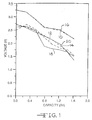
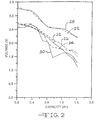
- FIG. 1 to 3 are graphs constructed from the results for the Li/MPO cells discharged under Tests I, II, III, respectively, in comparison to the results of the Li/SVO cells discharged under the same tests.
- curve 10 was constructed from the background voltage of the Li/MPO cell discharged according to Test I
- curve 12 was constructed from the P1 min. voltage of that cell
- curve 14 was constructed from the P4 min. voltage
- curve 16 was constructed from the background voltage of the Li/SVO cell discharged according to Test I
- curve 18 was constructed from the P1 min. voltage of that cell
- curve 20 was constructed from the P4 min. voltage.
- curve 22 was constructed from the background voltage of the Li/MPO cell discharged according to Test II
- curve 24 was constructed from the P1 min. voltage of that cell
- curve 26 was constructed from the P4 min. voltage
- curve 28 was constructed from the background voltage of the Li/SVO cell discharged according to Test II
- curve 30 was constructed from the P1 min. voltage of that cell and curve 32 was constructed from the P4 min. voltage.
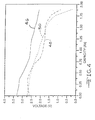
- curve 34 was constructed from the background voltage of the Li/MPO cell discharged according to Test III
- curve 36 was constructed from the P1 min. voltage of that cell
- curve 38 was constructed from the P4 min. voltage.
- curve 40 was constructed from the background voltage of the Li/SVO cell discharged according to Test III
- curve 42 was constructed from the P1 min. voltage of that cell and curve 44 was constructed from the P4 min. voltage.
- a second group of cells constructed according to Example I but containing various ratios of MPO and SVO was discharged under a protocol referred to in house as three year accelerated discharge data (ADD).
- the three year ADD test consisted of placing the cells on a 60.4 k ⁇ background load at 37°C, and pulsing the cells with a pulse train once every 120 days.
- the pulse train consisted of four 1.5 Amp pulses of 10 seconds duration with 15 seconds of rest between pulses.
- the three year ADD test reached conclusion after 52 months.
- Selected pulse train discharge results are presented in Table 1 with the complete discharge data graphed in Figs. 4 to 6.
- Fig. 4 is a graph constructed from the discharge of a lithium cell containing 100% MPO synthesized according to the present invention
- Fig. 5 is a graph constructed from the discharge of a lithium cell containing 50% prior art SVO and 50% MPO
- Fig. 6 is a graph constructed from the discharge of a lithium cell having a cathode containing 100% SVO active material synthesized by the prior art decomposition technique of Liang et al.
- curve 46 was constructed from the background voltage of a lithium cell containing 100% MPO cathode material
- curve 48 was constructed from the P1 min. voltage of that cell
- curve 50 was constructed from the P4 min. voltage.
- curve 52 was constructed from the background voltage of a lithium cell containing 50% SVO and 50% MPO cathode material
- curve 54 was constructed from the P1 min. voltage of that cell
- curve 56 was constructed from the P4 min. voltage
- curve 58 was constructed from the background voltage of a lithium cell containing 100% SVO
- curve 60 was constructed from the P1 min. voltage
- curve 62 was constructed from the P4 min. voltage.
Landscapes
- Chemical & Material Sciences (AREA)
- Chemical Kinetics & Catalysis (AREA)
- Electrochemistry (AREA)
- General Chemical & Material Sciences (AREA)
- Inorganic Chemistry (AREA)
- Engineering & Computer Science (AREA)
- Crystallography & Structural Chemistry (AREA)
- Materials Engineering (AREA)
- Manufacturing & Machinery (AREA)
- Battery Electrode And Active Subsutance (AREA)
- Primary Cells (AREA)
- Secondary Cells (AREA)
- Pharmaceuticals Containing Other Organic And Inorganic Compounds (AREA)
Description
- The present invention generally relates to the conversion of chemical energy to electrical energy, and more particularly, to an alkali metal electrochemical cell having a positive electrode comprising a mixed phase metal oxide. Preferred mixed phase metal oxides include silver vanadium oxide, copper vanadium oxide and copper silver vanadium oxide present in various phases or stoichiometric formulations along with a minor amount of the starting materials.
- Mixed metal oxides such as silver vanadium oxide are known for use as cathode active materials in electrochemical cells. U.S. Patent No. 4,391,729 to Liang et al., which is assigned to the assignee of the present invention and incorporated herein by reference, describes a method of preparing a composite cathode material by thermally decomposing a vanadium salt such as ammonium metavanadate to produce vanadium pentoxide. The nitrate or the nitrite of a second metal is then added to the vanadium pentoxide, thoroughly mixed therewith and heated to dryness. At the end of the initial drying period, the mixture is again stirred and ground to ensure homogeneity and subsequently baked for a minimum of 24 hours at 360°C. During the final heating/decomposition period, nitrogen oxide gases are evolved, and at specific time intervals after evolution of the nitrogen oxides, the admixture is stirred vigorously. The second metal is preferably selected from silver, copper, manganese and mixtures thereof. A typical product has the general formula AgxV2Oy wherein "x" is in the range from about 0.5 to about 2.0, and "y" is in the range from about 4.5 to about 6.0.
- U.S. Patent No. 5,516,340 to Takeuchi et al., which is assigned to the assignee of the present invention and incorporated herein by reference, describes the preparation of a metal oxide composite cathode material such as copper silver vanadium oxide using various starting materials including vanadium oxide combined with the nitrate or the nitrite of a second and a third metal. The reactants are thoroughly mixed together and then baked. The baking protocol calls for a gradual increase in the heating temperature up to a decomposition temperature accompanied by periodic stirring. Further, U.S. Patent No. 5,221,452 to Crespi describes various silver vanadium oxide preparation techniques, for example, milling powdered AgVO3 or powdered Ag2O with V2O5 and heating at 520°C.
- The metal oxide materials produced according to the techniques described by Liang et al., Takeuchi et al. and Crespi result in an electrode active material, preferably a cathode active material that is advantageous for use in implantable medical devices such as an implantable cardiac defibrillator and the like where the battery power source may run under a light, device monitoring load for extended periods of time interrupted by high rate pulse discharge during device activation. However, during pulse discharge, the occurrence of voltage delay is an undesirable characteristic of some metal oxide materials that may result in a shortened implantable device life. There is, therefore, the need for a metal oxide cathode material that provides all the advantages of the previously discussed metal oxide cathode materials, but which additionally exhibits increased discharge capacity and decreased voltage delay for pulse discharge applications. The present invention fulfills this need in a mixed phase metal oxide cathode material provided in a decomposition reaction wherein after the reactant starting materials or reactant constituents are initially combined into a homogeneous admixture, they are not further mixed during decomposition heating.
- In lieu of preparation techniques calling for the mixing of the reactant constituents both before and during heating, the present invention is directed to mixed phase metal oxide active materials synthesized from a homogenous admixture of starting materials or reactant constituents that are not further mixed once heating begins. A homogeneous admixture is defined as a substantially identical distribution of the reactant starting materials or reactant constituents throughout the admixture prior to heating. The starting materials include both nitrate, nitrite, carbonate and ammonium salt materials mixed with at least one metal oxide. Thus, although the ratio and type of starting materials does not differ from the standard preparation of silver vanadium oxide according to the previously discussed patent to Liang et al., the resulting mixed phase metal oxide active materials have an increased ability for the intercalation and deintercalation of metal ions produced by oxidation of the anode while minimizing the detrimental effects of voltage delay.
- Additionally, the present preparation techniques provide active materials with increased energy density which is an unexpected result.
- These and other aspects of the present invention will become more apparent to those skilled in the art by reference to the following description and to the appended drawings.
-
- Figs. 1 to 3 are graphs constructed from the discharge of lithium cells having a mixed phase silver vanadium oxide cathode prepared according to the present invention in comparison to lithium cells incorporating silver vanadium oxide synthesized according to the prior art decomposition preparation technique.
- Figs. 4 to 6 are graphs constructed from the discharge of lithium cells having various ratios of a mixed phase silver vanadium oxide prepared according to the present invention and silver vanadium oxide synthesized according to the prior art decomposition preparation technique.
- An electrochemical cell including a mixed phase metal oxide synthesized as an electrode active material such as a cathode active material according to the present invention preferably comprises an anode of a metal selected from Group IA of the Periodic Table of the Elements. This group of metals is collectively referred to as the alkali metals and comprises lithium, sodium, potassium, etc., and their alloys and intermetallic compounds including, for example, Li-Si, Li-Al, Li-B and Li-Si-B alloys and intermetallic compounds. The preferred anode comprises lithium. An alternate anode comprises a lithium alloy, such as a lithium-aluminum alloy. The greater the amount of aluminum present by weight in the alloy, the lower the energy density of the cell.
- The form of the anode may vary, but preferably the anode is a thin metal sheet or foil of the anode metal, pressed or rolled on a metallic anode current collector, i.e., preferably comprising nickel, to form an anode component. In the exemplary cell of the present invention, the anode component has an extended tab or lead of the same material as the anode current collector, i.e., preferably nickel, integrally formed therewith such as by welding and contacted by a weld to a cell case of conductive metal in a case-negative electrical configuration. Alternatively, the anode may be formed in some other geometry, such as a bobbin shape, cylinder or pellet to allow an alternate low surface cell design.
- The electrochemical reaction at the cathode involves conversion of ions which migrate from the anode to the cathode into atomic or molecular forms. The cathode material of the present invention comprises at least a first cathode active constituent formed from readily decomposable reactant constituent compounds consisting of metals from Groups IB, IIB, IIIB, IVB, VB, VIB, VIIB, as well as from Group VIII which are mixed together in a substantially homogeneous admixture and subsequently thermally treated so as to effect the rapid preparation of suitable mixed phase metal oxide cathode materials. The thermal decomposition heating occurs in an oxygen-containing atmosphere such as air or oxygen and at a temperature of about 200°C to about 500°C, and more preferably at about 230°C to about 450°C. Such decomposable reactant compounds include, but are not limited to, those classes of compounds known as nitrites, nitrates, carbonates and/or ammonium salts. Upon decomposition heating, the nitrates, nitrites and ammonium salt compounds are characterized by the evolution of nitrogen oxide gas and the carbonate compounds are characterized by the evolution of carbon dioxide. The decomposable reactant compounds may also comprise a metal sulfide instead of a metal oxide.
- Preferred mixed phase metal oxides are prepared by thoroughly mixing vanadium oxide with a metal a metal oxide or a decomposable metal compound of a second metal and possibly a third metal, wherein at least one of the second and third metals are of a decomposable compound. This homogeneous admixture having a substantially identical distribution of the reactant constituents throughout is thereafter reacted in a thermal decomposition reaction to form the resulting mixed phase metal oxide. The second and third metals are most preferably selected from silver, copper and manganese. An important aspect of the present invention is that the substantially homogeneous admixture is not further mixed once decomposition heating commences.
- One preferred mixed phase metal oxide substantially comprises an active material having the general formula SMxV2Oy wherein SM is a metal selected from Groups IB to VIIB and VIII of the Periodic Table of Elements and wherein x is about 0.30 to 2.0 and y is about 4.5 to 6.0 in the general formula. By way of illustration, and in no way intended to be limiting, one exemplary mixed phase cathode active material substantially comprises silver vanadium oxide (SVO) having the general formula AgxV2Oy in at least one of its many phases, i.e., β-phase silver vanadium oxide having in the general formula x = 0.35 and y = 5.8, γ-phase silver vanadium oxide having in the general formula x = 0.74 and y = 5.37 and ε-phase silver vanadium oxide having in the general formula x = 1.0 and y = 5.5, and combination and mixtures of phases thereof. In the mixed phase metal oxide product, there may also be present a minor amount of the reactant constituents, particularly the decomposable metal compound in a undecomposed state.
- The preparation technique of a mixed phase metal oxide according to the present invention produces an active material displaying increased capacity and decreased voltage delay in comparison to AgV2O5.5 (SVO) prepared using a decomposition synthesis from AgNO3 and V2O5 starting materials, such as is disclosed in the previously referenced U.S. Patent No. 4,391,729 to Liang et al. The discharge capacity and decreased voltage delay of the mixed phase metal oxide of the present invention is also an improvement over that of SVO typically prepared from Ag2O and V2O5 by a chemical addition reaction such as is described in U.S. Patent No. 5,498,494 to Takeuchi et al., which is assigned to the assignee of the present invention and incorporated herein by reference.
- Advantages of the use of this mixed phase material include increased capacity and decreased voltage delay for pulse discharge applications. An example of such an application is the implantable cardiac defibrillator, where the battery may run under a light load for extended periods of time interrupted by high rate pulse discharge. The occurrence of voltage delay under these conditions is detrimental in that it may shorten device life.
- Another preferred mixed phase composite cathode material is prepared from a homogeneous admixture of vanadium oxide and a second decomposable metal compound, metal or metal oxide and a third decomposable metal compound, metal or metal oxide wherein at least one of the second and third metal constituents is a decomposable form of silver and copper. According to the present invention, the homogeneous admixture is formed from V2Oz wherein z ≤ 5 combined with a mixture of either copper nitrate, copper nitrite or an ammonium salt of copper and a silver oxide or, a mixture of copper oxide and silver nitrate, silver nitrite or an ammonium salt of silver to provide the mixed phase metal oxide having the formula CuxAgyV2Oz (CSVO), preferably with x ≤ y. In this preparation technique, the oxide starting materials may include Ag2Oz wherein z = 2 to 1 and CuOz wherein z = 0 to 1. Thus, this composite cathode active material may be described as a metal-metal oxide-metal oxide, or a metal-metal-metal oxide and the range of material compositions found for CuxAgyV2Oz is preferably about 0.01 ≤ x ≤ 1.0, about 0.01 ≤ y ≤ 1.0 and about 5.01 ≤ z ≤ 6.5. Another embodiment of the present invention has vanadium oxide combined with both a decomposable compound of silver and copper. Typical forms of CSVO are Cu0.16Ag0.67V2Oz with z being about 5.5 and Cu0.5Ag0.5V2Oz with z being about 5.75. U.S. Patent Nos. 5,472,810 to Takeuchi et al. and 5,516,340 to Takeuchi et al. describe the prior art preparation of CSVO.
- The above described active materials are formed into an electrode for incorporation into an electrochemical cell by mixing one or more of them with a conductive additive such as acetylene black, carbon black and/or graphite. Metallic powders such as nickel, aluminum, titanium and stainless steel in powder form are also useful as conductive diluents when mixed with the above listed active materials. The cathode electrode further comprises a binder material which is preferably a fluoro-resin powder such as powdered polytetrafluoroethylene (PTFE) or powdered polyvinylidene fluoride (PVDF). More specifically, a preferred mixed phase cathode active material comprises SVO in any one of its many phases, or mixtures thereof, and/or CSVO along with a minor amount of the decomposable reactants mixed with a binder material and a conductive diluent.
- A preferred cathode active admixture comprises from about 80 % to 99 %, by weight, of a cathode active material comprising either one or both of the mixed phase SVO and CSVO materials prepared according to the decomposition techniques of the present invention and mixed with a suitable binder and a conductor diluent. The resulting blended cathode active mixture may be formed into a free-standing sheet prior to being contacted with a current collector to form the cathode electrode. The manner in which the cathode active mixture is prepared into a free-standing sheet is thoroughly described in U.S. Patent No. 5,435,874 to Takeuchi et al., which is assigned to the assignee of the present invention and incorporated herein by reference. Further, cathode components for incorporation into an electrochemical cell may also be prepared by rolling, spreading or pressing the mixed phase cathode active mixture of the present invention onto a suitable current collector. Cathodes prepared as described above may be in the form of one or more plates operatively associated with at least one or more plates of anode material, or in the form of a strip wound with a corresponding strip of anode material in a structure similar to a "jellyroll".
- In order to prevent internal short circuit conditions, the cathode of the present invention is separated from the Group IA anode material by a suitable separator material. The separator is of electrically insulative material, and the separator material also is chemically unreactive with the anode and cathode active materials and both chemically unreactive with and insoluble in the electrolyte. In addition, the separator material has a degree of porosity sufficient to allow flow therethrough of the electrolyte during the electrochemical reaction of the cell. Illustrative separator materials include woven and non-woven fabrics of polyolefinic fibers or fluoropolymeric fibers including polyvinylidine fluoride, polyethylenetetrafluoroethylene, and polyethylenechlorotrifluoroethylene laminated or superposed with a polyolefinic or a fluoropolymeric microporous film. Suitable microporous films include a polytetrafluoroethylene membrane commercially available under the designation ZITEX (Chemplast Inc.), polypropylene membrane commercially available under the designation CELGARD (Celanese Plastic Company, Inc.) and a membrane commercially available under the designation DEXIGLAS (C.H. Dexter, Div., Dexter Corp.). The separator may also be composed of non-woven glass, glass fiber materials and ceramic materials.
- The electrochemical cell of the present invention further includes a nonaqueous, ionically conductive electrolyte which serves as a medium for migration of ions between the anode and the cathode electrodes during the electrochemical reactions of the cell. The electrochemical reaction at the electrodes involves conversion of ions in atomic or molecular forms which migrate from the anode to the cathode. Thus, nonaqueous electrolytes suitable for the present invention are substantially inert to the anode and cathode materials, and they exhibit those physical properties necessary for ionic transport, namely, low viscosity, low surface tension and wettability.
- A suitable electrolyte has an inorganic or organic, ionically conductive salt dissolved in a nonaqueous solvent, and more preferably, the electrolyte includes an ionizable alkali metal salt dissolved in a mixture of aprotic organic solvents comprising a low viscosity solvent and a high permittivity solvent. The ionically conductive salt serves as the vehicle for migration of the anode ions to intercalate or react with the cathode active material. Preferably the ion-forming alkali metal salt is similar to the alkali metal comprising the anode.
- In a solid cathode/electrolyte system, the ionically conductive salt preferably has the general formula MM'F6 or MM'F4 wherein M is an alkali metal similar to the alkali metal comprising the anode and M' is an element selected from the group consisting of phosphorous, arsenic, antimony and boron. Examples of salts yielding M'F6 are: hexafluorophosphate (PF6), hexafluoroarsenate (AsF6) and hexafluoroantimonate (SbF6), while tetrafluoroborate (BF4) is exemplary of salts yielding M'F4. Alternatively, the corresponding sodium or potassium salts may be used. Other inorganic salts useful with the present invention include LiClO4, LiO2, LiAlCl4, LiGaCl4, LiC(SO2CF3)3, LiN(SO2CF3)2, LiSO3F, LiB(C6H5)4 and LiCF3SO3, and mixtures thereof.
- Low viscosity solvents include tetrahydrofuran (THF), methyl acetate (MA), diglyme, trigylme, tetragylme, dimethyl carbonate (DMC), 1,2-dimethoxyethane (DME), diethyl carbonate and mixtures thereof, and high permittivity solvents include cyclic carbonates, cyclic esters and cyclic amides such as propylene carbonate (PC), ethylene carbonate (EC), acetonitrile, dimethyl sulfoxide, dimethyl formamide, dimethyl acetamide, γ-butyrolactone (GBL) and N-methyl-pyrrolidinone (NMP) and mixtures thereof. In the present invention, the preferred anode is lithium metal and the preferred electrolyte is 1.OM to 1.2M LiAsF6 or LiPF6 in PC/DME.
- The preferred form of the electrochemical cell is a case-negative design wherein the anode/cathode couple is inserted into a conductive metal casing such that the casing is connected to the anode current collector in a case-negative configuration, as is well known to those skilled in the art. A preferred material for the casing is titanium although stainless steel, milled steel, nickel-plated milled steel and aluminum are also suitable. The casing header comprises a metallic lid having a sufficient number of openings to accommodate the glass-to-metal seal/terminal pin feedthrough for the cathode electrode. The anode electrode is preferably connected to the case or the lid. An additional opening is provided for electrolyte filling. The casing header comprises elements having compatibility with the other components of the electrochemical cell and is resistant to corrosion. The cell is thereafter filled with the electrolyte solution described hereinabove and hermetically sealed such as by close-welding a stainless steel plug over the fill hole, but not limited thereto. The cell of the present invention can also be constructed in a case-positive design.
- The following examples describe the manner and process of manufacturing an electrochemical cell according to the present invention, and they set forth the best mode contemplated by the inventors of carrying out the invention, but they are not to be construed as limiting.
- The synthesis of a mixed phase metal oxide (MPO) was accomplished using a 1:1 mole ratio of silver nitrate (AgNO3) and vanadium oxide (V2O5) reacted from 230°C to 375°C under an air atmosphere. The reaction was carefully controlled such that the reactants were only mixed prior to the thermal treatment of the material. Mixing or grinding of the components, as performed in the synthesis of standard SVO, i.e. as described in the previously discussed U.S. Patent No. 4,391,729 to Liang et al., was excluded during the heating step of the present preparation.
- The resulting solid-state MPO product was used directly as the active material for the cathode mixture without further preparation. The MPO material was characterized by differential scanning calorimetry and displayed endothermic transitions at 466°C, 533°C, and 555°C. The transitions in the DSC curve indicate the presence of at least three metal oxide phases: AgVO3, AgV2O5.5 (ε-phase), and Ag0.74V2O5.37 (γ-phase). The existence of multiple phases is in agreement with the physical appearance of MPO, which is a mixture of orange particles with gray and brown particles.
- The MPO material prepared according to the present invention and SVO material prepared according to Liang et al. were incorporated into respective alkali metal electrochemical cells. The MPO and SVO cells were of a multiplate design using the respective cathode materials containing, by weight, 94% MPO or SVO, 3% polytetrafluoroethylene, 2 % graphite, and 1% carbon black. The cathodes used Ti metal current collectors, and the total cathode surface area was about 80.6 cm2. Lithium metal in contact with a Ni metal current collector was used as the anode material. The cathodes were separated from the lithium anode by a polypropylene separator. The cells were filled with 1M LiAsF6 in PC/DME electrolyte and hermetically sealed.
- All of the test cells were subjected to constant current pulses of 1.5 Amps. The current pulses were applied in groups of four, each pulse lasting 10 seconds in duration, with 15 seconds of rest between pulses. Three separate test regimes were used to simulate actual use of the battery in an implantable cardiac defibrillator device. The test regimes differed only in the time period between pulse trains and the value of the constant resistance load placed on the cells throughout the test. In Test I, the cells were placed under a 17.4 kΩ load, and pulsed every two months. Test II had the cells discharged under a 60.4 kΩ load and pulsed every 4 months while Test III used a 100 kΩ load and the cells were pulsed every 6 months. Figs. 1 to 3 are graphs constructed from the results for the Li/MPO cells discharged under Tests I, II, III, respectively, in comparison to the results of the Li/SVO cells discharged under the same tests. In particular, in Fig. 1, curve 10 was constructed from the background voltage of the Li/MPO cell discharged according to Test I, curve 12 was constructed from the P1 min. voltage of that cell and curve 14 was constructed from the P4 min. voltage. In comparison, in Fig. 1,
curve 16 was constructed from the background voltage of the Li/SVO cell discharged according to Test I, curve 18 was constructed from the P1 min. voltage of that cell andcurve 20 was constructed from the P4 min. voltage. - In Fig. 2,
curve 22 was constructed from the background voltage of the Li/MPO cell discharged according to Test II,curve 24 was constructed from the P1 min. voltage of that cell andcurve 26 was constructed from the P4 min. voltage. In comparison, in Fig. 2,curve 28 was constructed from the background voltage of the Li/SVO cell discharged according to Test II,curve 30 was constructed from the P1 min. voltage of that cell andcurve 32 was constructed from the P4 min. voltage. - In Fig. 3,
curve 34 was constructed from the background voltage of the Li/MPO cell discharged according to Test III,curve 36 was constructed from the P1 min. voltage of that cell andcurve 38 was constructed from the P4 min. voltage. In comparison, in Fig. 3,curve 40 was constructed from the background voltage of the Li/SVO cell discharged according to Test III,curve 42 was constructed from the P1 min. voltage of that cell andcurve 44 was constructed from the P4 min. voltage. - Voltage delay is indicated in these graphs by the occurrence of P1min (minimum voltage of 1st current pulse) being lower than P4min (minimum voltage of 4th current pulse). As can be seen in Figs. 1 to 3, the Li/MPO cells displayed less voltage delay than the comparable Li/SVO cells, with this effect magnified as the time period between administration of the respective pulse trains increased from Test I to Test III. In addition, the Li/MPO cells provided higher pulse minimum voltages than the Li/SVO cells, thus resulting in increased capacity and longer battery life.
- A second group of cells constructed according to Example I but containing various ratios of MPO and SVO was discharged under a protocol referred to in house as three year accelerated discharge data (ADD). The three year ADD test consisted of placing the cells on a 60.4 kΩ background load at 37°C, and pulsing the cells with a pulse train once every 120 days. The pulse train consisted of four 1.5 Amp pulses of 10 seconds duration with 15 seconds of rest between pulses. The three year ADD test reached conclusion after 52 months. Selected pulse train discharge results are presented in Table 1 with the complete discharge data graphed in Figs. 4 to 6.
TABLE 1 PULSE TRAIN #5 Voltage (V) Cathode Bkgd V P1min P4min 100 % MPO 2.744 2.353 2.366 50 % MPO/50% SVO 2.736 2.366 2.350 100% SVO 2.739 2.004 2.326 PULSE TRAIN #7 Voltage (V) Cathode Bkgd V P1min P4min 100% MPO 2.557 1.811 2.117 50% MPO/50% SVO 2.556 1.781 2.095 100% SVO 2.554 1.485 2.008 PULSE TRAIN # 12Voltage (V) Cathode Bkgd V P1min P4min 100 % MPO 2.195 1.621 1.505 50% MPO/50% SVO 2.196 1.548 1.455 100% SVO 2.195 1.257 1.119 - Fig. 4 is a graph constructed from the discharge of a lithium cell containing 100% MPO synthesized according to the present invention, Fig. 5 is a graph constructed from the discharge of a lithium cell containing 50% prior art SVO and 50% MPO, and Fig. 6 is a graph constructed from the discharge of a lithium cell having a cathode containing 100% SVO active material synthesized by the prior art decomposition technique of Liang et al. In particular, in Fig. 4,
curve 46 was constructed from the background voltage of a lithium cell containing 100% MPO cathode material,curve 48 was constructed from the P1 min. voltage of that cell andcurve 50 was constructed from the P4 min. voltage. In Fig. 5,curve 52 was constructed from the background voltage of a lithium cell containing 50% SVO and 50% MPO cathode material, curve 54 was constructed from the P1 min. voltage of that cell andcurve 56 was constructed from the P4 min. voltage. In Fig. 6,curve 58 was constructed from the background voltage of a lithium cell containing 100% SVO,curve 60 was constructed from the P1 min. voltage andcurve 62 was constructed from the P4 min. voltage. - As is evident in Table 1 and Figs. 4 to 6, the cells containing the MPO cathode material yielded much higher pulse voltages than the SVO control cells on long term test. This results in a cell with significantly higher deliverable capacity.
Claims (23)
- A cathode for an electrochemical cell, the cathode comprising a mixed phase metal oxide including vanadium oxide and at least one of a decomposable silver-containing constituent and a decomposable copper-containing constituent provided in a substantially homogeneous mixture, and wherein after the initial homogenization mixing of the starting materials, the mixed phase metal oxide product is characterized as formed from the homogenized mixture having been heated to a decomposition temperature without further mixing once heating begins.
- The cathode according to Claim 1 wherein the decomposition temperature is at least about 200°C.
- The cathode according to Claim 1 or Claim 2 wherein the decomposition temperature is in a range of about 200°C to about 500°C
- The cathode according to any one of Claims 1 to 3 wherein the mixed phase metal oxide substantially consists of an active material having the general formula AgxV2Oy and wherein 0.30 ≤ x ≤ 2.0 and 4.5 ≤ y ≤ 6.0.
- The cathode according to any one of Claims 1 to 4 wherein the mixed phase metal oxide substantially consists of an active material having the general formula CuxAgyV2Oz and wherein 0.01 ≤ x ≤ 1.0, 0.1 ≤ y ≤ 1.0 and 5.01 ≤ z ≤ 6.5.
- The cathode according to Claim 5 wherein, in the general formula, x ≤ y.
- The cathode according to Claim 5 or Claim 6 wherein the mixed phase metal oxide has a stoichiometric formulation consisting of either Cu0.16Ag0.67V2Oz with z being about 5.5 or Cu0.5Ag0.5V2Oz with z being about 5.75, or mixtures thereof.
- The cathode according to any one of Claims 1 to 7 wherein the decomposable silver-containing constituent is selected from nitrates, nitrites, carbonates or ammonium salts.
- The cathode according to any one of Claims 1 to 8 wherein the decomposable copper-containing constituent is selected from nitrates, nitrites, carbonates or ammonium salts.
- The cathode according to any one of Claims 1 to 9 wherein one component of the mixed phase metal oxide comprises V2Oz with z ≤ 5.
- The cathode according to any one of Claims 1 to 10 wherein the cathode further comprises at least one of a binder material and a conductive additive.
- The cathode according to Claim 11 wherein the binder material is a fluoro-resin powder.
- The cathode according to Claim 11 or 12 wherein the conductive additive is selected from carbon, graphite powder, acetylene black or metallic powder selected from titanium, aluminum, nickel, stainless steel, or mixtures thereof.
- A cathode according to any one of Claims 1 to 13 wherein the cathode comprises a mixed phase metal oxide including vanadium oxide and at least one of a decomposable salt of silver, copper and manganese.
- An electrochemical cell comprising(a) an anode;(b) the cathode according to any one of Claims 1 to 14; and(c) an ionically conductive electrolyte activating both the anode and the cathode.
- The electrochemical cell according to Claim 15 wherein the anode is comprised of a Group IA metal.
- The electrochemical cell according to Claim 15 or Claim 16 wherein the alkali metal of the anode comprises lithium.
- The electrochemical cell according to any one of Claims 15 to 17 wherein the electrolyte comprises an ion-forming alkali metal salt dissolved in a non-aqueous solvent, and wherein the alkali metal of the salt is similar to the alkali metal comprising the anode.
- The electrochemical cell according to Claim 18 wherein the ion-forming alkali metal salt comprising the electrolyte is selected from LiPF6, LiAsF6, LiSbF6, LiBF6, LiClO4, Li2O, LiAlCl4, LiGaCl4, Li(SO2CF3)3, LiN(SO2CF3)2, LiSO3F, LiB(C6H5)4, LiCF3SO3 or mixtures thereof.
- The electrochemical cell according to Claim 18 or Claim 19 wherein the nonaqueous solvent comprises an organic solvent selected from tetrahydrofuran, propylene carbonate, dimethyl carbonate, diethyl carbonate, methyl acetate, acetonitrile, dimethyl sulfoxide, dimethyl formamide, dimethyl acetamide, γ-butyrolactone, N-methyl-pyrrolidinone, ethylene carbonate, diglyme, triglyme, tetraglyme, 1,2-dimethoxyethane, or mixtures thereof.
- A method of providing the electrochemical cell according to any one of Claims 15 to 20 which comprises:(a) providing a casing;(b) housing the electrochemical cell within the casing, comprising the steps of:(i) providing an anode;(iii) providing the cathode according to any one of Claims 1 to 14 wherein the mixed phase metal oxide is contracted to a current collector; and(iii) positioning the anode and the cathode inside the casing; and(c) activating the anode and the cathode with an electrolyte filled in the casing.
- The method according to Claim 21 wherein the substantially homogenous admixture is heated to the decomposition temperature in the range of about 200°C to about 500°C
- The method according to Claim 21 or Claim 22 wherein the substantially homogenous admixture is heated in an oxygen-containing atmosphere.
Applications Claiming Priority (2)
| Application Number | Priority Date | Filing Date | Title |
|---|---|---|---|
| US91707297A | 1997-08-22 | 1997-08-22 | |
| US917072 | 1997-08-22 |
Publications (3)
| Publication Number | Publication Date |
|---|---|
| EP0898317A2 EP0898317A2 (en) | 1999-02-24 |
| EP0898317A3 EP0898317A3 (en) | 1999-12-08 |
| EP0898317B1 true EP0898317B1 (en) | 2007-03-21 |
Family
ID=25438301
Family Applications (1)
| Application Number | Title | Priority Date | Filing Date |
|---|---|---|---|
| EP98306235A Expired - Lifetime EP0898317B1 (en) | 1997-08-22 | 1998-08-04 | Cathode comprising a mixed phase metal oxide, method of preparation and electrochemical cell therefor |
Country Status (5)
| Country | Link |
|---|---|
| US (3) | US6558845B1 (en) |
| EP (1) | EP0898317B1 (en) |
| JP (1) | JPH11144731A (en) |
| AU (1) | AU8087798A (en) |
| DE (1) | DE69837368T2 (en) |
Families Citing this family (13)
| Publication number | Priority date | Publication date | Assignee | Title |
|---|---|---|---|---|
| US7211349B2 (en) * | 2002-08-06 | 2007-05-01 | Wilson Greatbatch Technologies, Inc. | Silver vanadium oxide provided with a metal oxide coating |
| US7432001B1 (en) | 2003-12-09 | 2008-10-07 | Greatbatch Ltd. | Prevention of lithium deposition in nonaqueous electrolyte cells by electrolyte-to-cathode weight ratio |
| US20070281207A1 (en) * | 2003-12-09 | 2007-12-06 | Takeuchi Esther S | Prevention of lithium deposition in nonaqueous electrolyte cells by matching device usage to cell capacity |
| US20060143807A1 (en) * | 2004-12-13 | 2006-07-06 | Wilson Sporting Goods Co. | Sports helmet having slotted padding for receiving the ears of a user |
| JP5008325B2 (en) * | 2006-03-24 | 2012-08-22 | 三洋電機株式会社 | Lithium battery |
| JP5638058B2 (en) | 2009-03-27 | 2014-12-10 | ゼットパワー, エルエルシー | Improved cathode |
| US9219293B2 (en) * | 2009-06-30 | 2015-12-22 | Cardiac Pacemakers, Inc. | Controlling lithium deposition during manufacture of a battery |
| WO2011056813A1 (en) | 2009-11-03 | 2011-05-12 | Zpower, Inc. | Novel electrodes and rechargeable batteries |
| DE102010004661B4 (en) * | 2010-01-14 | 2014-12-24 | Siemens Aktiengesellschaft | Vanadium-based hard coating of a wind turbine component |
| WO2012040298A1 (en) | 2010-09-24 | 2012-03-29 | Zpower, Llc | Cathode |
| CA2886154A1 (en) | 2012-09-27 | 2014-04-03 | Zpower, Llc | Cathode |
| US9355789B2 (en) | 2013-05-10 | 2016-05-31 | Greatbatch Ltd. | Internal insulation design using porous material for an electrochemical cell |
| US10629862B2 (en) | 2016-11-04 | 2020-04-21 | Greatbatch Ltd. | Cathode insulator design |
Family Cites Families (13)
| Publication number | Priority date | Publication date | Assignee | Title |
|---|---|---|---|---|
| US4391729A (en) | 1979-12-17 | 1983-07-05 | Wilson Greatbatch Ltd. | Metal oxide composite cathode material for high energy density batteries |
| US4310609A (en) | 1979-12-17 | 1982-01-12 | Wilson Greatbatch Ltd. | Metal oxide composite cathode material for high energy density batteries |
| US5221452A (en) * | 1990-02-15 | 1993-06-22 | Asahi Glass Company Ltd. | Monopolar ion exchange membrane electrolytic cell assembly |
| US5221453A (en) * | 1990-09-27 | 1993-06-22 | Medtronic, Inc. | Silver vanadium oxide cathode material and method of preparation |
| US5516340A (en) * | 1993-03-17 | 1996-05-14 | Wilson Greatbatch Ltd. | Process for making a metal oxide composite cathode material for high energy density batteries |
| JP3445654B2 (en) | 1993-03-17 | 2003-09-08 | ウィルソン グレイトバッチ リミテッド | Electrochemical cell and its cathode |
| JPH07122275A (en) | 1993-05-25 | 1995-05-12 | Wilson Greatbatch Ltd | Cathode for electrochemical cell, method for its preparation and electrochemical cell |
| US5435874A (en) | 1993-11-01 | 1995-07-25 | Wilson Greatbatch Ltd. | Process for making cathode components for use in electrochemical cells |
| US5545497A (en) | 1994-06-21 | 1996-08-13 | Wilson Greatbatch Ltd. | Cathode material for nonaqueous electrochemical cells |
| US5670276A (en) * | 1995-12-04 | 1997-09-23 | Wilson Greatbatch Ltd. | Alternate synthetic method for mixed metal oxide cathode materials |
| US5716422A (en) | 1996-03-25 | 1998-02-10 | Wilson Greatbatch Ltd. | Thermal spray deposited electrode component and method of manufacture |
| US5955218A (en) * | 1996-12-18 | 1999-09-21 | Medtronic, Inc. | Heat-treated silver vanadium oxide for use in batteries for implantable medical devices |
| US5895733A (en) * | 1997-02-03 | 1999-04-20 | Medtronic, Inc. | Synthesis method for silver vanadium oxide |
-
1998
- 1998-08-04 EP EP98306235A patent/EP0898317B1/en not_active Expired - Lifetime
- 1998-08-04 DE DE69837368T patent/DE69837368T2/en not_active Expired - Fee Related
- 1998-08-20 JP JP10251950A patent/JPH11144731A/en not_active Withdrawn
- 1998-08-21 AU AU80877/98A patent/AU8087798A/en not_active Abandoned
-
1999
- 1999-11-12 US US09/439,872 patent/US6558845B1/en not_active Expired - Fee Related
-
2001
- 2001-10-26 US US10/055,687 patent/US6696201B2/en not_active Expired - Fee Related
- 2001-11-02 US US10/000,197 patent/US6685752B2/en not_active Expired - Lifetime
Also Published As
| Publication number | Publication date |
|---|---|
| US20020078556A1 (en) | 2002-06-27 |
| EP0898317A3 (en) | 1999-12-08 |
| US6696201B2 (en) | 2004-02-24 |
| US6685752B2 (en) | 2004-02-03 |
| DE69837368T2 (en) | 2007-11-29 |
| US6558845B1 (en) | 2003-05-06 |
| EP0898317A2 (en) | 1999-02-24 |
| US20020142223A1 (en) | 2002-10-03 |
| JPH11144731A (en) | 1999-05-28 |
| DE69837368D1 (en) | 2007-05-03 |
| AU8087798A (en) | 1999-03-04 |
Similar Documents
| Publication | Publication Date | Title |
|---|---|---|
| US5695892A (en) | Preparation of silver vanadium oxide using nitric acid with oxide starting materials | |
| US6228534B1 (en) | Annealing of mixed metal oxide electrodes to reduce polarization resistance | |
| US5639577A (en) | Nonaqueous electrochemical cell having a mixed cathode and method of preparation | |
| US6221534B1 (en) | Alkali metal electrochemical cell having an improved cathode activated with a nonaqueous electrolyte having a carbonate additive | |
| AU709614B2 (en) | Ternary solvent nonaqueous organic electrolyte for alkali metal electrochemical cells | |
| EP1146581B1 (en) | Synthetic method for preparation of a low surface area, single phase mixed metal oxide cathode active material for incorporation into an alkali metal electrochemical cell | |
| EP1331683A2 (en) | Cathode active material coated with a metal oxide for incorporation into a lithium electrochemical cell | |
| EP1207568A2 (en) | Sandwich cathode design using mixtures of two active materials for alkali metal or ion electrochemical cells | |
| EP1244160A1 (en) | Electrochemical cell having an electrode with a carbonate additive in the electrode active mixture | |
| US6685752B2 (en) | Method for providing a cathode of a mixed phase metal oxide | |
| US6413669B1 (en) | Melt impregnation of mixed metal oxide | |
| EP1339121B1 (en) | Organic cyclic carbonate additives for nonaqueous electrolyte in alkali metal electrochemical cells | |
| US6797017B2 (en) | Preparation of ε-phase silver vanadium oxide from γ-phase SVO starting material | |
| EP2897202A1 (en) | New high capacity cathode material with improved rate capability performance | |
| US9812710B2 (en) | Copper doped SVO compounds as high rate cathode materials | |
| US6803147B2 (en) | Silver vanadium oxide having low internal resistance and method of manufacture | |
| EP1113514A1 (en) | Preparation of a mixed metal oxide cathode active material by sequential decomposition and combination reactions | |
| US20180069241A1 (en) | Method for providing a high capacity cathode material with improved rate capability performance | |
| US7118829B2 (en) | Preparation of copper silver vanadium oxide from γ-phase SVO starting material | |
| CA2366191C (en) | Silver vanadium oxide having low internal resistance and method of manufacture |
Legal Events
| Date | Code | Title | Description |
|---|---|---|---|
| PUAI | Public reference made under article 153(3) epc to a published international application that has entered the european phase |
Free format text: ORIGINAL CODE: 0009012 |
|
| AK | Designated contracting states |
Kind code of ref document: A2 Designated state(s): CH DE FR GB IT LI NL SE |
|
| AX | Request for extension of the european patent |
Free format text: AL;LT;LV;MK;RO;SI |
|
| PUAL | Search report despatched |
Free format text: ORIGINAL CODE: 0009013 |
|
| AK | Designated contracting states |
Kind code of ref document: A3 Designated state(s): AT BE CH CY DE DK ES FI FR GB GR IE IT LI LU MC NL PT SE |
|
| AX | Request for extension of the european patent |
Free format text: AL;LT;LV;MK;RO;SI |
|
| RIC1 | Information provided on ipc code assigned before grant |
Free format text: 6H 01M 4/58 A, 6H 01M 4/48 B, 6C 01G 31/00 B |
|
| 17P | Request for examination filed |
Effective date: 20000417 |
|
| AKX | Designation fees paid |
Free format text: CH DE FR GB IT LI NL SE |
|
| GRAP | Despatch of communication of intention to grant a patent |
Free format text: ORIGINAL CODE: EPIDOSNIGR1 |
|
| GRAS | Grant fee paid |
Free format text: ORIGINAL CODE: EPIDOSNIGR3 |
|
| RAP1 | Party data changed (applicant data changed or rights of an application transferred) |
Owner name: WILSON GREATBATCH LTD. |
|
| RTI1 | Title (correction) |
Free format text: CATHODE COMPRISING A MIXED PHASE METAL OXIDE, METHOD OF PREPARATION AND ELECTROCHEMICAL CELL THEREFOR |
|
| GRAA | (expected) grant |
Free format text: ORIGINAL CODE: 0009210 |
|
| AK | Designated contracting states |
Kind code of ref document: B1 Designated state(s): CH DE FR GB IT LI NL SE |
|
| PG25 | Lapsed in a contracting state [announced via postgrant information from national office to epo] |
Ref country code: NL Free format text: LAPSE BECAUSE OF FAILURE TO SUBMIT A TRANSLATION OF THE DESCRIPTION OR TO PAY THE FEE WITHIN THE PRESCRIBED TIME-LIMIT Effective date: 20070321 Ref country code: LI Free format text: LAPSE BECAUSE OF FAILURE TO SUBMIT A TRANSLATION OF THE DESCRIPTION OR TO PAY THE FEE WITHIN THE PRESCRIBED TIME-LIMIT Effective date: 20070321 Ref country code: CH Free format text: LAPSE BECAUSE OF FAILURE TO SUBMIT A TRANSLATION OF THE DESCRIPTION OR TO PAY THE FEE WITHIN THE PRESCRIBED TIME-LIMIT Effective date: 20070321 |
|
| REG | Reference to a national code |
Ref country code: GB Ref legal event code: FG4D |
|
| REG | Reference to a national code |
Ref country code: CH Ref legal event code: EP |
|
| REF | Corresponds to: |
Ref document number: 69837368 Country of ref document: DE Date of ref document: 20070503 Kind code of ref document: P |
|
| REG | Reference to a national code |
Ref country code: SE Ref legal event code: TRGR |
|
| ET | Fr: translation filed | ||
| REG | Reference to a national code |
Ref country code: CH Ref legal event code: PL |
|
| NLV1 | Nl: lapsed or annulled due to failure to fulfill the requirements of art. 29p and 29m of the patents act | ||
| PGFP | Annual fee paid to national office [announced via postgrant information from national office to epo] |
Ref country code: GB Payment date: 20070830 Year of fee payment: 10 |
|
| PLBE | No opposition filed within time limit |
Free format text: ORIGINAL CODE: 0009261 |
|
| STAA | Information on the status of an ep patent application or granted ep patent |
Free format text: STATUS: NO OPPOSITION FILED WITHIN TIME LIMIT |
|
| PGFP | Annual fee paid to national office [announced via postgrant information from national office to epo] |
Ref country code: SE Payment date: 20070829 Year of fee payment: 10 Ref country code: DE Payment date: 20071001 Year of fee payment: 10 |
|
| 26N | No opposition filed |
Effective date: 20071227 |
|
| PG25 | Lapsed in a contracting state [announced via postgrant information from national office to epo] |
Ref country code: IT Free format text: LAPSE BECAUSE OF FAILURE TO SUBMIT A TRANSLATION OF THE DESCRIPTION OR TO PAY THE FEE WITHIN THE PRESCRIBED TIME-LIMIT Effective date: 20070321 |
|
| PGFP | Annual fee paid to national office [announced via postgrant information from national office to epo] |
Ref country code: FR Payment date: 20070817 Year of fee payment: 10 |
|
| EUG | Se: european patent has lapsed | ||
| GBPC | Gb: european patent ceased through non-payment of renewal fee |
Effective date: 20080804 |
|
| REG | Reference to a national code |
Ref country code: FR Ref legal event code: ST Effective date: 20090430 |
|
| PG25 | Lapsed in a contracting state [announced via postgrant information from national office to epo] |
Ref country code: FR Free format text: LAPSE BECAUSE OF NON-PAYMENT OF DUE FEES Effective date: 20080901 Ref country code: DE Free format text: LAPSE BECAUSE OF NON-PAYMENT OF DUE FEES Effective date: 20090303 |
|
| PG25 | Lapsed in a contracting state [announced via postgrant information from national office to epo] |
Ref country code: GB Free format text: LAPSE BECAUSE OF NON-PAYMENT OF DUE FEES Effective date: 20080804 |
|
| PG25 | Lapsed in a contracting state [announced via postgrant information from national office to epo] |
Ref country code: SE Free format text: LAPSE BECAUSE OF NON-PAYMENT OF DUE FEES Effective date: 20080805 |