EP0896740B1 - Process for the fabrication of electrochemical cell components - Google Patents
Process for the fabrication of electrochemical cell components Download PDFInfo
- Publication number
- EP0896740B1 EP0896740B1 EP97916518A EP97916518A EP0896740B1 EP 0896740 B1 EP0896740 B1 EP 0896740B1 EP 97916518 A EP97916518 A EP 97916518A EP 97916518 A EP97916518 A EP 97916518A EP 0896740 B1 EP0896740 B1 EP 0896740B1
- Authority
- EP
- European Patent Office
- Prior art keywords
- membrane
- coated
- frame
- frame member
- exchange membrane
- Prior art date
- Legal status (The legal status is an assumption and is not a legal conclusion. Google has not performed a legal analysis and makes no representation as to the accuracy of the status listed.)
- Expired - Lifetime
Links
- 238000000034 method Methods 0.000 title claims abstract description 30
- 210000003850 cellular structure Anatomy 0.000 title claims abstract description 5
- 238000004519 manufacturing process Methods 0.000 title claims abstract description 5
- 239000012528 membrane Substances 0.000 claims abstract description 73
- 239000000463 material Substances 0.000 claims abstract description 37
- 239000003014 ion exchange membrane Substances 0.000 claims abstract description 23
- 239000002904 solvent Substances 0.000 claims abstract description 17
- 238000000576 coating method Methods 0.000 claims abstract description 13
- 239000011248 coating agent Substances 0.000 claims abstract description 12
- XLYOFNOQVPJJNP-UHFFFAOYSA-N water Substances O XLYOFNOQVPJJNP-UHFFFAOYSA-N 0.000 claims abstract description 12
- 238000005304 joining Methods 0.000 claims abstract description 8
- 238000001035 drying Methods 0.000 claims abstract description 4
- -1 poly(vinylidene fluoride) Polymers 0.000 claims description 23
- 210000004027 cell Anatomy 0.000 claims description 19
- 229920002981 polyvinylidene fluoride Polymers 0.000 claims description 8
- LFQSCWFLJHTTHZ-UHFFFAOYSA-N Ethanol Chemical compound CCO LFQSCWFLJHTTHZ-UHFFFAOYSA-N 0.000 claims description 6
- OKKJLVBELUTLKV-UHFFFAOYSA-N Methanol Chemical compound OC OKKJLVBELUTLKV-UHFFFAOYSA-N 0.000 claims description 6
- ZMXDDKWLCZADIW-UHFFFAOYSA-N N,N-Dimethylformamide Chemical compound CN(C)C=O ZMXDDKWLCZADIW-UHFFFAOYSA-N 0.000 claims description 6
- WYURNTSHIVDZCO-UHFFFAOYSA-N Tetrahydrofuran Chemical compound C1CCOC1 WYURNTSHIVDZCO-UHFFFAOYSA-N 0.000 claims description 6
- SECXISVLQFMRJM-UHFFFAOYSA-N N-Methylpyrrolidone Chemical compound CN1CCCC1=O SECXISVLQFMRJM-UHFFFAOYSA-N 0.000 claims description 5
- 238000005341 cation exchange Methods 0.000 claims description 5
- IAZDPXIOMUYVGZ-UHFFFAOYSA-N Dimethylsulphoxide Chemical compound CS(C)=O IAZDPXIOMUYVGZ-UHFFFAOYSA-N 0.000 claims description 4
- 229920000915 polyvinyl chloride Polymers 0.000 claims description 4
- 239000004800 polyvinyl chloride Substances 0.000 claims description 4
- YLQBMQCUIZJEEH-UHFFFAOYSA-N tetrahydrofuran Natural products C=1C=COC=1 YLQBMQCUIZJEEH-UHFFFAOYSA-N 0.000 claims description 3
- QYKIQEUNHZKYBP-UHFFFAOYSA-N Vinyl ether Chemical compound C=COC=C QYKIQEUNHZKYBP-UHFFFAOYSA-N 0.000 claims description 2
- 230000000712 assembly Effects 0.000 claims description 2
- 238000000429 assembly Methods 0.000 claims description 2
- 229920001577 copolymer Polymers 0.000 claims description 2
- 238000002844 melting Methods 0.000 claims description 2
- 230000008018 melting Effects 0.000 claims description 2
- 238000010422 painting Methods 0.000 claims description 2
- 229920003229 poly(methyl methacrylate) Polymers 0.000 claims description 2
- 239000004926 polymethyl methacrylate Substances 0.000 claims description 2
- 229920002635 polyurethane Polymers 0.000 claims description 2
- 239000004814 polyurethane Substances 0.000 claims description 2
- 238000007761 roller coating Methods 0.000 claims description 2
- 238000007650 screen-printing Methods 0.000 claims description 2
- BFKJFAAPBSQJPD-UHFFFAOYSA-N tetrafluoroethene Chemical group FC(F)=C(F)F BFKJFAAPBSQJPD-UHFFFAOYSA-N 0.000 claims description 2
- 229920000557 Nafion® Polymers 0.000 description 8
- 239000002585 base Substances 0.000 description 6
- 238000003466 welding Methods 0.000 description 5
- 230000002378 acidificating effect Effects 0.000 description 3
- 239000000446 fuel Substances 0.000 description 3
- 230000006698 induction Effects 0.000 description 3
- 229920003934 Aciplex® Polymers 0.000 description 2
- 229920003935 Flemion® Polymers 0.000 description 2
- 239000002033 PVDF binder Substances 0.000 description 2
- 239000004695 Polyether sulfone Substances 0.000 description 2
- 239000000853 adhesive Substances 0.000 description 2
- 230000001070 adhesive effect Effects 0.000 description 2
- 239000003011 anion exchange membrane Substances 0.000 description 2
- 230000015572 biosynthetic process Effects 0.000 description 2
- 238000010276 construction Methods 0.000 description 2
- 238000007796 conventional method Methods 0.000 description 2
- 238000004146 energy storage Methods 0.000 description 2
- 229920002313 fluoropolymer Polymers 0.000 description 2
- 239000004811 fluoropolymer Substances 0.000 description 2
- 238000010438 heat treatment Methods 0.000 description 2
- 229920001467 poly(styrenesulfonates) Polymers 0.000 description 2
- 229920006393 polyether sulfone Polymers 0.000 description 2
- 229920000642 polymer Polymers 0.000 description 2
- 239000013047 polymeric layer Substances 0.000 description 2
- 229960002796 polystyrene sulfonate Drugs 0.000 description 2
- 239000011970 polystyrene sulfonate Substances 0.000 description 2
- 229910001220 stainless steel Inorganic materials 0.000 description 2
- 239000000126 substance Substances 0.000 description 2
- NWUYHJFMYQTDRP-UHFFFAOYSA-N 1,2-bis(ethenyl)benzene;1-ethenyl-2-ethylbenzene;styrene Chemical compound C=CC1=CC=CC=C1.CCC1=CC=CC=C1C=C.C=CC1=CC=CC=C1C=C NWUYHJFMYQTDRP-UHFFFAOYSA-N 0.000 description 1
- 239000004698 Polyethylene Substances 0.000 description 1
- 239000002253 acid Substances 0.000 description 1
- 239000003513 alkali Substances 0.000 description 1
- 125000003118 aryl group Chemical group 0.000 description 1
- 230000009286 beneficial effect Effects 0.000 description 1
- 230000001680 brushing effect Effects 0.000 description 1
- 239000000919 ceramic Substances 0.000 description 1
- 239000002322 conducting polymer Substances 0.000 description 1
- 229920001940 conductive polymer Polymers 0.000 description 1
- 238000007598 dipping method Methods 0.000 description 1
- 230000002209 hydrophobic effect Effects 0.000 description 1
- 239000012212 insulator Substances 0.000 description 1
- 238000005342 ion exchange Methods 0.000 description 1
- 239000003456 ion exchange resin Substances 0.000 description 1
- 229920003303 ion-exchange polymer Polymers 0.000 description 1
- 150000002500 ions Chemical class 0.000 description 1
- 229910001120 nichrome Inorganic materials 0.000 description 1
- 230000037361 pathway Effects 0.000 description 1
- 239000002798 polar solvent Substances 0.000 description 1
- 229920003208 poly(ethylene sulfide) Polymers 0.000 description 1
- 229920000573 polyethylene Polymers 0.000 description 1
- 239000002861 polymer material Substances 0.000 description 1
- 229920005597 polymer membrane Polymers 0.000 description 1
- 239000004810 polytetrafluoroethylene Substances 0.000 description 1
- 229920001343 polytetrafluoroethylene Polymers 0.000 description 1
- 239000011148 porous material Substances 0.000 description 1
Classifications
-
- H—ELECTRICITY
- H01—ELECTRIC ELEMENTS
- H01M—PROCESSES OR MEANS, e.g. BATTERIES, FOR THE DIRECT CONVERSION OF CHEMICAL ENERGY INTO ELECTRICAL ENERGY
- H01M8/00—Fuel cells; Manufacture thereof
- H01M8/10—Fuel cells with solid electrolytes
-
- B—PERFORMING OPERATIONS; TRANSPORTING
- B01—PHYSICAL OR CHEMICAL PROCESSES OR APPARATUS IN GENERAL
- B01D—SEPARATION
- B01D65/00—Accessories or auxiliary operations, in general, for separation processes or apparatus using semi-permeable membranes
- B01D65/003—Membrane bonding or sealing
-
- C—CHEMISTRY; METALLURGY
- C25—ELECTROLYTIC OR ELECTROPHORETIC PROCESSES; APPARATUS THEREFOR
- C25B—ELECTROLYTIC OR ELECTROPHORETIC PROCESSES FOR THE PRODUCTION OF COMPOUNDS OR NON-METALS; APPARATUS THEREFOR
- C25B13/00—Diaphragms; Spacing elements
-
- H—ELECTRICITY
- H01—ELECTRIC ELEMENTS
- H01M—PROCESSES OR MEANS, e.g. BATTERIES, FOR THE DIRECT CONVERSION OF CHEMICAL ENERGY INTO ELECTRICAL ENERGY
- H01M10/00—Secondary cells; Manufacture thereof
- H01M10/02—Details
-
- H—ELECTRICITY
- H01—ELECTRIC ELEMENTS
- H01M—PROCESSES OR MEANS, e.g. BATTERIES, FOR THE DIRECT CONVERSION OF CHEMICAL ENERGY INTO ELECTRICAL ENERGY
- H01M8/00—Fuel cells; Manufacture thereof
- H01M8/02—Details
- H01M8/0271—Sealing or supporting means around electrodes, matrices or membranes
- H01M8/0273—Sealing or supporting means around electrodes, matrices or membranes with sealing or supporting means in the form of a frame
-
- Y—GENERAL TAGGING OF NEW TECHNOLOGICAL DEVELOPMENTS; GENERAL TAGGING OF CROSS-SECTIONAL TECHNOLOGIES SPANNING OVER SEVERAL SECTIONS OF THE IPC; TECHNICAL SUBJECTS COVERED BY FORMER USPC CROSS-REFERENCE ART COLLECTIONS [XRACs] AND DIGESTS
- Y02—TECHNOLOGIES OR APPLICATIONS FOR MITIGATION OR ADAPTATION AGAINST CLIMATE CHANGE
- Y02E—REDUCTION OF GREENHOUSE GAS [GHG] EMISSIONS, RELATED TO ENERGY GENERATION, TRANSMISSION OR DISTRIBUTION
- Y02E60/00—Enabling technologies; Technologies with a potential or indirect contribution to GHG emissions mitigation
- Y02E60/10—Energy storage using batteries
-
- Y—GENERAL TAGGING OF NEW TECHNOLOGICAL DEVELOPMENTS; GENERAL TAGGING OF CROSS-SECTIONAL TECHNOLOGIES SPANNING OVER SEVERAL SECTIONS OF THE IPC; TECHNICAL SUBJECTS COVERED BY FORMER USPC CROSS-REFERENCE ART COLLECTIONS [XRACs] AND DIGESTS
- Y02—TECHNOLOGIES OR APPLICATIONS FOR MITIGATION OR ADAPTATION AGAINST CLIMATE CHANGE
- Y02E—REDUCTION OF GREENHOUSE GAS [GHG] EMISSIONS, RELATED TO ENERGY GENERATION, TRANSMISSION OR DISTRIBUTION
- Y02E60/00—Enabling technologies; Technologies with a potential or indirect contribution to GHG emissions mitigation
- Y02E60/30—Hydrogen technology
- Y02E60/50—Fuel cells
-
- Y—GENERAL TAGGING OF NEW TECHNOLOGICAL DEVELOPMENTS; GENERAL TAGGING OF CROSS-SECTIONAL TECHNOLOGIES SPANNING OVER SEVERAL SECTIONS OF THE IPC; TECHNICAL SUBJECTS COVERED BY FORMER USPC CROSS-REFERENCE ART COLLECTIONS [XRACs] AND DIGESTS
- Y02—TECHNOLOGIES OR APPLICATIONS FOR MITIGATION OR ADAPTATION AGAINST CLIMATE CHANGE
- Y02P—CLIMATE CHANGE MITIGATION TECHNOLOGIES IN THE PRODUCTION OR PROCESSING OF GOODS
- Y02P70/00—Climate change mitigation technologies in the production process for final industrial or consumer products
- Y02P70/50—Manufacturing or production processes characterised by the final manufactured product
Definitions
- the present invention relates to a process for the fabrication of electrochemical cell components and, in particular, to a process for joining a membrane to a frame, the said membrane constituting a component of an electrochemical cell such as a fuel cell or a cell for energy storage and/or power delivery.
- Ion exchange membranes have been proposed for use in various electrochemical applications, including chlor-alkali cells, fuel cells and energy storage/ power delivery devices. In these devices the ion exchange membrane serves to separate the compartments of the cell, whilst providing a conducting pathway for ions through the cell.
- Ion exchange membranes for use in such electrolytic cells may be films of fluoropolymers containing acidic groups or derivatives of acidic groups.
- cation exchange membranes are Nafion (DuPont), Flemion (Asahi Glass) and Aciplex (Asahi Chemical).
- An example of an anion exchange membrane is Tosflex (Tosoh Corporation).
- Industrial electrolytic or galvanic cells such as secondary batteries, fuel cells and electrolysers, typically consist of modules which each comprise a number of stacked, layered components which are clamped together in a stack.
- components typically consist of electrically insulating flow-frames, each containing an electrode, with a plurality of such flow-frames being sandwiched together with other components such as membranes and meshes.
- the membranes are generally laid in the wet swelled form between the other components and some membranes have a tendency to tear, crease, fold or puncture as the stack of components is being assembled.
- An improved method of incorporating the membrane into the cell, which also provides support to the membrane during cell assembly, is required.
- WO 94/25995 A to LEDJEFF et al. discloses a method of bonding an ion-conducting polymer membrane (PEM) made from modified base material to a polymeric, frame-shaped base material .
- a sheet of the polymeric base material preferably an aromatic polyethersulfone, PES
- PES polyethersulfone
- the ion exchange membrane is fixed in this cut-out portion and bonded to the frame-like base sheet using an adhesive system.
- the adhesive preferably contains a solution of the polymeric base material in a solvent which dissolves both the ion exchange material and the base material.
- the present invention provides a process for the fabrication of an electrochemical cell component which comprises an ion exchange membrane joined to a frame member formed from a dissimilar polymeric material, which process comprises the steps of:
- a coating solution is prepared of a polymeric material in a solvent which is miscible with water.
- the polymeric material is either the same material as that from which the frame is made, or a polymeric material which is compatible therewith.
- Preferred materials for the construction of the frame are poly(vinylidene fluoride), poly(vinyl chloride), polyurethane or poly(methyl methacrylate). These are therefore the polymers of choice for the formation of the coating solution.
- the solvent for the formation of the coating solution is a solvent which is miscible with water. It will be understood that the term “miscible” is intended to include within its scope solvents which are partially or fully miscible with water. This is because the ion exchange membranes contain water and by choosing a solvent for the coating solution which is miscible with water the coating solution is able to impregnate the membrane.
- Solvents which are miscible with water are polar solvents such as methanol, ethanol, dimethyl formamide, dimethylsulfoxide, tetrahydrofuran or N-methyl-pyrrolidone.
- the coating solution is coated onto the border of at least one face of the ion exchange membrane by conventional techniques such as roller coating, K-bar coating, painting or screen printing.
- the particular choice of coating method is not critical to the present invention, providing that an even coating around the border of the membrane can be achieved. It may be advantageous to mask the area of the membrane which is not to be coated since this provides dimensional stability to the membrane.
- the concentration of the polymeric material dissolved in the solvent will generally be in the range of from 0.2 to 20% weight by volume of the solvent, preferably 2 to 5% by weight of volume of the solvent.
- the ion exchange membrane which is coated in accordance with the present invention may be a fluoropolymer containing acidic groups or derivatives of acid groups.
- ion exchange membranes which may be used are the copolymers of tetrafluoroethylene and a sulfonated or carboxylated vinyl ether such as those sold under the trade names of Nafion (DuPont), such as Nafion 112, 115 or 117, or Flemion (Asahi Glass).
- Nafion DuPont
- Nafion 112, 115 or 117 such as Nafion 112, 115 or 117
- Flemion Adsahi Glass
- Another perfluorinated cation exchange membrane which may be used in the present invention is Aciplex (Asahi Chemical).
- a cation exchange membrane which is a polystyrene sulfonate membrane from Tokuyama Soda sold as Neosepta CM1, Neosepta CM2, Neosepta CMH, Neosepta CMX and Neosepta CMS, and Selemion (Asahi Glass).
- membranes which may be used in the present invention are heterogeneous membranes such as those based on polystyrene sulfonate ion exchange resin blended with another polymer such as polyethylene.
- Another type of membrane which may be used is a post-irradiation grafted membrane.
- An example of an anion exchange membrane which may be used in the present invention is Tosflex (Tosflex Corporation).
- the ion exchange membrane which is used in the present invention will generally have a thickness in the range of from 25 to 250 ⁇ m, more preferably from 50 to 125 ⁇ m.
- the membrane coated around its border in step (i) of the process of the present invention is preferably allowed to stand or dried before it is joined to the frame member.
- the coated membrane is allowed to stand it is believed that beneficial effects may be achieved by the solvent percolating into the pores of the membrane, or by the solvent softening the surface of the frame.
- the drying may either be carried out at room temperature, or by heating as required.
- the coated face of the membrane is then contacted with the frame member and the assembly joined together, generally using a combination of heat and pressure to achieve satisfactory joints.
- the assembly is preferably heated to a temperature at or above the melting point of the polymeric material of the frame, but below the temperature at which the membrane material degrades, so that the polymer material softens and forms a joint with the membrane material.
- the temperature range will generally be in the range of from about 170°C to 300°C.
- Suitable techniques for achieving joints between the membrane and the frame member include induction welding, hot bar welding, hot gas welding or ultrasonic welding.
- a particular advantage which is associated with the present invention is that the edges of the membrane are heat sealed during the processing steps and this prevents the membrane wicking, which has been a problem in the past.
- the frame/membrane assembly which is produced according to the process of the present invention makes it easier to handle the membrane and provides an easy way of locating the membrane in a cell structure of the type as discussed above.
- the present invention thus includes within its scope a frame/membrane assembly produced according to the process of the invention.
- the present invention also includes within its scope an electrochemical cell which comprises one or more frame/membrane assemblies produced according to the process of the invention.
- Strips of membrane material (Du Pont's Nafion 117) 25mm wide and approximately 60mm long, were dried under vacuum at 60°C for 30 minutes to remove water from the membrane. Solutions comprising 1g or 2g poly(vinylidene fluoride) dissolved in 40cc of N-methyl-pyrrolidone (NMP) were prepared. Each solution was then applied to the freshly dried membrane by dipping. The coated membranes were then allowed to stand in air. The membranes coated with PVDF were then joined to a poly(vinylidene fluoride) frame using induction heating in the following way. A loop of stainless steel wire was fixed to a ceramic insulator in close proximity to an induction workcoil connected to a high frequency (approximately 180 kHz) power supply. The workcoil heated the stainless steel wire to a temperature of approximately 200°C and this heated the membrane samples and frame materials, causing a joint to form after approximately 30 seconds.
- NMP N-methyl-pyrrolidone
- Example 2 Following the procedure of Example 1, a solution of 2g of poly(vinylidene fluoride) in 40cc of NMP was applied to Nafion 117 (DuPont). The coated membrane was then allowed to stand.
- the membrane was then joined to a PVDF frame using a 3mm wide hot bar weld at 260°C at a pressure of 48.2kPa (7psi) for 3 seconds. A good join was produced.
- Example 2 Following the procedure of Example 1, a Nafion 115 membrane was dipped in a solution comprising 1g of poly(vinyl chloride) dissolved at room temperature in 20cc tetrahydrofuran.
- the membrane was then joined to a PVC frame using a 3mm wide hot bar weld at 175°C at a pressure of 68.9 kPa (lOpsi) for 5 seconds. A good join was produced.
- Strips of membrane (Nafion 117 or 115) were prepared 25mm wide and approximately 60mm long in the as-received state. Solutions comprising 1g or 2g of polymeric material dissolved in 40cc of solvent were prepared. Each solution was applied to the membrane by brushing as a polymeric layer. The membranes coated with the polymeric layer were then joined to polymeric frame materials in the following way. A 3mm wide strip of nichrome electrically resistive tape was protected by a PTFE sheet to prevent sticking, and heated to the temperature indicated. This heated the membrane samples and frame materials, causing a joint to form after the time indicated.
Landscapes
- Chemical & Material Sciences (AREA)
- Chemical Kinetics & Catalysis (AREA)
- Engineering & Computer Science (AREA)
- Electrochemistry (AREA)
- Manufacturing & Machinery (AREA)
- General Chemical & Material Sciences (AREA)
- Sustainable Development (AREA)
- Sustainable Energy (AREA)
- Life Sciences & Earth Sciences (AREA)
- Materials Engineering (AREA)
- Metallurgy (AREA)
- Organic Chemistry (AREA)
- Manufacture Of Macromolecular Shaped Articles (AREA)
- Conductive Materials (AREA)
- Fuel Cell (AREA)
- Electrolytic Production Of Non-Metals, Compounds, Apparatuses Therefor (AREA)
- Laminated Bodies (AREA)
- Battery Electrode And Active Subsutance (AREA)
- Medicines Containing Material From Animals Or Micro-Organisms (AREA)
- Lining Or Joining Of Plastics Or The Like (AREA)
- Separation Using Semi-Permeable Membranes (AREA)
- Pharmaceuticals Containing Other Organic And Inorganic Compounds (AREA)
- Hybrid Cells (AREA)
- Crystals, And After-Treatments Of Crystals (AREA)
Abstract
Description
- The present invention relates to a process for the fabrication of electrochemical cell components and, in particular, to a process for joining a membrane to a frame, the said membrane constituting a component of an electrochemical cell such as a fuel cell or a cell for energy storage and/or power delivery.
- Ion exchange membranes have been proposed for use in various electrochemical applications, including chlor-alkali cells, fuel cells and energy storage/ power delivery devices. In these devices the ion exchange membrane serves to separate the compartments of the cell, whilst providing a conducting pathway for ions through the cell.
- Ion exchange membranes for use in such electrolytic cells may be films of fluoropolymers containing acidic groups or derivatives of acidic groups. Examples of cation exchange membranes are Nafion (DuPont), Flemion (Asahi Glass) and Aciplex (Asahi Chemical). An example of an anion exchange membrane is Tosflex (Tosoh Corporation).
- When incorporating ion exchange membranes into electrochemical cells it is important for the membrane to be located in the cell in such a manner that a good joint is formed, to ensure that the membrane becomes an integral part of a membrane frame electrode assembly. Industrial electrolytic or galvanic cells, such as secondary batteries, fuel cells and electrolysers, typically consist of modules which each comprise a number of stacked, layered components which are clamped together in a stack. For example, in a secondary battery of the redox flow type the components typically consist of electrically insulating flow-frames, each containing an electrode, with a plurality of such flow-frames being sandwiched together with other components such as membranes and meshes. The membranes are generally laid in the wet swelled form between the other components and some membranes have a tendency to tear, crease, fold or puncture as the stack of components is being assembled. An improved method of incorporating the membrane into the cell, which also provides support to the membrane during cell assembly, is required.
- WO 94/25995 A to LEDJEFF et al. discloses a method of bonding an ion-conducting polymer membrane (PEM) made from modified base material to a polymeric, frame-shaped base material . In accordance with one embodiment, a sheet of the polymeric base material (preferably an aromatic polyethersulfone, PES) is provided with a square cut-out portion. The ion exchange membrane is fixed in this cut-out portion and bonded to the frame-like base sheet using an adhesive system. The adhesive preferably contains a solution of the polymeric base material in a solvent which dissolves both the ion exchange material and the base material.
- Whilst it would be advantageous to join the membrane to a surrounding frame member, in order to assist in the location of the membrane in the cell and to facilitate cell construction, the materials from which ion exchange membranes are formed are not generally readily joinable to a frame member by conventional techniques, such as by welding, since the polymeric material of the membrane will generally be hydrophilic and the polymeric material of the frame member will generally be hydrophobic. We have now developed a process for joining a membrane to a frame member which overcomes these problems.
- Accordingly, the present invention provides a process for the fabrication of an electrochemical cell component which comprises an ion exchange membrane joined to a frame member formed from a dissimilar polymeric material, which process comprises the steps of:
- i) coating the border of at least one face of a water-containing ion exchange membrane with a solution in a water-miscible solvent of the polymeric material from which the said frame member is made, or of a polymeric material which is compatible with the polymeric frame material;
- ii) optionally allowing the said coated membrane to stand and/or drying the said coated membrane;
- iii) placing the coated face of the ion exchange membrane from step (i) or step (ii) in contact with the said frame member; and
- iv) joining the coated ion exchange membrane to the said frame member.
-
- In carrying out the process of the present invention a coating solution is prepared of a polymeric material in a solvent which is miscible with water. The polymeric material is either the same material as that from which the frame is made, or a polymeric material which is compatible therewith. Preferred materials for the construction of the frame are poly(vinylidene fluoride), poly(vinyl chloride), polyurethane or poly(methyl methacrylate). These are therefore the polymers of choice for the formation of the coating solution.
- The solvent for the formation of the coating solution is a solvent which is miscible with water. It will be understood that the term "miscible" is intended to include within its scope solvents which are partially or fully miscible with water. This is because the ion exchange membranes contain water and by choosing a solvent for the coating solution which is miscible with water the coating solution is able to impregnate the membrane.
- Solvents which are miscible with water are polar solvents such as methanol, ethanol, dimethyl formamide, dimethylsulfoxide, tetrahydrofuran or N-methyl-pyrrolidone.
- The coating solution is coated onto the border of at least one face of the ion exchange membrane by conventional techniques such as roller coating, K-bar coating, painting or screen printing. The particular choice of coating method is not critical to the present invention, providing that an even coating around the border of the membrane can be achieved. It may be advantageous to mask the area of the membrane which is not to be coated since this provides dimensional stability to the membrane.
- The concentration of the polymeric material dissolved in the solvent will generally be in the range of from 0.2 to 20% weight by volume of the solvent, preferably 2 to 5% by weight of volume of the solvent.
- The ion exchange membrane which is coated in accordance with the present invention may be a fluoropolymer containing acidic groups or derivatives of acid groups. For example, ion exchange membranes which may be used are the copolymers of tetrafluoroethylene and a sulfonated or carboxylated vinyl ether such as those sold under the trade names of Nafion (DuPont), such as Nafion 112, 115 or 117, or Flemion (Asahi Glass). Another perfluorinated cation exchange membrane which may be used in the present invention is Aciplex (Asahi Chemical). Another membrane which may be modified according to the invention is a cation exchange membrane which is a polystyrene sulfonate membrane from Tokuyama Soda sold as Neosepta CM1, Neosepta CM2, Neosepta CMH, Neosepta CMX and Neosepta CMS, and Selemion (Asahi Glass).
- Other membranes which may be used in the present invention are heterogeneous membranes such as those based on polystyrene sulfonate ion exchange resin blended with another polymer such as polyethylene. Another type of membrane which may be used is a post-irradiation grafted membrane. An example of an anion exchange membrane which may be used in the present invention is Tosflex (Tosflex Corporation).
- The ion exchange membrane which is used in the present invention will generally have a thickness in the range of from 25 to 250µm, more preferably from 50 to 125µm.
- The membrane coated around its border in step (i) of the process of the present invention is preferably allowed to stand or dried before it is joined to the frame member. When the coated membrane is allowed to stand it is believed that beneficial effects may be achieved by the solvent percolating into the pores of the membrane, or by the solvent softening the surface of the frame. When the coated membrane is dried, the drying may either be carried out at room temperature, or by heating as required.
- The coated face of the membrane is then contacted with the frame member and the assembly joined together, generally using a combination of heat and pressure to achieve satisfactory joints. The assembly is preferably heated to a temperature at or above the melting point of the polymeric material of the frame, but below the temperature at which the membrane material degrades, so that the polymer material softens and forms a joint with the membrane material. For example, for joining poly(vinylidene fluoride) to Nafion the temperature range will generally be in the range of from about 170°C to 300°C. Suitable techniques for achieving joints between the membrane and the frame member include induction welding, hot bar welding, hot gas welding or ultrasonic welding.
- A particular advantage which is associated with the present invention is that the edges of the membrane are heat sealed during the processing steps and this prevents the membrane wicking, which has been a problem in the past.
- The frame/membrane assembly which is produced according to the process of the present invention makes it easier to handle the membrane and provides an easy way of locating the membrane in a cell structure of the type as discussed above. The present invention thus includes within its scope a frame/membrane assembly produced according to the process of the invention.
- The present invention also includes within its scope an electrochemical cell which comprises one or more frame/membrane assemblies produced according to the process of the invention.
- The present invention will be further described with reference to the following Examples.
- Strips of membrane material (Du Pont's Nafion 117) 25mm wide and approximately 60mm long, were dried under vacuum at 60°C for 30 minutes to remove water from the membrane. Solutions comprising 1g or 2g poly(vinylidene fluoride) dissolved in 40cc of N-methyl-pyrrolidone (NMP) were prepared. Each solution was then applied to the freshly dried membrane by dipping. The coated membranes were then allowed to stand in air. The membranes coated with PVDF were then joined to a poly(vinylidene fluoride) frame using induction heating in the following way. A loop of stainless steel wire was fixed to a ceramic insulator in close proximity to an induction workcoil connected to a high frequency (approximately 180 kHz) power supply. The workcoil heated the stainless steel wire to a temperature of approximately 200°C and this heated the membrane samples and frame materials, causing a joint to form after approximately 30 seconds.
- The joints formed in this way and tested manually were generally weak in peel but relatively strong in tensile. Three specimen joints were immersed in water for over three weeks and then manually tested. The mechanical properties of these joints were unchanged compared to joints tested immediately after joining.
- Following the procedure of Example 1, a solution of 2g of poly(vinylidene fluoride) in 40cc of NMP was applied to Nafion 117 (DuPont). The coated membrane was then allowed to stand.
- The membrane was then joined to a PVDF frame using a 3mm wide hot bar weld at 260°C at a pressure of 48.2kPa (7psi) for 3 seconds. A good join was produced.
- Following the procedure of Example 1, a Nafion 115 membrane was dipped in a solution comprising 1g of poly(vinyl chloride) dissolved at room temperature in 20cc tetrahydrofuran.
- The membrane was then joined to a PVC frame using a 3mm wide hot bar weld at 175°C at a pressure of 68.9 kPa (lOpsi) for 5 seconds. A good join was produced.
- A similar good join was obtained using a bar temperature of 210°C at a pressure of 7psi for 3 seconds.
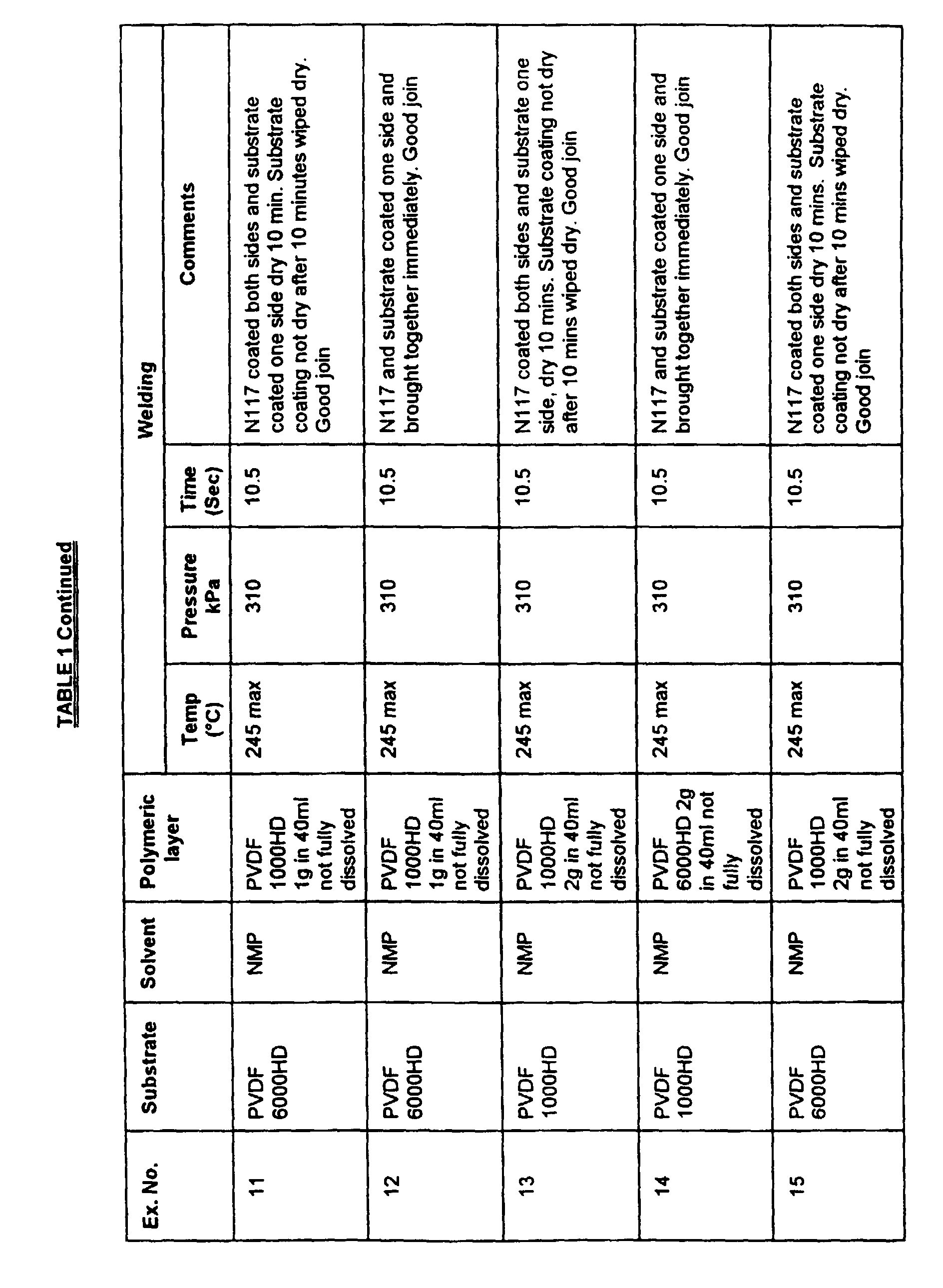
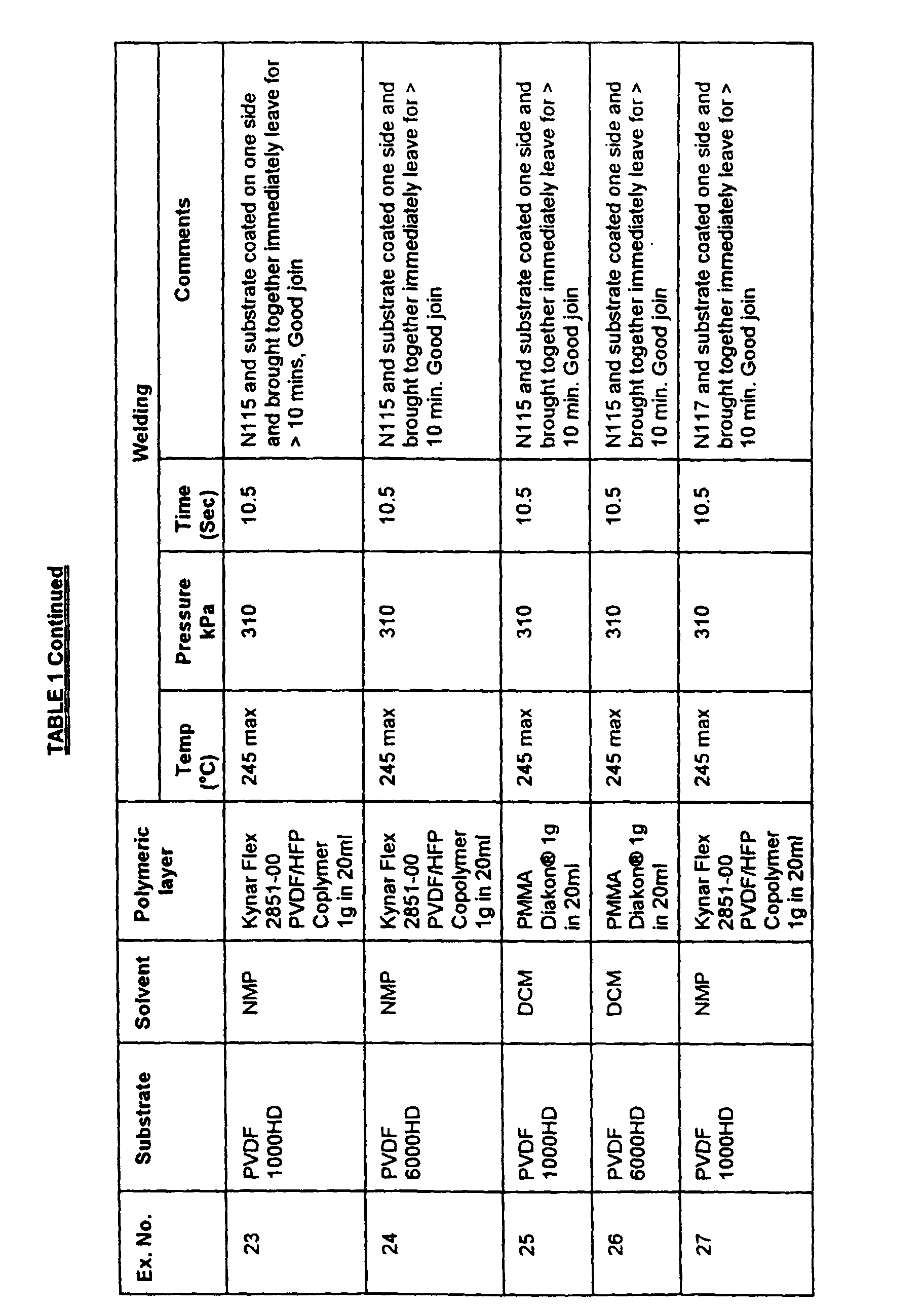
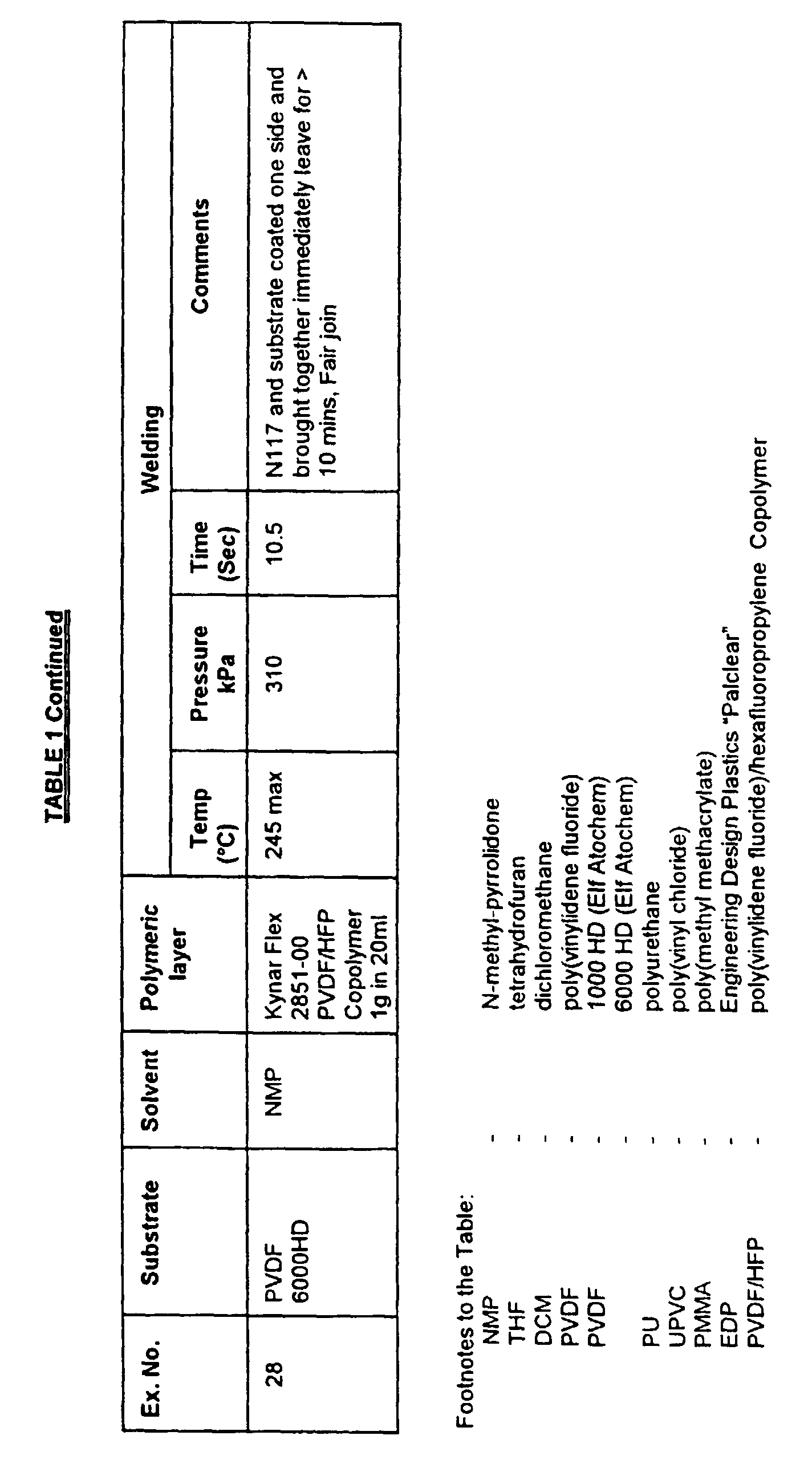
- Strips of membrane (Nafion 117 or 115) were prepared 25mm wide and approximately 60mm long in the as-received state. Solutions comprising 1g or 2g of polymeric material dissolved in 40cc of solvent were prepared. Each solution was applied to the membrane by brushing as a polymeric layer. The membranes coated with the polymeric layer were then joined to polymeric frame materials in the following way. A 3mm wide strip of nichrome electrically resistive tape was protected by a PTFE sheet to prevent sticking, and heated to the temperature indicated. This heated the membrane samples and frame materials, causing a joint to form after the time indicated.
- The results obtained are given in the following Table 1.


Claims (12)
- A process for the fabrication of an electrochemical cell component which comprises a water-containing ion exchange membrane joined to a frame member formed from a dissimilar polymeric material, which process comprises the steps of:i) coating the border of at least one face of a water-containing ion exchange membrane with a solution in a water-miscible solvent of the polymeric material from which the said frame member is made, or of a polymeric material which is compatible with the polymeric frame material;ii) optionally allowing the said coated membrane to stand and/or drying the said coated membrane;iii) placing the coated face of the ion exchange membrane from step (i) or step (ii) in contact with the said frame member; andiv) joining the coated ion-exchange membrane to the said frame member.
- A process as claimed in claim 1 wherein the frame member is made from poly(vinylidene fluoride) or poly(vinyl chloride), polyurethane or poly(methyl methacrylate).
- A process as claimed in claim 1 or claim 2 wherein the solvent in which the polymeric material is dissolved or dispersed is methanol, ethanol, dimethyl formamide, dimethylsulfoxide, tetrahydrofuran or N-methyl-pyrrolidone.
- A process as claimed in any one of the preceding claims wherein the membrane is coated by roller coating, K-bar coating, painting or screen printing.
- A process as claimed in any one of the preceding claims wherein the membrane is a cation exchange membrane.
- A process as claimed in claim 5 wherein the cation exchange membrane is a copolymer of tetrafluoroethylene and a sulfonated or carboxylated vinyl ether.
- A process as claimed in claim 5 or claim 6 wherein the membrane has a thickness in the range of from 50 to 125µm.
- A process as claimed in any one of the preceding claims wherein the coated membrane is dried in step (ii) using heat.
- A process as claimed in any one of the preceding claims wherein the coated membrane is joined to the frame using heat and pressure.
- A process as claimed in claim 9 wherein the joining of the membrane to the frame is carried out at a temperature at or above the melting point of the frame material.
- A frame/membrane assembly which has been produced by a process as claimed in any one of the preceding claims.
- An electrochemical cell which comprises one or more frame/membrane assemblies as claimed in claim 11.
Applications Claiming Priority (3)
| Application Number | Priority Date | Filing Date | Title |
|---|---|---|---|
| GB9607398 | 1996-04-10 | ||
| GBGB9607398.6A GB9607398D0 (en) | 1996-04-10 | 1996-04-10 | Process for the fabrication of electrochemical cell components |
| PCT/GB1997/000976 WO1997038461A1 (en) | 1996-04-10 | 1997-04-08 | Process for the fabrication of electrochemical cell components |
Publications (2)
| Publication Number | Publication Date |
|---|---|
| EP0896740A1 EP0896740A1 (en) | 1999-02-17 |
| EP0896740B1 true EP0896740B1 (en) | 2000-06-21 |
Family
ID=10791797
Family Applications (1)
| Application Number | Title | Priority Date | Filing Date |
|---|---|---|---|
| EP97916518A Expired - Lifetime EP0896740B1 (en) | 1996-04-10 | 1997-04-08 | Process for the fabrication of electrochemical cell components |
Country Status (29)
| Country | Link |
|---|---|
| EP (1) | EP0896740B1 (en) |
| JP (1) | JPH11514134A (en) |
| KR (1) | KR20000005300A (en) |
| CN (1) | CN1218580A (en) |
| AT (1) | ATE194042T1 (en) |
| AU (1) | AU713170B2 (en) |
| BG (1) | BG63652B1 (en) |
| BR (1) | BR9708562A (en) |
| CA (1) | CA2249224A1 (en) |
| CZ (1) | CZ323198A3 (en) |
| DE (1) | DE69702341T2 (en) |
| DK (1) | DK0896740T3 (en) |
| EG (1) | EG21553A (en) |
| ES (1) | ES2146993T3 (en) |
| GB (1) | GB9607398D0 (en) |
| GR (1) | GR3033596T3 (en) |
| HU (1) | HU221086B1 (en) |
| ID (1) | ID18475A (en) |
| IL (1) | IL126174A (en) |
| NO (1) | NO984650L (en) |
| NZ (1) | NZ331929A (en) |
| PL (1) | PL329245A1 (en) |
| PT (1) | PT896740E (en) |
| RU (1) | RU2193807C2 (en) |
| SK (1) | SK140298A3 (en) |
| TW (1) | TW355849B (en) |
| UA (1) | UA42100C2 (en) |
| WO (1) | WO1997038461A1 (en) |
| ZA (1) | ZA972988B (en) |
Families Citing this family (8)
| Publication number | Priority date | Publication date | Assignee | Title |
|---|---|---|---|---|
| US7014947B2 (en) | 2000-09-27 | 2006-03-21 | Proton Energy Systems, Inc. | Integral membrane support and frame structure |
| RU2328060C1 (en) * | 2006-11-23 | 2008-06-27 | Федеральное государственное предприятие "ЦНИИ судовой электротехники и технологии" (ФГУП "ЦНИИ СЭТ") | Fuel element and fuel-cell battery |
| RU2554927C1 (en) * | 2014-07-30 | 2015-07-10 | Дмитрий Юрьевич Тураев | Method of processing anion-exchange membrane ma-40 in hydrogen peroxide solution |
| DE102015102123A1 (en) * | 2015-02-13 | 2016-08-18 | Ewe-Forschungszentrum Für Energietechnologie E. V. | Device for a redox flow cell and method for producing a device for a redox flow cell |
| US11362338B2 (en) | 2017-02-14 | 2022-06-14 | Volkswagen Ag | Electric vehicle battery cell with solid state electrolyte |
| US10797284B2 (en) | 2017-02-14 | 2020-10-06 | Volkswagen Ag | Electric vehicle battery cell with polymer frame for battery cell components |
| US11870028B2 (en) | 2017-02-14 | 2024-01-09 | Volkswagen Ag | Electric vehicle battery cell with internal series connection stacking |
| US11362371B2 (en) | 2017-02-14 | 2022-06-14 | Volkswagen Ag | Method for manufacturing electric vehicle battery cells with polymer frame support |
Family Cites Families (9)
| Publication number | Priority date | Publication date | Assignee | Title |
|---|---|---|---|---|
| GB8330322D0 (en) * | 1983-11-14 | 1983-12-21 | Ici Plc | Electrolysis aqueous alkali metal chloride solution |
| JPS6372305A (en) * | 1986-09-17 | 1988-04-02 | Fuji Photo Film Co Ltd | Bonding method for filter membrane of filter cartridge |
| EP0339114A1 (en) * | 1988-04-28 | 1989-11-02 | E.I. Du Pont De Nemours And Company | Edge reinforcement of membranes for chlor-alkali cells |
| US5187025A (en) * | 1992-02-03 | 1993-02-16 | Analytic Power Corp. | Unitized fuel cell structure |
| RU2040078C1 (en) * | 1992-11-10 | 1995-07-20 | Государственное научно-производственное предприятие "Квант" | Primary storage battery |
| DE4304228C1 (en) * | 1993-02-12 | 1994-09-15 | Manfred Schlund | Vegetable slicer |
| DE4314745C1 (en) * | 1993-05-04 | 1994-12-08 | Fraunhofer Ges Forschung | Fuel cell |
| JPH0765847A (en) * | 1993-08-24 | 1995-03-10 | Kansai Electric Power Co Inc:The | Solid polymer electrolyte fuel cell |
| US5447636A (en) * | 1993-12-14 | 1995-09-05 | E. I. Du Pont De Nemours And Company | Method for making reinforced ion exchange membranes |
-
1996
- 1996-04-10 GB GBGB9607398.6A patent/GB9607398D0/en active Pending
-
1997
- 1997-04-08 ZA ZA972988A patent/ZA972988B/en unknown
- 1997-04-08 RU RU98120364/09A patent/RU2193807C2/en active
- 1997-04-08 BR BR9708562A patent/BR9708562A/en not_active IP Right Cessation
- 1997-04-08 CA CA002249224A patent/CA2249224A1/en not_active Abandoned
- 1997-04-08 AU AU25140/97A patent/AU713170B2/en not_active Ceased
- 1997-04-08 DK DK97916518T patent/DK0896740T3/en active
- 1997-04-08 WO PCT/GB1997/000976 patent/WO1997038461A1/en not_active Ceased
- 1997-04-08 JP JP9535973A patent/JPH11514134A/en active Pending
- 1997-04-08 IL IL12617497A patent/IL126174A/en not_active IP Right Cessation
- 1997-04-08 NZ NZ331929A patent/NZ331929A/en unknown
- 1997-04-08 CN CN97193698A patent/CN1218580A/en active Pending
- 1997-04-08 AT AT97916518T patent/ATE194042T1/en not_active IP Right Cessation
- 1997-04-08 UA UA98094808A patent/UA42100C2/en unknown
- 1997-04-08 CZ CZ983231A patent/CZ323198A3/en unknown
- 1997-04-08 PL PL97329245A patent/PL329245A1/en unknown
- 1997-04-08 DE DE69702341T patent/DE69702341T2/en not_active Expired - Fee Related
- 1997-04-08 SK SK1402-98A patent/SK140298A3/en unknown
- 1997-04-08 PT PT97916518T patent/PT896740E/en unknown
- 1997-04-08 EP EP97916518A patent/EP0896740B1/en not_active Expired - Lifetime
- 1997-04-08 ES ES97916518T patent/ES2146993T3/en not_active Expired - Lifetime
- 1997-04-08 HU HU9901995A patent/HU221086B1/en not_active IP Right Cessation
- 1997-04-08 KR KR1019980708012A patent/KR20000005300A/en not_active Ceased
- 1997-04-09 EG EG29197A patent/EG21553A/en active
- 1997-04-10 ID IDP971200A patent/ID18475A/en unknown
- 1997-05-30 TW TW086107401A patent/TW355849B/en active
-
1998
- 1998-10-05 NO NO984650A patent/NO984650L/en not_active Application Discontinuation
- 1998-10-08 BG BG102825A patent/BG63652B1/en unknown
-
2000
- 2000-06-22 GR GR20000401248T patent/GR3033596T3/en not_active IP Right Cessation
Also Published As
Similar Documents
| Publication | Publication Date | Title |
|---|---|---|
| US20010017188A1 (en) | Process for the fabrication of electrochemical cell components | |
| KR101218518B1 (en) | Separating membrane for fuel cell | |
| TW587351B (en) | Fuel cell membranes | |
| US6130175A (en) | Integral multi-layered ion-exchange composite membranes | |
| EP0900249B1 (en) | Integral multi-layered ion-exchange composite membranes | |
| US6156451A (en) | Process for making composite ion exchange membranes | |
| US20070087245A1 (en) | Multilayer polyelectrolyte membranes for fuel cells | |
| CA2393383A1 (en) | Acid functional fluoropolymer membranes and method of manufacture | |
| WO2008013601A1 (en) | Membrane electrode assemblies prepared from fluoropolymer dispersions | |
| WO2002058205A2 (en) | Proton-selective conducting membranes | |
| KR20100106980A (en) | Separation membrane for solid polymer fuel cell and separation membrane-catalyst electrode assembly | |
| CN101023550A (en) | Fuel cell durability | |
| EP0896740B1 (en) | Process for the fabrication of electrochemical cell components | |
| US20240006624A1 (en) | Free-standing, ion-selective composite membranes | |
| JP4719796B2 (en) | Diaphragm for direct liquid fuel cell | |
| AU2005282498A1 (en) | Membrane and membrane electrode assembly with adhesion promotion layer | |
| JP2003082488A (en) | Membrane electrode assembly and manufacturing method thereof | |
| CA2573466A1 (en) | Multi-layer polyelectrolyte membrane | |
| US7608118B2 (en) | Preconditioning fuel cell membrane electrode assemblies | |
| EP1825549A2 (en) | Fuel cell component storage or shipment | |
| HK1016349B (en) | Process for the fabrication of electrochemical cell components | |
| JP2004247152A (en) | Electrolyte membrane-electrode assembly, fuel cell, and method for producing electrolyte membrane-electrode assembly | |
| JPH08148167A (en) | Bonding body of polymer electrolyte membrane and electrode and bonding method thereof |
Legal Events
| Date | Code | Title | Description |
|---|---|---|---|
| PUAI | Public reference made under article 153(3) epc to a published international application that has entered the european phase |
Free format text: ORIGINAL CODE: 0009012 |
|
| 17P | Request for examination filed |
Effective date: 19980925 |
|
| AK | Designated contracting states |
Kind code of ref document: A1 Designated state(s): AT BE CH DE DK ES FI FR GB GR IE IT LI LU MC NL PT SE |
|
| GRAG | Despatch of communication of intention to grant |
Free format text: ORIGINAL CODE: EPIDOS AGRA |
|
| 17Q | First examination report despatched |
Effective date: 19990312 |
|
| GRAG | Despatch of communication of intention to grant |
Free format text: ORIGINAL CODE: EPIDOS AGRA |
|
| GRAG | Despatch of communication of intention to grant |
Free format text: ORIGINAL CODE: EPIDOS AGRA |
|
| GRAH | Despatch of communication of intention to grant a patent |
Free format text: ORIGINAL CODE: EPIDOS IGRA |
|
| GRAH | Despatch of communication of intention to grant a patent |
Free format text: ORIGINAL CODE: EPIDOS IGRA |
|
| GRAA | (expected) grant |
Free format text: ORIGINAL CODE: 0009210 |
|
| AK | Designated contracting states |
Kind code of ref document: B1 Designated state(s): AT BE CH DE DK ES FI FR GB GR IE IT LI LU MC NL PT SE |
|
| REF | Corresponds to: |
Ref document number: 194042 Country of ref document: AT Date of ref document: 20000715 Kind code of ref document: T |
|
| REG | Reference to a national code |
Ref country code: CH Ref legal event code: EP |
|
| REG | Reference to a national code |
Ref country code: IE Ref legal event code: FG4D |
|
| REF | Corresponds to: |
Ref document number: 69702341 Country of ref document: DE Date of ref document: 20000727 |
|
| ET | Fr: translation filed | ||
| REG | Reference to a national code |
Ref country code: ES Ref legal event code: FG2A Ref document number: 2146993 Country of ref document: ES Kind code of ref document: T3 |
|
| ITF | It: translation for a ep patent filed | ||
| REG | Reference to a national code |
Ref country code: CH Ref legal event code: NV Representative=s name: E. BLUM & CO. PATENTANWAELTE |
|
| REG | Reference to a national code |
Ref country code: DK Ref legal event code: T3 |
|
| REG | Reference to a national code |
Ref country code: PT Ref legal event code: SC4A Free format text: AVAILABILITY OF NATIONAL TRANSLATION Effective date: 20000810 |
|
| PLBE | No opposition filed within time limit |
Free format text: ORIGINAL CODE: 0009261 |
|
| STAA | Information on the status of an ep patent application or granted ep patent |
Free format text: STATUS: NO OPPOSITION FILED WITHIN TIME LIMIT |
|
| 26N | No opposition filed | ||
| REG | Reference to a national code |
Ref country code: GB Ref legal event code: 732E |
|
| REG | Reference to a national code |
Ref country code: CH Ref legal event code: PUE Owner name: INTERNATIONAL POWER PLC TRANSFER- REGENESYS TECHNO Ref country code: CH Ref legal event code: PFA Free format text: NATIONAL POWER PLC TRANSFER- INTERNATIONAL POWER PLC |
|
| BECN | Be: change of holder's name |
Effective date: 20011130 |
|
| REG | Reference to a national code |
Ref country code: GB Ref legal event code: IF02 |
|
| REG | Reference to a national code |
Ref country code: PT Ref legal event code: PD4A Free format text: REGENESYS TECHNOLOGIES LIMITED GB Effective date: 20011026 Ref country code: PT Ref legal event code: PC4A Free format text: INNOGY LIMITED GB Effective date: 20011026 |
|
| NLS | Nl: assignments of ep-patents |
Owner name: REGENESYS TECHNOLOGIES LIMITED |
|
| NLT1 | Nl: modifications of names registered in virtue of documents presented to the patent office pursuant to art. 16 a, paragraph 1 |
Owner name: INTERNATIONAL POWER PLC |
|
| REG | Reference to a national code |
Ref country code: FR Ref legal event code: TP Ref country code: FR Ref legal event code: CD |
|
| PGFP | Annual fee paid to national office [announced via postgrant information from national office to epo] |
Ref country code: SE Payment date: 20030318 Year of fee payment: 7 |
|
| PGFP | Annual fee paid to national office [announced via postgrant information from national office to epo] |
Ref country code: IE Payment date: 20030319 Year of fee payment: 7 Ref country code: GR Payment date: 20030319 Year of fee payment: 7 |
|
| PGFP | Annual fee paid to national office [announced via postgrant information from national office to epo] |
Ref country code: GB Payment date: 20030328 Year of fee payment: 7 |
|
| PGFP | Annual fee paid to national office [announced via postgrant information from national office to epo] |
Ref country code: NL Payment date: 20030331 Year of fee payment: 7 Ref country code: CH Payment date: 20030331 Year of fee payment: 7 |
|
| PGFP | Annual fee paid to national office [announced via postgrant information from national office to epo] |
Ref country code: PT Payment date: 20030401 Year of fee payment: 7 Ref country code: MC Payment date: 20030401 Year of fee payment: 7 |
|
| PGFP | Annual fee paid to national office [announced via postgrant information from national office to epo] |
Ref country code: BE Payment date: 20030402 Year of fee payment: 7 |
|
| PGFP | Annual fee paid to national office [announced via postgrant information from national office to epo] |
Ref country code: FI Payment date: 20030403 Year of fee payment: 7 |
|
| PGFP | Annual fee paid to national office [announced via postgrant information from national office to epo] |
Ref country code: ES Payment date: 20030408 Year of fee payment: 7 |
|
| PGFP | Annual fee paid to national office [announced via postgrant information from national office to epo] |
Ref country code: FR Payment date: 20030411 Year of fee payment: 7 |
|
| PGFP | Annual fee paid to national office [announced via postgrant information from national office to epo] |
Ref country code: DK Payment date: 20030414 Year of fee payment: 7 |
|
| PGFP | Annual fee paid to national office [announced via postgrant information from national office to epo] |
Ref country code: LU Payment date: 20030418 Year of fee payment: 7 |
|
| PGFP | Annual fee paid to national office [announced via postgrant information from national office to epo] |
Ref country code: AT Payment date: 20030429 Year of fee payment: 7 |
|
| PGFP | Annual fee paid to national office [announced via postgrant information from national office to epo] |
Ref country code: DE Payment date: 20030623 Year of fee payment: 7 |
|
| PG25 | Lapsed in a contracting state [announced via postgrant information from national office to epo] |
Ref country code: LU Free format text: LAPSE BECAUSE OF NON-PAYMENT OF DUE FEES Effective date: 20040408 Ref country code: IE Free format text: LAPSE BECAUSE OF NON-PAYMENT OF DUE FEES Effective date: 20040408 Ref country code: GB Free format text: LAPSE BECAUSE OF NON-PAYMENT OF DUE FEES Effective date: 20040408 Ref country code: FI Free format text: LAPSE BECAUSE OF NON-PAYMENT OF DUE FEES Effective date: 20040408 Ref country code: AT Free format text: LAPSE BECAUSE OF NON-PAYMENT OF DUE FEES Effective date: 20040408 |
|
| PG25 | Lapsed in a contracting state [announced via postgrant information from national office to epo] |
Ref country code: SE Free format text: LAPSE BECAUSE OF NON-PAYMENT OF DUE FEES Effective date: 20040409 |
|
| PG25 | Lapsed in a contracting state [announced via postgrant information from national office to epo] |
Ref country code: ES Free format text: LAPSE BECAUSE OF NON-PAYMENT OF DUE FEES Effective date: 20040410 |
|
| PG25 | Lapsed in a contracting state [announced via postgrant information from national office to epo] |
Ref country code: MC Free format text: LAPSE BECAUSE OF NON-PAYMENT OF DUE FEES Effective date: 20040430 Ref country code: LI Free format text: LAPSE BECAUSE OF NON-PAYMENT OF DUE FEES Effective date: 20040430 Ref country code: DK Free format text: LAPSE BECAUSE OF NON-PAYMENT OF DUE FEES Effective date: 20040430 Ref country code: CH Free format text: LAPSE BECAUSE OF NON-PAYMENT OF DUE FEES Effective date: 20040430 Ref country code: BE Free format text: LAPSE BECAUSE OF NON-PAYMENT OF DUE FEES Effective date: 20040430 |
|
| PG25 | Lapsed in a contracting state [announced via postgrant information from national office to epo] |
Ref country code: PT Free format text: LAPSE BECAUSE OF NON-PAYMENT OF DUE FEES Effective date: 20041015 |
|
| BERE | Be: lapsed |
Owner name: *REGENESYS TECHNOLOGIES LTD Effective date: 20040430 |
|
| PG25 | Lapsed in a contracting state [announced via postgrant information from national office to epo] |
Ref country code: NL Free format text: LAPSE BECAUSE OF NON-PAYMENT OF DUE FEES Effective date: 20041101 |
|
| PG25 | Lapsed in a contracting state [announced via postgrant information from national office to epo] |
Ref country code: GR Free format text: LAPSE BECAUSE OF NON-PAYMENT OF DUE FEES Effective date: 20041103 Ref country code: DE Free format text: LAPSE BECAUSE OF NON-PAYMENT OF DUE FEES Effective date: 20041103 |
|
| EUG | Se: european patent has lapsed | ||
| GBPC | Gb: european patent ceased through non-payment of renewal fee |
Effective date: 20040408 |
|
| REG | Reference to a national code |
Ref country code: CH Ref legal event code: PL |
|
| PG25 | Lapsed in a contracting state [announced via postgrant information from national office to epo] |
Ref country code: FR Free format text: LAPSE BECAUSE OF NON-PAYMENT OF DUE FEES Effective date: 20041231 |
|
| NLV4 | Nl: lapsed or anulled due to non-payment of the annual fee |
Effective date: 20041101 |
|
| REG | Reference to a national code |
Ref country code: IE Ref legal event code: MM4A |
|
| REG | Reference to a national code |
Ref country code: FR Ref legal event code: ST |
|
| PG25 | Lapsed in a contracting state [announced via postgrant information from national office to epo] |
Ref country code: IT Free format text: LAPSE BECAUSE OF NON-PAYMENT OF DUE FEES;WARNING: LAPSES OF ITALIAN PATENTS WITH EFFECTIVE DATE BEFORE 2007 MAY HAVE OCCURRED AT ANY TIME BEFORE 2007. THE CORRECT EFFECTIVE DATE MAY BE DIFFERENT FROM THE ONE RECORDED. Effective date: 20050408 |
|
| REG | Reference to a national code |
Ref country code: ES Ref legal event code: FD2A Effective date: 20040410 |