EP0893235A2 - Method for the production of a plastic laminate - Google Patents
Method for the production of a plastic laminate Download PDFInfo
- Publication number
- EP0893235A2 EP0893235A2 EP98202333A EP98202333A EP0893235A2 EP 0893235 A2 EP0893235 A2 EP 0893235A2 EP 98202333 A EP98202333 A EP 98202333A EP 98202333 A EP98202333 A EP 98202333A EP 0893235 A2 EP0893235 A2 EP 0893235A2
- Authority
- EP
- European Patent Office
- Prior art keywords
- pack
- fibre material
- matrix material
- consolidation
- placing
- Prior art date
- Legal status (The legal status is an assumption and is not a legal conclusion. Google has not performed a legal analysis and makes no representation as to the accuracy of the status listed.)
- Withdrawn
Links
- 238000000034 method Methods 0.000 title claims abstract description 48
- 238000004519 manufacturing process Methods 0.000 title claims abstract description 6
- 239000002650 laminated plastic Substances 0.000 title description 2
- 239000000463 material Substances 0.000 claims abstract description 42
- 239000011159 matrix material Substances 0.000 claims abstract description 38
- 239000000835 fiber Substances 0.000 claims abstract description 35
- 229920001169 thermoplastic Polymers 0.000 claims abstract description 13
- 239000004416 thermosoftening plastic Substances 0.000 claims abstract description 13
- 238000010438 heat treatment Methods 0.000 claims abstract description 7
- 230000015572 biosynthetic process Effects 0.000 claims abstract description 5
- 238000001816 cooling Methods 0.000 claims abstract description 5
- 238000012856 packing Methods 0.000 claims abstract description 3
- 238000000465 moulding Methods 0.000 claims description 14
- 239000007789 gas Substances 0.000 claims description 13
- 239000004744 fabric Substances 0.000 claims description 12
- 238000007596 consolidation process Methods 0.000 claims description 10
- 238000009423 ventilation Methods 0.000 claims description 9
- 229920000265 Polyparaphenylene Polymers 0.000 claims description 5
- UCKMPCXJQFINFW-UHFFFAOYSA-N Sulphide Chemical compound [S-2] UCKMPCXJQFINFW-UHFFFAOYSA-N 0.000 claims description 5
- -1 polyphenylene Polymers 0.000 claims description 5
- 239000004642 Polyimide Substances 0.000 claims description 4
- 229920001721 polyimide Polymers 0.000 claims description 4
- PXHVJJICTQNCMI-UHFFFAOYSA-N Nickel Chemical compound [Ni] PXHVJJICTQNCMI-UHFFFAOYSA-N 0.000 claims 2
- 229910000831 Steel Inorganic materials 0.000 claims 1
- 239000002184 metal Substances 0.000 claims 1
- 229910052751 metal Inorganic materials 0.000 claims 1
- 229910052759 nickel Inorganic materials 0.000 claims 1
- 238000007789 sealing Methods 0.000 claims 1
- 239000010959 steel Substances 0.000 claims 1
- 239000004952 Polyamide Substances 0.000 description 3
- 229920002647 polyamide Polymers 0.000 description 3
- 239000011521 glass Substances 0.000 description 2
- 229920001187 thermosetting polymer Polymers 0.000 description 2
- OKTJSMMVPCPJKN-UHFFFAOYSA-N Carbon Chemical compound [C] OKTJSMMVPCPJKN-UHFFFAOYSA-N 0.000 description 1
- 239000002390 adhesive tape Substances 0.000 description 1
- 229910052799 carbon Inorganic materials 0.000 description 1
- 239000011248 coating agent Substances 0.000 description 1
- 238000000576 coating method Methods 0.000 description 1
- 230000002301 combined effect Effects 0.000 description 1
- 230000006835 compression Effects 0.000 description 1
- 238000007906 compression Methods 0.000 description 1
- 230000001419 dependent effect Effects 0.000 description 1
- 230000000694 effects Effects 0.000 description 1
- 239000003365 glass fiber Substances 0.000 description 1
- 230000001788 irregular Effects 0.000 description 1
- 230000002787 reinforcement Effects 0.000 description 1
- 230000003313 weakening effect Effects 0.000 description 1
- 238000009736 wetting Methods 0.000 description 1
Images

Classifications
-
- B—PERFORMING OPERATIONS; TRANSPORTING
- B29—WORKING OF PLASTICS; WORKING OF SUBSTANCES IN A PLASTIC STATE IN GENERAL
- B29C—SHAPING OR JOINING OF PLASTICS; SHAPING OF MATERIAL IN A PLASTIC STATE, NOT OTHERWISE PROVIDED FOR; AFTER-TREATMENT OF THE SHAPED PRODUCTS, e.g. REPAIRING
- B29C70/00—Shaping composites, i.e. plastics material comprising reinforcements, fillers or preformed parts, e.g. inserts
- B29C70/04—Shaping composites, i.e. plastics material comprising reinforcements, fillers or preformed parts, e.g. inserts comprising reinforcements only, e.g. self-reinforcing plastics
- B29C70/28—Shaping operations therefor
- B29C70/40—Shaping or impregnating by compression not applied
- B29C70/42—Shaping or impregnating by compression not applied for producing articles of definite length, i.e. discrete articles
- B29C70/44—Shaping or impregnating by compression not applied for producing articles of definite length, i.e. discrete articles using isostatic pressure, e.g. pressure difference-moulding, vacuum bag-moulding, autoclave-moulding or expanding rubber-moulding
-
- B—PERFORMING OPERATIONS; TRANSPORTING
- B29—WORKING OF PLASTICS; WORKING OF SUBSTANCES IN A PLASTIC STATE IN GENERAL
- B29C—SHAPING OR JOINING OF PLASTICS; SHAPING OF MATERIAL IN A PLASTIC STATE, NOT OTHERWISE PROVIDED FOR; AFTER-TREATMENT OF THE SHAPED PRODUCTS, e.g. REPAIRING
- B29C70/00—Shaping composites, i.e. plastics material comprising reinforcements, fillers or preformed parts, e.g. inserts
- B29C70/04—Shaping composites, i.e. plastics material comprising reinforcements, fillers or preformed parts, e.g. inserts comprising reinforcements only, e.g. self-reinforcing plastics
- B29C70/28—Shaping operations therefor
- B29C70/54—Component parts, details or accessories; Auxiliary operations, e.g. feeding or storage of prepregs or SMC after impregnation or during ageing
- B29C70/542—Placing or positioning the reinforcement in a covering or packaging element before or during moulding, e.g. drawing in a sleeve
-
- B—PERFORMING OPERATIONS; TRANSPORTING
- B29—WORKING OF PLASTICS; WORKING OF SUBSTANCES IN A PLASTIC STATE IN GENERAL
- B29K—INDEXING SCHEME ASSOCIATED WITH SUBCLASSES B29B, B29C OR B29D, RELATING TO MOULDING MATERIALS OR TO MATERIALS FOR MOULDS, REINFORCEMENTS, FILLERS OR PREFORMED PARTS, e.g. INSERTS
- B29K2101/00—Use of unspecified macromolecular compounds as moulding material
- B29K2101/12—Thermoplastic materials
Definitions
- the invention relates to the field of the production of plastic laminates, such as panels, shaped products and the like.
- plastic laminates such as panels, shaped products and the like.
- it relates to laminates composed of layers of fibre material and a thermoplastic matrix.
- the thermoplastic matrix is melted such that the fibre material is impregnated. After cooling, a rigid product is obtained which has specific characteristics in respect of rigidity and strength depending on the orientation of the fibre layers, the number of fibre layers, the nature of the fibres and the like.
- EP-B 396456 discloses a method with which a stack of such materials is brought to the desired temperature in a vacuum chamber. The stack is compressed firmly between two pressure plates in said vacuum chamber, such that any air and gases are driven out of the stack by the combined effect of vacuum and pressure.
- the stack After the stack has been brought to the desired temperature in this way, it is transferred to a moulding press in which the stack is pressed into the desired shape to produce the final laminate product.
- thermosetting matrix materials make use of thermosetting matrix materials.
- the fibre material is first impregnated with such a matrix material, for example by means of coating.
- the fibre layers are then pressed onto one another by applying the pressure difference, after which the matrix is set by heating.
- thermoplastic matrix materials instead of such thermosetting matrix materials.
- Such thermoplastics are not only less expensive and easier to produce, they are also better able to resist fire and are easy to reprocess.
- the aim of the invention is, therefore, to provide a method which is suitable for thermoplastic matrix materials.
- thermoplastic matrix laminate comprising the following steps:
- the method can comprise the step of packing the pack of fibre material and matrix material in a casing.
- Air is present in the fibre material. Evolution of gas also occurs during heating of the matrix material and the fibre material. Consequently, gas inclusions could be formed. Such gas inclusions, however, constitute a weakening of the final laminate and their formation must therefore be prevented as far as possible. This can be achieved with the method according to the invention by removing gases from the casing. In particular, the gases can be drawn off from both sides of the pack, such that a homogeneous cross-section of the laminate which is free from gas inclusions can be obtained.
- the embedding of the fibres in the matrix material is highly dependent on temperature and pressure. At high pressures even relatively viscous matrix materials can be forced into the spaces between the fibres. With the method according to the invention, however, the contact pressures are low ( ⁇ 1 bar) and correct embedding of the fibre material in the matrix would therefore not always be guaranteed.
- polyphenylene sulphide is chosen as the thermoplastic matrix material. At certain temperatures this material has such a low viscosity that wetting of the fibres proceeds well even under a low contact pressure.
- the advantage of this is that the method according to the invention is outstandingly suitable for use in a furnace. It is not necessary to use an autoclave, which means that the investment required for carrying out the method according to the invention can remain restricted.
- Embedding of the fibres in the PPS matrix material can be carried out at a temperature of between 280 °C and 350 °C. Preferably, a temperature of ⁇ 315 °C is used, such that gas formation is avoided.
- the reduced pressures used for consolidation are at most 0.70 bar absolute and preferably 0.05 bar absolute.
- the pack can be accommodated between an upper and a lower ventilation layer.
- a porous hose-shaped element can also be fitted around the periphery of the pack.
- the pack with the layers on the top and bottom thereof can then be placed on a moulding table and covered with a gastight film, which is then sealed with respect to the moulding table.
- the pack of fibre material can be placed on a curved mould in order to produce curved products.
- the method also comprises the variant of applying a polyimide-material to the pack of fibre material and matrix material and then applying the release layer. After forming the product, the release layer and the polyimide material may be removed.
- the advantage of the product produced in this way is that it is still possible to apply a weld at the location of the polyimide-material.
- Figure 1 shows a moulding table 1, on which the pack, which is indicated in its entirety by 2, has to be placed.
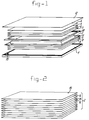
- Said pack 2 consists of a number of sheets of fibre material and polyphenylene sulphide film, as will be explained with reference to Figure 2.
- a tear fabric 3, glass cloth 4, perforated film 5 and ventilation fabric 6 are placed successively on the top of the pack 2.
- a tear fabric 7, a glass cloth 8 and a ventilation fabric 9 are also placed on the bottom of the pack 2.
- a ventilation cloth 10 and a perforated hose 11 are fitted around the pack 2, after which the entire pack comprising layers 2-9 and the annular elements 10, 11 is placed on the moulding table 1 and covered with a gastight film 12.
- the film 12 is sealed at the periphery with respect to the moulding table 1, for example using adhesive tape.
- the moulding table 1 has a connector 13 to which a vacuum source (not shown) can be connected, such that a vacuum of, for example, 0.30 bar absolute can be generated in the space between moulding table 1 and film 12.
- the pack consists of woven sheets of carbon fibres 14, which are each enclosed on both sides by polyphenylene sulphide films 15, 16.
- polyphenylene sulphide films 15, 16 Depending on the desired thickness of the final laminate and the desired strength and rigidity, a larger or smaller number of layers of fibre material 14 with specific orientations can be applied.
- the method according to the invention is outstandingly suitable for curved products such as skins for wing panels. With this method it is also possible to fit desired reinforcements in the form of additional strips and the like in certain positions. Curved and irregular shapes of this type can be held in good contact with the mould under the effect of the vacuum. The method according to the invention can consequently be used very flexibly and for diverse products.
- the ventilation fabric 9 and gastight film 12 layers are then placed on top.
- the gastight film is covered with respect to the seal 19.
- the mould 1, the seal 19 and the gastight film 12 are pressed firmly onto one another by means of clamps 18.
- the ventilation fabric e.g. from glass fibres, ensures a smooth application and compression on the pack 2.
- the product produced according to the illustrative embodiment in Figure 3 consists of the pack 2, the strips of polyamide material 17 and the adhering release layer 3.
- the release layer 3 is removed for further processing of this product. Upon removing said layer, usually a somewhat polluted surface remains. At the location of the (removed) strips of polyamide material the surface is clean, which means that a weld can be produced there.
- a release layer 20 from polyimide or a wax-like material may also be applied between pack 2 and moulding table 1.
Landscapes
- Chemical & Material Sciences (AREA)
- Engineering & Computer Science (AREA)
- Composite Materials (AREA)
- Mechanical Engineering (AREA)
- Casting Or Compression Moulding Of Plastics Or The Like (AREA)
- Moulding By Coating Moulds (AREA)
- Laminated Bodies (AREA)
Abstract
- providing at least one layer of fibre material,
- placing a thermoplastic matrix material on the fibre material,
- packing the pack of fibre material and matrix material in a casing,
- lowering the pressure in the casing,
- heating the fibre material and matrix material such that the fibre material is impregnated with said matrix material whilst maintaining the low pressure,
- cooling fibre material and matrix material with the formation of a laminate.
Description
- providing a pack of at least one layer of fibre material and a thermoplastic matrix material,
- placing the pack of fibre material and matrix material between two walls in contact with said pack,
- lowering the pressure in the casing defined by said walls,
- heating the fibre material and matrix material such that the fibre material is impregnated with the latter whilst maintaining the low pressure,
- cooling fibre material and matrix material with the formation of a laminate.
Claims (25)
- Method for the production of products from a thermoplastic matrix laminate, comprising the following steps:providing a pack of at least one layer of fibre material and a thermoplastic matrix material,placing the pack of fibre material and matrix material between two walls in contact with said pack,lowering the pressure in the casing defined by said walls,heating the fibre material and matrix material such that the fibre material is impregnated with the latter whilst maintaining the low pressure,cooling fibre material and matrix material with the formation of a laminate.
- Method according to Claim 1, comprising packing the pack of fibre material and matrix material in a casing.
- Method according to Claim 1 or 2, comprising the step of removing gases from the casing.
- Method according to Claim 3, comprising drawing off gases from both sides of the pack.
- Method according to one of the preceding claims, wherein the thermoplastic matrix material is polyphenylene sulphide (PPS).
- Method according to Claim 5, comprising the step of consolidating the pack at a temperature of between 280 °C and 350 °C.
- Method according to Claim 5, comprising consolidation of the pack at a temperature lower than 335 °C.
- Method according to Claim 6 or 7, comprising consolidation of the pack at a temperature between 300 °C and 325 °C.
- Method according to Claim 6, 7 or 8, comprising consolidation of the pack at a temperature between 310 °C and 315 °C.
- Method according to Claim 6, 7, 8 or 9, comprising consolidation of the pack at a temperature lower than 315 °C.
- Method according to one of the preceding claims, comprising consolidation of the pack under a vacuum of at most 0.70 bar absolute.
- Method according to Claim 11, comprising consolidation of the pack under a vacuum of 0.30 bar absolute.
- Method according to one of the preceding claims, comprising incorporating the pack between a top and a bottom ventilation layer.
- Method according to one of the preceding claims, comprising placing the pack on a porous mould.
- Method according to one of the preceding claims, comprising placing the pack on a curved mould.
- Method according to Claim 13, 14 or 15, comprising placing a release layer, such as a tear fabric, between each ventilation layer and the pack.
- Method according to Claim 16, comprising placing a polyimide material on the pack of fibre material and matrix material and then applying the release layer.
- Method according to one of the preceding claims, comprising fitting a porous hose-shaped element around at least part of the periphery of the pack.
- Method according to one of the preceding claims, comprising placing the pack with the layers on the top and bottom thereof on a moulding table, covering said pack with an essentially gastight film and sealing the film with respect to the moulding table.
- Method according to one of the preceding claims, comprising:preheating a furnace to the temperature required for consolidation,preparing a mould with a pack of fibre material and matrix material and other layers in advance outside the furnace,introducing the mould with pack and other layers directly into the preheated furnace.
- Method according to one of the preceding claims, comprising the use of a metal mould having a thickness of approximately 3 mm.
- Method according to one of the preceding claims, comprising the use of a mould made of steel or nickel.
- Method according to one of claims 19-22, comprising applying a release layer from polyimide between the pack and the moulding table.
- Method according to one of claims 19-22, comprising applying a release layer from a wax-like material between the pack and the moulding table.
- Curved product obtained according to the method described in one of the preceding claims.
Applications Claiming Priority (2)
| Application Number | Priority Date | Filing Date | Title |
|---|---|---|---|
| NL1006566A NL1006566C2 (en) | 1997-07-11 | 1997-07-11 | Method for manufacturing a plastic laminate. |
| NL1006566 | 1997-07-11 |
Publications (2)
| Publication Number | Publication Date |
|---|---|
| EP0893235A2 true EP0893235A2 (en) | 1999-01-27 |
| EP0893235A3 EP0893235A3 (en) | 2000-01-05 |
Family
ID=19765338
Family Applications (1)
| Application Number | Title | Priority Date | Filing Date |
|---|---|---|---|
| EP98202333A Withdrawn EP0893235A3 (en) | 1997-07-11 | 1998-07-10 | Method for the production of a plastic laminate |
Country Status (2)
| Country | Link |
|---|---|
| EP (1) | EP0893235A3 (en) |
| NL (1) | NL1006566C2 (en) |
Cited By (9)
| Publication number | Priority date | Publication date | Assignee | Title |
|---|---|---|---|---|
| RU2217312C2 (en) * | 2000-03-17 | 2003-11-27 | Еадс Дойчланд Гмбх | Method and device for manufacture of parts reinforced by fiber by the injection method |
| NL1021087C2 (en) * | 2002-07-16 | 2004-01-22 | Stork Fokker Aesp Bv | Method for forming a plastic plate and clamp therefor. |
| EP1428649A1 (en) * | 2002-12-13 | 2004-06-16 | Nitec Engineering GmbH | Method for producing three-dimensional parts |
| WO2005095091A1 (en) | 2004-03-30 | 2005-10-13 | Plastxform Ag | Method for producing molded bodies from thermoplastic material |
| WO2008031866A1 (en) * | 2006-09-15 | 2008-03-20 | Airbus France | Process for manufacturing a panel made of a thermoplastic composite |
| DE102014004053A1 (en) * | 2014-03-21 | 2015-09-24 | Fraunhofer-Gesellschaft zur Förderung der angewandten Forschung e.V. | Process for the consolidation of thermoplastic or thermoelastic fiber composite structures |
| DE102015014512A1 (en) | 2015-11-11 | 2017-05-11 | Fraunhofer-Gesellschaft zur Förderung der angewandten Forschung e.V. | Method and device for the consolidation of impregnated fiber composite structures |
| US10343373B2 (en) * | 2015-12-16 | 2019-07-09 | Airbus Defence and Space GmbH | Coated composite component |
| US20230191668A1 (en) * | 2021-12-21 | 2023-06-22 | Rohr, Inc. | Non-polyimid based thermoplastic film as vacuum bag material for consolidation of thermoplastic composite materials systems and methods |
Family Cites Families (5)
| Publication number | Priority date | Publication date | Assignee | Title |
|---|---|---|---|---|
| US4622091A (en) * | 1984-11-29 | 1986-11-11 | The Boeing Company | Resin film infusion process and apparatus |
| US4915896A (en) * | 1987-09-01 | 1990-04-10 | Phillips Petroleum Company | Vacuum bagging process for fiber reinforced thermoplastics |
| US4869770A (en) * | 1987-12-03 | 1989-09-26 | The Boeing Company | Method and apparatus for laminating composite materials |
| US5194190A (en) * | 1989-03-31 | 1993-03-16 | General Electric Company | Process for impregantion of glass fiber reinforcement with thermoplastic resins |
| EP0516235A1 (en) * | 1991-05-29 | 1992-12-02 | Dsm N.V. | Process for processing a material comprising thermoplastic polymer and fibrous reinforcing material |
-
1997
- 1997-07-11 NL NL1006566A patent/NL1006566C2/en not_active IP Right Cessation
-
1998
- 1998-07-10 EP EP98202333A patent/EP0893235A3/en not_active Withdrawn
Cited By (16)
| Publication number | Priority date | Publication date | Assignee | Title |
|---|---|---|---|---|
| RU2217312C2 (en) * | 2000-03-17 | 2003-11-27 | Еадс Дойчланд Гмбх | Method and device for manufacture of parts reinforced by fiber by the injection method |
| NL1021087C2 (en) * | 2002-07-16 | 2004-01-22 | Stork Fokker Aesp Bv | Method for forming a plastic plate and clamp therefor. |
| EP1428649A1 (en) * | 2002-12-13 | 2004-06-16 | Nitec Engineering GmbH | Method for producing three-dimensional parts |
| WO2005095091A1 (en) | 2004-03-30 | 2005-10-13 | Plastxform Ag | Method for producing molded bodies from thermoplastic material |
| US8329085B2 (en) | 2006-09-15 | 2012-12-11 | Airbus Operations Sas | Process for manufacturing a panel made of a thermoplastic composite |
| FR2905891A1 (en) * | 2006-09-15 | 2008-03-21 | Airbus France Sa | METHOD FOR MANUFACTURING PANEL OF THERMOPLASTIC COMPOSITE MATERIAL |
| JP2010503549A (en) * | 2006-09-15 | 2010-02-04 | エアバス・フランス | Method for manufacturing a panel formed of a thermoplastic composite |
| RU2446050C2 (en) * | 2006-09-15 | 2012-03-27 | Эрбюс Операсьон (Сас) | Method of fabricating panel from thermoplastic composite material |
| WO2008031866A1 (en) * | 2006-09-15 | 2008-03-20 | Airbus France | Process for manufacturing a panel made of a thermoplastic composite |
| DE102014004053A1 (en) * | 2014-03-21 | 2015-09-24 | Fraunhofer-Gesellschaft zur Förderung der angewandten Forschung e.V. | Process for the consolidation of thermoplastic or thermoelastic fiber composite structures |
| DE102014004053B4 (en) * | 2014-03-21 | 2017-05-18 | Fraunhofer-Gesellschaft zur Förderung der angewandten Forschung e.V. | Process for the consolidation of thermoplastic or thermoelastic fiber composite structures |
| DE102015014512A1 (en) | 2015-11-11 | 2017-05-11 | Fraunhofer-Gesellschaft zur Förderung der angewandten Forschung e.V. | Method and device for the consolidation of impregnated fiber composite structures |
| EP3168036A1 (en) | 2015-11-11 | 2017-05-17 | Fraunhofer-Gesellschaft zur Förderung der angewandten Forschung e.V. | Method and device for consolidating impregnated fiber composite structures |
| DE102015014512B4 (en) * | 2015-11-11 | 2017-05-24 | Fraunhofer-Gesellschaft zur Förderung der angewandten Forschung e.V. | Method and device for the consolidation of impregnated fiber composite structures |
| US10343373B2 (en) * | 2015-12-16 | 2019-07-09 | Airbus Defence and Space GmbH | Coated composite component |
| US20230191668A1 (en) * | 2021-12-21 | 2023-06-22 | Rohr, Inc. | Non-polyimid based thermoplastic film as vacuum bag material for consolidation of thermoplastic composite materials systems and methods |
Also Published As
| Publication number | Publication date |
|---|---|
| NL1006566C2 (en) | 1999-02-15 |
| EP0893235A3 (en) | 2000-01-05 |
Similar Documents
| Publication | Publication Date | Title |
|---|---|---|
| US4816106A (en) | Method for the controlled curing of composites | |
| US4869770A (en) | Method and apparatus for laminating composite materials | |
| EP0028637B1 (en) | Method of fabricating a composite structure | |
| US4915896A (en) | Vacuum bagging process for fiber reinforced thermoplastics | |
| US5116216A (en) | Apparatus for preparing thermoplastic composites | |
| EP0585545B1 (en) | A breather pad mainly made out of nylon fibers | |
| JPS63100046A (en) | Vacuum bag, manufacture of bag material and vacuum bag packing method | |
| EP0415870A2 (en) | Preform liners for resin transfer molding | |
| US20080210372A1 (en) | Composite article debulking process | |
| GB2168002A (en) | Composite material manufacture | |
| EP0175510B1 (en) | Vacuum bagging | |
| JP4648019B2 (en) | PRESSURE BAG MANUFACTURING METHOD AND COMPOSITE MOLDED ARTICLE MOLDING METHOD USING THE PRESSURE BAG | |
| EP0641276B1 (en) | Vacuum bagging | |
| JPH11207911A (en) | Composite material forming method and forming apparatus | |
| US5637272A (en) | Method of manufacturing a multi-holed surface plate made of a composite material and a raw forming element of the composite material therefor | |
| US7438781B2 (en) | System and method for vacuum bag fabrication | |
| JPS63251207A (en) | Molding method and apparatus for printed-circuit board | |
| US5624512A (en) | Method of curing composite articles using conformable vacuum bags | |
| NL1006566C2 (en) | Method for manufacturing a plastic laminate. | |
| US7306761B2 (en) | Method of manufacturing composite sandwich structures | |
| US4878979A (en) | Method of reusably sealing a silicone rubber vacuum bag to a mold for composite manufacture | |
| EP0358510A2 (en) | Apparatus and method for making composite materials | |
| JP3308304B2 (en) | Molding method of molding material and molding device | |
| JP2947873B2 (en) | Thermosetting resin composite molding method | |
| JP2738553B2 (en) | Composite panel bending section forming method |
Legal Events
| Date | Code | Title | Description |
|---|---|---|---|
| PUAI | Public reference made under article 153(3) epc to a published international application that has entered the european phase |
Free format text: ORIGINAL CODE: 0009012 |
|
| AK | Designated contracting states |
Kind code of ref document: A2 Designated state(s): DE ES FR GB NL |
|
| AX | Request for extension of the european patent |
Free format text: AL;LT;LV;MK;RO;SI |
|
| PUAL | Search report despatched |
Free format text: ORIGINAL CODE: 0009013 |
|
| AK | Designated contracting states |
Kind code of ref document: A3 Designated state(s): AT BE CH CY DE DK ES FI FR GB GR IE IT LI LU MC NL PT SE |
|
| AX | Request for extension of the european patent |
Free format text: AL;LT;LV;MK;RO;SI |
|
| 17P | Request for examination filed |
Effective date: 20000412 |
|
| AKX | Designation fees paid |
Free format text: DE ES FR GB NL |
|
| 17Q | First examination report despatched |
Effective date: 20001002 |
|
| STAA | Information on the status of an ep patent application or granted ep patent |
Free format text: STATUS: THE APPLICATION IS DEEMED TO BE WITHDRAWN |
|
| 18D | Application deemed to be withdrawn |
Effective date: 20010414 |