EP0892040A2 - Chelating composition - Google Patents
Chelating composition Download PDFInfo
- Publication number
- EP0892040A2 EP0892040A2 EP98305642A EP98305642A EP0892040A2 EP 0892040 A2 EP0892040 A2 EP 0892040A2 EP 98305642 A EP98305642 A EP 98305642A EP 98305642 A EP98305642 A EP 98305642A EP 0892040 A2 EP0892040 A2 EP 0892040A2
- Authority
- EP
- European Patent Office
- Prior art keywords
- acid
- chelating composition
- chelating
- naoh
- composition according
- Prior art date
- Legal status (The legal status is an assumption and is not a legal conclusion. Google has not performed a legal analysis and makes no representation as to the accuracy of the status listed.)
- Granted
Links
Images


Classifications
-
- C—CHEMISTRY; METALLURGY
- C11—ANIMAL OR VEGETABLE OILS, FATS, FATTY SUBSTANCES OR WAXES; FATTY ACIDS THEREFROM; DETERGENTS; CANDLES
- C11D—DETERGENT COMPOSITIONS; USE OF SINGLE SUBSTANCES AS DETERGENTS; SOAP OR SOAP-MAKING; RESIN SOAPS; RECOVERY OF GLYCEROL
- C11D3/00—Other compounding ingredients of detergent compositions covered in group C11D1/00
- C11D3/16—Organic compounds
- C11D3/20—Organic compounds containing oxygen
- C11D3/2075—Carboxylic acids-salts thereof
- C11D3/2086—Hydroxy carboxylic acids-salts thereof
-
- C—CHEMISTRY; METALLURGY
- C02—TREATMENT OF WATER, WASTE WATER, SEWAGE, OR SLUDGE
- C02F—TREATMENT OF WATER, WASTE WATER, SEWAGE, OR SLUDGE
- C02F5/00—Softening water; Preventing scale; Adding scale preventatives or scale removers to water, e.g. adding sequestering agents
- C02F5/08—Treatment of water with complexing chemicals or other solubilising agents for softening, scale prevention or scale removal, e.g. adding sequestering agents
- C02F5/10—Treatment of water with complexing chemicals or other solubilising agents for softening, scale prevention or scale removal, e.g. adding sequestering agents using organic substances
-
- C—CHEMISTRY; METALLURGY
- C02—TREATMENT OF WATER, WASTE WATER, SEWAGE, OR SLUDGE
- C02F—TREATMENT OF WATER, WASTE WATER, SEWAGE, OR SLUDGE
- C02F5/00—Softening water; Preventing scale; Adding scale preventatives or scale removers to water, e.g. adding sequestering agents
- C02F5/08—Treatment of water with complexing chemicals or other solubilising agents for softening, scale prevention or scale removal, e.g. adding sequestering agents
- C02F5/10—Treatment of water with complexing chemicals or other solubilising agents for softening, scale prevention or scale removal, e.g. adding sequestering agents using organic substances
- C02F5/12—Treatment of water with complexing chemicals or other solubilising agents for softening, scale prevention or scale removal, e.g. adding sequestering agents using organic substances containing nitrogen
-
- C—CHEMISTRY; METALLURGY
- C11—ANIMAL OR VEGETABLE OILS, FATS, FATTY SUBSTANCES OR WAXES; FATTY ACIDS THEREFROM; DETERGENTS; CANDLES
- C11D—DETERGENT COMPOSITIONS; USE OF SINGLE SUBSTANCES AS DETERGENTS; SOAP OR SOAP-MAKING; RESIN SOAPS; RECOVERY OF GLYCEROL
- C11D3/00—Other compounding ingredients of detergent compositions covered in group C11D1/00
- C11D3/16—Organic compounds
- C11D3/20—Organic compounds containing oxygen
- C11D3/2075—Carboxylic acids-salts thereof
- C11D3/2082—Polycarboxylic acids-salts thereof
-
- C—CHEMISTRY; METALLURGY
- C11—ANIMAL OR VEGETABLE OILS, FATS, FATTY SUBSTANCES OR WAXES; FATTY ACIDS THEREFROM; DETERGENTS; CANDLES
- C11D—DETERGENT COMPOSITIONS; USE OF SINGLE SUBSTANCES AS DETERGENTS; SOAP OR SOAP-MAKING; RESIN SOAPS; RECOVERY OF GLYCEROL
- C11D3/00—Other compounding ingredients of detergent compositions covered in group C11D1/00
- C11D3/16—Organic compounds
- C11D3/20—Organic compounds containing oxygen
- C11D3/22—Carbohydrates or derivatives thereof
-
- C—CHEMISTRY; METALLURGY
- C11—ANIMAL OR VEGETABLE OILS, FATS, FATTY SUBSTANCES OR WAXES; FATTY ACIDS THEREFROM; DETERGENTS; CANDLES
- C11D—DETERGENT COMPOSITIONS; USE OF SINGLE SUBSTANCES AS DETERGENTS; SOAP OR SOAP-MAKING; RESIN SOAPS; RECOVERY OF GLYCEROL
- C11D3/00—Other compounding ingredients of detergent compositions covered in group C11D1/00
- C11D3/16—Organic compounds
- C11D3/26—Organic compounds containing nitrogen
- C11D3/33—Amino carboxylic acids
Definitions
- This invention relates to a chelating composition formed of a specific aliphatic polycarboxylic acid and sugar or saccharic acid. More specifically, this invention relates to a chelating composition which can be advantageously used as an agent for preventing the precipitation of a metal ion contained in cooling water for use in a cooling tower, water for use in a boiler, and the like; an agent for repressing the formation of smear on cloth due to the sedimentation of a metal ion on a cloth during the dyeing or bleaching treatment; and an additive for a fiber processing agent, a detergent in food manufacturing industry, a detergent in a chemical plant, a metal surface-treating agent, and a paper-pulp processing agent.
- This invention also relates to a chelating composition to be used in a detergent for cleansing and removing stain adhering to a hard surface of glass, plastic, or metal. More specifically, this invention relates to a chelating composition to be used in a detergent which is used for cleansing and removing stain adhering to a hard surface of a package encasing provisions such as beverage and processed food, a container accommodating a package, and a pipe, a tank, a sterilizing plate, and a filling device in foodstuff production facilities by such means as immersion in, circulation and spray application of a liquid detergent, and to a chelating composition to be used in a chemical-mechanical industry grade detergent which is used for metal surface cleansing, metal cleansing, and precision cleansing. Particularly, this invention relates to a chelating composition to be used in a detergent which exhibits high cleansing power on a hard surface and, at the same time, excels in biodegradability.
- a metal ion has also incurred a possibility that when present in cooling water for a cooling tower or in water for a boiler, it will settle and eventually clog the pipe.
- chelating agents such as, for example, ethylenediaminetetraacetic acid (EDTA), nitrilotriacetic acid (NTA), N-(hydroxyethyl)ethylenediamine-N,N',N'-triacetic acid (HEDTA), diethylenetriaminepentaacetic acid (DTPA), and polyphosphoric acid have been used.
- EDTA ethylenediaminetetraacetic acid
- NTA nitrilotriacetic acid
- HEDTA N-(hydroxyethyl)ethylenediamine-N,N',N'-triacetic acid
- DTPA diethylenetriaminepentaacetic acid
- polyphosphoric acid polyphosphoric acid
- chelating agents While exhibiting an excellent ability to sequester metal ions, are not easily subjected to biodegradation. They, incur possibilities that their plant effluents, when discharged without any treatment into the neighboring environment, will cause water pollution. Even when an activated sludge is used to treat a chelating agent, it cannot be expected to purge the effluents of the chelating agent, and therefore all possible efforts must be made to recover the chelating agent from the effluent. Further, the chelating agent itself possibly forms a cause for eutrophication and induces abnormal growth of microorganisms.
- an aqueous detergent solution containing 1 to 3% by weight of an alkali metal hydroxide and 0.2 to 0.4% by weight of an alkali metal salt of ethylenediaminetetraacetic acid (chelating compound).
- the detergents which use a surfactant as a main component contain additionally such an alkali salt as carbonate, silicate, or phosphate which has relatively weak alkalinity, and an alkali metal salt of aspartic acid-N,N-diacetic acid, and find utility mainly in household applications have been also known (see EP-A-513,948, US-A-3,637,511, and DE-B-2,220,295).
- the aforementioned aqueous detergent solution containing the alkali metal salt of ethylenediaminetetraacetic acid indeed excels in the ability to cleanse and remove stain adhering to a surface of production facilities and packages, it suffers deficiency in the biodegradability. It, therefore, is not necessarily desirable from the viewpoint of the existent environmental protection to use this aqueous detergent solution in a foodstuff production plant, because the waste of this solution discharged from the plant undergoes no satisfactory biodegradation by the conventional treatment with activated sludge.
- compositions which combines a strong detergent power with excellent biodegradability. None of the compositions developed to date fully reconcile the capacity for detergency and the biodegradability.
- An object of this invention is to provide a chelating composition which excels in ability to forma chelate with a metal ion, particularly an iron ion, and is easily subjected to biodegradation and consequently has a low risk to pollute the environment.
- Another object of this invention is to provide a chelating composition which manifests great ability to sequester a metal ion within a wide pH range and effectively precludes a metal ion, particularly an iron ion, from settling in the form of a hydroxide.
- Still another object of this invention is to provide a chelating composition suitable for the chemical and mechanical industry grade detergent which is used for purging a glass, plastic, or metallic article of stain adhering to the surface thereof by means of metal surface cleaning, metal cleansing, and precision cleansing, for example.
- Yet another object of this invention is to provide a chelating composition suitable for the detergent which efficiently cleanses and removes stain adhering to a glass, plastic, or metallic article, specifically stain adhering to a hard surface of a package encasing provisions such as beverages and processed foods, a container accommodating the package, and a pipe, a tank, a sterilizing plate, and a filling device of foodstuff production facilities, and has excellent biodegradability as well as both excellent abilities as mentioned above.
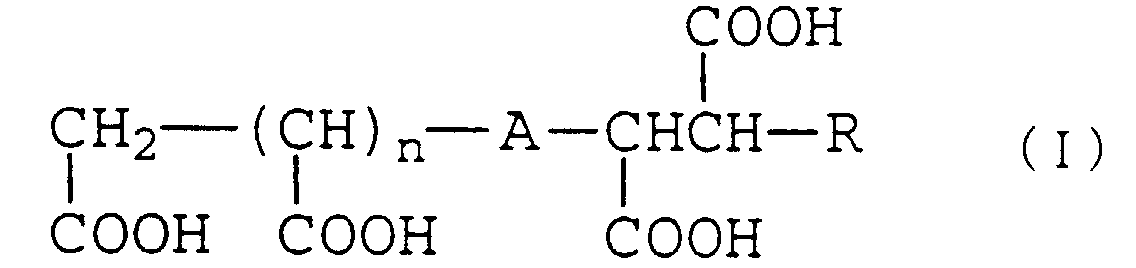
- a chelating composition which is formed of an aliphatic polycarboxylic acid of the formula (I): wherein A stands for an imino group or an oxygen atom, R stands for a hydrogen atom or a hydroxyl group, and n is 0 or 1, and specific sugar or saccharic acid markedly excels in the ability to sequester a metal ion or prevent a metal ion from insolubilization, namely manifests synergistic effects, as compared with the component compounds used independently.
- A stands for an imino group or an oxygen atom
- R stands for a hydrogen atom or a hydroxyl group
- n is 0 or 1
- specific sugar or saccharic acid markedly excels in the ability to sequester a metal ion or prevent a metal ion from insolubilization, namely manifests synergistic effects, as compared with the component compounds used independently.
- the present inventors have also found that the chelating composition mentioned above possesses great ability to sequester a metal ion within a wide pH range as compared with the conventional chelating agents and thus can prevent an iron ion from being precipitated in the form of hydroxide.
- the present inventors have further found that since the chelating composition mentioned above is efficiently decomposed by such means as known activated sludge, it avoids polluting the environment and thus has a low risk to pollute the environment.
- the present inventors have found that the chelating composition mentioned above affords a detergent and a detergent composition both capable of maintaining great ability to cleanse and remove stain and meanwhile behaving tenderly to the environment without polluting the environment because it possesses the ability to cleanse and remove efficiently stain adhering to a hard surface and combines excellent biodegradability with the two properties as well and, therefore, succumbs to efficient decomposition by such known means as the treatment with activated sludge.
- the present invention has been perfected based on the knowledge mentioned above.
- this invention provides a chelating composition which contains an aliphatic polycarboxylic acid of the formula (I): wherein A stands for an imino group or an oxygen atom, R stands for a hydrogen atom or a hydroxyl group, and n is 0 or 1, or the salt thereof and sugar or saccharic acid of 4 to 12 carbon atoms at such a ratio as enables the components to manifest synergistic effects.
- A stands for an imino group or an oxygen atom
- R stands for a hydrogen atom or a hydroxyl group
- n is 0 or 1, or the salt thereof and sugar or saccharic acid of 4 to 12 carbon atoms at such a ratio as enables the components to manifest synergistic effects.
- the chelating composition of this invention markedly excels in the ability to sequester a metal ion or prevent it from being insolubilized as compared with the component compounds used independently and, therefore, is capable of effectively sequestering the metal ion and preventing the metal ion from being insolubilized without polluting the environment.
- the chelating composition of this invention admits no possibilities of polluting the environment in the light of the spirit of draining the existing terrestrial environment because the compound of the formula (I) possesses excellent biodegradability and succumbs to decomposition by the known means such as the treatment with activated sludge as compared with the conventional detergents.
- the chelating composition of this invention can efficiently remove stain adhering to a glass bottle returned from the market while maintaining the excellent biodegradability because it possessed great ability to remove diatomaceous earth.
- the chelating composition of this invention can also effectively purge a beer tank of stain adhering thereto because it excels in the ability to dissolve calcium oxalate which is the main component of stain of the beer tank.
- Fig. 1 is a graph showing the ability of the chelating composition of this invention to sequester calcium.
- Fig. 2 is a graph showing the ability of the chelating composition of this invention to sequester calcium.
- Fig. 3 is a graph showing the ability of the chelating composition of this invention to sequester calcium.
- Fig. 4 is a graph showing the ability of the chelating composition of this invention to sequester calcium.
- this invention relates to a chelating composition containing an aliphatic polycarboxylic acid of the following formula (I): wherein A is an imino group or an oxygen atom, R is a hydrogen atom or a hydroxyl group, and n is 0 or 1, or a salt thereof and sugar or saccharic acid of 4 to 12 carbon atoms at such a ratio as enables the components to manifest synergistic effects.
- A is an imino group or an oxygen atom
- R is a hydrogen atom or a hydroxyl group
- n is 0 or 1, or a salt thereof and sugar or saccharic acid of 4 to 12 carbon atoms at such a ratio as enables the components to manifest synergistic effects.
- R is preferred to denote a hydroxyl group and/or A an imino group.
- HIDS, CIMM, IDS, CMIS, TMS, and TMA prove favorable and HIDS and TMS prove particularly favorable.
- Optical isomers are possibly present in some of the aliphatic polycarboxylic acids of the formula (I). This invention allows use of their racemic modifications. It otherwise allows the individual optical isomers to be used independently of one another as by synthesizing the individual optical isomers or separating the relevant racemic modifications, for example.
- the aliphatic polycarboxylic acid of the formula (I) in the form of a salt.
- salts of such alkali metals as sodium and potassium and ammonium salts prove particularly preferable.
- carboxyl groups participating in the formation of the aliphatic polycarboxylic acid three or four carboxyl groups may form any of the salts mentioned above or a part of these carboxyl groups, e.g. one, two, or three carboxyl groups, may form such salts.
- at least two carboxyl groups assume the form of salts.
- the aliphatic polycarboxylic acids of the formula (I) and the salts thereof may be used either singly or in the form of a mixture of two or more members. Incidentally, the aliphatic polycarboxylic acids of the formula (I) and the salts thereof will not pollute the environment because they are easily decomposed as with activated sludge, for example.
- sugar of 4 to 12 carbon atoms to be used in this invention monosaccharides such as erythrose, arabinose, andglucose; disaccharides such as maltose, lactose, and sucrose; erythritols such as erythritol; pentitols such as arabitol, ribitol, and xylitol; and hexytols such as sorbitol, mannitol, and galactitol may be cited.
- sorbitol may be used particularly preferably as the sugar according to this invention. These sugars may be used in any of the forms such as D form, L form, or the form of mixture thereof.
- aldonic acids such as arabonic acid, gluconic acid, and galactonic acid
- aldaric acids such as trihydroxyglutaric acid, glucaric acid, and mucic acid
- glucoheptoic acid may be cited.
- alkali metal salts of gluconic acid may be particularly preferably used as saccharic acids according to this invention.
- These saccharic acids may be used in any of the forms such as D form, L form, or the form of mixture thereof.
- This invention allows the sugars or saccharic acids mentioned above to be used in the form of salts such as, for example, salts of such alkali metals as sodium, potassium, and lithium; salts of such alkaline earth metals as calcium and magnesium; amine salts including such alkyl amines as monoethyl amine, diethyl amine, and triethyl amine, and salts of such alkanol amines as monoethanol amine; and salts with ammoniacal bases such as ammonium salts.
- salts such as, for example, salts of such alkali metals as sodium, potassium, and lithium
- salts of such alkaline earth metals as calcium and magnesium
- amine salts including such alkyl amines as monoethyl amine, diethyl amine, and triethyl amine, and salts of such alkanol amines as monoethanol amine
- salts with ammoniacal bases such as ammonium salts.
- the sugar and/or saccharic acid may be used either singly or in the form of a combination of two or more members.
- the sugar and/or saccharic acid is preferred to be selected among gluconic acid, sorbitol, and mixtures thereof. Particularly, it is preferred to contain gluconic acid.
- the ratio of the aliphatic polycarboxylic acid of the formula (I) to the sugar and/or saccharic acid varies with such factors as the kinds of aliphatic polycarboxylic acid, sugar, and saccharic acid to be used. It impose no particular restriction but only requires the relevant components to manifest synergistic effects aimed at.
- the ratio of the aliphatic polycarboxylic acid of the formula (I) to the sugar and/or saccharic acid is generally in the range of 98/2 to 50/50, preferably 95/5 to 70/30, and more preferably 90/10 to 80/20.
- the method for mixing the aliphatic polycarboxylic acid of the formula (I) with the sugar and/or saccharic acid imposes no particular restriction but only requires the relevant components to be mixed substantially uniformly.
- a method which consists in mixing the components both in a powdered state and a method which comprises mixing them both in the form of an aqueous solution may be cited.
- the chelating composition of this invention depending on the conditions of use, maybe put to use as mixed with a diluent.
- the chelating composition of this invention may be either in the form of powder or liquid.
- the chelating composition of the present invention can be advantageously used as an agent for preventing the precipitation of a metal ion contained in cooling water for use in a cooling tower, water for use in a boiler, and the like; an agent for repressing the formation of smear on cloth due to the sedimentation of a metal ion on the cloth during the dyeing or bleaching treatment; and an additive for a fiber processing agent, a detergent in food manufacturing industry, a detergent in a chemical plant, a metal surface treating agent, and a paper and pulp processing agent.
- the chelating composition of this invention can be put to use with a surfactant added.
- the surfactant to be used effectively herein may be any of the surfactants heretofore known to the art.
- anionic surfactants such as sodium stearate, sodium. palmitate, sodium laurate, and sodium laurylbenzene sulfonate
- nonionic surfactants such as polyoxyethylene alkyl ether and nonylphenyl polyoxyethylene alkyl ether
- cationic surfactants such as dodecylmethyl ammonium chloride, N-alkylpyridium halide, and tetraalkyl ammonium may be cited.
- sodium laurate is used particularly advantageously.
- the chelating composition of this invention can be used at a ratio, for example, in the range of 1 to 30 parts by weight, preferably 3 to 20 parts by weight, based on 100 parts by weight of the surfactant mentioned above.
- the chelating composition of this invention can incorporate therein another component except for the surfactant mentioned above.
- the another component the following compounds may be cited.
- the chelating composition of this invention may further incorporate therein an alkali metal hydroxide.
- alkali metal hydroxide sodium hydroxide, potassium hydroxide, and lithium hydroxide may be cited.
- sodium hydroxide and potassium hydroxide may be advantageously used.
- the amount of the alkali metal hydroxide to be incorporated in the chelating composition is in the range of 0.05 to 45% by weight, preferably 2 to 10% by weight.
- the chelatinc composition proves advantageous in terms of cleansing power, ease of handling, and economy when the amount of the alkali metal hydroxide incorporated therein is in the range mentioned above.
- the alkali metal hydroxide to be incorporated is in the range of 0.05 to 45% by weight, preferably 2 to 10% by weight.
- the amount of the compound of the formula (I) to be incorporated is in the range of 0.05 to 45% by weight, preferably 0.1 to 10% by weight, and the amount of the sugar or saccharic acid or the salt thereof to be incorporated is in the range of 0.001 to 10% by weight, preferably 0.003 to 1% by weight.
- the definition of the range for the amount of the alkali metal hydroxide to be incorporated is for the same reason as given above.
- the compound of the aforementioned formula (I) proves advantageous in terms of cleansing power, ease of handling, and economy when the amount of this compound is in the range as mentioned above.
- the sugar or saccharic acid or the salt thereof to be incorporated proves advantageous in terms of cleansing power, ease of handling, and economy when the amount thereof is in the range mentioned above.
- the chelating composition of this invention When the chelating composition of this invention is to be used for cleaning a hard surface, it can be manufactured, for example, by a simple procedure of mixing substantially uniformly the compound of the formula (I), the alkaline metal hydroxide, and the sugar and/or saccharic acid (inclusive of the salt thereof).
- the method for effecting the substantially uniform mixture is not particularly limited and may be selected arbitrarily among well-known methods in the art.
- the components may be mixed either in the form of powder or in the form of liquid.
- the chelating composition of this invention When the chelating composition of this invention is to be used for cleaning a hard surface, it may be put to use directly or as mixed with a diluent, depending on the purpose for which the composition is used. It may be used either in the form of powder or in the form of liquid.
- the chelating composition of this invention when it is to be used for cleaning a hard surface, it may incorporate therein as occasion demands a known detergent, a copolymer containing as components thereof acrylic acid or an alkali metal salt thereof and maleic acid or an alkali metal salt thereof and having a molecular weight exceeding 3,000, preferably in the range of 3,000 to 70,000, hexametaphosphoric acid and/or an alkali metal salt thereof as an agent for preventing the formation of scale, a well-known detergent auxiliary, etc.
- a known detergent a copolymer containing as components thereof acrylic acid or an alkali metal salt thereof and maleic acid or an alkali metal salt thereof and having a molecular weight exceeding 3,000, preferably in the range of 3,000 to 70,000, hexametaphosphoric acid and/or an alkali metal salt thereof as an agent for preventing the formation of scale, a well-known detergent auxiliary, etc.
- the chelating composition of this invention which comprises a specific aliphatic polycarboxylic acid and specific sugar or saccharic acid, can be advantageously used as an agent for preventing the precipitation of a metal ion contained in cooling water for use in a cooling tower, water for use in a boiler, and the like; an agent for repressing the formation of smear on cloth due to the sedimentation of a metal ion on a cloth during the dyeing or bleaching treatment; and an additive for a fiber processing agent, a detergent in food manufacturing industry, a detergent in a chemical plant, a metal surface-treating agent, and a paper-pulp processing agent.
- the chelating composition of this invention can be also advantageously used for cleansing and removing stain adhering to a hard surface of glass, plastic, or metal, more specifically, for cleansing and removing stain adhering to a hard surface of a package encasing provisions such as beverage and processed food, a container accommodating a package, and a pipe, a tank, a sterilizing plate, and a filling device in foodstuff production facilities by such means as immersion in, circulation and spray application of a liquid detergent, as well as for chemical-mechanical industry grade cleansing which is used in metal surface cleansing, metal cleansing, and precision cleansing.
- the chelating composition of this invention can be particularly advantageously used for the chemical and mechanical industry grade detergent which is intended for metal surface cleansing, metal cleansing, and precision cleansing, the stationary cleaning of a pipe, a tank (a fermentation tank of beer, for example), a sterilizing plate, and a filling device, and the cleaning of a glass bottle for beer and juice and other glass packages.
- An aqueous 2% by weight HIDS solution was prepared by dissolving 2 g of HIDS in 100 ml of deionized water. Then an aqueous 2% by weight sodium gluconate solution was prepared by dissolving 2 g of sodium gluconate in 100 ml of deionized water. In an Erlenmeyer flask, 500 ml in inner volume, 18 ml of the aqueous 2% by weight HIDS solution and 2 ml of the aqueous 2% by weight sodium gluconate solution prepared as described above were placed.
- compositions were manufactured by following the procedure of Example 1 while using such components in such ratios as are shown in Table 1 and were rated for their effects. The results are shown in Table 1.
- compositions were manufactured by following the procedure of Example 1 while using such components in such ratios as are shown in Table 2 and were rated for effect. The results are shown in Table 2.
- a solution (A) was prepared by dissolving 1.77 g of HIDS in 100 ml of deionized water.
- a solution (B) was prepared by dissolving 1.77 g of sodium gluconate in 100 ml of deionized water.
- a solution (C) was prepared by dissolving calcium carbonate in deionized water at a concentration of 0.1 mol/liter.
- the following buffer solutions were prepared for the purpose of adjusting the determined pH values to prescribed levels.
- Acetic acid-sodium acetate buffer solution prepared by mixing 16.4 ml of 0.2N acetic acid with 3.6 ml of 0.2M of sodium. acetate
- potassium dihydrogen phosphate-disodium hydrogen phosphate buffer solution prepared by mixing 4.0 ml of 1/15M KH 2 PO 4 with 6.0 ml of 1/15M Na 2 HPO 4 .
- boric acid + potassium chloride-sodium hydroxide buffer solution prepared by mixing 50 ml of 0.2M H 3 BO 3 + 0.2M KCl with 43.90 ml of 0.2N NaOH and 106.10 ml of water
- disodium hydrogen phosphate-sodium hydroxide buffer solution prepared by mixing 50 ml of 0.1M Na 2 HPO 4 with 43.2 ml of 0.1M NaOH and 6.8 ml of water
- a calcium ion selecting electrode was immersed in the mixed solution. The potential after 10 minutes was read out of the electrode.
- a calibration curve of calcium ion concentration was produced by using as the standard solution a solution containing calcium ion at a known concentration.
- the free calcium ion concentration of the solution was found by referring the potential reading mentioned above to the calibration curve.
- the difference of the free calcium ion concentration deducted from the total amount of calcium ion was reported as the amount of calcium ion sequestered (amount of sequestered calcium). The results are shown in Table 5.
- compositions were manufactured by following the procedure of Example 18 while using such components in such ratios as are shown in Table 3 and were tested in the same manner as in Example 18 to determine the amount of calcium sequestered. The results are shown in Table 5.
- compositions were manufactured by following the procedure of Example 18 while using such components in such ratios as are shown in Table 4 and were tested in the same manner as in Example 18 to determine the amount of calcium sequestered. The results are shown in Table 4.
- Example 18 287 294 300
- Example 19 255 263 270 270
- Example 20 288 293 300
- compositions of Examples 18 to 21 resulting from the addition of saccharic acid to aliphatic polycarboxylic acids of the formula (I) possessed great ability to sequester calcium as compared with those of Controls 9 to 13 using such component acids independently. This fact indicates that the mixture of the two acid components resulted in manifestation of synergistic effects.
- Chelating compositions resulting from combining the conventional chelating agents shown on the left side below with saccharic acid were tested for ability to sequester calcium at pH 10 in the same manner as in Example 18. The results are shown in the right side below.
- Chelating composition Ability to sequester calcium (mg/g) Control 14 EDTA4Na, 9 parts by weight Gluconic acid, 1 part by weight 245 Control 15 EDTA4Na, 8 parts by weight Gluconic acid, 2 part by weight 220 Control 16 DTPA5Na, 9 parts by weight Gluconic acid, 1 part by weight 180 Control 17 DTPA5Na, 8 parts by weight Gluconic acid, 2 part by weight 170
- DOC s stands for the amount of dissolved organic carbon remaining in the (sludge + sample) system and DOC w for the amount of dissolved organic carbon remaining in the (water + sample) system.
- compositions of this invention containing HIDS, IDS, or TMS, especially HIDS or IDS exhibited better biodegradability than the compositions for control containing the conventional EDTA or NTA.
- Example 23 Test for ability to sequester calcium ion
- the aqueous calcium solution was tested for calcium ion concentration with a calcium ion selecting electrode (made by ORION K.K. and sold under Cat. No. 9320) using an ion meter (made by ORION K.K. and sold under Model 290A).
- the amount of calcium ion found by the calibration method was reduced to the amount of calcium carbonate. The result of reduction was reported as the ability of the chelating agent to sequester calcium ion.
- compositions of this invention containing HIDS, IDS, or TMS exhibited better ability to sequester calcium ions than the compositions for control containing the conventional EDTA or NTA.
- An artificially defiled plate was obtained by uniformly applying an aqueous 20% diatomaceous earth dispersion solution to a slide glass and then drying the applied layer of the solution at 110 °C for 14 hours. This plate was used in the test.
- compositions of this invention containing HIDS, IDS, or TMS efficiently removed stain adhering to a glass bottle as compared with the conventional controls containing EDTA or NTA.
- Table 8 also shows that in the compositions of this invention, those having incorporated sugar (sorbitol) or the alkali metal salt of saccharic acid (sodium gluconate) registered improved ratios of removal of diatomaceous earth, suggesting that the composition of this invention, when used for the removal of stain adhering to a glass bottle, is preferred to incorporate therein sugar or saccharic acid or the salt thereof.
- control composition containing 3% of sodium hydroxide as an alkali metal hydroxide and 0.45% of NTA and 0.05% of sodium gluconate each as a chelating agent registered the value, 49%, as the ratio of removal of diatomaceous earth, which is equivalent to the ratio of removal obtained by the composition of this invention.
- NTA was inferior in biodegradability to the composition of this invention.
- Example 25 Test for solution of calcium oxalate
- compositions indicated in Table 9 were tested for solution of calcium oxalate under the following conditions.
- Container Stoppered Erlenmeyer flask, 300 ml in inner volume Amount of test solution 200 ml Cleaning time 10 minutes (shaking) Cleaning temperature Room temperature
- compositions of this invention containing HIDS, IDS, or TMS showed satisfactory ability to dissolve calcium oxalate at at least equivalent levels to that of the conventional compositions.
Landscapes
- Chemical & Material Sciences (AREA)
- Life Sciences & Earth Sciences (AREA)
- Chemical Kinetics & Catalysis (AREA)
- Organic Chemistry (AREA)
- Engineering & Computer Science (AREA)
- Oil, Petroleum & Natural Gas (AREA)
- Health & Medical Sciences (AREA)
- Wood Science & Technology (AREA)
- Emergency Medicine (AREA)
- General Chemical & Material Sciences (AREA)
- Hydrology & Water Resources (AREA)
- Environmental & Geological Engineering (AREA)
- Water Supply & Treatment (AREA)
- Molecular Biology (AREA)
- Detergent Compositions (AREA)
Abstract
Description


- 5
- No residue
- 4
- Very slight residue in ocherous color
- 3
- Small amount of residue in ocherous to brown color
- 2
- Residue in brown to dark brown color
- 1
- Residue in black color


| Amount of calcium sequestered, potency of CaCO3 (mg/g) | ||||
| | | | | |
| Example 18 | 287 | 294 | 300 | 300 |
| Example 19 | 255 | 263 | 270 | 270 |
| Example 20 | 288 | 293 | 300 | 300 |
| Example 21 | 256 | 264 | 270 | 270 |
| | 238 | 245 | 250 | 250 |
| | 236 | 242 | 247 | 247 |
| | 50 | 60 | 70 | 70 |
| | 240 | 252 | 260 | 260 |
| | 165 | 183 | 195 | 195 |
| Chelating composition | Ability to sequester calcium (mg/g) | |
| Control 14 | EDTA4Na, 9 parts by weight Gluconic acid, 1 part by weight | 245 |
| Control 15 | EDTA4Na, 8 parts by weight Gluconic acid, 2 part by weight | 220 |
| Control 16 | DTPA5Na, 9 parts by weight Gluconic acid, 1 part by weight | 180 |
| Control 17 | DTPA5Na, 8 parts by weight Gluconic acid, 2 part by weight | 170 |
| Test conditions: | |
| |
100 ppm |
| Activated |
300 ppm |
| Testing temperature | 25 ± 1 °C |
| Duration of test | 28 days |
| Method of analysis: | Analysis of dissolved carbon by a TOC analyzer |
| Detergent composition | Degree of degradability (%) | ||
| Alkali metal hydroxide (%) | Chelating agent (%) | ||
| NaOH(3%) | HIDS(0.36%) | Sodium gluconate (0.04%) | 92 |
| NaOH(3%) | HIDS(0.36%) | Sorbitol (0.04%) | 93 |
| NaOH(3%) | IDS(0.36%) | Sodium gluconate (0.04%) | 96 |
| NaOH(3%) | TMS(0.36%) | Sodium gluconate (0.04%) | 83 |
| NaOH(3%) | EDTA(0.4%) | 14 | |
| NaOH(3%) | NTA(0.4%) | 62 | |
| NaOH (3%) | NTA(0.36%) | Sodium gluconate (0.04%) | 66 |
| Container | Beaker, 100 ml in inner volume |
| Amount of | 50 ml |
| Concentration of aqueous calcium solution | 1.0 x 10⁻³ mol/ |
| Chelating agent | |
| 10 mg (reduced to solids) | |
| Stirring | 10 minutes (by the use of a stirrer) |
| Temperature | 25 °C |
| Detergent composition | Ability to sequester calcium ion CaCO3 C. V. (mg/g) | ||
| Alkali metal hydroxide (%) | Chelating agent | ||
| NaOH 2% | HIDS 9mg | Sodium gluconate lmg | 323 |
| NaOH 2% | HIDS 9mg | Sorbitol lmg | 328 |
| NaOH 2% | IDS 9mg | Sodium gluconate lmg | 366 |
| NaOH 2% | IDS 9mg | Sorbitol lmg | 359 |
| NaOH 2% | TMS 9mg | Sodium gluconate lmg | 384 |
| NaOH 2% | TMS 9mg | Sorbitol lmg | 380 |
| NaOH 2% | EDTA 10mg | 282 | |
| NaOH 2% | EDTA 9mg | Sodium gluconate lmg | 256 |
| NaOH 2% | EDTA 9mg | Sorbitol lmg | 254 |
| NaOH 2% | NTA 9mg | Sodium gluconate lmg | 296 |
| NaOH 2% | NTA 9mg | Sorbitol lmg | 297 |
| | 80 ° |
| Time | |
| 10 minutes | |
| Method of cleaning | Stationary immersion |
| Detergent composition | Ratio of removal of diatomaceous earth (%) | ||
| Alkali metal hydroxide (%) | Chelating agent (%) | ||
| NaOH 3% | HIDS 0.45% | Sodium gluconate 0.05% | 60 |
| | HIDS 0.45% | Sorbitol 0.05% | 74 |
| | IDS 0.45% | Sodium gluconate 0.05% | 51 |
| | IDS 0.45% | Sorbitol 0.05% | 45 |
| | TMS 0.45% | Sodium gluconate 0.05% | 42 |
| | 0 | ||
| | EDTA 0.5% | 31 | |
| | NTA 0.45% | Sodium gluconate 0.05% | 49 |
| | NTA 0.45% | Sorbitol 0.05% | 35 |
| | Sodium gluconate 0.05% | 1 | |
| | Sorbitol 0.05% | 2 |
| Container : Stoppered Erlenmeyer flask, 300 ml in inner volume Amount of | 200 |
| Cleaning time | |
| 10 minutes (shaking) | |
| Cleaning temperature | Room temperature |
- O
- Clear solution showing no discernible sign of undissolved calcium oxalate
- Δ
- Opaque solution showing sign of dissolution of calcium oxalate and yet suffering survival of undissolved calcium oxalate
- ×
- Solution showing substantially no sign of dissolved calcium oxalate
| Composition of Detergent | Result of rating | ||
| Alkali metal hydroxide (%) | Chelating agent (%) | ||
| NaOH 3% | HIDS 0.36% | Sodium gluconate 0.04% | ○ |
| | HIDS 0.36% | Sodium glucoheptate 0.04% | ○ |
| | HIDS 0.36% | Sorbitol 0.04% | ○ |
| | IDS 0.36% | Sodium gluconate 0.04% | ○ |
| | IDS 0.36% | Sodium glucoheptate 0.04% | ○ |
| | IDS 0.36% | Sorbitol 0.04% | ○ |
| | TMS 0.36% | Sodium gluconate 0.04% | ○ |
| | TMS 0.36% | Sodium glucoheptate 0.04% | ○ |
| | TMS 0.36% | Sorbitol 0.04% | ○ |
| | × | ||
| | EDTA 0.4% | ○ | |
| | NTA 0.4 | Δ | |
| NaOH | |||
| 3% | NTA 0.36% | Sodium gluconate 0.04 | Δ |
| NaOH | |||
| 3% | NTA 0.36% | Sorbitol 0.04 | Δ |
| NaOH | |||
| 3% | Sodium gluconate 0.04% | × | |
| | Sorbitol 0.04% | × |
Claims (10)
- A chelating composition containing an aliphatic polycarboxylic acid of the following formula (I):wherein A is an imino group or an oxygen atom, R is a hydrogen atom or a hydroxyl group, and n is 0 or 1, or the salt thereof and sugar or saccharic acid of 4 to 12 carbon atoms at such a ratio as enables the components to manifest synergistic effects.

- A chelating composition according to claim 1, wherein said sugar or saccharic acid of 4 to 12 carbon atoms is gluconic acid, sorbitol, or the mixture thereof.
- A chelating composition according to claim 1 or claim 2, wherein R is a hydroxyl group.
- A chelating composition according to any of claims 1 to 3, wherein A is an imino group.
- A chelating composition according to any of claims 1 to 4, wherein said ratio of the aliphatic polycarboxylic acid to the sugar or saccharic acid which enables the components to manifest synergistic effects is in the range of 98/2 to 50/50.
- A chelating composition according to claim 1, which further contains an alkali metal hydroxide.
- A chelating composition according to claim 6, wherein the amount of said alkali metal hydroxide or the salt thereof is in the range of 0.05 to 45% by weight and the amount of said sugar or saccharic acid or the salt thereof is in the range of 0.001 to 10% by weight.
- A chelating composition according to claim 6 or claim 7, which is used for cleansing a hard surface.
- A chelating composition according to any of claims 6 to 8, which is used for stationary cleaning.
- A chelating composition according to any of claims 6 to 8, which is used for cleansing a glass product.
Applications Claiming Priority (6)
| Application Number | Priority Date | Filing Date | Title |
|---|---|---|---|
| JP19153797A JPH1135921A (en) | 1997-07-16 | 1997-07-16 | Chelating composition |
| JP19153797 | 1997-07-16 | ||
| JP191537/97 | 1997-07-16 | ||
| JP10673698 | 1998-04-16 | ||
| JP106736/98 | 1998-04-16 | ||
| JP10673698A JPH11302691A (en) | 1998-04-16 | 1998-04-16 | Detergent for cleaning hard surface |
Publications (3)
| Publication Number | Publication Date |
|---|---|
| EP0892040A2 true EP0892040A2 (en) | 1999-01-20 |
| EP0892040A3 EP0892040A3 (en) | 2001-01-03 |
| EP0892040B1 EP0892040B1 (en) | 2003-03-05 |
Family
ID=26446843
Family Applications (1)
| Application Number | Title | Priority Date | Filing Date |
|---|---|---|---|
| EP98305642A Expired - Lifetime EP0892040B1 (en) | 1997-07-16 | 1998-07-15 | Use of Chelating compositions for cleaning |
Country Status (3)
| Country | Link |
|---|---|
| US (1) | US6103686A (en) |
| EP (1) | EP0892040B1 (en) |
| DE (1) | DE69811786T2 (en) |
Cited By (26)
| Publication number | Priority date | Publication date | Assignee | Title |
|---|---|---|---|---|
| WO2000058228A1 (en) * | 1999-03-26 | 2000-10-05 | Calgon Corporation | Rust and scale removal composition and process |
| WO2001088077A1 (en) * | 2000-05-15 | 2001-11-22 | Unilever Plc | Detergent compositions |
| WO2003022980A1 (en) * | 2001-09-10 | 2003-03-20 | Johnsondiversey, Inc. | Cleaning composition and method for using the same |
| WO2003080918A1 (en) | 2002-03-22 | 2003-10-02 | Reckitt Benckiser N.V. | Cleaning method |
| WO2003080781A1 (en) * | 2002-03-21 | 2003-10-02 | Colgate-Palmolive Company | Liquid cleaning composition containing a preservative and an effective chelating agent |
| WO2004024857A1 (en) * | 2002-09-10 | 2004-03-25 | Ecolab Inc. | Cleaning composition and cleaning of vehicles |
| WO2004065683A1 (en) * | 2003-01-17 | 2004-08-05 | Cht R. Beitlich Gmbh | Method for finishing textile fibrous materials |
| WO2005116158A1 (en) | 2004-05-31 | 2005-12-08 | Nippon Shokubai Co., Ltd. | Chelate compound-containing composition and use as detergents thereof |
| WO2006005919A1 (en) * | 2004-07-08 | 2006-01-19 | Reckitt Benckiser N.V. | Method of removing laundry ash |
| WO2006005913A1 (en) * | 2004-07-08 | 2006-01-19 | Reckitt Benckiser N.V. | Method of removing laundry ash |
| EP1681273A1 (en) | 2001-11-27 | 2006-07-19 | Reckitt Benckiser N.V. | Water-softening tablet |
| EP1749814A1 (en) * | 2005-07-27 | 2007-02-07 | Nippon Shokubai Co., Ltd. | Iminocarboxylic acid salt-containing solid composition and production method thereof |
| DE102007003885A1 (en) * | 2007-01-19 | 2008-07-24 | Lanxess Deutschland Gmbh | Use of a builder system comprising alkali metal tripolyphosphate and iminodisuccinic acid to produce automatic dishwasher formulations |
| EP1990319A2 (en) | 2003-07-07 | 2008-11-12 | Reckitt Benckiser N.V. | Water-softening method |
| EP1824958B1 (en) * | 2004-11-03 | 2010-01-13 | JohnsonDiversey, Inc., Renee J. Rymarz | Method of cleaning containers for recycling |
| WO2013182510A1 (en) * | 2012-06-06 | 2013-12-12 | Henkel Ag & Co. Kgaa | Dishwashing detergent |
| WO2013182508A1 (en) * | 2012-06-06 | 2013-12-12 | Henkel Ag & Co. Kgaa | Dishwashing detergent |
| JP2014058304A (en) * | 2012-09-18 | 2014-04-03 | Jotun As | Cleaning process |
| WO2014053367A1 (en) * | 2012-10-02 | 2014-04-10 | Henkel Ag & Co. Kgaa | Performance-enhanced detergents or cleaning agents comprising complexing agents ii |
| WO2014053365A1 (en) * | 2012-10-02 | 2014-04-10 | Henkel Ag & Co. Kgaa | Performance-enhanced detergents or cleaning agents comprising complexing agents i |
| EP3078732A1 (en) * | 2015-04-10 | 2016-10-12 | Henkel AG & Co. KGaA | Dishwashing detergent containing nitrogen-based complexing agents and mgda |
| EP2470633B1 (en) | 2009-08-26 | 2018-10-31 | Ecolab Inc. | Method of removing/preventing redeposition of protein soils |
| WO2020055242A1 (en) * | 2018-09-11 | 2020-03-19 | Vitens N.V. | Use of a fulvic acid-containing starting material |
| US10651491B2 (en) | 2015-08-24 | 2020-05-12 | Kemira Oyj | Method for reducing fouling of a microbial fuel cell, cleaning agent composition and its use |
| US11028344B2 (en) | 2016-08-16 | 2021-06-08 | Diversey, Inc. | Composition for aesthetic improvement of food and beverage containers and methods thereof |
| WO2021180587A1 (en) | 2020-03-10 | 2021-09-16 | Reckitt Benckiser Calgon B.V. | Composition for the removal and prevention of deposition of limescale |
Families Citing this family (15)
| Publication number | Priority date | Publication date | Assignee | Title |
|---|---|---|---|---|
| GB0017549D0 (en) * | 2000-07-18 | 2000-09-06 | Reckitt & Colmann Prod Ltd | Improvements in or relating to chemical compositions and their use |
| US6797177B2 (en) * | 2002-07-18 | 2004-09-28 | Ashland Inc. | Process for inhibiting scale and fouling on the metal surfaces exposed to an aqeuous system |
| US7094742B2 (en) * | 2004-04-23 | 2006-08-22 | Jelmar, Llc | Hard surface cleaning compositions containing a sultaine and a mixture of organic acids |
| WO2006050567A1 (en) * | 2004-11-12 | 2006-05-18 | Ultimate Nominees Pty Ltd | Non-toxic dispersants for hydrated lime slurries |
| US8536106B2 (en) | 2010-04-14 | 2013-09-17 | Ecolab Usa Inc. | Ferric hydroxycarboxylate as a builder |
| US8575084B2 (en) | 2010-11-12 | 2013-11-05 | Jelmar, Llc | Hard surface cleaning composition for personal contact areas |
| US8569220B2 (en) | 2010-11-12 | 2013-10-29 | Jelmar, Llc | Hard surface cleaning composition |
| RU2632882C2 (en) | 2012-05-14 | 2017-10-11 | ЭКОЛАБ ЮЭсЭй ИНК. | Solution for removing labels from reusable bottles for drinks |
| US9487735B2 (en) | 2012-05-14 | 2016-11-08 | Ecolab Usa Inc. | Label removal solution for low temperature and low alkaline conditions |
| US9434910B2 (en) | 2013-01-16 | 2016-09-06 | Jelmar, Llc | Mold and mildew stain removing solution |
| US9873854B2 (en) | 2013-01-16 | 2018-01-23 | Jelmar, Llc | Stain removing solution |
| CN108793440A (en) * | 2017-05-04 | 2018-11-13 | 中国石油化工股份有限公司 | A kind of recirculated cooling water low temperature scale inhibitor composition and its application |
| KR102575423B1 (en) * | 2018-08-20 | 2023-09-05 | 현대자동차주식회사 | Eco-friendly cleaning agent for metal materials and method for preparing the same |
| JP2023527312A (en) * | 2020-05-28 | 2023-06-28 | エコラボ ユーエスエー インコーポレイティド | Closed-loop cooling water corrosion inhibition using polymaleate and non-borate buffers |
| WO2021253006A1 (en) * | 2020-06-12 | 2021-12-16 | Solugen, Inc. | Compositions and methods for iron chelation |
Family Cites Families (21)
| Publication number | Priority date | Publication date | Assignee | Title |
|---|---|---|---|---|
| US3637511A (en) * | 1969-05-19 | 1972-01-25 | Ethyl Corp | Detergent formulations |
| CA973771A (en) * | 1971-04-30 | 1975-09-02 | Unilever Limited | Detergent compositions |
| EP0037184B1 (en) * | 1980-04-01 | 1985-01-23 | Interox Chemicals Limited | Liquid detergent compositions, their manufacture and their use in washing processes |
| US4664811A (en) * | 1985-07-01 | 1987-05-12 | Nalco Chemical Company | Prevention of iron fouling of ion exchange resins |
| US5015468A (en) * | 1990-06-26 | 1991-05-14 | The Procter & Gamble Company | Manufacture of tartrate disuccinate/tartrate monosuccinate with enhanced TDS levels |
| EP0513948B1 (en) * | 1991-05-15 | 1998-08-12 | Hampshire Chemical Corporation | Hard-surface cleaning compositions containing biodegradable chelants |
| JP3116329B2 (en) * | 1991-11-08 | 2000-12-11 | 大三工業株式会社 | Detergent composition |
| JP2568015B2 (en) * | 1991-12-26 | 1996-12-25 | 株式会社日本触媒 | Biodegradable detergent builders and cleaning compositions |
| DE4216363A1 (en) * | 1992-05-18 | 1993-11-25 | Henkel Kgaa | Process for color stabilization of surfactants |
| JP2869834B2 (en) * | 1992-07-17 | 1999-03-10 | 大三工業株式会社 | How to prevent whitening of glass |
| EP0628655B1 (en) * | 1993-06-11 | 2001-05-16 | Ciba SC Holding AG | Bleaching aids |
| US5670082A (en) * | 1993-06-11 | 1997-09-23 | Ciba-Geigy Corporation | Bleaching auxiliary |
| SE9400653D0 (en) * | 1994-02-25 | 1994-02-25 | Eka Nobel Ab | Bleach |
| JP3159865B2 (en) * | 1994-02-28 | 2001-04-23 | 大三工業株式会社 | Glass cleaning composition |
| GB2294268A (en) * | 1994-07-07 | 1996-04-24 | Procter & Gamble | Bleaching composition for dishwasher use |
| KR100254103B1 (en) * | 1994-10-20 | 2000-04-15 | 겐지 아이다 | Aqueous iminocarboxylic acid salt solution composition and method for handling iminocarboxylic acid salt |
| US5712243A (en) * | 1994-12-02 | 1998-01-27 | Lever Berothers Company, Division Of Conopco, Inc. | Intimate admixtures of salts of 2,2'-oxydisuccinate (ODS) with selected glycolipid based surfactants to improve the flow and handling characteristics of the (ODS) salt |
| EP0771793B1 (en) * | 1995-10-31 | 2001-04-04 | Nippon Shokubai Co., Ltd. | Method for the production of an epoxy compound |
| DE19541646A1 (en) * | 1995-11-08 | 1997-05-15 | Weigert Chem Fab | Methods and means for cleaning milking systems |
| JP3581469B2 (en) * | 1995-12-25 | 2004-10-27 | 大三工業株式会社 | Detergent composition |
| FI115641B (en) * | 1996-02-19 | 2005-06-15 | Kemira Oyj | Bleaching process for high yields |
-
1998
- 1998-07-15 EP EP98305642A patent/EP0892040B1/en not_active Expired - Lifetime
- 1998-07-15 DE DE69811786T patent/DE69811786T2/en not_active Expired - Fee Related
- 1998-07-16 US US09/116,173 patent/US6103686A/en not_active Expired - Fee Related
Cited By (32)
| Publication number | Priority date | Publication date | Assignee | Title |
|---|---|---|---|---|
| US6310024B1 (en) | 1999-03-26 | 2001-10-30 | Calgon Corporation | Rust and scale removal composition and process |
| AU774805B2 (en) * | 1999-03-26 | 2004-07-08 | Calgon Corporation | Rust and scale removal composition and process |
| WO2000058228A1 (en) * | 1999-03-26 | 2000-10-05 | Calgon Corporation | Rust and scale removal composition and process |
| WO2001088077A1 (en) * | 2000-05-15 | 2001-11-22 | Unilever Plc | Detergent compositions |
| WO2003022980A1 (en) * | 2001-09-10 | 2003-03-20 | Johnsondiversey, Inc. | Cleaning composition and method for using the same |
| EP1681273A1 (en) | 2001-11-27 | 2006-07-19 | Reckitt Benckiser N.V. | Water-softening tablet |
| WO2003080781A1 (en) * | 2002-03-21 | 2003-10-02 | Colgate-Palmolive Company | Liquid cleaning composition containing a preservative and an effective chelating agent |
| WO2003080918A1 (en) | 2002-03-22 | 2003-10-02 | Reckitt Benckiser N.V. | Cleaning method |
| US7695523B2 (en) | 2002-03-22 | 2010-04-13 | Reckitt Benckiser N.V. | Cleaning method |
| WO2004024857A1 (en) * | 2002-09-10 | 2004-03-25 | Ecolab Inc. | Cleaning composition and cleaning of vehicles |
| WO2004065683A1 (en) * | 2003-01-17 | 2004-08-05 | Cht R. Beitlich Gmbh | Method for finishing textile fibrous materials |
| EP1990319A2 (en) | 2003-07-07 | 2008-11-12 | Reckitt Benckiser N.V. | Water-softening method |
| EP1771524A4 (en) * | 2004-05-31 | 2007-11-28 | Nippon Catalytic Chem Ind | Chelate compound-containing composition and use as detergents thereof |
| WO2005116158A1 (en) | 2004-05-31 | 2005-12-08 | Nippon Shokubai Co., Ltd. | Chelate compound-containing composition and use as detergents thereof |
| WO2006005913A1 (en) * | 2004-07-08 | 2006-01-19 | Reckitt Benckiser N.V. | Method of removing laundry ash |
| WO2006005919A1 (en) * | 2004-07-08 | 2006-01-19 | Reckitt Benckiser N.V. | Method of removing laundry ash |
| EP1824958B1 (en) * | 2004-11-03 | 2010-01-13 | JohnsonDiversey, Inc., Renee J. Rymarz | Method of cleaning containers for recycling |
| AU2005305095B2 (en) * | 2004-11-03 | 2011-07-14 | Diversey, Inc. | Method of cleaning containers for recycling |
| EP1749814A1 (en) * | 2005-07-27 | 2007-02-07 | Nippon Shokubai Co., Ltd. | Iminocarboxylic acid salt-containing solid composition and production method thereof |
| US8173588B2 (en) | 2005-07-27 | 2012-05-08 | Nippon Shokubai Co., Ltd. | Iminocarboxylic acid salt-containing solid composition and production method thereof |
| DE102007003885A1 (en) * | 2007-01-19 | 2008-07-24 | Lanxess Deutschland Gmbh | Use of a builder system comprising alkali metal tripolyphosphate and iminodisuccinic acid to produce automatic dishwasher formulations |
| EP2470633B1 (en) | 2009-08-26 | 2018-10-31 | Ecolab Inc. | Method of removing/preventing redeposition of protein soils |
| WO2013182508A1 (en) * | 2012-06-06 | 2013-12-12 | Henkel Ag & Co. Kgaa | Dishwashing detergent |
| WO2013182510A1 (en) * | 2012-06-06 | 2013-12-12 | Henkel Ag & Co. Kgaa | Dishwashing detergent |
| JP2014058304A (en) * | 2012-09-18 | 2014-04-03 | Jotun As | Cleaning process |
| WO2014053367A1 (en) * | 2012-10-02 | 2014-04-10 | Henkel Ag & Co. Kgaa | Performance-enhanced detergents or cleaning agents comprising complexing agents ii |
| WO2014053365A1 (en) * | 2012-10-02 | 2014-04-10 | Henkel Ag & Co. Kgaa | Performance-enhanced detergents or cleaning agents comprising complexing agents i |
| EP3078732A1 (en) * | 2015-04-10 | 2016-10-12 | Henkel AG & Co. KGaA | Dishwashing detergent containing nitrogen-based complexing agents and mgda |
| US10651491B2 (en) | 2015-08-24 | 2020-05-12 | Kemira Oyj | Method for reducing fouling of a microbial fuel cell, cleaning agent composition and its use |
| US11028344B2 (en) | 2016-08-16 | 2021-06-08 | Diversey, Inc. | Composition for aesthetic improvement of food and beverage containers and methods thereof |
| WO2020055242A1 (en) * | 2018-09-11 | 2020-03-19 | Vitens N.V. | Use of a fulvic acid-containing starting material |
| WO2021180587A1 (en) | 2020-03-10 | 2021-09-16 | Reckitt Benckiser Calgon B.V. | Composition for the removal and prevention of deposition of limescale |
Also Published As
| Publication number | Publication date |
|---|---|
| EP0892040B1 (en) | 2003-03-05 |
| EP0892040A3 (en) | 2001-01-03 |
| DE69811786T2 (en) | 2003-10-23 |
| DE69811786D1 (en) | 2003-04-10 |
| US6103686A (en) | 2000-08-15 |
Similar Documents
| Publication | Publication Date | Title |
|---|---|---|
| US6103686A (en) | Chelating composition | |
| US6221834B1 (en) | Chelating agent and detergent comprising the same | |
| US5786313A (en) | Use of glycine-N,N-diacetic acid derivatives as biodegradable complexing agents for alkaline earth metal ions and heavy metal ions and process for the preparation thereof | |
| US5030377A (en) | Detergent compositions containing starch debranching enzymes | |
| US5545352A (en) | Rinsing compositions | |
| US5849095A (en) | Anti-etch bottle washing solution | |
| CA1120817A (en) | Detergent composition | |
| GB2095275A (en) | Enzyme detergent composition | |
| US6174852B1 (en) | High-density powdered detergent composition | |
| US3968047A (en) | Detergent compositions | |
| KR100436789B1 (en) | Detergent composition | |
| GB2311535A (en) | Detergent compositions | |
| CA2144103C (en) | Bleaching compositions | |
| JPH1135921A (en) | Chelating composition | |
| US5023018A (en) | Use of polyhydroxyalkylamine-N,N-dicarboxylic acids and their salts as builders in detergents and cleaning agents | |
| JP3221830B2 (en) | High density granular detergent composition | |
| JPS6023158B2 (en) | cleaning composition | |
| JP3522893B2 (en) | High density granular detergent composition | |
| JP3522894B2 (en) | Nonionic high-density granular detergent composition | |
| EP0877080B1 (en) | High-density granulated detergent composition | |
| JP3789511B2 (en) | Method for producing high-density granular detergent composition | |
| JPH10330789A (en) | Detergent composition | |
| JPH11302691A (en) | Detergent for cleaning hard surface | |
| JPH1060495A (en) | High density granular detergent composition | |
| JPH08325599A (en) | Method for producing high-density granular detergent composition |
Legal Events
| Date | Code | Title | Description |
|---|---|---|---|
| PUAI | Public reference made under article 153(3) epc to a published international application that has entered the european phase |
Free format text: ORIGINAL CODE: 0009012 |
|
| AK | Designated contracting states |
Kind code of ref document: A2 Designated state(s): DE FR GB |
|
| AX | Request for extension of the european patent |
Free format text: AL;LT;LV;MK;RO;SI |
|
| RIN1 | Information on inventor provided before grant (corrected) |
Inventor name: SUENAGA, HITOSHI Inventor name: MORITA, MASANAO Inventor name: MORIMOTO, TADANOBU Inventor name: OKUNO, SHUICHI Inventor name: SHIMOMURA, MASATOSHI Inventor name: SUMIDA, YASUTAKA Inventor name: ASAKAWA, MIAKI |
|
| PUAL | Search report despatched |
Free format text: ORIGINAL CODE: 0009013 |
|
| AK | Designated contracting states |
Kind code of ref document: A3 Designated state(s): AT BE CH CY DE DK ES FI FR GB GR IE IT LI LU MC NL PT SE |
|
| AX | Request for extension of the european patent |
Free format text: AL;LT;LV;MK;RO;SI |
|
| RIC1 | Information provided on ipc code assigned before grant |
Free format text: 7C 11D 3/20 A, 7C 11D 3/22 B, 7C 02F 5/10 B, 7C 11D 3/33 B, 7C 02F 5/12 B, 7D 06L 3/02 B, 7D 21C 9/10 B |
|
| 17P | Request for examination filed |
Effective date: 20010627 |
|
| AKX | Designation fees paid |
Free format text: DE FR GB |
|
| 17Q | First examination report despatched |
Effective date: 20011123 |
|
| RAP1 | Party data changed (applicant data changed or rights of an application transferred) |
Owner name: NAGASE CHEMTEX CORPORATION Owner name: NIPPON SHOKUBAI CO., LTD. |
|
| GRAH | Despatch of communication of intention to grant a patent |
Free format text: ORIGINAL CODE: EPIDOS IGRA |
|
| RIC1 | Information provided on ipc code assigned before grant |
Free format text: 7C 11D 3/20 A, 7C 11D 3/22 B, 7C 11D 3/33 B |
|
| RTI1 | Title (correction) |
Free format text: USE OF CHELATING COMPOSITIONS FOR CLEANING |
|
| GRAH | Despatch of communication of intention to grant a patent |
Free format text: ORIGINAL CODE: EPIDOS IGRA |
|
| GRAA | (expected) grant |
Free format text: ORIGINAL CODE: 0009210 |
|
| AK | Designated contracting states |
Designated state(s): DE FR GB |
|
| REG | Reference to a national code |
Ref country code: GB Ref legal event code: FG4D |
|
| REF | Corresponds to: |
Ref document number: 69811786 Country of ref document: DE Date of ref document: 20030410 Kind code of ref document: P |
|
| ET | Fr: translation filed | ||
| PLBE | No opposition filed within time limit |
Free format text: ORIGINAL CODE: 0009261 |
|
| STAA | Information on the status of an ep patent application or granted ep patent |
Free format text: STATUS: NO OPPOSITION FILED WITHIN TIME LIMIT |
|
| 26N | No opposition filed |
Effective date: 20031208 |
|
| PGFP | Annual fee paid to national office [announced via postgrant information from national office to epo] |
Ref country code: FR Payment date: 20060627 Year of fee payment: 9 |
|
| PGFP | Annual fee paid to national office [announced via postgrant information from national office to epo] |
Ref country code: GB Payment date: 20060712 Year of fee payment: 9 |
|
| PGFP | Annual fee paid to national office [announced via postgrant information from national office to epo] |
Ref country code: DE Payment date: 20060922 Year of fee payment: 9 |
|
| GBPC | Gb: european patent ceased through non-payment of renewal fee |
Effective date: 20070715 |
|
| PG25 | Lapsed in a contracting state [announced via postgrant information from national office to epo] |
Ref country code: DE Free format text: LAPSE BECAUSE OF NON-PAYMENT OF DUE FEES Effective date: 20080201 |
|
| PG25 | Lapsed in a contracting state [announced via postgrant information from national office to epo] |
Ref country code: GB Free format text: LAPSE BECAUSE OF NON-PAYMENT OF DUE FEES Effective date: 20070715 |
|
| REG | Reference to a national code |
Ref country code: FR Ref legal event code: ST Effective date: 20080331 |
|
| PG25 | Lapsed in a contracting state [announced via postgrant information from national office to epo] |
Ref country code: FR Free format text: LAPSE BECAUSE OF NON-PAYMENT OF DUE FEES Effective date: 20070731 |