EP0891765B1 - Oxidative hair dye compositions - Google Patents
Oxidative hair dye compositions Download PDFInfo
- Publication number
- EP0891765B1 EP0891765B1 EP98202318A EP98202318A EP0891765B1 EP 0891765 B1 EP0891765 B1 EP 0891765B1 EP 98202318 A EP98202318 A EP 98202318A EP 98202318 A EP98202318 A EP 98202318A EP 0891765 B1 EP0891765 B1 EP 0891765B1
- Authority
- EP
- European Patent Office
- Prior art keywords
- cosmetically acceptable
- pyrrolidine
- methyl
- aminophenyl
- hair
- Prior art date
- Legal status (The legal status is an assumption and is not a legal conclusion. Google has not performed a legal analysis and makes no representation as to the accuracy of the status listed.)
- Expired - Lifetime
Links
- 239000000203 mixture Substances 0.000 title claims description 127
- 239000000118 hair dye Substances 0.000 title claims description 48
- 230000001590 oxidative effect Effects 0.000 title claims description 37
- URAARCWOADCWLA-UHFFFAOYSA-N 4-pyrrolidin-1-ylaniline Chemical compound C1=CC(N)=CC=C1N1CCCC1 URAARCWOADCWLA-UHFFFAOYSA-N 0.000 claims description 53
- 239000000975 dye Substances 0.000 claims description 51
- 150000001875 compounds Chemical class 0.000 claims description 46
- CBCKQZAAMUWICA-UHFFFAOYSA-N 1,4-phenylenediamine Chemical compound NC1=CC=C(N)C=C1 CBCKQZAAMUWICA-UHFFFAOYSA-N 0.000 claims description 40
- 150000003839 salts Chemical class 0.000 claims description 25
- KJCVRFUGPWSIIH-UHFFFAOYSA-N 1-naphthol Chemical compound C1=CC=C2C(O)=CC=CC2=C1 KJCVRFUGPWSIIH-UHFFFAOYSA-N 0.000 claims description 22
- CWLKGDAVCFYWJK-UHFFFAOYSA-N 3-aminophenol Chemical class NC1=CC=CC(O)=C1 CWLKGDAVCFYWJK-UHFFFAOYSA-N 0.000 claims description 22
- 238000000034 method Methods 0.000 claims description 20
- GHMLBKRAJCXXBS-UHFFFAOYSA-N resorcinol Chemical compound OC1=CC=CC(O)=C1 GHMLBKRAJCXXBS-UHFFFAOYSA-N 0.000 claims description 20
- 239000007800 oxidant agent Substances 0.000 claims description 19
- 230000008878 coupling Effects 0.000 claims description 18
- 238000010168 coupling process Methods 0.000 claims description 18
- 238000005859 coupling reaction Methods 0.000 claims description 18
- 229940018563 3-aminophenol Drugs 0.000 claims description 17
- 239000001257 hydrogen Substances 0.000 claims description 17
- 229910052739 hydrogen Inorganic materials 0.000 claims description 17
- 125000004435 hydrogen atom Chemical group [H]* 0.000 claims description 17
- 238000004040 coloring Methods 0.000 claims description 15
- 125000002496 methyl group Chemical group [H]C([H])([H])* 0.000 claims description 15
- 239000007822 coupling agent Substances 0.000 claims description 14
- MHAJPDPJQMAIIY-UHFFFAOYSA-N Hydrogen peroxide Chemical group OO MHAJPDPJQMAIIY-UHFFFAOYSA-N 0.000 claims description 13
- PLIKAWJENQZMHA-UHFFFAOYSA-N 4-aminophenol Chemical class NC1=CC=C(O)C=C1 PLIKAWJENQZMHA-UHFFFAOYSA-N 0.000 claims description 10
- 239000000835 fiber Substances 0.000 claims description 10
- DBFYESDCPWWCHN-UHFFFAOYSA-N 5-amino-2-methylphenol Chemical compound CC1=CC=C(N)C=C1O DBFYESDCPWWCHN-UHFFFAOYSA-N 0.000 claims description 8
- 125000000217 alkyl group Chemical group 0.000 claims description 8
- 125000001997 phenyl group Chemical group [H]C1=C([H])C([H])=C(*)C([H])=C1[H] 0.000 claims description 8
- 125000004169 (C1-C6) alkyl group Chemical group 0.000 claims description 7
- ZTMADXFOCUXMJE-UHFFFAOYSA-N 2-methylbenzene-1,3-diol Chemical compound CC1=C(O)C=CC=C1O ZTMADXFOCUXMJE-UHFFFAOYSA-N 0.000 claims description 7
- SRJCJJKWVSSELL-UHFFFAOYSA-N 2-methylnaphthalen-1-ol Chemical compound C1=CC=CC2=C(O)C(C)=CC=C21 SRJCJJKWVSSELL-UHFFFAOYSA-N 0.000 claims description 7
- WCPGNFONICRLCL-UHFFFAOYSA-N 2-(2,4-diaminophenoxy)ethanol Chemical compound NC1=CC=C(OCCO)C(N)=C1 WCPGNFONICRLCL-UHFFFAOYSA-N 0.000 claims description 6
- 150000005207 1,3-dihydroxybenzenes Chemical class 0.000 claims description 3
- 125000000623 heterocyclic group Chemical group 0.000 claims description 3
- 150000004988 m-phenylenediamines Chemical class 0.000 claims description 3
- 150000002989 phenols Chemical class 0.000 claims description 3
- 102000011782 Keratins Human genes 0.000 claims 1
- 108010076876 Keratins Proteins 0.000 claims 1
- 239000000543 intermediate Substances 0.000 description 36
- KFZMGEQAYNKOFK-UHFFFAOYSA-N 2-propanol Substances CC(C)O KFZMGEQAYNKOFK-UHFFFAOYSA-N 0.000 description 27
- 238000004043 dyeing Methods 0.000 description 25
- XLYOFNOQVPJJNP-UHFFFAOYSA-N water Substances O XLYOFNOQVPJJNP-UHFFFAOYSA-N 0.000 description 19
- 239000000126 substance Substances 0.000 description 16
- -1 e.g. Substances 0.000 description 15
- LFQSCWFLJHTTHZ-UHFFFAOYSA-N Ethanol Chemical compound CCO LFQSCWFLJHTTHZ-UHFFFAOYSA-N 0.000 description 12
- RWRDLPDLKQPQOW-UHFFFAOYSA-N Pyrrolidine Chemical compound C1CCNC1 RWRDLPDLKQPQOW-UHFFFAOYSA-N 0.000 description 12
- 230000015572 biosynthetic process Effects 0.000 description 12
- 238000009472 formulation Methods 0.000 description 12
- 239000006210 lotion Substances 0.000 description 12
- CDBYLPFSWZWCQE-UHFFFAOYSA-L sodium carbonate Substances [Na+].[Na+].[O-]C([O-])=O CDBYLPFSWZWCQE-UHFFFAOYSA-L 0.000 description 11
- 239000007787 solid Substances 0.000 description 11
- 238000003786 synthesis reaction Methods 0.000 description 10
- 230000037308 hair color Effects 0.000 description 9
- 230000007935 neutral effect Effects 0.000 description 9
- 239000003086 colorant Substances 0.000 description 8
- 238000002360 preparation method Methods 0.000 description 8
- GEHJYWRUCIMESM-UHFFFAOYSA-L sodium sulfite Chemical compound [Na+].[Na+].[O-]S([O-])=O GEHJYWRUCIMESM-UHFFFAOYSA-L 0.000 description 8
- 239000002562 thickening agent Substances 0.000 description 8
- WZCQRUWWHSTZEM-UHFFFAOYSA-N 1,3-phenylenediamine Chemical compound NC1=CC=CC(N)=C1 WZCQRUWWHSTZEM-UHFFFAOYSA-N 0.000 description 7
- FECNOIODIVNEKI-UHFFFAOYSA-N 2-[(2-aminobenzoyl)amino]benzoic acid Chemical class NC1=CC=CC=C1C(=O)NC1=CC=CC=C1C(O)=O FECNOIODIVNEKI-UHFFFAOYSA-N 0.000 description 7
- VRJYOMHGXWVGNA-UHFFFAOYSA-N 2-methyl-4-pyrrolidin-1-ylaniline Chemical compound C1=C(N)C(C)=CC(N2CCCC2)=C1 VRJYOMHGXWVGNA-UHFFFAOYSA-N 0.000 description 7
- KDLHZDBZIXYQEI-UHFFFAOYSA-N Palladium Chemical compound [Pd] KDLHZDBZIXYQEI-UHFFFAOYSA-N 0.000 description 7
- 229940018564 m-phenylenediamine Drugs 0.000 description 7
- DNIAPMSPPWPWGF-UHFFFAOYSA-N monopropylene glycol Natural products CC(O)CO DNIAPMSPPWPWGF-UHFFFAOYSA-N 0.000 description 7
- 239000002243 precursor Substances 0.000 description 7
- 239000000243 solution Substances 0.000 description 7
- HZAXFHJVJLSVMW-UHFFFAOYSA-N 2-Aminoethan-1-ol Chemical compound NCCO HZAXFHJVJLSVMW-UHFFFAOYSA-N 0.000 description 6
- CSCPPACGZOOCGX-UHFFFAOYSA-N Acetone Chemical compound CC(C)=O CSCPPACGZOOCGX-UHFFFAOYSA-N 0.000 description 6
- YXFVVABEGXRONW-UHFFFAOYSA-N Toluene Chemical compound CC1=CC=CC=C1 YXFVVABEGXRONW-UHFFFAOYSA-N 0.000 description 6
- 239000002280 amphoteric surfactant Substances 0.000 description 6
- 239000000499 gel Substances 0.000 description 6
- 239000000047 product Substances 0.000 description 6
- 229910000029 sodium carbonate Inorganic materials 0.000 description 6
- 239000007858 starting material Substances 0.000 description 6
- HXGBHCCAZHQXQV-UHFFFAOYSA-N 3-methyl-4-pyrrolidin-1-ylaniline Chemical compound CC1=CC(N)=CC=C1N1CCCC1 HXGBHCCAZHQXQV-UHFFFAOYSA-N 0.000 description 5
- BFMQBSAYVXRDQS-UHFFFAOYSA-N 4-pyrrolidin-1-ylaniline;sulfuric acid Chemical compound OS([O-])(=O)=O.C1=CC([NH3+])=CC=C1N1CCCC1 BFMQBSAYVXRDQS-UHFFFAOYSA-N 0.000 description 5
- VHUUQVKOLVNVRT-UHFFFAOYSA-N Ammonium hydroxide Chemical compound [NH4+].[OH-] VHUUQVKOLVNVRT-UHFFFAOYSA-N 0.000 description 5
- 244000172533 Viola sororia Species 0.000 description 5
- 239000002671 adjuvant Substances 0.000 description 5
- 150000001298 alcohols Chemical class 0.000 description 5
- 239000000908 ammonium hydroxide Substances 0.000 description 5
- 239000003945 anionic surfactant Substances 0.000 description 5
- 239000003153 chemical reaction reagent Substances 0.000 description 5
- 229920001577 copolymer Polymers 0.000 description 5
- 235000014113 dietary fatty acids Nutrition 0.000 description 5
- 239000000194 fatty acid Substances 0.000 description 5
- 229930195729 fatty acid Natural products 0.000 description 5
- 150000004665 fatty acids Chemical class 0.000 description 5
- 239000004615 ingredient Substances 0.000 description 5
- 239000002736 nonionic surfactant Substances 0.000 description 5
- 239000003960 organic solvent Substances 0.000 description 5
- 230000009467 reduction Effects 0.000 description 5
- CDAWCLOXVUBKRW-UHFFFAOYSA-N 2-aminophenol Chemical compound NC1=CC=CC=C1O CDAWCLOXVUBKRW-UHFFFAOYSA-N 0.000 description 4
- 125000000954 2-hydroxyethyl group Chemical group [H]C([*])([H])C([H])([H])O[H] 0.000 description 4
- VADXNRFXLOJQQH-UHFFFAOYSA-N 2-methyl-4-pyrrolidin-1-ylaniline;sulfuric acid Chemical compound OS(O)(=O)=O.C1=C(N)C(C)=CC(N2CCCC2)=C1 VADXNRFXLOJQQH-UHFFFAOYSA-N 0.000 description 4
- SVTBMSDMJJWYQN-UHFFFAOYSA-N 2-methylpentane-2,4-diol Chemical compound CC(O)CC(C)(C)O SVTBMSDMJJWYQN-UHFFFAOYSA-N 0.000 description 4
- QGNGOGOOPUYKMC-UHFFFAOYSA-N 4-hydroxy-6-methylaniline Chemical compound CC1=CC(O)=CC=C1N QGNGOGOOPUYKMC-UHFFFAOYSA-N 0.000 description 4
- OKTJSMMVPCPJKN-UHFFFAOYSA-N Carbon Chemical compound [C] OKTJSMMVPCPJKN-UHFFFAOYSA-N 0.000 description 4
- QIGBRXMKCJKVMJ-UHFFFAOYSA-N Hydroquinone Chemical compound OC1=CC=C(O)C=C1 QIGBRXMKCJKVMJ-UHFFFAOYSA-N 0.000 description 4
- LUSZGTFNYDARNI-UHFFFAOYSA-N Sesamol Chemical compound OC1=CC=C2OCOC2=C1 LUSZGTFNYDARNI-UHFFFAOYSA-N 0.000 description 4
- 239000000654 additive Substances 0.000 description 4
- 229940027983 antiseptic and disinfectant quaternary ammonium compound Drugs 0.000 description 4
- GGNQRNBDZQJCCN-UHFFFAOYSA-N benzene-1,2,4-triol Chemical compound OC1=CC=C(O)C(O)=C1 GGNQRNBDZQJCCN-UHFFFAOYSA-N 0.000 description 4
- 125000004432 carbon atom Chemical group C* 0.000 description 4
- 239000003795 chemical substances by application Substances 0.000 description 4
- 150000002191 fatty alcohols Chemical class 0.000 description 4
- 229920002469 poly(p-dioxane) polymer Polymers 0.000 description 4
- 239000002244 precipitate Substances 0.000 description 4
- 150000003856 quaternary ammonium compounds Chemical class 0.000 description 4
- 235000010265 sodium sulphite Nutrition 0.000 description 4
- 238000003756 stirring Methods 0.000 description 4
- QFLWZFQWSBQYPS-AWRAUJHKSA-N (3S)-3-[[(2S)-2-[[(2S)-2-[5-[(3aS,6aR)-2-oxo-1,3,3a,4,6,6a-hexahydrothieno[3,4-d]imidazol-4-yl]pentanoylamino]-3-methylbutanoyl]amino]-3-(4-hydroxyphenyl)propanoyl]amino]-4-[1-bis(4-chlorophenoxy)phosphorylbutylamino]-4-oxobutanoic acid Chemical compound CCCC(NC(=O)[C@H](CC(O)=O)NC(=O)[C@H](Cc1ccc(O)cc1)NC(=O)[C@@H](NC(=O)CCCCC1SC[C@@H]2NC(=O)N[C@H]12)C(C)C)P(=O)(Oc1ccc(Cl)cc1)Oc1ccc(Cl)cc1 QFLWZFQWSBQYPS-AWRAUJHKSA-N 0.000 description 3
- WRIDQFICGBMAFQ-UHFFFAOYSA-N (E)-8-Octadecenoic acid Natural products CCCCCCCCCC=CCCCCCCC(O)=O WRIDQFICGBMAFQ-UHFFFAOYSA-N 0.000 description 3
- LQJBNNIYVWPHFW-UHFFFAOYSA-N 20:1omega9c fatty acid Natural products CCCCCCCCCCC=CCCCCCCCC(O)=O LQJBNNIYVWPHFW-UHFFFAOYSA-N 0.000 description 3
- FFUBZGRZHFDXKJ-UHFFFAOYSA-N 3-methyl-4-pyrrolidin-1-ylaniline;sulfuric acid Chemical compound OS(O)(=O)=O.CC1=CC(N)=CC=C1N1CCCC1 FFUBZGRZHFDXKJ-UHFFFAOYSA-N 0.000 description 3
- QSBYPNXLFMSGKH-UHFFFAOYSA-N 9-Heptadecensaeure Natural products CCCCCCCC=CCCCCCCCC(O)=O QSBYPNXLFMSGKH-UHFFFAOYSA-N 0.000 description 3
- DGAQECJNVWCQMB-PUAWFVPOSA-M Ilexoside XXIX Chemical compound C[C@@H]1CC[C@@]2(CC[C@@]3(C(=CC[C@H]4[C@]3(CC[C@@H]5[C@@]4(CC[C@@H](C5(C)C)OS(=O)(=O)[O-])C)C)[C@@H]2[C@]1(C)O)C)C(=O)O[C@H]6[C@@H]([C@H]([C@@H]([C@H](O6)CO)O)O)O.[Na+] DGAQECJNVWCQMB-PUAWFVPOSA-M 0.000 description 3
- 239000005642 Oleic acid Substances 0.000 description 3
- ZQPPMHVWECSIRJ-UHFFFAOYSA-N Oleic acid Natural products CCCCCCCCC=CCCCCCCCC(O)=O ZQPPMHVWECSIRJ-UHFFFAOYSA-N 0.000 description 3
- QAOWNCQODCNURD-UHFFFAOYSA-L Sulfate Chemical compound [O-]S([O-])(=O)=O QAOWNCQODCNURD-UHFFFAOYSA-L 0.000 description 3
- QAOWNCQODCNURD-UHFFFAOYSA-N Sulfuric acid Chemical compound OS(O)(=O)=O QAOWNCQODCNURD-UHFFFAOYSA-N 0.000 description 3
- ZMANZCXQSJIPKH-UHFFFAOYSA-N Triethylamine Chemical compound CCN(CC)CC ZMANZCXQSJIPKH-UHFFFAOYSA-N 0.000 description 3
- 150000001252 acrylic acid derivatives Chemical class 0.000 description 3
- KRKNYBCHXYNGOX-UHFFFAOYSA-N citric acid Chemical compound OC(=O)CC(O)(C(O)=O)CC(O)=O KRKNYBCHXYNGOX-UHFFFAOYSA-N 0.000 description 3
- 229940125773 compound 10 Drugs 0.000 description 3
- 239000000470 constituent Substances 0.000 description 3
- 239000012458 free base Substances 0.000 description 3
- QXJSBBXBKPUZAA-UHFFFAOYSA-N isooleic acid Natural products CCCCCCCC=CCCCCCCCCC(O)=O QXJSBBXBKPUZAA-UHFFFAOYSA-N 0.000 description 3
- ZLVXBBHTMQJRSX-VMGNSXQWSA-N jdtic Chemical compound C1([C@]2(C)CCN(C[C@@H]2C)C[C@H](C(C)C)NC(=O)[C@@H]2NCC3=CC(O)=CC=C3C2)=CC=CC(O)=C1 ZLVXBBHTMQJRSX-VMGNSXQWSA-N 0.000 description 3
- 239000003607 modifier Substances 0.000 description 3
- ZQPPMHVWECSIRJ-KTKRTIGZSA-N oleic acid Chemical compound CCCCCCCC\C=C/CCCCCCCC(O)=O ZQPPMHVWECSIRJ-KTKRTIGZSA-N 0.000 description 3
- 150000004989 p-phenylenediamines Chemical class 0.000 description 3
- 230000008569 process Effects 0.000 description 3
- 239000011369 resultant mixture Substances 0.000 description 3
- 239000000523 sample Substances 0.000 description 3
- 150000003467 sulfuric acid derivatives Chemical class 0.000 description 3
- 239000004094 surface-active agent Substances 0.000 description 3
- WVOAPRDRMLHUMI-UHFFFAOYSA-N (2-methylnaphthalen-1-yl) acetate Chemical compound C1=CC=C2C(OC(=O)C)=C(C)C=CC2=C1 WVOAPRDRMLHUMI-UHFFFAOYSA-N 0.000 description 2
- GHOKWGTUZJEAQD-ZETCQYMHSA-N (D)-(+)-Pantothenic acid Chemical compound OCC(C)(C)[C@@H](O)C(=O)NCCC(O)=O GHOKWGTUZJEAQD-ZETCQYMHSA-N 0.000 description 2
- XGNXYCFREOZBOL-UHFFFAOYSA-N 1,3-benzodioxol-5-amine Chemical compound NC1=CC=C2OCOC2=C1 XGNXYCFREOZBOL-UHFFFAOYSA-N 0.000 description 2
- BOKGTLAJQHTOKE-UHFFFAOYSA-N 1,5-dihydroxynaphthalene Chemical compound C1=CC=C2C(O)=CC=CC2=C1O BOKGTLAJQHTOKE-UHFFFAOYSA-N 0.000 description 2
- UPSPVRUBINSVBS-UHFFFAOYSA-N 1-(3-methyl-4-nitrophenyl)pyrrolidine Chemical compound C1=C([N+]([O-])=O)C(C)=CC(N2CCCC2)=C1 UPSPVRUBINSVBS-UHFFFAOYSA-N 0.000 description 2
- IXQSJUBRGIJRCV-UHFFFAOYSA-N 1-(4-nitrophenyl)pyrrolidine Chemical compound C1=CC([N+](=O)[O-])=CC=C1N1CCCC1 IXQSJUBRGIJRCV-UHFFFAOYSA-N 0.000 description 2
- WFQDTOYDVUWQMS-UHFFFAOYSA-N 1-fluoro-4-nitrobenzene Chemical compound [O-][N+](=O)C1=CC=C(F)C=C1 WFQDTOYDVUWQMS-UHFFFAOYSA-N 0.000 description 2
- XAWPKHNOFIWWNZ-UHFFFAOYSA-N 1h-indol-6-ol Chemical compound OC1=CC=C2C=CNC2=C1 XAWPKHNOFIWWNZ-UHFFFAOYSA-N 0.000 description 2
- ORVPXPKEZLTMNW-UHFFFAOYSA-N 1h-indol-7-ol Chemical compound OC1=CC=CC2=C1NC=C2 ORVPXPKEZLTMNW-UHFFFAOYSA-N 0.000 description 2
- YPBLNCRVEYJNER-UHFFFAOYSA-N 1h-indole-2,3-dione Chemical compound C1=CC=C2C(=O)C(=O)NC2=C1.C1=CC=C2C(=O)C(=O)NC2=C1 YPBLNCRVEYJNER-UHFFFAOYSA-N 0.000 description 2
- QKGQHTCUNGPCIA-UHFFFAOYSA-N 2,4,5-Trihydroxytoluene Chemical compound CC1=CC(O)=C(O)C=C1O QKGQHTCUNGPCIA-UHFFFAOYSA-N 0.000 description 2
- MJMRSGYLARBUDK-UHFFFAOYSA-N 2,4-dimethoxybenzene-1,3-diamine Chemical compound COC1=CC=C(N)C(OC)=C1N MJMRSGYLARBUDK-UHFFFAOYSA-N 0.000 description 2
- SYEYEGBZVSWYPK-UHFFFAOYSA-N 2,5,6-triamino-4-hydroxypyrimidine Chemical compound NC1=NC(N)=C(N)C(O)=N1 SYEYEGBZVSWYPK-UHFFFAOYSA-N 0.000 description 2
- BXBOXUNPNIJELB-UHFFFAOYSA-N 2,6-dimethoxypyridine-3,5-diamine Chemical compound COC1=NC(OC)=C(N)C=C1N BXBOXUNPNIJELB-UHFFFAOYSA-N 0.000 description 2
- BQHMISUMCDYQTR-UHFFFAOYSA-N 2-(1,3-benzodioxol-5-ylamino)ethanol Chemical compound OCCNC1=CC=C2OCOC2=C1 BQHMISUMCDYQTR-UHFFFAOYSA-N 0.000 description 2
- ZFFAFXDAFACVBX-UHFFFAOYSA-N 2-(2,4-diamino-5-methylphenoxy)ethanol Chemical compound CC1=CC(OCCO)=C(N)C=C1N ZFFAFXDAFACVBX-UHFFFAOYSA-N 0.000 description 2
- VQUSUEWNKVODST-UHFFFAOYSA-N 2-(2,4-diaminophenyl)ethanol Chemical compound NC1=CC=C(CCO)C(N)=C1 VQUSUEWNKVODST-UHFFFAOYSA-N 0.000 description 2
- SBUMIGFDXJIPLE-UHFFFAOYSA-N 2-(3-amino-4-methoxyanilino)ethanol Chemical compound COC1=CC=C(NCCO)C=C1N SBUMIGFDXJIPLE-UHFFFAOYSA-N 0.000 description 2
- RBUQOUQQUQCSAU-UHFFFAOYSA-N 2-(4-aminoanilino)ethanol Chemical compound NC1=CC=C(NCCO)C=C1 RBUQOUQQUQCSAU-UHFFFAOYSA-N 0.000 description 2
- XXAGRMCFQRKKEE-UHFFFAOYSA-N 2-(ethylamino)-4-methylphenol Chemical compound CCNC1=CC(C)=CC=C1O XXAGRMCFQRKKEE-UHFFFAOYSA-N 0.000 description 2
- IOLOLKAVXSYJSX-UHFFFAOYSA-N 2-[(3-amino-6-methoxypyridin-2-yl)amino]ethanol Chemical compound COC1=CC=C(N)C(NCCO)=N1 IOLOLKAVXSYJSX-UHFFFAOYSA-N 0.000 description 2
- ISCYHXYLVTWDJT-UHFFFAOYSA-N 2-[4-amino-n-(2-hydroxyethyl)anilino]ethanol Chemical compound NC1=CC=C(N(CCO)CCO)C=C1 ISCYHXYLVTWDJT-UHFFFAOYSA-N 0.000 description 2
- HCPJEHJGFKWRFM-UHFFFAOYSA-N 2-amino-5-methylphenol Chemical compound CC1=CC=C(N)C(O)=C1 HCPJEHJGFKWRFM-UHFFFAOYSA-N 0.000 description 2
- ALQKEYVDQYGZDN-UHFFFAOYSA-N 2-amino-6-methylphenol Chemical compound CC1=CC=CC(N)=C1O ALQKEYVDQYGZDN-UHFFFAOYSA-N 0.000 description 2
- BMTSZVZQNMNPCT-UHFFFAOYSA-N 2-aminopyridin-3-ol Chemical compound NC1=NC=CC=C1O BMTSZVZQNMNPCT-UHFFFAOYSA-N 0.000 description 2
- ZNQVEEAIQZEUHB-UHFFFAOYSA-N 2-ethoxyethanol Chemical compound CCOCCO ZNQVEEAIQZEUHB-UHFFFAOYSA-N 0.000 description 2
- 229940093475 2-ethoxyethanol Drugs 0.000 description 2
- OBCSAIDCZQSFQH-UHFFFAOYSA-N 2-methyl-1,4-phenylenediamine Chemical compound CC1=CC(N)=CC=C1N OBCSAIDCZQSFQH-UHFFFAOYSA-N 0.000 description 2
- XOAXOKSJNVLLHZ-UHFFFAOYSA-N 2-methylpyrazole-3,4-diamine Chemical compound CN1N=CC(N)=C1N XOAXOKSJNVLLHZ-UHFFFAOYSA-N 0.000 description 2
- OBOSXEWFRARQPU-UHFFFAOYSA-N 2-n,2-n-dimethylpyridine-2,5-diamine Chemical compound CN(C)C1=CC=C(N)C=N1 OBOSXEWFRARQPU-UHFFFAOYSA-N 0.000 description 2
- HWWIVWKTKZAORO-UHFFFAOYSA-N 3,4-dihydro-2h-1,4-benzoxazin-6-ol Chemical compound O1CCNC2=CC(O)=CC=C21 HWWIVWKTKZAORO-UHFFFAOYSA-N 0.000 description 2
- OTSJONQZPFMRGP-UHFFFAOYSA-N 3-(2-hydroxyethylamino)-4-methoxy-2-methylphenol Chemical compound COC1=CC=C(O)C(C)=C1NCCO OTSJONQZPFMRGP-UHFFFAOYSA-N 0.000 description 2
- IOERGEUWVDQLEB-UHFFFAOYSA-N 3-(3,5-diaminopyridin-2-yl)oxypropane-1,2-diol Chemical compound NC1=CN=C(OCC(O)CO)C(N)=C1 IOERGEUWVDQLEB-UHFFFAOYSA-N 0.000 description 2
- YCRGIOIOENCYMG-UHFFFAOYSA-N 3-(cyclopentylamino)phenol Chemical compound OC1=CC=CC(NC2CCCC2)=C1 YCRGIOIOENCYMG-UHFFFAOYSA-N 0.000 description 2
- XYRDGCCCBJITBH-UHFFFAOYSA-N 3-amino-2-chloro-6-methylphenol Chemical compound CC1=CC=C(N)C(Cl)=C1O XYRDGCCCBJITBH-UHFFFAOYSA-N 0.000 description 2
- FLROJJGKUKLCAE-UHFFFAOYSA-N 3-amino-2-methylphenol Chemical compound CC1=C(N)C=CC=C1O FLROJJGKUKLCAE-UHFFFAOYSA-N 0.000 description 2
- CZGCEKJOLUNIFY-UHFFFAOYSA-N 4-Chloronitrobenzene Chemical compound [O-][N+](=O)C1=CC=C(Cl)C=C1 CZGCEKJOLUNIFY-UHFFFAOYSA-N 0.000 description 2
- WSEFOZIMAJPJHW-UHFFFAOYSA-N 4-amino-2-(hydroxymethyl)phenol Chemical compound NC1=CC=C(O)C(CO)=C1 WSEFOZIMAJPJHW-UHFFFAOYSA-N 0.000 description 2
- RGKJLNMYCNSVKZ-UHFFFAOYSA-N 4-amino-2-(methoxymethyl)phenol Chemical compound COCC1=CC(N)=CC=C1O RGKJLNMYCNSVKZ-UHFFFAOYSA-N 0.000 description 2
- HDGMAACKJSBLMW-UHFFFAOYSA-N 4-amino-2-methylphenol Chemical compound CC1=CC(N)=CC=C1O HDGMAACKJSBLMW-UHFFFAOYSA-N 0.000 description 2
- JQVAPEJNIZULEK-UHFFFAOYSA-N 4-chlorobenzene-1,3-diol Chemical compound OC1=CC=C(Cl)C(O)=C1 JQVAPEJNIZULEK-UHFFFAOYSA-N 0.000 description 2
- AYAKPRUPZTWPLK-UHFFFAOYSA-N 4-ethoxy-6-methylbenzene-1,3-diamine Chemical compound CCOC1=CC(C)=C(N)C=C1N AYAKPRUPZTWPLK-UHFFFAOYSA-N 0.000 description 2
- NLMQHXUGJIAKTH-UHFFFAOYSA-N 4-hydroxyindole Chemical compound OC1=CC=CC2=C1C=CN2 NLMQHXUGJIAKTH-UHFFFAOYSA-N 0.000 description 2
- ZFIQGRISGKSVAG-UHFFFAOYSA-N 4-methylaminophenol Chemical compound CNC1=CC=C(O)C=C1 ZFIQGRISGKSVAG-UHFFFAOYSA-N 0.000 description 2
- PHNDZBFLOPIMSM-UHFFFAOYSA-N 4-morpholin-4-ylaniline Chemical compound C1=CC(N)=CC=C1N1CCOCC1 PHNDZBFLOPIMSM-UHFFFAOYSA-N 0.000 description 2
- XCJRRZLPXALCIP-UHFFFAOYSA-N 4-n-(2-methoxyethyl)benzene-1,4-diamine Chemical compound COCCNC1=CC=C(N)C=C1 XCJRRZLPXALCIP-UHFFFAOYSA-N 0.000 description 2
- TVOSOIXYPHKEAR-UHFFFAOYSA-N 4-piperidin-1-ylaniline Chemical compound C1=CC(N)=CC=C1N1CCCCC1 TVOSOIXYPHKEAR-UHFFFAOYSA-N 0.000 description 2
- SGNZYJXNUURYCH-UHFFFAOYSA-N 5,6-dihydroxyindole Chemical compound C1=C(O)C(O)=CC2=C1NC=C2 SGNZYJXNUURYCH-UHFFFAOYSA-N 0.000 description 2
- YGRFRBUGAPOJDU-UHFFFAOYSA-N 5-(2-hydroxyethylamino)-2-methylphenol Chemical compound CC1=CC=C(NCCO)C=C1O YGRFRBUGAPOJDU-UHFFFAOYSA-N 0.000 description 2
- IOJGGHXVNBFMFL-UHFFFAOYSA-N 5-(3,5-diaminopyridin-2-yl)oxypentane-1,3-diol Chemical compound NC1=CN=C(OCCC(O)CCO)C(N)=C1 IOJGGHXVNBFMFL-UHFFFAOYSA-N 0.000 description 2
- QPHMVRPABQUYGN-UHFFFAOYSA-N 5-amino-2,4-dichlorophenol Chemical compound NC1=CC(O)=C(Cl)C=C1Cl QPHMVRPABQUYGN-UHFFFAOYSA-N 0.000 description 2
- WDQMXRWYXILWPT-UHFFFAOYSA-N 5-amino-4-chloro-2-methylphenol Chemical compound CC1=CC(Cl)=C(N)C=C1O WDQMXRWYXILWPT-UHFFFAOYSA-N 0.000 description 2
- MUHQJMUYRYHUIW-UHFFFAOYSA-N 5-amino-4-methoxy-2-methylphenol Chemical compound COC1=CC(C)=C(O)C=C1N MUHQJMUYRYHUIW-UHFFFAOYSA-N 0.000 description 2
- AJGLCXBDYCEVIE-UHFFFAOYSA-N 5-chloro-3-hydroxy-1h-pyridin-2-one Chemical compound OC1=CC(Cl)=CN=C1O AJGLCXBDYCEVIE-UHFFFAOYSA-N 0.000 description 2
- LMIQERWZRIFWNZ-UHFFFAOYSA-N 5-hydroxyindole Chemical compound OC1=CC=C2NC=CC2=C1 LMIQERWZRIFWNZ-UHFFFAOYSA-N 0.000 description 2
- IOAISUCAQCEHTA-UHFFFAOYSA-N 5-methyl-2-propan-2-ylphenol Chemical compound CC(C)C1=CC=C(C)C=C1O.CC(C)C1=CC=C(C)C=C1O IOAISUCAQCEHTA-UHFFFAOYSA-N 0.000 description 2
- TUYBCLHMZFLWRY-UHFFFAOYSA-N 6-bromo-1,3-benzodioxol-5-ol Chemical compound C1=C(Br)C(O)=CC2=C1OCO2 TUYBCLHMZFLWRY-UHFFFAOYSA-N 0.000 description 2
- KIEGFAYDOKCBOK-UHFFFAOYSA-N 6-hydroxy-4,5-dimethyl-1h-pyridin-2-one Chemical compound CC1=CC(=O)NC(O)=C1C KIEGFAYDOKCBOK-UHFFFAOYSA-N 0.000 description 2
- ATCBPVDYYNJHSG-UHFFFAOYSA-N 6-methoxy-2-n-methylpyridine-2,3-diamine Chemical compound CNC1=NC(OC)=CC=C1N ATCBPVDYYNJHSG-UHFFFAOYSA-N 0.000 description 2
- CIWBSHSKHKDKBQ-JLAZNSOCSA-N Ascorbic acid Chemical compound OC[C@H](O)[C@H]1OC(=O)C(O)=C1O CIWBSHSKHKDKBQ-JLAZNSOCSA-N 0.000 description 2
- IJGRMHOSHXDMSA-UHFFFAOYSA-N Atomic nitrogen Chemical compound N#N IJGRMHOSHXDMSA-UHFFFAOYSA-N 0.000 description 2
- VEXZGXHMUGYJMC-UHFFFAOYSA-M Chloride anion Chemical compound [Cl-] VEXZGXHMUGYJMC-UHFFFAOYSA-M 0.000 description 2
- QUSNBJAOOMFDIB-UHFFFAOYSA-N Ethylamine Chemical compound CCN QUSNBJAOOMFDIB-UHFFFAOYSA-N 0.000 description 2
- XUMBMVFBXHLACL-UHFFFAOYSA-N Melanin Chemical compound O=C1C(=O)C(C2=CNC3=C(C(C(=O)C4=C32)=O)C)=C2C4=CNC2=C1C XUMBMVFBXHLACL-UHFFFAOYSA-N 0.000 description 2
- XBDQKXXYIPTUBI-UHFFFAOYSA-N Propionic acid Chemical class CCC(O)=O XBDQKXXYIPTUBI-UHFFFAOYSA-N 0.000 description 2
- 235000005811 Viola adunca Nutrition 0.000 description 2
- 240000009038 Viola odorata Species 0.000 description 2
- 235000013487 Viola odorata Nutrition 0.000 description 2
- 235000002254 Viola papilionacea Nutrition 0.000 description 2
- 230000002411 adverse Effects 0.000 description 2
- 150000005215 alkyl ethers Chemical class 0.000 description 2
- 229940045714 alkyl sulfonate alkylating agent Drugs 0.000 description 2
- 150000008052 alkyl sulfonates Chemical class 0.000 description 2
- 239000013566 allergen Substances 0.000 description 2
- XIWMTQIUUWJNRP-UHFFFAOYSA-N amidol Chemical compound NC1=CC=C(O)C(N)=C1 XIWMTQIUUWJNRP-UHFFFAOYSA-N 0.000 description 2
- 125000000129 anionic group Chemical group 0.000 description 2
- 229910052799 carbon Inorganic materials 0.000 description 2
- YCIMNLLNPGFGHC-UHFFFAOYSA-N catechol Chemical compound OC1=CC=CC=C1O YCIMNLLNPGFGHC-UHFFFAOYSA-N 0.000 description 2
- BVQUETZBXIMAFZ-UHFFFAOYSA-N chembl1328567 Chemical compound C1=CC=C2C(=O)C(O)=C(O)C(=O)C2=C1 BVQUETZBXIMAFZ-UHFFFAOYSA-N 0.000 description 2
- 238000006243 chemical reaction Methods 0.000 description 2
- HVYWMOMLDIMFJA-DPAQBDIFSA-N cholesterol Chemical compound C1C=C2C[C@@H](O)CC[C@]2(C)[C@@H]2[C@@H]1[C@@H]1CC[C@H]([C@H](C)CCCC(C)C)[C@@]1(C)CC2 HVYWMOMLDIMFJA-DPAQBDIFSA-N 0.000 description 2
- 229940073507 cocamidopropyl betaine Drugs 0.000 description 2
- 229940125904 compound 1 Drugs 0.000 description 2
- 230000003750 conditioning effect Effects 0.000 description 2
- 238000001816 cooling Methods 0.000 description 2
- 239000002537 cosmetic Substances 0.000 description 2
- 239000006071 cream Substances 0.000 description 2
- 238000011161 development Methods 0.000 description 2
- POULHZVOKOAJMA-UHFFFAOYSA-N dodecanoic acid Chemical compound CCCCCCCCCCCC(O)=O POULHZVOKOAJMA-UHFFFAOYSA-N 0.000 description 2
- QELUYTUMUWHWMC-UHFFFAOYSA-N edaravone Chemical compound O=C1CC(C)=NN1C1=CC=CC=C1 QELUYTUMUWHWMC-UHFFFAOYSA-N 0.000 description 2
- 230000000694 effects Effects 0.000 description 2
- 239000003995 emulsifying agent Substances 0.000 description 2
- 239000000839 emulsion Substances 0.000 description 2
- 238000011156 evaluation Methods 0.000 description 2
- BXWNKGSJHAJOGX-UHFFFAOYSA-N hexadecan-1-ol Chemical compound CCCCCCCCCCCCCCCCO BXWNKGSJHAJOGX-UHFFFAOYSA-N 0.000 description 2
- 229940051250 hexylene glycol Drugs 0.000 description 2
- 238000004519 manufacturing process Methods 0.000 description 2
- KBOPZPXVLCULAV-UHFFFAOYSA-N mesalamine Chemical compound NC1=CC=C(O)C(C(O)=O)=C1 KBOPZPXVLCULAV-UHFFFAOYSA-N 0.000 description 2
- 229960004963 mesalazine Drugs 0.000 description 2
- 238000002156 mixing Methods 0.000 description 2
- BKEFUBHXUTWQED-UHFFFAOYSA-N n-(4-amino-3-hydroxyphenyl)acetamide Chemical compound CC(=O)NC1=CC=C(N)C(O)=C1 BKEFUBHXUTWQED-UHFFFAOYSA-N 0.000 description 2
- ZUVBIBLYOCVYJU-UHFFFAOYSA-N naphthalene-1,7-diol Chemical compound C1=CC=C(O)C2=CC(O)=CC=C21 ZUVBIBLYOCVYJU-UHFFFAOYSA-N 0.000 description 2
- DFQICHCWIIJABH-UHFFFAOYSA-N naphthalene-2,7-diol Chemical compound C1=CC(O)=CC2=CC(O)=CC=C21 DFQICHCWIIJABH-UHFFFAOYSA-N 0.000 description 2
- 229910052757 nitrogen Inorganic materials 0.000 description 2
- GLDOVTGHNKAZLK-UHFFFAOYSA-N octadecan-1-ol Chemical compound CCCCCCCCCCCCCCCCCCO GLDOVTGHNKAZLK-UHFFFAOYSA-N 0.000 description 2
- 230000003647 oxidation Effects 0.000 description 2
- 238000007254 oxidation reaction Methods 0.000 description 2
- BWHMMNNQKKPAPP-UHFFFAOYSA-L potassium carbonate Chemical compound [K+].[K+].[O-]C([O-])=O BWHMMNNQKKPAPP-UHFFFAOYSA-L 0.000 description 2
- KWYUFKZDYYNOTN-UHFFFAOYSA-M potassium hydroxide Inorganic materials [OH-].[K+] KWYUFKZDYYNOTN-UHFFFAOYSA-M 0.000 description 2
- 239000001294 propane Substances 0.000 description 2
- VHNQIURBCCNWDN-UHFFFAOYSA-N pyridine-2,6-diamine Chemical compound NC1=CC=CC(N)=N1 VHNQIURBCCNWDN-UHFFFAOYSA-N 0.000 description 2
- PZRKPUQWIFJRKZ-UHFFFAOYSA-N pyrimidine-2,4,5,6-tetramine Chemical compound NC1=NC(N)=C(N)C(N)=N1 PZRKPUQWIFJRKZ-UHFFFAOYSA-N 0.000 description 2
- 238000011160 research Methods 0.000 description 2
- 239000002453 shampoo Substances 0.000 description 2
- 239000000344 soap Substances 0.000 description 2
- 239000011734 sodium Substances 0.000 description 2
- 229910052708 sodium Inorganic materials 0.000 description 2
- 239000002904 solvent Substances 0.000 description 2
- 238000011282 treatment Methods 0.000 description 2
- NKNCGBHPGCHYCQ-UHFFFAOYSA-N (2,5-diaminophenyl)methanol Chemical compound NC1=CC=C(N)C(CO)=C1 NKNCGBHPGCHYCQ-UHFFFAOYSA-N 0.000 description 1
- ALSTYHKOOCGGFT-KTKRTIGZSA-N (9Z)-octadecen-1-ol Chemical compound CCCCCCCC\C=C/CCCCCCCCO ALSTYHKOOCGGFT-KTKRTIGZSA-N 0.000 description 1
- 125000004178 (C1-C4) alkyl group Chemical group 0.000 description 1
- MYIDTCFDQGAVFL-UHFFFAOYSA-N 1,2,3,4-tetrahydronaphthalene-1,5-diol Chemical compound C1=CC=C2C(O)CCCC2=C1O MYIDTCFDQGAVFL-UHFFFAOYSA-N 0.000 description 1
- OQWWMUWGSBRNMA-UHFFFAOYSA-N 1-(2,4-diaminophenoxy)ethanol Chemical compound CC(O)OC1=CC=C(N)C=C1N OQWWMUWGSBRNMA-UHFFFAOYSA-N 0.000 description 1
- ZQVAGPGHTQBLMM-UHFFFAOYSA-N 1-(2-methylphenyl)pyrrolidine Chemical compound CC1=CC=CC=C1N1CCCC1 ZQVAGPGHTQBLMM-UHFFFAOYSA-N 0.000 description 1
- LAFRMYPYBPWQKY-UHFFFAOYSA-N 1-(3-methylphenyl)pyrrolidine Chemical compound CC1=CC=CC(N2CCCC2)=C1 LAFRMYPYBPWQKY-UHFFFAOYSA-N 0.000 description 1
- XYAQUYKPDDPZHG-UHFFFAOYSA-N 1-(4-aminoanilino)propan-2-ol Chemical compound CC(O)CNC1=CC=C(N)C=C1 XYAQUYKPDDPZHG-UHFFFAOYSA-N 0.000 description 1
- BGDCQZFFNFXYQC-UHFFFAOYSA-N 1-chloro-2-methyl-4-nitrobenzene Chemical compound CC1=CC([N+]([O-])=O)=CC=C1Cl BGDCQZFFNFXYQC-UHFFFAOYSA-N 0.000 description 1
- XUCYJGMIICONES-UHFFFAOYSA-N 1-fluoro-2-methyl-4-nitrobenzene Chemical compound CC1=CC([N+]([O-])=O)=CC=C1F XUCYJGMIICONES-UHFFFAOYSA-N 0.000 description 1
- VDQQJMHXZCMNMU-UHFFFAOYSA-N 1-phenylpyrrolidine Chemical compound C1CCCN1C1=CC=CC=C1 VDQQJMHXZCMNMU-UHFFFAOYSA-N 0.000 description 1
- IGXSSRPZRAIXQF-UHFFFAOYSA-N 2,3-dihydro-1,4-benzodioxin-5-ol Chemical compound O1CCOC2=C1C=CC=C2O IGXSSRPZRAIXQF-UHFFFAOYSA-N 0.000 description 1
- 229940113489 2,4-diaminophenoxyethanol Drugs 0.000 description 1
- RLYCRLGLCUXUPO-UHFFFAOYSA-N 2,6-diaminotoluene Chemical compound CC1=C(N)C=CC=C1N RLYCRLGLCUXUPO-UHFFFAOYSA-N 0.000 description 1
- MJAVQHPPPBDYAN-UHFFFAOYSA-N 2,6-dimethylbenzene-1,4-diamine Chemical compound CC1=CC(N)=CC(C)=C1N MJAVQHPPPBDYAN-UHFFFAOYSA-N 0.000 description 1
- WCSZUSRNCZMODA-UHFFFAOYSA-N 2-(1,3-diamino-6-ethoxycyclohexa-2,4-dien-1-yl)ethane-1,1-diol Chemical compound OC(CC1(C(C=CC(=C1)N)OCC)N)O WCSZUSRNCZMODA-UHFFFAOYSA-N 0.000 description 1
- UEANEAODIZOETQ-UHFFFAOYSA-N 2-(2,4-diaminophenoxy)acetic acid Chemical compound NC1=CC=C(OCC(O)=O)C(N)=C1 UEANEAODIZOETQ-UHFFFAOYSA-N 0.000 description 1
- VSSLBIBNTSJNSE-UHFFFAOYSA-N 2-(3-hydroxy-4-methylanilino)acetamide Chemical compound CC1=CC=C(NCC(N)=O)C=C1O VSSLBIBNTSJNSE-UHFFFAOYSA-N 0.000 description 1
- JEGKOEYHLJTZGJ-UHFFFAOYSA-N 2-(3-hydroxyanilino)acetamide Chemical compound NC(=O)CNC1=CC=CC(O)=C1 JEGKOEYHLJTZGJ-UHFFFAOYSA-N 0.000 description 1
- KUXGUCNZFCVULO-UHFFFAOYSA-N 2-(4-nonylphenoxy)ethanol Chemical class CCCCCCCCCC1=CC=C(OCCO)C=C1 KUXGUCNZFCVULO-UHFFFAOYSA-N 0.000 description 1
- PBBRFJWECSDSDZ-UHFFFAOYSA-N 2-[2,4-diamino-5-(2-hydroxyethoxy)phenoxy]ethanol Chemical compound NC1=CC(N)=C(OCCO)C=C1OCCO PBBRFJWECSDSDZ-UHFFFAOYSA-N 0.000 description 1
- BLXVTZPGEOGTGG-UHFFFAOYSA-N 2-[2-(4-nonylphenoxy)ethoxy]ethanol Chemical compound CCCCCCCCCC1=CC=C(OCCOCCO)C=C1 BLXVTZPGEOGTGG-UHFFFAOYSA-N 0.000 description 1
- NLMKTBGFQGKQEV-UHFFFAOYSA-N 2-[2-[2-[2-[2-[2-[2-[2-[2-[2-[2-[2-[2-[2-[2-[2-[2-[2-[2-(2-hexadecoxyethoxy)ethoxy]ethoxy]ethoxy]ethoxy]ethoxy]ethoxy]ethoxy]ethoxy]ethoxy]ethoxy]ethoxy]ethoxy]ethoxy]ethoxy]ethoxy]ethoxy]ethoxy]ethoxy]ethanol Chemical compound CCCCCCCCCCCCCCCCOCCOCCOCCOCCOCCOCCOCCOCCOCCOCCOCCOCCOCCOCCOCCOCCOCCOCCOCCOCCO NLMKTBGFQGKQEV-UHFFFAOYSA-N 0.000 description 1
- FJLWSRYKQCJGGK-UHFFFAOYSA-N 2-[3,5-diamino-6-(2-hydroxyethoxy)pyridin-2-yl]oxyethanol Chemical compound NC1=CC(N)=C(OCCO)N=C1OCCO FJLWSRYKQCJGGK-UHFFFAOYSA-N 0.000 description 1
- UXFQFBNBSPQBJW-UHFFFAOYSA-N 2-amino-2-methylpropane-1,3-diol Chemical compound OCC(N)(C)CO UXFQFBNBSPQBJW-UHFFFAOYSA-N 0.000 description 1
- MGLZGLAFFOMWPB-UHFFFAOYSA-N 2-chloro-1,4-phenylenediamine Chemical compound NC1=CC=C(N)C(Cl)=C1 MGLZGLAFFOMWPB-UHFFFAOYSA-N 0.000 description 1
- KSNXIEVAOOZTGY-UHFFFAOYSA-N 2-chloro-5-(2,2,2-trifluoroethylamino)phenol Chemical compound OC1=CC(NCC(F)(F)F)=CC=C1Cl KSNXIEVAOOZTGY-UHFFFAOYSA-N 0.000 description 1
- SWZVJOLLQTWFCW-UHFFFAOYSA-N 2-chlorobenzene-1,3-diol Chemical compound OC1=CC=CC(O)=C1Cl SWZVJOLLQTWFCW-UHFFFAOYSA-N 0.000 description 1
- TWJNQYPJQDRXPH-UHFFFAOYSA-N 2-cyanobenzohydrazide Chemical compound NNC(=O)C1=CC=CC=C1C#N TWJNQYPJQDRXPH-UHFFFAOYSA-N 0.000 description 1
- ICIDSZQHPUZUHC-UHFFFAOYSA-N 2-octadecoxyethanol Chemical compound CCCCCCCCCCCCCCCCCCOCCO ICIDSZQHPUZUHC-UHFFFAOYSA-N 0.000 description 1
- WNYJRJRHKRZXEO-UHFFFAOYSA-N 2-propan-2-ylbenzene-1,4-diamine Chemical compound CC(C)C1=CC(N)=CC=C1N WNYJRJRHKRZXEO-UHFFFAOYSA-N 0.000 description 1
- YFHBPZJUEOCAMK-UHFFFAOYSA-N 2-propylbenzene-1,4-diamine Chemical compound CCCC1=CC(N)=CC=C1N YFHBPZJUEOCAMK-UHFFFAOYSA-N 0.000 description 1
- BNRMHEDSMWOIMC-UHFFFAOYSA-N 4-(2-aminoethoxy)benzene-1,3-diamine Chemical compound NCCOC1=CC=C(N)C=C1N BNRMHEDSMWOIMC-UHFFFAOYSA-N 0.000 description 1
- NSMZCUAVEOTJDS-UHFFFAOYSA-N 4-chloro-2-methyl-1-nitrobenzene Chemical compound CC1=CC(Cl)=CC=C1[N+]([O-])=O NSMZCUAVEOTJDS-UHFFFAOYSA-N 0.000 description 1
- JHFOWEGCZWLHNW-UHFFFAOYSA-N 4-fluoro-2-methyl-1-nitrobenzene Chemical compound CC1=CC(F)=CC=C1[N+]([O-])=O JHFOWEGCZWLHNW-UHFFFAOYSA-N 0.000 description 1
- 102100028626 4-hydroxyphenylpyruvate dioxygenase Human genes 0.000 description 1
- POKISONDDBRXBK-UHFFFAOYSA-N 4-n,4-n,2-trimethylbenzene-1,4-diamine Chemical compound CN(C)C1=CC=C(N)C(C)=C1 POKISONDDBRXBK-UHFFFAOYSA-N 0.000 description 1
- QZHXKQKKEBXYRG-UHFFFAOYSA-N 4-n-(4-aminophenyl)benzene-1,4-diamine Chemical compound C1=CC(N)=CC=C1NC1=CC=C(N)C=C1 QZHXKQKKEBXYRG-UHFFFAOYSA-N 0.000 description 1
- VNECCGPOXBLLOG-UHFFFAOYSA-N 5-amino-2,6-dimethoxypyridin-3-ol Chemical compound COC1=NC(OC)=C(O)C=C1N VNECCGPOXBLLOG-UHFFFAOYSA-N 0.000 description 1
- CNEHJJGZSQRWRR-UHFFFAOYSA-N 5-amino-2-(2-hydroxyethoxy)phenol Chemical compound NC1=CC=C(OCCO)C(O)=C1 CNEHJJGZSQRWRR-UHFFFAOYSA-N 0.000 description 1
- JJHVYGVVMBYCMQ-UHFFFAOYSA-N 6-hydroxy-4-methyl-1h-pyridin-2-one Chemical compound CC=1C=C(O)NC(=O)C=1 JJHVYGVVMBYCMQ-UHFFFAOYSA-N 0.000 description 1
- YGGTVPCTAKYCSQ-UHFFFAOYSA-N 6-methoxyquinolin-8-amine Chemical compound N1=CC=CC2=CC(OC)=CC(N)=C21 YGGTVPCTAKYCSQ-UHFFFAOYSA-N 0.000 description 1
- KYARBIJYVGJZLB-UHFFFAOYSA-N 7-amino-4-hydroxy-2-naphthalenesulfonic acid Chemical compound OC1=CC(S(O)(=O)=O)=CC2=CC(N)=CC=C21 KYARBIJYVGJZLB-UHFFFAOYSA-N 0.000 description 1
- 235000007173 Abies balsamea Nutrition 0.000 description 1
- 239000004857 Balsam Substances 0.000 description 1
- GHOKWGTUZJEAQD-UHFFFAOYSA-N Chick antidermatitis factor Natural products OCC(C)(C)C(O)C(=O)NCCC(O)=O GHOKWGTUZJEAQD-UHFFFAOYSA-N 0.000 description 1
- 241000282412 Homo Species 0.000 description 1
- VEXZGXHMUGYJMC-UHFFFAOYSA-N Hydrochloric acid Chemical compound Cl VEXZGXHMUGYJMC-UHFFFAOYSA-N 0.000 description 1
- 244000018716 Impatiens biflora Species 0.000 description 1
- 239000004166 Lanolin Substances 0.000 description 1
- 239000005639 Lauric acid Substances 0.000 description 1
- 241001465754 Metazoa Species 0.000 description 1
- 235000021360 Myristic acid Nutrition 0.000 description 1
- TUNFSRHWOTWDNC-UHFFFAOYSA-N Myristic acid Natural products CCCCCCCCCCCCCC(O)=O TUNFSRHWOTWDNC-UHFFFAOYSA-N 0.000 description 1
- AOMUHOFOVNGZAN-UHFFFAOYSA-N N,N-bis(2-hydroxyethyl)dodecanamide Chemical compound CCCCCCCCCCCC(=O)N(CCO)CCO AOMUHOFOVNGZAN-UHFFFAOYSA-N 0.000 description 1
- QZXSMBBFBXPQHI-UHFFFAOYSA-N N-(dodecanoyl)ethanolamine Chemical compound CCCCCCCCCCCC(=O)NCCO QZXSMBBFBXPQHI-UHFFFAOYSA-N 0.000 description 1
- 229910019142 PO4 Inorganic materials 0.000 description 1
- 239000005662 Paraffin oil Substances 0.000 description 1
- 239000002202 Polyethylene glycol Substances 0.000 description 1
- 239000004721 Polyphenylene oxide Substances 0.000 description 1
- 229920000289 Polyquaternium Polymers 0.000 description 1
- ZLMJMSJWJFRBEC-UHFFFAOYSA-N Potassium Chemical compound [K] ZLMJMSJWJFRBEC-UHFFFAOYSA-N 0.000 description 1
- 239000004115 Sodium Silicate Substances 0.000 description 1
- 229920002472 Starch Chemical class 0.000 description 1
- 239000002253 acid Substances 0.000 description 1
- 230000002378 acidificating effect Effects 0.000 description 1
- 238000007605 air drying Methods 0.000 description 1
- 150000003973 alkyl amines Chemical class 0.000 description 1
- 150000008051 alkyl sulfates Chemical class 0.000 description 1
- 230000002009 allergenic effect Effects 0.000 description 1
- CBTVGIZVANVGBH-UHFFFAOYSA-N aminomethyl propanol Chemical compound CC(C)(N)CO CBTVGIZVANVGBH-UHFFFAOYSA-N 0.000 description 1
- BTBJBAZGXNKLQC-UHFFFAOYSA-N ammonium lauryl sulfate Chemical class [NH4+].CCCCCCCCCCCCOS([O-])(=O)=O BTBJBAZGXNKLQC-UHFFFAOYSA-N 0.000 description 1
- 238000004458 analytical method Methods 0.000 description 1
- 150000001450 anions Chemical class 0.000 description 1
- 230000000845 anti-microbial effect Effects 0.000 description 1
- 239000004599 antimicrobial Substances 0.000 description 1
- 239000003963 antioxidant agent Substances 0.000 description 1
- 235000006708 antioxidants Nutrition 0.000 description 1
- 235000010323 ascorbic acid Nutrition 0.000 description 1
- 229960005070 ascorbic acid Drugs 0.000 description 1
- 239000011668 ascorbic acid Substances 0.000 description 1
- 125000004429 atom Chemical group 0.000 description 1
- QVGXLLKOCUKJST-UHFFFAOYSA-N atomic oxygen Chemical compound [O] QVGXLLKOCUKJST-UHFFFAOYSA-N 0.000 description 1
- 239000002585 base Substances 0.000 description 1
- YSJGOMATDFSEED-UHFFFAOYSA-M behentrimonium chloride Chemical compound [Cl-].CCCCCCCCCCCCCCCCCCCCCC[N+](C)(C)C YSJGOMATDFSEED-UHFFFAOYSA-M 0.000 description 1
- 229940075506 behentrimonium chloride Drugs 0.000 description 1
- 229960000686 benzalkonium chloride Drugs 0.000 description 1
- CADWTSSKOVRVJC-UHFFFAOYSA-N benzyl(dimethyl)azanium;chloride Chemical compound [Cl-].C[NH+](C)CC1=CC=CC=C1 CADWTSSKOVRVJC-UHFFFAOYSA-N 0.000 description 1
- AXCZMVOFGPJBDE-UHFFFAOYSA-L calcium dihydroxide Chemical compound [OH-].[OH-].[Ca+2] AXCZMVOFGPJBDE-UHFFFAOYSA-L 0.000 description 1
- 239000000920 calcium hydroxide Substances 0.000 description 1
- 229910001861 calcium hydroxide Inorganic materials 0.000 description 1
- 125000003178 carboxy group Chemical group [H]OC(*)=O 0.000 description 1
- 239000003054 catalyst Substances 0.000 description 1
- 125000002091 cationic group Chemical group 0.000 description 1
- 239000003093 cationic surfactant Substances 0.000 description 1
- 150000001768 cations Chemical class 0.000 description 1
- 239000001913 cellulose Chemical class 0.000 description 1
- 229920002678 cellulose Chemical class 0.000 description 1
- 229940073669 ceteareth 20 Drugs 0.000 description 1
- 229940056318 ceteth-20 Drugs 0.000 description 1
- 229960000541 cetyl alcohol Drugs 0.000 description 1
- 230000008859 change Effects 0.000 description 1
- 239000002738 chelating agent Substances 0.000 description 1
- 239000007795 chemical reaction product Substances 0.000 description 1
- 235000012000 cholesterol Nutrition 0.000 description 1
- 239000006103 coloring component Substances 0.000 description 1
- 229940125782 compound 2 Drugs 0.000 description 1
- 229940126214 compound 3 Drugs 0.000 description 1
- 239000000490 cosmetic additive Substances 0.000 description 1
- 230000001808 coupling effect Effects 0.000 description 1
- 230000009615 deamination Effects 0.000 description 1
- 238000006481 deamination reaction Methods 0.000 description 1
- 230000003247 decreasing effect Effects 0.000 description 1
- 125000002704 decyl group Chemical group [H]C([H])([H])C([H])([H])C([H])([H])C([H])([H])C([H])([H])C([H])([H])C([H])([H])C([H])([H])C([H])([H])C([H])([H])* 0.000 description 1
- ZBCBWPMODOFKDW-UHFFFAOYSA-N diethanolamine Chemical compound OCCNCCO ZBCBWPMODOFKDW-UHFFFAOYSA-N 0.000 description 1
- XXJWXESWEXIICW-UHFFFAOYSA-N diethylene glycol monoethyl ether Chemical compound CCOCCOCCO XXJWXESWEXIICW-UHFFFAOYSA-N 0.000 description 1
- 239000002270 dispersing agent Substances 0.000 description 1
- 230000002500 effect on skin Effects 0.000 description 1
- 238000005516 engineering process Methods 0.000 description 1
- WCHFOOKTKZYYAE-UHFFFAOYSA-N ethoxyperoxyethane Chemical class CCOOOCC WCHFOOKTKZYYAE-UHFFFAOYSA-N 0.000 description 1
- 125000001495 ethyl group Chemical group [H]C([H])([H])C([H])([H])* 0.000 description 1
- 239000000706 filtrate Substances 0.000 description 1
- 239000003205 fragrance Substances 0.000 description 1
- 229910000078 germane Inorganic materials 0.000 description 1
- OFZKYQYOBLPIPO-UHFFFAOYSA-N guanidine;hydrate Chemical compound O.NC(N)=N OFZKYQYOBLPIPO-UHFFFAOYSA-N 0.000 description 1
- 239000003906 humectant Substances 0.000 description 1
- 150000003840 hydrochlorides Chemical class 0.000 description 1
- KDNFLUWYIMPBSA-UHFFFAOYSA-N hydrogen peroxide;1,3,5-triazine-2,4,6-triamine Chemical compound OO.NC1=NC(N)=NC(N)=N1 KDNFLUWYIMPBSA-UHFFFAOYSA-N 0.000 description 1
- 125000002768 hydroxyalkyl group Chemical group 0.000 description 1
- XUGNVMKQXJXZCD-UHFFFAOYSA-N isopropyl palmitate Chemical compound CCCCCCCCCCCCCCCC(=O)OC(C)C XUGNVMKQXJXZCD-UHFFFAOYSA-N 0.000 description 1
- 229940089456 isopropyl stearate Drugs 0.000 description 1
- 229940039717 lanolin Drugs 0.000 description 1
- 235000019388 lanolin Nutrition 0.000 description 1
- 150000002605 large molecules Chemical class 0.000 description 1
- 230000002045 lasting effect Effects 0.000 description 1
- 239000006193 liquid solution Substances 0.000 description 1
- 230000005923 long-lasting effect Effects 0.000 description 1
- 229920002521 macromolecule Polymers 0.000 description 1
- 239000000463 material Substances 0.000 description 1
- 230000007246 mechanism Effects 0.000 description 1
- 229910052751 metal Inorganic materials 0.000 description 1
- 239000002184 metal Substances 0.000 description 1
- 230000004048 modification Effects 0.000 description 1
- 238000012986 modification Methods 0.000 description 1
- BOUCRWJEKAGKKG-UHFFFAOYSA-N n-[3-(diethylaminomethyl)-4-hydroxyphenyl]acetamide Chemical compound CCN(CC)CC1=CC(NC(C)=O)=CC=C1O BOUCRWJEKAGKKG-UHFFFAOYSA-N 0.000 description 1
- GOQYKNQRPGWPLP-UHFFFAOYSA-N n-heptadecyl alcohol Natural products CCCCCCCCCCCCCCCCCO GOQYKNQRPGWPLP-UHFFFAOYSA-N 0.000 description 1
- JRNGUTKWMSBIBF-UHFFFAOYSA-N naphthalene-2,3-diol Chemical compound C1=CC=C2C=C(O)C(O)=CC2=C1 JRNGUTKWMSBIBF-UHFFFAOYSA-N 0.000 description 1
- 230000000802 nitrating effect Effects 0.000 description 1
- 238000006396 nitration reaction Methods 0.000 description 1
- 230000009935 nitrosation Effects 0.000 description 1
- 238000007034 nitrosation reaction Methods 0.000 description 1
- 229920000847 nonoxynol Polymers 0.000 description 1
- SNQQPOLDUKLAAF-UHFFFAOYSA-N nonylphenol Chemical class CCCCCCCCCC1=CC=CC=C1O SNQQPOLDUKLAAF-UHFFFAOYSA-N 0.000 description 1
- 239000003921 oil Substances 0.000 description 1
- 229940055577 oleyl alcohol Drugs 0.000 description 1
- XMLQWXUVTXCDDL-UHFFFAOYSA-N oleyl alcohol Natural products CCCCCCC=CCCCCCCCCCCO XMLQWXUVTXCDDL-UHFFFAOYSA-N 0.000 description 1
- 238000005691 oxidative coupling reaction Methods 0.000 description 1
- 239000001301 oxygen Substances 0.000 description 1
- 229910052760 oxygen Inorganic materials 0.000 description 1
- ATGUVEKSASEFFO-UHFFFAOYSA-N p-aminodiphenylamine Chemical compound C1=CC(N)=CC=C1NC1=CC=CC=C1 ATGUVEKSASEFFO-UHFFFAOYSA-N 0.000 description 1
- 229940055726 pantothenic acid Drugs 0.000 description 1
- 235000019161 pantothenic acid Nutrition 0.000 description 1
- 239000011713 pantothenic acid Substances 0.000 description 1
- 239000002304 perfume Substances 0.000 description 1
- 235000021317 phosphate Nutrition 0.000 description 1
- 150000003013 phosphoric acid derivatives Chemical class 0.000 description 1
- 239000000049 pigment Substances 0.000 description 1
- BASFCYQUMIYNBI-UHFFFAOYSA-N platinum Chemical compound [Pt] BASFCYQUMIYNBI-UHFFFAOYSA-N 0.000 description 1
- 229920000570 polyether Polymers 0.000 description 1
- 229920001223 polyethylene glycol Polymers 0.000 description 1
- 229920000642 polymer Polymers 0.000 description 1
- 229920002635 polyurethane Polymers 0.000 description 1
- 239000004814 polyurethane Substances 0.000 description 1
- 229910000027 potassium carbonate Inorganic materials 0.000 description 1
- 239000010970 precious metal Substances 0.000 description 1
- 230000002028 premature Effects 0.000 description 1
- ZPWFUIUNWDIYCJ-UHFFFAOYSA-N propan-2-yl octadecanoate Chemical compound CCCCCCCCCCCCCCCCCC(=O)OC(C)C ZPWFUIUNWDIYCJ-UHFFFAOYSA-N 0.000 description 1
- 125000004805 propylene group Chemical group [H]C([H])([H])C([H])([*:1])C([H])([H])[*:2] 0.000 description 1
- WQGWDDDVZFFDIG-UHFFFAOYSA-N pyrogallol Chemical compound OC1=CC=CC(O)=C1O WQGWDDDVZFFDIG-UHFFFAOYSA-N 0.000 description 1
- 239000003352 sequestering agent Substances 0.000 description 1
- 231100000438 skin toxicity Toxicity 0.000 description 1
- 229960001922 sodium perborate Drugs 0.000 description 1
- 229940045872 sodium percarbonate Drugs 0.000 description 1
- 239000001488 sodium phosphate Substances 0.000 description 1
- 229910000162 sodium phosphate Inorganic materials 0.000 description 1
- NTHWMYGWWRZVTN-UHFFFAOYSA-N sodium silicate Chemical compound [Na+].[Na+].[O-][Si]([O-])=O NTHWMYGWWRZVTN-UHFFFAOYSA-N 0.000 description 1
- 229910052911 sodium silicate Inorganic materials 0.000 description 1
- IAAKNVCARVEIFS-UHFFFAOYSA-M sodium;4-hydroxynaphthalene-1-sulfonate Chemical compound [Na+].C1=CC=C2C(O)=CC=C(S([O-])(=O)=O)C2=C1 IAAKNVCARVEIFS-UHFFFAOYSA-M 0.000 description 1
- MWNQXXOSWHCCOZ-UHFFFAOYSA-L sodium;oxido carbonate Chemical compound [Na+].[O-]OC([O-])=O MWNQXXOSWHCCOZ-UHFFFAOYSA-L 0.000 description 1
- YKLJGMBLPUQQOI-UHFFFAOYSA-M sodium;oxidooxy(oxo)borane Chemical compound [Na+].[O-]OB=O YKLJGMBLPUQQOI-UHFFFAOYSA-M 0.000 description 1
- 239000008107 starch Chemical class 0.000 description 1
- 235000019698 starch Nutrition 0.000 description 1
- 229940100459 steareth-20 Drugs 0.000 description 1
- 229940073743 steareth-20 methacrylate Drugs 0.000 description 1
- 229940012831 stearyl alcohol Drugs 0.000 description 1
- 125000004079 stearyl group Chemical group [H]C([*])([H])C([H])([H])C([H])([H])C([H])([H])C([H])([H])C([H])([H])C([H])([H])C([H])([H])C([H])([H])C([H])([H])C([H])([H])C([H])([H])C([H])([H])C([H])([H])C([H])([H])C([H])([H])C([H])([H])C([H])([H])[H] 0.000 description 1
- 239000000758 substrate Substances 0.000 description 1
- 150000003871 sulfonates Chemical class 0.000 description 1
- 125000001273 sulfonato group Chemical group [O-]S(*)(=O)=O 0.000 description 1
- 239000013589 supplement Substances 0.000 description 1
- 231100000057 systemic toxicity Toxicity 0.000 description 1
- 230000002110 toxicologic effect Effects 0.000 description 1
- 231100000027 toxicology Toxicity 0.000 description 1
- RYFMWSXOAZQYPI-UHFFFAOYSA-K trisodium phosphate Chemical compound [Na+].[Na+].[Na+].[O-]P([O-])([O-])=O RYFMWSXOAZQYPI-UHFFFAOYSA-K 0.000 description 1
- AQLJVWUFPCUVLO-UHFFFAOYSA-N urea hydrogen peroxide Chemical compound OO.NC(N)=O AQLJVWUFPCUVLO-UHFFFAOYSA-N 0.000 description 1
- 150000003673 urethanes Chemical class 0.000 description 1
- 239000000080 wetting agent Substances 0.000 description 1
- 239000004711 α-olefin Substances 0.000 description 1
Classifications
-
- A—HUMAN NECESSITIES
- A61—MEDICAL OR VETERINARY SCIENCE; HYGIENE
- A61K—PREPARATIONS FOR MEDICAL, DENTAL OR TOILETRY PURPOSES
- A61K8/00—Cosmetics or similar toiletry preparations
- A61K8/18—Cosmetics or similar toiletry preparations characterised by the composition
- A61K8/30—Cosmetics or similar toiletry preparations characterised by the composition containing organic compounds
- A61K8/49—Cosmetics or similar toiletry preparations characterised by the composition containing organic compounds containing heterocyclic compounds
- A61K8/4906—Cosmetics or similar toiletry preparations characterised by the composition containing organic compounds containing heterocyclic compounds with one nitrogen as the only hetero atom
- A61K8/4913—Cosmetics or similar toiletry preparations characterised by the composition containing organic compounds containing heterocyclic compounds with one nitrogen as the only hetero atom having five membered rings, e.g. pyrrolidone carboxylic acid
-
- A—HUMAN NECESSITIES
- A61—MEDICAL OR VETERINARY SCIENCE; HYGIENE
- A61Q—SPECIFIC USE OF COSMETICS OR SIMILAR TOILETRY PREPARATIONS
- A61Q5/00—Preparations for care of the hair
- A61Q5/10—Preparations for permanently dyeing the hair
Definitions
- the invention relates generally to methods and compositions for preparing stable oxidative hair dyes that result in long-lasting and true color and do not adversely affect the texture and condition of the hair after application.
- the present invention more particularly relates to oxidative hair dye compositions and methods comprising 1-(4-aminophenyl) pyrrolidines, as primary intermediates, in addition to other conventionally-used additives and components.
- Oxidative hair dye colorants are essential elements in hair dyeing preparations for the permanent dyeing of human hair.
- the hair dyeing process is achieved, in general, by the reaction of certain developing compounds with certain coupling compounds in the presence of a suitable oxidizing agent or compound, such as hydrogen peroxide.
- oxidation dyes such as those comprising primary intermediates, and couplers
- the procedure may involve the use of a two part system.
- one part can be a lotion formulation which contains a variety of ingredients, including oxidation dye precursors (i.e., primary intermediates and coupling agents).
- the other part is a developer formulation containing a suitable oxidizing agent, e.g., hydrogen peroxide.
- oxidizing agent e.g., hydrogen peroxide.
- the two parts are mixed to form a thickened liquid solution, for example, a lotion or a gel.
- some of the natural melanin pigment of the hair may be bleached.
- the precursors in the thickened solution e.g., lotion or gel
- Such systems generally contain a proportion of organic solvents and surfactants and contain relatively high levels of dye precursors to produce the desired color.
- 1,4-benzenediamine i.e., para-phenylenediamine or PPD
- PPD para-phenylenediamine
- a conventional coupling agent such as 3-aminophenol
- PPD is known to be both an allergen and a sensitizer. Therefore, needed in the art are primary intermediates that are capable of forming the unique color and shade performance of PPD, but which are more toxicologically benign.
- Such new primary intermediates can be used to replace PPD or used in conjunction with PPD, in whole or in part.
- U.S. Patent No. 4,840,639 to H. Husemeyer et al. discloses hydroxyalkyl-substituted PPDs, namely, the 1-hydroxyalkyl-2,5-diaminobenzenes, such as 2-(2-hydroxyethyl) PPD, as a developing agent in oxidative hair dyes.
- GB 1,025,916 to L'Oreal discloses compounds such as 1-(4-aminophenyl) piperidine or 4-(4-aminophenyl) morpholine, and couplers, in hair dye compositions and methods.
- US Patent No 5,019,130 discloses how the coloring of human hair and other keratinaceous substrates can be carried out using compositions containing certain N-aryl pyrroles as dye couplers or developers.
- the compounds of the present invention which are of the class of 1-(4-aminophenyl) pyrrolidines, or cosmetically acceptable salts thereof, are clearly distinct from photographic and hair dyeing compounds disclosed in the prior art and offer newly-discovered and advantageous hair coloring properties.
- 1-(4-aminophenyl) pyrrolidine is preferred.
- compositions and methods for the oxidative coloration of hair comprising one or more novel primary dye intermediate compounds of the 1-(4-aminophenyl) pyrrolidine class of compounds, this class being toxicologically benign to the user.
- the 1-(4-aminophenyl) pyrrolidine compounds of the invention are capable of replacing, in whole or in part, paraphenylenediamine (PPD), a known allergen and a sensitizer, employed with couplers as color modifiers in such hair dye formulations.
- PPD paraphenylenediamine
- Yet another object of the invention is to provide a newly-discovered primary dye intermediate, 1-(4-amino-3-methylphenyl) pyrrolidine, or a cosmetically acceptable salt thereof, which provides intense color when used in oxidative hair dye compositions in combination with coupling agents, oxidizing agents and other hair dye additives and/or adjuvants conventionally used in hair dye formulations for the dyeing of hair.
- the present invention provides novel compounds which are primary intermediates for use in oxidative hair dye compositions.
- the compositions of the present invention include, as primary dye intermediates, one or more components from the chemical class of substituted or unsubstituted 1-(4-aminophenyl) pyrrolidine compounds, and derivatives and cosmetically acceptable salts thereof.
- Nonlimiting examples of derivatives and salts of the 1-(4-aminophenyl) pyrrolidine compounds include sulfates, hydrochlorides, phosphates and the like, with sulfates being preferred.
- the 1-(4-aminophenyl) pyrrolidine compounds of the present invention are generally represented by the following chemical formula I: wherein R is a hydrogen (H) atom; C 1 -C 6 alkyl, preferably C 1 -C 4 alkyl; or C 1 -C 5 mono- or polyhydroxyalkyl, preferably C 1 -C 4 mono- or polyhydroxyalkyl. R is preferably selected from the group consisting of hydrogen, C 1 -C 2 alkyl, or C 1 -C 3 monohydroxyalkyl.
- unsubstituted 1-(4-aminophenyl) pyrrolidine e.g., formula I, wherein R is hydrogen
- substituted 1-(4-aminophenyl) pyrrolidines e.g., formula I, wherein R is methyl or ethyl
- substituted 1-(4-aminophenyl) pyrrolidines useful as primary dye intermediates in the hair coloring compositions of the invention include 1-(4-amino-2-methylphenyl) pyrrolidine and 1-(4-amino-3-methylphenyl) pyrrolidine or cosmetically acceptable salts thereof, for example, 1-(4-amino-2-methylphenyl) pyrrolidine sulfate and 1-(4-amino-3-methylphenyl) pyrrolidine sulfate, respectively.
- 1-(4-amino-2-methylphenyl) pyrrolidine and 1-(4-amino-3-methylphenyl) pyrrolidine have the structures depicted below as formulae II and III, respectively:
- compounds II and III are 1-(4-aminophenyl) pyrrolidines substituted with a methyl group
- the placement of a methyl group at the 3 position of the phenyl ring resulted in a unique primary intermediate which afforded a deeper and richer shade of color to dyed hair and surprisingly exceeded the quite acceptable and useful coloring performance of the 4-aminophenyl pyrrolidine compound substituted with a methyl group at position 2 of the phenyl ring.
- both the substituted and unsubstituted 4-aminophenyl pyrrolidine compounds proved to be effective as primary dye intermediates with other hair dye components in oxidative hair dye compositions of the present invention.
- a preferred unsubstituted 4-aminophenyl pyrrolidine compound of the present invention is 1-(4-aminophenyl) pyrrolidine, which is represented by the following formula IV:
- compositions of the present invention contain as a primary dye intermediate one or more substituted or unsubstituted 1-(4-aminophenyl) pyrrolidine compounds, or a cosmetically acceptable salt thereof, which may be present in admixture with one or more other dye component(s), for example, a primary dye intermediate, e.g., PPD, or conventional coupling component(s), in addition to other hair dye component ingredients, additives, or adjuvants typically used in oxidative hair dye formulations as described herein.
- a primary dye intermediate e.g., PPD, or conventional coupling component(s)
- the 1-(4-aminophenyl) pyrrolidines alone or in combination with one or more other dye intermediates and coupling agents produce novel dyestuffs which provide intense coloration to hair.
- the invention provides an oxidative hair dye product produced by reacting, in a cosmetically acceptable vehicle and in the presence of an oxidizing agent, a coupling compound and a 1-(4-aminophenyl) pyrrolidine, or a cosmetically acceptable salt thereof, having the formula I: wherein R is selected from the group consisting of hydrogen, C 1 -C 6 alkyl and C 1 -C 5 mono or polyhydroxyalkyl.
- the invention provides a hair dye product formed by reacting equimolar amounts of (i) a 1-(4-aminophenyl) pyrrolidine, or a cosmetically acceptable salt thereof, having the formula I: wherein R is selected from the group consisting of hydrogen, C 1 -C 6 alkyl and C 1 -C 5 mono or polyhydroxyalkyl, and (ii) a coupling agent, in a cosmetically acceptable vehicle.
- the 1-(4-aminophenyl) pyrrolidine compounds of the present invention achieve a deep coloration to hair and impart unique properties to dye substances used for oxidative hair coloring.
- compositions and methods of the present invention are appropriate for the dyeing of keratinous fibers, including the hair fibers of animals and humans, with particular application to the oxidative coloring of human hair.
- members of the class of 1-(4-aminophenyl)pyrrolidine primary dye intermediate compounds have been discovered to be similar in coloring capacity to the conventionally-used primary intermediate PPD, i.e., to exhibit the same color and intensity when used in an oxidative hair dye product with a coupling compound as color modifier in hair dye formulations (Table 4).
- the 1-(4-aminophenyl) pyrrolidines of the present invention and their cosmetically acceptable derivatives or salts afford particularly significant advantages as primary intermediates in dye compositions. These compounds can be used as substitutes for PPD and to replace PPD, in whole or in part, in dye compositions.
- the compositions of the present invention formulated to contain 1-(4-aminophenyl) pyrrolidine, or a cosmetically acceptable derivative or salt thereof, for the oxidative dyeing of hair afford outstanding effectiveness as colorants, with fewer adverse side effects than like compositions containing PPD.
- the present compositions satisfy the dermatological and toxicological requirements that should optimally be met by oxidative coloring substances, particularly for the coloring of human hair.
- the hair dyeing compositions described herein may also contain at least one other known and usual dye ingredient (i.e., used as primary dye intermediates and/or couplers), as well as conventional direct-acting colorants and dyes in admixture, should these substances be necessary or desired for the development and production of certain color nuances and tints.
- at least one other known and usual dye ingredient i.e., used as primary dye intermediates and/or couplers
- conventional direct-acting colorants and dyes in admixture should these substances be necessary or desired for the development and production of certain color nuances and tints.
- Illustrative component dye ingredients that are conventionally admixed and employed as constituents of customary hair dye formulations and that can be considered suitable for use in the compositions of the present invention are set forth hereinbelow.
- p-phenylenediamine used in oxidative hair coloring formulations, may conveniently be used in admixture with the novel primary intermediate 1-(4-aminophenyl) pyrrolidine compounds in the compositions of the present invention.
- p-phenylenediamine derivatives such as: p-toluenediamine; p-phenylenediamine; 2-chloro-p-phenylenediamine; N-phenyl-p-phenylenediamine; N-2-methoxyethyl-p-phenylenediamine; N,N-bis-hydroxyethyl-p-phenylenediamine; 2-hydroxymethyl-p-phenylenediamine; 2-hydroxyethyl-p-phenylenediamine; 4,4'-diaminodiphenylamine; 2,6-dimethyl-p-phenylenediamine; 2-isopropyl-p-phenylenediamine; N-(2-hydroxypropyl)-p-phenylenediamine; 2-propyl-p-phenylenediamine; 1,3-bis-(p-toluenediamine; p-phenylenediamine; 2-chloro-p-phenylenediamine; N-
- Preferred p-phenylenediamine derivatives include: p-toluenediamine; p-phenylenediamine; N-2-methoxyethyl-p-phenylenediamine; N,N-bis-hydroxyethyl-p-phenylenediamine; and 2-hydroxyethyl-p-phenylenediamine.
- p-Aminophenol derivatives include: p-aminophenol; p-methylaminophenol; 3-methyl-p-aminophenol; 2-hydroxymethyl-p-aminophenol; 2-methyl-p-aminophenol; 2-(2'-hydroxyethylaminomethyl)-p-aminophenol; 2-methoxymethyl-p-aminophenol; and 5-aminosalicylic acid, or combinations thereof.
- Preferred p-aminophenol derivatives include: p-aminophenol; p-methylaminophenol; 2-hydroxymethyl-p-aminophenol; 2-methyl-p-aminophenol; 2-(2'-hydroxyethylaminomethyl)-p-aminophenol; 2-methoxymethyl-p-aminophenol; and 5-aminosalicylic acid.
- Ortho developers include: catechol; pyrogallol; o-aminophenol; 2,4-diaminophenol; 2,4,5-trihydroxytoluene; 1,2,4-trihydroxybenzene; 2-ethylamino-p-cresol; 2,3-dihydroxynaphthalene; 5-methyl-o-aminophenol; 6-methyl-o-aminophenol; and 2-amino-5-acetaminophenol, or combinations thereof.
- Preferred ortho developers include: o-aminophenol; 2,4-diaminophenol; 2,4,5-trihydroxytoluene; 1,2,4-trihydroxybenzene; 2-ethylamino-p-cresol; 5-methyl-o-aminophenol; 6-methyl-o-aminophenol; and 2-amino-5-acetaminophenol.
- Phenols and resorcinol derivatives include: 2-methyl-1-naphthol; 1-acetoxy-2-methylnaphthalene; 1,7-dihydroxynaphthalene; resorcinol; 4-chlororesorcinol; 1-naphthol; 1,5-dihydroxynaphthalene; 2,7-dihydroxynaphthalene; hydroquinone; 2-methylresorcinol; 1-hydroxy-6-aminonaphthalene-3-sulfonic acid; thymol (2-isopropyl-5-methylphenol); 1,5-dihydroxy-1,2,3,4-tetrahydronaphthalene; 2-chlororesorcinol; 2,3-dihydroxy-1,4-naphthoquinone; and 1-naphthol-4-sulfonic acid, or combinations thereof.
- Preferred phenols and resorcinol derivatives include: 2-methyl-1-naphthol; 1-acetoxy-2-methylnaphthalene; 1,7-dihydroxynaphthalene; resorcinol; 4-chlororesorcinol; 1-naphthol; 1,5-dihydroxynaphthalene; 2,7-dihydroxynaphthalene; hydroquinone; 2-methylresorcinol; thymol (2-isopropyl-5-methylphenol); and 2,3-dihydroxy-1,4-naphthoquinone.
- m-Phenylenediamines include: m-phenylenediamine; 2-(2,4-diaminophenoxy)ethanol; N,N-(bis-hydroxyethyl) m-phenylenediamine; 2,6-diaminotoluene; N 2 -bis-hydroxyethyl-2,4-diaminophenetole; bis-(2,4-diaminophenoxy)-1,3-propane; hydroxyethyl-2,4-diaminobenzene; 2-amino-4-hydroxyethylamino anisole; aminoethyloxy-2,4-diaminobenzene; 2,4-diaminophenoxyacetic acid; 4,6-(bis-hydroxyethyloxy) m-phenylenediamine; 2,4-diamino-5-methylphenetole; 2,4-diamino-5-hydroxyethyloxytoluene; 2,4-d
- Preferred m-phenylenediamines include: m-phenylenediamine; 2,4-diaminophenoxyethanol; bis-(2,4-diaminophenoxy)-1,3-propane; hydroxyethyl-2,4-diaminobenzene; 2-amino-4-hydroxyethylamino anisole; 4,6-bis-hydroxyethyloxy-m-phenylenediamine; 2,4-diamino-5-methylphenetole; 2,4-diamino-5-hydroxyethyloxytoluene; 2,4-dimethoxy-1,3-diaminobenzene; and 2,6-(bis-hydroxyethylamino) toluene.
- m-Aminophenols include: m-aminophenol; 2-hydroxy-4-carbamoylmethylamino toluene; m-carbamoylmethylamino phenol; 6-hydroxybenzomorpholine; 2-hydroxy-4-aminotoluene; 2-hydroxy-4-hydroxyethylaminotoluene; 4,6-dichloro-m-aminophenol; 2-methyl-m-aminophenol; 2-chloro-6-methyl-m-aminophenol; 2-hydroxyethyloxy-5-aminophenol; 2-chloro-5-trifluoroethylaminophenol; 4-chloro-6-methyl-m-aminophenol; N-cyclopentyl-3-aminophenol; N-hydroxyethyl-4-methoxy-2-methyl-m-aminophenol and 5-amino-4-methoxy-2-methylphenol, or combinations thereof.
- Preferred m-aminophenols include: m-aminophenol; 6-hydroxybenzomorpholine; 2-hydroxy-4-aminotoluene; 2-hydroxy-4-hydroxyethylaminotoluene; 4,6-dichloro-m-aminophenol; 2-methyl-m-aminophenol; 2-chloro-6-methyl-m-aminophenol; 4-chloro-6-methyl-m-aminophenol; N-cyclopentyl-3-aminophenol; N-hydroxyethyl-4-methoxy-2-methyl-m-aminophenol and 5-amino-4-methoxy-2-methylphenol.
- Heterocyclic derivatives include: 2-dimethylamino-5-aminopyridine; 2,4,5,6-tetra-aminopyrimidine; 4,5-diamino-1-methyl-pyrazole; 1-phenyl-3-methyl-5-pyrazolone; 6-methoxy-8-aminoquinoline; 2,6-dihydroxy-4-methylpyridine; 5-hydroxy-1,4-benzodioxane; 3,4-methylenedioxyphenol; 4-hydroxyethylamino-1,2-methylenedioxybenzene; 2,6-dihydroxy-3,4-dimethylpyridine; 5-chloro-2,3-dihydroxypyridine; 3,5-diamino-2,6-dimethoxypyridine; 2-hydroxyethylamino-6-methoxy-3-aminopyridine; 3,4-methylenedioxyaniline; 2,6-bis-hydroxyethyloxy-3,5-diaminopyridine; 4-hydroxyindole; 3-amino-5-hydroxy-2
- Preferred heterocyclic derivatives include: 4,5-diamino-1-methyl-pyrazole; 2-dimethylamino-5-aminopyridine; 2,4,5,6-tetra-aminopyrimidine; 1-phenyl-3-methyl-5-pyrazolone; 3,4-methylenedioxyphenol; 4-hydroxyethylamino-1,2-methylenedioxybenzene; 2,6-dihydroxy-3,4-dimethylpyridine; 5-chloro-2,3-dihydroxypyridine; 3,5-diamino-2,6-dimethoxypyridine; 2-hydroxyethylamino-6-methoxy-3-aminopyridine; 3,4-methylenedioxyaniline; 4-hydroxyindole; 5,6-dihydroxyindole; 7-hydroxyindole; 5-hydroxyindole; 2-bromo-4,5-methylenedioxyphenol; 6-hydroxyindole; isatin (indole-2,3-dione); 3-amino-2-methyla
- the additional dye compounds e.g., couplers
- the total quantity of oxidative colorant, comprising dye substance(s) and coupling substance(s) will suitably amount to approximately 0.1 to 10%, by weight, and preferably, approximately 0.5 to 5% by weight, based on the total weight of the composition.
- reagent or component amounts are in % by weight (w/w), based on the total weight of the composition.
- the coupling component is generally used in approximately equimolar amounts relative to the developing component.
- the dye component in relation to the coupler, may be present either in increased or decreased amounts depending upon the formulation and the desired color, intensity or effect.
- the dye component and the coupling component, or cosmetically acceptable salts thereof will be present in tinctorially effective amounts for the coloring of a hair fiber.
- the hair dye preparations of the present invention may be formulated into cosmetic preparations such as a solution, cream, lotion, gel or emulsion.
- the compositions may represent a mixture of the coloring components (i.e., dye intermediate and coupling agent) in with other components commonly associated with the formulation of solutions, creams, lotions, gels or emulsions, and the like.
- components such as wetting agents or emulsifying agents from the categories of anionic or non-ionic surfactants, such as sulfates of fatty alcohols, alkanolamides of fatty alcohols, alkyl sulfonates, alkylbenzene sulfonates, oxyethylated fatty alcohols, oxyethylated nonylphenols; furthermore thickeners such a fatty alcohols, starch, cellulose derivatives, paraffin oil and fatty acids, as well as hair-care substances such as lanolin derivatives, cholesterol and pantothenic acid, may be formulated into the compositions of the invention.
- anionic or non-ionic surfactants such as sulfates of fatty alcohols, alkanolamides of fatty alcohols, alkyl sulfonates, alkylbenzene sulfonates, oxyethylated fatty alcohols, oxyethylated nonylphenols
- thickeners
- the compositions of the invention may contain organic solvents to assist in dissolving the dye precursors.
- the organic solvent content of the lotion may be from 0% to about 20%, preferably, about 1% to about 15%.
- useful solvents include alcohols containing up to three carbon atoms such as ethanol and isopropanol, polyhydroxy alcohols such as propylene or hexylene glycol and lower alkyl ethers thereof, such as ethoxy ethers.
- the hair dyeing compositions in accordance with the present invention may optionally contain conventionally-used adjuvants and cosmetic additives, or mixtures thereof, to achieve the final formulations.
- additives include, but are not limited to, anti-oxidants, e.g., ascorbic acid, erythoboric acid, or sodium sulfite, to inhibit premature oxidizing; oxidizing agents; fragrances and/or perfume oils; chelating agents; emulsifiers; coloring agents; thickeners; organic solvents; opacifying agents; dispersing agents; sequestering agents; hair-care substances; humectants; and anti-microbials, and others.
- anti-oxidants e.g., ascorbic acid, erythoboric acid, or sodium sulfite
- chelating agents emulsifiers
- coloring agents e.g., thickeners
- organic solvents e.g., organic solvents
- opacifying agents e.g., dispers
- organic solvents used in the hair dye compositions assist in dissolving the dyes.
- useful solvents include, but are not limited to, alcohols containing up to three carbon atoms, such as ethanol and isopropanol, as well as polyhydroxy alcohols, such as propylene glycol and hexylene glycol.
- Lower alkyl ethers, such as ethoxy diglycol may be used.
- Thickeners that may be used in the compositions of the present invention include a variety of fatty acid soaps and associative polymeric thickeners.
- the fatty acid soaps are alkaline metal salts or alkanolamine salts of fatty acids with C 10 -C 16 alkyl side chains.
- the preferred fatty acids include oleic acid, myristic acid and lauric acid, which are generally present in the compositions of the invention at about 0.5% to about 20%, preferably about 1% to about 10%.
- Associative thickeners are polymers that can thicken solutions at low concentrations.
- associative thickeners that are useful in the compositions of the present invention are acrylates copolymer (sold by Rohm and Haas under the tradename Aculyn-33), ceteareth-20 acrylates/steareth-20 methacrylate copolymer (sold by Rohm and Haas under the Trade Name Aculyn-22), acrylates/steareth-20 itaconate copolymer and acrylates/ceteth-20 itaconate copolymer.
- Another class of associative thickeners that is useful in the compositions of the present invention include the copolymers of polyurethane and polyethylene glycol or polyether urethanes. One such material is sold by Rohm and Haas under the tradename Aculyn-44.
- the associative polymeric thickeners are generally present in the compositions of the invention at about 0.1% to about 10%, preferably, about 0.5% to about 5%.
- the oxidative coupling i.e., the development of the dye, to produce the final color product on the hair
- chemical oxidizing agents are suitably and preferably used.
- hydrogen peroxide is a preferred oxidizing compound for use as a developer with the primary intermediate and coupler dye precursors of the invention.
- the concentration of hydrogen peroxide in the developer may be from about 1% to about 15%, preferably, from about 3% to about 12%.
- suitable oxidizing agents include, for example, urea peroxide, melamine peroxide, perborates and percarbonates such as sodium perborate or percarbonate. The amounts of such oxidizing agents can be routinely determined by one having skill in the art, without requiring any inventive skill.
- compositions of the invention may include a typical anionic, cationic, nonionic or amphoteric surfactant.
- the anionic surfactants include the variety of alkyl sulfates, alkylether sulfates, alkyl sulfonates, alkyl sulfosuccinates and N-acyl sarcosinates.
- the commonly-used anionic surfactants are sodium and ammonium lauryl sulfates, sodium and ammonium laureth sulfate and alpha olefin sulfonates.
- Anionic surfactants are generally present in the compositions of the present invention at about 0.1% to about 15%, preferably, about 0.5% to about 10%.
- nonionic surfactants that can be used in the present invention include the wide variety of ethoxylated alcohols, nonoxynols, alkanolamides, alkyl stearates, alkyl palmitates and alkylpolyglucosides.
- examples of the commonly-used nonionic surfactants are cetyl alcohol, stearyl alcohol, oleyl alcohol; the various types of ethoxylated alkylphenols; lauramide diethanolamide (DEA); lauramide monoethanolamide (MEA); isopropyl palmitate, isopropyl stearate and decylpolyglucoside.
- Nonionic surfactants are generally present in the compositions of the present invention at about 0.1% to about 15%, preferably, about 0.5% to about 10%.
- compositions in accordance with the present invention may also contain one or more quaternary ammonium compounds that provide hair conditioning effects.
- the quaternary ammonium compounds can be monomeric or polymeric quaternary ammonium compounds. Nonlimiting examples of such compounds include cetyltrimonium chloride, stearyl trimonium chloride, benzalkonium chloride, behentrimonium chloride and a variety of polyquaterniums.
- the quaternary ammonium compounds are generally present in the compositions of the present invention at about 0.1% to about 10%, preferably, about 0.5% to about 5%.
- Amphoteric surfactants that can be incorporated in the compositions of the present invention belong to the class of surface active chemicals that possess a positive and a negative charge in the same molecule and behave as a cation, an anion, or both, depending upon the pH of the medium and the nature of the amphoteric molecule.
- the positive charge is located on a nitrogen, while the negative charge is carried by a carboxyl or sulfonate group.
- amphoteric surfactants that are suitable for use in the present invention, including, for example, the well-known betaines, sultaines, glycinates and propionates that may generally be represented by the following structural formulae shown below:
- amphoteric surfactant or mixture of surfactants for use in the present compositions and methods is not critical.
- the surfactant may be selected from among those suggested above, or from any of a number of other known amphoteric surfactants.
- the amount of amphoteric surfactant in the compositions of the present invention is normally from about 0.5% to about 15%, preferably, about 2% to about 10%.
- the compositions in accordance with invention may be weakly acidic, neutral or alkaline.
- the pH of the prepared compositions can range from about 5 to about 11.
- Preferred is a pH range of about 8 to 10.
- Any of a wide variety of alkaline reagents can be used to adjust the pH of the hair coloring compositions.
- alkaline reagents include ammonium hydroxide, potassium or calcium hydroxide, sodium or potassium carbonate, sodium phosphate, sodium silicate, guanidine hydroxide, or any one of the alkylamines or alkanolamines, for example, ethylamine, triethylamine, trihydroxymethylamino amine, ethanolamine, diethanolamine, aminomethyl propanol, aminomethyl propanediol and the like.
- the preferred alkaline reagents are ammonium hydroxide, sodium carbonate and ethanolamine. With the reagents listed above, the selected pH will generally be achieved if the composition contains an alkaline agent in an amount from about 0.1% to about 15%, preferably, about 0.5% to about 5%.
- the application of the dyeing components is carried out by methods familiar to those in the art, for example, by mixing the hair dyeing preparation with an oxidant shortly before use, or at the time of applying the mixture onto the hair.
- the compositions form a stable formulation with enough consistency and body to remain on the hair without dripping or running during the complete coloring period.
- the primary intermediate and coupler i.e. the dye precursors, diffuse rapidly into the hair together with the oxidizing agent, or developer.
- the dyes form within the hair fiber, and since they are large molecules, remain in the hair so that the color change is permanent.
- the term "permanent" means the dye does not readily wash out of the hair with ordinary shampoos.
- the composition is washed from the hair with an ordinary water rinse followed by a shampoo.
- the application temperature is in the range of about 15°C to 50°C.
- the 1-(4-aminophenyl) pyrrolidines, and cosmetically-acceptable derivatives and salts thereof, are soluble in water and have a long shelf life, particularly as constituents of the hair dyeing preparations in accordance with the invention.
- These primary intermediates, of which 1-(4-aminophenyl) pyrrolidine and 1-(4-amino-3-methylphenyl) pyrrolidine are preferred, should be present in the hair dyeing preparations in an amount of approximately 0.1% to approximately 10%, preferably, approximately 0.1% to approximately 5%.
- the total quantity of oxidative colorant, consisting of dye component(s) and coupling component(s) will suitably amount to approximately 0.1% to approximately 20%, and preferably, approximately 0.5% to approximately 15% of the composition.
- the hair dyeing compounds in accordance with the invention will offer a wide range of varying color tints depending upon the type and composition of the colorant constituents.
- the color tints are distinguished herein by their particular intense and lasting color.
- the superior coloring properties of the hair dyeing compositions of the present invention are further evidenced by allowing grayed hair that has not been subjected to prior chemical damage to be covered without problems and with a depth and covering strength that, prior to the discovery of the primary intermediates of the present invention, had only been attained using the conventional PPD.
- compositions of this invention may be separately provided in a kit or packaged form ready for mixing by the user, either professional or consumer, to initiate the dyeing process.
- the kit provided in accordance with this invention comprises containers for housing the developer and the dye precursors. In the most convenient form, there will be two containers, one containing the primary dye intermediate and coupler, e.g., as a lotion; the other containing the oxidizing agent, also called the developer or developing agent.
- the method of the invention comprises applying the mixture to the hair to be colored and allowing it to remain in contact with the hair until the desired hair color has been attained, after which time the composition is removed from the hair as described above.
- 1-(4-aminophenyl) pyrrolidine sulfate used in the oxidative hair dye compositions of the present invention was prepared in the following steps:
- Example 1 Alternative synthesis procedures may be used. Examples include using 2-chloro-5-nitrotoluene as the starting material, and nitrating or nitrosating 1-(2-methylphenyl)pyrrolidine followed by reduction.
- 1-(4-amino-3-methylphenyl) pyrrolidine sulfate used in the oxidative hair dye compositions of the present invention was prepared as follows:
- Hair dyeing compositions in accordance with the invention were prepared as presented in Table 1.
- the compositions were in the form of lotions.
- Illustrative lotion compositions of this invention and the color results following the application of the compositions to gray hair are shown in Table 1.
- Hair dyeing lotion compositions in accordance with the present invention were prepared as presented in Table 2. Illustrative lotion compositions of this invention and the color results following the application of the composition to gray hair are presented in Table 2: EXAMPLES: 9 10 11 12 13 Amounts of Components Components wt% wt% wt% wt% wt% 1-(4-aminophenyl) pyrrolidine sulfate 1.0 3.5 0.3 0.1 0.1 p-phenylenediamine - - - - 0.1 N,N-bis(2-hydroxyethyl)-PPD sulfate - 0.5 - - - 4-aminophenol - - 0.1 - 0.2 3-methyl-4-aminophenol - - - 0.2 - m-aminophenol 0.5 1.5 - - 0.1 resorcinol 0.5 1.5 0.4 0.2 0.5 1-naphthol 0.1 - - -
- Hair dyeing gel compositions in accordance with the present invention were prepared as presented in Table 3. Illustrative gel compositions of this invention and the color results following the application of the composition to gray hair are presented in Table 3: EXAMPLES: 14 15 16 17 18 Amounts of Components Components wt% wt% wt% wt% wt% 1-(4-aminophenyl) pyrrolidine sulfate 1.0 3.5 0.3 0.1 0.1 p-phenylenediamine - - - - 0.1 N,N-bis(2-hydroxyethyl)-PPD sulfate - 0.5 - - - 4-aminophenol - - 0.1 - 0.2 3-methyl-4-aminophenol - - - 0.2 - m-aminophenol 0.5 1.5 - - 0.1 resorcinol 0.5 1.5 0.4 0.2 0.5 1-naphthol 0.1 - - -
- Table 4 presents the results of the hair dyeing performance of the 1-(4-aminophenyl) pyrrolidine primary intermediate (Compound 6 in Table 4) in compositions of the invention compared with that of PPD (Compound 1 in Table 4) and various analogs of PPD, using 3-aminophenol as coupling agent (Table 4).
- equimolar amounts of the primary dye intermediate (0.2 M) and the coupling agent (0.2 M) were used (for examples, see Tables 1-3).
- the primary intermediate and coupling agent were mixed with 20 vol. hydrogen peroxide immediately before use, and the mixture was subsequently applied to blended gray hair swatches. The treatment period was for 30 minutes at room temperature; thereafter, the dyed hair was rinsed with water and dried.
- L represents the standard Hunter Tristimulus values which measure the depth and tonality of the color.
- the parameters a and b may be positive or negative and define the chromatic condition of the hair.
- the more positive the a value the greater the redness of the hair, while negative a values indicate greenness.
- positive b values indicate yellowness, while negative b values indicate blueness.
- the L parameter is a measure of color intensity and has a value of 0 for absolute black to 100 for absolute white.
- compound 6 (1-(4-aminophenyl) pyrrolidine) of the present invention is the closest match to PPD (compound 1 ) in color tone and intensity when coupled with 3-aminophenol.
- Both the ⁇ H and the ⁇ E values for any compound versus PPD are the smallest for compound 6 (i.e., 1-(4-aminophenyl) pyrrolidine) of the invention.
- blended and bleached hair swatches were dyed for 30 minutes with compositions comprising 0.2 M primary intermediate and 0.2 M coupler in a cosmetically acceptable hair dye base (for examples, see Tables 1-3) plus 20 vol. H 2 O 2 , followed by a water rinse and air drying.
- compound 6 is unsubstituted 1-(4-aminophenyl) pyrrolidine
- compound 10 is 1-(4-amino-2-methylphenyl) pyrrolidine
- compound 11 is 1-(4-amino-3-methylphenyl) pyrrolidine.
- the structures of compounds 10 and 11 are shown as Formulae II and III, respectively, in the Detailed Description of the Invention hereinabove.
Landscapes
- Life Sciences & Earth Sciences (AREA)
- Health & Medical Sciences (AREA)
- Animal Behavior & Ethology (AREA)
- General Health & Medical Sciences (AREA)
- Public Health (AREA)
- Veterinary Medicine (AREA)
- Birds (AREA)
- Epidemiology (AREA)
- Cosmetics (AREA)
Description
- The invention relates generally to methods and compositions for preparing stable oxidative hair dyes that result in long-lasting and true color and do not adversely affect the texture and condition of the hair after application. The present invention more particularly relates to oxidative hair dye compositions and methods comprising 1-(4-aminophenyl) pyrrolidines, as primary intermediates, in addition to other conventionally-used additives and components.
- Oxidative hair dye colorants are essential elements in hair dyeing preparations for the permanent dyeing of human hair. The hair dyeing process is achieved, in general, by the reaction of certain developing compounds with certain coupling compounds in the presence of a suitable oxidizing agent or compound, such as hydrogen peroxide.
- When oxidation dyes, such as those comprising primary intermediates, and couplers are used in the dyeing of human hair, the procedure may involve the use of a two part system. In general, one part can be a lotion formulation which contains a variety of ingredients, including oxidation dye precursors (i.e., primary intermediates and coupling agents). The other part is a developer formulation containing a suitable oxidizing agent, e.g., hydrogen peroxide. Immediately prior to application to the hair, the two parts are mixed to form a thickened liquid solution, for example, a lotion or a gel. As a consequence of the oxidizing properties of the oxidizing agent, some of the natural melanin pigment of the hair may be bleached. The precursors in the thickened solution (e.g., lotion or gel) penetrate into the hair and are oxidized to produce the desired color. Such systems generally contain a proportion of organic solvents and surfactants and contain relatively high levels of dye precursors to produce the desired color.
- In order for procedures using permanent oxidative dyes to work properly, a number of parameters and conditions are important to consider in the use of these dyes in admixture with couplers in hair color preparations for human hair. Among these are the final color and color intensity that are produced after application to the subject's hair; the wash fastness and the light fastness of the resulting dye; the resistance of the dye to perspiration; the type of hair being dyed, e.g., virgin hair or waved hair; the resistance of the dye to various hair treatments, such as permanent wave, straightening, shampooing, conditioning and rubbing. In addition, the dye must have virtually no allergenicity or dermal or systemic toxicity.
- 1,4-benzenediamine (i.e., para-phenylenediamine or PPD) is a primary intermediate widely used in oxidative hair dye compositions. When coupled with a conventional coupling agent, such as 3-aminophenol, it forms a unique color which is very intense in depth, yet neutral in shade. However, PPD is known to be both an allergen and a sensitizer. Therefore, needed in the art are primary intermediates that are capable of forming the unique color and shade performance of PPD, but which are more toxicologically benign. Such new primary intermediates can be used to replace PPD or used in conjunction with PPD, in whole or in part.
- Until the present invention, no primary dye intermediate has been found as a dye component, which generates a quality of color that is comparable or equivalent to that produced by PPD when used with coupling substances as color modifiers. In addition, no primary dye intermediate, as a supplement or replacement for PPD, has to date been found which satisfies the above-listed requirements for oxidative colorants used in the dyeing of human hair.
- U.S. Patent No. 4,840,639 to H. Husemeyer et al. discloses hydroxyalkyl-substituted PPDs, namely, the 1-hydroxyalkyl-2,5-diaminobenzenes, such as 2-(2-hydroxyethyl) PPD, as a developing agent in oxidative hair dyes. GB 1,025,916 to L'Oreal discloses compounds such as 1-(4-aminophenyl) piperidine or 4-(4-aminophenyl) morpholine, and couplers, in hair dye compositions and methods. US Patent No 5,019,130 discloses how the coloring of human hair and other keratinaceous substrates can be carried out using compositions containing certain N-aryl pyrroles as dye couplers or developers.
- The electrochemical, photographic, allergenic and coupling properties of 1-(4-aminophenyl) pyrrolidine is disclosed by R.L. Bent et al., J. Am. Chem. Soc., 73:3100-3125, 1951 (Kodak Research Labs), in a long list of p-amino-N-alkylaniline compounds used in color photographic processes (Table I of Bent et al.). The report of Bent et al. is strictly germane to the photographic arts and does not teach or contemplate the use of primary dye intermediates in the oxidative coloring of hair. Similarly, L.K.J. Tong et al., J. Am. Chem. Soc., 82:1988-1996, 1959 (Kodak Research Labs), report the deamination of oxidized derivatives of p-phenylenediamines (Table I of Tong et al.). The studies of Tong et al. were carried out, in an unrelated field of art, in an effort to understand the mechanism of dye formation in connection with photographic image production.
- The compounds of the present invention, which are of the class of 1-(4-aminophenyl) pyrrolidines, or cosmetically acceptable salts thereof, are clearly distinct from photographic and hair dyeing compounds disclosed in the prior art and offer newly-discovered and advantageous hair coloring properties.
- It is an object of the invention to provide oxidative hair dye compositions and methods comprising compounds of the class of 1-(4-aminophenyl) pyrrolidines, or cosmetically acceptable salts thereof, as primary intermediates in compositions comprising such primary dye intermediates as well as coupling agents, oxidizing agents and other adjuvant substances. In accordance with a particular aspect of the invention 1-(4-aminophenyl) pyrrolidine is preferred.
- It is yet another object of the invention to provide compositions and methods for the oxidative coloration of hair comprising one or more novel primary dye intermediate compounds of the 1-(4-aminophenyl) pyrrolidine class of compounds, this class being toxicologically benign to the user.
- It is a further object of the invention to provide 1-(4-aminophenyl) pyrrolidine compounds that serve as effective and high-performance primary intermediates in oxidative hair dyes. The 1-(4-aminophenyl) pyrrolidine compounds of the invention are capable of replacing, in whole or in part, paraphenylenediamine (PPD), a known allergen and a sensitizer, employed with couplers as color modifiers in such hair dye formulations.
- Yet another object of the invention is to provide a newly-discovered primary dye intermediate, 1-(4-amino-3-methylphenyl) pyrrolidine, or a cosmetically acceptable salt thereof, which provides intense color when used in oxidative hair dye compositions in combination with coupling agents, oxidizing agents and other hair dye additives and/or adjuvants conventionally used in hair dye formulations for the dyeing of hair.
- Further objects and advantages afforded by the invention will be apparent from the detailed description hereinbelow.
- The present invention provides novel compounds which are primary intermediates for use in oxidative hair dye compositions. The compositions of the present invention include, as primary dye intermediates, one or more components from the chemical class of substituted or unsubstituted 1-(4-aminophenyl) pyrrolidine compounds, and derivatives and cosmetically acceptable salts thereof. Nonlimiting examples of derivatives and salts of the 1-(4-aminophenyl) pyrrolidine compounds include sulfates, hydrochlorides, phosphates and the like, with sulfates being preferred. The 1-(4-aminophenyl) pyrrolidine compounds of the present invention are generally represented by the following chemical formula I:wherein R is a hydrogen (H) atom; C1-C6 alkyl, preferably C1-C4 alkyl; or C1-C5 mono- or polyhydroxyalkyl, preferably C1-C4 mono- or polyhydroxyalkyl. R is preferably selected from the group consisting of hydrogen, C1-C2 alkyl, or C1-C3 monohydroxyalkyl. Preferred are unsubstituted 1-(4-aminophenyl) pyrrolidine (e.g., formula I, wherein R is hydrogen), as well as substituted 1-(4-aminophenyl) pyrrolidines, (e.g., formula I, wherein R is methyl or ethyl).
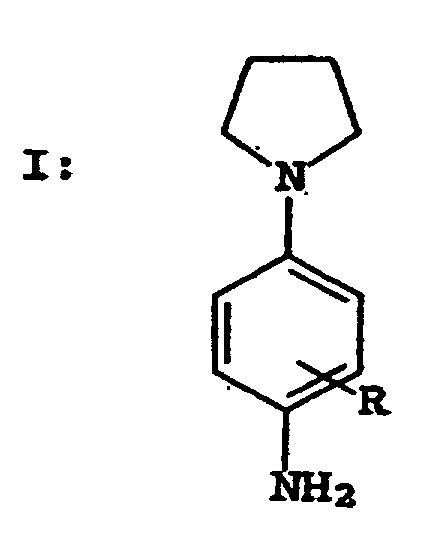
- In accordance with the present invention, substituted 1-(4-aminophenyl) pyrrolidines useful as primary dye intermediates in the hair coloring compositions of the invention include 1-(4-amino-2-methylphenyl) pyrrolidine and 1-(4-amino-3-methylphenyl) pyrrolidine or cosmetically acceptable salts thereof, for example, 1-(4-amino-2-methylphenyl) pyrrolidine sulfate and 1-(4-amino-3-methylphenyl) pyrrolidine sulfate, respectively. 1-(4-amino-2-methylphenyl) pyrrolidine and 1-(4-amino-3-methylphenyl) pyrrolidine have the structures depicted below as formulae II and III, respectively:Although compounds II and III are 1-(4-aminophenyl) pyrrolidines substituted with a methyl group, it was discovered that the placement of a methyl group at the 3 position of the phenyl ring resulted in a unique primary intermediate which afforded a deeper and richer shade of color to dyed hair and surprisingly exceeded the quite acceptable and useful coloring performance of the 4-aminophenyl pyrrolidine compound substituted with a methyl group at position 2 of the phenyl ring. Accordingly, both the substituted and unsubstituted 4-aminophenyl pyrrolidine compounds proved to be effective as primary dye intermediates with other hair dye components in oxidative hair dye compositions of the present invention.

- A preferred unsubstituted 4-aminophenyl pyrrolidine compound of the present invention is 1-(4-aminophenyl) pyrrolidine, which is represented by the following formula IV:

- The compositions of the present invention contain as a primary dye intermediate one or more substituted or unsubstituted 1-(4-aminophenyl) pyrrolidine compounds, or a cosmetically acceptable salt thereof, which may be present in admixture with one or more other dye component(s), for example, a primary dye intermediate, e.g., PPD, or conventional coupling component(s), in addition to other hair dye component ingredients, additives, or adjuvants typically used in oxidative hair dye formulations as described herein. The 1-(4-aminophenyl) pyrrolidines, alone or in combination with one or more other dye intermediates and coupling agents produce novel dyestuffs which provide intense coloration to hair.
- In a further aspect, the invention provides an oxidative hair dye product produced by reacting, in a cosmetically acceptable vehicle and in the presence of an oxidizing agent, a coupling compound and a 1-(4-aminophenyl) pyrrolidine, or a cosmetically acceptable salt thereof, having the formula I:wherein R is selected from the group consisting of hydrogen, C1-C6 alkyl and C1-C5 mono or polyhydroxyalkyl.

- In yet another aspect, the invention provides a hair dye product formed by reacting equimolar amounts of (i) a 1-(4-aminophenyl) pyrrolidine, or a cosmetically acceptable salt thereof, having the formula I:wherein R is selected from the group consisting of hydrogen, C1-C6 alkyl and C1-C5 mono or polyhydroxyalkyl, and (ii) a coupling agent, in a cosmetically acceptable vehicle.

- The 1-(4-aminophenyl) pyrrolidine compounds of the present invention achieve a deep coloration to hair and impart unique properties to dye substances used for oxidative hair coloring.
- It will be appreciated by those having skill in the art that the compositions and methods of the present invention are appropriate for the dyeing of keratinous fibers, including the hair fibers of animals and humans, with particular application to the oxidative coloring of human hair.
- In accordance with the present invention, members of the class of 1-(4-aminophenyl)pyrrolidine primary dye intermediate compounds have been discovered to be similar in coloring capacity to the conventionally-used primary intermediate PPD, i.e., to exhibit the same color and intensity when used in an oxidative hair dye product with a coupling compound as color modifier in hair dye formulations (Table 4).
- The 1-(4-aminophenyl) pyrrolidines of the present invention and their cosmetically acceptable derivatives or salts afford particularly significant advantages as primary intermediates in dye compositions. These compounds can be used as substitutes for PPD and to replace PPD, in whole or in part, in dye compositions. For example, the compositions of the present invention formulated to contain 1-(4-aminophenyl) pyrrolidine, or a cosmetically acceptable derivative or salt thereof, for the oxidative dyeing of hair, afford outstanding effectiveness as colorants, with fewer adverse side effects than like compositions containing PPD. In addition, the present compositions satisfy the dermatological and toxicological requirements that should optimally be met by oxidative coloring substances, particularly for the coloring of human hair.
- As described above, in addition to at least one of the novel component dye molecules encompassed by the present invention, the hair dyeing compositions described herein may also contain at least one other known and usual dye ingredient (i.e., used as primary dye intermediates and/or couplers), as well as conventional direct-acting colorants and dyes in admixture, should these substances be necessary or desired for the development and production of certain color nuances and tints.
- Illustrative component dye ingredients that are conventionally admixed and employed as constituents of customary hair dye formulations and that can be considered suitable for use in the compositions of the present invention are set forth hereinbelow. As but one particular example, p-phenylenediamine, used in oxidative hair coloring formulations, may conveniently be used in admixture with the novel primary intermediate 1-(4-aminophenyl) pyrrolidine compounds in the compositions of the present invention.
- Included among the suitable dye components that may be considered for use as primary intermediates and/or couplers in the dye compositions of the present invention are the following: p-phenylenediamine derivatives such as: p-toluenediamine; p-phenylenediamine; 2-chloro-p-phenylenediamine; N-phenyl-p-phenylenediamine; N-2-methoxyethyl-p-phenylenediamine; N,N-bis-hydroxyethyl-p-phenylenediamine; 2-hydroxymethyl-p-phenylenediamine; 2-hydroxyethyl-p-phenylenediamine; 4,4'-diaminodiphenylamine; 2,6-dimethyl-p-phenylenediamine; 2-isopropyl-p-phenylenediamine; N-(2-hydroxypropyl)-p-phenylenediamine; 2-propyl-p-phenylenediamine; 1,3-bis-(N-hydroxyethyl)-N-(4-aminophenyl)amino)-2-propanol; and 2-methyl-4-dimethylaminoaniline, or combinations thereof.
- Preferred p-phenylenediamine derivatives include: p-toluenediamine; p-phenylenediamine; N-2-methoxyethyl-p-phenylenediamine; N,N-bis-hydroxyethyl-p-phenylenediamine; and 2-hydroxyethyl-p-phenylenediamine.
- p-Aminophenol derivatives include: p-aminophenol; p-methylaminophenol; 3-methyl-p-aminophenol; 2-hydroxymethyl-p-aminophenol; 2-methyl-p-aminophenol; 2-(2'-hydroxyethylaminomethyl)-p-aminophenol; 2-methoxymethyl-p-aminophenol; and 5-aminosalicylic acid, or combinations thereof.
- Preferred p-aminophenol derivatives include: p-aminophenol; p-methylaminophenol; 2-hydroxymethyl-p-aminophenol; 2-methyl-p-aminophenol; 2-(2'-hydroxyethylaminomethyl)-p-aminophenol; 2-methoxymethyl-p-aminophenol; and 5-aminosalicylic acid.
- Ortho developers include: catechol; pyrogallol; o-aminophenol; 2,4-diaminophenol; 2,4,5-trihydroxytoluene; 1,2,4-trihydroxybenzene; 2-ethylamino-p-cresol; 2,3-dihydroxynaphthalene; 5-methyl-o-aminophenol; 6-methyl-o-aminophenol; and 2-amino-5-acetaminophenol, or combinations thereof.
- Preferred ortho developers include: o-aminophenol; 2,4-diaminophenol; 2,4,5-trihydroxytoluene; 1,2,4-trihydroxybenzene; 2-ethylamino-p-cresol; 5-methyl-o-aminophenol; 6-methyl-o-aminophenol; and 2-amino-5-acetaminophenol.
- Phenols and resorcinol derivatives include: 2-methyl-1-naphthol; 1-acetoxy-2-methylnaphthalene; 1,7-dihydroxynaphthalene; resorcinol; 4-chlororesorcinol; 1-naphthol; 1,5-dihydroxynaphthalene; 2,7-dihydroxynaphthalene; hydroquinone; 2-methylresorcinol; 1-hydroxy-6-aminonaphthalene-3-sulfonic acid; thymol (2-isopropyl-5-methylphenol); 1,5-dihydroxy-1,2,3,4-tetrahydronaphthalene; 2-chlororesorcinol; 2,3-dihydroxy-1,4-naphthoquinone; and 1-naphthol-4-sulfonic acid, or combinations thereof.
- Preferred phenols and resorcinol derivatives include: 2-methyl-1-naphthol; 1-acetoxy-2-methylnaphthalene; 1,7-dihydroxynaphthalene; resorcinol; 4-chlororesorcinol; 1-naphthol; 1,5-dihydroxynaphthalene; 2,7-dihydroxynaphthalene; hydroquinone; 2-methylresorcinol; thymol (2-isopropyl-5-methylphenol); and 2,3-dihydroxy-1,4-naphthoquinone.
- m-Phenylenediamines include: m-phenylenediamine; 2-(2,4-diaminophenoxy)ethanol; N,N-(bis-hydroxyethyl) m-phenylenediamine; 2,6-diaminotoluene; N2-bis-hydroxyethyl-2,4-diaminophenetole; bis-(2,4-diaminophenoxy)-1,3-propane; hydroxyethyl-2,4-diaminobenzene; 2-amino-4-hydroxyethylamino anisole; aminoethyloxy-2,4-diaminobenzene; 2,4-diaminophenoxyacetic acid; 4,6-(bis-hydroxyethyloxy) m-phenylenediamine; 2,4-diamino-5-methylphenetole; 2,4-diamino-5-hydroxyethyloxytoluene; 2,4-dimethoxy-1,3-diaminobenzene; and 2,6-(bis-hydroxyethylamino) toluene, or combinations thereof.
- Preferred m-phenylenediamines include: m-phenylenediamine; 2,4-diaminophenoxyethanol; bis-(2,4-diaminophenoxy)-1,3-propane; hydroxyethyl-2,4-diaminobenzene; 2-amino-4-hydroxyethylamino anisole; 4,6-bis-hydroxyethyloxy-m-phenylenediamine; 2,4-diamino-5-methylphenetole; 2,4-diamino-5-hydroxyethyloxytoluene; 2,4-dimethoxy-1,3-diaminobenzene; and 2,6-(bis-hydroxyethylamino) toluene.
- m-Aminophenols include: m-aminophenol; 2-hydroxy-4-carbamoylmethylamino toluene; m-carbamoylmethylamino phenol; 6-hydroxybenzomorpholine; 2-hydroxy-4-aminotoluene; 2-hydroxy-4-hydroxyethylaminotoluene; 4,6-dichloro-m-aminophenol; 2-methyl-m-aminophenol; 2-chloro-6-methyl-m-aminophenol; 2-hydroxyethyloxy-5-aminophenol; 2-chloro-5-trifluoroethylaminophenol; 4-chloro-6-methyl-m-aminophenol; N-cyclopentyl-3-aminophenol; N-hydroxyethyl-4-methoxy-2-methyl-m-aminophenol and 5-amino-4-methoxy-2-methylphenol, or combinations thereof.
- Preferred m-aminophenols include: m-aminophenol; 6-hydroxybenzomorpholine; 2-hydroxy-4-aminotoluene; 2-hydroxy-4-hydroxyethylaminotoluene; 4,6-dichloro-m-aminophenol; 2-methyl-m-aminophenol; 2-chloro-6-methyl-m-aminophenol; 4-chloro-6-methyl-m-aminophenol; N-cyclopentyl-3-aminophenol; N-hydroxyethyl-4-methoxy-2-methyl-m-aminophenol and 5-amino-4-methoxy-2-methylphenol.
- Heterocyclic derivatives include: 2-dimethylamino-5-aminopyridine; 2,4,5,6-tetra-aminopyrimidine; 4,5-diamino-1-methyl-pyrazole; 1-phenyl-3-methyl-5-pyrazolone; 6-methoxy-8-aminoquinoline; 2,6-dihydroxy-4-methylpyridine; 5-hydroxy-1,4-benzodioxane; 3,4-methylenedioxyphenol; 4-hydroxyethylamino-1,2-methylenedioxybenzene; 2,6-dihydroxy-3,4-dimethylpyridine; 5-chloro-2,3-dihydroxypyridine; 3,5-diamino-2,6-dimethoxypyridine; 2-hydroxyethylamino-6-methoxy-3-aminopyridine; 3,4-methylenedioxyaniline; 2,6-bis-hydroxyethyloxy-3,5-diaminopyridine; 4-hydroxyindole; 3-amino-5-hydroxy-2,6-dimethoxypyridine; 5,6-dihydroxyindole; 7-hydroxyindole; 5-hydroxyindole; 2-bromo-4,5-methylenedioxyphenol; 6-hydroxyindole; isatin (indole-2,3-dione); 3-amino-2-methylamino-6-methoxypyridine; 2-amino-3-hydroxypyridine; 2,6-diaminopyridine; 5-(3,5-diamino-2-pyridyloxy)-1,3-dihydroxypentane; 3-(3,5-diamino-2-pyridyloxy)-2-hydroxypropanol and 4-hydroxy-2,5,6-triaminopyrimidine, or combinations thereof.
- Preferred heterocyclic derivatives include: 4,5-diamino-1-methyl-pyrazole; 2-dimethylamino-5-aminopyridine; 2,4,5,6-tetra-aminopyrimidine; 1-phenyl-3-methyl-5-pyrazolone; 3,4-methylenedioxyphenol; 4-hydroxyethylamino-1,2-methylenedioxybenzene; 2,6-dihydroxy-3,4-dimethylpyridine; 5-chloro-2,3-dihydroxypyridine; 3,5-diamino-2,6-dimethoxypyridine; 2-hydroxyethylamino-6-methoxy-3-aminopyridine; 3,4-methylenedioxyaniline; 4-hydroxyindole; 5,6-dihydroxyindole; 7-hydroxyindole; 5-hydroxyindole; 2-bromo-4,5-methylenedioxyphenol; 6-hydroxyindole; isatin (indole-2,3-dione); 3-amino-2-methylamino-6-methoxypyridine; 2-amino-3-hydroxypyridine; 2,6-diaminopyridine; 5-(3,5-diamino-2-pyridyloxy)-1,3-dihydroxypentane; 3-(3,5-diamino-2-pyridyloxy)-2-hydroxypropanol and 4-hydroxy-2,5,6-triaminopyrimidine.
- The additional dye compounds, e.g., couplers, should be present in the hair dyeing compositions of the present invention in an amount of approximately 0.01 to 10%, by weight, preferably approximately 0.1 to 5%, by weight, based on the total weight of the composition. The total quantity of oxidative colorant, comprising dye substance(s) and coupling substance(s) will suitably amount to approximately 0.1 to 10%, by weight, and preferably, approximately 0.5 to 5% by weight, based on the total weight of the composition.
- Unless indicated otherwise, as used herein, reagent or component amounts are in % by weight (w/w), based on the total weight of the composition.
- In the compositions of the present invention, the coupling component is generally used in approximately equimolar amounts relative to the developing component. However, it will be appreciated that the dye component, in relation to the coupler, may be present either in increased or decreased amounts depending upon the formulation and the desired color, intensity or effect. In general terms, the dye component and the coupling component, or cosmetically acceptable salts thereof, will be present in tinctorially effective amounts for the coloring of a hair fiber.
- The hair dye preparations of the present invention may be formulated into cosmetic preparations such as a solution, cream, lotion, gel or emulsion. Also, in accordance with the invention, the compositions may represent a mixture of the coloring components (i.e., dye intermediate and coupling agent) in with other components commonly associated with the formulation of solutions, creams, lotions, gels or emulsions, and the like. For example, components such as wetting agents or emulsifying agents from the categories of anionic or non-ionic surfactants, such as sulfates of fatty alcohols, alkanolamides of fatty alcohols, alkyl sulfonates, alkylbenzene sulfonates, oxyethylated fatty alcohols, oxyethylated nonylphenols; furthermore thickeners such a fatty alcohols, starch, cellulose derivatives, paraffin oil and fatty acids, as well as hair-care substances such as lanolin derivatives, cholesterol and pantothenic acid, may be formulated into the compositions of the invention.
- As an example, if formulated as a lotion, the compositions of the invention may contain organic solvents to assist in dissolving the dye precursors. Accordingly, the organic solvent content of the lotion may be from 0% to about 20%, preferably, about 1% to about 15%. Typically useful solvents include alcohols containing up to three carbon atoms such as ethanol and isopropanol, polyhydroxy alcohols such as propylene or hexylene glycol and lower alkyl ethers thereof, such as ethoxy ethers.
- In addition, the hair dyeing compositions in accordance with the present invention may optionally contain conventionally-used adjuvants and cosmetic additives, or mixtures thereof, to achieve the final formulations. Examples of such additives include, but are not limited to, anti-oxidants, e.g., ascorbic acid, erythoboric acid, or sodium sulfite, to inhibit premature oxidizing; oxidizing agents; fragrances and/or perfume oils; chelating agents; emulsifiers; coloring agents; thickeners; organic solvents; opacifying agents; dispersing agents; sequestering agents; hair-care substances; humectants; and anti-microbials, and others. The list of optional ingredients is not intended as limiting. Other suitable adjuvants for inclusion in the hair dye compositions of the invention are disclosed, for example, in Zviak, The Science of Hair Care (1986) and in Balsam and Sagarin, Cosmetics: Science and Technology, Vol. 2, Second Edition, (1972).
- More specifically, organic solvents used in the hair dye compositions assist in dissolving the dyes. Typically useful solvents include, but are not limited to, alcohols containing up to three carbon atoms, such as ethanol and isopropanol, as well as polyhydroxy alcohols, such as propylene glycol and hexylene glycol. Lower alkyl ethers, such as ethoxy diglycol may be used.
- Thickeners that may be used in the compositions of the present invention include a variety of fatty acid soaps and associative polymeric thickeners. The fatty acid soaps are alkaline metal salts or alkanolamine salts of fatty acids with C10-C16 alkyl side chains. The preferred fatty acids include oleic acid, myristic acid and lauric acid, which are generally present in the compositions of the invention at about 0.5% to about 20%, preferably about 1% to about 10%. Associative thickeners are polymers that can thicken solutions at low concentrations. Among the associative thickeners that are useful in the compositions of the present invention are acrylates copolymer (sold by Rohm and Haas under the tradename Aculyn-33), ceteareth-20 acrylates/steareth-20 methacrylate copolymer (sold by Rohm and Haas under the Trade Name Aculyn-22), acrylates/steareth-20 itaconate copolymer and acrylates/ceteth-20 itaconate copolymer. Another class of associative thickeners that is useful in the compositions of the present invention include the copolymers of polyurethane and polyethylene glycol or polyether urethanes. One such material is sold by Rohm and Haas under the tradename Aculyn-44. The associative polymeric thickeners are generally present in the compositions of the invention at about 0.1% to about 10%, preferably, about 0.5% to about 5%.
- The oxidative coupling, i.e., the development of the dye, to produce the final color product on the hair, can, in principle, be performed with atmospheric oxygen. However, chemical oxidizing agents are suitably and preferably used. Although other oxidizing agents can be employed, hydrogen peroxide is a preferred oxidizing compound for use as a developer with the primary intermediate and coupler dye precursors of the invention. The concentration of hydrogen peroxide in the developer may be from about 1% to about 15%, preferably, from about 3% to about 12%. Other suitable oxidizing agents include, for example, urea peroxide, melamine peroxide, perborates and percarbonates such as sodium perborate or percarbonate. The amounts of such oxidizing agents can be routinely determined by one having skill in the art, without requiring any inventive skill.
- The compositions of the invention may include a typical anionic, cationic, nonionic or amphoteric surfactant. The anionic surfactants include the variety of alkyl sulfates, alkylether sulfates, alkyl sulfonates, alkyl sulfosuccinates and N-acyl sarcosinates. The commonly-used anionic surfactants are sodium and ammonium lauryl sulfates, sodium and ammonium laureth sulfate and alpha olefin sulfonates. Anionic surfactants are generally present in the compositions of the present invention at about 0.1% to about 15%, preferably, about 0.5% to about 10%.
- The nonionic surfactants that can be used in the present invention include the wide variety of ethoxylated alcohols, nonoxynols, alkanolamides, alkyl stearates, alkyl palmitates and alkylpolyglucosides. Examples of the commonly-used nonionic surfactants are cetyl alcohol, stearyl alcohol, oleyl alcohol; the various types of ethoxylated alkylphenols; lauramide diethanolamide (DEA); lauramide monoethanolamide (MEA); isopropyl palmitate, isopropyl stearate and decylpolyglucoside. Nonionic surfactants are generally present in the compositions of the present invention at about 0.1% to about 15%, preferably, about 0.5% to about 10%.
- The compositions in accordance with the present invention may also contain one or more quaternary ammonium compounds that provide hair conditioning effects. The quaternary ammonium compounds can be monomeric or polymeric quaternary ammonium compounds. Nonlimiting examples of such compounds include cetyltrimonium chloride, stearyl trimonium chloride, benzalkonium chloride, behentrimonium chloride and a variety of polyquaterniums. The quaternary ammonium compounds are generally present in the compositions of the present invention at about 0.1% to about 10%, preferably, about 0.5% to about 5%.
- Amphoteric surfactants that can be incorporated in the compositions of the present invention belong to the class of surface active chemicals that possess a positive and a negative charge in the same molecule and behave as a cation, an anion, or both, depending upon the pH of the medium and the nature of the amphoteric molecule. In general, the positive charge is located on a nitrogen, while the negative charge is carried by a carboxyl or sulfonate group. There are a large number of amphoteric surfactants that are suitable for use in the present invention, including, for example, the well-known betaines, sultaines, glycinates and propionates that may generally be represented by the following structural formulae shown below:
- 1. Betaines:

- 2. Sultaines:
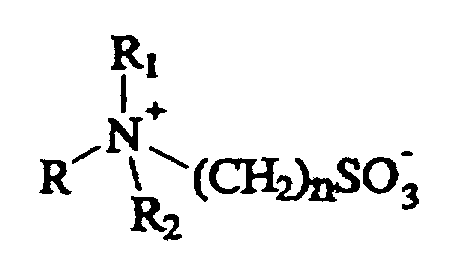
- 3. Propionates:

- 4. Glycinates:
 In these formulae, R is an alkyl or alkylamide group containing from about 10 to
about 20 carbon atoms. R1 and R2 are alkyl or hydroxyalkyl groups, which may be
the same or different, and contain up to about five carbon atoms; n is a positive
integer from one to about five.
In these formulae, R is an alkyl or alkylamide group containing from about 10 to
about 20 carbon atoms. R1 and R2 are alkyl or hydroxyalkyl groups, which may be
the same or different, and contain up to about five carbon atoms; n is a positive
integer from one to about five. -
- The selection of the amphoteric surfactant or mixture of surfactants for use in the present compositions and methods is not critical. The surfactant may be selected from among those suggested above, or from any of a number of other known amphoteric surfactants. The amount of amphoteric surfactant in the compositions of the present invention is normally from about 0.5% to about 15%, preferably, about 2% to about 10%.
- Depending on the final formulated preparation, the compositions in accordance with invention may be weakly acidic, neutral or alkaline. In particular, the pH of the prepared compositions can range from about 5 to about 11. Preferred is a pH range of about 8 to 10. Any of a wide variety of alkaline reagents can be used to adjust the pH of the hair coloring compositions. Such alkaline reagents include ammonium hydroxide, potassium or calcium hydroxide, sodium or potassium carbonate, sodium phosphate, sodium silicate, guanidine hydroxide, or any one of the alkylamines or alkanolamines, for example, ethylamine, triethylamine, trihydroxymethylamino amine, ethanolamine, diethanolamine, aminomethyl propanol, aminomethyl propanediol and the like. The preferred alkaline reagents are ammonium hydroxide, sodium carbonate and ethanolamine. With the reagents listed above, the selected pH will generally be achieved if the composition contains an alkaline agent in an amount from about 0.1% to about 15%, preferably, about 0.5% to about 5%.
- The application of the dyeing components is carried out by methods familiar to those in the art, for example, by mixing the hair dyeing preparation with an oxidant shortly before use, or at the time of applying the mixture onto the hair. On the hair, the compositions form a stable formulation with enough consistency and body to remain on the hair without dripping or running during the complete coloring period. The primary intermediate and coupler, i.e. the dye precursors, diffuse rapidly into the hair together with the oxidizing agent, or developer. The dyes form within the hair fiber, and since they are large molecules, remain in the hair so that the color change is permanent. The term "permanent" means the dye does not readily wash out of the hair with ordinary shampoos. At the end of coloring application (e.g., approximately 5 to 45 minutes, preferably, approximately 10 to 30 minutes), the composition is washed from the hair with an ordinary water rinse followed by a shampoo. The application temperature is in the range of about 15°C to 50°C.
- The 1-(4-aminophenyl) pyrrolidines, and cosmetically-acceptable derivatives and salts thereof, are soluble in water and have a long shelf life, particularly as constituents of the hair dyeing preparations in accordance with the invention. These primary intermediates, of which 1-(4-aminophenyl) pyrrolidine and 1-(4-amino-3-methylphenyl) pyrrolidine are preferred, should be present in the hair dyeing preparations in an amount of approximately 0.1% to approximately 10%, preferably, approximately 0.1% to approximately 5%. The total quantity of oxidative colorant, consisting of dye component(s) and coupling component(s) will suitably amount to approximately 0.1% to approximately 20%, and preferably, approximately 0.5% to approximately 15% of the composition.
- The hair dyeing compounds in accordance with the invention will offer a wide range of varying color tints depending upon the type and composition of the colorant constituents. The color tints are distinguished herein by their particular intense and lasting color. The superior coloring properties of the hair dyeing compositions of the present invention are further evidenced by allowing grayed hair that has not been subjected to prior chemical damage to be covered without problems and with a depth and covering strength that, prior to the discovery of the primary intermediates of the present invention, had only been attained using the conventional PPD.
- The compositions of this invention may be separately provided in a kit or packaged form ready for mixing by the user, either professional or consumer, to initiate the dyeing process. The kit provided in accordance with this invention comprises containers for housing the developer and the dye precursors. In the most convenient form, there will be two containers, one containing the primary dye intermediate and coupler, e.g., as a lotion; the other containing the oxidizing agent, also called the developer or developing agent.
- The method of the invention comprises applying the mixture to the hair to be colored and allowing it to remain in contact with the hair until the desired hair color has been attained, after which time the composition is removed from the hair as described above.
- The examples as set forth herein are meant to exemplify the various aspects of carrying out the invention and are not intended to limit the invention in any way.
- 1-(4-aminophenyl) pyrrolidine sulfate used in the oxidative hair dye compositions of the present invention was prepared in the following steps:
- 28.2 g (0.2 mole) 4-fluoronitrobenzene were combined with 21 ml (0.25 mole) pyrrolidine, 25.0 g Na2CO3, 200 ml H2O, and the resultant mixture was refluxed with stirring. When TLC showed no evidence of starting material (ca. 3 hours), the mixture was cooled to ambient temperature and then placed in an ice-bath. The mixture was filtered, washed three times with cold H2O and dried in vacuo at 50°C. The final yield was 38.2 g (99%) of yellow solid.

- 15.76 g (0.1 mole) 4-chloronitrobenzene were combined with 18.5 ml (0.22 mole) pyrrolidine, 11.0 g Na2CO3, 25 ml 2-propanol and 25 ml H2O, and the resultant mixture was refluxed with stirring. When TLC showed no evidence of starting material (ca. 14 hours), 75 ml H2O were added, the mixture was refluxed for 1 hour, cooled to ambient temperature and placed in an ice-bath. The cold mixture was filtered, washed 5 times with cold H2O and dried in vacuo at 50°C. The final yield was 19.05 g (99%) of yellow solid.
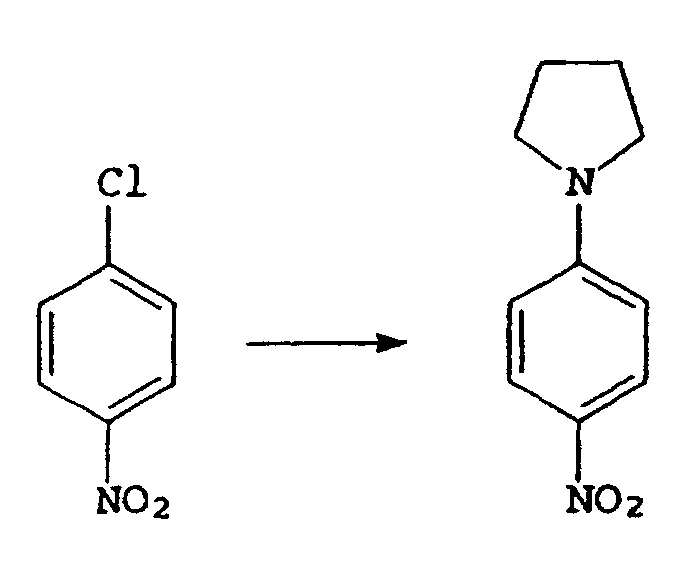
- 378.8 g (1.96 moles) 1-(4-nitrophenyl)pyrrolidine, 12.0 g Darco KB® carbon, and 10% palladium on carbon (Pd/C) were suspended in 1300 ml ethanol and hydrogenated on a Parr apparatus at 0.41 MPa (60 psi). When H2 uptake ceased and the reaction was complete, the mixture was filtered through filter aid and the resulting "cake" solid was washed 3 times with ethanol (50 ml/wash). The filtrate was stirred in an ice/acetone bath and a cold solution of concentrated H2SO4 (204 g (2 moles)) in 150 ml ethanol was added dropwise over 1 hour. The resultant precipitate was filtered, washed 4 times with ethanol (100 ml/wash) and dried in vacuo at 50°C. The final yield was 325 g (63%) of white solid. MS (solid probe): m/e 162 (free base).

- As appreciated by those having skill in the art, additional synthetic routes, such as nitration or nitrosation of 1-phenylpyrrolidine or its analogs, followed by reduction, may also be used. In addition, other reduction techniques, such as Zn/HCl, may be used, as can other precious metal catalysts, such as Pt/C.
- Substituted 1-(4-amino-2-methylphenyl) pyrrolidine sulfate, used in the oxidative hair dye compositions of the present invention, was prepared as follows:
- 15.5g (0.1 mole) 2-fluoro-5-nitrotoluene, 25 ml (0.3 mole) pyrrolidine, 11.0 g Na2CO3 were combined with 50 ml 2-ethoxyethanol and refluxed with stirring. When the TLC showed no evidence of starting material (ca. 2 hours), the mixture was poured onto ice. The precipitate was filtered, washed 5 times with cold H2O, and dried on filter paper for 2 hours. The resulting solid was mixed with 125 ml 2-propanol, 10% Pd/C, and hydrogenated at 0.41 MPa (60 psi) on a Parr apparatus. The mixture was filtered through filter-aid and stirred with external cooling in an ice/acetone bath. A cold solution of 10.7 g (0.105 mole) concentrated H2SO4 in 15 ml 2-propanol was added dropwise over 15 minutes. The resultant precipitate was filtered, washed 2 times with 2-propanol and dried in vacuo at 50°C. The final yield was 24.45 g (89%) of a light grey solid. MS (solid probe): m/e 176 (free base).

- As will be appreciated by those having skill in the art and as described above in Example 1, alternative synthesis procedures may be used. Examples include using 2-chloro-5-nitrotoluene as the starting material, and nitrating or nitrosating 1-(2-methylphenyl)pyrrolidine followed by reduction.
- 1-(4-amino-3-methylphenyl) pyrrolidine sulfate used in the oxidative hair dye compositions of the present invention was prepared as follows:
- 17.16 g (0.1 mole) 5-chloro-2-nitrotoluene were combined with 17 ml (0.2 mole) pyrrolidine, 11.0 g Na2CO3 and 60 ml 2-ethoxyethanol, and the resultant mixture was refluxed with stirring. When TLC showed no starting material (ca. 9 hours), the mixture was poured onto ice. The resultant precipitate was filtered, washed 5 times with cold H2O and dried in vacuo at 50°C. The final yield was 20.25 g (98%) of orange solid.
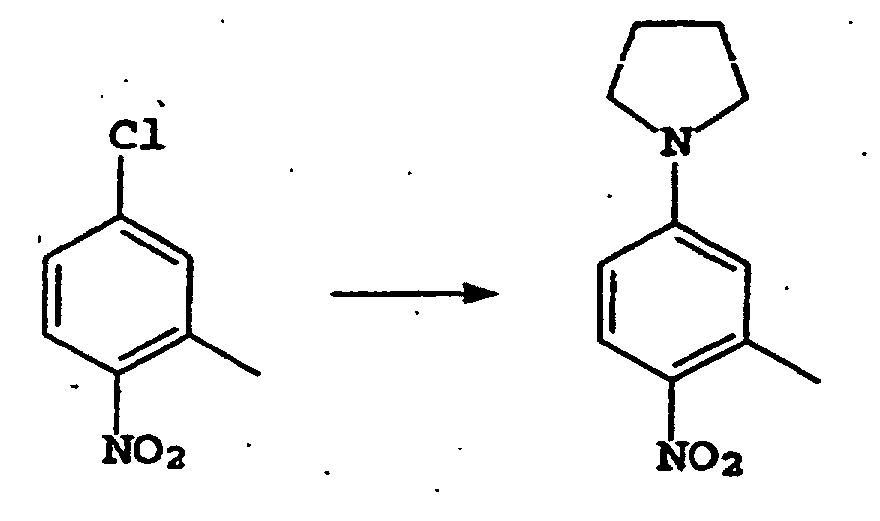
- 20.25 g (0.098 mole) 1-(4-nitro-3-methylphenyl)pyrrolidine were combined with 2 g Darco KB® carbon, 200 ml 2-propanol and 5% Pd/C. The mixture was hydrogenated at 0.41 MPa (60 psi) on a Parr apparatus. When reduction was complete, the mixture was filtered through filter aid and stirred with external cooling in an ice/acetone bath. A cold solution of 10.72 g (0.105 mole) concentrated H2SO4 in 20 ml 2-propanol was added dropwise and stirred for 1 hour. The mixture was filtered, washed 2 times with 2-propanol, and dried in vacuo at 50°C. The final yield was 22.3 g (83%) of off-white solid. MS (solid probe): m/e 176 (free base).
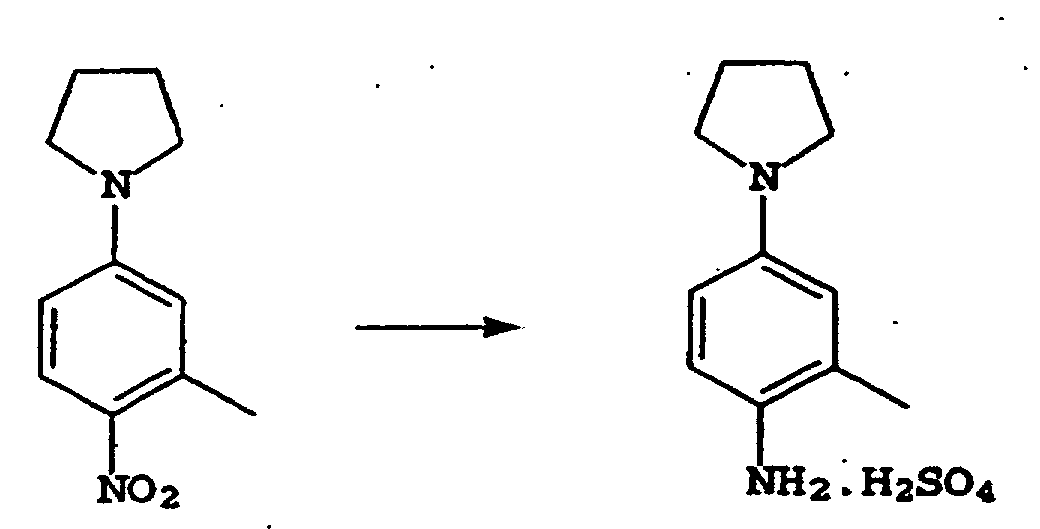
- As mentioned hereinabove, alternative syntheses and reduction techniques may also be used. For example, 5-fluoro-2-nitrotoluene can be used as the starting material and 1-(3-methylphenyl)pyrrolidine can be nitrated or nitrosated and reduced.
- Hair dyeing compositions in accordance with the invention (Examples 4-13) were prepared as presented in Table 1. The compositions were in the form of lotions. Illustrative lotion compositions of this invention and the color results following the application of the compositions to gray hair are shown in Table 1.
EXAMPLES: 4 5 6 7 8 Amounts of Components Components wt% wt% wt% wt% wt% 1-(4-aminophenyl)pyrrolidine sulfate 1.0 3.5 0.3 0.1 0.1 p-phenylenediamine - - - - 0.1 N,N-bis(2-hydroxyethyl)-PPD sulfate - 0.5 - - - 4-aminophenol - - 0.1 - 0.2 3-methyl-4-aminophenol - - - 0.2 - m-aminophenol 0.5 1.5 - - 0.1 resorcinol 0.5 1.5 0.4 0.2 0.5 1-naphthol 0.1 - - - 0.1 2-methyl-1-naphthol - - 0.1 0.1 - 4-amino-2-hydroxytoluene - - - 0.4 0.3 m-phenylenediamine - 0.2 - - - isopropanol 10 10 10 10 10 propylene glycol 15 15 15 15 15 oleic acid 14 14 14 14 14 nonoxynol-2 9 9 9 9 9 cocoamide DEA 1 1 1 1 1 ammonium hydroxide 10 10 10 10 10 sodium sulfite 0.1 0.1 0.1 0.1 0.1 water qs to 100 qs to 100 qs to 100 qs to 100 qs to 100 Color Results on Gray Hair Dark Brown Blue Black Light Brown Auburn Reddish Brown - Hair dyeing lotion compositions in accordance with the present invention (Examples 9 to 13) were prepared as presented in Table 2. Illustrative lotion compositions of this invention and the color results following the application of the composition to gray hair are presented in Table 2:
EXAMPLES: 9 10 11 12 13 Amounts of Components Components wt% wt% wt% wt% wt% 1-(4-aminophenyl) pyrrolidine sulfate 1.0 3.5 0.3 0.1 0.1 p-phenylenediamine - - - - 0.1 N,N-bis(2-hydroxyethyl)-PPD sulfate - 0.5 - - - 4-aminophenol - - 0.1 - 0.2 3-methyl-4-aminophenol - - - 0.2 - m-aminophenol 0.5 1.5 - - 0.1 resorcinol 0.5 1.5 0.4 0.2 0.5 1-naphthol 0.1 - - - 0.1 2-methyl-1-naphthol - - 0.1 0.1 - 4-amino-2-hydroxytoluene - - - 0.4 0.3 m-phenylenediamine - 0.2 - - - cocamidopropyl betaine 10 10 10 10 10 monoethanol amine 2 2 2 2 2 citric acid 1 1 1 1 1 ammonium hydroxide 10 10 10 10 10 sodium sulfite 0.1 0.1 0.1 0.1 0.1 water qs to 100 qs to 100 qs to 100 qs to 100 qs to 100 Color Results on Gray Hair Dark Brown Blue Black Light Brown Auburn Reddish Brown - Hair dyeing gel compositions in accordance with the present invention (Examples 14 to 18) were prepared as presented in Table 3. Illustrative gel compositions of this invention and the color results following the application of the composition to gray hair are presented in Table 3:
EXAMPLES: 14 15 16 17 18 Amounts of Components Components wt% wt% wt% wt% wt% 1-(4-aminophenyl) pyrrolidine sulfate 1.0 3.5 0.3 0.1 0.1 p-phenylenediamine - - - - 0.1 N,N-bis(2-hydroxyethyl)-PPD sulfate - 0.5 - - - 4-aminophenol - - 0.1 - 0.2 3-methyl-4-aminophenol - - - 0.2 - m-aminophenol 0.5 1.5 - - 0.1 resorcinol 0.5 1.5 0.4 0.2 0.5 1-naphthol 0.1 - - - 0.1 2-methyl-1-naphthol - - 0.1 0.1 - 4-amino-2-hydroxytoluene - - - 0.4 0.3 m-phenylenediamine - 0.2 - - - cocamidopropyl betaine 10 10 10 10 10 monoethanol amine 2 2 2 2 2 oleic acid 5 5 5 5 5 decyl polyglucoside 5 5 5 5 5 ammonium hydroxide 10 10 10 10 10 sodium sulfite 0.1 0.1 0.1 0.1 0.1 water qs to 100 qs to 100 qs to 100 qs to 100 qs to 100 Color Results on Gray Hair Dark Brown Blue Black Light Brown Auburn Reddish Brown - Table 4 presents the results of the hair dyeing performance of the 1-(4-aminophenyl) pyrrolidine primary intermediate (Compound 6 in Table 4) in compositions of the invention compared with that of PPD (Compound 1 in Table 4) and various analogs of PPD, using 3-aminophenol as coupling agent (Table 4). For these evaluations, equimolar amounts of the primary dye intermediate (0.2 M) and the coupling agent (0.2 M) were used (for examples, see Tables 1-3). The primary intermediate and coupling agent were mixed with 20 vol. hydrogen peroxide immediately before use, and the mixture was subsequently applied to blended gray hair swatches. The treatment period was for 30 minutes at room temperature; thereafter, the dyed hair was rinsed with water and dried.
- In Table 4, "L", "a", and "b" represent the standard Hunter Tristimulus values which measure the depth and tonality of the color. In the Hunter method, the parameters a and b may be positive or negative and define the chromatic condition of the hair. Thus, the more positive the a value, the greater the redness of the hair, while negative a values indicate greenness. Similarly, positive b values indicate yellowness, while negative b values indicate blueness. The L parameter is a measure of color intensity and has a value of 0 for absolute black to 100 for absolute white.
Hair Dyeing Performance of PPD Versus Various 1-(4-aminophenyl) pyrrolidine Compounds of the Present Invention (i.e., PPD Analogs) With 3-Aminophenol As Coupling Compound Dye Compound No. Chemical Name of Dye Compound Used As Primary Intermediate L a b ΔH ΔE 1 PPD 21.0 0.4 0.5 2 2-methyl PPD 22.0 1.0 0.1 0.85 1.31 3 2-(2-hydroxyethyl) PPD 26 1.6 3.0 3.7 6.22 4 2-chloro PPD 25.5 2.9 -1.0 2.55 5.17 5 N,N-bis(2-hydroxyethyl) PPD 23.5 0.4 -3.8 3.3 3.09 6 1-(4-aminophenyl) pyrrolidine 21.2 0.5 -1.0 0.51 0.55 7 1-(4-aminophenyl) piperidine 27.1 1.8 2.2 3.04 6.82 8 4-(4-aminophenyl) morpholine 27.1 3.8 2.0 4.22 7.42 9 N, N-dimethyl PPD 25.9 0.1 1.6 2.12 5.34 - From the data presented in Table 4, it can be observed that compound 6 (1-(4-aminophenyl) pyrrolidine) of the present invention is the closest match to PPD (compound 1) in color tone and intensity when coupled with 3-aminophenol. The difference in color tone is measured by ΔH = [(Δa)2 + (Δb)2]½ and total color difference, as determined by ΔE = [(Δa)2 + (Δb)2 + (ΔL)2]½. Both the ΔH and the ΔE values for any compound versus PPD are the smallest for compound 6 (i.e., 1-(4-aminophenyl) pyrrolidine) of the invention. Compound 2, (2-methyl PPD), the ring-substituted intermediate conventionally used in commercial hair dye products, is the next closest. None of the other compounds are as close to PPD in either intensity or tonality, including compound 3 (2-(2-hydroxyethyl) PPD). These results demonstrate that compound 6 of the present invention can be employed as a replacement, in whole or in part, for PPD with little or no difference in tone or intensity of color.
- The formation of an intense neutral color from the 1-(4-aminophenyl) pyrrolidine compound combined with 3-aminophenol, as coupler, was completely unexpected prior to the present invention, since this color is far different from that formed by close chemical analogs of 1-(4-aminophenyl) pyrrolidine, i.e., compounds 5, 7, 8 and 9, with 3-aminophenol. Indeed, although the aforementioned compounds are N,N-disubstituted or N-cyclic compounds, similar to 1-(4-aminophenyl) pyrrolidine, only 1-(4-aminophenyl) pyrrolidine matches virtually identically with the N-unsubstituted PPD in color formation. These findings were evidenced both for the difference in color tone (i.e., ΔH versus PPD) and for the variation in total color (ΔE versus PPD).
- In this example, the hair dyeing performance of unsubstituted 1-(4-aminophenyl) pyrrolidine (compound 6), 1-(4-amino-2-methylphenyl) pyrrolidine (compound 10) and 1-(4-amino-3-methylphenyl) pyrrolidine (compound 11), as primary intermediates in the compositions of the invention, was evaluated in combination with the different coupling agents presented in Table 5.
- For these analyses, blended and bleached hair swatches were dyed for 30 minutes with compositions comprising 0.2 M primary intermediate and 0.2 M coupler in a cosmetically acceptable hair dye base (for examples, see Tables 1-3) plus 20 vol. H2O2, followed by a water rinse and air drying.
Hair Color Products Obtained From 1-(4-Aminophenyl) Pyrrolidines of the Present Invention Reacted With Various Couplers Compound Coupler Color Blended Grey Bleached 6 3-aminophenol Bluish black Neutral black 6 resorcinol Dark brown Neutral black 6 2-methylresorcinol Dark reddish Neutral black 6 2-hydroxy-4-aminotoluene Violet black Neutral black 6 1-naphthol Blue Purplish black 6 2-methyl-1-naphthol Violet blue Dark violet blue 10 3-aminophenol Medium brown Dark brown 10 2-hydroxy-4-aminotoluene Violet Dark violet 10 1-naphthol Violet blue Deep blue 11 3-aminophenol Bluish black Neutral black 11 2-hydroxy-4-aminotoluene Dark blue Bluish black 11 1-naphthol Bright blue Violet 11 resorcinol Reddish brown Dark brown 11 2-methylresorcinol Medium brown Dark warm brown 11 2-methyl-1-napthol Navy blue Violet blue 6 2-(2,4-diaminophenoxy) ethanol Dark blue Neutral black 11 2-(2,4-diaminophenoxy) ethanol Blue Bluish black - In Table 5, compound 6 is unsubstituted 1-(4-aminophenyl) pyrrolidine, compound 10 is 1-(4-amino-2-methylphenyl) pyrrolidine and compound 11 is 1-(4-amino-3-methylphenyl) pyrrolidine. The structures of compounds 10 and 11 are shown as Formulae II and III, respectively, in the Detailed Description of the Invention hereinabove.
- The results from these evaluations demonstrate that the color produced using the unsubstituted and substituted 1-(4-aminophenyl) pyrrolidine compounds of the invention, namely 1-(4-aminophenyl) pyrrolidine, 1-(4-amino-2-methylphenyl) pyrrolidine and 1-(4-amino-3-methylphenyl) pyrrolidine, as primary intermediates in hair dye compositions, was intense and vivid. In addition, different coloration and nuances could be achieved using the compounds of the invention as primary intermediates in combination with various conventionally-used couplers. The newly-discovered compound 11 afforded surprising performance in coloring both gray and bleached hair compared with the coloration produced by compound 10 using the same coupling agents. Further, the results presented in Table 5 exemplify novel hair colors which are the reaction products of compounds of the present invention, e.g., compounds 6, 10 and 11, with particularly suitable couplers.
- Many modifications and variations of the present invention are possible in light of the above teachings. It is therefore to be understood that within the scope of the appended claims, the invention may be practiced otherwise than as specifically described.
Claims (31)
- A composition for the oxidative colouring of hair, said composition containing a primary dye intermediate and a coupling compound in a cosmetically acceptable vehicle, characterised in that said primary dye intermediate and said coupling compound form an oxidative hair dye in the presence of a cosmetically acceptable oxidizing agent, characterised in that said primary dye intermediate is a 1-(4-aminophenyl) pyrrolidine, or a cosmetically acceptable salt thereof, having formula I:wherein R is selected from the group consisting of hydrogen, C1-C6 alkyl and C1-C5 mono or polyhydroxyalkyl.
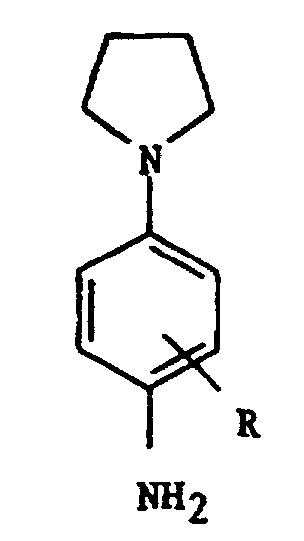
- The composition according to claim 1, characterised in that R is hydrogen or methyl.
- The composition according to claim 2, characterised in that R is hydrogen.
- The composition according to claim 2, characterised in that R is methyl.
- The composition according to claim 4, characterised in that said methyl is at the 2-position of the phenyl ring of said 1-(4-aminophenyl) pyrrolidine or cosmetically acceptable salt thereof.
- The composition according to claim 4, characterised in that said methyl is at the 3-position of the phenyl ring of said 1-(4-aminophenyl) pyrrolidine or cosmetically acceptable salt thereof.
- The composition according to claim 1, characterised in that R is hydrogen, C1-C2 alkyl, or C1-C3 monohydroxyalkyl.
- The composition according to claim 1, characterised in that said 1-(4-aminophenyl) pyrrolidine is present in an amount of about 0.01% to about 10%, by weight, based on the total weight of the composition.
- The composition according to claim 2, characterised in that said coupling compound is present in an amount of about 0.1% to about 10%, by weight, based on the total weight of the composition.
- The composition according to claim 8, characterised in that said 1-(4-aminophenyl) pyrrolidine primary intermediate is present at about 0.1% to about 5%, by weight, based on the total weight of the composition.
- The composition according to claim 9, characterised in that the coupling compound is present in an amount of about 0.1% to about 5%, by weight, based on the total weight of the composition.
- The composition according to claim 1, further including one or more additional dye components selected from the group consisting of p-phenylenediamine and cosmetically acceptable derivatives thereof; p-aminophenols and cosmetically acceptable derivatives thereof; ortho developers and cosmetically acceptable derivatives thereof; phenols and cosmetically acceptable derivatives thereof; resorcinols and cosmetically acceptable derivatives thereof; m-phenylenediamines and cosmetically acceptable derivatives thereof; m-aminophenols and cosmetically acceptable derivatives thereof; and heterocyclic derivatives.
- The composition according to claim 1, characterised in that said coupling compound is selected from the group consisting of 3-aminophenol, resorcinol, 2-methylresorcinol, 2-hydroxy-4-aminotoluene, 1-naphthol, 2-methyl-1-naphthol and 2-(2,4-diaminophenoxy)ethanol.
- The composition according to claim 1, further including an oxidizing agent, whereby said oxidative hair dye is produced.
- The composition according to claim 14, characterised in that said oxidizing agent is hydrogen peroxide.
- An oxidative hair dye product produced by reacting, in a cosmetically acceptable vehicle and in the presence of an oxidizing agent, a coupling compound and a 1-(4-aminophenyl) pyrrolidine, or a cosmetically acceptable salt thereof, having the formula I:wherein R is selected from the group consisting of hydrogen, C1-C6 alkyl and C1-C5 mono or polyhydroxyalkyl.

- The hair dye product according to claim 16, wherein R is hydrogen or methyl.
- The hair dye product according to claim 17, wherein R is hydrogen.
- The hair dye product according to claim 17, wherein R is methyl.
- The hair dye product according to claim 19, wherein said methyl is at the 2-position of the phenyl ring of said 1-(4-aminophenyl) pyrrolidine or cosmetically acceptable salt thereof.
- The hair dye product according to claim 19, wherein said methyl is at the 3-position of the phenyl ring of said 1-(4-aminophenyl) pyrrolidine or cosmetically acceptable salt thereof.
- The hair dye product according to claim 16, wherein R is hydrogen, C1-C2 alkyl, or C1-C3 monohydroxyalkyl.
- The hair dye product according to claim 16, wherein said coupling compound is selected from the group consisting of 3-aminophenol, 2-hydroxy-4-aminotoluene, resorcinol, 2-methylresorcinol, 1-naphthol, 2-methyl-1-napthol and 2-(2,4-diaminophenoxy) ethanol.
- A hair dye product formed by reacting equimolar amounts of (i) a 1-(4-aminophenyl) pyrrolidine, or a cosmetically acceptable salt thereof, having the formula I:wherein R is selected from the group consisting of hydrogen, C1-C6 alkyl and C1-C5 mono or polyhydroxyalkyl, and (ii) a coupling agent, in a cosmetically acceptable vehicle.
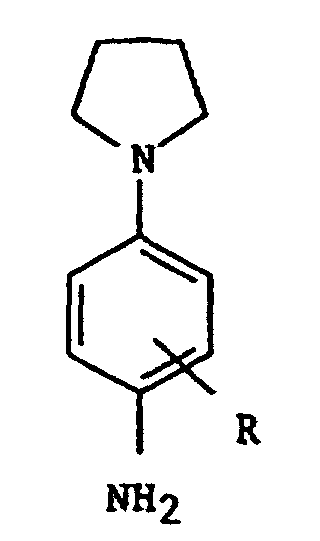
- The hair dye product according to claim 24, wherein R is hydrogen or methyl.
- The hair dye product according to claim 25, wherein said methyl is at the 2-position of the phenyl ring of said 1-(4-aminophenyl) pyrrolidine or cosmetically acceptable salt thereof.
- The hair dye product according to claim 25, wherein said methyl is at the 3-position of the phenyl ring of said 1-(4-aminophenyl) pyrrolidine or cosmetically acceptable salt thereof.
- The hair dye product according to claim 24, wherein R is hydrogen, C1-C2 alkyl, or C1-C3 monohydroxyalkyl.
- The hair dye product according to claim 24, wherein said coupling agent is selected from the group consisting of 3-aminophenol, 2-hydroxy-4-aminotoluene, resorcinol, 2-methylresorcinol, 1-naphthol, 2-methyl-t-nagthot and 2-(2,4-diaminophenoxy) ethanol.
- A method for the oxidative colouring of a keratin fibre comprising contacting the fibre with a fibre colouring effective amount of a composition containing a 1-(4-amino-phenyl) pyrrolidine, or a cosmetically acceptable salt thereof, having formula I:wherein R is selected from the group consisting of hydrogen, C1-C6 alkyl and C1-C5 mono or polyhydroxy alkyl, a coupling compound and a cosmetically acceptable oxidizing agent, in a cosmetically acceptable vehicle; and maintaining contact with the fibre until the fibre is coloured.
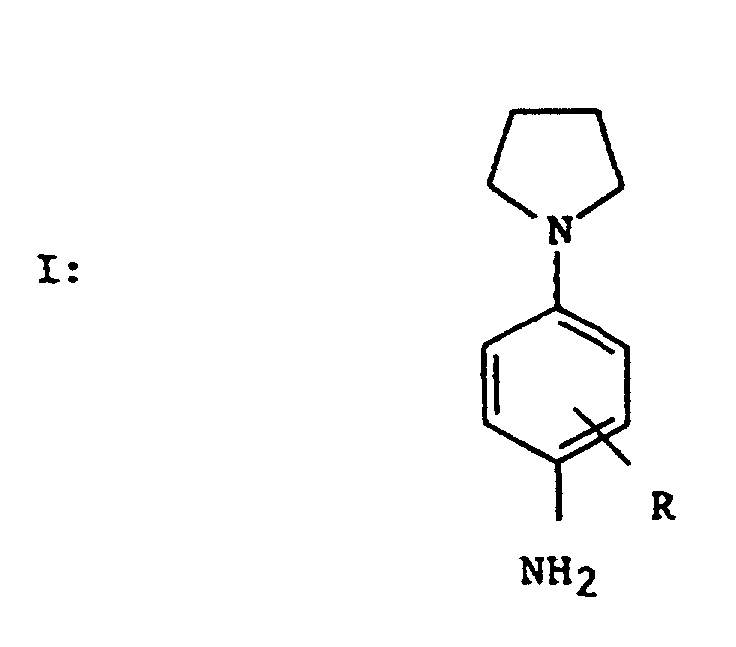
- The method according to claim 30 wherein the fibre is human hair.
Applications Claiming Priority (2)
| Application Number | Priority Date | Filing Date | Title |
|---|---|---|---|
| US08/892,339 US5851237A (en) | 1997-07-14 | 1997-07-14 | Oxidative hair dye compositions and methods containing 1--(4-aminophenyl) pyrrolidines |
| US892339 | 1997-07-14 |
Publications (3)
| Publication Number | Publication Date |
|---|---|
| EP0891765A2 EP0891765A2 (en) | 1999-01-20 |
| EP0891765A3 EP0891765A3 (en) | 2000-01-05 |
| EP0891765B1 true EP0891765B1 (en) | 2004-06-16 |
Family
ID=25399813
Family Applications (1)
| Application Number | Title | Priority Date | Filing Date |
|---|---|---|---|
| EP98202318A Expired - Lifetime EP0891765B1 (en) | 1997-07-14 | 1998-07-09 | Oxidative hair dye compositions |
Country Status (4)
| Country | Link |
|---|---|
| US (1) | US5851237A (en) |
| EP (1) | EP0891765B1 (en) |
| CA (1) | CA2242686A1 (en) |
| DE (1) | DE69824490T2 (en) |
Cited By (2)
| Publication number | Priority date | Publication date | Assignee | Title |
|---|---|---|---|---|
| US7070629B2 (en) | 2001-09-28 | 2006-07-04 | L'oreal, S.A. | Dye composition comprising at least one diaminopyrazole oxidation base, at least one paraphenylenediamine oxidation base comprising a cyclic amino group, and at least one coupler |
| US11129782B2 (en) | 2017-11-15 | 2021-09-28 | National University Of Singapore | Derivatives of PPD useful for coloring hair and skin |
Families Citing this family (40)
| Publication number | Priority date | Publication date | Assignee | Title |
|---|---|---|---|---|
| FR2751533B1 (en) | 1996-07-23 | 2003-08-15 | Oreal | COMPOSITION OF OXIDIZING DYE FOR KERATINIC FIBERS CONTAINING A NON-IONIC AMPHIPHILIC POLYMER |
| FR2769217B1 (en) * | 1997-10-03 | 2000-03-17 | Oreal | OXIDIZING COMPOSITION AND USES FOR DYING, FOR PERMANENT DEFORMATION OR FOR DECOLORATION OF KERATINIC FIBERS |
| FR2769221B1 (en) * | 1997-10-03 | 2000-01-14 | Oreal | OXIDIZING COMPOSITION AND USES FOR DYEING, PERMANENT DEFORMATION OR DECOLORATION OF KERATINIC FIBERS |
| US20020170123A9 (en) * | 1997-10-03 | 2002-11-21 | L'oreal S.A. | Oxidizing composition and uses for dyeing, for permanently reshaping or for bleaching keratin fibres |
| DE19812058C1 (en) * | 1998-03-19 | 1999-10-07 | Wella Ag | New 2-heterocyclyl-1,4-phenylenediamine derivatives |
| US6106578A (en) * | 1998-05-06 | 2000-08-22 | Rohm And Haas Company | Hair dye compositions and method of thickening the same |
| KR100681228B1 (en) | 1998-06-23 | 2007-02-09 | 헨켈 코만디트게젤샤프트 아우프 악티엔 | Dyestuffs for dyeing keratin fibers |
| DE19847192A1 (en) * | 1998-10-13 | 2000-04-27 | Wella Ag | Colorant for fibers, especially human hair, contains 4-nitrophenyl-N-heterocyclic, -cycloalkane, -alkoxyalkane or -amine compound |
| DE19921962C2 (en) * | 1999-05-12 | 2003-10-23 | Wella Ag | Means and methods for the oxidative dyeing of hair |
| FR2802089B1 (en) * | 1999-12-08 | 2002-01-18 | Oreal | COMPOSITION OF OXIDIZING DYE FOR KERANITIC FIBERS INCLUDING A THICKENING POLYMER WITH AMINOPLASTE-ETHER SKELETON |
| EP1116711B1 (en) * | 1999-12-18 | 2005-12-14 | Wella Aktiengesellschaft | 2-aminoalkyl-1,4-diaminobenzene derivatives and dye composition containing these compounds |
| FR2803195B1 (en) * | 1999-12-30 | 2002-03-15 | Oreal | COMPOSITION FOR OXIDATION DYEING OF KERATINIC FIBERS COMPRISING A THICKENING POLYMER COMPRISING AT LEAST ONE FATTY CHAIN AND A SINGLE- OR POLY-GLYCEROLE FATTY ALCOHOL |
| FR2805737B1 (en) * | 2000-03-06 | 2003-01-03 | Oreal | KERATINIC FIBER OXIDATION DYE COMPOSITION AND DYEING METHOD USING THE SAME |
| FR2805738B1 (en) * | 2000-03-06 | 2003-03-14 | Oreal | KERATINIC FIBER OXIDATION DYE COMPOSITION AND DYEING METHOD USING THE SAME |
| FR2805739B1 (en) * | 2000-03-06 | 2003-01-10 | Oreal | KERATINIC FIBER OXIDATION DYE COMPOSITION AND DYEING METHOD USING THE SAME |
| FR2806299B1 (en) * | 2000-03-14 | 2002-12-20 | Oreal | COMPOSITIONS FOR DYEING KERATINIC FIBERS CONTAINING PYRROLIDINYL GROUPED PARAPHENYLENEDIAMINE DERIVATIVES |
| WO2001076549A2 (en) * | 2000-04-11 | 2001-10-18 | Gerald Mc Laughlin | Composition and method for whitening teeth |
| FR2807652A1 (en) * | 2000-04-18 | 2001-10-19 | Oreal | COMPOSITION FOR THE OXIDIZING DYE OF FIBERS CONSISTING OF A 1- (4-AMINOPHENYL) -PYRROLIDINE AND A CATIONIC POLYMER |
| FR2807650B1 (en) * | 2000-04-18 | 2002-05-24 | Oreal | KERATIN FIBER OXIDATION DYE COMPOSITION COMPRISING 1- (4-AMINOPHENYL) -PYRROLIDINE AND A PARTICULAR DIRECT DYE |
| FR2807651B1 (en) * | 2000-04-18 | 2002-05-24 | Oreal | COMPOSITION FOR THE OXIDATION DYE OF KERATINIC FIBERS COMPRISING A 1- (4-AMINOPHENYL) -PYRROLIDINE AND A THICKENER POLYMER WITH A SUGAR PATTERN |
| FR2807653B1 (en) * | 2000-04-18 | 2002-05-24 | Oreal | KERATINIC FIBER OXIDATION DYE COMPOSITION COMPRISING 1- (4-AMINOPHENYL) -PYRROLIDINE AND AN ENZYMATIC SYSTEM |
| FR2817471B1 (en) * | 2000-12-06 | 2005-06-10 | Oreal | OXIDATION DYEING COMPOSITION BASED ON 1- (4-AMINOPHENYL) PYRROLIDINES SUBSTITUTED IN POSITION 3 AND 4 AND METHOD OF DYING THEREFOR |
| CA2428091A1 (en) * | 2000-12-06 | 2002-06-13 | P&G-Clairol, Inc. | Primary intermediates for oxidative coloration of hair |
| US6521761B2 (en) | 2000-12-06 | 2003-02-18 | Clairol Incorporated | Primary intermediates for oxidative coloration of hair |
| FR2817472B1 (en) * | 2000-12-06 | 2003-01-03 | Oreal | OXIDATION DYEING COMPOSITION BASED ON 1- (4-AMINOPHENYL) PYRROLIDINES SUBSTITUTED AT LEAST 2 AND 3 AND DYEING METHOD THEREOF |
| FR2817474B1 (en) * | 2000-12-06 | 2003-01-03 | Oreal | OXIDATION DYE COMPOSITION BASED ON 1- (4-AMINOPHENYL) PYRROLIDINES SUBSTITUTED IN POSITION 2 AND METHOD OF IMPLEMENTING DYEING |
| FR2817470B1 (en) * | 2000-12-06 | 2003-01-03 | Oreal | OXIDATION DYE COMPOSITION BASED ON 1- (AMINOPHENYL) PYRROLIDINES SUBSTITUTED IN POSITION 2 AND 5 AND DYEING METHOD THEREOF |
| FR2817473B1 (en) * | 2000-12-06 | 2003-01-03 | Oreal | OXIDATION DYE COMPOSITION BASED ON 1-4 (-AMINOPHENYL) PYRROLIDINES SUBSTITUTED IN POSITION 2 AND 4 AND DYEING METHOD THEREOF |
| AU2002306730A1 (en) * | 2001-03-14 | 2002-09-24 | Gerald Mclaughlin | Strips for treating teeth |
| FR2822374B1 (en) * | 2001-03-21 | 2004-07-09 | Oreal | COMPOSITIONS FOR DYEING KERATINIC FIBERS CONTAINING PYRROLIDINYL GROUPED PARAPHENYLENEDIAMINE DERIVATIVES |
| FR2822373B1 (en) * | 2001-03-21 | 2005-12-02 | Oreal | COMPOSITIONS FOR DYEING KERATIN FIBERS CONTAINING PYRROLIDINYL GROUP PARAPHENYLENEDIAMINE DERIVATIVES |
| US6946005B2 (en) * | 2002-03-27 | 2005-09-20 | L'oreal S.A. | Pyrrolidinyl-substituted para-phenylenediamine derivatives substituted with a cationic radical, and use of these derivatives for dyeing keratin fibers |
| US20040060127A1 (en) * | 2002-06-26 | 2004-04-01 | Stephane Sabelle | Composition for dyeing keratin fibers, comprising at least one para-phenylenediamine derivative comprising a pyrrolidyl group substituted with a silyl radical |
| US7132534B2 (en) * | 2002-07-05 | 2006-11-07 | L'oreal | Para-phenylenediamine derivatives containing a pyrrolidyl group, and use of these derivatives for coloring keratin fibers |
| FR2844272A1 (en) * | 2002-09-09 | 2004-03-12 | Oreal | New tricyclic indole or tetrahydroquinoline derivatives useful as developers in oxidation dye compositions for dyeing keratinic fibers, especially human hair |
| US6923835B2 (en) * | 2002-09-09 | 2005-08-02 | L'oreal S.A. | Bis-para-phenylenediamine derivatives comprising a pyrrolidyl group and use of these derivatives for dyeing keratin fibres |
| FR2848441B1 (en) * | 2002-12-13 | 2005-03-04 | Oreal | TINCTORIAL COMPOSITION COMPRISING CATIONIC PYRROLIDINE PARAPHENYLENEDIAMINE, TERTIARY PARAPHENYLENEDIAMINE AND BENZOMORPHOLINIC COUPLER, METHODS AND USES |
| FR2852955A3 (en) * | 2003-03-24 | 2004-10-01 | Oreal | PARAPHENYLENEDIAMINE DERIVATIVES WITH A CYCLIC DIAZA GROUP SUBSTITUTED BY A CATIONIC RADICAL AND USE OF THESE DERIVATIVES FOR COLORING KERATIN FIBERS |
| US7090703B2 (en) | 2003-03-24 | 2006-08-15 | L'oreal | Para-phenylenediamine derivatives comprising a cyclic diaza group substituted with a cationic radical, and use of these derivatives for dyeing keratin fibers |
| US7132543B2 (en) * | 2003-03-28 | 2006-11-07 | L'oreal S.A. | Para-phenylenediamine derivatives containing a disubstituted pyrrolidinyl group bearing a cationic radical, and use of the same for dyeing keratin fibers |
Family Cites Families (4)
| Publication number | Priority date | Publication date | Assignee | Title |
|---|---|---|---|---|
| US3632582A (en) * | 1967-11-02 | 1972-01-04 | Clairol Inc | Process for preparing nitro-p-phenylene-diamines |
| GB1488005A (en) * | 1974-01-25 | 1977-10-05 | Ici Ltd | Diazotype materials |
| US5019130A (en) * | 1989-11-03 | 1991-05-28 | Clairol Incorporated | Substituted N-aryl pyrroles in oxidative hair dye compositions |
| US5278034A (en) * | 1990-04-27 | 1994-01-11 | Fuji Photo Film Co., Ltd. | Process for forming color image |
-
1997
- 1997-07-14 US US08/892,339 patent/US5851237A/en not_active Expired - Lifetime
-
1998
- 1998-07-08 CA CA002242686A patent/CA2242686A1/en not_active Abandoned
- 1998-07-09 DE DE69824490T patent/DE69824490T2/en not_active Expired - Fee Related
- 1998-07-09 EP EP98202318A patent/EP0891765B1/en not_active Expired - Lifetime
Cited By (2)
| Publication number | Priority date | Publication date | Assignee | Title |
|---|---|---|---|---|
| US7070629B2 (en) | 2001-09-28 | 2006-07-04 | L'oreal, S.A. | Dye composition comprising at least one diaminopyrazole oxidation base, at least one paraphenylenediamine oxidation base comprising a cyclic amino group, and at least one coupler |
| US11129782B2 (en) | 2017-11-15 | 2021-09-28 | National University Of Singapore | Derivatives of PPD useful for coloring hair and skin |
Also Published As
| Publication number | Publication date |
|---|---|
| EP0891765A3 (en) | 2000-01-05 |
| US5851237A (en) | 1998-12-22 |
| DE69824490D1 (en) | 2004-07-22 |
| CA2242686A1 (en) | 1999-01-14 |
| DE69824490T2 (en) | 2005-07-07 |
| EP0891765A2 (en) | 1999-01-20 |
Similar Documents
| Publication | Publication Date | Title |
|---|---|---|
| US5851237A (en) | Oxidative hair dye compositions and methods containing 1--(4-aminophenyl) pyrrolidines | |
| EP0962452B1 (en) | Oxidative hair dye compositions and methods containing 1-(4-aminophenyl)-2-pyrrolidinemethanols | |
| US6074438A (en) | Hair dyeing compositions containing 2-chloro- and 2,6-dichloro-4-aminophenol and phenylpyrazolones | |
| CA2254408C (en) | Hair dye compositions containing 2,3 dialkyl-4-aminophenol and a 2-alkyl-1-naphthol | |
| US5766576A (en) | Oxidation hair dye compositions containing 3,4,5-triaminopyrazole derivatives and 3,4,5-triaminopyrazole derivatives | |
| RU2060728C1 (en) | Agent for hair oxidative staining | |
| US4470826A (en) | Nitro-derivatives of the benzene series and their use in the dyeing of keratin fibres | |
| JP2719514B2 (en) | Method for producing 2,4-diamino-1,3-dimethoxybenzene | |
| US4323360A (en) | Dyeing compositions for hair which contain 2,4-diamino-butoxybenzene and/or a salt thereof as the coupling agent | |
| EP0918051B1 (en) | Novel Bis-(2,4-diaminophenoxy) benzenes and their use as coupling components in oxidative hair coloring compositions and methods | |
| JPH0566363B2 (en) | ||
| US4432769A (en) | Nitro dyestuffs, a process for their preparation, and use of these dyestuffs in dyeing keratin fibres | |
| US4692166A (en) | Use of halogenated 4,5-methylenedioxyphenol in the dyeing of keratinous fibres | |
| US4543425A (en) | 1,3-Diamino-4-(2',2',2',-trifluoroethoxy)-benzene, method of producing the same, and hair coloring composition containing the same | |
| DE68903471T2 (en) | TRIALCOXY-SUBSTITUTED M-PHENYLENE DIAMINE, METHOD FOR THE PRODUCTION THEREOF AND THEIR USE AS A COUPLER IN THE OXYDATION DYEING OF KERATINIC FIBERS, PARTICULARLY HUMAN HAIR. | |
| US5145483A (en) | Substituted ortho-aminophenols, process for preparing them and their use for the oxidatin dyeing of keratinous fibres | |
| US5961666A (en) | Hair dye compositions containing 3-substituted-4-aminophenols and 2-substituted-1-naphthols | |
| US4563188A (en) | Para-phenylenediamines which can be used in oxidative hair dyeing | |
| JPH0637442B2 (en) | Method for producing nitroaniline compound | |
| GB2078747A (en) | Meta-phenylenediamine dye couplers | |
| US10588837B2 (en) | Oxidative coloration of hair with reduced hair damage | |
| JPH09268170A (en) | Oxidative hair dye containing 2,5-diaminobenzonitriles and novel 2,5-diaminobenzonitriles | |
| US5186717A (en) | Dyeing compositions for keratin fibres, based on 3-nitro-ortho-phenylenediamines, and certain 3-nitro-ortho-phenylenediamines used therein | |
| JPH0379325B2 (en) | ||
| WO2014180698A2 (en) | Hair colouring kit |
Legal Events
| Date | Code | Title | Description |
|---|---|---|---|
| PUAI | Public reference made under article 153(3) epc to a published international application that has entered the european phase |
Free format text: ORIGINAL CODE: 0009012 |
|
| AK | Designated contracting states |
Kind code of ref document: A2 Designated state(s): DE FR GB IT SE |
|
| AX | Request for extension of the european patent |
Free format text: AL;LT;LV;MK;RO;SI |
|
| PUAL | Search report despatched |
Free format text: ORIGINAL CODE: 0009013 |
|
| AK | Designated contracting states |
Kind code of ref document: A3 Designated state(s): AT BE CH CY DE DK ES FI FR GB GR IE IT LI LU MC NL PT SE |
|
| AX | Request for extension of the european patent |
Free format text: AL;LT;LV;MK;RO;SI |
|
| 17P | Request for examination filed |
Effective date: 20000705 |
|
| AKX | Designation fees paid |
Free format text: DE FR GB IT SE |
|
| RAP1 | Party data changed (applicant data changed or rights of an application transferred) |
Owner name: CLAIROL INCORPORATED |
|
| 17Q | First examination report despatched |
Effective date: 20021122 |
|
| RAP1 | Party data changed (applicant data changed or rights of an application transferred) |
Owner name: P&G-CLAIROL, INC. |
|
| GRAP | Despatch of communication of intention to grant a patent |
Free format text: ORIGINAL CODE: EPIDOSNIGR1 |
|
| GRAS | Grant fee paid |
Free format text: ORIGINAL CODE: EPIDOSNIGR3 |
|
| GRAA | (expected) grant |
Free format text: ORIGINAL CODE: 0009210 |
|
| AK | Designated contracting states |
Kind code of ref document: B1 Designated state(s): DE FR GB IT SE |
|
| REG | Reference to a national code |
Ref country code: GB Ref legal event code: FG4D |
|
| REF | Corresponds to: |
Ref document number: 69824490 Country of ref document: DE Date of ref document: 20040722 Kind code of ref document: P |
|
| REG | Reference to a national code |
Ref country code: SE Ref legal event code: TRGR |
|
| ET | Fr: translation filed | ||
| PLBE | No opposition filed within time limit |
Free format text: ORIGINAL CODE: 0009261 |
|
| STAA | Information on the status of an ep patent application or granted ep patent |
Free format text: STATUS: NO OPPOSITION FILED WITHIN TIME LIMIT |
|
| 26N | No opposition filed |
Effective date: 20050317 |
|
| PGFP | Annual fee paid to national office [announced via postgrant information from national office to epo] |
Ref country code: DE Payment date: 20070731 Year of fee payment: 10 |
|
| PGFP | Annual fee paid to national office [announced via postgrant information from national office to epo] |
Ref country code: GB Payment date: 20070618 Year of fee payment: 10 |
|
| PGFP | Annual fee paid to national office [announced via postgrant information from national office to epo] |
Ref country code: SE Payment date: 20070703 Year of fee payment: 10 Ref country code: IT Payment date: 20070714 Year of fee payment: 10 |
|
| PGFP | Annual fee paid to national office [announced via postgrant information from national office to epo] |
Ref country code: FR Payment date: 20070706 Year of fee payment: 10 |
|
| EUG | Se: european patent has lapsed | ||
| GBPC | Gb: european patent ceased through non-payment of renewal fee |
Effective date: 20080709 |
|
| PG25 | Lapsed in a contracting state [announced via postgrant information from national office to epo] |
Ref country code: DE Free format text: LAPSE BECAUSE OF NON-PAYMENT OF DUE FEES Effective date: 20090203 |
|
| REG | Reference to a national code |
Ref country code: FR Ref legal event code: ST Effective date: 20090331 |
|
| PG25 | Lapsed in a contracting state [announced via postgrant information from national office to epo] |
Ref country code: GB Free format text: LAPSE BECAUSE OF NON-PAYMENT OF DUE FEES Effective date: 20080709 |
|
| PG25 | Lapsed in a contracting state [announced via postgrant information from national office to epo] |
Ref country code: IT Free format text: LAPSE BECAUSE OF NON-PAYMENT OF DUE FEES Effective date: 20080709 Ref country code: FR Free format text: LAPSE BECAUSE OF NON-PAYMENT OF DUE FEES Effective date: 20080731 |
|
| PG25 | Lapsed in a contracting state [announced via postgrant information from national office to epo] |
Ref country code: SE Free format text: LAPSE BECAUSE OF NON-PAYMENT OF DUE FEES Effective date: 20080710 |