EP0888905A2 - Process and apparatus for printing and decorating by means of sublimable inks - Google Patents
Process and apparatus for printing and decorating by means of sublimable inks Download PDFInfo
- Publication number
- EP0888905A2 EP0888905A2 EP98112232A EP98112232A EP0888905A2 EP 0888905 A2 EP0888905 A2 EP 0888905A2 EP 98112232 A EP98112232 A EP 98112232A EP 98112232 A EP98112232 A EP 98112232A EP 0888905 A2 EP0888905 A2 EP 0888905A2
- Authority
- EP
- European Patent Office
- Prior art keywords
- thermoretractable
- images
- inks
- sublimable
- printed
- Prior art date
- Legal status (The legal status is an assumption and is not a legal conclusion. Google has not performed a legal analysis and makes no representation as to the accuracy of the status listed.)
- Withdrawn
Links
Images

Classifications
-
- B—PERFORMING OPERATIONS; TRANSPORTING
- B41—PRINTING; LINING MACHINES; TYPEWRITERS; STAMPS
- B41M—PRINTING, DUPLICATING, MARKING, OR COPYING PROCESSES; COLOUR PRINTING
- B41M5/00—Duplicating or marking methods; Sheet materials for use therein
- B41M5/025—Duplicating or marking methods; Sheet materials for use therein by transferring ink from the master sheet
- B41M5/035—Duplicating or marking methods; Sheet materials for use therein by transferring ink from the master sheet by sublimation or volatilisation of pre-printed design, e.g. sublistatic
- B41M5/0353—Duplicating or marking methods; Sheet materials for use therein by transferring ink from the master sheet by sublimation or volatilisation of pre-printed design, e.g. sublistatic using heat shrinkable film material; Thermotransfer combined with the shaping of the workpiece; Recto-verso printing; Image correction
Definitions
- the invention relates to a process and an apparatus for printing and decorating various articles by means of inks of the type applicable by sublimation.
- Sublimation is a direct transformation from the solid to the vapour state and the special sublimable inks, prepared on supports or sheets from fabric, paper or the like, transfer by sublimation from the sheets to the articles to be printed or decorated when said supports or sheets are kept closely adhering to the articles and heated.
- Sublimation printing or decoration has many advantages compared to other decoration means.
- Sublimation printing of substantially flat articles is easily realisable and is generally carried out with hot presses, which press sublimable-ink-bearing sheets on the articles to be decorated.
- the temperature to be reached is comprised between about 180 and 215°C, depending on the inks and colours utilized, and the pressure must suffice to ensure a direct touch between the plates and the articles.
- the supports or sheets carrying the sublimable ink are interposed between the articles and the membranes.
- Suction pumps create vacuum between the membranes, so that they adhere to the articles, stretching and pressing the inked sheets. Then heat is applied to reach said ink-sublimation temperatures.
- a first drawback is due to the very fact that the approaching of two membranes to the articles determines connection zones between the membranes in whose correspondence adhesion is lower. There exist therefore zone wherein printing does not take place or takes place with a quality lower with respect to other zones. Besides, if the surfaces to be decorated are very irregular, the membranes poorly adhere in any case to these surfaces.
- the membranes are submitted to a marked stretching: said membranes deform many time each day to adjust to the wrapped articles, and in these conditions they undergo a high temperature heating.
- the articles to be decorated must be free from holes or sharp edges, to prevent membranes from slitting or breaking.
- the preparation work must be carried out also for the interposition of the supports or sheets bearing the sublimable ink: actually, the same require great preparation ability, as the blind membranes cover the support, preventing a clear perception of their positioning.
- the technical task which is at the basis of the present invention is to conceive a process and a sublimation printing apparatus able to substantially obviate the aforesaid drawbacks.
- Object of this invention is also to provide a process allowing to obtain large size sections having a length of up to 20 m, variously decorated, to be used for the production of doors and windows, also for outdoor use, having the requirements of quality, weatherproofing and resistance to ageing, provided for by the different international norms and by quality marks.
- a further object of this invention is to provide a process for the realisation of sections, in particular from metal, aluminium and aluminium alloys, plastic materials, composite materials (such as resins reinforced with carbon and or glass fibres and the like) provided with decorations in one or more colours, such as geometric, floral, imitation wood, imitation marble decorations, and also decorations comprising very complex patterns, exempt from defects such as deformations of pattern edges, smears, diffusion and superposition of colours and the like, and using a process with a low manpower need.
- Still a further object of the invention is to provide an apparatus suitable for realising said process for the decoration of said sections.
- the specified technical task is substantially achieved by a process and an apparatus for printing and decorating by means of sublimable inks characterised in that they comprise any of the new technical solutions described hereunder and claimed, or any combination of the same.
- the sublimation printing process provides for the preformed images 1, obtained with sublimable inks, to be compressed on the surfaces to be printed and also submitted to heating, until there is obtained, by effect of pressure and temperature, the transfer and penetration of the images on surfaces 2a of articles 2 to be decorated.
- the pressure must ensure only a close touch between the inks and surfaces 2a.
- the temperature must be at least comprised between 180 and 215°C, depending on the inks and colours utilised. However, at a temperature from about 220°C to 250°C one is sure to obtain in any case sufficient thermal conditions.
- the preformed images are compressed by thermoretroaction of thermoretractable material 3.
- preformed images 1 are preferably arranged on sheets 4 from paper or fabric or other flexible material, and these sheets 4 are inserted between surfaces 2a and the thermoretractable material 3, before executing sublimation printing.
- sheets 4 may be steadily coupled to the thermoretractable material 3 before its application on surfaces 2a.
- Images 1 may be also directly printed on the thermoretractable material 3.
- thermoretractable material 3 is applied on articles 2, with the interposition of images 1, thermoretraction may take place according to two distinct methods.
- a special preheating stage to a temperature of about 100°C is executed as a first step.
- material 3 retracts in a few seconds, pressing the sublimable ink on the articles to be printed.
- Preheating may be carried out by any heat source, for instance with hot air jets which may be advantageously so oriented as to act on chosen points of material 3. In this way, it is possible to locally vary the effect of printing, even if sublimable inks are uniformly arranged.
- parts of material 3 tightly wrapping articles 2 may be removed, for instance by a simple cut, so as to prepare possible zones clearly unprinted, even in the presence of diffuse images on all articles 2.
- the preheating stage is not carried out and thermoretraction takes place spontaneously at the start of the heating stage in view of sublimation.
- thermoretractable material 3 before the preheating stage or before the heating stage, an air suction stage is carried out between the thermoretractable material 3 and surfaces 2a.
- thermoretractable material 3 This has the aim of further increasing pressure and preventing the shrinkage of the thermoretractable material 3 from being hindered by air, if no vents exist for the same.
- the pressure exercised may be varied by varying the thickness and the number of layers of the thermoretractable material.
- articles 2 to be printed may also been stored if, for any reason whatever, the printing cannot be carried out immediately. In this way, the thermoretractable material 3 is utilised as a case for the articles.
- thermoretractable material 3 may be utilised as a packing or protection material. Hence, the same is not directly removed from the decorated articles.
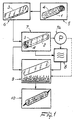
- Figure 1 shows a block diagram of all the stages of the process as described hereinabove.
- thermoretraction there is first carried out a preheating purposive to obtaining thermoretraction.
- a sucking stage, auxiliary and optional, may be carried out in 7a, directly after stage 7 and before stage 8 and/or 9.
- the final stage 10 concerns the treatment of articles 2, already printed but stil wrapped by the thermoretracted material 3.
- the invention also provides for the realisation of an apparatus 11 for carrying out the above described process.
- Apparatus 11 comprises the already mentioned elements 1-4, and the thermoretractable material 3 realises means for pressing images 1 on surfaces 2a of articles 2 represented - by way of example, as shown in particular by Figures 2 and 5 - by a handle for kitchen tools.
- the selected thermoretractable material 3 is polyethylene terephthalate in the form of a transparent film thermoretractable in one only or both directions.
- This material commonly called also polyetylene-terephthalate or polyethylene terephthalate or polyethylenglycol terephthalate, is commonly indicated by the initials PETP or PET. It is comprised of a polyester of ethylene glycol with terephthalic acid, having the formula:
- Polyethylene terephthalate is a thermoplastic material that melts at about 265°C and which has a glass transition temperature comprised between 70 and 80°C.
- the material may be so "stretched” or “drawn” as to obtain films having molecular chains oriented towards one direction or two directions transversal to each other. In fact, at said temperature, the stressed molecular chains untangle and orient.
- said films keep the orientation of the macromolecules and crystallise in oriented lattices, acquiring in this way excellent mechanical characteristics, as cohesion strengths between oriented macromolecules are much higher than those between non-oriented or tangled macromolecules.
- films from polyethylene terephthalate axially or biaxially oriented and crystallised are at present known in the art as being the transparent films from plastic material having the best physical and mechanical characteristics.
- polyethylene terephthalate is not only drawn at a temperature higher than glass transition temperature to orient the molecular chains, but is also cooled very quickly - while drawing is still being carried on - to a temperature lower than said temperature, drawing strains remain frozen in the material, which does not shrink any more to the starting size and keeps the shape imposed during the drawing.
- a further heating causes macromolecules to regain a certain degree of freedom and polyethylene terephthalate to return to the starting shape, before the drawing, even though with the macromolecules still oriented. This is the thermoretraction phenomenon.
- the so treated polyethylene terephthalate shows, when it is heated again to a high temperature, by way of example to substantially 100°C, a spontaneous shrinkage equal to substantially 50% the original size.
- air vents must be provided for in any case, for instance through small holes in material 3 or through the use of tubular shape thermoretractable material 3.
- material 3 is tubular and suitable to sequentially house the articles to be printed, as is schematically shown in Figure3. In this way, all printing operations may be continuously carried out.
- material 3 may be also constituted by sheets or bags or sacks or strips, so as to wrap the articles to be printed in the most convenient way.
- the retractable material 3 may also have various thicknesses and various layers.
- the preformed images 1 are prepared on sheets, possibly coupled by gluing or the like to the internal face of the retractable material 3 and the same material 3 may have images 1 on its internal face.
- preheating means 12 and heating means 13, that can obtain thermoretraction respectively transfer of images 1 on surfaces 2a.
- Preheating means 12 are, for instance, hot air jets, for instance at about 100°C, so orientable as to possibly select thermoretraction zones.
- Heating means 13 are for instance constituted by an air oven at about 220°C.
- Preheating means 12 and heating means 13 may substantially coincide: in such case, the air oven performs initially thermoretraction and then ink-sublimation.
- a conveyor belt 14 transports continuously the articles to be printed or decorated, inserted in a tubular shape thermoretractable material.
- the process according to the present invention is particularly advantageous for decorating profiles, of a length up to 20 meters and the like, or plates also of large dimensions variously shaped by means of geometrical design, floral decorations, imitation of wood and the like.
- the process for painting and/or decorating profiles of metal constituted by semifinished extruded or drawn profiles of aluminium alloys and the like, or variously shaped plates utilising the technique of the transfer of one-colour or multi-colour patterns or decorations in sublimable colours from a support by means of the combined action of pressure and temperature, characterised in that it consists in:
- thermoretractable material which so acts also as transfer support, and this, as it is apparent, allows to avoid the process step consisting of the wrapping the article to be decorated with the transfer support made of paper, fabric or the like.
- thermoretractable material which is utilised originally as a pressing unit in printing processes based on sublimation transferable inks.
- the invention achieves several advantages.
- the process and the apparatus may be applied with the utmost precision on articles of any shape, without giving rise to poor or imprecise printing zones.
- Printing may be controlled easily as concerns the pressure exercised, varying also - for instance with the thicknesses of the thermoretractable material - the pressure from zone to zone.
- the process and the apparatus may be realised in various ways, but always economically, and they may be adapted to both small production or mass production.
- the normal transparency of polyethylene terephthalate facilitates remarkably the positioning of the sheets bearing the sublimable ink, and it is not necessary to prepare the parts to be printed, for instance by closing the holes, given the resistance of polyethylene terephthalate.
- thermoretractable material With the simple measure of not removing immediately the thermoretracted material, any environment pollution due to the presence of solvent vapours is avoided. Indeed, it is useful to keep the thermoretractable material as a protective sheath.
- PET polyethylene therephthalate
- PEN polyethylene naphthalate
- thermoretraction requires a higher heating temperature to obtain thermoretraction, which temperature is however lower than that necessary to obtain the sublimation of sublimable inks.
Landscapes
- Laminated Bodies (AREA)
- Printing Methods (AREA)
- Coloring (AREA)
- Inks, Pencil-Leads, Or Crayons (AREA)
- Ink Jet Recording Methods And Recording Media Thereof (AREA)
- Treatment Of Fiber Materials (AREA)
Abstract
Description

- submitting the raw profile on the plate to usual preliminary operations of treatment (cleaning, degreasing, chemical and/or electrolytic conversion, anodization, etc.), then
- submitting it to one or more preliminary painting cycles, realisable with fluid or powder paints, carrying out a first operation with paints of a prefixed colour and such as to constitute a coat of primer, and a possible subsequent operation with transparent paints to avoid phenomena of diffusion with the colours of the transfer support , then
- after the complete polymerisation of said painting cycles carrying out the wrapping or the covering of the profile or the plate, with said transfer support , and then
- wrapping up the profile or the plate already wrapped in said support with a sheet or a strip from thermoretractable material, then
- submitting the so treated profile or plate to a heating action variable in function of the dimension of the profile up to about 280°C, for a time ranging from about 30 seconds to 30 minutes, to perform the thermoretraction of said thermoretractable material and the transfer and the polymerisation of the final colours from the transfer support to the profile or the plate.
- preparation of an engraved metal matrix carrying an impression equal to said decoration by means of known techniques such as photoengraving and the like;
- application of said decoration realised with sublimable inks on a sheet or a strip from flexible non extensible material such as polyethylene or polypropylene according to known inking tecniques, by means of said metal matrix;
- transfer of said decoration from said flexible non extensible sheet or strip to a sheet or strip from thermoretractable material such as polyethylene terephtalate, by heat compression of said flexible non extensible sheet or strip against said sheet or strip from thermoretractable material, obtaining a thermoretractable transfer support carrying said sublimable colour decoration.
Claims (24)
- A process for printing and decorating by means of sublimable inks, wherein images preformed and realised with said inks are submitted to compression and heating stages until their transfer onto surfaces to be printed is obtained, by sublimation of said inks, characterised in that said preformed images are pressed by thermoretraction of thermoretractable material, said images being pressed between said surfaces and said thermoretractable material.
- The process according to claim 1, wherein pressure is controlled by varying the thickness and number of layers of said material.
- The process according to one or more of the preceding claims, in particular claim 1, wherein a preheating stage is provided, suitable to obtain the thermoretraction of said material.
- The process according to one or more of the preceding claims, in particular claim 1, wherein an air suction stage is carried out between said thermoretractable material and the surfaces to be treated.
- The process according to one or more of the preceding claims, in particular claim 1, wherein said preformed images are prepared on sheets that are coupled to said thermoretractable material.
- The process according to one or more of the preceding claims, in particular claim 1, wherein said preformed images are directly printed on said thermoretractable material..
- The process according to one or more of the preceding claims, in particular claim 1, wherein after said preheating stage the articles to be printed are stored, the thermotreated material being utilised as a case for the articles waiting treatment.
- The process according to one or more of the preceding claims, in particular claim 1, wherein after the sublimation printing the thermotreated material is utilised as a packing material.
- An apparatus for printing and decorating by sublimable inks, comprising preformed images realised with said inks, means to press said images on surfaces to be printed, and means for heating said inks, suitable to obtain the transfer of said images on said surfaces by sublimation of said inks, characterised in that said compression means comprise thermoretractable material substantially wrapping said images.
- The apparatus according to one or more of the preceding claims, in particular claim 9, wherein preheating means are provided suitable to obtain the thermoretraction of said thermoretractable material.
- The apparatus according to one or more of the preceding claims, in particular claim 10, wherein said preheating means and said heating means substantially coincide.
- The apparatus according to claim 9, wherein said material is polyethylene terephthalate (PET) in the form of a retractable film.
- The apparatus according to claim 9, wherein said material is polyethylene naphthalate (PEN) in the form of a retractable film.
- The apparatus according to one or more of the preceding claims, in particular claim 9, wherein said thermoretractable material has a thickness and a number of layers selected depending on the pressure desired.
- The apparatus according to one or more of the preceding claims, in particular claim 9, wherein said thermoretractable material is tubular and suitable to sequentialy house the articles to be printed.
- The apparatus according to one or more of the preceding claims, in particular claim 9, wherein said thermoretractable material incorporates means suitable to facilitate, its removal, after the sublimation printing.
- The apparatus according to one or more of the preceding claims, in particular claim 9, wherein said preformed images are prepared on sheets steadily coupled to said thermoretractable material.
- The apparatus according to one or more of the preceding claims, in particular claim 9, wherein said thermoretractable material has said preformed images directly printed on the same.
- A new use of a thermoretractable material, characterised in that it is utilized as a pressing unit in printing processes based on sublimable inks.
- A new use according to claim 19, wherein said material is selected among polyethylene terephthalate (PET) and polyethylene naphthalate (PEN).
- A process and an apparatus comprising any whatever of the technical solution claimed or any whatever combination of the same.
- Process according to claim 1 for painting and/or decorating profiles of metal constituted by semifinished extruded or drawn profiles of aluminium alloys and the like, or variously shaped plates utilizing the technique of the transfer of one-colour or multi-colour patterns or decorations in sublimable colours from a support by means of the combined action of pressure and temperature, characterised in that it consists in:submitting the raw profile or the plate to usual preliminary operations of treatment (cleaning, degreasing, chemical and/or electrolytic conversion, anodization, etc.), thensubmitting it to one or more preliminary painting cycles, realisable with fluid or powder paints, carrying out a first operation with paints of a prefixed colour and such as to constitute a coat of primer, and a possible subsequent operation with transparent paints to avoid phenomena of diffusion with the colours of the transfer support , thenafter the complete polymerisation of said painting cycles carrying out the wrapping or the covering of the profile or the plate, with said transfer support , and thenwrapping up the profile or the plate already wrapped in said support with a sheet or a strip from thermoretractable material, thensubmitting the so treated profile or plate to a heating action variable in function of the dimension of the profile up to about 280°C, for a time ranging from about 30 seconds to 30 minutes, to perform the thermoretraction of said thermoretractable material and the transfer and the polymerisation of the final colours from the transfer support to the profile or the plate.
- Process according to claim 22, characterised in that the drawing or decoration to be transferred is realized directly upon said sheet or strip from thermoretractable material, which so acts also as transfer support.
- Process for the application of the decoration realised in sublimable colours upon said strip made of thermoretractable material according to claim 23, characterised in that it comprises the following steps:preparation of an engraved metal matrix carrying an impression equal to said decoration by means of known techniques such as photoengraving and the like;application of said decoration realised with sublimable inks on a sheet or a strip from flexible non extensible material such as polyethylene or polypropylene according to known inking tecniques, by means of said metal matrix;transfer of said decoration from said flexible non extensible sheet or strip to a sheet or strip from thermoretractable material such as polyethylene terephtalate, by heat compression of said flexible non extensible sheet or strip against said sheet or strip from thermoretractable material, obtaining a thermoretractable transfer support carrying said sublimable colour decoration.
Applications Claiming Priority (2)
| Application Number | Priority Date | Filing Date | Title |
|---|---|---|---|
| IT97MI001582A IT1292470B1 (en) | 1997-07-04 | 1997-07-04 | PROCEDURE AND APPARATUS FOR PRINTING AND DECORATING USING SUBLIMABLE INKS |
| ITMI971582 | 1997-07-04 |
Publications (2)
| Publication Number | Publication Date |
|---|---|
| EP0888905A2 true EP0888905A2 (en) | 1999-01-07 |
| EP0888905A3 EP0888905A3 (en) | 1999-11-24 |
Family
ID=11377494
Family Applications (1)
| Application Number | Title | Priority Date | Filing Date |
|---|---|---|---|
| EP98112232A Withdrawn EP0888905A3 (en) | 1997-07-04 | 1998-07-02 | Process and apparatus for printing and decorating by means of sublimable inks |
Country Status (3)
| Country | Link |
|---|---|
| US (1) | US6335749B1 (en) |
| EP (1) | EP0888905A3 (en) |
| IT (1) | IT1292470B1 (en) |
Cited By (11)
| Publication number | Priority date | Publication date | Assignee | Title |
|---|---|---|---|---|
| EP0950541A3 (en) * | 1998-04-15 | 2001-08-01 | V.I.V. International S.p.A. | Support for sublimable colour transfer for decorating objects and artifacts and the process thereof |
| EP1129844A1 (en) * | 2000-02-29 | 2001-09-05 | Brevet 2000 Holding S.A. | Composite stratified decorated panel from glass and/or transparent plastics |
| EP0953457A3 (en) * | 1998-04-30 | 2001-11-07 | Giovanni Bortolato | Apparatus and method for transferring graphic representations on an object by sublimation |
| WO2002043970A3 (en) * | 2000-11-30 | 2003-08-07 | Azzini Daniela | Device for electrostatic adhesion of inked film onto objects |
| WO2006037506A1 (en) * | 2004-10-06 | 2006-04-13 | Lasa Impianti S.R.L. | Process and equipment for continuous decoration of structural shapes by sublimation |
| WO2006053730A1 (en) * | 2004-11-22 | 2006-05-26 | Lasa Impianti S.R.L. | Process and equipment for continuous decoration of wooden chipboard panels by sublimation |
| EP1752305A1 (en) * | 2005-08-10 | 2007-02-14 | Menphis S.p.A. | Method for decorating by sublimation |
| WO2007049070A1 (en) | 2005-10-24 | 2007-05-03 | Peter John Hoggard | Method & apparatus for sublimation printing |
| WO2007110752A3 (en) * | 2006-03-27 | 2008-02-14 | Viv Int Spa | Apparatus for decorating objects |
| IT202000015289A1 (en) * | 2020-06-25 | 2021-12-25 | Atiu S R L | PROCESS AND EQUIPMENT FOR DECORATION OF OBJECTS USING SUBLIMATIC INKS. |
| IT202200025167A1 (en) | 2022-12-07 | 2024-06-07 | Isa Sleeve Srl | Continuous device for decorating objects with sublimation inks and continuous process using said device |
Families Citing this family (11)
| Publication number | Priority date | Publication date | Assignee | Title |
|---|---|---|---|---|
| ATE235383T1 (en) * | 1998-12-03 | 2003-04-15 | Akzo Nobel Nv | METHOD FOR PRODUCING A DECORATED SUBSTRATE |
| US6964722B2 (en) * | 2002-08-07 | 2005-11-15 | Trio Industries Holdings, L.L.C. | Method for producing a wood substrate having an image on at least one surface |
| US20040245126A1 (en) * | 2003-06-06 | 2004-12-09 | Diatikar David Houston | Table litter collection container |
| FR2862567B1 (en) * | 2003-06-24 | 2006-02-17 | Bernard Claveau | METHOD AND DEVICE FOR MARKING SUBLIMATION OF LONG OBJECTS |
| WO2005105470A1 (en) * | 2004-04-26 | 2005-11-10 | Holt Sublimation Printing And Products, Inc. | Direct-print sublimation ink support substrates and related methods of producing printed sublimation fabrics and/or sublimating a decoration onto target products |
| AU2013216773B2 (en) * | 2012-02-09 | 2016-06-09 | Brandbumps, Llc | Decorative detectable warning panel having improved grip |
| US9956704B2 (en) | 2012-04-19 | 2018-05-01 | Kohler Co. | Decorated rigid panel |
| US9895284B2 (en) | 2014-03-18 | 2018-02-20 | Brandbumps, Llc | Tactile warning surface mount panel for mounting on a preformed ground surface |
| WO2022245723A1 (en) | 2021-05-17 | 2022-11-24 | Greentech Composites Llc | Polymeric articles having dye sublimation printed images and method to form them |
| CN117917978A (en) | 2021-09-08 | 2024-04-23 | 绿色科技复合材料有限责任公司 | Non-polar thermoplastic composite material having dye sublimation printed image and method of forming the same |
| IT202300003039A1 (en) * | 2023-02-22 | 2024-08-22 | Atiu S R L | METHOD AND MACHINE FOR REMOVING A PRINTING FILM FROM A HOLLOW BODY |
Family Cites Families (9)
| Publication number | Priority date | Publication date | Assignee | Title |
|---|---|---|---|---|
| JPS5833490A (en) * | 1981-08-24 | 1983-02-26 | Dainippon Printing Co Ltd | Transfer printing method |
| JPS5833489A (en) * | 1981-08-24 | 1983-02-26 | Dainippon Printing Co Ltd | Transfer printing method |
| GB2141382B (en) * | 1983-06-13 | 1988-01-27 | Metal Box Plc | Decorating substrate materials |
| GB2145971B (en) * | 1983-09-02 | 1987-12-16 | Metal Box Plc | Decorating containers |
| FR2691108A1 (en) * | 1992-05-15 | 1993-11-19 | Henriot Francois | Thermal pattern transfer - using supple and heat-resistant silicone sheet between inner walls of mould to protect material and transfer sheet |
| ATE159617T1 (en) * | 1993-02-19 | 1997-11-15 | Duracell Inc | BATTERY SHELL |
| CH688231A5 (en) * | 1994-05-10 | 1997-06-30 | Werlig Ag | A process for printing by sublimation substantially rigid objects, and heat-shrinkable sleeve for the implementation of said method. |
| IT1275957B1 (en) * | 1995-03-22 | 1997-10-24 | Viv Int Spa | PROCEDURE FOR PAINTING AND / OR DECORATING SEMI-FINISHED EXTRUDED OR DRAWN AND SIMILAR PRODUCTS |
| US5718792A (en) * | 1996-02-29 | 1998-02-17 | Goode Ski Technologies | Method for decorating ski pole shafts |
-
1997
- 1997-07-04 IT IT97MI001582A patent/IT1292470B1/en active IP Right Grant
-
1998
- 1998-07-02 EP EP98112232A patent/EP0888905A3/en not_active Withdrawn
- 1998-07-06 US US09/110,489 patent/US6335749B1/en not_active Expired - Lifetime
Cited By (17)
| Publication number | Priority date | Publication date | Assignee | Title |
|---|---|---|---|---|
| EP0950541A3 (en) * | 1998-04-15 | 2001-08-01 | V.I.V. International S.p.A. | Support for sublimable colour transfer for decorating objects and artifacts and the process thereof |
| EP0953457A3 (en) * | 1998-04-30 | 2001-11-07 | Giovanni Bortolato | Apparatus and method for transferring graphic representations on an object by sublimation |
| EP1129844A1 (en) * | 2000-02-29 | 2001-09-05 | Brevet 2000 Holding S.A. | Composite stratified decorated panel from glass and/or transparent plastics |
| WO2002043970A3 (en) * | 2000-11-30 | 2003-08-07 | Azzini Daniela | Device for electrostatic adhesion of inked film onto objects |
| US7931770B2 (en) | 2004-10-06 | 2011-04-26 | Lasa Impianti, S.r.l. | Process and equipment for continuous decoration of structural shapes by sublimation |
| WO2006037506A1 (en) * | 2004-10-06 | 2006-04-13 | Lasa Impianti S.R.L. | Process and equipment for continuous decoration of structural shapes by sublimation |
| WO2006053730A1 (en) * | 2004-11-22 | 2006-05-26 | Lasa Impianti S.R.L. | Process and equipment for continuous decoration of wooden chipboard panels by sublimation |
| EP1752305A1 (en) * | 2005-08-10 | 2007-02-14 | Menphis S.p.A. | Method for decorating by sublimation |
| WO2007049070A1 (en) | 2005-10-24 | 2007-05-03 | Peter John Hoggard | Method & apparatus for sublimation printing |
| WO2007110752A3 (en) * | 2006-03-27 | 2008-02-14 | Viv Int Spa | Apparatus for decorating objects |
| US8276634B2 (en) | 2006-03-27 | 2012-10-02 | Decoral System Usa Corp. | Apparatus for decorating objects |
| IT202000015289A1 (en) * | 2020-06-25 | 2021-12-25 | Atiu S R L | PROCESS AND EQUIPMENT FOR DECORATION OF OBJECTS USING SUBLIMATIC INKS. |
| WO2021260613A1 (en) * | 2020-06-25 | 2021-12-30 | Volpato, Alessandro | Method and apparatus for decorating objects by means of sublimatic inks |
| US12479228B2 (en) | 2020-06-25 | 2025-11-25 | Atiu S.r.l. | Method and apparatus for decorating objects by means of sublimatic inks |
| EP4600420A3 (en) * | 2020-06-25 | 2025-11-26 | Atiu S.r.l. | Method for decorating objects by means of sublimatic inks |
| IT202200025167A1 (en) | 2022-12-07 | 2024-06-07 | Isa Sleeve Srl | Continuous device for decorating objects with sublimation inks and continuous process using said device |
| WO2024120672A1 (en) | 2022-12-07 | 2024-06-13 | Isa Sleeve Srl | Continuous apparatus for decorating objects with sublimatic inks and continuous process using this apparatus |
Also Published As
| Publication number | Publication date |
|---|---|
| IT1292470B1 (en) | 1999-02-08 |
| EP0888905A3 (en) | 1999-11-24 |
| US6335749B1 (en) | 2002-01-01 |
| ITMI971582A1 (en) | 1999-01-04 |
| ITMI971582A0 (en) | 1997-07-04 |
Similar Documents
| Publication | Publication Date | Title |
|---|---|---|
| US6335749B1 (en) | Process and apparatus for printing and decorating by means of sublimable inks | |
| CA1125642A (en) | Thermoimpression process | |
| EP0950540B1 (en) | Process for the production of variously painted and/or decorated artefacts by means of the technique of transfer from a sublimable colour support | |
| CA2213744C (en) | Process for making decorated, extruded, profiled elements | |
| CA2442070C (en) | Method and apparatus for continuously forming dye sublimation images in solid substrates | |
| AU730053B2 (en) | Process for decorating sections made of metal, plastic material or the like, and related apparatus | |
| AU2002255985A1 (en) | Method and apparatus for continuously forming dye sublimation images in solid substrates | |
| CN105189138A (en) | Method and apparatus for transfer lamination | |
| JPS6046034B2 (en) | multicolor printing method | |
| JPS606240B2 (en) | How to manufacture decorated water-resistant rigid panels | |
| CN100588468C (en) | Stainless steel plate surface treatment, pattern heat transfer printing method and plate made therefrom | |
| US5214022A (en) | Method for transfer printing an image motif onto a decor film | |
| US6015469A (en) | Process for the production of a support for sublimable color transfer for decorating items or artifacts from metal, plastic materials and the like | |
| US5795420A (en) | Method of applying a finishing sheet to a substrate | |
| CN101468562A (en) | Heat-transferring method | |
| KR100685292B1 (en) | Sublimation transfer printing method using heat-shrinkable sublimation transfer paper, sublimation transfer printing device for it, and decorative pattern pipe made by it | |
| WO2000030868A1 (en) | Method and apparatus for producing a silicone film for industrial decoration of objects | |
| JP2008508121A (en) | Film ink supporting medium and sublimation decoration method | |
| KR100269773B1 (en) | A method for transferring of various pattern by heat expansion and adsorption | |
| EP0950541A2 (en) | Support for sublimable colour transfer for decorating objects and artifacts and the process thereof | |
| GB2236710A (en) | Plastic article having a printed image or color sublimated into a surface thereof using light-fast dyes of volatizable inks and method of making such article | |
| CN121375353A (en) | Transfer type gravure touch decorative film and preparation method and application thereof | |
| HK1025078A (en) | Process for decorating sections made of metal, plastic material or the like, and related apparatus | |
| HK1010174A (en) | Process for making decorated, extruded, profiled elements | |
| IT1304220B1 (en) | Flexible and extensible material for decorating (non)metallic surface has a layer of high ultimate elongation material and another layer obtained by immersing the first layer on a plastic, pigmentable material |
Legal Events
| Date | Code | Title | Description |
|---|---|---|---|
| PUAI | Public reference made under article 153(3) epc to a published international application that has entered the european phase |
Free format text: ORIGINAL CODE: 0009012 |
|
| AK | Designated contracting states |
Kind code of ref document: A2 Designated state(s): AT BE CH DE ES FR GB GR IT LI NL PT |
|
| AX | Request for extension of the european patent |
Free format text: AL;LT;LV;MK;RO;SI |
|
| ITCL | It: translation for ep claims filed |
Representative=s name: BREVETTI EUROPA S.R.L. |
|
| PUAL | Search report despatched |
Free format text: ORIGINAL CODE: 0009013 |
|
| AK | Designated contracting states |
Kind code of ref document: A3 Designated state(s): AT BE CH CY DE DK ES FI FR GB GR IE IT LI LU MC NL PT SE |
|
| AX | Request for extension of the european patent |
Free format text: AL;LT;LV;MK;RO;SI |
|
| 17P | Request for examination filed |
Effective date: 20000214 |
|
| AKX | Designation fees paid |
Free format text: AT BE CH DE ES FR GB GR IT LI NL PT |
|
| 17Q | First examination report despatched |
Effective date: 20010110 |
|
| STAA | Information on the status of an ep patent application or granted ep patent |
Free format text: STATUS: THE APPLICATION IS DEEMED TO BE WITHDRAWN |
|
| 18D | Application deemed to be withdrawn |
Effective date: 20030116 |