EP0888624B1 - Tracking and erosion resistant composition - Google Patents
Tracking and erosion resistant composition Download PDFInfo
- Publication number
- EP0888624B1 EP0888624B1 EP97909013A EP97909013A EP0888624B1 EP 0888624 B1 EP0888624 B1 EP 0888624B1 EP 97909013 A EP97909013 A EP 97909013A EP 97909013 A EP97909013 A EP 97909013A EP 0888624 B1 EP0888624 B1 EP 0888624B1
- Authority
- EP
- European Patent Office
- Prior art keywords
- tracking
- parts
- weight
- mold
- erosion resistant
- Prior art date
- Legal status (The legal status is an assumption and is not a legal conclusion. Google has not performed a legal analysis and makes no representation as to the accuracy of the status listed.)
- Expired - Lifetime
Links
- 239000000203 mixture Substances 0.000 title claims abstract description 27
- 230000003628 erosive effect Effects 0.000 title claims abstract description 22
- 229920001296 polysiloxane Polymers 0.000 claims abstract description 25
- UQSXHKLRYXJYBZ-UHFFFAOYSA-N Iron oxide Chemical compound [Fe]=O UQSXHKLRYXJYBZ-UHFFFAOYSA-N 0.000 claims abstract description 20
- XLOMVQKBTHCTTD-UHFFFAOYSA-N Zinc monoxide Chemical compound [Zn]=O XLOMVQKBTHCTTD-UHFFFAOYSA-N 0.000 claims abstract description 18
- 239000000395 magnesium oxide Substances 0.000 claims abstract description 12
- CPLXHLVBOLITMK-UHFFFAOYSA-N magnesium oxide Inorganic materials [Mg]=O CPLXHLVBOLITMK-UHFFFAOYSA-N 0.000 claims abstract description 12
- AXZKOIWUVFPNLO-UHFFFAOYSA-N magnesium;oxygen(2-) Chemical compound [O-2].[Mg+2] AXZKOIWUVFPNLO-UHFFFAOYSA-N 0.000 claims abstract description 12
- 239000011787 zinc oxide Substances 0.000 claims abstract description 9
- 239000000654 additive Substances 0.000 claims description 20
- 230000000996 additive effect Effects 0.000 claims description 7
- 150000002978 peroxides Chemical class 0.000 claims description 3
- VGGSQFUCUMXWEO-UHFFFAOYSA-N Ethene Chemical compound C=C VGGSQFUCUMXWEO-UHFFFAOYSA-N 0.000 claims description 2
- 238000007259 addition reaction Methods 0.000 claims description 2
- 230000000063 preceeding effect Effects 0.000 claims 2
- BASFCYQUMIYNBI-UHFFFAOYSA-N platinum Chemical compound [Pt] BASFCYQUMIYNBI-UHFFFAOYSA-N 0.000 description 18
- 238000000465 moulding Methods 0.000 description 15
- PNEYBMLMFCGWSK-UHFFFAOYSA-N aluminium oxide Inorganic materials [O-2].[O-2].[O-2].[Al+3].[Al+3] PNEYBMLMFCGWSK-UHFFFAOYSA-N 0.000 description 11
- 238000000034 method Methods 0.000 description 11
- 239000011810 insulating material Substances 0.000 description 10
- 239000000463 material Substances 0.000 description 9
- 229910052697 platinum Inorganic materials 0.000 description 9
- 235000013980 iron oxide Nutrition 0.000 description 7
- 235000014692 zinc oxide Nutrition 0.000 description 6
- VYPSYNLAJGMNEJ-UHFFFAOYSA-N Silicium dioxide Chemical class O=[Si]=O VYPSYNLAJGMNEJ-UHFFFAOYSA-N 0.000 description 5
- 239000000356 contaminant Substances 0.000 description 5
- 239000012212 insulator Substances 0.000 description 5
- 239000003054 catalyst Substances 0.000 description 3
- 230000000052 comparative effect Effects 0.000 description 3
- 239000000945 filler Substances 0.000 description 3
- 229910044991 metal oxide Inorganic materials 0.000 description 3
- 150000004706 metal oxides Chemical class 0.000 description 3
- 125000002496 methyl group Chemical group [H]C([H])([H])* 0.000 description 3
- 229920000642 polymer Polymers 0.000 description 3
- 150000004684 trihydrates Chemical class 0.000 description 3
- -1 3,3,3-trifluoropropyl Chemical group 0.000 description 2
- NLXLAEXVIDQMFP-UHFFFAOYSA-N Ammonia chloride Chemical compound [NH4+].[Cl-] NLXLAEXVIDQMFP-UHFFFAOYSA-N 0.000 description 2
- GWEVSGVZZGPLCZ-UHFFFAOYSA-N Titan oxide Chemical compound O=[Ti]=O GWEVSGVZZGPLCZ-UHFFFAOYSA-N 0.000 description 2
- 238000006555 catalytic reaction Methods 0.000 description 2
- 238000006243 chemical reaction Methods 0.000 description 2
- 230000000694 effects Effects 0.000 description 2
- 239000013536 elastomeric material Substances 0.000 description 2
- 238000009472 formulation Methods 0.000 description 2
- 150000004678 hydrides Chemical class 0.000 description 2
- VBMVTYDPPZVILR-UHFFFAOYSA-N iron(2+);oxygen(2-) Chemical class [O-2].[Fe+2] VBMVTYDPPZVILR-UHFFFAOYSA-N 0.000 description 2
- JEIPFZHSYJVQDO-UHFFFAOYSA-N iron(III) oxide Inorganic materials O=[Fe]O[Fe]=O JEIPFZHSYJVQDO-UHFFFAOYSA-N 0.000 description 2
- 238000011068 loading method Methods 0.000 description 2
- 239000000843 powder Substances 0.000 description 2
- 230000003014 reinforcing effect Effects 0.000 description 2
- 239000000377 silicon dioxide Chemical class 0.000 description 2
- 239000004215 Carbon black (E152) Substances 0.000 description 1
- 241000196324 Embryophyta Species 0.000 description 1
- 239000004594 Masterbatch (MB) Substances 0.000 description 1
- HCHKCACWOHOZIP-UHFFFAOYSA-N Zinc Chemical compound [Zn] HCHKCACWOHOZIP-UHFFFAOYSA-N 0.000 description 1
- 239000002253 acid Substances 0.000 description 1
- 230000002411 adverse Effects 0.000 description 1
- WNROFYMDJYEPJX-UHFFFAOYSA-K aluminium hydroxide Chemical compound [OH-].[OH-].[OH-].[Al+3] WNROFYMDJYEPJX-UHFFFAOYSA-K 0.000 description 1
- 235000019270 ammonium chloride Nutrition 0.000 description 1
- 229940045985 antineoplastic platinum compound Drugs 0.000 description 1
- 230000015572 biosynthetic process Effects 0.000 description 1
- 125000004432 carbon atom Chemical group C* 0.000 description 1
- 239000006229 carbon black Substances 0.000 description 1
- 230000015556 catabolic process Effects 0.000 description 1
- 229910000420 cerium oxide Inorganic materials 0.000 description 1
- 239000011231 conductive filler Substances 0.000 description 1
- 239000004020 conductor Substances 0.000 description 1
- 239000004205 dimethyl polysiloxane Substances 0.000 description 1
- 239000012153 distilled water Substances 0.000 description 1
- 230000002708 enhancing effect Effects 0.000 description 1
- 125000001495 ethyl group Chemical group [H]C([H])([H])C([H])([H])* 0.000 description 1
- 238000000605 extraction Methods 0.000 description 1
- 239000003063 flame retardant Substances 0.000 description 1
- 229910021485 fumed silica Inorganic materials 0.000 description 1
- 125000000524 functional group Chemical group 0.000 description 1
- 229930195733 hydrocarbon Natural products 0.000 description 1
- 150000002430 hydrocarbons Chemical class 0.000 description 1
- 238000002347 injection Methods 0.000 description 1
- 239000007924 injection Substances 0.000 description 1
- 238000001746 injection moulding Methods 0.000 description 1
- 239000012774 insulation material Substances 0.000 description 1
- 239000007788 liquid Substances 0.000 description 1
- 235000012245 magnesium oxide Nutrition 0.000 description 1
- 238000004519 manufacturing process Methods 0.000 description 1
- 229910052751 metal Chemical class 0.000 description 1
- 239000002184 metal Chemical class 0.000 description 1
- 238000002156 mixing Methods 0.000 description 1
- 238000012986 modification Methods 0.000 description 1
- 230000004048 modification Effects 0.000 description 1
- 239000012778 molding material Substances 0.000 description 1
- BMMGVYCKOGBVEV-UHFFFAOYSA-N oxo(oxoceriooxy)cerium Chemical compound [Ce]=O.O=[Ce]=O BMMGVYCKOGBVEV-UHFFFAOYSA-N 0.000 description 1
- 125000001997 phenyl group Chemical group [H]C1=C([H])C([H])=C(*)C([H])=C1[H] 0.000 description 1
- 150000003018 phosphorus compounds Chemical class 0.000 description 1
- 230000000704 physical effect Effects 0.000 description 1
- 239000000049 pigment Substances 0.000 description 1
- 150000003058 platinum compounds Chemical class 0.000 description 1
- 229920000435 poly(dimethylsiloxane) Polymers 0.000 description 1
- 230000002028 premature Effects 0.000 description 1
- 230000000750 progressive effect Effects 0.000 description 1
- 125000001436 propyl group Chemical group [H]C([*])([H])C([H])([H])C([H])([H])[H] 0.000 description 1
- 230000002787 reinforcement Effects 0.000 description 1
- 150000003839 salts Chemical class 0.000 description 1
- HBMJWWWQQXIZIP-UHFFFAOYSA-N silicon carbide Chemical compound [Si+]#[C-] HBMJWWWQQXIZIP-UHFFFAOYSA-N 0.000 description 1
- 229910010271 silicon carbide Inorganic materials 0.000 description 1
- 239000000243 solution Substances 0.000 description 1
- 230000006641 stabilisation Effects 0.000 description 1
- 238000011105 stabilization Methods 0.000 description 1
- 239000003381 stabilizer Substances 0.000 description 1
- 239000000126 substance Substances 0.000 description 1
- 238000010998 test method Methods 0.000 description 1
- 238000012360 testing method Methods 0.000 description 1
- 239000004408 titanium dioxide Substances 0.000 description 1
- 210000003462 vein Anatomy 0.000 description 1
- 238000013022 venting Methods 0.000 description 1
- 125000000391 vinyl group Chemical group [H]C([*])=C([H])[H] 0.000 description 1
- 229920002554 vinyl polymer Polymers 0.000 description 1
- XLYOFNOQVPJJNP-UHFFFAOYSA-N water Chemical compound O XLYOFNOQVPJJNP-UHFFFAOYSA-N 0.000 description 1
- 229910052725 zinc Inorganic materials 0.000 description 1
- 239000011701 zinc Substances 0.000 description 1
Images

Classifications
-
- C—CHEMISTRY; METALLURGY
- C08—ORGANIC MACROMOLECULAR COMPOUNDS; THEIR PREPARATION OR CHEMICAL WORKING-UP; COMPOSITIONS BASED THEREON
- C08K—Use of inorganic or non-macromolecular organic substances as compounding ingredients
- C08K3/00—Use of inorganic substances as compounding ingredients
- C08K3/18—Oxygen-containing compounds, e.g. metal carbonyls
- C08K3/20—Oxides; Hydroxides
- C08K3/22—Oxides; Hydroxides of metals
Definitions
- This invention provides tracking and erosion resistant compositions, especially organopolysiloxanes, which are suitable as high voltage insulation materials and which are readily moldable into complex shapes.
- Tracking refers to the formation of conducting paths (tracks) of deteriorated material on the surface of the insulating material, caused by surface electric discharges.
- a tracking failure occurs when a track bridges the gap between two or more conductors, leading to an electrical breakdown.
- Erosion refers to the progressive wearing away of the insulating material by the electrical discharges, with failure eventually occuring because too much insulating material has been worn away.
- Organopolysiloxanes are common high voltage insulating materials, because of their electrical properties, processability (including moldability), physical properties, chemical inertness and other desirable characteristics. Organopolysiloxanes employed in high voltage equipment typically contain additives for enhancing their tracking and/or erosion resistance (hereinafter referred to as anti-tracking additives).
- alumina hydrate also referred to as aluminum hydroxide, alumina trihydrate, hydrated alumina or ALTH
- other additives such as metal oxides.
- Illustrative disclosures relating to alumina hydrate include Elliot, US 3,965,065 (1976); Penneck, US 3,969,308 (1976); Penneck, US 4,001,128 (1977); Cammack, II et al., US 4,100,089 (1978); Penneck et al., US 4,189,392 (1980); Penneck, US 4,399,064 (1983); Clabburn et al., US 4,431,861 (1984); Penneck, US 4,521,549 (1985); Adkins, US 4,822,830; and Kunieda et al., US 5,369,161 (1994). It has also been proposed to use alumina hydrate as an additive for other purposes, such as improving flame retardancy: Bobear, US 4,288,360 (1981
- Another class of additives are the platinum compounds, which are normally used for improving flame retardancy: Laur et al., US 3,635,874 (1972); Pfeifer et al., US 3,711,520 (1973); Milbert, US 3,821,140 (1974); Bargain, US 3,839,266 (1974); Hatanaka et al., US 3,862,082 (1975); Itoh et al., US 3,936,476 (1976); Matsushita, US 4,110,300 (1978); Bobear, US 4,288,360 (1981); Ackermann et al., US 4,419,474 (1983); and Derwent WPI Abstract No. 76-82267X/44 (abstract of JP-50-097644 (1975)).
- other additives may be simultaneously employed, either for flame retardancy also or for other purposes such as heat stabilization or tracking/erosion resistance.
- organopolysiloxanes for diverse purposes ranging from the aforementioned ones to thermal conductivity, reinforcement, and high temperature stability.
- additives include metal oxides, silica, and metal salts.
- Exemplary disclosures in this vein are: Koda et al., US 3,884,950 (1975); Cole et al., US 4,604,424 (1986); Szaplonczay et al., US 4,897,027 (1990); Wolfer et al., US 5,008,317 (1991); Bosch et al., US 5,023,295 (1991); Mazeika et al., WO 95/06552 (1995); Rowe et al., EP 0,218,461 A2 (1987); and GB 1,538,432 (1979).
- an organopolysiloxane used as a high voltage insulating material may contain a complex additive package.
- An organopolysiloxane may be formed into a complex shape for a particular end use.
- the aforementioned Mazeika WO '552 discloses a high voltage insulator having a shedded organopolysiloxane housing which has been molded by a process leaving no longitudinal mold lines (which are more susceptible to tracking failure).
- the combination of the critical placement of the mold lines and the complex shape of the molded part places stringent demands on the organopolysiloxane. It must flow readily enough to properly fill the mold cavity and, after molding, be sufficiently compliant to demold.
- many prior art anti-tracking additives interfere with the molding process for one reason or another.
- Alumina hydrate makes the molded part difficult to demold, especially at the loading levels needed for effectively improving antitracking resistance, about 15 parts per hundred by weight or greater, usually more than 100 phr in commercial embodiments. In our experience, alumina hydrate levels greater than 75 phr make demolding difficult.
- Many moldable organopolysiloxane compositions are cured (crosslinked) in the mold by via a vinyl-hydride addition reaction: Curing may be effected by a platinum catalyst, such as hexachloroplatinic acid. Amounts of platinum in excess of those used for curing may be used an additive; however, in such instances the platinum additive may also catalyze the curing reaction, leading to premature curing, or scorching. Another disadvantage of platinum as an additive is its high cost.
- the present invention provides a tracking and erosion resistant organopolysiloxane composition that is readily moldable into complex shaped articles. Many of these compositions also have tracking and/or erosion resistance properties which are markedly superior to those of the prior art.
- Such composition comprises
- Fig. 1 shows a mold suitable for molding a complex shaped insulator made of a composition of this invention.
- the organopolysiloxanes employed in this invention have a predominant repeat unit of the structure wherein R 1 and R 2 , which may be the same or different, are monovalent hydrocarbon or halogenated hydrocarbon radicals having 1 to 30 carbon atoms, such as methyl, ethyl, propyl, 3,3,3-trifluoropropyl, and phenyl, with methyl being preferred.
- a preferred organopolysiloxane is polydimethylsiloxane, that is, R 1 and R 2 each are methyl.
- the polymer contains reactive functional groups, such as vinyl and hydride, positioned at terminal positions in the polymer chain or at branching point within the polymer chain.
- the curing chemistry typically is either platinum or peroxide catalyzed.
- organopolysiloxanes are well known and are available in a large selection of grades from many suppliers, such as gums Q44758 and Q44768 available from Dow Corning STI, preferably blended to a durometer Shore A hardness (ASTM D2240) of between 45 and 60.
- the present invention is especially suitable for organopolysiloxanes which are cured by a hydride addition chemistry with platinum catalysis.
- the organopolysiloxane After curing (3 min at 350 °F, 4 hr post cure at 400 °F) the organopolysiloxane preferably has an elongation greater than 400 %, when tested according to ASTM D412 at 20 in/min.
- the Die B tear strength is preferably greater tan 100 pounds per linear inch (pli), preferably greater than 130 pli, most preferably greater than 150 pli.
- the amount of magnesium oxide should be between 1 and 15, preferably between 2 and 7, parts by weight per 100 parts by weight of organopolysiloxane (phr).
- a preferred magnesium oxide is in the form of a powder at least 94.5% pure, with at least 99% passing through a 325 mesh size sieve, and an average surface area greater than 32 m 2 /g.
- the amount of zinc oxide present is preferably between 15 and 45, preferably between between 15 and 25 phr.
- a preferred zinc oxide is in the form of a powder at least 99.63% pure, with at least 99.99% passing through a 325 mesh size sieve, and an average surface area of at least 7.5 m 2 /g.
- red iron oxide Fe 2 O 3
- the amount of iron oxide is preferably between 5 and 40, preferably between 5 and 20 phr, and most preferably between 5 and 10 phr.
- the iron oxide is conveniently added from a masterbatch in an organopolysiloxane gum.
- the tracking and erosion resistant compositions of this invention consist essentially of the organopolysiloxane (including any catalysts needed for the curing process), the first oxide material, and the second oxide material.
- other additives may be present, for example fillers (reinforcing or non-reinforcing), stabilizers, thermally conductive filler, flame retardants, and pigments.
- Exemplary specific other additives include titanium dioxide, cerium oxide, alumina hydrate, fumed silica, and carbon black.
- the composition is free of platinum, except that which is needed as a catalyst for the curing reaction.
- the amount of platinum needed for catalysis is between 15 and 30 parts by weight per million parts by weight of organopolysiloxane (parts per million, or ppm).
- alumina trihydrate has a tendency to negatively affect the moldability of the organopolysiloxane, especially at the high loadings required for maximum anti-tracking effect. While some alumina trihydrate may optionally be added to the composition of the instant invention, no particular benefits accompany such addition, and, indeed, its addition in amounts greater than 75 phr is undesirable from a moldability point of view and should be avoided.
- a composition of this invention is esssentially free of anti-tracking additives other than the aforementioned magnesium oxide, zinc oxide, and iron oxide.
- a filler such as MinusilTM silica may be present in an amount of about 5 to 20 phr (parts by weight per 100 parts by weight of organopolysiloxane).
- the tracking and erosion resistance of an insulating material can be quatitatively evaluated by the procedure published in ASTM D2303-90. Basically, this procedure measures the resistance of an insulating material to voltage stresses along its surface when wet with an ionizable, electrically conductive liquid contaminant, conditions which simulate exposure to dirt and condensed atmospheric moisture during service.
- the test method is of the inclined plane type, in which a contaminant solution is dripped onto a test specimen held at a 45° angle while a voltage is simultaneously applied. A voltage is applied in 250 V increments, with a hold period of 1 hr at each increment (unless a failure is indicated). The time and voltage at which failure eventually occurs is noted.
- compositions of this invention have utility as insulating materials in high voltage electrical equipment, for example insulators, surge arresters, elbows, joints, terminations, transformer bushings, fuse cut-outs, and disconnect switches.
- the compositions of this invention have excellent demoldability, making them especially suitable for molding parts with complex designs, such as shedded insulators, particularly ones which are free of longitudinal mold lines.
- a molding process for making such insulators is described in Mazeika, WO 95/06552 (1995), the disclosure of which is incorporated herein by reference.
- the elastomeric properties of the material permit the use mold plates which join substantially perpendicular to the longitudinal axis of the part, enabling the creation of parts where the mold line flash material is along the periphery of the extremities of the sheds, reducing the need for buffing and cycle time while leading to increased tracking resistance.
- compositional variations of the composition at the mold line on the extremities have little or no effect on shed performance.
- the elastomeric molding material permits the molded multiply radially walled part to pop through the molding plates especially upon the application of a vacuum to the internal structure of the tubular molded part during extraction from the mold.
- Fig. 1 shows a mold comprising plates 1, 2, 3, 4, 5, and 6 and a tubular forming insert 50 emanating from plate 6.
- the sheds or at least provisions for the sheds of the molded part are illustrated in elements 10, 20, 30 and 40 of Fig. 1 while the tubular nature is derived from the insert 50.
- the mold lines or flash points for the material instead of being along the longitudinal axis of the part occurs between 11 and 21, 23 and 31, 33 and 41, 43 and 51, respectively, upon the closing of the mold and injecting of the elastomeric composition.
- plates 1, 2, 3, 4, 5, and 6 are brought together with sufficient pressure, heat, time, and temperature for the injection and curing of the elastomeric material.
- the molding process may be carried out with an Engel 165 ton injection molding machine with vertical plattens or like machines.
- the Engel 165 machine was modified for the ejection of the part from a side of the mold as well as the need to move the plates.
- the reason for this modification is that the machine's opening stroke/daylight between the plattens when completely open must provide space for the operator or robots between at least two plates such as plate 2 and plate 3 as well as plate 1 and plate 2 to be able to remove the part from plate 2.
- Other equipment like a shuttle press or a rotary press can be used and is preferred for manufacturing of higher volumes mainly due to the ease of adding more plates to the mold or more radial shed elements or other details and to reduce the ware on mold leader pins.
- the support for the mold would be very simple on a shuttle or rotary table while providing greater ability to open the plates and withdraw the part.
- the molding machine barrel is heated to approximately 49 °C and the barrel temperature can be adjusted up or down depending upon the mold temperature as well as the part size and the gating/venting of the mold from 15 °C.
- a suitable molding time is a 2 minute cycle from clamping to unclamping to re-clamping that is from closing of the mold injecting the material molding the material and opening of the plate, removal of the finished part and reclosing to start a new cycle.
- the cycle time more specifically depends on the barrel temperature, the composition used in the mold, and the mold temperature.
- a suitable molding temperature is about 149 °C to about 204 °C, preferably 160 °C to 193 °C, and most preferably about 182 °C.
- molding plates 3 and 4 open which free the section of the part collapse in a space where the core is removed and pulled through plate 4.
- the mold is further opened between plates 3 and 2 and the part is pulled through plate 3 as in the prior step.
- the mold opening plates continues for plates 1 and 2 with the mold in a completely open position, the part is on the side of the plate facing plate 3 at which point the mold operator or robot is capable of removing the part from between open plates 2 and 3.
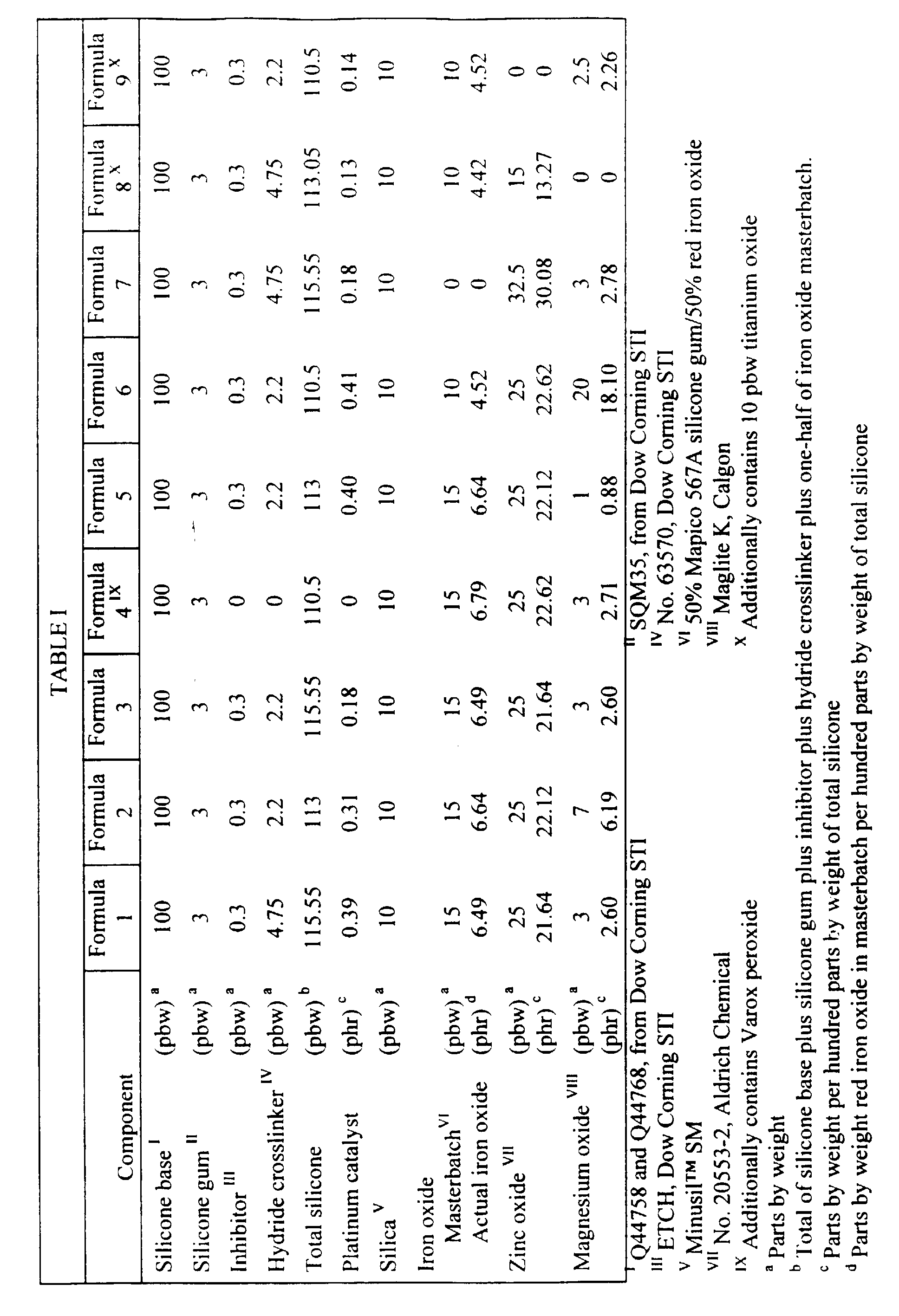
- Table I provides exemplary formulations according to the invention, along with comparative examples not according to this invention. Samples were prepared by mixing in a 3 liter sigma blade mixer at room temperature. The gums were pre-mixed until homogeneous. Fillers and additives were then added and mixed until well dispersed.
- Formulae 1 through 4 are according to this invention, with formulae 1 through 3 being examples of platinum cured systems and Formula4 being an example of a peroxide cured system.
Landscapes
- Chemical & Material Sciences (AREA)
- Chemical Kinetics & Catalysis (AREA)
- Medicinal Chemistry (AREA)
- Polymers & Plastics (AREA)
- Organic Chemistry (AREA)
- Health & Medical Sciences (AREA)
- Compositions Of Macromolecular Compounds (AREA)
- Glass Compositions (AREA)
- Superconductors And Manufacturing Methods Therefor (AREA)
- Organic Insulating Materials (AREA)
- Coating By Spraying Or Casting (AREA)
- Reinforced Plastic Materials (AREA)
- Paints Or Removers (AREA)
- Resistance Heating (AREA)
- Manufacture And Refinement Of Metals (AREA)
- Lubricants (AREA)
- Preventing Corrosion Or Incrustation Of Metals (AREA)
Abstract
Description
- This invention provides tracking and erosion resistant compositions, especially organopolysiloxanes, which are suitable as high voltage insulation materials and which are readily moldable into complex shapes.
- Two factors affecting the performance of a high voltage insulating material are its tracking resistance and its erosion resistance. Tracking refers to the formation of conducting paths (tracks) of deteriorated material on the surface of the insulating material, caused by surface electric discharges. A tracking failure occurs when a track bridges the gap between two or more conductors, leading to an electrical breakdown. Erosion refers to the progressive wearing away of the insulating material by the electrical discharges, with failure eventually occuring because too much insulating material has been worn away.
- Organopolysiloxanes (also called silicones) are common high voltage insulating materials, because of their electrical properties, processability (including moldability), physical properties, chemical inertness and other desirable characteristics. Organopolysiloxanes employed in high voltage equipment typically contain additives for enhancing their tracking and/or erosion resistance (hereinafter referred to as anti-tracking additives).
- One well-known anti-tracking additive is alumina hydrate (also referred to as aluminum hydroxide, alumina trihydrate, hydrated alumina or ALTH) alone or in combination with other additives such as metal oxides. Illustrative disclosures relating to alumina hydrate include Elliot, US 3,965,065 (1976); Penneck, US 3,969,308 (1976); Penneck, US 4,001,128 (1977); Cammack, II et al., US 4,100,089 (1978); Penneck et al., US 4,189,392 (1980); Penneck, US 4,399,064 (1983); Clabburn et al., US 4,431,861 (1984); Penneck, US 4,521,549 (1985); Adkins, US 4,822,830; and Kunieda et al., US 5,369,161 (1994). It has also been proposed to use alumina hydrate as an additive for other purposes, such as improving flame retardancy: Bobear, US 4,288,360 (1981). The alumina hydrate is sometimes combined with other additives, such as other metal oxides or phosphorus compounds.
- Another class of additives are the platinum compounds, which are normally used for improving flame retardancy: Laur et al., US 3,635,874 (1972); Pfeifer et al., US 3,711,520 (1973); Milbert, US 3,821,140 (1974); Bargain, US 3,839,266 (1974); Hatanaka et al., US 3,862,082 (1975); Itoh et al., US 3,936,476 (1976); Matsushita, US 4,110,300 (1978); Bobear, US 4,288,360 (1981); Ackermann et al., US 4,419,474 (1983); and Derwent WPI Abstract No. 76-82267X/44 (abstract of JP-50-097644 (1975)). Again, other additives may be simultaneously employed, either for flame retardancy also or for other purposes such as heat stabilization or tracking/erosion resistance.
- Lastly, many other additives have been added to organopolysiloxanes, for diverse purposes ranging from the aforementioned ones to thermal conductivity, reinforcement, and high temperature stability. These additives include metal oxides, silica, and metal salts. Exemplary disclosures in this vein are: Koda et al., US 3,884,950 (1975); Cole et al., US 4,604,424 (1986); Szaplonczay et al., US 4,897,027 (1990); Wolfer et al., US 5,008,317 (1991); Bosch et al., US 5,023,295 (1991); Mazeika et al., WO 95/06552 (1995); Rowe et al., EP 0,218,461 A2 (1987); and GB 1,538,432 (1979). In summary, an organopolysiloxane used as a high voltage insulating material may contain a complex additive package.
- An organopolysiloxane may be formed into a complex shape for a particular end use. For instance, the aforementioned Mazeika WO '552 discloses a high voltage insulator having a shedded organopolysiloxane housing which has been molded by a process leaving no longitudinal mold lines (which are more susceptible to tracking failure). The combination of the critical placement of the mold lines and the complex shape of the molded part places stringent demands on the organopolysiloxane. It must flow readily enough to properly fill the mold cavity and, after molding, be sufficiently compliant to demold. However, many prior art anti-tracking additives interfere with the molding process for one reason or another. Alumina hydrate makes the molded part difficult to demold, especially at the loading levels needed for effectively improving antitracking resistance, about 15 parts per hundred by weight or greater, usually more than 100 phr in commercial embodiments. In our experience, alumina hydrate levels greater than 75 phr make demolding difficult. Many moldable organopolysiloxane compositions are cured (crosslinked) in the mold by via a vinyl-hydride addition reaction:Curing may be effected by a platinum catalyst, such as hexachloroplatinic acid. Amounts of platinum in excess of those used for curing may be used an additive; however, in such instances the platinum additive may also catalyze the curing reaction, leading to premature curing, or scorching. Another disadvantage of platinum as an additive is its high cost.

- Further, greater and greater performance demands are placed on high voltage insulating materials, for example where power generating or distribution plants are built in polluted coastal areas - locations where tracking and erosion are particularly severe problems. Consequently, there is a need for more effective anti-tracking packages which do not exhibit the limitations of prior art packages.
- The present invention provides a tracking and erosion resistant organopolysiloxane composition that is readily moldable into complex shaped articles. Many of these compositions also have tracking and/or erosion resistance properties which are markedly superior to those of the prior art. Such composition comprises
- (a) 100 parts by weight of organopolysiloxane;
- (b) between 1 and 15 parts by weight of magnesium oxide;
- (c) between 15 and 45 parts by weight of zinc oxide; and
- (d) between 5 and 40 parts by weight of iron oxide.
-
- Fig. 1 shows a mold suitable for molding a complex shaped insulator made of a composition of this invention.
- The organopolysiloxanes employed in this invention have a predominant repeat unit of the structurewherein R1 and R2, which may be the same or different, are monovalent hydrocarbon or halogenated hydrocarbon radicals having 1 to 30 carbon atoms, such as methyl, ethyl, propyl, 3,3,3-trifluoropropyl, and phenyl, with methyl being preferred. A preferred organopolysiloxane is polydimethylsiloxane, that is, R1 and R2 each are methyl. For curing, the polymer contains reactive functional groups, such as vinyl and hydride, positioned at terminal positions in the polymer chain or at branching point within the polymer chain. The curing chemistry typically is either platinum or peroxide catalyzed. Such organopolysiloxanes are well known and are available in a large selection of grades from many suppliers, such as gums Q44758 and Q44768 available from Dow Corning STI, preferably blended to a durometer Shore A hardness (ASTM D2240) of between 45 and 60. The present invention is especially suitable for organopolysiloxanes which are cured by a hydride addition chemistry with platinum catalysis. After curing (3 min at 350 °F, 4 hr post cure at 400 °F) the organopolysiloxane preferably has an elongation greater than 400 %, when tested according to ASTM D412 at 20 in/min. The Die B tear strength is preferably greater tan 100 pounds per linear inch (pli), preferably greater than 130 pli, most preferably greater than 150 pli.

- We have discovered that the magnesium oxide synergistically and unexpectedly works with the zinc and iron oxides to provide exceptional tracking and erosion resistance, without adversely affecting demoldability, as might be the case with ALTH. The amount of magnesium oxide should be between 1 and 15, preferably between 2 and 7, parts by weight per 100 parts by weight of organopolysiloxane (phr). A preferred magnesium oxide is in the form of a powder at least 94.5% pure, with at least 99% passing through a 325 mesh size sieve, and an average surface area greater than 32 m2/g.
- The amount of zinc oxide present is preferably between 15 and 45, preferably between between 15 and 25 phr. A preferred zinc oxide is in the form of a powder at least 99.63% pure, with at least 99.99% passing through a 325 mesh size sieve, and an average surface area of at least 7.5 m2/g.
- Among the iron oxides, red iron oxide (Fe2O3) is preferred. The amount of iron oxide is preferably between 5 and 40, preferably between 5 and 20 phr, and most preferably between 5 and 10 phr. The iron oxide is conveniently added from a masterbatch in an organopolysiloxane gum.
- Preferably, the tracking and erosion resistant compositions of this invention consist essentially of the organopolysiloxane (including any catalysts needed for the curing process), the first oxide material, and the second oxide material. However, so long as they do not materially affect the basic and novel characteristics of this invention, other additives may be present, for example fillers (reinforcing or non-reinforcing), stabilizers, thermally conductive filler, flame retardants, and pigments. Exemplary specific other additives include titanium dioxide, cerium oxide, alumina hydrate, fumed silica, and carbon black. Preferably the composition is free of platinum, except that which is needed as a catalyst for the curing reaction. Generally, the amount of platinum needed for catalysis is between 15 and 30 parts by weight per million parts by weight of organopolysiloxane (parts per million, or ppm). As previously noted, alumina trihydrate has a tendency to negatively affect the moldability of the organopolysiloxane, especially at the high loadings required for maximum anti-tracking effect. While some alumina trihydrate may optionally be added to the composition of the instant invention, no particular benefits accompany such addition, and, indeed, its addition in amounts greater than 75 phr is undesirable from a moldability point of view and should be avoided. Preferably a composition of this invention is esssentially free of anti-tracking additives other than the aforementioned magnesium oxide, zinc oxide, and iron oxide. A filler such as Minusil™ silica may be present in an amount of about 5 to 20 phr (parts by weight per 100 parts by weight of organopolysiloxane).
- The tracking and erosion resistance of an insulating material can be quatitatively evaluated by the procedure published in ASTM D2303-90. Basically, this procedure measures the resistance of an insulating material to voltage stresses along its surface when wet with an ionizable, electrically conductive liquid contaminant, conditions which simulate exposure to dirt and condensed atmospheric moisture during service. The test method is of the inclined plane type, in which a contaminant solution is dripped onto a test specimen held at a 45° angle while a voltage is simultaneously applied. A voltage is applied in 250 V increments, with a hold period of 1 hr at each increment (unless a failure is indicated). The time and voltage at which failure eventually occurs is noted. The following procedure is representative: Samples were abraded with 400A grit silicon carbide paper and rinsed with distilled water. The initial tracking voltage method of ASTM D2303 was followed, starting at 2.5 kV and a contaminant flow rate of 0.15 mL/min. The contaminant was 0.1% ammonium chloride. The voltage was increased by 0.25 kV every hour, reaching 4.0 kV at the 6th hour. The voltage was held constant at 4.0 kV after that and both the tracking voltage and the failure time were recorded. The contaminant flow rate was changed according to Table I in ASTM D2303.
- The compositions of this invention have utility as insulating materials in high voltage electrical equipment, for example insulators, surge arresters, elbows, joints, terminations, transformer bushings, fuse cut-outs, and disconnect switches. As noted above, the compositions of this invention have excellent demoldability, making them especially suitable for molding parts with complex designs, such as shedded insulators, particularly ones which are free of longitudinal mold lines.
- A molding process for making such insulators is described in Mazeika, WO 95/06552 (1995), the disclosure of which is incorporated herein by reference. In this process, the elastomeric properties of the material permit the use mold plates which join substantially perpendicular to the longitudinal axis of the part, enabling the creation of parts where the mold line flash material is along the periphery of the extremities of the sheds, reducing the need for buffing and cycle time while leading to increased tracking resistance. In addition, compositional variations of the composition at the mold line on the extremities have little or no effect on shed performance. The elastomeric molding material permits the molded multiply radially walled part to pop through the molding plates especially upon the application of a vacuum to the internal structure of the tubular molded part during extraction from the mold.
- The molding process may be further understood by reference to Fig. 1, which shows a mold comprising plates 1, 2, 3, 4, 5, and 6 and a
tubular forming insert 50 emanating from plate 6. The sheds or at least provisions for the sheds of the molded part are illustrated inelements insert 50. The mold lines or flash points for the material instead of being along the longitudinal axis of the part occurs between 11 and 21, 23 and 31, 33 and 41, 43 and 51, respectively, upon the closing of the mold and injecting of the elastomeric composition. During the operation of the molding, plates 1, 2, 3, 4, 5, and 6 are brought together with sufficient pressure, heat, time, and temperature for the injection and curing of the elastomeric material. - The molding process may be carried out with an Engel 165 ton injection molding machine with vertical plattens or like machines. The Engel 165 machine was modified for the ejection of the part from a side of the mold as well as the need to move the plates. The reason for this modification is that the machine's opening stroke/daylight between the plattens when completely open must provide space for the operator or robots between at least two plates such as plate 2 and plate 3 as well as plate 1 and plate 2 to be able to remove the part from plate 2. Other equipment like a shuttle press or a rotary press can be used and is preferred for manufacturing of higher volumes mainly due to the ease of adding more plates to the mold or more radial shed elements or other details and to reduce the ware on mold leader pins. The support for the mold would be very simple on a shuttle or rotary table while providing greater ability to open the plates and withdraw the part. The molding machine barrel is heated to approximately 49 °C and the barrel temperature can be adjusted up or down depending upon the mold temperature as well as the part size and the gating/venting of the mold from 15 °C. A suitable molding time is a 2 minute cycle from clamping to unclamping to re-clamping that is from closing of the mold injecting the material molding the material and opening of the plate, removal of the finished part and reclosing to start a new cycle. The cycle time more specifically depends on the barrel temperature, the composition used in the mold, and the mold temperature.
- During the actual molding operation a suitable molding temperature is about 149 °C to about 204 °C, preferably 160 °C to 193 °C, and most preferably about 182 °C. Having described the overall sequence, the following description follows the cycle of the mold once the mold plates are closed and pressed together. With a closed mold, the preferred elastomeric material of the invention is injected and has an average cure time of about 1 minute. Thereafter, the mold is opened between plates 5 and 6 and the core attached to plate 6 is pulled out of the part. The rest of the mold is held together using latchlocks and an injector system on a side of the press as well as springs. Subsequently, mold plates 4 and 5 open via a stripper bolt to free these sections. Subsequent to this operation, molding plates 3 and 4 open which free the section of the part collapse in a space where the core is removed and pulled through plate 4. After the part is pulled through plate 4, the mold is further opened between plates 3 and 2 and the part is pulled through plate 3 as in the prior step. The mold opening plates continues for plates 1 and 2 with the mold in a completely open position, the part is on the side of the plate facing plate 3 at which point the mold operator or robot is capable of removing the part from between open plates 2 and 3.
- The present invention can be further understood by reference to the following examples, which are provided by means of illustration and not limitation. Table I provides exemplary formulations according to the invention, along with comparative examples not according to this invention. Samples were prepared by mixing in a 3 liter sigma blade mixer at room temperature. The gums were pre-mixed until homogeneous. Fillers and additives were then added and mixed until well dispersed. Formulae 1 through 4 are according to this invention, with formulae 1 through 3 being examples of platinum cured systems and Formula4 being an example of a peroxide cured system. Formulae 5 through 9 are comparative examples not according to example. In Formula 5, the amount of magnesium oxide is too low. In Formula 6, the amount of magnesium oxide is higher than prescribed. In Formula 7, there is no iron oxide. In Formula 8, there is no magnesium oxide. In Formula 9, there is no zinc oxide. Table II provides the tracking and erosion data for the formulae of Table I.

- It is noted that the formulations according to this invention consistently exhibited high tracking erosion times, greater than 840 min. Conversely, the comparative formulae achieved an 840 min tracking time occasionally, but could not do so with consistency. Since consistent performance is important in high voltage materials, the superiority of the compositions of the instant invention is demonstrated.
- The foregoing detailed description of the invention includes passages which are chiefly or exclusively concerned with particular parts or aspects of the invention. It is to be understood that this is for clarity and convenience, that a particular feature may be relevant in more than just passage in which it is disclosed, and that the disclosure herein includes all the appropriate combinations of information found in the different passages. Similarly, although the various descriptions thereof relate to specific embodiments of the invention, it is to be understood that where a specific feature is disclosed in the context of a particular embodiment, such feature can also be used, to the extent appropriate, in the context of another embodiment, in combination with another feature, or in the invention in general.
Claims (7)
- A tracking and erosion resistant composition, comprising:a) 100 parts by weight of organopolysiloxane;b) between 1 and 15 parts by weight of magnesium oxide;c) between 15 and 45 parts by weight of zinc oxide; andd) between 5 and 40 parts by weight of iron oxide
- A tracking and erosion resistant composition according to claim 1, wherein the amount of magnesium oxide is between 2 and 7 parts by weight.
- A tracking and erosion resistant composition according to claim 1 or 2, wherein the amount of zinc oxide is between 15 and 25 parts by weight.
- A tracking and erosion resistant composition according to claim 1, 2 or 3, wherein the amount of iron oxide is between 5 and 20 parts by weight.
- A tracking and erosion resistant composition according to any of the preceeding claims, which is essentially free of anti-tracking additive other than said magnesium oxide, said zinc oxide, and said iron oxide.
- A tracking and erosion resistant composition according to any of the preceeding claims, which is cured by a vinyl-hydride platinum-catalyzed addition reaction.
- A tracking and erosion resistant composition according to any of claims 1-6, which is cured by peroxide cure.
Applications Claiming Priority (3)
| Application Number | Priority Date | Filing Date | Title |
|---|---|---|---|
| US585233 | 1996-03-20 | ||
| US08/585,233 US5641827A (en) | 1996-03-20 | 1996-03-20 | Tracking and erosion resistant composition |
| PCT/US1997/003857 WO1997035326A1 (en) | 1996-03-20 | 1997-03-13 | Tracking and erosion resistant composition |
Publications (2)
| Publication Number | Publication Date |
|---|---|
| EP0888624A1 EP0888624A1 (en) | 1999-01-07 |
| EP0888624B1 true EP0888624B1 (en) | 2000-05-17 |
Family
ID=24340596
Family Applications (1)
| Application Number | Title | Priority Date | Filing Date |
|---|---|---|---|
| EP97909013A Expired - Lifetime EP0888624B1 (en) | 1996-03-20 | 1997-03-13 | Tracking and erosion resistant composition |
Country Status (17)
| Country | Link |
|---|---|
| US (1) | US5641827A (en) |
| EP (1) | EP0888624B1 (en) |
| JP (1) | JP2000507032A (en) |
| KR (1) | KR100454006B1 (en) |
| AT (1) | ATE193148T1 (en) |
| AU (1) | AU2076997A (en) |
| BR (1) | BR9708221A (en) |
| CA (1) | CA2249400C (en) |
| DE (1) | DE69702050T2 (en) |
| DK (1) | DK0888624T3 (en) |
| ES (1) | ES2146986T3 (en) |
| IL (1) | IL126262A (en) |
| NO (1) | NO317957B1 (en) |
| PT (1) | PT888624E (en) |
| TW (1) | TW413822B (en) |
| WO (1) | WO1997035326A1 (en) |
| ZA (1) | ZA972090B (en) |
Families Citing this family (8)
| Publication number | Priority date | Publication date | Assignee | Title |
|---|---|---|---|---|
| FR2757869B1 (en) * | 1996-12-31 | 1999-05-21 | Rhodia Chimie Sa | USE OF PT-BASED MIXTURES AND TRANSITIONAL METAL COMPOUNDS OTHER THAN PT TO IMPROVE ARC RESISTANCE PROPERTIES OF SILICON ELASTOMERS |
| DE19740631A1 (en) * | 1997-09-16 | 1999-03-18 | Ge Bayer Silicones Gmbh & Co | Arcing-resistant silicone rubber composition |
| EP0928008A3 (en) * | 1997-12-30 | 2000-01-05 | General Electric Company | Silicone compositions for high voltage insulator applications |
| US6103804A (en) * | 1998-10-07 | 2000-08-15 | Wacker Silicones Corporation | Process for the sealing components exposed to aggressive functional fluids and RTV silicone compositions suitable for use therein |
| US6387508B1 (en) | 2000-09-14 | 2002-05-14 | 3M Innovative Properties Company | Metal bonding film compositions |
| US20030024172A1 (en) * | 2001-06-05 | 2003-02-06 | Jerold Lyons | Method and apparatus for providing a modular shielded enclosure |
| EP1911044B1 (en) * | 2005-07-29 | 2012-07-18 | Prysmian Cables Et Systemes France | Substantially flat fire-resistant safety cable |
| WO2009109225A1 (en) * | 2008-03-05 | 2009-09-11 | Abb Research Ltd | Electrical insulation system based on silicone rubber |
Family Cites Families (22)
| Publication number | Priority date | Publication date | Assignee | Title |
|---|---|---|---|---|
| BE786957A (en) * | 1968-08-01 | 1973-01-29 | Raychem Corp | COMPOSITIONS OF POLYMERS. |
| BE757659A (en) * | 1969-10-17 | 1971-04-16 | Raychem Corp | HIGH TENSION INSULATION |
| US3711520A (en) * | 1970-09-04 | 1973-01-16 | Gen Electric | Flame retardant compositions |
| BE793729A (en) * | 1972-01-07 | 1973-07-05 | Rhone Poulenc Sa | ORGANOPOLYSILOXANIC COMPOSITIONS |
| BE795674A (en) * | 1972-02-21 | 1973-08-20 | Rhone Poulenc Sa | ORGANOPOLYSILOXANIC COMPOSITIONS TRANSFORMABLE INTO ELASTOMERS WITH IMPROVED COMBUSTION BEHAVIOR |
| US4001128A (en) * | 1972-07-21 | 1977-01-04 | Raychem Corporation | High voltage insulating materials |
| US3862082A (en) * | 1973-10-31 | 1975-01-21 | Toshiba Silicone Kabushiki Kai | Flame retardant silicone rubber compositions |
| GB1526397A (en) * | 1974-10-08 | 1978-09-27 | Raychem Ltd | Heat-recoverable article suitable for high voltage use |
| US3965065A (en) * | 1975-09-08 | 1976-06-22 | Dow Corning Corporation | Method of improving the electrical properties of organopolysiloxane elastomers and compositions therefor |
| US4100089A (en) * | 1976-01-16 | 1978-07-11 | Raychem Corporation | High-voltage insulating material comprising anti-tracking and erosion inhibiting compounds with insulating polymers |
| GB1590723A (en) * | 1976-08-03 | 1981-06-10 | Raychem Ltd | Hv insulation materials |
| US4110300A (en) * | 1976-11-12 | 1978-08-29 | Toray Silicone Company, Ltd. | Self-extinguishing silicone rubber compositions |
| US4288360A (en) * | 1979-12-26 | 1981-09-08 | General Electric Company | Flame resistant silicone rubber compositions and methods |
| DE3041588A1 (en) * | 1980-11-04 | 1982-06-09 | Bayer Ag, 5090 Leverkusen | FLAME-RESISTANT POLYSILOXANE MOLDS |
| HU194293B (en) * | 1985-05-17 | 1988-01-28 | Villamos Ipari Kutato Intezet | Process and equipment for production of forms from materials based on siliconelastomer and resistant against harms made by birds |
| GB8524238D0 (en) * | 1985-10-02 | 1985-11-06 | Raychem Gmbh | High voltage insulating material |
| US4604424A (en) * | 1986-01-29 | 1986-08-05 | Dow Corning Corporation | Thermally conductive polyorganosiloxane elastomer composition |
| US4822830A (en) * | 1987-11-09 | 1989-04-18 | Wacker Silicones Corporation | Organopolysiloxane elastomers having improved electrical properties and insulators coated therewith |
| DE3831479A1 (en) * | 1988-09-16 | 1990-03-29 | Wacker Chemie Gmbh | MEASURES SUITABLE FOR COATING THE SURFACE OF ELECTRIC HIGH VOLTAGE INSULATORS |
| DE3831478A1 (en) * | 1988-09-16 | 1990-03-29 | Wacker Chemie Gmbh | FERROUSABLE AND / OR CROP-CURRENT, ALARM-RELATED ORGANOPOLYSILOXANELASTOMERS, NETWORKABLE MASSES |
| JP2689281B2 (en) * | 1990-07-26 | 1997-12-10 | 日本碍子株式会社 | Silicone rubber composition for insulators used outdoors |
| TW365224U (en) * | 1993-09-03 | 1999-07-21 | Raychem Corp | Tubular polymeric shed |
-
1996
- 1996-03-20 US US08/585,233 patent/US5641827A/en not_active Expired - Lifetime
-
1997
- 1997-03-11 ZA ZA9702090A patent/ZA972090B/en unknown
- 1997-03-13 ES ES97909013T patent/ES2146986T3/en not_active Expired - Lifetime
- 1997-03-13 AU AU20769/97A patent/AU2076997A/en not_active Abandoned
- 1997-03-13 IL IL12626297A patent/IL126262A/en not_active IP Right Cessation
- 1997-03-13 BR BR9708221A patent/BR9708221A/en not_active IP Right Cessation
- 1997-03-13 DK DK97909013T patent/DK0888624T3/en active
- 1997-03-13 CA CA002249400A patent/CA2249400C/en not_active Expired - Fee Related
- 1997-03-13 AT AT97909013T patent/ATE193148T1/en not_active IP Right Cessation
- 1997-03-13 EP EP97909013A patent/EP0888624B1/en not_active Expired - Lifetime
- 1997-03-13 DE DE69702050T patent/DE69702050T2/en not_active Expired - Fee Related
- 1997-03-13 PT PT97909013T patent/PT888624E/en unknown
- 1997-03-13 WO PCT/US1997/003857 patent/WO1997035326A1/en not_active Ceased
- 1997-03-13 KR KR10-1998-0707387A patent/KR100454006B1/en not_active Expired - Fee Related
- 1997-03-13 JP JP9533537A patent/JP2000507032A/en not_active Ceased
- 1997-03-18 TW TW086103386A patent/TW413822B/en not_active IP Right Cessation
-
1998
- 1998-09-18 NO NO19984353A patent/NO317957B1/en unknown
Also Published As
| Publication number | Publication date |
|---|---|
| US5641827A (en) | 1997-06-24 |
| IL126262A (en) | 2003-07-31 |
| EP0888624A1 (en) | 1999-01-07 |
| NO984353L (en) | 1998-11-03 |
| ZA972090B (en) | 1997-09-17 |
| DE69702050D1 (en) | 2000-06-21 |
| AU2076997A (en) | 1997-10-10 |
| KR100454006B1 (en) | 2005-01-15 |
| DK0888624T3 (en) | 2000-11-20 |
| BR9708221A (en) | 1999-07-27 |
| TW413822B (en) | 2000-12-01 |
| CA2249400C (en) | 2003-07-29 |
| IL126262A0 (en) | 1999-05-09 |
| NO984353D0 (en) | 1998-09-18 |
| WO1997035326A1 (en) | 1997-09-25 |
| NO317957B1 (en) | 2005-01-10 |
| ES2146986T3 (en) | 2000-08-16 |
| CA2249400A1 (en) | 1997-09-25 |
| DE69702050T2 (en) | 2001-02-15 |
| ATE193148T1 (en) | 2000-06-15 |
| KR20000064671A (en) | 2000-11-06 |
| PT888624E (en) | 2000-09-29 |
| JP2000507032A (en) | 2000-06-06 |
Similar Documents
| Publication | Publication Date | Title |
|---|---|---|
| EP0787772B1 (en) | Silicone rubber composition | |
| EP0459464B1 (en) | Curable organosiloxane composition exhibiting reduced mold staining and scorching | |
| JP3828612B2 (en) | Liquid silicone rubber composition and method for producing the same | |
| CA2329295A1 (en) | Silicone rubber composition for insert molding or two-cavity molding | |
| EP0808868B1 (en) | Silicone rubber composition for application as electrical insulation | |
| US5641827A (en) | Tracking and erosion resistant composition | |
| JP3500973B2 (en) | Oil bleed silicone rubber composition | |
| GB2091282A (en) | Process for injection-moulding pasty organopolysiloxane compositions | |
| EP0808874A1 (en) | Liquid silicone rubber composition | |
| JP3453017B2 (en) | Polymer insulator | |
| JP3859791B2 (en) | Liquid silicone rubber composition for high voltage electrical insulation parts and method for producing the same | |
| US6645637B2 (en) | Extinguishing medium for quenching electric arcs scope | |
| EP1337588B1 (en) | Silicone rubber formulations and the use thereof | |
| US4588768A (en) | Thermally conductive heat curable organopolysiloxane compositions | |
| MXPA98007633A (en) | Composition resistant to tracking and eros | |
| EP0767207A1 (en) | Thermosetting silicone gum composition | |
| JP2698528B2 (en) | Electrical insulator used for non-ceramic insulator housing | |
| JPH0841348A (en) | Silicone rubber composition for high voltage electrical insulator | |
| JPS6069129A (en) | Epoxy resin composition | |
| JP2002265751A (en) | Phenolic resin molding material | |
| JP3290854B2 (en) | Phenolic resin molding material | |
| CN109467933A (en) | A kind of flame-proof silicon rubber and preparation method thereof conducive to demoulding | |
| EP0822230A2 (en) | Silicone rubber composition having flame-retardant and electrical insulating properties | |
| JPS6035945B2 (en) | Molding material for resin mold motor | |
| JP2001172470A (en) | Phenol resin molding material |
Legal Events
| Date | Code | Title | Description |
|---|---|---|---|
| PUAI | Public reference made under article 153(3) epc to a published international application that has entered the european phase |
Free format text: ORIGINAL CODE: 0009012 |
|
| 17P | Request for examination filed |
Effective date: 19980910 |
|
| AK | Designated contracting states |
Kind code of ref document: A1 Designated state(s): AT BE CH DE DK ES FI FR GB IT LI NL PT SE |
|
| GRAG | Despatch of communication of intention to grant |
Free format text: ORIGINAL CODE: EPIDOS AGRA |
|
| 17Q | First examination report despatched |
Effective date: 19990616 |
|
| GRAG | Despatch of communication of intention to grant |
Free format text: ORIGINAL CODE: EPIDOS AGRA |
|
| GRAG | Despatch of communication of intention to grant |
Free format text: ORIGINAL CODE: EPIDOS AGRA |
|
| GRAH | Despatch of communication of intention to grant a patent |
Free format text: ORIGINAL CODE: EPIDOS IGRA |
|
| GRAH | Despatch of communication of intention to grant a patent |
Free format text: ORIGINAL CODE: EPIDOS IGRA |
|
| GRAA | (expected) grant |
Free format text: ORIGINAL CODE: 0009210 |
|
| AK | Designated contracting states |
Kind code of ref document: B1 Designated state(s): AT BE CH DE DK ES FI FR GB IT LI NL PT SE |
|
| REF | Corresponds to: |
Ref document number: 193148 Country of ref document: AT Date of ref document: 20000615 Kind code of ref document: T |
|
| REG | Reference to a national code |
Ref country code: CH Ref legal event code: NV Representative=s name: KIRKER & CIE SA Ref country code: CH Ref legal event code: EP |
|
| REF | Corresponds to: |
Ref document number: 69702050 Country of ref document: DE Date of ref document: 20000621 |
|
| ET | Fr: translation filed | ||
| ITF | It: translation for a ep patent filed | ||
| REG | Reference to a national code |
Ref country code: ES Ref legal event code: FG2A Ref document number: 2146986 Country of ref document: ES Kind code of ref document: T3 |
|
| REG | Reference to a national code |
Ref country code: PT Ref legal event code: SC4A Free format text: AVAILABILITY OF NATIONAL TRANSLATION Effective date: 20000519 |
|
| REG | Reference to a national code |
Ref country code: DK Ref legal event code: T3 |
|
| PLBE | No opposition filed within time limit |
Free format text: ORIGINAL CODE: 0009261 |
|
| STAA | Information on the status of an ep patent application or granted ep patent |
Free format text: STATUS: NO OPPOSITION FILED WITHIN TIME LIMIT |
|
| 26N | No opposition filed | ||
| REG | Reference to a national code |
Ref country code: GB Ref legal event code: IF02 |
|
| PGFP | Annual fee paid to national office [announced via postgrant information from national office to epo] |
Ref country code: CH Payment date: 20080328 Year of fee payment: 12 |
|
| PGFP | Annual fee paid to national office [announced via postgrant information from national office to epo] |
Ref country code: SE Payment date: 20080327 Year of fee payment: 12 Ref country code: NL Payment date: 20080324 Year of fee payment: 12 Ref country code: GB Payment date: 20080327 Year of fee payment: 12 Ref country code: FI Payment date: 20080328 Year of fee payment: 12 |
|
| PGFP | Annual fee paid to national office [announced via postgrant information from national office to epo] |
Ref country code: AT Payment date: 20080220 Year of fee payment: 12 |
|
| PGFP | Annual fee paid to national office [announced via postgrant information from national office to epo] |
Ref country code: FR Payment date: 20080317 Year of fee payment: 12 Ref country code: DK Payment date: 20080331 Year of fee payment: 12 Ref country code: DE Payment date: 20080430 Year of fee payment: 12 |
|
| PGFP | Annual fee paid to national office [announced via postgrant information from national office to epo] |
Ref country code: BE Payment date: 20080410 Year of fee payment: 12 |
|
| BERE | Be: lapsed |
Owner name: *RAYCHEM CORP. Effective date: 20090331 |
|
| PG25 | Lapsed in a contracting state [announced via postgrant information from national office to epo] |
Ref country code: FI Free format text: LAPSE BECAUSE OF NON-PAYMENT OF DUE FEES Effective date: 20090313 Ref country code: AT Free format text: LAPSE BECAUSE OF NON-PAYMENT OF DUE FEES Effective date: 20090313 |
|
| REG | Reference to a national code |
Ref country code: CH Ref legal event code: PL |
|
| REG | Reference to a national code |
Ref country code: DK Ref legal event code: EBP |
|
| EUG | Se: european patent has lapsed | ||
| GBPC | Gb: european patent ceased through non-payment of renewal fee |
Effective date: 20090313 |
|
| NLV4 | Nl: lapsed or anulled due to non-payment of the annual fee |
Effective date: 20091001 |
|
| REG | Reference to a national code |
Ref country code: FR Ref legal event code: ST Effective date: 20091130 |
|
| PG25 | Lapsed in a contracting state [announced via postgrant information from national office to epo] |
Ref country code: LI Free format text: LAPSE BECAUSE OF NON-PAYMENT OF DUE FEES Effective date: 20090331 Ref country code: DE Free format text: LAPSE BECAUSE OF NON-PAYMENT OF DUE FEES Effective date: 20091001 Ref country code: CH Free format text: LAPSE BECAUSE OF NON-PAYMENT OF DUE FEES Effective date: 20090331 |
|
| PG25 | Lapsed in a contracting state [announced via postgrant information from national office to epo] |
Ref country code: NL Free format text: LAPSE BECAUSE OF NON-PAYMENT OF DUE FEES Effective date: 20091001 Ref country code: BE Free format text: LAPSE BECAUSE OF NON-PAYMENT OF DUE FEES Effective date: 20090331 |
|
| PG25 | Lapsed in a contracting state [announced via postgrant information from national office to epo] |
Ref country code: GB Free format text: LAPSE BECAUSE OF NON-PAYMENT OF DUE FEES Effective date: 20090313 Ref country code: FR Free format text: LAPSE BECAUSE OF NON-PAYMENT OF DUE FEES Effective date: 20091123 Ref country code: DK Free format text: LAPSE BECAUSE OF NON-PAYMENT OF DUE FEES Effective date: 20090331 |
|
| PGFP | Annual fee paid to national office [announced via postgrant information from national office to epo] |
Ref country code: PT Payment date: 20100219 Year of fee payment: 14 Ref country code: ES Payment date: 20100326 Year of fee payment: 14 |
|
| PGFP | Annual fee paid to national office [announced via postgrant information from national office to epo] |
Ref country code: IT Payment date: 20100329 Year of fee payment: 14 |
|
| PG25 | Lapsed in a contracting state [announced via postgrant information from national office to epo] |
Ref country code: SE Free format text: LAPSE BECAUSE OF NON-PAYMENT OF DUE FEES Effective date: 20090314 |
|
| REG | Reference to a national code |
Ref country code: PT Ref legal event code: MM4A Free format text: LAPSE DUE TO NON-PAYMENT OF FEES Effective date: 20110913 |
|
| PG25 | Lapsed in a contracting state [announced via postgrant information from national office to epo] |
Ref country code: PT Free format text: LAPSE BECAUSE OF NON-PAYMENT OF DUE FEES Effective date: 20110913 |
|
| PG25 | Lapsed in a contracting state [announced via postgrant information from national office to epo] |
Ref country code: IT Free format text: LAPSE BECAUSE OF NON-PAYMENT OF DUE FEES Effective date: 20110313 |
|
| REG | Reference to a national code |
Ref country code: ES Ref legal event code: FD2A Effective date: 20120424 |
|
| PG25 | Lapsed in a contracting state [announced via postgrant information from national office to epo] |
Ref country code: ES Free format text: LAPSE BECAUSE OF NON-PAYMENT OF DUE FEES Effective date: 20110314 |