EP0888309B1 - Imidazole derivatives having affinity for alpha2 receptors activity - Google Patents
Imidazole derivatives having affinity for alpha2 receptors activity Download PDFInfo
- Publication number
- EP0888309B1 EP0888309B1 EP96932609A EP96932609A EP0888309B1 EP 0888309 B1 EP0888309 B1 EP 0888309B1 EP 96932609 A EP96932609 A EP 96932609A EP 96932609 A EP96932609 A EP 96932609A EP 0888309 B1 EP0888309 B1 EP 0888309B1
- Authority
- EP
- European Patent Office
- Prior art keywords
- hydrogen
- alkyl
- hydroxy
- derivative
- salt
- Prior art date
- Legal status (The legal status is an assumption and is not a legal conclusion. Google has not performed a legal analysis and makes no representation as to the accuracy of the status listed.)
- Expired - Lifetime
Links
- 150000002460 imidazoles Chemical class 0.000 title claims abstract description 10
- 229940079865 intestinal antiinfectives imidazole derivative Drugs 0.000 title abstract description 3
- 230000000694 effects Effects 0.000 title description 2
- 102000005962 receptors Human genes 0.000 title description 2
- 108020003175 receptors Proteins 0.000 title description 2
- 229910052739 hydrogen Inorganic materials 0.000 claims abstract description 52
- 239000001257 hydrogen Substances 0.000 claims abstract description 52
- 125000004178 (C1-C4) alkyl group Chemical group 0.000 claims abstract description 38
- 150000001875 compounds Chemical class 0.000 claims abstract description 33
- 125000004435 hydrogen atom Chemical group [H]* 0.000 claims abstract description 21
- 125000000229 (C1-C4)alkoxy group Chemical group 0.000 claims abstract description 17
- UFHFLCQGNIYNRP-UHFFFAOYSA-N Hydrogen Chemical compound [H][H] UFHFLCQGNIYNRP-UHFFFAOYSA-N 0.000 claims abstract description 17
- 208000019901 Anxiety disease Diseases 0.000 claims abstract description 14
- 208000002193 Pain Diseases 0.000 claims abstract description 14
- 230000036506 anxiety Effects 0.000 claims abstract description 14
- 229910052736 halogen Inorganic materials 0.000 claims abstract description 14
- 150000002367 halogens Chemical class 0.000 claims abstract description 14
- 150000002431 hydrogen Chemical group 0.000 claims abstract description 14
- 150000003839 salts Chemical class 0.000 claims abstract description 12
- 125000002853 C1-C4 hydroxyalkyl group Chemical group 0.000 claims abstract description 10
- -1 C3-C7-cycloalkyl Chemical group 0.000 claims abstract description 10
- 150000002148 esters Chemical class 0.000 claims abstract description 10
- 206010012335 Dependence Diseases 0.000 claims abstract description 8
- 206010012735 Diarrhoea Diseases 0.000 claims abstract description 8
- 208000010412 Glaucoma Diseases 0.000 claims abstract description 8
- 206010020772 Hypertension Diseases 0.000 claims abstract description 8
- 208000019695 Migraine disease Diseases 0.000 claims abstract description 8
- 208000023178 Musculoskeletal disease Diseases 0.000 claims abstract description 8
- 208000010877 cognitive disease Diseases 0.000 claims abstract description 8
- 208000028867 ischemia Diseases 0.000 claims abstract description 8
- 206010027599 migraine Diseases 0.000 claims abstract description 8
- 230000000926 neurological effect Effects 0.000 claims abstract description 8
- 208000020016 psychiatric disease Diseases 0.000 claims abstract description 8
- 239000000126 substance Substances 0.000 claims abstract description 8
- 208000000094 Chronic Pain Diseases 0.000 claims abstract description 7
- 208000012902 Nervous system disease Diseases 0.000 claims abstract description 7
- 208000025966 Neurological disease Diseases 0.000 claims abstract description 7
- 208000005298 acute pain Diseases 0.000 claims abstract description 7
- 230000001684 chronic effect Effects 0.000 claims abstract description 7
- 201000009240 nasopharyngitis Diseases 0.000 claims abstract description 7
- 229940124534 adjunct to anesthesia Drugs 0.000 claims abstract description 6
- 125000006656 (C2-C4) alkenyl group Chemical group 0.000 claims abstract description 5
- 125000002924 primary amino group Chemical group [H]N([H])* 0.000 claims abstract description 5
- 229910052799 carbon Inorganic materials 0.000 claims abstract description 4
- 150000001721 carbon Chemical group 0.000 claims abstract description 4
- 125000002915 carbonyl group Chemical group [*:2]C([*:1])=O 0.000 claims abstract description 4
- 125000000449 nitro group Chemical group [O-][N+](*)=O 0.000 claims abstract description 4
- 150000003573 thiols Chemical class 0.000 claims abstract description 4
- 125000002023 trifluoromethyl group Chemical group FC(F)(F)* 0.000 claims abstract description 4
- 239000000203 mixture Substances 0.000 claims description 32
- 125000002887 hydroxy group Chemical group [H]O* 0.000 claims description 18
- 238000000034 method Methods 0.000 claims description 17
- 125000002496 methyl group Chemical group [H]C([H])([H])* 0.000 claims description 12
- 125000003392 indanyl group Chemical group C1(CCC2=CC=CC=C12)* 0.000 claims description 8
- 239000003814 drug Substances 0.000 claims description 4
- 238000004519 manufacturing process Methods 0.000 claims description 4
- 125000003277 amino group Chemical group 0.000 claims description 3
- 125000001495 ethyl group Chemical group [H]C([H])([H])C([H])([H])* 0.000 claims description 3
- 239000003937 drug carrier Substances 0.000 claims description 2
- 238000002360 preparation method Methods 0.000 abstract description 4
- 239000008194 pharmaceutical composition Substances 0.000 abstract description 2
- 125000004356 hydroxy functional group Chemical group O* 0.000 abstract 2
- 101100495911 Arabidopsis thaliana CHR10 gene Proteins 0.000 abstract 1
- 238000005160 1H NMR spectroscopy Methods 0.000 description 60
- XEKOWRVHYACXOJ-UHFFFAOYSA-N Ethyl acetate Chemical compound CCOC(C)=O XEKOWRVHYACXOJ-UHFFFAOYSA-N 0.000 description 57
- OKKJLVBELUTLKV-MZCSYVLQSA-N Deuterated methanol Chemical compound [2H]OC([2H])([2H])[2H] OKKJLVBELUTLKV-MZCSYVLQSA-N 0.000 description 52
- YMWUJEATGCHHMB-UHFFFAOYSA-N Dichloromethane Chemical compound ClCCl YMWUJEATGCHHMB-UHFFFAOYSA-N 0.000 description 42
- XLYOFNOQVPJJNP-UHFFFAOYSA-N water Substances O XLYOFNOQVPJJNP-UHFFFAOYSA-N 0.000 description 34
- VEXZGXHMUGYJMC-UHFFFAOYSA-N Hydrochloric acid Chemical compound Cl VEXZGXHMUGYJMC-UHFFFAOYSA-N 0.000 description 29
- 239000000243 solution Substances 0.000 description 29
- 150000003840 hydrochlorides Chemical class 0.000 description 24
- 239000000047 product Substances 0.000 description 21
- HEDRZPFGACZZDS-MICDWDOJSA-N Trichloro(2H)methane Chemical compound [2H]C(Cl)(Cl)Cl HEDRZPFGACZZDS-MICDWDOJSA-N 0.000 description 20
- HEMHJVSKTPXQMS-UHFFFAOYSA-M Sodium hydroxide Chemical compound [OH-].[Na+] HEMHJVSKTPXQMS-UHFFFAOYSA-M 0.000 description 18
- PMZURENOXWZQFD-UHFFFAOYSA-L Sodium Sulfate Chemical compound [Na+].[Na+].[O-]S([O-])(=O)=O PMZURENOXWZQFD-UHFFFAOYSA-L 0.000 description 13
- 229910052938 sodium sulfate Inorganic materials 0.000 description 13
- 235000011152 sodium sulphate Nutrition 0.000 description 13
- LFQSCWFLJHTTHZ-UHFFFAOYSA-N Ethanol Chemical compound CCO LFQSCWFLJHTTHZ-UHFFFAOYSA-N 0.000 description 12
- 239000012043 crude product Substances 0.000 description 12
- 238000003818 flash chromatography Methods 0.000 description 12
- 239000011541 reaction mixture Substances 0.000 description 12
- QCQCHGYLTSGIGX-GHXANHINSA-N 4-[[(3ar,5ar,5br,7ar,9s,11ar,11br,13as)-5a,5b,8,8,11a-pentamethyl-3a-[(5-methylpyridine-3-carbonyl)amino]-2-oxo-1-propan-2-yl-4,5,6,7,7a,9,10,11,11b,12,13,13a-dodecahydro-3h-cyclopenta[a]chrysen-9-yl]oxy]-2,2-dimethyl-4-oxobutanoic acid Chemical compound N([C@@]12CC[C@@]3(C)[C@]4(C)CC[C@H]5C(C)(C)[C@@H](OC(=O)CC(C)(C)C(O)=O)CC[C@]5(C)[C@H]4CC[C@@H]3C1=C(C(C2)=O)C(C)C)C(=O)C1=CN=CC(C)=C1 QCQCHGYLTSGIGX-GHXANHINSA-N 0.000 description 9
- VHUUQVKOLVNVRT-UHFFFAOYSA-N Ammonium hydroxide Chemical compound [NH4+].[OH-] VHUUQVKOLVNVRT-UHFFFAOYSA-N 0.000 description 9
- 239000000908 ammonium hydroxide Substances 0.000 description 9
- WGLUMOCWFMKWIL-UHFFFAOYSA-N dichloromethane;methanol Chemical compound OC.ClCCl WGLUMOCWFMKWIL-UHFFFAOYSA-N 0.000 description 8
- QNXSIUBBGPHDDE-UHFFFAOYSA-N indan-1-one Chemical compound C1=CC=C2C(=O)CCC2=C1 QNXSIUBBGPHDDE-UHFFFAOYSA-N 0.000 description 8
- 239000003480 eluent Substances 0.000 description 7
- QTBSBXVTEAMEQO-UHFFFAOYSA-N Acetic acid Chemical compound CC(O)=O QTBSBXVTEAMEQO-UHFFFAOYSA-N 0.000 description 6
- OKKJLVBELUTLKV-UHFFFAOYSA-N Methanol Chemical compound OC OKKJLVBELUTLKV-UHFFFAOYSA-N 0.000 description 6
- RAXXELZNTBOGNW-UHFFFAOYSA-N imidazole Natural products C1=CNC=N1 RAXXELZNTBOGNW-UHFFFAOYSA-N 0.000 description 5
- 239000012299 nitrogen atmosphere Substances 0.000 description 5
- QONDAZCJAPQGRX-UHFFFAOYSA-N 3-benzylimidazole-4-carbaldehyde Chemical compound O=CC1=CN=CN1CC1=CC=CC=C1 QONDAZCJAPQGRX-UHFFFAOYSA-N 0.000 description 4
- KDLHZDBZIXYQEI-UHFFFAOYSA-N Palladium Chemical compound [Pd] KDLHZDBZIXYQEI-UHFFFAOYSA-N 0.000 description 4
- QAOWNCQODCNURD-UHFFFAOYSA-N Sulfuric acid Chemical compound OS(O)(=O)=O QAOWNCQODCNURD-UHFFFAOYSA-N 0.000 description 4
- DKGAVHZHDRPRBM-UHFFFAOYSA-N Tert-Butanol Chemical compound CC(C)(C)O DKGAVHZHDRPRBM-UHFFFAOYSA-N 0.000 description 4
- WYURNTSHIVDZCO-UHFFFAOYSA-N Tetrahydrofuran Chemical compound C1CCOC1 WYURNTSHIVDZCO-UHFFFAOYSA-N 0.000 description 4
- 239000000556 agonist Substances 0.000 description 4
- ILAHWRKJUDSMFH-UHFFFAOYSA-N boron tribromide Chemical compound BrB(Br)Br ILAHWRKJUDSMFH-UHFFFAOYSA-N 0.000 description 4
- 125000002883 imidazolyl group Chemical group 0.000 description 4
- 238000010992 reflux Methods 0.000 description 4
- BMYNFMYTOJXKLE-UHFFFAOYSA-N 3-azaniumyl-2-hydroxypropanoate Chemical compound NCC(O)C(O)=O BMYNFMYTOJXKLE-UHFFFAOYSA-N 0.000 description 3
- 108060003345 Adrenergic Receptor Proteins 0.000 description 3
- 102000017910 Adrenergic receptor Human genes 0.000 description 3
- WKBOTKDWSSQWDR-UHFFFAOYSA-N Bromine atom Chemical compound [Br] WKBOTKDWSSQWDR-UHFFFAOYSA-N 0.000 description 3
- 239000002253 acid Substances 0.000 description 3
- 230000008484 agonism Effects 0.000 description 3
- GDTBXPJZTBHREO-UHFFFAOYSA-N bromine Substances BrBr GDTBXPJZTBHREO-UHFFFAOYSA-N 0.000 description 3
- 229910052794 bromium Inorganic materials 0.000 description 3
- 238000001816 cooling Methods 0.000 description 3
- 239000012528 membrane Substances 0.000 description 3
- 230000001423 neocortical effect Effects 0.000 description 3
- 239000012258 stirred mixture Substances 0.000 description 3
- 239000000725 suspension Substances 0.000 description 3
- 125000002221 trityl group Chemical group [H]C1=C([H])C([H])=C([H])C([H])=C1C([*])(C1=C(C(=C(C(=C1[H])[H])[H])[H])[H])C1=C([H])C([H])=C([H])C([H])=C1[H] 0.000 description 3
- 238000010626 work up procedure Methods 0.000 description 3
- XQBBUKOBDKYVEH-UHFFFAOYSA-N 1-(1h-imidazol-5-ylmethyl)-6-methoxy-2,3-dihydro-1h-indene-5-carbaldehyde Chemical compound C1CC=2C=C(C=O)C(OC)=CC=2C1CC1=CNC=N1 XQBBUKOBDKYVEH-UHFFFAOYSA-N 0.000 description 2
- BLQNOZHGIDFFAS-UHFFFAOYSA-N 1-(3-benzylimidazol-4-yl)ethanone Chemical compound CC(=O)C1=CN=CN1CC1=CC=CC=C1 BLQNOZHGIDFFAS-UHFFFAOYSA-N 0.000 description 2
- QKNYBSVHEMOAJP-UHFFFAOYSA-N 2-amino-2-(hydroxymethyl)propane-1,3-diol;hydron;chloride Chemical compound Cl.OCC(N)(CO)CO QKNYBSVHEMOAJP-UHFFFAOYSA-N 0.000 description 2
- JJKKPNBICLHKCB-UHFFFAOYSA-N 3-(1h-imidazol-5-ylmethyl)-6-methoxy-2,3-dihydro-1h-indene-5-carbaldehyde Chemical compound C1=2C=C(C=O)C(OC)=CC=2CCC1CC1=CNC=N1 JJKKPNBICLHKCB-UHFFFAOYSA-N 0.000 description 2
- GQNQOBBLCVTMRM-UHFFFAOYSA-N 3-(4-tert-butylphenyl)-1-(1h-imidazol-5-yl)propan-1-ol Chemical compound C1=CC(C(C)(C)C)=CC=C1CCC(O)C1=CNC=N1 GQNQOBBLCVTMRM-UHFFFAOYSA-N 0.000 description 2
- DPGCTXQRUWDQNA-UHFFFAOYSA-N 3-[1-(1h-imidazol-5-yl)propyl]-2,3-dihydro-1h-inden-5-ol Chemical compound C1CC2=CC=C(O)C=C2C1C(CC)C1=CNC=N1 DPGCTXQRUWDQNA-UHFFFAOYSA-N 0.000 description 2
- PLIPPAVFBJYEPZ-UHFFFAOYSA-N 5-(6-tert-butyl-2,3-dihydro-1h-inden-1-yl)-1h-imidazole Chemical compound C12=CC(C(C)(C)C)=CC=C2CCC1C1=CNC=N1 PLIPPAVFBJYEPZ-UHFFFAOYSA-N 0.000 description 2
- WOVCHPLIEOXTHP-UHFFFAOYSA-N 5-[(5-methoxy-2,3-dihydro-1h-inden-1-yl)methyl]-1h-imidazole Chemical compound C1CC2=CC(OC)=CC=C2C1CC1=CNC=N1 WOVCHPLIEOXTHP-UHFFFAOYSA-N 0.000 description 2
- DCPDKKDLGGMCDM-UHFFFAOYSA-N 5-[(6-methoxy-1,2,3,4-tetrahydronaphthalen-1-yl)methyl]-1h-imidazole Chemical compound C1CCC2=CC(OC)=CC=C2C1CC1=CNC=N1 DCPDKKDLGGMCDM-UHFFFAOYSA-N 0.000 description 2
- GDCKWMLPTVCZGU-UHFFFAOYSA-N 5-[(6-methoxy-2,3-dihydro-1h-inden-1-yl)methyl]-1h-imidazole Chemical compound C12=CC(OC)=CC=C2CCC1CC1=CNC=N1 GDCKWMLPTVCZGU-UHFFFAOYSA-N 0.000 description 2
- LYPWHPZUHOVYBB-UHFFFAOYSA-N 5-[(6-methoxy-2,3-dihydro-1h-inden-1-yl)methyl]-1h-imidazole;hydrochloride Chemical compound Cl.C12=CC(OC)=CC=C2CCC1CC1=CNC=N1 LYPWHPZUHOVYBB-UHFFFAOYSA-N 0.000 description 2
- FUSLZONREWHZRR-UHFFFAOYSA-N 5-[1-(6-methoxy-2,3-dihydro-1h-inden-1-yl)propyl]-1h-imidazole Chemical compound C1CC2=CC=C(OC)C=C2C1C(CC)C1=CNC=N1 FUSLZONREWHZRR-UHFFFAOYSA-N 0.000 description 2
- QADNIAIKBDFFMC-UHFFFAOYSA-N 6-(hydroxymethyl)-1-(1h-imidazol-5-ylmethyl)-2,3-dihydro-1h-inden-5-ol Chemical compound C1CC=2C=C(O)C(CO)=CC=2C1CC1=CNC=N1 QADNIAIKBDFFMC-UHFFFAOYSA-N 0.000 description 2
- XEXPATNGWGSUHA-UHFFFAOYSA-N 6-(hydroxymethyl)-3-(1h-imidazol-5-ylmethyl)-2,3-dihydro-1h-inden-5-ol Chemical compound C1=2C=C(O)C(CO)=CC=2CCC1CC1=CNC=N1 XEXPATNGWGSUHA-UHFFFAOYSA-N 0.000 description 2
- OVLZWLQHLLVLAS-UHFFFAOYSA-N 6-hydroxy-1-(1h-imidazol-5-ylmethyl)-2,3-dihydro-1h-indene-5-carbaldehyde Chemical compound C1CC=2C=C(C=O)C(O)=CC=2C1CC1=CNC=N1 OVLZWLQHLLVLAS-UHFFFAOYSA-N 0.000 description 2
- JFFOKYWPLPKADR-UHFFFAOYSA-N 6-hydroxy-3-(1h-imidazol-5-ylmethyl)-2,3-dihydro-1h-indene-5-carbaldehyde Chemical compound C1=2C=C(C=O)C(O)=CC=2CCC1CC1=CNC=N1 JFFOKYWPLPKADR-UHFFFAOYSA-N 0.000 description 2
- 206010002091 Anaesthesia Diseases 0.000 description 2
- PXGOKWXKJXAPGV-UHFFFAOYSA-N Fluorine Chemical compound FF PXGOKWXKJXAPGV-UHFFFAOYSA-N 0.000 description 2
- AFVFQIVMOAPDHO-UHFFFAOYSA-N Methanesulfonic acid Chemical compound CS(O)(=O)=O AFVFQIVMOAPDHO-UHFFFAOYSA-N 0.000 description 2
- 229910021627 Tin(IV) chloride Inorganic materials 0.000 description 2
- 239000004480 active ingredient Substances 0.000 description 2
- 230000037005 anaesthesia Effects 0.000 description 2
- 239000002585 base Substances 0.000 description 2
- 125000001797 benzyl group Chemical group [H]C1=C([H])C([H])=C(C([H])=C1[H])C([H])([H])* 0.000 description 2
- 230000015572 biosynthetic process Effects 0.000 description 2
- 239000000969 carrier Substances 0.000 description 2
- 239000003054 catalyst Substances 0.000 description 2
- 238000006243 chemical reaction Methods 0.000 description 2
- 229910052801 chlorine Inorganic materials 0.000 description 2
- 239000000460 chlorine Substances 0.000 description 2
- HRLIOXLXPOHXTA-NSHDSACASA-N dexmedetomidine Chemical compound C1([C@@H](C)C=2C(=C(C)C=CC=2)C)=CN=C[N]1 HRLIOXLXPOHXTA-NSHDSACASA-N 0.000 description 2
- 229960004253 dexmedetomidine Drugs 0.000 description 2
- GRTGGSXWHGKRSB-UHFFFAOYSA-N dichloromethyl methyl ether Chemical compound COC(Cl)Cl GRTGGSXWHGKRSB-UHFFFAOYSA-N 0.000 description 2
- 239000002552 dosage form Substances 0.000 description 2
- LJQKCYFTNDAAPC-UHFFFAOYSA-N ethanol;ethyl acetate Chemical compound CCO.CCOC(C)=O LJQKCYFTNDAAPC-UHFFFAOYSA-N 0.000 description 2
- 239000000706 filtrate Substances 0.000 description 2
- 229910052731 fluorine Inorganic materials 0.000 description 2
- 239000011737 fluorine Substances 0.000 description 2
- 238000011534 incubation Methods 0.000 description 2
- 125000000956 methoxy group Chemical group [H]C([H])([H])O* 0.000 description 2
- 238000007911 parenteral administration Methods 0.000 description 2
- 125000006239 protecting group Chemical group 0.000 description 2
- 239000000932 sedative agent Substances 0.000 description 2
- 230000001624 sedative effect Effects 0.000 description 2
- 229910000033 sodium borohydride Inorganic materials 0.000 description 2
- 239000012279 sodium borohydride Substances 0.000 description 2
- 239000007787 solid Substances 0.000 description 2
- 238000003786 synthesis reaction Methods 0.000 description 2
- 238000012360 testing method Methods 0.000 description 2
- YLQBMQCUIZJEEH-UHFFFAOYSA-N tetrahydrofuran Natural products C=1C=COC=1 YLQBMQCUIZJEEH-UHFFFAOYSA-N 0.000 description 2
- 125000001712 tetrahydronaphthyl group Chemical group C1(CCCC2=CC=CC=C12)* 0.000 description 2
- CXWXQJXEFPUFDZ-UHFFFAOYSA-N tetralin Chemical compound C1=CC=C2CCCCC2=C1 CXWXQJXEFPUFDZ-UHFFFAOYSA-N 0.000 description 2
- HPGGPRDJHPYFRM-UHFFFAOYSA-J tin(iv) chloride Chemical compound Cl[Sn](Cl)(Cl)Cl HPGGPRDJHPYFRM-UHFFFAOYSA-J 0.000 description 2
- 210000001177 vas deferen Anatomy 0.000 description 2
- GSAZPQZZGMCQHA-UHFFFAOYSA-N 1,3-dibromo-8-(1h-imidazol-5-ylmethyl)-5,6,7,8-tetrahydronaphthalen-2-ol Chemical compound C12=C(Br)C(O)=C(Br)C=C2CCCC1CC1=CNC=N1 GSAZPQZZGMCQHA-UHFFFAOYSA-N 0.000 description 1
- ODKWDDGJPRXIBL-UHFFFAOYSA-N 1-(1h-imidazol-5-ylmethyl)-2,3-dihydro-1h-inden-4-ol Chemical compound C1CC=2C(O)=CC=CC=2C1CC1=CNC=N1 ODKWDDGJPRXIBL-UHFFFAOYSA-N 0.000 description 1
- CKAGIFUDMZHJPB-UHFFFAOYSA-N 1-(1h-imidazol-5-ylmethyl)-3,3-dimethyl-1,2-dihydroindene-5,6-diol Chemical compound C12=CC(O)=C(O)C=C2C(C)(C)CC1CC1=CNC=N1 CKAGIFUDMZHJPB-UHFFFAOYSA-N 0.000 description 1
- BUMMJRQZIJBYDM-UHFFFAOYSA-N 1-(3-benzylimidazol-4-yl)-3-(4-tert-butylphenyl)prop-2-en-1-one Chemical compound C1=CC(C(C)(C)C)=CC=C1C=CC(=O)C1=CN=CN1CC1=CC=CC=C1 BUMMJRQZIJBYDM-UHFFFAOYSA-N 0.000 description 1
- QMGCDGOYTMKLIQ-UHFFFAOYSA-N 1-(3-benzylimidazol-4-yl)propan-1-one Chemical compound CCC(=O)C1=CN=CN1CC1=CC=CC=C1 QMGCDGOYTMKLIQ-UHFFFAOYSA-N 0.000 description 1
- RFJHPPQPQWYNPA-UHFFFAOYSA-N 1-benzyl-5-(2,3-dihydroinden-1-ylidenemethyl)imidazole Chemical compound C1=NC=C(C=C2C3=CC=CC=C3CC2)N1CC1=CC=CC=C1 RFJHPPQPQWYNPA-UHFFFAOYSA-N 0.000 description 1
- XHLHPRDBBAGVEG-UHFFFAOYSA-N 1-tetralone Chemical compound C1=CC=C2C(=O)CCCC2=C1 XHLHPRDBBAGVEG-UHFFFAOYSA-N 0.000 description 1
- XYHKNCXZYYTLRG-UHFFFAOYSA-N 1h-imidazole-2-carbaldehyde Chemical compound O=CC1=NC=CN1 XYHKNCXZYYTLRG-UHFFFAOYSA-N 0.000 description 1
- OYKZVKWXOWICFI-UHFFFAOYSA-N 3-(1h-imidazol-1-ium-4-ylmethyl)-2,3-dihydro-1h-inden-5-ol;chloride Chemical compound Cl.C12=CC(O)=CC=C2CCC1CC1=CN=CN1 OYKZVKWXOWICFI-UHFFFAOYSA-N 0.000 description 1
- QVDCGIZIQBQZMG-UHFFFAOYSA-N 3-(1h-imidazol-5-ylmethyl)-1,1-dimethyl-2,3-dihydroinden-5-ol Chemical compound C12=CC(O)=CC=C2C(C)(C)CC1CC1=CNC=N1 QVDCGIZIQBQZMG-UHFFFAOYSA-N 0.000 description 1
- WEDFLIWEOIWARI-UHFFFAOYSA-N 3-(1h-imidazol-5-ylmethyl)-2,3-dihydro-1h-inden-4-ol Chemical compound C1=2C(O)=CC=CC=2CCC1CC1=CNC=N1 WEDFLIWEOIWARI-UHFFFAOYSA-N 0.000 description 1
- VTZPAJGVRWKMAG-UHFFFAOYSA-N 3-(1h-imidazol-5-ylmethyl)-2,3-dihydro-1h-inden-5-ol Chemical compound C12=CC(O)=CC=C2CCC1CC1=CN=CN1 VTZPAJGVRWKMAG-UHFFFAOYSA-N 0.000 description 1
- ZGFKIJCQGKPXIX-UHFFFAOYSA-N 3-(1h-imidazol-5-ylmethyl)-6,7-dimethyl-2,3-dihydro-1h-inden-5-ol Chemical compound C12=CC(O)=C(C)C(C)=C2CCC1CC1=CNC=N1 ZGFKIJCQGKPXIX-UHFFFAOYSA-N 0.000 description 1
- KMXQRXUIJJIUKX-UHFFFAOYSA-N 3-(1h-imidazol-5-ylmethyl)-6-methyl-2,3-dihydro-1h-inden-5-ol Chemical compound C1=2C=C(O)C(C)=CC=2CCC1CC1=CNC=N1 KMXQRXUIJJIUKX-UHFFFAOYSA-N 0.000 description 1
- ALSHMKVALHWAKW-UHFFFAOYSA-N 3-[1-(1h-imidazol-5-yl)ethyl]-2,3-dihydro-1h-inden-5-ol Chemical compound C1CC2=CC=C(O)C=C2C1C(C)C1=CNC=N1 ALSHMKVALHWAKW-UHFFFAOYSA-N 0.000 description 1
- USHJMMAUZHEBDF-UHFFFAOYSA-N 4,6-dibromo-3-(1h-imidazol-5-ylmethyl)-2,3-dihydro-1h-inden-5-ol Chemical compound C12=C(Br)C(O)=C(Br)C=C2CCC1CC1=CNC=N1 USHJMMAUZHEBDF-UHFFFAOYSA-N 0.000 description 1
- DZSQSLQSMKNVBV-UHFFFAOYSA-N 4-nemd Chemical class C=1C=CC2=CC=CC=C2C=1C(C)C1=CN=CN1 DZSQSLQSMKNVBV-UHFFFAOYSA-N 0.000 description 1
- OTXINXDGSUFPNU-UHFFFAOYSA-N 4-tert-butylbenzaldehyde Chemical compound CC(C)(C)C1=CC=C(C=O)C=C1 OTXINXDGSUFPNU-UHFFFAOYSA-N 0.000 description 1
- FMVOBJQUDXLGTH-UHFFFAOYSA-N 5,7-dibromo-1-(1h-imidazol-5-ylmethyl)-2,3-dihydro-1h-inden-4-ol Chemical compound C12=C(Br)C=C(Br)C(O)=C2CCC1CC1=CNC=N1 FMVOBJQUDXLGTH-UHFFFAOYSA-N 0.000 description 1
- ZAMUBDVFXCPZMC-UHFFFAOYSA-N 5,7-ditert-butyl-1-(1h-imidazol-5-ylmethyl)-2,3-dihydro-1h-inden-4-ol Chemical compound C1=2C(C(C)(C)C)=CC(C(C)(C)C)=C(O)C=2CCC1CC1=CNC=N1 ZAMUBDVFXCPZMC-UHFFFAOYSA-N 0.000 description 1
- ULEBGZKLVXTGHM-UHFFFAOYSA-N 5,7-ditert-butyl-3-(1h-imidazol-5-yl)-2,3-dihydro-1h-inden-4-ol Chemical compound C1CC=2C(C(C)(C)C)=CC(C(C)(C)C)=C(O)C=2C1C1=CNC=N1 ULEBGZKLVXTGHM-UHFFFAOYSA-N 0.000 description 1
- LCQUJXODSUQFBV-UHFFFAOYSA-N 5-(1,2,3,4-tetrahydronaphthalen-1-yl)-1h-imidazole Chemical class C12=CC=CC=C2CCCC1C1=CNC=N1 LCQUJXODSUQFBV-UHFFFAOYSA-N 0.000 description 1
- VFXTUXUMIJBKKH-UHFFFAOYSA-N 5-(1,2,3,4-tetrahydronaphthalen-1-ylmethyl)-1h-imidazole Chemical compound C1CCC2=CC=CC=C2C1CC1=CNC=N1 VFXTUXUMIJBKKH-UHFFFAOYSA-N 0.000 description 1
- BORACSGHGKPHII-UHFFFAOYSA-N 5-(1h-imidazol-5-ylmethyl)-5,6,7,8-tetrahydronaphthalen-2-ol Chemical compound C1CCC2=CC(O)=CC=C2C1CC1=CNC=N1 BORACSGHGKPHII-UHFFFAOYSA-N 0.000 description 1
- ABBXOJTZYKLTBP-UHFFFAOYSA-N 5-(2,3-dihydro-1h-inden-1-yl)-1h-imidazole Chemical class C1CC2=CC=CC=C2C1C1=CNC=N1 ABBXOJTZYKLTBP-UHFFFAOYSA-N 0.000 description 1
- KGQNETGJTZFZMO-UHFFFAOYSA-N 5-(2,3-dihydro-1h-inden-1-ylmethyl)-1h-imidazole Chemical compound C1CC2=CC=CC=C2C1CC1=CNC=N1 KGQNETGJTZFZMO-UHFFFAOYSA-N 0.000 description 1
- XXQLSAWUSXSJTK-UHFFFAOYSA-N 5-(4-methyl-2,3-dihydro-1h-inden-1-yl)-1h-imidazole Chemical compound C1CC=2C(C)=CC=CC=2C1C1=CNC=N1 XXQLSAWUSXSJTK-UHFFFAOYSA-N 0.000 description 1
- MYWZHULNDAGTQR-UHFFFAOYSA-N 5-(4-methyl-2,3-dihydro-1h-inden-1-yl)-1h-imidazole;hydrochloride Chemical compound Cl.C1CC=2C(C)=CC=CC=2C1C1=CNC=N1 MYWZHULNDAGTQR-UHFFFAOYSA-N 0.000 description 1
- XIXCWQZCYYNJEE-UHFFFAOYSA-N 5-(6-tert-butyl-4-methyl-2,3-dihydro-1h-inden-1-yl)-1h-imidazole Chemical compound C1CC=2C(C)=CC(C(C)(C)C)=CC=2C1C1=CNC=N1 XIXCWQZCYYNJEE-UHFFFAOYSA-N 0.000 description 1
- KXBOHUGIOAHDMK-UHFFFAOYSA-N 5-[(4-methoxy-2,3-dihydro-1h-inden-1-yl)methyl]-1h-imidazole Chemical compound C1CC=2C(OC)=CC=CC=2C1CC1=CNC=N1 KXBOHUGIOAHDMK-UHFFFAOYSA-N 0.000 description 1
- RQUJTYZLLLWFBB-UHFFFAOYSA-N 5-[(4-methyl-1,2,3,4-tetrahydronaphthalen-1-yl)methyl]-1h-imidazole Chemical compound C12=CC=CC=C2C(C)CCC1CC1=CNC=N1 RQUJTYZLLLWFBB-UHFFFAOYSA-N 0.000 description 1
- BEIFCNBGIXMWQS-UHFFFAOYSA-N 5-[(5,6-dimethoxy-2,3-dihydro-1h-inden-1-yl)methyl]-1h-imidazole Chemical compound C1=2C=C(OC)C(OC)=CC=2CCC1CC1=CNC=N1 BEIFCNBGIXMWQS-UHFFFAOYSA-N 0.000 description 1
- RJZWTDXXZFIGSL-UHFFFAOYSA-N 5-[(5,6-dimethoxy-3,3-dimethyl-1,2-dihydroinden-1-yl)methyl]-1h-imidazole Chemical compound C1C(C)(C)C=2C=C(OC)C(OC)=CC=2C1CC1=CNC=N1 RJZWTDXXZFIGSL-UHFFFAOYSA-N 0.000 description 1
- OIYAKADOZSOBJK-UHFFFAOYSA-N 5-[(5-methoxy-1,2,3,4-tetrahydronaphthalen-1-yl)methyl]-1h-imidazole Chemical compound C1CCC=2C(OC)=CC=CC=2C1CC1=CNC=N1 OIYAKADOZSOBJK-UHFFFAOYSA-N 0.000 description 1
- BTSUGOMCHWKSLQ-UHFFFAOYSA-N 5-[(5-tert-butyl-2,3-dihydro-1h-inden-1-yl)methyl]-1h-imidazole Chemical compound C1CC2=CC(C(C)(C)C)=CC=C2C1CC1=CNC=N1 BTSUGOMCHWKSLQ-UHFFFAOYSA-N 0.000 description 1
- KMQGLQKHHNBUKJ-UHFFFAOYSA-N 5-[(5-tert-butyl-6-methoxy-2,3-dihydro-1h-inden-1-yl)methyl]-1h-imidazole Chemical compound C1CC=2C=C(C(C)(C)C)C(OC)=CC=2C1CC1=CNC=N1 KMQGLQKHHNBUKJ-UHFFFAOYSA-N 0.000 description 1
- KEKSWATUMHUCTR-UHFFFAOYSA-N 5-[(6-fluoro-2,3-dihydro-1h-inden-1-yl)methyl]-1h-imidazole Chemical compound C12=CC(F)=CC=C2CCC1CC1=CNC=N1 KEKSWATUMHUCTR-UHFFFAOYSA-N 0.000 description 1
- IVSMVIOUBJTNGG-UHFFFAOYSA-N 5-[(6-methoxy-1,2,3,4-tetrahydronaphthalen-1-yl)methyl]-1h-imidazole;hydrochloride Chemical compound Cl.C1CCC2=CC(OC)=CC=C2C1CC1=CNC=N1 IVSMVIOUBJTNGG-UHFFFAOYSA-N 0.000 description 1
- BSRKORSMRSVMEY-UHFFFAOYSA-N 5-[(6-methoxy-3,3-dimethyl-1,2-dihydroinden-1-yl)methyl]-1h-imidazole Chemical compound C=1C(OC)=CC=C(C(C2)(C)C)C=1C2CC1=CNC=N1 BSRKORSMRSVMEY-UHFFFAOYSA-N 0.000 description 1
- GPXTVZSOGLLVDV-UHFFFAOYSA-N 5-[(6-methoxy-4,5-dimethyl-2,3-dihydro-1h-inden-1-yl)methyl]-1h-imidazole Chemical compound C1CC=2C(C)=C(C)C(OC)=CC=2C1CC1=CNC=N1 GPXTVZSOGLLVDV-UHFFFAOYSA-N 0.000 description 1
- YZTLYXFVZUYZNT-UHFFFAOYSA-N 5-[(6-methoxy-4,7-dimethyl-2,3-dihydro-1h-inden-1-yl)methyl]-1h-imidazole Chemical compound C12=C(C)C(OC)=CC(C)=C2CCC1CC1=CNC=N1 YZTLYXFVZUYZNT-UHFFFAOYSA-N 0.000 description 1
- GTLMUGVJBIONCX-UHFFFAOYSA-N 5-[(6-methoxy-5-methyl-2,3-dihydro-1h-inden-1-yl)methyl]-1h-imidazole Chemical compound C1CC=2C=C(C)C(OC)=CC=2C1CC1=CNC=N1 GTLMUGVJBIONCX-UHFFFAOYSA-N 0.000 description 1
- AGFMIKXTFSMYTJ-UHFFFAOYSA-N 5-[(6-methoxy-7-methyl-2,3-dihydro-1h-inden-1-yl)methyl]-1h-imidazole Chemical compound C12=C(C)C(OC)=CC=C2CCC1CC1=CNC=N1 AGFMIKXTFSMYTJ-UHFFFAOYSA-N 0.000 description 1
- BXKRBVDCJBLTRO-UHFFFAOYSA-N 5-[(6-tert-butyl-5-methoxy-2,3-dihydro-1h-inden-1-yl)methyl]-1h-imidazole Chemical compound C1=2C=C(C(C)(C)C)C(OC)=CC=2CCC1CC1=CNC=N1 BXKRBVDCJBLTRO-UHFFFAOYSA-N 0.000 description 1
- ASONBLTWNFPTLC-UHFFFAOYSA-N 5-[(7-methoxy-2,3-dihydro-1h-inden-1-yl)methyl]-1h-imidazole Chemical compound C1=2C(OC)=CC=CC=2CCC1CC1=CNC=N1 ASONBLTWNFPTLC-UHFFFAOYSA-N 0.000 description 1
- LTUIPVQAVJPFFD-UHFFFAOYSA-N 5-[(7-tert-butyl-6-methoxy-1,2,3,4-tetrahydronaphthalen-1-yl)methyl]-1h-imidazole Chemical compound C1=2C=C(C(C)(C)C)C(OC)=CC=2CCCC1CC1=CNC=N1 LTUIPVQAVJPFFD-UHFFFAOYSA-N 0.000 description 1
- WDGDVUSYPQVVSX-UHFFFAOYSA-N 5-[1-(6-methoxy-2,3-dihydro-1h-inden-1-yl)ethyl]-1h-imidazole Chemical compound C12=CC(OC)=CC=C2CCC1C(C)C1=CNC=N1 WDGDVUSYPQVVSX-UHFFFAOYSA-N 0.000 description 1
- ZBCFJPQIAVLRRK-UHFFFAOYSA-N 6-bromo-3-(1h-imidazol-5-ylmethyl)-2,3-dihydro-1h-inden-5-ol Chemical compound C1CC=2C=C(Br)C(O)=CC=2C1CC1=CNC=N1 ZBCFJPQIAVLRRK-UHFFFAOYSA-N 0.000 description 1
- UJGDLLGKMWVCPT-UHFFFAOYSA-N 6-methoxy-2,3-dihydroinden-1-one Chemical compound COC1=CC=C2CCC(=O)C2=C1 UJGDLLGKMWVCPT-UHFFFAOYSA-N 0.000 description 1
- RUHSAJBHCZLBDP-UHFFFAOYSA-N 6-tert-butyl-1-(1h-imidazol-5-yl)-2,3-dihydro-1h-inden-5-ol Chemical compound C1CC=2C=C(O)C(C(C)(C)C)=CC=2C1C1=CNC=N1 RUHSAJBHCZLBDP-UHFFFAOYSA-N 0.000 description 1
- UMDKBCZAMTZQHR-UHFFFAOYSA-N 6-tert-butyl-1-(1h-imidazol-5-ylmethyl)-2,3-dihydro-1h-inden-5-ol Chemical compound C1CC=2C=C(O)C(C(C)(C)C)=CC=2C1CC1=CNC=N1 UMDKBCZAMTZQHR-UHFFFAOYSA-N 0.000 description 1
- YBZOAFZUCXKUFW-UHFFFAOYSA-N 6-tert-butyl-3-(1h-imidazol-5-ylmethyl)-2,3-dihydro-1h-inden-5-ol Chemical compound C1=2C=C(O)C(C(C)(C)C)=CC=2CCC1CC1=CNC=N1 YBZOAFZUCXKUFW-UHFFFAOYSA-N 0.000 description 1
- AIXQEXDVUCBBBZ-UHFFFAOYSA-N 8-(1h-imidazol-5-ylmethyl)-5,6,7,8-tetrahydronaphthalen-2-ol;hydrochloride Chemical compound Cl.C12=CC(O)=CC=C2CCCC1CC1=CNC=N1 AIXQEXDVUCBBBZ-UHFFFAOYSA-N 0.000 description 1
- HBAQYPYDRFILMT-UHFFFAOYSA-N 8-[3-(1-cyclopropylpyrazol-4-yl)-1H-pyrazolo[4,3-d]pyrimidin-5-yl]-3-methyl-3,8-diazabicyclo[3.2.1]octan-2-one Chemical class C1(CC1)N1N=CC(=C1)C1=NNC2=C1N=C(N=C2)N1C2C(N(CC1CC2)C)=O HBAQYPYDRFILMT-UHFFFAOYSA-N 0.000 description 1
- 229920001817 Agar Polymers 0.000 description 1
- GUBGYTABKSRVRQ-XLOQQCSPSA-N Alpha-Lactose Chemical compound O[C@@H]1[C@@H](O)[C@@H](O)[C@@H](CO)O[C@H]1O[C@@H]1[C@@H](CO)O[C@H](O)[C@H](O)[C@H]1O GUBGYTABKSRVRQ-XLOQQCSPSA-N 0.000 description 1
- 102000008873 Angiotensin II receptor Human genes 0.000 description 1
- 108050000824 Angiotensin II receptor Proteins 0.000 description 1
- ZAMOUSCENKQFHK-UHFFFAOYSA-N Chlorine atom Chemical compound [Cl] ZAMOUSCENKQFHK-UHFFFAOYSA-N 0.000 description 1
- 108010010803 Gelatin Proteins 0.000 description 1
- 150000000994 L-ascorbates Chemical class 0.000 description 1
- GUBGYTABKSRVRQ-QKKXKWKRSA-N Lactose Natural products OC[C@H]1O[C@@H](O[C@H]2[C@H](O)[C@@H](O)C(O)O[C@@H]2CO)[C@H](O)[C@@H](O)[C@H]1O GUBGYTABKSRVRQ-QKKXKWKRSA-N 0.000 description 1
- 238000006519 Mcmurry reaction Methods 0.000 description 1
- 244000061176 Nicotiana tabacum Species 0.000 description 1
- 235000002637 Nicotiana tabacum Nutrition 0.000 description 1
- 229910019142 PO4 Inorganic materials 0.000 description 1
- 235000019483 Peanut oil Nutrition 0.000 description 1
- CZMRCDWAGMRECN-UGDNZRGBSA-N Sucrose Chemical compound O[C@H]1[C@H](O)[C@@H](CO)O[C@@]1(CO)O[C@@H]1[C@H](O)[C@@H](O)[C@H](O)[C@@H](CO)O1 CZMRCDWAGMRECN-UGDNZRGBSA-N 0.000 description 1
- 229930006000 Sucrose Natural products 0.000 description 1
- RTAQQCXQSZGOHL-UHFFFAOYSA-N Titanium Chemical compound [Ti] RTAQQCXQSZGOHL-UHFFFAOYSA-N 0.000 description 1
- HCHKCACWOHOZIP-UHFFFAOYSA-N Zinc Chemical compound [Zn] HCHKCACWOHOZIP-UHFFFAOYSA-N 0.000 description 1
- 239000003929 acidic solution Substances 0.000 description 1
- 230000003213 activating effect Effects 0.000 description 1
- 239000008272 agar Substances 0.000 description 1
- 229910052783 alkali metal Inorganic materials 0.000 description 1
- 150000001340 alkali metals Chemical class 0.000 description 1
- 229910052784 alkaline earth metal Inorganic materials 0.000 description 1
- 150000001342 alkaline earth metals Chemical class 0.000 description 1
- 125000005907 alkyl ester group Chemical group 0.000 description 1
- 238000001949 anaesthesia Methods 0.000 description 1
- 230000036592 analgesia Effects 0.000 description 1
- 239000005557 antagonist Substances 0.000 description 1
- 239000000730 antalgic agent Substances 0.000 description 1
- 230000003276 anti-hypertensive effect Effects 0.000 description 1
- 230000002253 anti-ischaemic effect Effects 0.000 description 1
- 239000002249 anxiolytic agent Substances 0.000 description 1
- 235000010323 ascorbic acid Nutrition 0.000 description 1
- 150000001558 benzoic acid derivatives Chemical class 0.000 description 1
- 125000001743 benzylic group Chemical group 0.000 description 1
- 150000001649 bromium compounds Chemical class 0.000 description 1
- 239000000872 buffer Substances 0.000 description 1
- 239000002775 capsule Substances 0.000 description 1
- 125000004432 carbon atom Chemical group C* 0.000 description 1
- 238000009903 catalytic hydrogenation reaction Methods 0.000 description 1
- 150000001805 chlorine compounds Chemical class 0.000 description 1
- 125000001309 chloro group Chemical group Cl* 0.000 description 1
- 150000001860 citric acid derivatives Chemical class 0.000 description 1
- 238000004590 computer program Methods 0.000 description 1
- 238000009833 condensation Methods 0.000 description 1
- 230000005494 condensation Effects 0.000 description 1
- 238000007796 conventional method Methods 0.000 description 1
- 125000000753 cycloalkyl group Chemical group 0.000 description 1
- 239000003085 diluting agent Substances 0.000 description 1
- 230000003467 diminishing effect Effects 0.000 description 1
- 238000006073 displacement reaction Methods 0.000 description 1
- 230000008030 elimination Effects 0.000 description 1
- 238000003379 elimination reaction Methods 0.000 description 1
- 239000000839 emulsion Substances 0.000 description 1
- 238000002474 experimental method Methods 0.000 description 1
- 150000004675 formic acid derivatives Chemical class 0.000 description 1
- 239000008273 gelatin Substances 0.000 description 1
- 229920000159 gelatin Polymers 0.000 description 1
- 235000019322 gelatine Nutrition 0.000 description 1
- 235000011852 gelatine desserts Nutrition 0.000 description 1
- 239000003365 glass fiber Substances 0.000 description 1
- 238000005984 hydrogenation reaction Methods 0.000 description 1
- XLYOFNOQVPJJNP-UHFFFAOYSA-M hydroxide Chemical compound [OH-] XLYOFNOQVPJJNP-UHFFFAOYSA-M 0.000 description 1
- 125000004029 hydroxymethyl group Chemical group [H]OC([H])([H])* 0.000 description 1
- 239000005457 ice water Substances 0.000 description 1
- 238000000338 in vitro Methods 0.000 description 1
- 150000002468 indanes Chemical class 0.000 description 1
- 230000005764 inhibitory process Effects 0.000 description 1
- 150000002576 ketones Chemical class 0.000 description 1
- 239000008101 lactose Substances 0.000 description 1
- 239000007788 liquid Substances 0.000 description 1
- 150000002688 maleic acid derivatives Chemical class 0.000 description 1
- 238000002844 melting Methods 0.000 description 1
- 230000008018 melting Effects 0.000 description 1
- 229940098779 methanesulfonic acid Drugs 0.000 description 1
- 150000007522 mineralic acids Chemical class 0.000 description 1
- 238000012986 modification Methods 0.000 description 1
- 230000004048 modification Effects 0.000 description 1
- 230000004118 muscle contraction Effects 0.000 description 1
- 239000004081 narcotic agent Substances 0.000 description 1
- 239000000133 nasal decongestant Substances 0.000 description 1
- 150000002823 nitrates Chemical class 0.000 description 1
- 125000004433 nitrogen atom Chemical group N* 0.000 description 1
- 230000009871 nonspecific binding Effects 0.000 description 1
- 239000004006 olive oil Substances 0.000 description 1
- 235000008390 olive oil Nutrition 0.000 description 1
- 150000007524 organic acids Chemical class 0.000 description 1
- 239000012044 organic layer Substances 0.000 description 1
- 239000000312 peanut oil Substances 0.000 description 1
- MRBDMNSDAVCSSF-UHFFFAOYSA-N phentolamine Chemical compound C1=CC(C)=CC=C1N(C=1C=C(O)C=CC=1)CC1=NCCN1 MRBDMNSDAVCSSF-UHFFFAOYSA-N 0.000 description 1
- 229960001999 phentolamine Drugs 0.000 description 1
- 235000021317 phosphate Nutrition 0.000 description 1
- 150000003013 phosphoric acid derivatives Chemical class 0.000 description 1
- 230000003389 potentiating effect Effects 0.000 description 1
- 239000000843 powder Substances 0.000 description 1
- 229960001289 prazosin Drugs 0.000 description 1
- 239000002244 precipitate Substances 0.000 description 1
- 230000003518 presynaptic effect Effects 0.000 description 1
- 125000001436 propyl group Chemical group [H]C([*])([H])C([H])([H])C([H])([H])[H] 0.000 description 1
- 238000000159 protein binding assay Methods 0.000 description 1
- 108090000623 proteins and genes Proteins 0.000 description 1
- 102000004169 proteins and genes Human genes 0.000 description 1
- 239000013558 reference substance Substances 0.000 description 1
- 150000003873 salicylate salts Chemical class 0.000 description 1
- 230000028327 secretion Effects 0.000 description 1
- 239000002002 slurry Substances 0.000 description 1
- 241000894007 species Species 0.000 description 1
- 239000007858 starting material Substances 0.000 description 1
- 238000003756 stirring Methods 0.000 description 1
- 238000005556 structure-activity relationship Methods 0.000 description 1
- 238000006467 substitution reaction Methods 0.000 description 1
- 239000005720 sucrose Substances 0.000 description 1
- 150000003871 sulfonates Chemical class 0.000 description 1
- 150000003467 sulfuric acid derivatives Chemical class 0.000 description 1
- 239000006188 syrup Substances 0.000 description 1
- 235000020357 syrup Nutrition 0.000 description 1
- 239000003826 tablet Substances 0.000 description 1
- 150000003892 tartrate salts Chemical class 0.000 description 1
- 125000000999 tert-butyl group Chemical group [H]C([H])([H])C(*)(C([H])([H])[H])C([H])([H])[H] 0.000 description 1
- 239000010936 titanium Substances 0.000 description 1
- 229910052719 titanium Inorganic materials 0.000 description 1
- XJDNKRIXUMDJCW-UHFFFAOYSA-J titanium tetrachloride Chemical compound Cl[Ti](Cl)(Cl)Cl XJDNKRIXUMDJCW-UHFFFAOYSA-J 0.000 description 1
- 239000011534 wash buffer Substances 0.000 description 1
Classifications
-
- C—CHEMISTRY; METALLURGY
- C07—ORGANIC CHEMISTRY
- C07D—HETEROCYCLIC COMPOUNDS
- C07D233/00—Heterocyclic compounds containing 1,3-diazole or hydrogenated 1,3-diazole rings, not condensed with other rings
- C07D233/54—Heterocyclic compounds containing 1,3-diazole or hydrogenated 1,3-diazole rings, not condensed with other rings having two double bonds between ring members or between ring members and non-ring members
- C07D233/56—Heterocyclic compounds containing 1,3-diazole or hydrogenated 1,3-diazole rings, not condensed with other rings having two double bonds between ring members or between ring members and non-ring members with only hydrogen atoms or radicals containing only hydrogen and carbon atoms, attached to ring carbon atoms
-
- C—CHEMISTRY; METALLURGY
- C07—ORGANIC CHEMISTRY
- C07D—HETEROCYCLIC COMPOUNDS
- C07D233/00—Heterocyclic compounds containing 1,3-diazole or hydrogenated 1,3-diazole rings, not condensed with other rings
- C07D233/54—Heterocyclic compounds containing 1,3-diazole or hydrogenated 1,3-diazole rings, not condensed with other rings having two double bonds between ring members or between ring members and non-ring members
-
- A—HUMAN NECESSITIES
- A61—MEDICAL OR VETERINARY SCIENCE; HYGIENE
- A61K—PREPARATIONS FOR MEDICAL, DENTAL OR TOILETRY PURPOSES
- A61K31/00—Medicinal preparations containing organic active ingredients
- A61K31/33—Heterocyclic compounds
- A61K31/395—Heterocyclic compounds having nitrogen as a ring hetero atom, e.g. guanethidine or rifamycins
- A61K31/41—Heterocyclic compounds having nitrogen as a ring hetero atom, e.g. guanethidine or rifamycins having five-membered rings with two or more ring hetero atoms, at least one of which being nitrogen, e.g. tetrazole
- A61K31/415—1,2-Diazoles
-
- A—HUMAN NECESSITIES
- A61—MEDICAL OR VETERINARY SCIENCE; HYGIENE
- A61P—SPECIFIC THERAPEUTIC ACTIVITY OF CHEMICAL COMPOUNDS OR MEDICINAL PREPARATIONS
- A61P1/00—Drugs for disorders of the alimentary tract or the digestive system
- A61P1/12—Antidiarrhoeals
-
- A—HUMAN NECESSITIES
- A61—MEDICAL OR VETERINARY SCIENCE; HYGIENE
- A61P—SPECIFIC THERAPEUTIC ACTIVITY OF CHEMICAL COMPOUNDS OR MEDICINAL PREPARATIONS
- A61P11/00—Drugs for disorders of the respiratory system
- A61P11/02—Nasal agents, e.g. decongestants
-
- A—HUMAN NECESSITIES
- A61—MEDICAL OR VETERINARY SCIENCE; HYGIENE
- A61P—SPECIFIC THERAPEUTIC ACTIVITY OF CHEMICAL COMPOUNDS OR MEDICINAL PREPARATIONS
- A61P19/00—Drugs for skeletal disorders
-
- A—HUMAN NECESSITIES
- A61—MEDICAL OR VETERINARY SCIENCE; HYGIENE
- A61P—SPECIFIC THERAPEUTIC ACTIVITY OF CHEMICAL COMPOUNDS OR MEDICINAL PREPARATIONS
- A61P21/00—Drugs for disorders of the muscular or neuromuscular system
-
- A—HUMAN NECESSITIES
- A61—MEDICAL OR VETERINARY SCIENCE; HYGIENE
- A61P—SPECIFIC THERAPEUTIC ACTIVITY OF CHEMICAL COMPOUNDS OR MEDICINAL PREPARATIONS
- A61P23/00—Anaesthetics
-
- A—HUMAN NECESSITIES
- A61—MEDICAL OR VETERINARY SCIENCE; HYGIENE
- A61P—SPECIFIC THERAPEUTIC ACTIVITY OF CHEMICAL COMPOUNDS OR MEDICINAL PREPARATIONS
- A61P25/00—Drugs for disorders of the nervous system
-
- A—HUMAN NECESSITIES
- A61—MEDICAL OR VETERINARY SCIENCE; HYGIENE
- A61P—SPECIFIC THERAPEUTIC ACTIVITY OF CHEMICAL COMPOUNDS OR MEDICINAL PREPARATIONS
- A61P25/00—Drugs for disorders of the nervous system
- A61P25/04—Centrally acting analgesics, e.g. opioids
-
- A—HUMAN NECESSITIES
- A61—MEDICAL OR VETERINARY SCIENCE; HYGIENE
- A61P—SPECIFIC THERAPEUTIC ACTIVITY OF CHEMICAL COMPOUNDS OR MEDICINAL PREPARATIONS
- A61P25/00—Drugs for disorders of the nervous system
- A61P25/06—Antimigraine agents
-
- A—HUMAN NECESSITIES
- A61—MEDICAL OR VETERINARY SCIENCE; HYGIENE
- A61P—SPECIFIC THERAPEUTIC ACTIVITY OF CHEMICAL COMPOUNDS OR MEDICINAL PREPARATIONS
- A61P25/00—Drugs for disorders of the nervous system
- A61P25/22—Anxiolytics
-
- A—HUMAN NECESSITIES
- A61—MEDICAL OR VETERINARY SCIENCE; HYGIENE
- A61P—SPECIFIC THERAPEUTIC ACTIVITY OF CHEMICAL COMPOUNDS OR MEDICINAL PREPARATIONS
- A61P25/00—Drugs for disorders of the nervous system
- A61P25/26—Psychostimulants, e.g. nicotine, cocaine
-
- A—HUMAN NECESSITIES
- A61—MEDICAL OR VETERINARY SCIENCE; HYGIENE
- A61P—SPECIFIC THERAPEUTIC ACTIVITY OF CHEMICAL COMPOUNDS OR MEDICINAL PREPARATIONS
- A61P25/00—Drugs for disorders of the nervous system
- A61P25/28—Drugs for disorders of the nervous system for treating neurodegenerative disorders of the central nervous system, e.g. nootropic agents, cognition enhancers, drugs for treating Alzheimer's disease or other forms of dementia
-
- A—HUMAN NECESSITIES
- A61—MEDICAL OR VETERINARY SCIENCE; HYGIENE
- A61P—SPECIFIC THERAPEUTIC ACTIVITY OF CHEMICAL COMPOUNDS OR MEDICINAL PREPARATIONS
- A61P25/00—Drugs for disorders of the nervous system
- A61P25/30—Drugs for disorders of the nervous system for treating abuse or dependence
-
- A—HUMAN NECESSITIES
- A61—MEDICAL OR VETERINARY SCIENCE; HYGIENE
- A61P—SPECIFIC THERAPEUTIC ACTIVITY OF CHEMICAL COMPOUNDS OR MEDICINAL PREPARATIONS
- A61P25/00—Drugs for disorders of the nervous system
- A61P25/30—Drugs for disorders of the nervous system for treating abuse or dependence
- A61P25/34—Tobacco-abuse
-
- A—HUMAN NECESSITIES
- A61—MEDICAL OR VETERINARY SCIENCE; HYGIENE
- A61P—SPECIFIC THERAPEUTIC ACTIVITY OF CHEMICAL COMPOUNDS OR MEDICINAL PREPARATIONS
- A61P25/00—Drugs for disorders of the nervous system
- A61P25/30—Drugs for disorders of the nervous system for treating abuse or dependence
- A61P25/36—Opioid-abuse
-
- A—HUMAN NECESSITIES
- A61—MEDICAL OR VETERINARY SCIENCE; HYGIENE
- A61P—SPECIFIC THERAPEUTIC ACTIVITY OF CHEMICAL COMPOUNDS OR MEDICINAL PREPARATIONS
- A61P27/00—Drugs for disorders of the senses
-
- A—HUMAN NECESSITIES
- A61—MEDICAL OR VETERINARY SCIENCE; HYGIENE
- A61P—SPECIFIC THERAPEUTIC ACTIVITY OF CHEMICAL COMPOUNDS OR MEDICINAL PREPARATIONS
- A61P27/00—Drugs for disorders of the senses
- A61P27/02—Ophthalmic agents
- A61P27/06—Antiglaucoma agents or miotics
-
- A—HUMAN NECESSITIES
- A61—MEDICAL OR VETERINARY SCIENCE; HYGIENE
- A61P—SPECIFIC THERAPEUTIC ACTIVITY OF CHEMICAL COMPOUNDS OR MEDICINAL PREPARATIONS
- A61P29/00—Non-central analgesic, antipyretic or antiinflammatory agents, e.g. antirheumatic agents; Non-steroidal antiinflammatory drugs [NSAID]
-
- A—HUMAN NECESSITIES
- A61—MEDICAL OR VETERINARY SCIENCE; HYGIENE
- A61P—SPECIFIC THERAPEUTIC ACTIVITY OF CHEMICAL COMPOUNDS OR MEDICINAL PREPARATIONS
- A61P31/00—Antiinfectives, i.e. antibiotics, antiseptics, chemotherapeutics
- A61P31/12—Antivirals
-
- A—HUMAN NECESSITIES
- A61—MEDICAL OR VETERINARY SCIENCE; HYGIENE
- A61P—SPECIFIC THERAPEUTIC ACTIVITY OF CHEMICAL COMPOUNDS OR MEDICINAL PREPARATIONS
- A61P43/00—Drugs for specific purposes, not provided for in groups A61P1/00-A61P41/00
-
- A—HUMAN NECESSITIES
- A61—MEDICAL OR VETERINARY SCIENCE; HYGIENE
- A61P—SPECIFIC THERAPEUTIC ACTIVITY OF CHEMICAL COMPOUNDS OR MEDICINAL PREPARATIONS
- A61P9/00—Drugs for disorders of the cardiovascular system
-
- A—HUMAN NECESSITIES
- A61—MEDICAL OR VETERINARY SCIENCE; HYGIENE
- A61P—SPECIFIC THERAPEUTIC ACTIVITY OF CHEMICAL COMPOUNDS OR MEDICINAL PREPARATIONS
- A61P9/00—Drugs for disorders of the cardiovascular system
- A61P9/10—Drugs for disorders of the cardiovascular system for treating ischaemic or atherosclerotic diseases, e.g. antianginal drugs, coronary vasodilators, drugs for myocardial infarction, retinopathy, cerebrovascula insufficiency, renal arteriosclerosis
-
- A—HUMAN NECESSITIES
- A61—MEDICAL OR VETERINARY SCIENCE; HYGIENE
- A61P—SPECIFIC THERAPEUTIC ACTIVITY OF CHEMICAL COMPOUNDS OR MEDICINAL PREPARATIONS
- A61P9/00—Drugs for disorders of the cardiovascular system
- A61P9/12—Antihypertensives
-
- C—CHEMISTRY; METALLURGY
- C07—ORGANIC CHEMISTRY
- C07D—HETEROCYCLIC COMPOUNDS
- C07D233/00—Heterocyclic compounds containing 1,3-diazole or hydrogenated 1,3-diazole rings, not condensed with other rings
- C07D233/54—Heterocyclic compounds containing 1,3-diazole or hydrogenated 1,3-diazole rings, not condensed with other rings having two double bonds between ring members or between ring members and non-ring members
- C07D233/64—Heterocyclic compounds containing 1,3-diazole or hydrogenated 1,3-diazole rings, not condensed with other rings having two double bonds between ring members or between ring members and non-ring members with substituted hydrocarbon radicals attached to ring carbon atoms, e.g. histidine
Definitions
- the present invention relates to substituted 4(5)-(1-indanyl and 1-indanylmethyl and 1-indanylmethylen)imidazoles and 4(5)-[1-(1,2,3,4-tetrahydronaphthyl and 1,2,3,4-tetrahydronaphthylmethyl and 1,2,3,4-tetrahydronaphthylmethylen]imidazoles and to their isomers, pharmaceutically acceptable salts and esters. It also relates to their preparation, use and to pharmaceutical compositions containing them.
- the compounds of the invention have affinity for alpha2 receptors most of them being very selective alpha2 agonists. Accordingly, they are useful in the treatment of hypertension, glaucoma, migraine, diarrhea, ischemia, addiction to chemical substances (such as tobacco and narcotics) and different neurological, musculoskeletal, psychiatric and cognition disorders as well as sedative and analgesic agents, nasal decongestants, and adjuncts to anaesthesia.
- EP-A-0 183 492 describes tetraline and indane derivatives which are substituted with an imidazolyl-containing group in position 2.
- EP-A-0 717 037 describes substituted 4-(1,2,3,4-tetrahydro-l-naphthalenyl)-1H-imidazoles and 4-(2,3-dihydro-1H-indenyl)-1H-imidazoles, and their anti-ischaemic and anti-hypertensive activities.
- the imidazole derivatives of the invention are either compounds of formula I
- a halogen is e.g. chlorine, bromine or fluorine, preferably it is chlorine or fluorine.
- the C 1- C 4 -alkyl, C 1- C 4 -alkoxy and C 2- C 4 -alkenyl etc. groups may be branched or straight chain groups.
- C 3- C 7 -Cycloalkyl is a saturated cyclic hydrocarbon group having preferably 3 to 5 carbon atoms.
- Optionally substituted amino is an amino group which is unsubstituted or substituted with a C 1 -C 4 -alkyl group.
- the invention includes within its scope all the possible isomers and stereoisomers, in particular Z and E (cis and trans isomers) and enantiomers.
- the compounds of the formula (I) form acid addition salts with both organic and inorganic acids.
- Typical acid addition salts are chlorides, bromides, sulfates, nitrates, phosphates, sulfonates, formates, tartrates, maleates, citrates, benzoates, salicylates, ascorbates.
- compounds wherein one or more of R 4 to R 8 is a hydroxy group form esters and salts with alkali metals and alkaline earth metals.
- Typical esters include the lower alkyl esters, such as the methyl, ethyl and propyl esters.
- the compounds of the invention may be prepared using the following methods.
- the protecting group R' e.g. benzyl or trityl
- the use of 1-benzyl-5-imidazolecarbaldehyde as starting material leads to 1.5 substituted derivatives whereas when trityl is used the substitution is mainly 1.4.
- R' When R' is trityl it may be removed using an acid and, when it is benzyl, by catalytic hydrogenation.
- the preparation of 4(5)-(indan-1-ylmethyl and indan-1-ylmethylen)imidazole and the corresponding tetrahydronaphthyl skeleton may be accomplished using the so called McMurry reaction, in which an imidazole carbaldehyde or ketone reacts with an 1-indanone. The reaction is catalyzed by low valence titanium. The condensation may be followed by the hydrogenation of the double bond and simultaneous elimination of the protecting group in the imidazole ring.
- the compounds of the invention may be administered enterally, topically or parenterally.
- Parenteral administration is used, for example, when the compounds are given as sedative or anxiolytic agents in connection to different clinical operations and to cause analgesia or to potentiate anesthesia.
- the compounds of the invention may be formulated alone or together with another active ingredient and / or a pharmaceutically acceptable diluent or carrier to different pharmaceutical unit dosage forms i.e. tablets, capsules, solutions, emulsions and powders etc. using conventional techniques.
- the pharmaceutical carriers employed are selected with the planned manner of administration in mind.
- solid carriers may include lactose, sucrose, gelatin and agar, while liquid carriers typically include water, syrup, peanut oil and olive oil.
- the amount of the active ingredient varies from 0.01 to 75 weight-% depending on the type of the dosage form.
- the appropriate oral dosage for the compounds of the invention depends on several factors such as the compound to be administrated, the species, age and the sex of the subject to be treated, the condition to be treated and on the method of administration. Accordingly, the dosage for parenteral administration is typically from 0.5 ⁇ g/kg to 10 mg/kg per day and that for oral administration is from 5 ⁇ g/kg to 100 mg/kg for an adult male.
- the invention also provides a compound of the invention or an ester or salt thereof for use in a method of treatment of human or animal body.
- the present invention further provides a compound of the invention or an ester or salt thereof for use in the treatment of hypertension, glaucoma, chronic and acute pain, migraine, diarrhea, common cold, ischemia, addiction to chemical substances, anxiety, especially preoperative anxiety and different neurological, musculoskeletal, psychiatric and cognition disorders or as an adjunct to anesthesia.
- the invention also provides the use of a compound of the invention or an ester or salt thereof in the manufacture of a medicament for the treatment of hypertension, glaucoma, chronic and acute pain, migraine, diarrhea, common cold, ischemia, addiction to chemical substances, anxiety, especially preoperative anxiety and different neurological, musculoskeletal, psychiatric and cognition disorders or as an adjunct to anesthesia.
- the invention further relates to a method for the treatment of hypertension, glaucoma, chronic and acute pain, migraine, diarrhea, common cold, ischemia, addiction to chemical substances, anxiety, especially preoperative anxiety and different neurological, musculoskeletal, psychiatric and cognition disorders by administering to a subject in need of such treatment an effective amount of the compound of the invention or a pharmaceutically acceptable ester or salt thereof.
- Alpha2 agonism was determined by means of isolated, electrically stimulated prostatic portions of rat vas deferens preparation (Virtanen et al. Arch. Int. Pharmacodyn et Ther. 297 (1989), pp. 190-204).
- an alpha2 agonist is able to inhibit electrically induced muscular contractions by activating the presynaptic alpha2 adrenoceptors and thus diminishing the secretion on the motor transmitter.
- the known alpha2 agonist dexmedetomidine was used as reference substance. Results are shown in Table 1, where the alpha2 agonist effect is presented as the pD 2 -value (negative logarithm of the molar concentration of the compound producing 50 percent of maximal inhibition).
- Affinities for ⁇ 2 - adrenoceptors and ⁇ 1 -adrenoceptors were estimated by determining the displacement of 1 nM 3 H-RX821002 ( ⁇ 2 ) or 0.1 nM 3 H-prazosin ( ⁇ 1 ) from ⁇ -adrenoceptors in rat neocortical membranes.
- membranes were incubated with different concentrations of test compounds spanning a concentration range of five orders of magnitude. Nonspecific binding was defined with 10 ⁇ M phentolamine.
- Membranes were used at a protein concentration of 2 mg/ml in a total volume of 250 ⁇ l.
- the incubation buffer consisted of 50 mM TRIS-HCl, pH 7.7.
- the intermediate is dissolved in the mixture of ethanol (170 ml) and concentrated hydrochloric acid (3 ml).
- the reaction mixture is hydrogenated at 50-60 °C with 10 % palladium on carbon as catalyst until no more hydrogen is consumed.
- the mixture is filtered and the filtrate is evaporated to dryness.
- the residue is dissolved in water and is made alkaline with sodium hydroxide.
- the product is then extracted into methylene chloride which is washed with water, dried with sodium sulfate and evaporated to dryness.
- the product is converted to its hydrochloride salt in ethyl acetate using dry hydrochloric acid. The yield is 6.8 g.
- Titanium tetrachloride (17.2 g) is added dropwise to a stirred suspension of zinc powder (11.9 g) in tetrahydrofuran (100 ml) with ice cooling under a nitrogen atmosphere. The mixture is heated at reflux for one hour. After being cooled to room temperature, 1-indanone (2.0 g) and 3-benzyl-3H-imidazole-4-carbaldehyde (4.2 g) in tetrahydrofuran (30 ml) are added into the mixture. The mixture is refluxed with stirring for 3 hours. The cooled reaction mixture is made alkaline with dilute sodium hydroxide solution. The slurry is filtered, and the filtratate is evaporated to dryness under reduced pressure. The residue, which contains the crude intermediate 1-benzyl-5-(indan-1-ylidenemethyl)-1 H-imidazole is purified by flash chromatography.
- the purified intermediate (0.8 g) is dissolved in the mixture of ethanol (30 ml), water (2 ml) and concentrated hydrochloric acid (0.5 ml).
- the reaction mixture is hydrogenated at 50-60 °C with 10 % palladium on carbon as catalyst until no more hydrogen is consumed.
- the mixture is filtered, and the filtrate is evaporated to dryness.
- the residue is dissolved in water and is made alkaline with sodium hydroxide.
- the product is then extracted into methylene chloride which is washed with water, dried with sodium sulfate and evaporated to dryness.
- the product is converted to its hydrochloride salt in ethyl acetate using dry hydrochloric acid.
- the yield is 0.5 g, m.p. 182-183 °C.
- Example 2 The procedure of Example 2 is repeated except that 1-(3-benzyl-3H-imidazol-4-yl)-ethanone is used in place of 3-benzyl-3H-imidazole-4-carbaldehyde.
- the product contains two diastereomers ad and bc ( 78 % of ad and 22 % of bc).
- the reaction mixture contains two diastereomers ad and bc, which are separated by flash chromatography eluting with methylene chloride-methanol solution.
- Example 2 The procedure of Example 2 is repeated except that 1-tetralone is used in place of 1-indanone.
- the melting point of the hydrochloride salt is 185-188 °C.
- Bromine (130 mg, 1 eq.) is added dropwise to a stirred suspension of 3-(1H-imidazol-4-ylmethyl)-indan-5-ol hydrochloride (130 mg) in acetic acid (6 ml). The mixture is stirred at 20-23 °C for 3 hours. The reaction mixture is then poured into water and is made alkaline with ammonium hydroxide solution. The product is extracted into ethyl acetate which is washed with water, dried with sodium sulfate and evaporated to dryness. The product is purified by flash chromatography using methylene chloride-methanol as eluent and is then converted to the hydrochloride salt in ethyl acetate-ethanol solution.
- Bromine (190 mg, 2 eq.) is added dropwise to a stirred suspension of 8-(1H-imidazol-4-ylmethyl)-5,6,7,8-tetrahydronaphthalen-2-ol hydrochloride (150 mg) in acetic acid (5 ml). The mixture is stirred at 20-23 °C for 3 hours. The reaction mixture is then poured into water and is made alkaline with ammonium hydroxide solution. The product is extracted Into ethyl acetate which is washed with water, dried with sodium sulfate and evaporated to dryness.
- Tin(IV)chloride (1.60 g) is added dropwise to a stirred solution of dichloromethyl methyl ether (0.68 g) in methylene chloride (12 ml) with ice cooling under a nitrogen atmosphere. The solution is stirred at 0 °C for one hour before adding a solution of 4-(6-methoxyindan-1-ylmethyl)-1H-imidazole (0.60 g) in methylene chloride (4 ml). The resulting mixture is allowed to warm to ambient temperature while being stirred for 4 hours. The mixture is then poured into cold water and is made basic with ammonium hydroxide solution. The product is extracted into methylene chloride which is washed with water, dried with sodium sulfate and evaporated to dryness.
- Tin(IV)chloride (800 mg) is added dropwise to a stirred solution of dichloromethyl methyl ether (343 mg) in methylene chloride (8 ml) with ice cooling under a nitrogen atmosphere. The solution is stirred at 0 °C for one hour before adding a solution of 4-(5-methoxyindan-1-ylmethyl)-1H-imidazole (300 mg) in methylene chloride (4 ml). The resulting mixture is allowed to warm to ambient temperature while being stirred for 4 hours. The mixture is then poured into cold water and is made basic with ammonium hydroxide solution. Work-up of the mixture gives the crude product which is purified by flash chromatography and recrystallized from ethyl acetate.
- Example 2 The procedure of Example 2 is repeated except that 1-(3-benzyl-3H-imidazol-4-yl)-propan-1-one is used in place of 3-benzyl-3H-imidazole-4-carbaldehyde and 6-methoxyindan-1-one is used in place of 1-indanone.
- the product is a mixture of two diastereomers (1:1).
- 1 H NMR (as HCl-salt, MeOH-d 4 ): 0.86 (t, 3H), 0.92 (t, 3H), 1.65-1.95 (m, 4H), 1.98-2.08(m.
Landscapes
- Health & Medical Sciences (AREA)
- Chemical & Material Sciences (AREA)
- Organic Chemistry (AREA)
- Life Sciences & Earth Sciences (AREA)
- Veterinary Medicine (AREA)
- Public Health (AREA)
- General Health & Medical Sciences (AREA)
- Animal Behavior & Ethology (AREA)
- Medicinal Chemistry (AREA)
- Pharmacology & Pharmacy (AREA)
- Chemical Kinetics & Catalysis (AREA)
- General Chemical & Material Sciences (AREA)
- Nuclear Medicine, Radiotherapy & Molecular Imaging (AREA)
- Engineering & Computer Science (AREA)
- Bioinformatics & Cheminformatics (AREA)
- Neurology (AREA)
- Neurosurgery (AREA)
- Biomedical Technology (AREA)
- Addiction (AREA)
- Psychiatry (AREA)
- Pain & Pain Management (AREA)
- Cardiology (AREA)
- Heart & Thoracic Surgery (AREA)
- Ophthalmology & Optometry (AREA)
- Physical Education & Sports Medicine (AREA)
- Urology & Nephrology (AREA)
- Otolaryngology (AREA)
- Oncology (AREA)
- Communicable Diseases (AREA)
- Rheumatology (AREA)
- Hospice & Palliative Care (AREA)
- Anesthesiology (AREA)
- Orthopedic Medicine & Surgery (AREA)
- Virology (AREA)
- Vascular Medicine (AREA)
- Pulmonology (AREA)
- Epidemiology (AREA)
- Pharmaceuticals Containing Other Organic And Inorganic Compounds (AREA)
- Epoxy Resins (AREA)
- Plural Heterocyclic Compounds (AREA)
Abstract
Description
- The present invention relates to substituted 4(5)-(1-indanyl and 1-indanylmethyl and 1-indanylmethylen)imidazoles and 4(5)-[1-(1,2,3,4-tetrahydronaphthyl and 1,2,3,4-tetrahydronaphthylmethyl and 1,2,3,4-tetrahydronaphthylmethylen]imidazoles and to their isomers, pharmaceutically acceptable salts and esters. It also relates to their preparation, use and to pharmaceutical compositions containing them.
- The compounds of the invention have affinity for alpha2 receptors most of them being very selective alpha2 agonists. Accordingly, they are useful in the treatment of hypertension, glaucoma, migraine, diarrhea, ischemia, addiction to chemical substances (such as tobacco and narcotics) and different neurological, musculoskeletal, psychiatric and cognition disorders as well as sedative and analgesic agents, nasal decongestants, and adjuncts to anaesthesia.
- Gregory G.B., et al describe in J. Org. Chem. (1990), 55, 1479-1483 a new synthesis step for 1-phenylalkyl-1-(4-imidazolyl)-1,2,3,4-tetrahydronaphthalene derivatives which are useful as nonpeptide antagonists of the angiotensin II receptor.
- Hong S-S., et al describe in J. Med. Chem. (1994), 37, 2328-2333 the structure-activity relationship of benzylic modifications of 4-[1-(1-naphthyl)ethyl]-1H-imidazoles on α1- and α2- adrenergic receptors.
- EP-A-0 183 492 describes tetraline and indane derivatives which are substituted with an imidazolyl-containing group in position 2.
- EP-A-0 717 037 describes substituted 4-(1,2,3,4-tetrahydro-l-naphthalenyl)-1H-imidazoles and 4-(2,3-dihydro-1H-indenyl)-1H-imidazoles, and their anti-ischaemic and anti-hypertensive activities.
- The imidazole derivatives of the invention are either compounds of formula I
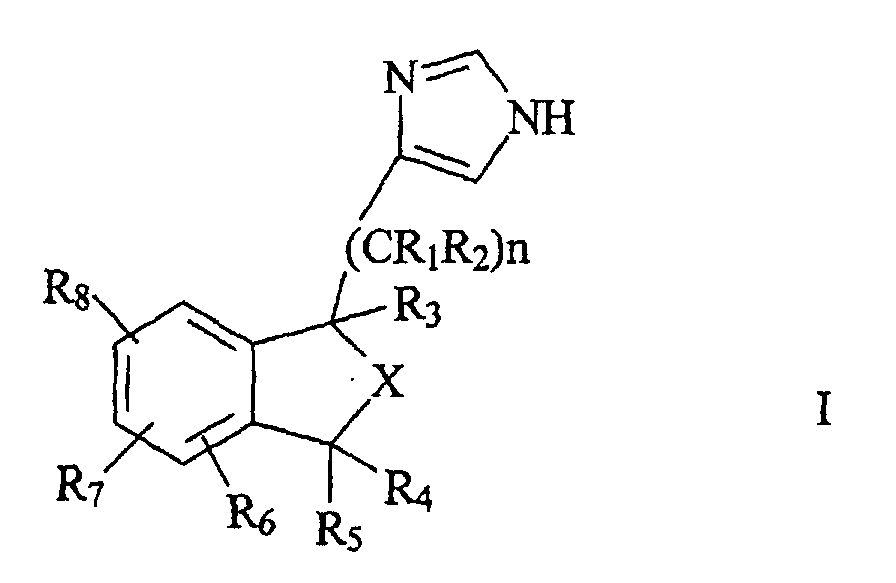
- n is 1
- R1 is hydrogen or C1-C4-alkyl
- R2 is hydrogen or R2 and R3 together form a double bond
- R3 is hydrogen or C1-C4-alkyl or R2 and R3 together form a double bond
- R4 is hydrogen, C1-C4-alkyl, hydroxy or C1-C4-alkoxy
- R5 is hydrogen or C1-C4-alkyl or R4 and R5 together with the carbon atom to which they are attached form a carbonyl group
- R6, R7 and R8 are each the same or different and are independently hydrogen, C1-C4-alkyl or C2-C4-alkenyl, C3-C7-cycloalkyl, hydroxy, C1-C4-alkoxy, C1-C4-hydroxyalkyl, thiol, C1-4-alkylthio, C1-4-alkylthiol, halogen, trifluoromethyl, nitro or optionally substituted amino
- X is -CHR10-(CHR11)m-
- m is 0 or 1
- and R9 and R10 are each the same or different and are independently hydrogen or C1-C4-alkyl; or a pharmaceutically acceptable ester or salt thereof.
-
- The terms as employed herein have the following meanings: A halogen is e.g. chlorine, bromine or fluorine, preferably it is chlorine or fluorine. The C1-C4-alkyl, C1-C4-alkoxy and C2-C4-alkenyl etc. groups may be branched or straight chain groups. C3-C7-Cycloalkyl is a saturated cyclic hydrocarbon group having preferably 3 to 5 carbon atoms. Optionally substituted amino is an amino group which is unsubstituted or substituted with a C1-C4-alkyl group.
-

- R1 is preferably hydrogen, methyl or ethyl.
- R2, R3 and R9 are preferably hydrogen.
- R4 and R5 are preferably hydrogen or methyl.
- R6 is preferably hydrogen, C1-C4-alkyl, such as methyl or t-butyl, hydroxy, C1-C4-alkoxy, such as methoxy or C1-C4-hydroxyalkyl, such as hydroxymethyl or halogen. For example, R6 may be a C1-C4-alkyl at position 4 or 5, such as 4-or 5-methyl or 4- or 5-t-butyl, 4-, 5-, 6- or 7-hydroxy, a C1-C4-alkoxy at position 5, 6 or 7 such as 5-, 6- or 7-methoxy or C1-C4-hydroxyalkyl at position 5 such as 5-hydroxymethyl. R6 may be halogen at position 5 or 6, such as 5-or 6-fluoro or 5- or 6-bromo.
- More preferably R6 is 4-, 5- or 6-hydroxy.
- R7 is preferably hydrogen, C1-C4-alkyl, hydroxy, C1-C4-alkoxy, C1-C4-hydroxyalkyl or halogen. For example, R7 may be C1-C4-alkyl at position 5, 6 or 7, such as 5- or 7-methyl or 5- or 6-t-butyl, 5- or 6-hydroxy, or C1-C4-alkoxy at position 6, such as 6-methoxy, C1-C4-hydroxyalkyl at position 6, such as 6-hydroxymethyl or halogen at position 5, such as 5-bromo.
- More preferably R7 is hydrogen, 6-t-butyl, 6-hydroxy or 6-hydroxymethyl.
- R8 is preferably hydrogen, C1-C4-alkyl, hydroxy, C1-C4-alkoxy or halogen, for example C1-C4-alkyl at position 7, such as 7-methyl or 7-t-butyl, 6- or 7-hydroxy or C1-C4-alkoxy at position 6, such as 6-methoxy or halogen at position 7 such as 7-bromo.
- Especially preferably R6 is hydroxy at the position 4 or 6 of the indane ring and R7 and R8 are hydrogen or R6 is hydroxy at the position 5 of the indane ring and R7 is hydroxy or C1-C4-alky or C1-C4-hydroxyalkyl at the position 6 of the indane ring, such as 6-t-butyl or 6-hydroxymethyl and R8 is hydrogen.
-
-

- R1, R2, R3, R5, R9 and R10 are preferably hydrogen.
- R4 is preferably hydrogen or C1-C4-alkyl, such as, for example, methyl.
- R6 is preferably at position 5, 6 or 7.
- R6 is preferably hydrogen, hydroxy, C1-C4-alkoxy, for example methoxy, or halogen. For example, R6 may be 5-, 6- or 7-methoxy, 6- or 7-hydroxy or halogen at position 6, such as 6-bromo.
- R7 is preferably at position 7.
- R7 is preferably hydrogen or C1-C4-alkyl, such as, for example, 7-t-butyl or 7-hydroxy.
- R8 is preferably at position 8.
- R8 is preferably hydrogen or halogen such as 8-bromo.
-
- The invention includes within its scope all the possible isomers and stereoisomers, in particular Z and E (cis and trans isomers) and enantiomers.
- The compounds of the formula (I) form acid addition salts with both organic and inorganic acids. Typical acid addition salts are chlorides, bromides, sulfates, nitrates, phosphates, sulfonates, formates, tartrates, maleates, citrates, benzoates, salicylates, ascorbates. Furthermore, compounds wherein one or more of R4 to R8 is a hydroxy group form esters and salts with alkali metals and alkaline earth metals. Typical esters include the lower alkyl esters, such as the methyl, ethyl and propyl esters.
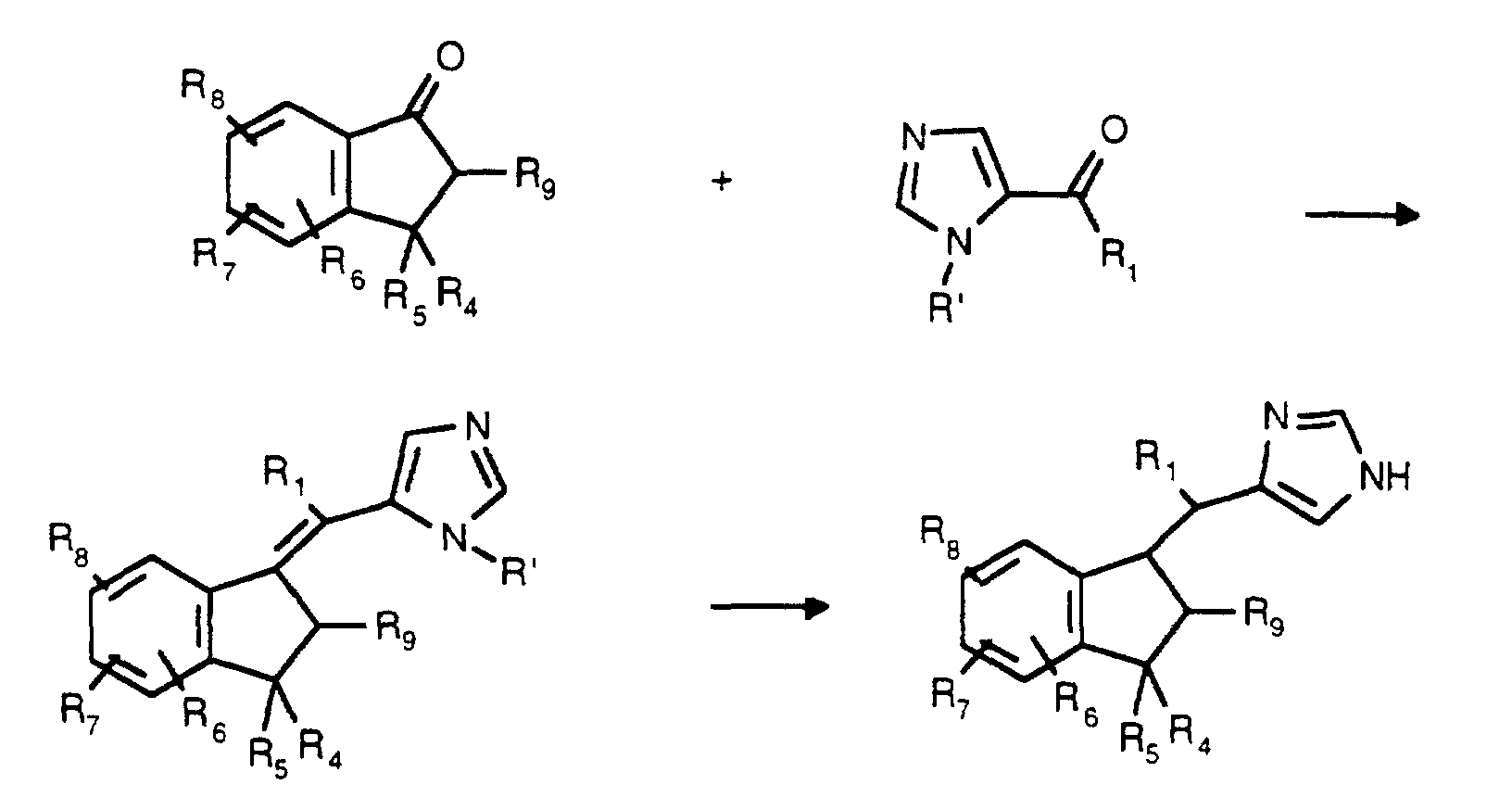
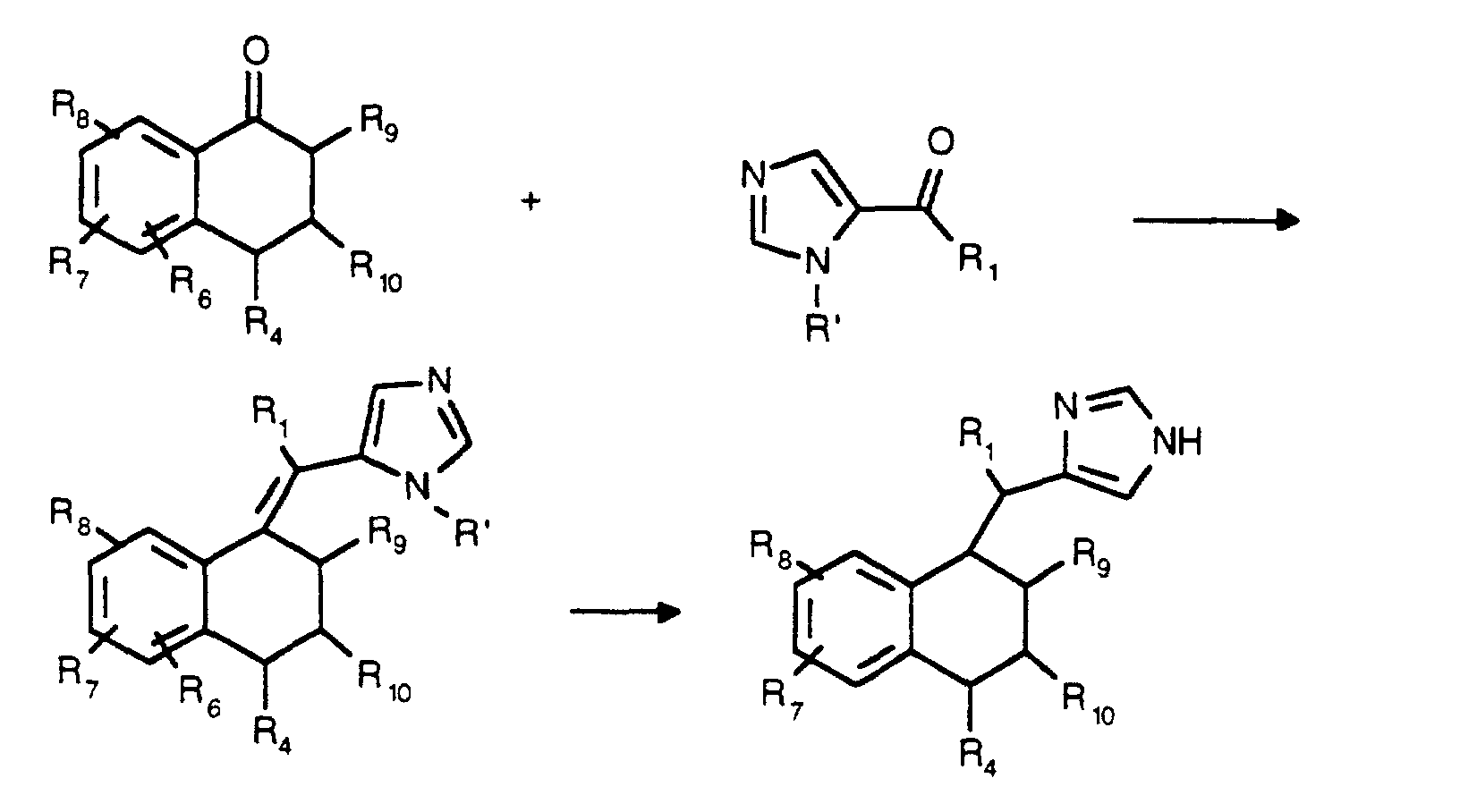
- The compounds of the invention may be prepared using the following methods. (It is to be noted that in the formulae below, when the imidazole group is protected, the protecting group R' (e.g. benzyl or trityl) may be attached to either of the two nitrogen atoms of the imidazole ring. Accordingly, the use of 1-benzyl-5-imidazolecarbaldehyde as starting material leads to 1.5 substituted derivatives whereas when trityl is used the substitution is mainly 1.4.)
- When R' is trityl it may be removed using an acid and, when it is benzyl, by catalytic hydrogenation.
- The preparation of 4(5)-(indan-1-ylmethyl and indan-1-ylmethylen)imidazole and the corresponding tetrahydronaphthyl skeleton may be accomplished using the so called McMurry reaction, in which an imidazole carbaldehyde or ketone reacts with an 1-indanone. The reaction is catalyzed by low valence titanium. The condensation may be followed by the hydrogenation of the double bond and simultaneous elimination of the protecting group in the imidazole ring.
- The compounds of the invention may be administered enterally, topically or parenterally. Parenteral administration is used, for example, when the compounds are given as sedative or anxiolytic agents in connection to different clinical operations and to cause analgesia or to potentiate anesthesia.
- The compounds of the invention may be formulated alone or together with another active ingredient and / or a pharmaceutically acceptable diluent or carrier to different pharmaceutical unit dosage forms i.e. tablets, capsules, solutions, emulsions and powders etc. using conventional techniques. The pharmaceutical carriers employed are selected with the planned manner of administration in mind. Thus, solid carriers may include lactose, sucrose, gelatin and agar, while liquid carriers typically include water, syrup, peanut oil and olive oil. The amount of the active ingredient varies from 0.01 to 75 weight-% depending on the type of the dosage form.
- The appropriate oral dosage for the compounds of the invention depends on several factors such as the compound to be administrated, the species, age and the sex of the subject to be treated, the condition to be treated and on the method of administration. Accordingly, the dosage for parenteral administration is typically from 0.5 µg/kg to 10 mg/kg per day and that for oral administration is from 5 µg/kg to 100 mg/kg for an adult male.
- The invention also provides a compound of the invention or an ester or salt thereof for use in a method of treatment of human or animal body.
- The present invention further provides a compound of the invention or an ester or salt thereof for use in the treatment of hypertension, glaucoma, chronic and acute pain, migraine, diarrhea, common cold, ischemia, addiction to chemical substances, anxiety, especially preoperative anxiety and different neurological, musculoskeletal, psychiatric and cognition disorders or as an adjunct to anesthesia.
- The invention also provides the use of a compound of the invention or an ester or salt thereof in the manufacture of a medicament for the treatment of hypertension, glaucoma, chronic and acute pain, migraine, diarrhea, common cold, ischemia, addiction to chemical substances, anxiety, especially preoperative anxiety and different neurological, musculoskeletal, psychiatric and cognition disorders or as an adjunct to anesthesia.
- The invention further relates to a method for the treatment of hypertension, glaucoma, chronic and acute pain, migraine, diarrhea, common cold, ischemia, addiction to chemical substances, anxiety, especially preoperative anxiety and different neurological, musculoskeletal, psychiatric and cognition disorders by administering to a subject in need of such treatment an effective amount of the compound of the invention or a pharmaceutically acceptable ester or salt thereof.
- Alpha2 agonism was determined by means of isolated, electrically stimulated prostatic portions of rat vas deferens preparation (Virtanen et al. Arch. Int. Pharmacodyn et Ther. 297 (1989), pp. 190-204). In this model, an alpha2 agonist is able to inhibit electrically induced muscular contractions by activating the presynaptic alpha2 adrenoceptors and thus diminishing the secretion on the motor transmitter. The known alpha2 agonist dexmedetomidine was used as reference substance. Results are shown in Table 1, where the alpha2 agonist effect is presented as the pD2-value (negative logarithm of the molar concentration of the compound producing 50 percent of maximal inhibition).
- The following compounds were tested:
- 1 4-(4-Methylindan-1-yl)-1H-imidazole hydrochloride (reference compound)
- 2 3-(1H-lmidazol-4-ylmethyl)-indan-5-ol hydrochloride
- 3 4-[1-(lndan-1-yl)-ethyl]-1H-imidazole hydrochloride
- 4 8-(1 H-lmidazol-4-ylmethyl)-5,6,7,8-tetrahydronaphthalen-2-ol hydrochloride
- 5 dexmedetomidine (reference compound)
Alpha2 agonism in vitro Compound pD2-value 1 8.1+-0.2 2 8.5+-0.1 3 8.9+-0.3 4 7.0+-0.1 5 8.4+-0.1 -
- Affinities for α2- adrenoceptors and α1-adrenoceptors were estimated by determining the displacement of 1 nM 3H-RX821002 (α2) or 0.1 nM 3H-prazosin (α1) from α-adrenoceptors in rat neocortical membranes. For this purpose membranes were incubated with different concentrations of test compounds spanning a concentration range of five orders of magnitude. Nonspecific binding was defined with 10 µM phentolamine. Membranes were used at a protein concentration of 2 mg/ml in a total volume of 250 µl. The incubation buffer consisted of 50 mM TRIS-HCl, pH 7.7. After a 30 min incubation at 25 °C samples were filtered through glass fibre filter and filters were washed three times with 4 ml icecold wash buffer consisting of 10 mM TRIS-HCl, pH 7.7. Filters were then dried, impregnated with a scintillation cocktail and counted in a scintillation counter. Experimental data was analyzed using the commercial nonlinear least squares computer program LIGAND.
- Each compound was tested in at least three independent experiments for its affinity on rat neocortical α2- or α1-adrenoceptors. The results are shown in Table 2.
Affinity on rat neocortical α2- or α1-adrenoceptors Compound pKi α2 pKi α1 alpha2 vs alpha1 selectivity 1 8.44 7.31 14 2 8.70 6.61 126 3 8.35 6.21 142 4 7.39 6.85 3 5 8.42 6.48 90 - The following examples illustrate how compounds of the invention may be prepared.
- A solution of 4-tert-butylbenzaldehyde (5.7 g), 1-(3-benzyl-3H-imidazol-4-yl)-ethanone (7.0 g) and 48 % sodium hydroxide (2.0 ml) in methanol (60 ml) is heated at 60-65 °C for 11 hours. The reaction mixture is then cooled in an ice bath. The resulting precipitate is filtered and the solid intermediate 1-(3-benzyl-3H-imidazol-4-yl)-3-(4-tert-butylphenyl)-propen-1-one is rinsed with methanol. The yield is 10.0 g.
- The intermediate is dissolved in the mixture of ethanol (170 ml) and concentrated hydrochloric acid (3 ml). The reaction mixture is hydrogenated at 50-60 °C with 10 % palladium on carbon as catalyst until no more hydrogen is consumed. The mixture is filtered and the filtrate is evaporated to dryness. The residue is dissolved in water and is made alkaline with sodium hydroxide. The product is then extracted into methylene chloride which is washed with water, dried with sodium sulfate and evaporated to dryness. The product is converted to its hydrochloride salt in ethyl acetate using dry hydrochloric acid. The yield is 6.8 g.
1H NMR (as HCl-salt, MeOH-d4): 1.29 (s, 9H), 2.06-2.13 (m, 2H), 2.62-2.78 (m, 2H), 4.77 (t, 1H), 7.13 (m, 2H), 7.30 (m, 2H), 7.40 (s, 1H), 8.79 (s, 1H) - A mixture of 3-(4-tert-butylphenyl)-1-(1H-imidazol-4-yl)-propan-1-ol (2.0 g) and methanesulfonic acid (30 ml) is heated at 60 °C for 5 minutes. The reaction is then quenched by pouring it into ice-water solution. The acidic solution is made basic with ammmonium hydroxide solution, and extracted with ethyl acetate. The combined organic layers are washed with water, dried with sodium sulfate, and evaporated to dryness under reduced pressure. The crude product is purified by flash chromatography by eluting with methylene chloride -methanol as eluent. The product is crystallized from ethyl acetate. The yield is 220 mg.
1H NMR (MeOH-d4): 1.24 (s, 9H), 2.07-2.20 (m, 1H), 2.43-2.54 (m, 1H), 2.81-3.01 (m, 2H), 4.35 (t, 1H), 6.74 (s, 1H), 7.09 (s, 1H), 7.14-7.21 (m, 2H), 7.60 (s, 1H) - Using the same method the following compound was prepared:
- 4-(4-Methylindan-1-yl)-1H-imidazole. M.p. of hydrochmoride 153-156 °C 1H NMR (as HCl-salt, MeOH-d4): 2.08-2.20 (m, 1H), 2.30 (s, 3H), 2.58-2.69 (m, 1H), 2.87-3.10 (m, 2H), 4.59 (t, 1H), 6.89 (d, J=7.0 Hz, 1H), 7.05-7.13 (m, 2H), 7.30 (s, 1H), 8.83 (s, 1H)
-
- Titanium tetrachloride (17.2 g) is added dropwise to a stirred suspension of zinc powder (11.9 g) in tetrahydrofuran (100 ml) with ice cooling under a nitrogen atmosphere. The mixture is heated at reflux for one hour. After being cooled to room temperature, 1-indanone (2.0 g) and 3-benzyl-3H-imidazole-4-carbaldehyde (4.2 g) in tetrahydrofuran (30 ml) are added into the mixture. The mixture is refluxed with stirring for 3 hours. The cooled reaction mixture is made alkaline with dilute sodium hydroxide solution. The slurry is filtered, and the filtratate is evaporated to dryness under reduced pressure. The residue, which contains the crude intermediate 1-benzyl-5-(indan-1-ylidenemethyl)-1 H-imidazole is purified by flash chromatography.
- The purified intermediate (0.8 g) is dissolved in the mixture of ethanol (30 ml), water (2 ml) and concentrated hydrochloric acid (0.5 ml). The reaction mixture is hydrogenated at 50-60 °C with 10 % palladium on carbon as catalyst until no more hydrogen is consumed. The mixture is filtered, and the filtrate is evaporated to dryness. The residue is dissolved in water and is made alkaline with sodium hydroxide. The product is then extracted into methylene chloride which is washed with water, dried with sodium sulfate and evaporated to dryness. The product is converted to its hydrochloride salt in ethyl acetate using dry hydrochloric acid. The yield is 0.5 g, m.p. 182-183 °C.
1H NMR (as HCl-salt, MeOH-d4): 1.74-1.81 (m, 1H), 2.22-2.29 (m, 1H), 2.80-2.95 (m, 3H), 3.17 (dd, J=15.1 Hz, J=5.7 Hz, 1H), 3.48-3.53 (m, 1H), 7.12-7.23 (m, 4H), 7.26 (s, 1H), 8.79 (s, 1H). - Using the same method the following compounds were prepared:
- 4-(6-Methoxyindan-1-ylmethyl)-1H-imidazole. M.p. of hydrochloride 197-200
°C.
1H NMR (as HCI-salt, MeOH-d4): 1.72-1.84 (m, 1H), 2.19-2.31 (m, 1H), 2.70-2.89 (m, 3H), 3.16 (dd, J=14.9 Hz, J=5.5 Hz, 1H), 3.42-3.51 (m, 1H), 3.74 (s, 3H), 6.68 (d, J=2.2 Hz, 1H), 6.74 (dd, J=8.2 Hz, J=2.2Hz, 1H), 7.10 (d, J=8.2 Hz, 1H), 7.27 (s, 1H), 8.82 (s, 1H) - 4-(5-Methoxyindan-1-ylmethyl)-1H-imidazole. M.p. of hydrochloride 204-206
°C.
1H NMR (as HCI-salt, MeOH-d4): 1.71-1.83 (m, 1H), 2.19-2.31 (m, 1H), 2.75-2.94 (m, 3H), 3.13 (dd, J=15.0 Hz, J= 5.5Hz, 1H), 3.40-3.49 (m, 1H), 3.75 (s, 3H), 6.70 (dd, J=8.3 Hz, J=2.2 Hz, 1H), 6.78 (d, J =2.2 Hz, 1H), 7.00 (d, J=8.3 Hz, 1H), 7.26 (s, 1H), 8.82 (s, 1H) - 4-(5,6-Dimethoxyindan-1-ylmethyl)-1H-imidazole. M.p. of hydrochloride 193-197
°C.
1H NMR (as HCI-salt, MeOH-d4): 1.72-1.84 (m, 1H), 2.20-2.32 (m, 1H), 2.75-2.88 (m, 3H), 3.15 (dd, J=15.1 Hz, J=5.2 Hz, 1H), 3.41-3.50 (m, 1H), 3.77 (s, 3H), 3.79 (s, 3H), 6.73 (s, 1H), 6.84 (s, 1H), 7.26 (s, 1H), 8.82 (s, 1H) - 4-(6-Methoxy-4,5-dimethylindan-1-ylmethyl)-1H-imidazole. M.p. of
hydrochloride 194-197 °C.
1H NMR (as HCI-salt, MeOH-d4): 1.70-1.81 (m, 1H), 2.09 (s, 3H), 2.15 (s, 3H), 2.17-2.29 (m, 1H), 2.69-2.89 (m, 3H), 3.14 (dd, J=15.1 Hz, J=5.7 Hz, 1H), 3.42-3.50 (m, 1H), 3.74 (s, 3H), 6.54 (s, 1H), 7.24 (s, 1H), 8.81 (s, 1H) - 4-(6-Methoxy-4,7-dimethylindan-1-ylmethyl)-1H-imidazole. M.p. of
hydrochloride 168-175 °C.
1H NMR (as HCI-salt, MeOH-d4): 1.88-1.94 (m, 1H), 2.07 (s, 3H), 2.09-2.18 (m, 1H), 2.19 (s, 3H), 2.69-2.77 (m, 3H), 2.90 (dd, J=15.2 Hz, J=4.7 Hz, 1H), 3.51-3.57 (m, 1H), 3.77 (s, 3H), 6.60 (s, 1H), 7.21 (s, 1H), 8.80 (s, 1H) - 4-(6-Methoxy-5-methylindan-1-ylmethyl)-1H-imidazole. M.p. of hydrochloride
183-186 °C.
1H NMR (as HCl-salt, MeOH-d4): 1.71-1.82 (m, 1H), 2.13 (s, 3H), 2.18-2.29 (m, 1H), 2.70-2.89 (m, 3H), 3.16 (dd, J=15.0 Hz, J=5.4 Hz, 1H), 3.42-3.50 (m, 1H), 3.76 (s, 3H), 6.65 (s, 1H), 6.95 (s, 1H), 7.26 (s, 1H), 8.82 (s, 1H) - 4-(6-Fluoroindan-1-ylmethyl)-1H-imidazole. M.p. of hydrochloride 215-222 °C. 1H NMR (as HCI-salt, MeOH-d4): 1.76-1.88 (m, 1H), 2.23-2.35 (m, 1H), 2.76-2.92 (m, 3H), 3.18 (dd, J=15.3 Hz, J=5.3 Hz, 1H), 3.46-3.56 (m, 1H), 6.86-6.92 (m, 2H), 7.17-7.20 (m, 1H), 7.31 (s, 1H), 8.83 (s, 1H)
- 4-(5-Fluoroindan-1-ylmethy)-1H-imidazole. M.p. of hydrochloride 185-189 °C. 1H NMR (as HCI-salt, MeOH-d4): 1.76-1.88 (m, 1H), 2.23-2.35 (m, 1H), 2.79-2.98 (m, 3H), 3.16 (dd, J=15.3 Hz, J=5.3 Hz, 1H), 3.43-3.53 (m, 1H), 6.83-6.96 (m, 2H), 7.08-7.13 (m, 1H), 7.29 (s, 1H), 8.82 (s, 1H)
- 4-(4-Methoxyindan-1-ylmethyl)-1H-imidazole. M.p. of hydrochloride 202-210
°C.
1H-NMR (as HCI-salt, MeOH-d4): 1.73-1.82 (m, 1H), 2.18-2.30 (m, 1H), 2.72-2.89 (m, 3H), 3.14 (dd, J=15.0 Hz, J=5.5 Hz, 1H), 3.48-3.56 (m, 1H), 3.80 (s, 3H), 6.72-6.78 (m, 2H), 7.14 (t, 1H), 7.24 (s, 1H), 8.79 (s, 1H) - 4-(6-Methoxy-7-methylindan-1-ylmethyl)-1H-imidazole. M.p. of hydrochloride
152-158 °C.
1H NMR (as HCI-salt, MeOH-d4): 1.86-1.93 (m, 1H), 2.11 (s, 3H), 2.12-2.20 (m, 1H), 2.68-2.96 (m, 4H), 3.52-3.59 (m, 1H), 3.79 (s, 3H), 6.75 (d, J=8.2 Hz, 1H), 6.99 (d, J=8.2 Hz, 1H), 7.22 (s, 1H), 8.79 (s, 1H) - 4-(7-Methoxyindan-1-ylmethyl)-1 H-imidazole
1H NMR (as HCI-salt, MeOH-d4): 1.82-1.90 (m, 1H), 2.09-2.19 (m, 1H), 2.72-2.91 (m, 3H), 3.14 (dd, J=14.9 Hz, J=4.8 Hz, 1H), 3.59-3.74 (m, 1H), 3.76 (s, 3H), 6.72-6.80 (m, 2H), 6.96 (s, 1H), 7.13 (t, 1H), 8.38 (s, 1H) - 4-(5,6-Dimethoxy-3,3-dimethylindan-1 -ylmethyl)-1H-imidazole
1H NMR (CDCl3): 1.12 (s, 3H), 1.28 (s, 3H), 1.63 (dd, J=12.5 Hz, J=8.3 Hz, 1H), 2.09 (dd, J=12.5 Hz, J=7.5 Hz, 1H), 2.72 (dd, J=14.6 Hz, J=9.0 Hz, 1H), 3.16 (dd, J=14.6 Hz, J=5.5 Hz, 1H), 3.47-3.52 (m, 1H), 3.78 (s, 3H), 3.86 (s, 3H), 6.61 (s, 1H), 6.66 (s, 1H), 6.82 (s, 1H), 7.58 (s, 1H) - 4-(5-tert-Butylindan-1-ylmethyl)-1H-imidazole
1H NMR (CDCl3): 1.32 (s, 9H), 1.71-1.83 (m, 1H), 2.19-2.30 (m, 1H), 2.73-2.87 (m, 3H), 3.08 (dd, J=14.7 Hz, J=5.6 Hz, 1H), 3.44-3.53 (m, 1H), 6.81 (s, 1H), 7.09 (d, J=7.8 Hz, 1H), 7.20 (dd, J=7.8 Hz, J=1.5 Hz, 1H), 7.26 (d, J=1.5 Hz, 1H), 7.55 (s, 1H) - 4-(6-Methoxy-3,3-dimethylindan-1-ylmethyl)-1 H-imidazole
1H NMR (CDCl3): 1.11 (s, 3H), 1.27 (s, 3H), 1.63 (dd, J=12.5 Hz, J=8.9 Hz, 1H), 2.06 (dd, J=12.5 Hz, J=7.5 Hz, 1H), 2.72 (dd, J=14.7 Hz, J=9.0 Hz, 1H), 3.19 (dd, J=14.7 Hz, J=5.4 Hz, 1H), 3.47-3.55 (m, 1H), 3.74 (s, 3H), 6.67 (d, J=2.2 Hz, 1H), 6.74 (dd, J=8.2 Hz, J=2.2 Hz, 1H), 6.83 (s, 1H), 7.03 (d, J=8.2 Hz, 1H), 7.58 (s, 1H) -
- The procedure of Example 2 is repeated except that 1-(3-benzyl-3H-imidazol-4-yl)-ethanone is used in place of 3-benzyl-3H-imidazole-4-carbaldehyde. The product contains two diastereomers ad and bc ( 78 % of ad and 22 % of bc).
1H NMR (as HCl-salt, MeOH-d4): 1.23 (d, J=7.1 Hz, -CH3, bc diastereomer), 1.38 (d, J=7.1 Hz, -CH3, ad diastereomer), 1.81-2.32 (m, 2H), 2.70-2.87 (m, 2H), 3.29-3.39 (m, 1H), 3.47-3.57 (m, 1H), 6.98-7.30 (m, 5H), 8.77 (s, 1H, ad diastereomer), 8.84 (s, 1H, bc diastereomer) - Using the same method the following substituted derivative was prepared:
- The reaction mixture contains two diastereomers ad and bc, which are separated by flash chromatography eluting with methylene chloride-methanol solution.
1H NMR (ad diastereomer as HCl-salt, MeOH-d4): 1.37 (d, J=7.1 Hz, 3H), 1.83-1.94 (m, 1H), 2.20-2.33 (m, 1H), 2.58-2.77 (m, 2H), 3.30-3.39 (m, 1H), 3.43-3.49 (m, 1H), 3.74 (s, 3H), 6.63 (d, J=2.4 Hz, 1H), 6.73 (dd, J=8.2 Hz, J=2.4 Hz, 1H), 7.05 (d, J=8.2 Hz, 1H), 7.13 (s, 1H), 8.74 (s, 1H)
1H NMR (bc diastereomer as HCl-salt, MeOH-d4): 1.23 (d, J=7.1 Hz, 3H), 1.90-2.01 (m, 1H), 2.05-2.16 (m, 1H), 2.70-81 (m, 2H), 3.29-3.39 (m, 1H), 3.43-3.54 (m, 1H), 3.72 (s, 3H), 6.54 (d, J=2.4 Hz, 1H), 6.73 (dd, J=8.2 Hz, J=2.4 Hz, 1H), 7.11 (d, J=8.2 Hz, 1H), 7.32 (s, 1H), 8.84 (s, 1H) - Sulfuric acid (0.5 ml) is added into the mixture of 4-(6-methoxyindan-1-ylmethyl)-1 H-imidazole hydrochloride (50 mg) and tert-butanol (2 ml). The mixture is stirred at 35-40 °C for 10 hours. The reaction mixture is then poured into water and is made alkaline with sodium hydroxide. The product is extracted into methylene chloride which is washed with water, dried with sodium sulfate and evaporated to dryness. The residue consisting of crude product is converted to its hydrochloride salt in ethyl acetate. The yield is 23 mg, m.p. 174-184 °C.
1H NMR (as HCI-salt, MeOH-d4): 1.33 (s, 9H), 1.71-1.83 (m, 1H), 2.19-2.31 (m, 1H), 2.73-2.89 (m, 3H), 3.15 (dd, J=15.0 Hz, J=5.1 Hz, 1H), 3.40-3.50 (m. 1H), 3.77 (s, 3H), 6.69 (s, 1H), 7.11 (s, 1H), 7.27 (s, 1H), 8.81 (s, 1H) - Using the same method the following compound was prepared:
- 4-(6-tert-Butyl-5-methoxyindan-1-ylmethyl)-1H-imidazole
1H NMR (as HCI-salt, MeOH-d4): 1.30 (s, 9H), 1.73-1.84 (m, 1H), 2.21-2.33 (m, 1H), 2.75-2.94 (m, 3H), 3.05 (dd, J=14.9 Hz, J=6.3 Hz, 1H), 3.35-3.45 (m, 1H), 3.80 (s, 3H), 6.83 (s, 1H), 6.86 (s, 1H), 7.23 (s, 1H), 8.81 (s, 1H) - 5,7-Di-tert-butyl-1-(1H-imidazol-4-ylmethyl)-indan-4-ol
1H NMR (as HCl-salt, MeOH-d4): 1.39 (s, 9H), 1.41 (s, 9H), 1.87-1.93 (m, 1H), 2.01-2.06 (m, 1H), 2.66-2.75 (m, 3H), 2.89-2.95 (m, 1H), 3.82-3.89 (m, 1H), 7.15 (s, 1H), 7.33 (s, 1H), 8.77 (s, 1H) - 6-tert-Butyl-1-(1H-imidazol-4-yl)-indan-5-ol
1H NMR (as HCl-salt, MeOH-d4): 1.32 (s, 9H), 2.06-2.15 (m, 1H), 2.52-2.63 (m, 1H), 2.82-3.02 (m, 2H), 4.46 (t, 1H), 6.69 (s, 1H), 6.88 (s, 1H), 7.25 (s, 1H), 8.79 (s, 1H) - 4-(6-tert-Butyl-4-methylindan-1-yl)-1H-imidazole. M.p. of hydrochloride 235-242°C.
1H NMR (as HCL-salt, MeOH-d4): 1.25 (s, 9H), 2.09-2.19 (m, 1H), 2.57-2.67 (m, 1H), 2.84-3.07 (m, 2H), 4.55 (t, 1H), 6.91 (s, 1H), 7.12 (s, 1H), 7.25 (s, 1H), 8.74 (s, 1H) - 5,7-Di-tert-Butyl-3-(1H-imidazol-4-yl)-indan-4-ol. M.p. of hydrochloride 216-222°C.
1H NMR (as HCl-salt, MeOH-d4): 1.35 (s, 9H), 1.39 (s, 9H), 2.11-2.18 (m, 1H), 2.44-2.52 (m, 1H), 3.06-3.16 (m, 2H), 4.59-4.63 (m, 1H), 6.78 (s, 1H), 7.23 (s, 1H), 8.75 (s, 1H) -
- A stirred mixture of 4-(6-methoxyindan-1-ylmethyl)-1H-imidazole hydrochloride (140 mg) and 48 % hydrobromic acid (7 ml) is heated under reflux for 45 minutes. The cooled reaction mixture is poured into water and is made basic with ammonium hydroxide solution. The product is extracted into ethyl acetate which is washed with water, dried with sodium sulfate and evaporated to dryness. The crude product is coverted to its hydrochloride salt in ethyl acetate. M.p. 206-208 °C.
1H NMR (as HCl-salt, MeOH-d4): 1.70-1.81 (m, 1H), 2.18-2.29 (m, 1H), 2.70-2.88 (m, 3H), 3.12 (dd, J=15.3 Hz, J=5.8 Hz, 1H), 3.38-3.46 (m, 1H), 6.53 (d, J =2.2 Hz, 1H), 6.60 (dd, J=8.1 Hz, J=2.2 Hz, 1H), 7.01 (d, J=8.1 Hz, 1H), 7.27 (s, 1H), 8.81 (s, 1H) - Using the same method the following compounds were prepared:
- 1-(1H-lmidazol-4-ylmethyl)-indan-5-ol. M.p. of hydrochloride 159-161 °C.
1H NMR (as HCl-salt, MeOH-d4): 1.69-1.80 (m, 1H), 2.17-2.29 (m, 1H), 2.71-2.89 (m, 3H), 3.11 (dd, J=14.8 Hz, J=5.7 Hz, 1H), 3.35-3.45 (m, 1H), 6.57 (dd, J=8.1 Hz, J=2.2 Hz, 1H), 6.64 (d, J=2.2 Hz, 1H), 6.89 (d, J=8.1 Hz, 1H), 7.24 (s, 1H), 8.79 (s, 1H) - 1-(1 H-lmidazol-4-ylmethyl)-indan-5,6-diol
1H NMR (as HCI-salt, MeOH-d4): 1.67-1.78 (m, 1H), 2.15-2.27 (m, 1H), 2.65-2.85 (m, 3H), 3.05 (dd, J=15.1 Hz, J=5.8 Hz, 1H), 3.30-3.40 (m, 1H), 6.51 (s, 1H), 6.63 (s, 1H), 7.24 (s, 1H), 8.80 (s, 1H) - 6-tert-Butyl-3-(1H-imidazol-4-ylmethyl)-indan-5-ol
1H NMR (as HCI-salt, MeOH-d4): 1.35 (s, 9H), 1.69-1.79 (m, 1H), 2.18-2.28 (m, 1H), 2.69-2.86 (m, 3H), 3.08 (dd, J=15.0 Hz, J=6.0 Hz, 1H), 3.35-3.43 (m, 1H), 6.46 (s, 1H), 7.04 (s, 1H), 7.26 (s, 1H), 8.81 (s, 1H) - 6-tert-Butyl-1-(1H-imidazol-4-ylmethyl)-indan-5-ol. M.p. of hydrochloride 229-230
°C.
1H NMR (as HCI-salt, MeOH-d4): 1.32 (s, 9H), 1.72-1.81 (m, 1H), 2.18-2.29 (m, 1H), 2.72-2.87 (m, 3H), 3.03 (dd, J=15.1 Hz, J=6.5 Hz, 1H), 3.32-3.40 (m, 1H), 6.59 (s, 1H), 6.79 (s, 1H), 7.23 (s, 1H), 8.81 (s, 1H) - 3-(1H-Imidazol-4-ylmethyl)-6,7-dimethylindan-5-ol. M.p. of hydrochloride 229-238
°C.
1H NMR (as HCI-salt, MeOH-d4): 1.66-1.78 (m, 1H), 2.08 (s, 3H), 2.13 (s, 3H), 2.14-2.26 (m, 1H), 2.66-2.85 (m, 3H), 3.06 (dd, J=15.1 Hz, J=5.8 Hz, 1H), 3.35-3.43 (m, 1H), 6.39 (s, 1H), 7.22 (s, 1H), 8.79 (s, 1H) - 3-(1H-lmidazol-4-ylmethyl)-4,7-dimethylindan-5-ol
1H NMR (as HCl-salt, MeOH-d4): 1.85-1.93 (m, 1H), 2.07 (s, 3H), 2.11 (s, 3H), 2.11-2.20 (m, 1H), 2.65-2.77 (m, 3H), 2.90 (dd, J=15.1 Hz, J=4.6 Hz, 1H), 3.49-3.57 (m, 1H), 6.47 (s, 1H), 7.19 (s, 1H), 8.79 (s, 1H) - 3-[1-(1H-Imidazol-4-yl)-ethyl]-indan-5-ol (mixture of two diastereomers ad and
bc)
1H NMR (base, CDCl3+MeOH-d4): 1.12 (d, J=7.0 Hz, -CH3, ad diastereomer), 1.22 (d, J=7.1 Hz, -CH3, bc diastereomer) - 3-(1H-Imidazol-4-ylmethyl)-6-methylindan-5-ol
1H NMR (as HCl-salt, MeOH-d4): 1.68-1.79 (m, 1H), 2.13 (s, 3H), 2.15-2.27 (m, 1H), 2.68-2.86 (m, 3H), 3.08 (dd, J=15.3 Hz, J=5.8 Hz, 1H), 3.36-3.43 (m, 1H), 6.49 (s, 1H), 6.90 (s, 1H), 7.25 (s, 1H), 8.81 (s, 1H) - 1-(1H-Imidazol-4-ylmethyl)-indan-4-ol. M.p. 199-205 °C.
1H NMR (MeOH-d4): 1.68-1.80 (m, 1H), 2.10-2.22 (m, 1H), 2.60-2.86 (m, 3H), 3.00 (dd, J=14.6 Hz, J=5.3 Hz, 1H), 3.38-3.48 (m, 1H), 6.56 (d, J=7.8 Hz, 1H), 6.62 (d, J=7.8 Hz, 1H), 6.71 (s, 1H), 6.94 (t, J=7.8 Hz, 1H), 7.56 (s, 1H) - 3-(1H-Imidazol-4-ylmethyl)indan-4-ol
1H NMR (as HCl-salt, MeOH-d4): 1.78-1.87 (m, 1H), 2.12-2.22 (m, 1H), 2.78-2.92 (m, 3H), 3.24 (dd, J=15.3 Hz, J=5.3 Hz, 1H), 3.59-3.65 (m, 1H), 6.56 (d, J=7.7 Hz, 1H), 6.68 (d, J=7.7 Hz, 1H), 6.99 (t, J=7.7Hz, 1H), 7.15 (s, 1H), 8.75 (s, 1H) - 3-(1H-Imidazol-4-ylmethyl)-1,1-dimethylindan-5,6-diol
1H NMR (MeOH-d4): 1.09 (s, 3H), 1.24 (s, 3H), 1.54 (dd, J=12.4 Hz, J=8.5 Hz, 1H), 1.98 (dd, J=12.4 Hz, J=7.4 Hz, 1H), 2.60 (dd, J=14.5 Hz, J=9.0 Hz, 1H), 3.07 (dd, J=14.5 Hz, J=5.5 Hz, 1H), 3.36-3.41 (m, 1H), 6.54 (s, 2H), 6.79 (s, 1H), 7.65 (s, 1H) - 3-(1H-Imidazol-4-ylmethyl)-1,1-dimethylindan-5-ol
1H NMR (as HCl-salt, MeOH-d4): 1.14 (s, 3H), 1.29 (s, 3H), 1.59 (dd, J=12.5 Hz, J=8.8 Hz, 1H), 2.06 (dd, J=12.5 Hz, J=7.5 Hz, 1H), 2.80 (dd, J=15.1 Hz, J=9.3 Hz, 1H), 3.27 (dd, J=15.1 Hz, J=5.2 Hz, 1H), 3.45-3.55 (m, 1H), 6.56 (d, J=2.0 Hz, 1H), 6.65 (dd, J=8.1 Hz, J=2.0 Hz, 1H), 6.96 (d, J=8.1 Hz, 1H), 7.32 (s, 1H), 8.83 (s, 1H) -
- The procedure of Example 2 is repeated except that 1-tetralone is used in place of 1-indanone. The melting point of the hydrochloride salt is 185-188 °C.
1H NMR (as HCl-salt, MeOH-d4): 1.59-1.93 (m, 4H), 2.70-2.80 (m, 2H), 2.96 (dd, J=14.8 Hz, J=9.5 Hz, 1H), 3.08-3.22 (m, 2H), 7.08-7.14 (m, 4H), 7.25 (s, 1H), 8.81 (s, 1H) - Using the same method the following compounds were prepared:
- 4-(5-Methoxy-1,2,3,4-tetrahydronaphthalen-1-ylmethyl)-1H-imidazole. M.p. of
hydrochloride 210-218 °C.
1H NMR (as HCl-salt, MeOH-d4): 1.58-1.64 (m, 1H), 1.71-1.86 (m, 3H), 2.50-2.60 (m, 1H), 2.66-2.74 (m, 1H), 2.96 (dd, J=14.8 Hz, J=9.5 Hz, 1H), 3.05-3.18 (m, 2H), 3.79 (s, 3H), 6.73-6.77 (m, 2H), 7.09 (t, 1H), 7.25(s, 1H), 8.81 (s, 1H) - 4-(6-Methoxy-1,2,3,4-tetrahydronaphthalen-1-ylmethyl)-1H-imidazole M.p. of
hydrochloride 184-191 °C.
1H NMR (as HCl-salt, MeOH-d4): 1.58-1.88 (m, 4H), 2.70-2.76 (m,2H), 2.93 (dd, J=14.5 Hz, J=9.2 Hz, 1H), 3.04-3.32 (m, 2H), 3.74 (s, 3H), 6.63 (d, J=2.5 Hz, 1H), 6.69 (dd, 8.4 Hz, J=2.5 Hz, 1H), 7.03 (d, J=8.4 Hz, 1H), 7.24 (s, 1H), 8.81 (s, 1H) - 4-(7-Methoxy-1,2,3,4-tetrahydronaphthlalen-1-ylmethyl)-1H-imidazole. M.p. of
hydrochloride 180-183 °C.
1H NMR (as base, CDCl3): 1.59-1.82 (m, 4H), 2.64-2.68 (m, 2H), 2.85 (dd, J=14.6 Hz, J=9.3 Hz, 1H), 3.01 (dd, J=14.6 Hz, J=4.8 Hz, 1H), 3.12-3.17 (m, 1H), 3.72 (s, 3H), 6.68-6.71 (m, 2H), 6.78 (s, 1H), 6.97-7.00 (m, 1H), 7.56 (s, 1H) - 4-(4-Methyl-1,2,3,4-tetrahydronaphthalen-1-ylmethyl)-1H-imidazole
The product is the mixture of two isomers ad and bc (85 % ad and 15 % bc).
1H NMR (as HCl-salt, MeOH-d4): 1.25 (d, J=7.0 Hz, -CH3, bc isomer), 1.30 (d, J=7.0 Hz, -CH3, ad isomer), 1.50-2.10 (m, 4H), 2.80-3.04 (m, 2H), 3.10-3.20 (m, 2H), 7.10-7.26 (m, 5H), 8.83 (s, 1H) -
- Sulfuric acid (0.75 ml) is added into the mixture of 4-(6-methoxy-1,2,3,4-tetrahydronaphthalen-1-ylmethyl)-1H-imidazole hydrochloride (75 mg) and tert-butanol (3 ml). The mixture is stirred at 35-40 °C for 15 hours. The reaction mixture is poured into water and is made alkaline with sodium hydroxide. The product is extracted into methylene chloride which is washed with water, dried with sodium sulfate and evaporated to dryness. The residue consisting of crude product is coverted to its hydrochloride salt in ethyl acetate. The yield is 40 mg.
1H NMR (as HCI-salt, MeOH-d4): 1.28 (s, 9H), 1.65-1.95 (m, 4H), 2.70-2.80 (m, 2H), 2.87-3.10 (m, 3H), 3.78 (s, 3H), 6.63 (s, 1H), 6.79 (s, 1H), 7.22 (s, 1H), 8.81 (s, 1H) - A stirred mixture of 4-(6-methoxy-1,2,3.4-tetrahydronaphthalen-1-ylmethyl)-1H-imidazole (220 mg) and 48 % hydrobromic acid (11 ml) is heated under reflux for one hour. The cooled reaction mixture is poured into water and is made basic with ammonium hydroxide solution. The product is extracted into ethyl acetate which is washed with water, dried with sodium sulfate and evaporated to dryness. The crude product is converted to its hydrochloride salt in ethyl acetate. The yield is 130 mg, m.p. 200-205°C.
1H NMR. (as HCl-salt, MeOH-d4): 1.54-1.90 (m, 4H), 2.62-2.72 (m, 2H), 2.88-3.11 (m, 3H), 6.51 (d, J=2.5 Hz, 1H), 6.56 (dd, J=8.3 Hz, J=2.5 Hz, 1H), 6.94 (d, J=8.3 Hz, 1H), 7.23 (s, 1H), 8.81 (s, 1H) - Using the same method the following compound was prepared:
8-(1H-lmidazol-4-ylmethyl)-5,6.7.8-tetrahydronaphthalen-2-ol. M.p. of hydrochloride 245-251 °C.
1H NMR (as HCl-salt. MeOH-d4): 1.53-1.89 (m, 4H), 2.60-2.70 (m, 2H), 2.90-2.99 (m, 1H), 3.05-3.12 (m, 2H), 6.55-6.60 (m, 2H), 6.90 (d, J=8.0 Hz, 1H), 7.24 (s, 1H), 8.80 (s, 1H) - Bromine (130 mg, 1 eq.) is added dropwise to a stirred suspension of 3-(1H-imidazol-4-ylmethyl)-indan-5-ol hydrochloride (130 mg) in acetic acid (6 ml). The mixture is stirred at 20-23 °C for 3 hours. The reaction mixture is then poured into water and is made alkaline with ammonium hydroxide solution. The product is extracted into ethyl acetate which is washed with water, dried with sodium sulfate and evaporated to dryness. The product is purified by flash chromatography using methylene chloride-methanol as eluent and is then converted to the hydrochloride salt in ethyl acetate-ethanol solution.
1H NMR (as HCI-salt, MeOH-d4): 1.71-1.83 (m, 1H), 2.18-2.30 (m, 1H), 2.72-2.89 (m, 3H), 3.10 (dd, J=14.9 Hz, J=5.9 Hz, 1H), 3.36-3.46 (m, 1H), 6.65 (s, 1H), 7.29 (s, 2H), 8.81 (s, 1H) - Bromine (190 mg, 2 eq.) is added dropwise to a stirred suspension of 8-(1H-imidazol-4-ylmethyl)-5,6,7,8-tetrahydronaphthalen-2-ol hydrochloride (150 mg) in acetic acid (5 ml). The mixture is stirred at 20-23 °C for 3 hours. The reaction mixture is then poured into water and is made alkaline with ammonium hydroxide solution. The product is extracted Into ethyl acetate which is washed with water, dried with sodium sulfate and evaporated to dryness. The product is purified by flash chromatography using methylene chloride-methanol as eluent and is then converted to the hydrochloride salt in ethyl acetate-ethanol solution.
1H NMR (MeOH-d4): 1.51-1.93 (m, 4H), 2.56-2.75 (m, 3H), 2.99 (dd, J=14.8 Hz, J=3.2 Hz, 1H), 3.30-3.33 (m, 1H), 6.88 (s, 1H), 7.23 (s, 1H), 7.61 (s, 1H) - Using the same method the following compouds were prepared:
- 4,6-Dibromo-3-(1H-imidazol-4-ylmethyl)-indan-5-ol
1H NMR (MeOH-d4): 1.95-2.16 (m, 2H), 2.58-2.89 (m, 3H), 3.02 (dd, J=14.6 Hz, J=3.5 Hz, 1H), 3.45-3.52 (m, 1H), 6.72 (s, 1H), 7.23 (s, 1H), 7.62 (s, 1H) - 5,7-Dibromo-1-(1 H-imidazol-4-ylmethyl)-indan-4-ol
1H NMR (as HCl-salt, MeOH-d4): 1.93-2.01 (m, 1H), 2.19-2.33 (m, 1H), 2.80-3.07 (m, 3H), 3.12 (dd, J=15.2 Hz, J=4.9 Hz, 1H), 3.51-3.59 (m, 1H), 7.25 (s, 1H), 7.46 (s, 1H), 8.82 (s, 1H) -
- Tin(IV)chloride (1.60 g) is added dropwise to a stirred solution of dichloromethyl methyl ether (0.68 g) in methylene chloride (12 ml) with ice cooling under a nitrogen atmosphere. The solution is stirred at 0 °C for one hour before adding a solution of 4-(6-methoxyindan-1-ylmethyl)-1H-imidazole (0.60 g) in methylene chloride (4 ml). The resulting mixture is allowed to warm to ambient temperature while being stirred for 4 hours. The mixture is then poured into cold water and is made basic with ammonium hydroxide solution. The product is extracted into methylene chloride which is washed with water, dried with sodium sulfate and evaporated to dryness. The crude product is purified by flash chromatography using methylene chloride-methanol as eluent.
1H NMR (CDCl3): 1.78-1.90 (m, 1H), 2.21-2.31 (m, 1H), 2.72-2.86 (m, 3H), 3.04 (dd, J=14.5 Hz, J=6.0 Hz, 1H), 3.50-3.61 (m, 1H), 3.85 (s, 3H), 6.75 (s, 1H), 6.79 (s, 1H), 7.61 (s, 1H), 7.66 (s, 1H), 10.40 (s, 1H) - Boron tribromide 1.0 M solution in methylene chloride (2 ml) is added dropwise to a stirred solution of 1-(1H-imidazol-4-ylmethyl)-6-methoxyindan-5-carbaldehyde (144 mg) in methylene chloride (10 ml) at -70 °C under a nitrogen atmosphere. After the addition the mixture is allowed to warm to room temperature and is stirred for 3 hours. The mixture is then poured into cold water and is made basic with ammonium hydroxide solution. The product is extracted into methylene chloride which is washed with water, dried with sodium sulfate and evaporated to dryness. The crude product is purified by flash chromatography using methylene chloride - methanol as eluent and crystallized from ethyl acetate.
1H NMR (CDCl3): 1.76-1.88 (m, 1H), 2.20-2.32 (m, 1H), 2.71-2.91 (m, 3H), 3.02 (dd, J=14.7 Hz, J=5.9 Hz, 1H), 3.44-3.54 (m, 1H), 6.73 (s, 1H), 6.76 (s, 1H), 7.36 (s, 1H), 7.54 (s, 1H), 9.81 (s, 1H) - Sodium borohydride (8 mg) is added into a solution of 6-hydroxy-1-(1H-imidazol-4-ylmethyl)-indan-5-carbaldehyde (44 mg) in ethanol (6 ml). The mixture is stirred at room temperature for one hour and then poured into water.
The product is extracted into ethyl acetate which is washed with water, dried with sodium sulfate and evaporated to dryness. The crude product is purified by flash chromatography using methylene chloride-methanol as eluent and crystallized from ethyl acetate.
1H NMR (CDCl3+ MeOH-d4): 1.66-1.77 (m, 1H), 2.12-2.23 (m, 1H), 2.62-2.81 (m, 3H), 2.93 (dd, J=14.7 Hz, J=5.7 Hz, 1H), 3.30-3.40 (m, 1H), 4.68 (s, 2H), 6.58 (s, 1H), 6.70 (s, 1H), 6.97 (s, 1H), 7.49 (s, 1H) - Tin(IV)chloride (800 mg) is added dropwise to a stirred solution of dichloromethyl methyl ether (343 mg) in methylene chloride (8 ml) with ice cooling under a nitrogen atmosphere. The solution is stirred at 0 °C for one hour before adding a solution of 4-(5-methoxyindan-1-ylmethyl)-1H-imidazole (300 mg) in methylene chloride (4 ml). The resulting mixture is allowed to warm to ambient temperature while being stirred for 4 hours. The mixture is then poured into cold water and is made basic with ammonium hydroxide solution. Work-up of the mixture gives the crude product which is purified by flash chromatography and recrystallized from ethyl acetate.
1H NMR (CDCl3): 1.78-1.90 (m, 1H), 2.22-2.33 (m, 1H), 2.73-2.96 (m, 3H), 3.05 (dd, J=14.6 Hz, J=5.5 Hz, 1H), 3.43-3.53 (m, 1H), 3.90 (s, 3H), 6.76 (s, 1H), 6.84 (s, 1H), 7.52 (s, 1H), 7.61 (s, 1H), 10.39 (s, 1H) - Boron tribromide 1.0 M solution in methylene chloride (3.9 ml) is added dropwise to a stirred solution of 3-(1H-imidazol-4-ylmethyl)-6-methoxyindan-5-carbaldehyde (318 mg) in methylene chloride (15 ml) at -70 °C under a nitrogen atmosphere. After the addition the mixture is allowed to warm to room temperature and is stirred for 3 hours. The mixture is then poured into cold water and is made basic with ammonium hydroxide solution. Work-up of the mixture gives the crude product which is purified by flash chromatography and recrystallized from ethyl acetate.
1H NMR (CDCl3): 1.77-1.89 (m, 1H), 2.22-2.34 (m, 1H), 2.75-2.90 (m, 3H), 3.01 (dd, J=14.6 Hz, J=6.2 Hz, 1H), 3.47-3.56 (m, 1H), 6.77 (s, 1H), 6.83 (s, 1H), 7.20 (s, 1H), 7.61 (s, 1H), 9.76 (s, 1H) - Sodium borohydride (10 mg) is added into a solution of 6-hydroxy-3-(1H-imidazol-4-ylmethyl)-indan-5-carbaldehyde (58 mg) in ethanol (10 ml). The mixture is stirred at room temperature for one hour and then poured into water. Work-up of the mixture gives the crude product which is purified by flash chromatography and recrystallized from ethyl acetate.
1H NMR (MeOH-d4): 1.62-1.72 (m, 1H), 2.08-2.19 (m, 1H), 2.59-2.76 (m, 3H), 2.99 (dd, J=14.4 Hz, J=5.2 Hz, 1H), 3.28-3.38 (m, 1H), 4.59 (s, 2H), 6.62 (s, 1H), 6.73 (s, 1H), 7.01 (s, 1H), 7.58 (s, 1H) - The procedure of Example 2 is repeated except that 1-(3-benzyl-3H-imidazol-4-yl)-propan-1-one is used in place of 3-benzyl-3H-imidazole-4-carbaldehyde and 6-methoxyindan-1-one is used in place of 1-indanone. The product is a mixture of two diastereomers (1:1).
1H NMR (as HCl-salt, MeOH-d4): 0.86 (t, 3H), 0.92 (t, 3H), 1.65-1.95 (m, 4H), 1.98-2.08(m. 2H), 2.15-2.25 (m, 2H), 2.50-2.73 (m, 4H), 2.96-3.04 (m, 1H), 3.10-3.18 (m, 1H), 3.35-3.50 (m, 2H), 3.69 (s, 3H), 3.78 (s, 3H), 6.38 (d, J=2.3 Hz,1H), 6.68-6.73 (m, 2H), 6.85 (d, J=2.3 Hz,1H), 7.03 (d, J=8.2 Hz, 1H), 7.06 (d, J=8.2 Hz 1H), 7.23 (s, 1H), 7.28 (s, 1H), 8.74 (s, 1H), 8.85 (s, 1H) - A stirred mixture of 4-[1-(6-methoxyindan-1-yl)-propyl]-1H-imidazole (174 mg) and 48 % hydrobromic acid (9 ml) is heated under reflux for 50 minutes. The cooled reaction mixture is poured into water and is made basic with ammonium hydroxide solution. The product is extracted into ethyl acetate which is washed with water, dried with sodium sulfate and evaporated to dryness. The crude product is purified by flash chromatography using methylene chloride- methanol as eluent. The product is a mixture of two diastereomers (1:1).
1H NMR (MeOH-d4): 0.79 (t, 3H), 0.84 (t, 3H), 1.60-2.14 (m, 8H), 2.51-2.63 (m, 4H), 2.78-2.85 (m, 2H), 3.27-3.38 (m, 2H), 6.31 (d, J=2.2 Hz, 1H), 6.51-6.55 (m, 2H), 6.59 (s, 1H), 6.64 (s, 1H), 6.68 (d, J=2.2 Hz, 1H), 6.89 (d, J=8.5 Hz, 1H), 6.92 (d, J=8.5 Hz, 1H), 7.52 (s, 1H), 7.59 (s, 1H)
Claims (18)
- An imidazole derivative which is a compound of formula I
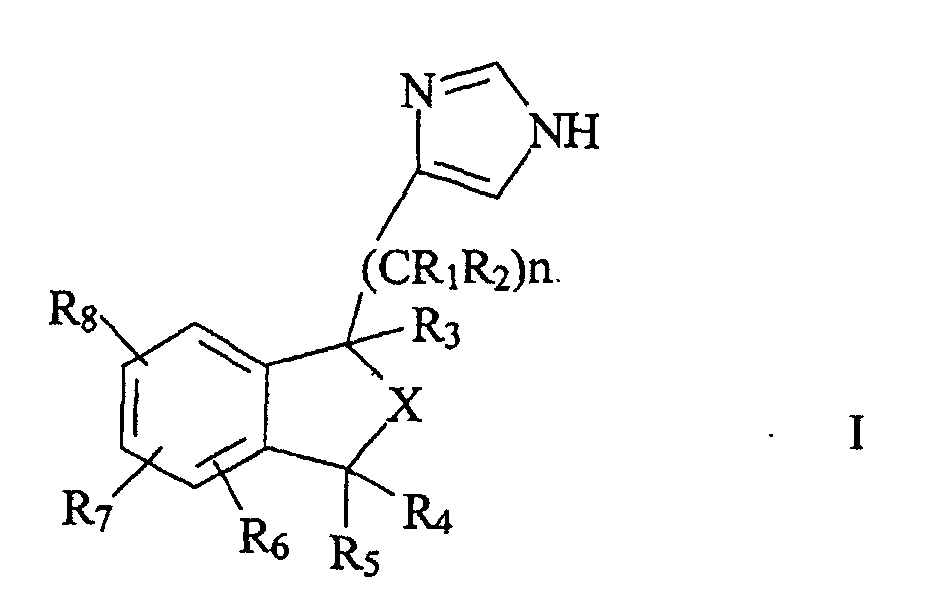 or a pharmaceutically acceptable ester or salt thereof.n is 1R1 is hydrogen or C1-C4-alkylR2 is hydrogen or R2 and R3 together form a double bondR3 is hydrogen or C1-C4-alkyl or R2 and R3 together form a double bondR4 is hydrogen, C1-C4-alkyl, hydroxy or C1-C4-alkoxyR5 is hydrogen or C1-C4-alkyl or R4 and R5 together with the carbon atom to which they are attached form a carbonyl groupR6, R7 and R8 are each the same or different and are independently hydrogen, C1-C4-alkyl or C2-C4-alkenyl, C3-C7-cycloalkyl, hydroxy, C1-C4-alkoxy, C1-C4-hydroxyalkyl, thiol, C1-C4-alkylthio, C1-C4-alkylthiol, halogen, trifluoromethyl, nitro or amino or amino substituted by C1-4 alkylX is -CHR9-(CHR10)m-m is 0 or 1and R9 and R10 are each the same or different and are independently hydrogen or C1-C4-alkyl;
 - A derivative according to claim 1 wherein R6, R7 and R8 are each hydrogen.
- A derivative according to claim 1 wherein R6 is C1-C4-alkyl at the position 4 or 6 of the indane ring and R7 and R8 are hydrogen.
- A derivative according to claim 1, wherein R6 is C1-C4-alkoxy at the position 7 of the indane ring and R7 and R8 are hydrogen.
- A derivative according to claim 1, wherein m=0.
- A derivative according to claim 5 wherein R1 is methyl or ethyl.
- A derivative according to claim 5 or 6, wherein R6, R7 and R8 are each hydrogen.
- A derivative according to claim 5 or 6, wherein R6 is hydroxy at the position 4 or 6 of the indane ring and R7 and R8 are hydrogen.
- A derivative according the claim 5 or 6, wherein R6 is hydroxy at the position 5 of the indane ring and R7 is hydroxy or C1-C4-alkyl or C1-C4-hydroxyalkyl at the position 6 of the indane ring and R8 is hydrogen.
- A derivative according to claim 1, wherein m=1.
- A derivative according to claim 10, wherein R5 to R8 are all hydrogen.
- A derivative according to claim 11, wherein R6 is a hydroxy group at the position 7 of the 1,2,3,4-tetrahydronaphthyl ring and R7 and R8 are hydrogen.
- A pharmaceutically acceptable composition comprising a derivative as defined in any one of claims 1 to 12 and a pharmaceutically acceptable carrier.
- A derivative as defined in any one of claims 1 to 12, for use in a method of treatment of the human or animal body.
- A derivative as defined in any one of claims 1 to 12, for use in the treatment of hypertension, glaucoma, chronic and acute pain, migraine, diarrhea, common cold, ischemia, addiction to chemical substances, anxiety, especially preoperative anxiety and different neurological, musculoskeletal, psychiatric and cognition disorders or as an adjunct to anesthesia.
- Use of a derivative as defined in any of the claims 1 to 12 in the manufacture of a medicament for use in the treatment of hypertension, glaucoma, chronic and acute pain, migraine, diarrhea, common cold, ischemia, addiction to chemical substances, anxiety, especially preoperative anxiety and different neurological musculoskeletal, psychiatric and cognition disorders.
- Use of a derivative as defined in any one of claims 1 to 12 in the manufacture of a medicament for use as an adjunct to anesthesia.
- Use of an imidazole derivative which is a compound of formula I
 or a pharmaceutically acceptable salt thereof, in the manufacture of a medicament for use in the treatment of hypertension, glaucoma, chronic and acute pain, migraine, diarrhea, common cold, ischemia, addiction to chemical substances, anxiety, especially preoperative anxiety and different neurological, musculoskeletal, psychiatric and cognition disorders or for use as an adjunct to anesthesia.n is 1R1 is hydrogen or C1-C4-alkylR2 is hydrogen or R2 and R3 together form a double bondR3 is hydrogen or C1-C4-alkyl or R2 and R3 together form a double bondR4 is hydrogen, C1-C4-alkyl, hydroxy or C1-C4-alkoxyR5 is hydrogen or C1-C4-alkyl or R4 and R5 together with the carbon atom to which they are attached form a carbonyl groupR6, R7 and R8 are each the same or different and are independently hydrogen, C1-C4-alkyl or C2-C4-alkenyl, C3-C7-cycloalkyl, hydroxy, C1-C4-alkoxy, C1-C4-hydroxyalkyl, thiol, C1-C4-alkylthio, C1-C4-alkylthiol, halogen, trifluoromethyl, nitro or amino or amino substituted by C1-4-alkylX is -CHR9-(CHR10)m -m is 0 or 1and R9 and R10 are each the same or different and are independently hydrogen or C1-C4-alkyl;
Applications Claiming Priority (3)
| Application Number | Priority Date | Filing Date | Title |
|---|---|---|---|
| GBGB9520150.5A GB9520150D0 (en) | 1995-10-03 | 1995-10-03 | New imidazole derivatives |
| GB9520150 | 1995-10-03 | ||
| PCT/FI1996/000518 WO1997012874A1 (en) | 1995-10-03 | 1996-10-02 | Imidazole derivatives having affinity for alpha2 receptors activity |
Publications (2)
| Publication Number | Publication Date |
|---|---|
| EP0888309A1 EP0888309A1 (en) | 1999-01-07 |
| EP0888309B1 true EP0888309B1 (en) | 2003-03-19 |
Family
ID=10781676
Family Applications (1)
| Application Number | Title | Priority Date | Filing Date |
|---|---|---|---|
| EP96932609A Expired - Lifetime EP0888309B1 (en) | 1995-10-03 | 1996-10-02 | Imidazole derivatives having affinity for alpha2 receptors activity |
Country Status (29)
| Country | Link |
|---|---|
| US (2) | US6313311B1 (en) |
| EP (1) | EP0888309B1 (en) |
| JP (1) | JP4129891B2 (en) |
| KR (1) | KR19990064013A (en) |
| CN (1) | CN1068592C (en) |
| AT (1) | ATE234819T1 (en) |
| AU (1) | AU708002B2 (en) |
| BG (1) | BG63916B1 (en) |
| CA (1) | CA2231535C (en) |
| CZ (1) | CZ291576B6 (en) |
| DE (1) | DE69626862T2 (en) |
| DK (1) | DK0888309T3 (en) |
| EE (1) | EE04436B1 (en) |
| ES (1) | ES2195013T3 (en) |
| GB (1) | GB9520150D0 (en) |
| HU (1) | HU224197B1 (en) |
| IL (1) | IL123721A (en) |
| LT (1) | LT4460B (en) |
| LV (1) | LV12108B (en) |
| NO (1) | NO311024B1 (en) |
| NZ (1) | NZ319169A (en) |
| PL (1) | PL189110B1 (en) |
| PT (1) | PT888309E (en) |
| RO (1) | RO120409B1 (en) |
| RU (1) | RU2188194C2 (en) |
| SI (1) | SI9620111B (en) |
| SK (1) | SK283542B6 (en) |
| UA (1) | UA49847C2 (en) |
| WO (1) | WO1997012874A1 (en) |
Families Citing this family (56)
| Publication number | Priority date | Publication date | Assignee | Title |
|---|---|---|---|---|
| ZA981080B (en) * | 1997-02-11 | 1998-08-12 | Warner Lambert Co | Bicyclic inhibitors of protein farnesyl transferase |
| US6329369B1 (en) | 1997-12-04 | 2001-12-11 | Allergan Sales, Inc. | Methods of treating pain and other conditions |
| US6841684B2 (en) * | 1997-12-04 | 2005-01-11 | Allergan, Inc. | Imidiazoles having reduced side effects |
| AU2002254265B2 (en) * | 1997-12-04 | 2008-05-15 | Allergan, Inc. | Imidiazole derivatives and their use as agonists selective at alpha 2B or 2B/2C adrenergic receptors |
| BR9813381A (en) * | 1997-12-04 | 2000-10-03 | Allergan Sales Inc | "substituted imidazole derivatives having agonist-like activity at alpha 2b or 2b / 2c adrenergic receptors" |
| DE69923698T2 (en) * | 1998-09-28 | 2006-01-12 | Orion Corp. | USE OF 3- (1H-IMIDAZOLE-4-YLMETHYL) -INDAN-5-OL FOR THE PREPARATION OF A MEDICAMENT FOR INTRASPINAL, INTRATHEAL AND EPIDURAL USE |
| TWI283669B (en) * | 1999-06-10 | 2007-07-11 | Allergan Inc | Compounds and method of treatment having agonist-like activity selective at alpha 2B or 2B/2C adrenergic receptors |
| AU5537800A (en) * | 1999-06-25 | 2001-01-31 | Orion Corporation | Method of admistering an imidazole derivative to obtain analgesia |
| ATE312606T1 (en) * | 1999-10-29 | 2005-12-15 | Orion Corp | USE OF AN IMIDAZOLE DERIVATIVE TO TREAT OR PREVENT HYPOTENSION AND SHOCK |
| FI20000073A0 (en) * | 2000-01-14 | 2000-01-14 | Orion Yhtymae Oy | New imidazole derivatives |
| US6388090B2 (en) | 2000-01-14 | 2002-05-14 | Orion Corporation | Imidazole derivatives |
| JP2003532712A (en) | 2000-05-08 | 2003-11-05 | オリオン コーポレーション | Novel polycyclic indanylimidazole having α2 adrenergic activity |
| TW200930291A (en) * | 2002-04-29 | 2009-07-16 | Bayer Cropscience Ag | Pesticidal heterocycles |
| FR2839719B1 (en) * | 2002-05-16 | 2004-08-06 | Pf Medicament | NOVEL IMIDAZOLIC COMPOUNDS, PROCESS FOR THEIR PREPARATION AND THEIR USE AS MEDICAMENTS |
| FI20022159A0 (en) | 2002-12-05 | 2002-12-05 | Orion Corp | New pharmaceutical compounds |
| FI116292B (en) * | 2003-01-08 | 2005-10-31 | Juvantia Pharma Ltd Oy | Process for the preparation of substituted imidazole derivatives and in the process useful intermediates |
| DE102004035322A1 (en) * | 2004-07-21 | 2006-02-16 | Universität des Saarlandes | Selective inhibitors of human corticoid synthases |
| WO2007024944A1 (en) | 2005-08-25 | 2007-03-01 | Schering Corporation | Imidazole derivatives as functionally selective alpha2c adrenoreceptor agonists |
| US7700592B2 (en) | 2005-08-25 | 2010-04-20 | Schering Corporation | α2C adrenoreceptor agonists |
| ES2348997T3 (en) | 2005-08-25 | 2010-12-21 | Schering Corporation | COMPOUNDS OF 3,4-DIHIDRO-2H-BENZO [1,4] OXAZINE AND 3,4-DIHIDRO-2H-BENZO [1,4] THIAZINE AS AGONISTS OF THE ALFA2C ADRENORRECEPTOR. |
| JP2009524618A (en) * | 2006-01-27 | 2009-07-02 | エフ.ホフマン−ラ ロシュ アーゲー | Use of 2-imidazole in the treatment of CNS disorders |
| AU2007312390B2 (en) | 2006-10-19 | 2013-03-28 | F. Hoffmann-La Roche Ag | Aminomethyl-4-imidazoles |
| AU2007316257A1 (en) | 2006-11-02 | 2008-05-08 | F. Hoffmann-La Roche Ag | Substituted 2-imidazoles as modulators of the trace amine associated receptors |
| WO2008058867A2 (en) | 2006-11-16 | 2008-05-22 | F. Hoffmann-La Roche Ag | Substituted 4-imidazoles |
| KR101189348B1 (en) | 2006-12-13 | 2012-10-09 | 에프. 호프만-라 로슈 아게 | Novel 2-imidazoles as ligands for trace amine associated receptorstaar |
| US20080146523A1 (en) | 2006-12-18 | 2008-06-19 | Guido Galley | Imidazole derivatives |
| ES2510546T3 (en) | 2007-02-02 | 2014-10-21 | F. Hoffmann-La Roche Ag | New 2-aminooxazolines as TAAR1 ligands for CNS disorders |
| BRPI0807961A2 (en) | 2007-02-13 | 2017-05-16 | Pharmacopeia Llc | functionally selective alpha2c adrenoreceptor agonist. |
| CA2678069A1 (en) | 2007-02-13 | 2008-08-21 | Schering Corporation | Derivatives and analogs of chroman as functionally selective alpha2c adrenoreceptor agonists |
| EP2398776A1 (en) * | 2007-02-13 | 2011-12-28 | Schering Corporation | Functionally selective alpha2c adrenoreceptor agonists |
| MX2009008465A (en) | 2007-02-15 | 2009-08-20 | Hoffmann La Roche | 2-aminooxazolines as taar1 ligands. |
| CN101687812A (en) | 2007-07-02 | 2010-03-31 | 弗·哈夫曼-拉罗切有限公司 | 2-Imidazoline Compounds with Good Affinity for Trace Amine-Associated Receptors (TAARs) |
| KR101150628B1 (en) | 2007-07-03 | 2012-05-31 | 에프. 호프만-라 로슈 아게 | 4-imidazolines and their use as antidepressants |
| CN101765587A (en) | 2007-07-27 | 2010-06-30 | 弗·哈夫曼-拉罗切有限公司 | 2-azetidinemethanamines and 2-pyrrolidinemethanamines as TAAR ligands |
| KR101167773B1 (en) | 2007-08-03 | 2012-07-24 | 에프. 호프만-라 로슈 아게 | Pyridinecarboxamide and benzamide derivatives as taar1 ligands |
| WO2009105504A2 (en) | 2008-02-21 | 2009-08-27 | Schering Corporation | Functionally selective alpha2c adrenoreceptor agonists |
| US8242153B2 (en) | 2008-07-24 | 2012-08-14 | Hoffmann-La Roche Inc. | 4,5-dihydro-oxazol-2YL derivatives |
| TW201026691A (en) | 2008-10-07 | 2010-07-16 | Schering Corp | Biaryl spiroaminooxazoline analogues as alpha2C adrenergic receptor modulators |
| EP3305281A1 (en) | 2009-05-15 | 2018-04-11 | Recro Pharma, Inc. | Sublingual dexmedetomidine compositions and methods of use thereof |
| US8354441B2 (en) | 2009-11-11 | 2013-01-15 | Hoffmann-La Roche Inc. | Oxazoline derivatives |
| US9452980B2 (en) | 2009-12-22 | 2016-09-27 | Hoffmann-La Roche Inc. | Substituted benzamides |
| US8673950B2 (en) | 2010-11-02 | 2014-03-18 | Hoffmann-Laroche Inc. | Dihydrooxazol-2-amine derivatives |
| US8802673B2 (en) | 2011-03-24 | 2014-08-12 | Hoffmann-La Roche Inc | Heterocyclic amine derivatives |
| US9073911B2 (en) * | 2011-06-09 | 2015-07-07 | Hoffmann-La Roche Inc. | Pyrazole derivatives |
| US9029370B2 (en) | 2011-06-10 | 2015-05-12 | Hoffmann-La Roche Inc. | Substituted benzamide derivatives |
| CA2858721C (en) | 2011-12-11 | 2021-03-16 | Recro Pharma, Inc. | Intranasal dexmedetomidine compositions and methods of use thereof |
| KR101631003B1 (en) | 2012-01-12 | 2016-06-15 | 에프. 호프만-라 로슈 아게 | Heterocyclic derivatives as trace amine associated receptors (taars) |
| EA026062B1 (en) | 2012-09-14 | 2017-02-28 | Ф. Хоффманн-Ля Рош Аг | Pyrazole carboxamide derivatives as trace amine associated receptor (taar) modulators for use in the treatment of different disorders, such as depression, diabetes and parkinson's disease |
| HK1206714A1 (en) * | 2012-09-17 | 2016-01-15 | 霍夫曼-拉罗奇有限公司 | Triazole carboxamide derivatives |
| WO2015165085A1 (en) | 2014-04-30 | 2015-11-05 | F.Hoffmann-La Roche Ag | Morpholin-pyridine derivatives |
| CN106470994B (en) | 2014-08-27 | 2019-09-24 | 豪夫迈·罗氏有限公司 | For treating the substituted pyrazine of CNS disease simultaneously [2,1-A] isoquinilone derivatives |
| KR101894681B1 (en) | 2014-08-27 | 2018-09-04 | 에프. 호프만-라 로슈 아게 | Substituted azetidine derivatives as taar ligands |
| MY195528A (en) | 2016-03-17 | 2023-01-30 | Hoffmann La Roche | 5-Ethyl-4-Methyl-Pyrazole-3-Carboxamide Derivative Having Activity as Agonist of Taar |
| CN116496261B (en) * | 2023-03-09 | 2025-06-27 | 中国人民解放军军事科学院军事医学研究院 | 4- (1H) -imidazole derivative and medical application thereof |
| CN118684628B (en) * | 2024-05-20 | 2025-06-17 | 中国人民解放军军事科学院军事医学研究院 | Substituted indanyl imidazole compounds and preparation method and use thereof |
| CN119424420B (en) * | 2024-11-15 | 2025-11-21 | 中国人民解放军军事科学院军事医学研究院 | Antitumor application of substituted indanyl imidazole compound |
Family Cites Families (12)
| Publication number | Priority date | Publication date | Assignee | Title |
|---|---|---|---|---|
| US3636002A (en) * | 1969-12-15 | 1972-01-18 | Janssen Pharmaceutica Nv | 1-(2-halobenzyloxy-1-indanyl)-imidazoles |
| ES8503669A1 (en) * | 1982-07-05 | 1985-03-01 | Erba Farmitalia | PROCEDURE FOR PREPARING N-IMIDAZOLYLIC DERIVATIVES OF BICYCLE COMPOUNDS. |
| US4634705A (en) * | 1984-06-06 | 1987-01-06 | Abbott Laboratories | Adrenergic amidines |
| US4659730A (en) * | 1984-06-18 | 1987-04-21 | Eli Lilly And Company | Aromatase inhibiting imidazole derivatives |
| GB2167408B (en) * | 1984-11-23 | 1988-05-25 | Farmos Oy | Substituted imidazole derivatives and their preparation and use |
| FI81092C (en) * | 1986-05-15 | 1990-09-10 | Farmos Oy | Process for the preparation of therapeutically active 4 (5) - (2,3-dihydro-1H-inden-2-yl) imidazole derivatives |
| US4878940A (en) * | 1987-04-02 | 1989-11-07 | Janssen Pharmaceutica N.V. | Herbicidal 1,5-substituted 1H-imidazoles |
| IL91542A0 (en) * | 1988-10-06 | 1990-04-29 | Erba Carlo Spa | N-imidazolyl-and n-imidazolyl-methyl derivatives of substituted bicyclic compounds,their preparation and pharmaceutical compositions containing them |
| GB2225782A (en) * | 1988-12-09 | 1990-06-13 | Farmos Group Limited | Imidazole derivatives useful for treatment of diabetes |
| GB9127050D0 (en) * | 1991-12-20 | 1992-02-19 | Orion Yhtymae Oy | Substituted imidazole derivatives and their preparation and use |
| GB9425211D0 (en) * | 1994-12-14 | 1995-02-15 | Ucb Sa | Substituted 1H-imidazoles |
| US6388090B2 (en) * | 2000-01-14 | 2002-05-14 | Orion Corporation | Imidazole derivatives |
-
1995
- 1995-10-03 GB GBGB9520150.5A patent/GB9520150D0/en active Pending
-
1996
- 1996-10-02 IL IL12372196A patent/IL123721A/en not_active IP Right Cessation
- 1996-10-02 NZ NZ319169A patent/NZ319169A/en not_active IP Right Cessation
- 1996-10-02 EP EP96932609A patent/EP0888309B1/en not_active Expired - Lifetime
- 1996-10-02 ES ES96932609T patent/ES2195013T3/en not_active Expired - Lifetime
- 1996-10-02 JP JP51399497A patent/JP4129891B2/en not_active Expired - Lifetime
- 1996-10-02 AU AU71327/96A patent/AU708002B2/en not_active Expired
- 1996-10-02 PL PL96328167A patent/PL189110B1/en unknown
- 1996-10-02 US US09/051,151 patent/US6313311B1/en not_active Expired - Lifetime
- 1996-10-02 EE EE9800101A patent/EE04436B1/en unknown
- 1996-10-02 SI SI9620111A patent/SI9620111B/en unknown
- 1996-10-02 PT PT96932609T patent/PT888309E/en unknown
- 1996-10-02 CZ CZ19981018A patent/CZ291576B6/en not_active IP Right Cessation
- 1996-10-02 UA UA98031588A patent/UA49847C2/en unknown
- 1996-10-02 RU RU98108027/04A patent/RU2188194C2/en active
- 1996-10-02 SK SK439-98A patent/SK283542B6/en not_active IP Right Cessation
- 1996-10-02 DE DE69626862T patent/DE69626862T2/en not_active Expired - Lifetime
- 1996-10-02 HU HU9802927A patent/HU224197B1/en active IP Right Grant
- 1996-10-02 CN CN96197438A patent/CN1068592C/en not_active Expired - Lifetime
- 1996-10-02 CA CA002231535A patent/CA2231535C/en not_active Expired - Lifetime
- 1996-10-02 RO RO98-00825A patent/RO120409B1/en unknown
- 1996-10-02 WO PCT/FI1996/000518 patent/WO1997012874A1/en not_active Ceased
- 1996-10-02 AT AT96932609T patent/ATE234819T1/en active
- 1996-10-02 DK DK96932609T patent/DK0888309T3/en active
- 1996-10-02 KR KR1019980702490A patent/KR19990064013A/en not_active Ceased
-
1998
- 1998-03-12 BG BG102324A patent/BG63916B1/en unknown
- 1998-03-31 LV LVP-98-61A patent/LV12108B/en unknown
- 1998-04-02 NO NO19981496A patent/NO311024B1/en not_active IP Right Cessation
- 1998-04-22 LT LT98-057A patent/LT4460B/en not_active IP Right Cessation
-
2001
- 2001-07-16 US US09/904,836 patent/US6479530B2/en not_active Expired - Lifetime
Also Published As
Similar Documents
| Publication | Publication Date | Title |
|---|---|---|
| US6313311B1 (en) | Imidazole derivatives having affinity for alpha2 receptors | |
| US6972299B2 (en) | Phenylethynyl and styryl derivatives of imidazole and fused ring heterocycles | |
| US5015639A (en) | Substituted benzazepines, their preparation and pharmaceutical compositions containing them | |
| US5247080A (en) | Substituted benzazepines useful as intermediates for producing pharmaceutically active compounds | |
| JP2009524616A (en) | Use of 4-imidazole derivatives for CNS disease | |
| FI81092B (en) | PROTECTION OF THERAPEUTIC ACTIVITIES 4 (5) - (2,3-DIHYDRO-1H-INDEN-2-YL) -IMIDAZOLDERIVAT. | |
| AU592733B2 (en) | Substituted 1h-imidazoles | |
| EP1261588B1 (en) | IMIDAZOLE COMPOUNDS AS Alpha2-ADRENOCEPTORS ANTAGONISTS | |
| US6388090B2 (en) | Imidazole derivatives | |
| CA2408290A1 (en) | New polycyclic indanylimidazoles with alpha2 adrenergic activity | |
| HK1014951B (en) | Imidazole derivatives having affinity for alpha2 receptors activity | |
| JPH08509502A (en) | Imidazole lipoxygenase inhibitor |
Legal Events
| Date | Code | Title | Description |
|---|---|---|---|
| PUAI | Public reference made under article 153(3) epc to a published international application that has entered the european phase |
Free format text: ORIGINAL CODE: 0009012 |
|
| 17P | Request for examination filed |
Effective date: 19980324 |
|
| AK | Designated contracting states |
Kind code of ref document: A1 Designated state(s): AT BE CH DE DK ES FI FR GB GR IE IT LI LU MC NL PT SE |
|
| AX | Request for extension of the european patent |
Free format text: SI PAYMENT 980326 |
|
| RAP1 | Party data changed (applicant data changed or rights of an application transferred) |
Owner name: ORION CORPORATION |
|
| 17Q | First examination report despatched |
Effective date: 19991110 |
|
| GRAG | Despatch of communication of intention to grant |
Free format text: ORIGINAL CODE: EPIDOS AGRA |
|
| RIN1 | Information on inventor provided before grant (corrected) |
Inventor name: COCKCROFT, VICTOR Inventor name: SAXLUND, RAIMO Inventor name: HILLILAE, MAARIT Inventor name: ELORANTA, MAIRE Inventor name: WURSTER, SIEGFRIED Inventor name: SAVOLA, JUHA-MATTI Inventor name: HUHTALA, PAAVO Inventor name: KARJALAINEN, ARTO |
|
| GRAG | Despatch of communication of intention to grant |
Free format text: ORIGINAL CODE: EPIDOS AGRA |
|
| GRAH | Despatch of communication of intention to grant a patent |
Free format text: ORIGINAL CODE: EPIDOS IGRA |
|
| GRAH | Despatch of communication of intention to grant a patent |
Free format text: ORIGINAL CODE: EPIDOS IGRA |
|
| GRAA | (expected) grant |
Free format text: ORIGINAL CODE: 0009210 |
|
| AK | Designated contracting states |
Designated state(s): AT BE CH DE DK ES FI FR GB GR IE IT LI LU MC NL PT SE |
|
| AX | Request for extension of the european patent |
Extension state: SI |
|
| REG | Reference to a national code |
Ref country code: GB Ref legal event code: FG4D |
|
| REG | Reference to a national code |
Ref country code: CH Ref legal event code: EP |
|
| REG | Reference to a national code |
Ref country code: IE Ref legal event code: FG4D |
|
| REG | Reference to a national code |
Ref country code: DK Ref legal event code: T3 |
|
| REF | Corresponds to: |
Ref document number: 69626862 Country of ref document: DE Date of ref document: 20030424 Kind code of ref document: P |
|
| REG | Reference to a national code |
Ref country code: GR Ref legal event code: EP Ref document number: 20030400932 Country of ref document: GR |
|
| REG | Reference to a national code |
Ref country code: SE Ref legal event code: TRGR |
|
| REG | Reference to a national code |
Ref country code: CH Ref legal event code: NV Representative=s name: A. BRAUN, BRAUN, HERITIER, ESCHMANN AG PATENTANWAE |
|
| ET | Fr: translation filed | ||
| PLBE | No opposition filed within time limit |
Free format text: ORIGINAL CODE: 0009261 |
|
| STAA | Information on the status of an ep patent application or granted ep patent |
Free format text: STATUS: NO OPPOSITION FILED WITHIN TIME LIMIT |
|
| 26N | No opposition filed |
Effective date: 20031222 |
|
| REG | Reference to a national code |
Ref country code: FR Ref legal event code: TP Ref country code: FR Ref legal event code: CD |
|
| REG | Reference to a national code |
Ref country code: CH Ref legal event code: PFA Owner name: ORION CORPORATION Free format text: ORION CORPORATION#ORIONINTIE 1#02200 ESPOO (FI) -TRANSFER TO- ORION CORPORATION#ORIONINTIE 1#02200 ESPOO (FI) |
|
| REG | Reference to a national code |
Ref country code: CH Ref legal event code: PCAR Free format text: NEW ADDRESS: HOLBEINSTRASSE 36-38, 4051 BASEL (CH) |
|
| REG | Reference to a national code |
Ref country code: FR Ref legal event code: PLFP Year of fee payment: 20 |
|
| PGFP | Annual fee paid to national office [announced via postgrant information from national office to epo] |
Ref country code: PT Payment date: 20150917 Year of fee payment: 20 |
|
| PGFP | Annual fee paid to national office [announced via postgrant information from national office to epo] |
Ref country code: LU Payment date: 20151023 Year of fee payment: 20 |
|
| PGFP | Annual fee paid to national office [announced via postgrant information from national office to epo] |
Ref country code: DK Payment date: 20151021 Year of fee payment: 20 |
|
| PGFP | Annual fee paid to national office [announced via postgrant information from national office to epo] |
Ref country code: IT Payment date: 20151026 Year of fee payment: 20 Ref country code: DE Payment date: 20151022 Year of fee payment: 20 Ref country code: GB Payment date: 20151021 Year of fee payment: 20 Ref country code: CH Payment date: 20151021 Year of fee payment: 20 Ref country code: FI Payment date: 20151013 Year of fee payment: 20 Ref country code: IE Payment date: 20151028 Year of fee payment: 20 Ref country code: GR Payment date: 20151013 Year of fee payment: 20 |
|
| PGFP | Annual fee paid to national office [announced via postgrant information from national office to epo] |
Ref country code: MC Payment date: 20151014 Year of fee payment: 20 Ref country code: AT Payment date: 20151022 Year of fee payment: 20 Ref country code: BE Payment date: 20151021 Year of fee payment: 20 Ref country code: FR Payment date: 20151023 Year of fee payment: 20 Ref country code: SE Payment date: 20151021 Year of fee payment: 20 Ref country code: ES Payment date: 20151021 Year of fee payment: 20 Ref country code: NL Payment date: 20151021 Year of fee payment: 20 |
|
| REG | Reference to a national code |
Ref country code: DE Ref legal event code: R071 Ref document number: 69626862 Country of ref document: DE |
|
| REG | Reference to a national code |
Ref country code: DK Ref legal event code: EUP Effective date: 20161002 |
|
| REG | Reference to a national code |
Ref country code: NL Ref legal event code: MK Effective date: 20161001 |
|
| REG | Reference to a national code |
Ref country code: CH Ref legal event code: PL |
|
| REG | Reference to a national code |
Ref country code: GB Ref legal event code: PE20 Expiry date: 20161001 |
|
| PG25 | Lapsed in a contracting state [announced via postgrant information from national office to epo] |
Ref country code: GB Free format text: LAPSE BECAUSE OF EXPIRATION OF PROTECTION Effective date: 20161001 |
|
| REG | Reference to a national code |
Ref country code: AT Ref legal event code: MK07 Ref document number: 234819 Country of ref document: AT Kind code of ref document: T Effective date: 20161002 |
|
| REG | Reference to a national code |
Ref country code: SE Ref legal event code: EUG |
|
| REG | Reference to a national code |
Ref country code: IE Ref legal event code: MK9A |
|
| REG | Reference to a national code |
Ref country code: ES Ref legal event code: FD2A Effective date: 20170126 |
|
| PG25 | Lapsed in a contracting state [announced via postgrant information from national office to epo] |
Ref country code: IE Free format text: LAPSE BECAUSE OF EXPIRATION OF PROTECTION Effective date: 20161002 |
|
| REG | Reference to a national code |
Ref country code: GR Ref legal event code: MA Ref document number: 20030400932 Country of ref document: GR Effective date: 20161003 |
|
| PG25 | Lapsed in a contracting state [announced via postgrant information from national office to epo] |
Ref country code: PT Free format text: LAPSE BECAUSE OF EXPIRATION OF PROTECTION Effective date: 20161012 |
|
| PG25 | Lapsed in a contracting state [announced via postgrant information from national office to epo] |
Ref country code: ES Free format text: LAPSE BECAUSE OF EXPIRATION OF PROTECTION Effective date: 20161003 |