EP0888058B1 - Herbicidal mixtures - Google Patents
Herbicidal mixtures Download PDFInfo
- Publication number
- EP0888058B1 EP0888058B1 EP97915111A EP97915111A EP0888058B1 EP 0888058 B1 EP0888058 B1 EP 0888058B1 EP 97915111 A EP97915111 A EP 97915111A EP 97915111 A EP97915111 A EP 97915111A EP 0888058 B1 EP0888058 B1 EP 0888058B1
- Authority
- EP
- European Patent Office
- Prior art keywords
- compound
- formula
- mixtures
- mixture
- test
- Prior art date
- Legal status (The legal status is an assumption and is not a legal conclusion. Google has not performed a legal analysis and makes no representation as to the accuracy of the status listed.)
- Expired - Lifetime
Links
- 239000000203 mixture Substances 0.000 title claims description 226
- 230000002363 herbicidal effect Effects 0.000 title claims description 50
- 150000001875 compounds Chemical class 0.000 claims description 199
- 239000004094 surface-active agent Substances 0.000 claims description 21
- 150000003839 salts Chemical class 0.000 claims description 18
- 238000000034 method Methods 0.000 claims description 12
- CAWXEEYDBZRFPE-UHFFFAOYSA-N Hexazinone Chemical compound O=C1N(C)C(N(C)C)=NC(=O)N1C1CCCCC1 CAWXEEYDBZRFPE-UHFFFAOYSA-N 0.000 claims description 11
- XMTQQYYKAHVGBJ-UHFFFAOYSA-N 3-(3,4-DICHLOROPHENYL)-1,1-DIMETHYLUREA Chemical compound CN(C)C(=O)NC1=CC=C(Cl)C(Cl)=C1 XMTQQYYKAHVGBJ-UHFFFAOYSA-N 0.000 claims description 10
- 239000003085 diluting agent Substances 0.000 claims description 10
- CTSLUCNDVMMDHG-UHFFFAOYSA-N 5-bromo-3-(butan-2-yl)-6-methylpyrimidine-2,4(1H,3H)-dione Chemical compound CCC(C)N1C(=O)NC(C)=C(Br)C1=O CTSLUCNDVMMDHG-UHFFFAOYSA-N 0.000 claims description 8
- 239000005510 Diuron Substances 0.000 claims description 8
- 239000005562 Glyphosate Substances 0.000 claims description 8
- XDDAORKBJWWYJS-UHFFFAOYSA-N glyphosate Chemical compound OC(=O)CNCP(O)(O)=O XDDAORKBJWWYJS-UHFFFAOYSA-N 0.000 claims description 8
- RSMUVYRMZCOLBH-UHFFFAOYSA-N metsulfuron methyl Chemical group COC(=O)C1=CC=CC=C1S(=O)(=O)NC(=O)NC1=NC(C)=NC(OC)=N1 RSMUVYRMZCOLBH-UHFFFAOYSA-N 0.000 claims description 7
- 239000007787 solid Substances 0.000 claims description 7
- 239000005584 Metsulfuron-methyl Substances 0.000 claims description 6
- 229940097068 glyphosate Drugs 0.000 claims description 6
- 239000007788 liquid Substances 0.000 claims description 6
- ZDXMLEQEMNLCQG-UHFFFAOYSA-N sulfometuron methyl Chemical group COC(=O)C1=CC=CC=C1S(=O)(=O)NC(=O)NC1=NC(C)=CC(C)=N1 ZDXMLEQEMNLCQG-UHFFFAOYSA-N 0.000 claims description 6
- IAJOBQBIJHVGMQ-UHFFFAOYSA-N 2-amino-4-[hydroxy(methyl)phosphoryl]butanoic acid Chemical compound CP(O)(=O)CCC(N)C(O)=O IAJOBQBIJHVGMQ-UHFFFAOYSA-N 0.000 claims description 5
- 239000005561 Glufosinate Substances 0.000 claims description 5
- FIKAKWIAUPDISJ-UHFFFAOYSA-L paraquat dichloride Chemical compound [Cl-].[Cl-].C1=C[N+](C)=CC=C1C1=CC=[N+](C)C=C1 FIKAKWIAUPDISJ-UHFFFAOYSA-L 0.000 claims description 5
- XOEMATDHVZOBSG-UHFFFAOYSA-N azafenidin Chemical compound C1=C(OCC#C)C(Cl)=CC(Cl)=C1N1C(=O)N2CCCCC2=N1 XOEMATDHVZOBSG-UHFFFAOYSA-N 0.000 claims description 4
- LMBFAGIMSUYTBN-MPZNNTNKSA-N teixobactin Chemical compound C([C@H](C(=O)N[C@@H]([C@@H](C)CC)C(=O)N[C@@H](CO)C(=O)N[C@H](CCC(N)=O)C(=O)N[C@H]([C@@H](C)CC)C(=O)N[C@@H]([C@@H](C)CC)C(=O)N[C@@H](CO)C(=O)N[C@H]1C(N[C@@H](C)C(=O)N[C@@H](C[C@@H]2NC(=N)NC2)C(=O)N[C@H](C(=O)O[C@H]1C)[C@@H](C)CC)=O)NC)C1=CC=CC=C1 LMBFAGIMSUYTBN-MPZNNTNKSA-N 0.000 claims description 3
- 241000196324 Embryophyta Species 0.000 description 141
- 229940125904 compound 1 Drugs 0.000 description 141
- 239000004480 active ingredient Substances 0.000 description 58
- 230000000694 effects Effects 0.000 description 38
- 239000004009 herbicide Substances 0.000 description 38
- 238000011282 treatment Methods 0.000 description 37
- 239000002689 soil Substances 0.000 description 34
- 229940125773 compound 10 Drugs 0.000 description 31
- ZLVXBBHTMQJRSX-VMGNSXQWSA-N jdtic Chemical compound C1([C@]2(C)CCN(C[C@@H]2C)C[C@H](C(C)C)NC(=O)[C@@H]2NCC3=CC(O)=CC=C3C2)=CC=CC(O)=C1 ZLVXBBHTMQJRSX-VMGNSXQWSA-N 0.000 description 31
- 239000002904 solvent Substances 0.000 description 31
- 231100001184 nonphytotoxic Toxicity 0.000 description 29
- 238000009472 formulation Methods 0.000 description 27
- 230000000996 additive effect Effects 0.000 description 25
- 229940125782 compound 2 Drugs 0.000 description 19
- 238000005507 spraying Methods 0.000 description 19
- 241000032989 Ipomoea lacunosa Species 0.000 description 18
- VYPSYNLAJGMNEJ-UHFFFAOYSA-N Silicium dioxide Chemical compound O=[Si]=O VYPSYNLAJGMNEJ-UHFFFAOYSA-N 0.000 description 18
- 208000027418 Wounds and injury Diseases 0.000 description 18
- 229940126214 compound 3 Drugs 0.000 description 18
- 230000006378 damage Effects 0.000 description 18
- 208000014674 injury Diseases 0.000 description 18
- 240000007298 Megathyrsus maximus Species 0.000 description 16
- 238000004382 potting Methods 0.000 description 16
- 241000894007 species Species 0.000 description 14
- 240000005561 Musa balbisiana Species 0.000 description 12
- 235000010624 Medicago sativa Nutrition 0.000 description 11
- 244000052363 Cynodon dactylon Species 0.000 description 10
- 244000025670 Eleusine indica Species 0.000 description 9
- 235000014716 Eleusine indica Nutrition 0.000 description 9
- 238000007865 diluting Methods 0.000 description 9
- 241000718035 Cenchrus echinatus Species 0.000 description 8
- 239000013065 commercial product Substances 0.000 description 8
- 229940125898 compound 5 Drugs 0.000 description 8
- 239000004033 plastic Substances 0.000 description 8
- 229920003023 plastic Polymers 0.000 description 8
- -1 salt anions Chemical class 0.000 description 8
- 244000036975 Ambrosia artemisiifolia Species 0.000 description 7
- 244000105624 Arachis hypogaea Species 0.000 description 7
- 235000010777 Arachis hypogaea Nutrition 0.000 description 7
- 240000001549 Ipomoea eriocarpa Species 0.000 description 7
- 235000005146 Ipomoea eriocarpa Nutrition 0.000 description 7
- 239000008187 granular material Substances 0.000 description 7
- 230000002195 synergetic effect Effects 0.000 description 7
- BFGQTWYXWNCTSX-UHFFFAOYSA-N triazine-4,5-dione Chemical compound O=C1C=NN=NC1=O BFGQTWYXWNCTSX-UHFFFAOYSA-N 0.000 description 7
- 235000010823 Digitaria sanguinalis Nutrition 0.000 description 6
- ROSDSFDQCJNGOL-UHFFFAOYSA-N Dimethylamine Chemical compound CNC ROSDSFDQCJNGOL-UHFFFAOYSA-N 0.000 description 6
- 235000001950 Elaeis guineensis Nutrition 0.000 description 6
- 244000127993 Elaeis melanococca Species 0.000 description 6
- 235000003805 Musa ABB Group Nutrition 0.000 description 6
- 235000018290 Musa x paradisiaca Nutrition 0.000 description 6
- 241001268782 Paspalum dilatatum Species 0.000 description 6
- 235000015266 Plantago major Nutrition 0.000 description 6
- 240000000111 Saccharum officinarum Species 0.000 description 6
- 235000007201 Saccharum officinarum Nutrition 0.000 description 6
- 240000002439 Sorghum halepense Species 0.000 description 6
- 239000000377 silicon dioxide Substances 0.000 description 6
- 244000099147 Ananas comosus Species 0.000 description 5
- 235000007119 Ananas comosus Nutrition 0.000 description 5
- 241000207199 Citrus Species 0.000 description 5
- 240000007154 Coffea arabica Species 0.000 description 5
- 235000008694 Humulus lupulus Nutrition 0.000 description 5
- 244000025221 Humulus lupulus Species 0.000 description 5
- 239000004965 Silica aerogel Substances 0.000 description 5
- 244000269722 Thea sinensis Species 0.000 description 5
- 235000009470 Theobroma cacao Nutrition 0.000 description 5
- 244000299461 Theobroma cacao Species 0.000 description 5
- 241000219094 Vitaceae Species 0.000 description 5
- 235000020971 citrus fruits Nutrition 0.000 description 5
- 235000016213 coffee Nutrition 0.000 description 5
- 235000013353 coffee beverage Nutrition 0.000 description 5
- 239000012141 concentrate Substances 0.000 description 5
- 235000013399 edible fruits Nutrition 0.000 description 5
- 235000021021 grapes Nutrition 0.000 description 5
- 235000014571 nuts Nutrition 0.000 description 5
- INFDPOAKFNIJBF-UHFFFAOYSA-N paraquat Chemical compound C1=C[N+](C)=CC=C1C1=CC=[N+](C)C=C1 INFDPOAKFNIJBF-UHFFFAOYSA-N 0.000 description 5
- 239000008188 pellet Substances 0.000 description 5
- 235000003129 Ambrosia artemisiifolia var elatior Nutrition 0.000 description 4
- 235000017060 Arachis glabrata Nutrition 0.000 description 4
- 235000018262 Arachis monticola Nutrition 0.000 description 4
- 241000035632 Digitaria ischaemum Species 0.000 description 4
- 244000152970 Digitaria sanguinalis Species 0.000 description 4
- 235000014820 Galium aparine Nutrition 0.000 description 4
- 244000292693 Poa annua Species 0.000 description 4
- 240000001451 Rottboellia cochinchinensis Species 0.000 description 4
- 229940100389 Sulfonylurea Drugs 0.000 description 4
- XSQUKJJJFZCRTK-UHFFFAOYSA-N Urea Chemical compound NC(N)=O XSQUKJJJFZCRTK-UHFFFAOYSA-N 0.000 description 4
- 239000000654 additive Substances 0.000 description 4
- 235000003484 annual ragweed Nutrition 0.000 description 4
- 235000003488 common ragweed Nutrition 0.000 description 4
- 230000007613 environmental effect Effects 0.000 description 4
- 230000009969 flowable effect Effects 0.000 description 4
- 235000020232 peanut Nutrition 0.000 description 4
- 239000000243 solution Substances 0.000 description 4
- YROXIXLRRCOBKF-UHFFFAOYSA-N sulfonylurea Chemical class OC(=N)N=S(=O)=O YROXIXLRRCOBKF-UHFFFAOYSA-N 0.000 description 4
- 239000000725 suspension Substances 0.000 description 4
- ZBMRKNMTMPPMMK-UHFFFAOYSA-N 2-amino-4-[hydroxy(methyl)phosphoryl]butanoic acid;azane Chemical compound [NH4+].CP(O)(=O)CCC(N)C([O-])=O ZBMRKNMTMPPMMK-UHFFFAOYSA-N 0.000 description 3
- WEVYAHXRMPXWCK-UHFFFAOYSA-N Acetonitrile Chemical compound CC#N WEVYAHXRMPXWCK-UHFFFAOYSA-N 0.000 description 3
- 235000003133 Ambrosia artemisiifolia Nutrition 0.000 description 3
- LYCAIKOWRPUZTN-UHFFFAOYSA-N Ethylene glycol Chemical compound OCCO LYCAIKOWRPUZTN-UHFFFAOYSA-N 0.000 description 3
- PSYBGEADHLUXCS-UHFFFAOYSA-N Isocil Chemical compound CC(C)N1C(=O)NC(C)=C(Br)C1=O PSYBGEADHLUXCS-UHFFFAOYSA-N 0.000 description 3
- 240000004658 Medicago sativa Species 0.000 description 3
- OKKJLVBELUTLKV-UHFFFAOYSA-N Methanol Chemical compound OC OKKJLVBELUTLKV-UHFFFAOYSA-N 0.000 description 3
- ZMXDDKWLCZADIW-UHFFFAOYSA-N N,N-Dimethylformamide Chemical compound CN(C)C=O ZMXDDKWLCZADIW-UHFFFAOYSA-N 0.000 description 3
- 244000234609 Portulaca oleracea Species 0.000 description 3
- 235000001855 Portulaca oleracea Nutrition 0.000 description 3
- 240000008042 Zea mays Species 0.000 description 3
- 235000002017 Zea mays subsp mays Nutrition 0.000 description 3
- 229960000892 attapulgite Drugs 0.000 description 3
- 239000004495 emulsifiable concentrate Substances 0.000 description 3
- 229910052625 palygorskite Inorganic materials 0.000 description 3
- 239000000843 powder Substances 0.000 description 3
- 239000000126 substance Substances 0.000 description 3
- 239000003826 tablet Substances 0.000 description 3
- 235000013616 tea Nutrition 0.000 description 3
- 235000009051 Ambrosia paniculata var. peruviana Nutrition 0.000 description 2
- 0 CCN1C(*c2c(*)cccc2)NC(C)CC1* Chemical compound CCN1C(*c2c(*)cccc2)NC(C)CC1* 0.000 description 2
- VTYYLEPIZMXCLO-UHFFFAOYSA-L Calcium carbonate Chemical compound [Ca+2].[O-]C([O-])=O VTYYLEPIZMXCLO-UHFFFAOYSA-L 0.000 description 2
- 241000218631 Coniferophyta Species 0.000 description 2
- 235000001602 Digitaria X umfolozi Nutrition 0.000 description 2
- 235000017898 Digitaria ciliaris Nutrition 0.000 description 2
- 235000005476 Digitaria cruciata Nutrition 0.000 description 2
- 235000006830 Digitaria didactyla Nutrition 0.000 description 2
- 235000005804 Digitaria eriantha ssp. eriantha Nutrition 0.000 description 2
- 235000013603 Digitaria ischaemum Nutrition 0.000 description 2
- IAZDPXIOMUYVGZ-UHFFFAOYSA-N Dimethylsulphoxide Chemical compound CS(C)=O IAZDPXIOMUYVGZ-UHFFFAOYSA-N 0.000 description 2
- 244000004281 Eucalyptus maculata Species 0.000 description 2
- 241000234642 Festuca Species 0.000 description 2
- 235000010469 Glycine max Nutrition 0.000 description 2
- 244000068988 Glycine max Species 0.000 description 2
- 235000017587 Medicago sativa ssp. sativa Nutrition 0.000 description 2
- ISWSIDIOOBJBQZ-UHFFFAOYSA-N Phenol Chemical compound OC1=CC=CC=C1 ISWSIDIOOBJBQZ-UHFFFAOYSA-N 0.000 description 2
- 235000008566 Pinus taeda Nutrition 0.000 description 2
- 241000218679 Pinus taeda Species 0.000 description 2
- 241000209049 Poa pratensis Species 0.000 description 2
- ZLMJMSJWJFRBEC-UHFFFAOYSA-N Potassium Chemical compound [K] ZLMJMSJWJFRBEC-UHFFFAOYSA-N 0.000 description 2
- CDBYLPFSWZWCQE-UHFFFAOYSA-L Sodium Carbonate Chemical compound [Na+].[Na+].[O-]C([O-])=O CDBYLPFSWZWCQE-UHFFFAOYSA-L 0.000 description 2
- PMZURENOXWZQFD-UHFFFAOYSA-L Sodium Sulfate Chemical compound [Na+].[Na+].[O-]S([O-])(=O)=O PMZURENOXWZQFD-UHFFFAOYSA-L 0.000 description 2
- 241000044578 Stenotaphrum secundatum Species 0.000 description 2
- 241001141210 Urochloa platyphylla Species 0.000 description 2
- 235000005824 Zea mays ssp. parviglumis Nutrition 0.000 description 2
- 238000005054 agglomeration Methods 0.000 description 2
- 230000002776 aggregation Effects 0.000 description 2
- 150000001298 alcohols Chemical class 0.000 description 2
- 239000000440 bentonite Substances 0.000 description 2
- 229910000278 bentonite Inorganic materials 0.000 description 2
- SVPXDRXYRYOSEX-UHFFFAOYSA-N bentoquatam Chemical compound O.O=[Si]=O.O=[Al]O[Al]=O SVPXDRXYRYOSEX-UHFFFAOYSA-N 0.000 description 2
- 235000006263 bur ragweed Nutrition 0.000 description 2
- RYAGRZNBULDMBW-UHFFFAOYSA-L calcium;3-(2-hydroxy-3-methoxyphenyl)-2-[2-methoxy-4-(3-sulfonatopropyl)phenoxy]propane-1-sulfonate Chemical compound [Ca+2].COC1=CC=CC(CC(CS([O-])(=O)=O)OC=2C(=CC(CCCS([O-])(=O)=O)=CC=2)OC)=C1O RYAGRZNBULDMBW-UHFFFAOYSA-L 0.000 description 2
- 239000004202 carbamide Substances 0.000 description 2
- 239000000969 carrier Substances 0.000 description 2
- 235000005822 corn Nutrition 0.000 description 2
- MZZBPDKVEFVLFF-UHFFFAOYSA-N cyanazine Chemical compound CCNC1=NC(Cl)=NC(NC(C)(C)C#N)=N1 MZZBPDKVEFVLFF-UHFFFAOYSA-N 0.000 description 2
- JHIVVAPYMSGYDF-UHFFFAOYSA-N cyclohexanone Chemical compound O=C1CCCCC1 JHIVVAPYMSGYDF-UHFFFAOYSA-N 0.000 description 2
- MWKFXSUHUHTGQN-UHFFFAOYSA-N decan-1-ol Chemical compound CCCCCCCCCCO MWKFXSUHUHTGQN-UHFFFAOYSA-N 0.000 description 2
- SWXVUIWOUIDPGS-UHFFFAOYSA-N diacetone alcohol Chemical compound CC(=O)CC(C)(C)O SWXVUIWOUIDPGS-UHFFFAOYSA-N 0.000 description 2
- 235000014113 dietary fatty acids Nutrition 0.000 description 2
- 239000000839 emulsion Substances 0.000 description 2
- 239000000194 fatty acid Substances 0.000 description 2
- 229930195729 fatty acid Natural products 0.000 description 2
- 239000000835 fiber Substances 0.000 description 2
- ZEKANFGSDXODPD-UHFFFAOYSA-N glyphosate-isopropylammonium Chemical compound CC(C)N.OC(=O)CNCP(O)(O)=O ZEKANFGSDXODPD-UHFFFAOYSA-N 0.000 description 2
- CATSNJVOTSVZJV-UHFFFAOYSA-N heptan-2-one Chemical compound CCCCCC(C)=O CATSNJVOTSVZJV-UHFFFAOYSA-N 0.000 description 2
- RUCAXVJJQQJZGU-UHFFFAOYSA-M hydron;2-(phosphonatomethylamino)acetate;trimethylsulfanium Chemical compound C[S+](C)C.OP(O)(=O)CNCC([O-])=O RUCAXVJJQQJZGU-UHFFFAOYSA-M 0.000 description 2
- 239000002917 insecticide Substances 0.000 description 2
- HJOVHMDZYOCNQW-UHFFFAOYSA-N isophorone Chemical compound CC1=CC(=O)CC(C)(C)C1 HJOVHMDZYOCNQW-UHFFFAOYSA-N 0.000 description 2
- 238000002156 mixing Methods 0.000 description 2
- UEZVMMHDMIWARA-UHFFFAOYSA-M phosphonate Chemical compound [O-]P(=O)=O UEZVMMHDMIWARA-UHFFFAOYSA-M 0.000 description 2
- 229920001451 polypropylene glycol Polymers 0.000 description 2
- 239000011591 potassium Substances 0.000 description 2
- 229910052700 potassium Inorganic materials 0.000 description 2
- BWHMMNNQKKPAPP-UHFFFAOYSA-L potassium carbonate Chemical compound [K+].[K+].[O-]C([O-])=O BWHMMNNQKKPAPP-UHFFFAOYSA-L 0.000 description 2
- 125000002924 primary amino group Chemical group [H]N([H])* 0.000 description 2
- 235000009736 ragweed Nutrition 0.000 description 2
- 235000018409 smooth crabgrass Nutrition 0.000 description 2
- 159000000000 sodium salts Chemical class 0.000 description 2
- 238000001228 spectrum Methods 0.000 description 2
- XLYOFNOQVPJJNP-UHFFFAOYSA-N water Substances O XLYOFNOQVPJJNP-UHFFFAOYSA-N 0.000 description 2
- JNYAEWCLZODPBN-JGWLITMVSA-N (2r,3r,4s)-2-[(1r)-1,2-dihydroxyethyl]oxolane-3,4-diol Polymers OC[C@@H](O)[C@H]1OC[C@H](O)[C@H]1O JNYAEWCLZODPBN-JGWLITMVSA-N 0.000 description 1
- DAGDLSRRQJATCV-UHFFFAOYSA-N 1-(2-bromoethoxy)-2-propan-2-ylbenzene Chemical compound CC(C)C1=CC=CC=C1OCCBr DAGDLSRRQJATCV-UHFFFAOYSA-N 0.000 description 1
- QMNWYGTWTXOQTP-UHFFFAOYSA-N 1h-triazin-6-one Chemical compound O=C1C=CN=NN1 QMNWYGTWTXOQTP-UHFFFAOYSA-N 0.000 description 1
- 239000002794 2,4-DB Substances 0.000 description 1
- YIVXMZJTEQBPQO-UHFFFAOYSA-N 2,4-DB Chemical compound OC(=O)CCCOC1=CC=C(Cl)C=C1Cl YIVXMZJTEQBPQO-UHFFFAOYSA-N 0.000 description 1
- 239000005631 2,4-Dichlorophenoxyacetic acid Substances 0.000 description 1
- JNYAEWCLZODPBN-UHFFFAOYSA-N 2-(1,2-dihydroxyethyl)oxolane-3,4-diol Polymers OCC(O)C1OCC(O)C1O JNYAEWCLZODPBN-UHFFFAOYSA-N 0.000 description 1
- ROKVVMOXSZIDEG-UHFFFAOYSA-N 2-(3,5,6-trichloropyridin-2-yl)oxyacetate;triethylazanium Chemical compound CCN(CC)CC.OC(=O)COC1=NC(Cl)=C(Cl)C=C1Cl ROKVVMOXSZIDEG-UHFFFAOYSA-N 0.000 description 1
- CLQMBPJKHLGMQK-UHFFFAOYSA-N 2-(4-isopropyl-4-methyl-5-oxo-4,5-dihydro-1H-imidazol-2-yl)nicotinic acid Chemical compound N1C(=O)C(C(C)C)(C)N=C1C1=NC=CC=C1C(O)=O CLQMBPJKHLGMQK-UHFFFAOYSA-N 0.000 description 1
- CABMTIJINOIHOD-UHFFFAOYSA-N 2-[4-methyl-5-oxo-4-(propan-2-yl)-4,5-dihydro-1H-imidazol-2-yl]quinoline-3-carboxylic acid Chemical compound N1C(=O)C(C(C)C)(C)N=C1C1=NC2=CC=CC=C2C=C1C(O)=O CABMTIJINOIHOD-UHFFFAOYSA-N 0.000 description 1
- IVDRCZNHVGQBHZ-UHFFFAOYSA-N 2-butoxyethyl 2-(3,5,6-trichloropyridin-2-yl)oxyacetate Chemical group CCCCOCCOC(=O)COC1=NC(Cl)=C(Cl)C=C1Cl IVDRCZNHVGQBHZ-UHFFFAOYSA-N 0.000 description 1
- CYEJMVLDXAUOPN-UHFFFAOYSA-N 2-dodecylphenol Chemical compound CCCCCCCCCCCCC1=CC=CC=C1O CYEJMVLDXAUOPN-UHFFFAOYSA-N 0.000 description 1
- XKJMBINCVNINCA-UHFFFAOYSA-N Alfalone Chemical compound CON(C)C(=O)NC1=CC=C(Cl)C(Cl)=C1 XKJMBINCVNINCA-UHFFFAOYSA-N 0.000 description 1
- 239000005995 Aluminium silicate Substances 0.000 description 1
- 235000003276 Apios tuberosa Nutrition 0.000 description 1
- 235000010744 Arachis villosulicarpa Nutrition 0.000 description 1
- 235000007319 Avena orientalis Nutrition 0.000 description 1
- 244000075850 Avena orientalis Species 0.000 description 1
- 241000219310 Beta vulgaris subsp. vulgaris Species 0.000 description 1
- 240000002791 Brassica napus Species 0.000 description 1
- 235000004977 Brassica sinapistrum Nutrition 0.000 description 1
- OYPRJOBELJOOCE-UHFFFAOYSA-N Calcium Chemical compound [Ca] OYPRJOBELJOOCE-UHFFFAOYSA-N 0.000 description 1
- 244000025254 Cannabis sativa Species 0.000 description 1
- 241000209120 Cenchrus Species 0.000 description 1
- VEXZGXHMUGYJMC-UHFFFAOYSA-M Chloride anion Chemical compound [Cl-] VEXZGXHMUGYJMC-UHFFFAOYSA-M 0.000 description 1
- 235000013162 Cocos nucifera Nutrition 0.000 description 1
- 244000060011 Cocos nucifera Species 0.000 description 1
- NDUPDOJHUQKPAG-UHFFFAOYSA-N Dalapon Chemical compound CC(Cl)(Cl)C(O)=O NDUPDOJHUQKPAG-UHFFFAOYSA-N 0.000 description 1
- 239000005504 Dicamba Substances 0.000 description 1
- GUVLYNGULCJVDO-UHFFFAOYSA-N EPTC Chemical compound CCCN(CCC)C(=O)SCC GUVLYNGULCJVDO-UHFFFAOYSA-N 0.000 description 1
- 235000006287 Hookers bur ragweed Nutrition 0.000 description 1
- 240000005979 Hordeum vulgare Species 0.000 description 1
- 235000007340 Hordeum vulgare Nutrition 0.000 description 1
- DGAQECJNVWCQMB-PUAWFVPOSA-M Ilexoside XXIX Chemical compound C[C@@H]1CC[C@@]2(CC[C@@]3(C(=CC[C@H]4[C@]3(CC[C@@H]5[C@@]4(CC[C@@H](C5(C)C)OS(=O)(=O)[O-])C)C)[C@@H]2[C@]1(C)O)C)C(=O)O[C@H]6[C@@H]([C@H]([C@@H]([C@H](O6)CO)O)O)O.[Na+] DGAQECJNVWCQMB-PUAWFVPOSA-M 0.000 description 1
- 239000005981 Imazaquin Substances 0.000 description 1
- XVOKUMIPKHGGTN-UHFFFAOYSA-N Imazethapyr Chemical compound OC(=O)C1=CC(CC)=CN=C1C1=NC(C)(C(C)C)C(=O)N1 XVOKUMIPKHGGTN-UHFFFAOYSA-N 0.000 description 1
- 239000005567 Imazosulfuron Substances 0.000 description 1
- NAGRVUXEKKZNHT-UHFFFAOYSA-N Imazosulfuron Chemical compound COC1=CC(OC)=NC(NC(=O)NS(=O)(=O)C=2N3C=CC=CC3=NC=2Cl)=N1 NAGRVUXEKKZNHT-UHFFFAOYSA-N 0.000 description 1
- 239000005909 Kieselgur Substances 0.000 description 1
- 239000005572 Lenacil Substances 0.000 description 1
- 229920001732 Lignosulfonate Polymers 0.000 description 1
- 240000006240 Linum usitatissimum Species 0.000 description 1
- 235000004431 Linum usitatissimum Nutrition 0.000 description 1
- 239000005573 Linuron Substances 0.000 description 1
- 235000007688 Lycopersicon esculentum Nutrition 0.000 description 1
- FYYHWMGAXLPEAU-UHFFFAOYSA-N Magnesium Chemical compound [Mg] FYYHWMGAXLPEAU-UHFFFAOYSA-N 0.000 description 1
- OKIBNKKYNPBDRS-UHFFFAOYSA-N Mefluidide Chemical compound CC(=O)NC1=CC(NS(=O)(=O)C(F)(F)F)=C(C)C=C1C OKIBNKKYNPBDRS-UHFFFAOYSA-N 0.000 description 1
- 239000005583 Metribuzin Substances 0.000 description 1
- FNJQGUKETYGBGL-UHFFFAOYSA-N OC(=O)C(N)CCP(=O)CO Chemical compound OC(=O)C(N)CCP(=O)CO FNJQGUKETYGBGL-UHFFFAOYSA-N 0.000 description 1
- 240000007817 Olea europaea Species 0.000 description 1
- 240000007594 Oryza sativa Species 0.000 description 1
- 235000007164 Oryza sativa Nutrition 0.000 description 1
- 239000005588 Oxadiazon Substances 0.000 description 1
- CHNUNORXWHYHNE-UHFFFAOYSA-N Oxadiazon Chemical compound C1=C(Cl)C(OC(C)C)=CC(N2C(OC(=N2)C(C)(C)C)=O)=C1Cl CHNUNORXWHYHNE-UHFFFAOYSA-N 0.000 description 1
- 239000005590 Oxyfluorfen Substances 0.000 description 1
- OQMBBFQZGJFLBU-UHFFFAOYSA-N Oxyfluorfen Chemical compound C1=C([N+]([O-])=O)C(OCC)=CC(OC=2C(=CC(=CC=2)C(F)(F)F)Cl)=C1 OQMBBFQZGJFLBU-UHFFFAOYSA-N 0.000 description 1
- 235000010678 Paulownia tomentosa Nutrition 0.000 description 1
- 240000002834 Paulownia tomentosa Species 0.000 description 1
- 239000005591 Pendimethalin Substances 0.000 description 1
- 239000005595 Picloram Substances 0.000 description 1
- 229920003171 Poly (ethylene oxide) Polymers 0.000 description 1
- 239000002202 Polyethylene glycol Substances 0.000 description 1
- JUJWROOIHBZHMG-UHFFFAOYSA-N Pyridine Chemical class C1=CC=NC=C1 JUJWROOIHBZHMG-UHFFFAOYSA-N 0.000 description 1
- 239000005614 Quizalofop-P-ethyl Substances 0.000 description 1
- 239000005615 Quizalofop-P-tefuryl Substances 0.000 description 1
- 235000004443 Ricinus communis Nutrition 0.000 description 1
- 235000003434 Sesamum indicum Nutrition 0.000 description 1
- 244000040738 Sesamum orientale Species 0.000 description 1
- CSPPKDPQLUUTND-NBVRZTHBSA-N Sethoxydim Chemical compound CCO\N=C(/CCC)C1=C(O)CC(CC(C)SCC)CC1=O CSPPKDPQLUUTND-NBVRZTHBSA-N 0.000 description 1
- UIIMBOGNXHQVGW-DEQYMQKBSA-M Sodium bicarbonate-14C Chemical compound [Na+].O[14C]([O-])=O UIIMBOGNXHQVGW-DEQYMQKBSA-M 0.000 description 1
- 240000003768 Solanum lycopersicum Species 0.000 description 1
- 235000002595 Solanum tuberosum Nutrition 0.000 description 1
- 244000061456 Solanum tuberosum Species 0.000 description 1
- 241000209072 Sorghum Species 0.000 description 1
- 235000011684 Sorghum saccharatum Nutrition 0.000 description 1
- 229920002472 Starch Polymers 0.000 description 1
- 235000021536 Sugar beet Nutrition 0.000 description 1
- ULUAUXLGCMPNKK-UHFFFAOYSA-N Sulfobutanedioic acid Chemical class OC(=O)CC(C(O)=O)S(O)(=O)=O ULUAUXLGCMPNKK-UHFFFAOYSA-N 0.000 description 1
- HBPDKDSFLXWOAE-UHFFFAOYSA-N Tebuthiuron Chemical compound CNC(=O)N(C)C1=NN=C(C(C)(C)C)S1 HBPDKDSFLXWOAE-UHFFFAOYSA-N 0.000 description 1
- NBQCNZYJJMBDKY-UHFFFAOYSA-N Terbacil Chemical compound CC=1NC(=O)N(C(C)(C)C)C(=O)C=1Cl NBQCNZYJJMBDKY-UHFFFAOYSA-N 0.000 description 1
- 239000005627 Triclopyr Substances 0.000 description 1
- GSEJCLTVZPLZKY-UHFFFAOYSA-N Triethanolamine Chemical class OCCN(CCO)CCO GSEJCLTVZPLZKY-UHFFFAOYSA-N 0.000 description 1
- 235000021307 Triticum Nutrition 0.000 description 1
- 244000098338 Triticum aestivum Species 0.000 description 1
- 235000016383 Zea mays subsp huehuetenangensis Nutrition 0.000 description 1
- 239000001089 [(2R)-oxolan-2-yl]methanol Substances 0.000 description 1
- 239000011149 active material Substances 0.000 description 1
- XCSGPAVHZFQHGE-UHFFFAOYSA-N alachlor Chemical compound CCC1=CC=CC(CC)=C1N(COC)C(=O)CCl XCSGPAVHZFQHGE-UHFFFAOYSA-N 0.000 description 1
- 150000004996 alkyl benzenes Chemical class 0.000 description 1
- 150000008051 alkyl sulfates Chemical class 0.000 description 1
- 235000012211 aluminium silicate Nutrition 0.000 description 1
- RQVYBGPQFYCBGX-UHFFFAOYSA-N ametryn Chemical compound CCNC1=NC(NC(C)C)=NC(SC)=N1 RQVYBGPQFYCBGX-UHFFFAOYSA-N 0.000 description 1
- 150000003863 ammonium salts Chemical class 0.000 description 1
- 230000003042 antagnostic effect Effects 0.000 description 1
- 239000007900 aqueous suspension Substances 0.000 description 1
- VGPYEHKOIGNJKV-UHFFFAOYSA-N asulam Chemical compound COC(=O)NS(=O)(=O)C1=CC=C(N)C=C1 VGPYEHKOIGNJKV-UHFFFAOYSA-N 0.000 description 1
- MXWJVTOOROXGIU-UHFFFAOYSA-N atrazine Chemical compound CCNC1=NC(Cl)=NC(NC(C)C)=N1 MXWJVTOOROXGIU-UHFFFAOYSA-N 0.000 description 1
- QRSHQJLLXXEYPS-UHFFFAOYSA-N azane;5-ethyl-2-(4-methyl-5-oxo-4-propan-2-yl-1h-imidazol-2-yl)pyridine-3-carboxylic acid Chemical compound [NH4+].[O-]C(=O)C1=CC(CC)=CN=C1C1=NC(C)(C(C)C)C(=O)N1 QRSHQJLLXXEYPS-UHFFFAOYSA-N 0.000 description 1
- OTSAMNSACVKIOJ-UHFFFAOYSA-N azane;carbamoyl(ethoxy)phosphinic acid Chemical compound [NH4+].CCOP([O-])(=O)C(N)=O OTSAMNSACVKIOJ-UHFFFAOYSA-N 0.000 description 1
- WPYMKLBDIGXBTP-UHFFFAOYSA-N benzoic acid Chemical compound OC(=O)C1=CC=CC=C1 WPYMKLBDIGXBTP-UHFFFAOYSA-N 0.000 description 1
- 230000015572 biosynthetic process Effects 0.000 description 1
- 229920001400 block copolymer Polymers 0.000 description 1
- VAIZTNZGPYBOGF-UHFFFAOYSA-N butyl 2-(4-{[5-(trifluoromethyl)pyridin-2-yl]oxy}phenoxy)propanoate Chemical group C1=CC(OC(C)C(=O)OCCCC)=CC=C1OC1=CC=C(C(F)(F)F)C=N1 VAIZTNZGPYBOGF-UHFFFAOYSA-N 0.000 description 1
- 125000000484 butyl group Chemical group [H]C([*])([H])C([H])([H])C([H])([H])C([H])([H])[H] 0.000 description 1
- 239000011575 calcium Substances 0.000 description 1
- 229910052791 calcium Inorganic materials 0.000 description 1
- 229910000019 calcium carbonate Inorganic materials 0.000 description 1
- 235000010216 calcium carbonate Nutrition 0.000 description 1
- 235000013877 carbamide Nutrition 0.000 description 1
- 125000002915 carbonyl group Chemical group [*:2]C([*:1])=O 0.000 description 1
- 238000003889 chemical engineering Methods 0.000 description 1
- 230000007797 corrosion Effects 0.000 description 1
- 238000005260 corrosion Methods 0.000 description 1
- HPXRVTGHNJAIIH-UHFFFAOYSA-N cyclohexanol Chemical compound OC1CCCCC1 HPXRVTGHNJAIIH-UHFFFAOYSA-N 0.000 description 1
- 239000003599 detergent Substances 0.000 description 1
- GUJOJGAPFQRJSV-UHFFFAOYSA-N dialuminum;dioxosilane;oxygen(2-);hydrate Chemical compound O.[O-2].[O-2].[O-2].[Al+3].[Al+3].O=[Si]=O.O=[Si]=O.O=[Si]=O.O=[Si]=O GUJOJGAPFQRJSV-UHFFFAOYSA-N 0.000 description 1
- JYIMWRSJCRRYNK-UHFFFAOYSA-N dialuminum;disodium;oxygen(2-);silicon(4+);hydrate Chemical compound O.[O-2].[O-2].[O-2].[O-2].[O-2].[O-2].[Na+].[Na+].[Al+3].[Al+3].[Si+4] JYIMWRSJCRRYNK-UHFFFAOYSA-N 0.000 description 1
- IWEDIXLBFLAXBO-UHFFFAOYSA-N dicamba Chemical compound COC1=C(Cl)C=CC(Cl)=C1C(O)=O IWEDIXLBFLAXBO-UHFFFAOYSA-N 0.000 description 1
- ZBCBWPMODOFKDW-UHFFFAOYSA-N diethanolamine Chemical compound OCCNCCO ZBCBWPMODOFKDW-UHFFFAOYSA-N 0.000 description 1
- MTHSVFCYNBDYFN-UHFFFAOYSA-N diethylene glycol Chemical compound OCCOCCO MTHSVFCYNBDYFN-UHFFFAOYSA-N 0.000 description 1
- 229950010286 diolamine Drugs 0.000 description 1
- YDEXUEFDPVHGHE-GGMCWBHBSA-L disodium;(2r)-3-(2-hydroxy-3-methoxyphenyl)-2-[2-methoxy-4-(3-sulfonatopropyl)phenoxy]propane-1-sulfonate Chemical compound [Na+].[Na+].COC1=CC=CC(C[C@H](CS([O-])(=O)=O)OC=2C(=CC(CCCS([O-])(=O)=O)=CC=2)OC)=C1O YDEXUEFDPVHGHE-GGMCWBHBSA-L 0.000 description 1
- 239000006185 dispersion Substances 0.000 description 1
- 239000000428 dust Substances 0.000 description 1
- 239000003995 emulsifying agent Substances 0.000 description 1
- 238000005538 encapsulation Methods 0.000 description 1
- 238000011067 equilibration Methods 0.000 description 1
- OSUHJPCHFDQAIT-UHFFFAOYSA-N ethyl 2-{4-[(6-chloroquinoxalin-2-yl)oxy]phenoxy}propanoate Chemical group C1=CC(OC(C)C(=O)OCC)=CC=C1OC1=CN=C(C=C(Cl)C=C2)C2=N1 OSUHJPCHFDQAIT-UHFFFAOYSA-N 0.000 description 1
- QMTNOLKHSWIQBE-FGTMMUONSA-N exo-(+)-cinmethylin Chemical compound O([C@H]1[C@]2(C)CC[C@@](O2)(C1)C(C)C)CC1=CC=CC=C1C QMTNOLKHSWIQBE-FGTMMUONSA-N 0.000 description 1
- 239000010408 film Substances 0.000 description 1
- 235000004426 flaxseed Nutrition 0.000 description 1
- VAIZTNZGPYBOGF-CYBMUJFWSA-N fluazifop-P-butyl Chemical group C1=CC(O[C@H](C)C(=O)OCCCC)=CC=C1OC1=CC=C(C(F)(F)F)C=N1 VAIZTNZGPYBOGF-CYBMUJFWSA-N 0.000 description 1
- 239000006260 foam Substances 0.000 description 1
- NVVZQXQBYZPMLJ-UHFFFAOYSA-N formaldehyde;naphthalene-1-sulfonic acid Chemical compound O=C.C1=CC=C2C(S(=O)(=O)O)=CC=CC2=C1 NVVZQXQBYZPMLJ-UHFFFAOYSA-N 0.000 description 1
- 239000000446 fuel Substances 0.000 description 1
- 239000000417 fungicide Substances 0.000 description 1
- 239000000499 gel Substances 0.000 description 1
- 238000000227 grinding Methods 0.000 description 1
- 239000004615 ingredient Substances 0.000 description 1
- 239000000543 intermediate Substances 0.000 description 1
- 125000001449 isopropyl group Chemical group [H]C([H])([H])C([H])(*)C([H])([H])[H] 0.000 description 1
- JJWLVOIRVHMVIS-UHFFFAOYSA-N isopropylamine Chemical class CC(C)N JJWLVOIRVHMVIS-UHFFFAOYSA-N 0.000 description 1
- NLYAJNPCOHFWQQ-UHFFFAOYSA-N kaolin Chemical compound O.O.O=[Al]O[Si](=O)O[Si](=O)O[Al]=O NLYAJNPCOHFWQQ-UHFFFAOYSA-N 0.000 description 1
- 150000002576 ketones Chemical class 0.000 description 1
- ZTMKADLOSYKWCA-UHFFFAOYSA-N lenacil Chemical compound O=C1NC=2CCCC=2C(=O)N1C1CCCCC1 ZTMKADLOSYKWCA-UHFFFAOYSA-N 0.000 description 1
- 229910003002 lithium salt Inorganic materials 0.000 description 1
- 159000000002 lithium salts Chemical class 0.000 description 1
- VIMSQXDDXJYTLW-UHFFFAOYSA-M lithium;5-bromo-3-butan-2-yl-6-methylpyrimidin-1-ide-2,4-dione Chemical compound [Li+].CCC(C)N1C(=O)[N-]C(C)=C(Br)C1=O VIMSQXDDXJYTLW-UHFFFAOYSA-M 0.000 description 1
- 239000011777 magnesium Substances 0.000 description 1
- 229910052749 magnesium Inorganic materials 0.000 description 1
- 235000009973 maize Nutrition 0.000 description 1
- 125000002496 methyl group Chemical group [H]C([H])([H])* 0.000 description 1
- FOXFZRUHNHCZPX-UHFFFAOYSA-N metribuzin Chemical compound CSC1=NN=C(C(C)(C)C)C(=O)N1N FOXFZRUHNHCZPX-UHFFFAOYSA-N 0.000 description 1
- 239000004530 micro-emulsion Substances 0.000 description 1
- 230000002906 microbiologic effect Effects 0.000 description 1
- 229910000403 monosodium phosphate Inorganic materials 0.000 description 1
- 235000019799 monosodium phosphate Nutrition 0.000 description 1
- 229910052901 montmorillonite Inorganic materials 0.000 description 1
- NVGOPFQZYCNLDU-UHFFFAOYSA-N norflurazon Chemical compound O=C1C(Cl)=C(NC)C=NN1C1=CC=CC(C(F)(F)F)=C1 NVGOPFQZYCNLDU-UHFFFAOYSA-N 0.000 description 1
- 239000003921 oil Substances 0.000 description 1
- CHIFOSRWCNZCFN-UHFFFAOYSA-N pendimethalin Chemical compound CCC(CC)NC1=C([N+]([O-])=O)C=C(C)C(C)=C1[N+]([O-])=O CHIFOSRWCNZCFN-UHFFFAOYSA-N 0.000 description 1
- 235000020030 perry Nutrition 0.000 description 1
- 125000001997 phenyl group Chemical group [H]C1=C([H])C([H])=C(*)C([H])=C1[H] 0.000 description 1
- 230000000704 physical effect Effects 0.000 description 1
- NQQVFXUMIDALNH-UHFFFAOYSA-N picloram Chemical compound NC1=C(Cl)C(Cl)=NC(C(O)=O)=C1Cl NQQVFXUMIDALNH-UHFFFAOYSA-N 0.000 description 1
- 229920005646 polycarboxylate Polymers 0.000 description 1
- 229920001223 polyethylene glycol Polymers 0.000 description 1
- 229910000027 potassium carbonate Inorganic materials 0.000 description 1
- ZRHANBBTXQZFSP-UHFFFAOYSA-M potassium;4-amino-3,5,6-trichloropyridine-2-carboxylate Chemical compound [K+].NC1=C(Cl)C(Cl)=NC(C([O-])=O)=C1Cl ZRHANBBTXQZFSP-UHFFFAOYSA-M 0.000 description 1
- 239000000047 product Substances 0.000 description 1
- LJZPPWWHKPGCHS-UHFFFAOYSA-N propargyl chloride Chemical compound ClCC#C LJZPPWWHKPGCHS-UHFFFAOYSA-N 0.000 description 1
- OSUHJPCHFDQAIT-GFCCVEGCSA-N quizalofop-P-ethyl Chemical group C1=CC(O[C@H](C)C(=O)OCC)=CC=C1OC1=CN=C(C=C(Cl)C=C2)C2=N1 OSUHJPCHFDQAIT-GFCCVEGCSA-N 0.000 description 1
- BBKDWPHJZANJGB-IKJXHCRLSA-N quizalofop-P-tefuryl Chemical group O=C([C@H](OC=1C=CC(OC=2N=C3C=CC(Cl)=CC3=NC=2)=CC=1)C)OCC1CCCO1 BBKDWPHJZANJGB-IKJXHCRLSA-N 0.000 description 1
- 235000009566 rice Nutrition 0.000 description 1
- ODCWYMIRDDJXKW-UHFFFAOYSA-N simazine Chemical compound CCNC1=NC(Cl)=NC(NCC)=N1 ODCWYMIRDDJXKW-UHFFFAOYSA-N 0.000 description 1
- 239000011734 sodium Substances 0.000 description 1
- 229910052708 sodium Inorganic materials 0.000 description 1
- 229910000029 sodium carbonate Inorganic materials 0.000 description 1
- 235000017550 sodium carbonate Nutrition 0.000 description 1
- AJPJDKMHJJGVTQ-UHFFFAOYSA-M sodium dihydrogen phosphate Chemical compound [Na+].OP(O)([O-])=O AJPJDKMHJJGVTQ-UHFFFAOYSA-M 0.000 description 1
- 229910052938 sodium sulfate Inorganic materials 0.000 description 1
- 235000011152 sodium sulphate Nutrition 0.000 description 1
- PDEFQWNXOUGDJR-UHFFFAOYSA-M sodium;2,2-dichloropropanoate Chemical compound [Na+].CC(Cl)(Cl)C([O-])=O PDEFQWNXOUGDJR-UHFFFAOYSA-M 0.000 description 1
- JNYAEWCLZODPBN-CTQIIAAMSA-N sorbitan Polymers OCC(O)C1OCC(O)[C@@H]1O JNYAEWCLZODPBN-CTQIIAAMSA-N 0.000 description 1
- 239000007921 spray Substances 0.000 description 1
- 239000008107 starch Substances 0.000 description 1
- 235000019698 starch Nutrition 0.000 description 1
- 235000000346 sugar Nutrition 0.000 description 1
- 125000000472 sulfonyl group Chemical group *S(*)(=O)=O 0.000 description 1
- 238000003786 synthesis reaction Methods 0.000 description 1
- 239000000454 talc Substances 0.000 description 1
- 229910052623 talc Inorganic materials 0.000 description 1
- BSYVTEYKTMYBMK-UHFFFAOYSA-N tetrahydrofurfuryl alcohol Chemical compound OCC1CCCO1 BSYVTEYKTMYBMK-UHFFFAOYSA-N 0.000 description 1
- 239000002562 thickening agent Substances 0.000 description 1
- REEQLXCGVXDJSQ-UHFFFAOYSA-N trichlopyr Chemical compound OC(=O)COC1=NC(Cl)=C(Cl)C=C1Cl REEQLXCGVXDJSQ-UHFFFAOYSA-N 0.000 description 1
- ZSDSQXJSNMTJDA-UHFFFAOYSA-N trifluralin Chemical compound CCCN(CCC)C1=C([N+]([O-])=O)C=C(C(F)(F)F)C=C1[N+]([O-])=O ZSDSQXJSNMTJDA-UHFFFAOYSA-N 0.000 description 1
- ICESBGJHRQHALQ-UHFFFAOYSA-K trisodium;(carboxymethylamino)methyl-hydroxyphosphinate;2-[[hydroxy(oxido)phosphoryl]methylamino]acetate Chemical compound [Na+].[Na+].[Na+].OC(=O)CNCP(O)([O-])=O.OC(=O)CNCP([O-])([O-])=O ICESBGJHRQHALQ-UHFFFAOYSA-K 0.000 description 1
- 235000013311 vegetables Nutrition 0.000 description 1
- 238000001238 wet grinding Methods 0.000 description 1
- 239000004563 wettable powder Substances 0.000 description 1
- 239000002023 wood Substances 0.000 description 1
Classifications
-
- A—HUMAN NECESSITIES
- A01—AGRICULTURE; FORESTRY; ANIMAL HUSBANDRY; HUNTING; TRAPPING; FISHING
- A01N—PRESERVATION OF BODIES OF HUMANS OR ANIMALS OR PLANTS OR PARTS THEREOF; BIOCIDES, e.g. AS DISINFECTANTS, AS PESTICIDES OR AS HERBICIDES; PEST REPELLANTS OR ATTRACTANTS; PLANT GROWTH REGULATORS
- A01N43/00—Biocides, pest repellants or attractants, or plant growth regulators containing heterocyclic compounds
- A01N43/90—Biocides, pest repellants or attractants, or plant growth regulators containing heterocyclic compounds having two or more relevant hetero rings, condensed among themselves or with a common carbocyclic ring system
-
- A—HUMAN NECESSITIES
- A01—AGRICULTURE; FORESTRY; ANIMAL HUSBANDRY; HUNTING; TRAPPING; FISHING
- A01N—PRESERVATION OF BODIES OF HUMANS OR ANIMALS OR PLANTS OR PARTS THEREOF; BIOCIDES, e.g. AS DISINFECTANTS, AS PESTICIDES OR AS HERBICIDES; PEST REPELLANTS OR ATTRACTANTS; PLANT GROWTH REGULATORS
- A01N25/00—Biocides, pest repellants or attractants, or plant growth regulators, characterised by their forms, or by their non-active ingredients or by their methods of application, e.g. seed treatment or sequential application; Substances for reducing the noxious effect of the active ingredients to organisms other than pests
- A01N25/02—Biocides, pest repellants or attractants, or plant growth regulators, characterised by their forms, or by their non-active ingredients or by their methods of application, e.g. seed treatment or sequential application; Substances for reducing the noxious effect of the active ingredients to organisms other than pests containing liquids as carriers, diluents or solvents
-
- A—HUMAN NECESSITIES
- A01—AGRICULTURE; FORESTRY; ANIMAL HUSBANDRY; HUNTING; TRAPPING; FISHING
- A01N—PRESERVATION OF BODIES OF HUMANS OR ANIMALS OR PLANTS OR PARTS THEREOF; BIOCIDES, e.g. AS DISINFECTANTS, AS PESTICIDES OR AS HERBICIDES; PEST REPELLANTS OR ATTRACTANTS; PLANT GROWTH REGULATORS
- A01N25/00—Biocides, pest repellants or attractants, or plant growth regulators, characterised by their forms, or by their non-active ingredients or by their methods of application, e.g. seed treatment or sequential application; Substances for reducing the noxious effect of the active ingredients to organisms other than pests
- A01N25/08—Biocides, pest repellants or attractants, or plant growth regulators, characterised by their forms, or by their non-active ingredients or by their methods of application, e.g. seed treatment or sequential application; Substances for reducing the noxious effect of the active ingredients to organisms other than pests containing solids as carriers or diluents
-
- A—HUMAN NECESSITIES
- A01—AGRICULTURE; FORESTRY; ANIMAL HUSBANDRY; HUNTING; TRAPPING; FISHING
- A01N—PRESERVATION OF BODIES OF HUMANS OR ANIMALS OR PLANTS OR PARTS THEREOF; BIOCIDES, e.g. AS DISINFECTANTS, AS PESTICIDES OR AS HERBICIDES; PEST REPELLANTS OR ATTRACTANTS; PLANT GROWTH REGULATORS
- A01N25/00—Biocides, pest repellants or attractants, or plant growth regulators, characterised by their forms, or by their non-active ingredients or by their methods of application, e.g. seed treatment or sequential application; Substances for reducing the noxious effect of the active ingredients to organisms other than pests
- A01N25/30—Biocides, pest repellants or attractants, or plant growth regulators, characterised by their forms, or by their non-active ingredients or by their methods of application, e.g. seed treatment or sequential application; Substances for reducing the noxious effect of the active ingredients to organisms other than pests characterised by the surfactants
-
- A—HUMAN NECESSITIES
- A01—AGRICULTURE; FORESTRY; ANIMAL HUSBANDRY; HUNTING; TRAPPING; FISHING
- A01N—PRESERVATION OF BODIES OF HUMANS OR ANIMALS OR PLANTS OR PARTS THEREOF; BIOCIDES, e.g. AS DISINFECTANTS, AS PESTICIDES OR AS HERBICIDES; PEST REPELLANTS OR ATTRACTANTS; PLANT GROWTH REGULATORS
- A01N43/00—Biocides, pest repellants or attractants, or plant growth regulators containing heterocyclic compounds
- A01N43/64—Biocides, pest repellants or attractants, or plant growth regulators containing heterocyclic compounds having rings with three nitrogen atoms as the only ring hetero atoms
- A01N43/647—Triazoles; Hydrogenated triazoles
- A01N43/653—1,2,4-Triazoles; Hydrogenated 1,2,4-triazoles
Definitions
- the control of undesired vegetation is extremely important in achieving high crop efficiency. This can be achieved by the selective control of the growth of weeds in such useful crops as alfalfa, barley, corn (maize), oats, peanut (groundnut), potato, rape, rice, sorghum, soybean, sugar beet, tomato, wheat, vegetables, perennial plantation crops including banana, citrus, cocoa, coffee, grapes, hops, plantain, pineapple, oil palm, rubber, sugarcane, tea, fruit trees, nut trees and forests, and turf, among others. Unchecked weed growth in such useful crops can cause significant reduction in productivity and thereby result in increased costs to the consumers. The control of undesired vegetation in noncrop areas is also important. The need for finding products that achieve such results continues to be commercially important.
- the mixtures of the invention preferred for enhanced herbicidal activity include:
- the Formula I compound can be prepared as described in U.S. 4,213,773.
- the synthesis involves reacting the phenol 1 with 3-chloropropyne (2) in the presence of a base such as anhydrous potassium carbonate in a suitable solvent, such as dry acetonitrile.
- Glyphosate (Formula IV ) is sold in the form of the isopropylammonium salt (Formula IVa ) by Monsanto as the active ingredient in Roundup® herbicide and Sting® herbicide. Glyphosate is sold in the form of the trimesium salt (Formula IVb ) by Zeneca as the active ingredient in Touchdown® herbicide. Although glyphosate is most conveniently obtained as a commercial product, it and its agriculturally useful salts can be prepared by methods described in U.S. 4,315,765 and U.S. 4,405,531.
- Paraquat (Formula VI ) is always present as the dication in a salt.
- the salt anions typically used are chloride, forming paraquat dichloride (Formula VIa ).
- Paraquat dichloride is sold by Zeneca as the active ingredient in Gramoxone® herbicide.
- paraquat is most conveniently obtained as a commercial product, the agriculturally suitable salts comprising it can be prepared by methods described in U.S. 2,972,528 and U.S. 3,793,335.
- Diuron (Formula VII ) is sold by DuPont as the active ingredient in Karmex® herbicide, along with bromacil as the active ingredient in Krovar® herbicide, and along with hexazinone as the active ingredient in Velpar® K herbicide.
- diuron is most conveniently obtained as a commercial product, it can be prepared by the methods described in U.S. 2,655,445.
- Mixtures of the Formula I and Formulae II-IX compounds will generally be used in formulation with an agriculturally suitable carrier comprising a liquid or solid diluent and/or a surfactant wherein the formulation is consistent with the physical properties of the active ingredients, mode of application and environmental factors such as soil type, moisture and temperature.
- Useful formulations include liquids such as solutions (including emulsifiable concentrates), suspensions, emulsions (including microemulsions and/or suspoemulsions) and the like which optionally can be thickened into gels.
- Useful formulations further include solids such as dusts, powders, granules, pellets, tablets, films, and the like which can be water-dispersible (“wettable”) or water-soluble.
- Active ingredients can be (micro)encapsulated and further formed into a suspension or solid formulation; alternatively the entire formulation of active ingredient can be encapsulated (or "overcoated”). Encapsulation can control or delay release of the active ingredients.
- Sprayable formulations can be extended in suitable media and used at spray volumes from about one to several hundred liters per hectare. High-strength compositions are primarily used as intermediates for further formulation.
- the formulations will typically contain effective amounts of active ingredients, diluent and surfactant within the following approximate ranges which add up to 100 percent by weight.
- Weight Percent Active Ingredient Diluent Surfactant Water-Dispersible and Water-soluble Granules, Tablets and Powders 5-90 0-94 1-15 Suspensions, Emulsions, Solutions (including Emulsifiable Concentrates) 5-50 40-95 0-15 Dusts 1-25 70-99 0-5 Granules and Pellets 0.01-99 5-99.99 0-15 High Strength Compositions 90-99 0-10 0-2
- Typical solid diluents are described in Watkins, et al., Handbook of Insecticide Dust Diluents and Carriers, 2nd Ed., Dorland Books, Caldwell, New Jersey. Typical liquid diluents are described in Marsden, Solvents Guide, 2nd Ed., Interscience, New York, 1950. McCutcheon's Detergents and Emulsifiers Annual, Allured Publ. Corp., Ridgewood, New Jersey, as well as Sisely and Wood, Encyclopedia of Surface Active Agents , Chemical Publ. Co., Inc., New York, 1964, list surfactants and recommended uses. All formulations can contain minor amounts of additives to reduce foam, caking, corrosion, microbiological growth and the like, or thickeners to increase viscosity.
- Surfactants include, for example, polyethoxylated alcohols, polyethoxylated alkylphenols, polyethoxylated sorbitan fatty acid esters, dialkyl sulfosuccinates, alkyl sulfates, alkylbenzene sulfonates, organosilicones, N , N -dialkyltaurates, lignin sulfonates, naphthalene sulfonate formaldehyde condensates, polycarboxylates, and polyoxyethylene/polyoxypropylene block copolymers.
- Solid diluents include, for example, clays such as bentonite, montmorillinite, attapulgite and kaolin, starch, sugar, silica, talc, diatomaceous earth, urea, calcium carbonate, sodium carbonate and bicarbonate, and sodium sulfate.
- clays such as bentonite, montmorillinite, attapulgite and kaolin, starch, sugar, silica, talc, diatomaceous earth, urea, calcium carbonate, sodium carbonate and bicarbonate, and sodium sulfate.
- Liquid diluents include, for example, water, N , N -dimethylformamide, dimethyl sulfoxide, N -alkylpyrrolidone, ethylene glycol, polypropylene glycol, paraffins, alkylbenzenes, alkylnaphthalenes, oils of olive, castor, linseed, tung, sesame, corn, peanut, cotton-seed, soybean, rape-seed and coconut, fatty acid esters, ketones such as cyclohexanone, 2-heptanone, isophorone and 4-hydroxy-4-methyl-2-pentanone, and alcohols such as methanol, cyclohexanol, decanol and tetrahydrofurfuryl alcohol.
- Solutions can be prepared by simply mixing the ingredients. Chemically stabilized aqueous sulfonylurea or agriculturally suitable sulfonylurea salt dispersions are taught in U.S. 4,936,900. Solution formulations of sulfonylureas with improved chemical stability are taught in U.S. 4,599,412. Dusts and powders can be prepared by blending and, usually, grinding as in a hammer mill or fluid-energy mill. Suspensions are usually prepared by wet-milling; see, for example, U.S. 3,060,084. Granules and pellets can be prepared by spraying the active material upon preformed granular carriers or by agglomeration techniques.
- Pellets can be prepared as described in U.S. 4,172,714.
- Water-dispersible and water-soluble granules can be prepared as taught in U.S. 4,144,050, U.S. 3,920,442 and DE 3,246,493.
- Tablets can be prepared as taught in U.S. 5,180,587, U.S. 5,232,701 and U.S. 5,208,030.
- Films can be prepared as taught in GB 2,095,558 and U.S. 3,299,566.
- Wettable Powder Compound 1 39.0% Compound 3 26.0% dodecylphenol polyethylene glycol ether 2.0% sodium ligninsulfonate 4.0% sodium silicoaluminate 6.0% montmorillonite (calcined) 23.0%.
- Granule Compound 1 1.1% Compound 8 8.9% attapulgite granules (low volatile matter, 0.71/0.30 mm; U.S.S. No. 25-50 sieves) 90.0%.
- Aqueous Suspension Compound 1 5.0% Compound 9 20.0% hydrated attapulgite 3.0% crude calcium ligninsulfonate 10.0% sodium dihydrogen phosphate 0.5% water 61.5%.
- Test results indicate that mixtures of Formula I with Formulae II-IX are highly active herbicides, providing unexpected synergistic control of selected grass and broadleaf weeds.
- the mixtures of the invention are valued for their utility for selective weed control in perennial plantation crops including banana, citrus, coffee, cocoa, grapes, hops, oil palm, plantain, pineapple, rubber, sugarcane, tea, fruit trees, nut trees and forests such as eucalyptus and conifers (e.g., loblolly pine), and turf (e.g., Kentucky bluegrass, St. Augustine grass, Kentucky fescue, Bermuda grass).
- These mixtures are also valued for their utility for enhanced broad-spectrum pre- and/or postemergence weed control in areas around fuel storage tanks, industrial storage areas, parking lots, drive-in theaters, billboards and railroad structures, and along fence rows and highways.
- the mixtures of Formula I with Formula II or III are particularly valued, because they retain acceptable levels of selectivity in crops such as banana, coffee, cocoa, hops, oil palm, plantain, pineapple, rubber, sugarcane, tea, forests and turf.
- the mixtures of Formula I with Formula IV, V or VI are particularly valued, because they retain acceptable levels of selectivity in crops such as banana, citrus, coffee, cocoa, grapes, hops, oil palm, plantain, pineapple, rubber, tea, fruit trees, nut trees and forests.
- the mixtures of Formula I with Formula VII are particularly valued, because they retain acceptable levels of selectivity in crops such as banana, grapes, oil palm, plantain, rubber, sugarcane, fruit trees and nut trees.
- the mixtures of Formula I with Formula VIII are particularly valued, because they retain acceptable levels of selectivity in crops such as citrus.
- the mixtures of Formula I with Formula IX are particularly valued, because they retain acceptable levels of selectivity in crops such as sugarcane and forests.
- Sequential applications of the mixtures may be particularly useful for controlling weeds that have germinated after the initial application or for improving control of larger weeds that may not be entirely controlled by a single application.
- sequential applications of the mixtures may be preferred in certain crop and noncrop utilities.
- the Formula I and Formulae II-IX mixtures of this invention can additionally be used in combination with other commercial herbicides, insecticides or fungicides.
- a mixture of one or more of the following herbicides with the Formula I and Formulae II-IX mixtures of this invention may be particularly useful for weed control.
- herbicides as mixture partners are: alachlor, ametryn, asulam, atrazine, cinmethylin, cyanazine, 2,4-D and its butotyl, butyl, isoctyl and isopropyl esters and its dimethylammonium, diolamine and trolamine salts, dalapon, dalapon-sodium, 2,4-DB and its dimethylammonium, potassium and sodium salts, dicamba and its dimethylammonium, potassium and sodium salts, EPTC, fluazifop-butyl, fluazifop-P-butyl, fosamine-ammonium, imazamethabenz-methyl, imazapyr, imazaquin, imazaquin-ammonium, imazethapyr, imazethapyr-ammonium, imazosulfuron, lenacil, linuron, mefluidide, metribuzin, norflurazon, oxadiazon,
- the herbicidally effective amounts of the compounds of Formulae I-IX in the mixtures will vary depending on the specific compounds selected, environmental conditions, formulation, method of application, amount and type of vegetation present, etc.
- the herbicidally effective amounts of Formula I relative to Formula II is generally in a ratio of 64:1 to 1:2, preferably in a ratio of 32:1 to 1:1, and most preferably in a ratio of 8:1 to 2:1.
- the herbicidally effective amounts of Formula I relative to Formula III is generally in a ratio of 16:1 to 1:8, preferably in a ratio of 8:1 to 1:4, and most preferably in a ratio of 4:1 to 1:2.
- a herbicidally effective amount of the Formula III compound is applied at a rate from 0.25 to 350 g ai/ha, preferably at a rate from 2 to 200 g ai/ha, and most preferably at a rate from 3 to 175 g ai/ha.
- a herbicidally effective amount of the Formula IV compound is applied at a rate from 140 to 9000 g ai/ha, preferably at a rate from 320 to 6700 g ai/ha, and most preferably at a rate from 500 to 4500 g ai/ha.
- a herbicidally effective amount of the Formula V compound is applied at a rate from 100 to 5000 g ai/ha, preferably at a rate from 250 to 2500 g ai/ha, and most preferably at a rate from 500 to 2000 g ai/ha.
- a herbicidally effective amount of the Formula VI compound is applied at a rate from 25 to 2000 g ai/ha, preferably at a rate from 50 to 1000 g ai/ha, and most preferably at a rate from 100 to 500 g ai/ha.
- a herbicidally effective amount of the Formula VII compound is applied at a rate from 200 to 10000 g ai/ha, preferably at a rate from 500 to 5000 g ai/ha, and most preferably at a rate from 500 to 4000 g ai/ha.
- a herbicidally effective amount of the Formula VIII compound is applied at a rate from 200 to 10000 g ai/ha, preferably at a rate from 500 to 4000 g ai/ha, and most preferably at a rate from 500 to 3000 g ai/ha.
- a herbicidally effective amount of the Formula IX compound is applied at a rate from 100 to 10000 g ai/ha, preferably at a rate from 100 to 3000 g ai/ha, and most preferably at a rate from 100 to 1000 g ai/ha.
- One skilled in the art can readily determine herbicidally effective application rates and ratios of the herbicide of Formula I to the herbicides of Formulae II-IX as well as timing necessary for the desired level of weed control and crop safety.
- the Formula I triazinone (Compound 1) was tested in combination with the Formula II sulfonylurea (Compound 2), the Formula III sulfonylurea (Compound 3), the Formula IV phosphonate (Compounds 4 and 5), the Formula V phosphonate (Compound 6), the Formula VI pyridinium salt (Compound 7), the Formula VII urea (Compound 8), the Formula VIII triazinedione (Compound 9) and the Formula IX triazinedione (Compound 10).
- 10-cm square plastic pots were partially filled with sandy loam soil and planted with seeds of large crabgrass ( Digitaria sanguinalis ), which were covered with 0.5 cm of soil.
- Preemergence treatments were applied by diluting dry flowable formulations of the compounds in a non-phytotoxic solvent containing a surfactant and then spraying the treatments onto the soil surface using a stationary laboratory circulating belt sprayer calibrated to deliver 327 L/ha through a single nozzle.
- Compound 1 was applied at 1, 2, 4 and 8 g ai/ha.
- Compound 2 was applied at 1 g ai/ha.
- Mixtures of Compound 1 at 1, 2, 4 and 8 g ai/ha and Compound 2 at 1 ai/ha were also applied. Individual treatments were replicated four times.
- Results of Test A are shown in Table A, which lists the observed response of a specific weed to Compound 1 and Compound 2 applied alone as single active ingredients, the observed responses of the specific weed to mixtures of Compound 1 and Compound 2, and the expected additive effect of the herbicidal mixtures of Compound 1 and Compound 2 (Colby's equation). Effect of Compound 1 and Compound 2 as Active Ingredients Alone and in Mixture Compound 1 Compound 2 Crabgrass Mean Expected Alone 1 0 0 - 2 0 20 - 4 0 42 - 8 0 84 - 0 1 31 - Mixtures 1 1 48 31 2 1 76 45 4 1 75 60 8 1 92 89
- 10-cm square plastic pots were partially filled with sandy loam soil and planted with seeds of southern sandbur ( Cenchrus echinatus ), which were covered with 0.5 cm of soil.
- Preemergence treatments were applied by diluting dry flowable formulations of the compounds in a non-phytotoxic solvent containing a surfactant and then spraying the treatments onto the soil surface using a stationary laboratory circulating belt sprayer calibrated to deliver 327 L/ha through a single nozzle.
- Compound 1 was applied at 1, 2 and 4 g ai/ha.
- Compound 2 was applied at 0.5 g ai/ha.
- Mixtures of Compound 1 at 1, 2 and 4 g ai/ha and Compound 2 at 0.5 ai/ha were also applied. Individual treatments were replicated four times.
- 10-cm square plastic pots were partially filled with sandy loam soil and planted with seeds of large crabgrass ( Digitaria sanguinalis ), which were covered with 0.5 cm of soil.
- Preemergence treatments were applied by diluting dry flowable formulations of the compounds in a non-phytotoxic solvent containing a surfactant and then spraying the treatments onto the soil surface using a stationary laboratory circulating belt sprayer calibrated to deliver 327 L/ha through a single nozzle.
- Compound 1 was applied at 1, 2 and 4 g ai/ha.
- Compound 3 was applied at 1 and 2 g ai/ha.
- Mixtures of Compound I at 1, 2 and 4 g ai/ha and Compound 3 at 1 and 2 ai/ha were also applied. Individual treatments were replicated four times.
- Treatments were positioned in a greenhouse in a randomized complete block design.
- the greenhouse was maintained at a 24 °C average daily temperature, and natural light in the greenhouse was supplemented with artificial light to achieve a photoperiod of 14 hours.
- the plants were evaluated for injury as compared to control plants that were sprayed preemergence with a non-phytotoxic solvent containing a surfactant.
- Injury was evaluated visually using a 0 to 100% scale where 0 indicates no effect and 100 indicates complete control.
- Results of Test C are shown in Table C, which lists the observed response of a specific weed to Compound I and Compound 3 applied alone as single active ingredients, the observed responses of the specific weed to mixtures of Compound 1 and Compound 3, and the expected additive effect of the herbicidal mixtures of Compound 1 and Compound 3 (Colby's equation).
- Effect of Compound 1 and Compound 3 as Active Ingredients Alone and in Mixture Compound 1
- Compound 3 Crabgrass Mean Expected Alone 1 0 0 - 2 0 11 - 4 0 61 - 0 1 8 - 0 2 31 - Mixtures 1 1 9 8 2 1 50 18 4 1 72 64 1 2 54 31 2 2 66 39 4 2 84 73
- 10-cm square plastic pots were partially filled with sandy loam soil and planted with seeds of pitted morningglory ( Ipomoea lacunosa ), which were covered with 0.5 cm of soil.
- Preemergence treatments were applied by diluting dry flowable formulations of the compounds in a non-phytotoxic solvent containing a surfactant and then spraying the treatments onto the soil surface using a stationary laboratory circulating belt sprayer calibrated to deliver 327 L/ha through a single nozzle.
- Compound 1 was applied at 1, 2 and 4 g ai/ha.
- Compound 3 was applied at 1 g ai/ha.
- Mixtures of Compound 1 at 1, 2 and 4 g ai/ha and Compound 3 at 1 g ai/ha were also applied. Individual treatments were replicated four times.
- Treatments were positioned in a greenhouse in a randomized complete block design.
- the greenhouse was maintained at a 24 °C average daily temperature, and natural light in the greenhouse was supplemented with artificial light to achieve a photoperiod of 14 hours.
- the plants were evaluated for injury as compared to control plants that were sprayed preemergence with a non-phytotoxic solvent containing a surfactant.
- Injury was evaluated visually using a 0 to 100% scale where 0 indicates no effect and 100 indicates complete control.
- Results of Test D are shown in Table D, which lists the observed response of a specific weed to Compound 1 and Compound 3 applied alone as single active ingredients, the observed responses of the specific weed to mixtures of Compound 1 and Compound 3, and the expected additive effect of the herbicidal mixtures of Compound 1 and Compound 3 (Colby's equation).
- Compound 3 Morningglory Mean Expected Alone 1 0 0 - 2 0 0 - 4 0 13 - 8 0 18 - 0 1 86 - Mixtures I 1 91 86 2 1 92 86 4 1 95 88 8 1 95 89
- Guineagrass ( Panicum maximum ) was grown 21 days in a greenhouse to approximately 24-cm height in 18-cm round pots containing a 60:40 mixture of sterilized sandy loam soil and Metro-Mix® 350 potting soil. Treatments were applied to the test species by diluting the formulated compounds in a non-phytotoxic solvent containing a surfactant, and spraying the treatments onto the plants using a stationary laboratory circulating belt sprayer calibrated to deliver 311 L/ha through a single nozzle. Compound 1 was applied at 31 and 62 g ai/ha. Compound 4 was applied at 125 and 250 g ai/ha.
- Results of Test E are shown in Table E, which lists the observed response of a specific weed to Compound 1 and Compound 4 applied alone as single active ingredients, the observed responses of the specific weed to mixtures of Compound 1 and Compound 4, and the expected additive effect of the herbicidal mixtures of Compound 1 and Compound 4 (Colby's equation). Effect of Compound 1 and Compound 4 as Active Ingredients Alone and in Mixture Compound 1 Compound 4 Guineagrass Mean Expected Alone 31 0 37 - 62 0 73 - 0 125 0 - 0 250 0 - Mixtures 31 125 53 37 62 125 80 73 31 250 70 37 62 250 78 73
- Guineagrass ( Panicum maximum ) seeds were planted in 18-cm round fiber pots filled with a 60:40 ratio of sterilized sandy loam soil and Metro-mix® 350 potting mixture. The plants were treated postemergence at the 6- to 8-leaf stage with test compounds formulated with a non-phytotoxic solvent.
- Compound 1 was applied at 250 and 500 g ai/ha.
- Compound 4 was applied at 250 and 500 g ai/ha.
- Mixtures of Compound I at 250 and 500 g ai/ha with Compound 4 at 250 and 500 g ai/ha were also applied.
- the treated plants were grown in a greenhouse. At the end of the tests, the plants were visually rated and compared with untreated controls using a scale of 0 to 100 where 0 indicates no effect and 100 indicates complete control.
- Results of Test G are shown in Table G, which lists the observed response of a specific weed to Compound 1 and Compound 4 applied alone as single active ingredients, the observed responses of the specific weed to mixtures of Compound 1 and Compound 4, and the expected additive effect of the herbicidal mixtures of Compound I and Compound 4 (Colby's equation).
- Results of Test H are shown in Table H, which lists the observed response of a specific weed to Compound 1 and Compound 5 applied alone as single active ingredients, the observed responses of the specific weed to mixtures of Compound 1 and Compound 5, and the expected additive effect of the herbicidal mixtures of Compound 1 and Compound 5 (Colby's equation). Effect of Compound 1 and Compound 5 as Active Ingredients Alone and in Mixture Compound 1 Compound 5 Morningglory Mean Expected Alone 31 0 47 - 62 0 - 125 0 90 - 0 125 0 - 0 250 3 - 0 500 17 - Mixtures 31 125 95 47 31 250 90 49 31 500 98 56 62 250 90 78 125 125 100 90
- Results of Test H are shown in Table I, which lists the observed response of a specific weed to Compound 1 and Compound 6 applied alone as single active ingredients, the observed responses of the specific weed to mixtures of Compound 1 and Compound 6, and the expected additive effect of the herbicidal mixtures of Compound 1 and Compound 6 (Colby's equation). Weeds other than that specifically listed are also controlled by mixtures of Compound 1 and Compound 6. Different ratios of Compound 1 to Compound 6, and different formulation types, also provide useful weed control from the combination of the two herbicides.
- Guineagrass ( Panicum maximum ) seeds were planted in 18-cm round fiber pots filled with a 60:40 ratio of sterilized sandy loam soil and Metro-mix® 350 potting mixture. The plants were treated postemergence at the 6- to 8-leaf stage with test compounds formulated with a non-phytotoxic solvent.
- Compound 1 was applied at 500 g ai/ha.
- Compound 7 was applied at 250 g ai/ha.
- a mixture of Compound I at 500 g ai/ha with Compound 7 at 250 g ai/ha were also applied.
- the treated plants were grown in a greenhouse. At the end of the tests, the plants were visually rated and compared with untreated controls using a scale of 0 to 100 where 0 indicates no effect and 100 indicates complete control.
- Results of Test K are shown in Table K, which lists the observed response of a specific weed to Compound 1 and Compound 7 applied alone as single active ingredients, the observed responses of the specific weed to mixtures of Compound 1 and Compound 7, and the expected additive effect of the herbicidal mixtures of Compound 1 and Compound 7 (Colby's equation). Effect of Compound 1 and Compound 7 as Active Ingredients Alone and in Mixture Compound 1 Compound 7 Guineagrass Mean Expected Alone 500 0 95 - 0 250 65 - Mixture 500 250 100 98
- Results of Test L are shown in Table L, which lists the observed response of specific weeds to Compound 1 and Compound 8 applied alone as single active ingredients, the observed responses of specific weeds to mixtures of Compound 1 and Compound 8, and the expected additive effect of the herbicidal mixtures of Compound 1 and Compound 8 (Colby's equation).
- Bermudagrass ( Cynodon dactylon ), guineagrass ( Panicum maximum ), and johnsongrass seeds were planted in 10-cm square plastic pots filled with a 60:40 ratio of sterilized sandy loam soil and Metro-mix® 350 potting mixture.
- the plants were treated postemergence with the test compounds formulated with a non-phytotoxic solvent.
- Compound 1 was applied at 125 g ai/ha.
- Compound 8 was applied at 500 g ai/ha.
- Mixtures of Compound 1 at 125 g ai/ha with Compound 8 at 500 g ai/ha were also applied.
- the treated plants were grown in a greenhouse. At the end of the tests, the plants were visually rated and compared with untreated controls using a scale of 0 to 100 where 0 indicates no effect and 100 indicates complete control.
- Results of Test M are shown in Table M, which lists the observed response of specific weeds to Compound 1 and Compound 8 applied alone as single active ingredients, the observed responses of specific weeds to mixtures of Compound 1 and Compound 8, and the expected additive effect of the herbicidal mixtures of Compound 1 and Compound 8 (Colby's equation). Effect of Compound 1 and Compound 8 as Active Ingredients Alone and in Mixture Cmpd 1 Cmpd 8 Bermudagrass Guineagrass Johnsongrass Mean Expected Mean Expected Mean Expected Alone 125 0 0 - 30 - 30 - 0 500 0 - 0 - 0 - Mixture 125 500 50 0 70 30 50 30
- Weeds other than those specifically listed in Tables L and M are also controlled by mixtures of Compound 1 and Compound 8. Different ratios of Compound 1 to Compound 8, and different formulation types, also provide useful weed control from the combination of the two herbicides.
- Dallisgrass ( Paspalum dilatatum ), broadleaf signalgrass ( Brachiaria platyphylla ), smooth crabgrass ( Digitaria ischaemum ), southern sandbur ( Cenchrus echinatus ) and common ragweed ( Ambrosia artemisiifolia ) seeds were planted in a growing medium comprising a 75:25 ratio of sterilized sandy loam soil and Metro-mix® 350 potting mixture and treated preemergence with the test compounds formulated with a non-phytotoxic solvent.
- Compound 1 was applied at 32 g ai/ha.
- Compound 9 was applied at 500 g ai/ha.
- Results of Test N are shown in Table N, which lists the observed response of specific weeds to Compound 1 and Compound 9 applied alone as single active ingredients, the observed responses of specific weeds to mixtures of Compound 1 and Compound 9, and the expected additive effect of the herbicidal mixtures of Compound 1 and Compound 9 (Colby's equation).
- Dallisgrass ( Paspalum dilatatum ), goosegrass ( Eleusine indica ), itchgrass ( Rottboellia exaltata ), johnsongrass ( Sorghum halepense ), and pitted morningglory ( Ipomoea lacunosa ) were grown in a greenhouse using a medium comprising a 60:40 ratio of sterilized sandy loam soil and Metro-mix® 350 potting mixture. The plants were treated postemergence with the test compounds formulated with a non-phytotoxic solvent. Compound 1 was applied at 32 and 64 g ai/ha. Compound 9 was applied at 250 g ai/ha.
- Results of Test P are shown in Table P, which lists the observed response of specific weeds to Compound 1 and Compound 10 applied alone as single active ingredients, the observed responses of specific weeds to mixtures of Compound 1 and Compound 10, and the expected additive effect of the herbicidal mixtures of Compound 1 and Compound 10 (Colby's equation).
- Bermudagrass ( Cynodon dactylon ), goosegrass ( Eleusine indica ) and pitted morningglory ( Ipomoea lacunosa ) seeds were planted in a growing medium comprising a 75:25 ratio of sterilized sandy loam soil and Metro-mix® 350 potting mixture and treated preemergence with the test compounds formulated with a non-phytotoxic solvent.
- Compound 1 was applied at 32 g ai/ha.
- Compound 10 was applied at 192 g ai/ha.
- Mixtures of Compound I at 32 g ai/ha with Compound 10 at 192 g ai/ha were also applied.
- the treated plants were grown in a greenhouse until they were rated at the end of the test. The plants were visually rated and compared with untreated controls using a scale of 0 to 100 where 0 indicates no effect and 100 indicates complete control.
- Results of Test Q are shown in Table Q, which lists the observed response of specific weeds to Compound 1 and Compound 10 applied alone as single active ingredients, the observed responses of specific weeds to mixtures of Compound I and Compound 10, and the expected additive effect of the herbicidal mixtures of Compound 1 and Compound 10 (Colby's equation). Effect of Compound 1 and Compound 10 as Active Ingredients Alone and in Mixture Cmpd 1 Cmpd 10 Bermudagrass goosegrass Morningglory Mean Expected Mean Expected Mean Expected Alone 32 0 30 - 70 - 0 - 0 192 0 - 0 - 0 - Mixture 32 192 70 30 90 70 80 0
- Dallisgrass ( Paspalum dilatatum ), annual bluegrass ( Poa annua ), southern sandbur ( Cenchrus echinatus ), alfalfa ( Medicago sativa ), and peanut ( Arachis hypogaea ) seeds were planted in a growing medium comprising a 75:25 ratio of sterilized sandy loam soil and Metro-mix® 350 potting mixture and treated preemergence with the test compounds formulated with a non-phytotoxic solvent.
- Compound 1 was applied at 64 g ai/ha.
- Compound 10 was applied at 384 g ai/ha. Mixtures of Compound 1 at 64 g ai/ha with Compound 10 at 384 g ai/ha were also applied.
- the treated plants were grown in a greenhouse until they were rated at the end of the test. The plants were visually rated and compared with untreated controls using a scale of 0 to 100 where 0 indicates no effect and 100 indicates complete control.
- Results of Test T are shown in Table T, which lists the observed response of specific weeds to Compound 1 and Compound 10 applied alone as single active ingredients, the observed responses of specific weeds to mixtures of Compound 1 and Compound 10, and the expected additive effect of the herbicidal mixtures of Compound 1 and Compound 10 (Colby's equation). Effect of Compound 1 and Compound 10 as Active Ingredients Alone and in Mixture Cmpd 1 Cmpd 10 Morningglory Mean Expected Alone 125 0 70 - 0 250 0 - 0 500 20 - Mixtures 125 250 80 70 125 500 100 76
- Results of Test T are shown in Table T, which lists the observed response of specific weeds to Compound 1 and Compound 10 applied alone as single active ingredients, the observed responses of specific weeds to mixtures of Compound 1 and Compound 10, and the expected additive effect of the herbicidal mixtures of Compound 1 and Compound 10 (Colby's equation).
Landscapes
- Life Sciences & Earth Sciences (AREA)
- General Health & Medical Sciences (AREA)
- Health & Medical Sciences (AREA)
- Wood Science & Technology (AREA)
- Pest Control & Pesticides (AREA)
- Plant Pathology (AREA)
- Engineering & Computer Science (AREA)
- Dentistry (AREA)
- Agronomy & Crop Science (AREA)
- Zoology (AREA)
- Environmental Sciences (AREA)
- Toxicology (AREA)
- Agricultural Chemicals And Associated Chemicals (AREA)
Description
- The present invention relates to mixtures of herbicides that have a synergistic effect on weeds.
- The control of undesired vegetation is extremely important in achieving high crop efficiency. This can be achieved by the selective control of the growth of weeds in such useful crops as alfalfa, barley, corn (maize), oats, peanut (groundnut), potato, rape, rice, sorghum, soybean, sugar beet, tomato, wheat, vegetables, perennial plantation crops including banana, citrus, cocoa, coffee, grapes, hops, plantain, pineapple, oil palm, rubber, sugarcane, tea, fruit trees, nut trees and forests, and turf, among others. Unchecked weed growth in such useful crops can cause significant reduction in productivity and thereby result in increased costs to the consumers. The control of undesired vegetation in noncrop areas is also important. The need for finding products that achieve such results continues to be commercially important.
- Combinations of herbicides are typically used to broaden the spectrum of plant control or enhance the level of control of any given species through additive effect. Certain rare combinations surprisingly give a greater-than-additive or synergistic effect. Several such valuable combinations have now been discovered.
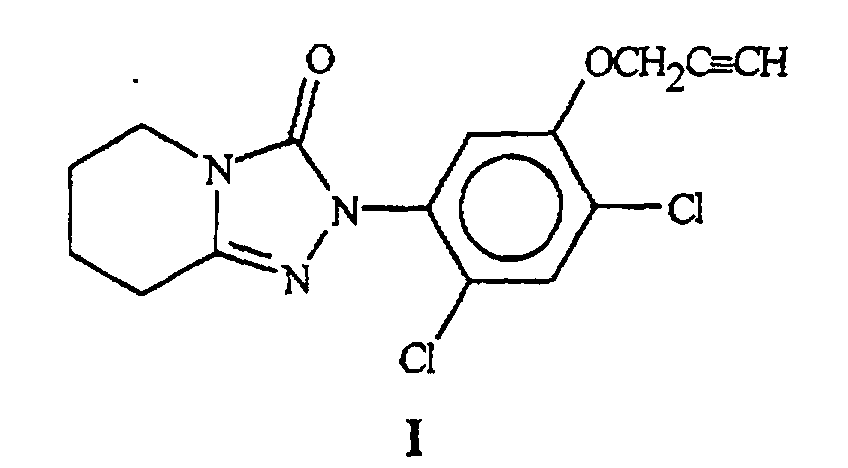
- U.S. 4,213,773 discloses 2-[2,4-dichloro-5-(2-propynyloxy)phenyl]-5,6,7,8-tetrahydro-1,2,4-triazolo[4,3-α]pyridin-3(2H)-one, and U.S. 5,332,718 discloses the utility of this compound for selective control of weeds in plantation crops. These references do not specifically disclose the particular mixtures of the present invention, nor do they describe or suggest the unexpected synergistic utility of said mixtures.
- This invention relates to mixtures of herbicides that produce synergistic results. The herbicidal mixtures comprise herbicidally effective amounts of the compound of Formula I in admixture with herbicidally effective amounts of one of the compounds of Formulae II through IX. This invention also relates to herbicidal compositions comprising effective amounts of the aforesaid mixtures and at least one of the following: surfactant, solid or liquid diluent. This invention also relates to a method of controlling undesired vegetation comprising applying to the locus of the undesired vegetation herbicidally effective amounts of the aforesaid mixtures.
- The mixtures of the invention comprising the Formula I and Formulae II-IX compounds are described below:2-[2,4-dichloro-5-(2-propynyloxy)phenyl]-5,6,7,8-tetrahydro-1,2,4-triazolo[4,3-a]pyridin-3(2H)-one (I);
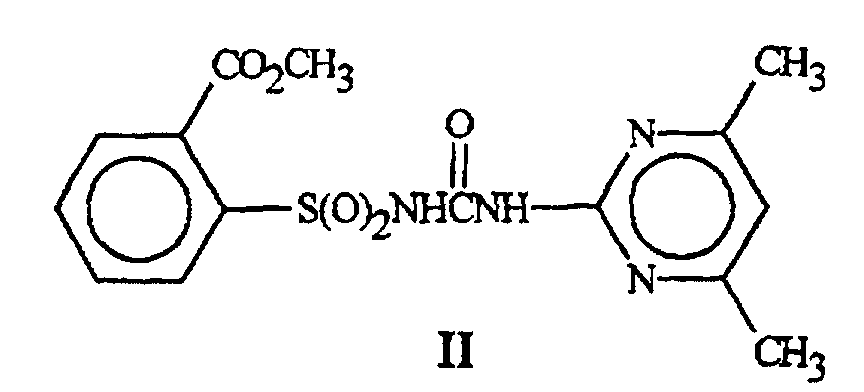
 methyl 2-[[[[(4,6-dimethy]-2-pyrimidinyl)amino]carbonyl]amino]sulfonyl]benzoate (sulfometuron methyl, II) and its agriculturally useful salts;
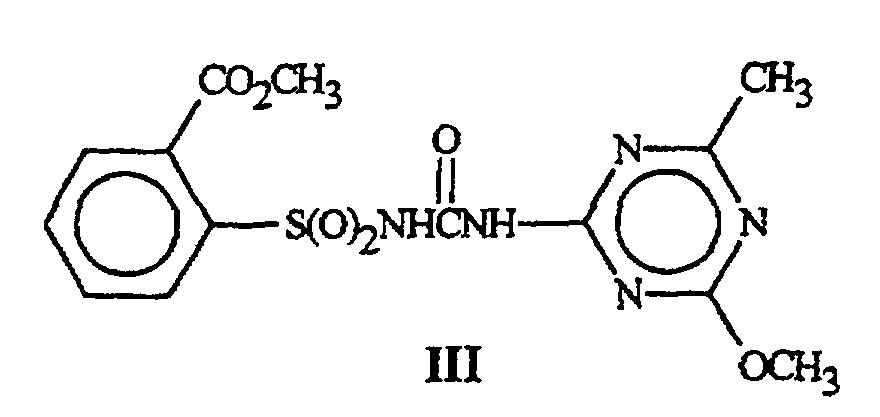
 methyl 2-[[[[(4-methoxy-6-methyl-1,3,5-triazin-2-yl)amino]carbonyl]amino]sulfonyl]benzoate (metsulfuron methyl, III) and its agriculturally useful salts;
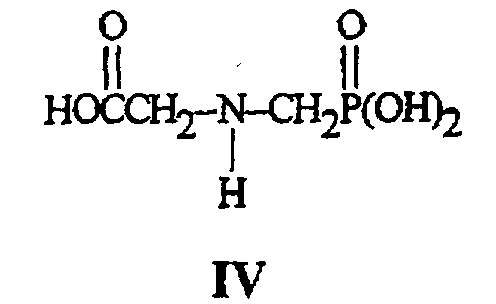
 N-(phosphonomethyl)glycine (glyphosate, IV) and its agriculturally useful salts;
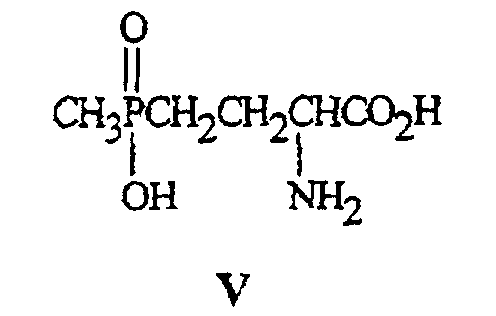
 (±)-2-amino-4-(hydroxymethylphosphinyl)butanoic acid (glufosinate, V) and its agriculturally useful salts;
 1,1'-dimethyl-4,4'-bipyridinium (paraquat, VI) in the form of agriculturally useful salts;
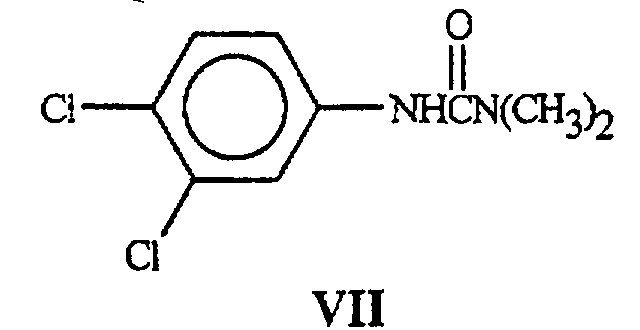
 N'-(3,4-dichlorophenyl)-N,N-dimethylurea (diuron, VII);
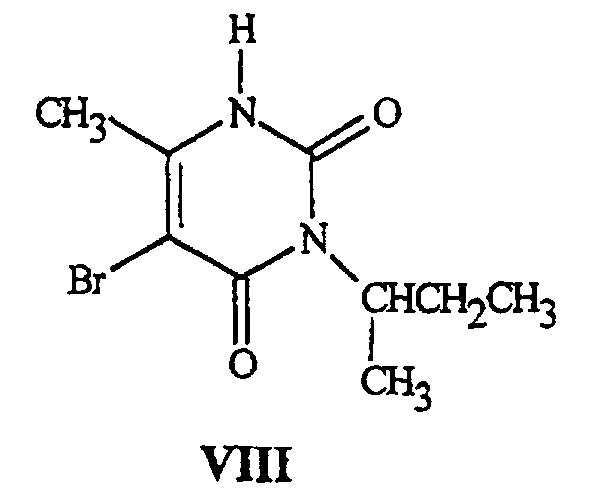
 5-bromo-6-methyl-3-(1-methylpropyl)-2,4(1H,3H)-pyrimidinedione (bromacil, VIII); and
 3-cyclohexyl-6-(dimethylamino)-1-methyl-1,3,5-triazine-2,4(1H,3H)-dione (hexazinone, IX).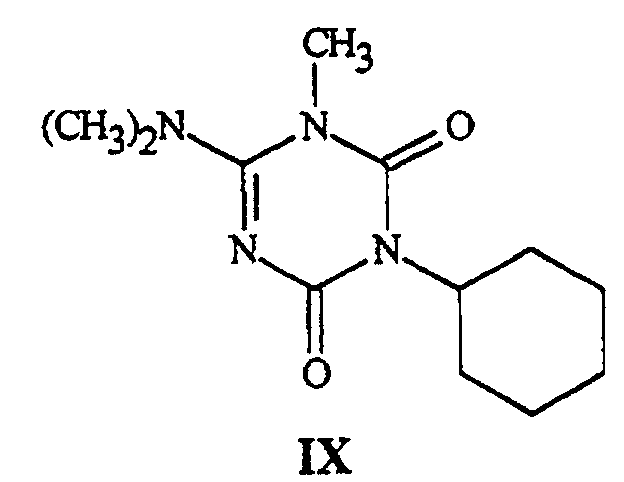
- The compounds of Formulae II-V and VIII can be present in the form of salts. In view of the close relationship between these compounds in their free forms and their agriculturally useful salts, including their equilibration under physiological and environmental conditions, hereinbefore and hereinafter any reference to Formulae II-V and VIII is to be understood as including both the free compounds and their agriculturally useful salts, where appropriate and expedient. Similarly, the dication of Formula VI is a salt component, and the counterions present will exchange under physiological and environmental conditions. Therefore hereinbefore and hereinafter any reference to Formula VI is to be understood as including all agriculturally useful salts comprising Formula VI, where appropriate and expedient.
- The mixtures of the invention preferred for enhanced herbicidal activity include:
- a) the compound of Formula I and the compound of Formula II,
- b) the compound of Formula I and the compound of Formula III,
- c) the compound of Formula I and the compound of Formula IV,
- d) the compound of Formula I and the compound of Formula V,
- e) the compound of Formula I and the compound of Formula VI,
- f) the compound of Formula I and the compound of Formula VII,
- g) the compound of Formula I and the compound of Formula VIII, and
- h) the compound of Formula I and the compound of Formula IX.
-
- The herbicidal compositions of the invention preferred for enhanced herbicidal activity include:
- a) the compound of Formula I and the compound of Formula II,
- b) the compound of Formula I and the compound of Formula III,
- c) the compound of Formula I and the compound of Formula IV,
- d) the compound of Formula I and the compound of Formula V,
- e) the compound of Formula I and the compound of Formula VI,
- f) the compound of Formula I and the compound of Formula VII,
- g) the compound of Formula I and the compound of Formula VIII, and
- h) the compound of Formula I and the compound of Formula IX.
-
- The preferred crops for application of the mixtures of the invention are perennial plantation crops including banana, citrus, coffee, cocoa, grapes, hops, oil palm, plantain, pineapple, rubber, sugarcane, tea, fruit trees, nut trees and forests such as eucalyptus and conifers (e.g., loblolly pine), and turf (e.g., Kentucky bluegrass, St. Augustine grass, Kentucky fescue, Bermuda grass).
- The Formula I compound can be prepared as described in U.S. 4,213,773. The synthesis involves reacting the phenol 1 with 3-chloropropyne (2) in the presence of a base such as anhydrous potassium carbonate in a suitable solvent, such as dry acetonitrile.

- Mixtures of the Formula I compound with several specific commercially available herbicides (Formulae II-IX) has now been discovered to demonstrate surprising synergistic control of key weeds.
- Sulfometuron methyl (Formula II) is sold by DuPont as the active ingredient in Oust® herbicide. Although sulfometuron methyl is most conveniently obtained as a commercial product, it and its agriculturally useful salts can be prepared by methods described in U.S. 4,394,506.
- Metsulfuron methyl (Formula III) is sold by DuPont as the active ingredient in Ally® herbicide and Escort® herbicide. Although metsulfuron methyl is most conveniently obtained as a commercial product, it and its agriculturally useful salts can be prepared by methods described in U.S. 4,383,113.
- Glyphosate (Formula IV) is sold in the form of the isopropylammonium salt (Formula IVa) by Monsanto as the active ingredient in Roundup® herbicide and Sting® herbicide. Glyphosate is sold in the form of the trimesium salt (Formula IVb) by Zeneca as the active ingredient in Touchdown® herbicide. Although glyphosate is most conveniently obtained as a commercial product, it and its agriculturally useful salts can be prepared by methods described in U.S. 4,315,765 and U.S. 4,405,531.
- Glufosinate (Formula V) is sold in the form of the ammonium salt (Formula Va) by AgrEvo as the active ingredient in Basta® herbicide. Although glufosinate is most conveniently obtained as a commercial product, it and its agriculturally useful salts can be prepared by methods described in U.S. 4,168,963.
- Paraquat (Formula VI) is always present as the dication in a salt. The salt anions typically used are chloride, forming paraquat dichloride (Formula VIa). Paraquat dichloride is sold by Zeneca as the active ingredient in Gramoxone® herbicide. Although paraquat is most conveniently obtained as a commercial product, the agriculturally suitable salts comprising it can be prepared by methods described in U.S. 2,972,528 and U.S. 3,793,335.
- Diuron (Formula VII) is sold by DuPont as the active ingredient in Karmex® herbicide, along with bromacil as the active ingredient in Krovar® herbicide, and along with hexazinone as the active ingredient in Velpar® K herbicide. Although diuron is most conveniently obtained as a commercial product, it can be prepared by the methods described in U.S. 2,655,445.
- Bromacil (Formula VIII) is sold by DuPont as the active ingredient in Hyvar® X herbicide and Hyvar® DF herbicide, as the lithium salt (bromacil-lithium, Formula VIIIa) as the active ingredient in Hyvar XL herbicide, and along with diuron as the active ingredient in Krovar® herbicide. Although bromacil is most conveniently obtained as a commercial product, it can be prepared by the methods described in U.S. 3,352,862.
- Hexazinone (Formula IX) is sold by DuPont as the active ingredient in Velpar® herbicide and along with diuron as the active ingredient in Velpar® K herbicide. Although hexazinone is most conveniently obtained as a commercial product, it can be prepared by the methods described in U.S. 3,902,997.
- The mixtures of the Formula I and Formulae II-IX compounds can be formulated in a number of ways:
- (a) the Formula I and Formulae II-IX compounds can be formulated separately and applied separately or applied simultaneously in an appropriate weight ratio, e.g., as a tank mix; or
- (b) the Formula I and Formulae II-IX compounds can be formulated together in the proper weight ratio.
-
- Mixtures of the Formula I and Formulae II-IX compounds will generally be used in formulation with an agriculturally suitable carrier comprising a liquid or solid diluent and/or a surfactant wherein the formulation is consistent with the physical properties of the active ingredients, mode of application and environmental factors such as soil type, moisture and temperature. Useful formulations include liquids such as solutions (including emulsifiable concentrates), suspensions, emulsions (including microemulsions and/or suspoemulsions) and the like which optionally can be thickened into gels. Useful formulations further include solids such as dusts, powders, granules, pellets, tablets, films, and the like which can be water-dispersible ("wettable") or water-soluble. Active ingredients can be (micro)encapsulated and further formed into a suspension or solid formulation; alternatively the entire formulation of active ingredient can be encapsulated (or "overcoated"). Encapsulation can control or delay release of the active ingredients. Sprayable formulations can be extended in suitable media and used at spray volumes from about one to several hundred liters per hectare. High-strength compositions are primarily used as intermediates for further formulation.
- The formulations will typically contain effective amounts of active ingredients, diluent and surfactant within the following approximate ranges which add up to 100 percent by weight.
Weight Percent Active Ingredient Diluent Surfactant Water-Dispersible and Water-soluble Granules, Tablets and Powders 5-90 0-94 1-15 Suspensions, Emulsions, Solutions (including Emulsifiable Concentrates) 5-50 40-95 0-15 Dusts 1-25 70-99 0-5 Granules and Pellets 0.01-99 5-99.99 0-15 High Strength Compositions 90-99 0-10 0-2 - Typical solid diluents are described in Watkins, et al., Handbook of Insecticide Dust Diluents and Carriers, 2nd Ed., Dorland Books, Caldwell, New Jersey. Typical liquid diluents are described in Marsden, Solvents Guide, 2nd Ed., Interscience, New York, 1950. McCutcheon's Detergents and Emulsifiers Annual, Allured Publ. Corp., Ridgewood, New Jersey, as well as Sisely and Wood, Encyclopedia of Surface Active Agents, Chemical Publ. Co., Inc., New York, 1964, list surfactants and recommended uses. All formulations can contain minor amounts of additives to reduce foam, caking, corrosion, microbiological growth and the like, or thickeners to increase viscosity.
- Surfactants include, for example, polyethoxylated alcohols, polyethoxylated alkylphenols, polyethoxylated sorbitan fatty acid esters, dialkyl sulfosuccinates, alkyl sulfates, alkylbenzene sulfonates, organosilicones, N,N-dialkyltaurates, lignin sulfonates, naphthalene sulfonate formaldehyde condensates, polycarboxylates, and polyoxyethylene/polyoxypropylene block copolymers. Solid diluents include, for example, clays such as bentonite, montmorillinite, attapulgite and kaolin, starch, sugar, silica, talc, diatomaceous earth, urea, calcium carbonate, sodium carbonate and bicarbonate, and sodium sulfate. Liquid diluents include, for example, water, N,N-dimethylformamide, dimethyl sulfoxide, N-alkylpyrrolidone, ethylene glycol, polypropylene glycol, paraffins, alkylbenzenes, alkylnaphthalenes, oils of olive, castor, linseed, tung, sesame, corn, peanut, cotton-seed, soybean, rape-seed and coconut, fatty acid esters, ketones such as cyclohexanone, 2-heptanone, isophorone and 4-hydroxy-4-methyl-2-pentanone, and alcohols such as methanol, cyclohexanol, decanol and tetrahydrofurfuryl alcohol.
- Solutions, including emulsifiable concentrates, can be prepared by simply mixing the ingredients. Chemically stabilized aqueous sulfonylurea or agriculturally suitable sulfonylurea salt dispersions are taught in U.S. 4,936,900. Solution formulations of sulfonylureas with improved chemical stability are taught in U.S. 4,599,412. Dusts and powders can be prepared by blending and, usually, grinding as in a hammer mill or fluid-energy mill. Suspensions are usually prepared by wet-milling; see, for example, U.S. 3,060,084. Granules and pellets can be prepared by spraying the active material upon preformed granular carriers or by agglomeration techniques. See Browning, "Agglomeration", Chemical Engineering, December 4, 1967, pp 147-48, Perry's Chemical Engineer's Handbook, 4th Ed., McGraw-Hill, New York, 1963, pages 8-57 and following, and WO 91/13546. Pellets can be prepared as described in U.S. 4,172,714. Water-dispersible and water-soluble granules can be prepared as taught in U.S. 4,144,050, U.S. 3,920,442 and DE 3,246,493. Tablets can be prepared as taught in U.S. 5,180,587, U.S. 5,232,701 and U.S. 5,208,030. Films can be prepared as taught in GB 2,095,558 and U.S. 3,299,566.
- For further information regarding formulation, see U.S. 3,235,361, Col. 6, line 16 through Col. 7, line 19 and Examples 10-41; U.S. 3,309,192, Col. 5, line 43 through Col. 7, line 62 and Examples 8, 12, 15, 39, 41, 52, 53, 58, 132, 138-140, 162-164, 166, 167 and 169-182; U.S. 2,891,855, Col. 3, line 66 through Col. 5, line 17 and Examples 1-4; Klingman, Weed Control as a Science, John Wiley and Sons, Inc.. New York, 1961, pp 81-96; and Hance et al., Weed Control Handbook, 8th Ed., Blackwell Scientific Publications, Oxford, 1989.
- In the following Examples, all percentages are by weight and all formulations are prepared in conventional ways. Compound numbers are as described in the Index Table on page 13.
-
High Strength Concentrate Compound 1 78.8% Compound 2 19.7% silica aerogel 0.5% synthetic amorphous fine silica 1.0%. -
Wettable Powder Compound 1 39.0% Compound 3 26.0% dodecylphenol polyethylene glycol ether 2.0% sodium ligninsulfonate 4.0% sodium silicoaluminate 6.0% montmorillonite (calcined) 23.0%. -
High Strength Concentrate Compound 1 24.6% Compound 4 73.9% silica aerogel 0.5% synthetic amorphous fine silica 1.0%. -
High Strength Concentrate Compound 1 32.8% Compound 5 65.7% silica aerogel 0.5% synthetic amorphous fine silica 1.0%. -
High Strength Concentrate Compound 1 24.6% Compound 6 73.9% silica aerogel 0.5% synthetic amorphous fine silica 1.0%. -
High Strength Concentrate Compound 1 24.6% Compound 7 73.9% silica aerogel 0.5% synthetic amorphous fine silica 1.0%. -
Granule Compound 1 1.1% Compound 8 8.9% attapulgite granules (low volatile matter, 0.71/0.30 mm; U.S.S. No. 25-50 sieves) 90.0%. -
Aqueous Suspension Compound 1 5.0% Compound 9 20.0% hydrated attapulgite 3.0% crude calcium ligninsulfonate 10.0% sodium dihydrogen phosphate 0.5% water 61.5%. -
Extruded Pellet Compound 1 5.0% Compound 10 20.0% anhydrous sodium sulfate 10.0% crude calcium ligninsulfonate 5.0% sodium alkylnaphthalenesulfonate 1.0% calcium/magnesium bentonite 59.0%. - Test results indicate that mixtures of Formula I with Formulae II-IX are highly active herbicides, providing unexpected synergistic control of selected grass and broadleaf weeds.
- The mixtures of the invention are valued for their utility for selective weed control in perennial plantation crops including banana, citrus, coffee, cocoa, grapes, hops, oil palm, plantain, pineapple, rubber, sugarcane, tea, fruit trees, nut trees and forests such as eucalyptus and conifers (e.g., loblolly pine), and turf (e.g., Kentucky bluegrass, St. Augustine grass, Kentucky fescue, Bermuda grass). These mixtures are also valued for their utility for enhanced broad-spectrum pre- and/or postemergence weed control in areas around fuel storage tanks, industrial storage areas, parking lots, drive-in theaters, billboards and railroad structures, and along fence rows and highways.
- The mixtures of Formula I with Formula II or III are particularly valued, because they retain acceptable levels of selectivity in crops such as banana, coffee, cocoa, hops, oil palm, plantain, pineapple, rubber, sugarcane, tea, forests and turf. The mixtures of Formula I with Formula IV, V or VI are particularly valued, because they retain acceptable levels of selectivity in crops such as banana, citrus, coffee, cocoa, grapes, hops, oil palm, plantain, pineapple, rubber, tea, fruit trees, nut trees and forests. The mixtures of Formula I with Formula VII are particularly valued, because they retain acceptable levels of selectivity in crops such as banana, grapes, oil palm, plantain, rubber, sugarcane, fruit trees and nut trees. The mixtures of Formula I with Formula VIII are particularly valued, because they retain acceptable levels of selectivity in crops such as citrus. The mixtures of Formula I with Formula IX are particularly valued, because they retain acceptable levels of selectivity in crops such as sugarcane and forests.
- Many of the mixtures provide useful weed control when applied in sequential applications. Sequential applications of the mixtures may be particularly useful for controlling weeds that have germinated after the initial application or for improving control of larger weeds that may not be entirely controlled by a single application. In particular, sequential applications of the mixtures may be preferred in certain crop and noncrop utilities.
- The Formula I and Formulae II-IX mixtures of this invention can additionally be used in combination with other commercial herbicides, insecticides or fungicides. A mixture of one or more of the following herbicides with the Formula I and Formulae II-IX mixtures of this invention may be particularly useful for weed control. Examples of other herbicides as mixture partners are: alachlor, ametryn, asulam, atrazine, cinmethylin, cyanazine, 2,4-D and its butotyl, butyl, isoctyl and isopropyl esters and its dimethylammonium, diolamine and trolamine salts, dalapon, dalapon-sodium, 2,4-DB and its dimethylammonium, potassium and sodium salts, dicamba and its dimethylammonium, potassium and sodium salts, EPTC, fluazifop-butyl, fluazifop-P-butyl, fosamine-ammonium, imazamethabenz-methyl, imazapyr, imazaquin, imazaquin-ammonium, imazethapyr, imazethapyr-ammonium, imazosulfuron, lenacil, linuron, mefluidide, metribuzin, norflurazon, oxadiazon, oxyfluorfen, pendimethalin, picloram, picloram-potassium, quizalofop-ethyl, quizalofop-P-ethyl, quizalofop-P-tefuryl, sethoxydim, simazine, tebuthiuron, terbacil, triclopyr, triclopyr-butotyl, triclopyr-triethylammonium, and trifluralin. Furthermore, the herbicides bromacil, diuron, glufosinate, glufosinate-ammonium, glyphosate, glyphosate-isopropylammonium, glyphosate-sesquisodium, glyphosate-trimesium, hexazinone, metsulfuron methyl, paraquat dichloride and sulfometuron methyl are useful as additional mixture partners in combination with other of the Formulae II-IX herbicidal compounds in admixture with the Formula I herbicidal compound.
- In certain instances, combinations with other herbicides having a similar spectrum of control but a different mode of action will be particularly advantageous for resistance management.
- Generally, the herbicidally effective amounts of the compounds of Formulae I-IX in the mixtures will vary depending on the specific compounds selected, environmental conditions, formulation, method of application, amount and type of vegetation present, etc. The herbicidally effective amounts of Formula I relative to Formula II is generally in a ratio of 64:1 to 1:2, preferably in a ratio of 32:1 to 1:1, and most preferably in a ratio of 8:1 to 2:1. The herbicidally effective amounts of Formula I relative to Formula III is generally in a ratio of 16:1 to 1:8, preferably in a ratio of 8:1 to 1:4, and most preferably in a ratio of 4:1 to 1:2. The herbicidally effective amounts of Formula I relative to Formula IV is generally in a ratio of 2:1 to 1:10, preferably in a ratio of 1:1 to 1:8, and most preferably in a ratio of 1:1 to 1:5. The herbicidally effective amounts of Formula I relative to Formula V is generally in a ratio of 1:1 to 1:10, preferably in a ratio of 1:1 to 1:8, and most preferably in a ratio of 1:1 to 1:5. The herbicidally effective amounts of Formula I relative to Formula VI is generally in a ratio of 2:1 to 1:10, preferably in a ratio of 1:1 to 1:8, and most preferably in a ratio of 1:1 to 1:5. The herbicidally effective amounts of Formula I relative to Formula VII is generally in a ratio of 1:4 to 1:24, preferably in a ratio of 1:4 to 1:16, and most preferably in a ratio of 1:5 to 1:12. The herbicidally effective amounts of Formula I relative to Formula VIII is generally in a ratio of 1:1 to 1:16, preferably in a ratio of 1:1 to 1:10, and most preferably in a ratio of 1:1 to 1:8. The herbicidally effective amounts of Formula I relative to Formula IX is generally in a ratio of 1:1 to 1:12, preferably in a ratio of 1:1 to 1:10, and most preferably in a ratio of 1:1 to 1:8.
- Generally a herbicidally effective amount of the Formula I compound is applied at a rate from 5 to 5000 g ai/ha, preferably at a rate from 10 to 2000 g ai/ha, and most preferably at a rate from 10 to 1000 g ai/ha. Generally a herbicidally effective amount of the Formula II compound is applied at a rate from 0.25 to 840 g ai/ha, preferably at a rate from 2 to 420 g ai/ha, and most preferably at a rate from 3 to 260 g ai/ha. Generally a herbicidally effective amount of the Formula III compound is applied at a rate from 0.25 to 350 g ai/ha, preferably at a rate from 2 to 200 g ai/ha, and most preferably at a rate from 3 to 175 g ai/ha. Generally a herbicidally effective amount of the Formula IV compound is applied at a rate from 140 to 9000 g ai/ha, preferably at a rate from 320 to 6700 g ai/ha, and most preferably at a rate from 500 to 4500 g ai/ha. Generally a herbicidally effective amount of the Formula V compound is applied at a rate from 100 to 5000 g ai/ha, preferably at a rate from 250 to 2500 g ai/ha, and most preferably at a rate from 500 to 2000 g ai/ha. Generally a herbicidally effective amount of the Formula VI compound is applied at a rate from 25 to 2000 g ai/ha, preferably at a rate from 50 to 1000 g ai/ha, and most preferably at a rate from 100 to 500 g ai/ha. Generally a herbicidally effective amount of the Formula VII compound is applied at a rate from 200 to 10000 g ai/ha, preferably at a rate from 500 to 5000 g ai/ha, and most preferably at a rate from 500 to 4000 g ai/ha. Generally a herbicidally effective amount of the Formula VIII compound is applied at a rate from 200 to 10000 g ai/ha, preferably at a rate from 500 to 4000 g ai/ha, and most preferably at a rate from 500 to 3000 g ai/ha. Generally a herbicidally effective amount of the Formula IX compound is applied at a rate from 100 to 10000 g ai/ha, preferably at a rate from 100 to 3000 g ai/ha, and most preferably at a rate from 100 to 1000 g ai/ha. One skilled in the art can readily determine herbicidally effective application rates and ratios of the herbicide of Formula I to the herbicides of Formulae II-IX as well as timing necessary for the desired level of weed control and crop safety.
- The Formula I triazinone (Compound 1) was tested in combination with the Formula II sulfonylurea (Compound 2), the Formula III sulfonylurea (Compound 3), the Formula IV phosphonate (Compounds 4 and 5), the Formula V phosphonate (Compound 6), the Formula VI pyridinium salt (Compound 7), the Formula VII urea (Compound 8), the Formula VIII triazinedione (Compound 9) and the Formula IX triazinedione (Compound 10). The compounds of Formulae I-IX are listed in the Index Table below by number referred to in the following test data:
INDEX TABLE Compound Number Formula Name 1 I 2-[2,4-dichloro-5-(2-propynyloxy)phenyl]-5,6,7,8-tetrahydro-1,2,4-triazolo(4,3-a]pyridin-3(2H)-one 2 II sulfometuron methyl 3 III metsulfuron methyl 4 IVa glyphosate-isopropylammonium 5 IVb glyphosate-trimesium 6 Va glufosinate-ammonium 7 VIa paraquat dichloride 8 VII diuron 9 VIII bromacil 10 IX hexazinone - The data in the following Tables A and B demonstrate the efficacy of the Formula I and Formula II mixtures of this invention against specific weeds. The weed control afforded by the mixtures of this invention are not limited, however, to these species. Compound numbers are as described in the Index Table on page 13.
- 10-cm square plastic pots were partially filled with sandy loam soil and planted with seeds of large crabgrass (Digitaria sanguinalis), which were covered with 0.5 cm of soil. Preemergence treatments were applied by diluting dry flowable formulations of the compounds in a non-phytotoxic solvent containing a surfactant and then spraying the treatments onto the soil surface using a stationary laboratory circulating belt sprayer calibrated to deliver 327 L/ha through a single nozzle. Compound 1 was applied at 1, 2, 4 and 8 g ai/ha. Compound 2 was applied at 1 g ai/ha. Mixtures of Compound 1 at 1, 2, 4 and 8 g ai/ha and Compound 2 at 1 ai/ha were also applied. Individual treatments were replicated four times. Treatments were positioned in a greenhouse in a randomized complete block design. The greenhouse was maintained at a 26 °C average daily temperature, and natural light in the greenhouse was supplemented with artificial light to achieve a photoperiod of 14 hours. At 30 days after spraying, the plants were evaluated for injury as compared to control plants that were sprayed preemergence with a non-phytotoxic solvent containing a surfactant. Injury was evaluated visually using a 0 to 100% scale where 0 indicates no effect and 100 indicates complete control.
- For Test A, the mean response of each treatment was determined. Colby's equation was used to calculate the expected additive herbicidal effect of the mixtures of Compound 1 and Compound 2. Colby's equation (Colby, S. R. "Calculating Synergistic and Antagonistic Responses of Herbicide Combinations," Weeds, 15(1), pp 20-22 (1967)) calculates the expected additive effect of herbicidal mixtures, and for two active ingredients is of the form:
- Pa+b is the percentage effect of the mixture expected from additive contribution of the individual components,
- Pa is the observed percentage effect of the first active ingredient at the same use rate as in the mixture, and
- Pb is the observed percentage effect of the second active ingredient at the same use rate as in the mixture.
-
- Results of Test A are shown in Table A, which lists the observed response of a specific weed to Compound 1 and Compound 2 applied alone as single active ingredients, the observed responses of the specific weed to mixtures of Compound 1 and Compound 2, and the expected additive effect of the herbicidal mixtures of Compound 1 and Compound 2 (Colby's equation).
Effect of Compound 1 and Compound 2 as Active Ingredients Alone and in Mixture Compound 1 Compound 2 Crabgrass Mean Expected Alone 1 0 0 - 2 0 20 - 4 0 42 - 8 0 84 - 0 1 31 - Mixtures 1 1 48 31 2 1 76 45 4 1 75 60 8 1 92 89 - 10-cm square plastic pots were partially filled with sandy loam soil and planted with seeds of southern sandbur (Cenchrus echinatus), which were covered with 0.5 cm of soil. Preemergence treatments were applied by diluting dry flowable formulations of the compounds in a non-phytotoxic solvent containing a surfactant and then spraying the treatments onto the soil surface using a stationary laboratory circulating belt sprayer calibrated to deliver 327 L/ha through a single nozzle. Compound 1 was applied at 1, 2 and 4 g ai/ha. Compound 2 was applied at 0.5 g ai/ha. Mixtures of Compound 1 at 1, 2 and 4 g ai/ha and Compound 2 at 0.5 ai/ha were also applied. Individual treatments were replicated four times. Treatments were positioned in a greenhouse in a randomized complete block design. The greenhouse was maintained at a 26 °C average daily temperature, and natural light in the greenhouse was supplemented with artificial light to achieve a photoperiod of 14 hours. At 30 days after spraying, the plants were evaluated for injury as compared to control plants that were sprayed preemergence with a non-phytotoxic solvent containing a surfactant. Injury was evaluated visually using a 0 to 100% scale where 0 indicates no effect and 100 indicates complete control.
- Results of Test B are shown in Table B, which lists the observed response of a specific weed to Compound 1 and Compound 2 applied alone as single active ingredients, the observed responses of the specific weed to mixtures of Compound 1 and Compound 2, and the expected additive effect of the herbicidal mixtures of Compound I and Compound 2 (Colby's equation).
Effect of Compound 1 and Compound 2 as Active Ingredients Alone and in Mixture Compound 1 Compound 2 Sandbur Mean Expected Alone 1 0 5 - 2 0 12 - 4 0 31 - 0 0.5 60 - Mixtures 1 0.5 65 62 2 0.5 85 65 4 0.5 86 72 - Weeds other than those specifically listed in Tables A and B are also controlled by mixtures of Compound 1 and Compound 2. Different ratios of Compound 1 to Compound 2, and different formulation types, also provide useful weed control from the combination of the two herbicides.
- The data in the following Tables C and D demonstrate the efficacy of the Formula I and Formula III mixtures of this invention against specific weeds. The weed control afforded by the mixtures of this invention are not limited, however, to these species. Compound numbers are as described in the Index Table on page 13.
- 10-cm square plastic pots were partially filled with sandy loam soil and planted with seeds of large crabgrass (Digitaria sanguinalis), which were covered with 0.5 cm of soil. Preemergence treatments were applied by diluting dry flowable formulations of the compounds in a non-phytotoxic solvent containing a surfactant and then spraying the treatments onto the soil surface using a stationary laboratory circulating belt sprayer calibrated to deliver 327 L/ha through a single nozzle. Compound 1 was applied at 1, 2 and 4 g ai/ha. Compound 3 was applied at 1 and 2 g ai/ha. Mixtures of Compound I at 1, 2 and 4 g ai/ha and Compound 3 at 1 and 2 ai/ha were also applied. Individual treatments were replicated four times. Treatments were positioned in a greenhouse in a randomized complete block design. The greenhouse was maintained at a 24 °C average daily temperature, and natural light in the greenhouse was supplemented with artificial light to achieve a photoperiod of 14 hours. At 33 days after spraying, the plants were evaluated for injury as compared to control plants that were sprayed preemergence with a non-phytotoxic solvent containing a surfactant. Injury was evaluated visually using a 0 to 100% scale where 0 indicates no effect and 100 indicates complete control.
- Results of Test C are shown in Table C, which lists the observed response of a specific weed to Compound I and Compound 3 applied alone as single active ingredients, the observed responses of the specific weed to mixtures of Compound 1 and Compound 3, and the expected additive effect of the herbicidal mixtures of Compound 1 and Compound 3 (Colby's equation).
Effect of Compound 1 and Compound 3 as Active Ingredients Alone and in Mixture Compound 1 Compound 3 Crabgrass Mean Expected Alone 1 0 0 - 2 0 11 - 4 0 61 - 0 1 8 - 0 2 31 - Mixtures 1 1 9 8 2 1 50 18 4 1 72 64 1 2 54 31 2 2 66 39 4 2 84 73 - 10-cm square plastic pots were partially filled with sandy loam soil and planted with seeds of pitted morningglory (Ipomoea lacunosa), which were covered with 0.5 cm of soil. Preemergence treatments were applied by diluting dry flowable formulations of the compounds in a non-phytotoxic solvent containing a surfactant and then spraying the treatments onto the soil surface using a stationary laboratory circulating belt sprayer calibrated to deliver 327 L/ha through a single nozzle. Compound 1 was applied at 1, 2 and 4 g ai/ha. Compound 3 was applied at 1 g ai/ha. Mixtures of Compound 1 at 1, 2 and 4 g ai/ha and Compound 3 at 1 g ai/ha were also applied. Individual treatments were replicated four times. Treatments were positioned in a greenhouse in a randomized complete block design. The greenhouse was maintained at a 24 °C average daily temperature, and natural light in the greenhouse was supplemented with artificial light to achieve a photoperiod of 14 hours. At 33 days after spraying, the plants were evaluated for injury as compared to control plants that were sprayed preemergence with a non-phytotoxic solvent containing a surfactant. Injury was evaluated visually using a 0 to 100% scale where 0 indicates no effect and 100 indicates complete control.
- Results of Test D are shown in Table D, which lists the observed response of a specific weed to Compound 1 and Compound 3 applied alone as single active ingredients, the observed responses of the specific weed to mixtures of Compound 1 and Compound 3, and the expected additive effect of the herbicidal mixtures of Compound 1 and Compound 3 (Colby's equation).
Effect of Compound I and Compound 3 as Active Ingredients Alone and in Mixture Compound 1 Compound 3 Morningglory Mean Expected Alone 1 0 0 - 2 0 0 - 4 0 13 - 8 0 18 - 0 1 86 - Mixtures I 1 91 86 2 1 92 86 4 1 95 88 8 1 95 89 - Weeds other than those specifically listed in Tables C and D are also controlled by mixtures of Compound 1 and Compound 3. Different ratios of Compound 1 to Compound 3, and different formulation types, also provide useful weed control from the combination of the two herbicides.
- The data in the following Tables E-H demonstrate the efficacy of the Formula I and Formula IV mixtures of this invention against specific weeds. The weed control afforded by the mixtures of this invention are not limited, however, to these species. Compound numbers are as described in the Index Table on page 13.
- Guineagrass (Panicum maximum) was grown 21 days in a greenhouse to approximately 24-cm height in 18-cm round pots containing a 60:40 mixture of sterilized sandy loam soil and Metro-Mix® 350 potting soil. Treatments were applied to the test species by diluting the formulated compounds in a non-phytotoxic solvent containing a surfactant, and spraying the treatments onto the plants using a stationary laboratory circulating belt sprayer calibrated to deliver 311 L/ha through a single nozzle. Compound 1 was applied at 31 and 62 g ai/ha. Compound 4 was applied at 125 and 250 g ai/ha. Mixtures of Compound 1 at 31 and 62 g ai/ha with Compound 4 at 125 and 250 g ai/ha were also applied. Individual treatments were replicated three times. Treatments were positioned in a greenhouse in a randomized complete block design. The greenhouse was maintained at a 28 °C average daily temperature, and natural light in the greenhouse was supplemented with artificial light to achieve a photoperiod of 14 hours. At 28 days after spraying, the plants were evaluated for injury as compared to control plants that were sprayed only with non-phytotoxic solvent. Injury was evaluated visually using a 0 to 100% scale where 0 indicates no effect and 100 indicates complete control.
- Results of Test E are shown in Table E, which lists the observed response of a specific weed to Compound 1 and Compound 4 applied alone as single active ingredients, the observed responses of the specific weed to mixtures of Compound 1 and Compound 4, and the expected additive effect of the herbicidal mixtures of Compound 1 and Compound 4 (Colby's equation).
Effect of Compound 1 and Compound 4 as Active Ingredients Alone and in Mixture Compound 1 Compound 4 Guineagrass Mean Expected Alone 31 0 37 - 62 0 73 - 0 125 0 - 0 250 0 - Mixtures 31 125 53 37 62 125 80 73 31 250 70 37 62 250 78 73 - Guineagrass (Panicum maximum) seeds were planted in 18-cm round fiber pots filled with a 60:40 ratio of sterilized sandy loam soil and Metro-mix® 350 potting mixture. The plants were treated postemergence at the 6- to 8-leaf stage with test compounds formulated with a non-phytotoxic solvent. Compound 1 was applied at 250 and 500 g ai/ha. Compound 4 was applied at 250 and 500 g ai/ha. Mixtures of Compound I at 250 and 500 g ai/ha with Compound 4 at 250 and 500 g ai/ha were also applied. The treated plants were grown in a greenhouse. At the end of the tests, the plants were visually rated and compared with untreated controls using a scale of 0 to 100 where 0 indicates no effect and 100 indicates complete control.
- Results of Test F are shown in Table F, which lists the observed response of a specific weed to Compound 1 and Compound 4 applied alone as single active ingredients, the observed responses of the specific weed to mixtures of Compound 1 and Compound 4, and the expected additive effect of the herbicidal mixtures of Compound 1 and Compound 4 (Colby's equation).
Effect of Compound 1 and Compound 4 as Active Ingredients Alone and in Mixture Compound 1 Compound 4 Guineagrass Mean Expected Alone 250 0 90 - 500 0 95 - 0 250 10 - 0 500 30 - Mixtures 250 250 95 91 250 500 95 93 500 250 100 96 500 500 100 96 - Pitted morningglory (Ipomoea lacunosa) was grown 21 days in a greenhouse to approximately 16-cm height in 18-cm round pots containing a 60:40 mixture of sterilized sandy loam soil and Metro-Mix® 350 potting soil. Treatments were applied to the test species by diluting the formulated compounds in a non-phytotoxic solvent containing a surfactant, and spraying the treatments onto the plants using a stationary laboratory circulating belt sprayer calibrated to deliver 311 L/ha through a single nozzle. Compound 1 was applied at 31, 62 and 125 g ai/ha. Compound 4 was applied at 125, 250 and 500 g ai/ha. Mixtures of Compound 1 at 31, 62 and 125 g ai/ha with Compound 4 at 125, 250 and 500 g ai/ha were also applied. Individual treatments were replicated three times. Treatments were positioned in a greenhouse in a randomized complete block design. The greenhouse was maintained at a 28 °C average daily temperature, and natural light in the greenhouse was supplemented with artificial light to achieve a photoperiod of 14 hours. At 28 days after spraying, the plants were evaluated for injury as compared to control plants that were sprayed only with non-phytotoxic solvent. Injury was evaluated visually using a 0 to 100% scale where 0 indicates no effect and 100 indicates complete control.
- Results of Test G are shown in Table G, which lists the observed response of a specific weed to Compound 1 and Compound 4 applied alone as single active ingredients, the observed responses of the specific weed to mixtures of Compound 1 and Compound 4, and the expected additive effect of the herbicidal mixtures of Compound I and Compound 4 (Colby's equation).
Effect of Compound 1 and Compound 4 as Active Ingredients Alone and in Mixture Compound 1 Compound 4 Morningglory Mean Expected Alone 31 0 47 - 62 0 77 - 125 0 90 - 0 125 0 - 0 250 0 - 0 500 17 - Mixtures 31 125 70 47 62 125 100 77 125 125 100 90 31 250 77 47 62 250 85 77 125 250 100 90 31 500 83 56 62 500 87 81 125 500 93 92 - Pitted morningglory (Ipomoea lacunosa) was grown 21 days in a greenhouse to approximately 16-cm height in 18-cm round pots containing a 60:40 mixture of sterilized sandy loam soil and Metro-Mix® 350 potting soil. Treatments were applied to the test species by diluting the formulated compounds in a non-phytotoxic solvent containing a surfactant, and spraying the treatments onto the plants using a stationary laboratory circulating belt sprayer calibrated to deliver 311 L/ha through a single nozzle. Compound 1 was applied at 31, 62 and 125 g ai/ha. Compound 5 was applied at 125, 250 and 500 g ai/ha. Mixtures of Compound 1 at 31, 62 and 125 g ai/ha with Compound 5 at 125, 250 and 500 g ai/ha were also applied. Individual treatments were replicated three times. Treatments were positioned in a greenhouse in a randomized complete block design. The greenhouse was maintained at a 28 °C average daily temperature, and natural light in the greenhouse was supplemented with artificial light to achieve a photoperiod of 14 hours. At 28 days after spraying, the plants were evaluated for injury as compared to control plants that were sprayed only with non-phytotoxic solvent. Injury was evaluated visually using a 0 to 100% scale where 0 indicates no effect and 100 indicates complete control.
- Results of Test H are shown in Table H, which lists the observed response of a specific weed to Compound 1 and Compound 5 applied alone as single active ingredients, the observed responses of the specific weed to mixtures of Compound 1 and Compound 5, and the expected additive effect of the herbicidal mixtures of Compound 1 and Compound 5 (Colby's equation).
Effect of Compound 1 and Compound 5 as Active Ingredients Alone and in Mixture Compound 1 Compound 5 Morningglory Mean Expected Alone 31 0 47 - 62 0 77 - 125 0 90 - 0 125 0 - 0 250 3 - 0 500 17 - Mixtures 31 125 95 47 31 250 90 49 31 500 98 56 62 250 90 78 125 125 100 90 - Weeds other than those specifically listed in Tables E-H are also controlled by mixtures of Compound 1 with Compounds 4 and 5. Different ratios of Compound 1 to Compounds 4 and 5, and different formulation types, also provide useful weed control from the combination of the herbicides.
- The following protocol was used for the test in Table I. Compound numbers are as described in the Index Table on page 13. The data demonstrate the efficacy of the Formula I and Formula V mixtures of this invention against a specific weed. The weed control afforded by the mixtures of this invention are not limited, however, to this species.
- Pitted morningglory (Ipomoea lacunosa) was grown 21 days in a greenhouse to approximately 16-cm height in 18-cm round pots containing a 60:40 mixture of sterilized sandy loam soil and Metro-Mix® 350 potting soil. Treatments were applied to the test species by diluting the formulated compounds in a non-phytotoxic solvent containing a surfactant, and spraying the treatments onto the plants using a stationary laboratory circulating belt sprayer calibrated to deliver 311 L/ha through a single nozzle. Compound 1 was applied at 31, 62 and 125 g ai/ha. Compound 6 was applied at 125, 250 and 500 g ai/ha. Mixtures of Compound 1 at 31, 62 and 125 g ai/ha with Compound 6 at 125, 250 and 500 g ai/ha were also applied. Individual treatments were replicated three times. Treatments were positioned in a greenhouse in a randomized complete block design. The greenhouse was maintained at a 28 °C average daily temperature, and natural light in the greenhouse was supplemented with artificial light to achieve a photoperiod of 14 hours. At 28 days after spraying, the plants were evaluated for injury as compared to control plants that were sprayed only with non-phytotoxic solvent. Injury was evaluated visually using a 0 to 100% scale where 0 indicates no effect and 100 indicates complete control.
- Results of Test H are shown in Table I, which lists the observed response of a specific weed to Compound 1 and Compound 6 applied alone as single active ingredients, the observed responses of the specific weed to mixtures of Compound 1 and Compound 6, and the expected additive effect of the herbicidal mixtures of Compound 1 and Compound 6 (Colby's equation). Weeds other than that specifically listed are also controlled by mixtures of Compound 1 and Compound 6. Different ratios of Compound 1 to Compound 6, and different formulation types, also provide useful weed control from the combination of the two herbicides.
Effect of Compound 1 and Compound 6 as Active Ingredients Alone and in Mixture Compound 1 Compound 6 Morningglory Mean Expected Alone 31 0 47 - 62 0 77 - 125 0 90 - 0 125 0 - 0 250 7 - 0 500 80 - Mixtures 31 125 80 47 62 125 93 77 125 125 93 90 31 250 90 51 62 250 100 79 125 250 97 91 62 500 100 95 125 500 100 98 - The data in the following Tables J and K demonstrate the efficacy of the Formula I and Formula VI mixtures of this invention against specific weeds. The weed control afforded by the mixtures of this invention are not limited, however, to these species. Compound numbers are as described in the Index Table on page 13.
- Pitted morningglory (Ipomoea lacunosa) was grown 21 days in a greenhouse to approximately 16-cm height in 18-cm round pots containing a 60:40 mixture of sterilized sandy loam soil and Metro-Mix® 350 potting soil. Treatments were applied to the test species by diluting the formulated compounds in a non-phytotoxic solvent containing a surfactant, and spraying the treatments onto the plants using a stationary laboratory circulating belt sprayer calibrated to deliver 311 L/ha through a single nozzle. Compound 1 was applied at 31, 62 and 125 g ai/ha. Compound 7 was applied at 125, 250 and 500 g ai/ha. Mixtures of Compound 1 at 31, 62 and 125 g ai/ha with Compound 7 at 125, 250 and 500 g ai/ha were also applied. Individual treatments were replicated three times. Treatments were positioned in a greenhouse in a randomized complete block design. The greenhouse was maintained at a 28 °C average daily temperature, and natural light in the greenhouse was supplemented with artificial light to achieve a photoperiod of 14 hours. At 28 days after spraying, the plants were evaluated for injury as compared to control plants that were sprayed only with non-phytotoxic solvent. Injury was evaluated visually using a 0 to 100% scale where 0 indicates no effect and 100 indicates complete control.
- Results of Test J are shown in Table J, which lists the observed response of a specific weed to Compound 1 and Compound 7 applied alone as single active ingredients,. the observed responses of the specific weed to mixtures of Compound I and Compound 7, and the expected additive effect of the herbicidal mixtures of Compound I and Compound 7 (Colby's equation).
Effect of Compound 1 and Compound 7 as Active Ingredients Alone and in Mixture Compound 1 Compound 7 Momingglory Mean Expected Alone 31 0 47 - 62 0 77 - 125 0 90 - 0 125 7 - 0 250 37 - 0 500 57 - Mixtures 31 125 70 51 62 125 100 79 125 125 100 91 31 250 88 67 62 250 100 86 31 500 100 77 - Guineagrass (Panicum maximum) seeds were planted in 18-cm round fiber pots filled with a 60:40 ratio of sterilized sandy loam soil and Metro-mix® 350 potting mixture. The plants were treated postemergence at the 6- to 8-leaf stage with test compounds formulated with a non-phytotoxic solvent. Compound 1 was applied at 500 g ai/ha. Compound 7 was applied at 250 g ai/ha. A mixture of Compound I at 500 g ai/ha with Compound 7 at 250 g ai/ha were also applied. The treated plants were grown in a greenhouse. At the end of the tests, the plants were visually rated and compared with untreated controls using a scale of 0 to 100 where 0 indicates no effect and 100 indicates complete control.
- Results of Test K are shown in Table K, which lists the observed response of a specific weed to Compound 1 and Compound 7 applied alone as single active ingredients, the observed responses of the specific weed to mixtures of Compound 1 and Compound 7, and the expected additive effect of the herbicidal mixtures of Compound 1 and Compound 7 (Colby's equation).
Effect of Compound 1 and Compound 7 as Active Ingredients Alone and in Mixture Compound 1 Compound 7 Guineagrass Mean Expected Alone 500 0 95 - 0 250 65 - Mixture 500 250 100 98 - Weeds other than those specifically listed in Tables J and K are also controlled by mixtures of Compound I and Compound 7. Different ratios of Compound 1 to Compound 7, and different formulation types, also provide useful weed control from the combination of the two herbicides.
- The data in the following Tables L and M demonstrate the efficacy of the Formula I and Formula VII mixtures of this invention against specific weeds. The weed control afforded by the mixtures of this invention are not limited, however, to these species. Compound numbers are as described in the Index Table on page 13.
- Pitted morningglory (Ipomoea lacunosa), common ragweed (Ambrosia artemisiifolia) and purslane (Portulaca oleracea) seeds were planted in 10-cm square plastic pots filled with a 60:40 ratio of sterilized sandy loam soil and Metro-mix® 350 potting mixture. The plants were treated postemergence with the test compounds formulated with a non-phytotoxic solvent. Compound 1 was applied at 64 g ai/ha. Compound 8 was applied at 250 and 500 g ai/ha. Mixtures of Compound 1 at 64 g ai/ha with Compound 8 at 250 and 500 g ai/ha were also applied. The treated plants were grown in a greenhouse. At the end of the tests, the plants were visually rated and compared with untreated controls using a scale of 0 to 100 where 0 indicates no effect and 100 indicates complete control.
- Results of Test L are shown in Table L, which lists the observed response of specific weeds to Compound 1 and Compound 8 applied alone as single active ingredients, the observed responses of specific weeds to mixtures of Compound 1 and Compound 8, and the expected additive effect of the herbicidal mixtures of Compound 1 and Compound 8 (Colby's equation).
Effect of Compound 1 and Compound 8 as Active Ingredients Alone and in Mixture Cmpd 1 Cmpd 8 Morningglory Ragweed Purslane Mean Expected Mean Expected Mean Expected Alone 64 0 20 - 80 - 70 - 0 250 0 - 0 - 0 - 0 500 0 - 0 - 0 - Mixtures 64 250 60 20 100 80 90 70 64 500 30 20 100 80 80 70 - Bermudagrass (Cynodon dactylon), guineagrass (Panicum maximum), and johnsongrass seeds were planted in 10-cm square plastic pots filled with a 60:40 ratio of sterilized sandy loam soil and Metro-mix® 350 potting mixture. The plants were treated postemergence with the test compounds formulated with a non-phytotoxic solvent. Compound 1 was applied at 125 g ai/ha. Compound 8 was applied at 500 g ai/ha. Mixtures of Compound 1 at 125 g ai/ha with Compound 8 at 500 g ai/ha were also applied. The treated plants were grown in a greenhouse. At the end of the tests, the plants were visually rated and compared with untreated controls using a scale of 0 to 100 where 0 indicates no effect and 100 indicates complete control.
- Results of Test M are shown in Table M, which lists the observed response of specific weeds to Compound 1 and Compound 8 applied alone as single active ingredients, the observed responses of specific weeds to mixtures of Compound 1 and Compound 8, and the expected additive effect of the herbicidal mixtures of Compound 1 and Compound 8 (Colby's equation).
Effect of Compound 1 and Compound 8 as Active Ingredients Alone and in Mixture Cmpd 1 Cmpd 8 Bermudagrass Guineagrass Johnsongrass Mean Expected Mean Expected Mean Expected Alone 125 0 0 - 30 - 30 - 0 500 0 - 0 - 0 - Mixture 125 500 50 0 70 30 50 30 - Weeds other than those specifically listed in Tables L and M are also controlled by mixtures of Compound 1 and Compound 8. Different ratios of Compound 1 to Compound 8, and different formulation types, also provide useful weed control from the combination of the two herbicides.
- The data in the following Tables N and O demonstrate the efficacy of the Formula I and Formula VIII mixtures of this invention against specific weeds. The weed control afforded by the mixtures of this invention are not limited, however, to these species. Compound numbers are as described in the Index Table on page 13.
- Dallisgrass (Paspalum dilatatum), broadleaf signalgrass (Brachiaria platyphylla), smooth crabgrass (Digitaria ischaemum), southern sandbur (Cenchrus echinatus) and common ragweed (Ambrosia artemisiifolia) seeds were planted in a growing medium comprising a 75:25 ratio of sterilized sandy loam soil and Metro-mix® 350 potting mixture and treated preemergence with the test compounds formulated with a non-phytotoxic solvent. Compound 1 was applied at 32 g ai/ha. Compound 9 was applied at 500 g ai/ha. Mixtures of Compound 1 at 32 g ai/ha with Compound 9 at 500 g ai/ha were also applied. The treated plants were grown in a greenhouse until they were rated at the end of the test. The plants were visually rated and compared with untreated controls using a scale of 0 to 100 where 0 indicates no effect and 100 indicates complete control.
- Results of Test N are shown in Table N, which lists the observed response of specific weeds to Compound 1 and Compound 9 applied alone as single active ingredients, the observed responses of specific weeds to mixtures of Compound 1 and Compound 9, and the expected additive effect of the herbicidal mixtures of Compound 1 and Compound 9 (Colby's equation).


- Dallisgrass (Paspalum dilatatum), goosegrass (Eleusine indica), itchgrass (Rottboellia exaltata), johnsongrass (Sorghum halepense), and pitted morningglory (Ipomoea lacunosa) were grown in a greenhouse using a medium comprising a 60:40 ratio of sterilized sandy loam soil and Metro-mix® 350 potting mixture. The plants were treated postemergence with the test compounds formulated with a non-phytotoxic solvent. Compound 1 was applied at 32 and 64 g ai/ha. Compound 9 was applied at 250 g ai/ha. Mixtures of Compound 1 at 32 and 64 g ai/ha with Compound 9 at 250 g ai/ha were also applied. The treated plants were grown in a greenhouse until they were rated at the end of the test. The plants were visually rated and compared with untreated controls using a scale of 0 to 100 where 0 indicates no effect and 100 indicates complete control.
- Results of Test O are shown in Table O, which lists the observed response of specific weeds to Compound 1 and Compound 9 applied alone as single active ingredients, the observed responses of specific weeds to mixtures of Compound 1 and Compound 9, and the expected additive effect of the herbicidal mixtures of Compound 1 and Compound 9 (Colby's equation).
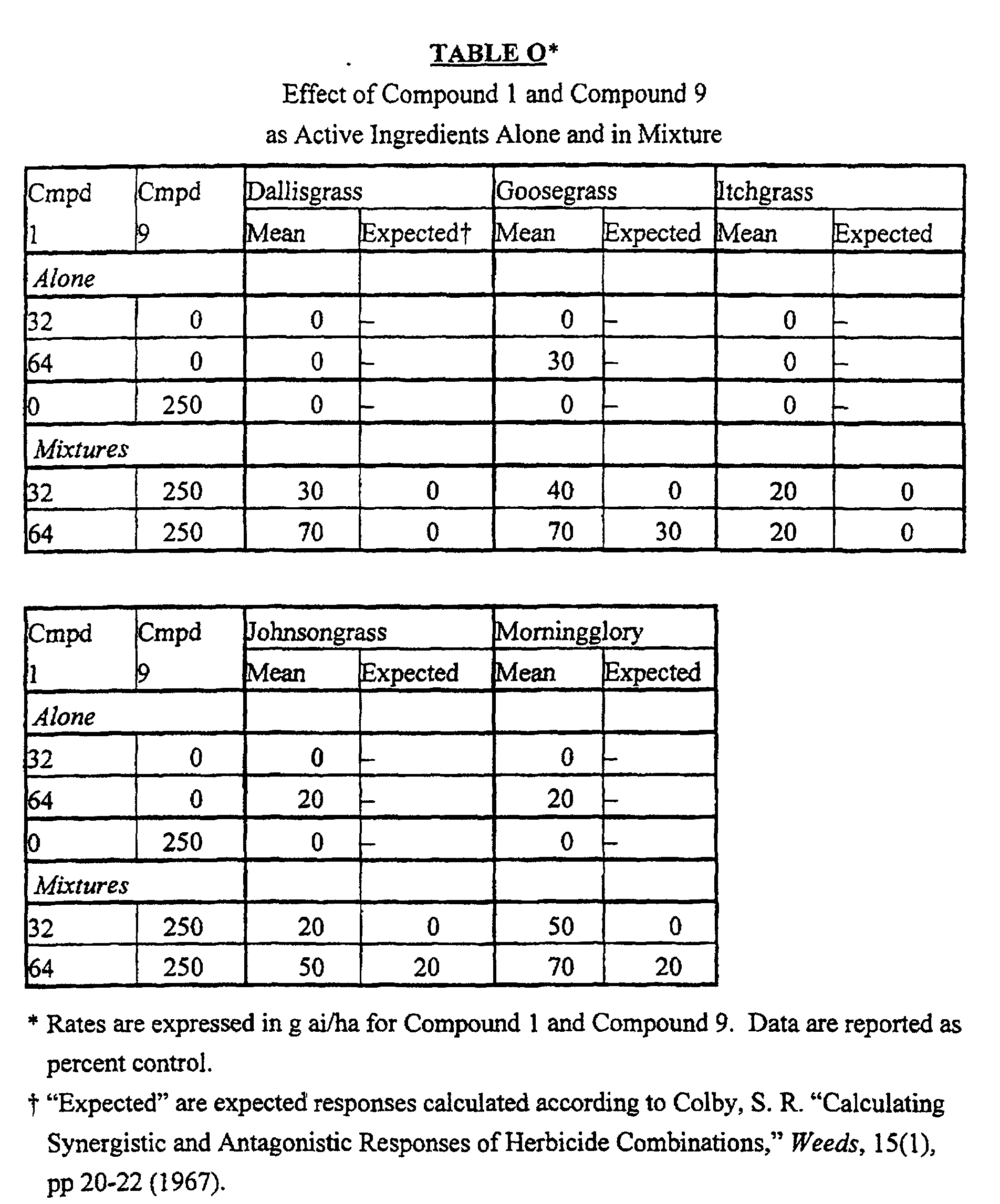
- Weeds other than those specifically listed in Tables N and O are also controlled by mixtures of Compound 1 and Compound 9. Different ratios of Compound 1 to Compound 9, and different formulation types, also provide useful weed control from the combination of the two herbicides.
- The data in the following Tables P-T demonstrate the efficacy of the Formula I and Formula IX mixtures of this invention against specific weeds. The weed control afforded by the mixtures of this invention are not limited, however, to these species. Compound numbers are as described in the Index Table on page 13.
- Bermudagrass (Cynodon dactylon), guineagrass (Panicum maximum), itchgrass (Rottboellia exaltata), johnsongrass (Sorghum halepense), peanut (Arachis hypogaea) and ragweed (Ambrosia artemisiifolia) seeds were planted in 10-cm plastic pots containing a 75:25 ratio of sterilized sandy loam soil and Metro-mix® 350 potting mixture and treated preemergence with the test compounds formulated with a non-phytotoxic solvent. Compound 1 was applied at 64 g ai/ha. Compound 10 was applied at 500 g ai/ha. Mixtures of Compound 1 at 64 g ai/ha with Compound 10 at 500 g ai/ha were also applied. The treated plants were grown in a greenhouse until they were rated at the end of the test. The plants were visually rated and compared with untreated controls using a scale of 0 to 100 where 0 indicates no effect and 100 indicates complete control.
- Results of Test P are shown in Table P, which lists the observed response of specific weeds to Compound 1 and Compound 10 applied alone as single active ingredients, the observed responses of specific weeds to mixtures of Compound 1 and Compound 10, and the expected additive effect of the herbicidal mixtures of Compound 1 and Compound 10 (Colby's equation).


- Bermudagrass (Cynodon dactylon), goosegrass (Eleusine indica) and pitted morningglory (Ipomoea lacunosa) seeds were planted in a growing medium comprising a 75:25 ratio of sterilized sandy loam soil and Metro-mix® 350 potting mixture and treated preemergence with the test compounds formulated with a non-phytotoxic solvent. Compound 1 was applied at 32 g ai/ha. Compound 10 was applied at 192 g ai/ha. Mixtures of Compound I at 32 g ai/ha with Compound 10 at 192 g ai/ha were also applied. The treated plants were grown in a greenhouse until they were rated at the end of the test. The plants were visually rated and compared with untreated controls using a scale of 0 to 100 where 0 indicates no effect and 100 indicates complete control.
- Results of Test Q are shown in Table Q, which lists the observed response of specific weeds to Compound 1 and Compound 10 applied alone as single active ingredients, the observed responses of specific weeds to mixtures of Compound I and Compound 10, and the expected additive effect of the herbicidal mixtures of Compound 1 and Compound 10 (Colby's equation).
Effect of Compound 1 and Compound 10 as Active Ingredients Alone and in Mixture Cmpd 1 Cmpd 10 Bermudagrass Goosegrass Morningglory Mean Expected Mean Expected Mean Expected Alone 32 0 30 - 70 - 0 - 0 192 0 - 0 - 0 - Mixture 32 192 70 30 90 70 80 0 - Dallisgrass (Paspalum dilatatum), annual bluegrass (Poa annua), southern sandbur (Cenchrus echinatus), alfalfa (Medicago sativa), and peanut (Arachis hypogaea) seeds were planted in a growing medium comprising a 75:25 ratio of sterilized sandy loam soil and Metro-mix® 350 potting mixture and treated preemergence with the test compounds formulated with a non-phytotoxic solvent. Compound 1 was applied at 64 g ai/ha. Compound 10 was applied at 384 g ai/ha. Mixtures of Compound 1 at 64 g ai/ha with Compound 10 at 384 g ai/ha were also applied. The treated plants were grown in a greenhouse until they were rated at the end of the test. The plants were visually rated and compared with untreated controls using a scale of 0 to 100 where 0 indicates no effect and 100 indicates complete control.
- Results of Test R are shown in Table R, which lists the observed response of specific weeds to Compound 1 and Compound 10 applied alone as single active ingredients, the observed responses of specific weeds to mixtures of Compound 1 and Compound 10, and the expected additive effect of the herbicidal mixtures of Compound 1 and Compound 10 (Colby's equation).

- Pitted morningglory (Ipomoea lacunosa) was grown in a greenhouse in 10-cm plastic pots containing a 60:40 ratio of sterilized sandy loam soil and Metro-mix® 350 potting mixture. When the plants reached the 5- to 8-leaf stage, they were treated postemergence with the test compounds formulated with a non-phytotoxic solvent. Compound 1 was applied at 125 g ai/ha. Compound 10 was applied at 250 and 500 g ai/ha. Mixtures of Compound 1 at 125 g ai/ha with Compound 10 at 250 and 500 g ai/ha were also applied. The treated plants were grown in a greenhouse until they were rated at the end of the test. The plants were visually rated and compared with untreated controls using a scale of 0 to 100 where 0 indicates no effect and 100 indicates complete control.
- Results of Test T are shown in Table T, which lists the observed response of specific weeds to Compound 1 and Compound 10 applied alone as single active ingredients, the observed responses of specific weeds to mixtures of Compound 1 and Compound 10, and the expected additive effect of the herbicidal mixtures of Compound 1 and Compound 10 (Colby's equation).
Effect of Compound 1 and Compound 10 as Active Ingredients Alone and in Mixture Cmpd 1 Cmpd 10 Morningglory Mean Expected Alone 125 0 70 - 0 250 0 - 0 500 20 - Mixtures 125 250 80 70 125 500 100 76 - Annual bluegrass (Poa annua), southern sandbur (Cenchrus echinatus), goosegrass (Eleusine indica), guineagrass (Panicum maximum), and smooth crabgrass (Digitaria ischaemum) were grown in a greenhouse using a medium comprising a 60:40 ratio of sterilized sandy loam soil and Metro-mix® 350 potting mixture. The plants were treated postemergence with the test compounds formulated with a non-phytotoxic solvent. Compound 1 was applied at 125 g ai/ha. Compound 10 was applied at 750 g ai/ha. Mixtures of Compound 1 at 125 g ai/ha with Compound 10 at 750 g ai/ha were also applied. The treated plants were grown in a greenhouse until they were rated at the end of the test. The plants were visually rated and compared with untreated controls using a scale of 0 to 100 where 0 indicates no effect and 100 indicates complete control.
- Results of Test T are shown in Table T, which lists the observed response of specific weeds to Compound 1 and Compound 10 applied alone as single active ingredients, the observed responses of specific weeds to mixtures of Compound 1 and Compound 10, and the expected additive effect of the herbicidal mixtures of Compound 1 and Compound 10 (Colby's equation).

- Weeds other than those specifically listed in Tables P-T are also controlled by mixtures of Compound 1 and Compound 10. Different ratios of Compound 1 to Compound 10, and different formulation types, also provide useful weed control from the combination of the two herbicides.
Claims (11)
- A herbicidally effective mixture of 2-[2,4-dichloro-5-(2-propynyloxy)-phenyl]-5,6,7,8-tetrahydro-1,2,4-triazolo[4,3-a]pyridin-3(2H)-one (Formula I) with a herbicidal compound selected fromand their agriculturally suitable salts.(a) sulfometuron methyl (Formula II),(b) metsulfuron methyl (Formula III),(c) glyphosate (Formula IV),(d) glufosinate (Formula V),(e) paraquat (Formula VI),(f) diuron (Formula VII),(g) bromacil (Formula VIII), and(h) hexazinone (Formula IX),
- The mixture of Claim 1 which is the compound of Formula I and the compound of Formula II.
- The mixture of Claim 1 which is the compound of Formula I and the compound of Formula III.
- The mixture of Claim I which is the compound of Formula I and the compound of Formula IV.
- The mixture of Claim 1 which is the compound of Formula I and the compound of Formula V.
- The mixture of Claim I which is the compound of Formula I and the compound of Formula VI.
- The mixture of Claim I which is the compound of Formula I and the compound of Formula VII.
- The mixture of Claim 1 which is the compound of Formula I and the compound of Formula VIII.
- The mixture of Claim 1 which is the compound of Formula I and the compound of Formula IX.
- An agriculturally suitable composition for controlling the growth of undesired vegetation comprising an effective amount of the mixture of any of Claims 1-9 and at least one of the following: surfactant, solid or liquid diluent.
- A method for controlling the growth of undesired vegetation by applying to the locus of the undesired vegetation a herbicidally effective amount of the mixture of any of Claims 1-9.
Applications Claiming Priority (3)
| Application Number | Priority Date | Filing Date | Title |
|---|---|---|---|
| US1329296P | 1996-03-12 | 1996-03-12 | |
| US13292P | 1996-03-12 | ||
| PCT/US1997/004151 WO1997033475A1 (en) | 1996-03-12 | 1997-03-06 | Herbicidal mixtures |
Publications (2)
| Publication Number | Publication Date |
|---|---|
| EP0888058A1 EP0888058A1 (en) | 1999-01-07 |
| EP0888058B1 true EP0888058B1 (en) | 2001-10-17 |
Family
ID=21759210
Family Applications (1)
| Application Number | Title | Priority Date | Filing Date |
|---|---|---|---|
| EP97915111A Expired - Lifetime EP0888058B1 (en) | 1996-03-12 | 1997-03-06 | Herbicidal mixtures |
Country Status (8)
| Country | Link |
|---|---|
| EP (1) | EP0888058B1 (en) |
| JP (1) | JP2000506533A (en) |
| KR (1) | KR19990087709A (en) |
| BR (1) | BR9708019A (en) |
| DE (1) | DE69707432T2 (en) |
| ES (1) | ES2164334T3 (en) |
| PT (1) | PT888058E (en) |
| WO (1) | WO1997033475A1 (en) |
Families Citing this family (3)
| Publication number | Priority date | Publication date | Assignee | Title |
|---|---|---|---|---|
| DE10160139A1 (en) * | 2001-12-07 | 2003-06-18 | Bayer Cropscience Gmbh | Synergistic herbicidal compositions containing certain herbicides from the group of benzoylcylohexanediones |
| JP2005068121A (en) * | 2003-08-27 | 2005-03-17 | Maruwa Biochemical Co Ltd | Quick-acting fine particle herbicide |
| CN102302038B (en) * | 2011-05-18 | 2014-01-29 | 江西正邦生物化工股份有限公司 | Weedicide for orchards and forest lands |
Family Cites Families (2)
| Publication number | Priority date | Publication date | Assignee | Title |
|---|---|---|---|---|
| EP0204146B1 (en) * | 1985-05-09 | 1990-07-11 | Sumitomo Chemical Company, Limited | Herbicidal composition |
| US5332718A (en) * | 1993-03-15 | 1994-07-26 | E. I. Du Pont De Nemours And Company | Herbicidal substituted bicyclic triazoles for plantation crops |
-
1997
- 1997-03-06 WO PCT/US1997/004151 patent/WO1997033475A1/en not_active Ceased
- 1997-03-06 KR KR1019980707176A patent/KR19990087709A/en not_active Ceased
- 1997-03-06 DE DE69707432T patent/DE69707432T2/en not_active Expired - Fee Related
- 1997-03-06 BR BR9708019A patent/BR9708019A/en not_active IP Right Cessation
- 1997-03-06 EP EP97915111A patent/EP0888058B1/en not_active Expired - Lifetime
- 1997-03-06 JP JP9532890A patent/JP2000506533A/en active Pending
- 1997-03-06 ES ES97915111T patent/ES2164334T3/en not_active Expired - Lifetime
- 1997-03-06 PT PT97915111T patent/PT888058E/en unknown
Also Published As
| Publication number | Publication date |
|---|---|
| DE69707432T2 (en) | 2002-06-27 |
| KR19990087709A (en) | 1999-12-27 |
| PT888058E (en) | 2002-02-28 |
| BR9708019A (en) | 1999-07-27 |
| EP0888058A1 (en) | 1999-01-07 |
| JP2000506533A (en) | 2000-05-30 |
| WO1997033475A1 (en) | 1997-09-18 |
| ES2164334T3 (en) | 2002-02-16 |
| DE69707432D1 (en) | 2001-11-22 |
Similar Documents
| Publication | Publication Date | Title |
|---|---|---|
| EP0915652B1 (en) | Herbicidal mixtures | |
| EP0532146B1 (en) | Herbicidal substituted bicyclic triazoles | |
| EP0863705B1 (en) | Synergetic herbicidal mixtures | |
| KR101525558B1 (en) | Synergistic crop-tolerated combinations of herbicides from the benzoylcyclohexandione group for application in rice growing | |
| US20080167188A1 (en) | Herbicide Combinations Comprising Special Ketoenoles | |
| PL217240B1 (en) | Application of herbicide composition, method for controlling weeds and herbicide formulation | |
| MX2008014367A (en) | Herbicidal mixture comprising diuron and mesotrione. | |
| AU688626B2 (en) | Herbicidal mixtures | |
| EP0774904B1 (en) | Herbicidal mixtures | |
| EP0823837B1 (en) | Herbicidal mixtures | |
| EP0888058A1 (en) | Herbicidal mixtures | |
| AU737523B2 (en) | Herbicidal mixtures | |
| USH1711H (en) | Herbicidal mixtures | |
| AU745391B2 (en) | Herbicidal mixtures | |
| EP0898451B1 (en) | Herbicidal mixtures | |
| NZ328536A (en) | Herbicidal mixture containing a 1,2,4-triazolo[4,3-a]pyridin-3(2h)-one derivative and either hexazinone, bromoacil, diuron, paraquat, glufosinate, glyphosate, metsulfuron methyl or sulfometuron methyl | |
| US5928995A (en) | Herbicidal mixtures | |
| WO1994018836A1 (en) | Synergistic herbicidal composition on the basis of thidiazimin | |
| US5332718A (en) | Herbicidal substituted bicyclic triazoles for plantation crops | |
| EP0953285A1 (en) | Hirbidical mixtures | |
| JP3100061B2 (en) | Herbicides for citrus, sugarcane, oil palm, etc. | |
| EP0890311A2 (en) | Herbicidal mixtures | |
| EP1073336A1 (en) | Herbicidal mixtures |
Legal Events
| Date | Code | Title | Description |
|---|---|---|---|
| PUAI | Public reference made under article 153(3) epc to a published international application that has entered the european phase |
Free format text: ORIGINAL CODE: 0009012 |
|
| 17P | Request for examination filed |
Effective date: 19980820 |
|
| AK | Designated contracting states |
Kind code of ref document: A1 Designated state(s): CH DE ES FR GB IT LI PT |
|
| GRAG | Despatch of communication of intention to grant |
Free format text: ORIGINAL CODE: EPIDOS AGRA |
|
| 17Q | First examination report despatched |
Effective date: 20001019 |
|
| GRAG | Despatch of communication of intention to grant |
Free format text: ORIGINAL CODE: EPIDOS AGRA |
|
| GRAH | Despatch of communication of intention to grant a patent |
Free format text: ORIGINAL CODE: EPIDOS IGRA |
|
| GRAH | Despatch of communication of intention to grant a patent |
Free format text: ORIGINAL CODE: EPIDOS IGRA |
|
| GRAA | (expected) grant |
Free format text: ORIGINAL CODE: 0009210 |
|
| AK | Designated contracting states |
Kind code of ref document: B1 Designated state(s): CH DE ES FR GB IT LI PT |
|
| REG | Reference to a national code |
Ref country code: CH Ref legal event code: EP |
|
| REF | Corresponds to: |
Ref document number: 69707432 Country of ref document: DE Date of ref document: 20011122 |
|
| ET | Fr: translation filed | ||
| REG | Reference to a national code |
Ref country code: CH Ref legal event code: NV Representative=s name: RITSCHER & SEIFERT |
|
| REG | Reference to a national code |
Ref country code: GB Ref legal event code: IF02 |
|
| REG | Reference to a national code |
Ref country code: ES Ref legal event code: FG2A Ref document number: 2164334 Country of ref document: ES Kind code of ref document: T3 |
|
| REG | Reference to a national code |
Ref country code: PT Ref legal event code: SC4A Free format text: AVAILABILITY OF NATIONAL TRANSLATION Effective date: 20011129 |
|
| PLBE | No opposition filed within time limit |
Free format text: ORIGINAL CODE: 0009261 |
|
| STAA | Information on the status of an ep patent application or granted ep patent |
Free format text: STATUS: NO OPPOSITION FILED WITHIN TIME LIMIT |
|
| 26N | No opposition filed | ||
| PGFP | Annual fee paid to national office [announced via postgrant information from national office to epo] |
Ref country code: PT Payment date: 20030214 Year of fee payment: 7 |
|
| PGFP | Annual fee paid to national office [announced via postgrant information from national office to epo] |
Ref country code: GB Payment date: 20030305 Year of fee payment: 7 |
|
| PGFP | Annual fee paid to national office [announced via postgrant information from national office to epo] |
Ref country code: FR Payment date: 20030310 Year of fee payment: 7 |
|
| PGFP | Annual fee paid to national office [announced via postgrant information from national office to epo] |
Ref country code: DE Payment date: 20030313 Year of fee payment: 7 |
|
| PGFP | Annual fee paid to national office [announced via postgrant information from national office to epo] |
Ref country code: CH Payment date: 20030314 Year of fee payment: 7 |
|
| PGFP | Annual fee paid to national office [announced via postgrant information from national office to epo] |
Ref country code: ES Payment date: 20030328 Year of fee payment: 7 |
|
| PG25 | Lapsed in a contracting state [announced via postgrant information from national office to epo] |
Ref country code: GB Free format text: LAPSE BECAUSE OF NON-PAYMENT OF DUE FEES Effective date: 20040306 |
|
| PG25 | Lapsed in a contracting state [announced via postgrant information from national office to epo] |
Ref country code: ES Free format text: LAPSE BECAUSE OF NON-PAYMENT OF DUE FEES Effective date: 20040308 |
|
| PG25 | Lapsed in a contracting state [announced via postgrant information from national office to epo] |
Ref country code: LI Free format text: LAPSE BECAUSE OF NON-PAYMENT OF DUE FEES Effective date: 20040331 Ref country code: CH Free format text: LAPSE BECAUSE OF NON-PAYMENT OF DUE FEES Effective date: 20040331 |
|
| PG25 | Lapsed in a contracting state [announced via postgrant information from national office to epo] |
Ref country code: DE Free format text: LAPSE BECAUSE OF NON-PAYMENT OF DUE FEES Effective date: 20041001 |
|
| PG25 | Lapsed in a contracting state [announced via postgrant information from national office to epo] |
Ref country code: PT Free format text: LAPSE BECAUSE OF NON-PAYMENT OF DUE FEES Effective date: 20041015 |
|
| GBPC | Gb: european patent ceased through non-payment of renewal fee | ||
| REG | Reference to a national code |
Ref country code: CH Ref legal event code: PL |
|
| PG25 | Lapsed in a contracting state [announced via postgrant information from national office to epo] |
Ref country code: FR Free format text: LAPSE BECAUSE OF NON-PAYMENT OF DUE FEES Effective date: 20041130 |
|
| REG | Reference to a national code |
Ref country code: PT Ref legal event code: MM4A Free format text: LAPSE DUE TO NON-PAYMENT OF FEES Effective date: 20040930 |
|
| REG | Reference to a national code |
Ref country code: FR Ref legal event code: ST |
|
| PG25 | Lapsed in a contracting state [announced via postgrant information from national office to epo] |
Ref country code: IT Free format text: LAPSE BECAUSE OF NON-PAYMENT OF DUE FEES Effective date: 20050306 |
|
| REG | Reference to a national code |
Ref country code: ES Ref legal event code: FD2A Effective date: 20040308 |
|
| PG25 | Lapsed in a contracting state [announced via postgrant information from national office to epo] |
Ref country code: PT Free format text: LAPSE BECAUSE OF NON-PAYMENT OF DUE FEES Effective date: 20040306 |