EP0887392B1 - Silicone emulsion coating composition and processes for the preparation thereof - Google Patents
Silicone emulsion coating composition and processes for the preparation thereof Download PDFInfo
- Publication number
- EP0887392B1 EP0887392B1 EP19970947929 EP97947929A EP0887392B1 EP 0887392 B1 EP0887392 B1 EP 0887392B1 EP 19970947929 EP19970947929 EP 19970947929 EP 97947929 A EP97947929 A EP 97947929A EP 0887392 B1 EP0887392 B1 EP 0887392B1
- Authority
- EP
- European Patent Office
- Prior art keywords
- composition
- constituent
- parts
- water
- coating material
- Prior art date
- Legal status (The legal status is an assumption and is not a legal conclusion. Google has not performed a legal analysis and makes no representation as to the accuracy of the status listed.)
- Expired - Lifetime
Links
- 229920001296 polysiloxane Polymers 0.000 title claims abstract description 92
- 239000000839 emulsion Substances 0.000 title claims abstract description 78
- 238000000034 method Methods 0.000 title claims abstract description 31
- 230000008569 process Effects 0.000 title abstract description 23
- 238000002360 preparation method Methods 0.000 title abstract description 21
- 239000008199 coating composition Substances 0.000 title abstract 2
- 239000000203 mixture Substances 0.000 claims abstract description 148
- VYPSYNLAJGMNEJ-UHFFFAOYSA-N Silicium dioxide Chemical compound O=[Si]=O VYPSYNLAJGMNEJ-UHFFFAOYSA-N 0.000 claims abstract description 89
- XLYOFNOQVPJJNP-UHFFFAOYSA-N water Substances O XLYOFNOQVPJJNP-UHFFFAOYSA-N 0.000 claims abstract description 64
- 239000008119 colloidal silica Substances 0.000 claims abstract description 53
- 125000005375 organosiloxane group Chemical group 0.000 claims abstract description 38
- 239000003995 emulsifying agent Substances 0.000 claims abstract description 34
- 238000002156 mixing Methods 0.000 claims abstract description 16
- 239000004793 Polystyrene Substances 0.000 claims abstract description 4
- 229920002223 polystyrene Polymers 0.000 claims abstract description 4
- -1 polysiloxane Polymers 0.000 claims description 109
- 239000000470 constituent Substances 0.000 claims description 92
- 238000000576 coating method Methods 0.000 claims description 90
- 239000011248 coating agent Substances 0.000 claims description 88
- 239000000463 material Substances 0.000 claims description 77
- 230000036961 partial effect Effects 0.000 claims description 35
- 239000003960 organic solvent Substances 0.000 claims description 32
- 150000002009 diols Chemical class 0.000 claims description 22
- 239000000049 pigment Substances 0.000 claims description 22
- 238000004519 manufacturing process Methods 0.000 claims description 21
- 230000002378 acidificating effect Effects 0.000 claims description 19
- 150000001282 organosilanes Chemical class 0.000 claims description 17
- 239000000377 silicon dioxide Substances 0.000 claims description 17
- 239000004215 Carbon black (E152) Substances 0.000 claims description 13
- 229930195733 hydrocarbon Natural products 0.000 claims description 13
- 229920001400 block copolymer Polymers 0.000 claims description 12
- 239000000126 substance Substances 0.000 claims description 8
- 238000006243 chemical reaction Methods 0.000 claims description 7
- 125000002887 hydroxy group Chemical group [H]O* 0.000 claims description 4
- 239000003054 catalyst Substances 0.000 abstract description 23
- 238000010438 heat treatment Methods 0.000 abstract description 13
- 230000007774 longterm Effects 0.000 abstract description 11
- YXFVVABEGXRONW-UHFFFAOYSA-N Toluene Chemical compound CC1=CC=CC=C1 YXFVVABEGXRONW-UHFFFAOYSA-N 0.000 description 99
- 239000000243 solution Substances 0.000 description 58
- 239000000758 substrate Substances 0.000 description 38
- 238000003756 stirring Methods 0.000 description 37
- OKKJLVBELUTLKV-UHFFFAOYSA-N Methanol Chemical compound OC OKKJLVBELUTLKV-UHFFFAOYSA-N 0.000 description 33
- 239000007787 solid Substances 0.000 description 20
- LFQSCWFLJHTTHZ-UHFFFAOYSA-N Ethanol Chemical compound CCO LFQSCWFLJHTTHZ-UHFFFAOYSA-N 0.000 description 18
- 238000004945 emulsification Methods 0.000 description 16
- 238000006116 polymerization reaction Methods 0.000 description 15
- 229920005989 resin Polymers 0.000 description 14
- 239000011347 resin Substances 0.000 description 14
- 230000003301 hydrolyzing effect Effects 0.000 description 13
- 239000003112 inhibitor Substances 0.000 description 13
- 230000009257 reactivity Effects 0.000 description 13
- RSCURYUCAQYJEJ-UHFFFAOYSA-L C([O-])([O-])=O.[Na+].C(CCCCCCCCCCC)C1=CC=CC=C1.[Na+] Chemical compound C([O-])([O-])=O.[Na+].C(CCCCCCCCCCC)C1=CC=CC=C1.[Na+] RSCURYUCAQYJEJ-UHFFFAOYSA-L 0.000 description 12
- VEXZGXHMUGYJMC-UHFFFAOYSA-N Hydrochloric acid Chemical compound Cl VEXZGXHMUGYJMC-UHFFFAOYSA-N 0.000 description 12
- 150000001875 compounds Chemical class 0.000 description 12
- NLYAJNPCOHFWQQ-UHFFFAOYSA-N kaolin Chemical compound O.O.O=[Al]O[Si](=O)O[Si](=O)O[Al]=O NLYAJNPCOHFWQQ-UHFFFAOYSA-N 0.000 description 12
- BDHFUVZGWQCTTF-UHFFFAOYSA-M sulfonate Chemical compound [O-]S(=O)=O BDHFUVZGWQCTTF-UHFFFAOYSA-M 0.000 description 12
- XLYOFNOQVPJJNP-DYCDLGHISA-N deuterium hydrogen oxide Chemical compound [2H]O XLYOFNOQVPJJNP-DYCDLGHISA-N 0.000 description 11
- 150000003254 radicals Chemical class 0.000 description 11
- 239000004094 surface-active agent Substances 0.000 description 11
- 229920002430 Fibre-reinforced plastic Polymers 0.000 description 9
- 229920003171 Poly (ethylene oxide) Polymers 0.000 description 9
- 239000002585 base Substances 0.000 description 9
- 239000003795 chemical substances by application Substances 0.000 description 9
- 230000000052 comparative effect Effects 0.000 description 9
- 230000000694 effects Effects 0.000 description 9
- 239000011151 fibre-reinforced plastic Substances 0.000 description 9
- CSCPPACGZOOCGX-UHFFFAOYSA-N Acetone Chemical compound CC(C)=O CSCPPACGZOOCGX-UHFFFAOYSA-N 0.000 description 8
- 230000007062 hydrolysis Effects 0.000 description 8
- 238000006460 hydrolysis reaction Methods 0.000 description 8
- RNMDNPCBIKJCQP-UHFFFAOYSA-N 5-nonyl-7-oxabicyclo[4.1.0]hepta-1,3,5-trien-2-ol Chemical compound C(CCCCCCCC)C1=C2C(=C(C=C1)O)O2 RNMDNPCBIKJCQP-UHFFFAOYSA-N 0.000 description 7
- UKLDJPRMSDWDSL-UHFFFAOYSA-L [dibutyl(dodecanoyloxy)stannyl] dodecanoate Chemical compound CCCCCCCCCCCC(=O)O[Sn](CCCC)(CCCC)OC(=O)CCCCCCCCCCC UKLDJPRMSDWDSL-UHFFFAOYSA-L 0.000 description 7
- 239000012975 dibutyltin dilaurate Substances 0.000 description 7
- 238000011156 evaluation Methods 0.000 description 7
- 239000010454 slate Substances 0.000 description 7
- KFZMGEQAYNKOFK-UHFFFAOYSA-N Isopropanol Chemical compound CC(C)O KFZMGEQAYNKOFK-UHFFFAOYSA-N 0.000 description 6
- 239000002253 acid Substances 0.000 description 6
- 229910052799 carbon Inorganic materials 0.000 description 6
- 239000004568 cement Substances 0.000 description 6
- 238000004807 desolvation Methods 0.000 description 6
- 229910052751 metal Inorganic materials 0.000 description 6
- 239000002184 metal Substances 0.000 description 6
- BFXIKLCIZHOAAZ-UHFFFAOYSA-N methyltrimethoxysilane Chemical compound CO[Si](C)(OC)OC BFXIKLCIZHOAAZ-UHFFFAOYSA-N 0.000 description 6
- 239000004417 polycarbonate Substances 0.000 description 6
- 230000002829 reductive effect Effects 0.000 description 6
- 239000000084 colloidal system Substances 0.000 description 5
- 238000004132 cross linking Methods 0.000 description 5
- MTHSVFCYNBDYFN-UHFFFAOYSA-N diethylene glycol Chemical class OCCOCCO MTHSVFCYNBDYFN-UHFFFAOYSA-N 0.000 description 5
- JJQZDUKDJDQPMQ-UHFFFAOYSA-N dimethoxy(dimethyl)silane Chemical compound CO[Si](C)(C)OC JJQZDUKDJDQPMQ-UHFFFAOYSA-N 0.000 description 5
- LIKFHECYJZWXFJ-UHFFFAOYSA-N dimethyldichlorosilane Chemical compound C[Si](C)(Cl)Cl LIKFHECYJZWXFJ-UHFFFAOYSA-N 0.000 description 5
- 239000011521 glass Substances 0.000 description 5
- 239000005055 methyl trichlorosilane Substances 0.000 description 5
- JLUFWMXJHAVVNN-UHFFFAOYSA-N methyltrichlorosilane Chemical compound C[Si](Cl)(Cl)Cl JLUFWMXJHAVVNN-UHFFFAOYSA-N 0.000 description 5
- 239000005054 phenyltrichlorosilane Substances 0.000 description 5
- 230000001681 protective effect Effects 0.000 description 5
- 229920002050 silicone resin Polymers 0.000 description 5
- 238000012360 testing method Methods 0.000 description 5
- ORVMIVQULIKXCP-UHFFFAOYSA-N trichloro(phenyl)silane Chemical compound Cl[Si](Cl)(Cl)C1=CC=CC=C1 ORVMIVQULIKXCP-UHFFFAOYSA-N 0.000 description 5
- DNIAPMSPPWPWGF-GSVOUGTGSA-N (R)-(-)-Propylene glycol Chemical compound C[C@@H](O)CO DNIAPMSPPWPWGF-GSVOUGTGSA-N 0.000 description 4
- OKTJSMMVPCPJKN-UHFFFAOYSA-N Carbon Chemical compound [C] OKTJSMMVPCPJKN-UHFFFAOYSA-N 0.000 description 4
- LYCAIKOWRPUZTN-UHFFFAOYSA-N Ethylene glycol Chemical class OCCO LYCAIKOWRPUZTN-UHFFFAOYSA-N 0.000 description 4
- XEEYBQQBJWHFJM-UHFFFAOYSA-N Iron Chemical compound [Fe] XEEYBQQBJWHFJM-UHFFFAOYSA-N 0.000 description 4
- 229910000831 Steel Inorganic materials 0.000 description 4
- NIXOWILDQLNWCW-UHFFFAOYSA-N acrylic acid group Chemical group C(C=C)(=O)O NIXOWILDQLNWCW-UHFFFAOYSA-N 0.000 description 4
- 239000002131 composite material Substances 0.000 description 4
- 239000004567 concrete Substances 0.000 description 4
- 125000000118 dimethyl group Chemical group [H]C([H])([H])* 0.000 description 4
- 239000002270 dispersing agent Substances 0.000 description 4
- DKAGJZJALZXOOV-UHFFFAOYSA-N hydrate;hydrochloride Chemical compound O.Cl DKAGJZJALZXOOV-UHFFFAOYSA-N 0.000 description 4
- 239000011356 non-aqueous organic solvent Substances 0.000 description 4
- WWZKQHOCKIZLMA-UHFFFAOYSA-N octanoic acid Chemical compound CCCCCCCC(O)=O WWZKQHOCKIZLMA-UHFFFAOYSA-N 0.000 description 4
- 229920003023 plastic Polymers 0.000 description 4
- 239000004033 plastic Substances 0.000 description 4
- SCVFZCLFOSHCOH-UHFFFAOYSA-M potassium acetate Chemical compound [K+].CC([O-])=O SCVFZCLFOSHCOH-UHFFFAOYSA-M 0.000 description 4
- 239000000843 powder Substances 0.000 description 4
- 150000003839 salts Chemical class 0.000 description 4
- 238000000926 separation method Methods 0.000 description 4
- 239000010959 steel Substances 0.000 description 4
- OGIDPMRJRNCKJF-UHFFFAOYSA-N titanium oxide Inorganic materials [Ti]=O OGIDPMRJRNCKJF-UHFFFAOYSA-N 0.000 description 4
- OAYXUHPQHDHDDZ-UHFFFAOYSA-N 2-(2-butoxyethoxy)ethanol Chemical compound CCCCOCCOCCO OAYXUHPQHDHDDZ-UHFFFAOYSA-N 0.000 description 3
- ZWEHNKRNPOVVGH-UHFFFAOYSA-N 2-Butanone Chemical compound CCC(C)=O ZWEHNKRNPOVVGH-UHFFFAOYSA-N 0.000 description 3
- 229920000178 Acrylic resin Polymers 0.000 description 3
- 239000004925 Acrylic resin Substances 0.000 description 3
- UHOVQNZJYSORNB-UHFFFAOYSA-N Benzene Chemical compound C1=CC=CC=C1 UHOVQNZJYSORNB-UHFFFAOYSA-N 0.000 description 3
- XEKOWRVHYACXOJ-UHFFFAOYSA-N Ethyl acetate Chemical compound CCOC(C)=O XEKOWRVHYACXOJ-UHFFFAOYSA-N 0.000 description 3
- 239000004372 Polyvinyl alcohol Substances 0.000 description 3
- 239000004902 Softening Agent Substances 0.000 description 3
- GWEVSGVZZGPLCZ-UHFFFAOYSA-N Titan oxide Chemical compound O=[Ti]=O GWEVSGVZZGPLCZ-UHFFFAOYSA-N 0.000 description 3
- 229910052782 aluminium Inorganic materials 0.000 description 3
- XAGFODPZIPBFFR-UHFFFAOYSA-N aluminium Chemical compound [Al] XAGFODPZIPBFFR-UHFFFAOYSA-N 0.000 description 3
- 125000000129 anionic group Chemical group 0.000 description 3
- 239000007864 aqueous solution Substances 0.000 description 3
- 229920002678 cellulose Polymers 0.000 description 3
- 235000010980 cellulose Nutrition 0.000 description 3
- 239000000919 ceramic Substances 0.000 description 3
- 239000003431 cross linking reagent Substances 0.000 description 3
- 229920001971 elastomer Polymers 0.000 description 3
- 150000002148 esters Chemical class 0.000 description 3
- 238000001879 gelation Methods 0.000 description 3
- TUJKJAMUKRIRHC-UHFFFAOYSA-N hydroxyl Chemical compound [OH] TUJKJAMUKRIRHC-UHFFFAOYSA-N 0.000 description 3
- 239000000178 monomer Substances 0.000 description 3
- 239000002245 particle Substances 0.000 description 3
- 239000013618 particulate matter Substances 0.000 description 3
- 238000005191 phase separation Methods 0.000 description 3
- 229920002451 polyvinyl alcohol Polymers 0.000 description 3
- 239000002244 precipitate Substances 0.000 description 3
- 239000005060 rubber Substances 0.000 description 3
- 229920002545 silicone oil Polymers 0.000 description 3
- NTHWMYGWWRZVTN-UHFFFAOYSA-N sodium silicate Chemical compound [Na+].[Na+].[O-][Si]([O-])=O NTHWMYGWWRZVTN-UHFFFAOYSA-N 0.000 description 3
- 239000002562 thickening agent Substances 0.000 description 3
- 150000003613 toluenes Chemical class 0.000 description 3
- POAOYUHQDCAZBD-UHFFFAOYSA-N 2-butoxyethanol Chemical compound CCCCOCCO POAOYUHQDCAZBD-UHFFFAOYSA-N 0.000 description 2
- KXGFMDJXCMQABM-UHFFFAOYSA-N 2-methoxy-6-methylphenol Chemical compound [CH]OC1=CC=CC([CH])=C1O KXGFMDJXCMQABM-UHFFFAOYSA-N 0.000 description 2
- 241000364063 Acentria ephemerella Species 0.000 description 2
- 239000004593 Epoxy Substances 0.000 description 2
- 108010010803 Gelatin Proteins 0.000 description 2
- ZRALSGWEFCBTJO-UHFFFAOYSA-N Guanidine Chemical compound NC(N)=N ZRALSGWEFCBTJO-UHFFFAOYSA-N 0.000 description 2
- DGAQECJNVWCQMB-PUAWFVPOSA-M Ilexoside XXIX Chemical compound C[C@@H]1CC[C@@]2(CC[C@@]3(C(=CC[C@H]4[C@]3(CC[C@@H]5[C@@]4(CC[C@@H](C5(C)C)OS(=O)(=O)[O-])C)C)[C@@H]2[C@]1(C)O)C)C(=O)O[C@H]6[C@@H]([C@H]([C@@H]([C@H](O6)CO)O)O)O.[Na+] DGAQECJNVWCQMB-PUAWFVPOSA-M 0.000 description 2
- 229920000877 Melamine resin Polymers 0.000 description 2
- LRHPLDYGYMQRHN-UHFFFAOYSA-N N-Butanol Chemical compound CCCCO LRHPLDYGYMQRHN-UHFFFAOYSA-N 0.000 description 2
- 239000004677 Nylon Substances 0.000 description 2
- CTQNGGLPUBDAKN-UHFFFAOYSA-N O-Xylene Chemical compound CC1=CC=CC=C1C CTQNGGLPUBDAKN-UHFFFAOYSA-N 0.000 description 2
- 229920001214 Polysorbate 60 Polymers 0.000 description 2
- 229920002472 Starch Polymers 0.000 description 2
- BOTDANWDWHJENH-UHFFFAOYSA-N Tetraethyl orthosilicate Chemical compound CCO[Si](OCC)(OCC)OCC BOTDANWDWHJENH-UHFFFAOYSA-N 0.000 description 2
- ATJFFYVFTNAWJD-UHFFFAOYSA-N Tin Chemical compound [Sn] ATJFFYVFTNAWJD-UHFFFAOYSA-N 0.000 description 2
- HCHKCACWOHOZIP-UHFFFAOYSA-N Zinc Chemical compound [Zn] HCHKCACWOHOZIP-UHFFFAOYSA-N 0.000 description 2
- MCMNRKCIXSYSNV-UHFFFAOYSA-N Zirconium dioxide Chemical compound O=[Zr]=O MCMNRKCIXSYSNV-UHFFFAOYSA-N 0.000 description 2
- CIUQDSCDWFSTQR-UHFFFAOYSA-N [C]1=CC=CC=C1 Chemical compound [C]1=CC=CC=C1 CIUQDSCDWFSTQR-UHFFFAOYSA-N 0.000 description 2
- 235000010443 alginic acid Nutrition 0.000 description 2
- 229920000615 alginic acid Polymers 0.000 description 2
- 150000004781 alginic acids Chemical class 0.000 description 2
- 125000001931 aliphatic group Chemical group 0.000 description 2
- 229920000180 alkyd Polymers 0.000 description 2
- PNEYBMLMFCGWSK-UHFFFAOYSA-N aluminium oxide Inorganic materials [O-2].[O-2].[O-2].[Al+3].[Al+3] PNEYBMLMFCGWSK-UHFFFAOYSA-N 0.000 description 2
- 239000003429 antifungal agent Substances 0.000 description 2
- TZCXTZWJZNENPQ-UHFFFAOYSA-L barium sulfate Chemical compound [Ba+2].[O-]S([O-])(=O)=O TZCXTZWJZNENPQ-UHFFFAOYSA-L 0.000 description 2
- 238000009835 boiling Methods 0.000 description 2
- 239000001913 cellulose Substances 0.000 description 2
- 230000008859 change Effects 0.000 description 2
- 229920001577 copolymer Polymers 0.000 description 2
- 238000005336 cracking Methods 0.000 description 2
- SWXVUIWOUIDPGS-UHFFFAOYSA-N diacetone alcohol Chemical compound CC(=O)CC(C)(C)O SWXVUIWOUIDPGS-UHFFFAOYSA-N 0.000 description 2
- 239000006185 dispersion Substances 0.000 description 2
- 238000001035 drying Methods 0.000 description 2
- 239000000975 dye Substances 0.000 description 2
- 230000001804 emulsifying effect Effects 0.000 description 2
- 239000002320 enamel (paints) Substances 0.000 description 2
- 230000007613 environmental effect Effects 0.000 description 2
- 239000003822 epoxy resin Substances 0.000 description 2
- 239000000835 fiber Substances 0.000 description 2
- 210000004905 finger nail Anatomy 0.000 description 2
- 239000008273 gelatin Substances 0.000 description 2
- 229920000159 gelatin Polymers 0.000 description 2
- 235000019322 gelatine Nutrition 0.000 description 2
- 235000011852 gelatine desserts Nutrition 0.000 description 2
- 239000003365 glass fiber Substances 0.000 description 2
- 230000002401 inhibitory effect Effects 0.000 description 2
- 229910052742 iron Inorganic materials 0.000 description 2
- ZXEKIIBDNHEJCQ-UHFFFAOYSA-N isobutanol Chemical compound CC(C)CO ZXEKIIBDNHEJCQ-UHFFFAOYSA-N 0.000 description 2
- 239000007788 liquid Substances 0.000 description 2
- 229920001778 nylon Polymers 0.000 description 2
- 150000001367 organochlorosilanes Chemical class 0.000 description 2
- 239000003973 paint Substances 0.000 description 2
- 229920001568 phenolic resin Polymers 0.000 description 2
- 229920000647 polyepoxide Polymers 0.000 description 2
- 235000011056 potassium acetate Nutrition 0.000 description 2
- 238000001556 precipitation Methods 0.000 description 2
- 239000011513 prestressed concrete Substances 0.000 description 2
- 239000000047 product Substances 0.000 description 2
- 239000002994 raw material Substances 0.000 description 2
- 239000004447 silicone coating Substances 0.000 description 2
- 239000002002 slurry Substances 0.000 description 2
- 229910052708 sodium Inorganic materials 0.000 description 2
- 239000011734 sodium Substances 0.000 description 2
- 239000002904 solvent Substances 0.000 description 2
- 235000019698 starch Nutrition 0.000 description 2
- 229920001187 thermosetting polymer Polymers 0.000 description 2
- VXUYXOFXAQZZMF-UHFFFAOYSA-N titanium(IV) isopropoxide Chemical compound CC(C)O[Ti](OC(C)C)(OC(C)C)OC(C)C VXUYXOFXAQZZMF-UHFFFAOYSA-N 0.000 description 2
- LWIHDJKSTIGBAC-UHFFFAOYSA-K tripotassium phosphate Chemical compound [K+].[K+].[K+].[O-]P([O-])([O-])=O LWIHDJKSTIGBAC-UHFFFAOYSA-K 0.000 description 2
- 239000008096 xylene Substances 0.000 description 2
- 239000011701 zinc Substances 0.000 description 2
- 229910052725 zinc Inorganic materials 0.000 description 2
- LNAZSHAWQACDHT-XIYTZBAFSA-N (2r,3r,4s,5r,6s)-4,5-dimethoxy-2-(methoxymethyl)-3-[(2s,3r,4s,5r,6r)-3,4,5-trimethoxy-6-(methoxymethyl)oxan-2-yl]oxy-6-[(2r,3r,4s,5r,6r)-4,5,6-trimethoxy-2-(methoxymethyl)oxan-3-yl]oxyoxane Chemical compound CO[C@@H]1[C@@H](OC)[C@H](OC)[C@@H](COC)O[C@H]1O[C@H]1[C@H](OC)[C@@H](OC)[C@H](O[C@H]2[C@@H]([C@@H](OC)[C@H](OC)O[C@@H]2COC)OC)O[C@@H]1COC LNAZSHAWQACDHT-XIYTZBAFSA-N 0.000 description 1
- TYKCBTYOMAUNLH-MTOQALJVSA-J (z)-4-oxopent-2-en-2-olate;titanium(4+) Chemical compound [Ti+4].C\C([O-])=C\C(C)=O.C\C([O-])=C\C(C)=O.C\C([O-])=C\C(C)=O.C\C([O-])=C\C(C)=O TYKCBTYOMAUNLH-MTOQALJVSA-J 0.000 description 1
- WPWHSFAFEBZWBB-UHFFFAOYSA-N 1-butyl radical Chemical compound [CH2]CCC WPWHSFAFEBZWBB-UHFFFAOYSA-N 0.000 description 1
- BMVXCPBXGZKUPN-UHFFFAOYSA-N 1-hexanamine Chemical compound CCCCCCN BMVXCPBXGZKUPN-UHFFFAOYSA-N 0.000 description 1
- MFYSUUPKMDJYPF-UHFFFAOYSA-N 2-[(4-methyl-2-nitrophenyl)diazenyl]-3-oxo-n-phenylbutanamide Chemical compound C=1C=CC=CC=1NC(=O)C(C(=O)C)N=NC1=CC=C(C)C=C1[N+]([O-])=O MFYSUUPKMDJYPF-UHFFFAOYSA-N 0.000 description 1
- ZNQVEEAIQZEUHB-UHFFFAOYSA-N 2-ethoxyethanol Chemical compound CCOCCO ZNQVEEAIQZEUHB-UHFFFAOYSA-N 0.000 description 1
- SVONRAPFKPVNKG-UHFFFAOYSA-N 2-ethoxyethyl acetate Chemical compound CCOCCOC(C)=O SVONRAPFKPVNKG-UHFFFAOYSA-N 0.000 description 1
- VVLAIYIMMFWRFW-UHFFFAOYSA-N 2-hydroxyethylazanium;acetate Chemical compound CC(O)=O.NCCO VVLAIYIMMFWRFW-UHFFFAOYSA-N 0.000 description 1
- RKZIPFOHRUCGGS-UHFFFAOYSA-N 4,5-dihydroimidazole-1-carboxylic acid Chemical compound OC(=O)N1CCN=C1 RKZIPFOHRUCGGS-UHFFFAOYSA-N 0.000 description 1
- 244000215068 Acacia senegal Species 0.000 description 1
- RZVAJINKPMORJF-UHFFFAOYSA-N Acetaminophen Chemical compound CC(=O)NC1=CC=C(O)C=C1 RZVAJINKPMORJF-UHFFFAOYSA-N 0.000 description 1
- HRPVXLWXLXDGHG-UHFFFAOYSA-N Acrylamide Chemical compound NC(=O)C=C HRPVXLWXLXDGHG-UHFFFAOYSA-N 0.000 description 1
- 229920001817 Agar Polymers 0.000 description 1
- 229910000838 Al alloy Inorganic materials 0.000 description 1
- VHUUQVKOLVNVRT-UHFFFAOYSA-N Ammonium hydroxide Chemical compound [NH4+].[OH-] VHUUQVKOLVNVRT-UHFFFAOYSA-N 0.000 description 1
- DKPFZGUDAPQIHT-UHFFFAOYSA-N Butyl acetate Natural products CCCCOC(C)=O DKPFZGUDAPQIHT-UHFFFAOYSA-N 0.000 description 1
- 229920002134 Carboxymethyl cellulose Polymers 0.000 description 1
- 229910001018 Cast iron Inorganic materials 0.000 description 1
- 229920000298 Cellophane Polymers 0.000 description 1
- RYGMFSIKBFXOCR-UHFFFAOYSA-N Copper Chemical compound [Cu] RYGMFSIKBFXOCR-UHFFFAOYSA-N 0.000 description 1
- 229910000737 Duralumin Inorganic materials 0.000 description 1
- 239000001856 Ethyl cellulose Substances 0.000 description 1
- ZZSNKZQZMQGXPY-UHFFFAOYSA-N Ethyl cellulose Chemical compound CCOCC1OC(OC)C(OCC)C(OCC)C1OC1C(O)C(O)C(OC)C(CO)O1 ZZSNKZQZMQGXPY-UHFFFAOYSA-N 0.000 description 1
- JOYRKODLDBILNP-UHFFFAOYSA-N Ethyl urethane Chemical compound CCOC(N)=O JOYRKODLDBILNP-UHFFFAOYSA-N 0.000 description 1
- 241000206672 Gelidium Species 0.000 description 1
- 229920002907 Guar gum Polymers 0.000 description 1
- 229920000084 Gum arabic Polymers 0.000 description 1
- 239000004354 Hydroxyethyl cellulose Substances 0.000 description 1
- 229920000663 Hydroxyethyl cellulose Polymers 0.000 description 1
- 229920002153 Hydroxypropyl cellulose Polymers 0.000 description 1
- 229910001209 Low-carbon steel Inorganic materials 0.000 description 1
- 239000004640 Melamine resin Substances 0.000 description 1
- NTIZESTWPVYFNL-UHFFFAOYSA-N Methyl isobutyl ketone Chemical compound CC(C)CC(C)=O NTIZESTWPVYFNL-UHFFFAOYSA-N 0.000 description 1
- UIHCLUNTQKBZGK-UHFFFAOYSA-N Methyl isobutyl ketone Natural products CCC(C)C(C)=O UIHCLUNTQKBZGK-UHFFFAOYSA-N 0.000 description 1
- AFCARXCZXQIEQB-UHFFFAOYSA-N N-[3-oxo-3-(2,4,6,7-tetrahydrotriazolo[4,5-c]pyridin-5-yl)propyl]-2-[[3-(trifluoromethoxy)phenyl]methylamino]pyrimidine-5-carboxamide Chemical compound O=C(CCNC(=O)C=1C=NC(=NC=1)NCC1=CC(=CC=C1)OC(F)(F)F)N1CC2=C(CC1)NN=N2 AFCARXCZXQIEQB-UHFFFAOYSA-N 0.000 description 1
- CHJJGSNFBQVOTG-UHFFFAOYSA-N N-methyl-guanidine Natural products CNC(N)=N CHJJGSNFBQVOTG-UHFFFAOYSA-N 0.000 description 1
- GRYLNZFGIOXLOG-UHFFFAOYSA-N Nitric acid Chemical compound O[N+]([O-])=O GRYLNZFGIOXLOG-UHFFFAOYSA-N 0.000 description 1
- 244000046052 Phaseolus vulgaris Species 0.000 description 1
- 235000010627 Phaseolus vulgaris Nutrition 0.000 description 1
- 239000005062 Polybutadiene Substances 0.000 description 1
- NRCMAYZCPIVABH-UHFFFAOYSA-N Quinacridone Chemical compound N1C2=CC=CC=C2C(=O)C2=C1C=C1C(=O)C3=CC=CC=C3NC1=C2 NRCMAYZCPIVABH-UHFFFAOYSA-N 0.000 description 1
- 229910052581 Si3N4 Inorganic materials 0.000 description 1
- BLRPTPMANUNPDV-UHFFFAOYSA-N Silane Chemical compound [SiH4] BLRPTPMANUNPDV-UHFFFAOYSA-N 0.000 description 1
- XUIMIQQOPSSXEZ-UHFFFAOYSA-N Silicon Chemical group [Si] XUIMIQQOPSSXEZ-UHFFFAOYSA-N 0.000 description 1
- 239000004115 Sodium Silicate Substances 0.000 description 1
- 239000004280 Sodium formate Substances 0.000 description 1
- BZHJMEDXRYGGRV-UHFFFAOYSA-N Vinyl chloride Chemical compound ClC=C BZHJMEDXRYGGRV-UHFFFAOYSA-N 0.000 description 1
- OCBFFGCSTGGPSQ-UHFFFAOYSA-N [CH2]CC Chemical compound [CH2]CC OCBFFGCSTGGPSQ-UHFFFAOYSA-N 0.000 description 1
- BFKVXNPJXXJUGQ-UHFFFAOYSA-N [CH2]CCCC Chemical compound [CH2]CCCC BFKVXNPJXXJUGQ-UHFFFAOYSA-N 0.000 description 1
- PQGAHNJECSVDEI-UHFFFAOYSA-N [CH2]CCCCC Chemical compound [CH2]CCCCC PQGAHNJECSVDEI-UHFFFAOYSA-N 0.000 description 1
- AQMHNCQZLQUNJI-UHFFFAOYSA-N [CH2]CCCCCC Chemical compound [CH2]CCCCCC AQMHNCQZLQUNJI-UHFFFAOYSA-N 0.000 description 1
- BQOWUDKEXDCGQS-UHFFFAOYSA-N [CH]1CCCC1 Chemical compound [CH]1CCCC1 BQOWUDKEXDCGQS-UHFFFAOYSA-N 0.000 description 1
- YUDRVAHLXDBKSR-UHFFFAOYSA-N [CH]1CCCCC1 Chemical compound [CH]1CCCCC1 YUDRVAHLXDBKSR-UHFFFAOYSA-N 0.000 description 1
- 235000010489 acacia gum Nutrition 0.000 description 1
- 239000000205 acacia gum Substances 0.000 description 1
- 150000008065 acid anhydrides Chemical class 0.000 description 1
- 125000005396 acrylic acid ester group Chemical group 0.000 description 1
- 229920006397 acrylic thermoplastic Polymers 0.000 description 1
- 229920000122 acrylonitrile butadiene styrene Polymers 0.000 description 1
- 239000002390 adhesive tape Substances 0.000 description 1
- 235000010419 agar Nutrition 0.000 description 1
- 239000000783 alginic acid Substances 0.000 description 1
- 229960001126 alginic acid Drugs 0.000 description 1
- 239000003513 alkali Substances 0.000 description 1
- 150000005215 alkyl ethers Chemical class 0.000 description 1
- 125000000217 alkyl group Chemical group 0.000 description 1
- 229910045601 alloy Inorganic materials 0.000 description 1
- 239000000956 alloy Substances 0.000 description 1
- RMRFFCXPLWYOOY-UHFFFAOYSA-N allyl radical Chemical compound [CH2]C=C RMRFFCXPLWYOOY-UHFFFAOYSA-N 0.000 description 1
- 150000001412 amines Chemical class 0.000 description 1
- QGZKDVFQNNGYKY-UHFFFAOYSA-N ammonia Natural products N QGZKDVFQNNGYKY-UHFFFAOYSA-N 0.000 description 1
- 235000021120 animal protein Nutrition 0.000 description 1
- 230000003064 anti-oxidating effect Effects 0.000 description 1
- 239000002216 antistatic agent Substances 0.000 description 1
- 150000008378 aryl ethers Chemical class 0.000 description 1
- 150000005840 aryl radicals Chemical class 0.000 description 1
- 239000012298 atmosphere Substances 0.000 description 1
- 230000008901 benefit Effects 0.000 description 1
- 230000015572 biosynthetic process Effects 0.000 description 1
- 239000011449 brick Substances 0.000 description 1
- 230000001680 brushing effect Effects 0.000 description 1
- 239000004566 building material Substances 0.000 description 1
- YHWCPXVTRSHPNY-UHFFFAOYSA-N butan-1-olate;titanium(4+) Chemical compound [Ti+4].CCCC[O-].CCCC[O-].CCCC[O-].CCCC[O-] YHWCPXVTRSHPNY-UHFFFAOYSA-N 0.000 description 1
- 239000006227 byproduct Substances 0.000 description 1
- 238000011088 calibration curve Methods 0.000 description 1
- 239000006229 carbon black Substances 0.000 description 1
- 239000001768 carboxy methyl cellulose Substances 0.000 description 1
- 235000010948 carboxy methyl cellulose Nutrition 0.000 description 1
- 150000001732 carboxylic acid derivatives Chemical class 0.000 description 1
- 239000008112 carboxymethyl-cellulose Substances 0.000 description 1
- 239000005018 casein Substances 0.000 description 1
- BECPQYXYKAMYBN-UHFFFAOYSA-N casein, tech. Chemical compound NCCCCC(C(O)=O)N=C(O)C(CC(O)=O)N=C(O)C(CCC(O)=N)N=C(O)C(CC(C)C)N=C(O)C(CCC(O)=O)N=C(O)C(CC(O)=O)N=C(O)C(CCC(O)=O)N=C(O)C(C(C)O)N=C(O)C(CCC(O)=N)N=C(O)C(CCC(O)=N)N=C(O)C(CCC(O)=N)N=C(O)C(CCC(O)=O)N=C(O)C(CCC(O)=O)N=C(O)C(COP(O)(O)=O)N=C(O)C(CCC(O)=N)N=C(O)C(N)CC1=CC=CC=C1 BECPQYXYKAMYBN-UHFFFAOYSA-N 0.000 description 1
- 235000021240 caseins Nutrition 0.000 description 1
- 230000003197 catalytic effect Effects 0.000 description 1
- 125000002091 cationic group Chemical group 0.000 description 1
- 239000007795 chemical reaction product Substances 0.000 description 1
- WBLIXGSTEMXDSM-UHFFFAOYSA-N chloromethane Chemical compound Cl[CH2] WBLIXGSTEMXDSM-UHFFFAOYSA-N 0.000 description 1
- 238000004587 chromatography analysis Methods 0.000 description 1
- 239000004927 clay Substances 0.000 description 1
- 229910052681 coesite Inorganic materials 0.000 description 1
- 238000009833 condensation Methods 0.000 description 1
- 230000005494 condensation Effects 0.000 description 1
- 238000006482 condensation reaction Methods 0.000 description 1
- 229910052802 copper Inorganic materials 0.000 description 1
- 239000010949 copper Substances 0.000 description 1
- 238000005260 corrosion Methods 0.000 description 1
- 230000007797 corrosion Effects 0.000 description 1
- 239000007822 coupling agent Substances 0.000 description 1
- 229910052906 cristobalite Inorganic materials 0.000 description 1
- 238000007766 curtain coating Methods 0.000 description 1
- 125000005265 dialkylamine group Chemical group 0.000 description 1
- OSXYHAQZDCICNX-UHFFFAOYSA-N dichloro(diphenyl)silane Chemical compound C=1C=CC=CC=1[Si](Cl)(Cl)C1=CC=CC=C1 OSXYHAQZDCICNX-UHFFFAOYSA-N 0.000 description 1
- 235000014113 dietary fatty acids Nutrition 0.000 description 1
- ZZNQQQWFKKTOSD-UHFFFAOYSA-N diethoxy(diphenyl)silane Chemical compound C=1C=CC=CC=1[Si](OCC)(OCC)C1=CC=CC=C1 ZZNQQQWFKKTOSD-UHFFFAOYSA-N 0.000 description 1
- 229940028356 diethylene glycol monobutyl ether Drugs 0.000 description 1
- AWSFUCVGQBUMLQ-UHFFFAOYSA-N dihydroxy-methoxy-methylsilane Chemical compound CO[Si](C)(O)O AWSFUCVGQBUMLQ-UHFFFAOYSA-N 0.000 description 1
- 238000007865 diluting Methods 0.000 description 1
- 239000003085 diluting agent Substances 0.000 description 1
- 238000010790 dilution Methods 0.000 description 1
- 239000012895 dilution Substances 0.000 description 1
- AHUXYBVKTIBBJW-UHFFFAOYSA-N dimethoxy(diphenyl)silane Chemical compound C=1C=CC=CC=1[Si](OC)(OC)C1=CC=CC=C1 AHUXYBVKTIBBJW-UHFFFAOYSA-N 0.000 description 1
- CVQVSVBUMVSJES-UHFFFAOYSA-N dimethoxy-methyl-phenylsilane Chemical compound CO[Si](C)(OC)C1=CC=CC=C1 CVQVSVBUMVSJES-UHFFFAOYSA-N 0.000 description 1
- SWSQBOPZIKWTGO-UHFFFAOYSA-N dimethylaminoamidine Natural products CN(C)C(N)=N SWSQBOPZIKWTGO-UHFFFAOYSA-N 0.000 description 1
- QHNXEVRKFKHMRL-UHFFFAOYSA-N dimethylazanium;acetate Chemical compound CNC.CC(O)=O QHNXEVRKFKHMRL-UHFFFAOYSA-N 0.000 description 1
- YYLGKUPAFFKGRQ-UHFFFAOYSA-N dimethyldiethoxysilane Chemical compound CCO[Si](C)(C)OCC YYLGKUPAFFKGRQ-UHFFFAOYSA-N 0.000 description 1
- WNEDOMBPJDUQPS-BFIADXHOSA-L dioctyltin(2+);(z)-4-hydroxy-4-oxobut-2-enoate Chemical compound CCCCCCCC[Sn](OC(=O)\C=C/C(O)=O)(OC(=O)\C=C/C(O)=O)CCCCCCCC WNEDOMBPJDUQPS-BFIADXHOSA-L 0.000 description 1
- 238000007598 dipping method Methods 0.000 description 1
- 238000009826 distribution Methods 0.000 description 1
- BRWZYZWZBMGMMG-UHFFFAOYSA-J dodecanoate tin(4+) Chemical compound [Sn+4].CCCCCCCCCCCC([O-])=O.CCCCCCCCCCCC([O-])=O.CCCCCCCCCCCC([O-])=O.CCCCCCCCCCCC([O-])=O BRWZYZWZBMGMMG-UHFFFAOYSA-J 0.000 description 1
- 239000005007 epoxy-phenolic resin Substances 0.000 description 1
- RSIHJDGMBDPTIM-UHFFFAOYSA-N ethoxy(trimethyl)silane Chemical compound CCO[Si](C)(C)C RSIHJDGMBDPTIM-UHFFFAOYSA-N 0.000 description 1
- QUPDWYMUPZLYJZ-UHFFFAOYSA-N ethyl Chemical compound C[CH2] QUPDWYMUPZLYJZ-UHFFFAOYSA-N 0.000 description 1
- 235000019325 ethyl cellulose Nutrition 0.000 description 1
- 229920001249 ethyl cellulose Polymers 0.000 description 1
- 239000001761 ethyl methyl cellulose Substances 0.000 description 1
- 235000010944 ethyl methyl cellulose Nutrition 0.000 description 1
- 239000004744 fabric Substances 0.000 description 1
- 239000000194 fatty acid Substances 0.000 description 1
- 229930195729 fatty acid Natural products 0.000 description 1
- 150000004665 fatty acids Chemical class 0.000 description 1
- 238000005187 foaming Methods 0.000 description 1
- 239000000665 guar gum Substances 0.000 description 1
- 235000010417 guar gum Nutrition 0.000 description 1
- 229960002154 guar gum Drugs 0.000 description 1
- 239000010440 gypsum Substances 0.000 description 1
- 229910052602 gypsum Inorganic materials 0.000 description 1
- 229910052736 halogen Inorganic materials 0.000 description 1
- 125000005843 halogen group Chemical group 0.000 description 1
- FUZZWVXGSFPDMH-UHFFFAOYSA-M hexanoate Chemical compound CCCCCC([O-])=O FUZZWVXGSFPDMH-UHFFFAOYSA-M 0.000 description 1
- 150000003840 hydrochlorides Chemical class 0.000 description 1
- 230000002209 hydrophobic effect Effects 0.000 description 1
- 235000019447 hydroxyethyl cellulose Nutrition 0.000 description 1
- 239000001863 hydroxypropyl cellulose Substances 0.000 description 1
- 235000010977 hydroxypropyl cellulose Nutrition 0.000 description 1
- 239000001866 hydroxypropyl methyl cellulose Substances 0.000 description 1
- 235000010979 hydroxypropyl methyl cellulose Nutrition 0.000 description 1
- 229920003088 hydroxypropyl methyl cellulose Polymers 0.000 description 1
- UFVKGYZPFZQRLF-UHFFFAOYSA-N hydroxypropyl methyl cellulose Chemical compound OC1C(O)C(OC)OC(CO)C1OC1C(O)C(O)C(OC2C(C(O)C(OC3C(C(O)C(O)C(CO)O3)O)C(CO)O2)O)C(CO)O1 UFVKGYZPFZQRLF-UHFFFAOYSA-N 0.000 description 1
- 229910010272 inorganic material Inorganic materials 0.000 description 1
- 239000011147 inorganic material Substances 0.000 description 1
- 239000001023 inorganic pigment Substances 0.000 description 1
- YOBAEOGBNPPUQV-UHFFFAOYSA-N iron;trihydrate Chemical compound O.O.O.[Fe].[Fe] YOBAEOGBNPPUQV-UHFFFAOYSA-N 0.000 description 1
- 238000003475 lamination Methods 0.000 description 1
- XIXADJRWDQXREU-UHFFFAOYSA-M lithium acetate Chemical compound [Li+].CC([O-])=O XIXADJRWDQXREU-UHFFFAOYSA-M 0.000 description 1
- 238000011068 loading method Methods 0.000 description 1
- JDSHMPZPIAZGSV-UHFFFAOYSA-N melamine Chemical compound NC1=NC(N)=NC(N)=N1 JDSHMPZPIAZGSV-UHFFFAOYSA-N 0.000 description 1
- 229910044991 metal oxide Inorganic materials 0.000 description 1
- 150000004706 metal oxides Chemical class 0.000 description 1
- 150000002739 metals Chemical class 0.000 description 1
- MDLRQEHNDJOFQN-UHFFFAOYSA-N methoxy(dimethyl)silicon Chemical compound CO[Si](C)C MDLRQEHNDJOFQN-UHFFFAOYSA-N 0.000 description 1
- POPACFLNWGUDSR-UHFFFAOYSA-N methoxy(trimethyl)silane Chemical compound CO[Si](C)(C)C POPACFLNWGUDSR-UHFFFAOYSA-N 0.000 description 1
- UIJMUCVCCQKMPZ-UHFFFAOYSA-N methoxy-dimethyl-(2-methylpropyl)silane Chemical compound CO[Si](C)(C)CC(C)C UIJMUCVCCQKMPZ-UHFFFAOYSA-N 0.000 description 1
- WCYWZMWISLQXQU-UHFFFAOYSA-N methyl Chemical compound [CH3] WCYWZMWISLQXQU-UHFFFAOYSA-N 0.000 description 1
- 229920000609 methyl cellulose Polymers 0.000 description 1
- HLXDKGBELJJMHR-UHFFFAOYSA-N methyl-tri(propan-2-yloxy)silane Chemical compound CC(C)O[Si](C)(OC(C)C)OC(C)C HLXDKGBELJJMHR-UHFFFAOYSA-N 0.000 description 1
- WHIVNJATOVLWBW-UHFFFAOYSA-N n-butan-2-ylidenehydroxylamine Chemical compound CCC(C)=NO WHIVNJATOVLWBW-UHFFFAOYSA-N 0.000 description 1
- PSZYNBSKGUBXEH-UHFFFAOYSA-N naphthalene-1-sulfonic acid Chemical compound C1=CC=C2C(S(=O)(=O)O)=CC=CC2=C1 PSZYNBSKGUBXEH-UHFFFAOYSA-N 0.000 description 1
- PYUYQYBDJFMFTH-WMMMYUQOSA-N naphthol red Chemical compound CCOC1=CC=CC=C1NC(=O)C(C1=O)=CC2=CC=CC=C2\C1=N\NC1=CC=C(C(N)=O)C=C1 PYUYQYBDJFMFTH-WMMMYUQOSA-N 0.000 description 1
- 229910017604 nitric acid Inorganic materials 0.000 description 1
- 239000003921 oil Substances 0.000 description 1
- 239000005416 organic matter Substances 0.000 description 1
- 239000012860 organic pigment Substances 0.000 description 1
- 239000007800 oxidant agent Substances 0.000 description 1
- JCGNDDUYTRNOFT-UHFFFAOYSA-N oxolane-2,4-dione Chemical compound O=C1COC(=O)C1 JCGNDDUYTRNOFT-UHFFFAOYSA-N 0.000 description 1
- ISWSIDIOOBJBQZ-UHFFFAOYSA-N phenol group Chemical group C1(=CC=CC=C1)O ISWSIDIOOBJBQZ-UHFFFAOYSA-N 0.000 description 1
- 239000005011 phenolic resin Substances 0.000 description 1
- IEQIEDJGQAUEQZ-UHFFFAOYSA-N phthalocyanine Chemical compound N1C(N=C2C3=CC=CC=C3C(N=C3C4=CC=CC=C4C(=N4)N3)=N2)=C(C=CC=C2)C2=C1N=C1C2=CC=CC=C2C4=N1 IEQIEDJGQAUEQZ-UHFFFAOYSA-N 0.000 description 1
- 229920003229 poly(methyl methacrylate) Polymers 0.000 description 1
- 229920000058 polyacrylate Polymers 0.000 description 1
- 229920002857 polybutadiene Polymers 0.000 description 1
- 229920000515 polycarbonate Polymers 0.000 description 1
- 229920005668 polycarbonate resin Polymers 0.000 description 1
- 239000004431 polycarbonate resin Substances 0.000 description 1
- 238000012643 polycondensation polymerization Methods 0.000 description 1
- 229920000728 polyester Polymers 0.000 description 1
- 229920001225 polyester resin Polymers 0.000 description 1
- 239000004645 polyester resin Substances 0.000 description 1
- 229920000259 polyoxyethylene lauryl ether Polymers 0.000 description 1
- 239000000249 polyoxyethylene sorbitan monopalmitate Substances 0.000 description 1
- 235000010483 polyoxyethylene sorbitan monopalmitate Nutrition 0.000 description 1
- 229920001282 polysaccharide Polymers 0.000 description 1
- 239000005017 polysaccharide Substances 0.000 description 1
- 150000004804 polysaccharides Chemical class 0.000 description 1
- 235000019422 polyvinyl alcohol Nutrition 0.000 description 1
- 229910000160 potassium phosphate Inorganic materials 0.000 description 1
- 235000011009 potassium phosphates Nutrition 0.000 description 1
- 235000019353 potassium silicate Nutrition 0.000 description 1
- 125000002924 primary amino group Chemical group [H]N([H])* 0.000 description 1
- 230000001737 promoting effect Effects 0.000 description 1
- QIWNOVRXWQPVIY-UHFFFAOYSA-N propylbenzene Chemical compound [CH2]CCC1=CC=CC=C1 QIWNOVRXWQPVIY-UHFFFAOYSA-N 0.000 description 1
- 239000005297 pyrex Substances 0.000 description 1
- 230000001105 regulatory effect Effects 0.000 description 1
- 238000009877 rendering Methods 0.000 description 1
- 239000011342 resin composition Substances 0.000 description 1
- 238000005096 rolling process Methods 0.000 description 1
- 238000007789 sealing Methods 0.000 description 1
- 239000013049 sediment Substances 0.000 description 1
- 229910000077 silane Inorganic materials 0.000 description 1
- 125000005372 silanol group Chemical group 0.000 description 1
- RMAQACBXLXPBSY-UHFFFAOYSA-N silicic acid Chemical compound O[Si](O)(O)O RMAQACBXLXPBSY-UHFFFAOYSA-N 0.000 description 1
- 229910052710 silicon Inorganic materials 0.000 description 1
- HBMJWWWQQXIZIP-UHFFFAOYSA-N silicon carbide Chemical compound [Si+]#[C-] HBMJWWWQQXIZIP-UHFFFAOYSA-N 0.000 description 1
- 229910010271 silicon carbide Inorganic materials 0.000 description 1
- HQVNEWCFYHHQES-UHFFFAOYSA-N silicon nitride Chemical compound N12[Si]34N5[Si]62N3[Si]51N64 HQVNEWCFYHHQES-UHFFFAOYSA-N 0.000 description 1
- 238000004513 sizing Methods 0.000 description 1
- HLBBKKJFGFRGMU-UHFFFAOYSA-M sodium formate Chemical compound [Na+].[O-]C=O HLBBKKJFGFRGMU-UHFFFAOYSA-M 0.000 description 1
- 235000019254 sodium formate Nutrition 0.000 description 1
- 229910052911 sodium silicate Inorganic materials 0.000 description 1
- 238000005507 spraying Methods 0.000 description 1
- 239000010935 stainless steel Substances 0.000 description 1
- 229910001220 stainless steel Inorganic materials 0.000 description 1
- 239000008107 starch Substances 0.000 description 1
- 229910052682 stishovite Inorganic materials 0.000 description 1
- 238000004381 surface treatment Methods 0.000 description 1
- 230000002194 synthesizing effect Effects 0.000 description 1
- 239000008399 tap water Substances 0.000 description 1
- 235000020679 tap water Nutrition 0.000 description 1
- 238000010345 tape casting Methods 0.000 description 1
- ISXSCDLOGDJUNJ-UHFFFAOYSA-N tert-butyl prop-2-enoate Chemical compound CC(C)(C)OC(=O)C=C ISXSCDLOGDJUNJ-UHFFFAOYSA-N 0.000 description 1
- 150000005621 tetraalkylammonium salts Chemical class 0.000 description 1
- LFQCEHFDDXELDD-UHFFFAOYSA-N tetramethyl orthosilicate Chemical compound CO[Si](OC)(OC)OC LFQCEHFDDXELDD-UHFFFAOYSA-N 0.000 description 1
- 229920001169 thermoplastic Polymers 0.000 description 1
- 229920002803 thermoplastic polyurethane Polymers 0.000 description 1
- 239000005028 tinplate Substances 0.000 description 1
- 150000003609 titanium compounds Chemical class 0.000 description 1
- 229910052905 tridymite Inorganic materials 0.000 description 1
- CPUDPFPXCZDNGI-UHFFFAOYSA-N triethoxy(methyl)silane Chemical compound CCO[Si](C)(OCC)OCC CPUDPFPXCZDNGI-UHFFFAOYSA-N 0.000 description 1
- JCVQKRGIASEUKR-UHFFFAOYSA-N triethoxy(phenyl)silane Chemical compound CCO[Si](OCC)(OCC)C1=CC=CC=C1 JCVQKRGIASEUKR-UHFFFAOYSA-N 0.000 description 1
- HUZZQXYTKNNCOU-UHFFFAOYSA-N triethyl(methoxy)silane Chemical compound CC[Si](CC)(CC)OC HUZZQXYTKNNCOU-UHFFFAOYSA-N 0.000 description 1
- FZDKJMNTJBDKGV-UHFFFAOYSA-N trihydroxy-(4-methylphenyl)silane Chemical compound CC1=CC=C([Si](O)(O)O)C=C1 FZDKJMNTJBDKGV-UHFFFAOYSA-N 0.000 description 1
- JLGNHOJUQFHYEZ-UHFFFAOYSA-N trimethoxy(3,3,3-trifluoropropyl)silane Chemical compound CO[Si](OC)(OC)CCC(F)(F)F JLGNHOJUQFHYEZ-UHFFFAOYSA-N 0.000 description 1
- ZNOCGWVLWPVKAO-UHFFFAOYSA-N trimethoxy(phenyl)silane Chemical compound CO[Si](OC)(OC)C1=CC=CC=C1 ZNOCGWVLWPVKAO-UHFFFAOYSA-N 0.000 description 1
- NNLPAMPVXAPWKG-UHFFFAOYSA-N trimethyl(1-methylethoxy)silane Chemical compound CC(C)O[Si](C)(C)C NNLPAMPVXAPWKG-UHFFFAOYSA-N 0.000 description 1
- 229940124543 ultraviolet light absorber Drugs 0.000 description 1
- 239000006097 ultraviolet radiation absorber Substances 0.000 description 1
- 150000003673 urethanes Chemical class 0.000 description 1
- ORGHESHFQPYLAO-UHFFFAOYSA-N vinyl radical Chemical compound C=[CH] ORGHESHFQPYLAO-UHFFFAOYSA-N 0.000 description 1
- 229920003169 water-soluble polymer Polymers 0.000 description 1
- 239000000080 wetting agent Substances 0.000 description 1
Classifications
-
- C—CHEMISTRY; METALLURGY
- C09—DYES; PAINTS; POLISHES; NATURAL RESINS; ADHESIVES; COMPOSITIONS NOT OTHERWISE PROVIDED FOR; APPLICATIONS OF MATERIALS NOT OTHERWISE PROVIDED FOR
- C09D—COATING COMPOSITIONS, e.g. PAINTS, VARNISHES OR LACQUERS; FILLING PASTES; CHEMICAL PAINT OR INK REMOVERS; INKS; CORRECTING FLUIDS; WOODSTAINS; PASTES OR SOLIDS FOR COLOURING OR PRINTING; USE OF MATERIALS THEREFOR
- C09D183/00—Coating compositions based on macromolecular compounds obtained by reactions forming in the main chain of the macromolecule a linkage containing silicon, with or without sulfur, nitrogen, oxygen, or carbon only; Coating compositions based on derivatives of such polymers
- C09D183/04—Polysiloxanes
- C09D183/06—Polysiloxanes containing silicon bound to oxygen-containing groups
-
- C—CHEMISTRY; METALLURGY
- C09—DYES; PAINTS; POLISHES; NATURAL RESINS; ADHESIVES; COMPOSITIONS NOT OTHERWISE PROVIDED FOR; APPLICATIONS OF MATERIALS NOT OTHERWISE PROVIDED FOR
- C09D—COATING COMPOSITIONS, e.g. PAINTS, VARNISHES OR LACQUERS; FILLING PASTES; CHEMICAL PAINT OR INK REMOVERS; INKS; CORRECTING FLUIDS; WOODSTAINS; PASTES OR SOLIDS FOR COLOURING OR PRINTING; USE OF MATERIALS THEREFOR
- C09D183/00—Coating compositions based on macromolecular compounds obtained by reactions forming in the main chain of the macromolecule a linkage containing silicon, with or without sulfur, nitrogen, oxygen, or carbon only; Coating compositions based on derivatives of such polymers
- C09D183/04—Polysiloxanes
-
- C—CHEMISTRY; METALLURGY
- C08—ORGANIC MACROMOLECULAR COMPOUNDS; THEIR PREPARATION OR CHEMICAL WORKING-UP; COMPOSITIONS BASED THEREON
- C08L—COMPOSITIONS OF MACROMOLECULAR COMPOUNDS
- C08L33/00—Compositions of homopolymers or copolymers of compounds having one or more unsaturated aliphatic radicals, each having only one carbon-to-carbon double bond, and only one being terminated by only one carboxyl radical, or of salts, anhydrides, esters, amides, imides or nitriles thereof; Compositions of derivatives of such polymers
- C08L33/04—Homopolymers or copolymers of esters
- C08L33/14—Homopolymers or copolymers of esters of esters containing halogen, nitrogen, sulfur, or oxygen atoms in addition to the carboxy oxygen
-
- C—CHEMISTRY; METALLURGY
- C08—ORGANIC MACROMOLECULAR COMPOUNDS; THEIR PREPARATION OR CHEMICAL WORKING-UP; COMPOSITIONS BASED THEREON
- C08L—COMPOSITIONS OF MACROMOLECULAR COMPOUNDS
- C08L75/00—Compositions of polyureas or polyurethanes; Compositions of derivatives of such polymers
- C08L75/04—Polyurethanes
- C08L75/14—Polyurethanes having carbon-to-carbon unsaturated bonds
-
- C—CHEMISTRY; METALLURGY
- C09—DYES; PAINTS; POLISHES; NATURAL RESINS; ADHESIVES; COMPOSITIONS NOT OTHERWISE PROVIDED FOR; APPLICATIONS OF MATERIALS NOT OTHERWISE PROVIDED FOR
- C09D—COATING COMPOSITIONS, e.g. PAINTS, VARNISHES OR LACQUERS; FILLING PASTES; CHEMICAL PAINT OR INK REMOVERS; INKS; CORRECTING FLUIDS; WOODSTAINS; PASTES OR SOLIDS FOR COLOURING OR PRINTING; USE OF MATERIALS THEREFOR
- C09D5/00—Coating compositions, e.g. paints, varnishes or lacquers, characterised by their physical nature or the effects produced; Filling pastes
- C09D5/02—Emulsion paints including aerosols
- C09D5/022—Emulsions, e.g. oil in water
-
- Y—GENERAL TAGGING OF NEW TECHNOLOGICAL DEVELOPMENTS; GENERAL TAGGING OF CROSS-SECTIONAL TECHNOLOGIES SPANNING OVER SEVERAL SECTIONS OF THE IPC; TECHNICAL SUBJECTS COVERED BY FORMER USPC CROSS-REFERENCE ART COLLECTIONS [XRACs] AND DIGESTS
- Y10—TECHNICAL SUBJECTS COVERED BY FORMER USPC
- Y10T—TECHNICAL SUBJECTS COVERED BY FORMER US CLASSIFICATION
- Y10T428/00—Stock material or miscellaneous articles
- Y10T428/31504—Composite [nonstructural laminate]
- Y10T428/31652—Of asbestos
- Y10T428/31663—As siloxane, silicone or silane
Definitions
- This invention relates to a composition of silicone emulsion coating material capable of forming a film excellent in the weatherability and durability and to a method for manufacturing such composition. It is also possible to obtain an excellent hardened coating by coating a proper organic coating substrate with such composition of silicone emulsion coating material, and resultant coated products having the hardened film will be also extremely useful.
- organic solvent series coatings discharge to the atmosphere their diluting organic solvent upon being used, they are regarded as one of important factors of gloval environmental problem.
- water is employed as the diluting agent instead of the organic solvent, and emulsion coating material emulsified through an emulsifying agent are employed.
- emulsion coating material For the emulsion coating material, ones of acrylics, urethanes and acryl silicones will form a main current. However, the coating of such emulsion coating material is deteriorated in the weatherability. Accordingly, a provision of an emulsion coating material which can form a film excellent in the weatherability has been demanded.
- a reactive silicone compound having a molecular end alkoxide radical or silanol radical has been known.
- the reactive silicone compound could have been present stably within the organic solvent but has been difficult to be kept emulsified for a long term even when the compound is emulsified with water and an emulsifying agent added, since the alkoxide radical or silanole radical of the reactive silicone compound reacts with water for condensation polymerization so as to apt to cause a gelation or precipitation to occur. Due to this, it has been required to control the reactivity of the reactive silicone compound with respect to water, in order to attain the stable emulsification for a long term of the reactive silicone compound.
- silicone oil controlled in the reactivity to water by closing the molecular ends is employed as a coating base material are forming the main current of the silicone emulsion coating material. Since silicone oil is inferior in the reactivity, however, the crosslinking reaction within the coated film is difficult to advance, and any highly durable silicone coating cannot be obtained. Due to this, the silicone emulsion coating material the coating base material of which is silicone oil is mainly employed as a surface treatment material in the field of fabrics only, and cannot be employed as the coating material in the field of coating.
- a three-dimensional, crosslinkable, water-dispersed silicone resin composition cnsisting of (A) polyorganosiloxane resin particulate matter of a softening point 50-250°C, (B) water, (C) an emulsifying agent and (D) an emulsion of a specific polyorganosiloxane containing in 1 molecular at least one of hydroxyl radical or hydrolyzable radical.
- the particulate matter of polyorganosiloxane employed in this composition is, while not specifically limited, the reactive silicone having silanol radical in the molecular.
- the silicone emulsion composition disclosed in this publication is a three-solution mixture type silicone emulsion composition consisting of (a) a silicone emulsion of organosiloxane partial hydrolyzate having in 1 molecule more than two of silanol radicals, anionic emulsifying agent and water, (b) a uniformly dispersed solution of a reaction product of amino functional silane or its hydrolyzate with an acid anhydride and coloidal silica, and (c) a hardening catalyst. When applied to a substrate, this composition forms a coating having a rubber elasticity mainly according to two-dimensional crosslinking.
- the above organosiloxane partial hydrolyzate employed in the composition is a sort of the reactive silicone compound and, while not limited, its molecular weight is disclosed to be more than 10,000 desirably (page 3, right column, line 6-8 of the publication).
- molecular weight is disclosed to be more than 10,000 desirably (page 3, right column, line 6-8 of the publication).
- a proportion in molecule of the silanol radical which participates in the reaction with water is almost zero, and the reactivity of organosiloxane partial hydrolyzate with respect to water is low. Because of this, the stability as an emulsion is considered to be seemingly high.
- the hardening catalyst is an essential component since no hardening occurs without the hardening catalyst.
- organosiloxane partial hydrolyzate is made to coexist with the hardening. catalyst, the crosslinking reaction of organosiloxane partial hydrolyzate is apt to progress. Due to this, such inexpediences as a gellation of the emulsion, white turbidity of the hardened coating and the like are apt to occur, and also there is a problem that costs are made high by the use of the hardening catalyst.
- An object of the present invention is to provide a composition of silicone emulsion coating material stable as an emulsion for a long term, and capable of attaining a low temperature hardening and a heating hardening even in the absence of hardening catalyst and forming a hardened film excellent in the weatherability and durability, as well as a method-for manufacturing such composition.
- composition of silicone emulsion coating material is formed with such constituents (A), (B), (C) and (D) contained as follows:
- silica component in the above (B) constituent is at a ratio of 5 to 100 wt.% with respect to the above (A) constituent.
- the above (D) constituent is of a content at a ratio of 50 to 90 wt.% to the whole of the composition of silicone emulsion coating material.
- composition of silicone emulsion coating material of the present invention further a nonionic urethane acryl block copolymer can be contained.
- the nonionic urethane acryl block copolymer is desirably of a content at a ratio of 0.1 to 10 wt.% with respect to a sum weight of the (A) constituent and the silica component in the (B) constituent.
- a pigment can be contained in the composition of silicone emulsion coating material of the present invention.
- composition of silicone emulsion coating material of the present invention there may be contained (E) a straight-chain polysiloxane diol containing hydroxyl radicals at both ends and represented by a general formula (hereinafter referred to as formula II) of HO(R 3 2 SiO) n H (wherein R 3 denotes monovalent hydrocarbon radical, and "n" is an integer more than 3).
- formula II a general formula of HO(R 3 2 SiO) n H (whereinafter referred to as formula II) of HO(R 3 2 SiO) n H (wherein R 3 denotes monovalent hydrocarbon radical, and "n" is an integer more than 3).
- n in the general formula representing the straight-chain polysiloxane diol containing hydroxyl radicals at both ends is in a range of 3 ⁇ n ⁇ 50.
- the content of the (E) constituent is at a ratio of 1 to 50 wt.% with respect to the sum of the (A) constituent and silica component in the (B) constituent.
- a first manufacturing method for the composition of silicone emulsion coating material according to the present invention comprises the steps of obtaining a mixture containing the (A) and (B) constituents by mixing hydrolyzable organosilane represented by a general formula (hereinafter referred to as a formula III) of R 2 n Si(OR 1 ) 4-n (in which R 1 and R 2 denoting monovalent hydrocarbon radical and "n" being an integer of 0-3), acidic colloidal silica, and mixing at least the (C) constituent among the (C) constituent and additional (D) constituent.
- a formula III hydrolyzable organosilane represented by a general formula (hereinafter referred to as a formula III) of R 2 n Si(OR 1 ) 4-n (in which R 1 and R 2 denoting monovalent hydrocarbon radical and "n" being an integer of 0-3), acidic colloidal silica, and mixing at least the (C) constituent among the (C) constituent and additional (D) constituent.
- the (D) constituent used in mixing the hydrolyzable organosilane, acidic colloidal silica and (D) constituent is of an amount at a ratio of 0.3 to 2.0 mol per an equivalent weight to 1 mol of OR 1 radical in the hydrolyzable organosilane.
- a second manufacturing method for the composition of silicone emulsion coating material according to the present invention comprises the steps of obtaining a desolvated substance by desolvating the organic solvent from the mixture of the (A) and (B) constituents containing the organic solvent, and mixing the desolvated substance with the (C) and (D) constituents.
- the steps of obtaining a pigment base by mixing nonionic urethane acryl block copolymer, the (D) constituent and pigment, and adding this pigment base may be further included.
- Organosiloxane partial hydrolyzate used as the (A) constituent of the composition according to the present invention is a silicone compound having at molecular ends both of -OR 1 radical and -OH 1 radical (either of which is bonded directly to silicon atom) and three dimensionally crosslinking.
- R 1 and R 2 in the foregoing formula (I) representing organosiloxane partial hydrolyzate (A) denote the monovalent hydrocarbon radicals and may be mutually identical one or different ones.
- R 2 may not be specifically limited so long as the same is monovalent hydrocarbon radical but a substituted or non-substituted monovalent hydrocarbon radical of a carbon number 1 to 8 will be the optimum, enumeratable examples of which will be such alkyl radicals as methyl radical, ethyl radical, propyl radical, butyl radical, pentyl radical, hexyl radical, heptyl radical or octyl radical; such cycloalkyl radicals as cyclopentyl radical or cyclohexyl radical; such aralkyl radicals as 2-phenylethyl radical or 3-phenylpropyl radical; such aryl radicals as phenyl radical or tolyl radical; such alkenyl radicals as vinyl radical or allyl radical; such halogen substituted hydrocarbon radicals as chloromethyl radical, ⁇ -chloropropyl radical or 3,3,3,-trifluoropropyl radical; and such substituted hydrocarbon radicals as
- organosiloxane partial hydrolyzate (A) may suffice the purpose so long as the same is monovalent hydrocarbon radical and is not specifically limited, alkyl radicals- of carbon number 1-4, for example, will be the obtimum.
- organosiloxane partial hydrolyzate (A) by partially alkoxylating silanol radical of silanol-radical-containing polyorganosiloxane which can be obtained by hydrolyzing, with a large amount of water through any known process, one or more than two of hydrolyzable organosilane selected from the group consisting hydrolyzable organochlorosilane and hydrolyzable organoalkoxysilane.
- organosiloxane partial hydrolyzate (A) in which unreacted alkoxy radical and silanol radical coexist can be obtained by hydrolyzing only part of alkoxy radical with the amount of water regulated, so that there may arise a case in which the foregoing treatment for partially alkoxylating silanol radical in silanol-radical-containing polyorganosiloxane can be omitted.
- hydrolyzable organochlorosilane while not specifically limited, there may be enumerated, for example,
- examples of acidic catalyst are such water-soluble acid as hydrochloric acid, and nitric acid, such acidic colloidal silica as will be described later, and examples of basic catalyst are aqueous ammonia, and basic colloidal silica.
- a, b, c and d are figures satisfying the foregoing relationship.
- an event when "a" is more than 3 an inconvenience that the hardening of the coating film does not progress well.
- An event when "b" is 2 2 results in silica (SiO 2 - not being organosiloxane), and there arises a problem that carcks are caused to occur in the hardened film.
- the weight-average molecular weight or organosiloxane partial hydrolyzate (A) is in the range of 600 to 5,000 in the polystyrene conversion. When less than 600, there arises an inconvenience that cracks occur in the hardened coating film, and, when exceeding 5,000, there arises a problem that the hardening does not progress well.
- Organosiloxane partial hydrolyzate (A) has the above structure, and its weight-average molecular weight is in the above predetermined range, so that its reactivity is high. Consequently, the composition of the present invention which includes this does not require the hardening catalyst for the hardening of its film, and allows not only the heat-hardening but also a low-temperature hardening to be realizable. Further, organosiloxane partial hydrolyzate (A) shows excellent balance of hydrophilic-hydrophobic nature at the molecular end radicals, notwithstanding the high reactivity, so that the emulsification can be kept stable for a long term.
- Colloidal silica employed as the (B) constituent of the composition of the present invention (hereinafter referred to as "colloidal silica (B)") is a constituent which provides to the coating film an excellent film forming properties, so that the coat hardness of the coating film can be elevated.
- the silica component in colloidal silica (B) is, while not specifically limited, at a ratio desirably of 5 to 100 wt.% and more desirably 15 to 80 wt.%, for example, with respect to organosiloxane partial hydrolyzate (A).
- a ratio desirably of 5 to 100 wt.% and more desirably 15 to 80 wt.% for example, with respect to organosiloxane partial hydrolyzate (A).
- colloidal silica (B) such ones as dispersed in water or ones dispersed in non-aqueous organic solvent such as alcohol can be used.
- colloidal silica contains 20-50 wt.% of silica as a solid component, and the loads of silica can be determined from this value.
- Colloidal silica dispersed in water is aqueous, and there is an advantage that it can be led into the emulsion as it is.
- Colloidal silica dispersed in the non-aqueous organic solvent is to cause the stability of emulsion deteriorated, and cannot be directly led into the emulsion.
- colloidal silica dispersed in the non-aqueous organic solvent can be obtained as a mixture of the (A) and (B) constituents dispersed in the non-aqueous organic solvent.
- the emulsification as the mixture of the (A) and (B) constituents is made possible.
- water existing as other component than the solid component can be used as a hardening agent for the hydrolyzing organosilane represented by the general formula (III).
- colloidal silica dispersed in water is normally made from water-glass, it is easily available as a marketed article. Further, colloidal silica dispersed in the organic solvent can be easily prepared by substituting an organic solvent for water in colloidal silica dispersed in water. Such colloidal silica dispersed in the organic solvent is also easily available as the marketed article, similarly to colloidal silica dispersed in water.
- organic solvent in which colloidal silica is dispersed will be, for example, such lower aliphatic alcohols as methanol, ethanol, isopropyl alcohol, n-butanol, and isobutanol; such ethylene glycol derivatives as ethylene glycol, ethylene glycol monobutyl ether, and ethylene glycol monoethyl ether acetate; such diethylene glycol derivatives as diethylene glycol derivatives as diethylene glycol, and diethylene glycol monobutyl ether; and diacetone alcohol, and one or more than two selected from the group consisting of these items may be employed.
- lower aliphatic alcohols as methanol, ethanol, isopropyl alcohol, n-butanol, and isobutanol
- ethylene glycol derivatives as ethylene glycol, ethylene glycol monobutyl ether, and ethylene glycol monoethyl ether acetate
- diethylene glycol derivatives diethylene glycol derivatives as diethylene glycol derivative
- toluene, xylene, ethyl acetate, butyl acetate, methyl ethyl ketone, methyl isobutyl ketone, and methyl ethyl ketoxime Concurrently with these hydrophilic organic solvents, it is laso possible to use toluene, xylene, ethyl acetate, butyl acetate, methyl ethyl ketone, methyl isobutyl ketone, and methyl ethyl ketoxime.
- preferable will be the lower aliphatic alcohols in view of the easiness of the desolvation.
- emulsifying agent (C) is the emulsifying agent for dispersing organosiloxane partial hydrolyzate (A) in water as emulsion particles.
- emulsifying agent (C) at least one selected from the group consisting of, for example, general protective colloid and a surface-active agent can be used.
- enumeratable examples will be polyvinyl alcohol, denatured polyvinyl alcohol, water-soluble cellulose derivative (such as ethyl cellulose, methyl cellulose, and hydroxy cellulose), starch, agar-agar, gelatin, gum arabic, alginic acid, stylene-maleic anhydride copolymer salt, maleic polybutadiene derivative, naphthalenesulfonic acid condensate, polyacrylate, acrylic acid amide, and acrylic acid ester.
- water-soluble cellulose derivative such as ethyl cellulose, methyl cellulose, and hydroxy cellulose
- starch agar-agar, gelatin, gum arabic, alginic acid, stylene-maleic anhydride copolymer salt, maleic polybutadiene derivative, naphthalenesulfonic acid condensate, polyacrylate, acrylic acid amide, and acrylic acid ester.
- enumeratable examples will be such anionic surface-active agents as alkylbenzenesulfonate, alkylnaphthalenesulfonate, fatty acid chloride, rosinate, dialkylsulfosuccinate, hydroxyalkanesulfonate, alkanesulfonate, alkylsulfate salt, alkylphosphate salt, and polyoxyethylene alkylarylether sulfate salt; such cationic surface-active agents as alkylamine salt, dialkylamine salt, tetraalkylammonium salt; such nonionic surface-active agents as polyoxyethylenealkylether, polyoxyethylenealkylarylether, polyoxyethylenesorbitan aliphatic acid ester, oxyethylene-oxypropylene copolymer, polyhyrdric alcohol-aliphatic acid partial ester, and polyoxyethylenic polyhydric alcohol-aliphatic series ester; and such ampholytic surface active agents as alkylbenzenesul
- desirable ratio with respect to the sum of organosiloxane partial hydrolyzate (A) and the silica component of colloidal silica (B) is, for example, 1 to 30 wt.% and, more desirably 2 to 15 wt.%.
- 1 wt.% there is a tendency that the emulsification is difficult while, when exceeding 30 wt.%, there arises a risk that the hardening characteristics and weatherability are deteriorated.
- water(D) For the content of water used as the (D) constituent of the composition of the present invention (hereinafter referred to as "water(D)”), desirable ratio in the total weight of the composition is, for example, 50 to 90 wt.% and, more desirably 60 to 80 wt.%.
- the content of water (D) is out of the above range, the emulsion is deteriorated in the stability, and there is a tendency of causing such inconvenience that a sediment takes place and so on to occur.
- composition of the present invention can contain non-aqueous-soluble organic solvent as occasion demands, such as, for the purpose of improving the stability of molecular weight of the organosiloxane partial hydrolyzate (A), and so on.
- non-aqueous-soluble organic solvent examples will be such ones of which the slubility with respect to 100 g of water at 25°C is less than 1 g as benzene, toluene, and xylene.
- non-aqueous-soluble organic solvent When such non-aqueous-soluble organic solvent is used, its content should preferably be in a range of not causing such problems as environmental ones, for example, at a ratio of 0 to 20 wt.% desirably or 0 to 10 wt.% more desirably, with respect to the total weight of the composition.
- composition of the present invention may contain, as occasion demands, a thickening agent, or a protective colloid which is usually added for improving the stability of the emulsion.
- the protective colloid can be used not only as the foregoing emulsifying agent but also as a viscosity increasing agent.
- enumeratable examples will be such celluloses as hydroxyethyl cellulose, hydroxypropyl cellulose, hydroxypropylmethyl cellulose, and carboxymethylcellulose; such polysaccharides as guar gum, and low-cast bean gum; such animal proteins as gelatin, and casein; such water-soluble polymer compounds as soluble starches, alginic acids, polyvinyl alcohol, and polyacrylic sodium.
- Nonionic urethane acryl block copolymer can be also used as the thickening agent.
- Nonionic urethane acryl block copolymer shows a property of association with respect to emulsion particles, and is capable of improving the composition of the present invention in the stability of emulsion and also of providing to the composition of the present invention an excellent flow, leveling and film-thickening properties.
- nonionic urethane acryl block copolymer its marketed article is easily available.
- composition of the present invention contains nonionic urethan acryl block copolymer
- its content is at a ratio of 0.1 to 10 wt.% desirably, or 1 to 5 wt.% more desirably, for example, with respect to the sum amount of the (A) constituent and the silica component in the (B) constituent.
- 0.1 wt.% there is a tendency that the foregoing network is not formed sufficiently and, in the case of exceeding 10 wt.%, there is a tendency that the hardened film is deteriorated in the weatherability.
- composition of the present invention may contain the (E) constituent.
- the straight-chain polysiloxane diol containing hydroxyl radicals at both ends as the (E) constituent (hereinafter referred to as "both-end hydroxyl radical containing straight chain polysiloxane diol (E)” or simply as “polysiloxane diol (E)”) is a constituent which promotes the hardening of the composition for more reliably attaining the low temperature hardening, and provides to the coating hardened film of the composition the tenacity (flexibility) for improving the film in its crack resisting ability.
- R 3 is not specifically limited so long as the same is the monovalent hydrocarbon radical, but the same one as that described before as R 2 in the formula (I), for example, may be used.
- R 3 dimethyl siloxane diol and methylphenyl siloxane diol are desirable from the view point that the hardened film is not deteriorated in the weatherability, the film is further improved in the crack resisting ability, and the easiness of availability.
- the both-end hydroxyl group containing straight-chain polysiloxane diol (E) is a molecule relatively poor in the reactivity, because it has no other reactive radical than the OH radical at molecular end. Due to this, polysiloxane diol (E) is in a state where the molecular end only is bonded with the (A) constituent or not bonded as yet.
- the main chain of polysiloxane diol (E) is of two dimensional structure and is present in a state relatively easily movable, so that any shrinkage of hardening upon crosslinking of the (A) constituent can be absorbed to be able to prevent the crack from occurring.
- polysiloxane diol (E) is capable of relatively easily bonding its both end hydroxyl radicals with OR 1 radicals in the (A) constituent, and of forming at lower temperatures a structure as the crosslinking agent between molecules of the (A) constituent. Because of this, the hardening of the coated film at lower temperatures can be more reliably established, so long as the hydroxyl group of polysiloxane diol (E) matching with the OR 1 radical in the (A) constituent is present. That is, with polysiloxane diol (E), it is possible to obtain both effect of softening agent and hardening promotion agent for the coated film.
- the content of polysiloxane diol (E) in the composition varies depending on the magnitude of "n" and at a ratio of, for example, 1 to 50 wt.% desirably or 5 to 20 wt.% more desirably, with respect to the sum of the (A) constituent and silica component in the (B) constituent.
- n the magnitude of "n”
- the content of polysiloxane diol (E) in the composition varies depending on the magnitude of "n" and at a ratio of, for example, 1 to 50 wt.% desirably or 5 to 20 wt.% more desirably, with respect to the sum of the (A) constituent and silica component in the (B) constituent.
- the composition of silicone emulsion coating material capable of forming the hardened film which is higher in the hardening property at a low temperature and improved in the crack resistance can be provided.
- the composition of the present invention may contain a pigment, as occasion demands.
- a pigment examples are such organic pigments as carbon black, quinacridone, naphthol red, phthalocyanine green, and Hansa yellow; such inorganic pigments as titanium oxide, barium sulfate, red oxide, and composite metal oxide; and combinations of one or more than two selected from these groups may also be used without any inconvenience.
- any process of directly dispersing pigment powder by means of ordinary dyestuff mill, and paint shaker involves a risk of destroying the emulsion and causing such incovenience as phase separation, gelation, and precipitation occurrence.
- a pigment base prepared by dispersing the pigment in water through a dispersant (desirably at a high concentration) is added to the emulsion and stirring them to a proper extent.
- the pigment base may contain, other than the dispersant, a wetting agent, viscosity control agent and the like.
- the foregoing nonionic urethane acryl block copolyer may be enumerated.
- the process for dispersing the pigment base is not specifically limited but may be any ordinary dispersing process. At this time, a dispersing agent, and coupling agent may also be used.
- composition of the present invention may contain, as occasion demands, other constituents than those in the above, such as a leveling agent, dye, metal powder, glass powder, anti-fungus agent (desirably inorganic anti-fungus agent), anti-oxidizing agent, antistatic agent, ultraviolet light absorber, antiformer, and mildew-proofing agent, to the extent of causing no ill affection on the effect of the present invention.
- a leveling agent dye, metal powder, glass powder, anti-fungus agent (desirably inorganic anti-fungus agent), anti-oxidizing agent, antistatic agent, ultraviolet light absorber, antiformer, and mildew-proofing agent, to the extent of causing no ill affection on the effect of the present invention.
- composition of the present invention is not required to contain the hardening catalyst since the low temperature hardening and heating hardening can be carried out without any hardening catalyst, it is possible to contain the hardening catalyst as occasion demands, for the purpose of promoting the hardening of the coated film.
- enumeratable examples will be alkyltitanates; such carboxylic acid metallic salts as tin octylic acid, tin laurate, iron octylic acid, lead octylic acid, dibutyltin dilaurate, and dioctyltin dimaleate; such titanium compounds as tetraisopropyl titanate, tetrabutyl titanate, titanium tetraacetylacetonate; such alkaline metal salts as lithium acetate, sodium formate, and potassium phosphate; such amine compounds or their hydrochlorides as n-hexylamine, guanidine, dibutylamine-2-hexoate, dimethylamine acetate, ethanolamine acetate. It is desirable that, upon their use, these hardening catalysts are prepared in the form of emulsion with the emulsifying agent (C) and water (D) preliminarily according to any
- any of such ordinary, various coating processes as brushing, spraying, dipping, flowing, rolling, curtain coating, knife coating and the like may be selected.
- a dilution with water is desirable but, as occasion demands, it is possible to add to the composition a small amount of such organic solvent of relatively high boiling point as butyl carbitol, ethyl cellosolve, butyl cellosolve and the like, for the purpose of adjusting the leveling or drying characteristics of the coated surface.
- enumeratable examples will be inorganic substrate, organic substrate, inorganic-organic composite substrate, coated substrate having on either one of its surfaces at least a layer of inorganic matter film and/or at least a layer of organic matter film.
- inorganic substrate enumeratable examples will be metallic substrates; glass substrates; enameled articles; such inorganic building materials as soluble glass veneer, and inorganic hardened articles; and ceramics.
- enumeratable examples will be non-ferrous metals [for example, aluminum (JIS-H4000), aluminum alloys (duralumin), copper, zinc], iron steels [for example, rolled steel (JIS-G3101), molten zinc plated steel (JIS-G3302), (rolled) stainless steel (JIS-G4304, G4305), and tinplate (JIS-G3303) and all other metals (including alloys).
- non-ferrous metals for example, aluminum (JIS-H4000), aluminum alloys (duralumin), copper, zinc]
- iron steels for example, rolled steel (JIS-G3101), molten zinc plated steel (JIS-G3302), (rolled) stainless steel (JIS-G4304, G4305), and tinplate (JIS-G3303) and all other metals (including alloys).
- glass substrate While not specifically limited, enumeratable examples will be sodium glass, pyrex, silica glass, and non-alkali glass.
- the foregoing enameled articles are ones made by baking a glassy enamel paint on the surface of metal to coat it.
- enumeratable examples are mild steel sheet, steel plate, cast iron, and aluminum, while not specifically limited thereto.
- enamel paint too, an ordinary one may be used, and no specific limitation is required.
- soluble water veneer plate such decorative laminate that formed by applying and baking sodium silicate on a slate or the like cement substrate is referred to.
- inorganic hardened articles While not specifically limited, all such substrates of inorganic material hardened and molded as a fibre-reinforced cement plate (JIS-A5430), ceramics sizing (JIS-A5422), wood-wool cement plate (JIS-A5405), pulp cement plate (JIS-A5414), slate/wood-wool-cement laminated sheet (JIS-A5426) gypsum board products (JIS-A6901), clay tile (JIS-A5208), thick slate (JIS-A5402), pottery tile (JIS-A5209), building concrete block (JIS-A5406), terrazzo (JIS-A5411), prestressed concrete double T slab (JIS-A5412), ALC panel (JIS-A5416), hollow prestressed concrete panel (JIS-A6511), and ordinary brick (JIS-R1250) are referred to.
- JIS-A5430 the fibre-reinforced cement plate
- JIS-A5422 wood-
- enumeratable examples are alumina, zirconia, silicon carbide, and silicon nitride.
- thermosetting or thermoplastic plastics as polycarbonate resin, acrylic resin, ABS resin, vinyl chloride resin, epoxy resin, and phenolic resin, such fibre-reinforced plastics (FRP) as these plastics reinforced by such organic fibres as a nylon fibre.
- FRP fibre-reinforced plastics Since the composition of the present invention is aqueous and small in the amount of organic solvent, the composition can be applied to a substrate relatively easily attacked by the organic solvent such as the plastics.
- enumeratable examples will be the fibre-reinforced plastics (FRP) of the foregoing plastics reinforced by such inorganic fibres as glass fibres, and carbon fibres.
- FRP fibre-reinforced plastics
- enumeratable examples will be hardened films of coating materials containing acrylic, alkyd, polyester, epoxy, urethane, acrylic silicone, chlorinated rubber, phenolic, melamine and organic resins.
- enumeratable examples will be hardened films of coating materials containing such inorganic resins as silicone resins.
- composition of the present invention In coating the substrate with the composition of the present invention, there is an event where the composition of the present invention applied as it is shows a difficulty in attaining a good adherence depending on the material and surface conditions of the substrate, so that, as occasion demands, it may be also possible to preliminarily form a primer layer on the surface of the substrate, prior to the formation of the coated and hardened film of the composition of the present invention.
- enumeratable examples of the organic primer layer will be a hardened resin layer of organic primer composition containing, as a solid component, more than 10 wt.% of at least one organic resin selected from the group consisting of nylon resin, alkyd resin, epoxy resin, acrylic resin, organic modified silicone resin (such as acrylic silicone resin and the like), chlorinated rubber resin, urethane resin, phenolic resin, polyester resin and melamine resin; and enumeratable examples of inorganic primer layer will be a hardened resin layer of inorganic primer composition containing, as a solid component, more than 90 wt.% of such inorganic resin as silicone resin.
- the thickness of the primer layer is, for example, 0.1 to 50 ⁇ m desirably, or 0.5 to 10 ⁇ m more desirably. When this thickness is too small, there arises a risk that the adherence cannot be 'obtained and, when the thickness is too much, there arises a risk of foaming caused upon being dried.
- a substrate which has at least one of the foregoing organic primer layer and/or inorganic primer layer on the surface is included in the category of the coated substrate. That is, the film which the coated substrate has on its surface may be the above primer layer.
- the substrate enumeratable examples will be a film shape, sheet shape, plate shape, and fibrous shape.
- the substrate may be a molded member of a material in these shapes, a formed member partly comprising at least one of materials of these shapes or their molded member.
- Ths substrate may be one formed with a single of the various foregoing materials, a composite member of a combination of at least two of the various foregoing materials, or a laminated member of a lamination of at least two of the various foregoing materials.
- any known process may be employed, and the process needs not be specifically limited.
- the temperature for the hardening also needs not be specifically limited, and it is possible to set the temperature in a wide range of normal temperatures to the heating temperature in accordance with desired properties of the hardened film.
- the thickness of the film formed with the composition of the present invention is desirably, about 0.1 to 20 ⁇ m, for example, or, more desirably, 1 to 10 ⁇ m in order that the film is held as stably adhered for a long term, without causing any cracking, or peeling to occur.
- the method for manufacturing the composition of the present invention it may be sufficient, for example, to mix and stir the (A), (B), (C) and (D) constituents.
- examples of the so-called emulsifying process will be the emulsifying process with such emulsifier as a homogenizer, or homomixer.
- the order of mixing the (A) through (D) constituents will be to uniformly mix the (A), (B) and (D) constituents, thereafter to add thereto the (C) constituent or (C) and (D) constituents, and to emulsify them with the above emulsifier.
- the method for manufacturing the composition of the present invention is not limited to the one described above.
- a first manufacturing method or a second manufacturing method according to the present invention may be employed.
- the hydrolyzable organosilane of the general formula (III), acidic colloidal silica and water (D) are mixed.
- the hydrolyzable organosiloxane is partially hydrolized by water (D) with the catalytic action of the acidic colloidal silica to produce organosiloxane partially hydrolyzate, and thereby the mixture containing organosiloxane partial hydrolyzate (A) and colloidal silica (B) is obtained.
- this mixture and emulsifying agent (C) are mixed, water (D) is added in an event when water (D) remains not at all or in a required amount at the above step, and the composition of silicone emulsion coating material is obtained.
- acidic colloidal silica employed in the first manufacturing method
- acidic ones among those above described as colloidal silica (B) may be enumerated.
- acidic colloidal silica either one of that dispersed in water and the other dispersed in an organic solvent can be used, or even both of them can be used concurrently.
- the hydrolyzable organoalkoxysilane or the like as has been described as the raw material for organosiloxane partial hydrolyzate (A) may be enumerated.
- the amount of water (D) used in mixing the hydrolyzing organosilane of the general formula (III), acidic colloidal silice (B) and water is at a ratio of, for example, 0.3 to 2.0 mol desirably, or 0.4 to 1.0 mol more desirably, per 1 mol equivalent weight of the OR 1 radicals in the hydrolyzing organosilane.
- the above molar amount of water is an amount including water present as other component than the solid component in this water-dispersed acidic colloidal silica.
- a pH control may be carried out as occasion demands, in mixing the hydrolyzing organosilane, acidic colloidal silica and water (D).
- the composition of silicone emulsion coating material is obtained by obtaining a desolvated substance through the desolvation of the organic solvent out of the mixture of the solvent-containing (A) and (B) constituents, and thereafter mixing this desolvated substance with the (C) and (D) constituents.
- the organic solvent contained in the mixture of the (A) and (B) constituents and to be subjected to the desolvation is alcohol produced as a by-product of the hydrolyzing reaction of the hydrolyzable organoalkoxysilane in the case when the hydrolyzable organoalkoxysilane is employed as the raw material of the (A) constituent, or the organic solvent contained in colloidal silica dispersed in the organic solvent in the case when the organic solvent-dispersed colloidal silica is used as the (B) constituent.
- R 1 which the hydrolyzable organoalkoxysilane has should desirably be a lower alkyl radical, or the organic solvent contained in the organic solvent-dispersed colloidal silica should desirably be a lower aliphatic alcohol, respectively.
- a desirable example will be a process of desolvating the organic solvent under the conditions of a heating under normal pressures, normal temperatures under a reduced pressure, or heating under the reduced pressure.
- such nonionic surface active agent as shown in the following may be used as a polymerization inhibitor, as occasion demands, for the purposes of inhibiting the reactivity of the mixture of the (A) and (B) constituents from the time of the desolvation to the emulsification, and of maintaining the hardened performance of the hardened film.
- nonionic surface active agent usable as the polymerization inhibitor enumeratable examples will be polyoxyethylene-added nonionic surface active agent of an HLB figure in a range of 5.0 to 20.0. With the HLB figure out of this range, not only the effect of inhibiting the polymerization is not shown, but also the polymerization may even be promoted.
- polyoxyethylene alkyl ethers as polyoxyethylene lauryl ether
- polyoxyethylenealkyl aryl ethers as polyoxyethylene nonyl phenyl ether
- polyoxyethylenesorbitan aliphatic acid esters as polyoxyethylenesorbitan monopalmitate
- these polymerization inhibitors may even be used as the emulsifying agent (C).
- Loading of the polymerization inhibitor may be 1 to 30 wt.% or 2 to 15 wt.% more desirably, for example, with respect to the sum of the (A) and (B) constituents.
- Loading of the polymerization inhibitor may be 1 to 30 wt.% or 2 to 15 wt.% more desirably, for example, with respect to the sum of the (A) and (B) constituents.
- an (E) constituent and its emulsified substance can be employed in the composition of the invention.
- E-1(E) polyoxyethylene nonylphenolether
- E-2 straight-chain dimethyl polysiloxanediol 5 parts of polyoxyethylene nonylphenolether (HLB 11.0) were added and stirred uniformly. After adding thereto 45 parts of water under stirring, the homogenizer (300 kg/cm 2 ) treatment was carried out, and thereby a silicone diol emulsion was obtained. This is referred to as E-2(E).
- Emulsification state of the coating material compositions of the respective examples was visually observed after 1 month and 6 months from the emulsification, and the evaluation was made under such criterion as in the followings:
- the coating material composition of the respective examples was applied to a surface of a pylex plate with a bar coater to be 1 ⁇ m thick in the dried film, and was dried at room temperatures, the state of which dried film was visually observed and evaluated under the following criterion:
- the coating material composition of the respective examples was applied to a surface of a pylex plate with a bar coater to be 1 ⁇ m thick in the dried film and was dried at room tempertures, thereafter a hardened film formed as hardened at 150°C for 30 minutes was scrubbed with a tip of finger nail, the hardened film after being scrubbed was visually observed, and the evaluation was made under the following criterion:
- the pencil hardness of the hardened film was measured in accordance with JIS-K5400.
- the coating material composition of the respective samples was applied to a surface of a pylex plate with a bar coater to be 1 ⁇ m thick in the dried film and was dried at room temperatures, thereafter a hardened film formed by hardening the dried film for 1 week in a constant-temperature constant-humidity bath set at a temperature of 40°C and a humidity of 90% was scrubbed with the tip of finger nail, the hardened film after being scrubbed was visually observed, and the evaluation was made under the following criterion:
- the pencil hardness of the hardened film was measured in accordance with JIS-K5400.
- the coating material composition of the respective samples was applied to a surface of alumina plate with a bar coater to be 1 ⁇ m, 5 ⁇ m or 20 ⁇ m thick in the dried film and dried at room temperatures, thereafter the appearance of a hardened film formed by hardening the dried film at 150°C for 30 minutes was visually observed, and the evaluation was made under the following criterion:
- the coating material composition of the respective examples was applied to one surface of a pylex plate with a bar coater to be 1 ⁇ m thick in the dried film and was dried at room temperatures, thereafter a test piece obtained by hardening the dried film at 150°C for 30 minutes was subjected to an accelerated weathering test for 1,200 hours with a sun-shine super long life weather meter ("WEL-SUN-HC" by SUGA TESTING EQUIPMENTS) employed, and the film observed as having no change was regarded excellent.
- Formulas of the coating material compositions of the respective examples are shown in following Tables 2 and 3 and result of their evaluation are shown in following Tables 4 and 5.
- coated articles have been manufactured as in the followings:
- the respective hardening-catalyst containing coating material compositions thus obtained were applied to such substrates as follows by the bar coater to be 1 ⁇ m or 20 ⁇ m thick in dried film and were dried at room temperatures, and the coated articles were obtained by having the dried films hardened for 1 week within a constant-temperature constant-humidity bath set at a temperature 40°C and at a humidity 90%.
- the film characteristic properties (adherence, resistance to cracking) were evaluated through the foregoing process. Further, as additional evaluation item, the film of the test piece tested for 1 hour in boiling tap water and then left stand for 1 hour was visually observed, and the one having no change was regarded excellent.
- epoxy series sealer (EPOLO E SEALER" by ISAMU TORYO K.K.) was used as a primer.
Landscapes
- Chemical & Material Sciences (AREA)
- Organic Chemistry (AREA)
- Chemical Kinetics & Catalysis (AREA)
- Engineering & Computer Science (AREA)
- Materials Engineering (AREA)
- Wood Science & Technology (AREA)
- Life Sciences & Earth Sciences (AREA)
- Health & Medical Sciences (AREA)
- Medicinal Chemistry (AREA)
- Polymers & Plastics (AREA)
- Oil, Petroleum & Natural Gas (AREA)
- Dispersion Chemistry (AREA)
- Paints Or Removers (AREA)
Abstract
Description
- This invention relates to a composition of silicone emulsion coating material capable of forming a film excellent in the weatherability and durability and to a method for manufacturing such composition. It is also possible to obtain an excellent hardened coating by coating a proper organic coating substrate with such composition of silicone emulsion coating material, and resultant coated products having the hardened film will be also extremely useful.
- Since organic solvent series coatings discharge to the atmosphere their diluting organic solvent upon being used, they are regarded as one of important factors of gloval environmental problem. As a countermeasure therefor, water is employed as the diluting agent instead of the organic solvent, and emulsion coating material emulsified through an emulsifying agent are employed.
- For the emulsion coating material, ones of acrylics, urethanes and acryl silicones will form a main current. However, the coating of such emulsion coating material is deteriorated in the weatherability. Accordingly, a provision of an emulsion coating material which can form a film excellent in the weatherability has been demanded.
- As the coating basis capable of forming the coating excellent in the weatherability, a reactive silicone compound having a molecular end alkoxide radical or silanol radical has been known. However, the reactive silicone compound could have been present stably within the organic solvent but has been difficult to be kept emulsified for a long term even when the compound is emulsified with water and an emulsifying agent added, since the alkoxide radical or silanole radical of the reactive silicone compound reacts with water for condensation polymerization so as to apt to cause a gelation or precipitation to occur. Due to this, it has been required to control the reactivity of the reactive silicone compound with respect to water, in order to attain the stable emulsification for a long term of the reactive silicone compound.
- Accordingly, ones in which silicone oil controlled in the reactivity to water by closing the molecular ends is employed as a coating base material are forming the main current of the silicone emulsion coating material. Since silicone oil is inferior in the reactivity, however, the crosslinking reaction within the coated film is difficult to advance, and any highly durable silicone coating cannot be obtained. Due to this, the silicone emulsion coating material the coating base material of which is silicone oil is mainly employed as a surface treatment material in the field of fabrics only, and cannot be employed as the coating material in the field of coating.
- In WPI Acc Publication No. 95-363696/199547, for example, there has been suggested a three-dimensional, crosslinkable, water-dispersed silicone resin composition cnsisting of (A) polyorganosiloxane resin particulate matter of a softening point 50-250°C, (B) water, (C) an emulsifying agent and (D) an emulsion of a specific polyorganosiloxane containing in 1 molecular at least one of hydroxyl radical or hydrolyzable radical. The particulate matter of polyorganosiloxane employed in this composition is, while not specifically limited, the reactive silicone having silanol radical in the molecular. However, its shape is particulate as being solid, and its molecular weight should preferably be more than 5,000 (Embodiment in the above publication), and the reactivity of the silanol radical with respect to water is considered low. Due to this, it is considered that a stable water-dispersed silicone is enabled. In order to form a hardened coating of this composition, however, it is required to cause to occur a condensation reaction of the silanol radical which is low in the reactivity, and a heat treatment at a high temperature of more than 200°C is required therefor, so as to be unable to cope with conditions for low temperature herdening. Further, a manufacturing method for this known compound has involved complicated works, in requiring steps of finely crushing and dispersing the particulate matter and so on.
- In order to render the silicone emulsion coating material using a reactive silicone compound as the coating base material to be able to cope with the low temperature hardening conditions, there has been suggested in Japanese Patent Laid-Open Publication No. 58-101153 a method for rendering a silicone emulsion coating material to be hardened at room temperatures by an addition of such hardening catalyst as octylic acid tin or the like to the material.
- The silicone emulsion composition disclosed in this publication is a three-solution mixture type silicone emulsion composition consisting of (a) a silicone emulsion of organosiloxane partial hydrolyzate having in 1 molecule more than two of silanol radicals, anionic emulsifying agent and water, (b) a uniformly dispersed solution of a reaction product of amino functional silane or its hydrolyzate with an acid anhydride and coloidal silica, and (c) a hardening catalyst. When applied to a substrate, this composition forms a coating having a rubber elasticity mainly according to two-dimensional crosslinking.
- The above organosiloxane partial hydrolyzate employed in the composition is a sort of the reactive silicone compound and, while not limited, its molecular weight is disclosed to be more than 10,000 desirably (page 3, right column, line 6-8 of the publication). In case of such large molecular weight, a proportion in molecule of the silanol radical which participates in the reaction with water is almost zero, and the reactivity of organosiloxane partial hydrolyzate with respect to water is low. Because of this, the stability as an emulsion is considered to be seemingly high.
- In the silicone emulsion composition disclosed in the above publication, however, the hardening catalyst is an essential component since no hardening occurs without the hardening catalyst. When organosiloxane partial hydrolyzate is made to coexist with the hardening. catalyst, the crosslinking reaction of organosiloxane partial hydrolyzate is apt to progress. Due to this, such inexpediences as a gellation of the emulsion, white turbidity of the hardened coating and the like are apt to occur, and also there is a problem that costs are made high by the use of the hardening catalyst.
- An object of the present invention is to provide a composition of silicone emulsion coating material stable as an emulsion for a long term, and capable of attaining a low temperature hardening and a heating hardening even in the absence of hardening catalyst and forming a hardened film excellent in the weatherability and durability, as well as a method-for manufacturing such composition.
- In the present invention, in this case, the composition of silicone emulsion coating material is formed with such constituents (A), (B), (C) and (D) contained as follows:
- (A) Organosiloxane partial hydrolyzate represented by an average composition formula (hereinafter referred to as formula I) of R2 aSiOb(OR1)c(OH)d (wherein R1 and R2 denote monovalent hydrocarbon radical, and a, b, c and d are figures satisfying the relationship of a+2b+c+d=4, 0≦a<3, 0<b<2, 0<c<4 and 0<d<4) and its weight-average molecular weight is 600-5,000 in polystyrene conversion; (B) a colloidal silica; (C) an emulsifying agent; and (D) water.
-
- In the composition of silicone emulsion coating material of the present invention, it is desirable that silica component in the above (B) constituent is at a ratio of 5 to 100 wt.% with respect to the above (A) constituent.
- In the composition of silicone emulsion coating material of the present invention, it is desirable that the above (D) constituent is of a content at a ratio of 50 to 90 wt.% to the whole of the composition of silicone emulsion coating material.
- In the composition of silicone emulsion coating material of the present invention, further a nonionic urethane acryl block copolymer can be contained.
- The nonionic urethane acryl block copolymer is desirably of a content at a ratio of 0.1 to 10 wt.% with respect to a sum weight of the (A) constituent and the silica component in the (B) constituent. In the composition of silicone emulsion coating material of the present invention, further a pigment can be contained.
- In the composition of silicone emulsion coating material of the present invention, there may be contained (E) a straight-chain polysiloxane diol containing hydroxyl radicals at both ends and represented by a general formula (hereinafter referred to as formula II) of HO(R3 2SiO)nH (wherein R3 denotes monovalent hydrocarbon radical, and "n" is an integer more than 3).
- In the composition of silicone emulsion coating material of the present invention, it is desirable that "n" in the general formula representing the straight-chain polysiloxane diol containing hydroxyl radicals at both ends is in a range of 3≦n≦50.
- Further in the composition of silicone emulsion coating material of the present invention, it is desirable that the content of the (E) constituent is at a ratio of 1 to 50 wt.% with respect to the sum of the (A) constituent and silica component in the (B) constituent.
- A first manufacturing method for the composition of silicone emulsion coating material according to the present invention comprises the steps of obtaining a mixture containing the (A) and (B) constituents by mixing hydrolyzable organosilane represented by a general formula (hereinafter referred to as a formula III) of R2 nSi(OR1)4-n (in which R1 and R2 denoting monovalent hydrocarbon radical and "n" being an integer of 0-3), acidic colloidal silica, and mixing at least the (C) constituent among the (C) constituent and additional (D) constituent.
- In the above first manufacturing method, it is desirable that the (D) constituent used in mixing the hydrolyzable organosilane, acidic colloidal silica and (D) constituent is of an amount at a ratio of 0.3 to 2.0 mol per an equivalent weight to 1 mol of OR1 radical in the hydrolyzable organosilane.
- A second manufacturing method for the composition of silicone emulsion coating material according to the present invention comprises the steps of obtaining a desolvated substance by desolvating the organic solvent from the mixture of the (A) and (B) constituents containing the organic solvent, and mixing the desolvated substance with the (C) and (D) constituents.
- In the foregoing first or second manufacturing method, the steps of obtaining a pigment base by mixing nonionic urethane acryl block copolymer, the (D) constituent and pigment, and adding this pigment base may be further included.
- Organosiloxane partial hydrolyzate used as the (A) constituent of the composition according to the present invention (hereinafter referred to as "organosiloxane hydrolyzate (A)") is a silicone compound having at molecular ends both of -OR1 radical and -OH1 radical (either of which is bonded directly to silicon atom) and three dimensionally crosslinking. R1 and R2 in the foregoing formula (I) representing organosiloxane partial hydrolyzate (A) denote the monovalent hydrocarbon radicals and may be mutually identical one or different ones.
- R2 may not be specifically limited so long as the same is monovalent hydrocarbon radical but a substituted or non-substituted monovalent hydrocarbon radical of a carbon number 1 to 8 will be the optimum, enumeratable examples of which will be such alkyl radicals as methyl radical, ethyl radical, propyl radical, butyl radical, pentyl radical, hexyl radical, heptyl radical or octyl radical; such cycloalkyl radicals as cyclopentyl radical or cyclohexyl radical; such aralkyl radicals as 2-phenylethyl radical or 3-phenylpropyl radical; such aryl radicals as phenyl radical or tolyl radical; such alkenyl radicals as vinyl radical or allyl radical; such halogen substituted hydrocarbon radicals as chloromethyl radical, γ-chloropropyl radical or 3,3,3,-trifluoropropyl radical; and such substituted hydrocarbon radicals as γ-methacryloxypropyl radical, γ-glycidoxypropyl radical, 3,4-epoxycyclohexyl ethyl radical or γ-mercaptopropyl radical. Among them, alkyl radical and phenyl radical of carbon number 1-4 are desirable in view of easy synthesizing and easy availability.
- Further, while R1 may suffice the purpose so long as the same is monovalent hydrocarbon radical and is not specifically limited, alkyl radicals- of carbon number 1-4, for example, will be the obtimum. For preparing process of organosiloxane partial hydrolyzate (A), while not specifically limited, and referring to an example of a case of obtaining one of which R1 in the formula (I) is alkyl radical (OR1 is alkoxy radical), for example, it is possible to obtain organosiloxane partial hydrolyzate (A) by partially alkoxylating silanol radical of silanol-radical-containing polyorganosiloxane which can be obtained by hydrolyzing, with a large amount of water through any known process, one or more than two of hydrolyzable organosilane selected from the group consisting hydrolyzable organochlorosilane and hydrolyzable organoalkoxysilane. In an event when the hydrolysis is carried out with hydrolyzable organoalkoxysilane in this preparing process, further, organosiloxane partial hydrolyzate (A) in which unreacted alkoxy radical and silanol radical coexist can be obtained by hydrolyzing only part of alkoxy radical with the amount of water regulated, so that there may arise a case in which the foregoing treatment for partially alkoxylating silanol radical in silanol-radical-containing polyorganosiloxane can be omitted.
- For the foregoing hydrolyzable organochlorosilane, while not specifically limited, there may be enumerated, for example,
- methyltrichlorosilane,
- dimethyldichlorosilane,
- phenyltrichlorosilane, and
- diphenyldichlorosilane.
-
- For the foregoing hydrolyzing organoalkoxysilane, there may be enumerated, for example, ones of which R1 is alkyl radical in hydrolyzing organosilane represented by the general formula (III). In concrete, examples of tetraalkoxysilane of n=0 are
- tetramethoxysilane, and
- tetraethoxysilane, and examples of organotrialkoxysilane of n=1 are
- methyltrimethoxysilane,
- methyltriethoxysilane,
- methyltriisopropoxysilane,
- phenyltrimethoxysilane,
- phenyltriethoxysilane, and
- 3,3,3-trifluoropropyltrimethoxysilane.
-
- Further, examples of diorganodialkoxysilane of n=2 are
- dimethyldimethoxysilane,
- dimethyldiethoxysilane,
- diphenyldimethoxysilane,
- diphenyldiethoxysilane, and
- methylphenyldimethoxysilane, and examples of triorganoalkoxysilane of n=3 are
- trimethylmethoxysilane,
- trimethylethoxysilane,
- triethylmethoxysilane,
- trimethylisopropoxysilane, and
- dimethylisobutylmethoxysilane.
-
- For the catalyst employed for the partial hydrolysis of hydrolyzing organosilane, examples of acidic catalyst are such water-soluble acid as hydrochloric acid, and nitric acid, such acidic colloidal silica as will be described later, and examples of basic catalyst are aqueous ammonia, and basic colloidal silica. When hyrolyzing organoalkoxysilane of which R1 is lower alkyl radical is used as hydrolyzing organosilane, a lower aliphatic alcohol is produced upon its partial hydrolysis, and it is desirable for preparing the composition of the present invention to carry out the desolvation preliminarily to remove this lower aliphatic alcohol, because the lower aliphatic alcohol is an amphiphatic solvent which causes the stability of emulsion deteriorated.
- In the formula (I) representing organosiloxane partial hydrolyzate (A), a, b, c and d are figures satisfying the foregoing relationship. In an event when "a" is more than 3, an inconvenience that the hardening of the coating film does not progress well. An event of b=0 results in a monomer, involving a problem that the hardened film cannot be formed. An event when "b" is 2 2 results in silica (SiO2 - not being organosiloxane), and there arises a problem that carcks are caused to occur in the hardened film. When c=0, the molecular ends are only R radical and OH radical which is hydrophilic, and the hydrophilic nature of the whole molecules increase, so as to cause a long term stability of the emulsion not to be attainable. When c=4, result is a monomer, which involves a problem that no hardened film can be formed. When d=0, the molecular ends are only of such hydrophobic radicals as R1 radical and OR1 radical so that, while it is advantageous to the long term stability of the emulsion, the OR1 radical is in lack of closslinking reactivity upon hardening the coating film and sufficiently hardened film cannot be obtained. When d=4, result is a monomer, and there is a problem that the hardened film cannot be formed.
- The weight-average molecular weight or organosiloxane partial hydrolyzate (A) is in the range of 600 to 5,000 in the polystyrene conversion. When less than 600, there arises an inconvenience that cracks occur in the hardened coating film, and, when exceeding 5,000, there arises a problem that the hardening does not progress well.
- Organosiloxane partial hydrolyzate (A) has the above structure, and its weight-average molecular weight is in the above predetermined range, so that its reactivity is high. Consequently, the composition of the present invention which includes this does not require the hardening catalyst for the hardening of its film, and allows not only the heat-hardening but also a low-temperature hardening to be realizable. Further, organosiloxane partial hydrolyzate (A) shows excellent balance of hydrophilic-hydrophobic nature at the molecular end radicals, notwithstanding the high reactivity, so that the emulsification can be kept stable for a long term.
- Colloidal silica employed as the (B) constituent of the composition of the present invention (hereinafter referred to as "colloidal silica (B)") is a constituent which provides to the coating film an excellent film forming properties, so that the coat hardness of the coating film can be elevated.
- The silica component in colloidal silica (B) is, while not specifically limited, at a ratio desirably of 5 to 100 wt.% and more desirably 15 to 80 wt.%, for example, with respect to organosiloxane partial hydrolyzate (A). When the silica component is less than 5 wt.%, there appears a tendency that the desired coating strength cannot be obtained and, when 100 wt.% is exceeded, the uniform dispersion of the colloidal silica (B) becomes difficult and there may arise an incovenience that organosiloxane partial hydrolyzate (A) is caused to be gelated.
- For colloidal silica (B), such ones as dispersed in water or ones dispersed in non-aqueous organic solvent such as alcohol can be used. In general, such colloidal silica contains 20-50 wt.% of silica as a solid component, and the loads of silica can be determined from this value. Colloidal silica dispersed in water is aqueous, and there is an advantage that it can be led into the emulsion as it is. Colloidal silica dispersed in the non-aqueous organic solvent is to cause the stability of emulsion deteriorated, and cannot be directly led into the emulsion. When used as a reactive catalyst of the hydrolyzing organosilane represented by the foregoing general formula (III), colloidal silica dispersed in the non-aqueous organic solvent can be obtained as a mixture of the (A) and (B) constituents dispersed in the non-aqueous organic solvent. By desolvating the organic solvent from this mixture, the emulsification as the mixture of the (A) and (B) constituents is made possible. In colloidal silica dispersed in water, further, water existing as other component than the solid component can be used as a hardening agent for the hydrolyzing organosilane represented by the general formula (III).
- While colloidal silica dispersed in water is normally made from water-glass, it is easily available as a marketed article. Further, colloidal silica dispersed in the organic solvent can be easily prepared by substituting an organic solvent for water in colloidal silica dispersed in water. Such colloidal silica dispersed in the organic solvent is also easily available as the marketed article, similarly to colloidal silica dispersed in water. The type of organic solvent in which colloidal silica is dispersed will be, for example, such lower aliphatic alcohols as methanol, ethanol, isopropyl alcohol, n-butanol, and isobutanol; such ethylene glycol derivatives as ethylene glycol, ethylene glycol monobutyl ether, and ethylene glycol monoethyl ether acetate; such diethylene glycol derivatives as diethylene glycol derivatives as diethylene glycol, and diethylene glycol monobutyl ether; and diacetone alcohol, and one or more than two selected from the group consisting of these items may be employed.
- Concurrently with these hydrophilic organic solvents, it is laso possible to use toluene, xylene, ethyl acetate, butyl acetate, methyl ethyl ketone, methyl isobutyl ketone, and methyl ethyl ketoxime. Among them, preferable will be the lower aliphatic alcohols in view of the easiness of the desolvation.
- The emulsifying agent used as the (C) constituent of the composition of the present invention (hereinafter referred to as "emulsifying agent (C)") is the emulsifying agent for dispersing organosiloxane partial hydrolyzate (A) in water as emulsion particles.
- For the emulsifying agent (C), at least one selected from the group consisting of, for example, general protective colloid and a surface-active agent can be used.
- For the protective colloid, enumeratable examples will be polyvinyl alcohol, denatured polyvinyl alcohol, water-soluble cellulose derivative (such as ethyl cellulose, methyl cellulose, and hydroxy cellulose), starch, agar-agar, gelatin, gum arabic, alginic acid, stylene-maleic anhydride copolymer salt, maleic polybutadiene derivative, naphthalenesulfonic acid condensate, polyacrylate, acrylic acid amide, and acrylic acid ester.
- For the surface-active agent, enumeratable examples will be such anionic surface-active agents as alkylbenzenesulfonate, alkylnaphthalenesulfonate, fatty acid chloride, rosinate, dialkylsulfosuccinate, hydroxyalkanesulfonate, alkanesulfonate, alkylsulfate salt, alkylphosphate salt, and polyoxyethylene alkylarylether sulfate salt; such cationic surface-active agents as alkylamine salt, dialkylamine salt, tetraalkylammonium salt; such nonionic surface-active agents as polyoxyethylenealkylether, polyoxyethylenealkylarylether, polyoxyethylenesorbitan aliphatic acid ester, oxyethylene-oxypropylene copolymer, polyhyrdric alcohol-aliphatic acid partial ester, and polyoxyethylenic polyhydric alcohol-aliphatic series ester; and such ampholytic surface active agents as alkylaminopropionic acid, alkyliminodipropionic acid, imidazolinecarboxylic acid, alkylbetain, sulphobetain, and amine oxide. Among them, anionic or nonionic surface active agents are desirable for the sake of the long term stability of the emulsion.
- For the content of the emulsifying agent (C) in the composition of the present invention, desirable ratio with respect to the sum of organosiloxane partial hydrolyzate (A) and the silica component of colloidal silica (B) is, for example, 1 to 30 wt.% and, more desirably 2 to 15 wt.%. When less than 1 wt.%, there is a tendency that the emulsification is difficult while, when exceeding 30 wt.%, there arises a risk that the hardening characteristics and weatherability are deteriorated.
- For the content of water used as the (D) constituent of the composition of the present invention (hereinafter referred to as "water(D)"), desirable ratio in the total weight of the composition is, for example, 50 to 90 wt.% and, more desirably 60 to 80 wt.%. When the content of water (D) is out of the above range, the emulsion is deteriorated in the stability, and there is a tendency of causing such inconvenience that a sediment takes place and so on to occur.
- The composition of the present invention can contain non-aqueous-soluble organic solvent as occasion demands, such as, for the purpose of improving the stability of molecular weight of the organosiloxane partial hydrolyzate (A), and so on. For the non-aqueous-soluble organic solvent usable, examples will be such ones of which the slubility with respect to 100 g of water at 25°C is less than 1 g as benzene, toluene, and xylene. When such non-aqueous-soluble organic solvent is used, its content should preferably be in a range of not causing such problems as environmental ones, for example, at a ratio of 0 to 20 wt.% desirably or 0 to 10 wt.% more desirably, with respect to the total weight of the composition.
- The composition of the present invention may contain, as occasion demands, a thickening agent, or a protective colloid which is usually added for improving the stability of the emulsion. The protective colloid can be used not only as the foregoing emulsifying agent but also as a viscosity increasing agent.
- For the above thickening agent or the protective colloid, enumeratable examples will be such celluloses as hydroxyethyl cellulose, hydroxypropyl cellulose, hydroxypropylmethyl cellulose, and carboxymethylcellulose; such polysaccharides as guar gum, and low-cast bean gum; such animal proteins as gelatin, and casein; such water-soluble polymer compounds as soluble starches, alginic acids, polyvinyl alcohol, and polyacrylic sodium.
- Nonionic urethane acryl block copolymer can be also used as the thickening agent. Nonionic urethane acryl block copolymer shows a property of association with respect to emulsion particles, and is capable of improving the composition of the present invention in the stability of emulsion and also of providing to the composition of the present invention an excellent flow, leveling and film-thickening properties. For such nonionic urethane acryl block copolymer, its marketed article is easily available. When the composition of the present invention contains nonionic urethan acryl block copolymer, its content is at a ratio of 0.1 to 10 wt.% desirably, or 1 to 5 wt.% more desirably, for example, with respect to the sum amount of the (A) constituent and the silica component in the (B) constituent. In the case of less than 0.1 wt.%, there is a tendency that the foregoing network is not formed sufficiently and, in the case of exceeding 10 wt.%, there is a tendency that the hardened film is deteriorated in the weatherability.
- Further, the composition of the present invention may contain the (E) constituent. The straight-chain polysiloxane diol containing hydroxyl radicals at both ends as the (E) constituent (hereinafter referred to as "both-end hydroxyl radical containing straight chain polysiloxane diol (E)" or simply as "polysiloxane diol (E)") is a constituent which promotes the hardening of the composition for more reliably attaining the low temperature hardening, and provides to the coating hardened film of the composition the tenacity (flexibility) for improving the film in its crack resisting ability.
- In the foregoing general formula (II) representing the both-end hydroxyl radical containing straight chain polysiloxane diol (E), R3 is not specifically limited so long as the same is the monovalent hydrocarbon radical, but the same one as that described before as R2 in the formula (I), for example, may be used. Among the straight-chain polysiloxane diols having such R3, dimethyl siloxane diol and methylphenyl siloxane diol are desirable from the view point that the hardened film is not deteriorated in the weatherability, the film is further improved in the crack resisting ability, and the easiness of availability.
- The both-end hydroxyl group containing straight-chain polysiloxane diol (E) is a molecule relatively poor in the reactivity, because it has no other reactive radical than the OH radical at molecular end. Due to this, polysiloxane diol (E) is in a state where the molecular end only is bonded with the (A) constituent or not bonded as yet. The main chain of polysiloxane diol (E) is of two dimensional structure and is present in a state relatively easily movable, so that any shrinkage of hardening upon crosslinking of the (A) constituent can be absorbed to be able to prevent the crack from occurring. Further, since polysiloxane diol (E) is capable of relatively easily bonding its both end hydroxyl radicals with OR1 radicals in the (A) constituent, and of forming at lower temperatures a structure as the crosslinking agent between molecules of the (A) constituent. Because of this, the hardening of the coated film at lower temperatures can be more reliably established, so long as the hydroxyl group of polysiloxane diol (E) matching with the OR1 radical in the (A) constituent is present. That is, with polysiloxane diol (E), it is possible to obtain both effect of softening agent and hardening promotion agent for the coated film. These effect will be made the maximum with polysiloxane diol (E) of which "n" in the formula (II) is in the range of 3≦n≦50 (more desirably be 5 to 45). Since polysiloxane diol (E) is of the straight chain, the hardening stress is easily absorbed, and the network structure as the crosslinking agent can be easily formed. The larger the value "n", the larger the effect as the softening agent, and the effect as the softening agent is not shown when "n" is less than 3. Since the smaller the value "n", the higher the reactivity of the end -OH radical, and the effect as the hardening agent is higher. When "n" is larger than 50, the reactivity of the end -OH radical is lowered, so that there is a tendency that the effect as the hardening agent is lowered and its molecule is enlarged, and there may arise a risk that the agent is not taken into the (A) constituent so as to cause a phase seperation, white turbidity and so on.
- In this case, the content of polysiloxane diol (E) in the composition varies depending on the magnitude of "n" and at a ratio of, for example, 1 to 50 wt.% desirably or 5 to 20 wt.% more desirably, with respect to the sum of the (A) constituent and silica component in the (B) constituent. When less than 1 wt.%, no sufficient network structure as the crosslinking agent can be formed and, when 50 wt.% is exceeded, there arises a tendency of causing such inconvenience that polysiloxane diol (E) not bonded as yet hinders the coated film from hardening. By mixing in the (A) constituent a proper amount of polysiloxane diol (E) from the one of large "n" to the one of small "n", the composition of silicone emulsion coating material capable of forming the hardened film which is higher in the hardening property at a low temperature and improved in the crack resistance can be provided.
- The composition of the present invention may contain a pigment, as occasion demands. For the pigment, while not specifically limited, examples are such organic pigments as carbon black, quinacridone, naphthol red, phthalocyanine green, and Hansa yellow; such inorganic pigments as titanium oxide, barium sulfate, red oxide, and composite metal oxide; and combinations of one or more than two selected from these groups may also be used without any inconvenience.
- For the process of dispersing the pigments, any process of directly dispersing pigment powder by means of ordinary dyestuff mill, and paint shaker involves a risk of destroying the emulsion and causing such incovenience as phase separation, gelation, and precipitation occurrence. As the process of dispersing the pigments, therefore, such process that a pigment base prepared by dispersing the pigment in water through a dispersant (desirably at a high concentration) is added to the emulsion and stirring them to a proper extent. Marketed article of the pigment base is easily available. The pigment base may contain, other than the dispersant, a wetting agent, viscosity control agent and the like. As an example of the dispersant, by the way, the foregoing nonionic urethane acryl block copolyer may be enumerated.
- The process for dispersing the pigment base is not specifically limited but may be any ordinary dispersing process. At this time, a dispersing agent, and coupling agent may also be used.
- The composition of the present invention may contain, as occasion demands, other constituents than those in the above, such as a leveling agent, dye, metal powder, glass powder, anti-fungus agent (desirably inorganic anti-fungus agent), anti-oxidizing agent, antistatic agent, ultraviolet light absorber, antiformer, and mildew-proofing agent, to the extent of causing no ill affection on the effect of the present invention.
- While the composition of the present invention is not required to contain the hardening catalyst since the low temperature hardening and heating hardening can be carried out without any hardening catalyst, it is possible to contain the hardening catalyst as occasion demands, for the purpose of promoting the hardening of the coated film. For the hardening catalyst, enumeratable examples will be alkyltitanates; such carboxylic acid metallic salts as tin octylic acid, tin laurate, iron octylic acid, lead octylic acid, dibutyltin dilaurate, and dioctyltin dimaleate; such titanium compounds as tetraisopropyl titanate, tetrabutyl titanate, titanium tetraacetylacetonate; such alkaline metal salts as lithium acetate, sodium formate, and potassium phosphate; such amine compounds or their hydrochlorides as n-hexylamine, guanidine, dibutylamine-2-hexoate, dimethylamine acetate, ethanolamine acetate. It is desirable that, upon their use, these hardening catalysts are prepared in the form of emulsion with the emulsifying agent (C) and water (D) preliminarily according to any ordinary process.
- For the process of coating with the composition of the present invention, any of such ordinary, various coating processes as brushing, spraying, dipping, flowing, rolling, curtain coating, knife coating and the like may be selected. When the composition is diluted, a dilution with water is desirable but, as occasion demands, it is possible to add to the composition a small amount of such organic solvent of relatively high boiling point as butyl carbitol, ethyl cellosolve, butyl cellosolve and the like, for the purpose of adjusting the leveling or drying characteristics of the coated surface.
- For the substrate to be coated with the composition of the present invention (also being the substrate employed as the coated articles according to the present invention), further, enumeratable examples will be inorganic substrate, organic substrate, inorganic-organic composite substrate, coated substrate having on either one of its surfaces at least a layer of inorganic matter film and/or at least a layer of organic matter film.
- For the inorganic substrate, enumeratable examples will be metallic substrates; glass substrates; enameled articles; such inorganic building materials as soluble glass veneer, and inorganic hardened articles; and ceramics.
- For the metallic substrate, while not specifically limited, enumeratable examples will be non-ferrous metals [for example, aluminum (JIS-H4000), aluminum alloys (duralumin), copper, zinc], iron steels [for example, rolled steel (JIS-G3101), molten zinc plated steel (JIS-G3302), (rolled) stainless steel (JIS-G4304, G4305), and tinplate (JIS-G3303) and all other metals (including alloys).
- For the glass substrate, while not specifically limited, enumeratable examples will be sodium glass, pyrex, silica glass, and non-alkali glass.
- The foregoing enameled articles are ones made by baking a glassy enamel paint on the surface of metal to coat it. For its blanket metal, enumeratable examples are mild steel sheet, steel plate, cast iron, and aluminum, while not specifically limited thereto. For the enamel paint, too, an ordinary one may be used, and no specific limitation is required.
- For the soluble water veneer plate, such decorative laminate that formed by applying and baking sodium silicate on a slate or the like cement substrate is referred to.
- For the inorganic hardened articles, while not specifically limited, all such substrates of inorganic material hardened and molded as a fibre-reinforced cement plate (JIS-A5430), ceramics sizing (JIS-A5422), wood-wool cement plate (JIS-A5405), pulp cement plate (JIS-A5414), slate/wood-wool-cement laminated sheet (JIS-A5426) gypsum board products (JIS-A6901), clay tile (JIS-A5208), thick slate (JIS-A5402), pottery tile (JIS-A5209), building concrete block (JIS-A5406), terrazzo (JIS-A5411), prestressed concrete double T slab (JIS-A5412), ALC panel (JIS-A5416), hollow prestressed concrete panel (JIS-A6511), and ordinary brick (JIS-R1250) are referred to.
- In conventional silicone coating, an attack of alkaline component effluent from the soluble water veneer or inorganic hardened article is apt to occur and a long term durability is unable to attain, so that a sealing treatment has been required for the substrate, whereas the stainproof composition of silicone emulsion coating material is characterized in that the long term durability can be attained since the emulsifying agent (C) is contained so as to be corrosion-resistant to the alkaline component.
- For the ceramic substrate, enumeratable examples are alumina, zirconia, silicon carbide, and silicon nitride.
- For the plastics substrate, enumeratable examples are such thermosetting or thermoplastic plastics as polycarbonate resin, acrylic resin, ABS resin, vinyl chloride resin, epoxy resin, and phenolic resin, such fibre-reinforced plastics (FRP) as these plastics reinforced by such organic fibres as a nylon fibre. Since the composition of the present invention is aqueous and small in the amount of organic solvent, the composition can be applied to a substrate relatively easily attacked by the organic solvent such as the plastics.
- For the inorganic-organic composite substrate, enumeratable examples will be the fibre-reinforced plastics (FRP) of the foregoing plastics reinforced by such inorganic fibres as glass fibres, and carbon fibres.
- For the organic film which forming the coated substrate, enumeratable examples will be hardened films of coating materials containing acrylic, alkyd, polyester, epoxy, urethane, acrylic silicone, chlorinated rubber, phenolic, melamine and organic resins.
- For the inorganic film forming the coated substrate, enumeratable examples will be hardened films of coating materials containing such inorganic resins as silicone resins.
- In coating the substrate with the composition of the present invention, there is an event where the composition of the present invention applied as it is shows a difficulty in attaining a good adherence depending on the material and surface conditions of the substrate, so that, as occasion demands, it may be also possible to preliminarily form a primer layer on the surface of the substrate, prior to the formation of the coated and hardened film of the composition of the present invention. For the primer layer, while not specifically limited to either of organic and inorganic ones, enumeratable examples of the organic primer layer will be a hardened resin layer of organic primer composition containing, as a solid component, more than 10 wt.% of at least one organic resin selected from the group consisting of nylon resin, alkyd resin, epoxy resin, acrylic resin, organic modified silicone resin (such as acrylic silicone resin and the like), chlorinated rubber resin, urethane resin, phenolic resin, polyester resin and melamine resin; and enumeratable examples of inorganic primer layer will be a hardened resin layer of inorganic primer composition containing, as a solid component, more than 90 wt.% of such inorganic resin as silicone resin.
- The thickness of the primer layer is, for example, 0.1 to 50 µm desirably, or 0.5 to 10 µm more desirably. When this thickness is too small, there arises a risk that the adherence cannot be 'obtained and, when the thickness is too much, there arises a risk of foaming caused upon being dried. By the way, a substrate which has at least one of the foregoing organic primer layer and/or inorganic primer layer on the surface is included in the category of the coated substrate. That is, the film which the coated substrate has on its surface may be the above primer layer.
- For the shape of the substrate, enumeratable examples will be a film shape, sheet shape, plate shape, and fibrous shape. Further, the substrate may be a molded member of a material in these shapes, a formed member partly comprising at least one of materials of these shapes or their molded member.
- Ths substrate may be one formed with a single of the various foregoing materials, a composite member of a combination of at least two of the various foregoing materials, or a laminated member of a lamination of at least two of the various foregoing materials.
- For the process of hardening the composition of the present invention applied on the substrate, any known process may be employed, and the process needs not be specifically limited. Further, the temperature for the hardening also needs not be specifically limited, and it is possible to set the temperature in a wide range of normal temperatures to the heating temperature in accordance with desired properties of the hardened film.
- The thickness of the film formed with the composition of the present invention (hardened film) is desirably, about 0.1 to 20 µm, for example, or, more desirably, 1 to 10 µm in order that the film is held as stably adhered for a long term, without causing any cracking, or peeling to occur.
- For the method for manufacturing the composition of the present invention, it may be sufficient, for example, to mix and stir the (A), (B), (C) and (D) constituents. For the stirring process, examples of the so-called emulsifying process will be the emulsifying process with such emulsifier as a homogenizer, or homomixer. In that case, the order of mixing the (A) through (D) constituents will be to uniformly mix the (A), (B) and (D) constituents, thereafter to add thereto the (C) constituent or (C) and (D) constituents, and to emulsify them with the above emulsifier.
- The method for manufacturing the composition of the present invention is not limited to the one described above. For example, a first manufacturing method or a second manufacturing method according to the present invention may be employed. In the first manufacturing method of the present invention, the hydrolyzable organosilane of the general formula (III), acidic colloidal silica and water (D) are mixed. Then, the hydrolyzable organosiloxane is partially hydrolized by water (D) with the catalytic action of the acidic colloidal silica to produce organosiloxane partially hydrolyzate, and thereby the mixture containing organosiloxane partial hydrolyzate (A) and colloidal silica (B) is obtained. Thereafter, this mixture and emulsifying agent (C) are mixed, water (D) is added in an event when water (D) remains not at all or in a required amount at the above step, and the composition of silicone emulsion coating material is obtained.
- For the acidic colloidal silica employed in the first manufacturing method, acidic ones among those above described as colloidal silica (B) may be enumerated. As the acidic colloidal silica, either one of that dispersed in water and the other dispersed in an organic solvent can be used, or even both of them can be used concurrently.
- As a concrete example of the hydrolyzing organosilane of the general formula (III) employed in the first manufacturing method, the hydrolyzable organoalkoxysilane or the like as has been described as the raw material for organosiloxane partial hydrolyzate (A) may be enumerated.
- In the first manufacturing method, the amount of water (D) used in mixing the hydrolyzing organosilane of the general formula (III), acidic colloidal silice (B) and water is at a ratio of, for example, 0.3 to 2.0 mol desirably, or 0.4 to 1.0 mol more desirably, per 1 mol equivalent weight of the OR1 radicals in the hydrolyzing organosilane. In an event when the acidic colloidal silica dispersed in water is used, the above molar amount of water is an amount including water present as other component than the solid component in this water-dispersed acidic colloidal silica. In an event where the acidic colloidal silica dispersed in an organic solvent is used, a desolvating step is later required for removing the organic solvent, but there is a tendency that, with the molar amount of water (D) made less than 0.3 mol, a low-molecular-weight silicone compound in the molecular-weight distribution of organosiloxane partial hydrolyzate (A) is removed out of the series together with the organic solvent at the time of desolvating the organic solvent. When the molar amount of water (D) exceeds 2.0 mol, on the other hand, the can-stability of organosiloxane partial hydrolyzate (A) is deteriorated, and there arises a risk of gelation.
- In the first manufacturing method, a pH control may be carried out as occasion demands, in mixing the hydrolyzing organosilane, acidic colloidal silica and water (D). In the second manufacturing method of the present invention, the composition of silicone emulsion coating material is obtained by obtaining a desolvated substance through the desolvation of the organic solvent out of the mixture of the solvent-containing (A) and (B) constituents, and thereafter mixing this desolvated substance with the (C) and (D) constituents.
- In the second manufacturing method, the organic solvent contained in the mixture of the (A) and (B) constituents and to be subjected to the desolvation is alcohol produced as a by-product of the hydrolyzing reaction of the hydrolyzable organoalkoxysilane in the case when the hydrolyzable organoalkoxysilane is employed as the raw material of the (A) constituent, or the organic solvent contained in colloidal silica dispersed in the organic solvent in the case when the organic solvent-dispersed colloidal silica is used as the (B) constituent. In view of the easiness of the desolvation, R1 which the hydrolyzable organoalkoxysilane has should desirably be a lower alkyl radical, or the organic solvent contained in the organic solvent-dispersed colloidal silica should desirably be a lower aliphatic alcohol, respectively.
- For the desolvating process of the organic solvent, while not specifically limited, a desirable example will be a process of desolvating the organic solvent under the conditions of a heating under normal pressures, normal temperatures under a reduced pressure, or heating under the reduced pressure. In the second manufacturing method, such nonionic surface active agent as shown in the following may be used as a polymerization inhibitor, as occasion demands, for the purposes of inhibiting the reactivity of the mixture of the (A) and (B) constituents from the time of the desolvation to the emulsification, and of maintaining the hardened performance of the hardened film. For the nonionic surface active agent usable as the polymerization inhibitor, enumeratable examples will be polyoxyethylene-added nonionic surface active agent of an HLB figure in a range of 5.0 to 20.0. With the HLB figure out of this range, not only the effect of inhibiting the polymerization is not shown, but also the polymerization may even be promoted.
- As concrete examples of the above polyoxyethylene-added nonionic surface active agent employable as the polymerization inhibitor, such polyoxyethylene alkyl ethers as polyoxyethylene lauryl ether; such polyoxyethylenealkyl aryl ethers as polyoxyethylene nonyl phenyl ether; and such polyoxyethylenesorbitan aliphatic acid esters as polyoxyethylenesorbitan monopalmitate may be enumerated. These substances may be used independently or concurrently. Further, these polymerization inhibitors may even be used as the emulsifying agent (C).
- Loading of the polymerization inhibitor may be 1 to 30 wt.% or 2 to 15 wt.% more desirably, for example, with respect to the sum of the (A) and (B) constituents. When less than 1 wt.%, its effect is not shown and, when exceeding 30 wt.%, the film is deteriorated in the hardened property and weatherability.
- In the followings, the present invention shall be described in detail with reference to working aspects and comparative examples. Throughout the working aspects and comparative examples, unless specifically defined, all the term "parts" represents "parts by weight", and "%" all represents "weight %". Further, the molecular weight has been measured with a calibration curve prepared by means of a standard polystylene, through GPC (gell permeation chromatography) performed with HLC8020 of TOHSOH K.K. used as an instrument. Further, the present invention is not limited to the following working aspects.
- Initially, preparation examples of the (A) constituent in basic working aspects shall be described.
- 1,000 parts of water and 50 parts of acetone were weighed into a flask to which a stirrer, heating jacket, condenser, dropping funnel and thermometer were mounted, a mixture solution of which was subjected to a hydrolysis at 60°C, while dropping under stirring a solution consisting of
- 44.8 parts (0.3 mol) of methyltrichlorosilane,
- 38.7 parts (0.3 mol) of dimethyldichlorosilane,
- 84.6 parts (0.4 mol) of phenyltrichlorosilane, and
- 200 parts of toluene. The stirring was ceased after 40 minutes from termination of the dropping, thus reacted solution was transferred into a separating funnel and was left to stand, therafter a hydrochloric acid water forming a lower one of two-layer separation was removed as separated, next, residual water and hydrochloric acid in toluene solution of organopolysiloxane of an upper layer were removed as distilled off together with an excessive toluene by means of a stripping under a reduced pressure, and thereby a 50% toluene solution of organopolysiloxane containing reactive molecule terminal silanol radical was obtained.
-
- With respect to a mixture solution of 100 parts of the above solution with 5 parts of methyltrimethoxysilane and 5 parts of dimethylmethoxysilane added, an alkoxylation of silanol group was carried out at 60°C, while dropping into the above mixture solution under stirring a solution consisting of dibutyltin dilaurate 0.6 parts and toluene 10 parts. The stirring was ceased after 40 minutes from termination of the dropping, dibutyltin dilaurate and methanol were removed as dilluted off with excessive toluene, and thereby an 80% toluene solution of organosiloxane partial hydrolyzate of a weight-average molecular weight of 2,000 was obtained. This shall be referred to as A-1.
- A mixture was obtained with
- 70 parts of methyltrimethoxysilane,
- 30 parts of dimethyldimethoxysilane, and
- 30 parts of tetraethoxysilane, the mixture was then diluted with 60 parts of isopropyl alcohol, further a diluted solution of 0.01 stated hydrochloric acid with 40 parts of water was added, and a hydrolysis was carried out at room temperatures under stirring. Thus obtained solution was heated in a constant temperature bath at 60°C, and thereby 30% mixture alcohol solution of organosiloxane partial hydrolyzate of a weight-average molecular weight of 1,500 was obtained. This shall be referred to as A-2.
-
- Next, a preparation example of an (A) and (B) mixture constituents shall be described.
- To 70 parts of methyltrimethoxysilane and 30 parts of dimethyldimethoxysilane, 40 parts of water-dispersed acidic colloidal silica (commodity name "SNOWTEX O" by NISSAN KAGAKU KOGYO K.K. of a solid component 20%) were added and mixed as stirred. By heating thus obtained solution in the constant temperature bath at 60°C, a 40% methanol solution of colloidal silica-mixed organosiloxane partial hydrolyzate of a weight-average molecular weight of 1,200 was obtained. This shall be referred to as AB-1.
- To 100 parts of methyltrimethoxysilane, 40 parts of water-dispersed acidic colloidal silica ("SNOWTEX O" by NISSAN KAGAKU KOGYO K.K. of the solid component 20%) and 40 parts of methanol silica sol as being acidic colloidal silica (commodity name "MA-ST" by NISSAN KAGAKU KOGYO K.K. of a solid component 30%) were added as stirred at room temperatures. By heating thus obtained solution in the constant temperature bath at 60°C, a 30% methanol solution of colloidal silica-mixed organosiloxane partial hydrolyzate of a weight-average molecular weight 1,600 was obtained. This shall be referred to as AB-2.
- Preparing conditions for A-1 through AB-2 obtained are shown collectively in Table 1. Further, it has been confirmed that organosiloxane partial hydrolyzates obtained in the above are all satisfying the foregoing average composition formula (I).
- Next, the emulsification shall be described.
- To 50 parts of 80% toluene solution of the (A) constituent obtained in Preparation Example A-1, 4 parts of dodecylbenzene sodium carbonate sulfonate as the emulsifying agent were added and they were uniformly stirred. Thereto, 100 parts of water-dispersed colloidal silica ("SNOWTEX O" by NISSAN KAGAKU KOGYO of solid component 20%) and 50 parts of water were added as being stirred, and thereafter a homogenizer (300 kg/cm2) treatment was carried out to obtain a composition of silicone emulsion coating material.
- To 50 parts of the 80% toluene solution of the (A) constituent obtained at Preparation Example A-1, 2 parts of polyoxyethylene nonylphenylether (HLB 11.0) as the polymerization inhibitor and 4 parts of dodecylbenzene sodium carbonate sulfonate as the emulsifying agent were added, and they were uniformly stirred. Thereto, 100 parts of water-dispersed colloidal silica ("SNOWTEX O" by NISSAN KAGAKU KOGYO of solid component 20%) and 50 parts of water were added under stirring and, thereafter the emulsification was carried out through the homogenizer (300 kg/cm2) treatment. Thereafter, a composition of silicone emulsion coating material was obtained by distilling off toluene using a rotary evaporator.
- To 100 parts of the 30% mixture alcohol solution of the (A) constituent obtained at Preparation Example A-2, 2 parts of polyoxyethylene nonylphenylether (HLB 12.6) were added as the polymerization inhibitor, they were uniformly stirred, and thereafter alcohol was distilled off by means of the rotary evaporator. To 32 parts of thus obtained residue, 5 parts of dodecylbenzene sodium carbonate sulfonate were added as the emulsifying agent, and they were uniformly stirred. Thereto, 120 parts of water-dispersed colloidal silica ("SNOWTEX O'' by NISSAN KAGAKU KOGYO of solid component 20%) were added under stirring, and a composition of silicone emulsion coating material was obtained by carrying out the homogenizer (300 kg/cm2) treatment.
- To 100 parts of the 40% methanole solution of the (A) and (B) mixture constituents obtained at Preparation Example AB-1, 3 parts of polyoxyethylene nonylphenylether (HLB 5.7) were added as the polymerization inhibitor, they were uniformly stirred, and thereafter methanole was distilled off by means of the rotary evaporator. To 43 parts of thus obtained residue, 3 parts of polyoxyethylene nonylphenylether (HLB 13.7) were added as the emulsifying agent, and they were stirred well to be uniform. Thereto, 60 parts of water were added under stirring, thereafter the homogenizer (300 kg/cm2) treatment was carried out, and a composition of silicone emulsion coating material was obtained.
- To 100 parts of the 30% methanole solution of the (A) and (B) mixture constituents obtained in Preparation Example AB-2, 3 parts of polyoxyethylene nonylphenylether (HLB 14.1) were added as the polymerization inhibitor, they were uniformly stirred, and thereafter methanole was distilled off by means of the rotary evaporator. To 33 parts of thus obtained residue, 3 parts of dodecylbenzene sodium carbonate sulfonate were added as the emulsifying agent, and they were well stirred to be uniform. Thereto, 100 parts of water were added under stirring, thereafter the homogenizer (300 kg/cm2) treatment was carried out, and a composition of silicone emulsion coating material was obtained.
- To 100 parts of the 30% mixture alcohol solution of the (A) constituent obtained in Preparation Example A-2, 2 parts of polyoxyethylene nonylphenylether (HLB 12.6) were added as the polymerization prohibitor and, after stirring uniformly, alcohol was distilled off by means of the rotary evaporator. To 32 parts of thus obtained residue, 5 parts of dodecylbenzene sodium carbonate sulfonate were added as the emulsifying agent, and they were stirred uniformly. Thereto, 120 parts of the water-dispersed colloidal silica ("SNOWTEX O" by NISSAN KAGAKU KOGYO of solid component 20%) were added under stirring, and thereafter the emulsification was carried out through the homogenizer (300 kg/cm2) treatment. Thereafter, 6 parts of nonionic urethaneacryl block copolymer (by the firm ROHM & HARSE, commodity name "RM-830", solid component 30%, an aqueous solution of butyl Carbitol/water = 28/72 in weight ratio) were added and stirred, and thereby the composition of silicone emulsion coating material was obtained.
- To 50 parts of the 80% toluene solution of the (A) constituent obtained in Preparation Example A-1, 4 parts of dodecylbenzene sodium carbonate sulfonate were added as the emulsifying agent, and they were stirred uniformly. Threreto, 100 parts of the water-dispersed colloidal silica ("SNOWTEX O" by NISSAN KAGAKU KOGYO of soild component 20%) and 50 parts of water were added under stirring, and thereafter the emulsification was carried out through the homogenizer (300 kg/cm2) treatment. Thereafter, 64.5 parts of a water-dispersing pigment slurry (by DAINICHI SEIKA, EP-62 White and titanium oxide 62%) were added and stirred, and thereby a composition of silicone emulsion coating material in white color was obtained.
- To 100 parts of the 40% methanol solution of the (A) and (B) constituents obtained in Preparation Example AB-1, 3 parts of polyoxyethylene nonylphenylether (HLB 5.7) were added as the polymerization inhibitor and, after stirring uniformly, methanol was distilled off by means of the rotary evaporator. To 43 parts of thus obtained residue, 3 parts of polyoxyethylene nonylphenylether (HLB 13.7) were added as the emulsifying agent, and they were well stirred to be uniform. Thereto, 60 parts of water were added under stirring, and the emulsification was carried out through the homogenizer (300 kg/cm2) treatment. Thereafter, 53.3 parts of a mixture dispersion-treated for 1 hour by a paint shaker of 50 parts of water-dispersing pigment slurry (titanium oxide powder "R-820" by ISHIHARA SANGYO), 5 parts of nonionic urethaneacryl block copolymer ("RM-830" by ROHM & HARSE, solid component 30% and the aqueous solution of butyl Carbitol/water = 28/72 in weight ratio) were added and stirred, and thereby a composition of silicone emulsion coating material in white color was obtained.
- Further, in the present invention, an (E) constituent and its emulsified substance can be employed in the composition of the invention. Referring thereto, straight-chain dimethyl polysiloxanediol of a weight-average molecular weight Mw=800 (n≒11) is referred to as E-1.
- To 50 parts of the straight-chain dimethyl polysiloxanediol of E-1, 5 parts of polyoxyethylene nonylphenolether (HLB 11.0) were added as the emulsifying agent, and they were stirred uniformly. After adding thereto 45 parts of water under stirring, the homogenizer (300 kg/cm2) treatment was carried out, and a silicone diol emulsion was obtained. This is referred to as E-1(E).
- A straight-chain dimethyl polysiloxanediol of a weight-average molecular weight Mw=3000 (n≒40) is referred to as E-2. To 50 parts of this E-2 straight-chain dimethyl polysiloxanediol, 5 parts of polyoxyethylene nonylphenolether (HLB 11.0) were added and stirred uniformly. After adding thereto 45 parts of water under stirring, the homogenizer (300 kg/cm2) treatment was carried out, and thereby a silicone diol emulsion was obtained. This is referred to as E-2(E).
- To 100 parts of the 40% methanol solution of the colloidal silica mixture (A) constituent obtained in Preparation Example AB-1, 3 parts of (E-1), 1 part of (E-2) and 2 parts of polyoxyethylene nonylphenolether (HLB 5.7) as the polymerization inhibitor were added and, after their stirring to be uniform, methanol was distilled off by means of the rotary evaporator. To 46 parts of thus obtained residue, 2 parts of polyoxyethylene nonylphenolether (HLB 13.7) were added and stirred uniformly. 100 parts of water were added thereto, thereafter the homogenizer (300 kg/cm2) treatment was carried out, and thereby a composition of silicone emulsion coating material was obtained.
- To 100 parts of the 30% mixture alcohol solution of the (A) constituent obtained in Preparation Example A-2, 3 parts of (E-1), 1 part of (E-2) and 2 parts of polyoxyethylene nonylphenolether (HLB 14.1) were added and, after stirring to be uniform, alcohol was distilled off by means of the rotary evaporator. To 36 parts of thus obtained residue, 2 parts of dodecylbenzene sodium carbonate sulfonate were added as the emulsifying agent, and they were stirred to be uniform. After adding thereto 80 parts of water under the stirring, the emulsification was carried out through the homogenizier (300 kg/cm2) treatment. Thereafter, 85 parts of the water-dispersed colloidal silica ("SNOWTEX O" by NISSAN KAGAKU KOGYO of solid component 20%) were added and stirred, and thereby a composition of silicone emulsion coating material was obtained.
- To 100 parts of the 30% mixture alcohol solution of the (A) constituent obtained in Preparation Example A-2, 2 parts of polyoxyethylene nonylphenolether (HLB 14.1) were added as the polimerization inhibitor and, after stirring to be uniform, alcohol was distilled off by means of the rotary evaporator. To 32 parts of thus obtained residue, 2 parts of dodecylbenzene sodium carbonate sulfonate were added as the emulsifying agent, and they were stirred to be uniform. Thereto, 80 parts of water were added under the stirring and, thereafter, the emulsification was carried out through the homogenizer (300 kg/cm2) treatment. Thereafter, 6 parts of E-1(E) emulsion, 2 parts of E-2(E) emulsion and 85 parts of the water-dispersed colloidal silica ("SNOWTEX O" by NISSAN KAGAKU KOGYO of solid component 20%) were added and stirred, and thereby a composition of silicone emulsion coating material was obtained.
- 1,000 parts of water and 50 parts of acetone were weighed into a flask to which a stirrer, heating jacket, condenser, dropping funnel and thermometer were mounted, a mixture solution of which was subjected to a hydrolysis at 60°C, while dropping thereinto under the stirring a solution consisting of
- 44.8 parts (0.3 mol) of methyltrichlorosilane,
- 38.7 parts (0.3 mol) of dimethyldichlorosilane,
- 84.6 parts (0.4 mol) of phenyltrichlorosilane, and
- 200 parts of toluene. The stirring was ceased after 40 minutes from termination of the dropping, thus reacted solution was transferred into a separating funnel and was left to stand, thereafter a hydrochloric acid water forming a lower one of two-layer separation was removed as separated, next, residual water and hydrochloric acid in toluene solution of organopolysiloxane of an upper layer were removed as distilled off together with an excessive toluene by means of a stripping under a reduced pressure, and thereby a 50% toluene solution of organopolysiloxane containing reactive molecular terminal silanol radical was obtained.
-
- To 50 parts of this toluene solution, 4 parts of dodecylbenzene sodium carbonate sulfonate were added as an emulsifying agent, and they were stirred to be uniform. Thereto, 100 parts of the water-dispersed colloidal silica ("SNOWTEX O" by NISSAN KAGAKU KOGYO of solid component 20%) and 50 parts of water were added under stirring, thereafter the homogenizer (300 kg/cm2) treatment was carried out, and a comparative composition of silicone emulsion coating material was obtained.
- 1,000 parts of water and 50 parts of acetone were weighed in a flask to which the stirrer, heating jacket, condenser, dropping funnel and thermometer were mounted, a mixture solution of which was subjected to the hydrolysis at 60°C, while dropping thereinto under the stirring the solution consisting of
- 44.8 parts (0.3 mol) of methyltrichlorosilane,
- 38.7 parts (0.3 mol) of dimethyldichlorosilane,
- 84.6 parts (0.4 mol) of phenyltrichlorosilane, and
- 200 parts of toluene. The stirring was ceased after 40 minutes from termination of the dropping, thus reacted solution was transferred into a separating funnel and was left to stand, thereafter, a hydrochloric acid water forming a lower one of two-layer separation was removed as separated, next, residual water and hydrochloric acid in toluene solution of organopolysiloxane of an upper layer were removed as distilled off together with an excessive toluene by means of a stripping under a reduced pressure, and thereby the 50% toluene solution of organopolysiloxane containing reactive molecular terminal silanol radical was obtained.
-
- Into a mixture solution formed by adding to 100 parts of the above solution 50 parts of methyltrimethoxysilane and 50 parts of dimethyldimethoxysilane, a solution consisting of 6 parts of dibutyltin dilaurate and 30 parts of toluene was dropped under stirring, during which dropping the alkoxylation of silanol radical was carried out at 60°C. The stirring was ceased after 40 minutes from termination of the dropping, dibutyltin dilaurate and methanol were removed as distilled off together with excessive toluene, and thereby an 80% toluene solution of organosiloxane partial hydrolyzate containing reactive molecule terminal methoxydo radical of a weight-average molecular weight of 2300 was obtained.
- To 50 parts of this toluene solution, 4 parts of dodecylbenzene sodium carbonate sulfonate were added as the emulsifying agent, and they were stirred uniformly. Thereto, 100 parts of the water-dispersed colloidal silica ("SNOWTEX O" by NISSAN KAGAKU KOGYO of solid component 20%) and 50 parts of water were added under stirring and, carrying out the homogenizer (300 kg/cm2) treatment, a composition of silicone emulsion coating material for comparison was obtained.
- To 100 parts of the 30% alcohol solution of the (A) constituent obtained in Preparation Example A-2, 2 parts of polyoxyethylene nonylphenolether (HLB 12.6) were added as the polymerization inhibitor, they were stirred uniformly, and thereafter alcohol was distilled off by means of the rotary evaporator. To 32 parts of thus obtained residue, 5 parts of dodecylbenzene sodium carbonate sulfonate were added as the emulsifying agent, and they were stirred uniformly. After adding therego 96 parts of water, the homogenizer (300 kg/cm2) treatment was carried out, and thereby a composition of silicone emulsion coating material for comparison was obtained.
- Into a flask to which a stirrer, heating jacket, condenser, dropping funnel and thermometer were mounted, 1,000 parts of water and 50 parts of acetone were weighed, a mixture solution of which was subjected to the hydrolysis at 100°C, while dropping under the stirring the solution consisting of
- 44.8 parts (0.3 mol) of methyltrichlorosilane,
- 38.7 parts (0.3 mol) of dimethyldichlorosilane,
- 84.6 parts (0.4 mol) of phenyltrichlorosilane, and
- 200 parts of toluene. The stirring was ceased after 2 hours from termination of the dropping, thus reacted solution was transferred into a separating funnel and was left to stand, thereafter a hydrochloric acid water forming a lower one of two-layer separation was removed as separated, next, residual water and hydrochloric acid in toluene solution of organosiloxane of an upper layer were removed as distilled off together with an excessive toluene by means of a stripping under a reduced pressure, and thereby the 50% toluene solution of organopolysiloxane containing reactive molecular terminal silanol radical was obtained.
-
- Into a mixture solution formed by adding to 100 parts of the above solution 5 parts of methyltorimethoxysilane and 5 parts of dimethyldimethoxysilane, a solution consisting of 0.6 parts of dibutyltin dilaurate and 10 parts of toluene was dropped under stirring, during which the alkoxylation of silanol radical was carried out at 60°C. The stirring was ceased after 40 minutes from termination of the dropping, dibutyltin dilaurate and methanol were removed as distilled off together with excessive toluene, and thereby an 80% toluene solution of organosiloxane partial hydrolyzate of a weight-average molecular weight of 8,000 was obtained. This is referred to as a comparison A-1.
- To 50 parts of this toluene solution, 4 parts of dodecylbenzene sodium carbonate sulfonate were added as the emulsifying agent, and they were stirred uniformly. After adding thereto 100 parts of the water-dispersed colloidal silica ("SNOWTEX O" by NISSAN KAGAKU KOGYO of solid component 20%) and 50 parts of water were added under stirring, the homogenizer (300 kg/cm2) treatment was carried out, and thereby a composition of silicone emulsion coating material for the comparison was obtained.
- Characteristic properties of the compositions of silicone emulsion coating material obtained in the foregoing Working Aspects and Comparative Examples were evaluated through processes as in the followings.
- Emulsification state of the coating material compositions of the respective examples was visually observed after 1 month and 6 months from the emulsification, and the evaluation was made under such criterion as in the followings:
- ○ : Uniformly opaque white liquid, without any condensed precipitate.
- Δ: Uniformly opaque white liquid, with a trace amount of condensed precipitate.
- ×: Ununiform phase separation has occurred, with a precipitate.
-
- The coating material composition of the respective examples was applied to a surface of a pylex plate with a bar coater to be 1 µm thick in the dried film, and was dried at room temperatures, the state of which dried film was visually observed and evaluated under the following criterion:
- ○ : Continuously transparent film.
- × : Discontinuous opaque film (white turbidity due to the phase separation and condensation, except a white turbidity due to such coarce particles as pigments).
-
- The coating material composition of the respective examples was applied to a surface of a pylex plate with a bar coater to be 1 µm thick in the dried film and was dried at room tempertures, thereafter a hardened film formed as hardened at 150°C for 30 minutes was scrubbed with a tip of finger nail, the hardened film after being scrubbed was visually observed, and the evaluation was made under the following criterion:
- ○ : No scratch remains.
- × : A scratch remains.
-
- Further, in the case where no scratch remains, the pencil hardness of the hardened film was measured in accordance with JIS-K5400.
- The coating material composition of the respective samples was applied to a surface of a pylex plate with a bar coater to be 1 µm thick in the dried film and was dried at room temperatures, thereafter a hardened film formed by hardening the dried film for 1 week in a constant-temperature constant-humidity bath set at a temperature of 40°C and a humidity of 90% was scrubbed with the tip of finger nail, the hardened film after being scrubbed was visually observed, and the evaluation was made under the following criterion:
- ○: No scratch remains.
- ×: A scratch remains.
-
- Further, in the case where no scratch remains, the pencil hardness of the hardened film was measured in accordance with JIS-K5400.
- The coating material composition of the respective samples was applied to a surface of alumina plate with a bar coater to be 1 µm, 5 µm or 20 µm thick in the dried film and dried at room temperatures, thereafter the appearance of a hardened film formed by hardening the dried film at 150°C for 30 minutes was visually observed, and the evaluation was made under the following criterion:
- ○ : No crack.
- Δ : Locally minute crack has occurred.
- × : Extensively crack has occurred.
-
- A coating material composition containing a hardening catalyst prepared by further adding to the coating material composition of the respective examples, 5 parts of potassium acetate (hardening catalyst) of 10 wt.% with respect to 100 parts of the (A) constituent within the composition, was applied to one surface of a pylex plate of a size 30x30 mm with a bar coater to be 1 µm thick in the dried film, and was dried at room temperatures, and thereafter the dried film was hardened for 1 week within a constant-temperature constant-humidity bath set at a temperature of 40°C and at a humidity of 90%, the adherence of which hardened film thus formed was evaluated through a peeling test with check-pattern adhesive tape (using cellophane tape).
- The coating material composition of the respective examples was applied to one surface of a pylex plate with a bar coater to be 1 µm thick in the dried film and was dried at room temperatures, thereafter a test piece obtained by hardening the dried film at 150°C for 30 minutes was subjected to an accelerated weathering test for 1,200 hours with a sun-shine super long life weather meter ("WEL-SUN-HC" by SUGA TESTING EQUIPMENTS) employed, and the film observed as having no change was regarded excellent. Formulas of the coating material compositions of the respective examples are shown in following Tables 2 and 3 and result of their evaluation are shown in following Tables 4 and 5.
- Next, the coated articles have been manufactured as in the followings:
- To the respective compositions of silicone emulsion coating material as obtained in Working Aspects 2 and 9, respectively, 5 parts of an aqueous solution of potassium acetate (hardening catalyst) of 10 wt.% with respect to 100 parts of the (A) constituent within these compositions were added, and thereby respective hardening-catalyst containing coating material compositions were obtained.
- The respective hardening-catalyst containing coating material compositions thus obtained were applied to such substrates as follows by the bar coater to be 1 µm or 20 µm thick in dried film and were dried at room temperatures, and the coated articles were obtained by having the dried films hardened for 1 week within a constant-temperature constant-humidity bath set at a temperature 40°C and at a humidity 90%.
- With respect to the respective coated articles, the film characteristic properties (adherence, resistance to cracking) were evaluated through the foregoing process. Further, as additional evaluation item, the film of the test piece tested for 1 hour in boiling tap water and then left stand for 1 hour was visually observed, and the one having no change was regarded excellent.
- For the substrate, such ones as follows were used:
- Stainless plate: SUS 304 plate (150x70x0.5 mm).
- Organic coated plate: Aluminum plate coated by thermosetting acrylic resin (150x70x2 mm).
- PC plate: Polycarbonate plate (150x70x5 mm).
- Slate Plate: Fibre reinforced cement plate (150x70x3 mm).
- Inorganic coated plate: A plate obtained by applying a 30% alcohol solution (A-2) of the (A) constituent obtained in Preparation Example A-2 to the pylex plate (100x100x1 mm) with the bar coater to be 1 µm thick in the dried film, drying the film at room temperatures, and thereafter hardening the film at 150°C for 20 minutes.
- FRP plate: Glass fibre reinforced acrylic plate (150x70x5 mm).
-
- Further, as occasion demands, epoxy series sealer ("EPOLO E SEALER" by ISAMU TORYO K.K.) was used as a primer.
- Evaluation results of the coated articles are shown in following Tables 6-9.

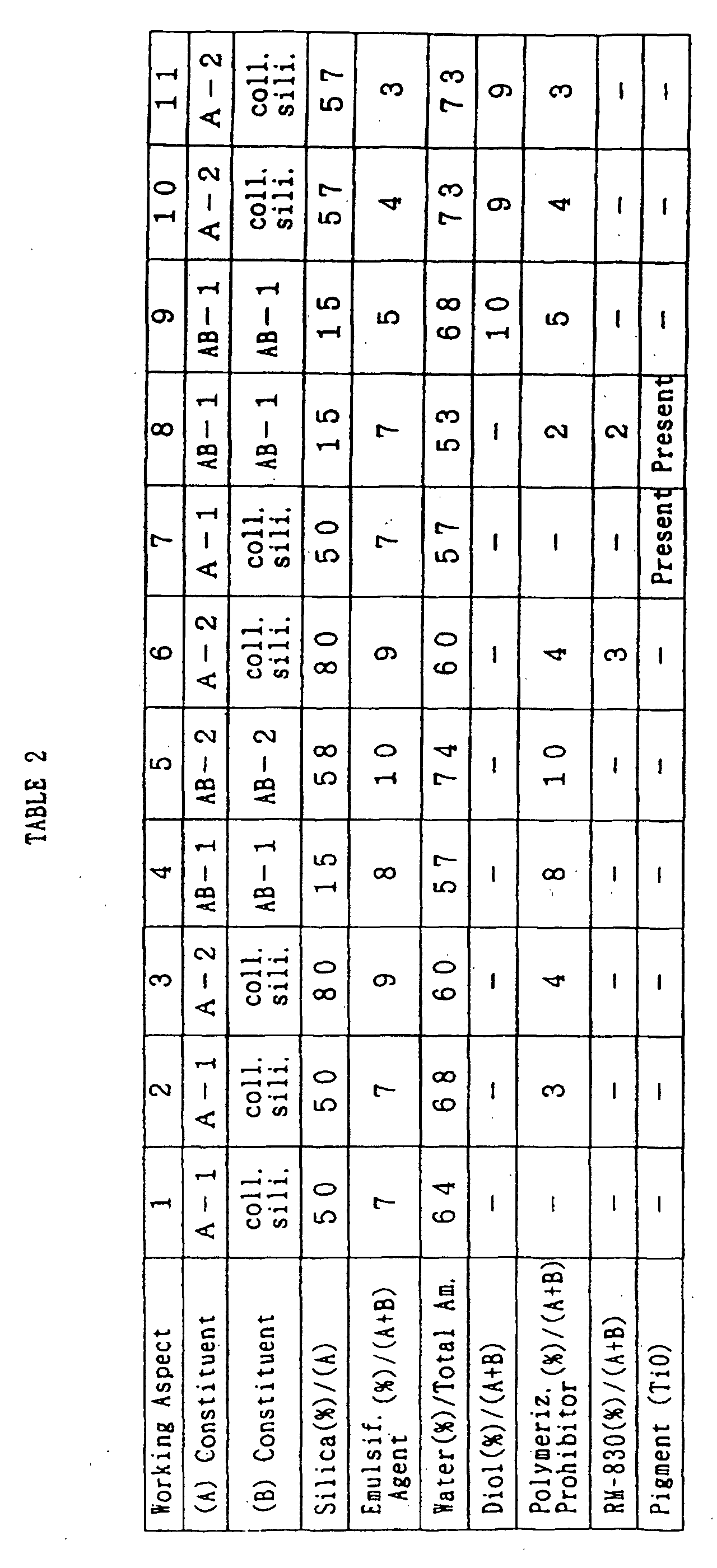
Comp. Ex. 1 2 3 4 (A) Constituent A - 1 A - 1 A - 2 Comp'g A - 1 (B) Constituent Coll. Silic. Coll. Silic. --- Coll. Silic. Silica(%)/(A) 5 0 5 0 --- 5 0 Emulsif. Agt. (%)/(A + B) 7 7 9 7 Water(%)/Toral 6 4 6 4 6 0 6 4 Polymrz. Prohbtr. (%)/(A+B) --- --- 4 --- RM-830(%)/(A+B) --- --- --- --- Pigment (TiO) --- --- --- --- Emulsif. Stablty. (aft. 1 month) --- ○ ○ ○ Emulsif. Stablty. (aft. 6 months) --- ○ ○ ○ Film Forming Property ○ ○ ○ Harden'g Prop. (Pencil Hardness) -- below 2 B below 2 B below 2 B Weatherability (ΔE) --- --- --- ○ Remark Gelated at Emulsif. 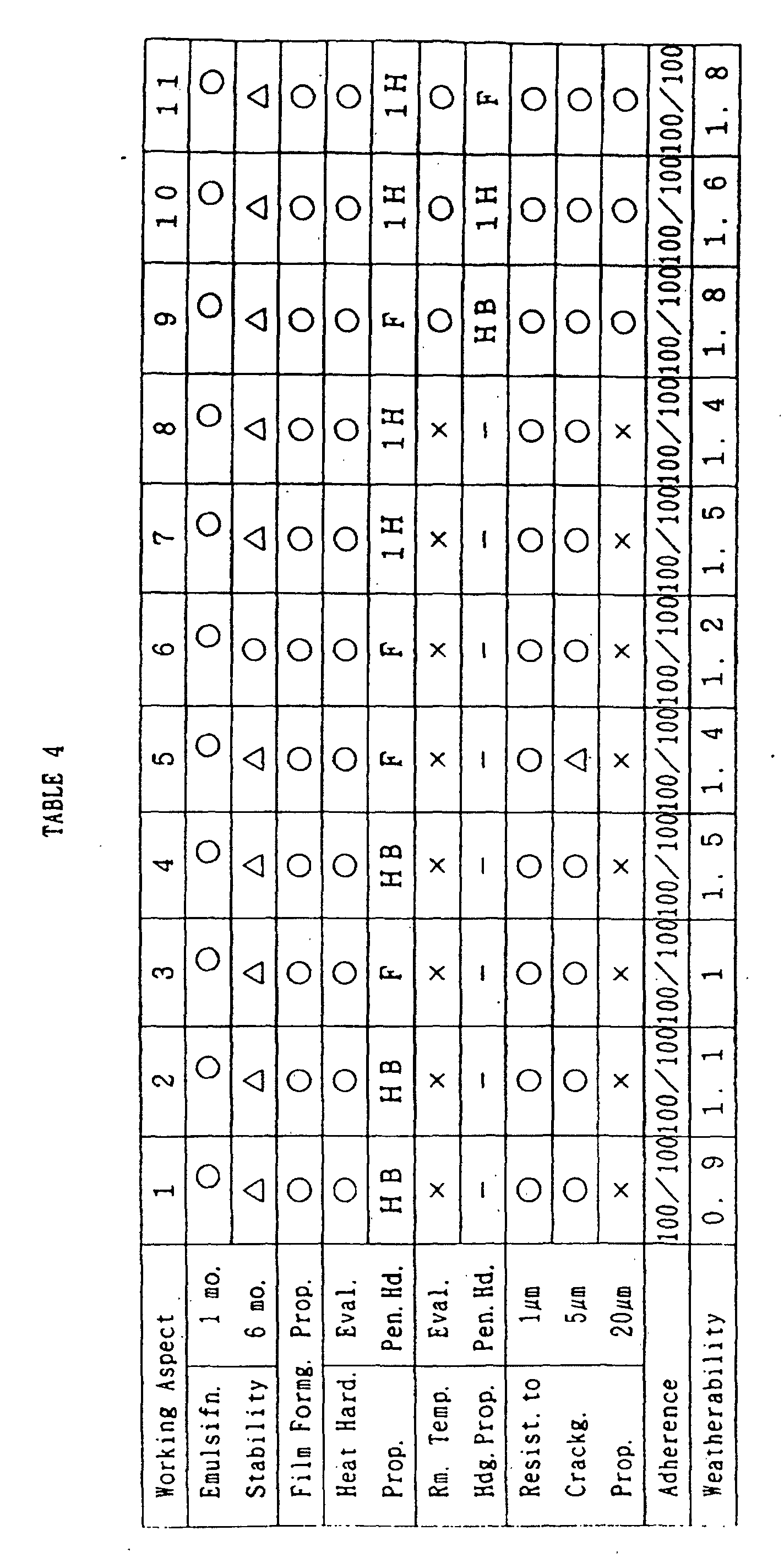
Comparative Example 1 2 3 4 Emulsification
Stability1 no. - ○ ○ Δ 6 mo. - ○ Δ × Film Forming Property - ○ ○ ○ Beat Hard.
PropertyEval. - × ○ ○ Pen. Hd. - - below 2B below 2B Bm. Temp. Hard.
PropertyEval. - × × × Pen. Hd. - - - - Resist, to
Crackg.
Prop.1 µm - - ○ ○ 5 µm - - × ○ 20 µm - - × × Adherence - - 100/100 100/100 Weatherability - - 1. 2 1.1 Remark Gelated at emulsf. Working Asp. 12 13 14 15 16 17 18 19 Substrate stainless plt. stainless plt. acryl. resin coated plt. acryl. resin coated plt. PC plt. PC plt. slate plt. slate plt. Coating material Work. Asp. 2 Work. Asp. 2 Work. Asp. 2 Work. Asp. 2 Work. Asp. 2 Work. Asp. 2 Work. Asp. 2 Work. Asp. 2 Primer pres. nil pres. nil pres. nil pres nil Adherence 1µm 100/100 0/100 100/100 80/100 100/100 0/100 100/100 0/100 20µm 100/100 0/100 100/100 30/100 100/100 0/100 100/100 0/100 resist. to boilng. water 1µm excel. entir. peeled excel. entir. peeled excel. entir. peeled excel. entir. peeled 20µm entir. crack. entir. peeled entir. crack. entir. peeled entir. crack entir. peeled entir. crack entir. peeled Working Asp. 20 21 22 23 Substrate inorg. coated plt. inorg. coated pit. FRP plt. FRP plt. Coating material Work. Asp. 2 Work. Asp. 2 Work. Asp. 2 Work. Asp. 2 Primer pres. nil pres. nil Adherence 1µm 100/100 100/100 100/100 100/100 20µm 100/100 90 /100 100/100 20 /100 Resist. to boilng. water 1µm excel, excel. excel. entir. peeled 20µm entir. crack. entir. crack entir. crack. entir. peeled Working Asp. 24 25 26 27 28 29 30 31 Substrate stainless plt. stainless plt. acryl. resin coated plt. acryl. resin coated pit. PC plt. PC plt. slate plt. slate plt. Coating material Work. Asp. 9 Work. Asp. 9 Work. Asp. 9 Work. Asp. 9 Work. Asp. 9 Work. Asp. 9 Work. Asp. 9 Work. Asp. 9 Primer pres. nil pres. nil pres. nil pres. oil Adherence 1µm 100/100 10 /100 100/100 100/100 100/100 0 /100 100/100 0 /100 20µm 100/100 0 /100 100/100 50 /100 100/100 0 /100 100/100 0 /100 Kesist. to boilng. water 1µm excel. entir. peeled excel. entir. peeled excel. entir. peeled excel. entir. peeled 20µm excel. entir. peeled excel. entir. peeled excel. entir. peeled excel. entir. peeled Working Asp. 32 33 34 35 Substrate inorg. coated plt. inorg. coated plt. FRP plt. FRP pit. Coating material Work. Asp. 9 Work. Asp. 9 Work. Asp. 9 Work. Asp. 9 Primer pres. nil pres. nil Adherence 1µm 100/100 100/100 100/100 70 /100 20µm 100/100 90 /100 100/100 30 /100 Resist. to boilng. water 1µm excel. entir. peeled excel. entir. peeled 20µm excel. entir. peeled excel. entir. peeled
Claims (14)
- A composition of silicone emulsion coating material comprising following (A), (B), (C) and (D) constituents:(A) organosiloxane partial hydrolyzate represented by an average composition formula of R2 aSiOb(OR1)c(OH)d (wherein R1 and R2 denote monovalent hydrocarbon radicals and a, b, c and d are figures satisfying the relationship of a+2b+c+d=4, 0≦a<3, 0<b<2, 0<c<4 and 0<d<4) and having a weight-average molecular weight of 600-5,000 in polystyrene conversion; (B) colloidal silica; (C) an emulsifying agent; and (D) water.
- The composition as set forth in claim 1, wherein the (B) constituent has a silica component at a ratio of 5-100 wt.% with respect to the (A) constituent.
- The composition as set forth in claim 1, wherein the (D) constituent is of a content at a ratio of 50-90 wt.% in the total weight of the composition of silicone emulsion coating material.
- The composition as set forth in claim 1, which further comprises nonionic urethane acryl block copolymer.
- The composition as set forth in claim 4, wherein nonionic urethane acryl block copolymer is of a content at a ratio of 0.1-10 wt.% with respect to the sum weight of the (A) constituent and the silica component in the (B) constituent.
- The composition as set forth in claim 1 which further comprises a pigment.
- The composition as set forth in claim 1 which further comprises a following (E) constituent:(E) a straight-chain polysiloxane diol containing hydroxyl groups at both ends and represented by general formula HO(R3 2SiO)nH (wherein R3 denotes monovalent hydrocarbon radical and "n" is an integer more than 3).
- The composition as set forth in claim 7 wherein "n" in the general formula representing the straight-chain polysiloxane diol containing hydroxyl radicals at both ends is in a range of 3≦n≦50.
- The composition as set forth in claim 7 wherein the (E) constituent is of a content at a ratio of 1-50 wt.% with respect to the sum weight of the (A) constituent and the silica component in the (B) constituent.
- A method for manufacturing a composition of silicone emulsion coating material, comprising the steps of obtaining a mixture containing the (A) and (B) constituents as defined in claim 1 by mixing hydrolyzable organosilane represented by a general formula R2 nSi(OR1)4-n (wherein R1 and R2 denoting monovalent hydrocarbon radicals and "n" being an integer of 0-3), acidic colloidal silica and the (D) constituent as defined in claim 1, and mixing the mixture with at least the (C) constituent as defined in claim 1 among the (C) and additional (D) constituent.
- The method according to claim 10 wherein the (D) constituent used in mixing the hydrolyzable organosilane, acidic colloidal silica and (D) constituent is in an amount at a ratio of 0.3-2.0 mol per 1 mol equivalent weight of OR1 radical in the hydrolyzable organosilane.
- A method for manufacturing a composition of silicone emulsion coating material, comprising the steps of obtaining a desolvated substance by desolvating an organic solvent from a mixture of the (A) and (B) constituents as defined in claim 1 and containing the organic solvent, and mixing the desolvated substance with the (C) and (D) constituents as defined in claim 1.
- The method as set forth in claim 10 or 12 which further comprises the steps of obtaining a pigment base by mixing nonionic urethane acryl block copolymer, (D) constituent and pigment, and adding the pigment base.
- A coated article having an applied and hardened film of a composition of silicone emulsion coating material consisting of the (A), (B), (C) and (D) constituents as defined in claim 1.
Applications Claiming Priority (7)
| Application Number | Priority Date | Filing Date | Title |
|---|---|---|---|
| JP334025/96 | 1996-12-13 | ||
| JP33402696 | 1996-12-13 | ||
| JP334026/96 | 1996-12-13 | ||
| JP33402596A JP3215943B2 (en) | 1996-12-13 | 1996-12-13 | Silicone emulsion coating material composition and method for producing the same |
| JP33402696A JP3875756B2 (en) | 1996-12-13 | 1996-12-13 | Silicone emulsion coating material composition and method for producing the same |
| JP33402596 | 1996-12-13 | ||
| PCT/JP1997/004597 WO1998026019A1 (en) | 1996-12-13 | 1997-12-12 | Silicone emulsion coating composition and processes for the preparation thereof |
Publications (3)
| Publication Number | Publication Date |
|---|---|
| EP0887392A1 EP0887392A1 (en) | 1998-12-30 |
| EP0887392A4 EP0887392A4 (en) | 2000-01-12 |
| EP0887392B1 true EP0887392B1 (en) | 2002-06-12 |
Family
ID=26574710
Family Applications (1)
| Application Number | Title | Priority Date | Filing Date |
|---|---|---|---|
| EP19970947929 Expired - Lifetime EP0887392B1 (en) | 1996-12-13 | 1997-12-12 | Silicone emulsion coating composition and processes for the preparation thereof |
Country Status (6)
| Country | Link |
|---|---|
| US (1) | US6025077A (en) |
| EP (1) | EP0887392B1 (en) |
| KR (1) | KR100276803B1 (en) |
| CN (1) | CN1070903C (en) |
| DE (1) | DE69713299T2 (en) |
| WO (1) | WO1998026019A1 (en) |
Cited By (1)
| Publication number | Priority date | Publication date | Assignee | Title |
|---|---|---|---|---|
| KR101725288B1 (en) * | 2016-07-11 | 2017-04-11 | 에코스포츠화학 주식회사 | Eco-friendly coating composition for floor or finishing comprising water soluble silicon acrylate |
Families Citing this family (35)
| Publication number | Priority date | Publication date | Assignee | Title |
|---|---|---|---|---|
| US6544397B2 (en) * | 1996-03-22 | 2003-04-08 | Ronald Redline | Method for enhancing the solderability of a surface |
| EP0942052B1 (en) * | 1997-03-14 | 2006-07-05 | Matsushita Electric Works, Ltd. | Antifouling silicone emulsion coating composition, process for producing the same and antifouling article coated therewith |
| US6287701B1 (en) * | 1998-05-25 | 2001-09-11 | Chuo Rika Kogyo Corporation | Resin compositions, processes for their production and their uses |
| US6133342A (en) | 1999-01-21 | 2000-10-17 | Marconi Data Systems Inc. | Coating composition |
| USRE45842E1 (en) * | 1999-02-17 | 2016-01-12 | Ronald Redline | Method for enhancing the solderability of a surface |
| US6268457B1 (en) | 1999-06-10 | 2001-07-31 | Allied Signal, Inc. | Spin-on glass anti-reflective coatings for photolithography |
| AU5600200A (en) * | 1999-06-10 | 2001-01-02 | Allied-Signal Inc. | Spin-on-glass anti-reflective coatings for photolithography |
| US6824879B2 (en) | 1999-06-10 | 2004-11-30 | Honeywell International Inc. | Spin-on-glass anti-reflective coatings for photolithography |
| US6478861B1 (en) | 1999-06-25 | 2002-11-12 | Videojet Technologies Inc. | Laser markable coating |
| US6261348B1 (en) * | 1999-06-25 | 2001-07-17 | Marconi Data Systems Inc. | Laser markable coating |
| CA2448889A1 (en) * | 2001-05-31 | 2002-12-05 | Akzo Nobel Coatings International B.V. | Coating biscuit tiles with an abrasion- and scratch-resistant coat |
| US20040241456A1 (en) * | 2001-09-28 | 2004-12-02 | Takeyuki Yamaki | Soil-resisting film formed article |
| DE10150274A1 (en) * | 2001-10-12 | 2003-04-30 | Wacker Chemie Gmbh | Silica with a homogeneous silylating agent layer |
| CN1606713B (en) * | 2001-11-15 | 2011-07-06 | 霍尼韦尔国际公司 | Spincoating antireflection paint for photolithography |
| KR100447315B1 (en) * | 2002-01-25 | 2004-09-04 | (주)뉴일광 | A Waterproof Agent Of Whitening Eliminate Funtional And Manufacturing Method thereof |
| KR100795251B1 (en) * | 2002-02-27 | 2008-01-15 | 히다치 가세고교 가부시끼가이샤 | Silica based film forming composition, silica based film, manufacturing method and electronic parts |
| JP2006500769A (en) * | 2002-09-20 | 2006-01-05 | ハネウェル・インターナショナル・インコーポレーテッド | Interlayer adhesion promoter for low-k materials |
| US8053159B2 (en) | 2003-11-18 | 2011-11-08 | Honeywell International Inc. | Antireflective coatings for via fill and photolithography applications and methods of preparation thereof |
| JP4775543B2 (en) * | 2005-01-24 | 2011-09-21 | 信越化学工業株式会社 | Organosilicone resin emulsion composition and method for producing the same, and article formed with a film of the composition |
| WO2007031276A1 (en) * | 2005-09-13 | 2007-03-22 | Corus Staal Bv | Process for producing tinplate, tinplate produced using said process and packaging produced thereof |
| US7883770B2 (en) * | 2006-03-31 | 2011-02-08 | Johnson Controls Technology Company | Vehicle seat with improved craftsmanship |
| JP2008133342A (en) * | 2006-11-28 | 2008-06-12 | Shin Etsu Chem Co Ltd | Emulsion coating agent composition and article coated therewith |
| US8642246B2 (en) * | 2007-02-26 | 2014-02-04 | Honeywell International Inc. | Compositions, coatings and films for tri-layer patterning applications and methods of preparation thereof |
| JP5324048B2 (en) * | 2007-03-20 | 2013-10-23 | ニチハ株式会社 | Building board |
| KR101082398B1 (en) * | 2007-11-19 | 2011-11-11 | 조경성 | Paper coated with silicon, vessel using the same and manufacturing method thereof |
| JP4678411B2 (en) * | 2008-02-22 | 2011-04-27 | 信越化学工業株式会社 | Film-forming organopolysiloxane emulsion composition |
| CN101555385B (en) * | 2009-05-07 | 2012-10-24 | 中国科学院广州化学研究所 | Water-reducible silicone coating and preparation method thereof |
| US8557877B2 (en) | 2009-06-10 | 2013-10-15 | Honeywell International Inc. | Anti-reflective coatings for optically transparent substrates |
| US8864898B2 (en) | 2011-05-31 | 2014-10-21 | Honeywell International Inc. | Coating formulations for optical elements |
| US20140001181A1 (en) * | 2012-07-02 | 2014-01-02 | Pramod K. Sharma | UV-Cured Strengthening Coating For Glass Containers |
| JP5797717B2 (en) * | 2013-10-16 | 2015-10-21 | 台湾太陽油▲墨▼股▲分▼有限公司 | White thermosetting resin composition, cured product thereof, and display member using the same |
| US10544329B2 (en) | 2015-04-13 | 2020-01-28 | Honeywell International Inc. | Polysiloxane formulations and coatings for optoelectronic applications |
| CN113512902B (en) * | 2020-04-09 | 2023-04-07 | 江苏四新科技应用研究所股份有限公司 | Organic silicon composite emulsion type defoaming agent for papermaking industry and preparation method thereof |
| CN114806406A (en) * | 2022-04-25 | 2022-07-29 | 开封夸克新材料有限公司 | Environment-friendly siloxane anti-corrosion temperature-resistant coating |
| CN118910929B (en) * | 2024-08-19 | 2025-04-15 | 联兴食品药品包装技术(东莞)有限公司 | A mixed coating liquid and fluorine-free oil-proof barrier paper and preparation method thereof |
Family Cites Families (8)
| Publication number | Priority date | Publication date | Assignee | Title |
|---|---|---|---|---|
| JPS6022018B2 (en) * | 1981-11-27 | 1985-05-30 | 信越化学工業株式会社 | Silicone aqueous emulsion composition |
| JPH0651863B2 (en) * | 1986-03-19 | 1994-07-06 | 東レ・ダウコ−ニング・シリコ−ン株式会社 | Silicone water emulsion coating |
| JP2530436B2 (en) * | 1986-09-18 | 1996-09-04 | 住友化学工業株式会社 | Coating composition |
| US5091460A (en) * | 1989-11-27 | 1992-02-25 | Toshiba Silicone Co., Ltd. | Coating composition, coated inorganic hardened product, and process for producing the product |
| JP2992591B2 (en) * | 1989-12-18 | 1999-12-20 | ジーイー東芝シリコーン株式会社 | Silica core-silicone shell, emulsion containing the same and method of producing emulsion |
| JP3100613B2 (en) * | 1990-02-23 | 2000-10-16 | ジーイー東芝シリコーン株式会社 | Silicone aqueous emulsion composition |
| JPH07247434A (en) * | 1994-03-09 | 1995-09-26 | Toshiba Silicone Co Ltd | Water-dispersed silicone resin composition |
| JP3121758B2 (en) * | 1996-02-01 | 2001-01-09 | ジーイー東芝シリコーン株式会社 | Film-forming emulsion-type silicone composition for airbag and airbag |
-
1997
- 1997-12-12 US US09/077,189 patent/US6025077A/en not_active Expired - Lifetime
- 1997-12-12 CN CN97191349A patent/CN1070903C/en not_active Expired - Fee Related
- 1997-12-12 DE DE69713299T patent/DE69713299T2/en not_active Expired - Lifetime
- 1997-12-12 KR KR1019980703662A patent/KR100276803B1/en not_active Expired - Fee Related
- 1997-12-12 WO PCT/JP1997/004597 patent/WO1998026019A1/en not_active Ceased
- 1997-12-12 EP EP19970947929 patent/EP0887392B1/en not_active Expired - Lifetime
Cited By (1)
| Publication number | Priority date | Publication date | Assignee | Title |
|---|---|---|---|---|
| KR101725288B1 (en) * | 2016-07-11 | 2017-04-11 | 에코스포츠화학 주식회사 | Eco-friendly coating composition for floor or finishing comprising water soluble silicon acrylate |
Also Published As
| Publication number | Publication date |
|---|---|
| WO1998026019A1 (en) | 1998-06-18 |
| CN1205027A (en) | 1999-01-13 |
| EP0887392A4 (en) | 2000-01-12 |
| KR100276803B1 (en) | 2001-01-15 |
| DE69713299T2 (en) | 2003-02-13 |
| CN1070903C (en) | 2001-09-12 |
| KR19990067635A (en) | 1999-08-25 |
| DE69713299D1 (en) | 2002-07-18 |
| US6025077A (en) | 2000-02-15 |
| EP0887392A1 (en) | 1998-12-30 |
Similar Documents
| Publication | Publication Date | Title |
|---|---|---|
| US6025077A (en) | Silicone emulsion coating composition and processes for the preparation thereof | |
| KR100630433B1 (en) | Manufacturing method of aqueous resin, aqueous curable resin composition, aqueous coating material and coating film formation method thereof | |
| JP2574061B2 (en) | Organic solution type coating composition, painted inorganic cured product, and method for producing the same | |
| JP2920140B2 (en) | Antifouling silicone emulsion coating material composition, method for producing the same, and antifouling coated article using the same | |
| US4383062A (en) | Waterborne coating compositions | |
| KR100310196B1 (en) | Antifouling silicone emulsion coating composition, process for producing the same and antifouling article coated therewith | |
| US5091460A (en) | Coating composition, coated inorganic hardened product, and process for producing the product | |
| US5190804A (en) | Coated inorganic hardened product | |
| JP3215943B2 (en) | Silicone emulsion coating material composition and method for producing the same | |
| JP3875756B2 (en) | Silicone emulsion coating material composition and method for producing the same | |
| JP3347097B2 (en) | Inorganic paint | |
| JP3467994B2 (en) | Silicone transfer film and transfer structure thereof | |
| JPH1060349A (en) | Ink composition and printed matter | |
| JP3509749B2 (en) | Inorganic paint | |
| JP2695113B2 (en) | Method for repairing inorganic hardened body or metal surface having silicon-based coating layer | |
| JP4352568B2 (en) | Inorganic paint | |
| JP3191600B2 (en) | Stainless steel painted structure and manufacturing method thereof | |
| JP2002186900A (en) | Ultra-low-contamination coating film and method for producing the same | |
| JP2000273395A (en) | Inorganic coating agent and coated article | |
| JPH06220402A (en) | Coating composition | |
| JPH093402A (en) | Composition for coating | |
| JPH06240207A (en) | Coating composition | |
| JP3193832B2 (en) | Coating composition and method for producing the same | |
| JP2001010878A (en) | Coated component | |
| JP3202930B2 (en) | Inorganic coating material composition and painted product using the same |
Legal Events
| Date | Code | Title | Description |
|---|---|---|---|
| PUAI | Public reference made under article 153(3) epc to a published international application that has entered the european phase |
Free format text: ORIGINAL CODE: 0009012 |
|
| 17P | Request for examination filed |
Effective date: 19980511 |
|
| AK | Designated contracting states |
Kind code of ref document: A1 Designated state(s): BE DE FR GB |
|
| A4 | Supplementary search report drawn up and despatched |
Effective date: 19991126 |
|
| AK | Designated contracting states |
Kind code of ref document: A4 Designated state(s): BE DE FR GB |
|
| 17Q | First examination report despatched |
Effective date: 20000704 |
|
| GRAG | Despatch of communication of intention to grant |
Free format text: ORIGINAL CODE: EPIDOS AGRA |
|
| GRAG | Despatch of communication of intention to grant |
Free format text: ORIGINAL CODE: EPIDOS AGRA |
|
| GRAH | Despatch of communication of intention to grant a patent |
Free format text: ORIGINAL CODE: EPIDOS IGRA |
|
| GRAH | Despatch of communication of intention to grant a patent |
Free format text: ORIGINAL CODE: EPIDOS IGRA |
|
| GRAA | (expected) grant |
Free format text: ORIGINAL CODE: 0009210 |
|
| AK | Designated contracting states |
Kind code of ref document: B1 Designated state(s): BE DE FR GB |
|
| REG | Reference to a national code |
Ref country code: GB Ref legal event code: FG4D |
|
| REF | Corresponds to: |
Ref document number: 69713299 Country of ref document: DE Date of ref document: 20020718 |
|
| ET | Fr: translation filed | ||
| PLBI | Opposition filed |
Free format text: ORIGINAL CODE: 0009260 |
|
| PLBF | Reply of patent proprietor to notice(s) of opposition |
Free format text: ORIGINAL CODE: EPIDOS OBSO |
|
| 26 | Opposition filed |
Opponent name: GE BAYER SILICONES GMBH & CO. KGLEGAL DEPARTME Effective date: 20030311 |
|
| PLAX | Notice of opposition and request to file observation + time limit sent |
Free format text: ORIGINAL CODE: EPIDOSNOBS2 |
|
| PLBB | Reply of patent proprietor to notice(s) of opposition received |
Free format text: ORIGINAL CODE: EPIDOSNOBS3 |
|
| PLBP | Opposition withdrawn |
Free format text: ORIGINAL CODE: 0009264 |
|
| PLBD | Termination of opposition procedure: decision despatched |
Free format text: ORIGINAL CODE: EPIDOSNOPC1 |
|
| PLBM | Termination of opposition procedure: date of legal effect published |
Free format text: ORIGINAL CODE: 0009276 |
|
| STAA | Information on the status of an ep patent application or granted ep patent |
Free format text: STATUS: OPPOSITION PROCEDURE CLOSED |
|
| REG | Reference to a national code |
Ref country code: GB Ref legal event code: 746 Effective date: 20040615 |
|
| 27C | Opposition proceedings terminated |
Effective date: 20040307 |
|
| REG | Reference to a national code |
Ref country code: FR Ref legal event code: D6 |
|
| PGFP | Annual fee paid to national office [announced via postgrant information from national office to epo] |
Ref country code: DE Payment date: 20121205 Year of fee payment: 16 |
|
| PGFP | Annual fee paid to national office [announced via postgrant information from national office to epo] |
Ref country code: GB Payment date: 20121212 Year of fee payment: 16 |
|
| PGFP | Annual fee paid to national office [announced via postgrant information from national office to epo] |
Ref country code: FR Payment date: 20130107 Year of fee payment: 16 |
|
| PGFP | Annual fee paid to national office [announced via postgrant information from national office to epo] |
Ref country code: BE Payment date: 20121217 Year of fee payment: 16 |
|
| BERE | Be: lapsed |
Owner name: *MATSUSHITA ELECTRIC WORKS LTD Effective date: 20131231 |
|
| REG | Reference to a national code |
Ref country code: DE Ref legal event code: R119 Ref document number: 69713299 Country of ref document: DE |
|
| GBPC | Gb: european patent ceased through non-payment of renewal fee |
Effective date: 20131212 |
|
| REG | Reference to a national code |
Ref country code: FR Ref legal event code: ST Effective date: 20140829 |
|
| REG | Reference to a national code |
Ref country code: DE Ref legal event code: R119 Ref document number: 69713299 Country of ref document: DE Effective date: 20140701 |
|
| PG25 | Lapsed in a contracting state [announced via postgrant information from national office to epo] |
Ref country code: BE Free format text: LAPSE BECAUSE OF NON-PAYMENT OF DUE FEES Effective date: 20131231 Ref country code: DE Free format text: LAPSE BECAUSE OF NON-PAYMENT OF DUE FEES Effective date: 20140701 |
|
| PG25 | Lapsed in a contracting state [announced via postgrant information from national office to epo] |
Ref country code: FR Free format text: LAPSE BECAUSE OF NON-PAYMENT OF DUE FEES Effective date: 20131231 Ref country code: GB Free format text: LAPSE BECAUSE OF NON-PAYMENT OF DUE FEES Effective date: 20131212 |