EP0887337B1 - Vinyl monomers having polyenic side chains derived from highly unsaturated fatty acids and derivatives thereof, and polymers of said monomers - Google Patents
Vinyl monomers having polyenic side chains derived from highly unsaturated fatty acids and derivatives thereof, and polymers of said monomers Download PDFInfo
- Publication number
- EP0887337B1 EP0887337B1 EP97900427A EP97900427A EP0887337B1 EP 0887337 B1 EP0887337 B1 EP 0887337B1 EP 97900427 A EP97900427 A EP 97900427A EP 97900427 A EP97900427 A EP 97900427A EP 0887337 B1 EP0887337 B1 EP 0887337B1
- Authority
- EP
- European Patent Office
- Prior art keywords
- monomers
- fatty acids
- unsaturated fatty
- highly unsaturated
- vinyl monomers
- Prior art date
- Legal status (The legal status is an assumption and is not a legal conclusion. Google has not performed a legal analysis and makes no representation as to the accuracy of the status listed.)
- Expired - Lifetime
Links
Images

Classifications
-
- C—CHEMISTRY; METALLURGY
- C08—ORGANIC MACROMOLECULAR COMPOUNDS; THEIR PREPARATION OR CHEMICAL WORKING-UP; COMPOSITIONS BASED THEREON
- C08F—MACROMOLECULAR COMPOUNDS OBTAINED BY REACTIONS ONLY INVOLVING CARBON-TO-CARBON UNSATURATED BONDS
- C08F20/00—Homopolymers and copolymers of compounds having one or more unsaturated aliphatic radicals, each having only one carbon-to-carbon double bond, and only one being terminated by only one carboxyl radical or a salt, anhydride, ester, amide, imide or nitrile thereof
- C08F20/02—Monocarboxylic acids having less than ten carbon atoms, Derivatives thereof
- C08F20/10—Esters
- C08F20/40—Esters of unsaturated alcohols, e.g. allyl (meth)acrylate
-
- C—CHEMISTRY; METALLURGY
- C07—ORGANIC CHEMISTRY
- C07C—ACYCLIC OR CARBOCYCLIC COMPOUNDS
- C07C69/00—Esters of carboxylic acids; Esters of carbonic or haloformic acids
- C07C69/52—Esters of acyclic unsaturated carboxylic acids having the esterified carboxyl group bound to an acyclic carbon atom
- C07C69/533—Monocarboxylic acid esters having only one carbon-to-carbon double bond
- C07C69/54—Acrylic acid esters; Methacrylic acid esters
-
- C—CHEMISTRY; METALLURGY
- C07—ORGANIC CHEMISTRY
- C07C—ACYCLIC OR CARBOCYCLIC COMPOUNDS
- C07C69/00—Esters of carboxylic acids; Esters of carbonic or haloformic acids
- C07C69/52—Esters of acyclic unsaturated carboxylic acids having the esterified carboxyl group bound to an acyclic carbon atom
- C07C69/587—Monocarboxylic acid esters having at least two carbon-to-carbon double bonds
Definitions
- This invention relates to the novel compounds, vinyl monomers having polyenic side chains derived from highly unsaturated fatty acids and (co)polymers thereof.
- Vinyl monomers having various functional groups in the side chains are known. Polymerization behavior of these monomers based on the functional groups and the relation between the structure and the properties of the resultant polymers are subjects of interest.
- a method for production of a polymer containing polyunsaturated acid residues is described, for example, in Japanese Published Unexamined Patent Application (KOKAI TOKKYO KOHO) No.125497/76; graft polymerization of poly(acrylic acid) and poly(methacrylic acid) with a poly(fatty acid) through ester bonding or amide bonding was performed to test whether the graft copolymer is usable as a DDS of prostaglandin.
- the graft polymerization with a polymer elongated the duration of action of prostaglandin as compared with prostaglandin used alone.
- US-A-3,284,385 and the related US-A-3,287,298 disclose unsaturated co-polymers obtained by polymerizing acrylic esters.
- the number of unsaturated bonds therein is limited to 1 to 4.
- the examples of the former document disclose fatty acids having a carbon number of 18 and 3 or less unsaturated bond.
- Arachidonic acid is described.
- EP-A-0693 507 a document according to Art.54(3)EPC, discloses a thermosetting liquid resin being a copolymer obtainable from two kinds of vinyl monomers and at least one monomer chosen from a monomer obtainable by reacting an ethylenically unsaturated epoxide with a fatty acid.
- the fatty acid has a C 3-30 hydrocarbon group linked to the carboxylic group which may have a double bond. Preferred are hydrocarbon groups having 16 to 22 carbon atoms and having at least two double bonds in the molecule.
- the fatty acid may be i.a. clupanodonic acid.
- J.Annl. Pol. Sci., Vol. 30, 4557-4570(1985) describes detailed studies made on the properties of polymers of acrylic acid esters containing unsaturated fatty acids having a carbon number of 18 and 1 to 3 unsaturated bonds and fatty acids having a carbon number of 12 and no unsaturated bonds.
- Eicosapentaenoic acid (abbreviated as EPA somewhere hereinafter) and docosahexaenoic acid (abbreviated as DHA somewhere hereinafter), contained as they are or in the form of derivatives such as glycerides in natural fat and oil, particularly in fat and oil in marine products such as mackerel, sardine, and cod, have recently become available in highly purified forms.
- natural fat and oil including fish oil contain, in addition to EPA having 20 carbon atoms and 5 double bonds in a molecule and DHA having 22 carbon atoms and 6 double bonds in a molecule, other various fatty acids having 12 to 24 carbon atoms and 0 to 6 double bonds in each molecule abundantly.
- the fatty acids, usually the esters thereof, remaining as the residue in distillation may remain behind when highly purified products are to be produced from the fatty acid mixtures described above as the starting material.
- the object of this invention is to provide novel vinyl monomers of a type unknown from the vinyl monomers developed so far.
- Another object of this invention is to provide polymers having double bonds in the side chains into which various functional groups can be introduced.
- a further object of this invention is to provide novel vinyl monomers having polyenic side chains derived from highly unsaturated fatty acids and the derivatives thereof and the polymers of said monomers.
- Yet another object of this invention is to provide a useful method for utilizing the fatty acid esters remaining as the residue in the distillation of esterified fish oil.
- the present invention relates to vinyl monomers having polyenic side chains defined in claim 1. These highly unsaturated fatty acids are exemplified by fatty acids derived from fatty acid esters remaining as the residue in the distillation of esterified fish oil.
- Alcohols of highly unsaturated fatty acids according to the present invention are eicosapentaenol, docosapentaenol, docosahexaenol,
- Derivatives of highly unsaturated fatty acids used in this invention are exemplified by fatty acid esters remaining as the residue in the distillation of esterified fish oil or alcohols derived therefrom.
- Vinyl monomers to bind highly unsaturated fatty acids represented by the general formula (1) or the derivatives thereof are exemplified by methacrylic acid, methacrylic acid esters, acrylic acid, acrylic acid esters, ethylene, butadiene, vinyl chloride, vinyl acetate, styrene, and acrylonitrile; that is, monomers having vinyl group that are used as starting materials for production of polymers are used.
- Vinyl monomers in this invention are preferably those obtained by esterification of eicosapentaenoic acid, docosahexaenoic acid, and/or these fatty acids derived from fatty acid esters remaining as the residue in the distillation of esterified fish oil, with 2-hydroxyethyl methacrylate.
- Other preferable examples are vinyl monomers obtained by esterification of eicosapentaenol, docosapentaenol, docosahexaenol, and/or there alcohols derived from fatty acid esters remaining as the residue in the distillation of esterified fish oil, with acrylic acid and/or methacrylic acid.
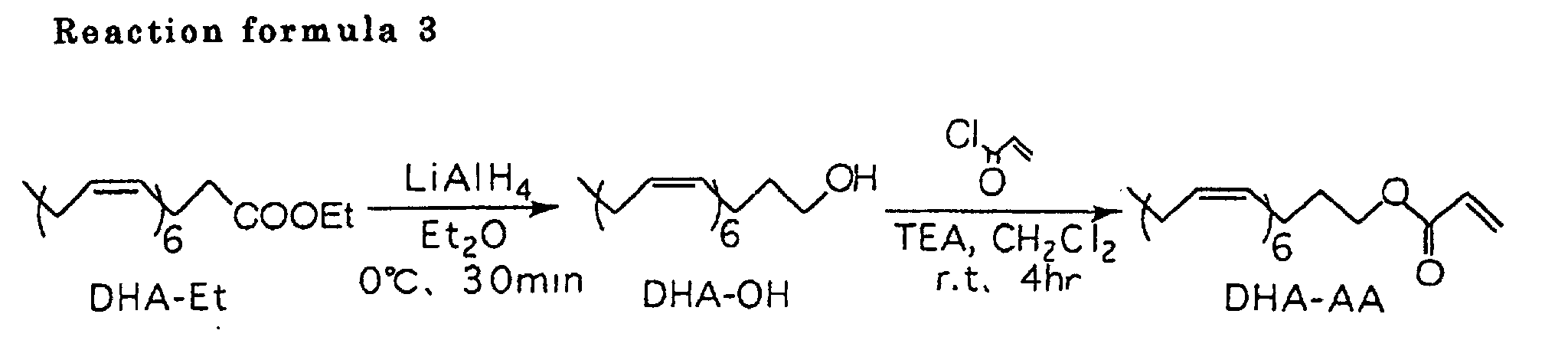
- a vinyl monomer in this invention can be prepared by, e.g. reducing docosahexaenoic acid (DHA) into an alcohol either directly or through several reaction steps and reacting the alcohol with acryloyl chloride.
- DHA docosahexaenoic acid
- These vinyl monomers can be polymerized by the use of various polymerization initiators.
- the vinyl monomers can be copolymerized with other monomers.
- Polymerization initiators used are preferably those known as radical polymerization initiators such as azobisisobutyronitrile (abbreviated as AIBN somewhere hereinafter), benzoyl peroxide, acetyl peroxide, etc.
- AIBN azobisisobutyronitrile
- Polymerization may be carried out in the solid phase (bulk polymerization) or in the liquid phase by using a reaction solvent such as chlorobenzene, dimethylformamide, or methanol.
- a reaction solvent such as chlorobenzene, dimethylformamide, or methanol.
- the drawing illustrates the 1 H-NMR chart of the polymer obtained in Example 5.
- Example 1 To DHA-HEMA (3mmol, 1.32 g) obtained in Example 1 was added 2,2'-azobisisobutyronitrile (AIBN) to 3 mol%, and the container was degassed and sealed, followed by solid phase polymerization at 60°C for 20 hours. After 20 hours, the conversion rate of DHA-HEMA was 13% as determined from 1 H-NMR. Molecular weight and distribution of molecular weight of the polymers were determined by GPC with conversion to polystyrene basis. The results are summarized in Table 1.
- AIBN 2,2'-azobisisobutyronitrile
- Example 5 1 mmol of DHA-MA was subjected to solid phase polymerization (Example 5), or to liquid phase polymerization after dissolving in chlorobenzene to the concentration of 1 mol/l (Example 6), and 1 mmol of DHA-AA was subjected to solid phase polymerization (Example 7), in the same manner as in Example 4 with 10 mol% of AIBN added.
- Table 1 The 1 H-NMR chart of the polymer obtained in Example 5 is shown in Fig.1. monomer AIBN (mol%) polymerization solvent conversion rate (%) molecular weight (Mn) molecular weight distribution (Mw/Mn) Example 4 DHA.
- HEMA 3 none 13 7900 1.20
- Example 5 DHA-MA 10 none 41 9400 3.66
- Example 6 DHA-MA 10 chloro-benzene 34 5000 1.80
- Example 8 1 mmol of DHA-HEMA and 1 mmol of HEMA were dissolved in N,N-dimethylformamide (Example 8) or chlorobenzene (Example 9) to the concentration of 1 mol/l, and subjected to liquid phase polymerization in the same manner as in Example 4.
- the content of p-DHA-HEMA in the resultant polymer was determined by 1 H-NMR. The result is shown in Table 2.
- AIBN mol%) polymerization solvent conversion rate (%) molecular weight (Mn) molecular weight distribution (Mw/Mn) DHA-HEMA content (%)
- Example 8 10 N,N-dimethylform amide 47 6500 1.50 33
- Example 9 20 chlorobenzene 60 4900 2.37 36
- Vinyl monomers having polyenic side chains derived from highly polyunsaturated fatty acids and the polymers of said monomers can be provided. Novel vinyl monomers of a type unknown from the conventional vinyl monomers developed so far can be provided. In addition polymers having double bonds in the side chain into which various functional groups can be introduced can be provided. Useful utilization of fatty acid esters remaining as the residue in distillation of fish oil can be provided.
Landscapes
- Chemical & Material Sciences (AREA)
- Organic Chemistry (AREA)
- Health & Medical Sciences (AREA)
- Chemical Kinetics & Catalysis (AREA)
- Medicinal Chemistry (AREA)
- Polymers & Plastics (AREA)
- Organic Low-Molecular-Weight Compounds And Preparation Thereof (AREA)
- Fats And Perfumes (AREA)
- Addition Polymer Or Copolymer, Post-Treatments, Or Chemical Modifications (AREA)
Description

3014, 2965, 2932, 1742, 1725, 1640, 1152, 712
0.97 (3H, t, J=7.5Hz),
1.92-2.29 (2H,m), 1.94 (3H, s),
2.30-2.50 (4H,m), 2.56-3.12(10H,m),
4.22-4.45 (4H,m), 5.06-5.62 (12H,m),
5.45-5.70 (1H,m), 6.02-6.20 (1H,m)

3014, 2965, 1723, 1640, 1160, 940
0.97 (3H, t, J=7.5Hz),
1.52-1.96 (2H,m), 1.94 (3H, S),
1.82-2.32 (4H,m), 2.55-3.10 (10H,m),
4.15 (2H,t, J=6.5Hz),
5.08-5.50 (12H, m), 5.40-5.61 (1H,m),
6.00-6.12 (1H,m)
3014, 2964, 1728, 1638, 1189, 986
0.95 (3H, t, J=7.4Hz),
1.49-1.88 (2H,m), 1.80-2.32 (4H, m),
2.50-3.02 (10H,m),
4.14 (2H, t, J=6.4Hz),
5.02-5.54 (12H,m), 5.48-6.54 (3H,m)
| monomer | AIBN (mol%) | polymerization solvent | conversion rate (%) | molecular weight (Mn) | molecular weight distribution (Mw/Mn) | |
| Example 4 | DHA. | 3 | none | 13 | 7900 | 1.20 |
| Example 5 | DHA-MA | 10 | none | 41 | 9400 | 3.66 |
| Example 6 | DHA-MA | 10 | chloro-benzene | 34 | 5000 | 1.80 |
| Example 7 | DHA-AA | 10 | none | 26 | 3000 | 3.11 |
| AIBN (mol%) | polymerization solvent | conversion rate (%) | molecular weight (Mn) | molecular weight distribution (Mw/Mn) | DHA-HEMA content (%) | |
| Example 8 | 10 | N,N-dimethylform amide | 47 | 6500 | 1.50 | 33 |
| Example 9 | 20 | chlorobenzene | 60 | 4900 | 2.37 | 36 |
Claims (5)
- Vinyl monomers having polyenic side chains obtainable by reacting vinyl monomers with(a) highly unsaturated fatty acids selected from eicosapentaenoic acid and docosahexaenoic acid, or(b) with the derivatives of said highly unsaturated fatty acids, or(c) with alcohols derived from highly unsaturated fatty acids selected from eicosapentaenol, docosapentaenol, docosahexaenol.
- Vinyl monomers of Claim 1, wherein said monomers are obtainable by esterification of said highly unsaturated fatty acids with 2-hydroxyethyl methacrylate.
- Vinyl monomers of Claim 1, wherein said monomers are obtainable by esterification of said alcohols with acrylic acid and/or methacrylic acid.
- Polymers obtainable by polymerization of a vinyl monomer according to any of Claims 1 to 3.
- Copolymers obtainable by copolymerization of a vinyl monomer according to any of Claims 1 to 3 with another monomer.
Applications Claiming Priority (4)
| Application Number | Priority Date | Filing Date | Title |
|---|---|---|---|
| JP2616496 | 1996-01-19 | ||
| JP26164/96 | 1996-01-19 | ||
| JP02616496A JP3818690B2 (en) | 1996-01-19 | 1996-01-19 | Vinyl monomer having a polyunsaturated fatty acid and its derivative-derived multiple double bond in the side chain and polymer thereof |
| PCT/JP1997/000068 WO1997026239A1 (en) | 1996-01-19 | 1997-01-16 | Vinyl monomers having polyenic side chains derived from highly unsaturated fatty acids and derivatives thereof, and polymers of said monomers |
Publications (3)
| Publication Number | Publication Date |
|---|---|
| EP0887337A1 EP0887337A1 (en) | 1998-12-30 |
| EP0887337A4 EP0887337A4 (en) | 1999-04-07 |
| EP0887337B1 true EP0887337B1 (en) | 2003-09-17 |
Family
ID=12185921
Family Applications (1)
| Application Number | Title | Priority Date | Filing Date |
|---|---|---|---|
| EP97900427A Expired - Lifetime EP0887337B1 (en) | 1996-01-19 | 1997-01-16 | Vinyl monomers having polyenic side chains derived from highly unsaturated fatty acids and derivatives thereof, and polymers of said monomers |
Country Status (5)
| Country | Link |
|---|---|
| US (1) | US6737460B2 (en) |
| EP (1) | EP0887337B1 (en) |
| JP (1) | JP3818690B2 (en) |
| CA (1) | CA2242409A1 (en) |
| WO (1) | WO1997026239A1 (en) |
Family Cites Families (12)
| Publication number | Priority date | Publication date | Assignee | Title |
|---|---|---|---|---|
| US3284385A (en) | 1962-07-02 | 1966-11-08 | Dal Mon Research Co | Unsaturated addition polymers convertible by oxygen to insoluble polymers |
| US3287298A (en) * | 1962-12-28 | 1966-11-22 | Dal Mon Research Co | Oxygen-convertible block copolymers of polymeric dianions |
| US4145320A (en) | 1974-10-15 | 1979-03-20 | Paolo Ferruti | Polymers containing polyunsaturated acid radicals, process for their preparation and use thereof |
| US4311624A (en) * | 1980-07-02 | 1982-01-19 | Rohm And Haas Company | Autoxidizable compositions |
| JPS57190016A (en) * | 1981-04-27 | 1982-11-22 | Hitachi Chem Co Ltd | Resin composition |
| JPS6295525A (en) | 1985-10-22 | 1987-05-02 | Kuraray Co Ltd | Photosensitive resin composition and method for preparing pattern using the composition |
| CA2011756A1 (en) * | 1989-03-22 | 1990-09-22 | Takashi Maruyama | Resin composition |
| GB9015086D0 (en) * | 1990-07-09 | 1990-08-29 | Unilever Plc | Cosmetic composition |
| US5173113A (en) | 1991-03-12 | 1992-12-22 | Topez Company | Composition for ink vehicles and protective coatings |
| US5746925A (en) * | 1993-06-08 | 1998-05-05 | Mansfield & Alper, Inc. | Composition for coagulating oil |
| JP3417733B2 (en) | 1994-07-11 | 2003-06-16 | 株式会社東芝 | Photosensitive material for ArF excimer laser exposure |
| JPH0834826A (en) | 1994-07-22 | 1996-02-06 | Toyo Ink Mfg Co Ltd | Curable liquid resin, its manufacturing method and its use |
-
1996
- 1996-01-19 JP JP02616496A patent/JP3818690B2/en not_active Expired - Fee Related
-
1997
- 1997-01-16 WO PCT/JP1997/000068 patent/WO1997026239A1/en not_active Ceased
- 1997-01-16 CA CA002242409A patent/CA2242409A1/en not_active Abandoned
- 1997-01-16 US US09/101,836 patent/US6737460B2/en not_active Expired - Fee Related
- 1997-01-16 EP EP97900427A patent/EP0887337B1/en not_active Expired - Lifetime
Also Published As
| Publication number | Publication date |
|---|---|
| US20010003128A1 (en) | 2001-06-07 |
| EP0887337A4 (en) | 1999-04-07 |
| JPH09194423A (en) | 1997-07-29 |
| WO1997026239A1 (en) | 1997-07-24 |
| JP3818690B2 (en) | 2006-09-06 |
| CA2242409A1 (en) | 1997-07-24 |
| EP0887337A1 (en) | 1998-12-30 |
| US6737460B2 (en) | 2004-05-18 |
Similar Documents
| Publication | Publication Date | Title |
|---|---|---|
| JP7795523B2 (en) | Polymer production method, composition for radical polymerization, and radical polymerization controller | |
| US6737460B2 (en) | Vinyl monomers having polyenic side chains derived from highly unsaturated fatty acids and derivatives thereof, and polymers of said monomers | |
| KR0152388B1 (en) | Michael addition product of N-vinylformamide with acrylic and methacrylic esters | |
| Moszner et al. | Polymerisation of cyclic monomers, 8. Synthesis and radical polymerisation of hybrid 2‐vinylcyclopropanes | |
| JPH08217755A (en) | Production of an azo compound and a graft polymer | |
| US5117047A (en) | Peroxy ester | |
| US5798434A (en) | Monomer mixture and method for the preparation thereof | |
| JP2023129436A (en) | Polymers and synthetic resins | |
| JP2778770B2 (en) | Polymer type polymerization initiator | |
| US4439588A (en) | Polymers of pivaloyloxyalkyl methacrylates, method for their preparation and modification | |
| JPH10279528A (en) | Itaconic acid ester and its polymer | |
| JP3200942B2 (en) | Boronic acid group-containing monomer and polymer thereof | |
| JP3116365B2 (en) | New organic peroxide | |
| JP3894804B2 (en) | Method for producing vinyl ether group-containing (meth) acrylic acid ester polymer | |
| JP4705257B2 (en) | Method for reducing N-oxyl compounds | |
| JP2022161860A (en) | Method for producing methacrylate (co)polymer | |
| US4670520A (en) | Method for modifying polyfumaric acid diester | |
| JP4676055B2 (en) | Method for controlling stereoregularity in radical polymerization | |
| US4218552A (en) | Polymers of pivaloyloxyalkyl methacrylates, method for their preparation and modification | |
| JPH0539322A (en) | Hydrophilic resin | |
| JP2002302466A (en) | Method for producing asymmetric (meth)acrylate crosslinking agent | |
| JPH08311004A (en) | N-methacryloyl-amino acid esters, its production and polymerizate thereof | |
| JPH0859586A (en) | N- (METHA) ACRYLOYL-LEUCINE ALKYL ESTER, PROCESS FOR PRODUCING THE SAME AND POLYMER THEREOF | |
| RU1781234C (en) | Process for producing acrylic polymers having high water-absorbing capacity | |
| JPH09316050A (en) | Ethylenic compound having acylthio group and copolymer thereof |
Legal Events
| Date | Code | Title | Description |
|---|---|---|---|
| PUAI | Public reference made under article 153(3) epc to a published international application that has entered the european phase |
Free format text: ORIGINAL CODE: 0009012 |
|
| 17P | Request for examination filed |
Effective date: 19980701 |
|
| AK | Designated contracting states |
Kind code of ref document: A1 Designated state(s): GB |
|
| A4 | Supplementary search report drawn up and despatched | ||
| AK | Designated contracting states |
Kind code of ref document: A4 Designated state(s): GB |
|
| 17Q | First examination report despatched |
Effective date: 20010424 |
|
| GRAH | Despatch of communication of intention to grant a patent |
Free format text: ORIGINAL CODE: EPIDOS IGRA |
|
| GRAS | Grant fee paid |
Free format text: ORIGINAL CODE: EPIDOSNIGR3 |
|
| GRAA | (expected) grant |
Free format text: ORIGINAL CODE: 0009210 |
|
| AK | Designated contracting states |
Kind code of ref document: B1 Designated state(s): GB |
|
| REG | Reference to a national code |
Ref country code: GB Ref legal event code: FG4D |
|
| PGFP | Annual fee paid to national office [announced via postgrant information from national office to epo] |
Ref country code: GB Payment date: 20031230 Year of fee payment: 8 |
|
| PLBE | No opposition filed within time limit |
Free format text: ORIGINAL CODE: 0009261 |
|
| STAA | Information on the status of an ep patent application or granted ep patent |
Free format text: STATUS: NO OPPOSITION FILED WITHIN TIME LIMIT |
|
| 26N | No opposition filed |
Effective date: 20040618 |
|
| PG25 | Lapsed in a contracting state [announced via postgrant information from national office to epo] |
Ref country code: GB Free format text: LAPSE BECAUSE OF NON-PAYMENT OF DUE FEES Effective date: 20050116 |
|
| GBPC | Gb: european patent ceased through non-payment of renewal fee |
Effective date: 20050116 |