EP0884376A2 - Use of aerogels as a filler material. - Google Patents
Use of aerogels as a filler material. Download PDFInfo
- Publication number
- EP0884376A2 EP0884376A2 EP98500131A EP98500131A EP0884376A2 EP 0884376 A2 EP0884376 A2 EP 0884376A2 EP 98500131 A EP98500131 A EP 98500131A EP 98500131 A EP98500131 A EP 98500131A EP 0884376 A2 EP0884376 A2 EP 0884376A2
- Authority
- EP
- European Patent Office
- Prior art keywords
- aerogels
- fluids
- transport
- acetylene
- acetone
- Prior art date
- Legal status (The legal status is an assumption and is not a legal conclusion. Google has not performed a legal analysis and makes no representation as to the accuracy of the status listed.)
- Withdrawn
Links
Images



Classifications
-
- C—CHEMISTRY; METALLURGY
- C10—PETROLEUM, GAS OR COKE INDUSTRIES; TECHNICAL GASES CONTAINING CARBON MONOXIDE; FUELS; LUBRICANTS; PEAT
- C10L—FUELS NOT OTHERWISE PROVIDED FOR; NATURAL GAS; SYNTHETIC NATURAL GAS OBTAINED BY PROCESSES NOT COVERED BY SUBCLASSES C10G OR C10K; LIQUIFIED PETROLEUM GAS; USE OF ADDITIVES TO FUELS OR FIRES; FIRE-LIGHTERS
- C10L3/00—Gaseous fuels; Natural gas; Synthetic natural gas obtained by processes not covered by subclass C10G, C10K; Liquefied petroleum gas
- C10L3/02—Compositions containing acetylene
- C10L3/04—Absorbing compositions, e.g. solvents
-
- C—CHEMISTRY; METALLURGY
- C04—CEMENTS; CONCRETE; ARTIFICIAL STONE; CERAMICS; REFRACTORIES
- C04B—LIME, MAGNESIA; SLAG; CEMENTS; COMPOSITIONS THEREOF, e.g. MORTARS, CONCRETE OR LIKE BUILDING MATERIALS; ARTIFICIAL STONE; CERAMICS; REFRACTORIES; TREATMENT OF NATURAL STONE
- C04B14/00—Use of inorganic materials as fillers, e.g. pigments, for mortars, concrete or artificial stone; Treatment of inorganic materials specially adapted to enhance their filling properties in mortars, concrete or artificial stone
- C04B14/02—Granular materials, e.g. microballoons
- C04B14/04—Silica-rich materials; Silicates
- C04B14/06—Quartz; Sand
- C04B14/064—Silica aerogel
-
- C—CHEMISTRY; METALLURGY
- C04—CEMENTS; CONCRETE; ARTIFICIAL STONE; CERAMICS; REFRACTORIES
- C04B—LIME, MAGNESIA; SLAG; CEMENTS; COMPOSITIONS THEREOF, e.g. MORTARS, CONCRETE OR LIKE BUILDING MATERIALS; ARTIFICIAL STONE; CERAMICS; REFRACTORIES; TREATMENT OF NATURAL STONE
- C04B16/00—Use of organic materials as fillers, e.g. pigments, for mortars, concrete or artificial stone; Treatment of organic materials specially adapted to enhance their filling properties in mortars, concrete or artificial stone
Definitions
- the present invention refers to the use of aerogels as a filler material.
- Aerogels concerned by the present invention find application as a filler material for the transport and/or storage of fluids, particularly for the transport of acetylene.
- Aerogels are the lightest solid-materials known. Their lightness lies in their high porosity so that they behave as open-cell foams with a large surface area. Pores exhibit a wide size-distribution, although their typical diameter usually is 15-20 nm, 95% of the total volume being occupied by them.
- the aerogel density ranges from 0,6 g/cm 3 to 0,003 g/cm 3 (only three times more dense than air). Their structure is derived from the one of the gel which formed it and, therefore, is amorphous.
- the most usual process for obtention of silica aerogels comprises the synthesis of silicon gels and their further supercritical drying.
- TMOS tetramethoxysilane
- the current application for aerogels has specially been as a thermal insulator; for instance, the silica aerogel which is a colloidal silica powder is used as low temperature insulator.
- aerogels are, for example, in satellites where they facilitate meteorite trapping, or as high quality gas-filters, or as auto-focus cameras for televisions.
- the present invention refers to the use of aerogels as a filler material for transport and/or storage of fluids.
- the present invention refers to the use of silica aerogels as a filler material for transport and storage of fluids, specially for acetylene.
- the present invention concerns the use of aerogels for transport or storage of said fluids, specially for acetylene.
- Acetylene is a flammable gas in the presence of air at high temperatures. It is employed in a number of industrial applications such as the synthesis of chemical products, welding, metal cutting, thermal treatment of materials and even for lighting in buoys.
- acetylene Being a flammable gas, acetylene must be transported in steel cylinders submitted to very severe regulations. This regulations require, among others, that the steel used for the cylinder meets certain physicochemical requirements and that the filling of the cylinder has a maximum of 92% porosity when filled up with a given amount of solvent; moreover, the cylinder must be fitted with the appropriate safety release-devices.
- the filling material of the cylinders must be porous in order to prevent the gas decomposition-feature and thus eliminate the possibility of forming acetylene-gas pockets, even small ones.
- the porous mass filling the acetylene cylinders is saturated with acetone or another solvent in which acetylene dissolves.
- the use of glass fibre results in fissures and, eventually the filler lightly shrinks.
- a cotton-fibre filler has resulted in lengthened hollow cavities. Polyester and rayon fibres tend to settle during preparation, making difficult to achieve uniformity in the filling of the cylinder.
- the invention provides a solution to the prior art drawbacks by using silica aerogels as a filler material that find application in the transport and/or storage of fluids, specially acetylene.
- Aerogels exhibit the property of transforming a fluid into a solid which encloses it, and subdivides it in small portions. This property is a very important feature in the case of highly dangerous fluids. The strict conditions required for transport or storage of said fluids are reduced when the transport or storage of such fluids is performed in a silica aerogel.
- silica aerogels as a filler material has the advantage that in the case of an accident, the loss of fluid should be minimal due to the fact that the fluid in question is dissolved in the aerogel forming a solid therewith.
- Silica aerogels meet the above mentioned features for the filler materials.
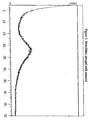
- Figure 1 shows the diffractogram of an air-dried gel.
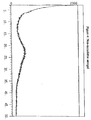
- Figures 2, 3 and 4 are the diffractograms of different aerogels.
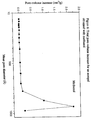
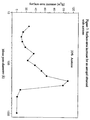
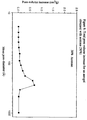
- Figures 5, 6, 7 and 8 show the pore-size distribution for different aerogels.
- Aerogels are monolithic and non-monolithic and have few cracks or defects.
- Silica aerogels contain pores of the three types, the majority of them having the size of mesopores and the minority that of the micropores.
- Density was determined by weighing the monolithic pieces of the different aerogels with a precision balance, and calculating their volume.
- the BET method gas absorption is useful to measure the surface area of a material, the total volume taken up by pores and their size distribution.
- the BET results for some aerogels are shown in Table 2 (see Figures 5, 6, 7 and 8).
- the surface areas of all the aerogels are rather similar, between about 400 and about 600 m 2 /g.
- the total volume of pores is twofold larger for gels obtained with methanol as compared with those obtained with acetone.
- the mean pore-diameter is smaller for aerogels obtained with acetone as compared with those obtained with methanol.
Landscapes
- Chemical & Material Sciences (AREA)
- Engineering & Computer Science (AREA)
- Ceramic Engineering (AREA)
- Organic Chemistry (AREA)
- Materials Engineering (AREA)
- Structural Engineering (AREA)
- Oil, Petroleum & Natural Gas (AREA)
- Dispersion Chemistry (AREA)
- Civil Engineering (AREA)
- Chemical Kinetics & Catalysis (AREA)
- General Chemical & Material Sciences (AREA)
- Silicon Compounds (AREA)
Abstract
Description

- high porosity;
- great mechanical resistance;
- they must not suffer degradation or aging with time;
- they must fill up the whole inner volume of the cylinder without letting empty spaces.
| Reagents for the aerogel obtention | Density (g/cm3) | Weight porosity |
| Methanol and NH4OH | 0.106 | 92.2 % |
| Methanol and NH4OH | 0.137 | 93.7 % |
| Methanol and NH4OH | 0.143 | 93.5 % |
| Methanol and NH4OH | 0.148 | 93.3 % |
| Methanol and NH4OH | 0.178 | 92.0 % |
| Methanol and NH4OH | 0.253 | 88.4 % |
| Methanol and NH4OH with CH3COOH | 0.105 | 95.2 % |
| Acetone (V=0,2) | 0.167 | 92.3 % |
| Acetone (V=0,2) | 0.151 | 93.1 % |
| Acetone (V=0,2) | 0.151 | 93.1 % |
| Acetone (V=0,2) | 0.137 | 93.7 % |
| Acetone (V=0,2) | 0.283 | 87.1 % |
| Acetone (V=0,3) | 0.245 | 88.9 % |
| Acetone (V=0,3) | 0.247 | 88.8 % |
| Acetone (V=0,3) | 0.435 | 80.2 % |
| Acetone (V=0,4) | 0.321 | 73.7 % |
| Properties of the porous structure of some aerogels. | |||||
| Density (g/cm3) | Porosity (weight percent) | Surface area | Total volume of pores (cm3/g) | Mean pore-diameter (Å) | |
| Methanol | 0.14 | 94 | 470 | 5.72 | 486 |
| Acetone (20%) | 0.28 | 87 | 630 | 2.64 | 356 |
| Acetone (30%) | 0.43 | 80 | 414 | 2.13 | 205 |
Claims (6)
- Use of silica aerogels presenting an amorphous structure, a density ranging from 0,6 g/cm3 to 0,003 g/cm3, as a filler material for transport and/or storage of fluids.
- Use as claimed in Claim 1 characterized in that the fluid is acetylene.
- Use as claimed in Claim 1 characterized in that micropores have a diameter size smaller than about 2 nm.
- Use as claimed in Claim 1 characterized in that mesopores have a diameter size ranging from about 2 nm to about 50 nm.
- Use as claimed in Claim 1 characterized in that macropores have a diameter size greater than about 50 nm.
- Use as claimed in Claim 1 characterized in that the surface area is higher than about 400 m2/g.
Applications Claiming Priority (2)
| Application Number | Priority Date | Filing Date | Title |
|---|---|---|---|
| ES9701231 | 1997-06-05 | ||
| ES009701231A ES2125838B1 (en) | 1997-06-05 | 1997-06-05 | USE OF AIRGELS AS FILLING MATERIALS. |
Publications (2)
| Publication Number | Publication Date |
|---|---|
| EP0884376A2 true EP0884376A2 (en) | 1998-12-16 |
| EP0884376A3 EP0884376A3 (en) | 1999-06-02 |
Family
ID=8299587
Family Applications (1)
| Application Number | Title | Priority Date | Filing Date |
|---|---|---|---|
| EP98500131A Withdrawn EP0884376A3 (en) | 1997-06-05 | 1998-06-03 | Use of aerogels as a filler material. |
Country Status (4)
| Country | Link |
|---|---|
| EP (1) | EP0884376A3 (en) |
| KR (1) | KR19990006679A (en) |
| CA (1) | CA2239130A1 (en) |
| ES (1) | ES2125838B1 (en) |
Cited By (4)
| Publication number | Priority date | Publication date | Assignee | Title |
|---|---|---|---|---|
| US7691909B2 (en) | 2004-09-24 | 2010-04-06 | Kansas State University Research Foundation | Aerosol gels |
| WO2011083174A1 (en) | 2010-01-11 | 2011-07-14 | Parexlanko | Insulating silica xerogel plaster |
| WO2017147463A1 (en) * | 2016-02-24 | 2017-08-31 | Massachusetts Institute Of Technology | Solar thermal aerogel receiver and materials therefor |
| US11170750B2 (en) | 2018-04-25 | 2021-11-09 | Massachusetts Institute Of Technology | Energy efficient soundproofing window retrofits |
Family Cites Families (5)
| Publication number | Priority date | Publication date | Assignee | Title |
|---|---|---|---|---|
| NL6411993A (en) * | 1963-10-18 | 1965-04-20 | ||
| US4349463A (en) * | 1981-01-19 | 1982-09-14 | Union Carbide Corporation | Acetylene storage vessel |
| DE3924243A1 (en) * | 1989-07-21 | 1991-01-24 | Henkel Kgaa | METHOD FOR PRODUCING SI0 (DOWN ARROW) 2 (DOWN ARROW) AEROGELS (II) |
| DE4103280A1 (en) * | 1991-02-04 | 1992-08-06 | Henkel Kgaa | AEROGELE AS CARRIER MATERIAL FOR FUEL SYSTEMS |
| FR2736342B1 (en) * | 1995-07-07 | 1999-01-29 | Univ Claude Bernard Lyon | PROCESS FOR THE MANUFACTURE OF MONOLITHIC SILICA AEROGELS AND THUS OBTAINED SILICA AEROGELS |
-
1997
- 1997-06-05 ES ES009701231A patent/ES2125838B1/en not_active Expired - Fee Related
-
1998
- 1998-05-29 CA CA002239130A patent/CA2239130A1/en not_active Abandoned
- 1998-06-03 EP EP98500131A patent/EP0884376A3/en not_active Withdrawn
- 1998-06-05 KR KR1019980020796A patent/KR19990006679A/en not_active Abandoned
Cited By (9)
| Publication number | Priority date | Publication date | Assignee | Title |
|---|---|---|---|---|
| US7691909B2 (en) | 2004-09-24 | 2010-04-06 | Kansas State University Research Foundation | Aerosol gels |
| WO2011083174A1 (en) | 2010-01-11 | 2011-07-14 | Parexlanko | Insulating silica xerogel plaster |
| EP3778524A1 (en) | 2010-01-11 | 2021-02-17 | Sika Technology Ag | Insulating silica xerogel plaster |
| WO2017147463A1 (en) * | 2016-02-24 | 2017-08-31 | Massachusetts Institute Of Technology | Solar thermal aerogel receiver and materials therefor |
| US10889501B2 (en) | 2016-02-24 | 2021-01-12 | Massachusetts Institute Of Technology | Solar thermal aerogel receiver and materials therefor |
| US11851334B2 (en) | 2016-02-24 | 2023-12-26 | Massachusetts Institute Of Technology | Solar thermal aerogel receiver and materials therefor |
| US11170750B2 (en) | 2018-04-25 | 2021-11-09 | Massachusetts Institute Of Technology | Energy efficient soundproofing window retrofits |
| US11749247B2 (en) | 2018-04-25 | 2023-09-05 | Massachusetts Institute Of Technology | Energy efficient soundproofing window retrofits |
| US12437741B2 (en) | 2018-04-25 | 2025-10-07 | Massachusetts Institute Of Technology | Energy efficient soundproofing window retrofits |
Also Published As
| Publication number | Publication date |
|---|---|
| ES2125838B1 (en) | 1999-11-16 |
| EP0884376A3 (en) | 1999-06-02 |
| CA2239130A1 (en) | 1998-12-05 |
| KR19990006679A (en) | 1999-01-25 |
| ES2125838A1 (en) | 1999-03-01 |
Similar Documents
| Publication | Publication Date | Title |
|---|---|---|
| AU593113B2 (en) | An asbestos free hardened monolithic filler mass | |
| US5734068A (en) | Silver catalyst for the oxidation of ethylene to ethylene oxide and process for preparing ethylene oxide | |
| RU2157729C2 (en) | Method of preparing catalyst carrier | |
| Vix-Guterl et al. | Formation of ordered mesoporous carbon material from a silica template by a one-step chemical vapour infiltration process. | |
| EP0056645B1 (en) | Filler for an acetylene storage vessel | |
| US20060079587A1 (en) | Organic, open cell foam materials, their carbonized derivatives, and methods for producing same | |
| CN107129318B (en) | Method for manufacturing honeycomb structure | |
| KR20200074191A (en) | Process for the production of porous carbon materials using improved carbon sources | |
| EP1025903B1 (en) | Process for production of cordierite-based ceramic honeycomb structure | |
| CN102471158A (en) | Porous ceramic material with macroporosity controlled by layered porogens | |
| JP2010265479A (en) | Organic open cell foam material | |
| JPH0572346B2 (en) | ||
| Bager et al. | Mercury porosimetry of hardened cement paste: the influence of particle size | |
| CN109678349A (en) | A method of foam glass is prepared using post-consumer glass and porous ceramic grain | |
| KR19990006679A (en) | Airgel as a Filler | |
| CA2210352C (en) | Calcium silicate mass for storing acetylene gas | |
| MXPA98004316A (en) | Use of airbrushes as rell materials | |
| Scherer et al. | Sintering aerogels | |
| EP0806984B1 (en) | Catalyst carrier | |
| EP0573654B1 (en) | Lightweight gas concrete | |
| US3475189A (en) | Filler material for acetylene cylinders | |
| JP2025185666A (en) | Air purifiers | |
| JP2025168123A (en) | Air purifiers | |
| CN1204746A (en) | Application of airgel as filling material | |
| RU2855493C1 (en) | Carrier for olefin epoxidation catalyst, method for its obtaining and catalyst based thereon |
Legal Events
| Date | Code | Title | Description |
|---|---|---|---|
| PUAI | Public reference made under article 153(3) epc to a published international application that has entered the european phase |
Free format text: ORIGINAL CODE: 0009012 |
|
| AK | Designated contracting states |
Kind code of ref document: A2 Designated state(s): BE DE ES FR GB IT NL |
|
| AX | Request for extension of the european patent |
Free format text: AL;LT;LV;MK;RO;SI |
|
| PUAL | Search report despatched |
Free format text: ORIGINAL CODE: 0009013 |
|
| AK | Designated contracting states |
Kind code of ref document: A3 Designated state(s): AT BE CH CY DE DK ES FI FR GB GR IE IT LI LU MC NL PT SE |
|
| AX | Request for extension of the european patent |
Free format text: AL;LT;LV;MK;RO;SI |
|
| 17P | Request for examination filed |
Effective date: 19991124 |
|
| AKX | Designation fees paid |
Free format text: BE DE ES FR GB IT NL |
|
| STAA | Information on the status of an ep patent application or granted ep patent |
Free format text: STATUS: THE APPLICATION IS DEEMED TO BE WITHDRAWN |
|
| 18D | Application deemed to be withdrawn |
Effective date: 20011231 |