EP0884360A1 - Technique for reducing the cold flow of rubbers - Google Patents
Technique for reducing the cold flow of rubbers Download PDFInfo
- Publication number
- EP0884360A1 EP0884360A1 EP98110108A EP98110108A EP0884360A1 EP 0884360 A1 EP0884360 A1 EP 0884360A1 EP 98110108 A EP98110108 A EP 98110108A EP 98110108 A EP98110108 A EP 98110108A EP 0884360 A1 EP0884360 A1 EP 0884360A1
- Authority
- EP
- European Patent Office
- Prior art keywords
- rubber
- weight percent
- isoprene
- styrene
- butadiene
- Prior art date
- Legal status (The legal status is an assumption and is not a legal conclusion. Google has not performed a legal analysis and makes no representation as to the accuracy of the status listed.)
- Withdrawn
Links
- 229920001971 elastomer Polymers 0.000 title claims abstract description 127
- 239000005060 rubber Substances 0.000 title claims abstract description 81
- 238000000034 method Methods 0.000 title claims abstract description 29
- PPBRXRYQALVLMV-UHFFFAOYSA-N Styrene Chemical compound C=CC1=CC=CC=C1 PPBRXRYQALVLMV-UHFFFAOYSA-N 0.000 claims abstract description 97
- 229920002857 polybutadiene Polymers 0.000 claims abstract description 97
- KAKZBPTYRLMSJV-UHFFFAOYSA-N Butadiene Chemical compound C=CC=C KAKZBPTYRLMSJV-UHFFFAOYSA-N 0.000 claims abstract description 75
- RRHGJUQNOFWUDK-UHFFFAOYSA-N Isoprene Chemical compound CC(=C)C=C RRHGJUQNOFWUDK-UHFFFAOYSA-N 0.000 claims abstract description 71
- VLLYOYVKQDKAHN-UHFFFAOYSA-N buta-1,3-diene;2-methylbuta-1,3-diene Chemical compound C=CC=C.CC(=C)C=C VLLYOYVKQDKAHN-UHFFFAOYSA-N 0.000 claims abstract description 70
- 239000005062 Polybutadiene Substances 0.000 claims abstract description 58
- 238000006116 polymerization reaction Methods 0.000 claims abstract description 38
- 229920000642 polymer Polymers 0.000 claims abstract description 35
- 230000009477 glass transition Effects 0.000 claims abstract description 24
- 229920002554 vinyl polymer Polymers 0.000 claims abstract description 22
- 239000003607 modifier Substances 0.000 claims abstract description 21
- 125000000391 vinyl group Chemical group [H]C([*])=C([H])[H] 0.000 claims abstract description 21
- 238000010539 anionic addition polymerization reaction Methods 0.000 claims abstract description 9
- VYPSYNLAJGMNEJ-UHFFFAOYSA-N Silicium dioxide Chemical compound O=[Si]=O VYPSYNLAJGMNEJ-UHFFFAOYSA-N 0.000 claims description 56
- 239000000203 mixture Substances 0.000 claims description 50
- 239000000178 monomer Substances 0.000 claims description 31
- 239000000377 silicon dioxide Substances 0.000 claims description 27
- 238000002156 mixing Methods 0.000 claims description 17
- 239000006229 carbon black Substances 0.000 claims description 16
- 229920001195 polyisoprene Polymers 0.000 claims description 16
- 239000003960 organic solvent Substances 0.000 claims description 13
- 229920005683 SIBR Polymers 0.000 claims description 11
- 229920003193 cis-1,4-polybutadiene polymer Polymers 0.000 claims description 9
- 150000001993 dienes Chemical class 0.000 claims description 9
- 239000011414 polymer cement Substances 0.000 claims description 9
- 244000043261 Hevea brasiliensis Species 0.000 claims description 8
- 229920003052 natural elastomer Polymers 0.000 claims description 8
- 229920001194 natural rubber Polymers 0.000 claims description 8
- 239000005065 High vinyl polybutadiene Substances 0.000 claims description 7
- 230000000379 polymerizing effect Effects 0.000 claims description 7
- 230000008569 process Effects 0.000 claims description 7
- XLOMVQKBTHCTTD-UHFFFAOYSA-N Zinc monoxide Chemical compound [Zn]=O XLOMVQKBTHCTTD-UHFFFAOYSA-N 0.000 claims description 6
- 239000003505 polymerization initiator Substances 0.000 claims description 6
- 229920003048 styrene butadiene rubber Polymers 0.000 claims description 6
- 230000000930 thermomechanical effect Effects 0.000 claims description 6
- 238000006243 chemical reaction Methods 0.000 claims description 5
- 239000007822 coupling agent Substances 0.000 claims description 4
- 238000012545 processing Methods 0.000 claims description 4
- 230000002194 synthesizing effect Effects 0.000 claims description 4
- VTHOKNTVYKTUPI-UHFFFAOYSA-N triethoxy-[3-(3-triethoxysilylpropyltetrasulfanyl)propyl]silane Chemical group CCO[Si](OCC)(OCC)CCCSSSSCCC[Si](OCC)(OCC)OCC VTHOKNTVYKTUPI-UHFFFAOYSA-N 0.000 claims description 3
- 239000011787 zinc oxide Substances 0.000 claims description 3
- 239000004793 Polystyrene Substances 0.000 abstract description 4
- 229920002223 polystyrene Polymers 0.000 abstract description 4
- 230000002829 reductive effect Effects 0.000 abstract description 3
- 238000003860 storage Methods 0.000 abstract description 2
- 150000001875 compounds Chemical class 0.000 description 43
- -1 alkali metal alkoxides Chemical class 0.000 description 38
- VLKZOEOYAKHREP-UHFFFAOYSA-N n-Hexane Chemical compound CCCCCC VLKZOEOYAKHREP-UHFFFAOYSA-N 0.000 description 17
- MZRVEZGGRBJDDB-UHFFFAOYSA-N N-Butyllithium Chemical compound [Li]CCCC MZRVEZGGRBJDDB-UHFFFAOYSA-N 0.000 description 16
- NINIDFKCEFEMDL-UHFFFAOYSA-N Sulfur Chemical compound [S] NINIDFKCEFEMDL-UHFFFAOYSA-N 0.000 description 16
- 239000011593 sulfur Substances 0.000 description 16
- 229910052717 sulfur Inorganic materials 0.000 description 16
- 238000005096 rolling process Methods 0.000 description 13
- 125000004432 carbon atom Chemical group C* 0.000 description 12
- BWGNESOTFCXPMA-UHFFFAOYSA-N Dihydrogen disulfide Chemical compound SS BWGNESOTFCXPMA-UHFFFAOYSA-N 0.000 description 10
- MYRTYDVEIRVNKP-UHFFFAOYSA-N 1,2-Divinylbenzene Chemical compound C=CC1=CC=CC=C1C=C MYRTYDVEIRVNKP-UHFFFAOYSA-N 0.000 description 8
- 239000000945 filler Substances 0.000 description 8
- 239000003999 initiator Substances 0.000 description 8
- 150000002900 organolithium compounds Chemical class 0.000 description 8
- 150000003961 organosilicon compounds Chemical class 0.000 description 7
- OKKJLVBELUTLKV-UHFFFAOYSA-N Methanol Chemical compound OC OKKJLVBELUTLKV-UHFFFAOYSA-N 0.000 description 6
- 239000002904 solvent Substances 0.000 description 6
- LFQSCWFLJHTTHZ-UHFFFAOYSA-N Ethanol Chemical compound CCO LFQSCWFLJHTTHZ-UHFFFAOYSA-N 0.000 description 5
- WHXSMMKQMYFTQS-UHFFFAOYSA-N Lithium Chemical compound [Li] WHXSMMKQMYFTQS-UHFFFAOYSA-N 0.000 description 5
- 230000008901 benefit Effects 0.000 description 5
- 239000003795 chemical substances by application Substances 0.000 description 5
- 238000005227 gel permeation chromatography Methods 0.000 description 5
- WYURNTSHIVDZCO-UHFFFAOYSA-N Tetrahydrofuran Chemical compound C1CCOC1 WYURNTSHIVDZCO-UHFFFAOYSA-N 0.000 description 4
- 150000001298 alcohols Chemical class 0.000 description 4
- 239000003054 catalyst Substances 0.000 description 4
- DOIRQSBPFJWKBE-UHFFFAOYSA-N dibutyl phthalate Chemical compound CCCCOC(=O)C1=CC=CC=C1C(=O)OCCCC DOIRQSBPFJWKBE-UHFFFAOYSA-N 0.000 description 4
- 229910052744 lithium Inorganic materials 0.000 description 4
- 238000004519 manufacturing process Methods 0.000 description 4
- 239000011347 resin Substances 0.000 description 4
- 229920005989 resin Polymers 0.000 description 4
- UHOVQNZJYSORNB-UHFFFAOYSA-N Benzene Chemical compound C1=CC=CC=C1 UHOVQNZJYSORNB-UHFFFAOYSA-N 0.000 description 3
- 239000004215 Carbon black (E152) Substances 0.000 description 3
- RTZKZFJDLAIYFH-UHFFFAOYSA-N Diethyl ether Chemical compound CCOCC RTZKZFJDLAIYFH-UHFFFAOYSA-N 0.000 description 3
- KFZMGEQAYNKOFK-UHFFFAOYSA-N Isopropanol Chemical compound CC(C)O KFZMGEQAYNKOFK-UHFFFAOYSA-N 0.000 description 3
- SJRJJKPEHAURKC-UHFFFAOYSA-N N-Methylmorpholine Chemical compound CN1CCOCC1 SJRJJKPEHAURKC-UHFFFAOYSA-N 0.000 description 3
- YXFVVABEGXRONW-UHFFFAOYSA-N Toluene Chemical compound CC1=CC=CC=C1 YXFVVABEGXRONW-UHFFFAOYSA-N 0.000 description 3
- ZMANZCXQSJIPKH-UHFFFAOYSA-N Triethylamine Chemical compound CCN(CC)CC ZMANZCXQSJIPKH-UHFFFAOYSA-N 0.000 description 3
- 239000003963 antioxidant agent Substances 0.000 description 3
- 230000000052 comparative effect Effects 0.000 description 3
- MTHSVFCYNBDYFN-UHFFFAOYSA-N diethylene glycol Chemical compound OCCOCCO MTHSVFCYNBDYFN-UHFFFAOYSA-N 0.000 description 3
- 238000009826 distribution Methods 0.000 description 3
- 239000000839 emulsion Substances 0.000 description 3
- 229930195733 hydrocarbon Natural products 0.000 description 3
- 150000002430 hydrocarbons Chemical class 0.000 description 3
- 230000002401 inhibitory effect Effects 0.000 description 3
- WGOPGODQLGJZGL-UHFFFAOYSA-N lithium;butane Chemical compound [Li+].CC[CH-]C WGOPGODQLGJZGL-UHFFFAOYSA-N 0.000 description 3
- 239000003921 oil Substances 0.000 description 3
- 239000000049 pigment Substances 0.000 description 3
- 229920002589 poly(vinylethylene) polymer Polymers 0.000 description 3
- 238000010058 rubber compounding Methods 0.000 description 3
- CRUILBNAQILVHZ-UHFFFAOYSA-N 1,2,3-trimethoxybenzene Chemical compound COC1=CC=CC(OC)=C1OC CRUILBNAQILVHZ-UHFFFAOYSA-N 0.000 description 2
- AGIQIOSHSMJYJP-UHFFFAOYSA-N 1,2,4-Trimethoxybenzene Chemical compound COC1=CC=C(OC)C(OC)=C1 AGIQIOSHSMJYJP-UHFFFAOYSA-N 0.000 description 2
- XDTMQSROBMDMFD-UHFFFAOYSA-N Cyclohexane Chemical compound C1CCCCC1 XDTMQSROBMDMFD-UHFFFAOYSA-N 0.000 description 2
- XTHFKEDIFFGKHM-UHFFFAOYSA-N Dimethoxyethane Chemical compound COCCOC XTHFKEDIFFGKHM-UHFFFAOYSA-N 0.000 description 2
- LCGLNKUTAGEVQW-UHFFFAOYSA-N Dimethyl ether Chemical compound COC LCGLNKUTAGEVQW-UHFFFAOYSA-N 0.000 description 2
- YNQLUTRBYVCPMQ-UHFFFAOYSA-N Ethylbenzene Chemical compound CCC1=CC=CC=C1 YNQLUTRBYVCPMQ-UHFFFAOYSA-N 0.000 description 2
- XEEYBQQBJWHFJM-UHFFFAOYSA-N Iron Chemical compound [Fe] XEEYBQQBJWHFJM-UHFFFAOYSA-N 0.000 description 2
- KWYHDKDOAIKMQN-UHFFFAOYSA-N N,N,N',N'-tetramethylethylenediamine Chemical compound CN(C)CCN(C)C KWYHDKDOAIKMQN-UHFFFAOYSA-N 0.000 description 2
- 238000005481 NMR spectroscopy Methods 0.000 description 2
- OFBQJSOFQDEBGM-UHFFFAOYSA-N Pentane Chemical compound CCCCC OFBQJSOFQDEBGM-UHFFFAOYSA-N 0.000 description 2
- DKGAVHZHDRPRBM-UHFFFAOYSA-N Tert-Butanol Chemical compound CC(C)(C)O DKGAVHZHDRPRBM-UHFFFAOYSA-N 0.000 description 2
- 125000003545 alkoxy group Chemical group 0.000 description 2
- 150000001412 amines Chemical class 0.000 description 2
- 238000004458 analytical method Methods 0.000 description 2
- 125000000129 anionic group Chemical group 0.000 description 2
- 230000003078 antioxidant effect Effects 0.000 description 2
- 150000004982 aromatic amines Chemical class 0.000 description 2
- 229960002380 dibutyl phthalate Drugs 0.000 description 2
- 235000014113 dietary fatty acids Nutrition 0.000 description 2
- 150000002170 ethers Chemical class 0.000 description 2
- BLHLJVCOVBYQQS-UHFFFAOYSA-N ethyllithium Chemical compound [Li]CC BLHLJVCOVBYQQS-UHFFFAOYSA-N 0.000 description 2
- 239000000194 fatty acid Substances 0.000 description 2
- 229930195729 fatty acid Natural products 0.000 description 2
- 150000004665 fatty acids Chemical class 0.000 description 2
- 238000009472 formulation Methods 0.000 description 2
- 238000001879 gelation Methods 0.000 description 2
- 238000010348 incorporation Methods 0.000 description 2
- 239000004615 ingredient Substances 0.000 description 2
- 239000007788 liquid Substances 0.000 description 2
- DLEDOFVPSDKWEF-UHFFFAOYSA-N lithium butane Chemical compound [Li+].CCC[CH2-] DLEDOFVPSDKWEF-UHFFFAOYSA-N 0.000 description 2
- SZAVVKVUMPLRRS-UHFFFAOYSA-N lithium;propane Chemical compound [Li+].C[CH-]C SZAVVKVUMPLRRS-UHFFFAOYSA-N 0.000 description 2
- 238000012986 modification Methods 0.000 description 2
- 230000004048 modification Effects 0.000 description 2
- 125000001979 organolithium group Chemical group 0.000 description 2
- NHKJPPKXDNZFBJ-UHFFFAOYSA-N phenyllithium Chemical compound [Li]C1=CC=CC=C1 NHKJPPKXDNZFBJ-UHFFFAOYSA-N 0.000 description 2
- 230000003014 reinforcing effect Effects 0.000 description 2
- 238000010074 rubber mixing Methods 0.000 description 2
- 238000010561 standard procedure Methods 0.000 description 2
- 229920001897 terpolymer Polymers 0.000 description 2
- 150000003512 tertiary amines Chemical class 0.000 description 2
- YLQBMQCUIZJEEH-UHFFFAOYSA-N tetrahydrofuran Natural products C=1C=COC=1 YLQBMQCUIZJEEH-UHFFFAOYSA-N 0.000 description 2
- GETQZCLCWQTVFV-UHFFFAOYSA-N trimethylamine Chemical compound CN(C)C GETQZCLCWQTVFV-UHFFFAOYSA-N 0.000 description 2
- FFEALJSTWWLJNP-UHFFFAOYSA-N 1,2,3-tributoxybenzene Chemical compound CCCCOC1=CC=CC(OCCCC)=C1OCCCC FFEALJSTWWLJNP-UHFFFAOYSA-N 0.000 description 1
- SQSBYHBYVDVLSA-UHFFFAOYSA-N 1,2,3-triethoxy-4,5,6-tripentylbenzene Chemical compound CCCCCC1=C(CCCCC)C(OCC)=C(OCC)C(OCC)=C1CCCCC SQSBYHBYVDVLSA-UHFFFAOYSA-N 0.000 description 1
- YIXWTOHVYXPCMF-UHFFFAOYSA-N 1,2,3-triethoxybenzene Chemical compound CCOC1=CC=CC(OCC)=C1OCC YIXWTOHVYXPCMF-UHFFFAOYSA-N 0.000 description 1
- GERHTYPPNDFNDZ-UHFFFAOYSA-N 1,2,3-trihexoxybenzene Chemical compound CCCCCCOC1=CC=CC(OCCCCCC)=C1OCCCCCC GERHTYPPNDFNDZ-UHFFFAOYSA-N 0.000 description 1
- YWUIRUKCFDTEOV-UHFFFAOYSA-N 1,2,3-trimethoxy-4,5,6-trimethylbenzene Chemical compound COC1=C(C)C(C)=C(C)C(OC)=C1OC YWUIRUKCFDTEOV-UHFFFAOYSA-N 0.000 description 1
- AOVUTAOJQZOAGA-UHFFFAOYSA-N 1,2,3-trimethoxy-5-propylbenzene Chemical compound CCCC1=CC(OC)=C(OC)C(OC)=C1 AOVUTAOJQZOAGA-UHFFFAOYSA-N 0.000 description 1
- MYQRWQLNVGUQNX-UHFFFAOYSA-N 1,2,4-tributoxybenzene Chemical compound CCCCOC1=CC=C(OCCCC)C(OCCCC)=C1 MYQRWQLNVGUQNX-UHFFFAOYSA-N 0.000 description 1
- MTXHYYFYFLXUEN-UHFFFAOYSA-N 1,2,4-triethoxybenzene Chemical compound CCOC1=CC=C(OCC)C(OCC)=C1 MTXHYYFYFLXUEN-UHFFFAOYSA-N 0.000 description 1
- VOAOBYQFUFGQEQ-UHFFFAOYSA-N 1,2,4-trimethoxy-3,5,6-trimethylbenzene Chemical compound COC1=C(C)C(C)=C(OC)C(OC)=C1C VOAOBYQFUFGQEQ-UHFFFAOYSA-N 0.000 description 1
- RUGCCDOTTHVGBY-UHFFFAOYSA-N 1,2,4-trimethoxy-3,5-dimethylbenzene Chemical compound COC1=CC(C)=C(OC)C(C)=C1OC RUGCCDOTTHVGBY-UHFFFAOYSA-N 0.000 description 1
- SNDHRSZUZCBJPB-UHFFFAOYSA-N 1,2,4-trimethoxy-5-propylbenzene Chemical compound CCCC1=CC(OC)=C(OC)C=C1OC SNDHRSZUZCBJPB-UHFFFAOYSA-N 0.000 description 1
- KPOKSQRDUMBARU-UHFFFAOYSA-N 1,2,4-tripentoxybenzene Chemical compound CCCCCOC1=CC=C(OCCCCC)C(OCCCCC)=C1 KPOKSQRDUMBARU-UHFFFAOYSA-N 0.000 description 1
- LZDKZFUFMNSQCJ-UHFFFAOYSA-N 1,2-diethoxyethane Chemical compound CCOCCOCC LZDKZFUFMNSQCJ-UHFFFAOYSA-N 0.000 description 1
- RYHBNJHYFVUHQT-UHFFFAOYSA-N 1,4-Dioxane Chemical compound C1COCCO1 RYHBNJHYFVUHQT-UHFFFAOYSA-N 0.000 description 1
- JVSJHOZKVMZMQA-UHFFFAOYSA-N 1-(1-pyrrolidin-1-ylethyl)pyrrolidine Chemical compound C1CCCN1C(C)N1CCCC1 JVSJHOZKVMZMQA-UHFFFAOYSA-N 0.000 description 1
- DURPTKYDGMDSBL-UHFFFAOYSA-N 1-butoxybutane Chemical compound CCCCOCCCC DURPTKYDGMDSBL-UHFFFAOYSA-N 0.000 description 1
- CPKHPYQIXCUKQJ-UHFFFAOYSA-N 1-di(piperidin-1-yl)phosphorylpiperidine Chemical compound C1CCCCN1P(N1CCCCC1)(=O)N1CCCCC1 CPKHPYQIXCUKQJ-UHFFFAOYSA-N 0.000 description 1
- RRQYJINTUHWNHW-UHFFFAOYSA-N 1-ethoxy-2-(2-ethoxyethoxy)ethane Chemical compound CCOCCOCCOCC RRQYJINTUHWNHW-UHFFFAOYSA-N 0.000 description 1
- KCIZTNZGSBSSRM-UHFFFAOYSA-N 3,4,5-Trimethoxytoluene Chemical compound COC1=CC(C)=CC(OC)=C1OC KCIZTNZGSBSSRM-UHFFFAOYSA-N 0.000 description 1
- HVCNXQOWACZAFN-UHFFFAOYSA-N 4-ethylmorpholine Chemical compound CCN1CCOCC1 HVCNXQOWACZAFN-UHFFFAOYSA-N 0.000 description 1
- FHQRDEDZJIFJAL-UHFFFAOYSA-N 4-phenylmorpholine Chemical compound C1COCCN1C1=CC=CC=C1 FHQRDEDZJIFJAL-UHFFFAOYSA-N 0.000 description 1
- IJGRMHOSHXDMSA-UHFFFAOYSA-N Atomic nitrogen Chemical compound N#N IJGRMHOSHXDMSA-UHFFFAOYSA-N 0.000 description 1
- 238000004438 BET method Methods 0.000 description 1
- ZATOFRITFRPYBT-UHFFFAOYSA-N C1=CC=C2C([Li])=CC=CC2=C1 Chemical compound C1=CC=C2C([Li])=CC=CC2=C1 ZATOFRITFRPYBT-UHFFFAOYSA-N 0.000 description 1
- CXNUBYQDLCPCGD-UHFFFAOYSA-N C=CC=C.CC(=C)C=CC=C Chemical compound C=CC=C.CC(=C)C=CC=C CXNUBYQDLCPCGD-UHFFFAOYSA-N 0.000 description 1
- OKTJSMMVPCPJKN-UHFFFAOYSA-N Carbon Chemical compound [C] OKTJSMMVPCPJKN-UHFFFAOYSA-N 0.000 description 1
- ZAFNJMIOTHYJRJ-UHFFFAOYSA-N Diisopropyl ether Chemical compound CC(C)OC(C)C ZAFNJMIOTHYJRJ-UHFFFAOYSA-N 0.000 description 1
- SNRUBQQJIBEYMU-UHFFFAOYSA-N Dodecane Natural products CCCCCCCCCCCC SNRUBQQJIBEYMU-UHFFFAOYSA-N 0.000 description 1
- 241001441571 Hiodontidae Species 0.000 description 1
- NHTMVDHEPJAVLT-UHFFFAOYSA-N Isooctane Chemical compound CC(C)CC(C)(C)C NHTMVDHEPJAVLT-UHFFFAOYSA-N 0.000 description 1
- 239000002879 Lewis base Substances 0.000 description 1
- 239000006057 Non-nutritive feed additive Substances 0.000 description 1
- CTQNGGLPUBDAKN-UHFFFAOYSA-N O-Xylene Chemical compound CC1=CC=CC=C1C CTQNGGLPUBDAKN-UHFFFAOYSA-N 0.000 description 1
- BPQQTUXANYXVAA-UHFFFAOYSA-N Orthosilicate Chemical compound [O-][Si]([O-])([O-])[O-] BPQQTUXANYXVAA-UHFFFAOYSA-N 0.000 description 1
- 239000004115 Sodium Silicate Substances 0.000 description 1
- 238000005299 abrasion Methods 0.000 description 1
- 238000010521 absorption reaction Methods 0.000 description 1
- 125000001931 aliphatic group Chemical group 0.000 description 1
- 229910052783 alkali metal Inorganic materials 0.000 description 1
- 125000000217 alkyl group Chemical group 0.000 description 1
- 229910052782 aluminium Inorganic materials 0.000 description 1
- XAGFODPZIPBFFR-UHFFFAOYSA-N aluminium Chemical compound [Al] XAGFODPZIPBFFR-UHFFFAOYSA-N 0.000 description 1
- 238000013459 approach Methods 0.000 description 1
- 125000003118 aryl group Chemical group 0.000 description 1
- 150000001735 carboxylic acids Chemical class 0.000 description 1
- 239000004568 cement Substances 0.000 description 1
- 230000008859 change Effects 0.000 description 1
- 229920003211 cis-1,4-polyisoprene Polymers 0.000 description 1
- 230000001010 compromised effect Effects 0.000 description 1
- 238000007796 conventional method Methods 0.000 description 1
- 229920001577 copolymer Polymers 0.000 description 1
- 238000007334 copolymerization reaction Methods 0.000 description 1
- 238000004132 cross linking Methods 0.000 description 1
- 239000003431 cross linking reagent Substances 0.000 description 1
- 125000000000 cycloalkoxy group Chemical group 0.000 description 1
- 125000000113 cyclohexyl group Chemical group [H]C1([H])C([H])([H])C([H])([H])C([H])(*)C([H])([H])C1([H])[H] 0.000 description 1
- 238000010908 decantation Methods 0.000 description 1
- 230000001419 dependent effect Effects 0.000 description 1
- 229940019778 diethylene glycol diethyl ether Drugs 0.000 description 1
- 238000000113 differential scanning calorimetry Methods 0.000 description 1
- SBZXBUIDTXKZTM-UHFFFAOYSA-N diglyme Chemical compound COCCOCCOC SBZXBUIDTXKZTM-UHFFFAOYSA-N 0.000 description 1
- 125000000118 dimethyl group Chemical group [H]C([H])([H])* 0.000 description 1
- JVSWJIKNEAIKJW-UHFFFAOYSA-N dimethyl-hexane Natural products CCCCCC(C)C JVSWJIKNEAIKJW-UHFFFAOYSA-N 0.000 description 1
- 229910001873 dinitrogen Inorganic materials 0.000 description 1
- POLCUAVZOMRGSN-UHFFFAOYSA-N dipropyl ether Chemical compound CCCOCCC POLCUAVZOMRGSN-UHFFFAOYSA-N 0.000 description 1
- 125000003438 dodecyl group Chemical group [H]C([H])([H])C([H])([H])C([H])([H])C([H])([H])C([H])([H])C([H])([H])C([H])([H])C([H])([H])C([H])([H])C([H])([H])C([H])([H])C([H])([H])* 0.000 description 1
- 125000001495 ethyl group Chemical group [H]C([H])([H])C([H])([H])* 0.000 description 1
- 238000002474 experimental method Methods 0.000 description 1
- 238000001914 filtration Methods 0.000 description 1
- 238000010528 free radical solution polymerization reaction Methods 0.000 description 1
- 239000007789 gas Substances 0.000 description 1
- 238000010438 heat treatment Methods 0.000 description 1
- 239000012535 impurity Substances 0.000 description 1
- 230000000415 inactivating effect Effects 0.000 description 1
- 229910052742 iron Inorganic materials 0.000 description 1
- 150000007527 lewis bases Chemical class 0.000 description 1
- 230000000670 limiting effect Effects 0.000 description 1
- 150000002642 lithium compounds Chemical class 0.000 description 1
- IQIWJEAPUNWDLC-UHFFFAOYSA-N lithium;octane Chemical compound [Li+].CCCCCCC[CH2-] IQIWJEAPUNWDLC-UHFFFAOYSA-N 0.000 description 1
- 239000000463 material Substances 0.000 description 1
- 125000000956 methoxy group Chemical group [H]C([H])([H])O* 0.000 description 1
- DVSDBMFJEQPWNO-UHFFFAOYSA-N methyllithium Chemical compound C[Li] DVSDBMFJEQPWNO-UHFFFAOYSA-N 0.000 description 1
- 239000002808 molecular sieve Substances 0.000 description 1
- 230000003647 oxidation Effects 0.000 description 1
- 238000007254 oxidation reaction Methods 0.000 description 1
- 230000020477 pH reduction Effects 0.000 description 1
- 239000002245 particle Substances 0.000 description 1
- 125000001997 phenyl group Chemical group [H]C1=C([H])C([H])=C(*)C([H])=C1[H] 0.000 description 1
- 230000000704 physical effect Effects 0.000 description 1
- 239000002244 precipitate Substances 0.000 description 1
- 238000001556 precipitation Methods 0.000 description 1
- BDERNNFJNOPAEC-UHFFFAOYSA-N propan-1-ol Chemical compound CCCO BDERNNFJNOPAEC-UHFFFAOYSA-N 0.000 description 1
- 230000001698 pyrogenic effect Effects 0.000 description 1
- URGAHOPLAPQHLN-UHFFFAOYSA-N sodium aluminosilicate Chemical compound [Na+].[Al+3].[O-][Si]([O-])=O.[O-][Si]([O-])=O URGAHOPLAPQHLN-UHFFFAOYSA-N 0.000 description 1
- NTHWMYGWWRZVTN-UHFFFAOYSA-N sodium silicate Chemical compound [Na+].[Na+].[O-][Si]([O-])=O NTHWMYGWWRZVTN-UHFFFAOYSA-N 0.000 description 1
- 229910052911 sodium silicate Inorganic materials 0.000 description 1
- 239000000126 substance Substances 0.000 description 1
- 229920003051 synthetic elastomer Polymers 0.000 description 1
- 239000000454 talc Substances 0.000 description 1
- 229910052623 talc Inorganic materials 0.000 description 1
- 150000003568 thioethers Chemical class 0.000 description 1
- YFNKIDBQEZZDLK-UHFFFAOYSA-N triglyme Chemical compound COCCOCCOCCOC YFNKIDBQEZZDLK-UHFFFAOYSA-N 0.000 description 1
- XQCNPXMIHJAHGO-UHFFFAOYSA-N trimethoxy-[(trimethoxysilylmethyltetrasulfanyl)methyl]silane Chemical compound CO[Si](OC)(OC)CSSSSC[Si](OC)(OC)OC XQCNPXMIHJAHGO-UHFFFAOYSA-N 0.000 description 1
- 239000012855 volatile organic compound Substances 0.000 description 1
- XLYOFNOQVPJJNP-UHFFFAOYSA-N water Substances O XLYOFNOQVPJJNP-UHFFFAOYSA-N 0.000 description 1
- 239000001993 wax Substances 0.000 description 1
- 239000008096 xylene Substances 0.000 description 1
Classifications
-
- C—CHEMISTRY; METALLURGY
- C08—ORGANIC MACROMOLECULAR COMPOUNDS; THEIR PREPARATION OR CHEMICAL WORKING-UP; COMPOSITIONS BASED THEREON
- C08F—MACROMOLECULAR COMPOUNDS OBTAINED BY REACTIONS ONLY INVOLVING CARBON-TO-CARBON UNSATURATED BONDS
- C08F236/00—Copolymers of compounds having one or more unsaturated aliphatic radicals, at least one having two or more carbon-to-carbon double bonds
- C08F236/02—Copolymers of compounds having one or more unsaturated aliphatic radicals, at least one having two or more carbon-to-carbon double bonds the radical having only two carbon-to-carbon double bonds
- C08F236/04—Copolymers of compounds having one or more unsaturated aliphatic radicals, at least one having two or more carbon-to-carbon double bonds the radical having only two carbon-to-carbon double bonds conjugated
- C08F236/10—Copolymers of compounds having one or more unsaturated aliphatic radicals, at least one having two or more carbon-to-carbon double bonds the radical having only two carbon-to-carbon double bonds conjugated with vinyl-aromatic monomers
-
- B—PERFORMING OPERATIONS; TRANSPORTING
- B60—VEHICLES IN GENERAL
- B60C—VEHICLE TYRES; TYRE INFLATION; TYRE CHANGING; CONNECTING VALVES TO INFLATABLE ELASTIC BODIES IN GENERAL; DEVICES OR ARRANGEMENTS RELATED TO TYRES
- B60C1/00—Tyres characterised by the chemical composition or the physical arrangement or mixture of the composition
- B60C1/0016—Compositions of the tread
-
- C—CHEMISTRY; METALLURGY
- C08—ORGANIC MACROMOLECULAR COMPOUNDS; THEIR PREPARATION OR CHEMICAL WORKING-UP; COMPOSITIONS BASED THEREON
- C08F—MACROMOLECULAR COMPOUNDS OBTAINED BY REACTIONS ONLY INVOLVING CARBON-TO-CARBON UNSATURATED BONDS
- C08F297/00—Macromolecular compounds obtained by successively polymerising different monomer systems using a catalyst of the ionic or coordination type without deactivating the intermediate polymer
- C08F297/02—Macromolecular compounds obtained by successively polymerising different monomer systems using a catalyst of the ionic or coordination type without deactivating the intermediate polymer using a catalyst of the anionic type
- C08F297/04—Macromolecular compounds obtained by successively polymerising different monomer systems using a catalyst of the ionic or coordination type without deactivating the intermediate polymer using a catalyst of the anionic type polymerising vinyl aromatic monomers and conjugated dienes
-
- C—CHEMISTRY; METALLURGY
- C08—ORGANIC MACROMOLECULAR COMPOUNDS; THEIR PREPARATION OR CHEMICAL WORKING-UP; COMPOSITIONS BASED THEREON
- C08L—COMPOSITIONS OF MACROMOLECULAR COMPOUNDS
- C08L21/00—Compositions of unspecified rubbers
-
- C—CHEMISTRY; METALLURGY
- C08—ORGANIC MACROMOLECULAR COMPOUNDS; THEIR PREPARATION OR CHEMICAL WORKING-UP; COMPOSITIONS BASED THEREON
- C08L—COMPOSITIONS OF MACROMOLECULAR COMPOUNDS
- C08L9/00—Compositions of homopolymers or copolymers of conjugated diene hydrocarbons
-
- C—CHEMISTRY; METALLURGY
- C08—ORGANIC MACROMOLECULAR COMPOUNDS; THEIR PREPARATION OR CHEMICAL WORKING-UP; COMPOSITIONS BASED THEREON
- C08L—COMPOSITIONS OF MACROMOLECULAR COMPOUNDS
- C08L53/00—Compositions of block copolymers containing at least one sequence of a polymer obtained by reactions only involving carbon-to-carbon unsaturated bonds; Compositions of derivatives of such polymers
- C08L53/02—Compositions of block copolymers containing at least one sequence of a polymer obtained by reactions only involving carbon-to-carbon unsaturated bonds; Compositions of derivatives of such polymers of vinyl-aromatic monomers and conjugated dienes
-
- C—CHEMISTRY; METALLURGY
- C08—ORGANIC MACROMOLECULAR COMPOUNDS; THEIR PREPARATION OR CHEMICAL WORKING-UP; COMPOSITIONS BASED THEREON
- C08L—COMPOSITIONS OF MACROMOLECULAR COMPOUNDS
- C08L7/00—Compositions of natural rubber
-
- C—CHEMISTRY; METALLURGY
- C08—ORGANIC MACROMOLECULAR COMPOUNDS; THEIR PREPARATION OR CHEMICAL WORKING-UP; COMPOSITIONS BASED THEREON
- C08L—COMPOSITIONS OF MACROMOLECULAR COMPOUNDS
- C08L9/00—Compositions of homopolymers or copolymers of conjugated diene hydrocarbons
- C08L9/06—Copolymers with styrene
-
- Y—GENERAL TAGGING OF NEW TECHNOLOGICAL DEVELOPMENTS; GENERAL TAGGING OF CROSS-SECTIONAL TECHNOLOGIES SPANNING OVER SEVERAL SECTIONS OF THE IPC; TECHNICAL SUBJECTS COVERED BY FORMER USPC CROSS-REFERENCE ART COLLECTIONS [XRACs] AND DIGESTS
- Y10—TECHNICAL SUBJECTS COVERED BY FORMER USPC
- Y10T—TECHNICAL SUBJECTS COVERED BY FORMER US CLASSIFICATION
- Y10T152/00—Resilient tires and wheels
- Y10T152/10—Tires, resilient
- Y10T152/10495—Pneumatic tire or inner tube
Definitions
- the replacement cost of tires is one of the major expenses encountered by the trucking industry. Tire replacement cost and frequency is, of course, also of concern to most automobile and light truck owners. In recent years, many modifications have been implemented to improve the treadwear characteristics of tires. However, improvements in tire treadwear characteristics have sometimes been achieved by compromising the traction and/or rolling resistance characteristics of the tire.
- rubbers having a high rebound can be utilized in making the tires' treads. Tires made with such rubbers undergo less energy loss during rolling and normally also exhibit improved treadwear characteristics. The traditional problem associated with this approach is that the tire's wet traction and wet skid resistance characteristics are compromised. This is because good rolling resistance which favors low energy loss and good traction characteristics which favor high energy loss are viscoelastically inconsistent properties.
- mixtures of various types of synthetic and natural rubber are normally utilized in tire treads.
- various mixtures of styrene-butadiene rubber and polybutadiene rubber are commonly used as a rubbery material for automobile tire treads.
- such blends are not totally satisfactory for all purposes.
- United States Patent 5,137,998 discloses a process for preparing a rubbery terpolymer of styrene, isoprene and butadiene having multiple glass transition temperatures and having an excellent combination of properties for use in making tire treads which comprises terpolymerizing styrene, isoprene and 1,3-butadiene in an organic solvent at a temperature of no more than about 40°C in the presence of (a) at least one member selected from the group consisting of tripiperidino phosphine oxide and alkali metal alkoxides and (b) an organolithium compound.
- United States Patent 5,047,483 discloses a pneumatic tire having an outer circumferential tread where said tread is a sulfur-cured rubber composition comprised of, based on 100 parts by weight rubber (phr), (A) about 10 to about 90 parts by weight of a styrene, isoprene, butadiene terpolymer rubber (SIBR), and (B) about 70 to about 30 weight percent of at least one of cis 1,4-polyisoprene rubber and cis 1,4-polybutadiene rubber wherein said SIBR rubber is comprised of (1) about 10 to about 35 weight percent bound styrene, (2) about 30 to about 50 weight percent bound isoprene and (3) about 30 to about 40 weight percent bound butadiene and is characterized by having a single glass transition temperature (Tg) which is in the range of about -10°C to about -40°C and, further the said bound butadiene structure contains about 30 to about 40 percent 1,2-vinyl units, the said bound iso
- United States Patent 5,272,220 discloses a styrene-isoprene-butadiene rubber which is particularly valuable for use in making truck tire treads which exhibit improved rolling resistance and tread wear characteristics, said rubber being comprised of repeat units which are derived from about 5 weight percent to about 20 weight percent styrene, from about 7 weight percent to about 35 weight percent isoprene, and from about 55 weight percent to about 88 weight percent 1,3-butadiene, wherein the repeat units derived from styrene, isoprene and 1,3-butadiene are in essentially random order, wherein from about 25 percent to about 40 percent of the repeat units derived from the 1,3-butadiene are of the cis-microstructure, wherein from about 40 percent to about 60 percent of the repeat units derived from the 1,3-butadiene are of the trans-microstructure, wherein from about 5 percent to about 25 percent of the repeat units derived from the 1,3-butadiene are of the vinyl-microstructure, where
- United States Patent 5,239,009 reveals a process for preparing a rubbery polymer which comprises: (a) polymerizing a conjugated diene monomer with a lithium initiator in the substantial absence of polar modifiers at a temperature which is within the range of about 5°C to about 100°C to produce a living polydiene segment having a number average molecular weight which is within the range of about 25,000 to about 350,000 and (b) utilizing the living polydiene segment to initiate the terpolymerization of 1,3-butadiene, isoprene and styrene, wherein the terpolymerization is conducted in the presence of at least one polar modifier at a temperature which is within the range of about 5°C to about 70°C to produce a final segment which is comprised of repeat units which are derived from 1,3-butadiene, isoprene and styrene, wherein the final segment has a number average molecular weight which is within the range of about 25,000 to about 3
- United States Patent 5,061,765 discloses isoprene-butadiene copolymers having high vinyl contents which can reportedly be employed in building tires which have improved traction, rolling resistance and abrasion resistance. These high vinyl isoprene-butadiene rubbers are synthesized by copolymerizing 1,3-butadiene monomer and isoprene monomer in an organic solvent at a temperature which is within the range of about -10°C to about 100°C in the presence of a catalyst system which is comprised of (a) an organoiron compound, (b) an organoaluminum compound, (c) a chelating aromatic amine and (d) a protonic compound; wherein the molar ratio of the chelating amine to the organoiron compound is within the range of about 0.1:1 to about 1:1, wherein the molar ratio of the organoaluminum compound to the organoiron compound is within the range of about 5:1 to about 200:1 and wherein the molar ratio of the proto
- United States Patent 5,405,927 discloses an isoprene-butadiene rubber which is particularly valuable for use in making truck tire treads, said rubber being comprised of repeat units which are derived from about 20 weight percent to about 50 weight percent isoprene and from about 50 weight percent to about 80 weight percent 1,3-butadiene, wherein the repeat units derived from isoprene and 1,3-butadiene are in essentially random order, wherein from about 3 percent to about 10 percent of the repeat units in said rubber are 1,2-polybutadiene units, wherein from about 50 percent to about 70 percent of the repeat units in said rubber are 1,4-polybutadiene units, wherein from about 1 percent to about 4 percent of the repeat units in said rubber are 3,4-polyisoprene units, wherein from about 25 percent to about 40 percent of the repeat units in the polymer are 1,4-polyisoprene units, wherein the rubber has a glass transition temperature which is within the range of about -90°C to about -75
- Cold flow is a problem that is commonly encountered in the handling and storage of many low molecular weight linear rubbers utilized in making tire tread compounds.
- cold flow is a particular problem with linear polymers having low glass transition temperatures and low molecular weights.
- Cold flow often presents a problem in isoprene-butadiene rubbers, low vinyl polybutadiene rubbers, medium vinyl polybutadiene rubbers and polyisoprene rubbers having low molecular weights and low glass transition temperatures which are used in making tire treads.
- These polymers are often crosslinked with divinyl benzene to reduce cold flow.
- this technique for overcoming cold flow can lead to other problems. For example, gelation can occur and polymer inconsistency often results. The crosslinking can also detrimentally change the physical characteristics of the rubbery polymer.
- This invention is based upon the unexpected discovery that the cold flow of rubbery polymers can be greatly reduced by incorporation of a small block of polystyrene therein. This technique does not cause gelation and can be implemented in a highly reproducible process. More importantly, the rubbery polymers which are modified by utilizing this technique possess physical properties that are essentially unaltered from those of the unmodified rubber.
- the modified rubbery polymers of this invention can easily be utilized in making tire tread compounds that offer excellent performance characteristics.
- treadwear characteristics and rolling resistance can be improved without compromising traction characteristics.
- the subject invention more specifically discloses a pneumatic tire having an outer circumferential tread wherein said tread is a sulfur-cured rubber composition comprised of, based on 100 parts by weight of rubber, (a) from about 30 to about 80 parts of a modified isoprene-butadiene rubber, wherein said modified isoprene-butadiene rubber is comprised of polymer chains containing repeat units which are derived from 1,3-butadiene, isoprene and from about 0.5 weight percent to about 3 weight percent styrene, wherein the repeat units which are derived from styrene are in blocks at the ends of the polymer chains, wherein the modified isoprene-butadiene rubber has a glass transition temperature which is within the range of about -105°C to about -65°C and wherein the rubbery polymer has a number average molecular weight which is within the range of about 50,000 to about 600,000 and (b) from about 20 to about 70 parts of a second rubber selected from the group consist
- the subject invention also reveals a pneumatic tire having an outer circumferential tread wherein said tread is a sulfur-cured rubber composition comprised of, based on 100 parts by weight of rubber,
- the present invention also discloses a pneumatic tire having an outer circumferential tread wherein said tread is a sulfur-cured rubber composition comprised of, based on 100 parts by weight of rubber,
- the subject invention further discloses a rubbery polymer which exhibits low cold flow characteristics which is comprised of polymer chains containing repeat units which are derived from about 97 weight percent to about 99.5 weight percent of at least one conjugated diolefin monomer and from about 0.5 weight percent to about 3 weight percent styrene, wherein the repeat units which are derived from styrene are in blocks at the ends of the polymer chains, wherein the rubbery polymer has a glass transition temperature which is within the range of about -105°C to about -65°C and wherein the rubbery polymer has a number average molecular weight which is within the range of about 50,000 to about 600,000.
- the present invention further reveals a process for synthesizing a rubbery polymer which exhibits low cold flow characteristics which comprises polymerizing from about 97 phm to about 99.5 phm of at least one conjugated diolefin monomer and 0.5 phm to about 3 phm of styrene, wherein said polymerization is initiated with an anionic polymerization initiator, wherein said polymerization is carried out in the absence of polar modifiers.
- the subject invention also discloses a process for synthesizing a rubbery polymer which exhibits low cold flow characteristics which comprises the steps of (1) polymerizing at least one conjugated diolefin monomer in an organic solvent to a conversion of at least about 99 percent to produce a living rubbery polymer cement, wherein said polymerization is initiated with an anionic polymerization initiator and wherein said polymerization is carried out in the presence of a polar modifier, (2) adding from about 0.5 phm to about 3 phm of styrene to the living rubbery polymer cement and (3) allowing the styrene to polymerize to produce the rubbery polymer which exhibits low cold flow characteristics.
- the modified rubbery polymers of this invention are synthesized by solution polymerization techniques. These anionic polymerizations are initiated with an anionic polymerization initiator, such as an organolithium compound, and are conducted in an organic solvent.
- an anionic polymerization initiator such as an organolithium compound
- Low vinyl polymers which exhibit low cold flow characteristics can be made by simply polymerizing from about 97 phm (parts by weight per 100 parts by weight of monomer) to about 99.5 phm of at least one conjugated diolefin monomer and 0.5 phm to about 3 phm of styrene, wherein said polymerization is initiated with an anionic polymerization initiator, wherein said polymerization is carried out in the absence of polar modifiers. It is highly preferred to utilize a batch polymerization technique.
- the absence of polar modifiers also causes the rubbery polymer being synthesized to have a low vinyl microstructure and a low glass transition temperature.
- the repeat units which are derived from 1,3-butadiene in the absence of polar modifiers will typically have a vinyl microstructure content which is within the range of about 6 percent to about 10 percent.
- Polybutadiene blocks made in the absence of polar modifiers will also have a glass transition temperature which is within the range of about -105°C to about -90°C.
- Rubbery polymers having a medium to high vinyl content can also be made by utilizing a different technique.
- medium vinyl polybutadiene rubber which exhibits low cold flow characteristics can be synthesized by (1) polymerizing 1,3-butadiene monomer with an anionic initiator in an organic solvent in the presence of a polar modifier to a conversion of at least about 99 percent to produce a living polybutadiene rubber cement, (2) adding from about 0.5 phm to about 3 phm of styrene to the living rubbery polymer cement and (3) allowing the styrene to polymerize to produce the polybutadiene rubber which exhibits low cold flow characteristics.
- the inert organic medium which is utilized as the solvent will typically be a hydrocarbon which is liquid at ambient temperatures which can be one or more aromatic, paraffinic or cycloparaffinic compounds. These solvents will normally contain from 4 to 10 carbon atoms per molecule and will be liquids under the conditions of the polymerization. It is, of course, important for the solvent selected to be inert.
- inert as used herein means that the solvent does not interfere with the polymerization reaction or react with the polymers made thereby.
- organic solvents include pentane, isooctane, cyclohexane, normal hexane, benzene, toluene, xylene, ethylbenzene and the like, alone or in admixture.
- Saturated aliphatic solvents such as cyclohexane and normal hexane, are most preferred.
- the anionic initiator will typically be a lithium compound, such as an organolithium compound.
- organolithium compounds which are preferred are organo monolithium compounds that can be represented by the formula R-Li, wherein R represents a hydrocarbyl radical containing from 1 to about 20 carbon atoms. Generally, such monofunctional organolithium compounds will contain from 1 to about 10 carbon atoms.
- organolithium compounds which can be employed include methyllithium, ethyllithium, isopropyllithium, n-butyllithium, sec-butyllithium, n-octyllithium, tert-octyllithium, n-decyllithium, phenyllithium, 1-napthyllithium, 4-butylphenyllithium, p-tolyllithium, 1-naphthyllithium, 4-butylphenyllithium, p-tolyllithium, 4-phenylbutyllithium, cyclohexyllithium, 4-butylcyclohexyllithium and 4-cyclohexylbutyllithium.
- Organo monolithium compounds such as alkyllithium compounds and aryllithium compounds, are usually employed.
- organo monolithium compounds that can be utilized include ethyllithium, isopropyllithium, n-butyllithium, secondary-butyllithium, normal-hexyllithium, tertiary-octyllithium, phenyllithium, 2-napthyllithium, 4-butylphenyllithium, 4-phenylbutyllithium, cyclohexyllithium, and the like.
- Normal-butyllithium and secondary-butyllithium are highly preferred lithium initiators.
- the amount of lithium initiator utilized will vary from one organolithium compound to another and with the molecular weight that is desired for the rubbery polymer being synthesized. As a general rule in all anionic polymerizations, the molecular weight (Mooney viscosity) of the polymer produced is inversely proportional to the amount of catalyst utilized.
- An amount of organolithium initiator will be selected to result in the production of a rubber having a number average molecular weight which is within the range of about 50,000 to about 600,000. As a general rule, from about 0.01 phm (parts per hundred parts by weight of monomer) to 1 phm of the organo lithium initiator will be employed. In most cases, from 0.01 phm to 0.1 phm of the lithium initiator will be employed with it being preferred to utilize 0.025 phm to 0.07 phm of the organo lithium compound.
- Modified polybutadiene rubbers which are synthesized utilizing the technique of this invention will typically have a number average molecular weight which is within the range of about 50,000 to about 200,000.
- Modified polyisoprene rubbers which are synthesized utilizing the technique of this invention will typically have a number average molecular weight which is within the range of about 100,000 to about 600,000 and modified isoprene-butadiene rubbers which are synthesized utilizing the technique of this invention will typically have a number average molecular weight which is within the range of about 100,000 to about 600,000.
- the benefits of this invention will be maximized in the case of rubbery polymers having number average molecular weights of less than about 400,000 and glass transition temperatures of less than -70°C.
- the benefits of this invention are even more clear-cut in the case of rubbery polymers having number average molecular weights of less than 300,000 and glass transition temperatures of less than -80°C.
- the modified isoprene-butadiene rubbers which are made utilizing the technique of this invention will typically contain from about 5 weight percent to about 78 weight percent isoprene, from about 20 weight percent to about 92 weight percent butadiene and from about 0.5 weight percent to about 3 weight percent styrene. It is normally preferred for the modified isoprene-butadiene rubbers of this invention to contain from about 15 weight percent to about 45 weight percent isoprene, from about 53 weight percent to about 83 weight percent butadiene and from about 0.5 weight percent to about 2 weight percent styrene.
- modified isoprene-butadiene rubbers of this invention contain from about 24 weight percent to about 37 weight percent isoprene, from about 62 weight percent to about 75 weight percent butadiene and from about 0.75 weight percent to about 1.25 weight percent styrene.
- the polymerization medium Normally, from about 5 weight percent to about 35 weight percent of the conjugated diene monomer will be charged into the polymerization medium (based upon the total weight of the polymerization medium including the organic solvent and monomers). In most cases, it will be preferred for the polymerization medium to contain from about 10 weight percent to about 30 weight percent monomers. It is typically more preferred for the polymerization medium to contain from about 20 weight percent to about 25 weight percent monomers.
- the polymerization will normally be conducted at a temperature which is within the range of about 5°C to about 100°C.
- the polymerization temperature will preferably be within the range of about 40°C to about 90°C to attain the desired microstructure for the block segment. Temperatures within the range of about 60°C to about 80°C are most preferred.
- the microstructure of repeat units which are derived from polybutadiene are somewhat dependent upon the polymerization temperature. For example, in the polymerization of 1,3-butadiene, it is known that higher temperatures result in lower vinyl contents (lower levels of 1,2-microstructure). Accordingly, the polymerization temperature selected will be determined with the ultimate desired microstructure of the polymer segment being kept in mind.
- polar modifiers can be utilized in cases where the polymerization is carried out with a modifier.
- Ethers and tertiary amines which act as Lewis bases are representative examples of polar modifiers that can be utilized.
- Some specific examples of typical polar modifiers include diethyl ether, di-n-propyl ether, diisopropyl ether, di-n-butyl ether, tetrahydrofuran, dioxane, ethylene glycol dimethyl ether, ethylene glycol diethyl ether, diethylene glycol dimethyl ether, diethylene glycol diethyl ether, triethylene glycol dimethyl ether, trimethylamine, triethylamine, N,N,N',N'-tetramethylethylenediamine, N-methyl morpholine, N-ethyl morpholine, N-phenyl morpholine and the like.
- the modifier can also be a 1,2,3-trialkoxybenzene or a 1,2,4-trialkoxybenzene.
- 1,2,3-trialkoxybenzenes that can be used include 1,2,3-trimethoxybenzene, 1,2,3-triethoxybenzene, 1,2,3-tributoxybenzene, 1,2,3-trihexoxybenzene, 4,5,6-trimethyl-1,2,3-trimethoxybenzene, 4,5,6-tri-n-pentyl-1,2,3-triethoxybenzene, 5-methyl-1,2,3-trimethoxybenzene and 5-propyl-1,2,3-trimethoxybenzene.
- 1,2,4-trialkoxybenzenes that can be used include 1,2,4-trimethoxybenzene, 1,2,4-triethoxybenzene, 1,2,4-tributoxybenzene, 1,2,4-tripentoxybenzene, 3,5,6-trimethyl-1,2,4-trimethoxybenzene, 5-propyl-1,2,4-trimethoxybenzene and 3,5-dimethyl-1,2,4-trimethoxybenzene.
- Dipiperidinoethane, dipyrrolidinoethane, tetramethylethylene diamine, diethylene glycol, dimethyl ether and tetrahydrofuran are representative of highly preferred modifiers.
- United States Patent 4,022,959 describes the use of ethers and tertiary amines as polar modifiers in greater detail.
- the distribution of repeat units derived from isoprene and butadiene is essentially random.
- the term "essentially random” as used herein means lacking a definite pattern.
- the concentration of repeat units derived from isoprene and butadiene may vary to some degree from one end to the other end of polymer chain.
- the repeat units which are derived from isoprene or 1,3-butadiene differ from the monomer from which they were derived in that a double bond is consumed by the polymerization reaction.
- the polymerization is normally allowed to continue until the monomers are exhausted. In other words, the copolymerization of 1,3-butadiene and isoprene is allowed to continue until the polymerization reaction is complete. In most cases, a monomer conversion of at least about 99 percent will be attained.
- the rubbery polymer can be recovered from the organic solvent.
- the rubbery polymer can be recovered from the organic solvent by any means, such as decantation, filtration and centrification. It is often desirable to precipitate the rubbery polymer from the organic solvent by the addition of lower alcohols containing from about 1 to about 4 carbon atoms to the polymer solution. Suitable lower alcohols for precipitation of the rubbery polymer from the polymer cement include methanol, ethanol, isopropyl alcohol, normal-propyl alcohol and t-butyl alcohol. The utilization of lower alcohols to precipitate the rubber from the polymer cement also "kills" the living polymer by inactivating lithium end groups. After the modified rubber is recovered from the solution, steam-stripping can be employed to reduce the level of volatile organic compounds in the modified rubber.
- Tire tread compounds can be made using these modified isoprene-butadiene rubbers without the need to blend additional rubbers therein. However, in many cases, it will be desirable to blend the modified isoprene-butadiene rubber with one or more additional rubbers to attain the desired performance characteristics for the tire tread compound.
- modified isoprene-butadiene rubbers of this invention can be compounded utilizing conventional ingredients and standard techniques.
- the modified isoprene-butadiene rubber will typically be blended with carbon black and/or silica, sulfur, additional fillers, accelerators, oils, waxes, scorch inhibiting agents, coupling agents and processing aids.
- the modified isoprene-butadiene rubber will be compounded with sulfur and/or a sulfur containing compound, at least one filler, at least one accelerator, at least one antidegradant, at least one processing oil, zinc oxide, optionally a tackifier resin, optionally a reinforcing resin, optionally one or more fatty acids, optionally a peptizer and optionally one or more scorch inhibiting agents.
- Such blends will normally contain from about 0.5 to 5 phr (parts per hundred parts of rubber by weight) of sulfur and/or a sulfur containing compound with 1 phr to 2.5 phr being preferred. It may be desirable to utilize insoluble sulfur in cases where bloom is a problem.
- the blend will also normally include from 0.1 to 2.5 phr of at least one accelerator with 0.2 to 1.5 phr being preferred.
- Antidegradants such as antioxidants and antiozonants, will generally be included in the tread compound blend in amounts ranging from 0.25 to 10 phr with amounts in the range of 1 to 5 phr being preferred.
- Processing oils will generally be included in the blend in amounts ranging from 2 to 100 phr with amounts ranging from 5 to 50 phr being preferred.
- the IBR containing blends of this invention will also normally contain from 0.5 to 10 phr of zinc oxide with 1 to 5 phr being preferred.
- These blends can optionally contain from 0 to 10 phr of tackifier resins, 0 to 10 phr of reinforcing resins, 1 to 10 phr of fatty acids, 0 to 2.5 phr of peptizers and 0 to 1 phr of scorch inhibiting agents.
- silica can be included in the tread rubber formulation.
- the processing of the rubber blend is normally conducted in the presence of a sulfur containing organosilicon compound to realize maximum benefits.
- suitable sulfur containing organosilicon compounds are of the formula: Z-Alk-S n -Alk-Z in which Z is selected from the group consisting of where R 1 is an alkyl group of 1 to 4 carbon atoms, cyclohexyl or phenyl; wherein R 2 is alkoxy of 1 to 8 carbon atoms, or cycloalkoxy of 5 to 8 carbon atoms, and wherein Alk is a divalent hydrocarbon of 1 to 18 carbon atoms and n is an integer of 2 to 8.
- butoxysilylpropyl) disulfide 3,3'-bis(propyl diethoxysilylpropyl) disulfide, 3,3'-bis(butyl dimethoxysilylpropyl) trisulfide, 3,3'-bis(phenyl dimethoxysilylpropyl) tetrasulfide, 3-phenyl ethoxybutoxysilyl 3'-trimethoxysilylpropyl tetrasulfide, 4,4'-bis(trimethoxysilylbutyl) tetrasulfide, 6,6'-bis(triethoxysilylhexyl) tetrasulfide, 12,12'-bis(triisopropoxysilyl dodecyl) disulfide, 18,18'-bis(trimethoxysilyloctadecyl) tetrasulfide, 18,18'-bis(tripropoxysilyloctadecenyl)
- the preferred sulfur containing organosilicon compounds are the 3,3'-bis(trimethoxy or triethoxy silylpropyl) sulfides.
- the most preferred compound is 3,3'-bis(triethoxysilylpropyl) tetrasulfide. Therefore, as to Formula I, preferably Z is where R 2 is an alkoxy of 2 to 4 carbon atoms, with 2 carbon atoms being particularly preferred; Alk is a divalent hydrocarbon of 2 to 4 carbon atoms with 3 carbon atoms being particularly preferred; and n is an integer of from 3 to 5 with 4 being particularly preferred.
- the amount of the sulfur containing organosilicon compound of Formula I in a rubber composition will vary depending on the level of silica that is used. Generally speaking, the amount of the compound of Formula I will range from about 0.01 to about 1.0 parts by weight per part by weight of the silica. Preferably, the amount will range from about 0.02 to about 0.4 parts by weight per part by weight of the silica. More preferably, the amount of the compound of Formula I will range from about 0.05 to about 0.25 parts by weight per part by weight of the silica.
- the rubber composition should contain a sufficient amount of silica and carbon black, if used, to contribute a reasonably high modulus and high resistance to tear.
- the silica filler may be added in amounts ranging from about 10 phr to about 250 phr. Preferably, the silica is present in an amount ranging from about 50 phr to about 120 phr. If carbon black is also present, the amount of carbon black, if used, may vary. Generally speaking, the amount of carbon black will vary from about 5 phr to about 80 phr. Preferably, the amount of carbon black will range from about 10 phr to about 40 phr.
- the silica coupler may be used in conjunction with a carbon black (namely, pre-mixed with a carbon black prior to addition to the rubber composition) and such carbon black is to be included in the aforesaid amount of carbon black for the rubber composition formulation.
- the total quantity of silica and carbon black will be at least about 30 phr.
- the combined weight of the silica and carbon black, as hereinbefore referenced, may be as low as about 30 phr, but is preferably from about 45 to about 130 phr.
- siliceous pigments used in rubber compounding applications can be used as the silica in this invention, including pyrogenic and precipitated siliceous pigments (silica), although precipitate silicas are preferred.
- the siliceous pigments preferably employed in this invention are precipitated silicas such as, for example, those obtained by the acidification of a soluble silicate; e.g., sodium silicate.
- Such silicas might be characterized, for example, by having a BET surface area, as measured using nitrogen gas, preferably in the range of about 40 to about 600, and more usually in a range of about 50 to about 300 square meters per gram.
- the BET method of measuring surface area is described in the Journal of the American Chemical Society , Volume 60, page 304 (1930).
- the silica may also be typically characterized by having a dibutylphthalate (DBP) absorption value in a range of about 100 to about 400, and more usually about 150 to about 300.
- DBP dibutylphthalate
- the silica might be expected to have an average ultimate particle size, for example, in the range of 0.01 to 0.05 micron as determined by the electron microscope, although the silica particles may be even smaller, or possibly larger, in size.
- silicas may be considered for use in this invention such as, only for example herein, and without limitation, silicas commercially available from PPG Industries under the Hi-Sil trademark with designations 210, 243, etc; silicas available from Rhone-Poulenc, with, for example, designation of Z1165MP and silicas available from Degussa AG with, for example, designations VN2 and VN3.
- Tire tread formulations which include silica and an organosilicon compound can be mixed utilizing a thermomechanical mixing technique to attain a better balance of tread compound performance characteristics, for example, traction, treadwear and rolling resistance characteristics.
- the mixing of the tire tread rubber formulation can be accomplished by conventional methods known to those having skill in the rubber mixing art.
- the ingredients are typically mixed in at least two stages; namely, at least one non-productive stage followed by a productive mix stage.
- the final curatives including sulfur vulcanizing agents are typically mixed in the final stage which is conventionally called the "productive" mix stage in which the mixing typically occurs at a temperature, or ultimate temperature, lower than the mix temperature(s) than the preceding non-productive mix stage(s).
- non-productive mix stages are well known to those having skill in the rubber mixing art.
- the mixing is carried out over a total mixing period of only one to three minutes with the rubber mixture being discharged from the mixing equipment at a temperature of no greater than 160°C.
- the maximum discharge temperature from the mixing step is normally no greater than about 145°C.
- the sulfur vulcanizable rubber composition containing the sulfur containing organosilicon compound, vulcanizable rubber and generally at least part of the silica should be subjected to a thermomechanical mixing step.
- the thermomechanical mixing step generally comprises mechanical working in a mixer, mill or extruder for a period of time suitable in order to produce a rubber temperature between 140°C and 190°C.
- the appropriate duration of the thermomechanical working varies as a function of the operating conditions and the volume and nature of the components.
- the thermomechanical working may be for a duration of time which is within the range of about 1 minute to about 20 minutes.
- the rubber will normally be preferred for the rubber to reach a temperature which is within the range of about 145°C to about 180°C and to be maintained at said temperature for a period of time which is within the range of about 2 minutes to about 10 minutes. It will normally be more preferred for the rubber to reach a temperature which is within the range of about 155°C to about 170°C and to be maintained at said temperature for a period of time which is within the range of about four minutes to about eight minutes.
- the modified isoprene-butadiene rubber containing tire tread compounds of this invention can be used in tire treads in conjunction with ordinary tire manufacturing techniques. Tires are built utilizing standard procedures with the modified isoprene-butadiene diblock rubber simply being substituted for the rubber compounds typically used as the tread rubber. After the tire has been built with the modified isoprene-butadiene rubber containing blend, it can be vulcanized using a normal tire cure cycle. Tires made in accordance with this invention can be cured over a wide temperature range. However, it is generally preferred for the tires of this invention to be cured at a temperature ranging from about 132°C (270°F) to about 175°C (347°F).
- the tires of this invention it is more typical for the tires of this invention to be cured at a temperature ranging from about 143°C (290°F) to about 165°C (329°F). It is generally preferred for the cure cycle used to vulcanize the tires of this invention to have a duration of about 8 to about 20 minutes with a cure cycle of about 10 to 18 minutes being most preferred.
- modified isoprene-butadiene rubbers of this invention By utilizing the modified isoprene-butadiene rubbers of this invention in tire tread compounds, treadwear characteristics can be improved without compromising traction or rolling resistance.
- the modified isoprene-butadiene rubbers of this invention can be advantageously utilized in both automobile and truck tire tread compounds.
- the modified isoprene-butadiene rubber utilized in tire tread compounds will have a single glass transition temperature which is within the range of about -105°C to about -65°C.
- the modified isoprene-butadiene rubbers of this invention can be blended with natural rubber to make tread compounds for passenger tires which exhibit outstanding rolling resistance, traction and tread wear characteristics.
- the utilization of natural rubber in such blends leads to improved processability.
- Such blends will normally contain from about 5 to about 30 weight percent natural rubber and from about 70 to about 95 percent of the modified isoprene-butadiene rubber.
- Such blends will preferably contain from about 20 weight percent to about 30 weight percent natural rubber and about 70 to about 80 weight percent of the modified isoprene-butadiene rubber.
- High performance tires which exhibit very exceptional traction characteristics, but somewhat comprised tread wear, can be prepared by blending the modified isoprene-butadiene rubber with solution or emulsion styrene-butadiene rubber (SBR).
- SBR emulsion styrene-butadiene rubber
- Such blends will normally contain from about 50 weight percent to about 75 weight percent of the modified isoprene-butadiene rubber and from about 25 weight percent to about 50 weight percent of the solution or emulsion styrene-butadiene rubber. It is typically preferred for such blends to contain from about 55 weight percent to about 65 weight percent of the modified isoprene-butadiene rubber and from about 35 weight percent to about 45 weight percent of the solution or emulsion styrene-butadiene rubber.
- from about 5 to about 30 weight percent high cis-1,4-polybutadiene can be blended with about 70 to about 95 weight percent of the modified isoprene-butadiene rubber.
- Such blends will preferably contain from about 20 weight percent to about 30 weight percent of the high cis-1,4-polybutadiene rubber and from about 70 weight percent to about 80 weight percent of the modified isoprene-butadiene rubber.
- the modified isoprene-butadiene rubber of this invention can be used to improve the traction, tread wear and rolling resistance of automobile tires made therewith by including 3,4-polyisoprene in the blend.
- a blend will typically contain from about 5 to about 30 weight percent 3,4-polyisoprene and from about 70 to about 95 weight percent of the modified isoprene-butadiene rubber.
- Such blends will normally contain from about 20 weight percent to about 30 weight percent of the 3,4-polyisoprene and from about 70 weight percent to about 80 weight percent of the modified isoprene-butadiene rubber.
- the 3,4-polyisoprene employed in such blends can be synthesized by the technique disclosed in United States Patent 5,239,023.
- This technique for producing 3,4-polyisoprene involves: (1) adding a catalyst system which is comprised of (a) an organoiron compound which is soluble in the organic solvent, wherein the iron in the organoiron compound is in the +3 oxidation state, (b) a partially hydrolyzed organoaluminum compound, which was prepared by adding a protonic compound selected from the group consisting of water, alcohols and carboxylic acids to the organoaluminum compound, and (c) a chelating aromatic amine; wherein the molar ratio of the chelating amine to the organoiron compound is within the range of about 0.1:1 to about 1:1, wherein the molar ratio of the organoaluminum compound to the organoiron compound is within the range of about 5:1 to about 200:1, and wherein the molar ratio of the protonic compound to the organ
- Truck tire tread compounds are typically prepared by blending from about 5 to about 30 weight percent of natural rubber and/or high cis-1,4-polybutadiene with about 70 to about 95 weight percent of the modified isoprene-butadiene rubber.
- High cis-1,4-polybutadiene which is suitable for use in such blends can be made by the process described in Canadian Patent 1,236,648.
- High cis-1,4-polybutadiene rubber which is suitable for employment in such blends is also sold by The Goodyear Tire & Rubber Company as Budene® 1207 polybutadiene rubber and Budene® 1208 polybutadiene rubber.
- the high cis-1,4-polybutadiene rubber will typically have a cis-microstructure content of at least 95 percent.
- Treads for high performance tires can also be made by blending from about 30 weight percent to about 80 weight percent of the modified isoprene-butadiene rubber with about 20 weight percent to about 70 weight percent of high vinyl polybutadiene rubber having a vinyl content of 60 to about 90 percent. Better traction characteristics can normally be realized by incorporation of a higher level of high vinyl polybutadiene rubber into the blend. It is accordingly normally preferred to blend from about 50 weight percent to about 70 weight percent of the modified isoprene-butadiene rubber with about 30 weight percent to about 50 weight percent of the high vinyl polybutadiene rubber.
- the high vinyl polybutadiene rubber will typically have a vinyl content which is within the range of about 60 percent to about 80 percent.
- Treads for high performance tires can also be made by blending medium vinyl polybutadiene rubber with the modified isoprene-butadiene rubber in cases where better rolling resistance is demanded.
- the medium vinyl polybutadiene rubber utilized in such cases has a vinyl content which is within the range of about 30 percent to 59 percent.
- the medium vinyl polybutadiene rubber preferably has a vinyl content which is within the range of about 40 percent to about 50 percent.
- treads for high performance tires can be made by blending from about 30 weight percent to about 80 weight percent of the modified isoprene-butadiene rubber with about 20 weight percent to about 70 weight percent of medium vinyl polybutadiene rubber.
- Treads for high performance automobile tires can also be made by blending styrene-isoprene-butadiene rubber (SIBR) with the modified isoprene-butadiene rubber.
- SIBR styrene-isoprene-butadiene rubber
- Such blends will normally contain from 30 weight percent to about 80 weight percent of the modified isoprene-butadiene rubber and from about 20 to about 70 weight percent of the SIBR. It is normally preferred to blend from about 50 weight percent to about 70 weight percent of the modified isoprene-butadiene rubber with about 30 weight percent to about 50 weight percent of the SIBR. It is generally more preferred to blend from about 55 weight percent to about 65 weight percent of the modified isoprene-butadiene rubber with about 35 weight percent to about 45 weight percent of the SIBR.
- the SIBR utilized in such tire tread compounds will typically have a glass transition temperature which is within the range of about -40°C to about -20°C.
- polymer microstructures are determined by nuclear magnetic resonance spectrometry (NMR).
- NMR nuclear magnetic resonance spectrometry
- Glass transition temperatures (Tg) are determined by differential scanning calorimetry at a heating rate of 10°C per minute and molecular weights are determined by gel permeation chromatography (GPC).
- an isoprene-butadiene rubber was prepared utilizing an n-butyllithium catalyst without using any polar modifier.
- 2,000 grams of a silica/molecular sieve/aluminum dried premix containing 19.8 weight percent of isoprene and 1,3-butadiene in hexanes was charged into a one-gallon (3.8 liters) reactor.
- the isoprene to 1,3 butadiene ratio was 30:70.
- n-butyl lithium (n-BuLi) solution 1.38 ml (milliliters) of a 0.96 M solution of n-BuLi (in hexane) were added to the reactor.
- the target Mn number averaged molecular weight
- the polymerization was allowed to proceed at 70°C for three hours. The analysis of the residual monomer indicated that the polymerization was completed.
- 2.0 ml of a 2 M solution of ethanol (in hexane) was added to the reactor to shortstop the polymerization and the polymer was removed from the reactor and stabilized with 1 phr (parts per 100 parts by weight of rubber) of antioxidant.
- the isoprene-butadiene rubber was determined to have a Tg (glass transition temperature) at -87°C. It was also determined to have a microstructure which contained 6 percent 1,2-polybutadiene units, 64 percent 1,4-polybutadiene units, 28 percent 1,4-polyisoprene units and 2 percent 3,4-polyisoprene units.
- the Mooney viscosity (ML-4) of the isoprene-butadiene rubber made was determined to be 83.
- the molecular weight of this isoprene-butadiene rubber was measured using GPC (gel permeation chromatography) to have a Mn of 313,000 and a Mw (weight averaged molecular weight) of 332,000 and a molecular weight distribution (MWD) of 1.06.
- the cold flow of this rubber was determined to be 8.07 mg/min (milligrams per minute) at 50°C.
- Example 1 The procedure described in Example 1 was utilized in these examples except that the styrene monomer (in amounts of 1 percent, 2 percent and 5 percent of the total monomer) was added to the isoprene-butadiene premix.
- the Mooney viscosities (ML-4) and cold flow values at 50°C of these polymers are listed in Table 1.
- the 30/70 isoprene-butadiene rubber containing 1 percent styrene for reduced cold flow characteristics was synthesized in a two-reactor (10 liters each) continuous system at 90°C.
- a dried premix containing isoprene, 1,3-butadiene and styrene in hexanes was charged into the first polymerization reactor continuously at a rate of 65.6 grams/minute.
- the premix monomer solution contained a ratio of isoprene to 1,3-butadiene to styrene of 30:70:1 and had a total monomer concentration of 14 weight percent.
- Polymerization was initiated by adding a 0.128 M solution of n-BuLi (normal butyl lithium) in hexanes into the first reactor at a rate of 0.2 grams/minute.
- the resulting polymerization medium was continuously pushed into the second reactor to continue the polymerization.
- the residence time for both reactors was set at 90 minutes to achieve complete monomer conversion in the second reactor.
- the polymer cement was then continuously pushed over to a holding tank containing the shortstop (methanol) and an antioxidant.
- the resulting polymer cement was then stream-stripped and the recovered rubber was dried in an oven at 60°C.
- the polymer was determined to have a glass transition temperature at -85°C.
- Example 5 The procedure described in Example 5 was utilized in this example except that styrene monomer was not added to the isoprene-1,3-butadiene monomer premix.
- the cold flow value at 50°C and ML-4 of this rubber is listed in Table 2.
- Example 5 The procedure described in Example 5 was utilized in this example except that styrene monomer was not added to the isoprene-1,3-butadiene monomer premix and a crosslinking agent, DVB (divinylbenzene) in the amount of 0.1 molar ratio to n-BuLi was added to the premix.
- DVB divininylbenzene
- the cold flow value at 50°C and ML-4 of this rubber is also listed in Table 2.
Landscapes
- Chemical & Material Sciences (AREA)
- Health & Medical Sciences (AREA)
- Chemical Kinetics & Catalysis (AREA)
- Medicinal Chemistry (AREA)
- Polymers & Plastics (AREA)
- Organic Chemistry (AREA)
- Inorganic Chemistry (AREA)
- Engineering & Computer Science (AREA)
- Mechanical Engineering (AREA)
- Compositions Of Macromolecular Compounds (AREA)
- Tires In General (AREA)
Abstract
Cold flow is a problem that is commonly
encountered in the handling and storage of low
molecular weight linear rubbers, such as low vinyl
polybutadiene rubber and isoprene-butadiene rubber.
This invention is based upon the unexpected discovery
that the cold flow of such rubbery polymers can be
greatly reduced by incorporating a small block of
polystyrene therein. The rubbery polymers of this
invention which exhibit a low level of cold flow can
be synthesized by simply terpolymerizing 1,3-butadiene,
isoprene and from about 0.5 phm to about 3
phm of styrene under anionic polymerization conditions
in the absence of a polar modifier. It is preferred
to utilize batch polymerization techniques. However,
continuous polymerization techniques can also be
utilized. This invention more specifically disclosed
a rubbery polymer which is comprised of polymer chains
containing repeat units which are derived from 1,3-butadiene,
isoprene and from about 0.5 weight percent
to about 3 weight percent styrene, wherein the repeat
units which are derived from styrene are in blocks at
the ends of the polymer chains, wherein the rubbery
polymer has a glass transition temperature which is
within the range of about -105°C to about -65°C and
wherein the rubbery polymer has a number average
molecular weight which is within the range of about
50,000 to about 600,000.
Description
The replacement cost of tires is one of the major
expenses encountered by the trucking industry. Tire
replacement cost and frequency is, of course, also of
concern to most automobile and light truck owners. In
recent years, many modifications have been implemented
to improve the treadwear characteristics of tires.
However, improvements in tire treadwear
characteristics have sometimes been achieved by
compromising the traction and/or rolling resistance
characteristics of the tire.
In order to reduce the rolling resistance of a
tire, rubbers having a high rebound can be utilized in
making the tires' treads. Tires made with such
rubbers undergo less energy loss during rolling and
normally also exhibit improved treadwear
characteristics. The traditional problem associated
with this approach is that the tire's wet traction and
wet skid resistance characteristics are compromised.
This is because good rolling resistance which favors
low energy loss and good traction characteristics
which favor high energy loss are viscoelastically
inconsistent properties.
In order to balance these two viscoelastically
inconsistent properties, mixtures of various types of
synthetic and natural rubber are normally utilized in
tire treads. For instance, various mixtures of
styrene-butadiene rubber and polybutadiene rubber are
commonly used as a rubbery material for automobile
tire treads. However, such blends are not totally
satisfactory for all purposes.
United States Patent 5,137,998 discloses a
process for preparing a rubbery terpolymer of styrene,
isoprene and butadiene having multiple glass
transition temperatures and having an excellent
combination of properties for use in making tire
treads which comprises terpolymerizing styrene,
isoprene and 1,3-butadiene in an organic solvent at a
temperature of no more than about 40°C in the presence
of (a) at least one member selected from the group
consisting of tripiperidino phosphine oxide and alkali
metal alkoxides and (b) an organolithium compound.
United States Patent 5,047,483 discloses a
pneumatic tire having an outer circumferential tread
where said tread is a sulfur-cured rubber composition
comprised of, based on 100 parts by weight rubber
(phr), (A) about 10 to about 90 parts by weight of a
styrene, isoprene, butadiene terpolymer rubber (SIBR),
and (B) about 70 to about 30 weight percent of at
least one of cis 1,4-polyisoprene rubber and cis 1,4-polybutadiene
rubber wherein said SIBR rubber is
comprised of (1) about 10 to about 35 weight percent
bound styrene, (2) about 30 to about 50 weight percent
bound isoprene and (3) about 30 to about 40 weight
percent bound butadiene and is characterized by having
a single glass transition temperature (Tg) which is in
the range of about -10°C to about -40°C and, further
the said bound butadiene structure contains about 30
to about 40 percent 1,2-vinyl units, the said bound
isoprene structure contains about 10 to about 30
percent 3,4-units, and the sum of the percent 1,2-vinyl
units of the bound butadiene and the percent
3,4-units of the bound isoprene is in the range of
about 40 to about 70 percent.
United States Patent 5,272,220 discloses a
styrene-isoprene-butadiene rubber which is
particularly valuable for use in making truck tire
treads which exhibit improved rolling resistance and
tread wear characteristics, said rubber being
comprised of repeat units which are derived from about
5 weight percent to about 20 weight percent styrene,
from about 7 weight percent to about 35 weight percent
isoprene, and from about 55 weight percent to about 88
weight percent 1,3-butadiene, wherein the repeat units
derived from styrene, isoprene and 1,3-butadiene are
in essentially random order, wherein from about 25
percent to about 40 percent of the repeat units
derived from the 1,3-butadiene are of the cis-microstructure,
wherein from about 40 percent to about
60 percent of the repeat units derived from the 1,3-butadiene
are of the trans-microstructure, wherein
from about 5 percent to about 25 percent of the repeat
units derived from the 1,3-butadiene are of the vinyl-microstructure,
wherein from about 75 percent to about
90 percent of the repeat units derived from the
isoprene are of the 1,4-microstructure, wherein from
about 10 percent to about 25 percent of the repeat
units derived from the isoprene are of the 3,4-microstructure,
wherein the rubber has a glass
transition temperature which is within the range of
about -90°C to about -70°C, wherein the rubber has a
number average molecular weight which is within the
range of about 150,000 to about 400,000, wherein the
rubber has a weight average molecular weight of about
300,000 to about 800,000, and wherein the rubber has
an inhomogeneity which is within the range of about
0.5 to about 1.5.
United States Patent 5,239,009 reveals a process
for preparing a rubbery polymer which comprises: (a)
polymerizing a conjugated diene monomer with a lithium
initiator in the substantial absence of polar
modifiers at a temperature which is within the range
of about 5°C to about 100°C to produce a living
polydiene segment having a number average molecular
weight which is within the range of about 25,000 to
about 350,000 and (b) utilizing the living polydiene
segment to initiate the terpolymerization of 1,3-butadiene,
isoprene and styrene, wherein the
terpolymerization is conducted in the presence of at
least one polar modifier at a temperature which is
within the range of about 5°C to about 70°C to produce
a final segment which is comprised of repeat units
which are derived from 1,3-butadiene, isoprene and
styrene, wherein the final segment has a number
average molecular weight which is within the range of
about 25,000 to about 350,000. The rubbery polymer
made by this process is reported to be useful for
improving the wet skid resistance and traction
characteristics of tires without sacrificing tread
wear or rolling resistance.
United States Patent 5,061,765 discloses
isoprene-butadiene copolymers having high vinyl
contents which can reportedly be employed in building
tires which have improved traction, rolling resistance
and abrasion resistance. These high vinyl isoprene-butadiene
rubbers are synthesized by copolymerizing
1,3-butadiene monomer and isoprene monomer in an
organic solvent at a temperature which is within the
range of about -10°C to about 100°C in the presence of
a catalyst system which is comprised of (a) an
organoiron compound, (b) an organoaluminum compound,
(c) a chelating aromatic amine and (d) a protonic
compound; wherein the molar ratio of the chelating
amine to the organoiron compound is within the range
of about 0.1:1 to about 1:1, wherein the molar ratio
of the organoaluminum compound to the organoiron
compound is within the range of about 5:1 to about
200:1 and wherein the molar ratio of the protonic
compound to the organoaluminum compound is within the
range of about 0.001:1 to about 0.2:1.
United States Patent 5,405,927 discloses an
isoprene-butadiene rubber which is particularly
valuable for use in making truck tire treads, said
rubber being comprised of repeat units which are
derived from about 20 weight percent to about 50
weight percent isoprene and from about 50 weight
percent to about 80 weight percent 1,3-butadiene,
wherein the repeat units derived from isoprene and
1,3-butadiene are in essentially random order, wherein
from about 3 percent to about 10 percent of the repeat
units in said rubber are 1,2-polybutadiene units,
wherein from about 50 percent to about 70 percent of
the repeat units in said rubber are 1,4-polybutadiene
units, wherein from about 1 percent to about 4 percent
of the repeat units in said rubber are 3,4-polyisoprene
units, wherein from about 25 percent to
about 40 percent of the repeat units in the polymer
are 1,4-polyisoprene units, wherein the rubber has a
glass transition temperature which is within the range
of about -90°C to about -75°C and wherein the rubber
has a Mooney viscosity which is within the range of
about 55 to about 140.
Cold flow is a problem that is commonly
encountered in the handling and storage of many low
molecular weight linear rubbers utilized in making
tire tread compounds. For instance, cold flow is a
particular problem with linear polymers having low
glass transition temperatures and low molecular
weights. Cold flow often presents a problem in
isoprene-butadiene rubbers, low vinyl polybutadiene
rubbers, medium vinyl polybutadiene rubbers and
polyisoprene rubbers having low molecular weights and
low glass transition temperatures which are used in
making tire treads. These polymers are often
crosslinked with divinyl benzene to reduce cold flow.
However, this technique for overcoming cold flow can
lead to other problems. For example, gelation can
occur and polymer inconsistency often results. The
crosslinking can also detrimentally change the
physical characteristics of the rubbery polymer.
This invention is based upon the unexpected
discovery that the cold flow of rubbery polymers can
be greatly reduced by incorporation of a small block
of polystyrene therein. This technique does not cause
gelation and can be implemented in a highly
reproducible process. More importantly, the rubbery
polymers which are modified by utilizing this
technique possess physical properties that are
essentially unaltered from those of the unmodified
rubber.
The modified rubbery polymers of this invention
can easily be utilized in making tire tread compounds
that offer excellent performance characteristics. For
example, by utilizing the modified isoprene-butadiene
rubbers of this invention in tire tread compounds,
treadwear characteristics and rolling resistance can
be improved without compromising traction
characteristics. The subject invention more
specifically discloses a pneumatic tire having an
outer circumferential tread wherein said tread is a
sulfur-cured rubber composition comprised of, based on
100 parts by weight of rubber, (a) from about 30 to
about 80 parts of a modified isoprene-butadiene
rubber, wherein said modified isoprene-butadiene
rubber is comprised of polymer chains containing
repeat units which are derived from 1,3-butadiene,
isoprene and from about 0.5 weight percent to about 3
weight percent styrene, wherein the repeat units which
are derived from styrene are in blocks at the ends of
the polymer chains, wherein the modified isoprene-butadiene
rubber has a glass transition temperature
which is within the range of about -105°C to about
-65°C and wherein the rubbery polymer has a number
average molecular weight which is within the range of
about 50,000 to about 600,000 and (b) from about 20 to
about 70 parts of a second rubber selected from the
group consisting of high vinyl polybutadiene rubber,
medium vinyl polybutadiene rubber and styrene-isoprene-butadiene
rubber.
The subject invention also reveals a pneumatic
tire having an outer circumferential tread wherein
said tread is a sulfur-cured rubber composition
comprised of, based on 100 parts by weight of rubber,
The present invention also discloses a pneumatic
tire having an outer circumferential tread wherein
said tread is a sulfur-cured rubber composition
comprised of, based on 100 parts by weight of rubber,
The subject invention further discloses a rubbery
polymer which exhibits low cold flow characteristics
which is comprised of polymer chains containing repeat
units which are derived from about 97 weight percent
to about 99.5 weight percent of at least one
conjugated diolefin monomer and from about 0.5 weight
percent to about 3 weight percent styrene, wherein the
repeat units which are derived from styrene are in
blocks at the ends of the polymer chains, wherein the
rubbery polymer has a glass transition temperature
which is within the range of about -105°C to about
-65°C and wherein the rubbery polymer has a number
average molecular weight which is within the range of
about 50,000 to about 600,000.
The present invention further reveals a process
for synthesizing a rubbery polymer which exhibits low
cold flow characteristics which comprises polymerizing
from about 97 phm to about 99.5 phm of at least one
conjugated diolefin monomer and 0.5 phm to about 3 phm
of styrene, wherein said polymerization is initiated
with an anionic polymerization initiator, wherein said
polymerization is carried out in the absence of polar
modifiers.
The subject invention also discloses a process
for synthesizing a rubbery polymer which exhibits low
cold flow characteristics which comprises the steps of
(1) polymerizing at least one conjugated diolefin
monomer in an organic solvent to a conversion of at
least about 99 percent to produce a living rubbery
polymer cement, wherein said polymerization is
initiated with an anionic polymerization initiator and
wherein said polymerization is carried out in the
presence of a polar modifier, (2) adding from about
0.5 phm to about 3 phm of styrene to the living
rubbery polymer cement and (3) allowing the styrene to
polymerize to produce the rubbery polymer which
exhibits low cold flow characteristics.
The modified rubbery polymers of this invention
are synthesized by solution polymerization techniques.
These anionic polymerizations are initiated with an
anionic polymerization initiator, such as an
organolithium compound, and are conducted in an
organic solvent. Low vinyl polymers which exhibit low
cold flow characteristics can be made by simply
polymerizing from about 97 phm (parts by weight per
100 parts by weight of monomer) to about 99.5 phm of
at least one conjugated diolefin monomer and 0.5 phm
to about 3 phm of styrene, wherein said polymerization
is initiated with an anionic polymerization initiator,
wherein said polymerization is carried out in the
absence of polar modifiers. It is highly preferred to
utilize a batch polymerization technique.
It is critical to conduct this polymerization in
the absence of significant quantities of polar
modifiers to insure that polystyrene blocks form at
the ends of the polymer chains. The absence of polar
modifiers also causes the rubbery polymer being
synthesized to have a low vinyl microstructure and a
low glass transition temperature. For example, the
repeat units which are derived from 1,3-butadiene in
the absence of polar modifiers will typically have a
vinyl microstructure content which is within the range
of about 6 percent to about 10 percent. Polybutadiene
blocks made in the absence of polar modifiers will
also have a glass transition temperature which is
within the range of about -105°C to about -90°C.
Rubbery polymers having a medium to high vinyl
content can also be made by utilizing a different
technique. For example, medium vinyl polybutadiene
rubber which exhibits low cold flow characteristics
can be synthesized by (1) polymerizing 1,3-butadiene
monomer with an anionic initiator in an organic
solvent in the presence of a polar modifier to a
conversion of at least about 99 percent to produce a
living polybutadiene rubber cement, (2) adding from
about 0.5 phm to about 3 phm of styrene to the living
rubbery polymer cement and (3) allowing the styrene to
polymerize to produce the polybutadiene rubber which
exhibits low cold flow characteristics.
From about 0.5 weight percent to about 3 weight
percent styrene will be incorporated into the rubbery
polymers of this invention, based upon the total
weight of monomers. It is typically preferred for the
modified rubbers of this invention to contain from
about 0.5 weight percent to about 2 weight percent
styrene. It is most preferred for the rubbery
polymers of this invention to contain from about 0.75
weight percent to about 1.25 weight percent styrene.
The inert organic medium which is utilized as the
solvent will typically be a hydrocarbon which is
liquid at ambient temperatures which can be one or
more aromatic, paraffinic or cycloparaffinic
compounds. These solvents will normally contain from
4 to 10 carbon atoms per molecule and will be liquids
under the conditions of the polymerization. It is, of
course, important for the solvent selected to be
inert. The term "inert" as used herein means that the
solvent does not interfere with the polymerization
reaction or react with the polymers made thereby.
Some representative examples of suitable organic
solvents include pentane, isooctane, cyclohexane,
normal hexane, benzene, toluene, xylene, ethylbenzene
and the like, alone or in admixture. Saturated
aliphatic solvents, such as cyclohexane and normal
hexane, are most preferred.
The anionic initiator will typically be a lithium
compound, such as an organolithium compound. The
organolithium compounds which are preferred are organo
monolithium compounds that can be represented by the
formula R-Li, wherein R represents a hydrocarbyl
radical containing from 1 to about 20 carbon atoms.
Generally, such monofunctional organolithium compounds
will contain from 1 to about 10 carbon atoms. Some
representative examples of organolithium compounds
which can be employed include methyllithium,
ethyllithium, isopropyllithium, n-butyllithium, sec-butyllithium,
n-octyllithium, tert-octyllithium, n-decyllithium,
phenyllithium, 1-napthyllithium, 4-butylphenyllithium,
p-tolyllithium, 1-naphthyllithium,
4-butylphenyllithium, p-tolyllithium, 4-phenylbutyllithium,
cyclohexyllithium, 4-butylcyclohexyllithium
and 4-cyclohexylbutyllithium.
Organo monolithium compounds, such as alkyllithium
compounds and aryllithium compounds, are usually
employed. Some representative examples of preferred
organo monolithium compounds that can be utilized
include ethyllithium, isopropyllithium,
n-butyllithium, secondary-butyllithium,
normal-hexyllithium, tertiary-octyllithium,
phenyllithium, 2-napthyllithium, 4-butylphenyllithium,
4-phenylbutyllithium, cyclohexyllithium, and the like.
Normal-butyllithium and secondary-butyllithium are
highly preferred lithium initiators.
The amount of lithium initiator utilized will
vary from one organolithium compound to another and
with the molecular weight that is desired for the
rubbery polymer being synthesized. As a general rule
in all anionic polymerizations, the molecular weight
(Mooney viscosity) of the polymer produced is
inversely proportional to the amount of catalyst
utilized. An amount of organolithium initiator will
be selected to result in the production of a rubber
having a number average molecular weight which is
within the range of about 50,000 to about 600,000. As
a general rule, from about 0.01 phm (parts per hundred
parts by weight of monomer) to 1 phm of the organo
lithium initiator will be employed. In most cases,
from 0.01 phm to 0.1 phm of the lithium initiator will
be employed with it being preferred to utilize 0.025
phm to 0.07 phm of the organo lithium compound.
Modified polybutadiene rubbers which are
synthesized utilizing the technique of this invention
will typically have a number average molecular weight
which is within the range of about 50,000 to about
200,000. Modified polyisoprene rubbers which are
synthesized utilizing the technique of this invention
will typically have a number average molecular weight
which is within the range of about 100,000 to about
600,000 and modified isoprene-butadiene rubbers which
are synthesized utilizing the technique of this
invention will typically have a number average
molecular weight which is within the range of about
100,000 to about 600,000. However, the benefits of
this invention will be maximized in the case of
rubbery polymers having number average molecular
weights of less than about 400,000 and glass
transition temperatures of less than -70°C. The
benefits of this invention are even more clear-cut in
the case of rubbery polymers having number average
molecular weights of less than 300,000 and glass
transition temperatures of less than -80°C.
The modified isoprene-butadiene rubbers which are
made utilizing the technique of this invention will
typically contain from about 5 weight percent to about
78 weight percent isoprene, from about 20 weight
percent to about 92 weight percent butadiene and from
about 0.5 weight percent to about 3 weight percent
styrene. It is normally preferred for the modified
isoprene-butadiene rubbers of this invention to
contain from about 15 weight percent to about 45
weight percent isoprene, from about 53 weight percent
to about 83 weight percent butadiene and from about
0.5 weight percent to about 2 weight percent styrene.
It is generally more preferred for the modified
isoprene-butadiene rubbers of this invention to
contain from about 24 weight percent to about 37
weight percent isoprene, from about 62 weight percent
to about 75 weight percent butadiene and from about
0.75 weight percent to about 1.25 weight percent
styrene.
Normally, from about 5 weight percent to about 35
weight percent of the conjugated diene monomer will be
charged into the polymerization medium (based upon the
total weight of the polymerization medium including
the organic solvent and monomers). In most cases, it
will be preferred for the polymerization medium to
contain from about 10 weight percent to about 30
weight percent monomers. It is typically more
preferred for the polymerization medium to contain
from about 20 weight percent to about 25 weight
percent monomers.
The polymerization will normally be conducted at
a temperature which is within the range of about 5°C
to about 100°C. The polymerization temperature will
preferably be within the range of about 40°C to about
90°C to attain the desired microstructure for the
block segment. Temperatures within the range of about
60°C to about 80°C are most preferred. The
microstructure of repeat units which are derived from
polybutadiene are somewhat dependent upon the
polymerization temperature. For example, in the
polymerization of 1,3-butadiene, it is known that
higher temperatures result in lower vinyl contents
(lower levels of 1,2-microstructure). Accordingly,
the polymerization temperature selected will be
determined with the ultimate desired microstructure of
the polymer segment being kept in mind.
A wide variety of polar modifiers can be utilized
in cases where the polymerization is carried out with
a modifier. Ethers and tertiary amines which act as
Lewis bases are representative examples of polar
modifiers that can be utilized. Some specific
examples of typical polar modifiers include diethyl
ether, di-n-propyl ether, diisopropyl ether,
di-n-butyl ether, tetrahydrofuran, dioxane, ethylene
glycol dimethyl ether, ethylene glycol diethyl ether,
diethylene glycol dimethyl ether, diethylene glycol
diethyl ether, triethylene glycol dimethyl ether,
trimethylamine, triethylamine,
N,N,N',N'-tetramethylethylenediamine, N-methyl
morpholine, N-ethyl morpholine, N-phenyl morpholine
and the like.
The modifier can also be a 1,2,3-trialkoxybenzene
or a 1,2,4-trialkoxybenzene. Some representative
examples of 1,2,3-trialkoxybenzenes that can be used
include 1,2,3-trimethoxybenzene,
1,2,3-triethoxybenzene, 1,2,3-tributoxybenzene,
1,2,3-trihexoxybenzene,
4,5,6-trimethyl-1,2,3-trimethoxybenzene,
4,5,6-tri-n-pentyl-1,2,3-triethoxybenzene,
5-methyl-1,2,3-trimethoxybenzene and
5-propyl-1,2,3-trimethoxybenzene. Some representative
examples of 1,2,4-trialkoxybenzenes that can be used
include 1,2,4-trimethoxybenzene,
1,2,4-triethoxybenzene, 1,2,4-tributoxybenzene,
1,2,4-tripentoxybenzene,
3,5,6-trimethyl-1,2,4-trimethoxybenzene,
5-propyl-1,2,4-trimethoxybenzene and
3,5-dimethyl-1,2,4-trimethoxybenzene.
Dipiperidinoethane, dipyrrolidinoethane,
tetramethylethylene diamine, diethylene glycol,
dimethyl ether and tetrahydrofuran are representative
of highly preferred modifiers. United States Patent
4,022,959 describes the use of ethers and tertiary
amines as polar modifiers in greater detail.
In the isoprene-butadiene rubbers of this
invention, the distribution of repeat units derived
from isoprene and butadiene is essentially random.
The term "essentially random" as used herein means
lacking a definite pattern. However, it is realized
that the concentration of repeat units derived from
isoprene and butadiene may vary to some degree from
one end to the other end of polymer chain. The repeat
units which are derived from isoprene or 1,3-butadiene
differ from the monomer from which they were derived
in that a double bond is consumed by the
polymerization reaction.
The polymerization is normally allowed to
continue until the monomers are exhausted. In other
words, the copolymerization of 1,3-butadiene and
isoprene is allowed to continue until the
polymerization reaction is complete. In most cases, a
monomer conversion of at least about 99 percent will
be attained.
After the polymerization has been completed, the
rubbery polymer can be recovered from the organic
solvent. The rubbery polymer can be recovered from
the organic solvent by any means, such as decantation,
filtration and centrification. It is often desirable
to precipitate the rubbery polymer from the organic
solvent by the addition of lower alcohols containing
from about 1 to about 4 carbon atoms to the polymer
solution. Suitable lower alcohols for precipitation
of the rubbery polymer from the polymer cement include
methanol, ethanol, isopropyl alcohol, normal-propyl
alcohol and t-butyl alcohol. The utilization of lower
alcohols to precipitate the rubber from the polymer
cement also "kills" the living polymer by inactivating
lithium end groups. After the modified rubber is
recovered from the solution, steam-stripping can be
employed to reduce the level of volatile organic
compounds in the modified rubber.
There are valuable benefits associated with
utilizing the modified isoprene-butadiene rubbers of
this invention in making tire tread compounds. Tire
tread compounds can be made using these modified
isoprene-butadiene rubbers without the need to blend
additional rubbers therein. However, in many cases,
it will be desirable to blend the modified isoprene-butadiene
rubber with one or more additional rubbers
to attain the desired performance characteristics for
the tire tread compound.
The modified isoprene-butadiene rubbers of this
invention can be compounded utilizing conventional
ingredients and standard techniques. For instance,
the modified isoprene-butadiene rubber will typically
be blended with carbon black and/or silica, sulfur,
additional fillers, accelerators, oils, waxes, scorch
inhibiting agents, coupling agents and processing
aids. In most cases, the modified isoprene-butadiene
rubber will be compounded with sulfur and/or a sulfur
containing compound, at least one filler, at least one
accelerator, at least one antidegradant, at least one
processing oil, zinc oxide, optionally a tackifier
resin, optionally a reinforcing resin, optionally one
or more fatty acids, optionally a peptizer and
optionally one or more scorch inhibiting agents. Such
blends will normally contain from about 0.5 to 5 phr
(parts per hundred parts of rubber by weight) of
sulfur and/or a sulfur containing compound with 1 phr
to 2.5 phr being preferred. It may be desirable to
utilize insoluble sulfur in cases where bloom is a
problem.
Normally, from 10 to 150 phr of at least one
filler will be utilized in the blend with 30 to 80 phr
being preferred. In most cases, at least some carbon
black will be utilized in the filler. The filler can,
of course, be comprised totally of carbon black.
Silica can be included in the filler to improve tear
resistance and heat build-up. Clays and/or talc can
be included in the filler to reduce cost. The blend
will also normally include from 0.1 to 2.5 phr of at
least one accelerator with 0.2 to 1.5 phr being
preferred. Antidegradants, such as antioxidants and
antiozonants, will generally be included in the tread
compound blend in amounts ranging from 0.25 to 10 phr
with amounts in the range of 1 to 5 phr being
preferred. Processing oils will generally be included
in the blend in amounts ranging from 2 to 100 phr with
amounts ranging from 5 to 50 phr being preferred. The
IBR containing blends of this invention will also
normally contain from 0.5 to 10 phr of zinc oxide with
1 to 5 phr being preferred. These blends can
optionally contain from 0 to 10 phr of tackifier
resins, 0 to 10 phr of reinforcing resins, 1 to 10 phr
of fatty acids, 0 to 2.5 phr of peptizers and 0 to 1
phr of scorch inhibiting agents.
To fully realize the total advantages of the
blends of this invention, silica can be included in
the tread rubber formulation. The processing of the
rubber blend is normally conducted in the presence of
a sulfur containing organosilicon compound to realize
maximum benefits. Examples of suitable sulfur
containing organosilicon compounds are of the formula:
Z-Alk-Sn-Alk-Z
in which Z is selected from the group consisting of
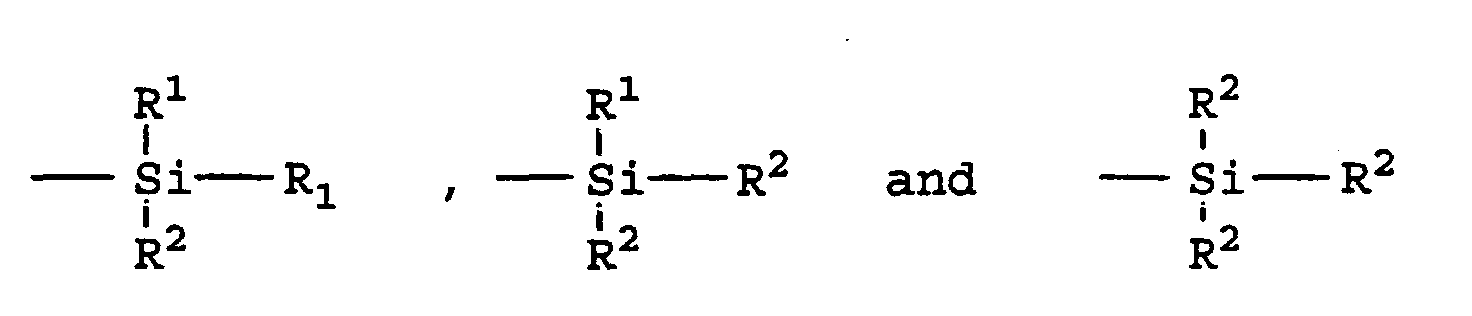 where R1 is an alkyl group of 1 to 4 carbon atoms,
cyclohexyl or phenyl; wherein R2 is alkoxy of 1 to 8
carbon atoms, or cycloalkoxy of 5 to 8 carbon atoms,
and wherein Alk is a divalent hydrocarbon of 1 to 18
carbon atoms and n is an integer of 2 to 8.
where R1 is an alkyl group of 1 to 4 carbon atoms,
cyclohexyl or phenyl; wherein R2 is alkoxy of 1 to 8
carbon atoms, or cycloalkoxy of 5 to 8 carbon atoms,
and wherein Alk is a divalent hydrocarbon of 1 to 18
carbon atoms and n is an integer of 2 to 8.
Specific examples of sulfur containing
organosilicon compounds which may be used in
accordance with the present invention include: 3,3'-bis(trimethoxysilylpropyl)
disulfide, 3,3'-bis(triethoxysilylpropyl)
tetrasulfide, 3,3'-bis(triethoxysilylpropyl)
octasulfide, 3,3'-bis(trimethoxysilylpropyl)
tetrasulfide, 2,2'-bis(triethoxysilylethyl)
tetrasulfide, 3,3'-bis(trimethoxysilylpropyl)
trisulfide, 3,3'-bis(triethoxysilylpropyl)
trisulfide, 3,3'-bis(tributoxysilylpropyl)
disulfide, 3,3'-bis(trimethoxysilylpropyl)
hexasulfide, 3,3'-bis(trimethoxysilylpropyl)
octasulfide, 3,3'-bis(trioctoxysilylpropyl)
tetrasulfide, 3,3'-bis(trihexoxysilylpropyl)
disulfide, 3,3'-bis(tri-2''-ethylhexoxysilylpropyl)
trisulfide, 3,3'-bis(triisooctoxysilylpropyl)
tetrasulfide, 3,3'-bis(tri-t-butoxysilylpropyl)
disulfide, 2,2'-bis(methoxy
diethoxy silyl ethyl) tetrasulfide, 2,2'-bis(tripropoxysilylethyl)
pentasulfide, 3,3'-bis(tricyclonexoxysilylpropyl)
tetrasulfide, 3,3'-bis(tricyclopentoxysilylpropyl)
trisulfide, 2,2'-bis(tri-2''-methylcyclohexoxysilylethyl)
tetrasulfide,
bis(trimethoxysilylmethyl) tetrasulfide, 3-methoxy
ethoxy propoxysilyl 3'-diethoxybutoxysilylpropyltetrasulfide,
2,2'-bis(dimethyl
methoxysilylethyl) disulfide, 2,2'-bis(dimethyl
sec.butoxysilylethyl) trisulfide, 3,3'-bis(methyl
butylethoxysilylpropyl) tetrasulfide, 3,3'-bis(di t-butylmethoxysilylpropyl)
tetrasulfide, 2,2'-bis(phenyl
methyl methoxysilylethyl) trisulfide, 3,3'-bis(diphenyl
isopropoxysilylpropyl) tetrasulfide,
3,3'-bis(diphenyl cyclohexoxysilylpropyl) disulfide,
3,3'-bis(dimethyl ethylmercaptosilylpropyl)
tetrasulfide, 2,2'-bis(methyl dimethoxysilylethyl)
trisulfide, 2,2'-bis(methyl ethoxypropoxysilylethyl)
tetrasulfide, 3,3'-bis(diethyl methoxysilylpropyl)
tetrasulfide, 3,3'-bis(ethyl di-sec.
butoxysilylpropyl) disulfide, 3,3'-bis(propyl
diethoxysilylpropyl) disulfide, 3,3'-bis(butyl
dimethoxysilylpropyl) trisulfide, 3,3'-bis(phenyl
dimethoxysilylpropyl) tetrasulfide, 3-phenyl
ethoxybutoxysilyl 3'-trimethoxysilylpropyl
tetrasulfide, 4,4'-bis(trimethoxysilylbutyl)
tetrasulfide, 6,6'-bis(triethoxysilylhexyl)
tetrasulfide, 12,12'-bis(triisopropoxysilyl dodecyl)
disulfide, 18,18'-bis(trimethoxysilyloctadecyl)
tetrasulfide, 18,18'-bis(tripropoxysilyloctadecenyl)
tetrasulfide, 4,4'-bis(trimethoxysilyl-buten-2-yl)
tetrasulfide, 4,4'-bis(trimethoxysilylcyclohexylene)
tetrasulfide, 5,5'-bis(dimethoxymethylsilylpentyl)
trisulfide, 3,3'-bis(trimethoxysilyl-2-methylpropyl)
tetrasulfide and 3,3'-bis(dimethoxyphenylsilyl-2-methylpropyl)
disulfide.
The preferred sulfur containing organosilicon
compounds are the 3,3'-bis(trimethoxy or triethoxy
silylpropyl) sulfides. The most preferred compound is
3,3'-bis(triethoxysilylpropyl) tetrasulfide.
Therefore, as to Formula I, preferably Z is
 where R2 is an alkoxy of 2 to 4 carbon atoms, with 2
carbon atoms being particularly preferred; Alk is a
divalent hydrocarbon of 2 to 4 carbon atoms with 3
carbon atoms being particularly preferred; and n is an
integer of from 3 to 5 with 4 being particularly
preferred.
where R2 is an alkoxy of 2 to 4 carbon atoms, with 2
carbon atoms being particularly preferred; Alk is a
divalent hydrocarbon of 2 to 4 carbon atoms with 3
carbon atoms being particularly preferred; and n is an
integer of from 3 to 5 with 4 being particularly
preferred.
The amount of the sulfur containing organosilicon
compound of Formula I in a rubber composition will
vary depending on the level of silica that is used.
Generally speaking, the amount of the compound of
Formula I will range from about 0.01 to about 1.0
parts by weight per part by weight of the silica.
Preferably, the amount will range from about 0.02 to
about 0.4 parts by weight per part by weight of the
silica. More preferably, the amount of the compound
of Formula I will range from about 0.05 to about 0.25
parts by weight per part by weight of the silica.
In addition to the sulfur containing
organosilicon, the rubber composition should contain a
sufficient amount of silica and carbon black, if used,
to contribute a reasonably high modulus and high
resistance to tear. The silica filler may be added in
amounts ranging from about 10 phr to about 250 phr.
Preferably, the silica is present in an amount ranging
from about 50 phr to about 120 phr. If carbon black
is also present, the amount of carbon black, if used,
may vary. Generally speaking, the amount of carbon
black will vary from about 5 phr to about 80 phr.
Preferably, the amount of carbon black will range from
about 10 phr to about 40 phr. It is to be appreciated
that the silica coupler may be used in conjunction
with a carbon black (namely, pre-mixed with a carbon
black prior to addition to the rubber composition) and
such carbon black is to be included in the aforesaid
amount of carbon black for the rubber composition
formulation. In any case, the total quantity of
silica and carbon black will be at least about 30 phr.
The combined weight of the silica and carbon black, as
hereinbefore referenced, may be as low as about 30
phr, but is preferably from about 45 to about 130 phr.
The commonly employed siliceous pigments used in
rubber compounding applications can be used as the
silica in this invention, including pyrogenic and
precipitated siliceous pigments (silica), although
precipitate silicas are preferred. The siliceous
pigments preferably employed in this invention are
precipitated silicas such as, for example, those
obtained by the acidification of a soluble silicate;
e.g., sodium silicate.
Such silicas might be characterized, for example,
by having a BET surface area, as measured using
nitrogen gas, preferably in the range of about 40 to
about 600, and more usually in a range of about 50 to
about 300 square meters per gram. The BET method of
measuring surface area is described in the Journal of
the American Chemical Society, Volume 60, page 304
(1930).
The silica may also be typically characterized by
having a dibutylphthalate (DBP) absorption value in a
range of about 100 to about 400, and more usually
about 150 to about 300. The silica might be expected
to have an average ultimate particle size, for
example, in the range of 0.01 to 0.05 micron as
determined by the electron microscope, although the
silica particles may be even smaller, or possibly
larger, in size.
Various commercially available silicas may be
considered for use in this invention such as, only for
example herein, and without limitation, silicas
commercially available from PPG Industries under the
Hi-Sil trademark with designations 210, 243, etc;
silicas available from Rhone-Poulenc, with, for
example, designation of Z1165MP and silicas available
from Degussa AG with, for example, designations VN2
and VN3.
Tire tread formulations which include silica and
an organosilicon compound can be mixed utilizing a
thermomechanical mixing technique to attain a better
balance of tread compound performance characteristics,
for example, traction, treadwear and rolling
resistance characteristics. On the other hand, the
mixing of the tire tread rubber formulation can be
accomplished by conventional methods known to those
having skill in the rubber mixing art. For example,
the ingredients are typically mixed in at least two
stages; namely, at least one non-productive stage
followed by a productive mix stage. The final
curatives including sulfur vulcanizing agents are
typically mixed in the final stage which is
conventionally called the "productive" mix stage in
which the mixing typically occurs at a temperature, or
ultimate temperature, lower than the mix
temperature(s) than the preceding non-productive mix
stage(s). The rubber, silica and sulfur containing
organosilicon, and carbon black if used, are mixed in
one or more non-productive mix stages. The terms
"non-productive" and "productive" mix stages are well
known to those having skill in the rubber mixing art.
In typical non-productive mixing procedures, the
mixing is carried out over a total mixing period of
only one to three minutes with the rubber mixture
being discharged from the mixing equipment at a
temperature of no greater than 160°C. When silica and
a coupling agent are present, the maximum discharge
temperature from the mixing step is normally no
greater than about 145°C.
For best results, the sulfur vulcanizable rubber
composition containing the sulfur containing
organosilicon compound, vulcanizable rubber and
generally at least part of the silica should be
subjected to a thermomechanical mixing step. The
thermomechanical mixing step generally comprises
mechanical working in a mixer, mill or extruder for a
period of time suitable in order to produce a rubber
temperature between 140°C and 190°C. The appropriate
duration of the thermomechanical working varies as a
function of the operating conditions and the volume
and nature of the components. For example, the
thermomechanical working may be for a duration of time
which is within the range of about 1 minute to about
20 minutes. It will normally be preferred for the
rubber to reach a temperature which is within the
range of about 145°C to about 180°C and to be
maintained at said temperature for a period of time
which is within the range of about 2 minutes to about
10 minutes. It will normally be more preferred for
the rubber to reach a temperature which is within the
range of about 155°C to about 170°C and to be
maintained at said temperature for a period of time
which is within the range of about four minutes to
about eight minutes.
The modified isoprene-butadiene rubber containing
tire tread compounds of this invention can be used in
tire treads in conjunction with ordinary tire
manufacturing techniques. Tires are built utilizing
standard procedures with the modified isoprene-butadiene
diblock rubber simply being substituted for
the rubber compounds typically used as the tread
rubber. After the tire has been built with the
modified isoprene-butadiene rubber containing blend,
it can be vulcanized using a normal tire cure cycle.
Tires made in accordance with this invention can be
cured over a wide temperature range. However, it is
generally preferred for the tires of this invention to
be cured at a temperature ranging from about 132°C
(270°F) to about 175°C (347°F). It is more typical
for the tires of this invention to be cured at a
temperature ranging from about 143°C (290°F) to about
165°C (329°F). It is generally preferred for the cure
cycle used to vulcanize the tires of this invention to
have a duration of about 8 to about 20 minutes with a
cure cycle of about 10 to 18 minutes being most
preferred.
By utilizing the modified isoprene-butadiene
rubbers of this invention in tire tread compounds,
treadwear characteristics can be improved without
compromising traction or rolling resistance. The
modified isoprene-butadiene rubbers of this invention
can be advantageously utilized in both automobile and
truck tire tread compounds. As a general rule, the
modified isoprene-butadiene rubber utilized in tire
tread compounds will have a single glass transition
temperature which is within the range of about -105°C
to about -65°C.
The modified isoprene-butadiene rubbers of this
invention can be blended with natural rubber to make
tread compounds for passenger tires which exhibit
outstanding rolling resistance, traction and tread
wear characteristics. The utilization of natural
rubber in such blends leads to improved
processability. Such blends will normally contain
from about 5 to about 30 weight percent natural rubber
and from about 70 to about 95 percent of the modified
isoprene-butadiene rubber. Such blends will
preferably contain from about 20 weight percent to
about 30 weight percent natural rubber and about 70 to
about 80 weight percent of the modified isoprene-butadiene
rubber.
High performance tires which exhibit very
exceptional traction characteristics, but somewhat
comprised tread wear, can be prepared by blending the
modified isoprene-butadiene rubber with solution or
emulsion styrene-butadiene rubber (SBR). Such blends
will normally contain from about 50 weight percent to
about 75 weight percent of the modified isoprene-butadiene
rubber and from about 25 weight percent to
about 50 weight percent of the solution or emulsion
styrene-butadiene rubber. It is typically preferred
for such blends to contain from about 55 weight
percent to about 65 weight percent of the modified
isoprene-butadiene rubber and from about 35 weight
percent to about 45 weight percent of the solution or
emulsion styrene-butadiene rubber.
In cases where tread wear is of greater
importance than traction, from about 5 to about 30
weight percent high cis-1,4-polybutadiene can be
blended with about 70 to about 95 weight percent of
the modified isoprene-butadiene rubber. Such blends
will preferably contain from about 20 weight percent
to about 30 weight percent of the high cis-1,4-polybutadiene
rubber and from about 70 weight percent
to about 80 weight percent of the modified isoprene-butadiene
rubber.
In another scenario, the modified isoprene-butadiene
rubber of this invention can be used to
improve the traction, tread wear and rolling
resistance of automobile tires made therewith by
including 3,4-polyisoprene in the blend. Such a blend
will typically contain from about 5 to about 30 weight
percent 3,4-polyisoprene and from about 70 to about 95
weight percent of the modified isoprene-butadiene
rubber. Such blends will normally contain from about
20 weight percent to about 30 weight percent of the
3,4-polyisoprene and from about 70 weight percent to
about 80 weight percent of the modified isoprene-butadiene
rubber.
The 3,4-polyisoprene employed in such blends can
be synthesized by the technique disclosed in United
States Patent 5,239,023. This technique for producing
3,4-polyisoprene involves: (1) adding a catalyst
system which is comprised of (a) an organoiron
compound which is soluble in the organic solvent,
wherein the iron in the organoiron compound is in the
+3 oxidation state, (b) a partially hydrolyzed
organoaluminum compound, which was prepared by adding
a protonic compound selected from the group consisting
of water, alcohols and carboxylic acids to the
organoaluminum compound, and (c) a chelating aromatic
amine; wherein the molar ratio of the chelating amine
to the organoiron compound is within the range of
about 0.1:1 to about 1:1, wherein the molar ratio of
the organoaluminum compound to the organoiron compound
is within the range of about 5:1 to about 200:1, and
wherein the molar ratio of the protonic compound to
the organoaluminum compound is within the range of
about 0.001:1 to about 0.2:1 to a polymerization
medium containing isoprene monomer and an organic
solvent and (2) allowing the isoprene monomer to
polymerize at a temperature which is within the range
of about -10°C to about 100°C. Another representative
example of a 3,4-polyisoprene rubber which can be
employed in the automobile tire tread compounds of
this invention is sold by Huels AG under the tradename
Vestogrip® A6001.
Truck tire tread compounds are typically prepared
by blending from about 5 to about 30 weight percent of
natural rubber and/or high cis-1,4-polybutadiene with
about 70 to about 95 weight percent of the modified
isoprene-butadiene rubber. High cis-1,4-polybutadiene
which is suitable for use in such blends can be made
by the process described in Canadian Patent 1,236,648.
High cis-1,4-polybutadiene rubber which is suitable
for employment in such blends is also sold by The
Goodyear Tire & Rubber Company as Budene® 1207
polybutadiene rubber and Budene® 1208 polybutadiene
rubber. The high cis-1,4-polybutadiene rubber will
typically have a cis-microstructure content of at
least 95 percent.
Treads for high performance tires can also be
made by blending from about 30 weight percent to about
80 weight percent of the modified isoprene-butadiene
rubber with about 20 weight percent to about 70 weight
percent of high vinyl polybutadiene rubber having a
vinyl content of 60 to about 90 percent. Better
traction characteristics can normally be realized by
incorporation of a higher level of high vinyl
polybutadiene rubber into the blend. It is
accordingly normally preferred to blend from about 50
weight percent to about 70 weight percent of the
modified isoprene-butadiene rubber with about 30
weight percent to about 50 weight percent of the high
vinyl polybutadiene rubber. It is generally more
preferred to blend from about 55 weight percent to
about 65 weight percent of the modified isoprene-butadiene
rubber with about 35 weight percent to about
45 weight percent of the high vinyl polybutadiene
rubber. The high vinyl polybutadiene rubber will
typically have a vinyl content which is within the
range of about 60 percent to about 80 percent.
Treads for high performance tires can also be
made by blending medium vinyl polybutadiene rubber
with the modified isoprene-butadiene rubber in cases
where better rolling resistance is demanded. The
medium vinyl polybutadiene rubber utilized in such
cases has a vinyl content which is within the range of
about 30 percent to 59 percent. The medium vinyl
polybutadiene rubber preferably has a vinyl content
which is within the range of about 40 percent to about
50 percent. For instance, treads for high performance
tires can be made by blending from about 30 weight
percent to about 80 weight percent of the modified
isoprene-butadiene rubber with about 20 weight percent
to about 70 weight percent of medium vinyl
polybutadiene rubber. It is normally preferred to
blend from about 50 weight percent to about 70 weight
percent of the modified isoprene-butadiene rubber with
about 30 weight percent to about 50 weight percent of
the medium vinyl polybutadiene rubber. It is
generally more preferred to blend from about 55 weight
percent to about 65 weight percent of the modified
isoprene-butadiene rubber with about 35 weight percent
to about 45 weight percent of the medium vinyl
polybutadiene rubber.
Treads for high performance automobile tires can
also be made by blending styrene-isoprene-butadiene
rubber (SIBR) with the modified isoprene-butadiene
rubber. Such blends will normally contain from 30
weight percent to about 80 weight percent of the
modified isoprene-butadiene rubber and from about 20
to about 70 weight percent of the SIBR. It is
normally preferred to blend from about 50 weight
percent to about 70 weight percent of the modified
isoprene-butadiene rubber with about 30 weight percent
to about 50 weight percent of the SIBR. It is
generally more preferred to blend from about 55 weight
percent to about 65 weight percent of the modified
isoprene-butadiene rubber with about 35 weight percent
to about 45 weight percent of the SIBR. The SIBR
utilized in such tire tread compounds will typically
have a glass transition temperature which is within
the range of about -40°C to about -20°C.
For purposes of this patent application, polymer
microstructures are determined by nuclear magnetic
resonance spectrometry (NMR). Glass transition
temperatures (Tg) are determined by differential
scanning calorimetry at a heating rate of 10°C per
minute and molecular weights are determined by gel
permeation chromatography (GPC).
This invention is illustrated by the following
examples which are merely for the purpose of
illustration and are not to be regarded as limiting
the scope of the invention or the manner in which it
can be practiced. Unless specifically indicated
otherwise, all parts and percentages are given by
weight.
In this experiment, an isoprene-butadiene rubber
was prepared utilizing an n-butyllithium catalyst
without using any polar modifier. In the procedure
used, 2,000 grams of a silica/molecular sieve/aluminum
dried premix containing 19.8 weight percent of
isoprene and 1,3-butadiene in hexanes was charged into
a one-gallon (3.8 liters) reactor. The isoprene to
1,3 butadiene ratio was 30:70. After the impurity of
the premix was removed by an n-butyl lithium (n-BuLi)
solution, 1.38 ml (milliliters) of a 0.96 M solution
of n-BuLi (in hexane) were added to the reactor. The
target Mn (number averaged molecular weight) was
300,000. The polymerization was allowed to proceed at
70°C for three hours. The analysis of the residual
monomer indicated that the polymerization was
completed. Then, 2.0 ml of a 2 M solution of ethanol
(in hexane) was added to the reactor to shortstop the
polymerization and the polymer was removed from the
reactor and stabilized with 1 phr (parts per 100 parts
by weight of rubber) of antioxidant.
After the hexane solvent was evaporated, the
resulting polymer was dried in a vacuum oven at 50°C.
The isoprene-butadiene rubber was determined to have a
Tg (glass transition temperature) at -87°C. It was
also determined to have a microstructure which
contained 6 percent 1,2-polybutadiene units, 64
percent 1,4-polybutadiene units, 28 percent 1,4-polyisoprene
units and 2 percent 3,4-polyisoprene
units. The Mooney viscosity (ML-4) of the isoprene-butadiene
rubber made was determined to be 83. The
molecular weight of this isoprene-butadiene rubber was
measured using GPC (gel permeation chromatography) to
have a Mn of 313,000 and a Mw (weight averaged
molecular weight) of 332,000 and a molecular weight
distribution (MWD) of 1.06. The cold flow of this
rubber was determined to be 8.07 mg/min (milligrams
per minute) at 50°C.
The procedure described in Example 1 was utilized
in these examples except that the styrene monomer (in
amounts of 1 percent, 2 percent and 5 percent of the
total monomer) was added to the isoprene-butadiene
premix. The GC (gas chromatograph) analysis of
residual monomer indicated that the stryene was
present in a block at the end of the polymer chains.
The Mooney viscosities (ML-4) and cold flow values at
50°C of these polymers are listed in Table 1.
| Example | Styrene Content (%) | ML-4 | Cold Flow |
| 1 | 0 | 83 | 8.07 |
| 2 | 1 | 87 | 4.52 |
| 3 | 2 | 80 | 4.59 |
| 4 | 5 | 84 | 4.62 |
The 30/70 isoprene-butadiene rubber containing 1
percent styrene for reduced cold flow characteristics
was synthesized in a two-reactor (10 liters each)
continuous system at 90°C. A dried premix containing
isoprene, 1,3-butadiene and styrene in hexanes was
charged into the first polymerization reactor
continuously at a rate of 65.6 grams/minute. The
premix monomer solution contained a ratio of isoprene
to 1,3-butadiene to styrene of 30:70:1 and had a total
monomer concentration of 14 weight percent.
Polymerization was initiated by adding a 0.128 M
solution of n-BuLi (normal butyl lithium) in hexanes
into the first reactor at a rate of 0.2 grams/minute.
The resulting polymerization medium was continuously
pushed into the second reactor to continue the
polymerization. The residence time for both reactors
was set at 90 minutes to achieve complete monomer
conversion in the second reactor. The polymer cement
was then continuously pushed over to a holding tank
containing the shortstop (methanol) and an
antioxidant. The resulting polymer cement was then
stream-stripped and the recovered rubber was dried in
an oven at 60°C. The polymer was determined to have a
glass transition temperature at -85°C. It was also
determined to have a microstructure which contained 7
percent 1,2-polybutadiene units, 62 percent 1,4-polybutadiene
units, 28 percent 1,4-polyisoprene
units, 2 percent 3,4-polyisoprene units and 1 percent
polystyrene unit. The molecular weight of this rubber
was measured using GPC to have an Mn of 169,500 and Mw
(weight average molecular weight) of 335,000 and a
molecular weight distribution of 1.98. The ML-4 and
cold flow values were determined to be 85 and 2.13
mg/min, respectively.
The procedure described in Example 5 was utilized
in this example except that styrene monomer was not
added to the isoprene-1,3-butadiene monomer premix.
The cold flow value at 50°C and ML-4 of this rubber is
listed in Table 2.
The procedure described in Example 5 was utilized
in this example except that styrene monomer was not
added to the isoprene-1,3-butadiene monomer premix and
a crosslinking agent, DVB (divinylbenzene) in the
amount of 0.1 molar ratio to n-BuLi was added to the
premix. The cold flow value at 50°C and ML-4 of this
rubber is also listed in Table 2.
| Example | Styrene Content (%) | DVB | ML-4 | Cold Flow (mg/min) |
| 5 | 1 | no | 85 | 2.13 |
| 6 | 0 | no | 95 | 2.62 |
| 7 | 0 | yes | 95 | 2.25 |
Variations in the present invention are possible
in light of the description of it provided herein.
While certain representative embodiments and details
have been shown for the purpose of illustrating the
subject invention, it will be apparent to those
skilled in this art that various changes and
modifications can be made therein without departing
from the scope of the subject invention. It is,
therefore, to be understood that changes can be made
in the particular embodiments described which will be
within the full intended scope of the invention as
defined by the following appended claims.
Claims (10)
- A pneumatic tire having an outer circumferential tread wherein said tread is a sulfur-cured rubber composition which is characterized by being comprised of, based on 100 parts by weight of rubber, (a) from 30 to 80 parts of a modified isoprene-butadiene rubber, wherein said modified isoprene-butadiene rubber is comprised of polymer chains containing repeat units which are derived from 1,3-butadiene, isoprene and from 0.5 weight percent to 3 weight percent styrene, wherein the repeat units which are derived from styrene are in blocks at the ends of the polymer chains, wherein the modified isoprene-butadiene rubber has a glass transition temperature which is within the range of -105°C to -65°C and wherein the rubbery polymer has a number average molecular weight which is within the range of 50,000 to 600,000 and (b) from 20 to 70 parts of a second rubber selected from the group consisting of high vinyl polybutadiene rubber, medium vinyl polybutadiene rubber and styrene-isoprene-butadiene rubber.
- A pneumatic tire having an outer circumferential tread wherein said tread is a sulfur-cured rubber composition which is characterized by being comprised of, based on 100 parts by weight of rubber, (a) from 70 to 95 parts of a modified isoprene-butadiene rubber, wherein said modified isoprene-butadiene rubber is comprised of polymer chains containing repeat units which are derived from 1,3-butadiene, isoprene and from 0.5 weight percent to 3 weight percent styrene, wherein the repeat units which are derived from styrene are in blocks at the ends of the polymer chains, wherein the modified isoprene-butadiene rubber has a glass transition temperature which is within the range of -105°C to -65°C and wherein the rubbery polymer has a number average molecular weight which is within the range of 50,000 to 600,000 and (b) from 5 to 30 parts of a second rubber selected from the group consisting of natural rubber, high cis-1,4-polybutadiene rubber having a cis-microstructure content of at least 95 percent and 3,4-polyisoprene rubber.
- A pneumatic tire having an outer circumferential tread wherein said tread is a sulfur-cured rubber composition which is characterized by being comprised of, based on 100 parts by weight of rubber, (a) from 50 to 75 parts of a modified isoprene-butadiene rubber, wherein said modified isoprene-butadiene rubber is comprised of polymer chains containing repeat units which are derived from 1,3-butadiene, isoprene and from 0.5 weight percent to 3 weight percent styrene, wherein the repeat units which are derived from styrene are in blocks at the ends of the polymer chains, wherein the modified isoprene-butadiene rubber has a glass transition temperature which is within the range of -105°C to -65°C and wherein the rubbery polymer has a number average molecular weight which is within the range of 50,000 to 600,000 and (b) from 25 to 50 parts of styrene-butadiene rubber.
- A rubbery polymer which exhibits low cold flow characteristics which is characterized by being comprised of polymer chains containing repeat units which are derived from 97 weight percent to 99.5 weight percent of at least one conjugated diolefin monomer and from 0.5 weight percent to 3 weight percent styrene, wherein the repeat units which are derived from styrene are in blocks at the ends of the polymer chains, wherein the rubbery polymer has a glass transition temperature which is within the range of -105°C to -65°C and wherein the rubbery polymer has a number average molecular weight which is within the range of 50,000 to 600,000.
- A process for synthesizing a rubbery polymer which exhibits low cold flow characteristics which is characterized by polymerizing from 97 phm to 99.5 phm of at least one conjugated diolefin monomer and 0.5 phm to 3 phm of styrene, wherein said polymerization is initiated with an anionic polymerization initiator, wherein said polymerization is carried out in the absence of polar modifiers.
- A process for synthesizing a rubbery polymer which exhibits low cold flow characteristics which is characterized by the steps of (1) polymerizing at least one conjugated diolefin monomer in an organic solvent to a conversion of at least 99 percent to produce a living rubbery polymer cement, wherein said polymerization is initiated with an anionic polymerization initiator and wherein said polymerization is carried out in the presence of a polar modifier, (2) adding from 0.5 phm to 3 phm of styrene to the living rubbery polymer cement and (3) allowing the styrene to polymerize to produce the rubbery polymer which exhibits low cold flow characteristics.
- A pneumatic tire as specified in claim 1, 2 or 3 characterized in that said tread is a sulfur-cured rubber composition which is further comprised of carbon black, silica at least one antidegradant, at least one processing oil and zinc oxide.
- A pneumatic tire as specified in claim 7 characterized in that the silica is present in an amount which is within the range of 10 phr to 250 phr.
- A pneumatic tire as specified in claim 7 or 8 characterized in that the rubber composition is further comprised of a silica coupling agent.
- A pneumatic tire as specified in claim 7, 8 or 9 characterized in that the silica is added by a thermomechanical mixing step; and characterized in that the silica coupling agent is bis-(3-triethoxysilylpropyl)tetrasulfide.
Applications Claiming Priority (2)
| Application Number | Priority Date | Filing Date | Title |
|---|---|---|---|
| US08/874,850 US6147164A (en) | 1997-06-13 | 1997-06-13 | Technique for reducing the cold flow of rubbers |
| US874850 | 1997-06-13 |
Publications (1)
| Publication Number | Publication Date |
|---|---|
| EP0884360A1 true EP0884360A1 (en) | 1998-12-16 |
Family
ID=25364709
Family Applications (1)
| Application Number | Title | Priority Date | Filing Date |
|---|---|---|---|
| EP98110108A Withdrawn EP0884360A1 (en) | 1997-06-13 | 1998-06-03 | Technique for reducing the cold flow of rubbers |
Country Status (2)
| Country | Link |
|---|---|
| US (3) | US6147164A (en) |
| EP (1) | EP0884360A1 (en) |
Cited By (3)
| Publication number | Priority date | Publication date | Assignee | Title |
|---|---|---|---|---|
| WO2013169333A1 (en) * | 2012-05-08 | 2013-11-14 | Chevron Phillips Chemical Company Lp | Cold flow resistant compositions containing rubber and a block copolymer |
| US8988634B2 (en) | 2011-05-03 | 2015-03-24 | Lg Electronics Inc. | Optical film and liquid crystal display device comprising the same |
| EP3800067A1 (en) * | 2019-10-04 | 2021-04-07 | The Goodyear Tire & Rubber Company | Rubber composition and pneumatic tire |
Families Citing this family (9)
| Publication number | Priority date | Publication date | Assignee | Title |
|---|---|---|---|---|
| DE10057508A1 (en) * | 2000-11-21 | 2002-05-23 | Bayer Ag | Rubber mixture for production of low-damping tires or tire tread, based on a polyether-diolefin block copolymer in which the polyether component is incorporated into the polymer chain |
| US6812288B2 (en) | 2001-12-28 | 2004-11-02 | Jsr Corporation | Rubber composition, vibration-isolating rubber and vibration-isolating mount |
| US7150919B2 (en) * | 2002-09-30 | 2006-12-19 | The Goodyear Tire & Rubber Company | Overmolded grip |
| US7264868B2 (en) * | 2002-09-30 | 2007-09-04 | The Goodyear Tire & Rubber Company | Overmolded grip |
| US20070276082A1 (en) * | 2006-05-24 | 2007-11-29 | Kim Balfour | Poly(arylene ether) composition, method, and article |
| US20070276067A1 (en) * | 2006-05-24 | 2007-11-29 | Kim Balfour | Poly(arylene ether) composition, method, and article |
| US7884168B2 (en) * | 2009-02-13 | 2011-02-08 | The Goodyear Tire & Rubber Company | Heterogeneous rubbery polymers having random, tapered, and block portions therein and methods of making same |
| CN104428332B (en) * | 2012-07-12 | 2016-09-14 | 株式会社普利司通 | Isoprene copolymer and method for producing same |
| JP2025516852A (en) * | 2022-05-20 | 2025-05-30 | 株式会社ブリヂストン | Rubber compounds providing improved dynamic and wear properties |
Citations (5)
| Publication number | Priority date | Publication date | Assignee | Title |
|---|---|---|---|---|
| US3402159A (en) * | 1963-12-20 | 1968-09-17 | Phillips Petroleum Co | Process for polymerizing butadiene and styrene terminated in short blocks of polystyrene |
| US3439064A (en) * | 1965-01-11 | 1969-04-15 | Exxon Research Engineering Co | Laminating varnish consisting of low viscosity,curable block copolymer |
| US3558575A (en) * | 1966-10-03 | 1971-01-26 | Firestone Tire & Rubber Co | Process for the production of copolymers free of block polystyrene |
| US5405927A (en) * | 1993-09-22 | 1995-04-11 | The Goodyear Tire & Rubber Company | Isoprene-butadiene rubber |
| DE4401934A1 (en) * | 1994-01-24 | 1995-07-27 | Sp Reifenwerke Gmbh | Rubber compound, tire tread made therefrom and tires with this tire tread |
Family Cites Families (7)
| Publication number | Priority date | Publication date | Assignee | Title |
|---|---|---|---|---|
| US5047483A (en) * | 1988-06-29 | 1991-09-10 | The Goodyear Tire & Rubber Company | Pneumatic tire with tread of styrene, isoprene, butadiene rubber |
| US5159020A (en) * | 1989-12-28 | 1992-10-27 | The Goodyear Tire & Rubber Company | Tire with tread comprising styrene, isoprene, butadiene terpolymer rubber |
| CA2035229A1 (en) * | 1990-10-22 | 1992-04-23 | Wen-Liang Hsu | Process for preparing a rubbery terpolymer of styrene, isoprene and butadiene |
| US5061765A (en) * | 1990-10-22 | 1991-10-29 | The Goodyear Tire & Rubber Company | Process for the synthesis of a high vinyl isoprene-butadiene copolymer |
| US5239009A (en) * | 1991-10-16 | 1993-08-24 | The Goodyear Tire & Rubber Company | High performance segmented elastomer |
| US5272220A (en) * | 1992-09-14 | 1993-12-21 | The Goodyear Tire & Rubber Company | Process for preparing styrene-isoprene-butadiene rubber |
| US5783640A (en) * | 1997-03-04 | 1998-07-21 | The Goodyear Tire & Rubber Company | Rubber compositions containing a disodium salt of 2, 2'-dithiosalicyclic acid |
-
1997
- 1997-06-13 US US08/874,850 patent/US6147164A/en not_active Expired - Fee Related
-
1998
- 1998-06-03 EP EP98110108A patent/EP0884360A1/en not_active Withdrawn
-
2000
- 2000-08-16 US US09/640,216 patent/US6289959B1/en not_active Expired - Fee Related
- 2000-08-16 US US09/640,215 patent/US6293325B1/en not_active Expired - Fee Related
Patent Citations (5)
| Publication number | Priority date | Publication date | Assignee | Title |
|---|---|---|---|---|
| US3402159A (en) * | 1963-12-20 | 1968-09-17 | Phillips Petroleum Co | Process for polymerizing butadiene and styrene terminated in short blocks of polystyrene |
| US3439064A (en) * | 1965-01-11 | 1969-04-15 | Exxon Research Engineering Co | Laminating varnish consisting of low viscosity,curable block copolymer |
| US3558575A (en) * | 1966-10-03 | 1971-01-26 | Firestone Tire & Rubber Co | Process for the production of copolymers free of block polystyrene |
| US5405927A (en) * | 1993-09-22 | 1995-04-11 | The Goodyear Tire & Rubber Company | Isoprene-butadiene rubber |
| DE4401934A1 (en) * | 1994-01-24 | 1995-07-27 | Sp Reifenwerke Gmbh | Rubber compound, tire tread made therefrom and tires with this tire tread |
Cited By (5)
| Publication number | Priority date | Publication date | Assignee | Title |
|---|---|---|---|---|
| US8988634B2 (en) | 2011-05-03 | 2015-03-24 | Lg Electronics Inc. | Optical film and liquid crystal display device comprising the same |
| WO2013169333A1 (en) * | 2012-05-08 | 2013-11-14 | Chevron Phillips Chemical Company Lp | Cold flow resistant compositions containing rubber and a block copolymer |
| US8933171B2 (en) | 2012-05-08 | 2015-01-13 | Chevron Phillips Chemical Company Lp | Cold flow resistant compositions containing rubber and a block copolymer |
| US9469752B2 (en) | 2012-05-08 | 2016-10-18 | Chevron Philips Chemical Company Lp | Cold flow resistant compositions containing rubber and a block copolymer |
| EP3800067A1 (en) * | 2019-10-04 | 2021-04-07 | The Goodyear Tire & Rubber Company | Rubber composition and pneumatic tire |
Also Published As
| Publication number | Publication date |
|---|---|
| US6293325B1 (en) | 2001-09-25 |
| US6289959B1 (en) | 2001-09-18 |
| US6147164A (en) | 2000-11-14 |
Similar Documents
| Publication | Publication Date | Title |
|---|---|---|
| EP0764688B1 (en) | High performance blend for tire treads | |
| US5677402A (en) | Process for preparing 3,4-polyisoprene rubber | |
| EP0806453B1 (en) | Tire tread containing 3,4-polyisoprene rubber | |
| US5686530A (en) | Tire tread compound | |
| US5652310A (en) | Rubbers having improved interaction with silica | |
| US7064171B1 (en) | Non-random styrene-butadiene rubber | |
| US6140434A (en) | Synthesis of high vinyl rubber | |
| US6326424B1 (en) | Tire tread compound | |
| GB2354523A (en) | Tread rubber for high traction tyres | |
| EP1359165B1 (en) | Synthesis of high vinyl rubber | |
| US6147164A (en) | Technique for reducing the cold flow of rubbers | |
| US6378582B1 (en) | Silica-reinforced tire tread rubber | |
| EP0992536B1 (en) | Tread rubber for high traction tires | |
| US6350807B1 (en) | Silica-reinforced tire tread rubber | |
| US6576728B1 (en) | Process for preparing styrene-isoprene rubber | |
| US6583244B1 (en) | Synthesis of rubber having a low vinyl content | |
| MXPA99008758A (en) | Rolling band rubber for high tracc rims | |
| MXPA99008889A (en) | Composed for the bearing band of a line | |
| MXPA97001862A (en) | Composite of surface of rolling of lla | |
| MXPA97002890A (en) | Rim surface containing rubber of 3,4-poliisopr |
Legal Events
| Date | Code | Title | Description |
|---|---|---|---|
| PUAI | Public reference made under article 153(3) epc to a published international application that has entered the european phase |
Free format text: ORIGINAL CODE: 0009012 |
|
| AK | Designated contracting states |
Kind code of ref document: A1 Designated state(s): DE ES FR GB IT |
|
| AX | Request for extension of the european patent |
Free format text: AL;LT;LV;MK;RO;SI |
|
| 17P | Request for examination filed |
Effective date: 19990504 |
|
| AKX | Designation fees paid |
Free format text: DE ES FR GB IT |
|
| 17Q | First examination report despatched |
Effective date: 20020315 |
|
| STAA | Information on the status of an ep patent application or granted ep patent |
Free format text: STATUS: THE APPLICATION IS DEEMED TO BE WITHDRAWN |
|
| 18D | Application deemed to be withdrawn |
Effective date: 20020726 |