EP0884303B1 - Method of stabilizing 4,6-diaminoresorcinol and salts thereof - Google Patents
Method of stabilizing 4,6-diaminoresorcinol and salts thereof Download PDFInfo
- Publication number
- EP0884303B1 EP0884303B1 EP98110503A EP98110503A EP0884303B1 EP 0884303 B1 EP0884303 B1 EP 0884303B1 EP 98110503 A EP98110503 A EP 98110503A EP 98110503 A EP98110503 A EP 98110503A EP 0884303 B1 EP0884303 B1 EP 0884303B1
- Authority
- EP
- European Patent Office
- Prior art keywords
- dar
- reducing agent
- diaminoresorcinol
- pbo
- volt
- Prior art date
- Legal status (The legal status is an assumption and is not a legal conclusion. Google has not performed a legal analysis and makes no representation as to the accuracy of the status listed.)
- Expired - Lifetime
Links
- 238000000034 method Methods 0.000 title claims description 23
- DPYROBMRMXHROQ-UHFFFAOYSA-N 4,6-diaminobenzene-1,3-diol Chemical compound NC1=CC(N)=C(O)C=C1O DPYROBMRMXHROQ-UHFFFAOYSA-N 0.000 title claims description 8
- 150000003839 salts Chemical class 0.000 title claims description 8
- 230000000087 stabilizing effect Effects 0.000 title claims description 8
- 239000003638 chemical reducing agent Substances 0.000 claims description 23
- 238000003860 storage Methods 0.000 claims description 15
- 229910021626 Tin(II) chloride Inorganic materials 0.000 claims description 12
- AXZWODMDQAVCJE-UHFFFAOYSA-L tin(II) chloride (anhydrous) Chemical compound [Cl-].[Cl-].[Sn+2] AXZWODMDQAVCJE-UHFFFAOYSA-L 0.000 claims description 12
- 239000000203 mixture Substances 0.000 claims description 11
- 238000004519 manufacturing process Methods 0.000 claims description 8
- 229910021591 Copper(I) chloride Inorganic materials 0.000 claims description 4
- 229910010062 TiCl3 Inorganic materials 0.000 claims description 4
- 125000003118 aryl group Chemical group 0.000 claims description 4
- OXBLHERUFWYNTN-UHFFFAOYSA-M copper(I) chloride Chemical compound [Cu]Cl OXBLHERUFWYNTN-UHFFFAOYSA-M 0.000 claims description 4
- 238000004090 dissolution Methods 0.000 claims description 4
- YONPGGFAJWQGJC-UHFFFAOYSA-K titanium(iii) chloride Chemical group Cl[Ti](Cl)Cl YONPGGFAJWQGJC-UHFFFAOYSA-K 0.000 claims description 4
- OFOBLEOULBTSOW-UHFFFAOYSA-N Malonic acid Chemical compound OC(=O)CC(O)=O OFOBLEOULBTSOW-UHFFFAOYSA-N 0.000 claims description 3
- ABLZXFCXXLZCGV-UHFFFAOYSA-N Phosphorous acid Chemical compound OP(O)=O ABLZXFCXXLZCGV-UHFFFAOYSA-N 0.000 claims description 2
- LSNNMFCWUKXFEE-UHFFFAOYSA-N Sulfurous acid Chemical compound OS(O)=O LSNNMFCWUKXFEE-UHFFFAOYSA-N 0.000 claims description 2
- 238000006116 polymerization reaction Methods 0.000 description 14
- 229920000642 polymer Polymers 0.000 description 12
- 238000000354 decomposition reaction Methods 0.000 description 11
- 239000000243 solution Substances 0.000 description 9
- KUMOYHHELWKOCB-UHFFFAOYSA-N 4,6-diaminobenzene-1,3-diol;dihydrochloride Chemical compound Cl.Cl.NC1=CC(N)=C(O)C=C1O KUMOYHHELWKOCB-UHFFFAOYSA-N 0.000 description 8
- NBIIXXVUZAFLBC-UHFFFAOYSA-N Phosphoric acid Chemical compound OP(O)(O)=O NBIIXXVUZAFLBC-UHFFFAOYSA-N 0.000 description 8
- 239000000835 fiber Substances 0.000 description 7
- 239000007858 starting material Substances 0.000 description 7
- VEXZGXHMUGYJMC-UHFFFAOYSA-N Hydrochloric acid Chemical compound Cl VEXZGXHMUGYJMC-UHFFFAOYSA-N 0.000 description 6
- HEMHJVSKTPXQMS-UHFFFAOYSA-M Sodium hydroxide Chemical compound [OH-].[Na+] HEMHJVSKTPXQMS-UHFFFAOYSA-M 0.000 description 6
- KKEYFWRCBNTPAC-UHFFFAOYSA-N Terephthalic acid Chemical compound OC(=O)C1=CC=C(C(O)=O)C=C1 KKEYFWRCBNTPAC-UHFFFAOYSA-N 0.000 description 6
- 235000011150 stannous chloride Nutrition 0.000 description 6
- 230000003647 oxidation Effects 0.000 description 5
- 238000007254 oxidation reaction Methods 0.000 description 5
- 229920000137 polyphosphoric acid Polymers 0.000 description 5
- HPGGPRDJHPYFRM-UHFFFAOYSA-J tin(iv) chloride Chemical compound Cl[Sn](Cl)(Cl)Cl HPGGPRDJHPYFRM-UHFFFAOYSA-J 0.000 description 5
- 229910000147 aluminium phosphate Inorganic materials 0.000 description 4
- 238000001035 drying Methods 0.000 description 4
- XLYOFNOQVPJJNP-UHFFFAOYSA-N water Substances O XLYOFNOQVPJJNP-UHFFFAOYSA-N 0.000 description 4
- OKKJLVBELUTLKV-UHFFFAOYSA-N Methanol Chemical compound OC OKKJLVBELUTLKV-UHFFFAOYSA-N 0.000 description 3
- 239000012298 atmosphere Substances 0.000 description 3
- 230000007774 longterm Effects 0.000 description 3
- UFHFLCQGNIYNRP-UHFFFAOYSA-N Hydrogen Chemical compound [H][H] UFHFLCQGNIYNRP-UHFFFAOYSA-N 0.000 description 2
- AFVFQIVMOAPDHO-UHFFFAOYSA-N Methanesulfonic acid Chemical compound CS(O)(=O)=O AFVFQIVMOAPDHO-UHFFFAOYSA-N 0.000 description 2
- OAICVXFJPJFONN-UHFFFAOYSA-N Phosphorus Chemical compound [P] OAICVXFJPJFONN-UHFFFAOYSA-N 0.000 description 2
- 229920000265 Polyparaphenylene Polymers 0.000 description 2
- NINIDFKCEFEMDL-UHFFFAOYSA-N Sulfur Chemical compound [S] NINIDFKCEFEMDL-UHFFFAOYSA-N 0.000 description 2
- 125000000217 alkyl group Chemical group 0.000 description 2
- 239000007864 aqueous solution Substances 0.000 description 2
- 125000004432 carbon atom Chemical group C* 0.000 description 2
- 230000015556 catabolic process Effects 0.000 description 2
- 230000015271 coagulation Effects 0.000 description 2
- 238000005345 coagulation Methods 0.000 description 2
- 230000000052 comparative effect Effects 0.000 description 2
- 238000001816 cooling Methods 0.000 description 2
- 238000006731 degradation reaction Methods 0.000 description 2
- 230000000694 effects Effects 0.000 description 2
- 238000000605 extraction Methods 0.000 description 2
- 229910052739 hydrogen Inorganic materials 0.000 description 2
- 239000001257 hydrogen Substances 0.000 description 2
- -1 inorganic acid salt Chemical class 0.000 description 2
- 239000012299 nitrogen atmosphere Substances 0.000 description 2
- 229910052698 phosphorus Inorganic materials 0.000 description 2
- 239000011574 phosphorus Substances 0.000 description 2
- 230000000379 polymerizing effect Effects 0.000 description 2
- 238000004321 preservation Methods 0.000 description 2
- GHMLBKRAJCXXBS-UHFFFAOYSA-N resorcinol Chemical compound OC1=CC=CC(O)=C1 GHMLBKRAJCXXBS-UHFFFAOYSA-N 0.000 description 2
- 238000003756 stirring Methods 0.000 description 2
- 229910052717 sulfur Inorganic materials 0.000 description 2
- 239000011593 sulfur Substances 0.000 description 2
- RELMFMZEBKVZJC-UHFFFAOYSA-N 1,2,3-trichlorobenzene Chemical compound ClC1=CC=CC(Cl)=C1Cl RELMFMZEBKVZJC-UHFFFAOYSA-N 0.000 description 1
- ZPQOPVIELGIULI-UHFFFAOYSA-N 1,3-dichlorobenzene Chemical compound ClC1=CC=CC(Cl)=C1 ZPQOPVIELGIULI-UHFFFAOYSA-N 0.000 description 1
- CDAWCLOXVUBKRW-UHFFFAOYSA-N 2-aminophenol Chemical class NC1=CC=CC=C1O CDAWCLOXVUBKRW-UHFFFAOYSA-N 0.000 description 1
- ZLCPKMIJYMHZMJ-UHFFFAOYSA-N 2-nitrobenzene-1,3-diol Chemical compound OC1=CC=CC(O)=C1[N+]([O-])=O ZLCPKMIJYMHZMJ-UHFFFAOYSA-N 0.000 description 1
- LFQSCWFLJHTTHZ-UHFFFAOYSA-N Ethanol Chemical compound CCO LFQSCWFLJHTTHZ-UHFFFAOYSA-N 0.000 description 1
- 238000002835 absorbance Methods 0.000 description 1
- 238000010420 art technique Methods 0.000 description 1
- 238000006243 chemical reaction Methods 0.000 description 1
- 239000003795 chemical substances by application Substances 0.000 description 1
- 239000000701 coagulant Substances 0.000 description 1
- 150000001875 compounds Chemical class 0.000 description 1
- 238000010276 construction Methods 0.000 description 1
- 239000000356 contaminant Substances 0.000 description 1
- 238000007796 conventional method Methods 0.000 description 1
- 229920001577 copolymer Polymers 0.000 description 1
- 239000013078 crystal Substances 0.000 description 1
- 239000001177 diphosphate Substances 0.000 description 1
- XPPKVPWEQAFLFU-UHFFFAOYSA-J diphosphate(4-) Chemical compound [O-]P([O-])(=O)OP([O-])([O-])=O XPPKVPWEQAFLFU-UHFFFAOYSA-J 0.000 description 1
- 235000011180 diphosphates Nutrition 0.000 description 1
- FOBPTJZYDGNHLR-UHFFFAOYSA-N diphosphorus Chemical compound P#P FOBPTJZYDGNHLR-UHFFFAOYSA-N 0.000 description 1
- 239000006185 dispersion Substances 0.000 description 1
- VFNGKCDDZUSWLR-UHFFFAOYSA-L disulfate(2-) Chemical compound [O-]S(=O)(=O)OS([O-])(=O)=O VFNGKCDDZUSWLR-UHFFFAOYSA-L 0.000 description 1
- 239000007789 gas Substances 0.000 description 1
- 125000005843 halogen group Chemical group 0.000 description 1
- 238000010438 heat treatment Methods 0.000 description 1
- 229920001519 homopolymer Polymers 0.000 description 1
- 239000012535 impurity Substances 0.000 description 1
- 238000009776 industrial production Methods 0.000 description 1
- 239000002184 metal Substances 0.000 description 1
- 229910052751 metal Inorganic materials 0.000 description 1
- 229910001510 metal chloride Inorganic materials 0.000 description 1
- 229940098779 methanesulfonic acid Drugs 0.000 description 1
- 238000002156 mixing Methods 0.000 description 1
- 239000002245 particle Substances 0.000 description 1
- ACVYVLVWPXVTIT-UHFFFAOYSA-N phosphinic acid Chemical compound O[PH2]=O ACVYVLVWPXVTIT-UHFFFAOYSA-N 0.000 description 1
- 238000003969 polarography Methods 0.000 description 1
- 239000000843 powder Substances 0.000 description 1
- 238000001556 precipitation Methods 0.000 description 1
- 238000000746 purification Methods 0.000 description 1
- 239000012048 reactive intermediate Substances 0.000 description 1
- 238000001953 recrystallisation Methods 0.000 description 1
- AKHNMLFCWUSKQB-UHFFFAOYSA-L sodium thiosulfate Chemical compound [Na+].[Na+].[O-]S([O-])(=O)=S AKHNMLFCWUSKQB-UHFFFAOYSA-L 0.000 description 1
- 235000019345 sodium thiosulphate Nutrition 0.000 description 1
- 239000007787 solid Substances 0.000 description 1
- 239000002904 solvent Substances 0.000 description 1
- 238000009987 spinning Methods 0.000 description 1
- 230000006641 stabilisation Effects 0.000 description 1
- 238000010189 synthetic method Methods 0.000 description 1
- KKEYFWRCBNTPAC-UHFFFAOYSA-L terephthalate(2-) Chemical compound [O-]C(=O)C1=CC=C(C([O-])=O)C=C1 KKEYFWRCBNTPAC-UHFFFAOYSA-L 0.000 description 1
- DLYUQMMRRRQYAE-UHFFFAOYSA-N tetraphosphorus decaoxide Chemical compound O1P(O2)(=O)OP3(=O)OP1(=O)OP2(=O)O3 DLYUQMMRRRQYAE-UHFFFAOYSA-N 0.000 description 1
- 238000002211 ultraviolet spectrum Methods 0.000 description 1
- 239000010887 waste solvent Substances 0.000 description 1
Classifications
-
- C—CHEMISTRY; METALLURGY
- C08—ORGANIC MACROMOLECULAR COMPOUNDS; THEIR PREPARATION OR CHEMICAL WORKING-UP; COMPOSITIONS BASED THEREON
- C08G—MACROMOLECULAR COMPOUNDS OBTAINED OTHERWISE THAN BY REACTIONS ONLY INVOLVING UNSATURATED CARBON-TO-CARBON BONDS
- C08G73/00—Macromolecular compounds obtained by reactions forming a linkage containing nitrogen with or without oxygen or carbon in the main chain of the macromolecule, not provided for in groups C08G12/00 - C08G71/00
- C08G73/06—Polycondensates having nitrogen-containing heterocyclic rings in the main chain of the macromolecule
- C08G73/22—Polybenzoxazoles
-
- C—CHEMISTRY; METALLURGY
- C07—ORGANIC CHEMISTRY
- C07C—ACYCLIC OR CARBOCYCLIC COMPOUNDS
- C07C213/00—Preparation of compounds containing amino and hydroxy, amino and etherified hydroxy or amino and esterified hydroxy groups bound to the same carbon skeleton
- C07C213/10—Separation; Purification; Stabilisation; Use of additives
Definitions
- the present invention relates to 4,6-diaminoresorcinol having superior storage stability and a salt thereof (hereinafter generally referred to as DAR).
- the present invention also relates to a method of stabilizing DAR.
- DAR has been conventionally known as a starting material of polybenzbisoxazole (hereinafter to be referred to as PBO) which can be processed into a highly strong fiber having a high elastic modulus.
- PBO polybenzbisoxazole
- PBO is synthesized by various methods inclusive of a method using resorcinol as a starting material, as described in Japanese Patent Unexamined Publication Nos. 242604/1995, 136/1990, US Patent Nos. 5,410,083 and 5,453,542, a method using trichlorobenzene as a starting material, as described in Japanese Patent Application under PCT laid-open under kohyo Nos.
- DAR has a shortcoming that it is susceptible to oxidation. When left in atmosphere, for example, it is discolored due to oxidation in several days, or several hours when the oxidation proceeds faster.
- PBO is obtained by polymerizing such DAR as a starting material, only a polymer discolored to green to purple and having a low polymerization degree is obtained. This in turn requires an inert atmosphere for the storage and handling of DAR, as well as complete drying of DAR. Even under such environment, degradation due to oxidation is inevitable by a long-term storage over several months. Therefore, a formed product (e.g., fiber and film) of PBO having superior property and quality has been unattainable by prior art techniques.
- Japanese Patent Examined Publication No. 21166/1994 proposes addition of a reducing oxide of phosphorus or sulfur during polymerization to give a high quality PBO.
- the addition aims at suppressing DAR's decomposition during polymerization, and does not overcome poor storage stability of DAR.
- US Patent No. 5,142,021 proposes addition of tin chloride during polymerization for the same purpose as in Japanese Patent Examined Publication No. 21166/1994.
- Japanese Patent Unexamined Publication No. 136/1990 teaches addition of tin chloride during production of DAR in an example.
- One of the purposes of the addition is to use it as a hydrogenating agent of reactive intermediate, nitro-1,3-benzenediol.
- the other purpose is to reduce impurity with tin chloride during purification by recrystallization.
- tin chloride is not present during the storage of DAR, and the addition does not overcome poor storage stability of DAR.
- Methods for the production of DAR are disdosed in WO93/08156 and EP-A-0 266 222.
- JP-A-60239447 deals with the stabilisation of aminophenols.
- the present invention further aims at providing a stabilizing method of DAR during storage.
- the present invention now provides a DAR having a noticeably improved storage stability that is obtained by adding a certain reducing agent.
- the present invention provides the following:
- DAR can be obtained by a conventional method.
- the methods described in WO88/03131, Japanese Patent Unexamined Publication Nos. 242604/1995 and 136/1990, US Patent Nos. 5,410,083 and 5,453,542, Japanese Patent Application under PCT laid-open under kohyo No. 502028/1993, Japanese Patent Unexamined Publication Nos. 238561/1989 and 24038/1991, and the like can be used.
- DAR obtained by the above-mentioned method is generally used in the form of a dihydrochloride.
- DAR is not limited to dihydrochloride, but may be inorganic acid salt such as disulfate and diphosphate or organic acid salt such as terephthalate and diacetate.
- the reducing agent in the present invention is a compound having a standard redox potential of not less than -0.20 volt and not more than 0.34 volt, preferably not less than 0.0 volt and not more than 0.20 volt.
- PBO is polymerized upon dissolution of DAR and terephthalic acid in polyphosphoric acid.
- the reducing agent having a standard redox potential of less than -0.20 volt undesirably causes generation of hydrogen upon reaction with phosphoric acid when DAR is dissolved in polyphosphoric acid during the production of PBO.
- the standard redox potential exceeds 0.34 volt, DAR is not stabilized.
- Examples of the reducing agent in the present invention include metal salts such as TiCl 3 , CuCl, SnCl 2 and the like, reducing oxide of phosphorus or sulfur, such as hypophosphorous acid and sodium thiosulfate and the like.
- metal chloride such as TiCl 3 , CuCl and SnCl 2 are particularly preferable in view of a great effect achieved for a little amount thereof.
- SnCl 2 and hydrate thereof are colorless and most preferable.
- the amount of a reducing agent varies depending on its kind. It is essential that the reducing agent be constantly contained in at least not less than 100 ppm, preferably not less than 1,000 ppm and more preferably not less than 2,000 ppm, of DAR or its salt during the storage of DAR. When it is less than 100 ppm, DAR cannot be stabilized sufficiently. The stabilizing effect of that level would not cause any problem for a short-term storage or use, but is not sufficient when it is preserved for a long term such as several months. When it is contained in 10,000 ppm, the stabilizing effect is sufficient.
- the reducing agent is preferably added during production of DAR, for example, during precipitation or drying. It is added in a molten state or upon dissolution in a volatile solution. Addition in a solid state prevents uniform mixing with DAR and possibly induces local progression of decomposition.
- the obtained DAR preferably carries the reducing agent uniformly attached to the surface of the DAR crystals.
- the DAR of the present invention having the above-mentioned construction can be used particularly as a starting material of PBO.
- This PBO obtained using DAR and an aromatic dicarboxylic acid is homopolymer or copolymer having structural units of the following formula (I).
- Z is a divalent aromatic organic residue which is represented by the following formulas (II) to (V).
- R 1 and R 2 may be the same or different and each is H, OH, alkyl having 1 to 4 carbon atoms, OR 3 wherein R 3 is alkyl having 1 to 4 carbon atoms, or halogen atom.
- a method for forming PBO into a fiber has been proposed in a number of patents.
- the PBO obtained using DAR of the present invention can be produced by a method known per se, such as a method disclosed in US Patent Nos. 5296185 and 5294390.
- a film can be also produced by a method known per se.
- 4,6-Diaminoresorcinol dihydrochloride is synthesized according to the method disclosed in WO88/03131.
- a solution of tin (II) chloride or its hydrate in hydrochloric acid is uniformly sprayed on DAR.
- the mixture is dried in vacuo by heating and stirring in a dryer at 40°C-100°C to give DAR containing tin (II) chloride in 100-10,000 ppm. It is possible to use the resulting DAR at once for the next step.
- PBO is produced by polymerization.
- the amounts of the starting materials are adjusted to achieve a polymer concentration of 5-20% by weight.
- 4,6-Diaminoresorcinol dihydrochloride obtained above, finely-divided terephthalic acid, polyphosphoric acid (105-120%) and phosphorus pentaoxide are heated and mixed at 70-220°C by, for example, the method described in US Patent No. 4,533,693 to Wolfe.
- a polymer having a high polymerization degree in a yellow dope can be obtained.
- the polymer thus obtained is fed into a spinning part and delivered from a spinneret generally at a temperature of not less than 100°C.
- the delivered dope (yarn before extraction of polyphosphoric acid) is taken up by a stress isolator such as godet rolls at a constant speed and drawn in a non-coagulant gas.
- the dope filaments solidified by cooling after yarn delivery is led to a coagulation bath containing an aqueous or alcohol solution.
- the yarn passed through the coagulation bath passes godet rolls. Finally, it is washed in an extraction bath containing water, methanol and the like until the concentration of phosphoric acid in the yarn becomes not more than 1.0%, preferably not more than 0.5%.
- a bundle of said fibers is neutralized with an aqueous solution of sodium hydroxide and further washed with water. After such treatment, it is dried in a dryer using high temperature air.
- the single fiber constituting the fiber bundle thus obtained has a sufficient strength of not less than 35 g/d and a sufficient elastic modulus of not less than about 1000 g/d.
- DAR was dissolved in IN aqueous hydrochloric acid solution and UV spectrum was measured, and the decomposition degree of DAR was calculated from the absorbance at 320nm which was derived from decomposition product of DAR.
- the intrinsic viscosity of PBO was measured at 25°C using methanesulfonic acid as a solvent.
- Tin (II) chloride (4.0 g) was dissolved in 20 ml of aqueous hydrochloric acid solution to give a 2 mol/l tin chloride solution.
- This solution was uniformly sprayed on 4,6-diaminoresorcinol dihydrochloride (1000 g) obtained by the method described in WO88/03131. Then, it was dried under reduced pressure while stirring in a rotary evaporator. The temperature was maintained from 40°C to 100°C during drying. After drying, divalent Sn in DAR was measured using a polarography (device used: 693VA Processor, 694VA Stand, 685 Dosimat, available from Metrom) and found to be 1800 ppm, 2880 ppm when converted to SnCl 2 . This DAR was preserved for 3 months at 30°C in contact with the air, and its decomposition degree was measured and found to be 0.0%.
- Polyparap henylene benzbisoxazole was polymerized using DAR obtained in Example 1.
- diphosphorus pentaoxide 14.49 kg
- 116% polyphosphoric acid 43.86 kg
- 4,6-diaminoresorcinol dihydrochloride 9.10 kg
- terephthalic acid 7.10 kg
- Example 2 The dope obtained in Example 2 was sent from the extruder to a gear pump while maintaining its temperature at 170°C.
- the dope was spun from a spinneret having 668 holes at 170°C.
- the delivered yarn was cooled with cooling air at 60°C, brought into contact with aqueous phosphoric acid solution and taken up with godet rolls.
- the yarn thus obtained was washed until the concentration of phosphoric acid in the yarn became 0.5% by weight and neutralized with an aqueous solution of sodium hydroxide.
- the yarn was further washed with water and dried at 200°C.
- the obtained yarn had a strength of 38 g/d, and an elastic modulus of 1034 g/d.
- 4,6-Diaminoresorcinol dihydrochloride synthesized according to the method described in WO88/03131 was preserved without a reducing agent for 3 months at 30°C in contact with the air. The decomposition degree was measured and found to be 0.38%.
- This 4,6-diaminoresorcinol dihydrochloride was polymerized in the same manner as in Example 2. As a result, the obtained polymer dope was green and had an intrinsic viscosity of 18 dl/g.
- Example 2 In the same manner as in Example 1 except that the reducing agents shown in Table 1 were added instead of tin (II) chloride, 4,6-diaminoresorcinol dihydrochlorides were obtained. The obtained DARs were preserved for 3 months at 30°C in contact with the air. The decomposition degree was measured and found to be 0.31% by weight in each example. The polymer dopes obtained by polymerizing DAR in the same manner as in Example 2 were yellow and had an intrinsic viscosity of 35-48 dl/g.
- Example 2 In the same manner as in Example 1 except that Pd was added as the reducing agent instead of tin (II) chloride, DAR was obtained. The obtained DAR was preserved for 3 months at 30°C in contact with the air. The decomposition degree was measured and found to be 0.31% by weight. The polymer dope obtained by polymerization using this DAR in the same manner as in Example 2 was purple and had an intrinsic viscosity of 12 dl/g.
- DAR was obtained.
- the obtained DAR was preserved for 3 months at 30°C in contact with the air, and its decomposition degree was measured.
- the decomposition degree was inconsistent and was 0.02-0.28% by weight and DAR had purple specks.
- the polymer dope obtained by polymerization using this DAR was yellow-green and had an intrinsic viscosity of 34 dl/g. Hydrogen was generated during polymerization and operation was very difficult.
- the present invention improves storage stability of 4,6-diaminoresorcinol. This in turn results in easy handling and long-term preservation.
- a high quality polymer PBO can be easily produced and the invention greatly contributes to the industrial field.
- DAR upon preservation in contact with the air at room temperature for not less than 1 month, or at room temperature under a nitrogen atmosphere for not less than 1 year, does not suffer from degradation caused by oxidation.
- the PBO obtained therefrom also has superior property of high polymerization degree.
Landscapes
- Chemical & Material Sciences (AREA)
- Organic Chemistry (AREA)
- Health & Medical Sciences (AREA)
- Chemical Kinetics & Catalysis (AREA)
- Medicinal Chemistry (AREA)
- Polymers & Plastics (AREA)
- Macromolecular Compounds Obtained By Forming Nitrogen-Containing Linkages In General (AREA)
- Organic Low-Molecular-Weight Compounds And Preparation Thereof (AREA)
Description
- The present invention relates to 4,6-diaminoresorcinol having superior storage stability and a salt thereof (hereinafter generally referred to as DAR). The present invention also relates to a method of stabilizing DAR.
- DAR has been conventionally known as a starting material of polybenzbisoxazole (hereinafter to be referred to as PBO) which can be processed into a highly strong fiber having a high elastic modulus. PBO is synthesized by various methods inclusive of a method using resorcinol as a starting material, as described in Japanese Patent Unexamined Publication Nos. 242604/1995, 136/1990, US Patent Nos. 5,410,083 and 5,453,542, a method using trichlorobenzene as a starting material, as described in Japanese Patent Application under PCT laid-open under kohyo Nos. 502028/1993 and WO88/03131 and a method using m-dichlorobenzene as a starting material, as described in Japanese Patent Unexamined Publication Nos. 238561/1989 and 24038/1991. Industrialization of DAR has been desired.
- On the other hand, DAR has a shortcoming that it is susceptible to oxidation. When left in atmosphere, for example, it is discolored due to oxidation in several days, or several hours when the oxidation proceeds faster. When PBO is obtained by polymerizing such DAR as a starting material, only a polymer discolored to green to purple and having a low polymerization degree is obtained. This in turn requires an inert atmosphere for the storage and handling of DAR, as well as complete drying of DAR. Even under such environment, degradation due to oxidation is inevitable by a long-term storage over several months. Therefore, a formed product (e.g., fiber and film) of PBO having superior property and quality has been unattainable by prior art techniques.
- Japanese Patent Examined Publication No. 21166/1994 proposes addition of a reducing oxide of phosphorus or sulfur during polymerization to give a high quality PBO. The addition aims at suppressing DAR's decomposition during polymerization, and does not overcome poor storage stability of DAR.
- Likewise, US Patent No. 5,142,021 proposes addition of tin chloride during polymerization for the same purpose as in Japanese Patent Examined Publication No. 21166/1994.
- Japanese Patent Unexamined Publication No. 136/1990 teaches addition of tin chloride during production of DAR in an example. One of the purposes of the addition is to use it as a hydrogenating agent of reactive intermediate, nitro-1,3-benzenediol. The other purpose is to reduce impurity with tin chloride during purification by recrystallization. Thus, tin chloride is not present during the storage of DAR, and the addition does not overcome poor storage stability of DAR. Methods for the production of DAR are disdosed in WO93/08156 and EP-A-0 266 222. JP-A-60239447 deals with the stabilisation of aminophenols.
- As mentioned above, synthetic methods of DAR have been actively studied and many techniques have been proposed. However, a stabilizing technique of DAR has not been found and industrial production of DAR has not been realized. It is therefore an object of the present invention to provide DAR having an improved storage stability.
- The present invention further aims at providing a stabilizing method of DAR during storage.
- The present invention now provides a DAR having a noticeably improved storage stability that is obtained by adding a certain reducing agent.
- Thus, the present invention provides the following:
- (1) A composition consisting essentially of 4,6-diaminoresorcinol or a salt thereof, and a reducing agent having a standard redox potential of not less than -0.20 volt and not more than 0.34 volt, in a proportion of not less than 100 ppm and not more than 10,000 ppm of DAR, wherein the reducing agent is added to DAR in a molten state or upon dissolution in a volatile solution.
- (2) A method for producing polybenzbisoxazole, comprising reacting a composition as defined in (1) above with an aromatic dicarboxylic acid.
- (3) A method for stabilizing 4,6-diaminoresorcinol or a salt thereof during storage, comprising providing a composition as defined in (1) above.
-
- The present invention is explained in more detail in the following.
- In the present invention, DAR can be obtained by a conventional method. For example, the methods described in WO88/03131, Japanese Patent Unexamined Publication Nos. 242604/1995 and 136/1990, US Patent Nos. 5,410,083 and 5,453,542, Japanese Patent Application under PCT laid-open under kohyo No. 502028/1993, Japanese Patent Unexamined Publication Nos. 238561/1989 and 24038/1991, and the like can be used.
- The DAR obtained by the above-mentioned method is generally used in the form of a dihydrochloride. In the present invention, DAR is not limited to dihydrochloride, but may be inorganic acid salt such as disulfate and diphosphate or organic acid salt such as terephthalate and diacetate.
- The reducing agent in the present invention is a compound having a standard redox potential of not less than -0.20 volt and not more than 0.34 volt, preferably not less than 0.0 volt and not more than 0.20 volt. PBO is polymerized upon dissolution of DAR and terephthalic acid in polyphosphoric acid. The reducing agent having a standard redox potential of less than -0.20 volt undesirably causes generation of hydrogen upon reaction with phosphoric acid when DAR is dissolved in polyphosphoric acid during the production of PBO. When the standard redox potential exceeds 0.34 volt, DAR is not stabilized.
- Examples of the reducing agent in the present invention include metal salts such as TiCl3, CuCl, SnCl2 and the like, reducing oxide of phosphorus or sulfur, such as hypophosphorous acid and sodium thiosulfate and the like. Of these, metal chloride such as TiCl3, CuCl and SnCl2 are particularly preferable in view of a great effect achieved for a little amount thereof. In particular, SnCl2 and hydrate thereof are colorless and most preferable.
- In the present invention, the amount of a reducing agent varies depending on its kind. It is essential that the reducing agent be constantly contained in at least not less than 100 ppm, preferably not less than 1,000 ppm and more preferably not less than 2,000 ppm, of DAR or its salt during the storage of DAR. When it is less than 100 ppm, DAR cannot be stabilized sufficiently. The stabilizing effect of that level would not cause any problem for a short-term storage or use, but is not sufficient when it is preserved for a long term such as several months. When it is contained in 10,000 ppm, the stabilizing effect is sufficient. Its content greater than that only results in higher costs and unwanted effects such as a great amount of a reducing agent as a contaminant in waste solvents during PBO production. The reducing agent is preferably added during production of DAR, for example, during precipitation or drying. It is added in a molten state or upon dissolution in a volatile solution. Addition in a solid state prevents uniform mixing with DAR and possibly induces local progression of decomposition. The obtained DAR preferably carries the reducing agent uniformly attached to the surface of the DAR crystals.
- The DAR of the present invention having the above-mentioned construction can be used particularly as a starting material of PBO. This PBO obtained using DAR and an aromatic dicarboxylic acid is homopolymer or copolymer having structural units of the following formula (I).
- It has been found that when the above-mentioned PBO is produced by polymerization of the above-mentioned DAR, a polymer having a high polymerization degree and fine color can be obtained, even after leaving the inventive DAR in contact with the air for more than 3 months.wherein Z is a divalent aromatic organic residue which is represented by the following formulas (II) to (V).


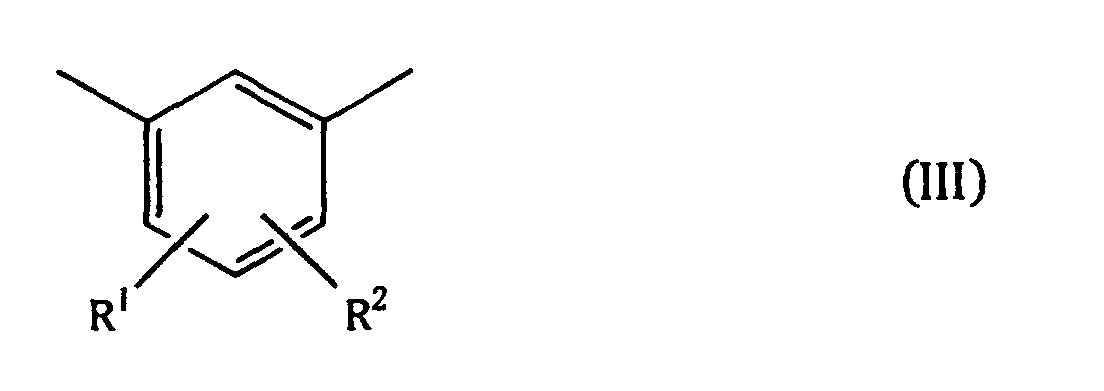
 wherein, in the formulas (II) to (V), R1 and R2 may be the same or different and each is H, OH, alkyl having 1 to 4 carbon atoms, OR3 wherein R3 is alkyl having 1 to 4 carbon atoms, or halogen atom.
- A method for forming PBO into a fiber has been proposed in a number of patents. The PBO obtained using DAR of the present invention can be produced by a method known per se, such as a method disclosed in US Patent Nos. 5296185 and 5294390. A film can be also produced by a method known per se.
- One preferable embodiment of the present invention is shown in the following, to which the present invention is not limited. 4,6-Diaminoresorcinol dihydrochloride is synthesized according to the method disclosed in WO88/03131. As a reducing agent, a solution of tin (II) chloride or its hydrate in hydrochloric acid is uniformly sprayed on DAR. Then, the mixture is dried in vacuo by heating and stirring in a dryer at 40°C-100°C to give DAR containing tin (II) chloride in 100-10,000 ppm. It is possible to use the resulting DAR at once for the next step. For assessment of storage stability, it is preserved in contact with atmosphere for 2 months at 30°C, and PBO is produced by polymerization.
- For polymerization of PBO, the amounts of the starting materials are adjusted to achieve a polymer concentration of 5-20% by weight. 4,6-Diaminoresorcinol dihydrochloride obtained above, finely-divided terephthalic acid, polyphosphoric acid (105-120%) and phosphorus pentaoxide are heated and mixed at 70-220°C by, for example, the method described in US Patent No. 4,533,693 to Wolfe. As a result, a polymer having a high polymerization degree in a yellow dope can be obtained.
- The polymer thus obtained is fed into a spinning part and delivered from a spinneret generally at a temperature of not less than 100°C. The delivered dope (yarn before extraction of polyphosphoric acid) is taken up by a stress isolator such as godet rolls at a constant speed and drawn in a non-coagulant gas. The dope filaments solidified by cooling after yarn delivery is led to a coagulation bath containing an aqueous or alcohol solution. The yarn passed through the coagulation bath passes godet rolls. Finally, it is washed in an extraction bath containing water, methanol and the like until the concentration of phosphoric acid in the yarn becomes not more than 1.0%, preferably not more than 0.5%. A bundle of said fibers is neutralized with an aqueous solution of sodium hydroxide and further washed with water. After such treatment, it is dried in a dryer using high temperature air. The single fiber constituting the fiber bundle thus obtained has a sufficient strength of not less than 35 g/d and a sufficient elastic modulus of not less than about 1000 g/d.
- The present invention is further explained in more detail by way of the following Examples, to which the present invention is not limited. In the Examples, DAR was dissolved in IN aqueous hydrochloric acid solution and UV spectrum was measured, and the decomposition degree of DAR was calculated from the absorbance at 320nm which was derived from decomposition product of DAR. The intrinsic viscosity of PBO was measured at 25°C using methanesulfonic acid as a solvent.
- Tin (II) chloride (4.0 g) was dissolved in 20 ml of aqueous hydrochloric acid solution to give a 2 mol/l tin chloride solution.
- This solution was uniformly sprayed on 4,6-diaminoresorcinol dihydrochloride (1000 g) obtained by the method described in WO88/03131. Then, it was dried under reduced pressure while stirring in a rotary evaporator. The temperature was maintained from 40°C to 100°C during drying. After drying, divalent Sn in DAR was measured using a polarography (device used: 693VA Processor, 694VA Stand, 685 Dosimat, available from Metrom) and found to be 1800 ppm, 2880 ppm when converted to SnCl2. This DAR was preserved for 3 months at 30°C in contact with the air, and its decomposition degree was measured and found to be 0.0%.
- Polyparap henylene benzbisoxazole (PBO) was polymerized using DAR obtained in Example 1. To be specific, diphosphorus pentaoxide (14.49 kg) was added to 116% polyphosphoric acid (43.86 kg) under a nitrogen atmosphere. Then, 4,6-diaminoresorcinol dihydrochloride (9.10 kg) obtained in Example 1 and terephthalic acid (7.10 kg) finely divided to an average particle size of 2µm were added, and the mixture was stirred and mixed in a reactor tank at 80°C. It was further heated and mixed at 150°C for 10 hours and polymerized in a twin-screw extruder heated to 200°C to give a polymer dope of cis-polyparaphenylene benzbisoxazole. The polymer dope was yellow and had an intrinsic viscosity of 38 dl/g.
- The dope obtained in Example 2 was sent from the extruder to a gear pump while maintaining its temperature at 170°C. The dope was spun from a spinneret having 668 holes at 170°C. The delivered yarn was cooled with cooling air at 60°C, brought into contact with aqueous phosphoric acid solution and taken up with godet rolls.
- The yarn thus obtained was washed until the concentration of phosphoric acid in the yarn became 0.5% by weight and neutralized with an aqueous solution of sodium hydroxide. The yarn was further washed with water and dried at 200°C. The obtained yarn had a strength of 38 g/d, and an elastic modulus of 1034 g/d.
- 4,6-Diaminoresorcinol dihydrochloride synthesized according to the method described in WO88/03131 was preserved without a reducing agent for 3 months at 30°C in contact with the air. The decomposition degree was measured and found to be 0.38%. This 4,6-diaminoresorcinol dihydrochloride was polymerized in the same manner as in Example 2. As a result, the obtained polymer dope was green and had an intrinsic viscosity of 18 dl/g.
- In the same manner as in Example 1 except that the reducing agents shown in Table 1 were added instead of tin (II) chloride, 4,6-diaminoresorcinol dihydrochlorides were obtained. The obtained DARs were preserved for 3 months at 30°C in contact with the air. The decomposition degree was measured and found to be 0.31% by weight in each example. The polymer dopes obtained by polymerizing DAR in the same manner as in Example 2 were yellow and had an intrinsic viscosity of 35-48 dl/g.
- In the same manner as in Example 1 except that Pd was added as the reducing agent instead of tin (II) chloride, DAR was obtained. The obtained DAR was preserved for 3 months at 30°C in contact with the air. The decomposition degree was measured and found to be 0.31% by weight. The polymer dope obtained by polymerization using this DAR in the same manner as in Example 2 was purple and had an intrinsic viscosity of 12 dl/g.
- In the same manner as in Example 1 except that Zn powder upon dispersion in water was added as the reducing agent instead of tin (II) chloride, DAR was obtained. The obtained DAR was preserved for 3 months at 30°C in contact with the air, and its decomposition degree was measured. The decomposition degree was inconsistent and was 0.02-0.28% by weight and DAR had purple specks. The polymer dope obtained by polymerization using this DAR was yellow-green and had an intrinsic viscosity of 34 dl/g. Hydrogen was generated during polymerization and operation was very difficult.
- DAR and PBO obtained in Examples and Comparative Examples above were evaluated, the results of which are shown in the following Table 1.
Ex.2 Ex.4 Ex.5 Ex.6 Ex.7 Com. Ex.1 Com. Ex.2 Com. Ex.3 Reducing Agent SnCl2 TiCl3 CuCl H3PO3 H2SO3 none Pd Zn Standard redox potential (volt) 0.15 0.04 0.153 -0.20 0.17 0.83 -0.763 Amount added (ppm) 2880 3860 5300 5300 420 2400 2800 Decomposition degree (%) 0.0 0.0 0.0 0.0 0.0 0.38 0.31 0.02-0.28 Intrinsic viscosity (dl/g) 38 48 43 44 35 18 12 34 Dope color yellow yellow yellow yellow yellow green purple yellow green Note - As is evident from Table 1, the present invention improves storage stability of 4,6-diaminoresorcinol. This in turn results in easy handling and long-term preservation. Thus, a high quality polymer PBO can be easily produced and the invention greatly contributes to the industrial field.
- Due to the method of the present invention, DAR upon preservation in contact with the air at room temperature for not less than 1 month, or at room temperature under a nitrogen atmosphere for not less than 1 year, does not suffer from degradation caused by oxidation. The PBO obtained therefrom also has superior property of high polymerization degree.
Claims (6)
- A composition comprising 4,6-diaminoresorcinol or a salt thereof, and a reducing agent having a standard redox potential of not less than -0.20 volt and not more than 0.34 volt, the reducing agent being contained in a proportion of not less than 100 ppm and not more than 10,000 ppm of 4,6-diaminoresorcinol, wherein the reducing agent is added to the 4,6-diamlnoresorcinol in a molten state or upon dissolution in a volatile solution.
- A composition according to claim 1, wherein the reducing agent has a standard redox potential of not less than 0.0 volt and not more than 0.20 volt.
- A composition according to claim 1, wherein the reducing agent is selected from TiCl3, CuCl, SnCl2, H3PO3 and H2SO3.
- A method for producing polybenzbisoxazole, comprising reacting a composition as defined in any of claims 1 to 3 with an aromatic dicarboxylic acid.
- A method for stabilizing 4,6-diaminoresorcinol or a salt thereof during storage, comprising providing a composition as defined in any of claims 1 to 3.
- Use of a composition as defined in any of claims 1 to 3 for producing polybenzbisoxazole.
Applications Claiming Priority (3)
| Application Number | Priority Date | Filing Date | Title |
|---|---|---|---|
| JP15250097 | 1997-06-10 | ||
| JP15250097 | 1997-06-10 | ||
| JP152500/97 | 1997-06-10 |
Publications (2)
| Publication Number | Publication Date |
|---|---|
| EP0884303A1 EP0884303A1 (en) | 1998-12-16 |
| EP0884303B1 true EP0884303B1 (en) | 2002-09-18 |
Family
ID=15541831
Family Applications (1)
| Application Number | Title | Priority Date | Filing Date |
|---|---|---|---|
| EP98110503A Expired - Lifetime EP0884303B1 (en) | 1997-06-10 | 1998-06-09 | Method of stabilizing 4,6-diaminoresorcinol and salts thereof |
Country Status (3)
| Country | Link |
|---|---|
| US (1) | US5911908A (en) |
| EP (1) | EP0884303B1 (en) |
| DE (1) | DE69807990T2 (en) |
Cited By (1)
| Publication number | Priority date | Publication date | Assignee | Title |
|---|---|---|---|---|
| CN106554287A (en) * | 2015-09-29 | 2017-04-05 | 中国石油化工集团公司 | A kind of method that stannous chloride is quantitatively adding in 4,6- diaminourea hydrochlorides |
Families Citing this family (1)
| Publication number | Priority date | Publication date | Assignee | Title |
|---|---|---|---|---|
| US7127747B2 (en) * | 2003-01-10 | 2006-10-31 | Sport Helmets, Inc. | Protective eyewear device for sports |
Family Cites Families (6)
| Publication number | Priority date | Publication date | Assignee | Title |
|---|---|---|---|---|
| JPS60239447A (en) * | 1984-05-15 | 1985-11-28 | リヤオ,チ− ス− | Stabilization of aminophenols |
| US4766244A (en) * | 1986-10-30 | 1988-08-23 | The Dow Chemical Company | High purity process for the preparation of 4,6-diamino-1,3-benzenediol |
| US4912246A (en) * | 1987-10-19 | 1990-03-27 | The Dow Chemical Company | 1,3-bis(alkylcarbonato)-nitrobenzenes |
| US5001279A (en) * | 1989-11-17 | 1991-03-19 | The Dow Chemical Company | Aqueous synthesis of 2-halo-4,6-dinitroresorcinol and 4,6-diaminoresorcinol |
| US5276128A (en) * | 1991-10-22 | 1994-01-04 | The Dow Chemical Company | Salts of polybenzazole monomers and their use |
| US5414130A (en) * | 1993-12-23 | 1995-05-09 | The Dow Chemical Company | Process for the preparation of diaminoresorcinol |
-
1998
- 1998-06-09 DE DE69807990T patent/DE69807990T2/en not_active Expired - Fee Related
- 1998-06-09 EP EP98110503A patent/EP0884303B1/en not_active Expired - Lifetime
- 1998-06-10 US US09/095,366 patent/US5911908A/en not_active Expired - Lifetime
Cited By (1)
| Publication number | Priority date | Publication date | Assignee | Title |
|---|---|---|---|---|
| CN106554287A (en) * | 2015-09-29 | 2017-04-05 | 中国石油化工集团公司 | A kind of method that stannous chloride is quantitatively adding in 4,6- diaminourea hydrochlorides |
Also Published As
| Publication number | Publication date |
|---|---|
| DE69807990D1 (en) | 2002-10-24 |
| US5911908A (en) | 1999-06-15 |
| EP0884303A1 (en) | 1998-12-16 |
| DE69807990T2 (en) | 2003-04-30 |
Similar Documents
| Publication | Publication Date | Title |
|---|---|---|
| KR970009334B1 (en) | Polyurethane composition | |
| EP2292815B1 (en) | Composite fiber of cellulose-polyvinylalcohol and preparation method thereof | |
| DE2616746B2 (en) | Process for the production of polyphenylene ethers | |
| WO2008131720A1 (en) | Method for the production of a bioactive cellulose fiber with a high degree of brightness | |
| US3941755A (en) | Fiber-forming 6TA/6IA copolymers | |
| EP0421215B1 (en) | Process for the preparation of light and exhaust gas resistant PUH elastomer fibres and films and the elastomer fibres with the corresponding composition | |
| US5911908A (en) | Method of stabilizing 4,6-diaminoresorcinol and salt thereof | |
| EP1866467B1 (en) | Process for the production of polyarenazole yarn | |
| DE2913204C2 (en) | ||
| JP3906954B2 (en) | 4,6-diaminoresorcinol and / or salt thereof, method for producing polybenzbisoxazole obtained therefrom, and molded article thereof | |
| KR100565133B1 (en) | How to stabilize 4,6-diaminoresorcinol and its salts | |
| EP1108709B1 (en) | Production method of aromatic diamine/aromatic dicarboxylate | |
| CN1148342C (en) | Method for stabilizing 4, 6-diaminoresorcinol and salts thereof | |
| EP0175968A1 (en) | Process for recovering poly(arylene sulfides) | |
| EP0624174B1 (en) | Semicarbazide/urethane stabilizer | |
| KR0152988B1 (en) | Oligomeric Semicarbazide Additives for Spandex | |
| JP4228090B2 (en) | 4,6-diaminoresorcinol-containing composition, polybenzobisoxazole using the composition, molded product thereof, and method for stabilizing storage of 4,6-diaminoresorcinol | |
| KR0167001B1 (en) | Process for preparing full-dull polyester resin | |
| US3242134A (en) | Polycarbonates stabilized with a manganese salt in combination with hypophosphorous acid | |
| Wendler et al. | Cellulosic shapes from ionic liquids modified by activated charcoals and nanosilver particles | |
| JPH08260240A (en) | Method for adjusting viscosity of extremely concentrated elastan solution for dry or wet spinning of elastan fiber | |
| CN1495220A (en) | Method for stabilizing 4,6-diaminoresorcinol and its salt | |
| EP0309229A2 (en) | Preparation of articles of manufacture from isotropic and anisotropic polyamide anion solutions | |
| JPS63132938A (en) | Aromatic polyamide and production thereof | |
| JPH0524246B2 (en) |
Legal Events
| Date | Code | Title | Description |
|---|---|---|---|
| PUAI | Public reference made under article 153(3) epc to a published international application that has entered the european phase |
Free format text: ORIGINAL CODE: 0009012 |
|
| AK | Designated contracting states |
Kind code of ref document: A1 Designated state(s): DE FR GB NL |
|
| AX | Request for extension of the european patent |
Free format text: AL;LT;LV;MK;RO;SI |
|
| 17P | Request for examination filed |
Effective date: 19990608 |
|
| AKX | Designation fees paid |
Free format text: DE FR GB NL |
|
| 17Q | First examination report despatched |
Effective date: 19990907 |
|
| GRAG | Despatch of communication of intention to grant |
Free format text: ORIGINAL CODE: EPIDOS AGRA |
|
| GRAG | Despatch of communication of intention to grant |
Free format text: ORIGINAL CODE: EPIDOS AGRA |
|
| GRAG | Despatch of communication of intention to grant |
Free format text: ORIGINAL CODE: EPIDOS AGRA |
|
| GRAH | Despatch of communication of intention to grant a patent |
Free format text: ORIGINAL CODE: EPIDOS IGRA |
|
| RTI1 | Title (correction) |
Free format text: METHOD OF STABILIZING 4,6-DIAMINORESORCINOL AND A SALT THEREOF |
|
| GRAH | Despatch of communication of intention to grant a patent |
Free format text: ORIGINAL CODE: EPIDOS IGRA |
|
| RTI1 | Title (correction) |
Free format text: METHOD OF STABILIZING 4,6-DIAMINORESORCINOL AND SALTS THEREOF |
|
| GRAA | (expected) grant |
Free format text: ORIGINAL CODE: 0009210 |
|
| AK | Designated contracting states |
Kind code of ref document: B1 Designated state(s): DE FR GB NL |
|
| REG | Reference to a national code |
Ref country code: GB Ref legal event code: FG4D |
|
| REF | Corresponds to: |
Ref document number: 69807990 Country of ref document: DE Date of ref document: 20021024 |
|
| ET | Fr: translation filed | ||
| PLBE | No opposition filed within time limit |
Free format text: ORIGINAL CODE: 0009261 |
|
| STAA | Information on the status of an ep patent application or granted ep patent |
Free format text: STATUS: NO OPPOSITION FILED WITHIN TIME LIMIT |
|
| 26N | No opposition filed |
Effective date: 20030619 |
|
| PGFP | Annual fee paid to national office [announced via postgrant information from national office to epo] |
Ref country code: NL Payment date: 20090615 Year of fee payment: 12 |
|
| PGFP | Annual fee paid to national office [announced via postgrant information from national office to epo] |
Ref country code: GB Payment date: 20090603 Year of fee payment: 12 Ref country code: DE Payment date: 20090604 Year of fee payment: 12 |
|
| REG | Reference to a national code |
Ref country code: NL Ref legal event code: V1 Effective date: 20110101 |
|
| GBPC | Gb: european patent ceased through non-payment of renewal fee |
Effective date: 20100609 |
|
| REG | Reference to a national code |
Ref country code: FR Ref legal event code: ST Effective date: 20110228 |
|
| PG25 | Lapsed in a contracting state [announced via postgrant information from national office to epo] |
Ref country code: DE Free format text: LAPSE BECAUSE OF NON-PAYMENT OF DUE FEES Effective date: 20110101 |
|
| PG25 | Lapsed in a contracting state [announced via postgrant information from national office to epo] |
Ref country code: NL Free format text: LAPSE BECAUSE OF NON-PAYMENT OF DUE FEES Effective date: 20110101 Ref country code: FR Free format text: LAPSE BECAUSE OF NON-PAYMENT OF DUE FEES Effective date: 20100630 |
|
| PG25 | Lapsed in a contracting state [announced via postgrant information from national office to epo] |
Ref country code: GB Free format text: LAPSE BECAUSE OF NON-PAYMENT OF DUE FEES Effective date: 20100609 |
|
| PGFP | Annual fee paid to national office [announced via postgrant information from national office to epo] |
Ref country code: FR Payment date: 20090611 Year of fee payment: 12 |