EP0883802B1 - Sensing device - Google Patents
Sensing device Download PDFInfo
- Publication number
- EP0883802B1 EP0883802B1 EP97905312A EP97905312A EP0883802B1 EP 0883802 B1 EP0883802 B1 EP 0883802B1 EP 97905312 A EP97905312 A EP 97905312A EP 97905312 A EP97905312 A EP 97905312A EP 0883802 B1 EP0883802 B1 EP 0883802B1
- Authority
- EP
- European Patent Office
- Prior art keywords
- discotic liquid
- liquid crystal
- fluid
- sensing device
- flow
- Prior art date
- Legal status (The legal status is an assumption and is not a legal conclusion. Google has not performed a legal analysis and makes no representation as to the accuracy of the status listed.)
- Expired - Lifetime
Links
Images


Classifications
-
- G—PHYSICS
- G01—MEASURING; TESTING
- G01N—INVESTIGATING OR ANALYSING MATERIALS BY DETERMINING THEIR CHEMICAL OR PHYSICAL PROPERTIES
- G01N27/00—Investigating or analysing materials by the use of electric, electrochemical, or magnetic means
- G01N27/02—Investigating or analysing materials by the use of electric, electrochemical, or magnetic means by investigating impedance
- G01N27/04—Investigating or analysing materials by the use of electric, electrochemical, or magnetic means by investigating impedance by investigating resistance
- G01N27/12—Investigating or analysing materials by the use of electric, electrochemical, or magnetic means by investigating impedance by investigating resistance of a solid body in dependence upon absorption of a fluid; of a solid body in dependence upon reaction with a fluid, for detecting components in the fluid
- G01N27/125—Composition of the body, e.g. the composition of its sensitive layer
- G01N27/126—Composition of the body, e.g. the composition of its sensitive layer comprising organic polymers
Definitions
- the invention relates to sensing devices, and aspects thereof, which exploit the unique properties of discotic liquid crystals ( DLC ).
- DLC discotic liquid crystals
- DLCs essentially comprise an aromatic core surrounded by several aliphatic side chains. Typically, a number of aromatic cores are positioned in an aligned, stacked fashion so as to provide for a columnar arrangement. Further, the columns tend to organise into a two dimensional superlattice providing, for example, a hexagonal structure, hexa-alkoxytriphenylenes are well known representatives of this structure of DLCs.
- DLCs attracted considerable attention when it was discovered that the columnar phase structure of DLCs was suitable for fast transport of charge carriers. More specifically, it was established that the orientation of the columns directed the flow of this charge because the charge essentially travelled along each column and was further insulated from adjacent columns by the aliphatic side chains attached to the aromatic cores. As a result of this knowledge the use of DLCs in the electronics industry has grown and it is of note that it is the transfer of electric charge along the axis of the columnar DLCs that has been exploited.
- Fluid sensing devices and in particular gas sensors, are becoming increasingly important for monitoring industrial environments. In particular, they are desirable for use in the chemical industry where the detection of leaks and in particular the detection of leaks of a hazardous nature must be continually monitored.
- various gas sensors have been developed. The most sophisticated is based on polymer technology and essentially involves the interaction of a gaseous molecule with a given polymer and the recording of a response as a result thereof. More specifically, the sensor uses electrically conducting organic polymers based on heterocyclic molecules such as pyrrole. Each polymer is a different functional unit that displays reversible changes in conductivity when it is exposed to polar volatile chemicals.
- an array of polymers are provided and the interaction of a gas molecule, or a cocktail of gas molecules, when exposed to each of said polymers in said array is monitored and the subsequent response, or fingerprint, is recorded. Thereafter when the same sensor array is exposed to the same gas, or combination of gases, the same response, or fingerprint, is noted.
- gas sensors can be "trained” to detect different gases, or combinations of gases, and so be programmed to monitor different environments for leaks.
- the aforementioned sophisticated technology is not sufficiently sensitive to detect all kinds of gases and in particular it is not able to detect all organics. Notably, it cannot detect non-polar hydrophobic organics such as benzene and as a result of this its application is not universal.
- Fluid sensing devices and in particular gas sensors, have been described which make use of discotic liquid crystals in WO 94/29263.
- this publication there is no reference in this publication as to the nature of the construction of this device that is desirable in order for the device to function effectively.
- fluid sensing device comprising a substrate on which there is provided at least one type of discotic liquid crystal which is arranged to form an array of columnar structures so as to present an upper part able to interact with a fluid to be sensed in use, characterised in that the array comprises a relatively thin film of less than one micrometer of the at least one discotic liquid crystal, and further characterised in that there is also provided contact means comprising a pair of electrodes to which a voltage can be applied being positioned on either side of the discotic liquid crystal surface in opposing fashion so as to measure the flow of electric charge through the upper part of said columnar structures in a direction generally across the surface of the same generally perpendicular to the axis of the columns, such as to measure changes in the said flow of electric charge in the said direction as a fluid to be sensed interacts with the said surface to affect surface organisation and thus charge flow therethrough.
- the effect on surface conductivity is very fast and so the device is able to operate in real time, in that the device comprises means to provide fluid sensing in real time by monitoring a change in the flow of electric charge measured by said contact means relating to the interaction of different fluids with the discotic liquid crystal.
- a plurality of discotic liquid crystals are provided and ideally on a single substrate.
- the plurality of discotic liquid crystals are positioned on such substrate so as to provide for an array.
- the response of different discotic liquid crystals to different fluids or gases can be determined, and where an array is provided a given gaseous molecule, or combination of gaseous molecules, can interact with the said array so as to provide a given, typically unique, response.
- This response can then be recorded and used for future analysis of gases, either identical to the original gas, or gases, or differing therefrom.
- the said device is also provided with an information storage and retrieval facility whereby data relating to different fluids and in particular gases can be stored and accessed so that analysis of gases or environments can be facilitated.
- said at least one discotic liquid crystal is 2, 3, 6, 7, 10, 11 hexa-hexyloxytriphenylene (HAT6).
- Said at least one discotic liquid crystal is preferably selected from 1-6 ⁇ - and/or 1- 6 ⁇ -triphenylenes and tricycloquinazolines such as optionally ⁇ -substituted alkyloxy triphenylenes, and hexa [substituted ethoxy] tricycloquinazolines, substituted phthalocyanines and discotic liquid crystals having modified aliphatic side chains.
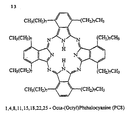
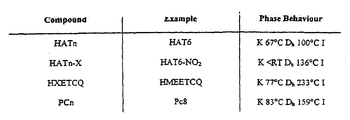
- said discotic liquid crystal comprises at least one such crystal shown in table 1 and exemplified in Figures 12 and 13.
- said discotic liquid crystal comprises a plurality of the discotic liquid crystal shown in table 1 and exemplified in Figures 12 and 13, and ideally each gas sensing device comprises a selected combination of said discotic liquid crystals which combination is selected having regard to the purpose of the sensor. Therefore, for example, where given discotic liquid crystals are shown to be particularly sensitive to a given gas, or combination of gases, then these discotic liquid crystals will be employed in sensors used to detect gases, or combinations of gases, for which they have exemplified favourable sensitivity.
- discotic liquid crystals shown in table 1 and exemplified in Figures 12 and 13
- the invention lies in the realisation that discotic liquid crystals can be used, because of their surface conductivity, to detect fluids and in particular gases.
- the number and nature of discotic liquid crystals that can be used in the invention are limitless, as is their combination, selective or otherwise, typically for use in an array.
- the said film is preferably less than 0.5 of a micrometre and ideally in the order of 0.1 micrometres.
- discotic liquid crystals function as fluid, and in particular gas, sensors because of the ability of the aliphatic side chains to interact with said gases and so affect the organisation at the surface of the discotic liquid crystal structure.
- the enhancement or depression of surface organisation thus affects the ability of the surface to conduct charge and we speculate, that in this way, a given fluid interacts with the surface of a discotic liquid crystal to affect surface organisation and thus charge flow therethrough.
- DLCs will be especially useful for sensing non-polar hydrophobic volatile chemicals in vapour sensing instruments usually referred to as "the electronic nose". These instruments, which detect smell levels down to parts per billion normally use an array of 8, 16 or 32 separate gas sensors. If is thought that DLCs may be used in such sensors and exploited because of the ability of DLCs to detect non-polar hydrophobic gases.
- Table 1 is a list of discotic liquid crystals suitable for working the invention.
- Figures 12 and 13 show the chemical structure of the discotic liquid crystals referred to in table 1.
- HAT6 a selected discotic liquid crystal
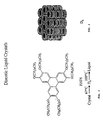
- the structure comprises an aromatic core surrounded by a number of aliphatic side chains.
- HAT6 exists in a crystalline phase below 67°C and is transformed into a liquid phase at temperatures in the order of 100°C.
- the basis structure shown in Figure 1 is typical of all discotic liquid crystals in that they essentially comprise an aromatic core surrounded by a number of aliphatic side chains. Moreover, the liquid crystalline state is located between a crystalline and isotropic liquid state.
- Figure 2 there is shown the organisational arrangement of a film of discotic liquid crystals.
- the aromatic cores are aligned and stacked so as to form columnar arrangements, thus the aliphatic side chains are provided between the aromatic columns and so act as spacers.
- Discotic liquid crystals are known to have a number of favourable properties, one being their wetting property and thus the ability to ensure efficient molecular contact with electrodes and the other being the high degree of internal order which occurs with the semi-fluidity of discotic liquid crystals.
- the former property is advantageous in terms of construction of devices using discotic liquid crystals and the latter property is advantageous in that it provides for "self-healing" if a disturbance should occur at the molecular level.
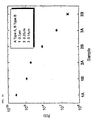
- Figure 3 shows the arrangement of discotic liquid crystals on a substrate. It can be seen that the organisation of the columnar structure tends to break down towards the surface and indeed it is this property which we exploit in this invention. However, we have found that despite the thickness of the discotic liquid crystal film the surface conductivity remains and therefore we conclude that whatever the thickness of the film the advantageous surface structure remains. Indeed, data to be presented hereinafter will show that thin films of discotic liquid crystals are preferred.
- FIG 4 we show a sensing device in accordance with the invention.
- the device essentially comprises a substrate 1 on which there has been deposited at least one discotic liquid crystal 2 existing in the liquid-crystalline state and so displaying the organised structure typical of its type.
- a pair of contact means 3 such as electrodes.
- the wetting properties of the discotic liquid crystal ensures that once the DLCs film is applied to the substrate and then placed in contact with the contact means good electrical contact is provided.
- the contact means comprise a pair of electrodes to which a voltage can be applied so ensuring that current can flow.
- each gas provides a unique signature which can be used , either in isolation or in combination with other such readings using different discotic liquid crystals, to identify it.
- the sensing device may therefore be of such diverse applications as: process control, by monitoring organic chemical reactions in real time; environmental monitoring, by early detection of contamination; hazard detection, by rapid indication of the presence of hazard gases and the like.
- discotic liquid crystals having modified aliphatic side chains may also be used.
- discotic liquid crystals having side chains which are engineered so as to be relatively, hydrophobic, hydrophilic, long in length, short in length, high in dipole moment, low in dipole moment or otherwise may be used.
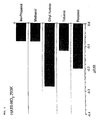
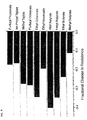
- the sensor of the invention was able to distinguish between alcohols such as iso-Propanol and Methanol and also acetates such as Ethyl Acetate and ring structures such as Benzene and Toluene.
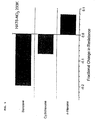
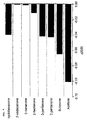
- Figure 6 shows that the sensor of the invention was also able to distinguish between aromatics and aliphatics and moreover that this ability to distinguish is polarised such that a ring structure such as Benzene or CycloHexane provides for a reduction in resistance, and so an increase in current flow, whereas an aliphatic such as n-Hexane provides for an increase in resistance and so a reduction in current flow.
- a ring structure such as Benzene or CycloHexane provides for a reduction in resistance, and so an increase in current flow
- an aliphatic such as n-Hexane provides for an increase in resistance and so a reduction in current flow.
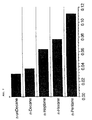
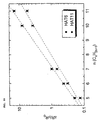
- the device of the invention can be used to distinguish between different aliphatics and in particular the chain length of different aliphatics. Summarily, the greater the carbon chain length the lower the resistance and so the greater the conductivity. This is further also shown in Figure 10 where it can be seen that there is a linear relationship between resistance at the discotic liquid crystal surface and chain length.
- a device comprising an array of selected discotic liquid crystals wherein the surface current flow for each of said selected discotic liquid crystal in said array can be measured.
- the discotic liquid crystals selected for use in the array are chosen on the basis of their sensitivity to particular fluids. In this way devices can be customised according to a users requirements.
- a plurality of discotic liquid crystals can be selected on the basis of the range of fluids that can be detected.
- any one or more of the discotic liquid crystals shown in table 1 and exemplified in Figures 12 and 13 are used. However, it is not intended that this invention should be limited to the specific discotic liquid crystals specified herein, rather the invention may employ any one or more known discotic liquid crystal(s).
- a solution of known composition is made up by dissolving the required weight of discotic liquid crystals in a low boiling point solvent (such as diethylether or carbon disulphide). Thin films are then formed on the electrode surface by casting a known volume of solution followed by evaporation of solvent. Homeotropic alignment of the thin film is achieved by suitable heat treatment which consists of heating the film to a temperature above its clearing point into the isotropic phase, followed by a slow cooling into the liquid crystalline phase.
- a low boiling point solvent such as diethylether or carbon disulphide
- discotic liquid crystals to detect fluids and in particular gases by measuring the surface discotic liquid charge associated with the interaction of said fluid and said discotic liquid crystal.
Landscapes
- Chemical & Material Sciences (AREA)
- Analytical Chemistry (AREA)
- Electrochemistry (AREA)
- Physics & Mathematics (AREA)
- Health & Medical Sciences (AREA)
- Life Sciences & Earth Sciences (AREA)
- Chemical Kinetics & Catalysis (AREA)
- Biochemistry (AREA)
- General Health & Medical Sciences (AREA)
- General Physics & Mathematics (AREA)
- Immunology (AREA)
- Pathology (AREA)
- Investigating Or Analyzing Materials By The Use Of Electric Means (AREA)
- Investigating Or Analyzing Materials By The Use Of Fluid Adsorption Or Reactions (AREA)
Description
Claims (13)
- A fluid sensing device comprising a substrate on which there is provided at least one type of discotic liquid crystal which is arranged to form an array of columnar structures so as to present an upper part able to interact with a fluid to be sensed in use, characterised in that the array comprises a relatively thin film of less than one micrometer of the at least one discotic liquid crystal, and further characterised in that there is also provided contact means comprising a pair of electrodes to which a voltage can be applied being positioned on either side of the discotic liquid crystal surface in opposing fashion so as to measure the flow of electric charge through the upper part of said columnar structures in a direction generally across the surface of the same generally perpendicular to the axis of the columns, such as to measure changes in the said flow of electric charge in the said direction as a fluid to be sensed interacts with the said surface to affect surface organisation and thus charge flow therethrough.
- A fluid sensing device according to claim 1 wherein the device comprises means to provide fluid sensing in real time by monitoring a change in the flow of electric charge measured by said contact means relating to the interaction of different fluids with the discotic liquid crystal.
- A fluid sensing device according to claim 1 or claim 2 which is provided with an information storage and retrieval facility comprsing means for information storage and retrieval of data relating to the interaction of different fluids with the discotic liquid crystal whereby data relating to different fluids and in particular gases can be stored and accessed so that an analysis of gases or environments can be facilitated.
- A fluid sensing device according to any preceding claim which comprises at least one discotic liquid crystal selected from 1-6β- and/or 1- 6α-triphenylenes and tricycloquinazolines such as optionally α-substituted alkyloxy triphenylenes, and hexa [substituted ethoxy] tricycloquinazolines, substituted phthalocyanines and discotic liquid crystals having modified aliphatic side chains.
- A fluid sensing device according to claim 4 which comprises at least one discotic liquid crystal selected from 2,3,6,7,10,11-hexa(hexyloxy)triphenylene (HAT6), 1-nitro 2,3,6,7,10,11-hexa(hexyloxy)triphenylene (HAT6-NO2), 2,3,7,8,12,13-hexa(2-(2'-methoxyethoxy)-ethoxyl)tricycloquinazoline (HMEETCQ), and 1,4,8,11,15,18,22,25-octa-(octyl)phthalocyanine (PC8).
- A fluid sensing device according to claim 4 or claim 5 wherein the array of at least one type of discotic liquid crystal includes 2,3,6,7,10,11-hexa (hexyloxy) triphenylene (HAT6).
- A fluid sensing device according to any of claims 1 to 6 comprising a selected combination of discotic liquid crystals which combination is selected having regard to the purpose of the sensor, preferably selected on the basis of the sensitivity to particular fluids, or of the range of fluids that can be detected.
- A fluid sensing device according to any of claims 1 to 7 wherein the relatively thin film of at least one discotic liquid crystal has a thickness less than 0.5 micrometer.
- A fluid sensing device according to claim 8 wherein the relatively thin film of at least one discotic liquid crystal has a thickness less than the order of 0.1 micrometer.
- A method for detecting a fluid comprising exposing a sensing device as defined in any of claims 1 to 9 to a fluid in manner that the fluid interacts with the surface of the at least one discotic liquid crystal, applying a voltage to the contact means and measuring a flow of electric charge, and analysing the unique signature obtained to identify the fluid.
- A method for the preparation of a fluid sensing device comprising providing at least one type of discotic liquid crystal on a substrate which is arranged to form an array of columnar structures so as to present an upper part able to interact with a fluid to be sensed in use, which array comprises a relatively thin film of less than one micrometer of the at least one discotic liquid crystal, positioning contact means comprising a pair of electrodes to which a voltage can be applied on either side of the discotic liquid crystal surface in opposing fashion so as to be able to measure the flow of electric charge through the upper part of said columnar structures in a direction generally across the surface of the same generally perpendicular to the axis of the columns, applying a voltage thereto, measuring changes in the flow of electric charge in the said direction as a fluid to be sensed interacts with the said surface to affect surface organisation and thus charge flow therethrough and providing contact means adapted to measure the flow of electric charge through the upper part of the film of discotic liquid crystals.
- A method according to Claim 11 wherein the thin film is homeotropically aligned.
- A method according to claim 11 or 12 wherein the substrate is an electrode surface.
Applications Claiming Priority (3)
| Application Number | Priority Date | Filing Date | Title |
|---|---|---|---|
| GBGB9604525.7A GB9604525D0 (en) | 1996-03-02 | 1996-03-02 | Sensing device |
| GB9604525 | 1996-03-02 | ||
| PCT/GB1997/000572 WO1997032202A1 (en) | 1996-03-02 | 1997-03-03 | Sensing device |
Publications (2)
| Publication Number | Publication Date |
|---|---|
| EP0883802A1 EP0883802A1 (en) | 1998-12-16 |
| EP0883802B1 true EP0883802B1 (en) | 2003-05-14 |
Family
ID=10789775
Family Applications (1)
| Application Number | Title | Priority Date | Filing Date |
|---|---|---|---|
| EP97905312A Expired - Lifetime EP0883802B1 (en) | 1996-03-02 | 1997-03-03 | Sensing device |
Country Status (6)
| Country | Link |
|---|---|
| US (1) | US6423272B1 (en) |
| EP (1) | EP0883802B1 (en) |
| AU (1) | AU2223797A (en) |
| DE (1) | DE69721971D1 (en) |
| GB (1) | GB9604525D0 (en) |
| WO (1) | WO1997032202A1 (en) |
Families Citing this family (10)
| Publication number | Priority date | Publication date | Assignee | Title |
|---|---|---|---|---|
| US6284197B1 (en) * | 1998-06-05 | 2001-09-04 | The Regents Of The University Of California | Optical amplification of molecular interactions using liquid crystals |
| US6858423B1 (en) | 1998-06-05 | 2005-02-22 | The Regents Of The University Of California | Optical Amplification of molecular interactions using liquid crystals |
| GB0122022D0 (en) * | 2001-09-12 | 2001-10-31 | Univ Cambridge Tech | Aligned discotic liquid crystals for devices |
| US7795007B2 (en) | 2003-09-23 | 2010-09-14 | Wisconsin Alumni Research Foundation | Detection of post-translationally modified peptides with liquid crystals |
| CA2539436A1 (en) | 2003-09-23 | 2005-09-01 | Wisconsin Alumni Research Foundation | Using liquid crystals to detect affinity microcontact printed biomolecules |
| US10011481B2 (en) | 2007-07-24 | 2018-07-03 | Technion Research And Development Foundation Ltd. | Chemically sensitive field effect transistors and uses thereof in electronic nose devices |
| US20100191474A1 (en) * | 2007-10-23 | 2010-07-29 | Technion Research And Development Foundation Ltd. | Electronic nose device with sensors composed of nanowires of columnar discotic liquid crystals with low sensititive to humidity |
| WO2010031047A2 (en) | 2008-09-15 | 2010-03-18 | Platypus Technologies, Llc | Detection of vapor phase compounds by changes in physical properties of a liquid crystal |
| TWI440698B (en) | 2011-09-26 | 2014-06-11 | Ind Tech Res Inst | Liquid crystal gas sensor cell and the use thereof |
| CN109632892B (en) * | 2019-01-11 | 2020-12-25 | 浙江大学 | Electronic nose-based detection model for pest damage duration of arborvitae wormhole trunk pests and application |
Family Cites Families (7)
| Publication number | Priority date | Publication date | Assignee | Title |
|---|---|---|---|---|
| GB8823721D0 (en) * | 1988-10-10 | 1988-11-16 | Boden N | Electronically conducting liquid crystals |
| GB9009870D0 (en) * | 1990-05-02 | 1990-06-27 | Secr Defence | Chemically sensitive organometallic semiconducting materials |
| US5282381A (en) | 1992-09-08 | 1994-02-01 | Hughes Aircraft Company | Supercritical fluid contamination monitor |
| US5345213A (en) | 1992-10-26 | 1994-09-06 | The United States Of America, As Represented By The Secretary Of Commerce | Temperature-controlled, micromachined arrays for chemical sensor fabrication and operation |
| US5750050A (en) * | 1993-06-16 | 1998-05-12 | Secretary Of State For Defence In Her Britannic Majesty's Government Of The U.K. Of Gt. Britain And N. Ireland Of Defence Evaluation Research Agency, Dra | Discotic compounds for use in liquid crystal mixtures |
| DE4429597A1 (en) * | 1994-08-20 | 1996-02-22 | Basf Ag | Use of low molecular weight or polymeric organic compounds with liquid crystalline properties present in the columnar helical phase |
| US5571401A (en) * | 1995-03-27 | 1996-11-05 | California Institute Of Technology | Sensor arrays for detecting analytes in fluids |
-
1996
- 1996-03-02 GB GBGB9604525.7A patent/GB9604525D0/en active Pending
-
1997
- 1997-03-03 AU AU22237/97A patent/AU2223797A/en not_active Abandoned
- 1997-03-03 WO PCT/GB1997/000572 patent/WO1997032202A1/en not_active Ceased
- 1997-03-03 US US09/142,160 patent/US6423272B1/en not_active Expired - Fee Related
- 1997-03-03 DE DE69721971T patent/DE69721971D1/en not_active Expired - Lifetime
- 1997-03-03 EP EP97905312A patent/EP0883802B1/en not_active Expired - Lifetime
Also Published As
| Publication number | Publication date |
|---|---|
| AU2223797A (en) | 1997-09-16 |
| EP0883802A1 (en) | 1998-12-16 |
| US6423272B1 (en) | 2002-07-23 |
| WO1997032202A1 (en) | 1997-09-04 |
| DE69721971D1 (en) | 2003-06-18 |
| GB9604525D0 (en) | 1996-05-01 |
Similar Documents
| Publication | Publication Date | Title |
|---|---|---|
| US5756879A (en) | Volatile organic compound sensors | |
| US5417100A (en) | Reversible sensor for detecting solvent vapors | |
| Nicho et al. | Polyaniline composite coatings interrogated by a nulling optical-transmittance bridge for sensing low concentrations of ammonia gas | |
| US6423272B1 (en) | Fluid sensing device using discotic liquid crystals | |
| Chang et al. | Printable polythiophene gas sensor array for low-cost electronic noses | |
| Reddy et al. | Fully printed flexible humidity sensor | |
| Harsányi | Polymer films in sensor applications: a review of present uses and future possibilities | |
| US4631952A (en) | Resistive hydrocarbon leak detector | |
| US20070236469A1 (en) | Fluid level sensing utilizing a mutual capacitance touchpad device | |
| Eastman et al. | Application of the solubility parameter concept to the design of chemiresistor arrays | |
| Ihdene et al. | Quartz crystal microbalance VOCs sensor based on dip coated polyaniline emeraldine salt thin films | |
| EP0578742A1 (en) | Sensors based on nanostructured, compiled films. | |
| Megahd et al. | Universal design rules for flory–Huggins polymer photonic vapor sensors | |
| Barnard et al. | Fiber-optic organic vapor sensor | |
| WO2009053981A2 (en) | Electronic nose device with sensors composed of nanowires of columnar discotic liquid crystals with low sensitivity to humidity | |
| Liu et al. | Naphthyl End‐Capped Terthiophene‐Based Chemiresistive Sensors for Biogenic Amine Detection and Meat Spoilage Monitoring | |
| US5607573A (en) | Method for detecting fugitive emissions | |
| EP3502670A1 (en) | Environmental sensor | |
| NL1019186C2 (en) | Method for determining the glass transition temperature of a polymer component during use. | |
| KR20120081093A (en) | Liquid organic semiconductor material | |
| EP0895595B1 (en) | Apparatus and method for detecting fluids | |
| Harsányi | Polymeric sensing films: new horizons in sensorics? | |
| Seo et al. | Highly reliable physical bending sensors using heterostructured floating gate organic transistor | |
| Hughes et al. | Characteristics and Mechanisms in Ion-Conducting Polymer Films as Chemical Sensors Polyethyleneoxide | |
| Harsányi | Polymeric sensing films: new horizons in sensorics? |
Legal Events
| Date | Code | Title | Description |
|---|---|---|---|
| PUAI | Public reference made under article 153(3) epc to a published international application that has entered the european phase |
Free format text: ORIGINAL CODE: 0009012 |
|
| 17P | Request for examination filed |
Effective date: 19980915 |
|
| AK | Designated contracting states |
Kind code of ref document: A1 Designated state(s): BE DE DK ES FR GB IT NL |
|
| 17Q | First examination report despatched |
Effective date: 20010723 |
|
| GRAH | Despatch of communication of intention to grant a patent |
Free format text: ORIGINAL CODE: EPIDOS IGRA |
|
| GRAH | Despatch of communication of intention to grant a patent |
Free format text: ORIGINAL CODE: EPIDOS IGRA |
|
| GRAA | (expected) grant |
Free format text: ORIGINAL CODE: 0009210 |
|
| AK | Designated contracting states |
Designated state(s): BE DE DK ES FR GB IT NL |
|
| PG25 | Lapsed in a contracting state [announced via postgrant information from national office to epo] |
Ref country code: NL Free format text: LAPSE BECAUSE OF FAILURE TO SUBMIT A TRANSLATION OF THE DESCRIPTION OR TO PAY THE FEE WITHIN THE PRESCRIBED TIME-LIMIT Effective date: 20030514 Ref country code: IT Free format text: LAPSE BECAUSE OF FAILURE TO SUBMIT A TRANSLATION OF THE DESCRIPTION OR TO PAY THE FEE WITHIN THE PRE;WARNING: LAPSES OF ITALIAN PATENTS WITH EFFECTIVE DATE BEFORE 2007 MAY HAVE OCCURRED AT ANY TIME BEFORE 2007. THE CORRECT EFFECTIVE DATE MAY BE DIFFERENT FROM THE ONE RECORDED.SCRIBED TIME-LIMIT Effective date: 20030514 Ref country code: FR Free format text: LAPSE BECAUSE OF FAILURE TO SUBMIT A TRANSLATION OF THE DESCRIPTION OR TO PAY THE FEE WITHIN THE PRESCRIBED TIME-LIMIT Effective date: 20030514 Ref country code: BE Free format text: LAPSE BECAUSE OF FAILURE TO SUBMIT A TRANSLATION OF THE DESCRIPTION OR TO PAY THE FEE WITHIN THE PRESCRIBED TIME-LIMIT Effective date: 20030514 |
|
| REG | Reference to a national code |
Ref country code: GB Ref legal event code: FG4D |
|
| REF | Corresponds to: |
Ref document number: 69721971 Country of ref document: DE Date of ref document: 20030618 Kind code of ref document: P |
|
| PG25 | Lapsed in a contracting state [announced via postgrant information from national office to epo] |
Ref country code: DK Free format text: LAPSE BECAUSE OF FAILURE TO SUBMIT A TRANSLATION OF THE DESCRIPTION OR TO PAY THE FEE WITHIN THE PRESCRIBED TIME-LIMIT Effective date: 20030814 |
|
| PG25 | Lapsed in a contracting state [announced via postgrant information from national office to epo] |
Ref country code: DE Free format text: LAPSE BECAUSE OF FAILURE TO SUBMIT A TRANSLATION OF THE DESCRIPTION OR TO PAY THE FEE WITHIN THE PRESCRIBED TIME-LIMIT Effective date: 20030815 |
|
| PG25 | Lapsed in a contracting state [announced via postgrant information from national office to epo] |
Ref country code: ES Free format text: LAPSE BECAUSE OF FAILURE TO SUBMIT A TRANSLATION OF THE DESCRIPTION OR TO PAY THE FEE WITHIN THE PRESCRIBED TIME-LIMIT Effective date: 20030825 |
|
| NLV1 | Nl: lapsed or annulled due to failure to fulfill the requirements of art. 29p and 29m of the patents act | ||
| PLBE | No opposition filed within time limit |
Free format text: ORIGINAL CODE: 0009261 |
|
| STAA | Information on the status of an ep patent application or granted ep patent |
Free format text: STATUS: NO OPPOSITION FILED WITHIN TIME LIMIT |
|
| 26N | No opposition filed |
Effective date: 20040217 |
|
| EN | Fr: translation not filed | ||
| GBPC | Gb: european patent ceased through non-payment of renewal fee |
Effective date: 20070303 |
|
| PG25 | Lapsed in a contracting state [announced via postgrant information from national office to epo] |
Ref country code: GB Free format text: LAPSE BECAUSE OF NON-PAYMENT OF DUE FEES Effective date: 20070303 |
|
| PGFP | Annual fee paid to national office [announced via postgrant information from national office to epo] |
Ref country code: GB Payment date: 20060301 Year of fee payment: 10 |