EP0883769B1 - Method of preparing a multilayer pipe - Google Patents
Method of preparing a multilayer pipe Download PDFInfo
- Publication number
- EP0883769B1 EP0883769B1 EP97906405A EP97906405A EP0883769B1 EP 0883769 B1 EP0883769 B1 EP 0883769B1 EP 97906405 A EP97906405 A EP 97906405A EP 97906405 A EP97906405 A EP 97906405A EP 0883769 B1 EP0883769 B1 EP 0883769B1
- Authority
- EP
- European Patent Office
- Prior art keywords
- polypropylene
- pipe
- ethylene
- propylene
- weight
- Prior art date
- Legal status (The legal status is an assumption and is not a legal conclusion. Google has not performed a legal analysis and makes no representation as to the accuracy of the status listed.)
- Expired - Lifetime
Links
- 238000000034 method Methods 0.000 title claims description 39
- 239000004743 Polypropylene Substances 0.000 claims abstract description 119
- -1 polypropylene Polymers 0.000 claims abstract description 108
- 229920001155 polypropylene Polymers 0.000 claims abstract description 99
- VGGSQFUCUMXWEO-UHFFFAOYSA-N Ethene Chemical compound C=C VGGSQFUCUMXWEO-UHFFFAOYSA-N 0.000 claims abstract description 63
- 239000005977 Ethylene Substances 0.000 claims abstract description 63
- 125000004805 propylene group Chemical group [H]C([H])([H])C([H])([*:1])C([H])([H])[*:2] 0.000 claims abstract description 52
- QQONPFPTGQHPMA-UHFFFAOYSA-N propylene Natural products CC=C QQONPFPTGQHPMA-UHFFFAOYSA-N 0.000 claims abstract description 50
- 239000004033 plastic Substances 0.000 claims abstract description 34
- 229920003023 plastic Polymers 0.000 claims abstract description 34
- 239000004711 α-olefin Substances 0.000 claims abstract description 28
- 229920000642 polymer Polymers 0.000 claims description 60
- 239000003054 catalyst Substances 0.000 claims description 42
- 229920005604 random copolymer Polymers 0.000 claims description 39
- 229920001577 copolymer Polymers 0.000 claims description 27
- 239000001257 hydrogen Substances 0.000 claims description 24
- 229910052739 hydrogen Inorganic materials 0.000 claims description 24
- 238000002360 preparation method Methods 0.000 claims description 16
- UFHFLCQGNIYNRP-UHFFFAOYSA-N Hydrogen Chemical compound [H][H] UFHFLCQGNIYNRP-UHFFFAOYSA-N 0.000 claims description 15
- 239000007789 gas Substances 0.000 claims description 14
- 229920001971 elastomer Polymers 0.000 claims description 13
- 239000000806 elastomer Substances 0.000 claims description 13
- 150000002431 hydrogen Chemical class 0.000 claims description 9
- 229910052749 magnesium Inorganic materials 0.000 claims description 8
- 239000011777 magnesium Substances 0.000 claims description 8
- 239000007795 chemical reaction product Substances 0.000 claims description 7
- 150000002899 organoaluminium compounds Chemical class 0.000 claims description 7
- 239000012429 reaction media Substances 0.000 claims description 7
- 150000003609 titanium compounds Chemical class 0.000 claims description 6
- 239000003153 chemical reaction reagent Substances 0.000 claims description 5
- 239000003795 chemical substances by application Substances 0.000 claims description 4
- 230000001105 regulatory effect Effects 0.000 claims description 4
- 239000000463 material Substances 0.000 abstract description 51
- 101100023124 Schizosaccharomyces pombe (strain 972 / ATCC 24843) mfr2 gene Proteins 0.000 abstract 2
- 238000012360 testing method Methods 0.000 description 18
- 229920001519 homopolymer Polymers 0.000 description 14
- 238000004519 manufacturing process Methods 0.000 description 14
- 239000000047 product Substances 0.000 description 13
- 239000002861 polymer material Substances 0.000 description 8
- 238000009826 distribution Methods 0.000 description 7
- TWRXJAOTZQYOKJ-UHFFFAOYSA-L Magnesium chloride Chemical compound [Mg+2].[Cl-].[Cl-] TWRXJAOTZQYOKJ-UHFFFAOYSA-L 0.000 description 6
- 239000012530 fluid Substances 0.000 description 6
- VOITXYVAKOUIBA-UHFFFAOYSA-N triethylaluminium Chemical compound CC[Al](CC)CC VOITXYVAKOUIBA-UHFFFAOYSA-N 0.000 description 6
- 150000001336 alkenes Chemical class 0.000 description 5
- JRZJOMJEPLMPRA-UHFFFAOYSA-N olefin Natural products CCCCCCCC=C JRZJOMJEPLMPRA-UHFFFAOYSA-N 0.000 description 5
- 229920005629 polypropylene homopolymer Polymers 0.000 description 5
- LFQSCWFLJHTTHZ-UHFFFAOYSA-N Ethanol Chemical compound CCO LFQSCWFLJHTTHZ-UHFFFAOYSA-N 0.000 description 4
- VSCWAEJMTAWNJL-UHFFFAOYSA-K aluminium trichloride Chemical compound Cl[Al](Cl)Cl VSCWAEJMTAWNJL-UHFFFAOYSA-K 0.000 description 4
- 150000001875 compounds Chemical class 0.000 description 4
- 238000013461 design Methods 0.000 description 4
- 239000000203 mixture Substances 0.000 description 4
- XJDNKRIXUMDJCW-UHFFFAOYSA-J titanium tetrachloride Chemical compound Cl[Ti](Cl)(Cl)Cl XJDNKRIXUMDJCW-UHFFFAOYSA-J 0.000 description 4
- 229920001400 block copolymer Polymers 0.000 description 3
- HQQADJVZYDDRJT-UHFFFAOYSA-N ethene;prop-1-ene Chemical group C=C.CC=C HQQADJVZYDDRJT-UHFFFAOYSA-N 0.000 description 3
- 230000000977 initiatory effect Effects 0.000 description 3
- 239000010936 titanium Substances 0.000 description 3
- VXNZUUAINFGPBY-UHFFFAOYSA-N 1-Butene Chemical compound CCC=C VXNZUUAINFGPBY-UHFFFAOYSA-N 0.000 description 2
- 229910003074 TiCl4 Inorganic materials 0.000 description 2
- 125000005234 alkyl aluminium group Chemical group 0.000 description 2
- WPYMKLBDIGXBTP-UHFFFAOYSA-N benzoic acid Chemical compound OC(=O)C1=CC=CC=C1 WPYMKLBDIGXBTP-UHFFFAOYSA-N 0.000 description 2
- 230000001276 controlling effect Effects 0.000 description 2
- SJJCABYOVIHNPZ-UHFFFAOYSA-N cyclohexyl-dimethoxy-methylsilane Chemical compound CO[Si](C)(OC)C1CCCCC1 SJJCABYOVIHNPZ-UHFFFAOYSA-N 0.000 description 2
- 238000006073 displacement reaction Methods 0.000 description 2
- 150000002148 esters Chemical class 0.000 description 2
- 238000001125 extrusion Methods 0.000 description 2
- 230000007774 longterm Effects 0.000 description 2
- 229910001629 magnesium chloride Inorganic materials 0.000 description 2
- 238000010128 melt processing Methods 0.000 description 2
- 238000002844 melting Methods 0.000 description 2
- 230000008018 melting Effects 0.000 description 2
- VNWKTOKETHGBQD-UHFFFAOYSA-N methane Chemical compound C VNWKTOKETHGBQD-UHFFFAOYSA-N 0.000 description 2
- QSSJZLPUHJDYKF-UHFFFAOYSA-N methyl 4-methylbenzoate Chemical compound COC(=O)C1=CC=C(C)C=C1 QSSJZLPUHJDYKF-UHFFFAOYSA-N 0.000 description 2
- 239000000178 monomer Substances 0.000 description 2
- 238000000465 moulding Methods 0.000 description 2
- 150000003961 organosilicon compounds Chemical class 0.000 description 2
- 125000005498 phthalate group Chemical class 0.000 description 2
- 229920002959 polymer blend Polymers 0.000 description 2
- 229920005606 polypropylene copolymer Polymers 0.000 description 2
- 229920005630 polypropylene random copolymer Polymers 0.000 description 2
- 239000007787 solid Substances 0.000 description 2
- XLYOFNOQVPJJNP-UHFFFAOYSA-N water Substances O XLYOFNOQVPJJNP-UHFFFAOYSA-N 0.000 description 2
- AFFLGGQVNFXPEV-UHFFFAOYSA-N 1-decene Chemical compound CCCCCCCCC=C AFFLGGQVNFXPEV-UHFFFAOYSA-N 0.000 description 1
- LIKMAJRDDDTEIG-UHFFFAOYSA-N 1-hexene Chemical compound CCCCC=C LIKMAJRDDDTEIG-UHFFFAOYSA-N 0.000 description 1
- BLDFSDCBQJUWFG-UHFFFAOYSA-N 2-(methylamino)-1,2-diphenylethanol Chemical compound C=1C=CC=CC=1C(NC)C(O)C1=CC=CC=C1 BLDFSDCBQJUWFG-UHFFFAOYSA-N 0.000 description 1
- WSSSPWUEQFSQQG-UHFFFAOYSA-N 4-methyl-1-pentene Chemical compound CC(C)CC=C WSSSPWUEQFSQQG-UHFFFAOYSA-N 0.000 description 1
- 239000004698 Polyethylene Substances 0.000 description 1
- 230000002411 adverse Effects 0.000 description 1
- 239000004411 aluminium Substances 0.000 description 1
- XAGFODPZIPBFFR-UHFFFAOYSA-N aluminium Chemical compound [Al] XAGFODPZIPBFFR-UHFFFAOYSA-N 0.000 description 1
- 229910052782 aluminium Inorganic materials 0.000 description 1
- 150000001399 aluminium compounds Chemical class 0.000 description 1
- 229940077746 antacid containing aluminium compound Drugs 0.000 description 1
- 230000004323 axial length Effects 0.000 description 1
- 230000002902 bimodal effect Effects 0.000 description 1
- 239000012986 chain transfer agent Substances 0.000 description 1
- 230000006835 compression Effects 0.000 description 1
- 238000007906 compression Methods 0.000 description 1
- 230000001143 conditioned effect Effects 0.000 description 1
- 238000005336 cracking Methods 0.000 description 1
- 230000006837 decompression Effects 0.000 description 1
- 238000011161 development Methods 0.000 description 1
- 230000018109 developmental process Effects 0.000 description 1
- 229920001198 elastomeric copolymer Polymers 0.000 description 1
- 230000007613 environmental effect Effects 0.000 description 1
- 239000012467 final product Substances 0.000 description 1
- 229920000578 graft copolymer Polymers 0.000 description 1
- 229920001903 high density polyethylene Polymers 0.000 description 1
- 229920006158 high molecular weight polymer Polymers 0.000 description 1
- 239000004700 high-density polyethylene Substances 0.000 description 1
- 238000004770 highest occupied molecular orbital Methods 0.000 description 1
- 238000001746 injection moulding Methods 0.000 description 1
- 239000007788 liquid Substances 0.000 description 1
- 239000011159 matrix material Substances 0.000 description 1
- 229920001179 medium density polyethylene Polymers 0.000 description 1
- 239000004701 medium-density polyethylene Substances 0.000 description 1
- 239000000155 melt Substances 0.000 description 1
- 229920003052 natural elastomer Polymers 0.000 description 1
- 239000003345 natural gas Substances 0.000 description 1
- 229920001194 natural rubber Polymers 0.000 description 1
- 229920000573 polyethylene Polymers 0.000 description 1
- 229920000098 polyolefin Polymers 0.000 description 1
- 239000004800 polyvinyl chloride Substances 0.000 description 1
- 230000000644 propagated effect Effects 0.000 description 1
- 238000012552 review Methods 0.000 description 1
- 238000010998 test method Methods 0.000 description 1
- 229920001169 thermoplastic Polymers 0.000 description 1
- 239000004416 thermosoftening plastic Substances 0.000 description 1
Classifications
-
- F—MECHANICAL ENGINEERING; LIGHTING; HEATING; WEAPONS; BLASTING
- F16—ENGINEERING ELEMENTS AND UNITS; GENERAL MEASURES FOR PRODUCING AND MAINTAINING EFFECTIVE FUNCTIONING OF MACHINES OR INSTALLATIONS; THERMAL INSULATION IN GENERAL
- F16L—PIPES; JOINTS OR FITTINGS FOR PIPES; SUPPORTS FOR PIPES, CABLES OR PROTECTIVE TUBING; MEANS FOR THERMAL INSULATION IN GENERAL
- F16L9/00—Rigid pipes
- F16L9/12—Rigid pipes of plastics with or without reinforcement
- F16L9/133—Rigid pipes of plastics with or without reinforcement the walls consisting of two layers
-
- F—MECHANICAL ENGINEERING; LIGHTING; HEATING; WEAPONS; BLASTING
- F16—ENGINEERING ELEMENTS AND UNITS; GENERAL MEASURES FOR PRODUCING AND MAINTAINING EFFECTIVE FUNCTIONING OF MACHINES OR INSTALLATIONS; THERMAL INSULATION IN GENERAL
- F16L—PIPES; JOINTS OR FITTINGS FOR PIPES; SUPPORTS FOR PIPES, CABLES OR PROTECTIVE TUBING; MEANS FOR THERMAL INSULATION IN GENERAL
- F16L11/00—Hoses, i.e. flexible pipes
- F16L11/04—Hoses, i.e. flexible pipes made of rubber or flexible plastics
-
- F—MECHANICAL ENGINEERING; LIGHTING; HEATING; WEAPONS; BLASTING
- F16—ENGINEERING ELEMENTS AND UNITS; GENERAL MEASURES FOR PRODUCING AND MAINTAINING EFFECTIVE FUNCTIONING OF MACHINES OR INSTALLATIONS; THERMAL INSULATION IN GENERAL
- F16L—PIPES; JOINTS OR FITTINGS FOR PIPES; SUPPORTS FOR PIPES, CABLES OR PROTECTIVE TUBING; MEANS FOR THERMAL INSULATION IN GENERAL
- F16L57/00—Protection of pipes or objects of similar shape against external or internal damage or wear
- F16L57/02—Protection of pipes or objects of similar shape against external or internal damage or wear against cracking or buckling
-
- Y—GENERAL TAGGING OF NEW TECHNOLOGICAL DEVELOPMENTS; GENERAL TAGGING OF CROSS-SECTIONAL TECHNOLOGIES SPANNING OVER SEVERAL SECTIONS OF THE IPC; TECHNICAL SUBJECTS COVERED BY FORMER USPC CROSS-REFERENCE ART COLLECTIONS [XRACs] AND DIGESTS
- Y10—TECHNICAL SUBJECTS COVERED BY FORMER USPC
- Y10T—TECHNICAL SUBJECTS COVERED BY FORMER US CLASSIFICATION
- Y10T428/00—Stock material or miscellaneous articles
- Y10T428/13—Hollow or container type article [e.g., tube, vase, etc.]
- Y10T428/1352—Polymer or resin containing [i.e., natural or synthetic]
- Y10T428/139—Open-ended, self-supporting conduit, cylinder, or tube-type article
- Y10T428/1393—Multilayer [continuous layer]
-
- Y—GENERAL TAGGING OF NEW TECHNOLOGICAL DEVELOPMENTS; GENERAL TAGGING OF CROSS-SECTIONAL TECHNOLOGIES SPANNING OVER SEVERAL SECTIONS OF THE IPC; TECHNICAL SUBJECTS COVERED BY FORMER USPC CROSS-REFERENCE ART COLLECTIONS [XRACs] AND DIGESTS
- Y10—TECHNICAL SUBJECTS COVERED BY FORMER USPC
- Y10T—TECHNICAL SUBJECTS COVERED BY FORMER US CLASSIFICATION
- Y10T428/00—Stock material or miscellaneous articles
- Y10T428/31504—Composite [nonstructural laminate]
- Y10T428/31855—Of addition polymer from unsaturated monomers
- Y10T428/31909—Next to second addition polymer from unsaturated monomers
-
- Y—GENERAL TAGGING OF NEW TECHNOLOGICAL DEVELOPMENTS; GENERAL TAGGING OF CROSS-SECTIONAL TECHNOLOGIES SPANNING OVER SEVERAL SECTIONS OF THE IPC; TECHNICAL SUBJECTS COVERED BY FORMER USPC CROSS-REFERENCE ART COLLECTIONS [XRACs] AND DIGESTS
- Y10—TECHNICAL SUBJECTS COVERED BY FORMER USPC
- Y10T—TECHNICAL SUBJECTS COVERED BY FORMER US CLASSIFICATION
- Y10T428/00—Stock material or miscellaneous articles
- Y10T428/31504—Composite [nonstructural laminate]
- Y10T428/31855—Of addition polymer from unsaturated monomers
- Y10T428/31909—Next to second addition polymer from unsaturated monomers
- Y10T428/31913—Monoolefin polymer
-
- Y—GENERAL TAGGING OF NEW TECHNOLOGICAL DEVELOPMENTS; GENERAL TAGGING OF CROSS-SECTIONAL TECHNOLOGIES SPANNING OVER SEVERAL SECTIONS OF THE IPC; TECHNICAL SUBJECTS COVERED BY FORMER USPC CROSS-REFERENCE ART COLLECTIONS [XRACs] AND DIGESTS
- Y10—TECHNICAL SUBJECTS COVERED BY FORMER USPC
- Y10T—TECHNICAL SUBJECTS COVERED BY FORMER US CLASSIFICATION
- Y10T428/00—Stock material or miscellaneous articles
- Y10T428/31504—Composite [nonstructural laminate]
- Y10T428/31855—Of addition polymer from unsaturated monomers
- Y10T428/31909—Next to second addition polymer from unsaturated monomers
- Y10T428/31913—Monoolefin polymer
- Y10T428/31917—Next to polyene polymer
-
- Y—GENERAL TAGGING OF NEW TECHNOLOGICAL DEVELOPMENTS; GENERAL TAGGING OF CROSS-SECTIONAL TECHNOLOGIES SPANNING OVER SEVERAL SECTIONS OF THE IPC; TECHNICAL SUBJECTS COVERED BY FORMER USPC CROSS-REFERENCE ART COLLECTIONS [XRACs] AND DIGESTS
- Y10—TECHNICAL SUBJECTS COVERED BY FORMER USPC
- Y10T—TECHNICAL SUBJECTS COVERED BY FORMER US CLASSIFICATION
- Y10T428/00—Stock material or miscellaneous articles
- Y10T428/31504—Composite [nonstructural laminate]
- Y10T428/31855—Of addition polymer from unsaturated monomers
- Y10T428/31938—Polymer of monoethylenically unsaturated hydrocarbon
Definitions
- the present invention relates to a method of preparing a multilayer pipe, and more specifically to a method of preparing a multilayer pressure pipe of polypropylene plastic with improved resistance to rapid crack propagation, high creep resistance and high long-term pressure resistance.
- pressure pipe is meant a pipe which, when used, is subjected to a positive pressure, i.e. the pressure inside or outside the pipe is higher than the pressure outside or inside the pipe, respectively.
- pipes of polymer material are frequently used for various purposes, such as fluid transport, i.e. transport of liquid or gas, e.g. water or natural gas, during which the fluid can be pressurised.
- the transported fluid may have varying temperatures, usually not outside the temperature range from about -40°C to about 100°C.
- Such pipes are now preferably made of polyolefin plastic, such as ethylene plastic (HDPE, MDPE), or of polyvinyl chloride (PVC) or alternatively of other materials that are not necessarily based on polymer.
- a drawback of such pipes at low temperatures is that if they are subjected to stress which initiates a crack, this crack can be spread or propagated very fast a considerable distance in the pipe and cause catastrophic failure of the pipe.
- the speed of propagation of the crack can be as high as about 100-300 m/s in the longitudinal direction of the pipe.
- This type of cracking is generally called rapid crack propagation (RCP), which is a generic term.
- RCP rapid crack propagation
- the RCP properties of a given pipe can be determined in various ways. According to one method, called the S4 test (Small Scale Steady State), which has been developed at Imperial College, London, and which is described in ISO DIS 13477, a pipe is tested, which has an axial length not below 7 pipe diameters.
- the outer diameter of the pipe is about 110 mm or greater and its wall thickness about 10 mm or greater.
- the outer diameter and the wall thickness have been selected to be 110 mm and 10 mm, respectively.
- the exterior of the pipe is at ambient pressure (atmospheric pressure)
- the pipe is pressurised internally, and the internal pressure in the pipe is kept constant at a pressure of 0.5 MPa positive pressure.
- a number of discs have been mounted on a shaft inside the pipe to prevent decompression during the tests.
- a knife projectile is shot, with well-defined forms, towards the pipe close to its one end in the so-called initiating zone in order to produce a rapidly running axial crack.
- the initiating zone is provided with an abutment for avoiding unnecessary deformation of the pipe.
- the test equipment is adjusted in such manner that crack initiation takes place in the material involved, and a number of tests are effected at varying temperatures.
- the axial crack length in the measuring zone having a total length of 4.5 diameters, is measured for each test and is plotted against the measured temperature. If the crack length exceeds 4 diameters, the crack is assessed to propagate.
- the critical temperature (T crit ) is the lowest temperature at which the pipe passes the test. The lower the critical temperature the better, since it results in an extension of the applicability of the pipe. It is desirable for the critical temperature to be as low as possible.
- T crit generally is in the range of from about 0°C to about -25°C, whereas T crit for a conventional polypropylene homopolymer is above about +23°C.
- a fracture resistant PP-pipe is disclosed in DE-C-4 202 399.
- Another method of determining the RCP properties for a pressure pipe of plastic is to determine the critical pressure, P crit , instead.
- the method conforms with the above-described method, but instead of keeping the pressure constant and successively lowering the temperature, the temperature is kept constant at 0°C ⁇ 2°C and the pressure in the pipe is successively increased.
- the highest pressure, at which the pipe still passes the test, is called the critical pressure, P crit .
- the method for determining P crit is less preferred in connection with the development of materials, since the tested pipe must usually be subjected to such high pressures as 1 MPa or more, which involves risks and difficulties. Therefore, the method of determining T crit is preferred and used in the present invention.
- pipes of polypropylene material with improved resistance to rapid crack propagation can be achieved by making the pipes of several layers of different polypropylene plastic materials, at least one of the layers being made of a special polypropylene composition.
- a multilayer pipe is provided, whose resistance to rapid crack propagation, measured as T crit , is better than -5°C, preferably better than -10°C.
- the multilayer pipe manufactured according to the invention comprising polypropylene plastic only, good adhesion is thus obtained between the various layers of the pipe, and it is not necessary to use any particular adhesion layers between the plastic layers of the pipe.
- the multilayer pipe according to the invention comprising polypropylene plastic only, it is also possible easily to reclaim old pipes according to the invention and use them for the manufacture of new polypropylene pipes. This is an important economic and environmental aspect.
- multilayer pipes having a high long-term pressure resistance of at least 10, preferably 11.2, more preferably 12.5 and most preferably 14.0 MPa extrapolated design stress at 20°C during 50 years according to ISO 8090.
- Polypropylene has hitherto not generally been used for pressure pipe applications at these comparatively high stress levels.
- a regular pipe grade polypropylene-random-copolymer material has a creep of 3.3 mm after 100 h and 3.7 mm after 400 h at 60°C and 7.3 MPa
- a polypropylene-random-homopolymer pipe material according to the invention has a creep of only 0.8 mm and 0.9 mm, respectively, under the same conditions.
- the method of preparing a multilayer polypropylene plastic pipe according to the present invention is characterised in that at least one of the layers of the pipe consists of a special polypropylene plastic composition which will be described in more detail below.
- polypropylene plastic or propylene plastic is meant a plastic based on polypropylene or on copolymers of propylene, the propylene monomer constituting the largest part of the mass.
- the polypropylene plastic may consist of homopolymers, copolymers or block copolymers of propylene.
- the copolymers can be graft copolymers or copolymers of propylene and one or more other monomers copolymerisable with propylene.
- PP-homopolymers give the pipe good rigidity but the impact and creep properties are not very good.
- PP-block copolymers give good impact properties but the creep properties are like those for homopolymers due to the homopolymer matrix.
- Propylene ethylene random copolymers which may be used for pressure pipe applications, like hot water pipe and industrial pipe, give flexibility and creep resistance, provided they contain sufficient high molecular weight components, but low rigidity and insufficient impact strength for many applications.
- the processability and the tensile strength/creep properties of conventional propylene random copolymers can be improved by broadening the MWD using multi-stage polymerisation processes.
- multi-stage polymerisation the MWD of the polymer can be broadened by producing different molecular weight polymers in each stage.
- the MWD of a polymer becomes broader when lower molecular weight polymer is reactor-blended into the higher molecular weight polymer, adjusting the final MFR by choosing the right molecular weight and the reactor split in each stage.
- the molecular weight of the polymer in each step can be controlled by hydrogen, which acts as a chain transfer agent. Reactor temperature may also be used for controlling the molecular weight of polymer in each step.
- Multi-stage polymerisation is known , but that process concerns film grade polypropylene with a final MFR 2 of about 1.5.
- polypropylene A and polypropylene B are utilised in a two- or multilayer design in order to achieve improved pipe properties in terms of processability, mechanical strength, inertness to contacting media, etc.
- an improved random copolymer, polypropylene A comprising a very high molecular weight fraction of Mw > 2,000,000 g/mole with random comonomer distribution and a lower molecular weight fraction with low or zero comonomer contents, is produced and used for one or more, preferably inner or core, layers of the pipe.
- This polypropylene A gives excellent mechanical strength including creep resistance and is further characterised in that it contains 1.0-10.0% by weight of ethylene or C 4 -C 10 - ⁇ -olefin repeating units and has an MFR 2 value of between 0.05 and 0.40 g/10 min.
- an elastomer-modified propylene B is used in order to improve the impact strength.
- This polymer can be produced as a homo-random-block PP copolymer in a three-stage process.
- the embodiment relating to the use of layer(s) of a non-elastomeric polypropylene is based on the idea of producing a broad MWD polypropylene containing a high molecular weight propylene random copolymer fraction with improved comonomer distribution using high yield catalysts in two or several reactors at different reacting conditions.
- the comonomers incorporated in long chains as described in this invention destroy the regularity of the chains leading to the more homogeneous distribution of the essential tie-chains and entanglements needed for creep properties and toughness in pipe materials.
- the low molecular weight fraction of polypropylene A contains no or a minimal portion of ethylene repeating units in the polymer. Added to the high molecular weight random copolymer fraction, this fraction is improving the processability.
- the optional low ethylene content fraction gives the total polymer the stiffness needed for rigid materials such as pipes.
- a homopolymer or a minirandom copolymer (ethylene ⁇ 1%) is, in fact, known to have a stiffness of 1400-1700 MPa, whereas a random copolymer with an ethylene content of ⁇ 2% has a stiffness of ⁇ 1000 MPa.
- step (a) of preparing polypropylene A a very high molecular weight random copolymer of propylene and ethylene is prepared, which gives the polypropylene its extremely high creep resistance.
- step (b) essentially homopolymeric low molecular weight polypropylene is prepared, which gives the product good melt-processing properties and improved stiffness.
- step (a) and (b) can be chosen freely. It is, however, preferable to perform step (a) before step (b). Although different catalyst systems of the above-mentioned type can be used in steps (a) and (b), it is preferable to use the same catalyst system for both steps. According to a preferred embodiment, the catalyst system is added to step (a) and the same catalyst system is then used in steps (a) and (b).
- Steps (a) and (b) can be performed in reactors, which may be of any type conventionally used for propylene polymerisation and copolymerisation preferably in loop (CSTR) or gas phase reactors, but it is most preferable to perform the first of the steps (a) and (b) in a loop (CSTR) reactor and the other step in a gas phase reactor, whereby any reaction medium used and unreactive reagents are removed from the loop reactor.
- the procatalyst also called catalyst in the art
- cocatalyst and external donor are fed to the loop reactor.
- the reaction medium and unreacted reagents such as H 2 or comonomer can be removed by known methods between the steps.
- step (a) It is also preferred to adjust the proportion of copolymer resulting from step (a) and the MFR values of step (a) and step (b) so that the FRR value (MFR 10 /MFR 2 ), which is also a measure of the molecular weight distribution, of said polypropylene A is between 10 and 100, most preferably between 20 and 50.
- FRR value MFR 10 /MFR 2
- the catalyst used in the present process for the preparation of polypropylene can be any suitable catalyst, which consists of a procatalyst, which is a reaction product of an at least tetravalent titanium compound and a magnesium halide compound, and a cocatalyst, which comprises an organoaluminum compound and, optionally, an external electron donor compound.
- said catalyst system has been prepared by:
- step (a) of the process for preparing polypropylene A a portion of ethylene is preferably used, which leads to 1.0 to 7.0% by weight of ethylene units in the random copolymer resulting from this step. Further in step (a), preferably no or a minimal amount of hydrogen is used, which leads to an MFR 10 value of between 0.05 and 2.0 g/min for the random copolymer resulting from this step, if the step is performed first. Also, the proportion of random copolymer resulting from step (a) is preferably from 40 to 80% by weight of said polymer propylene A.
- the polypropylene prepared by the process of the invention contains preferably more random copolymer than low molecular weight homopolymer or minirandom copolymer.
- step (b) low molecular weight essentially homopolymeric propylene is produced.
- the molecular weight is adjusted by means of hydrogen. If the hydrogen amount is too high, the molecular weight will be too low and the product will be useless as pipe, profile or moulding material.
- an amount of hydrogen is preferably used, which leads to an MFR 2 value of between 30 and 500 g/10 min for the polymer produced in this step.
- step (b) no or a minimal amount of ethylene is used, which preferably leads to 0.0 to 0.5% by weight of ethylene repeating units in the polymer resulting from this step.
- the low molecular weight homopolymer fraction is smaller than the high molecular weight random copolymer fraction, i.e. the proportion of polymer resulting from step (b) is from 60 to 20% by weight of said polypropylene.
- step (a) a very high molecular weight random copolymer of propylene and ethylene is prepared, which gives the polypropylene its extremely high shape-resistance.
- step (b) essentially homopolymeric low molecular weight polypropylene is prepared, which gives the product good melt-processing properties and improved stiffness.
- step (c) the provided rubbery copolymer gives better impact resistance.
- steps (a) and (b) can be-chosen freely. It is, however, preferable to perform step (a) before step (b). Although different catalyst systems of the above-mentioned type can be used in steps (a) and (b), it is preferable to use the same catalyst system for both steps. According to a preferred embodiment, the catalyst system is added to step (a) and the same catalyst system is then used both in steps (a) and (b).
- Steps (a) and (b) can be performed in reactors, which may be of any type conventionally used for propylene polymerisation and copolymerisation, preferably in loop (CSTR) or gas phase reactors, but it is most preferred to perform the first of steps of (a) and (b) in a loop (CSTR) reactor and the other step in a gas phase reactor, whereby any reaction medium used and unreactive reagents are removed from the loop reactor.
- the procatalyst also called catalyst in the art
- cocatalyst and external donor are fed to the loop reactor.
- the reaction medium and unreacted reagents such as H 2 or comonomer can be removed by known methods between the steps.
- steps (a) and (b) are performed so that the polypropylene resulting after the second step has an MFR 2 value of between 0.1 and 12 g/10 min.
- step (a) It is also preferred to adjust the proportion of copolymer resulting from step (a) and the MFR values of step (a) and step (b) so that the FRR value (MFR 10 /MFR 2 ), which is also a measure of the molecular weight distribution, of said polypropylene is between 10 and 100, most preferred between 20 and 50.
- FRR value MFR 10 /MFR 2
- the catalyst used in the present process for the preparation of polypropylene can be any suitable catalyst, which consists of a procatalyst, which is a reaction product of an at least tetravalent titanium compound and a magnesium halide compound, and a cocatalyst, which comprises an organoaluminium compound, an optionally external electron donor compound.
- said catalyst system has been prepared by:
- step (a) of the process for preparing polypropylene B a portion of ethylene or a C 4 -C 10 - ⁇ -olefin is preferably used, which leads to 1.0 to 7.0% by weight of ethylene or C 4 -C 10 - ⁇ -olefin units in the random copolymer resulting from this step.
- step (a) preferably no or a minimal amount of hydrogen is used, which leads to an MFR 10 value of between 0.05 and 2.0 g/ min for the random copolymer resulting from this step, if the step is performed first.
- the proportion of random copolymer resulting from step (a) is preferably from 40 to 80% by weight of the polypropylene resulting after the second step.
- the polypropylene prepared by the process of the invention contains preferably more random copolymer than low molecular weight homopolymer or minirandom copolymer.
- step (b) low molecular weight essentially homopolymeric or minirandom (having little comonomer) propylene is produced.
- the molecular weight is adjusted by means of hydrogen. If the hydrogen amount is too high, the molecular weight will be too low and the product will be useless as pipe, profile or moulding material.
- step (b) an amount of hydrogen is preferably used, which leads to an MFR 2 value of between 30 and 500 g/10 min for the polymer produced in this step.
- step (b) no or a minimal amount of ethylene is used, which preferably leads to 0.0 to 0.5% by weight of ethylene repeating units in the polymer resulting from this step.
- the low molecular weight homopolymer fraction is smaller than the high molecular weight random copolymer fraction, i.e. the proportion of polymer resulting from step (b) is from 60 to 20% by weight of the polypropylene resulting from the second step.
- the step (c) of providing an elastomer preferably follows steps (a) and (b) and most preferred, the order of steps is (a) ⁇ (b) ⁇ (c).
- the step (c) of providing an elastomer can be performed in two ways.
- said elastomer is provided by copolymerising at least propylene and ethylene into an elastomer.
- the conditions for the copolymerisation are within the limits of conventional EPM production conditions such as they are disclosed e.g. in Encyclopedia of Polymer Science and Engineering, Second Edition, Vol. 6, pp 545-558.
- a rubbery product is formed if the ethylene repeating unit content in the polymer is within a certain interval.
- ethylene and propylene are copolymerised into an elastomer at such a ratio that the copolymer step (c) contains from 10 to 70% by weight of ethylene units.
- the ethylene unit content is from 30 to 50% by weight of the copolymeric propylene/ethylene elastomer.
- the elastomer in step (c) is provided by adding a ready-made or natural elastomer to the reaction product of steps (a) and (b), most preferred an impact-modified heterophasic polypropylene having from 15 to 50% by weight of a propylene-ethylene elastomeric copolymer.
- the propylenes A and B discussed above are extremely creep-resistant (the creep resistance can be measured by registering the deflection of the material during 500-1000 h using 7.3 MPa load at 60°C) and shows a creep level of 1/3 to 1/2 of that for regular PP (pipe grade) material. This is a very good result and can open new applications in piping.
- the polypropylenes A and B can contain from 0.0 to 10.0% by weight of any other olefin such as butene-1, 4-methyl-pentene-1, hexene-1, octene-1 and decene-1 or combinations thereof.
- the stiffness of these materials in combination, used in different layers of a pipe is higher than that for homogeneous materials produced with about the same comonomer content in several reactors, or in only one reactor, but without losing in impact strength.
- the entanglements and tie-chains of the high molecular fraction in the material give the material better pipe properties, especially higher tensile strength, tensile modulus, charpy impact strength, and lower creep under load.
- the polypropylenes A and B also show longer time to failure at the same hoop stress levels in standard pipe pressure tests than conventionally produced random pipe material.
- the RCP properties are improved if the pipe is formed in several layers of different polypropylene plastic materials.
- different polypropylene plastic materials propylene plastics which differ, for instance, in respect of the RCP value, i.e. they have different T crit .
- the difference in T crit should be at least 5°C, preferably at least 10°C.
- the pipe according to the invention comprises two layers of different polymers, such as one layer of random-block-polypropylene and one layer of random-homo-polypropylene.
- the pipe is made up of more than two polymer layers, such as three or more layers.
- the inventive pipe is made up of three layers, such as, for instance, an inner layer of a first propylene plastic, an intermediate layer of a second propylene plastic and an outer layer of a third propylene plastic, of which the third propylene plastic can be of the same type as the first propylene plastic or differ therefrom.
- a pipe having an inner layer of elastomer-modified polypropylene, an intermediate layer of random-homo-polypropylene, and an outer layer of elastomer-modified polypropylene.
- the different polymer layers can be juxtaposed or, if desirable for improved adhesion, it is possible to arrange a thin intermediate layer between the polymer layers.
- the different layers of the pipe can have the same or different thickness.
- the layer or layers of one polymer may have one thickness, whereas the layer or layers of the other polymer may have a different, greater or smaller thickness. If there are more layers of one polymer, also these layers may have the same or different thickness.
- the invention is not restricted to multilayer pipes, which consist of a combination of two different polypropylene materials. Also combinations of three or more polypropylene materials are comprised by the invention.
- the improved resistance to RCP that is obtained in the invention can be utilised in various ways.
- a polymer material having relative low resistance to RCP high T crit
- the two polymer materials may be present as two or more, alternating layers.
- An embodiment of particular interest in this context is the combining of conventional random-polypropylene, which is a material having low resistance to RCP (high T crit ), with other polymer materials having lower T crit , such as random-block-polypropylene.
- the layer of random-polypropylene may then be provided with layers of the other polymer on the inside as well as the outside, or on one side only, preferably the outside.
- Another embodiment which is of interest in this context is the utilising of inexpensive polymer scrap as one layer and combining this with one or more layers of a better polymer material having lower T crit .
- the material having lower T crit is arranged at least on the outside of the pipe.
- a resistance to RCP is achieved which is higher than that of any of the included, individual materials.
- the multilayer pipes according to the invention are produced in a manner known per se by, for instance, extrusion or injection moulding, preferably by coextrusion.
- extrusion or injection moulding preferably by coextrusion.
- coextrusion preferably by coextrusion.
- Creep test is a Borealis tensile creep method for ranking of pipe materials.
- the increase of strain with time is recorded 500 to 1000 h.
- the creep is defined as the elongation at 100 h in mm units corresponding to stiffness and the slope between 100 h and 400 h in angle units.
- This creep resistance test method is comparable to e.g. ISO 899-1, DIN 53444 and ASTM 2990.
- the PP copolymers were produced in a pilot plant having a loop reactor and a fluid bed gas phase reactor connected in series.
- the catalyst, cocatalyst and donor were fed to the loop reactor.
- the reaction medium of loop was flashed away before the solid polymer containing the active catalyst entered the gas phase.
- the prepolymerised MgCl 2 -supported Ti catalyst (prepared according to US Patent 5,234,879, included by reference) was used in the polymerisation.
- Cocatalyst was triethyl aluminium (TEA) and external donor dicyclopentanedimethoxysilane (DCPDMS).
- Al/Ti mole ratio was 150 and Al/donor mole ratio 5.
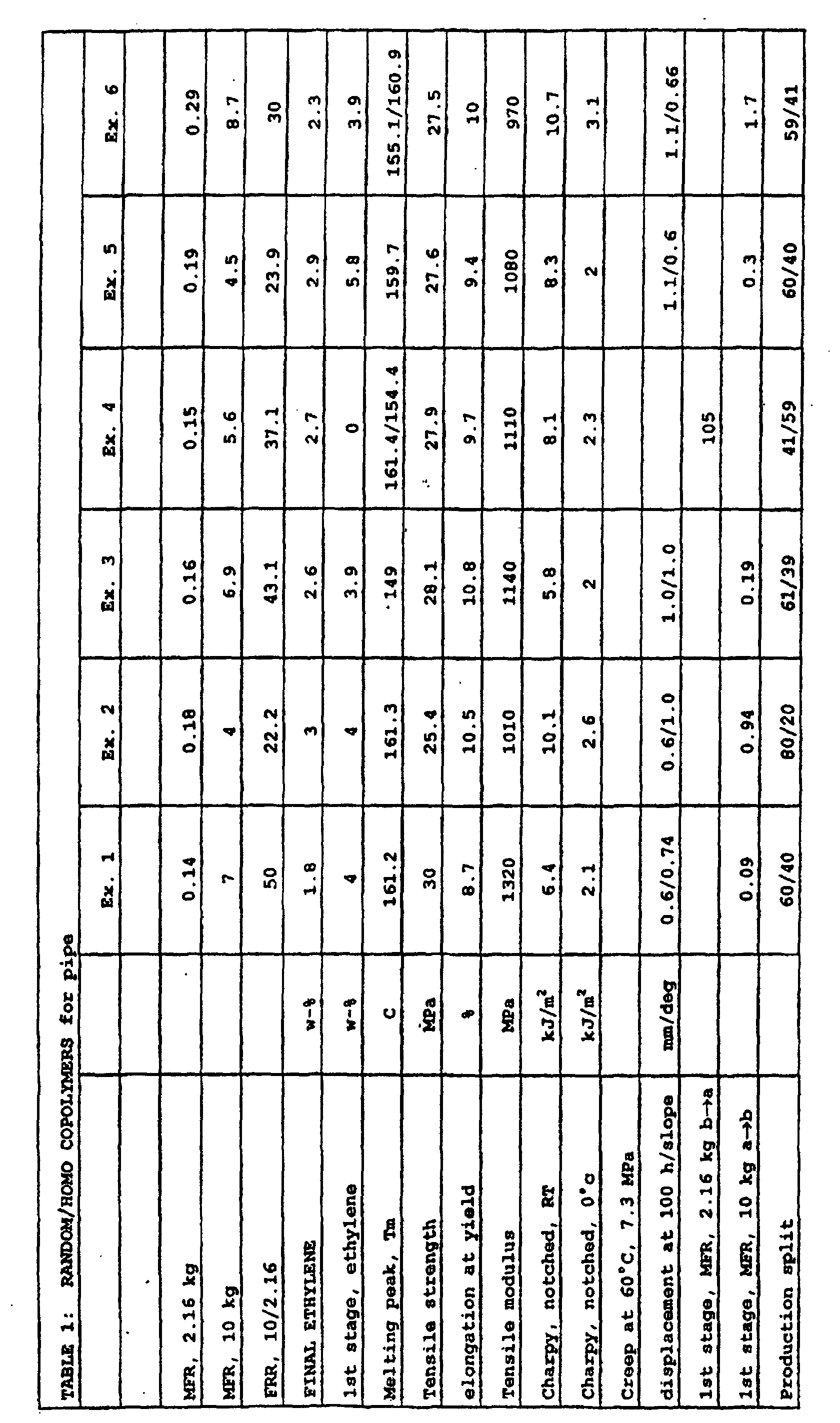
- first stage high MW propylene-ethylene random copolymer was produced, and the polymerisation was continued in the second stage (gas phase reactor) which produced low MW homo-PP.
- the polymerisation temperature used in both stages was 70°C.
- the production rate was 6 kg/h for the first stage and 4 kg/h for the second stage, which means a production split of 60/40.
- the MFRs of the first stage and final product were adjusted with separate hydrogen feeds.
- the polymer was polymerised as in Example 1, except that the production split was 80/20 and the MW of the random PP produced in the first stage was adjusted slightly lower with hydrogen feed. More detailed properties of the material produced in each stage are shown in Table 1.
- the polymer was polymerised as in Example 1, except that the production split was 61/39, and instead of homo-PP the second stage produced propylene-ethylene random copolymer containing 0.5 w-% ethylene. More detailed properties of the material produced in each stage are shown in Table 1.
- the polymer was polymerised as in Example 1, except that the first stage (loop reactor) produced low MW homo-PP and the second stage high MW propylene-ethylene random copolymer containing about 4 w-% ethylene.
- the production split was 41/59. More detailed properties of the material produced in each stage are shown in Table 1.
- the polymer was polymerised as in Example 1, except that the catalyst was prepared according to US Patent 4,784,983, included by reference, and the high MW random-PP produced in the first stage had higher ethylene content and slightly lower MW. More detailed properties of the material produced in each stage are shown in Table 1.
- the polymer was polymerised as in Example 1, except that the production split was 59/41, the MW of the random-PP produced in the first stage was adjusted slightly lower and that as external donor, cyclohexyl methyl dimethoxy silane was used. More detailed properties of the material produced in each stage are shown in Table 1.
- the polymers were polymerised as in Example 1. More detailed properties of the materials produced in each stage are shown in Table 2.
- the PP copolymer was produced in a pilot plant having a loop reactor and two fluid bed gas phase reactors connected in series.
- the catalyst, cocatalyst and donor were fed to the loop reactor.
- the reaction medium of loop was flashed away before the solid polymer containing the active catalyst entered the first gas phase.
- the prepolymerised MgC12-supported Ti catalyst (prepared according to US Patent 5,234,879, included by reference) was used in the polymerisation.
- Cocatalyst was triethyl aluminium (TEA) and external donor cyclohexyl methyl dimethoxy silane.
- first stage high MW propylene-ethylene random copolymer was produced.
- the polymerisation was continued in the second stage (gas phase reactor) which produced low MW homo-PP, and the third stage (gas phase) produced rubbery ethylene-propylene copolymer.
- the ethylene/propylene mole ratio in the third stage was 36/64.
- the production split of the stages in weight fractions was 63/12/25.
- the polymerisation temperature used in all stages was 70°C.
- the MFRs measured after the polymerisation stages were adjusted with separate hydrogen feeds.
- the polymer was polymerised as in Example 8a, except that the production split was 80/20/20. More detailed properties of the material produced in each stage are shown in Table 3.
- Multilayer pipes comprising 2 or 3 layers with a diameter of 110 mm and a pipe wall thickness of 10 mm were extruded using a conventional Cincinnati pipe extrusion line equipped with a multilayer tool.
- the running speed was 1.3 m/min and the melt temperature 210°C.
- the extruded pipes were conditioned at room temperature during 1 week before testing.
- the materials used for the pipes were the polymers prepared according to Examples 7a-c and 8a-b. More particularly, the polymers prepared in Examples 7a-c were blended at the weight ratio 1:1:1 and the resulting polymer blend is called PP2. Similarly, the polymers prepared in Examples 8a and 8b were blended at the weight ratio 1:1 and the resulting polymer blend is called PP1. Data for PP1 and PP2 are given in Table 4 and the multilayer pipe combinations are seen in Table 5. In Table 6, the measured RCP-critical temperature data and the pipe pressure test data are shown.
- thermoplastic pipes of polypropylene random copolymer for the conveyance of fluids should resist 16 MPa during 1 h at 20°C.
Landscapes
- Engineering & Computer Science (AREA)
- General Engineering & Computer Science (AREA)
- Mechanical Engineering (AREA)
- Rigid Pipes And Flexible Pipes (AREA)
- Laminated Bodies (AREA)
- Pipeline Systems (AREA)
- Addition Polymer Or Copolymer, Post-Treatments, Or Chemical Modifications (AREA)
Abstract
Description
- a temperature in step (c) of between 40 and 90°C,
- said catalyst system is added to step (a) and used in all the steps (a), (b) and (c),
- step (a) is performed in a loop (CSTR) reactor and steps (b) and (c) are performed in two separate gas phase reactors,
- the added comonomer portion is adjusted so that the proportion of ethylene repeating units after steps (a) and (b) is from 1 to 4% by weight and the proportion of ethylene repeating units after steps (a), (b) and (c) is from 5 to 15% by weight,
- in step (c) ethylene and propylene are copolymerised into an elastomer at a molar ratio ethylene/propylene of between 30/70 and 50/50.
| RANDOM/HOMO COPOLYMERS for pipe | ||||
| Ex. 7a | Ex. 7b | Ex. 7c | ||
| MFR, 2.16 kg | 0.13 | 0.14 | 0.16 | |
| MFR, 10 kg | 6.2 | 6.1 | 7.2 | |
| FRR, 10/2.16 | 47.7 | 43.6 | 45 | |
| FINAL ETHYLENE | w-% | 2 | 2 | 1.9 |
| 1st stage, ethylene | w-% | 4 | 4 | 4.1 |
| Melting peak, Tm | C | 160 | 157.8 | 160.2 |
| Tensile strength | MPa | 30.5 | 30.4 | 30.7 |
| elongation at yield | % | 9 | 9.1 | 8.8 |
| Tensile modulus | MPa | 1310 | 1300 | 1330 |
| Charpy, notched, RT | kJ/m2 | 6.4 | 6.8 | 6.3 |
| Charpy, notched, 0°c | kJ/m2 | 2.2 | 2.1 | 1.9 |
| Creep at 60°C, 7.3 MPa | ||||
| displacement at 100 h/slope | mm/deg | 0.80/0.60 | 0.75/0.64 | 0.6/0.7 |
| 1st stage, MFR, 2.16 kg b→a | ||||
| 1st stage, MFR, 10 kg a→b | 0.1 | 0.1 | 0.09 | |
| Production split | 60/40 | 60/40 | 60/40 |
| RANDOM/HOMO-BLOCK COPOLYMERS for pipe | |||
| Ex. 8a | Ex. 8b | ||
| MFR, 2.16 kg | g/10 | 0.14 | 0.28 |
| MFR, 10 kg | 3.7 | 7.9 | |
| FRR, 10/2.16 | 26.4 | 28.3 | |
| FINAL ETHYLENE | w-% | 6.8 | 9.1 |
| 2nd stage, ethylene | w-% | 1.7 | 1.8 |
| 1st stage, ethylene | w-% | 3.5 | 3.8 |
| Melting peak, Tm | °C | 154.6 | 150.5 |
| Tensile strength | MPa | 21.3 | 19 |
| elongation at yield | % | 9.2 | 10.1 |
| Tensile modulus | MPa | 860 | 760 |
| Charpy, notched, RT | kJ/m2 | 69 | 71 |
| Charpy, notched 0°C | kJ/m2 | 18.1 | 22 |
| Creep at 60°C, 7.3 MPa | |||
| displacement at 100 h/slope | mm/deg | 3.2/5.1 | - |
| Production split | 63/12/25 | 60/20/20 |
| Material | ||||
| PP1 | PPr-h-b | MFR2=0.13 | MFR10 = 6.0 | E-modulus = 800 MPa |
| PP2 | PPr-h | MFR2=0.13 | MFR10 = 6.0 | E-modulus = 1340 MPa |
| Multilayer pipe | Number of layers | Design (outer/inner layer, wall thickness distribution %) |
| A | 2 | PP1/PP2, 30/70 |
| B | 2 | PP1/PP2, 20/80 |
| C | 3 | PP1/PP2/PP1, 30/60/10 |
| D | 3 | PP1/PP2/PP1, 20/70/10 |
| Multilayer pipe | RCP, Tc °C | Pressure testing, 20°C (stress level, time to failure) | Fracture type |
| A | -7°C | 16.0 MPa >9100 h 19.5 MPa, 240 h | (Running) Ductile |
| B | -2°C | 16.0 MPa >9100 h 19.5 MPa, 212 h | (Running) Ductile |
| C | -5°C | 16.0 MPa >9120 h 19.5 MPa, 302 h | (Running) Ductile |
| D | 0°C | 16.0 MPa >9150 h 19.5 MPa, 251 h | (Running) Ductile |
Claims (9)
- A method of preparing a multilayer pipe of propylene plastic, characterised in that
a polypropylene A is obtained by polymerising propylene and ethylene or a C4-C10-α-olefin in the presence of a catalyst system, the procatalyst component of which is a reaction product of at least a tetravalent titanium compound and a magnesium halide compound and the cocatalyst component of which comprises an organoaluminium compound, optionally an external donor and hydrogen as a molecular weight regulating agent, to give a polypropylene containing from 1.0 to 10.0% by weight of ethylene or C4-C10-α-olefin repeating units and having an MFR2 value of between 0.05 and 0.40 g/10 min, wherein the process for the preparation of said polypropylene comprises the following steps in any mutual order:a polypropylene B is obtained by polymerising propylene and ethylene or a C4-C10-α-olefin in the presence of a catalyst system, the procatalyst component of which is a reaction product of at least a tetravalent titanium compound and a magnesium halide compound and the cocatalyst component of which comprises an organoaluminium compound, and hydrogen as a molecular weight regulating agent, as well as providing an elastomer component, to give an elastomer-modified polypropylene containing from 1.0 to 30% by weight of ethylene or C4-C10-α-olefin repeating units and having an MFR2 value of between 0.05 and 50 g/10 min, wherein the process for the preparation of said polypropylene B comprises the following steps:(a) copolymerising propylene and comonomer into a random copolymer at 40 to 110°C using: a catalyst system of the above-mentioned type; propylene; a portion of ethylene or C4-C10-α-olefin comonomer leading to 1.0 to 10.0% by weight of ethylene or C4-C10-α-olefin repeating units in said random copolymer; and no or a minimal amount of hydrogen leading to an MFR10 value of between 0.01 and 5.0 g/ 10 min for said random copolymer, if this step is performed first, or to an MFR2 value for said polypropylene of between 0.05 and 0.40 g/10 min, if this step is performed after step (b) ; the proportion of random polymer produced in this step being from 20 to 80% by weight of said polypropylene A,(b) polymerising propylene at 40 to 100°C using: a catalyst system of the above-mentioned type; propylene; no or a minimal portion of ethylene or C4-C10-α-olefin comonomer leading to 0.0 to 1.0% by weight of ethylene or C4-C10-α-olefin comonomer repeating units in the polymer produced in this step; and an amount of hydrogen leading to an MFR2 value of between 20 and 1000 g/10 min for said polymer, if this step is performed first, or to an MFR2 value for said polypropylene A of between 0.05 and 0.40 g/ 10 min, if this step is performed after step (a); the proportion of polymer produced in this step being from 80 to 20% by weight of said polypropylene A; andand that a multiplayer pipe of propylene plastic is prepared, wherein at least one of the layers of the pipe comprises a polypropylene, which is selected from polypropylene A and polypropylene B, whereby a multilayer pipe is obtained that has a resistance to rapid crack propagation expressed as the critical temperature of the pipe, which is equal to or lower than 0°C, the critical temperature for a pipe being the lowest temperature at which a crack initiated in the pipe propagates a distance in the pipe of at most 4 times the diameter of the pipe at a pressure difference between the inside and outside of the pipe of 0.5 MPa.(a) copolymerising propylene and comonomer into a random copolymer at 40 to 110°C using: a catalyst system of the above-mentioned type; propylene; a portion of ethylene or C4-C10-α-olefin comonomer leading to 1.0 to 10.0% by weight of ethylene or C4-C10-α-olefin repeating units in said random copolymer; and no or a minimal amount of hydrogen leading to an MFR10 value of between 0.01 and 5.0 g/ 10 min for said random copolymer, if this step is performed first, or to an MFR2 value for said polypropylene B of between 0.05 and 50 g/10 min, if this step is performed after step (b); the proportion of random copolymer produced in this step being from 20 to 80% by weight,(b) polymerising propylene at 40 to 110°C using: a catalyst system of the above-mentioned type; propylene; no or a minimal portion of ethylene or C4-C10-α-olefin comonomer leading to 0.0 to 1.0% by weight of ethylene or C4-C10-α-olefin comonomer repeating units in the polymer produced in this step; and an amount of hydrogen leading to an MFR2 value of between 20 and 1000 g/10 min for said polymer, if this step is performed first, or to an MFR2 value for said polypropylene B of between 0.05 and 50 g/10 min, if this step is performed after step (a); the proportion of the polymer produced in this step being from 80 to 20% by weight, and(c) providing a rubbery copolymer, the proportion of which is from 5 to 40% by weight of said polypropylene, to give said elastomer-modified polypropylene; - A method according to claim 1, wherein a multilayer pipe is prepared that has a critical temperature which is equal to or lower than -5°C.
- A method according to claim 1 or 2, wherein the order of steps for producing polypropylene A and B is (a)⇒(b).
- A method according to claim 3, wherein said catalyst system is added to step (a) and the same catalyst system is then used both in steps (a) and (b).
- A method according to any one of claims 1-4, wherein step (a) is performed in a loop reactor and step (b) is performed in a gas phase reactor, whereby any reaction medium used and any unreacted reagents are removed from the loop reactor between step (a) and step (b).
- A method according to any one of the preceding claims, wherein the proportion of copolymer resulting from step (a) and the MFR values of step (a) and step (b) are such that the FRR value of said polypropylene is between 10 and 100, preferably between 20 and 50.
- A method according to any one of the preceding claims, wherein in step (c), said elastomer is provided by copolymerising at least propylene and ethylene into an elastomer.
- A method according to any one of claims 1-7, wherein a pipe with two layers is prepared, the inner layer comprising polypropylene A, and the outer layer comprising polypropylene B.
- A method according to any one of claims 1-7, wherein a pipe with three layers is prepared, the intermediate layer comprising polypropylene A, while the inner and outer layers comprise polypropylene B.
Applications Claiming Priority (5)
| Application Number | Priority Date | Filing Date | Title |
|---|---|---|---|
| SE9600826 | 1996-03-04 | ||
| SE9600826A SE505937C2 (en) | 1996-03-04 | 1996-03-04 | Multilayer tube |
| FI961722A FI104828B (en) | 1996-04-19 | 1996-04-19 | New tubular polypropylene composition |
| FI961722 | 1996-04-19 | ||
| PCT/SE1997/000344 WO1997033117A1 (en) | 1996-03-04 | 1997-03-03 | Multilayer pipe |
Publications (2)
| Publication Number | Publication Date |
|---|---|
| EP0883769A1 EP0883769A1 (en) | 1998-12-16 |
| EP0883769B1 true EP0883769B1 (en) | 2003-05-02 |
Family
ID=26160152
Family Applications (1)
| Application Number | Title | Priority Date | Filing Date |
|---|---|---|---|
| EP97906405A Expired - Lifetime EP0883769B1 (en) | 1996-03-04 | 1997-03-03 | Method of preparing a multilayer pipe |
Country Status (6)
| Country | Link |
|---|---|
| US (1) | US6187402B1 (en) |
| EP (1) | EP0883769B1 (en) |
| AT (1) | ATE239185T1 (en) |
| AU (1) | AU2110597A (en) |
| DE (1) | DE69721504T2 (en) |
| WO (1) | WO1997033117A1 (en) |
Cited By (1)
| Publication number | Priority date | Publication date | Assignee | Title |
|---|---|---|---|---|
| DE202010011834U1 (en) * | 2010-08-26 | 2011-11-28 | Uponor Innovation Ab | Multilayer plastic pipe |
Families Citing this family (29)
| Publication number | Priority date | Publication date | Assignee | Title |
|---|---|---|---|---|
| DE19621022B4 (en) † | 1996-05-24 | 2014-12-31 | Basell Polyolefine Gmbh | High molecular weight ethylene / propylene reactor blend with broad molecular weight distribution |
| FI973816A0 (en) | 1997-09-26 | 1997-09-26 | Borealis As | Polypropen med Hoeg smaeltstyrka |
| IT1295925B1 (en) * | 1997-10-28 | 1999-05-28 | Montell North America Inc | POLYPROPYLENE COMPOSITIONS WITH HIGH CONTENT OF HEAVY MINERAL FILLERS, SUITABLE FOR THE COATING OF METAL PIPES |
| GB9908602D0 (en) * | 1999-04-15 | 1999-06-09 | Northumbria Lyonnaise Technolo | Rehabilitation of water supply pipes |
| DE29906998U1 (en) | 1999-04-20 | 1999-07-01 | Wavin B.V., Zwolle | Two-layer pipe |
| EP1201827A1 (en) * | 2000-10-23 | 2002-05-02 | Borealis Technology Oy | Pole for a road safety barrier |
| EP1260546A1 (en) * | 2001-05-21 | 2002-11-27 | Borealis Technology OY | Polyolefin multilayer pipe |
| EP1260528A1 (en) | 2001-05-21 | 2002-11-27 | Borealis Technology OY | Propylene polymer pipes for pipelines |
| EP1260545A1 (en) | 2001-05-21 | 2002-11-27 | Borealis Technology OY | Industrial polyolefin piping system |
| EP1260529A1 (en) | 2001-05-21 | 2002-11-27 | Borealis Technology OY | Propylene polymers with improved properties |
| EP1448704B1 (en) | 2001-10-30 | 2011-07-27 | Basell Poliolefine Italia S.r.l. | Pipe systems of polypropylene compositions |
| EP1312623A1 (en) | 2001-11-14 | 2003-05-21 | Borealis Technology Oy | Pressure pipes |
| BRPI0206560B1 (en) | 2001-11-27 | 2016-02-10 | Basell Poliolefine Spa | clear and flexible propylene polymer compositions |
| GB0324837D0 (en) * | 2003-10-24 | 2003-11-26 | Polypropylene Belgium Nv | Polypropylene pipe |
| RU2377461C2 (en) | 2004-06-25 | 2009-12-27 | Базелль Полиолефин Италия С.Р.Л. | Piping system manufactured from statistical copolymers of propylene and alpha-olefins |
| ES2331189T3 (en) * | 2005-05-20 | 2009-12-23 | Borealis Technology Oy | POLYPROPYLENE WITH AN IMPROVED PROCESSABILITY FOR THE MANUFACTURE OF PIPES. |
| ES2325405T5 (en) * | 2005-05-20 | 2013-04-23 | Borealis Technology Oy | High melt flow polymer, with improved durability, for tube applications |
| EP2042552A1 (en) * | 2007-09-27 | 2009-04-01 | Borealis Technology Oy | Polyolefin compositions having improved optical and mechanical properties |
| CN102159638B (en) * | 2008-10-01 | 2015-04-15 | 博里利斯股份公司 | New sewage pipe material with improved properties |
| US8217116B2 (en) * | 2009-07-15 | 2012-07-10 | Braskem America, Inc. | Polypropylene composition for buried structures |
| DE202010010668U1 (en) * | 2010-07-26 | 2011-11-16 | Rehau Ag + Co. | Hose line, in particular for sanitary applications, and hose arrangement |
| DE202010012463U1 (en) * | 2010-09-10 | 2011-12-12 | Rehau Ag + Co. | Plastic pipe fitting |
| BR112016026375B1 (en) | 2014-05-28 | 2021-07-06 | Basell Poliolefine Italia S.R.L. | polyolefin composition, sheets and pipe systems, and fitting for pipe systems |
| US10160849B1 (en) | 2014-10-01 | 2018-12-25 | Basell Poliolefine Italia S.R.L. | Propylene-based copolymer composition for pipes |
| CN113968413B (en) * | 2021-10-27 | 2023-03-10 | 雷诺丽特恒迅包装科技(北京)有限公司 | Milk storage bag and preparation method thereof |
| EP4636024A1 (en) | 2024-04-17 | 2025-10-22 | Basell Poliolefine Italia S.r.l. | Propylene-based copolymer composition for pipes |
| EP4636023A1 (en) | 2024-04-17 | 2025-10-22 | Basell Poliolefine Italia S.r.l. | Propylene-based copolymer composition for pipes |
| WO2025219023A1 (en) | 2024-04-17 | 2025-10-23 | Basell Poliolefine Italia S.R.L. | Propylene-based copolymer composition for pipes |
| DE102024113376A1 (en) | 2024-05-14 | 2025-11-20 | Bänninger Kunststoff-Produkte GmbH Reiskirchen | Plastic for the formation of a pipeline |
Family Cites Families (13)
| Publication number | Priority date | Publication date | Assignee | Title |
|---|---|---|---|---|
| US3737557A (en) * | 1972-06-27 | 1973-06-05 | British Insulated Callenders | Electric cables with ethylene-propylene insulation |
| CN1006071B (en) | 1985-04-01 | 1989-12-13 | 中国石油化工总公司 | Catalyst systems for olefin polymerization and copolymerization |
| BE1004303A3 (en) * | 1989-06-29 | 1992-10-27 | Jonaco Gmbh | Composite plastic tube. |
| JPH0348214A (en) | 1989-07-17 | 1991-03-01 | Hitachi Ltd | Optical path changeover switch |
| US5234879A (en) | 1990-12-19 | 1993-08-10 | Neste Oy | Method for the modification of catalysts intended for the polymerization of olefins |
| DE4202397C2 (en) * | 1992-01-29 | 1999-01-14 | Technoflow Fuel Systems Gmbh | Motor vehicle pipeline from a single-layer or a multi-layer extruded plastic pipe |
| DE4202399C1 (en) * | 1992-01-29 | 1993-02-04 | Technoform Caprano + Brunnhofer Kg, 3501 Fuldabrueck, De | |
| GB9313302D0 (en) | 1993-06-28 | 1993-08-11 | Robinson Dominic J | Liquid transfer system |
| DE9319879U1 (en) * | 1993-12-23 | 1994-03-17 | Ems-Inventa AG, Zürich | Sequentially co-extruded coolant line |
| EP0660024B1 (en) * | 1993-12-27 | 1997-10-22 | Sumitomo Chemical Company, Limited | Resin-coated pipe |
| GB9408767D0 (en) * | 1994-05-04 | 1994-06-22 | Hepworth Building Prod | Piping |
| GB2297137B (en) * | 1995-01-18 | 1999-02-03 | Uponor Ltd | Plastics pipe |
| FI104828B (en) * | 1996-04-19 | 2000-04-14 | Borealis As | New tubular polypropylene composition |
-
1997
- 1997-03-03 DE DE69721504T patent/DE69721504T2/en not_active Expired - Lifetime
- 1997-03-03 WO PCT/SE1997/000344 patent/WO1997033117A1/en not_active Ceased
- 1997-03-03 AU AU21105/97A patent/AU2110597A/en not_active Abandoned
- 1997-03-03 EP EP97906405A patent/EP0883769B1/en not_active Expired - Lifetime
- 1997-03-03 AT AT97906405T patent/ATE239185T1/en not_active IP Right Cessation
-
1998
- 1998-09-03 US US09/146,604 patent/US6187402B1/en not_active Expired - Fee Related
Cited By (1)
| Publication number | Priority date | Publication date | Assignee | Title |
|---|---|---|---|---|
| DE202010011834U1 (en) * | 2010-08-26 | 2011-11-28 | Uponor Innovation Ab | Multilayer plastic pipe |
Also Published As
| Publication number | Publication date |
|---|---|
| WO1997033117A1 (en) | 1997-09-12 |
| US6187402B1 (en) | 2001-02-13 |
| DE69721504D1 (en) | 2003-06-05 |
| AU2110597A (en) | 1997-09-22 |
| EP0883769A1 (en) | 1998-12-16 |
| DE69721504T2 (en) | 2003-11-27 |
| ATE239185T1 (en) | 2003-05-15 |
Similar Documents
| Publication | Publication Date | Title |
|---|---|---|
| US6187402B1 (en) | Multilayer pipe | |
| EP0894103B1 (en) | Process for the preparation of creep-resistant polypropylene block copolymers | |
| KR100540274B1 (en) | Polymer composition for pipe | |
| CA2669416C (en) | Multimodal polyethylene resin for pipe made by a single-site catalyst | |
| KR101184393B1 (en) | A pressureless polymer pipe, a composition therefore, and a process for preparing it | |
| EP1448704B1 (en) | Pipe systems of polypropylene compositions | |
| EP2539398B1 (en) | Random propylene copolymers for pipes | |
| EP0785954B1 (en) | New polypropylene composition with broad mwd | |
| EP2550324B1 (en) | Heterophasic polypropylene with excellent creep performance | |
| EP1724289B2 (en) | High melt flow polymer of improved durability for pipe applications | |
| CA2670047C (en) | Pipe having improved high temperature resistance | |
| EP2550325B1 (en) | Stiff and tough polypropylene compound | |
| AU2002363165A1 (en) | Pipe systems of polypropylene compositions | |
| CN101175810B (en) | Polypropylene with improved processability for the manufacture of pipes | |
| CN100551962C (en) | Pressureless polymer tubing | |
| EP1687373B1 (en) | Polypropylene pipe |
Legal Events
| Date | Code | Title | Description |
|---|---|---|---|
| PUAI | Public reference made under article 153(3) epc to a published international application that has entered the european phase |
Free format text: ORIGINAL CODE: 0009012 |
|
| 17P | Request for examination filed |
Effective date: 19980825 |
|
| AK | Designated contracting states |
Kind code of ref document: A1 Designated state(s): AT BE CH DE DK ES FI FR GB GR IE IT LI NL PT SE |
|
| 17Q | First examination report despatched |
Effective date: 20010813 |
|
| GRAH | Despatch of communication of intention to grant a patent |
Free format text: ORIGINAL CODE: EPIDOS IGRA |
|
| RTI1 | Title (correction) |
Free format text: METHOD OF PREPARING A MULTILAYER PIPE |
|
| GRAH | Despatch of communication of intention to grant a patent |
Free format text: ORIGINAL CODE: EPIDOS IGRA |
|
| GRAA | (expected) grant |
Free format text: ORIGINAL CODE: 0009210 |
|
| AK | Designated contracting states |
Designated state(s): AT BE CH DE DK ES FI FR GB GR IE IT LI NL PT SE |
|
| PG25 | Lapsed in a contracting state [announced via postgrant information from national office to epo] |
Ref country code: NL Free format text: LAPSE BECAUSE OF FAILURE TO SUBMIT A TRANSLATION OF THE DESCRIPTION OR TO PAY THE FEE WITHIN THE PRESCRIBED TIME-LIMIT Effective date: 20030502 Ref country code: LI Free format text: LAPSE BECAUSE OF FAILURE TO SUBMIT A TRANSLATION OF THE DESCRIPTION OR TO PAY THE FEE WITHIN THE PRESCRIBED TIME-LIMIT Effective date: 20030502 Ref country code: FI Free format text: LAPSE BECAUSE OF FAILURE TO SUBMIT A TRANSLATION OF THE DESCRIPTION OR TO PAY THE FEE WITHIN THE PRESCRIBED TIME-LIMIT Effective date: 20030502 Ref country code: CH Free format text: LAPSE BECAUSE OF FAILURE TO SUBMIT A TRANSLATION OF THE DESCRIPTION OR TO PAY THE FEE WITHIN THE PRESCRIBED TIME-LIMIT Effective date: 20030502 Ref country code: BE Free format text: LAPSE BECAUSE OF FAILURE TO SUBMIT A TRANSLATION OF THE DESCRIPTION OR TO PAY THE FEE WITHIN THE PRESCRIBED TIME-LIMIT Effective date: 20030502 Ref country code: AT Free format text: LAPSE BECAUSE OF FAILURE TO SUBMIT A TRANSLATION OF THE DESCRIPTION OR TO PAY THE FEE WITHIN THE PRESCRIBED TIME-LIMIT Effective date: 20030502 |
|
| REG | Reference to a national code |
Ref country code: GB Ref legal event code: FG4D |
|
| REG | Reference to a national code |
Ref country code: CH Ref legal event code: EP |
|
| REF | Corresponds to: |
Ref document number: 69721504 Country of ref document: DE Date of ref document: 20030605 Kind code of ref document: P |
|
| REG | Reference to a national code |
Ref country code: IE Ref legal event code: FG4D |
|
| PG25 | Lapsed in a contracting state [announced via postgrant information from national office to epo] |
Ref country code: SE Free format text: LAPSE BECAUSE OF FAILURE TO SUBMIT A TRANSLATION OF THE DESCRIPTION OR TO PAY THE FEE WITHIN THE PRESCRIBED TIME-LIMIT Effective date: 20030802 Ref country code: GR Free format text: LAPSE BECAUSE OF FAILURE TO SUBMIT A TRANSLATION OF THE DESCRIPTION OR TO PAY THE FEE WITHIN THE PRESCRIBED TIME-LIMIT Effective date: 20030802 Ref country code: DK Free format text: LAPSE BECAUSE OF FAILURE TO SUBMIT A TRANSLATION OF THE DESCRIPTION OR TO PAY THE FEE WITHIN THE PRESCRIBED TIME-LIMIT Effective date: 20030802 |
|
| PG25 | Lapsed in a contracting state [announced via postgrant information from national office to epo] |
Ref country code: PT Free format text: LAPSE BECAUSE OF FAILURE TO SUBMIT A TRANSLATION OF THE DESCRIPTION OR TO PAY THE FEE WITHIN THE PRESCRIBED TIME-LIMIT Effective date: 20030804 |
|
| PG25 | Lapsed in a contracting state [announced via postgrant information from national office to epo] |
Ref country code: ES Free format text: LAPSE BECAUSE OF FAILURE TO SUBMIT A TRANSLATION OF THE DESCRIPTION OR TO PAY THE FEE WITHIN THE PRESCRIBED TIME-LIMIT Effective date: 20030813 |
|
| NLV1 | Nl: lapsed or annulled due to failure to fulfill the requirements of art. 29p and 29m of the patents act | ||
| REG | Reference to a national code |
Ref country code: CH Ref legal event code: PL |
|
| ET | Fr: translation filed | ||
| PG25 | Lapsed in a contracting state [announced via postgrant information from national office to epo] |
Ref country code: IE Free format text: LAPSE BECAUSE OF NON-PAYMENT OF DUE FEES Effective date: 20040303 |
|
| PLBE | No opposition filed within time limit |
Free format text: ORIGINAL CODE: 0009261 |
|
| STAA | Information on the status of an ep patent application or granted ep patent |
Free format text: STATUS: NO OPPOSITION FILED WITHIN TIME LIMIT |
|
| 26N | No opposition filed |
Effective date: 20040203 |
|
| REG | Reference to a national code |
Ref country code: IE Ref legal event code: MM4A |
|
| REG | Reference to a national code |
Ref country code: GB Ref legal event code: 732E Free format text: REGISTERED BETWEEN 20110127 AND 20110202 |
|
| REG | Reference to a national code |
Ref country code: FR Ref legal event code: TP |
|
| REG | Reference to a national code |
Ref country code: DE Ref legal event code: R081 Ref document number: 69721504 Country of ref document: DE Owner name: BOREALIS TECHNOLOGY OY, FI Free format text: FORMER OWNER: BOREALIS A/S, LYNGBY, DK Effective date: 20110429 |
|
| PGFP | Annual fee paid to national office [announced via postgrant information from national office to epo] |
Ref country code: DE Payment date: 20140328 Year of fee payment: 18 |
|
| PGFP | Annual fee paid to national office [announced via postgrant information from national office to epo] |
Ref country code: IT Payment date: 20140325 Year of fee payment: 18 Ref country code: FR Payment date: 20140319 Year of fee payment: 18 |
|
| PGFP | Annual fee paid to national office [announced via postgrant information from national office to epo] |
Ref country code: GB Payment date: 20140319 Year of fee payment: 18 |
|
| REG | Reference to a national code |
Ref country code: DE Ref legal event code: R119 Ref document number: 69721504 Country of ref document: DE |
|
| GBPC | Gb: european patent ceased through non-payment of renewal fee |
Effective date: 20150303 |
|
| PG25 | Lapsed in a contracting state [announced via postgrant information from national office to epo] |
Ref country code: IT Free format text: LAPSE BECAUSE OF NON-PAYMENT OF DUE FEES Effective date: 20150303 |
|
| REG | Reference to a national code |
Ref country code: FR Ref legal event code: ST Effective date: 20151130 |
|
| PG25 | Lapsed in a contracting state [announced via postgrant information from national office to epo] |
Ref country code: DE Free format text: LAPSE BECAUSE OF NON-PAYMENT OF DUE FEES Effective date: 20151001 Ref country code: GB Free format text: LAPSE BECAUSE OF NON-PAYMENT OF DUE FEES Effective date: 20150303 |
|
| PG25 | Lapsed in a contracting state [announced via postgrant information from national office to epo] |
Ref country code: FR Free format text: LAPSE BECAUSE OF NON-PAYMENT OF DUE FEES Effective date: 20150331 |