EP0883342B1 - A composition and a method for the promotion of plant production and/or for the elimination of the unfavourable environmental influences in plant cultivation - Google Patents
A composition and a method for the promotion of plant production and/or for the elimination of the unfavourable environmental influences in plant cultivation Download PDFInfo
- Publication number
- EP0883342B1 EP0883342B1 EP96942538A EP96942538A EP0883342B1 EP 0883342 B1 EP0883342 B1 EP 0883342B1 EP 96942538 A EP96942538 A EP 96942538A EP 96942538 A EP96942538 A EP 96942538A EP 0883342 B1 EP0883342 B1 EP 0883342B1
- Authority
- EP
- European Patent Office
- Prior art keywords
- group
- formula
- atom
- plant
- addition salt
- Prior art date
- Legal status (The legal status is an assumption and is not a legal conclusion. Google has not performed a legal analysis and makes no representation as to the accuracy of the status listed.)
- Expired - Lifetime
Links
Classifications
-
- A—HUMAN NECESSITIES
- A01—AGRICULTURE; FORESTRY; ANIMAL HUSBANDRY; HUNTING; TRAPPING; FISHING
- A01N—PRESERVATION OF BODIES OF HUMANS OR ANIMALS OR PLANTS OR PARTS THEREOF; BIOCIDES, e.g. AS DISINFECTANTS, AS PESTICIDES OR AS HERBICIDES; PEST REPELLANTS OR ATTRACTANTS; PLANT GROWTH REGULATORS
- A01N43/00—Biocides, pest repellants or attractants, or plant growth regulators containing heterocyclic compounds
- A01N43/34—Biocides, pest repellants or attractants, or plant growth regulators containing heterocyclic compounds having rings with one nitrogen atom as the only ring hetero atom
- A01N43/40—Biocides, pest repellants or attractants, or plant growth regulators containing heterocyclic compounds having rings with one nitrogen atom as the only ring hetero atom six-membered rings
-
- A—HUMAN NECESSITIES
- A01—AGRICULTURE; FORESTRY; ANIMAL HUSBANDRY; HUNTING; TRAPPING; FISHING
- A01N—PRESERVATION OF BODIES OF HUMANS OR ANIMALS OR PLANTS OR PARTS THEREOF; BIOCIDES, e.g. AS DISINFECTANTS, AS PESTICIDES OR AS HERBICIDES; PEST REPELLANTS OR ATTRACTANTS; PLANT GROWTH REGULATORS
- A01N37/00—Biocides, pest repellants or attractants, or plant growth regulators containing organic compounds containing a carbon atom having three bonds to hetero atoms with at the most two bonds to halogen, e.g. carboxylic acids
- A01N37/18—Biocides, pest repellants or attractants, or plant growth regulators containing organic compounds containing a carbon atom having three bonds to hetero atoms with at the most two bonds to halogen, e.g. carboxylic acids containing the group —CO—N<, e.g. carboxylic acid amides or imides; Thio analogues thereof
- A01N37/28—Biocides, pest repellants or attractants, or plant growth regulators containing organic compounds containing a carbon atom having three bonds to hetero atoms with at the most two bonds to halogen, e.g. carboxylic acids containing the group —CO—N<, e.g. carboxylic acid amides or imides; Thio analogues thereof containing the group; Thio analogues thereof
-
- A—HUMAN NECESSITIES
- A01—AGRICULTURE; FORESTRY; ANIMAL HUSBANDRY; HUNTING; TRAPPING; FISHING
- A01N—PRESERVATION OF BODIES OF HUMANS OR ANIMALS OR PLANTS OR PARTS THEREOF; BIOCIDES, e.g. AS DISINFECTANTS, AS PESTICIDES OR AS HERBICIDES; PEST REPELLANTS OR ATTRACTANTS; PLANT GROWTH REGULATORS
- A01N37/00—Biocides, pest repellants or attractants, or plant growth regulators containing organic compounds containing a carbon atom having three bonds to hetero atoms with at the most two bonds to halogen, e.g. carboxylic acids
- A01N37/52—Biocides, pest repellants or attractants, or plant growth regulators containing organic compounds containing a carbon atom having three bonds to hetero atoms with at the most two bonds to halogen, e.g. carboxylic acids containing groups, e.g. carboxylic acid amidines
-
- A—HUMAN NECESSITIES
- A01—AGRICULTURE; FORESTRY; ANIMAL HUSBANDRY; HUNTING; TRAPPING; FISHING
- A01N—PRESERVATION OF BODIES OF HUMANS OR ANIMALS OR PLANTS OR PARTS THEREOF; BIOCIDES, e.g. AS DISINFECTANTS, AS PESTICIDES OR AS HERBICIDES; PEST REPELLANTS OR ATTRACTANTS; PLANT GROWTH REGULATORS
- A01N43/00—Biocides, pest repellants or attractants, or plant growth regulators containing heterocyclic compounds
- A01N43/72—Biocides, pest repellants or attractants, or plant growth regulators containing heterocyclic compounds having rings with nitrogen atoms and oxygen or sulfur atoms as ring hetero atoms
- A01N43/88—Biocides, pest repellants or attractants, or plant growth regulators containing heterocyclic compounds having rings with nitrogen atoms and oxygen or sulfur atoms as ring hetero atoms six-membered rings with three ring hetero atoms
Definitions
- the invention refers to the use of a composition and a method for the promotion of plant production and/or for the elimination of the unfavourable environmental influences in plant cultivation.
- the invention refers to the use of a composition comprising a hydroximic acid derivative of the formula wherein
- hydroximic acid derivatives of the formula I are known.
- EP No. 417 210 also describes hydroximic acid halides within the formula I having a selective beta-blocking effect, thus, being suitable for the treatment of diabetic angiopathy.
- Plants have a very important role from the point of view of the life on the earth. They are nutrient source for the animal world including man, and they have a considerable part in the preparation of oxygen that is essential for the life.
- the plants are especially sensitive to these sudden unfavourable changes in the germinating state since their natural defensive ability i.e. a certain buffering ability have not developed yet to a sufficient extent.
- such substances should have general properties that promote the maintenance or regeneration of the biological integrity of plant cell membranes. Furthermore, such substances should be able to induce the defensive mechanisms of plant cells, thus, avoiding the irreversible damage of the chromosome set or the mitochondrial genome of the cell.
- plants are able to tolerate the low water concentration of the cells for a longer time, then also lands having a restricted water supply could be cultivated.
- germinating seeds could be made resistant to low temperature or they could tolerate cooling down to a temperature below freezing point for a limited time, then certain domesticated plants could be sowed sooner, on the one part, and the crop land there of could be shifted to northern areas, on the other. In both cases a considerable economical benefit can be expected.
- composition of the invention comprising a hydroximic acid derivative of the formula I or a physiologically acceptable acid addition salt thereof as the active ingredient.
- composition used according to the invention comprises a hydroximic acid derivative of the formula I or a physiologically acceptable acid addition salt thereof as the active ingredient in admixture with one or more conventional solid or liquid carrier(s) of compositions used in plant protection.
- a C 1-5 alkyl group is, for example, a methyl, ethyl, n-propyl, isopropyl, n-butyl or n-pentyl group, peferably a methyl or an ethyl group.
- a C 3-8 cycloalkyl group is, for example, a cyclopropyl, cyclopentyl, cyclohexyl, cycloheptyl or cyclooctyl group, preferably a cyclopentyl or a cyclohexyl group.
- a 5 to 8 membered ring containing one or more heteroatom(s) can be, for example, a pyrrole, pyrazole, imidazole, oxazole, thiazole, pyridine, pyridazine, pyrimidine, piperazine, morpholine, indole, quinoline etc. ring.
- a C 1-24 alkoxy group is, for example, a methoxy, ethoxy, n-propoxy, tert.-butoxy, n-pentoxy, decyloxy, dodecyloxy, octadecyloxy etc. group.
- a C 1-25 alkanoyl group is, for example, a formyl, acetyl, propionyl, butiryl, caproyl, palmityl, stearyl etc. group.
- a C 3-9 alkenoyl group is, for example, an acryloyl, pentenoyl, hexenoyl, heptenoyl, octenoyl etc. group.
- a C 1-4 alkylene group is, for example, a methylene, ethylene, propylene or butylene group.
- a halo atom is, for example, a fluoro, chloro, bromo or iodo atom, preferably a chloro or a bromo atom.
- Y stands for a group of the formula R 7 -COO-, it can represent, for example, a linolenoyl, linoloyl, docosahexanoyl, eicosapentanoyl, arachidonoyl etc. group.
- physiologically acceptable acid addition salts of the compounds of the formula I are the acid addition salts formed with physiologically acceptable inorganic acids such as hydrochloric acid, sulfuric acid etc. or with physiologically acceptable organic acids such as acetic acid, fumaric acid, lactic acid etc.
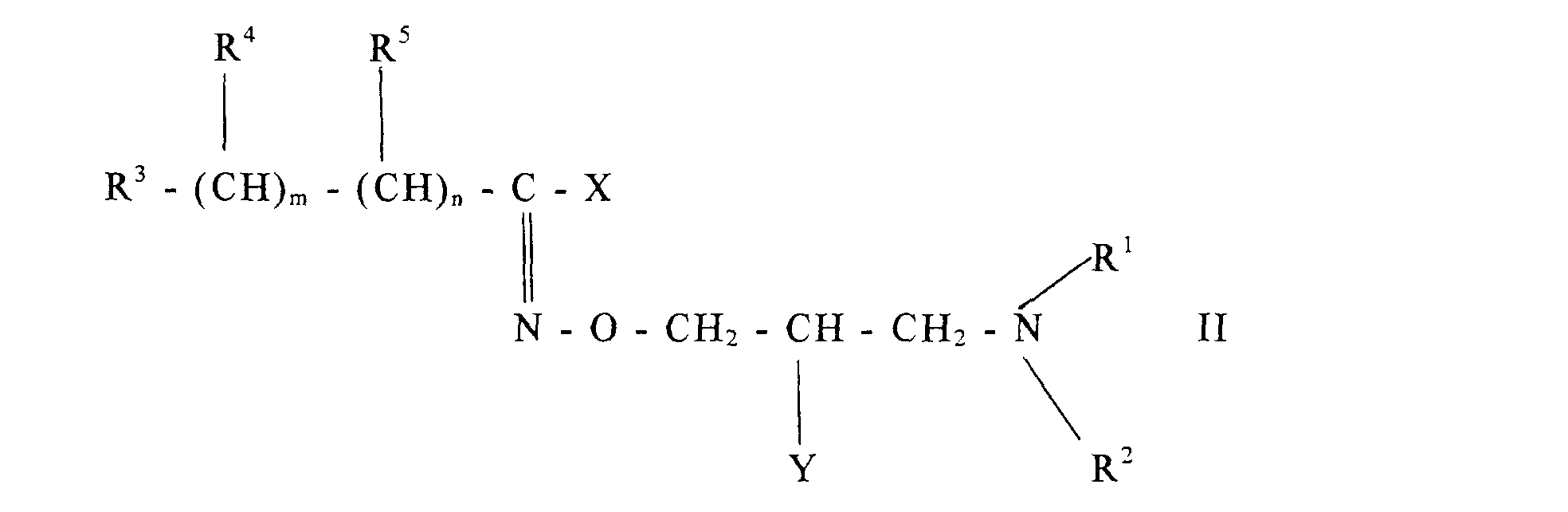
- a preferred subgroup of the compounds of the formula I consists of the hydroximic acid derivatives of the formula wherein R 1 , R 2 , R 3 , R 4 , R 5 , m and n are as stated in relation to formula I, X represents a halo atom or an amino group, Y means a hydroxy group, with the proviso that Y is other than hydroxy when X is an amino group.
- Especially preferred compounds of the formula II are those wherein R 1 and R 2 together with the nitrogen atom they are attached to form a piperidino group, R 3 stands for a pyridyl group, m and n have a value of 0, X is as defined above.
- preferred species are as follows: N-/2-hydroxy-3-(piperidinyl)propoxy/-3-pyridinecarboximidoyl chloride.
- a further preferred subgroup of the hydroximic acid derivatives of the formula I consists of the compounds of the formula wherein R 1 , R 2 , R 3 and A are as stated in relation to formula I.
- hydroximic acid derivatives of the formula I consists of the compound of the formula wherein R 1 , R 2 , R 3 and A are as stated in relation to formula I, Z represents an oxygen or a nitrogen atom.
- a still further preferred subgroup of the hydroximic acid derivatives of the formula I consists of the compounds of the formula wherein R 1 , R 2 , R 3 and A are as stated in relation to formula I, R 6 stands for a C 1-4 alkyl group.
- the compounds of the formula I can be prepared by the processes known from HU-P Nos. 177 578 and 207 988 as well as from HU-P Application published under No. T/66350.
- composition used according to the invention contains 0.01 to 95 % by weight, preferably 0.1 to 20 % by weight of a hydroximic acid derivative of the formula I or a physiologically acceptable acid addition salt thereof as the active ingredient in admixture with one or more conventional solid or liquid carrier(s) of compositions used in plant protection.
- composition used according to the invention can be solid or liquid, thus a powder mixture, solution, suspension, emulsion etc.
- any type of the compositions employed in plant protection may contain the active ingredient of the formula I.
- the carrier can be a solvent such as water, ethylene glycol, propylene glycol, glycerol, poly(ethylene glycol), vegetable oil, mineral oil etc.; a surface active agent such as an ionic or nonionic emulgator; a conventional agent used in cultivation for amelioriation work such as powdered limestone, powdered dolomite, perlite grist, fertilizer, mineral salt, microelement, plant protective agent such as fungicide etc.
- a solvent such as water, ethylene glycol, propylene glycol, glycerol, poly(ethylene glycol), vegetable oil, mineral oil etc.
- a surface active agent such as an ionic or nonionic emulgator
- a conventional agent used in cultivation for amelioriation work such as powdered limestone, powdered dolomite, perlite grist, fertilizer, mineral salt, microelement, plant protective agent such as fungicide etc.
- the composition used according to the invention is diluted with water before use, and in general the solution, suspension or emulsion containing 0.0001 to 1.0 % by weight of the compound of the formula I is employed for the treatment or leaf or root thereof is contacted with the compound of the formula I or a physiologically acceptable acid addition salt thereof and a solution, suspension or emulsion containing said compound, respectively.
- the seed of the plant to be cultivated can be treated with a seed-dressing composition comprising a compound of the formula I, or a seedling of the plant can be sprayed with a solution, suspension or emulsion comprising a compound of the formula I.
- the plant cultivated or the leaves thereof can be contacted through spraying with a solution, suspension or emulsion of a compound of the formula I, or the soil around the roots can be sprinkled with said solution, suspension or emulsion.
- a further possibility of treatment consists of adding a concentrated or diluted form of the composition of the invention to the spray used during the conventional plant protection work to obtain a final spray containing the compound of the formula I in the required concentration. In this way, the treatment of the invention is performed together with the conventional plant protection treatment.
- a further embodiment of the invention consists of a method for the promotion of plant production and/or for the elimination of the unfavourable environmental influences in plant cultivation.
- the plant to be cultivated or a seed or seedling or leaf or root thereof is treated with an effective non-toxic amount of a hydroximic acid derivative of the formula I or a physiologically acceptable acid addition salt thereof.
- the plant to be cultivated or a seed or seedling or leaf or root thereof is treated with a composition comprising 0.0001 to 1.0 % by weight of a compound of the formula I or a physiologically acceptable acid addition salt thereof in admixture with one or more conventional solid or liquid carrier(s) of compositions used in plant protection.
- unfavourable environmental influences for example nutrient deficiency, stress, the presence of heavy metal salts in the soil, and/or too cold or too warm environment etc. are meant. If seeds treated with a compound of the formula I are used for the cultivation, the plants are treated once or several times with a solution, suspension or emulsion of a compound of the formula I, the growth of the plants resist to the unfavourable environmental influences.
- composition and method of the invention can be preferably used in the cultivation of plants such as maize, bean, muscat melon, sunflower, tomato, capsicum, white mustard, poppy, amaranth, pigeon-berry, apricot, peach etc.
- the surface of the maize seeeds was treated with the aqueous solutions of the active ingredients.
- concentration of the solutions used were: 1 g/l; 0.1 g/l; 0.01 g/l; and 0.001 g/l.
- the seeds were placed onto a filter paper and let to germinate by adding the required amount of water at a uniform ratio. Then the seeds, germinated or not, were implanted into normal mould placed in plastic flacons. 20 ml of tap water were added to each flacon day by day. 14 to 15 days after the treatment of the seeds the plastic flacons were placed into a freezer (Zanussi, 50 litres) and left there for the indicated time at -17 °C. Then the flacons were removed, the freezer was left to cool down to -17 °C, and further plastic flacons were placed into it taking care that always the same mass of flacons should be placed in.
- the germination ratio of maize seeds was equivalent to nearly 100 %, thus it is not indicated in detail.
- composition of the invention is indeed suitable for the promotion of plant production and for the elimination of the unfavourable environmental influences in plant cultivation.
Landscapes
- Life Sciences & Earth Sciences (AREA)
- Wood Science & Technology (AREA)
- Plant Pathology (AREA)
- Health & Medical Sciences (AREA)
- Engineering & Computer Science (AREA)
- Dentistry (AREA)
- General Health & Medical Sciences (AREA)
- Agronomy & Crop Science (AREA)
- Pest Control & Pesticides (AREA)
- Zoology (AREA)
- Environmental Sciences (AREA)
- Agricultural Chemicals And Associated Chemicals (AREA)
- Breeding Of Plants And Reproduction By Means Of Culturing (AREA)
- Hydroponics (AREA)
- Pyridine Compounds (AREA)
- Cultivation Of Plants (AREA)
- Pharmaceuticals Containing Other Organic And Inorganic Compounds (AREA)
- Pretreatment Of Seeds And Plants (AREA)
- Fertilizers (AREA)
Abstract
Description

- R1
- represents a hydrogen atom or a C1-5 alkyl group,
- R2
- stands for a hydrogen atom, a C1-5 alkyl group, a C3-8 cycloalkyl group or a phenyl group optionally substituted by a hydroxy or a phenyl group, or
- R1 and R2
- together with the nitrogen atom they are attached to form a 5 to 8 membered ring optionally containing on or more further nitrogen, oxygen or sulfur atom(s) and said ring can be condensed with another alicyclic or heterocyclic ring, preferably a benzene, naphthalene, quinoline, isoquinoline, pyridine or pyrazoline ring, furthermore, if desired and chemically possible, the nitrogen and/or sulfur heteroatom(s) are present in the form of an oxide or dioxide,
- R3
- means a hydrogen atom, a phenyl group, a naphthyl group or a pyridyl group wherein said groups can be substituted by one or more halo atom(s) or C1-4 alkoxy group(s),
- Y
- is a hydrogen atom, a hydroxy group, a C1-24 alkoxy group optionally substituted by an amino group, a C2-24 polyalkenyloxy group containing 1 to 6 double bond(s), a C1-25 alkanoyl group, a C3-9 alkenoyl group or a group of the formula R7-COO- wherein R7 represents a C2-30 polyalkenyl group containing 1 to 6 double bond(s),
- X
- stands for a halo atom, an amino group, a C1-4 alkoxy group, or
- X
- forms with B an oxygen atom, or
- X and Y
- together withv the carbon atoms they are attached to and the
-NR-O-CH2 - group being between said carbon atoms form a
ring of the formula

- Z
- represents an oxygen atom or a nitrogen atom,
- R
- stands for a hydrogen atom or
- R
- forms with B a chemical bond,
- A
- is a C1-4 alkylene group or a chemical bond or a group of the
formula
wherein

- R4
- represents a hydrogen atom, a C1-5 alkyl group, a C3-8 cycloalkyl group or a phenyl group optionally substituted by a halo atom, a C1-4 alkoxy group or a C1-5 alkyl group,
- R5
- stands for a hydrogen atom, a C1-4 alkyl group or a phenyl group,
- m
- has a value of 0, 1 or 2
- n
- has a value of 0, 1 or 2,
or a physiologically acceptable acid addition salt thereof as the active ingredient.

N-/2-hydroxy-3-(piperidinyl)propoxy/-3-pyridinecarboximidoyl chloride.


compound "A":
N-/2-hydroxy-3 -(piperidinyl)propoxy/-3 -pyridinecarboximidoyl chloride malate.
| Treatment at -17 °C for 10 minutes | |||
| Seed group | Number of treated damaged seeds | Survival in% | |
| control | 11 | 9 | 18.18 |
| test | 10 | 4 | 60.00 |
| Treatment at -17 °C for 15 minutes | |||
| Seed group | Number of treated damaged seeds | Survival in % | |
| control | 10 | 7 | 30.00 |
| test | 11 | 1 | 90.91 |
| Treatment at -17 °C for 20 minutes | |||
| Seed group | Number of treated damaged seeds | Survival in % | |
| control | 10 | 8 | 20.00 |
| test | 10 | 1 | 90.00 |
| Conc. of compound "A" in g/l | Number of plants | Survival in % | ||
| unharmed | damaged | total | ||
| 1.0 | 24 | 5 | 29 | 82.70 |
| 0.1 | 22 | 7 | 29 | 75.80 |
| 0.01 | 20 | 7 | 27 | 74.10 |
| 0.001 | 22 | 5 | 27 | 81.50 |
| Height of maize treated with compound "A" after 11 days | |||||
| Height (in cm) of plants treated with compound "A" in | Control | ||||
| 1.0 | 0.1 | 0.01 | 0.001 | ||
| g/l solution | |||||
| 26 | 62 | 56 | 140 | 1 | |
| 64 | 23 | 30 | 119 | 3 | |
| 46 | 73 | 50 | 105 | 2 | |
| 109 | 22 | 54 | 76 | 1 | |
| 62 | 64 | 22 | 76 | 3 | |
| 50 | 60 | 40 | 80 | 4 | |
| 40 | 61 | 36 | 107 | 2 | |
| 79 | 82 | 10 | 33 | 1 | |
| 61 | 31 | 22 | 114 | 1 | |
| 58 | 34 | 77 | 166 | 3 | |
| 66 | 41 | 40 | 30 | 3 | |
| 58 | 88 | 56 | 53 | 1 | |
| 52 | 67 | 88 | 39 | 3 | |
| 42 | 67 | 66 | 42 | 2 | |
| 75 | 54 | 40 | 15 | 1 | |
| 48 | 67 | 27 | 42 | 1 | |
| 42 | 29 | 33 | 9 | 1 | |
| 33 | 33 | 43 | 76 | 3 | |
| 69 | 42 | 18 | 36 | 1 | |
| 67 | 40 | 58 | 17 | 1 | |
| 56 | 58 | 54 | 72 | 2 | |
| 54 | 28 | 52 | 43 | 2 | |
| 65 | 12 | - | 47 | 1 | |
| 30 | 63 | - | 67 | 2 | |
| 33 | 57 | - | 82 | 2 | |
| 10 | 50 | - | 16 | 1 | |
| - | - | - | 11 | 2 | |
| - | - | - | - | 1 | |
| - | - | - | - | 1 | |
| Number of plants | 26 | 26 | 22 | 27 | 29 |
| Average height | 53.7 | 50.3 | 44.2 | 63.4 | 1.8 |
| Height of maize treated with compound "A" after 14 days | |||||
| Height (in cm) of plants treated with compound "A" in | Control | ||||
| 1.0 | 0.1 | 0.01 | 0.001 | ||
| g/l solution | |||||
| 147 | 110 | 156 | 140 | 45 | |
| 172 | 130 | 72 | 119 | 12 | |
| 190 | 28 | 85 | 105 | 18 | |
| 75 | 78 | 155 | 76 | 22 | |
| 109 | 109 | 153 | 76 | 37 | |
| 77 | 101 | 18 | 80 | 16 | |
| 47 | 63 | 28 | 107 | 29 | |
| 108 | 146 | 64 | 33 | 24 | |
| 84 | 152 | 90 | 114 | 35 | |
| 74 | 156 | 93 | 166 | 16 | |
| 109 | 54 | 69 | 30 | 49 | |
| 142 | 159 | 34 | 53 | 18 | |
| 8 | 175 | 50 | 39 | 23 | |
| 6 | 97 | 83 | 42 | 36 | |
| 18 | 111 | 106 | 15 | 25 | |
| 160 | 145 | 85 | 42 | 14 | |
| 221 | 163 | 135 | 9 | 38 | |
| 97 | 70 | 141 | 76 | 43 | |
| 129 | 146 | 111 | 36 | 11 | |
| 75 | 38 | 176 | 17 | 39 | |
| 125 | 108 | 173 | 72 | 28 | |
| 102 | 24 | 120 | 43 | 12 | |
| 187 | 139 | 168 | 47 | 44 | |
| 141 | 168 | 101 | 67 | 53 | |
| 155 | 153 | 43 | 82 | 17 | |
| 150 | 135 | 98 | 16 | 10 | |
| 146 | 204 | 70 | 11 | 39 | |
| 110 | 112 | - | - | 41 | |
| 75 | 124 | - | - | 32 | |
| Number of plants | 29 | 29 | 27 | 27 | 29 |
| Average height | 111.7 | 117.2 | 99.1 | 63.4 | 28.5 |
Claims (12)
- Use of a composition for the protection of plant cells against the detrimental effects of the environment comprising a hydroximic acid derivative of the formulawherein

- R1
- represents a hydrogen atom or a C1-5 alkyl group,
- R2
- stands for a hydrogen atom, a C1-5 alkyl group, a C3-8 cycloalkyl group or a phenyl group optionally substituted by a hydroxy or a phenyl group, or
- R1 and R2
- together with the nitrogen atom they are
attached to form a 5 to 8 membered ring optionally
containing one or more further nitrogen, oxygen or
sulfur atom(s) and said ring can be condensed with
another alicyclic or heterocyclic ring, preferably a
benzene, naphthalene, quinoline, isoquinoline, pyridine or
pyrazoline ring, furthermore, if desired and chemically
possible, the nitrogen and/or sulfur heteroatom(s) are present in
the form of an oxide or
dioxide, - R3
- means a hydrogen atom, a phenyl group, a naphthyl group or a pyridyl group wherein said groups can be substituted by one or more halo atom(s) or C1-4 alkoxy group(s),
- Y
- means a hydrogen atom, a hydroxy group, a C1-24 alkoxy group optionally substituted by an amino group, a C2-24 polyalkenyloxy group containing 1 to 6 double bond(s), a C1-25 alkanoyl group, a C3-9 alkenoyl group or a group of the formula R7-COO- wherein R7 represents a C2-30 polyalkenyl group containing 1 to 6 double bond(s),
- X
- stands for a halo atom, an amino group, a C1-4 alkoxy group, or
- X
- forms with B an oxygen atom, or
- X and Y
- together with the carbon atoms they are attached
to and the -NR-O-CH2- group being between said
carbon atoms form a ring of the formula
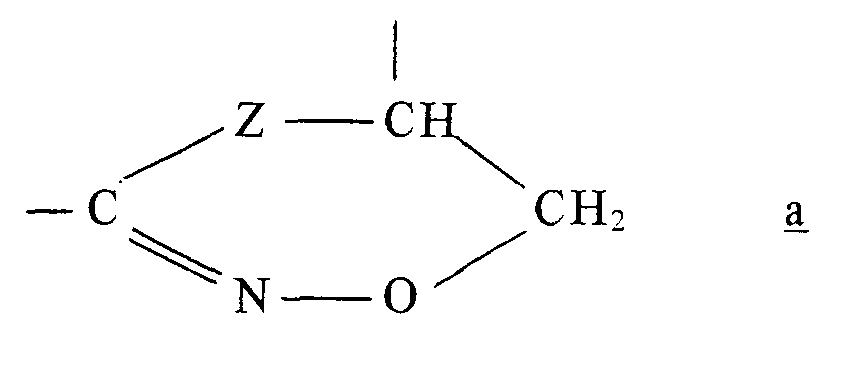
whereinZ represents an oxygen atom or a nitrogen atom,R stands for a hydrogen atom orR forms with B a chemical bond,A is a C1-4 alkylene group or a chemical bond or group of the formula or an acid addition salt thereof in admixture with one or more conventional solid or liquid carrier(s) of compositions used in plant protection.R4 represents a hydrogen atom, a C1-5 alkyl group, a C3-8 cycloalkyl group or a phenyl group optionally substituted by a halo atom, a C1-4 alkoxy group or a C1-5 alkyl group,R5 stands for a hydrogen atom, a C1-4 alkyl group or a phenyl group,m has a value of 0, 1 or 2,n has a value of 0, 1 or 2, with the proviso that Y is other than hydroxy when X is an amino group,
 - A use according to Claim 1 comprising a compound of the formulawherein R1, R2. R3. R4, R5, m and n are as stated in Claim 1, X represents a halo atom or an amino group, Y stands for a hydroxy group, or an acid addition salt thereof.
- A use according to Claim 1 comprising a compound of the formulawherein R1, R2, R3 and A are as defined in Claim 1, or an acid addition salt thereof.

- A use according to Claim 1 comprising a compound of the formulawherein R1, R2, R3 and A are as stated in Claim 1, Z represents an oxygen or a nitrogen atom, or an acid addition salt thereof.

- A use according to Claim 1 comprising a compound of the formulawherein R1, R2, R3 and A are as defined in Claim 1, R6 represents a C1-4 alkyl group, or an acid addition salt thereof.

- A use according to Claim 1 or 2 comprising a compound of the formula II, wherein R1 and R2 together with the nitrogen atom they are attached to form a piperidino group, m and n have the value of 0, X and Y are as stated in Claim 2, or an acid addition salt thereof.
- A use according to Claim 1, 2 or 6 comprising N-/2-hydroxy-3-(1-piperidinyl)propoxy/-3-pyridine-carboximidoyl chloride or an acid addition salt thereof.
- A use according to Claims 1 to 7 comprising 0.01 to 95 % by mass of the hydroximic acid derivative of Claim 1.
- A use according to Claims 1 to 8 comprising the protection of plant cells during the growth period or in germinating state against low water concentration for a longer time or against low temperature below freezing point for a restricted time or providing resistance against acidic, mutagenic or radiating agents.
- A method for the promotion of plant production and/or for the elimination of the unfavourable environmental influences in plant cultivation in which the plant to be cultivated or a seed or seedling or leaf or root thereof is treated with an effective non-toxic amount of a hydroximic acid derivative of the formula I, wherein R, R1, R2, R3, X, Y and B are as defined in Claim 1, or an acid addition salt thereof.
- A method of Claim 10 in which the plant to be cultivated or a seed or seedling or leaf or root thereof is treated with a composition comprising 0.0001 to 1.0 % by mass of a hydroximic acid derivative of the formula I, wherein R, R1, R2, R3, X, Y and B are as defined in Claim 1, or an acid addition salt thereof as the active ingredient in admixture with one or more conventional solid or liquid carrier(s) of compositions used in plant protection.
- A method of Claim 10 or 11 in which the hydroximic acid derivative is N-/2-hydroxy-3-(piperidinyl)propoxy/-3-pyridinecarboximidoyl chloride or an acid addition salt thereof.
Applications Claiming Priority (3)
| Application Number | Priority Date | Filing Date | Title |
|---|---|---|---|
| HU9503727A HUT78138A (en) | 1995-12-22 | 1995-12-22 | Composition for improvement of cultivation of plants comprising hydroximic acid derivative and use thereof |
| HU9503727 | 1995-12-22 | ||
| PCT/HU1996/000080 WO1997023132A1 (en) | 1995-12-22 | 1996-12-20 | A composition and a method for the promotion of plant production and/or for the elimination of the unfavourable environmental influences in plant cultivation |
Publications (2)
| Publication Number | Publication Date |
|---|---|
| EP0883342A1 EP0883342A1 (en) | 1998-12-16 |
| EP0883342B1 true EP0883342B1 (en) | 2001-10-10 |
Family
ID=10987503
Family Applications (1)
| Application Number | Title | Priority Date | Filing Date |
|---|---|---|---|
| EP96942538A Expired - Lifetime EP0883342B1 (en) | 1995-12-22 | 1996-12-20 | A composition and a method for the promotion of plant production and/or for the elimination of the unfavourable environmental influences in plant cultivation |
Country Status (15)
| Country | Link |
|---|---|
| US (1) | US6268309B1 (en) |
| EP (1) | EP0883342B1 (en) |
| JP (1) | JP2001510438A (en) |
| AT (1) | ATE206584T1 (en) |
| AU (1) | AU731878B2 (en) |
| CA (1) | CA2240710A1 (en) |
| DE (1) | DE69615869T2 (en) |
| DK (1) | DK0883342T3 (en) |
| ES (1) | ES2165533T3 (en) |
| HU (1) | HUT78138A (en) |
| IL (1) | IL124983A0 (en) |
| PT (1) | PT883342E (en) |
| RU (1) | RU2180481C2 (en) |
| UA (1) | UA52638C2 (en) |
| WO (1) | WO1997023132A1 (en) |
Families Citing this family (3)
| Publication number | Priority date | Publication date | Assignee | Title |
|---|---|---|---|---|
| HUP9702365A3 (en) * | 1997-04-22 | 1999-09-28 | Biorex Kutato Fejlesztoe Kft | Application of hydroxilamin-derivatives, as well as process and composition for increase of weather extreme resistent by cultivated plants |
| HUP9900475D0 (en) * | 1999-02-26 | 1999-04-28 | Biorex Kutato Fejlesztoe Kft | O-(3-piperidino-2-hydroxy-1-propyl)-hiyroximic acid-halogenid derivative, it's use for treating insulin resistance, and pharmaceutical compositions containing them as active component |
| US8308075B2 (en) | 2005-04-19 | 2012-11-13 | Kamterter Products, Llc | Systems for the control and use of fluids and particles |
Family Cites Families (6)
| Publication number | Priority date | Publication date | Assignee | Title |
|---|---|---|---|---|
| JPS519807B1 (en) * | 1971-03-31 | 1976-03-30 | ||
| DE2338010A1 (en) * | 1972-07-27 | 1974-02-14 | Ciba Geigy Ag | METHODS FOR REGULATING THE GROWTH AND DEVELOPMENT OF PLANTS |
| CH621043A5 (en) * | 1976-02-09 | 1981-01-15 | Ciba Geigy Ag | Process for protecting plants against frost damage, and composition for carrying out this process. |
| US4308399A (en) * | 1977-08-30 | 1981-12-29 | Chinoin Gyogyszer Es Vegyeszeti Termekek Gyara Rt. | O-(3-Amino-2-hydroxy-propyl)-amidoxime derivatives, process for the preparation thereof and pharmaceutical compositions containing same |
| HU207988B (en) * | 1988-10-20 | 1993-07-28 | Biorex Kutato Fejlesztoe Kft | Process for producing halogenides of o-/3-amino-2-hydroxy-propyl/hydroximic acid and pharmaceutical compositions containing them as active components |
| HUT54347A (en) * | 1989-01-10 | 1991-02-28 | Chinoin Gyogyszer Es Vegyeszet | Improved process for producing amidoximes |
-
1995
- 1995-12-22 HU HU9503727A patent/HUT78138A/en unknown
-
1996
- 1996-12-20 PT PT96942538T patent/PT883342E/en unknown
- 1996-12-20 UA UA98073916A patent/UA52638C2/en unknown
- 1996-12-20 EP EP96942538A patent/EP0883342B1/en not_active Expired - Lifetime
- 1996-12-20 JP JP52344397A patent/JP2001510438A/en active Pending
- 1996-12-20 RU RU98113779/04A patent/RU2180481C2/en active
- 1996-12-20 AT AT96942538T patent/ATE206584T1/en not_active IP Right Cessation
- 1996-12-20 AU AU11672/97A patent/AU731878B2/en not_active Ceased
- 1996-12-20 DE DE69615869T patent/DE69615869T2/en not_active Expired - Fee Related
- 1996-12-20 DK DK96942538T patent/DK0883342T3/en active
- 1996-12-20 ES ES96942538T patent/ES2165533T3/en not_active Expired - Lifetime
- 1996-12-20 IL IL12498396A patent/IL124983A0/en unknown
- 1996-12-20 CA CA002240710A patent/CA2240710A1/en not_active Abandoned
- 1996-12-20 WO PCT/HU1996/000080 patent/WO1997023132A1/en not_active Ceased
-
1999
- 1999-12-13 US US09/460,310 patent/US6268309B1/en not_active Expired - Fee Related
Also Published As
| Publication number | Publication date |
|---|---|
| HU9503727D0 (en) | 1996-02-28 |
| US6268309B1 (en) | 2001-07-31 |
| EP0883342A1 (en) | 1998-12-16 |
| AU731878B2 (en) | 2001-04-05 |
| CA2240710A1 (en) | 1997-07-03 |
| RU2180481C2 (en) | 2002-03-20 |
| ES2165533T3 (en) | 2002-03-16 |
| ATE206584T1 (en) | 2001-10-15 |
| PT883342E (en) | 2002-04-29 |
| IL124983A0 (en) | 1999-01-26 |
| DE69615869D1 (en) | 2001-11-15 |
| DK0883342T3 (en) | 2002-02-04 |
| HUT78138A (en) | 2000-09-28 |
| WO1997023132A1 (en) | 1997-07-03 |
| DE69615869T2 (en) | 2002-04-11 |
| AU1167297A (en) | 1997-07-17 |
| JP2001510438A (en) | 2001-07-31 |
| UA52638C2 (en) | 2003-01-15 |
Similar Documents
| Publication | Publication Date | Title |
|---|---|---|
| SU743561A3 (en) | Microbicidic and plant-growth regulating agent | |
| KR20000071013A (en) | Compositions for safening rice against acetochlor | |
| US4802905A (en) | Method for protecting plants and plant matter from stress | |
| SU1338783A3 (en) | Method of producing derivatives of diphenyl ester | |
| JPH09506369A (en) | A new method for protecting plants from fungal infections | |
| US6455468B1 (en) | Seed treatment composition | |
| CN101263821B (en) | Sterilizing composition | |
| US6268309B1 (en) | Use of a composition and a method for the promotion of plant production and/or for the elimination of the unfavorable influences in plant cultivation | |
| ES2201786T3 (en) | FUNGICIDE COMPOSITIONS FOR USE IN AGRICULTURE AND HORTICULTURE. | |
| US4207091A (en) | Method of preventing plants from damage by frost | |
| CN103314955B (en) | Water emulsion composition containing SYP-Z048 bactericide | |
| JPS6328404B2 (en) | ||
| CN110278953B (en) | Herbicide composition containing pyriftalid and pyraclonil and application thereof | |
| US4929267A (en) | Plant growth promotion | |
| WO1987000006A1 (en) | Plant microbiocidal compound and method | |
| CS268195B2 (en) | Plant growth regulator | |
| WO2001070019A2 (en) | Method of protecting plants from cold injury | |
| AU7070398A (en) | Use of hydroxylamine derivatives, and method and preparations for increasing the tolerance of field crops against weather stresses | |
| JPS6034902A (en) | Herbicidal composition | |
| US20230157292A1 (en) | Seed coating formula for controlling soybean southern blight and soybean sheath blight | |
| JPS6350321B2 (en) | ||
| US3689677A (en) | Method for controlling stripe smut | |
| JPS6218521B2 (en) | ||
| JPS63225305A (en) | Agricultural germicidal and plant growth regulating composition | |
| JPH03115205A (en) | Herbicide composition |
Legal Events
| Date | Code | Title | Description |
|---|---|---|---|
| PUAI | Public reference made under article 153(3) epc to a published international application that has entered the european phase |
Free format text: ORIGINAL CODE: 0009012 |
|
| 17P | Request for examination filed |
Effective date: 19980710 |
|
| AK | Designated contracting states |
Kind code of ref document: A1 Designated state(s): AT BE CH DE DK ES FI FR GB GR IE IT LI LU MC NL PT SE |
|
| RAP1 | Party data changed (applicant data changed or rights of an application transferred) |
Owner name: MEDGENE LIMITED |
|
| RAP1 | Party data changed (applicant data changed or rights of an application transferred) |
Owner name: BIOREX KUTATO ES FEJLESZTOE RT. |
|
| GRAG | Despatch of communication of intention to grant |
Free format text: ORIGINAL CODE: EPIDOS AGRA |
|
| 17Q | First examination report despatched |
Effective date: 20001129 |
|
| GRAG | Despatch of communication of intention to grant |
Free format text: ORIGINAL CODE: EPIDOS AGRA |
|
| GRAH | Despatch of communication of intention to grant a patent |
Free format text: ORIGINAL CODE: EPIDOS IGRA |
|
| GRAH | Despatch of communication of intention to grant a patent |
Free format text: ORIGINAL CODE: EPIDOS IGRA |
|
| RIN1 | Information on inventor provided before grant (corrected) |
Inventor name: KALMAN, MIKLOS Inventor name: LITERATI NAGY, PETER |
|
| GRAA | (expected) grant |
Free format text: ORIGINAL CODE: 0009210 |
|
| AK | Designated contracting states |
Kind code of ref document: B1 Designated state(s): AT BE CH DE DK ES FI FR GB GR IE IT LI LU MC NL PT SE |
|
| REF | Corresponds to: |
Ref document number: 206584 Country of ref document: AT Date of ref document: 20011015 Kind code of ref document: T |
|
| REG | Reference to a national code |
Ref country code: CH Ref legal event code: EP |
|
| REG | Reference to a national code |
Ref country code: IE Ref legal event code: FG4D |
|
| REF | Corresponds to: |
Ref document number: 69615869 Country of ref document: DE Date of ref document: 20011115 |
|
| PGFP | Annual fee paid to national office [announced via postgrant information from national office to epo] |
Ref country code: MC Payment date: 20011210 Year of fee payment: 6 |
|
| PGFP | Annual fee paid to national office [announced via postgrant information from national office to epo] |
Ref country code: GR Payment date: 20011212 Year of fee payment: 6 |
|
| PGFP | Annual fee paid to national office [announced via postgrant information from national office to epo] |
Ref country code: GB Payment date: 20011213 Year of fee payment: 6 Ref country code: ES Payment date: 20011213 Year of fee payment: 6 |
|
| PGFP | Annual fee paid to national office [announced via postgrant information from national office to epo] |
Ref country code: FR Payment date: 20011220 Year of fee payment: 6 Ref country code: FI Payment date: 20011220 Year of fee payment: 6 |
|
| PGFP | Annual fee paid to national office [announced via postgrant information from national office to epo] |
Ref country code: SE Payment date: 20011221 Year of fee payment: 6 |
|
| PGFP | Annual fee paid to national office [announced via postgrant information from national office to epo] |
Ref country code: NL Payment date: 20011227 Year of fee payment: 6 Ref country code: DK Payment date: 20011227 Year of fee payment: 6 Ref country code: DE Payment date: 20011227 Year of fee payment: 6 Ref country code: AT Payment date: 20011227 Year of fee payment: 6 |
|
| REG | Reference to a national code |
Ref country code: CH Ref legal event code: NV Representative=s name: ISLER & PEDRAZZINI AG |
|
| PGFP | Annual fee paid to national office [announced via postgrant information from national office to epo] |
Ref country code: IE Payment date: 20020101 Year of fee payment: 6 |
|
| REG | Reference to a national code |
Ref country code: GB Ref legal event code: IF02 |
|
| PGFP | Annual fee paid to national office [announced via postgrant information from national office to epo] |
Ref country code: LU Payment date: 20020103 Year of fee payment: 6 |
|
| PGFP | Annual fee paid to national office [announced via postgrant information from national office to epo] |
Ref country code: CH Payment date: 20020110 Year of fee payment: 6 |
|
| PGFP | Annual fee paid to national office [announced via postgrant information from national office to epo] |
Ref country code: PT Payment date: 20020111 Year of fee payment: 6 Ref country code: BE Payment date: 20020111 Year of fee payment: 6 |
|
| REG | Reference to a national code |
Ref country code: DK Ref legal event code: T3 |
|
| ET | Fr: translation filed | ||
| REG | Reference to a national code |
Ref country code: ES Ref legal event code: FG2A Ref document number: 2165533 Country of ref document: ES Kind code of ref document: T3 |
|
| REG | Reference to a national code |
Ref country code: PT Ref legal event code: SC4A Free format text: AVAILABILITY OF NATIONAL TRANSLATION Effective date: 20020110 |
|
| REG | Reference to a national code |
Ref country code: GR Ref legal event code: EP Ref document number: 20020400111 Country of ref document: GR |
|
| PLBE | No opposition filed within time limit |
Free format text: ORIGINAL CODE: 0009261 |
|
| STAA | Information on the status of an ep patent application or granted ep patent |
Free format text: STATUS: NO OPPOSITION FILED WITHIN TIME LIMIT |
|
| 26N | No opposition filed | ||
| PG25 | Lapsed in a contracting state [announced via postgrant information from national office to epo] |
Ref country code: LU Free format text: LAPSE BECAUSE OF NON-PAYMENT OF DUE FEES Effective date: 20021220 Ref country code: IE Free format text: LAPSE BECAUSE OF NON-PAYMENT OF DUE FEES Effective date: 20021220 Ref country code: GB Free format text: LAPSE BECAUSE OF NON-PAYMENT OF DUE FEES Effective date: 20021220 Ref country code: FI Free format text: LAPSE BECAUSE OF NON-PAYMENT OF DUE FEES Effective date: 20021220 Ref country code: AT Free format text: LAPSE BECAUSE OF NON-PAYMENT OF DUE FEES Effective date: 20021220 |
|
| PG25 | Lapsed in a contracting state [announced via postgrant information from national office to epo] |
Ref country code: SE Free format text: LAPSE BECAUSE OF NON-PAYMENT OF DUE FEES Effective date: 20021221 Ref country code: ES Free format text: LAPSE BECAUSE OF NON-PAYMENT OF DUE FEES Effective date: 20021221 |
|
| PG25 | Lapsed in a contracting state [announced via postgrant information from national office to epo] |
Ref country code: LI Free format text: LAPSE BECAUSE OF NON-PAYMENT OF DUE FEES Effective date: 20021231 Ref country code: CH Free format text: LAPSE BECAUSE OF NON-PAYMENT OF DUE FEES Effective date: 20021231 Ref country code: BE Free format text: LAPSE BECAUSE OF NON-PAYMENT OF DUE FEES Effective date: 20021231 |
|
| PG25 | Lapsed in a contracting state [announced via postgrant information from national office to epo] |
Ref country code: DK Free format text: LAPSE BECAUSE OF NON-PAYMENT OF DUE FEES Effective date: 20030131 |
|
| BERE | Be: lapsed |
Owner name: *BIOREX KUTATO ES FEJLESZTO RT. Effective date: 20021231 |
|
| PG25 | Lapsed in a contracting state [announced via postgrant information from national office to epo] |
Ref country code: PT Free format text: LAPSE BECAUSE OF NON-PAYMENT OF DUE FEES Effective date: 20030630 |
|
| PG25 | Lapsed in a contracting state [announced via postgrant information from national office to epo] |
Ref country code: NL Free format text: LAPSE BECAUSE OF NON-PAYMENT OF DUE FEES Effective date: 20030701 Ref country code: MC Free format text: LAPSE BECAUSE OF NON-PAYMENT OF DUE FEES Effective date: 20030701 Ref country code: DE Free format text: LAPSE BECAUSE OF NON-PAYMENT OF DUE FEES Effective date: 20030701 |
|
| PG25 | Lapsed in a contracting state [announced via postgrant information from national office to epo] |
Ref country code: GR Free format text: LAPSE BECAUSE OF NON-PAYMENT OF DUE FEES Effective date: 20030707 |
|
| EUG | Se: european patent has lapsed | ||
| REG | Reference to a national code |
Ref country code: DK Ref legal event code: EBP |
|
| GBPC | Gb: european patent ceased through non-payment of renewal fee |
Effective date: 20021220 |
|
| REG | Reference to a national code |
Ref country code: CH Ref legal event code: PL |
|
| NLV4 | Nl: lapsed or anulled due to non-payment of the annual fee |
Effective date: 20030701 |
|
| PG25 | Lapsed in a contracting state [announced via postgrant information from national office to epo] |
Ref country code: FR Free format text: LAPSE BECAUSE OF NON-PAYMENT OF DUE FEES Effective date: 20030901 |
|
| REG | Reference to a national code |
Ref country code: PT Ref legal event code: MM4A Free format text: LAPSE DUE TO NON-PAYMENT OF FEES Effective date: 20030630 |
|
| REG | Reference to a national code |
Ref country code: IE Ref legal event code: MM4A |
|
| REG | Reference to a national code |
Ref country code: FR Ref legal event code: ST |
|
| REG | Reference to a national code |
Ref country code: ES Ref legal event code: FD2A Effective date: 20021221 |
|
| PG25 | Lapsed in a contracting state [announced via postgrant information from national office to epo] |
Ref country code: IT Free format text: LAPSE BECAUSE OF NON-PAYMENT OF DUE FEES Effective date: 20051220 |