EP0882724B1 - Cyclic phenol sulfide containing sulfinyl or sulfonyl group and process for preparing the same - Google Patents
Cyclic phenol sulfide containing sulfinyl or sulfonyl group and process for preparing the same Download PDFInfo
- Publication number
- EP0882724B1 EP0882724B1 EP97934752A EP97934752A EP0882724B1 EP 0882724 B1 EP0882724 B1 EP 0882724B1 EP 97934752 A EP97934752 A EP 97934752A EP 97934752 A EP97934752 A EP 97934752A EP 0882724 B1 EP0882724 B1 EP 0882724B1
- Authority
- EP
- European Patent Office
- Prior art keywords
- group
- hydrocarbon group
- cyclic phenol
- phenol sulfide
- sulfinyl
- Prior art date
- Legal status (The legal status is an assumption and is not a legal conclusion. Google has not performed a legal analysis and makes no representation as to the accuracy of the status listed.)
- Expired - Lifetime
Links
- LJKQIQSBHFNMDV-UHFFFAOYSA-N 7-thiabicyclo[4.1.0]hepta-2,4-dien-6-ol Chemical compound C1=CC=CC2(O)C1S2 LJKQIQSBHFNMDV-UHFFFAOYSA-N 0.000 title claims abstract description 58
- 125000004122 cyclic group Chemical group 0.000 title claims abstract description 40
- 125000000475 sulfinyl group Chemical group [*:2]S([*:1])=O 0.000 title claims abstract description 21
- 125000000472 sulfonyl group Chemical group *S(*)(=O)=O 0.000 title claims abstract description 20
- 238000004519 manufacturing process Methods 0.000 title description 5
- 125000004435 hydrogen atom Chemical group [H]* 0.000 claims abstract description 32
- 125000002252 acyl group Chemical group 0.000 claims abstract description 14
- 150000008282 halocarbons Chemical group 0.000 claims abstract description 11
- 125000005843 halogen group Chemical group 0.000 claims abstract description 11
- 125000000449 nitro group Chemical group [O-][N+](*)=O 0.000 claims abstract description 11
- 229910052717 sulfur Inorganic materials 0.000 claims abstract description 5
- 150000002430 hydrocarbons Chemical group 0.000 claims description 38
- 238000000034 method Methods 0.000 claims description 29
- 239000007800 oxidant agent Substances 0.000 claims description 24
- MHAJPDPJQMAIIY-UHFFFAOYSA-N Hydrogen peroxide Chemical group OO MHAJPDPJQMAIIY-UHFFFAOYSA-N 0.000 claims description 16
- 150000001875 compounds Chemical class 0.000 claims description 9
- 229910052736 halogen Inorganic materials 0.000 claims description 9
- 150000002367 halogens Chemical class 0.000 claims description 9
- 229910052809 inorganic oxide Inorganic materials 0.000 claims description 8
- 230000001590 oxidative effect Effects 0.000 claims description 6
- GRYLNZFGIOXLOG-UHFFFAOYSA-N Nitric acid Chemical compound O[N+]([O-])=O GRYLNZFGIOXLOG-UHFFFAOYSA-N 0.000 claims description 5
- GDTBXPJZTBHREO-UHFFFAOYSA-N bromine Substances BrBr GDTBXPJZTBHREO-UHFFFAOYSA-N 0.000 claims description 5
- 229910052794 bromium Inorganic materials 0.000 claims description 5
- 229910052811 halogen oxide Inorganic materials 0.000 claims description 5
- 229910017604 nitric acid Inorganic materials 0.000 claims description 5
- 150000004965 peroxy acids Chemical class 0.000 claims description 5
- CBENFWSGALASAD-UHFFFAOYSA-N Ozone Chemical compound [O-][O+]=O CBENFWSGALASAD-UHFFFAOYSA-N 0.000 claims description 4
- 150000001451 organic peroxides Chemical class 0.000 claims description 4
- QVGXLLKOCUKJST-UHFFFAOYSA-N atomic oxygen Chemical compound [O] QVGXLLKOCUKJST-UHFFFAOYSA-N 0.000 claims description 3
- 229910052760 oxygen Inorganic materials 0.000 claims description 3
- 239000001301 oxygen Substances 0.000 claims description 3
- 229960001922 sodium perborate Drugs 0.000 claims description 3
- YKLJGMBLPUQQOI-UHFFFAOYSA-M sodium;oxidooxy(oxo)borane Chemical group [Na+].[O-]OB=O YKLJGMBLPUQQOI-UHFFFAOYSA-M 0.000 claims description 3
- 125000001246 bromo group Chemical group Br* 0.000 claims 1
- 125000001183 hydrocarbyl group Chemical group 0.000 abstract 3
- -1 aryl disulfide Chemical compound 0.000 description 102
- HEDRZPFGACZZDS-UHFFFAOYSA-N Chloroform Chemical compound ClC(Cl)Cl HEDRZPFGACZZDS-UHFFFAOYSA-N 0.000 description 54
- YMWUJEATGCHHMB-UHFFFAOYSA-N Dichloromethane Chemical compound ClCCl YMWUJEATGCHHMB-UHFFFAOYSA-N 0.000 description 33
- OKKJLVBELUTLKV-UHFFFAOYSA-N Methanol Chemical compound OC OKKJLVBELUTLKV-UHFFFAOYSA-N 0.000 description 30
- 239000002904 solvent Substances 0.000 description 22
- XLYOFNOQVPJJNP-UHFFFAOYSA-N water Substances O XLYOFNOQVPJJNP-UHFFFAOYSA-N 0.000 description 18
- QTBSBXVTEAMEQO-UHFFFAOYSA-N Acetic acid Chemical compound CC(O)=O QTBSBXVTEAMEQO-UHFFFAOYSA-N 0.000 description 17
- 239000007795 chemical reaction product Substances 0.000 description 16
- 125000000999 tert-butyl group Chemical group [H]C([H])([H])C(*)(C([H])([H])[H])C([H])([H])[H] 0.000 description 14
- 238000006243 chemical reaction Methods 0.000 description 13
- 239000000203 mixture Substances 0.000 description 13
- 239000000243 solution Substances 0.000 description 13
- WEVYAHXRMPXWCK-UHFFFAOYSA-N Acetonitrile Chemical compound CC#N WEVYAHXRMPXWCK-UHFFFAOYSA-N 0.000 description 12
- 238000007254 oxidation reaction Methods 0.000 description 11
- DHHKPEUQJIEKOA-UHFFFAOYSA-N tert-butyl 2-[6-(nitromethyl)-6-bicyclo[3.2.0]hept-3-enyl]acetate Chemical compound C1C=CC2C(CC(=O)OC(C)(C)C)(C[N+]([O-])=O)CC21 DHHKPEUQJIEKOA-UHFFFAOYSA-N 0.000 description 11
- 239000007864 aqueous solution Substances 0.000 description 10
- 239000003153 chemical reaction reagent Substances 0.000 description 10
- NINIDFKCEFEMDL-UHFFFAOYSA-N Sulfur Chemical compound [S] NINIDFKCEFEMDL-UHFFFAOYSA-N 0.000 description 9
- 239000003054 catalyst Substances 0.000 description 9
- 230000003647 oxidation Effects 0.000 description 9
- 229910052783 alkali metal Inorganic materials 0.000 description 8
- 229910052784 alkaline earth metal Inorganic materials 0.000 description 8
- 239000000460 chlorine Substances 0.000 description 8
- 239000011541 reaction mixture Substances 0.000 description 8
- 229910001415 sodium ion Inorganic materials 0.000 description 8
- 229910052727 yttrium Inorganic materials 0.000 description 8
- LFQSCWFLJHTTHZ-UHFFFAOYSA-N Ethanol Chemical compound CCO LFQSCWFLJHTTHZ-UHFFFAOYSA-N 0.000 description 7
- CSNNHWWHGAXBCP-UHFFFAOYSA-L Magnesium sulfate Chemical compound [Mg+2].[O-][S+2]([O-])([O-])[O-] CSNNHWWHGAXBCP-UHFFFAOYSA-L 0.000 description 7
- 229960000583 acetic acid Drugs 0.000 description 7
- 125000004093 cyano group Chemical group *C#N 0.000 description 7
- 239000000843 powder Substances 0.000 description 7
- 239000007858 starting material Substances 0.000 description 7
- 125000001424 substituent group Chemical group 0.000 description 7
- RTZKZFJDLAIYFH-UHFFFAOYSA-N Diethyl ether Chemical compound CCOCC RTZKZFJDLAIYFH-UHFFFAOYSA-N 0.000 description 6
- ISWSIDIOOBJBQZ-UHFFFAOYSA-N Phenol Chemical compound OC1=CC=CC=C1 ISWSIDIOOBJBQZ-UHFFFAOYSA-N 0.000 description 6
- 150000001340 alkali metals Chemical class 0.000 description 6
- 150000001342 alkaline earth metals Chemical class 0.000 description 6
- 125000000217 alkyl group Chemical group 0.000 description 6
- 230000015572 biosynthetic process Effects 0.000 description 6
- 239000003795 chemical substances by application Substances 0.000 description 6
- 229910052739 hydrogen Inorganic materials 0.000 description 6
- 239000010410 layer Substances 0.000 description 6
- 125000002496 methyl group Chemical group [H]C([H])([H])* 0.000 description 6
- 238000003786 synthesis reaction Methods 0.000 description 6
- 125000002887 hydroxy group Chemical group [H]O* 0.000 description 5
- 150000002500 ions Chemical class 0.000 description 5
- 238000001644 13C nuclear magnetic resonance spectroscopy Methods 0.000 description 4
- 238000005160 1H NMR spectroscopy Methods 0.000 description 4
- CSCPPACGZOOCGX-UHFFFAOYSA-N Acetone Chemical compound CC(C)=O CSCPPACGZOOCGX-UHFFFAOYSA-N 0.000 description 4
- WKBOTKDWSSQWDR-UHFFFAOYSA-N Bromine atom Chemical compound [Br] WKBOTKDWSSQWDR-UHFFFAOYSA-N 0.000 description 4
- VEXZGXHMUGYJMC-UHFFFAOYSA-N Hydrochloric acid Chemical compound Cl VEXZGXHMUGYJMC-UHFFFAOYSA-N 0.000 description 4
- QAOWNCQODCNURD-UHFFFAOYSA-N Sulfuric acid Chemical compound OS(O)(=O)=O QAOWNCQODCNURD-UHFFFAOYSA-N 0.000 description 4
- HEDRZPFGACZZDS-MICDWDOJSA-N Trichloro(2H)methane Chemical compound [2H]C(Cl)(Cl)Cl HEDRZPFGACZZDS-MICDWDOJSA-N 0.000 description 4
- 125000001931 aliphatic group Chemical group 0.000 description 4
- 125000003342 alkenyl group Chemical group 0.000 description 4
- 125000000304 alkynyl group Chemical group 0.000 description 4
- 229910052799 carbon Inorganic materials 0.000 description 4
- 125000004432 carbon atom Chemical group C* 0.000 description 4
- 238000000921 elemental analysis Methods 0.000 description 4
- 239000012362 glacial acetic acid Substances 0.000 description 4
- 238000002844 melting Methods 0.000 description 4
- 230000008018 melting Effects 0.000 description 4
- 239000000725 suspension Substances 0.000 description 4
- 102000004190 Enzymes Human genes 0.000 description 3
- 108090000790 Enzymes Proteins 0.000 description 3
- 238000005033 Fourier transform infrared spectroscopy Methods 0.000 description 3
- FKNQFGJONOIPTF-UHFFFAOYSA-N Sodium cation Chemical compound [Na+] FKNQFGJONOIPTF-UHFFFAOYSA-N 0.000 description 3
- HEMHJVSKTPXQMS-UHFFFAOYSA-M Sodium hydroxide Chemical compound [OH-].[Na+] HEMHJVSKTPXQMS-UHFFFAOYSA-M 0.000 description 3
- 239000002253 acid Substances 0.000 description 3
- 238000006900 dealkylation reaction Methods 0.000 description 3
- 238000000354 decomposition reaction Methods 0.000 description 3
- GNTDGMZSJNCJKK-UHFFFAOYSA-N divanadium pentaoxide Chemical compound O=[V](=O)O[V](=O)=O GNTDGMZSJNCJKK-UHFFFAOYSA-N 0.000 description 3
- 238000000605 extraction Methods 0.000 description 3
- VLKZOEOYAKHREP-UHFFFAOYSA-N n-Hexane Chemical compound CCCCCC VLKZOEOYAKHREP-UHFFFAOYSA-N 0.000 description 3
- 239000012044 organic layer Substances 0.000 description 3
- 229920000642 polymer Polymers 0.000 description 3
- XSVSPKKXQGNHMD-UHFFFAOYSA-N 5-bromo-3-methyl-1,2-thiazole Chemical compound CC=1C=C(Br)SN=1 XSVSPKKXQGNHMD-UHFFFAOYSA-N 0.000 description 2
- ZCYVEMRRCGMTRW-UHFFFAOYSA-N 7553-56-2 Chemical group [I] ZCYVEMRRCGMTRW-UHFFFAOYSA-N 0.000 description 2
- KAKZBPTYRLMSJV-UHFFFAOYSA-N Butadiene Chemical compound C=CC=C KAKZBPTYRLMSJV-UHFFFAOYSA-N 0.000 description 2
- ZAMOUSCENKQFHK-UHFFFAOYSA-N Chlorine atom Chemical compound [Cl] ZAMOUSCENKQFHK-UHFFFAOYSA-N 0.000 description 2
- RWSOTUBLDIXVET-UHFFFAOYSA-N Dihydrogen sulfide Chemical compound S RWSOTUBLDIXVET-UHFFFAOYSA-N 0.000 description 2
- XEEYBQQBJWHFJM-UHFFFAOYSA-N Iron Chemical compound [Fe] XEEYBQQBJWHFJM-UHFFFAOYSA-N 0.000 description 2
- RRHGJUQNOFWUDK-UHFFFAOYSA-N Isoprene Chemical compound CC(=C)C=C RRHGJUQNOFWUDK-UHFFFAOYSA-N 0.000 description 2
- LRHPLDYGYMQRHN-UHFFFAOYSA-N N-Butanol Chemical compound CCCCO LRHPLDYGYMQRHN-UHFFFAOYSA-N 0.000 description 2
- PCLIMKBDDGJMGD-UHFFFAOYSA-N N-bromosuccinimide Chemical compound BrN1C(=O)CCC1=O PCLIMKBDDGJMGD-UHFFFAOYSA-N 0.000 description 2
- JRNVZBWKYDBUCA-UHFFFAOYSA-N N-chlorosuccinimide Chemical compound ClN1C(=O)CCC1=O JRNVZBWKYDBUCA-UHFFFAOYSA-N 0.000 description 2
- KFSLWBXXFJQRDL-UHFFFAOYSA-N Peracetic acid Chemical compound CC(=O)OO KFSLWBXXFJQRDL-UHFFFAOYSA-N 0.000 description 2
- JUJWROOIHBZHMG-UHFFFAOYSA-N Pyridine Chemical compound C1=CC=NC=C1 JUJWROOIHBZHMG-UHFFFAOYSA-N 0.000 description 2
- UCKMPCXJQFINFW-UHFFFAOYSA-N Sulphide Chemical compound [S-2] UCKMPCXJQFINFW-UHFFFAOYSA-N 0.000 description 2
- DTQVDTLACAAQTR-UHFFFAOYSA-N Trifluoroacetic acid Chemical compound OC(=O)C(F)(F)F DTQVDTLACAAQTR-UHFFFAOYSA-N 0.000 description 2
- 125000002723 alicyclic group Chemical group 0.000 description 2
- 125000005024 alkenyl aryl group Chemical group 0.000 description 2
- 125000002877 alkyl aryl group Chemical group 0.000 description 2
- 125000005025 alkynylaryl group Chemical group 0.000 description 2
- VSCWAEJMTAWNJL-UHFFFAOYSA-K aluminium trichloride Chemical compound Cl[Al](Cl)Cl VSCWAEJMTAWNJL-UHFFFAOYSA-K 0.000 description 2
- 239000003963 antioxidant agent Substances 0.000 description 2
- 230000003078 antioxidant effect Effects 0.000 description 2
- 125000002029 aromatic hydrocarbon group Chemical group 0.000 description 2
- 125000003710 aryl alkyl group Chemical group 0.000 description 2
- 239000002585 base Substances 0.000 description 2
- CETPSERCERDGAM-UHFFFAOYSA-N ceric oxide Chemical compound O=[Ce]=O CETPSERCERDGAM-UHFFFAOYSA-N 0.000 description 2
- 229910052801 chlorine Inorganic materials 0.000 description 2
- 229920001577 copolymer Polymers 0.000 description 2
- 125000000392 cycloalkenyl group Chemical group 0.000 description 2
- 125000000753 cycloalkyl group Chemical group 0.000 description 2
- 230000020335 dealkylation Effects 0.000 description 2
- 229910000037 hydrogen sulfide Inorganic materials 0.000 description 2
- 238000010348 incorporation Methods 0.000 description 2
- 238000002354 inductively-coupled plasma atomic emission spectroscopy Methods 0.000 description 2
- NUJOXMJBOLGQSY-UHFFFAOYSA-N manganese dioxide Chemical compound O=[Mn]=O NUJOXMJBOLGQSY-UHFFFAOYSA-N 0.000 description 2
- 239000000463 material Substances 0.000 description 2
- 239000012528 membrane Substances 0.000 description 2
- 125000000956 methoxy group Chemical group [H]C([H])([H])O* 0.000 description 2
- 239000012074 organic phase Substances 0.000 description 2
- 239000003444 phase transfer catalyst Substances 0.000 description 2
- 150000002989 phenols Chemical class 0.000 description 2
- 125000001997 phenyl group Chemical group [H]C1=C([H])C([H])=C(*)C([H])=C1[H] 0.000 description 2
- 239000002861 polymer material Substances 0.000 description 2
- 238000001953 recrystallisation Methods 0.000 description 2
- 239000011369 resultant mixture Substances 0.000 description 2
- WOCIAKWEIIZHES-UHFFFAOYSA-N ruthenium(iv) oxide Chemical compound O=[Ru]=O WOCIAKWEIIZHES-UHFFFAOYSA-N 0.000 description 2
- 238000000926 separation method Methods 0.000 description 2
- 238000010898 silica gel chromatography Methods 0.000 description 2
- 235000002639 sodium chloride Nutrition 0.000 description 2
- VWDWKYIASSYTQR-UHFFFAOYSA-N sodium nitrate Chemical compound [Na+].[O-][N+]([O-])=O VWDWKYIASSYTQR-UHFFFAOYSA-N 0.000 description 2
- JQWHASGSAFIOCM-UHFFFAOYSA-M sodium periodate Chemical compound [Na+].[O-]I(=O)(=O)=O JQWHASGSAFIOCM-UHFFFAOYSA-M 0.000 description 2
- 238000003756 stirring Methods 0.000 description 2
- 239000000758 substrate Substances 0.000 description 2
- 239000011593 sulfur Substances 0.000 description 2
- 150000003568 thioethers Chemical class 0.000 description 2
- MGAXYKDBRBNWKT-UHFFFAOYSA-N (5-oxooxolan-2-yl)methyl 4-methylbenzenesulfonate Chemical compound C1=CC(C)=CC=C1S(=O)(=O)OCC1OC(=O)CC1 MGAXYKDBRBNWKT-UHFFFAOYSA-N 0.000 description 1
- RYHBNJHYFVUHQT-UHFFFAOYSA-N 1,4-Dioxane Chemical compound C1COCCO1 RYHBNJHYFVUHQT-UHFFFAOYSA-N 0.000 description 1
- 125000004343 1-phenylethyl group Chemical group [H]C1=C([H])C([H])=C(C([H])=C1[H])C([H])(*)C([H])([H])[H] 0.000 description 1
- XYPISWUKQGWYGX-UHFFFAOYSA-N 2,2,2-trifluoroethaneperoxoic acid Chemical compound OOC(=O)C(F)(F)F XYPISWUKQGWYGX-UHFFFAOYSA-N 0.000 description 1
- YQTCQNIPQMJNTI-UHFFFAOYSA-N 2,2-dimethylpropan-1-one Chemical group CC(C)(C)[C]=O YQTCQNIPQMJNTI-UHFFFAOYSA-N 0.000 description 1
- 125000004974 2-butenyl group Chemical group C(C=CC)* 0.000 description 1
- 125000006179 2-methyl benzyl group Chemical group [H]C1=C([H])C(=C(C([H])=C1[H])C([H])([H])*)C([H])([H])[H] 0.000 description 1
- 125000004493 2-methylbut-1-yl group Chemical group CC(C*)CC 0.000 description 1
- 125000003229 2-methylhexyl group Chemical group [H]C([H])([H])C([H])([H])C([H])([H])C([H])([H])C([H])(C([H])([H])[H])C([H])([H])* 0.000 description 1
- 125000000094 2-phenylethyl group Chemical group [H]C1=C([H])C([H])=C(C([H])=C1[H])C([H])([H])C([H])([H])* 0.000 description 1
- 125000003903 2-propenyl group Chemical group [H]C([*])([H])C([H])=C([H])[H] 0.000 description 1
- YNJSNEKCXVFDKW-UHFFFAOYSA-N 3-(5-amino-1h-indol-3-yl)-2-azaniumylpropanoate Chemical compound C1=C(N)C=C2C(CC(N)C(O)=O)=CNC2=C1 YNJSNEKCXVFDKW-UHFFFAOYSA-N 0.000 description 1
- 125000004080 3-carboxypropanoyl group Chemical group O=C([*])C([H])([H])C([H])([H])C(O[H])=O 0.000 description 1
- NHQDETIJWKXCTC-UHFFFAOYSA-N 3-chloroperbenzoic acid Chemical compound OOC(=O)C1=CC=CC(Cl)=C1 NHQDETIJWKXCTC-UHFFFAOYSA-N 0.000 description 1
- 125000006032 3-methyl-3-butenyl group Chemical group 0.000 description 1
- 125000005917 3-methylpentyl group Chemical group 0.000 description 1
- 125000006201 3-phenylpropyl group Chemical group [H]C1=C([H])C([H])=C(C([H])=C1[H])C([H])([H])C([H])([H])C([H])([H])* 0.000 description 1
- 125000000590 4-methylphenyl group Chemical group [H]C1=C([H])C(=C([H])C([H])=C1*)C([H])([H])[H] 0.000 description 1
- QHPQWRBYOIRBIT-UHFFFAOYSA-N 4-tert-butylphenol Chemical compound CC(C)(C)C1=CC=C(O)C=C1 QHPQWRBYOIRBIT-UHFFFAOYSA-N 0.000 description 1
- 239000004342 Benzoyl peroxide Substances 0.000 description 1
- OMPJBNCRMGITSC-UHFFFAOYSA-N Benzoylperoxide Chemical compound C=1C=CC=CC=1C(=O)OOC(=O)C1=CC=CC=C1 OMPJBNCRMGITSC-UHFFFAOYSA-N 0.000 description 1
- BVKZGUZCCUSVTD-UHFFFAOYSA-M Bicarbonate Chemical compound OC([O-])=O BVKZGUZCCUSVTD-UHFFFAOYSA-M 0.000 description 1
- 239000004215 Carbon black (E152) Substances 0.000 description 1
- XDTMQSROBMDMFD-UHFFFAOYSA-N Cyclohexane Chemical compound C1CCCCC1 XDTMQSROBMDMFD-UHFFFAOYSA-N 0.000 description 1
- PXGOKWXKJXAPGV-UHFFFAOYSA-N Fluorine Chemical compound FF PXGOKWXKJXAPGV-UHFFFAOYSA-N 0.000 description 1
- 239000002841 Lewis acid Substances 0.000 description 1
- FAPWRFPIFSIZLT-UHFFFAOYSA-M Sodium chloride Chemical compound [Na+].[Cl-] FAPWRFPIFSIZLT-UHFFFAOYSA-M 0.000 description 1
- 239000005708 Sodium hypochlorite Substances 0.000 description 1
- MJOQJPYNENPSSS-XQHKEYJVSA-N [(3r,4s,5r,6s)-4,5,6-triacetyloxyoxan-3-yl] acetate Chemical compound CC(=O)O[C@@H]1CO[C@@H](OC(C)=O)[C@H](OC(C)=O)[C@H]1OC(C)=O MJOQJPYNENPSSS-XQHKEYJVSA-N 0.000 description 1
- PQLVXDKIJBQVDF-UHFFFAOYSA-N acetic acid;hydrate Chemical compound O.CC(O)=O PQLVXDKIJBQVDF-UHFFFAOYSA-N 0.000 description 1
- 125000002777 acetyl group Chemical group [H]C([H])([H])C(*)=O 0.000 description 1
- 230000010933 acylation Effects 0.000 description 1
- 238000005917 acylation reaction Methods 0.000 description 1
- 239000000654 additive Substances 0.000 description 1
- 230000000996 additive effect Effects 0.000 description 1
- 150000001298 alcohols Chemical class 0.000 description 1
- 229910000288 alkali metal carbonate Inorganic materials 0.000 description 1
- 150000008041 alkali metal carbonates Chemical class 0.000 description 1
- 229910001508 alkali metal halide Inorganic materials 0.000 description 1
- 150000008045 alkali metal halides Chemical class 0.000 description 1
- 229910000102 alkali metal hydride Inorganic materials 0.000 description 1
- 150000008046 alkali metal hydrides Chemical class 0.000 description 1
- 150000008044 alkali metal hydroxides Chemical class 0.000 description 1
- 229910001615 alkaline earth metal halide Inorganic materials 0.000 description 1
- 229910001860 alkaline earth metal hydroxide Inorganic materials 0.000 description 1
- 229910000287 alkaline earth metal oxide Inorganic materials 0.000 description 1
- 125000005011 alkyl ether group Chemical group 0.000 description 1
- 150000001350 alkyl halides Chemical class 0.000 description 1
- HSFWRNGVRCDJHI-UHFFFAOYSA-N alpha-acetylene Natural products C#C HSFWRNGVRCDJHI-UHFFFAOYSA-N 0.000 description 1
- 125000003277 amino group Chemical group 0.000 description 1
- RDOXTESZEPMUJZ-UHFFFAOYSA-N anisole Chemical class COC1=CC=CC=C1 RDOXTESZEPMUJZ-UHFFFAOYSA-N 0.000 description 1
- 239000008346 aqueous phase Substances 0.000 description 1
- 125000003118 aryl group Chemical group 0.000 description 1
- 125000003236 benzoyl group Chemical group [H]C1=C([H])C([H])=C(C([H])=C1[H])C(*)=O 0.000 description 1
- 235000019400 benzoyl peroxide Nutrition 0.000 description 1
- OVHDZBAFUMEXCX-UHFFFAOYSA-N benzyl 4-methylbenzenesulfonate Chemical compound C1=CC(C)=CC=C1S(=O)(=O)OCC1=CC=CC=C1 OVHDZBAFUMEXCX-UHFFFAOYSA-N 0.000 description 1
- 125000001797 benzyl group Chemical group [H]C1=C([H])C([H])=C(C([H])=C1[H])C([H])([H])* 0.000 description 1
- 244000309464 bull Species 0.000 description 1
- 125000004063 butyryl group Chemical group O=C([*])C([H])([H])C([H])([H])C([H])([H])[H] 0.000 description 1
- 239000006227 byproduct Substances 0.000 description 1
- 229910000422 cerium(IV) oxide Inorganic materials 0.000 description 1
- 239000003638 chemical reducing agent Substances 0.000 description 1
- IAQWMWUKBQPOIY-UHFFFAOYSA-N chromium(4+);oxygen(2-) Chemical compound [O-2].[O-2].[Cr+4] IAQWMWUKBQPOIY-UHFFFAOYSA-N 0.000 description 1
- AYTAKQFHWFYBMA-UHFFFAOYSA-N chromium(IV) oxide Inorganic materials O=[Cr]=O AYTAKQFHWFYBMA-UHFFFAOYSA-N 0.000 description 1
- 229910000428 cobalt oxide Inorganic materials 0.000 description 1
- IVMYJDGYRUAWML-UHFFFAOYSA-N cobalt(ii) oxide Chemical compound [Co]=O IVMYJDGYRUAWML-UHFFFAOYSA-N 0.000 description 1
- ORTQZVOHEJQUHG-UHFFFAOYSA-L copper(II) chloride Chemical compound Cl[Cu]Cl ORTQZVOHEJQUHG-UHFFFAOYSA-L 0.000 description 1
- 125000000853 cresyl group Chemical group C1(=CC=C(C=C1)C)* 0.000 description 1
- 239000013078 crystal Substances 0.000 description 1
- 125000001047 cyclobutenyl group Chemical group C1(=CCC1)* 0.000 description 1
- 125000001995 cyclobutyl group Chemical group [H]C1([H])C([H])([H])C([H])(*)C1([H])[H] 0.000 description 1
- 125000001162 cycloheptenyl group Chemical group C1(=CCCCCC1)* 0.000 description 1
- 125000000582 cycloheptyl group Chemical group [H]C1([H])C([H])([H])C([H])([H])C([H])([H])C([H])(*)C([H])([H])C1([H])[H] 0.000 description 1
- 125000006622 cycloheptylmethyl group Chemical group 0.000 description 1
- 125000000596 cyclohexenyl group Chemical group C1(=CCCCC1)* 0.000 description 1
- 125000006639 cyclohexyl carbonyl group Chemical group 0.000 description 1
- 125000000113 cyclohexyl group Chemical group [H]C1([H])C([H])([H])C([H])([H])C([H])(*)C([H])([H])C1([H])[H] 0.000 description 1
- 125000004210 cyclohexylmethyl group Chemical group [H]C([H])(*)C1([H])C([H])([H])C([H])([H])C([H])([H])C([H])([H])C1([H])[H] 0.000 description 1
- 125000000522 cyclooctenyl group Chemical group C1(=CCCCCCC1)* 0.000 description 1
- 125000000640 cyclooctyl group Chemical group [H]C1([H])C([H])([H])C([H])([H])C([H])([H])C([H])(*)C([H])([H])C([H])([H])C1([H])[H] 0.000 description 1
- 125000002433 cyclopentenyl group Chemical group C1(=CCCC1)* 0.000 description 1
- 125000001511 cyclopentyl group Chemical group [H]C1([H])C([H])([H])C([H])([H])C([H])(*)C1([H])[H] 0.000 description 1
- 125000000298 cyclopropenyl group Chemical group [H]C1=C([H])C1([H])* 0.000 description 1
- 125000001559 cyclopropyl group Chemical group [H]C1([H])C([H])([H])C1([H])* 0.000 description 1
- 125000003493 decenyl group Chemical group [H]C([*])=C([H])C([H])([H])C([H])([H])C([H])([H])C([H])([H])C([H])([H])C([H])([H])C([H])([H])C([H])([H])[H] 0.000 description 1
- 230000018044 dehydration Effects 0.000 description 1
- 238000006297 dehydration reaction Methods 0.000 description 1
- 125000000664 diazo group Chemical group [N-]=[N+]=[*] 0.000 description 1
- 238000006193 diazotization reaction Methods 0.000 description 1
- 239000000539 dimer Substances 0.000 description 1
- LTYMSROWYAPPGB-UHFFFAOYSA-N diphenyl sulfide Chemical class C=1C=CC=CC=1SC1=CC=CC=C1 LTYMSROWYAPPGB-UHFFFAOYSA-N 0.000 description 1
- 238000004821 distillation Methods 0.000 description 1
- 229920001971 elastomer Polymers 0.000 description 1
- 125000004185 ester group Chemical group 0.000 description 1
- 238000006266 etherification reaction Methods 0.000 description 1
- 125000001495 ethyl group Chemical group [H]C([H])([H])C([H])([H])* 0.000 description 1
- 125000002534 ethynyl group Chemical group [H]C#C* 0.000 description 1
- 239000011737 fluorine Substances 0.000 description 1
- 229910052731 fluorine Inorganic materials 0.000 description 1
- 125000002485 formyl group Chemical group [H]C(*)=O 0.000 description 1
- 150000004820 halides Chemical class 0.000 description 1
- 230000002140 halogenating effect Effects 0.000 description 1
- JYVHOGDBFNJNMR-UHFFFAOYSA-N hexane;hydrate Chemical compound O.CCCCCC JYVHOGDBFNJNMR-UHFFFAOYSA-N 0.000 description 1
- 125000006038 hexenyl group Chemical group 0.000 description 1
- 229930195733 hydrocarbon Natural products 0.000 description 1
- 239000001257 hydrogen Substances 0.000 description 1
- 239000011630 iodine Substances 0.000 description 1
- 229910052740 iodine Inorganic materials 0.000 description 1
- 150000008424 iodobenzenes Chemical class 0.000 description 1
- 229910052742 iron Inorganic materials 0.000 description 1
- 125000000959 isobutyl group Chemical group [H]C([H])([H])C([H])(C([H])([H])[H])C([H])([H])* 0.000 description 1
- 125000004491 isohexyl group Chemical group C(CCC(C)C)* 0.000 description 1
- 125000001972 isopentyl group Chemical group [H]C([H])([H])C([H])(C([H])([H])[H])C([H])([H])C([H])([H])* 0.000 description 1
- 125000000555 isopropenyl group Chemical group [H]\C([H])=C(\*)C([H])([H])[H] 0.000 description 1
- 125000001449 isopropyl group Chemical group [H]C([H])([H])C([H])(*)C([H])([H])[H] 0.000 description 1
- 150000007517 lewis acids Chemical class 0.000 description 1
- 239000007788 liquid Substances 0.000 description 1
- 239000010687 lubricating oil Substances 0.000 description 1
- 229910052943 magnesium sulfate Inorganic materials 0.000 description 1
- 235000019341 magnesium sulphate Nutrition 0.000 description 1
- 125000005394 methallyl group Chemical group 0.000 description 1
- 239000012452 mother liquor Substances 0.000 description 1
- 125000004108 n-butyl group Chemical group [H]C([H])([H])C([H])([H])C([H])([H])C([H])([H])* 0.000 description 1
- 125000003136 n-heptyl group Chemical group [H]C([H])([H])C([H])([H])C([H])([H])C([H])([H])C([H])([H])C([H])([H])C([H])([H])* 0.000 description 1
- 125000001280 n-hexyl group Chemical group C(CCCCC)* 0.000 description 1
- 125000000740 n-pentyl group Chemical group [H]C([H])([H])C([H])([H])C([H])([H])C([H])([H])C([H])([H])* 0.000 description 1
- 125000004123 n-propyl group Chemical group [H]C([H])([H])C([H])([H])C([H])([H])* 0.000 description 1
- 125000001038 naphthoyl group Chemical group C1(=CC=CC2=CC=CC=C12)C(=O)* 0.000 description 1
- 125000001624 naphthyl group Chemical group 0.000 description 1
- 125000001971 neopentyl group Chemical group [H]C([*])([H])C(C([H])([H])[H])(C([H])([H])[H])C([H])([H])[H] 0.000 description 1
- 230000000802 nitrating effect Effects 0.000 description 1
- 239000012299 nitrogen atmosphere Substances 0.000 description 1
- 125000005187 nonenyl group Chemical group C(=CCCCCCCC)* 0.000 description 1
- 125000004365 octenyl group Chemical group C(=CCCCCCC)* 0.000 description 1
- 239000003960 organic solvent Substances 0.000 description 1
- 125000003431 oxalo group Chemical group 0.000 description 1
- 239000012071 phase Substances 0.000 description 1
- 125000000612 phthaloyl group Chemical group C(C=1C(C(=O)*)=CC=CC1)(=O)* 0.000 description 1
- 229910000028 potassium bicarbonate Inorganic materials 0.000 description 1
- 235000015497 potassium bicarbonate Nutrition 0.000 description 1
- 239000011736 potassium bicarbonate Substances 0.000 description 1
- TYJJADVDDVDEDZ-UHFFFAOYSA-M potassium hydrogencarbonate Chemical compound [K+].OC([O-])=O TYJJADVDDVDEDZ-UHFFFAOYSA-M 0.000 description 1
- 229940086066 potassium hydrogencarbonate Drugs 0.000 description 1
- 125000001844 prenyl group Chemical group [H]C([*])([H])C([H])=C(C([H])([H])[H])C([H])([H])[H] 0.000 description 1
- 239000000047 product Substances 0.000 description 1
- 125000001501 propionyl group Chemical group O=C([*])C([H])([H])C([H])([H])[H] 0.000 description 1
- UMJSCPRVCHMLSP-UHFFFAOYSA-N pyridine Natural products COC1=CC=CN=C1 UMJSCPRVCHMLSP-UHFFFAOYSA-N 0.000 description 1
- 239000002994 raw material Substances 0.000 description 1
- 150000003839 salts Chemical class 0.000 description 1
- 229920006395 saturated elastomer Polymers 0.000 description 1
- 239000011780 sodium chloride Substances 0.000 description 1
- SUKJFIGYRHOWBL-UHFFFAOYSA-N sodium hypochlorite Chemical compound [Na+].Cl[O-] SUKJFIGYRHOWBL-UHFFFAOYSA-N 0.000 description 1
- CMZUMMUJMWNLFH-UHFFFAOYSA-N sodium metavanadate Chemical compound [Na+].[O-][V](=O)=O CMZUMMUJMWNLFH-UHFFFAOYSA-N 0.000 description 1
- 239000004317 sodium nitrate Substances 0.000 description 1
- 235000010344 sodium nitrate Nutrition 0.000 description 1
- 239000001488 sodium phosphate Substances 0.000 description 1
- 229910000162 sodium phosphate Inorganic materials 0.000 description 1
- NYCVSSWORUBFET-UHFFFAOYSA-M sodium;bromite Chemical compound [Na+].[O-]Br=O NYCVSSWORUBFET-UHFFFAOYSA-M 0.000 description 1
- 239000003381 stabilizer Substances 0.000 description 1
- 125000003696 stearoyl group Chemical group O=C([*])C([H])([H])C([H])([H])C([H])([H])C([H])([H])C([H])([H])C([H])([H])C([H])([H])C([H])([H])C([H])([H])C([H])([H])C([H])([H])C([H])([H])C([H])([H])C([H])([H])C([H])([H])C([H])([H])C([H])([H])[H] 0.000 description 1
- 125000000020 sulfo group Chemical group O=S(=O)([*])O[H] 0.000 description 1
- 150000003462 sulfoxides Chemical class 0.000 description 1
- HIFJUMGIHIZEPX-UHFFFAOYSA-N sulfuric acid;sulfur trioxide Chemical compound O=S(=O)=O.OS(O)(=O)=O HIFJUMGIHIZEPX-UHFFFAOYSA-N 0.000 description 1
- SWAXTRYEYUTSAP-UHFFFAOYSA-N tert-butyl ethaneperoxoate Chemical compound CC(=O)OOC(C)(C)C SWAXTRYEYUTSAP-UHFFFAOYSA-N 0.000 description 1
- 125000001973 tert-pentyl group Chemical group [H]C([H])([H])C([H])([H])C(*)(C([H])([H])[H])C([H])([H])[H] 0.000 description 1
- 125000000383 tetramethylene group Chemical group [H]C([H])([*:1])C([H])([H])C([H])([H])C([H])([H])[*:2] 0.000 description 1
- PGAPATLGJSQQBU-UHFFFAOYSA-M thallium(i) bromide Chemical compound [Tl]Br PGAPATLGJSQQBU-UHFFFAOYSA-M 0.000 description 1
- XDLNRRRJZOJTRW-UHFFFAOYSA-N thiohypochlorous acid Chemical compound ClS XDLNRRRJZOJTRW-UHFFFAOYSA-N 0.000 description 1
- YONPGGFAJWQGJC-UHFFFAOYSA-K titanium(iii) chloride Chemical compound Cl[Ti](Cl)Cl YONPGGFAJWQGJC-UHFFFAOYSA-K 0.000 description 1
- 125000005425 toluyl group Chemical group 0.000 description 1
- 239000013638 trimer Substances 0.000 description 1
- XPEMYYBBHOILIJ-UHFFFAOYSA-N trimethyl(trimethylsilylperoxy)silane Chemical compound C[Si](C)(C)OO[Si](C)(C)C XPEMYYBBHOILIJ-UHFFFAOYSA-N 0.000 description 1
- RYFMWSXOAZQYPI-UHFFFAOYSA-K trisodium phosphate Chemical compound [Na+].[Na+].[Na+].[O-]P([O-])([O-])=O RYFMWSXOAZQYPI-UHFFFAOYSA-K 0.000 description 1
- ZNOKGRXACCSDPY-UHFFFAOYSA-N tungsten(VI) oxide Inorganic materials O=[W](=O)=O ZNOKGRXACCSDPY-UHFFFAOYSA-N 0.000 description 1
- 125000003774 valeryl group Chemical group O=C([*])C([H])([H])C([H])([H])C([H])([H])C([H])([H])[H] 0.000 description 1
- 125000000391 vinyl group Chemical group [H]C([*])=C([H])[H] 0.000 description 1
- 229920002554 vinyl polymer Polymers 0.000 description 1
Classifications
-
- C—CHEMISTRY; METALLURGY
- C07—ORGANIC CHEMISTRY
- C07D—HETEROCYCLIC COMPOUNDS
- C07D341/00—Heterocyclic compounds containing rings having three or more sulfur atoms as the only ring hetero atoms
Definitions
- the present invention relates to a novel cyclic phenol sulfide having at least one sulfinyl or sulfonyl group which can be used as, e.g., a metal-trapping agent, an ion sensor, a sensor with substrate specificity, a separating-membrane material, a polymer material, an oxidizing catalyst, a phase-transfer catalyst, a synthetic enzyme, a light energy converter, or an intermediate for functional molecules using a recognition ability of an ion or molecule, and a process for producing the same.
- a metal-trapping agent e.g., an ion sensor, a sensor with substrate specificity, a separating-membrane material, a polymer material, an oxidizing catalyst, a phase-transfer catalyst, a synthetic enzyme, a light energy converter, or an intermediate for functional molecules using a recognition ability of an ion or molecule, and a process for producing the same.
- Alkylphenol sulfides are conventionally known as an antioxidant (e.g., U.S. Patents 2,239,534, 3,377,334), a rubber sulfurizer (e.g., U.S. Patents 3,468,961, 3,647,885), a polymer stabilizer (e.g., U.S. Patents 3,882,082, 3,845,013, 3,843,600), an anticorrosive (e.g., U.S. Patent 3,684,587), and a starting material for phenates for use as a lubricating-oil additive (Hori et al ., Sekiyu Gakkai-shi , Vol. 34, p. 446, 1991).
- an antioxidant e.g., U.S. Patents 2,239,534, 3,377,33
- a rubber sulfurizer e.g., U.S. Patents 3,468,961, 3,647,885
- a polymer stabilizer e.g., U.S
- Known processes for producing conventional phenol sulfides include a method in which a phenol and elemental sulfur are used as starting materials (e.g., A.J. Neale et al ., Tetrahedron, Vol. 25, p. 4593, 1969); a method in which a phenol, elemental sulfur, and a base catalyst are used as starting materials (e.g., U.S. Patent 3,468,961); a method in which a phenol, elemental sulfur, and a molecular halogen are used as starting materials (e.g., B. Hortling et al ., Polym. Bull., Vol.
- An object of the present invention is to provide a novel cyclic phenol sulfide having at least one sulfinyl or sulfonyl group and a process for producing the same.
- X represents a hydrogen atom, a hydrocarbon group, or an acyl group
- Y represents a hydrogen atom, a hydrocarbon group, a halogenated hydrocarbon group, -COR 1 , -OR 2 , -COOR 3 , -CN, -CONH 2 , -NO 2 , -NR 4 R 5 , a halogen atom, -SO 4 R 6 , or -SO 3 R 7 , in which R 1 , R 2 , R 3 , R 4 , R 5 , R 6 , and R 7 each represents a hydrogen atom or a hydrocarbon group; and n represents an integer of 4 to 12, provided that
- the present invention provides a cyclic phenol sulfide having at least one sulfinyl or sulfonyl group represented by formula (1): wherein X represents a hydrogen atom, a hydrocarbon group, or an acyl group; Y represents a hydrogen atom, a hydrocarbon group, a halogenated hydrocarbon group, -COR 1 , -OR 2 , -COOR 3 , -CN, -CONH 2 , -NO 2 , -NR 4 R 5 , a halogen atom, -SO 4 R 6 , or -SO 3 R 7 , in which R 1 , R 2 , R 3 , R 4 , R 5 , R 6 , and R 7 each represents a hydrogen atom or a hydrocarbon group; Z represents one member selected from the group consisting of S, a sulfinyl group, and a sulfonyl group; and n represents an integer of 4 to 12, provided that the
- X represents a hydrogen atom, a hydrocarbon group, or an acyl group.
- the carbon atom number of the hydrocarbon group represented by X is not particularly limited as long as the number is 1 or more. Preferably, the carbon atom number of the hydrocarbon group is from 1 to 50.
- the hydrocarbon group include a saturated aliphatic hydrocarbon group, an unsaturated aliphatic hydrocarbon group, an alicyclic hydrocarbon group, an alicyclic-aliphatic hydrocarbon group, an aromatic hydrocarbon group, and an aromatic-aliphatic hydrocarbon group.
- Preferred examples of the saturated aliphatic hydrocarbon group include an alkyl group such as methyl, ethyl, n-propyl, isopropyl, n-butyl, isobutyl, tert-butyl, n-pentyl, isopentyl, neopentyl, tert-pentyl, 2-methylbutyl, n-hexyl, isohexyl, 3-methylpentyl, ethylbutyl, n-heptyl, 2-methylhexyl, n-octyl, isooctyl, tert-octyl, 2-ethylhexyl, 3-methylheptyl, n-nonyl, isononyl, 1-methyloctyl, ethylheptyl, n-decyl, 1-methylnonyl, n-undecyl, 1,1-dimethyln
- Preferred examples of the unsaturated aliphatic hydrocarbon group include alkenyl and alkynyl groups such as vinyl, allyl, isopropenyl, 2-butenyl, 2-methylallyl, 1,1-dimethylallyl, 3-methyl-2-butenyl, 3-methyl-3-butenyl, 4-pentenyl, hexenyl, octenyl, nonenyl, and decenyl groups; and a hydrocarbon group derived from a polymer or copolymer of acetylene, butadiene, or isoprene.
- alkenyl and alkynyl groups such as vinyl, allyl, isopropenyl, 2-butenyl, 2-methylallyl, 1,1-dimethylallyl, 3-methyl-2-butenyl, 3-methyl-3-butenyl, 4-pentenyl, hexenyl, octenyl, nonenyl, and decenyl groups
- Preferred examples of the alicyclic hydrocarbon group include cycloalkyl, cycloalkenyl, and cycloalkynyl groups such as cyclopropyl, cyclobutyl, cyclopentyl, cyclohexyl, cycloheptyl, cyclooctyl, 3-methylcyclohexyl, 4-methylcyclohexyl, 4-ethylcyclohexyl, 2-methylcyclooctyl, cyclopropenyl, cyclobutenyl, cyclopentenyl, cyclohexenyl, cycloheptenyl, cyclooctenyl, 4-methylcyclohexenyl, and 4-ethylcyclohexenyl groups.
- Preferred examples of the alicyclic-aliphatic hydrocarbon group include cycloalkyl-, cycloalkenyl-, or cycloalkynyl-substituted alkyl, alkenyl, and alkynyl groups such as cyclopropylethyl, cyclobutylethyl, cyclopentylethyl, cyclohexylmethyl, cyclohexylethyl, cycloheptylmethyl, cyclooctylethyl, 3-methylcyclohexylpropyl, 4-methylcyclohexylethyl, 4-ethylcyclohexylethyl, 2-methylcyclooctylethyl, cyclopropenylbutyl, cyclobutenylethyl, cyclopentenylethyl, cyclohexenylmethyl, cycloheptenylmethyl, cyclooctenylethyl,
- Preferred examples of the aromatic hydrocarbon group include an aryl group such as phenyl and naphthyl groups; and alkylaryl, alkenylaryl, and alkynylaryl groups such as 4-methylphenyl, 3,4-dimethylphenyl, 3,4,5-trimethylphenyl, 2-ethylphenyl, n-butylphenyl, tert-butylphenyl, amylphenyl, hexylphenyl, nonylphenyl, 2-tert-butyl-5-methylphenyl, cyclohexylphenyl, cresyl, oxyethylcresyl, 2-methoxy-4-tert-butylphenyl, and dodecylphenyl.
- the alkyl moiety of the alkylaryl group, the alkenyl moiety of the alkenylaryl group, and the alkynyl moiety of the alkynylaryl group may have a cyclic structure
- Preferred examples of the aromatic-aliphatic hydrocarbon group include aralkyl, aralkenyl, and aralkynyl groups such as benzyl, 1-phenylethyl, 2-phenylethyl, 2-phenylpropyl, 3-phenylpropyl, 4-phenylbutyl, 5-phenylpentyl, 6-phenylhexyl, 1- (4-methylphenyl) ethyl, 2- (4-methylphenyl) ethyl, 2-methylbenzyl, and 1,1-dimethyl-2-phenylethyl groups.
- the alkyl moiety of the aralkyl group, the alkenyl moiety of the aralkenyl group, and the alkynyl moiety of the aralkynyl group may have a cyclic structure.
- the carbon atom number of the acyl group is not particularly limited as long as the number is 1 or more. Preferably, the carbon atom number of the acyl group is from 1 to 40.
- Preferred examples of the acyl group include formyl, acetyl, propionyl, butyryl, isobutyryl, valeryl, isovaleryl, oxalyl, succinyl, pivaloyl, stearoyl, benzoyl, phenylpropionyl, toluoyl, naphthoyl, phthaloyl, indancarbonyl, p-methylbenzoyl, and cyclohexylcarbonyl groups.
- Y represents a hydrogen atom, a hydrocarbon group, a halogenated hydrocarbon group, -COR 1 , -OR 2 , -COOR 3 , -CN, -CONH 2 , -NO 2 , -NR 4 R 5 , a halogen atom, -SO 4 R 6 , or -SO 3 R 7 .
- hydrocarbon group and the -COR 1 group both represented by Y include the same hydrocarbon groups and acyl groups as those enumerated hereinabove with regard to X. Preferred examples thereof also include the same preferred groups.
- halogenated hydrocarbon group examples include halogenated hydrocarbon groups formed by halogen-substituting the same hydrocarbon groups as those enumerated hereinabove with regard to X. Preferred examples thereof also include halogenated hydrocarbon groups derived from the same preferred hydrocarbon groups.
- R 1 , R 2 , R 3 , R 4 , R 5 , R 6 , and R 7 each represents a hydrogen atom or a hydrocarbon group.
- the hydrocarbon group include the same hydrocarbon groups as those enumerated hereinabove with regard to X, and preferred examples thereof also include the same preferred groups.
- the above hydrocarbon group may be substituted with at least one substituent such as -COR 1 , -OR 2 , -COOR 3 , -CN, -CONH 2 , -NO 2 , -NR 4 R 5 , a halogen atom, -SO 4 R 6 , or -SO 3 R 7 .
- substituents such as -COR 1 , -OR 2 , -COOR 3 , -CN, -CONH 2 , -NO 2 , -NR 4 R 5 , a halogen atom, -SO 4 R 6 , or -SO 3 R 7 .
- the halogen atom may be any of fluorine, chlorine, bromine, and iodine atoms.
- These substituents may be of one kind or two or more kinds.
- the number of the substituents may be one or more per hydrocarbon group.
- the number of X's present is from 4 to 12 per molecule.
- the plural X's are the same or different.
- the number of Y's present is from 4 to 12 per molecule.
- the plural Y's are the same or different.
- the number of Z's present is from 4 to 12 per molecule, and at least one of the plural Z's is a sulfinyl group or a sulfonyl group.
- the cyclic phenol sulfide containing at least one sulfinyl or sulfonyl group according to the present invention can be produced by oxidizing a sulfide bond in a cyclic phenol sulfide represented by formula (2), wherein X represents a hydrogen atom, a hydrocarbon group, or an acyl group; Y represents a hydrogen atom, a hydrocarbon group, a halogenated hydrocarbon group, -COR 1 , -OR 2 , -COOR 3 , -CN, -CONH 2 , -NO 2 , -NR 4 R 5 , a halogen atom, -SO 4 R 6 , or -SO 3 R 7 , in which R 1 , R 2 , R 3 , R 4 , R 5 , R 6 , and R 7 each represents a hydrogen atom or a hydrocarbon group; and n represents an integer of 4 to 12, provided that the plural X's or the plural
- X represents a hydrogen atom, a hydrocarbon group, or an acyl group, and examples thereof are the same as those for the X in formula (1) described above.
- Y represents a hydrogen atom, a hydrocarbon group, a halogenated hydrocarbon group, -COR 1 , -OR 2 , -COOR 3 , -CN, -CONH 2 , -NO 2 , -NR 4 R 5 , a halogen atom, -SO 4 R 6 , or -SO 3 R 7 , wherein R 1 , R 2 , R 3 , R 4 , R 5 , R 6 , and R 7 each represents a hydrogen atom or a hydrocarbon group. Examples thereof are the same as those for the Y in formula (1) described above.
- the number of X's present is from 4 to 12 per molecule.
- the plural X's are the same or different.
- the number of Y's present is from 4 to 12 per molecule.
- the plural Y's are the same or different.
- a preferred process for producing a cyclic phenol sulfide represented by formula (2) comprises first reacting a phenol compound represented by formula (3): wherein Y represents a hydrogen atom or a hydrocarbon group, which is unsubstituted phenol or has a hydrocarbon group in the 4-position of the benzene ring to the hydroxyl group, with an appropriate amount of elemental sulfur in the presence of an appropriate amount of at least one metallic reagent selected from alkali metal reagents and alkaline earth metal reagents.
- the phenol compound and elemental sulfur used as starting materials are fed in such a proportion that the amount of the elemental sulfur is at least 0.1 gram equivalent, preferably at least: 0.35 gram equivalents, per gram equivalent of the phenol compound.
- the amount of the elemental sulfur fed as a raw material is preferably up to 20 gram equivalents, especially preferably up to 10 gram equivalents, per gram equivalent of the phenol compound.
- alkali metal reagents include elemental alkali metals, alkali metal hydrides, alkali metal hydroxides, alkali metal carbonates, alkali metal alkoxides, and alkali metal halides.
- alkaline earth metal reagents include elemental alkaline earth metals, alkaline earth metal hydrides, alkaline earth metal hydroxides, alkaline earth metal oxides, alkaline earth metal carbonates, alkaline earth metal alkoxides, and alkaline earth metal halides.
- the use amount of the alkali metal reagent or alkaline earth metal reagent is at least 0.005 gram equivalents, preferably at least 0.01 gram equivalent, per gram equivalent of the phenol compound. Although there is no particular upper limit on the use amount of the alkali metal reagent or alkaline earth metal reagent, the amount thereof is preferably less than 10 gram equivalents, especially preferably less than 5 gram equivalents.
- the hydrogen atom of the hydroxyl group can be suitably converted, if desired, to a hydrocarbon group or acyl group by etherification, acylation, or the like. If Y is a hydrogen atom, the hydrogen atom is directly replaced with a substituent. If Y is an alkyl group, a dealkylation reaction is conducted, followed by conversion of the substituent. Thus, a cyclic phenol sulfide represented by formula (2) can be produced.
- Methods for the replacement of a substituent include a method in which a cyclic phenol sulfide represented by formula (2) described above in which Y is an alkyl group is dealkylated with an aluminum chloride or cobalt oxide catalyst or the like to convert each alkyl group to hydrogen.
- Another method for replacement of a substituent comprises causing an appropriate nitrating agent, e.g., nitronium tetrafluoroborate or nitric acid, to act on the dealkylated cyclic phenol sulfide to convert the hydrogen atoms introduced by the dealkylation to nitro groups.
- an appropriate nitrating agent e.g., nitronium tetrafluoroborate or nitric acid
- the nitro groups can be converted to amino groups by reduction with an appropriate reducing agent, e.g., iron/hydrochloric acid.
- an appropriate reducing agent e.g., iron/hydrochloric acid.
- diazotize the resultant compound with sodium nitrate or the like and cause an appropriate halogenating agent, e.g., copper chloride, a cyano-introducing agent, or water to act on the diazotization product in the presence of hydrochloric acid or the like to convert the diazo groups to halogen atoms, cyano groups, or hydroxyl groups, respectively.
- the hydroxyl groups can be converted to acid sulfuric ester groups by the reaction of a sulfuric ester-forming agent, e.g., sulfuric acid.
- a sulfuric ester-forming agent e.g., sulfuric acid
- the hydroxyl groups can also be converted to alkyl ether groups by forming an alkali metal phenoxide, e.g., sodium phenoxide, and causing an alkyl halide to act thereon.
- an alkali metal phenoxide e.g., sodium phenoxide
- the hydrogen atoms introduced by the dealkylation can be converted to sulfo groups.
- the cyclic phenol sulfide represented by formula (2) thus synthesized can be converted to a cyclic phenol sulfide containing at least one sulfinyl or sulfonyl group by oxidizing the sulfide bond thereof.
- a general oxidizing agent can be used to conduct the oxidation reaction of sulfide bonds.
- Appropriate oxidizing agents include hydrogen peroxide, organic peroxides, peracids, halogen oxides, N-halogenated compounds, molecular halogens, oxygen, ozone, nitric acid, inorganic oxides, and the like.
- Preferred oxidizing agents include hydrogen peroxide, molecular halogens, and inorganic oxides.
- organic peroxides include t-butyl peracetate, perbenzoic acid, m-chloroperbenzoic acid, and benzoyl peroxide.
- Preferred examples of the peracids include peracetic acid, trifluoroperacetic acid, and bis(trimethylsilyl) peroxide.
- halogen oxides include sodium periodate, sodium hypochlorite, sodium bromite, and iodobenzenes.
- N-halogenated compounds include N-bromosuccinimide and N-chlorosuccinimide.
- Examples of the molecular halogens include chlorine, bromine, and iodine. Especially preferred is bromine.
- inorganic oxides include manganese (IV) oxide, cerium (IV) oxide, ruthenium (IV) oxide, chromium (IV) oxide, lead (IV) tetraacetate, sodium perborate, and permanganic acid salts. Especially preferred is sodium perborate.
- oxidizing agents may be used alone or in combination of two or more thereof.
- the oxidation number for sulfur can be changed by changing the amount by equivalent of the oxidizing agent added based on the amount of the sulfide bonds of the cyclic phenol sulfide represented by formula (2).
- sulfinyl bonds are apt to generate when the oxidizing agent is added in an amount nearly equivalent to the sulfide bonds, usually from 1.0 to 1.5 gram equivalents, preferably from 1.0 to 1.2 gram equivalents, per gram equivalent of the sulfide bonds.
- sulfonyl bonds are apt to generate when the oxidizing agent is used in excess, usually in an amount of from 2 to 10 gram equivalents, preferably from 2 to 6 gram equivalents, per gram equivalent of the sulfide bonds.
- a catalyst may be used for the reaction if necessary.
- Preferred examples of the catalyst of using, for example, hydrogen peroxide as an oxidizing agent include vanadium (V) oxide, sodium metavanadate (V), titanium trichloride, tungsten (VI) oxide, and sodium phosphate. These catalysts may be used alone or in combination of two or more thereof.
- the use amount of the catalyst is not particularly limited, it is generally from 0.005 to 10 gram equivalents, preferably from 0.01 to 6 gram equivalents, per gram equivalent of the sulfide bonds.
- the oxidation reaction can also be conducted using electrochemical and photochemical techniques. Furthermore, an enzyme can be used to conduct the oxidation.
- solvent to be used examples include chlorinated solvents such as chloroform and dichloromethane, alcohols such as methanol and ethanol, and protonic solvents such as acetonitrile, acetic acid, and water.
- chlorinated solvents such as chloroform and dichloromethane
- alcohols such as methanol and ethanol
- protonic solvents such as acetonitrile, acetic acid, and water.
- An alcohol solvent e.g., methanol, ethanol, or butanol, or a chlorinated solvent, e.g., chloroform or dichloromethane
- hydrogen peroxide or an organic oxide is used as an oxidizing agent
- a solvent such as water, acetonitrile, or trifluoroacetic acid is preferred if a peracid is used as an oxidizing agent
- a solvent such as methanol/water, acetone, or dioxane is preferred if a halogen oxide is used as an oxidizing agent
- an alcohol solvent e.g., methanol, is preferred if an N-halogenated compound is used as an oxidizing agent
- a two-phase system consisting of a chlorinated solvent, e.g., chloroform or dichloromethane, and a weakly alkaline aqueous solution, e.g., an aqueous solution of a hydrogen carbonate, is preferred if a mo
- nitric acid is used as an oxidizing agent; on the other hand, dichloromethane is preferred if ozone for the oxidation is used.
- dichloromethane is preferred if an inorganic oxide is used, it is preferred to use pyridine, acetonitrile, acetic acid, a hydrocarbon, a chlorinated solvent, e.g., dichloromethane or chloroform, or a solvent consisting of a mixture thereof.
- a solvent such as acetonitrile or acetic acid is preferably used.
- a chlorinated solvent e.g., chloroform or dichloromethane, or methanol is preferably used. These solvents may be used alone or in combination of two or more thereof.
- the use amount: of the solvent is not particularly limited, it may be generally from 5 to 100 ml, preferably from 10 to 50 ml, per g of the cyclic phenol sulfide.
- Reaction temperatures are preferably from -78°C to 100°C.
- the preferred temperatures vary depending on the oxidizing agents used. Specifically, temperatures of from 15°C to 65°C are preferred if hydrogen peroxide, oxygen, nitric acid, or an inorganic oxide is used as an oxidizing agent; temperatures of from -10°C to 90°C are preferred if an organic peroxide or a peracid is used as an oxidizing agent; and temperatures of from -10°C to 30°C are preferred if a molecular halogen or a halogen oxide is used.
- ozone for the oxidation the reaction is preferably conducted at -78°C. In the case where an electrochemical technique or a photochemical technique is used for the oxidation, the reaction is preferably conducted at a temperature of from 20°C to 60°C.
- the period of this reaction is not particularly limited, and an appropriate reaction period may be used according to the kind and incorporation amount of the oxidizing agent. In general, a reaction period of from 0.5 to 120 hours may be used.
- reaction product comprising a mixture of oxidative derivatives differing in oxidation number
- these derivatives may be separated by an ordinary separation technique, e.g., recrystallization.
- reaction product (I) was obtained as colorless crystals.
- the resultant suspension was cooled in a water bath, and 0.03 ml of bromine was gradually added thereto dropwise. The suspension was further stirred for 3 hours in a water bath.
- the reaction mixture obtained was separated into an aqueous layer and an organic layer.
- the aqueous layer was extracted with dichloromethane (20 ml x 2), and the resultant dichloromethane solution was added to the organic layer obtained above.
- This mixture was sufficiently washed with saturated aqueous common-salt solution and then dried over anhydrous magnesium sulfate. Thereafter, the solvent was distilled off to obtain 1.02 g of a cream-colored powder.
- This powder was treated with silica gel column chromatography (dichloromethane) to separate 244 mg of a reaction product (IV) and byproducts from the starting materials remaining unreacted.
- the sodium ion concentration in the aqueous solution of the sample containing cyclic phenol sulfide (II) after the extraction was found to be lower by 38% than that in the aqueous solution of the sample not containing cyclic phenol sulfide (II) after the test.
- the sodium ion concentration in the aqueous solution of the sample containing cyclic phenol sulfide (III) after the test was found to be lower by 58% than that in the aqueous solution of the sample not containing cyclic phenol sulfide (III) after the extraction.
- the cyclic phenol sulfide of the present invention is an entirely novel compound comprising phenol frameworks linked to each other with sulfide, sulfoxide, or sulfone bonds. It is useful, for example, as an antioxidant, a catalyst, a metal-trapping agent, a light sensor, an ion sensor, a sensor with substrate specificity, a separating-membrane material, a polymer material, a phase-transfer catalyst, an artificial enzyme, a light energy converter, or as an intermediate for functional molecules using a recognition ability of an ion or molecule.
Landscapes
- Chemical & Material Sciences (AREA)
- Organic Chemistry (AREA)
- Organic Low-Molecular-Weight Compounds And Preparation Thereof (AREA)
Abstract
Description
- The present invention relates to a novel cyclic phenol sulfide having at least one sulfinyl or sulfonyl group which can be used as, e.g., a metal-trapping agent, an ion sensor, a sensor with substrate specificity, a separating-membrane material, a polymer material, an oxidizing catalyst, a phase-transfer catalyst, a synthetic enzyme, a light energy converter, or an intermediate for functional molecules using a recognition ability of an ion or molecule, and a process for producing the same.
- Alkylphenol sulfides are conventionally known as an antioxidant (e.g., U.S. Patents 2,239,534, 3,377,334), a rubber sulfurizer (e.g., U.S. Patents 3,468,961, 3,647,885), a polymer stabilizer (e.g., U.S. Patents 3,882,082, 3,845,013, 3,843,600), an anticorrosive (e.g., U.S. Patent 3,684,587), and a starting material for phenates for use as a lubricating-oil additive (Hori et al., Sekiyu Gakkai-shi, Vol. 34, p. 446, 1991).
- Known processes for producing conventional phenol sulfides include a method in which a phenol and elemental sulfur are used as starting materials (e.g., A.J. Neale et al., Tetrahedron, Vol. 25, p. 4593, 1969); a method in which a phenol, elemental sulfur, and a base catalyst are used as starting materials (e.g., U.S. Patent 3,468,961); a method in which a phenol, elemental sulfur, and a molecular halogen are used as starting materials (e.g., B. Hortling et al., Polym. Bull., Vol. 8 (1982), p.1); a method in which a phenol reacts an aryl disulfide in the presence of a base catalyst (e.g., T. Fujisawa et al., J. Org. Chem., Vol. 33 (1973), p.687); a method in which a phenol and a sulfur halide are used as starting materials (e.g., U.S. Patent 2,239,534); and a method in which a halogenated phenol reacts with a sulfurized alkali metal reagent.
- However, they disclose an oligomer containing 2,2'-thiobis(4-alkylphenol) (dimer), 2- [3- (2-hydroxy-5-alkylphenylthio)-2-hydroxy-5-alkylphenylthio]-4-alkylphenol (trimer), or 2-[3-[3-(2-hydroxy-5-alkylphenylthio)-2-hydroxy-5-alkylphenylthio]-2-hydroxy-5-alkylphenylthio]-4-alkylphenol (tetramer), or a composition containing such an oligomer, and a process for the production thereof. Namely, the alkylphenol sulfides dealt with in those references are all noncyclic compounds, and the existence of a cyclic phenol sulfide and a method for producing the same have not been disclosed.
- Z. Aryan et al., J. Chem. Soc., 4709, 1962, disclose trimeric cyclic substituted phenyl sulphides obtained by reacting sulphur monochloride with anisole derivatives.
- An object of the present invention is to provide a novel cyclic phenol sulfide having at least one sulfinyl or sulfonyl group and a process for producing the same.
- The present inventors made intensive studies in order to accomplish the above object. As a result, they have found the existence of a novel cyclic phenol sulfide having at least one sulfinyl or sulfonyl group and is obtained from a cyclic phenol sulfide represented by formula (2) :wherein X represents a hydrogen atom, a hydrocarbon group, or an acyl group; Y represents a hydrogen atom, a hydrocarbon group, a halogenated hydrocarbon group, -COR1, -OR2, -COOR3, -CN, -CONH2, -NO2, -NR4R5, a halogen atom, -SO4R6, or -SO3R7, in which R1, R2, R3, R4, R5, R6, and R7 each represents a hydrogen atom or a hydrocarbon group; and n represents an integer of 4 to 12, provided that the plural X's or the plural Y's are the same or different, by oxidizing a sulfide bond in the compound. They have further found a process for producing the compound. The present invention has been completed based on these findings.

- Accordingly, the present invention provides a cyclic phenol sulfide having at least one sulfinyl or sulfonyl group represented by formula (1):wherein X represents a hydrogen atom, a hydrocarbon group, or an acyl group; Y represents a hydrogen atom, a hydrocarbon group, a halogenated hydrocarbon group, -COR1, -OR2, -COOR3, -CN, -CONH2, -NO2, -NR4R5, a halogen atom, -SO4R6, or -SO3R7, in which R1, R2, R3, R4, R5, R6, and R7 each represents a hydrogen atom or a hydrocarbon group; Z represents one member selected from the group consisting of S, a sulfinyl group, and a sulfonyl group; and n represents an integer of 4 to 12, provided that the plural X's or the plural Y's are the same or different, and that at least one of the plural Z's is a sulfinyl group or a sulfonyl group. The present invention further provides a process for producing the same.
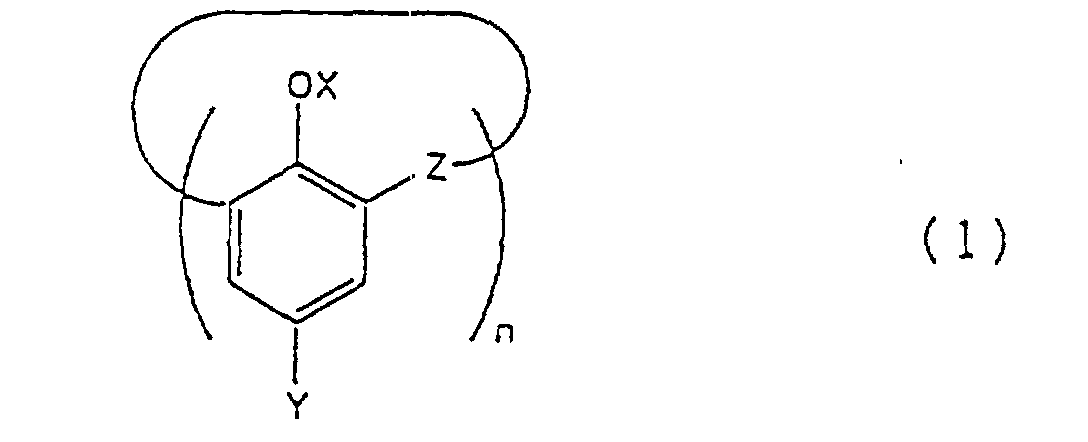
- The present invention will be explained below in detail.
- In formula (1), X represents a hydrogen atom, a hydrocarbon group, or an acyl group.
- The carbon atom number of the hydrocarbon group represented by X is not particularly limited as long as the number is 1 or more. Preferably, the carbon atom number of the hydrocarbon group is from 1 to 50. Examples of the hydrocarbon group include a saturated aliphatic hydrocarbon group, an unsaturated aliphatic hydrocarbon group, an alicyclic hydrocarbon group, an alicyclic-aliphatic hydrocarbon group, an aromatic hydrocarbon group, and an aromatic-aliphatic hydrocarbon group.
- Preferred examples of the saturated aliphatic hydrocarbon group include an alkyl group such as methyl, ethyl, n-propyl, isopropyl, n-butyl, isobutyl, tert-butyl, n-pentyl, isopentyl, neopentyl, tert-pentyl, 2-methylbutyl, n-hexyl, isohexyl, 3-methylpentyl, ethylbutyl, n-heptyl, 2-methylhexyl, n-octyl, isooctyl, tert-octyl, 2-ethylhexyl, 3-methylheptyl, n-nonyl, isononyl, 1-methyloctyl, ethylheptyl, n-decyl, 1-methylnonyl, n-undecyl, 1,1-dimethylnonyl, n-dodecyl, n-tetradecyl, n-heptadecyl, and n-octadecyl groups; and a hydrocarbon group derived from a polymer or copolymer of ethylene, propylene, or butylene.
- Preferred examples of the unsaturated aliphatic hydrocarbon group include alkenyl and alkynyl groups such as vinyl, allyl, isopropenyl, 2-butenyl, 2-methylallyl, 1,1-dimethylallyl, 3-methyl-2-butenyl, 3-methyl-3-butenyl, 4-pentenyl, hexenyl, octenyl, nonenyl, and decenyl groups; and a hydrocarbon group derived from a polymer or copolymer of acetylene, butadiene, or isoprene.
- Preferred examples of the alicyclic hydrocarbon group include cycloalkyl, cycloalkenyl, and cycloalkynyl groups such as cyclopropyl, cyclobutyl, cyclopentyl, cyclohexyl, cycloheptyl, cyclooctyl, 3-methylcyclohexyl, 4-methylcyclohexyl, 4-ethylcyclohexyl, 2-methylcyclooctyl, cyclopropenyl, cyclobutenyl, cyclopentenyl, cyclohexenyl, cycloheptenyl, cyclooctenyl, 4-methylcyclohexenyl, and 4-ethylcyclohexenyl groups.
- Preferred examples of the alicyclic-aliphatic hydrocarbon group include cycloalkyl-, cycloalkenyl-, or cycloalkynyl-substituted alkyl, alkenyl, and alkynyl groups such as cyclopropylethyl, cyclobutylethyl, cyclopentylethyl, cyclohexylmethyl, cyclohexylethyl, cycloheptylmethyl, cyclooctylethyl, 3-methylcyclohexylpropyl, 4-methylcyclohexylethyl, 4-ethylcyclohexylethyl, 2-methylcyclooctylethyl, cyclopropenylbutyl, cyclobutenylethyl, cyclopentenylethyl, cyclohexenylmethyl, cycloheptenylmethyl, cyclooctenylethyl, 4-methylcyclohexenylpropyl, and 4-ethylcyclohexenylpentyl groups.
- Preferred examples of the aromatic hydrocarbon group include an aryl group such as phenyl and naphthyl groups; and alkylaryl, alkenylaryl, and alkynylaryl groups such as 4-methylphenyl, 3,4-dimethylphenyl, 3,4,5-trimethylphenyl, 2-ethylphenyl, n-butylphenyl, tert-butylphenyl, amylphenyl, hexylphenyl, nonylphenyl, 2-tert-butyl-5-methylphenyl, cyclohexylphenyl, cresyl, oxyethylcresyl, 2-methoxy-4-tert-butylphenyl, and dodecylphenyl. The alkyl moiety of the alkylaryl group, the alkenyl moiety of the alkenylaryl group, and the alkynyl moiety of the alkynylaryl group may have a cyclic structure.
- Preferred examples of the aromatic-aliphatic hydrocarbon group include aralkyl, aralkenyl, and aralkynyl groups such as benzyl, 1-phenylethyl, 2-phenylethyl, 2-phenylpropyl, 3-phenylpropyl, 4-phenylbutyl, 5-phenylpentyl, 6-phenylhexyl, 1- (4-methylphenyl) ethyl, 2- (4-methylphenyl) ethyl, 2-methylbenzyl, and 1,1-dimethyl-2-phenylethyl groups. The alkyl moiety of the aralkyl group, the alkenyl moiety of the aralkenyl group, and the alkynyl moiety of the aralkynyl group may have a cyclic structure.
- The carbon atom number of the acyl group is not particularly limited as long as the number is 1 or more. Preferably, the carbon atom number of the acyl group is from 1 to 40. Preferred examples of the acyl group include formyl, acetyl, propionyl, butyryl, isobutyryl, valeryl, isovaleryl, oxalyl, succinyl, pivaloyl, stearoyl, benzoyl, phenylpropionyl, toluoyl, naphthoyl, phthaloyl, indancarbonyl, p-methylbenzoyl, and cyclohexylcarbonyl groups.
- In formula (1), Y represents a hydrogen atom, a hydrocarbon group, a halogenated hydrocarbon group, -COR1, -OR2, -COOR3, -CN, -CONH2, -NO2, -NR4R5, a halogen atom, -SO4R6, or -SO3R7.
- Examples of the hydrocarbon group and the -COR1 group both represented by Y include the same hydrocarbon groups and acyl groups as those enumerated hereinabove with regard to X. Preferred examples thereof also include the same preferred groups.
- Examples of the halogenated hydrocarbon group include halogenated hydrocarbon groups formed by halogen-substituting the same hydrocarbon groups as those enumerated hereinabove with regard to X. Preferred examples thereof also include halogenated hydrocarbon groups derived from the same preferred hydrocarbon groups.
- R1, R2, R3, R4, R5, R6, and R7 each represents a hydrogen atom or a hydrocarbon group. Examples of the hydrocarbon group include the same hydrocarbon groups as those enumerated hereinabove with regard to X, and preferred examples thereof also include the same preferred groups.
- The above hydrocarbon group may be substituted with at least one substituent such as -COR1, -OR2, -COOR3, -CN, -CONH2, -NO2, -NR4R5, a halogen atom, -SO4R6, or -SO3R7.
- The halogen atom may be any of fluorine, chlorine, bromine, and iodine atoms.
- These substituents may be of one kind or two or more kinds. The number of the substituents may be one or more per hydrocarbon group.
- In formula (1), the number of X's present is from 4 to 12 per molecule. The plural X's are the same or different.
- In formula (1), the number of Y's present is from 4 to 12 per molecule. The plural Y's are the same or different.
- Furthermore, in formula (1), the number of Z's present is from 4 to 12 per molecule, and at least one of the plural Z's is a sulfinyl group or a sulfonyl group.
- A process for producing the cyclic phenol sulfide of the present invention containing at least one sulfinyl or sulfonyl group will be explained next.
- The cyclic phenol sulfide containing at least one sulfinyl or sulfonyl group according to the present invention can be produced by oxidizing a sulfide bond in a cyclic phenol sulfide represented by formula (2), wherein X represents a hydrogen atom, a hydrocarbon group, or an acyl group; Y represents a hydrogen atom, a hydrocarbon group, a halogenated hydrocarbon group, -COR1, -OR2, -COOR3, -CN, -CONH2, -NO2, -NR4R5, a halogen atom, -SO4R6, or -SO3R7, in which R1, R2, R3, R4, R5, R6, and R7 each represents a hydrogen atom or a hydrocarbon group; and n represents an integer of 4 to 12, provided that the plural X's or the plural Y's are the same or different.
- In formula (2), X represents a hydrogen atom, a hydrocarbon group, or an acyl group, and examples thereof are the same as those for the X in formula (1) described above.
- In formula (2), Y represents a hydrogen atom, a hydrocarbon group, a halogenated hydrocarbon group, -COR1, -OR2, -COOR3, -CN, -CONH2, -NO2, -NR4R5, a halogen atom, -SO4R6, or -SO3R7, wherein R1, R2, R3, R4, R5, R6, and R7 each represents a hydrogen atom or a hydrocarbon group. Examples thereof are the same as those for the Y in formula (1) described above.
- In formula (2), the number of X's present is from 4 to 12 per molecule. The plural X's are the same or different.
- In formula (2), the number of Y's present is from 4 to 12 per molecule. The plural Y's are the same or different.
- A preferred process for producing a cyclic phenol sulfide represented by formula (2) comprises first reacting a phenol compound represented by formula (3):wherein Y represents a hydrogen atom or a hydrocarbon group, which is unsubstituted phenol or has a hydrocarbon group in the 4-position of the benzene ring to the hydroxyl group, with an appropriate amount of elemental sulfur in the presence of an appropriate amount of at least one metallic reagent selected from alkali metal reagents and alkaline earth metal reagents.
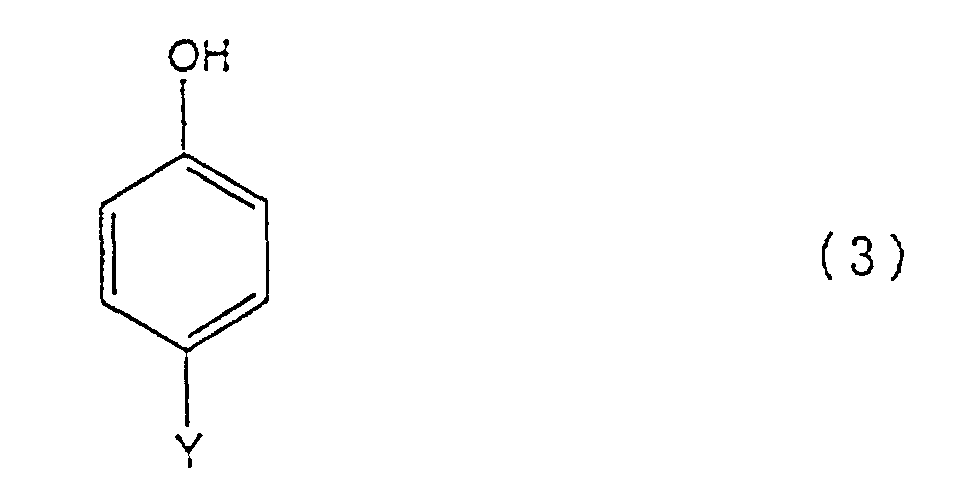
- The phenol compound and elemental sulfur used as starting materials are fed in such a proportion that the amount of the elemental sulfur is at least 0.1 gram equivalent, preferably at least: 0.35 gram equivalents, per gram equivalent of the phenol compound. Although there is no particular upper limit on the proportion of the elemental sulfur fed as a raw material, the amount thereof is preferably up to 20 gram equivalents, especially preferably up to 10 gram equivalents, per gram equivalent of the phenol compound.
- Examples of the alkali metal reagents include elemental alkali metals, alkali metal hydrides, alkali metal hydroxides, alkali metal carbonates, alkali metal alkoxides, and alkali metal halides. Examples of the alkaline earth metal reagents include elemental alkaline earth metals, alkaline earth metal hydrides, alkaline earth metal hydroxides, alkaline earth metal oxides, alkaline earth metal carbonates, alkaline earth metal alkoxides, and alkaline earth metal halides.
- The use amount of the alkali metal reagent or alkaline earth metal reagent is at least 0.005 gram equivalents, preferably at least 0.01 gram equivalent, per gram equivalent of the phenol compound. Although there is no particular upper limit on the use amount of the alkali metal reagent or alkaline earth metal reagent, the amount thereof is preferably less than 10 gram equivalents, especially preferably less than 5 gram equivalents.
- The hydrogen atom of the hydroxyl group can be suitably converted, if desired, to a hydrocarbon group or acyl group by etherification, acylation, or the like. If Y is a hydrogen atom, the hydrogen atom is directly replaced with a substituent. If Y is an alkyl group, a dealkylation reaction is conducted, followed by conversion of the substituent. Thus, a cyclic phenol sulfide represented by formula (2) can be produced.
- Methods for the replacement of a substituent include a method in which a cyclic phenol sulfide represented by formula (2) described above in which Y is an alkyl group is dealkylated with an aluminum chloride or cobalt oxide catalyst or the like to convert each alkyl group to hydrogen.
- Another method for replacement of a substituent comprises causing an appropriate nitrating agent, e.g., nitronium tetrafluoroborate or nitric acid, to act on the dealkylated cyclic phenol sulfide to convert the hydrogen atoms introduced by the dealkylation to nitro groups.
- The nitro groups can be converted to amino groups by reduction with an appropriate reducing agent, e.g., iron/hydrochloric acid. Furthermore, it is also possible to diazotize the resultant compound with sodium nitrate or the like and cause an appropriate halogenating agent, e.g., copper chloride, a cyano-introducing agent, or water to act on the diazotization product in the presence of hydrochloric acid or the like to convert the diazo groups to halogen atoms, cyano groups, or hydroxyl groups, respectively.
- The hydroxyl groups can be converted to acid sulfuric ester groups by the reaction of a sulfuric ester-forming agent, e.g., sulfuric acid.
- The hydroxyl groups can also be converted to alkyl ether groups by forming an alkali metal phenoxide, e.g., sodium phenoxide, and causing an alkyl halide to act thereon.
- By causing fuming sulfuric acid or the like to act on the dealkylated cyclic phenol sulfide, the hydrogen atoms introduced by the dealkylation can be converted to sulfo groups.
- Also, there is a method in which the dealkylated cyclic phenol sulfide is allowed to react with an acid halide, if desired in the presence of a Lewis acid or the like, whereby the hydrogen atoms introduced by the dehydration can be converted to acyl groups.
- The cyclic phenol sulfide represented by formula (2) thus synthesized can be converted to a cyclic phenol sulfide containing at least one sulfinyl or sulfonyl group by oxidizing the sulfide bond thereof.
- A general oxidizing agent can be used to conduct the oxidation reaction of sulfide bonds. Appropriate oxidizing agents include hydrogen peroxide, organic peroxides, peracids, halogen oxides, N-halogenated compounds, molecular halogens, oxygen, ozone, nitric acid, inorganic oxides, and the like. Preferred oxidizing agents include hydrogen peroxide, molecular halogens, and inorganic oxides.
- Preferred examples of the organic peroxides include t-butyl peracetate, perbenzoic acid, m-chloroperbenzoic acid, and benzoyl peroxide.
- Preferred examples of the peracids include peracetic acid, trifluoroperacetic acid, and bis(trimethylsilyl) peroxide.
- Preferred examples of the halogen oxides include sodium periodate, sodium hypochlorite, sodium bromite, and iodobenzenes.
- Preferred examples of the N-halogenated compounds include N-bromosuccinimide and N-chlorosuccinimide.
- Examples of the molecular halogens include chlorine, bromine, and iodine. Especially preferred is bromine.
- Preferred examples of the inorganic oxides include manganese (IV) oxide, cerium (IV) oxide, ruthenium (IV) oxide, chromium (IV) oxide, lead (IV) tetraacetate, sodium perborate, and permanganic acid salts. Especially preferred is sodium perborate.
- These oxidizing agents may be used alone or in combination of two or more thereof.
- With respect to the incorporation amount of the oxidizing agent used, the oxidation number for sulfur can be changed by changing the amount by equivalent of the oxidizing agent added based on the amount of the sulfide bonds of the cyclic phenol sulfide represented by formula (2). In general, sulfinyl bonds are apt to generate when the oxidizing agent is added in an amount nearly equivalent to the sulfide bonds, usually from 1.0 to 1.5 gram equivalents, preferably from 1.0 to 1.2 gram equivalents, per gram equivalent of the sulfide bonds. On the other hand, sulfonyl bonds are apt to generate when the oxidizing agent is used in excess, usually in an amount of from 2 to 10 gram equivalents, preferably from 2 to 6 gram equivalents, per gram equivalent of the sulfide bonds.
- A catalyst may be used for the reaction if necessary.
- Preferred examples of the catalyst of using, for example, hydrogen peroxide as an oxidizing agent include vanadium (V) oxide, sodium metavanadate (V), titanium trichloride, tungsten (VI) oxide, and sodium phosphate. These catalysts may be used alone or in combination of two or more thereof.
- Although the use amount of the catalyst is not particularly limited, it is generally from 0.005 to 10 gram equivalents, preferably from 0.01 to 6 gram equivalents, per gram equivalent of the sulfide bonds.
- The oxidation reaction can also be conducted using electrochemical and photochemical techniques. Furthermore, an enzyme can be used to conduct the oxidation.
- Examples of the solvent to be used include chlorinated solvents such as chloroform and dichloromethane, alcohols such as methanol and ethanol, and protonic solvents such as acetonitrile, acetic acid, and water. Although any desired solvent can be used as long as it does not inhibit the intended reaction, preferred solvents vary depending on the oxidation conditions used, generally as follows. An alcohol solvent, e.g., methanol, ethanol, or butanol, or a chlorinated solvent, e.g., chloroform or dichloromethane, is preferred if hydrogen peroxide or an organic oxide is used as an oxidizing agent; a solvent such as water, acetonitrile, or trifluoroacetic acid is preferred if a peracid is used as an oxidizing agent; a solvent such as methanol/water, acetone, or dioxane is preferred if a halogen oxide is used as an oxidizing agent; an alcohol solvent, e.g., methanol, is preferred if an N-halogenated compound is used as an oxidizing agent; and a two-phase system consisting of a chlorinated solvent, e.g., chloroform or dichloromethane, and a weakly alkaline aqueous solution, e.g., an aqueous solution of a hydrogen carbonate, is preferred if a molecular halogen is used as an oxidizing agent. Furthermore, a solvent such as water or cyclohexane is preferred nitric acid is used as an oxidizing agent; on the other hand, dichloromethane is preferred if ozone for the oxidation is used. If an inorganic oxide is used, it is preferred to use pyridine, acetonitrile, acetic acid, a hydrocarbon, a chlorinated solvent, e.g., dichloromethane or chloroform, or a solvent consisting of a mixture thereof. In the case where an electrochemical technique is used to conduct the oxidation, a solvent such as acetonitrile or acetic acid is preferably used. In the case where a photochemical technique is used to conduct the oxidation, a chlorinated solvent, e.g., chloroform or dichloromethane, or methanol is preferably used. These solvents may be used alone or in combination of two or more thereof.
- Although the use amount: of the solvent is not particularly limited, it may be generally from 5 to 100 ml, preferably from 10 to 50 ml, per g of the cyclic phenol sulfide.
- Reaction temperatures are preferably from -78°C to 100°C. However, the preferred temperatures vary depending on the oxidizing agents used. Specifically, temperatures of from 15°C to 65°C are preferred if hydrogen peroxide, oxygen, nitric acid, or an inorganic oxide is used as an oxidizing agent; temperatures of from -10°C to 90°C are preferred if an organic peroxide or a peracid is used as an oxidizing agent; and temperatures of from -10°C to 30°C are preferred if a molecular halogen or a halogen oxide is used. Furthermore, if ozone for the oxidation is used, the reaction is preferably conducted at -78°C. In the case where an electrochemical technique or a photochemical technique is used for the oxidation, the reaction is preferably conducted at a temperature of from 20°C to 60°C.
- The period of this reaction is not particularly limited, and an appropriate reaction period may be used according to the kind and incorporation amount of the oxidizing agent. In general, a reaction period of from 0.5 to 120 hours may be used.
- In the case where a reaction product comprising a mixture of oxidative derivatives differing in oxidation number was obtained, these derivatives may be separated by an ordinary separation technique, e.g., recrystallization.
- The present invention will be explained below in more detail by reference to Production Example, Examples, and Application Example, the invention should not be construed as being limited thereby in any way.
- To 45.2 g of 4-tert-butylphenol were added 14.4 g of elemental sulfur and 3.0 g of sodium hydroxide. The mixture was gradually heated to 230°C over a period of 4 hours with stirring in a nitrogen atmosphere, and then stirred for further 2 hours. During the stirring, the water and hydrogen sulfide which were generated by the reaction were removed. The water recovered by distillation during the reaction amounted to about 0.8 g, while the hydrogen sulfide generated by the reaction amounted to about 6 g. The resultant reaction mixture was cooled to room temperature, and 500 ml of ether was added thereto to dissolve the same. Thereafter, the reaction mixture was hydrolyzed with 1 N aqueous sulfuric acid solution. The ether layer obtained through liquid separation was washed with water and dried over magnesium sulfate. The ether was distilled off, and the reaction mixture thus obtained was separated by silica gel column chromatography (hexane/chloroform) to obtain a crude reaction product, which was recrystallized from chloroform/acetone. Thus, 4.32 g of a reaction product (I) was obtained as colorless crystals.
- This reaction product (I) is the cyclic alkylphenol sulfide represented by formula (2) wherein X=H, Y=t-Bu (tert-butyl), and n=4.
- Properties of this reaction product (I) are shown below.
- Melting point: 320-322°C
- 1H-NMR: (δ, ppm, CDCl3) 9.60 (s, 4H, OH), 7.64 (s, 8H, ArH), 1.22 (s, 36H, C(CH3)3)
- 13C-NMR: (δ, ppm, CDCl3) 155.6, 144.7, 136.4, 120.5 (Ar), 34.2 (C(CH3)3), 31.3 (C(CH3)3)
- IR: (cm-1, KRS-5) : 3324 (OH) , 2962 (CH)
- MS m/z: 720 (M+)
- Elemental analysis %:
Calculated for C40H48O4S4: C, 66.62; H, 6.71; S, 17.79,
Found: C, 66.37; H, 6.57; S, 17.22 -
- In 30 ml of chloroform was dissolved 1.8 g of 5, 11, 17, 23-tetra-tert-butyl-25, 26, 27, 28-tetrahydroxy-2, 8, 14, 20-tetrathia[19.3.1.13,719,13115,19]-octacosa-1(25), 3, 5, 7(28), 9, 11, 13(27), 15, 17, 19(26), 21, 23-dodecaene (I), represented by formula (2) wherein X=H, Y=t-Bu, and n=4. A solution prepared beforehand by dissolving 5.7 g of 30% aqueous hydrogen peroxide solution in 100 ml of glacial acetic acid was added dropwise to the chloroform solution at room temperature over a period of 30 minutes. This mixture was further stirred at room temperature for 24 hours. To the reaction mixture obtained was added 150 ml of water. This mixture was extracted with chloroform (50 ml x 3), and the chloroform layer was washed with water and dried over anhydrous magnesium sulfate. Thereafter, the solvent was distilled off, and the white powder obtained in an amount of 522 mg was sufficiently washed with methanol. Thus, 485 mg of a reaction product (II) was obtained.
- This reaction product (II) is the cyclic phenol sulfinyl compound represented by formula (1) wherein X=H, Y=t-Bu, n=4, and Z is sulfinyl.
- Properties thereof are shown below.
- Melting point: 210°C (decomposition point)
- 1H-NMR: (δ, ppm, Cl2CDCDCl2) 9.20 (s, 4H, OH), 7.61 (s, 8H, ArH), 1.26 (s, 36H, C(CH3)3)
- 13C-NMR: (δ, ppm, Cl2CDCDCl2) 152.7, 142.4, 130.2, 128.0, 124.2, 122.8 (Ar), 34.8 (C(CH3)3), 31.4 (C(CH3)3)
- FT-IR: (cm-1, KBr): 3074 (br, OH), 2960 (s, CH3), 1051, 998 (s, SO)
- MS (m/z): 785 (M++1)
- Elemental analysis %:
Calculated for C40H48S4O8: C, 61.20; H, 6.16; S, 16.34,
Found: C, 61.1; H, 6.3; S, 15.9. -
- In 30 ml of chloroform was dissolved 1.8 g of 5, 11, 17, 23-tetra-tert-butyl-25, 26, 27, 28-tetrahydroxy-2, 8, 14, 20-tetrathia[19.3.1.13,719,13115,19]-octacosa-1(25), 3, 5, 7(28), 9, 11, 13(27), 15, 17, 19(26), 21, 23-dodecaene (I), represented by formula (2) wherein X=H, Y=t-Bu, and n=4. A solution prepared beforehand by dissolving 22.8 g of 30% aqueous hydrogen peroxide solution in 100 ml of glacial acetic acid was added dropwise to the chloroform solution at room temperature over a period of 30 minutes. This mixture was further stirred at room temperature for 48 hours. To the reaction mixture obtained was added 150 ml of water. This mixture was extracted with chloroform (50 ml x 3), and the organic layer was washed with water and then dried over anhydrous magnesium sulfate. Thereafter, the chloroform was distilled off to obtain 740 mg of a white powder. This powder was sufficiently washed with methanol. Thus, 536 mg of a reaction product (III) was obtained.
- This reaction product (III) is the cyclic phenol sulfonyl compound represented by formula (1) wherein X=H, Y=t-Bu, n=4, and Z is sulfonyl.
- Properties thereof are shown below.
- Melting point: 399°C (decomposition point)
- 1H-NMR: (δ, ppm, Cl2CDCDCl2) 8.05 (s, 8H, ArH), 1.28 (s, 36H, C(CH3)3)
- 13C-NMR: (δ, ppm, Cl2CDCDCl2) 155.8, 143.3, 133.6, 128.9 (Ar), 34.9 (C(CH3)3), 31.2 (C(CH3)3
- FT-IR: (cm-1, KBr) : ν 3409 (br, OH), 2996 (s, CH3), 1308, 1164 (s, SO2)
- MS (m/z): 849 (M*+1)
- Elemental analysis %:
Calculated for C40H48S4O12: C, 56.58; H, 5.70; S, 15.11,
Found: C, 56.3; H, 5.7; S, 14.6. -
- In 65 ml of chloroform was dissolved 4 g of 5, 11, 17, 23-tetra-tert-butyl-25, 26, 27, 28-tetrahydroxy-2, 8, 14, 20-tetrathia[19.3.1.13,719,13115,19]-octacosa-1(25), 3, 5, 7(28), 9, 11, 13(27), 15, 17, 19(26), 21, 23-dodecaene (I), represented by formula (2) wherein X=H, Y=t-Bu, and n=4. To this chloroform solution was added 50 ml of glacial acetic acid to form a suspension. Thereto was added 2.44 g of sodium perborate monohydrate. This mixture was vigorously stirred at 50°C for 4 hours, and 200 ml of water was added to the reaction mixture obtained. The resultant mixture was extracted with chloroform (50 ml x 4), and the chloroform layer was sufficiently washed with water and dried over anhydrous magnesium sulfate. Thereafter, the solvent was distilled off, and the white powder obtained in an amount of 3.39 g was recrystallized from chloroform/methanol to obtain 1.3 g of a crude reaction product (II). After the mother liquor was concentrated, recrystallization from chloroform/methanol was conducted. Thus, 0.92 g of a reaction product (II) was obtained.
- This reaction product (II) is the cyclic phenol sulfinyl compound represented by formula (1) wherein X=H, Y=t-Bu, n=4, and Z is sulfinyl.
- In 20 ml of dichloromethane was dissolved 1.00 g of 5, 11, 17, 23-tetra-tert-butyl-25, 26, 27, 28-tetramethoxy-2, 8, 14, 20-tetrathia[19.3.1.13,719,13115,19]-octacosa-1(25), 3, 5, 7(28), 9, 11, 13(27), 15, 17, 19(26), 21, 23-dodecaene (V), represented by formula (2) wherein X=CH3, Y=t-Bu, and n=4. To this dichloromethane solution was added 20 ml of a. 10% potassium hydrogen carbonate solution. This mixture was vigorously stirred. The resultant suspension was cooled in a water bath, and 0.03 ml of bromine was gradually added thereto dropwise. The suspension was further stirred for 3 hours in a water bath. The reaction mixture obtained was separated into an aqueous layer and an organic layer. The aqueous layer was extracted with dichloromethane (20 ml x 2), and the resultant dichloromethane solution was added to the organic layer obtained above. This mixture was sufficiently washed with saturated aqueous common-salt solution and then dried over anhydrous magnesium sulfate. Thereafter, the solvent was distilled off to obtain 1.02 g of a cream-colored powder. This powder was treated with silica gel column chromatography (dichloromethane) to separate 244 mg of a reaction product (IV) and byproducts from the starting materials remaining unreacted.
- This reaction product (IV) is the cyclic phenol sulfinyl compound represented by formula (1) wherein X=CH3, Y=t-Bu, n=4, and one of the four Z's is sulfinyl.
- Properties thereof are shown below.
- Melting point: 291-292°C (decomposition point)
- 1H-NMR: (δ, ppm, Cl2CDCDCl2) 7.64, 7.57, 7.44 (m, 8H, ArH), 3.79, 3.48 (m, 12H, OCH3), 1.24 (s, 36H, C(CH3)3)
- 13C-NMR: (δ, ppm, Cl2CDCDCl2) 158.62, 155.34, 146.99, 145.96, 144.11, 138.26, 135.17, 131.89, 128.88, 123.22 (Ar), 61.29, 59.42 (OCH3), 34.33, 34.15 (C(CH3)3), 31.22 (C(CH3)3)
- FT-IR: (cm-1, KBr) : ν 2961, 2866 (s, CH3), 1051, 1002 (s, SO)
- MS (m/z): 793 (M+)
- Elemental analysis %:
Calculated for C40E48O5S4: C, 66.63; H, 7.12,
Found: C, 66.5; H, 7.3 -
- In 30 ml of chloroform was dissolved 1.8 g of 5, 11, 17, 23-tetra-tert-butyl-25,26,27,28-tetrahydroxy-2, 8, 14, 20-tetrathia[19.3.1.13,719,13115,19]octacosa-1(25), 3, 5, 7(28), 9, 11, 13(27), 15, 17, 19(26), 21, 23-dodecaene (I), represented by formula (2) wherein X=H and Y=t-Bu and n=4. To this chloroform solution was added 25 ml of glacial acetic acid to form a suspension. Thereto was added 2.57 g of sodium perborate monohydrate. This mixture was vigorously stirred at room temperature for 5 days, and 100 ml of water was added to the reaction mixture obtained. The resultant mixture was extracted with chloroform (40 ml x 2), and the chloroform layer was sufficiently washed with water and dried over anhydrous magnesium sulfate. Thereafter, the solvent was distilled off, and the white powder obtained in an amount of 1.45 g was sufficiently washed with methanol. Thus, 1.12 g of a reaction product (III) was obtained.
- This reaction product (III) is the cyclic phenol sulfonyl compound represented by formula (1) wherein X=H, Y=t-Bu, n=4, and Z is sulfonyl.
- The 5, 11, 17, 23-tetra-tert-butyl-25, 26, 27, 28-tetrahydroxy-2, 8, 14, 20-tetrasulfinyl-[19.3.1.13,719,13115,19]octacosa-1(25), 3, 5, 7(28), 9, 11, 13(27), 15, 17, 19(26), 21, 23-dodecaene (II) produced in Example 1 and the 5, 11, 17, 23-tetra-tert-butyl-25, 26, 27, 28-tetrahydroxy-2, 8, 14, 20-tetrasulfonyl-[19.3.1.13,719,13115,19]octacosa-1(25), 3, 5, 7(28), 9, 11, 13(27), 15, 17, 19(26), 21, 23-dodecaene (III) produced in Example 2 were dissolved in an organic solvent, and these solutions were brought into contact with an aqueous solution containing sodium ions to conduct sodium ion extraction.
- In 40 ml of chloroform were dissolved 16.0 mg of cyclic phenol sulfide (II) and 17.2 mg of cyclic phenol sulfide (III), respectively. These solutions were separately placed into a 200-ml separatory funnel together with 40 ml of an aqueous solution containing 20 ppm sodium ions. Each funnel was shaken for 5 hours. For the purpose of comparison, a mixture of 40 ml of chloroform containing neither cyclic phenol sulfide (II) nor (III) and 40 ml of an aqueous solution containing 20 ppm sodium ions was shaken for 5 hours in the same manner. After each sample was allowed to stand, the ion concentration in the aqueous solution was determined by the ICP-AES method (inductively coupled plasma-atomic emission spectrometry).
- As a result, the sodium ion concentration in the aqueous solution of the sample containing cyclic phenol sulfide (II) after the extraction was found to be lower by 38% than that in the aqueous solution of the sample not containing cyclic phenol sulfide (II) after the test. Furthermore, the sodium ion concentration in the aqueous solution of the sample containing cyclic phenol sulfide (III) after the test was found to be lower by 58% than that in the aqueous solution of the sample not containing cyclic phenol sulfide (III) after the extraction.
- It was thus found that by contacting the aqueous phase containing sodium ions with the organic phase containing either of the cyclic phenol sulfides synthesized in Examples 1 and 2, sodium ions can be extracted and transferred to the organic phase.
- The cyclic phenol sulfide of the present invention is an entirely novel compound comprising phenol frameworks linked to each other with sulfide, sulfoxide, or sulfone bonds. It is useful, for example, as an antioxidant, a catalyst, a metal-trapping agent, a light sensor, an ion sensor, a sensor with substrate specificity, a separating-membrane material, a polymer material, a phase-transfer catalyst, an artificial enzyme, a light energy converter, or as an intermediate for functional molecules using a recognition ability of an ion or molecule.
Claims (6)
- A cyclic phenol sulfide containing at least one sulfinyl or sulfonyl group represented by formula (1):wherein X represents a hydrogen atom, a hydrocarbon group, or an acyl group; Y represents a hydrogen atom, a hydrocarbon group, a halogenated hydrocarbon group, -COR1, -OR2, -COOR3, -CN, -CONH2, -NO2, -NR4R5, a halogen atom, -SO4R6, or -SO3R7, in which R1, R2, R3, R4, R5, R6, and R7 each represents a hydrogen atom or a hydrocarbon group; Z represents one member selected from the group consisting of S, a sulfinyl group, and a sulfonyl group; and n represents an integer of 4 to 12, provided that the plural X's or the plural Y's are the same or different, and that at least one of the plural Z's is a sulfinyl group or a sulfonyl group.

- A process for producing the cyclic phenol sulfide containing at least one sulfinyl or sulfonyl group represented by formula (1), which comprises oxidizing a sulfide bond of a cyclic phenol sulfide represented by formula (2):wherein X represents a hydrogen atom, a hydrocarbon group, or an acyl group; Y represents a hydrogen atom, a hydrocarbon group, a halogenated hydrocarbon group, -COR1, -OR2, -COOR3, -CN, -CONH2, -NO2, -NR4R5, a halogen atom, -SO4R6, or -SO3R7, in which R1, R2, R3, R4, R5, R6, and R7 each represents a hydrogen atom or a hydrocarbon group; and n represents an integer of 4 to 12, provided that the plural X's or the plural Y's are the same or different, with an oxidizing agent.

- The process for producing a cyclic phenol sulfide according to claim 2, wherein the oxidizing agent is hydrogen peroxide, an organic peroxide, a peracid, a halogen oxide, an N-halogenated compound, a molecular halogen, oxygen, ozone, nitric acid, or an inorganic oxide.
- The process for producing a cyclic phenol sulfide according to claim 2, wherein the oxidizing agent is hydrogen peroxide, a molecular halogen, or an inorganic oxide.
- The process for producing a cyclic phenol sulfide according to claim 3, wherein the molecular halogen as the oxidizing agent is bromine.
- The process for producing a cyclic phenol sulfide according to claim 3, wherein the inorganic oxide as the oxidizing agent is sodium perborate.
Applications Claiming Priority (4)
| Application Number | Priority Date | Filing Date | Title |
|---|---|---|---|
| JP25536896 | 1996-09-06 | ||
| JP255368/96 | 1996-09-06 | ||
| JP25536896 | 1996-09-06 | ||
| PCT/JP1997/002789 WO1998009959A1 (en) | 1996-09-06 | 1997-08-08 | Cyclic phenol sulfide containing sulfinyl or sulfonyl group and process for preparing the same |
Publications (3)
| Publication Number | Publication Date |
|---|---|
| EP0882724A4 EP0882724A4 (en) | 1998-12-09 |
| EP0882724A1 EP0882724A1 (en) | 1998-12-09 |
| EP0882724B1 true EP0882724B1 (en) | 2001-11-07 |
Family
ID=17277807
Family Applications (1)
| Application Number | Title | Priority Date | Filing Date |
|---|---|---|---|
| EP97934752A Expired - Lifetime EP0882724B1 (en) | 1996-09-06 | 1997-08-08 | Cyclic phenol sulfide containing sulfinyl or sulfonyl group and process for preparing the same |
Country Status (5)
| Country | Link |
|---|---|
| US (1) | US5998631A (en) |
| EP (1) | EP0882724B1 (en) |
| JP (1) | JP4094064B2 (en) |
| DE (1) | DE69708062T2 (en) |
| WO (1) | WO1998009959A1 (en) |
Families Citing this family (14)
| Publication number | Priority date | Publication date | Assignee | Title |
|---|---|---|---|---|
| DE69822503T2 (en) | 1997-12-09 | 2005-01-20 | Cosmo Oil Co. Ltd. | SULFONATED DERIVATIVES OF CYCLIC PHENOLSULFIDES, METHOD FOR THE PRODUCTION THEREOF, MEANS FOR THE SEPARATION AND RECOVERY THAT CONTAIN CYCLIC PHENOLSULFIDES, METHODS FOR THE SEPARATION OF THE SUBSTANCES AND MEDICAMENT COMPOSITIONS CONTAINING THESE SULFIDES |
| JP2000191658A (en) * | 1998-10-22 | 2000-07-11 | Cosmo Research Inst | Cyclic phenol sulfide metal complex, catalyst therefrom, and analysis of hydrogen peroxide |
| JP4480245B2 (en) * | 2000-03-13 | 2010-06-16 | 株式会社コスモ総合研究所 | Cyclic aniline sulfide and method for producing the same |
| US20030060637A1 (en) * | 2000-03-13 | 2003-03-27 | Sotaro Miyano | Cyclic aniline sulfide and process for preparing the same |
| US6602970B2 (en) | 2000-06-13 | 2003-08-05 | Toagosei Co., Ltd. | 2-cyanoacrylate composition |
| US7357270B2 (en) * | 2003-08-28 | 2008-04-15 | Mayrose Enterprises, Inc | Container holder and a system for supporting containers and a method for holding containers |
| KR101362828B1 (en) * | 2006-04-13 | 2014-02-14 | 호도가야 가가쿠 고교 가부시키가이샤 | Oxidized mixed cyclic phenol sulfides, and charge control agents and toners using the same |
| EP2128153B1 (en) | 2007-01-16 | 2013-08-21 | Hodogaya Chemical Co., Ltd. | Process for production of oxidized cyclic phenol sulfide |
| CN101589344B (en) | 2007-01-25 | 2012-07-25 | 保土谷化学工业株式会社 | Photoreceptor for electrophotography |
| KR20100122088A (en) * | 2008-02-14 | 2010-11-19 | 호도가야 가가쿠 고교 가부시키가이샤 | Successive production process for oxidized cyclic phenol sulfide |
| US20110045396A1 (en) * | 2008-05-09 | 2011-02-24 | Hodogaya Chemical Co., Ltd. | Charge Controlling Agent and Toner Using Metal Compound of Cyclic Phenol Sulfide |
| CN101440084B (en) * | 2008-12-29 | 2012-10-03 | 山东师范大学 | Sulfonylcalix [4] aromatic compounds and microwave assisted synthesizing method thereof |
| KR20120043079A (en) * | 2009-08-07 | 2012-05-03 | 호도가야 가가쿠 고교 가부시키가이샤 | Polymerized toner comprising cyclic phenol sulfide |
| KR20130099913A (en) | 2010-09-15 | 2013-09-06 | 호도가야 가가쿠 고교 가부시키가이샤 | Charge control agent and toner using same |
Family Cites Families (1)
| Publication number | Priority date | Publication date | Assignee | Title |
|---|---|---|---|---|
| JP3233570B2 (en) * | 1995-03-10 | 2001-11-26 | 株式会社コスモ総合研究所 | Cyclic phenol sulfide and method for producing the same |
-
1997
- 1997-08-08 DE DE69708062T patent/DE69708062T2/en not_active Expired - Lifetime
- 1997-08-08 JP JP51245898A patent/JP4094064B2/en not_active Expired - Lifetime
- 1997-08-08 EP EP97934752A patent/EP0882724B1/en not_active Expired - Lifetime
- 1997-08-08 WO PCT/JP1997/002789 patent/WO1998009959A1/en not_active Ceased
- 1997-08-08 US US09/068,583 patent/US5998631A/en not_active Expired - Lifetime
Also Published As
| Publication number | Publication date |
|---|---|
| EP0882724A4 (en) | 1998-12-09 |
| DE69708062D1 (en) | 2001-12-13 |
| EP0882724A1 (en) | 1998-12-09 |
| DE69708062T2 (en) | 2002-06-20 |
| US5998631A (en) | 1999-12-07 |
| JP4094064B2 (en) | 2008-06-04 |
| WO1998009959A1 (en) | 1998-03-12 |
Similar Documents
| Publication | Publication Date | Title |
|---|---|---|
| US5998631A (en) | Cyclic phenol sulfide having at least one sulfinyl or sulfonyl group and process for producing the same | |
| EP0731102B1 (en) | Cyclic phenol sulfide and process for producing the same | |
| JPWO1998009959A1 (en) | Sulfinyl or sulfonyl group-containing cyclic phenol sulfide and method for producing the same | |
| JPWO2004099149A1 (en) | Process for producing 2-chloro-5-fluoro-3-substituted pyridine or a salt thereof | |
| EP2042497B1 (en) | Method for producing strontium ranelate and its hydrates | |
| US6326519B1 (en) | Diallylic sulfides and processes for preparing the same | |
| JP4140792B2 (en) | Chlorosulfonic acid derivatives of cyclic phenol sulfides and process for producing the same | |
| EP0171320A1 (en) | Process for the preparation of unsaturated alpha-chlorinated compounds of two electroattractive groups in the beta position | |
| EP1678129B1 (en) | Improved process for preparing benzhydrylthioacetamide | |
| US6198007B1 (en) | Process for the preparation of 1-substituted 2,4-dinitrobenzenes | |
| JP3012933B1 (en) | Dithianaphthalenophane compound and method for producing the same | |
| CN117534596B (en) | Method for preparing beta-sulfonyl methyl acrylate compound | |
| JP3827029B2 (en) | Method for producing cyclic phenol sulfide | |
| EP2888250A1 (en) | Process for the synthesis of substituted gamma lactams | |
| JP2002255961A (en) | Method for producing cyclic phenol sulfide | |
| CN100537499C (en) | Process for producing halogenated adamantane compound | |
| JPH10168078A (en) | Method for producing cyclic phenol sulfide | |
| EP2956449B1 (en) | Process for the preparation of 4-(heterocycloalkyl)-benzene-1,3-diol compounds | |
| FR2530240A1 (en) | NOVEL ALKYL ESTERS OF N- (HYDROXY PROTECTED ETHYL) DITHIOCARBAMIC ACIDS | |
| US20030060637A1 (en) | Cyclic aniline sulfide and process for preparing the same | |
| FR3126708A1 (en) | Process for making pentazolate anion using hypervalent iodine oxidant | |
| KR100570279B1 (en) | Intermediates of coenzyme Qn and methods for preparing the intermediate | |
| JPH11130770A (en) | Method for producing cyclic nitrophenol sulfide | |
| FR2553764A1 (en) | Polysubstituted allyl compounds and methods of preparation of these compounds. | |
| JPH1077281A (en) | Method for producing halogenated cyclic phenol sulfide |
Legal Events
| Date | Code | Title | Description |
|---|---|---|---|
| PUAI | Public reference made under article 153(3) epc to a published international application that has entered the european phase |
Free format text: ORIGINAL CODE: 0009012 |
|
| 17P | Request for examination filed |
Effective date: 19980506 |
|
| A4 | Supplementary search report drawn up and despatched | ||
| AK | Designated contracting states |
Kind code of ref document: A4 Designated state(s): DE FR GB NL Kind code of ref document: A1 Designated state(s): DE FR GB NL |
|
| 17Q | First examination report despatched |
Effective date: 20000607 |
|
| GRAG | Despatch of communication of intention to grant |
Free format text: ORIGINAL CODE: EPIDOS AGRA |
|
| GRAG | Despatch of communication of intention to grant |
Free format text: ORIGINAL CODE: EPIDOS AGRA |
|
| GRAH | Despatch of communication of intention to grant a patent |
Free format text: ORIGINAL CODE: EPIDOS IGRA |
|
| GRAH | Despatch of communication of intention to grant a patent |
Free format text: ORIGINAL CODE: EPIDOS IGRA |
|
| GRAA | (expected) grant |
Free format text: ORIGINAL CODE: 0009210 |
|
| AK | Designated contracting states |
Kind code of ref document: B1 Designated state(s): DE FR GB NL |
|
| REF | Corresponds to: |
Ref document number: 69708062 Country of ref document: DE Date of ref document: 20011213 |
|
| REG | Reference to a national code |
Ref country code: GB Ref legal event code: IF02 |
|
| PLBE | No opposition filed within time limit |
Free format text: ORIGINAL CODE: 0009261 |
|
| STAA | Information on the status of an ep patent application or granted ep patent |
Free format text: STATUS: NO OPPOSITION FILED WITHIN TIME LIMIT |
|
| 26N | No opposition filed | ||
| REG | Reference to a national code |
Ref country code: FR Ref legal event code: TP |
|
| NLS | Nl: assignments of ep-patents |
Owner name: COSMO OIL COMPANY, LTD Effective date: 20080409 |
|
| REG | Reference to a national code |
Ref country code: FR Ref legal event code: PLFP Year of fee payment: 20 |
|
| PGFP | Annual fee paid to national office [announced via postgrant information from national office to epo] |
Ref country code: NL Payment date: 20160711 Year of fee payment: 20 |
|
| PGFP | Annual fee paid to national office [announced via postgrant information from national office to epo] |
Ref country code: DE Payment date: 20160802 Year of fee payment: 20 Ref country code: GB Payment date: 20160803 Year of fee payment: 20 |
|
| PGFP | Annual fee paid to national office [announced via postgrant information from national office to epo] |
Ref country code: FR Payment date: 20160712 Year of fee payment: 20 |
|
| REG | Reference to a national code |
Ref country code: DE Ref legal event code: R071 Ref document number: 69708062 Country of ref document: DE |
|
| REG | Reference to a national code |
Ref country code: NL Ref legal event code: MK Effective date: 20170807 |
|
| REG | Reference to a national code |
Ref country code: GB Ref legal event code: PE20 Expiry date: 20170807 |
|
| PG25 | Lapsed in a contracting state [announced via postgrant information from national office to epo] |
Ref country code: GB Free format text: LAPSE BECAUSE OF EXPIRATION OF PROTECTION Effective date: 20170807 |