EP0881328B1 - Curl und profile correction with high velocity hoods - Google Patents
Curl und profile correction with high velocity hoods Download PDFInfo
- Publication number
- EP0881328B1 EP0881328B1 EP98109710A EP98109710A EP0881328B1 EP 0881328 B1 EP0881328 B1 EP 0881328B1 EP 98109710 A EP98109710 A EP 98109710A EP 98109710 A EP98109710 A EP 98109710A EP 0881328 B1 EP0881328 B1 EP 0881328B1
- Authority
- EP
- European Patent Office
- Prior art keywords
- web
- drying
- hood
- cylinders
- paper
- Prior art date
- Legal status (The legal status is an assumption and is not a legal conclusion. Google has not performed a legal analysis and makes no representation as to the accuracy of the status listed.)
- Expired - Lifetime
Links
- 238000012937 correction Methods 0.000 title claims description 10
- 238000001035 drying Methods 0.000 claims abstract description 101
- 238000000034 method Methods 0.000 claims abstract description 11
- 239000004744 fabric Substances 0.000 claims description 15
- 238000009826 distribution Methods 0.000 claims description 9
- 238000012546 transfer Methods 0.000 claims description 5
- 238000007664 blowing Methods 0.000 claims description 2
- 239000000123 paper Substances 0.000 description 39
- 230000000694 effects Effects 0.000 description 9
- 238000001704 evaporation Methods 0.000 description 5
- 230000008020 evaporation Effects 0.000 description 5
- 239000007787 solid Substances 0.000 description 5
- 230000008901 benefit Effects 0.000 description 4
- 238000010438 heat treatment Methods 0.000 description 4
- 238000004519 manufacturing process Methods 0.000 description 4
- 230000008569 process Effects 0.000 description 3
- YSGSDAIMSCVPHG-UHFFFAOYSA-N valyl-methionine Chemical compound CSCCC(C(O)=O)NC(=O)C(N)C(C)C YSGSDAIMSCVPHG-UHFFFAOYSA-N 0.000 description 3
- 230000015572 biosynthetic process Effects 0.000 description 2
- 239000007789 gas Substances 0.000 description 2
- 230000014509 gene expression Effects 0.000 description 2
- 238000012986 modification Methods 0.000 description 2
- 230000004048 modification Effects 0.000 description 2
- XLYOFNOQVPJJNP-UHFFFAOYSA-N water Substances O XLYOFNOQVPJJNP-UHFFFAOYSA-N 0.000 description 2
- 229910001018 Cast iron Inorganic materials 0.000 description 1
- 229920003043 Cellulose fiber Polymers 0.000 description 1
- 239000000654 additive Substances 0.000 description 1
- 230000000996 additive effect Effects 0.000 description 1
- 238000006243 chemical reaction Methods 0.000 description 1
- 239000000567 combustion gas Substances 0.000 description 1
- 238000010276 construction Methods 0.000 description 1
- 230000007547 defect Effects 0.000 description 1
- 230000001419 dependent effect Effects 0.000 description 1
- 230000001627 detrimental effect Effects 0.000 description 1
- 239000000835 fiber Substances 0.000 description 1
- 238000012423 maintenance Methods 0.000 description 1
- 230000007246 mechanism Effects 0.000 description 1
- 239000011087 paperboard Substances 0.000 description 1
- 230000002093 peripheral effect Effects 0.000 description 1
- 239000011148 porous material Substances 0.000 description 1
- 238000003825 pressing Methods 0.000 description 1
- 238000011084 recovery Methods 0.000 description 1
- 230000004044 response Effects 0.000 description 1
- 230000000452 restraining effect Effects 0.000 description 1
- 238000009423 ventilation Methods 0.000 description 1
Images


Classifications
-
- D—TEXTILES; PAPER
- D21—PAPER-MAKING; PRODUCTION OF CELLULOSE
- D21F—PAPER-MAKING MACHINES; METHODS OF PRODUCING PAPER THEREON
- D21F5/00—Dryer section of machines for making continuous webs of paper
- D21F5/02—Drying on cylinders
- D21F5/04—Drying on cylinders on two or more drying cylinders
- D21F5/042—Drying on cylinders on two or more drying cylinders in combination with suction or blowing devices
- D21F5/044—Drying on cylinders on two or more drying cylinders in combination with suction or blowing devices using air hoods over the cylinders
Definitions
- This invention relates to paper drying and in particular to a method and apparatus to be used in the drying section of a paper machine to reduce curl in the finished product.
- a dryer section of a paper machine receives a paper web to be dried, from the forming end and pressing section of the paper machine.
- the web is conventionally dried on a plurality of dryer rolls heated by steam or gas so as to reduce the moisture content of the web to an acceptable percentage.
- the moving paper web travels over and with the drying cylinders which, conventionally, have been arranged in two tiers with one side of the web contacting one cylinder and then the other side of the web contacting the next cylinder.
- drying sections of paper machines have the drying cylinders grouped entirely or largely in single tiered sections with all or most of the drying being done on one side of the web only. This can cause uneven or one sided drying of the web which can lead to a bowing or curl of the paper web.
- the drying of paper and board is generally carried out on a multitude of steam heated cylinders.
- the web enters the drying section at 40 to 50% solids and leaves at 90 to 95% solids.
- the drying cylinders have been arranged in two tiers with the wet web travelling over first one cylinder, then the next, with one side of the paper heated over one drum and the opposite side on the next. The process continues until the paper exits the dryers at the desired solids content.
- the paper As the paper travels over the cylinders, it is held onto the cylinder by means of a dryer fabric the purpose of which is to guide the paper over the dryer and hold it in intimate contact with the dryer surface.
- the dryers are normally divided into groups of six to ten cylinders, each group having its own drive system. Likewise the dryers are grouped to provide sectional steam control to allow the drying temperature to be varied through the complete dryer section. Each drive group has its own dryer fabrics, one for the top dryers and one for the bottom dryers. In a two tier dryer, the web is held against the dryer only for the duration or wrap of the fabric in the dryer, approximately 180°. As the web passes from the one dryer to the next, it travels unsupported through the air (the draw) for a distance of several feet, until it reaches the next dryer and is then restrained by the fabric. While travelling through the draw, the web is susceptible to air movements which may cause the sheet to vibrate or flutter. If the aerodynamic forces acting on the web are high enough, the flutter may be sufficiently strong to cause the web to break which results in lost production while the broken paper (the broke) is removed and the web rethreaded through the machine.
- the web is a mat of cellulose fibers which are more or less randomly oriented in the plane of the web, their orientation being dependent on the web formation.
- the paper web can be made up of two or more layers, each being comprised of different types of fiber, having different lengths and orientations.
- One method of avoiding curl is to dry on both sides which in a single tiered dryer section, requires that the dried side be reversed, at some point in the dryer section.
- this has some drawbacks from an operating stand point in that if the web should break in the section that has the felts on the bottom, the resulting broke must first be removed from the inside of the drying section before the sheet can be rethreaded, resulting in lost production time.
- Another solution is to use dryers groups arranged in a single tier with the last section of dryers being a conventional two tiered dryer group. Although this entails the sheet travelling unsupported between the upper and lower tiers in the last section, the sheet, being largely dried at this location is sufficiently strong to resist the aerodynamic forces.
- Still other solutions use a total single tier dryer section with curl correction taking place after the dryers by means of using steam shower to re-humidify the sheet and thus release some of the stresses in the web caused by the non-uniform drying.
- This solution may be less than desirable because in order to have a dry web at the end of the process, the web must first be over dried in the dryer section, prior to rehumidification, which may result in a loss of production capacity.
- WO 96/32534 discloses a dryer-section concept of a paper/board machine and a method in the drying of a paper/board web.
- the dryer section comprises a number of drying cylinder groups, which comprise a single-wire draw, on whose support the web is guided so that it meanders as loop-shaped from a drying cylinder onto a suction cylinder.
- the web/the wire is guided so that the web is placed against the face of the drying cylinder and the wire is placed outside.
- the web is passed from one drying cylinder group into the next dryer group and further.
- At least some of the drying cylinders include impingement units or equivalent in connection with them, through which units a heated medium, preferably air or steam, is passed through the wire into connection with the web, so as to produce a two-sided drying effect and to increase the drying capacity.
- a heated medium preferably air or steam
- U.S. Patent 5,416,979 discloses an apparatus for drying a wet paper web during manufacture of the paper web.
- the apparatus allows the moisture profile of the web to be controlled and adjusted.
- the apparatus includes a rotatable dryer drum and a hood partially encompassing the rotatable dryer drum.
- a plurality of elongated heater nozzle boxes are disposed in the hood interior and extend across the dryer drum in the cross-machine direction, the elongated heater nozzle boxes being arrayed side-by-side in the machine direction.
- a plurality of gas burners is located in each of the nozzle box interiors and arranged side-by-side along the length of the nozzle box interiors for producing hot combustion gases within the nozzle box interiors of the heater nozzle boxes.
- U.S. Patent 5,600,898, February 11, 1997, Deshpande et al discloses a paper dryer for a single tier of top-felted dryer rolls which, in combination with air caps, simultaneously dry both sides of a web.
- the air caps are in the form of hoods which overlie the upper portions of the dryer rolls and blow high velocity hot air through the felts to dry the upper surface of the web, preferably at the same rate as the roll side of the paper is dried by steam heat transmitted to the surfaces of the dryer rolls.
- U.S. Patent 5,542,193 Beloit deals with a dryer group for controlling curl in the web. This is carried out by two separate groups of dryers.
- the patent discloses the use of a main line of single tier dryers to dry the first side of the web and then there is a further drying section which includes an upper tier of dryers and a lower tier of dryers to dry the second side of the web.
- a plurality of vacuum transfer rolls each of which is connected to a source of partial vacuum so that during the movement of the web around each of the vacuum transfer rolls the web is held against cross-machine and machine directional shrinkage.
- This patent also refers to the inclusion of control means to control the steam pressure within each dryer of the upper and lower tier thereof so that any tendency of the web to curl due to cross-machine directional shrinkage of the web is compensated for by the application of differential steam pressure.
- U.S. 4,096,643, June 27, 1978, Dominion Engineering Works discloses a paper web drying system having a series of adjacent compartments extending transversely across the web guide with means to provide moisture profiling by varying the quantity, velocity and temperature of the drying medium.
- U.S. 3,570,137 shows an apparatus for the continuous treatment of a web which encloses one or more web cylinders.
- U.S. 3, 183,607, May 18, 1985 discloses a drying hood having a movable plenum construction.
- This invention relates to a high velocity hood mounted adjacent to a drying cylinder on the opposite side of the paper web which is in contact with the drying cylinder.
- the arrangement is such as to transfer heat and thus to effect evaporation of water in the web on the side opposite the cylinder heated side.
- the effect of drying with the high velocity hood is to correct the uneven drying caused by drying the web totally or largely on one side with cylinders.
- the addition of high velocity hoods to the side opposite the cylinder from a point in the dryer section where the web is approximately 60% solids, will equalize the evaporation on both sides and eliminate the forces which result in curl.
- WO 96/32534 describes the use of impingement units; however, such impingement units as shown in that document do not disclose the high velocity hoods as described and claimed in the present invention and where the hood has a plurality of nozzle boxes that extend transverse to the web and arrayed around the perimeter of the dryer cylinders. Neither does it disclose the selected nozzle boxes having jets directed angularly toward the web so as to separate the boundary layer of air attached to the fabric travelling with the web.
- the Valmet published application referred to above fails to disclose a combination of elements as described in the following specification.
- air is blown through a dryer fabric to transfer heat to the top side of the web for drying.
- the Valmet published application refers to ventilating the pores of the fabric to reduce the vapor pressure and increase evaporation. This patent application therefore seems to be directed more to improving ventilation than to enhance evaporation.
- the published application also makes reference to the use of using hot dry air to effect the drying of the felt but the use of "dry air" would be extremely energy intensive. In the present invention, some or most of the drying air would be recirculated to improve economy.
- High velocity hoods are a well known element in web drying processes.
- the hood is an air distribution and drying system shaped to be installed over (or under) a drying cylinder, which conveys and directs high velocity jets of hot drying air onto the web travelling over the cylinder.
- the application of high velocity hoods over the drying cylinders can provide sufficient two-sided drying, to reduce or eliminate the curl effect associated with uneven or one-sided drying.
- the internal air distribution system is divided into compartments across the width of the web. This allows a control of the drying supplied across the back of the web. Compartmentalising the hood air distribution system in the cross machine direction provides a further benefit in that it allows for correction of variations of cross machine moisture profile.
- the drying effected by the impingement hood is additive to that contributed by the cylinders which allows for increases in machine speed or alternatively a dryer section shorter in length than one comprised solely of cylinders.
- the high velocity hood may be used to provide correction for variations in the machine direction moisture profile.
- the use of the high velocity hood applies equally for double tier dryer sections as well as single tier (top or bottom felted), where there is a requirement to dry preferentially one side of the paper web to correct for uneven drying with cylinders.
- the high velocity hood is also be used as a tool to help improve the runnability of the paper web through the drying section by using to advantage air jets in the leaving and entering nozzle boxes to eliminate or greatly reduce the boundary layer of air that is entrained by the moving fabric and in addition act as a suction plenum to maintain a negative pressure in the space defined by adjacent drying cylinders and intermediate turning rolls.
- hot drying air is supplied to the hood 12 from a system of ducts with a circulating fan, heating system (either steam heating coils or burner) not shown here.
- the hood can be supplied with internally mounted fans and burners or coils and in that way reduce the amount of space required for external ducting.
- One form of hood is described in Applicant's U.S. Patent 5,531,033 issued July 2, 1996, "Controlled Profile Drying Hood".
- the air enters the supply header 1 and is delivered through a plurality of distribution headers 2 to nozzle boxes 3, having a rectangular cross section, and which run transverse to the web and are arrayed around the perimeter of the dryer cylinder, generally between 90 and 240 degrees as shown in Figure 2.
- the front face of the nozzle boxes are perforated, whereby the impinging drying air blows onto the paper web.
- the gap 14 between adjacent nozzle boxes serves as a return channel for the spent drying air which is under a negative pressure owing to its connection to the suction side of the circulating fan.
- a typical drying section of a paper machine incorporates a plurality of parallel, single tier cylindrical dryers 16 and a plurality of turn rolls 18 are dispersed along the single tier of drying cylinders, one turn roll 18 intermediate each pair of cylinders 16.
- Several fabrics 20 are dispersed throughout the length of the dryer in order to carry the paper web 22 along the series of drying drums and turn rolls 18.
- One or more drying hoods 12 are arranged along the upper surfaces of the drying cylinders 16 as illustrated, and these hoods 12 may take the form of multiple units acting in combination with one or more of the dryer cylinders 16 as shown.
- the first and last nozzle boxes 6 in the hood 12 utilize a jet slot 24 running the full width of the paper web directed at an angle to the web so as to achieve the effect of separating the boundary layer of air attached to the moving fabric 20.
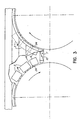
- an opening 7 in the hood 12 running the width of the paper web 22 serves to evacuate the air in the space 8 defined by adjacent cylinders 16 and their intermediate turn roll 18 as shown in Figure 3.
- This opening 7 is equipped with a damper 10 to permit adjustment of the amount of suction applied, the source of this suction being the circulating fan of the high velocity hood.
- the space defined by adjacent cylinders 16 and the intermediate turn roll 18 may be closed at the ends by means of plates 9 suspended from the hood to reduce the amount of air which must be removed to maintain a negative pressure in the space.
- the individual distribution headers 2 is fitted with a damper (not shown), to permit regulation of the air flow to the transverse nozzle boxes 3.
- Each distribution header 2 feeds the nozzles wrapping the cylinder or cylinders 16, the nozzles being divided into sections in the cross machine direction to permit drying control under that one section.
- the dampers 10 would be operated either manually or by means of an electric or pneumatic actuator.
- the air is then evacuated from under the nozzle boxes 3 into the interior of the hood 12 not occupied by the air distribution system and from the hood 12 directed back to the air circulation and heating system.
- a portion of the returning air which is laden with water vapour from evaporation is exhausted away from the air circulating system to atmosphere or to a suitable heat recovery system to recover the heat contained in the air stream.
- the outside of the hood 12 itself is suitably sealed and insulated as at 4 to make it airtight and to minimize heat loss to the surrounds.
- a retraction mechanism 5 consisting of the appropriate mechanical, electric, pneumatic or hydraulic actuators is provided to raise (or lower) the hood 12 away from the cylinder 16 to provide clearance for broke removal, fabric replacement and maintenance.
- the operation of the burners and dampers would be governed by a suitable control system which would regulate the amount of drying in response to the amount of correction required.
- each hood 12 covers two drying cylinders 16 but it could be designed to cover one cylinder 16 or more than two and in practice the size of the hood 12 will be dictated by the amount of surface area for drying required and the space limitations on the machine.
- the quantity of hoods 12 would be determined by the overall drying requirements and by the amount of drying required to effect curl and profile correction.
Landscapes
- Paper (AREA)
- Drying Of Solid Materials (AREA)
- Outer Garments And Coats (AREA)
- Respiratory Apparatuses And Protective Means (AREA)
- Coating With Molten Metal (AREA)
- Separation, Sorting, Adjustment, Or Bending Of Sheets To Be Conveyed (AREA)
Abstract
Description
- This invention relates to paper drying and in particular to a method and apparatus to be used in the drying section of a paper machine to reduce curl in the finished product.
- A dryer section of a paper machine receives a paper web to be dried, from the forming end and pressing section of the paper machine. The web is conventionally dried on a plurality of dryer rolls heated by steam or gas so as to reduce the moisture content of the web to an acceptable percentage. The moving paper web travels over and with the drying cylinders which, conventionally, have been arranged in two tiers with one side of the web contacting one cylinder and then the other side of the web contacting the next cylinder.
- In recent times, drying sections of paper machines have the drying cylinders grouped entirely or largely in single tiered sections with all or most of the drying being done on one side of the web only. This can cause uneven or one sided drying of the web which can lead to a bowing or curl of the paper web.
- As an example of conventional practice, the drying of paper and board is generally carried out on a multitude of steam heated cylinders. In this typical drying process, the web enters the drying section at 40 to 50% solids and leaves at 90 to 95% solids. Historically, the drying cylinders have been arranged in two tiers with the wet web travelling over first one cylinder, then the next, with one side of the paper heated over one drum and the opposite side on the next. The process continues until the paper exits the dryers at the desired solids content.
- As the paper travels over the cylinders, it is held onto the cylinder by means of a dryer fabric the purpose of which is to guide the paper over the dryer and hold it in intimate contact with the dryer surface.
- The dryers are normally divided into groups of six to ten cylinders, each group having its own drive system. Likewise the dryers are grouped to provide sectional steam control to allow the drying temperature to be varied through the complete dryer section. Each drive group has its own dryer fabrics, one for the top dryers and one for the bottom dryers. In a two tier dryer, the web is held against the dryer only for the duration or wrap of the fabric in the dryer, approximately 180°. As the web passes from the one dryer to the next, it travels unsupported through the air (the draw) for a distance of several feet, until it reaches the next dryer and is then restrained by the fabric. While travelling through the draw, the web is susceptible to air movements which may cause the sheet to vibrate or flutter. If the aerodynamic forces acting on the web are high enough, the flutter may be sufficiently strong to cause the web to break which results in lost production while the broken paper (the broke) is removed and the web rethreaded through the machine.
- Various solutions have been proposed to reduce sheet flutter in the dryer section and they have largely dealt with ways to reduce the length of the draw or unsupported length the paper must travel.
- One solution is to use drying cylinders arranged in a single tier, with the conventional felt turn roll replaced with a larger vacuum roll. In this way the web travels restrained over one dryer, then immediately over a turning roll which exerts a restraining force on the web, owing to the vacuum pressure acting on the back side of the web, then onto the next dryer and so on. In this way the unrestrained travel or draw is eliminated, the web stabilized and the detrimental aerodynamic effects minimized. The paper web can, in theory, be restrained through the duration of the drying process. Another advantage of this arrangement is that if the paper breaks in the drying section, the broke will automatically fall into the basement away from the machine, simplifying rethreading.
- One drawback to this dryer arrangement is that it results in dryer sections that are very long compared to two tier dryer sections.
- Another drawback to this solution arises from the one sidedness of the drying and is due largely to the formation of the paper web. The web is a mat of cellulose fibers which are more or less randomly oriented in the plane of the web, their orientation being dependent on the web formation. Likewise the paper web can be made up of two or more layers, each being comprised of different types of fiber, having different lengths and orientations.
- As paper is dried, it tends to shrink. With the web being maintained in tension in the direction of the web travel, the shrinkage occurs in the width of the web, the majority of the shrinkage occurring as the web is dried from 60% solids to completion. The amount of cross machine shrinkage is proportional to the drying energy applied to the sheet.
- In the case of a single tier drying section all of the drying energy is applied on one side of the sheet and as a result one side of the sheet tends to shrink more than the other. This non uniformity of shrinkage through the thickness of the web results in the web becoming bowed, a phenomena known as "curl". Curl is an undesirable condition as it leads to difficulties in the conversion of the web into a finished product, the "curled" web being more difficult to process than a flat web.
- With two tiered dryers each side of the paper is dried more or less equally, however some degree of curl correction is often provided by having separate steam supply systems for the top and bottom dryers in one or more cylinder groups, curl correction being done by varying the shell temperature between the top and bottom dryers.
- One method of avoiding curl is to dry on both sides which in a single tiered dryer section, requires that the dried side be reversed, at some point in the dryer section. Thus there is a series of dryer groups with the web dried on one side followed by another series of dryer groups with the web dried on the other side. However, this has some drawbacks from an operating stand point in that if the web should break in the section that has the felts on the bottom, the resulting broke must first be removed from the inside of the drying section before the sheet can be rethreaded, resulting in lost production time.
- Another solution is to use dryers groups arranged in a single tier with the last section of dryers being a conventional two tiered dryer group. Although this entails the sheet travelling unsupported between the upper and lower tiers in the last section, the sheet, being largely dried at this location is sufficiently strong to resist the aerodynamic forces.
- Still other solutions use a total single tier dryer section with curl correction taking place after the dryers by means of using steam shower to re-humidify the sheet and thus release some of the stresses in the web caused by the non-uniform drying.
- This solution may be less than desirable because in order to have a dry web at the end of the process, the web must first be over dried in the dryer section, prior to rehumidification, which may result in a loss of production capacity.
- The need for a solution to this curl problem has long been required. One proposed solution is found in a paper entitled "Defects Caused In Drying Paper-Notably Cockling And Curl" by G.H. Nuttall published in a book entitled "Drying Of Paper And Paperboard" 1972, Lockwood Publishing Co. Inc. This paper discloses several key causes of curl in paper web and it suggests possible solutions.
- WO 96/32534 discloses a dryer-section concept of a paper/board machine and a method in the drying of a paper/board web. The dryer section comprises a number of drying cylinder groups, which comprise a single-wire draw, on whose support the web is guided so that it meanders as loop-shaped from a drying cylinder onto a suction cylinder. The web/the wire is guided so that the web is placed against the face of the drying cylinder and the wire is placed outside. In the dryer-section concept, the web is passed from one drying cylinder group into the next dryer group and further. At least some of the drying cylinders include impingement units or equivalent in connection with them, through which units a heated medium, preferably air or steam, is passed through the wire into connection with the web, so as to produce a two-sided drying effect and to increase the drying capacity.
- U.S. Patent 5,416,979 discloses an apparatus for drying a wet paper web during manufacture of the paper web. The apparatus allows the moisture profile of the web to be controlled and adjusted. The apparatus includes a rotatable dryer drum and a hood partially encompassing the rotatable dryer drum. A plurality of elongated heater nozzle boxes are disposed in the hood interior and extend across the dryer drum in the cross-machine direction, the elongated heater nozzle boxes being arrayed side-by-side in the machine direction. A plurality of gas burners is located in each of the nozzle box interiors and arranged side-by-side along the length of the nozzle box interiors for producing hot combustion gases within the nozzle box interiors of the heater nozzle boxes.
- U.S. Patent 5,600,898, February 11, 1997, Deshpande et al, discloses a paper dryer for a single tier of top-felted dryer rolls which, in combination with air caps, simultaneously dry both sides of a web. The air caps are in the form of hoods which overlie the upper portions of the dryer rolls and blow high velocity hot air through the felts to dry the upper surface of the web, preferably at the same rate as the roll side of the paper is dried by steam heat transmitted to the surfaces of the dryer rolls.
- U.S. Patent 5,542,193, Beloit deals with a dryer group for controlling curl in the web. This is carried out by two separate groups of dryers. The patent discloses the use of a main line of single tier dryers to dry the first side of the web and then there is a further drying section which includes an upper tier of dryers and a lower tier of dryers to dry the second side of the web. A plurality of vacuum transfer rolls each of which is connected to a source of partial vacuum so that during the movement of the web around each of the vacuum transfer rolls the web is held against cross-machine and machine directional shrinkage. This patent also refers to the inclusion of control means to control the steam pressure within each dryer of the upper and lower tier thereof so that any tendency of the web to curl due to cross-machine directional shrinkage of the web is compensated for by the application of differential steam pressure.
- Canadian Published application 2,136,901, Valmet, suggests several ways to dry the side of a web opposite to that which is dried on the face of the dryer drums. In one example the use of an infrared device is disclosed and the possible use of microwave or RF radiators are discussed. It is also suggested that it is possible to use devices for the blowing of drying air, such as a blow device, by means of which air jets are applied to the upper surface of the web.
- Other patents of interest are as follows:
- U.S. Patents 4,523,390, June 18, 1985 which discloses a peripheral exhaust system for a high velocity dryer having dryer hood sections.
- U.S. 4,096,643, June 27, 1978, Dominion Engineering Works, discloses a paper web drying system having a series of adjacent compartments extending transversely across the web guide with means to provide moisture profiling by varying the quantity, velocity and temperature of the drying medium.
- U.S. 3,570,137 shows an apparatus for the continuous treatment of a web which encloses one or more web cylinders.
- U.S. 3, 183,607, May 18, 1985 discloses a drying hood having a movable plenum construction.
- Other U.S. Patents which may be of interest to the reader are 3,208,158; 3,541,697; 3,377,056; 3,167,408; and 3,163,503. These disclose dryer hoods having plural headers for applying drying medium to their associated webs.
- This invention relates to a high velocity hood mounted adjacent to a drying cylinder on the opposite side of the paper web which is in contact with the drying cylinder. The arrangement is such as to transfer heat and thus to effect evaporation of water in the web on the side opposite the cylinder heated side. The effect of drying with the high velocity hood is to correct the uneven drying caused by drying the web totally or largely on one side with cylinders. The addition of high velocity hoods to the side opposite the cylinder from a point in the dryer section where the web is approximately 60% solids, will equalize the evaporation on both sides and eliminate the forces which result in curl.
- WO 96/32534 describes the use of impingement units; however, such impingement units as shown in that document do not disclose the high velocity hoods as described and claimed in the present invention and where the hood has a plurality of nozzle boxes that extend transverse to the web and arrayed around the perimeter of the dryer cylinders. Neither does it disclose the selected nozzle boxes having jets directed angularly toward the web so as to separate the boundary layer of air attached to the fabric travelling with the web.
- The Valmet published application referred to above fails to disclose a combination of elements as described in the following specification. In the present invention, air is blown through a dryer fabric to transfer heat to the top side of the web for drying. The Valmet published application refers to ventilating the pores of the fabric to reduce the vapor pressure and increase evaporation. This patent application therefore seems to be directed more to improving ventilation than to enhance evaporation. The published application also makes reference to the use of using hot dry air to effect the drying of the felt but the use of "dry air" would be extremely energy intensive. In the present invention, some or most of the drying air would be recirculated to improve economy.
- With respect to U.S. Patent 5,600,898 this reference makes no mention of the provision for cross-machine profiling, a feature of the present invention. The present invention also may be used on bottom felted dryers or two tier dryers where ever there is a need to correct uneven drying. This would not be possible with the U.S. Patent in question. Moreover, there is no reference in this U.S. Patent for the provision of a retraction system to facilitate broke removal, a feature of the present invention.
- High velocity hoods are a well known element in web drying processes. The hood is an air distribution and drying system shaped to be installed over (or under) a drying cylinder, which conveys and directs high velocity jets of hot drying air onto the web travelling over the cylinder.
- The application of high velocity hoods over the drying cylinders can provide sufficient two-sided drying, to reduce or eliminate the curl effect associated with uneven or one-sided drying.
- To provide a further degree of control, the internal air distribution system is divided into compartments across the width of the web. This allows a control of the drying supplied across the back of the web. Compartmentalising the hood air distribution system in the cross machine direction provides a further benefit in that it allows for correction of variations of cross machine moisture profile. In addition, the drying effected by the impingement hood is additive to that contributed by the cylinders which allows for increases in machine speed or alternatively a dryer section shorter in length than one comprised solely of cylinders.
- Another advantage of the high velocity hood is that the amount of drying energy supplied can be varied quickly by raising or increasing the temperature of the drying air. In contrast, the time to vary the drying energy with steam cylinders is very slow owing to the huge thermal inertia of the cast iron drum. Therefore the high velocity hood may be used to provide correction for variations in the machine direction moisture profile.
- The use of the high velocity hood applies equally for double tier dryer sections as well as single tier (top or bottom felted), where there is a requirement to dry preferentially one side of the paper web to correct for uneven drying with cylinders.
- The high velocity hood is also be used as a tool to help improve the runnability of the paper web through the drying section by using to advantage air jets in the leaving and entering nozzle boxes to eliminate or greatly reduce the boundary layer of air that is entrained by the moving fabric and in addition act as a suction plenum to maintain a negative pressure in the space defined by adjacent drying cylinders and intermediate turning rolls.
- The invention is illustrated by way of example in the accompanying drawings in which:
- FIGURE 1 is a sectional view showing the internal air distribution system of the hood;
- FIGURE 2 is a schematic side elevation which shows an arrangement of a single tier drying section in conjunction with high velocity hoods according to the invention; and
- FIGURE 3 is a sectional view of the apparatus showing the arrangement of the first and last nozzle boxes with slot jets and a return air opening.
-
- Referring to Figure 1, hot drying air is supplied to the
hood 12 from a system of ducts with a circulating fan, heating system (either steam heating coils or burner) not shown here. Alternatively, the hood can be supplied with internally mounted fans and burners or coils and in that way reduce the amount of space required for external ducting. One form of hood is described in Applicant's U.S. Patent 5,531,033 issued July 2, 1996, "Controlled Profile Drying Hood". - Also, see Applicant's US-Patent No. 5,784,804 entitled "Yankee Hood With Integral Air Heating System".
- The air enters the supply header 1 and is delivered through a plurality of
distribution headers 2 to nozzle boxes 3, having a rectangular cross section, and which run transverse to the web and are arrayed around the perimeter of the dryer cylinder, generally between 90 and 240 degrees as shown in Figure 2. The front face of the nozzle boxes are perforated, whereby the impinging drying air blows onto the paper web. Thegap 14 between adjacent nozzle boxes serves as a return channel for the spent drying air which is under a negative pressure owing to its connection to the suction side of the circulating fan. - As shown in Figure 2, a typical drying section of a paper machine incorporates a plurality of parallel, single tier
cylindrical dryers 16 and a plurality of turn rolls 18 are dispersed along the single tier of drying cylinders, oneturn roll 18 intermediate each pair ofcylinders 16.Several fabrics 20 are dispersed throughout the length of the dryer in order to carry thepaper web 22 along the series of drying drums and turn rolls 18. - One or
more drying hoods 12 are arranged along the upper surfaces of the dryingcylinders 16 as illustrated, and thesehoods 12 may take the form of multiple units acting in combination with one or more of thedryer cylinders 16 as shown. - It is desirable to eliminate or reduce as much as possible the amount of air entrained in the
dryer fabric 20 as it leaves eachcylinder 16 moving toward the next turn roll 18 as the air flow into the space tends to pressurize the space defined by twoadjacent cylinders 16 and the intermediate turn roll (or rolls) 18, a negative pressure being desirable to help support theweb 22 against thedryer fabric 20. - To achieve this effect the first and
last nozzle boxes 6 in thehood 12 utilize ajet slot 24 running the full width of the paper web directed at an angle to the web so as to achieve the effect of separating the boundary layer of air attached to the movingfabric 20. - Between
adjacent cylinders 16 anopening 7 in thehood 12 running the width of thepaper web 22 serves to evacuate the air in thespace 8 defined byadjacent cylinders 16 and their intermediate turn roll 18 as shown in Figure 3. Thisopening 7 is equipped with a damper 10 to permit adjustment of the amount of suction applied, the source of this suction being the circulating fan of the high velocity hood. The space defined byadjacent cylinders 16 and the intermediate turn roll 18 may be closed at the ends by means ofplates 9 suspended from the hood to reduce the amount of air which must be removed to maintain a negative pressure in the space. - To enable cross-machine moisture profiling, the
individual distribution headers 2 is fitted with a damper (not shown), to permit regulation of the air flow to the transverse nozzle boxes 3. Eachdistribution header 2 feeds the nozzles wrapping the cylinder orcylinders 16, the nozzles being divided into sections in the cross machine direction to permit drying control under that one section. The dampers 10 would be operated either manually or by means of an electric or pneumatic actuator. - The air is then evacuated from under the nozzle boxes 3 into the interior of the
hood 12 not occupied by the air distribution system and from thehood 12 directed back to the air circulation and heating system. - A portion of the returning air which is laden with water vapour from evaporation is exhausted away from the air circulating system to atmosphere or to a suitable heat recovery system to recover the heat contained in the air stream.
- The outside of the
hood 12 itself is suitably sealed and insulated as at 4 to make it airtight and to minimize heat loss to the surrounds. - A retraction mechanism 5 consisting of the appropriate mechanical, electric, pneumatic or hydraulic actuators is provided to raise (or lower) the
hood 12 away from thecylinder 16 to provide clearance for broke removal, fabric replacement and maintenance. - The operation of the burners and dampers would be governed by a suitable control system which would regulate the amount of drying in response to the amount of correction required.
- As shown in Figure 2, each
hood 12 covers two dryingcylinders 16 but it could be designed to cover onecylinder 16 or more than two and in practice the size of thehood 12 will be dictated by the amount of surface area for drying required and the space limitations on the machine. - The quantity of
hoods 12 would be determined by the overall drying requirements and by the amount of drying required to effect curl and profile correction. - While the invention has been described in connection with a specific embodiment thereof and in a specific use, various modifications thereof will occur to those skilled in the art without departing from the scope of the invention as set forth in the appended claims.
- The terms and expressions which have been employed in this specification are used as terms of description and not of limitations, and there is no intention in the use of such terms and expressions to exclude any equivalents of the features shown and described or portions thereof, but it is recognized that various modifications are possible within the scope of the invention claims.
Claims (8)
- A method of drying a travelling paper web (22) in a dryer section of a paper machine having a plurality of drying cylinders (16) arranged in spaced, parallel relationship, with at least one turn roll (18) below the center line of each pair of drying cylinders (16), comprising the steps of:characterized by comprising the further step ofa) passing said web (22) over and against the surface of said drying cylinders (16) to dry one side of the web (22);b) simultaneously subjecting the other, top side of the web (22) to a plurality of jets, said jets being jets of hot drying air from a high velocity hood (12) mounted adjacent the top surfaces of said drying cylinders (16), thereby to substantially dry both sides of said web (22) evenly;c) providing cross-machine direction profiling to said hot drying air from damper means (10) in distribution headers (2) in said hood (12);d) providing said hot drying air with machine-direction moisture variation correction from means (2) in said hood (12);e) positioning selected nozzle boxes (6) in said hood (12) adjacent the inlet and outlet thereof and directing from said selected nozzle boxes (6) jets (24) at an angle to said top side of the paper web (22) to separate a boundary layer of air attached to a fabric (20) travelling with said web (22).
- A method according to claim 1, characterized by positioning said selected nozzle boxes (6) as the first and the last nozzle boxes (6) in said hood (12), with each nozzle box (6) having a jet slot (24) running the full width of the paper web (22).
- A method according to claim 1 or 2, characterized by arranging said plurality of drying cylinders (16) in a single tier.
- A method according to claim 1 or 2, characterized by arranging said plurality of drying cylinders (16) in more than one tier.
- Apparatus for drying a paper web (22) in the dryer section of a paper machine, said machine having at least one tier of drying cylinders (16) arranged in spaced, parallel relationship, at least one turn roll (18) being located intermediate each pair of drying cylinders (16) and below the center line thereof, said apparatus comprising a high velocity hood (12) mounted adjacent the upper surface of said drying cylinders (16) to transfer heat to the paper web (22) on the surface thereof opposite the side of the web (22) which is in contact with said dryer cylinders (16), said hood (12) having a plurality of nozzle boxes (3) extending transverse to said web (22), means for blowing hot drying air through said nozzle boxes (3) onto said paper web (22), and damper means (10) in said hood (12) to provide cross machine direction profiling and means (2) to provide machine direction moisture variation correction,
characterized in that the nozzle boxes (3) are arrayed around the perimeter of said dryer cylinders (16)}, a gap (14) between adjacent nozzle boxes (3) to provide return channels for spent drying air is provided and said high velocity hood (12) includes selected nozzle boxes (6) adjacent the hood inlet and outlet, wherein said selected nozzle boxes (6) each have a jet slot (24) angled toward said web (22), each jet slot (24) dispersing an air jet directed angularly toward said web (22) to separate a boundary layer of air attached to a fabric (20) travelling with said web (22). - Apparatus according to claim 5, characterized in that said selected nozzle boxes (6) are the first and last nozzle boxes (6) in said hood (12) and that each selected nozzle box(6) has a jet slot (24) running the full width of the paper web (22).
- Apparatus according to claim 5 or 6, characterized in that said drying cylinders (16) are arranged in a single tier.
- Apparatus according to claim 5 or 6, characterized in that said drying cylinders (16) are arranged in more than one tier.
Applications Claiming Priority (2)
| Application Number | Priority Date | Filing Date | Title |
|---|---|---|---|
| CA2206382 | 1997-05-28 | ||
| CA002206382A CA2206382C (en) | 1997-05-28 | 1997-05-28 | Curl and profile correction with high velocity hoods |
Publications (3)
| Publication Number | Publication Date |
|---|---|
| EP0881328A2 EP0881328A2 (en) | 1998-12-02 |
| EP0881328A3 EP0881328A3 (en) | 1999-05-19 |
| EP0881328B1 true EP0881328B1 (en) | 2003-02-19 |
Family
ID=4160764
Family Applications (1)
| Application Number | Title | Priority Date | Filing Date |
|---|---|---|---|
| EP98109710A Expired - Lifetime EP0881328B1 (en) | 1997-05-28 | 1998-05-28 | Curl und profile correction with high velocity hoods |
Country Status (5)
| Country | Link |
|---|---|
| US (1) | US6094838A (en) |
| EP (1) | EP0881328B1 (en) |
| AT (1) | ATE232922T1 (en) |
| CA (1) | CA2206382C (en) |
| DE (1) | DE69811426T2 (en) |
Families Citing this family (8)
| Publication number | Priority date | Publication date | Assignee | Title |
|---|---|---|---|---|
| FI106269B (en) * | 1999-05-10 | 2000-12-29 | Valmet Corp | Blow arrangement and method for compensating the curl tendency of paper or cardboard webs and a paper or cardboard machine |
| CA2300839A1 (en) * | 2000-03-17 | 2001-09-17 | Asea Brown Boveri Inc. | Thermal equalizer |
| US6484418B1 (en) * | 2000-11-06 | 2002-11-26 | Kimberly-Clark Worldwide, Inc. | Yankee drying hood and method comprising angled impingement nozzles |
| US8261465B2 (en) * | 2002-09-10 | 2012-09-11 | Voith Paper Patent Gmbh | Equipment and method for producing and/or treating a fibrous web |
| AT413709B (en) * | 2004-06-28 | 2006-05-15 | Andritz Ag Maschf | DEVICE FOR CONTINUOUS DRYING OF A FIBROUS WEB |
| FI119441B (en) * | 2007-08-20 | 2008-11-14 | Runtech Systems Oy | Method for compensating deformation of a paper web |
| US9481777B2 (en) | 2012-03-30 | 2016-11-01 | The Procter & Gamble Company | Method of dewatering in a continuous high internal phase emulsion foam forming process |
| DE102016125172A1 (en) * | 2016-12-21 | 2018-06-21 | Voith Patent Gmbh | Method for operating a heating group subsystem and heating subsystem |
Family Cites Families (17)
| Publication number | Priority date | Publication date | Assignee | Title |
|---|---|---|---|---|
| US3183607A (en) * | 1965-05-18 | Drying hood with movable plenum construction | ||
| US3163503A (en) * | 1960-08-15 | 1964-12-29 | Black Clawson Co | Dryer cylinder with an air impinging hood |
| US3167408A (en) * | 1961-11-16 | 1965-01-26 | Beloit Corp | Dryer hood construction for web material |
| US3208158A (en) * | 1963-04-09 | 1965-09-28 | Hupp Corp | Dryers |
| SE342273B (en) * | 1965-09-23 | 1972-01-31 | Svenska Flaektfabriken Ab | |
| GB1210980A (en) * | 1966-07-20 | 1970-11-04 | Vepa Ag | Machine for the continuous treatment of web-like materials such as textiles |
| US3541697A (en) * | 1968-08-01 | 1970-11-24 | Aer Corp | High velocity through-drying system |
| CA1066498A (en) * | 1976-01-21 | 1979-11-20 | Dominion Engineering Works Limited | Paper web streak drying system |
| US4523390A (en) * | 1982-12-13 | 1985-06-18 | Aer-Overly Corporation | Peripheral exhaust system for high velocity dryer |
| US5269074A (en) * | 1992-04-24 | 1993-12-14 | Beloit Technologies, Inc. | Single tier dryer section for curl control |
| US5542193A (en) * | 1992-04-24 | 1996-08-06 | Beloit Technologies, Inc. | Dryer group for curl control |
| FI100013B (en) * | 1993-03-22 | 1997-08-15 | Valmet Paper Machinery Inc | Drying procedure and drying module and drying portions where applied, especially for a fast-moving paper machine |
| FI103820B1 (en) * | 1993-11-30 | 1999-09-30 | Valmet Paper Machinery Inc | Procedures for drying a paper web and drying parts for paper machine |
| US5416979A (en) * | 1994-04-11 | 1995-05-23 | James River Paper Company, Inc. | Paper web dryer and paper moisture profiling system |
| US5531033A (en) * | 1994-10-18 | 1996-07-02 | Asea Brown Boveri, Inc. | Controlled profile drying hood |
| FI104276B (en) * | 1995-04-12 | 1999-12-15 | Valmet Corp | Drying party concept and process for drying a paper web / cardboard web |
| US5600898A (en) * | 1995-09-12 | 1997-02-11 | Beloit Technologies, Inc. | Curl control by dryer aircaps in top felted dryer section |
-
1997
- 1997-05-28 CA CA002206382A patent/CA2206382C/en not_active Expired - Fee Related
-
1998
- 1998-05-28 DE DE69811426T patent/DE69811426T2/en not_active Expired - Lifetime
- 1998-05-28 EP EP98109710A patent/EP0881328B1/en not_active Expired - Lifetime
- 1998-05-28 AT AT98109710T patent/ATE232922T1/en active
- 1998-05-28 US US09/086,022 patent/US6094838A/en not_active Expired - Lifetime
Also Published As
| Publication number | Publication date |
|---|---|
| EP0881328A3 (en) | 1999-05-19 |
| DE69811426T2 (en) | 2003-11-20 |
| EP0881328A2 (en) | 1998-12-02 |
| DE69811426D1 (en) | 2003-03-27 |
| US6094838A (en) | 2000-08-01 |
| CA2206382C (en) | 2000-08-22 |
| ATE232922T1 (en) | 2003-03-15 |
| CA2206382A1 (en) | 1998-11-28 |
Similar Documents
| Publication | Publication Date | Title |
|---|---|---|
| JP2717830B2 (en) | Web drying equipment | |
| US6001421A (en) | Method for drying paper and a dry end of a paper machine | |
| KR100391045B1 (en) | Method for drying of paper and dry end of a paper machine | |
| US5588223A (en) | Restrained paper dryer | |
| JPH07189163A (en) | Method for drying paper web and drying part of paper manufacturing machine | |
| WO1999032714A1 (en) | Method and apparatus for drying a paper web | |
| JP3271118B2 (en) | Papermaking machine dryer | |
| US5678321A (en) | Air caps for two tier double felted dryer | |
| US6128833A (en) | Dryer-section concept and method in the drying of a paper/board web | |
| CA2287279C (en) | Drying unit and dryer section that makes use of such units | |
| EP0638159B1 (en) | Multi-functional nozzle blow box | |
| US6094838A (en) | Curl and profile correction with high velocity hoods | |
| JP3660360B2 (en) | Method for adjusting paper curl in the drying section of a paper machine and paper / paperboard machine | |
| US6061927A (en) | Method for controlling curl of paper in a dryer section of a paper machine | |
| US6003245A (en) | Method for optimizing of evaporation drying of paper, runnability, and of paper quality as well as dryer section that makes use of the method in a paper machine | |
| EP1075565B1 (en) | Pulp drying line and method for drying pulp | |
| JP2717830C (en) |
Legal Events
| Date | Code | Title | Description |
|---|---|---|---|
| PUAI | Public reference made under article 153(3) epc to a published international application that has entered the european phase |
Free format text: ORIGINAL CODE: 0009012 |
|
| AK | Designated contracting states |
Kind code of ref document: A2 Designated state(s): AT DE FI FR GB IT SE |
|
| AX | Request for extension of the european patent |
Free format text: AL;LT;LV;MK;RO;SI |
|
| PUAL | Search report despatched |
Free format text: ORIGINAL CODE: 0009013 |
|
| AK | Designated contracting states |
Kind code of ref document: A3 Designated state(s): AT BE CH CY DE DK ES FI FR GB GR IE IT LI LU MC NL PT SE |
|
| AX | Request for extension of the european patent |
Free format text: AL;LT;LV;MK;RO;SI |
|
| 17P | Request for examination filed |
Effective date: 19991104 |
|
| AKX | Designation fees paid |
Free format text: AT DE FI FR GB IT SE |
|
| 17Q | First examination report despatched |
Effective date: 20000808 |
|
| GRAG | Despatch of communication of intention to grant |
Free format text: ORIGINAL CODE: EPIDOS AGRA |
|
| GRAG | Despatch of communication of intention to grant |
Free format text: ORIGINAL CODE: EPIDOS AGRA |
|
| GRAH | Despatch of communication of intention to grant a patent |
Free format text: ORIGINAL CODE: EPIDOS IGRA |
|
| GRAH | Despatch of communication of intention to grant a patent |
Free format text: ORIGINAL CODE: EPIDOS IGRA |
|
| GRAA | (expected) grant |
Free format text: ORIGINAL CODE: 0009210 |
|
| AK | Designated contracting states |
Designated state(s): AT DE FI FR GB IT SE |
|
| REG | Reference to a national code |
Ref country code: GB Ref legal event code: FG4D |
|
| REF | Corresponds to: |
Ref document number: 69811426 Country of ref document: DE Date of ref document: 20030327 Kind code of ref document: P |
|
| REG | Reference to a national code |
Ref country code: SE Ref legal event code: TRGR |
|
| RTI2 | Title (correction) |
Free format text: CURL AND PROFILE CORRECTION WITH HIGH VELOCITY HOODS |
|
| ET | Fr: translation filed | ||
| PLBE | No opposition filed within time limit |
Free format text: ORIGINAL CODE: 0009261 |
|
| STAA | Information on the status of an ep patent application or granted ep patent |
Free format text: STATUS: NO OPPOSITION FILED WITHIN TIME LIMIT |
|
| 26N | No opposition filed |
Effective date: 20031120 |
|
| PGFP | Annual fee paid to national office [announced via postgrant information from national office to epo] |
Ref country code: SE Payment date: 20110512 Year of fee payment: 14 Ref country code: FR Payment date: 20110523 Year of fee payment: 14 |
|
| PGFP | Annual fee paid to national office [announced via postgrant information from national office to epo] |
Ref country code: FI Payment date: 20110511 Year of fee payment: 14 Ref country code: AT Payment date: 20110427 Year of fee payment: 14 Ref country code: GB Payment date: 20110525 Year of fee payment: 14 |
|
| PGFP | Annual fee paid to national office [announced via postgrant information from national office to epo] |
Ref country code: DE Payment date: 20110525 Year of fee payment: 14 Ref country code: IT Payment date: 20110523 Year of fee payment: 14 |
|
| REG | Reference to a national code |
Ref country code: SE Ref legal event code: EUG |
|
| REG | Reference to a national code |
Ref country code: AT Ref legal event code: MM01 Ref document number: 232922 Country of ref document: AT Kind code of ref document: T Effective date: 20120528 |
|
| GBPC | Gb: european patent ceased through non-payment of renewal fee |
Effective date: 20120528 |
|
| PG25 | Lapsed in a contracting state [announced via postgrant information from national office to epo] |
Ref country code: AT Free format text: LAPSE BECAUSE OF NON-PAYMENT OF DUE FEES Effective date: 20120528 Ref country code: FI Free format text: LAPSE BECAUSE OF NON-PAYMENT OF DUE FEES Effective date: 20120528 |
|
| PG25 | Lapsed in a contracting state [announced via postgrant information from national office to epo] |
Ref country code: SE Free format text: LAPSE BECAUSE OF NON-PAYMENT OF DUE FEES Effective date: 20120529 Ref country code: IT Free format text: LAPSE BECAUSE OF NON-PAYMENT OF DUE FEES Effective date: 20120528 |
|
| REG | Reference to a national code |
Ref country code: FR Ref legal event code: ST Effective date: 20130131 |
|
| REG | Reference to a national code |
Ref country code: DE Ref legal event code: R119 Ref document number: 69811426 Country of ref document: DE Effective date: 20121201 |
|
| PG25 | Lapsed in a contracting state [announced via postgrant information from national office to epo] |
Ref country code: GB Free format text: LAPSE BECAUSE OF NON-PAYMENT OF DUE FEES Effective date: 20120528 Ref country code: FR Free format text: LAPSE BECAUSE OF NON-PAYMENT OF DUE FEES Effective date: 20120531 |
|
| PG25 | Lapsed in a contracting state [announced via postgrant information from national office to epo] |
Ref country code: DE Free format text: LAPSE BECAUSE OF NON-PAYMENT OF DUE FEES Effective date: 20121201 |