EP0880534B1 - Heteroatom substituted metallocene compounds for olefin polymerization catalyst systems and methods for preparing them - Google Patents
Heteroatom substituted metallocene compounds for olefin polymerization catalyst systems and methods for preparing them Download PDFInfo
- Publication number
- EP0880534B1 EP0880534B1 EP97901652A EP97901652A EP0880534B1 EP 0880534 B1 EP0880534 B1 EP 0880534B1 EP 97901652 A EP97901652 A EP 97901652A EP 97901652 A EP97901652 A EP 97901652A EP 0880534 B1 EP0880534 B1 EP 0880534B1
- Authority
- EP
- European Patent Office
- Prior art keywords
- group
- indene
- tri
- indenyl
- same
- Prior art date
- Legal status (The legal status is an assumption and is not a legal conclusion. Google has not performed a legal analysis and makes no representation as to the accuracy of the status listed.)
- Expired - Lifetime
Links
- 0 C*S(C)(C)OC1=CC(C)C(CC*)C1C Chemical compound C*S(C)(C)OC1=CC(C)C(CC*)C1C 0.000 description 1
- YJSXWYLNQYMGOW-UHFFFAOYSA-N CC(C)C(C)(C)[Si](C)(C)OC1Cc2ccccc2C1 Chemical compound CC(C)C(C)(C)[Si](C)(C)OC1Cc2ccccc2C1 YJSXWYLNQYMGOW-UHFFFAOYSA-N 0.000 description 1
- YATMLEYZSVQVLZ-UHFFFAOYSA-N CCCC(C1)CC1=[I]C(c1ccccc1C1)=C1O[Si+](C)(CCC)C(C)(C)C Chemical compound CCCC(C1)CC1=[I]C(c1ccccc1C1)=C1O[Si+](C)(CCC)C(C)(C)C YATMLEYZSVQVLZ-UHFFFAOYSA-N 0.000 description 1
Classifications
-
- C—CHEMISTRY; METALLURGY
- C08—ORGANIC MACROMOLECULAR COMPOUNDS; THEIR PREPARATION OR CHEMICAL WORKING-UP; COMPOSITIONS BASED THEREON
- C08F—MACROMOLECULAR COMPOUNDS OBTAINED BY REACTIONS ONLY INVOLVING CARBON-TO-CARBON UNSATURATED BONDS
- C08F10/00—Homopolymers and copolymers of unsaturated aliphatic hydrocarbons having only one carbon-to-carbon double bond
-
- C—CHEMISTRY; METALLURGY
- C07—ORGANIC CHEMISTRY
- C07F—ACYCLIC, CARBOCYCLIC OR HETEROCYCLIC COMPOUNDS CONTAINING ELEMENTS OTHER THAN CARBON, HYDROGEN, HALOGEN, OXYGEN, NITROGEN, SULFUR, SELENIUM OR TELLURIUM
- C07F17/00—Metallocenes
-
- C—CHEMISTRY; METALLURGY
- C08—ORGANIC MACROMOLECULAR COMPOUNDS; THEIR PREPARATION OR CHEMICAL WORKING-UP; COMPOSITIONS BASED THEREON
- C08F—MACROMOLECULAR COMPOUNDS OBTAINED BY REACTIONS ONLY INVOLVING CARBON-TO-CARBON UNSATURATED BONDS
- C08F110/00—Homopolymers of unsaturated aliphatic hydrocarbons having only one carbon-to-carbon double bond
- C08F110/02—Ethene
-
- C—CHEMISTRY; METALLURGY
- C08—ORGANIC MACROMOLECULAR COMPOUNDS; THEIR PREPARATION OR CHEMICAL WORKING-UP; COMPOSITIONS BASED THEREON
- C08F—MACROMOLECULAR COMPOUNDS OBTAINED BY REACTIONS ONLY INVOLVING CARBON-TO-CARBON UNSATURATED BONDS
- C08F110/00—Homopolymers of unsaturated aliphatic hydrocarbons having only one carbon-to-carbon double bond
- C08F110/04—Monomers containing three or four carbon atoms
- C08F110/06—Propene
-
- C—CHEMISTRY; METALLURGY
- C08—ORGANIC MACROMOLECULAR COMPOUNDS; THEIR PREPARATION OR CHEMICAL WORKING-UP; COMPOSITIONS BASED THEREON
- C08F—MACROMOLECULAR COMPOUNDS OBTAINED BY REACTIONS ONLY INVOLVING CARBON-TO-CARBON UNSATURATED BONDS
- C08F4/00—Polymerisation catalysts
- C08F4/42—Metals; Metal hydrides; Metallo-organic compounds; Use thereof as catalyst precursors
- C08F4/44—Metals; Metal hydrides; Metallo-organic compounds; Use thereof as catalyst precursors selected from light metals, zinc, cadmium, mercury, copper, silver, gold, boron, gallium, indium, thallium, rare earths or actinides
- C08F4/60—Metals; Metal hydrides; Metallo-organic compounds; Use thereof as catalyst precursors selected from light metals, zinc, cadmium, mercury, copper, silver, gold, boron, gallium, indium, thallium, rare earths or actinides together with refractory metals, iron group metals, platinum group metals, manganese, rhenium technetium or compounds thereof
- C08F4/62—Refractory metals or compounds thereof
- C08F4/64—Titanium, zirconium, hafnium or compounds thereof
- C08F4/659—Component covered by group C08F4/64 containing a transition metal-carbon bond
- C08F4/65908—Component covered by group C08F4/64 containing a transition metal-carbon bond in combination with an ionising compound other than alumoxane, e.g. (C6F5)4B-X+
-
- C—CHEMISTRY; METALLURGY
- C08—ORGANIC MACROMOLECULAR COMPOUNDS; THEIR PREPARATION OR CHEMICAL WORKING-UP; COMPOSITIONS BASED THEREON
- C08F—MACROMOLECULAR COMPOUNDS OBTAINED BY REACTIONS ONLY INVOLVING CARBON-TO-CARBON UNSATURATED BONDS
- C08F4/00—Polymerisation catalysts
- C08F4/42—Metals; Metal hydrides; Metallo-organic compounds; Use thereof as catalyst precursors
- C08F4/44—Metals; Metal hydrides; Metallo-organic compounds; Use thereof as catalyst precursors selected from light metals, zinc, cadmium, mercury, copper, silver, gold, boron, gallium, indium, thallium, rare earths or actinides
- C08F4/60—Metals; Metal hydrides; Metallo-organic compounds; Use thereof as catalyst precursors selected from light metals, zinc, cadmium, mercury, copper, silver, gold, boron, gallium, indium, thallium, rare earths or actinides together with refractory metals, iron group metals, platinum group metals, manganese, rhenium technetium or compounds thereof
- C08F4/62—Refractory metals or compounds thereof
- C08F4/64—Titanium, zirconium, hafnium or compounds thereof
- C08F4/659—Component covered by group C08F4/64 containing a transition metal-carbon bond
- C08F4/65912—Component covered by group C08F4/64 containing a transition metal-carbon bond in combination with an organoaluminium compound
-
- C—CHEMISTRY; METALLURGY
- C08—ORGANIC MACROMOLECULAR COMPOUNDS; THEIR PREPARATION OR CHEMICAL WORKING-UP; COMPOSITIONS BASED THEREON
- C08F—MACROMOLECULAR COMPOUNDS OBTAINED BY REACTIONS ONLY INVOLVING CARBON-TO-CARBON UNSATURATED BONDS
- C08F4/00—Polymerisation catalysts
- C08F4/42—Metals; Metal hydrides; Metallo-organic compounds; Use thereof as catalyst precursors
- C08F4/44—Metals; Metal hydrides; Metallo-organic compounds; Use thereof as catalyst precursors selected from light metals, zinc, cadmium, mercury, copper, silver, gold, boron, gallium, indium, thallium, rare earths or actinides
- C08F4/60—Metals; Metal hydrides; Metallo-organic compounds; Use thereof as catalyst precursors selected from light metals, zinc, cadmium, mercury, copper, silver, gold, boron, gallium, indium, thallium, rare earths or actinides together with refractory metals, iron group metals, platinum group metals, manganese, rhenium technetium or compounds thereof
- C08F4/62—Refractory metals or compounds thereof
- C08F4/64—Titanium, zirconium, hafnium or compounds thereof
- C08F4/659—Component covered by group C08F4/64 containing a transition metal-carbon bond
- C08F4/6592—Component covered by group C08F4/64 containing a transition metal-carbon bond containing at least one cyclopentadienyl ring, condensed or not, e.g. an indenyl or a fluorenyl ring
Definitions
- the present invention relates to novel metallocene catalyst systems for homo- and copolymerization of olefins, especially propylene, ethylene and higher alpha-olefins, in the presence of a cocatalyst, such as methylalumanoxane (MAO).
- a cocatalyst such as methylalumanoxane (MAO).
- MAO methylalumanoxane
- Especially the invention relates to metallocenes with heteroatom substituted indenyl and indenyl derivative ligands, a method for their preparation, and their use in polymerization of olefins, especially propylene and ethylene.
- Chiral C- 2 symmetric bis(indenyl) ansa-metallocenes are precursors to highly active catalysts for stereoselective polymerization of alpha-olefins.
- the performance characteristics of these systems are different, the variations being induced by size and position of the substituents.
- dimethylsilylene bridged 2,2'-dimethyl-4,4'-diaryl substituted bis(indenyl) zirconocenes developed by Brintzinger and coworkers (Organometallics 1994, 13, 964) and Spaleck et al. (Organometallics 1994, 13, 954), produce isotactic polypropylenes with catalyst activities and polymer properties comparable to those obtained with heterogeneous Ziegler-Natta catalysts.
- WO94/28034, EP 485822 and EP 584609 disclose 2-substituted indenyl metallocenes in general and 2-methyl derivatives in particular.
- the catalyst were supported and intended for atactic polymerization giving improved polymer morphology.
- the present invention concerns novel metallocene complexes (I) with an oxygen atom directly bonded to the 2-position of a pentahapto indenyl moiety, e.g., racemic [ethylenebis(2-(tert-butyldimethylsiloxy)indenyl)]zirconium dichloride, and their application in polymerization of olefins.
- These complexes (I) in combination with MAO or other activators, form highly active catalyst systems for homo- and copolymerization of olefins.
- the I/MAO catalyst systems polymerizes propylene to highly isotactic polypropylene.
- the propylene and ethylene polymerization activities of these (I)/MAO systems exceeds those of several conventional ansa-metallocene/MAO catalyst systems, such as dimethylsilylenebis(4,5,6,7-tetrahydroindenyl)zirconium dichloride/MAO, under similar polymerization conditions.
- the novel catalyst systems are very stable and retain their high activities at exceptionally low [Al]:[Zrl] ratios.
- a new catalyst precursor is obtained, in which a siloxy substitution in the 2-position of 5-membered ring of an indenyl-type compound has been carried out Thereby it is possible to produce metallocene compounds, in which an oxygen atom is directly bonded to the 2-position of a penta-hapto indenyl moiety.
- the catalyst precursor according to the invention concerns an indenyl compound having the formula (I): (IndY) m MR n B o wherein: each IndY is the same or different and is one of a mono- or polysubstituted, fused or non-fused, homo- or heterocyclic indenyl ligand, dihydroindenyl ligand or tetrahydroindenyl ligand, which ligand is substituted at the 2-position of its indenyl structure by the group Y, which group Y has the following structure (II): wherein D is one of silicon or germanium, R 3 , R 3' and R 4 are the same or different and are one of a hydrogen atom, a C 1 -C 10 hydrocarbyl group or a C 1 -C 10 hydrocarbyloxy group, or at least two of R 3 , R 3' and R 4 form together a C 2 -C 20 ring structure; M is a transition metal of group 4 of the Periodic
- fused or non-fused is meant that any ring at said ligand IndY may be fused or non-fused, i.e. have at least two atoms in common, with at least one further ring.
- homo- and heterocyclic is meant that any ring of said ligand IndY may have only carbon ring atoms (homo- or isocyclic) or may have other ring atoms than carbon (heterocyclic).
- the indenyl compound according to formula (I) has the following formula (III) where M is a metal selected from zirconium, titanium or hafnium, D is an element selected from silicon (Si) or germanium (Ge), B is abridge comprising at least one of -(CH 2 ) n -, -Si(R 3 ) 2 - or -Ge(R 3 ) 2 -, R 1 and R 2 are the same or different groups selected from a hydrogen atom, a C 1 -C 10 alkyl group, C 1 -C 10 alkoxy group, C 6 -C 10 aryl group, C 6 -C 10 aryloxy group, C 2 -C 10 alkenyl group, C 2 -C 10 arylalkyl group, C 2 -C 10 alkylaryl group, C 8 -C 40 arylalkenyl group or a halogen atom, preferably a C 1 -C 10 alkyl group and/or
- R 3' , R 3 -R 6 are same or different groups selected from hydrogen, C 1 -C 10 alkyl group, C 1 -C 10 alkoxy group, C 6 -C 10 aryl group, C 6 -C 10 aryloxy group, C 2 -C 10 alkenyl group, C 2 -C 10 arylalkyl group, C 2 -C 10 alkylaryl group, C 8 -C 40 arylalkenyl group and a halogen atom.
- R 3 and R 3' groups can also be connected to each other to form a ring structure and R 4 may also be part of a ring structure.
- M 1 is zirconium.
- R 1 and R 2 are preferably the same and most preferably they are halogen atoms, for example chlorine atoms.
- R 3 is preferably C 1 -C 10 alkyl or aryl group and most preferably it is methyl group.
- R 4 is likewise preferably C 1 -C 10 alkyl or aryl group, for example tert-butyl group, t-hexyl group or cyclohexyl group.
- D is Si
- B is -CH 2 CH 2 -
- R 1 R 2 and is chlorine
- R 3 is CH 3
- R 5 -R 6 is aromatic or fused aromatic or alkyl or hydrogen.
- R 3' , R 3 -R 6 are the same or different and are one of a hydrogen atom, a C 1 -C 10 alkyl group, a C 1 -C 10 alkoxy group, a C 6 -C 10 aryl group, a C 2 -C 10 alkenyl group, a C 7 -C 22 arylalkyl group, a C 7 -C 22 alkylaryl group, a C 8 -C 23 arylalkenyl group or a halogen atom, or at least two of R 3 , R 3' and R 4 form together a C 2 -C 10 ring structure, and R 8 , R 9 and R 10 are the same as above, alternatively, or the formula: wherein: R 3 , R 3' , R 4 -R 6 , R 8 , R 10 and D are the same as above; and B is a bridge of at least one of the groups -(CH 2 ) n
- the catalyst compounds according to the invention can be prepared from 2-indanone. This compound can be reacted in a suitable solvent with a base and a chlorosilane to form 2-siloxyindene with a yield of over 80%.
- Suitable solvents are for example dimethylformamide (DMF) and tetrahydrofurane (THF).
- Suitable bases are for example imidazole, triethylamine (TEA) and 1,8-diazabicyclo[5.4.0]undec-7-ene.
- Suitable chlorosilanes are for example tert-butyldimethylchlorosilane, t-hexyldimethylchlorosilane and cyclohexyldimethylchlorosilane.
- the reaction takes place according to the following reaction scheme (VII):
- 2-(tert-butyldimethylsiloxy)indene is reacted first with butyllithium and then with dimethyl dichlorosilane (Me 2 SiCl 2 ) to form dimethylsilylbis(2-(tert-butyldimethylsiloxy)indenyl)silane.
- Butyllithium can be replaced with methyllithium, sodium hydride or potassium hydride.
- dimethyl dichlorosilane can be replaced with any dialkyl or diarylsilane.
- Silicon can be replaced with germanium.
- Dimethylsilylbis(2-(tert-butyldimethylsiloxy)indenyl)silane can be reacted with butyllithium, which gives the corresponding bislithium salt.
- This product can be reacted with zirconium tetrachloride to yield [dimethylsilylbis(2-(tert-butyldimethylsiloxy)indenyl)]zirconium dichloride as a mixture of the racemic and meso diastereomers.
- Butyllithium may be replaced as described earlier.
- Zirconium tetrachloride can be replaced with titanium tetrachloride or hafnium tetrachloride to give the corresponding titanium and hafnium complexes.
- the reactions take place according to the following reaction schemes (VIII and IX):
- 2-(tert-butyldimethylsiloxy)-indene is reacted first with butyllithium and then with dibromoethane to form bis(2-(tert-butyldimethylsiloxy)indenyl)ethane.
- This compound can be reacted with two equivalents of butyllithium, which gives the corresponding bislithium salt.
- This can then be reacted with zirconium tetrachloride to yield [ethylenebis(2-(tert-butyldimethylsiloxy)indenyl)]zirconium dichloride.
- the racemic diastereomer of the latter is formed in great excess and is easily separated from the meso isomer by fractional crystallization.
- 2-(t-hexyldimethylsiloxy)-indene is reacted first with butyllithium and then with dibromoethane to form bis(2-(t-hexyldimethylsiloxy)indenyl)ethane.
- This compound can be reacted with two equivalents of butyllithium which gives the corresponding bislithium salt.
- This can then be reacted with with zirconium tetrachloride to yield [ethylenebis(2-(t-hexyldimethylsiloxy)indenyl)]zirconium dichloride.
- the racemic diastereomer of the latter is formed in great excess and is easily separated from the meso isomer by fractional crystallization.
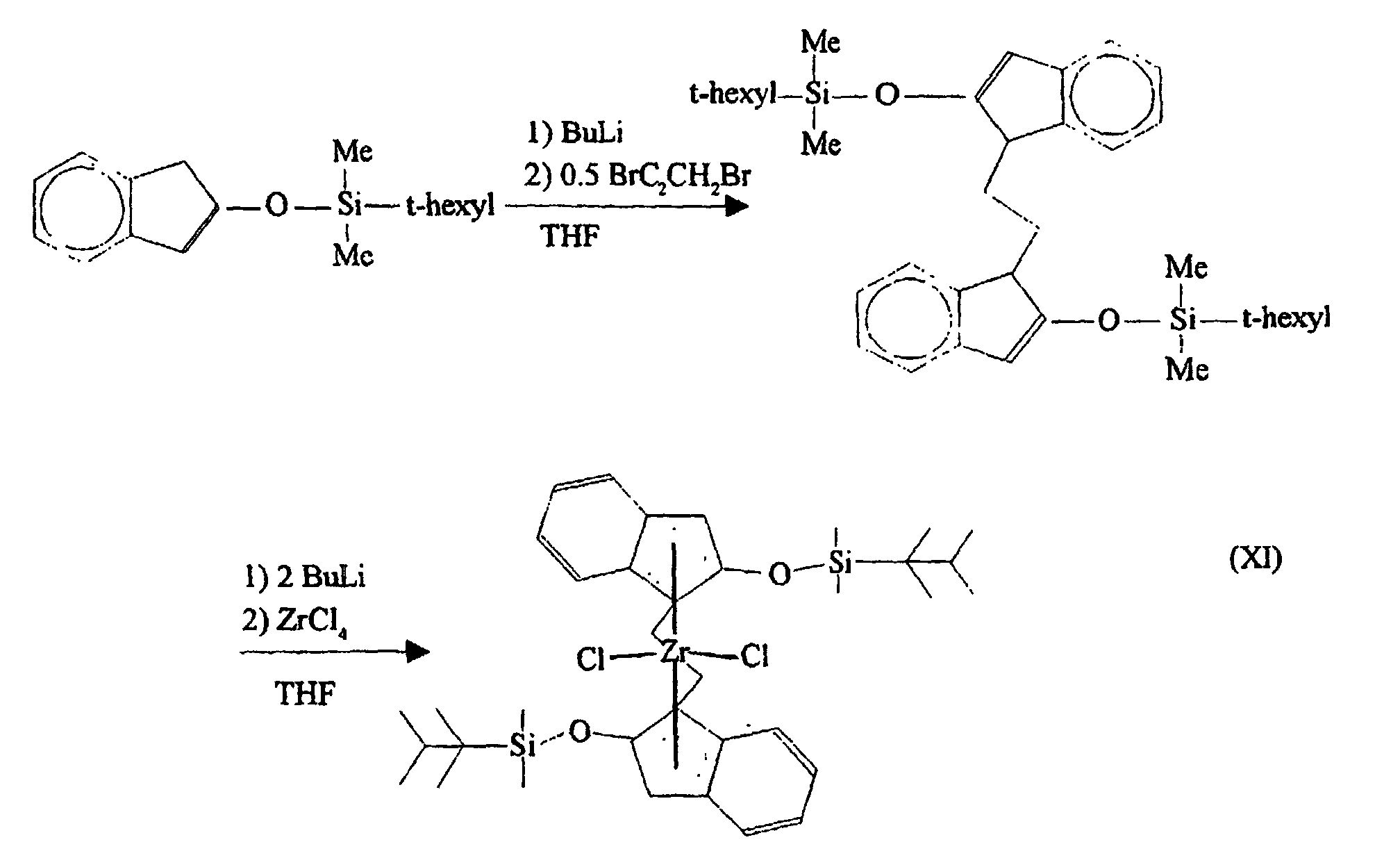
- the reactions take place according to the following reaction scheme (XI): In the reactions above butyllithium may be replaced as described earlier. Zirconium tetrachloride can be replaced with titanium tetrachloride or hafnium tetrachloride to give the corresponding titanum and hafnium complexes. Hydrogenation of [ethylenebis(2-(thexyldimethylsiloxy)indenyl)]zirconium dichloride yields the corresponding tetrahydroindenyl complex.
- Illustrative but non-limiting examples of the compounds according to the invention are, among others, 2-(tert-butyldimethylsiloxy)indene, 2-(t-hexyldimethylsiloxy)-indene, 2-(cyclohexyldimethyl-siloxy)indene, 2-(tert-butyldiphenylsiloxy)indene, dimethylsilylbis(2-(tert-butyldimethylsiloxy)indene), diphenylsilylbis(2-(tert-butyldimethylsiloxy)indene), dimethylsilylbis(2-(thexyldimethylsiloxy)indene), diphenylsilylbis(2-(thexyldimethylsiloxy)indene), dimethylsilylbis(2-(cyclohexyldimethylsiloxy)indene), diphenylsilylbis(2-(cyclohexyldimethylsiloxy)
- the metallocene compounds according to the invention can be used as catalyst components for polymerization or copolymerization of olefins.
- the olefins can be chosen from ethylene, propylene, butene, pentene, hexene, heptene and octene or mixtures thereof. Particularly the olefins can be selected from ethylene and propylene and mixtures thereof or together with other ⁇ -olefins.
- the catalysts can be either unsupported or supported.
- the supported catalysts are mainly used for slurry and gas phase processes.
- the support can be any support known for metallocene and other type catalysts.
- Preferable supports are silica and alumina.
- the compounds according to the invention can be used in combination with activator compounds, which are organometal compounds or any other compounds used in combination with metallocene compounds.
- Suitable cocatalysts are, for example, alkylaluminum compounds, aluminoxanes, methylaluminoxane, or modified methylaluminoxane.
- Preferred cocatalyst is methylaluminoxane (MAO).
- Other cocatalysts which may be used include Lewis or prolic acids, such as (B(C 6 F 5 ) 3 or [PhNMe 2 H] 1 B(C 6 F 5 ) 4 , which generate cationic metallocenes with compatible non-coordinating anions in the presence or absence of alkylaluminum compounds.
- activators are, for example, alumoxane compounds having the formula of R-(Al(R)-O) m -AlR 2 where n is 1-40, m is 3-40 and R is C 1 -C 8 alkyl group.
- R is methyl group and the preferable activator is methylalumoxane (MAO).
- the activator can be applied according to the methods known in the art.
- the polymerizations were performed in a 0.5 L Büchi glass autoclave in 200 mL of toluene. In a typical run half of the MAO/toluene solution was added to the reactor and stirred for 5 minutes in order to reduce any impurities in the reactor. In a parallel procedure 10-15 ⁇ mmol of the metallocene was dissolved in the remaining half of the MAO/toluene solution and preactivated at 25 °C for 5 min. The catalyst/activator mixture was charged into the reactor and the polymerization was started by introducing the olefin monomer. The polymerization was interrupted after 20 or 60 minutes by addition of ethanol or methanol. The polymer was analyzed after being washed with ethanol/HCl or methanol/HCl.
- Methylaluminoxane (MAO) was used as 29.3 w-% toluene solution (Al total 13.1 % w/w, Al as TMA 3.50% w/w). High purity ethylene and propylene (99,5%) were used as monomers.
- the polymerizations with the [metallocene] + [B(C 6 F 6 ) 4 ] - catalyst system were carried out at -20 °C and 2.0 bar propylene pressure using triethylalumina (TEA) as impurity scavenger.
- TEA triethylalumina
- 0.3 g of TEA was stirred with 50 mL of toluene followed by the addition of 5 ⁇ mol of the metallocene.
- the cation forming agent 14 ⁇ mol was added via a syringe.
- the polymerization was interrupted after 60 min by addition of ethanol or methanol.
- the polymer was analyzed after being washed with ethanol/HCl or methanol/HCl.
- the polymerizations were performed in a 2.0 L Büchi autoclave in 1300 mL of pentane.
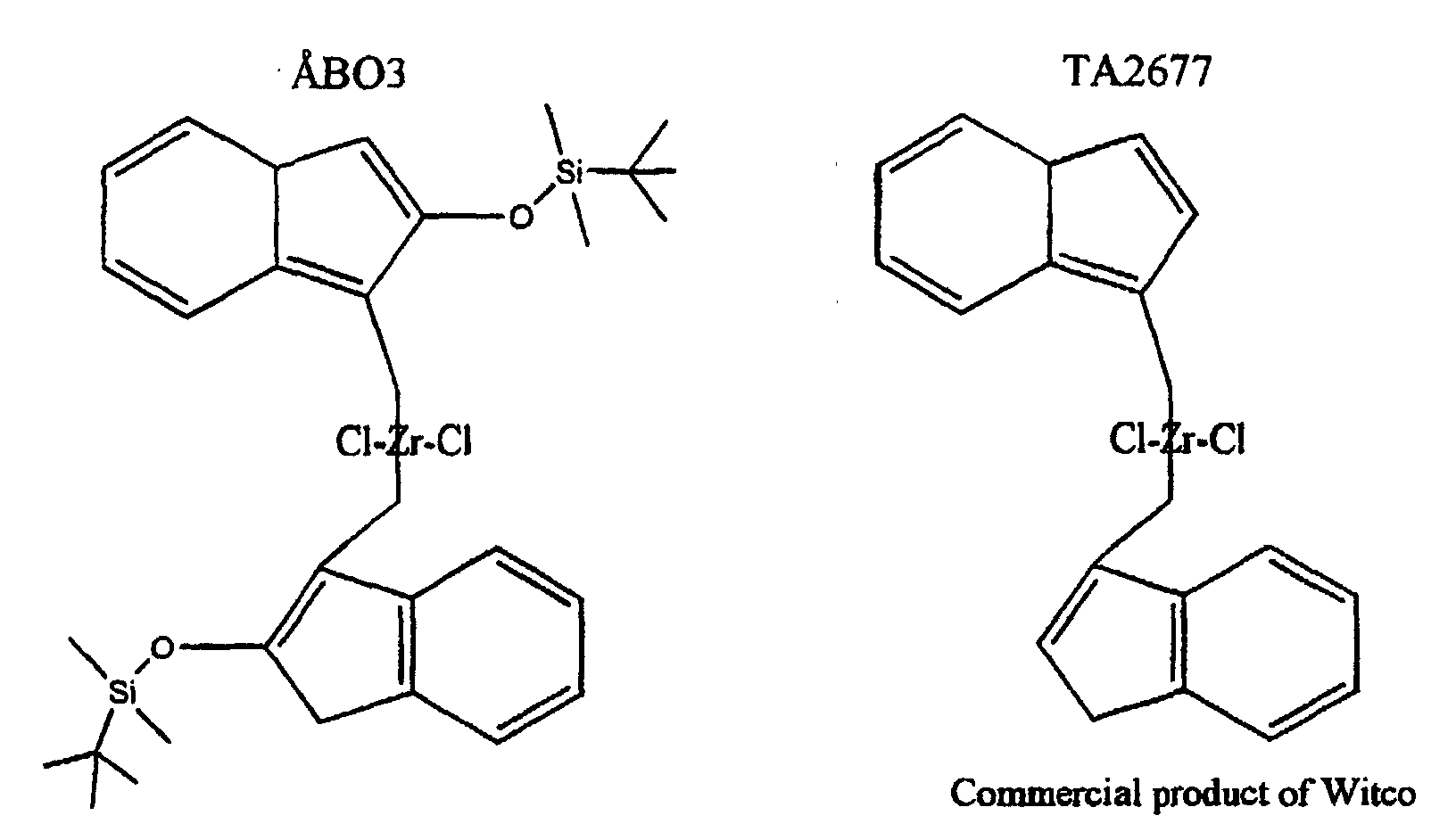
- a complex solution of ⁇ BO3 (rac-Et[2-(t-BuMe 2 SiO)Ind] 2 ZrCl 2 ) and MAO in toluene, having Al/Zr 200, was introduced into the reactor.
- the amount of metallocene was 2.5 ⁇ mol.
- the polymerization reactor was heated to 70 °C, polymerization temperature.
- 5 bar of ethylene partial pressure was introduced into the polymerization reactor and the reaction was started. After 30 min of polymerization, the reaction was stopped by closing the ethylene valve and releasing the overpressure from the reactor.
- the yield of polymer was 120 g polymer, giving a catalyst activity of 526 kgHD-PE/g ⁇ Zr ⁇ h.
- the polymerizations were performed in a 2.0 L Büchi autoclave in 1300 mL of pentane.
- a complex solution of ⁇ BO3 (rac-Et[2-(t-BuMe 2 SiO)Ind] 2 ZrCl 2 ) and MAO in toluene, having Al/Zr 200, was introduced into the reactor.
- the amount of metallocene was 1.25 ⁇ mol.
- the polymerization reactor was heated to 70 °C, polymerization temperature.
- 5 bar of ethylene partial pressure was introduced into the polymerization reactor and the reaction was started. After 30 min of polymerization, the reaction was stopped by closing the ethylene valve and releasing the overpressure from the reactor.
- the polymerizations were performed in a 2.0 L Büchi autoclave in 1300 mL of pentane.
- a complex solution of ⁇ BO3 (rac-Et[2-(t-BuMe 2 SiO)Ind] 2 ZrCl 2 ) and MAO in toluene, having Al/Zr 100, was introduced into the reactor.
- the amount of metallocene was 0.63 ⁇ mol.
- the polymerization reactor was heated to 70 °C, polymerization temperature.
- 5 bar of ethylene partial pressure was introduced into the polymerization reactor and the reaction was started. After 30 min of polymerization, the reaction was stopped by closing the ethylene valve and releasing the overpressure from the reactor.
- the polymerizations were performed in a 2.0 L Büchi autoclave in 1300 mL of pentane.
- a complex solution of ⁇ BO3 (rac-Et[2-(t-BuMe 2 SiO)Ind] 2 ZrCl 2 ) and MAO in toluene, having Al/Zr 100, was introduced into the reactor.
- the amount of metallocene was 0.6 ⁇ mol.
- the polymerization reactor was heated to 70 °C, polymerization temperature.
- 5 bar of ethylene partial pressure was introduced into the polymerization reactor and the reaction was started. After 30 min of polymerization, the reaction was stopped by closing the ethylene valve and releasing the overpressure from the reactor.
- the polymerizations were performed in a 2.0 L Büchi autoclave in 1300 mL of pentane.
- a complex solution of ⁇ BO3 (rac-Et[2-(t-BuMe 2 SiO)Ind] 2 ZrCl 2 ) and MAO in toluene, having Al/Zr 200, was introduced into the reactor.
- the amount of metallocene was 0.6 ⁇ mol.
- the polymerization reactor was heated to 70 °C, polymerization temperature.
- 5 bar of ethylene partial pressure was introduced into the polymerization reactor and the reaction was started. After 30 min of polymerization, the reaction was stopped by closing the ethylene valve and releasing the overpressure from the reactor.
- the polymerizations were performed in a 2.0 L Büchi autoclave in 1300 mL of pentane.
- a complex solution of ⁇ BO3 (rac-Et[2-(t-BuMe 2 SiO)Ind] 2 ZrCl 2 ) and MAO in toluene, having Al/Zr 500, was introduced into the reactor.
- the amount of metallocene was 0.6 ⁇ mol.
- the polymerization reactor was heated to 70 °C, polymerization temperature.
- 5 bar of ethylene partial pressure was introduced into the polymerization reactor and the reaction was started. After 30 min of polymerization, the reaction was stopped by closing the ethylene valve and releasing the overpressure from the reactor.
- the polymerizations were performed in a 2.0 L Büchi autoclave in 1300 mL of pentane.
- a complex solution of TA2677 (Et[1-Ind] 2 ZrCl 2 ) and MAO in toluene, having Al/Zr 100, was introduced into the reactor.
- the amount of metallocene was 0.65 ⁇ mol.
- the polymerization reactor was heated to 70 °C, polymerization temperature.
- 5 bar of ethylene partial pressure was introduced into the polymerization reactor and the reaction was started. After 30 min of polymerization, the reaction was stopped by closing the ethylene valve and releasing the overpressure from the reactor.
- the polymerizations were performed in a 2.0 L Büchi autoclave in 1300 mL of pentane.
- a complex solution of TA2677 (Et[1-Ind] 2 ZrCl 2 ) and MAO in toluene, having Al/Zr 200, was introduced into the reactor.
- the amount of metallocene was 0.65 ⁇ mol.
- the polymerization reactor was heated to 70 °C, polymerization temperature.
- 5 bar of ethylene partial pressure was introduced into the polymerization reactor and the reaction was started. After 30 min of polymerization, the reaction was stopped by closing the ethylene valve and releasing the overpressure from the reactor.
- the polymerizations were performed in a 2.0 L Büchi autoclave in 1300 mL of pentane.
- a complex solution of TA2677 (Et[1-Ind] 2 ZrCl 2 ) and MAO in toluene, having Al/Zr 500, was introduced into the reactor.
- the amount of metallocene was 0.65 ⁇ mol.
- the polymerization reactor was heated to 70 °C, polymerization temperature.
- 5 bar of ethylene partial pressure was introduced into the polymerization reactor and the reaction was started. After 30 min of polymerization, the reaction was stopped by closing the ethylene valve and releasing the overpressure from the reactor.
- the yield of polymer was 25 g polymer, giving a catalyst activity of 421 kgHD-PE/g ⁇ Zr ⁇ h.
- Examples 25 to 27 describe the influence of metallocene concentration on the polymerization. By using too high concentration the metal activity becomes too low. From these examples it can be seen that the metal activity is increased when the amount of the catalyst is decreased from 2.5 ⁇ mol down to 0.6 ⁇ mol.
- Examples 28-30 and comparative examples 1-3 shows the importance of a 2-siloxy substituent on catalyst activity.
- ethylenebis indenyl zirconium dichloride has a siloxy substituent the catalyst activity is increased especially with low Al/Zr-ratios indicating easy complex formation between metallocene and MAO and also increased activity of the zirconium. The difference can be seen best in figure 1 above.
Landscapes
- Chemical & Material Sciences (AREA)
- Organic Chemistry (AREA)
- Health & Medical Sciences (AREA)
- Chemical Kinetics & Catalysis (AREA)
- Medicinal Chemistry (AREA)
- Polymers & Plastics (AREA)
- Transition And Organic Metals Composition Catalysts For Addition Polymerization (AREA)
Description
- The present invention relates to novel metallocene catalyst systems for homo- and copolymerization of olefins, especially propylene, ethylene and higher alpha-olefins, in the presence of a cocatalyst, such as methylalumanoxane (MAO). Especially the invention relates to metallocenes with heteroatom substituted indenyl and indenyl derivative ligands, a method for their preparation, and their use in polymerization of olefins, especially propylene and ethylene.
- Chiral C-2 symmetric bis(indenyl) ansa-metallocenes are precursors to highly active catalysts for stereoselective polymerization of alpha-olefins. The performance characteristics of these systems are different, the variations being induced by size and position of the substituents. E.g., dimethylsilylene bridged 2,2'-dimethyl-4,4'-diaryl substituted bis(indenyl) zirconocenes developed by Brintzinger and coworkers (Organometallics 1994, 13, 964) and Spaleck et al. (Organometallics 1994, 13, 954), produce isotactic polypropylenes with catalyst activities and polymer properties comparable to those obtained with heterogeneous Ziegler-Natta catalysts.
- The area of electronically altered bis(indenyl) metallocenes has remained relatively unexplored. Previously, it has been reported that halogen or alkoxy substitution in the six-membered rings of indenes reduces the activity of the catalyst system and the molecular weight of the produced polymer (Consiglio et al, Organometallics 1990, 9, 3098; Collins et al., Organometallics 1992, 11, 2115). Bis(indenyl) zirconocenes with 2-amino functionalized ligands have been reported recentily by several groups (Luttikhedde et al., Organometallics 1996, 15, 3092; Plenio and Burth, J. Organomet Chem. 1996, 519, 269; Brintzinger et al., J. Organomet. Chem. 1996, 520, 63). The bridged complexes show somewhat lower catalytic activities compared with their unsubstituted bis(indenyl) zirconocene analogues.
- WO94/28034, EP 485822 and EP 584609 disclose 2-substituted indenyl metallocenes in general and 2-methyl derivatives in particular. The catalyst were supported and intended for atactic polymerization giving improved polymer morphology.
- The present invention concerns novel metallocene complexes (I) with an oxygen atom directly bonded to the 2-position of a pentahapto indenyl moiety, e.g., racemic [ethylenebis(2-(tert-butyldimethylsiloxy)indenyl)]zirconium dichloride, and their application in polymerization of olefins. These complexes (I), in combination with MAO or other activators, form highly active catalyst systems for homo- and copolymerization of olefins. E.g., the I/MAO catalyst systems polymerizes propylene to highly isotactic polypropylene. The propylene and ethylene polymerization activities of these (I)/MAO systems exceeds those of several conventional ansa-metallocene/MAO catalyst systems, such as dimethylsilylenebis(4,5,6,7-tetrahydroindenyl)zirconium dichloride/MAO, under similar polymerization conditions. The novel catalyst systems are very stable and retain their high activities at exceptionally low [Al]:[Zrl] ratios.
- According to the invention a new catalyst precursor is obtained, in which a siloxy substitution in the 2-position of 5-membered ring of an indenyl-type compound has been carried out Thereby it is possible to produce metallocene compounds, in which an oxygen atom is directly bonded to the 2-position of a penta-hapto indenyl moiety.
- Thus the catalyst precursor according to the invention concerns an indenyl compound having the formula (I):wherein D is one of silicon or germanium, R3, R3' and R4 are the same or different and are one of a hydrogen atom, a C1-C10 hydrocarbyl group or a C1-C10 hydrocarbyloxy group, or at least two of R3, R3' and R4 form together a C2-C20 ring structure; M is a transition metal of group 4 of the Periodic Table and is bound to the ligand IndY in at least an η5 bonding mode; each R is the same or different and is one of a hydrogen atom, a halogen atom, a C1-C10 hydrocarbyl group, a C1-C10 hydrocarbyloxy group, a tri-hydrocarbyl silyl group or two R form together a C2-C20 ring structure; B is a bridge atom or group between two IndY ligands or between one IndY ligand and the transition metal M; m is 1 or 2; o is 0 or 1; and n is 4-m when there is no bridge B or B is a bridge atom or group between two IndY ligands, or n is 4-m-o when B is a bridge atom or group between one IndY ligand and the transition metal M.

- By mono- or polysubstituted is meant that, in addition to said substituent Y, there may optionally be other substituents at the rings at said ligand IndY.
- By fused or non-fused is meant that any ring at said ligand IndY may be fused or non-fused, i.e. have at least two atoms in common, with at least one further ring.
- By homo- and heterocyclic is meant that any ring of said ligand IndY may have only carbon ring atoms (homo- or isocyclic) or may have other ring atoms than carbon (heterocyclic).
- Preturately the indenyl compound according to formula (I) has the following formula (III)where

M is a metal selected from zirconium, titanium or hafnium,
D is an element selected from silicon (Si) or germanium (Ge),
B is abridge comprising at least one of -(CH2)n-, -Si(R3)2- or -Ge(R3)2-,
R1 and R2 are the same or different groups selected from a hydrogen atom, a C1-C10 alkyl group, C1-C10 alkoxy group, C6-C10 aryl group, C6-C10 aryloxy group, C2-C10 alkenyl group, C2-C10 arylalkyl group, C2-C10 alkylaryl group, C8-C40 arylalkenyl group or a halogen atom, preferably a C1-C10 alkyl group and/or a halogen atom.
R3', R3-R6 are same or different groups selected from hydrogen, C1-C10 alkyl group, C1-C10 alkoxy group, C6-C10 aryl group, C6-C10 aryloxy group, C2-C10 alkenyl group, C2-C10 arylalkyl group, C2-C10 alkylaryl group, C8-C40 arylalkenyl group and a halogen atom. R3 and R3' groups can also be connected to each other to form a ring structure and R4 may also be part of a ring structure. - Preferably M1 is zirconium.
- R1 and R2 are preferably the same and most preferably they are halogen atoms, for example chlorine atoms.
- R3 is preferably C1-C10 alkyl or aryl group and most preferably it is methyl group. R4 is likewise preferably C1-C10 alkyl or aryl group, for example tert-butyl group, t-hexyl group or cyclohexyl group.
- Most preferably D is Si, B is -CH2CH2-, R1=R2 and is chlorine, R3 is CH3 and R5-R6 is aromatic or fused aromatic or alkyl or hydrogen.
- The invention also relates to 2-trihydrocarbyl and 2-trihydrokarbyloxy siloxyindene and germyloxyindene compounds having the general formula:further non-fused or further fused, homocyclic (=isocyclic) or heterocyclic, unsaturated or saturated, aliphatic or aromatic six-membered ring; and R8, R9 and R10 are the same or different and are one of a hydrogen atom, a C1-C10 hydrocarbyl group, a C1-C10 hydrocarbyloxy group, a tri-C1-C10 hydrocarbyl silyl group or a tri-C1-C10 hydrocarbyloxy silyl group, or one of R8 and R9 may be a group B which is a bridge atom or group to a cyclopentadienyl, fluorenyl or indenyl group, with the provision that when R7 forms an unsubstituted benzene ring, D is silicon, R3, R3' and R4 are methyls and R8 and R10 are hydrogens, R9 is not a hydrogen. Preferably, they have the formula:
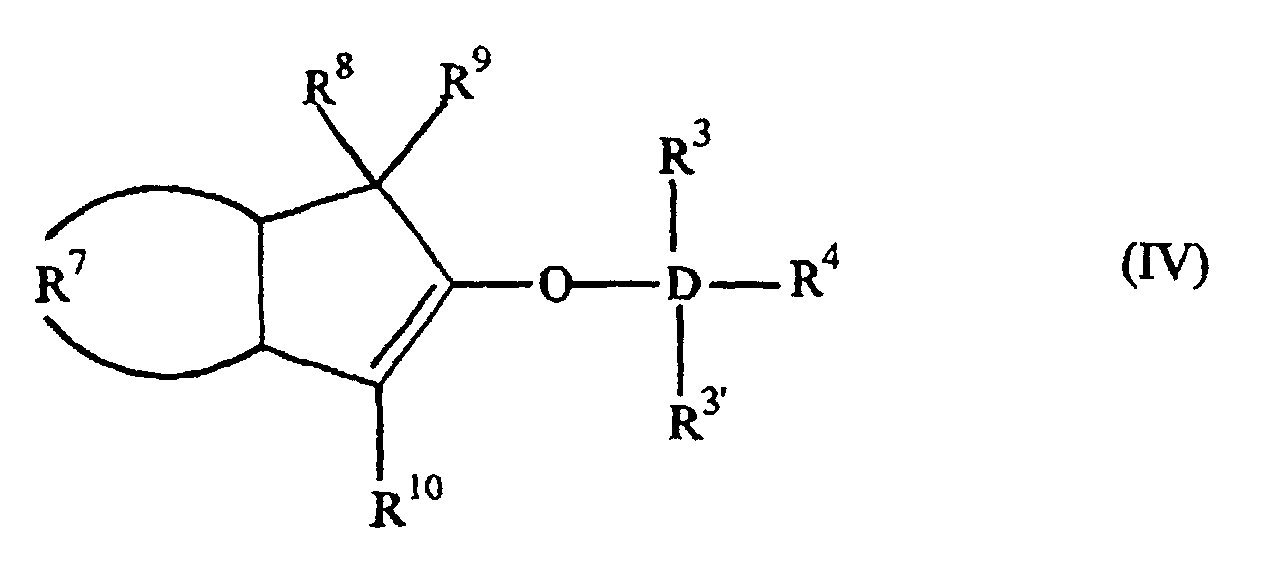 wherein: R3', R3-R6 are the same or different and are one of a hydrogen atom, a C1-C10 alkyl group, a C1-C10 alkoxy group, a C6-C10 aryl group, a C2-C10 alkenyl group, a C7-C22 arylalkyl group, a C7-C22 alkylaryl group, a C8-C23 arylalkenyl group or a halogen atom, or at least two of R3, R3' and R4 form together a C2-C10 ring structure, and R8, R9 and R10 are the same as above, alternatively, or the formula:
 wherein: R3, R3', R4-R6, R8, R10 and D are the same as above; and B is a bridge of at least one of the groups -(CH2)n-, -SiR3 2-, or -GeR3 2-, wherein n is 1-8 and R3 is the same as above. D is preferably Si.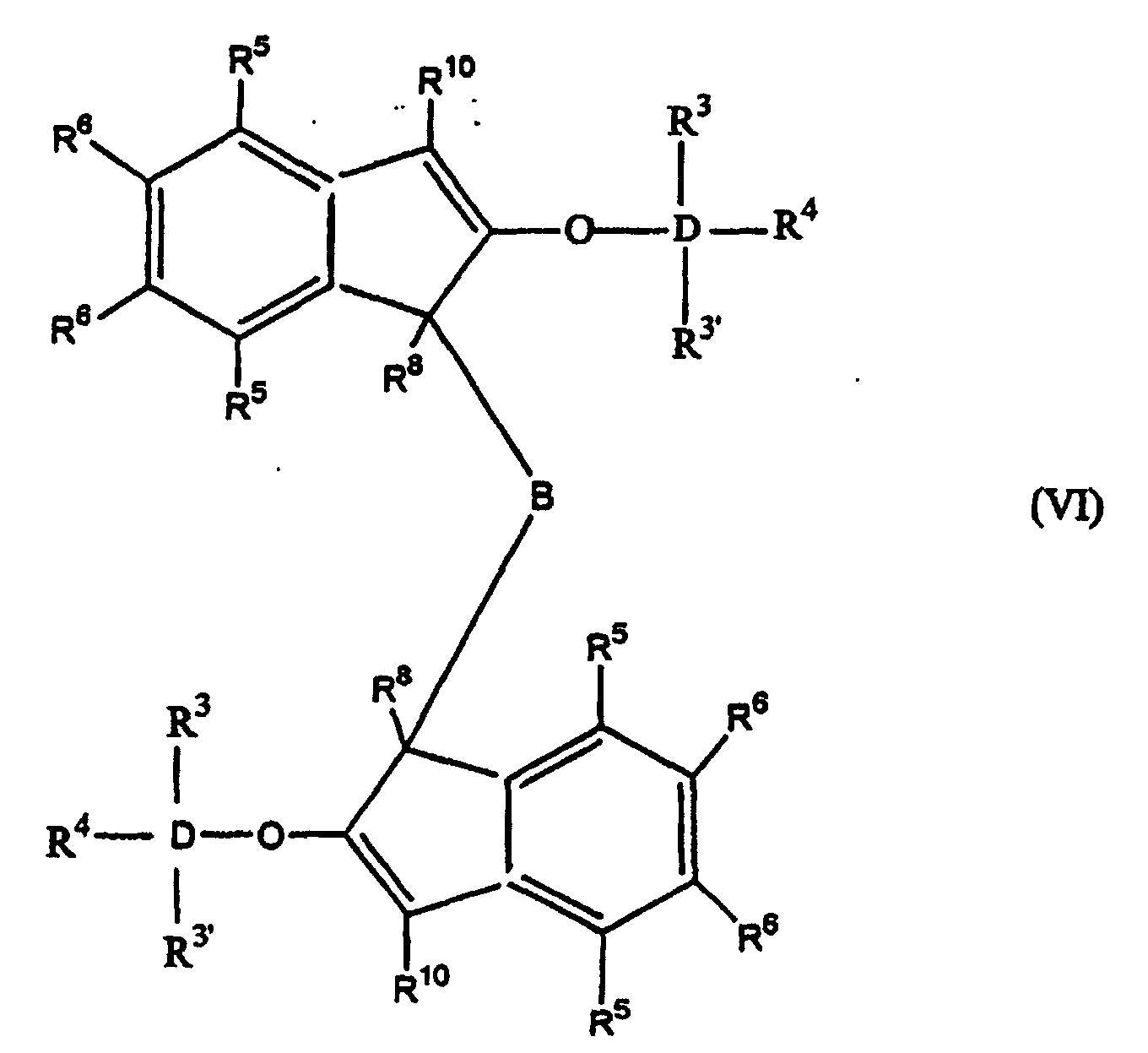
- The catalyst compounds according to the invention can be prepared from 2-indanone. This compound can be reacted in a suitable solvent with a base and a chlorosilane to form 2-siloxyindene with a yield of over 80%. Suitable solvents are for example dimethylformamide (DMF) and tetrahydrofurane (THF). Suitable bases are for example imidazole, triethylamine (TEA) and 1,8-diazabicyclo[5.4.0]undec-7-ene. Suitable chlorosilanes are for example tert-butyldimethylchlorosilane, t-hexyldimethylchlorosilane and cyclohexyldimethylchlorosilane. The reaction takes place according to the following reaction scheme (VII):

- According to one embodiment of the invention 2-(tert-butyldimethylsiloxy)indene is reacted first with butyllithium and then with dimethyl dichlorosilane (Me2SiCl2) to form dimethylsilylbis(2-(tert-butyldimethylsiloxy)indenyl)silane. Butyllithium can be replaced with methyllithium, sodium hydride or potassium hydride. Likewise dimethyl dichlorosilane can be replaced with any dialkyl or diarylsilane. Silicon can be replaced with germanium.
- Dimethylsilylbis(2-(tert-butyldimethylsiloxy)indenyl)silane can be reacted with butyllithium, which gives the corresponding bislithium salt. This product can be reacted with zirconium tetrachloride to yield [dimethylsilylbis(2-(tert-butyldimethylsiloxy)indenyl)]zirconium dichloride as a mixture of the racemic and meso diastereomers. Butyllithium may be replaced as described earlier. Zirconium tetrachloride can be replaced with titanium tetrachloride or hafnium tetrachloride to give the corresponding titanium and hafnium complexes. The reactions take place according to the following reaction schemes (VIII and IX):

- According to another embodiment of the invention 2-(tert-butyldimethylsiloxy)-indene is reacted first with butyllithium and then with dibromoethane to form bis(2-(tert-butyldimethylsiloxy)indenyl)ethane. This compound can be reacted with two equivalents of butyllithium, which gives the corresponding bislithium salt. This can then be reacted with zirconium tetrachloride to yield [ethylenebis(2-(tert-butyldimethylsiloxy)indenyl)]zirconium dichloride. The racemic diastereomer of the latter is formed in great excess and is easily separated from the meso isomer by fractional crystallization. Catalytic hydrogenation of racemic [ethylenebis(2-(tertbutyldimethylsiloxy)indenyl)]zirconium dichloride yields the corresponding tetrahydroindenyl complex. The reactions take place according to the following reaction scheme (X):In the reactions above butyllithium may be replaced as described earlier. Zirconium tetrachloride can be replaced with titanium tetrachloride or hafnium tetrachloride to give the corresponding titanium and hafnium complexes.

- According to still another embodiment of the invention 2-(t-hexyldimethylsiloxy)-indene is reacted first with butyllithium and then with dibromoethane to form bis(2-(t-hexyldimethylsiloxy)indenyl)ethane. This compound can be reacted with two equivalents of butyllithium which gives the corresponding bislithium salt. This can then be reacted with with zirconium tetrachloride to yield [ethylenebis(2-(t-hexyldimethylsiloxy)indenyl)]zirconium dichloride. The racemic diastereomer of the latter is formed in great excess and is easily separated from the meso isomer by fractional crystallization. The reactions take place according to the following reaction scheme (XI):In the reactions above butyllithium may be replaced as described earlier. Zirconium tetrachloride can be replaced with titanium tetrachloride or hafnium tetrachloride to give the corresponding titanum and hafnium complexes. Hydrogenation of [ethylenebis(2-(thexyldimethylsiloxy)indenyl)]zirconium dichloride yields the corresponding tetrahydroindenyl complex.
- Illustrative but non-limiting examples of the compounds according to the invention are, among others, 2-(tert-butyldimethylsiloxy)indene, 2-(t-hexyldimethylsiloxy)-indene, 2-(cyclohexyldimethyl-siloxy)indene, 2-(tert-butyldiphenylsiloxy)indene, dimethylsilylbis(2-(tert-butyldimethylsiloxy)indene), diphenylsilylbis(2-(tert-butyldimethylsiloxy)indene), dimethylsilylbis(2-(thexyldimethylsiloxy)indene), diphenylsilylbis(2-(thexyldimethylsiloxy)indene), dimethylsilylbis(2-(cyclohexyldimethylsiloxy)indene), diphenylsilylbis(2-(cyclohexyldimethylsiloxy)indene), dimethylsilylbis(2-(tert-butyldiphenylsiloxy)indene), diphenylsilylbis(2-(tert-butyldiphenylsiloxy)indene), racemic and meso [dimethylsilylbis(2-(tert-butyldimethylsiloxy)indenyl)]zirconium dichloride, racemic and meso [diphenylsilylbis(2-(tert-butyldimethylsiloxy)indenyl)]zirconium dichloride, racemic and meso [dimethylsilylbis(2-(t-hexyldimethylsiloxy)indenyl)]zirconium dichloride, racemic and meso [diphenylsilylbis(2-(t-hexyldimethylsiloxy)indenyl)]zirconium dichloride, racemic and meso [dimethylsilylbis(2-(cyclohexyldimethylsiloxy)indenyl)]zirconium dichloride, racemic and meso [dimethylsilylbis(2-(cyclohexyldimethylsiloxy)-indenyl)]zirconium dichloride, racemic and meso [dimethylsilylbis(2-2-(tert-butyldiphenylsiloxy)indenyl)]zirconium dichloride, racemic and meso [diphenylsilylbis(2-(tert-butyldiphenylsiloxy)indenyl)]zirconium dichloride, racemic and meso [dimethylsilylbis(2-(tert-butyldimethylsiloxy)-4,5,6,7-tetrahydroindenyl)]-zirconium dichloride, racemic and meso [diphenylsilylbis(2-(tert-butyldimethylsiloxy)-4,5,6,7-tetrahydroindenyl)]zirconium dichloride, racemic and meso [dimethylsilylbis(2-(thexyldimethylsiloxy)-4,5,6,7-tetrahydroindenyl)]zirconium dichloride, racemic and meso [diphenylsilylbis(2-(t-hexyldimethyl-siloxy)-4,5,6,7-tetrahydroindenyl)]zirconium dichloride, racemic and meso [dimethylsilylbis(2-(cyclohexyldimethylsiloxy)-4,5,6,7-tetrahydroindenyl)]zirconium dichloride, racemic and meso [diphenylsilylbis(2-(cyclohexyldimethylsiloxy)-4,5,6,7-tetrahydroindenyl)]zirconium dichloride, racemic and meso [dimethylsilylbis(2-(tert-butyldiphenylsiloxy)-4,5,6,7-tetrahydroindenyl)]zirconium dichloride, racemic and meso [diphenylsilylbis(2-(tert-butyldiphenylsiloxy)-4,5,6,7-tetrahydroindenyl)]-zirconium dichloride, bis(2-(tert-butyldimethylsiloxy)indenyl)ethane, bis(2-(thexyldimethylsiloxy)indenyl)ethane, bis(2-(tert-butyldiphenylsiloxy)indenyl)ethane, bis(2-(cyclohexyldimethylsiloxy)indenyl)ethane, [rac-ethylenebis(2-(tert-butyldimethylsiloxy)indenyl)]zirconium dichloride, racemic and meso [ethylenebis(2-(t-hexyldimethylsiloxy)indenyl)]zirconium dichloride, racemic and meso [ethylenebis(2-(cyclohexyldimethylsiloxy)indenyl)]zirconium dichloride, racemic and meso [ethylenebis(2-(tert-butyldiphenylsiloxy)indenyl)]zirconium dichloride, [rac-ethylenebis(2-(tert-butyldimethylsiloxy)-4,5,6,7-tetrahydroindenyl)]zirconium dichloride, racemic and meso [ethylenebis(2-(cyclohexyldimethylsiloxy)-4,5,6,7-tetrahydroindenyl)]zirconium dichloride, racemic and meso [ethylenebis(2-(tert-butyldiphenylsiloxy)-4,5,6,7-tetrahydroindenyl)]zirconium dichloride, bis(2-(t-hexyldimethylsiloxy)indenyl)ethane and [rac-ethylenebis(2-(t-hexyldimethylsiloxy)indenyl)]zirconium dichloride. Titanium or hafnium can be used instead of zirconium in corresponding complexes.
- The metallocene compounds according to the invention can be used as catalyst components for polymerization or copolymerization of olefins. The olefins can be chosen from ethylene, propylene, butene, pentene, hexene, heptene and octene or mixtures thereof. Particularly the olefins can be selected from ethylene and propylene and mixtures thereof or together with other α-olefins.
- The catalysts can be either unsupported or supported. The supported catalysts are mainly used for slurry and gas phase processes. The support can be any support known for metallocene and other type catalysts. Preferable supports are silica and alumina.
- The compounds according to the invention can be used in combination with activator compounds, which are organometal compounds or any other compounds used in combination with metallocene compounds. Suitable cocatalysts are, for example, alkylaluminum compounds, aluminoxanes, methylaluminoxane, or modified methylaluminoxane. Preferred cocatalyst is methylaluminoxane (MAO). Other cocatalysts which may be used include Lewis or prolic acids, such as (B(C6F5)3 or [PhNMe2H]1B(C6F5)4, which generate cationic metallocenes with compatible non-coordinating anions in the presence or absence of alkylaluminum compounds. Especially suitable activators are, for example, alumoxane compounds having the formula of R-(Al(R)-O)m-AlR2 where n is 1-40, m is 3-40 and R is C1-C8 alkyl group. Preferably R is methyl group and the preferable activator is methylalumoxane (MAO). The activator can be applied according to the methods known in the art.
- All operations were carried out in argon or nitrogen atmosphere using standard Schlenk, vacuum or glove box techniques. Solvents used were dried and distilled under argon prior to use. The 1H- and 13C NMR spectra were recorded in CDCl3 or CD2Cl2 solution using JEOL JNM-LA400 or Jeol JNM-A500 NMR spectrometer and referenced against tetramethylsilane (TMS) or the residual protons of the deuterated solvents. Direct electron ionization mass spectra (EIMS) were obtained on a Varian VG-7070E or a Varian-8000 mass spectrometer.
- A solution of tert-butyldimethylchlorosilane (248.69 g, 1.65 mol) and imidazole (112.33 g, 1.65 mol) in DMF (900 mL) was reacted with 2-indanone (198.24 g, 1.50 mol) and then stirred overnight at room temperature. The reaction mixture was treated with water (800 mL) and extracted with diethyl ether (3 × 400 mL). The combined organic phases were washed with water (2 × 400 mL) and dried over sodium sulfate. The solvents were removed under reduced pressure to leave an orange oil. Distillation under reduced pressure gave 331.2 g (89.6%) of the title compound as a yellow oil (bp 105-107 °C/0.1 mbar). 1H NMR (CDCl3, δ): 7.19-7.07 (m, 3H); 6.97 (td, 3J = 7.3 Hz, 4J = 1.4 Hz, 1H); 5.72 (dd, 4J = 1.9 Hz, 1.1 Hz, 1H); 3.24 (dd, 4J = 1.7 Hz, 1.1 Hz, 2H); 0.96 (s, 9H); 0.23 (s, 6H). 13C NMR (CDCl3, δ): 162.44; 145.14; 136.53; 126.44; 123.01; 122.39; 118.92; 106.58; 39.46; 25.59; 18.14; -4.68.
- A solution of thexyldimethylchlorosilane (100.0 g, 559.3 mmol) and imidazole (38.08 g, 559.3 mmol) in DMF (350 mL) was reacted with 2-indanone (67.40 g, 510.0 mmol) and then stirred for two days at room temperature. The reaction mixture was treated with water (300 mL). and extracted with Et2O (3 × 200 mL). The combined organic phases were washed with water (2 × 200 mL) and dried over sodium sulfate. Evaporation of the solvents left a red oil. Distillation under reduced pressure gave 116.89 g (83.5%) of the title compound as a yellow oil (bp. 128-130 °C/0.4 mbar). 1H NMR (CDCl3, δ): 7.24-7.10 (m, 3H); 7.00 (td, 3J = 7.3 Hz, 4J = 1.3 Hz, 1H); 5.74 (d, 4J = 0.6 Hz, 1H); 3.28 (s, 2H); 1.70 (sept, 3J = 6.8 Hz, 1H); 0.93 (s, 6H); 0.92 (d, 3J = 6.8 Hz, 6H); 0.29 (s, 6H). 13C NMR (CDCl3, δ): 162.82; 145.71; 137.03; 126.86; 123.45; 122.73; 119.29; 106.92; 40.00; 34.49; 25.51; 20.51; 18.89; -2.26.
- A solution of cyclohexyldimethylchlorosilane (84.62 g, 478.7 mmol) and imidazole (32.59 g, 478.7 mmol) in DMF (300 mL) was reacted with 2-indanone (57.62 g, 436.0 mmol). The reaction mixture was stirred overnight at room temperature, treated with water (300 mL) and extracted with Et2O (3 × 200 mL). The combined organic phases were washed with water (3 × 300 mL) and dried over sodium sulfate. The solvents were removed to leave an orange oil. Distillation under reduced pressure gave 81.67 g (68.8%) of the title compound as a yellow oil (bp. 140-142 °C/0.2 mbar). 1H NMR (CDCl3, δ): 7.25-7.11 (m, 3H); 7.01 (td, 3J = 7.3 Hz, 4J = 1.4 Hz, 1H); 5.76 (d, 4J = 0.7 Hz, 1H); 3 .29 (s, 2H); 1.77-1.74 (m, 5H); 1.27-1.13 (m 5H); 0.90 (m, 1H); 0.24 (s, 6H). 13C NMR (CDCl3, δ): 162.44; 145.24; 136.60; 126.47; 123.07; 122.37; 118.91; 106.32; 39.52; 27.69; 26.77; 26.46; 26.33; -3.55.
- To a solution of tert-butyldiphenylchlorosilane (42.43 g, 154.4 mmol) and DBU (25.64 g, 168.4 mmol) in benzene (200 mL) was added 2-indanone (18.38 g, 139.1 mmol) in one portion. The reaction mixture was stirred overnight, diluted with Et2O (200 mL), washed with 10% HCl (2 × 200 mL) and water (2 × 200 mL) and dried over sodium sulfate. The solvents were evaporated to leave a dark brown oil. Distillation under reduced pressure gave 38.22 g (74.1%) of the title compound as a yellow oil (bp. 172-175 °C/0.05 mbar). 1H NMR (CDCl3, δ): 7.77-7.74 (m, 4H); 7.46-7.36 (m, 6H); 7.18-7.16 (m, 1H); 7.11-7.07 (m, 1H); 6.98-6.94 (m, 2H); 5.48 (d, 4J = 0.7 Hz, 1H); 3.29 (s, 2H); 1.09 (s, 9H). 13C NMR (CDCl3, δ): 162.13; 145.17; 136.75; 135.53; 132.43; 130.20; 127:99; 126.51; 123.15; 122.49; 119.24; 107.91; 39.43; 26.60; 19.46.
- To a suspension of bisbenz[e,g]-2-indanone (35.90 g, 154.5 mmol) and tert-butyldimethylchlorosilane (28.00 g, 185.5 mmol) in benzene (300 mL) was added dropwise DBU (30.60 g, 201.0 mmol) while keeping the reaction mixture cold with an icebath. Stirring was continued for 1 hour at room temperature. The organic phase was washed with water (200 mL), 5% HCl (2 x 200 mL), water (200 mL) and dried over sodium sulfate. Evaporation of the solvents left a residue which was washed with MeOH (3 x 200 mL) to give the title compound (38.35 g, 110.7 mmol, 71.6%) as a slightly pink powder. EIMS (calcd/found): 346.1753/346.1744. 1H NMR (CDCl3, δ): 8.72-8.67 (m, 1H); 8.66-8.62 (m,1H); 8.02-7.96 (m, 1H); 7.82-7.99 (m,1H); 7.62-7.57 (m, 2H); 7.56-7.50 (m, 1H); 7.49-7.44 (m, 1H); 6.32 (m, 1H); 3.73 (m, 2H); 1.03 (s, 9H); 0.33 (s, 6H). 13C NMR (CDCl3, δ): 163.16; 139.79; 130.11; 129.41; 128.34; 127.73; 127.21; 126.67; 126.07; 125.53; 124.42; 123.91; 123.38; 123.24; 122.96; 104.55; 39.81; 25.68; 18.29; -4.50.
- To a solution of tert-butyldimethylchlorosilane (2.85 g, 18.9 mmol) and 4,7-dimethyl-2-indanone (2.53 g, 15.8 mmol, obtained by oxidation of 4,7-dimethylindene) in benzene (30 mL) was added DBU (3.13 g, 20.5 mmol) and the reaction mixture was stirred for 2 hours at room temperature. The mixture was diluted with Et2O (50 mL), washed with water (2 x 50 mL), 5% HCl (50 mL) water (2 x 50 mL) and dried over sodium sulphate. Evaporation of the solvents left a dark oil that was dissolved in pentane (30 mL). The unreacted starting materials were crystallized at - 15 °C and removed by filtration. Evaporation of the solvent gave 3.03 g (69.9%) of fairly pure title compound as an orange oil. 1H NMR (CDCl3, δ): 6.94 (dq, 3J =7.7 Hz, 4J=0.3 Hz, 1H),; 6.78 (dq, 3J=7.7 Hz, 4J=0.3 Hz, 1H); 5.84 (t, 4J=1.1 Hz, 1H); 3.20 (m, 2H); 2.30 (s, 3H); 2.25 (s, 3H); 1.00 (s, 9H); 0.27 (s, 6H); 13C NMR (CDCl3, δ): 162.08; 143.39; 134.89; 129.45; 127.78; 125.49; 123.84; 105.28; 38.80; 25.65; 18.29; 18.21; -4.57.
- To a solution of 2-(tert-butyldimethylsiloxy)indene (36.96 g, 150.0 mmol) in THF (150 mL) at 0 °C was added dropwise n-BuLi (60.0 mL of a 2.5 M solution in hexanes, 150.0 mmol) and the reaction mixture was stirred overnight at room temperature. The resulting solution was then cooled to -80 °C and treated dropwise with a solution of dibromoethane (14.09 g, 75.0 mmol) in THF (50 mL). After completed addition the reaction mixture was stirred overnight at room temperature and washed with saturated ammonium chloride solution (300 mL). Solvents from the organic phase were evaporated and the product was dissolved in Et2O (300 mL), washed with water (2 x 200 mL) and dried over sodium sulphate. Repeated crystallizations at -15 °C afforded 22.54 g (57.9%) of the title compound as an off-white solid. The first crystalline fraction consisted of diastereomerically pure material (Mp 108-110 °C). EIMS (calcd/found): 518.3036/518.3028. 1H NMR (CDCl3, δ, major diastereomer): 7.18-7.07 (m, 6H); 6.97 (td, 3J = 7.4 Hz, 4J = 1.3 Hz, 2H); 5.66 (s, 2H); 3.17 (m, 2H); 1.89-1.84 (m, AA', 2H); 1.59-1.54 (m, BB', 2H); 0.94 (s, 18H); 0.23 (s, 6H); 0.21 (s, 6H). 13C NMR (CDCl3, δ, major diastereomer): 164.96; 144.39; 140.62; 126.50; 122.58; 122.41; 118.74; 104.97; 49.18; 25.67; 24.34; 18.12; -4.68; -4.88. 1H NMR (CDCl3, δ, minor diastereomer): 7.17-7.05 (m, 6H); 6.97 (td, 3J =7.4 Hz, 4J = 1.2 Hz, 2H); 5.63 (s, 2H); 3.21 (m, 2H); 1.76-1.75 (m, 4H); 0.94 (s, 18H); 0.22 (s, 6H); 0.20 (s, 6H). 13C NMR (CDCl3, δ, minor diastereomer): 165.18; 144.35; 140.68; 126.53; 122.71; 122.35; 118.74; 104.87; 49.04; 25.67; 25.3 0; 18.14; -4.77.
- To a solution of 2-(t-hexyldimethylsiloxy)indene (68.62 g, 250.0 mmol) in THF (250 mL) at 0 °C was added dropwise n-BuLi (100.0 mL of a 2.5 M solution in hexanes, 250.0 mmol), and the reaction mixture was stirred overnight at room temperature. The resulting solution was then cooled to -80 °C and treated dropwise with a solution of dibromoethane (23.48 g, 125.0 mmol) in THF (100 mL). After completed addition the reaction mixture was stirred overnight at room temperature and washed with saturated ammonium chloride solution (350 mL). Solvents from the organic phase were evaporated, and the product was dissolved in Et2O (350 mL), washed with water (2 × 300 mL) and dried over sodium sulphate. Repeated crystallizations at -15 °C afforded 37.48 g (52.2%) of the title compound as off-white crystals. The first crystalline fraction consisted of diastereomerically pure material that was used for spectral characterization. EIMS (calcd/found): m/e 574.3662/574.3659. 1H NMR (CDCl3, δ): 7.22-7.07 (m, 6H); 6.97 (td, 3J = 7.4 Hz, 4J = 1.2 Hz, 2H); 5.65 (s, 2H); 3.15 (m, 2H); 1.91-1.84 (m, AA', 2H); 1.67 (sept, 3J = 6.8 Hz, 2H); 1.57-1.50 (m, BB', 2H); 0.89 (m, 24H); 0.27 (s, 6H); 0.24 (s, 6H). 13C NMR (CDCl3, δ): 164.75; 144.45; 140.58; 126.46; 122.60; 122.33; 118.68; 104.96; 49.24; 33.93; 25.03; 24.32; 20.14; 20.02; 18.51; 18.47; -2.66; - 2.95.
- To an ice-cooled solution of 2-(cyclohexyldimethylsiloxy)indene (13.62 g, 50.0 mmol) in THF (50 mL) was added dropwise n-BuLi (20.0 mL of a 2.5 M solution in hexanes, 50.0 mmol) and the reaction mixture was stirred overnight at room temperature. The resulting solution was then cooled to -80 °C and treated dropwise with a solution of dibromoethane (4.70 g, 25.0 mmol) in THF (30 mL). The reaction mixture was gradually warmed to room temperature, stirred overnight and washed with saturated ammonium chloride solution (150 mL). The organic phase was dried over sodium sulfate. Solvents were evaporated and the remaining oil was dissolved in Et2O (100 mL). Repeated crystallizations gave a total yield 4.03 g (28.2%) of the title compound as off-white crystals. The first crystalline fraction was used for spectral characterization. EIMS (calcd/found): m/e 570.3349/570.3342. 1H NMR (CDCl3, δ): 7.19-7.07 (m, 6H); 6.99 (td, 3J = 7.3 Hz, 4J = 1.3 Hz, 2H); 5.65 (s, 2H); 3.17 (m, 2H); 1.84-1.79 (m, AA', 2H); 1.73 (m, 10H); 1.59-1.54 (m, BB', 2H); 1.20 (m, 10H); 0.84 (m, 2H); 0.22 (s, 6H); 0.22 (s, 6H). 13C NMR (CDCl3, δ): 164.98; 144.47; 140.65; 126.51; 122.52; 122.33; 118.72; 104.64; 49.09; 27.72; 26.80; 26.48; 26.37; 24.29; -3.60.
- To a solution of 2-(tert-butyldiphenylsiloxy)indene (32.6 g, 88.0 mmol) in THF (200 mL) at 0 °C was added dropwise n-BuLi (35.5 mL of a 2.5 M solution in hexane, 88.8 mmol), and the reaction mixture was stirred overnight at room temperature. The resulting solution was then cooled to -80 °C and treated dropwise with a solution of dibromoethane (8.26 g, 44.0 mmol) in THF (50 mL). The reaction mixture was gradually warmed to room temperature, stirred overnight and washed with saturated ammonium chloride solution (2 × 300 mL). The organic phase was dried over sodium sulfate. Evaporation of the solvents left a brown oil that was dissolved in boiling Et2O (300 mL). Cooling to -15 °C gave 13.7 g (40.7%) of the title compound as a diastereomerically pure white microcrystalline powder. EIMS (calcd/found): m/e 766.3662/766.3641. 1H NMR (CDCl3, δ): 7.78-7.75 (m, 4H); 7.71-7.68 (m, 4H); 7.48-7.33 (m, 12H); 7.22-7.20 (m, 2H); 7.09-7.05 (m, 2H); 6.93-6.88 (m, 4H); 5.28 (s, 2H); 3.36 (m, 2H); 2.21-2.15 (m, AA', 2H); 1.85-1.79 (m, BB', 2H); 1.06 (s, 18H). 13C NMR (CDCl3, δ): 164.06; 144.19; 140.54; 135.45; 132.28; 131.91; 130.06; 129.99; 127.84; 127.79; 126.45; 122.65; 122.54; 119.06; 106.81; 49.25; 26.61; 25.10; 19.38. The mother liquor was evaporated to dryness and dissolved in boiling pentane (150 mL). Concentration and cooling to -15 °C gave the second crop 1.62 g (4.8%) of the title compound as a brown powder enriched in the minor diastereomer (total yield 45.5%).
- To an ice-cooled solution of 2-(tert-butyldimethylsiloxy)bisbenz[e,g]indene (20.00 g, 63,48 mmol) in THF (80 mL) was added dropwise n-BuLi (25.4 mL of a 2.5 M solution in hexanes, 63.50 mmol) and the reaction mixture stirred at room temperature for 1 hour. The solvents were removed in vacuo and toluene (200 mL) was added. The resulting solution was cooled to -80 °C and dibromoethane (5.95 g, 31.67 mmol) in toluene (20 mL) was added dropwise. The reaction mixture was gradually warmed to room temperature, stirred overnight and washed with saturated ammonium chloride solution (2 x 100 mL). The organic phase was dried over sodium sulfate. Concentration and cooling to -15 °C gave the title compound (900 mg, 1.25 mmol, 3.9%) as an off-white solid. EIMS (calcd/found): m/e 718.3662/718.3659. 1H NMR (CDCl3, δ): 8.73-8.69 (m, 2H); 8.66 (dt, 3J = 8.2 Hz, 4J = 0.6 Hz, 2H); 8.02-7.98 (m, 2H); 7.63-7.58 (m, 6H); 7.42 (ddd, 3J = 8.2 Hz, 3J = 6.9 Hz, 4J = 1.3 Hz, 2H); 7.34 (ddd, 3J = 8.2 Hz, 3J = 6.9 Hz, 4J = 1.2 Hz, 2H); 6.17 (d, 4J = 0.4 Hz, 2H); 3.57-3.54 (m, 2H); 2.09-2.06 (m, 2H); 1.76-1.73 (m, 2H); 0.72 (s, 18 H); 0.11 (s, 6H); 0.03 (s, 6H). 13C NMR (CDCl3, δ): 166.68; 139.37; 131.67; 130.32; 129.25; 127.93; 127.04; 126.70; 125.91; 125.46; 124.54; 123.61; 123.43; 123.20; 122.97; 102.67; 49.93; 25.48; 23.68; 18.04; -4.82; -5.03.
- To a solution of bis(2-(tert-butyldimethylsiloxy)indenyl)ethane (10.38 g, 20.0 mmol) in THF (100 mL) at -20 °C was added dropwise n-BuLi (16.1 mL of a 2.5 M solution in hexane, 40.2 mmol) and the reaction mixture was stirred for 3 hours at room temperature. To the resulting solution was added dropwise chlorotrimethylsilane (6.85 g, 63.0 mmol, 8.0 mL) at 0 °C. After completed addition the reaction mixture was stirred overnight at room temperature and the solvents were evaporated. The remaining orange solid was extracted with CH2Cl2 and filtrated through celite. The solvent was evaporated and the product was dissolved in Et2O (150 mL). Concentration and cooling to 0 °C gave 10.29 g (77.6%) of a 2:1 diastereomeric mixture of the title compound as off-white crystals. EIMS (calcd/found): m/e 662.3827/662.3834. 1H NMR (CD2Cl2, δ, major/minor diastereomer): 7.51-7.49 (m, 2H, major); 7.42-7.40 (m, 2H, minor); 7.29-7.24 (m, 4+2H, major/minor); 7.22-7.17 (m, 2H, minor); 7.08-7.02 (m, 2+2H, major/minor); 3.29 (s, 1H, minor); 3.27 (s, 1H, major); 3.00-2.96 (m, AA', 2H, minor); 2.72-2.65 (m, AA'BB', 4H, major); 2.44-2.40 (m, BB', 2H, minor); 1.02 (s, 18H, major); 1.01 (s, 18H, minor); 0.20 (s, 6H, minor); 0.19 (s, 6H, major); 0.10 (s, 6H, minor); 0.05 (s, 6H, major); 0.02 (s, 18H, minor); 0.01 (s, 18H, major). 13C NMR (CD2Cl2, δ, major diastereomer): 158.32; 144.56; 139.24; 125.09; 122.74; 121.98; 119.89; 118.08; 45.08; 26.14; 24.06; 18.52; -2.39; -3.40; -4.66. 13C NMR (CDCl3, δ, minor diastereomer): 158.08; 144.50; 139.14; 124.97; 122.62; 121.95; 119.95; 118.50; 45.13; 26.14; 23.86; 18.47; -2.29; -3.40; -4.24.
- To a solution of 2-(tert-butyldimethylsiloxy)indene (12.32 g, 50.0 mmol) in Et2O (50 mL) at 0 °C was added dropwise n-BuLi (20.0 mL of a 2.5 M solution in hexane, 50.0 mmol) and the reaction mixture was stirred overnight at room temperature. The resulting solution was then added dropwise to a solution of dimethyldichlorosilane (3.03 mL, 25.0 mmol) in Et2O (25 mL) at 0 °C. The reaction mixture was stirred overnight at room temperature and washed with saturated ammonium chloride solution (150 mL), water (3 × 100 mL) and dried over sodium sulfate. Evaporation of the solvents left a red oil that was dissolved in a 1:1 mixture of MeOH and acetone. Concentration and cooling to -30 °C gave 5.78 g (42.1%) of the title compound as slightly yellow crystals. The first crop consisted exclusively of the racemic diastereomer. EIMS (calcd/found): m/e 548.2962/548.2958. Mp: 92-94 °C. 1H NMR (CDCl3, δ): 7.22-7.14 (m, 6H); 6.98 (td, 3J = 7.3 Hz, 4J = 1.4 Hz, 2H); 5.85 (s, 2H); 3.99 (s, 2H); 0.97 (s, 18H); 0.34 (s, 6H); 0.28 (s, 6H); -0.23 (s, 6H). 13C NMR (CDCl3, δ): 164.96; 144.44; 137.55; 125.13; 122.75; 121.41; 118.83; 104.00; 43.06; 25.77; 18.20; -4.34; -4.88; -6.99. The oily residue was washed with copiously with cold MeOH (3 × 50 mL), cold pentane (50 mL) and dried in vacuo to yield 3.47 g (24.8%) of the fairly pure meso diastereomer as a red oil (total yield 66.9%).
- To a solution of 2-(t-hexyldimethylsiloxy)indene (35.58 g, 129.6 mmol) in Et2O (120 mL) at 0 °C was added dropwise n-BuLi (52.4 mL of a 2.5 M solution in hexane, 130.9 mmol) and the reaction mixture was stirred overnight at room temperature. The resulting solution was then added dropwise to a solution of dimethyldichlorosilane (7.9 mL, 64.8 mmol) in Et2O (50 mL) at 0 °C. The reaction mixture was stirred overnight at room temperature and washed with saturated ammonium chloride solution (300 mL), water (2 × 200 mL) and dried over sodium sulfate. Evaporation of the solvents left a red oil that was dissolved in a 4:1 mixture of MeOH and acetone. Concentration and cooling to -30 °C gave 11.67 g (29.7%) of the title compound as a white powder. The crystalline first crop consisted exclusively of the racemic diastereomer. EIMS (calcd/found): m/e 604.3588/604.3585. 1H NMR (CDCl3, δ): 7.22-7.13 (m, 6H); 6.98 (td, 3J = 7.3 Hz, 4J = 1.4 Hz, 2H); 5.85 (s, 2H); 3.99 (s, 2H); 1.72 (sept, 3J = 6.9 Hz, 2H); 0.94 (s, 6H); 0.94 (s, 6H); 0.90 (d, 3J = 6.9 Hz, 6H); 0.89 (d, 3J = 6.9 Hz, 6H); 0.38 (s, 6H); 0.34 (s, 6H); -0.23 (s, 6H). 13C NMR (CDCl3, δ): 164.87; 144.49; 137.53; 125.13; 122.86; 121.38; 118.84; 104.26; 43.15; 33.76; 25.19; 20.17; 20.08; 18.54; 18.45; - 2.30; -2.75; -6.73. The oily residue was washed with cold MeOH (3 × 100 mL) and dried in vacuo to yield 14.02 g (35.8%) of the fairly pure meso diastereomer as a red oil (total yield 65.5%).
- To a solution of 2-(tert-butyldimethylsiloxy)bisbenz[e,g]indenene (6.83 g, 19.7 mmol) in THF (50 mL) was added dropwise n-BuLi (7.9 mL of a 2.5 M solution in hexanes, 19.7 mmol) at -20 °C. The resulting red solution was allowed to warm to room temperature and added via cannula to a solution of ZrCl4 (2.24 g, 9.6 mmol) in THF (50 mL). The reaction mixture was refluxed for 20 h. Evaporation of the THF left a solid that was extracted with CH2Cl2 (50 mL) and filtrated through celite to remove lithium chloride. Evaporation of the CH2Cl2 left a red oily solid which was washed with Et2O (2 x 50 mL) to leave 2.97 g (34.0%) of the title compound as a pale green powder. In the EIMS mass spectrum of the title compound parent ions of composition C46H50Si2O2ZrCl2 + were observed in the appropriate isotope ratios at m/e = 850-859. 1H NMR (CDCl3, δ): 8.45 (m, 4H); 7.66 (m, 4H); 7.50-7.41 (m, 8H); 6.24 (s, 4H); 1.08 (s, 18H); 0.34 (s,12H). 13C NMR (CDCl3, δ): 153.11; 129.88; 129.02; 128.21; 128.13; 126.95; 126.82; 124.25; 123.37; 118.32; 97.22; 25.80; 18.48; -4.12.
- To an ice-cooled solution of bis(2-(tert-butyldimethylsiloxy)indenyl)ethane (5.37 g, 10.3 mmol) in THF (50 mL) was added dropwise n-BuLi (8.3 mL of a 2.5 M solution in hexanes, 20.7 mmol) and the reaction mixture was stirred overnight at room temperature. The resultant off-yellow suspension was then added via cannula to a suspension of ZrCl4 (2.41 g, 10.3 mmol) in THF (20 mL) at -80 °C. The reaction mixture was gradually warmed to room temperature and stirred overnight. Evaporation of the solvents left a yellow solid that was extracted with CH2Cl2 (150 mL) and filtrated through celite to remove lithium chloride. Concentration and cooling to -30 °C gave 1.47 g (21.0%) of the title compound as a yellow microcrystalline solid. In the EIMS mass spectrum of the title compound parent ions of composition C32H44Si2O2ZrCl2 + were observed in the appropriate isotope ratios at m/e = 676-684. 1H NMR (CD2Cl2, δ): 7.64 (dq, J = 8.6 Hz, 1.9 Hz, 0.9 Hz, 2H); 7.31-7.27 (m, 4H); 7.07-7.03 (m, 2H); 5.93 (d, J = 0.8 Hz, 2H); 4.01-3.90 (m, AA', 2H); 3.58-3.47 (m, BB', 2H); 1.00 (s, 18H); 0.20 (s, 6H); 0.19 (s, 6H). 13C NMR (CD2Cl2, δ): 150.12; 126.17; 125.14; 124.86; 124.79; 123.35; 116.99; 108.54; 98.61; 26.30; 25.80; 18.61; -3.94; -4.27.
- A mixture of rac-[Ethylenebis((2-tert-butyldimethylsiloxy)indenyl)]zirconium dichloride (1.00 g, 1.47 mmol) and PtO2 (20 mg) in CH2Cl2 (150 mL) was hydrogenated at 70 bar in a stirred reactor for 16 h. The light green suspension was filtered through Celite and the solvent evaporated. The residue was dissolved in hexane (50 mL) and cooled to 0 °C to provide 0.80 g (79.2%) of the title compound as a light green microcrystalline solid. In the EIMS mass spectrum of the title compound parent ions of composition C32H52Si2O2ZrCl2 + were observed at m/e = 684-692 in the appropriate isotope ratios. 1H NMR (CD2Cl2, δ): 5.69 (s, 2H); 3.39-3.29 (m, AA', 2H); 3.04-2.97 (m, 2H); 2.85-2.77 (m, 2H); 2.73-2.64 (m, BB', 2H); 2.48-2.34 (m, 4H); 1.90-1.70 (m, 4H); 1.59-1.42 (m, 4H); 0.92 (s, 18H); 0.20 (s, 6H); 0.16 (s, 6H). 13C NMR (CD2Cl2, δ): 142.24; 127.66; 117.29; 114.18; 106.45; 25.46; 24.46; 23.80; 22.05; 21.92; 21.75; 18.10; -4.09; -4.65.
- To a solution of bis(2-(tert-butyldimethylsiloxy)indenyl)ethane (10.38 g, 20.0 mmol) in THF (80 mL) at 0 °C was added dropwise n-BuLi (16.1 mL of a 2.5 M solution in hexane, 40.2 mmol) and the reaction mixture was stirred overnight at room temperature. The solvents were removed in vacuo and the resulting off-white powder was mixed with HfCl4 (6.41 g, 20.0 mmol). The mixture was cooled to -80°C and precooled CH2Cl2 (150 mL) was added. The light yellow suspension was gradually warmed to room temperature, stirred overnight and filtrated through celite to remove lithium chloride. Concentration and cooling to -30 °C gave 1.96 g (12.8%) of the title compound as a light yellow microcrystalline solid. In the EIMS mass spectrum of the title compound, parent ions of composition C32H44Si2O2HfCl2 + were observed in the appropriate isotope ratios at m/e = 760-774. 1H NMR (CD2Cl2, δ): 7.64 (dq, J = 8.5 Hz, 1.8 Hz, 1.0 Hz, 2H); 7.34-7.25 (m, 4H); 7.05-7.01 (m, 2H); 5.86 (d, 4J = 0.7 Hz, 2H); 4.02-3.92 (AA', 2H); 3.71-3.61 (BB', 2H); 1.02 (s, 18H); 0.22 (s, 6H); 0.21 (s, 6H). 13C NMR (CD2Cl2, δ): 148.64; 126.19; 124.97; 124.35; 124.30; 123.49; 115.47; 105.37; 96.46; 25.84; 25.52; 18.62; -3.92; -4.26.
- To an ice-cooled solution of bis(2-(t-hexyldimethylsiloxy)indenyl)ethane (11.50 g, 20.0 mmol) in THF (100 mL) was added dropwise n-BuLi (16.0 mL of a 2.5 M solution in hexane, 40.0 mmol) and the reaction mixture was stirred overnight at room temperature. The resultant off-yellow suspension was then added via cannula to a suspension of ZrCl4 (4.66 g, 20.0 mmol) in THF (25 mL) at -80 °C. The reaction mixture was gradually warmed to room temperature and stirred overnight. Evaporation of the solvents left a yellow solid that was extracted with CH2Cl2 ( 150 mL) and filtrated through Celite to remove lithium chloride. Concentration and cooling to -30 °C gave 3.25 g (22.1%) of the title compound as a yellow microcrystalline solid. Single crystals for X-ray diffraction were obtained from a saturated toluene solution at ambient temperature. In the EIMS mass spectrum of the title compound parent ions of composition C36H52Si2O2ZrCl2 + were observed in the appropriate isotope ratios at m/e = 732-740. 1H NMR (CD2Cl2, δ): 7.66 (dq, J = 8.6 Hz, 1.8 Hz, 1.0 Hz, 2H); 7.35-7.29 (m, 4H); 7.08-7.04 (m, 2H); 5.95 (d, 4J = 0.6 Hz, 2H); 4.04-3.94 (m, AA', 2H); 3.56-3.46 (m, BB', 2H); 1.74 (sept. 3J = 6.8 Hz, 2H); 0.99 (s, 6H); 0.97 (s, 6H); 0.95 (d, 3J = 6.8 Hz, 6H); 0.94 (d, 3J = 6.8 Hz, 6H); 0.26 (s, 6H); 0.25 (s, 6H). 13C NMR (CD2Cl2, δ): 150.48; 126.13; 125.18; 125.10; 124.85; 123.32; 116.94; 98.53; 34.22; 26.41; 25.84; 20.35; 20.14; 18.80; 18.64; -1.62; -2.01
- To a solution of dimethylbis(2-(tert-butyldiinethylsiloxy)indenyl)silane (10.98 g, 20.0 mmol) in Et2O (40 mL) at 0 °C was added dropwise n-BuLi (16.0 mL of a 2.5 M solution in hexane, 40.0 mmol) and the reaction mixture was stirred overnight at room temperature. The solvents were removed in vacuo to leave an off-white powder that was mixed with ZrCl4 (4.66 g, 20 mmol). The mixture was cooled to - 80 °C and precooled CH2Cl2 (150 mL) was added. The light yellow suspension was gradually warmed to room temperature, stirred overnight and filtrated through celite to remove lithium chloride. Concentration and cooling to -30 °C gave 7.95 g (56.0%) of an approximately 2: 1 rac/meso mixture of the fairly pure title compound as a bright yellow powder. In the EIMS mass spectrum of the title compound, parent ions of composition C32H46Si3O2ZrCl2 + were observed in the appropriate isotope ratios at m/e = 706-714. Small amounts of the fairly pure rac diastereomer of the title compound were obtained by carrying out the reaction in THF solution, followed by removal of LiCl and crystallization from Et2O. 1H NMR (CD2Cl2, δ, rac): 7.47-7.44 (m, 2H); 7.37-7.27 (m, 4H); 6.91-6.87 (m, 2H); 6.22 (d, 4J = 0.8 Hz, 2H); 1.19 (s,6H); 0.92 (s, 18H); 0.27 (s, 6H); 0.21 (s, 6H). 13C NMR (CD2Cl2, δ, rac): 155.89; 128.69; 127.13; 126.84; 125.07; 124.94; 119.69; 104.50; 73.22; 26.12; 19.23; 1.04; -3.36; -3.87.
- The polymerizations were performed in a 0.5 L Büchi glass autoclave in 200 mL of toluene. In a typical run half of the MAO/toluene solution was added to the reactor and stirred for 5 minutes in order to reduce any impurities in the reactor. In a parallel procedure 10-15 µmmol of the metallocene was dissolved in the remaining half of the MAO/toluene solution and preactivated at 25 °C for 5 min. The catalyst/activator mixture was charged into the reactor and the polymerization was started by introducing the olefin monomer. The polymerization was interrupted after 20 or 60 minutes by addition of ethanol or methanol. The polymer was analyzed after being washed with ethanol/HCl or methanol/HCl.
- Methylaluminoxane (MAO) was used as 29.3 w-% toluene solution (Al total 13.1 % w/w, Al as TMA 3.50% w/w). High purity ethylene and propylene (99,5%) were used as monomers.
- The results are presented in the Table 1 below.
Cat. ex. Polymn. Temperature Pressure bar Al:Zr Activity kgPP/mol Mw Mw/Mn 1 0 1.30 3000:1 500 33100 1.9 1 20 2.00 3000:1 5300 19000 2.4 1 40 2.70 3000:1 9000 9200 2.7 1 60 3.40 3000:1 7000 7000 2.9 1 80 4.10 3000:1 3500 3400 2.6 1 40 2.70 50:1 200 27700 1.8 1 40 2.70 250:1 8500 17700 2.1 1 40 2.70 500:1 9900 15900 2.2 1 40 2.70 1000:1 9400 13500 2.4 1 40 2.70 10000:1 10200 4600 2.3 2 20 2.00 3000:1 20 123000 2.1 2 40 2.70 3000:1 150 37800 1.8 2 60 3.40 3000.1 500 12600 1.8 - Propylene was polymerized according to Example 21. The conditions and results are presented in Table 2 below.
Metallocene Activity kgPP/mol Zr/h) Mw g(mol) Mw/ Mn Tm °C rac-Et[2-(t-BuMe2SiO)Ind]2ZrCl2 5300 19900 2.4 148 rac-Et[t-hexylMe2SiO)Ind]2ZrCl2 2700 16100 2.1 146 rac-Me2Si(IndH4)2ZrCl2 2300 53200 2.0 146 rac-Et(IndH4)2ZrCl2 800 33000 2.0 138 Tpol=20 °C; p=2.0 bar, polymerization time=60 min; Al:Zr=3000:1 - The polymerizations with the [metallocene]+[B(C6F6)4]- catalyst system were carried out at -20 °C and 2.0 bar propylene pressure using triethylalumina (TEA) as impurity scavenger. In a typical run 0.3 g of TEA was stirred with 50 mL of toluene followed by the addition of 5 µmol of the metallocene. The cation forming agent ( 14 µmol) was added via a syringe. The polymerization was interrupted after 60 min by addition of ethanol or methanol. The polymer was analyzed after being washed with ethanol/HCl or methanol/HCl.
- The conditions and results are presented in Table 3 below.
Metallocene Activity kg PP/mol M/h [mm] (%) [mmmm] (%) [rac-Et[2-(t-BuMe2SiO)Ind]2ZrMe]+[B(C6F5)4]- 7500 96.0 95.3 [rac-Et(Ind)2ZrMe]+[B(C6F5)4]- 4600 94.9 93.7 [rac-Me2Si(Ind)2ZrMe)+[B(C6F5)4]- 4600 95.7 94.9 Temperature = -20 °C; Polymerization time=20 min - Ethylene was polymerized as above. The results are presented in Table 4 below.
Ethylene polymerization with Et[IndOSiMe2tBu]2ZrCl2/MAO and Me2Si[IndH4]2ZrCl2/MAO /(reference) catalyst systems in toluene (Al:Zr = 3000:1; monomer pressure = 2 bars) Run Catalyst Activity kg PE mol Zr/h Tp °C Mw Mw/ Mn Tm °C Cryst. % 1 Et[IndOSiMe2tBu]2ZrCl2 6900 80 14700 3.8 126 65 2 Me2Si[IndH4]2ZrCl2 6400 80 55800 2,0 134 69 - The polymerizations were performed in a 2.0 L Büchi autoclave in 1300 mL of pentane. A complex solution of ÅBO3 (rac-Et[2-(t-BuMe2SiO)Ind]2ZrCl2) and MAO in toluene, having Al/Zr=200, was introduced into the reactor. The amount of metallocene was 2.5 µmol. After the feeding of the catalyst complex solution, the polymerization reactor was heated to 70 °C, polymerization temperature. At the beginning of the reaction, 5 bar of ethylene partial pressure was introduced into the polymerization reactor and the reaction was started. After 30 min of polymerization, the reaction was stopped by closing the ethylene valve and releasing the overpressure from the reactor.
- After 30 min of polymerization, the yield of polymer was 120 g polymer, giving a catalyst activity of 526 kgHD-PE/g·Zr·h.
- The polymerizations were performed in a 2.0 L Büchi autoclave in 1300 mL of pentane. A complex solution of ÅBO3 (rac-Et[2-(t-BuMe2SiO)Ind]2ZrCl2) and MAO in toluene, having Al/Zr=200, was introduced into the reactor. The amount of metallocene was 1.25 µmol. After the feeding of the catalyst complex solution, the polymerization reactor was heated to 70 °C, polymerization temperature. At the beginning of the reaction, 5 bar of ethylene partial pressure was introduced into the polymerization reactor and the reaction was started. After 30 min of polymerization, the reaction was stopped by closing the ethylene valve and releasing the overpressure from the reactor.
- After 30 min of polymerization, the yield of polymer was 103 g polymer, giving a catalyst activity of 903 kgHD-PE/g·Zr·h.
- The polymerizations were performed in a 2.0 L Büchi autoclave in 1300 mL of pentane. A complex solution of ÅBO3 (rac-Et[2-(t-BuMe2SiO)Ind]2ZrCl2) and MAO in toluene, having Al/Zr=100, was introduced into the reactor. The amount of metallocene was 0.63 µmol. After the feeding of the catalyst complex solution, the polymerization reactor was heated to 70 °C, polymerization temperature. At the beginning of the reaction, 5 bar of ethylene partial pressure was introduced into the polymerization reactor and the reaction was started. After 30 min of polymerization, the reaction was stopped by closing the ethylene valve and releasing the overpressure from the reactor.
- After 30 min of polymerization, the yield of polymer was 96 g polymer, giving a catalyst activity of 1670 kgHD-PE/g·Zr·h.
- The polymerizations were performed in a 2.0 L Büchi autoclave in 1300 mL of pentane. A complex solution of ÅBO3 (rac-Et[2-(t-BuMe2SiO)Ind]2ZrCl2) and MAO in toluene, having Al/Zr=100, was introduced into the reactor. The amount of metallocene was 0.6 µmol. After the feeding of the catalyst complex solution, the polymerization reactor was heated to 70 °C, polymerization temperature. At the beginning of the reaction, 5 bar of ethylene partial pressure was introduced into the polymerization reactor and the reaction was started. After 30 min of polymerization, the reaction was stopped by closing the ethylene valve and releasing the overpressure from the reactor.
- After 30 min of polymerization, the yield of polymer was 12 g polymer, giving a catalyst activity of 435 kgHD-PE/g·Zr·h.
- The polymerizations were performed in a 2.0 L Büchi autoclave in 1300 mL of pentane. A complex solution of ÅBO3 (rac-Et[2-(t-BuMe2SiO)Ind]2ZrCl2) and MAO in toluene, having Al/Zr=200, was introduced into the reactor. The amount of metallocene was 0.6 µmol. After the feeding of the catalyst complex solution, the polymerization reactor was heated to 70 °C, polymerization temperature. At the beginning of the reaction, 5 bar of ethylene partial pressure was introduced into the polymerization reactor and the reaction was started. After 30 min of polymerization, the reaction was stopped by closing the ethylene valve and releasing the overpressure from the reactor.
- After 30 min of polymerization, the yield of polymer was 27 g polymer, giving a catalyst activity of 936 kgHD-PE/g·Zr·h.
- The polymerizations were performed in a 2.0 L Büchi autoclave in 1300 mL of pentane. A complex solution of ÅBO3 (rac-Et[2-(t-BuMe2SiO)Ind]2ZrCl2) and MAO in toluene, having Al/Zr=500, was introduced into the reactor. The amount of metallocene was 0.6 µmol. After the feeding of the catalyst complex solution, the polymerization reactor was heated to 70 °C, polymerization temperature. At the beginning of the reaction, 5 bar of ethylene partial pressure was introduced into the polymerization reactor and the reaction was started. After 30 min of polymerization, the reaction was stopped by closing the ethylene valve and releasing the overpressure from the reactor.
- After 30 min of polymerization, the yield of polymer was 73 g polymer, giving a catalyst activity of 2534 kgHD-PE/g·Zr·h.
- The polymerizations were performed in a 2.0 L Büchi autoclave in 1300 mL of pentane. A complex solution of TA2677 (Et[1-Ind]2ZrCl2) and MAO in toluene, having Al/Zr=100, was introduced into the reactor. The amount of metallocene was 0.65 µmol. After the feeding of the catalyst complex solution, the polymerization reactor was heated to 70 °C, polymerization temperature. At the beginning of the reaction, 5 bar of ethylene partial pressure was introduced into the polymerization reactor and the reaction was started. After 30 min of polymerization, the reaction was stopped by closing the ethylene valve and releasing the overpressure from the reactor.
- After 30 min of polymerization, the yield of polymer was 9 g polymer, giving a catalyst activity of 151 kgHD-PE/g·Zr·h.
- The polymerizations were performed in a 2.0 L Büchi autoclave in 1300 mL of pentane. A complex solution of TA2677 (Et[1-Ind]2ZrCl2) and MAO in toluene, having Al/Zr=200, was introduced into the reactor. The amount of metallocene was 0.65 µmol. After the feeding of the catalyst complex solution, the polymerization reactor was heated to 70 °C, polymerization temperature. At the beginning of the reaction, 5 bar of ethylene partial pressure was introduced into the polymerization reactor and the reaction was started. After 30 min of polymerization, the reaction was stopped by closing the ethylene valve and releasing the overpressure from the reactor.
- After 30 min of polymerization, the yield of polymer was 27 g polymer, giving a catalyst activity of 455 kgHD-PE/g·Zr·h.
- The polymerizations were performed in a 2.0 L Büchi autoclave in 1300 mL of pentane. A complex solution of TA2677 (Et[1-Ind]2ZrCl2) and MAO in toluene, having Al/Zr=500, was introduced into the reactor. The amount of metallocene was 0.65 µmol. After the feeding of the catalyst complex solution, the polymerization reactor was heated to 70 °C, polymerization temperature. At the beginning of the reaction, 5 bar of ethylene partial pressure was introduced into the polymerization reactor and the reaction was started. After 30 min of polymerization, the reaction was stopped by closing the ethylene valve and releasing the overpressure from the reactor.
- After 30 min of polymerization, the yield of polymer was 25 g polymer, giving a catalyst activity of 421 kgHD-PE/g·Zr·h.
-
- MAO:
- methylalumoxane 30 w-% solution in toluene, produced by Albemarle
- Pentane:
- polymerization grade ultra pure pentane, H2O and O2 < < 1.0 ppm
- Ethylene:
- polymerization grade, H2O and O2 < < 1.0 ppm
- The polymerizations 28-30 were compared to the prior art comparative polymerizations 1-3. The results are presented in Table 5.
Comparison of ÅBO3 and TA2677 Compound ÅBO3 TA2677 Concentration 0.6 0.65 Al/Zr (mol/mol) 100 200 500 100 200 500 Medium Pentane Ethylene 5 bar Temp. °C 70 Yield (g) 12 27 73 9 27 25 Activity kgHD-PE/g·cat·h 435 936 2534 151 455 521 Mw 205000 114000 101000 128000 124000 D 4.0 2.8 2.9 3.4 2.8 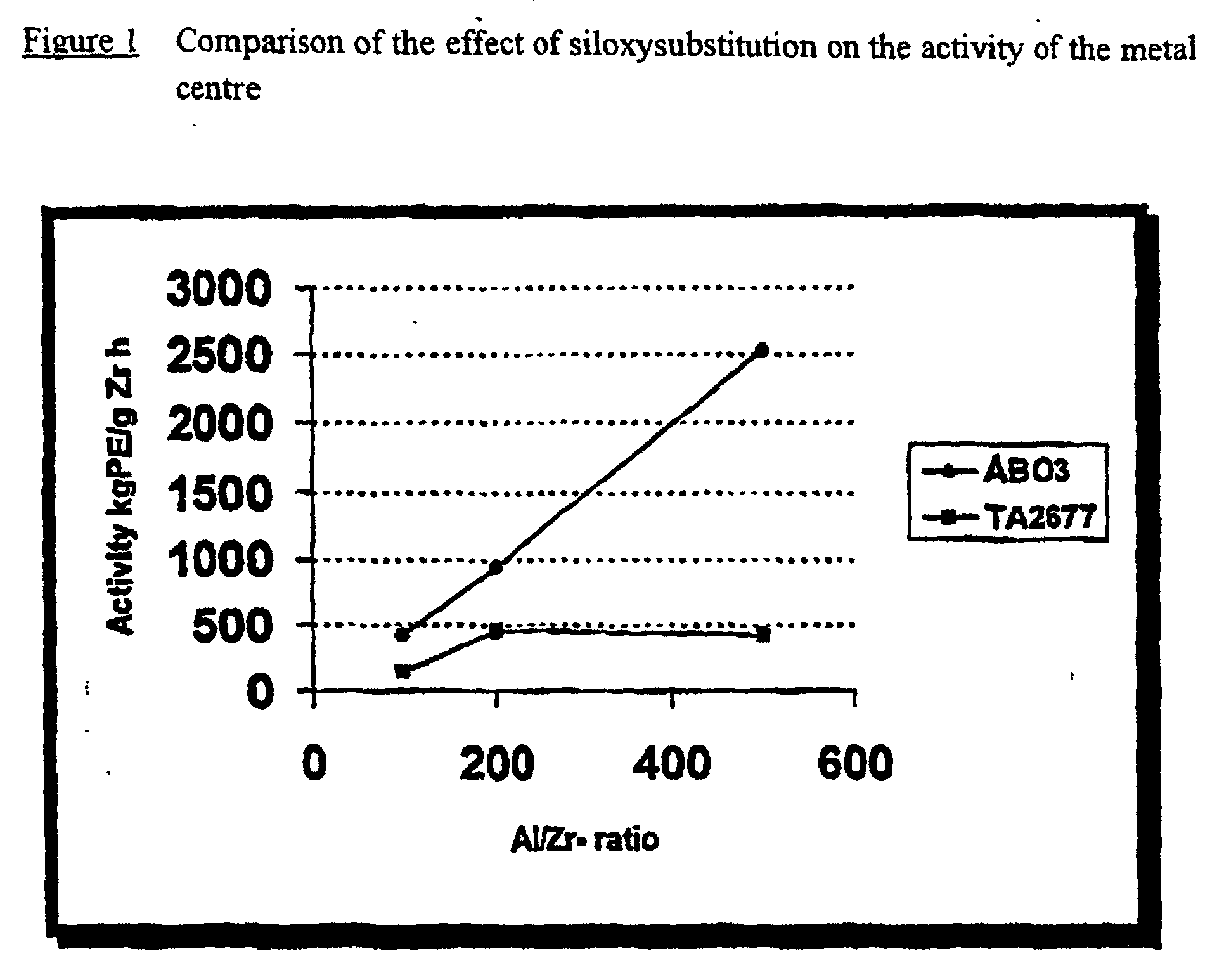
- Examples 25 to 27 describe the influence of metallocene concentration on the polymerization. By using too high concentration the metal activity becomes too low. From these examples it can be seen that the metal activity is increased when the amount of the catalyst is decreased from 2.5 µmol down to 0.6 µmol.
- Examples 28-30 and comparative examples 1-3 shows the importance of a 2-siloxy substituent on catalyst activity. When ethylenebis indenyl zirconium dichloride has a siloxy substituent the catalyst activity is increased especially with low Al/Zr-ratios indicating easy complex formation between metallocene and MAO and also increased activity of the zirconium. The difference can be seen best in figure 1 above.
Claims (17)
- A catalyst precursor having the formula (I):wherein D is one of silicon or germanium, R3, R3' and R4 are the same or different and are one of a hydrogen atom, a C1-C10 hydrocarbyl group or a C1-C10 hydrocarbyloxy group, or at least two of R3, R3' and R4 form together a C2-C20 ring structure; M is a transition metal of group 4 of the Periodic Table and is bound to the ligand IndY in at least an η5 bonding mode; each R is the same or different and is one of a hydrogen atom, a halogen atom, a C1-C10 hydrocarbyl group, a C1-C10 hydrocarbyloxy group, a tri-hydrocarbyl silyl group or two R form together a C2-C20 ring structure; B is a bridge atom or group between two IndY ligands or between one IndY ligand and the transition metal M; m is 1 or 2; o is 0 or 1; and n is 4-m when there is no bridge or B is a bridge atom or group between two IndY ligands, or n is 4-m-o when B is a bridge atom or group between one IndY ligand and the transition metal M.
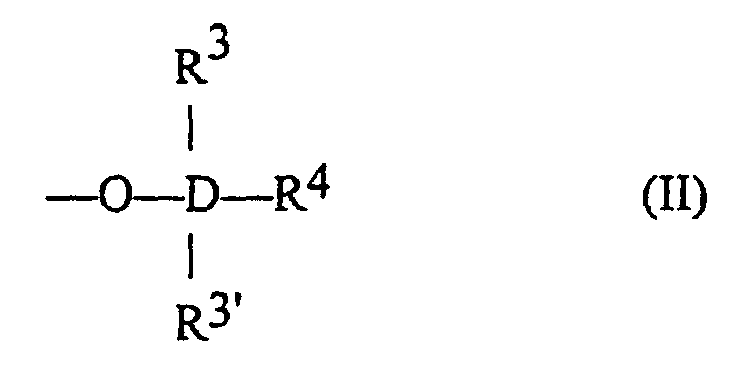
- A catalyst precursor having a formula (I):where
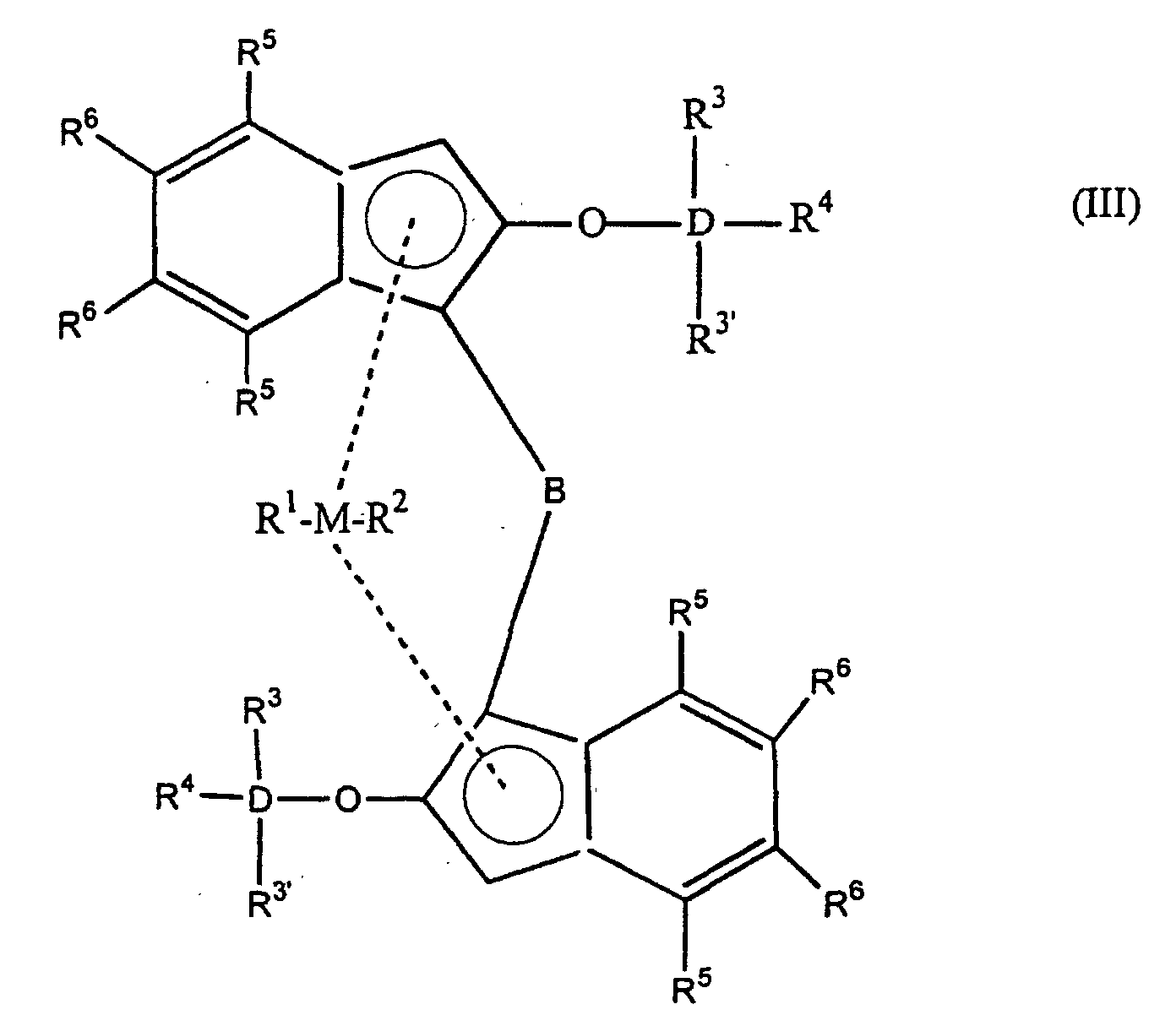
M is a metal selected from zirconium, titanium or hafnium,
D is an element selected from silicon (Si) or germanium (Ge),
B is a bridge comprising at least one of -(CH2)n, -Si(R3)2- or -Ge(R3)2-, wherein n = 1-8,
R1 and R2 are the same or different groups selected from hydrogen, C1-C10 alkyl group, C1-C10 alkoxy group, C6-C10 aryl group, C6-C10 aryloxy group, C2-C10 alkenyl group, C2-C10 arylalkyl group, C2-C10 alkylaryl group, C8-C40 arylalkenyl group or a halogen atom,
R3', R3-R6 are the same or different group selected from hydrogen, C1-C10 alkyl group, C1-C10 alkoxy group, C6-C10 aryl group, C6-C10 aryloxy group, C2-C10 alkenyl group, C7-C22 arylalkyl group, C7-C22 alkylaryl group, C8-C40 arylalkenyl group and a halogen atom, R3' and R3-groups can also be connected to each other to form a ring structure and R4 may also be a ring structure. - A catalyst precursor according to claim 1 or 2, characterized in that M is zirconium and D is silicon.
- A catalyst precursor according to claim 2, characterized in that R1 and R2 are preferably the same and most preferably they are halogen atoms, for example chlorine atoms.
- A catalyst precursor of claims 1-4, characterized in that R3' and or R3 is C1-C10 alkyl or aryl group and most preferably methyl group and R4 is C1-C10 alkyl or aryl group, preferably tert-butyl group, t-hexyl group or cyclohexyl group.
- A catalyst precursor according to any of preceding claims, characterized in that D is Si, B is -CH2CH2-, R=R1=R2 and is chlorine, R3 is CH3 and R5-R6 is aromatic or fused aromatic or alkyl or hydrogen.
- A 2-tri-hydrocarbylsiloxy indene, 2-tri-hydrocarbyloxy siloxy indene, 2-tri-hydrocarbylgermyloxy indene or 2-tri-hydrocarbyloxy germyloxy indene compound having the general formula:wherein: D is one of silicon and germanium; R3, R3' and R4 are the same or different and are one of a hydrogen atom, a C1-C10 hydrocarbyl group or a C1-C10 hydroarbyloxy group, or at least two of R3, R3' and R4 form together a C2-C20 ring structure; R7 is a four-atom chain forming an unsubstituted or substituted, further non-fused or further fused, homocyclic (=isocyclic) or heterocyclic, unsaturated or saturated, aliphatic or aromatic six-membered ring; and R8, R9 and R10 are the same or different and are one of a hydrogen atom, a C1-C10 hydrocarbyl group, a C1-C10 hydrocarbyloxy group, a tri-C1-C10 hydrocarbyl silyl group or a tri-C1-C10 hydrocarbyloxy silyl group, or one of R8 and R9 may be a group B which is a bridge atom or group to a cyclopentadienyl, fluorenyl or indenyl group, with the provision that when R7 forms an unsubstituted benzene ring, D is silicon, R3, R3' and R4 are methyls, R8 and R10 are hydrogens, R9 is not a hydrogen.

- A 2-tri-hydrocarbylsiloxy indene or 2-tri-hydrocarbylgermyloxy indene according to claim 7, characterized in that it has the following formula:wherein: R3', R3-R6 are the same or different and are one of a hydrogen atom, a C1-C10 alkyl group, a C1-C10 alkoxy group, a C6-C10 aryl group, a C2-C10 alkenyl group, a C7-C22 arylalkyl group, a C7-C22 alkylaryl group, a C8-C23 arylalkenyl group or a halogen atom, or at least two of R3, R3' and R4 form together a C2-C10 ring structure, and R8, R9 and R10 are the same as above.

- A 2-tri-hydrocarbylsiloxy indene or 2-tri-hydrocarbylgermyloxy indene according to claim 7 or 8, characterized in that it has the general formula (VI)wherein: R3, R3', R4-R6, R8, R10 and D are the same as above; and B is a bridge of at least one of the groups -(CH2)n-, -SiR3 2- or -GeR3 2-, wherein n is 1-8 and R3 is the same as above.
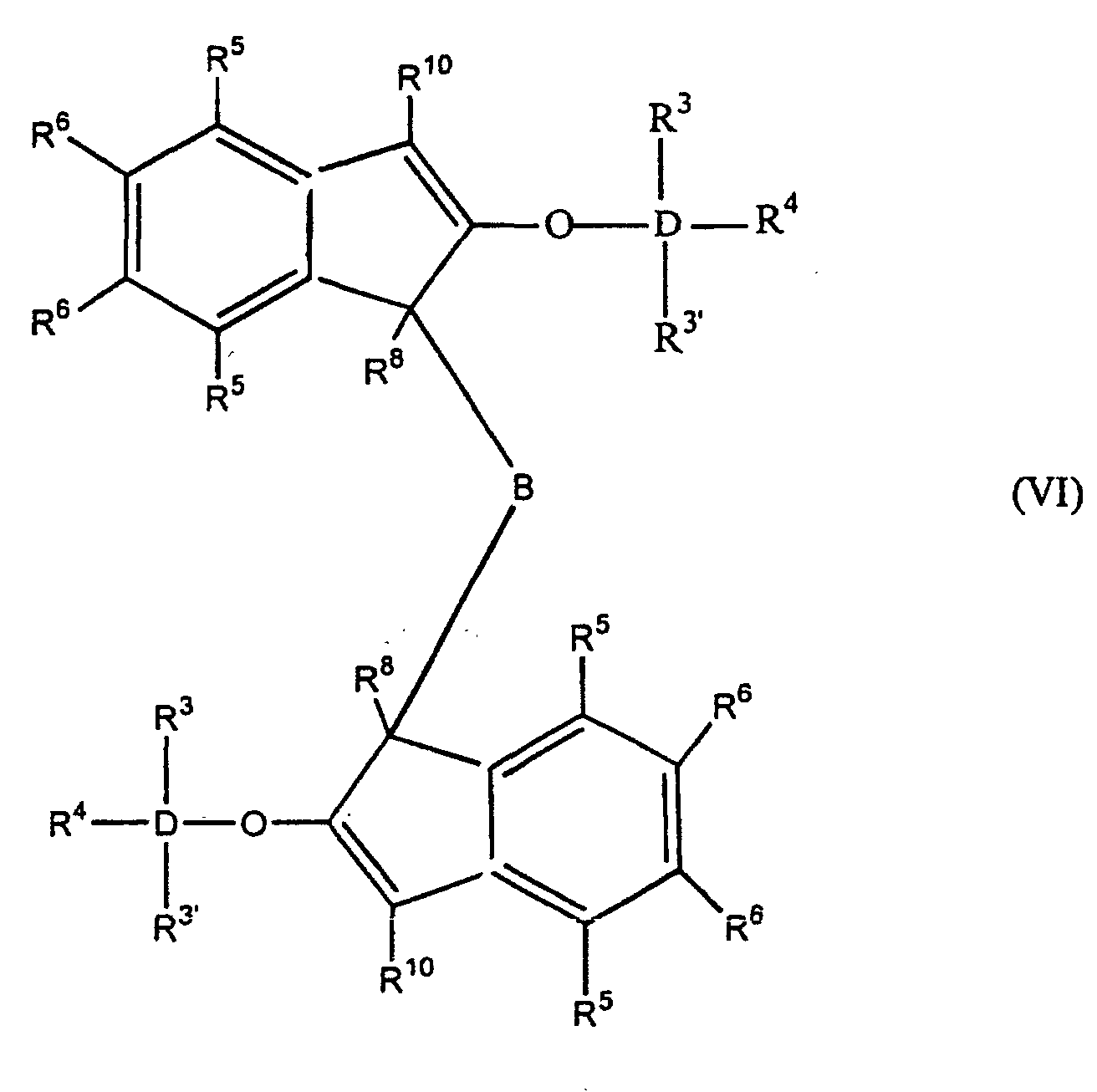
- A 2-tri-hydrocarbylsiloxy indene or 2-tri-hydrocarbylgermyloxy indene according to one of claims 7-9, characterized in that D is silicon.
- A method for preparing catalyst components for olefin polymerization and copolymerization, characterized in that 2-indanone is reacted in a solvent with a base and a chlorosilane to form 2-siloxyindene according to the following reaction scheme:where R' is tert-butyl or hexyl group.

- A method according to claim 11, characterized in that the base is selected from imidazole and triethylamine (TEA) and chlorosilanes are selected from tert-butyldimethylchlorosilane, t-hexyldimethylchlorosilane and cyclohexyldimethylchlorosilane.
- A method according to claims 11 or 12, characterized in that the reaction is continued according to the following reaction scheme:
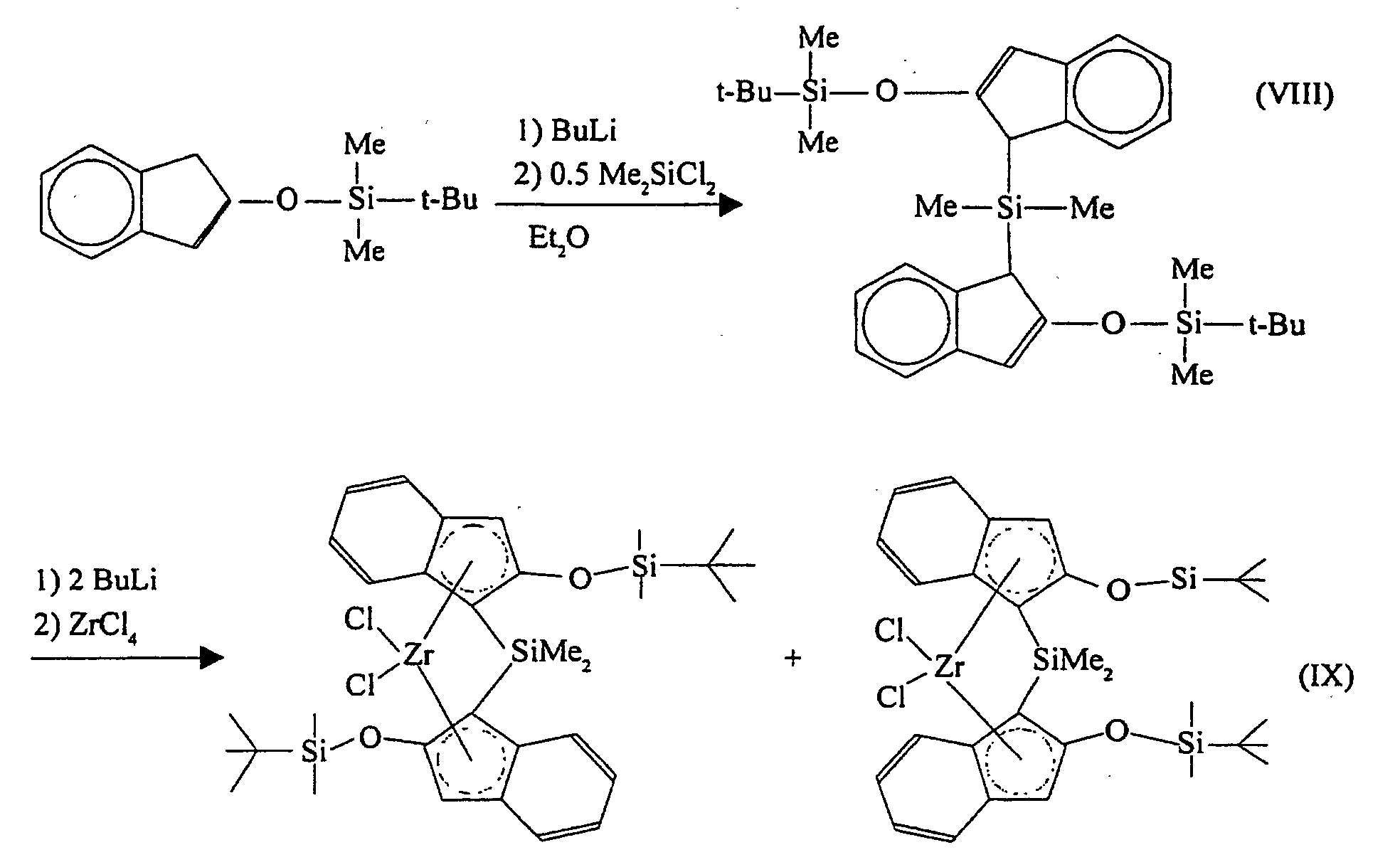
- A method according to claims 11 or 12, characterized in that the reaction is continued according to the following reaction scheme (X):

- A method according to claims 11 or 12, characterized in that the reaction is continued according to the following reaction scheme:
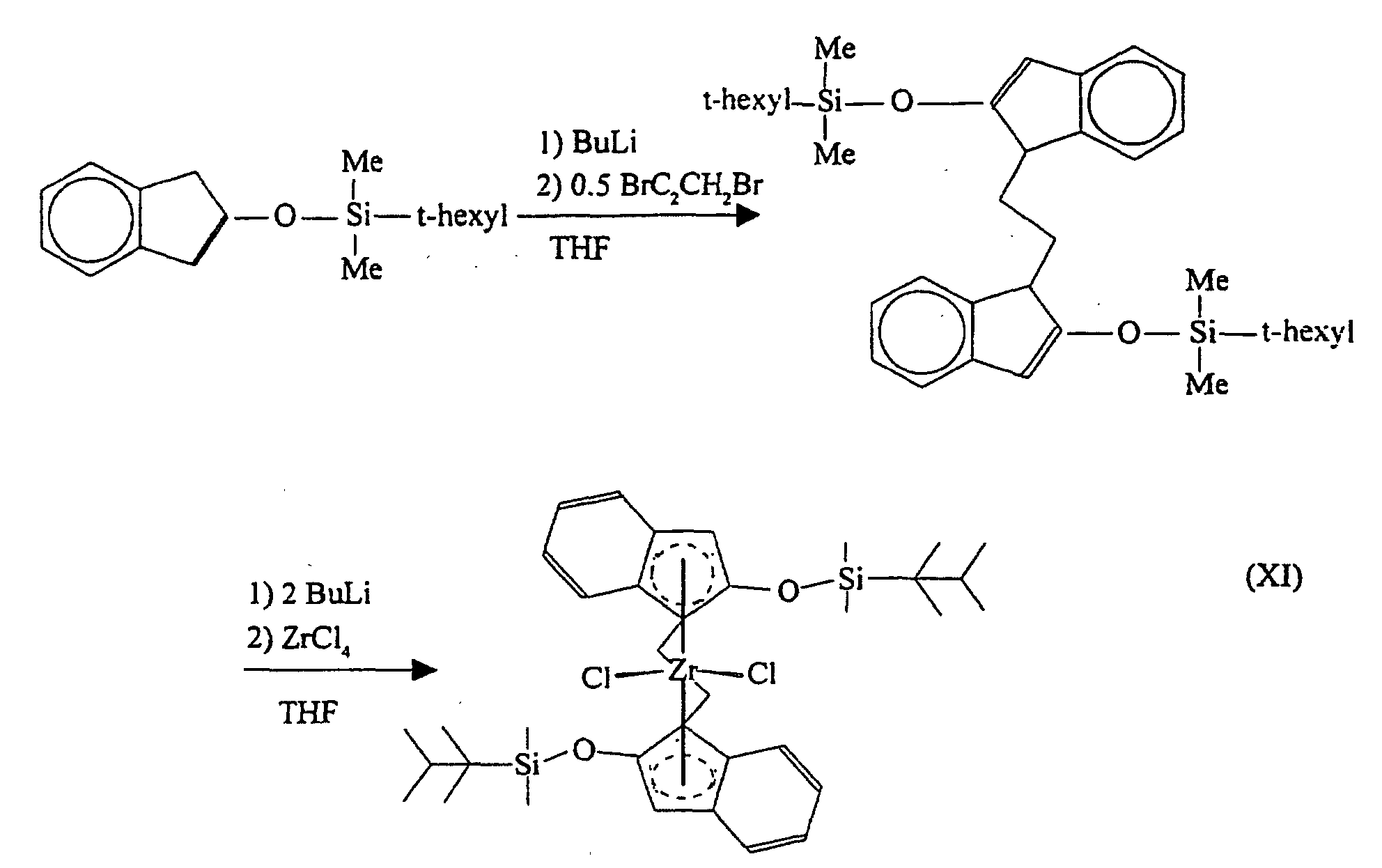
- Use of catalyst precursors according to claims 1-5 as polymerization catalyst components for polymerization or copolymerization of olefins.
- Use according to claim 16, characterized in that methylalumoxane (MAO) is used as cocatalyst.
Applications Claiming Priority (3)
| Application Number | Priority Date | Filing Date | Title |
|---|---|---|---|
| FI960437A FI104826B (en) | 1996-01-30 | 1996-01-30 | Heteroatom-substituted metallose compounds for catalytic systems in olefin polymerization and process for their preparation |
| FI960437 | 1996-01-30 | ||
| PCT/FI1997/000049 WO1997028170A1 (en) | 1996-01-30 | 1997-01-30 | Heteroatom substituted metallocene compounds for olefin polymerization catalyst systems and methods for preparing them |
Publications (2)
| Publication Number | Publication Date |
|---|---|
| EP0880534A1 EP0880534A1 (en) | 1998-12-02 |
| EP0880534B1 true EP0880534B1 (en) | 2003-12-17 |
Family
ID=8545178
Family Applications (1)
| Application Number | Title | Priority Date | Filing Date |
|---|---|---|---|
| EP97901652A Expired - Lifetime EP0880534B1 (en) | 1996-01-30 | 1997-01-30 | Heteroatom substituted metallocene compounds for olefin polymerization catalyst systems and methods for preparing them |
Country Status (20)
| Country | Link |
|---|---|
| US (1) | US6277778B1 (en) |
| EP (1) | EP0880534B1 (en) |
| JP (1) | JP4051089B2 (en) |
| KR (1) | KR19990082158A (en) |
| CN (1) | CN1089342C (en) |
| AR (1) | AR005612A1 (en) |
| AT (1) | ATE256691T1 (en) |
| AU (1) | AU722731B2 (en) |
| BR (1) | BR9707236A (en) |
| CZ (1) | CZ297674B6 (en) |
| DE (1) | DE69726841T2 (en) |
| ES (1) | ES2212070T3 (en) |
| FI (1) | FI104826B (en) |
| HU (1) | HUP9902106A3 (en) |
| IL (1) | IL125542A (en) |
| MY (1) | MY120110A (en) |
| SK (1) | SK285145B6 (en) |
| TW (1) | TW442509B (en) |
| WO (1) | WO1997028170A1 (en) |
| ZA (1) | ZA97766B (en) |
Families Citing this family (235)
| Publication number | Priority date | Publication date | Assignee | Title |
|---|---|---|---|---|
| IT1270253B (en) | 1994-06-20 | 1997-04-29 | Spherilene Srl | ETHYLENE COPOLYMERS AND PROCEDURE FOR THE PREPARATION OF ETHYLENE POLYMERS |
| FI104826B (en) | 1996-01-30 | 2000-04-14 | Borealis As | Heteroatom-substituted metallose compounds for catalytic systems in olefin polymerization and process for their preparation |
| DE69703728T2 (en) * | 1996-10-31 | 2001-06-28 | Repsol Quimica S.A., Madrid | Catalyst systems for the polymerization and copolymerization of alpha olefins |
| FI971565A7 (en) * | 1997-04-14 | 1998-10-15 | Borealis As | Substituted metallocene compounds for catalyst systems for the polymerization of olefins, intermediates thereof and method of preparation |
| EP0953581B1 (en) * | 1998-04-27 | 2004-01-07 | Repsol Quimica S.A. | Catalytic systems for the polymerization and copolymerization of alpha-olefins |
| FI981148A7 (en) | 1998-05-25 | 1999-11-26 | Borealis As | New activator systems for metallocene compounds |
| KR100367463B1 (en) * | 1999-03-03 | 2003-01-14 | 주식회사 엘지화학 | Metallocene compounds and their use for olefin polymerization |
| FI111954B (en) | 2000-02-21 | 2003-10-15 | Borealis Tech Oy | Process for preparing polyethylene coating on a substrate |
| WO2003000744A1 (en) | 2001-06-22 | 2003-01-03 | Borealis Technology Oy | Metallocene catalysts containing an idenyl moiety substituted at the 4-, 5-, 6- or 7-position by a siloxy or germyloxy group |
| GB0118010D0 (en) * | 2001-07-24 | 2001-09-19 | Borealis Tech Oy | Catalysts |
| EP1323747A1 (en) | 2001-12-19 | 2003-07-02 | Borealis Technology Oy | Production of olefin polymerisation catalysts |
| DE60137638D1 (en) | 2001-12-19 | 2009-03-26 | Borealis Tech Oy | Preparation of supported catalysts for olefin polymerization |
| TWI311566B (en) * | 2002-08-29 | 2009-07-01 | Lg Chemical Ltd | Fulvene, metallocene catalysts and preparation method thereof, and preparation of polyolefines copolymer using the same |
| SE0300195D0 (en) | 2003-01-28 | 2003-01-28 | Borealis Tech Oy | Coating composition, method of preparation thereof and substrate coated therewith |
| ATE541868T1 (en) | 2003-06-20 | 2012-02-15 | Borealis Polymers Oy | METHOD FOR PRODUCING A CATALYST FOR OLEFIN POLYMERIZATION |
| EP1616887A1 (en) * | 2004-07-13 | 2006-01-18 | Total Petrochemicals Research Feluy | Extrusion coating process of polyethylene |
| GB0423212D0 (en) | 2004-10-19 | 2004-11-24 | Borealis Tech Oy | Polymer |
| GB0423555D0 (en) | 2004-10-22 | 2004-11-24 | Borealis Tech Oy | Process |
| EP1739103A1 (en) | 2005-06-30 | 2007-01-03 | Borealis Technology Oy | Catalyst |
| DE102005035477A1 (en) | 2005-07-26 | 2007-02-01 | Basell Polyolefine Gmbh | Preparation of olefin polymers, e.g. polyethylene, for producing pressure pipes for transport of gas and wastewater, by polymerization of alpha-olefin(s) with hybrid catalyst to produce higher and lower molecular weight polymer components |
| DE602005013376D1 (en) | 2005-08-09 | 2009-04-30 | Borealis Tech Oy | Siloxy substituted metallocene catalysts |
| ATE478921T1 (en) | 2005-10-21 | 2010-09-15 | Borealis Tech Oy | COMPOSITION |
| EP1795542A1 (en) | 2005-12-07 | 2007-06-13 | Borealis Technology Oy | Polymer |
| EP1803743B1 (en) | 2005-12-30 | 2016-08-10 | Borealis Technology Oy | Catalyst particles |
| EP1803747A1 (en) | 2005-12-30 | 2007-07-04 | Borealis Technology Oy | Surface-modified polymerization catalysts for the preparation of low-gel polyolefin films |
| ATE480586T1 (en) | 2006-07-14 | 2010-09-15 | Borealis Tech Oy | HIGH DENSITY POLYETHYLENE |
| ATE461973T1 (en) | 2007-01-22 | 2010-04-15 | Borealis Tech Oy | LOW SURFACE ENERGY POLYPROPYLENE COMPOSITION |
| US20100280206A1 (en) | 2007-11-09 | 2010-11-04 | Borealis Technology Oy | Polyethylene copolymer |
| EP2072588B1 (en) | 2007-12-20 | 2012-10-10 | Borealis Technology Oy | Process for coating a pipe with high throughput using multimodal ethylene copolymer, and coated pipes obtained thereof |
| EP2072589A1 (en) | 2007-12-20 | 2009-06-24 | Borealis Technology Oy | Process for coating a pipe with high throughput using multimodal ethylene copolymer, and coated pipes obtained thereof |
| EP2072586B1 (en) | 2007-12-20 | 2020-11-11 | Borealis Technology Oy | Coated pipes having improved mechanical properties and a method of production thereof |
| PL2072587T3 (en) | 2007-12-20 | 2020-11-02 | Borealis Technology Oy | Coated pipes having improved mechanical properties at elevated temperatures and a method of production thereof |
| EP2130862A1 (en) | 2008-06-02 | 2009-12-09 | Borealis AG | Polymer compositions and pressure-resistant pipes made thereof |
| EP2130859A1 (en) | 2008-06-02 | 2009-12-09 | Borealis AG | Polymer compositions having improved homogeneity and odour, a method for making them and pipes made thereof |
| EP2130863A1 (en) | 2008-06-02 | 2009-12-09 | Borealis AG | High density polymer compositions, a method for their preparation and pressure-resistant pipes made therefrom |
| EP2130860A1 (en) | 2008-06-06 | 2009-12-09 | Borealis Technology Oy | Polymer |
| EP2133389A1 (en) | 2008-06-12 | 2009-12-16 | Borealis AG | Polypropylene composition |
| EP2182525A1 (en) | 2008-10-31 | 2010-05-05 | Borealis AG | Cable and polymer composition comprising a multimodal ethylene copolymer |
| EP2182524A1 (en) | 2008-10-31 | 2010-05-05 | Borealis AG | Cable and Polymer composition comprising a multimodal ethylene copolymer |
| EP2182526A1 (en) | 2008-10-31 | 2010-05-05 | Borealis AG | Cable and polymer composition comprising an multimodal ethylene copolymer |
| WO2010052264A1 (en) | 2008-11-07 | 2010-05-14 | Borealis Ag | Solid catalyst composition |
| EP2186831B1 (en) | 2008-11-10 | 2013-01-02 | Borealis AG | Process for the preparation of an unsupported, solid olefin polymerisation catalyst and use in polymerisation of olefins |
| ES2392698T3 (en) | 2008-11-10 | 2012-12-13 | Borealis Ag | Process for the preparation of a solid, non-support metallocene catalyst system and its use in the polymerization of olefins |
| WO2010069527A1 (en) | 2008-12-17 | 2010-06-24 | Basell Polyolefine Gmbh | Catalyst system for olefin polymerization, its production and use |
| EP2204410A1 (en) | 2008-12-31 | 2010-07-07 | Borealis AG | Article coated with a composition comprising polyethylene prepared with a single site catalyst |
| EP2275476A1 (en) | 2009-06-09 | 2011-01-19 | Borealis AG | Automotive material with excellent flow, high stiffness, excellent ductility and low CLTE |
| PL2471077T5 (en) | 2009-08-26 | 2023-11-27 | Borealis Ag | Cable and polymer composition |
| PL2308923T3 (en) | 2009-10-09 | 2012-11-30 | Borealis Ag | Glass fibre composite of improved processability |
| CN102686613B (en) | 2009-11-13 | 2014-08-13 | 博瑞立斯有限公司 | Process for recovering a transition metal compound |
| WO2011058089A1 (en) | 2009-11-13 | 2011-05-19 | Borealis Ag | Process for producing a polymerization catalyst |
| ES2424958T3 (en) | 2009-11-13 | 2013-10-10 | Borealis Ag | Process for olefin polymerization |
| EP2322568B1 (en) | 2009-11-13 | 2013-05-15 | Borealis AG | Process for producing an olefin polymerization catalyst |
| EP2330135B1 (en) | 2009-12-02 | 2012-11-07 | Borealis AG | Process for producing polyolefins |
| EP2330136B1 (en) | 2009-12-07 | 2013-08-28 | Borealis AG | Process for the preparation of an unsupported, solid metallocene catalyst system and its use in polymerization of olefins |
| US8859451B2 (en) | 2009-12-18 | 2014-10-14 | Basell Polyolefine Gmbh | Process for the preparation of supported catalysts |
| KR101424366B1 (en) | 2009-12-22 | 2014-07-31 | 보레알리스 아게 | Preparation of polypropylene in the presence of a single-site catalyst |
| EP2338920A1 (en) | 2009-12-22 | 2011-06-29 | Borealis AG | Preparation of single-site catalysts |
| EP2338921B8 (en) | 2009-12-22 | 2015-05-06 | Borealis AG | Preparation of single-site catalysts |
| US8618228B2 (en) | 2010-01-21 | 2013-12-31 | Basell Polyolefine Gmbh | Process for the preparation of ethylene copolymer compositions in the presence of an oligomerization catalyst |
| EP2738183A1 (en) | 2010-05-07 | 2014-06-04 | Borealis AG | Preparation of a solid catalyst system |
| EP2385073A1 (en) | 2010-05-07 | 2011-11-09 | Borealis AG | Process for the preparation of a solid metallocene catalyst system and its use in polymerisation of olefins |
| EP2386583A1 (en) | 2010-05-07 | 2011-11-16 | Borealis AG | Process for the preparation of a solid metallocene catalyst system and its use in polymerisation of olefins |
| EP2386582B1 (en) | 2010-05-07 | 2016-02-17 | Borealis AG | Preparation of a solid catalyst system |
| US8999875B2 (en) | 2010-05-28 | 2015-04-07 | Basell Polyolefine Gmbh | Process for preparing a supported catalyst system for olefin polymerization, the catalyst system and its use |
| ES2455694T3 (en) | 2010-08-06 | 2014-04-16 | Borealis Ag | Multilayer film |
| ES2674411T3 (en) | 2010-10-28 | 2018-06-29 | Borealis Ag | Single site polymer |
| PT2495038T (en) | 2011-03-02 | 2020-11-06 | Borealis Ag | Flexible reactor assembly for polymerization of olefins |
| ES2813282T3 (en) | 2011-03-02 | 2021-03-23 | Borealis Ag | High-performance reactor assembly for olefin polymerization |
| EP2495264B1 (en) | 2011-03-04 | 2013-05-08 | Borealis AG | Exterior automotive article with reduced paintability failure |
| EP2520625A1 (en) | 2011-05-06 | 2012-11-07 | Borealis AG | Coating composition |
| EP2554375B1 (en) | 2011-08-03 | 2014-04-09 | Borealis AG | Film |
| EP2570195B1 (en) | 2011-09-15 | 2014-12-03 | Borealis AG | Protective polymer layer |
| EP2607385B1 (en) | 2011-12-19 | 2014-03-19 | Borealis AG | Loop reactor providing an advanced production split control |
| PL2834301T3 (en) | 2012-04-04 | 2017-07-31 | Borealis Ag | High-flow fiber reinforced polypropylene composition |
| US9382359B2 (en) | 2012-08-29 | 2016-07-05 | Borealis Ag | Reactor assembly and method for polymerization of olefins |
| EP2722344B1 (en) | 2012-10-18 | 2017-03-22 | Borealis AG | Polymerisation process |
| EP2722346A1 (en) | 2012-10-18 | 2014-04-23 | Borealis AG | Polymerisation process and catalyst |
| ES2711081T3 (en) | 2012-10-18 | 2019-04-30 | Borealis Ag | Catalyst for the polymerization of olefins |
| EP2740748B1 (en) | 2012-12-07 | 2015-06-10 | Borealis AG | Method of polymerizing olefins in slurry reactors |
| EP2745926A1 (en) | 2012-12-21 | 2014-06-25 | Borealis AG | Gas phase polymerization and reactor assembly comprising a fluidized bed reactor and an external moving bed reactor |
| EP2745927A1 (en) | 2012-12-21 | 2014-06-25 | Borealis AG | Fluidized bed reactor with internal moving bed reaction unit |
| EP2829556B1 (en) | 2013-07-24 | 2016-11-16 | Borealis AG | Process |
| EP2829558B1 (en) | 2013-07-24 | 2016-12-14 | Borealis AG | Process |
| ES2651456T3 (en) | 2013-08-14 | 2018-01-26 | Borealis Ag | Propylene composition with better low temperature impact resistance |
| JP6190961B2 (en) | 2013-08-21 | 2017-08-30 | ボレアリス・アクチェンゲゼルシャフトBorealis Ag | High flow polyolefin composition having high rigidity and toughness |
| BR112016002682A8 (en) | 2013-08-21 | 2020-01-28 | Borealis Ag | high flow polyolefin composition with high rigidity and toughness |
| PT2853563T (en) | 2013-09-27 | 2016-07-14 | Borealis Ag | Films suitable for bopp processing from polymers with high xs and high tm |
| EP2860031B1 (en) | 2013-10-11 | 2016-03-30 | Borealis AG | Machine direction oriented film for labels |
| EP3060589B9 (en) | 2013-10-24 | 2018-04-18 | Borealis AG | Low melting pp homopolymer with high content of regioerrors and high molecular weight |
| ES2574428T3 (en) | 2013-10-24 | 2016-06-17 | Borealis Ag | Blow molded article based on bimodal random copolymer |
| WO2015062936A1 (en) | 2013-10-29 | 2015-05-07 | Borealis Ag | Solid single site catalysts with high polymerisation activity |
| MX368147B (en) | 2013-11-22 | 2019-09-20 | Borealis Ag | Low emission propylene homopolymer with high melt flow. |
| BR112016011829B1 (en) | 2013-12-04 | 2022-01-18 | Borealis Ag | COMPOSITION OF POLYPROPYLENE, FIBER AND MELT BLOWN, ARTICLE AND USE OF POLYPROPYLENE COMPOSITION |
| US9637602B2 (en) | 2013-12-18 | 2017-05-02 | Borealis Ag | BOPP film with improved stiffness/toughness balance |
| CN105829364B (en) | 2014-01-17 | 2017-11-10 | 博里利斯股份公司 | Method for preparing the butylene copolymer of propylene/1 |
| WO2015117958A1 (en) | 2014-02-06 | 2015-08-13 | Borealis Ag | Soft copolymers with high impact strength |
| PL3102634T3 (en) | 2014-02-06 | 2020-11-16 | Borealis Ag | Soft and transparent impact copolymers |
| EP2907841A1 (en) | 2014-02-14 | 2015-08-19 | Borealis AG | Polypropylene composite |
| EP2913345B1 (en) | 2014-02-28 | 2016-11-02 | Borealis AG | Gas phase polymerization process |
| EP2913346B1 (en) | 2014-02-28 | 2016-11-02 | Borealis AG | Process for polymerizing olefins in a fluidized bed |
| ES2659731T3 (en) | 2014-05-20 | 2018-03-19 | Borealis Ag | Polypropylene composition for automotive interior applications |
| EP2995631A1 (en) | 2014-09-12 | 2016-03-16 | Borealis AG | Process for producing graft copolymers on polyolefin backbone |
| ES2635519T3 (en) | 2014-11-21 | 2017-10-04 | Borealis Ag | Procedure for producing soft copolymer granules |
| ES2788424T3 (en) | 2014-11-26 | 2020-10-21 | Borealis Ag | Polyethylene composition for a film layer |
| TWI600694B (en) | 2014-11-26 | 2017-10-01 | 柏列利斯股份公司 | Film layer |
| CN107112071A (en) | 2014-12-19 | 2017-08-29 | 博里利斯股份公司 | Power cable polymer composition comprising thermoplastic and with favorable property |
| US11410788B2 (en) | 2014-12-19 | 2022-08-09 | Borealis Ag | Polymer composition for W and C application with advantageous electrical properties |
| EP3053976A1 (en) | 2015-02-09 | 2016-08-10 | Borealis AG | Adhesive composition |
| PL3261838T3 (en) | 2015-02-27 | 2019-07-31 | Borealis Ag | Laminated film structure based on polyethylene only |
| WO2016184812A1 (en) | 2015-05-20 | 2016-11-24 | Borealis Ag | Process for producing polyethylene composition |
| KR101973191B1 (en) | 2015-06-05 | 2019-04-26 | 주식회사 엘지화학 | Metallocene supported catalyst and method for preparing polyolefin using the same |
| KR101926833B1 (en) * | 2015-06-05 | 2019-03-07 | 주식회사 엘지화학 | Metallocene compound |
| ES2673428T3 (en) | 2015-06-12 | 2018-06-21 | Borealis Ag | Procedure and apparatus for the polymerization of olefins in the gas phase |
| EP3173443A1 (en) | 2015-11-27 | 2017-05-31 | Borealis AG | Semiconductive polyethylene composition |
| EP3173442A1 (en) | 2015-11-27 | 2017-05-31 | Borealis AG | Semiconductive polyethylene composition |
| EP3178853B1 (en) | 2015-12-07 | 2018-07-25 | Borealis AG | Process for polymerising alpha-olefin monomers |
| WO2017102704A1 (en) | 2015-12-15 | 2017-06-22 | Borealis Ag | Polyethylene based laminated film structure with barrier properties |
| EP3184166A1 (en) | 2015-12-22 | 2017-06-28 | Borealis AG | A method for withdrawing agglomerates from a fluidised bed reactor |
| EP3184167B8 (en) | 2015-12-22 | 2022-03-30 | Borealis AG | A method for returning polymer to a fluidised bed reactor |
| EP3241611B1 (en) | 2016-05-02 | 2020-03-04 | Borealis AG | A process for feeding a polymerisation catalyst |
| EP3243622B1 (en) | 2016-05-13 | 2020-09-09 | Borealis AG | Process for hydraulic conveying of polyolefin pellets |
| JP2019517938A (en) | 2016-06-03 | 2019-06-27 | ボレアリス エージー | Multilayer structure |
| WO2017216095A1 (en) | 2016-06-17 | 2017-12-21 | Borealis Ag | Bi- or multimodal polyethylene terpolymer with enhanced rheological properties |
| WO2017216094A1 (en) | 2016-06-17 | 2017-12-21 | Borealis Ag | Bi- or multimodal polyethylene with enhanced rheological properties |
| ES2799148T3 (en) | 2016-06-17 | 2020-12-15 | Borealis Ag | Bi- or multimodal polyethylene with low level of unsaturation |
| EP3257879A1 (en) | 2016-06-17 | 2017-12-20 | Borealis AG | Bi- or multimodal polyethylene with low unsaturation level |
| EP3257895A1 (en) | 2016-06-17 | 2017-12-20 | Borealis AG | Bi- or multimodal polyethylene terpolymer with enhanced rheological properties |
| EP3261093B1 (en) | 2016-06-21 | 2023-08-02 | Borealis AG | Cable with advantageous electrical properties |
| EP3261096A1 (en) | 2016-06-21 | 2017-12-27 | Borealis AG | Cable and composition |
| CN109328211B (en) | 2016-06-21 | 2024-08-06 | 博里利斯股份公司 | Polymer compositions for wire and cable applications having advantageous thermo-mechanical properties and electrical characteristics |
| FI3261095T3 (en) | 2016-06-21 | 2026-03-25 | Borealis Gmbh | Cable with improved electrical properties |
| KR102301007B1 (en) | 2016-06-23 | 2021-09-10 | 보레알리스 아게 | Process for catalyst deactivation |
| WO2018091653A1 (en) | 2016-11-18 | 2018-05-24 | Borealis Ag | Catalyst |
| EP3418308B1 (en) | 2017-06-20 | 2020-03-11 | Borealis AG | A method, an arrangement and use of an arrangement for olefin polymerisation |
| EP3418309A1 (en) | 2017-06-20 | 2018-12-26 | Borealis AG | A method, an arrangement and use of an arrangement of preparing polymer |
| ES2786567T3 (en) | 2017-06-23 | 2020-10-13 | Borealis Ag | Procedure and apparatus for the withdrawal of polymeric material from an olefin polymerization reactor with gases and solid |
| WO2019081611A1 (en) | 2017-10-24 | 2019-05-02 | Borealis Ag | Multilayer polymer film |
| EP3479896A1 (en) | 2017-11-03 | 2019-05-08 | Borealis AG | Polymerization reactor system comprising at least one withdrawal valve |
| EP3483189A1 (en) | 2017-11-14 | 2019-05-15 | Borealis AG | Automated method for terminating an olefin polymerization reaction under emergency conditions |
| ES2806646T3 (en) | 2017-11-17 | 2021-02-18 | Borealis Ag | Procedure to improve the cooling capacity of a gas-solid olefin polymerization reactor |
| EP3486260B1 (en) | 2017-11-17 | 2020-04-01 | Borealis AG | Method of splitting the return fluidization gas in a gas solids olefin polymerization reactor |
| EP3728342A1 (en) | 2017-12-21 | 2020-10-28 | Borealis AG | Process for the preparation of solid catalyst |
| US11447580B2 (en) | 2017-12-27 | 2022-09-20 | Borealis Ag | Ziegler-Natta catalyst and preparation thereof |
| KR20200095577A (en) | 2017-12-28 | 2020-08-10 | 보레알리스 아게 | Catalyst and its preparation |
| WO2019166652A1 (en) | 2018-03-02 | 2019-09-06 | Borealis Ag | Process |
| CN111684006B (en) | 2018-03-21 | 2023-08-11 | 博里利斯股份公司 | Bimodal or multimodal polyethylene composition |
| KR102498543B1 (en) | 2018-06-14 | 2023-02-09 | 보레알리스 아게 | Process for polymerization of olefins in a gas phase reactor with improved thermal homogeneity |
| WO2020025757A1 (en) | 2018-08-02 | 2020-02-06 | Borealis Ag | Process for polymerizing ethylene in a multi-stage polymerization process |
| US12404393B2 (en) | 2018-09-26 | 2025-09-02 | Borealis Ag | Propylene copolymer composition with excellent optical and mechanical properties |
| WO2020064313A1 (en) | 2018-09-26 | 2020-04-02 | Borealis Ag | Propylene random copolymer for use in film applications |
| CN112638959B (en) | 2018-09-26 | 2023-05-02 | 博里利斯股份公司 | Propylene copolymers with excellent optical properties |
| CN113242883B (en) | 2018-11-07 | 2023-09-22 | 北欧化工公司 | Polyolefin compositions with improved impact resistance and whitening resistance |
| AU2019378072B2 (en) | 2018-11-15 | 2022-04-14 | Abu Dhabi Polymers Co. Ltd (Borouge) L.L.C. | Polymer composition for blow molding applications |
| CN113056508B (en) | 2018-11-23 | 2023-08-04 | 博里利斯股份公司 | Polypropylene composition with improved optical properties and anti-whitening properties |
| EP3887412A1 (en) | 2018-11-29 | 2021-10-06 | Borealis AG | Process to produce a polymer and polymer |
| WO2020109452A1 (en) | 2018-11-30 | 2020-06-04 | Borealis Ag | Washing process |
| ES2945963T3 (en) | 2018-12-14 | 2023-07-11 | Borealis Ag | Polypropylene composition with favorable combination of optics, softness and low sealing |
| WO2020156993A1 (en) | 2019-01-28 | 2020-08-06 | Borealis Ag | Process for producing a polymer composition |
| WO2020156989A1 (en) | 2019-01-28 | 2020-08-06 | Borealis Ag | Polymer composition |
| CN117700565A (en) | 2019-05-24 | 2024-03-15 | 伊士曼化工公司 | Recovery of component cellulose esters |
| WO2020247192A1 (en) | 2019-05-24 | 2020-12-10 | Eastman Chemical Company | Recycle content cracked effluent |
| EP3976732A4 (en) | 2019-05-24 | 2023-05-17 | Eastman Chemical Company | MIXING SMALL AMOUNTS OF PYROLYSIS OIL INTO A TREATED LIQUID STREAM IN A STEAM CRACKER |
| EP3976734A4 (en) | 2019-05-24 | 2023-03-15 | Eastman Chemical Company | CRACKING OF A C4-C7 FRACTION OF PYROLYSIS OIL |
| US20220177616A1 (en) | 2019-06-04 | 2022-06-09 | Borealis Ag | Process and reactor assembly for the enhancement of hydrodynamics in a gas-solids fluidized bed reactor |
| KR102723897B1 (en) | 2019-06-04 | 2024-11-01 | 보레알리스 아게 | Method for producing polyolefins and multistage reactor assembly for producing polyolefins |
| KR102670190B1 (en) | 2019-06-24 | 2024-05-28 | 보레알리스 아게 | Manufacturing process for polypropylene with improved recovery rate |
| JP7438324B2 (en) | 2019-07-22 | 2024-02-26 | アブ・ダビ・ポリマーズ・カンパニー・リミテッド・(ブルージュ)・リミテッド・ライアビリティ・カンパニー | Multimodal polyethylene compositions with single-site catalysts |
| US12338211B2 (en) | 2019-07-29 | 2025-06-24 | Eastman Chemical Company | Recycle content (C4)alkanal |
| EP4004081B1 (en) | 2019-07-29 | 2025-09-17 | Eastman Chemical Company | Recycle content cyclobutane diol polyester |
| US12312540B2 (en) | 2019-10-31 | 2025-05-27 | Eastman Chemical Company | Pyrolysis method and system for recycled waste |
| US11945998B2 (en) | 2019-10-31 | 2024-04-02 | Eastman Chemical Company | Processes and systems for making recycle content hydrocarbons |
| EP4055001A4 (en) | 2019-11-07 | 2024-02-14 | Eastman Chemical Company | MIXED ESTERS WITH RECYCLED CONTENT AND SOLVENTS |
| KR20220093368A (en) | 2019-11-07 | 2022-07-05 | 이스트만 케미칼 컴파니 | Recycled Alpha Olefins and Fatty Alcohols |
| EP4054996A4 (en) | 2019-11-07 | 2024-03-27 | Eastman Chemical Company | OXOALCOHOLS AND OXOPLASTICIANS WITH RECYCLED CONTENT |
| EP4054998A4 (en) | 2019-11-07 | 2024-04-03 | Eastman Chemical Company | PROPANOL WITH RECYCLED CONTENT |
| EP3825357B1 (en) | 2019-11-25 | 2025-04-09 | Borealis AG | Propylene composition for foaming with improved mechanical properties |
| EP3838984A1 (en) | 2019-12-20 | 2021-06-23 | Borealis AG | Polymer composition and article |
| PL3868793T3 (en) | 2020-02-24 | 2026-04-20 | Borealis Gmbh | Process for producing alpha-olefin polymers in a multistage polymerization process |
| EP4126994A1 (en) | 2020-03-24 | 2023-02-08 | Borealis AG | Polyethylene composition for a film layer |
| EP4126993A1 (en) | 2020-03-24 | 2023-02-08 | Borealis AG | Polyethylene composition for a film layer |
| CN115397902A (en) | 2020-04-13 | 2022-11-25 | 伊士曼化工公司 | Recovery of component polyethylene |
| FI4153676T3 (en) | 2020-05-20 | 2025-10-22 | Borealis Gmbh | Polymer for electrical cable insulation |
| US20230203286A1 (en) | 2020-05-20 | 2023-06-29 | Borealis Ag | Polymer for cable jacket |
| CN115803411A (en) | 2020-07-13 | 2023-03-14 | 博里利斯股份公司 | adhesive polyethylene composition |
| US12435252B2 (en) | 2020-07-13 | 2025-10-07 | Borealis Ag | Adhesive polyethylene composition |
| EP4185620A1 (en) | 2020-07-23 | 2023-05-31 | Borealis AG | Multimodal ethylene copolymer |
| EP4192889A1 (en) | 2020-08-05 | 2023-06-14 | Dow Global Technologies LLC | Thermoplastic compositions comprising bimodal polyethylene and articles manufactured therefrom |
| WO2022129409A1 (en) | 2020-12-18 | 2022-06-23 | Borealis Ag | Modification of polyethylene terpolymer |
| EP4019582B1 (en) | 2020-12-23 | 2025-07-30 | Borealis GmbH | Polyethylene film |
| KR20230130052A (en) | 2021-01-08 | 2023-09-11 | 보레알리스 아게 | composition |
| EP4029914B1 (en) | 2021-01-14 | 2025-03-05 | Borealis AG | Heterophasic polyolefin composition |
| EP4036130B1 (en) | 2021-01-29 | 2023-03-22 | Borealis AG | Modification of polyethylene copolymer |
| EP4053194B1 (en) | 2021-03-03 | 2023-08-02 | Borealis AG | Monolayer blown film |
| CN116917342A (en) | 2021-03-09 | 2023-10-20 | 博里利斯股份公司 | Polyethylene compositions for film layers |
| EP4056598B1 (en) | 2021-03-09 | 2023-09-13 | Borealis AG | Polyethylene composition for a film layer |
| EP4056599B1 (en) | 2021-03-09 | 2023-07-26 | Borealis AG | Polyethylene composition for a film layer |
| US20240294681A1 (en) | 2021-06-24 | 2024-09-05 | Borealis Ag | Improving catalyst performance in multi-stage polyolefin production |
| KR20240025007A (en) | 2021-06-24 | 2024-02-26 | 보레알리스 아게 | Use of swelling agents in multi-step polyolefin production |
| CN118076874A (en) | 2021-06-24 | 2024-05-24 | 博里利斯股份公司 | Method for determining the compression characteristics of olefin polymerization catalysts |
| CA3223212A1 (en) | 2021-06-24 | 2022-12-29 | Borealis Ag | Utilization of 1-hexene in multi-stage polyolefin production |
| EP4116091A1 (en) | 2021-07-07 | 2023-01-11 | Borealis AG | Multilayer film |
| KR20240029078A (en) | 2021-07-08 | 2024-03-05 | 보레알리스 아게 | Polyethylene used in the production of cross-linked polyethylene (PEX) |
| EP4144435A1 (en) | 2021-09-01 | 2023-03-08 | Borealis AG | Gas phase polymerization process with improved gas recycling |
| US12195674B2 (en) | 2021-09-21 | 2025-01-14 | Eastman Chemical Company | Using spent caustic solution from pygas treatment to neutralize halogens from liquified waste plastic |
| EP4163309A1 (en) | 2021-10-07 | 2023-04-12 | Borealis AG | Hdpe |
| EP4163332B1 (en) | 2021-10-10 | 2026-04-01 | Borealis GmbH | Polyethylene composition for a film layer |
| EP4163334A1 (en) | 2021-10-10 | 2023-04-12 | Borealis AG | Polyethylene composition for a film layer |
| EP4166581A1 (en) | 2021-10-12 | 2023-04-19 | Borealis AG | Propylene composition for foaming with high melt flow rate |
| PL4257640T3 (en) | 2022-04-04 | 2025-03-24 | Borealis Ag | PIPE CONTAINING A POLYPROPYLONE COMPOSITION |
| US20250313002A1 (en) | 2022-04-11 | 2025-10-09 | Borealis Ag | Multilayer film |
| EP4317216A1 (en) | 2022-08-03 | 2024-02-07 | Abu Dhabi Polymers Co. Ltd (Borouge) LLC | Low density ethylene terpolymer composition |
| EP4389418A1 (en) | 2022-12-19 | 2024-06-26 | Abu Dhabi Polymers Co. Ltd (Borouge) - Sole Proprietorship L.L.C. | Multilayer collation shrink film |
| EP4389414A1 (en) | 2022-12-19 | 2024-06-26 | Abu Dhabi Polymers Co. Ltd (Borouge) - Sole Proprietorship L.L.C. | Multilayer collation shrink film |
| EP4389783A1 (en) | 2022-12-20 | 2024-06-26 | Borealis AG | Catalyst transition process |
| EP4389776A1 (en) | 2022-12-20 | 2024-06-26 | Borealis AG | Process |
| WO2024133044A1 (en) | 2022-12-23 | 2024-06-27 | Borealis Ag | Process for producing a polypropylene homo- or copolymer |
| CN120380039A (en) | 2022-12-23 | 2025-07-25 | 北欧化工股份公司 | Polypropylene copolymer production method |
| CN120380036A (en) | 2022-12-23 | 2025-07-25 | 北欧化工股份公司 | Method for producing high-fluidity polypropylene homopolymer |
| EP4417629A1 (en) | 2023-02-14 | 2024-08-21 | Borealis AG | Polyethylene blend for a film layer |
| EP4701858A1 (en) | 2023-04-26 | 2026-03-04 | Borealis GmbH | Layer element suitable as integrated backsheet for a bifacial photovoltaic module |
| EP4701857A1 (en) | 2023-04-26 | 2026-03-04 | Borealis GmbH | Layer element suitable as integrated backsheet for a bifacial photovoltaic module |
| EP4455170A1 (en) | 2023-04-28 | 2024-10-30 | Borealis AG | Cable compositions comprising a multimodal ethylene-butene-hexene terpolymer |
| WO2025003435A1 (en) | 2023-06-30 | 2025-01-02 | Borealis Ag | Process |
| EP4538321A1 (en) | 2023-10-11 | 2025-04-16 | Borealis AG | A way to increase the nucleation efficiency of ssc materials |
| EP4541583A1 (en) | 2023-10-18 | 2025-04-23 | Abu Dhabi Polymers Co. Ltd (Borouge) - Sole Proprietorship L.L.C. | Multilayer film |
| WO2025125458A1 (en) | 2023-12-12 | 2025-06-19 | Abu Dhabi Polymers Co. Ltd (Borouge) - Sole Proprietorship L.L.C. | Modified polyethylene having improved hydrostatic pressure resistance and slow crack growth resistance |
| EP4574848B1 (en) | 2023-12-19 | 2026-04-29 | Borealis GmbH | Polypropylene copolymer composition having high molecular weight |
| WO2025219537A1 (en) | 2024-04-18 | 2025-10-23 | Borealis Gmbh | Process for propylene polymerization with optimized prepolymerization conditions |
| WO2025219499A1 (en) | 2024-04-18 | 2025-10-23 | Borealis Gmbh | Processes for polymerising olefins |
| WO2025219533A1 (en) | 2024-04-18 | 2025-10-23 | Borealis Gmbh | Process for the preparation of a propylene homopolymer |
| WO2025262147A1 (en) | 2024-06-19 | 2025-12-26 | Borealis Gmbh | Processes for polymerising olefins |
| WO2026002813A1 (en) | 2024-06-24 | 2026-01-02 | Borealis Gmbh | Processes for polymerising olefins |
| EP4674614A1 (en) | 2024-07-04 | 2026-01-07 | Borealis GmbH | A polyethylene mdo film with high stiffness, adhesion and improved barrier forming capabilities |
| WO2026022206A1 (en) | 2024-07-25 | 2026-01-29 | Borealis Gmbh | Mixed-plastics polyethylene composition suitable for film applications |
| EP4685183A1 (en) | 2024-07-25 | 2026-01-28 | Borealis GmbH | Mixed-plastics polyethylene composition suitable for film applications |
Family Cites Families (9)
| Publication number | Priority date | Publication date | Assignee | Title |
|---|---|---|---|---|
| US5166216A (en) * | 1988-10-27 | 1992-11-24 | Basf Aktiengesellschaft | Methyl α-arylacrylates substituted by a heterocyclic radical and their use |
| ES2091273T3 (en) * | 1990-11-12 | 1996-11-01 | Hoechst Ag | PROCEDURE FOR THE PREPARATION OF A HIGH MOLECULAR WEIGHT OLEPHINIC POLYMER. |
| DE4120009A1 (en) * | 1991-06-18 | 1992-12-24 | Basf Ag | SOLUBLE CATALYST SYSTEMS FOR THE PRODUCTION OF POLYALK-1-ENEN WITH HIGH MOLES |
| ES2128371T3 (en) * | 1992-08-15 | 1999-05-16 | Targor Gmbh | PROCEDURE FOR OBTAINING POLYOLEFINS. |
| DE69408989T2 (en) * | 1993-05-25 | 1998-11-05 | Exxon Chemical Patents Inc | METALOCENATE CATALYST SYSTEM ON A SUPPORT FOR THE OLEFIN POLYMERIZATION, THEIR PRODUCTION AND USE |
| CA2193882C (en) | 1994-06-24 | 2005-07-26 | Anthony Nicholas Speca | Polymerization catalyst systems, their production and use |
| US5635437A (en) * | 1995-07-28 | 1997-06-03 | Exxon Chemicals Patents, Inc. | Method for preparing metallocene catalyst systems |
| FI104826B (en) | 1996-01-30 | 2000-04-14 | Borealis As | Heteroatom-substituted metallose compounds for catalytic systems in olefin polymerization and process for their preparation |
| WO2000009523A1 (en) * | 1998-08-11 | 2000-02-24 | The Dow Chemical Company | Ansa-group-4-metal bis (.mu.-substituted) aluminum complexes |
-
1996
- 1996-01-30 FI FI960437A patent/FI104826B/en active
-
1997
- 1997-01-30 SK SK1008-98A patent/SK285145B6/en unknown
- 1997-01-30 EP EP97901652A patent/EP0880534B1/en not_active Expired - Lifetime
- 1997-01-30 AR ARP970100376A patent/AR005612A1/en active IP Right Grant
- 1997-01-30 AU AU15485/97A patent/AU722731B2/en not_active Ceased
- 1997-01-30 HU HU9902106A patent/HUP9902106A3/en unknown
- 1997-01-30 CZ CZ0229498A patent/CZ297674B6/en not_active IP Right Cessation
- 1997-01-30 JP JP52733197A patent/JP4051089B2/en not_active Expired - Fee Related
- 1997-01-30 AT AT97901652T patent/ATE256691T1/en not_active IP Right Cessation
- 1997-01-30 ZA ZA9700766A patent/ZA97766B/en unknown
- 1997-01-30 IL IL12554297A patent/IL125542A/en not_active IP Right Cessation
- 1997-01-30 ES ES97901652T patent/ES2212070T3/en not_active Expired - Lifetime
- 1997-01-30 CN CN97193331A patent/CN1089342C/en not_active Expired - Fee Related
- 1997-01-30 WO PCT/FI1997/000049 patent/WO1997028170A1/en not_active Ceased
- 1997-01-30 DE DE69726841T patent/DE69726841T2/en not_active Expired - Lifetime
- 1997-01-30 MY MYPI97000351A patent/MY120110A/en unknown
- 1997-01-30 US US09/117,439 patent/US6277778B1/en not_active Expired - Fee Related
- 1997-01-30 BR BR9707236A patent/BR9707236A/en not_active IP Right Cessation
- 1997-01-30 KR KR1019980705881A patent/KR19990082158A/en not_active Withdrawn
- 1997-05-19 TW TW086106655A patent/TW442509B/en not_active IP Right Cessation
Also Published As
| Publication number | Publication date |
|---|---|
| CZ229498A3 (en) | 1998-12-16 |
| ATE256691T1 (en) | 2004-01-15 |
| JP4051089B2 (en) | 2008-02-20 |
| SK100898A3 (en) | 1999-03-12 |
| IL125542A0 (en) | 1999-03-12 |
| AU1548597A (en) | 1997-08-22 |
| DE69726841D1 (en) | 2004-01-29 |
| AU722731B2 (en) | 2000-08-10 |
| CN1214687A (en) | 1999-04-21 |
| ZA97766B (en) | 1997-08-18 |
| SK285145B6 (en) | 2006-07-07 |
| FI960437L (en) | 1997-07-31 |
| JP2000505794A (en) | 2000-05-16 |
| AR005612A1 (en) | 1999-06-23 |
| US6277778B1 (en) | 2001-08-21 |
| HUP9902106A2 (en) | 1999-11-29 |
| FI104826B (en) | 2000-04-14 |
| CZ297674B6 (en) | 2007-02-28 |
| IL125542A (en) | 2003-03-12 |
| ES2212070T3 (en) | 2004-07-16 |
| MY120110A (en) | 2005-09-30 |
| BR9707236A (en) | 1999-07-20 |
| KR19990082158A (en) | 1999-11-25 |
| DE69726841T2 (en) | 2004-11-04 |
| TW442509B (en) | 2001-06-23 |
| WO1997028170A1 (en) | 1997-08-07 |
| EP0880534A1 (en) | 1998-12-02 |
| HUP9902106A3 (en) | 2000-04-28 |
| CN1089342C (en) | 2002-08-21 |
| FI960437A0 (en) | 1996-01-30 |
Similar Documents
| Publication | Publication Date | Title |
|---|---|---|
| US6277778B1 (en) | Heteroatom substituted metallocene compounds for olefin polymerization catalyst systems and methods for preparing them | |
| US6355819B1 (en) | Substituted metallocene compounds for olefin polymerization catalyst systems, their intermediates and methods for preparing them | |
| JP3234876B2 (en) | Bridged chiral metallocenes, process for their preparation and their use as catalysts | |
| EP0423101B2 (en) | Catalyst for producing hemiisotactic polypropylene | |
| US6391991B1 (en) | Process for the preparation of amorphous polymers of propylene | |
| JP4771500B2 (en) | Syndiotactic / atactic block polyolefins, catalysts and methods for producing the same | |
| EP1401880B1 (en) | Metallocene catalysts containing an indenyl moiety substituted at the 4-, 5-, 6- or 7-position by a siloxy or germyloxy group | |
| US6180733B1 (en) | Bridged bis-fluorenyl metallocenes, process for the preparation thereof and use thereof in catalysts for the polymerization of olefins | |
| JPH03179006A (en) | Method and catalyst for preparation of syndiotactic polymer | |
| KR101712318B1 (en) | Metallocene isomeric catalyst and manufactured polyolefin using the same | |
| RU2161621C2 (en) | Method of preparing metalocenes having bridge bonds | |
| US6482905B1 (en) | Unsymmetric unbridged bis-indenyl metallocenes and their use | |
| EP1102778B1 (en) | Process for the preparation of titanium complexes | |
| KR100417970B1 (en) | Crosslinking metallocenes useful for olefin polymerization catalyst systems | |
| CA2246061C (en) | Heteroatom substituted metallocene compounds for olefin polymerization catalyst systems and methods for preparing them | |
| JP2000191715A (en) | Polyolefin production | |
| CA2120852C (en) | 9-substituted fluorenyl compounds and the preparation and use of metallocenes thereof | |
| JP3154511B2 (en) | Method for producing syndiotactic polypropylene | |
| KR20000016125A (en) | Metallocenes and catalysts for polymerization of olefins | |
| JPH10292007A (en) | Process and catalyst for producing polyolefin |
Legal Events
| Date | Code | Title | Description |
|---|---|---|---|
| PUAI | Public reference made under article 153(3) epc to a published international application that has entered the european phase |
Free format text: ORIGINAL CODE: 0009012 |
|
| 17P | Request for examination filed |
Effective date: 19980720 |
|
| AK | Designated contracting states |
Kind code of ref document: A1 Designated state(s): AT BE CH DE DK ES FI FR GB GR IE IT LI LU MC NL PT SE |
|
| AX | Request for extension of the european patent |
Free format text: SI PAYMENT 980717 |
|
| 17Q | First examination report despatched |
Effective date: 20010427 |
|
| GRAG | Despatch of communication of intention to grant |
Free format text: ORIGINAL CODE: EPIDOS AGRA |
|
| GRAG | Despatch of communication of intention to grant |
Free format text: ORIGINAL CODE: EPIDOS AGRA |
|
| GRAH | Despatch of communication of intention to grant a patent |
Free format text: ORIGINAL CODE: EPIDOS IGRA |
|
| RAP1 | Party data changed (applicant data changed or rights of an application transferred) |
Owner name: BOREALIS TECHNOLOGY OY |
|
| GRAH | Despatch of communication of intention to grant a patent |
Free format text: ORIGINAL CODE: EPIDOS IGRA |
|
| GRAA | (expected) grant |
Free format text: ORIGINAL CODE: 0009210 |
|
| AK | Designated contracting states |
Kind code of ref document: B1 Designated state(s): AT BE CH DE DK ES FI FR GB GR IE IT LI LU MC NL PT SE |
|
| AX | Request for extension of the european patent |
Extension state: SI |
|
| PG25 | Lapsed in a contracting state [announced via postgrant information from national office to epo] |
Ref country code: LI Free format text: LAPSE BECAUSE OF FAILURE TO SUBMIT A TRANSLATION OF THE DESCRIPTION OR TO PAY THE FEE WITHIN THE PRESCRIBED TIME-LIMIT Effective date: 20031217 Ref country code: FI Free format text: LAPSE BECAUSE OF FAILURE TO SUBMIT A TRANSLATION OF THE DESCRIPTION OR TO PAY THE FEE WITHIN THE PRESCRIBED TIME-LIMIT Effective date: 20031217 Ref country code: CH Free format text: LAPSE BECAUSE OF FAILURE TO SUBMIT A TRANSLATION OF THE DESCRIPTION OR TO PAY THE FEE WITHIN THE PRESCRIBED TIME-LIMIT Effective date: 20031217 Ref country code: AT Free format text: LAPSE BECAUSE OF FAILURE TO SUBMIT A TRANSLATION OF THE DESCRIPTION OR TO PAY THE FEE WITHIN THE PRESCRIBED TIME-LIMIT Effective date: 20031217 |
|
| REG | Reference to a national code |
Ref country code: GB Ref legal event code: FG4D |
|
| REG | Reference to a national code |
Ref country code: SE Ref legal event code: TRGR |
|
| REG | Reference to a national code |
Ref country code: CH Ref legal event code: EP |
|
| REG | Reference to a national code |
Ref country code: SE Ref legal event code: RPOT |
|
| REG | Reference to a national code |
Ref country code: IE Ref legal event code: FG4D |
|
| REF | Corresponds to: |
Ref document number: 69726841 Country of ref document: DE Date of ref document: 20040129 Kind code of ref document: P |
|
| PG25 | Lapsed in a contracting state [announced via postgrant information from national office to epo] |
Ref country code: LU Free format text: LAPSE BECAUSE OF NON-PAYMENT OF DUE FEES Effective date: 20040130 Ref country code: IE Free format text: LAPSE BECAUSE OF NON-PAYMENT OF DUE FEES Effective date: 20040130 |
|
| PG25 | Lapsed in a contracting state [announced via postgrant information from national office to epo] |
Ref country code: MC Free format text: LAPSE BECAUSE OF NON-PAYMENT OF DUE FEES Effective date: 20040131 |
|
| PG25 | Lapsed in a contracting state [announced via postgrant information from national office to epo] |
Ref country code: GR Free format text: LAPSE BECAUSE OF FAILURE TO SUBMIT A TRANSLATION OF THE DESCRIPTION OR TO PAY THE FEE WITHIN THE PRESCRIBED TIME-LIMIT Effective date: 20040317 Ref country code: DK Free format text: LAPSE BECAUSE OF FAILURE TO SUBMIT A TRANSLATION OF THE DESCRIPTION OR TO PAY THE FEE WITHIN THE PRESCRIBED TIME-LIMIT Effective date: 20040317 |
|
| REG | Reference to a national code |
Ref country code: CH Ref legal event code: PL |
|
| REG | Reference to a national code |
Ref country code: ES Ref legal event code: FG2A Ref document number: 2212070 Country of ref document: ES Kind code of ref document: T3 |
|
| ET | Fr: translation filed | ||
| PLBE | No opposition filed within time limit |
Free format text: ORIGINAL CODE: 0009261 |
|
| STAA | Information on the status of an ep patent application or granted ep patent |
Free format text: STATUS: NO OPPOSITION FILED WITHIN TIME LIMIT |
|
| REG | Reference to a national code |
Ref country code: IE Ref legal event code: MM4A |
|
| 26N | No opposition filed |
Effective date: 20040920 |
|
| PG25 | Lapsed in a contracting state [announced via postgrant information from national office to epo] |
Ref country code: PT Free format text: LAPSE BECAUSE OF NON-PAYMENT OF DUE FEES Effective date: 20040517 |
|
| PGFP | Annual fee paid to national office [announced via postgrant information from national office to epo] |
Ref country code: ES Payment date: 20080130 Year of fee payment: 12 |
|
| PGFP | Annual fee paid to national office [announced via postgrant information from national office to epo] |
Ref country code: SE Payment date: 20080114 Year of fee payment: 12 Ref country code: NL Payment date: 20080115 Year of fee payment: 12 Ref country code: IT Payment date: 20080125 Year of fee payment: 12 Ref country code: GB Payment date: 20080124 Year of fee payment: 12 |
|
| PGFP | Annual fee paid to national office [announced via postgrant information from national office to epo] |
Ref country code: FR Payment date: 20080111 Year of fee payment: 12 |
|
| PGFP | Annual fee paid to national office [announced via postgrant information from national office to epo] |
Ref country code: BE Payment date: 20080304 Year of fee payment: 12 |
|
| EUG | Se: european patent has lapsed | ||
| GBPC | Gb: european patent ceased through non-payment of renewal fee |
Effective date: 20090130 |
|
| NLV4 | Nl: lapsed or anulled due to non-payment of the annual fee |
Effective date: 20090801 |
|
| REG | Reference to a national code |
Ref country code: FR Ref legal event code: ST Effective date: 20091030 |
|
| PG25 | Lapsed in a contracting state [announced via postgrant information from national office to epo] |
Ref country code: NL Free format text: LAPSE BECAUSE OF NON-PAYMENT OF DUE FEES Effective date: 20090801 Ref country code: GB Free format text: LAPSE BECAUSE OF NON-PAYMENT OF DUE FEES Effective date: 20090130 |
|
| PG25 | Lapsed in a contracting state [announced via postgrant information from national office to epo] |
Ref country code: BE Free format text: LAPSE BECAUSE OF NON-PAYMENT OF DUE FEES Effective date: 20090131 |
|
| REG | Reference to a national code |
Ref country code: ES Ref legal event code: FD2A Effective date: 20090131 |
|
| PG25 | Lapsed in a contracting state [announced via postgrant information from national office to epo] |
Ref country code: FR Free format text: LAPSE BECAUSE OF NON-PAYMENT OF DUE FEES Effective date: 20090202 Ref country code: ES Free format text: LAPSE BECAUSE OF NON-PAYMENT OF DUE FEES Effective date: 20090131 |
|
| PG25 | Lapsed in a contracting state [announced via postgrant information from national office to epo] |
Ref country code: IT Free format text: LAPSE BECAUSE OF NON-PAYMENT OF DUE FEES Effective date: 20090130 |
|
| PG25 | Lapsed in a contracting state [announced via postgrant information from national office to epo] |
Ref country code: SE Free format text: LAPSE BECAUSE OF NON-PAYMENT OF DUE FEES Effective date: 20090131 |
|
| PGFP | Annual fee paid to national office [announced via postgrant information from national office to epo] |
Ref country code: DE Payment date: 20150121 Year of fee payment: 19 |
|
| REG | Reference to a national code |
Ref country code: DE Ref legal event code: R119 Ref document number: 69726841 Country of ref document: DE |
|
| PG25 | Lapsed in a contracting state [announced via postgrant information from national office to epo] |
Ref country code: DE Free format text: LAPSE BECAUSE OF NON-PAYMENT OF DUE FEES Effective date: 20160802 |