EP0879060B1 - Vaccines against varicella zoster virus gene 63 product - Google Patents
Vaccines against varicella zoster virus gene 63 product Download PDFInfo
- Publication number
- EP0879060B1 EP0879060B1 EP97902334A EP97902334A EP0879060B1 EP 0879060 B1 EP0879060 B1 EP 0879060B1 EP 97902334 A EP97902334 A EP 97902334A EP 97902334 A EP97902334 A EP 97902334A EP 0879060 B1 EP0879060 B1 EP 0879060B1
- Authority
- EP
- European Patent Office
- Prior art keywords
- vzv
- protein
- pharmaceutical composition
- zoster virus
- varicella
- Prior art date
- Legal status (The legal status is an assumption and is not a legal conclusion. Google has not performed a legal analysis and makes no representation as to the accuracy of the status listed.)
- Expired - Lifetime
Links
- 241000701085 Human alphaherpesvirus 3 Species 0.000 title claims abstract description 58
- 108090000623 proteins and genes Proteins 0.000 title claims abstract description 44
- 229960005486 vaccine Drugs 0.000 title description 15
- 102000004169 proteins and genes Human genes 0.000 claims abstract description 30
- 208000015181 infectious disease Diseases 0.000 claims abstract description 15
- 208000007514 Herpes zoster Diseases 0.000 claims abstract description 12
- 230000002265 prevention Effects 0.000 claims abstract description 7
- 101710134694 Transcriptional regulator ICP22 homolog Proteins 0.000 claims description 28
- 239000000427 antigen Substances 0.000 claims description 24
- 102000036639 antigens Human genes 0.000 claims description 24
- 108091007433 antigens Proteins 0.000 claims description 24
- 101900116756 Varicella-zoster virus Transcriptional regulator ICP22 homolog Proteins 0.000 claims description 23
- 230000004044 response Effects 0.000 claims description 13
- 108020001507 fusion proteins Proteins 0.000 claims description 12
- 102000037865 fusion proteins Human genes 0.000 claims description 12
- 101710176004 Major viral transcription factor ICP4 homolog Proteins 0.000 claims description 11
- 239000008194 pharmaceutical composition Substances 0.000 claims description 11
- 239000002671 adjuvant Substances 0.000 claims description 10
- 238000000034 method Methods 0.000 claims description 7
- 239000007764 o/w emulsion Substances 0.000 claims description 5
- 125000003275 alpha amino acid group Chemical group 0.000 claims description 4
- 239000000546 pharmaceutical excipient Substances 0.000 claims description 4
- 239000003814 drug Substances 0.000 claims description 3
- 238000004519 manufacturing process Methods 0.000 claims description 2
- 108020004707 nucleic acids Proteins 0.000 claims 3
- 102000039446 nucleic acids Human genes 0.000 claims 3
- 150000007523 nucleic acids Chemical class 0.000 claims 3
- 239000000203 mixture Substances 0.000 abstract description 13
- 210000000609 ganglia Anatomy 0.000 description 20
- 210000004027 cell Anatomy 0.000 description 18
- 230000000638 stimulation Effects 0.000 description 18
- 108020004414 DNA Proteins 0.000 description 13
- 210000001744 T-lymphocyte Anatomy 0.000 description 12
- 241000700605 Viruses Species 0.000 description 12
- GVJHHUAWPYXKBD-IEOSBIPESA-N α-tocopherol Chemical compound OC1=C(C)C(C)=C2O[C@@](CCC[C@H](C)CCC[C@H](C)CCCC(C)C)(C)CCC2=C1C GVJHHUAWPYXKBD-IEOSBIPESA-N 0.000 description 8
- 238000003556 assay Methods 0.000 description 7
- 230000009089 cytolysis Effects 0.000 description 7
- 210000002569 neuron Anatomy 0.000 description 7
- 201000006082 Chickenpox Diseases 0.000 description 6
- 208000003098 Ganglion Cysts Diseases 0.000 description 6
- 208000005400 Synovial Cyst Diseases 0.000 description 6
- 206010046980 Varicella Diseases 0.000 description 6
- 210000002966 serum Anatomy 0.000 description 6
- YYGNTYWPHWGJRM-UHFFFAOYSA-N (6E,10E,14E,18E)-2,6,10,15,19,23-hexamethyltetracosa-2,6,10,14,18,22-hexaene Chemical compound CC(C)=CCCC(C)=CCCC(C)=CCCC=C(C)CCC=C(C)CCC=C(C)C YYGNTYWPHWGJRM-UHFFFAOYSA-N 0.000 description 5
- BHEOSNUKNHRBNM-UHFFFAOYSA-N Tetramethylsqualene Natural products CC(=C)C(C)CCC(=C)C(C)CCC(C)=CCCC=C(C)CCC(C)C(=C)CCC(C)C(C)=C BHEOSNUKNHRBNM-UHFFFAOYSA-N 0.000 description 5
- PRAKJMSDJKAYCZ-UHFFFAOYSA-N dodecahydrosqualene Natural products CC(C)CCCC(C)CCCC(C)CCCCC(C)CCCC(C)CCCC(C)C PRAKJMSDJKAYCZ-UHFFFAOYSA-N 0.000 description 5
- 239000000839 emulsion Substances 0.000 description 5
- 229940035032 monophosphoryl lipid a Drugs 0.000 description 5
- 108091033319 polynucleotide Proteins 0.000 description 5
- 102000040430 polynucleotide Human genes 0.000 description 5
- 239000002157 polynucleotide Substances 0.000 description 5
- 229940031439 squalene Drugs 0.000 description 5
- TUHBEKDERLKLEC-UHFFFAOYSA-N squalene Natural products CC(=CCCC(=CCCC(=CCCC=C(/C)CCC=C(/C)CC=C(C)C)C)C)C TUHBEKDERLKLEC-UHFFFAOYSA-N 0.000 description 5
- 210000000115 thoracic cavity Anatomy 0.000 description 5
- 108090000288 Glycoproteins Proteins 0.000 description 4
- 102000003886 Glycoproteins Human genes 0.000 description 4
- 230000024932 T cell mediated immunity Effects 0.000 description 4
- 206010046865 Vaccinia virus infection Diseases 0.000 description 4
- 210000004369 blood Anatomy 0.000 description 4
- 239000008280 blood Substances 0.000 description 4
- 210000000805 cytoplasm Anatomy 0.000 description 4
- 230000034994 death Effects 0.000 description 4
- 239000012636 effector Substances 0.000 description 4
- 239000002953 phosphate buffered saline Substances 0.000 description 4
- 235000010482 polyoxyethylene sorbitan monooleate Nutrition 0.000 description 4
- 229920000053 polysorbate 80 Polymers 0.000 description 4
- 238000002360 preparation method Methods 0.000 description 4
- 206010037844 rash Diseases 0.000 description 4
- 229960000984 tocofersolan Drugs 0.000 description 4
- 208000007089 vaccinia Diseases 0.000 description 4
- 108091032973 (ribonucleotides)n+m Proteins 0.000 description 3
- 210000001266 CD8-positive T-lymphocyte Anatomy 0.000 description 3
- 241000588724 Escherichia coli Species 0.000 description 3
- 208000010201 Exanthema Diseases 0.000 description 3
- 230000006052 T cell proliferation Effects 0.000 description 3
- 108010067390 Viral Proteins Proteins 0.000 description 3
- 229940087168 alpha tocopherol Drugs 0.000 description 3
- 238000004458 analytical method Methods 0.000 description 3
- 238000010790 dilution Methods 0.000 description 3
- 239000012895 dilution Substances 0.000 description 3
- 201000010099 disease Diseases 0.000 description 3
- 208000037265 diseases, disorders, signs and symptoms Diseases 0.000 description 3
- 201000005884 exanthem Diseases 0.000 description 3
- 238000009472 formulation Methods 0.000 description 3
- 238000002649 immunization Methods 0.000 description 3
- 230000002163 immunogen Effects 0.000 description 3
- 239000002502 liposome Substances 0.000 description 3
- 239000002245 particle Substances 0.000 description 3
- 238000002255 vaccination Methods 0.000 description 3
- 238000001262 western blot Methods 0.000 description 3
- 239000002076 α-tocopherol Substances 0.000 description 3
- 235000004835 α-tocopherol Nutrition 0.000 description 3
- 108090000695 Cytokines Proteins 0.000 description 2
- 102000004127 Cytokines Human genes 0.000 description 2
- 238000002965 ELISA Methods 0.000 description 2
- 206010061598 Immunodeficiency Diseases 0.000 description 2
- 102100037850 Interferon gamma Human genes 0.000 description 2
- 108010074328 Interferon-gamma Proteins 0.000 description 2
- 241001092142 Molina Species 0.000 description 2
- 241000283973 Oryctolagus cuniculus Species 0.000 description 2
- 208000002193 Pain Diseases 0.000 description 2
- 108010047620 Phytohemagglutinins Proteins 0.000 description 2
- 241001454523 Quillaja saponaria Species 0.000 description 2
- 235000009001 Quillaja saponaria Nutrition 0.000 description 2
- 101000999689 Saimiriine herpesvirus 2 (strain 11) Transcriptional regulator ICP22 homolog Proteins 0.000 description 2
- PRXRUNOAOLTIEF-ADSICKODSA-N Sorbitan trioleate Chemical compound CCCCCCCC\C=C/CCCCCCCC(=O)OC[C@@H](OC(=O)CCCCCCC\C=C/CCCCCCCC)[C@H]1OC[C@H](O)[C@H]1OC(=O)CCCCCCC\C=C/CCCCCCCC PRXRUNOAOLTIEF-ADSICKODSA-N 0.000 description 2
- 230000005867 T cell response Effects 0.000 description 2
- UZQJVUCHXGYFLQ-AYDHOLPZSA-N [(2s,3r,4s,5r,6r)-4-[(2s,3r,4s,5r,6r)-4-[(2r,3r,4s,5r,6r)-4-[(2s,3r,4s,5r,6r)-3,5-dihydroxy-6-(hydroxymethyl)-4-[(2s,3r,4s,5s,6r)-3,4,5-trihydroxy-6-(hydroxymethyl)oxan-2-yl]oxyoxan-2-yl]oxy-3,5-dihydroxy-6-(hydroxymethyl)oxan-2-yl]oxy-3,5-dihydroxy-6-(hy Chemical compound O([C@H]1[C@H](O)[C@@H](CO)O[C@H]([C@@H]1O)O[C@H]1[C@H](O)[C@@H](CO)O[C@H]([C@@H]1O)O[C@H]1CC[C@]2(C)[C@H]3CC=C4[C@@]([C@@]3(CC[C@H]2[C@@]1(C=O)C)C)(C)CC(O)[C@]1(CCC(CC14)(C)C)C(=O)O[C@H]1[C@@H]([C@@H](O[C@H]2[C@@H]([C@@H](O[C@H]3[C@@H]([C@@H](O[C@H]4[C@@H]([C@@H](O[C@H]5[C@@H]([C@@H](O)[C@H](O)[C@@H](CO)O5)O)[C@H](O)[C@@H](CO)O4)O)[C@H](O)[C@@H](CO)O3)O)[C@H](O)[C@@H](CO)O2)O)[C@H](O)[C@@H](CO)O1)O)[C@@H]1O[C@H](CO)[C@@H](O)[C@H](O)[C@H]1O UZQJVUCHXGYFLQ-AYDHOLPZSA-N 0.000 description 2
- 230000036755 cellular response Effects 0.000 description 2
- 239000012141 concentrate Substances 0.000 description 2
- GVJHHUAWPYXKBD-UHFFFAOYSA-N d-alpha-tocopherol Natural products OC1=C(C)C(C)=C2OC(CCCC(C)CCCC(C)CCCC(C)C)(C)CCC2=C1C GVJHHUAWPYXKBD-UHFFFAOYSA-N 0.000 description 2
- LOKCTEFSRHRXRJ-UHFFFAOYSA-I dipotassium trisodium dihydrogen phosphate hydrogen phosphate dichloride Chemical compound P(=O)(O)(O)[O-].[K+].P(=O)(O)([O-])[O-].[Na+].[Na+].[Cl-].[K+].[Cl-].[Na+] LOKCTEFSRHRXRJ-UHFFFAOYSA-I 0.000 description 2
- 230000000694 effects Effects 0.000 description 2
- 238000005538 encapsulation Methods 0.000 description 2
- 238000002474 experimental method Methods 0.000 description 2
- 230000028996 humoral immune response Effects 0.000 description 2
- 230000001900 immune effect Effects 0.000 description 2
- 230000028993 immune response Effects 0.000 description 2
- 229920002521 macromolecule Polymers 0.000 description 2
- 201000001441 melanoma Diseases 0.000 description 2
- 210000003205 muscle Anatomy 0.000 description 2
- 239000013642 negative control Substances 0.000 description 2
- 210000005036 nerve Anatomy 0.000 description 2
- 210000000653 nervous system Anatomy 0.000 description 2
- 231100000252 nontoxic Toxicity 0.000 description 2
- 230000003000 nontoxic effect Effects 0.000 description 2
- 230000001885 phytohemagglutinin Effects 0.000 description 2
- 239000002243 precursor Substances 0.000 description 2
- 108090000765 processed proteins & peptides Proteins 0.000 description 2
- 102000004196 processed proteins & peptides Human genes 0.000 description 2
- 230000007420 reactivation Effects 0.000 description 2
- 230000000306 recurrent effect Effects 0.000 description 2
- 229930182490 saponin Natural products 0.000 description 2
- 150000007949 saponins Chemical class 0.000 description 2
- 235000017709 saponins Nutrition 0.000 description 2
- 239000000243 solution Substances 0.000 description 2
- 238000010186 staining Methods 0.000 description 2
- 241001529453 unidentified herpesvirus Species 0.000 description 2
- 230000003612 virological effect Effects 0.000 description 2
- XLYOFNOQVPJJNP-UHFFFAOYSA-N water Substances O XLYOFNOQVPJJNP-UHFFFAOYSA-N 0.000 description 2
- IIZPXYDJLKNOIY-JXPKJXOSSA-N 1-palmitoyl-2-arachidonoyl-sn-glycero-3-phosphocholine Chemical compound CCCCCCCCCCCCCCCC(=O)OC[C@H](COP([O-])(=O)OCC[N+](C)(C)C)OC(=O)CCC\C=C/C\C=C/C\C=C/C\C=C/CCCCC IIZPXYDJLKNOIY-JXPKJXOSSA-N 0.000 description 1
- 108010042708 Acetylmuramyl-Alanyl-Isoglutamine Proteins 0.000 description 1
- 102000007469 Actins Human genes 0.000 description 1
- 108010085238 Actins Proteins 0.000 description 1
- 201000001320 Atherosclerosis Diseases 0.000 description 1
- 241000588807 Bordetella Species 0.000 description 1
- 241000282693 Cercopithecidae Species 0.000 description 1
- 206010053567 Coagulopathies Diseases 0.000 description 1
- 101710094648 Coat protein Proteins 0.000 description 1
- 108020004705 Codon Proteins 0.000 description 1
- 235000001815 DL-alpha-tocopherol Nutrition 0.000 description 1
- 239000011627 DL-alpha-tocopherol Substances 0.000 description 1
- 102000004190 Enzymes Human genes 0.000 description 1
- 108090000790 Enzymes Proteins 0.000 description 1
- 102000005720 Glutathione transferase Human genes 0.000 description 1
- 108010070675 Glutathione transferase Proteins 0.000 description 1
- 102100027685 Hemoglobin subunit alpha Human genes 0.000 description 1
- 108091005902 Hemoglobin subunit alpha Proteins 0.000 description 1
- 208000029433 Herpesviridae infectious disease Diseases 0.000 description 1
- 241000700588 Human alphaherpesvirus 1 Species 0.000 description 1
- 108010007403 Immediate-Early Proteins Proteins 0.000 description 1
- 108010052285 Membrane Proteins Proteins 0.000 description 1
- 102000018697 Membrane Proteins Human genes 0.000 description 1
- 206010073333 Neuronophagia Diseases 0.000 description 1
- 108700001237 Nucleic Acid-Based Vaccines Proteins 0.000 description 1
- 108700026244 Open Reading Frames Proteins 0.000 description 1
- 238000012408 PCR amplification Methods 0.000 description 1
- 101100525628 Picea mariana SB62 gene Proteins 0.000 description 1
- 206010036376 Postherpetic Neuralgia Diseases 0.000 description 1
- 206010037407 Pulmonary hypoplasia Diseases 0.000 description 1
- -1 Quil A Chemical class 0.000 description 1
- 206010040047 Sepsis Diseases 0.000 description 1
- 102000004598 Small Nuclear Ribonucleoproteins Human genes 0.000 description 1
- 108010003165 Small Nuclear Ribonucleoproteins Proteins 0.000 description 1
- 108091081024 Start codon Proteins 0.000 description 1
- 101710172711 Structural protein Proteins 0.000 description 1
- 108010022394 Threonine synthase Proteins 0.000 description 1
- IQFYYKKMVGJFEH-XLPZGREQSA-N Thymidine Chemical compound O=C1NC(=O)C(C)=CN1[C@@H]1O[C@H](CO)[C@@H](O)C1 IQFYYKKMVGJFEH-XLPZGREQSA-N 0.000 description 1
- 108700005077 Viral Genes Proteins 0.000 description 1
- 208000008615 Zoster Sine Herpete Diseases 0.000 description 1
- 230000002411 adverse Effects 0.000 description 1
- 238000001042 affinity chromatography Methods 0.000 description 1
- WNROFYMDJYEPJX-UHFFFAOYSA-K aluminium hydroxide Chemical compound [OH-].[OH-].[OH-].[Al+3] WNROFYMDJYEPJX-UHFFFAOYSA-K 0.000 description 1
- 230000005875 antibody response Effects 0.000 description 1
- 230000000890 antigenic effect Effects 0.000 description 1
- 239000007864 aqueous solution Substances 0.000 description 1
- 238000011888 autopsy Methods 0.000 description 1
- 239000000872 buffer Substances 0.000 description 1
- 210000004899 c-terminal region Anatomy 0.000 description 1
- 239000001506 calcium phosphate Substances 0.000 description 1
- 229910000389 calcium phosphate Inorganic materials 0.000 description 1
- 235000011010 calcium phosphates Nutrition 0.000 description 1
- 238000004364 calculation method Methods 0.000 description 1
- 210000001736 capillary Anatomy 0.000 description 1
- 239000000969 carrier Substances 0.000 description 1
- 230000015556 catabolic process Effects 0.000 description 1
- 238000001516 cell proliferation assay Methods 0.000 description 1
- 238000005119 centrifugation Methods 0.000 description 1
- 230000035602 clotting Effects 0.000 description 1
- 230000021615 conjugation Effects 0.000 description 1
- 210000002808 connective tissue Anatomy 0.000 description 1
- 230000016396 cytokine production Effects 0.000 description 1
- 230000000120 cytopathologic effect Effects 0.000 description 1
- 210000001151 cytotoxic T lymphocyte Anatomy 0.000 description 1
- 230000001472 cytotoxic effect Effects 0.000 description 1
- 238000002784 cytotoxicity assay Methods 0.000 description 1
- 231100000263 cytotoxicity test Toxicity 0.000 description 1
- 238000002716 delivery method Methods 0.000 description 1
- 238000001514 detection method Methods 0.000 description 1
- 238000011161 development Methods 0.000 description 1
- 230000018109 developmental process Effects 0.000 description 1
- 102000004419 dihydrofolate reductase Human genes 0.000 description 1
- 238000009826 distribution Methods 0.000 description 1
- 238000005516 engineering process Methods 0.000 description 1
- 239000013020 final formulation Substances 0.000 description 1
- 239000012634 fragment Substances 0.000 description 1
- 238000004108 freeze drying Methods 0.000 description 1
- 230000002068 genetic effect Effects 0.000 description 1
- PCHJSUWPFVWCPO-UHFFFAOYSA-N gold Chemical compound [Au] PCHJSUWPFVWCPO-UHFFFAOYSA-N 0.000 description 1
- 239000010931 gold Substances 0.000 description 1
- 229910052737 gold Inorganic materials 0.000 description 1
- 238000003306 harvesting Methods 0.000 description 1
- 230000036541 health Effects 0.000 description 1
- 230000002962 histologic effect Effects 0.000 description 1
- 230000004727 humoral immunity Effects 0.000 description 1
- 210000000987 immune system Anatomy 0.000 description 1
- 238000003018 immunoassay Methods 0.000 description 1
- 230000002480 immunoprotective effect Effects 0.000 description 1
- 230000003308 immunostimulating effect Effects 0.000 description 1
- 238000000338 in vitro Methods 0.000 description 1
- 238000001727 in vivo Methods 0.000 description 1
- 210000003000 inclusion body Anatomy 0.000 description 1
- 230000002458 infectious effect Effects 0.000 description 1
- 230000028709 inflammatory response Effects 0.000 description 1
- 238000002347 injection Methods 0.000 description 1
- 239000007924 injection Substances 0.000 description 1
- 230000003834 intracellular effect Effects 0.000 description 1
- 238000007918 intramuscular administration Methods 0.000 description 1
- 210000003734 kidney Anatomy 0.000 description 1
- 238000002372 labelling Methods 0.000 description 1
- 239000000787 lecithin Substances 0.000 description 1
- 235000010445 lecithin Nutrition 0.000 description 1
- 229940067606 lecithin Drugs 0.000 description 1
- 239000007788 liquid Substances 0.000 description 1
- 230000002934 lysing effect Effects 0.000 description 1
- 101710130522 mRNA export factor Proteins 0.000 description 1
- 210000004962 mammalian cell Anatomy 0.000 description 1
- 239000000463 material Substances 0.000 description 1
- 230000007246 mechanism Effects 0.000 description 1
- 230000001404 mediated effect Effects 0.000 description 1
- 210000003071 memory t lymphocyte Anatomy 0.000 description 1
- 239000011859 microparticle Substances 0.000 description 1
- BSOQXXWZTUDTEL-ZUYCGGNHSA-N muramyl dipeptide Chemical compound OC(=O)CC[C@H](C(N)=O)NC(=O)[C@H](C)NC(=O)[C@@H](C)O[C@H]1[C@H](O)[C@@H](CO)O[C@@H](O)[C@@H]1NC(C)=O BSOQXXWZTUDTEL-ZUYCGGNHSA-N 0.000 description 1
- 208000004296 neuralgia Diseases 0.000 description 1
- 230000003472 neutralizing effect Effects 0.000 description 1
- 229940023146 nucleic acid vaccine Drugs 0.000 description 1
- 201000003508 omphalocele Diseases 0.000 description 1
- 210000005259 peripheral blood Anatomy 0.000 description 1
- 239000011886 peripheral blood Substances 0.000 description 1
- 210000001428 peripheral nervous system Anatomy 0.000 description 1
- 239000013612 plasmid Substances 0.000 description 1
- 229920001184 polypeptide Polymers 0.000 description 1
- 229920000136 polysorbate Polymers 0.000 description 1
- 239000013641 positive control Substances 0.000 description 1
- 230000008569 process Effects 0.000 description 1
- 239000000047 product Substances 0.000 description 1
- 230000002062 proliferating effect Effects 0.000 description 1
- 230000002035 prolonged effect Effects 0.000 description 1
- 230000004224 protection Effects 0.000 description 1
- 230000002797 proteolythic effect Effects 0.000 description 1
- 239000001397 quillaja saponaria molina bark Substances 0.000 description 1
- 238000011552 rat model Methods 0.000 description 1
- 230000010322 reactivation of latent virus Effects 0.000 description 1
- 230000001177 retroviral effect Effects 0.000 description 1
- 230000002441 reversible effect Effects 0.000 description 1
- 150000003839 salts Chemical class 0.000 description 1
- 238000005070 sampling Methods 0.000 description 1
- 230000028327 secretion Effects 0.000 description 1
- 238000000527 sonication Methods 0.000 description 1
- 239000003381 stabilizer Substances 0.000 description 1
- 238000007920 subcutaneous administration Methods 0.000 description 1
- 239000006228 supernatant Substances 0.000 description 1
- 229960000814 tetanus toxoid Drugs 0.000 description 1
- 229930003799 tocopherol Natural products 0.000 description 1
- 239000011732 tocopherol Substances 0.000 description 1
- 235000010384 tocopherol Nutrition 0.000 description 1
- 229960001295 tocopherol Drugs 0.000 description 1
- 238000001890 transfection Methods 0.000 description 1
- QORWJWZARLRLPR-UHFFFAOYSA-H tricalcium bis(phosphate) Chemical compound [Ca+2].[Ca+2].[Ca+2].[O-]P([O-])([O-])=O.[O-]P([O-])([O-])=O QORWJWZARLRLPR-UHFFFAOYSA-H 0.000 description 1
- 210000000427 trigeminal ganglion Anatomy 0.000 description 1
- 241000701161 unidentified adenovirus Species 0.000 description 1
- 239000013598 vector Substances 0.000 description 1
- 230000007419 viral reactivation Effects 0.000 description 1
- 239000013603 viral vector Substances 0.000 description 1
Images



Classifications
-
- C—CHEMISTRY; METALLURGY
- C07—ORGANIC CHEMISTRY
- C07K—PEPTIDES
- C07K14/00—Peptides having more than 20 amino acids; Gastrins; Somatostatins; Melanotropins; Derivatives thereof
- C07K14/005—Peptides having more than 20 amino acids; Gastrins; Somatostatins; Melanotropins; Derivatives thereof from viruses
-
- A—HUMAN NECESSITIES
- A61—MEDICAL OR VETERINARY SCIENCE; HYGIENE
- A61K—PREPARATIONS FOR MEDICAL, DENTAL OR TOILETRY PURPOSES
- A61K39/00—Medicinal preparations containing antigens or antibodies
- A61K39/12—Viral antigens
-
- A—HUMAN NECESSITIES
- A61—MEDICAL OR VETERINARY SCIENCE; HYGIENE
- A61K—PREPARATIONS FOR MEDICAL, DENTAL OR TOILETRY PURPOSES
- A61K39/00—Medicinal preparations containing antigens or antibodies
- A61K39/12—Viral antigens
- A61K39/245—Herpetoviridae, e.g. herpes simplex virus
- A61K39/25—Varicella-zoster virus
-
- A—HUMAN NECESSITIES
- A61—MEDICAL OR VETERINARY SCIENCE; HYGIENE
- A61P—SPECIFIC THERAPEUTIC ACTIVITY OF CHEMICAL COMPOUNDS OR MEDICINAL PREPARATIONS
- A61P31/00—Antiinfectives, i.e. antibiotics, antiseptics, chemotherapeutics
-
- A—HUMAN NECESSITIES
- A61—MEDICAL OR VETERINARY SCIENCE; HYGIENE
- A61P—SPECIFIC THERAPEUTIC ACTIVITY OF CHEMICAL COMPOUNDS OR MEDICINAL PREPARATIONS
- A61P31/00—Antiinfectives, i.e. antibiotics, antiseptics, chemotherapeutics
- A61P31/12—Antivirals
- A61P31/20—Antivirals for DNA viruses
- A61P31/22—Antivirals for DNA viruses for herpes viruses
-
- A—HUMAN NECESSITIES
- A61—MEDICAL OR VETERINARY SCIENCE; HYGIENE
- A61P—SPECIFIC THERAPEUTIC ACTIVITY OF CHEMICAL COMPOUNDS OR MEDICINAL PREPARATIONS
- A61P37/00—Drugs for immunological or allergic disorders
- A61P37/02—Immunomodulators
- A61P37/04—Immunostimulants
-
- A—HUMAN NECESSITIES
- A61—MEDICAL OR VETERINARY SCIENCE; HYGIENE
- A61K—PREPARATIONS FOR MEDICAL, DENTAL OR TOILETRY PURPOSES
- A61K39/00—Medicinal preparations containing antigens or antibodies
-
- C—CHEMISTRY; METALLURGY
- C12—BIOCHEMISTRY; BEER; SPIRITS; WINE; VINEGAR; MICROBIOLOGY; ENZYMOLOGY; MUTATION OR GENETIC ENGINEERING
- C12N—MICROORGANISMS OR ENZYMES; COMPOSITIONS THEREOF; PROPAGATING, PRESERVING, OR MAINTAINING MICROORGANISMS; MUTATION OR GENETIC ENGINEERING; CULTURE MEDIA
- C12N2710/00—MICROORGANISMS OR ENZYMES; COMPOSITIONS THEREOF; PROPAGATING, PRESERVING, OR MAINTAINING MICROORGANISMS; MUTATION OR GENETIC ENGINEERING; CULTURE MEDIA dsDNA viruses
- C12N2710/00011—Details
- C12N2710/16011—Herpesviridae
- C12N2710/16711—Varicellovirus, e.g. human herpesvirus 3, Varicella Zoster, pseudorabies
- C12N2710/16722—New viral proteins or individual genes, new structural or functional aspects of known viral proteins or genes
-
- C—CHEMISTRY; METALLURGY
- C12—BIOCHEMISTRY; BEER; SPIRITS; WINE; VINEGAR; MICROBIOLOGY; ENZYMOLOGY; MUTATION OR GENETIC ENGINEERING
- C12N—MICROORGANISMS OR ENZYMES; COMPOSITIONS THEREOF; PROPAGATING, PRESERVING, OR MAINTAINING MICROORGANISMS; MUTATION OR GENETIC ENGINEERING; CULTURE MEDIA
- C12N2710/00—MICROORGANISMS OR ENZYMES; COMPOSITIONS THEREOF; PROPAGATING, PRESERVING, OR MAINTAINING MICROORGANISMS; MUTATION OR GENETIC ENGINEERING; CULTURE MEDIA dsDNA viruses
- C12N2710/00011—Details
- C12N2710/16011—Herpesviridae
- C12N2710/16711—Varicellovirus, e.g. human herpesvirus 3, Varicella Zoster, pseudorabies
- C12N2710/16734—Use of virus or viral component as vaccine, e.g. live-attenuated or inactivated virus, VLP, viral protein
Definitions
- the present invention relates to compositions for the treatment or prevention of Zoster of individuals infected with Varicella Zoster virus (VZV), and to the prevention and treatment of Varicella infections.
- the compositions of the invention comprise the protein encoded by VZV gene 63 or an immunologically active derivative thereof.
- the invention further relates to compositions containing DNA or RNA corresponding to VZV gene 63.
- Varicella Virus is a human alpha herpes virus which causes two human diseases: on primary infection VZV causes childhood chicken pox (Varicella) thereafter the virus becomes latent and frequently reactivates (often decades later) to produce shingles (Zoster). During chicken pox, the virus penetrates the peripheral nervous system where it remains latent until reactivates as the painful Zoster form. Whilst the virus is latent the expression of most viral genes are repressed. It is believed that cell mediated immunity plays a crucial role in the control of latency, since reactivation as Zoster (or shingles) is frequent in the elderly or in immunocompromised individuals.
- VZV infection is characterized by minimal presence of free virus. During latency and reactivation virus is mainly intracellular. Accordingly, recurrent disease is not prevented even by high levels of neutralizing antibodies and virus control depends on cell mediated immunity. In order to obtain protection by vaccination, it is therefore desirable to induce not just an antibody response, but also a CTL response. An effective vaccine should prime CTL capable of acting as early as possible as soon as signs of reactivation of latent virus appear.
- any virus coded polypeptide not just those that are integral membrane proteins like the glycoproteins can be a potential targets of T cell mediated responses.
- VZV genome codes for several non structural proteins and internal virion proteins. in addition to external glycoproteins, this results in a large number of potential CTL targets and it is not known which protein would be the most relevant
- VZ virus The genome of VZ virus is composed of 71 open reading frames, encoding 68 proteins.
- the sequence of the virus DNA is known ( J. Gen Virol 67 1759-1816 ).
- the Varicella Zoster virus gene 63 encodes an Immediate early protein with a predicted molecular mass of 30.5kDa ( Debrus et al, J. of Virology 69(5), 1995 p 3240 ). The gene starts at 110581 (START CODON) and goes through to 111414 (STOP CODON). Another copy of the gene in reverse orientation is found between base 119316 to 118483. Rather unusually the IE 63 protein has been shown to be expressed in a rat model, in neurons during latency. The protein has been expressed as a fusion protein in E.coli (Debrus et al).
- VZV IE 63 protein is detected exclusively in the cytoplasm of neurons of latently infected human trigeminal and thoracic ganglia. This is the first identification of an alpha-herpesvirus protein expressed during latency in the human nervous system.
- this protein is an important target for the immune system, in particular is a target of a T cell response and thus is useful in the prevention and treatment of VZV infections. In particular, in the prevention of Zoster in patients already infected with VZV.
- Phlan et al discloses that expression of the immediate-early (IE) subset of HSV-1 genes is necessary and sufficient for snRNP redistribution and that specifically the product of the viral IE63 (ICP27) gene is essential for this effect.
- IE immediate-early
- Kennedy et al discloses that following infection by the OKA strain of VZV, cytopathic effects and significant viral antigen labelling with antibodies against VZV gpI and immediate-early (IE) protein 62 were first detected 6 to 7 days postinfection
- EP405867 discloses proteins from the Varicella-Zoster Virus glycoproteins consisting of anchor-less gpI, anchor-less gpII, or anchor-less gpIII.
- US5306635 discloses identification of the putative gpIII gene of varicella-zoster virus (VZV) which encodes immunogenic outer surface viral proteins.
- VZV varicella-zoster virus
- EP244155 discloses identification of the putative gpIII gene of varicella-zoster virus (VZV) which encodes immunogenic outer surface viral proteins.
- VZV varicella-zoster virus
- the present invention provides a pharmaceutical composition comprising Varicella Zoster Virus IE63 protein and a pharmaceutically acceptable excipient for treating a human susceptible to or suffering from VZV infection.
- a method of treating a human susceptible to or suffering from VZV infection which comprises administering a safe and effective amount of a composition according to the invention.
- the amount of protein in each vaccine dose is selected as an amount which induces an immunoprotective response without significant, adverse side effects in typical vaccines. Such amount will vary depending upon which specific immunogen is employed and how it is presented. Generally, it is expected that each dose will comprise 1-1000 ⁇ g of protein, preferably 2-100 ⁇ g, most preferably 4-40 ⁇ g.
- An optimal amount for a particular vaccine can be ascertained by standard studies involving observation of appropriate immune responses in subjects. Following an initial vaccination, subjects may receive one or several booster immunisation adequately spaced.
- compositions of the present invention may be used to treat, immunotherapeutically, patients suffering from VZV infections, in order to prevent or significantly decrease recurrent disease, frequency, severity or duration of shingles episodes.
- an aqueous solution of the VZV IE63 protein(s) can be used directly.
- the VZV IE63 protein(s), with or without prior lyophilization can be mixed together or with any of the various known adjuvants.
- adjuvants include, but are not limited to, aluminum hydroxide, muramyl dipeptide and saponins such as Quil A, in particular QS21 or 3 Deacylated monophosphoryl lipid A (3D-MPL).
- Adjuvants or adjuvant systems that preferentially induce a TH1 response are preferred.
- Adjuvants which are capable of preferential stimulation of the TH1 cell response are described in International Patent Application Nos. WO 94/00153 and WO 95/17209 .
- a particular preferred adjuvant comprises QS21, an Hplc purified non-toxic fraction derived from the bark of Quillaja Saponaria Molina, and 3 De-O-acylated monophosphoryl lipid A (3 D-MPL), optionally together with an oil in water emulsion.
- 3 De-O-acylated monophosphoryl lipid A is known from GB 2220211 (Ribi ). Chemically it is a mixture of 3 De-O-acylated monophosphoryl lipid A with 4, 5 or 6 acylated chains and is manufactured by Ribi Immunochem Montana. A preferred form of 3 De-O-acylated monophosphoryl lipid A is disclosed in International Patent Application No. 92/16556 .
- QS21 is a Hplc purified non toxic fraction of a saponin from the bark of the South American tree Quillaja Saponaria Molina and its method of its production is disclosed (as QA21) in US patent No. 5,057,540 .
- a preferred oil-in-water emulsion comprises a metabolisible oil, such as squalene, alpha tocopherol and tween 80. Additionally the oil in water emulsion may contain span 85 and/or lecithin.
- the ratio of QS21 : 3D-MPL will typically be in the order of 1 : 10 to 10 : 1; preferably 1 : 5 to 5 : 1 and often substantially 1 : 1.
- the preferred range for optimal synergy is 2.5:1 to 1:1 3D MPL: QS21.
- QS21 and 3D MPL will be present in a vaccine in the range 1 ⁇ g - 100 ⁇ g, preferably 10 ⁇ g - 50 ⁇ g per dose.
- the oil in water will comprise from 2 to 10% squalene, from 2 to 10% alpha tocopherol and from 0.3 to 3% tween 80.
- the ratio of squalene: alpha tocopherol is equal or less than 1 as this provides a more stable emulsion.
- Span 85 may also be present at a level of 1 %. In some cases it may be advantageous that the vaccines of the present invention will further contain a stabiliser.
- the protein can be encapsulated within microparticles such as liposomes.
- the VZV IE63 protein(s) can be conjugated to an immunostimulating macromolecule, such as killed Bordetella or a tetanus toxoid.
- Vaccine preparation is generally described in New Trends and Developments in Vaccines, Voller et al. (eds). University Park Press, Baltimore. Maryland, 1978 .
- Encapsulation within liposomes is described by Fullerton, US Patent 4,235,877 .
- Conjugation of proteins to macromolecules is disclosed, for example, by Likhite, US Patent 4,372,954 and Armor et al., US Patent 4,474,757 .
- Use of Quil A is disclosed by Dalsgaard et al., Acta Vet Scand, 18:349 (1977 ).
- 3D-MPL is available from Ribi immunochem, USA, and is disclosed in British Patent Application No. 2220211 and US Patent 4912094 .
- QS21 is disclosed in US patent No. 5057540 .
- polynucleotide of the invention in genetic immunisation will preferably employ a suitable delivery method such as direct injection of plasmid DNA into muscles ( Wolff et al., Hum Mol Genet 1992, 1:363 , Manthorpe et al., Hum. Gene Ther.
- Suitable promoters for muscle transfection include CMV, RSV, Sra, actin, MCK, alpha globin, adenovirus and dihydrofolate reductase.
- a preferred way of delivery a polynucleotide in accordance with the invention utilitises gold particles delivered by means of a gene gun US 5100792 , US 5036006 , and 4945050 .
- the polynucleotide compositions of the invention may be administered using the dosages and routes of administration described in WO 90/11092 . It will be apparent however that the precise dosage will depend on factors such as the weight, sex, mode of administration, general health of the patient and the condition to be treated. Nonetheless for Intramuscular use the dosages to employed will typically be in the range of 0.05 ⁇ g/kg to about 50 mg/kg, more typically from about 0.1 to 10 mg/kg. Subcutaneous, epidermal, intradermal or mucosal administration may be advantageous, due to the ability to induce high levels of CTL.
- the vaccine of the present invention may additionally contain other antigenic components such as VZV gpI, gpII gpIII, gpIV or gpV or their truncated derivatives or other immediate early proteins such as IE62 protein.
- IE62 protein immediate early proteins
- truncated gpI, gpII or gpIII as disclosed in European Patent application published under No. 0405867 .
- a vaccine composition comprising an anchorless gpI in combination with IE63 or IE63 derivative.
- anchorless it is meant, a VZV glycoprotein derivative which is devoid of substantially all of the C-terminal anchor region and which allows for secretion on when expressed in mammalian cells.
- Such proteins are described in EP-A-0405867 .
- a vaccine comprising a fusion protein comprising an amino acid sequence embodying IE 63 or derivative and amino acid sequence embodying one of gpI, gpII, gpIII, gpIV or gpV or derivative thereof or other immediate early protein, such as IE62.
- a ploynucleotide capable of expressing IE 63 or derivative thereof may be used directly as a nucleic acid vaccine.
- the polynucleotide is DNA.
- the polynucleotide will be under the control of a suitable promoter.
- RNA immunisation may also be used. RNA in such cases, may be prepared in accordance with the methods of WO92/10578 .
- Example 1 Vaccine formulation comprising VZV IE 63 Protein
- the two adjuvant formulations are made each comprising the following oil in water emulsion component.
- SB 62 5% squalene 5% tocopherol 2.0% tween 80; the particle size was 180 nm
- an equal volume of twice concentrated antigen (either 20 ⁇ g or 100 ⁇ g) is added and mixed. This is combined with 50 ⁇ g/ml of 3D-MPL and 20 ⁇ g/ml of QS21 to give the final formulation.
- Buffer is according to salt content and pH.
- T lymphocyte stimulation was determined by stimulation of PBMC (Peripheral Blood Mononucles cytes) isolated by ficollhypaque centrifugation.
- PBMC Peripheral Blood Mononucles cytes
- cytokine production by PBMC stimulated by IE63 was evaluated for 7 subjects: PBMC were stimulated either by GST or GST-IE63 and IL.2, IL4 and g-FN were deetected on day 2, 4 or 6 by ELISA. The results were expressed as the difference between the concentration of cytokines detected after stimulation by GST-IE63 or GST alone. IL2 and IL4 have never been detected while ⁇ -IFN was produced in significant amount (175 to 1400 pg/ml) by the T-cells stimulated by IE63, with a maximum produced on day 4.
- the amount of ⁇ -IFN detected in the culture where no stimulation was observed was significantly lower: Donor T-cell proliferation to IFN- ⁇ IL4 GST-IE63 (S.I.) (pg/ml) (pg/ml) 1 2,9 750 0 2 2,2 1400 0 3 7,4 500 0 4 8,0 625 0 5 2,0 175 0 6 2,0 50 0
- IE62 and IE63-specific CTL responses were detected in limiting dilution assays of T cells obtained from 10 VZV-immune donors. These assays were performed with autologous targets either non infected or infected by vaccinia-control, vaccinia-IE62 or vaccinia-IE63.
- the background generated by control targets presented a wide range of variation among the donors, but results were considered as valid only if the lysis of virus-specific targets was at least 10% higher than the lysis with control targets (uninfected or infected with vaccinia-control).
- Limiting dilution cultures were also prepared using purified populations of CD4+ and CD8+ T lymphocytes as effectors. Both populations lysed IE62 and IE63-targets.
- VZV expression in latently-infected ganglia one trigeminal and multiple thoracic ganglia from 9 adults and 3 infants were obtained within 24 hours after death. None of the subjects was immunocompromised before death, and at autopsy, there were no cutaneous signs of recent herpesvirus infection. Enzyme immunoassay revealed antibody to VZV in serum of all the adults. Serum available from only one of the 3 infants did not contain antibody to VZV. Liquid PCR amplification using VZV-specific primers ( Mahalingham R et al Engl. J.
- VZV-infected BSC-1 cells two focal areas of typical VZV cytopathology containing VZV IE63 protein were seen. No signal was detected in uninfected cells or in HSV-infected BSC-1 cells. In ganglia acquired 17 h after death from a 46-year old man who died of atherosclerosis, a characteristic red colour revealed VZV IE63 protein exclusively in the cytoplasm of 3 neurons. No signal was detected when normal rabbit serum was applied to an adjacent section of the same ganglion. Intense red staining was detected in the cytoplasm of a neuron in adjacent sections of a different thoracic ganglion of the same subject.
- VZV IE63 protein-specific staining was never seen in satellite (capsular) cells, capillaries, connective tissue, nerve fascicles within the ganglia, or nerve rootless entering the ganglia. No signal was detected when the antiserum against VZV IE63 protein was applied to ganglia of a 2-month-old infant who died of sepsis complicating a congenital omphalocele and pulmonary hypoplasia. Overall, VZV IE63 protein was found in 5 ganglia (4 thoracic and 1 trigeminal) from 2 adults. In one of these adults.
- VZV IE63 protein was detected in all 10 sections from 4 of 5 thoracic ganglion. In the second adult. VZV IE63 protein was detected in all 4 sections from the trigeminal ganglion. In positive sections, VZV IE63 protein was detected in the cytoplasm of 2-4 neurons. VZV IE protein was not detected in any of 4 sections prepared from each of 16 ganglia from 7 other adults, or in any of 4 sections from each of 9 ganglia from 3 infants.
- VZV IE63 protein only in some latently-infected ganglia might reflect sampling, ie analysis of every section of each ganglion containing VZV DNA for VZV IE63 protein might have revealed additional positive ganglia.
- virus expression might differ in different ganglia, for example, in ganglia latently infected with HSV, the number of neurons containing HSV DNA is far greater than that revealing latency-associated transcripts.
- VZV IE63 elicits a complete immune response:
Landscapes
- Health & Medical Sciences (AREA)
- Life Sciences & Earth Sciences (AREA)
- Virology (AREA)
- Chemical & Material Sciences (AREA)
- General Health & Medical Sciences (AREA)
- Medicinal Chemistry (AREA)
- Public Health (AREA)
- Veterinary Medicine (AREA)
- Immunology (AREA)
- Animal Behavior & Ethology (AREA)
- Pharmacology & Pharmacy (AREA)
- Organic Chemistry (AREA)
- Mycology (AREA)
- Nuclear Medicine, Radiotherapy & Molecular Imaging (AREA)
- General Chemical & Material Sciences (AREA)
- Chemical Kinetics & Catalysis (AREA)
- Microbiology (AREA)
- Epidemiology (AREA)
- Oncology (AREA)
- Communicable Diseases (AREA)
- Molecular Biology (AREA)
- Engineering & Computer Science (AREA)
- Bioinformatics & Cheminformatics (AREA)
- Gastroenterology & Hepatology (AREA)
- Biochemistry (AREA)
- Biophysics (AREA)
- Genetics & Genomics (AREA)
- Proteomics, Peptides & Aminoacids (AREA)
- Biotechnology (AREA)
- Medicines Containing Antibodies Or Antigens For Use As Internal Diagnostic Agents (AREA)
- Peptides Or Proteins (AREA)
Abstract
Description
- The present invention relates to compositions for the treatment or prevention of Zoster of individuals infected with Varicella Zoster virus (VZV), and to the prevention and treatment of Varicella infections. The compositions of the invention comprise the protein encoded by
VZV gene 63 or an immunologically active derivative thereof. The invention further relates to compositions containing DNA or RNA corresponding toVZV gene 63. - Varicella Virus is a human alpha herpes virus which causes two human diseases: on primary infection VZV causes childhood chicken pox (Varicella) thereafter the virus becomes latent and frequently reactivates (often decades later) to produce shingles (Zoster). During chicken pox, the virus penetrates the peripheral nervous system where it remains latent until reactivates as the painful Zoster form. Whilst the virus is latent the expression of most viral genes are repressed. It is believed that cell mediated immunity plays a crucial role in the control of latency, since reactivation as Zoster (or shingles) is frequent in the elderly or in immunocompromised individuals.
- VZV infection is characterized by minimal presence of free virus. During latency and reactivation virus is mainly intracellular. Accordingly, recurrent disease is not prevented even by high levels of neutralizing antibodies and virus control depends on cell mediated immunity. In order to obtain protection by vaccination, it is therefore desirable to induce not just an antibody response, but also a CTL response. An effective vaccine should prime CTL capable of acting as early as possible as soon as signs of reactivation of latent virus appear.
- As the mechanism of antigen recognition by Cytotoxic T lymphocytes CTL involves breakdown of native antigen into peptides, binding of the proteolytic fragments to MHC molecules and export of the complex to the cell surface, any virus coded polypeptide not just those that are integral membrane proteins like the glycoproteins, can be a potential targets of T cell mediated responses. However since the VZV genome codes for several non structural proteins and internal virion proteins. in addition to external glycoproteins, this results in a large number of potential CTL targets and it is not known which protein would be the most relevant
- The genome of VZ virus is composed of 71 open reading frames, encoding 68 proteins. The sequence of the virus DNA is known (J. Gen Virol 67 1759-1816). The Varicella Zoster
virus gene 63 encodes an Immediate early protein with a predicted molecular mass of 30.5kDa (Debrus et al, J. of Virology 69(5), 1995 p 3240). The gene starts at 110581 (START CODON) and goes through to 111414 (STOP CODON). Another copy of the gene in reverse orientation is found between base 119316 to 118483. Rather unusually theIE 63 protein has been shown to be expressed in a rat model, in neurons during latency. The protein has been expressed as a fusion protein in E.coli (Debrus et al). - It has now been discovered that VZV
IE 63 protein is detected exclusively in the cytoplasm of neurons of latently infected human trigeminal and thoracic ganglia. This is the first identification of an alpha-herpesvirus protein expressed during latency in the human nervous system. - Furthermore, the inventors have discovered that this protein is an important target for the immune system, in particular is a target of a T cell response and thus is useful in the prevention and treatment of VZV infections. In particular, in the prevention of Zoster in patients already infected with VZV.
- Phlan et al (PNAS 1993, 90 (9) 9056 - 60) discloses that expression of the immediate-early (IE) subset of HSV-1 genes is necessary and sufficient for snRNP redistribution and that specifically the product of the viral IE63 (ICP27) gene is essential for this effect.
- Kennedy et al (Virology 1994, 205 (2) 558 - 62) discloses that following infection by the OKA strain of VZV, cytopathic effects and significant viral antigen labelling with antibodies against VZV gpI and immediate-early (IE)
protein 62 were first detected 6 to 7 days postinfection -
EP405867 -
US5306635 discloses identification of the putative gpIII gene of varicella-zoster virus (VZV) which encodes immunogenic outer surface viral proteins. -
EP244155 - Accordingly, the present invention provides a pharmaceutical composition comprising Varicella Zoster Virus IE63 protein and a pharmaceutically acceptable excipient for treating a human susceptible to or suffering from VZV infection.
- This is the first medical use for such a protein and thus the invention accordingly provides the VZV IE63 protein for use in medicine. In a further aspect of the invention there is provided a method of treating a human susceptible to or suffering from VZV infection, which comprises administering a safe and effective amount of a composition according to the invention.
The amount of protein in each vaccine dose is selected as an amount which induces an immunoprotective response without significant, adverse side effects in typical vaccines. Such amount will vary depending upon which specific immunogen is employed and how it is presented. Generally, it is expected that each dose will comprise 1-1000 µg of protein, preferably 2-100 µg, most preferably 4-40 µg. An optimal amount for a particular vaccine can be ascertained by standard studies involving observation of appropriate immune responses in subjects. Following an initial vaccination, subjects may receive one or several booster immunisation adequately spaced. - In addition to vaccination of persons susceptible to VZV infections, the pharmaceutical compositions of the present invention may be used to treat, immunotherapeutically, patients suffering from VZV infections, in order to prevent or significantly decrease recurrent disease, frequency, severity or duration of shingles episodes.
- In the vaccine of the invention, an aqueous solution of the VZV IE63 protein(s), can be used directly. Alternatively, the VZV IE63 protein(s), with or without prior lyophilization, can be mixed together or with any of the various known adjuvants. Such adjuvants include, but are not limited to, aluminum hydroxide, muramyl dipeptide and saponins such as Quil A, in particular QS21 or 3 Deacylated monophosphoryl lipid A (3D-MPL). Adjuvants or adjuvant systems that preferentially induce a TH1 response are preferred. Adjuvants which are capable of preferential stimulation of the TH1 cell response are described in
International Patent Application Nos. WO 94/00153 WO 95/17209 - A particular preferred adjuvant comprises QS21, an Hplc purified non-toxic fraction derived from the bark of Quillaja Saponaria Molina, and 3 De-O-acylated monophosphoryl lipid A (3 D-MPL), optionally together with an oil in water emulsion.
- 3 De-O-acylated monophosphoryl lipid A is known from
GB 2220211 (Ribi 92/16556 - QS21 is a Hplc purified non toxic fraction of a saponin from the bark of the South American tree Quillaja Saponaria Molina and its method of its production is disclosed (as QA21) in
US patent No. 5,057,540 . - A preferred oil-in-water emulsion comprises a metabolisible oil, such as squalene, alpha tocopherol and tween 80. Additionally the oil in water emulsion may contain span 85 and/or lecithin.
- The ratio of QS21 : 3D-MPL will typically be in the order of 1 : 10 to 10 : 1; preferably 1 : 5 to 5 : 1 and often substantially 1 : 1. The preferred range for optimal synergy is 2.5:1 to 1:1 3D MPL: QS21. Typically for human administration QS21 and 3D MPL will be present in a vaccine in the
range 1 µg - 100 µg, preferably 10 µg - 50 µg per dose. Typically the oil in water will comprise from 2 to 10% squalene, from 2 to 10% alpha tocopherol and from 0.3 to 3% tween 80. Preferably the ratio of squalene: alpha tocopherol is equal or less than 1 as this provides a more stable emulsion. Span 85 may also be present at a level of 1 %. In some cases it may be advantageous that the vaccines of the present invention will further contain a stabiliser. - As a further exemplary alternative, the protein can be encapsulated within microparticles such as liposomes. In yet another exemplary alternative, the VZV IE63 protein(s) can be conjugated to an immunostimulating macromolecule, such as killed Bordetella or a tetanus toxoid.
- Vaccine preparation is generally described in New Trends and Developments in Vaccines, Voller et al. (eds). University Park Press, Baltimore. Maryland, 1978. Encapsulation within liposomes is described by Fullerton,
US Patent 4,235,877 . Conjugation of proteins to macromolecules is disclosed, for example, by Likhite,US Patent 4,372,954 and Armor et al.,US Patent 4,474,757 . Use of Quil A is disclosed by Dalsgaard et al., Acta Vet Scand, 18:349 (1977). 3D-MPL is available from Ribi immunochem, USA, and is disclosed inBritish Patent Application No. 2220211 US Patent 4912094 . QS21 is disclosed inUS patent No. 5057540 . - The use of polynucleotide of the invention in genetic immunisation will preferably employ a suitable delivery method such as direct injection of plasmid DNA into muscles (Wolff et al., Hum Mol Genet 1992, 1:363, Manthorpe et al., Hum. Gene Ther. 1963:4, 419), delivery of DNA complexed with specific protein carriers (Wu et al., J Biol Chem 1989: 264, 1985), coprecipation of DNA with calcium phosphate (Benvenisty & Reshef, PNAS, 1986:839551), or with other facilitators encapsulation of DNA in various forms of liposomes (Kaneda et al., Science 1989:243,375), particle bombardment (Tang et al., Nature 1992, 356:152, Eisenbraun et al., DNA Cell Biol 1993, 12:791) and in vivo infection using cloned retroviral vectors (Seegar et al, PNAS 1984:81, 5849) or non-infectious, recombinant viral vectors, such as
Semliki Forest helper 2 system (Berglund) et al Bio/Technology 1993, 11:916-920. Suitable promoters for muscle transfection include CMV, RSV, Sra, actin, MCK, alpha globin, adenovirus and dihydrofolate reductase. A preferred way of delivery a polynucleotide in accordance with the invention utilitises gold particles delivered by means of a gene gunUS 5100792 ,US 5036006 , and4945050 . - The polynucleotide compositions of the invention may be administered using the dosages and routes of administration described in
WO 90/11092 - The vaccine of the present invention may additionally contain other antigenic components such as VZV gpI, gpII gpIII, gpIV or gpV or their truncated derivatives or other immediate early proteins such as IE62 protein. In particular truncated gpI, gpII or gpIII as disclosed in European Patent application published under
No. 0405867 . - In a preferred embodiment of the present invention there is provided a vaccine composition comprising an anchorless gpI in combination with IE63 or IE63 derivative.
- By anchorless it is meant, a VZV glycoprotein derivative which is devoid of substantially all of the C-terminal anchor region and which allows for secretion on when expressed in mammalian cells. Such proteins are described in
EP-A-0405867 . - In an alternative embodiment there is provided a vaccine comprising a fusion protein comprising an amino acid
sequence embodying IE 63 or derivative and amino acid sequence embodying one of gpI, gpII, gpIII, gpIV or gpV or derivative thereof or other immediate early protein, such as IE62. - In an alternative embodiment, a ploynucleotide capable of expressing
IE 63 or derivative thereof may be used directly as a nucleic acid vaccine. Preferably the polynucleotide is DNA. In such cases, the polynucleotide will be under the control of a suitable promoter. - RNA immunisation may also be used. RNA in such cases, may be prepared in accordance with the methods of
WO92/10578 - The two adjuvant formulations are made each comprising the following oil in water emulsion component.
- SB 62: 5% squalene 5% tocopherol 2.0% tween 80; the particle size was 180 nm
- 1(a) Preparation of emulsion SB62 (2 fold concentrate)
Tween 80 is dissolved in phosphate buffered saline (PSB) to give a 2% solution in the PBS. To provide 100 ml two fold concentrate emulsion 5g of DL alpha tocopherol and 5ml of squalene are vortexed to mix thoroughly. 90ml of PBS/Tween solution is added and mixed thoroughly. The resulting emulsion is then passed through a syringe and finally microfluidised by using an M110S microfluidics machine. The resulting oil droplets have a size of approximately 180nm. - 1(b) The antigen is prepared according to the method of Debrus et al (supra).
- 1(c) Preparation of IE63 Protein QS21/3D MPL oil in water formulation.
- To the emulsion of 1 a) an equal volume of twice concentrated antigen (either 20µg or 100µg) is added and mixed. This is combined with 50µg/ml of 3D-MPL and 20µg/ml of QS21 to give the final formulation. Buffer is according to salt content and pH.
- Blood was drawn from eleven healthy donors of whom one had been vaccinated. All these donors were adults, with a history of chickenpox during childhood. In each case, 30 ml of blood were harvested in heparinised tubes and 5 ml were kept for clotting in order to harvest serum.
- Elisa tests were performed using whole VZV and control antigens to detect anti-VZV IgGs in blood samples: all the donors tested (except one) had detectable level of anti VZV antibodies, thus providing a serologic evidence of chickenpox developed during childhood.
- We searched for the presence of anti-IE63 antibodies, by a Western Blot analysis in which IE63, cloned in pGEX5X and expressed in E.coli as a fusion protein (GST-IE63) and purified by affinity chromatography (Debrus et al, J. Virol, 69, 3240-3245) was used. The GST protein, expressed and purified in the same manner was used as a negative control. In all the blood sample tested, the purified IE63 fusion protein was recognised indicating the presence of anti-IE63 antibodies in the serum. The control protein was never recognised by the antibodies.
- T lymphocyte stimulation was determined by stimulation of PBMC (Peripheral Blood Mononucles cytes) isolated by ficollhypaque centrifugation.
- All assays were performed in triplicates by stimulation of 3x10⁵ PBMC with PHA (phytohemagglutinin) to determine the non specific stimulation index, whole VZV and control antigens (prepared by sonication of infected or uninfected melanoma cells) and purified fusion protein (GST-IE63 or GST alone). On day 6, cells were pulsed with 3H-Thymidine for 16 hours, and then harvested. The stimulation index (SI) was calculated as the ratio of CPM in protein stimulated wells versus control wells, and was considered as positive if>2.
- 10 proliferation assays have been performed so far, with the parameters previously determined.
- The results are listed in table 1.
- The S.I. obtained after stimulation with whole VZ antigens or with IE63 have been plotted on a graph which is shown as
figure 1 . - From these data, we can conclude that:
- Most people (6/10) have a memory T cell response to VZV IE63
- Two donors have a very low SI with both whole antigens and purified fusion protein and could be considered as negative (SI <2). However, one of these had a very low antibody titer, without any clear evidence of chickenpox history and could therefore be a negative donor. The other one, whose antibody titer was high, had a better SI while the assay was performed with MBP-IE63 (SI=3.4), indicating that in some cases, one of the fusion proteins was better recognised by the T cells and that a comparison of both proteins could be useful in the cases where SI are very low, with a high standard deviation.
- Two other donors presented a negative response to IE63 while the SI with whole antigens was high, but the stimulation was done only with GST fusion protein.
- In an expansion of the above experiment, PBMC from 19 healthy adults were assayed for T cell proliferation in response to stimulation with either VZV antigens or GST-IE63 purified protein. The mean S.I. with VZ antigens was 15.5 ± 3.3 SE with values between 2.1 and 52. This means S.I. after stimulation by GST-IE63 was 3.4 ± 0.48 SE with value between 1.8 and 8. These S.I. data were significantly higher than those observed for non immune patients whose S.I. was 1.95 ± 0.48 SE for VZV antigens and 1.3 ± 0.1 SE for IE63. When S.I. after VZV stimulation were plotted and compared to the S.I. with GST-IE63, the two non immune patients appeared clearly negative (S.I < 2.0) with both antigen preparations (
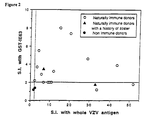
figure 2 ). All 17 immune donors had a S.I. to VZV antigens higher than 2.0. Among these positive donors. 3 (17%), of whom one had a history of multiple zoster eruptions, presented a very strong response to VZV antigens, while the S.I. with GST-IE63 was below 2.0. Four donors had a S.I. of 2.0 for GST-IE63 with a S.I. for VZ antigens ranging from 5.4 to 11. However, all these donors with a S.I. with GST-IE63 ≤ 2 had a very important response to GST alone (data not shown), which made it difficult to interpret the results. All the other natural immune individuals (59%) presented a strong response to GST-IE63, with a S.I. between 2.3 and 8. However, no correlation was found between the stimulation with VZ antigens and with the fusion protein. - The cytokine production by PBMC stimulated by IE63 was evaluated for 7 subjects: PBMC were stimulated either by GST or GST-IE63 and IL.2, IL4 and g-FN were deetected on
day 2, 4 or 6 by ELISA. The results were expressed as the difference between the concentration of cytokines detected after stimulation by GST-IE63 or GST alone. IL2 and IL4 have never been detected while γ-IFN was produced in significant amount (175 to 1400 pg/ml) by the T-cells stimulated by IE63, with a maximum produced on day 4. The amount of γ-IFN detected in the culture where no stimulation was observed was significantly lower:Donor T-cell proliferation to IFN-γ IL4 GST-IE63 (S.I.) (pg/ml) (pg/ml) 1 2,9 750 0 2 2,2 1400 0 3 7,4 500 0 4 8,0 625 0 5 2,0 175 0 6 2,0 50 0 - IE62 and IE63-specific CTL responses were detected in limiting dilution assays of T cells obtained from 10 VZV-immune donors. These assays were performed with autologous targets either non infected or infected by vaccinia-control, vaccinia-IE62 or vaccinia-IE63. The background generated by control targets presented a wide range of variation among the donors, but results were considered as valid only if the lysis of virus-specific targets was at least 10% higher than the lysis with control targets (uninfected or infected with vaccinia-control).
- When T cell populations recovered by T-Lymphokwik were used, the lysis of targets expressing VZV proteins was significantly higher than the one observed for the uninfected or control targets as demonstrated for one assay (
figure 3 ). The lysis observed with targets expressing IE62 was not significantly different from the lysis with targets expressing IE63. Similar results were obtained for the 4 assays performed with whole T cell population: a specific lysis of 25 to 48% was observed for IE62 and 27 to 43% for IE63. The mean precursor frequency for T cells that recognised IE62 or IE63 was 44500 ± 22500 SE and 31000 ± 16000 SE respectively, but the difference was not statistically significant (p = 0.8). - Limiting dilution cultures were also prepared using purified populations of CD4+ and CD8+ T lymphocytes as effectors. Both populations lysed IE62 and IE63-targets. The RCF of CD8+ cells recognising IE62 or IE63 was 28500 ± 10100 SE and 30500 ± 13700 SE respectively, which was not statistically different (p = 0,9), indicating that both viral proteins were recognised with the same efficiency by CD8+ cells (
figure 4 ). The number of cells lysing IE63 targets was also the same in both populations of effectors cells: the mean CD4+ effectors cells was 31450 ± 7500 SE which is the same as the frequency of CD8+ cells (P = 0,97). However, the calculation of the CD4+ cell frequency for IE62 recognition has been rejected by the computerised analysis. - To analyse VZV expression in latently-infected ganglia, one trigeminal and multiple thoracic ganglia from 9 adults and 3 infants were obtained within 24 hours after death. None of the subjects was immunocompromised before death, and at autopsy, there were no cutaneous signs of recent herpesvirus infection. Enzyme immunoassay revealed antibody to VZV in serum of all the adults. Serum available from only one of the 3 infants did not contain antibody to VZV. Liquid PCR amplification using VZV-specific primers (Mahalingham R et al Engl. J. Med 323 627-631) revealed VZV DNA in all adult ganglia, but not in any infant ganglia in DNA extracted from a small portion of each ganglion. The remaining portions of each ganglion were analysed immunohistochemically using antibodies raised in rabbit against the 30.5-kD-VZV IE63 protein, expressed as a glutathione-S-transferase fusion protein in E.coli and purified as described (Debrus et al supra). VZV infected and uninfected BSC-1 (African monkey kidney) cells served as positive and negative controls respectively.
- In VZV-infected BSC-1 cells, two focal areas of typical VZV cytopathology containing VZV IE63 protein were seen. No signal was detected in uninfected cells or in HSV-infected BSC-1 cells. In ganglia acquired 17 h after death from a 46-year old man who died of atherosclerosis, a characteristic red colour revealed VZV IE63 protein exclusively in the cytoplasm of 3 neurons. No signal was detected when normal rabbit serum was applied to an adjacent section of the same ganglion. Intense red staining was detected in the cytoplasm of a neuron in adjacent sections of a different thoracic ganglion of the same subject. A lighter red colour was also often seen in multiple neurons of latently-infected ganglia, suggesting a more diffuse, perhaps lower abundance infection. The red VZV IE63 protein-specific staining was never seen in satellite (capsular) cells, capillaries, connective tissue, nerve fascicles within the ganglia, or nerve rootless entering the ganglia. No signal was detected when the antiserum against VZV IE63 protein was applied to ganglia of a 2-month-old infant who died of sepsis complicating a congenital omphalocele and pulmonary hypoplasia. Overall, VZV IE63 protein was found in 5 ganglia (4 thoracic and 1 trigeminal) from 2 adults. In one of these adults. VZV IE63 protein was detected in all 10 sections from 4 of 5 thoracic ganglion. In the second adult. VZV IE63 protein was detected in all 4 sections from the trigeminal ganglion. In positive sections, VZV IE63 protein was detected in the cytoplasm of 2-4 neurons. VZV IE protein was not detected in any of 4 sections prepared from each of 16 ganglia from 7 other adults, or in any of 4 sections from each of 9 ganglia from 3 infants.
- The detection of VZV DNA in nearly all ganglia but VZV IE63 protein only in some latently-infected ganglia might reflect sampling, ie analysis of every section of each ganglion containing VZV DNA for VZV IE63 protein might have revealed additional positive ganglia. Alternatively, virus expression might differ in different ganglia, for example, in ganglia latently infected with HSV, the number of neurons containing HSV DNA is far greater than that revealing latency-associated transcripts.
- Finally, virus reactivation might have occurred, although this seems unlikely in the subjects who ganglia contained VZV IE63 protein, since there was no clinical evidence of zosterioform rash before death, no history of prolonged neuralgic pain which may precede rash (prehaerpetic neuralgia), no history of deermatomal distribution pain without rash (Zoster sine herpete), and no history of postherpetic neuralgia suggesting a low grade ganglionitis. Furthermore, histologic examination of ganglia revealed no neuronophagia, inclusion bodies or an inflammatory response.
- From these experiments, we can conclude that VZV IE63 elicits a complete immune response:
- anti-IE63 antibodies can be detected by western blot analysis in the serum of most donors with a history of chickenpox;
- T cells can proliferate after in vitro stimulation by IE63 (purified as a GST-fusion protein), but the limited number of tested donors did not allow to find a direct correlation between the stimulation index (S.I.) with VZV and the one with IE63. The T-cells proliferating in response to IE63 stimulation are mostly Th1 as indicated by the expression of high amount of IFN-gamma in the supernatant;
- a T cell cytotoxic activity in the context of IE63 recognition has been shown. CD4+ as well as CD8+ cells participate in the lysis process, as determined by the use of purified effector cells. The number of precursor cells recognising IE63 is similar to the number of cells responding to IE62.
- This is the first report of the identification of a herpesvirus protein expressed during latency in the human nervous system taken together with its immunological properties, it is an excellent antigen to be included in vaccine against Varicella Zoster.


S.I. was measured after stimulation of whole antigens (sonicated infected or mock infected melanoma cells diluted 4, 16 or 64 times) or with IE63 fusion protein (GST or GST-IE63).
The humoral immunity status has been evaluated by ELISA with whole antigen (expressed as the dilution for which O.D. is > 0.250) or by Western blot analysis with IE63.
Claims (12)
- A pharmaceutical composition comprising Varicella Zoster Virus IE63 protein and a pharmaceutically acceptable excipient for treating a human susceptible to or suffering from VZV infection.
- A pharmaceutical composition comprising a nucleic acid encoding VZV IE63 for treating a human susceptible to or suffering from VZV infection.
- Varicella Zoster Virus IE63 protein for use in medicine.
- Use of Varicella Zoster Virus IE 63 protein for the manufacture of a medicament for the prevention or amelioration of Varicella or Zoster.
- A pharmaceutical composition as claimed in claim 1 additionally comprising other IE proteins or VZV antigens.
- A pharmaceutical composition as claimed in claim 5 wherein the second VZV IE protein or additional VZV antigen is gpI, gpII, gpIII, gpIV, gpV, IE62 or an immunologically functional derivative thereof.
- A pharmaceutical composition according to claim 6 comprising a fusion protein comprising an amino acid sequence embodying VZV IE63 and amino acid sequence embodying one of gpl, gpII, gpIII, gpIV, gpV or derivative thereof.
- A pharmaceutical composition as claimed in claim 1, 2, 5, 6 or 7 additionally comprising an adjuvant.
- A pharmaceutical composition as claimed in claim 8 wherein the adjuvant preferentially induces a TH1 response.
- A pharmaceutical composition as claimed in claim 9 wherein the antigen is presented as an oil in water emulsion together with QS21 and 3D-MPL.
- A method of producing a pharmaceutical composition comprising a VZV IE63 protein, or a nucleic acid encoding said protein, comprising mixing said protein or nucleic acid with a pharmaceutically acceptable excipient.
- A method as claimed in claim 11, wherein the excipient comprises an adjuvant.
Applications Claiming Priority (5)
| Application Number | Priority Date | Filing Date | Title |
|---|---|---|---|
| GBGB9602617.4A GB9602617D0 (en) | 1996-02-09 | 1996-02-09 | Vaccines |
| GB9602617 | 1996-02-09 | ||
| GBGB9626882.6A GB9626882D0 (en) | 1996-12-24 | 1996-12-24 | Vaccines |
| GB9626882 | 1996-12-24 | ||
| PCT/EP1997/000520 WO1997028820A1 (en) | 1996-02-09 | 1997-02-04 | Vaccines against varicella zoster virus gene 63 product |
Publications (2)
| Publication Number | Publication Date |
|---|---|
| EP0879060A1 EP0879060A1 (en) | 1998-11-25 |
| EP0879060B1 true EP0879060B1 (en) | 2008-03-26 |
Family
ID=26308641
Family Applications (1)
| Application Number | Title | Priority Date | Filing Date |
|---|---|---|---|
| EP97902334A Expired - Lifetime EP0879060B1 (en) | 1996-02-09 | 1997-02-04 | Vaccines against varicella zoster virus gene 63 product |
Country Status (20)
| Country | Link |
|---|---|
| EP (1) | EP0879060B1 (en) |
| JP (1) | JP2002504080A (en) |
| KR (1) | KR100365986B1 (en) |
| CN (1) | CN1210470A (en) |
| AR (1) | AR005750A1 (en) |
| AT (1) | ATE390146T1 (en) |
| AU (1) | AU723555B2 (en) |
| BR (1) | BR9707400A (en) |
| CA (1) | CA2245545C (en) |
| CZ (1) | CZ289971B6 (en) |
| DE (1) | DE69738597T2 (en) |
| ES (1) | ES2301175T3 (en) |
| HU (1) | HUP0001991A3 (en) |
| IL (1) | IL125440A (en) |
| NO (1) | NO983617L (en) |
| NZ (1) | NZ331164A (en) |
| PL (1) | PL188457B1 (en) |
| TR (1) | TR199801531T2 (en) |
| TW (1) | TW575427B (en) |
| WO (1) | WO1997028820A1 (en) |
Families Citing this family (11)
| Publication number | Priority date | Publication date | Assignee | Title |
|---|---|---|---|---|
| AU1145699A (en) * | 1997-09-05 | 1999-03-22 | Smithkline Beecham Biologicals (Sa) | Oil in water emulsions containing saponins |
| DE69933200T2 (en) * | 1998-03-09 | 2007-02-22 | Glaxosmithkline Biologicals S.A. | COMBINED VACCINE COMPOSITIONS |
| GB9901254D0 (en) * | 1999-01-20 | 1999-03-10 | Smithkline Beecham Biolog | Vaccines |
| GB9921146D0 (en) * | 1999-09-07 | 1999-11-10 | Smithkline Beecham Biolog | Novel composition |
| ES2294864T3 (en) * | 1999-11-03 | 2008-04-01 | Powderject Vaccines, Inc. | GENETIC VACCINES POTENTIATED WITH ADJUSTERS. |
| CN1254541C (en) * | 2000-02-23 | 2006-05-03 | 史密丝克莱恩比彻姆生物有限公司 | new compound |
| NZ596501A (en) | 2009-05-27 | 2013-11-29 | Glaxosmithkline Biolog Sa | Casb7439 constructs |
| CA2900008C (en) | 2013-02-07 | 2025-10-07 | Children's Medical Center Corporation | Protein antigens that provide protection against pneumococcal colonization and/or disease |
| KR101723605B1 (en) * | 2014-10-21 | 2017-04-07 | 진원생명과학 주식회사 | Dna vaccine composition for preventing and treating herpes zoster and method of activating t-cell to vzv antizen by using the same |
| AU2022342080A1 (en) | 2021-09-09 | 2024-03-28 | Affinivax, Inc. | Multivalent pneumococcal vaccines |
| CN117224664B (en) * | 2023-10-23 | 2024-05-24 | 简达生物医药(南京)有限公司 | A recombinant herpes zoster vaccine injection and preparation method thereof |
Family Cites Families (2)
| Publication number | Priority date | Publication date | Assignee | Title |
|---|---|---|---|---|
| US4952674A (en) * | 1986-05-02 | 1990-08-28 | Merck & Co., Inc. | Vaccine against varicella-zoster virus |
| DK0405867T3 (en) * | 1989-06-27 | 1995-05-22 | Smithkline Beecham Biolog | Hitherto unknown compounds |
-
1997
- 1997-02-04 ES ES97902334T patent/ES2301175T3/en not_active Expired - Lifetime
- 1997-02-04 AT AT97902334T patent/ATE390146T1/en not_active IP Right Cessation
- 1997-02-04 BR BR9707400-4A patent/BR9707400A/en not_active Application Discontinuation
- 1997-02-04 DE DE69738597T patent/DE69738597T2/en not_active Expired - Fee Related
- 1997-02-04 KR KR10-1998-0706090A patent/KR100365986B1/en not_active Expired - Fee Related
- 1997-02-04 NZ NZ331164A patent/NZ331164A/en unknown
- 1997-02-04 EP EP97902334A patent/EP0879060B1/en not_active Expired - Lifetime
- 1997-02-04 AU AU16012/97A patent/AU723555B2/en not_active Ceased
- 1997-02-04 TR TR1998/01531T patent/TR199801531T2/en unknown
- 1997-02-04 CN CN97192099A patent/CN1210470A/en active Pending
- 1997-02-04 PL PL97328414A patent/PL188457B1/en not_active IP Right Cessation
- 1997-02-04 HU HU0001991A patent/HUP0001991A3/en not_active Application Discontinuation
- 1997-02-04 IL IL12544097A patent/IL125440A/en not_active IP Right Cessation
- 1997-02-04 CZ CZ19982486A patent/CZ289971B6/en not_active IP Right Cessation
- 1997-02-04 JP JP52814197A patent/JP2002504080A/en active Pending
- 1997-02-04 WO PCT/EP1997/000520 patent/WO1997028820A1/en not_active Ceased
- 1997-02-04 CA CA002245545A patent/CA2245545C/en not_active Expired - Fee Related
- 1997-02-07 AR ARP970100494A patent/AR005750A1/en not_active Application Discontinuation
- 1997-06-25 TW TW086102043A patent/TW575427B/en not_active IP Right Cessation
-
1998
- 1998-08-06 NO NO983617A patent/NO983617L/en unknown
Also Published As
| Publication number | Publication date |
|---|---|
| ES2301175T3 (en) | 2008-06-16 |
| CZ289971B6 (en) | 2002-05-15 |
| CZ248698A3 (en) | 1998-12-16 |
| WO1997028820A1 (en) | 1997-08-14 |
| AU1601297A (en) | 1997-08-28 |
| TW575427B (en) | 2004-02-11 |
| DE69738597T2 (en) | 2008-07-24 |
| NO983617L (en) | 1998-10-02 |
| CA2245545C (en) | 2008-12-30 |
| PL328414A1 (en) | 1999-01-18 |
| AR005750A1 (en) | 1999-07-14 |
| AU723555B2 (en) | 2000-08-31 |
| ATE390146T1 (en) | 2008-04-15 |
| NZ331164A (en) | 2000-02-28 |
| TR199801531T2 (en) | 1998-10-21 |
| EP0879060A1 (en) | 1998-11-25 |
| KR19990082360A (en) | 1999-11-25 |
| NO983617D0 (en) | 1998-08-06 |
| IL125440A0 (en) | 1999-03-12 |
| DE69738597D1 (en) | 2008-05-08 |
| KR100365986B1 (en) | 2003-02-20 |
| IL125440A (en) | 2002-02-10 |
| PL188457B1 (en) | 2005-02-28 |
| JP2002504080A (en) | 2002-02-05 |
| HUP0001991A2 (en) | 2000-10-28 |
| CN1210470A (en) | 1999-03-10 |
| HUP0001991A3 (en) | 2003-08-28 |
| BR9707400A (en) | 2000-01-04 |
| CA2245545A1 (en) | 1997-08-14 |
Similar Documents
| Publication | Publication Date | Title |
|---|---|---|
| EP0576478B1 (en) | Herpes simplex vaccine comprising hsv glycoprotein gd and 3 deacylated monophosphoryl lipid a | |
| JP5840167B2 (en) | Blister-herpes zoster virus vaccine | |
| CN116655748B (en) | Truncated varicella-zoster virus gE protein and application thereof | |
| EA000839B1 (en) | Liposomatic vaccine composition, use same and method for treating a mammal | |
| AU723555B2 (en) | Vaccines against varicella zoster virus gene 63 product | |
| US7112331B2 (en) | Vaccines against varicella zoster virus gene 63 product | |
| CN117126253B (en) | HSV immunogenic recombinant protein, preparation method and application thereof, and vaccine prepared by using same | |
| MXPA98006411A (en) | Vaccines against virus zoster virus gene 63 | |
| KR20230058101A (en) | COVID-19 vaccine with tocopherol-containing squalene emulsion adjuvant | |
| RU2845642C1 (en) | Vaccine formulations against coronavirus | |
| WO2025153100A1 (en) | Herpes simplex virus recombinant antigen and uses thereof | |
| WO2023039638A1 (en) | "immunogenic compositions and uses thereof" | |
| WO2022212289A1 (en) | Mutant herpesvirus and vaccine compositions | |
| HK1147273A (en) | Varicella zoster virus vaccine | |
| HK1156325A (en) | Varicella zoster virus vaccine | |
| HK1147272A (en) | Varicella zoster virus vaccine |
Legal Events
| Date | Code | Title | Description |
|---|---|---|---|
| PUAI | Public reference made under article 153(3) epc to a published international application that has entered the european phase |
Free format text: ORIGINAL CODE: 0009012 |
|
| 17P | Request for examination filed |
Effective date: 19980723 |
|
| AK | Designated contracting states |
Kind code of ref document: A1 Designated state(s): AT BE CH DE DK ES FI FR GB GR IE IT LI LU MC NL PT SE |
|
| AX | Request for extension of the european patent |
Free format text: SI PAYMENT 980723 |
|
| 17Q | First examination report despatched |
Effective date: 20041217 |
|
| 17Q | First examination report despatched |
Effective date: 20041217 |
|
| GRAP | Despatch of communication of intention to grant a patent |
Free format text: ORIGINAL CODE: EPIDOSNIGR1 |
|
| GRAS | Grant fee paid |
Free format text: ORIGINAL CODE: EPIDOSNIGR3 |
|
| GRAA | (expected) grant |
Free format text: ORIGINAL CODE: 0009210 |
|
| AK | Designated contracting states |
Kind code of ref document: B1 Designated state(s): AT BE CH DE DK ES FI FR GB GR IE IT LI LU MC NL PT SE |
|
| AX | Request for extension of the european patent |
Extension state: SI |
|
| REG | Reference to a national code |
Ref country code: GB Ref legal event code: FG4D |
|
| REG | Reference to a national code |
Ref country code: IE Ref legal event code: FG4D Ref country code: CH Ref legal event code: EP |
|
| REF | Corresponds to: |
Ref document number: 69738597 Country of ref document: DE Date of ref document: 20080508 Kind code of ref document: P |
|
| REG | Reference to a national code |
Ref country code: ES Ref legal event code: FG2A Ref document number: 2301175 Country of ref document: ES Kind code of ref document: T3 |
|
| PG25 | Lapsed in a contracting state [announced via postgrant information from national office to epo] |
Ref country code: FI Free format text: LAPSE BECAUSE OF FAILURE TO SUBMIT A TRANSLATION OF THE DESCRIPTION OR TO PAY THE FEE WITHIN THE PRESCRIBED TIME-LIMIT Effective date: 20080326 |
|
| PG25 | Lapsed in a contracting state [announced via postgrant information from national office to epo] |
Ref country code: AT Free format text: LAPSE BECAUSE OF FAILURE TO SUBMIT A TRANSLATION OF THE DESCRIPTION OR TO PAY THE FEE WITHIN THE PRESCRIBED TIME-LIMIT Effective date: 20080326 |
|
| NLV1 | Nl: lapsed or annulled due to failure to fulfill the requirements of art. 29p and 29m of the patents act | ||
| REG | Reference to a national code |
Ref country code: HK Ref legal event code: WD Ref document number: 1016474 Country of ref document: HK |
|
| PG25 | Lapsed in a contracting state [announced via postgrant information from national office to epo] |
Ref country code: SE Free format text: LAPSE BECAUSE OF FAILURE TO SUBMIT A TRANSLATION OF THE DESCRIPTION OR TO PAY THE FEE WITHIN THE PRESCRIBED TIME-LIMIT Effective date: 20080626 Ref country code: PT Free format text: LAPSE BECAUSE OF FAILURE TO SUBMIT A TRANSLATION OF THE DESCRIPTION OR TO PAY THE FEE WITHIN THE PRESCRIBED TIME-LIMIT Effective date: 20080901 |
|
| PG25 | Lapsed in a contracting state [announced via postgrant information from national office to epo] |
Ref country code: NL Free format text: LAPSE BECAUSE OF FAILURE TO SUBMIT A TRANSLATION OF THE DESCRIPTION OR TO PAY THE FEE WITHIN THE PRESCRIBED TIME-LIMIT Effective date: 20080326 |
|
| ET | Fr: translation filed | ||
| PG25 | Lapsed in a contracting state [announced via postgrant information from national office to epo] |
Ref country code: DK Free format text: LAPSE BECAUSE OF FAILURE TO SUBMIT A TRANSLATION OF THE DESCRIPTION OR TO PAY THE FEE WITHIN THE PRESCRIBED TIME-LIMIT Effective date: 20080326 |
|
| PLBE | No opposition filed within time limit |
Free format text: ORIGINAL CODE: 0009261 |
|
| STAA | Information on the status of an ep patent application or granted ep patent |
Free format text: STATUS: NO OPPOSITION FILED WITHIN TIME LIMIT |
|
| 26N | No opposition filed |
Effective date: 20081230 |
|
| PGFP | Annual fee paid to national office [announced via postgrant information from national office to epo] |
Ref country code: ES Payment date: 20090223 Year of fee payment: 13 |
|
| PGFP | Annual fee paid to national office [announced via postgrant information from national office to epo] |
Ref country code: DE Payment date: 20090227 Year of fee payment: 13 |
|
| PGFP | Annual fee paid to national office [announced via postgrant information from national office to epo] |
Ref country code: GB Payment date: 20090106 Year of fee payment: 13 |
|
| PGFP | Annual fee paid to national office [announced via postgrant information from national office to epo] |
Ref country code: BE Payment date: 20090318 Year of fee payment: 13 |
|
| PGFP | Annual fee paid to national office [announced via postgrant information from national office to epo] |
Ref country code: IT Payment date: 20090212 Year of fee payment: 13 |
|
| PG25 | Lapsed in a contracting state [announced via postgrant information from national office to epo] |
Ref country code: MC Free format text: LAPSE BECAUSE OF NON-PAYMENT OF DUE FEES Effective date: 20090228 |
|
| REG | Reference to a national code |
Ref country code: CH Ref legal event code: PL |
|
| PG25 | Lapsed in a contracting state [announced via postgrant information from national office to epo] |
Ref country code: LI Free format text: LAPSE BECAUSE OF NON-PAYMENT OF DUE FEES Effective date: 20090228 Ref country code: CH Free format text: LAPSE BECAUSE OF NON-PAYMENT OF DUE FEES Effective date: 20090228 |
|
| PGFP | Annual fee paid to national office [announced via postgrant information from national office to epo] |
Ref country code: FR Payment date: 20090206 Year of fee payment: 13 |
|
| PG25 | Lapsed in a contracting state [announced via postgrant information from national office to epo] |
Ref country code: IE Free format text: LAPSE BECAUSE OF NON-PAYMENT OF DUE FEES Effective date: 20090204 |
|
| BERE | Be: lapsed |
Owner name: UNIVERSITY OF LIEGE Effective date: 20100228 Owner name: SMITHKLINE BEECHAM BIOLOGICALS S.A. Effective date: 20100228 |
|
| GBPC | Gb: european patent ceased through non-payment of renewal fee |
Effective date: 20100204 |
|
| PG25 | Lapsed in a contracting state [announced via postgrant information from national office to epo] |
Ref country code: GR Free format text: LAPSE BECAUSE OF FAILURE TO SUBMIT A TRANSLATION OF THE DESCRIPTION OR TO PAY THE FEE WITHIN THE PRESCRIBED TIME-LIMIT Effective date: 20080627 |
|
| REG | Reference to a national code |
Ref country code: FR Ref legal event code: ST Effective date: 20101029 |
|
| PG25 | Lapsed in a contracting state [announced via postgrant information from national office to epo] |
Ref country code: FR Free format text: LAPSE BECAUSE OF NON-PAYMENT OF DUE FEES Effective date: 20100301 |
|
| PG25 | Lapsed in a contracting state [announced via postgrant information from national office to epo] |
Ref country code: DE Free format text: LAPSE BECAUSE OF NON-PAYMENT OF DUE FEES Effective date: 20100901 Ref country code: BE Free format text: LAPSE BECAUSE OF NON-PAYMENT OF DUE FEES Effective date: 20100228 |
|
| REG | Reference to a national code |
Ref country code: ES Ref legal event code: FD2A Effective date: 20110308 |
|
| PG25 | Lapsed in a contracting state [announced via postgrant information from national office to epo] |
Ref country code: GB Free format text: LAPSE BECAUSE OF NON-PAYMENT OF DUE FEES Effective date: 20100204 Ref country code: IT Free format text: LAPSE BECAUSE OF NON-PAYMENT OF DUE FEES Effective date: 20100204 |
|
| PG25 | Lapsed in a contracting state [announced via postgrant information from national office to epo] |
Ref country code: LU Free format text: LAPSE BECAUSE OF NON-PAYMENT OF DUE FEES Effective date: 20090204 |
|
| PG25 | Lapsed in a contracting state [announced via postgrant information from national office to epo] |
Ref country code: ES Free format text: LAPSE BECAUSE OF NON-PAYMENT OF DUE FEES Effective date: 20110307 |
|
| PG25 | Lapsed in a contracting state [announced via postgrant information from national office to epo] |
Ref country code: ES Free format text: LAPSE BECAUSE OF NON-PAYMENT OF DUE FEES Effective date: 20100205 |