EP0877733B1 - Process for production of piperidine derivatives - Google Patents
Process for production of piperidine derivatives Download PDFInfo
- Publication number
- EP0877733B1 EP0877733B1 EP96945097A EP96945097A EP0877733B1 EP 0877733 B1 EP0877733 B1 EP 0877733B1 EP 96945097 A EP96945097 A EP 96945097A EP 96945097 A EP96945097 A EP 96945097A EP 0877733 B1 EP0877733 B1 EP 0877733B1
- Authority
- EP
- European Patent Office
- Prior art keywords
- formula
- compound
- hydrogen
- moiety
- group
- Prior art date
- Legal status (The legal status is an assumption and is not a legal conclusion. Google has not performed a legal analysis and makes no representation as to the accuracy of the status listed.)
- Expired - Lifetime
Links
- 238000000034 method Methods 0.000 title claims abstract description 97
- 230000008569 process Effects 0.000 title claims abstract description 62
- 150000003053 piperidines Chemical class 0.000 title claims description 38
- 238000004519 manufacturing process Methods 0.000 title abstract description 8
- -1 piperidine derivative compound Chemical class 0.000 claims abstract description 141
- 239000001257 hydrogen Substances 0.000 claims abstract description 94
- 229910052739 hydrogen Inorganic materials 0.000 claims abstract description 94
- 125000000217 alkyl group Chemical group 0.000 claims abstract description 64
- 150000002431 hydrogen Chemical class 0.000 claims abstract description 52
- 125000003118 aryl group Chemical group 0.000 claims abstract description 49
- 229910052736 halogen Inorganic materials 0.000 claims abstract description 44
- 150000002367 halogens Chemical class 0.000 claims abstract description 44
- 125000002887 hydroxy group Chemical group [H]O* 0.000 claims abstract description 29
- UFHFLCQGNIYNRP-UHFFFAOYSA-N Hydrogen Chemical compound [H][H] UFHFLCQGNIYNRP-UHFFFAOYSA-N 0.000 claims abstract description 23
- 125000001424 substituent group Chemical group 0.000 claims abstract description 18
- NQRYJNQNLNOLGT-UHFFFAOYSA-N tetrahydropyridine hydrochloride Natural products C1CCNCC1 NQRYJNQNLNOLGT-UHFFFAOYSA-N 0.000 claims abstract description 16
- 125000003545 alkoxy group Chemical group 0.000 claims abstract description 12
- 125000004432 carbon atom Chemical group C* 0.000 claims abstract description 12
- 125000003178 carboxy group Chemical group [H]OC(*)=O 0.000 claims abstract description 7
- 150000001875 compounds Chemical class 0.000 claims description 133
- LMBFAGIMSUYTBN-MPZNNTNKSA-N teixobactin Chemical compound C([C@H](C(=O)N[C@@H]([C@@H](C)CC)C(=O)N[C@@H](CO)C(=O)N[C@H](CCC(N)=O)C(=O)N[C@H]([C@@H](C)CC)C(=O)N[C@@H]([C@@H](C)CC)C(=O)N[C@@H](CO)C(=O)N[C@H]1C(N[C@@H](C)C(=O)N[C@@H](C[C@@H]2NC(=N)NC2)C(=O)N[C@H](C(=O)O[C@H]1C)[C@@H](C)CC)=O)NC)C1=CC=CC=C1 LMBFAGIMSUYTBN-MPZNNTNKSA-N 0.000 claims description 28
- 229910052710 silicon Inorganic materials 0.000 claims description 24
- 239000010703 silicon Substances 0.000 claims description 23
- 125000002496 methyl group Chemical group [H]C([H])([H])* 0.000 claims description 20
- 125000004435 hydrogen atom Chemical group [H]* 0.000 claims description 19
- 238000007069 methylation reaction Methods 0.000 claims description 17
- 150000001412 amines Chemical class 0.000 claims description 16
- 230000011987 methylation Effects 0.000 claims description 16
- 125000004103 aminoalkyl group Chemical group 0.000 claims description 14
- XSXHWVKGUXMUQE-UHFFFAOYSA-N osmium dioxide Inorganic materials O=[Os]=O XSXHWVKGUXMUQE-UHFFFAOYSA-N 0.000 claims description 13
- ATJFFYVFTNAWJD-UHFFFAOYSA-N Tin Chemical compound [Sn] ATJFFYVFTNAWJD-UHFFFAOYSA-N 0.000 claims description 12
- 229910000272 alkali metal oxide Inorganic materials 0.000 claims description 11
- BTBUEUYNUDRHOZ-UHFFFAOYSA-N Borate Chemical compound [O-]B([O-])[O-] BTBUEUYNUDRHOZ-UHFFFAOYSA-N 0.000 claims description 10
- 239000002243 precursor Substances 0.000 claims description 9
- 230000009467 reduction Effects 0.000 claims description 6
- RWTNPBWLLIMQHL-UHFFFAOYSA-N fexofenadine Chemical group C1=CC(C(C)(C(O)=O)C)=CC=C1C(O)CCCN1CCC(C(O)(C=2C=CC=CC=2)C=2C=CC=CC=2)CC1 RWTNPBWLLIMQHL-UHFFFAOYSA-N 0.000 claims description 5
- 230000001035 methylating effect Effects 0.000 claims description 5
- UKXSKSHDVLQNKG-UHFFFAOYSA-N benzilic acid Chemical class C=1C=CC=CC=1C(O)(C(=O)O)C1=CC=CC=C1 UKXSKSHDVLQNKG-UHFFFAOYSA-N 0.000 claims description 3
- HDOWRFHMPULYOA-UHFFFAOYSA-N piperidin-4-ol Chemical compound OC1CCNCC1 HDOWRFHMPULYOA-UHFFFAOYSA-N 0.000 claims description 3
- ZTQSAGDEMFDKMZ-UHFFFAOYSA-N Butyraldehyde Chemical compound CCCC=O ZTQSAGDEMFDKMZ-UHFFFAOYSA-N 0.000 claims description 2
- 150000004648 butanoic acid derivatives Chemical class 0.000 claims description 2
- 230000003301 hydrolyzing effect Effects 0.000 claims 7
- 125000000956 methoxy group Chemical group [H]C([H])([H])O* 0.000 claims 2
- 229910052717 sulfur Inorganic materials 0.000 abstract 4
- 229910052760 oxygen Inorganic materials 0.000 abstract 2
- YXFVVABEGXRONW-UHFFFAOYSA-N Toluene Chemical compound CC1=CC=CC=C1 YXFVVABEGXRONW-UHFFFAOYSA-N 0.000 description 90
- XEKOWRVHYACXOJ-UHFFFAOYSA-N Ethyl acetate Chemical compound CCOC(C)=O XEKOWRVHYACXOJ-UHFFFAOYSA-N 0.000 description 70
- OKKJLVBELUTLKV-UHFFFAOYSA-N Methanol Chemical compound OC OKKJLVBELUTLKV-UHFFFAOYSA-N 0.000 description 54
- 239000002904 solvent Substances 0.000 description 52
- YMWUJEATGCHHMB-UHFFFAOYSA-N Dichloromethane Chemical compound ClCCl YMWUJEATGCHHMB-UHFFFAOYSA-N 0.000 description 44
- ZMXDDKWLCZADIW-UHFFFAOYSA-N N,N-Dimethylformamide Chemical compound CN(C)C=O ZMXDDKWLCZADIW-UHFFFAOYSA-N 0.000 description 35
- 238000005917 acylation reaction Methods 0.000 description 31
- 239000000203 mixture Substances 0.000 description 30
- KFZMGEQAYNKOFK-UHFFFAOYSA-N Isopropanol Chemical compound CC(C)O KFZMGEQAYNKOFK-UHFFFAOYSA-N 0.000 description 29
- 238000006243 chemical reaction Methods 0.000 description 28
- 239000000243 solution Substances 0.000 description 28
- 235000019439 ethyl acetate Nutrition 0.000 description 27
- 230000010933 acylation Effects 0.000 description 26
- LFQSCWFLJHTTHZ-UHFFFAOYSA-N Ethanol Chemical compound CCO LFQSCWFLJHTTHZ-UHFFFAOYSA-N 0.000 description 25
- UHOVQNZJYSORNB-UHFFFAOYSA-N Benzene Chemical compound C1=CC=CC=C1 UHOVQNZJYSORNB-UHFFFAOYSA-N 0.000 description 24
- 0 CCCN1CO*=CC1 Chemical compound CCCN1CO*=CC1 0.000 description 23
- HEDRZPFGACZZDS-UHFFFAOYSA-N Chloroform Chemical compound ClC(Cl)Cl HEDRZPFGACZZDS-UHFFFAOYSA-N 0.000 description 22
- RTZKZFJDLAIYFH-UHFFFAOYSA-N Diethyl ether Chemical compound CCOCC RTZKZFJDLAIYFH-UHFFFAOYSA-N 0.000 description 22
- GUGOEEXESWIERI-UHFFFAOYSA-N Terfenadine Chemical compound C1=CC(C(C)(C)C)=CC=C1C(O)CCCN1CCC(C(O)(C=2C=CC=CC=2)C=2C=CC=CC=2)CC1 GUGOEEXESWIERI-UHFFFAOYSA-N 0.000 description 22
- WYURNTSHIVDZCO-UHFFFAOYSA-N Tetrahydrofuran Chemical compound C1CCOC1 WYURNTSHIVDZCO-UHFFFAOYSA-N 0.000 description 22
- ZWEHNKRNPOVVGH-UHFFFAOYSA-N 2-Butanone Chemical compound CCC(C)=O ZWEHNKRNPOVVGH-UHFFFAOYSA-N 0.000 description 21
- 238000002360 preparation method Methods 0.000 description 20
- 229960000351 terfenadine Drugs 0.000 description 20
- 239000007787 solid Substances 0.000 description 19
- MVPPADPHJFYWMZ-UHFFFAOYSA-N chlorobenzene Chemical compound ClC1=CC=CC=C1 MVPPADPHJFYWMZ-UHFFFAOYSA-N 0.000 description 16
- 238000010992 reflux Methods 0.000 description 16
- QGJOPFRUJISHPQ-UHFFFAOYSA-N Carbon disulfide Chemical compound S=C=S QGJOPFRUJISHPQ-UHFFFAOYSA-N 0.000 description 15
- 239000002253 acid Substances 0.000 description 15
- 239000002585 base Substances 0.000 description 15
- VLKZOEOYAKHREP-UHFFFAOYSA-N n-Hexane Chemical class CCCCCC VLKZOEOYAKHREP-UHFFFAOYSA-N 0.000 description 15
- XLYOFNOQVPJJNP-UHFFFAOYSA-N water Substances O XLYOFNOQVPJJNP-UHFFFAOYSA-N 0.000 description 14
- 239000008096 xylene Substances 0.000 description 14
- RYHBNJHYFVUHQT-UHFFFAOYSA-N 1,4-Dioxane Chemical compound C1COCCO1 RYHBNJHYFVUHQT-UHFFFAOYSA-N 0.000 description 13
- CTQNGGLPUBDAKN-UHFFFAOYSA-N O-Xylene Chemical compound CC1=CC=CC=C1C CTQNGGLPUBDAKN-UHFFFAOYSA-N 0.000 description 13
- 239000003054 catalyst Substances 0.000 description 13
- 239000003795 chemical substances by application Substances 0.000 description 13
- VEXZGXHMUGYJMC-UHFFFAOYSA-N Hydrochloric acid Chemical compound Cl VEXZGXHMUGYJMC-UHFFFAOYSA-N 0.000 description 12
- LRHPLDYGYMQRHN-UHFFFAOYSA-N N-Butanol Chemical compound CCCCO LRHPLDYGYMQRHN-UHFFFAOYSA-N 0.000 description 12
- XUIMIQQOPSSXEZ-UHFFFAOYSA-N Silicon Chemical compound [Si] XUIMIQQOPSSXEZ-UHFFFAOYSA-N 0.000 description 12
- HEMHJVSKTPXQMS-UHFFFAOYSA-M Sodium hydroxide Chemical compound [OH-].[Na+] HEMHJVSKTPXQMS-UHFFFAOYSA-M 0.000 description 12
- 238000005804 alkylation reaction Methods 0.000 description 12
- 125000001495 ethyl group Chemical group [H]C([H])([H])C([H])([H])* 0.000 description 12
- 238000006460 hydrolysis reaction Methods 0.000 description 12
- 125000000468 ketone group Chemical group 0.000 description 12
- VZGDMQKNWNREIO-UHFFFAOYSA-N tetrachloromethane Chemical compound ClC(Cl)(Cl)Cl VZGDMQKNWNREIO-UHFFFAOYSA-N 0.000 description 12
- CSNNHWWHGAXBCP-UHFFFAOYSA-L Magnesium sulfate Chemical compound [Mg+2].[O-][S+2]([O-])([O-])[O-] CSNNHWWHGAXBCP-UHFFFAOYSA-L 0.000 description 10
- MZRVEZGGRBJDDB-UHFFFAOYSA-N N-Butyllithium Chemical group [Li]CCCC MZRVEZGGRBJDDB-UHFFFAOYSA-N 0.000 description 10
- 230000000694 effects Effects 0.000 description 10
- 230000007062 hydrolysis Effects 0.000 description 10
- BWHMMNNQKKPAPP-UHFFFAOYSA-L potassium carbonate Chemical compound [K+].[K+].[O-]C([O-])=O BWHMMNNQKKPAPP-UHFFFAOYSA-L 0.000 description 10
- QTBSBXVTEAMEQO-UHFFFAOYSA-N Acetic acid Chemical compound CC(O)=O QTBSBXVTEAMEQO-UHFFFAOYSA-N 0.000 description 9
- 239000004215 Carbon black (E152) Substances 0.000 description 9
- 229930195733 hydrocarbon Natural products 0.000 description 9
- 150000002430 hydrocarbons Chemical class 0.000 description 9
- 239000003921 oil Substances 0.000 description 9
- 235000019198 oils Nutrition 0.000 description 9
- XDTMQSROBMDMFD-UHFFFAOYSA-N Cyclohexane Chemical compound C1CCCCC1 XDTMQSROBMDMFD-UHFFFAOYSA-N 0.000 description 8
- NTYJJOPFIAHURM-UHFFFAOYSA-N Histamine Chemical compound NCCC1=CN=CN1 NTYJJOPFIAHURM-UHFFFAOYSA-N 0.000 description 8
- 150000008282 halocarbons Chemical class 0.000 description 8
- ZEUXAIYYDDCIRX-UHFFFAOYSA-N losartan carboxylic acid Chemical compound CCCCC1=NC(Cl)=C(C(O)=O)N1CC1=CC=C(C=2C(=CC=CC=2)C2=NNN=N2)C=C1 ZEUXAIYYDDCIRX-UHFFFAOYSA-N 0.000 description 8
- 125000001280 n-hexyl group Chemical group C(CCCCC)* 0.000 description 8
- 125000000740 n-pentyl group Chemical group [H]C([H])([H])C([H])([H])C([H])([H])C([H])([H])C([H])([H])* 0.000 description 8
- 125000004123 n-propyl group Chemical group [H]C([H])([H])C([H])([H])C([H])([H])* 0.000 description 8
- 125000001997 phenyl group Chemical group [H]C1=C([H])C([H])=C(*)C([H])=C1[H] 0.000 description 8
- 150000003839 salts Chemical class 0.000 description 8
- YLQBMQCUIZJEEH-UHFFFAOYSA-N tetrahydrofuran Natural products C=1C=COC=1 YLQBMQCUIZJEEH-UHFFFAOYSA-N 0.000 description 8
- NTIZESTWPVYFNL-UHFFFAOYSA-N Methyl isobutyl ketone Chemical compound CC(C)CC(C)=O NTIZESTWPVYFNL-UHFFFAOYSA-N 0.000 description 7
- UIHCLUNTQKBZGK-UHFFFAOYSA-N Methyl isobutyl ketone Natural products CCC(C)C(C)=O UIHCLUNTQKBZGK-UHFFFAOYSA-N 0.000 description 7
- VYPSYNLAJGMNEJ-UHFFFAOYSA-N Silicium dioxide Chemical compound O=[Si]=O VYPSYNLAJGMNEJ-UHFFFAOYSA-N 0.000 description 7
- PMZURENOXWZQFD-UHFFFAOYSA-L Sodium Sulfate Chemical compound [Na+].[Na+].[O-]S([O-])(=O)=O PMZURENOXWZQFD-UHFFFAOYSA-L 0.000 description 7
- 229910052799 carbon Inorganic materials 0.000 description 7
- 150000002148 esters Chemical class 0.000 description 7
- 229940043265 methyl isobutyl ketone Drugs 0.000 description 7
- 239000003960 organic solvent Substances 0.000 description 7
- 238000006722 reduction reaction Methods 0.000 description 7
- 229910052938 sodium sulfate Inorganic materials 0.000 description 7
- SCYULBFZEHDVBN-UHFFFAOYSA-N 1,1-Dichloroethane Chemical compound CC(Cl)Cl SCYULBFZEHDVBN-UHFFFAOYSA-N 0.000 description 6
- 125000006181 4-methyl benzyl group Chemical group [H]C1=C([H])C(=C([H])C([H])=C1C([H])([H])[H])C([H])([H])* 0.000 description 6
- QTBSBXVTEAMEQO-UHFFFAOYSA-M Acetate Chemical compound CC([O-])=O QTBSBXVTEAMEQO-UHFFFAOYSA-M 0.000 description 6
- KDLHZDBZIXYQEI-UHFFFAOYSA-N Palladium Chemical compound [Pd] KDLHZDBZIXYQEI-UHFFFAOYSA-N 0.000 description 6
- ZLMJMSJWJFRBEC-UHFFFAOYSA-N Potassium Chemical compound [K] ZLMJMSJWJFRBEC-UHFFFAOYSA-N 0.000 description 6
- JUJWROOIHBZHMG-UHFFFAOYSA-N Pyridine Chemical compound C1=CC=NC=C1 JUJWROOIHBZHMG-UHFFFAOYSA-N 0.000 description 6
- ZMANZCXQSJIPKH-UHFFFAOYSA-N Triethylamine Chemical compound CCN(CC)CC ZMANZCXQSJIPKH-UHFFFAOYSA-N 0.000 description 6
- 125000001797 benzyl group Chemical group [H]C1=C([H])C([H])=C(C([H])=C1[H])C([H])([H])* 0.000 description 6
- 125000001449 isopropyl group Chemical group [H]C([H])([H])C([H])(*)C([H])([H])[H] 0.000 description 6
- 125000004108 n-butyl group Chemical group [H]C([H])([H])C([H])([H])C([H])([H])C([H])([H])* 0.000 description 6
- 125000001971 neopentyl group Chemical group [H]C([*])([H])C(C([H])([H])[H])(C([H])([H])[H])C([H])([H])[H] 0.000 description 6
- 239000012044 organic layer Substances 0.000 description 6
- 229910052700 potassium Inorganic materials 0.000 description 6
- 239000011591 potassium Substances 0.000 description 6
- NLKNQRATVPKPDG-UHFFFAOYSA-M potassium iodide Chemical compound [K+].[I-] NLKNQRATVPKPDG-UHFFFAOYSA-M 0.000 description 6
- 125000002914 sec-butyl group Chemical group [H]C([H])([H])C([H])([H])C([H])(*)C([H])([H])[H] 0.000 description 6
- 239000012279 sodium borohydride Substances 0.000 description 6
- 229910000033 sodium borohydride Inorganic materials 0.000 description 6
- 125000000999 tert-butyl group Chemical group [H]C([H])([H])C(*)(C([H])([H])[H])C([H])([H])[H] 0.000 description 6
- 125000003944 tolyl group Chemical group 0.000 description 6
- 125000005023 xylyl group Chemical group 0.000 description 6
- VBTJEFSCACXENO-UHFFFAOYSA-N 2-[4-(4-chlorobutanoyl)phenyl]-2-methylpropanoic acid Chemical compound OC(=O)C(C)(C)C1=CC=C(C(=O)CCCCl)C=C1 VBTJEFSCACXENO-UHFFFAOYSA-N 0.000 description 5
- BVKZGUZCCUSVTD-UHFFFAOYSA-M Bicarbonate Chemical compound OC([O-])=O BVKZGUZCCUSVTD-UHFFFAOYSA-M 0.000 description 5
- FYYHWMGAXLPEAU-UHFFFAOYSA-N Magnesium Chemical compound [Mg] FYYHWMGAXLPEAU-UHFFFAOYSA-N 0.000 description 5
- FAPWRFPIFSIZLT-UHFFFAOYSA-M Sodium chloride Chemical compound [Na+].[Cl-] FAPWRFPIFSIZLT-UHFFFAOYSA-M 0.000 description 5
- 229910000288 alkali metal carbonate Inorganic materials 0.000 description 5
- 150000008041 alkali metal carbonates Chemical class 0.000 description 5
- 230000029936 alkylation Effects 0.000 description 5
- 239000011230 binding agent Substances 0.000 description 5
- 125000000484 butyl group Chemical group [H]C([*])([H])C([H])([H])C([H])([H])C([H])([H])[H] 0.000 description 5
- 230000000747 cardiac effect Effects 0.000 description 5
- 229960004132 diethyl ether Drugs 0.000 description 5
- 150000007529 inorganic bases Chemical class 0.000 description 5
- 229910052943 magnesium sulfate Inorganic materials 0.000 description 5
- 125000000325 methylidene group Chemical group [H]C([H])=* 0.000 description 5
- 229910000027 potassium carbonate Inorganic materials 0.000 description 5
- 235000011152 sodium sulphate Nutrition 0.000 description 5
- 229920002261 Corn starch Polymers 0.000 description 4
- 241001465754 Metazoa Species 0.000 description 4
- CDBYLPFSWZWCQE-UHFFFAOYSA-L Sodium Carbonate Chemical compound [Na+].[Na+].[O-]C([O-])=O CDBYLPFSWZWCQE-UHFFFAOYSA-L 0.000 description 4
- UIIMBOGNXHQVGW-UHFFFAOYSA-M Sodium bicarbonate Chemical compound [Na+].OC([O-])=O UIIMBOGNXHQVGW-UHFFFAOYSA-M 0.000 description 4
- 239000000443 aerosol Substances 0.000 description 4
- 239000005456 alcohol based solvent Substances 0.000 description 4
- 229910052783 alkali metal Inorganic materials 0.000 description 4
- 206010003119 arrhythmia Diseases 0.000 description 4
- YNHIGQDRGKUECZ-UHFFFAOYSA-L bis(triphenylphosphine)palladium(ii) dichloride Chemical compound [Cl-].[Cl-].[Pd+2].C1=CC=CC=C1P(C=1C=CC=CC=1)C1=CC=CC=C1.C1=CC=CC=C1P(C=1C=CC=CC=1)C1=CC=CC=C1 YNHIGQDRGKUECZ-UHFFFAOYSA-L 0.000 description 4
- DNSISZSEWVHGLH-UHFFFAOYSA-N butanamide Chemical class CCCC(N)=O DNSISZSEWVHGLH-UHFFFAOYSA-N 0.000 description 4
- 239000008120 corn starch Substances 0.000 description 4
- 229940099112 cornstarch Drugs 0.000 description 4
- 239000012043 crude product Substances 0.000 description 4
- 229960001340 histamine Drugs 0.000 description 4
- XMBWDFGMSWQBCA-UHFFFAOYSA-N hydrogen iodide Chemical compound I XMBWDFGMSWQBCA-UHFFFAOYSA-N 0.000 description 4
- 238000001727 in vivo Methods 0.000 description 4
- INQOMBQAUSQDDS-UHFFFAOYSA-N iodomethane Chemical compound IC INQOMBQAUSQDDS-UHFFFAOYSA-N 0.000 description 4
- KWGKDLIKAYFUFQ-UHFFFAOYSA-M lithium chloride Chemical compound [Li+].[Cl-] KWGKDLIKAYFUFQ-UHFFFAOYSA-M 0.000 description 4
- ZCSHNCUQKCANBX-UHFFFAOYSA-N lithium diisopropylamide Chemical compound [Li+].CC(C)[N-]C(C)C ZCSHNCUQKCANBX-UHFFFAOYSA-N 0.000 description 4
- ULWORPZJUIFPIC-UHFFFAOYSA-N methyl 2-[4-(4-chlorobutanoyl)phenyl]-2-methylpropanoate Chemical compound COC(=O)C(C)(C)C1=CC=C(C(=O)CCCCl)C=C1 ULWORPZJUIFPIC-UHFFFAOYSA-N 0.000 description 4
- NFHFRUOZVGFOOS-UHFFFAOYSA-N palladium;triphenylphosphane Chemical compound [Pd].C1=CC=CC=C1P(C=1C=CC=CC=1)C1=CC=CC=C1.C1=CC=CC=C1P(C=1C=CC=CC=1)C1=CC=CC=C1.C1=CC=CC=C1P(C=1C=CC=CC=1)C1=CC=CC=C1.C1=CC=CC=C1P(C=1C=CC=CC=1)C1=CC=CC=C1 NFHFRUOZVGFOOS-UHFFFAOYSA-N 0.000 description 4
- IUBQJLUDMLPAGT-UHFFFAOYSA-N potassium bis(trimethylsilyl)amide Chemical compound C[Si](C)(C)N([K])[Si](C)(C)C IUBQJLUDMLPAGT-UHFFFAOYSA-N 0.000 description 4
- FYSNRJHAOHDILO-UHFFFAOYSA-N thionyl chloride Chemical compound ClS(Cl)=O FYSNRJHAOHDILO-UHFFFAOYSA-N 0.000 description 4
- RIOQSEWOXXDEQQ-UHFFFAOYSA-N triphenylphosphine Chemical compound C1=CC=CC=C1P(C=1C=CC=CC=1)C1=CC=CC=C1 RIOQSEWOXXDEQQ-UHFFFAOYSA-N 0.000 description 4
- NGAKDIWPTMPPFP-UHFFFAOYSA-N 2-[4-[4-[4-[hydroxy(diphenyl)methyl]piperidin-1-yl]butanoyl]phenyl]-2-methylpropanoic acid Chemical compound C1=CC(C(C)(C(O)=O)C)=CC=C1C(=O)CCCN1CCC(C(O)(C=2C=CC=CC=2)C=2C=CC=CC=2)CC1 NGAKDIWPTMPPFP-UHFFFAOYSA-N 0.000 description 3
- BMYNFMYTOJXKLE-UHFFFAOYSA-N 3-azaniumyl-2-hydroxypropanoate Chemical compound NCC(O)C(O)=O BMYNFMYTOJXKLE-UHFFFAOYSA-N 0.000 description 3
- WEVYAHXRMPXWCK-UHFFFAOYSA-N Acetonitrile Chemical compound CC#N WEVYAHXRMPXWCK-UHFFFAOYSA-N 0.000 description 3
- FERIUCNNQQJTOY-UHFFFAOYSA-N Butyric acid Chemical compound CCCC(O)=O FERIUCNNQQJTOY-UHFFFAOYSA-N 0.000 description 3
- OKTJSMMVPCPJKN-UHFFFAOYSA-N Carbon Chemical compound [C] OKTJSMMVPCPJKN-UHFFFAOYSA-N 0.000 description 3
- DGAQECJNVWCQMB-PUAWFVPOSA-M Ilexoside XXIX Chemical compound C[C@@H]1CC[C@@]2(CC[C@@]3(C(=CC[C@H]4[C@]3(CC[C@@H]5[C@@]4(CC[C@@H](C5(C)C)OS(=O)(=O)[O-])C)C)[C@@H]2[C@]1(C)O)C)C(=O)O[C@H]6[C@@H]([C@H]([C@@H]([C@H](O6)CO)O)O)O.[Na+] DGAQECJNVWCQMB-PUAWFVPOSA-M 0.000 description 3
- WHXSMMKQMYFTQS-UHFFFAOYSA-N Lithium Chemical compound [Li] WHXSMMKQMYFTQS-UHFFFAOYSA-N 0.000 description 3
- KWYUFKZDYYNOTN-UHFFFAOYSA-M Potassium hydroxide Chemical compound [OH-].[K+] KWYUFKZDYYNOTN-UHFFFAOYSA-M 0.000 description 3
- DNIAPMSPPWPWGF-UHFFFAOYSA-N Propylene glycol Chemical compound CC(O)CO DNIAPMSPPWPWGF-UHFFFAOYSA-N 0.000 description 3
- 239000000739 antihistaminic agent Substances 0.000 description 3
- XGHOVGYJHWQGCC-UHFFFAOYSA-N carebastine Chemical compound C1=CC(C(C)(C(O)=O)C)=CC=C1C(=O)CCCN1CCC(OC(C=2C=CC=CC=2)C=2C=CC=CC=2)CC1 XGHOVGYJHWQGCC-UHFFFAOYSA-N 0.000 description 3
- 230000003197 catalytic effect Effects 0.000 description 3
- 239000003638 chemical reducing agent Substances 0.000 description 3
- 238000004440 column chromatography Methods 0.000 description 3
- 238000001816 cooling Methods 0.000 description 3
- 230000002440 hepatic effect Effects 0.000 description 3
- 229940071870 hydroiodic acid Drugs 0.000 description 3
- RAXXELZNTBOGNW-UHFFFAOYSA-N imidazole Natural products C1=CNC=N1 RAXXELZNTBOGNW-UHFFFAOYSA-N 0.000 description 3
- 238000000338 in vitro Methods 0.000 description 3
- 229910052500 inorganic mineral Inorganic materials 0.000 description 3
- 239000007788 liquid Substances 0.000 description 3
- 229910052744 lithium Inorganic materials 0.000 description 3
- 229910052749 magnesium Inorganic materials 0.000 description 3
- 239000011777 magnesium Substances 0.000 description 3
- GOUQSHOAAGQXNJ-UHFFFAOYSA-N methyl 2-[4-[1-hydroxy-4-[4-[hydroxy(diphenyl)methyl]piperidin-1-yl]butyl]phenyl]-2-methylpropanoate Chemical compound C1=CC(C(C)(C)C(=O)OC)=CC=C1C(O)CCCN1CCC(C(O)(C=2C=CC=CC=2)C=2C=CC=CC=2)CC1 GOUQSHOAAGQXNJ-UHFFFAOYSA-N 0.000 description 3
- RSFYLBVXPMDBIF-UHFFFAOYSA-N methyl 2-[4-[4-[4-[hydroxy-bis(4-methylphenyl)methyl]piperidin-1-yl]butanoyl]phenyl]-2-methylpropanoate Chemical compound C1=CC(C(C)(C)C(=O)OC)=CC=C1C(=O)CCCN1CCC(C(O)(C=2C=CC(C)=CC=2)C=2C=CC(C)=CC=2)CC1 RSFYLBVXPMDBIF-UHFFFAOYSA-N 0.000 description 3
- 239000012022 methylating agents Substances 0.000 description 3
- 235000010755 mineral Nutrition 0.000 description 3
- 239000011707 mineral Substances 0.000 description 3
- 150000007530 organic bases Chemical class 0.000 description 3
- 229910052763 palladium Inorganic materials 0.000 description 3
- 235000011181 potassium carbonates Nutrition 0.000 description 3
- 239000000047 product Substances 0.000 description 3
- UMJSCPRVCHMLSP-UHFFFAOYSA-N pyridine Natural products COC1=CC=CN=C1 UMJSCPRVCHMLSP-UHFFFAOYSA-N 0.000 description 3
- 239000000741 silica gel Substances 0.000 description 3
- 229910002027 silica gel Inorganic materials 0.000 description 3
- 229910052708 sodium Inorganic materials 0.000 description 3
- 239000011734 sodium Substances 0.000 description 3
- 239000000725 suspension Substances 0.000 description 3
- BUGNITMKWYOPCU-UHFFFAOYSA-N 1-propylpiperidin-4-ol Chemical class CCCN1CCC(O)CC1 BUGNITMKWYOPCU-UHFFFAOYSA-N 0.000 description 2
- UWCWUCKPEYNDNV-LBPRGKRZSA-N 2,6-dimethyl-n-[[(2s)-pyrrolidin-2-yl]methyl]aniline Chemical compound CC1=CC=CC(C)=C1NC[C@H]1NCCC1 UWCWUCKPEYNDNV-LBPRGKRZSA-N 0.000 description 2
- HRVZFJDYABWCQS-UHFFFAOYSA-N 2-[(4-bromophenyl)methyl]-4,4-dimethyl-1,2-oxazolidine Chemical compound C1C(C)(C)CON1CC1=CC=C(Br)C=C1 HRVZFJDYABWCQS-UHFFFAOYSA-N 0.000 description 2
- NTZHXKLMSWWUPY-UHFFFAOYSA-N 2-[4-(4-chloro-1-hydroxybutyl)phenyl]-2-methylpropanoic acid Chemical compound OC(=O)C(C)(C)C1=CC=C(C(O)CCCCl)C=C1 NTZHXKLMSWWUPY-UHFFFAOYSA-N 0.000 description 2
- LMPCSCOVKHFVKE-UHFFFAOYSA-N 2-[4-[1-hydroxy-4-[4-[hydroxy-bis(4-methylphenyl)methyl]piperidin-1-yl]butyl]phenyl]-2-methylpropanoic acid Chemical compound C1=CC(C)=CC=C1C(O)(C=1C=CC(C)=CC=1)C1CCN(CCCC(O)C=2C=CC(=CC=2)C(C)(C)C(O)=O)CC1 LMPCSCOVKHFVKE-UHFFFAOYSA-N 0.000 description 2
- 125000005916 2-methylpentyl group Chemical group 0.000 description 2
- GUBGYTABKSRVRQ-XLOQQCSPSA-N Alpha-Lactose Chemical compound O[C@@H]1[C@@H](O)[C@@H](O)[C@@H](CO)O[C@H]1O[C@@H]1[C@@H](CO)O[C@H](O)[C@H](O)[C@H]1O GUBGYTABKSRVRQ-XLOQQCSPSA-N 0.000 description 2
- CPELXLSAUQHCOX-UHFFFAOYSA-M Bromide Chemical compound [Br-] CPELXLSAUQHCOX-UHFFFAOYSA-M 0.000 description 2
- BAUWRHPMUVYFOD-UHFFFAOYSA-N CN(CC1)CCC1O Chemical compound CN(CC1)CCC1O BAUWRHPMUVYFOD-UHFFFAOYSA-N 0.000 description 2
- CURLTUGMZLYLDI-UHFFFAOYSA-N Carbon dioxide Chemical compound O=C=O CURLTUGMZLYLDI-UHFFFAOYSA-N 0.000 description 2
- 241000700198 Cavia Species 0.000 description 2
- XTHFKEDIFFGKHM-UHFFFAOYSA-N Dimethoxyethane Chemical compound COCCOC XTHFKEDIFFGKHM-UHFFFAOYSA-N 0.000 description 2
- ULGZDMOVFRHVEP-RWJQBGPGSA-N Erythromycin Chemical compound O([C@@H]1[C@@H](C)C(=O)O[C@@H]([C@@]([C@H](O)[C@@H](C)C(=O)[C@H](C)C[C@@](C)(O)[C@H](O[C@H]2[C@@H]([C@H](C[C@@H](C)O2)N(C)C)O)[C@H]1C)(C)O)CC)[C@H]1C[C@@](C)(OC)[C@@H](O)[C@H](C)O1 ULGZDMOVFRHVEP-RWJQBGPGSA-N 0.000 description 2
- QUSNBJAOOMFDIB-UHFFFAOYSA-N Ethylamine Chemical compound CCN QUSNBJAOOMFDIB-UHFFFAOYSA-N 0.000 description 2
- 108010010803 Gelatin Proteins 0.000 description 2
- GUBGYTABKSRVRQ-QKKXKWKRSA-N Lactose Natural products OC[C@H]1O[C@@H](O[C@H]2[C@H](O)[C@@H](O)C(O)O[C@@H]2CO)[C@H](O)[C@@H](O)[C@H]1O GUBGYTABKSRVRQ-QKKXKWKRSA-N 0.000 description 2
- 239000007832 Na2SO4 Substances 0.000 description 2
- GLUUGHFHXGJENI-UHFFFAOYSA-N Piperazine Chemical compound C1CNCCN1 GLUUGHFHXGJENI-UHFFFAOYSA-N 0.000 description 2
- ATUOYWHBWRKTHZ-UHFFFAOYSA-N Propane Chemical compound CCC ATUOYWHBWRKTHZ-UHFFFAOYSA-N 0.000 description 2
- 241000700159 Rattus Species 0.000 description 2
- UIIMBOGNXHQVGW-DEQYMQKBSA-M Sodium bicarbonate-14C Chemical compound [Na+].O[14C]([O-])=O UIIMBOGNXHQVGW-DEQYMQKBSA-M 0.000 description 2
- CZMRCDWAGMRECN-UGDNZRGBSA-N Sucrose Chemical compound O[C@H]1[C@H](O)[C@@H](CO)O[C@@]1(CO)O[C@@H]1[C@H](O)[C@@H](O)[C@H](O)[C@@H](CO)O1 CZMRCDWAGMRECN-UGDNZRGBSA-N 0.000 description 2
- 229930006000 Sucrose Natural products 0.000 description 2
- 238000009825 accumulation Methods 0.000 description 2
- 239000002671 adjuvant Substances 0.000 description 2
- 230000001476 alcoholic effect Effects 0.000 description 2
- 150000001340 alkali metals Chemical class 0.000 description 2
- 229910052782 aluminium Inorganic materials 0.000 description 2
- XAGFODPZIPBFFR-UHFFFAOYSA-N aluminium Chemical compound [Al] XAGFODPZIPBFFR-UHFFFAOYSA-N 0.000 description 2
- 230000001387 anti-histamine Effects 0.000 description 2
- 239000008346 aqueous phase Substances 0.000 description 2
- 238000003556 assay Methods 0.000 description 2
- RWCCWEUUXYIKHB-UHFFFAOYSA-N benzophenone Chemical class C=1C=CC=CC=1C(=O)C1=CC=CC=C1 RWCCWEUUXYIKHB-UHFFFAOYSA-N 0.000 description 2
- LWBPNIJBHRISSS-UHFFFAOYSA-L beryllium dichloride Chemical compound Cl[Be]Cl LWBPNIJBHRISSS-UHFFFAOYSA-L 0.000 description 2
- 239000004305 biphenyl Substances 0.000 description 2
- 230000037396 body weight Effects 0.000 description 2
- 229910000085 borane Inorganic materials 0.000 description 2
- 239000012267 brine Substances 0.000 description 2
- 229940124630 bronchodilator Drugs 0.000 description 2
- 239000002775 capsule Substances 0.000 description 2
- 235000011089 carbon dioxide Nutrition 0.000 description 2
- 150000001732 carboxylic acid derivatives Chemical class 0.000 description 2
- 150000001735 carboxylic acids Chemical class 0.000 description 2
- 229950010123 carebastine Drugs 0.000 description 2
- 239000000969 carrier Substances 0.000 description 2
- 238000010531 catalytic reduction reaction Methods 0.000 description 2
- 230000008859 change Effects 0.000 description 2
- 150000001805 chlorine compounds Chemical group 0.000 description 2
- NEHMKBQYUWJMIP-UHFFFAOYSA-N chloromethane Chemical compound ClC NEHMKBQYUWJMIP-UHFFFAOYSA-N 0.000 description 2
- AVPBPSOSZLWRDN-UHFFFAOYSA-M chloropalladium(1+);methanidylbenzene;triphenylphosphane Chemical compound [Pd+]Cl.[CH2-]C1=CC=CC=C1.C1=CC=CC=C1P(C=1C=CC=CC=1)C1=CC=CC=C1.C1=CC=CC=C1P(C=1C=CC=CC=1)C1=CC=CC=C1 AVPBPSOSZLWRDN-UHFFFAOYSA-M 0.000 description 2
- 239000012141 concentrate Substances 0.000 description 2
- 238000006880 cross-coupling reaction Methods 0.000 description 2
- 125000000113 cyclohexyl group Chemical group [H]C1([H])C([H])([H])C([H])([H])C([H])(*)C([H])([H])C1([H])[H] 0.000 description 2
- PAFZNILMFXTMIY-UHFFFAOYSA-N cyclohexylamine Chemical compound NC1CCCCC1 PAFZNILMFXTMIY-UHFFFAOYSA-N 0.000 description 2
- 239000003937 drug carrier Substances 0.000 description 2
- 230000032050 esterification Effects 0.000 description 2
- 238000005886 esterification reaction Methods 0.000 description 2
- 229920000159 gelatin Polymers 0.000 description 2
- 239000008273 gelatin Substances 0.000 description 2
- 235000019322 gelatine Nutrition 0.000 description 2
- 235000011852 gelatine desserts Nutrition 0.000 description 2
- 150000002334 glycols Chemical class 0.000 description 2
- SUMDYPCJJOFFON-UHFFFAOYSA-N isethionic acid Chemical compound OCCS(O)(=O)=O SUMDYPCJJOFFON-UHFFFAOYSA-N 0.000 description 2
- NNPPMTNAJDCUHE-UHFFFAOYSA-N isobutane Chemical compound CC(C)C NNPPMTNAJDCUHE-UHFFFAOYSA-N 0.000 description 2
- 239000005453 ketone based solvent Substances 0.000 description 2
- 239000008101 lactose Substances 0.000 description 2
- 239000010410 layer Substances 0.000 description 2
- YNESATAKKCNGOF-UHFFFAOYSA-N lithium bis(trimethylsilyl)amide Chemical compound [Li+].C[Si](C)(C)[N-][Si](C)(C)C YNESATAKKCNGOF-UHFFFAOYSA-N 0.000 description 2
- 239000000314 lubricant Substances 0.000 description 2
- HQKMJHAJHXVSDF-UHFFFAOYSA-L magnesium stearate Chemical compound [Mg+2].CCCCCCCCCCCCCCCCCC([O-])=O.CCCCCCCCCCCCCCCCCC([O-])=O HQKMJHAJHXVSDF-UHFFFAOYSA-L 0.000 description 2
- 239000000463 material Substances 0.000 description 2
- 239000002207 metabolite Substances 0.000 description 2
- PGQMZSGBFIPEKX-UHFFFAOYSA-N methyl 2-[4-[4-[4-[hydroxy(diphenyl)methyl]piperidin-1-yl]butanoyl]phenyl]-2-methylpropanoate Chemical compound C1=CC(C(C)(C)C(=O)OC)=CC=C1C(=O)CCCN1CCC(C(O)(C=2C=CC=CC=2)C=2C=CC=CC=2)CC1 PGQMZSGBFIPEKX-UHFFFAOYSA-N 0.000 description 2
- 150000005172 methylbenzenes Chemical class 0.000 description 2
- 150000007522 mineralic acids Chemical class 0.000 description 2
- 210000004400 mucous membrane Anatomy 0.000 description 2
- 125000001624 naphthyl group Chemical group 0.000 description 2
- VOKXPKSMYJLAIW-UHFFFAOYSA-N nickel;phosphane Chemical compound P.[Ni] VOKXPKSMYJLAIW-UHFFFAOYSA-N 0.000 description 2
- 150000007524 organic acids Chemical class 0.000 description 2
- 125000002524 organometallic group Chemical group 0.000 description 2
- PIBWKRNGBLPSSY-UHFFFAOYSA-L palladium(II) chloride Chemical compound Cl[Pd]Cl PIBWKRNGBLPSSY-UHFFFAOYSA-L 0.000 description 2
- YJVFFLUZDVXJQI-UHFFFAOYSA-L palladium(ii) acetate Chemical compound [Pd+2].CC([O-])=O.CC([O-])=O YJVFFLUZDVXJQI-UHFFFAOYSA-L 0.000 description 2
- RJUAEBLXGFKZMS-UHFFFAOYSA-N piperidin-1-ylmethanol Chemical compound OCN1CCCCC1 RJUAEBLXGFKZMS-UHFFFAOYSA-N 0.000 description 2
- BASFCYQUMIYNBI-UHFFFAOYSA-N platinum Chemical compound [Pt] BASFCYQUMIYNBI-UHFFFAOYSA-N 0.000 description 2
- 239000011736 potassium bicarbonate Substances 0.000 description 2
- 229910000028 potassium bicarbonate Inorganic materials 0.000 description 2
- 235000015497 potassium bicarbonate Nutrition 0.000 description 2
- TYJJADVDDVDEDZ-UHFFFAOYSA-M potassium hydrogencarbonate Chemical compound [K+].OC([O-])=O TYJJADVDDVDEDZ-UHFFFAOYSA-M 0.000 description 2
- 239000000843 powder Substances 0.000 description 2
- 239000003380 propellant Substances 0.000 description 2
- 239000011541 reaction mixture Substances 0.000 description 2
- 238000001953 recrystallisation Methods 0.000 description 2
- 230000004044 response Effects 0.000 description 2
- 229920006395 saturated elastomer Polymers 0.000 description 2
- QZAYGJVTTNCVMB-UHFFFAOYSA-N serotonin Chemical compound C1=C(O)C=C2C(CCN)=CNC2=C1 QZAYGJVTTNCVMB-UHFFFAOYSA-N 0.000 description 2
- 229910000030 sodium bicarbonate Inorganic materials 0.000 description 2
- 229910000029 sodium carbonate Inorganic materials 0.000 description 2
- 239000011780 sodium chloride Substances 0.000 description 2
- HPALAKNZSZLMCH-UHFFFAOYSA-M sodium;chloride;hydrate Chemical compound O.[Na+].[Cl-] HPALAKNZSZLMCH-UHFFFAOYSA-M 0.000 description 2
- 239000007921 spray Substances 0.000 description 2
- 238000003756 stirring Methods 0.000 description 2
- 239000005720 sucrose Substances 0.000 description 2
- 125000005270 trialkylamine group Chemical group 0.000 description 2
- UORVGPXVDQYIDP-UHFFFAOYSA-N trihydridoboron Substances B UORVGPXVDQYIDP-UHFFFAOYSA-N 0.000 description 2
- SFLSHLFXELFNJZ-QMMMGPOBSA-N (-)-norepinephrine Chemical compound NC[C@H](O)C1=CC=C(O)C(O)=C1 SFLSHLFXELFNJZ-QMMMGPOBSA-N 0.000 description 1
- HFVMEOPYDLEHBR-UHFFFAOYSA-N (2-fluorophenyl)-phenylmethanol Chemical compound C=1C=CC=C(F)C=1C(O)C1=CC=CC=C1 HFVMEOPYDLEHBR-UHFFFAOYSA-N 0.000 description 1
- QBYIENPQHBMVBV-HFEGYEGKSA-N (2R)-2-hydroxy-2-phenylacetic acid Chemical compound O[C@@H](C(O)=O)c1ccccc1.O[C@@H](C(O)=O)c1ccccc1 QBYIENPQHBMVBV-HFEGYEGKSA-N 0.000 description 1
- XMAYWYJOQHXEEK-OZXSUGGESA-N (2R,4S)-ketoconazole Chemical compound C1CN(C(=O)C)CCN1C(C=C1)=CC=C1OC[C@@H]1O[C@@](CN2C=NC=C2)(C=2C(=CC(Cl)=CC=2)Cl)OC1 XMAYWYJOQHXEEK-OZXSUGGESA-N 0.000 description 1
- PPTXVXKCQZKFBN-UHFFFAOYSA-N (S)-(-)-1,1'-Bi-2-naphthol Chemical group C1=CC=C2C(C3=C4C=CC=CC4=CC=C3O)=C(O)C=CC2=C1 PPTXVXKCQZKFBN-UHFFFAOYSA-N 0.000 description 1
- BJEPYKJPYRNKOW-REOHCLBHSA-N (S)-malic acid Chemical compound OC(=O)[C@@H](O)CC(O)=O BJEPYKJPYRNKOW-REOHCLBHSA-N 0.000 description 1
- UWYVPFMHMJIBHE-OWOJBTEDSA-N (e)-2-hydroxybut-2-enedioic acid Chemical compound OC(=O)\C=C(\O)C(O)=O UWYVPFMHMJIBHE-OWOJBTEDSA-N 0.000 description 1
- BZCOSCNPHJNQBP-UPHRSURJSA-N (z)-2,3-dihydroxybut-2-enedioic acid Chemical compound OC(=O)C(\O)=C(\O)C(O)=O BZCOSCNPHJNQBP-UPHRSURJSA-N 0.000 description 1
- XXHJRVRLLABZBJ-UHFFFAOYSA-N 1-[chloro-(4-methylphenyl)methyl]-4-methylbenzene Chemical compound C1=CC(C)=CC=C1C(Cl)C1=CC=C(C)C=C1 XXHJRVRLLABZBJ-UHFFFAOYSA-N 0.000 description 1
- QXQAPNSHUJORMC-UHFFFAOYSA-N 1-chloro-4-propylbenzene Chemical compound CCCC1=CC=C(Cl)C=C1 QXQAPNSHUJORMC-UHFFFAOYSA-N 0.000 description 1
- NMIZONYLXCOHEF-UHFFFAOYSA-N 1h-imidazole-2-carboxamide Chemical compound NC(=O)C1=NC=CN1 NMIZONYLXCOHEF-UHFFFAOYSA-N 0.000 description 1
- KFYHQBREJHADFS-UHFFFAOYSA-N 2-[1-(4-bromophenyl)ethyl]-4,4-dimethyl-1,2-oxazolidine Chemical compound C=1C=C(Br)C=CC=1C(C)N1CC(C)(C)CO1 KFYHQBREJHADFS-UHFFFAOYSA-N 0.000 description 1
- 229940058020 2-amino-2-methyl-1-propanol Drugs 0.000 description 1
- PKRSYEPBQPFNRB-UHFFFAOYSA-N 2-phenoxybenzoic acid Chemical compound OC(=O)C1=CC=CC=C1OC1=CC=CC=C1 PKRSYEPBQPFNRB-UHFFFAOYSA-N 0.000 description 1
- YMTDEUMSQQCFCK-UHFFFAOYSA-N 4-(4-hydroxypiperidin-1-ium-1-yl)butanoate Chemical class OC1CCN(CCCC(O)=O)CC1 YMTDEUMSQQCFCK-UHFFFAOYSA-N 0.000 description 1
- WJHJJDMECZRKKK-UHFFFAOYSA-N 4-(4-hydroxypiperidin-1-yl)butanal Chemical compound OC1CCN(CCCC=O)CC1 WJHJJDMECZRKKK-UHFFFAOYSA-N 0.000 description 1
- QOWSWEBLNVACCL-UHFFFAOYSA-N 4-Bromophenyl acetate Chemical compound OC(=O)CC1=CC=C(Br)C=C1 QOWSWEBLNVACCL-UHFFFAOYSA-N 0.000 description 1
- ALYNCZNDIQEVRV-UHFFFAOYSA-M 4-aminobenzoate Chemical compound NC1=CC=C(C([O-])=O)C=C1 ALYNCZNDIQEVRV-UHFFFAOYSA-M 0.000 description 1
- WUBBRNOQWQTFEX-UHFFFAOYSA-N 4-aminosalicylic acid Chemical compound NC1=CC=C(C(O)=O)C(O)=C1 WUBBRNOQWQTFEX-UHFFFAOYSA-N 0.000 description 1
- UNPKOFGAQOEDMF-UHFFFAOYSA-N 4-benzhydrylidenepiperidine Chemical class C1CNCCC1=C(C=1C=CC=CC=1)C1=CC=CC=C1 UNPKOFGAQOEDMF-UHFFFAOYSA-N 0.000 description 1
- OQAOREVBRZVXDS-UHFFFAOYSA-N 4-benzhydryloxypiperidine Chemical class C1CNCCC1OC(C=1C=CC=CC=1)C1=CC=CC=C1 OQAOREVBRZVXDS-UHFFFAOYSA-N 0.000 description 1
- LUYLEMZRJQTGPM-UHFFFAOYSA-N 4-benzhydrylpiperidine Chemical class C1CNCCC1C(C=1C=CC=CC=1)C1=CC=CC=C1 LUYLEMZRJQTGPM-UHFFFAOYSA-N 0.000 description 1
- QISOBCMNUJQOJU-UHFFFAOYSA-N 4-bromo-1h-pyrazole-5-carboxylic acid Chemical compound OC(=O)C=1NN=CC=1Br QISOBCMNUJQOJU-UHFFFAOYSA-N 0.000 description 1
- ZFCFBWSVQWGOJJ-UHFFFAOYSA-N 4-chlorobutanenitrile Chemical compound ClCCCC#N ZFCFBWSVQWGOJJ-UHFFFAOYSA-N 0.000 description 1
- CDIIZULDSLKBKV-UHFFFAOYSA-N 4-chlorobutanoyl chloride Chemical compound ClCCCC(Cl)=O CDIIZULDSLKBKV-UHFFFAOYSA-N 0.000 description 1
- PXRKCOCTEMYUEG-UHFFFAOYSA-N 5-aminoisoindole-1,3-dione Chemical compound NC1=CC=C2C(=O)NC(=O)C2=C1 PXRKCOCTEMYUEG-UHFFFAOYSA-N 0.000 description 1
- ZCYVEMRRCGMTRW-UHFFFAOYSA-N 7553-56-2 Chemical compound [I] ZCYVEMRRCGMTRW-UHFFFAOYSA-N 0.000 description 1
- VCDGSBJCRYTLNU-IKXAHOJESA-N 9-[(5s)-4,6,6-trimethyl-3-bicyclo[3.1.1]heptanyl]-9-borabicyclo[3.3.1]nonane Chemical compound C1CCC2CCCC1B2C1CC(C2(C)C)C[C@@]2([H])C1C VCDGSBJCRYTLNU-IKXAHOJESA-N 0.000 description 1
- CIWBSHSKHKDKBQ-JLAZNSOCSA-N Ascorbic acid Chemical compound OC[C@H](O)[C@H]1OC(=O)C(O)=C1O CIWBSHSKHKDKBQ-JLAZNSOCSA-N 0.000 description 1
- BSYNRYMUTXBXSQ-UHFFFAOYSA-N Aspirin Chemical compound CC(=O)OC1=CC=CC=C1C(O)=O BSYNRYMUTXBXSQ-UHFFFAOYSA-N 0.000 description 1
- 241000271566 Aves Species 0.000 description 1
- 241000283690 Bos taurus Species 0.000 description 1
- 101800004538 Bradykinin Proteins 0.000 description 1
- 206010006482 Bronchospasm Diseases 0.000 description 1
- COVZYZSDYWQREU-UHFFFAOYSA-N Busulfan Chemical compound CS(=O)(=O)OCCCCOS(C)(=O)=O COVZYZSDYWQREU-UHFFFAOYSA-N 0.000 description 1
- IWBDAPPKJUPNBB-UHFFFAOYSA-N CC(C)(C)OC(C(C)(C)N)(N)[I]=[IH] Chemical compound CC(C)(C)OC(C(C)(C)N)(N)[I]=[IH] IWBDAPPKJUPNBB-UHFFFAOYSA-N 0.000 description 1
- MWRBCODVEAQUAD-UHFFFAOYSA-N CC(c1ccc(C(C)(C)C(O)=O)cc1)O Chemical compound CC(c1ccc(C(C)(C)C(O)=O)cc1)O MWRBCODVEAQUAD-UHFFFAOYSA-N 0.000 description 1
- ZATIGZXTBCPTFO-UHFFFAOYSA-N CC1(CCCCC1)C(CC(CC1)NC(N)=[IH])(CC1[NH+](C)[O-])O Chemical compound CC1(CCCCC1)C(CC(CC1)NC(N)=[IH])(CC1[NH+](C)[O-])O ZATIGZXTBCPTFO-UHFFFAOYSA-N 0.000 description 1
- CTMHWPIWNRWQEG-UHFFFAOYSA-N CC1=CCCCC1 Chemical compound CC1=CCCCC1 CTMHWPIWNRWQEG-UHFFFAOYSA-N 0.000 description 1
- GZQDMWVBXVIQSG-UHFFFAOYSA-N CN(CC1)CCC1N=O Chemical compound CN(CC1)CCC1N=O GZQDMWVBXVIQSG-UHFFFAOYSA-N 0.000 description 1
- KJZLJGZZDNGGCA-UHFFFAOYSA-N CN1CCC(CO)CC1 Chemical compound CN1CCC(CO)CC1 KJZLJGZZDNGGCA-UHFFFAOYSA-N 0.000 description 1
- PAMIQIKDUOTOBW-UHFFFAOYSA-N CN1CCCCC1 Chemical compound CN1CCCCC1 PAMIQIKDUOTOBW-UHFFFAOYSA-N 0.000 description 1
- OYPRJOBELJOOCE-UHFFFAOYSA-N Calcium Chemical compound [Ca] OYPRJOBELJOOCE-UHFFFAOYSA-N 0.000 description 1
- 229940127291 Calcium channel antagonist Drugs 0.000 description 1
- 241000282472 Canis lupus familiaris Species 0.000 description 1
- 208000024172 Cardiovascular disease Diseases 0.000 description 1
- 241000700199 Cavia porcellus Species 0.000 description 1
- VEXZGXHMUGYJMC-UHFFFAOYSA-M Chloride anion Chemical compound [Cl-] VEXZGXHMUGYJMC-UHFFFAOYSA-M 0.000 description 1
- WBYWAXJHAXSJNI-SREVYHEPSA-N Cinnamic acid Chemical compound OC(=O)\C=C/C1=CC=CC=C1 WBYWAXJHAXSJNI-SREVYHEPSA-N 0.000 description 1
- 206010010774 Constipation Diseases 0.000 description 1
- 102000002004 Cytochrome P-450 Enzyme System Human genes 0.000 description 1
- 108010015742 Cytochrome P-450 Enzyme System Proteins 0.000 description 1
- 206010012735 Diarrhoea Diseases 0.000 description 1
- 206010049119 Emotional distress Diseases 0.000 description 1
- 241000283086 Equidae Species 0.000 description 1
- 241000282324 Felis Species 0.000 description 1
- 241000282326 Felis catus Species 0.000 description 1
- 238000005863 Friedel-Crafts acylation reaction Methods 0.000 description 1
- 230000005526 G1 to G0 transition Effects 0.000 description 1
- 241000237858 Gastropoda Species 0.000 description 1
- WQZGKKKJIJFFOK-GASJEMHNSA-N Glucose Natural products OC[C@H]1OC(O)[C@H](O)[C@@H](O)[C@@H]1O WQZGKKKJIJFFOK-GASJEMHNSA-N 0.000 description 1
- AEMRFAOFKBGASW-UHFFFAOYSA-N Glycolic acid Chemical compound OCC(O)=O AEMRFAOFKBGASW-UHFFFAOYSA-N 0.000 description 1
- QXZGBUJJYSLZLT-UHFFFAOYSA-N H-Arg-Pro-Pro-Gly-Phe-Ser-Pro-Phe-Arg-OH Natural products NC(N)=NCCCC(N)C(=O)N1CCCC1C(=O)N1C(C(=O)NCC(=O)NC(CC=2C=CC=CC=2)C(=O)NC(CO)C(=O)N2C(CCC2)C(=O)NC(CC=2C=CC=CC=2)C(=O)NC(CCCN=C(N)N)C(O)=O)CCC1 QXZGBUJJYSLZLT-UHFFFAOYSA-N 0.000 description 1
- 206010019670 Hepatic function abnormal Diseases 0.000 description 1
- 241000282412 Homo Species 0.000 description 1
- 102100035792 Kininogen-1 Human genes 0.000 description 1
- 240000007472 Leucaena leucocephala Species 0.000 description 1
- 235000010643 Leucaena leucocephala Nutrition 0.000 description 1
- OFOBLEOULBTSOW-UHFFFAOYSA-N Malonic acid Chemical compound OC(=O)CC(O)=O OFOBLEOULBTSOW-UHFFFAOYSA-N 0.000 description 1
- 241000124008 Mammalia Species 0.000 description 1
- AFVFQIVMOAPDHO-UHFFFAOYSA-N Methanesulfonic acid Chemical compound CS(O)(=O)=O AFVFQIVMOAPDHO-UHFFFAOYSA-N 0.000 description 1
- BZLVMXJERCGZMT-UHFFFAOYSA-N Methyl tert-butyl ether Chemical compound COC(C)(C)C BZLVMXJERCGZMT-UHFFFAOYSA-N 0.000 description 1
- 241000699670 Mus sp. Species 0.000 description 1
- OPKOKAMJFNKNAS-UHFFFAOYSA-N N-methylethanolamine Chemical compound CNCCO OPKOKAMJFNKNAS-UHFFFAOYSA-N 0.000 description 1
- 241000283903 Ovis aries Species 0.000 description 1
- 235000019483 Peanut oil Nutrition 0.000 description 1
- 241001494479 Pecora Species 0.000 description 1
- 239000002202 Polyethylene glycol Substances 0.000 description 1
- WTKZEGDFNFYCGP-UHFFFAOYSA-N Pyrazole Chemical compound C=1C=NNC=1 WTKZEGDFNFYCGP-UHFFFAOYSA-N 0.000 description 1
- LCTONWCANYUPML-UHFFFAOYSA-N Pyruvic acid Chemical compound CC(=O)C(O)=O LCTONWCANYUPML-UHFFFAOYSA-N 0.000 description 1
- IWYDHOAUDWTVEP-UHFFFAOYSA-N R-2-phenyl-2-hydroxyacetic acid Natural products OC(=O)C(O)C1=CC=CC=C1 IWYDHOAUDWTVEP-UHFFFAOYSA-N 0.000 description 1
- 239000007868 Raney catalyst Substances 0.000 description 1
- 229910000564 Raney nickel Inorganic materials 0.000 description 1
- NPXOKRUENSOPAO-UHFFFAOYSA-N Raney nickel Chemical compound [Al].[Ni] NPXOKRUENSOPAO-UHFFFAOYSA-N 0.000 description 1
- 239000012327 Ruthenium complex Substances 0.000 description 1
- 206010039897 Sedation Diseases 0.000 description 1
- KEAYESYHFKHZAL-UHFFFAOYSA-N Sodium Chemical compound [Na] KEAYESYHFKHZAL-UHFFFAOYSA-N 0.000 description 1
- 235000021355 Stearic acid Nutrition 0.000 description 1
- 241000282887 Suidae Species 0.000 description 1
- FEWJPZIEWOKRBE-UHFFFAOYSA-N Tartaric Acid Chemical compound [H+].[H+].[O-]C(=O)C(O)C(O)C([O-])=O FEWJPZIEWOKRBE-UHFFFAOYSA-N 0.000 description 1
- OKJPEAGHQZHRQV-UHFFFAOYSA-N Triiodomethane Natural products IC(I)I OKJPEAGHQZHRQV-UHFFFAOYSA-N 0.000 description 1
- 239000007983 Tris buffer Substances 0.000 description 1
- QXJARVSGJXWJQR-UHFFFAOYSA-N [2-(6-diphenylphosphanyl-3-methoxy-2,4-dimethylphenyl)-4-methoxy-3,5-dimethylphenyl]-diphenylphosphane Chemical group CC=1C(OC)=C(C)C=C(P(C=2C=CC=CC=2)C=2C=CC=CC=2)C=1C1=C(C)C(OC)=C(C)C=C1P(C=1C=CC=CC=1)C1=CC=CC=C1 QXJARVSGJXWJQR-UHFFFAOYSA-N 0.000 description 1
- ZDVDCDLBOLSVGM-UHFFFAOYSA-N [chloro(phenyl)methyl]benzene Chemical compound C=1C=CC=CC=1C(Cl)C1=CC=CC=C1 ZDVDCDLBOLSVGM-UHFFFAOYSA-N 0.000 description 1
- 230000005856 abnormality Effects 0.000 description 1
- OIPILFWXSMYKGL-UHFFFAOYSA-N acetylcholine Chemical compound CC(=O)OCC[N+](C)(C)C OIPILFWXSMYKGL-UHFFFAOYSA-N 0.000 description 1
- 229960004266 acetylcholine chloride Drugs 0.000 description 1
- 150000007513 acids Chemical class 0.000 description 1
- 230000002411 adverse Effects 0.000 description 1
- 239000000556 agonist Substances 0.000 description 1
- 150000001298 alcohols Chemical class 0.000 description 1
- 239000000783 alginic acid Substances 0.000 description 1
- 235000010443 alginic acid Nutrition 0.000 description 1
- 229920000615 alginic acid Polymers 0.000 description 1
- 229960001126 alginic acid Drugs 0.000 description 1
- 150000004781 alginic acids Chemical class 0.000 description 1
- 150000008044 alkali metal hydroxides Chemical class 0.000 description 1
- 229910052784 alkaline earth metal Inorganic materials 0.000 description 1
- 150000001342 alkaline earth metals Chemical class 0.000 description 1
- 125000004414 alkyl thio group Chemical group 0.000 description 1
- 208000026935 allergic disease Diseases 0.000 description 1
- 230000000172 allergic effect Effects 0.000 description 1
- AZDRQVAHHNSJOQ-UHFFFAOYSA-N alumane Chemical compound [AlH3] AZDRQVAHHNSJOQ-UHFFFAOYSA-N 0.000 description 1
- SMZOGRDCAXLAAR-UHFFFAOYSA-N aluminium isopropoxide Chemical compound [Al+3].CC(C)[O-].CC(C)[O-].CC(C)[O-] SMZOGRDCAXLAAR-UHFFFAOYSA-N 0.000 description 1
- 150000001408 amides Chemical class 0.000 description 1
- CBTVGIZVANVGBH-UHFFFAOYSA-N aminomethyl propanol Chemical compound CC(C)(N)CO CBTVGIZVANVGBH-UHFFFAOYSA-N 0.000 description 1
- 238000004458 analytical method Methods 0.000 description 1
- 230000002052 anaphylactic effect Effects 0.000 description 1
- RWZYAGGXGHYGMB-UHFFFAOYSA-N anthranilic acid Chemical compound NC1=CC=CC=C1C(O)=O RWZYAGGXGHYGMB-UHFFFAOYSA-N 0.000 description 1
- 239000003242 anti bacterial agent Substances 0.000 description 1
- 230000001466 anti-adreneric effect Effects 0.000 description 1
- 230000003266 anti-allergic effect Effects 0.000 description 1
- 230000001705 anti-serotonergic effect Effects 0.000 description 1
- 239000000043 antiallergic agent Substances 0.000 description 1
- 229940088710 antibiotic agent Drugs 0.000 description 1
- 239000003429 antifungal agent Substances 0.000 description 1
- 229940125715 antihistaminic agent Drugs 0.000 description 1
- 230000006793 arrhythmia Effects 0.000 description 1
- 239000012298 atmosphere Substances 0.000 description 1
- WDIHJSXYQDMJHN-UHFFFAOYSA-L barium chloride Chemical compound [Cl-].[Cl-].[Ba+2] WDIHJSXYQDMJHN-UHFFFAOYSA-L 0.000 description 1
- 229910001626 barium chloride Inorganic materials 0.000 description 1
- 229940045511 barium chloride Drugs 0.000 description 1
- WXBLLCUINBKULX-UHFFFAOYSA-N benzoic acid Chemical compound OC(=O)C1=CC=CC=C1.OC(=O)C1=CC=CC=C1 WXBLLCUINBKULX-UHFFFAOYSA-N 0.000 description 1
- 150000008366 benzophenones Chemical class 0.000 description 1
- 229910001627 beryllium chloride Inorganic materials 0.000 description 1
- 230000003115 biocidal effect Effects 0.000 description 1
- 125000006267 biphenyl group Chemical group 0.000 description 1
- 230000000903 blocking effect Effects 0.000 description 1
- 238000009835 boiling Methods 0.000 description 1
- QXZGBUJJYSLZLT-FDISYFBBSA-N bradykinin Chemical compound NC(=N)NCCC[C@H](N)C(=O)N1CCC[C@H]1C(=O)N1[C@H](C(=O)NCC(=O)N[C@@H](CC=2C=CC=CC=2)C(=O)N[C@@H](CO)C(=O)N2[C@@H](CCC2)C(=O)N[C@@H](CC=2C=CC=CC=2)C(=O)N[C@@H](CCCNC(N)=N)C(O)=O)CCC1 QXZGBUJJYSLZLT-FDISYFBBSA-N 0.000 description 1
- OQROAIRCEOBYJA-UHFFFAOYSA-N bromodiphenylmethane Chemical compound C=1C=CC=CC=1C(Br)C1=CC=CC=C1 OQROAIRCEOBYJA-UHFFFAOYSA-N 0.000 description 1
- GZUXJHMPEANEGY-UHFFFAOYSA-N bromomethane Chemical compound BrC GZUXJHMPEANEGY-UHFFFAOYSA-N 0.000 description 1
- 230000007885 bronchoconstriction Effects 0.000 description 1
- 239000000168 bronchodilator agent Substances 0.000 description 1
- 239000001273 butane Substances 0.000 description 1
- HGEQCTPJRWFPFK-UHFFFAOYSA-N butanoate;piperazin-1-ium Chemical compound CCCC(O)=O.C1CNCCN1 HGEQCTPJRWFPFK-UHFFFAOYSA-N 0.000 description 1
- HAAKHXDEVZXNCT-UHFFFAOYSA-N butanoic acid;morpholine Chemical compound CCCC(O)=O.C1COCCN1 HAAKHXDEVZXNCT-UHFFFAOYSA-N 0.000 description 1
- 229910052791 calcium Inorganic materials 0.000 description 1
- 239000011575 calcium Substances 0.000 description 1
- 239000000480 calcium channel blocker Substances 0.000 description 1
- 125000002915 carbonyl group Chemical group [*:2]C([*:1])=O 0.000 description 1
- 239000003153 chemical reaction reagent Substances 0.000 description 1
- 238000004587 chromatography analysis Methods 0.000 description 1
- 229910052681 coesite Inorganic materials 0.000 description 1
- 239000012230 colorless oil Substances 0.000 description 1
- 238000009833 condensation Methods 0.000 description 1
- 230000005494 condensation Effects 0.000 description 1
- 238000007796 conventional method Methods 0.000 description 1
- 229910052906 cristobalite Inorganic materials 0.000 description 1
- 239000013078 crystal Substances 0.000 description 1
- 150000003950 cyclic amides Chemical class 0.000 description 1
- 125000004122 cyclic group Chemical group 0.000 description 1
- HCAJEUSONLESMK-UHFFFAOYSA-N cyclohexylsulfamic acid Chemical compound OS(=O)(=O)NC1CCCCC1 HCAJEUSONLESMK-UHFFFAOYSA-N 0.000 description 1
- 230000018044 dehydration Effects 0.000 description 1
- 238000006297 dehydration reaction Methods 0.000 description 1
- 230000003111 delayed effect Effects 0.000 description 1
- 239000008121 dextrose Substances 0.000 description 1
- 150000004683 dihydrates Chemical class 0.000 description 1
- 239000003085 diluting agent Substances 0.000 description 1
- VAYGXNSJCAHWJZ-UHFFFAOYSA-N dimethyl sulfate Chemical compound COS(=O)(=O)OC VAYGXNSJCAHWJZ-UHFFFAOYSA-N 0.000 description 1
- ZMISODWVFHHWNR-UHFFFAOYSA-N diphenyl(4-piperidinyl)methanol Chemical class C=1C=CC=CC=1C(C=1C=CC=CC=1)(O)C1CCNCC1 ZMISODWVFHHWNR-UHFFFAOYSA-N 0.000 description 1
- QILSFLSDHQAZET-UHFFFAOYSA-N diphenylmethanol Chemical compound C=1C=CC=CC=1C(O)C1=CC=CC=C1 QILSFLSDHQAZET-UHFFFAOYSA-N 0.000 description 1
- 230000009429 distress Effects 0.000 description 1
- 239000002552 dosage form Substances 0.000 description 1
- 229940079593 drug Drugs 0.000 description 1
- 239000003814 drug Substances 0.000 description 1
- 206010013781 dry mouth Diseases 0.000 description 1
- 238000001035 drying Methods 0.000 description 1
- 229960001971 ebastine Drugs 0.000 description 1
- 239000000839 emulsion Substances 0.000 description 1
- 230000009088 enzymatic function Effects 0.000 description 1
- 229960003276 erythromycin Drugs 0.000 description 1
- CCIVGXIOQKPBKL-UHFFFAOYSA-M ethanesulfonate Chemical compound CCS([O-])(=O)=O CCIVGXIOQKPBKL-UHFFFAOYSA-M 0.000 description 1
- 150000002170 ethers Chemical class 0.000 description 1
- 229940052303 ethers for general anesthesia Drugs 0.000 description 1
- BKGNRWXKVMPQJE-UHFFFAOYSA-N ethyl 2-[4-[1-hydroxy-4-[4-[hydroxy(diphenyl)methyl]piperidin-1-yl]butyl]phenyl]-2-methylpropanoate Chemical compound C1=CC(C(C)(C)C(=O)OCC)=CC=C1C(O)CCCN1CCC(C(O)(C=2C=CC=CC=2)C=2C=CC=CC=2)CC1 BKGNRWXKVMPQJE-UHFFFAOYSA-N 0.000 description 1
- 238000001704 evaporation Methods 0.000 description 1
- 239000000945 filler Substances 0.000 description 1
- 239000000706 filtrate Substances 0.000 description 1
- 238000001914 filtration Methods 0.000 description 1
- 238000010579 first pass effect Methods 0.000 description 1
- 239000006260 foam Substances 0.000 description 1
- 238000009472 formulation Methods 0.000 description 1
- 239000012458 free base Substances 0.000 description 1
- 239000007789 gas Substances 0.000 description 1
- 150000004820 halides Chemical class 0.000 description 1
- 125000005843 halogen group Chemical group 0.000 description 1
- 238000010438 heat treatment Methods 0.000 description 1
- 125000005241 heteroarylamino group Chemical group 0.000 description 1
- 125000000623 heterocyclic group Chemical group 0.000 description 1
- 239000000938 histamine H1 antagonist Substances 0.000 description 1
- BHEPBYXIRTUNPN-UHFFFAOYSA-N hydridophosphorus(.) (triplet) Chemical compound [PH] BHEPBYXIRTUNPN-UHFFFAOYSA-N 0.000 description 1
- 230000005764 inhibitory process Effects 0.000 description 1
- 230000000968 intestinal effect Effects 0.000 description 1
- 229910052740 iodine Inorganic materials 0.000 description 1
- 239000011630 iodine Substances 0.000 description 1
- 239000001282 iso-butane Substances 0.000 description 1
- 125000003971 isoxazolinyl group Chemical group 0.000 description 1
- 229960004125 ketoconazole Drugs 0.000 description 1
- JVTAAEKCZFNVCJ-UHFFFAOYSA-N lactic acid Chemical compound CC(O)C(O)=O JVTAAEKCZFNVCJ-UHFFFAOYSA-N 0.000 description 1
- 239000012280 lithium aluminium hydride Substances 0.000 description 1
- BNHFWQQYLUPDOG-UHFFFAOYSA-N lithium;1,2,2,3-tetramethylpiperidine Chemical compound [Li].CC1CCCN(C)C1(C)C BNHFWQQYLUPDOG-UHFFFAOYSA-N 0.000 description 1
- 208000019423 liver disease Diseases 0.000 description 1
- 235000019359 magnesium stearate Nutrition 0.000 description 1
- VZCYOOQTPOCHFL-UPHRSURJSA-N maleic acid Chemical compound OC(=O)\C=C/C(O)=O VZCYOOQTPOCHFL-UPHRSURJSA-N 0.000 description 1
- 229960002510 mandelic acid Drugs 0.000 description 1
- 238000010907 mechanical stirring Methods 0.000 description 1
- 230000002503 metabolic effect Effects 0.000 description 1
- 229910052751 metal Inorganic materials 0.000 description 1
- 239000002184 metal Substances 0.000 description 1
- 150000002739 metals Chemical class 0.000 description 1
- 239000002480 mineral oil Substances 0.000 description 1
- 235000010446 mineral oil Nutrition 0.000 description 1
- 210000002464 muscle smooth vascular Anatomy 0.000 description 1
- IJDNQMDRQITEOD-UHFFFAOYSA-N n-butane Chemical compound CCCC IJDNQMDRQITEOD-UHFFFAOYSA-N 0.000 description 1
- LKPFBGKZCCBZDK-UHFFFAOYSA-N n-hydroxypiperidine Chemical class ON1CCCCC1 LKPFBGKZCCBZDK-UHFFFAOYSA-N 0.000 description 1
- OFBQJSOFQDEBGM-UHFFFAOYSA-N n-pentane Natural products CCCCC OFBQJSOFQDEBGM-UHFFFAOYSA-N 0.000 description 1
- 239000006199 nebulizer Substances 0.000 description 1
- 230000004061 negative regulation of ion transport Effects 0.000 description 1
- 231100000252 nontoxic Toxicity 0.000 description 1
- 230000003000 nontoxic effect Effects 0.000 description 1
- 229960002748 norepinephrine Drugs 0.000 description 1
- SFLSHLFXELFNJZ-UHFFFAOYSA-N norepinephrine Natural products NCC(O)C1=CC=C(O)C(O)=C1 SFLSHLFXELFNJZ-UHFFFAOYSA-N 0.000 description 1
- BKIMMITUMNQMOS-UHFFFAOYSA-N normal nonane Natural products CCCCCCCCC BKIMMITUMNQMOS-UHFFFAOYSA-N 0.000 description 1
- 230000000269 nucleophilic effect Effects 0.000 description 1
- QIQXTHQIDYTFRH-UHFFFAOYSA-N octadecanoic acid Chemical compound CCCCCCCCCCCCCCCCCC(O)=O QIQXTHQIDYTFRH-UHFFFAOYSA-N 0.000 description 1
- OQCDKBAXFALNLD-UHFFFAOYSA-N octadecanoic acid Natural products CCCCCCCC(C)CCCCCCCCC(O)=O OQCDKBAXFALNLD-UHFFFAOYSA-N 0.000 description 1
- 235000005985 organic acids Nutrition 0.000 description 1
- 239000012074 organic phase Substances 0.000 description 1
- 125000001037 p-tolyl group Chemical group [H]C1=C([H])C(=C([H])C([H])=C1*)C([H])([H])[H] 0.000 description 1
- 239000002245 particle Substances 0.000 description 1
- 239000000312 peanut oil Substances 0.000 description 1
- 239000003208 petroleum Substances 0.000 description 1
- 239000008194 pharmaceutical composition Substances 0.000 description 1
- 239000012071 phase Substances 0.000 description 1
- WLJVXDMOQOGPHL-UHFFFAOYSA-N phenylacetic acid Chemical compound OC(=O)CC1=CC=CC=C1 WLJVXDMOQOGPHL-UHFFFAOYSA-N 0.000 description 1
- 235000011007 phosphoric acid Nutrition 0.000 description 1
- 150000003016 phosphoric acids Chemical class 0.000 description 1
- 229910052697 platinum Inorganic materials 0.000 description 1
- 229920001223 polyethylene glycol Polymers 0.000 description 1
- 229910001414 potassium ion Inorganic materials 0.000 description 1
- LPNYRYFBWFDTMA-UHFFFAOYSA-N potassium tert-butoxide Chemical compound [K+].CC(C)(C)[O-] LPNYRYFBWFDTMA-UHFFFAOYSA-N 0.000 description 1
- 229920001592 potato starch Polymers 0.000 description 1
- 229940116317 potato starch Drugs 0.000 description 1
- 230000003389 potentiating effect Effects 0.000 description 1
- 238000001556 precipitation Methods 0.000 description 1
- 150000003141 primary amines Chemical class 0.000 description 1
- 239000001294 propane Substances 0.000 description 1
- 238000000425 proton nuclear magnetic resonance spectrum Methods 0.000 description 1
- IUVKMZGDUIUOCP-BTNSXGMBSA-N quinbolone Chemical compound O([C@H]1CC[C@H]2[C@H]3[C@@H]([C@]4(C=CC(=O)C=C4CC3)C)CC[C@@]21C)C1=CCCC1 IUVKMZGDUIUOCP-BTNSXGMBSA-N 0.000 description 1
- 230000035484 reaction time Effects 0.000 description 1
- 230000009257 reactivity Effects 0.000 description 1
- 210000001567 regular cardiac muscle cell of ventricle Anatomy 0.000 description 1
- 230000001105 regulatory effect Effects 0.000 description 1
- 230000000241 respiratory effect Effects 0.000 description 1
- 208000023504 respiratory system disease Diseases 0.000 description 1
- 230000000717 retained effect Effects 0.000 description 1
- 229910052703 rhodium Inorganic materials 0.000 description 1
- 239000010948 rhodium Substances 0.000 description 1
- MHOVAHRLVXNVSD-UHFFFAOYSA-N rhodium atom Chemical compound [Rh] MHOVAHRLVXNVSD-UHFFFAOYSA-N 0.000 description 1
- 150000003335 secondary amines Chemical class 0.000 description 1
- 230000036280 sedation Effects 0.000 description 1
- 230000001624 sedative effect Effects 0.000 description 1
- 239000000377 silicon dioxide Substances 0.000 description 1
- 231100000444 skin lesion Toxicity 0.000 description 1
- 206010040882 skin lesion Diseases 0.000 description 1
- 235000017557 sodium bicarbonate Nutrition 0.000 description 1
- 239000012312 sodium hydride Substances 0.000 description 1
- 229910000104 sodium hydride Inorganic materials 0.000 description 1
- 239000007892 solid unit dosage form Substances 0.000 description 1
- 239000003549 soybean oil Substances 0.000 description 1
- 235000012424 soybean oil Nutrition 0.000 description 1
- 238000010183 spectrum analysis Methods 0.000 description 1
- 239000008117 stearic acid Substances 0.000 description 1
- 229910052682 stishovite Inorganic materials 0.000 description 1
- 238000005556 structure-activity relationship Methods 0.000 description 1
- 229940124530 sulfonamide Drugs 0.000 description 1
- 150000003456 sulfonamides Chemical class 0.000 description 1
- 150000003460 sulfonic acids Chemical class 0.000 description 1
- 239000004094 surface-active agent Substances 0.000 description 1
- 239000003826 tablet Substances 0.000 description 1
- 150000003512 tertiary amines Chemical class 0.000 description 1
- 150000003573 thiols Chemical class 0.000 description 1
- JOXIMZWYDAKGHI-UHFFFAOYSA-N toluene-4-sulfonic acid Chemical compound CC1=CC=C(S(O)(=O)=O)C=C1 JOXIMZWYDAKGHI-UHFFFAOYSA-N 0.000 description 1
- 229910052905 tridymite Inorganic materials 0.000 description 1
- 229910052720 vanadium Inorganic materials 0.000 description 1
- 235000013311 vegetables Nutrition 0.000 description 1
- 208000003663 ventricular fibrillation Diseases 0.000 description 1
- 206010047302 ventricular tachycardia Diseases 0.000 description 1
- 150000003738 xylenes Chemical class 0.000 description 1
Classifications
-
- A—HUMAN NECESSITIES
- A61—MEDICAL OR VETERINARY SCIENCE; HYGIENE
- A61K—PREPARATIONS FOR MEDICAL, DENTAL OR TOILETRY PURPOSES
- A61K31/00—Medicinal preparations containing organic active ingredients
- A61K31/33—Heterocyclic compounds
- A61K31/395—Heterocyclic compounds having nitrogen as a ring hetero atom, e.g. guanethidine or rifamycins
- A61K31/435—Heterocyclic compounds having nitrogen as a ring hetero atom, e.g. guanethidine or rifamycins having six-membered rings with one nitrogen as the only ring hetero atom
- A61K31/44—Non condensed pyridines; Hydrogenated derivatives thereof
- A61K31/445—Non condensed piperidines, e.g. piperocaine
-
- C—CHEMISTRY; METALLURGY
- C07—ORGANIC CHEMISTRY
- C07D—HETEROCYCLIC COMPOUNDS
- C07D211/00—Heterocyclic compounds containing hydrogenated pyridine rings, not condensed with other rings
- C07D211/04—Heterocyclic compounds containing hydrogenated pyridine rings, not condensed with other rings with only hydrogen or carbon atoms directly attached to the ring nitrogen atom
- C07D211/06—Heterocyclic compounds containing hydrogenated pyridine rings, not condensed with other rings with only hydrogen or carbon atoms directly attached to the ring nitrogen atom having no double bonds between ring members or between ring members and non-ring members
- C07D211/36—Heterocyclic compounds containing hydrogenated pyridine rings, not condensed with other rings with only hydrogen or carbon atoms directly attached to the ring nitrogen atom having no double bonds between ring members or between ring members and non-ring members with hetero atoms or with carbon atoms having three bonds to hetero atoms with at the most one bond to halogen, e.g. ester or nitrile radicals, directly attached to ring carbon atoms
- C07D211/54—Sulfur atoms
-
- A—HUMAN NECESSITIES
- A61—MEDICAL OR VETERINARY SCIENCE; HYGIENE
- A61P—SPECIFIC THERAPEUTIC ACTIVITY OF CHEMICAL COMPOUNDS OR MEDICINAL PREPARATIONS
- A61P37/00—Drugs for immunological or allergic disorders
-
- A—HUMAN NECESSITIES
- A61—MEDICAL OR VETERINARY SCIENCE; HYGIENE
- A61P—SPECIFIC THERAPEUTIC ACTIVITY OF CHEMICAL COMPOUNDS OR MEDICINAL PREPARATIONS
- A61P37/00—Drugs for immunological or allergic disorders
- A61P37/08—Antiallergic agents
-
- C—CHEMISTRY; METALLURGY
- C07—ORGANIC CHEMISTRY
- C07D—HETEROCYCLIC COMPOUNDS
- C07D211/00—Heterocyclic compounds containing hydrogenated pyridine rings, not condensed with other rings
- C07D211/04—Heterocyclic compounds containing hydrogenated pyridine rings, not condensed with other rings with only hydrogen or carbon atoms directly attached to the ring nitrogen atom
- C07D211/06—Heterocyclic compounds containing hydrogenated pyridine rings, not condensed with other rings with only hydrogen or carbon atoms directly attached to the ring nitrogen atom having no double bonds between ring members or between ring members and non-ring members
- C07D211/08—Heterocyclic compounds containing hydrogenated pyridine rings, not condensed with other rings with only hydrogen or carbon atoms directly attached to the ring nitrogen atom having no double bonds between ring members or between ring members and non-ring members with hydrocarbon or substituted hydrocarbon radicals directly attached to ring carbon atoms
- C07D211/10—Heterocyclic compounds containing hydrogenated pyridine rings, not condensed with other rings with only hydrogen or carbon atoms directly attached to the ring nitrogen atom having no double bonds between ring members or between ring members and non-ring members with hydrocarbon or substituted hydrocarbon radicals directly attached to ring carbon atoms with radicals containing only carbon and hydrogen atoms attached to ring carbon atoms
- C07D211/14—Heterocyclic compounds containing hydrogenated pyridine rings, not condensed with other rings with only hydrogen or carbon atoms directly attached to the ring nitrogen atom having no double bonds between ring members or between ring members and non-ring members with hydrocarbon or substituted hydrocarbon radicals directly attached to ring carbon atoms with radicals containing only carbon and hydrogen atoms attached to ring carbon atoms with hydrocarbon or substituted hydrocarbon radicals attached to the ring nitrogen atom
-
- C—CHEMISTRY; METALLURGY
- C07—ORGANIC CHEMISTRY
- C07D—HETEROCYCLIC COMPOUNDS
- C07D211/00—Heterocyclic compounds containing hydrogenated pyridine rings, not condensed with other rings
- C07D211/04—Heterocyclic compounds containing hydrogenated pyridine rings, not condensed with other rings with only hydrogen or carbon atoms directly attached to the ring nitrogen atom
- C07D211/06—Heterocyclic compounds containing hydrogenated pyridine rings, not condensed with other rings with only hydrogen or carbon atoms directly attached to the ring nitrogen atom having no double bonds between ring members or between ring members and non-ring members
- C07D211/08—Heterocyclic compounds containing hydrogenated pyridine rings, not condensed with other rings with only hydrogen or carbon atoms directly attached to the ring nitrogen atom having no double bonds between ring members or between ring members and non-ring members with hydrocarbon or substituted hydrocarbon radicals directly attached to ring carbon atoms
- C07D211/18—Heterocyclic compounds containing hydrogenated pyridine rings, not condensed with other rings with only hydrogen or carbon atoms directly attached to the ring nitrogen atom having no double bonds between ring members or between ring members and non-ring members with hydrocarbon or substituted hydrocarbon radicals directly attached to ring carbon atoms with substituted hydrocarbon radicals attached to ring carbon atoms
- C07D211/20—Heterocyclic compounds containing hydrogenated pyridine rings, not condensed with other rings with only hydrogen or carbon atoms directly attached to the ring nitrogen atom having no double bonds between ring members or between ring members and non-ring members with hydrocarbon or substituted hydrocarbon radicals directly attached to ring carbon atoms with substituted hydrocarbon radicals attached to ring carbon atoms with hydrocarbon radicals, substituted by singly bound oxygen or sulphur atoms
- C07D211/22—Heterocyclic compounds containing hydrogenated pyridine rings, not condensed with other rings with only hydrogen or carbon atoms directly attached to the ring nitrogen atom having no double bonds between ring members or between ring members and non-ring members with hydrocarbon or substituted hydrocarbon radicals directly attached to ring carbon atoms with substituted hydrocarbon radicals attached to ring carbon atoms with hydrocarbon radicals, substituted by singly bound oxygen or sulphur atoms by oxygen atoms
-
- C—CHEMISTRY; METALLURGY
- C07—ORGANIC CHEMISTRY
- C07D—HETEROCYCLIC COMPOUNDS
- C07D261/00—Heterocyclic compounds containing 1,2-oxazole or hydrogenated 1,2-oxazole rings
- C07D261/02—Heterocyclic compounds containing 1,2-oxazole or hydrogenated 1,2-oxazole rings not condensed with other rings
- C07D261/04—Heterocyclic compounds containing 1,2-oxazole or hydrogenated 1,2-oxazole rings not condensed with other rings having one double bond between ring members or between a ring member and a non-ring member
Definitions
- the present invention relates to processes for the production of piperidine derivatives.
- Terfenadine 1-(p-tert-butylphenyl)-4-[4'-( ⁇ -hydroxydiphenylmethyl)-]-1'-piperidinyl]-butanol is a non-sedating anti-histamine. It is reported to be a specific H 1- receptor antagonist that is also devoid of any anticholingeric, anti-serotoninergic, and anti-adrenergic effects both in vitro and in vivo . See D. McTavish, K.L. Goa, M. Ferrill, Drugs , 1990, 39, 552; C.R. Kingsolving, N.L. Monroe, A.A. Carr, Pharmacologis , 1973, 15, 221; J.K.
- terfenadine has been shown to undergo extensive hepatic first-pass metabolism, and after usual dosages it cannot be detected in plasma unless very sensitive assays are used.
- a specific hepatic cytochrome P-450 enzyme converts terfenadine to the major metabolite 4-[4-[4-(hydroxydiphenylmethyl)-1-piperidinyl]-1-hydroxybutyl]- ⁇ - ⁇ -dimethylphenylacetic acid, also known as terfenadine carboxylic acid metabolite. This metabolite can be readily detected in plasma and is considered to be the active form of orally administered terfenadine.
- terfenadine Side effects reported with terfenadine are cardiac arrhythmias (ventricular tachyarrhythmias, torsades de points, ventricular fibrillation), sedation, GI distress, dry mouth, constipation and/or diarrhea.
- cardiac arrhythmias which are related to terfenadine's ability to prolong the cardiac QT interval, and are only reported in patients administered terfenadine with liver disease or who also take the antifungal drug ketoconazole or the antibiotic erythromycin.
- the FDA in 1992, required terfenadine to include a warning label.
- OTC formulations of terfenadine are purportedly being developed, the potentially serious side effects seen in some patients will be a significant obstacle for regulatory approval.
- terfenadine Since cardiac side effects of terfenadine have been reported in patients with impaired liver function, as well as in patients also taking antibiotics known to suppress hepatic enzyme function, it was speculated that the cardiac side effects were due to accumulation of terfenadine and not due to accumulation of terfenadine carboxylic acid metabolite. Patch clamp studies in isolated feline ventricular myocytes support the contention that terfenadine, and not the carboxylic acid metabolite, is responsible for cardiac side effects. At a concentration of 1 ⁇ M, terfenadine caused a greater than 90% inhibition of the delayed rectifier potassium current.
- terfenadine carboxylic acid metabolite had no significant effect on the potassium current in this assay (See R.L. Woosley, Y. Chen, J.P. Frieman, and R.A. Gillis, JAMA 1993, 269, 1532). Since inhibition of ion transport has been linked to cardiac abnormalities such as arrhythmias, these results indicate that terfenadine carboxylic acid is likely not liable to cause cardiac arrhythmias, at dose levels at which there is a distinct risk of such a side effect being caused by terfenadine itself.
- the compounds relax bronchial and vascular smooth muscle in vitro and in vivo and inhibit the constrictor influence of noradrenaline, potassium ions, and various other agonist drugs.
- the compounds also inhibit responses of intestinal and tracheal preparations to histamine, acetylcholine, and barium chloride and block the bronchoconstriction induced by histamine aerosol in guinea pigs in doses less than 1 mg/kg animal body weight administered orally.
- U.S. Patent No. 4,254,130 indicates that ⁇ -haloalkyl substituted phenyl ketones, wherein Z is hydrogen, are prepared by reacting an appropriate straight or branched lower alkyl C 1-6 ester of ⁇ - ⁇ -dimethylphenylacetic acid with a compound of the following formula: under the general conditions of a Friedel-Crafts acylation, wherein halo and m are described in column 11 of U.S. Patent No. 4,254,129. The reaction is carried out in carbon disulfide as the preferred solvent.
- the present invention is directed toward an improved process for preparation of tetfenadine carboxylic acid metabolite and carebastine derivatives.
- the present invention is directed to processes for preparing piperidine derivative compounds of the formulae Ia or Ib: wherein
- the piperidine derivative compound is prepared by providing a compound having the following formula II: wherein Z is
- the piperidine derivative compound is prepared by providing an ⁇ , ⁇ -disubstituted-methylbenzene derivative having the formula III: wherein
- the piperidine derivative compound is prepared by providing a 4-( ⁇ , ⁇ -disubstituted)-toluic acid derivative having the formula VI: wherein
- the invention further relates to a compound of formula II having the formula II:
- the present invention is also directed to processes for preparing a compound having the formula II.
- the process for preparing the compound of formula II includes acylating an ⁇ , ⁇ -disubstituted-methylbenzene derivative having the formula III: wherein
- the process for preparing the compound of formula II includes reacting a 4-( ⁇ , ⁇ -disubstituted)-toluic acid derivative having the formula VI: wherein
- the process for preparing the compound of formula II includes providing a compound having the formula XXVI: and methylating the compound of formula XXVI.
- the present invention is also directed towards 4-( ⁇ , ⁇ -disubstituted)-toluic acid derivatives and 4-( ⁇ , ⁇ -diunsubstituted)-toluic acid derivatives having, respectively, the formulae VI and IX: wherein Zis
- the present invention relates to a process for preparing piperidine derivative compounds having the formulae Ia or Ib: wherein
- piperidine derivative compounds may be in the form of 4-diphenylmethylpiperidine derivatives represented by the following formulae: or where A, B, D, and R 3 are defined above.
- the piperidine derivative compounds also include 4-(hydroxydiphenylmethyl)piperidine derivatives according to the following formulae: or where A, B, D, and R 3 are defined above.
- Another useful class of piperidine derivative compounds are 4-diphenylmethylenepiperidine derivatives in accordance with the following formulae: or where A, B, D, and R 3 are defined above.
- piperidine derivative compounds are 4-diphenylmethoxypiperidine derivatives having the following formulae: or where A, B, D, and R 3 are defined above.
- R 4 are substituted or unsubstituted, straight or branched alkyl groups, including methyl, ethyl, n-propyl, isopropyl, n-butyl, sec-butyl, tert-butyl, n-pentyl, neopentyl, n-hexyl, benzyl, and 4-methylbenzyl groups and substituted or unsubstituted aryl groups, including phenyl, tolyl, and xylyl groups.
- both diphenyl groups from the piperidine compound may be alkyl (e.g., methyl) substituted at the position para to the methylene, such as or
- the compounds prepared by the methods of the present invention can be pharmaceutically acceptable salts in the form of inorganic or organic acid or base addition salts of the above compounds.
- Suitable inorganic acids are, for example, hydrochloric, hydrobromic, sulfuric, and phosphoric acids.
- Suitable organic acids include carboxylic acids, such as, acetic, propionic, glycolic, lactic, pyruvic, malonic, succinic, fumaric, malic, tartaric, citric, cyclamic, ascorbic, maleic, hydroxymaleic, dihydroxymaleic, benzoic, phenylacetic, 4-aminobenzoic, anthranilic, cinnamic, salicylic, 4-aminosalicylic, 2-phenoxybenzoic, 2-acetoxybenzoic, and mandelic acid.
- Sulfonic acids such as, methanesulfonic, ethanesulfonic, and ⁇ -hydroxyethane-sulfonic acid are also suitable acids.
- Non-toxic salts of the compounds of the above-identified formulae formed with inorganic and organic bases include, for example, those alkali metals, such as, sodium, potassium, and lithium, alkaline earth metals, for example, calcium and magnesium, light metals of group IIIA, for example, aluminum, organic amines, such as, primary, secondary, or tertiary amines, for example, cyclohexylamine, ethylamine, pyridine, methylaminoethanol, and piperazine.
- These salts are prepared by conventional means, for example, by treating the piperidine derivative compounds of the formulae Ia or Ib: where A, B, D, n, R 1 , R 2 , and R 3 are defined above, with an appropriate acid or base.
- the piperidine derivative compounds prepared by the methods of the present invention can be utilized as the biologically active components in pharmaceutical compositions. These compounds are useful as antihistamines, antiallergy agents, and bronchodilators. They may be administered alone or with suitable pharmaceutical carriers, and can be in solid or liquid form such as, tablets, capsules, powders, solutions, suspensions, or emulsions.
- the compounds prepared by the methods of this invention can be administered orally, parenterally, for example, subcutaneously, intravenously, intramuscularly, intraperitoneally, by intranasal instillation or by application to mucous membranes, such as, that of the nose, throat, and bronchial tubes.
- mucous membranes such as, that of the nose, throat, and bronchial tubes.
- Such application to mucous membranes can be achieved with an aerosol spray containing small particles of a compound of this invention in a spray or dry powder form.
- the quantity of the compound administered will vary depending on the patient and the mode of administration and can be any effective amount.
- the quantity of the compound administered may vary over a wide range to provide in a unit dosage an effective amount of from about 0.01 to 20 mg/kg of body weight of the patient per day to achieve the desired effect.
- the desired antihistamine, antiallergy, and bronchodilator effects can be obtained by consumption of a unit dosage form such as a tablet containing 1 to 50 mg of the compound of the present invention taken I to 4 times daily.
- the solid unit dosage forms can be of the conventional type.
- This solid form can be a capsule, such as an ordinary gelatin type containing the compound of the present invention and a carrier, for example, lubricants and inert fillers such as, lactose, sucrose, or cornstarch.
- these compounds are tableted with conventional tablet bases such as lactose, sucrose, or cornstarch in combination with binders like acacia, cornstarch, or gelatin, disintegrating agents such as, cornstarch, potato starch, or alginic acid, and a lubricant like stearic acid or magnesium stearate.
- the compounds prepared according to this invention may also be administered in injectable dosages by solution or suspension of the compounds of the present invention in a physiologically acceptable diluent with a pharmaceutical carrier.
- a pharmaceutical carrier include sterile liquids such as water and oils, with or without the addition of a surfactant and other pharmaceutically acceptable adjuvants.
- Illustrative oils are those of petroleum, animal, vegetable, or synthetic origin, for example, peanut oil, soybean oil, or mineral oil.
- water, saline, aqueous dextrose and related sugar solution, and glycols such as, propylene glycol or polyethylene glycol, are preferred liquid carriers, particularly for injectable solutions.
- the compounds in solution or suspension may be packaged in a pressurized aerosol container together with suitable propellants, for example, hydrocarbon propellants like propane, butane, or isobutane with conventional adjuvants.
- suitable propellants for example, hydrocarbon propellants like propane, butane, or isobutane with conventional adjuvants.
- the compounds made according to the present invention can be used to treat warm blooded animals, birds, and mammals.
- Examples of such beings include humans, cats, dogs, horses, sheep, cows, pigs, lambs, rats, mice, and guinea pigs.
- the piperidine derivative compounds are prepared by providing a compound of formula II of the following formula: and converting the compound of formula II to the piperidine derivative compounds of the invention having a keto group with a piperidine compound.
- the resulting piperidine derivative compounds with a keto group can then be converted by reduction to the above-described piperidine compounds with a hydroxyl group.
- A is the substituents of its ring, each of which may be different or the same and is selected from the group consisting of hydrogen, halogen, alkyl, hydroxy, alkoxy, and other substituents.
- X 3 can be halogen, such as chloride, bromide, or iodide, a hydroxy or alkoxy having the formula OR 15 , a thiol or an alkylthio derivative having the formula SR 15 , an amine having the formula NR 15 R 16 , a sufonic ester having the formula OSO 2 R 15 (such as methanesulfonate or tosylate) or a sulfonamide having the formula NHSO 2 R 15 R 15 and R 16 are the same or different and are selected from the group consisting of hydrogen; an alkyl moiety, including substituted or unsubstituted, branched or straight-chain alkyl moieties, such as methyl, ethyl, n-propyl, isopropyl, n-butyl, sec-butyl, tert-butyl, n-pentyl, neopentyl, n-hexyl, benzyl, and 4-methyl
- Z can also be a heterocyclic moiety having the formula: where m is an integer from 1 to 6. It is to be understood that R 6 and R 7 , the two substituents bonded to each methylene (i.e. CH 2 group), of which there are m in the above formulae, are independently selected from each other. In addition, it is to be understood that R 6 groups and R 7 groups on one methylene can be the same or different than those on other methylenes.
- Each R 6 and each R 7 can be hydrogen; an alkyl moiety, including substituted or unsubstituted, branched or straight-chain alkyl moieties, such as methyl, ethyl, n-propyl, isopropyl, n-butyl, sec-butyl, tert-butyl, n-pentyl, neopentyl, n-hexyl, 2-methylpentyl, cyclohexyl, benzyl, and 4-methylbenzyl, preferably having from 1 to 7 carbon atoms; an aryl moiety, including substituted or unsubstituted aryl moieties, such as phenyl, tolyl, xylyl, and naphthyl; or a moiety having the formulae OR 8 , SR 8 , or NR 8 R 9 , where R 8 and R 9 are the same or different and can be hydrogen; an alkyl moiety, including substituted or unsub
- Z include isoxazoline moieties having the formula: wherein R 6 , R 7 , R 12 , and R 13 are the same or different and can be hydrogen; an alkyl moiety, including substituted or unsubstituted, branched or straight-chain alkyl moieties, such as methyl, ethyl, n-propyl, isopropyl, n-butyl, sec-butyl, tert-butyl, n-pentyl, neopentyl, n-hexyl, 2-methylpentyl, cyclohexyl, benzyl, and 4-methylbenzyl, preferably having from 1 to 7 carbon atoms; an aryl moiety, including substituted or unsubstituted aryl moieties, such as phenyl, tolyl, xylyl, and naphthyl; or a moiety having the formulae OR 8 , SR 8 , or NR 8
- m is 2, and R 12 and R 13 are hydrogen. More preferably, R 12 and R 13 are hydrogen, and R 6 and R 7 are each an alkyl moiety having from 1 to 7 carbon atoms. Most preferably, Z is 4,4-dimethylisoxazolin-2-yl, where each of R 12 and R 13 is hydrogen and R 6 and R 7 is methyl.
- the compound of formula II is produced by acylating an ⁇ , ⁇ -disubstituted-methylbenzene derivative having the formula III: with a compound having the formulae IV or V: to produce the compound having the formula II:
- the acylation agent is a butyl derivative.
- the acylation agent is a 4-( ⁇ , ⁇ -disubstituted)-toluic acid derivative.
- the compound of formula II is produced by reacting a 4-( ⁇ , ⁇ -disubstituted)-toluic acid derivative having the formula VI: with a compound having the formula VII:
- X 1 can be a halogen; trialkyl or triaryl tin; trialkyl or triaryl borate; alkylhalo silicon; trialkyl silicon; or a group -SO 2 R 17 in which R 17 represents hydrogen, an alkyl moiety or an unsubstituted aryl moiety.
- alkylhalo silicon is a tetravalent silicon atom bonded to at least one halogen and at least one alkyl group. The remaining silicon valency is bonded to either a second halogen or a second alkyl.
- One particularly useful alkylhalo silicon has the formula ⁇ SiCH 3 F 2 .
- X 2 in either embodiment, can be hydrogen; a halogen; an alkali metal oxide; a moiety having the formula ⁇ OR 10 ; a moiety having the formula ⁇ SR 10 , or an amine.
- Suitable amines are those having the formulae NR 10 R 11 or ⁇ NR 10 (OR 11 ); saturated cyclic amines, such as those having the formulae: or or heteroaryl amines, such as imidazole, pyrazole, and the like.
- R 10 and R 11 are the same or different and are selected from the group consisting of hydrogen; an alkyl moiety, including substituted or unsubstituted, branched or straight-chain alkyl moieties, such as methyl, ethyl, n-propyl, isopropyl, n-butyl, sec-butyl, tert-butyl, n-pentyl, neopentyl, n-hexyl, benzyl, and 4-methylbenzyl, preferably having from I to 7 carbon atoms; and an aryl moiety, including substituted or unsubstituted aryl moieties, such as phenyl, tolyl, and xylyl groups; p is an integer, preferably from 2 to 8.
- suitable acylation agents include include 4-substituted butanal or a 4-substituted butyric acid derivative.
- 4-substituted butyric acid derivatives are 4-substituted butyric acid halides, alkali metal 4-substituted butyric acid salts, 4-substituted butyric acid esters, or 4-substituted butyric acid amides.
- Suitable 4-substituted butyric acid halides include 4-substituted butyric acid fluoride, 4-substituted butyric acid chloride, and 4-substituted butyric acid bromide.
- suitable alkali metals include lithium, sodium, and potassium.
- the 4-substituted butyric acid amide can be an N-unsubstituted amide, such as 4-substituted butyric acid amide; an N-monosubstituted amide, such as N-methyl-4-substituted butyric acid amide, N-ethyl-4-substituted butyric acid amide, N-propyl-4-substituted butyric acid amide, and N-hexyl-4-substituted butyric acid amide; or an N,N-disubstituted amide.
- N-unsubstituted amide such as 4-substituted butyric acid amide
- an N-monosubstituted amide such as N-methyl-4-substituted butyric acid amide, N-ethyl-4-substituted butyric acid amide, N-propyl-4-substituted butyric acid amide, and N-hexy
- Suitable N,N-disubstituted amides include N,N-dimethyl-4-substituted butyric acid amide, N-methyl-N-ethyl-4-substituted butyric acid amide, N-methyl-N-propyl-4-substituted butyric acid amide, N-methyl-N-hexyl-4-substituted butyric acid amide, N,N-diethyl-4-substituted butyric acid amide, N-ethyl-N-propyl-4-substituted butyric acid amide, N-ethyl-N-hexyl-4-substituted butyric acid amide, N,N-dipropyl-4-substituted butyric acid amide, N-propyl-N-hexyl-4-substituted butyric acid amide, and N,N-dihexyl-4-substituted butyric
- Suitable N,N-disubstituted amides also include cyclic amides, such as butyric acid morpholine amide, butyric acid piperazine amide, butyric acid imidazole amide, and butyric acid pyrazole amide, as well as those having the formula: where p is an integer, preferably from 2 to 8, examples of which include N,N-ethylene-4-substituted butyric acid amide, N,N-propylene-4-substituted butyric acid amide, N,N-butylene-4-substituted butyric acid amide, and N,N-pentylene-4-substituted butyric acid amide.
- cyclic amides such as butyric acid morpholine amide, butyric acid piperazine amide, butyric acid imidazole amide, and butyric acid pyrazole amide, as well as those having the formula: where p is an integer, preferably from 2 to
- the acylation reactions are carried out in a suitable solvent in the presence of an appropriate catalyst for about 1 to 120 hours and at temperatures of about -78°C to the reflux temperature of the solvent.
- Suitable solvents for acylation include: hydrocarbon solvents, such as benzene, toluene, xylene, or cyclohexane; halogenated hydrocarbons, such as chlorobenzene, dichloroethane, methylene chloride, chloroform, or carbon tetrachloride; carbon disulfide; dimethylformamide; ethereal solvents, like tetrahydrofuran and diethylether; or dioxane.
- hydrocarbon solvents such as benzene, toluene, xylene, or cyclohexane
- halogenated hydrocarbons such as chlorobenzene, dichloroethane, methylene chloride, chloroform, or carbon tetrachloride
- carbon disulfide dimethylformamide
- ethereal solvents like tetrahydrofuran and diethylether; or dioxane.
- Suitable catalysts include palladium catalysts, like palladium chloride, palladium acetate, tetrakis(triphenylphosphine) palladium(0), dichlorobis(triphenylphosphine) palladium(II), or benzylchlorobis(triphenylphosphine)palladium(II); or nickel-phosphine catalysts.
- palladium catalysts like palladium chloride, palladium acetate, tetrakis(triphenylphosphine) palladium(0), dichlorobis(triphenylphosphine) palladium(II), or benzylchlorobis(triphenylphosphine)palladium(II); or nickel-phosphine catalysts.
- Acylation may also be carried out in the presence of added lithium chloride or triphenylphosphine. The latter acylation reaction is known in the art as organometallic cross-coupling reactions and is conducted
- acylation is carried out using the process employing a butyl derivative acylation agent
- the reaction can also be promoted by addition of an acylation promoter which, when reacted with the methylbenzene derivative, displaces X 1 from the carbon to which it is bonded, forming a reactive carbanion salt
- an acylation promoter is butyl lithium, which is particularly effective when X 2 is an amine.
- preferred acylation promoters are magnesium metal or tetraalkyl tin.
- Acylation promoters, especially organometallics such as butyl lithium are highly reactive with carbonyl groups. For this reason, the Z moiety is chosen to minimize reactivity of the carbon beta to the benzene ring.
- particularly inert Z moieties having the formula: such as isoxazolidium groups are preferred.
- the ⁇ , ⁇ -disubstituted-methylbenzene derivative having the formula III: can be provided by reacting an ⁇ , ⁇ -diunsubstituted-methylbenzene derivative having the formula VIII:
- a methylating agent a methylating agent
- the methylation reaction is carried out in a suitable solvent and in the presence of a suitable non-nucleophilic base, such as potassium t-butoxide, sodium hydride, lithium diisopropylamide (“LDA”), lithium hexamethyldisilazide (“LHMDS”), potassium hexamethyldisilazide (“KHMDS”), sodium or lithium tetramethylpiperidine, or related strong bases, for about 1 to about 120 hours, at temperatures from about -78°C to room temprature.
- a suitable non-nucleophilic base such as potassium t-butoxide, sodium hydride, lithium diisopropylamide (“LDA”), lithium hexamethyldisilazide (“LHMDS”), potassium hexamethyldisilazide (“KHMDS”), sodium or lithium tetramethylpiperidine, or related strong bases, for about 1 to about 120 hours, at temperatures from about
- Suitable solvents for methylation include: hydrocarbon solvents, such as benzene, toluene, xylene, or cyclohexane; halogenated hydrocarbons, such as chlorobenzene, dichloroethane, methylene chloride, or carbon tetrachloride; carbon disulfide; dimethylformamide; ethereal solvents, like tetrahydrofuran, t-butyl methyl ether, and diethylether, or dioxane. At least two molar equivalents and, preferably, between 2.1 and 3 molar equivalents of methylating agent are employed and added over the course of the reaction, either continuously or in two or more slugs. Suitable methylating agents include iodomethane, bromomethane, chloromethane, dimethyl sulfate, and the like.
- the ⁇ , ⁇ -diunsubstituted-methylbenzene derivatives having the formula VIII can be prepared by reacting the correponding ⁇ , ⁇ -diunsubstituted benzylic acid of the formula XXI: with an appropriate aminoalkyl derivative having the formula XXII: H 2 N-(CR 6 R 7 ) m -O-H XXII This reaction is conducted in a suitable solvent for about 1 to about 120 hours and at a temperature ranging from 0°C to the reflux temperature of the solvent.
- Suitable solvents for this reaction include: hydrocarbon solvents, such as benzene, toluene, xylene, or cyclohexane; halogenated hydrocarbons, such as chlorobenzene, dichlorethane, methylene chloride, chloroform, or carbon tetrachloride; carbon disulfide; dimethylformamide; etheral solvents, like tetrahydrofuran and diethylether, or dioxane.
- the solvent is maintained at reflux in an apparatus having a means for removing water, such as a Dean-Stark trap.
- the ⁇ , ⁇ -disubstituted-methylbenzene derivative having the formula III can be prepared from the corresponding ⁇ , ⁇ -disubstituted-benzylic acid derivative having the formula XXIII: by reacting the ⁇ , ⁇ -disubstituted-benzylic acid derivative with the above aminoalkyl derivative under the conditions described above with respect to the ⁇ , ⁇ -diunsubstituted-benzylic acid conversion.
- the ⁇ , ⁇ -disubstituted-benzylic acid derivative used to prepare the ⁇ , ⁇ -disubstituted-methylbenzene derivative can be synthesized by methylating the corresponding ⁇ , ⁇ -diunsubstituted-benzylic acid derivative. Conditions suitable to carry out this methylation are the same as those described above with respect to methylation of ⁇ , ⁇ -diunsubstituted-methylbenzene derivatives.
- the 4-( ⁇ , ⁇ -disubstituted)-toluic acid derivative can be provided by reacting a 4-( ⁇ , ⁇ -diunsubstituted)-toluic acid derivative having the formula IX: with a methylating agent. Suitable methylation conditions are the same as those described above.
- the 4-( ⁇ , ⁇ -diunsubstituted)-toluic acid derivatives having the formula IX can be prepared by reacting the correponding 4-( ⁇ -carboxy- ⁇ , ⁇ -diunsubstituted)-toluic acid derivative having the formula XXIII: with an appropriate aminoalkyl derivative having the formula XXII: H 2 N-(CR 6 R 7 ) m -O-H XXII: Conditions suitable to effect this reaction are the same as those given above for reaction of ⁇ , ⁇ -diunsubstituted-methylbenzene derivatives with aminoalkyl derivatives.
- the 4-( ⁇ , ⁇ -disubstituted)-toluic acid derivative having the formula VI can be prepared from the corresponding 4-( ⁇ -carboxy- ⁇ , ⁇ -disubstituted)-toluic acid derivative having the formula XXV: by reacting the 4-( ⁇ -carboxy- ⁇ , ⁇ -disubstituted)-toluic acid derivative with the above aminoalkyl derivative under the conditions described above with respect to the reaction of ⁇ , ⁇ -diunsubstituted-benzylic acid derivatives with aminoalkyl derivatives.
- the 4-( ⁇ -carboxy- ⁇ , ⁇ -disubstituted)-toluic acid derivative used to prepare the 4-( ⁇ , ⁇ -disubstituted)-toluic acid derivative can be synthesized by methylating the corresponding 4-( ⁇ -carboxy- ⁇ , ⁇ -diunsubstituted)-toluic acid derivative. Conditions suitable for carrying out this methylation are the same as those described above with respect to methylation of ⁇ , ⁇ -diunsubstituted-methylbenzene derivatives.
- the compound of the present invention having the formula II: can also be prepared from a corresponding compund having the formula XXVI: by methylation using reagents and conditions described above with respect to the methylation of ⁇ , ⁇ -diunsubstituted-methylbenzene derivatives.
- the compound of formula XXVI is conveniently prepared from an ⁇ , ⁇ -diunsubstituted-methylbenzene derivative having the formula VIII: by acylating the ⁇ , ⁇ -diunsubstituted-methylbenzene derivative with an acylation agent having the formula N or V: Acylation conditions suitable for this reaction are the same as those described above with respect to acylation of ⁇ , ⁇ -disubstituted-methylbenzene derivatives.
- the compound of formula VIB can be prepared from a 4-( ⁇ , ⁇ -diunsubstituted)-toluic acid derivative having the formula IX: by reacting the 4-( ⁇ , ⁇ -diunsubstituted)-toluic acid derivative with a compound having the formula VII: This reaction is can be carried out under the same reaction conditions as those described above with respect to acylation of ⁇ , ⁇ -disubstituted-methylbenzene derivatives.
- the compound of formula II can be hydrolyzed to form a compound having the formula X:
- the compound of formula II is converted to the compound of formula X by treating the compound of formula II with a mineral acid, such as hydrochloric acid, hydrobromic acid, or hydroiodic acid.
- a mineral acid such as hydrochloric acid, hydrobromic acid, or hydroiodic acid.
- the hydrolysis reaction is carried out in a suitable solvent, optionally in the presence of a catalytic amount of base for about 0.5 to 24 hours and a temperature of about -40 degrees C to the reflux temperature of the solvent.
- Suitable solvents for the hydrolysis reaction include hydrocarbon solvents, such as, benzene, toluene, xylene, or cyclohexane; ethereal solvents such as ether, tetrahydrofuran, dioxane, or dimethoxyethane; or halogenated hydrocarbons, such as, chlorobenzene, methylene chloride, carbon tetrachloride, chloroform, or dichloroethane.
- hydrocarbon solvents such as, benzene, toluene, xylene, or cyclohexane
- ethereal solvents such as ether, tetrahydrofuran, dioxane, or dimethoxyethane
- halogenated hydrocarbons such as, chlorobenzene, methylene chloride, carbon tetrachloride, chloroform, or dichloroethane.
- the acid group of the compound of formula X can be esterified by techniques well known to those skilled in the art, such as by evaporating an alcoholic solution of the acid and a mineral acid, such as a methanolic, ethanolic, propanolic, or butanolic solution of hydrochloric, hydrobromic, or hydroiodic acid, to dryness to form an ester having the formula:
- the compound of formula X or ester thereof can be reacted with a piperidine compound of the formula XI: to form the piperidine derivative compound having a keto group of the formula:
- This alkylation reaction is carried out in a suitable solvent preferably in the presence of a base and, optionally, in the presence of a catalytic amount of potassium iodide for about 4 to 120 hours at a temperature of about 70°C to the reflux temperature of the solvent.
- Suitable solvents for the alkylation reaction include alcohol solvents, such as, methanol, ethanol, isopropyl alcohol, or n-butanol; ketone solvents, such as, methyl isobutyl ketone or methyl ethyl ketone; hydrocarbon solvents, such as, benzene, toluene, or xylene; halogenated hydrocarbons, such as, chlorobenzene or methylene chloride; or dimethylformamide.
- alcohol solvents such as, methanol, ethanol, isopropyl alcohol, or n-butanol
- ketone solvents such as, methyl isobutyl ketone or methyl ethyl ketone
- hydrocarbon solvents such as, benzene, toluene, or xylene
- halogenated hydrocarbons such as, chlorobenzene or methylene chloride
- dimethylformamide such as, chlorobenzene or methylene chlor
- Suitable bases for the alkylation reaction include inorganic bases, for example, sodium bicarbonate, potassium carbonate, or potassium bicarbonate or organic bases, such as a trialkylamine, for example, triethylamine or pyridine, or an excess of the piperidine compound can be used.
- inorganic bases for example, sodium bicarbonate, potassium carbonate, or potassium bicarbonate or organic bases, such as a trialkylamine, for example, triethylamine or pyridine, or an excess of the piperidine compound can be used.
- a trialkylamine for example, triethylamine or pyridine
- Piperidine derivative compounds of the formula Ia having n equal to 1 and R 1 and R 2 equal to hydrogen can also be prepared by the following alternative alkylation procedure.
- the compound of formula X having the formula: is reacted with 4-hydroxypiperidine in an organic solvent, such as toluene, dioxane, xylene, methyl isobutyl ketone, methyl ethyl ketone, or N,N-dimethylformamide, at a temperature between 80° and 140°C and in the presence of an acid-binding agent, such as an alkali metal carbonate or bicarbonate, to form an N-substituted hydroxypiperidine having the formula:
- the N-substituted hydroxypiperidine is then reacted with a diphenylmonohalomethane having the formula XIII: wherein X 4 is a halogen, to form the piperidine derivative compound of the formula:
- the reaction is preferably carried out in an organic solvent, such as to
- the diphenylmonohalomethane can be obtained commercially, or it can be prepared by the methods known in the art, for example, by reaction of the corresponding diphenylmethanol with a phosphorous or thionyl chloride or bromide in an inert organic solvent. This alternative alkylation method is preferred when R 3 is ⁇ COOH.
- the alkylation reaction can be followed by base hydrolysis to convert R 3 substituents that are ⁇ COOalkyl groups to ⁇ COOH groups.
- base hydrolysis involves treatment of the piperidine derivative with an inorganic base, such as sodium hydroxide, in an aqueous lower alcohol solvent, such as aqueous methanol, ethanol, isopropyl alcohol, or n-butanol, at reflux temperature for about 1/2 hour to 12 hours.
- a suitable solvent such as toluene, xylene, dioxane, methyl isobutylketone, methyl ethyl ketone, or N,N-dimethylformamide.
- the reaction is conducted at a temperature between 80°C and 140°C and in the presence of a base, such as an alkali metal carbonate or bicarbonate.
- the piperidine derivative compound is produced by converting the compound of formula II having the formula to a compound having the formula XVI: with a piperidine compound having the formula XI: to form the compound of formula XVI.
- This alkylation reaction is carried out in a suitable solvent preferably in the presence of a base and, optionally, in the presence of a catalytic amount of potassium iodide for about 4 to 120 hours at a temperature of about 70°C to the reflux temperature of the solvent.
- Suitable solvents for the alkylation reaction include alcohol solvents, such as, methanol, ethanol, isopropyl alcohol, or n-butanol; ketone solvents, such as, methyl isobutyl ketone and methyl ethyl ketone; hydrocarbon solvents, such as, benzene, toluene, or xylene; halogenated hydrocarbons, such as, chlorobenzene or methylene chloride; or dimethylformamide.
- alcohol solvents such as, methanol, ethanol, isopropyl alcohol, or n-butanol
- ketone solvents such as, methyl isobutyl ketone and methyl ethyl ketone
- hydrocarbon solvents such as, benzene, toluene, or xylene
- halogenated hydrocarbons such as, chlorobenzene or methylene chloride
- dimethylformamide such as, chlorobenzene or methylene chlor
- Suitable bases for the alkylation reaction include inorganic bases, for example, sodium bicarbonate, potassium carbonate, or potassium bicarbonate or organic bases, such as a trialkylamine, for example, triethylamine or pyridine, or an excess of the piperidine compound can be used.
- inorganic bases for example, sodium bicarbonate, potassium carbonate, or potassium bicarbonate or organic bases, such as a trialkylamine, for example, triethylamine or pyridine, or an excess of the piperidine compound can be used.
- compounds of the formula XVI having n equal to 1 and R 1 and R 2 equal to hydrogen can be prepared by reacting the compound having the formula II: with 4-hydroxypiperidine in an organic solvent, such as toluene, dioxane, xylene, methyl isobutyl ketone, methyl ethyl ketone, or N,N-dimethylformamide, at a temperature between 80° and 140°C and in the presence of an acid-binding agent, such as an alkali metal carbonate or bicarbonate, to form an N-substituted hydroxypiperidine having the formula XVIII:
- the N-substituted hydroxypiperidine of formula XVIII is then reacted with a diphenylmonohalomethane having the formula XIII: wherein X 4 is a halogen, to form the compound of the formula XVI:
- the reaction is preferably carried out in an inert organic solvent, for example, toluene,
- piperidine derivatives of formula Ia having a keto group are prepared from an ⁇ , ⁇ -disubstituted-methylbenzene derivative having the formula III:
- the ⁇ , ⁇ -disubstituted-methylbenzene derivative is converted to a compound having the formula XVI: with a piperidine compound, preferably a 4-(4-substitutcd-piperidin-1-yl)butanal or a 4-(4-substituted-piperidin-1-yl)butyric acid derivative compound.
- 4-(4-substituted-piperidin-1-yl)butanals and 4-(4-substituted-piperidin-1-yl)butyric acid derivative compounds suitable for use in this acylation reaction include those having the formula XIV: where X 2 is as defined above.
- This conversion is carried out in a suitable solvent in the presence of an appropriate catalyst for about 1 to 120 hours and at temperatures of about -78°C to the reflux temperature of the solvent.
- Suitable solvents for this acylation include: hydrocarbon solvents, such as benzene, toluene, xylene, or cyclohexane; halogenated hydrocarbons, such as chlorobenzene, dichloroethane, methylene chloride, chloroform, or carbon tetrachloride; carbon disulfide; dimethylformamide; ethereal solvents, like tetrahydrofuran and diethylether; or dioxane.
- hydrocarbon solvents such as benzene, toluene, xylene, or cyclohexane
- halogenated hydrocarbons such as chlorobenzene, dichloroethane, methylene chloride, chloroform, or carbon tetrachloride
- carbon disulfide dimethylformamide
- ethereal solvents like tetrahydrofuran and diethylether; or dioxane.
- catalysts may be utilized when A is hydrogen. Suitable catalysts include palladium catalysts, like palladium chloride, palladium acetate, tetrakis(triphenylphosphine) palladium(0), dichlorobis(triphenylphosphine) palladium(II), or benzylchlorobis(triphenylphosphine)palladium(II); or nickel-phosphine catalysts.
- the acylation reaction may also be carried out in the presence of added lithium chloride or triphenylphosphine.
- the latter cross-coupling reactions is typically conducted by the general procedures of Milstein (1979), Labadie, Sahlberg, Milstein (1978), and Tamao, all of which are hereby incorporated by reference.
- the acylation reaction can also be promoted by addition of an acylation promoter which, when reacted with the methylbenzene derivative, displaces X 1 from the benzene ring, forming a reactive carbanion salt.
- an acylation promoter is butyl lithium, which is particularly effective when X 2 is an amine.
- preferred acylation promoters are magnesium metal or tetraalkyl tin.
- 4-(4-substituted-piperidin-1-yl)butanals and 4-(4-substituted-piperidin-1-yl)butyric acid derivatives include 4-(4-hydroxy-piperidin-1-yl)butanal and 4-(4-hydroxy-piperidin-1-yl)butyric acid derivatives having the formula XVII:
- the ⁇ , ⁇ -disubstituted-methylbenzene derivative is converted with the 4-(4-hydmxy-piperidin-1-yl)butyric acid derivative to produce an N-substituted hydroxy piperidine having the formula XVIII:
- the N-substituted hydroxy piperidine of formula XVIII is then converted to compounds of formula XVI with a diphenylmonohalomethane as described above.
- N-substituted hydroxy piperidine of formula XVIII can be hydrolyzed to produce an N-substituted piperidine compound having the formula XII: Suitable hydrolysis conditions are as described below with regard to hydrolysis of the compound of formula XVI.
- the hydrolyzed N-substituted piperidine compound can then be converted to the piperidine derivative of formula Ia using a diphenylmonohalomethane as described above.
- piperidine derivatives having a keto group are prepared from a 4-( ⁇ , ⁇ -disubstituted)-toluic acid derivative having the formula VI:
- the 4-( ⁇ , ⁇ -disubstituted)-toluic acid derivative of formula VI is converted to a compound having the formula XVI: with a piperidine compound, preferably a 3-(4-substituted-piperidin-1-yl)propane, such as those having the formula XIX: where X 1 is as defined above.
- This conversion is carried out in a suitable solvent in the presence of an appropriate catalyst for about 1 to 120 hours and at temperatures of about - 78°C to the reflux temperature of the solvent.
- Suitable solvents and catalysts are the same as those described above in connection with the conversion of ⁇ , ⁇ -disubstituted-methylbenzene derivatives to compounds of formula XVI.
- 3-(4-substituted-piperidin-1-yl)propane derivatives include 3-(4-hydroxy-piperidin-1-yl)propane derivatives having the formula XX:
- the 4-( ⁇ , ⁇ -disubstituted)-toluic acid derivative is converted with the 3-(4-hydroxy-piperidin-1-yl)propane derivative to produce an N-substituted hydroxy piperidine having the formula XVIII:
- the N-substituted hydroxy piperidine of formula XVIII is then converted to compounds of formula XVI with a diphenylmonohalomethane, before or after hydrolysis of the N-substituted hydroxy piperidine to the N-substituted piperidine compound having the formula XII: as described above.
- the compound of formula XVI is then converted to the piperidine derivative compound having the formula:
- This conversion can be effected by treatment of the compound of formula XVI with a mineral acid, such as hydrochloric acid, hydrobromic acid, or hydroiodic acid in a suitable organic solvent, for about 0.5 to 24 hours and a temperature of about -40 degrees C to the reflux temperature of the solvent.
- Suitable solvents include alcohols, such as methanol, ethanol, isopropanol, and various glycols; hydrocarbon solvents, such as, benzene, toluene, xylene, or cyclohexane; ethereal solvents such as ether, tetrahydrofuran, dioxane, or dimethoxyethane; or halogenated hydrocarbons, such as, chlorobenzene, methylene chloride, carbon tetrachloride, chloroform, or dichloroethane.
- alcohols such as methanol, ethanol, isopropanol, and various glycols
- hydrocarbon solvents such as, benzene, toluene, xylene, or cyclohexane
- ethereal solvents such as ether, tetrahydrofuran, dioxane, or dimethoxyethane
- halogenated hydrocarbons such as, chlorobenzene
- this conversion can be effected in vivo by administering the piperidine derivative percursor to a subject, and permitting the subject to metabolize the compound of formula XVI to the piperidine derivative compound.
- the amounts and modes of administration are the same as those discussed above for administration of piperidine derivative compounds of the present invention.
- the process of the present invention is useful in producing piperidine derivatives with either a keto group or a hydroxyl group.
- Derivatives with keto groups can be converted to similar compounds with hydroxyl groups by reduction reactions which are well known in the art.
- Reduction can be carried out with sodium borohydride or potassium borohydride in lower alcohol solvents, such as, methanol, ethanol, isopropyl alcohol, or n-butanol.
- lower alcohol solvents such as, methanol, ethanol, isopropyl alcohol, or n-butanol.
- suitable solvents are ethers, for example, diethyl ether, tetrahydrofuran, or dioxane. These reduction reactions are carried out at temperatures ranging from about 0°C to the reflux temperature of the solvent, and the reaction time varies from about 0.5 to 8 hours.
- Catalytic reduction with hydrogen may also be employed using, for example, Raney nickel, palladium, platinum, or rhodium catalysts in lower alcohol solvents, such as, methanol, ethanol, isopropyl alcohol, or n-butanol or acetic acid or their aqueous mixtures, or by the use of aluminum isopropoxide in isopropyl alcohol.
- Reduction using sodium borohydride is generally preferred over catalytic reduction when forming carboxylic acids or esters.
- the piperidine derivative containing a hydroxy group thus prepared can optionally be separated into its enantiomerically pure components by conventional methods.
- the racemic mixture of piperidine derivative enantiomers can be converted to a racemic mixture of diastereomers with a reactive chiral agent. The diastereomers are then separated by, for example, recrystallization or chromatography, and the pure enantiomer is recovered by cleaving the reactive chiral agent.
- the racemic mixture of piperidine derivative enantiomers can be chromatographically separated using chiral stationary phases or by recrystallization by using chiral solvents.
- Piperidine derivatives having keto groups can also be converted to enantiomerically pure piperidine derivatives having hydroxy groups by using chiral reducing agents. For example, reduction using (+)-B-chlorodiisopropinocamphenyl-borane produces the piperidine derivative having R chirality at the carbon to which the hydroxy group is bonded. Alternatively, by using (-)-B-chlorodiisopropinoeamphenylborane produces the S enantiomer.
- chiral-reducing agents are (R) and (S)-oxazaborolidine/BH 3 , potassium 9-0-(1,2:5.6-di-O-isopropylidine- ⁇ -D-glucofuransoyl)-9-boratabicyclo [3.3.1]nonane, (R) and (S)-B-3-pinanyl-9-borabicyclo[3.3.1]nonane, NB-enantride, lithium (R)-(+) and (S)-(-)-2,2'-dihydroxy-1,1'-binaphthyl alkoxyl aluminum hydride, (R)-(+) and (S)-(-)-2,2'-dihydroxy-6,6'-dimethylbiphenyl borane-amine complex, tris(((1S, 2S, SR)-2-isoprophy-5-methyl-cyclohex-1-yl)methyl)aluminum, (((1R, 3R)-2,2-
- base hydrolysis can be used to produce a carboxylic acid.
- Such procedures are well known and generally involve treatment with an inorganic base, such as, sodium hydroxide or potassium hydroxide, in an aqueous lower alcoholic solvent, such as aqueous methanol, ethanol, isopropyl alcohol, or n-butanol.
- Base hydrolysis is carried out at a temperature from about room temperature to the solvent reflux temperature for about 1/2 hour to 12 hours.
- piperidine derivative precursors bearing a keto group and having the formula XVI: can be reduced to compounds bearing a hydroxyl group having the formula:
- the piperidine derivative precursors bearing a hydroxyl group can be converted to the piperidine derivative having the formula: in vitro, such as by treating the piperidine derivative precursor bearing a hydroxyl group with strong acid, as discussed above, or, alternatively, in vivo, by administering the piperidine derivative precursor bearing a hydroxyl group to a subject.
- the crude product is dissolved in CH 2 Cl 2 and chromatographed on Davisil Grade 633 SiO 2 eluting with a gradient of CHCl 3 , to 10% CH 3 OH in CHCl 3 , to 25% CH 3 OH in CHCl 3 .
- the product containing fractions are concentrated to afford 4-[4-[4-hydroxydiphenylmethyl)-1-piperidinyl]-1-hydroxybutyl]- ⁇ , ⁇ -dimethylphenylacetic acid.
- the aqueous layer is extracted with ethyl acetate, the combined organic layers are dried with sodium sulfate, and the ethyl acetate is removed in vacuo to provide crude product.
- the resultant material is purified by column chromatography (Davisil grade 633 silica gel, packed in methylene chloride, material applied in chloroform, and eluted with a gradient of 2% methanol to methylene chloride to 5% methanol to methylene chloride) to afford methyl 4-[4-[4-(bis(4-methylphenyl)hydroxymethyl)-1-piperidinyl]-1-hydroxybutyl]- ⁇ , ⁇ -dimethylphenylacetate.
Landscapes
- Chemical & Material Sciences (AREA)
- Organic Chemistry (AREA)
- Health & Medical Sciences (AREA)
- Veterinary Medicine (AREA)
- Animal Behavior & Ethology (AREA)
- Public Health (AREA)
- General Health & Medical Sciences (AREA)
- Life Sciences & Earth Sciences (AREA)
- Medicinal Chemistry (AREA)
- Pharmacology & Pharmacy (AREA)
- Nuclear Medicine, Radiotherapy & Molecular Imaging (AREA)
- General Chemical & Material Sciences (AREA)
- Bioinformatics & Cheminformatics (AREA)
- Chemical Kinetics & Catalysis (AREA)
- Immunology (AREA)
- Engineering & Computer Science (AREA)
- Pulmonology (AREA)
- Epidemiology (AREA)
- Hydrogenated Pyridines (AREA)
- Pharmaceuticals Containing Other Organic And Inorganic Compounds (AREA)
- Plural Heterocyclic Compounds (AREA)
- Heterocyclic Carbon Compounds Containing A Hetero Ring Having Nitrogen And Oxygen As The Only Ring Hetero Atoms (AREA)
Abstract
Description
- The present invention relates to processes for the production of piperidine derivatives.
- Terfenadine, 1-(p-tert-butylphenyl)-4-[4'-(α-hydroxydiphenylmethyl)-]-1'-piperidinyl]-butanol is a non-sedating anti-histamine. It is reported to be a specific H1-receptor antagonist that is also devoid of any anticholingeric, anti-serotoninergic, and anti-adrenergic effects both in vitro and in vivo. See D. McTavish, K.L. Goa, M. Ferrill, Drugs, 1990, 39, 552; C.R. Kingsolving, N.L. Monroe, A.A. Carr, Pharmacologis, 1973, 15, 221; J.K. Woodward, N.L. Munro, Arzneim-Forsch, 1982, 32, 1154; K.V. Mann, K.J. Tietze, Clin. Pharm. 1989, 6, 331. A great deal of effort has been made investigating structure-activity relationships of terfenadine analogs, and this is reflected in the large number of U.S. patents disclosing this compound and related structures as follows:
- U.S. Patent No. 3,687,956 to Zivkovic
- U.S. Patent No. 3,806,526 to Carr, et. al.
- U.S. Patent No. 3,829,433 to Carr, et. al.
- U.S. Patent No. 3,862,173 to Carr, et. al.
- U.S. Patent No. 3,878,217 to Carr, et. al.
- U.S. Patent No. 3,922,276 to Duncan, et. al.
- U.S. Patent No. 3,931,197 to Carr, et. al.
- U.S. Patent No. 3,941,795 to Carr, et. al.
- U.S. Patent No. 3,946,022 to Carr, et. al.
- U.S. Patent No. 3,956,296 to Duncan, et. al.
- U.S. Patent No. 3,965,257 to Carr, et. al.
- U.S. Patent No. 4,742,175 to Fawcett, et. al.
- In animal and human metabolic studies, terfenadine has been shown to undergo extensive hepatic first-pass metabolism, and after usual dosages it cannot be detected in plasma unless very sensitive assays are used. A specific hepatic cytochrome P-450 enzyme converts terfenadine to the major metabolite 4-[4-[4-(hydroxydiphenylmethyl)-1-piperidinyl]-1-hydroxybutyl]-α-α-dimethylphenylacetic acid, also known as terfenadine carboxylic acid metabolite. This metabolite can be readily detected in plasma and is considered to be the active form of orally administered terfenadine.
- Side effects reported with terfenadine are cardiac arrhythmias (ventricular tachyarrhythmias, torsades de points, ventricular fibrillation), sedation, GI distress, dry mouth, constipation and/or diarrhea. The most serious of these, and potentially life threatening, are cardiac arrhythmias, which are related to terfenadine's ability to prolong the cardiac QT interval, and are only reported in patients administered terfenadine with liver disease or who also take the antifungal drug ketoconazole or the antibiotic erythromycin. As a result of these adverse events, the FDA, in 1992, required terfenadine to include a warning label. Although OTC formulations of terfenadine are purportedly being developed, the potentially serious side effects seen in some patients will be a significant obstacle for regulatory approval.
- Since cardiac side effects of terfenadine have been reported in patients with impaired liver function, as well as in patients also taking antibiotics known to suppress hepatic enzyme function, it was speculated that the cardiac side effects were due to accumulation of terfenadine and not due to accumulation of terfenadine carboxylic acid metabolite. Patch clamp studies in isolated feline ventricular myocytes support the contention that terfenadine, and not the carboxylic acid metabolite, is responsible for cardiac side effects. At a concentration of 1 µM, terfenadine caused a greater than 90% inhibition of the delayed rectifier potassium current. At concentrations up to 5 µM, the terfenadine carboxylic acid metabolite had no significant effect on the potassium current in this assay (See R.L. Woosley, Y. Chen, J.P. Frieman, and R.A. Gillis, JAMA 1993, 269, 1532). Since inhibition of ion transport has been linked to cardiac abnormalities such as arrhythmias, these results indicate that terfenadine carboxylic acid is likely not liable to cause cardiac arrhythmias, at dose levels at which there is a distinct risk of such a side effect being caused by terfenadine itself.
- Carebastine, 4-[4-[4-(diphenylmethoxy)-1-piperidinyl]-1-oxobutyl]-α,α-dimethylphenylacetic acid, is the carboxylic acid metabolite of ebastine, 1-(p-tert-butylphenyl)-4-[4'-(α-diphenylmethoxy)-1'-piperidinyl]-butanol. Both compounds possess potent selective histamine H1-receptor blocking and calcium antagonist properties and should prove useful in the treatment of a variety of respiratory, allergic, and cardiovascular disease states.
- These compounds relax bronchial and vascular smooth muscle in vitro and in vivo and inhibit the constrictor influence of noradrenaline, potassium ions, and various other agonist drugs. The compounds also inhibit responses of intestinal and tracheal preparations to histamine, acetylcholine, and barium chloride and block the bronchoconstriction induced by histamine aerosol in guinea pigs in doses less than 1 mg/kg animal body weight administered orally. They also possess antianaphylactin properties in the rat, inhibit the skin lesions to a variety of anaphylactic mediators (histamine, 5-hydroxytryptamine, bradykinin, LCD4, etc.), and antagonize the Schultz-Dale response in the sensitive guinea-pig.
- Piperidine derivatives related to the terfenadine carboxylic acid metabolite are disclosed in the following U.S. patents:
- U.S. Patent No. 4,254,129 to Carr, et. al.
- U.S. Patent No. 4,254,130 to Carr, et. al.
- U.S. Patent No. 4,285,957 to Carr, et. al.
- U.S. Patent No. 4,285,958 to Carr, et. al.
- In similar fashion, U.S. Patent No. 4,550,116 to Soto et al. describes preparation of piperidine derivatives related to carebastine by reacting the ω-haloalkyl substituted phenyl ketone with a substituted hydroxypiperidine derivative of the formula:

- U.S. Patent No. 4,254,130 indicates that ω-haloalkyl substituted phenyl ketones, wherein Z is hydrogen, are prepared by reacting an appropriate straight or branched lower alkyl C1-6 ester of α-α-dimethylphenylacetic acid with a compound of the following formula:

- Other procedures for producing terfenadine carboxylic acid metabolite are disclosed in PCT Application Nos. WO95/00492, WO94/03170, and WO95/00480.
- The present invention is directed toward an improved process for preparation of tetfenadine carboxylic acid metabolite and carebastine derivatives.
- The present invention is directed to processes for preparing piperidine derivative compounds of the formulae Ia or Ib:


- n is 0 or 1;
- R1 is hydrogen or hydroxy;
- R2 is hydrogen;
- R3 is ―COOH or ―COOR4;
- R4 is an alkyl or aryl moiety;
- A, B, and D are the substituents of their rings, each of which may be different or the same, and are selected from the group consisting of hydrogen, halogens, alkyl, hydroxy, alkoxy, and other substituents
- In one aspect of the invention, the piperidine derivative compound is prepared by providing a compound having the following formula II:

Z is
- m is an integer from 1 to 6;
- X3 is halogen, OR15, SR15, NR15R16, OSO2R15, or NHSO2R15;
- R6 and R7 are the same or different and are selected from the group consisting of hydrogen, an alkyl moiety, an aryl moiety, OR8, SR8, and NR8R9; and
- R8, R9, R15, and R16 are the same or different and are selected from the group consisting of hydrogen, an alkyl moiety, and an aryl moiety.
- In another aspect of the present invention, the piperidine derivative compound is prepared by providing an α,α-disubstituted-methylbenzene derivative having the formula III:

- X1 is a halogen, trialkyl or triaryl tin, trialkyl or triaryl borate, alkylhalo silicon, trialkyl silicon, or a group ―OSO2R17 in which R17 represents hydrogen, an alkyl moiety or an unsubstituted aryl moiety
- In another aspect of the present invention, the piperidine derivative compound is prepared by providing a 4-(α,α-disubstituted)-toluic acid derivative having the formula VI:

- X2 is hydrogen; a halogen; an alkali metal oxide; a moiety having the formula ―OR10; a moiety having the formula ―SR10; or an amine; and
- R10 is selected from the group consisting of hydrogen, an alkyl moiety, and an aryl moiety
- The invention further relates to a compound of formula II having the formula II:

- The present invention is also directed to processes for preparing a compound having the formula II.
- In one aspect of the present invention, the process for preparing the compound of formula II includes acylating an α,α-disubstituted-methylbenzene derivative having the formula III:

- X1 is a halogen, trialkyl or triaryl tin, trialkyl or triaryl borate, alkylhalo silicon, trialkyl silicon, or a group ―OSO2R17 in which R17 represents hydrogen, an alkyl moiety or an unsubstituted aryl moiety
- X2 is hydrogen; a halogen; an alkali metal oxide; a moiety having the formula ―OR10; a moiety having the formula ―SR10; or an amine and
- R10 is selected from the group consisting of hydrogen, an alkyl moiety, and an aryl moiety.
- In another aspect of the present invention, the process for preparing the compound of formula II includes reacting a 4-(α,α-disubstituted)-toluic acid derivative having the formula VI:

- X2 is hydrogen; a halogen; an alkali metal oxide; a moiety having the formula ―OR10; a moiety having the formula ―SR10; or an amine and
- R10 is selected from the group consisting of hydrogen, an alkyl moiety, and an aryl moiety
- X1 is a halogen, trialkyl or triaryl tin, trialkyl or triaryl borate, alkylhalo silicon, trialkyl silicon, or a group ―OSO2R17 in which R17 represents hydrogen, an alkyl moiety or an unsubstituted aryl moiety
- In yet another aspect of the present invention, the process for preparing the compound of formula II includes providing a compound having the formula XXVI:

- The present invention is also directed towards 4-(α,α-disubstituted)-toluic acid derivatives and 4-(α,α-diunsubstituted)-toluic acid derivatives having, respectively, the formulae VI and IX:


Zis
- m is an integer from 1 to 6;
- X2 is hydrogen; a halogen; an alkali metal oxide; a moiety having the formula ―OR10; a moiety having the formula ―SR10; or an amine;
- R6 and R7 are the same or different and are selected from the group consisting of hydrogen, an alkyl moiety, an aryl moiety, OR8, SR8, and NR8R9;
- R8, R9, and R10 are selected from the group consisting of hydrogen, an alkyl moiety, and an aryl moiety; and
- A is the substituents of its ring, each of which may be different or the same and are selected from the group consisting of hydrogen, halogens, alkyl, hydroxy, alkoxy, and other substituents.
- The present invention relates to a process for preparing piperidine derivative compounds having the formulae Ia or Ib:


- n is 0 or 1;
- R1 is hydrogen or hydroxy;
- R2 is hydrogen;
- R3 is ―COOH or ―COOR4;
- R4 is an alkyl or aryl moiety;
- A, B, and D are the substituents of their rings, each of which may be different or the same, and are selected from the group consisting of hydrogen, halogens, alkyl, hydroxy, alkoxy, and other substituents or a salt thereof.
- These piperidine derivative compounds may be in the form of 4-diphenylmethylpiperidine derivatives represented by the following formulae:


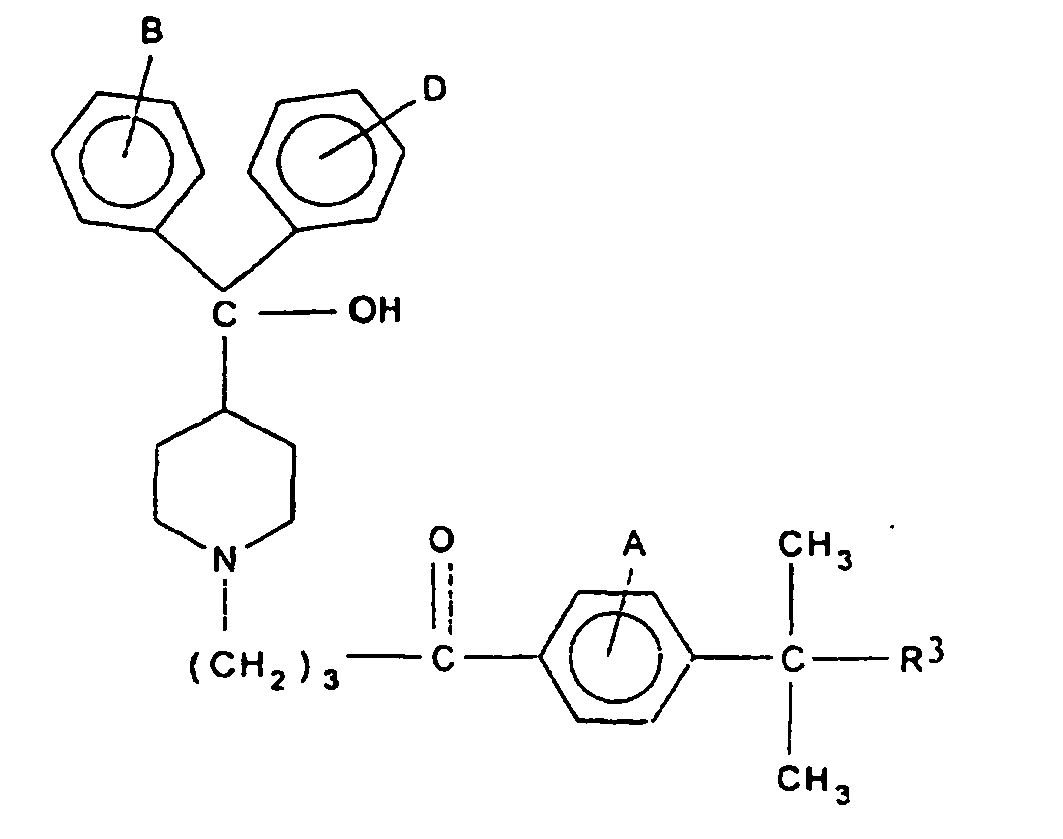


- Another useful class of piperidine derivative compounds are 4-diphenylmethoxypiperidine derivatives having the following formulae:


- Examples of R4 are substituted or unsubstituted, straight or branched alkyl groups, including methyl, ethyl, n-propyl, isopropyl, n-butyl, sec-butyl, tert-butyl, n-pentyl, neopentyl, n-hexyl, benzyl, and 4-methylbenzyl groups and substituted or unsubstituted aryl groups, including phenyl, tolyl, and xylyl groups.
- Illustrative examples of compounds prepared by the process of the present invention are as follows:
- 4-[4-[4-(hydroxydiphenylmethyl)-1-piperidinyl]-1-hydroxybutyl]-α,α-dimethylbenzeneacetic acid;
- 4-[4-[4-(diphenylmethyl)-1-piperidinyl]-1-hydroxybutyl]-α,α-dimethylbenzeneacetic acid;
- 4-[4-[4-(diphenylmethylene)-1-piperidinyl]-1-hydroxybutyl]-α,α-dimethylbenzeneacetic acid;
- 4-[4-[4-(hydroxydiphenylmethyl)-1-piperidinyl]-1-hydroxybutyl]-α,α-dimethyl-3-hydroxybenzeneacetic acid;
- 4-[4-[4-(hydroxydiphenylmethyl)-1-piperidinyl]-1-hydroxybutyl]-α,α-dimethyl-2-hydroxybenzeneacetic acid;
- 4-[4-[4-(diphenylmethylene)-1-piperidinyl]-1-hydroxybutyl]-α,α-dimethyl-3-hydroxybenzeneacetic acid;
- 4-[4-[4-(diphenylmethylene)-1-piperidinyl]-1-hydroxybutyl]-α,α-dimethylbenzeneacetic acid;
- ethyl 4-[4-[4-(hydroxydiphenylmethyl)-1-piperidinyl]-1-hydroxybutyl]-α,α-dimethylbenzeneacetate;
- n-pentyl 4-[4-[4-(diphenylmethyt)-1-piperidinyl]-1-hydroxybutyl]-α,α-dimethylbenzeneacetate;
- ethyl 4-[4-[4-(diphenylmethylene)-1-piperidinyl]-1-hydroxybutyl]-α,α-dimethylbenzeneacetate;
- methyl 4-[4-[4-(hydroxydiphenylmethyl)-1-piperidinyl]-1-hydroxybutyl]-α,α-dimethylbenzeneacetate;
- ethyl 4-[4-[4-(hydroxydiphenylmethyl)-1-piperidinyl]-1-hydroxybutyl]-α,α-dimethyl-(3-hydroxybenzene)acetate;
- n-propyl 4-[4-[4-(hydroxydiphenylmethyl)-1-piperidinyl]-1-hydroxybutyl]-α,α-dimethyl-(2-hydroxybenzene)acetate;
- n-hexyl 4-[4-[4-(diphenylmethylene)-1-piperidinyl]-1-hydroxybutyl]-α,α-dimethyl-(3-hydroxybenzene)acetate;
- ethyl 4-[4-[4-(diphenylmethylene)-1-piperidinyl]-1-hydroxybutyl]-α,α-dimethylbenzeneacetate;
- 4-[4-[4-(diphenylmethoxy)-1-piperidinyl]-1-hydroxybutyl]-α,α-dimethylbenzeneacetic acid;
- 4-[4-[4-(diphenylmethoxy)-1-piperidinyl]-1-hydroxybutyl]-α,α-dimethyl-3-hydroxybenzeneacetic acid;
- 4-[4-[4-(diphenylmethoxy)-1-piperidinyl]-1-hydroxybutyl]-α,α-dimethyl-2-hydroxybenzeneacetic acid;
- 4-[4-[4-(diphenylmethoxy)-1-piperidinyl]-1-hydroxybutyl]-α,α-dimethyl-3-hydroxybenzeneacetic acid;
- 4-[4-[4-(diphenylmethoxy)-1-piperidinyl]-1-hydroxybutyl]-α,α-dimethylbenzeneacetic acid;
- n-pentyl 4-[4-[-4-(diphenylmethoxy)-1-piperidinyl]-1-hydroxybutyl]-α,α-dimethylbenzeneacetate;
- ethyl 4-[4-[4-(diphenylmethoxy)-1-piperidinyl]-1-hydroxybutyl]-α,α-dimethylbenzeneacetate;
- ethyl 4-[4-[4-(diphenylmethoxy)-1-piperidinyl]-1-hydroxybutyl]-α,α-dimethyl-(3-hydroxybenzene)acetate;
- n-propyl 4-[4-[4-(diphenylmethoxy)-1-piperidinyl]-1-hydroxybutyl]-α,α-dimethyl-(2-hydroxybenzene)acetate;
- n-hexyl 4-[4-[4-(diphenylmethoxy)-1-piperidinyl]-1-hydroxybutyl]-α,α-dimethyl-(3-hydroxybenzene)acetate; and
- ethyl 4-[4-[4-(diphenylmethoxy)-1-piperidinyl]-1-hydroxybutyl]-α,α-dimethylbenzeneacetate.
- Optionally, both diphenyl groups from the piperidine compound may be alkyl (e.g., methyl) substituted at the position para to the methylene, such as
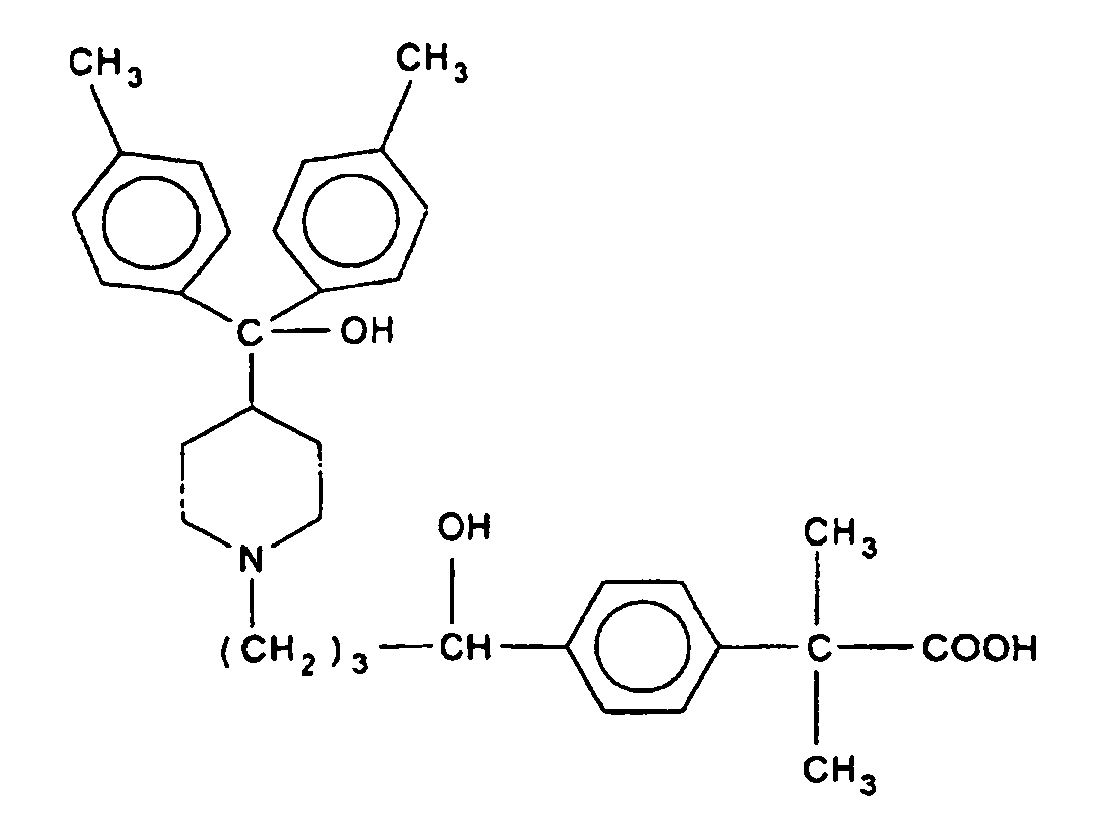
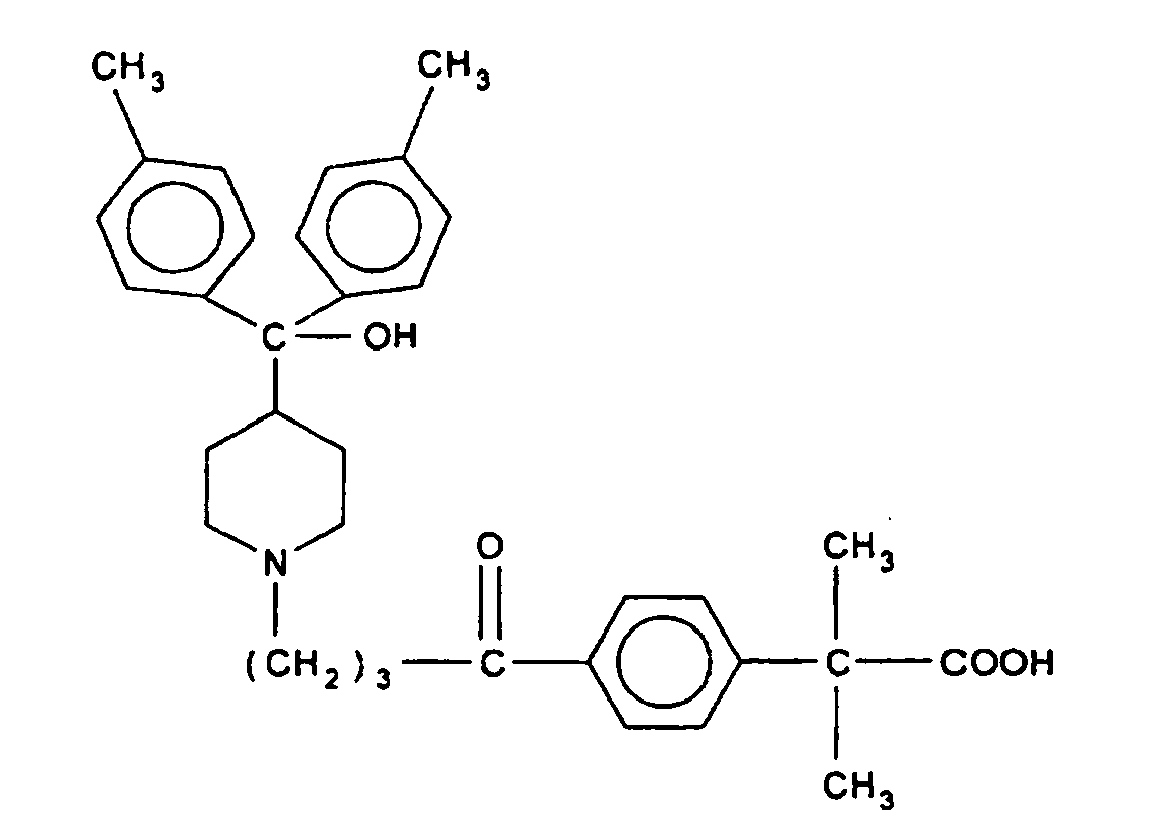


- The compounds prepared by the methods of the present invention can be pharmaceutically acceptable salts in the form of inorganic or organic acid or base addition salts of the above compounds. Suitable inorganic acids are, for example, hydrochloric, hydrobromic, sulfuric, and phosphoric acids. Suitable organic acids include carboxylic acids, such as, acetic, propionic, glycolic, lactic, pyruvic, malonic, succinic, fumaric, malic, tartaric, citric, cyclamic, ascorbic, maleic, hydroxymaleic, dihydroxymaleic, benzoic, phenylacetic, 4-aminobenzoic, anthranilic, cinnamic, salicylic, 4-aminosalicylic, 2-phenoxybenzoic, 2-acetoxybenzoic, and mandelic acid. Sulfonic acids, such as, methanesulfonic, ethanesulfonic, and β-hydroxyethane-sulfonic acid are also suitable acids. Non-toxic salts of the compounds of the above-identified formulae formed with inorganic and organic bases include, for example, those alkali metals, such as, sodium, potassium, and lithium, alkaline earth metals, for example, calcium and magnesium, light metals of group IIIA, for example, aluminum, organic amines, such as, primary, secondary, or tertiary amines, for example, cyclohexylamine, ethylamine, pyridine, methylaminoethanol, and piperazine. These salts are prepared by conventional means, for example, by treating the piperidine derivative compounds of the formulae Ia or Ib:


- The piperidine derivative compounds prepared by the methods of the present invention can be utilized as the biologically active components in pharmaceutical compositions. These compounds are useful as antihistamines, antiallergy agents, and bronchodilators. They may be administered alone or with suitable pharmaceutical carriers, and can be in solid or liquid form such as, tablets, capsules, powders, solutions, suspensions, or emulsions.
- The compounds prepared by the methods of this invention can be administered orally, parenterally, for example, subcutaneously, intravenously, intramuscularly, intraperitoneally, by intranasal instillation or by application to mucous membranes, such as, that of the nose, throat, and bronchial tubes. Such application to mucous membranes can be achieved with an aerosol spray containing small particles of a compound of this invention in a spray or dry powder form.
- The quantity of the compound administered will vary depending on the patient and the mode of administration and can be any effective amount. The quantity of the compound administered may vary over a wide range to provide in a unit dosage an effective amount of from about 0.01 to 20 mg/kg of body weight of the patient per day to achieve the desired effect. For example, the desired antihistamine, antiallergy, and bronchodilator effects can be obtained by consumption of a unit dosage form such as a tablet containing 1 to 50 mg of the compound of the present invention taken I to 4 times daily.
- The solid unit dosage forms can be of the conventional type. This solid form can be a capsule, such as an ordinary gelatin type containing the compound of the present invention and a carrier, for example, lubricants and inert fillers such as, lactose, sucrose, or cornstarch. In another embodiment, these compounds are tableted with conventional tablet bases such as lactose, sucrose, or cornstarch in combination with binders like acacia, cornstarch, or gelatin, disintegrating agents such as, cornstarch, potato starch, or alginic acid, and a lubricant like stearic acid or magnesium stearate.
- The compounds prepared according to this invention may also be administered in injectable dosages by solution or suspension of the compounds of the present invention in a physiologically acceptable diluent with a pharmaceutical carrier. Such carriers include sterile liquids such as water and oils, with or without the addition of a surfactant and other pharmaceutically acceptable adjuvants. Illustrative oils are those of petroleum, animal, vegetable, or synthetic origin, for example, peanut oil, soybean oil, or mineral oil. In general, water, saline, aqueous dextrose and related sugar solution, and glycols such as, propylene glycol or polyethylene glycol, are preferred liquid carriers, particularly for injectable solutions.
- For use as aerosols, the compounds in solution or suspension may be packaged in a pressurized aerosol container together with suitable propellants, for example, hydrocarbon propellants like propane, butane, or isobutane with conventional adjuvants. These compounds may be administered in a non-pressurized form, such as in a nebulizer or atomizer.
- The compounds made according to the present invention can be used to treat warm blooded animals, birds, and mammals. Examples of such beings include humans, cats, dogs, horses, sheep, cows, pigs, lambs, rats, mice, and guinea pigs.
- According to one aspect of the present invention, the piperidine derivative compounds are prepared by providing a compound of formula II of the following formula:

- The resulting piperidine derivative compounds with a keto group can then be converted by reduction to the above-described piperidine compounds with a hydroxyl group.
- A is the substituents of its ring, each of which may be different or the same and is selected from the group consisting of hydrogen, halogen, alkyl, hydroxy, alkoxy, and other substituents.
- X3 can be halogen, such as chloride, bromide, or iodide, a hydroxy or alkoxy having the formula OR15, a thiol or an alkylthio derivative having the formula SR15, an amine having the formula NR15R16, a sufonic ester having the formula OSO2R15 (such as methanesulfonate or tosylate) or a sulfonamide having the formula NHSO2R15 R15 and R16 are the same or different and are selected from the group consisting of hydrogen; an alkyl moiety, including substituted or unsubstituted, branched or straight-chain alkyl moieties, such as methyl, ethyl, n-propyl, isopropyl, n-butyl, sec-butyl, tert-butyl, n-pentyl, neopentyl, n-hexyl, benzyl, and 4-methylbenzyl, preferably having from I to 7 carbon atoms; and an aryl moiety, including substituted or unsubstituted aryl moieties, such as phenyl, tolyl, and xylyl.
- Z can also be a heterocyclic moiety having the formula:


- A variety of methods can be used to provide these compounds of formula II.
- In one embodiment of the present invention, the compound of formula II is produced by acylating an α,α-disubstituted-methylbenzene derivative having the formula III:

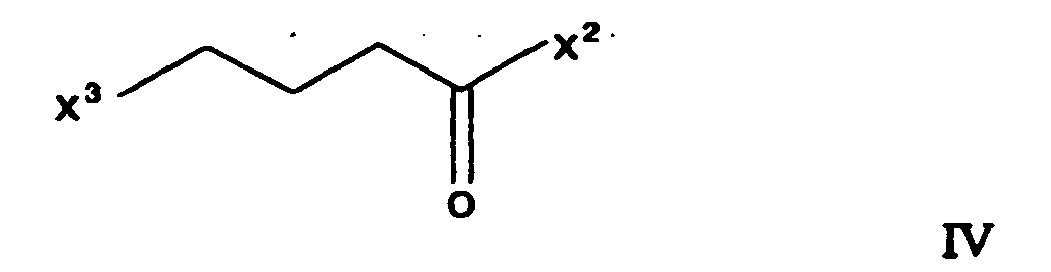


- In another embodiment of the present invention, the acylation agent is a 4-(α,α-disubstituted)-toluic acid derivative. In this embodiment, the compound of formula II is produced by reacting a 4-(α,α-disubstituted)-toluic acid derivative having the formula VI:


- Irrespective of whether the compound of formula II is produced using the process employing a butyl derivative acylation agent or the process employing a 4-(α,α-disubstituted)-toluic acid derivative acylation agent, X1 can be a halogen; trialkyl or triaryl tin; trialkyl or triaryl borate; alkylhalo silicon; trialkyl silicon; or a group -SO2R17 in which R17 represents hydrogen, an alkyl moiety or an unsubstituted aryl moiety. As used herein, alkylhalo silicon is a tetravalent silicon atom bonded to at least one halogen and at least one alkyl group. The remaining silicon valency is bonded to either a second halogen or a second alkyl. One particularly useful alkylhalo silicon has the formula ―SiCH3F2.
- X2, in either embodiment, can be hydrogen; a halogen; an alkali metal oxide; a moiety having the formula ―OR10; a moiety having the formula ―SR10, or an amine. Suitable amines are those having the formulae NR10R11 or ―NR10(OR11); saturated cyclic amines, such as those having the formulae:
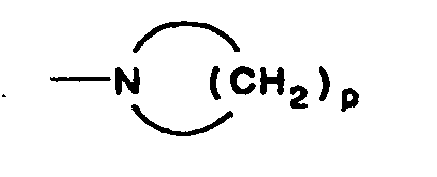

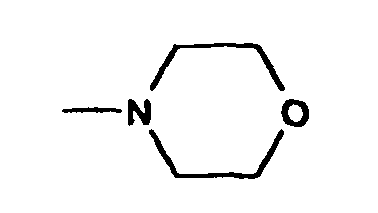
- In practicing the process employing a butyl derivative acylation agent, suitable acylation agents include include 4-substituted butanal or a 4-substituted butyric acid derivative. Illustrative examples of 4-substituted butyric acid derivatives are 4-substituted butyric acid halides, alkali metal 4-substituted butyric acid salts, 4-substituted butyric acid esters, or 4-substituted butyric acid amides.
- Suitable 4-substituted butyric acid halides include 4-substituted butyric acid fluoride, 4-substituted butyric acid chloride, and 4-substituted butyric acid bromide. Where an alkali metal salt of 4-substituted butyric acid is employed as the acylating agent, suitable alkali metals include lithium, sodium, and potassium.
- The 4-substituted butyric acid amide can be an N-unsubstituted amide, such as 4-substituted butyric acid amide; an N-monosubstituted amide, such as N-methyl-4-substituted butyric acid amide, N-ethyl-4-substituted butyric acid amide, N-propyl-4-substituted butyric acid amide, and N-hexyl-4-substituted butyric acid amide; or an N,N-disubstituted amide. Suitable N,N-disubstituted amides include N,N-dimethyl-4-substituted butyric acid amide, N-methyl-N-ethyl-4-substituted butyric acid amide, N-methyl-N-propyl-4-substituted butyric acid amide, N-methyl-N-hexyl-4-substituted butyric acid amide, N,N-diethyl-4-substituted butyric acid amide, N-ethyl-N-propyl-4-substituted butyric acid amide, N-ethyl-N-hexyl-4-substituted butyric acid amide, N,N-dipropyl-4-substituted butyric acid amide, N-propyl-N-hexyl-4-substituted butyric acid amide, and N,N-dihexyl-4-substituted butyric acid amide. N,N-disubstituted butyric acid amides having the formula ―NR10(OR11), such as N-methyl-N-methoxy-4-substituted butyric acid amide, N-methyl-N-ethoxy-4-substituted butyric acid amide, N-ethyl-N-methoxy-4-substituted butyric acid amide, N-ethyl-N-ethoxy-4-substituted butyric acid amide, are particularly useful. Suitable N,N-disubstituted amides also include cyclic amides, such as butyric acid morpholine amide, butyric acid piperazine amide, butyric acid imidazole amide, and butyric acid pyrazole amide, as well as those having the formula:

- Irrespective of whether the compound of formula II is produced using the process employing a butyl derivative acylation agent or the process employing a 4-(α,α-disubstituted)-toluic acid derivative acylation agent, the acylation reactions are carried out in a suitable solvent in the presence of an appropriate catalyst for about 1 to 120 hours and at temperatures of about -78°C to the reflux temperature of the solvent. Suitable solvents for acylation include: hydrocarbon solvents, such as benzene, toluene, xylene, or cyclohexane; halogenated hydrocarbons, such as chlorobenzene, dichloroethane, methylene chloride, chloroform, or carbon tetrachloride; carbon disulfide; dimethylformamide; ethereal solvents, like tetrahydrofuran and diethylether; or dioxane.
- In practicing either of the above processes, a variety of catalysts may be utilized when A is hydrogen. Suitable catalysts include palladium catalysts, like palladium chloride, palladium acetate, tetrakis(triphenylphosphine) palladium(0), dichlorobis(triphenylphosphine) palladium(II), or benzylchlorobis(triphenylphosphine)palladium(II); or nickel-phosphine catalysts. Acylation may also be carried out in the presence of added lithium chloride or triphenylphosphine. The latter acylation reaction is known in the art as organometallic cross-coupling reactions and is conducted by the general procedures of D. Milstein, et al., J. Org. Chem., 1979, 44, 1613 ("Milstein (1979)"); J.W. Labadie, et al., J. Org. Chem., 1983,48,4634 ("Labadie"); C. Sahlberg, et al., Tetrahedron Letters, 1983, 24, 5137 ("Sahlberg"); D. Milstein, et al., J.Am. Chem. Soc., 1978, 100, 3636 ("Milstein (1978)"); and K. Tamao, et al., Tetrahedron, 1982, 38, 3347 ("Tamao"), all of which are hereby incorporated by reference.
- Where acylation is carried out using the process employing a butyl derivative acylation agent, the reaction can also be promoted by addition of an acylation promoter which, when reacted with the methylbenzene derivative, displaces X1 from the carbon to which it is bonded, forming a reactive carbanion salt One suitable acylation promoter is butyl lithium, which is particularly effective when X2 is an amine. When X2 is chloride, preferred acylation promoters are magnesium metal or tetraalkyl tin. Acylation promoters, especially organometallics such as butyl lithium, are highly reactive with carbonyl groups. For this reason, the Z moiety is chosen to minimize reactivity of the carbon beta to the benzene ring. In particular, when employing an acylation promoter, particularly inert Z moieties having the formula:

- The α,α-disubstituted-methylbenzene derivative having the formula III:


- with a methylating agent. The methylation reaction is carried out in a suitable solvent and in the presence of a suitable non-nucleophilic base, such as potassium t-butoxide, sodium hydride, lithium diisopropylamide ("LDA"), lithium hexamethyldisilazide ("LHMDS"), potassium hexamethyldisilazide ("KHMDS"), sodium or lithium tetramethylpiperidine, or related strong bases, for about 1 to about 120 hours, at temperatures from about -78°C to room temprature. Preferably, the reaction is conducted under an inert, dry atmosphere, such as N2 or Ar gas, in an inert, dry solvent. Suitable solvents for methylation include: hydrocarbon solvents, such as benzene, toluene, xylene, or cyclohexane; halogenated hydrocarbons, such as chlorobenzene, dichloroethane, methylene chloride, or carbon tetrachloride; carbon disulfide; dimethylformamide; ethereal solvents, like tetrahydrofuran, t-butyl methyl ether, and diethylether, or dioxane. At least two molar equivalents and, preferably, between 2.1 and 3 molar equivalents of methylating agent are employed and added over the course of the reaction, either continuously or in two or more slugs. Suitable methylating agents include iodomethane, bromomethane, chloromethane, dimethyl sulfate, and the like.
- The α,α-diunsubstituted-methylbenzene derivatives having the formula VIII can be prepared by reacting the correponding α,α-diunsubstituted benzylic acid of the formula XXI:

H2N-(CR6R7)m-O-H XXII
This reaction is conducted in a suitable solvent for about 1 to about 120 hours and at a temperature ranging from 0°C to the reflux temperature of the solvent. Suitable solvents for this reaction include: hydrocarbon solvents, such as benzene, toluene, xylene, or cyclohexane; halogenated hydrocarbons, such as chlorobenzene, dichlorethane, methylene chloride, chloroform, or carbon tetrachloride; carbon disulfide; dimethylformamide; etheral solvents, like tetrahydrofuran and diethylether, or dioxane. Preferably, the solvent is maintained at reflux in an apparatus having a means for removing water, such as a Dean-Stark trap. In many cases, it is advantageous to convert the α,α-diunsubstituted-benzylic acid derivative to the corresponding acid halide, such as by treatment with thionyl chloride, prior to reaction with the aminoalkyl derivative. - Alternatively, the α,α-disubstituted-methylbenzene derivative having the formula III can be prepared from the corresponding α,α-disubstituted-benzylic acid derivative having the formula XXIII:

- The α,α-disubstituted-benzylic acid derivative used to prepare the α,α-disubstituted-methylbenzene derivative can be synthesized by methylating the corresponding α,α-diunsubstituted-benzylic acid derivative. Conditions suitable to carry out this methylation are the same as those described above with respect to methylation of α,α-diunsubstituted-methylbenzene derivatives.
- Where acylation is carried out with a 4-(α,α-disubstituted)-toluic acid derivative having the formula VI:


H2N-(CR6R7)m-O-H XXII
Conditions suitable to effect this reaction are the same as those given above for reaction of α,α-diunsubstituted-methylbenzene derivatives with aminoalkyl derivatives. - Alternatively, the 4-(α,α-disubstituted)-toluic acid derivative having the formula VI can be prepared from the corresponding 4-(α-carboxy-α,α-disubstituted)-toluic acid derivative having the formula XXV:

- The 4-(α-carboxy-α,α-disubstituted)-toluic acid derivative used to prepare the 4-(α,α-disubstituted)-toluic acid derivative can be synthesized by methylating the corresponding 4-(α-carboxy-α,α-diunsubstituted)-toluic acid derivative. Conditions suitable for carrying out this methylation are the same as those described above with respect to methylation of α,α-diunsubstituted-methylbenzene derivatives.
- The compound of the present invention having the formula II:


- When employing this route, the compound of formula XXVI is conveniently prepared from an α,α-diunsubstituted-methylbenzene derivative having the formula VIII:


- Alternatively, the compound of formula VIB can be prepared from a 4-(α,α-diunsubstituted)-toluic acid derivative having the formula IX:


- Once the compound of formula II is provided, it is then converted to the piperidine derivative with a piperidine compound.
- In one aspect of the present invention, the compound of formula II can be hydrolyzed to form a compound having the formula X:

- If desired, the acid group of the compound of formula X can be esterified by techniques well known to those skilled in the art, such as by evaporating an alcoholic solution of the acid and a mineral acid, such as a methanolic, ethanolic, propanolic, or butanolic solution of hydrochloric, hydrobromic, or hydroiodic acid, to dryness to form an ester having the formula:

- After hydrolysis and optional esterification, the compound of formula X or ester thereof can be reacted with a piperidine compound of the formula XI:


- Piperidine derivative compounds of the formula Ia having n equal to 1 and R1 and R2 equal to hydrogen can also be prepared by the following alternative alkylation procedure. Subsequent to hydrolysis and optional esterification, the compound of formula X having the formula:


- Irrespective of the alkylation procedure employed, when R3 is ―COOalkyl, the alkylation reaction can be followed by base hydrolysis to convert R3 substituents that are ―COOalkyl groups to ―COOH groups. Such base hydrolysis involves treatment of the piperidine derivative with an inorganic base, such as sodium hydroxide, in an aqueous lower alcohol solvent, such as aqueous methanol, ethanol, isopropyl alcohol, or n-butanol, at reflux temperature for about 1/2 hour to 12 hours.
- Piperidine compounds where n = 0 and each of R1 and R2 is hydrogen or where n=0 and R1 is hydroxy and R2 is hydrogen are commercially available or may be prepared according to procedures well known in the art (e.g. F.J. McCarty, C.H. Tilford, M.G. Van Campen, J. Am. Chem. Soc., 1961, 26, 4084, which is hereby incorporated by reference). Piperidine compounds wherein n = 0 and R1 and R2 form a second bond between the carbon atoms bearing R1 and R2 may be prepared by dehydration of the corresponding compound wherein R1 is hydroxy by procedures generally known in the art. Piperidine compounds wherein n =1 and R1 and R2 are both hydrogen are prepared by condensation of an appropriately substituted diphenylmonohalomethane, such as diphenylchloromethane, diphenylbromomethane, and di(p-tolyl)chloromethane, with a 1-alkoxycarbonyl-4-hydroxypiperidine in a suitable solvent, such as toluene, xylene, dioxane, methyl isobutylketone, methyl ethyl ketone, or N,N-dimethylformamide. The reaction is conducted at a temperature between 80°C and 140°C and in the presence of a base, such as an alkali metal carbonate or bicarbonate. Following the reaction, hydrolysis with alkali metal hydroxide in an organic solvent, such as ethanol or isopropanol, at the boiling point of the solvent, yields the 4-(diarylmethoxy)-piperidine free base.
- In another aspect of the present invention, the piperidine derivative compound is produced by converting the compound of formula II having the formula


- Alternatively, compounds of the formula XVI having n equal to 1 and R1 and R2 equal to hydrogen can be prepared by reacting the compound having the formula II:


- According to yet another aspect of the present invention, piperidine derivatives of formula Ia having a keto group are prepared from an α,α-disubstituted-methylbenzene derivative having the formula III:


- 4-(4-substituted-piperidin-1-yl)butanals and 4-(4-substituted-piperidin-1-yl)butyric acid derivative compounds suitable for use in this acylation reaction include those having the formula XIV:

- A variety of catalysts may be utilized when A is hydrogen. Suitable catalysts include palladium catalysts, like palladium chloride, palladium acetate, tetrakis(triphenylphosphine) palladium(0), dichlorobis(triphenylphosphine) palladium(II), or benzylchlorobis(triphenylphosphine)palladium(II); or nickel-phosphine catalysts. The acylation reaction may also be carried out in the presence of added lithium chloride or triphenylphosphine. The latter cross-coupling reactions is typically conducted by the general procedures of Milstein (1979), Labadie, Sahlberg, Milstein (1978), and Tamao, all of which are hereby incorporated by reference.
- The acylation reaction can also be promoted by addition of an acylation promoter which, when reacted with the methylbenzene derivative, displaces X1 from the benzene ring, forming a reactive carbanion salt. One suitable acylation promoter is butyl lithium, which is particularly effective when X2 is an amine. When X2 is chloride, preferred acylation promoters are magnesium metal or tetraalkyl tin.
- Other suitable 4-(4-substituted-piperidin-1-yl)butanals and 4-(4-substituted-piperidin-1-yl)butyric acid derivatives include 4-(4-hydroxy-piperidin-1-yl)butanal and 4-(4-hydroxy-piperidin-1-yl)butyric acid derivatives having the formula XVII:


- Alternatively, the N-substituted hydroxy piperidine of formula XVIII can be hydrolyzed to produce an N-substituted piperidine compound having the formula XII:

- In still another aspect of the present invention, piperidine derivatives having a keto group are prepared from a 4-(α,α-disubstituted)-toluic acid derivative having the formula VI:


- Other suitable 3-(4-substituted-piperidin-1-yl)propane derivatives include 3-(4-hydroxy-piperidin-1-yl)propane derivatives having the formula XX:

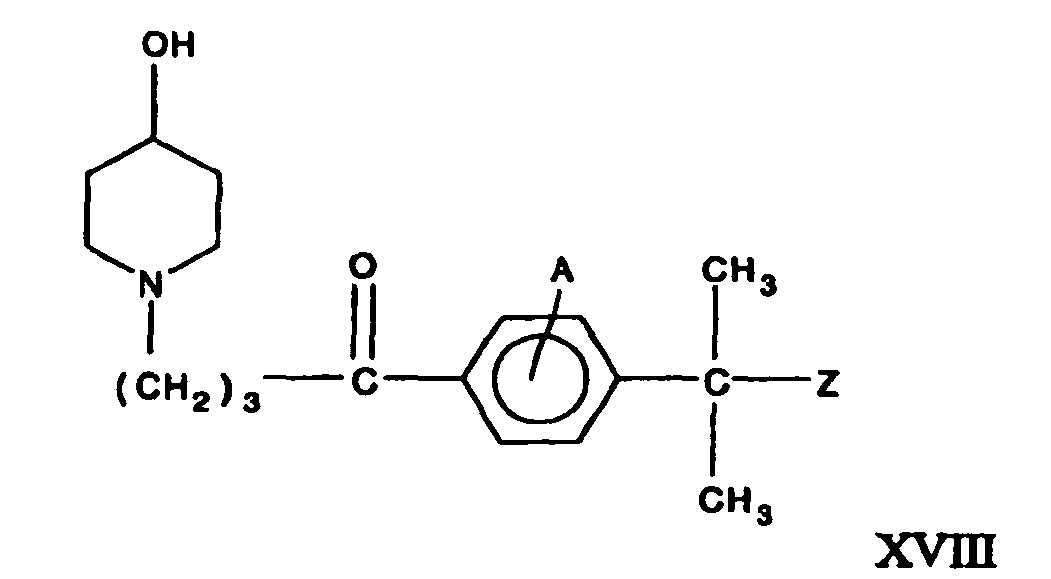

- Irrespective of the alkylation procedure employed, the compound of formula XVI is then converted to the piperidine derivative compound having the formula:

- As discussed above, the process of the present invention is useful in producing piperidine derivatives with either a keto group or a hydroxyl group. Derivatives with keto groups can be converted to similar compounds with hydroxyl groups by reduction reactions which are well known in the art.
- Reduction can be carried out with sodium borohydride or potassium borohydride in lower alcohol solvents, such as, methanol, ethanol, isopropyl alcohol, or n-butanol.
- When lithium aluminum hydride or diborane are used as reducing agents, suitable solvents are ethers, for example, diethyl ether, tetrahydrofuran, or dioxane. These reduction reactions are carried out at temperatures ranging from about 0°C to the reflux temperature of the solvent, and the reaction time varies from about 0.5 to 8 hours.
- Catalytic reduction with hydrogen may also be employed using, for example, Raney nickel, palladium, platinum, or rhodium catalysts in lower alcohol solvents, such as, methanol, ethanol, isopropyl alcohol, or n-butanol or acetic acid or their aqueous mixtures, or by the use of aluminum isopropoxide in isopropyl alcohol. Reduction using sodium borohydride is generally preferred over catalytic reduction when forming carboxylic acids or esters.
- The piperidine derivative containing a hydroxy group thus prepared can optionally be separated into its enantiomerically pure components by conventional methods. For example, the racemic mixture of piperidine derivative enantiomers can be converted to a racemic mixture of diastereomers with a reactive chiral agent. The diastereomers are then separated by, for example, recrystallization or chromatography, and the pure enantiomer is recovered by cleaving the reactive chiral agent. Alternatively, the racemic mixture of piperidine derivative enantiomers can be chromatographically separated using chiral stationary phases or by recrystallization by using chiral solvents.
- Piperidine derivatives having keto groups can also be converted to enantiomerically pure piperidine derivatives having hydroxy groups by using chiral reducing agents. For example, reduction using (+)-B-chlorodiisopropinocamphenyl-borane produces the piperidine derivative having R chirality at the carbon to which the hydroxy group is bonded. Alternatively, by using (-)-B-chlorodiisopropinoeamphenylborane produces the S enantiomer. Other suitable chiral-reducing agents are (R) and (S)-oxazaborolidine/BH3, potassium 9-0-(1,2:5.6-di-O-isopropylidine-α-D-glucofuransoyl)-9-boratabicyclo [3.3.1]nonane, (R) and (S)-B-3-pinanyl-9-borabicyclo[3.3.1]nonane, NB-enantride, lithium (R)-(+) and (S)-(-)-2,2'-dihydroxy-1,1'-binaphthyl alkoxyl aluminum hydride, (R)-(+) and (S)-(-)-2,2'-dihydroxy-6,6'-dimethylbiphenyl borane-amine complex, tris(((1S, 2S, SR)-2-isoprophy-5-methyl-cyclohex-1-yl)methyl)aluminum, (((1R, 3R)-2,2-dimethylbicyclo[2.2.1]hept-3-yl)methyl)beryllium chloride, (R)-BINAP-ruthenium complex/H2, and 6,6'-bis(diphenylphosphino)-3,3'-dimethoxy-2,2',4,4'-tetramethyl-1,1'-biphenyl.
- When esters with hydroxyl groups have been formed, base hydrolysis can be used to produce a carboxylic acid. Such procedures are well known and generally involve treatment with an inorganic base, such as, sodium hydroxide or potassium hydroxide, in an aqueous lower alcoholic solvent, such as aqueous methanol, ethanol, isopropyl alcohol, or n-butanol. Base hydrolysis is carried out at a temperature from about room temperature to the solvent reflux temperature for about 1/2 hour to 12 hours.
- In like manner, piperidine derivative precursors bearing a keto group and having the formula XVI:


- The piperidine derivative precursors bearing a hydroxyl group can be converted to the piperidine derivative having the formula:

- The present invention is further illustrated by the following examples.
- A mixture of 4-bromophenylacetic acid (172 g, 0.800 mole), 2-amino-2-methyl-1-propanol (115 mL, 1.20 mole), and 900 mL xylenes were refluxed for 24 hours in an apparatus equipped with a Dean-Stark trap. The mixture was then cooled, filtered, and concentrated to afford a crystalline solid. The solid was slurried in hexanes, and filtered to afford 147 g of a white solid. The hexane filtrate was then concentrated, slurried with hexanes, and filtered to afford another 13 g of 4-bromo-α-(4,4-dimethylisoxazolin-2-yl)toluene as a white solid. The combined yield was 160 g (75%).
- A 250 mL three neck round bottomed flask was charged with 5.0 g (0.0186 mole) of 4-bromo-α-(4,4-dimethylisoxazolin-2-y1)toluene, prepared according to Example 1, and 50 mL of dry THF under N2. KHMDS, 27 mL (0.0279 mole, 1.5 eq), was then slowly added over 10 minutes. A color change to deep orange was observed. After stirring the mixture for 15 minutes at room temperature, 1.16 mL (0.0186 mole, 1 equiv.) of methyl iodide was added in one portion. The reaction exothermed to 46°C, and white solid precipitated while the solution retained a pale yellow tint. After stirring for 1 hour, another 27 mL (0.0279 mole, 1.5 equiv.) of KHMDS was added causing the temperature of the reaction to rise from 27° to 30°C and the color to change to orange. The reaction was stirred for an additional 20 minutes and, thereafter, a second equivalent of CH3I was added. An aliquot was removed, quenched with water, and extracted with ethyl acetate. TLC analysis (4:1 hexane/ethyl acetate) showed the presence of the more polar 4-bromo-α-methyl-α-(4,4-dimethylisoxazolin-2-yl)toluene ("mono adduct"). An additional 0.2 mL of CH3I was added which turned the pale yellow solution to white. The reaction mixture was then added to 100 mL 10% acetic acid/water along with 250 mL methylene chloride. The organic layer was washed twice with 50 mL brine and dried with sodium sulfate. After concentration and drying at room temperature and a pressure of 0.1 mm Hg overnight, 5.65 g (103%) of a yellowish solid was obtained. The solid was dissolved in 30 mL isopropanol and 20 mL of water was slowly added until an oil had formed. To the mixture, 5 mL of isopropanol was added with heating to dissolve all of the oil. The oil crystallized upon cooling in an ice bath, yielding 4.61 g (0.0156 mmole, 84%) of pure 4-bromo-α,α-dimethyl-α-(4,4-dimethylisoxazolin-2-yl)toluene no trace of mono adduct.
- A solution of 4-bromo-α,α-dimethyl-α-(4,4-dimethylisoxazolin-2-yl)toluene (10.0 g. 0.0338 mole), prepared in accordance with Example 2, in 400 mL THF is cooled to -78°C, n-butyllithium (16 mL, 0.042 mole) is added via syringe, and the mixture is stirred at -78°C for 30 minutes. While keeping the temperature below -75°C, 4-chlorobutyryl chloride (14.4 g, 0.102 mole) in 30 mL THF is added dropwise, and the mixture is stirred at -78°C for 30 minutes. The mixture is allowed to warm to -15°C and is quenched with water. The product is extracted with methylene chloride, washed with saturated NaCl solution, dried over Na2SO4, and concentrated. The residue is cooled to 0°C, treated with minimal acetonitrile, and filtered, to afford 4-(4-chloro-1-oxobutyl)-α,α-dimethyl-α-(4,4-dimethylisoxazolin-2-yl)toluene.
- A mixture of 4-(4-chloro-1-oxobutyl)-α,α-dimethyl-α-(4,4-dimethylisoxazolin-2-yl)toluene, prepared according to Example 3, (47.8 g, 0.15 mole), 150 mL concentrated hydrochloric acid, and 150 mL 1,4-dioxane is brought to reflux for 18 hours. The mixture is extracted three times with ethyl acetate. The organics are washed with saturated Nacl solution, dried over MgSO4, and concentrated. Crude product is purified by column chromatography using silica gel, and eluting with hexane/ethyl acetate/acetic acid. Cleaner fractions are combined and recrystallized from methylene chloride/hexanes to afford 4-(4-chloro-1-oxobutyl)-α,α-dimethylphenylacetic acid.
- A solution of 4-(4-chloro-1-oxobutyl)-α,α-dimethylphenylacetic acid, prepared according to Example 4, (15 g, 0.056 mole) in 450 mL of a HCl-saturated methanol is : refluxed for 1 hour. The mixture is concentrated to dryness and partitioned between ethyl acetate and water. The aqueous phase is extracted twice again with ethyl acetate. The combined organic phases are dried over MgSO4 and concentrated to an oil. The oil is purified by column chromatography using silica gel, and eluting with hexanes/ethyl acetate. Clean fractions are combined and concentrated to afford methyl 4-(4-chloro-1-oxobutyl)-α,α-dimethylphenylacetate.
- A solution of 12.6 g of methyl 4-(4-chloro-1-oxobutyl)-α,α-dimethylphenylacetate, prepared in accordance with Example 5, in 500 mL of toluene in a one liter three neck flask with mechanical stirring is added 8.8 g of 4-(α,α-diphenyl)piperidinemethanol and 23 g of K2CO3 and the mixture is refluxed for 7 hr. The cooled reaction mixture is then filtered and concentrated in vacuo. The residue is dissolved in Et2O and treated with excess ethereal HCl. The mixture is then concentrated to a solid. The solid is treated with EtOAc and collected by filtration. The product is then partitioned between EtOAc and 2N Na2CO3. The organics are dried over MgSO4, filtered, and concentrated in vacuo to afford methyl 4-[4-[4-(hydroxydiphenylmethyl)-1-piperidinyl]-1-oxobutyl]-α,α-dimethylphenylacetate.
- A solution of 13.5 g of methyl 4-[4-[4-(hydroxydiphenylmethyl)-1-piperidinyl]-1-oxobutyl]-α,α-dimethylphenylacetate, prepared in accordance with Example 6, in 250 mL of CH3OH is cooled in an ice CH3OH bath, and 1.8 g of NaBH4 is added in portions. After 1 hr, the mixture is concentrated to a solid. The residue is partitioned between EtOAc and saturated aqueous NaHCO3. The aqueous portion is extracted with EtOAc. The combined organics are washed with saturated aqueous NaCl, dried over MgSO4, filtered, and concentrated in vacuo to afford methyl 4-[4-[4-(hydroxydiphenylmethyl)-1-piperidinyl]-1-hydroxybutyl]-α,α-dimethylphenylacetate as a foam.
- To a solution of 9.5 g of methyl-4-[4-[4-(hydroxydiphenylmethyl)-1-piperidinyl]-1-hydroxybutyl]-α,α-dimethylphenylacetate, prepared in accordance with Example 7, in 300 mL of CH3OH and 150 mL of H2O, is added 10 g of NaOH. The mixture is refluxed for 1hr, then cooled. The CH3OH is removed in vacuo. The concentrate is diluted with H2O and CHCl3, and the pH is adjusted to approximately 5.5 to 6.0. The phases are separated, and the aqueous phase is extracted with CHCl3. The combined organics are dried over MgSO4, filtered, and stripped to afford crude product.
- The crude product is dissolved in CH2Cl2 and chromatographed on Davisil Grade 633 SiO2 eluting with a gradient of CHCl3, to 10% CH3OH in CHCl3, to 25% CH3OH in CHCl3. The product containing fractions are concentrated to afford 4-[4-[4-hydroxydiphenylmethyl)-1-piperidinyl]-1-hydroxybutyl]-α,α-dimethylphenylacetic acid.
- To a solution of 6.4 g (0.017 mol) of methyl 4-(4-chloro-1-oxobutyl)-α,α-dimethylphenylacetate, prepared in accordance with Example 5, in 500 mL of toluene in a one liter round bottom flask equipped with a mechanical stirrer is added 5.1 g (0.017 mol) of 4-(α,α-bis(4-methylphenyl)-piperidinemethanol, followed by 11.8 g (0.086 mol) of solid potassium carbonate. The solution is heated to reflux for 24 hr. After cooling, the mixture is filtered, and the toluene is removed in vacuo. The residue is partitioned between ethyl acetate and 2 N sodium carbonate solution. The aqueous layer is extracted twice with ethyl acetate, the combined organic layers are dried with sodium sulfate, and the ethyl acetate is removed in vacuo to provide methyl 4-[4-[4-(bis(4-methylphenyl)hydroxymethyl)-1-piperidinyl]-1-oxobutyl]-α,α-dimethylphenylacetate.
- To a -10°C solution of 6.8 g (0.013 mol) of methyl 4-[4-[4-(bis(4-methylphenyl)hydroxymethyl)-1-piperidinyl]-1-oxobutyl]-α,α-dimethylphenylacetate, prepared in accordance with Example 9, in 150 mL of methanol in a 500 mL round bottom flask equipped with a mechanical stirrer is slowly added 0.86 g (0.023 mol) of sodium borohydride, and the reaction is stirred for 2 hr. The methanol is removed in vacuo, and the residue is partitioned between ethyl acetate and aqueous sodium bicarbonate solution. The aqueous layer is extracted with ethyl acetate, the combined organic layers are dried with sodium sulfate, and the ethyl acetate is removed in vacuo to provide crude product. The resultant material is purified by column chromatography (Davisil grade 633 silica gel, packed in methylene chloride, material applied in chloroform, and eluted with a gradient of 2% methanol to methylene chloride to 5% methanol to methylene chloride) to afford methyl 4-[4-[4-(bis(4-methylphenyl)hydroxymethyl)-1-piperidinyl]-1-hydroxybutyl]-α,α-dimethylphenylacetate.
- To 350 mL of methanol in a 1 L round bottom flask equipped with a mechanical stirrer is added 5.3 g (9.8 mmol) of methyl 4-[4-[4-(bis(4-methylphenyl)hydroxymethyl)-1-piperidinyl]-1-hydroxybutyl]-α,α-dimethylphenylacetate, prepared in accordance with Example 10, 5.1 g (0.13 mol) of solid sodium hydroxide, and 100 mL of water. The mixture is heated to reflux for 3 hr. After cooling, the methanol is removed in vacuo, and 6 N hydrochloric acid is added dropwise until the solution was no longer basic (pH = 7). The solution is extracted three times with ethyl acetate. The organic layers are combined, and precipitation is induced. The solid is washed with ether to provide 4-[4-[4-(bis(4-methylphenyl)hydroxymethyl)-1-piperidinyl]-1-hydroxybutyl]-α,α-dimethylphenylacetic acid, as the dihydrate.
- To a solution of 50 mg of 4-(4-chloro-1-oxobutyl)-α,α-dimethylphenylacetic acid, prepared in accordance with Example 4, in 3 mL of methanol is added 50 mg of NaBH4. The mixture is stirred for 30 minutes, acidified with 2N HCl, and the methanol is removed in vacuo. The concentrate is extracted with EtOAc. The organics are dried over Na2SO4, filtered, and concentrated to afford 4-(1-hydroxy-4-chlorobutyl)-α,α-dimethylphenylacetic acid.
- A mixture of 800 mg of 4-(4-chloro-1-oxobutyl)-α,α-dimethylphenylacetic acid, prepared in accordance with Example 4, 800 mg of 4-(α,α-diphenyl)piperidinemethanol, and 2.4 g of K2CO3 in 25 mL of toluene is stirred for 48 hours at room temperature. The mixture is concentrated in vacuo. The residue is treated with EtOAc, filtered, and concentrated to afford 4-[4-[4-(hydroxydiphenylmethyl)-1-piperidinyl]-1-oxobutyl]-α,α-dimethylphenylacetic acid.
- A mixture of 4-[4-[4-(hydroxydiphenylmethyl)-1-piperidinyl]-1-oxobutyl]-α,α-dimethylphenylacetic acid, prepared in accordance with Example 13, and 300 mg of NaBH4 in 25 mL of CH3OH is stirred overnight at room temperature. The mixture is then concentrated in vacuo. The residue is partitioned between EtOAc and H2O. The aqueous portion is treated with concentrated HCl until pH 6, then extracted with EtOAc. The organics are concentrated in vacuo. The residue is dissolved in EtOAc, filtered, and concentrated in vacuo to an oil. The oil is dissolved in CH3OH and concentrated to a solid. The solid is slurried with EtOAc, filtered, and rinsed with EtOAc to afford 4-[4-[4-hydroxydiphenylmethyl)-1-piperidinyl]-1-hydroxybutyl]-α,α-dimethylphenylacetic acid.
- Magnesium (96 mg, 3 mM) was suspended in tetrahydrofuran. A small crystal of iodine was added to activate the magnesium. Solid 4-bromo-α,α-dimethyl-α-(4,4-dimethylisoxazolin-2-yl)toluene (600 mg. 2 mM), prepared in accordance with Example 2, was added, and the mixture was stirred for 6 hours at room temperature, then for 6 hours at reflux, and then cooled to room temperature. After adding 4-chlorobutyronitrile, the mixture was stirred overnight and then poured into cold, dilute acid. The acid solution was extracted with ethyl acetate, and the organic layer was separated and dried with sodium sulfate. Removal of the solvent under reduced pressure afforded an almost colorless oil in 93% yield. Spectral analysis was consistent with 4-(4-chloro-1-oxobutyl)-α,α-dimethyl-α-(4,4-dimethylisoxazolin-2-yl)toluene.
- A solution of 4-bromo-α,α-dimethyl-α-(4,4-dimethylisoxazolin-2-yl)toluene (1 g. 3.4 mM mole), prepared in accordance with Example 2, was chilled to -78 °C in a dry ice bath, and to this was added a solution of 2M butyl lithium (3.4 mM). The mixture was stirred for 15 minutes, 2 mL of DMF was added, the dry ice bath was removed, and the mixture was allowed to warm to 0°C. The 0°C solution was poured into cold brine and extracted with ethyl acetate. The organic layer was separated and dried with sodium sulfate. Removal of the solvent under reduced pressure and afforded a white solid whose proton NMR spectrum was consistent with 4-formyl-α,α-dimethyl-α-(4,4-dimethylisoxazolin-2-yl)toluene.
- Although the invention has been described in detail for the purpose of illustration, it is understood that such detail is solely for that purpose, and variations can be made therein by those skilled in the art without departing from the spirit and scope of the invention which is defined by the following claims.


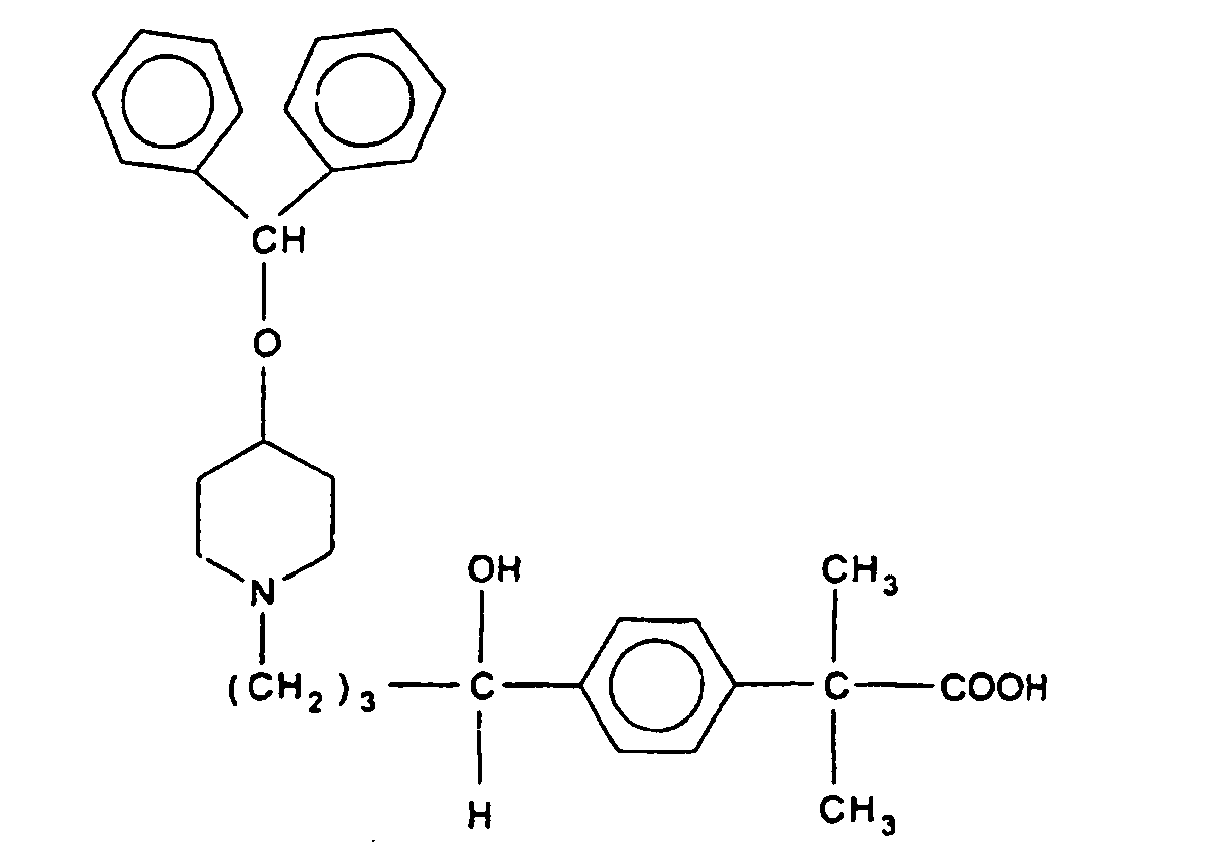

Claims (45)
- A process of preparing a piperidine derivative compound of the formula Ia or Ib:

 n is 0 or 1;R1 is hydrogen or hydroxy;R2 is hydrogen;or, when n is 0, R1 and R2 taken together form a second bond between the carbon atoms bearing R1 and R2, provided that when n is 1, R1 and R2 are each hydrogen;R3 is ―COOH or ―COOR4;R4 is an alkyl or aryl moiety;A, B, and D are the substituents of their rings, each of which may be different or the same, and are selected from the group consisting of hydrogen, halogens, alkyl, hydroxy, and alkoxy,said process comprising:
(A)(i) providing a compound of the formula II: Zis
Zis m is an integer from 1 to 6;X3 is halogen, OR15, SR15, NR15R16, OSO2R15, or NHSO2R15;R6 and R7 are the same or different and are selected from the group consisting of hydrogen, an alkyl moiety, an aryl moiety, OR8, SR8, and NR8R9; andR8, R9, R15, and R16 are the same or different and are selected from the group consisting of hydrogen, an alkyl moiety, and an aryl moietywherein said providing is carried out by
(A)(i)(a) acylating a compound of the formula III: X1 is a halogen, trialkyl or triaryl tin, trialkyl or triaryl borate, trialkyl silicon, alkylhalo silicon, or a group ―OSO2R17 in which R17 represents hydrogen, an alkyl moiety or an unsubstituted aryl moiety,with a compound having the formulae IV or V:
 X2 is hydrogen; a halogen; an alkali metal oxide; a moiety having the formula ―OR10; a moiety having the formula -SR10; or an amine; andR10 is selected from the group consisting of hydrogen, an alkyl moiety, and an aryl moiety;or
(A)(i)(b) reacting a compound of the formula VI:
 X1 is a halogen, triallcyl or triaryl tin, trialkyl or triaryl borate, trialkyl silicon, alkylhalo silicon, or a group ―OSO2R17 in which R17 represents hydrogen, an alkyl moiety or an unsubstituted aryl moiety ;or
(A)(i)(c) acylating a compound of the formula VIII:


(A)(i)(d) reacting a compound of the formula IX:

and
(A)(ii) converting said compound of formula II to the piperidine derivative compound of formula Ia or Ib by:
(A)(ii)(a) hydrolysing the compound of formula II to form a compound of the formula X:
reacting the compound of formula X, or the esterified derivative thereof, with a piperidine compound of the formula XI:
(A)(ii)(b) reacting the compound of formula II with the piperidine compound of formula X and hydrolysing the resultant product;
or
(A)(ii)(c) where n is 1 and R1 and R2 are hydrogen, hydrolysing the compound of formula II to produce a compound of the formula X, and
reacting the compound of formula X with 4-hydroxypiperidine to produce an N-substituted hydroxypiperidine having the formula XII:
reacting the compound of formula XII with a diphenylbalomethane having the formula XIII:
or
(B) (i) providing a compound of the formula III: X1 is a halogen, trialkyl or triaryl tin, trialkyl or triaryl borate, trialkyl silicon, alkylhalo silicon, or a group ―OSO2R17 in which R17 represents hydrogen, an alkyl moiety or an unsubstituted aryl moiety;and
(B)(ii) converting said compound of formula III to the piperidine derivative compound of formula Ia or Ib by:
(B)(ii)(a) reacting the compound of formula III with a 4-(4-substituted)piperidin-1-yl)butanal or a 4-(4-substituted)piperidin-1-yl)butyric acid derivative having the formula XIV: X2 is a hydrogen; halogen; an alkali metal oxide; a moiety having the formula ―OR10; a moiety having the formula ―SR10; or an amine; andR10 is selected from the group consisting of hydrogen, an alkyl moiety, and an aryl moietyto form a piperidine derivative precursor having the formula XVI:
hydrolysing the piperidine derivative precursor of formula XVI;
or
(B)(ii)(b) where n is 1 and R1 and R2 are hydrogen, reacting the compound of the formula III with a 4-(4-substituted-piperidin-1-yl)butanal or a 4-(4-substituted-piperidin-1-yl)butyric acid derivative having the formula XVII: X2 is hydrogen; a halogen; an alkali metal oxide; a moiety having the formula ―OR10; a moiety having the formula ―SR10; or an amine; andR10 is selected from the group consisting of hydrogen, an alkyl moiety, and an aryl moietyto produce an N-substituted hydroxypiperidine having the formula XVIII:
reacting said N-substituted hydroxypiperidine of the formula XVIII with a diarylhalomethane having the formula XIII:
and hydrolysing the resultant product;
or
(C)(i) providing a compound of the formula VI:
(C)(ii) converting the compound of formula VI to the piperidine derivative compound of formula Ia or Ib by the method of
(C)(ii)(a) reacting the compound of formula VI with a 3-(4-substituted)piperidin-1-yl)propane derivative having the formula XIX:
X1 is a halogen, trialkyl or triaryl tin, trialkyl or triaryl borate, trialkyl silicon, alkylhalo silicon, or a group ―OSO2R17 in which R17 represents hydrogen, an alkyl moiety or an unsubstituted aryl moiety,
to form a piperidine derivative precursor having the formula XVI:
hydrolysing said piperidine derivative precursor of the formula XVI; or
(C)(ii)(b) where n is 1 and R1 and R2 are hydrogen, reacting the compound of formula VI with a 3-(4-substituted-piperidin-1-yl)propane derivative having the formula XX: X1 is a halogen, trialkyl or triaryl tin, trialkyl or triaryl borate, trialkyl silicon, alkylhalo silicon, or a group ―OSO2R17 in which R17 represents hydrogen, an alkyl moiety or an unsubstituted aryl moiety,to produce an N-substituted hydroxypiperidine having the formula XVIII:
reacting the N-substituted hydroxypiperidine of formula XVIII with a diarylhalomethane having the formula XIII:
and hydrolysing the resultant product. - A process as claimed in Claim 1, which is carried out by the method (A).
- A process as claimed in Claim 2, wherein the compound of formula II is prepared by the method (A)(i)(a).
- A process as claimed in Claim 3, wherein the compound of formula III is prepared by methylation of a compound of the formula VIII:
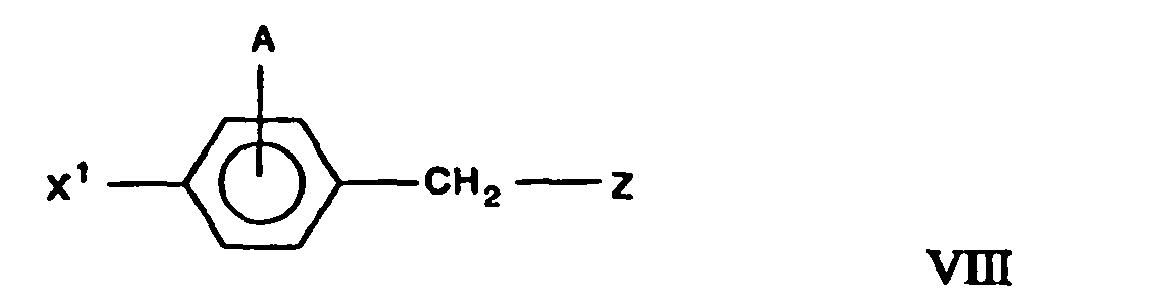
- A process as claimed in Claim 2, wherein the compound of formula II is prepared by method (A)(i)(b).
- A process as claimed in Claim 5, wherein the compound of formula VI is prepared by methylation of a compound of the formula IX:

- A process as claimed in Claim 2, wherein the compound of formula II is prepared by method (A)(i)(c).
- A process as claimed in Claim 2, wherein the compound of formula II is prepared by method (A)(i)(d).
- A process as claimed in any one of Claims 3 to 8, wherein the compound of formula II is converted to the piperidine derivative by method (A)(ii)(a).
- A process as claimed in any one of Claims 3 to 8, wherein the compound of formula II is converted to the piperidine derivative by method (A)(ii)(b).
- A process as claimed in Claim 1, which is carried out by method (B).
- A process as claimed in Claim 11, wherein the compound of formula III is prepared by methylation of a compound of the formula VIII:

- A process as claimed in Claim 11 or Claim 12, wherein the compound of formula III is converted to the piperidine derivative compound of formula Ia or Ib by method (B)(ii)(a).
- A process as claimed in Claim 11 or Claim 12, wherein the compound of formula III is converted to the piperidine derivative compound of formula Ia or Ib by method (B)(ii)(b).
- A process as claimed in Claim 1, which is carried out by method (C).
- A process as claimed in Claim 15, wherein the compound of formula VI is prepared by methylation of a compound of the formula IX:

- A process as claimed in Claim 15 or Claim 16, wherein the compound of formula VI is converted to the piperidine derivative of formula Ia or Ib by method (C)(ii)(a).
- A process as claimed in Claim 15 or Claim 16, wherein the compound of formula VI is converted to the piperidine derivative of formula Ia or Ib by method (C)(ii)(b).
- A process as claimed in any preceding claim, which further comprises reduction of a piperidine derivative compound of the formula Ia:


- A process as claimed in Claim 19, wherein the hydroxylated piperidine derivative compound has the formula:

- A process as claimed in claim 19, wherein the hydroxylated piperidine derivative compound has the formula:

- A process as claimed in Claim 1, wherein the piperidine derivative compound has the formula:

- A process as claimed in Claim 1, wherein the piperidine derivative compound has the formula:

- A process according to claim 12, wherein the compound of the formula VIII:


H2N-(CR6R7)m-O-H XXII
- A process according to claim 11, wherein said compound of formula III is prepared by reacting an α,α-disubstituted benzylic acid derivative having the formula XXIII:

H2N-(CR6R7)m-O-H XXII
- A process according to claim 16, wherein the compound of the formula IX:


H2N-(CR6R7)m-O-H XXII
- A process according to claim 15, wherein said compound of formula VI is prepared by reacting a 4-(α-carboxy-α,α-disubstituted)-toluic acid derivative having the formula XXV:

H2N-(CR6R7)m-O-H XXII
- A compound having the formula II:
 Zis
Zis m is an integer from 1 to 6;X3 is halogen; OR15, SR15, NR15R16, OSO2R15, or NHSO2R15;R6 and R7 are the same or different and are selected from the group consisting of hydrogen, an alkyl moiety, an aryl moiety, OR8, SR8, and NR8R9;R8, R9, R15, and R16 are the same or different and are selected from the group consisting of hydrogen, an alkyl moiety, and an aryl moiety; andA is the substituents of its ring, each of which may be different or the same and are selected from the group consisting of hydrogen, halogens, alkyl, hydroxy, and alkoxy.
 - A compound according to claim 28, wherein Z is

- A process of preparing the compound of Claim 28, which process comprisesa) acylating an α,α-disubstituted-methylbenzene derivative having the formula III:
 X1 is a halogen, trialkyl or triaryl tin, trialkyl or triaryl borate, trialkyl silicon, alkylhalo silicon, or a group ―OSO2R17 in which R17 represents hydrogen, an alkyl moiety or an unsubstituted aryl moiety,with a compound having the formulae IV or V:
 X2 is hydrogen; a halogen; an alkali metal oxide; a moiety having the formula ―OR10; a moiety having the formula ―SR10; or an amine; andR10 is selected from the group consisting of hydrogen, an alkyl moiety, and an aryl moiety,orb) forming a compound of the formula XXVI
 b1) acylating a compound of the formula VIII:

 b2) acylating a compound of the formula IX:

or(c) reacting a compound of the formula VI:

- A process as claimed in Claim 30, which is carried out by the method (a).
- A process as claimed in Claim 31, wherein the compound of the formula III:
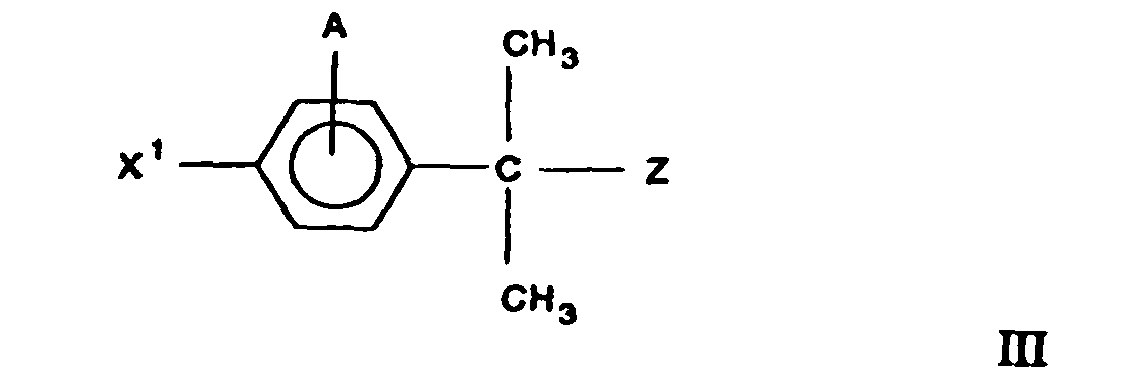

- A process as claimed in Claim 31, wherein the compound of formula III:


H2N-(CR6R7)m-O-H XXII
- A process as claimed in Claim 31, wherein the compound of the formula III:


H2N-(CR6R7)m-O-H XXII
- A process as claimed in Claim 30, which is carried out by method (b).
- A process as claimed in Claim 35, in which the compound of formula XXVI is prepared by method b1).
- A process as claimed in Claim 35, wherein the compound of formula XXVI is prepared by method b2).
- A process as claimed in Claim 30, which is carried out by the method (c).
- A process as claimed in Claim 38, wherein the compound of the formula VI:


- A process as claimed in Claim 39, wherein the compound of formula IX:


H2N-(CR6R7)m-O-H XXII
- A process as claimed in Claim 38, wherein the compound of formula VI:


H2N-(CR8R7)m-O-H XXII
- A compound having the formula VI:
 Z is
Z is m is an integer from 1 to 6;X2 is hydrogen; a halogen; an alkali metal oxide; a moiety having the formula ―OR10; a moiety having the formula ―SR10; or an amine;R6 and R7 are the same or different and are selected from the group consisting of hydrogen, an alkyl moiety, an aryl moiety, OR8, SR8, and NR8R9;R8, R9, and R10 are the same or different and are selected from the group consisting of hydrogen, an alkyl moiety, and an aryl moiety; andA is the substituents of its ring, each of which may be different or the same and are selected from the group consisting of hydrogen, halogens, alkyl, hydroxy, and alkoxy.
 - A compound as claimed in Claim 42, wherein Z is

- A compound having the formula IX:
 Zis
Zis m is an integer from 1 to 6;X2 is hydrogen; a halogen; an alkali metal oxide; a moiety having the formula ―OR10; a moiety having the formula ―SR10; or an amine ;R6 and R7 are the same or different and are selected from the group consisting of hydrogen, an alkyl moiety, an aryl moiety, OR8, SR8, and NR8R9;R8, R9, and R10 are the same or different and are selected from the group consisting of hydrogen, an alkyl moiety, and an aryl moiety; andA is the substituents of its ring, each of which may be different or the same and are selected from the group consisting of hydrogen, halogens, alkyl, hydroxy, and alkoxy.
 - A compound as claimed in Claim 44, wherein Z is
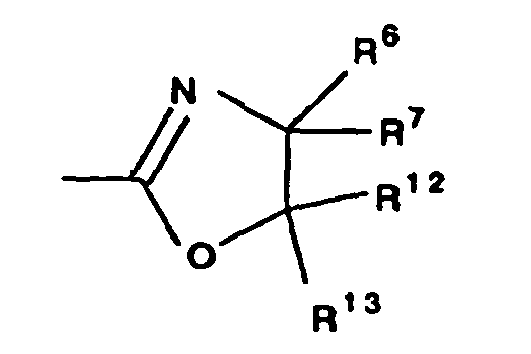
Priority Applications (1)
| Application Number | Priority Date | Filing Date | Title |
|---|---|---|---|
| EP03077248A EP1362849A3 (en) | 1995-12-21 | 1996-12-19 | Process for production of piperidine derivatives |
Applications Claiming Priority (3)
| Application Number | Priority Date | Filing Date | Title |
|---|---|---|---|
| US575344 | 1995-12-21 | ||
| US08/575,344 US6201124B1 (en) | 1995-12-21 | 1995-12-21 | Process for production of piperidine derivatives |
| PCT/US1996/020769 WO1997022344A1 (en) | 1995-12-21 | 1996-12-19 | Process for production of piperidine derivatives |
Related Child Applications (1)
| Application Number | Title | Priority Date | Filing Date |
|---|---|---|---|
| EP03077248A Division EP1362849A3 (en) | 1995-12-21 | 1996-12-19 | Process for production of piperidine derivatives |
Publications (3)
| Publication Number | Publication Date |
|---|---|
| EP0877733A1 EP0877733A1 (en) | 1998-11-18 |
| EP0877733A4 EP0877733A4 (en) | 1999-03-31 |
| EP0877733B1 true EP0877733B1 (en) | 2006-08-09 |
Family
ID=24299941
Family Applications (2)
| Application Number | Title | Priority Date | Filing Date |
|---|---|---|---|
| EP96945097A Expired - Lifetime EP0877733B1 (en) | 1995-12-21 | 1996-12-19 | Process for production of piperidine derivatives |
| EP03077248A Withdrawn EP1362849A3 (en) | 1995-12-21 | 1996-12-19 | Process for production of piperidine derivatives |
Family Applications After (1)
| Application Number | Title | Priority Date | Filing Date |
|---|---|---|---|
| EP03077248A Withdrawn EP1362849A3 (en) | 1995-12-21 | 1996-12-19 | Process for production of piperidine derivatives |
Country Status (16)
| Country | Link |
|---|---|
| US (7) | US6201124B1 (en) |
| EP (2) | EP0877733B1 (en) |
| JP (2) | JP4865113B2 (en) |
| KR (2) | KR100591212B1 (en) |
| AT (1) | ATE335726T1 (en) |
| AU (1) | AU723759B2 (en) |
| BR (1) | BR9612099A (en) |
| CA (1) | CA2240735C (en) |
| DE (1) | DE69636439T2 (en) |
| DK (1) | DK0877733T3 (en) |
| ES (1) | ES2268715T3 (en) |
| HU (1) | HUP9900947A3 (en) |
| NO (1) | NO311718B1 (en) |
| NZ (1) | NZ326228A (en) |
| PT (1) | PT877733E (en) |
| WO (1) | WO1997022344A1 (en) |
Cited By (1)
| Publication number | Priority date | Publication date | Assignee | Title |
|---|---|---|---|---|
| EP2371817A1 (en) | 2010-04-01 | 2011-10-05 | Arevipharma GmbH | Process for the preparation of 1-[4-(1,1-dimethylethyl)phenyl]-4-[4-(diphenylmethoxy)-1-piperidinyl]-1-butanone and acid addition salts thereof |
Families Citing this family (26)
| Publication number | Priority date | Publication date | Assignee | Title |
|---|---|---|---|---|
| EP1953142A1 (en) * | 1993-06-25 | 2008-08-06 | Aventis Inc. | Process for the preparation of antihistaminic 4-diphenylmethyl piperidine derivatives |
| US6201124B1 (en) * | 1995-12-21 | 2001-03-13 | Albany Molecular Research, Inc. | Process for production of piperidine derivatives |
| US6153754A (en) * | 1995-12-21 | 2000-11-28 | Albany Molecular Research, Inc. | Process for production of piperidine derivatives |
| ES2151442B1 (en) * | 1999-01-11 | 2001-07-01 | Espanola Prod Quimicos | NEW DERIVATIVE OF BENCENOETHANOL. |
| CZ20033019A3 (en) * | 2001-04-09 | 2004-07-14 | Teva Pharmaceutical Industries Ltd. | Polymorphs of fexofenadine hydrochloride |
| US20030021849A1 (en) * | 2001-04-09 | 2003-01-30 | Ben-Zion Dolitzky | Polymorphs of fexofenadine hydrochloride |
| ITRM20010260A1 (en) | 2001-05-17 | 2002-11-18 | Dinamite Dipharma S P A In For | PROCESS FOR THE PREPARATION OF PHEXOPHENADINE OR ACID 4 1-HYDROXY-4-4- (HYDROXYDIDENYLMETHYL) -1-PIPERIDINYL | -BUTYL | -ALPHA, ALPHA-DIMETHYLBENZ |
| CA2465913A1 (en) * | 2001-11-08 | 2003-05-15 | Judith Aronhime | Polymorphs of fexofenadine base |
| EP1474392A1 (en) * | 2002-06-10 | 2004-11-10 | Teva Pharmaceutical Industries Ltd. | Polymorphic form xvi of fexofenadine hydrochloride |
| US6949765B2 (en) | 2002-11-05 | 2005-09-27 | Chartered Semiconductor Manufacturing Ltd. | Padless structure design for easy identification of bridging defects in lines by passive voltage contrast |
| TW200517114A (en) | 2003-10-15 | 2005-06-01 | Combinatorx Inc | Methods and reagents for the treatment of immunoinflammatory disorders |
| KR20070007196A (en) * | 2004-04-26 | 2007-01-12 | 테바 파마슈티컬 인더스트리즈 리미티드 | Crystalline Forms of Fexofenadine Hydrochloride and Methods for Making the Same |
| US7498345B2 (en) * | 2004-09-17 | 2009-03-03 | Albany Molecular Research, Inc. | Process for production of piperidine derivatives |
| US7498443B2 (en) * | 2004-09-17 | 2009-03-03 | Albany Molecular Research, Inc. | Process for production of carebastine |
| JP2008514641A (en) * | 2004-09-28 | 2008-05-08 | テバ ファーマシューティカル インダストリーズ リミティド | Crystalline fexofenadine and method for its preparation |
| ZA200804550B (en) | 2005-11-09 | 2009-08-26 | Combinatorx Inc | Methods, compositions, and kits for the treatment of medical conditions |
| CN100443470C (en) * | 2006-07-21 | 2008-12-17 | 杭州保灵有限公司 | Prepn of ebastine |
| ITMI20061491A1 (en) * | 2006-07-27 | 2008-01-28 | Archimica Srl | PROCESS FOR THE PREPARATION OF FEXOPHENADINE. |
| ITMI20061492A1 (en) * | 2006-07-27 | 2008-01-28 | Archimica Srl | PROCESS FOR THE PREPARATION OF FEXOPHENADINE. |
| ITMI20070987A1 (en) | 2007-05-16 | 2008-11-17 | Dipharma Francis Srl | PROCEDURE FOR THE PREPARATION OF KETONIC COMPOUNDS |
| WO2010021681A2 (en) * | 2008-08-18 | 2010-02-25 | Combinatorx (Singapore) Pte. Ltd. | Compositions and methods for treatment of viral diseases |
| US20110130711A1 (en) * | 2009-11-19 | 2011-06-02 | Follica, Inc. | Hair growth treatment |
| CN105254579A (en) * | 2015-09-19 | 2016-01-20 | 万全万特制药江苏有限公司 | Method for preparing bilastine intermediate through one-kettle process |
| CN114621083A (en) * | 2022-03-30 | 2022-06-14 | 西安万隆制药股份有限公司 | Antihistamine medicine fexofenadine hydrochloride impurity and synthesis method and application thereof |
| CN114671802B (en) * | 2022-04-14 | 2024-05-17 | 江苏联环药业股份有限公司 | Preparation method of high-purity ebastine |
| WO2024146022A1 (en) * | 2023-01-03 | 2024-07-11 | 成都施贝康生物医药科技有限公司 | Crystal form and amorphous form of carebastine p-toluenesulfonate |
Family Cites Families (36)
| Publication number | Priority date | Publication date | Assignee | Title |
|---|---|---|---|---|
| US2919274A (en) | 1957-09-17 | 1959-12-29 | Sahyun Melville | Amidines |
| US4028404A (en) | 1967-07-31 | 1977-06-07 | Allen & Hanburys Limited | Acetic acid derivatives |
| GB1242169A (en) | 1969-04-09 | 1971-08-11 | Ucb Sa | Piperidine derivatives |
| US3839431A (en) | 1970-07-13 | 1974-10-01 | Squibb & Sons Inc | Cyclopropylmethylphenylacetic acids and derivatives |
| US3787217A (en) * | 1970-12-25 | 1974-01-22 | Kumiai Chemical Industry Co | Method for controlling sea organisms |
| US3898271A (en) | 1971-06-08 | 1975-08-05 | Squibb & Sons Inc | Cyclopropylmethylphenylacetic acids and derivatives |
| BE794596A (en) | 1972-01-28 | 1973-05-16 | Richardson Merrell Inc | SUBSTITUTED PIPERIDINOALCANONE OXIMES AND THEIR PREPARATION PROCESS |
| US3878217A (en) | 1972-01-28 | 1975-04-15 | Richardson Merrell Inc | Alpha-aryl-4-substituted piperidinoalkanol derivatives |
| BE794598A (en) | 1972-01-28 | 1973-05-16 | Richardson Merrell Inc | NEW OLEFINIC DERIVATIVES OF PIPERIDINES SUBSTITUTED IN 4 AND THEIR PREPARATION PROCESS |
| US3965257A (en) | 1972-01-28 | 1976-06-22 | Richardson-Merrell Inc. | Compositions and methods for the treatment of the symptoms of histamine induced allergic reactions |
| US3806526A (en) | 1972-01-28 | 1974-04-23 | Richardson Merrell Inc | 1-aroylalkyl-4-diphenylmethyl piperidines |
| US3931197A (en) | 1974-02-08 | 1976-01-06 | Richardson-Merrell Inc. | Substituted piperidine derivatives |
| US3941795A (en) | 1974-02-08 | 1976-03-02 | Richardson-Merrell Inc. | α-ARYL-4-SUBSTITUTED PIPERIDINOALKANOL DERIVATIVES |
| US3946022A (en) | 1974-03-04 | 1976-03-23 | Richardson-Merrell Inc. | Piperidine derivatives |
| US3922276A (en) | 1974-12-11 | 1975-11-25 | Robins Co Inc A H | 1-Substituted-4-benzylidenepiperidines |
| US3956296A (en) | 1974-12-11 | 1976-05-11 | A. H. Robins Company, Incorporated | 1-Substituted-4-benzylpiperidines |
| DD141422A5 (en) | 1978-01-27 | 1980-04-30 | Schering Ag | PROCESS FOR THE PREPARATION OF PHENYL ACID DERIVATIVES |
| US4285957A (en) | 1979-04-10 | 1981-08-25 | Richardson-Merrell Inc. | 1-Piperidine-alkanol derivatives, pharmaceutical compositions thereof, and method of use thereof |
| US4285958A (en) | 1979-04-10 | 1981-08-25 | Richardson-Merrell Inc. | 1-Piperidine-alkylene ketones, pharmaceutical compositions thereof and method of use thereof |
| US4254129A (en) | 1979-04-10 | 1981-03-03 | Richardson-Merrell Inc. | Piperidine derivatives |
| US4254130A (en) | 1979-04-10 | 1981-03-03 | Richardson-Merrell Inc. | Piperidine derivatives |
| GB8321157D0 (en) | 1983-08-05 | 1983-09-07 | Fordonal Sa | Piperidine derivatives |
| US4742175A (en) | 1986-05-07 | 1988-05-03 | Merrell Dow Pharmaceuticals Inc. | Preparation of polymorphically pure terfenadine |
| US5382600A (en) | 1988-01-22 | 1995-01-17 | Pharmacia Aktiebolag | 3,3-diphenylpropylamines and pharmaceutical compositions thereof |
| FR2636946B1 (en) | 1988-09-23 | 1990-11-02 | Lipha | ((DIARYLMETHOXY) ALCOYL) -1 PYRROLIDINES AND PIPERIDINES, METHODS OF PREPARATION AND MEDICAMENTS CONTAINING THEM |
| DE4034218A1 (en) | 1990-10-27 | 1992-04-30 | Merck Patent Gmbh | METHOD FOR PRODUCING CAREBASTIN |
| HU211019B (en) | 1991-12-02 | 1995-09-28 | Richter Gedeon Vegyeszet | Process for producing new 1,2,3,6-tetrahydropyridine and piperidine derivatives substituted with n-(hydroxylalkyl) group and compositions comprising such compounds |
| HU226561B1 (en) | 1992-04-10 | 2009-04-28 | Merrell Dow Pharma | Process for preparation 4-diphenylmethyl piperidine derivatives and the novel intermediates thereof |
| FI950467A7 (en) | 1992-08-03 | 1995-03-31 | Sepracor Inc | Terfenadine metabolites and their optically pure isomers for the treatment of allergic diseases |
| US20020007068A1 (en) * | 1999-07-16 | 2002-01-17 | D'ambra Thomas E. | Piperidine derivatives and process for their production |
| HU226559B1 (en) * | 1993-06-24 | 2009-03-30 | Amr Technology | Process for the production of piperidine derivatives |
| EP1953142A1 (en) * | 1993-06-25 | 2008-08-06 | Aventis Inc. | Process for the preparation of antihistaminic 4-diphenylmethyl piperidine derivatives |
| US6153754A (en) * | 1995-12-21 | 2000-11-28 | Albany Molecular Research, Inc. | Process for production of piperidine derivatives |
| US6201124B1 (en) * | 1995-12-21 | 2001-03-13 | Albany Molecular Research, Inc. | Process for production of piperidine derivatives |
| US5925761A (en) * | 1997-02-04 | 1999-07-20 | Sepracor Inc. | Synthesis of terfenadine and derivatives |
| US7498345B2 (en) * | 2004-09-17 | 2009-03-03 | Albany Molecular Research, Inc. | Process for production of piperidine derivatives |
-
1995
- 1995-12-21 US US08/575,344 patent/US6201124B1/en not_active Expired - Lifetime
-
1996
- 1996-12-19 JP JP52309597A patent/JP4865113B2/en not_active Expired - Lifetime
- 1996-12-19 CA CA002240735A patent/CA2240735C/en not_active Expired - Lifetime
- 1996-12-19 BR BR9612099-1A patent/BR9612099A/en not_active IP Right Cessation
- 1996-12-19 HU HU9900947A patent/HUP9900947A3/en unknown
- 1996-12-19 DE DE69636439T patent/DE69636439T2/en not_active Expired - Lifetime
- 1996-12-19 KR KR1020057009030A patent/KR100591212B1/en not_active Expired - Lifetime
- 1996-12-19 ES ES96945097T patent/ES2268715T3/en not_active Expired - Lifetime
- 1996-12-19 PT PT96945097T patent/PT877733E/en unknown
- 1996-12-19 KR KR10-1998-0704760A patent/KR100516869B1/en not_active Expired - Lifetime
- 1996-12-19 EP EP96945097A patent/EP0877733B1/en not_active Expired - Lifetime
- 1996-12-19 DK DK96945097T patent/DK0877733T3/en active
- 1996-12-19 AU AU13547/97A patent/AU723759B2/en not_active Expired
- 1996-12-19 AT AT96945097T patent/ATE335726T1/en active
- 1996-12-19 EP EP03077248A patent/EP1362849A3/en not_active Withdrawn
- 1996-12-19 NZ NZ326228A patent/NZ326228A/en not_active IP Right Cessation
- 1996-12-19 WO PCT/US1996/020769 patent/WO1997022344A1/en not_active Ceased
-
1998
- 1998-06-18 NO NO19982806A patent/NO311718B1/en not_active IP Right Cessation
-
2000
- 2000-08-09 US US09/634,169 patent/US6452011B1/en not_active Expired - Lifetime
- 2000-08-09 US US09/634,775 patent/US6448406B1/en not_active Expired - Lifetime
-
2002
- 2002-08-05 US US10/212,854 patent/US6974872B2/en not_active Expired - Fee Related
-
2005
- 2005-05-06 US US11/123,275 patent/US7560561B2/en not_active Expired - Fee Related
-
2008
- 2008-09-04 JP JP2008227513A patent/JP2009019059A/en active Pending
-
2009
- 2009-06-11 US US12/483,002 patent/US8022220B2/en not_active Expired - Fee Related
-
2011
- 2011-08-11 US US13/207,850 patent/US20110295014A1/en not_active Abandoned
Cited By (3)
| Publication number | Priority date | Publication date | Assignee | Title |
|---|---|---|---|---|
| EP2371817A1 (en) | 2010-04-01 | 2011-10-05 | Arevipharma GmbH | Process for the preparation of 1-[4-(1,1-dimethylethyl)phenyl]-4-[4-(diphenylmethoxy)-1-piperidinyl]-1-butanone and acid addition salts thereof |
| WO2011121099A2 (en) | 2010-04-01 | 2011-10-06 | Arevipharma Gmbh | Process for the preparation of 1-[4-(1,1-dimethylethyl)phenyl]-4-[4-(diphenylmethoxy)-1-piperidinyl]-1-butanone and acid addition salts thereof |
| DE112011101112T5 (en) | 2010-04-01 | 2013-01-10 | Arevipharma Gmbh | A process for producing 1- [4- (1,1-dimethylethyl) phenyl] -4- [4- (diphenylmethoxy) -1-piperidinyl] -1-butanone and acid addition salts thereof |
Also Published As
Similar Documents
| Publication | Publication Date | Title |
|---|---|---|
| US6452011B1 (en) | Process for production of piperidine derivatives | |
| EP0868182B1 (en) | Process for production of piperidine derivatives | |
| HK1060130A (en) | Process for production of piperidine derivatives | |
| MXPA98004894A (en) | Procedure for the production of piperid derivatives | |
| MXPA98004895A (en) | Procedure for the production of piperid derivatives |
Legal Events
| Date | Code | Title | Description |
|---|---|---|---|
| PUAI | Public reference made under article 153(3) epc to a published international application that has entered the european phase |
Free format text: ORIGINAL CODE: 0009012 |
|
| 17P | Request for examination filed |
Effective date: 19980630 |
|
| AK | Designated contracting states |
Kind code of ref document: A1 Designated state(s): AT BE CH DE DK ES FI FR GB GR IE IT LI LU MC NL PT SE |
|
| A4 | Supplementary search report drawn up and despatched |
Effective date: 19990212 |
|
| AK | Designated contracting states |
Kind code of ref document: A4 Designated state(s): AT BE CH DE DK ES FI FR GB GR IE IT LI LU MC NL PT SE |
|
| 17Q | First examination report despatched |
Effective date: 20000606 |
|
| RAP1 | Party data changed (applicant data changed or rights of an application transferred) |
Owner name: AMR TECHNOLOGY, INC. |
|
| GRAP | Despatch of communication of intention to grant a patent |
Free format text: ORIGINAL CODE: EPIDOSNIGR1 |
|
| GRAS | Grant fee paid |
Free format text: ORIGINAL CODE: EPIDOSNIGR3 |
|
| GRAA | (expected) grant |
Free format text: ORIGINAL CODE: 0009210 |
|
| AK | Designated contracting states |
Kind code of ref document: B1 Designated state(s): AT BE CH DE DK ES FI FR GB GR IE IT LI LU MC NL PT SE |
|
| REG | Reference to a national code |
Ref country code: GB Ref legal event code: FG4D |
|
| REG | Reference to a national code |
Ref country code: CH Ref legal event code: EP |
|
| REG | Reference to a national code |
Ref country code: IE Ref legal event code: FG4D |
|
| REF | Corresponds to: |
Ref document number: 69636439 Country of ref document: DE Date of ref document: 20060921 Kind code of ref document: P |
|
| REG | Reference to a national code |
Ref country code: CH Ref legal event code: NV Representative=s name: HEPP, WENGER & RYFFEL AG |
|
| REG | Reference to a national code |
Ref country code: GR Ref legal event code: EP Ref document number: 20060403697 Country of ref document: GR |
|
| REG | Reference to a national code |
Ref country code: SE Ref legal event code: TRGR |
|
| REG | Reference to a national code |
Ref country code: DK Ref legal event code: T3 |
|
| REG | Reference to a national code |
Ref country code: PT Ref legal event code: SC4A Free format text: AVAILABILITY OF NATIONAL TRANSLATION Effective date: 20061107 |
|
| ET | Fr: translation filed | ||
| REG | Reference to a national code |
Ref country code: ES Ref legal event code: FG2A Ref document number: 2268715 Country of ref document: ES Kind code of ref document: T3 |
|
| PLBE | No opposition filed within time limit |
Free format text: ORIGINAL CODE: 0009261 |
|
| STAA | Information on the status of an ep patent application or granted ep patent |
Free format text: STATUS: NO OPPOSITION FILED WITHIN TIME LIMIT |
|
| 26N | No opposition filed |
Effective date: 20070510 |
|
| REG | Reference to a national code |
Ref country code: CH Ref legal event code: PFA Owner name: ALBANY MOLECULAR RESEARCH, INC. Free format text: AMR TECHNOLOGY, INC.#5429 MAIN STREET P.O. BOX 2587#MANCHESTER CENTER, VT 05255-2587 (US) -TRANSFER TO- ALBANY MOLECULAR RESEARCH, INC.#26 CORPORATE CIRCLE#ALBANY, NY 12203-0289 (US) |
|
| REG | Reference to a national code |
Ref country code: GB Ref legal event code: 732E Free format text: REGISTERED BETWEEN 20100930 AND 20101006 |
|
| REG | Reference to a national code |
Ref country code: NL Ref legal event code: SD Effective date: 20101111 |
|
| REG | Reference to a national code |
Ref country code: FR Ref legal event code: TP |
|
| REG | Reference to a national code |
Ref country code: ES Ref legal event code: PC2A Owner name: ALBANY MOLECULAR RESEARCH,INC. Effective date: 20110216 |
|
| REG | Reference to a national code |
Ref country code: DE Ref legal event code: R082 Ref document number: 69636439 Country of ref document: DE Representative=s name: MAIWALD PATENTANWALTSGESELLSCHAFT MBH, DE Effective date: 20110912 Ref country code: DE Ref legal event code: R081 Ref document number: 69636439 Country of ref document: DE Owner name: ALBANY MOLECULAR RESEARCH, INC. (N.D.GES.D. ST, US Free format text: FORMER OWNER: AMR TECHNOLOGY,INC., MANCHESTER CENTER, US Effective date: 20110912 Ref country code: DE Ref legal event code: R081 Ref document number: 69636439 Country of ref document: DE Owner name: ALBANY MOLECULAR RESEARCH, INC. (N.D.GES.D. ST, US Free format text: FORMER OWNER: AMR TECHNOLOGY,INC., MANCHESTER CENTER, VT., US Effective date: 20110912 |
|
| REG | Reference to a national code |
Ref country code: FR Ref legal event code: PLFP Year of fee payment: 20 |
|
| PGFP | Annual fee paid to national office [announced via postgrant information from national office to epo] |
Ref country code: DE Payment date: 20151215 Year of fee payment: 20 Ref country code: GB Payment date: 20151216 Year of fee payment: 20 Ref country code: GR Payment date: 20151112 Year of fee payment: 20 Ref country code: IE Payment date: 20151209 Year of fee payment: 20 Ref country code: FI Payment date: 20151209 Year of fee payment: 20 Ref country code: DK Payment date: 20151210 Year of fee payment: 20 Ref country code: CH Payment date: 20151211 Year of fee payment: 20 |
|
| PGFP | Annual fee paid to national office [announced via postgrant information from national office to epo] |
Ref country code: ES Payment date: 20151112 Year of fee payment: 20 Ref country code: SE Payment date: 20151211 Year of fee payment: 20 Ref country code: FR Payment date: 20151110 Year of fee payment: 20 Ref country code: PT Payment date: 20151218 Year of fee payment: 20 Ref country code: NL Payment date: 20151210 Year of fee payment: 20 Ref country code: BE Payment date: 20151207 Year of fee payment: 20 Ref country code: AT Payment date: 20151125 Year of fee payment: 20 Ref country code: MC Payment date: 20151028 Year of fee payment: 20 |
|
| PGFP | Annual fee paid to national office [announced via postgrant information from national office to epo] |
Ref country code: LU Payment date: 20160107 Year of fee payment: 20 |
|
| PGFP | Annual fee paid to national office [announced via postgrant information from national office to epo] |
Ref country code: IT Payment date: 20151221 Year of fee payment: 20 |
|
| REG | Reference to a national code |
Ref country code: DE Ref legal event code: R071 Ref document number: 69636439 Country of ref document: DE |
|
| REG | Reference to a national code |
Ref country code: NL Ref legal event code: MK Effective date: 20161218 |
|
| REG | Reference to a national code |
Ref country code: CH Ref legal event code: PL |
|
| REG | Reference to a national code |
Ref country code: DK Ref legal event code: EUP Effective date: 20161219 |
|
| REG | Reference to a national code |
Ref country code: GB Ref legal event code: PE20 Expiry date: 20161218 |
|
| REG | Reference to a national code |
Ref country code: IE Ref legal event code: MK9A |
|
| PG25 | Lapsed in a contracting state [announced via postgrant information from national office to epo] |
Ref country code: GB Free format text: LAPSE BECAUSE OF EXPIRATION OF PROTECTION Effective date: 20161218 |
|
| REG | Reference to a national code |
Ref country code: SE Ref legal event code: EUG |
|
| REG | Reference to a national code |
Ref country code: AT Ref legal event code: MK07 Ref document number: 335726 Country of ref document: AT Kind code of ref document: T Effective date: 20161219 |
|
| PG25 | Lapsed in a contracting state [announced via postgrant information from national office to epo] |
Ref country code: PT Free format text: LAPSE BECAUSE OF EXPIRATION OF PROTECTION Effective date: 20161227 |
|
| REG | Reference to a national code |
Ref country code: GR Ref legal event code: MA Ref document number: 20060403697 Country of ref document: GR Effective date: 20161220 |
|
| PG25 | Lapsed in a contracting state [announced via postgrant information from national office to epo] |
Ref country code: ES Free format text: LAPSE BECAUSE OF EXPIRATION OF PROTECTION Effective date: 20161220 Ref country code: IE Free format text: LAPSE BECAUSE OF EXPIRATION OF PROTECTION Effective date: 20161219 |