EP0876998A1 - Process for producing nickel hydroxide from elemental nickel - Google Patents
Process for producing nickel hydroxide from elemental nickel Download PDFInfo
- Publication number
- EP0876998A1 EP0876998A1 EP98303003A EP98303003A EP0876998A1 EP 0876998 A1 EP0876998 A1 EP 0876998A1 EP 98303003 A EP98303003 A EP 98303003A EP 98303003 A EP98303003 A EP 98303003A EP 0876998 A1 EP0876998 A1 EP 0876998A1
- Authority
- EP
- European Patent Office
- Prior art keywords
- nickel
- solution
- aqueous solution
- aqueous
- elemental
- Prior art date
- Legal status (The legal status is an assumption and is not a legal conclusion. Google has not performed a legal analysis and makes no representation as to the accuracy of the status listed.)
- Granted
Links
- PXHVJJICTQNCMI-UHFFFAOYSA-N Nickel Chemical compound [Ni] PXHVJJICTQNCMI-UHFFFAOYSA-N 0.000 title claims abstract description 161
- 229910052759 nickel Inorganic materials 0.000 title claims abstract description 65
- 238000000034 method Methods 0.000 title claims abstract description 53
- BFDHFSHZJLFAMC-UHFFFAOYSA-L nickel(ii) hydroxide Chemical compound [OH-].[OH-].[Ni+2] BFDHFSHZJLFAMC-UHFFFAOYSA-L 0.000 title claims abstract description 52
- QGZKDVFQNNGYKY-UHFFFAOYSA-N ammonia Natural products N QGZKDVFQNNGYKY-UHFFFAOYSA-N 0.000 claims abstract description 65
- VHUUQVKOLVNVRT-UHFFFAOYSA-N Ammonium hydroxide Chemical compound [NH4+].[OH-] VHUUQVKOLVNVRT-UHFFFAOYSA-N 0.000 claims abstract description 18
- 235000011114 ammonium hydroxide Nutrition 0.000 claims abstract description 18
- QVGXLLKOCUKJST-UHFFFAOYSA-N atomic oxygen Chemical compound [O] QVGXLLKOCUKJST-UHFFFAOYSA-N 0.000 claims abstract description 18
- 239000001301 oxygen Substances 0.000 claims abstract description 18
- 229910052760 oxygen Inorganic materials 0.000 claims abstract description 18
- NLXLAEXVIDQMFP-UHFFFAOYSA-N Ammonium chloride Substances [NH4+].[Cl-] NLXLAEXVIDQMFP-UHFFFAOYSA-N 0.000 claims abstract description 15
- 239000000203 mixture Substances 0.000 claims abstract description 14
- -1 hydroxyl ions Chemical class 0.000 claims abstract description 13
- 230000001376 precipitating effect Effects 0.000 claims abstract description 8
- 238000004090 dissolution Methods 0.000 claims abstract description 7
- 239000000243 solution Substances 0.000 claims description 47
- 239000007864 aqueous solution Substances 0.000 claims description 17
- 239000002244 precipitate Substances 0.000 claims description 16
- 239000011701 zinc Substances 0.000 claims description 10
- 229910052725 zinc Inorganic materials 0.000 claims description 8
- 239000000654 additive Substances 0.000 claims description 6
- 229910052783 alkali metal Inorganic materials 0.000 claims description 6
- 238000001914 filtration Methods 0.000 claims description 6
- 238000004064 recycling Methods 0.000 claims description 3
- HCHKCACWOHOZIP-UHFFFAOYSA-N Zinc Chemical compound [Zn] HCHKCACWOHOZIP-UHFFFAOYSA-N 0.000 claims description 2
- 229910052793 cadmium Inorganic materials 0.000 claims description 2
- 229910017052 cobalt Inorganic materials 0.000 claims description 2
- 239000010941 cobalt Substances 0.000 claims description 2
- GUTLYIVDDKVIGB-UHFFFAOYSA-N cobalt atom Chemical compound [Co] GUTLYIVDDKVIGB-UHFFFAOYSA-N 0.000 claims description 2
- 229910052748 manganese Inorganic materials 0.000 claims description 2
- 230000000996 additive effect Effects 0.000 claims 3
- 230000003213 activating effect Effects 0.000 abstract description 2
- 229910021529 ammonia Inorganic materials 0.000 description 19
- 239000000843 powder Substances 0.000 description 17
- 238000002386 leaching Methods 0.000 description 12
- 238000004821 distillation Methods 0.000 description 11
- 239000000725 suspension Substances 0.000 description 9
- 229910021508 nickel(II) hydroxide Inorganic materials 0.000 description 8
- 238000001556 precipitation Methods 0.000 description 8
- VEXZGXHMUGYJMC-UHFFFAOYSA-M Chloride anion Chemical compound [Cl-] VEXZGXHMUGYJMC-UHFFFAOYSA-M 0.000 description 7
- FAPWRFPIFSIZLT-UHFFFAOYSA-M Sodium chloride Chemical compound [Na+].[Cl-] FAPWRFPIFSIZLT-UHFFFAOYSA-M 0.000 description 6
- 229910000069 nitrogen hydride Inorganic materials 0.000 description 6
- 238000009835 boiling Methods 0.000 description 5
- 239000000706 filtrate Substances 0.000 description 5
- 229910052751 metal Inorganic materials 0.000 description 5
- 239000002184 metal Substances 0.000 description 5
- 239000000047 product Substances 0.000 description 5
- 239000011347 resin Substances 0.000 description 5
- 229920005989 resin Polymers 0.000 description 5
- 150000003839 salts Chemical class 0.000 description 5
- 239000006227 byproduct Substances 0.000 description 4
- 150000002815 nickel Chemical class 0.000 description 4
- 238000010899 nucleation Methods 0.000 description 4
- 229910002651 NO3 Inorganic materials 0.000 description 3
- QAOWNCQODCNURD-UHFFFAOYSA-L Sulfate Chemical compound [O-]S([O-])(=O)=O QAOWNCQODCNURD-UHFFFAOYSA-L 0.000 description 3
- BFNBIHQBYMNNAN-UHFFFAOYSA-N ammonium sulfate Chemical compound N.N.OS(O)(=O)=O BFNBIHQBYMNNAN-UHFFFAOYSA-N 0.000 description 3
- 229910052921 ammonium sulfate Inorganic materials 0.000 description 3
- 235000011130 ammonium sulphate Nutrition 0.000 description 3
- NVPZOOKWNAMVPQ-UHFFFAOYSA-N azanide;nickel Chemical compound [NH2-].[NH2-].[NH2-].[NH2-].[NH2-].[NH2-].[Ni] NVPZOOKWNAMVPQ-UHFFFAOYSA-N 0.000 description 3
- 230000005484 gravity Effects 0.000 description 3
- 150000004679 hydroxides Chemical class 0.000 description 3
- NPURPEXKKDAKIH-UHFFFAOYSA-N iodoimino(oxo)methane Chemical compound IN=C=O NPURPEXKKDAKIH-UHFFFAOYSA-N 0.000 description 3
- 239000007788 liquid Substances 0.000 description 3
- 239000000463 material Substances 0.000 description 3
- 230000001590 oxidative effect Effects 0.000 description 3
- 238000000926 separation method Methods 0.000 description 3
- 239000011780 sodium chloride Substances 0.000 description 3
- QTBSBXVTEAMEQO-UHFFFAOYSA-M Acetate Chemical compound CC([O-])=O QTBSBXVTEAMEQO-UHFFFAOYSA-M 0.000 description 2
- NHNBFGGVMKEFGY-UHFFFAOYSA-N Nitrate Chemical compound [O-][N+]([O-])=O NHNBFGGVMKEFGY-UHFFFAOYSA-N 0.000 description 2
- PMZURENOXWZQFD-UHFFFAOYSA-L Sodium Sulfate Chemical compound [Na+].[Na+].[O-]S([O-])(=O)=O PMZURENOXWZQFD-UHFFFAOYSA-L 0.000 description 2
- 150000003863 ammonium salts Chemical class 0.000 description 2
- 229940075397 calomel Drugs 0.000 description 2
- 239000003518 caustics Substances 0.000 description 2
- 238000006243 chemical reaction Methods 0.000 description 2
- 230000003247 decreasing effect Effects 0.000 description 2
- 238000010586 diagram Methods 0.000 description 2
- ZOMNIUBKTOKEHS-UHFFFAOYSA-L dimercury dichloride Chemical compound Cl[Hg][Hg]Cl ZOMNIUBKTOKEHS-UHFFFAOYSA-L 0.000 description 2
- 238000002474 experimental method Methods 0.000 description 2
- 239000012527 feed solution Substances 0.000 description 2
- 239000012065 filter cake Substances 0.000 description 2
- XLYOFNOQVPJJNP-UHFFFAOYSA-M hydroxide Chemical compound [OH-] XLYOFNOQVPJJNP-UHFFFAOYSA-M 0.000 description 2
- 150000002739 metals Chemical class 0.000 description 2
- 239000007800 oxidant agent Substances 0.000 description 2
- 239000012716 precipitator Substances 0.000 description 2
- 239000012266 salt solution Substances 0.000 description 2
- 229910052938 sodium sulfate Inorganic materials 0.000 description 2
- 235000011152 sodium sulphate Nutrition 0.000 description 2
- 239000007787 solid Substances 0.000 description 2
- 239000002351 wastewater Substances 0.000 description 2
- XLYOFNOQVPJJNP-UHFFFAOYSA-N water Substances O XLYOFNOQVPJJNP-UHFFFAOYSA-N 0.000 description 2
- PAWQVTBBRAZDMG-UHFFFAOYSA-N 2-(3-bromo-2-fluorophenyl)acetic acid Chemical compound OC(=O)CC1=CC=CC(Br)=C1F PAWQVTBBRAZDMG-UHFFFAOYSA-N 0.000 description 1
- MYMOFIZGZYHOMD-UHFFFAOYSA-N Dioxygen Chemical compound O=O MYMOFIZGZYHOMD-UHFFFAOYSA-N 0.000 description 1
- UFHFLCQGNIYNRP-UHFFFAOYSA-N Hydrogen Chemical compound [H][H] UFHFLCQGNIYNRP-UHFFFAOYSA-N 0.000 description 1
- DGAQECJNVWCQMB-PUAWFVPOSA-M Ilexoside XXIX Chemical group C[C@@H]1CC[C@@]2(CC[C@@]3(C(=CC[C@H]4[C@]3(CC[C@@H]5[C@@]4(CC[C@@H](C5(C)C)OS(=O)(=O)[O-])C)C)[C@@H]2[C@]1(C)O)C)C(=O)O[C@H]6[C@@H]([C@H]([C@@H]([C@H](O6)CO)O)O)O.[Na+] DGAQECJNVWCQMB-PUAWFVPOSA-M 0.000 description 1
- ZLMJMSJWJFRBEC-UHFFFAOYSA-N Potassium Chemical compound [K] ZLMJMSJWJFRBEC-UHFFFAOYSA-N 0.000 description 1
- VMHLLURERBWHNL-UHFFFAOYSA-M Sodium acetate Chemical compound [Na+].CC([O-])=O VMHLLURERBWHNL-UHFFFAOYSA-M 0.000 description 1
- 238000010521 absorption reaction Methods 0.000 description 1
- 239000002253 acid Substances 0.000 description 1
- 150000001450 anions Chemical class 0.000 description 1
- 230000015572 biosynthetic process Effects 0.000 description 1
- OJIJEKBXJYRIBZ-UHFFFAOYSA-N cadmium nickel Chemical compound [Ni].[Cd] OJIJEKBXJYRIBZ-UHFFFAOYSA-N 0.000 description 1
- 239000003638 chemical reducing agent Substances 0.000 description 1
- 238000009833 condensation Methods 0.000 description 1
- 230000005494 condensation Effects 0.000 description 1
- 238000007796 conventional method Methods 0.000 description 1
- 239000013078 crystal Substances 0.000 description 1
- 229910001882 dioxygen Inorganic materials 0.000 description 1
- 239000012153 distilled water Substances 0.000 description 1
- 238000001035 drying Methods 0.000 description 1
- 230000007613 environmental effect Effects 0.000 description 1
- 238000010438 heat treatment Methods 0.000 description 1
- 239000004615 ingredient Substances 0.000 description 1
- 239000013067 intermediate product Substances 0.000 description 1
- 239000010808 liquid waste Substances 0.000 description 1
- 239000006148 magnetic separator Substances 0.000 description 1
- 238000004519 manufacturing process Methods 0.000 description 1
- 229910052987 metal hydride Inorganic materials 0.000 description 1
- 150000004681 metal hydrides Chemical class 0.000 description 1
- LGQLOGILCSXPEA-UHFFFAOYSA-L nickel sulfate Chemical compound [Ni+2].[O-]S([O-])(=O)=O LGQLOGILCSXPEA-UHFFFAOYSA-L 0.000 description 1
- 229910000363 nickel(II) sulfate Inorganic materials 0.000 description 1
- 230000003647 oxidation Effects 0.000 description 1
- 238000007254 oxidation reaction Methods 0.000 description 1
- 239000002245 particle Substances 0.000 description 1
- 229910052700 potassium Inorganic materials 0.000 description 1
- 239000011591 potassium Substances 0.000 description 1
- 229910052708 sodium Inorganic materials 0.000 description 1
- 239000011734 sodium Substances 0.000 description 1
- 235000017281 sodium acetate Nutrition 0.000 description 1
- 239000001632 sodium acetate Substances 0.000 description 1
- 159000000000 sodium salts Chemical class 0.000 description 1
- 239000008247 solid mixture Substances 0.000 description 1
- 230000001502 supplementing effect Effects 0.000 description 1
- 238000005979 thermal decomposition reaction Methods 0.000 description 1
- 238000005406 washing Methods 0.000 description 1
Images


Classifications
-
- C—CHEMISTRY; METALLURGY
- C01—INORGANIC CHEMISTRY
- C01G—COMPOUNDS CONTAINING METALS NOT COVERED BY SUBCLASSES C01D OR C01F
- C01G53/00—Compounds of nickel
- C01G53/04—Oxides
-
- C—CHEMISTRY; METALLURGY
- C01—INORGANIC CHEMISTRY
- C01P—INDEXING SCHEME RELATING TO STRUCTURAL AND PHYSICAL ASPECTS OF SOLID INORGANIC COMPOUNDS
- C01P2002/00—Crystal-structural characteristics
- C01P2002/60—Compounds characterised by their crystallite size
-
- C—CHEMISTRY; METALLURGY
- C01—INORGANIC CHEMISTRY
- C01P—INDEXING SCHEME RELATING TO STRUCTURAL AND PHYSICAL ASPECTS OF SOLID INORGANIC COMPOUNDS
- C01P2002/00—Crystal-structural characteristics
- C01P2002/70—Crystal-structural characteristics defined by measured X-ray, neutron or electron diffraction data
Definitions
- This invention relates to a process for producing nickel hydroxide from nickel powders.
- Nickel hydroxide is a very important material in the manufacture of positive nickel electrodes for alkaline batteries.
- the electric vehicle market demands a low-cost-high-performance battery to facilitate the widespread acceptance of electric vehicles.
- nickel cadmium and metal hydride batteries provide good performance at a reasonable cost. Lowering the cost of nickel hydroxide however, could significantly increase the cost effectiveness of electric vehicles using these batteries.
- Canadian Patent Application No. 2,137,762 describes a relatively pollutant-free process for precipitating nickel hydroxide. This process first prepares a "reactive" nickel hydroxide by anodically oxidizing the metallic nickel. A strong ammonia/NaCl solution then dissolves the nickel hydroxide to generate a nickel-hexammine-chloride intermediate product. Subjecting this intermediate to distillation in a loop reactor decomposes the nickel-hexammine into nickel hydroxide.
- This process produces nickel hydroxide from elemental nickel. Introducing elemental nickel into at least a 4 N aqueous ammonia solution forms a mixture. Activating the nickel powder of this mixture allows the nickel to react with oxygen in the solution. This results in the dissolving of the nickel, producing a loaded solution containing nickel and hydroxyl ions. The redox potential of the solution remains negative during the dissolution of nickel. Distilling the loaded solution to vaporize the aqueous ammonia solution results in the precipitating of nickel hydroxide.
- This invention relates to the discovery that precipitating nickel hydroxide independent of leaching or dissolving elemental nickel improves the effectiveness of producing nickel hydroxide from elemental nickel.
- this process offers a better control of the product's properties, by precipitating the nickel hydroxide in a controlled distillation step.
- Nickel hydroxide's crystallographic properties have a strong influence on its ultimate electrochemical properties. If the nickel hydroxide is too crystalline, it will not function properly in battery applications.
- the nickel powder leaches in an aqueous ammoniacal solution using oxygen gas as an oxidant.
- the aqueous ammoniacal solution contains free ammonia and may also contain a small amount of ammonium salt, such as sulfate, chloride, nitrate or acetate.
- the concentration of free ammonia could be within a wide range, but should be preferably over 4 N in order to dissolve sufficient quantities of nickel into solution.
- a free ammonia concentration of at least 8 N dissolves additional nickel. Most advantageously, the concentration is at least 12 N for producing highly concentrated nickel solutions.
- Nickel powders of high surface area, e.g. 0.4 m 2 /g or higher, are particularly suitable as feed materials for this process. These powders typically originate from the thermal decomposition of nickel carbonyl.
- the ammonium salts concentration could be from 0 to 1 N or higher, but preferably around 0.1 N.
- the leaching step operates advantageously at any temperature between 0 °C and the boiling point of the solution, which would depend on the concentration of free ammonia in the solution.
- a single agitated tank or tanks in series can carry out the nickel powder leaching at atmospheric pressure or with a slight oxygen over-pressure to accelerate the dissolution of nickel powder and eliminate any ammonia loss into the atmosphere.
- the leaching produces nickel and hydroxyl ions.
- the hydroxyl ions can raise the pH to levels above 13.
- Elemental nickel powders can contain a difficult to dissolve passive film.
- activated nickel means elemental nickel capable of dissolving in an ammonia-containing solution at atmospheric pressure in the presence of oxygen.
- contacting the nicke! feed powder with recycled process solution in a separate agitating tank with the resulting suspension being fed into a reactor activates the nickel.
- a separate solution of dilute or other acid can activate the nickel.
- any suitable reducing agent such as hydrogen gas may reduce any passive oxygen film surrounding the nickel to effectively activate the nickel.
- the resulting liquor combines with the ammonia reactor condensate and recycles back to the leaching as illustrated in the flow diagram. Recycling of the aqueous ammoniacal solution provides a closed-loop process for producing nickel hydroxide without any by-products.
- the process facilitates co-precipitating a total of up to about 15 weight percent additives, such as e.g. Ba, Ca, Cd, Co, Mn and Zn. Introducing these metals into the leach liquor or optionally into the evaporator/precipitator vessel produces the "doped" nickel hydroxide. Most advantageously, the nickel hydroxide contains up to 12 weight percent total cobalt and zinc co-precipitated in the hydroxide.
- additives such as e.g. Ba, Ca, Cd, Co, Mn and Zn.
- Example 1 This test used a resin kettle filled with 1.9L of an aqueous solution, containing 8 moles/L of free ammonia and 0.05 mole/L of ammonium sulfate.
- the resin kettle contained a 2 in. (5.1 cm) diameter radial turbine impeller, four baffles, an oxygen sparger, a condenser, a redox-potential electrode and a thermometer. This impeller agitated the solution at 1200 rpm and maintained the solution at room temperature under atmospheric pressure. All the examples of this specification relied upon this equipment. Introducing 32 g of Ni powder (INCO® powder type 255) into the agitated solution formed a liquid/solid mixture.
- Ni powder INCO® powder type 255
- Example 2 This test used the same ingredients as Example 1, except that the feed solution contained twice as much ammonium sulfate and small quantities of Co and Zn powders. Specifically, the solution contained 0.1 mole /L ammonium sulfate.
- the reactor contained 1.9 L of feed solution and the following quantities of metallic powders: 40.7 g Ni powder (INCO Type 255), 0.505 g Co powder (Afrimet) and 0.989 g Zn powder.
- the initial potential ofthe feed powder suspension was -902 mV with respect to a SCE.
- the oxygen flow was 15 mL/mm. for 22 hours to leach the metal powders. The redox potential increased during this period to -166 mV (with respect to a SCE). Terminating the oxygen flow quickly ceased the leaching of the metals. After completing this leaching, the leach liquor filtrate analyzed 21 g/L Ni, 0.23 g/L Co and 0.53 g/L Zn.
- Example 3 This test used the resin kettle of Example 1 filled with approximately 1.5 L of leach liquor.
- the leach liquor had originated from dissolving nickel NI(OH) 2 , containing Co and Zn, in a 14 N aqueous ammonia solution (anion-free), analyzing 5.9 g/L dissolved nickel.
- the solution began to boil when the temperature reached 53 °C. This distillation continued until the solution temperature reached 71°C. After distillation, filtering the suspension produced a filter cake. Washing the filter cake with water and drying it in an oven at 70 °C recovered 10.6 g of nickel hydroxide. This hydroxide analyzed 58.9% Ni, 0.24% Co and 2.75% Zn.
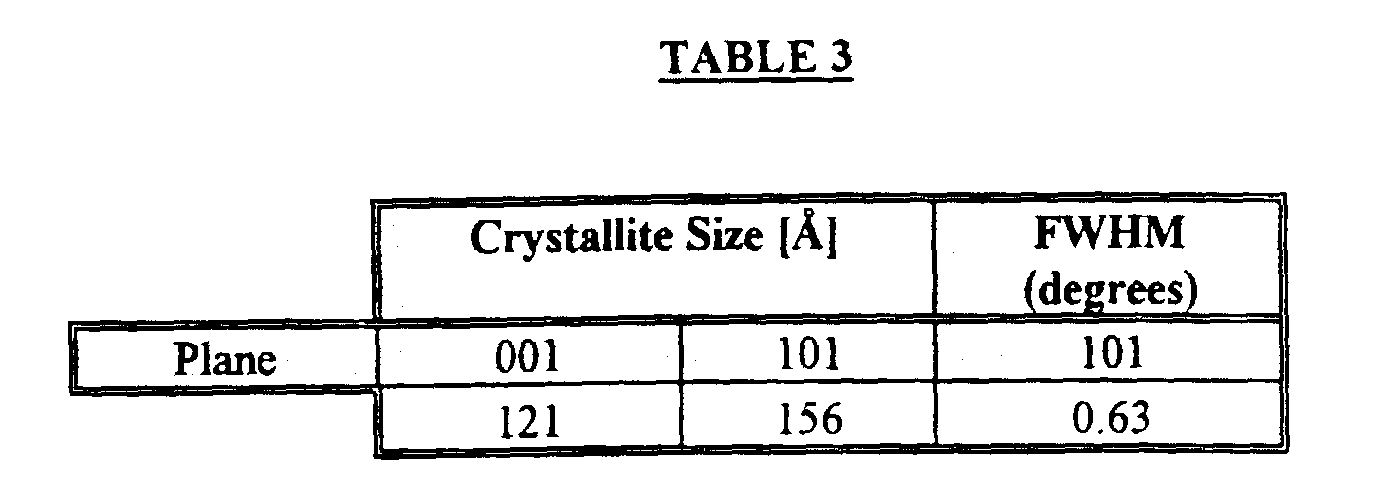
- the filtering also recovered 1.15 L of filtrate, containing 1.88 g/L Ni. Measuring crystallite size for the 001 and 101 planes and the full width half maximum (FWHM) ofthe 101 plane indicate crystallinity and predict battery performance. This product, produced without seeding, was very crystalline, as indicated below:
- the high crystallite sizes of the 001 and 101 planes indicate a highly crystalline structure. Furthermore, the narrow width of the 101 plane indicates high crystallinity.
- Example 4 This test used the starting feed liquor of Example 3, except the kettle contained 4.25 g of Ni(OH) 2 seed at the beginning of the test. The test continued until the boiling temperature reached 75°C. The process produced 16.7 g of Ni(OH) 2 , analyzing 60.1% Ni, 0.42% Co and 2.44% Zn, and 1.07 L of filtrate, analyzing 1.2 g/L Ni. This hydroxide was substantially less crystalline than that obtained in Example 3, as shown below:
- Example 5 This semi-batch test used 1.5 L of filtrate from Example 4 plus 20 g of Ni(OH) 2 seeds placed in the resin kettle. Heating this mixture to the boiling point, which was 82°C, initiated the distilling of the loaded solution. Then a leach liquor solution, containing 15.8 g/L Ni, 126 g/L of ammonia and 14.1 g/L sulfate fed into the boiling mixture at the rate of 5 mL/min. The boiling point decreased to 77°C; and it maintained in the 77-78°C range until the end of the test. At the end of the test, approximately 1.5 L of the leach liquor was pumped into the kettle. This test produced a total of 31.7 g of Ni(OH) 2 product having the following crystallinity:
- the crystallinity of Ni(OH) 2 seeding material (expressed in terms of crystallite size) was as follows:
- the low crystallite size and wide 101 plane peak indicate this hydroxide has low crystallinity and good electrochemical performance.
- This Example illustrates that seeding dramatically affects the crystallinity of the Ni(OH) 2 product. Running the process continuously, preferably at high rates, should also lower crystallinity of the nickel hydroxide.
- nickel powder also reacts in a concentrated free ammonia solution using oxygen as an oxidant.
- This solution also contains an alkali metal salt.
- the alkali metal salt is sodium or potassium.
- any alkali metal salt such as a sulfate, acetate, nitrate or chloride effectively aid in driving the nickel oxidation process at a low temperature, for example, 30 °C or below.
- this solution has a free ammonia concentration of at least 10 N to effectively dissolve the nickel. Nickel readily dissolves in this solution at atmospheric pressure or at a slight oxygen over-pressure.
- the solution may precipitate in the form of a nickel-ammine salt, depending on the anion of the sodium salt used.
- a nickel-ammine salt depending on the anion of the sodium salt used.
- the nickel when using an ammonia/sodium chloride solution (i.e. chloride anion), the nickel precipitates as a purple-blue-nickel-ammine chloride (presumably nickel-hexammine chloride).
- the nickel in this step may precipitate as any type of nickel ammine.
- the chloride ion promotes precipitation of the nickel-hexammine. Most advantageously, chloride concentration ranges between 0.5 and 3 N. If this process continues to the point of precipitating a nickel salt, this process must separate the nickel salt from the unreacted nickel. A gravity or magnetic method can readily separate the salt from the unreacted metal.
- the nickel-ammine precipitate settles slower than the nickel powder and consequently gravity separation devices can separate these particulate. Also since nickel powder is magnetic, a magnetic separator also readily separates the elemental nickel powder from the nonmagnetic nickel salt. The separated nickel powder recycles back to the nickel leaching operation as shown in the flow diagram.
- Example 6 This test used the resin kettle of Example L1 filled with 1.7 L of 8 N NH 3 -2 N NaCl solution and 86 g of Ni powder (INCO Type 123 powder).
- the kettle contained a 2 in. (5.1 cm) diameter radial turbine impeller rotating at 1000 rpm. The impeller agitated the mixture at room temperature (23°C). After agitating the suspension for about 30 min., the pH and the redox potential stabilized at 12.40 and -850 mV respectively. Starting oxygen flow through the sparger at 10 mL/min. initiated the reaction. The experiment continued until the potential increased to -190 mV. The pH at this point was 13.47. During the experiment, a purple-blue precipitate formed.
- Example 7 This test used the conditions of Example 6, except the solution contained 8 N NH 3 , 2 N sodium sulfate solution. But this process did not produce any observable nickel-ammine precipitate. The leach liquor analyzed 9.8 g/L of dissolved Ni.
- Example 8 This test used the conditions of Example 6, except the solution contained 8 N NH 3 and 2 N sodium acetate. This process did not produce any observable nickel-ammine precipitate. The leach liquor analyzed 10.1 g/L of dissolved Ni.
- This invention provides a pollution-free-closed-loop process for producing nickel hydroxide.
- Employing this pollution-free process facilitates producing low-cost nickel hydroxide.
- this process allows direct control of the precipitation process.
- the nature of the nickel hydroxide seeds, temperature and the rate of distillation together act to control the ultimate crystallinity of thc nickel hydroxide.
- the control of the crystallinity allows optimizing of nickel hydroxide to maximize battery performance.
- the process may introduce crystal modifying additives in the dissolution or precipitation steps to further increase battery performance.
Landscapes
- Chemical & Material Sciences (AREA)
- Organic Chemistry (AREA)
- Inorganic Chemistry (AREA)
- Inorganic Compounds Of Heavy Metals (AREA)
- Manufacture And Refinement Of Metals (AREA)
Abstract
Description



Claims (10)
- A method of producing nickel hydroxide from elemental nickel comprising the steps of:a) introducing elemental nickel into an aqueous solution to form a mixture, the aqueous solution containing at least 4 N aqueous ammonia, and the elemental nickel of the mixture being activated for dissolution into the aqueous solution;b) adding oxygen to the aqueous solution to dissolve the elemcntal nickel in the aqueous ammonia solution to form a loaded solution containing nickel and hydroxyl ions, and the aqueous solution having a reducing potential during the dissolving of the elemental nickel;c) distilling the loaded solution to precipitate nickel hydroxide and to vaporize the aqueous ammonia solution: andd) recycling the vaporized aqueous ammonia solution to dissolve additional quantities of the elemental nickel.
- The method of claim 1 wherein the distilling prccipitates nickel hydroxide on nickel hydroxide seeds.
- The method of claim 1 including the additional step of filtering the nickel hydroxide from aqueous ammonia solution remaining after the distilling of the loaded solution.
- The method of claim 1 wherein the aqueous solution contains a dissolved alkali metal salt.
- The method of claim 4 including the steps of precipitating a nickel ammine in the aqueous solution and introducing a mixture of the loaded aqueous solution and the nickel ammine into a vessel for said distilling.
- A method of producing nickel hydroxide from elemental nickel comprising the steps of:a) introducing elemental nickel into an aqueous solution to form a mixture, the aqueous solution containing at least 8 N aqueous ammonia, and the elemental nickel of the mixture being activated for dissolution into the aqueous solution:b) adding oxygen to the aqueous solution to dissolve the elemental nickel in the aqueous ammonia solution to form a loaded solution containing nickel and hydroxyl ions, and the aqueous solution having a reducing potential during the dissolving of the elemental nickel;c) distilling the loaded solution to precipitatc nickel hydroxide and to vaporize the aqueous ammonia solution;d) filtering the nickel hydroxide from aqueous ammonia solution remaining after the distilling of the loaded solution; ande) recycling the vaporized and filtered aqueous ammonia solution to dissolve additional quantities of the elemental nickel.
- The method of claim 6 including the additional steps of prccipitating a nickel hexammine in the aqueous solution and introducing a mixture of the loaded solution and the nickel hexammine into a vessel for said distilling.
- The method of claim 6 including the step of adding at least one additive to the aqueous solution, the additive bcing selccted from the group consisting of Ba, Ca, Cd, Co, Mn and Zn wherein the distilling co-precipitates a total of up to about 15 weight percent of the additive.
- The method of claim 8 wherein the distilling of the nickel-containing solution includes co-precipitating up to about 12 weight percent total cobalt and zinc.
- The method of claim 6 wherein nickel dissolves in an aqueous solution having an ammonia salt concentration between 0 and 1 N.
Applications Claiming Priority (2)
| Application Number | Priority Date | Filing Date | Title |
|---|---|---|---|
| US08/847,715 US5824283A (en) | 1997-04-28 | 1997-04-28 | Process for producing nickel hydroxide from elemental nickel |
| US847715 | 1997-04-28 |
Publications (2)
| Publication Number | Publication Date |
|---|---|
| EP0876998A1 true EP0876998A1 (en) | 1998-11-11 |
| EP0876998B1 EP0876998B1 (en) | 2003-07-09 |
Family
ID=25301316
Family Applications (1)
| Application Number | Title | Priority Date | Filing Date |
|---|---|---|---|
| EP98303003A Expired - Lifetime EP0876998B1 (en) | 1997-04-28 | 1998-04-20 | Process for producing nickel hydroxide from elemental nickel |
Country Status (5)
| Country | Link |
|---|---|
| US (1) | US5824283A (en) |
| EP (1) | EP0876998B1 (en) |
| JP (1) | JP4286337B2 (en) |
| CA (1) | CA2235894C (en) |
| DE (1) | DE69816174T2 (en) |
Cited By (3)
| Publication number | Priority date | Publication date | Assignee | Title |
|---|---|---|---|---|
| BE1013519A3 (en) * | 1998-06-16 | 2002-03-05 | Inco Ltd | Methods for doping and hydrate nickel coating. |
| WO2003020644A1 (en) * | 2001-09-04 | 2003-03-13 | Inco Limited | Method for reducing the crystallinity of nickel hydroxide powders |
| CN102945964A (en) * | 2012-11-23 | 2013-02-27 | 湖南丰日电源电气股份有限公司 | Method for producing doped alpha-nickel hydroxide cathode material through seeding process |
Families Citing this family (8)
| Publication number | Priority date | Publication date | Assignee | Title |
|---|---|---|---|---|
| US6652603B2 (en) | 2001-06-29 | 2003-11-25 | Inco Limited | Process for removing sodium sulfate from nickel hydroxide effluent streams |
| RU2193014C1 (en) * | 2001-08-03 | 2002-11-20 | ОАО "Институт Гипроникель" | Process of spherical nickel hydroxide production |
| US6669837B1 (en) * | 2002-12-17 | 2003-12-30 | Sunbelt Chlor Alkali Partnership | Alkali metal hydroxide evaporator system |
| WO2007000075A1 (en) * | 2005-06-27 | 2007-01-04 | Shenzhen Bak Battery Co., Ltd | Method for preparing spherical nickelous hydroxide which is dopped and multiple metal oxides, and lithium ion secondary battery |
| JP2014157807A (en) * | 2013-01-15 | 2014-08-28 | Auto Network Gijutsu Kenkyusho:Kk | Connector terminal and method for producing connector terminal |
| CN111971822A (en) * | 2018-04-04 | 2020-11-20 | 斯普林鲍尔国际公司 | Production method of positive electrode material for lithium ion battery |
| KR102951055B1 (en) * | 2019-09-12 | 2026-04-09 | 테슬라, 인크. | Manufacturing process of cathode materials for rechargeable lithium batteries |
| EP4733263A1 (en) | 2023-06-22 | 2026-04-29 | Sumitomo Metal Mining Co., Ltd. | Method for producing hydroxide containing nickel and cobalt |
Citations (4)
| Publication number | Priority date | Publication date | Assignee | Title |
|---|---|---|---|---|
| US4244938A (en) * | 1978-11-20 | 1981-01-13 | Mooney Chemicals, Inc. | Preparation of transition metal hydrates by direct metal reaction |
| EP0575093A1 (en) * | 1992-06-15 | 1993-12-22 | Inco Limited | Process for producing nickel hydroxide |
| EP0658514A1 (en) * | 1993-12-14 | 1995-06-21 | H.C. Starck GmbH & Co. KG | Process for the preparation of metal hydroxides |
| EP0673882A1 (en) * | 1994-03-22 | 1995-09-27 | Inco Limited | Process for producing nickel hydroxide from elementary nickel |
Family Cites Families (12)
| Publication number | Priority date | Publication date | Assignee | Title |
|---|---|---|---|---|
| US1135785A (en) * | 1913-04-10 | 1915-04-13 | Hans A Frasch | Process and apparatus for producing hydroxids of metals by means of ammonia. |
| US3440099A (en) * | 1966-11-15 | 1969-04-22 | Bell Telephone Labor Inc | Electrolyte additives for nickel-cadmium cells |
| SE324820B (en) * | 1969-03-11 | 1970-06-15 | Svenska Ackumulator Ab | |
| US4053578A (en) * | 1973-12-17 | 1977-10-11 | The International Nickel Company, Inc. | Process for oxidizing primarily nickel powders |
| US4481128A (en) * | 1981-01-29 | 1984-11-06 | Westinghouse Electric Corp. | Alkali slurry ozonation to produce a high capacity nickel battery material |
| DE3129189A1 (en) * | 1981-07-24 | 1983-02-03 | Varta Batterie Ag, 3000 Hannover | Preparation method for nickel(II) hydroxide as a positive- electrode material for galvanic elements |
| DE3513119A1 (en) * | 1985-04-12 | 1986-10-23 | Peter Dr. 4000 Düsseldorf Faber | Process for preparing higher-valence nickel oxides for electrical accumulators in a chemical manner |
| US5281494A (en) * | 1990-05-04 | 1994-01-25 | Inco Limited | Nickel hydroxide |
| US5569444A (en) * | 1990-06-18 | 1996-10-29 | Blanchard; Philippe | Process of obtaining a metal hydroxide powder and powder obtained by the process |
| CA2133906A1 (en) * | 1993-10-20 | 1995-04-21 | Kuninobu Makimoto | Method for the preparation of nickel hydroxide particles |
| DE4439989C2 (en) * | 1994-11-09 | 1997-06-19 | Starck H C Gmbh Co Kg | Manganese-containing nickel (II) hydroxide powder, process for their preparation and their use |
| DE4439987C2 (en) * | 1994-11-09 | 1997-02-27 | Starck H C Gmbh Co Kg | Process for the preparation of manganese (III) -containing nickel hydroxide and its use |
-
1997
- 1997-04-28 US US08/847,715 patent/US5824283A/en not_active Expired - Lifetime
-
1998
- 1998-04-20 DE DE69816174T patent/DE69816174T2/en not_active Expired - Lifetime
- 1998-04-20 EP EP98303003A patent/EP0876998B1/en not_active Expired - Lifetime
- 1998-04-24 CA CA002235894A patent/CA2235894C/en not_active Expired - Fee Related
- 1998-04-27 JP JP11735098A patent/JP4286337B2/en not_active Expired - Fee Related
Patent Citations (4)
| Publication number | Priority date | Publication date | Assignee | Title |
|---|---|---|---|---|
| US4244938A (en) * | 1978-11-20 | 1981-01-13 | Mooney Chemicals, Inc. | Preparation of transition metal hydrates by direct metal reaction |
| EP0575093A1 (en) * | 1992-06-15 | 1993-12-22 | Inco Limited | Process for producing nickel hydroxide |
| EP0658514A1 (en) * | 1993-12-14 | 1995-06-21 | H.C. Starck GmbH & Co. KG | Process for the preparation of metal hydroxides |
| EP0673882A1 (en) * | 1994-03-22 | 1995-09-27 | Inco Limited | Process for producing nickel hydroxide from elementary nickel |
Non-Patent Citations (1)
| Title |
|---|
| LECERF A ET AL: "SYNTHESE DES HYDROXYDES DE COBALT, NICKEL ET CADMIUM PAR OXYDATION DES METAUX PAR L'OXYGENE EN PRESENCE D'AMMONIAQUE", MATERIALS RESEARCH BULLETIN, vol. 29, no. 12, 1 December 1994 (1994-12-01), pages 1255 - 1262, XP000478056 * |
Cited By (4)
| Publication number | Priority date | Publication date | Assignee | Title |
|---|---|---|---|---|
| BE1013519A3 (en) * | 1998-06-16 | 2002-03-05 | Inco Ltd | Methods for doping and hydrate nickel coating. |
| WO2003020644A1 (en) * | 2001-09-04 | 2003-03-13 | Inco Limited | Method for reducing the crystallinity of nickel hydroxide powders |
| US6576205B2 (en) | 2001-09-04 | 2003-06-10 | Inco Limited | Method for reducing the crystallinity of nickel hydroxide powders |
| CN102945964A (en) * | 2012-11-23 | 2013-02-27 | 湖南丰日电源电气股份有限公司 | Method for producing doped alpha-nickel hydroxide cathode material through seeding process |
Also Published As
| Publication number | Publication date |
|---|---|
| DE69816174D1 (en) | 2003-08-14 |
| JPH10324524A (en) | 1998-12-08 |
| EP0876998B1 (en) | 2003-07-09 |
| CA2235894C (en) | 2001-02-27 |
| US5824283A (en) | 1998-10-20 |
| DE69816174T2 (en) | 2004-04-15 |
| JP4286337B2 (en) | 2009-06-24 |
Similar Documents
| Publication | Publication Date | Title |
|---|---|---|
| US11710857B2 (en) | Recycling of cobalt and nickel from lithium-ion batteries | |
| CN113039295A (en) | Method for extracting metals from lithium ion batteries | |
| CN108615868B (en) | Nickel-cobalt-manganese ternary material precursor with high sphericity, compact surface and low impurities, and preparation method and application thereof | |
| EP0876998B1 (en) | Process for producing nickel hydroxide from elemental nickel | |
| KR20230166088A (en) | precipitation of metals | |
| CN109897964A (en) | Manganese-containing material recovery and regeneration method | |
| WO2023071350A1 (en) | Comprehensive recovery method for spent sodium-ion batteries | |
| CN113921932B (en) | Precursor solution, preparation method thereof, positive electrode material and lithium ion battery | |
| CN111115662B (en) | Lithium battery material recovery method | |
| JP4996923B2 (en) | Method for producing nickel hydroxide | |
| US4489043A (en) | Manufacture of manganous sulfate solutions | |
| JP2703487B2 (en) | Method for producing nickel hydroxide | |
| CN117712533A (en) | Treatment method and application of waste lithium iron manganese phosphate battery | |
| CN112342383A (en) | Separation and recovery method of nickel, cobalt, manganese and lithium in ternary waste | |
| JP2758574B2 (en) | Method for producing nickel hydroxide | |
| CN109825714B (en) | Method for synthesizing precursor raw material of lithium battery positive electrode material by using nickel protoxide reclaimed material | |
| WO2025054677A1 (en) | A method for regeneration of a cathode active material | |
| CN115709979B (en) | Method for preparing battery-grade manganese iron phosphate by taking high-iron manganese ore as raw material | |
| US3751558A (en) | Process of separating cobalt from nickel by means of ammonia | |
| US6015538A (en) | Methods for doping and coating nickel hydroxide | |
| RU2855112C1 (en) | Method for hydrometallurgical processing of components of spent high-nickel lithium-ion batteries | |
| CN117107069B (en) | Method for preparing cobalt product from cobalt-containing ammonia solution in one step | |
| CN104701524A (en) | Method for directly preparing nickel-cobalt-manganese ternary cathode material precursor from nickel electrolyte | |
| CA1158018A (en) | Process for production of coc1.sub.2 solution from cobaltic oxide-hydrate | |
| CN118086685A (en) | Method for recovering aluminum from sulfuric acid leaching solution of copper-aluminum material |
Legal Events
| Date | Code | Title | Description |
|---|---|---|---|
| PUAI | Public reference made under article 153(3) epc to a published international application that has entered the european phase |
Free format text: ORIGINAL CODE: 0009012 |
|
| AK | Designated contracting states |
Kind code of ref document: A1 Designated state(s): BE DE FR GB SE |
|
| AX | Request for extension of the european patent |
Free format text: AL;LT;LV;MK;RO;SI |
|
| 17P | Request for examination filed |
Effective date: 19990511 |
|
| AKX | Designation fees paid |
Free format text: BE DE FR GB SE |
|
| 17Q | First examination report despatched |
Effective date: 20011218 |
|
| GRAH | Despatch of communication of intention to grant a patent |
Free format text: ORIGINAL CODE: EPIDOS IGRA |
|
| GRAH | Despatch of communication of intention to grant a patent |
Free format text: ORIGINAL CODE: EPIDOS IGRA |
|
| GRAA | (expected) grant |
Free format text: ORIGINAL CODE: 0009210 |
|
| AK | Designated contracting states |
Designated state(s): BE DE FR GB SE |
|
| REG | Reference to a national code |
Ref country code: GB Ref legal event code: FG4D |
|
| REF | Corresponds to: |
Ref document number: 69816174 Country of ref document: DE Date of ref document: 20030814 Kind code of ref document: P |
|
| REG | Reference to a national code |
Ref country code: SE Ref legal event code: TRGR |
|
| ET | Fr: translation filed | ||
| PLBE | No opposition filed within time limit |
Free format text: ORIGINAL CODE: 0009261 |
|
| STAA | Information on the status of an ep patent application or granted ep patent |
Free format text: STATUS: NO OPPOSITION FILED WITHIN TIME LIMIT |
|
| 26N | No opposition filed |
Effective date: 20040414 |
|
| PGFP | Annual fee paid to national office [announced via postgrant information from national office to epo] |
Ref country code: DE Payment date: 20130423 Year of fee payment: 16 |
|
| PGFP | Annual fee paid to national office [announced via postgrant information from national office to epo] |
Ref country code: BE Payment date: 20140630 Year of fee payment: 17 |
|
| REG | Reference to a national code |
Ref country code: DE Ref legal event code: R119 Ref document number: 69816174 Country of ref document: DE |
|
| PG25 | Lapsed in a contracting state [announced via postgrant information from national office to epo] |
Ref country code: DE Free format text: LAPSE BECAUSE OF NON-PAYMENT OF DUE FEES Effective date: 20141101 |
|
| REG | Reference to a national code |
Ref country code: DE Ref legal event code: R119 Ref document number: 69816174 Country of ref document: DE Effective date: 20141101 |
|
| REG | Reference to a national code |
Ref country code: FR Ref legal event code: PLFP Year of fee payment: 18 |
|
| PGFP | Annual fee paid to national office [announced via postgrant information from national office to epo] |
Ref country code: GB Payment date: 20150311 Year of fee payment: 18 |
|
| PGFP | Annual fee paid to national office [announced via postgrant information from national office to epo] |
Ref country code: SE Payment date: 20150421 Year of fee payment: 18 |
|
| PGFP | Annual fee paid to national office [announced via postgrant information from national office to epo] |
Ref country code: FR Payment date: 20150402 Year of fee payment: 18 |
|
| REG | Reference to a national code |
Ref country code: SE Ref legal event code: EUG |
|
| GBPC | Gb: european patent ceased through non-payment of renewal fee |
Effective date: 20160420 |
|
| REG | Reference to a national code |
Ref country code: FR Ref legal event code: ST Effective date: 20161230 |
|
| PG25 | Lapsed in a contracting state [announced via postgrant information from national office to epo] |
Ref country code: FR Free format text: LAPSE BECAUSE OF NON-PAYMENT OF DUE FEES Effective date: 20160502 Ref country code: GB Free format text: LAPSE BECAUSE OF NON-PAYMENT OF DUE FEES Effective date: 20160420 |
|
| PG25 | Lapsed in a contracting state [announced via postgrant information from national office to epo] |
Ref country code: SE Free format text: LAPSE BECAUSE OF NON-PAYMENT OF DUE FEES Effective date: 20160421 |
|
| PG25 | Lapsed in a contracting state [announced via postgrant information from national office to epo] |
Ref country code: BE Free format text: LAPSE BECAUSE OF NON-PAYMENT OF DUE FEES Effective date: 20150430 |