EP0876161B1 - Contrast media - Google Patents

Contrast media Download PDF

Info

Publication number
EP0876161B1
EP0876161B1 EP97901180A EP97901180A EP0876161B1 EP 0876161 B1 EP0876161 B1 EP 0876161B1 EP 97901180 A EP97901180 A EP 97901180A EP 97901180 A EP97901180 A EP 97901180A EP 0876161 B1 EP0876161 B1 EP 0876161B1
Authority
EP
European Patent Office
Prior art keywords
complex
contrast medium
group
nmr
multinuclear
Prior art date
Legal status (The legal status is an assumption and is not a legal conclusion. Google has not performed a legal analysis and makes no representation as to the accuracy of the status listed.)
Expired - Lifetime
Application number
EP97901180A
Other languages
German (de)
French (fr)
Other versions
EP0876161A2 (en
Inventor
Michael Droege
Shi-Bao Yu
William Sanderson
Edward Bacon
Daniel Delecki
William Earley
Naidong Ye
Current Assignee (The listed assignees may be inaccurate. Google has not performed a legal analysis and makes no representation or warranty as to the accuracy of the list.)
Amersham Health Salutar Inc
Original Assignee
Nycomed Salutar Inc
Priority date (The priority date is an assumption and is not a legal conclusion. Google has not performed a legal analysis and makes no representation as to the accuracy of the date listed.)
Filing date
Publication date
Application filed by Nycomed Salutar Inc filed Critical Nycomed Salutar Inc
Publication of EP0876161A2 publication Critical patent/EP0876161A2/en
Application granted granted Critical
Publication of EP0876161B1 publication Critical patent/EP0876161B1/en
Anticipated expiration legal-status Critical
Expired - Lifetime legal-status Critical Current

Links

Images

Classifications

    • B—PERFORMING OPERATIONS; TRANSPORTING
    • B82—NANOTECHNOLOGY
    • B82Y—SPECIFIC USES OR APPLICATIONS OF NANOSTRUCTURES; MEASUREMENT OR ANALYSIS OF NANOSTRUCTURES; MANUFACTURE OR TREATMENT OF NANOSTRUCTURES
    • B82Y5/00—Nanobiotechnology or nanomedicine, e.g. protein engineering or drug delivery
    • A—HUMAN NECESSITIES
    • A61—MEDICAL OR VETERINARY SCIENCE; HYGIENE
    • A61K—PREPARATIONS FOR MEDICAL, DENTAL OR TOILETRY PURPOSES
    • A61K49/00—Preparations for testing in vivo
    • A61K49/04—X-ray contrast preparations
    • A—HUMAN NECESSITIES
    • A61—MEDICAL OR VETERINARY SCIENCE; HYGIENE
    • A61K—PREPARATIONS FOR MEDICAL, DENTAL OR TOILETRY PURPOSES
    • A61K49/00—Preparations for testing in vivo
    • A61K49/22—Echographic preparations; Ultrasonic imaging preparations
    • A61K49/222—Echographic preparations; Ultrasonic imaging preparations characterised by a special physical form, e.g. emulsions, liposomes
    • A61K49/228—Host-guest complexes, clathrates, chelates
    • A—HUMAN NECESSITIES
    • A61—MEDICAL OR VETERINARY SCIENCE; HYGIENE
    • A61K—PREPARATIONS FOR MEDICAL, DENTAL OR TOILETRY PURPOSES
    • A61K51/00—Preparations containing radioactive substances for use in therapy or testing in vivo

Definitions

  • the present invention relates to the use in diagnostic imaging, in particular X-ray, ultrasound and scintigraphy of contrast agents comprising complexes of multinuclear moieties, and to contrast media containing such complexes.
  • All diagnostic imaging is based on the achievement of different signal levels from different structures within the body.
  • X-ray imaging for example, for a given body structure to be visible in the image, the X-ray attenuation by that structure must differ from that of the surrounding tissues.
  • the difference in signal between the body structure and its surroundings is frequently termed contrast and much effort has been devoted to means of enhancing contrast in diagnostic imaging since the greater the contrast between a body structure and its surroundings the higher the quality of the images and the greater their value to the physician performing the diagnosis.
  • the greater the contrast the smaller the body structures that may be visualized in the imaging procedure i.e. increased contrast can lead to increased spatial resolution.
  • the diagnostic quality of images is strongly dependent on the inherent noise level in the imaging procedure - and the ratio of the contrast level to the noise level can thus be seen to represent an effective diagnostic quality factor for diagnostic images.
  • APCA aminopolycarboxylic acid
  • contrast enhancement may be achieved particularly effectively by the use of multinuclear complexes, that is complexes wherein the complexed moiety itself comprises two or more contrast enhancing atoms.
  • the complex would comprise two or more heavy metal atoms and for MRI the complex would contain two or more metal atoms with paramagnetic properties.
  • multinuclear complexes comprising two ligand-conjugated multinuclear clusters are particularly effective diagnostic imaging contrast enhancers, in particular for X-ray imaging.
  • the present invention provides a diagnostic imaging contrast medium comprising an image contrast enhancing physiologically tolerable complex, said complex comprising a pair of interconjugated multinuclear clusters, or a physiologically tolerable salt thereof, together with at least one pharmaceutical carrier or excipient.
  • multinuclear cluster is meant a covalently bound molecule or ion containing at least two, and preferably 3, 4, 5 or 6, especially 3 or 4 metal atoms, in particular heavy metals or paramagnetic metals or metals having radiation emitting isotopes.
  • the cluster framework will generally include other atoms which may for example serve as bridges between the contrast enhancing atoms.
  • Such further atoms include for example oxygen and sulphur and thus many multinuclear clusters will be in the form of polyoxo cations and the full and partial sulfur analogues.
  • the dimeric cluster complexes eg. those in which the individual clusters contain three contrast enhancing atoms M, ie. (M 3 ) 2 complexes, have particular potential as contrast agents since, relative to simple monomeric multinuclear complexes, the increase in the contrast enhancing atom content of the molecule is achieved with little increase in the volume occupied by the contrast agent complex.
  • contrast enhancing atoms ie. (M 3 ) 2 complexes
  • the invention provides the use of a physiologically tolerable complex, said complex comprising a pair of interconjugated multinuclear clusters, or a physiologically tolerable salt thereof, for the manufacture of a contrast medium composition for use in imaging of the human or non-human animal body.
  • Preferred multinuclear complexes for use in accordance with the invention include those having two M 3 clusters (which may of course include other atoms besides the three contrast enhancing atoms M) linked together by three chelant groups L, each of which coordinates to both clusters. This can be expressed by the general formula I (M 3 ) 2 L 3
  • Each M 3 cluster may thus, for example, be present as a group of formula X 3 S a O b where a is 1, 2, 3 or 4, b is 0, 1, 2 or 3, a+b is 4, and X is a metal atom.
  • the M 3 clusters may be present as W 3 S 4 [ie. W 3 ( ⁇ 3 S) ( ⁇ 2 S) 3 ] or W 3 SO 3 .
  • ⁇ 3 S and ⁇ 2 S here indicate sulphur atoms bound respectively to 3 and 2 metal atoms in the cluster.
  • the ligands can be selected from a wide range of structures.
  • the range of metal coordinating and cluster coordinating ligands is very broad and is described at length in the scientific and patent literature relating to heavy metal detoxification and sequestering and to chelate based magnetic resonance imaging contrast agents. In the latter regard the reader is referred to the numerous patent publications of Schering, Nycomed Imaging, Nycomed Salutar, Squibb, Mallinckrodt, Bracco and Guerbet.
  • the ligands L may conveniently represent linear, branched or cyclic polyamino, polyaminocarboxylic or polycarboxylic acids. More specifically, L may be represented by the formula II: (R 2 ) 2 N[(CHR 4 ) m NR 1 ] n (CHR 4 ) m N(R 2 ) 2 where each R 1 which may be the same or different represents a group R 2 or a C 1-4 alkyl, phenyl-C 1-4 alkyl, C 1-4 hydroxyalkyl or amino-C 1-4 alkyl group or two R 1 groups may together represent a group CH 2 CH 2 NR 3 CH 2 CH 2 where R 3 is an R 2 group or a C 1-4 alkyl group optionally substituted by hydroxyl, carboxyl, aryl or amino groups; n is 0, 1 or 2; each m is 2, 3 or 4 preferably 2; and each R 4 denotes a group R 1 or a carboxyl, hydroxyl
  • L is represented by the formulae III, IV or V (R 2 ) 2 NCH 2 CH 2 NR 1 CH 2 CH 2 NR 1 CH 2 CH 2 N (R 2 ) 2 (R 2 ) 2 NCH 2 CHR 4 N(R 2 ) 2 in which R 1 , R 2 and R 4 are as defined above.
  • L may be selected from (HOOCCH 2 ) 2 NCH 2 CH 2 N(CH 2 CH 2 OH)CH 2 CH 2 N(CH 2 CH 2 OH)CH 2 CH 2 N(CH 2 COOH) 2 (HOCH 2 CH 2 ) 2 NCOCH 2 N(CH 2 COOH)CH 2 CH 2 (N(CH 2 COOH)CH 2 CH 2 ) 2 N(CH 2 COOH)CH 2 CON(CH 2 CH 2 OH) 2 (HOOCCH 2 ) 2 NCH 2 CH(CH 3 )N (CH 2 COOH) 2 H 2 NCH 2 CH 2 N(CH 2 COOH)CH 2 CH 2 N(CH 2 COOH)CH 2 CH 2 NH 2 (HOOCCH 2 ) 2 NCH 2 CH 2 N(CH 2 CH 2 N(CH 2 CH 2 OH) 2 )CH 2 CH 2 N(CH 2 CH 2 N(CH 2 COOH) 2 (HOOCCH 2 ) 2 NCH 2 CH 2 N(CH 2 CH 2 N(CH 2 CH 2 OH) 2 )CH 2 CH 2 N(CH
  • L may be selected from (HOOCCH 2 ) 2 NCH 2 CH 2 N(CH(CH 2 OH) 2 )CH 2 CH 2 N(CH 2 COOH) 2 and (HOOCCH 2 ) 2 NCH 2 CH 2 N (C(CH 2 OH) 3 )CH 2 CH 2 N(CH 2 COOH) 2 .
  • polyamines and polyethers especially linear or cyclic polyamines and polyethers, such as ethylenediamine,1,4,7-triazacyclononane and cyclen, can be used as ligands
  • linear aminopolycarboxylic acids (APCAs) substituted to carry a pendant charged or hydrophilic group are preferred, particularly DTPA, EDTA and TTHA derivatives thereof and analogues, and other cyclic and non-cyclic APCAs as defined in WO-A-89/00557.
  • APCAs linear aminopolycarboxylic acids
  • any alkyl moiety preferably has a carbon atom content of up to 8
  • any cyclic group other than the macrocyclic skeleton of a macrocyclic ligand is preferably a three to eight membered ring and any carboxyl derivative is preferably an amide group.
  • the complexes used according to the invention may be ionic or, more preferably, may carry no net charge; most preferably they are non-ionic. Moreover they may be water-soluble or, less preferably, water-insoluble. Any necessary counterions should of course most preferably also be physiologically tolerable.
  • Suitable countercations include for example protons, alkali and alkaline earth metal ions, e.g. sodium, calcium and magnesium and zinc, ammonium and organic cations (e.g. organic amine cations, quaternary ammonium, pyridinium, meglumine, alkylammonium, polyhydroxy-alkylammonium, basic protonated amino acids, etc), transition metal complex cations, organometallic cations, etc.
  • Suitable counteranions include for example halide (e.g. chloride, bromide, iodide, I 3 - etc.), sulphate, mesylate, phosphate, etc.
  • the 2:3 complexes ie. two clusters interlinked by 3 ligands, such as those of formula I above, are novel and these and their salts, especially the physiologically acceptable salts form a further aspect of the invention.
  • particular reference is made to (W 3 S a O b ) 2 [(R 2 ) 2 N[(CHR 4 ) m NR 1 ] n (CHR 4 ) m N(R 2 )] 3 complexes and salts thereof.
  • the electrical charge carried by the ligands L should substantially if not completely balance that carried by the M 3 clusters.
  • the electrical charge carried by the ligands L should substantially if not completely balance that carried by the M 3 clusters.
  • the electrical charge carried by the ligands L should substantially if not completely balance that carried by the M 3 clusters.
  • charge compensation chelate ligands which carry a positive charge, preferably in the form of a quaternary ammonium group located either in the backbone of the bridging ligand or, more preferably, in a backbone substituent of the ligand.
  • charge compensation ligands are capable of forming a 2:3 zwitterionic complex with a lower overall ionic charge (reduced from -4 to -1).
  • charge compensation ligands may be functionalised with groups such as for example hydroxyl groups, which serve to increase the solubility/hydrophilicity of the resulting complex.
  • Two main approaches can be used to introduce charge compensation: (i) prepare positively charged ligands (such as quaternary ammonium containing) and then form a 2:3 complex with the W 3 SO 3 cluster; and (ii) start with a pre-formed 2:3 cluster/ligand complex and use a chemical reaction at a non-tungsten coordinating functional group (amine, carboxylate, etc.) to introduce positive charge (quaternary ammonium for example).
  • positively charged ligands such as quaternary ammonium containing
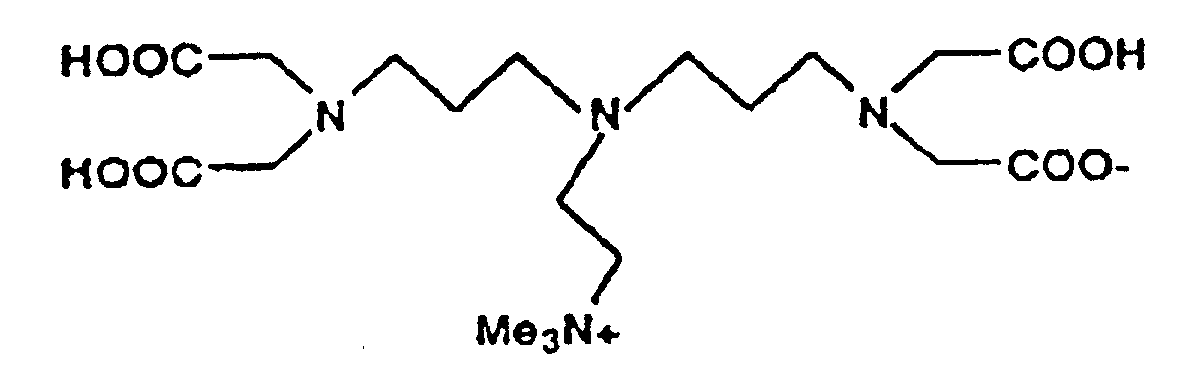
  • reaction of the 2:3 W 3 SO 3 complex of DTPA and/or carboxymethyl-PDTA with a group possessing a quaternary nitrogen atom appears to be a particularly promising route, in particular reaction with cholamine or its bis(hydroxyethylated) analog N-methyl-N,N-bis(hydroxyethyl)ethylenediamine which possess an amino group capable of reacting with the carboxyl group of DTPA or carboxymethyl-PDTA and a quaternary nitrogen atom to balance the negative charges on the complex, eg. the (M 3 ) 2 L 3 complex.
  • a further alternative approach to reducing the overall charge of the complexes for use in accordance with the invention is by coordination of suitable metal ions of appropriate charge between the incomplete cube faces of M 3 clusters.
  • suitable metal ions may conveniently be present as a cryptated species held in postion between the M 3 clusters by coordination with the ligands present.
  • the 3 oxygen atoms on each cluster may form an octahedral coordination environment for binding of a suitably charged metal ion:
  • Metal ions of particular interest include those from the groups IVa and IVb and Ce(IV). Such metal ions may be present in the +4 oxidation state, resulting in a complex having an overall charge of zero. Lower charged metal ions having a charge of +3, +2 and +1 may however be used to achieve partial charge compensation.
  • metal ions may be incorporated into the cluster complex as cryptated metal ions held between the M 3 clusters rather than by being coordinated to the M 3 clusters. This can be illustrated in the case of two W 3 clusters as below:
  • the complexes used according to the invention may be prepared by reaction of multinuclear cluster comounds with the appropriate ligands, optionally having selected groups protected during the dimer formation reaction and with deprotection being effected thereafter. Such a reaction forms a further aspect of the present invention.
  • the ligands used may be ligands known from the literature or may be prepared by analogous methods to those described in the literature.
  • the cluster compounds used may be compounds known from the literature or may be prepared by analogous methods to those described in the literature, eg. in WO-91/14460 and WO 92/17215 and the references set out therein.
  • a particularly useful method for the preparation of [W 3 SO 3 (H 2 O) 9 ]Cl 4 comprises a variant of the process described in WO 92/17215, in which the reaction product of W(CO 6 ) and Na 2 S is treated with at least 6N HCl, and preferably approximately 12N HCl, prior to ion exchange chromatography.
  • the media of the invention may be in conventional pharmaceutical adminstration forms such as tablets, coated tablets, capsules, powders, solutions, suspensions, dispersions, syrups, suppositories, emulsions, liposomes, etc; solutions, suspensions and dispersions in physiologically acceptable carrier media, e.g. water for injections, will however generally be preferred.
  • physiologically acceptable carrier media e.g. water for injections
  • the carrier medium incorporating the multinuclear complex is preferably isotonic or somewhat hypertonic.
  • media for parenteral administration will preferably contain small quantities, e.g.
  • the media of the invention should generally have a heavy atom content of 1 millimole/l to 5 mole/l, preferably 0.1 to 2 mole/l. Dosages of from 0.05 to 2.0 mmoles/Kg, e.g. 0.5 to 1.5 mmoles/kg will generally be sufficient to provide adequate contrast although dosages of 0.8 to 1.2 mmoles/kg will normally be preferred.
  • TGA shows 5.1 wt% loss (ambient temperature to 150°C) for 1.2 H 2 O/mol.
  • the reaction was stopped, cooled, filtered over a fine frit to remove the Na 3 PO 4 , rinsed with CH 3 CN, reduced to dryness and 54.13g of yellow oil were collected.
  • the t-butyl groups were removed by the addition of 100 ml conc HCl and 100 ml distilled water. After stirring for over an hour, the solution was reduced to an oil by rotary-evaporation, chased 3 times with distilled water and 1 H NMR confirmed that all of the t-butyl groups had been removed.
  • N-methylglucamine (9.76g, 0.05M), 2-bromoethyliminodiacetic acid di-t-butyl ester (38.75g, 0.11M), anhydrous trisodium phosphate (20g, 0.12M), and acetonitrile (600 ml) were stirred and refluxed under nitrogen for 18 hours.
  • the reaction mixture was filtered, and the solvent evaporated.
  • the resulting pale yellow residue was treated with 6N HCl (100 ml), stirred for 1 hour to hydrolyze the ester groups, and then reevaporated to yield crude ligand (40.0g) as a pale yellow solid.
  • This ligand was prepared by the method described in (a) above using N-methylpropane-2,3-diol (5.25g, 0.05M), 2-bromoethyliminodiacetic acid di-t-butyl ester (38.75g, 0.11M), anhydrous Na 3 PO 4 (20g, 0.12M), and CH 3 CN (600 ml).
  • the crude, hydrolysed product weighed 32.8g.
  • a portion (5g) was chromatographed on AG-1 X8 (acetate) and, after elution with 0.75N acetic acid, elution with 1N acetic acid yielded purified ligand (2.98g, representing a reaction yield of 92%). It could be further purified by dissolving in water and precipitation with isopropanol.
  • CMPDTA 2-Carboxymethylpropylenediaminetetraccetic acid
  • This product was alkylated by the method of Example 2 (using 5 equivalents of t-butylbromoacetate since the carboxyl group is also alkylated under the reaction conditions) to yield the the ligand pentaester.
  • This was chromatographed on silica-gel, the required product being eluted with 2-3% MeOH in CH 2 Cl 2 as a colorless, viscous oil.
  • This was hydrolysed to the ligand by stirring overnight in 6N HCl. It was purified by chromatography on AG-1 X8, the ligand being eluted with 6N HCl, and isolated as a dry, colorless foam on a rotary evaporator.
  • the ester was hydrolysed with triflic acid to yield the required ligand.
  • This compound was prepared from diethylenetriamine by treatment with ethyl trifluoroacetate (2 equiv.) in CHCl 3 at 0°C, the solution then being stirred overnight. The solution was then evaporated to dryness to yield the bis (trifluoroamide) as a white solid foam. This was dissolved in dry CH 3 CN, treated with MeI (1.1 equiv.) and excess solid anhydrous K 2 CO 3 and stirred at room temperature for 3 hours. The mixture was filtered, the solvent evaporated, the residue dissolved in water, and the solution extracted three times with CHCl 3 . The combined organic solutions were washed once with brine, dried, and evaporated to give a pale yellow oil (74% yield) which crystalized on standing.
  • Ethanolamine was stirred with 2-bromoethyliminodiacetate-t-butyl ester (2.2 equiv.), and anhydrous Na 3 PO 4 (10 equiv.) in CH 3 CN, and allowed to reflux overnight. The mixture was filtered and the residue chromatographed on silica-gel, the required product being eluted with 4-5% MeOH in CHCl 3 . The ester was hydrolysed by stirring overnight in 6N HCl. The ligand was isolated by chromatography on AG-1 X8, the required producted being eluted with 4N acetic acid and isolated as a pale yellow gum.
  • Benzylamine was stirred with 2-bromoethyl-IDA-t-butyl ester (2.2 equiv.) and anhydrous Na 3 PO 4 (10 equiv.) in CH 3 CN, and allowed to reflux overnight. The mixture was filtered and the residue chromatographed on silica-gel, the required product being eluted with 3% MeOH in CHCl 3 . The ester was hydrolysed by stirring overnight in 6N HCl. The ligand was isolated by chromatography on AG-1 X8, the required product being eluted with 4-5N acetic acid.
  • N-methyldiethylenetriamine tetraacetic acid (prepared as in Example 9) was dissolved in MeOH, treated with 6 equiva lents of SOCl 2 dropwise, and then allowed to stir overnight. The solution was evaporated, the residue dissolved in a small amount of MeOH and a small excess of triethylamine added. The mixture was then considerably diluted with ether, and the precipitated amine hydrochloride filtered. Evaporation of the ether yielded the pure tetramethylester as a pale yellow oil in 96% yield.
  • the title compounds were prepared by a modified procedure based on that described by Cotton, F.A., et. al. in Polyhedron 5 , 907 (1986).
  • Na 4 [(W 3 S 3 O) 2 (EGTA) 3 ] .6H 2 O was formulated as a 121 mM solution with pH 6.95; osmolality 517 mmoles/kg.
  • the maximum tolerated dose (MTD) in mice was ⁇ 3.95 mmoles complex/kg.
  • mice Na 4 [(W 3 SO 3 ) 2 (OBETA) 3 ].10H 2 O was formulated as a 107 mM solution with pH 7.03; osmolality 498 mmoles/kg.
  • the maximum tolerated dose (MTD) in mice was -4.35 mmoles complex/kg.
  • Na 4 [(W 3 SO 3 ) 2 (PDTA) 3 ] 11H 2 O was formulated as a 79mM solution with pH 6.6; osmolality 311 mmoles/kg.
  • the maximum tolerated dose (MTD) in mice was >6.5 mmoles complex/kg.
  • This compound was prepared in a similar procedure to that of Na 4 [(W 3 SO 3 ) 2 (PDTA) 3 ], with 4.0g of [W 3 SO 3 (H 2 O) 9 ]Cl 4 , 400 mL of DMF, and 2.54g of BDTA.
  • the crude product was purified by two treatments of Sephadex G-25 column. The third band was collected and rotary evaporated to dryness. 1.1g of red solid was obtained. It contained 12 H 2 O.
  • mice Na 4 [(W 3 SO 3 ) 2 (BDTA) 3 ].12H 2 O was formulated as a 120mM solution with pH 7.4; osmolality 459 mmoles/kg.
  • the maximum tolerated dose (MTD) in mice was ⁇ 2.55 mmoles complex/kg.
  • Na 4 [(W 3 SO 3 ) 2 (MeO-PDTA) 3 ] . 7H 2 O was formulated as a 140mM solution with pH 6.5; osmolality 563 mmoles/kg.
  • the maximum tolerated dose (MTD) in mice was -5.25 mmoles complex/kg.
  • CM-PDTA 2-Carboxymethyl-1.3-propylene diamine-N,N,N'N'. tetraacetic acid
  • This compound was prepared in a similar procedure to that of Na 4 [(W 3 SO 3 ) 2 (HO-PDTA) 3 ] with 2.0g of [W 3 SO 3 (H 2 O) 9 ]Cl 4 , 100mL of DMF and 1.21g of CM-PDTA. However, no red solid separated during the reaction, which was different to the preparation of Na 4 [(W 3 SO 3 ) 2 (HO-PDTA) 3 ].
  • the Na 4 [(W 3 SO 3 ) 2 (CM-PDTA) 3 ] was purified by multiple recrystallisation steps of the PPN + salt in a similar procedure to that of Na 4 [(W 3 SO 3 ) 2 (HO-PDTA) 3 ]. 0.50g of red solid was obtained. It contained 7 H 2 O.
  • This compound was prepared in a similar procedure to that of Na 4 [(W 3 SO 3 ) 2 (HO-PDTA) 3 ] with 2.0g of [W 3 SO 3 (H 2 O) 9 ]Cl 4 , 100mL of DMF and 1.37g of DTPA. A red solid separated during the reaction, which was collected by filtration as the crude product. The Na 4 [(W 3 SO 3 ) 2 (DTPA) 3 ] was purified by multiple recrystallisation steps of the PPN + salt in a similar procedure to that of Na 4 [(W 3 SO 3 ) 2 (HO-PDTA) 3 ]. 0.40g of red solid was obtained. It contained 5.5 H 2 O.
  • This compound was prepared in a similar procedure to that of Na 4 [(W 3 SO 3 ) 2 (HO-PDTA) 3 ] with 2.0g of [W 3 SO 3 (H 2 O) 9 ]Cl 4 , 100mL of DMF and 1.31g of HO-Et-DTTA. A red solid separated during the reaction, which was collected by filtration as the crude product.
  • the Na 4 [(W 3 SO 3 ) 2 (HO-Et-DTTA) 3 ] was purified by multiple recrystallisation steps of the PPN + salt in a similar procedure to that of Na 4 [(W 3 SO 3 ) 2 (HO-PDTA) 3 ]. 0.10g of red solid was obtained. It contained 15 H 2 O.
  • This compound was prepared in a similar procedure to that of Na 4 [(W 3 SO 3 ) 2 (HO-PDTA) 3 ] with 2.0g of [W 3 SO 3 (H 2 O) 9 ]Cl 4 , 100mL of DMF and 1.21g of Me-DTTA. A red solid separated during the reaction, which was collected by filtration as the crude product. The Na 4 [(W 3 SO 3 ) 2 (DTTA) 3 ] was purified by multiple recrystallisation steps of the PPN + salt in a similar procedure to that of Na 4 [(W 3 SO 3 ) 2 (HO-PDTA) 3 ]. 0.24g of red solid was obtained. It contained 10 H 2 O.
  • the W 3 SO 3 DTPA complex (Example 27, 2.0g, 0.77 mM), (2-aminoethyl)trimethylammonium chloride hydrochloride (cholamine, 15.0g, 85.7 mM), 1-(3-dimethylaminopropyl)-3-ethylcarbodiimide hydrochloride (EDAC, 14.8g, 77 mM), and 1-hydroxybenzotriazole hydrate (HOBT, 11.9g, 88 mM), were stirred in water (400 mL), and the pH adjusted from 4.4 to 6.85 with 50% aqueous NaOH. The mixture was stirred for 18 hours, after which time the pH was 6.95.
  • cholamine 15.0g, 85.7 mM
  • EDAC 1-(3-dimethylaminopropyl)-3-ethylcarbodiimide hydrochloride
  • HOBT 1-hydroxybenzotriazole hydrate
  • this solution was passed twice through Sephadex G-10 gel filtration agent (to remove the organic reagents), the red eluate being collected in each case.
  • This solution was next passed through ion exchange resin (Bio-Rad AG 50W-X8, Na + form, to remove any traces of cholamine). This solution (pH 7.1) was evaporated to leave a dark red solid (2.03g).
  • the compound has the formula: C 57 H 96 N 15 O 33 W 6 S 2 Na. xH 2 O Product H% C% Na% S% W% HPLC purity % Found 4.69 24.34 8.05 0.34 2.35 37.35 95 Calc., x 8.39 4.21 23.15 7.10 0.78 2.17 37.30 (x was determined thermogravimetrically)
  • the osmolality was determined in water and compared to the EGTA complex (Example 20).
  • Complex (charge) Concentration Osmolality EGTA (4-) 41 mM 199 mmole/kg Cholamide 40 mM 79 mmole/kg
  • the osmolality for the EGTA complex is as expected for a 5 particle system at this concentration.
  • the osmolality for the cholamide complex is as expected for a 2 particle system at this concentration.
  • Example 32 The same method of Example 32 was used for the preparation of this complex but in place of the W 3 SO 3 DTPA complex, the W 3 SO 3 -CMPDTA complex was used.
  • Example 32 The method of Example 32 was used, but in place of cholamide the bis(hydroxyethylated) analog, [NH 2 CH 2 CH 2 N + (CH 3 )(CH 2 CH 2 OH) 2 ] [Cl - ] was used.

Landscapes

  • Health & Medical Sciences (AREA)
  • Life Sciences & Earth Sciences (AREA)
  • General Health & Medical Sciences (AREA)
  • Epidemiology (AREA)
  • Animal Behavior & Ethology (AREA)
  • Chemical & Material Sciences (AREA)
  • Public Health (AREA)
  • Veterinary Medicine (AREA)
  • Engineering & Computer Science (AREA)
  • Nanotechnology (AREA)
  • Pharmacology & Pharmacy (AREA)
  • Medicinal Chemistry (AREA)
  • Physics & Mathematics (AREA)
  • Acoustics & Sound (AREA)
  • Radiology & Medical Imaging (AREA)
  • Nuclear Medicine, Radiotherapy & Molecular Imaging (AREA)
  • Bioinformatics & Cheminformatics (AREA)
  • Biophysics (AREA)
  • Biotechnology (AREA)
  • General Engineering & Computer Science (AREA)
  • Medical Informatics (AREA)
  • Molecular Biology (AREA)
  • Crystallography & Structural Chemistry (AREA)
  • Optics & Photonics (AREA)
  • Medicines Containing Antibodies Or Antigens For Use As Internal Diagnostic Agents (AREA)
  • Organic Low-Molecular-Weight Compounds And Preparation Thereof (AREA)

Description

The present invention relates to the use in diagnostic imaging, in particular X-ray, ultrasound and scintigraphy of contrast agents comprising complexes of multinuclear moieties, and to contrast media containing such complexes.
All diagnostic imaging is based on the achievement of different signal levels from different structures within the body. Thus in X-ray imaging for example, for a given body structure to be visible in the image, the X-ray attenuation by that structure must differ from that of the surrounding tissues. The difference in signal between the body structure and its surroundings is frequently termed contrast and much effort has been devoted to means of enhancing contrast in diagnostic imaging since the greater the contrast between a body structure and its surroundings the higher the quality of the images and the greater their value to the physician performing the diagnosis. Moreover, the greater the contrast the smaller the body structures that may be visualized in the imaging procedure, i.e. increased contrast can lead to increased spatial resolution.
The diagnostic quality of images is strongly dependent on the inherent noise level in the imaging procedure - and the ratio of the contrast level to the noise level can thus be seen to represent an effective diagnostic quality factor for diagnostic images.
Achieving improvement in such a diagnostic quality factor has long been and still remains an important goal. In techniques such as X-ray and ultrasound, one approach to improving the diagnostic quality factor has been to introduce contrast enhancing materials, contrast agents, into the body region being imaged.
Thus in X-ray for example early examples of contrast agents were insoluble inorganic barium salts which enhanced X-ray attenuation in the body zones into which they distributed. More recently the field of X-ray contrast agents has been dominated by soluble iodine containing compounds such as those marketed by Nycomed AS under the trade names Omnipaque and Amipaque.
Much recent work on X-ray contrast agents has concentrated on aminopolycarboxylic acid (APCA) chelates of heavy metal ions and, recognising that effective imaging of many body sites requires localization at the body sites in question of relatively high concentrations of the metal ions, there have been suggestions that polychelants, that is substances possessing more than one separate chelant moiety, might be used to achieve this.
More recently it has been found that contrast enhancement may be achieved particularly effectively by the use of multinuclear complexes, that is complexes wherein the complexed moiety itself comprises two or more contrast enhancing atoms. Thus, for X-ray or ultrasound the complex would comprise two or more heavy metal atoms and for MRI the complex would contain two or more metal atoms with paramagnetic properties.
However, we have now found that multinuclear complexes comprising two ligand-conjugated multinuclear clusters are particularly effective diagnostic imaging contrast enhancers, in particular for X-ray imaging.
Thus, viewed from one aspect the present invention provides a diagnostic imaging contrast medium comprising an image contrast enhancing physiologically tolerable complex, said complex comprising a pair of interconjugated multinuclear clusters, or a physiologically tolerable salt thereof, together with at least one pharmaceutical carrier or excipient.
By "multinuclear cluster" is meant a covalently bound molecule or ion containing at least two, and preferably 3, 4, 5 or 6, especially 3 or 4 metal atoms, in particular heavy metals or paramagnetic metals or metals having radiation emitting isotopes. Clusters containing heavy metals (ie. row 5 of the periodic table or higher) and in particular W or Mo, especially W, are particularly preferred, especially W3 and W4 clusters.
In such multinuclear clusters, besides the contrast enhancing atoms, generally metal atoms, the cluster framework will generally include other atoms which may for example serve as bridges between the contrast enhancing atoms. Such further atoms include for example oxygen and sulphur and thus many multinuclear clusters will be in the form of polyoxo cations and the full and partial sulfur analogues.
The dimeric cluster complexes, eg. those in which the individual clusters contain three contrast enhancing atoms M, ie. (M3)2 complexes, have particular potential as contrast agents since, relative to simple monomeric multinuclear complexes, the increase in the contrast enhancing atom content of the molecule is achieved with little increase in the volume occupied by the contrast agent complex. Thus the use of such complexes enables a high ratio of contrast enhancing atom to overall complex volume to be achieved. By increasing the relative content of contrast enhancing atoms in this way the total quantity of the contrast agent to achieve the same contrast effect may be reduced and problems associated with contrast agent solubility or toxicity or with contrast medium viscosity may also be reduced.
Viewed from another aspect the invention provides the use of a physiologically tolerable complex, said complex comprising a pair of interconjugated multinuclear clusters, or a physiologically tolerable salt thereof, for the manufacture of a contrast medium composition for use in imaging of the human or non-human animal body.
Viewed from a still further aspect, the invention provides a method of generating an image of a human or non-human animal, preferably mammalian, body which method comprises administering to said body a contrast enhancing amount of a physiologically tolerable complex, said complex comprising a pair of interconjugated multinuclear clusters, or a physiologically tolerable salt thereof, and generating an image of at least part of said body into which said agent distributes.
Preferred multinuclear complexes for use in accordance with the invention include those having two M3 clusters (which may of course include other atoms besides the three contrast enhancing atoms M) linked together by three chelant groups L, each of which coordinates to both clusters. This can be expressed by the general formula I (M3)2 L3
Particularly preferred complexes for use in contrast media according to the invention include those in which M is selected from the group VIb metals, in particular those in which M is Mo and/or W, especially preferably those in which each M is W.
As mentioned above the multinuclear clusters may also contain further atoms which may have little or no contrast enhancing effect but which may for example function as bridging atoms bonding the contrast enhancing atoms in each M3 cluster together. Particularly suitable examples of such bridging atoms include the atoms of groups VIa and VIIa, eg. oxygen, sulphur, selenium, tellurium and halogen atoms.
Each M3 cluster may thus, for example, be present as a group of formula X3SaOb where a is 1, 2, 3 or 4, b is 0, 1, 2 or 3, a+b is 4, and X is a metal atom.
Particularly preferably, the M3 clusters may be present as W3S4 [ie. W3(µ 3S) (µ 2S)3] or W3SO3.
The symbols "µ 3S" and "µ 2S" here indicate sulphur atoms bound respectively to 3 and 2 metal atoms in the cluster.
Besides the ligands which interlink the multinuclear clusters, the complexes may of course include further ligands which coordinate only to a single cluster.
The ligands, either those which interlink or those which coordinate to a single cluster, can be selected from a wide range of structures. The range of metal coordinating and cluster coordinating ligands is very broad and is described at length in the scientific and patent literature relating to heavy metal detoxification and sequestering and to chelate based magnetic resonance imaging contrast agents. In the latter regard the reader is referred to the numerous patent publications of Schering, Nycomed Imaging, Nycomed Salutar, Squibb, Mallinckrodt, Bracco and Guerbet.
For interlinking clusters, the ligands L may conveniently represent linear, branched or cyclic polyamino, polyaminocarboxylic or polycarboxylic acids. More specifically, L may be represented by the formula II: (R2)2N[(CHR4)mNR1]n(CHR4)mN(R2)2 where each R1 which may be the same or different represents a group R2 or a C1-4alkyl, phenyl-C1-4alkyl, C1-4hydroxyalkyl or amino-C1-4 alkyl group or two R1 groups may together represent a group CH2CH2NR3CH2CH2 where R3 is an R2 group or a C1-4 alkyl group optionally substituted by hydroxyl, carboxyl, aryl or amino groups; n is 0, 1 or 2; each m is 2, 3 or 4 preferably 2; and each R4 denotes a group R1 or a carboxyl, hydroxyl or C1-4alkoxy group; and each R2 independently represents a hydrogen atom or an optionally amidated or esterified carboxy - (C1-4 alkyl) group, wherein any amide nitrogen is substituted by group selected from hydrogen atoms and optionally hydroxylated C1-4 alkyl groups; preferably optionally hydroxylated C1-4 alkyl groups; preferably such that an R4 or R1 group contains a quaternary amine group.
Particularly preferably L is represented by the formulae III, IV or V (R2)2NCH2CH2NR1CH2CH2NR1CH2CH2N (R2)2
Figure 00060001
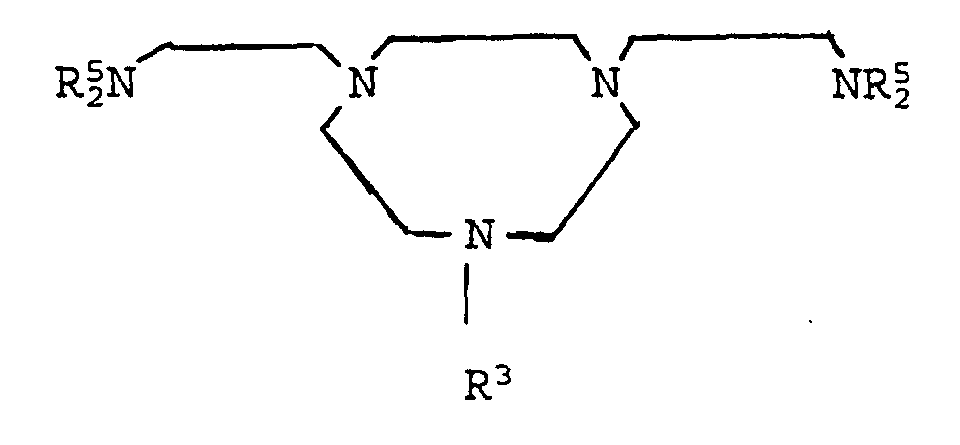
(R2)2NCH2CHR4N(R2)2    in which R1, R2 and R4 are as defined above.
For example, L may be selected from (HOOCCH2)2NCH2CH2N(CH2CH2OH)CH2CH2N(CH2CH2OH)CH2CH2N(CH2COOH)2 (HOCH2CH2)2NCOCH2N(CH2COOH)CH2CH2(N(CH2COOH)CH2CH2)2N(CH2COOH)CH2CON(CH2CH2OH)2 (HOOCCH2)2NCH2CH(CH3)N (CH2COOH)2 H2NCH2CH2N(CH2COOH)CH2CH2N(CH2COOH)CH2CH2NH2 (HOOCCH2)2NCH2CH2N(CH2CH2N(CH2CH2OH)2)CH2CH2N(CH2CH2N(CH2CH2OH)2)CH2CH2N(CH2COOH)2 (HOOCCH2)2NCH2CH2N(CH2COOH)CH2CH2N(CH2COOH)CH2CH2N(CH2COOH)2
and
Figure 00060002
   where each R5 is hydrogen or carboxymethyl and R3 is hydroxyalkyl or N-carboxymethylated amino alkyl.
Particularly preferably, L may be selected from (HOOCCH2)2NCH2CH2N(CH(CH2OH)2)CH2CH2N(CH2COOH)2 and (HOOCCH2)2NCH2CH2N (C(CH2OH)3)CH2CH2N(CH2COOH)2.
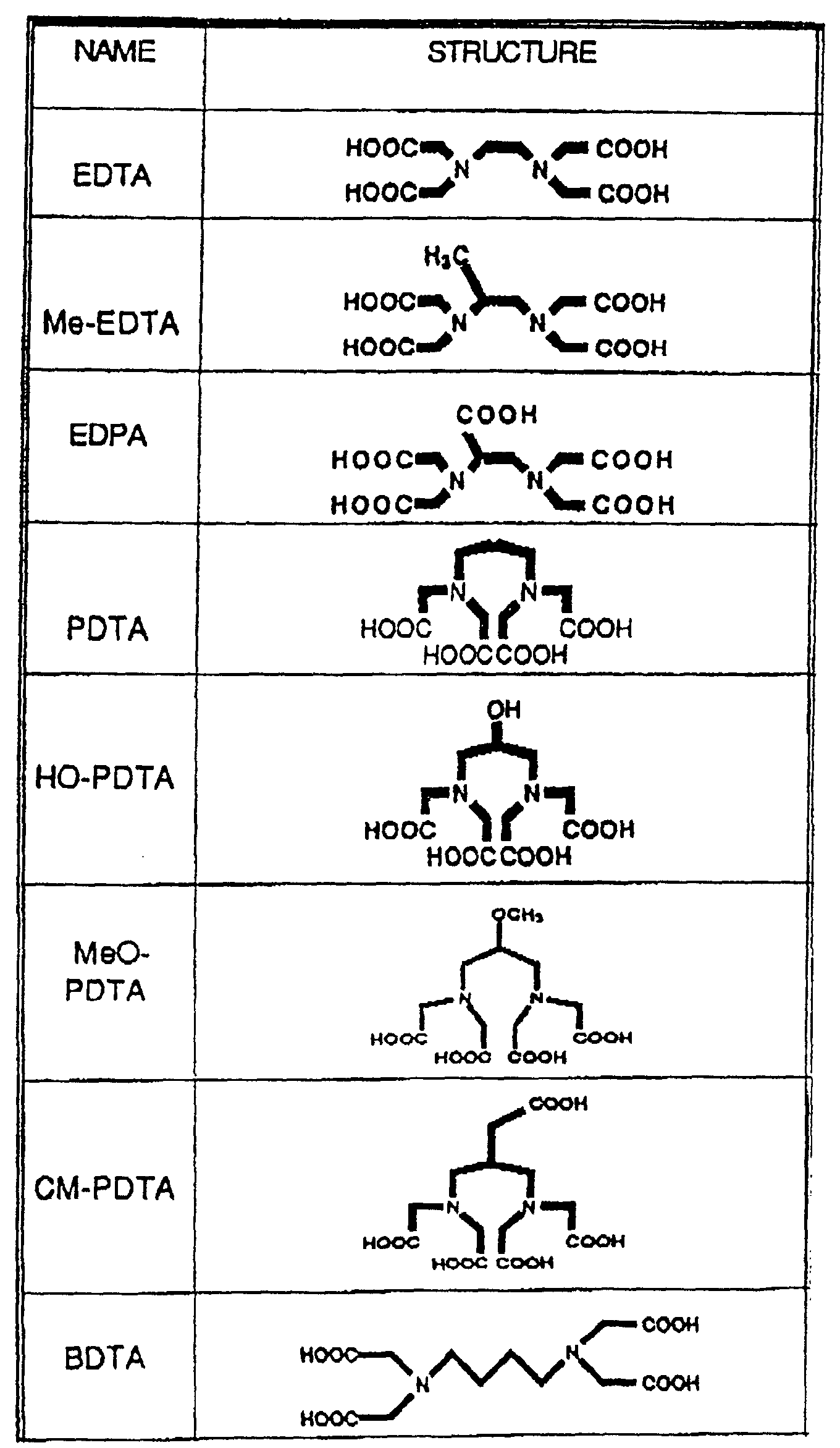
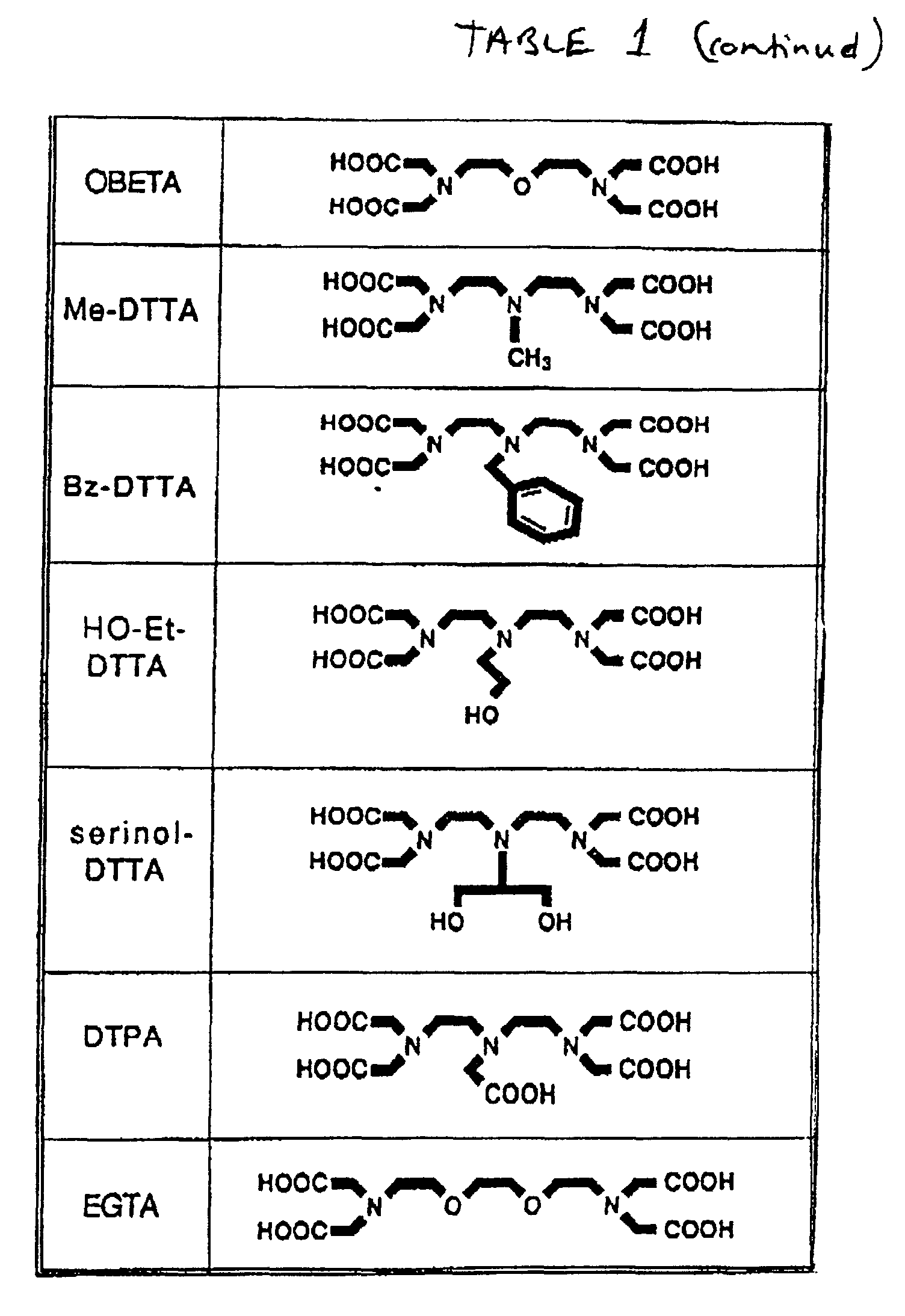
Further suitable ligands are shown in Table 1 below:
Figure 00070001
Figure 00080001
Besides the compounds of formula II, many of the most useful ligands useable according to the invention fall into the more general formula VI Z (X (CHR6)a)bXZ (where a is an integer of from 2 to 12, preferably 2 to 10, e.g. 2, 3, or 4; b is an integer of from 1 to 8, preferably 2, 3 or 4;
  • each R6, independently is hydrogen, a hydrophilic or charged group (e.g. a hydroxyalkyl or quaternary aminoalkyl group) or two groups R6, or one R6 and one group Z, together represent a saturated or unsaturated heterocyclic or carbocyclic ring, preferably with 5-7 ring atoms;
  • each X independently is O, S, NZ or PZ,
  • each Z indpendently is hydrogen, hydroxyalkyl, mercaptoalkyl, carboxyalkyl (or an amide or ester derivative thereof e.g. -CH2CONHCH3) or optionally hydroxy or mercapto substituted acyl, or is a side chain ((CHR6)a X*)cZ* (where c is 1 to 4 and X* and Z* are as defined for X and Z but do not represent any group containing a X* or Z* group) or two groups Z together form a bridging group ((CHR6)a X*)c(CHR6)a) or are salts thereof).
  • While polyamines and polyethers, especially linear or cyclic polyamines and polyethers, such as ethylenediamine,1,4,7-triazacyclononane and cyclen, can be used as ligands, in general linear aminopolycarboxylic acids (APCAs) substituted to carry a pendant charged or hydrophilic group are preferred, particularly DTPA, EDTA and TTHA derivatives thereof and analogues, and other cyclic and non-cyclic APCAs as defined in WO-A-89/00557.
    In the ligands of formulae II to VI described above, unless otherwise stated, any alkyl moiety preferably has a carbon atom content of up to 8, any cyclic group other than the macrocyclic skeleton of a macrocyclic ligand is preferably a three to eight membered ring and any carboxyl derivative is preferably an amide group.
    The complexes used according to the invention may be ionic or, more preferably, may carry no net charge; most preferably they are non-ionic. Moreover they may be water-soluble or, less preferably, water-insoluble. Any necessary counterions should of course most preferably also be physiologically tolerable.
    The range of physiologically acceptable counterions for therapeutically active agents is of course well known to pharmacologists.
    Suitable countercations include for example protons, alkali and alkaline earth metal ions, e.g. sodium, calcium and magnesium and zinc, ammonium and organic cations (e.g. organic amine cations, quaternary ammonium, pyridinium, meglumine, alkylammonium, polyhydroxy-alkylammonium, basic protonated amino acids, etc), transition metal complex cations, organometallic cations, etc. Suitable counteranions include for example halide (e.g. chloride, bromide, iodide, I3 - etc.), sulphate, mesylate, phosphate, etc.
    The 2:3 complexes, ie. two clusters interlinked by 3 ligands, such as those of formula I above, are novel and these and their salts, especially the physiologically acceptable salts form a further aspect of the invention. In this regard, particular reference is made to (W3SaOb)2[(R2)2N[(CHR4)mNR1]n(CHR4)mN(R2)]3 complexes and salts thereof.
    In the complexes used in the invention, it is particularly preferred that the electrical charge carried by the ligands L should substantially if not completely balance that carried by the M3 clusters. Thus, for example, in the case of the 2:3 complexes of W3SO3 it is preferably to reduce the overall negative charge inherent in such a complex whilst simultaneously increasing the water solubility/hydrophilicity of the cluster complex.
    We have found that this can be achieved by the use of so-called "charge compensation" chelate ligands which carry a positive charge, preferably in the form of a quaternary ammonium group located either in the backbone of the bridging ligand or, more preferably, in a backbone substituent of the ligand. On complexation with, for example, two W3SO3 clusters, such "charge compensation" ligands are capable of forming a 2:3 zwitterionic complex with a lower overall ionic charge (reduced from -4 to -1).
    In addition, the positive centre of such "charge compensation" ligands may be functionalised with groups such as for example hydroxyl groups, which serve to increase the solubility/hydrophilicity of the resulting complex.
    Two main approaches can be used to introduce charge compensation: (i) prepare positively charged ligands (such as quaternary ammonium containing) and then form a 2:3 complex with the W3SO3 cluster; and (ii) start with a pre-formed 2:3 cluster/ligand complex and use a chemical reaction at a non-tungsten coordinating functional group (amine, carboxylate, etc.) to introduce positive charge (quaternary ammonium for example).
    The precise location of the positive centre on the chelate ligand has been found to affect the complexation reaction pathway and in some cases may shift the pathway away from formation of the desired 2:3 complexes towards undesired polymeric materials.
    Alternatively it is possible to introduce positive charge into a pre-formed 2:3 complex. This approach uses a post-complexation functionalization of a pre-formed 2:3 complex of W3SO3 to derivatize a portion of the ligand in a 2:3 complex that is not involved in coordinating to tungsten. Charge compensation is achieved by either inducing a positive centre (such as alkylation to form a quaternary ammonium center at an amine of the ligand that is not involved in binding to tungsten) or by attaching a cationic functional group (such as a quaternary ammonium group) to a functional group of the ligand that is not attached to tungsten. This is an attractive approach because it overcomes any possible difficulties of complexation with positively charged ligands and because straightforward organic chemistry can be used to attach different types of hydrophilic and charged groups to already formed and purified 2:3 complexes of W3SO3.
    For example, the reaction of the 2:3 W3SO3 complex of DTPA and/or carboxymethyl-PDTA with a group possessing a quaternary nitrogen atom appears to be a particularly promising route, in particular reaction with cholamine or its bis(hydroxyethylated) analog N-methyl-N,N-bis(hydroxyethyl)ethylenediamine which possess an amino group capable of reacting with the carboxyl group of DTPA or carboxymethyl-PDTA and a quaternary nitrogen atom to balance the negative charges on the complex, eg. the (M3)2L3 complex.
    Figure 1 hereinafter illustrates the reaction of (W3SO3)2(DTPA)3 with cholamine to produce a complex having a single overall negative charge.
    A further alternative approach to reducing the overall charge of the complexes for use in accordance with the invention is by coordination of suitable metal ions of appropriate charge between the incomplete cube faces of M3 clusters. Such metal atoms may conveniently be present as a cryptated species held in postion between the M3 clusters by coordination with the ligands present.
    Thus, for example, in the case of 2 W3SO3 clusters, the 3 oxygen atoms on each cluster may form an octahedral coordination environment for binding of a suitably charged metal ion:
    Figure 00130001
    Metal ions of particular interest include those from the groups IVa and IVb and Ce(IV). Such metal ions may be present in the +4 oxidation state, resulting in a complex having an overall charge of zero. Lower charged metal ions having a charge of +3, +2 and +1 may however be used to achieve partial charge compensation.
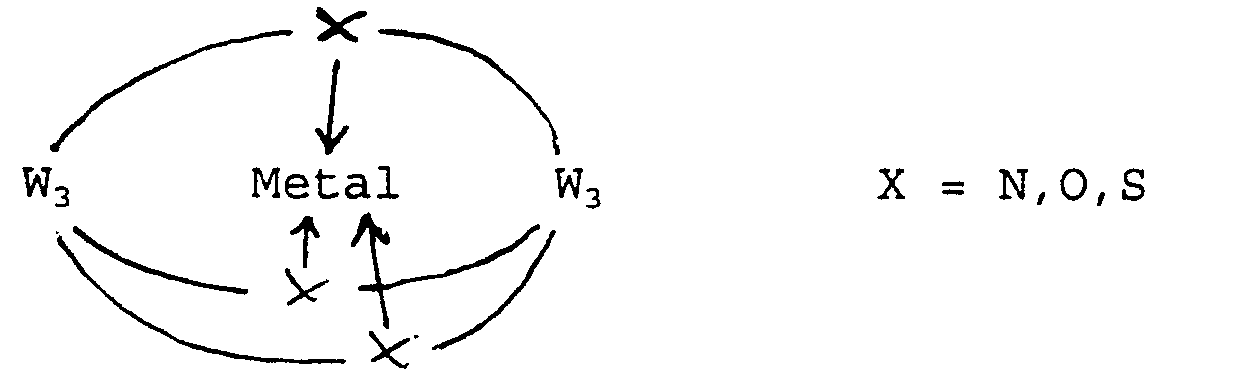
    As outlined above, metal ions may be incorporated into the cluster complex as cryptated metal ions held between the M3 clusters rather than by being coordinated to the M3 clusters. This can be illustrated in the case of two W3 clusters as below:
    Figure 00130002
    Suitable metal ions include those of groups Ia, IIa and IIIa, transition metal ions and lanthanide elements. As will be appreciated, in the case of 2:3 complex illustrated above, as the metal ion charge varies from +1 to +4, the overall charge of the complex will vary from -3 to 0.
    The complexes used according to the invention may be prepared by reaction of multinuclear cluster comounds with the appropriate ligands, optionally having selected groups protected during the dimer formation reaction and with deprotection being effected thereafter. Such a reaction forms a further aspect of the present invention.
    The ligands used may be ligands known from the literature or may be prepared by analogous methods to those described in the literature.
    The cluster compounds used may be compounds known from the literature or may be prepared by analogous methods to those described in the literature, eg. in WO-91/14460 and WO 92/17215 and the references set out therein. A particularly useful method for the preparation of [W3SO3(H2O)9]Cl4 comprises a variant of the process described in WO 92/17215, in which the reaction product of W(CO6) and Na2S is treated with at least 6N HCl, and preferably approximately 12N HCl, prior to ion exchange chromatography.
    For adminstration to human or animal subjects, the complexes will conveniently be formulated in sterile form together with pharmaceutical or veterinary carriers or excipient. The contrast media of the invention may conveniently contain pharmaceutical or veterinary formulation aids, for example stabilizers, antioxidants, osmolality adjusting agents, buffers, pH adjusting agents, colorants, flavours, viscosity adjusting agents and the like. They may be in forms suitable for parenteral or enteral administration, for example, injection or infusion or administration directly into a body cavity having an external voidance duct, for example the gastrointestinal tract, the bladder and the uterus. Thus the media of the invention may be in conventional pharmaceutical adminstration forms such as tablets, coated tablets, capsules, powders, solutions, suspensions, dispersions, syrups, suppositories, emulsions, liposomes, etc; solutions, suspensions and dispersions in physiologically acceptable carrier media, e.g. water for injections, will however generally be preferred. Where the medium is formulated for parenteral administration, the carrier medium incorporating the multinuclear complex is preferably isotonic or somewhat hypertonic. Moreover, media for parenteral administration will preferably contain small quantities, e.g. 0.01 to 10 mole percent relative to the multinuclear complex of free chelants or of weak chelate complexes with physiologically tolerable chelated species (e.g. Ca2+); small additions of sodium or calcium salts may also advantageously be made.
    For use as X-ray contrast media, the media of the invention should generally have a heavy atom content of 1 millimole/l to 5 mole/l, preferably 0.1 to 2 mole/l. Dosages of from 0.05 to 2.0 mmoles/Kg, e.g. 0.5 to 1.5 mmoles/kg will generally be sufficient to provide adequate contrast although dosages of 0.8 to 1.2 mmoles/kg will normally be preferred.
    For scintigraphy, dosages of the radioactive species will generally be lower.
    The present invention will now be described by way of the following Examples, in which all percentages and ratios are by weight and all temperatures are in degrees Celsius, unless otherwise specified.
    EXAMPLE 1 Preparation of oxybis(ethyliminodiacetic acid) (OBETA)
    Chloroacetic acid (13.3g, 141 mmol) was dissolved in 15 ml 30% NaOH. To this was added 2,2'-oxybis(ethylamine)-dihydrochloride (5.0g, 28.2 mmol) with stirring.
    Further 30% NaOH solution was added to keep the pH between 10 and 11.5 during the course of the reaction. After 2½ hours the reaction was heated to 40°, and then to 90° after a further 3 hours. The reaction was left overnight at ambient temperature, and then heated for 12 hours at 90°, during which time it consumed only a small amount of NaOH. 1H-NMR indicated the reaction to be completed at this stage. The product was then loaded onto an AG1-X8 acetate form ion exchange resin column and eluted with 4-5N HOAc. The non-bound portion of the product was mixed with excess sodium acetate, loaded onto an AG50W H+ column, and eluted with NH4OH. The fractions containing clean product from both columns were combined, basified and rechromatographed through AG1-X8 acetate form ion exchange resin to give 6g (63%) of a white foam product on drying under vacuum.
    13C NMR (D2O) 55.3, 57.4, 65.0, 170.0.
    1H NMR (D2O) 3.42, t, 4H; 3.67, t, 4H; 3.89, s, 8H.
    Calc OBETA + 0.1 H2O 42.63% C, 6.02% H, 8.29% N.
    Found 42.54% C, 5.94% H, 8.34% N.
    EXAMPLE 2 Preparation of serinol DTTA
    2-Bromoethyl-iminodiacetic acid-t-butyl ester (36.4g, 103 mmol), serinol (4.28g, 47 mmol) and trisodium phosphate (77g, 470 mmol) were combined in 200 ml acetonitrile and heated to reflux overnight with stirring. The next day, TLC of the solution showed one major spot and three very minor spots. The mixture was filtered and the filter cake washed with further CH3CN and discarded. The filtrate was evaporated to dryness to give 36g of a thick yellow oil, which was then diluted with methanol and treated with 6N HCl (200 ml). After one hour stirring, this was evaporated to dryness and treated with further 6N HCl for an hour. The solution was evaported to dryness, and chased once with water to give 34g solid (1H-NMR indicated ∼98% complete deprotection). This was dissolved in water and the pH raised to 11 with NaOH. The product was loaded onto 800 cm3 AG1-X8 OH-form ion exchange resin, washed with water, and eluted with acetic acid. Pure desired product was eluted off with 3N acetic acid, and further impure product was recovered with additional 3N and 4N acetic acid. The fractions containing pure product were combined and chased repeatedly with H2O to give 9.2g of a white foam on drying under vacuum. The impure product was rechromatographed under the same conditions to give an additional 3g product for a total yield of 12.2g (64%).
    13C NMR (D2O) 50.0, 53.2, 58.1, 59.5, 66.0, 173.6.
    1H NMR (D2O) 3.24, m, 9H; 3.56, d, 4H; 3.62, s, 8H.
    C15H27N3O10•1.4 H2O.
    Calc 41.5% C, 6.9% H, 9.7% N.
    Found 41.5% C, 6.8% H, 9.6% N.
    TGA shows 5.1 wt% loss (ambient temperature to 150°C) for 1.2 H2O/mol.
    EXAMPLE 3 Preparation of DTTA-Tris
    Figure 00180001
    A 3 necked, 1.0 L round bottom flask equipped with an overhead stirrer, reflux condenser, oil bath and hot plate was charged with 8.278g (0.0683 moles) (HOCH2)3CNH2 which was dissolved using 200 ml of 10% MeOH/CH3CN. 123.20g (0.752 moles) Na3PO4, 52.97g (0.150 moles) bromoethyl-IDA, t-butyl-ester and approximately 650 ml of 10% MeOH/CH3CN was added and the mixture was refluxed (85-90°C) for 20 hours under a N2 purge and the reaction was followed by TLC. After 40 hours no more bromoethyl-IDA was observed. The reaction was stopped, cooled, filtered over a fine frit to remove the Na3PO4, rinsed with CH3CN, reduced to dryness and 54.13g of yellow oil were collected. The t-butyl groups were removed by the addition of 100 ml conc HCl and 100 ml distilled water. After stirring for over an hour, the solution was reduced to an oil by rotary-evaporation, chased 3 times with distilled water and 1H NMR confirmed that all of the t-butyl groups had been removed.
    The yellow oil was diluted in approximately 100-200 ml of distilled water, basified using 2.0N NaOH to pH 10.5, reduced in volume, readjusted to pH 10.5, filtered over a fine frit and loaded onto an AG1-X8 column in the OH-form. The column was washed with 2.0 L of distilled water. The eluant was evaporated to dryness and 1H NMR confirmed that the water wash contained impurities and sodium hydroxide. The column was washed with 3-4 L each of 1.0 N, 2.0 N and 3.0 N HOAc solutions and 1H and 13C NMR confirmed that these washes did not contain the desired title product. The column was further washed with 10.0 L of 4.0 N HOAc and 5L of 5.0 N HOAc solutions, and following evaporation under vacuum >28g of crispy white solid (93% yield) was obtained. It was confirmed by 1H (integration fit 8:6:8) and 13C (ppm; 172.9, 70.8, 63.0, 58.6, 56.0, 49.5) NMR and by mass spectroscopy. (M-H+ at 440 amu.) that the 4.0 N/5.0 N HOAc washes contained the desired product, DTTA-Tris.
    C6H29N3O11•2 H2O:
    Calc C: 40.42 H: 7.00 N: 8.84
    Found C: 40.29 H: 6.72 N: 8.77
    EXAMPLE 4 Preparation of N'-(polyhydroxyalkyl)-N'-methyldiethylenetriaminetetraacetic acid
    Figure 00190001
    (a) R = CH 2 (CHOH) 4 CH 2 OH
    N-methylglucamine (9.76g, 0.05M), 2-bromoethyliminodiacetic acid di-t-butyl ester (38.75g, 0.11M), anhydrous trisodium phosphate (20g, 0.12M), and acetonitrile (600 ml) were stirred and refluxed under nitrogen for 18 hours. The reaction mixture was filtered, and the solvent evaporated. The resulting pale yellow residue was treated with 6N HCl (100 ml), stirred for 1 hour to hydrolyze the ester groups, and then reevaporated to yield crude ligand (40.0g) as a pale yellow solid.
    A portion (5g) of this solid was chromatographed on AG-1 X8 (acetate form) ion exchange resin. After elution with 0.75N acetic acid, the purified ligand (2.57g, representing a reaction yield of 80%) was eluted with 1N acetic acid. It could be further purified by dissolving in water and precipitation with methanol.
    FAB-MS showed MH+ 514, calculated = 514.
    1H NMR: 4.1 ppm, t, 1H, terminal CHOH; 3.2-3.8 ppm, m (including major s at 3.5 ppm, CH2COO), 24H (theor. = 23); 3.0 ppm, s, 3H, NCH3.
    (b) R = CH 2 CHOHCH 2 OH
    This ligand was prepared by the method described in (a) above using N-methylpropane-2,3-diol (5.25g, 0.05M), 2-bromoethyliminodiacetic acid di-t-butyl ester (38.75g, 0.11M), anhydrous Na3PO4 (20g, 0.12M), and CH3CN (600 ml). The crude, hydrolysed product weighed 32.8g. A portion (5g) was chromatographed on AG-1 X8 (acetate) and, after elution with 0.75N acetic acid, elution with 1N acetic acid yielded purified ligand (2.98g, representing a reaction yield of 92%). It could be further purified by dissolving in water and precipitation with isopropanol.
    FAB-MS showed MH+ 424, calculated = 424.
    1H NMR: 4.1 ppm, t, 1H, CHOH; 3.3-3.9 ppm, m (including major s at 3.6 ppm, CH2COO), 23H (theor. = 20); 3.1 ppm, s, 3H, NCH3.
    EXAMPLE 5 Preparation of carboxyethylenediaminetetraacetic acid (EDPA)
    Chloroacetic acid (5 equiv) was dissolved in 30% NaOH. To this was added 2,3-diaminopropionic acid (1 equiv) with stirring. Further 30% NaOH solution was added to keep the pH between 10 and 11.5 during the course of the reaction. After 2.5 hours the reaction was heated to 40°C, and then to 90°C after a further 3 hours. The reaction was left overnight at RT, and then heated for a day at 90°C, during which time it consumed only a small amount of NaOH. After this the reaction appeared complete by 1H-NMR. The product was loaded onto an AG1-X8 acetate form ion exchange resin column; the ligand was not fully purified by ion exchange chromatography, and hence was further purified by recrystallization from water.
    FAB MS: MH+ found, 337; calculated, 337.
    1H NMR (D2O, ppm) : 3.0(m), 2.7 (d), 2.3(m).
    13C NMR (D2O, ppm) : 169.0, 167.9, 53.8, 48.5, 45.3, 44.0
    Calc. for C11H16N2O10.2.3H2O 34.98%C 5.50%H 7.42%N
    Found 35.06%C 5.76%H 7.25%N
    EXAMPLE 6 Preparation of 2-Methoxypropylenediaminetetraacetic acid (MeO-PDTA)
    The amino groups of 2-hydroxy-1,3-diaminopropane were protected using (BOC)2O (quantitative yield). The product, in anhydrous tetrahydrofuran, was treated with NaH (1.1 equiv) for 1 hour, and then treated at 0°C with MeI (2 equiv), allowing the mixture to warm to ambient temperature overnight. The product was chromatographed on silica-gel, and the required product eluted with 10-20% ethyl acetate in hexane in 43% yield. It was hydrolyzed by stirring overnight at room temperature with 6N HCl, and then alkylated with bromoacetic acid at 45%, pH 9-10 overnight. The crude ligand was purified by chromatography on AG-1 X8 resin (OH- form), being eluted with 10-15N acetic acid, yield 90%.
    FAB MS : MH+ found, 337. Calc, 337
    1H NMR (D2O, ppm): 3.7,s, 9H : 3.3, m, 4H : 3.1 s, 3H.
    EXAMPLE 7 Preparation of 2-Carboxymethylpropylenediaminetetraccetic acid (CMPDTA)
    To malononitrile (30g, 0.45M) in anhydrous tetrahydrofuran (3000 mL) was added NaH (14.4 g, 60%. 0.36M), and the mixture stirred for 15 minutes. Benzyl bromoacetate (57 mL. 0.36M) in tetrahydrofuran (500 mL) was added slowly dropwise at 0°C, and the mixture allowed to stir overnight. The solution was filtered and the solvent evaporated to yield an orange gum. This was treated with ethanol to yield a white solid (12.5g) whose 1H NMR spectrum indicated that it contained 93% monoalkylated malononitrile and 7% of the dialkylated product. A second treatment with ethanol improves the purity to 97%.
    This product, in acetic acid solution, was reduced overnight in a Parr hydrogenator using Pearlman's catalyst, to yield 2-carboxymethyl-1,3-propylenediamine as a pale yellow gum.
    FAB MS : MH+ found, 133, calc. 133.
    This product was alkylated by the method of Example 2 (using 5 equivalents of t-butylbromoacetate since the carboxyl group is also alkylated under the reaction conditions) to yield the the ligand pentaester. This was chromatographed on silica-gel, the required product being eluted with 2-3% MeOH in CH2Cl2 as a colorless, viscous oil. This was hydrolysed to the ligand by stirring overnight in 6N HCl. It was purified by chromatography on AG-1 X8, the ligand being eluted with 6N HCl, and isolated as a dry, colorless foam on a rotary evaporator.
    FAB MS: MH+ found, 365. Calc., 365.
    1H NMR (D2O, ppm) : 3.8, 3.7, 3.0, 2.2.
    13C NMR (D2O, ppm) : 184, 181, 63, 61.5, 60.7, 43, 34.
    EXAMPLE 8 Preparation of butylenediaminetetraacetic acid (BDTA)
    6.0 g of 1.4-diaminobutane and 56.4g (4.25 equivalents) of t-butylbromoacetate and trisodium phosphate (77 g, 470 mmol) were combined in 200 ml acetonitrille and heated to reflux overnight with mechanical stirring. The next day, TLC of the solution showed one major spot and three very minor spots. The mixture was filtered and the salt cake was washed with further CH3CN and discarded. The filtrate was evaporated to dryness to give a thick yellow oil which was then diluted with methanol and treated with 6N HCl (200ml). After one hour stirring, this was evaporated to dryness and treated with further 6N HCl for one an hour. The solution was evaporated to dryness, and chased once with water to give 34g solid; 1H-NMR showed ∼98% complete deprotection. The crude t-butyl ester product was chromatographed on silica-gel, the required product being eluted with 3-4% MeOH in CH2Cl2.
    FAB MS: MH+ found, 545: calculated, 545.
    The ester was hydrolysed with triflic acid to yield the required ligand.
    FAB MS: MH+ found, 321: calculated, 321.
    This product was purified by dissolution in 2N NH4OH followed by precipitation with 12N HC1.
    1H NMR (D2O, ppm): 2.8,s, 8H; 2.2,s, 4H: 1.1,s, 4H.
    13C NMR (D2O, ppm): 181, 60, 56, 25.
    Calc. for C12H20N2O8,1.29HCl,1.10H2O 37.23%C 6.12%H 7.24%N
    Found 37.22%C 6.06%H 7.17%N
    EXAMPLE 9 Preparation of N'-methyl-DTTA (Me-DTTA)
    This compound was prepared from diethylenetriamine by treatment with ethyl trifluoroacetate (2 equiv.) in CHCl3 at 0°C, the solution then being stirred overnight. The solution was then evaporated to dryness to yield the bis (trifluoroamide) as a white solid foam. This was dissolved in dry CH3CN, treated with MeI (1.1 equiv.) and excess solid anhydrous K2CO3 and stirred at room temperature for 3 hours. The mixture was filtered, the solvent evaporated, the residue dissolved in water, and the solution extracted three times with CHCl3. The combined organic solutions were washed once with brine, dried, and evaporated to give a pale yellow oil (74% yield) which crystalized on standing. This product was deprotected by stirring overnight at room temperature in 4N NaOH, with the addition of a small amount of MeOH to clarify the solution. The solvent was evaporated, and the product amine purified by vacuum distillation, a higher boiling fraction being rejected, yield 37%. The amine was alkylated by the procedure of Example 1. The product was purified by chromatography on AG-1 X8, the desired product being eluted with 2 N acetic acid.
    1H NMR (D2O, ppm): 3.6,s,8H; 3.3,s,8H; 2.8,s,3H.
    EXAMPLE 10 Preparation of N-2.3-propanediol DTTA (2.3-diol-PDTA).
    3-Amino-2,3-propenediol in DMF was treated with 2-bromoethyliminodiacetic acid di(t-butyl) ester (2.2 equiv.), and tetramethylguanidine (2.2 equiv.), and heated at 75°C for 24 hours. The solvent was evaporated, and the residue dissolved in CHCl3 and extracted three times with water. The CHCl3 was evaporated, and the residue hydrolyzed by stirring overnight in 6N HCl. The crude ligand was purified by chromatography on AG-1 X8, being eluted by 4N acetic acid.
    1H NMR (D2O, ppm) :
    3.83,m,1H; 3.62,s.8H; 3.36 and 3.27,t and s 10H; 3.0,t,2H.
    13C NMR (D2O, ppm) :
    : 171, 66.3, 62.8, 55.7, 55.2, 50.1, 49.7
    EXAMPLE 11 Preparation of hydroxyethyl DTTA (HO-Et-DTTA)
    Ethanolamine was stirred with 2-bromoethyliminodiacetate-t-butyl ester (2.2 equiv.), and anhydrous Na3PO4 (10 equiv.) in CH3CN, and allowed to reflux overnight. The mixture was filtered and the residue chromatographed on silica-gel, the required product being eluted with 4-5% MeOH in CHCl3. The ester was hydrolysed by stirring overnight in 6N HCl. The ligand was isolated by chromatography on AG-1 X8, the required producted being eluted with 4N acetic acid and isolated as a pale yellow gum.
    FAB MS: MH+ found 380; calculated 380.
    1H NMR (D2O, ppm) :
    3.7,t,2H; 3.6,s,8H; 3.3,t,8H; 3.1,t,2H.
    13C NMR (D2O, ppm):
    173, 56.8, 56.5, 55.6, 51.2, 50.6.
    EXAMPLE 12 Preparation of benzyl-DTTA (Bz-DTTA)
    Benzylamine was stirred with 2-bromoethyl-IDA-t-butyl ester (2.2 equiv.) and anhydrous Na3PO4 (10 equiv.) in CH3CN, and allowed to reflux overnight. The mixture was filtered and the residue chromatographed on silica-gel, the required product being eluted with 3% MeOH in CHCl3. The ester was hydrolysed by stirring overnight in 6N HCl. The ligand was isolated by chromatography on AG-1 X8, the required product being eluted with 4-5N acetic acid.
    1H NMR (D2O, ppm) :
    7.1,s,5H; 3.9,s,2H; 3.3,s,8H; 3.1,s,8H
    13C NMR (D2O, ppm):
    170, 127.9, 126.9, 125.9, 59.6, 56.1, 51.7, 50.9
    EXAMPLE 13 Preparation of N',N'-dimethyl-N,N"-diethylenetriaminetraacetic acid (DTTAO-Me).
    N-methyldiethylenetriamine tetraacetic acid (prepared as in Example 9) was dissolved in MeOH, treated with 6 equiva lents of SOCl2 dropwise, and then allowed to stir overnight. The solution was evaporated, the residue dissolved in a small amount of MeOH and a small excess of triethylamine added. The mixture was then considerably diluted with ether, and the precipitated amine hydrochloride filtered. Evaporation of the ether yielded the pure tetramethylester as a pale yellow oil in 96% yield.
    The tetraester was dissolved in methanol, MeI added (1 equiv.), and the solution stirred for 1 hour at room temperature. A second addition of MeI (1 equiv.) was made, and the solution stirred for 3 days. Evaporation yielded the required quaternized product. This was hydrolyzed with 1N HC1 at 90°C for 2 hours. The crude ligand was recovered by evaporation, and purified on AG-1 X8 (acetate form). The pure ligand was eluted with 0.75N acetic acid, and evaporated several times with 1N HC1 to convert it to the hydrochloride (2HC1) salt, a white powder.
    FAB MS: MH+ found 364. Calc. 364.
    1H NMR (D2O, ppm) :
    3.65 and 3.61,s and t, 12H; 3.3,t,4H; 3.0,s,6H.
    13C NMR (D2O, ppm):
    171, 60.4, 57.1, 53.3, 50.2.
    Calc. for C14H28N3O8Cl3,4.5H2O 30.36%C; 6.73%H; 7.59%N
    Found 30.40%C; 6.66%H; 7.58%N.
    EXAMPLE 14 Preparation of NONON-MeO
    Figure 00270001
    2(2-Aminoethoxy) ethanol was converted to the BOC derivative in quantitative yield with (BOC)2O. The hydroxyl group was converted to the bromo group by treatment in CH2Cl2 at 0°C with triphenylphosphine (1.25 equiv.) and N-bromo-succinimide (1.25 equiv.). The bromo compound was recovered from a silica-gel column in 63% yield as a colorless oil by elution with 1:1 ether-hexane. This was used in an alkylation-quaternization reaction on dimethylamine, similar to that of Example 4 except that the mixture was refluxed for 4 days. The product was purified on silica-gel, eluting with 10% MeOH-CHCl3, and recovered in 67% yield.
    FAB MS: MH+ found 420. Calc. 421.
    Removal of the BOC protecting groups was achieved quantitatively by treatment with 6N HCl at room temperature for 15 hours. After removal of the HCl by repeated reconcentration from water, the diamine was alkylated with bromoacetic acid under the conditions of Example 1. The product was purified by chromatography on AG-1 X8, eluted with 0.05N acetic acid as a colorless gum in 64% yield.
    1H NMR (D2O, ppm) :
    3.75 and 3.69, 2s, 16H; 3.5,s,4H; 3.4,s,4H; 3.0,s,6H.
    13C NMR (D2O, ppm):
    169, 64, 56.5, 54.7, 51.8
    EXAMPLE 15 Preparation of DTPA-cholamine:
    Figure 00280001
    This was prepared by the method of Example 2, using 3-bromopropyliminodiacetic acid-t-butyl ester (8.05g, 22mM), cholamine hydrochloride (1.75g, 10mM), and anhydrous Na3PO4 (10g. 61mM), in 200mL acetonitrille, and refluxed for 4 days. The mixture was filtered and the product isolated on a rotary evaporator.
    FAB MS: MH+ found, 674; Calc., 674.
    The reaction mixture was chromatographed on silica-gel, the required product being eluted by 7.5% MeOH in CH2Cl2 as a yellow oil (64% yield). The ester was hydrolysed with 6N HC1 at room temperature for 1 hour. The recovered product was purified by chromatography on AG-1 X8, the product being eluted with 0.5M acetic acid (56% yield, based on cholamine)
    FAB MS: MH+ found, 449. Calc. 449.
    1H NMR (D2O, ppm) :
    3.67,s,8H; 3.55,t,2H; 3.35,t,2H; 3.15,t,4H; 3.0,s,9H; 2.95,t,4H; 1.9,t,4H
    13C NMR (D2O, ppm):
    170, 60.5, 57.8, 54.3, 54.0, 50.7, 46.5, 20.0
    EXAMPLE 18 Preparation of the W 3 ( µ 3 -S) 3 complex of ethylenebis-(oxyethylenenitrilo)tetraacetic acid: [Na 4 ((W 3 ( µ 3 -S)( µ 2 -S) 3 ) 2 (EGTA) 3 ]
    3.66g of [W3(µ 3-S) (µ 2-S)3(H2O)9] Cl4 prepared as described in WO92/17215 was dissolved in 500 mL of DMF, forming a dark green solution. 2.065g of EGTA was added to the green solution. The mixture was refluxed for 4 hours until a blue suspension was obtained. After cooling the suspension, the blue solid was collected by filtration and washed with isopropanol and acetone. The yield for the crude product was 3.73g.
    1H NMR (d6-DMSO) δ = 4.49 ppm (t, 4H), 4.19 ppm (q, 4H, J-15.81 Hz), 3.98 ppm (t, 4H), 3.60 ppm (s, 4H).
    EXAMPLE 19 a) Preparation of [W 3 SO 3 (H 2 O) 9 ] Cl 4 and [W 3 S 3 O(H 2 O) 9 ]Cl 4
    The title compounds were prepared by a modified procedure based on that described by Cotton, F.A., et. al. in Polyhedron 5, 907 (1986). To a three-neck flask with 24.0g of anhydrous Na2S, 1.6mL of H2O was added dropwise, then 40.0g of W(CO)6, and 2.0L of acetic anhydride was added. The mixture refluxed for 6 hours under N2. Then an additional 20g of W(CO)6 was added and the mixture was refluxed for 16 hours. After thorough cooling of the mixture, the yellow-brown solid was dissolved in 2.0 M HCl. The red solution was filtered and the filtrate was diluted by the addition of 5 equiv. amount of water. The solution was loaded onto an AG50W-X8 cation exchange column. 0.5 M HC1 and 0.75 M HC1 was used to wash off the undesired byproducts. Elution with 4 M HCl yielded a red solution. This eluant was rotary evaporated to dryness. The resulting solid was redissolved in 2 M HC1 and loaded onto a Sephadex G-15 column. Elution with 2 M HCl yielded a red-orange band (1st band), which when evaporated to dryness at high vacuum gave a red solid [W3SO3(H2O)9]Cl4 (15g). The second band, purple-red, was also collected and rotary evaporated to dryness under vacuum to afford a red-purple solid [W3S3O(H2O)9]Cl4 (approx. 2g).
    Elemental analysis indicated the first band was [W3SO3(H2O)9] Cl4.
    Calculated W (58.95%) S (3.43%)
    Found W (59.40%) S (3.63%)
    UV-Vis: 460 nm (ε = 360 M-1cm-1)
    The second band was identified as [W3S3O(H2O)9]Cl4 by its UV-vis spectrum.
    UV-Vis: 535 nm (ε = 410 M-1cm-1).
    b) Preparation of [W 3 SO 3 (H 2 O) 9 ]Cl 4 and [W 3 S 3 O(H 2 O) 9 ]Cl 4 with an improved ratio of W 3 SO 3 :W 3 S 3 O
    To W(CO6) (90g) and Na2S (36g) under a blanket of N2 was added acetic anhydride (31). The flow of N2 was then stopped and the mixture stirred with a mechanical stirrer. The mixture was heated at reflux for 72hr. The resulting black solution was cooled to room temperature and filtered. The solid (dark brown powder and clear needles) was divided in half. Fraction A (107g, wet) was placed under vacuum and stored for future use in a freezer. The remaining Fraction B (107g, wet) was taken up in 12N HCl (1000ml) and stirred briefly. The mixture was allowed to stand for 2.5hr, then poured into H2O (1l). The resulting solution was concentrated under vacuum at less than 50°C to 100ml. This solution was loaded onto a Sephadex (G-25, 500g) column and eluted with 2N HCl. Three distinct fractions were obtained. First was a pale orange band, second a ruby red/brown band and third a purple band. The ruby red/brown band was collected and concentrated in vacuum to dryness to yield 15.6g of the W3SO3 compound. In addition 3g of a 50:50 mixture of the W3SO3 compound and a pale orange solid and 7g of a 75:25 mixture of the W3SO3 compound and a purple solid were obtained.
    EXAMPLE 20 Preparation of Na 4 [(W 3 SO 3 ) 2 (EGTA) 3 ] and Na 4 [(W 3 S 3 O) 2 (EGTA) 3 ] (EGTA = Ethylene glycol bis(2-aminoethyl ether)-N.N.N'N-tetraacetic acid). 1. Na4 [(W3SO3)2(EGTA)3]
    5.0g of [W3SO3(H2O)9]Cl4 was dissolved in 700 mL of DMF. Then 3.0g of EGTA was added. The mixture was refluxed for 3 hours, a red solid separated. The red solid was collected by filtration and redissolved in H2O. It was passed through an AG50X8 column (Na+ form) and the resulting solution was dried by rotary evaporation. The red solid was dissolved in minimal amount of water and loaded on to a Sephadex G-25 column. Elution with water yielded three bands. The last band was collected, dried by rotary evaporation, and passed through the Sephadex G-25 column again. The third band was collected and dried to give 1.0g of red solid product. It contained 10 H2O.
    UV-Vis: 475 nm (ε = 1250 M-1cm-1).
    1H NMR (D2O, ppm) :
    4.26 (d,4H), 4.04 (d,4H), 3.55 (t,4H) 3.44 (t, 4H), 3.35 (s, 4H).
    13C NMR (D2O) :
    δ (ppm) 181.0, 70.3, 66.8, 64.1.
    183W NMR (D2O, Na2WO4 reference) :
    δ (ppm) 1206.5.
    MS-FAB+:
    M+Na 2507.
    Elemental analysis:
    Calculated W(41.1%) S(2.41) C(18.93) H(3.03) N(3.15)
    Na(3.45)
    Found W(39.8%) S(2.43) C(18.74) H(2.88) N(3.08)
    Na(3.44)
    Na4[(W3SO3)2(EGTA)3].10H2O was formulated as a 168 mM solution with pH 6.65; osmolality 685 mmoles/kg. The maximum tolerated dose (MTD) in mice was ∼7.75 mmoles complex/kg.
    2. Na4[(W3S3O)2(EGTA)3]
    This compound was prepared in a similar procedure to that of Na4[(W3S3O)2(EGTA)3] with 5.0g of [W3S3O(H2O)9]Cl4, 800 mL of DMF, and 2.95g of EGTA. The crude product was purified by two treatments of Sephadex G-25 column. The third band was collected and rotary evaporated to dryness. 0.7g of red-purple solid was obtained. It contained 6 H2O.
    UV-Vis: 558 nm.
    183W NMR (D2O) : δ (ppm) 2479, 1853, 1854, 1855
    MS-FAB+: [M+Na]+ 2571.
    Elemental analysis:
    Calculated W(41.53%) S(7.20) C(18.99) H(2.73) N(3.16)
    Na(3.46)
    Found W(43.12%) S(6.60) C(19.02) H(2.81) N(3.09)
    Na(3.84)
    Na4[(W3S3O)2(EGTA)3] .6H2O was formulated as a 121 mM solution with pH 6.95; osmolality 517 mmoles/kg. The maximum tolerated dose (MTD) in mice was ∼3.95 mmoles complex/kg.
    EXAMPLE 21 Preparation of Na4[(W3SO3)2(OBETA)3] (OBETA = Oxbis(ethylamine)-N.N.N'N'-tetraacetic acid
    To a solution of 3.8g [W3SO3(H2O)9]Cl4 in 400 mL of DMF, 1.83 g of OBETA was added. The mixture was refluxed for 3 hours, a red-orange solid separated. The solid was collected and excess amount of isopropanol was added to the filtrate, causing the separation of additonal solid. It was collected and the two batches of solids were combined. They were dissolved in H2O and the solution was passed through a AG50X8 column (Na+ form). The eluant was rotary evaporated to dryness. The red solution was dissolved in minimal amount of water and loaded on to a Sephadex G-25 column. Elution with water yielded three bands. The last band was collected, rotary evaporated to dryness, and passed through the Sephadex G-25 column again. The third band was collected and rotary evaporated to dryness. 1.8g of red solid was obtained. It contained 10 H2O.
    UV-Vis:
    475 nm
    1H NMR (D2O) ;
    δ (ppm) 4.28 (d, 4H), 4.17 (d, 4H), 3.55 (t, 4H), 3.39 (t, 4H)
    13C NMR (D2O) :
    δ (ppm) 182.0, 67.9, 65.3
    183W NMR (D2O):
    δ (ppm) 1203.5
    MS-FAB+ M+Na 2374.
    Elemental analysis:
    Calculated W (43.56%) S(2.53) C(17.08) H(2.71) N(3.32)
    Na(3.60)
    Found W(43.77%) S(2.70) C(16.98) H(2.49) N(3.34)
    Na (3.18)
    Formulation and Toxicology in Mice
    Na4[(W3SO3)2(OBETA)3].10H2O was formulated as a 107 mM solution with pH 7.03; osmolality 498 mmoles/kg. The maximum tolerated dose (MTD) in mice was -4.35 mmoles complex/kg.
    EXAMPLE 22 Preparation of Na4[(W3SO3)2(PDTA)3] (PDTA = 1.3-Propylene diamine-N,N,N',N', tetraacetic acid)
    To a solution of 2.0 g [W3SO3(H2O)9]Cl4 in 160mL of DMF, 0.91 g of PDTA was added. The mixture was refluxed for 4 hr, a red solid separated. The solid was collected by filtration. It was dissolved in H2O and the solution was passed through a AG50X8 column (Na+ form). The eluant was rotary evaporated to dryness. The red solid was dissolved in minimal amount of water and loaded on to a Sephadex G-25 column. Elution with water yielded three bands. The last band was collected, rotary evaporated to dryness, and passed through the Sephadex G-25 column again. The third band was collected and rotary evaporated to dryness, 1.2 g of red solid was obtained. It contained 11 H2O.
    UV-Vis:
    475 nm.
    1H NMR (D2O) :
    δ (ppm) 4.20 (d, 4H), 4.09 (d, 4H), (m, 4H), 2.07 (m, 2H). 2.93
    13C NMR (D2O) :
    δ (ppm) 182.6, 66.8, 63.9, 19.2.
    183W NMR (D2O) :
    δ (ppm) 1189
    MS-FAB+:
    [M+H]+ 2262
    Elemental analysis:
    Calculated W (44.84%) S (2.61) C (16.30) H (2.61)
    N (3.42) Na (3.74)
    W (44.46%) S (2.69) C (16.65) H (2.30)
    N (3.46) Na (3.81)
    Formulation and Toxicology in Mice.
    Na4[(W3SO3)2(PDTA)3] 11H2O was formulated as a 79mM solution with pH 6.6; osmolality 311 mmoles/kg. The maximum tolerated dose (MTD) in mice was >6.5 mmoles complex/kg.
    EXAMPLE 23 Preparation of Na 4 [(W 3 SO 3 ) 2 (BDTA) 3 ] (BDTA = 1,4-Butylene diamine-N,N,N',N'-tetraacetic acid)
    This compound was prepared in a similar procedure to that of Na4[(W3SO3)2(PDTA)3], with 4.0g of [W3SO3 (H2O)9]Cl4, 400 mL of DMF, and 2.54g of BDTA. The crude product was purified by two treatments of Sephadex G-25 column. The third band was collected and rotary evaporated to dryness. 1.1g of red solid was obtained. It contained 12 H2O.
    UV-Vis:
    475 nm.
    1H NMR (D2O) :
    δ (ppm) 4.17 (d, 4H), 3.92 (d, 4H), 3.15 (b, 4H), 1.28 (b, 4H).
    183W NMR (D2O) :
    δ (ppm) 1209.
    MS-FAB+:
    [M+Na]+ 2327.
    Elemental analysis:
    Calculated W (43.77%) S (2.54%) C(17.16) H(2.88)
    N (3.33) Na (3.65)
    Found W (44.29%) S (2.51%) C(16.93) H(2.96)
    N (3.15) Na (3.50)
    Formulation and Toxicology in Mice
    Na4[(W3SO3)2(BDTA)3].12H2O was formulated as a 120mM solution with pH 7.4; osmolality 459 mmoles/kg. The maximum tolerated dose (MTD) in mice was ~2.55 mmoles complex/kg.
    EXAMPLE 24 Preparation of Na 4 [(W 3 SO 3 ) 2 (HO-PDTA) 3 ] (HO-PDTA = 2-Hydroxy-1,3-propylene diamine-N,N,N'N'-tetraacetic acid)
    To a solution of 2.0 g [W3SO3(H2O)9] Cl4 in 100mL of DMF, 1.10 g of HO-PDTA was added. The mixture was refluxed for 3hr, a red solid separated. The DMF solvent was recovered by rotary evaporation and a red residue was obtained. It was dissolved in H2O and NaOH was used to adjust the pH of the solution from pH 2 to pH 9. The solution was rotary evaporated to dryness. The residue was dissolved in water and filtered through a 0.22 micron filter. The pH of the solution was then adjusted back to pH 2 by the addition of HCl. Then 1.7g of [(Ph3P)2N]Cl (PPNCl) in warm water was added and a fine red solid separated. The solid was collected by filtration and purified by multiple recrystallization steps from MeOH/H2O. The crystallization procedure consisted of diluting the MeOH solution of (PPN)4[(W3SO3)2(HO-PDTA)3] with distilled water and allowing the crystals to grow slowly. The crystals were collected and washed with hot distilled water. The Na+ salt of the complex was obtained through cation exchange using AG50X8 resin (Na+ form). 0.76g of red solid was obtained. It contained 6 H2O.
    UV-Vis:
    475 nm
    1H NMR (D2O) :
    δ (ppm) 4.7 (m, 1H), 4.2-4.6 (m, 8H), 3.33 (m, 2H), 2.74 (m, 2H)
    183W NMR (D2O):
    δ (ppm) 1207.7, 1201.3, 1196.2, 1190.7.
    MS-FAB+:
    [M+H]+ 2308
    Elemental analysis:
    Calculated W (45.62%) S (2.65%) C(16.39) H(2.25)
    N (3.48) Na (3.80)
    Found W (46.05%) S (2.68%) C(16.02) H(2.66)
    N (3.40) Na (3.54)
    Formulation and Toxicology in Mice
    By neutralizing the H4[(W3SO3)2(HO-PDTA)3] solution, which was obtained through the cation exchange using AG50X8 resin (H+ form), with N-methyl-d-glucamine (NMG), the (NMG)4[(W3SO3)2(HO-PDTA)3] salt was obtained. It was formulated as a 153mM solution with pH 6.98; osmolality 499 mmoles/kg. The maximum tolerated dose (MTD) in mice was ∼2.17 mmoles complex/kg.
    EXAMPLE 25 Preparation of Na 4 [(W 3 SO 3 ) 2 (MeO-PDTA) 3 ] (MeO-PDTA = 2-Methoxyl-1,3-propylene diamine-N,N,N'N'-tetraacetic acid).
    To a solution of 2.0 g [W3SO3(H2O)9]Cl4 in 30mL of DMF at 150°C, a solution of 1.08g of MeO-PDTA in 30mL of DMF was added dropwise. The addition took 30 min., then the mixture was refluxed for 3 hr, a red solution separated. The solid was collected by filtration. It was dissolved in H2O and the solution was passed through a AG50X8 column (Na+ form). The eluant was dried by rotary evaporation. The red solution was dissolved in minimal amount of water and loaded on to a Sephadex G-25 column. Elution with water yielded three bands. The last band was collected, rotovapped to dryness, and passed through the Sephadex G-25 column again. The third band was collected and dried by rotary evaporation. 1.4g of red solid was obtained. It contained 7 H2O.
    UV-Vis:
    475 nm
    1H NMR (D2O) :
    δ (ppm) 4.2-4.6 (m, 9H), 3.71 (s, 3H) 3.33 (m, 4H), 2.8 (m, 4H)
    183W NMR (D2O) :
    δ (ppm) 1212.4, 1205.8, 1201.7, 1195.4,
    MS-FAB+:
    [M+H]+ + 2349
    Elemental analysis:
    Calculated W (44.51%) S (2.59%) C(17.45) H(2.52)
    N(3.39) Na(3.71)
    Found W (45.13%) S (2.35%) C(16.77) H(2.91)
    N(3.17) Na(3.89)
    Formulation and Toxicology in Mice
    Na4[(W3SO3)2(MeO-PDTA)3] . 7H2O was formulated as a 140mM solution with pH 6.5; osmolality 563 mmoles/kg. The maximum tolerated dose (MTD) in mice was -5.25 mmoles complex/kg.
    EXAMPLE 26 Preparation of Na 4 [(W 3 SO 3 ) 2 (CM-PDTA) 3 ] (CM-PDTA = 2-Carboxymethyl-1.3-propylene diamine-N,N,N'N'. tetraacetic acid)
    This compound was prepared in a similar procedure to that of Na4[(W3SO3)2(HO-PDTA)3] with 2.0g of [W3SO3(H2O)9]Cl4, 100mL of DMF and 1.21g of CM-PDTA. However, no red solid separated during the reaction, which was different to the preparation of Na4[(W3SO3)2(HO-PDTA)3]. The Na4[(W3SO3)2(CM-PDTA)3] was purified by multiple recrystallisation steps of the PPN+ salt in a similar procedure to that of Na4[(W3SO3)2(HO-PDTA)3]. 0.50g of red solid was obtained. It contained 7 H2O.
    UV-Vis:
    475 nm.
    1H NMR (D2O):
    δ (ppm) 4.1-4.6 (m, 8H), 3.7 (m, 2H), 2.5-3.0 (m, 7H),
    183W NMR (D2O) :
    δ (ppm) 1235.7, 1228.1, 1216.7, 1212.6.
    MS-FAB+:
    [M+Na]+ 2504
    Elemental analysis:
    Calculated W (41.97%) S (2.44%) C(17.82) H(2.26)
    N(3.20) Na(6.12)
    Found W (41.70%) S (2.62%) C(18.22) H(2.79)
    N(3.20) Na(6.09)
    EXAMPLE 27 Preparation of Na 4 [(W 3 SO 3 ) 2 (DTPA) 3 ] (DTPA = Diethylenetriaminepentaacetic acid)
    This compound was prepared in a similar procedure to that of Na4[(W3SO3)2(HO-PDTA)3] with 2.0g of [W3SO3(H2O)9]Cl4, 100mL of DMF and 1.37g of DTPA. A red solid separated during the reaction, which was collected by filtration as the crude product. The Na4[(W3SO3)2(DTPA)3] was purified by multiple recrystallisation steps of the PPN+ salt in a similar procedure to that of Na4[(W3SO3)2(HO-PDTA)3]. 0.40g of red solid was obtained. It contained 5.5 H2O.
    UV-Vis:
    475 nm (ε = 1300 M-1cm-1)
    1H NMR (D2O):
    δ (ppm) 4.24 (d, 4H), 4.02 (d, 4H), 3.37 (b, 4H), 3.01 (s, 2H), 2.93 (m, 4H)
    13C NMR (D2O) :
    δ (ppm) 182.2, 180.1, 65.1, 64.4, 56.6, 51.8.
    183W NMR (D2O) :
    δ (ppm) 1211.6.
    MS-FAB+:
    [M+Na]+ 2612
    Elemental analysis:
    Calculated W (41.04%) S (2.39%) C(18.77) H(2.44)
    N(4.69) Na(5.99)
    Found W (41.36%) S (2.49%) C(18.71) H(2.97)
    N(4.28) Na(6.13)
    EXAMPLE 28 Preparation of Na 4 [(W 3 SO 3 ) 2 (HO-Et-DTTA) 3 ] (HO-Et-DTTA = N'-Hydroxyethyl-N,N,N"N"-diethylenetriaminetetraacetic acid)
    This compound was prepared in a similar procedure to that of Na4[(W3SO3)2(HO-PDTA)3] with 2.0g of [W3SO3(H2O)9]Cl4, 100mL of DMF and 1.31g of HO-Et-DTTA. A red solid separated during the reaction, which was collected by filtration as the crude product. The Na4 [(W3SO3)2(HO-Et-DTTA)3] was purified by multiple recrystallisation steps of the PPN+ salt in a similar procedure to that of Na4[(W3SO3)2(HO-PDTA)3]. 0.10g of red solid was obtained. It contained 15 H2O.
    UV-Vis:
    475 nm (ε = 1300 M-1cm-1)
    1H NMR (D2O):
    δ (ppm) 4.20 (d, 4H), 4.00 (d, 4H), 3.48 (b, 2H), 3.35 (m, 4H), 2.77 (m, 4H), 2.46 (b, 2H);
    13C NMR (D2O):
    δ (ppm) 182.6, 65.7, 65.1, 62.0, 57.5. 53.0
    183W NMR (D2O) :
    δ (ppm) 1218.3.
    MS-FAB+:
    [M+Na]+ 2503.
    Elemental analysis:
    Calculated W (40.09%) S (2.33%) C(18.33) H(3.41)
    N(4.58) Na(3.34)
    Found W (39.68%) S (2.89%) C(18.64) H(3.01)
    N(4.59) Na(3.89)
    EXAMPLE 29 Preparation of Na4[(W3SO3)2(Bz-DTTA)3] (Bz-DTTA = N'-benzyl-N,N,N"N"-diethylenetriaminetetraacetic acid)
    This compound was prepared in a similar procedure to that of Na4[(W3SO3)2(HO-PDTA)3] with 2.0g of [W3SO3(H2O)9]Cl4, 100mL of DMF and 1.46g of Bz-DTTA. However, only a little solid separated during the reaction, which was filtered off. The crude product was obtained by the addition of isopropanol to the filtrate. The Na4[(W3SO3)2(Bz-DTTA)3] was purified by multiple recrystallisation steps of the PPN+ salt in a similar procedure to that of Na4[(W3SO3)2(HO-PDTA)3]. 0.10g of red solid was obtained.
    UV-Vis:
    475 nm
    183W NMR (D2O) :
    δ (ppm) 1212.2.
    MS-FAB+:
    [M+Na]+ 2643.
    EXAMPLE 30 Preparation of Na 4 [(W 3 SO 3 ) 2 (Me-DTTA) 3 ] (Me-DTTA = N'-methyl-N,N,N"N"-diethylenetriaminetetraacetic acid)
    This compound was prepared in a similar procedure to that of Na4[(W3SO3)2(HO-PDTA)3] with 2.0g of [W3SO3(H2O)9]Cl4, 100mL of DMF and 1.21g of Me-DTTA. A red solid separated during the reaction, which was collected by filtration as the crude product. The Na4[(W3SO3)2(DTTA)3] was purified by multiple recrystallisation steps of the PPN+ salt in a similar procedure to that of Na4[(W3SO3)2(HO-PDTA)3]. 0.24g of red solid was obtained. It contained 10 H2O.
    UV-Vis:
    475 nm
    1H NMR (D2O) :
    δ (ppm) 4.15 (d, 4H), 3.97 (d, 4H), 3.35 (b, 4H), 2.62 (b, 4H), 1.85 (s, 3H)
    13C NMR (D2O) :
    δ (ppm) 182.7, 65.7, 65.3, 55.6, 43.9
    183W NMR (D2O):
    δ (ppm) 1212.2
    MS-FAB+:
    [M+Na]+ 2413
    Elemental analysis:
    Calculated W (42.90%) S (2.49%) C(18.22) H(3.02)
    N(4.90) Na(3.58)
    Found W (42.86%) S (2.52%) C(18.39) H(2.94)
    N(4.92) Na(3.71)
    EXAMPLE 31 Preparation of Na4[(W3SO3)2 (Serinol-DTTA) 3] (Serinol-DTTA = N'-Serinol-N,N,N"N"-diethylenetriaminetetraacetic acid)
    This compound was prepared in a similar procedure to that of Na4[(W3SO3)2(HO-PDTA)3] with 2.0g of [W3SO3(H2O)9]Cl4, 100mL of DMF and 1.21g of Serinol-DTTA. A red solid separated during the reaction, which was collected by filtration as the crude product. The Na4[(W3SO3)2(Serinol-DTTA)3] was purified by multiple recrystallisation steps of the PPN+ salt in a similar procedure to that of Na4[(W3SO3)2(HO-PDTA)3]. 0.15g of red solid was obtained. It contained 14 H2O.
    UV-Vis:
    475 nm
    1H NMR (D2O) :
    δ (ppm) 4.21 (d, 4H), 4.00 (d, 4H), 3.54 (d, 4H), 3.36 (b, 4H), 3.05 (b, 4H), 2.65 (m, 1H)
    13C NMR (D2O) :
    δ (ppm) 182.6, 66.3, 65.8, 61.9, 48.9
    183W NMR (D2O) :
    δ (ppm) 1251.2
    MS-FAB+:
    [M+Na]+ 2595
    Elemental analysis:
    Calculated W (39.07%) S (2.27%) C(19.14) H(3.46)
    N(4.46) Na(3.86)
    Found W (38.52%) S (2.62%) C(19.81) H(3.36)
    N(4.51) Na(4.35)
    EXAMPLE 32 Preparation of the cholamide derivative of the W 3 SO 3 -DTPA complex
    The W3SO3DTPA complex (Example 27, 2.0g, 0.77 mM), (2-aminoethyl)trimethylammonium chloride hydrochloride (cholamine, 15.0g, 85.7 mM), 1-(3-dimethylaminopropyl)-3-ethylcarbodiimide hydrochloride (EDAC, 14.8g, 77 mM), and 1-hydroxybenzotriazole hydrate (HOBT, 11.9g, 88 mM), were stirred in water (400 mL), and the pH adjusted from 4.4 to 6.85 with 50% aqueous NaOH. The mixture was stirred for 18 hours, after which time the pH was 6.95. After concentration, this solution was passed twice through Sephadex G-10 gel filtration agent (to remove the organic reagents), the red eluate being collected in each case. This solution was next passed through ion exchange resin (Bio-Rad AG 50W-X8, Na+ form, to remove any traces of cholamine). This solution (pH 7.1) was evaporated to leave a dark red solid (2.03g).
    NMR Spectra
    1H NMR (D2O, ppm):
    4.0, q; 3.5; 3.3; 3.2; 3.0, s[N+(CH3)3]; 2.6
    13C NMR (D2O, ppm):
    182, 176, 66.0, 65.4, 64.8, 55.8, 53.0, 35.5
    183W NM (D2O, ppm) :
    1212.9
    Elemental Analysis:
    The compound has the formula: C57H96N15O33W6S2Na. xH2O
    Product H% C% Na% S% W% HPLC purity %
    Found 4.69 24.34 8.05 0.34 2.35 37.35 95
    Calc., x 8.39 4.21 23.15 7.10 0.78 2.17 37.30
    (x was determined thermogravimetrically)
    Osmolality:
    The osmolality was determined in water and compared to the EGTA complex (Example 20).
    Complex (charge) Concentration Osmolality
    EGTA (4-) 41 mM 199 mmole/kg
    Cholamide 40 mM 79 mmole/kg
    The osmolality for the EGTA complex is as expected for a 5 particle system at this concentration. The osmolality for the cholamide complex is as expected for a 2 particle system at this concentration.
    EXAMPLE 33 Preparation of the cholamide derivative of the W 3 SO 3 -CMPDTA complex
    The same method of Example 32 was used for the preparation of this complex but in place of the W3SO3DTPA complex, the W3SO3-CMPDTA complex was used.
    The cholamide-W3SO3-CMPDTA complex had the following NMR characteristics:
    1H NMR (D2O, ppm):
    4.1, q; 3.6; 3.3; 3.0, d [N+(CH3)3] ; 2.6
    13C NMR (D2O, ppm) :
    183, 181, 175, 68.5, 68.0, 65.7, 64.5, 64.0, 63.5, 55.0, 34.9, 35.5
    183W NMR (D2O, ppm):
    1235.7, 1228.1, 1216.7, 1212.6, in ratio 2:2:1:2.
    EXAMPLE 34 Preparation of a hydroxyethylated analog of the W 3 SO 3 -DTPA complex
    The method of Example 32 was used, but in place of cholamide the bis(hydroxyethylated) analog, [NH2CH2CH2N+(CH3)(CH2CH2OH)2] [Cl-] was used.
    This derivative had the following NMR characteristics:
    1H NMR (D2O, ppm, 80°C):
    4.9, q; 4.8, 4.4; 4.3; 4.2; 3.9, S; 3.9; 3.6;
    13C NMR (D2O, ppm, 80°C) :
    181, 175, 65.7, 64.4, 63.7, 62.4, 56.5, 51.8, 51.5, 34.2.

    Claims (18)

    1. A diagnostic imaging contrast medium comprising an image contrast enhancing physiologically tolerable complex, said complex comprising a pair of interconjugated multinuclear clusters, or a physiologically tolerable salt thereof, together with at least one pharmaceutical carrier or excipient.
    2. A contrast medium as claimed in claim 1 wherein the multinuclear cluster contains 3, 4, 5 or 6 metal atoms.
    3. A contrast medium as claimed in claim 2 wherein the multinuclear cluster contains 3 or 4 metal atoms.
    4. A contrast medium as claimed in any preceding claim wherein the multinuclear cluster contains W or Mo.
    5. A contrast medium as claimed in claim 4 wherein the multinuclear cluster is a W3 or W4 cluster.
    6. A contrast medium as claimed in any preceding claim wherein the complex is of general formula I (M3)2 L3 wherein M3 is a multinuclear cluster containing three metal atoms and L is a ligand.
    7. A contrast medium as claimed in claim 6 wherein M3 is a cluster of formula X3SaOb where a is 1, 2, 3 or 4, b is 0, 1, 2 or 3, a+b is 4, and X is a metal atom.
    8. A contrast medium as claimed in claim 7 wherein M3 is W3SO3.
    9. A contrast medium as claimed in claim 6 wherein L is represented by the formula II: (R2)2N[(CHR4)mNR1]n(CHR4)mN(R2)2 where each R1 which may be the same or different represents a group R2 or a C1-4alkyl, phenyl-C1-4alkyl, C1-4hydroxyalkyl or amino-C1-4 alkyl group or two R1 groups may together represent a group CH2CH2NR3CH2CH2 where R3 is an R2 group or a C1-4 alkyl group optionally substituted by hydroxyl, carboxyl, aryl or amino groups;
      n is 0, 1 or 2; each m is 2, 3 or 4; each R4 denotes a group R1 or a carboxyl, hydroxyl or C1-4alkoxy group; and each R2 independently represents a hydrogen atom or an optionally amidated or esterified carboxy -(C1-4 alkyl) group, wherein any amide nitrogen is substituted by group selected from hydrogen atoms and optionally hydroxylated C1-4 alkyl groups.
    10. A contrast medium as claimed in any preceding claim wherein the complex possesses overall zero electrical charge.
    11. A contrast medium as claimed in claim 10 wherein the complex is prepared by reaction of a multinuclear cluster with a charge compensation ligand.
    12. A contrast medium as claimed in claim 10 wherein the complex is prepared by post-complexation functionalization of a charged multinuclear cluster-ligand complex.
    13. A contrast medium as claimed in claim 12 being the reaction product of the 2:3 W3SO3 complex of DTPA and/or carboxymethyl-PDTA with cholamine or N-methyl-N,N-bis(hydroxyethyl)ethylenediamine.
    14. Use of a physiologically tolerable complex, said complex comprising a pair of interconjugated multinuclear clusters, or a physiologically tolerable salt thereof, for the manufacture of a contrast medium composition for use in imaging of the human or non-human animal body.
    15. A method of generating an image of a human or non-human animal body which method comprises administering to said body a contrast enhancing amount of a physiologically tolerable complex, said complex comprising a pair of interconjugated multinuclear clusters, or a physiologically tolerable salt thereof, and generating an image of at least part of said body into which said agent distributes.
    16. A compound of formula I or a salt thereof (M3)2 L3 wherein M3 is a multinuclear cluster containing three metal atoms and L is a ligand.
    17. A compound selected from serinol-DTTA, DTTA-Tris, N'-(polyhydroxyalkyl)-N'-methyldiethylenetriaminetetraacetic acid wherein "polyhydroxyalkyl" is CH2CHOHCH2OH or CH2(CHOH)4CH2OH, 2-methoxypropylenediaminetetraacetic acid, 2-carboxymethylpropylenediaminetetraccetic acid, N'-methyl-DTTA, N-2,3-propanediol DTTA, hydroxyethyl DTTA, benzyl-DTTA, N',N'-dimethyl-N,N"-diethylenetriaminetraacetic acid, NONON-MeO and DTPA-cholamine
    18. A process for the preparation of [W3SO3(H2O)9] Cl4 comprising reaction of W(CO6) and Na2S, acidification of the reaction product with HCl and purification of [N3SO3(H2O)9] Cl4 therefrom, characterised in that the reaction product is acidified with at least 6N HCl.
    EP97901180A 1996-01-23 1997-01-23 Contrast media Expired - Lifetime EP0876161B1 (en)

    Applications Claiming Priority (3)

    Application Number Priority Date Filing Date Title
    GB9601340 1996-01-23
    GBGB9601340.4A GB9601340D0 (en) 1996-01-23 1996-01-23 Contrast media
    PCT/GB1997/000211 WO1997026921A2 (en) 1996-01-23 1997-01-23 Contrast media

    Publications (2)

    Publication Number Publication Date
    EP0876161A2 EP0876161A2 (en) 1998-11-11
    EP0876161B1 true EP0876161B1 (en) 2001-11-21

    Family

    ID=10787437

    Family Applications (1)

    Application Number Title Priority Date Filing Date
    EP97901180A Expired - Lifetime EP0876161B1 (en) 1996-01-23 1997-01-23 Contrast media

    Country Status (12)

    Country Link
    EP (1) EP0876161B1 (en)
    JP (1) JP2000515850A (en)
    KR (1) KR19990081900A (en)
    CN (1) CN1208353A (en)
    AU (1) AU1452397A (en)
    BR (1) BR9707300A (en)
    CA (1) CA2241190A1 (en)
    DE (1) DE69709700T2 (en)
    GB (1) GB9601340D0 (en)
    HU (1) HUP9901488A2 (en)
    NO (1) NO983371L (en)
    WO (1) WO1997026921A2 (en)

    Families Citing this family (3)

    * Cited by examiner, † Cited by third party
    Publication number Priority date Publication date Assignee Title
    JP2008297268A (en) 2007-06-01 2008-12-11 Fujifilm Corp Higher fatty acid triester compounds having diethylenetriamine type metal chelate structure
    EP2733148A1 (en) * 2012-11-15 2014-05-21 Bayer Pharma Aktiengesellschaft Tungsten complexes with di-dentate ligands
    CN113402404B (en) 2021-04-30 2022-03-11 苏州科锐迈德生物医药科技有限公司 Lipid compound, lipid carrier containing same, nucleic acid lipid nanoparticle composition and pharmaceutical preparation

    Family Cites Families (6)

    * Cited by examiner, † Cited by third party
    Publication number Priority date Publication date Assignee Title
    WO1992017215A1 (en) * 1990-03-28 1992-10-15 Nycomed Salutar, Inc. Contrast media
    GB9006977D0 (en) * 1990-03-28 1990-05-23 Nycomed As Compositions
    JPH06510759A (en) * 1991-08-05 1994-12-01 マリンクロッド・インコーポレイテッド Heavy metal clusters used as contrast agents
    US5641472A (en) * 1995-07-20 1997-06-24 Fung; Ella Y. Tungsten clusters
    US5602268A (en) * 1995-07-20 1997-02-11 Mallinckrodt Medical, Inc. Process for producing tungsten clusters
    AU7082496A (en) * 1995-08-03 1997-03-05 Schering Aktiengesellschaft Use of metal clusters as a contrast or radiotherapy agent

    Also Published As

    Publication number Publication date
    DE69709700D1 (en) 2002-02-21
    WO1997026921A3 (en) 1997-10-23
    JP2000515850A (en) 2000-11-28
    GB9601340D0 (en) 1996-03-27
    AU1452397A (en) 1997-08-20
    CA2241190A1 (en) 1997-07-31
    BR9707300A (en) 1999-12-28
    DE69709700T2 (en) 2002-08-08
    KR19990081900A (en) 1999-11-15
    CN1208353A (en) 1999-02-17
    NO983371D0 (en) 1998-07-22
    HUP9901488A2 (en) 1999-08-30
    NO983371L (en) 1998-07-22
    EP0876161A2 (en) 1998-11-11
    WO1997026921A2 (en) 1997-07-31

    Similar Documents

    Publication Publication Date Title
    US5281704A (en) Polychelant compounds
    US5679810A (en) Linear oligomeric polychelant compounds
    EP0497926B1 (en) Multi-site metal chelating agents
    DE69534990T2 (en) CONTRAST AGENTS
    US5446145A (en) Polychelant compounds
    DE69514350T2 (en) Gallic Acid Conjugates, Their Metal Complexes and Related Applications
    DE3625417A1 (en) TETRAAZACYCLODODECAN DERIVATIVES
    EP0901496A1 (en) Contrast agents
    JPH082855B2 (en) New magnetic resonance contrast agent
    WO1992017215A1 (en) Contrast media
    EP0577675B1 (en) Contrast media
    EP0565930A1 (en) Tetraazacyclododecane tetraacetic acid derivatives and the use thereof as diagnostic agents
    US5556968A (en) Polyazamacrocycle chelating agents with amide linkages
    EP0755385B1 (en) Chelant compounds
    WO1995020353A1 (en) Functionalized aza-bimacrocyclic ligands for imaging applications
    CA2213454A1 (en) Dtpa derivatives substituted in a novel way, their metal complexes, pharmaceutical agents containing these complexes, their use in diagnosis and therapy, as well as process for the production of complexes and agents
    WO1995019185A1 (en) Functionalized aza-macrobicyclic ligands for imaging applications
    IE904319A1 (en) 10-(2'-Hydroxy-3'POLYOXAALKYL)-1,4,7-TRISCARBOXYMETHYL-¹1,4,7,10-TETRAAZACYCLODODECANE
    EP0876161A2 (en) Contrast media
    AU740759B2 (en) Chelating agents
    DE69904450T2 (en) MANGANIC CHELATE WITH HIGH RELAXIVITY IN THE SERUM
    US5730956A (en) DTPA di-alkyl monoamides for x-ray and MRI
    HK1002003B (en) Multi-site metal chelating agents
    IE903799A1 (en) Compounds
    JP2000136174A (en) Dipolychelating agent

    Legal Events

    Date Code Title Description
    PUAI Public reference made under article 153(3) epc to a published international application that has entered the european phase

    Free format text: ORIGINAL CODE: 0009012

    17P Request for examination filed

    Effective date: 19980714

    AK Designated contracting states

    Kind code of ref document: A2

    Designated state(s): DE DK ES FI FR GB IE IT SE

    GRAG Despatch of communication of intention to grant

    Free format text: ORIGINAL CODE: EPIDOS AGRA

    17Q First examination report despatched

    Effective date: 20010126

    GRAG Despatch of communication of intention to grant

    Free format text: ORIGINAL CODE: EPIDOS AGRA

    GRAH Despatch of communication of intention to grant a patent

    Free format text: ORIGINAL CODE: EPIDOS IGRA

    GRAH Despatch of communication of intention to grant a patent

    Free format text: ORIGINAL CODE: EPIDOS IGRA

    GRAA (expected) grant

    Free format text: ORIGINAL CODE: 0009210

    AK Designated contracting states

    Kind code of ref document: B1

    Designated state(s): DE DK ES FI FR GB IE IT SE

    PG25 Lapsed in a contracting state [announced via postgrant information from national office to epo]

    Ref country code: IT

    Free format text: LAPSE BECAUSE OF FAILURE TO SUBMIT A TRANSLATION OF THE DESCRIPTION OR TO PAY THE FEE WITHIN THE PRE;WARNING: LAPSES OF ITALIAN PATENTS WITH EFFECTIVE DATE BEFORE 2007 MAY HAVE OCCURRED AT ANY TIME BEFORE 2007. THE CORRECT EFFECTIVE DATE MAY BE DIFFERENT FROM THE ONE RECORDED.SCRIBED TIME-LIMIT

    Effective date: 20011121

    Ref country code: FI

    Free format text: LAPSE BECAUSE OF FAILURE TO SUBMIT A TRANSLATION OF THE DESCRIPTION OR TO PAY THE FEE WITHIN THE PRESCRIBED TIME-LIMIT

    Effective date: 20011121

    REG Reference to a national code

    Ref country code: IE

    Ref legal event code: FG4D

    REG Reference to a national code

    Ref country code: GB

    Ref legal event code: IF02

    PGFP Annual fee paid to national office [announced via postgrant information from national office to epo]

    Ref country code: SE

    Payment date: 20020107

    Year of fee payment: 6

    PG25 Lapsed in a contracting state [announced via postgrant information from national office to epo]

    Ref country code: IE

    Free format text: LAPSE BECAUSE OF NON-PAYMENT OF DUE FEES

    Effective date: 20020123

    PGFP Annual fee paid to national office [announced via postgrant information from national office to epo]

    Ref country code: ES

    Payment date: 20020130

    Year of fee payment: 6

    PG25 Lapsed in a contracting state [announced via postgrant information from national office to epo]

    Ref country code: SE

    Free format text: LAPSE BECAUSE OF FAILURE TO SUBMIT A TRANSLATION OF THE DESCRIPTION OR TO PAY THE FEE WITHIN THE PRESCRIBED TIME-LIMIT

    Effective date: 20020221

    Ref country code: DK

    Free format text: LAPSE BECAUSE OF FAILURE TO SUBMIT A TRANSLATION OF THE DESCRIPTION OR TO PAY THE FEE WITHIN THE PRESCRIBED TIME-LIMIT

    Effective date: 20020221

    REF Corresponds to:

    Ref document number: 69709700

    Country of ref document: DE

    Date of ref document: 20020221

    ET Fr: translation filed
    PG25 Lapsed in a contracting state [announced via postgrant information from national office to epo]

    Ref country code: ES

    Free format text: LAPSE BECAUSE OF FAILURE TO SUBMIT A TRANSLATION OF THE DESCRIPTION OR TO PAY THE FEE WITHIN THE PRESCRIBED TIME-LIMIT

    Effective date: 20020530

    PLBE No opposition filed within time limit

    Free format text: ORIGINAL CODE: 0009261

    STAA Information on the status of an ep patent application or granted ep patent

    Free format text: STATUS: NO OPPOSITION FILED WITHIN TIME LIMIT

    26N No opposition filed
    REG Reference to a national code

    Ref country code: IE

    Ref legal event code: MM4A

    PGFP Annual fee paid to national office [announced via postgrant information from national office to epo]

    Ref country code: GB

    Payment date: 20130125

    Year of fee payment: 17

    Ref country code: FR

    Payment date: 20130211

    Year of fee payment: 17

    Ref country code: DE

    Payment date: 20130129

    Year of fee payment: 17

    REG Reference to a national code

    Ref country code: DE

    Ref legal event code: R119

    Ref document number: 69709700

    Country of ref document: DE

    GBPC Gb: european patent ceased through non-payment of renewal fee

    Effective date: 20140123

    REG Reference to a national code

    Ref country code: DE

    Ref legal event code: R119

    Ref document number: 69709700

    Country of ref document: DE

    Effective date: 20140801

    PG25 Lapsed in a contracting state [announced via postgrant information from national office to epo]

    Ref country code: DE

    Free format text: LAPSE BECAUSE OF NON-PAYMENT OF DUE FEES

    Effective date: 20140801

    REG Reference to a national code

    Ref country code: FR

    Ref legal event code: ST

    Effective date: 20140930

    PG25 Lapsed in a contracting state [announced via postgrant information from national office to epo]

    Ref country code: FR

    Free format text: LAPSE BECAUSE OF NON-PAYMENT OF DUE FEES

    Effective date: 20140131

    Ref country code: GB

    Free format text: LAPSE BECAUSE OF NON-PAYMENT OF DUE FEES

    Effective date: 20140123