EP0875288B1 - Process for ring opening of cyclic compounds - Google Patents
Process for ring opening of cyclic compounds Download PDFInfo
- Publication number
- EP0875288B1 EP0875288B1 EP98106127A EP98106127A EP0875288B1 EP 0875288 B1 EP0875288 B1 EP 0875288B1 EP 98106127 A EP98106127 A EP 98106127A EP 98106127 A EP98106127 A EP 98106127A EP 0875288 B1 EP0875288 B1 EP 0875288B1
- Authority
- EP
- European Patent Office
- Prior art keywords
- catalyst
- ring opening
- catalysts
- cyclohexane
- compounds
- Prior art date
- Legal status (The legal status is an assumption and is not a legal conclusion. Google has not performed a legal analysis and makes no representation as to the accuracy of the status listed.)
- Expired - Lifetime
Links
- 238000007142 ring opening reaction Methods 0.000 title claims description 32
- 238000000034 method Methods 0.000 title claims description 17
- 230000008569 process Effects 0.000 title claims description 16
- 150000001923 cyclic compounds Chemical class 0.000 title description 8
- 239000003054 catalyst Substances 0.000 claims description 57
- BASFCYQUMIYNBI-UHFFFAOYSA-N platinum Chemical compound [Pt] BASFCYQUMIYNBI-UHFFFAOYSA-N 0.000 claims description 24
- MCMNRKCIXSYSNV-UHFFFAOYSA-N Zirconium dioxide Chemical compound O=[Zr]=O MCMNRKCIXSYSNV-UHFFFAOYSA-N 0.000 claims description 22
- 239000010948 rhodium Substances 0.000 claims description 20
- 229910052751 metal Inorganic materials 0.000 claims description 16
- 239000002184 metal Substances 0.000 claims description 16
- 229910052703 rhodium Inorganic materials 0.000 claims description 14
- PNEYBMLMFCGWSK-UHFFFAOYSA-N aluminium oxide Inorganic materials [O-2].[O-2].[O-2].[Al+3].[Al+3] PNEYBMLMFCGWSK-UHFFFAOYSA-N 0.000 claims description 13
- 239000000203 mixture Substances 0.000 claims description 13
- UFHFLCQGNIYNRP-UHFFFAOYSA-N Hydrogen Chemical compound [H][H] UFHFLCQGNIYNRP-UHFFFAOYSA-N 0.000 claims description 12
- 229910052739 hydrogen Inorganic materials 0.000 claims description 12
- 239000001257 hydrogen Substances 0.000 claims description 12
- 229910052697 platinum Inorganic materials 0.000 claims description 12
- MHOVAHRLVXNVSD-UHFFFAOYSA-N rhodium atom Chemical compound [Rh] MHOVAHRLVXNVSD-UHFFFAOYSA-N 0.000 claims description 12
- VYPSYNLAJGMNEJ-UHFFFAOYSA-N Silicium dioxide Chemical compound O=[Si]=O VYPSYNLAJGMNEJ-UHFFFAOYSA-N 0.000 claims description 11
- 230000003197 catalytic effect Effects 0.000 claims description 7
- 229910052741 iridium Inorganic materials 0.000 claims description 6
- 125000004432 carbon atom Chemical group C* 0.000 claims description 5
- 150000001875 compounds Chemical class 0.000 claims description 5
- -1 cyclic organic compounds Chemical class 0.000 claims description 5
- GKOZUEZYRPOHIO-UHFFFAOYSA-N iridium atom Chemical compound [Ir] GKOZUEZYRPOHIO-UHFFFAOYSA-N 0.000 claims description 5
- 229910052707 ruthenium Inorganic materials 0.000 claims description 5
- 239000000377 silicon dioxide Substances 0.000 claims description 5
- KJTLSVCANCCWHF-UHFFFAOYSA-N Ruthenium Chemical compound [Ru] KJTLSVCANCCWHF-UHFFFAOYSA-N 0.000 claims description 4
- 239000002283 diesel fuel Substances 0.000 claims description 4
- 229910052702 rhenium Inorganic materials 0.000 claims description 4
- 229910052746 lanthanum Inorganic materials 0.000 claims description 3
- FZLIPJUXYLNCLC-UHFFFAOYSA-N lanthanum atom Chemical compound [La] FZLIPJUXYLNCLC-UHFFFAOYSA-N 0.000 claims description 3
- 229910052761 rare earth metal Inorganic materials 0.000 claims description 3
- 150000002910 rare earth metals Chemical class 0.000 claims description 3
- WUAPFZMCVAUBPE-UHFFFAOYSA-N rhenium atom Chemical compound [Re] WUAPFZMCVAUBPE-UHFFFAOYSA-N 0.000 claims description 3
- 239000003607 modifier Substances 0.000 claims description 2
- 238000006243 chemical reaction Methods 0.000 description 28
- VLKZOEOYAKHREP-UHFFFAOYSA-N n-Hexane Chemical compound CCCCCC VLKZOEOYAKHREP-UHFFFAOYSA-N 0.000 description 21
- 239000000047 product Substances 0.000 description 12
- XDTMQSROBMDMFD-UHFFFAOYSA-N Cyclohexane Chemical compound C1CCCCC1 XDTMQSROBMDMFD-UHFFFAOYSA-N 0.000 description 11
- NNBZCPXTIHJBJL-UHFFFAOYSA-N decalin Chemical compound C1CCCC2CCCCC21 NNBZCPXTIHJBJL-UHFFFAOYSA-N 0.000 description 8
- MRELNEQAGSRDBK-UHFFFAOYSA-N lanthanum oxide Inorganic materials [O-2].[O-2].[O-2].[La+3].[La+3] MRELNEQAGSRDBK-UHFFFAOYSA-N 0.000 description 7
- KTUFCUMIWABKDW-UHFFFAOYSA-N oxo(oxolanthaniooxy)lanthanum Chemical compound O=[La]O[La]=O KTUFCUMIWABKDW-UHFFFAOYSA-N 0.000 description 7
- UHOVQNZJYSORNB-UHFFFAOYSA-N Benzene Chemical compound C1=CC=CC=C1 UHOVQNZJYSORNB-UHFFFAOYSA-N 0.000 description 6
- 238000005336 cracking Methods 0.000 description 6
- 238000006317 isomerization reaction Methods 0.000 description 6
- 238000006356 dehydrogenation reaction Methods 0.000 description 5
- PXXNTAGJWPJAGM-UHFFFAOYSA-N vertaline Natural products C1C2C=3C=C(OC)C(OC)=CC=3OC(C=C3)=CC=C3CCC(=O)OC1CC1N2CCCC1 PXXNTAGJWPJAGM-UHFFFAOYSA-N 0.000 description 5
- 229910052593 corundum Inorganic materials 0.000 description 4
- 125000000113 cyclohexyl group Chemical group [H]C1([H])C([H])([H])C([H])([H])C([H])(*)C([H])([H])C1([H])[H] 0.000 description 4
- 229930195733 hydrocarbon Natural products 0.000 description 4
- 150000002430 hydrocarbons Chemical class 0.000 description 4
- 229910001845 yogo sapphire Inorganic materials 0.000 description 4
- 229910021536 Zeolite Inorganic materials 0.000 description 3
- 239000000969 carrier Substances 0.000 description 3
- HNPSIPDUKPIQMN-UHFFFAOYSA-N dioxosilane;oxo(oxoalumanyloxy)alumane Chemical compound O=[Si]=O.O=[Al]O[Al]=O HNPSIPDUKPIQMN-UHFFFAOYSA-N 0.000 description 3
- 238000005470 impregnation Methods 0.000 description 3
- 150000002739 metals Chemical class 0.000 description 3
- 230000009466 transformation Effects 0.000 description 3
- 238000000844 transformation Methods 0.000 description 3
- 239000010457 zeolite Substances 0.000 description 3
- YBYIRNPNPLQARY-UHFFFAOYSA-N 1H-indene Chemical compound C1=CC=C2CC=CC2=C1 YBYIRNPNPLQARY-UHFFFAOYSA-N 0.000 description 2
- 239000004215 Carbon black (E152) Substances 0.000 description 2
- 229910002621 H2PtCl6 Inorganic materials 0.000 description 2
- UFWIBTONFRDIAS-UHFFFAOYSA-N Naphthalene Chemical compound C1=CC=CC2=CC=CC=C21 UFWIBTONFRDIAS-UHFFFAOYSA-N 0.000 description 2
- 230000015572 biosynthetic process Effects 0.000 description 2
- 229910052799 carbon Inorganic materials 0.000 description 2
- 229910052681 coesite Inorganic materials 0.000 description 2
- 229910052906 cristobalite Inorganic materials 0.000 description 2
- 230000000694 effects Effects 0.000 description 2
- IIEWJVIFRVWJOD-UHFFFAOYSA-N ethylcyclohexane Chemical compound CCC1CCCCC1 IIEWJVIFRVWJOD-UHFFFAOYSA-N 0.000 description 2
- 150000004679 hydroxides Chemical class 0.000 description 2
- 239000011261 inert gas Substances 0.000 description 2
- FYDKNKUEBJQCCN-UHFFFAOYSA-N lanthanum(3+);trinitrate Chemical compound [La+3].[O-][N+]([O-])=O.[O-][N+]([O-])=O.[O-][N+]([O-])=O FYDKNKUEBJQCCN-UHFFFAOYSA-N 0.000 description 2
- 230000007246 mechanism Effects 0.000 description 2
- 230000004048 modification Effects 0.000 description 2
- 238000012986 modification Methods 0.000 description 2
- 230000009467 reduction Effects 0.000 description 2
- 239000000243 solution Substances 0.000 description 2
- 229910052682 stishovite Inorganic materials 0.000 description 2
- 229910052905 tridymite Inorganic materials 0.000 description 2
- YUHZIUAREWNXJT-UHFFFAOYSA-N (2-fluoropyridin-3-yl)boronic acid Chemical class OB(O)C1=CC=CN=C1F YUHZIUAREWNXJT-UHFFFAOYSA-N 0.000 description 1
- CIWBSHSKHKDKBQ-JLAZNSOCSA-N Ascorbic acid Chemical compound OC[C@H](O)[C@H]1OC(=O)C(O)=C1O CIWBSHSKHKDKBQ-JLAZNSOCSA-N 0.000 description 1
- BVKZGUZCCUSVTD-UHFFFAOYSA-M Bicarbonate Chemical compound OC([O-])=O BVKZGUZCCUSVTD-UHFFFAOYSA-M 0.000 description 1
- PXXNTAGJWPJAGM-VCOUNFBDSA-N Decaline Chemical compound C=1([C@@H]2C3)C=C(OC)C(OC)=CC=1OC(C=C1)=CC=C1CCC(=O)O[C@H]3C[C@H]1N2CCCC1 PXXNTAGJWPJAGM-VCOUNFBDSA-N 0.000 description 1
- 102000002322 Egg Proteins Human genes 0.000 description 1
- 108010000912 Egg Proteins Proteins 0.000 description 1
- 229910021604 Rhodium(III) chloride Inorganic materials 0.000 description 1
- 241000711825 Viral hemorrhagic septicemia virus Species 0.000 description 1
- 239000002253 acid Substances 0.000 description 1
- 238000013459 approach Methods 0.000 description 1
- 150000001491 aromatic compounds Chemical class 0.000 description 1
- 150000004945 aromatic hydrocarbons Chemical class 0.000 description 1
- QVGXLLKOCUKJST-UHFFFAOYSA-N atomic oxygen Chemical compound [O] QVGXLLKOCUKJST-UHFFFAOYSA-N 0.000 description 1
- 125000002619 bicyclic group Chemical group 0.000 description 1
- 238000001354 calcination Methods 0.000 description 1
- 239000003638 chemical reducing agent Substances 0.000 description 1
- KVZJLSYJROEPSQ-UHFFFAOYSA-N cis-DMCH Natural products CC1CCCCC1C KVZJLSYJROEPSQ-UHFFFAOYSA-N 0.000 description 1
- 238000007697 cis-trans-isomerization reaction Methods 0.000 description 1
- 230000000052 comparative effect Effects 0.000 description 1
- 230000001186 cumulative effect Effects 0.000 description 1
- 125000004122 cyclic group Chemical group 0.000 description 1
- 125000000753 cycloalkyl group Chemical group 0.000 description 1
- 150000001934 cyclohexanes Chemical class 0.000 description 1
- 230000007423 decrease Effects 0.000 description 1
- 230000003247 decreasing effect Effects 0.000 description 1
- 239000012895 dilution Substances 0.000 description 1
- 238000010790 dilution Methods 0.000 description 1
- 210000003278 egg shell Anatomy 0.000 description 1
- 230000002349 favourable effect Effects 0.000 description 1
- 239000000446 fuel Substances 0.000 description 1
- 239000007789 gas Substances 0.000 description 1
- 238000005984 hydrogenation reaction Methods 0.000 description 1
- 238000007327 hydrogenolysis reaction Methods 0.000 description 1
- 230000006872 improvement Effects 0.000 description 1
- 239000007788 liquid Substances 0.000 description 1
- 239000012263 liquid product Substances 0.000 description 1
- 239000000463 material Substances 0.000 description 1
- 229910000510 noble metal Inorganic materials 0.000 description 1
- 230000001590 oxidative effect Effects 0.000 description 1
- 229910052760 oxygen Inorganic materials 0.000 description 1
- 239000001301 oxygen Substances 0.000 description 1
- QRMPKOFEUHIBNM-UHFFFAOYSA-N p-dimethylcyclohexane Natural products CC1CCC(C)CC1 QRMPKOFEUHIBNM-UHFFFAOYSA-N 0.000 description 1
- 239000012188 paraffin wax Substances 0.000 description 1
- 239000002245 particle Substances 0.000 description 1
- HPQURZRDYMUHJI-UHFFFAOYSA-N pentylcyclopentane Chemical compound CCCCCC1CCCC1 HPQURZRDYMUHJI-UHFFFAOYSA-N 0.000 description 1
- 239000000843 powder Substances 0.000 description 1
- 239000010453 quartz Substances 0.000 description 1
- SONJTKJMTWTJCT-UHFFFAOYSA-K rhodium(iii) chloride Chemical compound [Cl-].[Cl-].[Cl-].[Rh+3] SONJTKJMTWTJCT-UHFFFAOYSA-K 0.000 description 1
- 150000003839 salts Chemical class 0.000 description 1
- 238000007086 side reaction Methods 0.000 description 1
- 229910001220 stainless steel Inorganic materials 0.000 description 1
- 239000010935 stainless steel Substances 0.000 description 1
- 238000006467 substitution reaction Methods 0.000 description 1
- 229910052717 sulfur Inorganic materials 0.000 description 1
- KVZJLSYJROEPSQ-HTQZYQBOSA-N trans-1,2-dimethylcyclohexane Chemical compound C[C@@H]1CCCC[C@H]1C KVZJLSYJROEPSQ-HTQZYQBOSA-N 0.000 description 1
- QRMPKOFEUHIBNM-ZKCHVHJHSA-N trans-1,4-dimethylcyclohexane Chemical compound C[C@H]1CC[C@H](C)CC1 QRMPKOFEUHIBNM-ZKCHVHJHSA-N 0.000 description 1
- 229910052723 transition metal Inorganic materials 0.000 description 1
- 150000003624 transition metals Chemical class 0.000 description 1
- 229910052727 yttrium Inorganic materials 0.000 description 1
Classifications
-
- B—PERFORMING OPERATIONS; TRANSPORTING
- B01—PHYSICAL OR CHEMICAL PROCESSES OR APPARATUS IN GENERAL
- B01J—CHEMICAL OR PHYSICAL PROCESSES, e.g. CATALYSIS OR COLLOID CHEMISTRY; THEIR RELEVANT APPARATUS
- B01J23/00—Catalysts comprising metals or metal oxides or hydroxides, not provided for in group B01J21/00
- B01J23/70—Catalysts comprising metals or metal oxides or hydroxides, not provided for in group B01J21/00 of the iron group metals or copper
- B01J23/76—Catalysts comprising metals or metal oxides or hydroxides, not provided for in group B01J21/00 of the iron group metals or copper combined with metals, oxides or hydroxides provided for in groups B01J23/02 - B01J23/36
- B01J23/83—Catalysts comprising metals or metal oxides or hydroxides, not provided for in group B01J21/00 of the iron group metals or copper combined with metals, oxides or hydroxides provided for in groups B01J23/02 - B01J23/36 with rare earths or actinides
-
- B—PERFORMING OPERATIONS; TRANSPORTING
- B01—PHYSICAL OR CHEMICAL PROCESSES OR APPARATUS IN GENERAL
- B01J—CHEMICAL OR PHYSICAL PROCESSES, e.g. CATALYSIS OR COLLOID CHEMISTRY; THEIR RELEVANT APPARATUS
- B01J23/00—Catalysts comprising metals or metal oxides or hydroxides, not provided for in group B01J21/00
- B01J23/38—Catalysts comprising metals or metal oxides or hydroxides, not provided for in group B01J21/00 of noble metals
- B01J23/54—Catalysts comprising metals or metal oxides or hydroxides, not provided for in group B01J21/00 of noble metals combined with metals, oxides or hydroxides provided for in groups B01J23/02 - B01J23/36
- B01J23/56—Platinum group metals
- B01J23/63—Platinum group metals with rare earths or actinides
-
- B—PERFORMING OPERATIONS; TRANSPORTING
- B01—PHYSICAL OR CHEMICAL PROCESSES OR APPARATUS IN GENERAL
- B01J—CHEMICAL OR PHYSICAL PROCESSES, e.g. CATALYSIS OR COLLOID CHEMISTRY; THEIR RELEVANT APPARATUS
- B01J23/00—Catalysts comprising metals or metal oxides or hydroxides, not provided for in group B01J21/00
- B01J23/38—Catalysts comprising metals or metal oxides or hydroxides, not provided for in group B01J21/00 of noble metals
- B01J23/54—Catalysts comprising metals or metal oxides or hydroxides, not provided for in group B01J21/00 of noble metals combined with metals, oxides or hydroxides provided for in groups B01J23/02 - B01J23/36
- B01J23/56—Platinum group metals
- B01J23/64—Platinum group metals with arsenic, antimony, bismuth, vanadium, niobium, tantalum, polonium, chromium, molybdenum, tungsten, manganese, technetium or rhenium
- B01J23/652—Chromium, molybdenum or tungsten
-
- C—CHEMISTRY; METALLURGY
- C10—PETROLEUM, GAS OR COKE INDUSTRIES; TECHNICAL GASES CONTAINING CARBON MONOXIDE; FUELS; LUBRICANTS; PEAT
- C10G—CRACKING HYDROCARBON OILS; PRODUCTION OF LIQUID HYDROCARBON MIXTURES, e.g. BY DESTRUCTIVE HYDROGENATION, OLIGOMERISATION, POLYMERISATION; RECOVERY OF HYDROCARBON OILS FROM OIL-SHALE, OIL-SAND, OR GASES; REFINING MIXTURES MAINLY CONSISTING OF HYDROCARBONS; REFORMING OF NAPHTHA; MINERAL WAXES
- C10G45/00—Refining of hydrocarbon oils using hydrogen or hydrogen-generating compounds
- C10G45/58—Refining of hydrocarbon oils using hydrogen or hydrogen-generating compounds to change the structural skeleton of some of the hydrocarbon content without cracking the other hydrocarbons present, e.g. lowering pour point; Selective hydrocracking of normal paraffins
- C10G45/60—Refining of hydrocarbon oils using hydrogen or hydrogen-generating compounds to change the structural skeleton of some of the hydrocarbon content without cracking the other hydrocarbons present, e.g. lowering pour point; Selective hydrocracking of normal paraffins characterised by the catalyst used
-
- C—CHEMISTRY; METALLURGY
- C10—PETROLEUM, GAS OR COKE INDUSTRIES; TECHNICAL GASES CONTAINING CARBON MONOXIDE; FUELS; LUBRICANTS; PEAT
- C10G—CRACKING HYDROCARBON OILS; PRODUCTION OF LIQUID HYDROCARBON MIXTURES, e.g. BY DESTRUCTIVE HYDROGENATION, OLIGOMERISATION, POLYMERISATION; RECOVERY OF HYDROCARBON OILS FROM OIL-SHALE, OIL-SAND, OR GASES; REFINING MIXTURES MAINLY CONSISTING OF HYDROCARBONS; REFORMING OF NAPHTHA; MINERAL WAXES
- C10G2400/00—Products obtained by processes covered by groups C10G9/00 - C10G69/14
- C10G2400/04—Diesel oil
-
- Y—GENERAL TAGGING OF NEW TECHNOLOGICAL DEVELOPMENTS; GENERAL TAGGING OF CROSS-SECTIONAL TECHNOLOGIES SPANNING OVER SEVERAL SECTIONS OF THE IPC; TECHNICAL SUBJECTS COVERED BY FORMER USPC CROSS-REFERENCE ART COLLECTIONS [XRACs] AND DIGESTS
- Y10—TECHNICAL SUBJECTS COVERED BY FORMER USPC
- Y10S—TECHNICAL SUBJECTS COVERED BY FORMER USPC CROSS-REFERENCE ART COLLECTIONS [XRACs] AND DIGESTS
- Y10S585/00—Chemistry of hydrocarbon compounds
- Y10S585/929—Special chemical considerations
- Y10S585/94—Opening of hydrocarbon ring
Definitions
- the present invention relates in general to a process for ring opening of cyclic compounds with at least 6 carbon atoms in the ring structure. More particularly, the invention concerns a process for ring opening of cyclic compounds including derivatives of cyclohexane, decaline, idane (indene), benzene, and naphthalene being present in diesel fuel in presence of hydrogen to linear or branched paraffinic molecules.
- One of the approaches to the improvement of the cetane number of diesel fuel is to increase the content of paraffinic compounds with linear chains in the diesel fuel.
- the content of non-cyclic paraffins in the hydrocarbon mixture can be increased by carrying out ring opening of cycloparaffins formed upon hydrogenation of aromatic compounds present in the fuel.
- WO Patent No. 97/09290 discloses a process for selective opening of compounds having at least one C 5 ring, using catalysts based on one or more metals selected from the group consisting of iridium, ruthenium and rhodium on a catalyst support material.
- catalysts based on one or more metals selected from the group consisting of iridium, ruthenium and rhodium on a catalyst support material.
- Different feedstocks such as n-pentylcyclopentane, bicyclic and tricyclic with fused 5-membered rings have been tested for ring opening, using the above mentioned catalysts in composition with platinium supported catalysts.
- the process of the invention is directed to ring opening of at least 6-membered cyclic organic compounds. It is also generally acknowledged in the art that C 5 rings are much easier to cleave than C 6 rings, and include a different reaction mechanism.
- the general object of this invention is to provide a process for ring opening of cyclic compounds having at least 6 carbon atoms in the ring structure in the presence of hydrogen by use of efficient heterogeneous metal-supported catalysts based on various oxide carriers.
- oxides, hydroxides or mixed oxides and hydroxides can be used as supports for active metal components in ring opening of cyclic organic compounds.
- the carriers for the ring opening catalysts are the commercial forms of alumina, silica, zirconia and mixtures thereof.
- the oxides are modified with lanthanum and rare earth metals.
- Metals supported on the appropriate carriers are noble and transition metals, such as platinum, rhodium, rhenium, iridium and ruthenium.
- the metal loading in the catalyst may range from 0.1 to 10 wt%.
- this invention provides a process for the ring opening of cyclic organic compounds with at least 6 carbon atoms in the ring structure by contacting the compounds in presence of hydrogen with a catalyst comprising a carrier of alumina, silica, zirconia and mixtures thereof from 0.1 to 10 per cent by weight of a catalytic active metal selected from platinum, rhodium, rhenium, iridium and ruthenium characterised in that the catalyst further comprises mixtures or combinations thereof from 0.01 to 20 per cent by weight of a metal modifier selected from lanthanum and rare earth metals.
- a catalyst comprising a carrier of alumina, silica, zirconia and mixtures thereof from 0.1 to 10 per cent by weight of a catalytic active metal selected from platinum, rhodium, rhenium, iridium and ruthenium characterised in that the catalyst further comprises mixtures or combinations thereof from 0.01 to 20 per cent by weight of a metal modifier selected from lanthanum and rare earth metals.
- hydrogen or a mixture of hydrogen with an inert gas is used as a reducing agent.
- Hydrocarbons or mixtures thereof are introduced in a flow-type high-pressure reactor as a mixture with hydrogen or with a mixture of hydrogen and an inert gas.
- Convenient process conditions are a hydrogen-to-hydrocarbon ratio ranging from 1:1 to 1:50, more preferably, from 1:5 to 1:20; a liquid hourly space velocity ranging from 0.1 to 10, more preferably, from 0.5 to 2; and a total pressure from 1 to 100 atm, more preferably from 20 to 50 atm.
- the reaction is preferably carried out at a temperature from 450 to 670°K.
- the products evolving from the process comprise typically a mixture of gas products and liquid products, including paraffinic linear or branched hydrocarbons, cyclic compounds (both naphtenes and aromatics).
- a ⁇ -alumina carrier with a specific surface area of 170 m 2 /g is impregnated to incipient wetness with a solution of [Rh(NH 3 ) 5 Cl]Cl 2 so that the metal loading will be n0.5, 1.0, or 2.0 wt%.
- the samples obtained were dried and then reduced in a hydrogen flow at 450°C for 1 h.
- the thus prepared catalysts were tested in cyclohexane transformations in a flow reactor at the following conditions:
- Bimetallic catalysts containing Rh+Pt in different molar ratios, Rh+Re, and Rh+Ru were prepared on the basis of the same alumina carrier, which was impregnated with a solution containing the complexes, salts or other compounds of the above metals, such as [Rh(NH 3 ) 5 Cl] Cl 2 , RhCl 3 , H 2 PtCl 6 , (NH 4 ) 2 ReO 4 , with an appropriate concentrations of the components so that the overall metal loading was 1.0 or 1.5 wt%.
- the catalysts thus obtained were tested in cyclohexane conversion under conditions of Example 1. The results are summarized in Table 1.
- the ⁇ -alumina carrier was modified with 1 wt% of iridium.
- the catalytic data on cyclohexane conversion obtained after reduction in hydrogen are given in Table 2.
- the 1%Rh/ ⁇ -alumina catalyst prepared as described in Example 1 was reduced in different ways: at different temperatures in a hydrogen flow with or without the preliminary oxidative treatment in an oxygen flow.
- the comparative data on cyclohexane ring opening on the thus prepared and reduced catalysts are presented in Table 3.
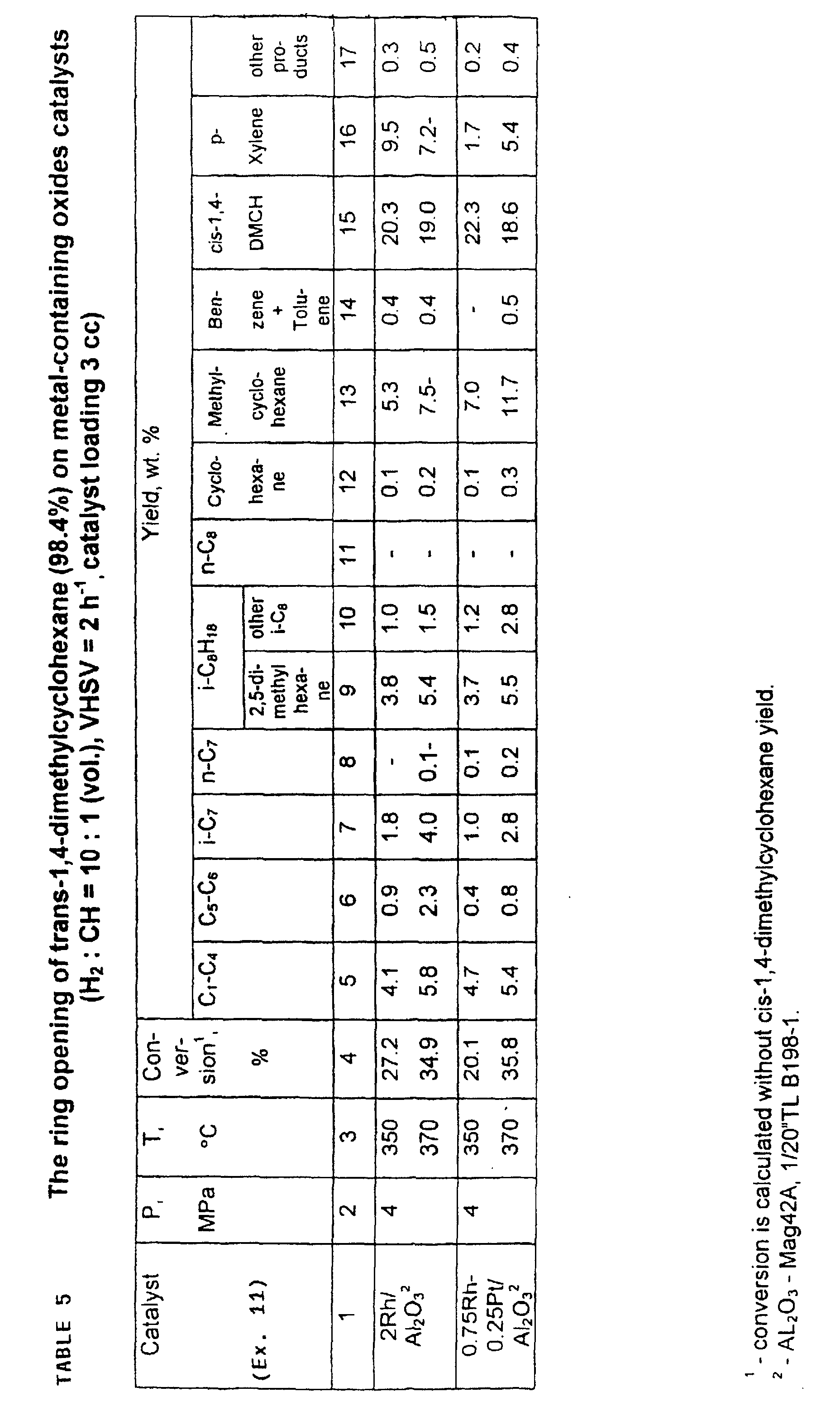
- the catalysts prepared according to Examples 1 and 2 were tested in the reaction of trans-1,4-dimethylcyclo-hexane conversion under conditions of Example 1.
- the catalytic data are collected in Table 5.
- Rhodium-containing catalyst systems were shown to be most active and selective in ring opening of cyclic hydrocarbons. The reaction proceeds at substantially lower temperatures compared to Pt-catalysts and dehydrogenation is suppressed to a considerable extent. Thus, at 260°C and 3 MPa, the 2%Rh/Al 2 O 3 catalyst provides a yield of n-hexane from cyclohexane of 33.4% at a selectivity of 94%. No isomerization (iso-C 6 H 14 , MCP) or dehydrogenation (C 6 H 6 ) products were identified under these conditions. The highest n-C 6 yield (70.5%) was achieved on this catalyst at 280°C at the ring-opening selectivity of 85%.
- Rh/Al 2 O 3 catalyst containing 0.5 wt% Rh shows about the same performance as the 1% Rh/Al 2 O 3 sample, which is somewhat lower as compared to the sample containing 2 wt% Rh; therefore, in principle, the metal loading can be decreased.
- the highest yield of n-hexane for the 0.5% Rh/Al 2 O 3 catalyst reaches 26.4% at the selectivity close to 60% at 320°C, 1 MPa.
- the egg-shell 1%Rh/Al 2 O 3 catalyst shows similar catalytic properties, and the n-hexane yield is about 30% at 320°C at the selectivity of 54%.
- the 1% Rh/Al 2 O 3 catalyst tested at the pressure of 3 Mpa provides the yield of n-hexane close to 60% at 300°C at the ring-opening selectivity of 69%.
- the 1% Rh/SiO 2 catalyst is less active in cyclohexane conversion, as compared with Al 2 O 3 -based systems and the selectivities are lower.
- the n-hexane yield reaches ⁇ 52% at 320 C.
- the selectivity is 56%.
- Ru-containing catalysts show advantageous catalytic properties in ring opening of cyclohexane.
- the cyclohexane conversion on the 1 Ru/Al 2 O 3 catalysts is high (up to 30%) even at low temperatures of 200-210°C, i.e., at temperatures when both Pt and Rh catalysts are inactive.
- the Ru-containing catalysts catalyze solely cracking, i.e., the temperature intervals favourable for ring opening on Ru-catalysts are very narrow (200-220°C).
Landscapes
- Chemical & Material Sciences (AREA)
- Engineering & Computer Science (AREA)
- Chemical Kinetics & Catalysis (AREA)
- Organic Chemistry (AREA)
- Materials Engineering (AREA)
- Oil, Petroleum & Natural Gas (AREA)
- Crystallography & Structural Chemistry (AREA)
- General Chemical & Material Sciences (AREA)
- Organic Low-Molecular-Weight Compounds And Preparation Thereof (AREA)
- Catalysts (AREA)
Description
- The present invention relates in general to a process for ring opening of cyclic compounds with at least 6 carbon atoms in the ring structure. More particularly, the invention concerns a process for ring opening of cyclic compounds including derivatives of cyclohexane, decaline, idane (indene), benzene, and naphthalene being present in diesel fuel in presence of hydrogen to linear or branched paraffinic molecules.
- One of the approaches to the improvement of the cetane number of diesel fuel is to increase the content of paraffinic compounds with linear chains in the diesel fuel. The content of non-cyclic paraffins in the hydrocarbon mixture can be increased by carrying out ring opening of cycloparaffins formed upon hydrogenation of aromatic compounds present in the fuel.
- Commercially available catalytic systems based on 1% Pt/H-Beta zeolite are disclosed in US Patent No. 5,382,730. The described catalysts exhibit rather high activity in ring opening of C6 cyclic compounds and are used in combination with isomerization catalysts to improve quality of a C5-C6 downstream feed. In this case, however, a 1:3 mixture of normal and isoparaffins was formed at conversion rates of ∼80% at 230-270°C under high-pressure conditions. Another catalyst is proposed in US Patent No. 5,382,731 for ring opening of C6 cyclic compounds comprising a 1% Pt/WO3/ZrO2 system. The performance of this catalyst is similar to that of Pt/H-Beta zeolite, at slightly different reaction conditions.
- WO Patent No. 97/09290 discloses a process for selective opening of compounds having at least one C5 ring, using catalysts based on one or more metals selected from the group consisting of iridium, ruthenium and rhodium on a catalyst support material. Different feedstocks such as n-pentylcyclopentane, bicyclic and tricyclic with fused 5-membered rings have been tested for ring opening, using the above mentioned catalysts in composition with platinium supported catalysts. In contrast to the prior art mentioned in this disclosure, the process of the invention is directed to ring opening of at least 6-membered cyclic organic compounds. It is also generally acknowledged in the art that C5 rings are much easier to cleave than C6 rings, and include a different reaction mechanism.
- Only a very limited number of prior art publications are available, which are related to decalin conversion on zeolite and oxide catalysts. In most of these publications decalin cracking is studied, which leads to more than 100 products in the C1-C10 range. Decalin conversion has also been studied from the point of view of its cis trans isomerization. There is no available reported data on decalin conversion on oxide catalysts.
- The general object of this invention is to provide a process for ring opening of cyclic compounds having at least 6 carbon atoms in the ring structure in the presence of hydrogen by use of efficient heterogeneous metal-supported catalysts based on various oxide carriers.
- Various types of oxides, hydroxides or mixed oxides and hydroxides can be used as supports for active metal components in ring opening of cyclic organic compounds.
- The carriers for the ring opening catalysts are the commercial forms of alumina, silica, zirconia and mixtures thereof. The oxides are modified with lanthanum and rare earth metals.
- Metals supported on the appropriate carriers are noble and transition metals, such as platinum, rhodium, rhenium, iridium and ruthenium. The metal loading in the catalyst may range from 0.1 to 10 wt%.
- In accordance with the above finding, this invention provides a process for the ring opening of cyclic organic compounds with at least 6 carbon atoms in the ring structure by contacting the compounds in presence of hydrogen with a catalyst comprising a carrier of alumina, silica, zirconia and mixtures thereof from 0.1 to 10 per cent by weight of a catalytic active metal selected from platinum, rhodium, rhenium, iridium and ruthenium characterised in that the catalyst further comprises mixtures or combinations thereof from 0.01 to 20 per cent by weight of a metal modifier selected from lanthanum and rare earth metals.
- When operating the process of the invention, hydrogen or a mixture of hydrogen with an inert gas is used as a reducing agent.
- Hydrocarbons or mixtures thereof are introduced in a flow-type high-pressure reactor as a mixture with hydrogen or with a mixture of hydrogen and an inert gas.
- Convenient process conditions are a hydrogen-to-hydrocarbon ratio ranging from 1:1 to 1:50, more preferably, from 1:5 to 1:20; a liquid hourly space velocity ranging from 0.1 to 10, more preferably, from 0.5 to 2; and a total pressure from 1 to 100 atm, more preferably from 20 to 50 atm. The reaction is preferably carried out at a temperature from 450 to 670°K.
- The products evolving from the process comprise typically a mixture of gas products and liquid products, including paraffinic linear or branched hydrocarbons, cyclic compounds (both naphtenes and aromatics).
- In order to further illustrate the present invention and the advantages thereof, the following specific examples are given below.
- In the Examples, the following parameters (in per cent) are used: C=percentage of conversion, S=selectivity, Y=yield based on the product passed=C x S.
- A γ-alumina carrier with a specific surface area of 170 m2/g is impregnated to incipient wetness with a solution of [Rh(NH3)5Cl]Cl2 so that the metal loading will be n0.5, 1.0, or 2.0 wt%. The samples obtained were dried and then reduced in a hydrogen flow at 450°C for 1 h. The thus prepared catalysts were tested in cyclohexane transformations in a flow reactor at the following conditions:
- Reaction temperature = 260-320°C,
- VHSV = 2 h-1,
- Total pressure = 1-5 Mpa,
- Hydrogen-to-cyclohexane ratio (molar) = 10:1. 3 ml of a catalyst in powder form (particle size of 0,2-0,5 mm) were placed into a tubular reactor made of quartz or stainless steel (with an internal diameter of 14 mm).
-
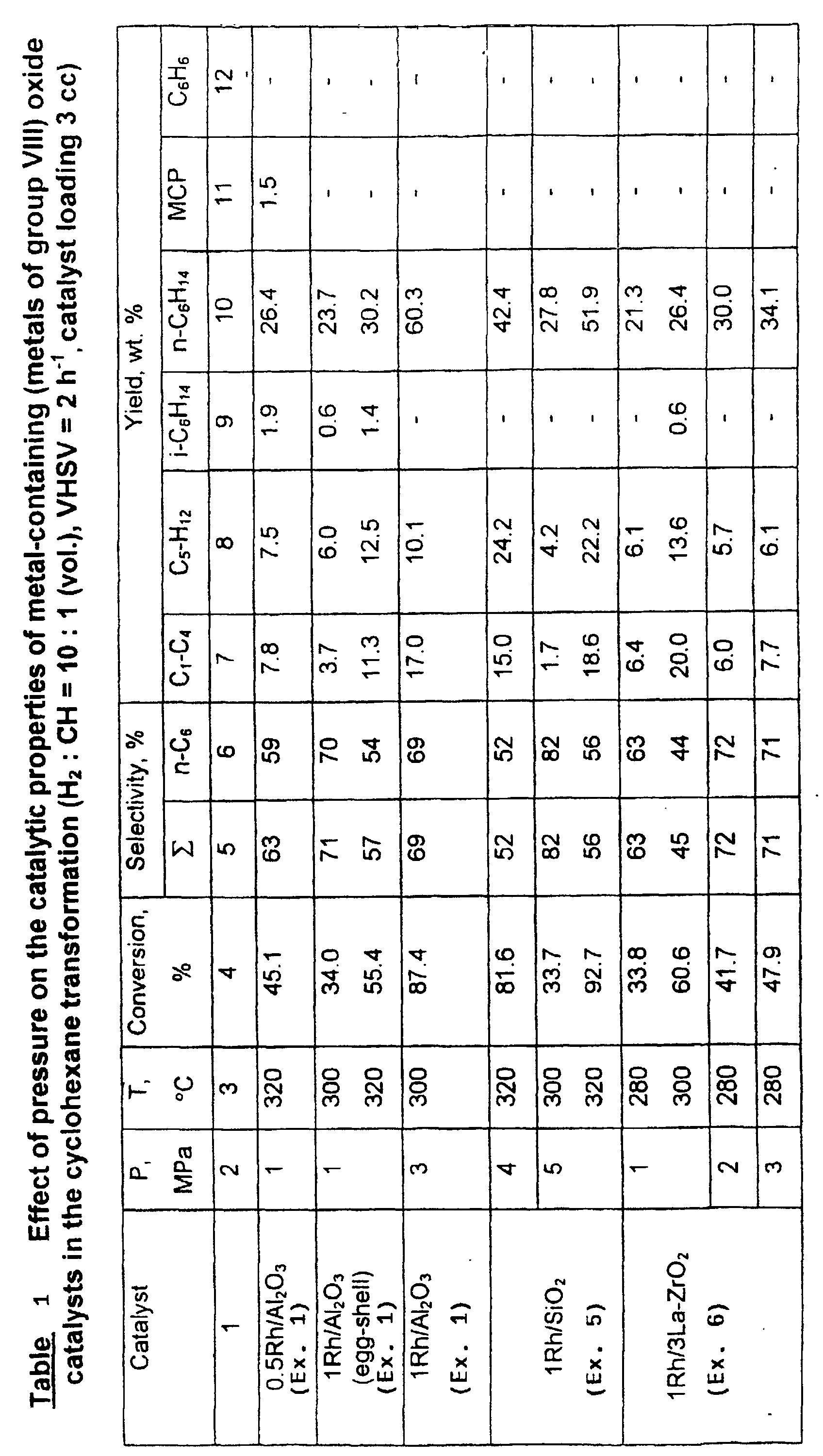
- The results are summarized in Table 1. The C, S and Y parameters were measured in 30 min. after the beginning of the reaction.
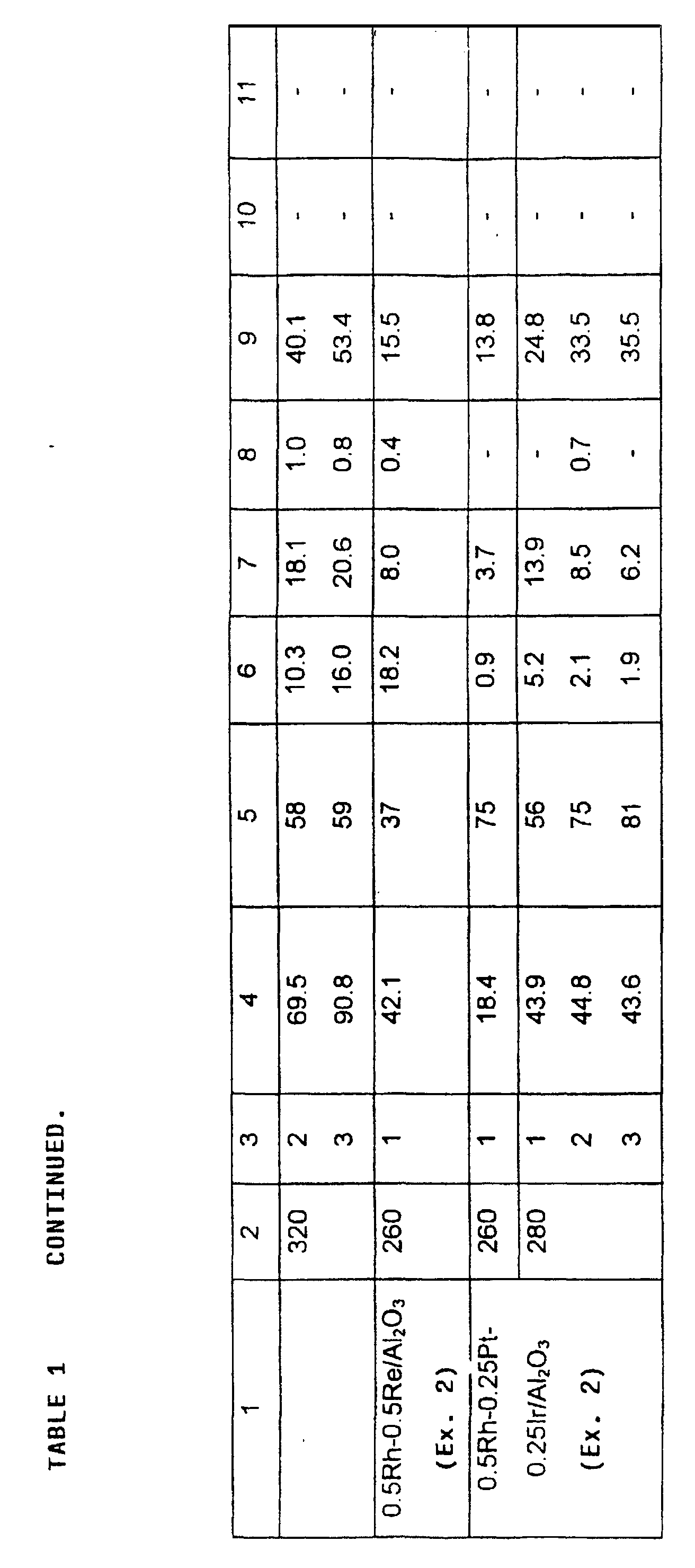
- Bimetallic catalysts containing Rh+Pt in different molar ratios, Rh+Re, and Rh+Ru were prepared on the basis of the same alumina carrier, which was impregnated with a solution containing the complexes, salts or other compounds of the above metals, such as [Rh(NH3)5Cl] Cl2, RhCl3, H2PtCl6, (NH4)2ReO4, with an appropriate concentrations of the components so that the overall metal loading was 1.0 or 1.5 wt%. The catalysts thus obtained were tested in cyclohexane conversion under conditions of Example 1. The results are summarized in Table 1.
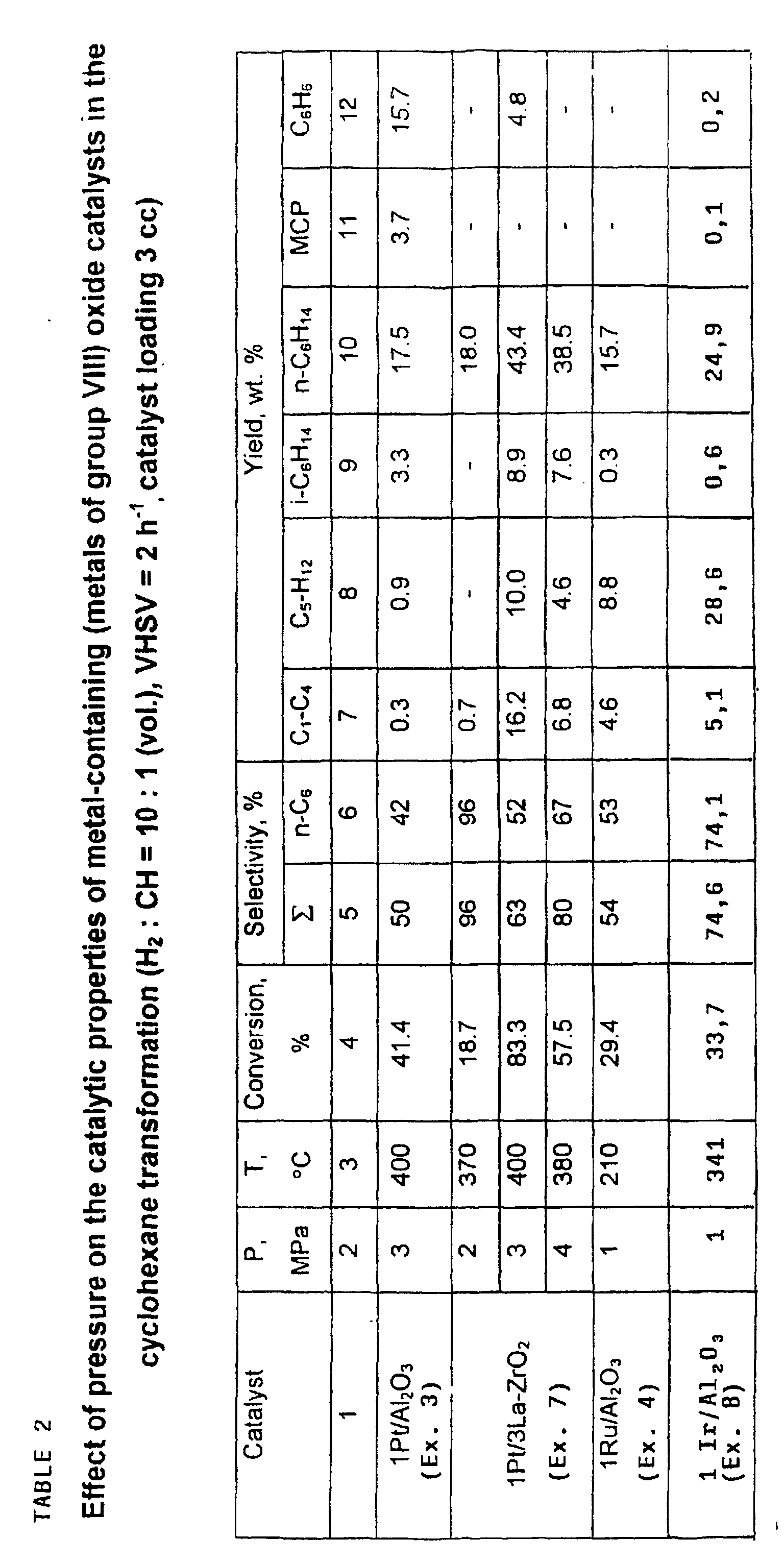
- The same γ-alumina carrier was impregnated with platinum so that the metal loading was 1 wt%. The catalyst testing was carried out under the same conditions as described in Example 1. The results of testing in ring opening of cyclohexane are presented in Table 2.
- Similarly the catalyst 1%Ru/γ-alumina was prepared on the basis of the same support. The results of this catalyst testing in cyclohexane transformations under conditions of Example 1 are given in Table 2.
- A SiO2 carrier with a specific surface area of 450 m2/g was impregnated to incipient wetness with [Rh(NH3)5Cl]Cl2, so that the metal loading was 1 wt%. The data on cyclohexane conversion and ring opening selectivity for this catalyst are collected in Table 1.
- ZrO2 (surface area ∼150 m2/g) was modified with 3 wt% La2O3 supported by impregnation with lanthanum nitrate, followed by calcination at 500 C. Then 1 wt% of rhodium was supported by incipient wetness impregnation. After reduction, the catalyst was tested in cyclohexane ring opening, the results are presented in Table 1.
- ZrO2 modified with 3 wt% La2O3 by impregnation with lanthanum nitrate was further impregnated with platinum using [Pt(NH3)6] (HCO3)2. The metal loading was 1 wt%. The data on this catalyst performance in cyclohexane ring opening under conditions of Example 1 are shown in Table 2.
- The γ-alumina carrier was modified with 1 wt% of iridium. The catalytic data on cyclohexane conversion obtained after reduction in hydrogen are given in Table 2.
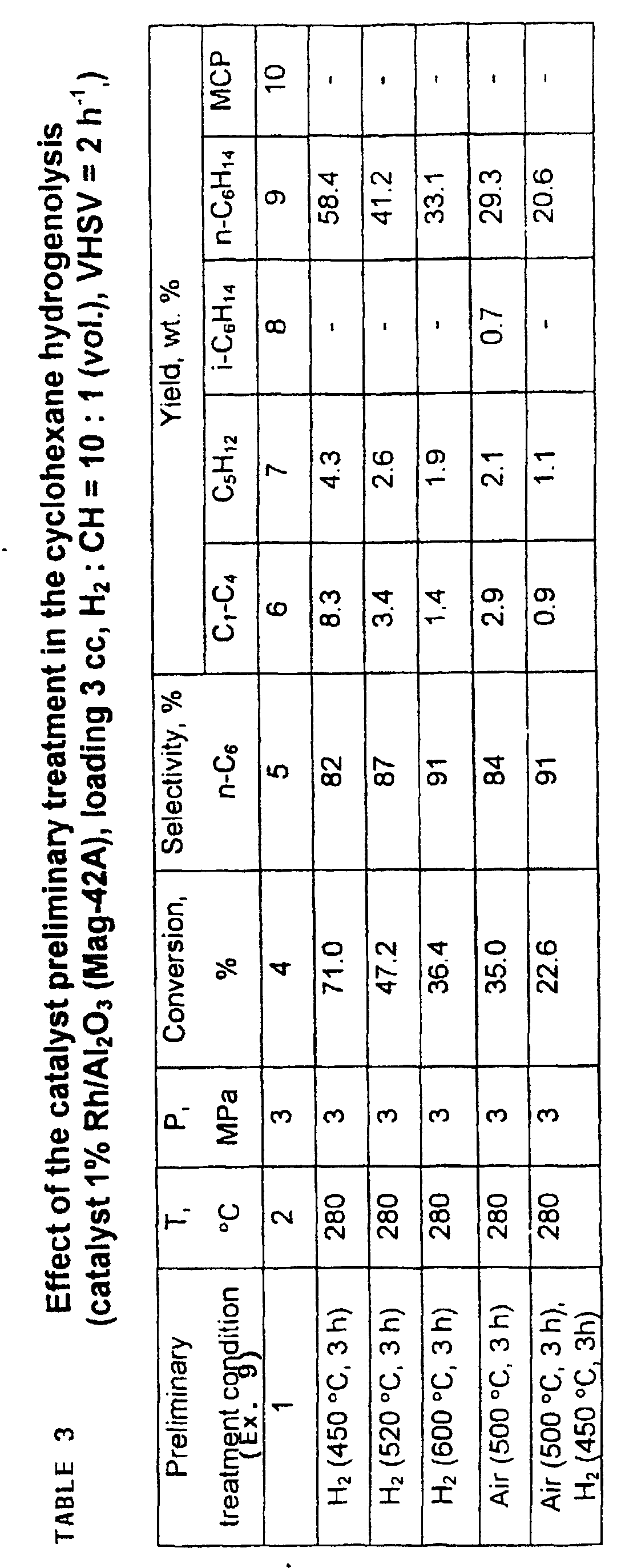
- The 1%Rh/γ-alumina catalyst prepared as described in Example 1 was reduced in different ways: at different temperatures in a hydrogen flow with or without the preliminary oxidative treatment in an oxygen flow. The comparative data on cyclohexane ring opening on the thus prepared and reduced catalysts are presented in Table 3.
- The catalysts prepared according to Examples 1 and 2 were tested in the reaction of trans-1,2-dimethylcyclo-hexane conversion under conditions of Example 1. The results are given in Table 4.
- The catalysts prepared according to Examples 1 and 2 were tested in the reaction of trans-1,4-dimethylcyclo-hexane conversion under conditions of Example 1. The catalytic data are collected in Table 5.
- The catalysts prepared according to Examples 1 and 2 were tested in the reaction of ethylcyclohexane transformations under conditions of Example 1. The results are presented in Table 6.
- For Pt-containing Al2O3-based catalysts, the formation of aromatic hydrocarbons substantially decreases at high pressures, but still high reaction temperatures are required to provide a reasonable conversion (350-400°C). The highest n-C6H14 yield (17.5%) was achieved at 400°C, 3 MPa. The ring-opening selectivity is 50% and n-paraffin is the main product at a selectivity of 42%. Bracking is not as decisive as at atmospheric pressure and the cumulative yield of C1-C4 hydrocarbons does not exceed 0.3 wt%. Nevertheless, dehydrogenation (the benzene yield is 15.7%) still contributes substantially to the reaction network.
- On the contrary, isomerization processes are suppressed and the overall yield of iso-C6 and MCP is close to 7%.
- Rhodium-containing catalyst systems were shown to be most active and selective in ring opening of cyclic hydrocarbons. The reaction proceeds at substantially lower temperatures compared to Pt-catalysts and dehydrogenation is suppressed to a considerable extent. Thus, at 260°C and 3 MPa, the 2%Rh/Al2O3 catalyst provides a yield of n-hexane from cyclohexane of 33.4% at a selectivity of 94%. No isomerization (iso-C6H14, MCP) or dehydrogenation (C6H6) products were identified under these conditions. The highest n-C6 yield (70.5%) was achieved on this catalyst at 280°C at the ring-opening selectivity of 85%.
- The Rh/Al2O3 catalyst containing 0.5 wt% Rh shows about the same performance as the 1% Rh/Al2O3 sample, which is somewhat lower as compared to the sample containing 2 wt% Rh; therefore, in principle, the metal loading can be decreased. Thus, the highest yield of n-hexane for the 0.5% Rh/Al2O3 catalyst reaches 26.4% at the selectivity close to 60% at 320°C, 1 MPa.
- The egg-shell 1%Rh/Al2O3 catalyst shows similar catalytic properties, and the n-hexane yield is about 30% at 320°C at the selectivity of 54%.
- The 1% Rh/Al2O3 catalyst tested at the pressure of 3 Mpa provides the yield of n-hexane close to 60% at 300°C at the ring-opening selectivity of 69%.
- The 1% Rh/SiO2 catalyst is less active in cyclohexane conversion, as compared with Al2O3-based systems and the selectivities are lower. At high pressures (5 MPa), the n-hexane yield reaches ∼52% at 320 C. The selectivity is 56%.
- Ru-containing catalysts show advantageous catalytic properties in ring opening of cyclohexane. The cyclohexane conversion on the 1 Ru/Al2O3 catalysts is high (up to 30%) even at low temperatures of 200-210°C, i.e., at temperatures when both Pt and Rh catalysts are inactive. However, at temperatures above 230°C, the Ru-containing catalysts catalyze solely cracking, i.e., the temperature intervals favourable for ring opening on Ru-catalysts are very narrow (200-220°C).
- Modification of ZrO2 with La2O3 (3 wt%) completely suppresses the isomerization side reactions in the case of the 1% Rh/3%La2O3/ZrO2 catalyst. However, light products (C1-C4) are still formed in a considerable amount, probably, not by a cracking mechanism but via hydrogenolysis of cyclohexane and products of ring opening. Nevertheless, the yield of n-hexane is rather high (up to 34% at 280°C, 3 MPa) at a ring-opening selectivity of 71%.
- In the case of the 1% Pt/3%La2O3/ZrO2 catalyst, the pattern with the formation of ring opening products is very similar to that found for 1% Rh/3%La2O3/ZrO2 and the maximum yield of n-hexane (43.4%) was achieved at 400°C, 3MPa; the selectivity to n-hexane was 52%. Unlike the Rh-containing catalyst, for the Pt-sample, isomerization products (isohexanes) were also formed, which can be explained by the peculiarities of the procedure used for supporting platinum: H2PtCl6 was used as a source of Pt and this acid introduced some acidity in the support. Also, dehydrogenation processes occur in the case of the Pt catalyst, which can be substantially suppressed by increasing the reaction pressure to 3 MPa. Reasonably high selectivity of 96% was achieved on this catalyst at 370°C and 2 MPa, the n-hexane yield was equal to 18%. It is interesting to note that for the 1% Pt/3%La2O3/ZrO2 sample, the effect of switching from the complex pattern to pure cracking is observed when the reaction temperature increases from 400 to 420°C at 3 MPa.
- Interesting results were obtained with 1% Ir/Al2O3 (Table 2): the maximum yield of n-hexane was 24.9% at 341°C, 1.0 MPa and dilution of 10:1; the ring-opening selectivity was 74.1%. Only small amounts of cracking products were found at the reactor outlet.
- To summarize, the given Examples show that the catalysts according to the invention for the process of ring opening of cyclic compounds with at least 6 carbon atoms in the presence of hydrogen exhibit the following advantages over the known catalysts disclosed in US Patent Nos. 5,382,730 and 5,382,731 (1995):
- (i) The yield of ring opening products on the inventive catalysts may be increased to 50-70% at the selectivity of 70-95%;
- (ii) Mainly normal paraffins are formed in cyclohexane ring opening, whereas the reactions of skeletal isomerization and cracking, as well as dehydrogenation are substantially suppressed;
- (iii) Bimetallic Rh-Pt and Rh-Ru catalysts show a good performance at a lower overall metal loading as compared to monometallic catalysts and the range of the reaction temperatures and pressures that are optimal for the ring opening process is wider.
-
- While the invention has been described in terms of various preferred embodiments, the skilled artisan will appreciate that various modifications, substitutions, omissions and other changes may be made without departing from the spirit thereof. Accordingly, it is intended that the scope of the present invention be limited solely by the following claims, including equivalents thereof.



Claims (2)
- Process for ring opening of cyclic organic compounds with at least 6 carbon atoms in the ring structure by contacting the compounds in presence of hydrogen with a catalyst comprising a carrier of alumina, silica, zirconia and mixtures thereof from 0.1 to 10 per cent by weight of a catalytic active metal selected from platinum, rhodium, rhenium, iridium, ruthenium and mixtures or combinations thereof characterized in that the catalyst further comprises from 0.01 to 20 per cent by weight of a metal modifier selected from lanthanum and rare earth metals.
- Process according to claim 1 characterized in that the cyclic organic compounds are contained in diesel fuel.
Applications Claiming Priority (2)
| Application Number | Priority Date | Filing Date | Title |
|---|---|---|---|
| US4500797P | 1997-04-28 | 1997-04-28 | |
| US45007P | 1997-04-28 |
Publications (2)
| Publication Number | Publication Date |
|---|---|
| EP0875288A1 EP0875288A1 (en) | 1998-11-04 |
| EP0875288B1 true EP0875288B1 (en) | 2002-10-09 |
Family
ID=21935508
Family Applications (1)
| Application Number | Title | Priority Date | Filing Date |
|---|---|---|---|
| EP98106127A Expired - Lifetime EP0875288B1 (en) | 1997-04-28 | 1998-04-03 | Process for ring opening of cyclic compounds |
Country Status (3)
| Country | Link |
|---|---|
| US (1) | US6235962B1 (en) |
| EP (1) | EP0875288B1 (en) |
| DE (1) | DE69808542T2 (en) |
Families Citing this family (19)
| Publication number | Priority date | Publication date | Assignee | Title |
|---|---|---|---|---|
| DE10023279A1 (en) * | 2000-05-08 | 2001-11-29 | Inst Angewandte Chemie Berlin | Catalyst, for the aromatization of aliphatic and alicyclic hydrocarbons, comprises a porous oxide or oxide mixture of Ti, Zr and/or Hf modified at least on the surface. |
| WO2002102939A2 (en) | 2001-06-01 | 2002-12-27 | Akzo Nobel N.V. | Process for the hydrogenation of aromatics |
| EP1287889B1 (en) * | 2001-09-03 | 2012-11-14 | Nissan Motor Co., Ltd. | Catalyst for selectively oxidizing carbon monoxide |
| EP1402950A1 (en) * | 2002-09-25 | 2004-03-31 | Haldor Topsoe A/S | Catalyst and process of paraffin hydrocarbon conversion |
| US7776784B2 (en) * | 2003-07-14 | 2010-08-17 | Nippon Oil Corporation | Hydrodesulfurization catalyst and hydrodesulfurization process for gasoline fractions |
| US20060281957A1 (en) * | 2003-11-07 | 2006-12-14 | Galperin Leonid B | Dual functional catalyst for selective opening of cyclic paraffins and process for using the catalyst |
| US7407907B2 (en) | 2003-11-07 | 2008-08-05 | Uop Llc | Dual functional catalyst for selective opening of cyclic paraffins and process for using the catalyst |
| US7405177B2 (en) * | 2003-11-07 | 2008-07-29 | Uop Llc | Catalyst for selective opening of cyclic naphtha and process for using the catalyst |
| US20050101474A1 (en) * | 2003-11-07 | 2005-05-12 | Galperin Leonid B. | Catalyst for selective opening of cyclic naphtha and process for using the catalyst |
| US20050101819A1 (en) * | 2003-11-07 | 2005-05-12 | Galperin Leonid B. | Dual functional catalyst for selective opening of cyclic paraffins and process for using the catalyst |
| FI119588B (en) * | 2003-11-27 | 2009-01-15 | Neste Oil Oyj | Precious metal catalyst for hydrocarbon conversion, process of production thereof and process for production of diesel fuel |
| US7345214B2 (en) * | 2005-10-03 | 2008-03-18 | Uop Llc | Modified PT/RU catalyst for ring opening and process using the catalyst |
| US8877674B2 (en) * | 2006-04-26 | 2014-11-04 | Battelle Memorial Institute | Selective CO methanation catalysis |
| FR2908056B1 (en) * | 2006-11-07 | 2009-06-26 | Inst Francais Du Petrole | BIMETALLIC CATALYST BASED ON PLATINUM AND A SECOND GROUP VIII METAL USED FOR OPENING CYCLIC COMPOUNDS |
| US20080135448A1 (en) * | 2006-11-17 | 2008-06-12 | Choudhary Tushar V | Distillate-to-gasoline catalyst system and process therefor |
| DE102011118482A1 (en) * | 2011-11-12 | 2013-05-16 | Volkswagen Aktiengesellschaft | Increasing cetane number of naphtha comprises hydrogenation of used naphtha containing unsaturated and/or aryl compounds in presence of catalyst containing iridium or rhodium and/or oxidic carrier, and/or ring opening of cyclic compound |
| US10363553B2 (en) * | 2017-04-19 | 2019-07-30 | King Abdulaziz University | Nanocomposite hollow sphere as a photocatalyst and methods thereof |
| US10472577B2 (en) * | 2017-06-22 | 2019-11-12 | Uop Llc | Composition for opening polycyclic rings in hydrocracking |
| JP2024039107A (en) * | 2022-09-09 | 2024-03-22 | 千代田化工建設株式会社 | Metal catalyst and method for hydrolysis of cyclic compounds using the same |
Family Cites Families (13)
| Publication number | Priority date | Publication date | Assignee | Title |
|---|---|---|---|---|
| US4330302A (en) * | 1973-11-21 | 1982-05-18 | Exxon Research & Engineering Co. | High thermal stability liquid hydrocarbons and methods for producing them |
| US4098683A (en) * | 1975-11-03 | 1978-07-04 | Uop Inc. | Process for hydrodesulfurizing or hydrogenating a hydrocarbon distillate |
| US4202758A (en) * | 1977-09-30 | 1980-05-13 | Uop Inc. | Hydroprocessing of hydrocarbons |
| JPH0380937A (en) * | 1989-08-25 | 1991-04-05 | Tonen Corp | Steam reforming catalyst of hydrocarbon and preparation thereof |
| DE69218616T2 (en) | 1991-10-25 | 1997-07-03 | Mobil Oil Corp | COMBINED PARAFFINISOMERIZATION / RING OPENING METHOD |
| US5498810A (en) * | 1991-11-21 | 1996-03-12 | Uop | Selective isoparaffin synthesis from naphtha |
| US5345026A (en) * | 1993-07-22 | 1994-09-06 | Mobil Oil Corp. | Ring opening process |
| US5382731A (en) * | 1993-07-22 | 1995-01-17 | Mobil Oil Corp. | Combined paraffin isomerization/ring opening process |
| US5770042A (en) * | 1993-11-15 | 1998-06-23 | Uop | Upgrading of cyclic naphthas |
| US5463155A (en) * | 1993-11-15 | 1995-10-31 | Uop | Upgrading of cyclic naphthas |
| US5556825A (en) * | 1995-01-06 | 1996-09-17 | Ford Motor Company | Automotive catalysts with improved oxygen storage and metal dispersion |
| US5831139A (en) * | 1995-06-07 | 1998-11-03 | Uop Llc | Production of aliphatic gasoline |
| CA2227303C (en) * | 1995-09-05 | 2006-11-21 | Exxon Research And Engineering Company | Process for selectively opening naphthenic rings |
-
1998
- 1998-04-03 EP EP98106127A patent/EP0875288B1/en not_active Expired - Lifetime
- 1998-04-03 DE DE69808542T patent/DE69808542T2/en not_active Expired - Lifetime
- 1998-04-27 US US09/066,697 patent/US6235962B1/en not_active Expired - Lifetime
Also Published As
| Publication number | Publication date |
|---|---|
| DE69808542T2 (en) | 2003-02-13 |
| DE69808542D1 (en) | 2002-11-14 |
| US6235962B1 (en) | 2001-05-22 |
| EP0875288A1 (en) | 1998-11-04 |
Similar Documents
| Publication | Publication Date | Title |
|---|---|---|
| US6235962B1 (en) | Catalysts and process for ring opening of cyclic compounds | |
| KR100786600B1 (en) | Highly active isomerization catalyst and its preparation method and uses | |
| US5356851A (en) | Catalyst containing a group VIII metal and a group IIIA metal deposited on a support | |
| EP0585065B1 (en) | Isomerization catalyst of group 8 metal/ZrO2/SiO2/WO2, and isomerization process using it | |
| US6245220B1 (en) | Selective hydrogenation of diolefins to the olefins employing catalysts containing palladium, also tin and/or lead | |
| US4431574A (en) | Supported group VIII noble metal catalyst and process for making it | |
| JPH0625020A (en) | Method of selectively hydrogenating hydrocarbon | |
| US6498280B1 (en) | Catalyst comprising an element from groups 8, 9 or 10 with good accessibility, and its use in a paraffin dehydrogenation process | |
| JP2004508161A (en) | Method and catalyst for opening the naphthene ring of a naphthene ring-containing compound | |
| US7220701B2 (en) | Catalyst and process for selective hydrogenation | |
| US6623625B2 (en) | Naphthene ring opening over group VIII metal catalysts containing cracking moderators | |
| JP2593334B2 (en) | Method for isomerizing 1-butene to 2-butene in C4 hydrocarbon fraction containing butadiene and sulfur compounds | |
| RU2132731C1 (en) | Method of preparing hydrocarbon-dehydrogenation catalyst | |
| US20060063954A1 (en) | Catalyst and process for selective hydrogenation | |
| US3567625A (en) | Hydroforming with promoted iridium catalyst | |
| US20020038068A1 (en) | Naphthene ring opening over a ring opening catalyst combination | |
| US20020043481A1 (en) | Ring opening with group VIII metal catalysts supported on modified substrate | |
| US6683020B2 (en) | Naphthene ring opening over an iridium ring opening catalyst | |
| RU2087187C1 (en) | Catalyst for selective hydrogenation and method of preparation thereof | |
| Lapidus et al. | Bimetallic cobalt catalysts for the synthesis of hydrocarbons from CO and H2 | |
| Gőbölös et al. | Transformation of n-hexane on Al2O3and SiO2supported Pt, Pt+ Ga and Ir+ Pt+ Ga catalysts prepared by anchoring methods | |
| RU2024306C1 (en) | Method for activation of palladium catalyst | |
| WO1997009290A1 (en) | Process for selectively opening naphthenic rings | |
| CA2416719A1 (en) | Naphthene ring opening over an iridium ring opening catalyst | |
| AU2001278958A1 (en) | Method and catalyst for opening naphthenic rings of naphthenic ring-containing compounds |
Legal Events
| Date | Code | Title | Description |
|---|---|---|---|
| PUAI | Public reference made under article 153(3) epc to a published international application that has entered the european phase |
Free format text: ORIGINAL CODE: 0009012 |
|
| AK | Designated contracting states |
Kind code of ref document: A1 Designated state(s): BE DE FI FR GB NL |
|
| AX | Request for extension of the european patent |
Free format text: AL;LT;LV;MK;RO;SI |
|
| 17P | Request for examination filed |
Effective date: 19990504 |
|
| AKX | Designation fees paid |
Free format text: BE DE FI FR GB NL |
|
| 17Q | First examination report despatched |
Effective date: 19990602 |
|
| RTI1 | Title (correction) |
Free format text: PROCESS FOR RING OPENING OF CYCLIC COMPOUNDS |
|
| GRAG | Despatch of communication of intention to grant |
Free format text: ORIGINAL CODE: EPIDOS AGRA |
|
| GRAG | Despatch of communication of intention to grant |
Free format text: ORIGINAL CODE: EPIDOS AGRA |
|
| GRAH | Despatch of communication of intention to grant a patent |
Free format text: ORIGINAL CODE: EPIDOS IGRA |
|
| GRAH | Despatch of communication of intention to grant a patent |
Free format text: ORIGINAL CODE: EPIDOS IGRA |
|
| GRAA | (expected) grant |
Free format text: ORIGINAL CODE: 0009210 |
|
| AK | Designated contracting states |
Kind code of ref document: B1 Designated state(s): BE DE FI FR GB NL |
|
| REG | Reference to a national code |
Ref country code: GB Ref legal event code: FG4D |
|
| REF | Corresponds to: |
Ref document number: 69808542 Country of ref document: DE Date of ref document: 20021114 |
|
| ET | Fr: translation filed | ||
| PLBE | No opposition filed within time limit |
Free format text: ORIGINAL CODE: 0009261 |
|
| STAA | Information on the status of an ep patent application or granted ep patent |
Free format text: STATUS: NO OPPOSITION FILED WITHIN TIME LIMIT |
|
| 26N | No opposition filed |
Effective date: 20030710 |
|
| REG | Reference to a national code |
Ref country code: FR Ref legal event code: PLFP Year of fee payment: 19 |
|
| REG | Reference to a national code |
Ref country code: FR Ref legal event code: PLFP Year of fee payment: 20 |
|
| PGFP | Annual fee paid to national office [announced via postgrant information from national office to epo] |
Ref country code: NL Payment date: 20170426 Year of fee payment: 20 |
|
| PGFP | Annual fee paid to national office [announced via postgrant information from national office to epo] |
Ref country code: FR Payment date: 20170426 Year of fee payment: 20 Ref country code: DE Payment date: 20170427 Year of fee payment: 20 Ref country code: GB Payment date: 20170427 Year of fee payment: 20 |
|
| PGFP | Annual fee paid to national office [announced via postgrant information from national office to epo] |
Ref country code: BE Payment date: 20170427 Year of fee payment: 20 Ref country code: FI Payment date: 20170427 Year of fee payment: 20 |
|
| REG | Reference to a national code |
Ref country code: DE Ref legal event code: R071 Ref document number: 69808542 Country of ref document: DE |
|
| REG | Reference to a national code |
Ref country code: NL Ref legal event code: MK Effective date: 20180402 |
|
| REG | Reference to a national code |
Ref country code: GB Ref legal event code: PE20 Expiry date: 20180402 Ref country code: BE Ref legal event code: MK Effective date: 20180403 |
|
| PG25 | Lapsed in a contracting state [announced via postgrant information from national office to epo] |
Ref country code: GB Free format text: LAPSE BECAUSE OF EXPIRATION OF PROTECTION Effective date: 20180402 |