EP0874853B1 - Process for preparation of cefdinir - Google Patents
Process for preparation of cefdinir Download PDFInfo
- Publication number
- EP0874853B1 EP0874853B1 EP96943357A EP96943357A EP0874853B1 EP 0874853 B1 EP0874853 B1 EP 0874853B1 EP 96943357 A EP96943357 A EP 96943357A EP 96943357 A EP96943357 A EP 96943357A EP 0874853 B1 EP0874853 B1 EP 0874853B1
- Authority
- EP
- European Patent Office
- Prior art keywords
- acid
- process according
- formula
- dimethylacetamide
- cefdinir
- Prior art date
- Legal status (The legal status is an assumption and is not a legal conclusion. Google has not performed a legal analysis and makes no representation as to the accuracy of the status listed.)
- Expired - Lifetime
Links
- 0 *C(*1)=NC=C1*=*O Chemical compound *C(*1)=NC=C1*=*O 0.000 description 3
Classifications
-
- C—CHEMISTRY; METALLURGY
- C07—ORGANIC CHEMISTRY
- C07D—HETEROCYCLIC COMPOUNDS
- C07D501/00—Heterocyclic compounds containing 5-thia-1-azabicyclo [4.2.0] octane ring systems, i.e. compounds containing a ring system of the formula:, e.g. cephalosporins; Such ring systems being further condensed, e.g. 2,3-condensed with an oxygen-, nitrogen- or sulfur-containing hetero ring
-
- A—HUMAN NECESSITIES
- A61—MEDICAL OR VETERINARY SCIENCE; HYGIENE
- A61P—SPECIFIC THERAPEUTIC ACTIVITY OF CHEMICAL COMPOUNDS OR MEDICINAL PREPARATIONS
- A61P31/00—Antiinfectives, i.e. antibiotics, antiseptics, chemotherapeutics
-
- A—HUMAN NECESSITIES
- A61—MEDICAL OR VETERINARY SCIENCE; HYGIENE
- A61P—SPECIFIC THERAPEUTIC ACTIVITY OF CHEMICAL COMPOUNDS OR MEDICINAL PREPARATIONS
- A61P31/00—Antiinfectives, i.e. antibiotics, antiseptics, chemotherapeutics
- A61P31/04—Antibacterial agents
Definitions
- the present invention relates to a process for preparing cefdinir represented by the following formula (I) as a cephalosporin antibiotics :
- Cefdinir of formula (I) above has a chemical name of 7 ⁇ -[2-(2-aminothiazol-4-yl)-2-(Z)-(hydroxyimino)acetamido]-3-vinyl-3-cep -hem-4-carboxylic acid. It is the third generation of cephalosporin antibiotics for oral administration and has a broader antibacterial spectrum over the general gram positive and gram negative bacteria than other antibiotics for oral administration. Particularly, it has been reported that cefdinir has an excellent antibacterial activity against Staphylococci and Streptococci.
- cefdinir is prepared according to the reaction scheme 1, however, there can occur many problems such that the process for preparing the 7-amido compound(B) should be carried out at a temperature below -20°C under an anhydrous condition and that the isolation of the N-oxime compound(C) may cause a lot of troubles in the procedure of industrialization since the compound(C) is obtained as a solid having a syrup or a foam phase after the solvent is distilled off under reduced pressure.
- the aminothiazole compound(D) is obtained in a poor yield and purity and with a brownish poor color, which finally exerts a harmful influence upon the purity and color of the desired cefdinir.
- the present invention pertains to a process for preparing cefdinir of formula (I) characterized in that a trityl protecting group in the cefdinir intermediate of formula (II) is removed in the presence of an acid.
- the process is depicted in the following reaction scheme 2.
- cefdinir intermediate of formula (II) which is very excellent in yield and purity is used as a starting material.
- an inorganic acid such as hydrochloric acid, hydrobromic acid, hydroiodic acid, sulfuric acid, Lewis acid, etc.
- an organic acid such as acetic acid, formic acid, trifluoroacetic acid, methanesulfonic acid, benzenesulfonic acid, p-toluenesulfonic acid, etc.
- an acidic hydrogen ion exchange resin can be mentioned, wherein Lewis acid includes boron trifluoride, boron trifluoride ethyletherate, aluminum chloride, antimony pentachloride, ferrous chloride, stannous chloride, titanium tetrachloride, zinc chloride, etc.
- reaction is carried out in the presence of an anisole as a cation capturing agent.
- the acid is preferably used in an amount of 1 to 20 equivalents with respect to the starting material (II).
- reaction it is preferable to carry out the reaction at a low temperature in a range of -30 to 5°C. But, the reaction can also be performed at 40 to 70°C in case of using the acid in an amount of 1 to 2 equivalents with respect to the cefdinir intermediate of formula (II).
- the solvent one or more selected from a group consisting of water, ethanol, methanol, propanol, t-butanol, tetrahydrofuran, dioxane, N,N-dimethylformamide, N,N-dimethylacetamide, methylene chloride and chloroform can be used, and if desired, the organic acid or inorganic acid itself can be used as a reaction solvent.
- cefdinir of formula (I) prepared according to the process as explained above exhibits a superior quality in color, yield and purity to that prepared according to the earlier process, and such a result is basically caused by use of the cefdinir intermediate of formula (II) as a starting material. That is, this intermediate is a crystalline compound having a pale yellow color and a high purity more than 98%, therefore it's good quality has a beneficial effect on the next step for finally producing cefdinir having an excellent quality.
- the earlier process for preparing cefdinir from the reactive derivative has problems that 1-hydroxybenzotriazole or 2-mercaptobenzothiazole produced during the reaction can hardly be removed from the reaction mixture, which lowers the purity of the reaction product and also makes the purifying step difficult.
- the present invention having no such problems can be estimated as an astonishing one.
- cefdinir can be prepared from the expensive compound(A) through a 4-step reaction.
- the present invention only 2 steps of reaction are needed for the preparation of the final product, cefdinir. Therefore, a lot of beneficial effects can be expected by applying the present invention for preparing cefdinir such that a decrease of the yield due to the multi-step reaction can be prevented; the product can be provided with a low price since there is no need to use the expensive material; and the manufacturing time can be saved by cutting the reaction steps in half, and the like.
- the present invention pertains to the compound of formula (II) above and process for preparing the same.
- the cefdinir intermediate of formula (II) used as a starting material in the reaction scheme 2 is a crystalline complex with a salt and a solvent, and it can easily be prepared by reacting a reactive ester having the following formula (III) with a 3-cephem derivative having the following formula (IV) in a solvent in the presence or absence of a base and then by adding p-toluenesulfonic acid thereto.
- the reaction is depicted in the following reaction scheme 3 : in which
- the reactive ester compound of formula (III) used as a starting substance in the reaction scheme 3 above is a known compound and can be prepared according to the process disclosed in literatures (see, European Patent Laid-open Publication No. 555,769; Japanese Patent Laid-open Publication No. sho 57-175,196.
- This process for the preparation of cephalosporin derivatives distinguishes from the process according to the invention in that after the condensation between the compounds of formula (III) and (IV), p-toluensulfonic acid is added to the mixture in the presence of dimethylacetamide. In the process of the mentioned patents the p-toluensulfonic acid is added after the condensation in order to remove the trityl group.
- the reactive ester compound of formula (III) is used in an amount of 0.8 to 2.0 equivalents, preferably 1.0 to 1.2 equivalents with respect to the 3-cephem derivative of formula (IV).
- the solvent which can be used in the reaction of scheme 3 includes, N,N-dimethylacetamide alone, or a mixture of N,N-dimethylacetamide with one or more selected from a group consisting of ethanol, methanol, isopropanol, diethylether, tetrahydrofuran, dioxane, methylene chloride, chloroform, acetonitrile, ethyl acetate and acetone.
- the solvent is used in an amount of 10 to 60ml, preferably 10 to 30ml with respect to 1g of the 3-cephem derivative of formula (IV).
- the reaction is carried out at a temperature of -15 to 40 °C, preferably 0 to 30°C.
- the reaction is completed after 1 to 24 hours have passed from the initial point, however, it is desirable to complete the reaction within 1 to 5 hours since the color of the reaction solution becomes poor and the amount of side products increases as the reaction time becomes longer.
- the process for preparing the compound (II) of the present invention can be carried out in the presence of a base.
- a base tertiary amines such as triethylamine, tri-n-butylamine, diisopropylethylamine, triethylenediamine, pyridine, N,N-dimethylaniline, etc., preferably triethylamine or tri-n-butylamine can be used as the base.
- the base can be used in an amount of 0.5 to 5 equivalents, preferably 1 to 2 equivalents with respect to the 3-cephem derivative of formula (IV).
- reaction can also be carried out by using N-trimethylsilylacetamide or N,O-bistrimethylsilylacetamide in an amount of 1 to 3 equivalents with respect to the 3-cephem derivative of formula (IV) instead of the base.
- diethylether, diisopropylether or ethylacetate is added to the reaction mixture to crystallize the product in the work-up procedure.
- they are added in an amount of 2 to 6 times by volume with respect to the reaction solvent, however, it is desirable to add them in an amount of 3 to 5 times by volume considering the reaction yield and purity.
- p-toluenesulfonic acid is usually used in an amount of 1 to 4 equivalents, preferably 2 to 3 equivalents with respect to the 3-cephem derivative of formula (IV).
- the cefdinir intermediate of formula (II) thus produced is a crystalline complex with a salt and a solvent, and it has a unique structure wherein one molecule of p-toluenesulfonic acid and two molecules of N,N-dimethylacetamide are attached to the main structure. Accordingly, it can be isolated more easily from the reaction mixture in a high purity than the usual cephalosporin compound having a noncrystalline form.
- the pH of the solution was adjusted to 6.5 to 7.5 by adding sodium hydrogen carbonate little by little.
- the aqueous layer was separated, washed with a solvent mixture of 30ml of tetrahydrofuran and 60ml of ethylacetate, and then adjusted to pH 2.4 to 2.8 using 2N-HCl.
- the crystal thus precipitated was stirred for 1 hour under ice-bath, filtered, washed with 30ml of water and dried to obtain 5.5g (Yield 92%) of the title compound as a pale yellow solid.
Landscapes
- Chemical & Material Sciences (AREA)
- Organic Chemistry (AREA)
- Health & Medical Sciences (AREA)
- Communicable Diseases (AREA)
- Oncology (AREA)
- Chemical Kinetics & Catalysis (AREA)
- General Chemical & Material Sciences (AREA)
- Medicinal Chemistry (AREA)
- Nuclear Medicine, Radiotherapy & Molecular Imaging (AREA)
- Pharmacology & Pharmacy (AREA)
- Life Sciences & Earth Sciences (AREA)
- Animal Behavior & Ethology (AREA)
- General Health & Medical Sciences (AREA)
- Public Health (AREA)
- Veterinary Medicine (AREA)
- Cephalosporin Compounds (AREA)
- Pharmaceuticals Containing Other Organic And Inorganic Compounds (AREA)
Abstract
Description
- The present invention relates to a process for preparing cefdinir represented by the following formula (I) as a cephalosporin antibiotics :

- Cefdinir of formula (I) above has a chemical name of 7β -[2-(2-aminothiazol-4-yl)-2-(Z)-(hydroxyimino)acetamido]-3-vinyl-3-cep -hem-4-carboxylic acid. It is the third generation of cephalosporin antibiotics for oral administration and has a broader antibacterial spectrum over the general gram positive and gram negative bacteria than other antibiotics for oral administration. Particularly, it has been reported that cefdinir has an excellent antibacterial activity against Staphylococci and Streptococci.
- In US Patent No. 4,559,334 or European Patent No. 105 459 is disclosed a process for preparing cefdinir as represented in the following reaction scheme 1.

- In the above reaction, 7-amino-3-vinyl-3-cephem-4-carboxylic acid ester(A) is reacted with a reactive carboxylic acid derivative to obtain an 7-amido compound(B), and this compound is treated with a nitrosating agent to prepare an N-oxime compound(C). Continually, the compound(C) is cyclized with thiourea to prepare an aminothiazole compound(D), and then finally cefdinir of formula (I) is prepared by removing the carboxy protecting group.
- In case cefdinir is prepared according to the reaction scheme 1, however, there can occur many problems such that the process for preparing the 7-amido compound(B) should be carried out at a temperature below -20°C under an anhydrous condition and that the isolation of the N-oxime compound(C) may cause a lot of troubles in the procedure of industrialization since the compound(C) is obtained as a solid having a syrup or a foam phase after the solvent is distilled off under reduced pressure. In addition, the aminothiazole compound(D) is obtained in a poor yield and purity and with a brownish poor color, which finally exerts a harmful influence upon the purity and color of the desired cefdinir. Further, in the reaction scheme 1, since cefdinir is synthesized through a complicated reaction consisting of 4 steps from the expensive 7-amino-3-vinyl-3-cephem-4-carboxylic acid derivative, the cost for production of cefdinir increases according as the whole reaction yield decreases.
- Thus, the present inventors have extensively studied to develop a novel process by which cefdinir can conveniently be prepared in a good yield and a high purity. As a result, we have identified that such a purpose can be achieved by using a novel cefdinir intermediate represented by the following formula (II) as a starting substance and then completed the present invention.in which

Ph represents phenyl,
p-TsOH represents p-toluenesulfonic acid, and
DMAC represents N,N-dimethylacetamide. - Thus, it is an object of the present invention to provide a novel process for preparing cefdinir using the intermediate of formula (II) as a starting substance.
- It is another object of the present invention to provide a novel intermediate of formula (II), as defined above, and process for preparation thereof.
- In one aspect, the present invention pertains to a process for preparing cefdinir of formula (I) characterized in that a trityl protecting group in the cefdinir intermediate of formula (II) is removed in the presence of an acid. The process is depicted in the following reaction scheme 2.

- The most important feature in the process for preparing cefdinir according to the present invention is that the novel cefdinir intermediate of formula (II) which is very excellent in yield and purity is used as a starting material.
- As the acid which can be used in the process for preparing cefdinir according to the present invention, an inorganic acid such as hydrochloric acid, hydrobromic acid, hydroiodic acid, sulfuric acid, Lewis acid, etc.; an organic acid such as acetic acid, formic acid, trifluoroacetic acid, methanesulfonic acid, benzenesulfonic acid, p-toluenesulfonic acid, etc.; or an acidic hydrogen ion exchange resin can be mentioned, wherein Lewis acid includes boron trifluoride, boron trifluoride ethyletherate, aluminum chloride, antimony pentachloride, ferrous chloride, stannous chloride, titanium tetrachloride, zinc chloride, etc. When an organic acid such as trifluoroacetic acid or p-toluenesulfonic acid, or a Lewis acid is selected, it is preferable that the reaction is carried out in the presence of an anisole as a cation capturing agent. The acid is preferably used in an amount of 1 to 20 equivalents with respect to the starting material (II).
- It is preferable to carry out the reaction at a low temperature in a range of -30 to 5°C. But, the reaction can also be performed at 40 to 70°C in case of using the acid in an amount of 1 to 2 equivalents with respect to the cefdinir intermediate of formula (II).
- As the solvent, one or more selected from a group consisting of water, ethanol, methanol, propanol, t-butanol, tetrahydrofuran, dioxane, N,N-dimethylformamide, N,N-dimethylacetamide, methylene chloride and chloroform can be used, and if desired, the organic acid or inorganic acid itself can be used as a reaction solvent.
- The cefdinir of formula (I) prepared according to the process as explained above exhibits a superior quality in color, yield and purity to that prepared according to the earlier process, and such a result is basically caused by use of the cefdinir intermediate of formula (II) as a starting material. That is, this intermediate is a crystalline compound having a pale yellow color and a high purity more than 98%, therefore it's good quality has a beneficial effect on the next step for finally producing cefdinir having an excellent quality.
- Generally, the earlier process for preparing cefdinir from the reactive derivative has problems that 1-hydroxybenzotriazole or 2-mercaptobenzothiazole produced during the reaction can hardly be removed from the reaction mixture, which lowers the purity of the reaction product and also makes the purifying step difficult. Upon considering this, the present invention having no such problems can be estimated as an astounding one.
- Furthermore, in the prior art, cefdinir can be prepared from the expensive compound(A) through a 4-step reaction. In contrast, in the present invention, only 2 steps of reaction are needed for the preparation of the final product, cefdinir. Therefore, a lot of beneficial effects can be expected by applying the present invention for preparing cefdinir such that a decrease of the yield due to the multi-step reaction can be prevented; the product can be provided with a low price since there is no need to use the expensive material; and the manufacturing time can be saved by cutting the reaction steps in half, and the like.
- In another aspect, the present invention pertains to the compound of formula (II) above and process for preparing the same.
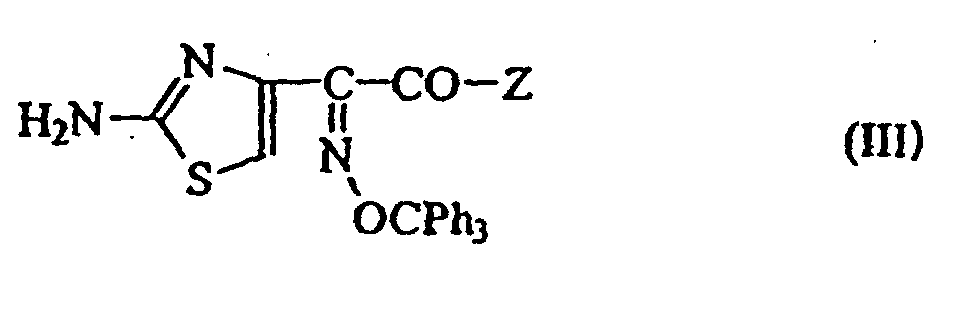
- The cefdinir intermediate of formula (II) used as a starting material in the reaction scheme 2 is a crystalline complex with a salt and a solvent, and it can easily be prepared by reacting a reactive ester having the following formula (III) with a 3-cephem derivative having the following formula (IV) in a solvent in the presence or absence of a base and then by adding p-toluenesulfonic acid thereto. The reaction is depicted in the following reaction scheme 3 :in which

- Z
- represents
or
 wherein R' represents C1-C4 alkyl or phenyl, or R' together with phosphorus and oxygen atoms to which R' is attached can form a 5 to 6-membered heterocycle.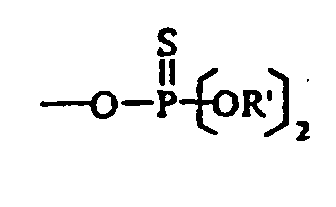
- The reactive ester compound of formula (III) used as a starting substance in the reaction scheme 3 above is a known compound and can be prepared according to the process disclosed in literatures (see, European Patent Laid-open Publication No. 555,769; Japanese Patent Laid-open Publication No. sho 57-175,196. This process for the preparation of cephalosporin derivatives distinguishes from the process according to the invention in that after the condensation between the compounds of formula (III) and (IV), p-toluensulfonic acid is added to the mixture in the presence of dimethylacetamide. In the process of the mentioned patents the p-toluensulfonic acid is added after the condensation in order to remove the trityl group. This particular feature of the process of the present application, results in the formation of the crystalline intermediate of formula (II) which can be easily isolated from the reaction mixture. No additional step is necessary to remove the mercaptobenzothiazole by-product. The specific structure of the crystalline intermediate of formula (II) has never been disclosed in the prior art especially US 4,559,334 or EP 105 459. The 3-cephem derivative of formula (IV) can also be prepared easily according to the known method described in US Patent No. 4,423,213.
- The reactive ester compound of formula (III) is used in an amount of 0.8 to 2.0 equivalents, preferably 1.0 to 1.2 equivalents with respect to the 3-cephem derivative of formula (IV). The solvent which can be used in the reaction of scheme 3 includes, N,N-dimethylacetamide alone, or a mixture of N,N-dimethylacetamide with one or more selected from a group consisting of ethanol, methanol, isopropanol, diethylether, tetrahydrofuran, dioxane, methylene chloride, chloroform, acetonitrile, ethyl acetate and acetone. In this case, the solvent is used in an amount of 10 to 60mℓ, preferably 10 to 30mℓ with respect to 1g of the 3-cephem derivative of formula (IV).
- Generally, the reaction is carried out at a temperature of -15 to 40 °C, preferably 0 to 30°C. The reaction is completed after 1 to 24 hours have passed from the initial point, however, it is desirable to complete the reaction within 1 to 5 hours since the color of the reaction solution becomes poor and the amount of side products increases as the reaction time becomes longer.
- The process for preparing the compound (II) of the present invention can be carried out in the presence of a base. If a base is used, tertiary amines such as triethylamine, tri-n-butylamine, diisopropylethylamine, triethylenediamine, pyridine, N,N-dimethylaniline, etc., preferably triethylamine or tri-n-butylamine can be used as the base. The base can be used in an amount of 0.5 to 5 equivalents, preferably 1 to 2 equivalents with respect to the 3-cephem derivative of formula (IV). On the other hand, the reaction can also be carried out by using N-trimethylsilylacetamide or N,O-bistrimethylsilylacetamide in an amount of 1 to 3 equivalents with respect to the 3-cephem derivative of formula (IV) instead of the base.
- After the reaction is completed under the conditions as explained above, diethylether, diisopropylether or ethylacetate is added to the reaction mixture to crystallize the product in the work-up procedure. In this case, they are added in an amount of 2 to 6 times by volume with respect to the reaction solvent, however, it is desirable to add them in an amount of 3 to 5 times by volume considering the reaction yield and purity.
- On the other hand, p-toluenesulfonic acid is usually used in an amount of 1 to 4 equivalents, preferably 2 to 3 equivalents with respect to the 3-cephem derivative of formula (IV).
- The cefdinir intermediate of formula (II) thus produced is a crystalline complex with a salt and a solvent, and it has a unique structure wherein one molecule of p-toluenesulfonic acid and two molecules of N,N-dimethylacetamide are attached to the main structure. Accordingly, it can be isolated more easily from the reaction mixture in a high purity than the usual cephalosporin compound having a noncrystalline form.
- It is recognized through a X-ray powder diffraction analysis that the compound (II) has a different crystalline form from other noncrystalline compounds. Particularly, in the X-ray powder diffraction spectrum of Figure 1, the characteristic peak of the compound (II) is well represented. The unique Debye-Scherrer X-ray powder diffraction pattern of the crystalline compound of formula (II) is described in the following Table 1.
- In Table 1 below, "" represents a diffraction angle, "d" represents a spacing between the layers, and "I/Io" represents a relative intensity.
Debye-Scherrer X-ray powder diffraction pattern of the compound of formula (II) d I/Io d I / Io 4.28 20.63 18 19.64 4.52 19 8.06 10.96 29 20.32 4.37 20 8.36 10.57 38 20.62 4.31 51 8.88 9.95 22 20.82 4.26 28 9.14 9.67 18 21.06 4.21 46 10.08 8.77 15 21.58 4.11 34 11.22 7.88 34 21.76 4.08 23 11.44 7.73 28 22.24 3.99 20 12.02 7.36 33 22.58 3.93 18 12.92 6.85 20 23.02 3.86 25 13.28 6.66 32 23.34 3.81 17 15.24 5.81 18 23.48 3.79 21 15.56 5.69 27 24.24 3.67 39 16.20 5.47 22 25.04 3.55 21 16.76 5.29 19 25.12 3.54 16 17.14 5.17 95 25.70 3.46 29 17.24 5.14 81 26.04 3.42 19 17.62 5.03 29 26.62 3.35 16 18.14 4.89 69 27.22 3.27 17 18.50 4.79 87 27.76 3.21 16 18.54 4.78 100 29.28 3.05 18 18.76 4.73 60 29.48 3.03 20 - In addition, the structure of the intermediate (II) is identified qualitatively through IR and NMR spectroscopy (see, Figure 1 to 3)
- Hereinafter, the present invention will be more specifically explained by the following examples.
- 8.0g (35.4mmol) of 7-amino-3-vinyl-3-cephem-4-carboxylic acid and 21.5g (37.1mmol) of (2)-(2-aminothiazol-4-yl)-2-trityloxyiminoacetic acid 2-benzothiazolyl thioester were suspended in 80mℓ of N,N-dimethylacetamide and 16.8mℓ (70.0mmol) of tri-n-butylamine was added thereto. Then, the reaction mixture was stirred for 1 hour while keeping the temperature at 15 to 20°C and 240mℓ of diethylether was added to the mixture. The reaction mixture thus prepared was stirred for 30 minutes and then filtered through a cellite. To the filtrate was added 20.2g (0.11mol) of p-toluenesulfonic acid · monohydrate dissolved in 40mℓ of methanol and the resulting solution was stirred for 2 hours at room temperature. After 160mℓ of diethylether was further added thereto, the whole solution was stirred for one hour at room temperature, cooled to 0 to 5°C, stirred for one hour and filtered. The crystal thus obtained was washed sequentially with 50mℓ of N,N-dimethylacetamide-diethylether(1:5, v/v) and 50mℓ of diethylether and then dried to obtain 32.3g (Yield 93%) of the title compound as a pale yellow crystal.
- HPLC Purity: 99.2%
- m.p.(°C) : 164 - 165
- IR(KBr, cm-1) : 3061, 1780, 1622, 1192
- 1H-NMR(MeOH-d4) δ : 2.0(s,6H), 2.3(s,3H), 2.9(s,6H), 3.0(s,6H), 3.7 (s,2H), 5.0-6.0(m,4H), 6.9-7.5(m,17H), 7.7(d,2H,J=8Hz)
- 10.0g (44.0mmol) of 7-amino-3-vinyl-3-cephem-4-carboxylic acid and 27.0g (46.4mmol) of (Z)-(2-aminothiazol-4-yl)-2-trityloxyiminoacetic acid 2-benzothiazolylthioester were mixed in 200mℓ of N,N-dimethylacetamide. 22.0mℓ (89.0mmol) of N,O-bistrimethylsilylacetamide was added thereto and then the resulting mixture was stirred overnight at 10 to 20°C. After 600mℓ of diethylether and 10mℓ of methanol were added to the mixture, the whole mixture was stirred for 30 minutes and then filtered through a cellite. To the filtrate was added 12.6g (66.2mmol) of p-toluenesulfonic acid · monohydrate dissolved in 40mℓ of methanol and the resulting solution was stirred for 3 hours. After 400mℓ of diethylether was further added thereto, the solution was stirred for 2 hours and then filtered. The crystal thus obtained was washed sequentially with 60mℓ of N,N-dimethylacetamide-diethylether(1:5, v/v) and 100mℓ of diethylether and then dried to obtain 38.3g (Yield 88%) of 7 β-[2-(2-aminothiazol-4-yl)-2(Z)-(trityloxyimino)acetamido]-3-vinyl-3-cephem-4-carboxylic acid · p-toluenesulfonic acid · 2 N,N-dimethylacetarnide as a pale yellow crystal. The purity of the product determined by HPLC analysis was 99.4%, and melting point, IR and 1H-NMR data were identical to those described in Example 1.
- 18.9g (32.5mmol) of diethylthiophosphoryl (Z)-(2-aminothiazol-4-yl)-2-trityloxyiminoacetate was dissolved in 105mℓ of N,N-dimethyl acetamide. 7.0g (31mmol) of 7-amino-3-vinyl-3-cephem-4-carboxylic acid and 8.6mℓ (62mmol) of triethylamine were added thereto and then the resulting mixture was stirred for 2 hours at room temperature. 210mℓ of diethylether was added to the mixture, which was then stirred for 30 minutes and filtered through a cellite. To the filtrate was added 17.7g (93mmol) of p-toluenesulfonic acid · monohydrate dissolved in 25mℓ of ethanol and the resulting solution was stirred for one hour and a half. After 210mℓ of diethylether was further added thereto, the solution was filtered to obtain a crystal. The crystal thus obtained was washed sequentially with 50mℓ of N,N-dimethylacetamide-diethylether(1:5, v/v) and 50mℓ of diethylether and then dried to obtain 26.2g (Yield 86%) of 7β - [2-(2-aminothiazol-4-yl)-2(Z)-(trityloxyimino)acetamido]-3-vinyl-3-cephem-4-carboxylic acid · p-toluenesulfonic acid · 2 N,N-dimethylacetamide as a pale yellow crystal. The purity of the product determined by HPLC analysis was 98.5%, and melting point, IR and 1H-NMR data were identical to those described in Example 1.
- 10.0g (44.0mmol) of 7-amino-3-vinyl-3-cephem-4-carboxylic acid and 27.0g (46.4mmol) of (Z)-(2-aminothiazol-4-yl)-2-trityloxyiminoacetic acid 2-benzothiazolylthioester were suspended in 150mℓ of N,N-dimethylacetamide. 21.0mℓ (88.0mmol) of tri-n-butylamine was added thereto and the mixture was stirred for 1 hour and a half at 15 to 25°C. 25.2g (133mmol) of p-toluenesulfonic acid · monohydrate was added to the mixture and thoroughly dissolved, 450mℓ of diisopropylether was added thereto and then the whole mixture was stirred for 2 hours. After 300mℓ of diisopropylether was added to the mixture, the resulting solution was stirred for 2 hours, cooled to about 5°C, stirred for 1 hour and filtered to obtain a crystal. The crystal thus obtained was washed sequentially with 50mℓ of N,N-dimethylacetamide-diethylether(1:5, v/v) and 50mℓ of diethylether and then dried to obtain 41.8g (Yield 96%) of 7β -[2-(2-aminothiazol-4-yl)-2(Z)-(trityloxyimino)acetamido]-3-vinyl-3-cephem-4-carboxylic acid · p-toluenesulfonic acid · 2 N,N-dimethylacetamide as a pale yellow crystal. The purity of the product determined by HPLC analysis was 98.2%, and melting point, IR and 1H-NMR data were identical to those described in Example 1.
- 10.0g (44.0mmol) of 7-amino-3-vinyl -3-cephem-4-carboxylic acid and 30.8g (53mmol) of (Z)-(2-aminothiazol-4-yl)-2-trityloxyiminoacetic acid 2-benzothiazolylthioester were mixed in 200mℓ of N,N-dimethylacetamide. 21.1mℓ (88mmol) of tri-n-butylamine was added thereto and then the resulting mixture was stirred overnight at room temperature. After 400mℓ of diethylether and 2g of activated charcoal were added to the mixture, the whole mixture was stirred for 1 hour and then filtered through a cellite. To the filtrate was added 16.8g (88mmol) of p-toluenesulfonic acid monohydrate dissolved in 30mℓ of methanol and the resulting solution was stirred for 2 hours. After 400mℓ of diethylether was further added thereto, the solution was stirred for 2 hours and then filtered. The crystal thus obtained was washed sequentially with 50mℓ of N,N-dimethylacetamide-diethylether(1:5, v/v) and 50mℓ of diethylether and then dried to obtain 37.0g (Yield 85%) of 7β -[2-(2-aminothiazol-4-yl)-2(Z)-(trityloxyimino)acetamido]-3-vinyl-3-cephem-4-carboxylic acid · p-toluenesulfonic acid · 2 N,N-dimethylacetamide as a pale yellow crystal. The purity of the product determined by HPLC analysis was 98.5%, and melting point, IR and 1H-NMR data were identical to those described in Example 1.
- 15.0g (15.2mmol) of 7β-[2-(2-aminothiazol-4-yl)-2(Z)-(trityloxyimino)acetamido]-3-vinyl-3-cephem-4-carboxylic acid · p-toluenesulfonic acid · 2 N,N-dimethylacetamide was dissolved in 90mℓ of methanol and then 0.51mℓ (15.2mmol) of 99% formic acid was added thereto. After the resulting mixture was stirred for 5 hours under reflux, the methanol contained therein was removed under reduced pressure and 50mℓ of water, 30mℓ of tetrahydrofuran and 60mℓ of ethylacetate were added to the residue. The pH of the solution was adjusted to 6.5 to 7.5 by adding sodium hydrogen carbonate little by little. The aqueous layer was separated, washed with a solvent mixture of 30mℓ of tetrahydrofuran and 60mℓ of ethylacetate, and then adjusted to pH 2.4 to 2.8 using 2N-HCl. The crystal thus precipitated was stirred for 1 hour under ice-bath, filtered, washed with 30mℓ of water and dried to obtain 5.5g (Yield 92%) of the title compound as a pale yellow solid.
- HPLC Purity : 99.2%
- IR(KBr, cm-1) : 3300, 1780, 1665, 1180, 1130
- 1H-NMR(DMSO-d6) δ: 3.5, 3.80(2H,ABq,J=18Hz), 5.2(1H,d,J=5Hz), 5.3 (1H,d,J=10Hz), 5.6(1H,d,J=17Hz), 5.8(1H,dd,J=8Hz,5Hz), 6.7(1H, s), 6.9(1H,dd,J=17Hz,10Hz), 7.1(2H,brs), 9.4(1H,d,J=8Hz), 11.3 (1H,brs)
- 10.0g (10.2mmol) of 7β-[2-(2-aminothiazol-4-yl)-2(Z)-(trityloxyimino)acetamido]-3-vinyl-3-cephem-4-carboxylic acid · p-toluenesulfonic acid · 2 N,N-dimethylacetamide was dissolved in 20mℓ of methanol and then 20mℓ (0.26mol) of trifluoroacetic acid and 10mℓ (92mmol) of anisole were added thereto. After the mixture was stirred for 5 hours at 40 to 45°C, the methanol contained therein was removed under reduced pressure. The residue was dispersed in 200mℓ of ethylacetate, and then the resulting solution was stirred for 30 minutes and filtered. The pale yellow solid thus obtained was dried and dissolved in 60mℓ of water, 30mℓ of tetrahydrofuran and 60mℓ of ethylacetate. The pH of the solution was adjusted to 5.5 to 6.5 by adding sodium hydrogen carbonate little by little. The aqueous layer was separated, washed with a solvent mixture of 30mℓ of tetrahydrofuran and 60mℓ of ethylacetate, and then adjusted to pH 2.4 to 2.8 using 2N-HCl. The crystal thus precipitated was stirred for 1 hour under ice-bath, filtered, washed with 30mℓ of water and dried to obtain 3.6g (Yield 90%) of 7β-[2-(2-aminothiazol-4-yl)-2(Z)-(hydroxyimino)acetamido]-3-vinyl-3-cephem-4-carboxylic acid as a pale yellow solid. The purity of the product determined by HPLC analysis was 99.4%, and IR and 1H-NMR data were identical to those described in Example 6.
- To 5.0g (5.1mmol) of 7β-[2-(2-aminothiazol-4-yl)-2(Z)-(trityloxyimino)acetamido]-3-vinyl-3-cephem-4-carboxylic acid p-toluenesulfonic acid 2 N,N-dimethylacetamide was added 15mℓ of 85% formic acid and the mixture was stirred for 2 hours at room temperature. After tritylcarbinol thus precipitated was removed by filtration, the filtrate was concentrated under reduced pressure. To the residue were added 30mℓ of water, 10mℓ of tetrahydrofuran and 20mℓ of ethylacetate. The pH of the solution was adjusted to 6.5 by adding sodium hydrogen carbonate little by little. The aqueous layer was separated, washed with a solvent mixture of 10mℓ of tetrahydrofuran and 20mℓ of ethylacetate, and then adjusted to pH 2.4 to 2.8 using 2N-HCl. The crystal thus precipitated was stirred for 1 hour under ice-bath, filtered, washed with 10mℓ of water and dried to obtain 1.9g (Yield 93%) of 7β-[2-(2-aminothiazol-4-yl)-2(Z)-(hydroxyimino)acetamido]-3-vinyl-3-cephem-4-carboxylic acid as a pale yellow solid. The purity of the product determined by HPLC analysis was 99.1%, and IR and 1H-NMR data were identical to those described in Example 6.
Claims (18)
- A process for preparing cefdinir having the following formula (I),characterized in that a trityl protecting group in a cefdinir intermediate having the following formula (II),
 in which Ph represents phenyl, p-TsOH represents p-toluenesulfonic acid, and DMAC represents N,N-dimethylacetamide, is removed in the presence of an acid.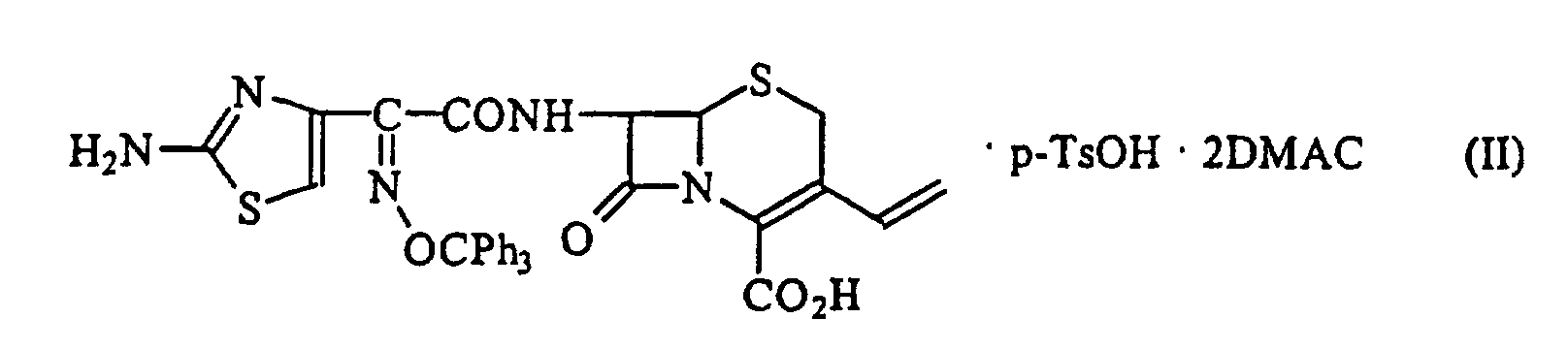
- The process according to claim 1, wherein the acid is an inorganic acid, an organic acid, or an acidic hydrogen ion exchange resin.
- The process according to claim 2, wherein the inorganic acid is selected from a group consisting of hydrochloric acid, hydrobromic acid, hydroiodic acid, sulfuric acid and Lewis acid.
- The process according to claim 3, wherein the Lewis acid is selected from a group consisting of boron trifluoride, boron trifluoride ethyletherate, aluminum chloride, antimony pentachloride, ferrous chloride, stannous chloride, titanium tetrachloride and zinc chloride.
- The process according to claim 2, wherein the organic acid is selected from a group consisting of acetic acid, formic acid, trifluoroacetic acid, methanesulfonic acid, benzenesulfonic acid and p-toluenesulfonic acid.
- The process according to claim 2, wherein the reaction is carried out in the presence of a cation capturing agent when a Lewis acid or an organic acid is used.
- The process according to claim 6, wherein the cation capturing agent is anisole.
- The process according to claim 1, wherein the acid is used in an amount of 1 to 20 equivalents with respect to the compound of formula (II).
- A crystalline cefdinir intermediate having the following formula (II) :in which

Ph represents phenyl,
p-TsOH represents p-toluenesulfonic acid, and
DMAC represents N,N-dimethylacetamide - A process for preparing a compound having the following formula (II),in which Ph represents phenyl, p-TsOH represents p-toluenesulfonic acid, and DMAC represents N,N-dimethylacetamide, characterized in that a reactive ester having the following formula (III),
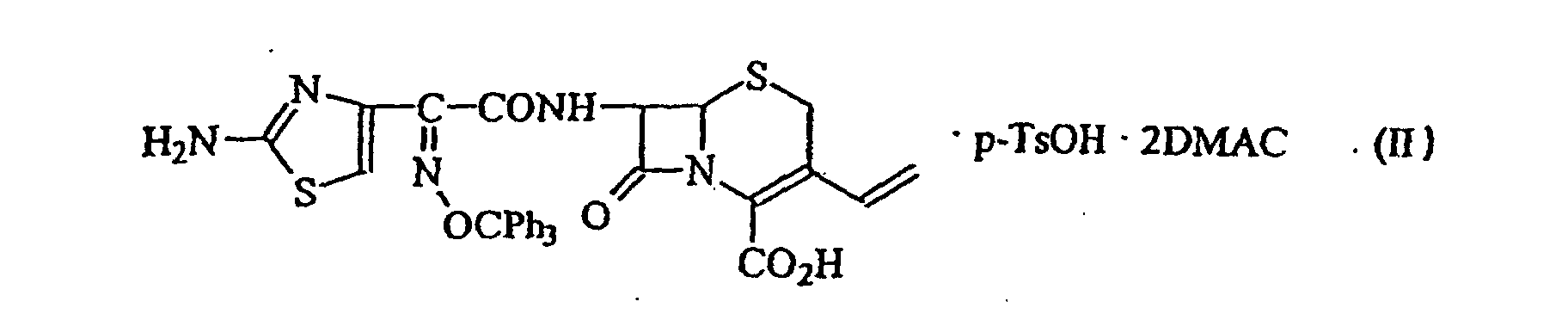 in which Z represents
 or
or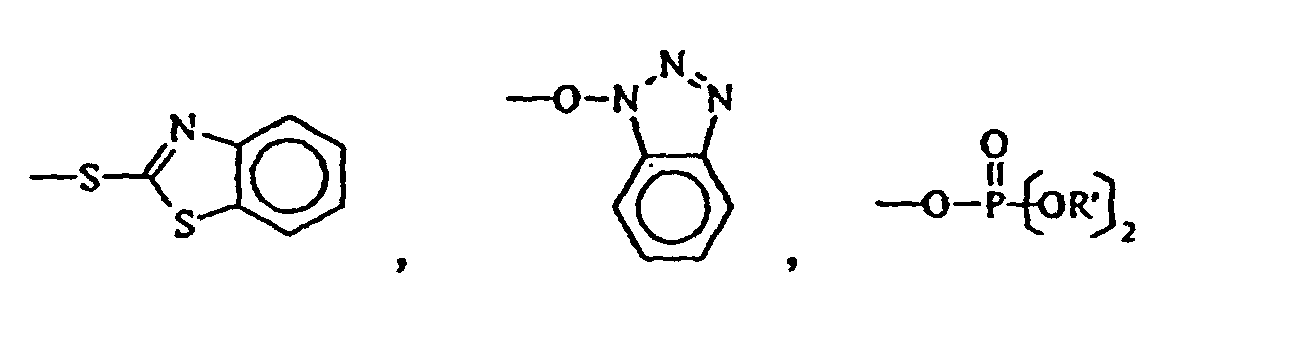 wherein R' represents C1-C4 alkyl or phenyl, or R' together with phosphorus and oxygen atoms to which R' is attached can form a 5 to 6-membered heterocycle, is reacted with a 3-cephem derivative having the following formula (IV),
 in N,N-dimethylacetamide in the presence or absence of a base, and then p-toluenesulfonic acid is added thereto.
- The process according to claim 11, wherein the reactive ester of formula (III) is used in an amount of 0.8 to 2.0 equivalents with respect to the 3-cephem derivative of formula (IV).
- The process according to claim 11, wherein N,N-dimethylacetamide is combined with one or more selected from a group consisting of ethanol, methanol, isopropanol, diethylether, tetrahydrofuran, dioxane, methylene chloride, chloroform, acetonitrile, ethylacetate and acetone.
- The process according to claim 11, wherein the reaction is carried out at a temperature of -15 to 40 °C.
- The process according to claim 11, wherein a tertiary amine is used as the base.
- The process according to claim 15, wherein the tertiary amine is triethylamine or tri-n-butylamine.
- The process according to claim 11, wherein N-trimethylsilylacetamide or N,O-bistrimethylsilylacetamide is used in the absence of a base.
- The process according to claim 11, wherein p-toluenesulfonic acid is used in an amount of 1 to 3 equivalents with respect to the 3-cephem derivative of formula (IV).
- The process according to claim 11, wherein one selected from a group consisting of diethylether, diisopropylether and ethylacetate is used in an amount of 2 to 6 times by volume with respect to the reaction solvent in the work-up procedure.
Applications Claiming Priority (5)
| Application Number | Priority Date | Filing Date | Title |
|---|---|---|---|
| KR5869595 | 1995-12-27 | ||
| KR1019950058694A KR0174432B1 (en) | 1995-12-27 | 1995-12-27 | Novel crystalline Cefdinir intermediate and preparation method thereof |
| KR5869495 | 1995-12-27 | ||
| KR1019950058695A KR0174431B1 (en) | 1995-12-27 | 1995-12-27 | Process for preparing cefdinir |
| PCT/KR1996/000250 WO1997024358A1 (en) | 1995-12-27 | 1996-12-26 | Process for preparation of cefdinir |
Publications (2)
| Publication Number | Publication Date |
|---|---|
| EP0874853A1 EP0874853A1 (en) | 1998-11-04 |
| EP0874853B1 true EP0874853B1 (en) | 2002-06-05 |
Family
ID=26631527
Family Applications (1)
| Application Number | Title | Priority Date | Filing Date |
|---|---|---|---|
| EP96943357A Expired - Lifetime EP0874853B1 (en) | 1995-12-27 | 1996-12-26 | Process for preparation of cefdinir |
Country Status (9)
| Country | Link |
|---|---|
| US (1) | US6093814A (en) |
| EP (1) | EP0874853B1 (en) |
| JP (1) | JP3948628B2 (en) |
| AT (1) | ATE218572T1 (en) |
| DE (1) | DE69621649T2 (en) |
| DK (1) | DK0874853T3 (en) |
| ES (1) | ES2175167T3 (en) |
| PT (1) | PT874853E (en) |
| WO (1) | WO1997024358A1 (en) |
Cited By (2)
| Publication number | Priority date | Publication date | Assignee | Title |
|---|---|---|---|---|
| EP2030975A1 (en) * | 2007-08-06 | 2009-03-04 | ACS DOBFAR S.p.A. | CEFDINIR synthesis process |
| CN102020664A (en) * | 2010-11-30 | 2011-04-20 | 浙江工业大学 | Synthesis method for cefdinir |
Families Citing this family (33)
| Publication number | Priority date | Publication date | Assignee | Title |
|---|---|---|---|---|
| US5883247A (en) * | 1996-06-10 | 1999-03-16 | Hoffmann-La Roche Inc. | Preparation of cephem and isooxacephem derivatives |
| AT405283B (en) * | 1997-04-04 | 1999-06-25 | Biochemie Gmbh | NEW CRYSTALLINE 7- (Z) - (2- (2-AMINOTHIAZOL-4-YL) -2-HYDROXYIMINOACETAMIDO) -3-VINYL-3-CEPHEM-4- CARBONIC ACID DICYCLOHEXYLAMMONIUM SALTS AND METHODS FOR THE PRODUCTION THEREOF |
| US20080113025A1 (en) * | 1998-11-02 | 2008-05-15 | Elan Pharma International Limited | Compositions comprising nanoparticulate naproxen and controlled release hydrocodone |
| JP4544692B2 (en) * | 2000-04-13 | 2010-09-15 | 大塚化学株式会社 | Method for producing 3-vinyl-cephem compound |
| KR100451672B1 (en) * | 2001-06-05 | 2004-10-08 | 한미약품 주식회사 | Crystalline acid salts of cefdinir, process for their preparation and process for the preparation of cefdinir using same |
| ITMI20012364A1 (en) * | 2001-11-09 | 2003-05-09 | Antibioticos Spa | SUMMARY PROCESS OF CEFIXIMA VIA ALCHIL-O ARILSOLFONATI |
| EP1458728A1 (en) * | 2001-12-13 | 2004-09-22 | Ranbaxy Laboratories Limited | Crystalline cefdinir potassium dihydrate |
| CN1628118A (en) * | 2002-04-26 | 2005-06-15 | 兰贝克赛实验室有限公司 | The method for preparing cefdinir |
| ITMI20020913A0 (en) * | 2002-04-29 | 2002-04-29 | Acs Dobfar Spa | NEW CRYSTALLINE FORM OF CEFDINIR |
| EP1842852A1 (en) * | 2002-08-13 | 2007-10-10 | Sandoz AG | A cefdinir intermediate |
| ITMI20022076A1 (en) * | 2002-10-01 | 2004-04-02 | Antibioticos Spa | INTERMEDIATE SALTS OF CEFDINIR. |
| US20070106073A1 (en) * | 2003-03-24 | 2007-05-10 | Eiji Imai | Novel crystal of 7-[2-[(2-aminothiazol-4-yl)-2-hydroxyiminoacetamide-3-vinyl-3-cephem-4-carboxylic acid (syn isomer) and method for preparation thereof |
| WO2004104010A1 (en) * | 2003-05-20 | 2004-12-02 | Ranbaxy Laboratories Limited | Crystalline form of cefdinir |
| US20050137182A1 (en) * | 2003-06-02 | 2005-06-23 | Ramesh Dandala | Novel crystalline form of cefdinir |
| US20040242556A1 (en) * | 2003-06-02 | 2004-12-02 | Ramesh Dandala | Novel crystalline form of cefdinir |
| US20050113355A1 (en) * | 2003-09-12 | 2005-05-26 | Duerst Richard W. | Cefdinir pyridine salt |
| US20050059818A1 (en) * | 2003-09-12 | 2005-03-17 | Duerst Richard W. | Polymorph of a pharmaceutical |
| US20050059819A1 (en) * | 2003-09-12 | 2005-03-17 | Duerst Richard W. | Cefdinir pyridine salt |
| US20060211676A1 (en) * | 2004-03-16 | 2006-09-21 | Devalina Law | Crystalline anhydrous cefdinir and crystalline cefdinir hydrates |
| US20060142261A1 (en) * | 2004-03-16 | 2006-06-29 | Devalina Law | Crystalline anhydrous cefdinir and crystalline cefdinir hydrates |
| US20060142563A1 (en) * | 2004-03-16 | 2006-06-29 | Devalina Law | Crystalline anhydrous cefdinir and crystalline cefdinir hydrates |
| US20050209211A1 (en) * | 2004-03-16 | 2005-09-22 | Devalina Law | Trihemihydrate, anhydrate and novel hydrate forms of Cefdinir |
| US20060069079A1 (en) * | 2004-09-27 | 2006-03-30 | Sever Nancy E | Stable amorphous cefdinir |
| US20050245738A1 (en) * | 2004-05-03 | 2005-11-03 | Lupin Ltd | Stable bioavailable crystalline form or cefdinir and a process for the preparation thereof |
| WO2006010978A1 (en) * | 2004-06-30 | 2006-02-02 | Wockhardt Limited | Cefdinir polymorphic forms, and imidazole salt |
| WO2006018807A1 (en) * | 2004-08-16 | 2006-02-23 | Ranbaxy Laboratories Limited | Crystalline forms of cefdinir |
| MX2007006018A (en) * | 2004-11-30 | 2007-06-07 | Astellas Pharma Inc | Novel oral pharmaceutical suspension of cefdinir crystal. |
| EP1848724A2 (en) * | 2005-10-31 | 2007-10-31 | Teva Pharmaceutical Industries Ltd | Process for the preparation of cefdinir |
| US20070128268A1 (en) * | 2005-12-07 | 2007-06-07 | Herwig Jennewein | Pharmaceutical compositions comprising an antibiotic |
| US8466096B2 (en) * | 2007-04-26 | 2013-06-18 | Afton Chemical Corporation | 1,3,2-dioxaphosphorinane, 2-sulfide derivatives for use as anti-wear additives in lubricant compositions |
| KR101058135B1 (en) * | 2008-04-04 | 2011-08-24 | 대웅바이오 주식회사 | Useful Intermediates for Cefdinir Synthesis and Methods for Preparing Cefdinir Using the Same |
| CN101481383B (en) * | 2008-12-31 | 2012-01-11 | 杭州奥默医药技术有限公司 | Cefdinir acid type double salt compound and preparation |
| CN103319503A (en) * | 2013-06-09 | 2013-09-25 | 四川方向药业有限责任公司 | Preparation method of cefdinir |
Citations (3)
| Publication number | Priority date | Publication date | Assignee | Title |
|---|---|---|---|---|
| EP0105459A2 (en) * | 1982-09-30 | 1984-04-18 | Fujisawa Pharmaceutical Co., Ltd. | Syn-isomer of 7-substituted-3-vinyl-3-cephem compounds, processes for production thereof and pharmaceutical compositions containing them |
| EP0484966A2 (en) * | 1990-11-09 | 1992-05-13 | Eisai Co., Ltd. | 7-Acyl-3-(substituted carbamoyloxy) cephem compounds, use thereof and process for their preparation |
| EP0555769A2 (en) * | 1992-02-14 | 1993-08-18 | Hoechst Aktiengesellschaft | Process for the preparation of Cephem-Prodrug-esters |
Family Cites Families (1)
| Publication number | Priority date | Publication date | Assignee | Title |
|---|---|---|---|---|
| CN1130908A (en) * | 1994-07-22 | 1996-09-11 | 安蒂比奥蒂科斯公司 | Glutaryl 7-aminocephalosporanic acid derivative and preparation method thereof |
-
1996
- 1996-12-26 US US09/068,719 patent/US6093814A/en not_active Expired - Lifetime
- 1996-12-26 JP JP52423097A patent/JP3948628B2/en not_active Expired - Lifetime
- 1996-12-26 DK DK96943357T patent/DK0874853T3/en active
- 1996-12-26 AT AT96943357T patent/ATE218572T1/en not_active IP Right Cessation
- 1996-12-26 ES ES96943357T patent/ES2175167T3/en not_active Expired - Lifetime
- 1996-12-26 WO PCT/KR1996/000250 patent/WO1997024358A1/en not_active Ceased
- 1996-12-26 PT PT96943357T patent/PT874853E/en unknown
- 1996-12-26 DE DE69621649T patent/DE69621649T2/en not_active Expired - Lifetime
- 1996-12-26 EP EP96943357A patent/EP0874853B1/en not_active Expired - Lifetime
Patent Citations (3)
| Publication number | Priority date | Publication date | Assignee | Title |
|---|---|---|---|---|
| EP0105459A2 (en) * | 1982-09-30 | 1984-04-18 | Fujisawa Pharmaceutical Co., Ltd. | Syn-isomer of 7-substituted-3-vinyl-3-cephem compounds, processes for production thereof and pharmaceutical compositions containing them |
| EP0484966A2 (en) * | 1990-11-09 | 1992-05-13 | Eisai Co., Ltd. | 7-Acyl-3-(substituted carbamoyloxy) cephem compounds, use thereof and process for their preparation |
| EP0555769A2 (en) * | 1992-02-14 | 1993-08-18 | Hoechst Aktiengesellschaft | Process for the preparation of Cephem-Prodrug-esters |
Cited By (3)
| Publication number | Priority date | Publication date | Assignee | Title |
|---|---|---|---|---|
| EP2030975A1 (en) * | 2007-08-06 | 2009-03-04 | ACS DOBFAR S.p.A. | CEFDINIR synthesis process |
| CN102020664A (en) * | 2010-11-30 | 2011-04-20 | 浙江工业大学 | Synthesis method for cefdinir |
| CN102020664B (en) * | 2010-11-30 | 2012-12-12 | 浙江工业大学 | Synthesis method for cefdinir |
Also Published As
| Publication number | Publication date |
|---|---|
| ES2175167T3 (en) | 2002-11-16 |
| EP0874853A1 (en) | 1998-11-04 |
| ATE218572T1 (en) | 2002-06-15 |
| DK0874853T3 (en) | 2002-09-23 |
| WO1997024358A1 (en) | 1997-07-10 |
| JP3948628B2 (en) | 2007-07-25 |
| JP2000502700A (en) | 2000-03-07 |
| DE69621649T2 (en) | 2002-09-19 |
| PT874853E (en) | 2002-09-30 |
| DE69621649D1 (en) | 2002-07-11 |
| US6093814A (en) | 2000-07-25 |
Similar Documents
| Publication | Publication Date | Title |
|---|---|---|
| US6093814A (en) | Process for preparation of cefdinir | |
| JP3421354B2 (en) | Crystalline cefdiniramine salt | |
| MXPA04010627A (en) | Process for the preparation of cefdinir. | |
| EP0408034B1 (en) | 3-Substituted vinyl cephalosporin derivatives | |
| US5412094A (en) | Bicyclic beta-lactam/paraben complexes | |
| HU195183B (en) | Process for producing alpha-(o-chlorphenyl)-aminomethylene-beta-formilamino-propionitrile | |
| US4866055A (en) | Cephalosporin derivatives and their crystalline derivatives | |
| AU654384B2 (en) | Preparation of a cephalosporin antibiotic using the syn-isomer of a thiazolyl intermediate | |
| NZ298410A (en) | Production of cefotaxime and sodium salts | |
| JP3434840B2 (en) | Manufacturing method of cephalosporin antibiotic | |
| US6001996A (en) | Complexes of cephalosporins and carbacephalosporins with parabens | |
| KR20040007978A (en) | A process for preparing 9-[4-acetoxy-3-(acetoxymethyl)but-1-yl]-2-aminopurine | |
| EP1274695B1 (en) | New thiazol compounds and their preparations | |
| US5594130A (en) | Preparation of a cephalosporin antibiotic using the syn-isomer of a thiazolyl intermediate | |
| EP0019067B1 (en) | 5,10-dioxo-5,10-dihydrodiimidazo(1,5-a,1',5'-d)pyrazine-1,6-dicarboxylic acid and a process for producing imidazoledicarboxylic acid amido-derivatives | |
| KR0174432B1 (en) | Novel crystalline Cefdinir intermediate and preparation method thereof | |
| KR0174431B1 (en) | Process for preparing cefdinir | |
| US5594129A (en) | Process for the preparation of a cephalosporin antibiotic | |
| US5831085A (en) | Process for manufacture of cephalosporin such as ceftazidime and intermediate thereof | |
| JPH01242589A (en) | Cephem compound | |
| KR0156275B1 (en) | Process for preparation of ceftazidime pentahydrate | |
| KR19990017228A (en) | Method for preparing cephem derivatives | |
| JPH01131186A (en) | Beta-lactam compound, production thereof, intermediate for synthesis thereof and composition for remedy of microbism containing said compound | |
| HU197579B (en) | Process for production of derivatives of cefem carbonic acid | |
| HK1034078A1 (en) | Process for purification of a cephalosporin derivative |
Legal Events
| Date | Code | Title | Description |
|---|---|---|---|
| PUAI | Public reference made under article 153(3) epc to a published international application that has entered the european phase |
Free format text: ORIGINAL CODE: 0009012 |
|
| 17P | Request for examination filed |
Effective date: 19980504 |
|
| AK | Designated contracting states |
Kind code of ref document: A1 Designated state(s): AT BE CH DE DK ES FI FR GB GR IE IT LI LU MC NL PT SE |
|
| 17Q | First examination report despatched |
Effective date: 20000317 |
|
| GRAG | Despatch of communication of intention to grant |
Free format text: ORIGINAL CODE: EPIDOS AGRA |
|
| GRAG | Despatch of communication of intention to grant |
Free format text: ORIGINAL CODE: EPIDOS AGRA |
|
| GRAH | Despatch of communication of intention to grant a patent |
Free format text: ORIGINAL CODE: EPIDOS IGRA |
|
| GRAH | Despatch of communication of intention to grant a patent |
Free format text: ORIGINAL CODE: EPIDOS IGRA |
|
| GRAA | (expected) grant |
Free format text: ORIGINAL CODE: 0009210 |
|
| AK | Designated contracting states |
Kind code of ref document: B1 Designated state(s): AT BE CH DE DK ES FI FR GB GR IE IT LI LU MC NL PT SE |
|
| REF | Corresponds to: |
Ref document number: 218572 Country of ref document: AT Date of ref document: 20020615 Kind code of ref document: T |
|
| REG | Reference to a national code |
Ref country code: GB Ref legal event code: FG4D |
|
| REG | Reference to a national code |
Ref country code: CH Ref legal event code: EP |
|
| REG | Reference to a national code |
Ref country code: CH Ref legal event code: NV Representative=s name: ANDRE ROLAND CONSEILS EN PROPRIETE INTELLECTUELLE |
|
| REG | Reference to a national code |
Ref country code: IE Ref legal event code: FG4D |
|
| REF | Corresponds to: |
Ref document number: 69621649 Country of ref document: DE Date of ref document: 20020711 |
|
| REG | Reference to a national code |
Ref country code: DK Ref legal event code: T3 |
|
| REG | Reference to a national code |
Ref country code: PT Ref legal event code: SC4A Free format text: AVAILABILITY OF NATIONAL TRANSLATION Effective date: 20020709 |
|
| ET | Fr: translation filed | ||
| PGFP | Annual fee paid to national office [announced via postgrant information from national office to epo] |
Ref country code: FI Payment date: 20021108 Year of fee payment: 7 Ref country code: DK Payment date: 20021108 Year of fee payment: 7 |
|
| PGFP | Annual fee paid to national office [announced via postgrant information from national office to epo] |
Ref country code: NL Payment date: 20021112 Year of fee payment: 7 Ref country code: MC Payment date: 20021112 Year of fee payment: 7 Ref country code: BE Payment date: 20021112 Year of fee payment: 7 Ref country code: AT Payment date: 20021112 Year of fee payment: 7 |
|
| PGFP | Annual fee paid to national office [announced via postgrant information from national office to epo] |
Ref country code: SE Payment date: 20021113 Year of fee payment: 7 Ref country code: CH Payment date: 20021113 Year of fee payment: 7 |
|
| REG | Reference to a national code |
Ref country code: GR Ref legal event code: EP Ref document number: 20020402941 Country of ref document: GR |
|
| REG | Reference to a national code |
Ref country code: ES Ref legal event code: FG2A Ref document number: 2175167 Country of ref document: ES Kind code of ref document: T3 |
|
| PGFP | Annual fee paid to national office [announced via postgrant information from national office to epo] |
Ref country code: PT Payment date: 20021119 Year of fee payment: 7 |
|
| PGFP | Annual fee paid to national office [announced via postgrant information from national office to epo] |
Ref country code: IE Payment date: 20021220 Year of fee payment: 7 |
|
| PGFP | Annual fee paid to national office [announced via postgrant information from national office to epo] |
Ref country code: GR Payment date: 20021230 Year of fee payment: 7 |
|
| PGFP | Annual fee paid to national office [announced via postgrant information from national office to epo] |
Ref country code: LU Payment date: 20030106 Year of fee payment: 7 |
|
| PLBE | No opposition filed within time limit |
Free format text: ORIGINAL CODE: 0009261 |
|
| STAA | Information on the status of an ep patent application or granted ep patent |
Free format text: STATUS: NO OPPOSITION FILED WITHIN TIME LIMIT |
|
| 26N | No opposition filed |
Effective date: 20030306 |
|
| PG25 | Lapsed in a contracting state [announced via postgrant information from national office to epo] |
Ref country code: LU Free format text: LAPSE BECAUSE OF NON-PAYMENT OF DUE FEES Effective date: 20031226 Ref country code: IE Free format text: LAPSE BECAUSE OF NON-PAYMENT OF DUE FEES Effective date: 20031226 Ref country code: FI Free format text: LAPSE BECAUSE OF NON-PAYMENT OF DUE FEES Effective date: 20031226 Ref country code: AT Free format text: LAPSE BECAUSE OF NON-PAYMENT OF DUE FEES Effective date: 20031226 |
|
| PG25 | Lapsed in a contracting state [announced via postgrant information from national office to epo] |
Ref country code: SE Free format text: LAPSE BECAUSE OF NON-PAYMENT OF DUE FEES Effective date: 20031227 |
|
| PG25 | Lapsed in a contracting state [announced via postgrant information from national office to epo] |
Ref country code: MC Free format text: LAPSE BECAUSE OF NON-PAYMENT OF DUE FEES Effective date: 20031231 Ref country code: LI Free format text: LAPSE BECAUSE OF NON-PAYMENT OF DUE FEES Effective date: 20031231 Ref country code: CH Free format text: LAPSE BECAUSE OF NON-PAYMENT OF DUE FEES Effective date: 20031231 Ref country code: BE Free format text: LAPSE BECAUSE OF NON-PAYMENT OF DUE FEES Effective date: 20031231 |
|
| PG25 | Lapsed in a contracting state [announced via postgrant information from national office to epo] |
Ref country code: DK Free format text: LAPSE BECAUSE OF NON-PAYMENT OF DUE FEES Effective date: 20040102 |
|
| BERE | Be: lapsed |
Owner name: *HANMI PHARMACEUTICAL CO. LTD Effective date: 20031231 |
|
| PG25 | Lapsed in a contracting state [announced via postgrant information from national office to epo] |
Ref country code: PT Free format text: LAPSE BECAUSE OF NON-PAYMENT OF DUE FEES Effective date: 20040630 |
|
| PG25 | Lapsed in a contracting state [announced via postgrant information from national office to epo] |
Ref country code: NL Free format text: LAPSE BECAUSE OF NON-PAYMENT OF DUE FEES Effective date: 20040701 |
|
| PG25 | Lapsed in a contracting state [announced via postgrant information from national office to epo] |
Ref country code: GR Free format text: LAPSE BECAUSE OF NON-PAYMENT OF DUE FEES Effective date: 20040705 |
|
| EUG | Se: european patent has lapsed | ||
| REG | Reference to a national code |
Ref country code: CH Ref legal event code: PL |
|
| REG | Reference to a national code |
Ref country code: DK Ref legal event code: EBP |
|
| NLV4 | Nl: lapsed or anulled due to non-payment of the annual fee |
Effective date: 20040701 |
|
| REG | Reference to a national code |
Ref country code: IE Ref legal event code: MM4A |
|
| REG | Reference to a national code |
Ref country code: PT Ref legal event code: MM4A Free format text: LAPSE DUE TO NON-PAYMENT OF FEES Effective date: 20040630 |
|
| PG25 | Lapsed in a contracting state [announced via postgrant information from national office to epo] |
Ref country code: IT Free format text: LAPSE BECAUSE OF NON-PAYMENT OF DUE FEES;WARNING: LAPSES OF ITALIAN PATENTS WITH EFFECTIVE DATE BEFORE 2007 MAY HAVE OCCURRED AT ANY TIME BEFORE 2007. THE CORRECT EFFECTIVE DATE MAY BE DIFFERENT FROM THE ONE RECORDED. Effective date: 20051226 |
|
| PGRI | Patent reinstated in contracting state [announced from national office to epo] |
Ref country code: IT Effective date: 20091201 |
|
| REG | Reference to a national code |
Ref country code: DE Ref legal event code: R082 Ref document number: 69621649 Country of ref document: DE Representative=s name: WABLAT LANGE KARTHAUS ANWALTSSOZIETAET, DE |
|
| REG | Reference to a national code |
Ref country code: ES Ref legal event code: PC2A Owner name: HANMI SCIENCE CO., LTD Effective date: 20130123 |
|
| REG | Reference to a national code |
Ref country code: GB Ref legal event code: 732E Free format text: REGISTERED BETWEEN 20130207 AND 20130214 |
|
| REG | Reference to a national code |
Ref country code: DE Ref legal event code: R082 Ref document number: 69621649 Country of ref document: DE Representative=s name: WABLAT LANGE KARTHAUS ANWALTSSOZIETAET, DE Effective date: 20130201 Ref country code: DE Ref legal event code: R081 Ref document number: 69621649 Country of ref document: DE Owner name: HANMI SCIENCE CO., LTD., HWASEONG-SI, KR Free format text: FORMER OWNER: HANMI PHARMACEUTICAL CO., LTD., KYUNGGI, KR Effective date: 20130201 Ref country code: DE Ref legal event code: R081 Ref document number: 69621649 Country of ref document: DE Owner name: HANMI SCIENCE CO., LTD., KR Free format text: FORMER OWNER: HANMI PHARMACEUTICAL CO., LTD., KYUNGGI, KR Effective date: 20130201 |
|
| REG | Reference to a national code |
Ref country code: FR Ref legal event code: TP Owner name: HANMI SCIENCE CO., LTD, KR Effective date: 20130411 |
|
| REG | Reference to a national code |
Ref country code: FR Ref legal event code: PLFP Year of fee payment: 20 |
|
| PGFP | Annual fee paid to national office [announced via postgrant information from national office to epo] |
Ref country code: DE Payment date: 20151019 Year of fee payment: 20 Ref country code: IT Payment date: 20151215 Year of fee payment: 20 Ref country code: GB Payment date: 20151023 Year of fee payment: 20 |
|
| PGFP | Annual fee paid to national office [announced via postgrant information from national office to epo] |
Ref country code: FR Payment date: 20151026 Year of fee payment: 20 Ref country code: ES Payment date: 20151001 Year of fee payment: 20 |
|
| REG | Reference to a national code |
Ref country code: DE Ref legal event code: R071 Ref document number: 69621649 Country of ref document: DE |
|
| REG | Reference to a national code |
Ref country code: GB Ref legal event code: PE20 Expiry date: 20161225 |
|
| PG25 | Lapsed in a contracting state [announced via postgrant information from national office to epo] |
Ref country code: GB Free format text: LAPSE BECAUSE OF EXPIRATION OF PROTECTION Effective date: 20161225 |
|
| PG25 | Lapsed in a contracting state [announced via postgrant information from national office to epo] |
Ref country code: ES Free format text: LAPSE BECAUSE OF EXPIRATION OF PROTECTION Effective date: 20161227 |