EP0874530A1 - Serial data transmission of variable length mini packets using statistical multiplexing - Google Patents
Serial data transmission of variable length mini packets using statistical multiplexing Download PDFInfo
- Publication number
- EP0874530A1 EP0874530A1 EP98302348A EP98302348A EP0874530A1 EP 0874530 A1 EP0874530 A1 EP 0874530A1 EP 98302348 A EP98302348 A EP 98302348A EP 98302348 A EP98302348 A EP 98302348A EP 0874530 A1 EP0874530 A1 EP 0874530A1
- Authority
- EP
- European Patent Office
- Prior art keywords
- frames
- predetermined size
- mini packets
- aal2
- octets
- Prior art date
- Legal status (The legal status is an assumption and is not a legal conclusion. Google has not performed a legal analysis and makes no representation as to the accuracy of the status listed.)
- Withdrawn
Links
Images

Classifications
-
- H—ELECTRICITY
- H04—ELECTRIC COMMUNICATION TECHNIQUE
- H04Q—SELECTING
- H04Q11/00—Selecting arrangements for multiplex systems
- H04Q11/04—Selecting arrangements for multiplex systems for time-division multiplexing
- H04Q11/0428—Integrated services digital network, i.e. systems for transmission of different types of digitised signals, e.g. speech, data, telecentral, television signals
- H04Q11/0478—Provisions for broadband connections
-
- H—ELECTRICITY
- H04—ELECTRIC COMMUNICATION TECHNIQUE
- H04L—TRANSMISSION OF DIGITAL INFORMATION, e.g. TELEGRAPHIC COMMUNICATION
- H04L12/00—Data switching networks
- H04L12/54—Store-and-forward switching systems
- H04L12/56—Packet switching systems
- H04L12/5601—Transfer mode dependent, e.g. ATM
- H04L2012/5638—Services, e.g. multimedia, GOS, QOS
- H04L2012/5646—Cell characteristics, e.g. loss, delay, jitter, sequence integrity
- H04L2012/5652—Cell construction, e.g. including header, packetisation, depacketisation, assembly, reassembly
- H04L2012/5653—Cell construction, e.g. including header, packetisation, depacketisation, assembly, reassembly using the ATM adaptation layer [AAL]
- H04L2012/5656—Cell construction, e.g. including header, packetisation, depacketisation, assembly, reassembly using the ATM adaptation layer [AAL] using the AAL2
-
- H—ELECTRICITY
- H04—ELECTRIC COMMUNICATION TECHNIQUE
- H04L—TRANSMISSION OF DIGITAL INFORMATION, e.g. TELEGRAPHIC COMMUNICATION
- H04L12/00—Data switching networks
- H04L12/54—Store-and-forward switching systems
- H04L12/56—Packet switching systems
- H04L12/5601—Transfer mode dependent, e.g. ATM
- H04L2012/5672—Multiplexing, e.g. coding, scrambling
Definitions
- the present invention is directed to data transmission. More particularly, the present invention is directed to serial data transmission of variable length mini packets using statistical multiplexing.
- Public telephone carriers offer many digital services that customers can subscribe to. Some digital services allow the customer to multiplex multiple telecommunication applications (e.g., a PBX and computer data equipment) located at the customer's premise onto a single access circuit.
- multiple telecommunication applications e.g., a PBX and computer data equipment
- a T1 circuit includes multiple frames, with each frame including twenty-four time slots, and each time slot including eight bits of information.
- a T1 circuit utilizes synchronous time division multiplexing ("TDM") to multiplex together information from multiple telecommunication applications. Synchronous TDM allocates time slots, or bandwidth, on a per application basis. However, this means that when an application is not using its assigned time slots during idle time, the time slots cannot be used by other applications. Therefore, time slots are frequently unused, and the usage efficiency of the T1 circuit is decreased.
- TDM synchronous time division multiplexing
- ATM Asynchronous Transfer Mode
- ATM utilizes a form of multiplexing known as statistical multiplexing ("STM").
- STM statistical multiplexing
- bandwidth is shared among all telecommunication applications, and bandwidth is used by an application only when needed.
- bandwidth in an ATM circuit is typically more fully utilized than with a T1 circuit.
- Fig. 1 illustrates the structure of an ATM cell 10.
- the ATM cell 10 consists of a five octet (one octet equals one byte) header 14 and a forty-eight octet payload 12.
- Uncompressed voice typically is digitized at a rate of 64 Kbps. At that rate, it takes approximately six milliseconds to fill up the forty-eight octet payload 12 of ATM cell 10. The six millisecond delay is an acceptable delay in a typical voice telephony system.
- An ATM circuit can be used more efficiently if the voice is compressed using one of many known compression techniques.
- compressing the voice increases the delay for filling up ATM cell 10.
- ITU International Telecommunication Union
- G.729 CS-ACELP
- MP-MLQ ITU standard G.723.1
- the logical unit of octets that must be read by the receiving device is varied depending on the compression technique used. Specifically, with uncompressed voice, the logical unit is one octet (i.e., the receiving device can decode received compressed voice on a one octet basis). However, with compressed voice, the logical unit changes because typically the receiving unit must receive multiple octets to decode the voice. For example, when voice is compressed to eight Kbps using the G.723.1 standard, the logical unit is twenty-four octets. However, when voice is compressed using the G.729 standard, the logical unit is ten octets. Multiple ten octet units do not evenly fit into the forty-eight octet payload 12 of ATM cell 10. Therefore, it is desirable to have packets of variable size to accommodate different logical unit sizes.
- AAL2 ATM Adaption Layer-2
- Fig. 2 illustrates the AAL2 layer in comparison to the ATM layer.
- the AAL2 layer 16 is the layer above the ATM cell layer 17.
- the AAL2 layer specifies how higher layer data (data layer 15), in this case mini packets, should be packed into ATM cells and transmitted on the physical layer 18 (i.e., the structure which carries the data, such as a fiber optic cable).
- Fig. 3 illustrates the structure of an AAL2 mini packet.
- the mini packet 20 includes a three octet packet header 24 and a packet payload 22.
- Packet payload 22 can be one to sixty-four octets long.
- AAL2 mini packets are packed onto ATM cells in a stream fashion (i.e., one after the other).
- Fig. 4 illustrates multiple AAL2 mini packets 36, 37, 38, 39 packed onto two ATM cells 30, 31.
- Each ATM cell 30, 31 in addition to including an ATM header 32, 33 must also include a message start pointer ("MSP") 34, 35.
- MSP message start pointer
- the MSP includes a six bit pointer, a one bit sequence number, and a one bit parity. The six bit pointer delineates the starting place of the next packet within the ATM cell.
- Mini packets can span multiple ATM cells. For example, in Fig. 4 mini packet 38 spans both ATM cell 30 and ATM cell 31.
- AAL2 method of using AAL2 packets within ATM cells to transmit variable mini packets is that a large overhead is incurred. This large overhead reduces transmission efficiency.
- AAL2 At the packet level AAL2 requires a three octet mini packet header.
- AAL2 At the cell level AAL2 requires six octets of overhead (a five octet ATM header and a one octet MSP).
- the six octets of overhead must be prorated among the packets.
- the cell level overhead For an AAL2 packet whose payload is "L" octets long, the cell level overhead is (L+3) * (6/47). The total overhead is 3 + (L+3) * (6/47).
- Table 1 table gives some examples of the overhead incurred with AAL2 for various packet lengths: Packet Payload (octets) Overhead (octets) (percentage) 8 4.40 55.1% 16 5.43 33.9% 24 6.45 26.9% 32 7.47 23.3% 47 9.51 19.8%
- Another problem is that ATM, in accordance with ATM standards, cannot operate at speeds slower than a T1 circuit (i.e., 1.544 Mbps). Therefore, the speed of AAL2, which is mapped onto an ATM cell, also cannot be operated at speeds slower than a T1 circuit.
- One embodiment of the present invention satisfies the above needs, and others, by integrating AAL2 mini packets directly onto the physical layer to provide serial data transmission using statistical multiplexing. In one embodiment of the present invention, this is achieved by generating a plurality of frames of a predetermined size. A plurality of AAL2 variable length mini packets are then statistically multiplexed onto the plurality of frames. A pointer field is then inserted into each of the frames. The pointer field includes a pointer that delineates the starting place of the next full packet in the frame that includes the pointer field, a framing bit that forms a pattern with other framing bits, and a parity bit. The frames are then transmitted over a serial transmission line.
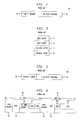
- Fig. 1 illustrates the structure of an ATM cell.
- Fig. 2 illustrates an AAL2 layer in comparison to an ATM layer.
- Fig. 3 illustrates the structure of an AAL2 mini packet.
- Fig. 4 illustrates multiple AAL2 mini packets packed onto two ATM cells.
- Fig. 5 illustrates the layers used in one embodiment of the present invention.
- Fig. 6 illustrates the structure of two frames that result from one embodiment of the present invention.
- Fig. 7 illustrates the structure of a frame header inserted at the beginning of each frame in one embodiment of the present invention.
- Fig. 5 illustrates the layers used in one embodiment of the present invention. As shown in Fig. 5, an AAL2 packet layer 44 is directly above the physical layer 46, and the data layer 42 is above the AAL2 layer 44. Therefore, AAL2 packets, or their equivalents, are mapped directly onto the physical layer 46. In one embodiment, a framing structure is provided on physical layer 46.
- Fig. 6 illustrates the structure of two frames that result from one embodiment of the present invention.
- Each frame 50, 51 includes a frame header 52, 53 inserted at the beginning of the frame, and AAL2 mini packets 54, 55, 56, 57.
- Mini packets, such as mini packet 56 can span multiple frames.
- the size of each frame can vary in size but is fixed once it is selected.
- the selected size of the frame is optimized based on a number of factors including error loss, resynchronization speed and packing efficiency.
- error loss When a shorter frame size is selected, overhead is increased because more frame headers are used.
- error losses increase because more packets are lost when a frame is lost.
- resynchronization time is increased because, as described below, resynchronization requires reading a plurality of frame headers.
- Frames 50, 51 can be generated by, for example, a general purpose computer that includes a processor and a storage device, or by any known frame generating device.
- Fig. 7 illustrates the structure of the frame header inserted at the beginning of each frame in one embodiment of the present invention.
- Frame header 60 is similar to MSP 34, 35 shown in Fig. 4.
- Frame header 60 includes a six bit pointer 62, a one bit framing bit 64, and a one bit parity bit 66.
- the six bit pointer 62 delineates the starting place of the next packet within the frame.
- the framing bit 64 forms a pattern across multiple frames that is used for sequencing and synchronizing the frames.
- Use of a framing bit pattern to sequence and synchronize frames is a known technique that is implemented, for example, with T1 communication lines and is disclosed in J. Bellamy, Digital Telephony, Second Edition, John Wiley & Sons, Inc., pp. 210-215 (1991), incorporated herein by reference, The technique is also disclosed in conjunction with ITU standard G.704.
- the method of mapping AAL2 packets directly to the physical layer in accordance with the present invention results in reduced overhead in comparison to the AAL2 method which maps AAL2 packets to ATM cells.
- a popular telecommunication service is Accunet Spectrum of Digital Services ("ASDS") which is a leased line digital service available from AT&T Corp.
- ASDS Accunet Spectrum of Digital Services
- the payload of the circuit is N x 64 Kbps.
- ASDS utilizes T1 frames, but N time-slots are used instead of the entire T1 frame. For example, if the circuit is 256 Kbps, four time slots of the twenty-four time slots in a T1 frame would be used.
- the size of the frame must first be determined. At this speed (256 Kbps), a reasonable tradeoff between efficiency and delay would be a frame of 24-48 octets. At the beginning of each frame, a pointer header would be inserted as the first octet of each frame. Under this mode, with a frame size of 24 octets, the overhead per packet for an L octet packet would be 3 + (L + 3)/24 which is better than the AAL2 over ATM case.
- variable length packet schemes In general, variable length packet schemes have better packing efficiency than fixed length schemes such as ATM.
- IP Internet Protocol
- TCP/IP Transmission Control Protocol/ Internet Protocol
- the actual payload is only 56 octets because the overhead is 50 octets (20 octet IP header, 20 octet TCP header, 8 octet SNAP header, plus 8 octet AAL5 trailer).
- the present invention integrates AAL2 mini packets directly onto the physical layer to provide serial data transmission using statistical multiplexing.
- the present invention reduces the overhead in comparison to the prior art, can operate at speeds slower that a T1 communication line, and utilizes variable length packets.
- variable length mini packets are not limited to AAL2 mini packets in the present invention. Any type of variable length mini packets can be used.
- the frame size can be greater than 64 octets, as long as the pointer 62 is also increased in size to accommodate more than 64 octets.
Landscapes
- Engineering & Computer Science (AREA)
- Computer Networks & Wireless Communication (AREA)
- Data Exchanges In Wide-Area Networks (AREA)
- Time-Division Multiplex Systems (AREA)
Abstract
AAL2 mini packets are integrated directly onto
the physical layer (46) to provide serial data transmission
using statistical multiplexing. This can be achieved
by generating a plurality of frames of a predetermined
size. A plurality of AAL2 variable length mini
packets are then statistically multiplexed onto the
plurality of frames. A pointer field is then inserted
into each of the frames. The pointer field includes a
pointer that delineates the starting place of the next
full packet in the frame that includes the pointer
field, a framing bit that forms a pattern with other
framing bits, and a parity bit. The frames are then
transmitted over a serial transmission line.
Description
The present invention is directed to data
transmission. More particularly, the present
invention is directed to serial data transmission of
variable length mini packets using statistical
multiplexing.
Public telephone carriers offer many digital
services that customers can subscribe to. Some
digital services allow the customer to multiplex
multiple telecommunication applications (e.g., a PBX
and computer data equipment) located at the customer's
premise onto a single access circuit.
One example of a single access circuit is a T1
circuit. A T1 circuit includes multiple frames, with
each frame including twenty-four time slots, and each
time slot including eight bits of information. A T1
circuit utilizes synchronous time division
multiplexing ("TDM") to multiplex together information
from multiple telecommunication applications.
Synchronous TDM allocates time slots, or bandwidth, on
a per application basis. However, this means that
when an application is not using its assigned time
slots during idle time, the time slots cannot be used
by other applications. Therefore, time slots are
frequently unused, and the usage efficiency of the T1
circuit is decreased.
Another example of a single access circuit is an
Asynchronous Transfer Mode ("ATM") circuit. ATM
utilizes a form of multiplexing known as statistical
multiplexing ("STM"). With STM, bandwidth is shared
among all telecommunication applications, and
bandwidth is used by an application only when needed.
Thus the bandwidth in an ATM circuit is typically
more fully utilized than with a T1 circuit.
All information in ATM is carried in the form of
fixed-length data units called cells. Fig. 1
illustrates the structure of an ATM cell 10. The ATM
cell 10 consists of a five octet (one octet equals one
byte) header 14 and a forty-eight octet payload 12.
Uncompressed voice typically is digitized at a
rate of 64 Kbps. At that rate, it takes approximately
six milliseconds to fill up the forty-eight octet
payload 12 of ATM cell 10. The six millisecond delay
is an acceptable delay in a typical voice telephony
system.
An ATM circuit can be used more efficiently if
the voice is compressed using one of many known
compression techniques. However, compressing the
voice increases the delay for filling up ATM cell 10.
For example, using known methods (e.g., International
Telecommunication Union ("ITU") standard G.729 (CS-ACELP)
or ITU standard G.723.1 (MP-MLQ)), voice can be
compressed to a rate of eight Kbps or below, with very
good quality. At a rate of eight Kbps, it takes
approximately forty-eight milliseconds to fill up the
forty-eight octet payload 12 of ATM cell 10. A forty-eight
millisecond delay is noticeable to a user of a
voice telephony system, so it is an unacceptable
delay. Therefore, it is desirable to have smaller
packet sizes than forty-eight octets so that they can
be filled more quickly and reduce delay.
In addition, when using compressed voice, the
logical unit of octets that must be read by the
receiving device is varied depending on the
compression technique used. Specifically, with
uncompressed voice, the logical unit is one octet
(i.e., the receiving device can decode received
compressed voice on a one octet basis). However, with
compressed voice, the logical unit changes because
typically the receiving unit must receive multiple
octets to decode the voice. For example, when voice
is compressed to eight Kbps using the G.723.1
standard, the logical unit is twenty-four octets.
However, when voice is compressed using the G.729
standard, the logical unit is ten octets. Multiple
ten octet units do not evenly fit into the forty-eight
octet payload 12 of ATM cell 10. Therefore, it is
desirable to have packets of variable size to
accommodate different logical unit sizes.
One known method to reduce the delay of
transmitting compressed voice and to accommodate
varied logical units is to utilize small packets
(referred to as "mini packets") of variable length and
integrate them into ATM cells. This method utilizes
an ATM Adaption Layer-2 ("AAL2") adaption layer. The
AAL2 adaption layer is promulgated by ITU standard
I.363.2.
Fig. 2 illustrates the AAL2 layer in comparison
to the ATM layer. As shown in Fig. 2, the AAL2 layer
16 is the layer above the ATM cell layer 17. The AAL2
layer specifies how higher layer data (data layer 15),
in this case mini packets, should be packed into ATM
cells and transmitted on the physical layer 18 (i.e.,
the structure which carries the data, such as a fiber
optic cable).
Fig. 3 illustrates the structure of an AAL2 mini
packet. The mini packet 20 includes a three octet
packet header 24 and a packet payload 22. Packet
payload 22 can be one to sixty-four octets long.
AAL2 mini packets are packed onto ATM cells in a
stream fashion (i.e., one after the other). Fig. 4
illustrates multiple AAL2 mini packets 36, 37, 38, 39
packed onto two ATM cells 30, 31. Each ATM cell 30,
31 in addition to including an ATM header 32, 33 must
also include a message start pointer ("MSP") 34, 35.
The MSP includes a six bit pointer, a one bit sequence
number, and a one bit parity. The six bit pointer
delineates the starting place of the next packet
within the ATM cell. Mini packets can span multiple
ATM cells. For example, in Fig. 4 mini packet 38
spans both ATM cell 30 and ATM cell 31.
One problem with the AAL2 method of using AAL2
packets within ATM cells to transmit variable mini
packets is that a large overhead is incurred. This
large overhead reduces transmission efficiency.
Specifically, at the packet level AAL2 requires a
three octet mini packet header. At the cell level
AAL2 requires six octets of overhead (a five octet ATM
header and a one octet MSP). However, because an ATM
cell can carry multiple packets, the six octets of
overhead must be prorated among the packets. For an
AAL2 packet whose payload is "L" octets long, the cell
level overhead is (L+3) * (6/47). The total overhead
is 3 + (L+3) * (6/47). Table 1 table gives some
examples of the overhead incurred with AAL2 for
various packet lengths:
| Packet Payload (octets) | Overhead | |
| (octets) | (percentage) | |
| 8 | 4.40 | 55.1% |
| 16 | 5.43 | 33.9% |
| 24 | 6.45 | 26.9% |
| 32 | 7.47 | 23.3% |
| 47 | 9.51 | 19.8% |
Another problem is that ATM, in accordance with
ATM standards, cannot operate at speeds slower than a
T1 circuit (i.e., 1.544 Mbps). Therefore, the speed
of AAL2, which is mapped onto an ATM cell, also cannot
be operated at speeds slower than a T1 circuit.
Based on the foregoing, there is a need for a
method and apparatus for serial data transmission of
variable length mini packets using statistical
multiplexing which incurs a smaller overhead than
using the known combination of AAL2 and ATM, and
further is able to operate at speeds slower than a T1
circuit.
One embodiment of the present invention satisfies
the above needs, and others, by integrating AAL2 mini
packets directly onto the physical layer to provide
serial data transmission using statistical
multiplexing. In one embodiment of the present
invention, this is achieved by generating a plurality
of frames of a predetermined size. A plurality of
AAL2 variable length mini packets are then
statistically multiplexed onto the plurality of
frames. A pointer field is then inserted into each of
the frames. The pointer field includes a pointer that
delineates the starting place of the next full packet
in the frame that includes the pointer field, a
framing bit that forms a pattern with other framing
bits, and a parity bit. The frames are then
transmitted over a serial transmission line.
Fig. 1 illustrates the structure of an ATM cell.
Fig. 2 illustrates an AAL2 layer in comparison to
an ATM layer.
Fig. 3 illustrates the structure of an AAL2 mini
packet.
Fig. 4 illustrates multiple AAL2 mini packets
packed onto two ATM cells.
Fig. 5 illustrates the layers used in one
embodiment of the present invention.
Fig. 6 illustrates the structure of two frames
that result from one embodiment of the present
invention.
Fig. 7 illustrates the structure of a frame
header inserted at the beginning of each frame in one
embodiment of the present invention.
The present invention reduces packet overhead and
is able to run at speeds slower than a T1 line by
eliminating the ATM layer that is integrated with the
AAL2 layer in the prior art. Fig. 5 illustrates the
layers used in one embodiment of the present
invention. As shown in Fig. 5, an AAL2 packet layer
44 is directly above the physical layer 46, and the
data layer 42 is above the AAL2 layer 44. Therefore,
AAL2 packets, or their equivalents, are mapped
directly onto the physical layer 46. In one
embodiment, a framing structure is provided on
physical layer 46.
Fig. 6 illustrates the structure of two frames
that result from one embodiment of the present
invention. Each frame 50, 51 includes a frame header
52, 53 inserted at the beginning of the frame, and
AAL2 mini packets 54, 55, 56, 57. Mini packets, such
as mini packet 56, can span multiple frames. The size
of each frame can vary in size but is fixed once it is
selected. The selected size of the frame is optimized
based on a number of factors including error loss,
resynchronization speed and packing efficiency. When
a shorter frame size is selected, overhead is
increased because more frame headers are used.
However, when a larger frame size is selected, error
losses increase because more packets are lost when a
frame is lost. Further, with a larger frame size,
resynchronization time is increased because, as
described below, resynchronization requires reading a
plurality of frame headers.
Fig. 7 illustrates the structure of the frame
header inserted at the beginning of each frame in one
embodiment of the present invention. Frame header 60
is similar to MSP 34, 35 shown in Fig. 4. Frame
header 60 includes a six bit pointer 62, a one bit
framing bit 64, and a one bit parity bit 66. The six
bit pointer 62 delineates the starting place of the
next packet within the frame. The framing bit 64
forms a pattern across multiple frames that is used
for sequencing and synchronizing the frames. Use of a
framing bit pattern to sequence and synchronize frames
is a known technique that is implemented, for example,
with T1 communication lines and is disclosed in J.
Bellamy, Digital Telephony, Second Edition, John Wiley
& Sons, Inc., pp. 210-215 (1991), incorporated herein
by reference, The technique is also disclosed in
conjunction with ITU standard G.704.
The method of mapping AAL2 packets directly to
the physical layer in accordance with the present
invention results in reduced overhead in comparison to
the AAL2 method which maps AAL2 packets to ATM cells.
For example, a popular telecommunication service is
Accunet Spectrum of Digital Services ("ASDS") which is
a leased line digital service available from AT&T
Corp. In ASDS, the payload of the circuit is N x 64
Kbps. ASDS utilizes T1 frames, but N time-slots are
used instead of the entire T1 frame. For example, if
the circuit is 256 Kbps, four time slots of the
twenty-four time slots in a T1 frame would be used.
In order to implement ASDS using the present
invention, the size of the frame must first be
determined. At this speed (256 Kbps), a reasonable
tradeoff between efficiency and delay would be a frame
of 24-48 octets. At the beginning of each frame, a
pointer header would be inserted as the first octet of
each frame. Under this mode, with a frame size of 24
octets, the overhead per packet for an L octet packet
would be 3 + (L + 3)/24 which is better than the AAL2
over ATM case.
Note that this is a comparison between two
variable length packet schemes. In general, variable
length packet schemes have better packing efficiency
than fixed length schemes such as ATM. For example,
the most common data packet in the Internet Protocol
("IP") environment is the Transmission Control
Protocol/ Internet Protocol ("TCP/IP") acknowledge
packet which requires two ATM cells (53 x 2 = 106
octets) to send. However the actual payload is only
56 octets because the overhead is 50 octets (20 octet
IP header, 20 octet TCP header, 8 octet SNAP header,
plus 8 octet AAL5 trailer). To send the same
information with AAL2 over ATM would incur an overhead
of 3 + (56 + 3)*6/47 = 10.5 octets. However, to send
the same information with AAL2 directly over a 24
octet long frame using the present invention, an
overhead of only 3 + (56 +3)/24 = 5.46 octets is
incurred.
As described, the present invention integrates
AAL2 mini packets directly onto the physical layer to
provide serial data transmission using statistical
multiplexing. The present invention reduces the
overhead in comparison to the prior art, can operate
at speeds slower that a T1 communication line, and
utilizes variable length packets.
Several embodiments of the present invention are
specifically illustrated and/or described herein.
However, it will be appreciated that modifications and
variations of the present invention are covered by the
above teachings and within the purview of the appended
claims without departing from the spirit and intended
scope of the invention. For example, the variable
length mini packets are not limited to AAL2 mini
packets in the present invention. Any type of
variable length mini packets can be used. Further,
the frame size can be greater than 64 octets, as long
as the pointer 62 is also increased in size to
accommodate more than 64 octets.
Claims (18)
- A method of transmitting a plurality of variable length mini packets over a serial transmission line, comprising the steps of:a) generating a plurality of frames of a predetermined size;b) statistically multiplexing the mini packets onto said plurality of frames;c) inserting a pointer field into each of said frames;
andd) transmitting said frames over the serial transmission line. - The method of claim 1, wherein said pointer field comprises:a pointer that delineates the starting place of the next full packet in a frame that includes the pointer field;a framing bit that forms a pattern with other framing bits; anda parity bit.
- The method of claim 2, wherein the mini packets are AAL2 mini packets.
- The method of claim 1, wherein said predetermined size is at least twenty-four octets and at most sixty-four octets.
- The method of claim 1, wherein said predetermined size is based on line speed, delay requirements and packing efficiency.
- The method of claim 2, wherein the pattern provides sequencing and synchronizing.
- A system for formatting serial data for transmitting over a communication network, said system comprising:means for generating a plurality of frames of a predetermined size;means for statistically multiplexing variable length mini packets onto said plurality of frames; andmeans for inserting a pointer field into each of said frames;
- The system of claim 7, wherein said pointer field comprises:a pointer that delineates the starting place of the next packet in a frame that includes the pointer field;a framing bit that forms a pattern with other framing bits; anda parity bit.
- The system of claim 8, wherein the mini packets are AAL2 mini packets.
- The system of claim 7, wherein said predetermined size is at least twenty-four octets and at most sixty-four octets.
- The system of claim 7, wherein said predetermined size is based on line speed, delay requirements and packing efficiency.
- The system of claim 8, wherein the pattern provides sequencing and synchronizing.
- A method of formatting a serial data transmission stream comprising the steps of:a) generating a plurality of frames of a predetermined size;b) statistically multiplexing a plurality of variable length mini packets onto said plurality of frames; andc) inserting a pointer field into each of said frames.
- The method of claim 13, wherein said pointer field comprises:a pointer that delineates the starting place of the next packet in the frame;a framing bit that forms a pattern with other framing bits; anda parity bit.
- The method of claim 14, wherein the mini packets are AAL2 mini packets.
- The method of claim 13, wherein said frames are a predetermined size, and said predetermined size is at least twenty-four octets and at most sixty-four octets.
- The method of claim 16, wherein said predetermined size is based on line speed, delay requirements and packing efficiency.
- The method of claim 14, wherein the pattern provides sequencing and synchronizing.
Applications Claiming Priority (2)
| Application Number | Priority Date | Filing Date | Title |
|---|---|---|---|
| US847949 | 1997-04-22 | ||
| US08/847,949 US6229821B1 (en) | 1997-04-22 | 1997-04-22 | Serial data transmission of variable length mini packets using statistical multiplexing |
Publications (1)
| Publication Number | Publication Date |
|---|---|
| EP0874530A1 true EP0874530A1 (en) | 1998-10-28 |
Family
ID=25301923
Family Applications (1)
| Application Number | Title | Priority Date | Filing Date |
|---|---|---|---|
| EP98302348A Withdrawn EP0874530A1 (en) | 1997-04-22 | 1998-03-27 | Serial data transmission of variable length mini packets using statistical multiplexing |
Country Status (4)
| Country | Link |
|---|---|
| US (1) | US6229821B1 (en) |
| EP (1) | EP0874530A1 (en) |
| JP (1) | JPH10303941A (en) |
| CA (1) | CA2233126C (en) |
Cited By (7)
| Publication number | Priority date | Publication date | Assignee | Title |
|---|---|---|---|---|
| WO2000030304A1 (en) * | 1998-11-13 | 2000-05-25 | Samsung Electronics Co., Ltd. | Aal2 processing device and method for atm network |
| WO2000059261A1 (en) * | 1999-03-30 | 2000-10-05 | Telefonaktiebolaget Lm Ericsson (Publ) | Framing of aal-2 minicells on a nx64 kbps e1/t1 channel structure |
| GB2349294A (en) * | 1999-04-19 | 2000-10-25 | Marconi Comm Ltd | Communications system |
| EP1111827A2 (en) | 1999-12-22 | 2001-06-27 | Alcatel USA Sourcing, L.P. | STS-n with enhanced granularity |
| WO2001093479A1 (en) * | 2000-05-30 | 2001-12-06 | Electronics And Telecommunications Research Institute | Multi-dimensional orthogonal resource hopping multiplexing communications method and apparatus |
| FR2825866A1 (en) * | 2001-06-12 | 2002-12-13 | France Telecom | Variable length packet transport procedure uses frame porter |
| EP1829293A4 (en) * | 2004-12-22 | 2010-06-02 | Exar Corp | COMMUNICATION SYSTEM WITH SEGMENTATION AND SEGMENT ENTRY |
Families Citing this family (19)
| Publication number | Priority date | Publication date | Assignee | Title |
|---|---|---|---|---|
| US6493347B2 (en) * | 1996-12-16 | 2002-12-10 | Juniper Networks, Inc. | Memory organization in a switching device |
| FI104926B (en) * | 1998-01-28 | 2000-04-28 | Nokia Networks Oy | Statistical multiplexing in telecommunications networks |
| US6396853B1 (en) * | 1998-05-28 | 2002-05-28 | Nortel Networks Limited | Providing data services to telecommunications user terminals |
| US6717948B1 (en) * | 1998-07-30 | 2004-04-06 | Nokia Corporation | Knowledge-based connection admission method and apparatus for providing efficient multiplexing of data and speech over AAL2 |
| DE19845038A1 (en) * | 1998-09-30 | 2000-04-06 | Siemens Ag | Method for connecting communication terminals to a switching system via a communication network |
| DE19845031B4 (en) * | 1998-09-30 | 2005-03-31 | Siemens Ag | Method for connecting switching systems via a packet-oriented communication network |
| US6993021B1 (en) * | 1999-03-08 | 2006-01-31 | Lucent Technologies Inc. | Lightweight internet protocol encapsulation (LIPE) scheme for multimedia traffic transport |
| US6393025B1 (en) * | 1999-08-09 | 2002-05-21 | Lucent Technologies Inc. | Time-sensitive packet processor for an ATM switch |
| US6918034B1 (en) * | 1999-09-29 | 2005-07-12 | Nokia, Corporation | Method and apparatus to provide encryption and authentication of a mini-packet in a multiplexed RTP payload |
| KR100584405B1 (en) * | 1999-12-22 | 2006-05-26 | 삼성전자주식회사 | Next-Generation Exchange System Applying AA2 |
| DE10001855A1 (en) * | 2000-01-18 | 2001-07-19 | Siemens Ag | Data transmission method for communication network, switch nodes, firewalls etc. |
| JP4405044B2 (en) * | 2000-06-21 | 2010-01-27 | 富士通株式会社 | Network relay apparatus and packet combining method |
| US7626999B2 (en) * | 2001-03-16 | 2009-12-01 | Tellabs San Jose, Inc. | Apparatus and methods for circuit emulation of a point-to-point protocol operating over a multi-packet label switching network |
| JP3681989B2 (en) * | 2001-04-10 | 2005-08-10 | 三菱電機株式会社 | Gateway system and voice gateway system |
| US7554977B2 (en) * | 2001-06-21 | 2009-06-30 | Qualcomm Incorporated | Method and apparatus for indicating packet boundaries in frames |
| US7376148B1 (en) * | 2004-01-26 | 2008-05-20 | Cisco Technology, Inc. | Method and apparatus for improving voice quality in a packet based network |
| US20080043757A1 (en) * | 2004-08-12 | 2008-02-21 | Koninklijke Philips Electronics, N.V. | Integrated Circuit And Method For Packet Switching Control |
| CN100507892C (en) * | 2004-09-02 | 2009-07-01 | 北京中星微电子有限公司 | Communication method suitable for serial peripheral equipment interface bus |
| US9819766B1 (en) * | 2014-07-30 | 2017-11-14 | Google Llc | System and method for improving infrastructure to infrastructure communications |
Citations (2)
| Publication number | Priority date | Publication date | Assignee | Title |
|---|---|---|---|---|
| EP0685951A2 (en) * | 1994-05-02 | 1995-12-06 | Advanced Micro Devices, Inc. | Line interface devices for fast-packet networks |
| US5570362A (en) * | 1994-03-16 | 1996-10-29 | Fujitsu Limited | System for transferring variable length cells under ATM |
Family Cites Families (9)
| Publication number | Priority date | Publication date | Assignee | Title |
|---|---|---|---|---|
| US4941089A (en) * | 1986-12-12 | 1990-07-10 | Datapoint Corporation | Input/output network for computer system |
| US4935925A (en) * | 1987-03-11 | 1990-06-19 | Aristacom International, Inc. | Adaptive digital network interface |
| JPH0548638A (en) * | 1991-08-15 | 1993-02-26 | Fujitsu Ltd | End-to-end congestion handling control processing method in ATM network |
| DE69328176T2 (en) * | 1993-08-26 | 2000-12-21 | Hewlett-Packard Co., Palo Alto | Transmission system |
| US5444709A (en) * | 1993-09-30 | 1995-08-22 | Apple Computer, Inc. | Protocol for transporting real time data |
| US5519640A (en) * | 1994-01-26 | 1996-05-21 | Hughes Aircraft Company | Multimedia frame relay codec |
| US5774469A (en) * | 1996-04-01 | 1998-06-30 | Telefonaktiebolaget Lm Ericsson | Combined minicell alignment and header protection method and apparatus |
| US5802050A (en) * | 1996-06-10 | 1998-09-01 | Telefonaktiebolaget Lm Ericsson | Minicell sequence number count |
| US5987034A (en) * | 1996-08-30 | 1999-11-16 | Cisco Technology, Inc. | ATM cells within frame relay technology |
-
1997
- 1997-04-22 US US08/847,949 patent/US6229821B1/en not_active Expired - Lifetime
-
1998
- 1998-03-25 CA CA002233126A patent/CA2233126C/en not_active Expired - Fee Related
- 1998-03-27 EP EP98302348A patent/EP0874530A1/en not_active Withdrawn
- 1998-04-22 JP JP11124598A patent/JPH10303941A/en active Pending
Patent Citations (2)
| Publication number | Priority date | Publication date | Assignee | Title |
|---|---|---|---|---|
| US5570362A (en) * | 1994-03-16 | 1996-10-29 | Fujitsu Limited | System for transferring variable length cells under ATM |
| EP0685951A2 (en) * | 1994-05-02 | 1995-12-06 | Advanced Micro Devices, Inc. | Line interface devices for fast-packet networks |
Non-Patent Citations (2)
| Title |
|---|
| JOHNSSON M ET AL: "SUPPORT FOR LOW BITRATE APPLICATIONS IN ATM NETWORKS", PROCEEDINGS OF IFIP WORKSHOP ON PERFORMANCE MODELLING AND EVALUATION OF ATM NETWORKS, 3 June 1996 (1996-06-03), pages 39/1 - 39/14, XP002045906 * |
| OTT M A ET AL: "PROTOTYPE ATM LAN SYSTEM MULTIMEDIA ON DEMAND APPLICATIONS", NEC RESEARCH AND DEVELOPMENT, vol. 35, no. 4, 1 October 1994 (1994-10-01), pages 366 - 373, XP000496856 * |
Cited By (16)
| Publication number | Priority date | Publication date | Assignee | Title |
|---|---|---|---|---|
| WO2000030304A1 (en) * | 1998-11-13 | 2000-05-25 | Samsung Electronics Co., Ltd. | Aal2 processing device and method for atm network |
| RU2209523C2 (en) * | 1998-11-13 | 2003-07-27 | Самсунг Электроникс Ко., Лтд. | Adaptive level 2a (al2a) processing device and method for asynchronous transmission mode network |
| WO2000059261A1 (en) * | 1999-03-30 | 2000-10-05 | Telefonaktiebolaget Lm Ericsson (Publ) | Framing of aal-2 minicells on a nx64 kbps e1/t1 channel structure |
| US6600746B1 (en) | 1999-03-30 | 2003-07-29 | Telefonaktiebolaget Lm Ericsson | AAL2 framing on NX64 KBPS E1/T1 |
| GB2349294B (en) * | 1999-04-19 | 2001-07-11 | Marconi Comm Ltd | Communications system |
| GB2349294A (en) * | 1999-04-19 | 2000-10-25 | Marconi Comm Ltd | Communications system |
| US7050442B1 (en) | 1999-04-19 | 2006-05-23 | Marconi Uk Intellectual Property Ltd. | Communications system, bus and method for communication of ATM data traffic |
| EP1111827A2 (en) | 1999-12-22 | 2001-06-27 | Alcatel USA Sourcing, L.P. | STS-n with enhanced granularity |
| EP1111827A3 (en) * | 1999-12-22 | 2005-10-12 | Alcatel USA Sourcing, L.P. | STS-n with enhanced granularity |
| WO2001093479A1 (en) * | 2000-05-30 | 2001-12-06 | Electronics And Telecommunications Research Institute | Multi-dimensional orthogonal resource hopping multiplexing communications method and apparatus |
| AU2001234199B2 (en) * | 2000-05-30 | 2004-11-04 | Electronics And Telecommunications Research Institute | Multi-dimensional orthogonal resource hopping multiplexing communications method and apparatus |
| US7149199B2 (en) | 2000-05-30 | 2006-12-12 | Korea Advanced Institute Of Science And Technology | Multi-dimensional orthogonal resource hopping multiplexing communications method and apparatus |
| FR2825866A1 (en) * | 2001-06-12 | 2002-12-13 | France Telecom | Variable length packet transport procedure uses frame porter |
| WO2002101999A1 (en) * | 2001-06-12 | 2002-12-19 | France Telecom Sa | Method for transporting variable-length packets in temporal circuit frames |
| KR100903378B1 (en) * | 2001-06-12 | 2009-06-23 | 프랑스 뗄레꽁 | Variable Length Packet Transmission in Time Division Circuit Raster Procedures |
| EP1829293A4 (en) * | 2004-12-22 | 2010-06-02 | Exar Corp | COMMUNICATION SYSTEM WITH SEGMENTATION AND SEGMENT ENTRY |
Also Published As
| Publication number | Publication date |
|---|---|
| CA2233126C (en) | 2002-10-22 |
| US6229821B1 (en) | 2001-05-08 |
| CA2233126A1 (en) | 1998-10-22 |
| JPH10303941A (en) | 1998-11-13 |
Similar Documents
| Publication | Publication Date | Title |
|---|---|---|
| US6229821B1 (en) | Serial data transmission of variable length mini packets using statistical multiplexing | |
| US5841771A (en) | Telecommunications switch apparatus and method for time switching | |
| US5862136A (en) | Telecommunications apparatus and method | |
| US6490296B2 (en) | Multi-link segmentation and reassembly for bonding multiple PVC's in an inverse multiplexing arrangement | |
| US5509007A (en) | Cell multiplexing apparatus handling multiple items of information | |
| US6009100A (en) | Asynchronous transfer mode switching system | |
| CA2164597A1 (en) | Communication system | |
| AU705154B2 (en) | Telecommunications system | |
| US6272128B1 (en) | Method and system for emulating a T1 link over an ATM network | |
| US5742610A (en) | Method and apparatus for use in a data communications network serving subscribers operating at a plurality of transmisson data rates | |
| US6804229B2 (en) | Multiple node network architecture | |
| JP2001508622A (en) | ATM communication system and method | |
| US6714543B1 (en) | ATM communications system and method | |
| EP0894385B1 (en) | Minicell decoupling in atm cells | |
| US7154904B2 (en) | Time slot management method and a main station and substation realizing such a method | |
| US6788703B2 (en) | DS0 on ATM, mapping and handling | |
| EP0797373B1 (en) | A method and apparatus for converting synchronous narrowband signals into broadband asynchronous transfer mode signals in an integrated telecommunications network | |
| US6885661B1 (en) | Private branch exchange built using an ATM Network | |
| US6771655B1 (en) | Method and apparatus for managing data transportation | |
| US6778538B2 (en) | Virtual junctors | |
| GB2310119A (en) | A bi-directional communications network | |
| KR100314564B1 (en) | Statistical method of data compression | |
| US7088704B1 (en) | Transporting voice telephony and data via a single ATM transport link | |
| EP0854659B1 (en) | A time slot management method and apparatus | |
| US6914909B2 (en) | Method to divide upstream timeslots in a time division multiple access system, related line terminator and related network terminator |
Legal Events
| Date | Code | Title | Description |
|---|---|---|---|
| PUAI | Public reference made under article 153(3) epc to a published international application that has entered the european phase |
Free format text: ORIGINAL CODE: 0009012 |
|
| AK | Designated contracting states |
Kind code of ref document: A1 Designated state(s): DE FR GB IT SE |
|
| AX | Request for extension of the european patent |
Free format text: AL;LT;LV;MK;RO;SI |
|
| 17P | Request for examination filed |
Effective date: 19990422 |
|
| AKX | Designation fees paid |
Free format text: DE FR GB IT SE |
|
| STAA | Information on the status of an ep patent application or granted ep patent |
Free format text: STATUS: THE APPLICATION IS DEEMED TO BE WITHDRAWN |
|
| 18D | Application deemed to be withdrawn |
Effective date: 20031001 |