EP0873410B1 - Transgenic plants exhibiting altered flower colour and methods for producing same - Google Patents
Transgenic plants exhibiting altered flower colour and methods for producing same Download PDFInfo
- Publication number
- EP0873410B1 EP0873410B1 EP96913379A EP96913379A EP0873410B1 EP 0873410 B1 EP0873410 B1 EP 0873410B1 EP 96913379 A EP96913379 A EP 96913379A EP 96913379 A EP96913379 A EP 96913379A EP 0873410 B1 EP0873410 B1 EP 0873410B1
- Authority
- EP
- European Patent Office
- Prior art keywords
- plant
- dfr
- dhk
- carnation
- dhm
- Prior art date
- Legal status (The legal status is an assumption and is not a legal conclusion. Google has not performed a legal analysis and makes no representation as to the accuracy of the status listed.)
- Expired - Lifetime
Links
- 230000009261 transgenic effect Effects 0.000 title claims abstract description 38
- 238000000034 method Methods 0.000 title claims abstract description 28
- 230000001747 exhibiting effect Effects 0.000 title claims abstract description 22
- 241000196324 Embryophyta Species 0.000 claims abstract description 107
- 240000006497 Dianthus caryophyllus Species 0.000 claims abstract description 96
- 239000002773 nucleotide Substances 0.000 claims abstract description 7
- 125000003729 nucleotide group Chemical group 0.000 claims abstract description 7
- 235000009355 Dianthus caryophyllus Nutrition 0.000 claims description 55
- 108010062650 Flavonoid 3',5'-hydroxylase Proteins 0.000 claims description 54
- 239000000758 substrate Substances 0.000 claims description 26
- 108020004707 nucleic acids Proteins 0.000 claims description 24
- 102000039446 nucleic acids Human genes 0.000 claims description 24
- 150000007523 nucleic acids Chemical class 0.000 claims description 24
- 101100226484 Arabidopsis thaliana CYP75B1 gene Proteins 0.000 claims description 23
- 101100494423 Oryza sativa subsp. japonica CYP75B3 gene Proteins 0.000 claims description 23
- 230000002068 genetic effect Effects 0.000 claims description 18
- 108091028043 Nucleic acid sequence Proteins 0.000 claims description 15
- 230000002194 synthesizing effect Effects 0.000 claims description 14
- 235000004338 Syringa vulgaris Nutrition 0.000 claims description 7
- 235000007516 Chrysanthemum Nutrition 0.000 claims description 4
- 241000332371 Abutilon x hybridum Species 0.000 claims description 3
- 241001083548 Anemone Species 0.000 claims description 3
- 241000722913 Callistephus chinensis Species 0.000 claims description 3
- 241000202296 Delphinium Species 0.000 claims description 3
- 241000511009 Eustoma exaltatum subsp. russellianum Species 0.000 claims description 3
- 241001071795 Gentiana Species 0.000 claims description 3
- 241000735332 Gerbera Species 0.000 claims description 3
- 241001632576 Hyacinthus Species 0.000 claims description 3
- 241000220317 Rosa Species 0.000 claims description 3
- 244000061458 Solanum melongena Species 0.000 claims description 3
- 235000002597 Solanum melongena Nutrition 0.000 claims description 3
- 244000047670 Viola x wittrockiana Species 0.000 claims description 3
- 235000004031 Viola x wittrockiana Nutrition 0.000 claims description 3
- 235000009754 Vitis X bourquina Nutrition 0.000 claims description 3
- 235000012333 Vitis X labruscana Nutrition 0.000 claims description 3
- 240000006365 Vitis vinifera Species 0.000 claims description 3
- 235000014787 Vitis vinifera Nutrition 0.000 claims description 3
- 244000189548 Chrysanthemum x morifolium Species 0.000 claims description 2
- 241000207748 Petunia Species 0.000 claims 6
- 244000297179 Syringa vulgaris Species 0.000 claims 1
- 108010044229 Dihydroflavanol 4-reductase Proteins 0.000 abstract description 123
- KJXSIXMJHKAJOD-LSDHHAIUSA-N (+)-dihydromyricetin Chemical compound C1([C@@H]2[C@H](C(C3=C(O)C=C(O)C=C3O2)=O)O)=CC(O)=C(O)C(O)=C1 KJXSIXMJHKAJOD-LSDHHAIUSA-N 0.000 abstract description 104
- KQILIWXGGKGKNX-UHFFFAOYSA-N dihydromyricetin Natural products OC1C(=C(Oc2cc(O)cc(O)c12)c3cc(O)c(O)c(O)c3)O KQILIWXGGKGKNX-UHFFFAOYSA-N 0.000 abstract description 52
- 238000013459 approach Methods 0.000 abstract description 3
- 238000012505 colouration Methods 0.000 abstract description 3
- PADQINQHPQKXNL-LSDHHAIUSA-N (+)-dihydrokaempferol Chemical compound C1([C@@H]2[C@H](C(C3=C(O)C=C(O)C=C3O2)=O)O)=CC=C(O)C=C1 PADQINQHPQKXNL-LSDHHAIUSA-N 0.000 description 63
- RAYJUFCFJUVJBB-UHFFFAOYSA-N dihydrokaempferol Natural products OC1Oc2c(O)cc(O)cc2C(=O)C1c3ccc(O)cc3 RAYJUFCFJUVJBB-UHFFFAOYSA-N 0.000 description 63
- 240000007377 Petunia x hybrida Species 0.000 description 41
- 239000002299 complementary DNA Substances 0.000 description 36
- CXQWRCVTCMQVQX-LSDHHAIUSA-N (+)-taxifolin Chemical compound C1([C@@H]2[C@H](C(C3=C(O)C=C(O)C=C3O2)=O)O)=CC=C(O)C(O)=C1 CXQWRCVTCMQVQX-LSDHHAIUSA-N 0.000 description 34
- XCGZWJIXHMSSQC-UHFFFAOYSA-N dihydroquercetin Natural products OC1=CC2OC(=C(O)C(=O)C2C(O)=C1)c1ccc(O)c(O)c1 XCGZWJIXHMSSQC-UHFFFAOYSA-N 0.000 description 34
- 239000012634 fragment Substances 0.000 description 30
- 108020004414 DNA Proteins 0.000 description 25
- 235000007242 delphinidin Nutrition 0.000 description 20
- GCPYCNBGGPHOBD-UHFFFAOYSA-N Delphinidin Natural products OC1=Cc2c(O)cc(O)cc2OC1=C3C=C(O)C(=O)C(=C3)O GCPYCNBGGPHOBD-UHFFFAOYSA-N 0.000 description 19
- 235000010208 anthocyanin Nutrition 0.000 description 19
- 229930002877 anthocyanin Natural products 0.000 description 19
- 239000004410 anthocyanin Substances 0.000 description 19
- 150000004636 anthocyanins Chemical class 0.000 description 19
- JKHRCGUTYDNCLE-UHFFFAOYSA-O delphinidin Chemical compound [O+]=1C2=CC(O)=CC(O)=C2C=C(O)C=1C1=CC(O)=C(O)C(O)=C1 JKHRCGUTYDNCLE-UHFFFAOYSA-O 0.000 description 19
- VEVZSMAEJFVWIL-UHFFFAOYSA-O cyanidin cation Chemical compound [O+]=1C2=CC(O)=CC(O)=C2C=C(O)C=1C1=CC=C(O)C(O)=C1 VEVZSMAEJFVWIL-UHFFFAOYSA-O 0.000 description 18
- 238000004519 manufacturing process Methods 0.000 description 18
- 238000004458 analytical method Methods 0.000 description 16
- 239000013612 plasmid Substances 0.000 description 15
- 102000004190 Enzymes Human genes 0.000 description 14
- 108090000790 Enzymes Proteins 0.000 description 14
- FAPWRFPIFSIZLT-UHFFFAOYSA-M Sodium chloride Chemical compound [Na+].[Cl-] FAPWRFPIFSIZLT-UHFFFAOYSA-M 0.000 description 14
- DBMJMQXJHONAFJ-UHFFFAOYSA-M Sodium laurylsulphate Chemical compound [Na+].CCCCCCCCCCCCOS([O-])(=O)=O DBMJMQXJHONAFJ-UHFFFAOYSA-M 0.000 description 14
- 210000004027 cell Anatomy 0.000 description 14
- 235000019333 sodium laurylsulphate Nutrition 0.000 description 13
- 108091032973 (ribonucleotides)n+m Proteins 0.000 description 12
- 108010031387 anthocyanidin synthase Proteins 0.000 description 12
- 239000003086 colorant Substances 0.000 description 11
- 229930003935 flavonoid Natural products 0.000 description 11
- 150000002215 flavonoids Chemical class 0.000 description 11
- 235000017173 flavonoids Nutrition 0.000 description 11
- 230000037361 pathway Effects 0.000 description 11
- FSVMLWOLZHGCQX-UHFFFAOYSA-N Leucopelargonidin Chemical compound OC1C(O)C2=C(O)C=C(O)C=C2OC1C1=CC=C(O)C=C1 FSVMLWOLZHGCQX-UHFFFAOYSA-N 0.000 description 10
- 229930014669 anthocyanidin Natural products 0.000 description 10
- 235000008758 anthocyanidins Nutrition 0.000 description 10
- PHTQWCKDNZKARW-UHFFFAOYSA-N isoamylol Chemical compound CC(C)CCO PHTQWCKDNZKARW-UHFFFAOYSA-N 0.000 description 10
- IYRMWMYZSQPJKC-UHFFFAOYSA-N kaempferol Chemical group C1=CC(O)=CC=C1C1=C(O)C(=O)C2=C(O)C=C(O)C=C2O1 IYRMWMYZSQPJKC-UHFFFAOYSA-N 0.000 description 10
- XEKOWRVHYACXOJ-UHFFFAOYSA-N Ethyl acetate Chemical compound CCOC(C)=O XEKOWRVHYACXOJ-UHFFFAOYSA-N 0.000 description 9
- 229920002148 Gellan gum Polymers 0.000 description 9
- 235000007336 cyanidin Nutrition 0.000 description 9
- MWDZOUNAPSSOEL-UHFFFAOYSA-N kaempferol Natural products OC1=C(C(=O)c2cc(O)cc(O)c2O1)c3ccc(O)cc3 MWDZOUNAPSSOEL-UHFFFAOYSA-N 0.000 description 9
- 239000006870 ms-medium Substances 0.000 description 9
- 238000004809 thin layer chromatography Methods 0.000 description 9
- 239000005496 Chlorsulfuron Substances 0.000 description 8
- KCXVZYZYPLLWCC-UHFFFAOYSA-N EDTA Chemical compound OC(=O)CN(CC(O)=O)CCN(CC(O)=O)CC(O)=O KCXVZYZYPLLWCC-UHFFFAOYSA-N 0.000 description 8
- REFJWTPEDVJJIY-UHFFFAOYSA-N Quercetin Chemical group C=1C(O)=CC(O)=C(C(C=2O)=O)C=1OC=2C1=CC=C(O)C(O)=C1 REFJWTPEDVJJIY-UHFFFAOYSA-N 0.000 description 8
- DTQVDTLACAAQTR-UHFFFAOYSA-N Trifluoroacetic acid Chemical compound OC(=O)C(F)(F)F DTQVDTLACAAQTR-UHFFFAOYSA-N 0.000 description 8
- AIYUHDOJVYHVIT-UHFFFAOYSA-M caesium chloride Chemical compound [Cl-].[Cs+] AIYUHDOJVYHVIT-UHFFFAOYSA-M 0.000 description 8
- 238000006243 chemical reaction Methods 0.000 description 8
- VJYIFXVZLXQVHO-UHFFFAOYSA-N chlorsulfuron Chemical compound COC1=NC(C)=NC(NC(=O)NS(=O)(=O)C=2C(=CC=CC=2)Cl)=N1 VJYIFXVZLXQVHO-UHFFFAOYSA-N 0.000 description 8
- 229960001484 edetic acid Drugs 0.000 description 8
- JTEDVYBZBROSJT-UHFFFAOYSA-N indole-3-butyric acid Chemical compound C1=CC=C2C(CCCC(=O)O)=CNC2=C1 JTEDVYBZBROSJT-UHFFFAOYSA-N 0.000 description 8
- HKUHOPQRJKPJCJ-UHFFFAOYSA-N pelargonidin Natural products OC1=Cc2c(O)cc(O)cc2OC1c1ccc(O)cc1 HKUHOPQRJKPJCJ-UHFFFAOYSA-N 0.000 description 8
- 235000006251 pelargonidin Nutrition 0.000 description 8
- 239000000049 pigment Substances 0.000 description 8
- 108090000623 proteins and genes Proteins 0.000 description 8
- 210000001519 tissue Anatomy 0.000 description 8
- QKNYBSVHEMOAJP-UHFFFAOYSA-N 2-amino-2-(hydroxymethyl)propane-1,3-diol;hydron;chloride Chemical compound Cl.OCC(N)(CO)CO QKNYBSVHEMOAJP-UHFFFAOYSA-N 0.000 description 7
- 241000589155 Agrobacterium tumefaciens Species 0.000 description 7
- 238000010276 construction Methods 0.000 description 7
- 108010060641 flavanone synthetase Proteins 0.000 description 7
- HVQAJTFOCKOKIN-UHFFFAOYSA-N flavonol Natural products O1C2=CC=CC=C2C(=O)C(O)=C1C1=CC=CC=C1 HVQAJTFOCKOKIN-UHFFFAOYSA-N 0.000 description 7
- 235000011957 flavonols Nutrition 0.000 description 7
- NWKFECICNXDNOQ-UHFFFAOYSA-N flavylium Chemical compound C1=CC=CC=C1C1=CC=C(C=CC=C2)C2=[O+]1 NWKFECICNXDNOQ-UHFFFAOYSA-N 0.000 description 7
- 238000002955 isolation Methods 0.000 description 7
- 239000000203 mixture Substances 0.000 description 7
- XVFMGWDSJLBXDZ-UHFFFAOYSA-O pelargonidin Chemical compound C1=CC(O)=CC=C1C(C(=C1)O)=[O+]C2=C1C(O)=CC(O)=C2 XVFMGWDSJLBXDZ-UHFFFAOYSA-O 0.000 description 7
- 239000011780 sodium chloride Substances 0.000 description 7
- OHKOGUYZJXTSFX-KZFFXBSXSA-N ticarcillin Chemical compound C=1([C@@H](C(O)=O)C(=O)N[C@H]2[C@H]3SC([C@@H](N3C2=O)C(O)=O)(C)C)C=CSC=1 OHKOGUYZJXTSFX-KZFFXBSXSA-N 0.000 description 7
- 229960004659 ticarcillin Drugs 0.000 description 7
- QTBSBXVTEAMEQO-UHFFFAOYSA-N Acetic acid Chemical compound CC(O)=O QTBSBXVTEAMEQO-UHFFFAOYSA-N 0.000 description 6
- WEVYAHXRMPXWCK-UHFFFAOYSA-N Acetonitrile Chemical compound CC#N WEVYAHXRMPXWCK-UHFFFAOYSA-N 0.000 description 6
- 108010017826 DNA Polymerase I Proteins 0.000 description 6
- 102000004594 DNA Polymerase I Human genes 0.000 description 6
- 108700007698 Genetic Terminator Regions Proteins 0.000 description 6
- ZEACOKJOQLAYTD-UHFFFAOYSA-N Leucoanthocyanidin Natural products OC1C(O)C2=C(O)C=C(O)C=C2OC1C1=CC(O)=C(O)C(O)=C1 ZEACOKJOQLAYTD-UHFFFAOYSA-N 0.000 description 6
- HEMHJVSKTPXQMS-UHFFFAOYSA-M Sodium hydroxide Chemical compound [OH-].[Na+] HEMHJVSKTPXQMS-UHFFFAOYSA-M 0.000 description 6
- 241001104043 Syringa Species 0.000 description 6
- 230000015572 biosynthetic process Effects 0.000 description 6
- 230000000694 effects Effects 0.000 description 6
- 230000004060 metabolic process Effects 0.000 description 6
- 239000000243 solution Substances 0.000 description 6
- 238000003786 synthesis reaction Methods 0.000 description 6
- 239000013598 vector Substances 0.000 description 6
- XLYOFNOQVPJJNP-UHFFFAOYSA-N water Chemical compound O XLYOFNOQVPJJNP-UHFFFAOYSA-N 0.000 description 6
- UBSCDKPKWHYZNX-UHFFFAOYSA-N Demethoxycapillarisin Natural products C1=CC(O)=CC=C1OC1=CC(=O)C2=C(O)C=C(O)C=C2O1 UBSCDKPKWHYZNX-UHFFFAOYSA-N 0.000 description 5
- FSVMLWOLZHGCQX-SOUVJXGZSA-N Leucopelargonidin Natural products C1([C@H]2OC3=CC(O)=CC(O)=C3[C@H](O)[C@@H]2O)=CC=C(O)C=C1 FSVMLWOLZHGCQX-SOUVJXGZSA-N 0.000 description 5
- 108091034117 Oligonucleotide Proteins 0.000 description 5
- 229930006000 Sucrose Natural products 0.000 description 5
- CZMRCDWAGMRECN-UGDNZRGBSA-N Sucrose Chemical compound O[C@H]1[C@H](O)[C@@H](CO)O[C@@]1(CO)O[C@@H]1[C@H](O)[C@@H](O)[C@H](O)[C@@H](CO)O1 CZMRCDWAGMRECN-UGDNZRGBSA-N 0.000 description 5
- 239000004098 Tetracycline Substances 0.000 description 5
- 238000009396 hybridization Methods 0.000 description 5
- 235000008777 kaempferol Nutrition 0.000 description 5
- UXOUKMQIEVGVLY-UHFFFAOYSA-N morin Natural products OC1=CC(O)=CC(C2=C(C(=O)C3=C(O)C=C(O)C=C3O2)O)=C1 UXOUKMQIEVGVLY-UHFFFAOYSA-N 0.000 description 5
- 230000035772 mutation Effects 0.000 description 5
- 108091008146 restriction endonucleases Proteins 0.000 description 5
- 241000894007 species Species 0.000 description 5
- 239000005720 sucrose Substances 0.000 description 5
- 229960002180 tetracycline Drugs 0.000 description 5
- 229930101283 tetracycline Natural products 0.000 description 5
- 235000019364 tetracycline Nutrition 0.000 description 5
- 150000003522 tetracyclines Chemical class 0.000 description 5
- SBZWTSHAFILOTE-SOUVJXGZSA-N (2R,3S,4S)-leucocyanidin Chemical compound C1([C@H]2OC3=CC(O)=CC(O)=C3[C@H](O)[C@@H]2O)=CC=C(O)C(O)=C1 SBZWTSHAFILOTE-SOUVJXGZSA-N 0.000 description 4
- ZEACOKJOQLAYTD-SOUVJXGZSA-N (2R,3S,4S)-leucodelphinidin Chemical compound C1([C@H]2OC3=CC(O)=CC(O)=C3[C@H](O)[C@@H]2O)=CC(O)=C(O)C(O)=C1 ZEACOKJOQLAYTD-SOUVJXGZSA-N 0.000 description 4
- 240000001436 Antirrhinum majus Species 0.000 description 4
- IJGRMHOSHXDMSA-UHFFFAOYSA-N Atomic nitrogen Chemical compound N#N IJGRMHOSHXDMSA-UHFFFAOYSA-N 0.000 description 4
- 108010014303 DNA-directed DNA polymerase Proteins 0.000 description 4
- 102000016928 DNA-directed DNA polymerase Human genes 0.000 description 4
- 241000588724 Escherichia coli Species 0.000 description 4
- 108700039691 Genetic Promoter Regions Proteins 0.000 description 4
- HMXJLDJMSRBOCV-UHFFFAOYSA-N Leucocyanidin Natural products OC1C(OC2C(O)C(Oc3cc(O)cc(O)c23)c4ccc(O)c(O)c4)c5c(O)cc(O)cc5OC1c6ccc(O)c(O)c6 HMXJLDJMSRBOCV-UHFFFAOYSA-N 0.000 description 4
- ZEACOKJOQLAYTD-ZNMIVQPWSA-N Leucodelphinidin Natural products O[C@H]1[C@H](c2cc(O)c(O)c(O)c2)Oc2c([C@@H]1O)c(O)cc(O)c2 ZEACOKJOQLAYTD-ZNMIVQPWSA-N 0.000 description 4
- TWRXJAOTZQYOKJ-UHFFFAOYSA-L Magnesium chloride Chemical compound [Mg+2].[Cl-].[Cl-] TWRXJAOTZQYOKJ-UHFFFAOYSA-L 0.000 description 4
- 241000218922 Magnoliophyta Species 0.000 description 4
- ISWSIDIOOBJBQZ-UHFFFAOYSA-N Phenol Chemical compound OC1=CC=CC=C1 ISWSIDIOOBJBQZ-UHFFFAOYSA-N 0.000 description 4
- ZVOLCUVKHLEPEV-UHFFFAOYSA-N Quercetagetin Natural products C1=C(O)C(O)=CC=C1C1=C(O)C(=O)C2=C(O)C(O)=C(O)C=C2O1 ZVOLCUVKHLEPEV-UHFFFAOYSA-N 0.000 description 4
- HWTZYBCRDDUBJY-UHFFFAOYSA-N Rhynchosin Natural products C1=C(O)C(O)=CC=C1C1=C(O)C(=O)C2=CC(O)=C(O)C=C2O1 HWTZYBCRDDUBJY-UHFFFAOYSA-N 0.000 description 4
- 238000005516 engineering process Methods 0.000 description 4
- 150000002216 flavonol derivatives Chemical class 0.000 description 4
- SBZWTSHAFILOTE-UHFFFAOYSA-N leucocianidol Natural products OC1C(O)C2=C(O)C=C(O)C=C2OC1C1=CC=C(O)C(O)=C1 SBZWTSHAFILOTE-UHFFFAOYSA-N 0.000 description 4
- 229940086558 leucocyanidin Drugs 0.000 description 4
- 108010083942 mannopine synthase Proteins 0.000 description 4
- 235000005875 quercetin Nutrition 0.000 description 4
- 229960001285 quercetin Drugs 0.000 description 4
- 239000012146 running buffer Substances 0.000 description 4
- 239000002904 solvent Substances 0.000 description 4
- 239000006228 supernatant Substances 0.000 description 4
- 230000009466 transformation Effects 0.000 description 4
- 239000005631 2,4-Dichlorophenoxyacetic acid Substances 0.000 description 3
- 108010000700 Acetolactate synthase Proteins 0.000 description 3
- 241000701489 Cauliflower mosaic virus Species 0.000 description 3
- 108091026890 Coding region Proteins 0.000 description 3
- LFQSCWFLJHTTHZ-UHFFFAOYSA-N Ethanol Chemical compound CCO LFQSCWFLJHTTHZ-UHFFFAOYSA-N 0.000 description 3
- WSFSSNUMVMOOMR-UHFFFAOYSA-N Formaldehyde Chemical compound O=C WSFSSNUMVMOOMR-UHFFFAOYSA-N 0.000 description 3
- 244000061176 Nicotiana tabacum Species 0.000 description 3
- 235000002637 Nicotiana tabacum Nutrition 0.000 description 3
- 238000000636 Northern blotting Methods 0.000 description 3
- 108020004511 Recombinant DNA Proteins 0.000 description 3
- 238000012300 Sequence Analysis Methods 0.000 description 3
- 238000002105 Southern blotting Methods 0.000 description 3
- HFCYZXMHUIHAQI-UHFFFAOYSA-N Thidiazuron Chemical compound C=1C=CC=CC=1NC(=O)NC1=CN=NS1 HFCYZXMHUIHAQI-UHFFFAOYSA-N 0.000 description 3
- JLCPHMBAVCMARE-UHFFFAOYSA-N [3-[[3-[[3-[[3-[[3-[[3-[[3-[[3-[[3-[[3-[[3-[[5-(2-amino-6-oxo-1H-purin-9-yl)-3-[[3-[[3-[[3-[[3-[[3-[[5-(2-amino-6-oxo-1H-purin-9-yl)-3-[[5-(2-amino-6-oxo-1H-purin-9-yl)-3-hydroxyoxolan-2-yl]methoxy-hydroxyphosphoryl]oxyoxolan-2-yl]methoxy-hydroxyphosphoryl]oxy-5-(5-methyl-2,4-dioxopyrimidin-1-yl)oxolan-2-yl]methoxy-hydroxyphosphoryl]oxy-5-(6-aminopurin-9-yl)oxolan-2-yl]methoxy-hydroxyphosphoryl]oxy-5-(6-aminopurin-9-yl)oxolan-2-yl]methoxy-hydroxyphosphoryl]oxy-5-(6-aminopurin-9-yl)oxolan-2-yl]methoxy-hydroxyphosphoryl]oxy-5-(6-aminopurin-9-yl)oxolan-2-yl]methoxy-hydroxyphosphoryl]oxyoxolan-2-yl]methoxy-hydroxyphosphoryl]oxy-5-(5-methyl-2,4-dioxopyrimidin-1-yl)oxolan-2-yl]methoxy-hydroxyphosphoryl]oxy-5-(4-amino-2-oxopyrimidin-1-yl)oxolan-2-yl]methoxy-hydroxyphosphoryl]oxy-5-(5-methyl-2,4-dioxopyrimidin-1-yl)oxolan-2-yl]methoxy-hydroxyphosphoryl]oxy-5-(5-methyl-2,4-dioxopyrimidin-1-yl)oxolan-2-yl]methoxy-hydroxyphosphoryl]oxy-5-(6-aminopurin-9-yl)oxolan-2-yl]methoxy-hydroxyphosphoryl]oxy-5-(6-aminopurin-9-yl)oxolan-2-yl]methoxy-hydroxyphosphoryl]oxy-5-(4-amino-2-oxopyrimidin-1-yl)oxolan-2-yl]methoxy-hydroxyphosphoryl]oxy-5-(4-amino-2-oxopyrimidin-1-yl)oxolan-2-yl]methoxy-hydroxyphosphoryl]oxy-5-(4-amino-2-oxopyrimidin-1-yl)oxolan-2-yl]methoxy-hydroxyphosphoryl]oxy-5-(6-aminopurin-9-yl)oxolan-2-yl]methoxy-hydroxyphosphoryl]oxy-5-(4-amino-2-oxopyrimidin-1-yl)oxolan-2-yl]methyl [5-(6-aminopurin-9-yl)-2-(hydroxymethyl)oxolan-3-yl] hydrogen phosphate Polymers Cc1cn(C2CC(OP(O)(=O)OCC3OC(CC3OP(O)(=O)OCC3OC(CC3O)n3cnc4c3nc(N)[nH]c4=O)n3cnc4c3nc(N)[nH]c4=O)C(COP(O)(=O)OC3CC(OC3COP(O)(=O)OC3CC(OC3COP(O)(=O)OC3CC(OC3COP(O)(=O)OC3CC(OC3COP(O)(=O)OC3CC(OC3COP(O)(=O)OC3CC(OC3COP(O)(=O)OC3CC(OC3COP(O)(=O)OC3CC(OC3COP(O)(=O)OC3CC(OC3COP(O)(=O)OC3CC(OC3COP(O)(=O)OC3CC(OC3COP(O)(=O)OC3CC(OC3COP(O)(=O)OC3CC(OC3COP(O)(=O)OC3CC(OC3COP(O)(=O)OC3CC(OC3COP(O)(=O)OC3CC(OC3COP(O)(=O)OC3CC(OC3CO)n3cnc4c(N)ncnc34)n3ccc(N)nc3=O)n3cnc4c(N)ncnc34)n3ccc(N)nc3=O)n3ccc(N)nc3=O)n3ccc(N)nc3=O)n3cnc4c(N)ncnc34)n3cnc4c(N)ncnc34)n3cc(C)c(=O)[nH]c3=O)n3cc(C)c(=O)[nH]c3=O)n3ccc(N)nc3=O)n3cc(C)c(=O)[nH]c3=O)n3cnc4c3nc(N)[nH]c4=O)n3cnc4c(N)ncnc34)n3cnc4c(N)ncnc34)n3cnc4c(N)ncnc34)n3cnc4c(N)ncnc34)O2)c(=O)[nH]c1=O JLCPHMBAVCMARE-UHFFFAOYSA-N 0.000 description 3
- 238000009825 accumulation Methods 0.000 description 3
- 230000010933 acylation Effects 0.000 description 3
- 238000005917 acylation reaction Methods 0.000 description 3
- 150000001452 anthocyanidin derivatives Chemical class 0.000 description 3
- 238000011161 development Methods 0.000 description 3
- 230000018109 developmental process Effects 0.000 description 3
- 238000012869 ethanol precipitation Methods 0.000 description 3
- 229940093499 ethyl acetate Drugs 0.000 description 3
- 235000019439 ethyl acetate Nutrition 0.000 description 3
- 239000013604 expression vector Substances 0.000 description 3
- 150000007946 flavonol Chemical class 0.000 description 3
- 238000010353 genetic engineering Methods 0.000 description 3
- 230000033444 hydroxylation Effects 0.000 description 3
- 238000005805 hydroxylation reaction Methods 0.000 description 3
- 239000007788 liquid Substances 0.000 description 3
- 239000013642 negative control Substances 0.000 description 3
- 239000002245 particle Substances 0.000 description 3
- 238000003752 polymerase chain reaction Methods 0.000 description 3
- 230000001172 regenerating effect Effects 0.000 description 3
- 239000000523 sample Substances 0.000 description 3
- FTVWIRXFELQLPI-ZDUSSCGKSA-N (S)-naringenin Chemical compound C1=CC(O)=CC=C1[C@H]1OC2=CC(O)=CC(O)=C2C(=O)C1 FTVWIRXFELQLPI-ZDUSSCGKSA-N 0.000 description 2
- YEDFEBOUHSBQBT-UHFFFAOYSA-N 2,3-dihydroflavon-3-ol Chemical class O1C2=CC=CC=C2C(=O)C(O)C1C1=CC=CC=C1 YEDFEBOUHSBQBT-UHFFFAOYSA-N 0.000 description 2
- FWMNVWWHGCHHJJ-SKKKGAJSSA-N 4-amino-1-[(2r)-6-amino-2-[[(2r)-2-[[(2r)-2-[[(2r)-2-amino-3-phenylpropanoyl]amino]-3-phenylpropanoyl]amino]-4-methylpentanoyl]amino]hexanoyl]piperidine-4-carboxylic acid Chemical compound C([C@H](C(=O)N[C@H](CC(C)C)C(=O)N[C@H](CCCCN)C(=O)N1CCC(N)(CC1)C(O)=O)NC(=O)[C@H](N)CC=1C=CC=CC=1)C1=CC=CC=C1 FWMNVWWHGCHHJJ-SKKKGAJSSA-N 0.000 description 2
- 229920001817 Agar Polymers 0.000 description 2
- 229920000936 Agarose Polymers 0.000 description 2
- 241000589158 Agrobacterium Species 0.000 description 2
- 108091003079 Bovine Serum Albumin Proteins 0.000 description 2
- 108010004539 Chalcone isomerase Proteins 0.000 description 2
- HEDRZPFGACZZDS-UHFFFAOYSA-N Chloroform Chemical compound ClC(Cl)Cl HEDRZPFGACZZDS-UHFFFAOYSA-N 0.000 description 2
- 241000723353 Chrysanthemum Species 0.000 description 2
- 101150002919 DFR gene Proteins 0.000 description 2
- 238000001712 DNA sequencing Methods 0.000 description 2
- 101100169274 Escherichia coli (strain K12) cydC gene Proteins 0.000 description 2
- 108010018087 Flavanone 3-dioxygenase Proteins 0.000 description 2
- ZHNUHDYFZUAESO-UHFFFAOYSA-N Formamide Chemical compound NC=O ZHNUHDYFZUAESO-UHFFFAOYSA-N 0.000 description 2
- 239000001828 Gelatine Substances 0.000 description 2
- 101100420606 Geobacillus stearothermophilus sacB gene Proteins 0.000 description 2
- 241001284366 Koumansetta rainfordi Species 0.000 description 2
- 101100301239 Myxococcus xanthus recA1 gene Proteins 0.000 description 2
- 241000109329 Rosa xanthina Species 0.000 description 2
- 235000004789 Rosa xanthina Nutrition 0.000 description 2
- 102000004357 Transferases Human genes 0.000 description 2
- 108090000992 Transferases Proteins 0.000 description 2
- OJOBTAOGJIWAGB-UHFFFAOYSA-N acetosyringone Chemical compound COC1=CC(C(C)=O)=CC(OC)=C1O OJOBTAOGJIWAGB-UHFFFAOYSA-N 0.000 description 2
- 230000009471 action Effects 0.000 description 2
- 239000008272 agar Substances 0.000 description 2
- 239000011543 agarose gel Substances 0.000 description 2
- 150000001413 amino acids Chemical class 0.000 description 2
- 230000001580 bacterial effect Effects 0.000 description 2
- 238000009835 boiling Methods 0.000 description 2
- 229940098773 bovine serum albumin Drugs 0.000 description 2
- 235000021466 carotenoid Nutrition 0.000 description 2
- 150000001747 carotenoids Chemical class 0.000 description 2
- 230000001413 cellular effect Effects 0.000 description 2
- 239000001913 cellulose Substances 0.000 description 2
- 229920002678 cellulose Polymers 0.000 description 2
- 238000005119 centrifugation Methods 0.000 description 2
- 239000003153 chemical reaction reagent Substances 0.000 description 2
- 239000013599 cloning vector Substances 0.000 description 2
- 238000005520 cutting process Methods 0.000 description 2
- 150000001915 cyanidin derivatives Chemical class 0.000 description 2
- 238000002474 experimental method Methods 0.000 description 2
- 108010015706 flavonoid 3'-hydroxylase Proteins 0.000 description 2
- 229920000159 gelatin Polymers 0.000 description 2
- 235000019322 gelatine Nutrition 0.000 description 2
- 239000011521 glass Substances 0.000 description 2
- PCHJSUWPFVWCPO-UHFFFAOYSA-N gold Chemical compound [Au] PCHJSUWPFVWCPO-UHFFFAOYSA-N 0.000 description 2
- 239000010931 gold Substances 0.000 description 2
- 229910052737 gold Inorganic materials 0.000 description 2
- 229940094991 herring sperm dna Drugs 0.000 description 2
- 238000004128 high performance liquid chromatography Methods 0.000 description 2
- 238000011534 incubation Methods 0.000 description 2
- 229910001629 magnesium chloride Inorganic materials 0.000 description 2
- KZMACGJDUUWFCH-UHFFFAOYSA-O malvidin Chemical compound COC1=C(O)C(OC)=CC(C=2C(=CC=3C(O)=CC(O)=CC=3[O+]=2)O)=C1 KZMACGJDUUWFCH-UHFFFAOYSA-O 0.000 description 2
- 239000002609 medium Substances 0.000 description 2
- 108020004999 messenger RNA Proteins 0.000 description 2
- 230000004048 modification Effects 0.000 description 2
- 238000012986 modification Methods 0.000 description 2
- 238000002703 mutagenesis Methods 0.000 description 2
- 231100000350 mutagenesis Toxicity 0.000 description 2
- WGEYAGZBLYNDFV-UHFFFAOYSA-N naringenin Natural products C1(=O)C2=C(O)C=C(O)C=C2OC(C1)C1=CC=C(CC1)O WGEYAGZBLYNDFV-UHFFFAOYSA-N 0.000 description 2
- 235000007625 naringenin Nutrition 0.000 description 2
- 229940117954 naringenin Drugs 0.000 description 2
- 229910052757 nitrogen Inorganic materials 0.000 description 2
- 238000010606 normalization Methods 0.000 description 2
- 239000008188 pellet Substances 0.000 description 2
- 239000001267 polyvinylpyrrolidone Substances 0.000 description 2
- 235000013855 polyvinylpyrrolidone Nutrition 0.000 description 2
- 239000000843 powder Substances 0.000 description 2
- 239000000047 product Substances 0.000 description 2
- 230000008929 regeneration Effects 0.000 description 2
- 238000011069 regeneration method Methods 0.000 description 2
- FSYKKLYZXJSNPZ-UHFFFAOYSA-N sarcosine Chemical compound C[NH2+]CC([O-])=O FSYKKLYZXJSNPZ-UHFFFAOYSA-N 0.000 description 2
- 238000012216 screening Methods 0.000 description 2
- 238000001228 spectrum Methods 0.000 description 2
- 230000001131 transforming effect Effects 0.000 description 2
- AWNXKZVIZARMME-UHFFFAOYSA-N 1-[[5-[2-[(2-chloropyridin-4-yl)amino]pyrimidin-4-yl]-4-(cyclopropylmethyl)pyrimidin-2-yl]amino]-2-methylpropan-2-ol Chemical compound N=1C(NCC(C)(O)C)=NC=C(C=2N=C(NC=3C=C(Cl)N=CC=3)N=CC=2)C=1CC1CC1 AWNXKZVIZARMME-UHFFFAOYSA-N 0.000 description 1
- DSXZIKVKQAFHAN-UHFFFAOYSA-N 1-morpholin-4-ylpropane-1-sulfonic acid Chemical compound CCC(S(O)(=O)=O)N1CCOCC1 DSXZIKVKQAFHAN-UHFFFAOYSA-N 0.000 description 1
- YQHMWTPYORBCMF-ZZXKWVIFSA-N 2',4,4',6'-tetrahydroxychalcone Chemical compound C1=CC(O)=CC=C1\C=C\C(=O)C1=C(O)C=C(O)C=C1O YQHMWTPYORBCMF-ZZXKWVIFSA-N 0.000 description 1
- HXKWSTRRCHTUEC-UHFFFAOYSA-N 2,4-Dichlorophenoxyaceticacid Chemical compound OC(=O)C(Cl)OC1=CC=C(Cl)C=C1 HXKWSTRRCHTUEC-UHFFFAOYSA-N 0.000 description 1
- PSOZMUMWCXLRKX-UHFFFAOYSA-N 2,4-dinitro-6-pentan-2-ylphenol Chemical compound CCCC(C)C1=CC([N+]([O-])=O)=CC([N+]([O-])=O)=C1O PSOZMUMWCXLRKX-UHFFFAOYSA-N 0.000 description 1
- WZIMSXIXZTUBSO-UHFFFAOYSA-N 2-[[bis(carboxymethyl)amino]methyl-(carboxymethyl)amino]acetic acid Chemical compound OC(=O)CN(CC(O)=O)CN(CC(O)=O)CC(O)=O WZIMSXIXZTUBSO-UHFFFAOYSA-N 0.000 description 1
- 101710145473 2-oxoglutarate-dependent dioxygenase Proteins 0.000 description 1
- NKDFYOWSKOHCCO-YPVLXUMRSA-N 20-hydroxyecdysone Chemical compound C1[C@@H](O)[C@@H](O)C[C@]2(C)[C@@H](CC[C@@]3([C@@H]([C@@](C)(O)[C@H](O)CCC(C)(O)C)CC[C@]33O)C)C3=CC(=O)[C@@H]21 NKDFYOWSKOHCCO-YPVLXUMRSA-N 0.000 description 1
- DMZOKBALNZWDKI-JBNLOVLYSA-N 4-Coumaroyl-CoA Natural products S(C(=O)/C=C/c1ccc(O)cc1)CCNC(=O)CCNC(=O)[C@@H](O)C(CO[P@@](=O)(O[P@@](=O)(OC[C@H]1[C@@H](OP(=O)(O)O)[C@@H](O)[C@@H](n2c3ncnc(N)c3nc2)O1)O)O)(C)C DMZOKBALNZWDKI-JBNLOVLYSA-N 0.000 description 1
- UXVMQQNJUSDDNG-UHFFFAOYSA-L Calcium chloride Chemical compound [Cl-].[Cl-].[Ca+2] UXVMQQNJUSDDNG-UHFFFAOYSA-L 0.000 description 1
- 102000053602 DNA Human genes 0.000 description 1
- 239000003298 DNA probe Substances 0.000 description 1
- 229920002307 Dextran Polymers 0.000 description 1
- 208000035240 Disease Resistance Diseases 0.000 description 1
- 229920001917 Ficoll Polymers 0.000 description 1
- 108010076511 Flavonol synthase Proteins 0.000 description 1
- 101001018064 Homo sapiens Lysosomal-trafficking regulator Proteins 0.000 description 1
- 239000006142 Luria-Bertani Agar Substances 0.000 description 1
- 239000006137 Luria-Bertani broth Substances 0.000 description 1
- 102100033472 Lysosomal-trafficking regulator Human genes 0.000 description 1
- LTYOQGRJFJAKNA-KKIMTKSISA-N Malonyl CoA Natural products S(C(=O)CC(=O)O)CCNC(=O)CCNC(=O)[C@@H](O)C(CO[P@](=O)(O[P@](=O)(OC[C@H]1[C@@H](OP(=O)(O)O)[C@@H](O)[C@@H](n2c3ncnc(N)c3nc2)O1)O)O)(C)C LTYOQGRJFJAKNA-KKIMTKSISA-N 0.000 description 1
- 244000038561 Modiola caroliniana Species 0.000 description 1
- 235000010703 Modiola caroliniana Nutrition 0.000 description 1
- IKMDFBPHZNJCSN-UHFFFAOYSA-N Myricetin Chemical group C=1C(O)=CC(O)=C(C(C=2O)=O)C=1OC=2C1=CC(O)=C(O)C(O)=C1 IKMDFBPHZNJCSN-UHFFFAOYSA-N 0.000 description 1
- 108700026244 Open Reading Frames Proteins 0.000 description 1
- 238000012408 PCR amplification Methods 0.000 description 1
- 206010034133 Pathogen resistance Diseases 0.000 description 1
- 102000003867 Phospholipid Transfer Proteins Human genes 0.000 description 1
- 108090000216 Phospholipid Transfer Proteins Proteins 0.000 description 1
- 229920001213 Polysorbate 20 Polymers 0.000 description 1
- 108091034057 RNA (poly(A)) Proteins 0.000 description 1
- 239000013614 RNA sample Substances 0.000 description 1
- 108010077895 Sarcosine Proteins 0.000 description 1
- 229920005654 Sephadex Polymers 0.000 description 1
- 239000012507 Sephadex™ Substances 0.000 description 1
- VMHLLURERBWHNL-UHFFFAOYSA-M Sodium acetate Chemical compound [Na+].CC([O-])=O VMHLLURERBWHNL-UHFFFAOYSA-M 0.000 description 1
- 239000005708 Sodium hypochlorite Substances 0.000 description 1
- QAOWNCQODCNURD-UHFFFAOYSA-L Sulfate Chemical compound [O-]S([O-])(=O)=O QAOWNCQODCNURD-UHFFFAOYSA-L 0.000 description 1
- 108010006785 Taq Polymerase Proteins 0.000 description 1
- 239000007983 Tris buffer Substances 0.000 description 1
- 240000006064 Urena lobata Species 0.000 description 1
- 238000007792 addition Methods 0.000 description 1
- 238000000246 agarose gel electrophoresis Methods 0.000 description 1
- 230000004075 alteration Effects 0.000 description 1
- 230000000692 anti-sense effect Effects 0.000 description 1
- 230000006696 biosynthetic metabolic pathway Effects 0.000 description 1
- 238000009395 breeding Methods 0.000 description 1
- 230000001488 breeding effect Effects 0.000 description 1
- 238000010804 cDNA synthesis Methods 0.000 description 1
- 239000001110 calcium chloride Substances 0.000 description 1
- 229910001628 calcium chloride Inorganic materials 0.000 description 1
- 238000013375 chromatographic separation Methods 0.000 description 1
- 238000004587 chromatography analysis Methods 0.000 description 1
- 239000001666 citrus aurantium l. flower Substances 0.000 description 1
- 238000004440 column chromatography Methods 0.000 description 1
- 238000010668 complexation reaction Methods 0.000 description 1
- 150000001875 compounds Chemical class 0.000 description 1
- 238000009833 condensation Methods 0.000 description 1
- 230000005494 condensation Effects 0.000 description 1
- SUYVUBYJARFZHO-RRKCRQDMSA-N dATP Chemical compound C1=NC=2C(N)=NC=NC=2N1[C@H]1C[C@H](O)[C@@H](COP(O)(=O)OP(O)(=O)OP(O)(O)=O)O1 SUYVUBYJARFZHO-RRKCRQDMSA-N 0.000 description 1
- SUYVUBYJARFZHO-UHFFFAOYSA-N dATP Natural products C1=NC=2C(N)=NC=NC=2N1C1CC(O)C(COP(O)(=O)OP(O)(=O)OP(O)(O)=O)O1 SUYVUBYJARFZHO-UHFFFAOYSA-N 0.000 description 1
- RGWHQCVHVJXOKC-SHYZEUOFSA-J dCTP(4-) Chemical compound O=C1N=C(N)C=CN1[C@@H]1O[C@H](COP([O-])(=O)OP([O-])(=O)OP([O-])([O-])=O)[C@@H](O)C1 RGWHQCVHVJXOKC-SHYZEUOFSA-J 0.000 description 1
- HAAZLUGHYHWQIW-KVQBGUIXSA-N dGTP Chemical compound C1=NC=2C(=O)NC(N)=NC=2N1[C@H]1C[C@H](O)[C@@H](COP(O)(=O)OP(O)(=O)OP(O)(O)=O)O1 HAAZLUGHYHWQIW-KVQBGUIXSA-N 0.000 description 1
- NHVNXKFIZYSCEB-XLPZGREQSA-N dTTP Chemical compound O=C1NC(=O)C(C)=CN1[C@@H]1O[C@H](COP(O)(=O)OP(O)(=O)OP(O)(O)=O)[C@@H](O)C1 NHVNXKFIZYSCEB-XLPZGREQSA-N 0.000 description 1
- 238000012217 deletion Methods 0.000 description 1
- 230000037430 deletion Effects 0.000 description 1
- 150000001958 delphinidin Chemical class 0.000 description 1
- 150000001959 delphinidin derivatives Chemical class 0.000 description 1
- 101150106284 deoR gene Proteins 0.000 description 1
- 238000001514 detection method Methods 0.000 description 1
- 238000010586 diagram Methods 0.000 description 1
- 230000029087 digestion Effects 0.000 description 1
- 238000001962 electrophoresis Methods 0.000 description 1
- 238000010828 elution Methods 0.000 description 1
- 238000001976 enzyme digestion Methods 0.000 description 1
- 230000007717 exclusion Effects 0.000 description 1
- 238000000605 extraction Methods 0.000 description 1
- 239000011536 extraction buffer Substances 0.000 description 1
- 229930002879 flavonoid pigment Natural products 0.000 description 1
- 150000004638 flavonoid pigments Chemical class 0.000 description 1
- 230000008124 floral development Effects 0.000 description 1
- 238000009363 floriculture Methods 0.000 description 1
- 239000000499 gel Substances 0.000 description 1
- 230000013595 glycosylation Effects 0.000 description 1
- 238000006206 glycosylation reaction Methods 0.000 description 1
- 230000012010 growth Effects 0.000 description 1
- YQOKLYTXVFAUCW-UHFFFAOYSA-N guanidine;isothiocyanic acid Chemical compound N=C=S.NC(N)=N YQOKLYTXVFAUCW-UHFFFAOYSA-N 0.000 description 1
- 238000003306 harvesting Methods 0.000 description 1
- 230000036541 health Effects 0.000 description 1
- 238000010438 heat treatment Methods 0.000 description 1
- 239000001307 helium Substances 0.000 description 1
- 229910052734 helium Inorganic materials 0.000 description 1
- SWQJXJOGLNCZEY-UHFFFAOYSA-N helium atom Chemical compound [He] SWQJXJOGLNCZEY-UHFFFAOYSA-N 0.000 description 1
- 239000005556 hormone Substances 0.000 description 1
- 229940088597 hormone Drugs 0.000 description 1
- 238000000338 in vitro Methods 0.000 description 1
- 238000011081 inoculation Methods 0.000 description 1
- 238000007689 inspection Methods 0.000 description 1
- 230000010354 integration Effects 0.000 description 1
- 238000002372 labelling Methods 0.000 description 1
- 101150109249 lacI gene Proteins 0.000 description 1
- LTYOQGRJFJAKNA-DVVLENMVSA-N malonyl-CoA Chemical compound O[C@@H]1[C@H](OP(O)(O)=O)[C@@H](COP(O)(=O)OP(O)(=O)OCC(C)(C)[C@@H](O)C(=O)NCCC(=O)NCCSC(=O)CC(O)=O)O[C@H]1N1C2=NC=NC(N)=C2N=C1 LTYOQGRJFJAKNA-DVVLENMVSA-N 0.000 description 1
- 235000009584 malvidin Nutrition 0.000 description 1
- 238000013507 mapping Methods 0.000 description 1
- 239000003550 marker Substances 0.000 description 1
- 239000000463 material Substances 0.000 description 1
- 229910052753 mercury Inorganic materials 0.000 description 1
- -1 mercury halide Chemical class 0.000 description 1
- 230000002503 metabolic effect Effects 0.000 description 1
- 229910052751 metal Inorganic materials 0.000 description 1
- 239000002184 metal Substances 0.000 description 1
- 230000011987 methylation Effects 0.000 description 1
- 238000007069 methylation reaction Methods 0.000 description 1
- 239000003595 mist Substances 0.000 description 1
- 238000002156 mixing Methods 0.000 description 1
- 239000004570 mortar (masonry) Substances 0.000 description 1
- PCOBUQBNVYZTBU-UHFFFAOYSA-N myricetin Natural products OC1=C(O)C(O)=CC(C=2OC3=CC(O)=C(O)C(O)=C3C(=O)C=2)=C1 PCOBUQBNVYZTBU-UHFFFAOYSA-N 0.000 description 1
- 235000007743 myricetin Nutrition 0.000 description 1
- 229940116852 myricetin Drugs 0.000 description 1
- 230000003472 neutralizing effect Effects 0.000 description 1
- 239000003415 peat Substances 0.000 description 1
- 150000002958 pelargonidin derivatives Chemical class 0.000 description 1
- XFDQJKDGGOEYPI-UHFFFAOYSA-O peonidin Chemical compound C1=C(O)C(OC)=CC(C=2C(=CC=3C(O)=CC(O)=CC=3[O+]=2)O)=C1 XFDQJKDGGOEYPI-UHFFFAOYSA-O 0.000 description 1
- 229930015721 peonidin Natural products 0.000 description 1
- 235000006404 peonidin Nutrition 0.000 description 1
- 239000010451 perlite Substances 0.000 description 1
- 235000019362 perlite Nutrition 0.000 description 1
- AFOLOMGWVXKIQL-UHFFFAOYSA-O petunidin Chemical compound OC1=C(O)C(OC)=CC(C=2C(=CC=3C(O)=CC(O)=CC=3[O+]=2)O)=C1 AFOLOMGWVXKIQL-UHFFFAOYSA-O 0.000 description 1
- 229930015717 petunidin Natural products 0.000 description 1
- 235000006384 petunidin Nutrition 0.000 description 1
- 150000008300 phosphoramidites Chemical class 0.000 description 1
- 230000004962 physiological condition Effects 0.000 description 1
- 230000008635 plant growth Effects 0.000 description 1
- 239000000256 polyoxyethylene sorbitan monolaurate Substances 0.000 description 1
- 235000010486 polyoxyethylene sorbitan monolaurate Nutrition 0.000 description 1
- 239000002243 precursor Substances 0.000 description 1
- 102000004169 proteins and genes Human genes 0.000 description 1
- 238000000746 purification Methods 0.000 description 1
- 239000011541 reaction mixture Substances 0.000 description 1
- 238000011084 recovery Methods 0.000 description 1
- 238000011160 research Methods 0.000 description 1
- 229940043230 sarcosine Drugs 0.000 description 1
- 108700004121 sarkosyl Proteins 0.000 description 1
- 229940016590 sarkosyl Drugs 0.000 description 1
- 229920006395 saturated elastomer Polymers 0.000 description 1
- 238000011451 sequencing strategy Methods 0.000 description 1
- 238000012163 sequencing technique Methods 0.000 description 1
- 238000002741 site-directed mutagenesis Methods 0.000 description 1
- 239000001632 sodium acetate Substances 0.000 description 1
- 235000017281 sodium acetate Nutrition 0.000 description 1
- 239000001509 sodium citrate Substances 0.000 description 1
- NLJMYIDDQXHKNR-UHFFFAOYSA-K sodium citrate Chemical compound O.O.[Na+].[Na+].[Na+].[O-]C(=O)CC(O)(CC([O-])=O)C([O-])=O NLJMYIDDQXHKNR-UHFFFAOYSA-K 0.000 description 1
- SUKJFIGYRHOWBL-UHFFFAOYSA-N sodium hypochlorite Chemical compound [Na+].Cl[O-] SUKJFIGYRHOWBL-UHFFFAOYSA-N 0.000 description 1
- KSAVQLQVUXSOCR-UHFFFAOYSA-M sodium lauroyl sarcosinate Chemical compound [Na+].CCCCCCCCCCCC(=O)N(C)CC([O-])=O KSAVQLQVUXSOCR-UHFFFAOYSA-M 0.000 description 1
- 239000002689 soil Substances 0.000 description 1
- 239000008223 sterile water Substances 0.000 description 1
- 239000012536 storage buffer Substances 0.000 description 1
- 238000006467 substitution reaction Methods 0.000 description 1
- 229910021653 sulphate ion Inorganic materials 0.000 description 1
- 239000000725 suspension Substances 0.000 description 1
- 238000012360 testing method Methods 0.000 description 1
- DMZOKBALNZWDKI-MATMFAIHSA-N trans-4-coumaroyl-CoA Chemical compound O=C([C@H](O)C(C)(COP(O)(=O)OP(O)(=O)OC[C@@H]1[C@H]([C@@H](O)[C@@H](O1)N1C2=NC=NC(N)=C2N=C1)OP(O)(O)=O)C)NCCC(=O)NCCSC(=O)\C=C\C1=CC=C(O)C=C1 DMZOKBALNZWDKI-MATMFAIHSA-N 0.000 description 1
- LENZDBCJOHFCAS-UHFFFAOYSA-N tris Chemical compound OCC(N)(CO)CO LENZDBCJOHFCAS-UHFFFAOYSA-N 0.000 description 1
- 238000002604 ultrasonography Methods 0.000 description 1
- 241001515965 unidentified phage Species 0.000 description 1
- 210000003934 vacuole Anatomy 0.000 description 1
- 230000017260 vegetative to reproductive phase transition of meristem Effects 0.000 description 1
Images



Classifications
-
- C—CHEMISTRY; METALLURGY
- C12—BIOCHEMISTRY; BEER; SPIRITS; WINE; VINEGAR; MICROBIOLOGY; ENZYMOLOGY; MUTATION OR GENETIC ENGINEERING
- C12N—MICROORGANISMS OR ENZYMES; COMPOSITIONS THEREOF; PROPAGATING, PRESERVING, OR MAINTAINING MICROORGANISMS; MUTATION OR GENETIC ENGINEERING; CULTURE MEDIA
- C12N9/00—Enzymes; Proenzymes; Compositions thereof; Processes for preparing, activating, inhibiting, separating or purifying enzymes
- C12N9/0004—Oxidoreductases (1.)
- C12N9/0071—Oxidoreductases (1.) acting on paired donors with incorporation of molecular oxygen (1.14)
-
- C—CHEMISTRY; METALLURGY
- C12—BIOCHEMISTRY; BEER; SPIRITS; WINE; VINEGAR; MICROBIOLOGY; ENZYMOLOGY; MUTATION OR GENETIC ENGINEERING
- C12N—MICROORGANISMS OR ENZYMES; COMPOSITIONS THEREOF; PROPAGATING, PRESERVING, OR MAINTAINING MICROORGANISMS; MUTATION OR GENETIC ENGINEERING; CULTURE MEDIA
- C12N15/00—Mutation or genetic engineering; DNA or RNA concerning genetic engineering, vectors, e.g. plasmids, or their isolation, preparation or purification; Use of hosts therefor
- C12N15/09—Recombinant DNA-technology
- C12N15/63—Introduction of foreign genetic material using vectors; Vectors; Use of hosts therefor; Regulation of expression
- C12N15/79—Vectors or expression systems specially adapted for eukaryotic hosts
- C12N15/82—Vectors or expression systems specially adapted for eukaryotic hosts for plant cells, e.g. plant artificial chromosomes (PACs)
- C12N15/8241—Phenotypically and genetically modified plants via recombinant DNA technology
- C12N15/8242—Phenotypically and genetically modified plants via recombinant DNA technology with non-agronomic quality (output) traits, e.g. for industrial processing; Value added, non-agronomic traits
- C12N15/8243—Phenotypically and genetically modified plants via recombinant DNA technology with non-agronomic quality (output) traits, e.g. for industrial processing; Value added, non-agronomic traits involving biosynthetic or metabolic pathways, i.e. metabolic engineering, e.g. nicotine, caffeine
- C12N15/825—Phenotypically and genetically modified plants via recombinant DNA technology with non-agronomic quality (output) traits, e.g. for industrial processing; Value added, non-agronomic traits involving biosynthetic or metabolic pathways, i.e. metabolic engineering, e.g. nicotine, caffeine involving pigment biosynthesis
-
- C—CHEMISTRY; METALLURGY
- C12—BIOCHEMISTRY; BEER; SPIRITS; WINE; VINEGAR; MICROBIOLOGY; ENZYMOLOGY; MUTATION OR GENETIC ENGINEERING
- C12N—MICROORGANISMS OR ENZYMES; COMPOSITIONS THEREOF; PROPAGATING, PRESERVING, OR MAINTAINING MICROORGANISMS; MUTATION OR GENETIC ENGINEERING; CULTURE MEDIA
- C12N9/00—Enzymes; Proenzymes; Compositions thereof; Processes for preparing, activating, inhibiting, separating or purifying enzymes
- C12N9/0004—Oxidoreductases (1.)
- C12N9/0006—Oxidoreductases (1.) acting on CH-OH groups as donors (1.1)
Definitions
- the present invention relates generally to novel approaches in generating transgenic plants exhibiting altered flower colour. More particularly, the present invention provides transgenic carnation plants and flowers cut therefrom exhibiting flower colouration not naturally associated with carnation plants. The present invention further contemplates methods for producing transgenic carnation plants with the altered flower colour.
- the floriculture industry in particular strives to develop new and different varieties of flowering plants, with improved characteristics ranging from disease and pathogen resistance to altered flower colour.
- classical breeding techniques have been used with some success, this approach has been limited by the constraints of a particular species' gene pool. It is rare, for example, for a single species to have a full spectrum of coloured varieties. Accordingly, substantial effort has been directed towards the use of recombinant DNA technology to generate transgenic plants exhibiting the desired characteristics.
- Flavonoids contribute to a range of colours from yellow to red to blue. Carotenoids impart an orange or yellow tinge and are commonly the only pigment in yellow or orange flowers.
- the flavonoid molecules which make the major contribution to flower colour are the anthocyanins which are glycosylated derivatives of cyanidin, delphinidin, petunidin, peonidin, malvidin and pelargonidin, and are localised in the vacuole. The different anthocyanins can produce marked differences in colour. Flower colour is also influenced by co-pigmentation with colourless flavonoids, metal complexation, glycosylation, acylation, methylation and vacuolar pH (Forkmann, 1991).
- the biosynthetic pathway for the flavonoid pigments (hereinafter referred to as the "flavonoid pathway") is well established (Ebel and Hahlbrock, 1988; Hahlbrock and Grisebach, 1979; Wiering and de Vlaming, 1984; Schram et al ., 1984; Stafford, 1990).
- the first committed step in the pathway involves the condensation of three molecules of malonyl-CoA with one molecule of p -coumaroyl-CoA. This reaction is catalysed by the enzyme chalcone synthase (CHS).
- CHS chalcone synthase
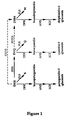
- the B-ring of dihydrokaempferol can be hydroxylated at either the 3', or both the 3' and 5' positions, to produce dihydroquercetin (DHQ) and dihydromyricetin (DHM), respectively (see Figure 1).
- DHQ is an intermediate required for the production of cyanidin-based anthocyanins
- DHM is an intermediate required for the production of delphinidin-based anthocyanins in the flavonoid pathway.
- Two key enzymes involved in this pathway are flavonoid 3'-hydroxylase (F3'H) and flavonoid 3',5'-hydroxylase (F3'5'H). The F3'H acts on DHK to produce DHQ.
- the F3'5'H is a broad spectrum enzyme catalyzing hydroxylation of DHK in the 3' and 5' positions and of DHQ in the 5' position (Stotz and Forkmann, 1982), in both instances producing DHM.
- the pattern of hydroxylation of the B-ring of anthocyanins plays a key role in determining petal colour.
- DFR dihydroflavonol-4-reductase
- the inventors sought to genetically manipulate the flavonoid pathway in carnation plants to generate a range of plants with the capacity to direct DHK metabolism towards delphinidin in preference to or rather than pelargonidin or cyanidin.
- the resulting plants exhibit altered flower colouration relative to presently available carnation plants.
- the new transgenic carnation plants and more particularly flowers cut therefrom fulfil a long-felt need in the horticultural and more particularly the floricultural industry in relation to carnations.
- the technology of the present invention is also applicable to a range of other flowering plants such as roses and chrysanthemums.
- one aspect of the present invention contemplates a method of producing a plant exhibiting altered flower colour, said method comprising selecting a plant from which said first plant is derived wherein said selected plant is incapable of synthesizing a DFR which acts on DHK, or produces reduced levels of DFR compared to a wild-type plant, or produces a DFR with a reduced substrate specificity for DHK compared to DHQ or DHM; and introducing into said selected plant one or more genetic constructs comprising nucleotide sequences encoding a F3'5'H and a DFR which is capable of acting on DHM but is incapable of acting on DHK or has a greater substrate specificity for DHM than for DHK or DHQ.
- the present invention provides a method for producing a carnation plant exhibiting altered flower colour, said method comprising selecting a carnation plant from which said first carnation plant is derived wherein said selected plant is incapable of synthesizing a DFR which acts on DHK, or produces reduced levels of DFR compared to a wild-type plant, or produces a DFR with a reduced substrate specificity for DHK compared to DHQ or DHM in flowers; and introducing into said selected plant one or more genetic constructs comprising nucleotide sequences encoding a F3'5'H and a DFR which is capable of acting on DHM but is incapable of acting on DHK or has a greater substrate specificity for DHM than for DHK or DHQ.
- the present invention is exemplified herein using carnation plants. This is done, however, with the understanding that the instant invention extends to a range of flowering plants such as but not limited to roses and chrysanthemums. Reference hereinafter to carnations should be taken as reference to other suitable flowering plants.
- the method for producing the carnation plant exhibiting altered flower colour may be carried out by the steps of:
- altered flower colour includes alteration in the colour of any or all components of the flower including the petal, sepal and stamen.
- altered flower colour is shown by comparing the flower colour of a transgenic plant made in accordance with the present invention with a plant of the same species but which possesses a DFR which can act on DHK. In practical terms, a comparison may be made between the transgenic plant and the "selected" plant, i.e. the plant from which the transgenic plant is derived.
- the present invention is predicated in part on the genetic manipulation of the anthocyanin pathway in carnation plants to direct metabolism of DHK preferentially towards DHM and delphinidin and derivatives thereof rather than through leucopelargonidin and pelargonidin derivatives or DHQ and leucocyanidin and cyanidin derivatives.
- Flowers of carnation plants lack a F3'5'H and, hence, DHK is unable to undergo metabolism down the delphinidin pathway which is required in order to produce flower colours in the range covering lilac, violet, purple and blue or various shades thereof.
- the inventors screened for and located white lines of carnations lacking a functional DFR.
- Expression of an introduced nucleic acid molecule results in a F3'5'H which is capable of directing DHK metabolism to DHM.
- Introduction and expression of a nucleic acid molecule encoding a non - indigenous DFR which is capable of acting on DHM but not DHK, results in DHM metabolism being directed to leucodelphinidin thereby allowing subsequent conversion to other derivatives of delphinidin. Little or no metabolism occurs via the pelargonidin or cyanidin pathway.
- the flowers of the starting plant also lack a F3'H.
- the present invention contemplates a method for producing a carnation plant exhibiting altered flower colour properties, said method comprising selecting a carnation plant from which said first mentioned carnation plant is to be derived wherein said selected plant is incapable of synthesizing either a F3'H or a DFR which can act on DHK, or produces reduced levels of DFR compared to a wild-type plant, or produces a DFR with a reduced substrate specificity for DHK compared to DHQ or DHM in flowers; and introducing into said selected plant one or more genetic constructs comprising nucleotide sequences encoding an F3'5'H and a DFR which is capable of acting on DHM but is incapable of acting on DHK or has a greater substrate specificity for DHM than for DHK or DHQ.
- the method for producing the carnation plant exhibiting altered flower colour may be carried out by the steps of:
- the present invention is exemplified herein using petunia DFR as an enzyme capable of acting on DHM but not DHK. This is done, however, with the understanding that the present invention extends to a DFR enzyme from any plant providing it is capable of acting on DHM but not DHK.
- a particularly useful F3'5'H is from petunia but other sources of F3'5'H include egg plant, lisianthus, gentian, pansy, china aster, anemone, grape, iris, hyacinth, delphinium and bell flower.
- Reference herein to the ability of a plant to produce or not produce an enzyme such as DFR, F3'H and F3'5'H relates to its ability in flowers and not necessarily elsewhere in the plant.
- a particularly preferred embodiment of the present invention relates to a method for producing a carnation plant exhibiting altered flower colour and such methods may be performed by selecting a carnation plant from which said first carnation plant is to be derived wherein said selected plant is incapable of synthesizing either F3'H or a DFR which can act on DHK, or produces reduced levels of DFR compared to a wild-type plant, or produces a DFR with a reduced substrate specificity for DHK compared to DHQ or DHM in flowers, introducing into cells of said selected plant one or more genetic constructs comprising nucleotide sequences which separately encode a F3'5'H and a petunia DFR, regenerating a plant from said cells, and then growing said plant under conditions sufficient to permit expression of said F3'5'H and said petunia DFR such that said plant produces flowers of different colour relative to said selected plant.
- the F3'5'H is of petunia origin.
- the selected plant from which the subject transgenic plant exhibiting altered flower colour is derived may be a natural mutant for DFR such that it substantially does not produce DFR or produces reduced levels of this enzyme, or produces the enzyme with altered substrate specificities such as substantial inability to metabolize DHK.
- the selected plant is a double mutant for DFR and F3'H. Mutants of these types would generally have white flowers. Mutations may be single or multiple nucleotide substitutions, deletions and/or additions to the nucleotide sequences defining the enzymes. Alternatively, the mutations may be induced or directed by, for example, transposon tagging, oligonucleotide-directed mutagenesis, Agrobacterium -directed mutagenesis or viral-directed mutagenesis.
- genetic constructs may be introduced to reduce expression of DFR and/or F3'H by, for example, antisense or co-suppression methods.
- a plant may be chosen with substantial inability to synthesize one of DFR or F3'H and a genetic sequence introduced to reduce expression of the other of said DFR or F3'H.
- a plant may be selected with substantial inability to synthesise one of DFR or F3'H and a mutation induced in the other of said DFR or F3'H, by any of the means mentioned above.
- the resulting plant would be a "selected” plant and a recipient for a F3'5'H and a DFR capable of acting on DHM but not DHK.
- a "selected” plant may also be considered a "parent” plant since it is from this plant that a transgenic plant exhibiting altered flower colour is derived in accordance with the methods of the present invention.
- the altered flower colour contemplated by the present invention includes the ability of the carnations to produce a range of colours including lilac, violet, purple and blue flowers or various shades thereof from, for example, deep mauve to dark blue to a violet colour or their various shades or combinations thereof.
- Another aspect of the present invention contemplates a transgenic plant exhibiting altered flower colour, said plant being incapable of synthesizing a DFR which acts on DHK, or produces reduced levels of DFR compared to a wild-type plant, or produces a DFR with a reduced substrate specificity for DHK compared to DHQ or DHM; and which carries a nucleic acid molecule comprising a sequence of nucleotides which encodes a F3'5'H and a DFR which is capable of acting on DHM but is incapable of acting on DHK or has a greater substrate specificity for DHM than for DHK or DHQ.
- the plant is a carnation, rose, gerbera or chrysanthemum.
- the nucleic acid molecule may comprise multiple genetic constructs separately encoding DFR and F3'5'H or a single combined genetic construct encoding both enzymes but with expression being generally directed by two separate promoters.
- the term "nucleic acid molecule" encompasses single or multiple nucleic acid molecules.
- the carnation plant is also substantially incapable of synthesizing a F3'H.
- the present invention extends to the flowers and in particular flowers cut from such transgenic carnations or from plants produced according to the methods herein disclosed.
- a “non-indigenous” DFR is an enzyme not normally produced in carnation plants and, in one preferred embodiment, is from petunia.
- a “non-indigenous” DFR may alternatively have originated from a carnation plant but has undergone mutation to restrict its substrate specificity to DHM.
- the F3'5'H is also non-indigenous and in one aspect is preferably from petunia.
- Carnation flowers of the invention exhibiting altered flower colour may be obtained by growing a transgenic flowering carnation plant for a time and under conditions for flowers to form and then optionally harvesting said flowers, said transgenic carnation plant having been genetically manipulated as described hereinbefore such that:
- the flowers exhibiting altered flower colour will now have the capacity to metabolise DHK to DHM and delphinidin and derivatives thereof of the flavonoid pathway.
- the transgenic plant is also substantially incapable of expressing a F3'H.
- genetic sequences encoding separately a F3'5'H, a DFR which is capable of acting on DHM but is incapable of acting on DHK or has a greater substrate specificity for DHM than for DHK or DHQ and optionally also a F3'H may be used in the genetic manipulation of a carnation plant incapable of expressing or synthesizing an active DFR capable of acting on DHK or DHM, or produces reduced levels of DFR compared to a wild-type plant, or produces a DFR with a reduced substrate specificity for DHK compared to DHQ or DHM; so as to allow the manufacture of a carnation plant exhibiting altered flower colour compared to a carnation plant which is capable of synthesizing a DFR capable of acting on DHK.
- the present invention extends to flowers and in particular flowers cut from said carnation plants.
- the flowers of some plants such as, for example, rose, carnation and gerbera, produce two types of anthocyanidins, depending on their genotype - pelargonidin and cyanidin.
- pelargonidin In the absence of F3'H activity, pelargonidin is produced; in its presence, cyanidin is produced.
- Pelargonidin is usually accompanied by kaempferol, a colourless flavonol.
- Cyanidin pigments are usually accompanied by either quercetin or both kaempferol and quercetin. Both pelargonidin and kaempferol are derived from DHK; both cyanidin and quercetin are derived from DHQ ( Figure 1).
- a number of enzymes including DFR, ANS and 3GT are required for the conversion of dihydroflavonols (DHK, DHQ and DHM) to the coloured anthocyanins.
- DHK, DHQ and DHM dihydroflavonols
- DHM dihydroflavonols
- a third type of anthocyanidin, delphinidin cannot be produced in flowers of these plants, owing to the natural absence of F3'5'H activity.
- the DFR enzyme is capable of metabolising two dibydroflavonols, DHK and DHQ, to leucoanthocyanidins which are ultimately converted to anthocyanidin pigments which are responsible for flower colour.
- DHK is converted to leucopelargonidin giving rise to red-coloured carnations and DHQ to leucocyanidin producing crimson carnations (Geissman and Mehlquist, 1947; Stich et al ., 1992b) (see Figure 1).
- Carnation DFR is also capable of converting DHM to leucodelphinidin (Forkmann et al ., 1987). However, naturally-occurring carnation lines do not contain a flavonoid 3',5'-hydroxylase enzyme and therefore do not synthesise DHM.
- the petunia DFR enzyme has a different specificity to that of the carnation DFR. It is able to convert DHQ through to leucocyanidin, but it is not able to convert DHK to leucopelargonidin (Forkmann et al ., 1987). In petunia lines containing the F3'5'H enzyme, the petunia DFR enzyme can convert the DHM produced by the action of F3'5'H to leucodelphinidin, which is further modified giving rise to delphinidin - the pigment responsible for blue-coloured flowers (see Figure 1). Even though the petunia DFR is capable of converting both DHQ and DHM, it is able to convert DHM far more efficiently, favouring the production of delphinidin (Forkmann et al., 1987).
- Carnation is transformable with a nucleic acid molecule encoding the petunia F3'5'H from another species, thereby allowing the production of DHM and ultimately the accumulation of delphinidin (International Patent Application No. PCT/AU94/00265; [WO94/28140]).
- the efficiency of delphinidin production in many of these plants is low due to the competition of carnation DFR with the F3'5'H enzyme for DHK or DHQ as substrate.
- the accumulation of significant amounts of delphinidin may, therefore, be limited by the action of the carnation DFR.
- the inventors have shown that the efficiency of delphinidin production is markedly increased by transformation of a DFR mutant cultivar with an appropriate genetic construct. In such a line there is no accumulation of anthocyanin, due to the absence of DFR enzyme activity. However, when a nucleic acid molecule encoding the petunia DFR enzyme is used to transform this line, together with a nucleic acid molecule encoding flavonoid 3',5'-hydroxylase and both enzymes are expressed, DHK is then converted to leucodelphinidin by the introduced enzymes and ultimately to delphinidin pigments by the plant's endogenous enzymes.
- the DFR mutant line is also a F3'H mutant, there is little or no production of DHQ and therefore the only anthocyanins produced by the transgenic plants are delphinidin derivatives. In the presence of the F3'H, cyanidin pigments may also be produced, but delphinidin is the major anthocyanin produced because the petunia DFR is more efficient at utilizing DHM than DHQ as a substrate.
- Flowers from carnation plants genetically manipulated in this manner produce a range of flower colours covering lilac, violet, purple and blue or various shades thereof. Exemplification of the application of this strategy in accordance with the present invention in the production of carnations with altered flower colour is provided by the following examples.
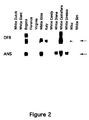
- Example 14 Northern analysis was then performed, as described in Example 14. After the RNA was transferred from the gel to a Hybond-N filter (Amersham), the filter was probed with the 290 bp Bam HI/ Hind III cDNA fragment of ANS (described in Example 6) labelled with 32 P. The 1.2 kbp Asp 718/ Bam HI partial DFR clone (described in Example 7) was also labelled with 32 P and used to probe duplicate filters. Prehybridisation (1 hour at 42°C) and hybridization (16 hours at 42°C) were carried out as described in Example 14.
- the cloning vector pBluescript II (KS + ) was obtained from Stratagene.
- plants were grown in specialised growth rooms with a 14 hour day length at a light intensity of 10,000 lux minimum and a temperature of 22°C to 26°C.
- PCR Polymerase Chain Reaction
- the oligonucleotides synthesized were: 5' AC(A,G)TC(A,G)GT(A,G)TGIGC(T,C)TCIACICC 3' SEQ ID NO:1 5' TGGGA(A,G)GA(T,C)TA(T,C)ITITT(T,C)CA 3' SEQ ID NO:2
- PCR amplification was carried out on 50 ng of cDNA in the presence of 10 mM Tris-HCl (pH 8.3), 50 mM KCl, 2 mM MgCl 2 , 0.01% gelatine, 0.2 mM dATP, 0.2 mM dCTP, 0.2 mM dGTP, 0.2 mM dTTP, 0.4 ⁇ M each primer and 1.25 units Taq polymerase (Cetus).
- the reaction mix (50 ⁇ L) was cycled once at each of 95°C for 3 min; 48°C for 1 min; 72°C for 1 min; and then 39 times at each of 95°C for 1 min; 48°C for 1 min; 72°C for 1 min.
- a DNA fragment of 290 base pairs (bp) was produced.
- the 290 bp fragment was isolated by Sea Plaque TM low gelling temperature agarose (FMC) electrophoresis in a TAE running buffer (40 mM Tris, 50 mM acetic acid, 50 mM EDTA). The DNA was extracted from the agarose by heating to 65°C, phenol extraction and ethanol precipitation. The fragment was then ligated into a ddT-tailed vector prepared as described by Holton and Graham (1991). Sequencing of plasmid clones was performed using Prism TM Ready Reaction Dye Primer chemistry and a DNA Sequencing System 373A (Applied Biosystems).
- cDNA was ligated with 1 ⁇ g of Uni-Zap TM XR vector (Stratagene). Ligation was carried out at 4°C for 4 days and then packaged using Packagene TM (Promega).
- the resultant library contained 1.5 x 10 5 plaque forming units (p.f.u.) and was amplified by eluting the bacteriophage from the agar plates into phage storage buffer (100 mM NaCl, 10 mM MgCl 2, 1,0 mM Tris-HCl (pH 7.4), 0.05% w/v gelatine).
- the colony lifts were prehybridized (42°C, 1 hour) and hybridized (42°C, overnight) in a solution of 6 x SSC (0.6 M NaCl, 0.06 M sodium citrate), 0.5% w/v sodium dodecyl sulphate (SDS), 0.1% polyvinyl-pyrrolidone (PVP), 0.1 % w/v bovine serum albumin (BSA), 0. 1 % ficoll, 0.01 M ethylenediaminetetra-acetic acid (EDTA), and 100 mg/mL denatured herring sperm DNA.
- 6 x SSC 0.6 M NaCl, 0.06 M sodium citrate
- SDS sodium dodecyl sulphate
- PVP polyvinyl-pyrrolidone
- BSA bovine serum albumin
- EDTA ethylenediaminetetra-acetic acid
- the clones isolated were sequenced using Prism TM Ready Reaction Dye Primer chemistry and a DNA Sequencing System 373A (Applied Biosystems). One clone was found to have homology with the petunia DFR. This clone contained a 1.2 kilobase pair (kbp) cDNA insert and appeared to be a partial DFR clone only.
- Double-stranded DNA sequence of the entire cDNA insert was obtained using a shotgun clone sequencing strategy.
- the DFR cDNA fragment was purified, self-ligated and sheared by ultrasound (four times seven-second bursts at 20 watts from a Branson sonicator with a microprobe attached).
- the fragment ends were repaired using T4 DNA polymerase and size fractionated in the range of 350 to 600 bp using agarose gel electrophoresis in TAE running buffer. Fragments were purified using Geneclean (Bio101), ligated into Sma I-cut pUC18 and individual clones were sequenced.
- the resulting plasmid (pCGP1406) contained the petunia DFR cDNA between the MAC promoter (Comai et al , 1990) and the mannopine synthase (mas) terminator (Comai et al , 1990).
- a Bgl II digest of this plasmid was used in the construction of pCGP1470, as described in Example 9.
- the cDNA clone in plasmid pCGP1406 was shown to be functional by bombardment of Petunia hybrida cv. Br140 petals.
- Br140 lacks DFR activity due to a mutation at the an6 genetic locus, so the flowers are white and do not produce anthocyanins.
- coloured cells were produced due to anthocyanin synthesis, indicating that the DFR gene fragment present in this plasmid was functional.
- a genomic library was made from Petunia hybrida cv. Old Glory Blue DNA in the vector ⁇ 2001 (Holton, 1992). Approximately 200,000 p.f.u. were plated out on NZY plates, lifts were taken onto NEN filters and the filters were hybridised with 400,000 cpm/mL of the 32 P-labelled 1kb petunia DFR cDNA fragment (see 8a, above). Hybridising clones were purified, DNA was isolated from each and mapped by restriction enzyme digestion. A 13 kb Sac I fragment of one of these clones was isolated and ligated with Sac I-cut pBluescriptII to create pCGP1472.
- the genomic clone in plasmid pCGP1472 was also shown to be functional by bombardment of Petunia hybrida cv. Br140 petals. After bombardment of petals with pCGP1472, coloured cells were produced, due to anthiocyanin synthesis. Finer mapping indicated that a 5 kb Bgl II fragment contained the entire DFR gene. This 5kb fragment was used in the construction of pCGP1473, as described in Example 10.
- Plasmid pCGP485 (International Patent Application PCT/AU94/00265 [WO94/28140] was digested with Pst I to release a 3.5 kb genetic construct consisting of a snapdragon CHS promoter sequence, a petunia Hf1 cDNA fragment and a petunia phospholipid transfer protein terminator sequence (International Patent Application PCT/AU92/00334 [WO93/01290). The overhanging 3'-ends of the fragment were removed with T4 DNA polymerase according to standard protocols (Sambrook et al ., 1989) before ligation into the Sma I site of the binary vector pWTT2132 (DNAP). The resultant clone was designated pCGP1452.
- a map of pCGP1473 is presented in Figure 4.
- Escherichia coli strains DH5 ⁇ and XL1-Blue used for routine manipulations, were transformed using the method of Inoue et al . (1990).
- the plasmids pCGP1470 and pCGP1473 were introduced into Agrobacterium tumefaciens strain AGL0 by adding 5 ⁇ g of plasmid DNA to 100 ⁇ L of competent Agrobacterium tumefaciens cells prepared by inoculating a 50 mL MG/L (Garfinkel and Nester, 1980) culture and growing for 16 hours with shaking at 28°C. The cells were then pelleted and resuspended in 1 mL of 20 mM CaCl 2 . The DNA- Agrobacterium mixture was frozen by incubation in liquid nitrogen for 2 min and then allowed to thaw by incubation at 37°C for 5 min.
- the cells were then mixed with 1 mL of MG/L media and incubated with shaking for 4 hours at 28°C.
- Cells of A. tumefaciens carrying pCGP1470 or pCGP1473 were selected on MG/L agar plates containing 50 ⁇ g/mL tetracycline. The presence of the plasmid was confirmed by Southern analysis of DNA isolated from the tecacycline-resistant transformants.
- Agrobacterium tumefaciens strain AGL0 (Lazo et al., 1991), containing the binary vector pCGP1470 or pCGP1473, was maintained at 4°C on LB agar plates with 50 mg/L tetracycline. A single colony was grown overnight in liquid LB broth containing 50 mg/L tetracycline and diluted to 5 x 10 8 cells/mL next day before inoculation.
- Carnation stem tissue was co-cultivated with Agrobacterium for 5 days on MS medium supplemented with 3% w/v sucrose, 0.5 mg/L benzlaminopurine, 0.5 mg/L 2,4-dichlorophenoxy-acetic acid (2,4-D), 100 ⁇ M acetosyringone and 0.25% w/v Gelrite (pH 5.7).
- the top 6-8 mm of each co-cultivated stem was cut into 3-4 mm segments, which were then transferred to MS medium (Murashige and Skoog, 1962) supplemented with 0.3% w/v sucrose, 0.5 mg/L BAP, 0.5 mg/L 2,4-D, 1 ⁇ g/L chlorsulfuron, 500 mg/L ticarcillin and 0.25% w/v Gelrite.
- explants were transferred to fresh MS medium containing 0.3% sucrose, 0.16 mg/L thidiazuron (TDZ), 0.5 mg/L indole-3-butyric acid (IBA), 2 ⁇ g/L chlorsulfuron, 500 mg/L ticarcillin and 0.25% w/v Gelrite and care was taken at this stage to remove axillary shoots from stem explants.
- healthy adventitious shoots were transferred to hormone free MS medium containing 3% w/v sucrose, 3 ⁇ g/L chlorsulfuron, 500 mg/L ticarcillin, 0.25 % w/v Gelrite.
- Suncaps (Sigma) were placed on top of the glass jars to hasten the normalisation of shoots. All cultures were maintained under a 16 hour photoperiod (120 ⁇ E/m 2 /s cool white fluorescent light) at 23°C ⁇ 2°C. Normalised shoots, approximately 1.5-2.0 cm tall, were rooted on 3 g/kg IBA rooting powder and acclimatised under mist. A soil mix containing 75% perlite/25% peat was used for acclimation, which was carried out at 23°C under a 14 hour photoperiod (200 ⁇ E/m 2 /s mercury halide light) and typically lasted 3-4 weeks. Plants were fertilised with a carnation mix containing 1g/L CaNO 3 and 0.75 g/L of a mixture of microelements plus N:P:K in the ratio 4.7:3.5: 29.2.
- DNA was isolated from 0.3-0.5 grams of leaf tissue using the method of Lassner et al . (1989).
- genomic DNA was digested with Xba I and electrophoresed through a 1% w/v agarose gel in a running buffer of TAE.
- the DNA was then denatured in denaturing solution (1.5 M NaCl/0.5 M NaOH) for 0.5 to 1.0 hour, neutralised in 0.5 M Tris-HCl (pH 7.5)/1.5 M NaCl for 0.5 to 1.0 hour and the DNA was then transferred to a Hybond-N (Amersham) filter in 20 x SSC.
- Filters were hybridized with 32 P-labelled DNA (10 3 cpm/ ⁇ g, 2 x 10 6 cpm/mL) from a 730 bp Eco RV fragment of a petunia Hf1 cDNA clone. Filters were washed in 2 x SSC/1% w/v SDS at 65°C for 1 hour and then 0.2 x SSC/1% w/v SDS at 65°C for 1 hour.
- the CsCl was dissolved by mixing and samples were then layered over a 10 mL cushion of 5.7 M CsCl, 50 mM EDTA (pH 7.0) in 38.5 mL Quick-seal centrifuge tubes (Beckman) and centrifuged at 42,000 rpm for 12-16 hours at 23°C in a Ti-70 rotor. Pellets were resuspended in TE/SDS (10 mM Tris-HCl (pH 7.5), 1 mM EDTA, 0.1% w/v SDS) and extracted with phenol:chloroform (1:1) saturated in 10 mM EDTA (pH 7.5). Following ethanol precipitation the RNA pellets were resuspended in TE/SDS.
- RNA samples were electrophoresed through 2.2 M formaldehyde/1.2% w/v agarose gels using running buffer containing 40 mM morpholino-propanesulphonic acid (pH 7.0), 5 mM sodium acetate, 0.1 mM EDTA (pH 8.0).
- the RNA was transferred to Hybond-N filters (Amersham) as described by the manufacturer and probed with the appropriate 32 P-labelled cDNA fragment (10 8 cpm/ ⁇ g, 2 x 10 6 cpm/mL).
- Prehybridization (1 hour at 42°C) and hybridization (16 hours at 42°C) were carried out in 50% v/v formamide, 1 M NaCl, 1% w/v SDS, 10% w/v dextran sulphate.
- Degraded herring sperm DNA 100 ⁇ g/mL was added with the 32 P-labelled probe for the hybridization step.
- Filters were washed in 2 x SSC/1% w/v SDS at 65°C for 1 hour and then 0.2 x SSC/1% w/v SDS at 65°C for 1 hour. All filters were exposed to Kodak XAR film with an intensifying screen at -70°C for 48 hours.
- the upper (ethylacetate) phase was transferred to a new microcentrifuge tube, dried down under vacuum in a SpeedVac Concentrator (Savant) and resuspended in 15 ⁇ L ethylacetate and a 2 ⁇ L aliquot was spotted onto a cellulose TLC sheet (20 cm x 20 cm, Merck) and run for approximately 3-4 hours in Forestal solvent (30 parts acetic acid: 3 parts HCl: 10 parts water). The TLC plate was then allowed to air dry and the flavonols were viewed under ultraviolet light.
- Savant SpeedVac Concentrator
- the upper phase (IAA) was transferred to a new tube, dried down under vacuum and resuspended in 20 ⁇ L of IAA and a 1 ⁇ L aliquot was spotted onto a cellulose TLC sheet (20 x 20 cm, Merck) and run for approximately 3-4 hours in Forestal solvent.
- the TLC plate was allowed to air dry and the anthocyanidins could be viewed under normal light.
- Anthocyanins were extracted and hydrolysed by incubating approximately 0.5 g carnation petals with 1 mL of 2 M HCl at 100°C for 30 minutes. Anthocyanidins were extracted with 200 ⁇ L of IAA. One quarter of this mixture was dried down under vacuum and resuspended in 200 ⁇ L of 50% acetonitrile and 0.5 % TFA (tri-fluoro acetic acid).
- Particle bombardment using 1 ⁇ m gold particles was performed essentially as described by Sanford et al . (1993).
- the biolistic Bio-Rad PDS-100 helium-driven gun with 1100 psi rupture disks was used for all bombardments.
- Petals were dissected from opening carnation flower buds and placed on top of a plate of MS medium (+ 0.25% gelrite) before bombardment. Each plate was bombarded twice with an independently-prepared batch of DNA-coated gold particles.
- the plasmid DNA used for bombardment was purified using either a CsCl gradient method (Sambrook et al ., 1989) or a Qiagen column (Qiagen). One microgram of DNA was used per shot.
- DNA fragments (50 to 100 ng) were radioactively labelled with 50 ⁇ Ci of [ ⁇ - 32 P]-dCTP using an oligolabeuing kit (Bresatec). Unincorporated [ ⁇ - 32 P]-dCTP was removed by chromatography on a Sephadex G-50 (Fine) column as described by Sambrook et al . (1989).
Landscapes
- Health & Medical Sciences (AREA)
- Life Sciences & Earth Sciences (AREA)
- Genetics & Genomics (AREA)
- Engineering & Computer Science (AREA)
- Chemical & Material Sciences (AREA)
- Zoology (AREA)
- Organic Chemistry (AREA)
- Bioinformatics & Cheminformatics (AREA)
- Wood Science & Technology (AREA)
- Biotechnology (AREA)
- Molecular Biology (AREA)
- General Engineering & Computer Science (AREA)
- Biomedical Technology (AREA)
- Microbiology (AREA)
- Biochemistry (AREA)
- General Health & Medical Sciences (AREA)
- Medicinal Chemistry (AREA)
- Nutrition Science (AREA)
- Cell Biology (AREA)
- Physics & Mathematics (AREA)
- Biophysics (AREA)
- Plant Pathology (AREA)
- Breeding Of Plants And Reproduction By Means Of Culturing (AREA)
- Micro-Organisms Or Cultivation Processes Thereof (AREA)
- Cultivation Of Plants (AREA)
- Fertilizers (AREA)
Abstract
Description
- The present invention relates generally to novel approaches in generating transgenic plants exhibiting altered flower colour. More particularly, the present invention provides transgenic carnation plants and flowers cut therefrom exhibiting flower colouration not naturally associated with carnation plants. The present invention further contemplates methods for producing transgenic carnation plants with the altered flower colour.
- Bibliographic details of the publications referred to in this specification are collected at the end of the description. Sequence Identity Numbers (SEQ ID NOs.) for the nucleotide sequences referred to in the specification are defined following the bibliography.
- Throughout this specification, unless the context requires otherwise, the word "comprise", or variations such as "comprises" or "comprising", will be understood to imply the inclusion of a stated element or integer or group of elements or integers but not the exclusion of any other element or integer or group of elements or integers.
- The rapidly increasing sophistication of recombinant DNA technology is greatly facilitating a broad spectrum of industrial processes from the horticultural to medical and allied health industries. The horticultural and related agricultural industries are particularly benefiting from the advances in recombinant DNA technology.
- The floriculture industry in particular strives to develop new and different varieties of flowering plants, with improved characteristics ranging from disease and pathogen resistance to altered flower colour. Although classical breeding techniques have been used with some success, this approach has been limited by the constraints of a particular species' gene pool. It is rare, for example, for a single species to have a full spectrum of coloured varieties. Accordingly, substantial effort has been directed towards the use of recombinant DNA technology to generate transgenic plants exhibiting the desired characteristics.
- The development of varieties of the major cutflower species such as carnation plants, for example, having flowers exhibiting a range of colours covering lilac, violet, purple and blue or various shades thereof, would offer a significant opportunity in both the cutflower and ornamental markets.
- Flower colour is predominantly due to two types of pigment: flavonoids and carotenoids. Flavonoids contribute to a range of colours from yellow to red to blue. Carotenoids impart an orange or yellow tinge and are commonly the only pigment in yellow or orange flowers. The flavonoid molecules which make the major contribution to flower colour are the anthocyanins which are glycosylated derivatives of cyanidin, delphinidin, petunidin, peonidin, malvidin and pelargonidin, and are localised in the vacuole. The different anthocyanins can produce marked differences in colour. Flower colour is also influenced by co-pigmentation with colourless flavonoids, metal complexation, glycosylation, acylation, methylation and vacuolar pH (Forkmann, 1991).
- The biosynthetic pathway for the flavonoid pigments (hereinafter referred to as the "flavonoid pathway") is well established (Ebel and Hahlbrock, 1988; Hahlbrock and Grisebach, 1979; Wiering and de Vlaming, 1984; Schram et al., 1984; Stafford, 1990). The first committed step in the pathway involves the condensation of three molecules of malonyl-CoA with one molecule of p-coumaroyl-CoA. This reaction is catalysed by the enzyme chalcone synthase (CHS). The product of this reaction, 2',4,4',6'-tetrahydroxychalcone, is normally rapidly isomerized to produce naringenin by the enzyme chalcone-flavanone isomerase (CHI). Naringenin is subsequently hydroxylated at the 3-position of the central ring by flavanone 3-hydroxylase (F3H) to produce dihydrokaempferol (DHK).
- The B-ring of dihydrokaempferol (DHK) can be hydroxylated at either the 3', or both the 3' and 5' positions, to produce dihydroquercetin (DHQ) and dihydromyricetin (DHM), respectively (see Figure 1). DHQ is an intermediate required for the production of cyanidin-based anthocyanins and DHM is an intermediate required for the production of delphinidin-based anthocyanins in the flavonoid pathway. Two key enzymes involved in this pathway are flavonoid 3'-hydroxylase (F3'H) and flavonoid 3',5'-hydroxylase (F3'5'H). The F3'H acts on DHK to produce DHQ. The F3'5'H is a broad spectrum enzyme catalyzing hydroxylation of DHK in the 3' and 5' positions and of DHQ in the 5' position (Stotz and Forkmann, 1982), in both instances producing DHM. The pattern of hydroxylation of the B-ring of anthocyanins plays a key role in determining petal colour.
- Another key enzyme is dihydroflavonol-4-reductase (DFR) which has variable substrate specificity depending on its plant source and has the potential to act on any one or more of DHK, DHQ and DHM.
- Many of the major cutflower species lack the F3'5'H and consequently cannot display the range of colours, resultant from synthesis of delphinidins and derivatives thereof, that would otherwise be possible. This is particularly the case for carnations which constitute a major proportion of the world-wide cutflower market. There is a need, therefore, to modify carnation plants to generate transgenic plants which are capable of producing the F3'5'H, thereby providing a means of converting DHK and DHQ to DHM, thereby influencing the hydroxylation pattern of the anthocyanins and allowing the production of anthocyanins derived from delphinidin. Flower colour is modified as a result and a single species is able to express a broader spectrum of flower colours. WO94/28140 describes the introduction of F3'5'H into plants, lacking F3'5'H, to increase delphinidin production relative to non-transgenic plants. DFR enzyme levels were however not modified.
- In work leading up to the present invention, the inventors sought to genetically manipulate the flavonoid pathway in carnation plants to generate a range of plants with the capacity to direct DHK metabolism towards delphinidin in preference to or rather than pelargonidin or cyanidin. The resulting plants exhibit altered flower colouration relative to presently available carnation plants. The new transgenic carnation plants and more particularly flowers cut therefrom fulfil a long-felt need in the horticultural and more particularly the floricultural industry in relation to carnations. The technology of the present invention is also applicable to a range of other flowering plants such as roses and chrysanthemums.
- Accordingly, one aspect of the present invention contemplates a method of producing a plant exhibiting altered flower colour, said method comprising selecting a plant from which said first plant is derived wherein said selected plant is incapable of synthesizing a DFR which acts on DHK, or produces reduced levels of DFR compared to a wild-type plant, or produces a DFR with a reduced substrate specificity for DHK compared to DHQ or DHM; and introducing into said selected plant one or more genetic constructs comprising nucleotide sequences encoding a F3'5'H and a DFR which is capable of acting on DHM but is incapable of acting on DHK or has a greater substrate specificity for DHM than for DHK or DHQ.
- More particularly, the present invention provides a method for producing a carnation plant exhibiting altered flower colour, said method comprising selecting a carnation plant from which said first carnation plant is derived wherein said selected plant is incapable of synthesizing a DFR which acts on DHK, or produces reduced levels of DFR compared to a wild-type plant, or produces a DFR with a reduced substrate specificity for DHK compared to DHQ or DHM in flowers; and introducing into said selected plant one or more genetic constructs comprising nucleotide sequences encoding a F3'5'H and a DFR which is capable of acting on DHM but is incapable of acting on DHK or has a greater substrate specificity for DHM than for DHK or DHQ.
- The present invention is exemplified herein using carnation plants. This is done, however, with the understanding that the instant invention extends to a range of flowering plants such as but not limited to roses and chrysanthemums. Reference hereinafter to carnations should be taken as reference to other suitable flowering plants.
- The method for producing the carnation plant exhibiting altered flower colour, may be carried out by the steps of:
- (i) selecting a plant from which said carnation plant is to be derived wherein said selected plant is incapable of synthesizing a DFR which acts on DHK, or produces reduced levels of DFR compared to a wild-type plant, or produces a DFR with a reduced substrate specificity for DHK compared to DHQ or DHM in flowers;
- (ii) transforming cells of said selected plant with one or more genetic constructs comprising nucleotide sequences which encode separately F3'5'H and DFR provided said DFR is capable of acting on DHM but is incapable of acting on DHK or has a greater substrate specificity for DHM than for DHK or DHQ;
- (iii) regenerating a transgenic plant from said transformed cells such that said regenerated plant is capable of expressing said F3'5'H and said DFR of step (ii); and
- (iv) growing said plant under conditions to permit expression of said F3'5'H and said DFR of step (ii) in flowers.
- Reference herein to altered flower colour includes alteration in the colour of any or all components of the flower including the petal, sepal and stamen. Conveniently, altered flower colour is shown by comparing the flower colour of a transgenic plant made in accordance with the present invention with a plant of the same species but which possesses a DFR which can act on DHK. In practical terms, a comparison may be made between the transgenic plant and the "selected" plant, i.e. the plant from which the transgenic plant is derived.
- The present invention is predicated in part on the genetic manipulation of the anthocyanin pathway in carnation plants to direct metabolism of DHK preferentially towards DHM and delphinidin and derivatives thereof rather than through leucopelargonidin and pelargonidin derivatives or DHQ and leucocyanidin and cyanidin derivatives. Flowers of carnation plants lack a F3'5'H and, hence, DHK is unable to undergo metabolism down the delphinidin pathway which is required in order to produce flower colours in the range covering lilac, violet, purple and blue or various shades thereof. To achieve a preferential re-direction of DHK metabolic products down the delphinidin pathway, the inventors screened for and located white lines of carnations lacking a functional DFR. Expression of an introduced nucleic acid molecule results in a F3'5'H which is capable of directing DHK metabolism to DHM. Introduction and expression of a nucleic acid molecule encoding a non - indigenous DFR which is capable of acting on DHM but not DHK, then results in DHM metabolism being directed to leucodelphinidin thereby allowing subsequent conversion to other derivatives of delphinidin. Little or no metabolism occurs via the pelargonidin or cyanidin pathway.
- In a particularly preferred embodiment, the flowers of the starting plant also lack a F3'H.
- According to one preferred embodiment, the present invention contemplates a method for producing a carnation plant exhibiting altered flower colour properties, said method comprising selecting a carnation plant from which said first mentioned carnation plant is to be derived wherein said selected plant is incapable of synthesizing either a F3'H or a DFR which can act on DHK, or produces reduced levels of DFR compared to a wild-type plant, or produces a DFR with a reduced substrate specificity for DHK compared to DHQ or DHM in flowers; and introducing into said selected plant one or more genetic constructs comprising nucleotide sequences encoding an F3'5'H and a DFR which is capable of acting on DHM but is incapable of acting on DHK or has a greater substrate specificity for DHM than for DHK or DHQ.
- The method for producing the carnation plant exhibiting altered flower colour, may be carried out by the steps of:
- (i) selecting a carnation plant from which said first mentioned carnation plant is to be derived, wherein said selected plant is incapable of synthesizing either F3'H or a DFR which can act on DHK, or produces reduced levels of DFR compared to a wild-type plant, or produces a DFR with a reduced substrate specificity for DHK compared to DHQ or DHM in flowers;
- (ii) transforming cells of said selected plant with one or more genetic constructs comprising nucleotide sequences which encode separately F3'5'H and DFR provided said DFR is capable of acting on DHM but is incapable of acting on DHK or has a greater substrate specificity for DHM than for DHK or DHQ;
- (iii) regenerating a transgenic plant from said transformed cells such that said regenerated plant is capable of expressing said F3'5'H and said DFR of step (ii); and
- (iv) growing said plant under conditions to permit expression of said F3'5'H and said DFR of step (i) in flowers.
- The present invention is exemplified herein using petunia DFR as an enzyme capable of acting on DHM but not DHK. This is done, however, with the understanding that the present invention extends to a DFR enzyme from any plant providing it is capable of acting on DHM but not DHK. Similarly, a particularly useful F3'5'H is from petunia but other sources of F3'5'H include egg plant, lisianthus, gentian, pansy, china aster, anemone, grape, iris, hyacinth, delphinium and bell flower.
- Reference herein to the ability of a plant to produce or not produce an enzyme such as DFR, F3'H and F3'5'H relates to its ability in flowers and not necessarily elsewhere in the plant.
- A particularly preferred embodiment of the present invention relates to a method for producing a carnation plant exhibiting altered flower colour and such methods may be performed by selecting a carnation plant from which said first carnation plant is to be derived wherein said selected plant is incapable of synthesizing either F3'H or a DFR which can act on DHK, or produces reduced levels of DFR compared to a wild-type plant, or produces a DFR with a reduced substrate specificity for DHK compared to DHQ or DHM in flowers, introducing into cells of said selected plant one or more genetic constructs comprising nucleotide sequences which separately encode a F3'5'H and a petunia DFR, regenerating a plant from said cells, and then growing said plant under conditions sufficient to permit expression of said F3'5'H and said petunia DFR such that said plant produces flowers of different colour relative to said selected plant. Preferably, the F3'5'H is of petunia origin.
- The selected plant from which the subject transgenic plant exhibiting altered flower colour is derived may be a natural mutant for DFR such that it substantially does not produce DFR or produces reduced levels of this enzyme, or produces the enzyme with altered substrate specificities such as substantial inability to metabolize DHK. Preferably, however, the selected plant is a double mutant for DFR and F3'H. Mutants of these types would generally have white flowers. Mutations may be single or multiple nucleotide substitutions, deletions and/or additions to the nucleotide sequences defining the enzymes. Alternatively, the mutations may be induced or directed by, for example, transposon tagging, oligonucleotide-directed mutagenesis, Agrobacterium-directed mutagenesis or viral-directed mutagenesis.
- Alternatively, genetic constructs may be introduced to reduce expression of DFR and/or F3'H by, for example, antisense or co-suppression methods. In this aspect of the invention, a plant may be chosen with substantial inability to synthesize one of DFR or F3'H and a genetic sequence introduced to reduce expression of the other of said DFR or F3'H. Alternatively, a plant may be selected with substantial inability to synthesise one of DFR or F3'H and a mutation induced in the other of said DFR or F3'H, by any of the means mentioned above. In either case, the resulting plant would be a "selected" plant and a recipient for a F3'5'H and a DFR capable of acting on DHM but not DHK. A "selected" plant may also be considered a "parent" plant since it is from this plant that a transgenic plant exhibiting altered flower colour is derived in accordance with the methods of the present invention.
- The altered flower colour contemplated by the present invention includes the ability of the carnations to produce a range of colours including lilac, violet, purple and blue flowers or various shades thereof from, for example, deep mauve to dark blue to a violet colour or their various shades or combinations thereof.
- Another aspect of the present invention contemplates a transgenic plant exhibiting altered flower colour, said plant being incapable of synthesizing a DFR which acts on DHK, or produces reduced levels of DFR compared to a wild-type plant, or produces a DFR with a reduced substrate specificity for DHK compared to DHQ or DHM; and which carries a nucleic acid molecule comprising a sequence of nucleotides which encodes a F3'5'H and a DFR which is capable of acting on DHM but is incapable of acting on DHK or has a greater substrate specificity for DHM than for DHK or DHQ.
- Preferably, the plant is a carnation, rose, gerbera or chrysanthemum. In accordance with this aspect of the present invention, the nucleic acid molecule may comprise multiple genetic constructs separately encoding DFR and F3'5'H or a single combined genetic construct encoding both enzymes but with expression being generally directed by two separate promoters. The term "nucleic acid molecule" encompasses single or multiple nucleic acid molecules.
- Preferably, the carnation plant is also substantially incapable of synthesizing a F3'H.
- The present invention extends to the flowers and in particular flowers cut from such transgenic carnations or from plants produced according to the methods herein disclosed.
- A "non-indigenous" DFR is an enzyme not normally produced in carnation plants and, in one preferred embodiment, is from petunia. A "non-indigenous" DFR may alternatively have originated from a carnation plant but has undergone mutation to restrict its substrate specificity to DHM. The F3'5'H is also non-indigenous and in one aspect is preferably from petunia.
- Carnation flowers of the invention exhibiting altered flower colour, may be obtained by growing a transgenic flowering carnation plant for a time and under conditions for flowers to form and then optionally harvesting said flowers, said transgenic carnation plant having been genetically manipulated as described hereinbefore such that:
- (i) it is incapable of expressing a DFR which is capable of acting on DHK, or produces reduced levels of DFR compared to a wild-type plant, or produces a DFR with a reduced substrate specificity for DHK compared to DHQ or DHM;
- (ii) it is capable of expressing a non-indigenous F3'5'H; and
- (iii) it is capable of expressing a non-indigenous DFR which is capable of acting on DHM but is incapable of acting on DHK or has a greater substrate specificity for DHM than for DHK or DHQ.
- The flowers exhibiting altered flower colour will now have the capacity to metabolise DHK to DHM and delphinidin and derivatives thereof of the flavonoid pathway.
- Preferably, the transgenic plant is also substantially incapable of expressing a F3'H.
- In methods of the present invention, genetic sequences encoding separately a F3'5'H, a DFR which is capable of acting on DHM but is incapable of acting on DHK or has a greater substrate specificity for DHM than for DHK or DHQ and optionally also a F3'H, may be used in the genetic manipulation of a carnation plant incapable of expressing or synthesizing an active DFR capable of acting on DHK or DHM, or produces reduced levels of DFR compared to a wild-type plant, or produces a DFR with a reduced substrate specificity for DHK compared to DHQ or DHM; so as to allow the manufacture of a carnation plant exhibiting altered flower colour compared to a carnation plant which is capable of synthesizing a DFR capable of acting on DHK. In a related aspect, the present invention extends to flowers and in particular flowers cut from said carnation plants.
- The present invention is further described by reference to the following figures and/or examples.
- In the Figures:
- Figure 1 is a schematic diagram of the pathways for conversion of dihydroflavonols to flavonols and anthocyanins. Abbreviations: DHK = dihydrokaempferol, DHQ = dihydroquercetin, DHM = dihydromyricetin, K = kaempferol, Q = quercetin, M = myricetin, F3'H = flavonoid 3'-hydroxylase, F3'5'H = flavonoid 3',5'-hydroxylase, FLS = flavonol synthase, DFR = dihydroflavonol-4-reductase, ANS = anthocyanidin synthase, 3GT = flavonoid 3-glucosyltransferase.
- Figure 2 is an autoradiographic representation of a Northern analysis comparing the expression levels of DFR and ANS mRNA in thirteen commercially-available white carnation cultivars. Arrows point to the relevant transcripts.
- Figure 3 is a diagrammatic representation of the binary expression vector pCGP1470, construction of which is described in Example 9. Tc resistance = the tetracycline resistance gene; LB = left border; RB = right border; surB = the coding region and terminator sequences for the tobacco acetolactate synthase gene; 35S = the promoter region from the
cauliflower mosaic virus 35S gene; CHS = the promoter region from the snapdragon chalcone synthase gene; Hf1 = the DNA sequence encoding petunia flavonoid 3',5'-hydroxylase; D8 = terminator sequence from a petunia phospholipid transferase; MAC = the mannopine synthase promoter enhanced withcauliflower mosaic virus 35S gene sequences; DFR = the DNA sequence encoding dihydroflavonol-4-reductase; mas = the terminator sequence from the Agrobacterium tumefaciens mannopine synthase gene. Selected restriction enzyme sites are indicated. - Figure 4 is a diagrammatic representation of the binary expression vector pCGP1473, construction of which is described in Example 10. Tc resistance = the tetracycline resistance gene; LB = left border; RB = right border; surB = the coding region and terminator sequences for the tobacco acetolactate synthase gene; 35S = the promoter region from the
cauliflower mosaic virus 35S gene; CHS = the promoter region from the snapdragon chalcone synthase gene; Hf1 = the DNA sequence encoding petunia flavonoid 3',5'-hydroxylase; D8 = terminator sequence from a petunia phospholipid transferase; genomic DFR = the genomic DNA sequence encoding dihydroflavonol-4-reductase. Selected restriction enzyme sites are indicated. - Figure 5 is an autoradiographic representation of a Southern hybridization of DNA isolated from leaf tissue from White Unesco, which had been transformed with a genetic construct (pCGP1470) containing the tobacco acetolactate synthase gene as selectable marker, and the nucleic acid molecule encoding F3'5'H and DFR. Carnation genomic DNA was digested with the restriction endonuclease XbaI and the Southern blot was probed with a 32P-labelled 730 base-pair fragment of the petunia F3'5'H coding region. Filters were washed in 0.2 x SSC/1% w/v SDS at 65°C. Lanes 1-12 represent DNA samples isolated from independent transgenic plants whilst
lane 13 is non-transformed White Unesco (negative control). No bands were detected in the non-transformed negative control.Lane 14 represents 33 pg of pCGP1470 plasmid DNA digested with XbaI. - Figure 6 is an autoradiographic representation of a Northern blot of F3'5'H and DFR RNA in petals. Total RNA (10µg/lane) was analysed from petals of White Unesco plants transformed with pCGP1470 (lanes 1-7), and petals of non-transgenic White Unesco flowers (lane 8). No bands were detected in the non-transformed negative control in
lane 8.Lane 9 represents 10µg of RNA isolated from Petunia hybrida cv. Old Glory Blue. A: Northern blot was hybridized with 32P-labelled DNA from a 730 bp EcoRV fragment of a petunia F3'5'H cDNA clone and washed in 2 x SSC/1% w/v SDS at 65°C for 0.5 hour. B: Northern blot was hybridized with a 32P-labelled 1.2 kb SacI/XbaI DNA fragment of a petunia DFR cDNA clone from plasmid pCGP 1403 (see Example 8a). - Figure 7 is a black and white representation of a colour photographic plate representing a non-transgenic control White Unesco flower (the white flower on the left) and a flower from a White Unesco plant transformed with pCGP1470. The transformed plant produces a flower which is lilac/violet in colour.
- Original colour plates are available for inspection from the Applicant.
- The flowers of some plants such as, for example, rose, carnation and gerbera, produce two types of anthocyanidins, depending on their genotype - pelargonidin and cyanidin. In the absence of F3'H activity, pelargonidin is produced; in its presence, cyanidin is produced. Pelargonidin is usually accompanied by kaempferol, a colourless flavonol. Cyanidin pigments are usually accompanied by either quercetin or both kaempferol and quercetin. Both pelargonidin and kaempferol are derived from DHK; both cyanidin and quercetin are derived from DHQ (Figure 1). A number of enzymes, including DFR, ANS and 3GT are required for the conversion of dihydroflavonols (DHK, DHQ and DHM) to the coloured anthocyanins. A third type of anthocyanidin, delphinidin, cannot be produced in flowers of these plants, owing to the natural absence of F3'5'H activity.
- In carnation, the DFR enzyme is capable of metabolising two dibydroflavonols, DHK and DHQ, to leucoanthocyanidins which are ultimately converted to anthocyanidin pigments which are responsible for flower colour. DHK is converted to leucopelargonidin giving rise to red-coloured carnations and DHQ to leucocyanidin producing crimson carnations (Geissman and Mehlquist, 1947; Stich et al., 1992b) (see Figure 1). Carnation DFR is also capable of converting DHM to leucodelphinidin (Forkmann et al., 1987). However, naturally-occurring carnation lines do not contain a flavonoid 3',5'-hydroxylase enzyme and therefore do not synthesise DHM.
- The petunia DFR enzyme has a different specificity to that of the carnation DFR. It is able to convert DHQ through to leucocyanidin, but it is not able to convert DHK to leucopelargonidin (Forkmann et al., 1987). In petunia lines containing the F3'5'H enzyme, the petunia DFR enzyme can convert the DHM produced by the action of F3'5'H to leucodelphinidin, which is further modified giving rise to delphinidin - the pigment responsible for blue-coloured flowers (see Figure 1). Even though the petunia DFR is capable of converting both DHQ and DHM, it is able to convert DHM far more efficiently, favouring the production of delphinidin (Forkmann et al., 1987).
- Carnation is transformable with a nucleic acid molecule encoding the petunia F3'5'H from another species, thereby allowing the production of DHM and ultimately the accumulation of delphinidin (International Patent Application No. PCT/AU94/00265; [WO94/28140]). However, the efficiency of delphinidin production in many of these plants is low due to the competition of carnation DFR with the F3'5'H enzyme for DHK or DHQ as substrate. The accumulation of significant amounts of delphinidin may, therefore, be limited by the action of the carnation DFR.
- The inventors have shown that the efficiency of delphinidin production is markedly increased by transformation of a DFR mutant cultivar with an appropriate genetic construct. In such a line there is no accumulation of anthocyanin, due to the absence of DFR enzyme activity. However, when a nucleic acid molecule encoding the petunia DFR enzyme is used to transform this line, together with a nucleic acid molecule encoding flavonoid 3',5'-hydroxylase and both enzymes are expressed, DHK is then converted to leucodelphinidin by the introduced enzymes and ultimately to delphinidin pigments by the plant's endogenous enzymes. If the DFR mutant line is also a F3'H mutant, there is little or no production of DHQ and therefore the only anthocyanins produced by the transgenic plants are delphinidin derivatives. In the presence of the F3'H, cyanidin pigments may also be produced, but delphinidin is the major anthocyanin produced because the petunia DFR is more efficient at utilizing DHM than DHQ as a substrate. Flowers from carnation plants genetically manipulated in this manner produce a range of flower colours covering lilac, violet, purple and blue or various shades thereof. Exemplification of the application of this strategy in accordance with the present invention in the production of carnations with altered flower colour is provided by the following examples.
- To identify carnation cultivars having genotypes suitable for application of the strategy of Example 1, white-flowered cultivars were obtained. Flavonols were extracted from each and analysed by thin layer chromatography (TLC), as described in Example 16a. The only flavonol detected in all of these-cultivars was kaempferol, indicating that F3'H activity was absent, or substantially reduced, in the flowers of all cultivars.
- Northern analysis was then performed, as described in Example 14. After the RNA was transferred from the gel to a Hybond-N filter (Amersham), the filter was probed with the 290 bp BamHI/HindIII cDNA fragment of ANS (described in Example 6) labelled with 32P. The 1.2 kbp Asp718/BamHI partial DFR clone (described in Example 7) was also labelled with 32P and used to probe duplicate filters. Prehybridisation (1 hour at 42°C) and hybridization (16 hours at 42°C) were carried out as described in Example 14. Filters were washed in 2 x SSC, 1% w/v SDS at 65°C for 1 to 2 hours and then 0.2 x SSC, 1% w/v SDS at 65°C for 0.5 to 1 hour. The Northerns were autoradiographed overnight at -70°C.
- This analysis indicated that two of the tested carnation cultivars had no DFR message, while still producing significant levels of ANS mRNA (see Figure 2). These two carnation cultivars, White Unesco and White Diana, thus appeared to be of the correct genotype for application of this strategy.
- To confirm that White Diana and White Unesco were not mutated in any of the genes necessary for conversion of leucoanthocyanidin to anthocyanin, precursor feeding experiments were carried out. Petal segments of White Unesco and White Diana were placed in 1 mg/mL solutions of leucopelargonidin and leucocyanidin and incubated for 16 hours at room temperature. Anthocyanin synthesis occurred near the cut edges of the petals in each case.
- Leucopelargonidin feeding led to the synthesis of pelargonidin, and leucocyanidm led to the synthesis of cyanidin. Anthocyanidin identity was determined by TLC analysis (see Example 16b). Either of these two cultivars was thereby shown to be a suitable candidate for genetic manipulation utilizing the DFR mutant strategy. Further exemplification is provided with cv. White Unesco.
- All restriction enzymes and other reagents were obtained from commercial sources and used generally according to the manufacturer's recommendations.
- The cloning vector pBluescript II (KS+) was obtained from Stratagene.
The SmaI-cut pUC 18 cloning vector was obtained from Pharmacia. - The bacterial strains used in the following examples were:
- Escherichia coli :
- XL1-Blue
supE44, hsdR17(rk-, mk+), recA1, endA1, gyrA96(Nalr), thi-1, relA1, lac-, [F'proAB, lacI q, lacZΔM15, Tn10(tetr)] (Bullock et al., 1987). - DH5α
supE44, Δ(lacZYA-ArgF), U169, ø80lacZΔM15, hsdR17(rk-, mk +), recA1, endA1, gyrA96(Nalr), thi-1, relA1, deoR (Hanahan, 1983; BRL, 1986).
- XL1-Blue
- Agrobacterium tumefaciens:
- AGL0 Lazo et al. (1991)
- Unless otherwise stated, plants were grown in specialised growth rooms with a 14 hour day length at a light intensity of 10,000 lux minimum and a temperature of 22°C to 26°C.
- A Polymerase Chain Reaction (PCR) method was employed to isolate a DNA fragment representing carnation anthocyanidin synthase (ANS). Degenerate oligonucleotides were designed to conserved regions of 2-oxoglutarate-dependent dioxygenase sequences from plants. Oligonucleotides were synthesized on an Applied Biosystems PCR-Mate DNA synthesiser using phosphoramidite chemistry. The oligonucleotides synthesized were:
5' AC(A,G)TC(A,G)GT(A,G)TGIGC(T,C)TCIACICC 3' SEQ ID NO:1
5' TGGGA(A,G)GA(T,C)TA(T,C)ITITT(T,C)CA 3' SEQ ID NO:2 - Total RNA was extracted from petals of carnation cv. Laguna flowers at stage 1 (Stich et al., 1992a) using the method of Turpen and Griffith (1986). Oligo dT (12-18)-primed cDNA was synthesized from 50 µg of total RNA by Superscript™ (BRL) according to the manufacturer's instructions. The cDNA was purified by S200 spun-column chromatography (Pharmacia) followed by ethanol precipitation. PCR amplification was carried out on 50 ng of cDNA in the presence of 10 mM Tris-HCl (pH 8.3), 50 mM KCl, 2 mM MgCl2, 0.01% gelatine, 0.2 mM dATP, 0.2 mM dCTP, 0.2 mM dGTP, 0.2 mM dTTP, 0.4 µM each primer and 1.25 units Taq polymerase (Cetus). The reaction mix (50 µL) was cycled once at each of 95°C for 3 min; 48°C for 1 min; 72°C for 1 min; and then 39 times at each of 95°C for 1 min; 48°C for 1 min; 72°C for 1 min. A DNA fragment of 290 base pairs (bp) was produced.
- The 290 bp fragment was isolated by Sea Plaque™ low gelling temperature agarose (FMC) electrophoresis in a TAE running buffer (40 mM Tris, 50 mM acetic acid, 50 mM EDTA). The DNA was extracted from the agarose by heating to 65°C, phenol extraction and ethanol precipitation. The fragment was then ligated into a ddT-tailed vector prepared as described by Holton and Graham (1991). Sequencing of plasmid clones was performed using Prism™ Ready Reaction Dye Primer chemistry and a DNA Sequencing System 373A (Applied Biosystems). When compared with the petunia ANS cDNA (Weiss et al., 1993) using FASTA (Pearson and Lipman, 1988) the carnation sequence showed 83% homology at the amino acid level. This 290 bp cDNA fragment was used in Northern analysis of a range of white carnation cultivars (as described in Example 2b).
- Total RNA was extracted from carnation cv. Laguna petals at stage 9 (Stich et al., 1992a). Polyadenylated RNA was selected using the Oligotex (Qiagen) purification system according to the manufacturer's instructions. A directional cDNA library was constructed using 2 µg of poly(A)+ RNA, as a template for cDNA synthesis, and Superscript™ (BRL) according to the manufacturer's instructions. DNA Polymerase I (Klenow fragment) was used to synthesize second strand cDNA which was blunted and ligated to EcoRI adapters. After digestion with XhoI, the cDNA was size-fractionated on a S200 column (Pharmacia). One third of the cDNA was ligated with 1 µg of Uni-Zap™XR vector (Stratagene). Ligation was carried out at 4°C for 4 days and then packaged using Packagene™ (Promega). The resultant library contained 1.5 x 10⁵ plaque forming units (p.f.u.) and was amplified by eluting the bacteriophage from the agar plates into phage storage buffer (100 mM NaCl, 10
mM MgCl 2, 1,0 mM Tris-HCl (pH 7.4), 0.05% w/v gelatine). - Approximately 100,000 p.f.u. were plated (at 10,000 pfu/plate) onto NZY plates and incubated at 37°C for 8 hours and then at 4°C for 1 hour. Thereafter, duplicate colony lifts were taken onto Colony/Plaque Screen™ filters (DuPont) and treated as recommended by the manufacturer. Prior to hybridization, the duplicate filters were prewashed in a solution of 50 mM Tris-HCl pH 8.0, 1 M NaCl, 1 mM EDTA, 0. 1 % w/v sarcosine (prewashing solution) at 42°C for 30 minutes followed by similar washes in 0.4 M NaOH and in neutralising solution (0.5 M Tris-HCl pH 8.0, 1.5 M NaCl). After rinsing in 2 x SSC, the colony lifts were prehybridized (42°C, 1 hour) and hybridized (42°C, overnight) in a solution of 6 x SSC (0.6 M NaCl, 0.06 M sodium citrate), 0.5% w/v sodium dodecyl sulphate (SDS), 0.1% polyvinyl-pyrrolidone (PVP), 0.1 % w/v bovine serum albumin (BSA), 0. 1 % ficoll, 0.01 M ethylenediaminetetra-acetic acid (EDTA), and 100 mg/mL denatured herring sperm DNA. The full-length 32P-labelled petunia dihydroflavonol 4-reductase (DFR) cDNA clone from pCGP1403 (Example 8) was used for hybridization. Filters were washed at 65°C in 2 x SSC/1 % w/v SDS and exposed to Kodak XAR film with an intensifying screen at -70°C for 16 hours.
- The clones isolated were sequenced using Prism™ Ready Reaction Dye Primer chemistry and a DNA Sequencing System 373A (Applied Biosystems). One clone was found to have homology with the petunia DFR. This clone contained a 1.2 kilobase pair (kbp) cDNA insert and appeared to be a partial DFR clone only.
- Double-stranded DNA sequence of the entire cDNA insert was obtained using a shotgun clone sequencing strategy. The DFR cDNA fragment was purified, self-ligated and sheared by ultrasound (four times seven-second bursts at 20 watts from a Branson sonicator with a microprobe attached). The fragment ends were repaired using T4 DNA polymerase and size fractionated in the range of 350 to 600 bp using agarose gel electrophoresis in TAE running buffer. Fragments were purified using Geneclean (Bio101), ligated into SmaI-cut pUC18 and individual clones were sequenced. Comparison of the carnation sequence with the Swissprot protein database using the FASTA program (Pearson and Lipman, 1988) showed that there was 66.9% identity at the amino acid level with the petunia DFR cDNA and 65.7% with the snapdragon DFR. This 1.2 kbp partial DFR clone was used in Northern analysis of a range of white carnation cultivars (as described in Example 2b).
- To isolate a full-length petunia DFR cDNA, 200,000 clones of a Petunia hybrida cv. Old Glory Blue λZAP cDNA library (Holton et al., 1993) were screened using a 32P-labelled 1 kb fragment of a petunia DFR cDNA clone described previously (Brugliera et al., 1994). Twenty clones hybridized strongly with this probe. These clones were picked and plasmids were excised in vitro. DNA sequence analysis revealed that eight of these clones contained the entire protein coding region of DFR, when compared with published sequences (Beld et al., 1989; Huits et al., 1994).
- One of the eight full-length petunia DFR cDNA clones, contained in plasmid pCGP1403, was used to screen a carnation cDNA library, as described in Example 7. This full-length clone was further subcloned into a plant expression vector to test for function, as follows. A 1.5 kb Asp718/BamHI fragment of pCGP1403, which contained the DFR cDNA, was ligated with an Asp718/BamHI digest of the vector pCGP40 (International Patent Application No. PCT/AU92/00334 [WO 93/01290]. The resulting plasmid (pCGP1406) contained the petunia DFR cDNA between the MAC promoter (Comai et al, 1990) and the mannopine synthase (mas) terminator (Comai et al, 1990). A BglII digest of this plasmid was used in the construction of pCGP1470, as described in Example 9.
- The cDNA clone in plasmid pCGP1406 was shown to be functional by bombardment of Petunia hybrida cv. Br140 petals. Br140 lacks DFR activity due to a mutation at the an6 genetic locus, so the flowers are white and do not produce anthocyanins. However, after bombardment of petals with pCGP1406, coloured cells were produced due to anthocyanin synthesis, indicating that the DFR gene fragment present in this plasmid was functional.
- A genomic library was made from Petunia hybrida cv. Old Glory Blue DNA in the vector λ2001 (Holton, 1992). Approximately 200,000 p.f.u. were plated out on NZY plates, lifts were taken onto NEN filters and the filters were hybridised with 400,000 cpm/mL of the 32P-labelled 1kb petunia DFR cDNA fragment (see 8a, above). Hybridising clones were purified, DNA was isolated from each and mapped by restriction enzyme digestion. A 13 kb SacI fragment of one of these clones was isolated and ligated with SacI-cut pBluescriptII to create pCGP1472. The genomic clone in plasmid pCGP1472 was also shown to be functional by bombardment of Petunia hybrida cv. Br140 petals. After bombardment of petals with pCGP1472, coloured cells were produced, due to anthiocyanin synthesis. Finer mapping indicated that a 5 kb BglII fragment contained the entire DFR gene. This 5kb fragment was used in the construction of pCGP1473, as described in Example 10.
- Plasmid pCGP485 (International Patent Application PCT/AU94/00265 [WO94/28140] was digested with PstI to release a 3.5 kb genetic construct consisting of a snapdragon CHS promoter sequence, a petunia Hf1 cDNA fragment and a petunia phospholipid transfer protein terminator sequence (International Patent Application PCT/AU92/00334 [WO93/01290). The overhanging 3'-ends of the fragment were removed with T4 DNA polymerase according to standard protocols (Sambrook et al., 1989) before ligation into the SmaI site of the binary vector pWTT2132 (DNAP). The resultant clone was designated pCGP1452.
- A 3.4 kb genetic construct containing the MAC promoter (Comai et al., 1990), a petunia DFR cDNA (Example 15) and the mannopine synthase (mas) terminator (Comai et al., 1990), was isolated from pCGP1406 as a BglII fragment (see Example 8a). The resulting 5'-overhang was "filled in" using DNA Polymerase I (Klenow fragment) according to standard protocols (Sambrook et al., 1989). The fragment was then ligated into PstI restricted, T4 DNA polymerase-treated pCGP1452 to create pCGP1470. A map of pCGP1470 is presented in Figure 3.
- A 5 kb Bgl II fragment from a petunia DFR genomic clone, pCGP1472 (described in Example 8b), was isolated and the resulting 5'-overhang was "filled-in" using DNA Polymerase I (Klenow fragment). The fragment was ligated into the PstI-restricted, T4 DNA polymerase-treated pCGP1452 to create pCGP1473. A map of pCGP1473 is presented in Figure 4.
- Escherichia coli strains DH5α and XL1-Blue, used for routine manipulations, were transformed using the method of Inoue et al. (1990).
- The plasmids pCGP1470 and pCGP1473 were introduced into Agrobacterium tumefaciens strain AGL0 by adding 5 µg of plasmid DNA to 100 µL of competent Agrobacterium tumefaciens cells prepared by inoculating a 50 mL MG/L (Garfinkel and Nester, 1980) culture and growing for 16 hours with shaking at 28°C. The cells were then pelleted and resuspended in 1 mL of 20 mM CaCl2. The DNA-Agrobacterium mixture was frozen by incubation in liquid nitrogen for 2 min and then allowed to thaw by incubation at 37°C for 5 min. The cells were then mixed with 1 mL of MG/L media and incubated with shaking for 4 hours at 28°C. Cells of A. tumefaciens carrying pCGP1470 or pCGP1473 were selected on MG/L agar plates containing 50 µg/mL tetracycline. The presence of the plasmid was confirmed by Southern analysis of DNA isolated from the tecacycline-resistant transformants.
- Carnation cv. White Unesco cuttings were obtained from Van Wyk and Son Flower Supply, Victoria, Australia. The outer leaves were removed and the cuttings were sterilised briefly in 70% v/v ethanol followed by 1.25% w/v sodium hypochlorite (with Tween 20) for 6 min and rinsed three times with sterile water. All the visible leaves and axillary buds were removed under the dissecting microscope before co-cultivation.
- Agrobacterium tumefaciens strain AGL0 (Lazo et al., 1991), containing the binary vector pCGP1470 or pCGP1473, was maintained at 4°C on LB agar plates with 50 mg/L tetracycline. A single colony was grown overnight in liquid LB broth containing 50 mg/L tetracycline and diluted to 5 x 10⁸ cells/mL next day before inoculation. Carnation stem tissue was co-cultivated with Agrobacterium for 5 days on MS medium supplemented with 3% w/v sucrose, 0.5 mg/L benzlaminopurine, 0.5 mg/
L 2,4-dichlorophenoxy-acetic acid (2,4-D), 100 µM acetosyringone and 0.25% w/v Gelrite (pH 5.7). - For selection of transformed stem tissue, the top 6-8 mm of each co-cultivated stem was cut into 3-4 mm segments, which were then transferred to MS medium (Murashige and Skoog, 1962) supplemented with 0.3% w/v sucrose, 0.5 mg/L BAP, 0.5 mg/
L 2,4-D, 1 µg/L chlorsulfuron, 500 mg/L ticarcillin and 0.25% w/v Gelrite. After two-three weeks, explants were transferred to fresh MS medium containing 0.3% sucrose, 0.16 mg/L thidiazuron (TDZ), 0.5 mg/L indole-3-butyric acid (IBA), 2 µg/L chlorsulfuron, 500 mg/L ticarcillin and 0.25% w/v Gelrite and care was taken at this stage to remove axillary shoots from stem explants. After 3 weeks, healthy adventitious shoots were transferred to hormone free MS medium containing 3% w/v sucrose, 3 µg/L chlorsulfuron, 500 mg/L ticarcillin, 0.25 % w/v Gelrite. Shoots which survived 3 µg/L chlorsulfuron were transferred to MS medium supplemented with 3% w/v sucrose, 500 mg/L ticarcillin, 5 µg/L chlorsulfuron and 0.25 % w/v Gelrite for shoot elongation. - After 2-3 weeks, leaves were pulled from the shoots which had survived selection and were placed on a regeneration medium consisting of MS medium supplemented with 0.22 mg/L TDZ, 0.5 mg/L IBA, 3 µg/L chlorsulfuron, 500 mg/L ticarcillin and 0.25% w/v Gelrite, to obtain shoot regeneration in the presence of selection. Regenerated shoots were transferred to hormone-free MS medium containing 5 µg/L chlorsulfuron, 500 mg/L ticarcillin and 0.25% w/v Gelrite for 2-4 weeks, then to hormone-free MS medium containing 200 mg/L ticarcillin and 0.4% w/v Gelrite, in glass jars, for normalisation. Suncaps (Sigma) were placed on top of the glass jars to hasten the normalisation of shoots. All cultures were maintained under a 16 hour photoperiod (120 µE/m2/s cool white fluorescent light) at 23°C±2°C. Normalised shoots, approximately 1.5-2.0 cm tall, were rooted on 3 g/kg IBA rooting powder and acclimatised under mist. A soil mix containing 75% perlite/25% peat was used for acclimation, which was carried out at 23°C under a 14 hour photoperiod (200 µE/m2/s mercury halide light) and typically lasted 3-4 weeks. Plants were fertilised with a carnation mix containing 1g/L CaNO3 and 0.75 g/L of a mixture of microelements plus N:P:K in the ratio 4.7:3.5: 29.2.
- DNA was isolated from 0.3-0.5 grams of leaf tissue using the method of Lassner et al. (1989).
- Approximately 1 µg of genomic DNA was digested with XbaI and electrophoresed through a 1% w/v agarose gel in a running buffer of TAE. The DNA was then denatured in denaturing solution (1.5 M NaCl/0.5 M NaOH) for 0.5 to 1.0 hour, neutralised in 0.5 M Tris-HCl (pH 7.5)/1.5 M NaCl for 0.5 to 1.0 hour and the DNA was then transferred to a Hybond-N (Amersham) filter in 20 x SSC.
- Filters were hybridized with 32P-labelled DNA (103 cpm/µg, 2 x 10⁶ cpm/mL) from a 730 bp EcoRV fragment of a petunia Hf1 cDNA clone. Filters were washed in 2 x SSC/1% w/v SDS at 65°C for 1 hour and then 0.2 x SSC/1% w/v SDS at 65°C for 1 hour.
- Southern analysis of putative transgenic carnation plants obtained after selection on chlorsulfuron confirmed the integration of the genetic construct comprising the nucleic acid molecule encoding F3'5'H into the genome, as shown in Figure 5. Northern analysis of flowers from carnation plants transformed with pCGP1470, performed as described in Example 14, below, confirmed that the introduced nucleic acid molecules defining F3'5'H and DFR were both expressed (see Figure 6).
- Total RNA was isolated from tissue that had been frozen in liquid nitrogen and ground to a fme powder using a mortar and pestle. An extraction buffer of 4 M guanidine isothiocyanate, 50 mM Tris-HCl (pH 8.0), 20 mM EDTA, 0.1% v/v Sarkosyl, was added to the tissue and the mixture was homogenised for 1 minute using a polytron at maximum speed. After the suspension was filtered through Miracloth, it was centrifuged in a JA20 rotor for 10 minutes at 10,000 rpm. The supernatant was transferred to a clean tube and 0.2 grams of CsCl was added for each mL of supernatant. The CsCl was dissolved by mixing and samples were then layered over a 10 mL cushion of 5.7 M CsCl, 50 mM EDTA (pH 7.0) in 38.5 mL Quick-seal centrifuge tubes (Beckman) and centrifuged at 42,000 rpm for 12-16 hours at 23°C in a Ti-70 rotor. Pellets were resuspended in TE/SDS (10 mM Tris-HCl (pH 7.5), 1 mM EDTA, 0.1% w/v SDS) and extracted with phenol:chloroform (1:1) saturated in 10 mM EDTA (pH 7.5). Following ethanol precipitation the RNA pellets were resuspended in TE/SDS.
- RNA samples were electrophoresed through 2.2 M formaldehyde/1.2% w/v agarose gels using running buffer containing 40 mM morpholino-propanesulphonic acid (pH 7.0), 5 mM sodium acetate, 0.1 mM EDTA (pH 8.0). The RNA was transferred to Hybond-N filters (Amersham) as described by the manufacturer and probed with the appropriate 32P-labelled cDNA fragment (108 cpm/µg, 2 x 10⁶ cpm/mL). Prehybridization (1 hour at 42°C) and hybridization (16 hours at 42°C) were carried out in 50% v/v formamide, 1 M NaCl, 1% w/v SDS, 10% w/v dextran sulphate. Degraded herring sperm DNA (100 µg/mL) was added with the 32P-labelled probe for the hybridization step.
- Filters were washed in 2 x SSC/1% w/v SDS at 65°C for 1 hour and then 0.2 x SSC/1% w/v SDS at 65°C for 1 hour. All filters were exposed to Kodak XAR film with an intensifying screen at -70°C for 48 hours.
- The expression of the introduced nucleic acid molecules representing F3'5'H and DFR in the DFR/F3'H mutant carnation cultivar White Unesco had a marked effect on flower colour. The flowers of the non-transgenic plants are white, whereas the transgenic plants produced flowers which were a lilac/violet colour. The colour changes observed may also be described in terms of numbers from the Royal Horiticultural Society's Colour Chart. In general, the changes can be described as moving the colour from white to the purple/violet/blue hues represented by many, but not all, of the colour squares between 80 and 98.
- Although not wishing to limit the possible colour changes which may be achieved, some of the colours observed in flowers of transformed White Unesco plants could be described, approximately, as having changed from white (untransformed) to 84B/C (transformed). Furthermore, the use of a stronger promoter to direct expression of the introduced nucleic acid molecules may allow production of even higher amounts of delphinidin pigment, thereby causing the development of colours of bluer hue. It should be remembered that other biochemical and physiological conditions such as petal pH, extend of co-pigmentation and degree of acylation of anthocyanins will also affect the individual outcome. These can be manipulated by transformation of other suitable cultivars, or by co-transformation with nucleic acid molecules affecting pH co-pigmentation or acylation. This may enable the development of colours of bluer hue. The citing of specific colours achieved should not be interpreted as defining or limiting the possible range.
- Approximately 0.5 gram of fresh carnation petal tissue was added to 1 mL of 2 M HCl in a 1.5 mL microcentrifuge tube (Eppendorf) and heated in a boiling water bath for 30 minutes. Cellular debris was pelleted by centrifugation at 14,000 rpm for 5 minutes and 500 µL of supernatant was transferred to a clean microcentrifuge tube. Flavonoids were extracted with 200 µL ethylacetate and centrifuged briefly to separate the phases. The upper (ethylacetate) phase was transferred to a new microcentrifuge tube, dried down under vacuum in a SpeedVac Concentrator (Savant) and resuspended in 15 µL ethylacetate and a 2µL aliquot was spotted onto a cellulose TLC sheet (20 cm x 20 cm, Merck) and run for approximately 3-4 hours in Forestal solvent (30 parts acetic acid: 3 parts HCl: 10 parts water). The TLC plate was then allowed to air dry and the flavonols were viewed under ultraviolet light.
- Two carnation petals were added to 1 mL of 2 M HCl in a 1.5 mL microcentrifuge tube (Eppendorf) and heated in a boiling water bath for 30 minutes. Cellular debris was pelleted by centrifugation at 14,000 rpm for 5 minutes and 500 µL of supernatant was transferred to a clean microcentrifuge tube. Anthocyanidins were extracted with 200 µL of iso-amylalcohol (IAA) and centrifuged briefly to separate the phases. The upper phase (IAA) was transferred to a new tube, dried down under vacuum and resuspended in 20 µL of IAA and a 1 µL aliquot was spotted onto a cellulose TLC sheet (20 x 20 cm, Merck) and run for approximately 3-4 hours in Forestal solvent. The TLC plate was allowed to air dry and the anthocyanidins could be viewed under normal light.
- Anthocyanins were extracted and hydrolysed by incubating approximately 0.5 g carnation petals with 1 mL of 2 M HCl at 100°C for 30 minutes. Anthocyanidins were extracted with 200 µL of IAA. One quarter of this mixture was dried down under vacuum and resuspended in 200 µL of 50% acetonitrile and 0.5 % TFA (tri-fluoro acetic acid). A 5 µL aliquot was analysed by HPLC via gradient elution using gradient conditions of 50%B to 60%B over 10 minutes, then 60%B for 10 minutes and finally 60%B to 100%B over 5 minutes, where solvent A consisted of TFA:water (5:995) and solvent B consisted of acetonitrile:TFA:water (500:5:495). An Asahi Pac ODP-50 cartridge column (250 mm x 4.6 mm, internal diameter) was used for the reversed phase chromatographic separations. The flow rate was 1 mL/minute and the temperature was 40°C. The detection of anthocyanidins was carried out using a Shimadzu SPD-M6A three-dimensional detector at 400-650 nm.
- Particle bombardment using 1 µm gold particles was performed essentially as described by Sanford et al. (1993). The biolistic Bio-Rad PDS-100 helium-driven gun with 1100 psi rupture disks was used for all bombardments. Petals were dissected from opening carnation flower buds and placed on top of a plate of MS medium (+ 0.25% gelrite) before bombardment. Each plate was bombarded twice with an independently-prepared batch of DNA-coated gold particles. The plasmid DNA used for bombardment was purified using either a CsCl gradient method (Sambrook et al., 1989) or a Qiagen column (Qiagen). One microgram of DNA was used per shot.
- DNA fragments (50 to 100 ng) were radioactively labelled with 50 µCi of [α-32P]-dCTP using an oligolabeuing kit (Bresatec). Unincorporated [α-32P]-dCTP was removed by chromatography on a Sephadex G-50 (Fine) column as described by Sambrook et al. (1989). Those skilled in the art will appreciate that the invention described herein is susceptible to variations and modifications other than those specifically described. It is to be understood that the invention includes all such variations and modifications. The invention also includes all of the steps, features, compositions and compounds referred to or indicated in this specification, individually or collectively, and any and all combinations of any two or more of said steps or features.
-
- Beld, M., Martin, C., Huits, H., Stuitje, A.R. and Gerats, A.G.M. Plant Molecular Biology 13: 491-502, 1989.
- Bethesda Research Laboratories. BRL pUC host: E. coli DH5α- competent cells. Bethesda Res. Lab. Focus. 8(2): 9, 1986.
- Brugliera, F., Holton, T.A., Stevenson, T.W., Farcy, E., Lu, C-Y. and Cornish, E.C., The Plant Journal 5(1): 81-92, 1994.
- Bullock, W. O., Fernandez, J.M. and Short, J.M. BioTechniques 5: 376, 1987.
- Comai, L., Moran, P. and Maslyar, D., Plant Molecular Biology 15: 373-381, 1990.
- Ebel, J. and Hahlbrock, K., In: The Flavonoids: Advances in Research Since 1980. Harbourne, J.B. (ed.), Academic Press, New York, USA, 641-679, 1988.
- Forkmann, G. Plant Breeding 106: 1-26, 1991.
- Forkmann, G., and Ruhnau, B. Z. Naturforsch. 42c: 1146-1148, 1987.
- Garfinkel, D.J. and Nester, E.W., J.Bact. 144: 732-743, 1980.
- Geissman, T.A. and Mehlquist, G.A.L. Genetics 32: 410-433, 1947.
- Hahlbrock, K. and Grisebach, H., Annu. Rev. Plant Physiol. 30: 105-130, 1979.
- Hanahan, D. J. Mol. Biol. 166: 557, 1983.
- Holton, T.A., and Graham, M.W. Nudeic Acids Research 19(5): 1156, 1991.
- Holton, T.A. Isolation and characterisation of petal-specifc genes from Petunia hybrida. PhD Thesis, University of Melbourne, 1992.
- Holton, T.A., Brugliera, F. and Tanaka, Y. The Plant Journal 4(6): 1003-1010, 1993.
- Huits, H.S.M., Gerats, A.G.M., Kreike, M.M., Mol, J.N.M. and Koes, R.E. The Plant Journal 6(3): 295-310, 1994.
- Inoue, H., Nojima, H. and Okayama, H., Gene 96: 23-28, 1990.
- Lassner et al. Plant Molecular Biology Reporter 7: 116-128, 1989.
- Lazo, G.R., Pascal, A.S. and Ludwig, R.A. Bio/technology 9: 963-967, 1991.
- Murashige, T. and Skoog, F. Physiol. Plant 15: 73-97, 1962.
- Pearson, W.R. and Lipman, D.J. Proc. Natl. Acad. Sci. (USA) 85: 2444-2448, 1988.
- Sambrook, J., Fritsch, E.F. and Maniatis, T. Molecular Cloning: A Laboratory Manual (2nd edition), Cold Spring Harbor Laboratory Press, USA, 1989.
- Sanford, J.C., Klein, T.M., Wolf, E.D. and Allen, N. Journal of Particle Science Technology 5: 27-37, 1993.
- Schram, A.W., Jonsson, L.M.V. and Bennink, G.J.H., Biochemistry of flavonoid synthesis in Petunia hybrida. In: Petunia Sink, K.C. (ed.), Springer-Verlag, Berlin, Germany, pp 68-73, 1984.
- Stafford, H.A., Flavonoid Metabolism. CRC Press, Inc. Boca Raton, Florida, USA, 1990.
- Stich, K., Eidenberger, T., and Wurst, F. Z. Naturforsch. 47c: 553-560, 1992a.
- Stich, K., Eidenberger, T., Wurst, F., and Forkmann, G. Planta 187: 103-108, 1992b.
- Stotz, G. and Formann, G.Z. Naturforsch 37c: 19-23, 1982.
- Turpen, T. H. and Griffith, O. M., BioTechniques 4: 11-15, 1986.
- Weiss, D., van der Luit, A.H., Kroon, J.T.M., Mol, J.N.M. and Kooter, J.M. Plant Molecular Biology 22: 893-897, 1993.
- Wiering, H. and de Vlaming, P., Inheritance and Biochemistry of Pigments. In: Petunia Sink, K.C. (ed.), Springer-Verlag, Berlin, Germany, pp 49-65, 1984.
-
- (1) GENERAL INFORMATION:
- (i) APPLICANT:
- (A) NAME: International Flower Development Pty Ltd
- (B) STREET: 16 Gipps Street
- (C) CITY: Collingwood
- (D) STATE: Victoria
- (E) COUNTRY: Australia
- (F) POSTAL CODE (ZIP): 3066
- (ii) TITLE OF INVENTION: Transgenic plants exhibiting altered flower colour and methods for producing same
- (iii) NUMBER OF SEQUENCES: 2
- (iv) COMPUTER READABLE FORM:
- (A) MEDIUM TYPE: Floppy disk
- (B) COMPUTER: IBM PC compatible
- (C) OPERATING SYSTEM: PC-DOS/MS-DOS
- (D) SOFTWARE: PatentIn Release #1.0, Version #1.30 (EPO)
- (vi) PRIOR APPLICATION DATA:
- (A) APPLICATION NUMBER: AU PN 2988
- (B) FILING DATE: 16-MAY-1995
- (i) APPLICANT:
- (2) INFORMATION FOR SEQ ID NO: 1:
- (i) SEQUENCE CHARACTERISTICS:
- (A) LENGTH: 23 base pairs
- (B) TYPE: nucleic acid
- (C) STRANDEDNESS: single
- (D) TOPOLOGY: linear
- (ii) MOLECULE TYPE: other nucleic acid
- (A) DESCRIPTION: /desc = "Synthesized oligonucleotide"
- (xi) SEQUENCE DESCRIPTION: SEQ ID NO: 1:
ACRTCRGTRT GNGCYTCNAC NCC 23
- (i) SEQUENCE CHARACTERISTICS:
- (2) INFORMATION FOR SEQ ID NO: 2:
- (i) SEQUENCE CHARACTERISTICS:
- (A) LENGTH: 20 base pairs
- (B) TYPE: nucleic acid
- (C) STRANDEDNESS: single
- (D) TOPOLOGY: linear
- (ii) MOLECULE TYPE: other nucleic acid
- (A) DESCRIPTION: /desc = "Synthesized oligonucleotide"
- (xi) SEQUENCE DESCRIPTION: SEQ ID NO: 2:
TGGGARGAYT AYNTNTTYCA 20
- (i) SEQUENCE CHARACTERISTICS:
Claims (14)
- A method of producing a plant exhibiting altered flower colour, said method comprising selecting a plant from which said first plant is derived wherein said selected plant is incapable of synthesizing a DFR_which acts on DHK, or produces reduced levels of DFR compared to a wild-type plant, or produces a DFR with a reduced substrate specificity for DHK compared to DHQ or DHM; and introducing into said selected plant one or more genetic constructs comprising nucleotide sequences encoding a F3'5'H and a DFR which is capable of acting on DHM but is incapable of acting on DHK or has a greater substrate specificity for DHM than for DHK or DHQ.
- A method as claimed in claim 1 wherein the plant is a carnation, rose, gerbera or chrysanthemum.
- A method as claimed in claim 2 wherein the plant is a carnation.
- A method as claimed in claim 1, 2 or 3 wherein the selected plant is also incapable of synthesizing a F3'H.
- A method as claimed in any one of claims 1 to 4 wherein the nucleotide sequence encoding a DFR introduced into said selected plant is of petunia origin.
- A method as claimed in any one of claims 1 to 5 wherein the nucleotide sequence encoding a F3'5'H is from petunia, egg plant, lisianthus, gentian, pansy, china aster, anemone, grape, iris, hyacinth, delphinium or bell flower.
- A method as claimed in claim 6 wherein the nucleotide sequence encoding F3'5'H is from petunia.
- A method as claimed in any one of claims 1 to 7 wherein the altered flower colour is lilac, violet, purple or blue or a shade thereof.
- A transgenic plant exhibiting altered flower colour as defined in any one of claims 1 to 3 and 8, said plant being incapable of synthesizing a DFR which acts on DHK, or produces reduced levels of DFR compared to a wild-type plant, or produces a DFR with a reduced substrate specificity for DHK compared to DHQ or DHM; and which carries a nucleic acid molecule comprising a sequence of nucleotides which encodes a F3'5'H and a DFR which is capable of acting on DHM but is incapable of acting on DHK or has a greater substrate specificity for DHM than for DHK or DHQ.
- A transgenic plant as claimed in claim 9 wherein the plant is also incapable of synthesizing a F3'H.
- A transgenic plant as claimed in claim 9 or 10 wherein the nucleic acid molecule encoding the DFR is of petunia origin.
- A transgenic plant as claimed in any one of claims 9 to 11 wherein the nucleic acid molecule encoding the F3'5'H is from petunia, egg plant, lisianthus, gentian, pansy, china aster, anemone, grape, iris, hyacinth, delphinium or bell flower.
- A transgenic plant as claimed in claim 12 wherein the nucleic acid molecule encoding the F3'5'H is of petunia origin.
- A flower cut from a transgenic plant as defined in any one of claims 9 to 13 or a part of said plant.
Applications Claiming Priority (3)
| Application Number | Priority Date | Filing Date | Title |
|---|---|---|---|
| AUPN2988/95 | 1995-05-16 | ||
| AUPN2988A AUPN298895A0 (en) | 1995-05-16 | 1995-05-16 | Transgenic plants exhibiting altered flower colour and methods for producing same |
| PCT/AU1996/000296 WO1996036716A1 (en) | 1995-05-16 | 1996-05-16 | Transgenic plants exhibiting altered flower colour and methods for producing same |
Publications (3)
| Publication Number | Publication Date |
|---|---|
| EP0873410A1 EP0873410A1 (en) | 1998-10-28 |
| EP0873410A4 EP0873410A4 (en) | 1999-07-28 |
| EP0873410B1 true EP0873410B1 (en) | 2006-07-05 |
Family
ID=3787331
Family Applications (1)
| Application Number | Title | Priority Date | Filing Date |
|---|---|---|---|
| EP96913379A Expired - Lifetime EP0873410B1 (en) | 1995-05-16 | 1996-05-16 | Transgenic plants exhibiting altered flower colour and methods for producing same |
Country Status (14)
| Country | Link |
|---|---|
| US (1) | US6080920A (en) |
| EP (1) | EP0873410B1 (en) |
| JP (1) | JP3585932B2 (en) |
| AT (1) | ATE332383T1 (en) |
| AU (1) | AUPN298895A0 (en) |
| CA (1) | CA2202668A1 (en) |
| DE (1) | DE69636328T2 (en) |
| DK (1) | DK0873410T3 (en) |
| EA (1) | EA199700386A1 (en) |
| ES (1) | ES2265644T3 (en) |
| HU (1) | HUP9802555A2 (en) |
| NZ (1) | NZ307119A (en) |
| PT (1) | PT873410E (en) |
| WO (1) | WO1996036716A1 (en) |
Families Citing this family (39)
| Publication number | Priority date | Publication date | Assignee | Title |
|---|---|---|---|---|
| WO2000050613A2 (en) * | 1999-02-22 | 2000-08-31 | Yissum Research And Development Company Of The Hebrew University Of Jerusalem | Transgenic plants and method for transforming carnations |
| US7129393B1 (en) | 1999-02-22 | 2006-10-31 | Yissum Research Development Company Of The Hebrew University | Transgenic plants and method for transforming carnations |
| JP3803499B2 (en) * | 1999-02-25 | 2006-08-02 | 三木 敬三郎 | Transgenic pearl oyster and method for producing the same |
| US6656733B1 (en) * | 1999-08-25 | 2003-12-02 | President Of Nagoya University | Method for efficiently producing redifferentiated plantlets by addition of thickening agent |
| US6465630B1 (en) * | 2000-08-14 | 2002-10-15 | Korea Kumho Petrochemical Co. Ltd. | Genetic sequences encoding substrate-specific dihydroflavonol 4-reductase and uses therefor |
| AUPR811301A0 (en) * | 2001-10-05 | 2001-10-25 | Agresearch Limited | Manipulation of flavonoid biosynthesis |
| WO2003040306A2 (en) * | 2001-11-07 | 2003-05-15 | Genesis Research And Development Corporation Limited | Compositions from the grasses lolium perenne and festuca arundinacea |
| US20050150008A1 (en) * | 2001-11-07 | 2005-07-07 | Agrigenesis Biosciences Limited | Compositions isolated from forage grasses and methods of use |
| NZ536414A (en) * | 2002-05-06 | 2007-11-30 | Genesis Res & Dev Corp Ltd | Dihydroflavonal-4-reductase (DFR) sequences from Festuca arundinacea and Lolium perenne |
| AU2003254410B2 (en) * | 2002-08-30 | 2011-04-21 | Suntory Holdings Limited | Flavonoid 3',5'hydroxylase gene sequences and uses therefor |
| CN1678746B (en) * | 2002-08-30 | 2012-11-14 | 三得利控股株式会社 | Flavonoid 3', 5' hydroxylase gene sequence and its application |
| AU2003901797A0 (en) * | 2003-04-14 | 2003-05-01 | Agresearch Limited | Manipulation of condensed tannin biosynthesis |
| NZ543750A (en) * | 2003-05-22 | 2008-08-29 | Kagoshima Tlo Co Ltd | Method of crossing flower color genotypes |
| AU2004264488B2 (en) * | 2003-08-13 | 2008-10-02 | Suntory Holdings Limited | Process for producing rose with modified color |
| EP1668138A2 (en) * | 2003-09-10 | 2006-06-14 | E. I. du Pont de Nemours and Company | Dihydroflavonol-4-reductase |
| US7923601B2 (en) * | 2004-03-25 | 2011-04-12 | Hirohito Suzuki | Cultivation method of flowering plant, flowering plant obtained by the cultivation method, processing method of cut flower and cut flower obtained by the processing method |
| JP3559279B1 (en) * | 2004-03-25 | 2004-08-25 | 浩仁 鈴木 | Flower cultivation method and flower obtained by the cultivation method |
| CN100356858C (en) * | 2004-09-28 | 2007-12-26 | 广东省农业科学院蚕业与农产品加工研究所 | Natural fruit and vegetable and fruit and vegetable product toning agent |
| CN101454447A (en) | 2006-06-01 | 2009-06-10 | 教会高等教育科研与病人护理协会 | Plant nucleic acids associated with cellular pH and uses thereof |
| JP5285304B2 (en) | 2007-03-15 | 2013-09-11 | 石原産業株式会社 | Communis flavonoid 3 ', 5'-hydroxylase gene |
| TW200845888A (en) * | 2007-03-29 | 2008-12-01 | Int Flower Dev Pty Ltd | Process for generation of surface chimera transgenic plants |
| JP5144347B2 (en) | 2007-04-26 | 2013-02-13 | 石原産業株式会社 | Method for producing moth orchid with modified flower color |
| ES2385416T3 (en) * | 2007-06-20 | 2012-07-24 | Suntory Holdings Limited | Rose containing flavone and malvidin, and method for its production |
| EP2159282A4 (en) * | 2007-06-20 | 2010-07-28 | Int Flower Dev Pty Ltd | ROSE CONTAINING FLAVONE AND DELPHINIDINE, AND METHOD FOR PRODUCING THE SAME |
| US20110023162A1 (en) * | 2007-11-15 | 2011-01-27 | International Flower Developments Pty. Ltd. | Genetically modified chrysanthemums |
| JP5500556B2 (en) * | 2007-11-15 | 2014-05-21 | サントリーホールディングス株式会社 | Genetically modified plants with altered flower parts |
| WO2010050605A1 (en) | 2008-10-27 | 2010-05-06 | インターナショナル フラワー ディベロプメンツ プロプライアタリー リミティド | Cinerarium-derived chromosomal dna involved in synthesis of flavonoid, and use thereof |
| USPP21595P3 (en) * | 2008-12-19 | 2010-12-28 | International Flower Developments Pty Ltd. | Dianthus plant named ‘Floriagate’ |
| US8293100B2 (en) | 2009-03-13 | 2012-10-23 | Terrasep, Llc | Methods and apparatus for centrifugal liquid chromatography |
| JP5099653B2 (en) * | 2009-03-27 | 2012-12-19 | サントリーホールディングス株式会社 | New compounds in blue roses |
| CN102421903B (en) | 2009-04-24 | 2014-04-16 | 独立行政法人农业·食品产业技术综合研究机构 | Method for producing chrysanthemum plants containing delphinidin in petals |
| WO2010122850A1 (en) | 2009-04-24 | 2010-10-28 | 独立行政法人農業・食品産業技術総合研究機構 | Method for production of chrysanthemum plant having petals containing modified anthocyanin |
| USPP21515P2 (en) | 2009-05-26 | 2010-11-23 | International Flower Developments Pty Ltd. | Dianthus plant named ‘Florijade’ |
| JP5945747B2 (en) | 2010-09-17 | 2016-07-05 | サントリーホールディングス株式会社 | Method for producing lilies containing delphinidin in petals |
| RU2017103447A (en) | 2012-02-24 | 2019-01-23 | Сантори Холдингз Лимитед | A TRAINER RECEIVED FROM THORENA, ABLE TO OPERATE IN PETALS |
| US20150074855A1 (en) | 2012-04-16 | 2015-03-12 | Suntory Holdings Limited | Novel campanula flavonoid 3',5'-hydroxylase gene and its use |
| CN114736921B (en) * | 2022-04-27 | 2023-12-29 | 宁夏大学 | Method for obtaining genetically transformed plant by utilizing iris DFR gene |
| CN117757815A (en) * | 2023-12-11 | 2024-03-26 | 昆明理工大学 | A construction method and application of the VIGS system of Gorgeous Gentian |
| CN119732320B (en) * | 2025-03-04 | 2025-06-06 | 云南林业职业技术学院 | Method for tissue culture and rapid propagation of delphinium grandiflorum and application |
Family Cites Families (4)
| Publication number | Priority date | Publication date | Assignee | Title |
|---|---|---|---|---|
| DE3738657C1 (en) * | 1987-11-13 | 1989-05-18 | Max Planck Gesellschaft | Plants with modified flower color and genetic engineering processes for their production |
| CA2130800C (en) * | 1992-03-02 | 2002-05-14 | Yasuhiro Kikuchi | Plant genes encoding flavonoid-3',5'-hydroxylase |
| EP0640136B1 (en) * | 1992-03-27 | 2003-05-07 | INTERNATIONAL FLOWER DEVELOPMENTS Pty. Ltd. | Genetic sequences encoding flavonoid pathway enzymes with flavonoid 3'-hydroxylase activity and uses thereof |
| JPH08511683A (en) * | 1993-05-20 | 1996-12-10 | インターナショナル フラワー ディベロップメンツ プロプライアタリー リミティド | Transgenic flowering plant |
-
1995
- 1995-05-16 AU AUPN2988A patent/AUPN298895A0/en not_active Abandoned
-
1996
- 1996-05-16 HU HU9802555A patent/HUP9802555A2/en unknown
- 1996-05-16 CA CA002202668A patent/CA2202668A1/en not_active Abandoned
- 1996-05-16 ES ES96913379T patent/ES2265644T3/en not_active Expired - Lifetime
- 1996-05-16 EA EA199700386A patent/EA199700386A1/en unknown
- 1996-05-16 DK DK96913379T patent/DK0873410T3/en active
- 1996-05-16 EP EP96913379A patent/EP0873410B1/en not_active Expired - Lifetime
- 1996-05-16 DE DE69636328T patent/DE69636328T2/en not_active Expired - Lifetime
- 1996-05-16 JP JP53439596A patent/JP3585932B2/en not_active Expired - Lifetime
- 1996-05-16 WO PCT/AU1996/000296 patent/WO1996036716A1/en not_active Ceased
- 1996-05-16 PT PT96913379T patent/PT873410E/en unknown
- 1996-05-16 US US08/809,928 patent/US6080920A/en not_active Expired - Lifetime
- 1996-05-16 AT AT96913379T patent/ATE332383T1/en active
- 1996-05-16 NZ NZ307119A patent/NZ307119A/en unknown
Also Published As
| Publication number | Publication date |
|---|---|
| WO1996036716A1 (en) | 1996-11-21 |
| ATE332383T1 (en) | 2006-07-15 |
| JP3585932B2 (en) | 2004-11-10 |
| EP0873410A1 (en) | 1998-10-28 |
| DE69636328D1 (en) | 2006-08-17 |
| DK0873410T3 (en) | 2006-10-30 |
| EA199700386A1 (en) | 1998-06-25 |
| JPH11505116A (en) | 1999-05-18 |
| US6080920A (en) | 2000-06-27 |
| DE69636328T2 (en) | 2007-08-09 |
| AUPN298895A0 (en) | 1995-06-08 |
| CA2202668A1 (en) | 1996-11-21 |
| ES2265644T3 (en) | 2007-02-16 |
| HUP9802555A2 (en) | 1999-02-01 |
| PT873410E (en) | 2006-11-30 |
| NZ307119A (en) | 1999-04-29 |
| EP0873410A4 (en) | 1999-07-28 |
Similar Documents
| Publication | Publication Date | Title |
|---|---|---|
| US6080920A (en) | Transgenic plants exhibiting altered flower color and methods for producing same | |
| EP0522880B1 (en) | Genetic sequences encoding flavonoid pathway enzymes and uses therefor | |
| US6774285B1 (en) | Nucleic acid sequences encoding flavonoid 3′-hydroxylase and methods of altering flower color therewith | |
| US5859329A (en) | Genetic sequences encoding flavonol synthase enzymes and uses therefor | |
| IE83375B1 (en) | Genetic sequences encoding flavonoid pathway enzymes and uses therefor | |
| EP0703982A4 (en) | ||
| US5639870A (en) | Genetic sequences encoding flavonoid pathway enzymes and uses therefor | |
| US5948955A (en) | Transgenic plants having altered anthocyann levels | |
| AU699874B2 (en) | Transgenic plants exhibiting altered flower colour and methods for producing same | |
| AU672308B2 (en) | Transgenic flowering plants | |
| AU4690193A (en) | Genetic sequences encoding flavonol synthase enzymes and uses therefor |
Legal Events
| Date | Code | Title | Description |
|---|---|---|---|
| PUAI | Public reference made under article 153(3) epc to a published international application that has entered the european phase |
Free format text: ORIGINAL CODE: 0009012 |
|
| 17P | Request for examination filed |
Effective date: 19971205 |
|
| AK | Designated contracting states |
Kind code of ref document: A1 Designated state(s): AT BE CH DE DK ES FI FR GB GR IE IT LI LU MC NL PT SE |
|
| AX | Request for extension of the european patent |
Free format text: AL PAYMENT 971205;LT PAYMENT 971205;LV PAYMENT 971205;SI PAYMENT 971205 |
|
| RIC1 | Information provided on ipc code assigned before grant |
Free format text: 6C 12N 15/82 A, 6C 12N 15/53 B, 6A 01H 5/02 B, 6A 01H 5/00 B |
|
| A4 | Supplementary search report drawn up and despatched |
Effective date: 19990610 |
|
| AK | Designated contracting states |
Kind code of ref document: A4 Designated state(s): AT BE CH DE DK ES FI FR GB GR IE IT LI LU MC NL PT SE |
|
| 17Q | First examination report despatched |
Effective date: 20020710 |
|
| GRAP | Despatch of communication of intention to grant a patent |
Free format text: ORIGINAL CODE: EPIDOSNIGR1 |
|
| GRAS | Grant fee paid |
Free format text: ORIGINAL CODE: EPIDOSNIGR3 |
|
| RAP1 | Party data changed (applicant data changed or rights of an application transferred) |
Owner name: INTERNATIONAL FLOWER DEVELOPMENTS PTY LTD |
|
| GRAA | (expected) grant |
Free format text: ORIGINAL CODE: 0009210 |
|
| AK | Designated contracting states |
Kind code of ref document: B1 Designated state(s): AT BE CH DE DK ES FI FR GB GR IE IT LI LU MC NL PT SE |
|
| AX | Request for extension of the european patent |
Extension state: AL LT LV SI |
|
| PG25 | Lapsed in a contracting state [announced via postgrant information from national office to epo] |
Ref country code: IT Free format text: LAPSE BECAUSE OF FAILURE TO SUBMIT A TRANSLATION OF THE DESCRIPTION OR TO PAY THE FEE WITHIN THE PRESCRIBED TIME-LIMIT;WARNING: LAPSES OF ITALIAN PATENTS WITH EFFECTIVE DATE BEFORE 2007 MAY HAVE OCCURRED AT ANY TIME BEFORE 2007. THE CORRECT EFFECTIVE DATE MAY BE DIFFERENT FROM THE ONE RECORDED. Effective date: 20060705 Ref country code: FI Free format text: LAPSE BECAUSE OF FAILURE TO SUBMIT A TRANSLATION OF THE DESCRIPTION OR TO PAY THE FEE WITHIN THE PRESCRIBED TIME-LIMIT Effective date: 20060705 |
|
| REG | Reference to a national code |
Ref country code: GB Ref legal event code: FG4D |
|
| REG | Reference to a national code |
Ref country code: CH Ref legal event code: EP |
|
| REG | Reference to a national code |
Ref country code: IE Ref legal event code: FG4D |
|
| REF | Corresponds to: |
Ref document number: 69636328 Country of ref document: DE Date of ref document: 20060817 Kind code of ref document: P |
|
| REG | Reference to a national code |
Ref country code: CH Ref legal event code: NV Representative=s name: HEPP, WENGER & RYFFEL AG |
|
| REG | Reference to a national code |
Ref country code: SE Ref legal event code: TRGR |
|
| REG | Reference to a national code |
Ref country code: DK Ref legal event code: T3 |
|
| REG | Reference to a national code |
Ref country code: GR Ref legal event code: EP Ref document number: 20060403246 Country of ref document: GR |
|
| REG | Reference to a national code |
Ref country code: PT Ref legal event code: SC4A Free format text: AVAILABILITY OF NATIONAL TRANSLATION Effective date: 20060925 |
|
| LTIE | Lt: invalidation of european patent or patent extension |
Effective date: 20060705 |
|
| ET | Fr: translation filed | ||
| REG | Reference to a national code |
Ref country code: ES Ref legal event code: FG2A Ref document number: 2265644 Country of ref document: ES Kind code of ref document: T3 |
|
| PLBE | No opposition filed within time limit |
Free format text: ORIGINAL CODE: 0009261 |
|
| STAA | Information on the status of an ep patent application or granted ep patent |
Free format text: STATUS: NO OPPOSITION FILED WITHIN TIME LIMIT |
|
| 26N | No opposition filed |
Effective date: 20070410 |
|
| REG | Reference to a national code |
Ref country code: FR Ref legal event code: TP Owner name: SUNTORY HOLDINGS LIMITED, JP Effective date: 20111017 |
|
| REG | Reference to a national code |
Ref country code: PT Ref legal event code: PC4A Owner name: SUNTORY HOLDINGS LIMITED, JP Effective date: 20111025 |
|
| REG | Reference to a national code |
Ref country code: DE Ref legal event code: R082 Ref document number: 69636328 Country of ref document: DE Representative=s name: REITSTOETTER KINZEBACH, DE Effective date: 20111013 Ref country code: DE Ref legal event code: R081 Ref document number: 69636328 Country of ref document: DE Owner name: SUNTORY HOLDINGS LIMITED, JP Free format text: FORMER OWNER: INTERNATIONAL FLOWER DEVELOPMENTS PTY. LTD., BUNDOORA, VICTORIA, AU Effective date: 20111013 Ref country code: DE Ref legal event code: R081 Ref document number: 69636328 Country of ref document: DE Owner name: SUNTORY HOLDINGS LIMITED, JP Free format text: FORMER OWNER: INTERNATIONAL FLOWER DEVELOPMENTS PTY. LTD., BUNDOORA, AU Effective date: 20111013 |
|
| REG | Reference to a national code |
Ref country code: GB Ref legal event code: 732E Free format text: REGISTERED BETWEEN 20111124 AND 20111129 |
|
| REG | Reference to a national code |
Ref country code: ES Ref legal event code: PC2A Owner name: SUNTORY HOLDINGS LIMITED Effective date: 20120314 |
|
| REG | Reference to a national code |
Ref country code: NL Ref legal event code: SD Effective date: 20120413 |
|
| REG | Reference to a national code |
Ref country code: CH Ref legal event code: PUE Owner name: SUNTORY HOLDINGS LIMITED Free format text: INTERNATIONAL FLOWER DEVELOPMENTS PTY LTD#1 PARK DRIVE#BUNDOORA VIC 3083 (AU) -TRANSFER TO- SUNTORY HOLDINGS LIMITED#1-40, DOJIMAHAMA 2-CHOME, KITA-KU, OSAKA-SHI#OSAKA 530-8203 (JP) |
|
| REG | Reference to a national code |
Ref country code: AT Ref legal event code: PC Ref document number: 332383 Country of ref document: AT Kind code of ref document: T Owner name: SUNTORY HOLDINGS LIMITED, JP Effective date: 20121017 |
|
| PGFP | Annual fee paid to national office [announced via postgrant information from national office to epo] |
Ref country code: CH Payment date: 20140513 Year of fee payment: 19 Ref country code: GR Payment date: 20140414 Year of fee payment: 19 |
|
| REG | Reference to a national code |
Ref country code: FR Ref legal event code: PLFP Year of fee payment: 20 |
|
| PGFP | Annual fee paid to national office [announced via postgrant information from national office to epo] |
Ref country code: LU Payment date: 20150513 Year of fee payment: 20 |
|
| PGFP | Annual fee paid to national office [announced via postgrant information from national office to epo] |
Ref country code: SE Payment date: 20150512 Year of fee payment: 20 Ref country code: GB Payment date: 20150513 Year of fee payment: 20 Ref country code: DE Payment date: 20150512 Year of fee payment: 20 Ref country code: ES Payment date: 20150413 Year of fee payment: 20 Ref country code: MC Payment date: 20150409 Year of fee payment: 20 Ref country code: DK Payment date: 20150512 Year of fee payment: 20 Ref country code: PT Payment date: 20150518 Year of fee payment: 20 |
|
| PGFP | Annual fee paid to national office [announced via postgrant information from national office to epo] |
Ref country code: NL Payment date: 20150409 Year of fee payment: 20 Ref country code: AT Payment date: 20150427 Year of fee payment: 20 Ref country code: IT Payment date: 20150515 Year of fee payment: 20 Ref country code: FR Payment date: 20150508 Year of fee payment: 20 Ref country code: IE Payment date: 20150512 Year of fee payment: 20 Ref country code: BE Payment date: 20150514 Year of fee payment: 20 |
|
| REG | Reference to a national code |
Ref country code: CH Ref legal event code: PL |
|
| PG25 | Lapsed in a contracting state [announced via postgrant information from national office to epo] |
Ref country code: LI Free format text: LAPSE BECAUSE OF NON-PAYMENT OF DUE FEES Effective date: 20150531 Ref country code: GR Free format text: LAPSE BECAUSE OF NON-PAYMENT OF DUE FEES Effective date: 20151208 Ref country code: CH Free format text: LAPSE BECAUSE OF NON-PAYMENT OF DUE FEES Effective date: 20150531 |
|
| REG | Reference to a national code |
Ref country code: GR Ref legal event code: ML Ref document number: 20060403246 Country of ref document: GR Effective date: 20151208 |
|
| REG | Reference to a national code |
Ref country code: DE Ref legal event code: R071 Ref document number: 69636328 Country of ref document: DE |
|
| REG | Reference to a national code |
Ref country code: NL Ref legal event code: MK Effective date: 20160515 |
|
| REG | Reference to a national code |
Ref country code: PT Ref legal event code: MM4A Free format text: MAXIMUM VALIDITY LIMIT REACHED Effective date: 20160516 Ref country code: DK Ref legal event code: EUP Effective date: 20160516 |
|
| REG | Reference to a national code |
Ref country code: GB Ref legal event code: PE20 Expiry date: 20160515 |
|
| REG | Reference to a national code |
Ref country code: IE Ref legal event code: MK9A |
|
| REG | Reference to a national code |
Ref country code: AT Ref legal event code: MK07 Ref document number: 332383 Country of ref document: AT Kind code of ref document: T Effective date: 20160516 |
|
| PG25 | Lapsed in a contracting state [announced via postgrant information from national office to epo] |
Ref country code: IE Free format text: LAPSE BECAUSE OF EXPIRATION OF PROTECTION Effective date: 20160516 Ref country code: GB Free format text: LAPSE BECAUSE OF EXPIRATION OF PROTECTION Effective date: 20160515 |
|
| REG | Reference to a national code |
Ref country code: ES Ref legal event code: FD2A Effective date: 20160826 |
|
| PG25 | Lapsed in a contracting state [announced via postgrant information from national office to epo] |
Ref country code: PT Free format text: LAPSE BECAUSE OF EXPIRATION OF PROTECTION Effective date: 20160523 |
|
| PG25 | Lapsed in a contracting state [announced via postgrant information from national office to epo] |
Ref country code: ES Free format text: LAPSE BECAUSE OF EXPIRATION OF PROTECTION Effective date: 20160517 |