EP0873327B1 - Process for the preparation of 2-chloro-5-chloromethyl-thiazole - Google Patents
Process for the preparation of 2-chloro-5-chloromethyl-thiazole Download PDFInfo
- Publication number
- EP0873327B1 EP0873327B1 EP96943098A EP96943098A EP0873327B1 EP 0873327 B1 EP0873327 B1 EP 0873327B1 EP 96943098 A EP96943098 A EP 96943098A EP 96943098 A EP96943098 A EP 96943098A EP 0873327 B1 EP0873327 B1 EP 0873327B1
- Authority
- EP
- European Patent Office
- Prior art keywords
- compound
- process according
- formula
- chlorinating agent
- variant
- Prior art date
- Legal status (The legal status is an assumption and is not a legal conclusion. Google has not performed a legal analysis and makes no representation as to the accuracy of the status listed.)
- Expired - Lifetime
Links
- YQRRLOOOZNMRIP-UHFFFAOYSA-N C=C(CN1)SC1=S Chemical compound C=C(CN1)SC1=S YQRRLOOOZNMRIP-UHFFFAOYSA-N 0.000 description 2
- VRMUIVKEHJSADG-UHFFFAOYSA-N ClCc([s]1)cnc1Cl Chemical compound ClCc([s]1)cnc1Cl VRMUIVKEHJSADG-UHFFFAOYSA-N 0.000 description 1
Classifications
-
- C—CHEMISTRY; METALLURGY
- C07—ORGANIC CHEMISTRY
- C07D—HETEROCYCLIC COMPOUNDS
- C07D277/00—Heterocyclic compounds containing 1,3-thiazole or hydrogenated 1,3-thiazole rings
- C07D277/02—Heterocyclic compounds containing 1,3-thiazole or hydrogenated 1,3-thiazole rings not condensed with other rings
- C07D277/20—Heterocyclic compounds containing 1,3-thiazole or hydrogenated 1,3-thiazole rings not condensed with other rings having two or three double bonds between ring members or between ring members and non-ring members
- C07D277/32—Heterocyclic compounds containing 1,3-thiazole or hydrogenated 1,3-thiazole rings not condensed with other rings having two or three double bonds between ring members or between ring members and non-ring members with hetero atoms or with carbon atoms having three bonds to hetero atoms with at the most one bond to halogen, e.g. ester or nitrile radicals, directly attached to ring carbon atoms
-
- C—CHEMISTRY; METALLURGY
- C07—ORGANIC CHEMISTRY
- C07C—ACYCLIC OR CARBOCYCLIC COMPOUNDS
- C07C333/00—Derivatives of thiocarbamic acids, i.e. compounds containing any of the groups, the nitrogen atom not being part of nitro or nitroso groups
- C07C333/14—Dithiocarbamic acids; Derivatives thereof
- C07C333/18—Esters of dithiocarbamic acids
- C07C333/20—Esters of dithiocarbamic acids having nitrogen atoms of dithiocarbamate groups bound to hydrogen atoms or to acyclic carbon atoms
-
- C—CHEMISTRY; METALLURGY
- C07—ORGANIC CHEMISTRY
- C07C—ACYCLIC OR CARBOCYCLIC COMPOUNDS
- C07C333/00—Derivatives of thiocarbamic acids, i.e. compounds containing any of the groups, the nitrogen atom not being part of nitro or nitroso groups
- C07C333/14—Dithiocarbamic acids; Derivatives thereof
- C07C333/30—Dithiocarbamic acids; Derivatives thereof having sulfur atoms of dithiocarbamic groups bound to other sulfur atoms
Definitions
- a process for preparing 2-chloro-5-chloromethyl-thiazole comprises reacting an allyl isothiocyanate derivative with a chlorinating agent.
- the yields obtained are generally good. It is possible to attain a yield of about 70 % of the theoretical yield.
- Suitable chlorinating agents are those indicated under variant a).
- the reactants can be reacted with one another as they are, i.e. without the addition of a solvent or diluent, for example in the melt. However, in most cases the addition of a solvent or diluent or a mixture thereof is advantageous. Examples of suitable solvents and diluents are those indicated under variant a).
- the reaction time is not critical; a reaction period from 0.1 to 48 hours, especially from 1 to 24 hours, is preferred.
- Suitable chlorinating agents are those indicated under variant a).
- the compounds II, III, IV and V are known or, where novel, can be prepared in analogy to known compounds.
Landscapes
- Chemical & Material Sciences (AREA)
- Organic Chemistry (AREA)
- Thiazole And Isothizaole Compounds (AREA)
- Organic Low-Molecular-Weight Compounds And Preparation Thereof (AREA)
- Pharmaceuticals Containing Other Organic And Inorganic Compounds (AREA)
- Agricultural Chemicals And Associated Chemicals (AREA)
Abstract
Description
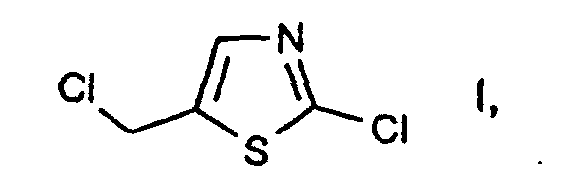
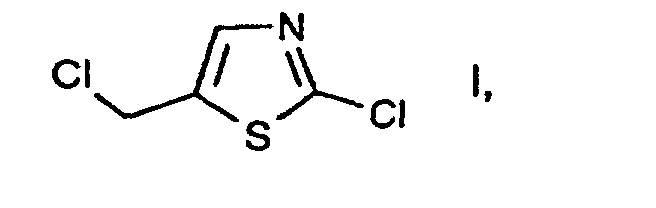
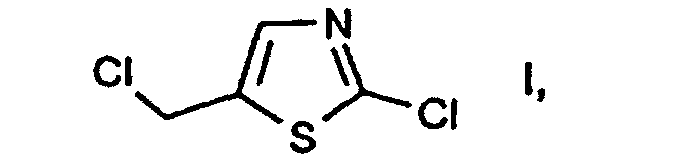
- The invention relates to a process for preparing the known compound of the formulawhich comprises
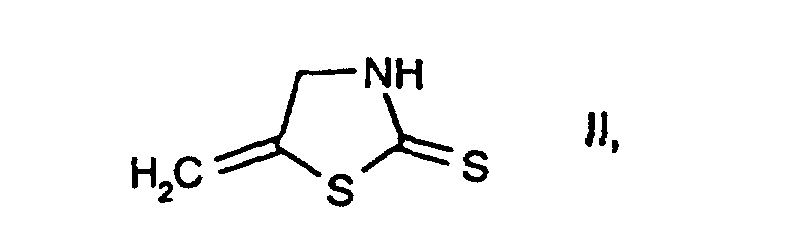
- a) reacting the known compound of the formula
in free form or in salt form, with a chlorinating agent, or

- b) reacting the compound of the formula
which is known, in the presence or absence of a free-radical catalyst, with a chlorinating agent, or

- c1) first reacting the compound of the formula II or the compound 2-mercapto-5-methylthiazole, in each case in free form or in salt form, with a chlorinating agent and
- c2) subjecting the compound of the formula III, which is obtainable in this way to further reaction, with or without isolating it, with a chlorinating agent in accordance with variant b), or
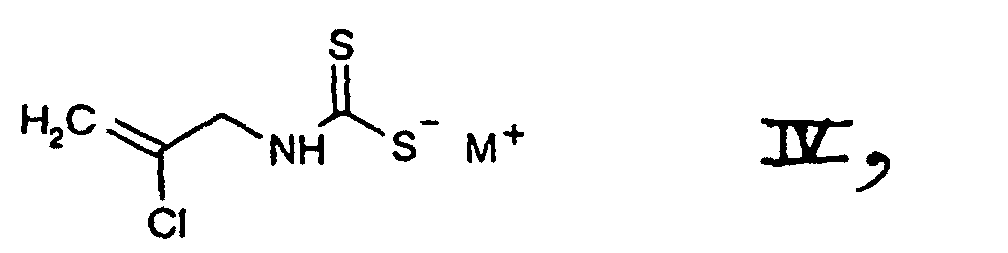
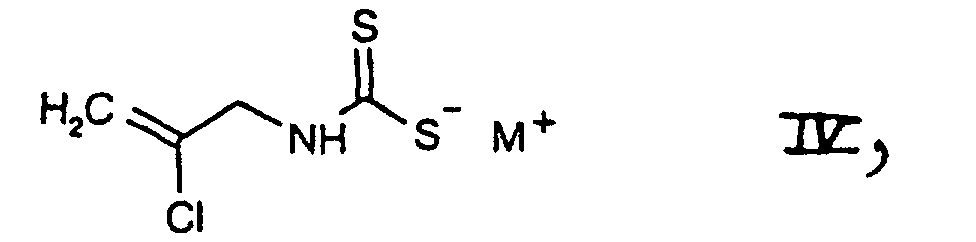
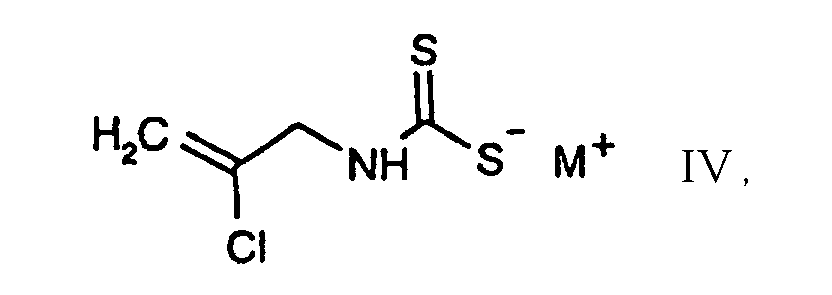
- d1) first subjecting a salt of the formula
which is known or can be prepared by methods known per se and in which M+ is an all metal ion, one equivalent of an alkaline earth metal ion or is a nonalkylated ammonium or an ammonium ion which is alkylated with from one to four identical or different alkyl radicals, and is preferably a potassium ion or, in particular, a sodium ion, to treatment with a base and
- d2) subjecting the compound of the formula II thus obtainable, in free form or in salt form, with or without isolating it, to further reaction with a chlorinating agent in accordance with variant a) or in accordance with variant c1)/c2), or
- e1) first reacting the compound of the formula
which is known, with carbon disulfide, in the presence or absence of a base, and

- e2) further reacting the compound of the formula II thus obtainable, in free form or in salt form, with or without isolating it, with a chlorinating agent in accordance with variant a) or in accordance with variant c1)/c2). 2-Chloro-5-chloromethyl-thiazole I is an important intermediate in the preparation of pesticidal compounds, as are described, for example, in EP-A-0 192 060.
-
- According to EP-A-0 446 913 a process for preparing 2-chloro-5-chloromethyl-thiazole comprises reacting an allyl isothiocyanate derivative with a chlorinating agent.
- Unless defined otherwise, the general terms used above and below have the following meanings.
- Compounds and groups containing carbon include, unless defined otherwise, in each case from 1 up to and including 6, preferably from 1 up to and including 3, in particular 1 or 2, carbon atoms.
- Alkyl is (always taking into account the particular number of carbon atoms) either straight-chain, i.e. methyl, ethyl, propyl, butyl, pentyl or hexyl, or branched, e.g. isopropyl, isobutyl, sec-butyl, tert-butyl, isopentyl, neopentyl or isohexyl.
- Depending on the requirements, the reactions described above and below are carried out in the presence or absence of an appropriate solvent or diluent or a mixture thereof, with cooling, at room temperature or with heating, for example in a temperature range from -80°C to the boiling temperature of the reaction medium, preferably from -60°C to 200°C, in a closed vessel under atmospheric, elevated or reduced pressure, under an inert gas atmosphere and/or under hydrogen-free conditions. Particularly advantageous reaction conditions are described below and can be inferred in particular from the Examples.
- Examples of suitable chlorinating agents are elemental chlorine, Javelle water, N-chlorosuccinimide, phosphorus trichloride, phosphorus pentachloride, sulfuryl chloride or thionyl chloride or mixtures of two or more of these compounds, preferably elemental chlorine or sulfuryl chloride or a mixture of these two compounds, particularly preferably sulfuryl chloride.
The reactants can be reacted with one another without adding a solvent or diluent. However, the addition of a solvent or diluent or a mixture thereof may also be advantageous, its amount not being critical. Examples of such solvents or diluents are: water; alcohols, such as methanol, ethanol, propanol, isopropanol, butanol, ethylene glycol or glycerol; aromatic, aliphatic or alicyclic hydrocarbons and halogenated hydrocarbons, such as benzene, toluene, xylene, mesitylene, tetralin, chlorobenzene, dichlorobenzene, bromobenzene, petroleum ether, hexane, cyclohexane, dichloromethane, trichloromethane, tetrachloromethane, dichloroethane, trichloroethene or tetrachtoroethene; ethers, such as diethyl ether, dipropyl ether, diisopropyl ether, dibutyl ether, tert-butyl methyl ether, ethylene glycol monomethyl ether, ethylene glycol monoethyl ether, ethylene glycol dimethyl ether, dimethoxydiethyl ether, tetrahydrofuran or dioxane; amides, such as N,N-dimethylformamide, N,N-diethylformamide, N,N-dimethylacetamide, N-methylpyrrolidone or hexamethylphosphoramide; nitriles, such as acetonitrile or propionitrile; and sulfoxides, such as dimethyl sulfoxide. If the reaction is carried out in the presence of an organic acid, then it is also possible for acids employed in excess, for example strong organic carboxylic acids, such as unsubstituted or substituted - for example by halogen - C1-C4alkanecarboxylic acids, examples being formic acid, acetic acid or propionic acid, to be used as solvent or diluent. The reaction is preferably carried out in the presence of a halogenated hydrocarbon, especially in dichloromethane. - The reaction takes place advantageously in a temperature range from -20°C to +180°C, preferably from 0°C to +80°C, and in many cases in the range between room temperature and the reflux temperature of the reaction mixture. In a preferred embodiment of the variant a) the compound II is reacted at from 0 to 40°C, preferably at from 10 to 15°C, with a chlorinating agent, preferably sulfuryl chloride.
- The reaction takes place preferably at atmospheric pressure.
- The reaction time is not critical; a reaction period from 0.1 to 48 hours, especially from 0.5 to 4 hours, is preferred.
- The product is isolated by conventional methods, for example by filtration, crystallization, distillation or chromatography, or by any appropriate combination of these methods.
- The yields obtained are generally good. It is possible to attain a yield of about 70 % of the theoretical yield.
- Preferred conditions for the reaction are described in Examples H1 to H3.
- Examples of suitable free-radical catalysts are azobis(isobutyronitrile) or, in particular, dibenzoyl peroxide.
- Examples of suitable chlorinating agents are those indicated under variant a).
- The reactants can be reacted with one another as they are, i.e. without the addition of a solvent or diluent, for example in the melt. However, in most cases the addition of a solvent or diluent or a mixture thereof is advantageous. Examples of suitable solvents and diluents are those indicated under variant a).
- The reaction takes place advantageously in a temperature range from 20°C to +180°C, preferably from 0°C to +80°C, and in many cases in the range between room temperature and the reflux temperature o the reaction mixture.
- In a preferred embodiment of the variant b) the compound III is reacted at from 10 to 120°C, preferably at 80°C, with a chlorinating agent, preferably N -chlorosuccinimide.
- The reaction takes place preferably at atmospheric pressure.
- The reaction time is not critical; a reaction period from 0.1 to 100 hours, especially from 12 to 72 hours, is preferred.
- The product is isolated by conventional methods, for example by filtration, crystallization, distillation or chromatography, or by any appropriate combination of these methods.
- Preferred conditions for the reaction are described in Example H4.
- Examples of suitable chlorinating agents are those indicated under variant a).
- The reactants can be reacted with one another as they are, i.e. without the addition of a solvent or diluent, for example in the melt. However, in most cases the addition of a solvent or diluent on a mixture thereof is advantageous. Examples of suitable solvents and diluents are those indicated under variant a).
- The reaction takes place advantageously in a temperature range from 20°C to +80°C, preferably from -10°C to +40°C, and in many cases in the range between room temperature and the reflux temperature of the reaction mixture. In a preferred embodiment of the variant c1)/c2) the compound II is initially reacted at from -10 to 40°C, preferably at 0°C, with a chlorinating agent, preferably sulfuryl chloride, to give a compound of the formula III, which then, preferably after it has been isolated, is subjected to further reaction with a further chlorinating agent, preferably N -chlorosuccinimide.
- The reaction takes place preferably at atmospheric pressure.
- The reaction time is not critical; a reaction period from 0.1 to 100 hours, especially from 1 to 72 hours, preferably from 12 to 72 hours, is preferred.
- The product is isolated by conventional methods, for example by filtration, crystallization, distillation or chromatography, or by any appropriate combination of these methods. 2-Mercapto-5-methyl-thiazole, which can be used also in its tautomeric form (2-thioxo compound), can be obtained, for example, by acid treatment of the compound of the formula II.
- Preferred conditions for the reactions are described in Examples H4, H5 and H7.
- Examples of suitable bases for facilitating the reaction are alkali metal or alkaline earth metal hydroxides, hydrides, amides, alkanolates, acetates, carbonates, dialkylamides or alkylsilylamides, alkylamines, alkylenediamines, nonalkylated or N-alkylated, saturated or unsaturated, cycloalkylamines, basic heterocycles, ammonium hydroxides and carbocyclic amines. Specific examples are sodium hydroxide, hydride, amide, methanolate, acetate and carbonate, potassium tert-butanolate, hydroxide, carbonate and hydride, lithium diisopropylamide, potassium bis(trimethylsilyl)amide, calcium hydride, triethylamine, diisopropylethylamine, triethylenediamine, cyclohexylamine, N -cyclohexyl-N,N-dimethylamine, N,N-diethylaniline, pyridine, 4-(N,N-dimethylamino)pyridine, quinuclidine, N-methylmorpholine, benzyltrimethylammonium hydroxide and 1,5-diazabicyclo[5.4.0]undec-5-ene (DBU).
- The reactants can be reacted with one another as they are, i.e. without the addition of a solvent or diluent, for example in the melt. However, in most cases the addition of a solvent or diluent or a mixture thereof is advantageous. Examples of suitable solvents and diluents are those indicated under variant a).
- The reaction takes place advantageously in a temperature range from -20°C to +80°C, preferably from -10°C to +40°C, and in many cases in the range between room temperature and the reflux temperature of the reaction mixture.
- The reaction takes place preferably at atmospheric pressure.
- The reaction time is not critical; a reaction period from 0.1 to 100 hours, especially from 12 to 72 hours, is preferred,
- The product is isolated by conventional methods, for example by filtration, crystallization, distillation or chromatography, or by any appropriate combination of these methods.
- Examples of suitable chlorinating agents are those indicated under variant a).
- The reactants can be reacted with one another as they are, i.e. without the addition of a solvent or diluent, for example in the melt. However, in most cases the addition of a solvent or diluent or a mixture thereof is advantageous. Examples of suitable solvents and diluents are those indicated under variant a).
- The reaction takes place advantageously in a temperature range from -20°C to +180°C, preferably from 0°C to +80°C, and in many cases in the range between room temperature and the reflux temperature of the reaction mixture
- In a preferred embodiment of the variant d2) the compound II is reacted at from 0 to 40°C, preferably at from 10 to 15°C, with a chlorinating agent, preferably sulfuryl chloride.
- The reaction takes place preferably at atmospheric pressure.
- The reaction time is not critical; a reaction period from 0.1 to 48 hours, especially from 0.5 to 4 to hours, is preferred.
- The product is isolated by conventional methods, for example by filtration, crystallization, distillation or chromatography, or by any appropriate combination of these method.
- Preferred conditions for the reaction are described in Examples H1 to H3, H4, H5 and H7.
- Examples of suitable bases for facilitating the reaction are those indicated under variant d1).
- The reactants can be reacted with one another as they are, i.e. without the addition of a solvent or diluent, for example in the melt. However, in most cases the addition of a solvent or diluent or a mixture thereof is advantageous. Examples of suitable solvents and diluents are those indicated under variant a).
- The reaction takes place advantageously in a temperature range from -20°C to +180°C, preferably from 0°C to +80°C, and in many cases in the range between room temperature and the reflux temperature of the reaction mixture.
- The reaction takes place preferably at atmospheric pressure.
- The reaction time is not critical; a reaction period from 0.1 to 48 hours, especially from 1 to 24 hours, is preferred.
- The product is isolated by conventional methods, for example by filtration, crystallization, distillation or chromatography, or by any appropriate combination of these methods.
- Examples of suitable chlorinating agents are those indicated under variant a).
- The reactants can be reacted with one another as they are, i.e. without the addition of a solvent or diluent, for example in the melt. However, in most cases the addition of a solvent or diluent or a mixture thereof is advantageous. Examples of suitable solvents and diluents are those indicated under variant a).
- The reaction takes place advantageously in a temperature range from -20°C to +180°C, preferably from 0°C to +80°C, and in many cases in the range between room temperature and the reflux temperature of the reaction mixture.
- In a preferred embodiment of the variant e2) the compound II is reacted at from 0 to 40°C, preferably at from 10 to 15°C, with a chlorinating agent, preferably sulfuryl chloride.
- The reaction takes place preferably at atmospheric pressure.
- The reaction time is not critical; a reaction period from 0.1 to 48 hours, especially from 0.5 to 4 hours, is preferred.
- The product is isolated by conventional methods, for example by filtration, crystallization, distillation or chromatography, or by any appropriate combination of these methods.
- Preferred conditions for the reaction are described in Examples H1 to H3, H4, H5 and H7.
- The invention likewise provides starting materials and intermediates, which are novel and which are used in accordance with the invention to prepare the compound I, a process for their preparation, and their use as starting materials and intermediates for preparing the compound I.
- The invention additionally provides starting materials and intermediates, in each case in free form or in salt form if applicable, which are novel and which are used in accordance with the invention for preparing the compounds II and III and/or their salts, a process for their preparation, and their use as starting materials and intermediates for preparing the compounds II and III and/or their salts.
- The compounds II, III, IV and V are known or, where novel, can be prepared in analogy to known compounds.
- The invention relates to all those process embodiments, in which the starting material is a compound obtainable as an initial product or intermediate at any stage of the process and in which all or some of the missing steps are carried out or in which a starting material is used in the form of a derivative or salt and/or its racemates or enantiomers or, in particular, is formed under the reaction conditions. The invention relates in particular to the processes described in Examples H1 to H7.
- The Examples which follow serve to illustrate the invention. They do not restrict the invention. Temperatures are given in degrees Celsius.
- 4 g of chlorine gas are passed at 10-15°C into a solution of 100 ml of acetic acid and 7 ml of water. Subsequently, at the same temperature, 9.2 g of 5-methylenethiazolidine-2-thione, 12 ml of 30 % sodium hydroxide solution, 28 ml of water and 21 g of chlorine gas are metered in over the course of 2-3 hours. Then 100 ml of water are added to this reaction mixture, and extraction is carried out three times with 30 ml of toluene. The organic phase is dried over sodium sulfate and concentrated in vacuo at 45°C to give the title compound in a yield of 56 % (melting point: 35°C).
- 1.31 g of 5-methylenethiazolidine-2-thione are added in portions at 0°C, with stirring, to a solution of 5.4 g of sulfuryl chloride in 8 ml of dichloromethane and 0.72 ml of water. The reaction mixture is subsequently stirred at room temperature for 1 hour. The mixture is then adjusted to a pH of 2 with 30 % sodium hydroxide solution, and the organic phase is separated off, dried over sodium sulfate and concentrated in vacuo to give the title compound in a yield of 70 % (melting point: 35°C).
- 1 ml of water at -5°C and then, at the same temperature over the course of 5 minutes, 1.4 g of 5-methylenethiazolidine-2-thione in five portions are added to a mixture of 13 ml of dichloromethane and 10 g of sulfuryl chloride. The reaction mixture is then diluted with 20 ml of water and 33 ml of dichloromethane and neutralized with about 24 ml of 30 % sodium hydroxide solution, and the organic phase is separated off. The aqueous phase is subjected to extraction with 27 ml of dichloromethane, and the combined extracts are dried over sodium sulfate and concentrated in vacuo at 35°C to give the title compound in a yield of 31 % (melting point: 35°C).
- 5 mg of dibenzoyl peroxide in portions and then 155 mg of N-chlorosuccinimide are added at room temperature and with stirring to a solution of 124 mg of 2-chloro-5-methyl-thiazole in 4 ml of carbon tetrachloride. The reaction mixture is boiled under reflux for 64 hours, then a further 5 mg of dibenzoyl peroxide and 155 mg of N-chlorosuccinimide are added, and boiling is resumed for 8 hours. After cooling to room temperature, the suspension is filtered, and the residue is washed with carbon tetrachloride. The organic phase is then concentrated in vacuo, and the residue is purified by chromatography on silica gel with ethyl acetate/hexane (1:9) to give the title compound (melting point: 35°C).
- 1.31 g of 5-methylenethiazolidine-2-thione are added in portions with stirring and at 0°C to a solution of 5.4 g of sulfuryl chloride in 8 ml of dichloromethane and 0.72 ml of water. The reaction mixture is subsequently stirred at room temperature for 1 hour and then adjusted to a pH of 2 using 30 % sodium hydroxide solution, and the organic phase is separated off, washed a number of times with water, dried over sodium sulfate and concentrated by evaporation to give 2-chloro-5-methyl-thiazole with a boiling point of 174°C.
- 3.81 g of carbon disulfide are added with stirring and at 0°C to a solution of 4.58 g of 2-chloroallylamine in 25 ml of 2 N sodium hydroxide solution. A solution of sodium N-(2-chloro-2-propenyl)dithiocarbamate is thus obtainable.
- 1.35 g of 2-mercapto-5-methyl-thiazole are added in portions, with stirring and at 0°C, to a solution of 5.8 g of sulfuryl chloride in 9 ml of dichloromethane and 720 mg of water. The reaction mixture is subsequently stirred at room temperature for 1 hour and then adjusted to a pH of 2 using aqueous sodium hydroxide solution (30%). The organic phase is separated off, dried over sodium sulfate and concentrated by evaporation to give 1.99 g of 2-chloro-5-methyl-thiazole with a boiling point of 174°.
Claims (27)
- A process for preparing the compound of the formulawhich comprises
 a) reacting the compound of the formulain free form or in salt form, with a chlorinating agent, or
 b) reacting the compound of the formulain the presence or absence of a free-radical catalyst, with a chlorinating agent, or
 c1) first reacting the compound of the formula II or the compound 2-mercapto-5-methyl-thiazole, in each case in free form or in salt form, with a chlorinating agent andc2) subjecting the compound of the formula III, which is obtainable in this way, to further reaction, with or without isolating it, with a chlorinating agent in accordance with variant b), ord1) first subjecting a salt of the formulain which M+ is an alkali metal ion, one equivalent of an alkaline earth metal ion or is a nonalkylated ammonium ion or an ammonium ion which is alkylated with from one to four identical or different alkyl radicals, and is preferably a potassium ion or, in particular, a sodium ion, to treatment with a base and
 (d2) subjecting the compound of the formula II thus obtainable, in free form or in salt form, with or without isolating it, to further reaction with a chlorinating agent in accordance with variant a) or in accordance with variant c1)/c2), ore1) first reacting the compound of the formulawith carbon disulfide, in the presence or absence of a base, and
 e2) further reacting the compound of the formula II thus obtainable, in free form or in salt form, with or without isolating it, with a chlorinating agent in accordance with variant a) or in accordance with variant c1)/c2).
 - A process according to claim 1 for preparing the compound of the formulawhich comprises reacting the compound of the formula
 in free form or in salt form, with a chlorinating agent.
- A process according to claim 2, wherein the chlorinating agent is selected from the group consisting of elemental chlorine, Javelle water, N -chlorosuccinimide, phosphorus trichloride, phosphorus pentachloride, sulfuryl chloride, thionyl chloride and mixtures of two or more of these compounds.
- A process according to claim 3, wherein the chlorinating agent is selected from the group consisting of elemental chlorine, sulfuryl chloride and a mixture of these two compounds.
- A process according to claim 4, wherein the chlorinating agent is sulfuryl chloride.
- A process according to claim 2, wherein the solvent is selected from the group consisting of water, strong organic carboxylic acids, aromatic, aliphatic and alicyclic hydrocarbons and halogenated hydrocarbons, and mixtures of these solvents.
- A process according to claim 6, wherein the solvent is selected from the group consisting of water, formic acid, acetic acid, propionic acid, benzene, toluene, xylene, mesitylene, tetralin, chlorobenzene, dichlorobenzene, bromobenzene, petroleum ether, hexane, cyclohexane, dichloromethane, trichloromethane, tetrachloromethane, dichloroethane, trichloroethene and tetrachloroethene, and mixtures of these solvents.
- A process according to claim 7, wherein the solvent is selected from the group consisting of water, formic acid, acetic acid, dichloromethane, trichloromethane, tetrachloromethane and dichloroethane, and mixtures of these solvents.
- A process according to claim 8, wherein the solvent is a mixture of water and dichloromethane.
- A process according to claim 9, wherein the weight ratio of dichloromethane to water is from 5 to 50.
- A process according to claim 10, wherein the weight ratio of dichloromethane to water is from 10 to 30.
- A process according to claim 2, wherein the reaction is carried out at from -10°C to +40°C.
- A process according to claim 2, wherein the reaction period is from 0.1 to 4 hours.
- A process according to claim 13, wherein the reaction period is from 0.5 to 1.5 hours.
- A process according to claim 1 for preparing the compound of the formulawhich comprises reacting the compound of the formula
 with a chlorinating agent.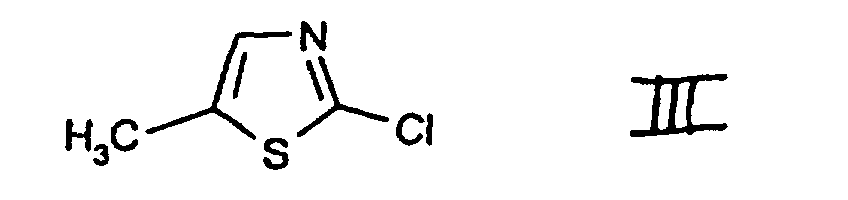
- A process according to claim 15, wherein the chlorinating agent is selected from the group consisting of elemental chlorine, Javelle water, N -chlorosuccinimide, phosphorus trichloride, phosphorus pentachloride, sulfuryl chloride, thionyl chloride and mixtures of two or more of these compounds.
- A process according to claim 16, wherein the chlorinating agent is N-chlorosuccinimide.
- A process according to claim 15, wherein the solvent is selected from the group consisting of water, strong organic carboxylic acids, aromatic, aliphatic and alicyclic hydrocarbons and halogenated hydrocarbons, and mixtures of these solvents.
- A process according to claim 18, wherein the solvent is selected from the group consisting of water, formic acid, acetic acid, propionic acid, benzene, toluene, xylene, mesitylene, tetralin, chlorobenzene, dichlorobenzene, bromobenzene, petroleum ether, hexane, cyclohexane, dichloromethane, trichloromethane, tetrachloromethane, dichloroethane, trichloroethene and tetrachloroethene, and mixtures of these solvents.
- A process according to claim 19, wherein the solvent is selected from the group consisting of water, formic acid, acetic acid, dichloromethane, trichloromethane, tetrachloromethane and dichloroethane, and mixtures of these solvents.
- A process according to claim 20, wherein the solvent is tetrachloromethane.
- A process according to claim 15, wherein the reaction is carried out at from +20°C to +80°C.
- A process according to claim 15, wherein the reaction period is from 1 to 120 hours.
- A process according to claim 23, wherein the reaction period is from 48 to 96 hours.
- A process according to claim 1 for the preparation of the compound of the formulawhich comprises first reacting the compound of the formula
 or the compound 2-mercapto-5-methyl-thiazole, in each case in free form or in salt form, with a chlorinating agent and further reacting the compound thus obtainable of the formula
 with or without isolating it, with a chlorinating agent in accordance with variant b).
- A process according to claim 1 for the preparation of the compound of the formulawhich comprises first subjecting a salt of the formula
 in which M+ is as defined in claim 1, to treatment with a base and further reacting the compound thus obtainable of the formula
 in free form or in salt form, with or without isolating it, with a chlorinating agent in according with variant a) or in according with variant c1)/c2).
- A process according to claim 1 for the preparation of the compound of the formulawhich comprises first reacting the compound of the formula
 with carbon disulfide, in the presence or absence of a base, and further reacting the compound thus obtainable of the formula
 in tree form or in salt form, with or without isolating it, with a chlorinating agent in accordance with variant a) or in accordance with variant c1)/c2).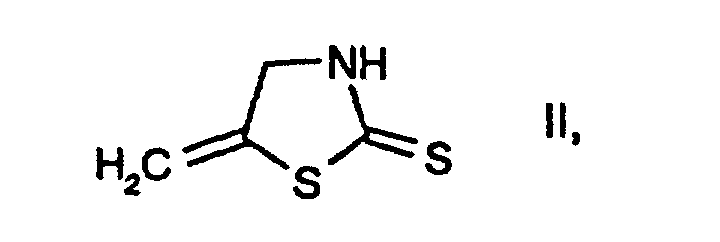
Priority Applications (1)
| Application Number | Priority Date | Filing Date | Title |
|---|---|---|---|
| DK96943098T DK0873327T3 (en) | 1995-12-21 | 1996-12-12 | Process for preparing 2-chloro-5-chloromethyl-thiazole |
Applications Claiming Priority (4)
| Application Number | Priority Date | Filing Date | Title |
|---|---|---|---|
| CH363695 | 1995-12-21 | ||
| CH363695 | 1995-12-21 | ||
| CH3636/95 | 1995-12-21 | ||
| PCT/EP1996/005564 WO1997023469A1 (en) | 1995-12-21 | 1996-12-12 | Process for the preparation of 2-chloro-5-chloromethyl-thiazole |
Publications (2)
| Publication Number | Publication Date |
|---|---|
| EP0873327A1 EP0873327A1 (en) | 1998-10-28 |
| EP0873327B1 true EP0873327B1 (en) | 2004-07-14 |
Family
ID=4260248
Family Applications (1)
| Application Number | Title | Priority Date | Filing Date |
|---|---|---|---|
| EP96943098A Expired - Lifetime EP0873327B1 (en) | 1995-12-21 | 1996-12-12 | Process for the preparation of 2-chloro-5-chloromethyl-thiazole |
Country Status (11)
| Country | Link |
|---|---|
| US (2) | US8013167B1 (en) |
| EP (1) | EP0873327B1 (en) |
| JP (1) | JP4118949B2 (en) |
| AT (1) | ATE271043T1 (en) |
| AU (1) | AU1193597A (en) |
| DE (1) | DE69632919T2 (en) |
| DK (1) | DK0873327T3 (en) |
| ES (1) | ES2224187T3 (en) |
| TW (1) | TW576833B (en) |
| WO (1) | WO1997023469A1 (en) |
| ZA (1) | ZA9610771B (en) |
Families Citing this family (10)
| Publication number | Priority date | Publication date | Assignee | Title |
|---|---|---|---|---|
| JP4118949B2 (en) * | 1995-12-21 | 2008-07-16 | シンジェンタ パーティシペーションズ アクチェンゲゼルシャフト | Synthesis method of 2-chloro-5-chloromethylthiazole |
| DE29616780U1 (en) * | 1996-09-26 | 1998-01-29 | Robert Bosch Gmbh, 70469 Stuttgart | Rod coil for ignition systems |
| PL196029B1 (en) | 1996-12-19 | 2007-11-30 | Syngenta Participations Ag | Method of obtaining derivatives of thiazole |
| DE19653586A1 (en) * | 1996-12-20 | 1998-06-25 | Bayer Ag | Process for the preparation of 2-chloro-5-aminomethylthiazole |
| US5959118A (en) * | 1997-08-29 | 1999-09-28 | Abbott Laboratories | Process for the preparation of 5-hydroxymethylthiazoles |
| DE19908447A1 (en) | 1999-02-26 | 2000-08-31 | Bayer Ag | Process for the preparation of 2-chloro-5-chloromethylthiazole |
| AT409760B (en) * | 1999-11-15 | 2002-11-25 | Dsm Fine Chem Austria Gmbh | New 3-chloro-2-isothiocyanato-propanal, its acetals, N-((5-(2-aminothiazol)yl)methyl)thiourea, (5-(2-aminothiazol)yl)methylthioformamidine and salts are used or formed in preparation of 2-chloro-5-chloromethyl-1,3-thiazole |
| US20140113824A1 (en) | 2011-05-10 | 2014-04-24 | Bayer Intellectual Property Gmbh | Bicyclic (thio)carbonylamidines |
| AR114185A1 (en) * | 2018-01-23 | 2020-07-29 | Adama Makhteshim Ltd | SYNTHESIS OF 5-CHLORINE-2 - [(3,4,4-TRIFLUORO-3-BUTEN-1-IL) THIO] -THAZOLE |
| CN108276357B (en) * | 2018-02-13 | 2020-02-21 | 浙江永太科技股份有限公司 | Synthetic method of 2-chloro-5-chloromethyl thiazole |
Family Cites Families (4)
| Publication number | Priority date | Publication date | Assignee | Title |
|---|---|---|---|---|
| US5180833A (en) * | 1990-03-16 | 1993-01-19 | Takeda Chemical Industries, Ltd. | Process for the preparation of chlorothiazole derivatives |
| US5679769A (en) * | 1994-03-15 | 1997-10-21 | Sloan-Kettering Institute For Cancer Research | Synthesis of asparagine-linked glycopeptides on a polymeric solid support |
| JP4118949B2 (en) * | 1995-12-21 | 2008-07-16 | シンジェンタ パーティシペーションズ アクチェンゲゼルシャフト | Synthesis method of 2-chloro-5-chloromethylthiazole |
| DE19548417A1 (en) * | 1995-12-22 | 1997-06-26 | Bayer Ag | Process for the preparation of 2-chloro-5-chloromethylthiazole |
-
1996
- 1996-12-12 JP JP52326697A patent/JP4118949B2/en not_active Expired - Fee Related
- 1996-12-12 AU AU11935/97A patent/AU1193597A/en not_active Abandoned
- 1996-12-12 ES ES96943098T patent/ES2224187T3/en not_active Expired - Lifetime
- 1996-12-12 AT AT96943098T patent/ATE271043T1/en active
- 1996-12-12 DE DE69632919T patent/DE69632919T2/en not_active Expired - Lifetime
- 1996-12-12 DK DK96943098T patent/DK0873327T3/en active
- 1996-12-12 US US09/091,333 patent/US8013167B1/en not_active Expired - Fee Related
- 1996-12-12 WO PCT/EP1996/005564 patent/WO1997023469A1/en not_active Ceased
- 1996-12-12 EP EP96943098A patent/EP0873327B1/en not_active Expired - Lifetime
- 1996-12-14 TW TW085115467A patent/TW576833B/en not_active IP Right Cessation
- 1996-12-20 ZA ZA9610771A patent/ZA9610771B/en unknown
-
2011
- 2011-08-22 US US13/214,799 patent/US20110306772A1/en not_active Abandoned
Also Published As
| Publication number | Publication date |
|---|---|
| EP0873327A1 (en) | 1998-10-28 |
| JP2000502661A (en) | 2000-03-07 |
| US8013167B1 (en) | 2011-09-06 |
| ES2224187T3 (en) | 2005-03-01 |
| ATE271043T1 (en) | 2004-07-15 |
| DK0873327T3 (en) | 2004-11-22 |
| WO1997023469A1 (en) | 1997-07-03 |
| JP4118949B2 (en) | 2008-07-16 |
| US20110306772A1 (en) | 2011-12-15 |
| TW576833B (en) | 2004-02-21 |
| DE69632919D1 (en) | 2004-08-19 |
| ZA9610771B (en) | 1997-06-30 |
| DE69632919T2 (en) | 2005-07-28 |
| AU1193597A (en) | 1997-07-17 |
Similar Documents
| Publication | Publication Date | Title |
|---|---|---|
| US20110306772A1 (en) | Process for the preparation of 2-chloro-5-chloromethyl-thiazole | |
| EP0850231B1 (en) | Process for preparing a 2-chloro-5-chloromethyl-thiazole compound | |
| RU2176241C2 (en) | Method of synthesis of derivatives of 3-amino-2-mercaptobenzoic acid (variants), derivatives of benzothiazole and method of their synthesis | |
| KR100519189B1 (en) | Intermediate compounds for preparing 2-chlorothiazole compounds, and a process for preparing the same | |
| EP0946531B1 (en) | Process for the preparation of thiazole derivatives | |
| WO1997023469A9 (en) | Process for the preparation of 2-chloro-5-chloromethyl-thiazole | |
| JPH07252226A (en) | Production of 2-chloro-5-methylpyridine | |
| KR100520249B1 (en) | Process for the preparation of thiazole derivatives | |
| EP1311494B1 (en) | Continuous process for the preparation of pesticidal chlorothiazoles | |
| US12565493B2 (en) | Method for preparing 2-[2-(2-chlorothiazol-5-yl)-2-oxo-ethyl]sulfanyl-6-hydroxy-3-methyl-5-phenyl-pyrimidin-4-one | |
| AU2001287699A1 (en) | Continuous process for the preparation of pesticidal chlorothiazoles | |
| HU184758B (en) | Process for producing 5-mercapto-1,2,3-triazole derivatives | |
| KR20010007081A (en) | Process for manufacture of N-alk(en)oxy(or aryloxy)carbonyl isothiocyanates and their derivatives in the presence of N,N-dialkylarylamine catalyst | |
| EP1201662B1 (en) | Preparation of thiazoles | |
| KR940008923B1 (en) | Amino acetonitrile derivatives | |
| US20020010340A1 (en) | Process for preparation of 2-aminothiazolecarboxamide derivatives | |
| WO1997014688A1 (en) | A PROCESS FOR THE PREPARATION OF α-CHLOROMETHYLPHENYLACETIC ACID DERIVATIVES | |
| KR830000271B1 (en) | Method for preparing 1,2,3-thiadiazol-5-yl urea | |
| HU194198B (en) | Process for preparing n-methyl-s-methyl-n'-square brackets open 2-(2-dimehtylaminomethyl-thiazol-4-yl-methyl-thio)-ethyl square brackets closed-isothiourea |
Legal Events
| Date | Code | Title | Description |
|---|---|---|---|
| PUAI | Public reference made under article 153(3) epc to a published international application that has entered the european phase |
Free format text: ORIGINAL CODE: 0009012 |
|
| 17P | Request for examination filed |
Effective date: 19980525 |
|
| AK | Designated contracting states |
Kind code of ref document: A1 Designated state(s): AT BE CH DE DK ES FI FR GB GR IE IT LI LU NL PT SE |
|
| RIN1 | Information on inventor provided before grant (corrected) |
Inventor name: WADSWORTH, DAVID, JOHN Inventor name: PITTERNA, THOMAS Inventor name: SENN, MARCEL Inventor name: NAEF, RUFOLF Inventor name: GSELL, LAURENZ Inventor name: O'SULLIVAN, ANTHONY, CORNELIUS |
|
| RAP1 | Party data changed (applicant data changed or rights of an application transferred) |
Owner name: NOVARTIS-ERFINDUNGEN VERWALTUNGSGESELLSCHAFT M.B.H |
|
| RAP1 | Party data changed (applicant data changed or rights of an application transferred) |
Owner name: NOVARTIS-ERFINDUNGEN VERWALTUNGSGESELLSCHAFT M.B. Owner name: NOVARTIS AG |
|
| RAP1 | Party data changed (applicant data changed or rights of an application transferred) |
Owner name: SYNGENTA PARTICIPATIONS AG |
|
| 17Q | First examination report despatched |
Effective date: 20010920 |
|
| GRAP | Despatch of communication of intention to grant a patent |
Free format text: ORIGINAL CODE: EPIDOSNIGR1 |
|
| GRAS | Grant fee paid |
Free format text: ORIGINAL CODE: EPIDOSNIGR3 |
|
| GRAA | (expected) grant |
Free format text: ORIGINAL CODE: 0009210 |
|
| AK | Designated contracting states |
Kind code of ref document: B1 Designated state(s): AT BE CH DE DK ES FI FR GB GR IE IT LI LU NL PT SE |
|
| REG | Reference to a national code |
Ref country code: GB Ref legal event code: FG4D |
|
| REG | Reference to a national code |
Ref country code: CH Ref legal event code: EP |
|
| REF | Corresponds to: |
Ref document number: 69632919 Country of ref document: DE Date of ref document: 20040819 Kind code of ref document: P |
|
| REG | Reference to a national code |
Ref country code: IE Ref legal event code: FG4D |
|
| PG25 | Lapsed in a contracting state [announced via postgrant information from national office to epo] |
Ref country code: GR Free format text: LAPSE BECAUSE OF FAILURE TO SUBMIT A TRANSLATION OF THE DESCRIPTION OR TO PAY THE FEE WITHIN THE PRESCRIBED TIME-LIMIT Effective date: 20041014 |
|
| REG | Reference to a national code |
Ref country code: SE Ref legal event code: TRGR |
|
| REG | Reference to a national code |
Ref country code: DK Ref legal event code: T3 |
|
| PG25 | Lapsed in a contracting state [announced via postgrant information from national office to epo] |
Ref country code: LU Free format text: LAPSE BECAUSE OF NON-PAYMENT OF DUE FEES Effective date: 20041212 |
|
| REG | Reference to a national code |
Ref country code: ES Ref legal event code: FG2A Ref document number: 2224187 Country of ref document: ES Kind code of ref document: T3 |
|
| ET | Fr: translation filed | ||
| PLBE | No opposition filed within time limit |
Free format text: ORIGINAL CODE: 0009261 |
|
| STAA | Information on the status of an ep patent application or granted ep patent |
Free format text: STATUS: NO OPPOSITION FILED WITHIN TIME LIMIT |
|
| 26N | No opposition filed |
Effective date: 20050415 |
|
| PG25 | Lapsed in a contracting state [announced via postgrant information from national office to epo] |
Ref country code: PT Free format text: LAPSE BECAUSE OF NON-PAYMENT OF DUE FEES Effective date: 20041214 |
|
| PGFP | Annual fee paid to national office [announced via postgrant information from national office to epo] |
Ref country code: DK Payment date: 20131126 Year of fee payment: 18 |
|
| PGFP | Annual fee paid to national office [announced via postgrant information from national office to epo] |
Ref country code: SE Payment date: 20131206 Year of fee payment: 18 Ref country code: GB Payment date: 20131126 Year of fee payment: 18 Ref country code: IE Payment date: 20131127 Year of fee payment: 18 Ref country code: CH Payment date: 20131127 Year of fee payment: 18 Ref country code: AT Payment date: 20131126 Year of fee payment: 18 |
|
| PGFP | Annual fee paid to national office [announced via postgrant information from national office to epo] |
Ref country code: ES Payment date: 20131218 Year of fee payment: 18 Ref country code: FR Payment date: 20131126 Year of fee payment: 18 Ref country code: NL Payment date: 20131206 Year of fee payment: 18 Ref country code: IT Payment date: 20131216 Year of fee payment: 18 Ref country code: FI Payment date: 20131205 Year of fee payment: 18 |
|
| PGFP | Annual fee paid to national office [announced via postgrant information from national office to epo] |
Ref country code: BE Payment date: 20131230 Year of fee payment: 18 |
|
| PGFP | Annual fee paid to national office [announced via postgrant information from national office to epo] |
Ref country code: DE Payment date: 20131230 Year of fee payment: 18 |
|
| PG25 | Lapsed in a contracting state [announced via postgrant information from national office to epo] |
Ref country code: BE Free format text: LAPSE BECAUSE OF NON-PAYMENT OF DUE FEES Effective date: 20141231 |
|
| REG | Reference to a national code |
Ref country code: DE Ref legal event code: R119 Ref document number: 69632919 Country of ref document: DE |
|
| REG | Reference to a national code |
Ref country code: DK Ref legal event code: EBP Effective date: 20141231 |
|
| REG | Reference to a national code |
Ref country code: NL Ref legal event code: V1 Effective date: 20150701 |
|
| REG | Reference to a national code |
Ref country code: NL Ref legal event code: V1 Effective date: 20150701 |
|
| PG25 | Lapsed in a contracting state [announced via postgrant information from national office to epo] |
Ref country code: SE Free format text: LAPSE BECAUSE OF NON-PAYMENT OF DUE FEES Effective date: 20141213 Ref country code: FI Free format text: LAPSE BECAUSE OF NON-PAYMENT OF DUE FEES Effective date: 20141212 |
|
| REG | Reference to a national code |
Ref country code: CH Ref legal event code: PL |
|
| REG | Reference to a national code |
Ref country code: SE Ref legal event code: EUG |
|
| REG | Reference to a national code |
Ref country code: AT Ref legal event code: MM01 Ref document number: 271043 Country of ref document: AT Kind code of ref document: T Effective date: 20141212 |
|
| GBPC | Gb: european patent ceased through non-payment of renewal fee |
Effective date: 20141212 |
|
| REG | Reference to a national code |
Ref country code: IE Ref legal event code: MM4A |
|
| REG | Reference to a national code |
Ref country code: FR Ref legal event code: ST Effective date: 20150831 |
|
| PG25 | Lapsed in a contracting state [announced via postgrant information from national office to epo] |
Ref country code: NL Free format text: LAPSE BECAUSE OF NON-PAYMENT OF DUE FEES Effective date: 20150701 |
|
| PG25 | Lapsed in a contracting state [announced via postgrant information from national office to epo] |
Ref country code: CH Free format text: LAPSE BECAUSE OF NON-PAYMENT OF DUE FEES Effective date: 20141231 Ref country code: DE Free format text: LAPSE BECAUSE OF NON-PAYMENT OF DUE FEES Effective date: 20150701 Ref country code: LI Free format text: LAPSE BECAUSE OF NON-PAYMENT OF DUE FEES Effective date: 20141231 Ref country code: GB Free format text: LAPSE BECAUSE OF NON-PAYMENT OF DUE FEES Effective date: 20141212 Ref country code: IE Free format text: LAPSE BECAUSE OF NON-PAYMENT OF DUE FEES Effective date: 20141212 |
|
| PG25 | Lapsed in a contracting state [announced via postgrant information from national office to epo] |
Ref country code: AT Free format text: LAPSE BECAUSE OF NON-PAYMENT OF DUE FEES Effective date: 20141212 Ref country code: FR Free format text: LAPSE BECAUSE OF NON-PAYMENT OF DUE FEES Effective date: 20141231 |
|
| PG25 | Lapsed in a contracting state [announced via postgrant information from national office to epo] |
Ref country code: IT Free format text: LAPSE BECAUSE OF NON-PAYMENT OF DUE FEES Effective date: 20141212 |
|
| REG | Reference to a national code |
Ref country code: ES Ref legal event code: FD2A Effective date: 20160127 |
|
| PG25 | Lapsed in a contracting state [announced via postgrant information from national office to epo] |
Ref country code: DK Free format text: LAPSE BECAUSE OF NON-PAYMENT OF DUE FEES Effective date: 20141231 |
|
| PG25 | Lapsed in a contracting state [announced via postgrant information from national office to epo] |
Ref country code: ES Free format text: LAPSE BECAUSE OF NON-PAYMENT OF DUE FEES Effective date: 20141213 |