EP0872242B1 - A coated sodium phosphate bowel cleanser - Google Patents
A coated sodium phosphate bowel cleanser Download PDFInfo
- Publication number
- EP0872242B1 EP0872242B1 EP97309126A EP97309126A EP0872242B1 EP 0872242 B1 EP0872242 B1 EP 0872242B1 EP 97309126 A EP97309126 A EP 97309126A EP 97309126 A EP97309126 A EP 97309126A EP 0872242 B1 EP0872242 B1 EP 0872242B1
- Authority
- EP
- European Patent Office
- Prior art keywords
- sodium phosphate
- phosphate
- coated
- composition according
- film forming
- Prior art date
- Legal status (The legal status is an assumption and is not a legal conclusion. Google has not performed a legal analysis and makes no representation as to the accuracy of the status listed.)
- Expired - Lifetime
Links
- 239000001488 sodium phosphate Substances 0.000 title claims abstract description 29
- RYFMWSXOAZQYPI-UHFFFAOYSA-K trisodium phosphate Chemical compound [Na+].[Na+].[Na+].[O-]P([O-])([O-])=O RYFMWSXOAZQYPI-UHFFFAOYSA-K 0.000 title claims abstract description 29
- 229910000162 sodium phosphate Inorganic materials 0.000 title claims abstract description 28
- 239000000203 mixture Substances 0.000 claims abstract description 37
- 239000000843 powder Substances 0.000 claims abstract description 28
- 235000011008 sodium phosphates Nutrition 0.000 claims abstract description 28
- 229920003088 hydroxypropyl methyl cellulose Polymers 0.000 claims abstract description 21
- BNIILDVGGAEEIG-UHFFFAOYSA-L disodium hydrogen phosphate Chemical compound [Na+].[Na+].OP([O-])([O-])=O BNIILDVGGAEEIG-UHFFFAOYSA-L 0.000 claims abstract description 20
- 239000001866 hydroxypropyl methyl cellulose Substances 0.000 claims abstract description 20
- 235000010979 hydroxypropyl methyl cellulose Nutrition 0.000 claims abstract description 20
- UFVKGYZPFZQRLF-UHFFFAOYSA-N hydroxypropyl methyl cellulose Chemical compound OC1C(O)C(OC)OC(CO)C1OC1C(O)C(O)C(OC2C(C(O)C(OC3C(C(O)C(O)C(CO)O3)O)C(CO)O2)O)C(CO)O1 UFVKGYZPFZQRLF-UHFFFAOYSA-N 0.000 claims abstract description 20
- 229940061607 dibasic sodium phosphate Drugs 0.000 claims abstract description 19
- AJPJDKMHJJGVTQ-UHFFFAOYSA-M sodium dihydrogen phosphate Chemical compound [Na+].OP(O)([O-])=O AJPJDKMHJJGVTQ-UHFFFAOYSA-M 0.000 claims abstract description 19
- 229940045641 monobasic sodium phosphate Drugs 0.000 claims abstract description 17
- 229910000403 monosodium phosphate Inorganic materials 0.000 claims abstract description 17
- 235000019799 monosodium phosphate Nutrition 0.000 claims abstract description 17
- 229920000642 polymer Polymers 0.000 claims abstract description 15
- 239000013078 crystal Substances 0.000 claims abstract description 10
- NBIIXXVUZAFLBC-UHFFFAOYSA-K phosphate Chemical compound [O-]P([O-])([O-])=O NBIIXXVUZAFLBC-UHFFFAOYSA-K 0.000 claims description 34
- 229910019142 PO4 Inorganic materials 0.000 claims description 32
- 239000010452 phosphate Substances 0.000 claims description 31
- 238000000576 coating method Methods 0.000 claims description 25
- 239000011248 coating agent Substances 0.000 claims description 21
- XLYOFNOQVPJJNP-UHFFFAOYSA-N water Substances O XLYOFNOQVPJJNP-UHFFFAOYSA-N 0.000 claims description 12
- 239000000243 solution Substances 0.000 claims description 11
- 238000000034 method Methods 0.000 claims description 10
- 239000003792 electrolyte Substances 0.000 claims description 8
- 239000012188 paraffin wax Substances 0.000 claims description 8
- 239000002245 particle Substances 0.000 claims description 7
- 239000007864 aqueous solution Substances 0.000 claims description 6
- DGAQECJNVWCQMB-PUAWFVPOSA-M Ilexoside XXIX Chemical compound C[C@@H]1CC[C@@]2(CC[C@@]3(C(=CC[C@H]4[C@]3(CC[C@@H]5[C@@]4(CC[C@@H](C5(C)C)OS(=O)(=O)[O-])C)C)[C@@H]2[C@]1(C)O)C)C(=O)O[C@H]6[C@@H]([C@H]([C@@H]([C@H](O6)CO)O)O)O.[Na+] DGAQECJNVWCQMB-PUAWFVPOSA-M 0.000 claims description 5
- 238000005086 pumping Methods 0.000 claims description 5
- 239000011734 sodium Substances 0.000 claims description 5
- 238000012545 processing Methods 0.000 claims description 4
- 239000000975 dye Substances 0.000 claims description 3
- 229910052708 sodium Inorganic materials 0.000 claims description 3
- 239000007787 solid Substances 0.000 claims description 3
- 239000000126 substance Substances 0.000 claims description 3
- 239000011324 bead Substances 0.000 claims description 2
- 238000004519 manufacturing process Methods 0.000 claims description 2
- 230000005012 migration Effects 0.000 claims description 2
- 238000013508 migration Methods 0.000 claims description 2
- 239000011148 porous material Substances 0.000 claims description 2
- 239000000725 suspension Substances 0.000 claims description 2
- 239000000945 filler Substances 0.000 claims 2
- 239000003205 fragrance Substances 0.000 claims 2
- 239000011261 inert gas Substances 0.000 claims 2
- 238000013270 controlled release Methods 0.000 claims 1
- 238000001035 drying Methods 0.000 claims 1
- 239000000796 flavoring agent Substances 0.000 claims 1
- 235000019634 flavors Nutrition 0.000 claims 1
- 239000008194 pharmaceutical composition Substances 0.000 claims 1
- 229910001414 potassium ion Inorganic materials 0.000 claims 1
- 229910001415 sodium ion Inorganic materials 0.000 claims 1
- 239000002202 Polyethylene glycol Substances 0.000 abstract description 3
- 229920001223 polyethylene glycol Polymers 0.000 abstract description 3
- 235000021317 phosphate Nutrition 0.000 description 20
- 239000000047 product Substances 0.000 description 11
- 238000010521 absorption reaction Methods 0.000 description 6
- 239000008141 laxative Substances 0.000 description 6
- 238000002360 preparation method Methods 0.000 description 6
- 239000003814 drug Substances 0.000 description 5
- 230000000694 effects Effects 0.000 description 5
- 150000002500 ions Chemical class 0.000 description 5
- OAICVXFJPJFONN-UHFFFAOYSA-N Phosphorus Chemical compound [P] OAICVXFJPJFONN-UHFFFAOYSA-N 0.000 description 4
- 229940125722 laxative agent Drugs 0.000 description 4
- 230000003204 osmotic effect Effects 0.000 description 4
- 239000008147 saline laxative Substances 0.000 description 4
- FAPWRFPIFSIZLT-UHFFFAOYSA-M Sodium chloride Chemical compound [Na+].[Cl-] FAPWRFPIFSIZLT-UHFFFAOYSA-M 0.000 description 3
- 238000002052 colonoscopy Methods 0.000 description 3
- 230000035622 drinking Effects 0.000 description 3
- 229940079593 drug Drugs 0.000 description 3
- 239000012530 fluid Substances 0.000 description 3
- 235000013305 food Nutrition 0.000 description 3
- 230000002475 laxative effect Effects 0.000 description 3
- 230000007246 mechanism Effects 0.000 description 3
- 239000011574 phosphorus Substances 0.000 description 3
- 229910052698 phosphorus Inorganic materials 0.000 description 3
- 206010010774 Constipation Diseases 0.000 description 2
- 206010028813 Nausea Diseases 0.000 description 2
- 210000001072 colon Anatomy 0.000 description 2
- 230000000112 colonic effect Effects 0.000 description 2
- 230000008991 intestinal motility Effects 0.000 description 2
- 239000007788 liquid Substances 0.000 description 2
- 230000000144 pharmacologic effect Effects 0.000 description 2
- 230000008569 process Effects 0.000 description 2
- 239000008213 purified water Substances 0.000 description 2
- 150000003839 salts Chemical class 0.000 description 2
- 239000011780 sodium chloride Substances 0.000 description 2
- 206010000060 Abdominal distension Diseases 0.000 description 1
- KHOITXIGCFIULA-UHFFFAOYSA-N Alophen Chemical compound C1=CC(OC(=O)C)=CC=C1C(C=1N=CC=CC=1)C1=CC=C(OC(C)=O)C=C1 KHOITXIGCFIULA-UHFFFAOYSA-N 0.000 description 1
- 206010068286 Anorectal discomfort Diseases 0.000 description 1
- 206010003445 Ascites Diseases 0.000 description 1
- OYPRJOBELJOOCE-UHFFFAOYSA-N Calcium Chemical group [Ca] OYPRJOBELJOOCE-UHFFFAOYSA-N 0.000 description 1
- 206010007559 Cardiac failure congestive Diseases 0.000 description 1
- 206010014418 Electrolyte imbalance Diseases 0.000 description 1
- 108010010803 Gelatin Proteins 0.000 description 1
- 206010019280 Heart failures Diseases 0.000 description 1
- 206010019663 Hepatic failure Diseases 0.000 description 1
- 229920002562 Polyethylene Glycol 3350 Polymers 0.000 description 1
- ZLMJMSJWJFRBEC-UHFFFAOYSA-N Potassium Chemical group [K] ZLMJMSJWJFRBEC-UHFFFAOYSA-N 0.000 description 1
- 229920002472 Starch Polymers 0.000 description 1
- 206010047700 Vomiting Diseases 0.000 description 1
- 125000005396 acrylic acid ester group Chemical group 0.000 description 1
- 206010000891 acute myocardial infarction Diseases 0.000 description 1
- 230000002730 additional effect Effects 0.000 description 1
- 230000002411 adverse Effects 0.000 description 1
- 238000000889 atomisation Methods 0.000 description 1
- 230000033228 biological regulation Effects 0.000 description 1
- 229960000503 bisacodyl Drugs 0.000 description 1
- 239000008280 blood Substances 0.000 description 1
- 210000004369 blood Anatomy 0.000 description 1
- 230000037396 body weight Effects 0.000 description 1
- 210000000481 breast Anatomy 0.000 description 1
- 239000008142 bulk forming laxative Substances 0.000 description 1
- 229940079357 bulk-forming laxatives Drugs 0.000 description 1
- 239000002775 capsule Substances 0.000 description 1
- 239000004359 castor oil Substances 0.000 description 1
- 235000019438 castor oil Nutrition 0.000 description 1
- 229960001777 castor oil Drugs 0.000 description 1
- 230000008859 change Effects 0.000 description 1
- 230000035606 childbirth Effects 0.000 description 1
- 150000001875 compounds Chemical class 0.000 description 1
- 239000007891 compressed tablet Substances 0.000 description 1
- 230000003247 decreasing effect Effects 0.000 description 1
- 230000013872 defecation Effects 0.000 description 1
- 230000001419 dependent effect Effects 0.000 description 1
- 235000013325 dietary fiber Nutrition 0.000 description 1
- 238000003618 dip coating Methods 0.000 description 1
- 229910000397 disodium phosphate Inorganic materials 0.000 description 1
- 230000007717 exclusion Effects 0.000 description 1
- 239000003925 fat Substances 0.000 description 1
- 235000019197 fats Nutrition 0.000 description 1
- 239000012467 final product Substances 0.000 description 1
- 229940084343 fleet phospho-soda Drugs 0.000 description 1
- 230000037406 food intake Effects 0.000 description 1
- 239000008273 gelatin Substances 0.000 description 1
- 229920000159 gelatin Polymers 0.000 description 1
- 235000019322 gelatine Nutrition 0.000 description 1
- 235000011852 gelatine desserts Nutrition 0.000 description 1
- ZEMPKEQAKRGZGQ-XOQCFJPHSA-N glycerol triricinoleate Natural products CCCCCC[C@@H](O)CC=CCCCCCCCC(=O)OC[C@@H](COC(=O)CCCCCCCC=CC[C@@H](O)CCCCCC)OC(=O)CCCCCCCC=CC[C@H](O)CCCCCC ZEMPKEQAKRGZGQ-XOQCFJPHSA-N 0.000 description 1
- 230000006872 improvement Effects 0.000 description 1
- 210000004347 intestinal mucosa Anatomy 0.000 description 1
- 210000000936 intestine Anatomy 0.000 description 1
- 208000007903 liver failure Diseases 0.000 description 1
- 231100000835 liver failure Toxicity 0.000 description 1
- 229960005336 magnesium citrate Drugs 0.000 description 1
- 239000004337 magnesium citrate Substances 0.000 description 1
- 235000002538 magnesium citrate Nutrition 0.000 description 1
- 230000014759 maintenance of location Effects 0.000 description 1
- 239000000463 material Substances 0.000 description 1
- 230000010534 mechanism of action Effects 0.000 description 1
- 238000012986 modification Methods 0.000 description 1
- 230000004048 modification Effects 0.000 description 1
- 210000004877 mucosa Anatomy 0.000 description 1
- 229920005615 natural polymer Polymers 0.000 description 1
- 230000008693 nausea Effects 0.000 description 1
- 235000015097 nutrients Nutrition 0.000 description 1
- 239000006186 oral dosage form Substances 0.000 description 1
- 244000052769 pathogen Species 0.000 description 1
- 150000003904 phospholipids Chemical class 0.000 description 1
- 150000003013 phosphoric acid derivatives Chemical class 0.000 description 1
- 230000002035 prolonged effect Effects 0.000 description 1
- 230000001737 promoting effect Effects 0.000 description 1
- 238000012552 review Methods 0.000 description 1
- 238000007761 roller coating Methods 0.000 description 1
- 230000028327 secretion Effects 0.000 description 1
- 239000007921 spray Substances 0.000 description 1
- 238000005507 spraying Methods 0.000 description 1
- 235000019698 starch Nutrition 0.000 description 1
- 239000008143 stimulant laxative Substances 0.000 description 1
- 210000002784 stomach Anatomy 0.000 description 1
- 238000003860 storage Methods 0.000 description 1
- 235000000346 sugar Nutrition 0.000 description 1
- 150000008163 sugars Chemical class 0.000 description 1
- 238000001356 surgical procedure Methods 0.000 description 1
- PLSARIKBYIPYPF-UHFFFAOYSA-H trimagnesium dicitrate Chemical compound [Mg+2].[Mg+2].[Mg+2].[O-]C(=O)CC(O)(CC([O-])=O)C([O-])=O.[O-]C(=O)CC(O)(CC([O-])=O)C([O-])=O PLSARIKBYIPYPF-UHFFFAOYSA-H 0.000 description 1
- 235000015112 vegetable and seed oil Nutrition 0.000 description 1
- 239000008158 vegetable oil Substances 0.000 description 1
- 230000008673 vomiting Effects 0.000 description 1
- 239000002699 waste material Substances 0.000 description 1
Classifications
-
- A—HUMAN NECESSITIES
- A61—MEDICAL OR VETERINARY SCIENCE; HYGIENE
- A61K—PREPARATIONS FOR MEDICAL, DENTAL OR TOILETRY PURPOSES
- A61K9/00—Medicinal preparations characterised by special physical form
- A61K9/0087—Galenical forms not covered by A61K9/02 - A61K9/7023
- A61K9/0095—Drinks; Beverages; Syrups; Compositions for reconstitution thereof, e.g. powders or tablets to be dispersed in a glass of water; Veterinary drenches
-
- A—HUMAN NECESSITIES
- A61—MEDICAL OR VETERINARY SCIENCE; HYGIENE
- A61K—PREPARATIONS FOR MEDICAL, DENTAL OR TOILETRY PURPOSES
- A61K33/00—Medicinal preparations containing inorganic active ingredients
- A61K33/42—Phosphorus; Compounds thereof
-
- A—HUMAN NECESSITIES
- A61—MEDICAL OR VETERINARY SCIENCE; HYGIENE
- A61K—PREPARATIONS FOR MEDICAL, DENTAL OR TOILETRY PURPOSES
- A61K9/00—Medicinal preparations characterised by special physical form
- A61K9/14—Particulate form, e.g. powders, Processes for size reducing of pure drugs or the resulting products, Pure drug nanoparticles
- A61K9/16—Agglomerates; Granulates; Microbeadlets ; Microspheres; Pellets; Solid products obtained by spray drying, spray freeze drying, spray congealing,(multiple) emulsion solvent evaporation or extraction
- A61K9/1605—Excipients; Inactive ingredients
- A61K9/1617—Organic compounds, e.g. phospholipids, fats
-
- A—HUMAN NECESSITIES
- A61—MEDICAL OR VETERINARY SCIENCE; HYGIENE
- A61K—PREPARATIONS FOR MEDICAL, DENTAL OR TOILETRY PURPOSES
- A61K9/00—Medicinal preparations characterised by special physical form
- A61K9/14—Particulate form, e.g. powders, Processes for size reducing of pure drugs or the resulting products, Pure drug nanoparticles
- A61K9/16—Agglomerates; Granulates; Microbeadlets ; Microspheres; Pellets; Solid products obtained by spray drying, spray freeze drying, spray congealing,(multiple) emulsion solvent evaporation or extraction
- A61K9/1605—Excipients; Inactive ingredients
- A61K9/1629—Organic macromolecular compounds
- A61K9/1652—Polysaccharides, e.g. alginate, cellulose derivatives; Cyclodextrin
-
- A—HUMAN NECESSITIES
- A61—MEDICAL OR VETERINARY SCIENCE; HYGIENE
- A61K—PREPARATIONS FOR MEDICAL, DENTAL OR TOILETRY PURPOSES
- A61K9/00—Medicinal preparations characterised by special physical form
- A61K9/48—Preparations in capsules, e.g. of gelatin, of chocolate
- A61K9/50—Microcapsules having a gas, liquid or semi-solid filling; Solid microparticles or pellets surrounded by a distinct coating layer, e.g. coated microspheres, coated drug crystals
- A61K9/5005—Wall or coating material
- A61K9/5021—Organic macromolecular compounds
- A61K9/5036—Polysaccharides, e.g. gums, alginate; Cyclodextrin
- A61K9/5042—Cellulose; Cellulose derivatives, e.g. phthalate or acetate succinate esters of hydroxypropyl methylcellulose
-
- A—HUMAN NECESSITIES
- A61—MEDICAL OR VETERINARY SCIENCE; HYGIENE
- A61K—PREPARATIONS FOR MEDICAL, DENTAL OR TOILETRY PURPOSES
- A61K9/00—Medicinal preparations characterised by special physical form
- A61K9/48—Preparations in capsules, e.g. of gelatin, of chocolate
- A61K9/50—Microcapsules having a gas, liquid or semi-solid filling; Solid microparticles or pellets surrounded by a distinct coating layer, e.g. coated microspheres, coated drug crystals
- A61K9/5005—Wall or coating material
- A61K9/5015—Organic compounds, e.g. fats, sugars
-
- A—HUMAN NECESSITIES
- A61—MEDICAL OR VETERINARY SCIENCE; HYGIENE
- A61K—PREPARATIONS FOR MEDICAL, DENTAL OR TOILETRY PURPOSES
- A61K9/00—Medicinal preparations characterised by special physical form
- A61K9/48—Preparations in capsules, e.g. of gelatin, of chocolate
- A61K9/50—Microcapsules having a gas, liquid or semi-solid filling; Solid microparticles or pellets surrounded by a distinct coating layer, e.g. coated microspheres, coated drug crystals
- A61K9/5005—Wall or coating material
- A61K9/5021—Organic macromolecular compounds
- A61K9/5036—Polysaccharides, e.g. gums, alginate; Cyclodextrin
- A61K9/5042—Cellulose; Cellulose derivatives, e.g. phthalate or acetate succinate esters of hydroxypropyl methylcellulose
- A61K9/5047—Cellulose ethers containing no ester groups, e.g. hydroxypropyl methylcellulose
-
- A—HUMAN NECESSITIES
- A61—MEDICAL OR VETERINARY SCIENCE; HYGIENE
- A61K—PREPARATIONS FOR MEDICAL, DENTAL OR TOILETRY PURPOSES
- A61K9/00—Medicinal preparations characterised by special physical form
- A61K9/48—Preparations in capsules, e.g. of gelatin, of chocolate
- A61K9/50—Microcapsules having a gas, liquid or semi-solid filling; Solid microparticles or pellets surrounded by a distinct coating layer, e.g. coated microspheres, coated drug crystals
- A61K9/5073—Microcapsules having a gas, liquid or semi-solid filling; Solid microparticles or pellets surrounded by a distinct coating layer, e.g. coated microspheres, coated drug crystals having two or more different coatings optionally including drug-containing subcoatings
Definitions
- Laxatives can be used to treat constipation by promoting defecation. In addition, laxatives are useful for bowel clearance before radiological examination, colonoscopy, endoscopic examination, surgery or childbirth.
- the first mechanism is the retention of fluid in colonic contents by the hydrophilic or osmotic properties of the laxative compositions.
- the second mechanism is a decrease in the absorption of water and NaCl by acting directly or indirectly on the colonic mucosa.
- the third mechanism of action is an increase in the intestinal motility, which causes decreased absorption of water and salt due to the increased transit time.
- laxatives there are several different types of laxatives including dietary fiber and bulk-forming laxatives, stimulant laxatives, and saline and osmotic laxatives.
- Commonly used laxative products include castor oil, magnesium citrate, bisacodyl, PEG-electrolyte lavage and sodium phosphate. PEG-Lavage and sodium phosphate are the most commonly used products for colon cleansing prior to endoscopic examination.
- the present sodium phosphate composition is an oral saline laxative and bowel cleanser. Saline laxatives are poorly and slowly absorbed and act by their osmotic properties in the luminal fluid.
- a commonly used oral saline laxative is "FLEET PHOSPHO-SODA" (21.6 g monobasic sodium phosphate and 8.1 g dibasic sodium phosphate in 45 ml of a stable buffered aqueous solution). This product has been found by most patients to have an unpleasant taste despite the addition of flavorings. In addition, some patients become nauseated and are affected by the slight electrolyte imbalance from using this product.
- the object of the present invention is to provide a sodium phosphate bowel cleansing composition which has a pleasant taste and preferably binds ions to reduce the amount of electrolyte shift caused by the absorption of ions from the composition.
- the coating of sodium phosphate powders or crystals presents unique difficulties in that these compounds are highly ionic inorganic salts which are administered in larger amounts than most pharmaceuticals and require prolonged contact with water in a suspension.
- the coatings which are used must have pores which are small enough to prevent the migration of ions through the coating and the coatings must be usable in amounts sufficient to coat large quantities of powder without adversely affecting the desired pharmacological effect.
- the present invention solves these problems allowing the production of a sodium phosphate bowel cleansing composition which has improved taste and retains the desired pharmacological effect.
- the present invention relates to a bowel cleansing composition which overcomes the prior art problems of unpleasant taste.
- the present bowel cleansing composition contains a mixture of monobasic sodium phosphate and dibasic sodium phosphate free flowing powders or crystals which have been coated with an edible grade film forming polymer.
- the coating may be selected to attract sodium and/or phosphate ions, thus reducing the electrolyte shift after oral ingestion (i.e. a nonabsorbable coating can be used which attracts and binds ions thereby preventing the ions from being absorbed).
- Flavorings and dyes can be added to the composition to further improve the taste and appearance of the composition.
- the present invention is an improvement of a commonly used sodium phosphate saline laxative.
- free flowing phosphate powders or crystals are coated with a film forming polymer such as hydroxypropylmethyl cellulose (HPMC).
- HPMC hydroxypropylmethyl cellulose
- Control release beads could also be made with the phosphate layered on a bead center and then coated with the film forming polymer.
- the phosphate can be coated with a pH dependent coating which is designed to release in the low pH of the stomach.
- the phosphate powders of the present invention can be coated with any edible grade film forming polymer.
- the polymeric coating should be relatively impervious to passage of the sodium phosphates during passage through the patient's mouth.
- These polymers include gelatin, vegetable oils, natural polymers, starches, sugars, fats, paraffins, phospholipids, polyethylene glycol (PEG), and acrylic acid esters.
- PEG polyethylene glycol
- acrylic acid esters examples of preferred coating materials are HPMC E15, premium grade, which meets USP, Food Chemicals Codex, Kosher Certification and FDA Regulations for food and drugs; and standard pure food and drug paraffin.
- the coating can be selected to have additional properties such as binding sodium and/or phosphate ions (thereby reducing any electrolyte shift) and/or the coating may be nonmetabolizable.
- HPMC is an example of such a coating.
- the coating is applied. in a layer sufficient to mask the taste of the phosphate powders and is substantially impervious to the aqueous solution in which the coated powder is suspended prior to administration.
- the coating can be applied by a variety of processes including but not limited to fluidbed processing, pan coating, spray dry coating, roller coating and dip coating.
- the present invention contains sodium phosphate, preferably both monobasic and dibasic sodium phosphates, in an amount which produces between 200-1000Mosmois per adult cleansing dose (Mosmols are a measure of osmotic strength).
- a dose of the present composition preferably contains the coated equivalent of 18.8 g uncoated NaH 2 PO 4 anhydrous, which is about 22.56 g of coated NaH 2 PO 4 anhydrous; and the coated equivalent of 4.3 g uncoated Na 2 HPC 4 anhydrous, which is about 4.73 g of coated Na 2 HPO 4 anhydrous; in 45 mis of a stable buffered aqueous solution.
- the monobasic and dibasic phosphates can be mixed prior to coating or can be coated individually and then mixed.
- the dibasic and monobasic phosphate crystals preferably have a particle size of between 10 and 200 mesh (that is, the particles pass through a screen with 394-7874 openings per metre (10-200 openings per inch)) which results in a coated product which has a particle size of between 10 and 200 mesh.
- the dry coated powder Prior to administration, the dry coated powder is mixed with an aqueous solution.
- the weight ratio of the powder to the aqueous solution is between 1:1 to 1:1000.
- a 10.0% solids solution of HPMC is prepared by dispersing 112.5 g of HPMC in 375 mls of purified water at 80-90°C. Once the HPMC is dispersed in the warm water, 762 mls of of cool purified water are added.
- phosphate powders 600 g of uncoated free flowing monobasic sodium phosphate powder is added to a fluidbed processing bowl and the bowl is positioned into the fluidbed processor.
- the processor is turned on causing the phosphate to be suspended in a heated (80-120°C) air stream of 0.25-0.45 m 3 /second (500-900 cubic feet per metre - CFM).
- a heated (80-120°C) air stream of 0.25-0.45 m 3 /second (500-900 cubic feet per metre - CFM).
- the HPMC solution prepared above is applied.
- the HPMC solution is applied by a controlled pumping system through an air atomized nozzle.
- the product temperature is maintained at 55-65°C during the entire coating process.
- the pumping system is turned off and the coated phosphate powder is dried to a moisture level of less than 1.0% H 2 O.
- the coated phosphate powder is dried, melted paraffin is sprayed on the coated phosphate powder until a ratio of between 1-10% w/w is obtained.
- the atomization air is heated to 100° ⁇ 15°C.
- the final product is removed from the fluid bed processor and classified through a 10 mesh Sweco screen (that is, having 394 openings per metre) to remove any oversized particles.
- the phosphate powder is coated with 10.0% ( ⁇ 7) HPMC by weight and 5.0% ⁇ 1% paraffin. The coating is between 2-40% by weight of the phosphate.
- the coated dibasic sodium phosphate is prepared by substituting 7550 g of uncoated free flowing dibasic sodium phosphate for the monobasic sodium phosphate in the above process.
- 7550 g of uncoated free flowing dibasic sodium phosphate powder is added to a fluidbed processing bowl and the bowl is positioned into the fluidbed processor.
- the processor is turned on causing the phosphate to be suspended in a heated (80-120°C) air stream of 0.25-0.45 m 3 /second (500-900 CFM).
- a heated (80-120°C) air stream of 0.25-0.45 m 3 /second (500-900 CFM).
- the HPMC solution prepared above is applied.
- the HPMC solution is applied by a controlled pumping system through an air atomized nozzle.
- the product temperature is maintained at 55-65°C during the entire coating process.
- the pumping system is turned off and the coated phosphate powder is dried to a moisture level of less than 1.0% H 2 O.
- the dibasic sodium phosphate is not coated with melted paraffin.
- the coated monobasic and dibasic sodium phosphates are mixed and then stored as a dry composition.
- the dry coated sodium phosphate composition prepared in example 2 is suspended in 45 mls of water immediately prior to administration to a patient
- Criteria for excluding patients from the study were patients with 1) Cr > 2.0, 2) symptomatic congestive heart failure, 3) known liver failure, 4) ascites, 5) patients who are pregnant or breast feeding, 6) patients with ⁇ 100 # body weight, and/or 7) patients with acute myocardial infarction within the past 6 months.
- the patients were randomly assigned to one of four treatment groups.
- the subjects were given written instructions for use of the bowel cleansing product.
- the subjects completed a one page questionnaire after taking the cleansing preparation and before colonoscopy at Martha Jefferson Hospital.
- the questionnaire consisted of rating difficulty with drinking prep and side effects.
- the patients had a blood sample (Chem 21) drawn twice - once 3-7 days before the colonscopy in the office of Charlottesville Gastroenterology Associates (or at Martha Jefferson Hospital by prior arrangement) and then once immediately prior to colonoscopy at Martha Jefferson Hospital.
- the colonoscopist completed the preparation study sheet and was blinded to the type of patient preparation.
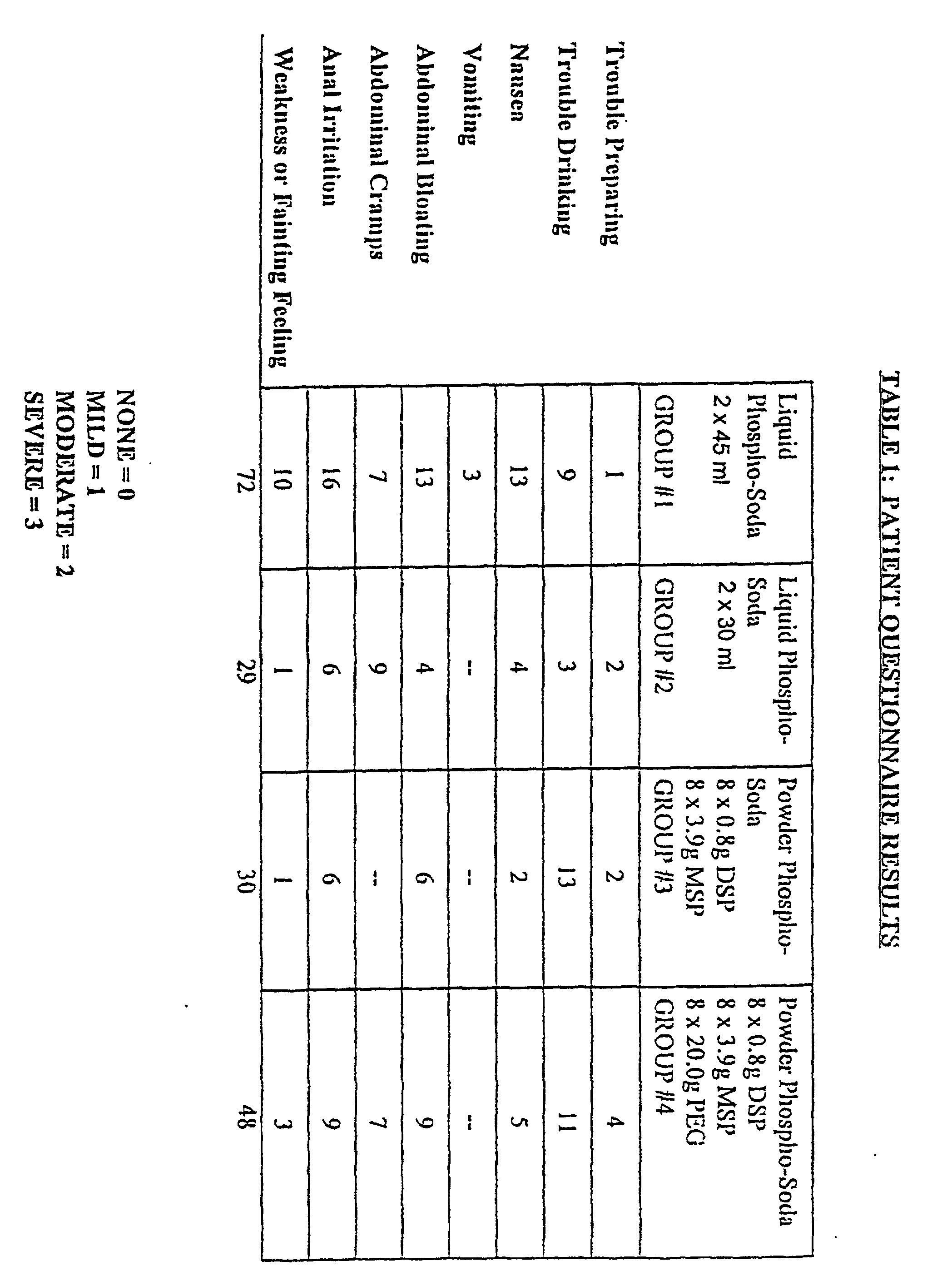
- Group 1 two doses of 45 ml sodium phosphate had the largest total for side effects.
- Groups 2 through 4 showed less nausea, vomiting and abdominal bloating than group 1.
- Group 2 showed less trouble drinking than groups 1, 3 and 4.
- Group 1 showed substantially more anal irritation and weakness or faint feeling than the other groups.
- Tables 3-6 show the difference of each of four electrolytes before and after dosing with various presentations of sodium phosphate.
- Phosphorus is the only meaningful data, due to the extreme scatter of the other data.
- Group 1 patients showed an increase in phosphorus absorption which amounted to about 50% more as compared to groups 2, 3 and 4. The increase is statistically significant at the 99% confidence level.
- Group 4 showed less phosphorus absorption than groups 2 and 3 but the difference was not statistically significant.
- Table 7 is a list of the directions of the change in other values in the CHEM 7 and CHEM PROFILE.
Landscapes
- Health & Medical Sciences (AREA)
- Life Sciences & Earth Sciences (AREA)
- Animal Behavior & Ethology (AREA)
- Veterinary Medicine (AREA)
- Engineering & Computer Science (AREA)
- Bioinformatics & Cheminformatics (AREA)
- Chemical & Material Sciences (AREA)
- Medicinal Chemistry (AREA)
- Pharmacology & Pharmacy (AREA)
- Epidemiology (AREA)
- Public Health (AREA)
- General Health & Medical Sciences (AREA)
- Biophysics (AREA)
- Molecular Biology (AREA)
- Inorganic Chemistry (AREA)
- Pharmaceuticals Containing Other Organic And Inorganic Compounds (AREA)
- Medicinal Preparation (AREA)
- Detergent Compositions (AREA)
- Cosmetics (AREA)
- Medicines Containing Material From Animals Or Micro-Organisms (AREA)
- External Artificial Organs (AREA)
- Medicines Containing Antibodies Or Antigens For Use As Internal Diagnostic Agents (AREA)
- Saccharide Compounds (AREA)
Abstract
Description
- The movement of nutrients, wastes, electrolytes, and water through the human intestines depends on the proper balance of absorption and secretion of water and electrolytes by the intestinal epithelium. Various pathogens, physical conditions and drugs can affect this balance or affect intestinal motility which can result in constipation. Laxatives can be used to treat constipation by promoting defecation. In addition, laxatives are useful for bowel clearance before radiological examination, colonoscopy, endoscopic examination, surgery or childbirth.
- There are three basic mechanisms of laxative action. The first mechanism is the retention of fluid in colonic contents by the hydrophilic or osmotic properties of the laxative compositions. The second mechanism is a decrease in the absorption of water and NaCl by acting directly or indirectly on the colonic mucosa. The third mechanism of action is an increase in the intestinal motility, which causes decreased absorption of water and salt due to the increased transit time.
- There are several different types of laxatives including dietary fiber and bulk-forming laxatives, stimulant laxatives, and saline and osmotic laxatives. Commonly used laxative products include castor oil, magnesium citrate, bisacodyl, PEG-electrolyte lavage and sodium phosphate. PEG-Lavage and sodium phosphate are the most commonly used products for colon cleansing prior to endoscopic examination.
- The present sodium phosphate composition is an oral saline laxative and bowel cleanser. Saline laxatives are poorly and slowly absorbed and act by their osmotic properties in the luminal fluid. A commonly used oral saline laxative is "FLEET PHOSPHO-SODA" (21.6 g monobasic sodium phosphate and 8.1 g dibasic sodium phosphate in 45 ml of a stable buffered aqueous solution). This product has been found by most patients to have an unpleasant taste despite the addition of flavorings. In addition, some patients become nauseated and are affected by the slight electrolyte imbalance from using this product. In view of these problems, the object of the present invention is to provide a sodium phosphate bowel cleansing composition which has a pleasant taste and preferably binds ions to reduce the amount of electrolyte shift caused by the absorption of ions from the composition.
- In EP-A-0771562 (not published at the priority date of the present application) solid oral dosage forms of phosphate composition are disclosed, notably capsules and compressed tablets.
- Though powdered pharmaceuticals may have been coated to mask taste in the past, the coating of sodium phosphate powders or crystals presents unique difficulties in that these compounds are highly ionic inorganic salts which are administered in larger amounts than most pharmaceuticals and require prolonged contact with water in a suspension. In view of this, the coatings which are used must have pores which are small enough to prevent the migration of ions through the coating and the coatings must be usable in amounts sufficient to coat large quantities of powder without adversely affecting the desired pharmacological effect. The present invention solves these problems allowing the production of a sodium phosphate bowel cleansing composition which has improved taste and retains the desired pharmacological effect.
- The present invention relates to a bowel cleansing composition which overcomes the prior art problems of unpleasant taste. The present bowel cleansing composition contains a mixture of monobasic sodium phosphate and dibasic sodium phosphate free flowing powders or crystals which have been coated with an edible grade film forming polymer. The coating may be selected to attract sodium and/or phosphate ions, thus reducing the electrolyte shift after oral ingestion (i.e. a nonabsorbable coating can be used which attracts and binds ions thereby preventing the ions from being absorbed). Flavorings and dyes can be added to the composition to further improve the taste and appearance of the composition.
- The present invention is an improvement of a commonly used sodium phosphate saline laxative. In the present invention, free flowing phosphate powders or crystals are coated with a film forming polymer such as hydroxypropylmethyl cellulose (HPMC). Control release beads could also be made with the phosphate layered on a bead center and then coated with the film forming polymer. The phosphate can be coated with a pH dependent coating which is designed to release in the low pH of the stomach.
- The phosphate powders of the present invention can be coated with any edible grade film forming polymer. The polymeric coating should be relatively impervious to passage of the sodium phosphates during passage through the patient's mouth. These polymers include gelatin, vegetable oils, natural polymers, starches, sugars, fats, paraffins, phospholipids, polyethylene glycol (PEG), and acrylic acid esters. Examples of preferred coating materials are HPMC E15, premium grade, which meets USP, Food Chemicals Codex, Kosher Certification and FDA Regulations for food and drugs; and standard pure food and drug paraffin. The coating can be selected to have additional properties such as binding sodium and/or phosphate ions (thereby reducing any electrolyte shift) and/or the coating may be nonmetabolizable. HPMC is an example of such a coating. The coating is applied. in a layer sufficient to mask the taste of the phosphate powders and is substantially impervious to the aqueous solution in which the coated powder is suspended prior to administration. The coating can be applied by a variety of processes including but not limited to fluidbed processing, pan coating, spray dry coating, roller coating and dip coating.
- The present invention contains sodium phosphate, preferably both monobasic and dibasic sodium phosphates, in an amount which produces between 200-1000Mosmois per adult cleansing dose (Mosmols are a measure of osmotic strength). A dose of the present composition preferably contains the coated equivalent of 18.8 g uncoated NaH2PO4 anhydrous, which is about 22.56 g of coated NaH2PO4 anhydrous; and the coated equivalent of 4.3 g uncoated Na2HPC4 anhydrous, which is about 4.73 g of coated Na2HPO4 anhydrous; in 45 mis of a stable buffered aqueous solution. The monobasic and dibasic phosphates can be mixed prior to coating or can be coated individually and then mixed. The dibasic and monobasic phosphate crystals preferably have a particle size of between 10 and 200 mesh (that is, the particles pass through a screen with 394-7874 openings per metre (10-200 openings per inch)) which results in a coated product which has a particle size of between 10 and 200 mesh.
- Prior to administration, the dry coated powder is mixed with an aqueous solution. The weight ratio of the powder to the aqueous solution is between 1:1 to 1:1000. The following examples are for illustrative purposes and are not intended to limit the scope of the present invention. Minor modifications of the exemplified procedures will be obvious to those of skill in the art
- A 10.0% solids solution of HPMC is prepared by dispersing 112.5 g of HPMC in 375 mls of purified water at 80-90°C. Once the HPMC is dispersed in the warm water, 762 mls of of cool purified water are added.
- To prepare the phosphate powders, 600 g of uncoated free flowing monobasic sodium phosphate powder is added to a fluidbed processing bowl and the bowl is positioned into the fluidbed processor. The processor is turned on causing the phosphate to be suspended in a heated (80-120°C) air stream of 0.25-0.45 m3/second (500-900 cubic feet per metre - CFM). Once the phosphate is heated to a product temperature of 55-65°C the HPMC solution prepared above is applied. The HPMC solution is applied by a controlled pumping system through an air atomized nozzle. The product temperature is maintained at 55-65°C during the entire coating process. After the HPMC solution is applied the pumping system is turned off and the coated phosphate powder is dried to a moisture level of less than 1.0% H2O. After the coated phosphate powder is dried, melted paraffin is sprayed on the coated phosphate powder until a ratio of between 1-10% w/w is obtained. During the spraying of the paraffin, the atomization air is heated to 100° ± 15°C. The final product is removed from the fluid bed processor and classified through a 10 mesh Sweco screen (that is, having 394 openings per metre) to remove any oversized particles. In the coated product, the phosphate powder is coated with 10.0% (± 7) HPMC by weight and 5.0% ± 1% paraffin. The coating is between 2-40% by weight of the phosphate.
- The coated dibasic sodium phosphate is prepared by substituting 7550 g of uncoated free flowing dibasic sodium phosphate for the monobasic sodium phosphate in the above process. Thus, 7550 g of uncoated free flowing dibasic sodium phosphate powder is added to a fluidbed processing bowl and the bowl is positioned into the fluidbed processor. The processor is turned on causing the phosphate to be suspended in a heated (80-120°C) air stream of 0.25-0.45 m3/second (500-900 CFM). Once the phosphate is heated to a product temperature of 55-65°C the HPMC solution prepared above is applied. The HPMC solution is applied by a controlled pumping system through an air atomized nozzle. The product temperature is maintained at 55-65°C during the entire coating process. After the HPMC solution is applied the pumping system is turned off and the coated phosphate powder is dried to a moisture level of less than 1.0% H2O. The dibasic sodium phosphate is not coated with melted paraffin.
- 24.89 g HPMC coated monobasic sodium phosphate 4.77 g HPMC coated dibasic sodium phosphate
- The coated monobasic and dibasic sodium phosphates are mixed and then stored as a dry composition.
- The dry coated sodium phosphate composition prepared in example 2 is suspended in 45 mls of water immediately prior to administration to a patient
- In this study, the bowel cleansing effectiveness, ease of consumption, side effects, and safety of sodium phosphate, normal 45 ml dose (Group I), reduced 30 ml dose sodium phosphate (Group II), coated sodium phosphate (Group III), and coated sodium phosphate and powder PEG 3350 (Group IV) were investigated. Sixty (60) patients undergoing colonscopy who met the inclusion/exclusion criteria participated. The inclusion criteria included patients who 1) were scheduled for elective outpatient colonscopy, and 2) were men & non-pregnant women, aged 18 years or older, who signed an institutional review board (IRB) approved written informed consent. Criteria for excluding patients from the study were patients with 1) Cr > 2.0, 2) symptomatic congestive heart failure, 3) known liver failure, 4) ascites, 5) patients who are pregnant or breast feeding, 6) patients with < 100 # body weight, and/or 7) patients with acute myocardial infarction within the past 6 months.
- After obtaining the informed consent, the patients were randomly assigned to one of four treatment groups. The subjects were given written instructions for use of the bowel cleansing product.
- The subjects completed a one page questionnaire after taking the cleansing preparation and before colonoscopy at Martha Jefferson Hospital. The questionnaire consisted of rating difficulty with drinking prep and side effects.
- The patients had a blood sample (Chem 21) drawn twice - once 3-7 days before the colonscopy in the office of Charlottesville Gastroenterology Associates (or at Martha Jefferson Hospital by prior arrangement) and then once immediately prior to colonoscopy at Martha Jefferson Hospital.
- The colonoscopist completed the preparation study sheet and was blinded to the type of patient preparation.
- As shown table 1, listing the patient questionnaire results, Group 1 (two doses of 45 ml sodium phosphate) had the largest total for side effects. The side effect scoring is 0 = none, 1 = mild, 2 = moderate and 3 = severe. Groups 2 through 4 showed less nausea, vomiting and abdominal bloating than group 1. Group 2 showed less trouble drinking than groups 1, 3 and 4. Group 1 showed substantially more anal irritation and weakness or faint feeling than the other groups.
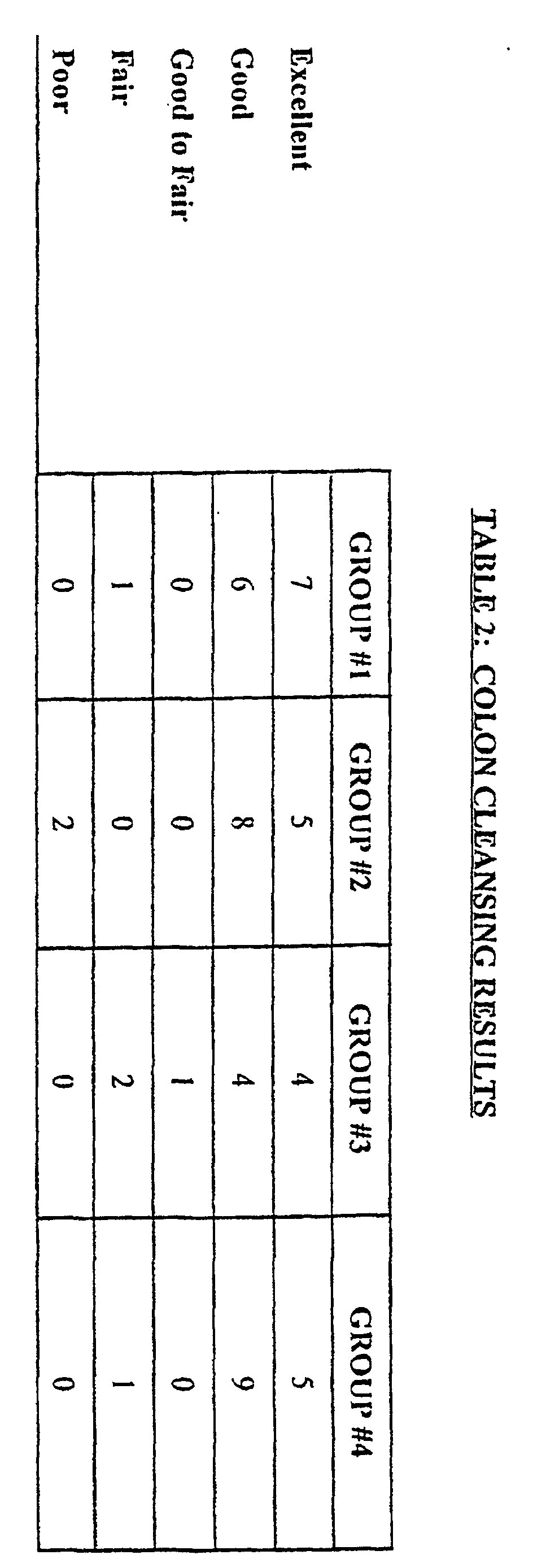
- Table 2, colon cleansing , shows that group 1 cleansed slightly better than the rest of the groups but not statistically significant.
- Tables 3-6 show the difference of each of four electrolytes before and after dosing with various presentations of sodium phosphate. Phosphorus is the only meaningful data, due to the extreme scatter of the other data. Group 1 patients showed an increase in phosphorus absorption which amounted to about 50% more as compared to groups 2, 3 and 4. The increase is statistically significant at the 99% confidence level. Group 4 showed less phosphorus absorption than groups 2 and 3 but the difference was not statistically significant.
- Table 7 is a list of the directions of the change in other values in the CHEM 7 and CHEM PROFILE.
- This study shows that the present sodium phosphate composition is safe and effective and implies that a preferred embodiment is to use the reduced dosage of sodium phosphate whether it is 30 ml liquid or the equivalent in coated powder. The coated powder has some advantages over the liquid which include storage, taste and side effects other than trouble drinking.
PHOSPHORUS GROUP #1 GROUP #2 GROUP #3 GROUP #4 6.1 4.0 1.8 2.2 3.1 3.2 3.0 2.5 3.8 0.8 2.3 2.4 3.6 2.2 2.2 1.1 4.8 3.1 2.7 3.7 4.6 3.6 2.6 2.0 3.3 0.4 3.5 1.6 3.0 1.2 1.0 2.4 3.5 2.4 2.7 2.6 4.2 2.5 3.0 3.1 3.3 2.7 1.8 1.5 2.8 2.3 2.0 2.0 3.1 3.5 1.5 1.0 Average 3.543 2.423 2.418 2.257 STD 1.159 1.071 0.698 0.814 SODIUM GROUP #1 GROUP #2 GROUP #3 GROUP #4 1.0 -3.0 5.0 1.0 1.0 3.0 24.0 0.0 7.0 3.0 0.0 4.0 1.0 1.0 3.0 0.0 2.0 1.0 -3.0 -1.0 8.0 -3.0 0.0 0.0 6.0 0.0 1.0 2.0 3.0 2.0 2.0 1.0 1.0 -1.0 0.0 4.0 6.0 0.0 2.0 4.0 5.0 0.0 1.0 0.0 2.0 0.0 1.0 4.0 0.0 1.0 4.0 7.0 3.0 Average 3.571 0.308 3.000 1.857 STD 2.793 1.888 7.195 1.964 CALCIUM GROUP #1 GROUP #2 GROUP #3 GROUP #4 -0.4 -0.3 -0.6 0.2 -0.1 0.1 0.1 -0.2 0.3 -0.8 0.2 -0.9 -0.7 -0.6 -0.3 -0.3 -0.7 0.0 -0.4 -0.5 -0.3 -1.0 -0.1 -2.0 -1.0 -1.1 -0.2 -0.1 -0.7 -0.1 -0.8 0.3 -0.2 -0.7 0.1 0.2 -0.3 - -0.2 -0.8 0.1 0.1 -0.5 -0.3 -0.3 -0.7 -0.1 0.0 -1.5 -0.8 0.7 0.4 -0.8 -0.2 Average -0.450 -0.462 -0.258 -0.343 STD 0.382 0.391 0.349 0.722 POTASSIUM GROUP #1 GROUP #2 GROUP #3 GROUP #4 -0.5 -1.3 -1.6 -0.5 0.0 -0.5 -0.2 -0.7 -0.4 -0.7 -0.6 -0.1 -0.1 -0.5 -0.5 0.2 -0.4 -1.2 -0.5 -0.6 -0.3 -0.9 -0.6 0.1 -0.4 -0.3 -0.1 0.0 -0.8 -0.1 0.5 -0.1 -0.1 -0.2 -0.4 0.0 -0.3 -0.2 -0.7 -0.4 -0.3 0.0 -0.8 -0.3 -0.1 -0.1 -0.6 -1.2 -0.8 -0.1 -0.4 0.2 -0.8 Average -0.307 -0.469 -0.592 -0.343 STD 0.281 0.435 0.391 0.386 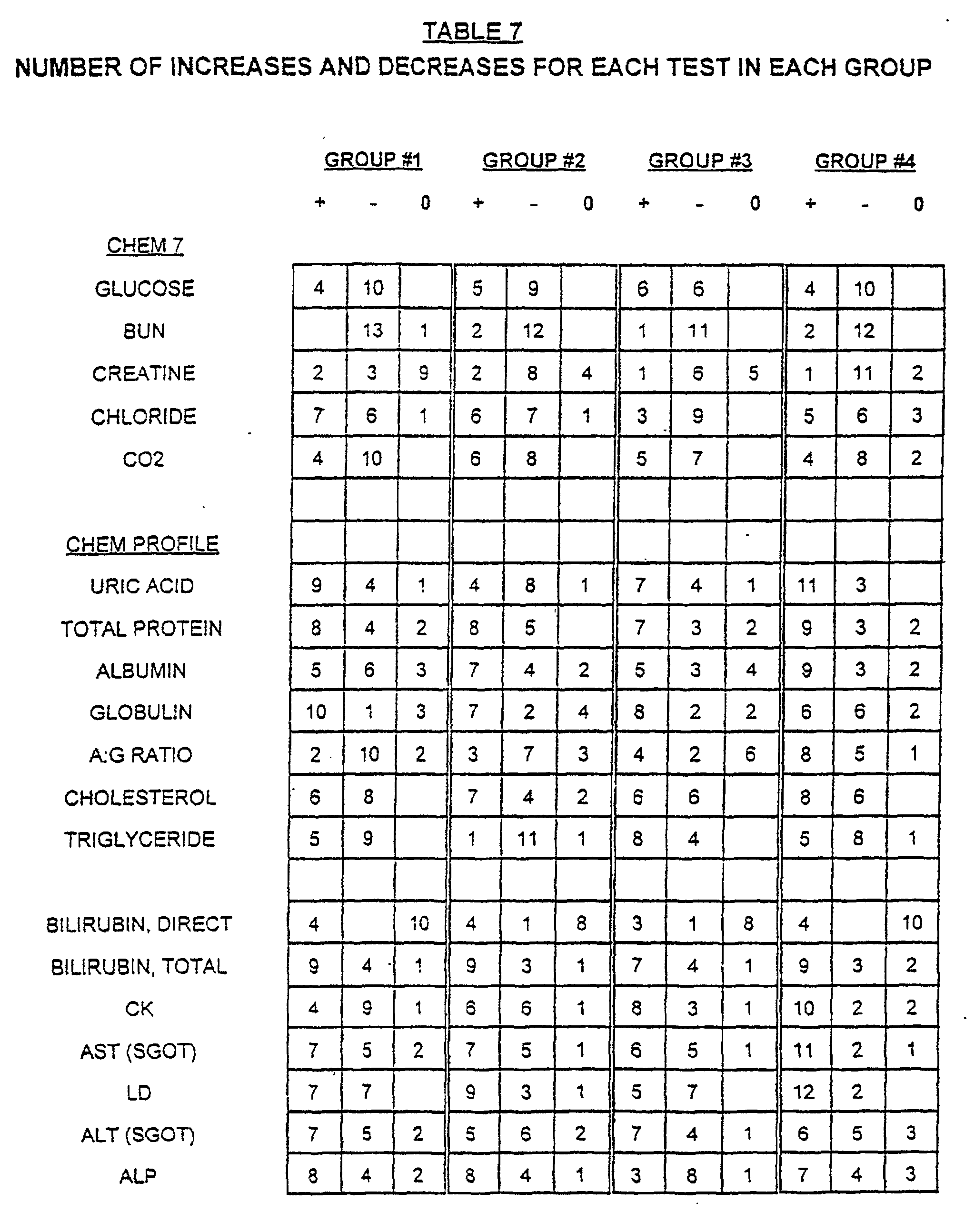
Claims (24)
- A sodium phosphate composition which can be suspended in water to form a bowel cleansing suspension; comprising particulate monobasic sodium phosphate and particulate dibasic sodium phosphate, wherein said monobasic sodium phosphate and dibasic sodium phosphate are coated with at least one edible film forming polymer.
- The composition according to claim 1, wherein said monobasic sodium phosphate and dibasic sodium phosphate are in the form of free flowing powders or crystals.
- The composition according to claim 1, wherein said monobasic sodium phosphate and dibasic sodium phosphate are in the form of controlled release beads.
- The composition according to claim 1, further comprising at least one additional substance selected from the group consisting of pharmaceutically acceptable fillers, dyes, and fragrances.
- The composition according to claim 1, wherein said film forming polymer is hydroxypropylmethyl cellulose.
- The composition according to claim 1, wherein the amount of monobasic sodium phosphate and dibasic sodium phosphate produces between 200-1000 Mosmols per dose.
- The composition according to claim 2, wherein said powders or crystals have a particle size range between 10-200 mesh (that is, the particles would pass through a screen with 394-7874 openings per metre).
- The composition according to claim 1, wherein said monobasic sodium phosphate and dibasic sodium phosphate are coated with 10.0% (± 7.0) hydroxypropylmethyl cellulose and 5.0% ± 1% paraffin.
- A method for producing a coated phosphate powder or crystal comprising the steps of:a) placing uncoated phosphate powder or crystals in a fluidbed processing bowl,b) suspending the phosphate in a heated inert gas stream to heat the phosphate,c) applying a coating solution to said phosphate to produce a coated phosphate,d) drying the coated phosphate, ande) thereafter applying a coating of melted paraffin on said coated phosphate to produce a coated sodium phosphate composition.
- The method according to claim 9, wherein said uncoated phosphate powder is selected from the group consisting of monobasic sodium phosphate, dibasic sodium phosphate and a mixture of monobasic sodium phosphate and dibasic sodium phosphate.
- The method according to claim 9, wherein said coating solution is a solution of hydroxypropylmethyl cellulose which contains 10.0% ± 2%solids.
- The method according to claim 9, further comprising classifying said coated sodium phosphate composition by passing said product through a 10 mesh screen (394 openings per metre) to remove any oversized particles.
- The method according to claim 9, wherein said coated phosphate is dried to a moisture level of less than 1.0% H2O.
- The method according to claim 9, wherein said phosphate is suspended in a heated inert gas stream of 0.25-0.45 m3/second (500-900 CFM) at a temperature between 80-120°C to heat the phosphate to a temperature of 55-65°C.
- The method according to claim 9, wherein said paraffin is applied using atomized air heated to a temperature of 100° ± 15°C.
- The method according to claim 9, wherein said coating solution is applied by a controlled pumping system through an air atomized nozzle.
- A bowel cleansing composition comprising monobasic sodium phosphate and dibasic sodium phosphate suspended in an aqueous solution, wherein said monobasic sodium phosphate and dibasic sodium phosphate are coated with a film forming polymer.
- A dry sodium phosphate composition, comprising free flowing monobasic sodium phosphate and dibasic sodium phosphate powders or crystals coated with a film forming polymer.
- The pharmaceutical composition according to claim 18, wherein said film forming polymer is hydroxypropylmethyl cellulose.
- The composition according to claim 18, further comprising at least one substance selected from the group consisting of pharmaceutically acceptable fillers, dyes, flavors and fragrances.
- The composition according to claim 1, wherein said edible film forming polymer reduces electrolyte shift by binding sodium and phosphate ions.
- The composition according to claim 1, wherein said edible film forming polymer forms at least one layer which blocks the migration of sodium and/or potassium ions.
- The composition according to claim 1, wherein two edible film forming polymers are present as first and second layers and said second layer blocks any pores present in said first layer.
- The composition according to claim 1, wherein said wherein said edible film forming polymer is nonmetabolizable.
Priority Applications (1)
| Application Number | Priority Date | Filing Date | Title |
|---|---|---|---|
| SI9730162T SI0872242T1 (en) | 1996-11-13 | 1997-11-13 | A coated sodium phosphate bowel cleanser |
Applications Claiming Priority (2)
| Application Number | Priority Date | Filing Date | Title |
|---|---|---|---|
| US3087096P | 1996-11-13 | 1996-11-13 | |
| US30870P | 1996-11-13 |
Publications (3)
| Publication Number | Publication Date |
|---|---|
| EP0872242A2 EP0872242A2 (en) | 1998-10-21 |
| EP0872242A3 EP0872242A3 (en) | 1999-10-20 |
| EP0872242B1 true EP0872242B1 (en) | 2001-06-06 |
Family
ID=21856440
Family Applications (1)
| Application Number | Title | Priority Date | Filing Date |
|---|---|---|---|
| EP97309126A Expired - Lifetime EP0872242B1 (en) | 1996-11-13 | 1997-11-13 | A coated sodium phosphate bowel cleanser |
Country Status (11)
| Country | Link |
|---|---|
| US (1) | US5997906A (en) |
| EP (1) | EP0872242B1 (en) |
| AT (1) | ATE201824T1 (en) |
| AU (1) | AU731016B2 (en) |
| CA (1) | CA2221011C (en) |
| DE (1) | DE69705106T2 (en) |
| DK (1) | DK0872242T3 (en) |
| ES (1) | ES2158453T3 (en) |
| GR (1) | GR3036302T3 (en) |
| PT (1) | PT872242E (en) |
| SI (1) | SI0872242T1 (en) |
Families Citing this family (22)
| Publication number | Priority date | Publication date | Assignee | Title |
|---|---|---|---|---|
| US6555139B2 (en) | 1999-06-28 | 2003-04-29 | Wockhardt Europe Limited | Preparation of micron-size pharmaceutical particles by microfluidization |
| GB9924636D0 (en) * | 1999-10-18 | 1999-12-22 | Norgine Bv | Laxative preparation |
| US6946149B2 (en) | 2002-04-30 | 2005-09-20 | Braintree Laboratories, Inc. | Salt solution for colon cleansing |
| US8361452B2 (en) * | 2002-07-15 | 2013-01-29 | Halow George M | Bowel cleansing composition |
| AU2003259006A1 (en) * | 2002-09-13 | 2004-04-30 | Metcon Medicin Ab | Composition and method for use in intestinal cleansing procedures |
| US20040071779A1 (en) * | 2002-10-09 | 2004-04-15 | Keiser Dale Arthur | Gelled laxative compositions |
| US7291324B2 (en) * | 2002-10-22 | 2007-11-06 | Braintree Laboratories Inc. | Method of bowel cleansing |
| US6996500B2 (en) * | 2002-10-30 | 2006-02-07 | Hewlett-Packard Development Company, L.P. | Method for communicating diagnostic data |
| US7049319B2 (en) | 2003-09-23 | 2006-05-23 | Semaan Abboud | Colon cleansing composition and method |
| US7687075B2 (en) | 2003-11-19 | 2010-03-30 | Salix Pharmaceuticals, Ltd. | Colonic purgative composition with soluble binding agent |
| SI1750702T1 (en) | 2004-06-04 | 2011-03-31 | Braintree Lab | Method of bowel cleansing |
| US20060051428A1 (en) * | 2004-09-03 | 2006-03-09 | Nelson Ayala | Aspartame and citrate flavored phosphate salt laxative |
| US20070082061A1 (en) * | 2005-10-07 | 2007-04-12 | Nelson Ayala | Reduction of saltiness with sweeteners |
| EP1976520B1 (en) * | 2005-12-29 | 2011-04-27 | Braintree Laboratories, Inc. | Kit comprising an osmotic laxative and a stimulant laxative for preparing the colon for virtual colonoscopy |
| US7985429B2 (en) | 2006-03-03 | 2011-07-26 | C. B. Fleet Company, Inc. | Flavored colonic cleansing system |
| US7998510B2 (en) | 2006-08-17 | 2011-08-16 | C. B. Fleet Company, Inc. | Low dose colonic cleansing system |
| USD683210S1 (en) | 2007-03-01 | 2013-05-28 | C.B. Fleet Company, Inc. | Container for colonic cleansing kit |
| WO2010013993A1 (en) * | 2008-08-01 | 2010-02-04 | Titan Petchem (M) Sdn Bhd | Halal polymer resins and process for making the same |
| KR101053731B1 (en) | 2008-10-21 | 2011-08-02 | 이문성 | Method for preparing dissolution time-controlled enteric cleaner composition |
| US8211417B1 (en) | 2009-10-31 | 2012-07-03 | Harry Snady | Method of bowel cleansing |
| KR101210831B1 (en) * | 2012-02-10 | 2012-12-11 | 주식회사태준제약 | Colonic purgative composition comprising polyethylene glycol and vitamin c |
| CN115957238B (en) * | 2022-12-14 | 2025-03-21 | 嘉实(湖南)医药科技有限公司 | A method for preparing sodium phosphate granules |
Family Cites Families (5)
| Publication number | Priority date | Publication date | Assignee | Title |
|---|---|---|---|---|
| US4999200A (en) * | 1987-12-09 | 1991-03-12 | Marion Laboratories | Psyllium tablet composition, method of manufacture and method of use |
| US5498425A (en) * | 1995-03-17 | 1996-03-12 | Block Drug Company, Inc. | Phosphosoda buffered saline laxative |
| AU7056896A (en) * | 1995-11-03 | 1997-05-08 | Thomas Julius Borody | Improved method for colonic evacuation |
| AUPN634595A0 (en) * | 1995-11-03 | 1995-11-30 | Borody, Thomas Julius | Improved method for colonic evacuation |
| ATE235894T1 (en) * | 1996-05-08 | 2003-04-15 | Craig A Aronchick | NON-AQUEOUS COLONIC LAXATIVES |
-
1997
- 1997-11-13 AT AT97309126T patent/ATE201824T1/en not_active IP Right Cessation
- 1997-11-13 SI SI9730162T patent/SI0872242T1/en unknown
- 1997-11-13 CA CA002221011A patent/CA2221011C/en not_active Expired - Fee Related
- 1997-11-13 AU AU45151/97A patent/AU731016B2/en not_active Ceased
- 1997-11-13 US US08/970,089 patent/US5997906A/en not_active Expired - Lifetime
- 1997-11-13 DK DK97309126T patent/DK0872242T3/en active
- 1997-11-13 PT PT97309126T patent/PT872242E/en unknown
- 1997-11-13 DE DE69705106T patent/DE69705106T2/en not_active Expired - Fee Related
- 1997-11-13 EP EP97309126A patent/EP0872242B1/en not_active Expired - Lifetime
- 1997-11-13 ES ES97309126T patent/ES2158453T3/en not_active Expired - Lifetime
-
2001
- 2001-07-31 GR GR20010401152T patent/GR3036302T3/en not_active IP Right Cessation
Also Published As
| Publication number | Publication date |
|---|---|
| DK0872242T3 (en) | 2001-09-10 |
| DE69705106D1 (en) | 2001-07-12 |
| CA2221011A1 (en) | 1998-05-13 |
| DE69705106T2 (en) | 2001-09-20 |
| CA2221011C (en) | 2003-06-24 |
| US5997906A (en) | 1999-12-07 |
| AU731016B2 (en) | 2001-03-22 |
| PT872242E (en) | 2001-11-30 |
| ES2158453T3 (en) | 2001-09-01 |
| GR3036302T3 (en) | 2001-10-31 |
| AU4515197A (en) | 1998-05-21 |
| EP0872242A2 (en) | 1998-10-21 |
| SI0872242T1 (en) | 2001-12-31 |
| EP0872242A3 (en) | 1999-10-20 |
| ATE201824T1 (en) | 2001-06-15 |
Similar Documents
| Publication | Publication Date | Title |
|---|---|---|
| US5997906A (en) | Coated sodium phosphate bowel cleanser | |
| US6042849A (en) | Unit dosage forms for treatment of vasoconstriction and related conditions | |
| KR900007468B1 (en) | New Glucose Delivery Compositions of Active Substances | |
| DE3782840T2 (en) | MEDICINAL PRODUCTS WITH DELAYED RELEASE. | |
| KR860000513B1 (en) | Process for Preparation of Microencapsulated Bacampicillin Acid Addition-Containing Powder | |
| DE60117801T2 (en) | PHARMACEUTICAL COMPOSITION WITH CONTROLLED RELEASE AND DELAYED ABSORPTION | |
| FI93608B (en) | Process for the preparation of solid drug preparations containing xanthan gum | |
| JP3010562B2 (en) | Sustained-release preparation unit | |
| US4126672A (en) | Sustained release pharmaceutical capsules | |
| EP0421921B1 (en) | Double coated granules | |
| DE60026459T2 (en) | Simethicone-containing laxative | |
| EP0277127A1 (en) | NEW DRUG PREPARATION WITH REGULAR ADMINISTRATION OF THE ACTIVE AGENT, AND THEIR PRODUCTION METHOD. | |
| EP0804172B1 (en) | Controlled release potassium dosage form | |
| JP2002080398A (en) | ORAL SOLID PHAMACEUTICAL FORMULATION WITH pH-DEPENDENT MULTIPHASIC RELEASE | |
| CN101375869A (en) | Slow/controlled release pellet composition containing ginkgo leaf extracts and preparation method thereof | |
| KR20190041233A (en) | Colonic purgative composition comprising sulfate salts | |
| DE69914360T2 (en) | CHROMONE PREPARATION FOR ENTERAL ACTIVE SUBSTANCE RELEASE | |
| US4832955A (en) | Controlled release potassium chloride composition | |
| DE602004008737T2 (en) | Chondroitin sulfate-containing composition | |
| EP0159735A1 (en) | Pharmaceutical composition containing tetracyclin or doxycyclin salts and a process of preparing such a composition | |
| JPH0539228A (en) | Sustained-release preparation comprising alginc acid propylene glycol ester | |
| CN106361718A (en) | Colon-specific bioadhesive tablet containing monosialotetrahexosyl ganglioside sodium | |
| US3842169A (en) | Composition and method for treatment of pathological calcification in animals | |
| CA3199266A1 (en) | Sulfate salt formulations for colon cleansing | |
| WO1998024412A2 (en) | Compounds useful against diseases of the colon and methods for orally administering same |
Legal Events
| Date | Code | Title | Description |
|---|---|---|---|
| PUAI | Public reference made under article 153(3) epc to a published international application that has entered the european phase |
Free format text: ORIGINAL CODE: 0009012 |
|
| AK | Designated contracting states |
Kind code of ref document: A2 Designated state(s): AT BE CH DE DK ES FI FR GB GR IE IT LI LU MC NL PT SE |
|
| AX | Request for extension of the european patent |
Free format text: AL;LT;LV;MK;RO;SI |
|
| PUAL | Search report despatched |
Free format text: ORIGINAL CODE: 0009013 |
|
| AK | Designated contracting states |
Kind code of ref document: A3 Designated state(s): AT BE CH DE DK ES FI FR GB GR IE IT LI LU MC NL PT SE |
|
| AX | Request for extension of the european patent |
Free format text: AL;LT;LV;MK;RO;SI |
|
| RIC1 | Information provided on ipc code assigned before grant |
Free format text: 6A 61K 33/42 A, 6A 61K 9/16 B |
|
| 17P | Request for examination filed |
Effective date: 19991015 |
|
| 17Q | First examination report despatched |
Effective date: 19991220 |
|
| AKX | Designation fees paid |
Free format text: AT BE CH DE DK ES FI FR GB GR IE IT LI LU MC NL PT SE |
|
| AXX | Extension fees paid |
Free format text: AL PAYMENT 20000329;LT PAYMENT 20000329;LV PAYMENT 20000329;MK PAYMENT 20000329;RO PAYMENT 20000329;SI PAYMENT 20000329 |
|
| GRAG | Despatch of communication of intention to grant |
Free format text: ORIGINAL CODE: EPIDOS AGRA |
|
| GRAG | Despatch of communication of intention to grant |
Free format text: ORIGINAL CODE: EPIDOS AGRA |
|
| GRAH | Despatch of communication of intention to grant a patent |
Free format text: ORIGINAL CODE: EPIDOS IGRA |
|
| GRAH | Despatch of communication of intention to grant a patent |
Free format text: ORIGINAL CODE: EPIDOS IGRA |
|
| GRAA | (expected) grant |
Free format text: ORIGINAL CODE: 0009210 |
|
| AK | Designated contracting states |
Kind code of ref document: B1 Designated state(s): AT BE CH DE DK ES FI FR GB GR IE IT LI LU MC NL PT SE |
|
| AX | Request for extension of the european patent |
Free format text: AL PAYMENT 20000329;LT PAYMENT 20000329;LV PAYMENT 20000329;MK PAYMENT 20000329;RO PAYMENT 20000329;SI PAYMENT 20000329 |
|
| REF | Corresponds to: |
Ref document number: 201824 Country of ref document: AT Date of ref document: 20010615 Kind code of ref document: T |
|
| REG | Reference to a national code |
Ref country code: CH Ref legal event code: NV Representative=s name: BRAUN & PARTNER PATENT-, MARKEN-, RECHTSANWAELTE * |
|
| REF | Corresponds to: |
Ref document number: 69705106 Country of ref document: DE Date of ref document: 20010712 |
|
| REG | Reference to a national code |
Ref country code: IE Ref legal event code: FG4D |
|
| ITF | It: translation for a ep patent filed | ||
| REG | Reference to a national code |
Ref country code: ES Ref legal event code: FG2A Ref document number: 2158453 Country of ref document: ES Kind code of ref document: T3 |
|
| REG | Reference to a national code |
Ref country code: DK Ref legal event code: T3 |
|
| ET | Fr: translation filed | ||
| REG | Reference to a national code |
Ref country code: PT Ref legal event code: SC4A Free format text: AVAILABILITY OF NATIONAL TRANSLATION Effective date: 20010809 |
|
| REG | Reference to a national code |
Ref country code: GB Ref legal event code: IF02 |
|
| PLBE | No opposition filed within time limit |
Free format text: ORIGINAL CODE: 0009261 |
|
| STAA | Information on the status of an ep patent application or granted ep patent |
Free format text: STATUS: NO OPPOSITION FILED WITHIN TIME LIMIT |
|
| 26N | No opposition filed | ||
| REG | Reference to a national code |
Ref country code: SI Ref legal event code: IF |
|
| PGFP | Annual fee paid to national office [announced via postgrant information from national office to epo] |
Ref country code: NL Payment date: 20071124 Year of fee payment: 11 Ref country code: MC Payment date: 20071121 Year of fee payment: 11 Ref country code: LU Payment date: 20071205 Year of fee payment: 11 Ref country code: ES Payment date: 20071126 Year of fee payment: 11 Ref country code: DK Payment date: 20071130 Year of fee payment: 11 |
|
| PGFP | Annual fee paid to national office [announced via postgrant information from national office to epo] |
Ref country code: AT Payment date: 20071121 Year of fee payment: 11 Ref country code: CH Payment date: 20071129 Year of fee payment: 11 Ref country code: FI Payment date: 20071129 Year of fee payment: 11 Ref country code: IT Payment date: 20071128 Year of fee payment: 11 |
|
| PGFP | Annual fee paid to national office [announced via postgrant information from national office to epo] |
Ref country code: BE Payment date: 20071213 Year of fee payment: 11 Ref country code: SE Payment date: 20071128 Year of fee payment: 11 |
|
| PGFP | Annual fee paid to national office [announced via postgrant information from national office to epo] |
Ref country code: GB Payment date: 20071128 Year of fee payment: 11 Ref country code: FR Payment date: 20071119 Year of fee payment: 11 |
|
| PGFP | Annual fee paid to national office [announced via postgrant information from national office to epo] |
Ref country code: PT Payment date: 20071121 Year of fee payment: 11 Ref country code: GR Payment date: 20071129 Year of fee payment: 11 Ref country code: DE Payment date: 20071221 Year of fee payment: 11 |
|
| REG | Reference to a national code |
Ref country code: PT Ref legal event code: MM4A Free format text: LAPSE DUE TO NON-PAYMENT OF FEES Effective date: 20090513 |
|
| BERE | Be: lapsed |
Owner name: C.B. *FLEET CY INC. Effective date: 20081130 |
|
| PG25 | Lapsed in a contracting state [announced via postgrant information from national office to epo] |
Ref country code: MC Free format text: LAPSE BECAUSE OF NON-PAYMENT OF DUE FEES Effective date: 20081130 |
|
| REG | Reference to a national code |
Ref country code: CH Ref legal event code: PL |
|
| REG | Reference to a national code |
Ref country code: DK Ref legal event code: EBP |
|
| EUG | Se: european patent has lapsed | ||
| GBPC | Gb: european patent ceased through non-payment of renewal fee |
Effective date: 20081113 |
|
| PG25 | Lapsed in a contracting state [announced via postgrant information from national office to epo] |
Ref country code: NL Free format text: LAPSE BECAUSE OF NON-PAYMENT OF DUE FEES Effective date: 20090601 Ref country code: FI Free format text: LAPSE BECAUSE OF NON-PAYMENT OF DUE FEES Effective date: 20081113 |
|
| NLV4 | Nl: lapsed or anulled due to non-payment of the annual fee |
Effective date: 20090601 |
|
| REG | Reference to a national code |
Ref country code: IE Ref legal event code: MM4A |
|
| PG25 | Lapsed in a contracting state [announced via postgrant information from national office to epo] |
Ref country code: PT Free format text: LAPSE BECAUSE OF NON-PAYMENT OF DUE FEES Effective date: 20090513 Ref country code: IT Free format text: LAPSE BECAUSE OF NON-PAYMENT OF DUE FEES Effective date: 20081113 Ref country code: AT Free format text: LAPSE BECAUSE OF NON-PAYMENT OF DUE FEES Effective date: 20081113 |
|
| PGFP | Annual fee paid to national office [announced via postgrant information from national office to epo] |
Ref country code: IE Payment date: 20071126 Year of fee payment: 11 |
|
| REG | Reference to a national code |
Ref country code: FR Ref legal event code: ST Effective date: 20090731 |
|
| PG25 | Lapsed in a contracting state [announced via postgrant information from national office to epo] |
Ref country code: BE Free format text: LAPSE BECAUSE OF NON-PAYMENT OF DUE FEES Effective date: 20081130 |
|
| PG25 | Lapsed in a contracting state [announced via postgrant information from national office to epo] |
Ref country code: LI Free format text: LAPSE BECAUSE OF NON-PAYMENT OF DUE FEES Effective date: 20081130 Ref country code: IE Free format text: LAPSE BECAUSE OF NON-PAYMENT OF DUE FEES Effective date: 20081113 Ref country code: DK Free format text: LAPSE BECAUSE OF NON-PAYMENT OF DUE FEES Effective date: 20081130 Ref country code: DE Free format text: LAPSE BECAUSE OF NON-PAYMENT OF DUE FEES Effective date: 20090603 Ref country code: CH Free format text: LAPSE BECAUSE OF NON-PAYMENT OF DUE FEES Effective date: 20081130 |
|
| REG | Reference to a national code |
Ref country code: SI Ref legal event code: KO00 Effective date: 20090630 |
|
| PG25 | Lapsed in a contracting state [announced via postgrant information from national office to epo] |
Ref country code: GR Free format text: LAPSE BECAUSE OF NON-PAYMENT OF DUE FEES Effective date: 20090603 Ref country code: GB Free format text: LAPSE BECAUSE OF NON-PAYMENT OF DUE FEES Effective date: 20081113 |
|
| REG | Reference to a national code |
Ref country code: ES Ref legal event code: FD2A Effective date: 20081114 |
|
| PG25 | Lapsed in a contracting state [announced via postgrant information from national office to epo] |
Ref country code: ES Free format text: LAPSE BECAUSE OF NON-PAYMENT OF DUE FEES Effective date: 20081114 |
|
| PG25 | Lapsed in a contracting state [announced via postgrant information from national office to epo] |
Ref country code: LU Free format text: LAPSE BECAUSE OF NON-PAYMENT OF DUE FEES Effective date: 20081113 |
|
| PG25 | Lapsed in a contracting state [announced via postgrant information from national office to epo] |
Ref country code: SE Free format text: LAPSE BECAUSE OF NON-PAYMENT OF DUE FEES Effective date: 20081114 |
|
| PG25 | Lapsed in a contracting state [announced via postgrant information from national office to epo] |
Ref country code: FR Free format text: LAPSE BECAUSE OF NON-PAYMENT OF DUE FEES Effective date: 20081130 |