EP0867955A1 - Non-aqueous electrolyte secondary battery - Google Patents
Non-aqueous electrolyte secondary battery Download PDFInfo
- Publication number
- EP0867955A1 EP0867955A1 EP98302265A EP98302265A EP0867955A1 EP 0867955 A1 EP0867955 A1 EP 0867955A1 EP 98302265 A EP98302265 A EP 98302265A EP 98302265 A EP98302265 A EP 98302265A EP 0867955 A1 EP0867955 A1 EP 0867955A1
- Authority
- EP
- European Patent Office
- Prior art keywords
- lithium
- tin
- battery
- aqueous electrolyte
- secondary battery
- Prior art date
- Legal status (The legal status is an assumption and is not a legal conclusion. Google has not performed a legal analysis and makes no representation as to the accuracy of the status listed.)
- Granted
Links
- 239000011255 nonaqueous electrolyte Substances 0.000 title claims abstract description 19
- ATJFFYVFTNAWJD-UHFFFAOYSA-N Tin Chemical compound [Sn] ATJFFYVFTNAWJD-UHFFFAOYSA-N 0.000 claims abstract description 42
- OKTJSMMVPCPJKN-UHFFFAOYSA-N Carbon Chemical compound [C] OKTJSMMVPCPJKN-UHFFFAOYSA-N 0.000 claims abstract description 37
- 229910052799 carbon Inorganic materials 0.000 claims abstract description 25
- 239000011149 active material Substances 0.000 claims abstract description 23
- 239000011230 binding agent Substances 0.000 claims abstract description 16
- 229920005989 resin Polymers 0.000 claims abstract description 14
- 239000011347 resin Substances 0.000 claims abstract description 14
- 229910001128 Sn alloy Inorganic materials 0.000 claims abstract description 11
- 239000003960 organic solvent Substances 0.000 claims abstract description 10
- 229910052723 transition metal Inorganic materials 0.000 claims abstract description 9
- 150000002642 lithium compounds Chemical class 0.000 claims abstract description 8
- 150000003624 transition metals Chemical class 0.000 claims abstract description 8
- HBBGRARXTFLTSG-UHFFFAOYSA-N Lithium ion Chemical compound [Li+] HBBGRARXTFLTSG-UHFFFAOYSA-N 0.000 claims abstract description 7
- 229910001416 lithium ion Inorganic materials 0.000 claims abstract description 7
- 239000000470 constituent Substances 0.000 claims abstract description 6
- 229910044991 metal oxide Inorganic materials 0.000 claims abstract description 6
- 150000004706 metal oxides Chemical class 0.000 claims abstract description 6
- 239000007787 solid Substances 0.000 claims abstract description 6
- 229910052744 lithium Inorganic materials 0.000 claims description 95
- WHXSMMKQMYFTQS-UHFFFAOYSA-N Lithium Chemical compound [Li] WHXSMMKQMYFTQS-UHFFFAOYSA-N 0.000 claims description 89
- 239000000463 material Substances 0.000 claims description 27
- 239000000843 powder Substances 0.000 claims description 13
- 238000004519 manufacturing process Methods 0.000 claims description 11
- XTHFKEDIFFGKHM-UHFFFAOYSA-N Dimethoxyethane Chemical compound COCCOC XTHFKEDIFFGKHM-UHFFFAOYSA-N 0.000 claims description 10
- YEJRWHAVMIAJKC-UHFFFAOYSA-N 4-Butyrolactone Chemical compound O=C1CCCO1 YEJRWHAVMIAJKC-UHFFFAOYSA-N 0.000 claims description 8
- 229920000642 polymer Polymers 0.000 claims description 7
- 238000003487 electrochemical reaction Methods 0.000 claims description 5
- 239000000758 substrate Substances 0.000 claims description 5
- -1 polypropylene Polymers 0.000 description 22
- AMWRITDGCCNYAT-UHFFFAOYSA-L hydroxy(oxo)manganese;manganese Chemical compound [Mn].O[Mn]=O.O[Mn]=O AMWRITDGCCNYAT-UHFFFAOYSA-L 0.000 description 20
- 239000008151 electrolyte solution Substances 0.000 description 19
- XOLBLPGZBRYERU-UHFFFAOYSA-N tin dioxide Chemical compound O=[Sn]=O XOLBLPGZBRYERU-UHFFFAOYSA-N 0.000 description 17
- 239000000203 mixture Substances 0.000 description 16
- PXHVJJICTQNCMI-UHFFFAOYSA-N nickel Substances [Ni] PXHVJJICTQNCMI-UHFFFAOYSA-N 0.000 description 16
- 238000000034 method Methods 0.000 description 15
- 238000012360 testing method Methods 0.000 description 14
- 230000008859 change Effects 0.000 description 12
- 239000007773 negative electrode material Substances 0.000 description 12
- 239000007774 positive electrode material Substances 0.000 description 12
- 239000008188 pellet Substances 0.000 description 11
- 238000002441 X-ray diffraction Methods 0.000 description 10
- 229910052751 metal Inorganic materials 0.000 description 10
- 239000002184 metal Substances 0.000 description 10
- 230000015572 biosynthetic process Effects 0.000 description 9
- 239000011248 coating agent Substances 0.000 description 9
- 238000000576 coating method Methods 0.000 description 9
- 150000001875 compounds Chemical class 0.000 description 9
- 239000010439 graphite Substances 0.000 description 9
- 229910002804 graphite Inorganic materials 0.000 description 9
- 239000011572 manganese Substances 0.000 description 9
- 229910052759 nickel Inorganic materials 0.000 description 9
- KMTRUDSVKNLOMY-UHFFFAOYSA-N Ethylene carbonate Chemical compound O=C1OCCO1 KMTRUDSVKNLOMY-UHFFFAOYSA-N 0.000 description 8
- 239000002245 particle Substances 0.000 description 8
- 239000010935 stainless steel Substances 0.000 description 8
- 229910001220 stainless steel Inorganic materials 0.000 description 8
- WYURNTSHIVDZCO-UHFFFAOYSA-N Tetrahydrofuran Chemical compound C1CCOC1 WYURNTSHIVDZCO-UHFFFAOYSA-N 0.000 description 7
- 239000000853 adhesive Substances 0.000 description 7
- 230000001070 adhesive effect Effects 0.000 description 7
- 230000006866 deterioration Effects 0.000 description 7
- 239000000047 product Substances 0.000 description 7
- 239000007784 solid electrolyte Substances 0.000 description 7
- 229910001887 tin oxide Inorganic materials 0.000 description 7
- 239000004743 Polypropylene Substances 0.000 description 6
- 230000007423 decrease Effects 0.000 description 6
- 238000007599 discharging Methods 0.000 description 6
- 238000000227 grinding Methods 0.000 description 6
- 229920001155 polypropylene Polymers 0.000 description 6
- 238000007789 sealing Methods 0.000 description 6
- XLYOFNOQVPJJNP-UHFFFAOYSA-N water Substances O XLYOFNOQVPJJNP-UHFFFAOYSA-N 0.000 description 6
- 229920002125 Sokalan® Polymers 0.000 description 5
- 239000006258 conductive agent Substances 0.000 description 5
- 239000003792 electrolyte Substances 0.000 description 5
- 239000011888 foil Substances 0.000 description 5
- 239000004584 polyacrylic acid Substances 0.000 description 5
- 239000011164 primary particle Substances 0.000 description 5
- 229910052719 titanium Inorganic materials 0.000 description 5
- 239000010936 titanium Substances 0.000 description 5
- WNXJIVFYUVYPPR-UHFFFAOYSA-N 1,3-dioxolane Chemical compound C1COCO1 WNXJIVFYUVYPPR-UHFFFAOYSA-N 0.000 description 4
- OIFBSDVPJOWBCH-UHFFFAOYSA-N Diethyl carbonate Chemical compound CCOC(=O)OCC OIFBSDVPJOWBCH-UHFFFAOYSA-N 0.000 description 4
- RTZKZFJDLAIYFH-UHFFFAOYSA-N Diethyl ether Chemical compound CCOCC RTZKZFJDLAIYFH-UHFFFAOYSA-N 0.000 description 4
- 229910000733 Li alloy Inorganic materials 0.000 description 4
- 239000004698 Polyethylene Substances 0.000 description 4
- RTAQQCXQSZGOHL-UHFFFAOYSA-N Titanium Chemical compound [Ti] RTAQQCXQSZGOHL-UHFFFAOYSA-N 0.000 description 4
- 230000003247 decreasing effect Effects 0.000 description 4
- 238000001035 drying Methods 0.000 description 4
- 238000004880 explosion Methods 0.000 description 4
- 239000000835 fiber Substances 0.000 description 4
- 239000000945 filler Substances 0.000 description 4
- 239000001989 lithium alloy Substances 0.000 description 4
- MHCFAGZWMAWTNR-UHFFFAOYSA-M lithium perchlorate Chemical compound [Li+].[O-]Cl(=O)(=O)=O MHCFAGZWMAWTNR-UHFFFAOYSA-M 0.000 description 4
- 239000004570 mortar (masonry) Substances 0.000 description 4
- 238000007747 plating Methods 0.000 description 4
- BASFCYQUMIYNBI-UHFFFAOYSA-N platinum Chemical compound [Pt] BASFCYQUMIYNBI-UHFFFAOYSA-N 0.000 description 4
- 229920000573 polyethylene Polymers 0.000 description 4
- 238000003860 storage Methods 0.000 description 4
- YLQBMQCUIZJEEH-UHFFFAOYSA-N tetrahydrofuran Natural products C=1C=COC=1 YLQBMQCUIZJEEH-UHFFFAOYSA-N 0.000 description 4
- GWEVSGVZZGPLCZ-UHFFFAOYSA-N titanium dioxide Inorganic materials O=[Ti]=O GWEVSGVZZGPLCZ-UHFFFAOYSA-N 0.000 description 4
- WEVYAHXRMPXWCK-UHFFFAOYSA-N Acetonitrile Chemical compound CC#N WEVYAHXRMPXWCK-UHFFFAOYSA-N 0.000 description 3
- CURLTUGMZLYLDI-UHFFFAOYSA-N Carbon dioxide Chemical compound O=C=O CURLTUGMZLYLDI-UHFFFAOYSA-N 0.000 description 3
- RYGMFSIKBFXOCR-UHFFFAOYSA-N Copper Chemical compound [Cu] RYGMFSIKBFXOCR-UHFFFAOYSA-N 0.000 description 3
- ZMXDDKWLCZADIW-UHFFFAOYSA-N N,N-Dimethylformamide Chemical compound CN(C)C=O ZMXDDKWLCZADIW-UHFFFAOYSA-N 0.000 description 3
- BQCADISMDOOEFD-UHFFFAOYSA-N Silver Chemical compound [Ag] BQCADISMDOOEFD-UHFFFAOYSA-N 0.000 description 3
- YXFVVABEGXRONW-UHFFFAOYSA-N Toluene Chemical compound CC1=CC=CC=C1 YXFVVABEGXRONW-UHFFFAOYSA-N 0.000 description 3
- 239000000654 additive Substances 0.000 description 3
- 229910045601 alloy Inorganic materials 0.000 description 3
- 239000000956 alloy Substances 0.000 description 3
- 229910052782 aluminium Inorganic materials 0.000 description 3
- XAGFODPZIPBFFR-UHFFFAOYSA-N aluminium Chemical compound [Al] XAGFODPZIPBFFR-UHFFFAOYSA-N 0.000 description 3
- 239000003125 aqueous solvent Substances 0.000 description 3
- 239000012298 atmosphere Substances 0.000 description 3
- 229910052802 copper Inorganic materials 0.000 description 3
- 239000010949 copper Substances 0.000 description 3
- JBTWLSYIZRCDFO-UHFFFAOYSA-N ethyl methyl carbonate Chemical compound CCOC(=O)OC JBTWLSYIZRCDFO-UHFFFAOYSA-N 0.000 description 3
- PCHJSUWPFVWCPO-UHFFFAOYSA-N gold Chemical compound [Au] PCHJSUWPFVWCPO-UHFFFAOYSA-N 0.000 description 3
- 229910052737 gold Inorganic materials 0.000 description 3
- 239000010931 gold Substances 0.000 description 3
- 239000012535 impurity Substances 0.000 description 3
- XEEYBQQBJWHFJM-UHFFFAOYSA-N iron Substances [Fe] XEEYBQQBJWHFJM-UHFFFAOYSA-N 0.000 description 3
- 150000002641 lithium Chemical class 0.000 description 3
- 229910001486 lithium perchlorate Inorganic materials 0.000 description 3
- 150000003839 salts Chemical class 0.000 description 3
- 229910052709 silver Inorganic materials 0.000 description 3
- 239000004332 silver Substances 0.000 description 3
- 239000002904 solvent Substances 0.000 description 3
- 229910052721 tungsten Inorganic materials 0.000 description 3
- ZZXUZKXVROWEIF-UHFFFAOYSA-N 1,2-butylene carbonate Chemical compound CCC1COC(=O)O1 ZZXUZKXVROWEIF-UHFFFAOYSA-N 0.000 description 2
- QTBSBXVTEAMEQO-UHFFFAOYSA-N Acetic acid Natural products CC(O)=O QTBSBXVTEAMEQO-UHFFFAOYSA-N 0.000 description 2
- IAZDPXIOMUYVGZ-UHFFFAOYSA-N Dimethylsulphoxide Chemical compound CS(C)=O IAZDPXIOMUYVGZ-UHFFFAOYSA-N 0.000 description 2
- ZHNUHDYFZUAESO-UHFFFAOYSA-N Formamide Chemical compound NC=O ZHNUHDYFZUAESO-UHFFFAOYSA-N 0.000 description 2
- 229910008365 Li-Sn Inorganic materials 0.000 description 2
- 229910015685 LixMnOy Inorganic materials 0.000 description 2
- 229910006759 Li—Sn Inorganic materials 0.000 description 2
- 239000002033 PVDF binder Substances 0.000 description 2
- 229920003171 Poly (ethylene oxide) Polymers 0.000 description 2
- JUJWROOIHBZHMG-UHFFFAOYSA-N Pyridine Chemical compound C1=CC=NC=C1 JUJWROOIHBZHMG-UHFFFAOYSA-N 0.000 description 2
- 238000004458 analytical method Methods 0.000 description 2
- MTHSVFCYNBDYFN-UHFFFAOYSA-N anhydrous diethylene glycol Natural products OCCOCCO MTHSVFCYNBDYFN-UHFFFAOYSA-N 0.000 description 2
- QVGXLLKOCUKJST-UHFFFAOYSA-N atomic oxygen Chemical compound [O] QVGXLLKOCUKJST-UHFFFAOYSA-N 0.000 description 2
- DISYGAAFCMVRKW-UHFFFAOYSA-N butyl ethyl carbonate Chemical compound CCCCOC(=O)OCC DISYGAAFCMVRKW-UHFFFAOYSA-N 0.000 description 2
- 229910002092 carbon dioxide Inorganic materials 0.000 description 2
- 239000003575 carbonaceous material Substances 0.000 description 2
- 229910000428 cobalt oxide Inorganic materials 0.000 description 2
- IVMYJDGYRUAWML-UHFFFAOYSA-N cobalt(ii) oxide Chemical compound [Co]=O IVMYJDGYRUAWML-UHFFFAOYSA-N 0.000 description 2
- 239000011231 conductive filler Substances 0.000 description 2
- 229920001940 conductive polymer Polymers 0.000 description 2
- 238000013461 design Methods 0.000 description 2
- IEJIGPNLZYLLBP-UHFFFAOYSA-N dimethyl carbonate Chemical compound COC(=O)OC IEJIGPNLZYLLBP-UHFFFAOYSA-N 0.000 description 2
- XBDQKXXYIPTUBI-UHFFFAOYSA-N dimethylselenoniopropionate Natural products CCC(O)=O XBDQKXXYIPTUBI-UHFFFAOYSA-N 0.000 description 2
- 238000007598 dipping method Methods 0.000 description 2
- 239000007772 electrode material Substances 0.000 description 2
- 229920006351 engineering plastic Polymers 0.000 description 2
- 239000003822 epoxy resin Substances 0.000 description 2
- 150000002148 esters Chemical class 0.000 description 2
- FKRCODPIKNYEAC-UHFFFAOYSA-N ethyl propionate Chemical compound CCOC(=O)CC FKRCODPIKNYEAC-UHFFFAOYSA-N 0.000 description 2
- LYCAIKOWRPUZTN-UHFFFAOYSA-N ethylene glycol Natural products OCCO LYCAIKOWRPUZTN-UHFFFAOYSA-N 0.000 description 2
- 238000011156 evaluation Methods 0.000 description 2
- 239000010408 film Substances 0.000 description 2
- 229910052731 fluorine Inorganic materials 0.000 description 2
- 229920001973 fluoroelastomer Polymers 0.000 description 2
- GAEKPEKOJKCEMS-UHFFFAOYSA-N gamma-valerolactone Chemical compound CC1CCC(=O)O1 GAEKPEKOJKCEMS-UHFFFAOYSA-N 0.000 description 2
- 239000011261 inert gas Substances 0.000 description 2
- 229910003480 inorganic solid Inorganic materials 0.000 description 2
- 238000003780 insertion Methods 0.000 description 2
- 230000037431 insertion Effects 0.000 description 2
- 230000010220 ion permeability Effects 0.000 description 2
- 150000002500 ions Chemical class 0.000 description 2
- 229910052742 iron Inorganic materials 0.000 description 2
- 238000005259 measurement Methods 0.000 description 2
- 239000002905 metal composite material Substances 0.000 description 2
- TZIHFWKZFHZASV-UHFFFAOYSA-N methyl formate Chemical compound COC=O TZIHFWKZFHZASV-UHFFFAOYSA-N 0.000 description 2
- 239000012046 mixed solvent Substances 0.000 description 2
- JKQOBWVOAYFWKG-UHFFFAOYSA-N molybdenum trioxide Chemical compound O=[Mo](=O)=O JKQOBWVOAYFWKG-UHFFFAOYSA-N 0.000 description 2
- LYGJENNIWJXYER-UHFFFAOYSA-N nitromethane Chemical compound C[N+]([O-])=O LYGJENNIWJXYER-UHFFFAOYSA-N 0.000 description 2
- 150000001451 organic peroxides Chemical class 0.000 description 2
- 229910052760 oxygen Inorganic materials 0.000 description 2
- 239000001301 oxygen Substances 0.000 description 2
- 230000000737 periodic effect Effects 0.000 description 2
- 238000001637 plasma atomic emission spectroscopy Methods 0.000 description 2
- 229910052697 platinum Inorganic materials 0.000 description 2
- 229920000647 polyepoxide Polymers 0.000 description 2
- 229920000098 polyolefin Polymers 0.000 description 2
- 229920002981 polyvinylidene fluoride Polymers 0.000 description 2
- 239000011148 porous material Substances 0.000 description 2
- RUOJZAUFBMNUDX-UHFFFAOYSA-N propylene carbonate Chemical compound CC1COC(=O)O1 RUOJZAUFBMNUDX-UHFFFAOYSA-N 0.000 description 2
- 238000004080 punching Methods 0.000 description 2
- 230000002940 repellent Effects 0.000 description 2
- 239000005871 repellent Substances 0.000 description 2
- 239000000243 solution Substances 0.000 description 2
- 239000007858 starting material Substances 0.000 description 2
- VZGDMQKNWNREIO-UHFFFAOYSA-N tetrachloromethane Chemical compound ClC(Cl)(Cl)Cl VZGDMQKNWNREIO-UHFFFAOYSA-N 0.000 description 2
- 229920001187 thermosetting polymer Polymers 0.000 description 2
- WFKWXMTUELFFGS-UHFFFAOYSA-N tungsten Chemical compound [W] WFKWXMTUELFFGS-UHFFFAOYSA-N 0.000 description 2
- 239000010937 tungsten Substances 0.000 description 2
- 238000003466 welding Methods 0.000 description 2
- VAYTZRYEBVHVLE-UHFFFAOYSA-N 1,3-dioxol-2-one Chemical compound O=C1OC=CO1 VAYTZRYEBVHVLE-UHFFFAOYSA-N 0.000 description 1
- IRPGOXJVTQTAAN-UHFFFAOYSA-N 2,2,3,3,3-pentafluoropropanal Chemical compound FC(F)(F)C(F)(F)C=O IRPGOXJVTQTAAN-UHFFFAOYSA-N 0.000 description 1
- JWUJQDFVADABEY-UHFFFAOYSA-N 2-methyltetrahydrofuran Chemical compound CC1CCCO1 JWUJQDFVADABEY-UHFFFAOYSA-N 0.000 description 1
- OMQHDIHZSDEIFH-UHFFFAOYSA-N 3-Acetyldihydro-2(3H)-furanone Chemical compound CC(=O)C1CCOC1=O OMQHDIHZSDEIFH-UHFFFAOYSA-N 0.000 description 1
- 229910018087 Al-Cd Inorganic materials 0.000 description 1
- KLZUFWVZNOTSEM-UHFFFAOYSA-K Aluminum fluoride Inorganic materials F[Al](F)F KLZUFWVZNOTSEM-UHFFFAOYSA-K 0.000 description 1
- 229910018188 Al—Cd Inorganic materials 0.000 description 1
- 229920000049 Carbon (fiber) Polymers 0.000 description 1
- 229920002134 Carboxymethyl cellulose Polymers 0.000 description 1
- QGLBZNZGBLRJGS-UHFFFAOYSA-N Dihydro-3-methyl-2(3H)-furanone Chemical compound CC1CCOC1=O QGLBZNZGBLRJGS-UHFFFAOYSA-N 0.000 description 1
- VGGSQFUCUMXWEO-UHFFFAOYSA-N Ethene Chemical compound C=C VGGSQFUCUMXWEO-UHFFFAOYSA-N 0.000 description 1
- 239000005977 Ethylene Substances 0.000 description 1
- YCKRFDGAMUMZLT-UHFFFAOYSA-N Fluorine atom Chemical compound [F] YCKRFDGAMUMZLT-UHFFFAOYSA-N 0.000 description 1
- 238000005033 Fourier transform infrared spectroscopy Methods 0.000 description 1
- 229920002153 Hydroxypropyl cellulose Polymers 0.000 description 1
- FUJCRWPEOMXPAD-UHFFFAOYSA-N Li2O Inorganic materials [Li+].[Li+].[O-2] FUJCRWPEOMXPAD-UHFFFAOYSA-N 0.000 description 1
- 229910000552 LiCF3SO3 Inorganic materials 0.000 description 1
- RJUFJBKOKNCXHH-UHFFFAOYSA-N Methyl propionate Chemical compound CCC(=O)OC RJUFJBKOKNCXHH-UHFFFAOYSA-N 0.000 description 1
- 239000005062 Polybutadiene Substances 0.000 description 1
- 239000004642 Polyimide Substances 0.000 description 1
- 239000004372 Polyvinyl alcohol Substances 0.000 description 1
- XBDQKXXYIPTUBI-UHFFFAOYSA-M Propionate Chemical compound CCC([O-])=O XBDQKXXYIPTUBI-UHFFFAOYSA-M 0.000 description 1
- VYPSYNLAJGMNEJ-UHFFFAOYSA-N Silicium dioxide Chemical compound O=[Si]=O VYPSYNLAJGMNEJ-UHFFFAOYSA-N 0.000 description 1
- XUIMIQQOPSSXEZ-UHFFFAOYSA-N Silicon Chemical compound [Si] XUIMIQQOPSSXEZ-UHFFFAOYSA-N 0.000 description 1
- 229920002472 Starch Polymers 0.000 description 1
- KXKVLQRXCPHEJC-UHFFFAOYSA-N acetic acid trimethyl ester Natural products COC(C)=O KXKVLQRXCPHEJC-UHFFFAOYSA-N 0.000 description 1
- 239000006230 acetylene black Substances 0.000 description 1
- 239000002253 acid Substances 0.000 description 1
- 150000001298 alcohols Chemical class 0.000 description 1
- 229910052783 alkali metal Inorganic materials 0.000 description 1
- 150000001340 alkali metals Chemical class 0.000 description 1
- 150000001356 alkyl thiols Chemical class 0.000 description 1
- 229910000147 aluminium phosphate Inorganic materials 0.000 description 1
- 229910021383 artificial graphite Inorganic materials 0.000 description 1
- 239000010426 asphalt Substances 0.000 description 1
- QRUDEWIWKLJBPS-UHFFFAOYSA-N benzotriazole Chemical compound C1=CC=C2N[N][N]C2=C1 QRUDEWIWKLJBPS-UHFFFAOYSA-N 0.000 description 1
- 239000012964 benzotriazole Substances 0.000 description 1
- FWBMVXOCTXTBAD-UHFFFAOYSA-N butyl methyl carbonate Chemical compound CCCCOC(=O)OC FWBMVXOCTXTBAD-UHFFFAOYSA-N 0.000 description 1
- VASVAWIFVXAQMI-UHFFFAOYSA-N butyl propyl carbonate Chemical compound CCCCOC(=O)OCCC VASVAWIFVXAQMI-UHFFFAOYSA-N 0.000 description 1
- 229920005549 butyl rubber Polymers 0.000 description 1
- 239000003990 capacitor Substances 0.000 description 1
- 239000001569 carbon dioxide Substances 0.000 description 1
- 239000004917 carbon fiber Substances 0.000 description 1
- 239000001768 carboxy methyl cellulose Substances 0.000 description 1
- 235000010948 carboxy methyl cellulose Nutrition 0.000 description 1
- 150000001735 carboxylic acids Chemical class 0.000 description 1
- 239000008112 carboxymethyl-cellulose Substances 0.000 description 1
- 150000005678 chain carbonates Chemical class 0.000 description 1
- 239000006231 channel black Substances 0.000 description 1
- 229910052804 chromium Inorganic materials 0.000 description 1
- 239000002131 composite material Substances 0.000 description 1
- 239000004020 conductor Substances 0.000 description 1
- 230000007797 corrosion Effects 0.000 description 1
- 238000005260 corrosion Methods 0.000 description 1
- 239000013078 crystal Substances 0.000 description 1
- 150000004292 cyclic ethers Chemical class 0.000 description 1
- 125000004122 cyclic group Chemical group 0.000 description 1
- 238000000354 decomposition reaction Methods 0.000 description 1
- 229920005994 diacetyl cellulose Polymers 0.000 description 1
- 229960004132 diethyl ether Drugs 0.000 description 1
- XUCJHNOBJLKZNU-UHFFFAOYSA-M dilithium;hydroxide Chemical compound [Li+].[Li+].[OH-] XUCJHNOBJLKZNU-UHFFFAOYSA-M 0.000 description 1
- VUPKGFBOKBGHFZ-UHFFFAOYSA-N dipropyl carbonate Chemical compound CCCOC(=O)OCCC VUPKGFBOKBGHFZ-UHFFFAOYSA-N 0.000 description 1
- 238000004090 dissolution Methods 0.000 description 1
- 239000002019 doping agent Substances 0.000 description 1
- 239000000428 dust Substances 0.000 description 1
- 229920001971 elastomer Polymers 0.000 description 1
- 238000010292 electrical insulation Methods 0.000 description 1
- 238000002848 electrochemical method Methods 0.000 description 1
- 238000010894 electron beam technology Methods 0.000 description 1
- 150000002170 ethers Chemical class 0.000 description 1
- 229940052303 ethers for general anesthesia Drugs 0.000 description 1
- QKBJDEGZZJWPJA-UHFFFAOYSA-N ethyl propyl carbonate Chemical compound [CH2]COC(=O)OCCC QKBJDEGZZJWPJA-UHFFFAOYSA-N 0.000 description 1
- 229940093476 ethylene glycol Drugs 0.000 description 1
- 239000002657 fibrous material Substances 0.000 description 1
- 239000011737 fluorine Substances 0.000 description 1
- 230000006870 function Effects 0.000 description 1
- 239000006232 furnace black Substances 0.000 description 1
- 239000007789 gas Substances 0.000 description 1
- 239000011521 glass Substances 0.000 description 1
- 239000003365 glass fiber Substances 0.000 description 1
- 150000004676 glycans Chemical class 0.000 description 1
- 150000002334 glycols Chemical class 0.000 description 1
- 150000004820 halides Chemical class 0.000 description 1
- 239000001863 hydroxypropyl cellulose Substances 0.000 description 1
- 235000010977 hydroxypropyl cellulose Nutrition 0.000 description 1
- 229920002681 hypalon Polymers 0.000 description 1
- 150000003949 imides Chemical class 0.000 description 1
- 238000010348 incorporation Methods 0.000 description 1
- 238000002347 injection Methods 0.000 description 1
- 239000007924 injection Substances 0.000 description 1
- DCYOBGZUOMKFPA-UHFFFAOYSA-N iron(2+);iron(3+);octadecacyanide Chemical compound [Fe+2].[Fe+2].[Fe+2].[Fe+3].[Fe+3].[Fe+3].[Fe+3].N#[C-].N#[C-].N#[C-].N#[C-].N#[C-].N#[C-].N#[C-].N#[C-].N#[C-].N#[C-].N#[C-].N#[C-].N#[C-].N#[C-].N#[C-].N#[C-].N#[C-].N#[C-] DCYOBGZUOMKFPA-UHFFFAOYSA-N 0.000 description 1
- JEIPFZHSYJVQDO-UHFFFAOYSA-N iron(III) oxide Inorganic materials O=[Fe]O[Fe]=O JEIPFZHSYJVQDO-UHFFFAOYSA-N 0.000 description 1
- QSZMZKBZAYQGRS-UHFFFAOYSA-N lithium;bis(trifluoromethylsulfonyl)azanide Chemical compound [Li+].FC(F)(F)S(=O)(=O)[N-]S(=O)(=O)C(F)(F)F QSZMZKBZAYQGRS-UHFFFAOYSA-N 0.000 description 1
- 230000007246 mechanism Effects 0.000 description 1
- 238000002844 melting Methods 0.000 description 1
- 230000008018 melting Effects 0.000 description 1
- VNWKTOKETHGBQD-UHFFFAOYSA-N methane Chemical compound C VNWKTOKETHGBQD-UHFFFAOYSA-N 0.000 description 1
- 229940017219 methyl propionate Drugs 0.000 description 1
- KKQAVHGECIBFRQ-UHFFFAOYSA-N methyl propyl carbonate Chemical compound CCCOC(=O)OC KKQAVHGECIBFRQ-UHFFFAOYSA-N 0.000 description 1
- 230000005012 migration Effects 0.000 description 1
- 238000013508 migration Methods 0.000 description 1
- 238000002156 mixing Methods 0.000 description 1
- 229910052750 molybdenum Inorganic materials 0.000 description 1
- 229910021382 natural graphite Inorganic materials 0.000 description 1
- 229910052758 niobium Inorganic materials 0.000 description 1
- 150000004767 nitrides Chemical class 0.000 description 1
- 239000004745 nonwoven fabric Substances 0.000 description 1
- 230000003287 optical effect Effects 0.000 description 1
- 239000005011 phenolic resin Substances 0.000 description 1
- NBIIXXVUZAFLBC-UHFFFAOYSA-N phosphoric acid Substances OP(O)(O)=O NBIIXXVUZAFLBC-UHFFFAOYSA-N 0.000 description 1
- 150000003014 phosphoric acid esters Chemical class 0.000 description 1
- 229920006122 polyamide resin Polymers 0.000 description 1
- 229920002857 polybutadiene Polymers 0.000 description 1
- 229920001223 polyethylene glycol Polymers 0.000 description 1
- 229920001721 polyimide Polymers 0.000 description 1
- 229920001451 polypropylene glycol Polymers 0.000 description 1
- 229920001282 polysaccharide Polymers 0.000 description 1
- 239000005017 polysaccharide Substances 0.000 description 1
- 229920002451 polyvinyl alcohol Polymers 0.000 description 1
- 235000019422 polyvinyl alcohol Nutrition 0.000 description 1
- 229920000915 polyvinyl chloride Polymers 0.000 description 1
- 239000004800 polyvinyl chloride Substances 0.000 description 1
- 238000003825 pressing Methods 0.000 description 1
- 235000019260 propionic acid Nutrition 0.000 description 1
- 229960003351 prussian blue Drugs 0.000 description 1
- 239000013225 prussian blue Substances 0.000 description 1
- UMJSCPRVCHMLSP-UHFFFAOYSA-N pyridine Natural products COC1=CC=CN=C1 UMJSCPRVCHMLSP-UHFFFAOYSA-N 0.000 description 1
- 238000004445 quantitative analysis Methods 0.000 description 1
- 229910052761 rare earth metal Inorganic materials 0.000 description 1
- 239000002994 raw material Substances 0.000 description 1
- 230000009467 reduction Effects 0.000 description 1
- 239000004627 regenerated cellulose Substances 0.000 description 1
- 239000005060 rubber Substances 0.000 description 1
- 229910052710 silicon Inorganic materials 0.000 description 1
- 239000010703 silicon Substances 0.000 description 1
- 239000002689 soil Substances 0.000 description 1
- 239000008107 starch Substances 0.000 description 1
- 235000019698 starch Nutrition 0.000 description 1
- 229920003048 styrene butadiene rubber Polymers 0.000 description 1
- 239000000126 substance Substances 0.000 description 1
- 229920005608 sulfonated EPDM Polymers 0.000 description 1
- BFKJFAAPBSQJPD-UHFFFAOYSA-N tetrafluoroethene Chemical group FC(F)=C(F)F BFKJFAAPBSQJPD-UHFFFAOYSA-N 0.000 description 1
- 239000006234 thermal black Substances 0.000 description 1
- 229920005992 thermoplastic resin Polymers 0.000 description 1
- 239000010409 thin film Substances 0.000 description 1
- 230000007704 transition Effects 0.000 description 1
- 238000001291 vacuum drying Methods 0.000 description 1
- 229910052720 vanadium Inorganic materials 0.000 description 1
- GRUMUEUJTSXQOI-UHFFFAOYSA-N vanadium dioxide Chemical compound O=[V]=O GRUMUEUJTSXQOI-UHFFFAOYSA-N 0.000 description 1
- 229920002554 vinyl polymer Polymers 0.000 description 1
- 210000000707 wrist Anatomy 0.000 description 1
- 229910052726 zirconium Inorganic materials 0.000 description 1
Images




Classifications
-
- H—ELECTRICITY
- H01—ELECTRIC ELEMENTS
- H01M—PROCESSES OR MEANS, e.g. BATTERIES, FOR THE DIRECT CONVERSION OF CHEMICAL ENERGY INTO ELECTRICAL ENERGY
- H01M10/00—Secondary cells; Manufacture thereof
- H01M10/05—Accumulators with non-aqueous electrolyte
- H01M10/056—Accumulators with non-aqueous electrolyte characterised by the materials used as electrolytes, e.g. mixed inorganic/organic electrolytes
- H01M10/0564—Accumulators with non-aqueous electrolyte characterised by the materials used as electrolytes, e.g. mixed inorganic/organic electrolytes the electrolyte being constituted of organic materials only
- H01M10/0566—Liquid materials
- H01M10/0569—Liquid materials characterised by the solvents
-
- H—ELECTRICITY
- H01—ELECTRIC ELEMENTS
- H01M—PROCESSES OR MEANS, e.g. BATTERIES, FOR THE DIRECT CONVERSION OF CHEMICAL ENERGY INTO ELECTRICAL ENERGY
- H01M10/00—Secondary cells; Manufacture thereof
- H01M10/05—Accumulators with non-aqueous electrolyte
- H01M10/058—Construction or manufacture
-
- H—ELECTRICITY
- H01—ELECTRIC ELEMENTS
- H01M—PROCESSES OR MEANS, e.g. BATTERIES, FOR THE DIRECT CONVERSION OF CHEMICAL ENERGY INTO ELECTRICAL ENERGY
- H01M4/00—Electrodes
- H01M4/02—Electrodes composed of, or comprising, active material
- H01M4/13—Electrodes for accumulators with non-aqueous electrolyte, e.g. for lithium-accumulators; Processes of manufacture thereof
- H01M4/139—Processes of manufacture
- H01M4/1395—Processes of manufacture of electrodes based on metals, Si or alloys
-
- H—ELECTRICITY
- H01—ELECTRIC ELEMENTS
- H01M—PROCESSES OR MEANS, e.g. BATTERIES, FOR THE DIRECT CONVERSION OF CHEMICAL ENERGY INTO ELECTRICAL ENERGY
- H01M4/00—Electrodes
- H01M4/02—Electrodes composed of, or comprising, active material
- H01M4/36—Selection of substances as active materials, active masses, active liquids
- H01M4/38—Selection of substances as active materials, active masses, active liquids of elements or alloys
- H01M4/387—Tin or alloys based on tin
-
- H—ELECTRICITY
- H01—ELECTRIC ELEMENTS
- H01M—PROCESSES OR MEANS, e.g. BATTERIES, FOR THE DIRECT CONVERSION OF CHEMICAL ENERGY INTO ELECTRICAL ENERGY
- H01M4/00—Electrodes
- H01M4/02—Electrodes composed of, or comprising, active material
- H01M4/36—Selection of substances as active materials, active masses, active liquids
- H01M4/48—Selection of substances as active materials, active masses, active liquids of inorganic oxides or hydroxides
- H01M4/50—Selection of substances as active materials, active masses, active liquids of inorganic oxides or hydroxides of manganese
- H01M4/505—Selection of substances as active materials, active masses, active liquids of inorganic oxides or hydroxides of manganese of mixed oxides or hydroxides containing manganese for inserting or intercalating light metals, e.g. LiMn2O4 or LiMn2OxFy
-
- H—ELECTRICITY
- H01—ELECTRIC ELEMENTS
- H01M—PROCESSES OR MEANS, e.g. BATTERIES, FOR THE DIRECT CONVERSION OF CHEMICAL ENERGY INTO ELECTRICAL ENERGY
- H01M4/00—Electrodes
- H01M4/02—Electrodes composed of, or comprising, active material
- H01M4/62—Selection of inactive substances as ingredients for active masses, e.g. binders, fillers
- H01M4/621—Binders
-
- H—ELECTRICITY
- H01—ELECTRIC ELEMENTS
- H01M—PROCESSES OR MEANS, e.g. BATTERIES, FOR THE DIRECT CONVERSION OF CHEMICAL ENERGY INTO ELECTRICAL ENERGY
- H01M4/00—Electrodes
- H01M4/02—Electrodes composed of, or comprising, active material
- H01M4/62—Selection of inactive substances as ingredients for active masses, e.g. binders, fillers
- H01M4/624—Electric conductive fillers
- H01M4/625—Carbon or graphite
-
- H—ELECTRICITY
- H01—ELECTRIC ELEMENTS
- H01M—PROCESSES OR MEANS, e.g. BATTERIES, FOR THE DIRECT CONVERSION OF CHEMICAL ENERGY INTO ELECTRICAL ENERGY
- H01M10/00—Secondary cells; Manufacture thereof
- H01M10/05—Accumulators with non-aqueous electrolyte
- H01M10/052—Li-accumulators
- H01M10/0525—Rocking-chair batteries, i.e. batteries with lithium insertion or intercalation in both electrodes; Lithium-ion batteries
-
- H—ELECTRICITY
- H01—ELECTRIC ELEMENTS
- H01M—PROCESSES OR MEANS, e.g. BATTERIES, FOR THE DIRECT CONVERSION OF CHEMICAL ENERGY INTO ELECTRICAL ENERGY
- H01M4/00—Electrodes
- H01M4/02—Electrodes composed of, or comprising, active material
- H01M2004/026—Electrodes composed of, or comprising, active material characterised by the polarity
- H01M2004/027—Negative electrodes
-
- H—ELECTRICITY
- H01—ELECTRIC ELEMENTS
- H01M—PROCESSES OR MEANS, e.g. BATTERIES, FOR THE DIRECT CONVERSION OF CHEMICAL ENERGY INTO ELECTRICAL ENERGY
- H01M2300/00—Electrolytes
- H01M2300/0017—Non-aqueous electrolytes
- H01M2300/0025—Organic electrolyte
- H01M2300/0028—Organic electrolyte characterised by the solvent
- H01M2300/0037—Mixture of solvents
-
- H—ELECTRICITY
- H01—ELECTRIC ELEMENTS
- H01M—PROCESSES OR MEANS, e.g. BATTERIES, FOR THE DIRECT CONVERSION OF CHEMICAL ENERGY INTO ELECTRICAL ENERGY
- H01M4/00—Electrodes
- H01M4/02—Electrodes composed of, or comprising, active material
-
- H—ELECTRICITY
- H01—ELECTRIC ELEMENTS
- H01M—PROCESSES OR MEANS, e.g. BATTERIES, FOR THE DIRECT CONVERSION OF CHEMICAL ENERGY INTO ELECTRICAL ENERGY
- H01M4/00—Electrodes
- H01M4/02—Electrodes composed of, or comprising, active material
- H01M4/36—Selection of substances as active materials, active masses, active liquids
- H01M4/38—Selection of substances as active materials, active masses, active liquids of elements or alloys
- H01M4/40—Alloys based on alkali metals
- H01M4/405—Alloys based on lithium
-
- H—ELECTRICITY
- H01—ELECTRIC ELEMENTS
- H01M—PROCESSES OR MEANS, e.g. BATTERIES, FOR THE DIRECT CONVERSION OF CHEMICAL ENERGY INTO ELECTRICAL ENERGY
- H01M4/00—Electrodes
- H01M4/02—Electrodes composed of, or comprising, active material
- H01M4/36—Selection of substances as active materials, active masses, active liquids
- H01M4/48—Selection of substances as active materials, active masses, active liquids of inorganic oxides or hydroxides
- H01M4/485—Selection of substances as active materials, active masses, active liquids of inorganic oxides or hydroxides of mixed oxides or hydroxides for inserting or intercalating light metals, e.g. LiTi2O4 or LiTi2OxFy
-
- Y—GENERAL TAGGING OF NEW TECHNOLOGICAL DEVELOPMENTS; GENERAL TAGGING OF CROSS-SECTIONAL TECHNOLOGIES SPANNING OVER SEVERAL SECTIONS OF THE IPC; TECHNICAL SUBJECTS COVERED BY FORMER USPC CROSS-REFERENCE ART COLLECTIONS [XRACs] AND DIGESTS
- Y02—TECHNOLOGIES OR APPLICATIONS FOR MITIGATION OR ADAPTATION AGAINST CLIMATE CHANGE
- Y02E—REDUCTION OF GREENHOUSE GAS [GHG] EMISSIONS, RELATED TO ENERGY GENERATION, TRANSMISSION OR DISTRIBUTION
- Y02E60/00—Enabling technologies; Technologies with a potential or indirect contribution to GHG emissions mitigation
- Y02E60/10—Energy storage using batteries
Definitions
- the present invention relates to a non-aqueous electrolyte secondary battery using non-aqueous electrolyte with lithium ion-conductivity in which material capable of incorporating and releasing lithium is used as negative and positive active materials.
- secondary batteries for memory backup or clocks have mainly been batteries that are charged at 3 V or more.
- secondary batteries for memory backup or for clocks also need only produce lower voltages.
- batteries are earnestly desired which are charged at 2.5 V and are used at a final discharge voltage of up to 1.2 V.
- a capacitor having a small capacitance is used.
- Tin has conventionally been known as a material which can dope and undope lithium (J. Electrochem. Soc. Vol. 128, No. 4, Page 725).
- plate-like tin is doped with lithium, it involves a large volume expansion. This fact, has the result that it is difficult to prepare a battery having a good cycle characteristic. The reason is considered to be that the material is repeatedly subjected to volume changes by repeated cycles and as a result tin separates from the plate-like material and no longer participates in charge and discharge cycle.
- Li-Sn alloy obtained by metallurgically heat melting tin and lithium has been used.
- the Li-Sn alloy is liable to be oxidized by oxygen or moisture in the air.
- the atomic ratio of Li to Sn must be as small as 1 or less or almost all of the production steps must be conducted in dry air or an inert gas atmosphere. Thus, there is suffered a problem that the production becomes complicated and the production costs are thereby increased.
- tin oxide represented by SnO is a material capable of doping and undoping.
- the tin oxide has low potential to lithium and is liable to be reduced up to metallic Sn, it was not feasible to constitute a battery that is charged at 2.5 V and is used at a final discharge voltage up to 1.2 V by using SnO as a positive electrode active material having a potential to lithium of 3 V.
- tin oxide has been suitable for a battery that is charged at 3.5 to 5 V and which is used at a final discharge voltage up to about 2 V. This is in combination with a lithium-containing manganese oxide having a potential to lithium of 3 V. Similarly, batteries are known which are charged at 4.5 to 4 V and used at a final discharge voltage up to about 3V. This is in combination with a lithium-containing cobalt oxide having a voltage to lithium of 4 V or the like.
- Tin has conventionally been known as a material that can dope and undope lithium.
- plate-like tin is doped, a large volume expansion is involved. Therefore, it has been difficult to prepare a battery having good cycle characteristics. This is considered to be due to the fact that tin which is subject to repeated volume change by repeated cycles is liberated from the plate-like tin while containing lithium and does not participate in the charge and discharge cycle. Further, tin having lithium sufficiently doped therein has low potential. Thus, it has been difficult to form a battery which is discharged at 2.5 V and which is used at a final discharge voltage up to 1.2 V in combination with cobalt oxide or manganese oxide.
- the present invention provides a non-aqueous electrolyte secondary battery, characterized by using a negative electrode comprising a powdery tin or tin alloy, a powdery carbon with electron conductivity and a resin binder, a positive electrode having as an active material a metal oxide containing a transition metal as a constituent element, and a non-aqueous electrolyte with lithium ion conductivity comprised of a lithium compound dissolved or solid solubilized in an organic solvent.
- Fig. 1 is a cross sectional view showing one example of a test cell used for evaluation of charge and discharge characteristics of an active material in the non-aqueous electrolyte secondary battery according to the present invention.
- a counter electrode case 1 which also serves as a counter electrode terminal is formed by drawing a plate made of stainless steel having Ni-plated on its outer surface.
- a counter electrode 3 is formed by punching a lithium foil having a predetermined thickness and a diameter of 14 mm, and press-fixing it to the inside of the counter electrode case 1.
- a working electrode case 7 is made of stainless steel having Ni-plated on its outer surface. Case 7 serves as a working electrode terminal.
- a working electrode 5 is constituted using an active material according to the present invention, as described later.
- a working electrode collector 6 consists of a conductive adhesive containing carbon. It bonds the working electrode 5 and the working electrode case 7, thereby electrically connecting those compoents.
- a separator 4 is comprised of a porous film of polypropylene, and has an electrolyte impregnated therein.
- a gasket 8 is mainly comprised of polypropylene, and is interposed between the counter electrode case 1 and the working electrode case 7. It provides electrical insulation between the counter electrode and the working electrode. An open edge of the working electrode case 7 is bent inwardly and caulked, thereby sealing and encapsulating the battery contents therein.
- the electrolyte used is one in which 1 mol/l of lithium hexafluorophosphate is dissolved in a mixed solvent of ethylene carbonate and ethyl methyl carbonate in 1 : 1 volume ratio.
- the size of the test cell had an outer diameter of 20 mm and a thickness of 1.6 mm.
- the working electrode 5 was prepared as follows. Commercially available Sn was ground and graded with an automatic mortar. The resulting material was used as an active material of the working electrode. Graphite as a conductive material and polyvinylidene fluoride or the like as a binder were added to this active material, in the weight ratio of 45 : 10, respectively, thereby providing a working electrode mixture.
- This working electrode mixture was press-molded at 2 ton/cm 2 into a pellet having a diameter of 4.05 mm and a thickness of 0.3 mm, thus forming the working electrode 5. Thereafter, the working electrode 5 thus obtained was bonded to the working electrode case 7. This was done using the working electrode collector 6 comprising a conductive resin binder containing carbon as a conductive filler to form an unitary body. The unitary body was heat dried at 150°C for 8 hours under a reduced pressure, to thus obtain the above-mentioned test cell A.
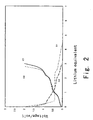
- the test cell A thus prepared was subjected to a charge and discharge cycle under conditions of a constant current of 0.1 mA with a final voltage of 0 V of discharge (D) and a final voltage of 2.0 V of charge (C) .
- the charge and discharge characteristics thus obtained are shown in Fig. 2.
- D1 shows a first discharge
- D2 shows a second discharge
- C1 shows a first charge
- C2 shows a second charge.
- charge and discharge characteristics of a test cell B in which a product obtained by grinding and grading commercially available SnO with an automatic mortar as an active material for the working electrode are shown in Fig. 3. Comparing Fig. 2 and Fig. 3, it is seen that the charge and discharge after the second cycle are almost the same. It can thus be considered that the materials after charge and discharge are in practical terms the same.
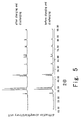
- X-ray diffraction measurement results for SnO used as the working electrode of the test cell B both before and after charge and discharge are shown in Fig. 4.
- X-ray measurement results of Sn used as the working electrode of the test cell A are shown in Fig. 5.
- the measurement material was prepared by grinding with an agate mortar a working electrode taken from a battery, in a dry room with a dew point of 60°C.
- the lower chart, which is before charge and discharge, in Fig. 4 shows the result for SnO.
- the charts show that SnO was reduced to Sn by incorporation into and release from the working electrode of lithium by deep charge and discharge.
- the particle size of tin is preferably 500 ⁇ m or less, more preferably 100 ⁇ m or less, and most preferably 50 to 0.1 ⁇ m. Its specific surface area is preferably 0.05 to 100 m 2 /g, more preferably 0.1 to 50 m 2 /g, and most preferably 0.1 to 30 m 2 /g.
- tin oxide such as SnO or SnO 2 as a starting material and reduce it by electrochemical reaction with lithium or a material containing lithium.
- a transition metal composite oxide containing lithium capable of migrating in charge and discharge is used as a positive electrode active material; an electrode (negative electrode) is previously constituted using tin which does not contain lithium or contains lithium in a small amount (the lithium equivalent to tin is 1 or less).
- the electrode can be made as tin containing lithium by charging it using the same after assembling a battery. Therefore, there are advantages that it is not necessary to produce a battery using tin containing lithium (in large amount) which is oxidized with oxygen or moisture in the air and which is unstable. The production process and production facilities become simple and production costs are considerably reduced. Further, where a transition metal composite oxide which does not contain lithium capable of migrating in charge and discharge is used as a positive electrode active material; the material can be made as tin containing lithium by directly contacting lithium with a negative electrode active material.
- the potential of this lithium-containing manganese oxide is somewhat too high to produce a battery that is charged at 2.5V using the combination with a tin negative electrode. Therefore, it is necessary to increase the amount of lithium incorporated into a positive electrode during discharge in order to decrease the potential of the electrode.
- the maximum amount of lithium equivalent mol (atomic ratio) to 1 mol of Mn, incorporated into a positive electrode in discharging is made to be 0.66 ⁇ x ⁇ 0.90. This results in a battery which can be charged at 2.5 V.
- the range is 0.7 ⁇ x ⁇ 0.83. If x exceeds 0.83, lithium-containing manganese oxide undergoes structural changes, such as phase transition, and capacity decrease may occur.
- the material When the amount of lithium in lithium-containing manganese oxide is high the material has a high resistance value. Therefore, it is important to add a powdery carbon as a conductive assistant (in the proportion of 7% or more, and preferably 9% or more), thereby decreasing the resistance value of the positive electrode. Adding carbon that does not participate in charge sacrifices the battery capacity. Therefore, the upper limit of the amount of carbon to be added to a positive electrode may be determined, considering the battery capacity.
- Embodiments of the present invention use a negative electrode comprising a powdery tin or tin alloy, a powdery carbon having an electrical conductivity, and a resin binder; a positive electrode having as an active material a metal oxide containing a transition metal as a constituent element; and a non-aqueous electrolyte with lithium ion conductivity comprising a dissolved lithium compound or a solid solubilized in an organic solvent.
- the tin powder constituting the negative electrode is not particularly limited; but a powder prepared by, for example, grinding or atomizing method can be used.
- the tin or tin alloy constituting a negative electrode it is effective to reduce an oxide of tin by electrochemical reaction between the oxide of tin and lithium, or a material containing lithium, inside a battery after assembling the battery. Alternatively, it can be produced inside or outside the battery in the course of production of the battery.
- a negative electrode material tin and tin oxide may be mixed and used, or only part of the tin oxide may be reduced by lithium or lithium alloy and may be used as such.
- transition metals elements of 4th, 5th and 6th Periods in the Periodic Table and elements belonging to III-A Group to II-B Group
- elements belonging to IV-B Group elements belonging to alkali metal (elements belonging I-A Group, II-A Group in the Periodic Table) or P, Cl, Br, I or F
- the amount of the compounds to be added is preferably 0 to 20 mol%.
- the equivalent mol of lithium insertion in a negative electrode is preferably 2 to 4.5 mol.
- SnO is used, it is preferably 2.5 to 6.5 mol.
- SnO is used as a starting material for a negative electrode, it is reduced up to metallic Sn.
- loss of release to lithium insertion in an initial charge and discharge cycle is about 1.5 mol to 1 mol of Sn. But, if the cycle is repeated, the loss is 2 mol or more than the case when metallic Sn is produced.
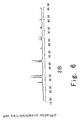
- the presence of metallic Sn is confirmed by X ray diffraction of Figs. 4, 5 and 6. It is unclear whether doping and undoping lithium in Sn is a doping in an ion state or whether alloyed Sn with lithium is formed.
- the minimum constituent element of the negative electrode according to the present invention is a powdery tin or tin alloy, a powdery carbon with electron conductivity, and a resin binder. Fillers and/or various additives or the like may be added according to need.
- the lithium-containing manganese oxide which is the positive electrode material according to the present invention may contain at least one kind of transition metal elements, typical elements and rare earth elements to form a composite metal oxide or a mixture. Particularly preferable dopants are P, Co, Ni, Ti, V, Zr, Nb, Mo, W, Fe, Cr, and the like.
- a method of containing lithium in the positive electrode material is the electrochemical method.
- the positive electrode active materials that can be used in combination with Sn in the service voltage range of the present invention are NaCrS, TiO 2 , VO 2 , MoO 3 , iron mixed valence complex (Prussian blue or the like), and the like in addition to lithium-containing manganese oxide having a potential to lithium of 3 V. Those lithium-containing compounds can also be used.
- the average particle size of the positive electrode active material used in the present invention is preferably 500 ⁇ m or less, more preferably 100 ⁇ m or less, and most preferably 50 to 0.1 ⁇ m.
- the form of the active material is preferably a primary particle aggregate having an average particle size of 1 micron or more and 20 microns or less comprising an aggregate of primary particles having an average particle size of 0.1 micron or more and 2.5 microns or less. More preferably the material is a primary particle aggregate having an average particle size of 3.5 microns or more and 9.5 microns or less comprising an aggregate of primary particles having an average particle size of 0.1 micron or more and 2.5 microns or less.
- the entire volume preferably 80% or more of the entire volume (more preferably 85% or more of the entire volume, and most preferably 90% or more of the entire volume) has a particle size of 1 micron or more and 15 microns or less.
- the specific surface area is preferably 0.05 to 100 m 2 /g, more preferably 0.1 to 50 m 2 /g, and most preferably 0.1 to 30 m 2 /g.
- Materials which dope lithium in tin or tin oxide for use in the present invention are lithium metals, lithium alloys, and baked carbonaceous compounds which can absorb and release lithium ion or lithium metal.
- the purpose of using the above-mentioned lithium metal or lithium alloy together is to reduce oxides of tin or to dope lithium in tin in a battery.
- the electrode can be in various shapes; such as plate-like, film-like, column-like or formation on a metal foil.
- a mixture of positive electrode active materials or negative electrode active materials are mainly used by compressing them into the shape of a pellet.
- an electrode in sheet form can be punched and used. The thickness and diameter of the pellet are determined depending on the size of the battery.
- a mixture of positive electrode active materials or negative electrode active materials is mainly obtained by coating on a collector, drying and compressing.
- the thickness, length and width of the coating are determined depending on the size of the battery.
- the thickness of the coating is preferably 1 to 2,000 ⁇ m when compressed after drying.
- Generally employed methods can be used to form the pellet by pressing.
- a mold press method or calendar press method is preferable.
- the press pressure is not particularly limited, but 0.2 to 3 t/cm 2 is preferable.
- the press rate of the calendar press method is preferably 0.1 to 50 m/min.
- the press temperature is preferably from room temperature to 200 °C.
- Conductive agents, binders, fillers or like can be added to the electrode mixture.
- the kind of conductive agent is not particularly limited, and metal powder may be used.
- carbonaceous materials are particularly preferable. Carbon materials are most general and natural graphite (flaky graphite, scaly graphite, soil graphite), artificial graphite, carbon black, channel black, thermal black, furnace black, acetylene black, carbon fiber and the like can be used. Further, metal powder such as copper, nickel, or silver, or metal fiber can be used as a metal. Conductive polymers can also be used.
- the amount of carbon to be added is not particularly limited due to the fact that the mixing ratio differs depending on electrical conductivity of the active material, electrode shape, or the like.
- the negative electrode 1 to 50% by weight is preferable, and 2 to 40% by weight is particularly preferable.
- the positive electrode since it is necessary to decrease the resistance as much as possible; 7 to 50% by weight is preferable, and 9 to 40% by weight is particularly preferable.
- the average particle size of the carbon is in the range of 0.5 to 50 ⁇ m, preferably in the range of 0.5 to 15 ⁇ m, and more preferably in the range of 0.5 to 6 ⁇ m.
- the contact property between active materials becomes good, network formation of electron conduction is increased, and active materials which do not participate in electrochemical reaction are decreased.
- Binders are preferably materials that are insoluble in electrolyte solution, but they are not particularly limited.
- polysaccharides, thermoplastic resins, thermosetting resins, polymers having rubber elasticity, and the like such as polyacrylic acid and polyacrylic acid neutralized product, polyvinyl alcohol, carboxymethyl cellulose, starch, hydroxypropyl cellulose, regenerated cellulose, diacetyl cellulose, polyvinyl chloride, polyvinyl pyrolidone, tetrafluoroethylene, polyvinylidene fluoride, polyethylene, polypropylene, ethylene-propylene-diene polymer (EPDM), sulfonated EPDM, styrene butadiene rubber, polybutadiene, fluororubber, polyethylene oxide, polyimide, epoxy resin, phenol resin or the like, can be used alone or in mixtures.
- the amount of the binder to be added is not particularly limited, but 1 to 50% by weight is preferable. In particular, for
- fillers can be used so long as they are preferably fibrous materials which do not cause chemical change.
- fibers of olefin polymers such as polypropylene or polyethylene, glasses, carbon, and the like can be used.
- the amount of filler to be added is not particularly limited, but 0 to 30% by weight is preferable.
- the electrolyte solution is not particularly limited.
- Organic solvents used in conventional non-aqueous secondary battery can be used. Cyclic esters, chain esters, cyclic ethers, chain ethers, and the like can be used as the organic solvents. Examples thereof are organic solvents such as propylene carbonate (PC), ethylene carbonate (EC), butylene carbonate (BC), vinylene carbonate, dimethyl carbonate (DMC), diethyl carbonate (DEC), ⁇ -butyrolactone( ⁇ BL), 2-methyl- ⁇ -butyrolactone, acetyl- ⁇ -butyrolactone, ⁇ -valerolactone, 1,2-dimethoxyethane (DME), 1,2-ethoxyethane, diethyl ether, ethylene glycol dialkyl ether, diethylene glycol dialkyl ether, triethylene glycol dialkyl ether, tetraethylene glycol dialkyl ether, dipropyl carbonate, methyleth
- Main impurities present in the above-mentioned solvents include water, and organic peroxides (for example, glycols, alcohols, carboxylic acids). It is considered that each of the above-mentioned impurities form an insulating coating on the surface of the graphitized product; thereby increasing interfacial resistance of the electrode. This provides the possibility of influencing a decrease in cycle life or capacity. Further, there is the possibility that self-discharge during storage can increase.
- the impurities are decreased as much as possible. More specifically, it is preferable that the water content is 50 ppm or less and organic peroxide is 1,000 ppm or less.
- At least one kind of salt such as lithium perchlorate (LiClO 4 ), lithium hexafluorophosphate (LiPF 3 ), lithium borofluoride (LiBF 4 ), lithium hexafluoroarsenate (LiBF 4 ), lithium trifluorometasulfonate (LiCF 3 SO 3 ), lithium bistrifluoromethylsulfonyl imide [LiN(CF 3 SO 2 ) 2 ], thiocynate or aluminum fluoride can be used. It is desirable that the dissolution amount to the non-aqueous solvent is 0.5 to 3.0 mol/l.
- a battery production was conducted with an electrolyte solution containing EC, DEC (1 : 2) and 1M of LiClO 4 , and a good result was obtained.
- deterioration was large.
- the battery was dismantled and X ray diffraction of the negative electrode active material was conducted, Sn formation was recognized.
- an optical nicroscope it was found that many needle-like (whisker) Sn structures were present. Since needle-like Sn does not have contact with graphite added as the conductive agent, it is considered that deterioration occurs. Similar deterioration tends to occur in DMC and EMC that are chain carbonate, other than DEC.
- the solid electrolyte may be distinguished as an inorganic solid electrolyte or an organic solid electrolyte.
- Nitride of Li, halide, oxyacid salt, and the like are well known as inorganic solid electrolytes.
- Polyethylene oxide derivatives or polymers containing the derivatives, polypropylene oxide derivatives or polymers containing the derivatives, phosphoric acid ester polymers, and the like are effective as the organic solid electrolyte.
- a method of using inorganic and organic solid electrolytes together is known.
- An insulating thin film having a large ion permeability and also having a predetermined mechanical strength can be used as the separator. From the standpoints of organic solvent resistance and hydrophobicity; sheets or non-woven fabrics made from olefin polymers such as polypropylene, glass fibers or polyethylene are generally used.
- the pore size of the separator is in the range generally used for batteries. For example, 0.01 to 10 ⁇ m may be used.
- the thickness of the separator is the range generally used for batteries, for example 5 to 300 ⁇ m. Further, it is effective as a safe countermeasure to use a separator in which the ion permeability is changed depending on temperature.
- additives may be added for the purpose of improving discharge or charge and discharge characteristics. They may directly be added to the active material, but a method of adding them to the electrolyte solution is most generally used.
- the additives may be toluene, pyridine and the like.
- electrolyte solution incombustible for example, carbon tetrachloride or ethylene trifluorochloride may be added to the electrolyte solution.
- the electrolyte solution or electrolyte can be contained in the mixture of the positive electrode or the negative electrode.
- a method of containing the above-mentioned polymer with ion conductivity or nitromethane is known from Japanese Patent Application Laid-open No. Sho 48-36633.
- a method is known from Japanese Patent Application Laid-open No. Sho 57-124870.
- a metal plate or a metal foil having a small electric resistance is preferable.
- a metal plate or a metal foil having a small electric resistance is preferable.
- nickel, aluminum, titanium, tungsten, gold, platinum, baked carbon and the like aluminum or stainless the surface of which is treated with carbon, nickel, titanium or silver, can be used as a material for the positive electrode. Two-phase stainless steel is effective against corrosion.
- nickel plating can be conducted for the outer portion of the battery.
- the treating method includes wet plating, dryplating, CVD, PVD, clad formation with press-fixing, coating, and the like.
- the treating method includes wet plating, dry plating, CVD, PVD, clad formation with press-fixing, coating, and the like.
- the surface of those materials is sometimes oxidized, but benzotriazole, triazine thiol, alkyl thiol, fluorine type water repellent, silicon type water repellent and the like can be used as an anti-rust treatment.
- the shape is foil, can , film, sheet, net, punched product, lathe product, porous material, foamed product, molded article of fibers, or the like.
- the thickness is not particularly limited.
- a terminal can be fixed by resistance welding, laser welding or the like.
- Materials for the terminal include stainless steel, stainless-nickel clad material, stainless steel having nickel or gold plated thereon, and the like. They are not particularly limited so long as they are metal.
- a material prepared by adding a powder of carbon or metal, or fiber to a resin dissolved in a solvent, a material prepared by dissolving a conductive polymer, or the like can be used as the conductive adhesive.
- the adhesive can be coated between the collector and the electrode pellet to fix an electrode.
- the conductive adhesive in this case often contains a thermosetting resin.
- the adhesive is used for the purpose of electrical connection, rather than physical adhesion of the collector and the electrode.
- polypropylene, polyethylene, polyamide resin and various engineering plastics can be used as the gasket.
- a polypropylene-made gasket is used.
- materials such as engineering plastics having a high heat resistant temperature may be used in order to cope with the reflow temperature in mounting a battery on a substrate.
- a sealing compound of one kind or a mixture of asphalt pitch, butyl rubber, fluororubber, chlorosulfonated polyethylene, epoxy resin, and the like is used between the gasket and positive and negative cans.
- the sealing compound is transparent, it may be colored to clarify the presence or the absence of the coating.
- a method of coating the sealing compound the following can be used: injection of the sealing compound in a gasket; coating on positive and negative cans; dipping a gasket in a sealing compound solution; and the like.
- the shape of the battery can be coin, button, sheet, cylinder, rectangle and the like.
- non-aqueous secondary battery of the present invention is not particularly limited, and includes, for example, portable telephone, backup electric power supply for pager or the like, electric power supply of wrist watch having a generator function, and the like.
- the battery of the present invention is assembled in a moisture-free atmosphere or inert gas atmosphere. Further, it is preferable that the parts to be assembled are dried beforehand. Methods generally employed can be utilized as drying or water-removal methods for the pellet, sheet or other parts. In particular, it is preferable to use hot air, vacuum, infrared ray, far infrared ray, electron beam and low moisture air, alone or in combination thereof.
- the temperature is preferably in the range of 80 to 350°C, and in particular, the range of 100 to 250°C is preferable.
- Water content is preferably 2,000 ppm or less in the entire battery. It is preferable in a positive electrode mixture, a negative electrode mixture or the electrolyte that the water content is 20 ppm or less, respectively, from the point of improved cycle characteristic.
- the present examples are examples in which lithium containing manganese oxide is used as a positive electrode active material, and Sn is used as a negative electrode active material.
- the positive electrode, negative electrode and electrolyte solution prepared as below were used.
- the size of the battery outer diameter was 6.8 mm and thickness of 2.1 mm.
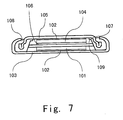
- a cross sectional view of the battery is shown in Fig. 7.
- a negative electrode was prepared as follows. A powder obtained by grinding and grading commercially available Sn or SnO with an automatic mortar to a diameter of 44 ⁇ m or less was used as an active material of the working electrode. With this active material, graphite as a collector and polyacrylic acid as a binder were mixed in a weight ratio of 70.5 : 21.5 7, respectively, to prepare a negative electrode mixture. This mixture was press-molded into a pellet having a diameter of 4.05 mm with 2 ton/cm 2 . The negative electrode pellet 104 thus obtained was adhered to a negative electrode case 105 using an electrode collector 102 comprising a conductive resin binder containing carbon as a conductive filler, to form a unitary body. The resulting unitary body was heated and dried at 150 °C for 8 hours under reduced pressure. Further, a product obtained by punching a lithium foil 106 with a diameter of 4 mm was press fixed to the pellet to form a lithium-negative electrode laminate battery.
- Examples 1 to 4 a battery was prepared in the manner such that equivalent mol of Li to 1 mol of Mn of the positive electrode was increased.
- the actual equivalent of Li to Mn 1 mol of the positive electrode is shown in the right-hand column of Table 1.
- An electrolyte solution 107 used was a solution prepared by dissolving 1 mol/l of LiC1O 4 in a mixed solvent of ⁇ -BL, EC and DME in a volume ratio of 1 : 1 : 2.
- a charge and discharge cycle test was conducted on the battery thus prepared under the conditions of discharging at a constant current of 50 ⁇ A with a final voltage of 1.2 V and charging by maintaining a constant current of 50 ⁇ A with a final voltage of 2.5 V for 24 hours.
- Negative electrode active material Mass of negative electrode active material (mg) Mass of positive electrode active material (mg) Lithium thickness (mm) Li equivalent mol to positive electrode Mn 1 Sn 6.4 26.4 0.25 0.62 2 Sn 8.9 17.6 0.31 0.76 3 Sn 9.9 15.0 0.34 0.81 4 Sn 10.1 14.2 0.35 0.84 5 SnO 9.3 26.4 0.25 0.63 6 SnO 12.8 17.6 0.31 0.74 7 SnO 14.3 15.0 0.34 0.83 8 SnO 14.6 14.2 0.35 0.84 The equivalent mol of Li to 1 mol of Mn of the positive electrode was calculated from the results obtained by conducting quantitative analysis by plasma emission spectroscopy as follows, and was described in the Table.
- Discharging 5th cycle of each battery was performed up to 0.0 V, and the battery was then overhauled to pick up a positive electrode.
- the positive electrode picked up was washed with ethyl methyl carbonate, and filtered, followed by drying, and plasma emission spectroscopy was conducted. It can be considered that this lithium amount is almost the maximum to be incorporated in the positive electrode upon general charging and discharging.
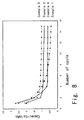
- Example 1 The number of cycles and change of discharge capacity where Sn was used as an active material are shown in Fig. 8.
- Example 1 is the case that lithium amount to a positive electrode is small. Considering the respective electrode in the inside of the battery; since the amount of lithium which moves between the electrodes is small, the positive electrode and also the negative electrode utilize a portion having high potential. In particular, a portion having high potential in the negative electrode is a region in which the cycle is unstable. Therefore deterioration of capacitance by the cycle is large.
- lithium to a positive electrode is increased.
- Lithium incorporated in the positive electrode at the 1st discharge is larger than that incorporated at the 2nd discharge or after.
- Lithium corresponding to the difference of capacity between the 1st discharge and the 2nd discharge remains in the positive electrode at the 1st discharge, and does not participate in the subsequent discharge.
- this lithium decreases the potential of the positive electrode, a stable region having lower potential than the negative electrode can be utilized. For this reason, cycle deterioration after the 2nd discharge is small.
- Example 4 is the case that lithium to the positive electrode is further increased.
- Lithium which can further be incorporated in a positive electrode on the design of the battery is incorporated into the battery (a design such that Li equivalent mol to 1 mol of Mn of positive electrode is 0.91).
- the resistance of the positive electrode increases, and it is considered that lithium corresponding to the increased portion is not incorporated in the positive electrode.
- Li equivalent mol to 1 mol of Mn of positive electrode was incorporated only 0.84 as shown in Table 1). For this reason, the capacity is somewhat low.
- the present invention provides a non-aqueous electrolyte secondary battery, characterized by using a negative electrode comprising a powdery tin or tin alloy, a powdery carbon with electron conductivity and a resin binder, a positive electrode having as an active material a metal oxide containing a transition metal as a constituent element, and a non-aqueous electrolyte with lithium ion conductivity comprised of a lithium compound dissolved or solid solubilized in an organic solvent.
- a battery having excellent characteristics can be obtained by using tin obtained by reducing oxide of tin with lithium, as a negative electrode active material.
- a battery having excellent cycle characteristics can be produced by making that the maximum amount of lithium incorporated in the positive electrode 0.66 ⁇ x ⁇ 0.90.
- cycle characteristics are further improved by the proportion of powder carbon added as an electron conductive assistant to the positive electrode.
- an electrolyte solution which contains 1,2-dimethoxy ethane, ethylene carbonate and lithium compound as essential elements, and contains ⁇ -butyrolactone as an selective element; the high temperature dependence characteristic is improved, and safety in avoiding explosion is improved should a high voltage be applied.
Landscapes
- Chemical & Material Sciences (AREA)
- Chemical Kinetics & Catalysis (AREA)
- Electrochemistry (AREA)
- General Chemical & Material Sciences (AREA)
- Engineering & Computer Science (AREA)
- Manufacturing & Machinery (AREA)
- Inorganic Chemistry (AREA)
- Materials Engineering (AREA)
- Condensed Matter Physics & Semiconductors (AREA)
- General Physics & Mathematics (AREA)
- Physics & Mathematics (AREA)
- Battery Electrode And Active Subsutance (AREA)
- Secondary Cells (AREA)
Abstract
Description
| Example No. | Negative electrode active material | Mass of negative electrode active material (mg) | Mass of positive electrode active material (mg) | Lithium thickness (mm) | Li equivalent mol to |
| 1 | Sn | 6.4 | 26.4 | 0.25 | 0.62 |
| 2 | Sn | 8.9 | 17.6 | 0.31 | 0.76 |
| 3 | Sn | 9.9 | 15.0 | 0.34 | 0.81 |
| 4 | Sn | 10.1 | 14.2 | 0.35 | 0.84 |
| 5 | SnO | 9.3 | 26.4 | 0.25 | 0.63 |
| 6 | SnO | 12.8 | 17.6 | 0.31 | 0.74 |
| 7 | SnO | 14.3 | 15.0 | 0.34 | 0.83 |
| 8 | SnO | 14.6 | 14.2 | 0.35 | 0.84 |
Claims (6)
- A non-aqueous electrolyte secondary battery, characterized by using a negative electrode comprising a powdery tin or tin alloy, a powdery carbon with electron conductivity and a resin binder, a positive electrode having as an active material a metal oxide containing a transition metal as a constituent element, and a non-aqueous electrolyte with lithium ion conductivity comprised of a lithium compound dissolved or solid solubilized in an organic solvent.
- The non-aqueous electrolyte secondary battery as claimed in claim 1, characterized in that the tin or tin alloy is obtained by reducing oxide of the tin by electrochemical reaction of oxide of tin with lithium or a material containing lithium inside a battery after assembling the battery, or inside or outside the battery in the course of battery production.
- The non-aqueous electrolyte secondary battery as claimed in claim 1, characterized in that the negative electrode is one in which lithium is incorporated in a negative electrode substrate by electrochemical reaction of the negative electrode substrate containing tin or tin alloy, electron conductive powder and the resin binder, the compositional ratio of lithium and tin, Li/Sn, being 1 or less, with lithium or a material containing lithium.
- The non-aqueous electrolyte secondary battery as claimed in claim 1, characterized in that in the non-aqueous electrolyte secondary battery in which the center of service voltage is 2.7 V to 0.8 V, the positive electrode is represented by an atomic ratio of Li : Mn : 0 = x : 1 : y (2 ≤ y ≤ 3), and the maximum value which the atomic ratio of Li can have, is in the range of 0.66 ≤ x ≤ 0.90.
- The non-aqueous electrolyte secondary battery as claimed in claim 4, characterized in that the proportion of the powdery carbon added to the positive electrode as an electron conductive assistant is 7% or more.
- The non-aqueous electrolyte secondary battery as claimed in claim 1, characterized in that 1,2-dimethoxyethane and a lithium compound are contained as the essential element of the non-aqueous electrolyte with lithium ion conductivity comprised of the lithium compound dissolved or solid solubilized in the organic solvent or polymer, and γ-butyrolactone is contained as a selective element.
Applications Claiming Priority (3)
| Application Number | Priority Date | Filing Date | Title |
|---|---|---|---|
| JP74170/97 | 1997-03-26 | ||
| JP07417097A JP3200025B2 (en) | 1997-03-26 | 1997-03-26 | Non-aqueous electrolyte secondary battery |
| JP7417097 | 1997-03-26 |
Publications (2)
| Publication Number | Publication Date |
|---|---|
| EP0867955A1 true EP0867955A1 (en) | 1998-09-30 |
| EP0867955B1 EP0867955B1 (en) | 2004-05-19 |
Family
ID=13539426
Family Applications (1)
| Application Number | Title | Priority Date | Filing Date |
|---|---|---|---|
| EP98302265A Expired - Lifetime EP0867955B1 (en) | 1997-03-26 | 1998-03-25 | Non-aqueous electrolyte secondary battery |
Country Status (3)
| Country | Link |
|---|---|
| EP (1) | EP0867955B1 (en) |
| JP (1) | JP3200025B2 (en) |
| DE (1) | DE69823910T2 (en) |
Cited By (4)
| Publication number | Priority date | Publication date | Assignee | Title |
|---|---|---|---|---|
| WO2001067528A1 (en) * | 2000-03-07 | 2001-09-13 | Matsushita Electric Industrial Co., Ltd. | Non-aqueous electrolyte secondary battery |
| EP1160898A3 (en) * | 2000-05-25 | 2002-06-12 | MERCK PATENT GmbH | Reduced tin oxides as anode active material in electrochemical cells |
| US7875388B2 (en) | 2007-02-06 | 2011-01-25 | 3M Innovative Properties Company | Electrodes including polyacrylate binders and methods of making and using the same |
| CN116262955A (en) * | 2021-12-15 | 2023-06-16 | 重庆天齐锂业有限责任公司 | Lithium tin intermetallic compound and preparation method and application thereof |
Families Citing this family (14)
| Publication number | Priority date | Publication date | Assignee | Title |
|---|---|---|---|---|
| JP3619000B2 (en) * | 1997-01-28 | 2005-02-09 | キヤノン株式会社 | Electrode structure, secondary battery, and manufacturing method thereof |
| JP2001196052A (en) * | 2000-01-12 | 2001-07-19 | Sony Corp | Negative electrode and non-aqueous electrolyte battery |
| US7276314B2 (en) | 2000-12-22 | 2007-10-02 | Fmc Corporation | Lithium metal dispersion in secondary battery anodes |
| US6706447B2 (en) | 2000-12-22 | 2004-03-16 | Fmc Corporation, Lithium Division | Lithium metal dispersion in secondary battery anodes |
| US8980477B2 (en) | 2000-12-22 | 2015-03-17 | Fmc Corporation | Lithium metal dispersion in secondary battery anodes |
| US7341804B2 (en) * | 2002-09-20 | 2008-03-11 | 3M Innovative Properties Company | Anode compositions having an elastomeric binder and an adhesion promoter |
| JP4546740B2 (en) * | 2004-01-07 | 2010-09-15 | 三井金属鉱業株式会社 | Method for producing negative electrode for non-aqueous electrolyte secondary battery |
| US8231810B2 (en) | 2004-04-15 | 2012-07-31 | Fmc Corporation | Composite materials of nano-dispersed silicon and tin and methods of making the same |
| US7771874B2 (en) | 2005-06-29 | 2010-08-10 | Fmc Corporation | Lithium manganese compounds and methods of making the same |
| US7588623B2 (en) | 2005-07-05 | 2009-09-15 | Fmc Corporation Lithium Division | Stabilized lithium metal powder for li-ion application, composition and process |
| US20090035663A1 (en) | 2006-10-13 | 2009-02-05 | Fmc Corporation, Lithium Division | Stabilized lithium metal powder for li-ion application, composition and process |
| US8021496B2 (en) | 2007-05-16 | 2011-09-20 | Fmc Corporation | Stabilized lithium metal powder for Li-ion application, composition and process |
| JP2011124052A (en) * | 2009-12-10 | 2011-06-23 | Murata Mfg Co Ltd | Nonaqueous electrolyte secondary battery and method for charging the same |
| KR20250096871A (en) * | 2018-05-02 | 2025-06-27 | 테슬라, 인크. | Compositions and methods for silicon containing dry anode films |
Citations (9)
| Publication number | Priority date | Publication date | Assignee | Title |
|---|---|---|---|---|
| US4814242A (en) * | 1987-10-13 | 1989-03-21 | Allied-Signal Inc. | Elastomeric binders for battery electrodes |
| EP0460617A2 (en) * | 1990-06-04 | 1991-12-11 | Mitsubishi Petrochemical Co., Ltd. | Alkali-metal based electrode for secondary battery |
| US5262255A (en) * | 1991-01-30 | 1993-11-16 | Matsushita Electric Industrial Co., Ltd. | Negative electrode for non-aqueous electrolyte secondary battery |
| DE4320140A1 (en) * | 1992-08-06 | 1994-02-10 | Hitachi Ltd | Composite anode for sec. batteries with non-aq. electrolytes - contains alkali metal alloy powder as active material, with oxygen-contg. carbon powder and ethylene@]-propylene] copolymer binder |
| JPH06275268A (en) * | 1993-03-22 | 1994-09-30 | Seiko Instr Inc | Nonaqueous electrolyte secondary battery |
| EP0651450A1 (en) * | 1993-10-22 | 1995-05-03 | Fuji Photo Film Co., Ltd. | Nonaqueous secondary battery |
| EP0664570A1 (en) * | 1994-01-21 | 1995-07-26 | Renata AG | Primary or secondary electrochemical generator having an electrode comprising nanometer size particles |
| JPH07235293A (en) * | 1994-02-24 | 1995-09-05 | Fuji Photo Film Co Ltd | Nonaqueous electrolyte secondary battery |
| WO1996013873A1 (en) * | 1994-10-27 | 1996-05-09 | Fuji Photo Film Co., Ltd. | Nonaqueous secondary cell and its manufacturing method |
-
1997
- 1997-03-26 JP JP07417097A patent/JP3200025B2/en not_active Expired - Lifetime
-
1998
- 1998-03-25 DE DE69823910T patent/DE69823910T2/en not_active Expired - Fee Related
- 1998-03-25 EP EP98302265A patent/EP0867955B1/en not_active Expired - Lifetime
Patent Citations (10)
| Publication number | Priority date | Publication date | Assignee | Title |
|---|---|---|---|---|
| US4814242A (en) * | 1987-10-13 | 1989-03-21 | Allied-Signal Inc. | Elastomeric binders for battery electrodes |
| EP0460617A2 (en) * | 1990-06-04 | 1991-12-11 | Mitsubishi Petrochemical Co., Ltd. | Alkali-metal based electrode for secondary battery |
| US5262255A (en) * | 1991-01-30 | 1993-11-16 | Matsushita Electric Industrial Co., Ltd. | Negative electrode for non-aqueous electrolyte secondary battery |
| DE4320140A1 (en) * | 1992-08-06 | 1994-02-10 | Hitachi Ltd | Composite anode for sec. batteries with non-aq. electrolytes - contains alkali metal alloy powder as active material, with oxygen-contg. carbon powder and ethylene@]-propylene] copolymer binder |
| JPH06275268A (en) * | 1993-03-22 | 1994-09-30 | Seiko Instr Inc | Nonaqueous electrolyte secondary battery |
| EP0651450A1 (en) * | 1993-10-22 | 1995-05-03 | Fuji Photo Film Co., Ltd. | Nonaqueous secondary battery |
| EP0664570A1 (en) * | 1994-01-21 | 1995-07-26 | Renata AG | Primary or secondary electrochemical generator having an electrode comprising nanometer size particles |
| JPH07235293A (en) * | 1994-02-24 | 1995-09-05 | Fuji Photo Film Co Ltd | Nonaqueous electrolyte secondary battery |
| WO1996013873A1 (en) * | 1994-10-27 | 1996-05-09 | Fuji Photo Film Co., Ltd. | Nonaqueous secondary cell and its manufacturing method |
| EP0789412A1 (en) * | 1994-10-27 | 1997-08-13 | Fuji Photo Film Co., Ltd. | Nonaqueous secondary cell and its manufacturing method |
Non-Patent Citations (5)
| Title |
|---|
| DATABASE INSPEC INSTITUTE OF ELECTRICAL ENGINEERS, STEVENAGE, GB; COURTNEY I A ET AL: "Electrochemical and in situ X-ray diffraction studies of the reaction of lithium with tin oxide composites", XP002072396 * |
| J ET AL: "Small particle size multiphase Li-alloy anodes for lithium-ion -batteries", SOLID STATE IONICS, vol. 90, no. 1-4, September 1996 (1996-09-01), pages 281-287, XP004071677 * |
| JOURNAL OF THE ELECTROCHEMICAL SOCIETY, JUNE 1997, ELECTROCHEM. SOC, USA, vol. 144, no. 6, ISSN 0013-4651, pages 2045 - 2052, XP002072409 * |
| PATENT ABSTRACTS OF JAPAN vol. 018, no. 681 (E - 1649) 21 December 1994 (1994-12-21) * |
| PATENT ABSTRACTS OF JAPAN vol. 096, no. 001 31 January 1996 (1996-01-31) * |
Cited By (7)
| Publication number | Priority date | Publication date | Assignee | Title |
|---|---|---|---|---|
| WO2001067528A1 (en) * | 2000-03-07 | 2001-09-13 | Matsushita Electric Industrial Co., Ltd. | Non-aqueous electrolyte secondary battery |
| US6911282B2 (en) | 2000-03-07 | 2005-06-28 | Matsushita Electric Industrial Co., Ltd. | Non-aqueous electrolyte secondary battery |
| EP1160898A3 (en) * | 2000-05-25 | 2002-06-12 | MERCK PATENT GmbH | Reduced tin oxides as anode active material in electrochemical cells |
| US6727020B2 (en) * | 2000-05-25 | 2004-04-27 | MERCK Patent Gesellschaft mit beschränkter Haftung | Reduced positive-electrode material in an electrochemical cell |
| US7875388B2 (en) | 2007-02-06 | 2011-01-25 | 3M Innovative Properties Company | Electrodes including polyacrylate binders and methods of making and using the same |
| CN116262955A (en) * | 2021-12-15 | 2023-06-16 | 重庆天齐锂业有限责任公司 | Lithium tin intermetallic compound and preparation method and application thereof |
| CN116262955B (en) * | 2021-12-15 | 2024-06-07 | 重庆天齐锂业有限责任公司 | Lithium tin intermetallic compound and preparation method and application thereof |
Also Published As
| Publication number | Publication date |
|---|---|
| EP0867955B1 (en) | 2004-05-19 |
| DE69823910D1 (en) | 2004-06-24 |
| JPH10270086A (en) | 1998-10-09 |
| DE69823910T2 (en) | 2005-06-23 |
| JP3200025B2 (en) | 2001-08-20 |
Similar Documents
| Publication | Publication Date | Title |
|---|---|---|
| US6083644A (en) | Non-aqueous electrolyte secondary battery | |
| EP0867955B1 (en) | Non-aqueous electrolyte secondary battery | |
| JP4608735B2 (en) | Non-aqueous electrolyte secondary battery charging method | |
| EP0567149B1 (en) | Nonaqueous secondary battery | |
| US9214697B2 (en) | Lithium secondary battery | |
| US5807645A (en) | Discharge promoter mixture for reducing cell swelling in alkali metal electrochemical cells | |
| US6051343A (en) | Polymeric solid electrolyte and lithium secondary cell using the same | |
| EP1030398B1 (en) | Gel electrolyte and gel electrolyte battery | |
| US20020061446A1 (en) | Double current collector negative electrode design for alkali metal ion electrochemical cells | |
| CA2017571C (en) | Non-aqueous alkali battery having an improved cathode | |
| EP1492179B1 (en) | Anode material and battery using the same | |
| JP4318800B2 (en) | Non-aqueous electrolyte secondary battery for reflow soldering | |
| JP3481157B2 (en) | Non-aqueous electrolyte battery and method for manufacturing the same | |
| US20020127476A1 (en) | Non-aqueous electrolyte secondary battery | |
| JP4186463B2 (en) | Nonaqueous electrolyte secondary battery | |
| JP2001185214A (en) | Non-aqueous electrochemical device and its electrolyte | |
| KR102436440B1 (en) | Cathode, method for manufacturing the same, and rechargeable lithium battery comprising the same | |
| JPH0997611A (en) | Battery electrodes and secondary batteries | |
| JP3341705B2 (en) | Lithium secondary battery | |
| JPH10270079A (en) | Non-aqueous electrolyte battery | |
| JP3555261B2 (en) | Battery electrolyte and battery | |
| JP2007294179A (en) | Nonaqueous electrolyte secondary battery | |
| JP3555262B2 (en) | Battery electrolyte and battery | |
| JP2707664B2 (en) | Lithium secondary battery | |
| JPH09259891A (en) | Non-aqueous electrolyte secondary battery |
Legal Events
| Date | Code | Title | Description |
|---|---|---|---|
| PUAI | Public reference made under article 153(3) epc to a published international application that has entered the european phase |
Free format text: ORIGINAL CODE: 0009012 |
|
| AK | Designated contracting states |
Kind code of ref document: A1 Designated state(s): DE FR GB |
|
| AX | Request for extension of the european patent |
Free format text: AL;LT;LV;MK;RO;SI |
|
| 17P | Request for examination filed |
Effective date: 19990316 |
|
| AKX | Designation fees paid |
Free format text: DE FR GB |
|
| 17Q | First examination report despatched |
Effective date: 20011024 |
|
| GRAP | Despatch of communication of intention to grant a patent |
Free format text: ORIGINAL CODE: EPIDOSNIGR1 |
|
| GRAS | Grant fee paid |
Free format text: ORIGINAL CODE: EPIDOSNIGR3 |
|
| GRAA | (expected) grant |
Free format text: ORIGINAL CODE: 0009210 |
|
| AK | Designated contracting states |
Kind code of ref document: B1 Designated state(s): DE FR GB |
|
| REG | Reference to a national code |
Ref country code: GB Ref legal event code: FG4D |
|
| REF | Corresponds to: |
Ref document number: 69823910 Country of ref document: DE Date of ref document: 20040624 Kind code of ref document: P |
|
| ET | Fr: translation filed | ||
| PLBE | No opposition filed within time limit |
Free format text: ORIGINAL CODE: 0009261 |
|
| STAA | Information on the status of an ep patent application or granted ep patent |
Free format text: STATUS: NO OPPOSITION FILED WITHIN TIME LIMIT |
|
| 26N | No opposition filed |
Effective date: 20050222 |
|
| REG | Reference to a national code |
Ref country code: GB Ref legal event code: 732E |
|
| REG | Reference to a national code |
Ref country code: FR Ref legal event code: TP |
|
| REG | Reference to a national code |
Ref country code: FR Ref legal event code: TP |
|
| PGFP | Annual fee paid to national office [announced via postgrant information from national office to epo] |
Ref country code: FR Payment date: 20080718 Year of fee payment: 11 |
|
| PGFP | Annual fee paid to national office [announced via postgrant information from national office to epo] |
Ref country code: GB Payment date: 20080625 Year of fee payment: 11 |
|
| PGFP | Annual fee paid to national office [announced via postgrant information from national office to epo] |
Ref country code: DE Payment date: 20090319 Year of fee payment: 12 |
|
| GBPC | Gb: european patent ceased through non-payment of renewal fee |
Effective date: 20090325 |
|
| REG | Reference to a national code |
Ref country code: FR Ref legal event code: ST Effective date: 20091130 |
|
| PG25 | Lapsed in a contracting state [announced via postgrant information from national office to epo] |
Ref country code: GB Free format text: LAPSE BECAUSE OF NON-PAYMENT OF DUE FEES Effective date: 20090325 Ref country code: FR Free format text: LAPSE BECAUSE OF NON-PAYMENT OF DUE FEES Effective date: 20091123 |
|
| PG25 | Lapsed in a contracting state [announced via postgrant information from national office to epo] |
Ref country code: DE Free format text: LAPSE BECAUSE OF NON-PAYMENT OF DUE FEES Effective date: 20101001 |