EP0866137B1 - Process for producing calcium salt of (-)-Erythrohydroxycitric acid - Google Patents
Process for producing calcium salt of (-)-Erythrohydroxycitric acid Download PDFInfo
- Publication number
- EP0866137B1 EP0866137B1 EP19970301777 EP97301777A EP0866137B1 EP 0866137 B1 EP0866137 B1 EP 0866137B1 EP 19970301777 EP19970301777 EP 19970301777 EP 97301777 A EP97301777 A EP 97301777A EP 0866137 B1 EP0866137 B1 EP 0866137B1
- Authority
- EP
- European Patent Office
- Prior art keywords
- hydroxycitric acid
- garcinia
- acid
- mixture
- calcium salt
- Prior art date
- Legal status (The legal status is an assumption and is not a legal conclusion. Google has not performed a legal analysis and makes no representation as to the accuracy of the status listed.)
- Expired - Lifetime
Links
- 238000000034 method Methods 0.000 title claims description 39
- 230000008569 process Effects 0.000 title claims description 35
- 159000000007 calcium salts Chemical class 0.000 title claims description 23
- 239000002253 acid Substances 0.000 title claims description 18
- 229920001277 pectin Polymers 0.000 claims description 45
- 102000004190 Enzymes Human genes 0.000 claims description 43
- 108090000790 Enzymes Proteins 0.000 claims description 43
- 241000593508 Garcinia Species 0.000 claims description 40
- 241000283690 Bos taurus Species 0.000 claims description 38
- 235000000885 Garcinia xanthochymus Nutrition 0.000 claims description 30
- 239000000203 mixture Substances 0.000 claims description 27
- 239000001814 pectin Substances 0.000 claims description 25
- 235000010987 pectin Nutrition 0.000 claims description 25
- 235000013399 edible fruits Nutrition 0.000 claims description 22
- XLYOFNOQVPJJNP-UHFFFAOYSA-N water Substances O XLYOFNOQVPJJNP-UHFFFAOYSA-N 0.000 claims description 20
- 238000010438 heat treatment Methods 0.000 claims description 9
- 239000007900 aqueous suspension Substances 0.000 claims description 8
- 239000003513 alkali Substances 0.000 claims description 7
- 239000000047 product Substances 0.000 claims description 7
- UXVMQQNJUSDDNG-UHFFFAOYSA-L Calcium chloride Chemical compound [Cl-].[Cl-].[Ca+2] UXVMQQNJUSDDNG-UHFFFAOYSA-L 0.000 claims description 5
- 241000173371 Garcinia indica Species 0.000 claims description 5
- 239000001110 calcium chloride Substances 0.000 claims description 5
- 229910001628 calcium chloride Inorganic materials 0.000 claims description 5
- 230000002879 macerating effect Effects 0.000 claims description 3
- 239000006228 supernatant Substances 0.000 claims 2
- 238000000926 separation method Methods 0.000 claims 1
- 229940089491 hydroxycitric acid Drugs 0.000 description 65
- ZMJBYMUCKBYSCP-UHFFFAOYSA-N (+)-Erythro-hydroxycitric acid Natural products OC(=O)C(O)C(O)(C(O)=O)CC(O)=O ZMJBYMUCKBYSCP-UHFFFAOYSA-N 0.000 description 64
- 238000000605 extraction Methods 0.000 description 25
- HEMHJVSKTPXQMS-UHFFFAOYSA-M Sodium hydroxide Chemical compound [OH-].[Na+] HEMHJVSKTPXQMS-UHFFFAOYSA-M 0.000 description 24
- 239000000284 extract Substances 0.000 description 20
- ZMJBYMUCKBYSCP-AWFVSMACSA-N (1s,2r)-1,2-dihydroxypropane-1,2,3-tricarboxylic acid Chemical compound OC(=O)[C@@H](O)[C@@](O)(C(O)=O)CC(O)=O ZMJBYMUCKBYSCP-AWFVSMACSA-N 0.000 description 13
- 150000002596 lactones Chemical class 0.000 description 10
- 239000000243 solution Substances 0.000 description 8
- 238000004448 titration Methods 0.000 description 8
- 229920002488 Hemicellulose Polymers 0.000 description 5
- 239000001913 cellulose Substances 0.000 description 5
- 229920002678 cellulose Polymers 0.000 description 5
- 239000003925 fat Substances 0.000 description 5
- 150000003839 salts Chemical class 0.000 description 5
- LFQSCWFLJHTTHZ-UHFFFAOYSA-N Ethanol Chemical compound CCO LFQSCWFLJHTTHZ-UHFFFAOYSA-N 0.000 description 4
- 150000007513 acids Chemical class 0.000 description 4
- 230000015572 biosynthetic process Effects 0.000 description 4
- 238000002360 preparation method Methods 0.000 description 4
- OKKJLVBELUTLKV-UHFFFAOYSA-N Methanol Chemical compound OC OKKJLVBELUTLKV-UHFFFAOYSA-N 0.000 description 3
- KWYUFKZDYYNOTN-UHFFFAOYSA-M Potassium hydroxide Chemical compound [OH-].[K+] KWYUFKZDYYNOTN-UHFFFAOYSA-M 0.000 description 3
- KRKNYBCHXYNGOX-UHFFFAOYSA-N citric acid Chemical compound OC(=O)CC(O)(C(O)=O)CC(O)=O KRKNYBCHXYNGOX-UHFFFAOYSA-N 0.000 description 3
- 235000005911 diet Nutrition 0.000 description 3
- 230000037213 diet Effects 0.000 description 3
- 230000036449 good health Effects 0.000 description 3
- 230000007407 health benefit Effects 0.000 description 3
- 150000002632 lipids Chemical class 0.000 description 3
- 229910052751 metal Inorganic materials 0.000 description 3
- 239000002184 metal Substances 0.000 description 3
- 239000000758 substrate Substances 0.000 description 3
- 230000001225 therapeutic effect Effects 0.000 description 3
- DTTONLKLWRTCAB-UDFURZHRSA-N (1s,3e,5r,7r)-3-[(3,4-dihydroxyphenyl)-hydroxymethylidene]-6,6-dimethyl-5,7-bis(3-methylbut-2-enyl)-1-[(2s)-5-methyl-2-prop-1-en-2-ylhex-4-enyl]bicyclo[3.3.1]nonane-2,4,9-trione Chemical compound O=C([C@@]1(C(C)(C)[C@H](CC=C(C)C)C[C@](C2=O)(C1=O)C[C@H](CC=C(C)C)C(C)=C)CC=C(C)C)\C2=C(\O)C1=CC=C(O)C(O)=C1 DTTONLKLWRTCAB-UDFURZHRSA-N 0.000 description 2
- NWUYHJFMYQTDRP-UHFFFAOYSA-N 1,2-bis(ethenyl)benzene;1-ethenyl-2-ethylbenzene;styrene Chemical compound C=CC1=CC=CC=C1.CCC1=CC=CC=C1C=C.C=CC1=CC=CC=C1C=C NWUYHJFMYQTDRP-UHFFFAOYSA-N 0.000 description 2
- CSCPPACGZOOCGX-UHFFFAOYSA-N Acetone Chemical compound CC(C)=O CSCPPACGZOOCGX-UHFFFAOYSA-N 0.000 description 2
- 244000245602 Garcinia atroviridis Species 0.000 description 2
- QDKLRKZQSOQWJQ-JGWHSXGBSA-N Garcinol Natural products O=C([C@@]1(C(C)(C)[C@@H](CC=C(C)C)C[C@](C=2O)(C1=O)C[C@H](CC=C(C)C)C(C)=C)CC=C(C)C)C=2C(=O)C1=CC=C(O)C(O)=C1 QDKLRKZQSOQWJQ-JGWHSXGBSA-N 0.000 description 2
- WCUXLLCKKVVCTQ-UHFFFAOYSA-M Potassium chloride Chemical compound [Cl-].[K+] WCUXLLCKKVVCTQ-UHFFFAOYSA-M 0.000 description 2
- CDBYLPFSWZWCQE-UHFFFAOYSA-L Sodium Carbonate Chemical compound [Na+].[Na+].[O-]C([O-])=O CDBYLPFSWZWCQE-UHFFFAOYSA-L 0.000 description 2
- 229930002877 anthocyanin Natural products 0.000 description 2
- 235000010208 anthocyanin Nutrition 0.000 description 2
- 239000004410 anthocyanin Substances 0.000 description 2
- 150000004636 anthocyanins Chemical class 0.000 description 2
- 239000011575 calcium Substances 0.000 description 2
- 230000003197 catalytic effect Effects 0.000 description 2
- 239000003729 cation exchange resin Substances 0.000 description 2
- HVYWMOMLDIMFJA-DPAQBDIFSA-N cholesterol Chemical compound C1C=C2C[C@@H](O)CC[C@]2(C)[C@@H]2[C@@H]1[C@@H]1CC[C@H]([C@H](C)CCCC(C)C)[C@@]1(C)CC2 HVYWMOMLDIMFJA-DPAQBDIFSA-N 0.000 description 2
- 150000002148 esters Chemical class 0.000 description 2
- 235000013305 food Nutrition 0.000 description 2
- LMFLOMBYUXRHIL-UHFFFAOYSA-N garcifuran-A Natural products COC1=C(O)C(OC)=CC(C=2C(=C3C=COC3=CC=2)O)=C1 LMFLOMBYUXRHIL-UHFFFAOYSA-N 0.000 description 2
- GRBCIRZXESZBGJ-UHFFFAOYSA-N guttiferone F Natural products CC(=CCCC(C(=C)C)C12CC(CC=C(C)C)C(C)(C)C(CC=C(C)C)(C(=O)C(=C1O)C(=O)c3ccc(O)c(O)c3)C2=O)C GRBCIRZXESZBGJ-UHFFFAOYSA-N 0.000 description 2
- 239000003960 organic solvent Substances 0.000 description 2
- KJFMBFZCATUALV-UHFFFAOYSA-N phenolphthalein Chemical compound C1=CC(O)=CC=C1C1(C=2C=CC(O)=CC=2)C2=CC=CC=C2C(=O)O1 KJFMBFZCATUALV-UHFFFAOYSA-N 0.000 description 2
- BWHMMNNQKKPAPP-UHFFFAOYSA-L potassium carbonate Substances [K+].[K+].[O-]C([O-])=O BWHMMNNQKKPAPP-UHFFFAOYSA-L 0.000 description 2
- 239000002244 precipitate Substances 0.000 description 2
- 241000894007 species Species 0.000 description 2
- 239000000126 substance Substances 0.000 description 2
- 102000004146 ATP citrate synthases Human genes 0.000 description 1
- 108090000662 ATP citrate synthases Proteins 0.000 description 1
- 241000251468 Actinopterygii Species 0.000 description 1
- OYPRJOBELJOOCE-UHFFFAOYSA-N Calcium Chemical compound [Ca] OYPRJOBELJOOCE-UHFFFAOYSA-N 0.000 description 1
- 102100034279 Calcium-binding mitochondrial carrier protein Aralar2 Human genes 0.000 description 1
- 241000546193 Clusiaceae Species 0.000 description 1
- 241000196324 Embryophyta Species 0.000 description 1
- WQZGKKKJIJFFOK-GASJEMHNSA-N Glucose Natural products OC[C@H]1OC(O)[C@H](O)[C@@H](O)[C@@H]1O WQZGKKKJIJFFOK-GASJEMHNSA-N 0.000 description 1
- DGAQECJNVWCQMB-PUAWFVPOSA-M Ilexoside XXIX Chemical compound C[C@@H]1CC[C@@]2(CC[C@@]3(C(=CC[C@H]4[C@]3(CC[C@@H]5[C@@]4(CC[C@@H](C5(C)C)OS(=O)(=O)[O-])C)C)[C@@H]2[C@]1(C)O)C)C(=O)O[C@H]6[C@@H]([C@H]([C@@H]([C@H](O6)CO)O)O)O.[Na+] DGAQECJNVWCQMB-PUAWFVPOSA-M 0.000 description 1
- 241000134253 Lanka Species 0.000 description 1
- CTYZDZBOBNKJOV-UHFFFAOYSA-N OC(=O)C(O)C(O)(C(O)=O)CC(O)=O.OC(=O)C(O)C(O)(C(O)=O)CC(O)=O Chemical compound OC(=O)C(O)C(O)(C(O)=O)CC(O)=O.OC(=O)C(O)C(O)(C(O)=O)CC(O)=O CTYZDZBOBNKJOV-UHFFFAOYSA-N 0.000 description 1
- 208000008589 Obesity Diseases 0.000 description 1
- ZLMJMSJWJFRBEC-UHFFFAOYSA-N Potassium Chemical compound [K] ZLMJMSJWJFRBEC-UHFFFAOYSA-N 0.000 description 1
- 241000700159 Rattus Species 0.000 description 1
- 229910001854 alkali hydroxide Inorganic materials 0.000 description 1
- 150000008044 alkali metal hydroxides Chemical class 0.000 description 1
- 239000012670 alkaline solution Substances 0.000 description 1
- 239000003957 anion exchange resin Substances 0.000 description 1
- 239000007864 aqueous solution Substances 0.000 description 1
- 230000037396 body weight Effects 0.000 description 1
- 229910021538 borax Inorganic materials 0.000 description 1
- 229910052791 calcium Inorganic materials 0.000 description 1
- AXCZMVOFGPJBDE-UHFFFAOYSA-L calcium dihydroxide Chemical compound [OH-].[OH-].[Ca+2] AXCZMVOFGPJBDE-UHFFFAOYSA-L 0.000 description 1
- 239000000920 calcium hydroxide Substances 0.000 description 1
- 229910001861 calcium hydroxide Inorganic materials 0.000 description 1
- BRPQOXSCLDDYGP-UHFFFAOYSA-N calcium oxide Chemical compound [O-2].[Ca+2] BRPQOXSCLDDYGP-UHFFFAOYSA-N 0.000 description 1
- 239000000292 calcium oxide Substances 0.000 description 1
- ODINCKMPIJJUCX-UHFFFAOYSA-N calcium oxide Inorganic materials [Ca]=O ODINCKMPIJJUCX-UHFFFAOYSA-N 0.000 description 1
- XFOSOYZCQOPDSQ-XMYIDBJESA-K calcium;potassium;(1s,2s)-1,2-dihydroxypropane-1,2,3-tricarboxylate Chemical compound [K+].[Ca+2].[O-]C(=O)[C@@H](O)[C@](O)(C([O-])=O)CC([O-])=O XFOSOYZCQOPDSQ-XMYIDBJESA-K 0.000 description 1
- 125000003178 carboxy group Chemical group [H]OC(*)=O 0.000 description 1
- 239000003054 catalyst Substances 0.000 description 1
- 238000006243 chemical reaction Methods 0.000 description 1
- 239000003795 chemical substances by application Substances 0.000 description 1
- 235000012000 cholesterol Nutrition 0.000 description 1
- 108010084210 citrin Proteins 0.000 description 1
- 238000004440 column chromatography Methods 0.000 description 1
- 230000000052 comparative effect Effects 0.000 description 1
- 150000001875 compounds Chemical class 0.000 description 1
- 238000010411 cooking Methods 0.000 description 1
- 238000001816 cooling Methods 0.000 description 1
- 235000021438 curry Nutrition 0.000 description 1
- 230000002708 enhancing effect Effects 0.000 description 1
- 238000002474 experimental method Methods 0.000 description 1
- 230000004136 fatty acid synthesis Effects 0.000 description 1
- 150000001281 gamma hydroxy acids Chemical class 0.000 description 1
- 125000000457 gamma-lactone group Chemical group 0.000 description 1
- 239000008103 glucose Substances 0.000 description 1
- 229930182470 glycoside Natural products 0.000 description 1
- 230000005484 gravity Effects 0.000 description 1
- PFHZIWAVXDSFTB-UHFFFAOYSA-N hibiscusoic acid Natural products OC(=O)C1OC(=O)CC1(O)C(O)=O PFHZIWAVXDSFTB-UHFFFAOYSA-N 0.000 description 1
- 238000004128 high performance liquid chromatography Methods 0.000 description 1
- 230000006872 improvement Effects 0.000 description 1
- 239000012535 impurity Substances 0.000 description 1
- 230000000415 inactivating effect Effects 0.000 description 1
- 239000003112 inhibitor Substances 0.000 description 1
- 230000002401 inhibitory effect Effects 0.000 description 1
- 230000005764 inhibitory process Effects 0.000 description 1
- 238000005342 ion exchange Methods 0.000 description 1
- 230000006372 lipid accumulation Effects 0.000 description 1
- 238000004519 manufacturing process Methods 0.000 description 1
- 150000004702 methyl esters Chemical class 0.000 description 1
- 235000016709 nutrition Nutrition 0.000 description 1
- 230000035764 nutrition Effects 0.000 description 1
- 235000020824 obesity Nutrition 0.000 description 1
- 230000003287 optical effect Effects 0.000 description 1
- 230000001766 physiological effect Effects 0.000 description 1
- 229910052700 potassium Inorganic materials 0.000 description 1
- 239000011591 potassium Substances 0.000 description 1
- XAEFZNCEHLXOMS-UHFFFAOYSA-M potassium benzoate Chemical compound [K+].[O-]C(=O)C1=CC=CC=C1 XAEFZNCEHLXOMS-UHFFFAOYSA-M 0.000 description 1
- 229910000027 potassium carbonate Inorganic materials 0.000 description 1
- 239000001103 potassium chloride Substances 0.000 description 1
- 235000011164 potassium chloride Nutrition 0.000 description 1
- 238000001556 precipitation Methods 0.000 description 1
- 239000002994 raw material Substances 0.000 description 1
- 239000011541 reaction mixture Substances 0.000 description 1
- 229920006395 saturated elastomer Polymers 0.000 description 1
- 229910052708 sodium Inorganic materials 0.000 description 1
- 239000011734 sodium Substances 0.000 description 1
- 229910000029 sodium carbonate Inorganic materials 0.000 description 1
- 159000000000 sodium salts Chemical class 0.000 description 1
- 239000004328 sodium tetraborate Substances 0.000 description 1
- 235000010339 sodium tetraborate Nutrition 0.000 description 1
Images

Classifications
-
- C—CHEMISTRY; METALLURGY
- C12—BIOCHEMISTRY; BEER; SPIRITS; WINE; VINEGAR; MICROBIOLOGY; ENZYMOLOGY; MUTATION OR GENETIC ENGINEERING
- C12P—FERMENTATION OR ENZYME-USING PROCESSES TO SYNTHESISE A DESIRED CHEMICAL COMPOUND OR COMPOSITION OR TO SEPARATE OPTICAL ISOMERS FROM A RACEMIC MIXTURE
- C12P7/00—Preparation of oxygen-containing organic compounds
- C12P7/40—Preparation of oxygen-containing organic compounds containing a carboxyl group including Peroxycarboxylic acids
- C12P7/44—Polycarboxylic acids
- C12P7/48—Tricarboxylic acids, e.g. citric acid
-
- C—CHEMISTRY; METALLURGY
- C07—ORGANIC CHEMISTRY
- C07C—ACYCLIC OR CARBOCYCLIC COMPOUNDS
- C07C59/00—Compounds having carboxyl groups bound to acyclic carbon atoms and containing any of the groups OH, O—metal, —CHO, keto, ether, groups, groups, or groups
- C07C59/235—Saturated compounds containing more than one carboxyl group
- C07C59/245—Saturated compounds containing more than one carboxyl group containing hydroxy or O-metal groups
Definitions
- the present invention relates to a process for the preparation of (-)-hydroxycitric acid as calcium salt from the fruit rinds of Garcinia species.
- the calcium salt of (-)-hydroxycitric acid as well as (-)-hydroxycitric acid itself are therapeutically active components which alleviate fat formation.
- (-)-hydroxycitric acid is usually unstable in free form and gets converted to its corresponding lactone.
- the lactone of (-)-hydroxycitric acid is not therapeutically active since it shows little or no inhibition of deposit of fats [Ref. Clouatre et al, "The Diet and Health Benefits of hydroxycitric acid", A Good Health Guide pp 8-48 (1994)].
- alkali/alkaline agent e.g. calcium oxide, calcium hydroxide to its corresponding alkali or alkaline metal salts like sodium, potassium or calcium.
- (-) Erythro-hydroxycitric are suitable compounds possessing therapeutic properties of free hydroxycitric acid.
- (-) Erythro-hydroxycitric acid is the primary acid found in fruit rinds of Garcinia species such as Garcinia cambogia , Garcinia atroviridis and Garcinia indica .
- Garcinia species belong to the plant family known as Guttiferae. This species grow in the evergreen forests of Konkan stretching southwards in India and Western Ghats and are useful in food preparations.
- Garcinia species Usefulness of Garcinia species in food preparations is reported in literature. In the West Coast of South India, Garcinia Cambogia is used primarily in cooking and in Sri Lanka it is employed commercially in fish curing. G Indica and G, Atroviridis are also useful for culinary purposes especially in the preparation of curries. [ The Diet and Health Benefits of hydroxycitric acid, Clouatre et al, A Good Health Guide, pg. 8-9(1994); The Wealth of India, Vol. IV, p. 99, 100 CSIR New Delhi (1956); P.E.P. Deranlyagala, Ceylon J. Scl, Sec. (c) V, 49(1933); M F Chandratha, Trop. Agriculturist, 103,34(1947) ].
- the concentration of (-)-hydroxycitric acid is found to be highest in Garcinia cambogia.
- Garcinia cambogia contains about 30% of (-)-hydroxycitric acid which is the biologically active component.
- (-)-Hydroxycitric acid was first isolated by Y.S Lewis and S Neelkanthan from the fruit rinds of G. cambogia and two other species and was characterized on the basis of chemical and spectroscopic studies [Y.S Lewis et al, Phytochemistry, Vol 4, p. 619 (1965) and Y.S. Lewis et al, Current Sci, Vol 33, p.82(1964)].
- hydroxycitric acid (1,2-dihydroxypropane-1,2,3-tricarboxylic acid) has two asymmetric centres, four different isomers are possible of these (-)-erythro-hydroxycitric acid is biologically active and is isolated from the said Garcinia species.
- Hydroxycitric acid being a gamma-hydroxy acid, cyclises readily to the corresponding gamma-lactone. In nature the acid occurs in the form of its lactone which is different in chemical structure and physiological effect from the free acid, which inhibits fat formation.
- (-)-Erythro-hydroxycitric acid is a therapeutically active molecule as an active inhibitor of fat formation [Lipids 9, 121-128(1971); ibid 12(1), 1-9(1977); ibid 12(4), 357-363(1977); ibid 9, 129-134(1974); Am. Journal of Clinical Nutrition 30(5), 777-784(1977); International Journal of obesity, 8, Supp 1, 241/248(1984)].
- (-)-Erythro-hydroxycitric acid reduces fatty acid synthesis by inhibiting the enzyme ATP-citrate lyase which is responsible for converting excess of glucose into fat and cholesterol.
- the calcium salt of (-)-hydroxycitric acid is a commercial commodity and is manufactured in India by M/s. Lisalaya Herbals Ltd., Indore; M/s. Lucky Labs Ltd., New Delhi; M/s. Sharon Pharma Chem Ltd., Vashi, New Bombay and M/s. Hillgreen Company, Bangalore.
- the product is marketed in USA under the trade names "Citrin Garcinia Plus”, “Citrimax”, “Appe-Slim", "Pro-lean”.
- the conventional processes are carried out using number of steps and at elevated temperature which often present difficult operating conditions and result in high cost of production.
- the major object of the present invention is to solve the difficulties of the prior art and provide a simple, practically viable method for extraction of (-)-erythro-hydroxycitric acid from Garcinia fruit rinds.
- a further object of the invention is to provide a process for extraction of (-)-erythro-hydroxycitric acid without necessarily using an organic solvent or excessive temperature.
- Yet another object of the invention is to provide a process for the extraction of (-)-erythro-hydroxycitric acid without formation of its corresponding lactone.
- the inventors have found that the catalytic use of a pectic enzyme such as polygalactouronase (PG) and pectin lysase (PL) or a mixture thereof is effective in inactivating structural components like pectins, cellulose and hemicellulose thereby making the extraction process of hydroxycitric acid more effective.
- a pectic enzyme such as polygalactouronase (PG) and pectin lysase (PL) or a mixture thereof is effective in inactivating structural components like pectins, cellulose and hemicellulose thereby making the extraction process of hydroxycitric acid more effective.
- the present invention relates to a process for producing calcium salt of (-)-erythro-hydroxycitric acid from fruit rinds of Garcinia species selected for example from Garcinia Cambogia , Garcinia indica and Garcinia atroviridis, the process comprising:
- the enzyme mixture is preferably used in the range of 0.0011 to 0.022 g per g of Garcinia fruit rind.
- a mixture of pectic enzymes is used and such mixture of pectic enzymes consists of polygalactouronase (PG) and pectin lysase (PL) in the ratio of between 1:07 to 1:60 and preferably about 1:48.
- PG polygalactouronase
- PL pectin lysase
- the aqueous suspension of fruit rinds is provided by macerating fruit rinds of the Garcinia fruit rinds in water.
- step(ii) is filtered prior to the step of heating in step(iii) in which heating is effected at temperatures of about 70°C.
- the alkali used in the process is an aqueous alkaline solution and is chosen from sodium hydroxide, sodium carbonate, potassium chloride and potassium carbonate.
- the calcium salt of (-)-erythro-hydroxycitric acid thus obtained by the present process is dried.
- the process of the present invention for the extraction of (-)-ery-thro-hydroxycitric acid from Garcinia rind comprises macerating the Garcinia fruit rinds with water and 0.3% enzyme mixture of polygalactouronase (PG) and pectin lysase(PL) (1:60) at 40°C for two hours to yield the water extracts.
- the residue remaining in the first extraction is further extracted in similar manner to obtain two more extracts.
- Each extract was filtered and combined.
- the combined extracts were heated at 70°C for 1 hour to inactivate the enzymes to obtain a clear solution.
- an aqueous alkali solution such as 20% sodium hydroxide solution was added till it is alkaline (pH 8-9).
- Garcinia fruit rinds contain hydroxycitric acid in its lactone form and some pectinous matter such as pectin, cellulose and hemicellulose.
- pectinous matter such as pectin, cellulose and hemicellulose.
- hydroxycitric acid in its alkali or alkaline metal form should be free from the accompanying pectinous matter.
- Pectin consists of polygalactouronic acid residues linked by beta 1,4 bonds and some of the carboxyl groups of the acid are present as methyl esters.
- the pectic enzyme, polygalactouronase (PG) hydrolytically cleaves the glycosidic bonds of polygalactouronic acids [Methods in Enzymology, Vol.1, pg. 158-166].
- Another enzyme i.e. pectin lysase (PL) breaks the ester linkages of pectin, cellulose and hemicellulose.
- the product obtained by the present process is lighter in colour 'as compared to that obtained using conventional process.
- the mixture of pectic enzymes i.e. polygalactouronase (PG) and pectin lysase(PL) used in the present invention was obtained from M/s. Microzyme India Pvt. Ltd., Mumbai with the trade name Microlase.
- the mixture of pectic enzymes i.e. polygalactouronase(PG) and pectin lysase (PL) was used in different combinations such as 1:07, 1:39, 1:48 and 1:60.
- the preferred combination of the said enzymes is 1:48, since high yield of calcium salt of hydroxycitric acid i.e. high hydroxycitric acid content was obtained when this combination was used.
- the enzymes as used have a specific gravity of 1.1.
- pectic enzymes play a major role in reducing the impurities such as pectin, cellulose and hemicellulose associated with hydroxycitric acid.
- the process of the present invention is carried out at a temperature ranging from 30°C to 50°C preferably at 40°C.
- the time of the reaction depends on the conditions used i.e. temperature and composition and proportion of enzyme to the Garcinia rind and ranges from one to three hours depending on the parameters employed.
- the process of the present invention can be carried out without use of any organic solvent, which is an improvement over the prior art.
- Garcinia Cambogia rind (25.27 g) was taken in 100 ml water and 0.025 ml of pectic enzyme in mixture i.e. polygalactouronase(PG) and pectin lysase(PL) (1:48), was added, stirred and heated to 40°C for 3 hrs.
- the first extract was then filtered.
- the residue remaining in the first extraction was further extracted in similar manner as first extract to obtain two more additional extracts which were filtered and combined with the first extract.
- the combined extract was then heated at 70°C for 20 minutes to inactivate the catalytic enzymes to obtain extract rich in hydroxycitric acid.
- 20% of aqueous sodium hydroxide was added to attain a pH of 8-9.
- the intermediate sodium salt was then treated with 20% aqueous calcium chloride to pH of 6 at which the calcium salt of hydroxycitric acid precipitates, which was dried at 90°C for 4 hours in a tray drier to yield 13.11 g (51.89%) calcium salt of hydroxycitric acid .
- the hydroxycitric acid content was 71.0% titrimetry.
- Garcinia Cambogia rind (5 g) was taken in 25 ml water and 0.1 ml of pectic enzyme in mixture i.e. polygalactouronase(PG) and pectin lysase(PL) (1:48), was added and worked up in similar manner as in example 1.
- the yield of calcium salt of hydroxycitric acid obtained is 2.68 g (57.20%).
- the hydroxycitric acid content is 72.8% by titrimetry.
- Garcinia Cambogia rind 24.12 g was taken in 100 ml water and 0.02 ml of pectic enzyme in mixture i.e. polygalactouronase(PG) and pectin lysase(PL) (1:48), was added and worked up in a similar manner as in example 1.
- the yield of calcium salt of hydroxycitric acid obtained is 8.77 g (36.37%).
- the hydroxycitric acid content is 70.39% by titrimetry.
- Garcinia Cambogia rind (26.15 g) was taken in 100 ml water and 0.01 ml of pectic enzyme in mixture i.e. polygalactouronase(PG) and pectin lysase(PL) (1:48), was added and worked up in a similar manner as in example 1.
- the yield of calcium salt of hydroxycitric acid obtained is 4.6 g (17.3%).
- the hydroxycitric acid content is 55.46% by titrimetry.
- Garcinia cambogia rind (20.13 g) was taken in 100 ml water and 0.02 ml of pectic enzyme in mixture i.e. polygalactouronase(PG) and pectin lysase(PL) (1:07), was added and worked up in the same manner as in example 1.
- the yield of calcium salt of hydroxycitric acid obtained is 7.39 g (36.74%).
- the hydroxycitric acid content is 54.33% by titrimetry.
- Garcinia Cambogia rind (19.94 g) was taken in 100 ml water and 0.02 ml of pectic enzyme mixture i.e. polygalactouronase(PG) and pectin lysase(PL) (1:38), was added and worked up in the same manner as in example 1.
- the calcium salt of hydroxycitric acid is obtained in 5.75 g (28.82%) yield.
- the hydroxycitric acid content is 54.12% by titrimetry.
- Garcinia indica rind (25.28 g) was taken in 100 ml water and 0.025 ml of pectic enzyme in mixture i.e. polygalactouronase(PG) and pectin lysase(PL) (1:48), was added and worked up in similar manner as in example 1.
- the yield calcium salt of hydroxycitric acid obtained is 3.67 g (14.52%).
- the hydroxycitric acid content is 46.07% by titrimetry.
- Garcinia cambogia fruit rind (10 g) was taken in water (150 ml).
Landscapes
- Organic Chemistry (AREA)
- Chemical & Material Sciences (AREA)
- Engineering & Computer Science (AREA)
- Zoology (AREA)
- Life Sciences & Earth Sciences (AREA)
- Wood Science & Technology (AREA)
- Chemical Kinetics & Catalysis (AREA)
- Microbiology (AREA)
- General Chemical & Material Sciences (AREA)
- Biotechnology (AREA)
- Health & Medical Sciences (AREA)
- Biochemistry (AREA)
- Bioinformatics & Cheminformatics (AREA)
- General Engineering & Computer Science (AREA)
- General Health & Medical Sciences (AREA)
- Genetics & Genomics (AREA)
- Medicines Containing Plant Substances (AREA)
Description
- The present invention relates to a process for the preparation of (-)-hydroxycitric acid as calcium salt from the fruit rinds of Garcinia species.
- The calcium salt of (-)-hydroxycitric acid as well as (-)-hydroxycitric acid itself are therapeutically active components which alleviate fat formation. (-)-hydroxycitric acid is usually unstable in free form and gets converted to its corresponding lactone. The lactone of (-)-hydroxycitric acid is not therapeutically active since it shows little or no inhibition of deposit of fats [Ref. Clouatre et al, "The Diet and Health Benefits of hydroxycitric acid", A Good Health Guide pp 8-48 (1994)].
- Accordingly to retain the therapeutic properties of (-)-hydroxycitric acid it was neutralised by alkali/alkaline agent e.g. calcium oxide, calcium hydroxide to its corresponding alkali or alkaline metal salts like sodium, potassium or calcium.
- These salts of (-) erythro-hydroxycitric are suitable compounds possessing therapeutic properties of free hydroxycitric acid. (-) Erythro-hydroxycitric acid is the primary acid found in fruit rinds of Garcinia species such as Garcinia cambogia, Garcinia atroviridis and Garcinia indica. Garcinia species belong to the plant family known as Guttiferae. This species grow in the evergreen forests of Konkan stretching southwards in Kerala and Western Ghats and are useful in food preparations.
- Usefulness of Garcinia species in food preparations is reported in literature. In the West Coast of South India, Garcinia Cambogia is used primarily in cooking and in Sri Lanka it is employed commercially in fish curing. G Indica and G, Atroviridis are also useful for culinary purposes especially in the preparation of curries. [ The Diet and Health Benefits of hydroxycitric acid, Clouatre et al, A Good Health Guide, pg. 8-9(1994); The Wealth of India, Vol. IV, p. 99, 100 CSIR New Delhi (1956); P.E.P. Deranlyagala, Ceylon J. Scl, Sec. (c) V, 49(1933); M F Chandratha, Trop. Agriculturist, 103,34(1947) ].
- The concentration of (-)-hydroxycitric acid is found to be highest in Garcinia cambogia. Garcinia cambogia contains about 30% of (-)-hydroxycitric acid which is the biologically active component. (-)-Hydroxycitric acid was first isolated by Y.S Lewis and S Neelkanthan from the fruit rinds of G. cambogia and two other species and was characterized on the basis of chemical and spectroscopic studies [Y.S Lewis et al, Phytochemistry, Vol 4, p. 619 (1965) and Y.S. Lewis et al, Current Sci, Vol 33, p.82(1964)].
- Since hydroxycitric acid (1,2-dihydroxypropane-1,2,3-tricarboxylic acid) has two asymmetric centres, four different isomers are possible of these (-)-erythro-hydroxycitric acid is biologically active and is isolated from the said Garcinia species. Hydroxycitric acid being a gamma-hydroxy acid, cyclises readily to the corresponding gamma-lactone. In nature the acid occurs in the form of its lactone which is different in chemical structure and physiological effect from the free acid, which inhibits fat formation. ["The Diet and Health Benefits of hydroxycitric acid, Clouatre et al, A Good Health Guide, pp, 8-9(1994)"]. (-)-Erythro-hydroxycitric acid is a therapeutically active molecule as an active inhibitor of fat formation [Lipids 9, 121-128(1971); ibid 12(1), 1-9(1977); ibid 12(4), 357-363(1977); ibid 9, 129-134(1974); Am. Journal of Clinical Nutrition 30(5), 777-784(1977); International Journal of obesity, 8, Supp 1, 241/248(1984)]. (-)-Erythro-hydroxycitric acid reduces fatty acid synthesis by inhibiting the enzyme ATP-citrate lyase which is responsible for converting excess of glucose into fat and cholesterol. It has also been shown to reduce the body weight and lower lipid accumulation in rats [Serglo W, Medical Hypothesls, 27 : 39(1988), Sullivan A.C. et al, Lipids, 9:121(1973) and Sullivan A.C. et al, Lipids, 9:129(1973)].
- Various methods utilized in the prior art for the extraction of (-)-erythro-hydroxycitric acid are summarised below :
- 1. Y.S Lewis in Methods in Enzymology, 13:613(1967) described a process for the extraction of hydroxycitric acid wherein the acid was extracted using acetone or an alcohol such as ethanol and the resulting extract was treated with potassium hydroxide to yield potassium salt of the acid which was attempted to be converted to free hydroxycitric acid by passing through cation exchange resin. However, the attempt was futile since the acid was converted to its corresponding lactone and the yield of lactone was only 15%.
- 2. Indian Patent No. 160753 describes a process for the extraction of hydroxycitric acid along with garcinol and anthocyanins from rind of Garcinia indica wherein the extraction of fruit rind with acidulated water followed by treatment with alcohol yielded all the three desired products i.e. hydroxycitric acid, garcinol and anthocyanins which were separated by column chromatography. Hydroxycitric acid obtained by this process is unstable, cyclising to lactone and yield is only 16%.
- 3. WO 96/05741 describes a process for enriching hydroxycitric acid from Garcinia rind which comprises passing salt free water extract through anion exchange resin and liberating hydroxycitric acid in metal salt form by adding an alkali hydroxide such as sodium hydroxide. The hydroxycitrate salt is converted to its free acid by passing it through a cation exchange resin column wherein the free hydroxycitric acid, the lactone of hydroxycitric acid and citric acid constitute 94 to 99% by weight. of total solutes dissolved in water. However, this process utilising an ion exchange column would not be economical and also the total yield from the raw material is poor.
- 4. In addition to the above, the conventional process that is generally used in commerce consists of extraction of Garcinia cambogia fruit rind with water at 90°C to form the water extract. The residue remaining in the first extraction is further extracted twice in similar manner as the first extract to obtain two more additional extracts. Each extract after heating was combined and concentrated at 80°C till the volume was halved. The resulting concentrated extract was made alkaline by adding 20% aqueous sodium hydroxide solution till a pH of 4-5 is attained and kept overnight so that resinous pectin settles at the bottom. Next day the extract was decanted to remove the resinous matter and another portion of 20% aqueous solution of sodium hydroxide was added till it is alkaline (pH 7.5 to 8), followed by addition of aqueous calcium chloride till the pH of 6 to precipitate calcium salt of hydroxycitric acid. Methanol was added to enhance the precipitation process and the resulting calcium salt of hydroxycitric acid was filtered, dried to obtain light gray coloured product in 32.6% yield.
-
- Most of the prior art processes relate to extraction of (-)-hydroxycitric acid, however, in most of the cases the attempts to isolate free (-)-hydroxycitric acid were futile, since the acid being unstable it slowly lactonises forming the corresponding lactone. Hence, free (-)-hydroxycitric acid is always associated with some amount of lactone.
- The calcium salt of (-)-hydroxycitric acid is a commercial commodity and is manufactured in India by M/s. Lisalaya Herbals Ltd., Indore; M/s. Lucky Labs Ltd., New Delhi; M/s. Sharon Pharma Chem Ltd., Vashi, New Bombay and M/s. Hillgreen Company, Bangalore. The product is marketed in USA under the trade names "Citrin Garcinia Plus", "Citrimax", "Appe-Slim", "Pro-lean".
- The conventional processes are carried out using number of steps and at elevated temperature which often present difficult operating conditions and result in high cost of production.
- Thus the major object of the present invention is to solve the difficulties of the prior art and provide a simple, practically viable method for extraction of (-)-erythro-hydroxycitric acid from Garcinia fruit rinds.
- A further object of the invention is to provide a process for extraction of (-)-erythro-hydroxycitric acid without necessarily using an organic solvent or excessive temperature.
- Yet another object of the invention is to provide a process for the extraction of (-)-erythro-hydroxycitric acid without formation of its corresponding lactone.
- The inventors have found that the catalytic use of a pectic enzyme such as polygalactouronase (PG) and pectin lysase (PL) or a mixture thereof is effective in inactivating structural components like pectins, cellulose and hemicellulose thereby making the extraction process of hydroxycitric acid more effective.
- Thus the present invention relates to a process for producing calcium salt of (-)-erythro-hydroxycitric acid from fruit rinds of Garcinia species selected for example from Garcinia Cambogia, Garcinia indica and Garcinia atroviridis, the process comprising:
- i) providing an aqueous suspension of fruit rinds of said Garcinia species;
- ii) heating the aqueous suspension with a mixture of pectic enzymes at a temperature of between 30°C to 50°C for 1 to 3 hours;
- iii) heating the mass to deactivate the enzyme(s);
- iv) adding alkali to the resulting solution to achieve a pH of between 8-9;
- v) adding calcium chloride to the product to precipitate the calcium salt of (-)-erythro-hydroxycitric acid.
-
- The enzyme mixture is preferably used in the range of 0.0011 to 0.022 g per g of Garcinia fruit rind. Preferably according to the invention a mixture of pectic enzymes is used and such mixture of pectic enzymes consists of polygalactouronase (PG) and pectin lysase (PL) in the ratio of between 1:07 to 1:60 and preferably about 1:48. In the process of the invention the aqueous suspension of fruit rinds is provided by macerating fruit rinds of the Garcinia fruit rinds in water.
- It is desirable that the mass obtained in step(ii) is filtered prior to the step of heating in step(iii) in which heating is effected at temperatures of about 70°C. The alkali used in the process is an aqueous alkaline solution and is chosen from sodium hydroxide, sodium carbonate, potassium chloride and potassium carbonate. The calcium salt of (-)-erythro-hydroxycitric acid thus obtained by the present process is dried.
- According to preferred aspect of the present invention the process of the present invention for the extraction of (-)-ery-thro-hydroxycitric acid from Garcinia rind comprises macerating the Garcinia fruit rinds with water and 0.3% enzyme mixture of polygalactouronase (PG) and pectin lysase(PL) (1:60) at 40°C for two hours to yield the water extracts. The residue remaining in the first extraction is further extracted in similar manner to obtain two more extracts. Each extract was filtered and combined. The combined extracts were heated at 70°C for 1 hour to inactivate the enzymes to obtain a clear solution. To the resulting solution an aqueous alkali solution such as 20% sodium hydroxide solution was added till it is alkaline (pH 8-9). After cooling the reaction mixture to ambient temperature, 20% solution of calcium chloride was added and pH adjusted to 6-7 to precipitate out calcium salt of hydroxycitric acid. The resulting precipitate was filtered, washed and dried to obtain calcium salt of (-)-erythro-hydroxycitric acid in 51.89% yield based on the amount of Garcinia rind taken.
- Garcinia fruit rinds contain hydroxycitric acid in its lactone form and some pectinous matter such as pectin, cellulose and hemicellulose. For therapeutic purpose hydroxycitric acid in its alkali or alkaline metal form should be free from the accompanying pectinous matter.
- Pectin consists of polygalactouronic acid residues linked by beta 1,4 bonds and some of the carboxyl groups of the acid are present as methyl esters. The pectic enzyme, polygalactouronase (PG) hydrolytically cleaves the glycosidic bonds of polygalactouronic acids [Methods in Enzymology, Vol.1, pg. 158-166]. Another enzyme i.e. pectin lysase (PL) breaks the ester linkages of pectin, cellulose and hemicellulose.
- The product obtained by the present process is lighter in colour 'as compared to that obtained using conventional process.
- Total acids were estimated by titrimetry and were found to be 71%, of which hydroxycitric acid as analysed by HPLC was found to be 68.53%.
- The mixture of pectic enzymes i.e. polygalactouronase (PG) and pectin lysase(PL) used in the present invention was obtained from M/s. Microzyme India Pvt. Ltd., Mumbai with the trade name Microlase.
- The mixture of pectic enzymes i.e. polygalactouronase(PG) and pectin lysase (PL) was used in different combinations such as 1:07, 1:39, 1:48 and 1:60. However, the preferred combination of the said enzymes is 1:48, since high yield of calcium salt of hydroxycitric acid i.e. high hydroxycitric acid content was obtained when this combination was used.
- The enzymes as used have a specific gravity of 1.1.
- It is found that pectic enzymes play a major role in reducing the impurities such as pectin, cellulose and hemicellulose associated with hydroxycitric acid.
- Not being bound by any theory it is believed that when added to the water extract of Garcinia rind the enzymes work by breaking the glycoside bonds of pectin, cleaving the polygalactouronic acids of pectin and breaking the ester linkages of pectin, cellulose and hemicellulose thereby enhancing release of (-)-erythro-hydroxycitric acid as compared to the prior art processes.
- The ratio of pectic enzymes to substrate was found to be important. The higher the ratio of enzyme to the substrate, the faster is the release of hydroxycitric acid from the Garcinia rind. The results are presented in the following Table I.
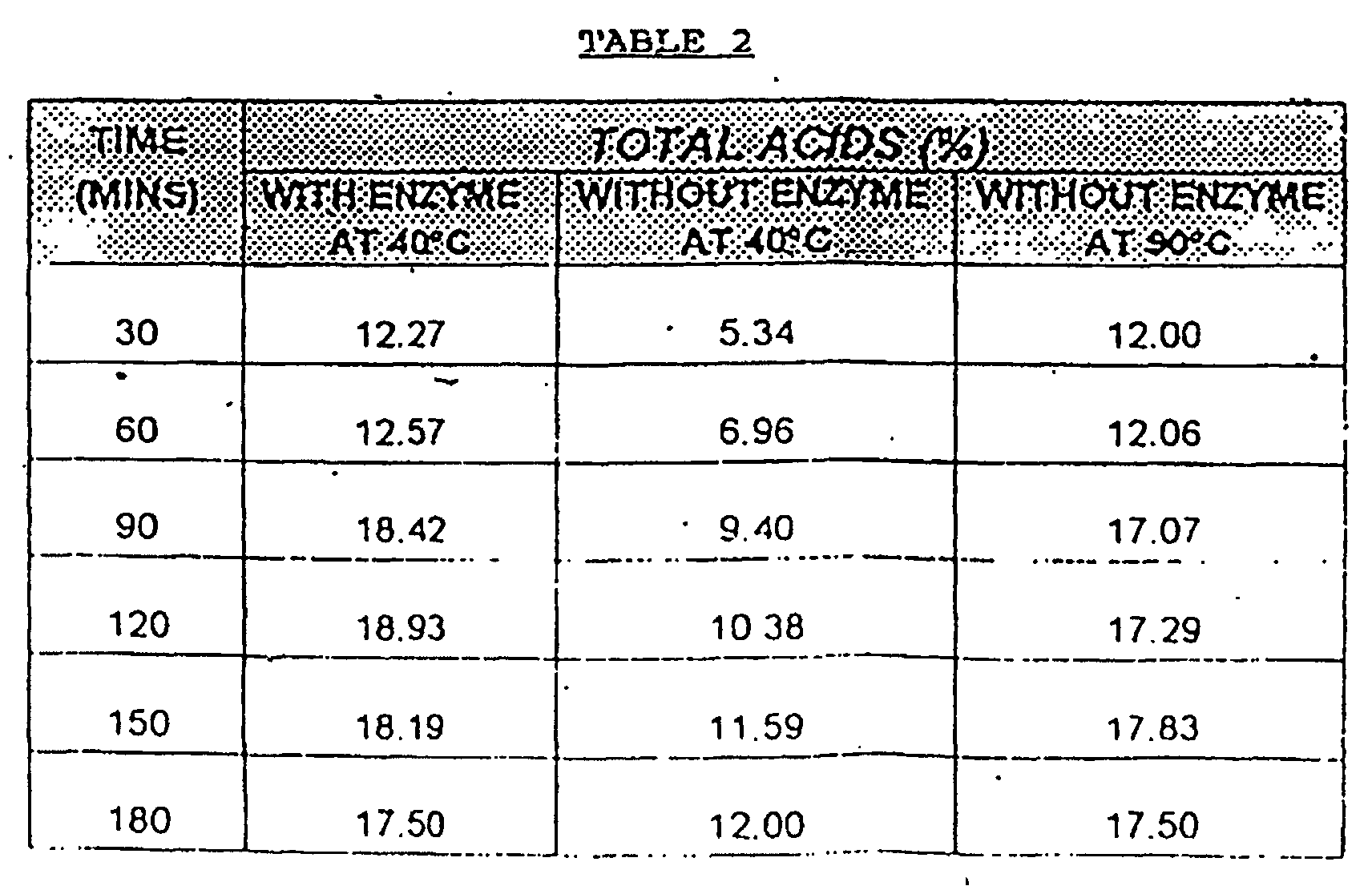
RATIO OF ENZYME TO SUBSTRATE w/w (%) Ca SALT OF HCA % HCA AS TOTAL ACIDS % 0.042 17.30% 55.46% 0.091 36.37% 70.39% 0.110 51.89% 71.00% 2.200 57.20% 72.80% - The rate of extraction of hydroxycitric acid from Garcinia rind was studied in the presence and absence of enzymes at constant temperature of 40°C. It was observed that when the process was carried out in presence of enzymes the rate of release of hydroxycitric acid is faster. The results are presented in Figure I. The slow release of hydroxycitric acid in the absence of enzyme is evident from Figure I.
- Also kinetics for extraction of hydroxycitric acid at elevated temperature of 90°C in the absence of enzymes was studied . It is evident from Figure I that even at higher temperature, the release of hydroxycitric acid is slow as compared to that obtained at 40°C in the presence of enzymes .
- This data proves that the enzymes act as catalyst in effective release of hydroxycitric acid that is bound in Garcinia rinds.
- The process of the present invention is carried out at a temperature ranging from 30°C to 50°C preferably at 40°C.
- All attempts to isolate hydroxycitric acid at 40°C without enzymes, led to poor yield of the product which is evident from Figure I.
- The time of the reaction depends on the conditions used i.e. temperature and composition and proportion of enzyme to the Garcinia rind and ranges from one to three hours depending on the parameters employed.
- The process of the present invention can be carried out without use of any organic solvent, which is an improvement over the prior art.
- The objects of the invention are illustrated by the following non-limiting examples:
- Garcinia Cambogia rind (25.27 g) was taken in 100 ml water and 0.025 ml of pectic enzyme in mixture i.e. polygalactouronase(PG) and pectin lysase(PL) (1:48), was added, stirred and heated to 40°C for 3 hrs. The first extract was then filtered. The residue remaining in the first extraction was further extracted in similar manner as first extract to obtain two more additional extracts which were filtered and combined with the first extract. The combined extract was then heated at 70°C for 20 minutes to inactivate the catalytic enzymes to obtain extract rich in hydroxycitric acid. To the resulting
solution 20% of aqueous sodium hydroxide was added to attain a pH of 8-9. The intermediate sodium salt was then treated with 20% aqueous calcium chloride to pH of 6 at which the calcium salt of hydroxycitric acid precipitates, which was dried at 90°C for 4 hours in a tray drier to yield 13.11 g (51.89%) calcium salt of hydroxycitric acid . The hydroxycitric acid content was 71.0% titrimetry. -
- [free (-)-erythro-hydroxycitric acid] : [α]D 20 = -20° (C = 10% in water)
- [(-)-erythro-hydroxycitric acid : [α]D 20 = -96° (C = 10% in water) saturated with borax]
- I.R.(KBr) in cm -1 ( calcium salt of (-)-erythro-hydroxycitric acid ) : ° 3420, 1600, 1410.
-
- Garcinia Cambogia rind (5 g) was taken in 25 ml water and 0.1 ml of pectic enzyme in mixture i.e. polygalactouronase(PG) and pectin lysase(PL) (1:48), was added and worked up in similar manner as in example 1. The yield of calcium salt of hydroxycitric acid obtained is 2.68 g (57.20%). The hydroxycitric acid content is 72.8% by titrimetry.
- Garcinia Cambogia rind (24.12 g) was taken in 100 ml water and 0.02 ml of pectic enzyme in mixture i.e. polygalactouronase(PG) and pectin lysase(PL) (1:48), was added and worked up in a similar manner as in example 1. The yield of calcium salt of hydroxycitric acid obtained is 8.77 g (36.37%). The hydroxycitric acid content is 70.39% by titrimetry.
- Garcinia Cambogia rind (26.15 g) was taken in 100 ml water and 0.01 ml of pectic enzyme in mixture i.e. polygalactouronase(PG) and pectin lysase(PL) (1:48), was added and worked up in a similar manner as in example 1. The yield of calcium salt of hydroxycitric acid obtained is 4.6 g (17.3%). The hydroxycitric acid content is 55.46% by titrimetry.
- Garcinia cambogia rind (20.13 g) was taken in 100 ml water and 0.02 ml of pectic enzyme in mixture i.e. polygalactouronase(PG) and pectin lysase(PL) (1:07), was added and worked up in the same manner as in example 1. The yield of calcium salt of hydroxycitric acid obtained is 7.39 g (36.74%). The hydroxycitric acid content is 54.33% by titrimetry.
- Garcinia Cambogia rind (19.94 g) was taken in 100 ml water and 0.02 ml of pectic enzyme mixture i.e. polygalactouronase(PG) and pectin lysase(PL) (1:38), was added and worked up in the same manner as in example 1. The calcium salt of hydroxycitric acid is obtained in 5.75 g (28.82%) yield. The hydroxycitric acid content is 54.12% by titrimetry.
- Garcinia indica rind (25.28 g) was taken in 100 ml water and 0.025 ml of pectic enzyme in mixture i.e. polygalactouronase(PG) and pectin lysase(PL) (1:48), was added and worked up in similar manner as in example 1. The yield calcium salt of hydroxycitric acid obtained is 3.67 g (14.52%). The hydroxycitric acid content is 46.07% by titrimetry.
- Three experiments were carried out to study the rate of extraction of (-)-erythro hydroxycitric acid from Garcinia fruit rind in the presence or absence of pectic enzymes at temperature of 40°C and 90°C respectively.
- The procedure was as follows:
- Garcinia cambogia fruit rind (10 g) was taken in water (150 ml).
- 1. To the resulting aqueous suspension 0.01 ml of pectic enzyme mixture i.e. polygalactouronase (PG) and pectin lysase(PL) (1:48) was added, stirred and kept at 40°C in an incubator.
- 2. The resulting aqueous suspension without adding enzyme was kept at 40°C in an incubator.
- 3. The resulting aqueous suspension without adding enzyme was refluxed at 90°C.
-
- In each of the above cases 5 ml extract was withdrawn after every 30 minutes upto three hours and titrated against 0.1 N sodium hydroxide using phenolphthalein as an indicator. Depending on the consumption of sodium hydroxide the amount of total acid was calculated. The comparative data is presented in Table 2 and figure 1 respectively.
Claims (9)
- A process for producing calcium salt of (-)-erythrohydroxycitric acid from fruit rinds of Garcinia species, the process comprising:i) heating an aqueous suspension of fruit rinds of said Garcinia species with a mixture of pectic enzymes at a temperature of between 30°C to 50°C for 1 to 3 hours followed by separation of the rinds from the supernatant;ii) heating the supernatant to deactivate the enzyme(s);iii) adding alkali to the deactivated solution to achieve a pH of between 8-9;iv) adding calcium chloride to the product to precipitate the calcium salt of (-)-erythrohydroxycitric acid.
- A process as claimed in claim 1 wherein the Garcinia species is G. Cambogia, G. Indica or G. Atroviridia.
- A process as claimed in claim 1 or claim 2 wherein said mixture of enzymes is used in the range of 0.0011 to 0.022 g per g of Garcinia fruit rind.
- A process as claimed in any one of the preceding claims wherein the mixture of pectic enzymes consists of polygalactouronase (PG) and pectin lysase (PL) in a ratio of between 1:07 to 1:60.
- A process as claimed in claim 4 wherein the ratio of polygalactouronase (PG) and pectin lysase (PL) is 1:48.
- A process as claimed in any one of the preceding claims wherein the aqueous suspension of fruit rinds is provided by macerating fruit rinds of Garcinia fruit in water.
- A process as claimed in any one of the preceding claims wherein the mass obtained in step (I) is filtered prior to the step of heating in step (ii).
- A process as claimed in any one of the preceding claims wherein the temperature of heating in step (ii) is about 70°C.
- A process as claimed in any one of the preceding claims wherein step (i) is carried out at a temperature of about 40°C.
Priority Applications (2)
| Application Number | Priority Date | Filing Date | Title |
|---|---|---|---|
| DE69718437T DE69718437D1 (en) | 1997-03-17 | 1997-03-17 | Process for the preparation of calcium (-) - erythrohydroxy citrate |
| EP19970301777 EP0866137B1 (en) | 1997-03-17 | 1997-03-17 | Process for producing calcium salt of (-)-Erythrohydroxycitric acid |
Applications Claiming Priority (1)
| Application Number | Priority Date | Filing Date | Title |
|---|---|---|---|
| EP19970301777 EP0866137B1 (en) | 1997-03-17 | 1997-03-17 | Process for producing calcium salt of (-)-Erythrohydroxycitric acid |
Publications (2)
| Publication Number | Publication Date |
|---|---|
| EP0866137A1 EP0866137A1 (en) | 1998-09-23 |
| EP0866137B1 true EP0866137B1 (en) | 2003-01-15 |
Family
ID=8229247
Family Applications (1)
| Application Number | Title | Priority Date | Filing Date |
|---|---|---|---|
| EP19970301777 Expired - Lifetime EP0866137B1 (en) | 1997-03-17 | 1997-03-17 | Process for producing calcium salt of (-)-Erythrohydroxycitric acid |
Country Status (2)
| Country | Link |
|---|---|
| EP (1) | EP0866137B1 (en) |
| DE (1) | DE69718437D1 (en) |
Families Citing this family (3)
| Publication number | Priority date | Publication date | Assignee | Title |
|---|---|---|---|---|
| WO2000015051A1 (en) * | 1998-09-14 | 2000-03-23 | Interhealth Nutraceuticals, Inc. | Hydroxycitric acid compositions |
| AU2003241151A1 (en) * | 2003-05-19 | 2004-12-03 | Indfrag Limited | A novel composition of complex metal salt of garcinia acid, a process for preparing the same and use thereof |
| EP3762357A4 (en) * | 2018-03-07 | 2021-12-08 | Glykon Technologies Group, LLC | HYDROXYCITRIC ACID METAL HETEROCYCLIC COMPOUNDS WITH COVALENT CHARACTERISTICS |
Family Cites Families (1)
| Publication number | Priority date | Publication date | Assignee | Title |
|---|---|---|---|---|
| JP3177289B2 (en) * | 1992-02-17 | 2001-06-18 | 明治製菓株式会社 | Granulated soil for agricultural and horticultural use |
-
1997
- 1997-03-17 DE DE69718437T patent/DE69718437D1/en not_active Expired - Lifetime
- 1997-03-17 EP EP19970301777 patent/EP0866137B1/en not_active Expired - Lifetime
Also Published As
| Publication number | Publication date |
|---|---|
| DE69718437D1 (en) | 2003-02-20 |
| EP0866137A1 (en) | 1998-09-23 |
Similar Documents
| Publication | Publication Date | Title |
|---|---|---|
| KR100844918B1 (en) | Algin oligosaccharides and the derivatives thereof as well as the manufacture and the use of the same | |
| DE2552871B2 (en) | Optically active di- and monoacetyl esters of cyclopent-1-en-3,5-diol, optically active cyclopent-1-en-33-diol and processes for their preparation | |
| JPH0418051A (en) | Purification of reaction product of soap- containing crude polyol fatty acid polyester | |
| JPH01211594A (en) | Purification of polyol-facty acid crude polyester | |
| US7858128B2 (en) | Hydroxycitric acid compositions, pharmaceutical and dietary supplements and food products made therefrom, and methods for their use in reducing body weight | |
| EP0866137A1 (en) | Process for producing calcium salt of (-)-Erythrohydroxycitric acid | |
| JPH0421655A (en) | Purification of reaction product of soap- containing crude polyol fatty acid polyester | |
| JP2016522187A (en) | Method for stabilizing a composition containing at least one product of internal dehydration of hydrogenated sugar, resulting composition and use thereof | |
| US3636097A (en) | Isolation of malic acid from tobacco | |
| JP4328848B2 (en) | [Poly- (2,5-dihydroxyphenylene)]-4-thiosulfate sodium salt having a linear structure as a regulator of cell metabolism and method for producing the same | |
| US2338534A (en) | Preparation of d-galacturonic acid and its salts | |
| Brown et al. | Some carboxylic acids present in royal jelly | |
| KR20100070362A (en) | Process for producing carnosol from carnosic acid using hydrogen peroxide or peracids | |
| Benn et al. | Ranunculin | |
| JPH01207296A (en) | Purification of polyol-facty acid crude polyester | |
| US6875891B2 (en) | Process for preparing highly water soluble double salts of hydroxycitric acid particularly alkali and alkaline earth metal double salts | |
| CN101784205B (en) | Method for producing distilled olive juice extract | |
| US7208615B2 (en) | Triple mineral salts of (-)-hydroxycitric acid and processes for preparing the same | |
| KR20110039380A (en) | Process for producing carnosol from carnosic acid using hydrogen peroxide or peracid | |
| US7214823B2 (en) | Hydroxycitric acid complex metal salts, composition, and methods | |
| Cavallito et al. | The antibacterial principle of Arctium minus. II. The unsaturated lactone structure | |
| CN114163370A (en) | Vitamin D2Preparation method of (1) | |
| JP4405631B2 (en) | Method for purification of conjugated linoleic acid isomers | |
| RU2034556C1 (en) | Method of preparing copper derivatives of chlorophyll | |
| US20100152488A1 (en) | High Purity (-) Hydroxycitric Acid Metal Salt Derivatives and Method of Preparation of the Same |
Legal Events
| Date | Code | Title | Description |
|---|---|---|---|
| PUAI | Public reference made under article 153(3) epc to a published international application that has entered the european phase |
Free format text: ORIGINAL CODE: 0009012 |
|
| AK | Designated contracting states |
Kind code of ref document: A1 Designated state(s): CH DE FR GB IT LI |
|
| 17P | Request for examination filed |
Effective date: 19990308 |
|
| AKX | Designation fees paid |
Free format text: CH DE FR GB IT LI |
|
| RBV | Designated contracting states (corrected) |
Designated state(s): CH DE FR GB IT LI |
|
| 17Q | First examination report despatched |
Effective date: 20010308 |
|
| GRAG | Despatch of communication of intention to grant |
Free format text: ORIGINAL CODE: EPIDOS AGRA |
|
| GRAG | Despatch of communication of intention to grant |
Free format text: ORIGINAL CODE: EPIDOS AGRA |
|
| GRAH | Despatch of communication of intention to grant a patent |
Free format text: ORIGINAL CODE: EPIDOS IGRA |
|
| GRAH | Despatch of communication of intention to grant a patent |
Free format text: ORIGINAL CODE: EPIDOS IGRA |
|
| GRAA | (expected) grant |
Free format text: ORIGINAL CODE: 0009210 |
|
| AK | Designated contracting states |
Kind code of ref document: B1 Designated state(s): CH DE FR GB IT LI |
|
| PG25 | Lapsed in a contracting state [announced via postgrant information from national office to epo] |
Ref country code: LI Free format text: LAPSE BECAUSE OF FAILURE TO SUBMIT A TRANSLATION OF THE DESCRIPTION OR TO PAY THE FEE WITHIN THE PRESCRIBED TIME-LIMIT Effective date: 20030115 Ref country code: IT Free format text: LAPSE BECAUSE OF FAILURE TO SUBMIT A TRANSLATION OF THE DESCRIPTION OR TO PAY THE FEE WITHIN THE PRESCRIBED TIME-LIMIT;WARNING: LAPSES OF ITALIAN PATENTS WITH EFFECTIVE DATE BEFORE 2007 MAY HAVE OCCURRED AT ANY TIME BEFORE 2007. THE CORRECT EFFECTIVE DATE MAY BE DIFFERENT FROM THE ONE RECORDED. Effective date: 20030115 Ref country code: FR Free format text: LAPSE BECAUSE OF NON-PAYMENT OF DUE FEES Effective date: 20030115 Ref country code: CH Free format text: LAPSE BECAUSE OF FAILURE TO SUBMIT A TRANSLATION OF THE DESCRIPTION OR TO PAY THE FEE WITHIN THE PRESCRIBED TIME-LIMIT Effective date: 20030115 |
|
| RAP1 | Party data changed (applicant data changed or rights of an application transferred) |
Owner name: LUPIN LABORATORIES LIMITED |
|
| REG | Reference to a national code |
Ref country code: GB Ref legal event code: FG4D Ref country code: CH Ref legal event code: EP |
|
| REF | Corresponds to: |
Ref document number: 69718437 Country of ref document: DE Date of ref document: 20030220 Kind code of ref document: P |
|
| RAP2 | Party data changed (patent owner data changed or rights of a patent transferred) |
Owner name: LUPIN LIMITED |
|
| PGFP | Annual fee paid to national office [announced via postgrant information from national office to epo] |
Ref country code: GB Payment date: 20030404 Year of fee payment: 7 |
|
| PG25 | Lapsed in a contracting state [announced via postgrant information from national office to epo] |
Ref country code: DE Free format text: LAPSE BECAUSE OF FAILURE TO SUBMIT A TRANSLATION OF THE DESCRIPTION OR TO PAY THE FEE WITHIN THE PRESCRIBED TIME-LIMIT Effective date: 20030416 |
|
| REG | Reference to a national code |
Ref country code: CH Ref legal event code: PL |
|
| PLBE | No opposition filed within time limit |
Free format text: ORIGINAL CODE: 0009261 |
|
| STAA | Information on the status of an ep patent application or granted ep patent |
Free format text: STATUS: NO OPPOSITION FILED WITHIN TIME LIMIT |
|
| EN | Fr: translation not filed | ||
| 26N | No opposition filed |
Effective date: 20031016 |
|
| PG25 | Lapsed in a contracting state [announced via postgrant information from national office to epo] |
Ref country code: GB Free format text: LAPSE BECAUSE OF NON-PAYMENT OF DUE FEES Effective date: 20040317 |
|
| GBPC | Gb: european patent ceased through non-payment of renewal fee |
Effective date: 20040317 |