EP0866113A1 - Lower-ash lubricating oil having ultra-neutral zinc dialkyldithiophosphates - Google Patents
Lower-ash lubricating oil having ultra-neutral zinc dialkyldithiophosphates Download PDFInfo
- Publication number
- EP0866113A1 EP0866113A1 EP98302088A EP98302088A EP0866113A1 EP 0866113 A1 EP0866113 A1 EP 0866113A1 EP 98302088 A EP98302088 A EP 98302088A EP 98302088 A EP98302088 A EP 98302088A EP 0866113 A1 EP0866113 A1 EP 0866113A1
- Authority
- EP
- European Patent Office
- Prior art keywords
- lubricating oil
- weight
- zinc
- oil composition
- zinc dialkyldithiophosphate
- Prior art date
- Legal status (The legal status is an assumption and is not a legal conclusion. Google has not performed a legal analysis and makes no representation as to the accuracy of the status listed.)
- Withdrawn
Links
- 239000011701 zinc Substances 0.000 title claims abstract description 107
- 229910052725 zinc Inorganic materials 0.000 title claims abstract description 102
- HCHKCACWOHOZIP-UHFFFAOYSA-N Zinc Chemical compound [Zn] HCHKCACWOHOZIP-UHFFFAOYSA-N 0.000 title claims abstract description 101
- 239000010687 lubricating oil Substances 0.000 title claims abstract description 48
- 239000000203 mixture Substances 0.000 claims abstract description 54
- OAICVXFJPJFONN-UHFFFAOYSA-N Phosphorus Chemical compound [P] OAICVXFJPJFONN-UHFFFAOYSA-N 0.000 claims abstract description 31
- 229910052698 phosphorus Inorganic materials 0.000 claims abstract description 30
- 239000011574 phosphorus Substances 0.000 claims abstract description 30
- 239000002199 base oil Substances 0.000 claims abstract description 11
- 230000001050 lubricating effect Effects 0.000 claims abstract description 8
- 125000000217 alkyl group Chemical group 0.000 claims description 19
- 238000000034 method Methods 0.000 claims description 18
- 239000003112 inhibitor Substances 0.000 claims description 16
- 239000002270 dispersing agent Substances 0.000 claims description 12
- 230000003647 oxidation Effects 0.000 claims description 11
- 238000007254 oxidation reaction Methods 0.000 claims description 11
- 239000003599 detergent Substances 0.000 claims description 8
- 125000004432 carbon atom Chemical group C* 0.000 claims description 6
- 238000002156 mixing Methods 0.000 claims description 2
- 230000003247 decreasing effect Effects 0.000 claims 1
- VLKZOEOYAKHREP-UHFFFAOYSA-N n-Hexane Chemical compound CCCCCC VLKZOEOYAKHREP-UHFFFAOYSA-N 0.000 description 36
- 150000003839 salts Chemical class 0.000 description 28
- 239000002253 acid Substances 0.000 description 27
- 239000013049 sediment Substances 0.000 description 24
- 239000003921 oil Substances 0.000 description 18
- 230000007935 neutral effect Effects 0.000 description 17
- 150000001447 alkali salts Chemical class 0.000 description 16
- QTBSBXVTEAMEQO-UHFFFAOYSA-N Acetic acid Chemical compound CC(O)=O QTBSBXVTEAMEQO-UHFFFAOYSA-N 0.000 description 15
- 239000011541 reaction mixture Substances 0.000 description 15
- XLOMVQKBTHCTTD-UHFFFAOYSA-N Zinc monoxide Chemical compound [Zn]=O XLOMVQKBTHCTTD-UHFFFAOYSA-N 0.000 description 12
- 239000010705 motor oil Substances 0.000 description 12
- 238000004679 31P NMR spectroscopy Methods 0.000 description 8
- 230000007797 corrosion Effects 0.000 description 8
- 238000005260 corrosion Methods 0.000 description 8
- 239000000463 material Substances 0.000 description 8
- LFQSCWFLJHTTHZ-UHFFFAOYSA-N Ethanol Chemical compound CCO LFQSCWFLJHTTHZ-UHFFFAOYSA-N 0.000 description 7
- 239000007788 liquid Substances 0.000 description 7
- 239000011521 glass Substances 0.000 description 6
- XLYOFNOQVPJJNP-UHFFFAOYSA-N water Substances O XLYOFNOQVPJJNP-UHFFFAOYSA-N 0.000 description 6
- 239000011787 zinc oxide Substances 0.000 description 6
- 239000000654 additive Substances 0.000 description 5
- 150000002148 esters Chemical class 0.000 description 5
- CYQAYERJWZKYML-UHFFFAOYSA-N phosphorus pentasulfide Chemical compound S1P(S2)(=S)SP3(=S)SP1(=S)SP2(=S)S3 CYQAYERJWZKYML-UHFFFAOYSA-N 0.000 description 5
- 150000001875 compounds Chemical class 0.000 description 4
- 125000002768 hydroxyalkyl group Chemical group 0.000 description 4
- 238000002360 preparation method Methods 0.000 description 4
- 238000005406 washing Methods 0.000 description 4
- 150000003751 zinc Chemical class 0.000 description 4
- KBPLFHHGFOOTCA-UHFFFAOYSA-N 1-Octanol Chemical compound CCCCCCCCO KBPLFHHGFOOTCA-UHFFFAOYSA-N 0.000 description 3
- AFFLGGQVNFXPEV-UHFFFAOYSA-N 1-decene Chemical compound CCCCCCCCC=C AFFLGGQVNFXPEV-UHFFFAOYSA-N 0.000 description 3
- 239000004215 Carbon black (E152) Substances 0.000 description 3
- 229910000975 Carbon steel Inorganic materials 0.000 description 3
- LYCAIKOWRPUZTN-UHFFFAOYSA-N Ethylene glycol Chemical compound OCCO LYCAIKOWRPUZTN-UHFFFAOYSA-N 0.000 description 3
- PEDCQBHIVMGVHV-UHFFFAOYSA-N Glycerine Chemical compound OCC(O)CO PEDCQBHIVMGVHV-UHFFFAOYSA-N 0.000 description 3
- OKKJLVBELUTLKV-UHFFFAOYSA-N Methanol Chemical compound OC OKKJLVBELUTLKV-UHFFFAOYSA-N 0.000 description 3
- DNIAPMSPPWPWGF-UHFFFAOYSA-N Propylene glycol Chemical compound CC(O)CO DNIAPMSPPWPWGF-UHFFFAOYSA-N 0.000 description 3
- 150000007513 acids Chemical class 0.000 description 3
- 239000003963 antioxidant agent Substances 0.000 description 3
- BTANRVKWQNVYAZ-UHFFFAOYSA-N butan-2-ol Chemical compound CCC(C)O BTANRVKWQNVYAZ-UHFFFAOYSA-N 0.000 description 3
- 239000010962 carbon steel Substances 0.000 description 3
- 239000003795 chemical substances by application Substances 0.000 description 3
- 230000000052 comparative effect Effects 0.000 description 3
- MTHSVFCYNBDYFN-UHFFFAOYSA-N diethylene glycol Chemical compound OCCOCCO MTHSVFCYNBDYFN-UHFFFAOYSA-N 0.000 description 3
- LQZZUXJYWNFBMV-UHFFFAOYSA-N dodecan-1-ol Chemical compound CCCCCCCCCCCCO LQZZUXJYWNFBMV-UHFFFAOYSA-N 0.000 description 3
- 229930195733 hydrocarbon Natural products 0.000 description 3
- 150000002430 hydrocarbons Chemical class 0.000 description 3
- 238000004519 manufacturing process Methods 0.000 description 3
- 229910052751 metal Inorganic materials 0.000 description 3
- 239000002184 metal Substances 0.000 description 3
- 239000002480 mineral oil Substances 0.000 description 3
- 235000010446 mineral oil Nutrition 0.000 description 3
- 150000003333 secondary alcohols Chemical class 0.000 description 3
- 238000001228 spectrum Methods 0.000 description 3
- 238000007619 statistical method Methods 0.000 description 3
- BBMCTIGTTCKYKF-UHFFFAOYSA-N 1-heptanol Chemical compound CCCCCCCO BBMCTIGTTCKYKF-UHFFFAOYSA-N 0.000 description 2
- BVUXDWXKPROUDO-UHFFFAOYSA-N 2,6-di-tert-butyl-4-ethylphenol Chemical compound CCC1=CC(C(C)(C)C)=C(O)C(C(C)(C)C)=C1 BVUXDWXKPROUDO-UHFFFAOYSA-N 0.000 description 2
- SZAQZZKNQILGPU-UHFFFAOYSA-N 2-[1-(2-hydroxy-3,5-dimethylphenyl)-2-methylpropyl]-4,6-dimethylphenol Chemical compound C=1C(C)=CC(C)=C(O)C=1C(C(C)C)C1=CC(C)=CC(C)=C1O SZAQZZKNQILGPU-UHFFFAOYSA-N 0.000 description 2
- YIWUKEYIRIRTPP-UHFFFAOYSA-N 2-ethylhexan-1-ol Chemical compound CCCCC(CC)CO YIWUKEYIRIRTPP-UHFFFAOYSA-N 0.000 description 2
- NLZUEZXRPGMBCV-UHFFFAOYSA-N Butylhydroxytoluene Chemical compound CC1=CC(C(C)(C)C)=C(O)C(C(C)(C)C)=C1 NLZUEZXRPGMBCV-UHFFFAOYSA-N 0.000 description 2
- KFZMGEQAYNKOFK-UHFFFAOYSA-N Isopropanol Chemical compound CC(C)O KFZMGEQAYNKOFK-UHFFFAOYSA-N 0.000 description 2
- LRHPLDYGYMQRHN-UHFFFAOYSA-N N-Butanol Chemical compound CCCCO LRHPLDYGYMQRHN-UHFFFAOYSA-N 0.000 description 2
- 238000005481 NMR spectroscopy Methods 0.000 description 2
- ISWSIDIOOBJBQZ-UHFFFAOYSA-N Phenol Chemical compound OC1=CC=CC=C1 ISWSIDIOOBJBQZ-UHFFFAOYSA-N 0.000 description 2
- VKCLPVFDVVKEKU-UHFFFAOYSA-N S=[P] Chemical compound S=[P] VKCLPVFDVVKEKU-UHFFFAOYSA-N 0.000 description 2
- 125000003158 alcohol group Chemical group 0.000 description 2
- 150000001298 alcohols Chemical class 0.000 description 2
- 238000004458 analytical method Methods 0.000 description 2
- 125000000753 cycloalkyl group Chemical group 0.000 description 2
- BXWNKGSJHAJOGX-UHFFFAOYSA-N hexadecan-1-ol Chemical compound CCCCCCCCCCCCCCCCO BXWNKGSJHAJOGX-UHFFFAOYSA-N 0.000 description 2
- -1 hydroxy alkyl compound Chemical class 0.000 description 2
- PHTQWCKDNZKARW-UHFFFAOYSA-N isoamylol Chemical compound CC(C)CCO PHTQWCKDNZKARW-UHFFFAOYSA-N 0.000 description 2
- 150000002763 monocarboxylic acids Chemical class 0.000 description 2
- KPSSIOMAKSHJJG-UHFFFAOYSA-N neopentyl alcohol Chemical compound CC(C)(C)CO KPSSIOMAKSHJJG-UHFFFAOYSA-N 0.000 description 2
- 239000000376 reactant Substances 0.000 description 2
- 238000001179 sorption measurement Methods 0.000 description 2
- 239000013638 trimer Substances 0.000 description 2
- WMYJOZQKDZZHAC-UHFFFAOYSA-H trizinc;dioxido-sulfanylidene-sulfido-$l^{5}-phosphane Chemical compound [Zn+2].[Zn+2].[Zn+2].[O-]P([O-])([S-])=S.[O-]P([O-])([S-])=S WMYJOZQKDZZHAC-UHFFFAOYSA-H 0.000 description 2
- 239000004711 α-olefin Substances 0.000 description 2
- ALSTYHKOOCGGFT-KTKRTIGZSA-N (9Z)-octadecen-1-ol Chemical compound CCCCCCCC\C=C/CCCCCCCCO ALSTYHKOOCGGFT-KTKRTIGZSA-N 0.000 description 1
- WJECKFZULSWXPN-UHFFFAOYSA-N 1,2-didodecylbenzene Chemical compound CCCCCCCCCCCCC1=CC=CC=C1CCCCCCCCCCCC WJECKFZULSWXPN-UHFFFAOYSA-N 0.000 description 1
- RUFPHBVGCFYCNW-UHFFFAOYSA-N 1-naphthylamine Chemical class C1=CC=C2C(N)=CC=CC2=C1 RUFPHBVGCFYCNW-UHFFFAOYSA-N 0.000 description 1
- KGRVJHAUYBGFFP-UHFFFAOYSA-N 2,2'-Methylenebis(4-methyl-6-tert-butylphenol) Chemical compound CC(C)(C)C1=CC(C)=CC(CC=2C(=C(C=C(C)C=2)C(C)(C)C)O)=C1O KGRVJHAUYBGFFP-UHFFFAOYSA-N 0.000 description 1
- SXSWMAUXEHKFGX-UHFFFAOYSA-N 2,3-dimethylbutan-1-ol Chemical compound CC(C)C(C)CO SXSWMAUXEHKFGX-UHFFFAOYSA-N 0.000 description 1
- OPLCSTZDXXUYDU-UHFFFAOYSA-N 2,4-dimethyl-6-tert-butylphenol Chemical compound CC1=CC(C)=C(O)C(C(C)(C)C)=C1 OPLCSTZDXXUYDU-UHFFFAOYSA-N 0.000 description 1
- BAYAKMPRFGNNFW-UHFFFAOYSA-N 2,4-dimethylpentan-3-ol Chemical compound CC(C)C(O)C(C)C BAYAKMPRFGNNFW-UHFFFAOYSA-N 0.000 description 1
- GSOYMOAPJZYXTB-UHFFFAOYSA-N 2,6-ditert-butyl-4-(3,5-ditert-butyl-4-hydroxyphenyl)phenol Chemical compound CC(C)(C)C1=C(O)C(C(C)(C)C)=CC(C=2C=C(C(O)=C(C=2)C(C)(C)C)C(C)(C)C)=C1 GSOYMOAPJZYXTB-UHFFFAOYSA-N 0.000 description 1
- QHPKIUDQDCWRKO-UHFFFAOYSA-N 2,6-ditert-butyl-4-[2-(3,5-ditert-butyl-4-hydroxyphenyl)propan-2-yl]phenol Chemical compound CC(C)(C)C1=C(O)C(C(C)(C)C)=CC(C(C)(C)C=2C=C(C(O)=C(C=2)C(C)(C)C)C(C)(C)C)=C1 QHPKIUDQDCWRKO-UHFFFAOYSA-N 0.000 description 1
- GLDUZMNCEGHSBP-UHFFFAOYSA-N 2-(2-octylphenoxy)ethanol Chemical compound CCCCCCCCC1=CC=CC=C1OCCO GLDUZMNCEGHSBP-UHFFFAOYSA-N 0.000 description 1
- XQESJWNDTICJHW-UHFFFAOYSA-N 2-[(2-hydroxy-5-methyl-3-nonylphenyl)methyl]-4-methyl-6-nonylphenol Chemical compound CCCCCCCCCC1=CC(C)=CC(CC=2C(=C(CCCCCCCCC)C=C(C)C=2)O)=C1O XQESJWNDTICJHW-UHFFFAOYSA-N 0.000 description 1
- AKNMPWVTPUHKCG-UHFFFAOYSA-N 2-cyclohexyl-6-[(3-cyclohexyl-2-hydroxy-5-methylphenyl)methyl]-4-methylphenol Chemical compound OC=1C(C2CCCCC2)=CC(C)=CC=1CC(C=1O)=CC(C)=CC=1C1CCCCC1 AKNMPWVTPUHKCG-UHFFFAOYSA-N 0.000 description 1
- TZYRSLHNPKPEFV-UHFFFAOYSA-N 2-ethyl-1-butanol Chemical compound CCC(CC)CO TZYRSLHNPKPEFV-UHFFFAOYSA-N 0.000 description 1
- YFHKLSPMRRWLKI-UHFFFAOYSA-N 2-tert-butyl-4-(3-tert-butyl-4-hydroxy-5-methylphenyl)sulfanyl-6-methylphenol Chemical compound CC(C)(C)C1=C(O)C(C)=CC(SC=2C=C(C(O)=C(C)C=2)C(C)(C)C)=C1 YFHKLSPMRRWLKI-UHFFFAOYSA-N 0.000 description 1
- BGWNOSDEHSHFFI-UHFFFAOYSA-N 2-tert-butyl-4-[(3-tert-butyl-4-hydroxy-5-methylphenyl)methylsulfanylmethyl]-6-methylphenol Chemical compound CC(C)(C)C1=C(O)C(C)=CC(CSCC=2C=C(C(O)=C(C)C=2)C(C)(C)C)=C1 BGWNOSDEHSHFFI-UHFFFAOYSA-N 0.000 description 1
- PFANXOISJYKQRP-UHFFFAOYSA-N 2-tert-butyl-4-[1-(5-tert-butyl-4-hydroxy-2-methylphenyl)butyl]-5-methylphenol Chemical compound C=1C(C(C)(C)C)=C(O)C=C(C)C=1C(CCC)C1=CC(C(C)(C)C)=C(O)C=C1C PFANXOISJYKQRP-UHFFFAOYSA-N 0.000 description 1
- MQWCQFCZUNBTCM-UHFFFAOYSA-N 2-tert-butyl-6-(3-tert-butyl-2-hydroxy-5-methylphenyl)sulfanyl-4-methylphenol Chemical compound CC(C)(C)C1=CC(C)=CC(SC=2C(=C(C=C(C)C=2)C(C)(C)C)O)=C1O MQWCQFCZUNBTCM-UHFFFAOYSA-N 0.000 description 1
- BKZXZGWHTRCFPX-UHFFFAOYSA-N 2-tert-butyl-6-methylphenol Chemical compound CC1=CC=CC(C(C)(C)C)=C1O BKZXZGWHTRCFPX-UHFFFAOYSA-N 0.000 description 1
- MDWVSAYEQPLWMX-UHFFFAOYSA-N 4,4'-Methylenebis(2,6-di-tert-butylphenol) Chemical compound CC(C)(C)C1=C(O)C(C(C)(C)C)=CC(CC=2C=C(C(O)=C(C=2)C(C)(C)C)C(C)(C)C)=C1 MDWVSAYEQPLWMX-UHFFFAOYSA-N 0.000 description 1
- WVYWICLMDOOCFB-UHFFFAOYSA-N 4-methyl-2-pentanol Chemical compound CC(C)CC(C)O WVYWICLMDOOCFB-UHFFFAOYSA-N 0.000 description 1
- MQWCXKGKQLNYQG-UHFFFAOYSA-N 4-methylcyclohexan-1-ol Chemical compound CC1CCC(O)CC1 MQWCXKGKQLNYQG-UHFFFAOYSA-N 0.000 description 1
- 229920000089 Cyclic olefin copolymer Polymers 0.000 description 1
- 239000005909 Kieselgur Substances 0.000 description 1
- XQVWYOYUZDUNRW-UHFFFAOYSA-N N-Phenyl-1-naphthylamine Chemical compound C=1C=CC2=CC=CC=C2C=1NC1=CC=CC=C1 XQVWYOYUZDUNRW-UHFFFAOYSA-N 0.000 description 1
- VYPSYNLAJGMNEJ-UHFFFAOYSA-N Silicium dioxide Chemical compound O=[Si]=O VYPSYNLAJGMNEJ-UHFFFAOYSA-N 0.000 description 1
- NINIDFKCEFEMDL-UHFFFAOYSA-N Sulfur Chemical compound [S] NINIDFKCEFEMDL-UHFFFAOYSA-N 0.000 description 1
- 239000004809 Teflon Substances 0.000 description 1
- 229920006362 Teflon® Polymers 0.000 description 1
- AOZDHFFNBZAHJF-UHFFFAOYSA-N [3-hexanoyloxy-2,2-bis(hexanoyloxymethyl)propyl] hexanoate Chemical compound CCCCCC(=O)OCC(COC(=O)CCCCC)(COC(=O)CCCCC)COC(=O)CCCCC AOZDHFFNBZAHJF-UHFFFAOYSA-N 0.000 description 1
- 229910052784 alkaline earth metal Inorganic materials 0.000 description 1
- 150000001342 alkaline earth metals Chemical class 0.000 description 1
- 125000003342 alkenyl group Chemical group 0.000 description 1
- 125000004183 alkoxy alkyl group Chemical group 0.000 description 1
- 150000004996 alkyl benzenes Chemical class 0.000 description 1
- 150000001412 amines Chemical class 0.000 description 1
- 239000007866 anti-wear additive Substances 0.000 description 1
- 230000003078 antioxidant effect Effects 0.000 description 1
- 238000003556 assay Methods 0.000 description 1
- 230000005540 biological transmission Effects 0.000 description 1
- 230000015572 biosynthetic process Effects 0.000 description 1
- SAOKZLXYCUGLFA-UHFFFAOYSA-N bis(2-ethylhexyl) adipate Chemical compound CCCCC(CC)COC(=O)CCCCC(=O)OCC(CC)CCCC SAOKZLXYCUGLFA-UHFFFAOYSA-N 0.000 description 1
- DKVNPHBNOWQYFE-UHFFFAOYSA-N carbamodithioic acid Chemical compound NC(S)=S DKVNPHBNOWQYFE-UHFFFAOYSA-N 0.000 description 1
- 229960000541 cetyl alcohol Drugs 0.000 description 1
- 238000006243 chemical reaction Methods 0.000 description 1
- 238000004140 cleaning Methods 0.000 description 1
- 238000002485 combustion reaction Methods 0.000 description 1
- 229920001577 copolymer Polymers 0.000 description 1
- 125000004122 cyclic group Chemical group 0.000 description 1
- QCRFMSUKWRQZEM-UHFFFAOYSA-N cycloheptanol Chemical compound OC1CCCCCC1 QCRFMSUKWRQZEM-UHFFFAOYSA-N 0.000 description 1
- HPXRVTGHNJAIIH-UHFFFAOYSA-N cyclohexanol Chemical compound OC1CCCCC1 HPXRVTGHNJAIIH-UHFFFAOYSA-N 0.000 description 1
- XCIXKGXIYUWCLL-UHFFFAOYSA-N cyclopentanol Chemical compound OC1CCCC1 XCIXKGXIYUWCLL-UHFFFAOYSA-N 0.000 description 1
- 230000002939 deleterious effect Effects 0.000 description 1
- 230000006866 deterioration Effects 0.000 description 1
- LMODBLQHQHXPEI-UHFFFAOYSA-N dibutylcarbamothioylsulfanylmethyl n,n-dibutylcarbamodithioate Chemical compound CCCCN(CCCC)C(=S)SCSC(=S)N(CCCC)CCCC LMODBLQHQHXPEI-UHFFFAOYSA-N 0.000 description 1
- 150000001991 dicarboxylic acids Chemical class 0.000 description 1
- GHKVUVOPHDYRJC-UHFFFAOYSA-N didodecyl hexanedioate Chemical compound CCCCCCCCCCCCOC(=O)CCCCC(=O)OCCCCCCCCCCCC GHKVUVOPHDYRJC-UHFFFAOYSA-N 0.000 description 1
- DMBHHRLKUKUOEG-UHFFFAOYSA-N diphenylamine Chemical class C=1C=CC=CC=1NC1=CC=CC=C1 DMBHHRLKUKUOEG-UHFFFAOYSA-N 0.000 description 1
- 239000012990 dithiocarbamate Substances 0.000 description 1
- 230000000694 effects Effects 0.000 description 1
- 239000012530 fluid Substances 0.000 description 1
- 239000006260 foam Substances 0.000 description 1
- 238000009472 formulation Methods 0.000 description 1
- 125000000524 functional group Chemical group 0.000 description 1
- 125000001188 haloalkyl group Chemical group 0.000 description 1
- 239000010720 hydraulic oil Substances 0.000 description 1
- 230000005764 inhibitory process Effects 0.000 description 1
- 238000007689 inspection Methods 0.000 description 1
- JEIPFZHSYJVQDO-UHFFFAOYSA-N iron(III) oxide Inorganic materials O=[Fe]O[Fe]=O JEIPFZHSYJVQDO-UHFFFAOYSA-N 0.000 description 1
- 239000000314 lubricant Substances 0.000 description 1
- 239000006078 metal deactivator Substances 0.000 description 1
- 239000010707 multi-grade lubricating oil Substances 0.000 description 1
- 229910052757 nitrogen Inorganic materials 0.000 description 1
- 229940055577 oleyl alcohol Drugs 0.000 description 1
- XMLQWXUVTXCDDL-UHFFFAOYSA-N oleyl alcohol Natural products CCCCCCC=CCCCCCCCCCCO XMLQWXUVTXCDDL-UHFFFAOYSA-N 0.000 description 1
- 125000004437 phosphorous atom Chemical group 0.000 description 1
- 229920001195 polyisoprene Polymers 0.000 description 1
- 229920000642 polymer Polymers 0.000 description 1
- 229920005862 polyol Polymers 0.000 description 1
- 150000003077 polyols Chemical class 0.000 description 1
- 229920003048 styrene butadiene rubber Polymers 0.000 description 1
- 125000000547 substituted alkyl group Chemical group 0.000 description 1
- 238000006467 substitution reaction Methods 0.000 description 1
- KZNICNPSHKQLFF-UHFFFAOYSA-N succinimide Chemical class O=C1CCC(=O)N1 KZNICNPSHKQLFF-UHFFFAOYSA-N 0.000 description 1
- BDHFUVZGWQCTTF-UHFFFAOYSA-M sulfonate Chemical compound [O-]S(=O)=O BDHFUVZGWQCTTF-UHFFFAOYSA-M 0.000 description 1
- 229910052717 sulfur Inorganic materials 0.000 description 1
- 239000011593 sulfur Substances 0.000 description 1
- 125000004434 sulfur atom Chemical group 0.000 description 1
- 238000010998 test method Methods 0.000 description 1
- 230000004580 weight loss Effects 0.000 description 1
- MBBWTVUFIXOUBE-UHFFFAOYSA-L zinc;dicarbamodithioate Chemical compound [Zn+2].NC([S-])=S.NC([S-])=S MBBWTVUFIXOUBE-UHFFFAOYSA-L 0.000 description 1
Classifications
-
- C—CHEMISTRY; METALLURGY
- C07—ORGANIC CHEMISTRY
- C07F—ACYCLIC, CARBOCYCLIC OR HETEROCYCLIC COMPOUNDS CONTAINING ELEMENTS OTHER THAN CARBON, HYDROGEN, HALOGEN, OXYGEN, NITROGEN, SULFUR, SELENIUM OR TELLURIUM
- C07F9/00—Compounds containing elements of Groups 5 or 15 of the Periodic Table
- C07F9/02—Phosphorus compounds
- C07F9/06—Phosphorus compounds without P—C bonds
- C07F9/16—Esters of thiophosphoric acids or thiophosphorous acids
- C07F9/165—Esters of thiophosphoric acids
- C07F9/17—Esters of thiophosphoric acids with hydroxyalkyl compounds without further substituents on alkyl
-
- C—CHEMISTRY; METALLURGY
- C10—PETROLEUM, GAS OR COKE INDUSTRIES; TECHNICAL GASES CONTAINING CARBON MONOXIDE; FUELS; LUBRICANTS; PEAT
- C10M—LUBRICATING COMPOSITIONS; USE OF CHEMICAL SUBSTANCES EITHER ALONE OR AS LUBRICATING INGREDIENTS IN A LUBRICATING COMPOSITION
- C10M137/00—Lubricating compositions characterised by the additive being an organic non-macromolecular compound containing phosphorus
- C10M137/02—Lubricating compositions characterised by the additive being an organic non-macromolecular compound containing phosphorus having no phosphorus-to-carbon bond
- C10M137/04—Phosphate esters
- C10M137/10—Thio derivatives
-
- C—CHEMISTRY; METALLURGY
- C10—PETROLEUM, GAS OR COKE INDUSTRIES; TECHNICAL GASES CONTAINING CARBON MONOXIDE; FUELS; LUBRICANTS; PEAT
- C10M—LUBRICATING COMPOSITIONS; USE OF CHEMICAL SUBSTANCES EITHER ALONE OR AS LUBRICATING INGREDIENTS IN A LUBRICATING COMPOSITION
- C10M167/00—Lubricating compositions characterised by the additive being a mixture of a macromolecular compound, a non-macromolecular compound and a compound of unknown or incompletely defined constitution, each of these compounds being essential
-
- C—CHEMISTRY; METALLURGY
- C10—PETROLEUM, GAS OR COKE INDUSTRIES; TECHNICAL GASES CONTAINING CARBON MONOXIDE; FUELS; LUBRICANTS; PEAT
- C10M—LUBRICATING COMPOSITIONS; USE OF CHEMICAL SUBSTANCES EITHER ALONE OR AS LUBRICATING INGREDIENTS IN A LUBRICATING COMPOSITION
- C10M2205/00—Organic macromolecular hydrocarbon compounds or fractions, whether or not modified by oxidation as ingredients in lubricant compositions
-
- C—CHEMISTRY; METALLURGY
- C10—PETROLEUM, GAS OR COKE INDUSTRIES; TECHNICAL GASES CONTAINING CARBON MONOXIDE; FUELS; LUBRICANTS; PEAT
- C10M—LUBRICATING COMPOSITIONS; USE OF CHEMICAL SUBSTANCES EITHER ALONE OR AS LUBRICATING INGREDIENTS IN A LUBRICATING COMPOSITION
- C10M2205/00—Organic macromolecular hydrocarbon compounds or fractions, whether or not modified by oxidation as ingredients in lubricant compositions
- C10M2205/06—Organic macromolecular hydrocarbon compounds or fractions, whether or not modified by oxidation as ingredients in lubricant compositions containing conjugated dienes
-
- C—CHEMISTRY; METALLURGY
- C10—PETROLEUM, GAS OR COKE INDUSTRIES; TECHNICAL GASES CONTAINING CARBON MONOXIDE; FUELS; LUBRICANTS; PEAT
- C10M—LUBRICATING COMPOSITIONS; USE OF CHEMICAL SUBSTANCES EITHER ALONE OR AS LUBRICATING INGREDIENTS IN A LUBRICATING COMPOSITION
- C10M2207/00—Organic non-macromolecular hydrocarbon compounds containing hydrogen, carbon and oxygen as ingredients in lubricant compositions
- C10M2207/02—Hydroxy compounds
- C10M2207/023—Hydroxy compounds having hydroxy groups bound to carbon atoms of six-membered aromatic rings
- C10M2207/024—Hydroxy compounds having hydroxy groups bound to carbon atoms of six-membered aromatic rings having at least two phenol groups but no condensed ring
-
- C—CHEMISTRY; METALLURGY
- C10—PETROLEUM, GAS OR COKE INDUSTRIES; TECHNICAL GASES CONTAINING CARBON MONOXIDE; FUELS; LUBRICANTS; PEAT
- C10M—LUBRICATING COMPOSITIONS; USE OF CHEMICAL SUBSTANCES EITHER ALONE OR AS LUBRICATING INGREDIENTS IN A LUBRICATING COMPOSITION
- C10M2207/00—Organic non-macromolecular hydrocarbon compounds containing hydrogen, carbon and oxygen as ingredients in lubricant compositions
- C10M2207/02—Hydroxy compounds
- C10M2207/023—Hydroxy compounds having hydroxy groups bound to carbon atoms of six-membered aromatic rings
- C10M2207/026—Hydroxy compounds having hydroxy groups bound to carbon atoms of six-membered aromatic rings with tertiary alkyl groups
-
- C—CHEMISTRY; METALLURGY
- C10—PETROLEUM, GAS OR COKE INDUSTRIES; TECHNICAL GASES CONTAINING CARBON MONOXIDE; FUELS; LUBRICANTS; PEAT
- C10M—LUBRICATING COMPOSITIONS; USE OF CHEMICAL SUBSTANCES EITHER ALONE OR AS LUBRICATING INGREDIENTS IN A LUBRICATING COMPOSITION
- C10M2207/00—Organic non-macromolecular hydrocarbon compounds containing hydrogen, carbon and oxygen as ingredients in lubricant compositions
- C10M2207/28—Esters
- C10M2207/287—Partial esters
- C10M2207/289—Partial esters containing free hydroxy groups
-
- C—CHEMISTRY; METALLURGY
- C10—PETROLEUM, GAS OR COKE INDUSTRIES; TECHNICAL GASES CONTAINING CARBON MONOXIDE; FUELS; LUBRICANTS; PEAT
- C10M—LUBRICATING COMPOSITIONS; USE OF CHEMICAL SUBSTANCES EITHER ALONE OR AS LUBRICATING INGREDIENTS IN A LUBRICATING COMPOSITION
- C10M2209/00—Organic macromolecular compounds containing oxygen as ingredients in lubricant compositions
- C10M2209/02—Macromolecular compounds obtained by reactions only involving carbon-to-carbon unsaturated bonds
- C10M2209/08—Macromolecular compounds obtained by reactions only involving carbon-to-carbon unsaturated bonds containing monomers having an unsaturated radical bound to a carboxyl radical, e.g. acrylate type
- C10M2209/084—Acrylate; Methacrylate
-
- C—CHEMISTRY; METALLURGY
- C10—PETROLEUM, GAS OR COKE INDUSTRIES; TECHNICAL GASES CONTAINING CARBON MONOXIDE; FUELS; LUBRICANTS; PEAT
- C10M—LUBRICATING COMPOSITIONS; USE OF CHEMICAL SUBSTANCES EITHER ALONE OR AS LUBRICATING INGREDIENTS IN A LUBRICATING COMPOSITION
- C10M2215/00—Organic non-macromolecular compounds containing nitrogen as ingredients in lubricant Compositions
- C10M2215/02—Amines, e.g. polyalkylene polyamines; Quaternary amines
- C10M2215/04—Amines, e.g. polyalkylene polyamines; Quaternary amines having amino groups bound to acyclic or cycloaliphatic carbon atoms
-
- C—CHEMISTRY; METALLURGY
- C10—PETROLEUM, GAS OR COKE INDUSTRIES; TECHNICAL GASES CONTAINING CARBON MONOXIDE; FUELS; LUBRICANTS; PEAT
- C10M—LUBRICATING COMPOSITIONS; USE OF CHEMICAL SUBSTANCES EITHER ALONE OR AS LUBRICATING INGREDIENTS IN A LUBRICATING COMPOSITION
- C10M2215/00—Organic non-macromolecular compounds containing nitrogen as ingredients in lubricant Compositions
- C10M2215/02—Amines, e.g. polyalkylene polyamines; Quaternary amines
- C10M2215/06—Amines, e.g. polyalkylene polyamines; Quaternary amines having amino groups bound to carbon atoms of six-membered aromatic rings
- C10M2215/064—Di- and triaryl amines
-
- C—CHEMISTRY; METALLURGY
- C10—PETROLEUM, GAS OR COKE INDUSTRIES; TECHNICAL GASES CONTAINING CARBON MONOXIDE; FUELS; LUBRICANTS; PEAT
- C10M—LUBRICATING COMPOSITIONS; USE OF CHEMICAL SUBSTANCES EITHER ALONE OR AS LUBRICATING INGREDIENTS IN A LUBRICATING COMPOSITION
- C10M2215/00—Organic non-macromolecular compounds containing nitrogen as ingredients in lubricant Compositions
- C10M2215/02—Amines, e.g. polyalkylene polyamines; Quaternary amines
- C10M2215/06—Amines, e.g. polyalkylene polyamines; Quaternary amines having amino groups bound to carbon atoms of six-membered aromatic rings
- C10M2215/064—Di- and triaryl amines
- C10M2215/065—Phenyl-Naphthyl amines
-
- C—CHEMISTRY; METALLURGY
- C10—PETROLEUM, GAS OR COKE INDUSTRIES; TECHNICAL GASES CONTAINING CARBON MONOXIDE; FUELS; LUBRICANTS; PEAT
- C10M—LUBRICATING COMPOSITIONS; USE OF CHEMICAL SUBSTANCES EITHER ALONE OR AS LUBRICATING INGREDIENTS IN A LUBRICATING COMPOSITION
- C10M2215/00—Organic non-macromolecular compounds containing nitrogen as ingredients in lubricant Compositions
- C10M2215/24—Organic non-macromolecular compounds containing nitrogen as ingredients in lubricant Compositions having hydrocarbon substituents containing thirty or more carbon atoms, e.g. nitrogen derivatives of substituted succinic acid
- C10M2215/26—Amines
-
- C—CHEMISTRY; METALLURGY
- C10—PETROLEUM, GAS OR COKE INDUSTRIES; TECHNICAL GASES CONTAINING CARBON MONOXIDE; FUELS; LUBRICANTS; PEAT
- C10M—LUBRICATING COMPOSITIONS; USE OF CHEMICAL SUBSTANCES EITHER ALONE OR AS LUBRICATING INGREDIENTS IN A LUBRICATING COMPOSITION
- C10M2217/00—Organic macromolecular compounds containing nitrogen as ingredients in lubricant compositions
- C10M2217/04—Macromolecular compounds from nitrogen-containing monomers obtained otherwise than by reactions only involving carbon-to-carbon unsaturated bonds
- C10M2217/046—Polyamines, i.e. macromoleculars obtained by condensation of more than eleven amine monomers
-
- C—CHEMISTRY; METALLURGY
- C10—PETROLEUM, GAS OR COKE INDUSTRIES; TECHNICAL GASES CONTAINING CARBON MONOXIDE; FUELS; LUBRICANTS; PEAT
- C10M—LUBRICATING COMPOSITIONS; USE OF CHEMICAL SUBSTANCES EITHER ALONE OR AS LUBRICATING INGREDIENTS IN A LUBRICATING COMPOSITION
- C10M2217/00—Organic macromolecular compounds containing nitrogen as ingredients in lubricant compositions
- C10M2217/06—Macromolecular compounds obtained by functionalisation op polymers with a nitrogen containing compound
-
- C—CHEMISTRY; METALLURGY
- C10—PETROLEUM, GAS OR COKE INDUSTRIES; TECHNICAL GASES CONTAINING CARBON MONOXIDE; FUELS; LUBRICANTS; PEAT
- C10M—LUBRICATING COMPOSITIONS; USE OF CHEMICAL SUBSTANCES EITHER ALONE OR AS LUBRICATING INGREDIENTS IN A LUBRICATING COMPOSITION
- C10M2219/00—Organic non-macromolecular compounds containing sulfur, selenium or tellurium as ingredients in lubricant compositions
- C10M2219/08—Thiols; Sulfides; Polysulfides; Mercaptals
- C10M2219/082—Thiols; Sulfides; Polysulfides; Mercaptals containing sulfur atoms bound to acyclic or cycloaliphatic carbon atoms
- C10M2219/087—Thiols; Sulfides; Polysulfides; Mercaptals containing sulfur atoms bound to acyclic or cycloaliphatic carbon atoms containing hydroxy groups; Derivatives thereof, e.g. sulfurised phenols
-
- C—CHEMISTRY; METALLURGY
- C10—PETROLEUM, GAS OR COKE INDUSTRIES; TECHNICAL GASES CONTAINING CARBON MONOXIDE; FUELS; LUBRICANTS; PEAT
- C10M—LUBRICATING COMPOSITIONS; USE OF CHEMICAL SUBSTANCES EITHER ALONE OR AS LUBRICATING INGREDIENTS IN A LUBRICATING COMPOSITION
- C10M2219/00—Organic non-macromolecular compounds containing sulfur, selenium or tellurium as ingredients in lubricant compositions
- C10M2219/08—Thiols; Sulfides; Polysulfides; Mercaptals
- C10M2219/082—Thiols; Sulfides; Polysulfides; Mercaptals containing sulfur atoms bound to acyclic or cycloaliphatic carbon atoms
- C10M2219/087—Thiols; Sulfides; Polysulfides; Mercaptals containing sulfur atoms bound to acyclic or cycloaliphatic carbon atoms containing hydroxy groups; Derivatives thereof, e.g. sulfurised phenols
- C10M2219/088—Neutral salts
-
- C—CHEMISTRY; METALLURGY
- C10—PETROLEUM, GAS OR COKE INDUSTRIES; TECHNICAL GASES CONTAINING CARBON MONOXIDE; FUELS; LUBRICANTS; PEAT
- C10M—LUBRICATING COMPOSITIONS; USE OF CHEMICAL SUBSTANCES EITHER ALONE OR AS LUBRICATING INGREDIENTS IN A LUBRICATING COMPOSITION
- C10M2219/00—Organic non-macromolecular compounds containing sulfur, selenium or tellurium as ingredients in lubricant compositions
- C10M2219/08—Thiols; Sulfides; Polysulfides; Mercaptals
- C10M2219/082—Thiols; Sulfides; Polysulfides; Mercaptals containing sulfur atoms bound to acyclic or cycloaliphatic carbon atoms
- C10M2219/087—Thiols; Sulfides; Polysulfides; Mercaptals containing sulfur atoms bound to acyclic or cycloaliphatic carbon atoms containing hydroxy groups; Derivatives thereof, e.g. sulfurised phenols
- C10M2219/089—Overbased salts
-
- C—CHEMISTRY; METALLURGY
- C10—PETROLEUM, GAS OR COKE INDUSTRIES; TECHNICAL GASES CONTAINING CARBON MONOXIDE; FUELS; LUBRICANTS; PEAT
- C10M—LUBRICATING COMPOSITIONS; USE OF CHEMICAL SUBSTANCES EITHER ALONE OR AS LUBRICATING INGREDIENTS IN A LUBRICATING COMPOSITION
- C10M2223/00—Organic non-macromolecular compounds containing phosphorus as ingredients in lubricant compositions
- C10M2223/02—Organic non-macromolecular compounds containing phosphorus as ingredients in lubricant compositions having no phosphorus-to-carbon bonds
- C10M2223/04—Phosphate esters
- C10M2223/045—Metal containing thio derivatives
-
- C—CHEMISTRY; METALLURGY
- C10—PETROLEUM, GAS OR COKE INDUSTRIES; TECHNICAL GASES CONTAINING CARBON MONOXIDE; FUELS; LUBRICANTS; PEAT
- C10N—INDEXING SCHEME ASSOCIATED WITH SUBCLASS C10M RELATING TO LUBRICATING COMPOSITIONS
- C10N2010/00—Metal present as such or in compounds
- C10N2010/04—Groups 2 or 12
-
- C—CHEMISTRY; METALLURGY
- C10—PETROLEUM, GAS OR COKE INDUSTRIES; TECHNICAL GASES CONTAINING CARBON MONOXIDE; FUELS; LUBRICANTS; PEAT
- C10N—INDEXING SCHEME ASSOCIATED WITH SUBCLASS C10M RELATING TO LUBRICATING COMPOSITIONS
- C10N2040/00—Specified use or application for which the lubricating composition is intended
- C10N2040/25—Internal-combustion engines
-
- C—CHEMISTRY; METALLURGY
- C10—PETROLEUM, GAS OR COKE INDUSTRIES; TECHNICAL GASES CONTAINING CARBON MONOXIDE; FUELS; LUBRICANTS; PEAT
- C10N—INDEXING SCHEME ASSOCIATED WITH SUBCLASS C10M RELATING TO LUBRICATING COMPOSITIONS
- C10N2040/00—Specified use or application for which the lubricating composition is intended
- C10N2040/25—Internal-combustion engines
- C10N2040/251—Alcohol-fuelled engines
-
- C—CHEMISTRY; METALLURGY
- C10—PETROLEUM, GAS OR COKE INDUSTRIES; TECHNICAL GASES CONTAINING CARBON MONOXIDE; FUELS; LUBRICANTS; PEAT
- C10N—INDEXING SCHEME ASSOCIATED WITH SUBCLASS C10M RELATING TO LUBRICATING COMPOSITIONS
- C10N2040/00—Specified use or application for which the lubricating composition is intended
- C10N2040/25—Internal-combustion engines
- C10N2040/252—Diesel engines
-
- C—CHEMISTRY; METALLURGY
- C10—PETROLEUM, GAS OR COKE INDUSTRIES; TECHNICAL GASES CONTAINING CARBON MONOXIDE; FUELS; LUBRICANTS; PEAT
- C10N—INDEXING SCHEME ASSOCIATED WITH SUBCLASS C10M RELATING TO LUBRICATING COMPOSITIONS
- C10N2040/00—Specified use or application for which the lubricating composition is intended
- C10N2040/25—Internal-combustion engines
- C10N2040/252—Diesel engines
- C10N2040/253—Small diesel engines
-
- C—CHEMISTRY; METALLURGY
- C10—PETROLEUM, GAS OR COKE INDUSTRIES; TECHNICAL GASES CONTAINING CARBON MONOXIDE; FUELS; LUBRICANTS; PEAT
- C10N—INDEXING SCHEME ASSOCIATED WITH SUBCLASS C10M RELATING TO LUBRICATING COMPOSITIONS
- C10N2040/00—Specified use or application for which the lubricating composition is intended
- C10N2040/25—Internal-combustion engines
- C10N2040/255—Gasoline engines
-
- C—CHEMISTRY; METALLURGY
- C10—PETROLEUM, GAS OR COKE INDUSTRIES; TECHNICAL GASES CONTAINING CARBON MONOXIDE; FUELS; LUBRICANTS; PEAT
- C10N—INDEXING SCHEME ASSOCIATED WITH SUBCLASS C10M RELATING TO LUBRICATING COMPOSITIONS
- C10N2040/00—Specified use or application for which the lubricating composition is intended
- C10N2040/25—Internal-combustion engines
- C10N2040/255—Gasoline engines
- C10N2040/28—Rotary engines
Definitions
- the present invention relates to a lower-ash lubricating oil having ultra-neutral zinc dialkyldithiophosphates as antiwear agents.
- additives can be used in lubricating oils in order to improve certain oil properties and to make a more satisfactory lubricant.
- antiwear agents decrease wear of machine parts.
- Wear inhibitors are incorporated in motor oils and industrial oils to prevent wear of moving parts in high performance engines.
- Numerous other additives have been developed for use in such oil compositions to improve the lubricating characteristics thereof and to lessen the wear of the moving parts.
- zinc dialkyldithiophosphates have long been used as antiwear additives and antioxidants in hydraulic oils, motor oils, automatic transmission fluids, and the like.
- Processes for the production of zinc dialkyldithiophosphates are well known. See U.S. Patent Nos. 2,838,555; 3,848,032; 4,085,053; 4,123,370; 4,215,067; and 4,263,150, which are all hereby incorporated by reference for all purposes.
- four equivalents of a hydroxy alkyl compound are reacted with phosphorus pentasulfide. Once formed, the dialkyldithiophosphoric acid is then neutralized with an excess of zinc oxide.
- the zinc to phosphorus ratio An important characteristic in determining the antiwear properties of the zinc dialkyldithiophosphate is the zinc to phosphorus ratio. Typically, the conventional wisdom was that the zinc to phosphorus ratio should be no less than about 1.15:1, and preferably greater than about 1.20:1.
- This patent teaches a process for preparing an overbased zinc dithiophosphate. It states that "neutral" zinc dithiophosphate have a zinc to phosphorus ratio of 1.06:1.
- This patent teaches a lubricating oil composition that has a base oil, either an alcohol or amine, and a primary zinc dialkyldithiophosphate that has a zinc to phosphorus weight ratio of 1.15:1 to 1.5:1, and a preferred zinc to phosphorus weight ratio of 1.15:1 to 1.35:1.
- This patent teaches a lubricating oil composition that has a base oil and a primary zinc dialkyldithiophosphate that has a zinc to phosphorus weight ratio of 1.15:1 to 1.65:1, and a preferred zinc to phosphorus weight ratio of 1.20:1 to 1.5:1.
- This patent teaches a low ash lubricating oil composition that has an antioxidant, an overbased alkaline earth metal sulfurized alkyl phenate, and a primary zinc dialkyldithiophosphate.
- the basic to neutral salt ratio of the zinc dialkyldithiophosphate is at least 0.96 by 31 P nuclear magnetic resonance (NMR) spectroscopy.
- This patent teaches a process for making an overbased zinc salt of dialkyldithiophosphate that has a zinc to phosphorus weight ratio of 1.2:1 to 1.3:1.
- This patent teaches a process for making an overbased zinc salt of dialkyldithiophosphate that has a zinc to phosphorus weight ratio of 1.15:1 to 1.3:1.
- the present invention provides a lower-ash lubricating oil composition having superior antiwear performance.
- That lower-ash lubricating oil composition has a base oil of lubricating viscosity and an ultra-neutral zinc dialkyldithiophosphate.
- the present invention comes out of basic research in the field of zinc dialkyldithiophosphates. We have discovered that ultra-neutral zinc salts of dialkyldithiophosphates give better antiwear performance than basic zinc salts of dialkyldithiophosphates. This is surprising because conventional wisdom has always been that basic zinc dialkyldithiophosphate salts give better performance.
- the ultra-neutral zinc dialkyldithiophosphate salts tend to exist as oligomers in solution, while the basic salts tend to exist as a single entity.
- the ultra-neutral salts would have a greater tendency to adsorb onto the surface because there are more polar functional groups per unit. Without the adsorption step, wear inhibition cannot take place. Larger oligomers tend to adsorb preferentially to the metal surface, thus providing anti-wear. As these larger oligomers are adsorbed, the equilibrium in solution is shifted toward re-equilibrating to provide more of these larger oligomers.
- Basic salts do not interact with the metal surface as favorably. This phenomenon was not seen in previous work because most anti-wear bench tests do not show the effects of adsorption.
- ultra-neutral zinc dialkyldithiophosphate we mean a zinc dialkyldithiophosphate having a zinc to phosphorus weight ratio in the range of from 0.95:1 to 1.04:1.
- Ultra-neutral zinc dialkyldithiophosphates are distinguished from “neutral” zinc dialkyldithiophosphates in that they have a lower zinc to phosphorus ratio.
- Conventional wisdom has always been that "neutral" zinc dialkyldithiophosphates have a zinc to phosphorus ratio of 1.05:1 or 1.06:1.
- zinc dialkyldithiophosphate salts having a zinc to phosphorus weight ratio of 1.05 contain approximately 10 weight percent basic salts, as determined by 31 P NMR spectroscopy.
- zinc dialkyldithiophosphate salts having lower zinc to phosphorus weight ratios give better antiwear properties without being deleterious to other properties.
- the ash content of lubricating oils varies considerably, but for the purposes of this application, the term "lower-ash” means an ash content of less than 1.5 weight percent.
- the ash content of the lubricating oil composition is less than 1.1 weight percent, more preferably less than 1.0 weight percent.
- the ash content of the lubricating oil composition should be low in order to prevent deterioration of the anti-wear properties of the zinc dialkyldithiophosphate.
- each of the alkyl groups of the zinc dialkyldithiophosphate contains from 3 to 20 carbon atoms. More preferably, each of the alkyl groups contains from 3 to 8 carbon atoms.
- each of the alkyl groups of the zinc dialkyldithiophosphate is a secondary alkyl group.
- the low ash lubricating oil composition has a base oil of lubricating viscosity, an ashless dispersant, an overbased sulfurized alkylphenate detergent, an oxidation inhibitor, a viscosity index improver, and the ultra-neutral zinc dialkyldithiophosphate.
- the present invention involves a lower-ash lubricating oil composition having superior antiwear performance.
- That lower-ash lubricating oil composition has a base oil of lubricating viscosity and an ultra-neutral zinc dialkyldithiophosphate.
- the ultra-neutral zinc dialkyldithiophosphate is generally incorporated into an engine oil in an amount of 0.05 to 5 weight percent, preferably 0.05 to 3 weight percent, per total amount of the engine oil.
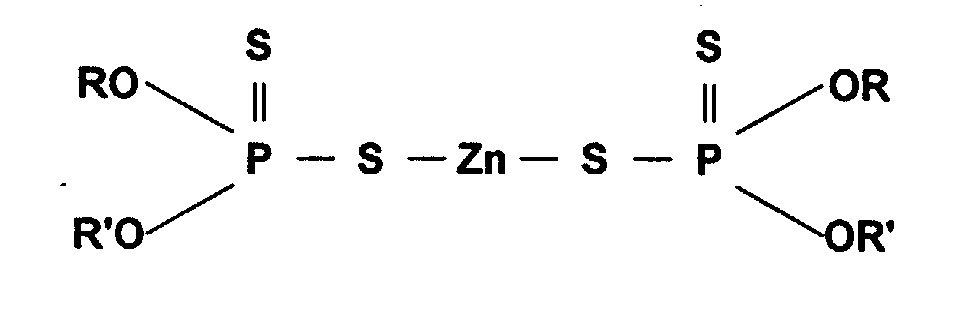
- the ultra-neutral zinc dialkyldithiophosphate can be produced from a dialkyldithiophosphoric acid of the formula:
- the hydroxy alkyl compounds from which the dialkyldithiophosphoric acids are derived can be represented generically by the formula ROH or R'OH, where R or R' is alkyl or substituted alkyl group.
- R or R' is a branched, non-branched, or cyclic alkyl containing 3 to 20 carbon atoms; more preferably, a branched, non-branched, or cyclic secondary alkyl containing 3 to 8 carbon atoms; most preferably, a dialkyldithiophosphoric acid wherein the alkyl group is derived from a secondary alcohol blend containing an average of about 4.5 carbons per molecule.
- hydroxy alkyl compounds may also be used. As is recognized in the art, these hydroxy alkyl compounds need not be monohydroxy alkyl compounds. That is, the dialkyldithiophosphoric acids may be prepared from mono-, di-, tri-, tetra-, and other polyhydroxy alkyl compounds, or mixtures of two or more of the foregoing. It is to be understood that most commercially available alcohols are not pure compounds but are mixtures containing a predominant amount of the desired alcohol and minor amounts of various isomers and/or longer or shorter chain alcohols.
- ROH or R'OH examples of the general class of compounds corresponding to the formula ROH or R'OH are those wherein R or R' are selected from an alkyl, cycloalkyl, alkylsubstituted cycloalkyl, alkoxyalkyl, haloalkyl, and the like.
- hydroxy alkyl compounds are 4-methyl-2-pentanol, 2-butanol, octyl alcohol, cyclohexanol, 2-ethyl-hexanol, isopropanol, methylcyclohexanol, cycloheptanol, cyclopentanol, butanol, isoamyl alcohol, oleyl alcohol, dodecanol, lauryl alcohol, cetyl alcohol, ethylene glycol, propylene glycol, octylphenoxyethanol, neopentyl alcohol, isohexyl alcohol, 2,3-dimethylbutanol, n-heptanol, diisopropyl carbinol, glycerol, diethylene glycol, capryl alcohol, and the like.
- the phosphorus pentasulfide reactant used in the dialkyldithiophosphoric acid formation step of this invention may contain minor amounts of any one or more of P 2 S 3 , P 4 S 3 , P 4 S 7 , or P 4 S 9 .
- Such phosphorus sulfide compositions may contain minor amounts of free sulfur.
- phosphorus pentasulfide While the structure of phosphorus pentasulfide is generally represented as P 2 S 5 , the actual structure is believed to contain four phosphorus atoms and ten sulfur atoms, i.e., P 4 S 10 .
- the phosphorus sulfide reactant will be considered as a compound having the structure of P 2 S 5 with the understanding that the actual structure is probably P 4 S 10 .
- the ultra-neutral zinc dialkyldithiophosphates of this invention are useful as lubricating oil additives imparting antiwear properties to the lubricating oil.
- Such lubricating oil compositions are useful in diesel engines, gasoline engines, as well as in marine engines.
- Such lubricating oil compositions employ a finished lubricating oil, which may be single or multigrade.
- Multigrade lubricating oils are prepared by adding viscosity index (VI) improvers.
- the lubricating oil, or base oil, used in such compositions may be mineral oil or synthetic oils of viscosity suitable for use in the crankcase of an internal combustion engine, such as gasoline engines and diesel engines, which include marine engines.
- Crankcase lubricating oils ordinarily have a viscosity of about 1300 cSt at 0° F to 24 cSt at 210° F (99° C).
- the lubricating oils may be derived from synthetic or natural sources.
- Mineral oil for use as the base oil in this invention includes paraffinic, naphthenic, and other oils that are ordinarily used in lubricating oil compositions. Synthetic oils include both hydrocarbon synthetic oils and synthetic esters.
- Useful synthetic hydrocarbon oils include liquid polymers of alpha olefins having the proper viscosity. Especially useful are the hydrogenated liquid oligomers of C 6 to C 12 alpha olefins, such as 1-decene trimer. Likewise, alkyl benzenes of proper viscosity, such as didodecyl benzene, can be used.
- Useful synthetic esters include the esters of both monocarboxylic acid and polycarboxylic acids, as well as monohydroxy alkanols and polyols.
- Typical examples are didodecyl adipate, pentaerythritol tetracaproate, di-2-ethylhexyl adipate, dilaurylsebacate, and the like.
- Complex esters prepared from mixtures of mono and dicarboxylic acids and mono and dihydroxy alkanols can also be used.
- Blends of hydrocarbon oils with synthetic oils are also useful. For example, blends of 10 to 25 weight percent hydrogenated 1-decene trimer with 75 to 90 weight percent 150 SUS (100° F) mineral oil gives an excellent lubricating oil base.
- the lubricating oil composition may also contain small amounts of ashless dispersants, phenate and sulfonate detergents, rust inhibitors, foam inhibitors, corrosion inhibitors, metal deactivators, pour point depressants, antioxidants, and a variety of other well-known additives.
- ashless dispersants useful in the present invention include succinimides and succinic esters, each of which has an alkyl or alkenyl group of a molecular weight of about 700 to 3,000. In addition to these compounds, their derivatives (e.g., borated derivatives) are also employable.
- the ashless dispersant is generally incorporated into an engine oil in an amount of 0 to 20 weight percent, preferably 1 to 10 weight percent, per total amount of the engine oil.
- overbased sulfurized alkylphenates useful in the present invention include those described, for example, in U.S. Patent Nos. 2,680,096; 3,178,368; 3,367,867; 3,801,507; 5,529,705; and the like, which are all hereby incorporated by reference for all purposes.
- the overbased sulfurized alkylphenate is generally incorporated into an engine oil in an amount of 0 to 20 weight percent, preferably 1 to 10 weight percent, per total amount of the engine oil.
- oxidation inhibitors useful in the present invention include, but are not limited to, phenol type (phenolic) oxidation inhibitors, such as 4,4'-methylenebis(2,6-di-tert-butylphenol), 4,4'-bis(2,6-di-tert-butylphenol), 4,4'-bis(2-methyl6-tert-butylphenol), 2,2'-methylene-bis(4-methyl-6-tert-butyl-phenol), 4,4'-butylidene-bis(3-methyl-6-tert-butylphenol), 4,4'-isopropylidene-bis(2,6-ditert-butylphenol), 2,2'-methylene-bis(4-methyl-6-nonylphenol), 2,2'-isobutylidenebis(4,6-dimethylphenol), 2,2'-methylene-bis(4-methyl-6-cyclohexylphenol), 2,6-ditert-butyl-4-methylphenol, 2,6-di-tert
- Diphenylamine-type oxidation inhibitors include, but are not limited to, alkylated diphenylamine, phenyl- ⁇ -naphthylamine, and alkylated ⁇ -naphthylamine.
- Other types of oxidiation inhibitors include metal dithiocarbamate (e.g., zinc dithiocarbamate), and methylenebis(dibutyldithiocarbamate).
- the oxidation inhibitor is generally incorporated into an engine oil in an amount of 0 to 10 weight percent, preferably 0.05 to 2 weight percent, per total amount of the engine oil.
- viscosity index improvers useful in the present invention include poly-(alkyl methacrylate), ethylene-propylene copolymer, styrene-butadiene copolymer, and polyisoprene. Viscosity index improvers of dispersant type (having increased dispersancy) or multi-function type are also employed. These viscosity index improvers can be used singly or in combination.
- the viscosity index improver is generally incorporated into an engine oil in an amount of 0 to 20 weight percent, preferably 1 to 15 weight percent, per total amount of the engine oil.
- a lubricating oil composition can be produced by blending together a major amount of a base oil of lubricating viscosity, from 0 to 20 weight % of an ashless dispersant, from 0 to 20 weight % of an overbased sulfurized alkylphenate detergent, from 0 to 10 weight % of an oxidation inhibitor, from 0 to 20 weight % of a viscosity index improver; and, from 0.05 to 5 weight % of a zinc dialkyldithiophosphate, wherein said-zinc dialkyldithiophosphate has a zinc to phosphorus weight ratio in the range of from 0.95:1 to 1.04:1, wherein the ash content of said lubricating oil composition is less-than 1.5 weight percent.
- the lubricating oil composition produced by that method might have a slightly different composition, as components interact.
- An ultra-neutral zinc dialkyldithiophosphate salt was prepared by the following process, from a dialkyldithiophosphoric acid wherein the alkyl group was derived from a secondary alcohol blend containing an average of about 4.5 carbons per molecule. 1164 grams of 100 neutral oil, 8.7 grams of acetic acid, and about two-thirds (2034 grams) of the total dialkyldithiophosphoric acid charge were charged into a stirred round bottom glass flask. 437 grams of zinc oxide was then charged to the reaction mixture. The remaining dialkyldithiophosphoric acid (1017 grams) was added at a rate such that the temperature of the mixture did not exceed 77° C.
- the temperature of the reaction mixture was held at approximately 77° C for three hours. After three hours, the reaction mixture was heated to 99° C, and vacuum was applied for thirty minutes to strip off any water and/or unreacted alcohol. The product was filtered using diatomaceous earth filter aid. The zinc and phosphorus content of this material were measured, and the zinc to phosphorus ratio was calculated to be 0.98. No basic salt was detected by 31 P NMR.
- Basic and ultra-neutral zinc dialkyldithiophosphate salts were synthesized using a different procedure than that shown in Example 1. Each salt was blended into a oil formulation containing: Group I base stock, 8 weight percent of an ashless dispersant, 53 mmoles/kg of a metallic detergent, 0.2 weight percent of an oxidation inhibitor, and a non-dispersant olefin copolymer viscosity index improver to achieve SAE15W-40 grade lubricating oils. These oils were tested in the ASTM Sequence VE engine test, which utilizes a Ford 2.3 liter four-cylinder engine.
- the test method simulates a type of severe field test service characterized by a combination of low speed, low temperature "stop and go" city driving and moderate tumpike operation.
- the effectiveness of the additives in the oil is measured in terms of the protection provided against valve train wear.
- the Sequence VE wear results are shown in Table I.
- the data show that the ultra-neutral zinc dialkyldithiophosphate salt provided better wear performance than the basic zinc dialkyldithiophosphate salt under these test conditions, as measured by average cam wear and maximum cam wear.
- Tables II and III show the statistical analyses of the engine test data. Theies analyses show that there is a high confidence level in this wear data.
- An ultra-neutral zinc dialkyldithiophosphate salt was prepared from a dialkyldithiophosphoric acid wherein the alkyl group is derived from a secondary alcohol blend containing an average of about 4.5 carbons per molecule.
- the derived ultra-neutral zinc dialkyldithiophosphate had a Zn:P ratio of 0.98:1, which was less than the theoretical 1.05:1 of neutral zinc dialkyldithiophosphate and found to have a low corrosivity to carbon steel.
- the corrosion test was run as follows: Three new carbon steel (Type 1018) test coupons, approximately 2 x 2 inches square, were individually weighed to four decimal places. The coupons were suspended by teflon tape in a glass vessel containing sufficient secondary zinc dialkyldithiophosphate to totally immerse the coupons. The secondary zinc dialkyldithiophosphate had a zinc to phosphorus ratio of 0.98:1 and contained no basic salt according to 31 P NMR analysis. The vessel containing the coupons and the zinc dialkyldithiophosphate was placed into a 52° C oven. The first coupon was removed from the test liquid after 72 hours for inspection. It was gently cleaned with cleanser to remove any scale that had formed.
- Zinc dialkyldithiophosphate with less that 1.05:1 Zn:P ratio tend to produce less sediment during the manufacturing process than zinc dialkyldithiophosphate made with higher Zn:P ratios.
- An ultra-neutral secondary zinc dialkyldithiophosphate salt was prepared by charging 124.9 grams of 100 neutral oil, 1.0 gram of acetic acid and about two-thirds (218.3 grams) of the total dialkyldithiophosphoric acid charge into a stirred round bottom glass flask. 48.4 grams of zinc oxide was then charged to the reaction mixture. The remaining dialkyldithiophosphoric acid (109.2 grams) was added at a rate such that the temperature of the mixture did not exceed 77° C. Once all the dialkyldithiophosphoric acid was added, the temperature of the reaction mixture was held at approximately 77° C for three hours.
- the reaction mixture was heated to approximately 97° C, and vacuum was applied for 30 minutes to strip off any water and/or unreacted alcohol.
- the product was diluted with hexane and centrifuged to separate any sediment.
- the hexane solution was decanted from the sediment and discarded.
- the sediment was washed with hexane, re-centrifuged, and the liquid was decanted. This washing procedure was repeated.
- the sediment was dried and weighed. The sediment was determined to be 0.05 weight percent.
- the zinc and phosphorus content of this material was measured, and the zinc to phosphorus ratio was calculated to be 1.01:1 and no basic salt was detected by 31 P NMR.
- dialkyldithiophosphoric acid As used in Example 4, another preparation of secondary zinc dialkyldithiophosphate salt was made by charging 128.2 grams of 100 neutral oil, 1.0 gram of acetic acid and about two-thirds (224.1 grams) of the total dialkyldithiophosphoric acid charge into a stirred round bottom glass flask. 51.7 grams of zinc oxide was then charged to the reaction mixture. The remaining dialkyldithiophosphoric acid (112.1 grams) was added at a rate such that the temperature of the mixture did not exceed 77° C. Once all the dialkyldithiophosphoric acid was added, the temperature of the reaction mixture was held at approximately 77° C for three hours.
- the reaction mixture was heated to approximately 97° C, and vacuum was applied for 30 minutes to strip off any water and/or unreacted alcohol.
- the product was diluted with hexane and centrifuged to separate any sediment.
- the hexane solution was decanted from the sediment.
- the sediment was washed with hexane, re-centrifuged, and the liquid was decanted. This washing procedure was repeated.
- the sediment was determined to be 0.04 weight percent.
- the zinc and phosphorus content of this material was measured, and the zinc to phosphorus ratio was calculated to be 1.06.
- This material contained 14 weight percent basic salt (relative to the total neutral and basic salts) as determined by 31 P NMR.
- Example 4 Using the same dialkyldithiophosphoric acid as used in Example 4, another preparation of a secondary zinc dialkyldithiophosphate salt was made by charging 95.1 grams of 100 neutral oil, 0.8 grams of acetic acid and about two-thirds (166.3 grams) of the total dialkyldithiophosphoric acid charge into a stirred round bottom glass flask. 39.9 grams of zinc oxide was then charged to the reaction mixture. The remaining dialkyldithiophosphoric acid (83.1 grams) was added at a rate such that the temperature of the mixture did not exceed 77° C. Once all the dialkyldithiophosphoric acid was added, the temperature of the reaction mixture was held at approximately 77° C for three hours.
- the reaction mixture was heated to approximately 98° C, and vacuum was applied for 30 minutes to strip off any water and/or unreacted alcohol.
- the product was diluted with hexane and centrifuged to separate any sediment.
- the hexane solution was decanted from the sediment.
- the sediment was washed with hexane, re-centrifuged, and the liquid was decanted. This washing procedure was repeated.
- the sediment was dried and weighed. The sediment was determined to be 0.09 weight percent.
- the zinc and phosphorus content of this material was measured, and the zinc to phosphorus ratio was calculated to be 1.09.
- This material contained 22 weight percent basic salt (relative to the total neutral and basic salts) as determined by 31 P NMR.
- Example 4 Using the same dialkyldithiophosphoric acid as used in Example 4, another preparation of a secondary zinc dialkyldithiophosphate salt was made by charging 94.7 grams of 100 neutral oil, 0.8 grams of acetic acid and about two-thirds (165.5 grams) of the total dialkyldithiophosphoric acid charge into a stirred round bottom glass flask. 41.2 grams of zinc oxide was then charged to the reaction mixture. The remaining dialkyldithiophosphoric acid (82.7 grams) was added at a rate such that the temperature of the mixture did not exceed 77° C. Once all the dialkyldithiophosphoric acid was added, the temperature of the reaction mixture was held at approximately 77° C for three hours.
- the reaction mixture was heated to approximately 99° C, and vacuum was applied for 30 minutes to strip off any water and/or unreacted alcohol.
- the product was diluted with hexane and centrifuged to separate any sediment.
- the hexane solution was decanted from the sediment.
- the sediment was washed with hexane, re-centrifuged, and the liquid was decanted. This washing procedure was repeated.
- the sediment was dried and weighed. The sediment was determined to be 0.28 weight percent.
- the zinc and phosphorus content of this material was measured, and the zinc to phosphorus ratio was calculated to be 1.11.
- This material contained 27 weight percent basic salt (relative to the total neutral and basic salts) as determined by 31 P NMR.
Landscapes
- Chemical & Material Sciences (AREA)
- Organic Chemistry (AREA)
- Chemical Kinetics & Catalysis (AREA)
- General Chemical & Material Sciences (AREA)
- Oil, Petroleum & Natural Gas (AREA)
- Health & Medical Sciences (AREA)
- Life Sciences & Earth Sciences (AREA)
- Biochemistry (AREA)
- General Health & Medical Sciences (AREA)
- Molecular Biology (AREA)
- Lubricants (AREA)
Abstract
Description

| Ultra-Neutral ZnDTP versus Basic ZnDTP Wear Performance in Sequence VE Engine Test. | |||
| Zn:P Ratio | Average Cam Wear | Maximum Cam Wear | |
| Basic Salt ZnDTP | 1.27:1 | 7.62 ± 4.02 | 17.2 ± 3.75 |
| Ultra-Neutral Salt ZnDTP | 0.98:1 | 0.80 ± 0.94 | 3.83 ± 5.86 |
| Statistical Analysis of Sequence VE Wear Performance (Square Root of Average Cam Wear (ACW)) | |||
| Zinc Type | n | Mean | p-Value (Conclusion) |
| Basic Salt | 3 | 2.68 | 0.027 (Significant Difference) |
| Ultra-Neutral Salt | 3 | 0.80 |
| Statistical Analysis of Sequence VE Wear Performance (Square Root of Maximum Cam Wear (MCW)) | |||
| Zinc Type | n | Mean | p-Value (Conclusion) |
| Basic Salt | 3 | 4.13 | 0.045 (Significant Difference) |
| Ultra-Neutral Salt | 3 | 1.53 |
| Ultra-Neutral Salt/Carbon Steel Corrosion Test Results. | |||||
| Corrosion Rate | |||||
| Zn:P | % Basic Salt by NMR | Exposure Temp. (° C) | mils per year after | ||
| 72 hr. | 198 hr. | 720 hr. | |||
| 0.98 | 0.0 | 52 | 0.62 | 0.27 | 0.05 |
Claims (13)
- A lubricating oil composition comprising:wherein the ash content of said lubricating oil composition is less than 1.5 weight percent.(a) a base oil of lubricating viscosity; and(b) a zinc dialkyldithiophosphate, wherein said zinc dialkyldithiophosphate has a zinc to phosphorus weight ratio in the range of from 0.95:1 to 1.04:1; and
- A lubricating oil composition according to Claim 1, wherein the ash content of said lubricating oil composition is less than 1.1 weight percent.
- A lubricating oil composition according to Claim 2, wherein the ash content of said lubricating oil composition is less than 1.0 weight percent.
- A lubricating oil composition according to any preceding claim, wherein each of the alkyl groups of said zinc dialkyldithiophosphate contains from 3 to 20 carbon atoms.
- A lubricating oil composition according to claim 4, wherein each of the alkyl groups of said zinc dialkyldithiophosphate contains from 3 to 8 carbon atoms.
- A lubricating oil composition according to claim 5 or 6, wherein each of the alkyl groups of said zinc dialkyldithiophosphate is a secondary alkyl group.
- A lubricating oil composition according to any preceding claim, further comprising an overbased sulfurized alkylphenate detergent.
- A lubricating oil composition according to any one of claims 1 to 6, wherein the zinc dialkyldithiophosphate is used in an amount of from 0.05 to 5 weight percent, and further comprising(i) 0 to 20 weight % of an ashless dispersant:(ii) 0 to 20 weight % of an overbased sulfurized alkylphenate detergent;(iii) 0 to 10 weight % of an oxidation inhibitor; and(iv) 0 to 20 weight % of a viscosity index improver.
- A lubricating oil according to claim 8, wherein the zinc dialkyldithiophosphate is used in an amount of from 0.05 to 3 weight %.
- A lubricating oil composition according to claim 8 or 9, further comprising:(i) from 1 to 10 weight % of an ashless dispersant;(ii) from 1 to 10 weight % of an overbased sulfurized alkylphenate detergent;(iii) from 0.05 to 2 weight % of an oxidation inhibitor; and(iv) from 1 to 15 weight % of a viscosity index improver.
- A method of decreasing the wear of machine parts, said method comprising using a lubricating oil composition according to any preceding claim.
- A method of producing a lubricating oil composition comprising blending the following components together:wherein the ash content of said lubricating oil composition is less than 1.5 weight percent.(a) a major amount of a base oil of lubricating viscosity;(b) from 0 to 20 weight % of an ashless dispersant;(c) from 0 to 20 weight % of an overbased sulfurized alkylphenate detergent:(d) from 0 to 10 weight % of an oxidation inhibitor;(e) from 0 to 20 weight % of a viscosity index improver; and(f) from 0.05 to 5 weight % of a zinc dialkyldithiophosphate, wherein said zinc dialkyldithiophosphate has a zinc to phosphorus weight ratio in the range of from 0.95:1 to 1.04:1;
- A lubricating oil composition produced by the method according to Claim 12.
Applications Claiming Priority (2)
| Application Number | Priority Date | Filing Date | Title |
|---|---|---|---|
| US822251 | 1997-03-20 | ||
| US08/822,251 US5728656A (en) | 1997-03-20 | 1997-03-20 | Lower-ash lubricating oil having ultra-neutral zinc dialkyldithiophosphates |
Publications (1)
| Publication Number | Publication Date |
|---|---|
| EP0866113A1 true EP0866113A1 (en) | 1998-09-23 |
Family
ID=25235574
Family Applications (1)
| Application Number | Title | Priority Date | Filing Date |
|---|---|---|---|
| EP98302088A Withdrawn EP0866113A1 (en) | 1997-03-20 | 1998-03-19 | Lower-ash lubricating oil having ultra-neutral zinc dialkyldithiophosphates |
Country Status (5)
| Country | Link |
|---|---|
| US (1) | US5728656A (en) |
| EP (1) | EP0866113A1 (en) |
| JP (1) | JPH10265791A (en) |
| CA (1) | CA2231295C (en) |
| SG (1) | SG71765A1 (en) |
Cited By (1)
| Publication number | Priority date | Publication date | Assignee | Title |
|---|---|---|---|---|
| EP1529829A1 (en) * | 2003-11-06 | 2005-05-11 | Afton Chemical Corporation | Process for producing zinc dialkyldithiophosphates exhibiting improved seal compatibility properties |
Families Citing this family (19)
| Publication number | Priority date | Publication date | Assignee | Title |
|---|---|---|---|---|
| GB9716283D0 (en) * | 1997-08-01 | 1997-10-08 | Exxon Chemical Patents Inc | Lubricating oil compositions |
| JP5057603B2 (en) * | 1998-05-01 | 2012-10-24 | 昭和シェル石油株式会社 | Lubricating oil composition for internal combustion engines |
| US6667282B2 (en) * | 2001-05-31 | 2003-12-23 | Crompton Corporation | Alkyl hydrazide additives for lubricants |
| US20050061734A1 (en) * | 2003-09-22 | 2005-03-24 | Alltrista Zinc Products, L.P. | Anti-corrosive engine oil system components |
| US20050065042A1 (en) * | 2003-09-22 | 2005-03-24 | Alltrista Zinc Products, L.P., An Indiana Limited Partnership | Anti-corrosive engine oil system components |
| US6958409B1 (en) | 2004-06-15 | 2005-10-25 | Chevron Oronite Company Llc | Process for reduced crude sediment in metal salts of hydrocarbyl dithiophosphoric acid |
| US7648949B2 (en) * | 2005-01-27 | 2010-01-19 | The Lubrizol Corporation | Low phosphorus cobalt complex-containing engine oil lubricant |
| AU2007275457A1 (en) * | 2006-07-17 | 2008-01-24 | The Lubrizol Corporation | Lubricating oil composition and method of improving efficiency of emissions control system |
| US8123934B2 (en) * | 2008-06-18 | 2012-02-28 | Chevron U.S.A., Inc. | System and method for pretreatment of solid carbonaceous material |
| US8211840B2 (en) * | 2008-12-09 | 2012-07-03 | Afton Chemical Corporation | Additives and lubricant formulations for improved antiwear properties |
| US20110120915A1 (en) * | 2009-11-24 | 2011-05-26 | Chevron U.S.A. Inc. | Hydrogenation of solid carbonaceous materials using mixed catalysts |
| US20110120916A1 (en) * | 2009-11-24 | 2011-05-26 | Chevron U.S.A. Inc. | Hydrogenation of solid carbonaceous materials using mixed catalysts |
| US20110120917A1 (en) * | 2009-11-24 | 2011-05-26 | Chevron U.S.A. Inc. | Hydrogenation of solid carbonaceous materials using mixed catalysts |
| US20110120914A1 (en) * | 2009-11-24 | 2011-05-26 | Chevron U.S.A. Inc. | Hydrogenation of solid carbonaceous materials using mixed catalysts |
| US9725673B2 (en) * | 2010-03-25 | 2017-08-08 | Afton Chemical Corporation | Lubricant compositions for improved engine performance |
| US9200230B2 (en) | 2013-03-01 | 2015-12-01 | VORA Inc. | Lubricating compositions and methods of use thereof |
| JP6655994B2 (en) * | 2016-01-13 | 2020-03-04 | 株式会社神戸製鋼所 | Mixed powder for powder metallurgy |
| CN109679728B (en) * | 2017-10-18 | 2022-06-24 | 中国石油化工股份有限公司 | Gasoline engine lubricating oil composition and preparation method thereof |
| US12110468B1 (en) | 2023-03-22 | 2024-10-08 | Afton Chemical Corporation | Antiwear systems for improved wear in medium and/or heavy duty diesel engines |
Citations (8)
| Publication number | Priority date | Publication date | Assignee | Title |
|---|---|---|---|---|
| US3347790A (en) * | 1965-07-01 | 1967-10-17 | Lubrizol Corp | Lubricating compositions containing metal salts of acids of phosphorus |
| US3944495A (en) * | 1974-02-19 | 1976-03-16 | Texaco Inc. | Metal dialkyldithiophosphates |
| US4466895A (en) * | 1983-06-27 | 1984-08-21 | The Lubrizol Corporation | Metal salts of lower dialkylphosphorodithioic acids |
| WO1989009812A1 (en) * | 1988-04-11 | 1989-10-19 | The Lubrizol Corporation | Lubricating oil additives |
| US5102566A (en) * | 1987-10-02 | 1992-04-07 | Exxon Chemical Patents Inc. | Low ash lubricant compositions for internal combustion engines (pt-727) |
| US5326485A (en) * | 1992-01-24 | 1994-07-05 | Ethyl Petroleum Additives, Inc. | Low ash lubricating oil compositions |
| WO1995029976A1 (en) * | 1994-04-28 | 1995-11-09 | Exxon Chemical Patents Inc. | Crankcase lubricant for modern heavy duty diesel and gasoline fueled engines |
| US5567342A (en) * | 1994-06-06 | 1996-10-22 | Nippon Oil Co., Ltd. | Lubricating oil composition for internal combustion engines |
Family Cites Families (7)
| Publication number | Priority date | Publication date | Assignee | Title |
|---|---|---|---|---|
| US3691220A (en) * | 1971-12-09 | 1972-09-12 | Mobil Oil Corp | Process for preparing overbased zinc phosphorodithioates |
| GB1565961A (en) * | 1976-02-25 | 1980-04-23 | Orobis Ltd | Composition comprising a mixture of the zinc salts of o,o'-dialkyl dithiophosphoric acids |
| US4094800A (en) * | 1976-07-14 | 1978-06-13 | Standard Oil Company (Indiana) | Anti-wear lubricating oil compositions |
| US4592851A (en) * | 1980-09-02 | 1986-06-03 | Exxon Research And Engineering Co. | Lubricating oil composition and method for providing improved thermal stability |
| US5384054A (en) * | 1994-01-18 | 1995-01-24 | Ethyl Petrolium Additives, Inc. | Process for metal salts of hydrocarbyl dithiophosphoric acid |
| US5380448A (en) * | 1994-02-07 | 1995-01-10 | Ethyl Petrolium Additives, Inc. | Process for metal salts of hydrocarbyl dithiophosphoric acid |
| GB2293389A (en) * | 1994-09-26 | 1996-03-27 | Ethyl Petroleum Additives Ltd | Mixed zinc salt lubricant additives |
-
1997
- 1997-03-20 US US08/822,251 patent/US5728656A/en not_active Expired - Lifetime
-
1998
- 1998-03-06 CA CA002231295A patent/CA2231295C/en not_active Expired - Fee Related
- 1998-03-13 SG SG1998000532A patent/SG71765A1/en unknown
- 1998-03-19 EP EP98302088A patent/EP0866113A1/en not_active Withdrawn
- 1998-03-20 JP JP10072383A patent/JPH10265791A/en active Pending
Patent Citations (8)
| Publication number | Priority date | Publication date | Assignee | Title |
|---|---|---|---|---|
| US3347790A (en) * | 1965-07-01 | 1967-10-17 | Lubrizol Corp | Lubricating compositions containing metal salts of acids of phosphorus |
| US3944495A (en) * | 1974-02-19 | 1976-03-16 | Texaco Inc. | Metal dialkyldithiophosphates |
| US4466895A (en) * | 1983-06-27 | 1984-08-21 | The Lubrizol Corporation | Metal salts of lower dialkylphosphorodithioic acids |
| US5102566A (en) * | 1987-10-02 | 1992-04-07 | Exxon Chemical Patents Inc. | Low ash lubricant compositions for internal combustion engines (pt-727) |
| WO1989009812A1 (en) * | 1988-04-11 | 1989-10-19 | The Lubrizol Corporation | Lubricating oil additives |
| US5326485A (en) * | 1992-01-24 | 1994-07-05 | Ethyl Petroleum Additives, Inc. | Low ash lubricating oil compositions |
| WO1995029976A1 (en) * | 1994-04-28 | 1995-11-09 | Exxon Chemical Patents Inc. | Crankcase lubricant for modern heavy duty diesel and gasoline fueled engines |
| US5567342A (en) * | 1994-06-06 | 1996-10-22 | Nippon Oil Co., Ltd. | Lubricating oil composition for internal combustion engines |
Cited By (3)
| Publication number | Priority date | Publication date | Assignee | Title |
|---|---|---|---|---|
| EP1529829A1 (en) * | 2003-11-06 | 2005-05-11 | Afton Chemical Corporation | Process for producing zinc dialkyldithiophosphates exhibiting improved seal compatibility properties |
| US7368596B2 (en) | 2003-11-06 | 2008-05-06 | Afton Chemical Corporation | Process for producing zinc dialkyldithiophosphates exhibiting improved seal compatibility properties |
| US7592490B2 (en) | 2003-11-06 | 2009-09-22 | Afton Chemical Corporation | Process for producing zinc dialkyldithiophosphates exhibiting improved seal compatibility properties |
Also Published As
| Publication number | Publication date |
|---|---|
| CA2231295A1 (en) | 1998-09-20 |
| SG71765A1 (en) | 2000-04-18 |
| JPH10265791A (en) | 1998-10-06 |
| CA2231295C (en) | 2006-06-06 |
| US5728656A (en) | 1998-03-17 |
Similar Documents
| Publication | Publication Date | Title |
|---|---|---|
| US5728656A (en) | Lower-ash lubricating oil having ultra-neutral zinc dialkyldithiophosphates | |
| US6333298B1 (en) | Molybdenum-free low volatility lubricating oil composition | |
| EP1422286B1 (en) | Oil compositions for improved fuel economy | |
| RU2029778C1 (en) | Lubricating oil for internal combustion engines | |
| CA2131098C (en) | Lubricant composition containing mixed friction modifiers | |
| US4495088A (en) | Method for improving fuel economy of internal combustion engines | |
| CA2132523C (en) | Lubricant compositions containing alkoxylated amine and sulfurized hydrocarbyl phenol friction modifiers | |
| US9365793B2 (en) | Methods and compositions for reducing wear in internal combustion engines lubricated with a low phosphorous content borate-containing lubricating oil | |
| KR0145373B1 (en) | High performance lubricant composition | |
| EP1051466B1 (en) | Use of polyalfaolefins (pao) derived from 1-dodecene or 1-tetradecene to imrove thermal stability in engine oil in an internal combustion engine | |
| US4406803A (en) | Method for improving fuel economy of internal combustion engines | |
| KR20190011215A (en) | Motorcycle lubricant | |
| JPH06184578A (en) | Engine oil composition | |
| WO2016205458A1 (en) | Multifunctional molybdenum containing compounds, method of making and using, and lubricating oil compositions containing same | |
| CA2460400C (en) | Friction modifiers for engine oil composition | |
| CA2572041C (en) | A method of improving the acrylic rubber sealant compatibility with a lubricating oil composition in an internal combustion engine in comparison to a conventionally used lubricating oil composition | |
| US4681694A (en) | Marine crankcase lubricant | |
| JPH1135962A (en) | Lubricating oil composition | |
| JPH09511015A (en) | Overbased alkyloxybenzene sulfonates as detergents | |
| EP0976810A1 (en) | Mixture of alkyl-phenyl-sulfonates of alkaline earth metals, its application as an additive for lubricating oil, and methods of preparation | |
| EP4476306A1 (en) | Lubricating engine oil for hybrid or plug-in hybrid electric vehicles | |
| RU2023003C1 (en) | Internal engine lubricating oil | |
| GB2087922A (en) | Lubricating oil additive for reducing fuel consumption in internal combustion engines | |
| KR20160074557A (en) | Lubricating oil composition for protection of silver bearings in medium speed diesel engines |
Legal Events
| Date | Code | Title | Description |
|---|---|---|---|
| PUAI | Public reference made under article 153(3) epc to a published international application that has entered the european phase |
Free format text: ORIGINAL CODE: 0009012 |
|
| AK | Designated contracting states |
Kind code of ref document: A1 Designated state(s): DE FR GB NL |
|
| AX | Request for extension of the european patent |
Free format text: AL;LT;LV;MK;RO;SI |
|
| 17P | Request for examination filed |
Effective date: 19981026 |
|
| AKX | Designation fees paid |
Free format text: DE FR GB NL |
|
| RBV | Designated contracting states (corrected) |
Designated state(s): DE FR GB NL |
|
| RAP1 | Party data changed (applicant data changed or rights of an application transferred) |
Owner name: CHEVRON CHEMICAL COMPANY LLC |
|
| 17Q | First examination report despatched |
Effective date: 20001106 |
|
| RAP1 | Party data changed (applicant data changed or rights of an application transferred) |
Owner name: CHEVRON ORONITE COMPANY LLC |
|
| STAA | Information on the status of an ep patent application or granted ep patent |
Free format text: STATUS: THE APPLICATION IS DEEMED TO BE WITHDRAWN |
|
| 18D | Application deemed to be withdrawn |
Effective date: 20051122 |