EP0865446B1 - Agents for promoting bone formation - Google Patents
Agents for promoting bone formation Download PDFInfo
- Publication number
- EP0865446B1 EP0865446B1 EP96942315A EP96942315A EP0865446B1 EP 0865446 B1 EP0865446 B1 EP 0865446B1 EP 96942315 A EP96942315 A EP 96942315A EP 96942315 A EP96942315 A EP 96942315A EP 0865446 B1 EP0865446 B1 EP 0865446B1
- Authority
- EP
- European Patent Office
- Prior art keywords
- group
- bone formation
- bone
- agent
- manufacturing
- Prior art date
- Legal status (The legal status is an assumption and is not a legal conclusion. Google has not performed a legal analysis and makes no representation as to the accuracy of the status listed.)
- Expired - Lifetime
Links
- 230000011164 ossification Effects 0.000 title claims abstract description 32
- 230000001737 promoting effect Effects 0.000 title claims abstract description 28
- 150000001875 compounds Chemical class 0.000 claims abstract description 49
- 239000003795 chemical substances by application Substances 0.000 claims abstract description 25
- 108090000765 processed proteins & peptides Proteins 0.000 claims abstract description 23
- 108010059557 kistrin Proteins 0.000 claims abstract description 14
- ZTYNVDHJNRIRLL-FWZKYCSMSA-N rhodostomin Chemical compound C([C@H]1C(=O)N[C@@H](CO)C(=O)N[C@@H](CCCNC(N)=N)C(=O)N[C@@H](C)C(=O)NCC(=O)N[C@@H](CCCCN)C(=O)N[C@H](C(N[C@@H]2C(=O)N[C@@H](CCCNC(N)=N)C(=O)N[C@H](C(=O)N3CCC[C@H]3C(=O)N[C@@H](CCCNC(N)=N)C(=O)NCC(=O)N[C@@H](CC(O)=O)C(=O)N[C@@H](CCSC)C(=O)N3CCC[C@H]3C(=O)N[C@@H](CC(O)=O)C(=O)N[C@@H](CC(O)=O)C(=O)N[C@@H](CCCNC(N)=N)C(=O)N[C@H](C(N[C@H](C(=O)NCC(=O)N[C@@H](CCC(N)=O)C(=O)N[C@@H](CO)C(=O)N[C@@H](C)C(=O)N[C@@H](CC(O)=O)C(=O)N[C@@H](CSSC2)C(=O)N2[C@@H](CCC2)C(=O)N[C@@H](CCCNC(N)=N)C(=O)N[C@@H](CC=2C=CC(O)=CC=2)C(=O)N[C@@H](CC=2NC=NC=2)C(O)=O)[C@@H](C)O)=O)CSSC[C@H]2C(=O)N[C@H]3CSSC[C@@H](C(NCC(=O)N[C@@H](CCC(O)=O)C(=O)NCC(=O)N[C@@H](CC(C)C)C(=O)N2)=O)NC(=O)[C@H](CCC(N)=O)NC(=O)[C@H](C)NC(=O)CNC(=O)[C@@H]2CCCN2C(=O)[C@H](CCCNC(N)=N)NC(=O)[C@H](CC(C)C)NC(=O)[C@H](CCCCN)NC(=O)[C@H]2NC(=O)[C@H]([C@@H](C)O)NC(=O)[C@H](C)NC(=O)[C@H](C)NC(=O)[C@H](CC(O)=O)NC(=O)[C@@H]4CSSC[C@H](NC(=O)[C@H](CC(O)=O)NC(=O)[C@@H](NC(=O)[C@H](CCC(O)=O)NC(=O)[C@H](CCCCN)NC(=O)CN)CSSC2)C(=O)N[C@@H](CO)C(=O)N[C@@H](CO)C(=O)N2CCC[C@H]2C(=O)N[C@@H](CCC(O)=O)C(=O)N[C@@H](CC(N)=O)C(=O)N2CCC[C@H]2C(=O)N[C@H](C(N4)=O)CSSC[C@H](NC(=O)[C@H](CCC(N)=O)NC(=O)[C@H](CCC(O)=O)NC3=O)C(=O)N[C@@H](CCCCN)C(=O)N1)[C@@H](C)CC)=O)[C@@H](C)CC)C1=CC=CC=C1 ZTYNVDHJNRIRLL-FWZKYCSMSA-N 0.000 claims abstract description 14
- RGNVSYKVCGAEHK-GUBZILKMSA-N (3s)-3-[[2-[[(2s)-2-[(2-aminoacetyl)amino]-5-(diaminomethylideneamino)pentanoyl]amino]acetyl]amino]-4-[[(1s)-1-carboxy-2-hydroxyethyl]amino]-4-oxobutanoic acid Chemical compound NC(N)=NCCC[C@H](NC(=O)CN)C(=O)NCC(=O)N[C@@H](CC(O)=O)C(=O)N[C@@H](CO)C(O)=O RGNVSYKVCGAEHK-GUBZILKMSA-N 0.000 claims abstract description 11
- 108010034892 glycyl-arginyl-glycyl-aspartyl-serine Proteins 0.000 claims abstract description 11
- 125000004435 hydrogen atom Chemical group [H]* 0.000 claims abstract description 10
- 150000003839 salts Chemical class 0.000 claims abstract description 4
- 238000004519 manufacturing process Methods 0.000 claims abstract 13
- 125000004432 carbon atom Chemical group C* 0.000 claims description 30
- 125000002887 hydroxy group Chemical group [H]O* 0.000 claims description 10
- 125000000217 alkyl group Chemical group 0.000 claims description 8
- 125000003118 aryl group Chemical group 0.000 claims description 5
- 125000000753 cycloalkyl group Chemical group 0.000 claims description 5
- 125000003545 alkoxy group Chemical group 0.000 claims description 4
- 125000003302 alkenyloxy group Chemical group 0.000 claims description 3
- 125000004104 aryloxy group Chemical group 0.000 claims description 3
- IYMAXBFPHPZYIK-BQBZGAKWSA-N Arg-Gly-Asp Chemical compound NC(N)=NCCC[C@H](N)C(=O)NCC(=O)N[C@@H](CC(O)=O)C(O)=O IYMAXBFPHPZYIK-BQBZGAKWSA-N 0.000 abstract description 11
- 102000004196 processed proteins & peptides Human genes 0.000 abstract description 9
- 229920001184 polypeptide Polymers 0.000 abstract description 6
- 150000001413 amino acids Chemical group 0.000 abstract description 4
- 108010072041 arginyl-glycyl-aspartic acid Proteins 0.000 abstract description 4
- 238000002560 therapeutic procedure Methods 0.000 abstract description 3
- 125000004178 (C1-C4) alkyl group Chemical group 0.000 abstract 3
- 210000000988 bone and bone Anatomy 0.000 description 55
- 210000004027 cell Anatomy 0.000 description 24
- 230000002308 calcification Effects 0.000 description 13
- 230000000694 effects Effects 0.000 description 11
- 210000000963 osteoblast Anatomy 0.000 description 11
- 102000002260 Alkaline Phosphatase Human genes 0.000 description 10
- 108020004774 Alkaline Phosphatase Proteins 0.000 description 10
- 0 NC(NCCC[C@@](C(C1CC(N[C@@](C2)C(N[C@@](C3CCCCC3)C(O)=O)=O)=*=C2O)=O)NC1=O)=N Chemical compound NC(NCCC[C@@](C(C1CC(N[C@@](C2)C(N[C@@](C3CCCCC3)C(O)=O)=O)=*=C2O)=O)NC1=O)=N 0.000 description 10
- 210000002997 osteoclast Anatomy 0.000 description 10
- 239000000243 solution Substances 0.000 description 9
- 230000015572 biosynthetic process Effects 0.000 description 8
- 238000011282 treatment Methods 0.000 description 8
- XLYOFNOQVPJJNP-UHFFFAOYSA-N water Substances O XLYOFNOQVPJJNP-UHFFFAOYSA-N 0.000 description 8
- 238000011534 incubation Methods 0.000 description 7
- 239000002609 medium Substances 0.000 description 7
- WEVYAHXRMPXWCK-UHFFFAOYSA-N Acetonitrile Chemical compound CC#N WEVYAHXRMPXWCK-UHFFFAOYSA-N 0.000 description 6
- CKLJMWTZIZZHCS-UWTATZPHSA-N D-aspartic acid Chemical compound OC(=O)[C@H](N)CC(O)=O CKLJMWTZIZZHCS-UWTATZPHSA-N 0.000 description 6
- DTQVDTLACAAQTR-UHFFFAOYSA-N Trifluoroacetic acid Chemical compound OC(=O)C(F)(F)F DTQVDTLACAAQTR-UHFFFAOYSA-N 0.000 description 6
- 230000037396 body weight Effects 0.000 description 6
- 230000001605 fetal effect Effects 0.000 description 6
- 108010044426 integrins Proteins 0.000 description 6
- 102000006495 integrins Human genes 0.000 description 6
- 238000002360 preparation method Methods 0.000 description 6
- 235000018102 proteins Nutrition 0.000 description 6
- 102000004169 proteins and genes Human genes 0.000 description 6
- 108090000623 proteins and genes Proteins 0.000 description 6
- 241000283690 Bos taurus Species 0.000 description 5
- UREBDLICKHMUKA-CXSFZGCWSA-N dexamethasone Chemical compound C1CC2=CC(=O)C=C[C@]2(C)[C@]2(F)[C@@H]1[C@@H]1C[C@@H](C)[C@@](C(=O)CO)(O)[C@@]1(C)C[C@@H]2O UREBDLICKHMUKA-CXSFZGCWSA-N 0.000 description 5
- 229960003957 dexamethasone Drugs 0.000 description 5
- 125000001997 phenyl group Chemical group [H]C1=C([H])C([H])=C(*)C([H])=C1[H] 0.000 description 5
- 239000000126 substance Substances 0.000 description 5
- CIWBSHSKHKDKBQ-JLAZNSOCSA-N Ascorbic acid Chemical compound OC[C@H](O)[C@H]1OC(=O)C(O)=C1O CIWBSHSKHKDKBQ-JLAZNSOCSA-N 0.000 description 4
- 102000004190 Enzymes Human genes 0.000 description 4
- 108090000790 Enzymes Proteins 0.000 description 4
- 108010067306 Fibronectins Proteins 0.000 description 4
- 102000016359 Fibronectins Human genes 0.000 description 4
- TWRXJAOTZQYOKJ-UHFFFAOYSA-L Magnesium chloride Chemical compound [Mg+2].[Cl-].[Cl-] TWRXJAOTZQYOKJ-UHFFFAOYSA-L 0.000 description 4
- 238000010521 absorption reaction Methods 0.000 description 4
- 210000002805 bone matrix Anatomy 0.000 description 4
- 229940088598 enzyme Drugs 0.000 description 4
- 108010053299 glycyl-arginyl-glycyl-aspartyl-seryl-proline Proteins 0.000 description 4
- 208000010392 Bone Fractures Diseases 0.000 description 3
- 108010035532 Collagen Proteins 0.000 description 3
- 102000008186 Collagen Human genes 0.000 description 3
- LFQSCWFLJHTTHZ-UHFFFAOYSA-N Ethanol Chemical compound CCO LFQSCWFLJHTTHZ-UHFFFAOYSA-N 0.000 description 3
- HEMHJVSKTPXQMS-UHFFFAOYSA-M Sodium hydroxide Chemical compound [OH-].[Na+] HEMHJVSKTPXQMS-UHFFFAOYSA-M 0.000 description 3
- 238000002835 absorbance Methods 0.000 description 3
- 229920001436 collagen Polymers 0.000 description 3
- 210000004292 cytoskeleton Anatomy 0.000 description 3
- 201000010099 disease Diseases 0.000 description 3
- 208000037265 diseases, disorders, signs and symptoms Diseases 0.000 description 3
- 210000003754 fetus Anatomy 0.000 description 3
- 239000007788 liquid Substances 0.000 description 3
- 238000000034 method Methods 0.000 description 3
- 125000000956 methoxy group Chemical group [H]C([H])([H])O* 0.000 description 3
- 239000000825 pharmaceutical preparation Substances 0.000 description 3
- 239000000843 powder Substances 0.000 description 3
- 210000002966 serum Anatomy 0.000 description 3
- 210000001519 tissue Anatomy 0.000 description 3
- 238000002054 transplantation Methods 0.000 description 3
- 125000003088 (fluoren-9-ylmethoxy)carbonyl group Chemical group 0.000 description 2
- 208000018083 Bone metabolism disease Diseases 0.000 description 2
- CURLTUGMZLYLDI-UHFFFAOYSA-N Carbon dioxide Chemical compound O=C=O CURLTUGMZLYLDI-UHFFFAOYSA-N 0.000 description 2
- CKLJMWTZIZZHCS-UHFFFAOYSA-N D-OH-Asp Natural products OC(=O)C(N)CC(O)=O CKLJMWTZIZZHCS-UHFFFAOYSA-N 0.000 description 2
- 108010080379 Fibrin Tissue Adhesive Proteins 0.000 description 2
- WSFSSNUMVMOOMR-UHFFFAOYSA-N Formaldehyde Chemical compound O=C WSFSSNUMVMOOMR-UHFFFAOYSA-N 0.000 description 2
- AEMRFAOFKBGASW-UHFFFAOYSA-N Glycolic acid Chemical compound OCC(O)=O AEMRFAOFKBGASW-UHFFFAOYSA-N 0.000 description 2
- 102000012355 Integrin beta1 Human genes 0.000 description 2
- 108010022222 Integrin beta1 Proteins 0.000 description 2
- JGFZNNIVVJXRND-UHFFFAOYSA-N N,N-Diisopropylethylamine (DIPEA) Chemical compound CCN(C(C)C)C(C)C JGFZNNIVVJXRND-UHFFFAOYSA-N 0.000 description 2
- FXHOOIRPVKKKFG-UHFFFAOYSA-N N,N-Dimethylacetamide Chemical compound CN(C)C(C)=O FXHOOIRPVKKKFG-UHFFFAOYSA-N 0.000 description 2
- 208000001132 Osteoporosis Diseases 0.000 description 2
- 229910019142 PO4 Inorganic materials 0.000 description 2
- NBIIXXVUZAFLBC-UHFFFAOYSA-N Phosphoric acid Chemical compound OP(O)(O)=O NBIIXXVUZAFLBC-UHFFFAOYSA-N 0.000 description 2
- NQRYJNQNLNOLGT-UHFFFAOYSA-N Piperidine Chemical compound C1CCNCC1 NQRYJNQNLNOLGT-UHFFFAOYSA-N 0.000 description 2
- 229930006000 Sucrose Natural products 0.000 description 2
- CZMRCDWAGMRECN-UGDNZRGBSA-N Sucrose Chemical compound O[C@H]1[C@H](O)[C@@H](CO)O[C@@]1(CO)O[C@@H]1[C@H](O)[C@@H](O)[C@H](O)[C@@H](CO)O1 CZMRCDWAGMRECN-UGDNZRGBSA-N 0.000 description 2
- 125000005073 adamantyl group Chemical group C12(CC3CC(CC(C1)C3)C2)* 0.000 description 2
- 230000010062 adhesion mechanism Effects 0.000 description 2
- 229940024606 amino acid Drugs 0.000 description 2
- 235000001014 amino acid Nutrition 0.000 description 2
- 229960005070 ascorbic acid Drugs 0.000 description 2
- 235000010323 ascorbic acid Nutrition 0.000 description 2
- 239000011668 ascorbic acid Substances 0.000 description 2
- 229960005261 aspartic acid Drugs 0.000 description 2
- DHCLVCXQIBBOPH-UHFFFAOYSA-N beta-glycerol phosphate Natural products OCC(CO)OP(O)(O)=O DHCLVCXQIBBOPH-UHFFFAOYSA-N 0.000 description 2
- GHRQXJHBXKYCLZ-UHFFFAOYSA-L beta-glycerolphosphate Chemical compound [Na+].[Na+].CC(CO)OOP([O-])([O-])=O GHRQXJHBXKYCLZ-UHFFFAOYSA-L 0.000 description 2
- 125000003178 carboxy group Chemical group [H]OC(*)=O 0.000 description 2
- 230000001413 cellular effect Effects 0.000 description 2
- NEHMKBQYUWJMIP-UHFFFAOYSA-N chloromethane Chemical compound ClC NEHMKBQYUWJMIP-UHFFFAOYSA-N 0.000 description 2
- 238000002316 cosmetic surgery Methods 0.000 description 2
- 230000008878 coupling Effects 0.000 description 2
- 238000010168 coupling process Methods 0.000 description 2
- 238000005859 coupling reaction Methods 0.000 description 2
- 125000004122 cyclic group Chemical group 0.000 description 2
- 125000000000 cycloalkoxy group Chemical group 0.000 description 2
- 125000000113 cyclohexyl group Chemical group [H]C1([H])C([H])([H])C([H])([H])C([H])(*)C([H])([H])C1([H])[H] 0.000 description 2
- 230000018109 developmental process Effects 0.000 description 2
- 239000012153 distilled water Substances 0.000 description 2
- 239000003814 drug Substances 0.000 description 2
- 229940079593 drug Drugs 0.000 description 2
- 210000002744 extracellular matrix Anatomy 0.000 description 2
- 239000008187 granular material Substances 0.000 description 2
- 229910052588 hydroxylapatite Inorganic materials 0.000 description 2
- 239000007924 injection Substances 0.000 description 2
- 238000002347 injection Methods 0.000 description 2
- 229910052500 inorganic mineral Inorganic materials 0.000 description 2
- 230000003834 intracellular effect Effects 0.000 description 2
- 239000003446 ligand Substances 0.000 description 2
- 229910001629 magnesium chloride Inorganic materials 0.000 description 2
- 239000000463 material Substances 0.000 description 2
- 239000011707 mineral Substances 0.000 description 2
- 125000001624 naphthyl group Chemical group 0.000 description 2
- 239000008183 oral pharmaceutical preparation Substances 0.000 description 2
- XYJRXVWERLGGKC-UHFFFAOYSA-D pentacalcium;hydroxide;triphosphate Chemical compound [OH-].[Ca+2].[Ca+2].[Ca+2].[Ca+2].[Ca+2].[O-]P([O-])([O-])=O.[O-]P([O-])([O-])=O.[O-]P([O-])([O-])=O XYJRXVWERLGGKC-UHFFFAOYSA-D 0.000 description 2
- 239000000546 pharmaceutical excipient Substances 0.000 description 2
- NBIIXXVUZAFLBC-UHFFFAOYSA-K phosphate Chemical compound [O-]P([O-])([O-])=O NBIIXXVUZAFLBC-UHFFFAOYSA-K 0.000 description 2
- 239000010452 phosphate Substances 0.000 description 2
- 239000002504 physiological saline solution Substances 0.000 description 2
- 239000005720 sucrose Substances 0.000 description 2
- 239000006228 supernatant Substances 0.000 description 2
- AQRLNPVMDITEJU-UHFFFAOYSA-N triethylsilane Chemical compound CC[SiH](CC)CC AQRLNPVMDITEJU-UHFFFAOYSA-N 0.000 description 2
- NTEDOEBWPRVVSG-XUXIUFHCSA-N (2s)-1-[(2s)-2-[[(2s)-2-[[2-[[(2s)-2-[(2-aminoacetyl)amino]-5-(diaminomethylideneamino)pentanoyl]amino]acetyl]amino]-3-carboxypropanoyl]amino]-3-hydroxypropanoyl]pyrrolidine-2-carboxylic acid Chemical compound NC(N)=NCCC[C@H](NC(=O)CN)C(=O)NCC(=O)N[C@@H](CC(O)=O)C(=O)N[C@@H](CO)C(=O)N1CCC[C@H]1C(O)=O NTEDOEBWPRVVSG-XUXIUFHCSA-N 0.000 description 1
- BDNKZNFMNDZQMI-UHFFFAOYSA-N 1,3-diisopropylcarbodiimide Chemical compound CC(C)N=C=NC(C)C BDNKZNFMNDZQMI-UHFFFAOYSA-N 0.000 description 1
- OWEGMIWEEQEYGQ-UHFFFAOYSA-N 100676-05-9 Natural products OC1C(O)C(O)C(CO)OC1OCC1C(O)C(O)C(O)C(OC2C(OC(O)C(O)C2O)CO)O1 OWEGMIWEEQEYGQ-UHFFFAOYSA-N 0.000 description 1
- XLBBKEHLEPNMMF-SSUNCQRMSA-N 129038-42-2 Chemical compound C([C@@H](C(=O)N[C@@H](CC(C)C)C(=O)N[C@@H](CCCCN)C(=O)N[C@@H](CCC(O)=O)C(=O)NCC(=O)N[C@H](C(=O)N[C@@H]([C@@H](C)CC)C(=O)N[C@@H](CS)C(=O)N[C@@H](CCCCN)C(=O)N[C@@H](CCCNC(N)=N)C(=O)N[C@@H](C)C(=O)N[C@@H](CCCNC(N)=N)C(=O)NCC(=O)N[C@@H](CC(O)=O)C(=O)N[C@@H](CC(O)=O)C(=O)N[C@@H](CCSC)C(=O)N[C@@H](CC(O)=O)C(=O)N[C@@H](CC(O)=O)C(=O)N[C@@H](CC=1C=CC(O)=CC=1)C(=O)N[C@@H](CS)C(=O)N[C@@H](CC(N)=O)C(=O)NCC(=O)N[C@@H](CCCCN)C(=O)N[C@@H]([C@@H](C)O)C(=O)N[C@@H](CS)C(=O)N[C@@H](CC(O)=O)C(=O)N[C@@H](CS)C(=O)N1[C@@H](CCC1)C(=O)N[C@@H](CCCNC(N)=N)C(=O)N[C@@H](CC(N)=O)C(=O)N1[C@@H](CCC1)C(=O)N[C@@H](CC=1NC=NC=1)C(=O)N[C@@H](CCCCN)C(=O)NCC(=O)N1[C@@H](CCC1)C(=O)N[C@@H](C)C(=O)N[C@@H]([C@@H](C)O)C(O)=O)[C@@H](C)O)NC(=O)[C@H](CCCCN)NC(=O)[C@H](CS)NC(=O)[C@H](CC(N)=O)NC(=O)[C@H](CCCNC(N)=N)NC(=O)[C@H](CS)NC(=O)[C@H](CS)NC(=O)[C@H]1N(CCC1)C(=O)CNC(=O)[C@H](CO)NC(=O)[C@H](CCC(O)=O)NC(=O)[C@H](CS)NC(=O)[C@@H](N)CCC(O)=O)C1=CC=CC=C1 XLBBKEHLEPNMMF-SSUNCQRMSA-N 0.000 description 1
- 229940058020 2-amino-2-methyl-1-propanol Drugs 0.000 description 1
- WAKFRZBXTKUFIW-UHFFFAOYSA-N 2-bromo-2-phenylacetic acid Chemical compound OC(=O)C(Br)C1=CC=CC=C1 WAKFRZBXTKUFIW-UHFFFAOYSA-N 0.000 description 1
- 239000004475 Arginine Substances 0.000 description 1
- 208000027496 Behcet disease Diseases 0.000 description 1
- 208000006386 Bone Resorption Diseases 0.000 description 1
- RZQZSVMXRFRBHD-SFJQHFOJSA-N C=C(CCC[C@@H](C(N1CC(N[C@@H](C2)C(N[C@@H](CC3=CNC4=CC=CCC34)C(O)=O)=O)=[B]=C2O)=O)NC1=O)C(N)=N Chemical compound C=C(CCC[C@@H](C(N1CC(N[C@@H](C2)C(N[C@@H](CC3=CNC4=CC=CCC34)C(O)=O)=O)=[B]=C2O)=O)NC1=O)C(N)=N RZQZSVMXRFRBHD-SFJQHFOJSA-N 0.000 description 1
- XYSKTBCCHBRRLD-HASIMZOWSA-N CC(C)CC(C)NC([C@H](CC(O)O)NC(CN(C([C@H](CCCNC1NC1N)N1)=O)C1=O)=O)=O Chemical compound CC(C)CC(C)NC([C@H](CC(O)O)NC(CN(C([C@H](CCCNC1NC1N)N1)=O)C1=O)=O)=O XYSKTBCCHBRRLD-HASIMZOWSA-N 0.000 description 1
- WUJFDOXSDCRGLM-UHFFFAOYSA-N CCOCCCCC(N)=N Chemical compound CCOCCCCC(N)=N WUJFDOXSDCRGLM-UHFFFAOYSA-N 0.000 description 1
- QYDXLAFLYRDWFP-LLVKDONJSA-N C[C@@](C(C)=O)(c1ccccc1)SC Chemical compound C[C@@](C(C)=O)(c1ccccc1)SC QYDXLAFLYRDWFP-LLVKDONJSA-N 0.000 description 1
- OYPRJOBELJOOCE-UHFFFAOYSA-N Calcium Chemical compound [Ca] OYPRJOBELJOOCE-UHFFFAOYSA-N 0.000 description 1
- 102000029816 Collagenase Human genes 0.000 description 1
- 108060005980 Collagenase Proteins 0.000 description 1
- 108010069514 Cyclic Peptides Proteins 0.000 description 1
- 102000001189 Cyclic Peptides Human genes 0.000 description 1
- FBPFZTCFMRRESA-KVTDHHQDSA-N D-Mannitol Chemical compound OC[C@@H](O)[C@@H](O)[C@H](O)[C@H](O)CO FBPFZTCFMRRESA-KVTDHHQDSA-N 0.000 description 1
- 108700021041 Disintegrin Proteins 0.000 description 1
- -1 FMOC amino acid Chemical class 0.000 description 1
- 229930091371 Fructose Natural products 0.000 description 1
- 239000005715 Fructose Substances 0.000 description 1
- RFSUNEUAIZKAJO-ARQDHWQXSA-N Fructose Chemical compound OC[C@H]1O[C@](O)(CO)[C@@H](O)[C@@H]1O RFSUNEUAIZKAJO-ARQDHWQXSA-N 0.000 description 1
- WQZGKKKJIJFFOK-GASJEMHNSA-N Glucose Natural products OC[C@H]1OC(O)[C@H](O)[C@@H](O)[C@@H]1O WQZGKKKJIJFFOK-GASJEMHNSA-N 0.000 description 1
- DHMQDGOQFOQNFH-UHFFFAOYSA-N Glycine Chemical compound NCC(O)=O DHMQDGOQFOQNFH-UHFFFAOYSA-N 0.000 description 1
- 108010003272 Hyaluronate lyase Proteins 0.000 description 1
- 102000001974 Hyaluronidases Human genes 0.000 description 1
- 108010017642 Integrin alpha2beta1 Proteins 0.000 description 1
- 108010047852 Integrin alphaVbeta3 Proteins 0.000 description 1
- 102000008607 Integrin beta3 Human genes 0.000 description 1
- 108010020950 Integrin beta3 Proteins 0.000 description 1
- 229930064664 L-arginine Natural products 0.000 description 1
- 235000014852 L-arginine Nutrition 0.000 description 1
- ODKSFYDXXFIFQN-BYPYZUCNSA-N L-arginine Chemical compound OC(=O)[C@@H](N)CCCN=C(N)N ODKSFYDXXFIFQN-BYPYZUCNSA-N 0.000 description 1
- GUBGYTABKSRVRQ-PICCSMPSSA-N Maltose Natural products O[C@@H]1[C@@H](O)[C@H](O)[C@@H](CO)O[C@@H]1O[C@@H]1[C@@H](CO)OC(O)[C@H](O)[C@H]1O GUBGYTABKSRVRQ-PICCSMPSSA-N 0.000 description 1
- 229930195725 Mannitol Natural products 0.000 description 1
- 206010027476 Metastases Diseases 0.000 description 1
- 102000004264 Osteopontin Human genes 0.000 description 1
- 108010081689 Osteopontin Proteins 0.000 description 1
- 208000006735 Periostitis Diseases 0.000 description 1
- 102000004160 Phosphoric Monoester Hydrolases Human genes 0.000 description 1
- 108090000608 Phosphoric Monoester Hydrolases Proteins 0.000 description 1
- 102000007365 Sialoglycoproteins Human genes 0.000 description 1
- 108010032838 Sialoglycoproteins Proteins 0.000 description 1
- FEWJPZIEWOKRBE-UHFFFAOYSA-N Tartaric acid Natural products [H+].[H+].[O-]C(=O)C(O)C(O)C([O-])=O FEWJPZIEWOKRBE-UHFFFAOYSA-N 0.000 description 1
- 108060008245 Thrombospondin Proteins 0.000 description 1
- 102000002938 Thrombospondin Human genes 0.000 description 1
- 239000007983 Tris buffer Substances 0.000 description 1
- 229920004890 Triton X-100 Polymers 0.000 description 1
- 239000013504 Triton X-100 Substances 0.000 description 1
- 102000004142 Trypsin Human genes 0.000 description 1
- 108090000631 Trypsin Proteins 0.000 description 1
- 108010031318 Vitronectin Proteins 0.000 description 1
- 102100035140 Vitronectin Human genes 0.000 description 1
- 239000003875 Wang resin Substances 0.000 description 1
- NERFNHBZJXXFGY-UHFFFAOYSA-N [4-[(4-methylphenyl)methoxy]phenyl]methanol Chemical group C1=CC(C)=CC=C1COC1=CC=C(CO)C=C1 NERFNHBZJXXFGY-UHFFFAOYSA-N 0.000 description 1
- 230000009471 action Effects 0.000 description 1
- 230000004913 activation Effects 0.000 description 1
- 239000004480 active ingredient Substances 0.000 description 1
- 239000000853 adhesive Substances 0.000 description 1
- 230000001070 adhesive effect Effects 0.000 description 1
- RGCKGOZRHPZPFP-UHFFFAOYSA-N alizarin Chemical compound C1=CC=C2C(=O)C3=C(O)C(O)=CC=C3C(=O)C2=C1 RGCKGOZRHPZPFP-UHFFFAOYSA-N 0.000 description 1
- 229910000147 aluminium phosphate Inorganic materials 0.000 description 1
- CBTVGIZVANVGBH-UHFFFAOYSA-N aminomethyl propanol Chemical compound CC(C)(N)CO CBTVGIZVANVGBH-UHFFFAOYSA-N 0.000 description 1
- 239000007864 aqueous solution Substances 0.000 description 1
- ODKSFYDXXFIFQN-UHFFFAOYSA-N arginine Natural products OC(=O)C(N)CCCNC(N)=N ODKSFYDXXFIFQN-UHFFFAOYSA-N 0.000 description 1
- 235000009697 arginine Nutrition 0.000 description 1
- 238000003556 assay Methods 0.000 description 1
- 125000000051 benzyloxy group Chemical group [H]C1=C([H])C([H])=C(C([H])=C1[H])C([H])([H])O* 0.000 description 1
- WQZGKKKJIJFFOK-VFUOTHLCSA-N beta-D-glucose Chemical compound OC[C@H]1O[C@@H](O)[C@H](O)[C@@H](O)[C@@H]1O WQZGKKKJIJFFOK-VFUOTHLCSA-N 0.000 description 1
- GUBGYTABKSRVRQ-QUYVBRFLSA-N beta-maltose Chemical compound OC[C@H]1O[C@H](O[C@H]2[C@H](O)[C@@H](O)[C@H](O)O[C@@H]2CO)[C@H](O)[C@@H](O)[C@@H]1O GUBGYTABKSRVRQ-QUYVBRFLSA-N 0.000 description 1
- 210000002449 bone cell Anatomy 0.000 description 1
- 239000011575 calcium Substances 0.000 description 1
- 229910052791 calcium Inorganic materials 0.000 description 1
- 239000001506 calcium phosphate Substances 0.000 description 1
- 229910000389 calcium phosphate Inorganic materials 0.000 description 1
- 235000011010 calcium phosphates Nutrition 0.000 description 1
- 239000002775 capsule Substances 0.000 description 1
- 239000001569 carbon dioxide Substances 0.000 description 1
- 229910002092 carbon dioxide Inorganic materials 0.000 description 1
- 239000000969 carrier Substances 0.000 description 1
- 230000021164 cell adhesion Effects 0.000 description 1
- 210000000170 cell membrane Anatomy 0.000 description 1
- 238000005119 centrifugation Methods 0.000 description 1
- 239000000919 ceramic Substances 0.000 description 1
- 150000001793 charged compounds Chemical class 0.000 description 1
- 238000006243 chemical reaction Methods 0.000 description 1
- 239000011248 coating agent Substances 0.000 description 1
- 238000000576 coating method Methods 0.000 description 1
- 229960002424 collagenase Drugs 0.000 description 1
- 210000002808 connective tissue Anatomy 0.000 description 1
- 230000001054 cortical effect Effects 0.000 description 1
- 235000018417 cysteine Nutrition 0.000 description 1
- XUJNEKJLAYXESH-UHFFFAOYSA-N cysteine Natural products SCC(N)C(O)=O XUJNEKJLAYXESH-UHFFFAOYSA-N 0.000 description 1
- 238000010511 deprotection reaction Methods 0.000 description 1
- 238000003745 diagnosis Methods 0.000 description 1
- 230000004069 differentiation Effects 0.000 description 1
- BGRWYRAHAFMIBJ-UHFFFAOYSA-N diisopropylcarbodiimide Natural products CC(C)NC(=O)NC(C)C BGRWYRAHAFMIBJ-UHFFFAOYSA-N 0.000 description 1
- KAKKHKRHCKCAGH-UHFFFAOYSA-L disodium;(4-nitrophenyl) phosphate;hexahydrate Chemical compound O.O.O.O.O.O.[Na+].[Na+].[O-][N+](=O)C1=CC=C(OP([O-])([O-])=O)C=C1 KAKKHKRHCKCAGH-UHFFFAOYSA-L 0.000 description 1
- 108010025752 echistatin Proteins 0.000 description 1
- 230000004821 effect on bone Effects 0.000 description 1
- 239000003480 eluent Substances 0.000 description 1
- 230000002255 enzymatic effect Effects 0.000 description 1
- HOKWYTJBCLGWDI-UHFFFAOYSA-N ethyl 2-ethyl-2-fluorobutanoate Chemical compound CCOC(=O)C(F)(CC)CC HOKWYTJBCLGWDI-UHFFFAOYSA-N 0.000 description 1
- 201000010934 exostosis Diseases 0.000 description 1
- 125000003983 fluorenyl group Chemical group C1(=CC=CC=2C3=CC=CC=C3CC12)* 0.000 description 1
- 238000004108 freeze drying Methods 0.000 description 1
- 239000011521 glass Substances 0.000 description 1
- 239000008103 glucose Substances 0.000 description 1
- 230000023597 hemostasis Effects 0.000 description 1
- 239000000833 heterodimer Substances 0.000 description 1
- 229960002773 hyaluronidase Drugs 0.000 description 1
- 201000010930 hyperostosis Diseases 0.000 description 1
- 238000010191 image analysis Methods 0.000 description 1
- 238000002649 immunization Methods 0.000 description 1
- 230000003053 immunization Effects 0.000 description 1
- 125000001041 indolyl group Chemical group 0.000 description 1
- 230000002401 inhibitory effect Effects 0.000 description 1
- 230000003993 interaction Effects 0.000 description 1
- 238000010255 intramuscular injection Methods 0.000 description 1
- 239000007927 intramuscular injection Substances 0.000 description 1
- 239000007928 intraperitoneal injection Substances 0.000 description 1
- 238000010253 intravenous injection Methods 0.000 description 1
- 239000000594 mannitol Substances 0.000 description 1
- 235000010355 mannitol Nutrition 0.000 description 1
- 238000001819 mass spectrum Methods 0.000 description 1
- 239000012528 membrane Substances 0.000 description 1
- 230000006371 metabolic abnormality Effects 0.000 description 1
- 229910052751 metal Inorganic materials 0.000 description 1
- 239000002184 metal Substances 0.000 description 1
- 150000002739 metals Chemical class 0.000 description 1
- 230000009401 metastasis Effects 0.000 description 1
- 125000002496 methyl group Chemical group [H]C([H])([H])* 0.000 description 1
- 239000000203 mixture Substances 0.000 description 1
- 238000000655 nuclear magnetic resonance spectrum Methods 0.000 description 1
- 208000005368 osteomalacia Diseases 0.000 description 1
- 208000002865 osteopetrosis Diseases 0.000 description 1
- 238000007911 parenteral administration Methods 0.000 description 1
- 238000010647 peptide synthesis reaction Methods 0.000 description 1
- 210000003460 periosteum Anatomy 0.000 description 1
- 239000011148 porous material Substances 0.000 description 1
- 239000013641 positive control Substances 0.000 description 1
- 230000000069 prophylactic effect Effects 0.000 description 1
- 238000011321 prophylaxis Methods 0.000 description 1
- 125000006239 protecting group Chemical group 0.000 description 1
- 102000005962 receptors Human genes 0.000 description 1
- 108020003175 receptors Proteins 0.000 description 1
- 238000004007 reversed phase HPLC Methods 0.000 description 1
- 210000004761 scalp Anatomy 0.000 description 1
- 230000009758 senescence Effects 0.000 description 1
- 239000012679 serum free medium Substances 0.000 description 1
- 239000003998 snake venom Substances 0.000 description 1
- RUYANEADGUFWRJ-UHFFFAOYSA-M sodium;(4-nitrophenyl) hydrogen phosphate Chemical compound [Na+].OP([O-])(=O)OC1=CC=C([N+]([O-])=O)C=C1 RUYANEADGUFWRJ-UHFFFAOYSA-M 0.000 description 1
- 210000004872 soft tissue Anatomy 0.000 description 1
- 238000001179 sorption measurement Methods 0.000 description 1
- 208000010110 spontaneous platelet aggregation Diseases 0.000 description 1
- 239000007858 starting material Substances 0.000 description 1
- 125000001424 substituent group Chemical group 0.000 description 1
- 125000002653 sulfanylmethyl group Chemical group [H]SC([H])([H])[*] 0.000 description 1
- 239000000829 suppository Substances 0.000 description 1
- 238000003786 synthesis reaction Methods 0.000 description 1
- 239000003826 tablet Substances 0.000 description 1
- 235000002906 tartaric acid Nutrition 0.000 description 1
- 239000011975 tartaric acid Substances 0.000 description 1
- QORWJWZARLRLPR-UHFFFAOYSA-H tricalcium bis(phosphate) Chemical compound [Ca+2].[Ca+2].[Ca+2].[O-]P([O-])([O-])=O.[O-]P([O-])([O-])=O QORWJWZARLRLPR-UHFFFAOYSA-H 0.000 description 1
- LENZDBCJOHFCAS-UHFFFAOYSA-N tris Chemical compound OCC(N)(CO)CO LENZDBCJOHFCAS-UHFFFAOYSA-N 0.000 description 1
- 239000012588 trypsin Substances 0.000 description 1
- 230000029663 wound healing Effects 0.000 description 1
Classifications
-
- C—CHEMISTRY; METALLURGY
- C07—ORGANIC CHEMISTRY
- C07K—PEPTIDES
- C07K5/00—Peptides containing up to four amino acids in a fully defined sequence; Derivatives thereof
- C07K5/04—Peptides containing up to four amino acids in a fully defined sequence; Derivatives thereof containing only normal peptide links
- C07K5/08—Tripeptides
- C07K5/0821—Tripeptides with the first amino acid being heterocyclic, e.g. His, Pro, Trp
-
- A—HUMAN NECESSITIES
- A61—MEDICAL OR VETERINARY SCIENCE; HYGIENE
- A61K—PREPARATIONS FOR MEDICAL, DENTAL OR TOILETRY PURPOSES
- A61K38/00—Medicinal preparations containing peptides
- A61K38/04—Peptides having up to 20 amino acids in a fully defined sequence; Derivatives thereof
-
- A—HUMAN NECESSITIES
- A61—MEDICAL OR VETERINARY SCIENCE; HYGIENE
- A61K—PREPARATIONS FOR MEDICAL, DENTAL OR TOILETRY PURPOSES
- A61K38/00—Medicinal preparations containing peptides
- A61K38/04—Peptides having up to 20 amino acids in a fully defined sequence; Derivatives thereof
- A61K38/05—Dipeptides
-
- A—HUMAN NECESSITIES
- A61—MEDICAL OR VETERINARY SCIENCE; HYGIENE
- A61K—PREPARATIONS FOR MEDICAL, DENTAL OR TOILETRY PURPOSES
- A61K38/00—Medicinal preparations containing peptides
- A61K38/04—Peptides having up to 20 amino acids in a fully defined sequence; Derivatives thereof
- A61K38/07—Tetrapeptides
-
- A—HUMAN NECESSITIES
- A61—MEDICAL OR VETERINARY SCIENCE; HYGIENE
- A61K—PREPARATIONS FOR MEDICAL, DENTAL OR TOILETRY PURPOSES
- A61K38/00—Medicinal preparations containing peptides
- A61K38/04—Peptides having up to 20 amino acids in a fully defined sequence; Derivatives thereof
- A61K38/12—Cyclic peptides, e.g. bacitracins; Polymyxins; Gramicidins S, C; Tyrocidins A, B or C
-
- A—HUMAN NECESSITIES
- A61—MEDICAL OR VETERINARY SCIENCE; HYGIENE
- A61K—PREPARATIONS FOR MEDICAL, DENTAL OR TOILETRY PURPOSES
- A61K38/00—Medicinal preparations containing peptides
- A61K38/16—Peptides having more than 20 amino acids; Gastrins; Somatostatins; Melanotropins; Derivatives thereof
- A61K38/17—Peptides having more than 20 amino acids; Gastrins; Somatostatins; Melanotropins; Derivatives thereof from animals; from humans
- A61K38/1703—Peptides having more than 20 amino acids; Gastrins; Somatostatins; Melanotropins; Derivatives thereof from animals; from humans from vertebrates
-
- A—HUMAN NECESSITIES
- A61—MEDICAL OR VETERINARY SCIENCE; HYGIENE
- A61K—PREPARATIONS FOR MEDICAL, DENTAL OR TOILETRY PURPOSES
- A61K38/00—Medicinal preparations containing peptides
- A61K38/16—Peptides having more than 20 amino acids; Gastrins; Somatostatins; Melanotropins; Derivatives thereof
- A61K38/17—Peptides having more than 20 amino acids; Gastrins; Somatostatins; Melanotropins; Derivatives thereof from animals; from humans
- A61K38/39—Connective tissue peptides, e.g. collagen, elastin, laminin, fibronectin, vitronectin, cold insoluble globulin [CIG]
-
- A—HUMAN NECESSITIES
- A61—MEDICAL OR VETERINARY SCIENCE; HYGIENE
- A61P—SPECIFIC THERAPEUTIC ACTIVITY OF CHEMICAL COMPOUNDS OR MEDICINAL PREPARATIONS
- A61P19/00—Drugs for skeletal disorders
-
- A—HUMAN NECESSITIES
- A61—MEDICAL OR VETERINARY SCIENCE; HYGIENE
- A61P—SPECIFIC THERAPEUTIC ACTIVITY OF CHEMICAL COMPOUNDS OR MEDICINAL PREPARATIONS
- A61P19/00—Drugs for skeletal disorders
- A61P19/08—Drugs for skeletal disorders for bone diseases, e.g. rachitism, Paget's disease
-
- A—HUMAN NECESSITIES
- A61—MEDICAL OR VETERINARY SCIENCE; HYGIENE
- A61P—SPECIFIC THERAPEUTIC ACTIVITY OF CHEMICAL COMPOUNDS OR MEDICINAL PREPARATIONS
- A61P43/00—Drugs for specific purposes, not provided for in groups A61P1/00-A61P41/00
-
- C—CHEMISTRY; METALLURGY
- C07—ORGANIC CHEMISTRY
- C07C—ACYCLIC OR CARBOCYCLIC COMPOUNDS
- C07C271/00—Derivatives of carbamic acids, i.e. compounds containing any of the groups, the nitrogen atom not being part of nitro or nitroso groups
- C07C271/06—Esters of carbamic acids
- C07C271/08—Esters of carbamic acids having oxygen atoms of carbamate groups bound to acyclic carbon atoms
- C07C271/10—Esters of carbamic acids having oxygen atoms of carbamate groups bound to acyclic carbon atoms with the nitrogen atoms of the carbamate groups bound to hydrogen atoms or to acyclic carbon atoms
- C07C271/22—Esters of carbamic acids having oxygen atoms of carbamate groups bound to acyclic carbon atoms with the nitrogen atoms of the carbamate groups bound to hydrogen atoms or to acyclic carbon atoms to carbon atoms of hydrocarbon radicals substituted by carboxyl groups
-
- C—CHEMISTRY; METALLURGY
- C07—ORGANIC CHEMISTRY
- C07C—ACYCLIC OR CARBOCYCLIC COMPOUNDS
- C07C279/00—Derivatives of guanidine, i.e. compounds containing the group, the singly-bound nitrogen atoms not being part of nitro or nitroso groups
- C07C279/04—Derivatives of guanidine, i.e. compounds containing the group, the singly-bound nitrogen atoms not being part of nitro or nitroso groups having nitrogen atoms of guanidine groups bound to acyclic carbon atoms of a carbon skeleton
- C07C279/08—Derivatives of guanidine, i.e. compounds containing the group, the singly-bound nitrogen atoms not being part of nitro or nitroso groups having nitrogen atoms of guanidine groups bound to acyclic carbon atoms of a carbon skeleton being further substituted by singly-bound oxygen atoms
-
- C—CHEMISTRY; METALLURGY
- C07—ORGANIC CHEMISTRY
- C07C—ACYCLIC OR CARBOCYCLIC COMPOUNDS
- C07C279/00—Derivatives of guanidine, i.e. compounds containing the group, the singly-bound nitrogen atoms not being part of nitro or nitroso groups
- C07C279/20—Derivatives of guanidine, i.e. compounds containing the group, the singly-bound nitrogen atoms not being part of nitro or nitroso groups containing any of the groups, X being a hetero atom, Y being any atom, e.g. acylguanidines
-
- C—CHEMISTRY; METALLURGY
- C07—ORGANIC CHEMISTRY
- C07K—PEPTIDES
- C07K14/00—Peptides having more than 20 amino acids; Gastrins; Somatostatins; Melanotropins; Derivatives thereof
- C07K14/435—Peptides having more than 20 amino acids; Gastrins; Somatostatins; Melanotropins; Derivatives thereof from animals; from humans
- C07K14/46—Peptides having more than 20 amino acids; Gastrins; Somatostatins; Melanotropins; Derivatives thereof from animals; from humans from vertebrates
-
- C—CHEMISTRY; METALLURGY
- C07—ORGANIC CHEMISTRY
- C07K—PEPTIDES
- C07K14/00—Peptides having more than 20 amino acids; Gastrins; Somatostatins; Melanotropins; Derivatives thereof
- C07K14/435—Peptides having more than 20 amino acids; Gastrins; Somatostatins; Melanotropins; Derivatives thereof from animals; from humans
- C07K14/745—Blood coagulation or fibrinolysis factors
-
- C—CHEMISTRY; METALLURGY
- C07—ORGANIC CHEMISTRY
- C07K—PEPTIDES
- C07K14/00—Peptides having more than 20 amino acids; Gastrins; Somatostatins; Melanotropins; Derivatives thereof
- C07K14/435—Peptides having more than 20 amino acids; Gastrins; Somatostatins; Melanotropins; Derivatives thereof from animals; from humans
- C07K14/78—Connective tissue peptides, e.g. collagen, elastin, laminin, fibronectin, vitronectin or cold insoluble globulin [CIG]
-
- C—CHEMISTRY; METALLURGY
- C07—ORGANIC CHEMISTRY
- C07K—PEPTIDES
- C07K5/00—Peptides containing up to four amino acids in a fully defined sequence; Derivatives thereof
- C07K5/02—Peptides containing up to four amino acids in a fully defined sequence; Derivatives thereof containing at least one abnormal peptide link
- C07K5/0202—Peptides containing up to four amino acids in a fully defined sequence; Derivatives thereof containing at least one abnormal peptide link containing the structure -NH-X-X-C(=0)-, X being an optionally substituted carbon atom or a heteroatom, e.g. beta-amino acids
-
- C—CHEMISTRY; METALLURGY
- C07—ORGANIC CHEMISTRY
- C07K—PEPTIDES
- C07K5/00—Peptides containing up to four amino acids in a fully defined sequence; Derivatives thereof
- C07K5/04—Peptides containing up to four amino acids in a fully defined sequence; Derivatives thereof containing only normal peptide links
- C07K5/08—Tripeptides
- C07K5/0815—Tripeptides with the first amino acid being basic
- C07K5/0817—Tripeptides with the first amino acid being basic the first amino acid being Arg
-
- C—CHEMISTRY; METALLURGY
- C07—ORGANIC CHEMISTRY
- C07K—PEPTIDES
- C07K5/00—Peptides containing up to four amino acids in a fully defined sequence; Derivatives thereof
- C07K5/04—Peptides containing up to four amino acids in a fully defined sequence; Derivatives thereof containing only normal peptide links
- C07K5/10—Tetrapeptides
- C07K5/1019—Tetrapeptides with the first amino acid being basic
-
- C—CHEMISTRY; METALLURGY
- C07—ORGANIC CHEMISTRY
- C07K—PEPTIDES
- C07K5/00—Peptides containing up to four amino acids in a fully defined sequence; Derivatives thereof
- C07K5/04—Peptides containing up to four amino acids in a fully defined sequence; Derivatives thereof containing only normal peptide links
- C07K5/10—Tetrapeptides
- C07K5/1024—Tetrapeptides with the first amino acid being heterocyclic
Definitions
- This invention relates to a promoting agent for bone formation which comprises a peptide or polypeptide containing the amino acid sequence consisting of ArgGlyAsp (hereinafter referred to as RGD sequence) in the molecule. Further, the invention relates to a prophylactic use for bone fracture utilizing a promoting agent for bone formation comprising the peptide or polypeptide containing the said RGD sequence. Also, the invention relates to a novel cyclic peptide containing the said RGD sequence. And further, it relates to a promoting agent for bone formation which comprises a compound represented by the general formulae (IX), (X) and (XII).
- Bone is composed of outer cortical bone and inner trabecular bone.
- the function of bone in living body is to maintain a given shape as a skeleton and to store various inorganic substances such as calcium, phosphoric acid and the like. Bone may apparently appear to be a tissue with less variability, but actually old bone is adsorbed and instead new bone is formed. This is usually referred to as bone reformation.
- the bone reformation can be accomplished by coupling of osteoclasts controlling bone adsorption with osteoblasts controlling bone formation as both can primarily participate in therein. It has been recently elucidated that the function of osteoblasts is not limited to bone formation solely, but it is related to differentiation and activation of osteoclasts and osteoblasts may play a role as a control center in cellular bone reconstruction.
- bone metabolism diseases may include osteoporosis, Behçet disease, osteomalacia, hyperostosis and osteopetrosis.
- osteoporosis is the most frequently developed disease and frequency of its occurrence appears to increase with senescence so that the diagnosis and effective therapy thereof have been earnestly desired.
- the bone metabolism diseases mean those diseases wherein bone cells have specific metabolic abnormalities in any bone tissues.
- the present inventors have made earnest studies to find out a promoting factor for bone formation using a cultural assay and finally completed this invention.
- Integrin may participate in the interaction between cells and cells or between cells and extracellular matrices and play an important role in wound healing, development, immunization, hemostasis or metastasis.
- Integrin superfamily is an ⁇ , ⁇ -heterodimer group found on the cell surface and may combine extracellular ligands and cytoskeleton. All integrins are heterodimers and each sub-unit is extracellular by 90% and may have a long membrane permeable domain and a short intracellular domain. The extracellular domain is bound with the extracellular matrices or ligands of the cell surface, while the intracellular domain is bound with cytoskeleton proteins.
- Bone matrices such as osteopontin, bone sialoglycoproteins, thrombospondin, fibronectin and vitronectin are found in bone and all proteins have been found to have the RGD sequence.
- osteoclasts have been found to have integrin ⁇ V ⁇ 3 and ⁇ 2 ⁇ 1 in the cell membrane surface (Davies J. et al., J. Cell Biol., Vol.1, 109, p.1817, 1989 and Zambonin Z. A. et al., Connect. Tissue Res., Vol. 20, p.143, 1989). From the facts that bone absorption by osteoclasts can be inhibited by the action of an antibody to integrin (Davies J. et al., J.
- echstatin a protein derived from snake venom and having the RGD sequence and a platelet aggregation inhibiting activity
- a synthetic GdRGDSP peptide and a cyclic synthetic GPenGRGDSPCA peptide can inhibit bone absorption by mouse osteoclasts and GdRGDSP peptide can inhibit the formation of tartaric acid-resistant and phosphatase-positive multinuclear osteoclasts (Gabri V. D. P. et al., J. Bone Miner. Res., Vol.9, p.1021, 1994)
- recognition and adhesion of bone matrices by integrin and related cytoskeleton does deeply participate in the development of bone absorption function of osteoclasts.
- the adhesion of cell matrices between osteoblasts and bone matrices would be caused by the adhesion mechanism via collagen and fibronectin in the bone matrices and ⁇ 1 integrin of osteoblasts.
- the cell adhesion of osteoblasts with osteoclasts can be performed via fibronectin as both ⁇ 3 integrin of osteoclasts and ⁇ 1 integrin in osteoblasts may be a receptor for fibronectin.
- the disintegrin family including echstatin or kistrin William R. G. et al., Protein Science, Vol.2, p.1749, 1993
- the RGD peptide show a promoting action for bone formation.
- Bone formation can be promoted by administering a peptide or polypeptide containing the RGD sequence in the molecule or a biologically acceptable salt thereof to patients.
- the peptides or polypeptide containing the RGD sequence in the molecule may illustratively include kistrin, echstatin, a peptide represented by Gly-Arg-Gly-Asp-Ser (hereinafter referred to as GRGDS), a compound represented by the general formula (I) wherein R 1 , R 2 , R 3 , R 4 , R 5 and R 6 may be the same or different and each represents one selected from the group consisting of a hydrogen atom; an alkyl group of 1-8 carbon atoms optionally substituted with one selected from the group consisting of a hydroxy group, a carboxy group, a cycloalkyl group of 3-10 carbon atoms optionally substituted with a hydroxy group, and an aryl group of 6-12 carbon atoms optionally substituted with a hydroxy
- this invention provides a new compound represented by the formula (II).
- Kistrin and echstatin are proteins having molecular weights of about 7,300 and about 5,400, respectively, and they are disclosed, for instance, Protein Science (1993), 2, 1749- 1755.
- the GRGDS may be easily synthesized according to a conventional peptide synthesis.
- the compounds of the general formula (I) are disclosed in U.S. Patent No. 5,384,3-09 and their representative compounds may be illustrated by the formulae (III) - (VI).
- the compounds of the general formula (II) are novel and may be prepared according to the method as described in Barker et al., J.Med.Chem., 1992, 35,2040. Their representative compounds may be illustrated by the formulae (VII) and (VIII).
- the compounds of the general formulae (IX), (X) and (XII) are known and may be synthesized according to the methods disclosed in EP-0449079, EP-A0530505, EP-A0566919, WO 95/14008, EP-A0528586 and WO 93/19046.
- a daily dose of 0.001 - 100 ⁇ g/kg body weight, preferably 0.01 - 10 ⁇ g/kg body weight is used.
- a daily dose of 0.001 - 10 mg/kg body weight, preferably 0.01 - 1 mg/kg body weight is used.
- the present drug may be systemically administered by intravenous injection, intramuscular injection, intraperitoneal injection, oral administration, parenteral administration such as suppository or any other prior art means.
- pharmaceutical preparations there may be intended injectable or oral pharmaceutical preparations.
- injectable pharmaceutical preparations may include, for example, injectable powders.
- suitable water-soluble excipients such as mannitol, sucrose, maltose, glucose and fructose may be added and dissolved in water and the solution is poured portionwise into ampoules and freeze-dried and sealed to form pharmaceutical preparations.
- Oral pharmaceutical preparations may include conventional tablets, capsules, granules, fine granules, powders as well as enteric coated preparations.
- a carrier containing the present drug may be more preferably implanted in the area close to the fractured portion.
- natural polymeric substances such as collagen or fibrin glue, synthetic polymeric substances capable of being dispersed in living body such as poly lactated glycolic acid can be used for carriers.
- the present agent may be applied by coating on the surface of the bone or tooth to be transplanted with an adhesive substance such as collagen paste or fibrin glue. And, it may be applied to the tissue, the bone or alveolar bone in the portion to which bone or tooth is to be transplanted.
- artificial bone or artificial fang may be used which is composed of, for example, metals, ceramics, glass and other natural or artificial inorganic substances such as hydroxyapatite.
- the surface of artificial bone composed of a denser materials is roughened to keep the present agent over the said surface.
- the Compounds GH 4 and GH 5 were prepared according to the standard FMOC method as described in P.L. Barker et al., J. Med. Chem., 35, p. 2040-2048, 1992.
- FMOC-S-trityl-cysteine bound to Wang resin was used as a starting material and the FMOC amino acid having a suitable side chain protecting group, D-aspartic acid(O-t-butyl); L-aspartic acid(O-t-butyl) ; glycine; L-arginine(N-2,2,5,7,8-pentamethylchromane-6-sulfonyl) were in turn used in 3 moles portions.
- the FMOC at the N-terminal was removed with piperidine (in the form of a 20% solution in dimethylacetamide) and racemic 2-bromo-2-phenylacetic acid (4 equivalents) activated with diisopropylcarbodiimide (2 equivalents) was added to the free N-terminal.
- the S-trityl group at the cysteine side chain was removed with a chloromethane solution containing dilute trifluoroacetic acid (2%) and then the resulting peptide was cyclized by addition of a solution of diisopropylethylamine (2 equivalents) in dimethylacetamide.
- GH 4 and GH 5 were confirmed to have the formula (VII) or (VIII), but could not be identified whichever they correspond to.
- echstatin 10 ⁇ g was dissolved in 1 ml of water and a water soluble excipient, sucrose, was added so as to be at 1.25- 40 w/v%. It was sterilely filtered by means of a 0.22 ⁇ m filter (available from Milipore Inc.). It was added in portions to vessels, freeze-dried and sealed to form preparations.
- Calvaria was excised from rat fetus of 20 days old and osteoblast-like cells were prepared by enzymatic treatment.
- the osteoblast-like cells were incubated in MEM ⁇ (+) medium containing 100 ⁇ l/ml ascorbic acid, 2mM ⁇ -glycerol phosphate and 10% bovine fetal serum to form bone tuberculum.
- MEM ⁇ (+) medium containing 100 ⁇ l/ml ascorbic acid, 2mM ⁇ -glycerol phosphate and 10% bovine fetal serum to form bone tuberculum.
- kistrin and echstatin did promote calcification and the number of bone tuberculum at 10 -7 and 10 -8 M. Promoted alkaline phosphatase activity was observed at 10 -8 M.
- Cyclic synthetic peptides did promote calcification and the number of bone tuberculum at 10 -6 and 10 -8 M.
- the compound of the formula (III) did promote calcification at 10 -8 and 10 -10 M, and did the number of bone tuberculum at 10 -6 M.
- the GRGDS did promote calcification at 10 -6 M, but completely prevented calcification at 10 -4 M.
- Fetuses of 20 days old were taken out from pregnant rat and immersed in 70% ethanol. Calvaria was exposed by removing scalp using nose-bent forceps and nose-bent scissors. Calvaria was cut out without removing periosteum and immersed in a bovine fetal serum-free medium. Connective tissues traveling toward front and rear in the central area and surrounding soft tissues were cut off using a scalpel. All bone pieces thus prepared were placed into a 50 ml centrifugal tube. 10 ml of the enzyme solution was added and the tube was shaken in a thermostat at 37°C for 5 minutes.
- Fraction 1 The treated liquid with dispersed cells was recovered and centrifuged at 1200 rpm for 5 minutes followed by removing a supernatant. 15 ml of F12, 10% FCS medium was added and cells were untied well and then spread on a 10 cm petri dish, which was defined as Fraction 1. To the bone pieces after recovering the treated liquid of the Fraction 1 was added 10 ml of the enzyme solution and shaken in a thermostat at 37°C for 10 minutes. After centrifugation, the resulting cells were defined as Fraction 2.
- the cells in those fractions up to Fraction 5 were obtained in the similar enzyme treatment as above and the cells of Fractions 3-5 were incubated in a carbon dioxide incubator for 2 - 3 days using F12 medium containing 10% bovine fetal serum. After incubation, the cells were recovered by treating with 0.25% trypsin (EDTAfree). After counting the number of cells, cells were innoculated to a 4-well incubation plate (Nunc) at 1900 cells/300 ⁇ l (1000 cells/cm 2 ) and incubation was continued for a further 2 - 3 days.
- Unc 4-well incubation plate
- the cells were fixed with 10% formalin/phosphate buffered physiological saline for 60 minutes and then washed three times with distilled water. Thereafter, calcium phosphate in bone tuberculum was stained by treating with a 1% alizarin red stain for 10 minutes and washed three times with distilled water.
- the area of the stained bone tuberculum was measured using Nikonruzex 3U image analysis device, while the number of bone tuberculum was counted visually under microscope.
- the cells incubated in the same manner as in the above 2) were washed twice with 500 ⁇ l of phosphate-buffered physiological saline and 300 ⁇ l of the eluent (1% Triton X-100, 0.5 mM magnesium chloride, 10 mM Tris, pH 7.2) was added and the mixture was allowed to stand on ice for 3 minutes. It was then transferred into Eppendorf tube, homogenized by means of a homogenizer and allowed to stand in a thermostat at 37°C overnight to elute alkaline phosphatase. Subsequently, residues of cells and extracellular stroma were removed by centrifuging at 12000 rpm for 10 minutes and 10 ⁇ l of a supernatant was taken into another tube.
- the eluent 1% Triton X-100, 0.5 mM magnesium chloride, 10 mM Tris, pH 7.2
- Alkaline phosphatase activity was calculated according to the following equation: Alkaline phosphatase activity ( ⁇ mole / min / well ) - Absorbance of sample - absorbance of blank ⁇ 0.05714 10 minutes ⁇ 300 10
- the dexamethasone-medicated group In a positive control, the dexamethasone-medicated group, noticeable promoting effects were observed in all of the area of the calcined region, the number of bone tuberculum and the alkaline phosphatase activity, as compared with the non-treated group. Kistrin and echstatin did promote calcification and the number of bone tuberculum at 10 -7 and 10 -8 M, whereas they prevented completely calcification at 10 -6 M, but were not observed to affect the number of bone tuberculum. Also, they were observed to promote alkaline phosphatase activity at 10 -8 M.
- the compounds of the formula (IV), GH 4, GH 5 and the formula (V) did promote calcification and the number of bone tuberculum at 10 -6 and 10 -8 M.
- the compounds of the formula (III), GH 4, GH 5 and the formula (V) did completely prevent calcification at 10 -4 M, but were not observed to affect the number of bone tuberculum.
- the compound of the formula (III) did promote calcification at 10 -8 and 10 -10 M and did promote the number of bone tuberculum at 10 -6 M.
- the GRGDS did promote calcification at 10 -6 M, but did completely prevent calcification at 10 -4 M.
- the number of bone tuberculum was observed to show a tendency to be increased at these concentrations.
- Kistrin and Compound No. 43 were tested using the bone tuberculum formation test as described above. The results are shown in Table 3.
- Table 3 Calcified area Alkaline phosphatase activity Treatment (mm 2 /well) ( ⁇ M/min/well) Non-treated 4.46 ⁇ 0.83 0.084 ⁇ 0.008
- Table 3 Calcified area Alkaline phosphatase activity Treatment (mm 2 /well) ( ⁇ M/min/well) Non-treated 4.46 ⁇ 0.83 0.084 ⁇ 0.008
- An agent for promoting bone formation which comprises as an active ingredient a peptide or polypeptide having the amino acid sequence composed of ArgGlyAsp in the molecule such as kistrin, echstatin, a peptide represented by Gly-Arg-Gly-Asp-Ser, a compound of the above formula (I) or (II), or a compound of the formula (IX), (X) or (XII), can be administered to human body or implanted into the area close to the fractured bone to accomplish effective prophylaxis and therapy of bone fracture.
Landscapes
- Health & Medical Sciences (AREA)
- Chemical & Material Sciences (AREA)
- Life Sciences & Earth Sciences (AREA)
- Organic Chemistry (AREA)
- Medicinal Chemistry (AREA)
- General Health & Medical Sciences (AREA)
- Proteomics, Peptides & Aminoacids (AREA)
- Gastroenterology & Hepatology (AREA)
- Engineering & Computer Science (AREA)
- Molecular Biology (AREA)
- Biochemistry (AREA)
- Genetics & Genomics (AREA)
- Biophysics (AREA)
- Pharmacology & Pharmacy (AREA)
- Public Health (AREA)
- Animal Behavior & Ethology (AREA)
- Veterinary Medicine (AREA)
- Bioinformatics & Cheminformatics (AREA)
- Epidemiology (AREA)
- Immunology (AREA)
- Zoology (AREA)
- Toxicology (AREA)
- Physical Education & Sports Medicine (AREA)
- Chemical Kinetics & Catalysis (AREA)
- General Chemical & Material Sciences (AREA)
- Nuclear Medicine, Radiotherapy & Molecular Imaging (AREA)
- Biomedical Technology (AREA)
- Hematology (AREA)
- Marine Sciences & Fisheries (AREA)
- Crystallography & Structural Chemistry (AREA)
- Orthopedic Medicine & Surgery (AREA)
- Rheumatology (AREA)
- Medicines That Contain Protein Lipid Enzymes And Other Medicines (AREA)
- Peptides Or Proteins (AREA)
- Pharmaceuticals Containing Other Organic And Inorganic Compounds (AREA)
- Organic Low-Molecular-Weight Compounds And Preparation Thereof (AREA)
- Acyclic And Carbocyclic Compounds In Medicinal Compositions (AREA)
- Rehabilitation Tools (AREA)
Abstract
Description
- This invention relates to a promoting agent for bone formation which comprises a peptide or polypeptide containing the amino acid sequence consisting of ArgGlyAsp (hereinafter referred to as RGD sequence) in the molecule. Further, the invention relates to a prophylactic use for bone fracture utilizing a promoting agent for bone formation comprising the peptide or polypeptide containing the said RGD sequence. Also, the invention relates to a novel cyclic peptide containing the said RGD sequence. And further, it relates to a promoting agent for bone formation which comprises a compound represented by the general formulae (IX), (X) and (XII).
- Bone is composed of outer cortical bone and inner trabecular bone. The function of bone in living body is to maintain a given shape as a skeleton and to store various inorganic substances such as calcium, phosphoric acid and the like. Bone may apparently appear to be a tissue with less variability, but actually old bone is adsorbed and instead new bone is formed. This is usually referred to as bone reformation. The bone reformation can be accomplished by coupling of osteoclasts controlling bone adsorption with osteoblasts controlling bone formation as both can primarily participate in therein. It has been recently elucidated that the function of osteoblasts is not limited to bone formation solely, but it is related to differentiation and activation of osteoclasts and osteoblasts may play a role as a control center in cellular bone reconstruction.
- Those diseases generally referred to as bone metabolism diseases may include osteoporosis, Behçet disease, osteomalacia, hyperostosis and osteopetrosis. Among them, osteoporosis is the most frequently developed disease and frequency of its occurrence appears to increase with senescence so that the diagnosis and effective therapy thereof have been earnestly desired.
- The bone metabolism diseases mean those diseases wherein bone cells have specific metabolic abnormalities in any bone tissues. The present inventors have made earnest studies to find out a promoting factor for bone formation using a cultural assay and finally completed this invention.
- Integrin may participate in the interaction between cells and cells or between cells and extracellular matrices and play an important role in wound healing, development, immunization, hemostasis or metastasis. Integrin superfamily is an α,β-heterodimer group found on the cell surface and may combine extracellular ligands and cytoskeleton. All integrins are heterodimers and each sub-unit is extracellular by 90% and may have a long membrane permeable domain and a short intracellular domain. The extracellular domain is bound with the extracellular matrices or ligands of the cell surface, while the intracellular domain is bound with cytoskeleton proteins. Bone matrices such as osteopontin, bone sialoglycoproteins, thrombospondin, fibronectin and vitronectin are found in bone and all proteins have been found to have the RGD sequence. Recently, osteoclasts have been found to have integrin αVβ3 and α2β1 in the cell membrane surface (Davies J. et al., J. Cell Biol., Vol.1, 109, p.1817, 1989 and Zambonin Z. A. et al., Connect. Tissue Res., Vol. 20, p.143, 1989). From the facts that bone absorption by osteoclasts can be inhibited by the action of an antibody to integrin (Davies J. et al., J. Cell Biol., Vol.109, p.1817, 1989), that bone absorption by rat osteoclasts can be inhibited by synthetic GRGDSP peptide (GlyArgGlyAspSerPro) (Horton M. A. et al., Exp. Cell Res., Vol.195, p.368, 1991), and further that echstatin, a protein derived from snake venom and having the RGD sequence and a platelet aggregation inhibiting activity, a synthetic GdRGDSP peptide and a cyclic synthetic GPenGRGDSPCA peptide can inhibit bone absorption by mouse osteoclasts and GdRGDSP peptide can inhibit the formation of tartaric acid-resistant and phosphatase-positive multinuclear osteoclasts (Gabri V. D. P. et al., J. Bone Miner. Res., Vol.9, p.1021, 1994), it is suggested that recognition and adhesion of bone matrices by integrin and related cytoskeleton does deeply participate in the development of bone absorption function of osteoclasts.
- It may be then considered that the adhesion of cell matrices between osteoblasts and bone matrices would be caused by the adhesion mechanism via collagen and fibronectin in the bone matrices and β1 integrin of osteoblasts. Also, it would be possible in the adhesion mechanism between heterocytes that the cell adhesion of osteoblasts with osteoclasts can be performed via fibronectin as both β3 integrin of osteoclasts and β1 integrin in osteoblasts may be a receptor for fibronectin. However, it has not yet been suggested that the disintegrin family including echstatin or kistrin (William R. G. et al., Protein Science, Vol.2, p.1749, 1993) and the RGD peptide show a promoting action for bone formation.
- As indicated just above it was know that :
- Kistrin (J.BONE AND MINERAL RESEARCH Vol 9, n° 3, 1994 pages 381-387 XP 000653332 - KING K.L. et AL),
- Echistatin (ENDOCRINOLOGY, vol 132, n° 3, 1993, BALTIMORE, pages 939-940, XP000652638 - OURSLER M.J. and TH. C. SPELSBERG), and from (ENDOCRINOLOGY, vol 132, n° 3, 1993, BALTIMORE, pages 1411-1413, XP000652599 - FISHER J.E. ET AL)
- Integrins (J.BONE AND MINERAL RESEARCH Vol 9, n° 7, 1994 pages 1021-1028, XP000651794 VAN DER PLUIJM G. ET AL) and from J.CELLULAR BIOCHEM, vol 56, 1994, pages 323-330, XP0000652575 (DRESDNER-POLLAK) that these compounds had an effect on bone resorption but none of these references shows or suggests a promoting action on bone formation.
- It is the object of this invention to provide a promoting agent for bone formation, a use for bone formation.
- Bone formation can be promoted by administering a peptide or polypeptide containing the RGD sequence in the molecule or a biologically acceptable salt thereof to patients. The peptides or polypeptide containing the RGD sequence in the molecule may illustratively include kistrin, echstatin, a peptide represented by Gly-Arg-Gly-Asp-Ser (hereinafter referred to as GRGDS), a compound represented by the general formula (I)


- And, this invention provides a new compound represented by the formula (II).
- Also, this invention is directed to the use for promoting bone formation which comprises administering to patients a compound represented by the general formula (IX)

a compound represented by the general formula (X)
a compound of the formula (XII)
- In the above formulae, Pro and Aoc represent respectively

- Kistrin and echstatin are proteins having molecular weights of about 7,300 and about 5,400, respectively, and they are disclosed, for instance, Protein Science (1993), 2, 1749- 1755. The GRGDS may be easily synthesized according to a conventional peptide synthesis. The compounds of the general formula (I) are disclosed in U.S. Patent No. 5,384,3-09 and their representative compounds may be illustrated by the formulae (III) - (VI).


- The compounds of the general formula (II) are novel and may be prepared according to the method as described in Barker et al., J.Med.Chem., 1992, 35,2040. Their representative compounds may be illustrated by the formulae (VII) and (VIII).


- Illustrative compounds of the general formula (IX) are as recited below.


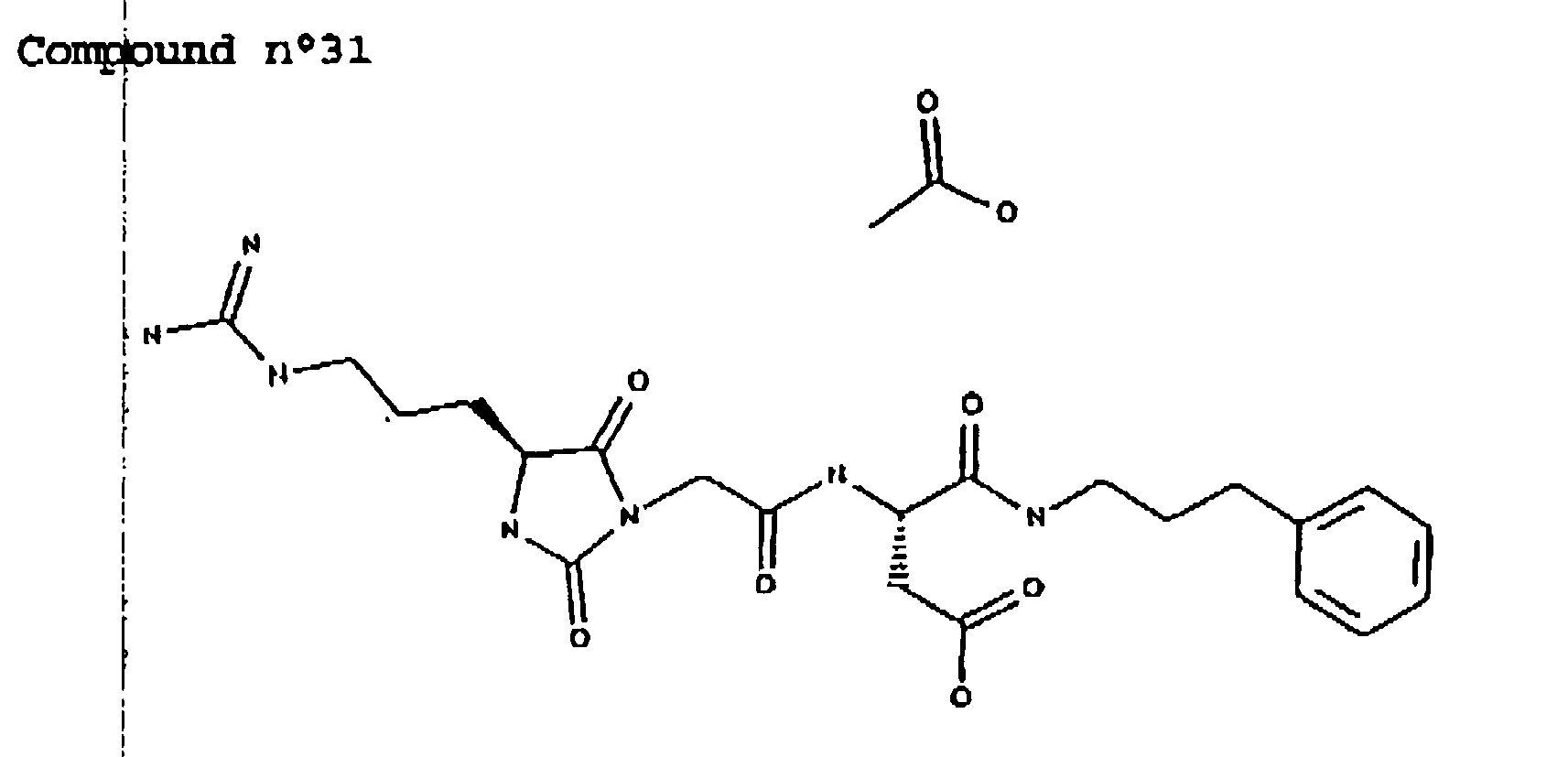


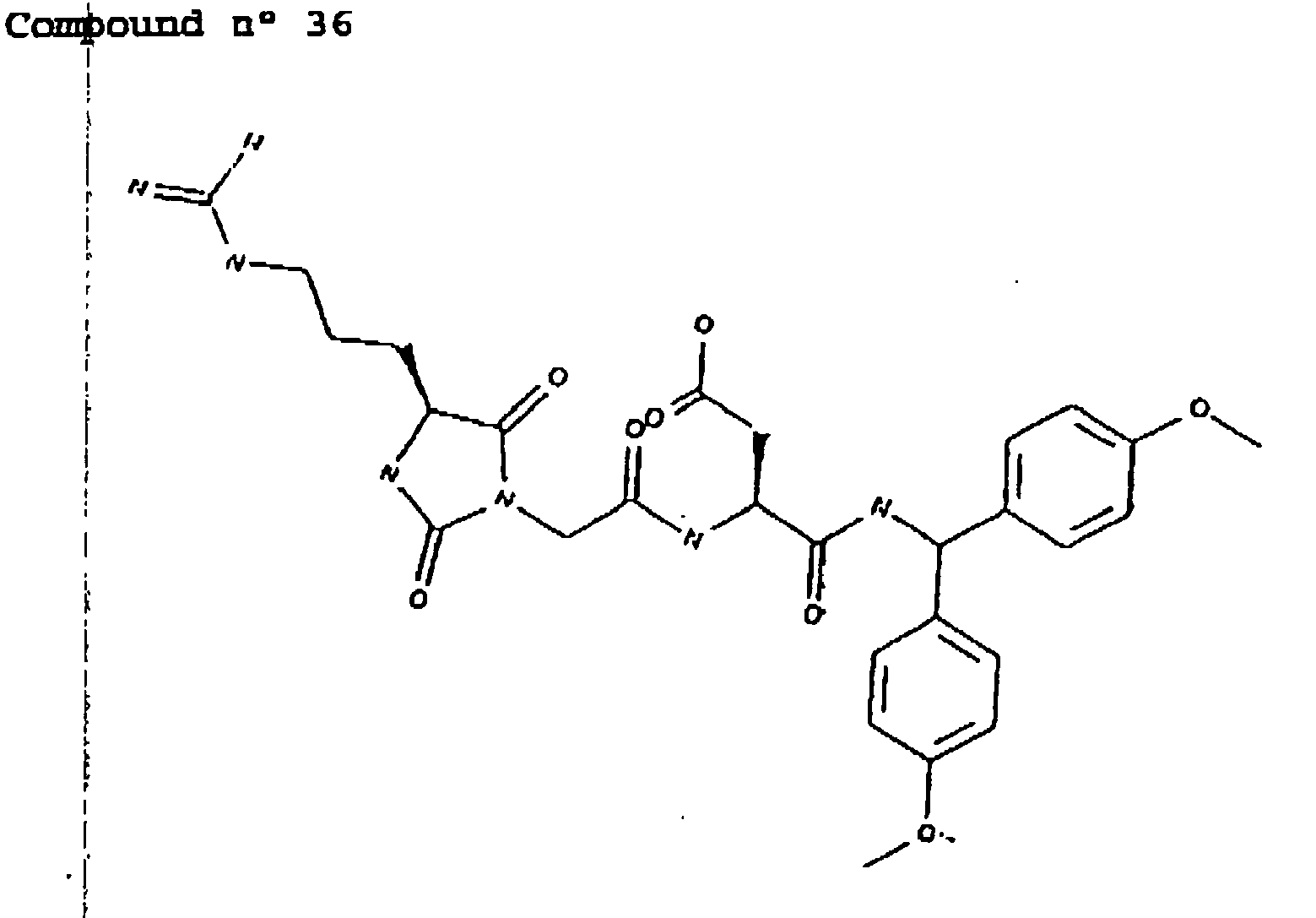


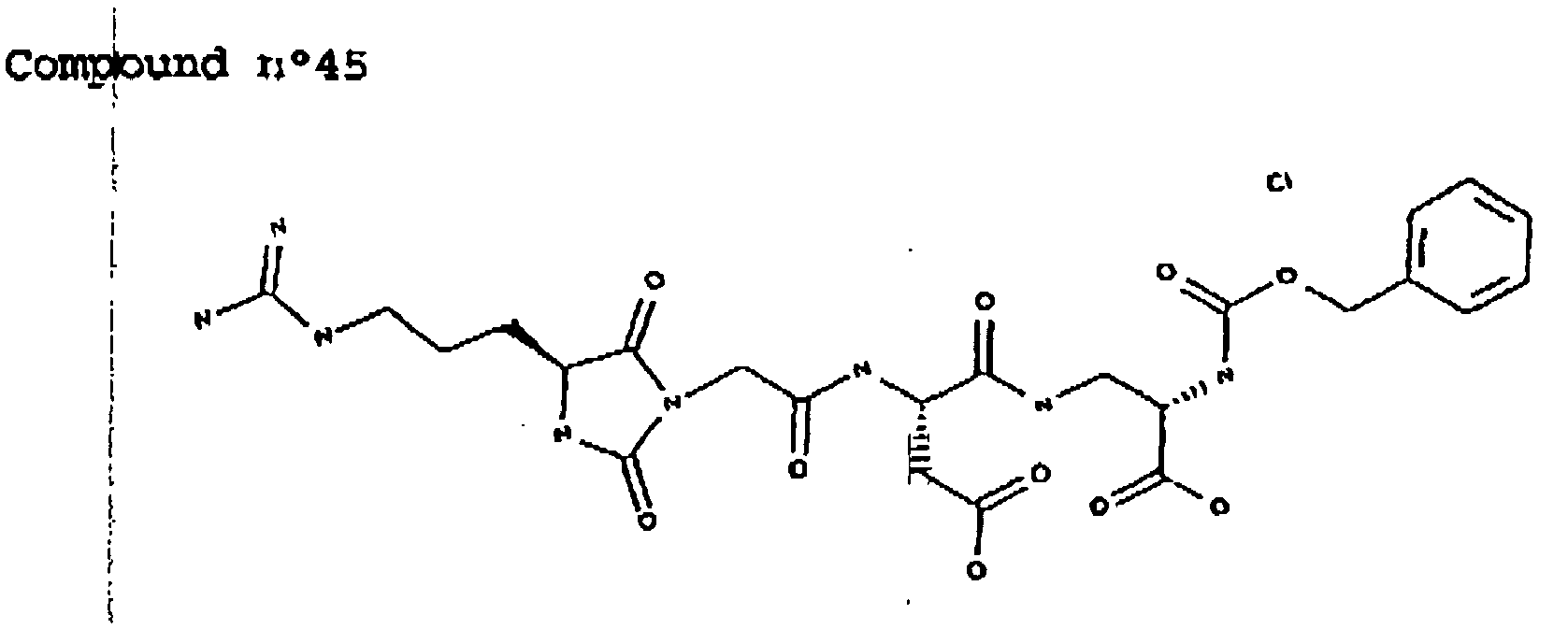


- Illustrative compounds of the general formula (X) are as recited below.


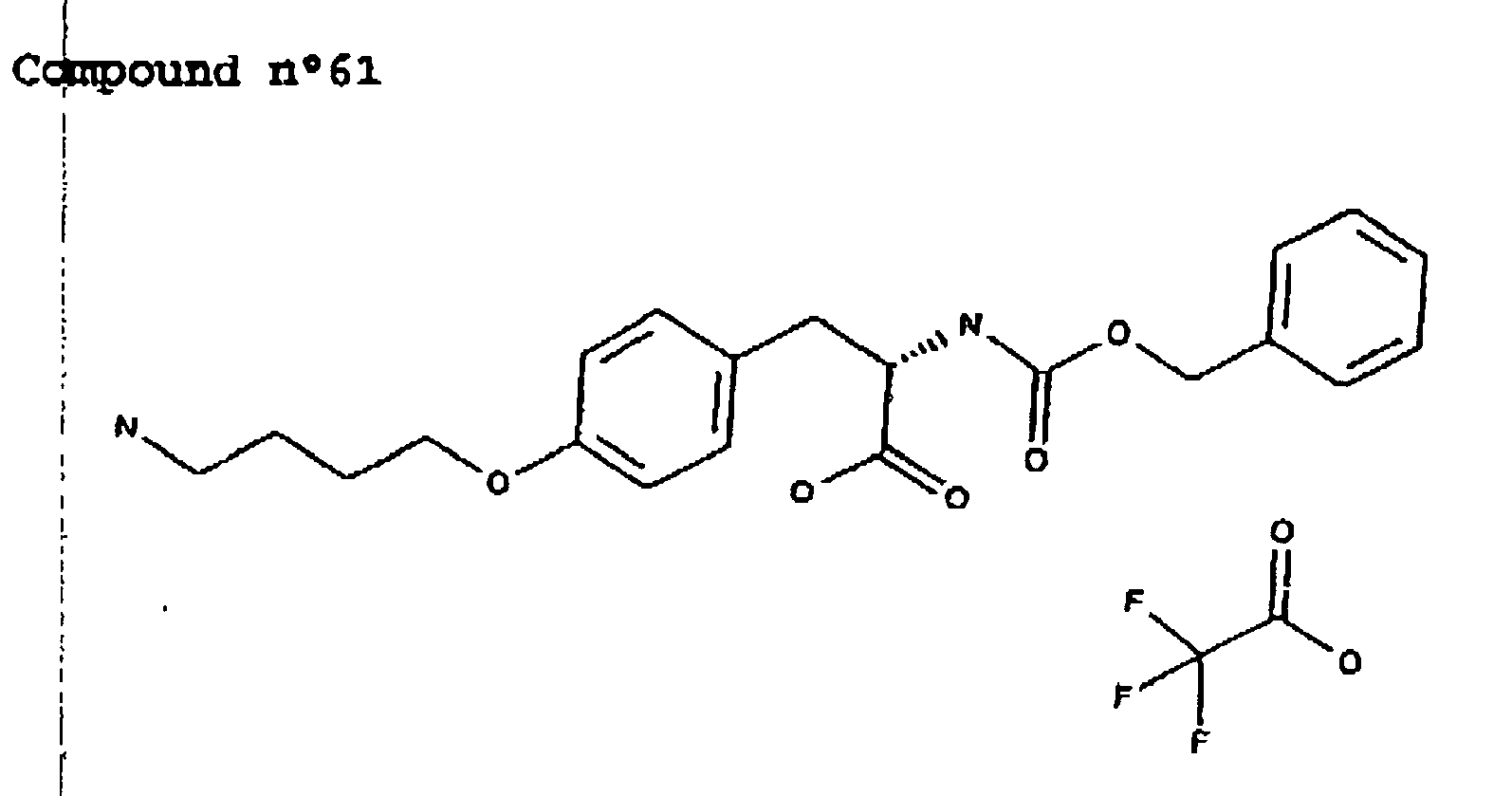


- Illustrative compound of the general formula (XI) is as recited below.
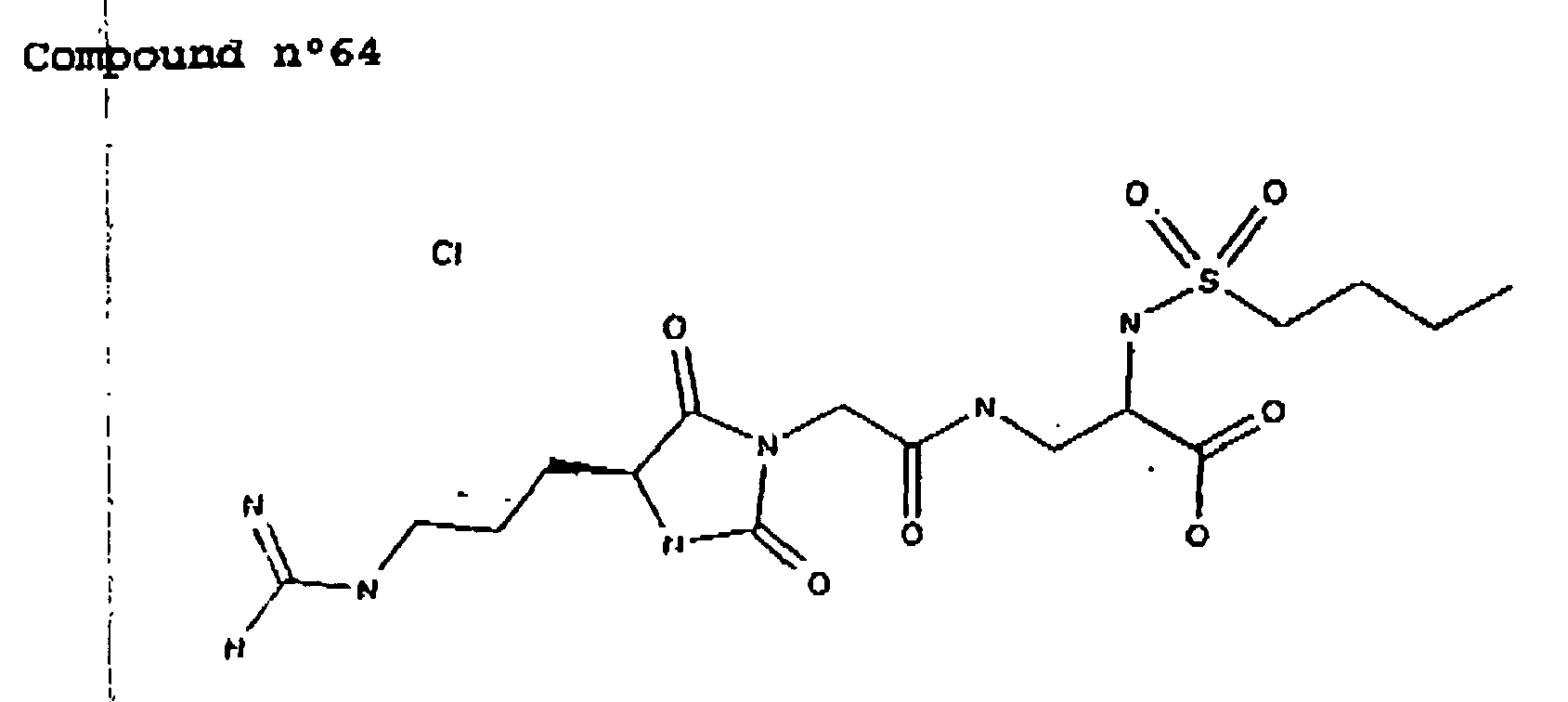
- Illustrative compound of the general formula (XII) is as recited below.

- The compounds of the general formulae (IX), (X) and (XII) are known and may be synthesized according to the methods disclosed in EP-0449079, EP-A0530505, EP-A0566919, WO 95/14008, EP-A0528586 and WO 93/19046. When kistrin or echstatin is to be administered to human as a promoting agent for bone formation, a daily dose of 0.001 - 100 µg/kg body weight, preferably 0.01 - 10 µg/kg body weight, is used. In the case of the GRGDS, a daily dose of 0.001 - 10 mg/kg body weight, preferably 0.01 - 1 mg/kg body weight, is used. In the case of the compound represented by the general formula (I), (II), (IX), (X) or (XII), a daily dose of 0.001 - 10 mg/kg body weight, preferably 0.01 - 1 mg/kg body weight, is used.
- The present drug may be systemically administered by intravenous injection, intramuscular injection, intraperitoneal injection, oral administration, parenteral administration such as suppository or any other prior art means. As pharmaceutical preparations, there may be intended injectable or oral pharmaceutical preparations. Injectable pharmaceutical preparations may include, for example, injectable powders. In this instance, one or more of suitable water-soluble excipients such as mannitol, sucrose, maltose, glucose and fructose may be added and dissolved in water and the solution is poured portionwise into ampoules and freeze-dried and sealed to form pharmaceutical preparations. Oral pharmaceutical preparations may include conventional tablets, capsules, granules, fine granules, powders as well as enteric coated preparations.
- In the treatment of bone fracture, it may be systemically administered or locally given by injection and others. For local administration, a carrier containing the present drug may be more preferably implanted in the area close to the fractured portion. In this case, natural polymeric substances such as collagen or fibrin glue, synthetic polymeric substances capable of being dispersed in living body such as poly lactated glycolic acid can be used for carriers. In plastic surgery, cosmetic surgery, bone transplantation or dental transplantation, the present agent may be applied by coating on the surface of the bone or tooth to be transplanted with an adhesive substance such as collagen paste or fibrin glue. And, it may be applied to the tissue, the bone or alveolar bone in the portion to which bone or tooth is to be transplanted. In transplantation of bone or tooth, artificial bone or artificial fang may be used which is composed of, for example, metals, ceramics, glass and other natural or artificial inorganic substances such as hydroxyapatite. In this case, it may be also feasible to form a core portion with a dense material and form a surface portion with a porous material such as hydroxyapatite and to penetre the present agent into the porous portion. Also, it is possible that the surface of artificial bone composed of a denser materials is roughened to keep the present agent over the said surface.
- The Compounds GH 4 and GH 5 were prepared according to the standard FMOC method as described in P.L. Barker et al., J. Med. Chem., 35, p. 2040-2048, 1992. FMOC-S-trityl-cysteine bound to Wang resin was used as a starting material and the FMOC amino acid having a suitable side chain protecting group, D-aspartic acid(O-t-butyl); L-aspartic acid(O-t-butyl) ; glycine; L-arginine(N-2,2,5,7,8-pentamethylchromane-6-sulfonyl) were in turn used in 3 moles portions. The FMOC at the N-terminal was removed with piperidine (in the form of a 20% solution in dimethylacetamide) and racemic 2-bromo-2-phenylacetic acid (4 equivalents) activated with diisopropylcarbodiimide (2 equivalents) was added to the free N-terminal. The S-trityl group at the cysteine side chain was removed with a chloromethane solution containing dilute trifluoroacetic acid (2%) and then the resulting peptide was cyclized by addition of a solution of diisopropylethylamine (2 equivalents) in dimethylacetamide. Deprotection and sectioning of the cyclized peptide were performed by treatment with trifluoroacetic acid containing triethylsilane (2%). Removal of triethylfluoroacetic acid afforded a crude peptide, which was then purified using reverse phase HPLC column [Vydac, C-18, a 0.1% aqueous solution of trifluoroacetic acid, acetonitrile] with linear gradient (acetonitrile: 0 - 40%, 80 min). The compounds involved in those fractions obtained after about 22 minutes and about 24 minutes, respectively, were named GH 4 and GH 5. The peptides were isolated as white powders by freeze-drying in water. Both compounds were detected for molecular ion peak (M+H)+= 680.7 in electrospray mass spectra. Both compounds showed apparently different NMR spectra at 0 - 10 ppm in water at pH 4-5. Coupling Constant (NH-CH, Hz)
Amino acid GH 4 GH 5 Arginine 8.05 4.9 D-Aspartic acid 8.02 8.1 L-Aspartic acid 3.14 7.7 Cysteine 6.08 7.6 - GH 4 and GH 5 were confirmed to have the formula (VII) or (VIII), but could not be identified whichever they correspond to.
- 10 µg of echstatin was dissolved in 1 ml of water and a water soluble excipient, sucrose, was added so as to be at 1.25- 40 w/v%. It was sterilely filtered by means of a 0.22 µm filter (available from Milipore Inc.). It was added in portions to vessels, freeze-dried and sealed to form preparations.
- The promoting action of bone formation by the present agent will be illustrated by way of the following test results.
- Calvaria was excised from rat fetus of 20 days old and osteoblast-like cells were prepared by enzymatic treatment. The osteoblast-like cells were incubated in MEMα(+) medium containing 100 µl/ml ascorbic acid, 2mM β-glycerol phosphate and 10% bovine fetal serum to form bone tuberculum. For bone tuberculum formation by the primary cultured osteoblasts, kistrin and echstatin did promote calcification and the number of bone tuberculum at 10-7 and 10-8M. Promoted alkaline phosphatase activity was observed at 10-8M.
- Cyclic synthetic peptides, the compounds of the formulae (IV), (VII), (VIII) and (V) did promote calcification and the number of bone tuberculum at 10-6 and 10-8M. The compound of the formula (III) did promote calcification at 10-8 and 10-10M, and did the number of bone tuberculum at 10-6M. The GRGDS did promote calcification at 10-6M, but completely prevented calcification at 10-4M.
- 100 mg of collagenase (0.2%) and 50 mg of hyaluronidase (0.1%) were weighed out and added to 50 ml of bovine fetal serum-free P12 medium and stirred with a stirrer. It was sterilely filtered with a 0.22 µm filter and then applied.
- Fetuses of 20 days old (about 14 fetuses) were taken out from pregnant rat and immersed in 70% ethanol. Calvaria was exposed by removing scalp using nose-bent forceps and nose-bent scissors. Calvaria was cut out without removing periosteum and immersed in a bovine fetal serum-free medium. Connective tissues traveling toward front and rear in the central area and surrounding soft tissues were cut off using a scalpel. All bone pieces thus prepared were placed into a 50 ml centrifugal tube. 10 ml of the enzyme solution was added and the tube was shaken in a thermostat at 37°C for 5 minutes. The treated liquid with dispersed cells was recovered and centrifuged at 1200 rpm for 5 minutes followed by removing a supernatant. 15 ml of F12, 10% FCS medium was added and cells were untied well and then spread on a 10 cm petri dish, which was defined as Fraction 1. To the bone pieces after recovering the treated liquid of the Fraction 1 was added 10 ml of the enzyme solution and shaken in a thermostat at 37°C for 10 minutes. After centrifugation, the resulting cells were defined as Fraction 2. Subsequently, the cells in those fractions up to Fraction 5 were obtained in the similar enzyme treatment as above and the cells of Fractions 3-5 were incubated in a carbon dioxide incubator for 2 - 3 days using F12 medium containing 10% bovine fetal serum. After incubation, the cells were recovered by treating with 0.25% trypsin (EDTAfree). After counting the number of cells, cells were innoculated to a 4-well incubation plate (Nunc) at 1900 cells/300 µl (1000 cells/cm2) and incubation was continued for a further 2 - 3 days. After incubation, all cultured liquid was removed, 300 µl of the medium containing the active compound or dexamethasone (10-8M) instead was added and then incubation was continued for 14 days. For the incubation from this point, the MEMα(+) medium containing 100 µl/ml ascorbic acid, 2 mM β-glycerol phosphate and 10% bovine fetal serum optimum for calcification was used. The medium was exchanged every 2 days and the active compound was added at every exchange. Area of the calcified region and the number of bone tuberculum were used as an index for bone tuberculum formation. After incubation, the cells were fixed with 10% formalin/phosphate buffered physiological saline for 60 minutes and then washed three times with distilled water. Thereafter, calcium phosphate in bone tuberculum was stained by treating with a 1% alizarin red stain for 10 minutes and washed three times with distilled water.
- The area of the stained bone tuberculum was measured using Nikonruzex 3U image analysis device, while the number of bone tuberculum was counted visually under microscope.
- The cells incubated in the same manner as in the above 2) were washed twice with 500 µl of phosphate-buffered physiological saline and 300 µl of the eluent (1% Triton X-100, 0.5 mM magnesium chloride, 10 mM Tris, pH 7.2) was added and the mixture was allowed to stand on ice for 3 minutes. It was then transferred into Eppendorf tube, homogenized by means of a homogenizer and allowed to stand in a thermostat at 37°C overnight to elute alkaline phosphatase. Subsequently, residues of cells and extracellular stroma were removed by centrifuging at 12000 rpm for 10 minutes and 10 µl of a supernatant was taken into another tube. 190 µl of an alkaline phosphatase substrate solution (100 mM 2-amino-2-methyl 1-propanol, 2 mM magnesium chloride and 2 mM sodium p-nitrophenylphosphate) was added and allowed to react in a thermostat at 37°C for 10 minutes. Reaction was discontinued by addition of 800 µl of a 1N sodium hydroxide solution and absorbance was measured at a wave length of 405 nm.
- Alkaline phosphatase activity was calculated according to the following equation:

- The results of the bone tuberculum formation effect observed in the primary cultured osteoblasts are shown in Table 1.
Table 1 Calcified area No. of bone tuberculum Alkaline phosphatase activity Treatment (nm2/well) (per well) (µM/min/well) Non-treated 2.37 ± 0.98 146.5 ± 10.9 0.044 ± 0.014 Dexamethasone 8.00 ± 0.20 307.3 ± 34.1 0.181 ± 0.018 Kistrin 10-6M 0.01 ± 0.02 147.8 ± 14.2 0.040 ± 0.003 10-7M 3.95 ± 0.82 189.5 ± 16.3 0.051 ± 0.007 10-8M 4.03 ± 0.67 161.8 ± 19.2 0.067 ± 0.005 10-9M 3.14 ± 0.95 153.8 ± 12.3 0.051 ± 0.008 Echstatin 10-6M 0.00 ± 0.00 179.0 ± 17.9 0.042 ± 0.007 10-7M 3.89 ± 0.54 195.3 ± 16.0 0.046 ± 0.006 10-8M 4.82 ± 0.64 180.5 ± 13.7 0.067 ± 0.001 10-9M 3.13 ± 0.51 153.8 ± 12.3 0.053 ± 0.010 mean ± standard deviation (n-4) - In a positive control, the dexamethasone-medicated group, noticeable promoting effects were observed in all of the area of the calcined region, the number of bone tuberculum and the alkaline phosphatase activity, as compared with the non-treated group. Kistrin and echstatin did promote calcification and the number of bone tuberculum at 10-7 and 10-8M, whereas they prevented completely calcification at 10-6M, but were not observed to affect the number of bone tuberculum. Also, they were observed to promote alkaline phosphatase activity at 10-8M.
- The results of the effect by the compounds of the formulae (III). (IV), GH 4, GH 5 and (V) are shown in Table 2.
Table 2 Treatment Calcified area (mm2/well) No. of bone tuberculum (per well) Non-treated 2.37 ± 0.98 146.5 ± 10.9 Dexamethasone 8.00 ± 0.20 307.3 ± 34.1 Formula (III) 10-4M 0.00 ± 0.00 164.5 ±12.0 10-6M 1.82 ± 0.49 177.5 ± 11.4 10-8M 3.67 ± 0.54 162.8 ± 31.0 10-10M 4.39 ± 0.65 158.0 ± 28.7 Formula (IV) 10-4M 1.82 ± 0.46 182.8 ± 22.8 10-6M 4.99 ± 0.84 194.3 ± 8.1 10-8M 5.58 ± 0.95 194.8 ± 19.3 10-10M 3.13 ± 0.67 157.0 ± 17.6 GH4 10-4M 0.00 ± 0.00 152.3 ± 8.5 10-6M 4.24 ± 0.55 196.0 ± 16.3 10-8M 5.64 ± 0.81 184.8 ± 23.7 10-10M 3.78 ± 0.47 166.0 ±17.0 GH5 10-4M 0-00 ± 0.00 207.5 ± 18.9 10-6M 4.00 ± 0.81 211.8 ± 14.5 10-8M 5.88 ± 0.78 204.8 ± 22.9 10-10M 4.51 ± 0.57 155.0 ± 13.5 Formula (V) 10-4M 0.00 ± 0.00 148.8 ± 15.2 10-6 M 3.37 ± 0.48 182.8 ± 22.8 10-8M 3.47 ± 0.75 174.8 ± 23.7 10-10M 2.41 ± 0.99 158.5 ± 23.6 GRGDS 10-4M 0.00 ± 0.00 168.3 ± 17.1 10-6M 3.74 ± 0.95 166.5 ± 10.6 mean ± standard deviation (n=4) - The compounds of the formula (IV), GH 4, GH 5 and the formula (V) did promote calcification and the number of bone tuberculum at 10-6 and 10-8M. The compounds of the formula (III), GH 4, GH 5 and the formula (V) did completely prevent calcification at 10-4M, but were not observed to affect the number of bone tuberculum. The compound of the formula (III) did promote calcification at 10-8 and 10-10M and did promote the number of bone tuberculum at 10-6M. The GRGDS did promote calcification at 10-6M, but did completely prevent calcification at 10-4M. The number of bone tuberculum was observed to show a tendency to be increased at these concentrations.
- Kistrin and Compound No. 43 were tested using the bone tuberculum formation test as described above. The results are shown in Table 3.
Table 3 Calcified area Alkaline phosphatase activity Treatment (mm2/well) (µM/min/well) Non-treated 4.46 ± 0.83 0.084 ± 0.008 Dexamethasone 10-8M 13.82 ± 1.20 0.143 ± 0.015 Kistrin 10-5M 4.54 ± 0.88 0.085 ± 0.009 10-6M 7.93 ± 1.37 0.119 ± 0.008 10-7M 11.25 ± 1.04 0.133 ± 0.006 10-8M 9.87 ± 1.04 0.126 ± 0.006 Compound No. 43 10-5M 4.83 ± 0.87 0.088 ± 0.008 10-6M 7.31 ± 0.69 0.108 ± 0.005 10-7M 8.45 ± 0.66 0.099 ± 0.004 10-8M 6.29 ± 0.43 0.100 ± 0.003 mean ± standard deviation (n-4) - Compound No. 63 was tested using the bone tuberculum formation test as described above. The results are shown in Table 4.
Table 4 Treatment Calcified area (mm2/well) Non-treated 2.56 ± 0.11 Dexamethasone 10-8M 12.17 ± 1.05 Compound No. 63 10-5M 1.62 ± 0.55 10-6M 4.26 ± 2.14 10-7M 5.14 ± 1.29 10-8M 3.84 ± 1.06 mean ± standard deviation (n=4) - An agent for promoting bone formation, which comprises as an active ingredient a peptide or polypeptide having the amino acid sequence composed of ArgGlyAsp in the molecule such as kistrin, echstatin, a peptide represented by Gly-Arg-Gly-Asp-Ser, a compound of the above formula (I) or (II), or a compound of the formula (IX), (X) or (XII), can be administered to human body or implanted into the area close to the fractured bone to accomplish effective prophylaxis and therapy of bone fracture.
Claims (13)
- A compound represented by the following formula (II)
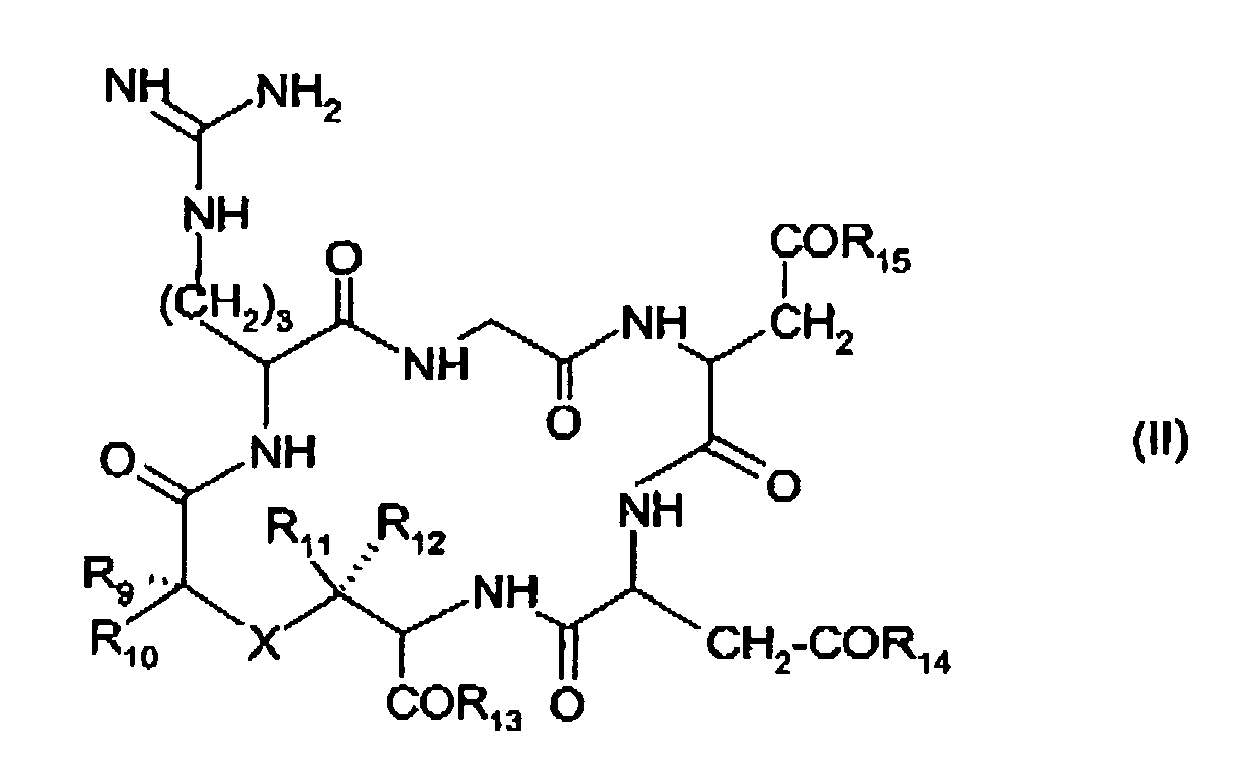
- Use of a compound selected from the group consisting of kistrin, echstatin, a peptide represented by Gly-Arg-Gly-Asp-Ser and a compound represented by the general formula (I), (II), (IX), (X) or (XII)


- Use of kistrin for manufacturing an agent for promoting bone formation.
- Use of echstatin for manufacturing an agent for promoting bone formation.
- Use of a peptide represented by Gly-Arg-Gly-Asp-Ser for manufacturing an agent for promoting bone formation.
- Use of a compound represented by the formula (III)

- Use of a compound represented by the formula (IV)

- Use of a compound represented by the formula (V)
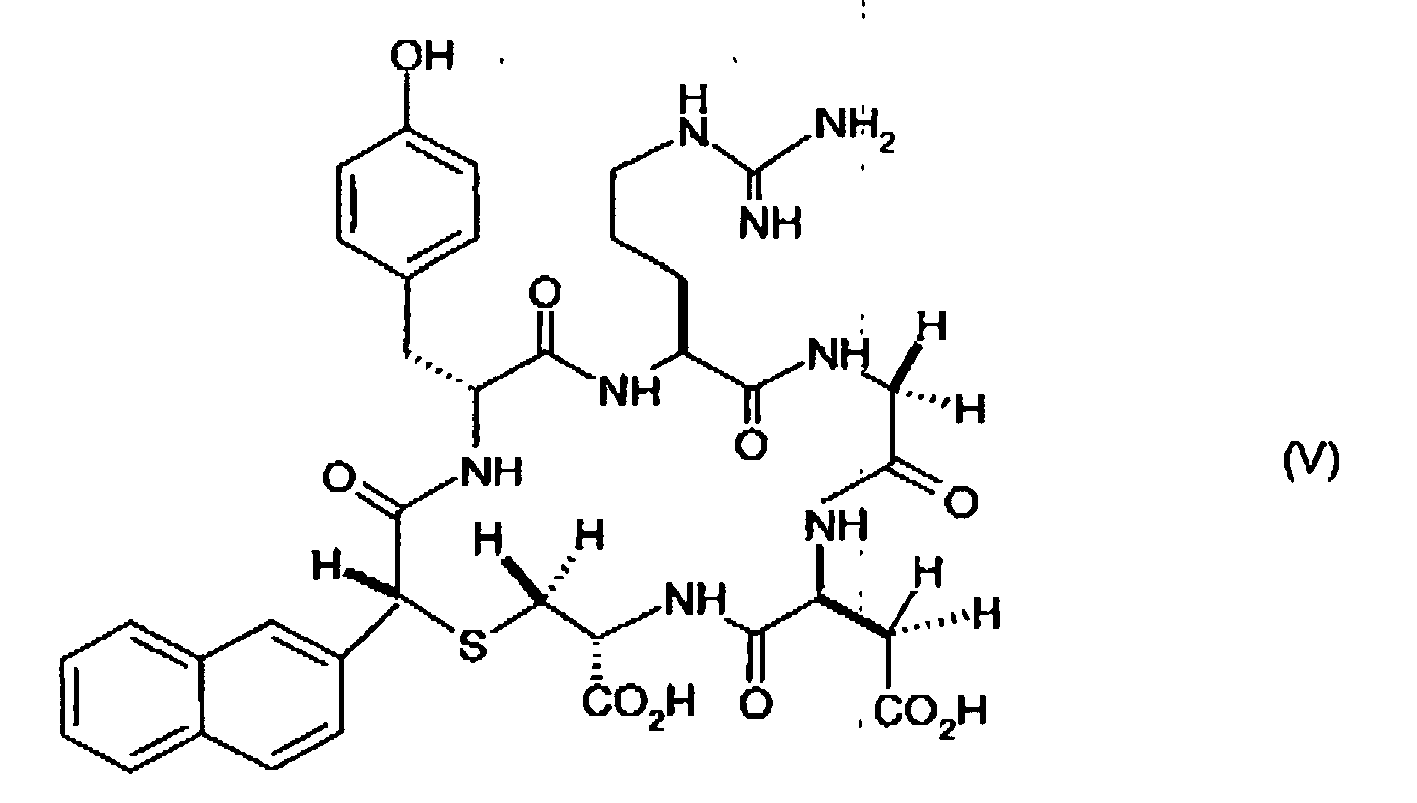
- Use of a compound represented by the formula (VI)

- Use of a compound represented by the formula (VII)

- Use of a compound represented by the formula (VIII)

- Use of a compound represented by the formula (XIII)

- Use of a compound represented by the formula (XIV)

Applications Claiming Priority (3)
| Application Number | Priority Date | Filing Date | Title |
|---|---|---|---|
| JP34505795A JP3895792B2 (en) | 1995-12-08 | 1995-12-08 | Bone formation promoter |
| JP345057/95 | 1995-12-08 | ||
| PCT/EP1996/005380 WO1997021726A1 (en) | 1995-12-08 | 1996-12-06 | Agents for promoting bone formation |
Publications (2)
| Publication Number | Publication Date |
|---|---|
| EP0865446A1 EP0865446A1 (en) | 1998-09-23 |
| EP0865446B1 true EP0865446B1 (en) | 2007-03-21 |
Family
ID=18374002
Family Applications (1)
| Application Number | Title | Priority Date | Filing Date |
|---|---|---|---|
| EP96942315A Expired - Lifetime EP0865446B1 (en) | 1995-12-08 | 1996-12-06 | Agents for promoting bone formation |
Country Status (8)
| Country | Link |
|---|---|
| US (2) | US6194380B1 (en) |
| EP (1) | EP0865446B1 (en) |
| JP (2) | JP3895792B2 (en) |
| AT (1) | ATE357456T1 (en) |
| CA (1) | CA2236335A1 (en) |
| DE (1) | DE69636987T2 (en) |
| IL (1) | IL124623A0 (en) |
| WO (1) | WO1997021726A1 (en) |
Families Citing this family (18)
| Publication number | Priority date | Publication date | Assignee | Title |
|---|---|---|---|---|
| JP3895792B2 (en) * | 1995-12-08 | 2007-03-22 | プロスケリア・エス・ア・エス | Bone formation promoter |
| ES2171768T3 (en) * | 1996-03-20 | 2002-09-16 | Hoechst Ag | OSEA RESORTION INHIBITORS AND VITRONECTINE RECEPTORS ANTAGONISTS. |
| US6376476B1 (en) * | 1996-12-13 | 2002-04-23 | Zymogenetics Corporation | Isoprenoid pathway inhibitors for stimulating bone growth |
| EP0933367A1 (en) * | 1997-12-19 | 1999-08-04 | Hoechst Marion Roussel Deutschland GmbH | Novel acylguanidine derivates as inhibitors of bone resorption and as vitronectin receptor antagonists |
| US6313119B1 (en) | 1998-01-23 | 2001-11-06 | Adventis Pharma Deutschland Gmbh | Sulfonamide derivatives as inhibitors of bone resorption and as inhibitors of cell adhesion |
| JP2002501054A (en) * | 1998-01-23 | 2002-01-15 | アヴェンティス ファルマ ドイチェラント ゲーエムベーハー | Novel sulfonamide derivatives as inhibitors of bone resorption and as inhibitors of cell adhesion |
| US6410521B1 (en) | 1998-06-12 | 2002-06-25 | Osteoscreen, Inc. | Nutritional supplements for stimulating bone growth |
| JP2002522540A (en) * | 1998-08-13 | 2002-07-23 | メルク エンド カムパニー インコーポレーテッド | Integrin receptor antagonist |
| FR2786182B1 (en) * | 1998-11-24 | 2001-01-12 | Hoechst Marion Roussel Inc | NOVEL ACYLGUANIDINES DERIVATIVES, PROCESS FOR THEIR PREPARATION, THEIR USE AS MEDICAMENTS AND THE PHARMACEUTICAL COMPOSITIONS CONTAINING THEM |
| EP1108721A1 (en) * | 1999-12-15 | 2001-06-20 | Aventis Pharma Deutschland GmbH | Thienylalanine derivatives as inhibitors of cell adhesion |
| AU2003221582A1 (en) | 2002-05-03 | 2003-11-17 | Millenium Biologix Inc. | Connective tissue stimulating peptides |
| WO2005041998A1 (en) | 2003-10-02 | 2005-05-12 | Ali Sadat M | Peptide for promoting healing of fractures |
| KR101013999B1 (en) * | 2004-03-19 | 2011-02-14 | 재단법인서울대학교산학협력재단 | Screening membrane and implant with bone tissue enhancement peptide |
| KR100676945B1 (en) * | 2005-03-18 | 2007-02-01 | 재단법인서울대학교산학협력재단 | Bone graft material and tissue engineering scaffold |
| KR100757241B1 (en) * | 2006-09-13 | 2007-09-10 | 재단법인서울대학교산학협력재단 | Bone graft containing bone tissue formation peptide |
| KR100909867B1 (en) * | 2007-04-16 | 2009-07-29 | 주식회사바이오러넥스 | Compositions for the Prevention and Treatment of Osteo Metabolic Diseases |
| KR100879704B1 (en) * | 2008-06-11 | 2009-01-22 | 오스템임플란트 주식회사 | Oligopeptides Promote Bone Adhesion and Bone Formation |
| KR101896762B1 (en) * | 2015-06-18 | 2018-09-11 | 서울대학교산학협력단 | A peptide for promoting bone formation or inhibiting bone resorption and use thereof |
Family Cites Families (6)
| Publication number | Priority date | Publication date | Assignee | Title |
|---|---|---|---|---|
| US5384309A (en) * | 1989-07-17 | 1995-01-24 | Genentech, Inc. | Cyclized peptides and their use as platelet aggregation inhibitors |
| DE4126277A1 (en) * | 1991-08-08 | 1993-02-11 | Cassella Ag | HYDANTO DERIVATIVES |
| US5217994A (en) * | 1991-08-09 | 1993-06-08 | Merck & Co., Inc. | Method of inhibiting osteoclast-mediated bone resorption by administration of aminoalkyl-substituted phenyl derivatives |
| DE4427979A1 (en) * | 1993-11-15 | 1996-02-15 | Cassella Ag | Substituted 5-ring heterocycles, their preparation and their use |
| AU2753595A (en) * | 1994-06-27 | 1996-01-19 | Snow Brand Milk Products Co., Ltd. | Novel protein and process for producing the same |
| JP3895792B2 (en) * | 1995-12-08 | 2007-03-22 | プロスケリア・エス・ア・エス | Bone formation promoter |
-
1995
- 1995-12-08 JP JP34505795A patent/JP3895792B2/en not_active Expired - Lifetime
-
1996
- 1996-12-06 US US09/077,714 patent/US6194380B1/en not_active Expired - Lifetime
- 1996-12-06 WO PCT/EP1996/005380 patent/WO1997021726A1/en not_active Ceased
- 1996-12-06 AT AT96942315T patent/ATE357456T1/en not_active IP Right Cessation
- 1996-12-06 EP EP96942315A patent/EP0865446B1/en not_active Expired - Lifetime
- 1996-12-06 CA CA002236335A patent/CA2236335A1/en not_active Abandoned
- 1996-12-06 IL IL12462396A patent/IL124623A0/en unknown
- 1996-12-06 JP JP9521692A patent/JP2000502996A/en active Pending
- 1996-12-06 DE DE69636987T patent/DE69636987T2/en not_active Expired - Lifetime
-
2000
- 2000-07-26 US US09/626,302 patent/US6344439B1/en not_active Expired - Lifetime
Also Published As
| Publication number | Publication date |
|---|---|
| US6344439B1 (en) | 2002-02-05 |
| JP3895792B2 (en) | 2007-03-22 |
| CA2236335A1 (en) | 1997-06-19 |
| IL124623A0 (en) | 1998-12-06 |
| WO1997021726A1 (en) | 1997-06-19 |
| DE69636987D1 (en) | 2007-05-03 |
| JPH09157181A (en) | 1997-06-17 |
| EP0865446A1 (en) | 1998-09-23 |
| JP2000502996A (en) | 2000-03-14 |
| ATE357456T1 (en) | 2007-04-15 |
| US6194380B1 (en) | 2001-02-27 |
| DE69636987T2 (en) | 2007-12-06 |
Similar Documents
| Publication | Publication Date | Title |
|---|---|---|
| US6194380B1 (en) | Agents for promoting bone formation | |
| EP0617705B1 (en) | Non-peptidic surrogates of the arg-gly-asp sequence and pharmaceutical compositions comprising them | |
| US6818620B2 (en) | Synthetic compounds and compositions with enhanced cell binding | |
| Younai et al. | Modulation of collagen synthesis by transforming growth factor-β in keloid and hypertrophic scar fibroblasts | |
| EP0502926B1 (en) | Anti-thrombotic peptides and pseudopeptides | |
| AU628910B2 (en) | Polypeptide-polymer conjugates active in wound healing | |
| JP3054150B2 (en) | Polypeptides, compositions and methods of use derived from thrombin | |
| US5086069A (en) | Anti-thrombotic peptide and pseudopeptide derivatives | |
| JP3200609B2 (en) | Epithelial cell growth promoter | |
| US5051405A (en) | Anti-thrombotic peptides and pseudopeptides | |
| JPH05504336A (en) | Peptide derivatives, their production methods, pharmaceuticals containing them, and methods for treating glaucoma | |
| JPH03500046A (en) | Polypeptide with fibronectin activity | |
| US5064814A (en) | Anti-thrombotic peptide and pseudopeptide derivatives | |
| KR101174795B1 (en) | Skin regeneration system | |
| CA2690734A1 (en) | Polypeptides and methods of use | |
| US8691944B2 (en) | Fibronectin polypeptides and methods of use | |
| US5231082A (en) | Cyclic peptide with anti-metastasis activity | |
| JP2006514822A (en) | Thrombin peptide derivative | |
| EP0397635B1 (en) | Peptide with anti-metastasis activity | |
| WO2008026634A1 (en) | Mesenchymal cell proliferation stimulator and skeletal system biomaterial | |
| JP2003517809A (en) | New peptide | |
| MXPA98004449A (en) | Agents to promote training or | |
| JP2002065252A (en) | Method for expanding hematopoietic stem / progenitor cells and incubator therefor | |
| IL100130A (en) | Guanidine derivatives and pharmaceutical compositions comprising them |
Legal Events
| Date | Code | Title | Description |
|---|---|---|---|
| PUAI | Public reference made under article 153(3) epc to a published international application that has entered the european phase |
Free format text: ORIGINAL CODE: 0009012 |
|
| 17P | Request for examination filed |
Effective date: 19980708 |
|
| AK | Designated contracting states |
Kind code of ref document: A1 Designated state(s): AT BE CH DE DK ES FI FR GB GR IE IT LI LU NL PT SE |
|
| RAP1 | Party data changed (applicant data changed or rights of an application transferred) |
Owner name: AVENTIS PHARMA S.A. |
|
| 17Q | First examination report despatched |
Effective date: 20030821 |
|
| GRAP | Despatch of communication of intention to grant a patent |
Free format text: ORIGINAL CODE: EPIDOSNIGR1 |
|
| GRAS | Grant fee paid |
Free format text: ORIGINAL CODE: EPIDOSNIGR3 |
|
| GRAA | (expected) grant |
Free format text: ORIGINAL CODE: 0009210 |
|
| AK | Designated contracting states |
Kind code of ref document: B1 Designated state(s): AT BE CH DE DK ES FI FR GB GR IE IT LI LU NL PT SE |
|
| PG25 | Lapsed in a contracting state [announced via postgrant information from national office to epo] |
Ref country code: NL Free format text: LAPSE BECAUSE OF FAILURE TO SUBMIT A TRANSLATION OF THE DESCRIPTION OR TO PAY THE FEE WITHIN THE PRESCRIBED TIME-LIMIT Effective date: 20070321 Ref country code: LI Free format text: LAPSE BECAUSE OF FAILURE TO SUBMIT A TRANSLATION OF THE DESCRIPTION OR TO PAY THE FEE WITHIN THE PRESCRIBED TIME-LIMIT Effective date: 20070321 Ref country code: FI Free format text: LAPSE BECAUSE OF FAILURE TO SUBMIT A TRANSLATION OF THE DESCRIPTION OR TO PAY THE FEE WITHIN THE PRESCRIBED TIME-LIMIT Effective date: 20070321 Ref country code: CH Free format text: LAPSE BECAUSE OF FAILURE TO SUBMIT A TRANSLATION OF THE DESCRIPTION OR TO PAY THE FEE WITHIN THE PRESCRIBED TIME-LIMIT Effective date: 20070321 Ref country code: BE Free format text: LAPSE BECAUSE OF FAILURE TO SUBMIT A TRANSLATION OF THE DESCRIPTION OR TO PAY THE FEE WITHIN THE PRESCRIBED TIME-LIMIT Effective date: 20070321 Ref country code: AT Free format text: LAPSE BECAUSE OF FAILURE TO SUBMIT A TRANSLATION OF THE DESCRIPTION OR TO PAY THE FEE WITHIN THE PRESCRIBED TIME-LIMIT Effective date: 20070321 |
|
| REG | Reference to a national code |
Ref country code: GB Ref legal event code: FG4D |
|
| REG | Reference to a national code |
Ref country code: CH Ref legal event code: EP |
|
| REF | Corresponds to: |
Ref document number: 69636987 Country of ref document: DE Date of ref document: 20070503 Kind code of ref document: P |
|
| REG | Reference to a national code |
Ref country code: IE Ref legal event code: FG4D |
|
| PG25 | Lapsed in a contracting state [announced via postgrant information from national office to epo] |
Ref country code: SE Free format text: LAPSE BECAUSE OF FAILURE TO SUBMIT A TRANSLATION OF THE DESCRIPTION OR TO PAY THE FEE WITHIN THE PRESCRIBED TIME-LIMIT Effective date: 20070621 |
|
| PG25 | Lapsed in a contracting state [announced via postgrant information from national office to epo] |
Ref country code: ES Free format text: LAPSE BECAUSE OF FAILURE TO SUBMIT A TRANSLATION OF THE DESCRIPTION OR TO PAY THE FEE WITHIN THE PRESCRIBED TIME-LIMIT Effective date: 20070702 |
|
| PG25 | Lapsed in a contracting state [announced via postgrant information from national office to epo] |
Ref country code: PT Free format text: LAPSE BECAUSE OF FAILURE TO SUBMIT A TRANSLATION OF THE DESCRIPTION OR TO PAY THE FEE WITHIN THE PRESCRIBED TIME-LIMIT Effective date: 20070821 |
|
| REG | Reference to a national code |
Ref country code: CH Ref legal event code: PL |
|
| NLV1 | Nl: lapsed or annulled due to failure to fulfill the requirements of art. 29p and 29m of the patents act | ||
| PLBE | No opposition filed within time limit |
Free format text: ORIGINAL CODE: 0009261 |
|
| STAA | Information on the status of an ep patent application or granted ep patent |
Free format text: STATUS: NO OPPOSITION FILED WITHIN TIME LIMIT |
|
| PG25 | Lapsed in a contracting state [announced via postgrant information from national office to epo] |
Ref country code: DK Free format text: LAPSE BECAUSE OF FAILURE TO SUBMIT A TRANSLATION OF THE DESCRIPTION OR TO PAY THE FEE WITHIN THE PRESCRIBED TIME-LIMIT Effective date: 20070321 |
|
| 26N | No opposition filed |
Effective date: 20071227 |
|
| PG25 | Lapsed in a contracting state [announced via postgrant information from national office to epo] |
Ref country code: IT Free format text: LAPSE BECAUSE OF FAILURE TO SUBMIT A TRANSLATION OF THE DESCRIPTION OR TO PAY THE FEE WITHIN THE PRESCRIBED TIME-LIMIT Effective date: 20070321 Ref country code: GR Free format text: LAPSE BECAUSE OF FAILURE TO SUBMIT A TRANSLATION OF THE DESCRIPTION OR TO PAY THE FEE WITHIN THE PRESCRIBED TIME-LIMIT Effective date: 20070622 |
|
| PG25 | Lapsed in a contracting state [announced via postgrant information from national office to epo] |
Ref country code: IE Free format text: LAPSE BECAUSE OF NON-PAYMENT OF DUE FEES Effective date: 20071206 |
|
| PG25 | Lapsed in a contracting state [announced via postgrant information from national office to epo] |
Ref country code: LU Free format text: LAPSE BECAUSE OF NON-PAYMENT OF DUE FEES Effective date: 20071206 |
|
| REG | Reference to a national code |
Ref country code: FR Ref legal event code: PLFP Year of fee payment: 20 |
|
| PGFP | Annual fee paid to national office [announced via postgrant information from national office to epo] |
Ref country code: DE Payment date: 20151201 Year of fee payment: 20 Ref country code: GB Payment date: 20151202 Year of fee payment: 20 |
|
| PGFP | Annual fee paid to national office [announced via postgrant information from national office to epo] |
Ref country code: FR Payment date: 20151110 Year of fee payment: 20 |
|
| REG | Reference to a national code |
Ref country code: DE Ref legal event code: R071 Ref document number: 69636987 Country of ref document: DE |
|
| REG | Reference to a national code |
Ref country code: GB Ref legal event code: PE20 Expiry date: 20161205 |
|
| PG25 | Lapsed in a contracting state [announced via postgrant information from national office to epo] |
Ref country code: GB Free format text: LAPSE BECAUSE OF EXPIRATION OF PROTECTION Effective date: 20161205 |