EP0865442B1 - IMIDAZO[1,2-a]QUINOXALIN-4-AMINES ACTIVE AS ADENOSINE ANTAGONISTS, PROCESS FOR THEIR PREPARATION AND PHARMACEUTICAL COMPOSITIONS THEREOF - Google Patents
IMIDAZO[1,2-a]QUINOXALIN-4-AMINES ACTIVE AS ADENOSINE ANTAGONISTS, PROCESS FOR THEIR PREPARATION AND PHARMACEUTICAL COMPOSITIONS THEREOF Download PDFInfo
- Publication number
- EP0865442B1 EP0865442B1 EP96937458A EP96937458A EP0865442B1 EP 0865442 B1 EP0865442 B1 EP 0865442B1 EP 96937458 A EP96937458 A EP 96937458A EP 96937458 A EP96937458 A EP 96937458A EP 0865442 B1 EP0865442 B1 EP 0865442B1
- Authority
- EP
- European Patent Office
- Prior art keywords
- hydrogen
- compound
- formula
- compounds
- quinoxaline
- Prior art date
- Legal status (The legal status is an assumption and is not a legal conclusion. Google has not performed a legal analysis and makes no representation as to the accuracy of the status listed.)
- Expired - Lifetime
Links
- 238000000034 method Methods 0.000 title claims abstract description 43
- 238000002360 preparation method Methods 0.000 title claims abstract description 16
- 239000008194 pharmaceutical composition Substances 0.000 title claims abstract description 9
- 230000008569 process Effects 0.000 title claims abstract description 6
- 239000000296 purinergic P1 receptor antagonist Substances 0.000 title claims abstract description 4
- 150000001875 compounds Chemical class 0.000 claims abstract description 89
- 210000003169 central nervous system Anatomy 0.000 claims abstract description 7
- 150000003839 salts Chemical class 0.000 claims abstract description 7
- 208000012902 Nervous system disease Diseases 0.000 claims abstract description 4
- 208000025966 Neurological disease Diseases 0.000 claims abstract description 4
- 208000020016 psychiatric disease Diseases 0.000 claims abstract description 4
- 239000001257 hydrogen Substances 0.000 claims description 37
- 229910052739 hydrogen Inorganic materials 0.000 claims description 37
- 150000002431 hydrogen Chemical group 0.000 claims description 23
- XHXFXVLFKHQFAL-UHFFFAOYSA-N phosphoryl trichloride Chemical compound ClP(Cl)(Cl)=O XHXFXVLFKHQFAL-UHFFFAOYSA-N 0.000 claims description 12
- 125000002496 methyl group Chemical group [H]C([H])([H])* 0.000 claims description 10
- 239000004480 active ingredient Substances 0.000 claims description 9
- 125000004169 (C1-C6) alkyl group Chemical group 0.000 claims description 8
- UFHFLCQGNIYNRP-UHFFFAOYSA-N Hydrogen Chemical compound [H][H] UFHFLCQGNIYNRP-UHFFFAOYSA-N 0.000 claims description 8
- FFUAGWLWBBFQJT-UHFFFAOYSA-N hexamethyldisilazane Chemical compound C[Si](C)(C)N[Si](C)(C)C FFUAGWLWBBFQJT-UHFFFAOYSA-N 0.000 claims description 8
- QKWWDTYDYOFRJL-UHFFFAOYSA-N 2,2-dimethoxyethanamine Chemical compound COC(CN)OC QKWWDTYDYOFRJL-UHFFFAOYSA-N 0.000 claims description 7
- 239000000460 chlorine Substances 0.000 claims description 7
- 239000003814 drug Substances 0.000 claims description 7
- 239000000546 pharmaceutical excipient Substances 0.000 claims description 7
- 125000004209 (C1-C8) alkyl group Chemical group 0.000 claims description 6
- 125000006552 (C3-C8) cycloalkyl group Chemical group 0.000 claims description 6
- 125000004435 hydrogen atom Chemical group [H]* 0.000 claims description 6
- JKANAVGODYYCQF-UHFFFAOYSA-N prop-2-yn-1-amine Chemical compound NCC#C JKANAVGODYYCQF-UHFFFAOYSA-N 0.000 claims description 6
- 229910019213 POCl3 Inorganic materials 0.000 claims description 5
- 239000003795 chemical substances by application Substances 0.000 claims description 5
- OAKJQQAXSVQMHS-UHFFFAOYSA-N Hydrazine Chemical compound NN OAKJQQAXSVQMHS-UHFFFAOYSA-N 0.000 claims description 4
- 150000001412 amines Chemical class 0.000 claims description 4
- 239000012320 chlorinating reagent Substances 0.000 claims description 4
- 229910052801 chlorine Inorganic materials 0.000 claims description 4
- 229910052731 fluorine Inorganic materials 0.000 claims description 4
- 231100000252 nontoxic Toxicity 0.000 claims description 4
- 230000003000 nontoxic effect Effects 0.000 claims description 4
- 230000002378 acidificating effect Effects 0.000 claims description 3
- 238000007796 conventional method Methods 0.000 claims description 3
- 125000001424 substituent group Chemical group 0.000 claims description 3
- 125000006704 (C5-C6) cycloalkyl group Chemical group 0.000 claims description 2
- ZAMOUSCENKQFHK-UHFFFAOYSA-N Chlorine atom Chemical compound [Cl] ZAMOUSCENKQFHK-UHFFFAOYSA-N 0.000 claims description 2
- PXGOKWXKJXAPGV-UHFFFAOYSA-N Fluorine Chemical compound FF PXGOKWXKJXAPGV-UHFFFAOYSA-N 0.000 claims description 2
- 229910052794 bromium Inorganic materials 0.000 claims description 2
- 125000001511 cyclopentyl group Chemical group [H]C1([H])C([H])([H])C([H])([H])C([H])(*)C1([H])[H] 0.000 claims description 2
- 239000011737 fluorine Substances 0.000 claims description 2
- 229910052736 halogen Inorganic materials 0.000 claims description 2
- 150000002367 halogens Chemical class 0.000 claims description 2
- LFQSCWFLJHTTHZ-UHFFFAOYSA-N Ethanol Chemical compound CCO LFQSCWFLJHTTHZ-UHFFFAOYSA-N 0.000 description 64
- HEDRZPFGACZZDS-MICDWDOJSA-N Trichloro(2H)methane Chemical compound [2H]C(Cl)(Cl)Cl HEDRZPFGACZZDS-MICDWDOJSA-N 0.000 description 50
- 238000005160 1H NMR spectroscopy Methods 0.000 description 27
- 238000004458 analytical method Methods 0.000 description 27
- 239000000203 mixture Substances 0.000 description 21
- RYNAIJUDTQWFSL-UHFFFAOYSA-N 4-chloroimidazo[1,2-a]quinoxaline Chemical compound ClC1=NC2=CC=CC=C2N2C1=NC=C2 RYNAIJUDTQWFSL-UHFFFAOYSA-N 0.000 description 19
- 238000006243 chemical reaction Methods 0.000 description 18
- JYJHXLBINQTWJT-UHFFFAOYSA-N 4-chloro-1-methylimidazo[1,2-a]quinoxaline Chemical compound C1=CC=C2N3C(C)=CN=C3C(Cl)=NC2=C1 JYJHXLBINQTWJT-UHFFFAOYSA-N 0.000 description 13
- XEKOWRVHYACXOJ-UHFFFAOYSA-N Ethyl acetate Chemical compound CCOC(C)=O XEKOWRVHYACXOJ-UHFFFAOYSA-N 0.000 description 13
- PAFZNILMFXTMIY-UHFFFAOYSA-N cyclohexylamine Chemical compound NC1CCCCC1 PAFZNILMFXTMIY-UHFFFAOYSA-N 0.000 description 11
- NISGSNTVMOOSJQ-UHFFFAOYSA-N cyclopentanamine Chemical compound NC1CCCC1 NISGSNTVMOOSJQ-UHFFFAOYSA-N 0.000 description 10
- 239000000047 product Substances 0.000 description 10
- 239000000126 substance Substances 0.000 description 10
- XLYOFNOQVPJJNP-UHFFFAOYSA-N water Substances O XLYOFNOQVPJJNP-UHFFFAOYSA-N 0.000 description 10
- VYPSYNLAJGMNEJ-UHFFFAOYSA-N Silicium dioxide Chemical compound O=[Si]=O VYPSYNLAJGMNEJ-UHFFFAOYSA-N 0.000 description 9
- 102000009346 Adenosine receptors Human genes 0.000 description 8
- 108050000203 Adenosine receptors Proteins 0.000 description 8
- HEDRZPFGACZZDS-UHFFFAOYSA-N Chloroform Chemical compound ClC(Cl)Cl HEDRZPFGACZZDS-UHFFFAOYSA-N 0.000 description 8
- YMWUJEATGCHHMB-UHFFFAOYSA-N Dichloromethane Chemical compound ClCCl YMWUJEATGCHHMB-UHFFFAOYSA-N 0.000 description 8
- 230000000694 effects Effects 0.000 description 8
- 239000000725 suspension Substances 0.000 description 7
- ZMHIASDYZYZPDB-UHFFFAOYSA-N 1-methyl-5h-imidazo[1,2-a]quinoxalin-4-one Chemical compound C1=CC=C2NC(=O)C3=NC=C(C)N3C2=C1 ZMHIASDYZYZPDB-UHFFFAOYSA-N 0.000 description 6
- OKKJLVBELUTLKV-MZCSYVLQSA-N Deuterated methanol Chemical compound [2H]OC([2H])([2H])[2H] OKKJLVBELUTLKV-MZCSYVLQSA-N 0.000 description 6
- 241001465754 Metazoa Species 0.000 description 6
- HEMHJVSKTPXQMS-UHFFFAOYSA-M Sodium hydroxide Chemical compound [OH-].[Na+] HEMHJVSKTPXQMS-UHFFFAOYSA-M 0.000 description 6
- RIEGODVWDDKNBT-UHFFFAOYSA-N imidazo[1,2-a]quinoxalin-4-amine Chemical class NC1=NC2=CC=CC=C2N2C1=NC=C2 RIEGODVWDDKNBT-UHFFFAOYSA-N 0.000 description 6
- XSCHRSMBECNVNS-UHFFFAOYSA-N quinoxaline Chemical compound N1=CC=NC2=CC=CC=C21 XSCHRSMBECNVNS-UHFFFAOYSA-N 0.000 description 6
- FAPWRFPIFSIZLT-UHFFFAOYSA-M Sodium chloride Chemical class [Na+].[Cl-] FAPWRFPIFSIZLT-UHFFFAOYSA-M 0.000 description 5
- 102000005962 receptors Human genes 0.000 description 5
- 108020003175 receptors Proteins 0.000 description 5
- SPSSDDOTEZKOOV-UHFFFAOYSA-N 2,3-dichloroquinoxaline Chemical compound C1=CC=C2N=C(Cl)C(Cl)=NC2=C1 SPSSDDOTEZKOOV-UHFFFAOYSA-N 0.000 description 4
- HZAXFHJVJLSVMW-UHFFFAOYSA-N 2-Aminoethan-1-ol Chemical compound NCCO HZAXFHJVJLSVMW-UHFFFAOYSA-N 0.000 description 4
- PWQFJNXWADUCMK-UHFFFAOYSA-N 4,7,8-trichloroimidazo[1,2-a]quinoxaline Chemical compound N1=C(Cl)C2=NC=CN2C2=C1C=C(Cl)C(Cl)=C2 PWQFJNXWADUCMK-UHFFFAOYSA-N 0.000 description 4
- CZECFGSUZDZRRU-UHFFFAOYSA-N 4,8-dichloro-1-methylimidazo[1,2-a]quinoxaline Chemical compound C1=C(Cl)C=C2N3C(C)=CN=C3C(Cl)=NC2=C1 CZECFGSUZDZRRU-UHFFFAOYSA-N 0.000 description 4
- GTRPBYKBWSFRSU-UHFFFAOYSA-N 4,8-dichloroimidazo[1,2-a]quinoxaline Chemical compound N1=C(Cl)C2=NC=CN2C2=CC(Cl)=CC=C21 GTRPBYKBWSFRSU-UHFFFAOYSA-N 0.000 description 4
- DGXWCFWUCFNNLI-UHFFFAOYSA-N 4-chloro-8-fluoroimidazo[1,2-a]quinoxaline Chemical compound N1=C(Cl)C2=NC=CN2C2=CC(F)=CC=C21 DGXWCFWUCFNNLI-UHFFFAOYSA-N 0.000 description 4
- PFEYJYBORXHQES-UHFFFAOYSA-N 8-chloro-5h-imidazo[1,2-a]quinoxalin-4-one Chemical compound N1C(=O)C2=NC=CN2C2=CC(Cl)=CC=C21 PFEYJYBORXHQES-UHFFFAOYSA-N 0.000 description 4
- 208000024827 Alzheimer disease Diseases 0.000 description 4
- HCYAFALTSJYZDH-UHFFFAOYSA-N Desimpramine Chemical compound C1CC2=CC=CC=C2N(CCCNC)C2=CC=CC=C21 HCYAFALTSJYZDH-UHFFFAOYSA-N 0.000 description 4
- IAZDPXIOMUYVGZ-WFGJKAKNSA-N Dimethyl sulfoxide Chemical compound [2H]C([2H])([2H])S(=O)C([2H])([2H])[2H] IAZDPXIOMUYVGZ-WFGJKAKNSA-N 0.000 description 4
- NQRYJNQNLNOLGT-UHFFFAOYSA-N Piperidine Chemical compound C1CCNCC1 NQRYJNQNLNOLGT-UHFFFAOYSA-N 0.000 description 4
- 239000005557 antagonist Substances 0.000 description 4
- 239000000935 antidepressant agent Substances 0.000 description 4
- 229940005513 antidepressants Drugs 0.000 description 4
- 229910052681 coesite Inorganic materials 0.000 description 4
- 238000001816 cooling Methods 0.000 description 4
- 229910052906 cristobalite Inorganic materials 0.000 description 4
- 229960003914 desipramine Drugs 0.000 description 4
- 229940079593 drug Drugs 0.000 description 4
- 239000003480 eluent Substances 0.000 description 4
- 235000003599 food sweetener Nutrition 0.000 description 4
- VLKZOEOYAKHREP-UHFFFAOYSA-N n-Hexane Chemical compound CCCCCC VLKZOEOYAKHREP-UHFFFAOYSA-N 0.000 description 4
- 239000000377 silicon dioxide Substances 0.000 description 4
- 229910052682 stishovite Inorganic materials 0.000 description 4
- 239000003765 sweetening agent Substances 0.000 description 4
- 229910052905 tridymite Inorganic materials 0.000 description 4
- YTEOFXCKOQBQRA-UHFFFAOYSA-N 5h-imidazo[1,2-a]quinoxalin-4-one Chemical class O=C1NC2=CC=CC=C2N2C1=NC=C2 YTEOFXCKOQBQRA-UHFFFAOYSA-N 0.000 description 3
- VEXZGXHMUGYJMC-UHFFFAOYSA-M Chloride anion Chemical compound [Cl-] VEXZGXHMUGYJMC-UHFFFAOYSA-M 0.000 description 3
- PEDCQBHIVMGVHV-UHFFFAOYSA-N Glycerine Chemical compound OCC(O)CO PEDCQBHIVMGVHV-UHFFFAOYSA-N 0.000 description 3
- ZMXDDKWLCZADIW-UHFFFAOYSA-N N,N-Dimethylformamide Chemical compound CN(C)C=O ZMXDDKWLCZADIW-UHFFFAOYSA-N 0.000 description 3
- 239000007868 Raney catalyst Substances 0.000 description 3
- NPXOKRUENSOPAO-UHFFFAOYSA-N Raney nickel Chemical compound [Al].[Ni] NPXOKRUENSOPAO-UHFFFAOYSA-N 0.000 description 3
- 229910000564 Raney nickel Inorganic materials 0.000 description 3
- ZMANZCXQSJIPKH-UHFFFAOYSA-N Triethylamine Chemical compound CCN(CC)CC ZMANZCXQSJIPKH-UHFFFAOYSA-N 0.000 description 3
- BFNBIHQBYMNNAN-UHFFFAOYSA-N ammonium sulfate Chemical compound N.N.OS(O)(=O)=O BFNBIHQBYMNNAN-UHFFFAOYSA-N 0.000 description 3
- 229910052921 ammonium sulfate Inorganic materials 0.000 description 3
- 239000001166 ammonium sulphate Substances 0.000 description 3
- 235000011130 ammonium sulphate Nutrition 0.000 description 3
- 230000027455 binding Effects 0.000 description 3
- 201000010099 disease Diseases 0.000 description 3
- 208000037265 diseases, disorders, signs and symptoms Diseases 0.000 description 3
- 239000002270 dispersing agent Substances 0.000 description 3
- 238000001704 evaporation Methods 0.000 description 3
- 239000000284 extract Substances 0.000 description 3
- 239000000796 flavoring agent Substances 0.000 description 3
- 238000012048 forced swim test Methods 0.000 description 3
- 238000009472 formulation Methods 0.000 description 3
- QRZLMPANXOGORV-UHFFFAOYSA-N n-cyclopentyl-1-methylimidazo[1,2-a]quinoxalin-4-amine Chemical compound N=1C2=CC=CC=C2N2C(C)=CN=C2C=1NC1CCCC1 QRZLMPANXOGORV-UHFFFAOYSA-N 0.000 description 3
- 239000002244 precipitate Substances 0.000 description 3
- 239000003755 preservative agent Substances 0.000 description 3
- 239000000375 suspending agent Substances 0.000 description 3
- 239000000080 wetting agent Substances 0.000 description 3
- VJKIUAPYTPBLGI-UHFFFAOYSA-N (1-methylimidazo[1,2-a]quinoxalin-4-yl)hydrazine Chemical compound C1=CC=C2N3C(C)=CN=C3C(NN)=NC2=C1 VJKIUAPYTPBLGI-UHFFFAOYSA-N 0.000 description 2
- NWZSZGALRFJKBT-KNIFDHDWSA-N (2s)-2,6-diaminohexanoic acid;(2s)-2-hydroxybutanedioic acid Chemical compound OC(=O)[C@@H](O)CC(O)=O.NCCCC[C@H](N)C(O)=O NWZSZGALRFJKBT-KNIFDHDWSA-N 0.000 description 2
- GEYOCULIXLDCMW-UHFFFAOYSA-N 1,2-phenylenediamine Chemical compound NC1=CC=CC=C1N GEYOCULIXLDCMW-UHFFFAOYSA-N 0.000 description 2
- PVOAHINGSUIXLS-UHFFFAOYSA-N 1-Methylpiperazine Chemical compound CN1CCNCC1 PVOAHINGSUIXLS-UHFFFAOYSA-N 0.000 description 2
- GQWLQHHUPKCOJH-UHFFFAOYSA-N 2,3,6,7-tetrachloroquinoxaline Chemical compound ClC1=C(Cl)N=C2C=C(Cl)C(Cl)=CC2=N1 GQWLQHHUPKCOJH-UHFFFAOYSA-N 0.000 description 2
- GZEGFNCRZUGIOB-UHFFFAOYSA-N 2,3,6-trichloroquinoxaline Chemical compound N1=C(Cl)C(Cl)=NC2=CC(Cl)=CC=C21 GZEGFNCRZUGIOB-UHFFFAOYSA-N 0.000 description 2
- QKNYBSVHEMOAJP-UHFFFAOYSA-N 2-amino-2-(hydroxymethyl)propane-1,3-diol;hydron;chloride Chemical compound Cl.OCC(N)(CO)CO QKNYBSVHEMOAJP-UHFFFAOYSA-N 0.000 description 2
- OJNACOCWOMGESB-UHFFFAOYSA-N 3-chloro-n-prop-2-ynylquinoxalin-2-amine Chemical compound C1=CC=C2N=C(NCC#C)C(Cl)=NC2=C1 OJNACOCWOMGESB-UHFFFAOYSA-N 0.000 description 2
- 0 CC(*C=C(C)*1)C(N)=*c(cc2N)c1cc2N Chemical compound CC(*C=C(C)*1)C(N)=*c(cc2N)c1cc2N 0.000 description 2
- VTYYLEPIZMXCLO-UHFFFAOYSA-L Calcium carbonate Chemical compound [Ca+2].[O-]C([O-])=O VTYYLEPIZMXCLO-UHFFFAOYSA-L 0.000 description 2
- 208000020401 Depressive disease Diseases 0.000 description 2
- 108010052285 Membrane Proteins Proteins 0.000 description 2
- YNAVUWVOSKDBBP-UHFFFAOYSA-N Morpholine Chemical compound C1COCCN1 YNAVUWVOSKDBBP-UHFFFAOYSA-N 0.000 description 2
- 241000699670 Mus sp. Species 0.000 description 2
- JLTDJTHDQAWBAV-UHFFFAOYSA-N N,N-dimethylaniline Chemical compound CN(C)C1=CC=CC=C1 JLTDJTHDQAWBAV-UHFFFAOYSA-N 0.000 description 2
- KDLHZDBZIXYQEI-UHFFFAOYSA-N Palladium Chemical compound [Pd] KDLHZDBZIXYQEI-UHFFFAOYSA-N 0.000 description 2
- 206010039966 Senile dementia Diseases 0.000 description 2
- CDBYLPFSWZWCQE-UHFFFAOYSA-L Sodium Carbonate Chemical compound [Na+].[Na+].[O-]C([O-])=O CDBYLPFSWZWCQE-UHFFFAOYSA-L 0.000 description 2
- 229920002472 Starch Polymers 0.000 description 2
- QAOWNCQODCNURD-UHFFFAOYSA-N Sulfuric acid Chemical compound OS(O)(=O)=O QAOWNCQODCNURD-UHFFFAOYSA-N 0.000 description 2
- 229940123445 Tricyclic antidepressant Drugs 0.000 description 2
- OIRDTQYFTABQOQ-KQYNXXCUSA-N adenosine Chemical compound C1=NC=2C(N)=NC=NC=2N1[C@@H]1O[C@H](CO)[C@@H](O)[C@H]1O OIRDTQYFTABQOQ-KQYNXXCUSA-N 0.000 description 2
- 238000010171 animal model Methods 0.000 description 2
- 230000001430 anti-depressive effect Effects 0.000 description 2
- 239000007900 aqueous suspension Substances 0.000 description 2
- 230000015572 biosynthetic process Effects 0.000 description 2
- 239000003054 catalyst Substances 0.000 description 2
- 238000005660 chlorination reaction Methods 0.000 description 2
- 235000013355 food flavoring agent Nutrition 0.000 description 2
- 239000008187 granular material Substances 0.000 description 2
- IKDUDTNKRLTJSI-UHFFFAOYSA-N hydrazine monohydrate Substances O.NN IKDUDTNKRLTJSI-UHFFFAOYSA-N 0.000 description 2
- 238000005984 hydrogenation reaction Methods 0.000 description 2
- DRWHQEBESUKAGL-UHFFFAOYSA-N imidazo[1,2-a]quinoxalin-4-ylhydrazine Chemical compound NNC1=NC2=CC=CC=C2N2C1=NC=C2 DRWHQEBESUKAGL-UHFFFAOYSA-N 0.000 description 2
- 239000007788 liquid Substances 0.000 description 2
- HQKMJHAJHXVSDF-UHFFFAOYSA-L magnesium stearate Chemical compound [Mg+2].CCCCCCCCCCCCCCCCCC([O-])=O.CCCCCCCCCCCCCCCCCC([O-])=O HQKMJHAJHXVSDF-UHFFFAOYSA-L 0.000 description 2
- 239000012528 membrane Substances 0.000 description 2
- 239000002480 mineral oil Substances 0.000 description 2
- 235000010446 mineral oil Nutrition 0.000 description 2
- 230000009871 nonspecific binding Effects 0.000 description 2
- PQPFFKCJENSZKL-UHFFFAOYSA-N pentan-3-amine Chemical compound CCC(N)CC PQPFFKCJENSZKL-UHFFFAOYSA-N 0.000 description 2
- 230000003389 potentiating effect Effects 0.000 description 2
- 239000000843 powder Substances 0.000 description 2
- QELSKZZBTMNZEB-UHFFFAOYSA-N propylparaben Chemical compound CCCOC(=O)C1=CC=C(O)C=C1 QELSKZZBTMNZEB-UHFFFAOYSA-N 0.000 description 2
- 238000001953 recrystallisation Methods 0.000 description 2
- 239000013558 reference substance Substances 0.000 description 2
- 239000002904 solvent Substances 0.000 description 2
- 239000001117 sulphuric acid Substances 0.000 description 2
- 235000011149 sulphuric acid Nutrition 0.000 description 2
- 239000006188 syrup Substances 0.000 description 2
- 235000020357 syrup Nutrition 0.000 description 2
- 230000001225 therapeutic effect Effects 0.000 description 2
- 239000003029 tricyclic antidepressant agent Substances 0.000 description 2
- 235000015112 vegetable and seed oil Nutrition 0.000 description 2
- 239000008158 vegetable oil Substances 0.000 description 2
- 238000005303 weighing Methods 0.000 description 2
- RIRGCFBBHQEQQH-SSFGXONLSA-N (-)-n6-(2-phenylisopropyl)adenosine Chemical compound C([C@@H](C)NC=1C=2N=CN(C=2N=CN=1)[C@H]1[C@@H]([C@H](O)[C@@H](CO)O1)O)C1=CC=CC=C1 RIRGCFBBHQEQQH-SSFGXONLSA-N 0.000 description 1
- LNAZSHAWQACDHT-XIYTZBAFSA-N (2r,3r,4s,5r,6s)-4,5-dimethoxy-2-(methoxymethyl)-3-[(2s,3r,4s,5r,6r)-3,4,5-trimethoxy-6-(methoxymethyl)oxan-2-yl]oxy-6-[(2r,3r,4s,5r,6r)-4,5,6-trimethoxy-2-(methoxymethyl)oxan-3-yl]oxyoxane Chemical compound CO[C@@H]1[C@@H](OC)[C@H](OC)[C@@H](COC)O[C@H]1O[C@H]1[C@H](OC)[C@@H](OC)[C@H](O[C@H]2[C@@H]([C@@H](OC)[C@H](OC)O[C@@H]2COC)OC)O[C@@H]1COC LNAZSHAWQACDHT-XIYTZBAFSA-N 0.000 description 1
- ABJFBJGGLJVMAQ-UHFFFAOYSA-N 1,4-dihydroquinoxaline-2,3-dione Chemical compound C1=CC=C2NC(=O)C(=O)NC2=C1 ABJFBJGGLJVMAQ-UHFFFAOYSA-N 0.000 description 1
- IXPNQXFRVYWDDI-UHFFFAOYSA-N 1-methyl-2,4-dioxo-1,3-diazinane-5-carboximidamide Chemical compound CN1CC(C(N)=N)C(=O)NC1=O IXPNQXFRVYWDDI-UHFFFAOYSA-N 0.000 description 1
- MIOPVJXOAMUIGH-UHFFFAOYSA-N 1-methyl-4-(4-methylpiperazin-1-yl)imidazo[1,2-a]quinoxaline Chemical compound C1CN(C)CCN1C1=NC2=CC=CC=C2N2C1=NC=C2C MIOPVJXOAMUIGH-UHFFFAOYSA-N 0.000 description 1
- VNEWMAIPADQRQT-UHFFFAOYSA-N 1-methyl-4-piperidin-1-ylimidazo[1,2-a]quinoxaline Chemical compound N=1C2=CC=CC=C2N2C(C)=CN=C2C=1N1CCCCC1 VNEWMAIPADQRQT-UHFFFAOYSA-N 0.000 description 1
- SSJNIVCHPPHGAF-UHFFFAOYSA-N 1-methyl-n-pentan-3-ylimidazo[1,2-a]quinoxalin-4-amine Chemical compound CCC(CC)NC1=NC2=CC=CC=C2N2C1=NC=C2C SSJNIVCHPPHGAF-UHFFFAOYSA-N 0.000 description 1
- MWIBZYOIUYMZSJ-UHFFFAOYSA-N 1-methylimidazo[1,2-a]quinoxalin-4-amine Chemical compound C1=CC=C2N3C(C)=CN=C3C(N)=NC2=C1 MWIBZYOIUYMZSJ-UHFFFAOYSA-N 0.000 description 1
- ZVPDNRVYHLRXLX-UHFFFAOYSA-N 1-ter-butyl-3-p-tolyl-1h-pyrazolo[3,4-d]pyrimidin-4-ylamine Chemical compound C1=CC(C)=CC=C1C1=NN(C(C)(C)C)C2=NC=NC(N)=C12 ZVPDNRVYHLRXLX-UHFFFAOYSA-N 0.000 description 1
- CMQLMJCICYOHDE-UHFFFAOYSA-N 2,3-dichloro-6,7-difluoroquinoxaline Chemical compound ClC1=C(Cl)N=C2C=C(F)C(F)=CC2=N1 CMQLMJCICYOHDE-UHFFFAOYSA-N 0.000 description 1
- VVVJWGDOTVMBNA-UHFFFAOYSA-N 2,3-dichloro-6-fluoroquinoxaline Chemical compound N1=C(Cl)C(Cl)=NC2=CC(F)=CC=C21 VVVJWGDOTVMBNA-UHFFFAOYSA-N 0.000 description 1
- BATAIDNNPMRRHG-UHFFFAOYSA-N 2-(imidazo[1,2-a]quinoxalin-4-ylamino)ethanol Chemical compound OCCNC1=NC2=CC=CC=C2N2C1=NC=C2 BATAIDNNPMRRHG-UHFFFAOYSA-N 0.000 description 1
- CESPZQVHYHMZHZ-UHFFFAOYSA-N 2-[(1-methylimidazo[1,2-a]quinoxalin-4-yl)amino]ethanol Chemical compound C1=CC=C2N3C(C)=CN=C3C(NCCO)=NC2=C1 CESPZQVHYHMZHZ-UHFFFAOYSA-N 0.000 description 1
- VPDLDNPQNDDZSK-UHFFFAOYSA-N 3-chloro-n-(2,2-dimethoxyethyl)quinoxalin-2-amine Chemical compound C1=CC=C2N=C(Cl)C(NCC(OC)OC)=NC2=C1 VPDLDNPQNDDZSK-UHFFFAOYSA-N 0.000 description 1
- YELMWJNXDALKFE-UHFFFAOYSA-N 3h-imidazo[4,5-f]quinoxaline Chemical class N1=CC=NC2=C(NC=N3)C3=CC=C21 YELMWJNXDALKFE-UHFFFAOYSA-N 0.000 description 1
- BBOTYRRDVABAAK-UHFFFAOYSA-N 4,7,8-trichloro-1-methylimidazo[1,2-a]quinoxaline Chemical compound ClC1=C(Cl)C=C2N3C(C)=CN=C3C(Cl)=NC2=C1 BBOTYRRDVABAAK-UHFFFAOYSA-N 0.000 description 1
- LEYLGASDPIBOMV-UHFFFAOYSA-N 4-(4-methylpiperazin-1-yl)imidazo[1,2-a]quinoxaline Chemical compound C1CN(C)CCN1C1=NC2=CC=CC=C2N2C1=NC=C2 LEYLGASDPIBOMV-UHFFFAOYSA-N 0.000 description 1
- NRHZAVJNUJCQRL-UHFFFAOYSA-N 4-[4-(4-aminophenyl)piperazin-1-yl]aniline Chemical compound C1=CC(N)=CC=C1N1CCN(C=2C=CC(N)=CC=2)CC1 NRHZAVJNUJCQRL-UHFFFAOYSA-N 0.000 description 1
- KOOOUIWBEQMRPE-UHFFFAOYSA-N 4-chloro-7,8-difluoroimidazo[1,2-a]quinoxaline Chemical compound N1=C(Cl)C2=NC=CN2C2=C1C=C(F)C(F)=C2 KOOOUIWBEQMRPE-UHFFFAOYSA-N 0.000 description 1
- WOLYQBAWLJKWHK-UHFFFAOYSA-N 4-imidazo[1,2-a]quinoxalin-4-ylmorpholine Chemical compound C1COCCN1C1=NC2=CC=CC=C2N2C1=NC=C2 WOLYQBAWLJKWHK-UHFFFAOYSA-N 0.000 description 1
- NTAPGLCGAAGSLE-UHFFFAOYSA-N 4-oxo-5h-imidazo[1,2-a]quinoxaline-2-carboxylic acid Chemical class C1=CC=C2N3C=C(C(=O)O)N=C3C(=O)NC2=C1 NTAPGLCGAAGSLE-UHFFFAOYSA-N 0.000 description 1
- LVLQWSTVNRDTJT-UHFFFAOYSA-N 4-piperidin-1-ylimidazo[1,2-a]quinoxaline Chemical compound C1CCCCN1C1=NC2=CC=CC=C2N2C1=NC=C2 LVLQWSTVNRDTJT-UHFFFAOYSA-N 0.000 description 1
- AGGLMDATQIKJTK-UHFFFAOYSA-N 7,8-dichloro-1-methyl-5h-imidazo[1,2-a]quinoxalin-4-one Chemical compound ClC1=C(Cl)C=C2NC(=O)C3=NC=C(C)N3C2=C1 AGGLMDATQIKJTK-UHFFFAOYSA-N 0.000 description 1
- INRPWJDBSCEMAX-UHFFFAOYSA-N 7,8-dichloro-5h-imidazo[1,2-a]quinoxalin-4-one Chemical compound N1C(=O)C2=NC=CN2C2=C1C=C(Cl)C(Cl)=C2 INRPWJDBSCEMAX-UHFFFAOYSA-N 0.000 description 1
- FJQCFLBCNCFPJF-UHFFFAOYSA-N 7,8-dichloro-n-cyclohexylimidazo[1,2-a]quinoxalin-4-amine Chemical compound C12=NC=CN2C=2C=C(Cl)C(Cl)=CC=2N=C1NC1CCCCC1 FJQCFLBCNCFPJF-UHFFFAOYSA-N 0.000 description 1
- GDWZPKOSAWHFNV-UHFFFAOYSA-N 7,8-dichloro-n-cyclopentyl-1-methylimidazo[1,2-a]quinoxalin-4-amine Chemical compound N=1C2=CC(Cl)=C(Cl)C=C2N2C(C)=CN=C2C=1NC1CCCC1 GDWZPKOSAWHFNV-UHFFFAOYSA-N 0.000 description 1
- RJABPCXMTLROFF-UHFFFAOYSA-N 7,8-dichloro-n-cyclopentylimidazo[1,2-a]quinoxalin-4-amine Chemical compound C12=NC=CN2C=2C=C(Cl)C(Cl)=CC=2N=C1NC1CCCC1 RJABPCXMTLROFF-UHFFFAOYSA-N 0.000 description 1
- ITVLEXQRLRTDAD-UHFFFAOYSA-N 7,8-difluoro-5h-imidazo[1,2-a]quinoxalin-4-one Chemical compound N1C(=O)C2=NC=CN2C2=C1C=C(F)C(F)=C2 ITVLEXQRLRTDAD-UHFFFAOYSA-N 0.000 description 1
- CBYUWLHBIZLKHL-UHFFFAOYSA-N 8-chloro-1-methyl-5h-imidazo[1,2-a]quinoxalin-4-one Chemical compound ClC1=CC=C2NC(=O)C3=NC=C(C)N3C2=C1 CBYUWLHBIZLKHL-UHFFFAOYSA-N 0.000 description 1
- BQASDIKJJYKQKL-UHFFFAOYSA-N 8-chloro-n-cyclohexyl-1-methylimidazo[1,2-a]quinoxalin-4-amine Chemical compound N=1C2=CC=C(Cl)C=C2N2C(C)=CN=C2C=1NC1CCCCC1 BQASDIKJJYKQKL-UHFFFAOYSA-N 0.000 description 1
- QBILZXPMXBMNFU-UHFFFAOYSA-N 8-chloro-n-cyclohexylimidazo[1,2-a]quinoxalin-4-amine Chemical compound C12=NC=CN2C2=CC(Cl)=CC=C2N=C1NC1CCCCC1 QBILZXPMXBMNFU-UHFFFAOYSA-N 0.000 description 1
- XMPAILNYRRQAJE-UHFFFAOYSA-N 8-chloro-n-cyclopentyl-1-methylimidazo[1,2-a]quinoxalin-4-amine Chemical compound N=1C2=CC=C(Cl)C=C2N2C(C)=CN=C2C=1NC1CCCC1 XMPAILNYRRQAJE-UHFFFAOYSA-N 0.000 description 1
- MQMFOYSMOGKHGK-UHFFFAOYSA-N 8-chloro-n-cyclopentylimidazo[1,2-a]quinoxalin-4-amine Chemical compound C12=NC=CN2C2=CC(Cl)=CC=C2N=C1NC1CCCC1 MQMFOYSMOGKHGK-UHFFFAOYSA-N 0.000 description 1
- JJTQQHLGPLPZFY-UHFFFAOYSA-N 8-chloro-n-pentan-3-ylimidazo[1,2-a]quinoxalin-4-amine Chemical compound CCC(CC)NC1=NC2=CC=C(Cl)C=C2N2C1=NC=C2 JJTQQHLGPLPZFY-UHFFFAOYSA-N 0.000 description 1
- FFBDFADSZUINTG-LEZITTIZSA-N 8-cyclopentyl-1,3-bis(1,3-ditritiopropyl)-7h-purine-2,6-dione Chemical compound N1C=2C(=O)N(C([3H])CC[3H])C(=O)N(C([3H])CC[3H])C=2N=C1C1CCCC1 FFBDFADSZUINTG-LEZITTIZSA-N 0.000 description 1
- XAFQTVQSECXPJO-UHFFFAOYSA-N 8-fluoro-5h-imidazo[1,2-a]quinoxalin-4-one Chemical compound N1C(=O)C2=NC=CN2C2=CC(F)=CC=C21 XAFQTVQSECXPJO-UHFFFAOYSA-N 0.000 description 1
- LRFVTYWOQMYALW-UHFFFAOYSA-N 9H-xanthine Chemical group O=C1NC(=O)NC2=C1NC=N2 LRFVTYWOQMYALW-UHFFFAOYSA-N 0.000 description 1
- 208000009304 Acute Kidney Injury Diseases 0.000 description 1
- GUBGYTABKSRVRQ-XLOQQCSPSA-N Alpha-Lactose Chemical compound O[C@@H]1[C@@H](O)[C@@H](O)[C@@H](CO)O[C@H]1O[C@@H]1[C@@H](CO)O[C@H](O)[C@H](O)[C@H]1O GUBGYTABKSRVRQ-XLOQQCSPSA-N 0.000 description 1
- 208000031872 Body Remains Diseases 0.000 description 1
- 208000014644 Brain disease Diseases 0.000 description 1
- 206010006550 Bulimia nervosa Diseases 0.000 description 1
- 239000002126 C01EB10 - Adenosine Substances 0.000 description 1
- PAOANWZGLPPROA-RQXXJAGISA-N CGS-21680 Chemical compound O[C@@H]1[C@H](O)[C@@H](C(=O)NCC)O[C@H]1N1C2=NC(NCCC=3C=CC(CCC(O)=O)=CC=3)=NC(N)=C2N=C1 PAOANWZGLPPROA-RQXXJAGISA-N 0.000 description 1
- FBPFZTCFMRRESA-FSIIMWSLSA-N D-Glucitol Natural products OC[C@H](O)[C@H](O)[C@@H](O)[C@H](O)CO FBPFZTCFMRRESA-FSIIMWSLSA-N 0.000 description 1
- FBPFZTCFMRRESA-JGWLITMVSA-N D-glucitol Chemical compound OC[C@H](O)[C@@H](O)[C@H](O)[C@H](O)CO FBPFZTCFMRRESA-JGWLITMVSA-N 0.000 description 1
- 206010012289 Dementia Diseases 0.000 description 1
- IAZDPXIOMUYVGZ-UHFFFAOYSA-N Dimethylsulphoxide Chemical compound CS(C)=O IAZDPXIOMUYVGZ-UHFFFAOYSA-N 0.000 description 1
- 208000032274 Encephalopathy Diseases 0.000 description 1
- VEXZGXHMUGYJMC-UHFFFAOYSA-N Hydrochloric acid Chemical compound Cl VEXZGXHMUGYJMC-UHFFFAOYSA-N 0.000 description 1
- GUBGYTABKSRVRQ-QKKXKWKRSA-N Lactose Natural products OC[C@H]1O[C@@H](O[C@H]2[C@H](O)[C@@H](O)C(O)O[C@@H]2CO)[C@H](O)[C@@H](O)[C@H]1O GUBGYTABKSRVRQ-QKKXKWKRSA-N 0.000 description 1
- 240000007472 Leucaena leucocephala Species 0.000 description 1
- 235000010643 Leucaena leucocephala Nutrition 0.000 description 1
- 208000019022 Mood disease Diseases 0.000 description 1
- 241000699666 Mus <mouse, genus> Species 0.000 description 1
- 208000021384 Obsessive-Compulsive disease Diseases 0.000 description 1
- MUBZPKHOEPUJKR-UHFFFAOYSA-N Oxalic acid Chemical compound OC(=O)C(O)=O MUBZPKHOEPUJKR-UHFFFAOYSA-N 0.000 description 1
- 206010033664 Panic attack Diseases 0.000 description 1
- 208000018737 Parkinson disease Diseases 0.000 description 1
- 208000033626 Renal failure acute Diseases 0.000 description 1
- 208000004756 Respiratory Insufficiency Diseases 0.000 description 1
- 206010038678 Respiratory depression Diseases 0.000 description 1
- 235000021355 Stearic acid Nutrition 0.000 description 1
- 229930006000 Sucrose Natural products 0.000 description 1
- CZMRCDWAGMRECN-UGDNZRGBSA-N Sucrose Chemical compound O[C@H]1[C@H](O)[C@@H](CO)O[C@@]1(CO)O[C@@H]1[C@H](O)[C@@H](O)[C@H](O)[C@@H](CO)O1 CZMRCDWAGMRECN-UGDNZRGBSA-N 0.000 description 1
- 230000005856 abnormality Effects 0.000 description 1
- 238000010521 absorption reaction Methods 0.000 description 1
- DPXJVFZANSGRMM-UHFFFAOYSA-N acetic acid;2,3,4,5,6-pentahydroxyhexanal;sodium Chemical compound [Na].CC(O)=O.OCC(O)C(O)C(O)C(O)C=O DPXJVFZANSGRMM-UHFFFAOYSA-N 0.000 description 1
- 239000002253 acid Substances 0.000 description 1
- 230000009471 action Effects 0.000 description 1
- 201000011040 acute kidney failure Diseases 0.000 description 1
- 208000012998 acute renal failure Diseases 0.000 description 1
- 229960005305 adenosine Drugs 0.000 description 1
- 239000002390 adhesive tape Substances 0.000 description 1
- 235000010443 alginic acid Nutrition 0.000 description 1
- 239000000783 alginic acid Substances 0.000 description 1
- 229920000615 alginic acid Polymers 0.000 description 1
- 229960001126 alginic acid Drugs 0.000 description 1
- 150000004781 alginic acids Chemical class 0.000 description 1
- 239000002269 analeptic agent Substances 0.000 description 1
- 230000003042 antagnostic effect Effects 0.000 description 1
- 238000003556 assay Methods 0.000 description 1
- WPYMKLBDIGXBTP-UHFFFAOYSA-N benzoic acid group Chemical group C(C1=CC=CC=C1)(=O)O WPYMKLBDIGXBTP-UHFFFAOYSA-N 0.000 description 1
- 239000011230 binding agent Substances 0.000 description 1
- 230000005540 biological transmission Effects 0.000 description 1
- 230000037396 body weight Effects 0.000 description 1
- 210000004556 brain Anatomy 0.000 description 1
- 208000029028 brain injury Diseases 0.000 description 1
- 239000000872 buffer Substances 0.000 description 1
- RYYVLZVUVIJVGH-UHFFFAOYSA-N caffeine Chemical compound CN1C(=O)N(C)C(=O)C2=C1N=CN2C RYYVLZVUVIJVGH-UHFFFAOYSA-N 0.000 description 1
- 229910000019 calcium carbonate Inorganic materials 0.000 description 1
- 239000001506 calcium phosphate Substances 0.000 description 1
- 229910000389 calcium phosphate Inorganic materials 0.000 description 1
- 235000011010 calcium phosphates Nutrition 0.000 description 1
- 239000001768 carboxy methyl cellulose Substances 0.000 description 1
- 210000000748 cardiovascular system Anatomy 0.000 description 1
- 208000015114 central nervous system disease Diseases 0.000 description 1
- 230000008859 change Effects 0.000 description 1
- 229940110456 cocoa butter Drugs 0.000 description 1
- 235000019868 cocoa butter Nutrition 0.000 description 1
- 239000003086 colorant Substances 0.000 description 1
- 230000006735 deficit Effects 0.000 description 1
- 235000014113 dietary fatty acids Nutrition 0.000 description 1
- HPNMFZURTQLUMO-UHFFFAOYSA-N diethylamine Chemical compound CCNCC HPNMFZURTQLUMO-UHFFFAOYSA-N 0.000 description 1
- 239000003085 diluting agent Substances 0.000 description 1
- 229960001760 dimethyl sulfoxide Drugs 0.000 description 1
- 238000006073 displacement reaction Methods 0.000 description 1
- 239000003995 emulsifying agent Substances 0.000 description 1
- 239000000839 emulsion Substances 0.000 description 1
- 125000001495 ethyl group Chemical group [H]C([H])([H])C([H])([H])* 0.000 description 1
- 239000003257 excitatory amino acid Substances 0.000 description 1
- 230000002461 excitatory amino acid Effects 0.000 description 1
- 239000000194 fatty acid Substances 0.000 description 1
- 229930195729 fatty acid Natural products 0.000 description 1
- -1 fatty acid esters Chemical class 0.000 description 1
- 239000000706 filtrate Substances 0.000 description 1
- 238000001914 filtration Methods 0.000 description 1
- 239000012458 free base Substances 0.000 description 1
- 229960003692 gamma aminobutyric acid Drugs 0.000 description 1
- BTCSSZJGUNDROE-UHFFFAOYSA-N gamma-aminobutyric acid Chemical compound NCCCC(O)=O BTCSSZJGUNDROE-UHFFFAOYSA-N 0.000 description 1
- 210000001035 gastrointestinal tract Anatomy 0.000 description 1
- 229920000159 gelatin Polymers 0.000 description 1
- 235000019322 gelatine Nutrition 0.000 description 1
- 230000008570 general process Effects 0.000 description 1
- 239000007902 hard capsule Substances 0.000 description 1
- 210000002216 heart Anatomy 0.000 description 1
- XLYOFNOQVPJJNP-ZSJDYOACSA-N heavy water Substances [2H]O[2H] XLYOFNOQVPJJNP-ZSJDYOACSA-N 0.000 description 1
- 125000002887 hydroxy group Chemical group [H]O* 0.000 description 1
- 239000001866 hydroxypropyl methyl cellulose Substances 0.000 description 1
- 235000010979 hydroxypropyl methyl cellulose Nutrition 0.000 description 1
- 229920003088 hydroxypropyl methyl cellulose Polymers 0.000 description 1
- UFVKGYZPFZQRLF-UHFFFAOYSA-N hydroxypropyl methyl cellulose Chemical compound OC1C(O)C(OC)OC(CO)C1OC1C(O)C(O)C(OC2C(C(O)C(OC3C(C(O)C(O)C(CO)O3)O)C(CO)O2)O)C(CO)O1 UFVKGYZPFZQRLF-UHFFFAOYSA-N 0.000 description 1
- DOUYETYNHWVLEO-UHFFFAOYSA-N imiquimod Chemical compound C1=CC=CC2=C3N(CC(C)C)C=NC3=C(N)N=C21 DOUYETYNHWVLEO-UHFFFAOYSA-N 0.000 description 1
- 238000007654 immersion Methods 0.000 description 1
- 238000001727 in vivo Methods 0.000 description 1
- 238000011065 in-situ storage Methods 0.000 description 1
- 238000011534 incubation Methods 0.000 description 1
- 239000003701 inert diluent Substances 0.000 description 1
- 239000007924 injection Substances 0.000 description 1
- 238000002347 injection Methods 0.000 description 1
- 230000003993 interaction Effects 0.000 description 1
- 238000000185 intracerebroventricular administration Methods 0.000 description 1
- 238000001990 intravenous administration Methods 0.000 description 1
- 238000002955 isolation Methods 0.000 description 1
- JJWLVOIRVHMVIS-UHFFFAOYSA-N isopropylamine Chemical compound CC(C)N JJWLVOIRVHMVIS-UHFFFAOYSA-N 0.000 description 1
- 210000003734 kidney Anatomy 0.000 description 1
- 239000008101 lactose Substances 0.000 description 1
- 239000000787 lecithin Substances 0.000 description 1
- 235000010445 lecithin Nutrition 0.000 description 1
- 238000012417 linear regression Methods 0.000 description 1
- 239000000314 lubricant Substances 0.000 description 1
- 235000019359 magnesium stearate Nutrition 0.000 description 1
- 238000002844 melting Methods 0.000 description 1
- 230000008018 melting Effects 0.000 description 1
- 229920000609 methyl cellulose Polymers 0.000 description 1
- 239000001923 methylcellulose Substances 0.000 description 1
- 235000010981 methylcellulose Nutrition 0.000 description 1
- 150000007522 mineralic acids Chemical class 0.000 description 1
- 238000002156 mixing Methods 0.000 description 1
- ZBJSFEQRUFGIKK-UHFFFAOYSA-N n,n-diethylimidazo[1,2-a]quinoxalin-4-amine Chemical compound CCN(CC)C1=NC2=CC=CC=C2N2C1=NC=C2 ZBJSFEQRUFGIKK-UHFFFAOYSA-N 0.000 description 1
- AXTOXKAIGLWPOX-UHFFFAOYSA-N n-cyclohexyl-1-methylimidazo[1,2-a]quinoxalin-4-amine Chemical compound N=1C2=CC=CC=C2N2C(C)=CN=C2C=1NC1CCCCC1 AXTOXKAIGLWPOX-UHFFFAOYSA-N 0.000 description 1
- UDBWQNKXQNJHGW-UHFFFAOYSA-N n-cyclohexyl-8-fluoroimidazo[1,2-a]quinoxalin-4-amine Chemical compound C12=NC=CN2C2=CC(F)=CC=C2N=C1NC1CCCCC1 UDBWQNKXQNJHGW-UHFFFAOYSA-N 0.000 description 1
- IISNBBGJNFIHDW-UHFFFAOYSA-N n-cyclohexylimidazo[1,2-a]quinoxalin-4-amine Chemical compound C1CCCCC1NC1=NC2=CC=CC=C2N2C1=NC=C2 IISNBBGJNFIHDW-UHFFFAOYSA-N 0.000 description 1
- TWCQQXYTHGAMAE-UHFFFAOYSA-N n-cyclopentyl-7,8-difluoroimidazo[1,2-a]quinoxalin-4-amine Chemical compound C12=NC=CN2C=2C=C(F)C(F)=CC=2N=C1NC1CCCC1 TWCQQXYTHGAMAE-UHFFFAOYSA-N 0.000 description 1
- ACTPTNOXABOXDL-UHFFFAOYSA-N n-cyclopentyl-8-fluoroimidazo[1,2-a]quinoxalin-4-amine Chemical compound C12=NC=CN2C2=CC(F)=CC=C2N=C1NC1CCCC1 ACTPTNOXABOXDL-UHFFFAOYSA-N 0.000 description 1
- VWJBBPXQAYUGHQ-UHFFFAOYSA-N n-cyclopentylimidazo[1,2-a]quinoxalin-4-amine Chemical compound C1CCCC1NC1=NC2=CC=CC=C2N2C1=NC=C2 VWJBBPXQAYUGHQ-UHFFFAOYSA-N 0.000 description 1
- MWMAUFWOQBVPNV-UHFFFAOYSA-N n-propan-2-ylimidazo[1,2-a]quinoxalin-4-amine Chemical compound CC(C)NC1=NC2=CC=CC=C2N2C1=NC=C2 MWMAUFWOQBVPNV-UHFFFAOYSA-N 0.000 description 1
- RWORPLHWPZOMHL-UHFFFAOYSA-N n-propylimidazo[1,2-a]quinoxalin-4-amine Chemical compound CCCNC1=NC2=CC=CC=C2N2C1=NC=C2 RWORPLHWPZOMHL-UHFFFAOYSA-N 0.000 description 1
- 229920001206 natural gum Polymers 0.000 description 1
- 230000001537 neural effect Effects 0.000 description 1
- 230000003472 neutralizing effect Effects 0.000 description 1
- 239000002547 new drug Substances 0.000 description 1
- 231100000344 non-irritating Toxicity 0.000 description 1
- GYCKQBWUSACYIF-UHFFFAOYSA-N o-hydroxybenzoic acid ethyl ester Natural products CCOC(=O)C1=CC=CC=C1O GYCKQBWUSACYIF-UHFFFAOYSA-N 0.000 description 1
- QIQXTHQIDYTFRH-UHFFFAOYSA-N octadecanoic acid Chemical compound CCCCCCCCCCCCCCCCCC(O)=O QIQXTHQIDYTFRH-UHFFFAOYSA-N 0.000 description 1
- OQCDKBAXFALNLD-UHFFFAOYSA-N octadecanoic acid Natural products CCCCCCCC(C)CCCCCCCCC(O)=O OQCDKBAXFALNLD-UHFFFAOYSA-N 0.000 description 1
- 239000003921 oil Substances 0.000 description 1
- 235000019198 oils Nutrition 0.000 description 1
- 150000007524 organic acids Chemical class 0.000 description 1
- 125000005489 p-toluenesulfonic acid group Chemical class 0.000 description 1
- 208000019906 panic disease Diseases 0.000 description 1
- 230000002093 peripheral effect Effects 0.000 description 1
- 229940124531 pharmaceutical excipient Drugs 0.000 description 1
- 208000019899 phobic disease Diseases 0.000 description 1
- 229920001223 polyethylene glycol Polymers 0.000 description 1
- 239000001267 polyvinylpyrrolidone Substances 0.000 description 1
- 229920000036 polyvinylpyrrolidone Polymers 0.000 description 1
- 235000013855 polyvinylpyrrolidone Nutrition 0.000 description 1
- 238000000746 purification Methods 0.000 description 1
- 210000000664 rectum Anatomy 0.000 description 1
- 210000005227 renal system Anatomy 0.000 description 1
- 238000007363 ring formation reaction Methods 0.000 description 1
- 238000012216 screening Methods 0.000 description 1
- 238000000926 separation method Methods 0.000 description 1
- 208000019116 sleep disease Diseases 0.000 description 1
- 210000002460 smooth muscle Anatomy 0.000 description 1
- 235000010413 sodium alginate Nutrition 0.000 description 1
- 239000000661 sodium alginate Substances 0.000 description 1
- 229940005550 sodium alginate Drugs 0.000 description 1
- 229910001467 sodium calcium phosphate Inorganic materials 0.000 description 1
- 229910000029 sodium carbonate Inorganic materials 0.000 description 1
- 235000019812 sodium carboxymethyl cellulose Nutrition 0.000 description 1
- 229920001027 sodium carboxymethylcellulose Polymers 0.000 description 1
- 239000001488 sodium phosphate Substances 0.000 description 1
- 239000007901 soft capsule Substances 0.000 description 1
- 239000007787 solid Substances 0.000 description 1
- 239000000243 solution Substances 0.000 description 1
- 239000000600 sorbitol Substances 0.000 description 1
- 239000008107 starch Substances 0.000 description 1
- 235000019698 starch Nutrition 0.000 description 1
- 239000007858 starting material Substances 0.000 description 1
- 239000008117 stearic acid Substances 0.000 description 1
- 230000004936 stimulating effect Effects 0.000 description 1
- 238000007920 subcutaneous administration Methods 0.000 description 1
- KDYFGRWQOYBRFD-UHFFFAOYSA-N succinic acid group Chemical group C(CCC(=O)O)(=O)O KDYFGRWQOYBRFD-UHFFFAOYSA-N 0.000 description 1
- 239000005720 sucrose Substances 0.000 description 1
- 239000000829 suppository Substances 0.000 description 1
- 238000013268 sustained release Methods 0.000 description 1
- 239000012730 sustained-release form Substances 0.000 description 1
- 239000000454 talc Substances 0.000 description 1
- 235000012222 talc Nutrition 0.000 description 1
- 229910052623 talc Inorganic materials 0.000 description 1
- ZFXYFBGIUFBOJW-UHFFFAOYSA-N theophylline Chemical compound O=C1N(C)C(=O)N(C)C2=C1NC=N2 ZFXYFBGIUFBOJW-UHFFFAOYSA-N 0.000 description 1
- 238000002560 therapeutic procedure Methods 0.000 description 1
- 231100000331 toxic Toxicity 0.000 description 1
- 230000002588 toxic effect Effects 0.000 description 1
- 230000009466 transformation Effects 0.000 description 1
- 230000000472 traumatic effect Effects 0.000 description 1
- QORWJWZARLRLPR-UHFFFAOYSA-H tricalcium bis(phosphate) Chemical compound [Ca+2].[Ca+2].[Ca+2].[O-]P([O-])([O-])=O.[O-]P([O-])([O-])=O QORWJWZARLRLPR-UHFFFAOYSA-H 0.000 description 1
- RYFMWSXOAZQYPI-UHFFFAOYSA-K trisodium phosphate Chemical compound [Na+].[Na+].[Na+].[O-]P([O-])([O-])=O RYFMWSXOAZQYPI-UHFFFAOYSA-K 0.000 description 1
- 238000005406 washing Methods 0.000 description 1
- 229940100445 wheat starch Drugs 0.000 description 1
Classifications
-
- C—CHEMISTRY; METALLURGY
- C07—ORGANIC CHEMISTRY
- C07D—HETEROCYCLIC COMPOUNDS
- C07D487/00—Heterocyclic compounds containing nitrogen atoms as the only ring hetero atoms in the condensed system, not provided for by groups C07D451/00 - C07D477/00
- C07D487/02—Heterocyclic compounds containing nitrogen atoms as the only ring hetero atoms in the condensed system, not provided for by groups C07D451/00 - C07D477/00 in which the condensed system contains two hetero rings
- C07D487/04—Ortho-condensed systems
Definitions
- the present invention relates to the imidazo[1,2-a]quinoxalin-4-amines and their salts, that are active as antagonists of the adenosine receptors; a process for their preparation as well as the pharmaceutical compositions containing them as active ingredients that are useful in the theraphy for the treatment of various psychiatric and neurological disorders of the central nervous system.
- theophylline (1,3-dimethylxanthine) and caffeine (1,3,7-trimethylxanthine) are capable of antagonizing the effects of adenosine through interaction with its receptors, and that it is mainly to such a property that their central nervous system stimulant effects are to be ascribed.
- the presence of pharmacologically relevant effects also at the heart, kidney and smooth muscle level has determined a serious limitation to the therapeutical use of these substances as agents for effectively treating the central nervous system diseases characterized by abnormalities in the neuronal transmission processes, such as, for example, depression and senile dementia.
- the compounds of the invention might therefore exhibit a lower incidence of side effects, especially at the peripheral level.
- the present invention relates therefore to a compound of the formula (I): wherein:
- R 1 is hydrogen or methyl
- R 2 is hydrogen
- R 3 is hydrogen, straight- or branched- chain (C 1 -C 6 )alkyl, that is optionally substituted with OH
- R 4 and R 5 can be the same or different and are hydrogen, chlorine or fluorine, with the proviso that when R 1 , R 2 , R 4 , R 5 are hydrogen, R 3 can not be hydrogen, straight- or branched-chain (C 1 -C 8 )alkyl, (C 3 -C 8 )cycloalkyl.
- R 1 is methyl
- R 2 is hydrogen
- R 3 is cyclopentyl
- R 4 and R 5 are both hydrogen, that is the compound 4-cyclopentylamino-1-methylimidazo[1,2-a]quinoxaline.
- the salts of the compounds of formula (I) comprise the acid addition salts that can be prepared in situ during the final isolation and the purification or by means of a separate reaction of the free base with the suitable organic or inorganic acid chosen, for example, from hydrochloric, hydrobromic, phosphoric, methaphosphoric, nitric, sulphuric, tartaric, acetic, citric, malic, lactic, fumaric, benzoic, glycolic, gluconic, succinic and p-toluene sulfonic acids.
- suitable organic or inorganic acid chosen, for example, from hydrochloric, hydrobromic, phosphoric, methaphosphoric, nitric, sulphuric, tartaric, acetic, citric, malic, lactic, fumaric, benzoic, glycolic, gluconic, succinic and p-toluene sulfonic acids.
- An object of the present invention is also a process for the preparation of the compounds of the general formula (I).
- Said process comprises reacting the 2,3-dichloroquinoxaline of the formula (II) wherein R4 and R5 are as defined for the compound of formula (I), with amino acetaldehyde dimethyl acetal or with propargyl amine, thereby to obtain, respectively, the compounds of the formulae (III) and (IV) that are subsequently submitted to a cyclization reaction in an acidic medium, preferably at a temperature comprised between 50 and 120°C, to obtain the imidazo[1,2-a]quinoxalin-4(5H)-ones of formula (V) in which R 1 is hydrogen or methyl depending on whether the starting compound was compound (III) or compound (IV), respectively, R 4 and R 5 being as defined above.
- the transformation of the compounds of formula (V) into the inventive compounds having the formula (I) can be carried out following two different synthetic sequences: in the first one, the chloride of the formula (VI) in which all the substituents are as already defined, said chloride being obtained by treatment of compound of formula (V) with POCl 3 or another chlorinating agent, is reacted with the suitable amine HNR 2 R 3 , in which R 2 is hydrogen, straight- or branched- chain (C 1 -C 6 )alkyl; R 3 is hydrogen, straight or branched chain (C 1 -C 8 )alkyl, possibly substituted with hydroxy, (C 3 -C 8 )cycloalkyl; or R 2 and R 3 together form wherein Z is a direct bond, or O, NR 6 , R 6 being a straight- or branched- chain (C 1 -C 6 )alkyl; m and n , same or different, are 1, 2 or 3.
- the compound of formula (V) can be directly converted into the compounds of formula (I), by reacting it with a silylating agent, such as hexamethyl disilazane and the suitable amine HNR 2 R 3 in which R 2 and R 3 are as defined in formula (I), at a temperature between 80 and 180°C, possibly in the presence of a catalyst, such as ammonium sulphate.
- a silylating agent such as hexamethyl disilazane and the suitable amine HNR 2 R 3 in which R 2 and R 3 are as defined in formula (I)
- the preparation of the compounds of formula (I) in which R 2 and R 3 are both hydrogen can also be carried out by reacting the chloride of formula (VI) with hydrazine to obtain a compound of formula (VII) in which all the substituents are as defined above, followed by hydrogenation of this compound by conventional methods, such as, for example, hydrogen and palladium-on-carbon, or Raney nickel.
- the preferred compound of the present invention can be prepared according to the general process described above through the formation of the compound of formula (V). Said compound is then converted to the preferred compounds of formula (I) by means of either synthetic sequence shown above.
- the especially preferred compound of formula (I) of the present invention can be prepared by treating 2,3-dichloroquinoxaline (compound of formula (II) in which R 4 and R 5 are both hydrogen) with propargylamine to obtain the 2-propargylamino-3-chloroquinoxaline (compound of formula (IV) in which both R 4 and R 5 are hydrogen), followed by reacting this latter compound in an acidic medium, for example with concentrated sulphuric acid, at a temperature of between 50 and 120°C, to give 1-methylimidazo[1,2-a]quinoxalin-4(5H)-one (compound of formula (V) in which R 1 is methyl and R 4 and R 5 are both hydrogen).
- This compound can finally be converted to 4-cyclopentylamino-1-methylimidazo[1,2-a]quinoxaline through the formation of the intermediate 4-chloro-1-methylimidazo[1,2-a]quinoxaline (compound of formula (VI) in which R 1 is methyl and R 4 and R 5 are both hydrogen) by chlorination with one of known chlorinating agents at a temperature of between 50 and 150°C, followed by the reaction of the latter compound with cyclopentylamine, or alternatively, by reaction of 1-methylimidazo[1,2-a]quinoxalin-4(5H)-one with cyclopentylamine in hexamethyl disilazane or other silylating agent at a temperature of between 80 and 180°C, possibly in the presence of a catalyst, such as ammonium sulphate.
- a catalyst such as ammonium sulphate
- the compounds of formula (I) of the present invention are antagonists of the adenosine receptors, are active on the central nervous system and can therefore be advantageously used as active ingredients for the preparation of medicaments that are useful in therapy for the treatment of various psychiatric disorders of the central nervous system, such as the depressive syndromes of various etiology and symptomatology and mood disorders in general, bulimia nervosa, sleep disorders, obsessive-compulsive disorders, phobias, panic attacks.
- various psychiatric disorders of the central nervous system such as the depressive syndromes of various etiology and symptomatology and mood disorders in general, bulimia nervosa, sleep disorders, obsessive-compulsive disorders, phobias, panic attacks.
- neurological diseases such as pre-senile and senile dementia, the Alzheimer's disease, the multiinfarctual dementias, the encephalopathies of toxic or traumatic origin, the Parkinson disease, the post-neurological deficits, the respiratory depression, the neonatal cerebral damage.
- the compounds of the present invention and their salts could be used for the treatment of diseases of the renal system, such as acute renal failure, or of diseases of the cardiovascular system.
- the compounds of the present invention can be administered by oral, transdermal or transmucosal route, parenterally or rectally in formulations containing them as the active ingredients at a therapeutically effective dosage with conventional, non-toxic pharmaceutical excipients.
- parenteral as used herein comprises subcutaneous, intravenous, intramuscolar and intracerebroventricular injections. If the compounds of the present invention are in the form of a pharmaceutical composition, as in a preferred embodiment of the invention, the precise formulation employed will obviously depend on the administration route chosen.
- compositions that are suitable for the oral administration can be for example tablets, aqueous or oily suspensions, dispersible powders or granules, hard or soft capsules, syrups or elixirs.
- the compositions for the oral administration can contain one or more sweetening agents, colorants, flavouring and preserving agents that are suitable to make the pharmaceutical composition elegant and palatable.
- the formulations for oral administration comprise tablets in which the active ingredient is admixed with non-toxic, pharmaceutically acceptable excipients.
- Said excipients can be inert diluents, such as calcium carbonate, sodium carbonate, lactose, calcium phosphate or sodium phosphate; granulating or disgregating agents, such as wheat starch or alginic acid; binding agents, such as starch or gelatines; lubricant agents, such as magnesium stearate, stearic acid or talc.
- the tablets can be non-coated or coated with conventional techniques known to a person skilled in the art in order to delay disintegration and absorption in the gastrointestinal tract, in order to achieve a sustained release action.
- the aqueous suspensions generally contain the active ingredients admixed with the suitable excipients.
- the excipients can be suspending agents, such as sodium carboxymethyl cellulose, methyl cellulose, hydroxypropyl methyl cellulose, sodium alginate, polyvinylpyrrolidone; dispersants and wetting agents. They can also contain one or more preservatives, such as ethyl and n-propyl p-hydroxybenzoate; one or more flavouring agent; one or more sweetening agents.
- the oily suspensions can be formulated by suspending the active ingredient in a vegetable or mineral oil; they can contain sweetening agents and flavouring agents in order to make the preparation palatable.
- the dispersible powders and granules that are suitable to the preparation of an aqueous suspension by adding water contain the active ingredient in admixture with the dispersing or wetting agent, a suspending agent and one or more preserving agents.
- compositions of the present invention can also be in the form of a water/oil emulsion.
- the oily phase can consist of a vegetable or mineral oil.
- the emulsifying agents can be natural gums, such as acacia, or natural phosphatides, such as lecithins, or natural or synthetic fatty acid esters.
- the syrups and the elixirs can be formulated with sweetening agents, for example glycerol, sorbitol or sucrose.
- the pharmaceutical compositions can be in the form of aqueous or oily, sterile injectable suspensions.
- the suspensions can be formulated with the known techniques by using dispersing or wetting agents and suspending agents that are known in the art.
- the sterile injectable preparations can be sterile injectable solutions or suspensions in a non-toxic solvent or diluent that is suitable for the parenteral use.
- the compounds of the present invention can also be administered by the rectal route in the form of suppositories.
- These compositions can be prepared by mixing the active ingredient with a suitable, non irritating excipient that is solid at room temperature but liquid at the rectal temperature, thereby melting in rectum to release the drug.
- the polyethylene glycols and the cocoa butter are suitable compounds for this purpose.
- the therapeutically or prophylactically effective amounts of a compound of the present invention will depend on a number of factors including, for example, the age and weight of the patient, the severity of the specific disease requiring the treatment, the administration route.
- an effective amount of the compound of the present invention for the treatment of depressive syndromes and of senile dementia will generally be comprised in the range of 0.005-20 mg/kg of body weight per day, more frequently in the range of 0.05-2 mg/kg per day.
- a 1 receptors The binding on A 1 receptors has been carried out according to the method described in FASEB J. 1989, 3, A1047 on preparations of rat striatal membranes by incubating 200 ⁇ g of membrane proteins for 1 h at 25°C with the substance to be tested, 5 nM [ 3 H]-CGS21680 and 50 nM CPA. The non-specific binding has been determined with 100 nM CPA.
- the incubations were blocked by filtration by means of a cell-harvester and, after completion of the separation of the bound from the free, the radioactivity contents were evaluated by liquid scintillation.
- the concentration-inhibition curves were obtained by assaying the receptor displacement at at least ten different concentrations of the test substance (all the assays were carried out in triplicate).
- the IC 50 values have been determined by non-linear regression curves and transformed into Ki values according to the Cheng-Prusoff equation.
- Table I shows the results obtained with the compounds of examples 5, 9, 13, 18, 22 and 25 of the invention.
- Adenosine receptors affinities Substance Ki, A 1 (nM) Ki, A 1 ( ⁇ M) COMPOUND EX. 5 54 COMPOUND EX. 9 7,9 2,5 COMPOUND EX. 13 - 2,6 COMPOUND EX. 18 23,5 COMPOUND EX. 22 26,5 COMPOUND EX. 25 84
- test compound is intraperitoneally (i.p.) administered to the animal; the vehicle is administered to the control animals.
- the duration of permanence in water is 6': from the 2 nd to the 6 th minute the time is measured during which the animal remains motionless.
- Table II shows the results obtained with the compounds of examples 9, 13, 16, 18 and 21 of the invention, expressed as the percent variation of the immobility time of the treated animals versus the control group.
- the tricyclic antidepressant drug desipramine was used as the reference substance. Forced swim test Substance Dose (mg/kg.i.p.) %variation immobility time vs.C.
- mice Male albino CD 1 mice weighing 25-35 g were used.
- the animal is administered the test compound by the i.p. route; the control animals are administered the vehicle.
- the mouse is suspended from a horizontal bar at about 40 cm from the support plane by means of an adhesive tape applied at the end of the tail and secured to a hook.
- the immobility time period is registered during 6'.
- Table III shows the results obtained with the compound of example 9 of the invention, as the percent change of the immobility time period of the treated animals versus the control group.
Landscapes
- Chemical & Material Sciences (AREA)
- Organic Chemistry (AREA)
- Pharmaceuticals Containing Other Organic And Inorganic Compounds (AREA)
- Nitrogen Condensed Heterocyclic Rings (AREA)
Abstract
Description
- The present invention relates to the imidazo[1,2-a]quinoxalin-4-amines and their salts, that are active as antagonists of the adenosine receptors; a process for their preparation as well as the pharmaceutical compositions containing them as active ingredients that are useful in the theraphy for the treatment of various psychiatric and neurological disorders of the central nervous system.
- It is known that theophylline (1,3-dimethylxanthine) and caffeine (1,3,7-trimethylxanthine) are capable of antagonizing the effects of adenosine through interaction with its receptors, and that it is mainly to such a property that their central nervous system stimulant effects are to be ascribed. However the presence of pharmacologically relevant effects also at the heart, kidney and smooth muscle level has determined a serious limitation to the therapeutical use of these substances as agents for effectively treating the central nervous system diseases characterized by abnormalities in the neuronal transmission processes, such as, for example, depression and senile dementia. Moreover, their low affinity to the adenosine receptors implies that the therapeutically effective dosages are too close to those causing serious side effects at the central level too.
A series of compounds having various non-xanthine structures have exhibited, in a various amount, affinity to the adenosine receptors (see for example documents EP 515,107 A2 and J. Med. Chem. 1991, 34, 1202), but none of them has the structure of imidazo[1,2-a]quinoxalin- 4-amines.
Several derivatives of imidazo[1,2-a]quinoxalin- 4-amines have been described in the literature: for example in U.S. Patent N. 5,182,386 imidazoquinoxalines are disclosed that interact with the central receptors of GABA, whilst in WO 94/22865 analogous compounds (especially derivatives of 4,5-dihydro-4-oxoimidazo [1,2-a]quinoxaline-2-carboxylic acid) are described as antagonists of excitatory amino acids. In no case, however, an affinity of such substances to the adenosine receptors has been pointed out.
US Patent No. 4,229,452 discloses N-cyclohexyl-, N-butyl, N-propylimidazo[1,2-a]quinoxalin-4-amine Chemical Abstracts 1972, 77:88433s describes imidazo[1,2-a]quinoxalin-4-amine. Such compounds, along with the whole subclass of unsubstituted N-alkyl- and N-cycloalkyl imidazo[1,2-a]quinoxalin-4-amines have been excluded from Claim 1.
US Patent No. 4,780,464 and J.Med.Chem. 1990, 33, 2240-2254 disclose[1,2,4]triazolo[4,3-a]quinoxalin-4-amines having activity as adenosine antagonists and antidepressants. Such compounds are different from those claimed in the present invention. In addition, they are not particularly potent as antidepressants, having minimum effective doses in the Porsolt's forced swim test not lower than 1 mg/kg orally, with a consequent risk of developing significant side effects.
With the present invention, it has surprisingly been discovered that a group of imidazo[1,2-a]quinoxalin- 4-amines are potent antagonists of the adenosine receptors that are active in vivo onto the central nervous system at much lower dosage as compared with the compounds that are presently in general use in theraphy. - The compounds of the invention might therefore exhibit a lower incidence of side effects, especially at the peripheral level.
- The present invention relates therefore to a compound of the formula (I):wherein:
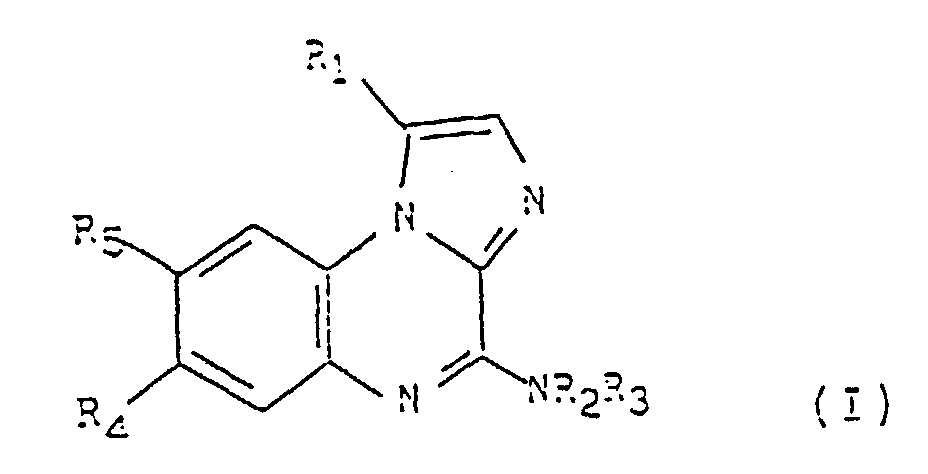
- R1 is hydrogen or methyl;
- R2 is hydrogen, straight- or branched- chain (C1-C6)alkyl;
- R3 is hydrogen, straight- or branched- chain (C1-C8)alkyl that is optionally substituted with OH, (C3-C8)cycloalkyl; or R2 and R3 together form
- Z is a direct bond, or O, NR6, R6 being a straight- or branched- chain (C1-C6)alkyl;
- m and n, same or different, are 1, 2 or 3;
- R4 and R5 can be the same or different and are hydrogen or halogen chosen from Cl, F, Br; with the proviso that when R1, R2, R4, R5 are hydrogen, R3 can not be hydrogen, straight- or branched-chain (C1-C8)alkyl, (C3-C8)cycloalkyl;
- and its pharmacologically acceptable salts;
-
- In the present invention, there are preferred the compounds of formula (I) in which R1 is hydrogen or methyl, R2 is hydrogen, R3 is hydrogen, straight- or branched- chain (C1-C6)alkyl, that is optionally substituted with OH, (C5-C6)cycloalkyl, R4 and R5 can be the same or different and are hydrogen, chlorine or fluorine,
with the proviso that when R1, R2, R4, R5 are hydrogen, R3 can not be hydrogen, straight- or branched-chain (C1-C8)alkyl, (C3-C8)cycloalkyl. - Especially preferred is the compound of formula (I) in which R1 is methyl, R2 is hydrogen, R3 is cyclopentyl, R4 and R5 are both hydrogen, that is the compound 4-cyclopentylamino-1-methylimidazo[1,2-a]quinoxaline.
- The salts of the compounds of formula (I) comprise the acid addition salts that can be prepared in situ during the final isolation and the purification or by means of a separate reaction of the free base with the suitable organic or inorganic acid chosen, for example, from hydrochloric, hydrobromic, phosphoric, methaphosphoric, nitric, sulphuric, tartaric, acetic, citric, malic, lactic, fumaric, benzoic, glycolic, gluconic, succinic and p-toluene sulfonic acids.
- An object of the present invention is also a process for the preparation of the compounds of the general formula (I). Said process comprises reacting the 2,3-dichloroquinoxaline of the formula (II)wherein R4 and R5 are as defined for the compound of formula (I), with amino acetaldehyde dimethyl acetal or with propargyl amine, thereby to obtain, respectively, the compounds of the formulae (III) and (IV)
 that are subsequently submitted to a cyclization reaction in an acidic medium, preferably at a temperature comprised between 50 and 120°C, to obtain the imidazo[1,2-a]quinoxalin-4(5H)-ones of formula (V)
 in which R1 is hydrogen or methyl depending on whether the starting compound was compound (III) or compound (IV), respectively, R4 and R5 being as defined above.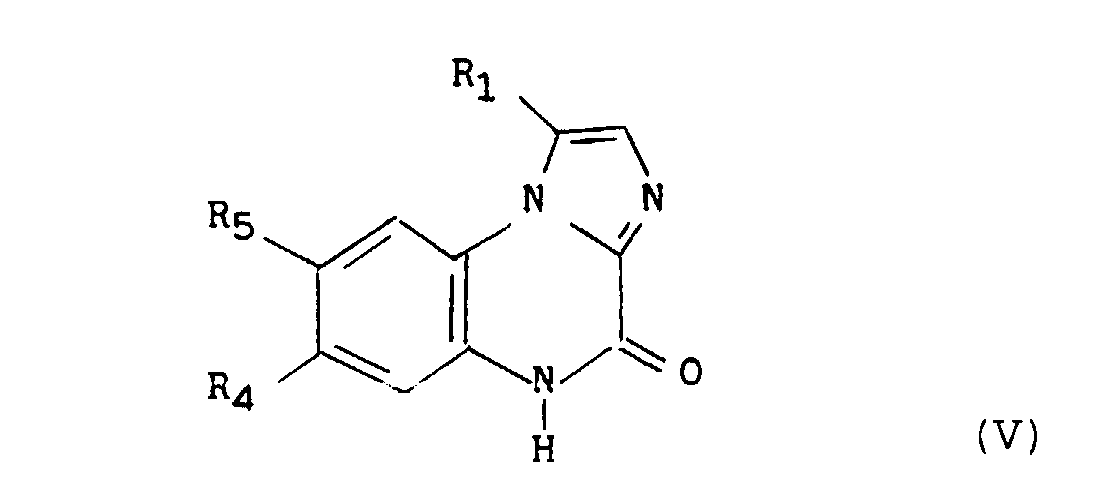
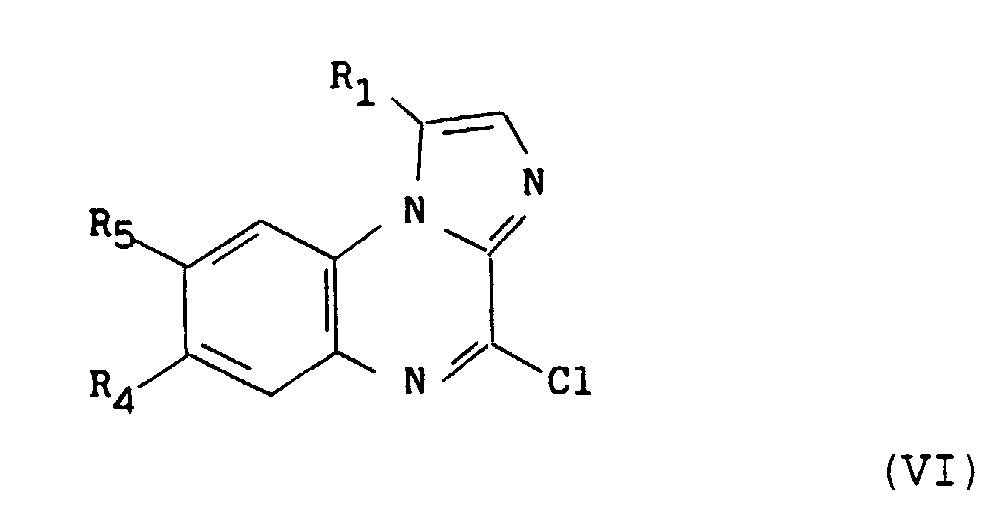
- The transformation of the compounds of formula (V) into the inventive compounds having the formula (I) can be carried out following two different synthetic sequences: in the first one, the chloride of the formula (VI)in which all the substituents are as already defined, said chloride being obtained by treatment of compound of formula (V) with POCl3 or another chlorinating agent, is reacted with the suitable amine HNR2R3, in which R2 is hydrogen, straight- or branched- chain (C1-C6)alkyl; R3 is hydrogen, straight or branched chain (C1-C8)alkyl, possibly substituted with hydroxy, (C3-C8)cycloalkyl; or R2 and R3 together form
 wherein Z is a direct bond, or O, NR6, R6 being a straight- or branched- chain (C1-C6)alkyl; m and n , same or different, are 1, 2 or 3.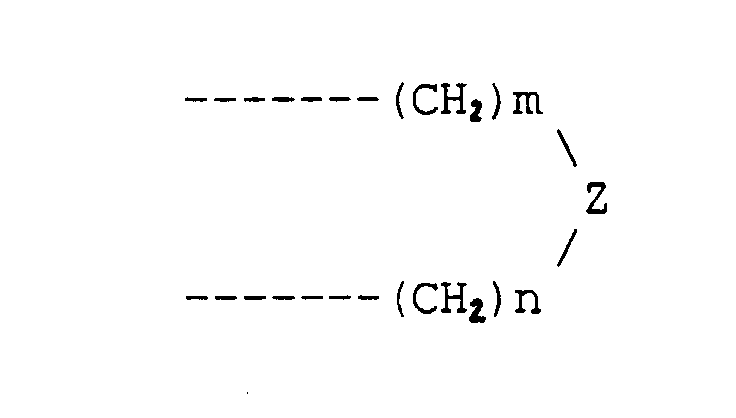
- As an alternative, the compound of formula (V) can be directly converted into the compounds of formula (I), by reacting it with a silylating agent, such as hexamethyl disilazane and the suitable amine HNR2R3 in which R2 and R3 are as defined in formula (I), at a temperature between 80 and 180°C, possibly in the presence of a catalyst, such as ammonium sulphate.
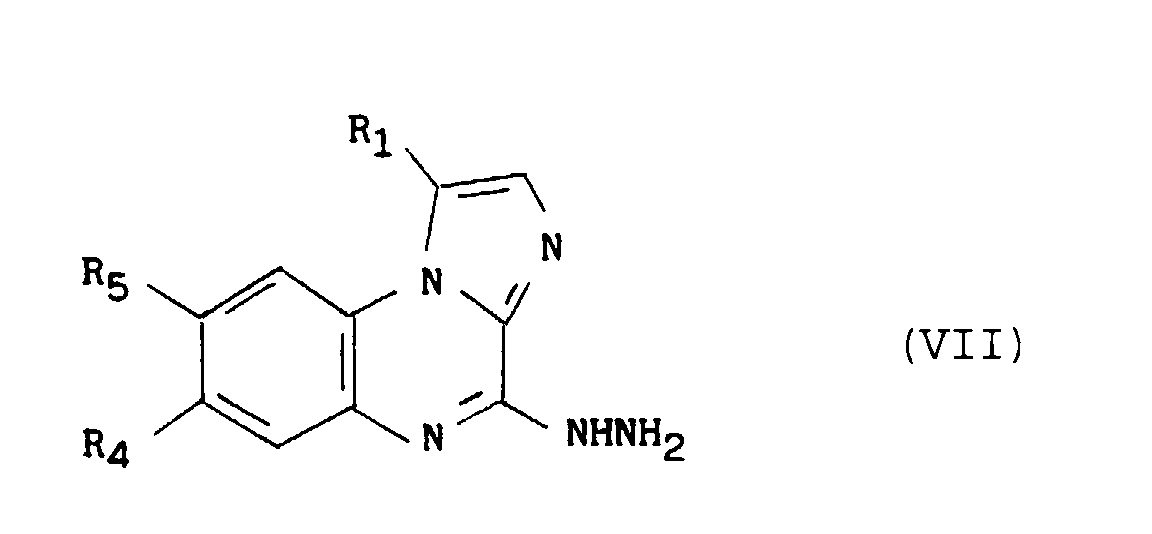
- The preparation of the compounds of formula (I) in which R2 and R3 are both hydrogen, can also be carried out by reacting the chloride of formula (VI) with hydrazine to obtain a compound of formula (VII)in which all the substituents are as defined above, followed by hydrogenation of this compound by conventional methods, such as, for example, hydrogen and palladium-on-carbon, or Raney nickel.
- The preferred compound of the present invention can be prepared according to the general process described above through the formation of the compound of formula (V). Said compound is then converted to the preferred compounds of formula (I) by means of either synthetic sequence shown above. For example, the especially preferred compound of formula (I) of the present invention can be prepared by treating 2,3-dichloroquinoxaline (compound of formula (II) in which R4 and R5 are both hydrogen) with propargylamine to obtain the 2-propargylamino-3-chloroquinoxaline (compound of formula (IV) in which both R4 and R5 are hydrogen), followed by reacting this latter compound in an acidic medium, for example with concentrated sulphuric acid, at a temperature of between 50 and 120°C, to give 1-methylimidazo[1,2-a]quinoxalin-4(5H)-one (compound of formula (V) in which R1 is methyl and R4 and R5 are both hydrogen). This compound can finally be converted to 4-cyclopentylamino-1-methylimidazo[1,2-a]quinoxaline through the formation of the intermediate 4-chloro-1-methylimidazo[1,2-a]quinoxaline (compound of formula (VI) in which R1 is methyl and R4 and R5 are both hydrogen) by chlorination with one of known chlorinating agents at a temperature of between 50 and 150°C, followed by the reaction of the latter compound with cyclopentylamine, or alternatively, by reaction of 1-methylimidazo[1,2-a]quinoxalin-4(5H)-one with cyclopentylamine in hexamethyl disilazane or other silylating agent at a temperature of between 80 and 180°C, possibly in the presence of a catalyst, such as ammonium sulphate.
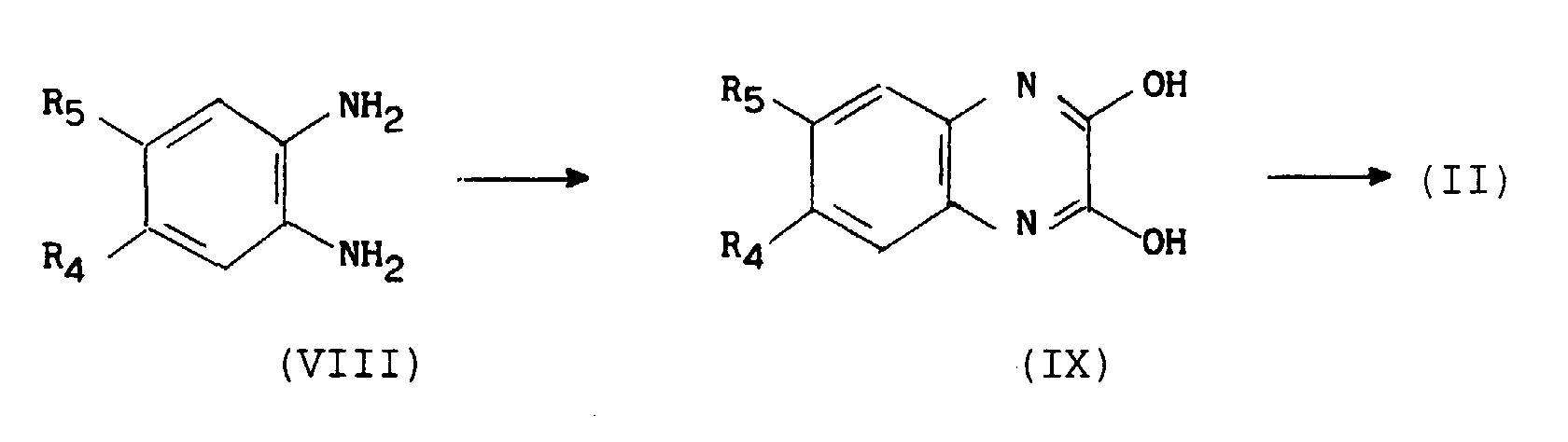
- The preparation of the compounds of formula (II), when they are not commercially available, can be carried out with methods such as the one shown below. Specifically, phenylenediamine (VIII) is reacted with dialkyl oxalate to give the 2,3-dihydroxyquinoxaline (IX), wich is then subjected to a chlorinating reaction with one of the usual chlorinating agents, such as for example POCl3, thereby obtaining the compounds (II)
- As shown hereinafter in Examples 28 to 30, the compounds of formula (I) of the present invention are antagonists of the adenosine receptors, are active on the central nervous system and can therefore be advantageously used as active ingredients for the preparation of medicaments that are useful in therapy for the treatment of various psychiatric disorders of the central nervous system, such as the depressive syndromes of various etiology and symptomatology and mood disorders in general, bulimia nervosa, sleep disorders, obsessive-compulsive disorders, phobias, panic attacks. Further indications are neurological diseases, such as pre-senile and senile dementia, the Alzheimer's disease, the multiinfarctual dementias, the encephalopathies of toxic or traumatic origin, the Parkinson disease, the post-neurological deficits, the respiratory depression, the neonatal cerebral damage.
- Besides being employed as drugs acting on the central nervous system, the compounds of the present invention and their salts could be used for the treatment of diseases of the renal system, such as acute renal failure, or of diseases of the cardiovascular system.
- For all the above-mentioned therapeutical uses, the compounds of the present invention can be administered by oral, transdermal or transmucosal route, parenterally or rectally in formulations containing them as the active ingredients at a therapeutically effective dosage with conventional, non-toxic pharmaceutical excipients. The term parenteral as used herein comprises subcutaneous, intravenous, intramuscolar and intracerebroventricular injections. If the compounds of the present invention are in the form of a pharmaceutical composition, as in a preferred embodiment of the invention, the precise formulation employed will obviously depend on the administration route chosen.
- The pharmaceutical compositions that are suitable for the oral administration can be for example tablets, aqueous or oily suspensions, dispersible powders or granules, hard or soft capsules, syrups or elixirs. The compositions for the oral administration can contain one or more sweetening agents, colorants, flavouring and preserving agents that are suitable to make the pharmaceutical composition elegant and palatable.
- The formulations for oral administration comprise tablets in which the active ingredient is admixed with non-toxic, pharmaceutically acceptable excipients. Said excipients can be inert diluents, such as calcium carbonate, sodium carbonate, lactose, calcium phosphate or sodium phosphate; granulating or disgregating agents, such as wheat starch or alginic acid; binding agents, such as starch or gelatines; lubricant agents, such as magnesium stearate, stearic acid or talc.
- The tablets can be non-coated or coated with conventional techniques known to a person skilled in the art in order to delay disintegration and absorption in the gastrointestinal tract, in order to achieve a sustained release action.
- The aqueous suspensions generally contain the active ingredients admixed with the suitable excipients. The excipients can be suspending agents, such as sodium carboxymethyl cellulose, methyl cellulose, hydroxypropyl methyl cellulose, sodium alginate, polyvinylpyrrolidone; dispersants and wetting agents. They can also contain one or more preservatives, such as ethyl and n-propyl p-hydroxybenzoate; one or more flavouring agent; one or more sweetening agents.
- The oily suspensions can be formulated by suspending the active ingredient in a vegetable or mineral oil; they can contain sweetening agents and flavouring agents in order to make the preparation palatable.
- The dispersible powders and granules that are suitable to the preparation of an aqueous suspension by adding water contain the active ingredient in admixture with the dispersing or wetting agent, a suspending agent and one or more preserving agents.
- The pharmaceutical compositions of the present invention can also be in the form of a water/oil emulsion. The oily phase can consist of a vegetable or mineral oil. The emulsifying agents can be natural gums, such as acacia, or natural phosphatides, such as lecithins, or natural or synthetic fatty acid esters. The syrups and the elixirs can be formulated with sweetening agents, for example glycerol, sorbitol or sucrose.
- The pharmaceutical compositions can be in the form of aqueous or oily, sterile injectable suspensions. The suspensions can be formulated with the known techniques by using dispersing or wetting agents and suspending agents that are known in the art. The sterile injectable preparations can be sterile injectable solutions or suspensions in a non-toxic solvent or diluent that is suitable for the parenteral use.
- The compounds of the present invention can also be administered by the rectal route in the form of suppositories. These compositions can be prepared by mixing the active ingredient with a suitable, non irritating excipient that is solid at room temperature but liquid at the rectal temperature, thereby melting in rectum to release the drug. The polyethylene glycols and the cocoa butter are suitable compounds for this purpose.
- The therapeutically or prophylactically effective amounts of a compound of the present invention will depend on a number of factors including, for example, the age and weight of the patient, the severity of the specific disease requiring the treatment, the administration route. However, an effective amount of the compound of the present invention for the treatment of depressive syndromes and of senile dementia will generally be comprised in the range of 0.005-20 mg/kg of body weight per day, more frequently in the range of 0.05-2 mg/kg per day.
- In order to better illustrate the present invention, the following examples are reported, that are in no way to be considered as limiting.
-
- (a) A mixture of 5.0 g of 2,3-dichloroquinoxaline and 5.5 ml of aminoacetaldehyde dimethyl acetal in 75 ml of ethanol is refluxed for 4 h. After concentrating under vacuum, the resulting mixture is added with water -and extracted with ethyl acetate. The organic extracts are then washed with saturated NaCl, dried and evaporated. The residue is finally chromatographed on SiO2 (eluent: CH2Cl2), thereby obtaining 5.0 g of 2-chloro-3-(2,2-dimethoxyethylamino)quinoxaline (IR (KBr): 3347, 2936, 1580, 1523, 1129 cm-1). 4.5 g of this product are then treated with 20 ml of 48% HBr and the mixture is refluxed for 4 h. After cooling down, the mixture is neutralized with aqueous NaOH and the resulting precipitate is filtered under vacuum and dried to obtain 3.2 g of imidazo[1,2-a]quinoxalin-4(5H)-one (m.p. >300°C)
- (b) A mixture of 0.47 g of imidazo[1,2-a]quinoxalin-4(5H)-one and 0.42 ml of N,N-dimethylaniline in 5.6 ml of phosphorus oxychloride is refluxed for 2 h. After evaporating under vacuum the resulting mixture, the residue is taken up in chloroform and repeatedly washed with water, then with saturated NaCl, then it is dried and evaporated thereby obtaining, after recrystallization from n-hexane / chloroform, 0.29 g of 4-chloroimidazo-[1,2-a]quinoxaline (IR (KBr): 1456, 755 cm-1).
- (c) A mixture of 0.25 g of 4-chloromidazo[1,2-a]quinoxaline and 0.5 ml of hydrazine hydrate in 1.5 ml of ethanol is refluxed for 2 h. After cooling the mixture, the resulting precipitate is filtered under vacuum, washed and dried, thereby obtaining 0.22 g of 4-hydrazinoimidazo[1,2-a]quinoxaline (IR (KBr): 3308, 3237, 1570 cm-1).
- (d) A mixture of 0.17 g of 4-hydrazinoimidazo[1,2-a]quinoxaline
and 3.4 ml of Raney nickel in 20 ml of
water is refluxed for 1.5 h. After cooling down, the
mixture is filtered on Celite, followed by washing with
methanolic chloroform. The filtrate is concentrated under
vacuum and extracted with ethyl acetate. The organic
extracts are then washed with saturated NaCl, dried and
evaporated, thereby obtaining 0.17 g of imidazo[1,2-a]quinoxalin-4-amine.
M.p. (DSC) = 205.3°C (onset); IR
(KBr): 3301, 3143, 1653, 1525 cm-1;
1H-NMR (CDCl3): δ 8.0 (1H, s), 7.8÷7.45 (3H,m), 7.45÷7.2 (2H,m), 5.8 (2H,sb) ; UV (EtOH): λmax= 229, 295, 331 nm.Elementary analysis for C10H8N4 (m.w. 184.20): calcd. C 65.21, H 4.38, N 30.42%; found C 65.48, H 4.71, N 30.10%. -
-
- (a) A mixture of 10 g of 2,3-dichloroquinoxaline, 4.5 ml of propargylamine, 10.5 ml of triethylamine in 50 ml of ethanol is refluxed for 4 h. After evaporating under vacuum the resulting mixture, the residue is chromatographed on SiO2 (eluent: CH2Cl2) thereby obtaining 7.0 g of 2-chloro-3-(propargylamino)quinoxaline (IR (KBr) : 3441, 3282, 1518 cm-1). This product is then added with 10 ml of concentrated sulphuric acid and the resulting mixture is stirred at 90°C for 1 h. After cooling down and cautiously neutralizing with aqueous NaOH, the resulting precipitate is filtered under vacuum, washed, dried, decolorized and recrystallized from dimethylformamide, thereby obtaining 2.4 g of 1-methylimidazo[1,2-a]quinoxaline-4(5H)-one (m.p. >300°C).
- (b) The chlorination of 1-methylimidazo[1,2-a]quinoxalin-4(5H)-one with POCl3 is carried out according to a closely analogous procedure to that reported in example 1 (b), thereby obtaining 4-chloro-1-methylimidazo[1,2-a]quinoxaline (IR (KBr): 1486, 754 cm-1).
- (c) The reaction of 4-chloro-1-methylimidazo[1,2-a]quinoxaline with hydrazine hydrate is carried out according to a strictly analogous procedure to that followed in example 1 (c), thereby obtaining 4-hydrazino-1-methylimidazo[1,2-a]quinoxaline (IR (KBr): 3298, 3250, 1564 cm-1).
- (d) The hydrogenation of 4-hydrazino-1-methylimidazo[1,2-a]quinoxaline
with Raney nickel is
carried out according to a strictly analogous procedure
to that followed in example 1 (d), thereby obtaining 1-methylimidazo[1,2-a]quinoxalin-4-amine.
m.p. (DSC) =
184.8°C (onset); IR (KBr): 3379, 3295, 1640, 1516 cm-1;
1H-NMR (CDCl3) : δ 8.05 (1H,dd), 7.9÷7.2 (3H,m), 7.2
(1H, s), 5,7 (2H, sb), 2.85 (3H, s) ; UV (EtOH): λmax=
225, 270, 304, 329 nm.
Elementary analysis for C11H10N4 (m.w. 198.23): calcd. C 66.65, H 5.08, N 28.26%; found C 66.79, H 5.30, N 28.03%. -
- A mixture of 2,8 g of 4-chloroimidazo[1,2-a]quinoxaline (example 1) and 9.8 ml of diethylamine in 40 ml of ethanol is refluxed for 4 h. After evaporating the solvent, the residue is taken up in chloroform and washed with water and saturated NaCl, then dried and evaporated, thereby obtaining 2.2 g of raw product that is subsequently chromatographed on SiO2 (eluent: CH2Cl2): after recrystallization from n-hexane there are obtained 1.3 g of 4- diethylaminoimidazo[1,2-a]quinoxaline. m.p. (DSC) = 91.7°C (onset); IR (KBr):
2976, 1518, 1425, cm-1 ; 1H-NMR (CDCl3) : δ 7.9 (1H,s), 7.7÷7.4 (3H,m), 7.35÷7.05 (2H,m), 4.15 (4H,q), 1.3 (6H,t); UV (EtOH): λmax= 231, 250, 293, 305, 332, 348 nm.Elementary analysis for C14H16N4(m.w. 240.31): calcd. C 69.97, H 6.71, N 23.31%; found C 69.99, H 6.80, N 23.13%. - By reaction of 4-chloroimidazo[1,2-a]quinoxaline (example 1) with isopropylamine according to a procedure that is similar to that followed in example 3 there is obtained 4-isopropylaminoimidazo[1,2-a]quinoxaline. m.p. (DSC) = 102.7°C (onset); IR (KBr) : 3230, 2966, 1559 cm-1; 1H-NMR (DMSO-d6) : δ 8.55 (1H,s), 8.2÷7.95 (1H,m), 7.6÷7.4 (2H,m), 7.4÷7.2 (3H,m), 4.5 (1H,m), 1.25 (6H,d) ; UV (EtOH): λ max= 227, 244, 285, 297, 318, 332 nm.
Elementary analysis for C13H14N4 (m.w. 226.28) : calcd. C 69.00, H 6.23, N 24.76%; found C 69.17, H 6.70, N 25.05%. - By reaction of 4-chloro-1-methylimidazo[1,2-a]quinoxaline (example 2) with 1-ethylpropylamine, according to a procedure that is similar to that followed in example 3, there is obtained 4-(1-ethylpropylamino)-1-methylimidazo[1,2-a] quinoxaline. m.p. (DSC) = 75.9°C (onset); IR (KBr) : 3231, 2965, 1546 cm-1; 1H-NMR (CDCl3) : δ 8.0 (1H,dd), 7.7 (1H,dd), 7.4÷7.1 (3H,m), 5.9 (1H,d), 4.2 (1H,m), 2.85 (3H,s), 1.65 (4H,m), 0.95 (6H,t) ; UV (EtOH): λmax= 221, 241, 268, 298, 313 nm.
Elementary analysis for C16H20N4 (m.w. 268.36) : calcd. C 71.61, H 7.51, N 20.83%; found C 71.12, H 7.53, N 20.79%. - By reaction of 4-chloromidazo[1,2-a]quinoxaline (example 1) with ethanolamine according to a procedure that is similar to that followed in example 3 there is obtained 4-(2-hydroxyethylamino)imidazo[1,2-a] quinoxaline. m.p. (DSC) = 150.8°C (onset); IR (KBr): 3312, 1598, 1564 cm-1;
1H-NMR (CDCl3/CD3OD): δ 8.2 (1H,s), 8.1÷7.55 (2H,m), 7.55 (1H, s), 7.4÷7.2 (2H,m), 3.8 (4H,s) ; UV (EtOH): λmax= 227, 285, 297, 317, 330 nm.Elementary analysis for C12H12N4 (m.w. 228.25): calcd. C 63.14, H 5.30, N 24.55%; found C 63.16, H 5.40, N 24.99%. - By reaction of 4-chloro-1-methylimidazo[1,2-a]quinoxaline (example 2) with ethanolamine, according to a procedure that is similar to that followed in example 3 there is obtained 4-(2-hydroxyethylamino)-1-methyl imidazo[1,2-a]quinoxaline. m.p. (DSC) = 173.4°C (onset); IR (KBr) : 3415, 3217, 1558 cm-1; 1H-NMR (CDCl3): δ 8.0 (1H,dd), 7.7÷7.2 (3H,m), 7.2 (1H,s), 6.6 (1H,m), 5.3 (1H,sb), 3.85 (4H,m), 2.8 (3H,s) ; UV (EtOH): λmax= 225, 242, 271, 301, 314, 327 nm.
Elementary analysis for C13H14N4 (m.w. 242.28): calcd. C 64.45, H 5.82, N 23.12%; found C 64.29, H 5.91, N 23.13%. - By reaction of 4-chloromidazo[1,2-a]quinoxaline (example 1) with cyclopentylamine according to a procedure that is similar to that followed in example 3 there is obtained 4-cyclopentylaminoimidazo[1,2-a] quinoxaline. m.p. (DSC) = 114.3°C (onset); IR (KBr): 3419, 2962, 1543 cm-1; 1H-NMR (CDCl3): δ 7.9 (1H,s), 7.8÷7.0 (5H,m), 6.2 (1H,d), 4.7 (1H,m), 2.3÷2.05 (4H,m), 2.0÷1.3 (4H,m); UV (EtOH): λmax= 228, 244, 285, 297, 319, 333 nm.
Elementary analysis for C15H16N4 (m.w. 252.32): calcd. C 71.40, H 6.39, N 22.20%; found C 71.13, H 7.30, N 22.29%. - A mixture of 3.5 g of 1-methylimidazo[1,2-a] quinoxalin-4(5H)-one (example 2), 13 ml of hexamethyl disilazane, 0.5 g of ammonium sulphate and 8.7 ml di cyclopentylamine is stirred at 120°C in a Dean-Stark apparatus for 24 h. After concentrating the resulting mixture under vacuum, the residue is added with water and extracted with ethyl acetate. The organic extracts are then washed with water and saturated NaCl, dried and evaporated, thereby obtaining 1.5 g of a raw product that is subsequently chromatographed on SiO2 (eluent: CH2Cl2/AcOEt 97:3). By recrystallizing from ethyl acetate, there is obtained 4-cyclopentylamino-1-methyl imidazo [1,2-a]quinoxaline.
m.p. (DSC) = 167.3°C (onset); IR (KBr): 3294, 2948, 1544 cm-1; 1H-NMR (CDCl3): δ 8.0 (1H,dd), 7.7 (1H,dd), 7.4÷7.05 (3H,m), 6.0 (1H,d), 4.6 (1H,m), 2.8 (3H,s), 2.3÷2.05 (4H,m), 2.0÷1.4 (4H,m); UV (EtOH): λmax= 225, 243, 272, 301, 316, 329 nm.Elementary analysis for C16H18N4 (m.w. 266.35): calcd. C 72.15, H 6.81, N 21.03%; found C 71.86, H 6.81, N 20.79%. - By reaction of 4-chloroimidazo[1,2-a]quinoxaline (example 1) with cylohexylamine, according to a procedure that is similar to that followed in example 3, there is obtained 4-cyclohexylaminoimidazo[1,2-a]quinoxaline. m.p. (DSC)= 94.0°C (onset); IR (KBr): 3227, 2924, 1560 cm-1; 1H-NMR (CDCl3) : δ 7.85 (1H,d, J=2Hz), 7.8÷7.4 (3H,m), 7.4÷7.1 (2H,m), 6.0 (1H,d), 4.2 (1H,m), 2.3÷1.95 (4H,m), 1.95÷0.9 (6H,m) ; UV (EtOH): λmax= 225, 242, 283, 294, 316, 330 nm.
Elementary analysis for C16H18N4 (m.w.266.35): calcd. C 72.15, H 6.81, N 21.03%; found C 72.25, H 7.04, N 21.19%. - By reaction of 1-methylimidazo[1,2-a]quinoxalin-4(5H)-one (example 2) with cyclohexylamine, according to a procedure that is similar to that followed in example 9, there is obtained 4-cyclohexylamino-1-methyl imidazo [1,2-a]quinoxaline. m.p. (DSC)=126.5°C (onset); IR (KBr): 3345, 2938, 1546 cm-1; 1H-NMR (CDCl3): δ 8.0 (1H,dd), 7.7 (1H,dd), 7.5÷7,1 (3H,m), 6.0 (1H,d), 4.2 (1H,m), 2.85 (3H,s), 2.3÷1.95 (4H,m), 1.95÷0.9 (6H,m); UV (EtOH): λmax = 225, 243, 272, 301, 316, 329 nm.
Elementary analysis for C17H20N4 (m.w. 280.37): calcd. C 72.83, H 7.19, N 19.98%; found C 72.21, H 7.54, N 20.14%. - By reaction of 4-chloroimidazo[1,2-a]quinoxaline (example 1) with piperidine, according to a procedure that is similar to that followed in example 3, there is obtained 4-(1-piperidinyl)imidazo[1,2-a]quinoxaline. m.p. (DSC)=108.2°C (onset); IR(KBr): 3107, 2935, 1517 cm-1; 1H-NMR (CDCl3): δ 7.9 (1H,d, J=2Hz), 7.75÷7.4 (3H,m), 7.4÷7.1 (2H,m), 4.3 (4H,t), 1.9÷1.6 (6H,m); UV (EtOH): λmax= 231, 249, 293, 305, 333 nm.
Elementary analysis for C15H16N4 (m.w. 252.32): calcd. C 71.40, H 6.39, N 22.20%; found C 71.38, H 6.63, N 22.61%. - By reaction of 4-chloro-1-methylimidazo[1,2-a]quinoxaline (example 2) with piperidine, according to a procedure that is similar to that followed in example 3, there is obtained 1-methyl-4-piperidinylimidazo[1,2-a]quinoxaline. m.p. (DSC) = 78.9°C (onset); IR (KBr): 3018, 2927, 1502 cm-1; 1H-NMR (CDCl3): δ8.05 (1H,dd), 7.65 (1H,dd), 7.5÷7.0 (3H,m), 4.25 (4H,t), 2.85 (3H,s), 1.9÷1.6 (6H,m); UV (EtOH): λmax= 249, 281, 297, 310, 329 nm.
Elementary analysis for C16H18N4 (m.w. 266.35): calcd. C 72.15, H 6.81, N 21.03%; found C 71.84, H 7.09, N 20.70%. - By reaction of 4-chloroimidazo[1,2-a]quinoxaline (example 1) with morpholine, according to a procedure that is similar to that followed in example 3, there is obtained 4-(4-morpholinyl)imidazo[1,2-a]quinoxaline. m.p. (DSC)= 142.8°C (onset); IR (KBr) : 3016, 2962, 1517 cm-1; 1H-NMR (CDCl3): δ 8.0 (1H,s), 7.8÷7.5 (3H,m), 7.5÷7.2 (2H,m), 4.4 (4H,t), 3.9 (4H,t); UV (EtOH) : λmax= 230, 248, 292, 304, 330 nm.
Elementary analysis for C14H14N4O(m.w. 254.29): calcd. C 66.13, H 5.55, N 22.03%; found C 65.43, H 5.47, N 22.25%. - By reaction of 4-chloroimidazo[1,2-a]quinoxaline (example 1) with N-methylpiperazine, according to a procedure that is similar to that followed in example 3, there is obtained 4-(N'-methylpiperazinyl)imidazo[1,2-a] quinoxaline, that is subsequently converted to the dihydrochloride by treatment with ethanolic HCl. m.p. (DSC)= 305.6°c (onset); IR (KBr): 2697, 1560, 1508 cm-1; 1H-NMR (DMSO-d6/CD3OD): δ8.7 (1H,sb), 8.3÷8.0 (1H,m), 7.8÷7.35 (4H,m), 5.5 (4H,t), 3.7÷3.3 (4H,m), 2.8 (3H,s); UV (EtOH): λmax= 230, 291, 304, 320 nm.
Elementary analysis for C15H17N5.2HCl (m.w. 340.25): calcd. C 52.95, H 5.63, N 20.58%; found C 52.81, H 5.78, N 20.13%. - By reaction of 4-chloro-1-methylimidazo[1,2-a]quinoxaline (example 2) with N-methylpiperazine, according to a procedure that is similar to that followed in example 3, there is obtained 1-methyl-4-(N'-methylpiperazinyl)imidazo[1,2-a]quinoxaline. m.p.
(DSC)= 108.0°C (onset); IR (KBr): 2928, 1535, 1510 cm-1; 1H-NMR (CDCl3): δ 8.1 (1H,dd), 7.7 (1H,dd), 7.4÷7.0 (3H,m), 4.35 (4H,t), 2.85 (3H,s), 2.6 (4H,t), 2.3 (3H,s); UV (EtOH): λmax= 228, 248, 279, 309, 325 nm.Elementary analysis for C16H19N5 (m.w. 281.36): calcd. C 68.30, H 6.81, N 24.89%; found C 68.37, H 7.15, N 25.05%. - By reaction of 2,3,6-trichloroquinoxaline with aminoacetaldehyde dimethyl acetal, according to a procedure that is similar to that described in example 1, there is obtained 8-chloroimidazo[1,2-a]quinoxalin-4(5H)-one (m.p.>300°C). By reacting this product with 1-ethyl propylamine according to the method described in example 9, there is obtained 8-chloro-4-(1-ethylpropylamino)imidazo[1,2-a]quinoxaline. m.p.
(DSC)= 125.1°C (onset); IR (KBr) : 3406, 3105, 2964, 1532 cm-1; 1H-NMR (CDCl3/CD3OD): δ 8.4 (1H,s), 8.05 (1H, d, J=2Hz), 7.8÷7.4 (3H,m), 3.85 (1H,m), 1.65 (4H,m), 0.95 (6H,t); UV (EtOH): λmax= 230, 245, 289, 301, 326 nm.Elementary analysis for C15H17ClN4 (m.w. 288.78): calcd. C 62.39, H 5.93, N 19.40%; found C 62.17, H 6.02, N 19.46%. - By reacting 8-chloroimidazo[1,2-a]quinoxalin-4(5H)-one (example 17) with POCl3, following a procedure that is similar to that described in example 1, there is obtained 4,8-dichloroimidazo[1,2-a]quinoxaline that is subsequently reacted with cyclopentylamine according to the method described in example 3, thereby obtaining 4-cyclopentylamino-8-chloroimidazo[1,2-a]quinoxaline. m.p.
(DSC) = 140.1°C (onset); IR (KBr) : 3401, 2955, 1554 cm-1; 1H-NMR (CDCl3): δ 7.8 (1H,d, J=2Hz), 7.7÷7.2 (4H,m), 6.15 (1H,d) 4.6 (1H,m), 2.3÷2.05 (4H,m), 2.0÷51.3 (4H,m); UV (EtOR): λmax= 229, 245, 289, 301, 326, 340 nm.Elementary analysis for C15H15ClN4 (m.w. 286.76): calcd. C 62.83, H 5.27, N 19.54%; found C 63.04, H 5.36, N 19.64%. - By reacting 4,8-dichloroimidazo[1,2-a]quinoxaline (example 18) with cyclohexylamine, following a procedure that is similar to that described in example 3, there is obtained 4-cyclohexylamino-8-chloroimidazo[1,2-a]quinoxaline. m.p.
(DSC)=126.7°C (onset); IR (KBr): 3413, 2926, 1555 cm-1; 1H-NMR (CDCl3): δ 7.85 (1H,s), 7.7÷7.2 (4H,m), 6.1 (1H,d), 4.2 (1H,m), 2.3÷2.0 (4H,m), 2.0÷1.2 (6H,m); UV (EtOH): λmax= 229, 245, 289, 301, 326, 340 nm.Elementary analysis for C16H17ClN4 (m.w. 300.79): calcd. C 63.89, H 5.70, N 18.63% found C 64.07, H 5.79, N 18.80% - By reacting 2,3,6-trichloroquinoxaline with propargylamine, following a procedure that is similar to that described in example 2, there is obtained 8-chloro-1-methylimidazo[1,2-a]quinoxalin-4(5H)-one (m.p.>300°C) and, subsequently, 4,8-dichloro-1-methylimidazo[1,2-a] quinoxaline. By reacting this product with cyclopentylamine according to the method described in example 3, there is obtained 4-cyclopentylamino-8-chloro-1-methylimidazo[1,2-a]quinoxaline. m.p.
(DSC)= 130.5°C (onset); IR (KBr): 3421, 2954, 1555 cm-1; 1H-NMR (CDCl3):δ 7.95 (1H,d, J=2Hz), 7.6 (1H,d, J=9Hz), 7.35÷7.15 (2H,m), 6.1 (1H,d), 4.5 (1H,s), 2.8 (3H,s), 2.4÷2.05 (4H,m), 2.0÷1.3 (4H,m); UV (EtOH) : λmax= 227, 251, 276, 305, 323, 336 nm.Elementary analysis for C16H17ClN4 (m.w. 300.79): calcd. C 63.89, H 5.70, N 18.63% found C 63.79, H 5.79, N 18.58% - By reacting 4,8-dichloro-1-methylimidazo[1,2-a] quinoxaline (example 20) with cyclohexylamine, following a procedure that is similar to that described in example 3, there is obtained 4-cyclohexylamino-8-chloro-1-methylimidazo[1,2-a]quinoxaline. m.p.
(DSC) = 130.4°C (onset); IR (KBr): 3410, 2927, 1551 cm-1; 1H-NMR (CDCl3): δ 7.95 (1H,d, J=2Hz), 7.6 (1H,d, J=9Hz), 7.4÷7.2 (2H,m), 6.1 (1H,d), 4.2 (1H,m), 2.8 (3H,2), 2.3÷1.1 (10H,m); UV (EtOH): λmax= 227, 250, 276, 305, 323, 336 nm.Elementary analysis for C17H19ClN4 (m.w. 314.82): calcd. C 64.86, H 6.08, N 17.80% found C 64.86, H 6.21, N 17.91% - By reacting 2,3,6,7-tetrachloroquinoxaline with aminoacetaldehyde dimethyl acetal, following a procedure that is similar to that described in example 1, there is obtained 7,8-dichloroimidazo[1,2-a]quinoxalin-4(5H)-one (m.p.>300°C) and, subsequently, 4,7,8-trichloroimidazo [1,2-a]quinoxaline. By reacting this product with cyclopentylamine according to the method described in example 3, there is obtained 4-cyclopentylamino-7,8-dichloroimidazo[1,2-a]quinoxaline.
m.p. (DSC) = 139.4°C (onset); IR (KBr): 3247, 2961, 1589, 1556 cm-1 ; 1H-NMR (CDCl3): δ 7.8 (2H,m) , 7.7 (1H,s), 7.55 (1H,s), 6.2 (1H,d), 4.6 (1H,m), 2.4÷1.3 (8H, m); UV (EtOH):λmax= 235, 274, 292, 304, 330, 345 nm.Elementary analysis for C15H14Cl2N4 (m.w. 321.21): calcd. C 56.09, H 4.39, N 17.44%; found C 56.13, H 4.41, N 17.52%. - By reacting 4,7,8-trichloroimidazo[1,2-a]quinoxaline (example 22) with cyclohexylamine, following a procedure that is similar to that described in example 3, there is obtained 4-cyclohexylamino-7,8-dichloroimidazo[1,2-a] quinoxaline. m.p.
(DSC) = 162.3°C (onset); IR (KBr): 3332, 2929, 1587, 1550 cm-1; 1H-NMR (CDCl3): δ 7.8 (2H,m) , 7.7 (1H,s), 7.55 (1H,d, J=2Hz), 6.2 (1H,d), 4.4 (1H,m), 2.3÷1.2 (10H,m); UV (EtOH): λmax= 234, 274, 292, 304, 330, 345 nm.Elementary analysis for C16H16Cl2N4.1/2H2O (m.w. 344.25): calcd. C 55.82, H 4.98, N 16.28% found C 55.83, H 5.00, N 16.31% - By reacting 2,3,6,7-tetrachloroquinoxaline with propargylamine, following a procedure that is similar to that described in example 2 there is obtained 7,8-dichloro-1-methylimidazo[1,2-a]quinoxalin-4(5H)-one (m.p.>300°C) and, subsequently, 1-methyl-4,7,8-trichloroimidazo[1,2-a]quinoxaline. By reacting this product with cyclopentylamine according to the method described in example 3, there is obtained 4-cyclopentylamino-7,8-dichloro-1-methylimidazo[1,2-a]quinoxaline.
m.p. (DSC) = 213.5°C (onset); IR (KBr): 3411, 2960, 1548 cm-1; 1H-NMR (CDCl3): δ 8.0 (1H,s), 7.75 (1H,s), 7.25 (1H,s), 6.2 (1H,d), 4.6 (1H,m), 2.8 (3H,s), 2.3÷1.3 (8H,m); UV (EtOH): λmax= 233, 279, 308, 327, 341 nm.Elementary analysis for C16H16Cl2N4 (m.w. 335.23): calcd. C 57.33, H 4.81, N 16.71%; found C 57.41, H 4.82, N 16.68%. - By reacting 2,3-dichloro-6-fluoroquinoxaline with aminoacetaldehyde dimethyl acetal, following a procedure that is similar to that described in example 1, there is obtained 8-fluoroimidazo[1,2-a]quinoxalin-4(5H)-one (m.p. >300°C) and, subsequently, 4-chloro-8-fluoroimidazo[1,2-a]quinoxaline. By reacting this product with cyclopentyl amine according to the method described in example 3, there is obtained 4-cyclopentylamino-8-fluoroimidazo[1,2-a]quinoxaline.
m.p. (DSC) = 85.7°C (onset); IR (KBr) : 3255, 2964, 1551 cm-1; 1H-NMR (CDCl3): δ 7.8 (1H,s), 7.7÷7.35 (1H,dd, JHF=16Hz), 7.5 (1H,d, J=2Hz), 7.6÷7.25 (1H,dd, JHF=16Hz), 7.05 (1H,dd), 6.0 (1H,d), 4.55 (1H,m), 2.35÷1.3 (8H,m); UV (EtOH): λmax= 226, 268, 285, 296, 323, 336 nm.Elementary analysis for C15H15FN4 (m.w. 270.31): calcd. C 66.65, H 5.59, N 20.73%; found C 66.36, H 5.66, N 20.86%. - By reacting 4-chloro-8-fluoroimidazo[1,2-a] quinoxaline (example 25) with cyclohexylamine, following a procedure that is similar to that described in example 3, there is obtained 4-cyclohexylamino-8-fluoroimidazo[1,2-a]quinoxaline. m.p.
(DSC) = 157.6°C (onset); IR (KBr): 3415, 2927, 1556 cm-1; 1H-NMR (CDCl3): δ 7.8 (1H,dd, J=2Hz), 7.7÷7.35 (1H,dd, JHF=16Hz), 7.55 (1H,d, J=2Hz), 7.55÷7.25 (1H, dd, JHF=16Hz), 7.05 (1H,dd), 6.0 (1H,d), 4.25 (1H,m), 2.35÷1.2 (10H,m); UV (EtOH): λmax= 226, 239, 285, 297, 323, 337 nm.Elementary analysis for C16H17FN4 (m.w. 284.33): calcd. C 67.59, H 6.03, N 19.71% found C 67.31, H 6.04, N 19.70% - By reacting 2, 3-dichloro-6,7-difluoroquinoxaline with aminoacetaldehyde dimethyl acetal, following a procedure that is similar to that described in example 1, there is obtained 7,8-difluoroimidazo[1,2-a]quinoxalin-4(5H)-one (m.p. >300°C) and, subsequently, 4-chloro-7,8-difluoroimidazo[1,2-a]quinoxaline. By reacting this product with cyclopentylamine according to the method described in example 3, there is obtained 4-cyclopentylamino-7,8-difluoroimidazo[1,2-a]quinoxaline. m.p. (DSC) = 146.0°C (onset); IR (KBr): 3263, 2955, 1554 cm-1; 1H-NMR (CDCl3): δ 7.7 (1H,s), 7.65÷7.15 (3H,m), 6.1 (1H,d), 4.6 (1H,m), 2.3÷1.3 (8H,m); UV (EtOH): λmax= 225, 241, 270, 295, 323, 337 nm.
Elementary analysis for C15H14F2N4 (m.w. 288.30): calcd. C 62.49, H 4.89, N 19.43%; found C 62.46, H 5.03, N 19.65%. - Binding on the adenosine receptors.
- The binding on A1 receptors has been carried out according to the method described in Naunyn-Schmied. Arch. Pharmacol. 1987, 336, 204 on preparations of synaptosomial membranes from rat brain by incubating 200 µg of membrane proteins for 1 h at 25°C with the substance to be tested and 0.3 nM [3H]-DPCPX in 400 µl of 50 mM Tris.HCl pH = 7.4. The non-specific binding has been determined with 5 nM R-PIA.
- The binding on A1 receptors has been carried out according to the method described in FASEB J. 1989, 3, A1047 on preparations of rat striatal membranes by incubating 200 µg of membrane proteins for 1 h at 25°C with the substance to be tested, 5 nM [3H]-CGS21680 and 50 nM CPA. The non-specific binding has been determined with 100 nM CPA.
- The incubations were blocked by filtration by means of a cell-harvester and, after completion of the separation of the bound from the free, the radioactivity contents were evaluated by liquid scintillation. The concentration-inhibition curves were obtained by assaying the receptor displacement at at least ten different concentrations of the test substance (all the assays were carried out in triplicate). The tested substances were dissolved in dimethyl sulphoxide and diluted in 50 mM Tris.HCl buffer pH = 7.4. The IC50 values have been determined by non-linear regression curves and transformed into Ki values according to the Cheng-Prusoff equation.
- Table I shows the results obtained with the compounds of examples 5, 9, 13, 18, 22 and 25 of the invention.
Adenosine receptors affinities : Substance Ki, A1 (nM) Ki, A1 (µM) COMPOUND EX. 5 54 COMPOUND EX. 9 7,9 2,5 COMPOUND EX. 13 - 2,6 COMPOUND EX. 18 23,5 COMPOUND EX. 22 26,5 COMPOUND EX. 25 84 - The test described by R.D.Porsolt et al. in Arch.Int.Pharmacodyn.Ther. 1977, 229, 327, has been carried out which is widely used as an animal model for the study of the antidepressant activity of new drugs. Male albino CD 1 mice weighing 25-35 g were used.
- One hour before immersion in water, the test compound is intraperitoneally (i.p.) administered to the animal; the vehicle is administered to the control animals. The duration of permanence in water is 6': from the 2nd to the 6th minute the time is measured during which the animal remains motionless. Table II shows the results obtained with the compounds of examples 9, 13, 16, 18 and 21 of the invention, expressed as the percent variation of the immobility time of the treated animals versus the control group. As the reference substance the tricyclic antidepressant drug desipramine was used.
Forced swim test Substance Dose (mg/kg.i.p.) %variation immobility time vs.C. COMPOUND EX.9 0.001 -32.8 COMPOUND EX.9 0.01 -45.3 COMPOUND EX.13 0.1 -23.5 COMPOUND EX.13 1 -70.7 COMPOUND EX.16 0.1 -22.4 COMPOUND EX.16 1 -51.4 COMPOUND EX.18 1 -42.3 COMPOUND EX.18 10 -52.8 COMPOUND EX.21 0.001 -33.0 COMPOUND EX.21 0.01 -48.6 DESIPRAMINE 7.5 -10.4 DESIPRAMINE 30 -41.4 - The test described by L.Steru, et al. in Psychopharmacology 1985, 85, 367, also widely used as an animal model for the screening of antidepressant activity has been carried out.
- Male albino CD 1 mice weighing 25-35 g were used.
- Half an hour before the test, the animal is administered the test compound by the i.p. route; the control animals are administered the vehicle. The mouse is suspended from a horizontal bar at about 40 cm from the support plane by means of an adhesive tape applied at the end of the tail and secured to a hook. The immobility time period is registered during 6'.
- Table III shows the results obtained with the compound of example 9 of the invention, as the percent change of the immobility time period of the treated animals versus the control group.
- As the reference substance the tricyclic antidepressant drug desipramine was used.
Tail suspension test Substance Dose (mg/kg.i.p.) %variation immobility time vs.C. COMPOUND EX.9 0.001 -26.7 COMPOUND EX.9 0.01 -41.1 COMPOUND EX.9 0.1 -64.3 DESYPRAMINE 4 -21.3 DESYPRAMINE 16 -62.4
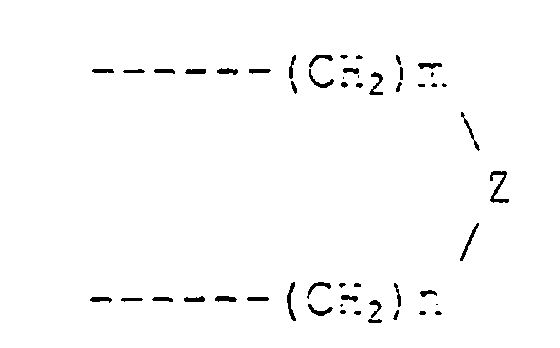
Claims (8)
- A compound of the formula (I):wherein:
 or R2 and R3 together formR1 is hydrogen or methyl;R2 is hydrogen, straight- or branched- chain (C1-C6)alkyl;R3 is hydrogen, straight- or branched- chain (C1-C8)alkyl that is optionally substituted with OH, (C3-C8)cycloalkyl;wherein
 Z is a direct bond, or O, NR6, R6 being a straight- or branched- chain (C1-C6)alkyl;m and n, same or different, are 1, 2 or 3;R4 and R5 can be the same or different and are hydrogen or halogen chosen from Cl, F, Br; with the proviso that when R1, R2, R4, R5 are hydrogen, R3 can not be hydrogen, straight- or branched-chain (C1-C8)alkyl, (C3-C8)cycloalkyl;and its pharmacologically acceptable salts
 - A compound according to claim 1 characterized in that R1 is hydrogen or methyl, R2 is hydrogen, R3 is hydrogen, straight- or branched- chain (C1-C6) alkyl, that is optionally substituted with OH, (C5-C6) cycloalkyl, R4 and R5 can be the same or different and are hydrogen, chlorine or fluorine.
- A compound according to claims 1 and 2 characterized in that R1 is methyl, R2 is hydrogen, R3 is cyclopentyl, R4 and R5 are both hydrogen.
- A process for the preparation of the compounds of the formula (I) according to claims 1 to 3, characterized in that a compound of formula (II)in which R4 and R5 are as defined in claim 1, is reacted with amino acetaldehyde dimethyl acetal or with propargyl amine, thereby to obtain, respectively, the compounds of the formulae (III) and (IV)
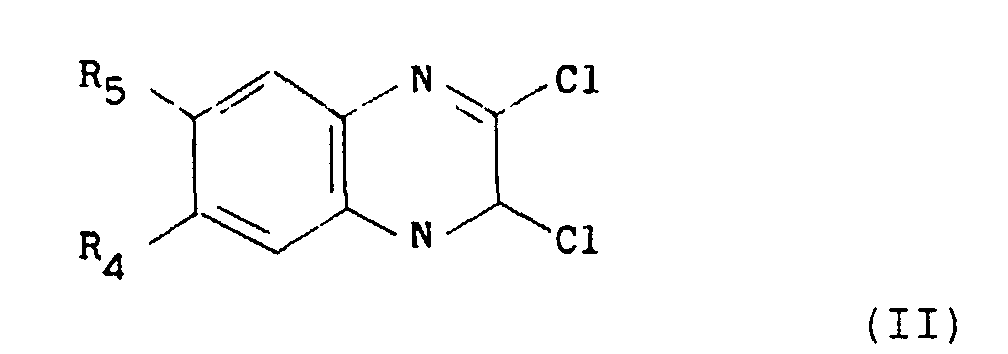 in which R4 and R5 are as defined in claim 1, said compounds being subsequently cyclized in an acidic milieu to give the compound of formula (V)
 in which R1 is hydrogen or methyl, R4 and R5 are as defined in claim 1; compound (V) is then reacted with a chlorinating agent such as POCl3 to provide the compound of formula (VI)
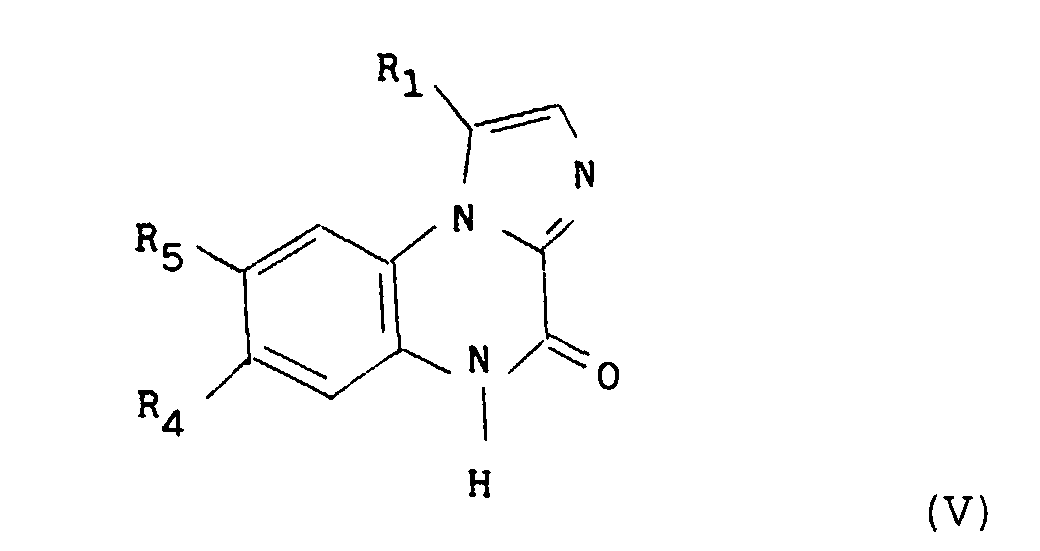 in which all the substituents are as defined above, which is subsequently reacted with the amine HNR2R3, in which R2 and R3 are as defined in claim 1;
or
compound (V), prepared as described above, is reacted with a silylating agent, such as hexamethyl disilazane, and amine HNR2R3, in which R2 and R3 are as defined in claim 1, at a temperature of between 80 and 180°C;
or
for the preparation of the compounds of formula (I) in which R2 and R3 are both hydrogen, the compound (VI), prepared as described above is reacted with hydrazine to give the compound of the formula (VII)in which R1, R4 and R5 are as defined in claim 1, which is subsequently hydrogenated according to conventional methods.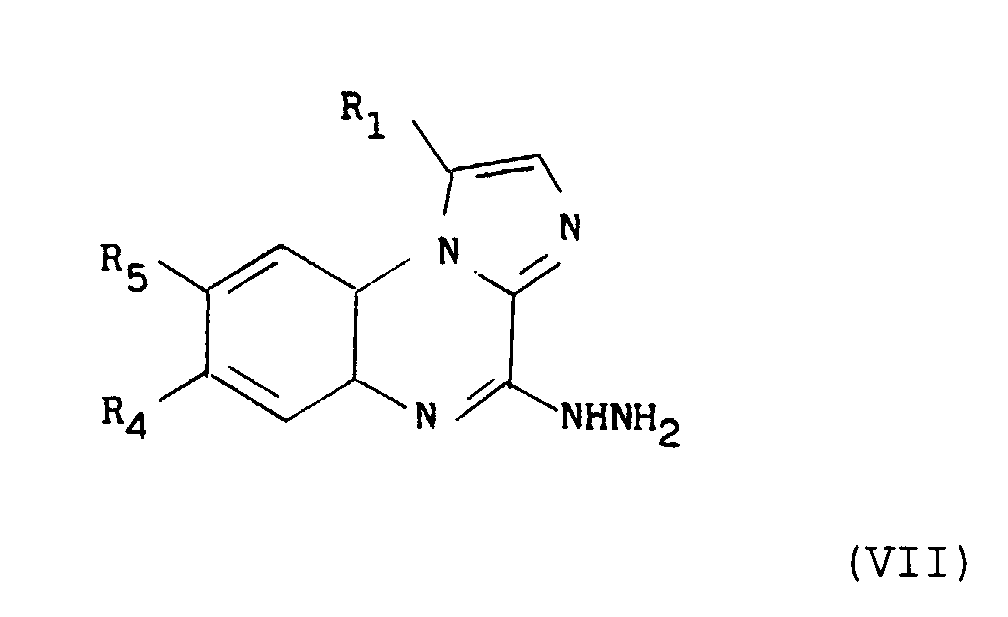
- Pharmaceutical compositions characterized in that they contain at least a compound according to claim 1 as an active ingredient at an effective dosage together with one or more conventional, non-toxic excipient.
- Use of the compounds of claim 1 as adenosine antagonists.
- Use of compounds according to claim 1 for the preparation of a medicament for the treatment of psychiatric disorders.
- Use of compounds according to claim 1 for the preparation of a medicament for the treatment of neurological diseases of the central nervous system.
Applications Claiming Priority (3)
| Application Number | Priority Date | Filing Date | Title |
|---|---|---|---|
| IT95MI002446A IT1276167B1 (en) | 1995-11-24 | 1995-11-24 | IMIDAZO (1,2-ALPHA) QUINOSSALIN-4-AMINE ACTIVE AS ADENOSINE ANTAGONISTS, PROCEDURE FOR THEIR PREPARATION AND COMPOSITIONS |
| ITMI952446 | 1995-11-24 | ||
| PCT/IB1996/001291 WO1997019079A1 (en) | 1995-11-24 | 1996-11-22 | IMIDAZO[1,2-a]QUINOXALIN-4-AMINES ACTIVE AS ADENOSINE ANTAGONISTS, PROCESS FOR THEIR PREPARATION AND PHARMACEUTICAL COMPOSITIONS THEREOF |
Publications (2)
| Publication Number | Publication Date |
|---|---|
| EP0865442A1 EP0865442A1 (en) | 1998-09-23 |
| EP0865442B1 true EP0865442B1 (en) | 2000-07-05 |
Family
ID=11372590
Family Applications (1)
| Application Number | Title | Priority Date | Filing Date |
|---|---|---|---|
| EP96937458A Expired - Lifetime EP0865442B1 (en) | 1995-11-24 | 1996-11-22 | IMIDAZO[1,2-a]QUINOXALIN-4-AMINES ACTIVE AS ADENOSINE ANTAGONISTS, PROCESS FOR THEIR PREPARATION AND PHARMACEUTICAL COMPOSITIONS THEREOF |
Country Status (9)
| Country | Link |
|---|---|
| US (1) | US6124287A (en) |
| EP (1) | EP0865442B1 (en) |
| AT (1) | ATE194347T1 (en) |
| DE (1) | DE69609192T2 (en) |
| ES (1) | ES2149504T3 (en) |
| GR (1) | GR3034354T3 (en) |
| IT (1) | IT1276167B1 (en) |
| PT (1) | PT865442E (en) |
| WO (1) | WO1997019079A1 (en) |
Families Citing this family (12)
| Publication number | Priority date | Publication date | Assignee | Title |
|---|---|---|---|---|
| US6235740B1 (en) | 1997-08-25 | 2001-05-22 | Bristol-Myers Squibb Co. | Imidazoquinoxaline protein tyrosine kinase inhibitors |
| US6635626B1 (en) | 1997-08-25 | 2003-10-21 | Bristol-Myers Squibb Co. | Imidazoquinoxaline protein tyrosine kinase inhibitors |
| DE69940808D1 (en) * | 1998-03-04 | 2009-06-10 | Bristol Myers Squibb Co | HETEROCYCLES SUBSTITUTED IMIDAZOPYRAZINES AS PROTEIN TYROSINE KINASE INHIBITORS |
| AU1182702A (en) | 2000-10-03 | 2002-04-15 | Bristol Myers Squibb Co | Amino-substituted tetracyclic compounds useful as anti-inflammatory agents and pharmaceutical compositions comprising same |
| US6869956B2 (en) | 2000-10-03 | 2005-03-22 | Bristol-Myers Squibb Company | Methods of treating inflammatory and immune diseases using inhibitors of IκB kinase (IKK) |
| CN100386326C (en) * | 2003-10-22 | 2008-05-07 | 中国人民解放军军事医学科学院毒物药物研究所 | 1-Hydroxymethylimidazo[1,2-a]quinoxaline compound and its application |
| ATE539079T1 (en) * | 2006-03-23 | 2012-01-15 | Novartis Ag | IMIDAZOCHINOXALINE COMPOUNDS AS IMMUNE MODULATORS |
| DE102006039912A1 (en) * | 2006-08-25 | 2008-03-20 | Bayer Healthcare Ag | Substituted spirotetronic acids and their use |
| WO2008072779A1 (en) * | 2006-12-13 | 2008-06-19 | Aska Pharmaceutical Co., Ltd. | Quinoxaline derivative |
| EP1972629A1 (en) * | 2007-03-23 | 2008-09-24 | Mutabilis SA | New imidazolo-heteroaryl derivatives with antibacterial properties |
| ITMI20072230A1 (en) * | 2007-11-23 | 2009-05-24 | Campagnolo Srl | CONTROL DEVICE FOR BICYCLE WITH RECURCED HANDLEBAR |
| WO2017037604A1 (en) * | 2015-08-28 | 2017-03-09 | Bheema Rao Paraselli | Novel fyn kinase inhibitors |
Family Cites Families (4)
| Publication number | Priority date | Publication date | Assignee | Title |
|---|---|---|---|---|
| US4229452A (en) * | 1977-01-07 | 1980-10-21 | Westwood Pharmaceuticals, Inc. | Treatment of inflammatory disorders with 4-trifluoromethylimidazo[1,2-a]quinoxaline |
| US4780464A (en) * | 1986-12-08 | 1988-10-25 | Warner-Lambert Company | (1,2,4)triazolo(4,3-a)quinoxaline-4-amines |
| US5182386A (en) * | 1991-08-27 | 1993-01-26 | Neurogen Corporation | Certain imidazoquinoxalinones; a new class of gaba brain receptor ligands |
| JPH08508271A (en) * | 1993-03-31 | 1996-09-03 | ビーエーエスエフ アクチエンゲゼルシャフト | Imidazoloquinoxalinone derivatives as EAA antagonists |
-
1995
- 1995-11-24 IT IT95MI002446A patent/IT1276167B1/en active IP Right Grant
-
1996
- 1996-11-22 ES ES96937458T patent/ES2149504T3/en not_active Expired - Lifetime
- 1996-11-22 PT PT96937458T patent/PT865442E/en unknown
- 1996-11-22 DE DE69609192T patent/DE69609192T2/en not_active Expired - Fee Related
- 1996-11-22 EP EP96937458A patent/EP0865442B1/en not_active Expired - Lifetime
- 1996-11-22 AT AT96937458T patent/ATE194347T1/en not_active IP Right Cessation
- 1996-11-22 US US09/068,515 patent/US6124287A/en not_active Expired - Fee Related
- 1996-11-22 WO PCT/IB1996/001291 patent/WO1997019079A1/en not_active Ceased
-
2000
- 2000-09-06 GR GR20000402042T patent/GR3034354T3/en unknown
Non-Patent Citations (1)
| Title |
|---|
| R. SARGES ET AL: "4-Amino[1,2,4Ütriazolo[4,3-aÜquinoxalines. A novel class of potent adenosine receptor antagonists and potential rapid-onset antidepressants", J. MED. CHEM., vol. 33, no. 8, 1990, pages 2240 - 2254 * |
Also Published As
| Publication number | Publication date |
|---|---|
| PT865442E (en) | 2000-10-31 |
| ES2149504T3 (en) | 2000-11-01 |
| ITMI952446A0 (en) | 1995-11-24 |
| GR3034354T3 (en) | 2000-12-29 |
| ITMI952446A1 (en) | 1997-05-24 |
| US6124287A (en) | 2000-09-26 |
| IT1276167B1 (en) | 1997-10-27 |
| WO1997019079A1 (en) | 1997-05-29 |
| DE69609192D1 (en) | 2000-08-10 |
| DE69609192T2 (en) | 2001-03-22 |
| ATE194347T1 (en) | 2000-07-15 |
| EP0865442A1 (en) | 1998-09-23 |
Similar Documents
| Publication | Publication Date | Title |
|---|---|---|
| EP2114903B1 (en) | Bicyclic pyrimidinones and uses thereof | |
| EP1246623B1 (en) | Compounds specific to adenosine a1, a2a, and a3 receptor and uses thereof | |
| US6545000B1 (en) | [1,2,4]triazolo[1,5-c]pyrimidine derivatives | |
| JPH0770128A (en) | Pyrazolopyrimidinone derivative | |
| DE60001735T2 (en) | 1-AMINOTRIAZOLO 4,3-A CHINAZOLIN-5-ONE AND / OR -THIONE INHIBITORS OF PHOSPHODIESTERASES IV | |
| JPH0256484A (en) | Fused pyrimidine compound and its production | |
| HUT67312A (en) | Naphtalene derivatives and process for their producing | |
| CN103467471A (en) | Organic compounds | |
| WO1997032881A1 (en) | 4-amino pyrimidine derivates, medicaments containing these compounds, their use and process for their production | |
| CZ342595A3 (en) | Purine derivatives, process of their preparation and pharmaceutical compositions containing thereof | |
| HU219395B (en) | Imidazopyridines, their producing, their use in treating gastrointestinal diseases and pharmaceutical compositions containing them | |
| US6124287A (en) | Imidazo[1,2-a]quinoxalin-4-amines active as adenosine antagonists, process for their preparation and pharmaceutical compositions thereof | |
| WO2003016314A1 (en) | 1-alkyl 0r 1-cycloalkyltriazolo[4,3-a]quinazolin-5-ones as phosphodiesterase inhibitors | |
| JPH06104666B2 (en) | 2-Substituted-e-fused- [1,2,4] triazolo [1,5-c] pyrimidines and pharmaceutical compositions containing the same | |
| US20030199502A1 (en) | Indoloquinazolinones | |
| CA2211729A1 (en) | 6-aryl pyrazolo[3,4-d¦pyrimidin-4-ones and compositions and methods of use thereof | |
| JP3116230B2 (en) | Tricyclic fused pyrimidine derivatives | |
| WO1999043678A1 (en) | Remedies/preventives for parkinson's disease | |
| Suzuki et al. | New bronchodilators. 1. 1, 5-Substituted 1H-imidazo [4, 5-c] quinolin-4 (5H)-ones | |
| FI98461C (en) | A process for the preparation of therapeutically useful compounds | |
| CN1219936A (en) | New triazolopurines, method of preparing them and their use as drugs | |
| WO2003082873A1 (en) | New-4-(pyrrolopyrimidin-6-yl)benzenesulphonamide derivatives | |
| SK282635B6 (en) | [1,2,4] Triazolo [4,3-a] quinoxalinone compounds, pharmaceutical composition, process for the preparation of [1,2,4] triazolo [4,3-a] quinoxalinone compounds and their use | |
| WO1999006408A1 (en) | New 2,3-benzodiazepine derivatives | |
| JP2003506373A (en) | C-6 ring substituted pyrido [1,2-a] benzimidazole derivatives useful in the treatment of central nervous system disorders |
Legal Events
| Date | Code | Title | Description |
|---|---|---|---|
| PUAI | Public reference made under article 153(3) epc to a published international application that has entered the european phase |
Free format text: ORIGINAL CODE: 0009012 |
|
| 17P | Request for examination filed |
Effective date: 19980501 |
|
| AK | Designated contracting states |
Kind code of ref document: A1 Designated state(s): AT BE CH DE ES FR GB GR IE IT LI NL PT SE |
|
| GRAG | Despatch of communication of intention to grant |
Free format text: ORIGINAL CODE: EPIDOS AGRA |
|
| 17Q | First examination report despatched |
Effective date: 19990615 |
|
| GRAG | Despatch of communication of intention to grant |
Free format text: ORIGINAL CODE: EPIDOS AGRA |
|
| GRAG | Despatch of communication of intention to grant |
Free format text: ORIGINAL CODE: EPIDOS AGRA |
|
| GRAH | Despatch of communication of intention to grant a patent |
Free format text: ORIGINAL CODE: EPIDOS IGRA |
|
| RTI1 | Title (correction) |
Free format text: IMIDAZO(1,2-A)QUINOXALIN-4-AMINES ACTIVE AS ADENOSINE ANTAGONISTS, PROCESS FOR THEIR PREPARATION AND PHARMACEUTICAL COMPOSITIONS THEREOF |
|
| GRAH | Despatch of communication of intention to grant a patent |
Free format text: ORIGINAL CODE: EPIDOS IGRA |
|
| GRAA | (expected) grant |
Free format text: ORIGINAL CODE: 0009210 |
|
| AK | Designated contracting states |
Kind code of ref document: B1 Designated state(s): AT BE CH DE ES FR GB GR IE IT LI NL PT SE |
|
| REF | Corresponds to: |
Ref document number: 194347 Country of ref document: AT Date of ref document: 20000715 Kind code of ref document: T |
|
| ITF | It: translation for a ep patent filed | ||
| REG | Reference to a national code |
Ref country code: CH Ref legal event code: NV Representative=s name: MICHELI & CIE INGENIEURS-CONSEILS Ref country code: CH Ref legal event code: EP |
|
| REG | Reference to a national code |
Ref country code: IE Ref legal event code: FG4D |
|
| REF | Corresponds to: |
Ref document number: 69609192 Country of ref document: DE Date of ref document: 20000810 |
|
| ET | Fr: translation filed | ||
| REG | Reference to a national code |
Ref country code: PT Ref legal event code: SC4A Free format text: AVAILABILITY OF NATIONAL TRANSLATION Effective date: 20000712 |
|
| REG | Reference to a national code |
Ref country code: ES Ref legal event code: FG2A Ref document number: 2149504 Country of ref document: ES Kind code of ref document: T3 |
|
| PG25 | Lapsed in a contracting state [announced via postgrant information from national office to epo] |
Ref country code: IE Free format text: LAPSE BECAUSE OF NON-PAYMENT OF DUE FEES Effective date: 20001122 Ref country code: AT Free format text: LAPSE BECAUSE OF NON-PAYMENT OF DUE FEES Effective date: 20001122 |
|
| PG25 | Lapsed in a contracting state [announced via postgrant information from national office to epo] |
Ref country code: LI Free format text: LAPSE BECAUSE OF NON-PAYMENT OF DUE FEES Effective date: 20001130 Ref country code: GR Free format text: LAPSE BECAUSE OF NON-PAYMENT OF DUE FEES Effective date: 20001130 Ref country code: CH Free format text: LAPSE BECAUSE OF NON-PAYMENT OF DUE FEES Effective date: 20001130 Ref country code: BE Free format text: LAPSE BECAUSE OF NON-PAYMENT OF DUE FEES Effective date: 20001130 |
|
| PLBE | No opposition filed within time limit |
Free format text: ORIGINAL CODE: 0009261 |
|
| STAA | Information on the status of an ep patent application or granted ep patent |
Free format text: STATUS: NO OPPOSITION FILED WITHIN TIME LIMIT |
|
| BERE | Be: lapsed |
Owner name: BIOMEDICA FOSCAMA INDUSTRIA CHIMICO-FARMACEUTICA Effective date: 20001130 |
|
| PG25 | Lapsed in a contracting state [announced via postgrant information from national office to epo] |
Ref country code: NL Free format text: LAPSE BECAUSE OF NON-PAYMENT OF DUE FEES Effective date: 20010601 |
|
| 26N | No opposition filed | ||
| REG | Reference to a national code |
Ref country code: CH Ref legal event code: PL |
|
| NLV4 | Nl: lapsed or anulled due to non-payment of the annual fee |
Effective date: 20010601 |
|
| REG | Reference to a national code |
Ref country code: IE Ref legal event code: MM4A |
|
| REG | Reference to a national code |
Ref country code: GB Ref legal event code: IF02 |
|
| PG25 | Lapsed in a contracting state [announced via postgrant information from national office to epo] |
Ref country code: PT Free format text: LAPSE BECAUSE OF NON-PAYMENT OF DUE FEES Effective date: 20020531 |
|
| REG | Reference to a national code |
Ref country code: PT Ref legal event code: MM4A Free format text: LAPSE DUE TO NON-PAYMENT OF FEES Effective date: 20020531 |
|
| PGFP | Annual fee paid to national office [announced via postgrant information from national office to epo] |
Ref country code: GB Payment date: 20041122 Year of fee payment: 9 |
|
| PGFP | Annual fee paid to national office [announced via postgrant information from national office to epo] |
Ref country code: ES Payment date: 20041124 Year of fee payment: 9 |
|
| PGFP | Annual fee paid to national office [announced via postgrant information from national office to epo] |
Ref country code: SE Payment date: 20041125 Year of fee payment: 9 |
|
| PGFP | Annual fee paid to national office [announced via postgrant information from national office to epo] |
Ref country code: FR Payment date: 20041130 Year of fee payment: 9 |
|
| PGFP | Annual fee paid to national office [announced via postgrant information from national office to epo] |
Ref country code: DE Payment date: 20050131 Year of fee payment: 9 |
|
| PG25 | Lapsed in a contracting state [announced via postgrant information from national office to epo] |
Ref country code: IT Free format text: LAPSE BECAUSE OF NON-PAYMENT OF DUE FEES Effective date: 20051122 Ref country code: GB Free format text: LAPSE BECAUSE OF NON-PAYMENT OF DUE FEES Effective date: 20051122 |
|
| PG25 | Lapsed in a contracting state [announced via postgrant information from national office to epo] |
Ref country code: SE Free format text: LAPSE BECAUSE OF NON-PAYMENT OF DUE FEES Effective date: 20051123 Ref country code: ES Free format text: LAPSE BECAUSE OF NON-PAYMENT OF DUE FEES Effective date: 20051123 |
|
| PG25 | Lapsed in a contracting state [announced via postgrant information from national office to epo] |
Ref country code: DE Free format text: LAPSE BECAUSE OF NON-PAYMENT OF DUE FEES Effective date: 20060601 |
|
| EUG | Se: european patent has lapsed | ||
| GBPC | Gb: european patent ceased through non-payment of renewal fee |
Effective date: 20051122 |
|
| PG25 | Lapsed in a contracting state [announced via postgrant information from national office to epo] |
Ref country code: FR Free format text: LAPSE BECAUSE OF NON-PAYMENT OF DUE FEES Effective date: 20060731 |
|
| REG | Reference to a national code |
Ref country code: FR Ref legal event code: ST Effective date: 20060731 |
|
| REG | Reference to a national code |
Ref country code: ES Ref legal event code: FD2A Effective date: 20051123 |
|
| PG25 | Lapsed in a contracting state [announced via postgrant information from national office to epo] |
Ref country code: PT Free format text: LAPSE BECAUSE OF NON-PAYMENT OF DUE FEES Effective date: 20001122 |