EP0862603B1 - Well fluid - Google Patents
Well fluid Download PDFInfo
- Publication number
- EP0862603B1 EP0862603B1 EP96939872A EP96939872A EP0862603B1 EP 0862603 B1 EP0862603 B1 EP 0862603B1 EP 96939872 A EP96939872 A EP 96939872A EP 96939872 A EP96939872 A EP 96939872A EP 0862603 B1 EP0862603 B1 EP 0862603B1
- Authority
- EP
- European Patent Office
- Prior art keywords
- alkyl
- fluid
- atoms
- fact
- water soluble
- Prior art date
- Legal status (The legal status is an assumption and is not a legal conclusion. Google has not performed a legal analysis and makes no representation as to the accuracy of the status listed.)
- Expired - Lifetime
Links
- 239000012530 fluid Substances 0.000 title claims description 121
- 229920003169 water-soluble polymer Polymers 0.000 claims description 38
- 125000000217 alkyl group Chemical group 0.000 claims description 35
- XLYOFNOQVPJJNP-UHFFFAOYSA-N water Substances O XLYOFNOQVPJJNP-UHFFFAOYSA-N 0.000 claims description 28
- 125000004432 carbon atom Chemical group C* 0.000 claims description 25
- 239000000203 mixture Substances 0.000 claims description 24
- 229930182470 glycoside Natural products 0.000 claims description 22
- 150000002338 glycosides Chemical class 0.000 claims description 22
- 238000005553 drilling Methods 0.000 claims description 20
- 125000002887 hydroxy group Chemical group [H]O* 0.000 claims description 20
- 150000001875 compounds Chemical class 0.000 claims description 17
- 125000002791 glucosyl group Chemical group C1([C@H](O)[C@@H](O)[C@H](O)[C@H](O1)CO)* 0.000 claims description 8
- 238000003878 thermal aging Methods 0.000 claims description 8
- 230000001588 bifunctional effect Effects 0.000 claims description 7
- 229920002678 cellulose Polymers 0.000 claims description 7
- 235000010980 cellulose Nutrition 0.000 claims description 7
- 238000000034 method Methods 0.000 claims description 7
- 229920002134 Carboxymethyl cellulose Polymers 0.000 claims description 6
- 235000010948 carboxy methyl cellulose Nutrition 0.000 claims description 6
- 125000004435 hydrogen atom Chemical group [H]* 0.000 claims description 6
- NIXOWILDQLNWCW-UHFFFAOYSA-N 2-Propenoic acid Natural products OC(=O)C=C NIXOWILDQLNWCW-UHFFFAOYSA-N 0.000 claims description 5
- 239000001768 carboxy methyl cellulose Substances 0.000 claims description 5
- 239000008112 carboxymethyl-cellulose Substances 0.000 claims description 5
- 239000001913 cellulose Substances 0.000 claims description 5
- 238000002360 preparation method Methods 0.000 claims description 5
- -1 viscosifiers Substances 0.000 claims description 5
- 244000007835 Cyamopsis tetragonoloba Species 0.000 claims description 4
- FBPFZTCFMRRESA-FSIIMWSLSA-N D-Glucitol Natural products OC[C@H](O)[C@H](O)[C@@H](O)[C@H](O)CO FBPFZTCFMRRESA-FSIIMWSLSA-N 0.000 claims description 4
- 229920002472 Starch Polymers 0.000 claims description 4
- 125000003342 alkenyl group Chemical group 0.000 claims description 4
- 125000002947 alkylene group Chemical group 0.000 claims description 4
- 229920001222 biopolymer Polymers 0.000 claims description 4
- 238000009833 condensation Methods 0.000 claims description 4
- 230000005494 condensation Effects 0.000 claims description 4
- 229920001577 copolymer Polymers 0.000 claims description 4
- 229930195733 hydrocarbon Natural products 0.000 claims description 4
- 150000002430 hydrocarbons Chemical class 0.000 claims description 4
- 238000003801 milling Methods 0.000 claims description 4
- 239000000178 monomer Substances 0.000 claims description 4
- 125000004430 oxygen atom Chemical group O* 0.000 claims description 4
- 150000003839 salts Chemical class 0.000 claims description 4
- 229920006395 saturated elastomer Polymers 0.000 claims description 4
- 229910052708 sodium Inorganic materials 0.000 claims description 4
- 239000000600 sorbitol Substances 0.000 claims description 4
- 235000019698 starch Nutrition 0.000 claims description 4
- 230000000638 stimulation Effects 0.000 claims description 4
- 125000000547 substituted alkyl group Chemical group 0.000 claims description 4
- 150000005846 sugar alcohols Polymers 0.000 claims description 4
- 229920001285 xanthan gum Polymers 0.000 claims description 4
- SMZOUWXMTYCWNB-UHFFFAOYSA-N 2-(2-methoxy-5-methylphenyl)ethanamine Chemical compound COC1=CC=C(C)C=C1CCN SMZOUWXMTYCWNB-UHFFFAOYSA-N 0.000 claims description 3
- XHZPRMZZQOIPDS-UHFFFAOYSA-N 2-Methyl-2-[(1-oxo-2-propenyl)amino]-1-propanesulfonic acid Chemical compound OS(=O)(=O)CC(C)(C)NC(=O)C=C XHZPRMZZQOIPDS-UHFFFAOYSA-N 0.000 claims description 3
- HRPVXLWXLXDGHG-UHFFFAOYSA-N Acrylamide Chemical compound NC(=O)C=C HRPVXLWXLXDGHG-UHFFFAOYSA-N 0.000 claims description 3
- 229920000881 Modified starch Polymers 0.000 claims description 3
- 229910052791 calcium Inorganic materials 0.000 claims description 3
- 229920001519 homopolymer Polymers 0.000 claims description 3
- 235000019426 modified starch Nutrition 0.000 claims description 3
- 238000011160 research Methods 0.000 claims description 3
- 239000002253 acid Substances 0.000 claims description 2
- 125000002252 acyl group Chemical group 0.000 claims description 2
- 239000003139 biocide Substances 0.000 claims description 2
- 229910052792 caesium Inorganic materials 0.000 claims description 2
- 150000001768 cations Chemical class 0.000 claims description 2
- 229920003086 cellulose ether Polymers 0.000 claims description 2
- 239000003795 chemical substances by application Substances 0.000 claims description 2
- 238000005260 corrosion Methods 0.000 claims description 2
- 230000007797 corrosion Effects 0.000 claims description 2
- 239000002270 dispersing agent Substances 0.000 claims description 2
- 239000003995 emulsifying agent Substances 0.000 claims description 2
- 230000032050 esterification Effects 0.000 claims description 2
- 238000005886 esterification reaction Methods 0.000 claims description 2
- RTZKZFJDLAIYFH-UHFFFAOYSA-N ether Substances CCOCC RTZKZFJDLAIYFH-UHFFFAOYSA-N 0.000 claims description 2
- 150000002402 hexoses Chemical class 0.000 claims description 2
- 229910052739 hydrogen Inorganic materials 0.000 claims description 2
- 239000003112 inhibitor Substances 0.000 claims description 2
- 229910052744 lithium Inorganic materials 0.000 claims description 2
- 239000000314 lubricant Substances 0.000 claims description 2
- 229910052749 magnesium Inorganic materials 0.000 claims description 2
- 150000007524 organic acids Chemical class 0.000 claims description 2
- 239000003002 pH adjusting agent Substances 0.000 claims description 2
- 150000002972 pentoses Chemical class 0.000 claims description 2
- 229910052700 potassium Inorganic materials 0.000 claims description 2
- 239000006254 rheological additive Substances 0.000 claims description 2
- 239000000725 suspension Substances 0.000 claims description 2
- 150000003628 tricarboxylic acids Chemical class 0.000 claims description 2
- 125000000837 carbohydrate group Chemical group 0.000 claims 1
- 239000002562 thickening agent Substances 0.000 claims 1
- 125000000391 vinyl group Chemical group [H]C([*])=C([H])[H] 0.000 claims 1
- 229920002554 vinyl polymer Polymers 0.000 claims 1
- 239000000706 filtrate Substances 0.000 description 22
- 239000008186 active pharmaceutical agent Substances 0.000 description 18
- 239000000654 additive Substances 0.000 description 15
- 230000000694 effects Effects 0.000 description 10
- 230000032683 aging Effects 0.000 description 9
- 230000009467 reduction Effects 0.000 description 9
- 239000013505 freshwater Substances 0.000 description 7
- HEMHJVSKTPXQMS-UHFFFAOYSA-M Sodium hydroxide Chemical compound [OH-].[Na+] HEMHJVSKTPXQMS-UHFFFAOYSA-M 0.000 description 6
- TZCXTZWJZNENPQ-UHFFFAOYSA-L barium sulfate Chemical compound [Ba+2].[O-]S([O-])(=O)=O TZCXTZWJZNENPQ-UHFFFAOYSA-L 0.000 description 6
- 239000010428 baryte Substances 0.000 description 6
- 229910052601 baryte Inorganic materials 0.000 description 6
- 230000015572 biosynthetic process Effects 0.000 description 6
- 230000006872 improvement Effects 0.000 description 6
- 238000012360 testing method Methods 0.000 description 6
- ONCZQWJXONKSMM-UHFFFAOYSA-N dialuminum;disodium;oxygen(2-);silicon(4+);hydrate Chemical compound O.[O-2].[O-2].[O-2].[O-2].[O-2].[O-2].[O-2].[O-2].[O-2].[O-2].[O-2].[O-2].[Na+].[Na+].[Al+3].[Al+3].[Si+4].[Si+4].[Si+4].[Si+4] ONCZQWJXONKSMM-UHFFFAOYSA-N 0.000 description 5
- 238000000518 rheometry Methods 0.000 description 5
- 229940080314 sodium bentonite Drugs 0.000 description 5
- 229910000280 sodium bentonite Inorganic materials 0.000 description 5
- VTYYLEPIZMXCLO-UHFFFAOYSA-L Calcium carbonate Chemical compound [Ca+2].[O-]C([O-])=O VTYYLEPIZMXCLO-UHFFFAOYSA-L 0.000 description 4
- 238000005755 formation reaction Methods 0.000 description 4
- 239000000047 product Substances 0.000 description 4
- 239000011435 rock Substances 0.000 description 4
- 239000011734 sodium Substances 0.000 description 4
- LFQSCWFLJHTTHZ-UHFFFAOYSA-N Ethanol Chemical compound CCO LFQSCWFLJHTTHZ-UHFFFAOYSA-N 0.000 description 3
- 206010042602 Supraventricular extrasystoles Diseases 0.000 description 3
- 230000000996 additive effect Effects 0.000 description 3
- 238000009472 formulation Methods 0.000 description 3
- 229920005615 natural polymer Polymers 0.000 description 3
- 229920000642 polymer Polymers 0.000 description 3
- 239000013535 sea water Substances 0.000 description 3
- 239000008107 starch Substances 0.000 description 3
- 239000000126 substance Substances 0.000 description 3
- 238000006467 substitution reaction Methods 0.000 description 3
- 239000005995 Aluminium silicate Substances 0.000 description 2
- 239000004368 Modified starch Substances 0.000 description 2
- BPQQTUXANYXVAA-UHFFFAOYSA-N Orthosilicate Chemical compound [O-][Si]([O-])([O-])[O-] BPQQTUXANYXVAA-UHFFFAOYSA-N 0.000 description 2
- CDBYLPFSWZWCQE-UHFFFAOYSA-L Sodium Carbonate Chemical compound [Na+].[Na+].[O-]C([O-])=O CDBYLPFSWZWCQE-UHFFFAOYSA-L 0.000 description 2
- 125000001931 aliphatic group Chemical group 0.000 description 2
- 235000012211 aluminium silicate Nutrition 0.000 description 2
- 229940092782 bentonite Drugs 0.000 description 2
- 229910000278 bentonite Inorganic materials 0.000 description 2
- 239000000440 bentonite Substances 0.000 description 2
- SVPXDRXYRYOSEX-UHFFFAOYSA-N bentoquatam Chemical compound O.O=[Si]=O.O=[Al]O[Al]=O SVPXDRXYRYOSEX-UHFFFAOYSA-N 0.000 description 2
- 229910000019 calcium carbonate Inorganic materials 0.000 description 2
- 239000003638 chemical reducing agent Substances 0.000 description 2
- FYGDTMLNYKFZSV-MRCIVHHJSA-N dextrin Chemical compound O[C@@H]1[C@@H](O)[C@H](O)[C@@H](CO)OC1O[C@@H]1[C@@H](CO)OC(O[C@@H]2[C@H](O[C@H](O)[C@H](O)[C@H]2O)CO)[C@H](O)[C@H]1O FYGDTMLNYKFZSV-MRCIVHHJSA-N 0.000 description 2
- 239000000839 emulsion Substances 0.000 description 2
- 230000007613 environmental effect Effects 0.000 description 2
- 150000004675 formic acid derivatives Chemical class 0.000 description 2
- NLYAJNPCOHFWQQ-UHFFFAOYSA-N kaolin Chemical compound O.O.O=[Al]O[Si](=O)O[Si](=O)O[Al]=O NLYAJNPCOHFWQQ-UHFFFAOYSA-N 0.000 description 2
- 239000000463 material Substances 0.000 description 2
- 239000003129 oil well Substances 0.000 description 2
- 239000004094 surface-active agent Substances 0.000 description 2
- 230000008961 swelling Effects 0.000 description 2
- 238000003786 synthesis reaction Methods 0.000 description 2
- 229920001059 synthetic polymer Polymers 0.000 description 2
- 239000000230 xanthan gum Substances 0.000 description 2
- 235000010493 xanthan gum Nutrition 0.000 description 2
- 229940082509 xanthan gum Drugs 0.000 description 2
- BZANQLIRVMZFOS-ZKZCYXTQSA-N (3r,4s,5s,6r)-2-butoxy-6-(hydroxymethyl)oxane-3,4,5-triol Chemical compound CCCCOC1O[C@H](CO)[C@@H](O)[C@H](O)[C@H]1O BZANQLIRVMZFOS-ZKZCYXTQSA-N 0.000 description 1
- HOVAGTYPODGVJG-UVSYOFPXSA-N (3s,5r)-2-(hydroxymethyl)-6-methoxyoxane-3,4,5-triol Chemical compound COC1OC(CO)[C@@H](O)C(O)[C@H]1O HOVAGTYPODGVJG-UVSYOFPXSA-N 0.000 description 1
- FEBUJFMRSBAMES-UHFFFAOYSA-N 2-[(2-{[3,5-dihydroxy-2-(hydroxymethyl)-6-phosphanyloxan-4-yl]oxy}-3,5-dihydroxy-6-({[3,4,5-trihydroxy-6-(hydroxymethyl)oxan-2-yl]oxy}methyl)oxan-4-yl)oxy]-3,5-dihydroxy-6-(hydroxymethyl)oxan-4-yl phosphinite Chemical compound OC1C(O)C(O)C(CO)OC1OCC1C(O)C(OC2C(C(OP)C(O)C(CO)O2)O)C(O)C(OC2C(C(CO)OC(P)C2O)O)O1 FEBUJFMRSBAMES-UHFFFAOYSA-N 0.000 description 1
- GJCOSYZMQJWQCA-UHFFFAOYSA-N 9H-xanthene Chemical compound C1=CC=C2CC3=CC=CC=C3OC2=C1 GJCOSYZMQJWQCA-UHFFFAOYSA-N 0.000 description 1
- 239000004215 Carbon black (E152) Substances 0.000 description 1
- 244000303965 Cyamopsis psoralioides Species 0.000 description 1
- 229920001732 Lignosulfonate Polymers 0.000 description 1
- 239000004117 Lignosulphonate Substances 0.000 description 1
- RQTDRJMAUKHGHV-UHFFFAOYSA-N P.P.I Chemical compound P.P.I RQTDRJMAUKHGHV-UHFFFAOYSA-N 0.000 description 1
- 229920002305 Schizophyllan Polymers 0.000 description 1
- VYPSYNLAJGMNEJ-UHFFFAOYSA-N Silicium dioxide Chemical compound O=[Si]=O VYPSYNLAJGMNEJ-UHFFFAOYSA-N 0.000 description 1
- RTQCAYKHUMWCEM-UHFFFAOYSA-N [Mg].ClO Chemical compound [Mg].ClO RTQCAYKHUMWCEM-UHFFFAOYSA-N 0.000 description 1
- 230000009471 action Effects 0.000 description 1
- 150000001298 alcohols Chemical class 0.000 description 1
- 239000002280 amphoteric surfactant Substances 0.000 description 1
- 125000000484 butyl group Chemical group [H]C([*])([H])C([H])([H])C([H])([H])C([H])([H])[H] 0.000 description 1
- 150000001720 carbohydrates Chemical group 0.000 description 1
- 229910052799 carbon Inorganic materials 0.000 description 1
- 239000004927 clay Substances 0.000 description 1
- 230000000295 complement effect Effects 0.000 description 1
- 239000000470 constituent Substances 0.000 description 1
- 239000000356 contaminant Substances 0.000 description 1
- 239000002537 cosmetic Substances 0.000 description 1
- 239000003599 detergent Substances 0.000 description 1
- 238000004090 dissolution Methods 0.000 description 1
- 230000001804 emulsifying effect Effects 0.000 description 1
- 150000002148 esters Chemical class 0.000 description 1
- 238000011156 evaluation Methods 0.000 description 1
- 239000012065 filter cake Substances 0.000 description 1
- 238000001914 filtration Methods 0.000 description 1
- 235000013312 flour Nutrition 0.000 description 1
- 150000004676 glycans Chemical class 0.000 description 1
- 239000004615 ingredient Substances 0.000 description 1
- 230000005764 inhibitory process Effects 0.000 description 1
- 230000003993 interaction Effects 0.000 description 1
- 239000003077 lignite Substances 0.000 description 1
- 235000019357 lignosulphonate Nutrition 0.000 description 1
- 238000005461 lubrication Methods 0.000 description 1
- 239000011777 magnesium Substances 0.000 description 1
- 229910052751 metal Inorganic materials 0.000 description 1
- 239000002184 metal Substances 0.000 description 1
- 229910000000 metal hydroxide Inorganic materials 0.000 description 1
- 150000004692 metal hydroxides Chemical class 0.000 description 1
- HOVAGTYPODGVJG-UHFFFAOYSA-N methyl beta-galactoside Natural products COC1OC(CO)C(O)C(O)C1O HOVAGTYPODGVJG-UHFFFAOYSA-N 0.000 description 1
- 125000002496 methyl group Chemical group [H]C([H])([H])* 0.000 description 1
- 150000002772 monosaccharides Chemical group 0.000 description 1
- 229920001542 oligosaccharide Polymers 0.000 description 1
- 150000002482 oligosaccharides Chemical class 0.000 description 1
- 238000005457 optimization Methods 0.000 description 1
- 230000035699 permeability Effects 0.000 description 1
- 239000003208 petroleum Substances 0.000 description 1
- 239000004033 plastic Substances 0.000 description 1
- 229920001282 polysaccharide Polymers 0.000 description 1
- 239000005017 polysaccharide Substances 0.000 description 1
- 239000011148 porous material Substances 0.000 description 1
- 230000008569 process Effects 0.000 description 1
- 235000017550 sodium carbonate Nutrition 0.000 description 1
- 229910000029 sodium carbonate Inorganic materials 0.000 description 1
- SKMHHHHLLBKNKR-UHFFFAOYSA-M sodium;prop-2-enamide;prop-2-enoate Chemical compound [Na+].NC(=O)C=C.[O-]C(=O)C=C SKMHHHHLLBKNKR-UHFFFAOYSA-M 0.000 description 1
- 239000007787 solid Substances 0.000 description 1
- 239000002904 solvent Substances 0.000 description 1
- 238000010561 standard procedure Methods 0.000 description 1
- 230000003068 static effect Effects 0.000 description 1
- 230000035882 stress Effects 0.000 description 1
- 230000002195 synergetic effect Effects 0.000 description 1
- 125000002348 vinylic group Chemical group 0.000 description 1
Images

Classifications
-
- C—CHEMISTRY; METALLURGY
- C07—ORGANIC CHEMISTRY
- C07H—SUGARS; DERIVATIVES THEREOF; NUCLEOSIDES; NUCLEOTIDES; NUCLEIC ACIDS
- C07H15/00—Compounds containing hydrocarbon or substituted hydrocarbon radicals directly attached to hetero atoms of saccharide radicals
- C07H15/02—Acyclic radicals, not substituted by cyclic structures
- C07H15/04—Acyclic radicals, not substituted by cyclic structures attached to an oxygen atom of the saccharide radical
-
- C—CHEMISTRY; METALLURGY
- C09—DYES; PAINTS; POLISHES; NATURAL RESINS; ADHESIVES; COMPOSITIONS NOT OTHERWISE PROVIDED FOR; APPLICATIONS OF MATERIALS NOT OTHERWISE PROVIDED FOR
- C09K—MATERIALS FOR MISCELLANEOUS APPLICATIONS, NOT PROVIDED FOR ELSEWHERE
- C09K8/00—Compositions for drilling of boreholes or wells; Compositions for treating boreholes or wells, e.g. for completion or for remedial operations
- C09K8/02—Well-drilling compositions
- C09K8/04—Aqueous well-drilling compositions
- C09K8/14—Clay-containing compositions
- C09K8/18—Clay-containing compositions characterised by the organic compounds
- C09K8/20—Natural organic compounds or derivatives thereof, e.g. polysaccharides or lignin derivatives
- C09K8/206—Derivatives of other natural products, e.g. cellulose, starch, sugars
Definitions
- the invention concerns fluids which can be used in the search for subterranean reservoirs of hydrocarbons and water, in geognostic drilling, in civil engineering operations etc., improved as regards specific properties and with a low environmental impact, containing environmentally compatible additives.
- the improvement in specific properties concerns the fluid loss and the fluid resistance to thermal aging.
- the field of invention comprises, besides drilling and completion fluids, also all the water based systems used in well operations such as work-over, milling stimulation, fracturing, spotting fluids, cementing, etc.
- well fluid will be used as reference to all this range of applications.
- the well fluids have a natural trend to lose the water phase through permeable rock formations met during drilling, because of pressure, which is generally higher inside the well than the pore pressure in the rock formation.
- various additives have been studied which, both in static and dynamic conditions, enable the building of a filter cake adhering to the well walls, having a thickness low enough not to limit the fluid circulation in the well and a permeability limited enough to reduce the fluid loss due to filtration.
- Lecocu-Michel discloses concentrated aqueous compositions comprising (i) more than 12% by weight of one or more alkylpolyglycosides, the fatty chain of each of said alkylpolyglycosides comprising at least 10 carbon atoms, and (ii) at least one amphoteric surfactant.
- Said compositions may be used for preparing formulations suitable for cosmetics, pharmaceutics, detergents, hygiene products and drilling compositions.
- the use of alkyl(poly)glycosides is required when it is necessary to emulsify two incompatible phases; no effect of filtrate reduction is reported, even in the presence of natural or synthetic polymers.
- the claimed improvement consists in the swelling reduction of the clays met by the fluid during drilling operations.
- This improvement is obtained provided that the alkyl radical of the alkylglycoside is able to maintain good water solubility and it therefore contains from 1 to 4 carbon atoms, preferably 1 carbon atom.
- the concentration of alkylglycoside in the water phase must range from 35 to 65% in weight to be effective: in such ratios the component cannot be considered an additive any more but a base constituent of the fluid and therefore it directly determines economic aspects.
- the scope of this invention is to describe new well fluids with better resistance to fluid loss and temperature over a wide range of temperatures and pressures, obtainable more economically and with a lower environmental impact at the same performance.
- water based well fluids containing a very low quantity of at least one alkyl(poly)glycoside (APG) with alkyl chain C 8 - C 26 and at least one water soluble polymer in the suitable ratios determine a better fluid loss control and a better resistance to thermal aging.
- the water soluble polymer can be of natural origin, or a modified natural polymer, or of synthetic origin; the alkyl(poly)glycoside consists of an aliphatic chain bound to a monosaccharide or to an oligosaccharide through an o-glycoside bond or of similar products as indicated by the formula (I).
- the APG quantity and its weight ratio to the water soluble polymer and the type of the water soluble polymer determine the characteristics of filtrate reduction and the resistance to thermal aging.
- This invention therefore describes these fluids, the process for their preparation and their use as well fluids.
- Figure 1 represents the loss of filtrate (API FLc) using combinations of water soluble polymers with APG in comparision with the use of only one of such substances.
- the well fluids of this invention are based on a continuous water phase carrying components of varying nature with different functions, as known in the art (see e.g. G. R. Gray, H.C.H. Darley, W. F. Rogers, "Composition and Properties of Oil Well Drilling Fluids” 4th Edition, Gulf Publishing Co., Houston, Texas, U.S.A.,1980); these are generally weighting agents, viscosifiers, rheology modifiers, dispersants thinners, emulsifiers, lubricants, defoamers, biocides, pH modifiers, corrosion inhibitors, etc.
- Such fluids in particular, also contain at least one filtrate reducer chosen among water soluble polymers of natural origin, eventually modified or of synthetic origin.
- water soluble polymers suitable for the use according to this invention are the cellulose ethers, PACs, starch and its derivatives, polygalactomannans (e.g. guar) and derivatives, biopolymers of varying nature; homopolymers of acrylic acid, of acrylamide, of 2-acrylamido-2-methylpropanesulphonic acid and copolymers with the above monomers or of the above monomers with other acrylic or vinylic monomers and their water soluble salts. These polymers are characterized by such behaviour in solution as enables reduction of the fluid loss with respect to the base fluid without the water soluble polymer.
- Water soluble polymers particularly preferred are PACs and the carboxymethylcelluloses of various substitution degrees and molecular weight.
- This alkyl(poly)glycoside is chosen among the compounds represented by the following formula (I): R-O-(A-O) X -(G) Y -(D) Z where:
- the compounds of formula (I) are known and widely described, whether concerning their synthesis and corresponding preparation methods, or for the physico- chemical and application properties, as e.g. reported on M. R. Porter, Handbook of Surfactants, Blackie Academic & Professional, London (2nd Ed. 1994) 202-210; F. A. Hughes and B. W. Lew, J. Am. Oil Chem. Soc. 1970 47, 162-167; F. Lomax, Specialty Chemicals, Jan-Feb. 1994, 21-24.
- the compounds of formula (I) can be used in purified form or unpurified, as obtained from the synthesis.
- the introduction in the well fluid can be through direct addition of the compounds of formula (I), as they are, or in solution in suitable solvents (water, alcohols etc.) or as suspension in a suitable material.
- suitable solvents water, alcohols etc.
- the preferred compounds of formula (I) are commercially available from various sources and all are essentially biodegradable.
- the combinations preferred are those formed by alkyl(poly)glycosides having alkyl chains from 10 to 26 C atoms and by a water soluble polymer chosen among carboxymethylcellulose, polyanionic cellulose (PAC), polygalactomannans (e.g. guar) and biopolymers (e.g. xanthan).
- PAC polyanionic cellulose
- biopolymers e.g. xanthan.
- the quantity of the compound of formula (I) to be introduced in the water well can vary, as specified above, from 0.001 to 3% by weight on the fluid.
- this weight ratio can vary from 2 x 10 -4 to 150 preferably, and conveniently from 10 -3 to 10.
- the well fluids according to this invention can be successfully employed in the search for hydrocarbons, water beds, in geognostic drilling and in civil engineering operations and in particular in drilling, completion, work-over, milling stimulation, fracturing and spotting fluids.
- API FL is the filtrate value equal to the volume taken in the first 30 minutes from the beginning of the test, obtained at room temperature (ca. 25°C) and at an applied pressure of 100 psi;
- API FL corrected is the filtrate value equal to the double of the volume taken between 7.5 minutes and 30 minutes from the beginning of the test, obtained under the same conditions.
- HPHT FL AA high temperature/high pressure fluid loss test after aging
- HPHT FL AA high temperature/high pressure fluid loss test after aging
- the high temperature aging of the muds has been carried out in suitable heat aging cells in a roller-oven at 120°C for 16 hours, with the procedures generally known to the experts.
- the synthetic sea water is prepared according to the specifications ASTM D 1141-75 (Standard Specifications for Substitute Ocean Water).
- the commercial products used in the examples are the following: PRODUCT DESCRIPTION SOURCE CEPAC REGULAR Polyanionic cellulose Lamberti S.p.A. - Italy LAMPAC EXLO Polyanionic cellulose Lamberti S.p.A. - Italy LAMPAC REGULAR Polyanionic cellulose Lamberti S.p.A. - Italy CARBOCEL LV Carboxymethylcellulose Lamberti S.p.A. - Italy CARBOCEL EHV Carboxymethylcellulose Lamberti S.p.A. - Italy LAMGUM 200 Guar flour Lamberti S.p.A.
- alkyl(poly)glycosides As alkyl(poly)glycosides (APG) have been used the following (described with reference to the formula (I)):
- the water insoluble APG have been added to the fluid after dissolution in ethanol at a dry content of ca. 15% weight/alcohol weight.
- the fluids according to this invention can be successfully used in drilling, completion, work-over, milling stimulation, fracturing and spotting fluids operations, concerning hydrocarbon or water beds research, in geognostic drilling and in civil engineering operations.
- a range of well fluids has been prepared having variable content of water soluble polymer and APG and comparing fluids without APG or water soluble polymer and the API filtrate loss corrected (FLc) has been determined as reported below.
- FLc API filtrate loss corrected
- a range of well fluids has been prepared through addition of a constant minimum quantity of different types of alkyl(poly)glycosides to the soluble polymers present in the fluid (CEPAC REGULAR) and the reduction of the HPHT FL AA at 120°C has been determined.
- the fluid n° 2/14 shows that it is not possible to obtain good HPHT values when instead of adding APG the water soluble polymer is increased by the same quantity.
- FLUIDS COMPOSITION COMPONENTS (g) FLUID N° 3/1 FLUID N° 3/2 FRESH WATER 400 400 KCl 20 20 CEPAC REGULAR 1.15 1.15 IDVIS 0.80 0.80 C618 - 0.80 BARITE 120 120 RESULTS OBTAINED FLUID N° 3/1 FLUID N° 3/2 API FLc (ml/l) 12 10 AV BA (cP) 21 24 PV BA (cP) 10 12 YP BA (lb/100 ft 2 ) 22 24 HPHT FL AA (ml) 100 52 AV AA (cP) 8.5 14.5 PV AA (cP) 6.0 9.5 YP AA (lb/100 ft 2 ) 5.0 10.0 DENSITY (g/cm 3 ) 1.25 1.25
- FLUIDS COMPOSITION COMPONENTS (g) FLUID N° 4/1 FLUID N° 4/2 SYNTHETIC SEA WATER (ml) 350 350 KCI 10.5 10.5 CEPAC REGULAR 4 4 MgO 1 1 KAOLIN 10 10 SODIUM BENTONITE 10 10 BARITE 300 300 CaCO 3 10 10 C1618 - 1 RESULTS OBTAINED FLUID N° 4/1 FLUID N° 4/2 PV BA (cP) 40 40 YP BA (lb/100 ft 2 ) 150 155 PV AA (cP) 31 46 YP AA (lb/100 ft 2 ) 4 12 HPHT FL AA (ml) 25.4 13.6 DENSITY (g/cm 3 ) 1.6 1.6 1.6 1.6
- FLUIDS COMPOSITION COMPONENTS (g) FLUID N° 6/1 6/2 6/3 6/4 FRESH WATER 400 400 400 400 KCI 20 20 20 20 IDVIS 0.80 0.80 0 80 0.80 LAMPAC EXLO 0.80 0.80 0.80 0.80 C1618 - 0.032 0.064 0.80 BARITE 12 12 12 12 RESULTS OBTAINED FLUID N° 6/1 6/2 6/3 6/4 AV BA (cP) 7.5 7.5 8.0 11.0 API FLc (ml) 15.4 11 10 4
- the optimization of the API fluid loss corrected is obtained by adding APG.
- FLUIDS COMPOSITION COMPONENTS (g) FLUID N° 8/1 8/2 8/3 8/4 FRESH WATER 400 400 400 400 SODIUM BENTONITE 8 8 8 8 LAMGUM 200 3.2 3.2 3.2 3.2 C1618 - 0.13 0.32 0.96 RESULTS OBTAINED FLUID N° 8/1 8/2 8/3 8/4 AV BA (cP) 44.5 45 47 49 PV BA (cP) 16 16 16 16 16 YP BA (lb/100 ft 2 ) 57 58 62 66 API FLc (ml) 10.9 9 6.4 4.2
- Water soluble polymer based fluids have been prepared containing respectively APG with chain C 16 -C 18 , insoluble in water and, in comparison, APG with methyl and butyl, water soluble.
- FLUIDS COMPOSITION COMPONENTS (g) FLUID N° 11/1 11/2 11/3 FRESH WATER 350 350 350 KCI 15 15 15 IDVIS 1 1 1 LAMPAC REGULAR 1.5 1.5 1.5 DEXTRID 4 4 4 NaOH 0.5 0.5 0.5 SODA ASH 0.25 0.25 0.25 Na SILICATE (% V/V) 5 5 5 C1618 - 0.15 0.65 BARITE 12 12 12 RESULTS OBTAINED FLUID N° 11/1 11/2 11/3 API FL BA (ml) 6.8 5.6 3.7 AV BA (cP) 31 34 37.5 PV BA (cP) 17.5 17 19.5 YP BA (lb/100 ft 2 ) 27 34 36
Landscapes
- Chemical & Material Sciences (AREA)
- Organic Chemistry (AREA)
- Engineering & Computer Science (AREA)
- Life Sciences & Earth Sciences (AREA)
- Genetics & Genomics (AREA)
- Dispersion Chemistry (AREA)
- Biotechnology (AREA)
- General Health & Medical Sciences (AREA)
- Health & Medical Sciences (AREA)
- Molecular Biology (AREA)
- Crystallography & Structural Chemistry (AREA)
- Biochemistry (AREA)
- General Life Sciences & Earth Sciences (AREA)
- Materials Engineering (AREA)
- Compositions Of Macromolecular Compounds (AREA)
- Addition Polymer Or Copolymer, Post-Treatments, Or Chemical Modifications (AREA)
- External Artificial Organs (AREA)
- Pharmaceuticals Containing Other Organic And Inorganic Compounds (AREA)
Description
- The invention concerns fluids which can be used in the search for subterranean reservoirs of hydrocarbons and water, in geognostic drilling, in civil engineering operations etc., improved as regards specific properties and with a low environmental impact, containing environmentally compatible additives. In particular the improvement in specific properties concerns the fluid loss and the fluid resistance to thermal aging.
- The field of invention comprises, besides drilling and completion fluids, also all the water based systems used in well operations such as work-over, milling stimulation, fracturing, spotting fluids, cementing, etc. In the text the term "well fluid" will be used as reference to all this range of applications.
- The well fluids have a natural trend to lose the water phase through permeable rock formations met during drilling, because of pressure, which is generally higher inside the well than the pore pressure in the rock formation. In the course of the years various additives have been studied which, both in static and dynamic conditions, enable the building of a filter cake adhering to the well walls, having a thickness low enough not to limit the fluid circulation in the well and a permeability limited enough to reduce the fluid loss due to filtration.
- Among the most known additives used in drilling fluids and in order to obtain the desired functional characteristics, with effect on fluid loss control, the following can be cited:
- water swellable clays such as bentonite, which generally require the use of other filtrate reducing agents;
- lignite, eventually oxidised, sulphonated, sulphomethylenated, treated with sodium hydroxide or with polyvalent metal salts such as Fe, Cr, Ti;
- lignosulphonates of Ca, Cr, Fe, Ti;
- natural polymers such as starch and its derivatives (carboxymethylated or hydroxyethylated starch), carboxymethylcellulose at different degrees of substitution and of molecular weight, PACs (polyanionic celluloses), polygalactomannans (e.g. guar) and its derivatives (e.g. carboxymethylated and hydroxypropylated), biopolymers such as xanthan gum, scleroglucan, succinoglycan, etc.;
- synthetic polymers such as homo and copolymers of acrylic acid and acrylamide, 2-acrylamido-2-methyl propane sulphonic acid, etc. and their water soluble salts.
- The well fluids containing the above mentioned additives meet specific technical requirements; however because of the high variability of the rock formations, temperature and pressure conditions ever increasing with depth, it is often necessary to vary considerably the additive dosage or use different additives to obtain the desired effect.
- As the additive or additives used generally also influence other characteristics (viscosity, lubrication, clay swelling inhibition, etc.), also these vary and often in a undesirable way. The correct fluid formulations therefore are a delicate compromise among the various properties and the fluid loss, which implies the alternative or complementary use of various additives and the careful search for the best dosage.
- In the case of high dosage necessary for particularly permeable rock formations, or with particularly high pressures and temperatures, other drawbacks consist, for instance, in the high formulation cost, in biodegradability problems and in the polluting potential of the additives used and in the necessity to operate in confined spaces (e.g. on offshore platforms) and therefore materials are stocked in minimal quantities.
- More recently, combinations of water soluble polymers and other components have been studied in order to improve specific properties.
- In the US patent 4.900.457 (Shell Oil Company) A. S. Clarke-Sturman et al. describe a polysaccharide solution composition and its use as drilling fluid, characterized by the presence of water soluble polymers and alkaline formates. The claimed improvement consists in the resistance of the rheological properties after aging of the composition at high temperature, obtained through the addition of a sufficient quantity of formates. No evidence is reported for an eventual decrease of the fluid loss.
- In the EP patent 541 606 (Henkel) H. Mueller et al. describe the use of alkylpolyglycosides as emulsifying surfactants for well fluids, containing a continuous or dispersed oil phase together with a water phase. These additives enable water-in-oil (invert) or oil-in-water (direct) emulsions to be obtained with good stability.
- In the WO 95/04592 (S.E.P.P.I.C.) Lecocu-Michel discloses concentrated aqueous compositions comprising (i) more than 12% by weight of one or more alkylpolyglycosides, the fatty chain of each of said alkylpolyglycosides comprising at least 10 carbon atoms, and (ii) at least one amphoteric surfactant. Said compositions may be used for preparing formulations suitable for cosmetics, pharmaceutics, detergents, hygiene products and drilling compositions. The use of alkyl(poly)glycosides is required when it is necessary to emulsify two incompatible phases; no effect of filtrate reduction is reported, even in the presence of natural or synthetic polymers.
- In the US patent 5.403.820 (O'Brien, Goins, Simpson & Associates Inc.) and in SPE/IADC 29404 T.O. Walker et al. describe drilling fluids characterized by the addition of water soluble alkylglycosides with alkyl chains containing between 1 to 4 carbon atoms and containing, among other things, additives for the fluid loss control.
- The claimed improvement consists in the swelling reduction of the clays met by the fluid during drilling operations. This improvement is obtained provided that the alkyl radical of the alkylglycoside is able to maintain good water solubility and it therefore contains from 1 to 4 carbon atoms, preferably 1 carbon atom. In the above mentioned patent application no specific interaction between the alkylglycoside added and the other fluid components is reported. The concentration of alkylglycoside in the water phase must range from 35 to 65% in weight to be effective: in such ratios the component cannot be considered an additive any more but a base constituent of the fluid and therefore it directly determines economic aspects.
- The above mentioned aspects stress the necessity of a research for more effective additives to be used in the fluid loss control and for the resistance of the mud to thermal aging.
- The scope of this invention is to describe new well fluids with better resistance to fluid loss and temperature over a wide range of temperatures and pressures, obtainable more economically and with a lower environmental impact at the same performance.
- Surprisingly we have found that water based well fluids containing a very low quantity of at least one alkyl(poly)glycoside (APG) with alkyl chain C8 - C26 and at least one water soluble polymer in the suitable ratios determine a better fluid loss control and a better resistance to thermal aging. The water soluble polymer can be of natural origin, or a modified natural polymer, or of synthetic origin; the alkyl(poly)glycoside consists of an aliphatic chain bound to a monosaccharide or to an oligosaccharide through an o-glycoside bond or of similar products as indicated by the formula (I). The APG quantity and its weight ratio to the water soluble polymer and the type of the water soluble polymer determine the characteristics of filtrate reduction and the resistance to thermal aging.
- This invention therefore describes these fluids, the process for their preparation and their use as well fluids.
- Figure 1 represents the loss of filtrate (API FLc) using combinations of water soluble polymers with APG in comparision with the use of only one of such substances.
- The well fluids of this invention are based on a continuous water phase carrying components of varying nature with different functions, as known in the art (see e.g. G. R. Gray, H.C.H. Darley, W. F. Rogers, "Composition and Properties of Oil Well Drilling Fluids" 4th Edition, Gulf Publishing Co., Houston, Texas, U.S.A.,1980); these are generally weighting agents, viscosifiers, rheology modifiers, dispersants thinners, emulsifiers, lubricants, defoamers, biocides, pH modifiers, corrosion inhibitors, etc. Such fluids, in particular, also contain at least one filtrate reducer chosen among water soluble polymers of natural origin, eventually modified or of synthetic origin.
- Examples of water soluble polymers suitable for the use according to this invention are the cellulose ethers, PACs, starch and its derivatives, polygalactomannans (e.g. guar) and derivatives, biopolymers of varying nature; homopolymers of acrylic acid, of acrylamide, of 2-acrylamido-2-methylpropanesulphonic acid and copolymers with the above monomers or of the above monomers with other acrylic or vinylic monomers and their water soluble salts. These polymers are characterized by such behaviour in solution as enables reduction of the fluid loss with respect to the base fluid without the water soluble polymer. Water soluble polymers particularly preferred are PACs and the carboxymethylcelluloses of various substitution degrees and molecular weight.
- A detailed description of such water soluble polymers, which are commercially available from various sources, is reported on G. R. Gray, H.C.H. Darley, W. F. Rogers, "Composition and Properties of Oil Well Drilling Fluids" 4th Edition, Gulf Publishing Co., Houston, Texas, U.S.A., 1980. The concentrations of water soluble polymers normally used (expressed in weight/fluid weight) range from 0.02 to 5% and preferably from 0.05 to 3%.
- Surprisingly it has now been found that the introduction in the well fluids of at least one alkyl(poly)glycoside with aliphatic chain containing from 8 to 26 C atoms, enables a better fluid loss control and a better resistance to thermal aging, in presence of water soluble polymers, even at very low dosages of this alkyl(poly)glycoside, and in particular from 0.001 to 3% in weight on the fluid weight, even in dynamic conditions and at high pressures and temperatures as required in many operations (i.e. up to 1000 atm and 150 °C).
- This alkyl(poly)glycoside is chosen among the compounds represented by the following formula (I):
- O represents an oxygen atom;
- R represents an alkyl or alkenyl group having from 8 to 26 C atoms, linear or branched, unsubstituted or hydroxy substituted;
- A represents an alkylene group having from 2 to 4 C atoms, linear or branched, or a bifunctional residue of a polyalcohol remaining after removing 2 hydroxyl groups on any 2 carbon atoms (e.g. a residue of sorbitol);
- G represents a saccharide residue remaining after removing z hydrogen atoms from all the non glycosidic hydroxyl groups and removing the glycosidic hydroxyl group of a reducing sugar made of hexoses or/and pentoses, bound to A-O or to R-O (in the case x=0) through an o-glycosidic ether bond;
- D represents an acyl residue of an organic acid, bound to an oxygen atom of
the residue (G)Y having formula
where M represents an alkyl or alkenyl chain having from 1 to 18 C atoms, linear or branched, unsubstituted or substituted by one or more groups such as OH, COOMt, SO3Mt, -OPO3Mt2, NH2, NR1R2, where R1 and R2 can be the same or different and represent alkyl chains having from 1 to 4 C atoms, linear or branched and Mt represents one hydrogen atom or a cation such as Li, Na, K, Cs, Ca, Mg, Fe, NH4+;
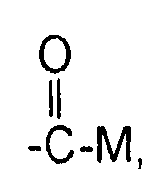
- x is a number from 0 to 10 which represents the average condensation degree of A, when A represents an alkylene group and is equal to 1 when A represents a bifunctional residue of a polyalcohol remaining after removing 2 hydroxyl groups;
- y is a number from 1 to 10 which represents the average condensation degree of G;
- z is a number from 0 to 10 which represents the average esterification degree of (G)Y.
-
- The compounds of formula (I) are known and widely described, whether concerning their synthesis and corresponding preparation methods, or for the physico- chemical and application properties, as e.g. reported on M. R. Porter, Handbook of Surfactants, Blackie Academic & Professional, London (2nd Ed. 1994) 202-210; F. A. Hughes and B. W. Lew, J. Am. Oil Chem. Soc. 1970 47, 162-167; F. Lomax, Specialty Chemicals, Jan-Feb. 1994, 21-24.
- The compounds of formula (I) can be used in purified form or unpurified, as obtained from the synthesis. The introduction in the well fluid can be through direct addition of the compounds of formula (I), as they are, or in solution in suitable solvents (water, alcohols etc.) or as suspension in a suitable material. Alternatively it is possible to previously treat (i.e. mix or soak) other ingredients of the well fluid (e.g. water soluble polymers) with the compounds of formula (I).
- The preferred compounds within this invention are those of formula (I) where:
- R represents a linear alkyl group having from 10 to 26 C atoms, unsubstituted or hydroxy substituted;
- x = 0, or = 1 when A is a bifunctional residue of sorbitol remaining after removing 2 hydroxyl groups;
- G represents a glucose residue remaining after removing 1 hydrogen atom from the non glycosidic hydroxyl groups and removing the glycosidic hydroxyl group;
- y is a number from 1 to 3;
- z = 0, or = 1 when
D = CO(CHOH)2COOMt or
D=COCH2C(OH)(COOMt)CH2COOMt or
D =COCH2CH(SO3Mt)COOMt or
D = COCH(SO3Mt)CH2COOMt, with Mt = H or Na. -
- Examples of the preferred compound of formula (I) are the alkyl(poly)glycosides not derivatized in which x = 0, G is a glucose residue, y = 1-2, z = 0 and R is a linear saturated not substituted alkyl group, having from 10 to 26 C atoms, as e.g. described in the patents US 3.219.656, US 3.547.828, US 3.839.318; other preferred compounds of formula (I) are the esters of the alkyl(poly)glycosides in which x = 0, G is a glucose residue, y = 1-2, z = 1 and D is a monoacyl residue of a bi- or tri-carboxylic acid, eventually sulphonated, in acid form or neutralized with Na and R is a linear saturated not substituted alkyl group having from 10 to 26 C atoms, as i.e. described in the patents EP 258814, EP 510564, EP 510565; other preferred compounds of formula (I) are glycosides in which R is a linear alkyl group having from 10 to 18 C atoms substituted with hydroxyl group in position 2, A is sorbitol group, x = 1, G is a glucose residue, y = 1-2, z = 0, as described in the patent EP 525494.
- The preferred compounds of formula (I) are commercially available from various sources and all are essentially biodegradable.
- For the preparation of the well fluids according to this invention, the combinations preferred are those formed by alkyl(poly)glycosides having alkyl chains from 10 to 26 C atoms and by a water soluble polymer chosen among carboxymethylcellulose, polyanionic cellulose (PAC), polygalactomannans (e.g. guar) and biopolymers (e.g. xanthan). The quantity of the compound of formula (I) to be introduced in the water well can vary, as specified above, from 0.001 to 3% by weight on the fluid.
- In particular it is convenient to fix the water soluble polymer content in the drilling fluid and indicate the ratio in weight of the compound of formula (I) with respect to the water soluble polymer. In this way it results that, if the polymer concentration in the fluid is as previously indicated, this weight ratio can vary from 2 x 10⁻⁴ to 150 preferably, and conveniently from 10-3 to 10.
- The fluids containing at least one water soluble polymer and at least one alkyl(poly)glycoside, in quantities and ratios as reported above, exhibit a significantly reduced fluid loss with respect to the same fluids not containing the component of formula (I) and have a better resistance to thermal aging, as can be seen in the examples to follow.
- In particular it is possible to exploit the alkyl(poly)glycoside behaviour in combination with the water soluble polymer in order to effectively control the fluid loss at high pressures and temperatures (up to 1000 atm and 150 °C) where the use of only the water soluble polymer would require a much higher dosage to obtain the same performance.
- Thanks to their characteristics, the well fluids according to this invention can be successfully employed in the search for hydrocarbons, water beds, in geognostic drilling and in civil engineering operations and in particular in drilling, completion, work-over, milling stimulation, fracturing and spotting fluids.
- To better illustrate the invention, in the following examples is reported the effect of the addition of some types of formula (I) compounds using the same water soluble polymer, at various ratios in weight between formula (I) compounds and the water soluble polymer; the effect of the combination of the formula (I) compounds with different water soluble polymers is also reported and how such an effect is influenced by the nature of the fluid. For a better understanding of the experimental aspects and the importance of the fluid components, their preparation and evaluation methods of their properties will be first described.
- The fluids used in the examples have been prepared according to the recipies reported for each example and the rheological and fluid loss characteristics have been measured using the apparatus and the methods described in "Standard Procedure for Field Testing Water-Based Drilling Fluids", API Recommended Practice 13B-1 (RP 13 B-1), First Edition, June 1, 1990, edited by American Petroleum Institute, 1220 L. Street, Northwest, Washington, DC 20005, U.S.A. In particular the rheological properties have been measured with a Direct Indicating Viscometer (Section 2) at a temperature of ca. 25°C.
- Here the following abbreviations have been used: AV=apparent viscosity, PV= plastic viscosity, YP=yield point, BA=before aging, AA=after aging, n.d.= not determined. The fluid loss properties (FL) have been measured with the equipment and the procedures detailed in Section 3.
- The meaning of "API FL" (FL) is the filtrate value equal to the volume taken in the first 30 minutes from the beginning of the test, obtained at room temperature (ca. 25°C) and at an applied pressure of 100 psi; the meaning of "API FL corrected" (FLc) is the filtrate value equal to the double of the volume taken between 7.5 minutes and 30 minutes from the beginning of the test, obtained under the same conditions.
- The meaning of HPHT FL AA (high temperature/high pressure fluid loss test after aging) is the fluid loss volume obtained at a temperature of 120°C, with a difference in applied pressure of 500 psi, filtrate value equal to the volume taken in the first 30 minutes from the beginning of the test. The high temperature aging of the muds has been carried out in suitable heat aging cells in a roller-oven at 120°C for 16 hours, with the procedures generally known to the experts.
- The synthetic sea water is prepared according to the specifications ASTM D 1141-75 (Standard Specifications for Substitute Ocean Water).
- The commercial products used in the examples are the following:
PRODUCT DESCRIPTION SOURCE CEPAC REGULAR Polyanionic cellulose Lamberti S.p.A. - Italy LAMPAC EXLO Polyanionic cellulose Lamberti S.p.A. - Italy LAMPAC REGULAR Polyanionic cellulose Lamberti S.p.A. - Italy CARBOCEL LV Carboxymethylcellulose Lamberti S.p.A. - Italy CARBOCEL EHV Carboxymethylcellulose Lamberti S.p.A. - Italy LAMGUM 200 Guar flour Lamberti S.p.A. - Italy VISPLEX Alluminium Magnesium
Hydroxychloride (MMH-Mix Metal Hydroxide)Schlumberger Dowell Drilling Fluids - France FLOPLEX Modified starch Schlumberger Dowell Drilling Fluids - France DEXTRID Modified starch Baroid Drilling Fluids Inc.-U.S.A. POLY PLUS Copolymer sodium acrylate-acrylamide in inverted emulsion (PHPA) M -I Drilling Fluids-U.S.A. Q BROXIN Ferrochromolignosulphonate Baroid Drilling Fluids Inc.-USA IDVIS Xanthan Gum Schlumberger Dowell Drilling Fluids - France - As alkyl(poly)glycosides (APG) have been used the following (described with reference to the formula (I)):

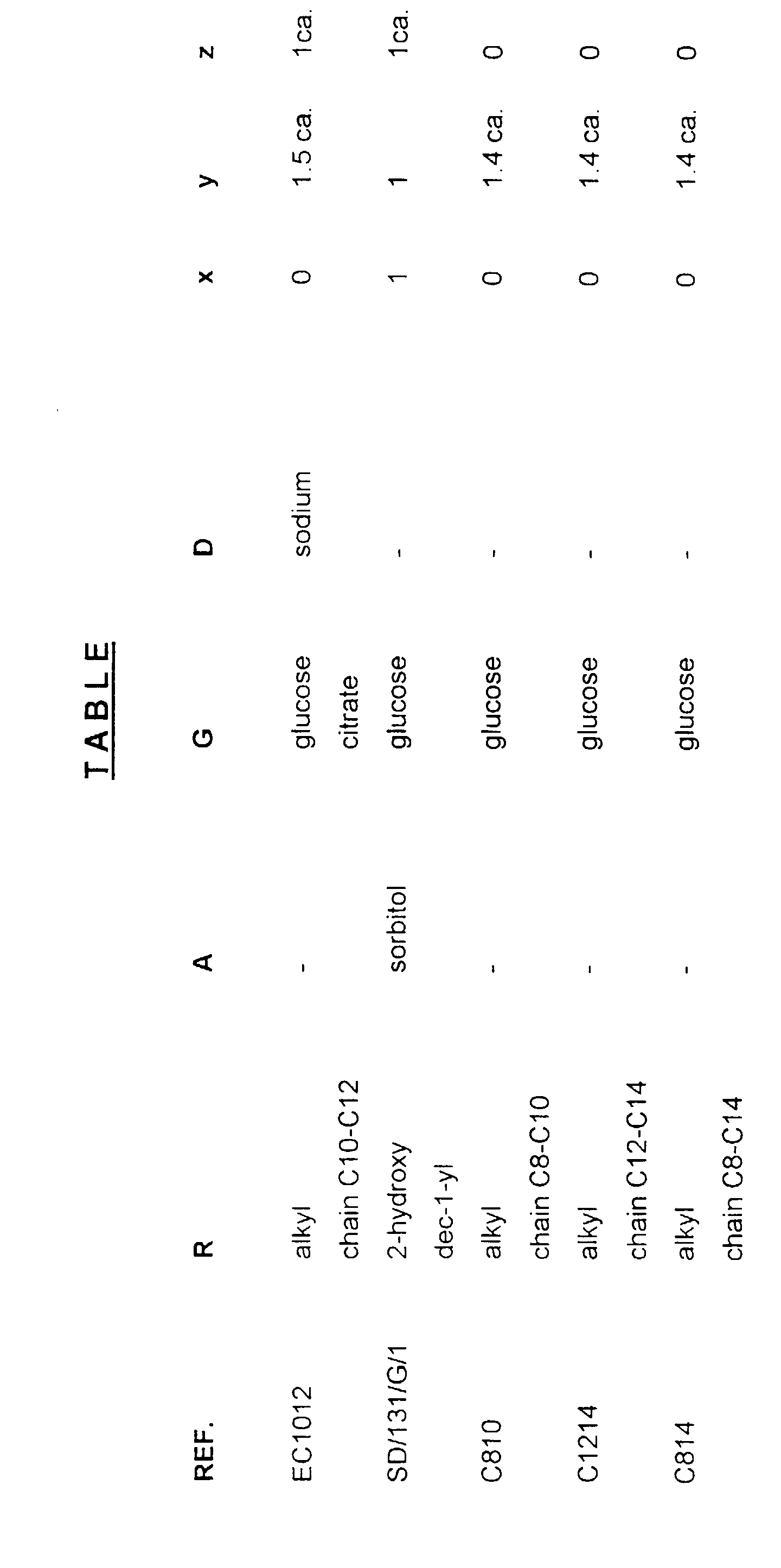
- The compounds indicated with references C1 and C4 are not considered in this invention and are reported as comparison.
- The water insoluble APG have been added to the fluid after dissolution in ethanol at a dry content of ca. 15% weight/alcohol weight. The quantities reported always refer to the effective content of APG.
- Thanks to its characteristics the fluids according to this invention can be successfully used in drilling, completion, work-over, milling stimulation, fracturing and spotting fluids operations, concerning hydrocarbon or water beds research, in geognostic drilling and in civil engineering operations.
- To illustrate but not to limit this invention the following examples are reported.
- A range of well fluids has been prepared having variable content of water soluble polymer and APG and comparing fluids without APG or water soluble polymer and the API filtrate loss corrected (FLc) has been determined as reported below.
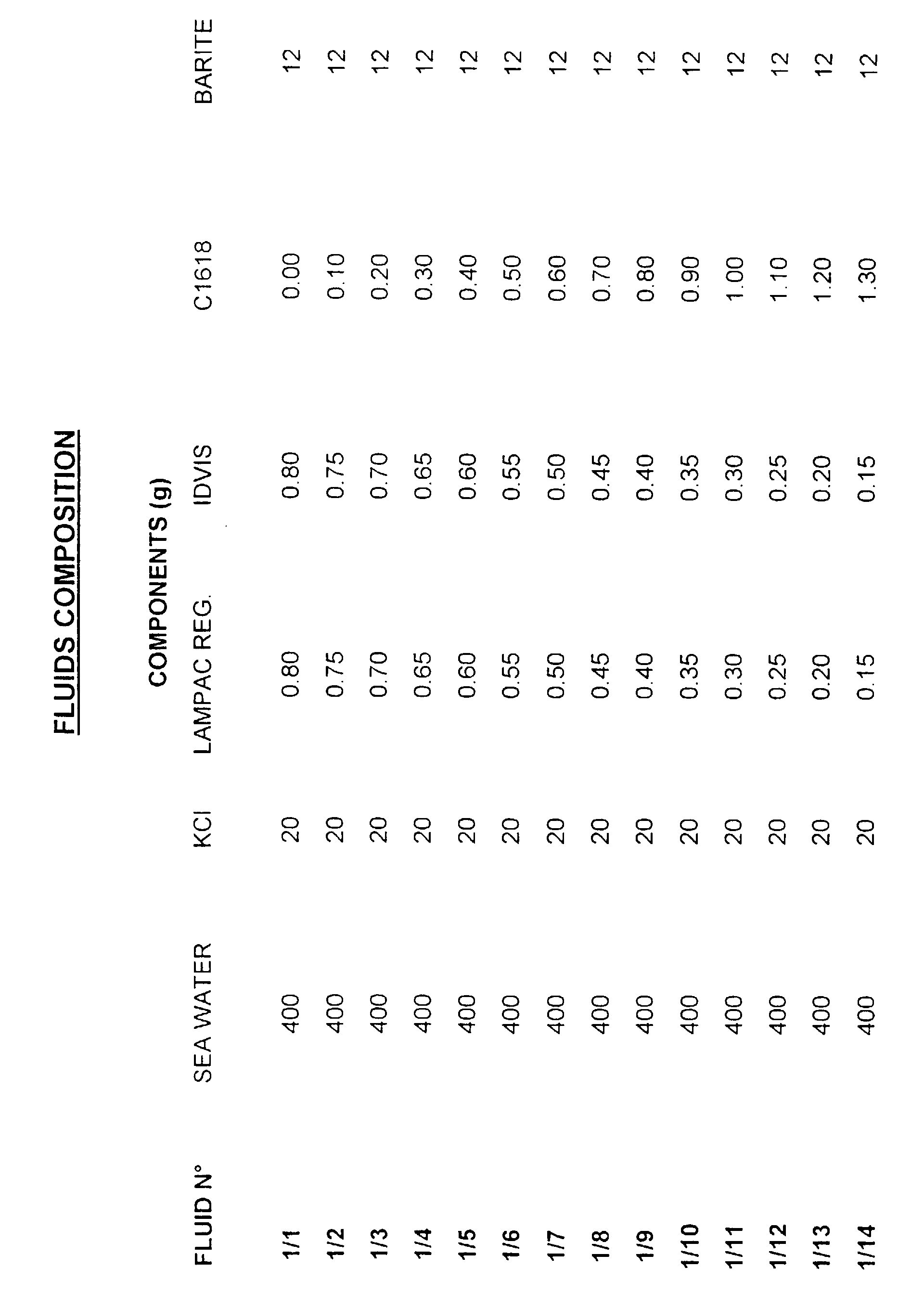

RESULTS OBTAINED FLUID N° API FLc (ml) AV AA (cP) %C1618 WEIGHT/WEIGHT 1/1 18.2 18 - 1/2 12.8 18 0.023 1/3 10.2 n.d. 0.046 1/4 8.6 16 0.069 1/5 8.0 n.d. 0.092 1/6 6.8 14 0.115 1/7 6.2 n.d. 0.138 1/8 5.6 11 0.161 1/9 4.8 n.d. 0.184 1/10 4.6 n.d. 0.207 1/11 4.4 n.d. 0.231 1/12 5.2 n.d. 0.254 1/13 6.0 n.d. 0.277 1/14 6.4 n.d. 0.300 1/15 8.6 n.d. 0.323 1/16 11.8 n.d. 0.347 1/17 32.8 n.d. 0.370 1/2 bis 18.2 n.d. - 1/4 bis 18.4 n.d. - 1/6 bis 18.8 n.d. - 1/8 bis 19.6 n.d. - 1/10 bis 21.2 n.d. - 1/12 bis 27.8 n.d. - 1/14 bis 61.0 n.d. - 1/16 bis 154.0 n.d. - - From the above mentioned tests it follows that using combinations of water soluble polymers with APG in any ratio reduces the filtrate loss compared to the use of only one of said additives with the same total content, showing a synergic effect, as represented in figure 1.
- Moreover, it is shown that a substitution of 15% of water soluble polymers with APG is able to reduce the fluid loss by approximately 50%.
- A range of well fluids has been prepared through addition of a constant minimum quantity of different types of alkyl(poly)glycosides to the soluble polymers present in the fluid (CEPAC REGULAR) and the reduction of the HPHT FL AA at 120°C has been determined.


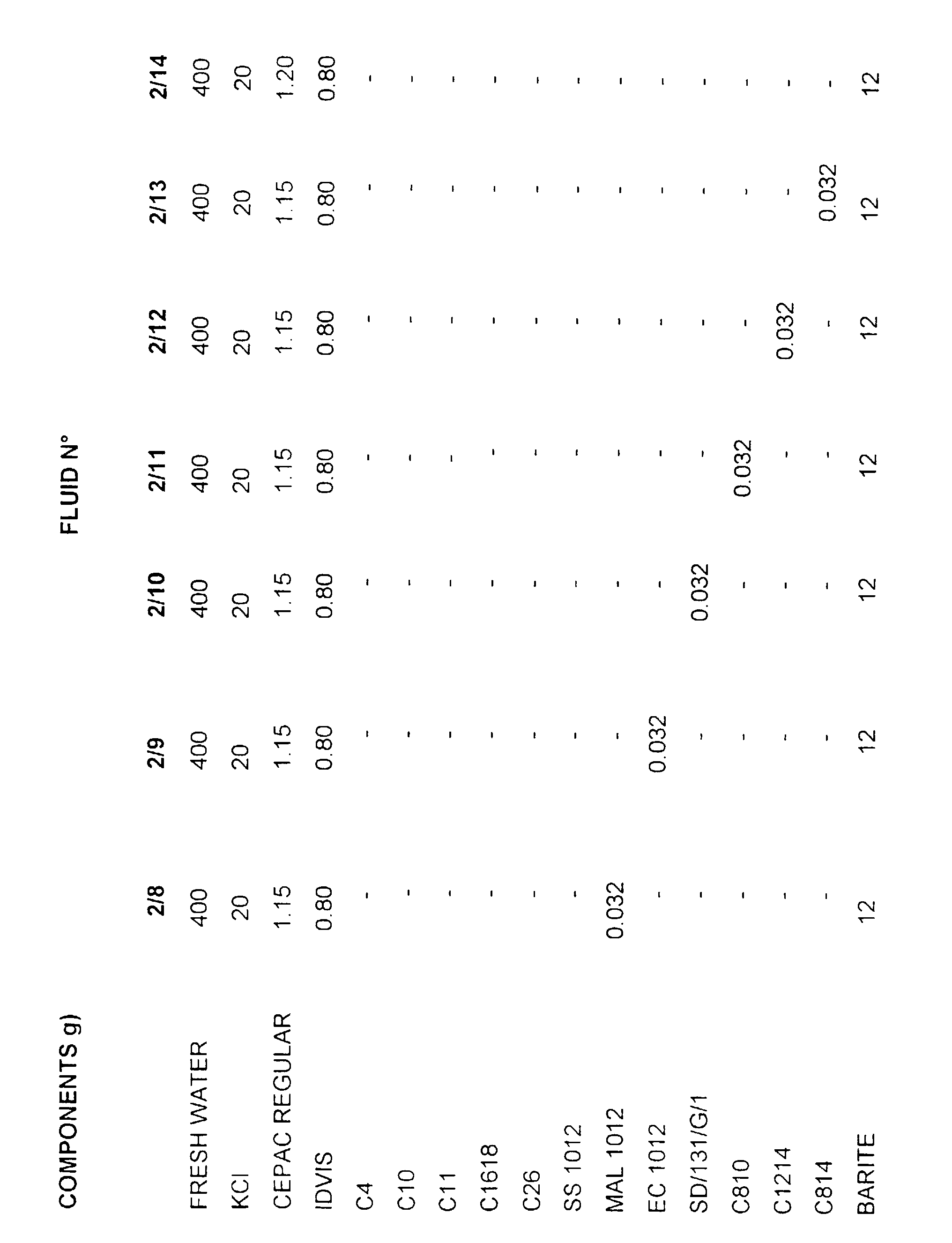

- The above results show that addition of different types of APG equal to 2.8% in weight with respect to the water soluble polymer (CEPAC REGULAR) can reduce the HPHT filtrate after aging in variable proportions up to 53%. This effect is not present with APG having chains C1 and C4.
- The fluid n° 2/14 shows that it is not possible to obtain good HPHT values when instead of adding APG the water soluble polymer is increased by the same quantity.
- Two water well fluids have been prepared, respectively without and with APG, as reported below.
FLUIDS COMPOSITION COMPONENTS (g) FLUID N° 3/1 FLUID N° 3/2 FRESH WATER 400 400 KCl 20 20 CEPAC REGULAR 1.15 1.15 IDVIS 0.80 0.80 C618 - 0.80 BARITE 120 120 RESULTS OBTAINED FLUID N° 3/1 FLUID N° 3/2 API FLc (ml/l) 12 10 AV BA (cP) 21 24 PV BA (cP) 10 12 YP BA (lb/100 ft2) 22 24 HPHT FL AA (ml) 100 52 AV AA (cP) 8.5 14.5 PV AA (cP) 6.0 9.5 YP AA (lb/100 ft2) 5.0 10.0 DENSITY (g/cm3) 1.25 1.25 - The results show that the addition of APG to the fluid produces sharp reduction of HPHT filtrate, improvement in the corrected API filtrate and in the rheology after aging.
- Two fluids have been prepared at high density and containing drill solids as reported below and the reduction of HPHT FL AA and the viscosity variation due to an APG addition have been determined.
FLUIDS COMPOSITION COMPONENTS (g) FLUID N° 4/1 FLUID N° 4/2 SYNTHETIC SEA WATER (ml) 350 350 KCI 10.5 10.5 CEPAC REGULAR 4 4 MgO 1 1 KAOLIN 10 10 SODIUM BENTONITE 10 10 BARITE 300 300 CaCO 310 10 C1618 - 1 RESULTS OBTAINED FLUID N° 4/1 FLUID N° 4/2 PV BA (cP) 40 40 YP BA (lb/100 ft2) 150 155 PV AA (cP) 31 46 YP AA (lb/100 ft2) 4 12 HPHT FL AA (ml) 25.4 13.6 DENSITY (g/cm3) 1.6 1.6 - The results show that the addition of 25% in weight of an APG to CEPAC REGULAR improves the fluid resistance to thermal aging, limiting decrease in YP and with HPHT AA filtrate values halved.
- A dispersed bentonite fluid has been prepared in presence of contaminants and the improvement of the HPHT AA filtrate loss due to an addition of APG has been verified.
FLUIDS COMPOSITION COMPONENTS(g) FLUID N° 5/1 FLUID N° 5/2 FRESH WATER 380 380 SODIUM BENTONITE 19 19 Q-BROXIN 0.38 0.38 CARBOCEL LV 2 2 CARBOCEL EHV 0.6 0.6 BARITE 100 100 KAOLIN 20 20 CaCO 310 10 C1618 - 1.30 RESULTS OBTAINED FLUID N° 5/1 FLUID N° 5/2 AV AA (cP) 23.5 42.5 PV AA (cP) 16 26 YP AA (lb/100 ft2) 15 33 HPHT FL AA (ml) 22.6 16 - The results show that the addition of an alkyl(poly)glycoside improves both the HPHT AA filtrate and the fluid rheology after aging.
- Fluids with increasing concentrations of APG have been prepared and the effect on the API filtrate loss corrected has been determined.
FLUIDS COMPOSITION COMPONENTS (g) FLUID N° 6/1 6/2 6/3 6/4 FRESH WATER 400 400 400 400 KCI 20 20 20 20 IDVIS 0.80 0.80 0 80 0.80 LAMPAC EXLO 0.80 0.80 0.80 0.80 C1618 - 0.032 0.064 0.80 BARITE 12 12 12 12 RESULTS OBTAINED FLUID N° 6/1 6/2 6/3 6/4 AV BA (cP) 7.5 7.5 8.0 11.0 API FLc (ml) 15.4 11 10 4 - The results show the effect of the APG quantity added on the fluid loss reduction.
- Fluids with PHPA have been prepared as reported below and the API filtrate corrected has been optimized.
FLUIDS COMPOSITION COMPONENTS (g) FLUID N° 7/1 7/2 7/3 FRESH WATER 400 400 400 SODIUM BENTONITE 8 8 8 CARBOCEL LV 0.80 0.40 0.80 C1618 - 0.40 0.40 POLY-PLUS 2 2 1.6 RESULTS OBTAINED FLUID N° 7/1 7/2 7/3 AV BA (cP) 20 20 16.5 PV BA (cP) 15 15 12 YP BA (lb/100 ft2) 10 10 9 API FLc (ml) 13.2 10.8 9.6 - In the above mentioned example, the optimization of the API fluid loss corrected is obtained by adding APG.
- A range of fluids for top hole has been prepared in order to study the action of APG addition on the API filtrate corrected loss of these fluids.
FLUIDS COMPOSITION COMPONENTS (g) FLUID N° 8/1 8/2 8/3 8/4 FRESH WATER 400 400 400 400 SODIUM BENTONITE 8 8 8 8 LAMGUM 200 3.2 3.2 3.2 3.2 C1618 - 0.13 0.32 0.96 RESULTS OBTAINED FLUID N° 8/1 8/2 8/3 8/4 AV BA (cP) 44.5 45 47 49 PV BA (cP) 16 16 16 16 YP BA (lb/100 ft2) 57 58 62 66 API FLc (ml) 10.9 9 6.4 4.2 - The results show that in the above mentioned fluids the fluid loss reduction is proportional to the APG quantity added.
- The fluids reported below have been prepared in order to verify the variation in rheology and the corrected API filtrate loss of the Visplex system on addition of APG.
FLUIDS COMPOSITION COMPONENTS (g) FLUID N° 9/1 FLUID N° 9/2 FRESH WATER 184.3 184.3 SODIUM BENTONITE 15.8 15.8 SEA WATER 123 123 VISPLEX 1.5 1.5 FLOPLEX 3.5 3.5 C1618 - 0. 50 BARITE 20 20 RESULTS OBTAINED FLUID N° 9/1 FLUID N° 9/2 PV BA (cP) 12 13 YP BA (lb/100 ft2) 30 36 API FLc (ml) 10.4 8.8 - The results show that the APG addition to the Visplex system improves the rheology and the filtrate.
- Water soluble polymer based fluids have been prepared containing respectively APG with chain C16-C18, insoluble in water and, in comparison, APG with methyl and butyl, water soluble.
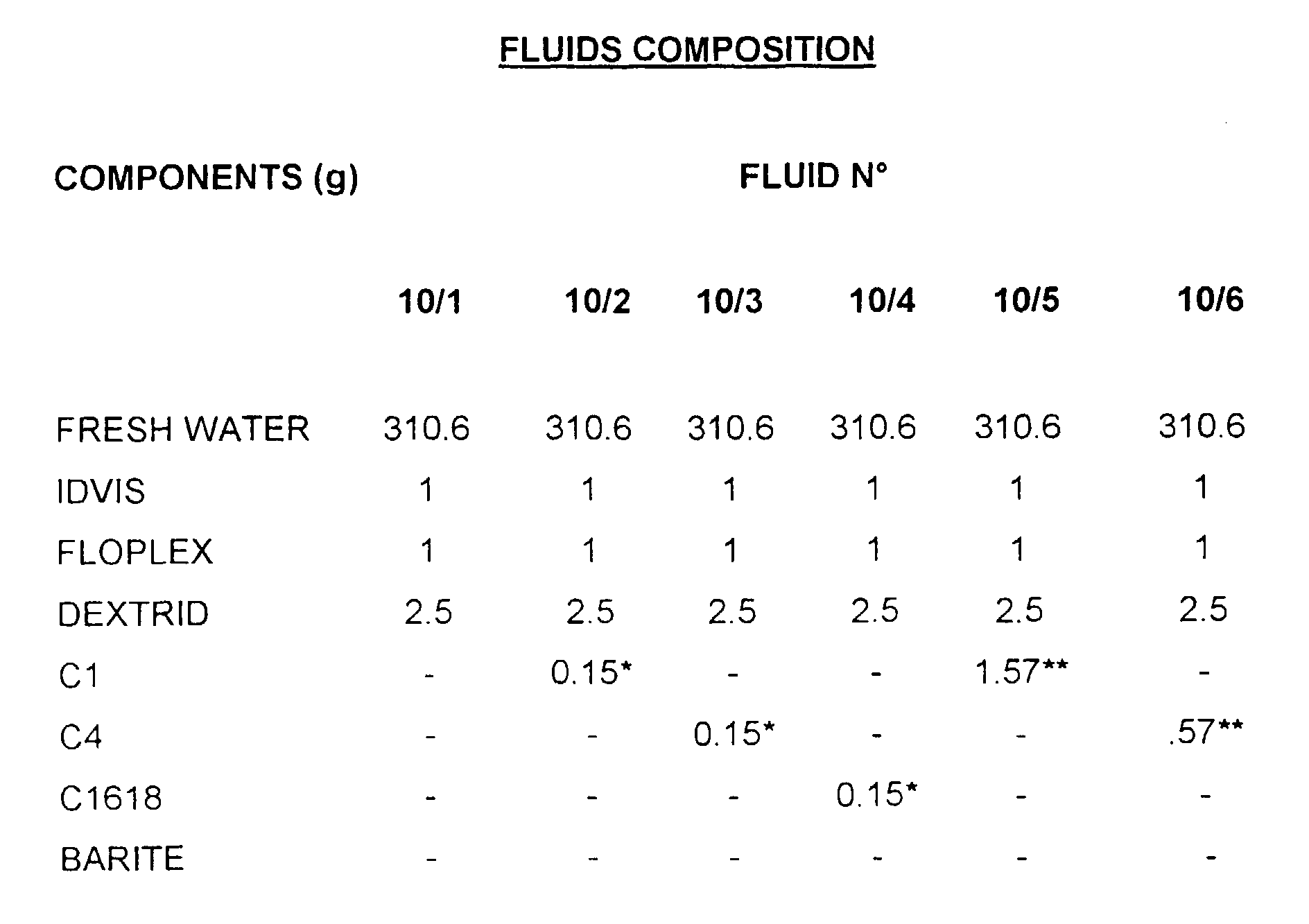


- The results show that at the concentrations described in the example the APG with chain C16-C18 improves the fluid loss. No effect noted with methyl glucoside and butyl glucoside.
- The fluids reported below have been prepared in order to verify the variations due to the addition of APG in a silicate system.
FLUIDS COMPOSITION COMPONENTS (g) FLUID N° 11/1 11/2 11/3 FRESH WATER 350 350 350 KCI 15 15 15 IDVIS 1 1 1 LAMPAC REGULAR 1.5 1.5 1.5 DEXTRID 4 4 4 NaOH 0.5 0.5 0.5 SODA ASH 0.25 0.25 0.25 Na SILICATE (% V/V) 5 5 5 C1618 - 0.15 0.65 BARITE 12 12 12 RESULTS OBTAINED FLUID N° 11/1 11/2 11/3 API FL BA (ml) 6.8 5.6 3.7 AV BA (cP) 31 34 37.5 PV BA (cP) 17.5 17 19.5 YP BA (lb/100 ft2) 27 34 36 - The results show that the addition of APG in the silicate system improves the rheology and the filtrate.
Claims (13)
- Water based well fluids having an improved fluid loss control and an improved resistance to the thermal aging, characterized by the fact that they contain both at least one water soluble polymer and at least one alkyl(poly)glycoside chosen among the compounds represented by the following formula (I):O represents an oxygen atom;R represents an alkyl or alkenyl group having from 8 to 26 C atoms, linear or branched, unsubstituted or hydroxy substituted;A represents an alkylene group having from 2 to 4 C atoms, linear or branched, or a bifunctional residue of a polyalcohol remaining after removing 2 hydroxyl groups on any 2 carbon atoms;G represents a saccharide residue remaining after removing z hydrogen atoms from all the non glycosidic hydroxyl groups and removing the glycosidic hydroxyl group of a reducing sugar made of hexoses or/and pentoses, bound to A-O or to R-O (in the case x=0) through an o-glycosidic ether bond;D represents an acyl residue of an organic acid, bound to an oxygen atom of the residue (G)Y having formulawhere M represents an alkyl or alkenyl chain having from 1 to 18 C atoms, linear or branched, unsubstituted or substituted by one or more groups such as OH, COOMt, SO3Mt, -OPO3Mt2, NH2, NR1R2, where R1 and R2 can be the same or different and represent alkyl chains having from 1 to 4 C atoms, linear or branched and Mt represents one hydrogen atom or a cation selected from Li, Na, K, Cs, Ca, Mg, Fe, NH4+;
 x is a number from 0 to 10 which represents the average condensation degree of A, when A represents an alkylene group and is equal to 1 when A represents a bifunctional residue of a polyalcohol remaining after removing 2 hydroxyl groups; y is a number from 1 to 10 which represents the average condensation degree of G;z is a number from 0 to 10 which represents the average esterification degree of (G)Y.
 - Well fluids according to the claim 1, characterized by the fact that said water soluble polymer is chosen in the group composed by cellulose ethers, polyanionic celluloses, starches, starch derivatives, polygalactomannans and derivatives thereof, biopolymers, homopolymers of acrylic acid, of acrylamide, of 2-acrylamido-2-methylpropanesulphonic acid and copolymers among these ones or of these ones with other acrylic or vinyl monomers and their water soluble salts.
- Well fluids according to the claim 1, characterized by the fact that in said formula (I):R represents a linear alkyl group having from 10 to 26 C atoms, unsubstituted or hydroxy substituted;x = 0, or = 1 when A is a bifunctional residue of sorbitol remaining after removing 2 hydroxyl groups;G represents a glucose residue remaining after removing 1 hydrogen atom from the non glycosidic hydroxyl groups and removing the glycosidic hydroxyl group;y is a number from 1 to 3;z = 0, or = 1 when
D = CO(CHOH)2COOMt or
D=COCH2C(OH)(COOMt)CH2COOMt or
D = COCH2CH(SO3Mt)COOMt or
D = COCH(SO3Mt)CH2COOMt, with Mt = H or Na. - Well fluids according to the claim 1, characterized by the fact that in said formula (I):x = 0, G is a glucose residue, y = 1-2, z = 0 and R is linear saturated not substituted alkyl having from 10 to 26 C atoms.
- Well fluids according to the claim 1, characterized by the fact that in said formula (I):x = 0, G is a glucose residue, y = 1-2, z = 1 and D is a monoacyl residue of a bi- or tri-carboxylic acid, optionally sulphonated, in acid form or salified with Na and R is a linear saturated not substituted alkyl group having from 10 to 26 C atoms.
- Well fluids according to the claim 1, characterized by the fact that in said formula (I):R is a linear alkyl group having from 10 to 18 C atoms substituted with hydroxyl group in position 2, A is a sorbitol bifunctional residue, x = 1, G is a glucose residue, y = 1-2, z = 0.
- Well fluids according to the claim 1, characterized by the fact that they contain an alkyl(poly)glycoside having alkyl chains from 10 to 26 C atoms and a water soluble polymer chosen among carboxymethylcellulose, polyanionic cellulose, guar and xanthan gums.
- Well fluids according to the claim 1, characterized by the fact that said alkyl(poly)glycoside is contained in quantity from 0.001 to 3% in weight with respect to the fluid, and said water soluble polymer is contained in quantity from 0.02 to 5% in weight with respect to the fluid.
- Well fluids according to the claim 1, characterized by the fact that said alkyl(poly)glycoside is contained in quantity from 0.001 to 3% in weight with respect to the fluid, and said water soluble polymer is contained in quantity from 0.05 to 3% in weight with respect to the fluid.
- Procedure for the preparation of well fluids as described in claim 1, characterized by the fact that to a water composition comprising thickening agents, viscosifiers, rheological modifiers, dispersants, emulsifiers, lubricants, defoamers, biocides, pH modifiers and corrosion inhibitors, are added at least one alkyl(poly)glycoside having formula (I) in quantity from 0.001 to 3% in weight with respect to the fluid and at least one water soluble polymer in quantity from 0.02 to 5% in weight with respect to the fluid.
- Procedure according to the claim 10, characterized by the fact that said alkyl(poly)glycoside is added directly to said water composition as is or in the form of solution or suspension.
- Procedure according to claim 10, characterized by the fact that said alkyl(poly)glycoside is added to said water composition in form of a mix with one of said agents or with said water soluble polymer.
- Use of well fluids as described in claim 1, in drilling, completion, work-over, milling stimulation, fracturing and spotting fluids operations, concerning hydrocarbons or water beds research, geognostic drilling and civil engineering operations.
Applications Claiming Priority (3)
| Application Number | Priority Date | Filing Date | Title |
|---|---|---|---|
| ITMI952422 | 1995-11-22 | ||
| IT95MI002422A IT1276156B1 (en) | 1995-11-22 | 1995-11-22 | FLUIDS PER WELL |
| PCT/EP1996/005128 WO1997019145A1 (en) | 1995-11-22 | 1996-11-21 | Well fluid |
Publications (2)
| Publication Number | Publication Date |
|---|---|
| EP0862603A1 EP0862603A1 (en) | 1998-09-09 |
| EP0862603B1 true EP0862603B1 (en) | 2000-01-19 |
Family
ID=11372571
Family Applications (1)
| Application Number | Title | Priority Date | Filing Date |
|---|---|---|---|
| EP96939872A Expired - Lifetime EP0862603B1 (en) | 1995-11-22 | 1996-11-21 | Well fluid |
Country Status (6)
| Country | Link |
|---|---|
| EP (1) | EP0862603B1 (en) |
| AU (1) | AU7694996A (en) |
| DE (1) | DE69606320T2 (en) |
| IT (1) | IT1276156B1 (en) |
| NO (1) | NO322842B1 (en) |
| WO (1) | WO1997019145A1 (en) |
Families Citing this family (6)
| Publication number | Priority date | Publication date | Assignee | Title |
|---|---|---|---|---|
| US6133347A (en) | 1999-07-09 | 2000-10-17 | Mbt Holding Ag | Oligomeric dispersant |
| US6861459B2 (en) | 1999-07-09 | 2005-03-01 | Construction Research & Technology Gmbh | Oligomeric dispersant |
| IT1313694B1 (en) | 1999-11-26 | 2002-09-09 | Eni Spa | PROCEDURE TO REDUCE THE ABSORPTION OF POLYMERS ON MATRICEROCCIOSA. |
| US6518223B2 (en) | 2000-08-14 | 2003-02-11 | Grain Processing Corporation | Drilling fluid, apparatus, and method |
| US7018955B2 (en) | 2000-08-14 | 2006-03-28 | Grain Processing Corporation | Drilling fluid, apparatus, and method |
| WO2004020546A1 (en) * | 2002-08-28 | 2004-03-11 | Grain Processing Corporation | Drilling fluid, apparatus, and method |
Family Cites Families (5)
| Publication number | Priority date | Publication date | Assignee | Title |
|---|---|---|---|---|
| US5403820A (en) * | 1992-12-24 | 1995-04-04 | O'brien-Goins-Simpson & Associates | Environmentally safe water base drilling fluid |
| FR2709679B1 (en) * | 1993-08-06 | 1995-10-06 | Seppic Sa | Concentrated aqueous compositions of alkylpolyglycosides and their uses. |
| FR2719600B1 (en) * | 1994-05-04 | 1996-06-14 | Inst Francais Du Petrole | Process and fluid used in a well - Application to drilling. |
| EP0702073A1 (en) * | 1994-09-19 | 1996-03-20 | Baker Hughes Incorporated | Shale stabilising drilling fluid employing saccharide derivatives |
| US5684075A (en) * | 1995-02-21 | 1997-11-04 | Phillips Petroleum Company | Compositions comprising an acrylamide-containing polymer and process therewith |
-
1995
- 1995-11-22 IT IT95MI002422A patent/IT1276156B1/en active IP Right Grant
-
1996
- 1996-11-21 AU AU76949/96A patent/AU7694996A/en not_active Abandoned
- 1996-11-21 WO PCT/EP1996/005128 patent/WO1997019145A1/en not_active Ceased
- 1996-11-21 EP EP96939872A patent/EP0862603B1/en not_active Expired - Lifetime
- 1996-11-21 DE DE69606320T patent/DE69606320T2/en not_active Expired - Fee Related
-
1998
- 1998-05-20 NO NO19982318A patent/NO322842B1/en unknown
Also Published As
| Publication number | Publication date |
|---|---|
| DE69606320T2 (en) | 2000-08-24 |
| ITMI952422A0 (en) | 1995-11-22 |
| EP0862603A1 (en) | 1998-09-09 |
| AU7694996A (en) | 1997-06-11 |
| WO1997019145A1 (en) | 1997-05-29 |
| DE69606320D1 (en) | 2000-02-24 |
| NO982318L (en) | 1998-07-21 |
| ITMI952422A1 (en) | 1997-05-22 |
| IT1276156B1 (en) | 1997-10-27 |
| NO982318D0 (en) | 1998-05-20 |
| NO322842B1 (en) | 2006-12-11 |
Similar Documents
| Publication | Publication Date | Title |
|---|---|---|
| US5635458A (en) | Water-based drilling fluids for reduction of water adsorption and hydration of argillaceous rocks | |
| US6291405B1 (en) | Glycol based drilling fluid | |
| US5057234A (en) | Non-hydrocarbon invert emulsions for use in well drilling operations | |
| US6620769B1 (en) | Environmentally acceptable fluid polymer suspension for oil field services | |
| EP0675936B1 (en) | Environmentally safe drilling fluid | |
| US5141920A (en) | Hydrocarbon invert emulsions for use in well drilling operations | |
| US20090291861A1 (en) | Wellbore fluid | |
| US4963273A (en) | Modified non-polluting liquid phase shale swelling inhibition drilling fluid and method of using same | |
| US9574127B2 (en) | Wellbore fluid | |
| CA2161916C (en) | Compositions comprising an acrylamide-containing polymer and process therewith | |
| NO327979B1 (en) | Source processing fluids and a method for increasing their thermal stability | |
| US20110030961A1 (en) | Treatment of Fluids that Increase in Viscosity at or Above a Threshold Temperature and Methods of Formulating and Using Such Fluids | |
| US5710107A (en) | Environmentally safe drilling fluid | |
| EP0862603A1 (en) | Well fluid | |
| EP0495856B1 (en) | Wellbore fluid | |
| CA2237855A1 (en) | Well fluid | |
| Nicora et al. | Biodegradable surfactants for cosmetics find application in drilling fluids | |
| Ukeles et al. | Drilling fluids | |
| GB2365896A (en) | Drilling fluid | |
| EP1103697B1 (en) | Process for reducing the adsorption of polymers onto rock matrix | |
| WO1998040446A1 (en) | Glycol derivatives and blends thereof as gas hydrate inhibitors in water base drilling, drill-in, and completion fluids | |
| GB2363148A (en) | Glycol derivatives and blends thereof as gas hydrate inhibitors |
Legal Events
| Date | Code | Title | Description |
|---|---|---|---|
| PUAI | Public reference made under article 153(3) epc to a published international application that has entered the european phase |
Free format text: ORIGINAL CODE: 0009012 |
|
| 17P | Request for examination filed |
Effective date: 19980618 |
|
| AK | Designated contracting states |
Kind code of ref document: A1 Designated state(s): DE FR GB IT NL |
|
| GRAG | Despatch of communication of intention to grant |
Free format text: ORIGINAL CODE: EPIDOS AGRA |
|
| 17Q | First examination report despatched |
Effective date: 19990222 |
|
| GRAG | Despatch of communication of intention to grant |
Free format text: ORIGINAL CODE: EPIDOS AGRA |
|
| GRAH | Despatch of communication of intention to grant a patent |
Free format text: ORIGINAL CODE: EPIDOS IGRA |
|
| GRAH | Despatch of communication of intention to grant a patent |
Free format text: ORIGINAL CODE: EPIDOS IGRA |
|
| GRAA | (expected) grant |
Free format text: ORIGINAL CODE: 0009210 |
|
| AK | Designated contracting states |
Kind code of ref document: B1 Designated state(s): DE FR GB IT NL |
|
| PG25 | Lapsed in a contracting state [announced via postgrant information from national office to epo] |
Ref country code: NL Free format text: LAPSE BECAUSE OF FAILURE TO SUBMIT A TRANSLATION OF THE DESCRIPTION OR TO PAY THE FEE WITHIN THE PRESCRIBED TIME-LIMIT Effective date: 20000119 |
|
| REF | Corresponds to: |
Ref document number: 69606320 Country of ref document: DE Date of ref document: 20000224 |
|
| ITF | It: translation for a ep patent filed | ||
| ET | Fr: translation filed | ||
| NLV1 | Nl: lapsed or annulled due to failure to fulfill the requirements of art. 29p and 29m of the patents act | ||
| PLBE | No opposition filed within time limit |
Free format text: ORIGINAL CODE: 0009261 |
|
| STAA | Information on the status of an ep patent application or granted ep patent |
Free format text: STATUS: NO OPPOSITION FILED WITHIN TIME LIMIT |
|
| 26N | No opposition filed | ||
| REG | Reference to a national code |
Ref country code: GB Ref legal event code: IF02 |
|
| PG25 | Lapsed in a contracting state [announced via postgrant information from national office to epo] |
Ref country code: IT Free format text: LAPSE BECAUSE OF NON-PAYMENT OF DUE FEES;WARNING: LAPSES OF ITALIAN PATENTS WITH EFFECTIVE DATE BEFORE 2007 MAY HAVE OCCURRED AT ANY TIME BEFORE 2007. THE CORRECT EFFECTIVE DATE MAY BE DIFFERENT FROM THE ONE RECORDED. Effective date: 20051121 |
|
| PGFP | Annual fee paid to national office [announced via postgrant information from national office to epo] |
Ref country code: GB Payment date: 20071106 Year of fee payment: 12 Ref country code: FR Payment date: 20071011 Year of fee payment: 12 |
|
| PGFP | Annual fee paid to national office [announced via postgrant information from national office to epo] |
Ref country code: DE Payment date: 20071221 Year of fee payment: 12 |
|
| GBPC | Gb: european patent ceased through non-payment of renewal fee |
Effective date: 20081121 |
|
| REG | Reference to a national code |
Ref country code: FR Ref legal event code: ST Effective date: 20090731 |
|
| PG25 | Lapsed in a contracting state [announced via postgrant information from national office to epo] |
Ref country code: DE Free format text: LAPSE BECAUSE OF NON-PAYMENT OF DUE FEES Effective date: 20090603 |
|
| PG25 | Lapsed in a contracting state [announced via postgrant information from national office to epo] |
Ref country code: GB Free format text: LAPSE BECAUSE OF NON-PAYMENT OF DUE FEES Effective date: 20081121 |
|
| PGFP | Annual fee paid to national office [announced via postgrant information from national office to epo] |
Ref country code: IT Payment date: 20071106 Year of fee payment: 12 |
|
| PGRI | Patent reinstated in contracting state [announced from national office to epo] |
Ref country code: IT Effective date: 20110616 |
|
| PG25 | Lapsed in a contracting state [announced via postgrant information from national office to epo] |
Ref country code: FR Free format text: LAPSE BECAUSE OF NON-PAYMENT OF DUE FEES Effective date: 20081130 |
|
| PGRI | Patent reinstated in contracting state [announced from national office to epo] |
Ref country code: IT Effective date: 20110616 |