EP0862557B1 - SYMMETRICAL bis-HETEROARYLMETHOXYPHENYLALKYL CARBOXYLATES AS INHIBITORS OF LEUKOTRIENE BIOSYNTHESIS - Google Patents
SYMMETRICAL bis-HETEROARYLMETHOXYPHENYLALKYL CARBOXYLATES AS INHIBITORS OF LEUKOTRIENE BIOSYNTHESIS Download PDFInfo
- Publication number
- EP0862557B1 EP0862557B1 EP96932335A EP96932335A EP0862557B1 EP 0862557 B1 EP0862557 B1 EP 0862557B1 EP 96932335 A EP96932335 A EP 96932335A EP 96932335 A EP96932335 A EP 96932335A EP 0862557 B1 EP0862557 B1 EP 0862557B1
- Authority
- EP
- European Patent Office
- Prior art keywords
- carbon atoms
- phenyl
- bis
- group
- quinolylmethoxy
- Prior art date
- Legal status (The legal status is an assumption and is not a legal conclusion. Google has not performed a legal analysis and makes no representation as to the accuracy of the status listed.)
- Expired - Lifetime
Links
- 0 CC1*c(cccc2)c2N=C(COc2ccc(C(C)(CCC(O)=O)c(cc3)ccc3OCc3nc4ccccc4[n]3C)cc2)C1 Chemical compound CC1*c(cccc2)c2N=C(COc2ccc(C(C)(CCC(O)=O)c(cc3)ccc3OCc3nc4ccccc4[n]3C)cc2)C1 0.000 description 2
- DNPLHAZFJZIGBU-UHFFFAOYSA-N CC(CCC(O)=O)(c(cc1)ccc1OCc1ccc(cccc2)c2c1)c(cc1)ccc1OCc1nc(cccc2)c2cc1 Chemical compound CC(CCC(O)=O)(c(cc1)ccc1OCc1ccc(cccc2)c2c1)c(cc1)ccc1OCc1nc(cccc2)c2cc1 DNPLHAZFJZIGBU-UHFFFAOYSA-N 0.000 description 1
Classifications
-
- C—CHEMISTRY; METALLURGY
- C07—ORGANIC CHEMISTRY
- C07D—HETEROCYCLIC COMPOUNDS
- C07D213/00—Heterocyclic compounds containing six-membered rings, not condensed with other rings, with one nitrogen atom as the only ring hetero atom and three or more double bonds between ring members or between ring members and non-ring members
- C07D213/02—Heterocyclic compounds containing six-membered rings, not condensed with other rings, with one nitrogen atom as the only ring hetero atom and three or more double bonds between ring members or between ring members and non-ring members having three double bonds between ring members or between ring members and non-ring members
- C07D213/04—Heterocyclic compounds containing six-membered rings, not condensed with other rings, with one nitrogen atom as the only ring hetero atom and three or more double bonds between ring members or between ring members and non-ring members having three double bonds between ring members or between ring members and non-ring members having no bond between the ring nitrogen atom and a non-ring member or having only hydrogen or carbon atoms directly attached to the ring nitrogen atom
- C07D213/24—Heterocyclic compounds containing six-membered rings, not condensed with other rings, with one nitrogen atom as the only ring hetero atom and three or more double bonds between ring members or between ring members and non-ring members having three double bonds between ring members or between ring members and non-ring members having no bond between the ring nitrogen atom and a non-ring member or having only hydrogen or carbon atoms directly attached to the ring nitrogen atom with substituted hydrocarbon radicals attached to ring carbon atoms
- C07D213/28—Radicals substituted by singly-bound oxygen or sulphur atoms
- C07D213/30—Oxygen atoms
-
- A—HUMAN NECESSITIES
- A61—MEDICAL OR VETERINARY SCIENCE; HYGIENE
- A61P—SPECIFIC THERAPEUTIC ACTIVITY OF CHEMICAL COMPOUNDS OR MEDICINAL PREPARATIONS
- A61P11/00—Drugs for disorders of the respiratory system
-
- A—HUMAN NECESSITIES
- A61—MEDICAL OR VETERINARY SCIENCE; HYGIENE
- A61P—SPECIFIC THERAPEUTIC ACTIVITY OF CHEMICAL COMPOUNDS OR MEDICINAL PREPARATIONS
- A61P29/00—Non-central analgesic, antipyretic or antiinflammatory agents, e.g. antirheumatic agents; Non-steroidal antiinflammatory drugs [NSAID]
-
- A—HUMAN NECESSITIES
- A61—MEDICAL OR VETERINARY SCIENCE; HYGIENE
- A61P—SPECIFIC THERAPEUTIC ACTIVITY OF CHEMICAL COMPOUNDS OR MEDICINAL PREPARATIONS
- A61P37/00—Drugs for immunological or allergic disorders
- A61P37/08—Antiallergic agents
-
- A—HUMAN NECESSITIES
- A61—MEDICAL OR VETERINARY SCIENCE; HYGIENE
- A61P—SPECIFIC THERAPEUTIC ACTIVITY OF CHEMICAL COMPOUNDS OR MEDICINAL PREPARATIONS
- A61P43/00—Drugs for specific purposes, not provided for in groups A61P1/00-A61P41/00
-
- C—CHEMISTRY; METALLURGY
- C07—ORGANIC CHEMISTRY
- C07D—HETEROCYCLIC COMPOUNDS
- C07D215/00—Heterocyclic compounds containing quinoline or hydrogenated quinoline ring systems
- C07D215/02—Heterocyclic compounds containing quinoline or hydrogenated quinoline ring systems having no bond between the ring nitrogen atom and a non-ring member or having only hydrogen atoms or carbon atoms directly attached to the ring nitrogen atom
- C07D215/12—Heterocyclic compounds containing quinoline or hydrogenated quinoline ring systems having no bond between the ring nitrogen atom and a non-ring member or having only hydrogen atoms or carbon atoms directly attached to the ring nitrogen atom with substituted hydrocarbon radicals attached to ring carbon atoms
- C07D215/14—Radicals substituted by oxygen atoms
-
- C—CHEMISTRY; METALLURGY
- C07—ORGANIC CHEMISTRY
- C07D—HETEROCYCLIC COMPOUNDS
- C07D215/00—Heterocyclic compounds containing quinoline or hydrogenated quinoline ring systems
- C07D215/02—Heterocyclic compounds containing quinoline or hydrogenated quinoline ring systems having no bond between the ring nitrogen atom and a non-ring member or having only hydrogen atoms or carbon atoms directly attached to the ring nitrogen atom
- C07D215/16—Heterocyclic compounds containing quinoline or hydrogenated quinoline ring systems having no bond between the ring nitrogen atom and a non-ring member or having only hydrogen atoms or carbon atoms directly attached to the ring nitrogen atom with hetero atoms or with carbon atoms having three bonds to hetero atoms with at the most one bond to halogen, e.g. ester or nitrile radicals, directly attached to ring carbon atoms
- C07D215/18—Halogen atoms or nitro radicals
-
- C—CHEMISTRY; METALLURGY
- C07—ORGANIC CHEMISTRY
- C07D—HETEROCYCLIC COMPOUNDS
- C07D235/00—Heterocyclic compounds containing 1,3-diazole or hydrogenated 1,3-diazole rings, condensed with other rings
- C07D235/02—Heterocyclic compounds containing 1,3-diazole or hydrogenated 1,3-diazole rings, condensed with other rings condensed with carbocyclic rings or ring systems
- C07D235/04—Benzimidazoles; Hydrogenated benzimidazoles
- C07D235/06—Benzimidazoles; Hydrogenated benzimidazoles with only hydrogen atoms, hydrocarbon or substituted hydrocarbon radicals, directly attached in position 2
- C07D235/12—Radicals substituted by oxygen atoms
-
- C—CHEMISTRY; METALLURGY
- C07—ORGANIC CHEMISTRY
- C07D—HETEROCYCLIC COMPOUNDS
- C07D241/00—Heterocyclic compounds containing 1,4-diazine or hydrogenated 1,4-diazine rings
- C07D241/36—Heterocyclic compounds containing 1,4-diazine or hydrogenated 1,4-diazine rings condensed with carbocyclic rings or ring systems
- C07D241/38—Heterocyclic compounds containing 1,4-diazine or hydrogenated 1,4-diazine rings condensed with carbocyclic rings or ring systems with only hydrogen or carbon atoms directly attached to the ring nitrogen atoms
- C07D241/40—Benzopyrazines
- C07D241/42—Benzopyrazines with only hydrogen atoms, hydrocarbon or substituted hydrocarbon radicals, directly attached to carbon atoms of the hetero ring
-
- C—CHEMISTRY; METALLURGY
- C07—ORGANIC CHEMISTRY
- C07D—HETEROCYCLIC COMPOUNDS
- C07D277/00—Heterocyclic compounds containing 1,3-thiazole or hydrogenated 1,3-thiazole rings
- C07D277/60—Heterocyclic compounds containing 1,3-thiazole or hydrogenated 1,3-thiazole rings condensed with carbocyclic rings or ring systems
- C07D277/62—Benzothiazoles
- C07D277/64—Benzothiazoles with only hydrocarbon or substituted hydrocarbon radicals attached in position 2
Definitions
- This invention relates to compounds having activity to inhibit leukotriene biosynthesis, to pharmaceutical compositions comprising these compounds, and to a medical method of treatment. More particularly, this invention concerns a class of symmetrical bis -heteroarylrnethoxyphenylalkyl carboxylate compounds which inhibit leukotriene biosynthesis, to pharmaceutical compositions comprising these compounds and to a method of inhibiting leukotriene biosynthesis.
- leukotrienes are extremely potent substances which produce a wide variety of biological effects, often even when present only in nanomolar to picomalar concentrations.
- Leukotrienes are important pathological mediators in a variety of diseases. Alterations in leukotriene metabolism have been demonstrated in a number of disease states including asthma, allergic rhinitis, rheumatoid arthritis and gout, psoriasis, adult respiratory distress syndrome, inflammatory bowel disease, endotoxin shock syndrome, atherosclerosis, ischemia induced myocardial injury, and central nervous system pathology resulting from the formation of leukotrienes following stroke or subarachnoid hemorrhage.
- United States Patent Number 5,358,955 discloses aryl and heteroarylmethoxyphenyl compounds which inhibit leukotriene biosynthesis.
- United States Patent Number 5,512,581 discloses iminoxycarboxylate derivatives which inhibit leukotriene biosynthesis.
- United States Patent Number 5,326,883 discloses oxime ether derivatives having lipoxygenase inhibitory activity.
- EP-A- 349 062 discloses quinolylmethoxyphenyl alkanoic acid derivatives which inhibit leukotriene biosynthesis.
- the present invention provides a class of novel symmetrical bis -heteroarylmethoxyphenylalkyl carboxylate compounds and their derivatives and pharmaceutically acceptable salts.
- the compounds have the formula: wherein W is the same at each occurrence and is selected from the group consisting of (a) quinolyl; (b) quinolyl substituted with a substituent selected from the group consisting of (b-1) halogen, (b-2) alkyl of one to six carbon atoms, (b-3) phenyl, (b-4) phenyl substituted with a substituent selected from the group consisting of (b-4-a) halogen, (b-4b) alkyl of one to six carbon atoms, (b-4-c) haloalkyl of one to six carbon atoms, and (b-4-d) alkoxy of one to six carbon atoms, (b-5) pyridyl, and (b-6) pyridyl substituted with a substituent selected from the
- R 1 and R 2 are independently selected from the group consisting of (a) hydrogen, (b) alkyl of one to six carbon atoms, (c) halolalkyl of one to six carbon atoms, (d) alkoxy of one to six carbon atoms, and (e) halogen.
- R 3 is selected from the group consisting of (a) hydrogen and (b) alkyl of one six carbon atoms.
- X is absent or is selected from the group consisting of (a) alkylene of one to six carbon atoms, (b) alkenylene of one to six carbon atoms, and (c) alkynylene of one to six carbon atoms.
- A is selected from the group consisting of (a) alkylene of one to six carbon atoms, and (b) cycloalkylene of three to eight carbon atoms.
- M is selected from the group consisting of (a) -O- attached to a pharmaceutically acceptable metabolically cleavable group selected from the group consisting of acetyl, propionyl, butyryl, benzoyl, ethoxycarbonyl, trimethylsilyl, triethylsilyl and succinyl, (b) -OR 3 where R 3 is selected from the group consisting of hydrogen and alkyl of one to six carbon atoms, and (c)-NR 7 R 8 where R 7 and R 8 are independently selected from the group consisting of hydrogen, alkyl of one to six carbon atoms, hydroxy, and alkoxy of one to six carbon atoms, or R 7 and R 8 taken together define a five- to eight-membered ring, with the proviso that R 7 and R 8 may not simultaneously be hydroxyl, (d) -NR 3 S0 2 R 9 wherein R 3 is as defined above and R 9 is alkyl of one to six carbon atoms, (e)-NH
- the present invention also provides pharmaceutical compositions which comprise a therapeutically effective amount of compound as defined above in combination with a pharmaceutically acceptable carrier.
- the compounds of the invention are useful for inhibiting leukotriene biosynthesis in a host mammal in need of such treatment by administering to a mammal in need of such treatment a therapeutically effective amount of a compound as defined above.
- alkyl refers to a monovalent group derived from a straight or branched chain saturated hydrocarbon by the removal of a single hydrogen atom.
- Alkyl groups are exemplified by methyl, ethyl, n- and iso-propyl, n -, sec -, iso- and tert -butyl.
- alkoxy and alkoxyl denote an alkyl group, as defined above, attached to the parent molecular moiety through an oxygen atom.
- Representative alkoxy groups include methoxy, ethoxy, propoxy and butoxy.
- alkenyl refers to monovalent straight or branched chain groups of 2 to 6 carbon atoms containing a carbon-carbon double bond, derived from an alkene by the removal of one hydrogen atom and include, but are not limited to groups such as ethenyl, 1 -propenyl, 2-propenyl, 2-methyl- 1 -propenyl, 1 -butenyl and 2-butenyl.
- alkylene denotes a divalent group derived from a straight or branched chain saturated hydrocarbon by the removal of two hydrogen atoms, for example -CH 2 -, -CH 2 CH 2 - and -CH(CH 3 )CH 2 -.
- alkenylene denotes a divalent group derived from a straight or branched chain hydrocarbon containing at least one carbon-carbon double bond.
- alkynylene refers to a divalent group derived by the removal of two hydrogen atoms from a straight or branched chain acyclic hydrocarbon group containing at least one carbon-carbon triple bond.
- alkynylene include ⁇ CH ⁇ CH ⁇ , ⁇ CH ⁇ CH-CH 2 ⁇ and ⁇ CH ⁇ CH-CH(CH 3 ) ⁇ .
- aryl refers to a monovalent carbocyclic group containing one or more fused or non-fused phenyl rings and includes, for example, phenyl, 1- or 2-naphthyl, 1,2-dihydronaphthyl and 1,2,3,4-tetrahydronaphthyl.
- cycloalkyl refers to a monovalent saturated cyclic hydrocarbon group.
- Representative cycloalkyl groups include cyclopropyl, cyclobutyl, cyclopentyl, cyclohexyl, cycloheptyl and bicyclo [2.2.1] heptane.
- Cycloalkylene denotes a divalent radical derived from a cycloalkane by the removal of two hydrogen atoms.
- haloalkyl denotes an alkyl group, as defined above, having one, two, or three halogen atoms attached thereto and is exemplified by such groups as chloromethyl, bromoethyl and trifluoromethyl.
- Metabolically cleavable group denotes a moiety which is readily cleaved in vivo from the compound bearing it, which compound after cleavage remains or becomes pharmacologically active.
- Metabolically cleavable groups form a class of groups reactive with the carboxyl group of the compounds of this invention (where M is -OH) well known to practitioners of the art. According to the present invention, they are selected from the group consisting of acetyl, propionyl, butyryl, benzoyl, ethoxycarbonyl, trimethyl- and triethysilyl and succinyl.
- the compounds bearing such groups act as pro-drugs of other leukotriene biosynthesis inhibitors.
- the compounds bearing the metabolically cleavable groups have the advantage that they may exhibit improved bioavailability as a result of enhanced solubility and/or rate of absorption conferred upon the parent compound by virtue of the presence of the metabolically cleavable group.
- the compounds of the present invention are capable of forming base addition salts.
- pharmaceutically acceptable salts refers to the relatively nontoxic inorganic and organic base addition salts of compounds of the present invention. These salts can be prepared in situ during the final isolation and purification of the compounds, or by separately reacting the purified carboxyl compound with a suitable base such as the hydroxide, carbonate, or bicarbonate of a pharmaceutically acceptable metal cation or with ammonia, or an organic primary, secondary, or tertiary amine of sufficient basicity to form a salt with the carboxyl functional group of the compounds of this invention.
- a suitable base such as the hydroxide, carbonate, or bicarbonate of a pharmaceutically acceptable metal cation or with ammonia, or an organic primary, secondary, or tertiary amine of sufficient basicity to form a salt with the carboxyl functional group of the compounds of this invention.
- Representative alkali or alkaline earth metal salts include sodium, lithium, potassium, calcium, magnesium, and the like.
- Representative organic amines useful for the formation of base addition salts include ethylamine, diethylamine, ethylenediamine, ethanolamine, diethanolamine and piperazine. (See, for example, S. M. Berge, et al., J. Pharmaceutical Sciences , 1977, 66 : 1 - 19).
- the compounds of the present invention possess a heterocyclic ring moiety containing a basic nitrogen atom, the compounds are capable of forming acid addition salts.
- pharmaceutically acceptable salts also refers to the nontoxic inorganic and organic acid addition salts of compounds of the present invention. These salts can be prepared in situ during the final isolation and purification of the compounds, or by separately reacting the purified compound in its free-base form with a suitable inorganic or organic acid and isolating the salt thus formed.
- Representative acid addition salts include acetate, adipate, alginate, ascorbate, aspartate, benzenesulfonate, benzoate, bisulfate, borate, butyrate, camphorate, camphersulfonate, citrate, cyclopentanepropionate, digluconate, dodecylsulfate, ethanesulfonate, furnarate, glucoheptonate, glycerophosphate, hemisulfate, heptonate, hexanoate, hydrobromide, hydrochloride, hydroiodide, 2-hydroxy-ethanesulfonate, lactobionate, lactate, laurate, lauryl sulfate, malate, maleate, malonate, methanesulfonate, 2-naphthalenesulfonate, nicotinate, nitrate, oleate, oxalate, palmitate, parnoate,
- Asymmetric centers may exist in the compounds of the present invention.
- the present invention contemplates the various stereoisomers and mixtures thereof.
- Individual stereoisomers of compounds of the present invention are made by synthesis from starting materials containing the chiral centers or by preparation of mixtures of enantiomeric products followed by separation as, for example, by conversion to a mixture of diastereomers followed by separation by recrystallization or chromatographic techniques, or by direct separation of the optical enantiomers on chiral chromatographic columns.
- Starting compounds of particular stereochemistry are either commercially available or are made by the methods detailed below and resolved by techniques well known in the organic chemical arts.
- Z is COM wherein M is -OH, in particular when X is alkylene of one to six carbon atoms.
- W is selected from the group consisting of (a) quinolyl; (b) quinolyl substituted with a substituent selected from the group consisting of (b-1) halogen, (b-2) alkyl of one to six carbon atoms, (b-3) phenyl, (b-4) phenyl substituted with a substituent selected from the group consisting of (b-4-a) halogen, (b-4-b) alkyl of one to six carbon atoms, (b-4-c) haloalkyl of one to six carbon atoms, and (b-4-d) alkoxy of one to six carbon atoms, (b-5) pyridyl, and (b-6) pyridyl substituted with a substituent selected from the group consisting of (b-6-a) halogen, (b-6-b) alkyl of one to six carbon atoms, and (b-6-c) alkoxy of one to six carbon atoms,
- Still more preferred compounds have the structure defined immediately above wherein X is alkylene of one to six carbon atoms, and Z is COOH.
- W is the same at each occurrence and is selected from the group consisting of (a) quinolyl; and (b) quinolyl substituted with a substituent selected from the group consisting of (b-1) halogen, (b-2) alkyl of one to six carbon atoms, (b-3) phenyl, (b-4) phenyl substituted with a substituent selected from the group consisting of (b-4-a) halogen, (b-4-b) alkyl of one to six carbon atoms, (b-4-c) haloalkyl of one to six carbon atoms, and (b-4-d) alkoxy of one to six carbon atoms, (b-5) pyridyl, and (b-6) pyridyl substituted with a substituent selected from the group consisting of (b-6-a) halogen, (b-6-b) alkyl of one to six carbon atoms, and (b-6-
- the PMNL was collected, erythrocytes lysed and washed 2x and suspended at 1.0 x 10 7 cells/mL in Earle's balanced salt solution with 17 mM Earle's HEPES. Aliquots of the cell suspension were preincubated with test compounds dissolved in DMSO (final concentration ⁇ 2%) for 15 minutes and stimulated with calcium ionophore (final concentration 8.3, ⁇ M) for 10 minutes at 37°C. Incubations were stopped with the addition of two volumes of ice-cold methanol followed by centrifuging the cell suspensions at 4°C for 10 minutes at ⁇ 450 x g. The amount of LTB 4 in the methanol extract was analyzed by enzyme-linked immunoassay or by HPLC analysis.
- the compounds of this invention inhibit leukotriene biosynthesis as shown by the data for representative examples in Table 1.
- Table 1 In Vitro Inhibitory Potencies Against 5-Lipoxygenase From Stimulated LTB 4 Formation in Human Polymorphonuclear Leukocytes
- IC 50 ( ⁇ M) 1 0.040 2 0.069 5 0.030 6 0.035 7 0.040 8 0.046 9 0.050 11 0.040 12 0.032 14 0.043 20 0.026 25 0.050 26 0.080 27 0.028 28 0.034 30 0.050 31 0.035 34 0.070 36 0.025
- Rats were dosed with experimental compounds in 0.2% methocel one hour prior to the intrapleural injection of the calcium ionophore, A23187.
- the rats where lightly anesthetized with Pentrane (Abbott Laboratories) and injected intrapleurally with 0.5 ml of 2% ethanol in injectable saline (Abbott Laboratories) containing 20 ⁇ g of A23187 (Cal BioChem-Novabiochem). Thirty minutes later the animals were euthanised and the pleural cavities lavaged with ice cold saline (Abbott Laboratories). The lavage fluid was then added to ice cold methanol (final methanol concentration 30%) to lyse cells and precipitate protein.
- Eicosanoids were determined by enzyme immunoassay by standard methods. In Vivo Leukotriene Inhibition in Rat Pleural Inflammation Example % Inhibition at 3 mg/kg 2 53% 11 42% 14 32% 24 38% 26 50% 27 42% 34 30%
- the present invention also provides pharmaceutical compositions which comprise compounds of the present invention formulated together with one or more non-toxic pharmaceutically acceptable carriers.
- the pharmaceutical compositions may be specially formulated for oral administration in solid or liquid form, for parenteral injection, or for rectal administration.
- compositions of this invention can be administered to humans and other animals orally, rectally, parenterally, intracisternally, intravaginally, intraperitoneally, topically (as by powders, ointments, or drops), bucally, or as an oral or nasal spray.
- parenteral administration refers to modes of administration which include intravenous, intramuscular, intraperitoneal, intrasternal, subcutaneous and intraarticular injection and infusion.
- compositions of this invention for parenteral injection comprise pharmaceutically acceptable sterile aqueous or nonaqueous solutions, dispersions, suspensions or emulsions as well as sterile powders for reconstitution into sterile injectable solutions or dispersions just prior to use.
- suitable aqueous and nonaqueous carriers, diluents, solvents or vehicles include water, ethanol, polyols (such as glycerol, propylene glycol and polyethylene glycol) and suitable mixtures thereof, vegetable oils (such as olive oil), and injectable organic esters such as ethyl oleate.
- Proper fluidity can be maintained, for example, by the use of coating materials such as lecithin, by the maintenance of the required particle size in the case of dispersions, and by the use of surfactants.
- compositions may also contain adjuvants such as preservative, wetting agents, emulsifying agents, and dispersing agents. Prevention of the action of microorganisms may be ensured by the inclusion of various antibacterial and antifungal agents, for example, paraben, chlorobutanol and phenol sorbic acid.
- isotonic agents such as sugars and sodium chloride. Prolonged absorption of the injectable pharmaceutical form may be brought about by the inclusion of agents which delay absorption such as aluminum monostearate and gelatin.
- the absorption of the drug in order to prolong the effect of the drug, it is desirable to slow the absorption of the drug from subcutaneous or intramuscular injection. This may be accomplished by the use of a liquid suspension of crystalline or amorphous material with poor water solubility. The rate of absorption of the drug then depends upon its rate of dissolution which, in turn, may depend upon crystal size and crystalline form. Alternatively, delayed absorption of a parenterally administered drug form is accomplished by dissolving or suspending the drug in an oil vehicle.
- Injectable depot forms are made by forming microencapsule matrices of the drug in biodegradable polymers such as polylactide-polyglycolide. Depending upon the ratio of drug to polymer and the nature of the particular polymer employed, the rate of drug release can be controlled. Examples of other biodegradable polymers include poly(orthoesters) and poly(anhydrides). Depot injectable formulations are also prepared by entrapping the drug in liposomes or microemulsions which are compatible with body tissues.
- the injectable formulations can be sterilized, for example, by filtration through a bacterial-retaining filter, or by incorporating sterilizing agents in the form of sterile solid compositions which can be dissolved or dispersed in sterile water or other sterile injectable medium just prior to use.
- Solid dosage forms for oral administration include capsules, tablets, pills. powders, and granules.
- the active compound is mixed with at least one inert, pharmaceutically acceptable excipient or carrier such as sodium citrate or dicalcium phosphate and/or
- compositions of a similar type may also be employed as fillers in soft and hard-filled gelatin capsules using such excipients as lactose or milk sugar as well as high molecular weight polyethylene glycols.
- the solid dosage forms of tablets, dragees, capsules, pills, and granules can be prepared with coatings and shells such as enteric coatings and other coatings well known in the pharmaceutical formulating art. They may optionally contain opacifying agents and can also be of a composition that they release the active ingredient(s) only, or preferentially, in a certain part of the intestinal tract, optionally, in a delayed manner. Examples of embedding compositions which can be used include polymeric substances and waxes.
- the active compounds can also be in micro-encapsulated form, if appropriate, with one or more of the above-mentioned excipients.
- Liquid dosage forms for oral administration include pharmaceutically acceptable emulsions, solutions, suspensions, syrups and elixirs.
- the liquid dosage forms may contain inert diluents commonly used in the art such as, for example, water or other solvents, solubilizing agents and emulsifiers such as ethyl alcohol, isopropyl alcohol, ethyl carbonate, ethyl acetate benzyl alcohol, benzyl benzoate, propylene glycol, 1,3-butylene glycol, dimethyl formamide, oils (in particular, cottonseed, groundnut, corn, germ, olive, castor, and sesame oils), glycerol, tetrahydrofurfuryl alcohol, polyethylene glycols and fatty acid esters of sorbitan, and mixtures thereof.
- inert diluents commonly used in the art such as, for example, water or other solvents, solubilizing agents and emulsifiers such as
- the oral compositions can also include adjuvants such as wetting agents, emulsifying and suspending agents, sweetening, flavoring, and perfuming agents.
- adjuvants such as wetting agents, emulsifying and suspending agents, sweetening, flavoring, and perfuming agents.
- Suspensions in addition to the active compounds, may contain suspending agents as, for example, ethoxylated isostearyl alcohols, polyoxyethlylene sorbitol ,and sorbitan esters, microcrystalline cellulose, aluminum metahydroxide, bentonite, aparagar, and tragacanth, and mixtures thereof.
- suspending agents as, for example, ethoxylated isostearyl alcohols, polyoxyethlylene sorbitol ,and sorbitan esters, microcrystalline cellulose, aluminum metahydroxide, bentonite, aparagar, and tragacanth, and mixtures thereof.
- compositions for rectal or vaginal administration are preferably suppositories which can be prepared by mixing the compounds of this invention with suitable non irritating excipients or carriers such as cocoa butter, polyethylene glycol or a suppository wax which are solid at room temperature but liquid at body temperature and therefore melt in the rectum or vaginal cavity and release the active compound.
- suitable non irritating excipients or carriers such as cocoa butter, polyethylene glycol or a suppository wax which are solid at room temperature but liquid at body temperature and therefore melt in the rectum or vaginal cavity and release the active compound.
- Liposomes are generally derived from phospholipids or other lipid substances. Liposomes are formed by mono- or multilamellar hydrated liquid crystals that are dispersed in an aqueous medium. Any nontoxic, physiologically acceptable and metabolizable lipid capable of forming liposomes can be used.
- the present compositions in liposome form can contain, in addition to a compound of the present invention, stabilizers, preservatives, excipients, and the like.
- the preferred lipids are the phospholipids and the phosphatidyl cholines (lecithins), both natural and synthetic.
- Dosage forms for topical administration of a compound of this invention include powders, sprays, ointments and inhalants.
- the active compound is mixed under sterile conditions with a pharmaceutically acceptable carrier and any needed preservatives, buffers, or propellants which may be required.
- Opthalmic formulations, eye ointments, powders and solutions are also contemplated as being within the scope of this invention.
- Actual dosage levels of active ingredients in the pharmaceutical compositions of this invention may be varied so as to obtain an amount of the active compound(s) that is effective to achieve the desired therapeutic response for a particular patient, compositions, and mode of administration.
- the selected dosage level will depend upon the activity of the particular compound, the route of administration, the severity of the condition being treated, and the condition and prior medical history of the patient being treated. However, it is within the skill of the art to start doses of the compound at levels lower than required to achieve the desired therapeutic effect and to gradually increase the dosage until the desired effect is achieved.
- dosage levels of about 1 to about 50, more preferably of about 5 to about 20 mg of active compound per kilogram of body weight per day are administered orally to a mammalian patient.
- the effective daily dose may be divided into multiple doses for purposes of administration, e.g. , two to four separate doses per day.
- Step 2 4,4- bis (4-(2-quinolylmethyl)phenyl)pentanoic acid methyl ester
- the solid precipitate was collected by filtration, dried in vacuo , and purified by chromatography on silica gel (9:1 CH 2 Cl 2 /EtOAc, followed by 20:1 CH 2 Cl 2 /CH 3 OH) to provide 2.53 g (70%) of the desired product.
- Step 1 N -phthaloyl- O -[4,4 -bis (4-(2-quinolylmethoxy)phenyl)pent-1-yl]hydroxylamine
- reaction mixture was concentrated in vacuo and purified by chromatography on silica gel (methylene chloride-ethyl acetate 12:1) to provide 1.33 g of N -phthaloyl- O -[4,4- bis (4-(2-quinolylmethoxy)phenyl)pent-1-yl]hydroxylamine.
- Step 2 O -[4,4- bis (4-(2-quinolylmethoxy)phenyl)pent-1-yl]hydroxylamine
- Step 1 [4,4- bis (4-(2-quinolylmethoxy)phenyl)pent-1-yl]-2-iminoxypropionic acid methyl ester
- the desired product was prepared according to the procedure of Example 1, except substituting 2-chloromethylbenzothiazole for 2-chloromethylquinoline: mp 185-186°C; 1 H NMR (300 mHz, DMSO-d 6 ) d 1.60 (s.
- Step 1 4,4- bis (4-(6-fluoro-2-quinolylmethoxy)phenyl)pentanoic acid
- the desired compound was prepared according to the procedure of Example 1, except substituting 2 chloromethyl-6-fluoroquinoline for 2-chloromethylquinoline.
- Step 2 4,4- bis (4-(6-fluoro-2-quinolylmethoxy)phenyl)pentanoic acid sodium salt
- Step 1 4,4- bis -(4-(2-pyridylmethoxy)phenyl)pentanoic acid
- the desired compound was prepared according to the procedure of Example 1, except substituting 2-picolyl chloride for 2-chloromethylquinoline.
- Step 2 4,4- bis -(4-(2-pyridylmethoxy)phenyl)pentanoic acid sodium salt
- Step 1 4,4- bis (3-chloro-4-(2-quinolylmethoxy)phenyl)pentanoic acid methyl ester
- the desired compound was prepared according to the method of Example 4, except substituting 4,4- Bis (3-chloro-4-hydroxyphenyl)pentanoic acid, prepared as in Example 20, for 4,4- bis (4-(2-quinolylmethoxy)phenyl)pentanoic acid.
- Step 2 O -[4,4- bis (3-chloro-4-(2-quinolylmethoxy)phenyl)pent-1-yl]hydroxylamine
- the desired compound was prepared according to the method of Example 5, steps 1 and 2, except substituting 4,4 -bis (3-chloro-4-(2-quinolylmethoxy)phenyl)-pentan-1-ol, prepared as in step 1, for 4,4- bis (4-(2-quinolylmethoxy)phenyl)pentan-1-ol.
- Step 3 [4,4 -bis (3-chloro-4-(2-quinolylmethoxy)-phenyl)pent-1-yl]-2-iminoxypropionic acid
- the desired compound was prepared according to the method of Example 6, except substituting O -[4,4 -bis (3-chloro-4-(2-quinolylmethoxy)phenyl)pent-1-yl]hydroxylamine, prepared as in step 2, for O -[4,4- bis (4-(2-quinolylmethoxy)-phenyl)pent-1-yl]hydroxylamine.
- Step 4 [4,4 -bis (3-chloro-4-(2-quinolylmethoxy)-phenyl)pent-1-yl]-2-iminoxypropionic acid sodium salt
- Step 1 bis (4-(2-quinolylmethoxy)phenyl) ketone
- Step 1 2,2-dimethyl-3,3- bis (4-hydroxyphenyl)propionic acid methyl ester
- Step 2 2,2-dimethyl-3,3 -bis (4-(2-quinolylmethoxy)phenyl)propionic acid methyl ester
- Step 4 2,2-dimethyl-3,3- bis (4-(2-quinolylmethoxy)phenyl)propionic acid sodium salt
- Step 3 [2,2-dimethyl-3,3 -bis (4-(2-quinolylmethoxy)phenyl)prop-1-yl]oximinoacetic acid
- the desired compound was prepared according to the method of Example 7, step 2, except substituting 2,2-dimethyl-3,3- bis (4-(2-quinolylmethoxy)phenyl)-propanal, prepared as in step 2, for 4,4- bis (4-(2-quinolylmethoxy)phenyl)pentanal.
- Step 4 [2,2-dimethyl-3,3 -bis (4-(2-quinolylmethoxy)phenyl)prop-1-yl]oximinoacetic acid sodium salt
- Step 1 2,2- bis (4-(2-quinolymethoxy)phenyl)acetic acid methyl ester
- the desired compound was prepared according to the method of Example 1, steps 1 and 2, except substituting 2,2- bis (4-hydroxyphenyl)acetic acid, prepared as in Example 29, for 4,4-bis(4-hydroxyphenyl)pentanoic acid.
- Step 2 2,2- bis (4-(2-quinolylmethoxy)phenyl)eth-1-yloximinoacetic acid
- Step 1 2,2- bis (4-hydroxyphenyl)acetic acid- N -carboxymethyl amide
- Step 2 4,4- bis (4-(2-quinolylmethoxy)phenyl)acetic acid- N -carboxymethyl amide
- Step 2 O -[4,4- bis (4-(2-quinolylmethoxy)phenyl)but-1-yl]hydroxylamine
- the desired compound was prepared according to the method of Example 5, steps 1 and 2, except substituting 3,3- bis (4-(2-quinolylmethoxy)phenyl)butan-1-ol, prepared as in step 1, for 4,4- bis (4-(2-quinolylmethoxy)phenyl)pentan-1-ol.
- Step 3 [3,3- bis -(2-quinolylmethoxyphenyl)but-1-yl]-2-iminoxypropionic acid
Landscapes
- Chemical & Material Sciences (AREA)
- Organic Chemistry (AREA)
- Health & Medical Sciences (AREA)
- Life Sciences & Earth Sciences (AREA)
- General Health & Medical Sciences (AREA)
- Veterinary Medicine (AREA)
- Chemical Kinetics & Catalysis (AREA)
- General Chemical & Material Sciences (AREA)
- Medicinal Chemistry (AREA)
- Nuclear Medicine, Radiotherapy & Molecular Imaging (AREA)
- Public Health (AREA)
- Pharmacology & Pharmacy (AREA)
- Animal Behavior & Ethology (AREA)
- Engineering & Computer Science (AREA)
- Bioinformatics & Cheminformatics (AREA)
- Pulmonology (AREA)
- Immunology (AREA)
- Pain & Pain Management (AREA)
- Rheumatology (AREA)
- Pharmaceuticals Containing Other Organic And Inorganic Compounds (AREA)
- Plural Heterocyclic Compounds (AREA)
- Acyclic And Carbocyclic Compounds In Medicinal Compositions (AREA)
- Quinoline Compounds (AREA)
- Pyridine Compounds (AREA)
- Heterocyclic Carbon Compounds Containing A Hetero Ring Having Nitrogen And Oxygen As The Only Ring Hetero Atoms (AREA)
- Organic Low-Molecular-Weight Compounds And Preparation Thereof (AREA)
Abstract
Description
- This invention relates to compounds having activity to inhibit leukotriene biosynthesis, to pharmaceutical compositions comprising these compounds, and to a medical method of treatment. More particularly, this invention concerns a class of symmetrical bis-heteroarylrnethoxyphenylalkyl carboxylate compounds which inhibit leukotriene biosynthesis, to pharmaceutical compositions comprising these compounds and to a method of inhibiting leukotriene biosynthesis.
- The leukotrienes are extremely potent substances which produce a wide variety of biological effects, often even when present only in nanomolar to picomalar concentrations. Leukotrienes are important pathological mediators in a variety of diseases. Alterations in leukotriene metabolism have been demonstrated in a number of disease states including asthma, allergic rhinitis, rheumatoid arthritis and gout, psoriasis, adult respiratory distress syndrome, inflammatory bowel disease, endotoxin shock syndrome, atherosclerosis, ischemia induced myocardial injury, and central nervous system pathology resulting from the formation of leukotrienes following stroke or subarachnoid hemorrhage.
- Compounds which prevent leukotriene biosynthesis are thus useful in the treatment of disease states such as those listed above in which the leukotrienes play an important pathophysiological role.
- United States Patent Number 5,358,955 (October 25,1994) discloses aryl and heteroarylmethoxyphenyl compounds which inhibit leukotriene biosynthesis.
- United States Patent Number 4,970,215 (November 13, 1990) discloses quinolylmethoxyphenyl acetic acid derivatives which inhibit leukotriene biosynthesis.
- United States Patent Number 5,512,581 discloses iminoxycarboxylate derivatives which inhibit leukotriene biosynthesis. United States Patent Number 5,326,883 (July 5, 1994) discloses oxime ether derivatives having lipoxygenase inhibitory activity.
- EP-A- 349 062 (January 3, 1990) discloses quinolylmethoxyphenyl alkanoic acid derivatives which inhibit leukotriene biosynthesis.
- PCT Application Number WO 94/27968 (December 8, 1994) discloses quinoline derivatives as leukotriene antagonists.
- Prasit, et al., Bioorganic and Medicinal Chemistry Letters, 1 (11), 645 (1991) describe ((4-(4-chlorophenyl)-1-(4-(2-quinolylmethoxy)phenyl)butyl)thio)acetic acid as an orally active leukotriene biosynthesis inhibitor, and Musser and Kraft, Journal of Medicinal Chemistry, 35 (14), 1, (1992) review quinoline containing leukotriene biosynthesis inhibitors.
- In its principal embodiment, the present invention provides a class of novel symmetrical bis-heteroarylmethoxyphenylalkyl carboxylate compounds and their derivatives and pharmaceutically acceptable salts. The compounds have the formula:wherein W is the same at each occurrence and is selected from the group consisting of (a) quinolyl; (b) quinolyl substituted with a substituent selected from the group consisting of (b-1) halogen, (b-2) alkyl of one to six carbon atoms, (b-3) phenyl, (b-4) phenyl substituted with a substituent selected from the group consisting of (b-4-a) halogen, (b-4b) alkyl of one to six carbon atoms, (b-4-c) haloalkyl of one to six carbon atoms, and (b-4-d) alkoxy of one to six carbon atoms, (b-5) pyridyl, and (b-6) pyridyl substituted with a substituent selected from the group consisting of (b-6-a) halogen, (b-6-b) alkyl of one to six carbon atoms, and (b-6-c) alkoxy of one to six carbon atoms; (c) benzothiazolyl; (d) benzothiazolyl substituted with a substituent selected from the group consisting of (d-1) halogen, (d-2) alkyl of one to six carbon atoms, (d-3) phenyl, (d-4) phenyl substituted with a substituent selected from the group consisting of (d-4-a) halogen, (d-4-b) alkyl of one to six carbon atoms, (d-4-c) haloalkyl of one to six carbon atoms, and (d-4-d) alkoxy of one to six carbon atoms, (d-5) pyridyl, and (d-6) pyridyl substituted with a substituent selected from the group consisting of (d-6-a) halogen, (d-6-b) alkyl of one to six carbon atoms, and (d-6-c) alkoxy of one to six carbon atoms; (e) benzoxazolyl; (f) benzoxazolyl substituted with a substituent selected from the group consisting of (f-1) halogen, (f-2) alkyl of one to six carbon atoms, (f-3) phenyl, (f-4) phenyl substituted with a substituent selected from the group consisting of (f-4-a) halogen, (f-4-b) alkyl of one to six carbon atoms, (f-4-c) haloalkyl of one to six carbon atoms, and (f-4-d) alkoxy of one to six carbon atoms, (f-5) pyridyl, and (f-6) pyridyl substituted with a substituent selected from the group consisting of (f-6-a) halogen, (f-6-b) alkyl of one to six carbon atoms, and (f-6-c) alkoxy of one to six carbon atoms; (g) benzimidazolyl; (h) benzimidazolyl substituted with a substituent selected from the group consisting of (h-1) halogen, (h-2) alkyl of one to six carbon atoms, (h-3) phenyl, (h-4) phenyl substituted with a substituent selected from the group consisting of (h-4-a) halogen, (h-4-b) alkyl of one to six carbon atoms, (h-4-c) haloalkyl of one to six carbon atoms, and (h-4-d) alkoxy of one to six carbon atoms, (h-5) pyridyl, and (h-6) pyridyl substituted with a substituent selected from the group consisting of (h-6-a) halogen, (h-6-b) alkyl of one to six carbon atoms, and (h-6-c) alkoxy of one to six carbon atoms; (i) quinoxalyl; (j) quinoxalyl substituted with a substituent selected from the group consisting of (j-1) halogen, (j-2) alkyl of one to six carbon atoms, (j-3) phenyl, (j-4) phenyl substituted with a substituent selected from the group consisting of (j-4-a) halogen, (j-4-b) alkyl of one to six carbon atoms, (j-4-c) haloalkyl of one to six carbon atoms, and (j-4-d) alkoxy of one to six carbon atoms, (j-5) pyridyl, and (j-6) pyridyl substituted with a substituent selected from the group consisting of (j-6-a) halogen, (j-6-b) alkyl of one to six carbon atoms, and (j-6-c) alkoxy of one to six carbon atoms; (k) pyridyl; (l) pyridyl substituted with a substituent selected from the group consisting of (l-1) phenyl, (l-2) phenyl substituted with a substituent selected from the group consisting of (l-2-a) halogen, (l-2-b) alkyl of one to six carbon atoms, (l-2-c) haloalkyl of one to six carbon atoms, and (l-2-d) alkoxy of one to six carbon atoms, (l-3) pyridyl, and (l-4) pyridyl substituted with a substituent selected from the group consisting of (l-4-a) halogen, (l-4-b) alkyl of one to six carbon atoms, and (l-4-c) alkoxy of one to six carbon atoms; (m) pyrimidyl; (n) pyrimidyl substituted with a substituent selected from the group consisting of (n-1) phenyl, (n-2) phenyl substituted with a substituent selected from the group consisting of (n-2-a) halogen, (n-2-b) alkyl of one to six carbon atoms, (n-2-c) haloalkyl of one to six carbon atoms, and (n-2-d) alkoxy of one to six carbon atoms, (n-3) pyridyl, and (n-4) pyridyl substituted wit;h a substituent selected from the group consisting of (n-4-a) halogen, (n-4-b) alkyl of one to six carbon atoms, and (n-4-c) alkoxy of one to six carbon atoms; (o) thiazolyl, and (p) thiazolyl substituted with a substituent selected from the group consisting of (p-1) phenyl, (p-2) phenyl substituted with a substituent selected from the group consisting of (p-2-a) halogen, (p-2-b) alkyl of one to six carbon atoms, (p-2-c) haloalkyl of one to six carbon atoms, and (p-2-d) alkoxy of one to six carbon atoms, (p-3) pyridyl, and (p-4) pyridyl substituted with a substituent selected from the group consisting of (p-4-a) halogen, (p-4-b) alkyl of one to six carbon atoms, and (p-4-c) alkoxy of one o six carbon atoms.
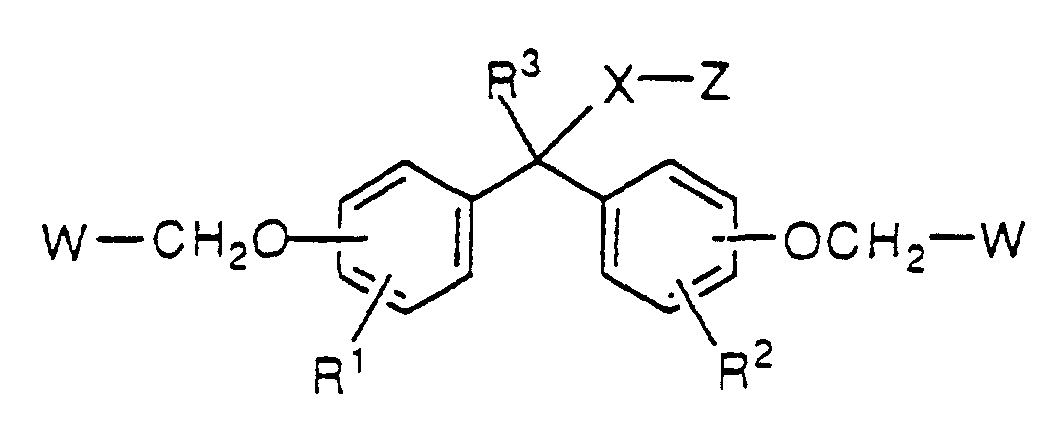
- R1 and R2 are independently selected from the group consisting of (a) hydrogen, (b) alkyl of one to six carbon atoms, (c) halolalkyl of one to six carbon atoms, (d) alkoxy of one to six carbon atoms, and (e) halogen.
- R3 is selected from the group consisting of (a) hydrogen and (b) alkyl of one six carbon atoms.
- X is absent or is selected from the group consisting of (a) alkylene of one to six carbon atoms, (b) alkenylene of one to six carbon atoms, and (c) alkynylene of one to six carbon atoms.
- Z is selected from the group consisting of (a) COM, (b) CH=N-O-A-COM, (c) CH2-0-N=A-COM, and (d) OR3 where R3 is hydrogen or alkyl of one to six carbon atoms.
- A is selected from the group consisting of (a) alkylene of one to six carbon atoms, and (b) cycloalkylene of three to eight carbon atoms.
- M is selected from the group consisting of (a) -O- attached to a pharmaceutically acceptable metabolically cleavable group selected from the group consisting of acetyl, propionyl, butyryl, benzoyl, ethoxycarbonyl, trimethylsilyl, triethylsilyl and succinyl, (b) -OR3 where R3 is selected from the group consisting of hydrogen and alkyl of one to six carbon atoms, and (c)-NR7R8 where R7 and R8 are independently selected from the group consisting of hydrogen, alkyl of one to six carbon atoms, hydroxy, and alkoxy of one to six carbon atoms, or R7 and R8 taken together define a five- to eight-membered ring, with the proviso that R7 and R8 may not simultaneously be hydroxyl, (d) -NR3S02R9 wherein R3 is as defined above and R9 is alkyl of one to six carbon atoms, (e)-NH-tetrazolyl, and (f) glycinyl.
- The present invention also provides pharmaceutical compositions which comprise a therapeutically effective amount of compound as defined above in combination with a pharmaceutically acceptable carrier.
- The compounds of the invention are useful for inhibiting leukotriene biosynthesis in a host mammal in need of such treatment by administering to a mammal in need of such treatment a therapeutically effective amount of a compound as defined above.
- As used throughout this specification and the appended claims, the following terms have the meanings specified.
- The term alkyl refers to a monovalent group derived from a straight or branched chain saturated hydrocarbon by the removal of a single hydrogen atom. Alkyl groups are exemplified by methyl, ethyl, n- and iso-propyl, n-, sec-, iso- and tert-butyl.
- The terms alkoxy and alkoxyl denote an alkyl group, as defined above, attached to the parent molecular moiety through an oxygen atom. Representative alkoxy groups include methoxy, ethoxy, propoxy and butoxy.
- The term alkenyl as used herein refers to monovalent straight or branched chain groups of 2 to 6 carbon atoms containing a carbon-carbon double bond, derived from an alkene by the removal of one hydrogen atom and include, but are not limited to groups such as ethenyl, 1 -propenyl, 2-propenyl, 2-methyl- 1 -propenyl, 1 -butenyl and 2-butenyl.
- The term alkylene denotes a divalent group derived from a straight or branched chain saturated hydrocarbon by the removal of two hydrogen atoms, for example -CH2-, -CH2CH2- and -CH(CH3)CH2-.
- The term alkenylene denotes a divalent group derived from a straight or branched chain hydrocarbon containing at least one carbon-carbon double bond. Examples of alkenylene include -CH=CH-, -CH2CH=CH-, -C(CH3)=CH-, and -CH2CH=CHCH2-.
- The term alkynylene refers to a divalent group derived by the removal of two hydrogen atoms from a straight or branched chain acyclic hydrocarbon group containing at least one carbon-carbon triple bond. Examples of alkynylene include ―CH≡CH―, ―CH≡CH-CH2― and ―CH≡CH-CH(CH3)―.
- The term aryl as used herein refers to a monovalent carbocyclic group containing one or more fused or non-fused phenyl rings and includes, for example, phenyl, 1- or 2-naphthyl, 1,2-dihydronaphthyl and 1,2,3,4-tetrahydronaphthyl.
- The term cycloalkyl as used herein refers to a monovalent saturated cyclic hydrocarbon group. Representative cycloalkyl groups include cyclopropyl, cyclobutyl, cyclopentyl, cyclohexyl, cycloheptyl and bicyclo [2.2.1] heptane.
- Cycloalkylene denotes a divalent radical derived from a cycloalkane by the removal of two hydrogen atoms.
- The term haloalkyl denotes an alkyl group, as defined above, having one, two, or three halogen atoms attached thereto and is exemplified by such groups as chloromethyl, bromoethyl and trifluoromethyl.
- As used throughout this specification and the appended claims, the term "metabolically cleavable group" denotes a moiety which is readily cleaved in vivo from the compound bearing it, which compound after cleavage remains or becomes pharmacologically active. Metabolically cleavable groups form a class of groups reactive with the carboxyl group of the compounds of this invention (where M is -OH) well known to practitioners of the art. According to the present invention, they are selected from the group consisting of acetyl, propionyl, butyryl, benzoyl, ethoxycarbonyl, trimethyl- and triethysilyl and succinyl.
- Because of the ease with which the metabolically cleavable groups of the compounds of this invention are cleaved in vivo, the compounds bearing such groups act as pro-drugs of other leukotriene biosynthesis inhibitors. The compounds bearing the metabolically cleavable groups have the advantage that they may exhibit improved bioavailability as a result of enhanced solubility and/or rate of absorption conferred upon the parent compound by virtue of the presence of the metabolically cleavable group.
- In those instances where M = OH, the compounds of the present invention are capable of forming base addition salts. In such instances, the term "pharmaceutically acceptable salts" refers to the relatively nontoxic inorganic and organic base addition salts of compounds of the present invention. These salts can be prepared in situ during the final isolation and purification of the compounds, or by separately reacting the purified carboxyl compound with a suitable base such as the hydroxide, carbonate, or bicarbonate of a pharmaceutically acceptable metal cation or with ammonia, or an organic primary, secondary, or tertiary amine of sufficient basicity to form a salt with the carboxyl functional group of the compounds of this invention.
- Representative alkali or alkaline earth metal salts include sodium, lithium, potassium, calcium, magnesium, and the like. Representative organic amines useful for the formation of base addition salts include ethylamine, diethylamine, ethylenediamine, ethanolamine, diethanolamine and piperazine. (See, for example, S. M. Berge, et al., J. Pharmaceutical Sciences, 1977, 66: 1 - 19).
- Similarly, in those instances where the compounds of the present invention possess a heterocyclic ring moiety containing a basic nitrogen atom, the compounds are capable of forming acid addition salts. In such cases, the term "pharmaceutically acceptable salts" also refers to the nontoxic inorganic and organic acid addition salts of compounds of the present invention. These salts can be prepared in situ during the final isolation and purification of the compounds, or by separately reacting the purified compound in its free-base form with a suitable inorganic or organic acid and isolating the salt thus formed. Representative acid addition salts include acetate, adipate, alginate, ascorbate, aspartate, benzenesulfonate, benzoate, bisulfate, borate, butyrate, camphorate, camphersulfonate, citrate, cyclopentanepropionate, digluconate, dodecylsulfate, ethanesulfonate, furnarate, glucoheptonate, glycerophosphate, hemisulfate, heptonate, hexanoate, hydrobromide, hydrochloride, hydroiodide, 2-hydroxy-ethanesulfonate, lactobionate, lactate, laurate, lauryl sulfate, malate, maleate, malonate, methanesulfonate, 2-naphthalenesulfonate, nicotinate, nitrate, oleate, oxalate, palmitate, parnoate, pectinate, persulfate, 3-phenylpropionate, phosphate, picrate, pivalate, propionate, stearate, succinate, sulfate, tartrate, thiocyanate, toluenesulfonate, undecanoate and valerate salts. (See, for example, S. M. Berge, et al., J. Pharmaceutical Sciences, 1977, 66: 1-19)).
- Said pharmaceutically acceptable acid and base addition salts are also contemplated as falling within the scope of the present invention.
- Asymmetric centers may exist in the compounds of the present invention. The present invention contemplates the various stereoisomers and mixtures thereof. Individual stereoisomers of compounds of the present invention are made by synthesis from starting materials containing the chiral centers or by preparation of mixtures of enantiomeric products followed by separation as, for example, by conversion to a mixture of diastereomers followed by separation by recrystallization or chromatographic techniques, or by direct separation of the optical enantiomers on chiral chromatographic columns. Starting compounds of particular stereochemistry are either commercially available or are made by the methods detailed below and resolved by techniques well known in the organic chemical arts.
- Examples of compounds contemplated as falling within the scope of the present invention include, but are not limited to:
- 4,4-bis(4-(2-quinolylmethoxy)phenyl)pentanoic acid,
- 4,4-bis(4-(2-quinolylmethyl)phenyl)pentanoic acid methyl ester,
- 4,4-bis(4-(2-quinolylmethoxy)phenyl)pentanoic acid sodium salt,
- 4,4-bis(4-(2-quinolylmethoxy)phenyl) pentanoic acid magnesium salt,
- 4,4-bis(4-(2-quinolylmethoxy)phenyl)pentan-1-ol,
- [4,4-bis(4-(2-quinolylmethoxy)phenyl)pent-1-yl]iminoxyacetic acid,
- [4,4-bis(4-(2-quinolylmethoxy)phenyl)pent-1-yl]-2-iminoxypropionic acid,
- [4,4-bis(4-(2-quinolylmethoxy)phenyl)pent-1-yl]-2-iminoxypropionic acid, methyl ester,
- [4,4-bis(4-(2-quinolylmethoxy)phenyl)pent-1-yl]oximinoacetic acid,
- 4,4-bis(4-(2-benzothiazoylmethoxy)phenyl)pentanoic acid,
- 4,4-bis(4-(2-benzothiazoylmethoxy)phenyl)pentanoic acid sodium salt,
- 4,4-bis(4-(7-chloro-2-quinolylmethoxy)phenyl)pentanoic acid,
- 4,4-bis(4-(6-fluoro-2-quinolylmethoxy)phenyl)pentanoic acid sodium salt,
- 4,4-bis(4-(6-fluoro-2-quinolylmethoxy)phenyl)pentanoic acid,
- 2,2-bis(4-(2-quinolylmethoxy)phenyl)propionic acid,
- 3,3-bis(4-(2-quinolylmethoxy)phenyl)butanoic acid,
- 5,5-bis(4-(2-quinolylmethoxy)phenyl)hexanoic acid,
- 5,5-bis(4-(2-quinolylmethoxy)phenyl)hexanoic acid sodium salt,
- 4,4-bis-(4-(2-pyridylmethoxy)phenyl)pentanoic acid sodium salt,
- 4,4-bis-(4-(2-pyridylmethoxy)phenyl)pentanoic acid,
- 4,4-bis-(4-(2-quinoxylmethoxy)phenyl)pentanoic acid sodium salt,
- 4,4-bis(4-(1-methyl-2-benzimidazolylmethoxy)phenyl)pentanoic acid,
- 4,4-bis(4-(1-methyl-2-benzimidazolylmethoxy)phenyl)pentanoic acid sodium salt,
- 4,4-bis(3-chloro-4-(2-quinolylmethoxy)phenyl)pentanoic acid,
- 4,4-bis(3-chloro-4-(2-quinolylmethoxy)phenyl)pentanoic acid methyl ester,
- 4,4-bis(3-chloro-4-(2-quinolylmethoxy)phenyl)pentanoic acid sodium salt,
- [4,4-bis(3-chloro-4-(2-quinolylmethoxy)phenyl)pent-1-yl]-2-iminoxypropionic acid sodium salt,
- 4,4-bis(3-chloro-4-(2-quinolylmethoxy)phenyl)pentan-1-ol,
- [4,4-bis(3-chloro-4-(2-quinolylmethoxy)phenyl)pent-1-yl]-2-iminoxypropionic acid,
- 4,4-bis(4-(2-quinolylmethoxy)phenyl)pentanoic acid N,N-diethylhydroxylamine ester,
- 2,2-bis(4-(2-quinolylmethoxy)phenyl)butyric acid,
- 1,1-bis(4-(2-quinolylmethoxy)phenyl)ethanol,
- 2,2-dimethyl-3,3-bis(4-(2-quinolylmethoxy)phenyl)propionic acid sodium salt,
- 2,2-dimethyl-3,3-bis(4-(2-quinolylmethoxy)phenyl)propionic acid methyl ester,
- 2,2-dimethyl-3,3-bis(4-(2-quinolylmethoxy)phenyl)propionic acid,
- [2,2-dimethyl-3,3-bis(4-(2-quinolylmethoxy)phenyl)prop-1-yl]oximinoacetic acid sodium salt,
- 2,2-dimethyl-3,3-bis(4-(2-quinolylmethoxy)phenyl)propan-1-ol,
- [2,2-dimethyl-3,3-bis(4-(2-quinolylmethoxy)phenyl)prop-1-yl]oximinoacetic acid,
- 2,2-dimethyl-3,3-bis(4-(2-quinolylmethoxy)phenyl)-1-propyliminoxyacetic acid,
- 2,2-bis(4-(2-quinolymethoxy)phenyl)acetic acid,
- 2,2-bis(4-(6-fluoro-2-quinolymethoxy)phenyl)acetic acid,
- 2,2-bis(4-(2-quinolylmethoxy)phenyl)eth-1-yloximinoacetic acid,
- 2,2-bis(4-(2-quinolymethoxy)phenyl)acetic acid methyl ester,
- 2,2-bis(4-(2-quinolylmethoxy)phenyl)eth-1-yloximinoacetic acid sodium salt,
- 3,3-bis(4-(2-quinolylmethoxy)phenyl)propionic acid,
- 3,3-bis(4-(2-quinolylmethoxy)phenyl)propionic acid sodium salt,
- 4,4-bis(4-(2-quinolylmethoxy)phenyl)acetic acid-N-carboxymethyl amide,
- [3,3-bis-(2-quinolylmethoxyphenyl)but-1-yl]-2-iminoxypropionic acid,
- 3,3-bis(4-(2-quinolylmethoxy)phenyl)butan-1-ol,
- 4,4-bis(4-(2-benzoxazolylmethoxy)phenyl)pentanoic acid,
- 4,4-bis(4-(2-pyrimidylmethoxy)phenyl)pentanoic acid,
- 4,4-bis(4-(4-phenyl-2-thiazolylmethoxy)phenyl)pentanoic acid,
- 4,4-bis(4-(4-(pyrid-2-yl)-2-thiazolylmethoxy)phenyl)pentanoic acid,
- 4,4-bis(4-(6-phenyl-2-pyridylmethoxy)phenyl)pentanoic acid,
- 4,4-bis(4-(5-phenyl-2-pyridylmethoxy)phenyl)pentanoic acid,
- 4,4-bis(4-(6-(pyrid-2-yl)-2-pyridylmethoxy)phenyl)pentanoic acid, and
- 4,4-bis(4-(4-phenyl-2-pyrimidylmethoxy)phenyl)pentanoic acid.
-
- Preferred compounds of the present invention have the structure defined above wherein Z is selected from the group consisting of (a) COM, (b) CH=N-O-A-COM, (c) CH2-0-N=A-COM, and (d) OH wherein A is alkylene of one to six carbon atoms, and M is -OH. In a preferred embodiment, Z is COM wherein M is -OH, in particular when X is alkylene of one to six carbon atoms.
- More preferred compounds of the present invention have the structure defined immediately above wherein W is selected from the group consisting of (a) quinolyl; (b) quinolyl substituted with a substituent selected from the group consisting of (b-1) halogen, (b-2) alkyl of one to six carbon atoms, (b-3) phenyl, (b-4) phenyl substituted with a substituent selected from the group consisting of (b-4-a) halogen, (b-4-b) alkyl of one to six carbon atoms, (b-4-c) haloalkyl of one to six carbon atoms, and (b-4-d) alkoxy of one to six carbon atoms, (b-5) pyridyl, and (b-6) pyridyl substituted with a substituent selected from the group consisting of (b-6-a) halogen, (b-6-b) alkyl of one to six carbon atoms, and (b-6-c) alkoxy of one to six carbon atoms; (c) benzothiazolyl; and (d) benzothiazolyl substituted with a substituent selected from the group consisting of (d-1) halogen, (d-2) alkyl of one to six carbon atoms, (d-3) phenyl, (d-4) phenyl substituted with a substituent selected from the group consisting of (d-4-a) halogen, (d-4-b) alkyl of one to six carbon atoms, (d-4-c) haloalkyl of one to six carbon atoms, and (d-4-d) alkoxy of one to six carbon atoms, (d-5) pyridyl, and (d-6) pyridyl substituted with a substituent selected from the group consisting of (d-6-a) halogen, (d-6-b) alkyl of one to six carbon atoms, and (d-6-c) alkoxy of one to six carbon atoms.
- Still more preferred compounds have the structure defined immediately above wherein X is alkylene of one to six carbon atoms, and Z is COOH.
- The most preferred compounds of the present invention have the structure defined immediately above wherein W is the same at each occurrence and is selected from the group consisting of (a) quinolyl; and (b) quinolyl substituted with a substituent selected from the group consisting of (b-1) halogen, (b-2) alkyl of one to six carbon atoms, (b-3) phenyl, (b-4) phenyl substituted with a substituent selected from the group consisting of (b-4-a) halogen, (b-4-b) alkyl of one to six carbon atoms, (b-4-c) haloalkyl of one to six carbon atoms, and (b-4-d) alkoxy of one to six carbon atoms, (b-5) pyridyl, and (b-6) pyridyl substituted with a substituent selected from the group consisting of (b-6-a) halogen, (b-6-b) alkyl of one to six carbon atoms, and (b-6-c) alkoxy of one to six carbon atoms.
- Compounds representative of the most preferred embodiment include
- 4,4-bis(4-(2-quinolylmethoxy)phenyl)pentanoic acid,
- 4,4-bis(4-(2-quinolylmethoxy)phenyl)pentanoic acid sodium salt,
- 4,4-bis(4-(2-quinolylmethoxy)phenyl) pentanoic acid magnesium salt,
- 4,4-bis(4-(2-benzothiazoylmethoxy)phenyl)pentanoic acid,
- 4,4-bis(4-(2-benzothiazoylmethoxy)phenyl)pentanoic acid sodium salt,
- 4,4-bis(4-(7-chloro-2-quinolylmethoxy)phenyl)pentanoic acid,
- 4,4-bis(4-(7-fluoro-2-quinolylmethoxy)phenyl)pentanoic acid sodium salt,
- 2,2-bis(4-(2-quinolylmethoxy)phenyl)propionic acid,
- 3,3-bis(4-(2-quinolylmethoxy)phenyl)butanoic acid,
- 5,5-bis(4-(2-quinolylmethoxy)phenyl)hexanoic acid,
- 5,5-bis(4-(2-quinolylmethoxy)phenyl)hexanoic acid sodium salt,
- 4,4-bis(3-chloro-4-(2-quinolylmethoxy)phenyl)pentanoic acid,
- 4,4-bis(3-chloro-4-(2-quinolylmethoxy)phenyl)pentanoic acid sodium salt,
- 2,2-bis(4-(2-quinolylmethoxy)phenyl)butyric acid,
- 2,2-dimethyl-3,3-bis(4-(2-quinolylmethoxy)phenyl)propionic acid sodium salt,
- 2,2-bis(4-(2-quinolymethoxy)phenyl)acetic acid,
- 2,2-bis(4-(6-fluoro-2-quinolymethoxy)phenyl)acetic acid,
- 2,2-bis(4-(2-quinolylmethoxy)phenyl)propionic acid, and
- 2,2-bis(4-(2-quinolylmethoxy)phenyl)propionic acid sodium salt.
-
- Inhibition of leukotriene biosynthesis was evaluated in vitro using an assay involving calcium ionophore-induced LTB4 expressed in human polymorphornuclear leukocytes (PMNL). Human PMNL isolated from heparinized (20 USP units/mL) venous blood (25 mL) obtained from healthy volunteers was layered over an equal volume of Ficoll-Hypaque Mono-Poly Resolving Medium (ICN Flow, Costa Mesa, CA) and centrifugated at 400 x g for 40 minutes at 20°C. The PMNL was collected, erythrocytes lysed and washed 2x and suspended at 1.0 x 10⁷ cells/mL in Earle's balanced salt solution with 17 mM Earle's HEPES. Aliquots of the cell suspension were preincubated with test compounds dissolved in DMSO (final concentration <2%) for 15 minutes and stimulated with calcium ionophore (final concentration 8.3, µM) for 10 minutes at 37°C. Incubations were stopped with the addition of two volumes of ice-cold methanol followed by centrifuging the cell suspensions at 4°C for 10 minutes at ∼450 x g. The amount of LTB4 in the methanol extract was analyzed by enzyme-linked immunoassay or by HPLC analysis.
- The compounds of this invention inhibit leukotriene biosynthesis as shown by the data for representative examples in Table 1.
In Vitro Inhibitory Potencies Against 5-Lipoxygenase From Stimulated LTB4 Formation in Human Polymorphonuclear Leukocytes Example IC50 (µM) 1 0.040 2 0.069 5 0.030 6 0.035 7 0.040 8 0.046 9 0.050 11 0.040 12 0.032 14 0.043 20 0.026 25 0.050 26 0.080 27 0.028 28 0.034 30 0.050 31 0.035 34 0.070 36 0.025 - Inhibition of leukotriene biosynthesis in vivo was evaluated using the Ionophore A32187-Induced Rat Plueral Inflammation Model. Pleural inflammation was induced in male rats following the method of Rao et al (Rao, T. S., Currie, J. L., Shaffer, A. F., Isakson, P. C., (1993) Evaluation of 5-lipoxygenase Inhibitors, Zileuton, A-78773 and ICI D-2138 in an lonophore (A-23187) Induced Pleural Inflammation Model in the Rat, Life Sciences, 53: 147 (1993)). Rats were dosed with experimental compounds in 0.2% methocel one hour prior to the intrapleural injection of the calcium ionophore, A23187. The rats where lightly anesthetized with Pentrane (Abbott Laboratories) and injected intrapleurally with 0.5 ml of 2% ethanol in injectable saline (Abbott Laboratories) containing 20 µg of A23187 (Cal BioChem-Novabiochem). Thirty minutes later the animals were euthanised and the pleural cavities lavaged with ice cold saline (Abbott Laboratories). The lavage fluid was then added to ice cold methanol (final methanol concentration 30%) to lyse cells and precipitate protein. Eicosanoids were determined by enzyme immunoassay by standard methods.
In Vivo Leukotriene Inhibition in Rat Pleural Inflammation Example % Inhibition at 3 mg/kg 2 53% 11 42% 14 32% 24 38% 26 50% 27 42% 34 30% - The present invention also provides pharmaceutical compositions which comprise compounds of the present invention formulated together with one or more non-toxic pharmaceutically acceptable carriers. The pharmaceutical compositions may be specially formulated for oral administration in solid or liquid form, for parenteral injection, or for rectal administration.
- The pharmaceutical compositions of this invention can be administered to humans and other animals orally, rectally, parenterally, intracisternally, intravaginally, intraperitoneally, topically (as by powders, ointments, or drops), bucally, or as an oral or nasal spray. The term "parenteral" administration as used herein refers to modes of administration which include intravenous, intramuscular, intraperitoneal, intrasternal, subcutaneous and intraarticular injection and infusion.
- Pharmaceutical compositions of this invention for parenteral injection comprise pharmaceutically acceptable sterile aqueous or nonaqueous solutions, dispersions, suspensions or emulsions as well as sterile powders for reconstitution into sterile injectable solutions or dispersions just prior to use. Examples of suitable aqueous and nonaqueous carriers, diluents, solvents or vehicles include water, ethanol, polyols (such as glycerol, propylene glycol and polyethylene glycol) and suitable mixtures thereof, vegetable oils (such as olive oil), and injectable organic esters such as ethyl oleate. Proper fluidity can be maintained, for example, by the use of coating materials such as lecithin, by the maintenance of the required particle size in the case of dispersions, and by the use of surfactants.
- These compositions may also contain adjuvants such as preservative, wetting agents, emulsifying agents, and dispersing agents. Prevention of the action of microorganisms may be ensured by the inclusion of various antibacterial and antifungal agents, for example, paraben, chlorobutanol and phenol sorbic acid.
- It may also be desirable to include isotonic agents such as sugars and sodium chloride. Prolonged absorption of the injectable pharmaceutical form may be brought about by the inclusion of agents which delay absorption such as aluminum monostearate and gelatin.
- In some cases, in order to prolong the effect of the drug, it is desirable to slow the absorption of the drug from subcutaneous or intramuscular injection. This may be accomplished by the use of a liquid suspension of crystalline or amorphous material with poor water solubility. The rate of absorption of the drug then depends upon its rate of dissolution which, in turn, may depend upon crystal size and crystalline form. Alternatively, delayed absorption of a parenterally administered drug form is accomplished by dissolving or suspending the drug in an oil vehicle.
- Injectable depot forms are made by forming microencapsule matrices of the drug in biodegradable polymers such as polylactide-polyglycolide. Depending upon the ratio of drug to polymer and the nature of the particular polymer employed, the rate of drug release can be controlled. Examples of other biodegradable polymers include poly(orthoesters) and poly(anhydrides). Depot injectable formulations are also prepared by entrapping the drug in liposomes or microemulsions which are compatible with body tissues.
- The injectable formulations can be sterilized, for example, by filtration through a bacterial-retaining filter, or by incorporating sterilizing agents in the form of sterile solid compositions which can be dissolved or dispersed in sterile water or other sterile injectable medium just prior to use.
- Solid dosage forms for oral administration include capsules, tablets, pills. powders, and granules. In such solid dosage forms, the active compound is mixed with at least one inert, pharmaceutically acceptable excipient or carrier such as sodium citrate or dicalcium phosphate and/or
- a) fillers or extenders such as starches, lactose, sucrose, glucose, mannitol, and silicic acid,
- b) binders such as, for example, carboxymethylcellulose, alginates, gelatin, polyvinylpyrrolidone, sucrose, and acacia,
- c) humectants such as glycerol,
- d) disintegrating agents such as agar-agar, calcium carbonate, potato or tapioca starch, alginic acid, certain silicates, and sodium carbonate,
- e) solution retarding agents such as paraffin,
- f) absorption accelerators such as quaternary ammonium compounds,
- g) wetting agents such as, for example, cetyl alcohol and glycerol monostearate,
- h) absorbents such as kaolin and bentonite clay, and i) lubricants such as talc, calcium stearate, magnesium stearate, solid polyethylene glycols, sodium lauryl sulfate, and mixtures thereof. In the case of capsules, tablets and pills, the dosage form may also comprise buffering agents.
-
- Solid compositions of a similar type may also be employed as fillers in soft and hard-filled gelatin capsules using such excipients as lactose or milk sugar as well as high molecular weight polyethylene glycols.
- The solid dosage forms of tablets, dragees, capsules, pills, and granules can be prepared with coatings and shells such as enteric coatings and other coatings well known in the pharmaceutical formulating art. They may optionally contain opacifying agents and can also be of a composition that they release the active ingredient(s) only, or preferentially, in a certain part of the intestinal tract, optionally, in a delayed manner. Examples of embedding compositions which can be used include polymeric substances and waxes.
- The active compounds can also be in micro-encapsulated form, if appropriate, with one or more of the above-mentioned excipients.
- Liquid dosage forms for oral administration include pharmaceutically acceptable emulsions, solutions, suspensions, syrups and elixirs. In addition to the active compounds, the liquid dosage forms may contain inert diluents commonly used in the art such as, for example, water or other solvents, solubilizing agents and emulsifiers such as ethyl alcohol, isopropyl alcohol, ethyl carbonate, ethyl acetate benzyl alcohol, benzyl benzoate, propylene glycol, 1,3-butylene glycol, dimethyl formamide, oils (in particular, cottonseed, groundnut, corn, germ, olive, castor, and sesame oils), glycerol, tetrahydrofurfuryl alcohol, polyethylene glycols and fatty acid esters of sorbitan, and mixtures thereof.
- Besides inert diluents, the oral compositions can also include adjuvants such as wetting agents, emulsifying and suspending agents, sweetening, flavoring, and perfuming agents.
- Suspensions, in addition to the active compounds, may contain suspending agents as, for example, ethoxylated isostearyl alcohols, polyoxyethlylene sorbitol ,and sorbitan esters, microcrystalline cellulose, aluminum metahydroxide, bentonite, aparagar, and tragacanth, and mixtures thereof.
- Compositions for rectal or vaginal administration are preferably suppositories which can be prepared by mixing the compounds of this invention with suitable non irritating excipients or carriers such as cocoa butter, polyethylene glycol or a suppository wax which are solid at room temperature but liquid at body temperature and therefore melt in the rectum or vaginal cavity and release the active compound.
- Compounds of the present invention can also be administered in the form of liposomes. As is known in the art, liposomes are generally derived from phospholipids or other lipid substances. Liposomes are formed by mono- or multilamellar hydrated liquid crystals that are dispersed in an aqueous medium. Any nontoxic, physiologically acceptable and metabolizable lipid capable of forming liposomes can be used. The present compositions in liposome form can contain, in addition to a compound of the present invention, stabilizers, preservatives, excipients, and the like. The preferred lipids are the phospholipids and the phosphatidyl cholines (lecithins), both natural and synthetic.
- Methods to form liposomes are known in the art. See, for example, Prescott, Ed., Methods in Cell Biology, Volume XIV, Academic Press, New York, N.Y. (1976), p. 33, et seq.
- Dosage forms for topical administration of a compound of this invention include powders, sprays, ointments and inhalants. The active compound is mixed under sterile conditions with a pharmaceutically acceptable carrier and any needed preservatives, buffers, or propellants which may be required. Opthalmic formulations, eye ointments, powders and solutions are also contemplated as being within the scope of this invention.
- Actual dosage levels of active ingredients in the pharmaceutical compositions of this invention may be varied so as to obtain an amount of the active compound(s) that is effective to achieve the desired therapeutic response for a particular patient, compositions, and mode of administration. The selected dosage level will depend upon the activity of the particular compound, the route of administration, the severity of the condition being treated, and the condition and prior medical history of the patient being treated. However, it is within the skill of the art to start doses of the compound at levels lower than required to achieve the desired therapeutic effect and to gradually increase the dosage until the desired effect is achieved.
- Generally dosage levels of about 1 to about 50, more preferably of about 5 to about 20 mg of active compound per kilogram of body weight per day are administered orally to a mammalian patient. If desired, the effective daily dose may be divided into multiple doses for purposes of administration, e.g., two to four separate doses per day.
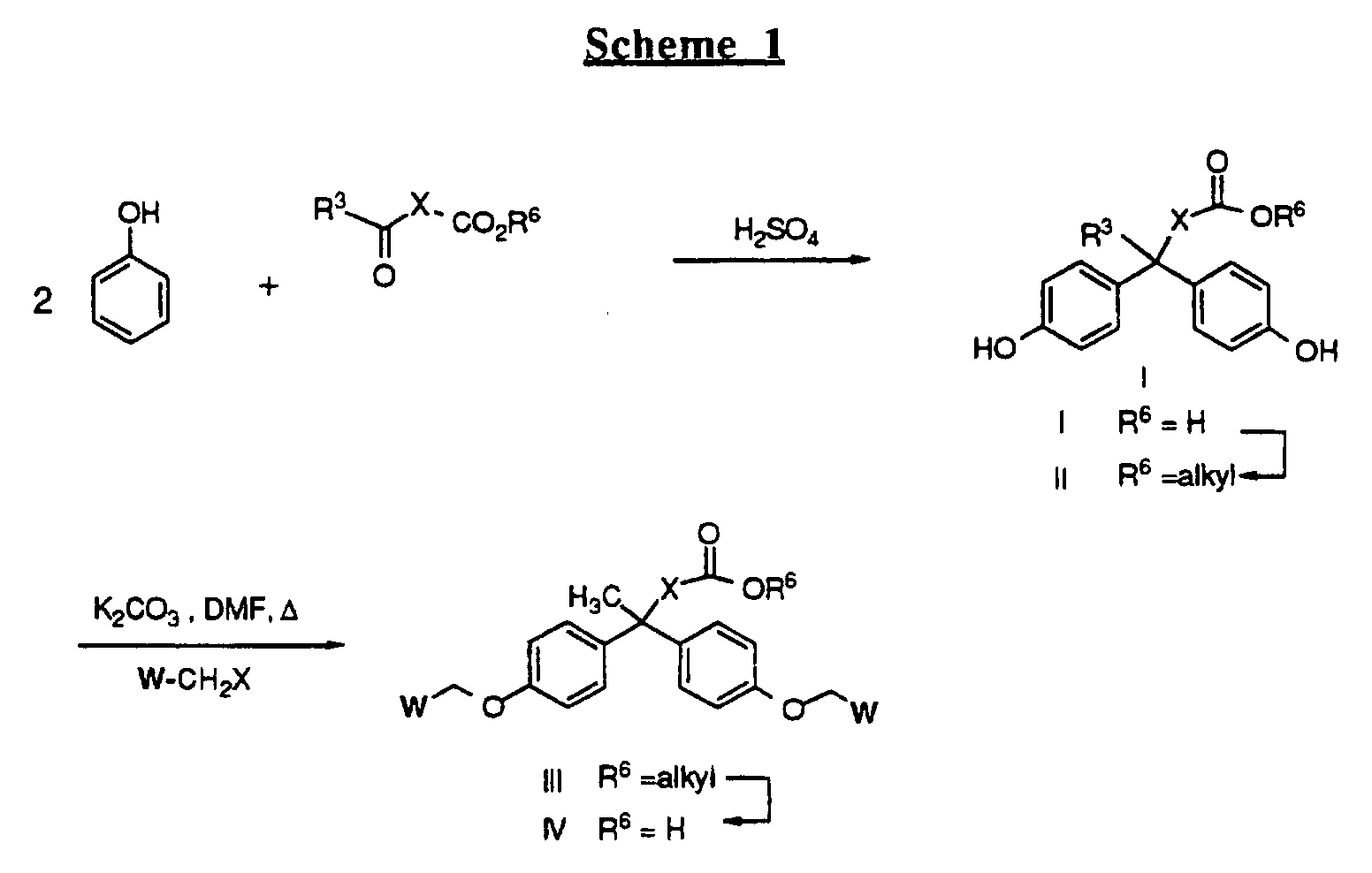
- In general, the compounds of this invention are synthesized by reaction schemes 1-3 as illustrated below. The preparation of compounds of this invention wherein Z is CO2R6, wherein R6 is H or alkyl is outlined in Scheme 1. Reaction of two equivalents of phenol with the requisite carbonyl (keto or aldehyde) ester in the presence of acid gives adducts of formula I (see US Pat. No. 2,933,520). Intermediates of formula I wherein R6 is H are esterified, for example by reaction with an alcohol in the presence of acid, to give an ester of formula II, which is then reacted with a heteroarylmethyl halide of formula W-CH2X where X is Cl, Br, or I, and W is defined above in the presence of a suitable base such as K2CO3 to provide the desired compound III in which R6 is alkyl. Hydrolysis of the ester, for example using aqueous alkali, provides compounds of formula IV wherein R6 is H.
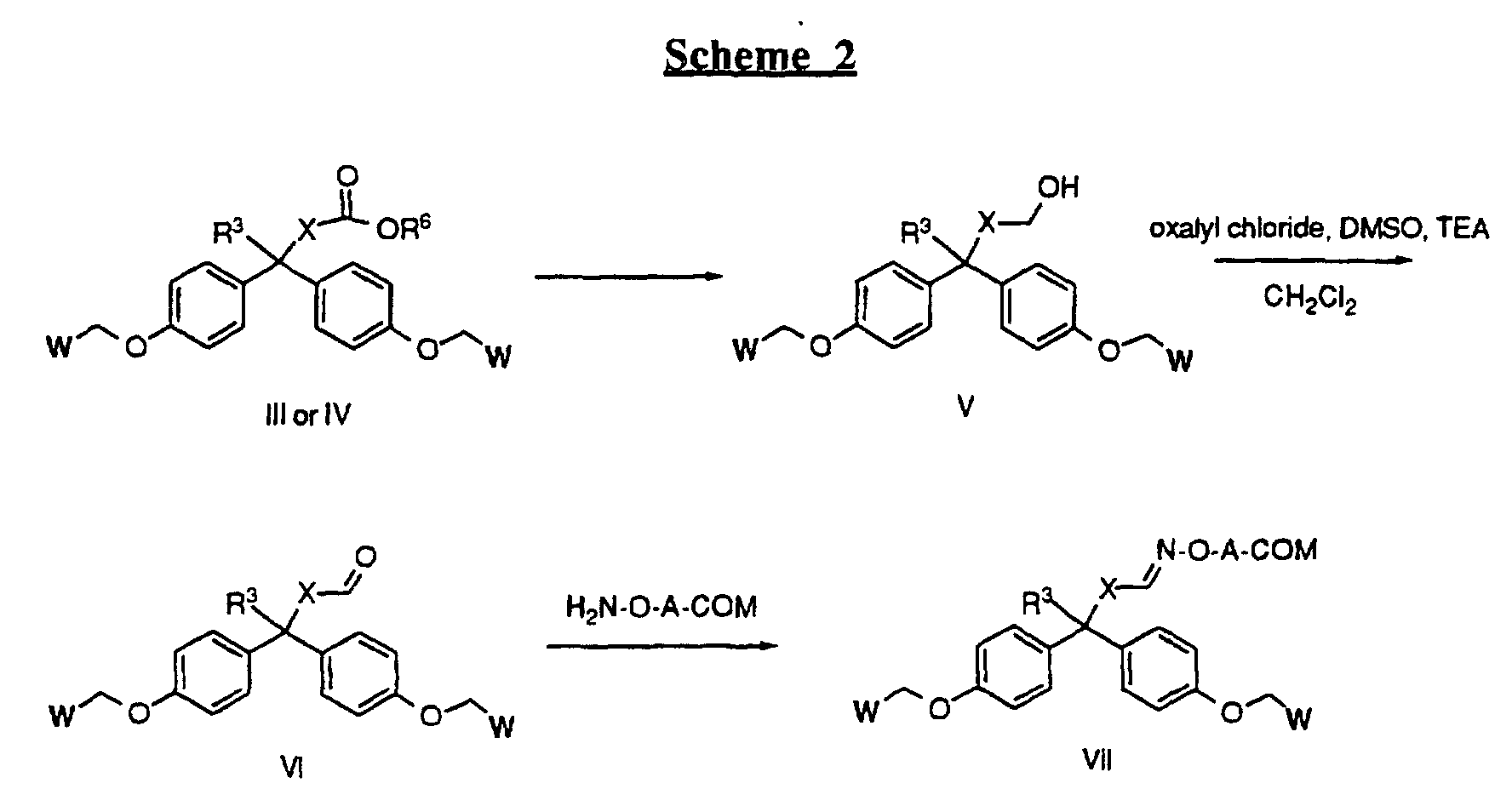
- A general procedure for the synthesis of compounds of this invention wherein Z is OR4 or CH=N-O-A-COM is described in Scheme 2. Reduction of ester III, for example using lithium aluminum hydride or sodium borohydride, or acid IV, for example using lithium aluminum hydride or using sodium borohydride to reduce the mixed anhydride made from the acid and ethyl chloroformate, provides alcohol V. Compounds of this invention wherein R4 is alkyl are then prepared from V using methods well-known in the art such as reaction with alkyl iodide in the presence of base. Alcohol V is converted to compounds of this invention wherein CH=N-O-A-COM by oxidation to the aldehyde, for example using Swem oxidation conditions (Swern, et al., J. Org. Chem., 1978, 43, 2480), followed by reaction with the requisite hydroxylamine derivative H2N-O-A-COM.
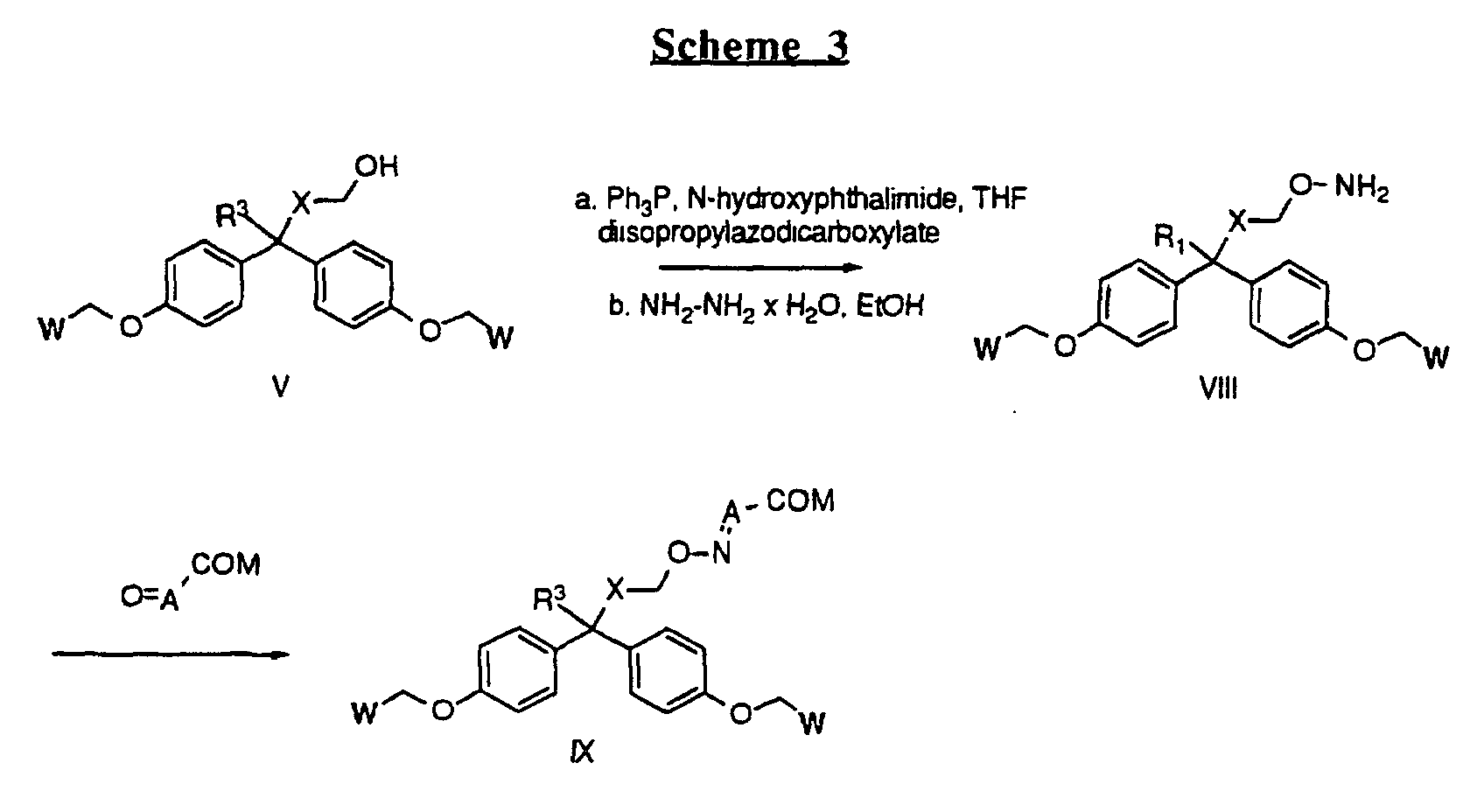
- The preparation of compound of this invention wherein Z is CH2-O-N=A-COM is described in Scheme 3. The hydroxy intermediate V, prepared in Scheme 2 above, is converted to hydroxylamine derivative VIII by known methods such as coupling with N-hydroxyphthalimide under Mitsunobu conditions (triphenylphosphine, diethyl or diisopropylazodicarboxylate; see Mitsunobu, O., Synthesis, 1981, 1), followed by treatment with hydrazine. The hydroxylamine derivative VIII is then reacted with the requisite carbonyl unit, O=A-COM to provide the compounds of this invention represented by the general structure IX.
- The foregoing may be better understood by reference to the following examples which are provided for illustration and are not intended to limit the scope of the invention as it is defined by the appended claims.
-
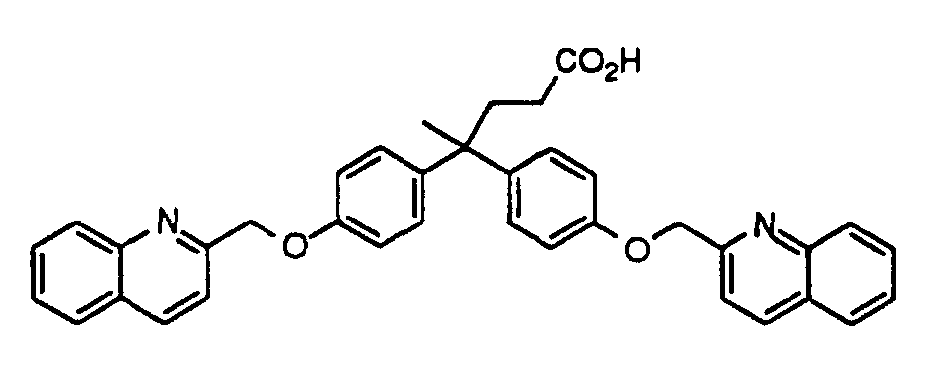
- To a solution in methanol (120 mL) of 4,4-bis(4-hydroxyphenyl)pentanoic acid (Aldrich Chemical Co., 12 g, 42 mmol) was added concentrated H2SO4 (0.5 mL) and the mixture was heated to reflux for 3 hours. After cooling to room temperature the mixture was concentrated in vacuo and dissolved in ether (300 mL). The organic layer was washed with saturated aqueous NaHCO3 (2 x 150 mL) and brine, dried over MgSO4, filtered, and concentrated in vacuo to provide a thick oil which was crystallized from ether/hexane to give 4,4-bis(4-hydroxyphenyl)pentanoic acid methyl ester as an off-white color solid (11.8 g, 94%), mp 130°C.
- To a solution in dry DMF under N2 of 4,4-bis(4-hydroxyphenyl)pentanoic acid methyl ester (6.0 g, 20 mmol), prepared as in step 1, was added powdered K2CO3 (11.0 g, 80 mmol) and the reaction was stirred for 10 minutes after which 2-chloromethylquinoline hydrochloride (8.5 g, 40 mmol) was added. The mixture was heated at 60 °C for 18 hours and then cooled to room temperature, diluted with EtOAc (200 mL), washed with water and brine, dried over MgSO4, filtered and concentrated in vacuo to provide a residue which was purified by chromatography on silica gel (9:1 CH2Cl2/EtOAc) to provide 10.8 (92%) of 4,4-bis(4-(2-quinolylmethyl)phenyl)-pentanoic acid methyl ester.
- To a solution in 1:1 dioxane/methanol (100 mL) of 4,4-bis(4-(2-quinolylmethyl)phenyl)pentanoic acid methyl ester (3.3 g, 5.7 mmol), prepared as in step 2, was added aqueous 1N NaOH (10 mL) and the mixture was heated at reflux for 3 hours, cooled to room temperature, concentrated in vacuo, diluted with water and neutralized with 10% aqueous citric acid. The solid precipitate was collected by filtration, dried in vacuo, and purified by chromatography on silica gel (9:1 CH2Cl2/EtOAc, followed by 20:1 CH2Cl2/CH3OH) to provide 2.53 g (70%) of the desired product. Crystallization from methylene chloride-hexanes gave 4,4-bis(4-(2-quinolylmethoxy)phenyl)pentanoic acid: mp 105-106°C; 1H NMR (300 MHz, DMSO-d6) d 1.50 (s, 3H), 1.95 (m, 2H), 2.27 (m, 2H), 5.34 (s, 4H), 6.98 (d, 4H, J = 8 Hz), 7.10 (d, 4H, J = 8 Hz), 7.65 (m, 4H), 7.80 (m, 2H), 8.00 (m, 4H), 8.42 (d, 2H, J = 9 Hz), 12.00 (s, 1H); MS (DCI-NH3) m/e 569 (M+H)+. Anal. Calc'd. for C37H32N2O4: C, 78.15; H, 5.67; N, 4.93. Found: C, 77.52; H, 5.88; N, 4.60.
- To a solution in dioxane (10 mL) and methanol (10 mL) of 4,4-bis(4-(2-quinolylmethoxy)phenyl)pentanoic acid (320 mg, 0.56 mmol), prepared as in step 1, was added aqueous 1N sodium hydroxide (0.55 ml, 0.55 mmol). The mixture was then concentrated in vacuo. The product was crystallized by dissolving in CH2Cl2 and precipitation by dropwise addition of a mixture of ethyl acetate-ethyl ether (1:2): 1H NMR (300 MHz, DMSO-d6) d 1.47 (s, 3H), 1.63 (m, 2H), 2.18 (m, 2H), 5.31 (s, 4H), 6.95 (d, 4H, J = 9 Hz), 7.08 (d, 4H, J = 9 Hz), 7.64 (m, 4H), 7.78 (m, 2H), 8.00 (m, 4H), 8.40 (d, 2H, J = 8 Hz); MS (FAB+) m/e 591 (M+H)+; (FAB-) 589 (M-H)-. Anal. Calc'd. for C37H31N2O4Na•0.25 H2O:C, 74.67; H, 5.34; N, 4.71; Found: C, 74.57; H, 5.32; N, 4.52.
- To a stirred room temperature THF solution of 4,4-bis(4-(2-quinolylmethoxy)phenyl)pentanoic acid (0.6 g, 1.06 mmol), prepared as in Example 1, was added MgO (0.021 g, 0.528 mmol). Water was added until the mixture became homogeneous. The reaction was allowed to stir for 24 hours. The solvent was removed in vacuo and the residue triturated with hexanes. The precipitate was vacuum filtered and washed with hexanes. The solid was dried in vacuo at 55 °C for 48 hours to give 0.510 g (83%) of 4,4-bis(4-(2-quinolylmethoxy)phenyl)pentanoic acid magnesium salt as a cream-colored powder: mp 96-110°C; 1H NMR (300 MHz, DMSO-d6) d 1.42 (s, 6H), 1.76 (m, 4H), 2.21 (m, 4H), 5.27 (s, 8H), 6.91 (d, 8H, J = 7.5 Hz), 7.03 (d, 8H, J = 7.5 Hz), 7.58 (m, 8H), 7.74 (t, 4H, J = 7.5 Hz), 7.96 (m, 8H), 8.34 (m, 4H). Anal. Calc'd. for C74H62N4O8Mg•1.50 H2O: C, 74.90; H, 5.52; N, 4.72. Found: C, 74.81; H, 5.64; N, 4.68.
-

- To a mixture in THF (50 mL) of 4.4-bis(4-(2-quinolylmethoxy)phenyl)-pentanoic acid 2-quinolylmethyl ester (2.1 g, 3 mmol), prepared as in Example 1, and sodium borohydride (380 mg, 10 mmol) was added dropwise methanol at 50-55 °C and the mixture was stirred for 30 minutes. The mixture was cooled to room temperature, poured into water (50 mL) and acidified to pH 4. The resulting mixture was extracted with ethyl acetate, dried over MgSO4, filtered, and concentrated in vacuo. The residue was purified by chromatography on silica gel (methylene chloride-ethyl acetate 3:1) to afford 1.46 g (88%) of 4,4-bis(4-(2-quinolylmethoxy)phenyl)pentan-1-ol: 1H NMR (300 MHz, DMSO-d6) d 1.18 (m, 2H), 1.48 (s, 3H), 2.00 (m, 2H), 3.34 (m, 2H), 4.34 (t, 1H, J = 6 Hz), 5.30 (s, 4H), 6.96 (d, 4H, J = 9 Hz), 7.09 (d, 4H, J = 9 Hz), 7.64 (m, 4H), 7.79 (m, 2H), 8.00 (t, 4H, J = 8 Hz), 8.41 (d, 2H, J = 8 Hz); MS (DCI-NH3) m/e 555 (M+H)+. Anal. Calc'd. for C37H34N2O3•0.5 H2O: C, 78.84; H, 6.44; N, 4.97. Found: C, 78.67; H, 5.95; N, 4.70.
-
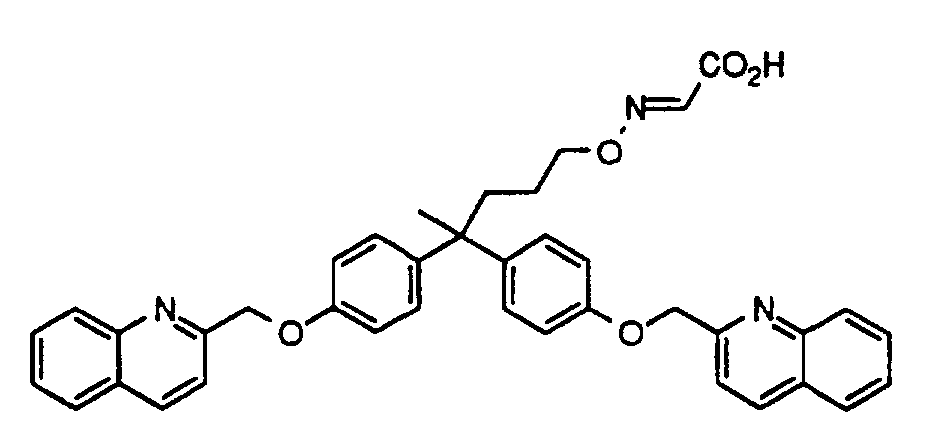
- To a solution in THF (35 mL) of 4,4-bis(4-(2-quinolylmethoxy)phenyl)-pentan-1-ol (1.11 g, 2 mmol), prepared as in Example 4, N-hydroxyphthalimide (326 mg, 2 mmol) and triphenylphosphine (786 mg, 3 mmol)was added a solution of DIAD (0.6 ml, 3 mmol) in THF (5 mL), and the resulting mixture was stirred at room temperature for 10 hours. The reaction mixture was concentrated in vacuo and purified by chromatography on silica gel (methylene chloride-ethyl acetate 12:1) to provide 1.33 g of N-phthaloyl-O-[4,4-bis(4-(2-quinolylmethoxy)phenyl)pent-1-yl]hydroxylamine.
- To a solution in dioxane (15 mL) and ethanol (15 mL) of the N-phthaloyl-O-[4,4-bis(4-(2-quinolylmethoxy)phenyl)pent-1-yl]hydroxylamine prepared in step 1 was added hydrazine hydrate (0.25 mL, 4 mmol) and the mixture was heated at reflux for 30 minutes. The mixture was then treated with aqueous 10% sodium carbonate (20 mL) and extracted with ethyl acetate. The organic extract was washed with water and brine, dried over MgSO4, filtered, and concentrated in vacuo. The residue was purified by chromatography on silica gel (ethyl acetate) to afford 420 mg of O-[4,4-bis(4-(2-quinolylmethoxy)phenyl)pent-1-yl]hydroxylamine.
- A solution in dioxane (10 mL), methanol (5 mL) and water (2 mL) of O-[4,4-bis(4-(2-quinolylmethoxy)phenyl)pent-1-yl]hydroxylamine (114 mg, 0.2 mmol), prepared as in step 2, glyoxylic acid (19 mg, 0.2 mmol) and acetic acid (0.012 mL, 0.2 mmol) was stirred at ambient temperature for 16 hours. The mixture was then concentrated in vacuo and the residue was dissolved in ethyl acetate (50 mL). The resulting solution was washed with water and brine, dried over MgSO4, filtered, and concentrated in vacuo. The residue was crystallized from methylene chloride-hexane to afford 108 mg (86%) of [4,4-bis(4-(2-quinolylmethoxy)phenyl)pent-1-yl]iminoxyacetic acid: mp 80-82°C; 1H NMR (300 MHz, DMSO-d6) d 1.40 (m, 2H), 1.53 (s, 3H), 2.04 (m, 2H), 4.10 (t, 2H, J = 7 Hz), 5.31 (s, 4H), 6.95 (d, 4H, J = 9 Hz), 7.08 (d, 4H, J = 9 Hz), 7.52 (s, 1H), 7.63 (m, 4H), 7.78 (m, 2H), 8.00 (m, 4H), 8.40 (d, 2H, J = 8 Hz); MS (DCI-NH3) m/e: 626 (M+H)+. Anal. Calc'd. for C39H35N3O5: C, 74.86; H, 5.64; N, 6.72; Found: C, 74.89; H, 6.03; N, 6.42.
-
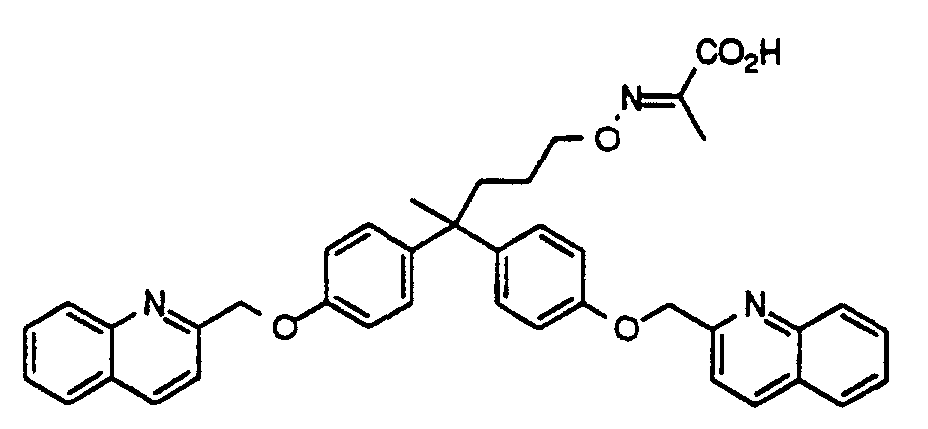
- A mixture in dioxane (20 mL) and methanol (20 mL) of O-[4,4-bis(4-(2-quinolylmethoxy)phenyl)pent-1-yl]hydroxylamine (306 mg, 0.54 mmol), prepared as in Example 5, step 2, methyl pyruvate (0.055 mL, 0.55 mmol) and acetic acid (0.033 mL, 0.55 mmol) was stirred at room temperature for 12 hours. The mixture was then partitioned between aqueous 10% sodium bicarbonate and ethyl acetate. The ethyl acetate extract was washed with water and brine, dried over MgSO4, filtered, and concentrated in vacuo. The residue was purified by chromatography on silica gel (methylene chloride-ethyl acetate 4:1) to afford 320 mg of [4,4-bis(4-(2-quinolyl-methoxy)phenyl)pent-1-yl]-2-iminoxypropionic acid methyl ester.
- The desired compound was prepared according to the method of Example 1, step 3, except substituting [4,4-bis(4-(2-quinolylmethoxy)phenyl)pent- 1-yl]-2-iminoxypropionic acid methyl ester, prepared as in step 1, for 4,4-bis(4-(2-quinolylmethyl)phenyl)pentanoic acid methyl ester: mp 80-82°C; 1H NMR (300 MHz, DMSO-d6) d 1.42 (m, 2H), 1.53 (s, 3H), 1.90 (s, 3H), 2.05 (m, 2H), 4.11 (t, 2H, J = 7 Hz), 5.33 (s, 4H), 6.95 (d, 4H, J = 9 Hz), 7.09 (d, 4H, J = 9 Hz), 7.64 (m, 4H), 7.78 (m, 2H), 8.00 (m, 4H), 8.41 (d, 2H, J = 8 Hz); MS (DCI-NH3) m/e 640 (M+H)+. Anal. Calc'd. for C40H37N3O5: C, 75.10; H, 5.83; N, 6.57. Found: C, 74.86; H, 6.11; N, 6.27.
-

- To a solution in DMSO (20 mL) of 4,4-bis(4-(2-quinolylmethoxy)phenyl)-pentan-1-ol (410 mg, 0.74 mmol), prepared as in Example 4, and 1,3-dicyclohexylcarbodiimide (515 mg, 2.5 mmol) was added aqueous 1M phosophoric acid (0.5 mL) and the resulting mixture was stirred at room temperature for 4 hours. Ethyl acetate (80 mL) was added and dicyclohexylurea was filtered off. The filtrate was washed with water and brine dried over MgSO4, filtered, and concentrated in vacuo. The residue was purified by chromatography on silica gel (methylene chloride-ethyl acetate 9:1) to afford 280 mg of 4,4-bis(4-(2-quinolylmethoxy)phenyl)pentanal.
- A mixture in dioxane (10 mL), methanol (10 mL) and water (5 mL) of the 4,4-bis(4-(2-quinolylmethoxy)phenyl)pentanal (280 mg, 0.5 mmol) prepared in step 1, carboxymethoxylamine hemihydrochloride (110 mg, 0.5 mmol), and sodium acetate trihydrate (69 mg, 0.5 mmol) was stirred at ambient temperature for 12 hours. The mixture was diluted with water and extracted with ethyl acetate. The ethyl acetate extract was washed with water and brine, dried over MgSO4, filtered, and concentrated in vacuo. The residue was recrystallized from methylene chloride-hexane to afford 250 mg (80 %) of [4,4-bis(4-(2-quinolylmethoxy)phenyl)pent-1-yl]oximinoacetic acid: mp 78-80°C; 1H NMR (300 MHz, DMSO-d6) d 1.53 (s, 3H), 1.88 (m 1H), 2.05 (m, 1H), 2.22 (m, 2H), 4.40 and 4.45 (two s, 1:1, 2H), 5.34 (s, 4H), 6.75 and 7.45 (two t, 1:1, 1H), 6.96 (d, 4H, J = 9 Hz), 7.10 (dd, 4H, J = 9, 7 Hz), 7.64 (m, 4H), 7.78 (m, 2H), 8.00 (m, 4H), 8.41 (d, 2H, J = 8 Hz), 12.62 (bs , 1H); MS (DCI-NH3) m/e 626 (M+H)+. Anal. Calc'd. for C39H35N3O5•0.5 H2O: C, 73.79; H, 5.72; N, 6.62. Found: C, 73.94; H, 6.13; N, 6.68.
-

- The desired product was prepared according to the procedure of Example 1, except substituting 2-chloromethylbenzothiazole for 2-chloromethylquinoline: mp 185-186°C; 1H NMR (300 mHz, DMSO-d6) d 1.60 (s. 3H), 1.94 (m, 2H), 2.29 (m, 2H), 5.05 (s, 4H), 7.01 (d, 4H, J = 9 Hz), 7.13 (d, 4H, J = 9 Hz), 7.50 (m, 4H), 8.03 (d, 2H, J = 9 Hz), 8.13 (m, 2H), 12.04 (bs, 1 H); MS (DCI-NH3) m/e 598 (M+NH4)+, 581 (M+H)+. Anal. Calc'd. for C33H28N2O4S2: C, 68.27; H, 4.86; N, 4.83. Found C, 68.06; H, 4.70; N, 4.64.
- The desired salt was prepared according to the procedure of Example 2, except substituting 4,4-bis(4-(2-benzothiazoylmethoxy)phenyl)pentanoic acid, prepared as in Example 8, for 4,4-bis(4-(2-quinolylmethoxy)phenyl)pentanoic acid: mp 105-108°C; 1H NMR (300 mHz, DMSO-d6) d 1.48 (s, 3H), 1.58 (m, 2H), 2.19 (m, 2H), 5.54 (s, 4H), 6.98 (d, 4H, J = 9 Hz), 7.10 (d, 4H, J = 9 Hz), 7.5 (m, 4H), 8.01 (d, 2H, J = 9 Hz), 8.11 (d, 2H, J = 9 Hz). MS (FAB) m/e 625 (M+Na)+. 603 (M+H)+. Anal. Calc'd. for C33H27N2O4SNa•1.5 H20: C, 62.95; H, 4.80; N, 4.45. Found: C, 63.11; H, 4.72; N, 4.26.
-

- The desired compound was prepared according to the procedure of Example 1, except substituting 2 chloromethyl-7-chloroquinoline for 2-chloromethylquinoline: mp 88-90°C; 1H NMR (300 mHz, DMSO-d6) d 1.51 (s, 3H), 1.95 (m, 2H), 2.28 (m, 2H), 5.33 (s, 4H), 6.97 (d, 4H, J = 9 Hz), 7.09 (d, 4H, J = 9 Hz), 7.66 (dd, 2H, J = 9, 2 Hz), 7.71 (d, 2H, J = 9 Hz), 8.06 (m, 4H), 8.47 (d, 2H, J = 9 Hz), 12.03 (bs, 1H); MS (DCI-NH3) m/e 637 (M+H)+. Anal. Calc'd. for C37H30C12N2O4: C, 69.81; H, 4.75; N, 4.40. Found: C, 69.77; H, 5.05; N, 4.17.
-

- The desired compound was prepared according to the procedure of Example 1, except substituting 2 chloromethyl-6-fluoroquinoline for 2-chloromethylquinoline.
- The desired salt was prepared according to the procedure of Example 2, except substituting 4,4-bis(4-(6-fluoro-2-quinolylmethoxy)phenyl)pentanoic acid, prepared as in step 1, for 4,4-bis(4-(2-quinolylmethoxy)phenyl)pentanoic acid: mp 97-99°C; 1H NMR (300 mHz, DMSO-d6) d 1.48 (s, 3H), 1.70 (m, 2H), 2.1 (m, 2H), 5.31 (S, 4H), 6.95 (d, 4H, J = 9 Hz), 7.08 (d, 4H, J = 9 Hz), 7.68 (m, 4H), 7.80 (dd, 2H, J = 9, 3 Hz), 8.08 (dd, 2H, J = 9, 6 Hz), 8.41 (d, 2H): MS (FAB) m/e 627 (M+Na)+, 605 (M+H)+. Anal. Calc'd. for: C37H29F2N2O4Na: C, 70.92; H, 4.76; N 4.47. Found: C, 70.79; H, 4.84; N, 4.30.
-
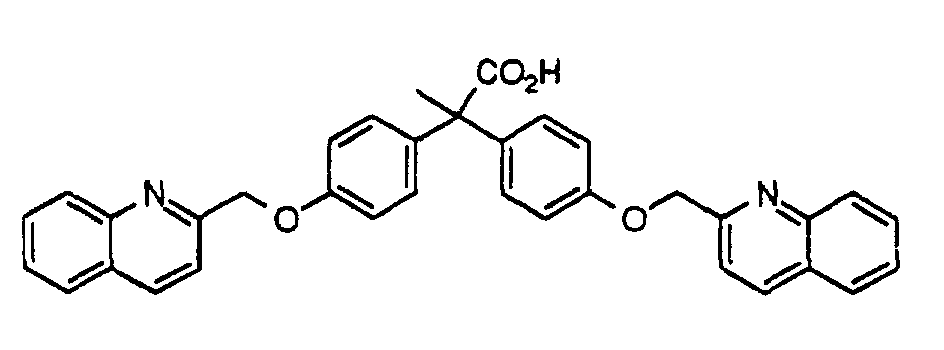
- To a cooled mixture of phenol (9.4 g, 0.1 mol), pyruvic acid (4.4 g, 0.05 mol), and water was added concentrated H2SO4 (4.5 mL, 18.0 g) dropwise with stirring. After 15 minutes the ice bath was removed and the reaction was warmed to room temperature and stirred for 18 hours. The reaction mixture was diluted with ethyl ether/water (200 ml 1:1) and the layers were separated. The organic layer was extracted with saturated aqueous NaHCO3. The aqueous extract was then acidified, extracted with ethyl ether, dried over MgSO4, filtered, and concentrated in vacuo to give 2,2-bis(4-hydroxyphenyl)propionic acid (6.2 g) as a colorless sticky oil.
- The desired compound was prepared according to the method of Example 1, except substituting 2,2-bis(4-hydroxyphenyl)propionic acid, prepared as in step 1, for 4,4-bis(4-hydroxyphenyl)pentanoic acid: mp 208-210°C; 1H NMR (300 mHz, DMSO-d6) d 1.75 (s, 3H), 5.33 (s, 4H), 7.01 (d, 4H, J = 9 Hz), 7.12 (d, 4H, J = 9 Hz), 7.63 (m, 4H), 7.78 (m, 2H), 8.01 (t, 4H, J = 8 Hz), 8.42 (d, 2H, J = 8 Hz), 12.65 (bs, 1 H); MS (DCI-NH3) m/e 541 (M+H)+. Anal. Calc'd. for C35H28N2O4•H2O: C, 75.19; H, 5.28; N, 5.02. Found: C, 74.85; H, 4.89; N, 4.92.
-

- The desired product was prepared according to the procedure of Example 12, except substituting ethyl acetoacetate for pyruvic acid and hydrolysis of the intermediate ethyl ester as described in Example 1, step 3: mp 94-96°C; 1H NMR (300 mHz, DMSO-d6) d 1.75 (s, 3H), 3.02 (s, 2H), 5.32 (s, 4H), 6.95 (d, 4H, J = 9 Hz), 7.11 (d, 4H, J = 9 Hz), 7.65 (m, 4H), 7.78 (m, 2H), 8.01 (t, 4H, J = 8 Hz), 8.41 (d, 2H, J = 8 Hz), 11.83 (bs, 1H); MS (DCI-NH3) m/e 555 (M+H)+. Anal. Calc'd. for C36H30N204•0.5H20: C, 76.71; H, 5.54; N, 4.95. Found: C, 76.23; H, 5.43; N, 4.66.
-

- The desired compound was prepared according to the procedure of Example 12, except substituting 4-acetyl butyric acid for pyruvic acid: mp 87-89°C; 1H NMR (300 mHz, DMSO-d6) d 1.25 (m, 2H), 1.51 (s, 3H), 2.0 (m, 2H), 2.17 (t, 2H, J = 8 Hz), 5.32 (s, 4H), 6.96 (d, 4H, J = 9 Hz), 7.09 (d, 4H, J = 9 Hz), 7.62 (m, 4H), 7.68 (d, 2H, J = 9 Hz), 7.78 (m, 2H), 8.02 (t, 2H, J = 8 Hz), 8.41 (d, 2H, J = 8 Hz), 11.97 (bs, 1H); MS (FAB) m/e 583 (M+H)+. Anal. Calc'd. for C38H34N2O4: C, 78.34; H, 5.87; N, 4.81. Found: C, 77.97; H, 6.0; N, 4.63.
- The desired compound was prepared according to the method of Example 2, except substituting 5,5-bis(4-(2-quinolylmethoxy)phenyl)hexanoic acid, prepared as in Example 14, for 4,4-bis(4-(2-quinolylmethoxy)phenyl)pentanoic acid: 1H NMR (300 mHz, DMSO-d6) d 1.20 (m, 2H), 1.51 (s, 3H), 1.81 (t, 2H, J = 8 Hz), 1.95 (m, 2H), 5.32 (s, 4H), 6.94 (d, 4H, J = 9 Hz), 7.09 (d, 4H, J = 9 Hz), 7.61 (t, 2H, J = 8 Hz), 7.68 (d, 2H, J = 8 Hz), 7.80 (m, 2H), 8.01 (t, 4H, J = 8 Hz), 8.42 (d, 2H, J = 8 Hz). MS (FAB) m/e 605 (M+Na)+, 583 (M+H)+. Anal. Calc'd. for C38H33N2O4Na •0.5 H20: C, 74.39; H, 5.55; N, 4.57. Found: C, 74.64; H, 5.64; N, 4.36.
-
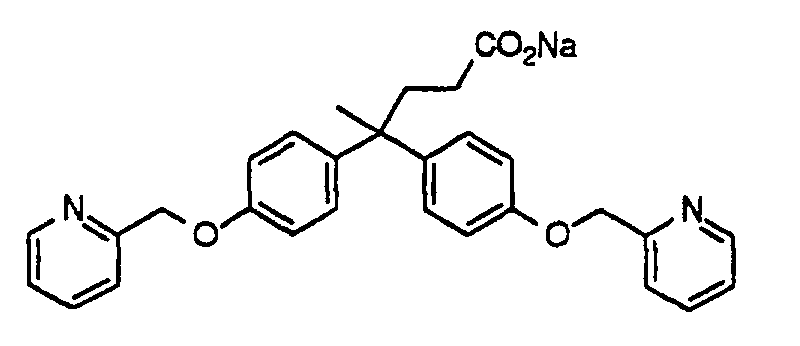
- The desired compound was prepared according to the procedure of Example 1, except substituting 2-picolyl chloride for 2-chloromethylquinoline.
- The desired compound was prepared according to Example 2, except substituting 4,4-bis-(4-(2-pyridylmethoxy)phenyl)pentanoic acid, prepared as in step 1, for 4,4-bis(4-(2-quinolylmethoxy)phenyl)pentanoic acid: 1H NMR (300 mHz, DMSO-d6) d 1.49 (s, 3H), 1.53 (m, 2H), 2.21 (m, 2H), 5.13 (s, 4H), 6.92 (d, 4H, J = 9 Hz), 7.08 (d, 4H, J = 9 Hz), 7.34 (m, 2H), 7.51 (d, 2H, J = 9 Hz), 7.34 (m, 2H), 7.51 (d, 2H, J = 9 Hz), 7.84 (dt, 2H, J = 9, 2 Hz), 8.56 (d, 2H, J = 4.5 Hz); MS (FAB) m/e 491 (M+Na)+, 469 (M+H)+. Anal. Calc'd. for C29H27N2O4Na•0.5H20: C, 69.72; H, 5.57; N, 5.57. Found: C, 69.45; H, 5.59; N, 5.29.
-
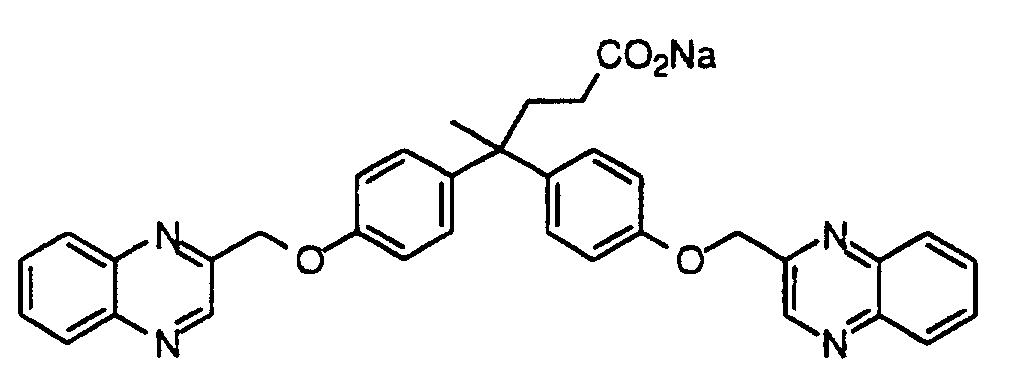
- The desired compound was prepared according to Example 16, except substituting 2-chloromethylquinoxaline for 2-picolyl chloride: 1H NMR (300 mHz, DMSO-d6) d 1.49 (s, 3H), 1.66 (m, 2H), 2.22 (m, 2H), 5.42 (s, 4H), 6.99 (d, 4H, J = 9 Hz), 7.11 (d, 4H, J = 9 Hz), 7.88 (m, 4H), 8.11 (m, 4H), 9.11 (s, 2H); MS (FAB) m/e 593 (M+Na)+, 571 (M+H)+. Anal. Calc'd. for C35H29N4O4Na •H20: C, 68.91; H, 5.11; N, 9.19. Found: C, 68.58, H, 5.15, N, 8.99.
-

- The desired product was prepared according to the procedure of Example 1, except substituting 1-methyl-2-chloromethylbenzimidazole for 2-chloromethylquinoline: mp 110-112°C; 1H NMR (300 MHz; DMSO-d6) d 1.52 (s, 3H), 1.95 (m, 2H), 2.28 (m, 2H), 3.85 (s, 6H), 5.37 (s, 4H), 7.02 (d, 4H, J = 9 Hz), 7.10 (d, 4H, J = 9 Hz), 7.35 (m, 4H), 7.56 (m, 2H), 7.64 (m, 2H), 12.00 (bs, 1 H); MS (FAB+) m/e 575 (M+H)+; (FAB-) m/e 573 (M-H)-. Anal. Calc'd. for C35H34N4O4•H2O: C, 70.93; H, 6.12; N, 9.45. Found: C, 70.79; H, 6.11; N, 8.87.
- The desired product was prepared according to the method of Example 2, except substituting 4,4-bis(4-(1-methyl-2-benzimidazolylmethoxy)phenyl)pentanoic acid, prepared as in Example 18, for 4,4-bis(4-(2-quinolylmethoxy)phenyl)pentanoic acid: 1H NMR (300 MHz, DMSO-d6) d 1.48 (s, 3H), 1.60 (m, 2H), 2.20 (m, 2H), 3.85 (s, 6H), 5.35 (s, 4H), 7.00 (d, 4H, J = 9 Hz), 7.09 (d, 4H, J = 9 Hz), 7.35 (m, 4H), 7.56 (m, 2H), 7.64 (m, 2H); MS (FAB+) m/e 597 (M+Na)+, 575 (M+H)+, (FAB-) m/e 573 (M-H)-. Anal. Calc'd. for C35H33N4O4Na•1.5H2O: C, 67.53; H, 5.81; N, 9.00. Found: C, 67.50; H, 5.85; N, 8.56.
-

- A mixture of 4,4-bis(4-hydroxyphenyl)pentanoic acid (5.72 g, 20 mmol), and N-chlorosuccinimide (5.84 g, 44 mmol) in chloroform (120 mL) and dioxane (30 mL) was heated at reflux for 5 hours. The reaction mixture was concentrated in vacuo and the residue was dissolved in methanol (100 mL). The methanol solution was cooled to -70 °C, thionyl chloride (3 mL) was added, and the mixture was left at ambient temperature for 16 hours. The methanol was removed in vacuo and DMF (150 mL), potassium carbonate (13.8 g, 100 mmol) and 2-chloromethyl-quinoline hydrochloride (9 g, 42 mmol) were added to the residue. The resulting mixture was stirred at room temperature for 10 hours. The mixture was diluted with water (400 mL) and extracted with ethyl acetate. The organic layer was washed with water and brine, dried over MgSO4, filtered, and concentrated in vacuo. The residue was purified by chromatography on silica gel (methylene chloride-ethyl acetate 15:1) to afford 8 g of 4,4-bis(3-chloro-4-(2-quinolylmethoxy)phenyl)pentanoic acid methyl ester and 1.2 g of 4-(3-chloro-4-(2-quinolylmethoxy)phenyl)-4-(3,5-dichloro-4-(2-quinolylmethoxy)phenyl)pentanoic acid methyl ester.
- The desired compound was prepared according to the method of Example 1, step 3, except substituting 4,4-bis(3-chloro-4-(2-quinolylmethoxy)phenyl)pentanoic acid methyl ester, prepared as in step 1, for 4,4-bis(4-(2-quinolylmethoxy)phenyl)-pentanoic acid methyl ester: mp 91-94°C; 1H NMR (300 MHz, DMSO-d6) d 1.53 (s, 3H), 1.96 (m, 2H), 2,30 (m, 2H), 5.44 (s, 4H), 7.09 (dd, 2H, J = 3, 9 Hz), 7.20 (d, 2H, J = 9 Hz), 7.24 (d, 2H, J = 3Hz), 7.62 (m, 2H), 7.71 (d, 2H, J = 9 Hz), 7.80 (m, 2H), 8.00 (m, 4H), 8.44 (d, 2H, J = 9 Hz), 12.08 (bs, 1H); MS (DCI-NH3) m/e 637 (M+H)+. Anal. Calc'd. for C37H30Cl2N2O4 x H2O: C, 67.79; H, 4.92; N, 4.27. Found: C, 68.02; H, 4.85; N, 3.94.
- The desired product was prepared according to the method of Example 2, except substituting 4,4-bis(3-chloro-4-(2-quinolylmethoxy)phenyl)pentanoic acid, prepared as in Example 20, for 4,4-bis(4-(2-quinolylmethoxy)phenyl)pentanoic acid: 1H NMR (300 MHz, DMSO-d6) d 1.47 (s, 3H), 1.85 (m, 2H), 2.25 (m, 2H), 5.43 (s, 4H), 7.06 (dd, 2H, J = 3, J = 9 Hz), 7.18 (d, 2H, J = 9 Hz), 7.22 (d, 2H, J = 3Hz), 7.61 (m, 2H), 7.71 (d, 2H, J = 9 Hz), 7.79 (m, 2H), 8.00 (m, 4H), 8.42 (d, 2H, J = 9 Hz); MS (FAB+) m/e 659 (M+Na)+, 637 (M+H)+, MS (FAB-) m/e 635 (M-H)-. Anal. Calc'd. for C37H29Cl2N2O4Na: C, 67.38; H, 4.43; N, 4.25. Found: C, 67.74; H, 4.89; N, 3.96.
-
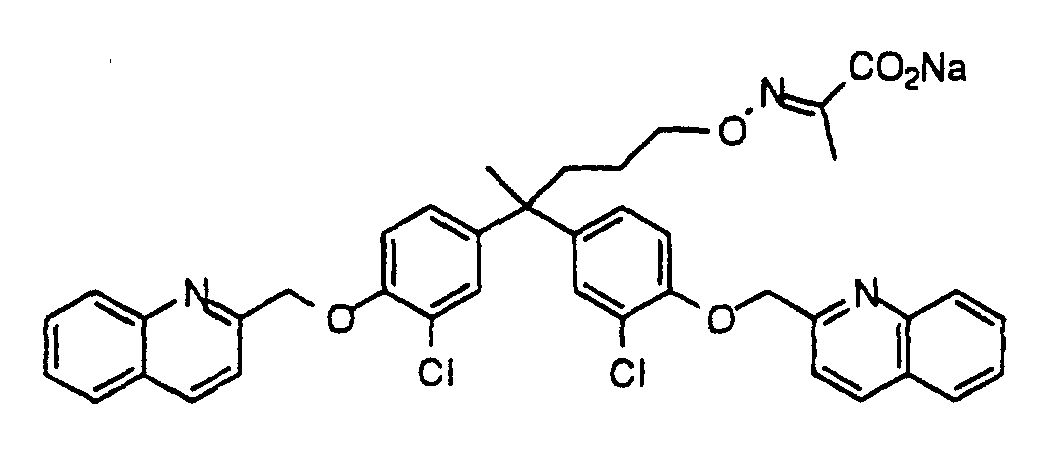
- The desired compound was prepared according to the method of Example 4, except substituting 4,4-Bis(3-chloro-4-hydroxyphenyl)pentanoic acid, prepared as in Example 20, for 4,4-bis(4-(2-quinolylmethoxy)phenyl)pentanoic acid.
- The desired compound was prepared according to the method of Example 5, steps 1 and 2, except substituting 4,4-bis(3-chloro-4-(2-quinolylmethoxy)phenyl)-pentan-1-ol, prepared as in step 1, for 4,4-bis(4-(2-quinolylmethoxy)phenyl)pentan-1-ol.
- The desired compound was prepared according to the method of Example 6, except substituting O-[4,4-bis(3-chloro-4-(2-quinolylmethoxy)phenyl)pent-1-yl]hydroxylamine, prepared as in step 2, for O-[4,4-bis(4-(2-quinolylmethoxy)-phenyl)pent-1-yl]hydroxylamine.
- The desired compound was prepared according to the method of Example 2, except substituting [4,4-bis(3-chloro-4-(2-quinolylmethoxy)phenyl)pent-1-yl]-2-iminoxypropionic acid, prepared as in step 3, for 4,4-bis(4-(2-quinolylmethoxy)phenyl)pentanoic acid: 1H NMR (300 MHz, DMSO-d6) d 1.31 (m, 2H), 1.54 (s, 3H), 1.79 (s, 3H), 2.04 (m, 2H), 3.93 (t, 2H, J = 7 Hz), 5.42 (s, 4H), 7.09 (dd, 2H, J = 3, 9 Hz), 7.20 (m, 4H), 7.62 (m, 2H), 7.71 (d, 2H, J = 8 Hz), 7.80 (m, 2H), 8.00 (m, 4H), 8.44 (d, 2H, J = 8 Hz); MS (FAB+) m/e 730 (M+Na)+, 708 (M+H)+, (FAB-) m/e 706 (M-H)-. Anal. Calc'd. for C40H34N3Cl2O5Na•H2O: C, 64.17; H, 4.84; N, 5.61. Found: C, 64.40; H, 4.87; N, 5.37.
-
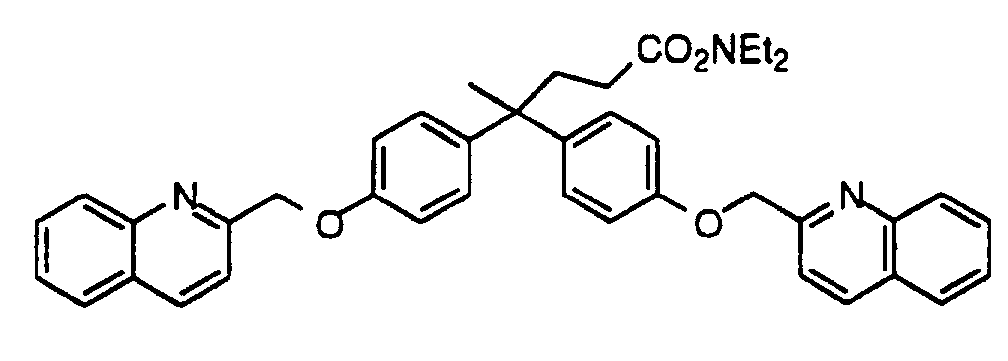
- To a solution in methylene chloride (10 mL) of 4,4-bis-(4-(2-quinolylmethoxy)phenyl) pentanoic acid (570 mg, 1 mmol), prepared as in Example 1, was added 1,1'-carbonyldiimidazole (162 mg, 1.1 mmol) and the resulting mixture was stirred at room temperature for 25 minutes. N,N-Diethylhydroxylamine (0.14 mL, 1.2 mmol) was then added and stirring was continued for additional 30 minutes. The solution was concentrated in vacuo and the residue was purified by chromatography on silica gel (methylene chloride-ethyl acetate 4:1) to afford 420 mg (66 %) of 4,4-bis(4-(2-quinolylmethoxy)phenyl)pentanoic acid N,N-diethylhydroxylamine ester: 1H NMR (300 MHz, DMSO-d6) d 0.92 (t, 6H, J = 7 Hz), 1.51 (s, 3H), 2.03 (m, 2H), 2.30 (m, 2H), 2.75 (q, 4H, J = 7 Hz), 5.32 (s, 4H), 6.98 (d, 4H, J = 9 Hz), 7.09 (d, 4H, J = 9 Hz), 7.65 (m, 4H), 7.78 (m, 2H), 8.00 (m, 4H), 8.41 (d, 2H, J = 9 Hz); MS (DCI-NH3) m/e 640 (M+H)+. Anal. Calc'd. for C41H41N3O4: C, 76.97; H, 6.46; N, 6.57. Found: C, 76.82; H, 6.49; N, 6.50.
-
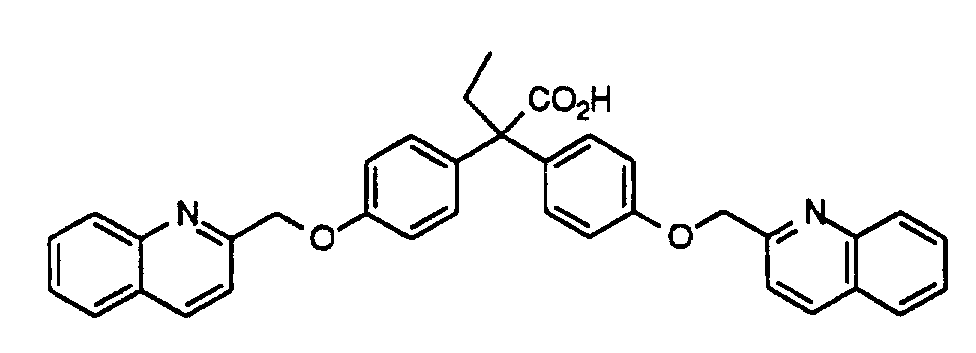
- The desired product was prepared according to the procedure of Example 12, except substituting 2-ketobutyric acid for pyruvic acid: mp 83-92°C; 1H NMR (300 MHz, DMSO-d6) d 0.65 (m, 3H), 2.25 (m, 2H), 5.35 (s, 4H), 7.00 (d, 4H, J = 9 Hz), 7.16 (d, 4H, J = 9 Hz), 7.63 (m, 2H), 7.68 (d, 2H, J = 9 Hz), 7.79 (m, 2H), 8.01 (m, 4H), 8.42 (d, 2H, J = 9 Hz), 12.54 (br s, 1H); MS (DCI-NH3) m/e 555 (M+H)+. Anal. Calc'd. for C36H30N2O4•0.55 H2O: C, 76. 59; H, 5.55; N, 4.96. Found: C, 76.90; H, 5.78; N, 4.57.
-
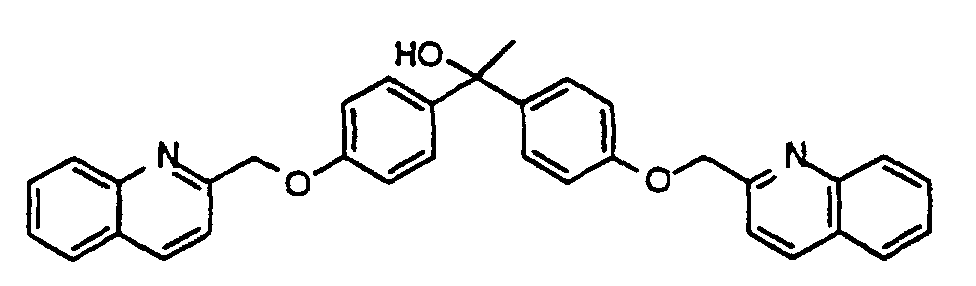
- To a solution of 4-4'-dihydroxybenzophenone (4.22 g, 20 mmol) and K2CO3 (16.5 g, 120 mmol) in DMF (75 mL) was added 2-chloromethylquinoline hydrochloride (8.56 g, 40 mmol) and the resulting solution was stirred at 60 °C or 16 hours. The reaction mixture was then poured into ice water (100 mL and the resulting solid was collected by filtration, slurried in 20% ether/hexane, filtered, and dried in vacuo to afford bis(4-(2-quinolylmethoxy)phenyl) ketone (9.3 g, 94%) as white solid.
- To a -78 °C solution in THF (20 mL) of bis(4-(2-quinolylmethoxy)phenyl) ketone (992 mg, 2 mmol), prepared as in step 1, was added methylmagnesium bromide (3M solution in ethyl ether, 0.8 mL, 2.4 mmol) and the resulting mixture was stirred at room temperature for 12 hours. The mixture was then quenched with saturated aqueous ammonium chloride and extracted with ethyl acetate. The organic phase was washed with water and brine, dried over MgSO4, filtered, and concentrated in vacuo. The residue was purified by chromatography on silica gel (methylene chloride-ethyl acetate 4:1) to afford 920 mg (90%) of 1,1-bis(4-(2-quinolylmethoxy)phenyl)ethanol: mp 129-131°C; 1H NMR (300 MHz, DMSO-d6) d 1.74 (s, 3H), 5.32 (s, 4H), 5.48 (s, 1H), 6.95 (d, 4H, J = 9 Hz), 7.30 (d, 4H, J = 9 Hz), 7.63 (m, 4H), 7.78 (m, 2H), 8.01 (m, 4H), 8.39 (d, 2H, J = 8 Hz); MS (DCI-NH3) m/e 513 (M+H)+. Anal. Calc'd. for C34H28N2O3: C, 79.67; H, 5.51; N, 5.46. Found: C, 79.48; H, 5.62; N, 5.25.
-
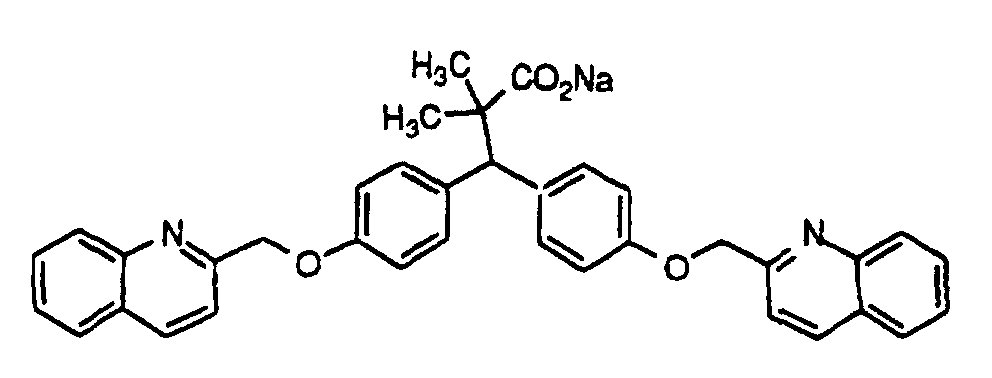
- To a stirred 0 °C solution in methanol (2 mL) of phenol (3.76 g, 40 mmol) and methyl-3-carboxaldehyde-2,2-dimethyl propionate (2.6 g, 20 mmol) was added dropwise 10 g of sulfuric acid. The deep red solution was stirred in the ice bath for 0.5 hours and at room temperature for an additional 3 hours. The mixture was poured into 300 mL water and extracted with ether (2 x 300 mL). The combined ether extracts were washed twice with saturated aqueous NaHCO3, twice with water, and once with brine. The organic layer was dried over MgSO4, filtered, and concentrated in vacuo. The residue purified by column chromatography on silica gel (35% ethyl acetate / hexanes) to give 1.1g (18%) of methyl ester intermediate as a white semisolid.
- To a stirred solution in DMF (50 mL) of 2,2-dimethyl-3,3-bis(4-hydroxyphenyl)propionic acid methyl ester (1.1 g, 3.7 mmol), prepared as in step 1, was added Cs2CO3 (2.5 g, 7.7 mmol) and the mixture stirred 0.5 hours at room temperature. 2-Chloromethyquinoline (1.37g, 7.7 mmol) was added as a solid in small portions. The reaction mixture was stirred overnight at room temperature. The mixture was poured into 300 mL of water and extracted with ether (2 X 200 mL). Brine was added to the aqueous layer and it was extracted twice with ether. The combined ether extracts were washed with brine, dried over MgSO4 filtered, and concentrated in vacuo to give a light yellow oil. Chromatography on silica gel (40% ethyl acetate / hexanes) gave 1.68 g (78%) of 2,2-dimethyl-3,3-bis(4-(2-quinolylmethoxy)phenyl)propionic acid methyl ester as a white foam.
- To a solution in methanol (8 mL) and THF (4 mL) of 2,2-dimethyl-3,3-bis(4-(2-quinolylmethoxy)phenyl)propionic acid methyl ester (0.4 g, 0.69 mmol), prepared as in step 2, was added LiOH•H2O (4 ml, 4 mmole, 1 M solution) dropwise, and the mixture was stirred overnight after which an additional 2 mL of the LiOH solution was added and the mixture was stirred an additional 24 hours. The mixture was concentrated to dryness, acidified with excess 0.5 M citric acid, diluted with water and extracted with ethyl acetate (3 x 50 mL). The combined organic layers were washed with brine, dried over MgSO4, filtered, and concentrated in vacuo. Purification by chromatography on silica gel (7% MeOH/CH2Cl2) provided 0.16 g (40%) of 2,2-dimethyl-3,3-bis(4-(2-quinolylmethoxy)phenyl)propionic acid as a white solid: mp 124-127°C. Anal. Calc'd. for C37H32N2O4: C, 78.14; H, 5.67; N 4.92. Found C, 77.45; H, 5.74; N, 4.67.
- To a solution in THF (10 mL) and ethanol (8 mL) of 2,2-dimethyl-3,3-bis(4-(2-quinolylmethoxy)phenyl)propionic acid (0.128 g, .225 mmol), prepared as in step 3, was added one equivalent of NaOH (2.3 mL, 0.1 N NaOH). The reaction was stirred for 1 hour at room temperature, concentrated, and dried under high vacuum to provide 2,2-dimethyl-3,3-bis(4-(2-quinolylmethoxy)phenyl)propionic acid sodium salt as a white powder 0.13 g (99%): mp 250-255°C (dec); 1H NMR (300 MHz, DMSO-d6) d 0.91 (s, 6H), 4.46 (s, 1H), 5.29 (s, 4H), 6.87 (d, 4H, J = 9 Hz), 7.15 (d, 4H, J = 9 Hz), 7.61 (m, 2H), 7.67 (d, 4H, J = 9 Hz), 7.78 (m, 2H), 8.00 (t, 4H, J = 9 Hz), 8.40 (d, 2H, J = 9 Hz); MS m/e (FAB+) 569 (M+H)+, (FAB-) 567 (M-H)-. Anal. Calc'd. for C37H31N2O4Na•0.5 H2O: C, 74.10; H, 5.37; N 4.67. Found C, 74.02; H, 5.24; N, 4.50.
-

- To a stirred solution in THF (50 mL) at ambient temperature of 2,2-dimethyl-3,3-bis(4-(2-quinolylmethoxy)phenyl)propionic acid methyl ester (1.33 g, 2.28 mmole), prepared as in Example 26, step 2, was added LiAlH4 (0.09 g, 2.5 mmol) in a single portion. The mixture was stirred 3 hours at ambient temperature. Water (0.1 mL) was added followed by aqueous 1N NaOH (0.1 ml) and water (0.5 mL). The mixture was then concentrated to dryness and partitioned between water and ethyl acetate. The organic layer was washed with brine, dried over MgSO4, filtered, and concentrated in vacuo. Purification by chromatography on silica gel (60% ethylacetate / hexanes) gave 1.01 g (80%) of 2,2-dimethyl-3,3-bis(4-(2-quinolylmethoxy)phenyl)-propan-1-ol as a yellow foam.
- To a -78 °C solution in methylene chloride (15 mL) of 2,2-dimethyl-3,3-bis(4-(2-quinolylmethoxy)phenyl)propan-1-ol (0.4 g, 0.72 mmol), prepared as in step 1, and DMSO (0.17 g, 2.17 mmol) was added oxalyl chloride (0.14 g, 1.08 mmol) and the reaction mixture was stirred for 0.5 hours. Triethylamine (0.37 g, 3.6 mmol) was added via syringe, the ice bath was removed, and the reaction was allowed to warm to room temperature. The mixture was concentrated in vacuo and triturated with dry THF. The THF solution was filtered and washed with additional THF. The THF solution and washings were combined and concentrated in vacuo to give crude 2,2-dimethyl-3,3-bis(4-(2-quinolylmethoxy)phenyl)propanal which was used without further purification for oxime formation.
- The desired compound was prepared according to the method of Example 7, step 2, except substituting 2,2-dimethyl-3,3-bis(4-(2-quinolylmethoxy)phenyl)-propanal, prepared as in step 2, for 4,4-bis(4-(2-quinolylmethoxy)phenyl)pentanal.
- The desired compound was prepared according to the method of Example 2, except substituting [2,2-dimethyl-3,3-bis(4-(2-quinolylmethoxy)phenyl)prop-1-yl]oximinoacetic acid, prepared as in step 2, for 4,4-bis(4-(2-quinolylmethoxy)-phenyl)pentanoic acid: 1H NMR (300 MHz, DMSO-d6) d 1.03 (s, 6H), 3.89 (s, 1H), 4.06 (s, 2H), 5.32 (s, 4H), 6.97 (d, 4H, J = 9 Hz), 7.31 (d, 4H, J = 9 Hz), 7.46 (s, 1H), 7.65 (m, 4H), 7.78 (m, 2H), 8.01 (t, 4H, J = 9 Hz), 8.40 (d, 2H, J = 9 Hz); MS (FAB+) m/e 648 (M+Na)+, 626 (M+H)+.
-

- The desired compound was prepared according to the method of Example 5, except substituting 2,2-dimethyl-3,3-bis(4-(2-quinolylmethoxy)phenyl)propan-1-ol prepared as in Example 27, step 1, for 4,4-bis(4-(2-quinolylmethoxy)phenyl)pentan-1-ol: Amorphous white solid, softens at 125 °C (decompose over next 40 °C range); 1H NMR (300 MHz, DMSO-d6) d 0.94 (s, 6H), 3.68 (s, 2H), 3.90 (s, 1H), 5.41 (s, 4H), 6.96 (d, 4H, J = 9 Hz), 7.36 (d, 4H, J = 9 Hz), 7.41 (m, 2H), 7.63 (m, 4H), 7.78 (m, 2H), 8.00 (t, 4H, J = 9 Hz), 8.39 (d, 2H, J = 9 Hz). Anal. Calc'd. for C39H35N3O5N•2.0 H2O: C, 70.78; H, 5.94: N 6.34, Found C, 71.25; H, 5.28; N 6.39.
-
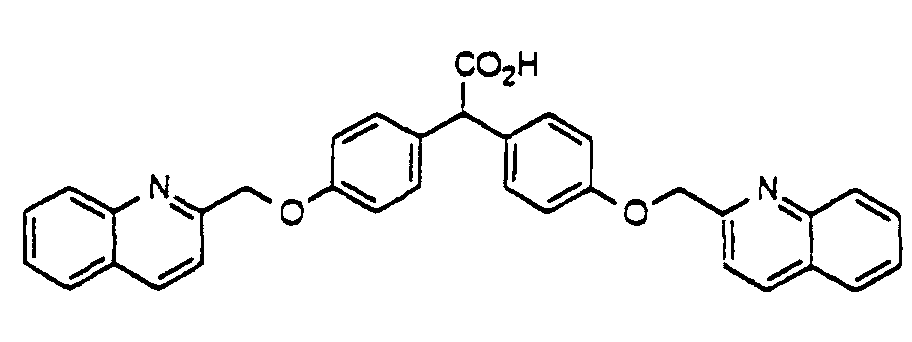
- The title compound was prepared according to the procedure of Example 12, except substituting glyoxylic acid for pyruvic acid: mp 119-128°C; 1H NMR (300 MHz, DMSO-d6) d 4.91 (s, 1H), 5.34 (s, 4H), 7.01 (d, 4H, J = 7.5 Hz), 7.23 (d, 4H, J = 7.5 Hz), 7.62 (t, 2H, J = 7.5 Hz), 7.66 (d, 2H, J = 7.5 Hz), 7.79 (t, 2H, J = 7.5 Hz), 8.01 (t, 4H, J = 7.5 Hz), 8.40 (d, 2H, J = 7.5 Hz). MS (DCI-NH3) m/e 527 (M+H)+. Anal. Calc'd. for C34H26N2O4•H2O: C, 74.98; H. 5.18; N, 5.14. Found: C, 74.97; H, 4.75; N, 5.02.
-
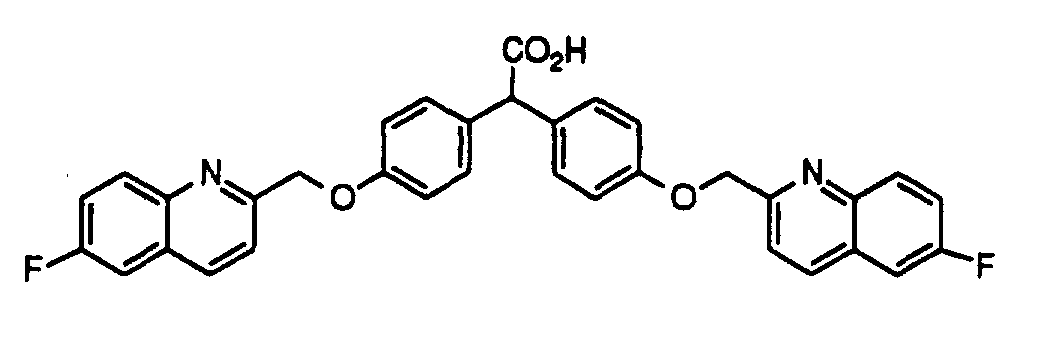
- The title compound was prepared according to the procedure of Example 12, except substituting glyoxylic acid for pyruvic acid, and substituting 2-chloromethyl-6-fluoroquinoline for 2-chloromethylquinoline: mp 221-223°C; 1H NMR (300 MHz, DMSO-d6) d 4.92 (s, 1H), 5.33 (s, 4H), 7.01 (d, 4H, J = 7.5 Hz), 7.23 (d, 4H, J = 7.5 Hz), 7.70 (m, 4H), 7.82 (dd, 2H, J = 2.5, 9.0 Hz), 8.08 (m, 2H), 8.40 (d, 2H, J = 7.5 Hz); MS (DCI-NH3) m/e 563(M+H)+. Anal. Calc'd. for C34H26N2O4: C, 72.59; H, 4.30; N, 4.97. Found: C, 72.36; H, 4.22; N, 4.76.
-
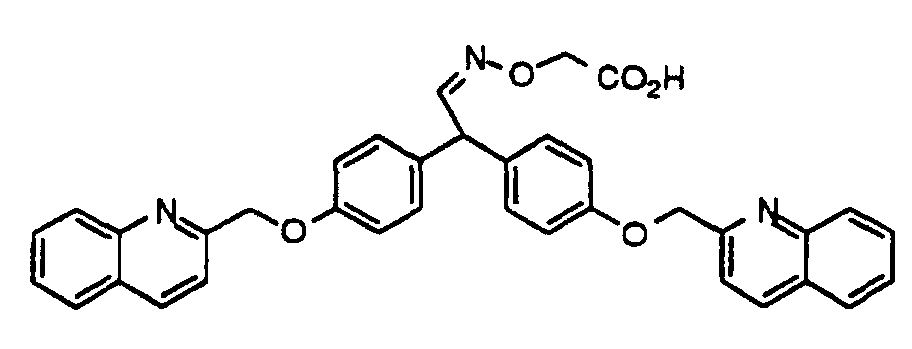
- The desired compound was prepared according to the method of Example 1, steps 1 and 2, except substituting 2,2-bis(4-hydroxyphenyl)acetic acid, prepared as in Example 29, for 4,4-bis(4-hydroxyphenyl)pentanoic acid.
- The title compound was prepared according to the procedure of Example 27, steps 1-3, except substituting 2,2-bis(4-hydroxyphenyl)acetic acid methyl ester, prepared as in step 1, for methyl 2,2-dimethyl-3,3-bis(4-(2-quinolylmethoxy)phenyl)-propionate: mp 104-108°C; 1H NMR (300 MHz, DMSO-d6) d 4.18 (s, 2H), 4.72 (d, 1H, J = 7.5 Hz), 5.33 (s, 4H), 7.01 (d, 4H, J = 7.5 Hz), 7.28 (d, 4H, J = 7.5 Hz), 7.64 (m, 4H), 7.78 (t, 2H, J = 7.5 Hz), 7.98 (m, 5H), 8.40 (d, 2H, J = 7.5 Hz); MS (FAB+) m/e 584 (M+H)+, (FAB-) m/e 582 (M-H)- .Anal. Calc'd. for C36H29N3O5•1.5 H2O: C, 70.80; H, 5.28; N, 6.88. Found: C, 71.07; H, 5.03; N, 6.61.
- The desired compound was prepared according to the method of Example 2, except substituting 2,2-bis(4-(2-quinolylmethoxy)phenyl)-1-ethyloximinoacetic acid, prepared as in Example 31, for 4,4-bis(4-(2-quinolylmethoxy)phenyl)pentanoic acid: mp 138-145°C; 1H NMR (300 MHz, DMSO-d6) d 4.04 (s, 2H), 4.12 (s, 1H), 4.72 (d, 1H, J = 7.5 Hz), 5.33 (s, 4H), 7.01 (d, 4H, J = 7.5 Hz), 7.28 (d, 4H, J = 7.5 Hz), 7.64 (m, 4H), 7.78 (t, 2H, J = 7.5 Hz), 8.00 (m, 4H), 8.40 (d, 2H, J = 7.5 Hz). MS (DCI-NH3) m/e 606 (M+Na)+, 584 (M+H)+.
-
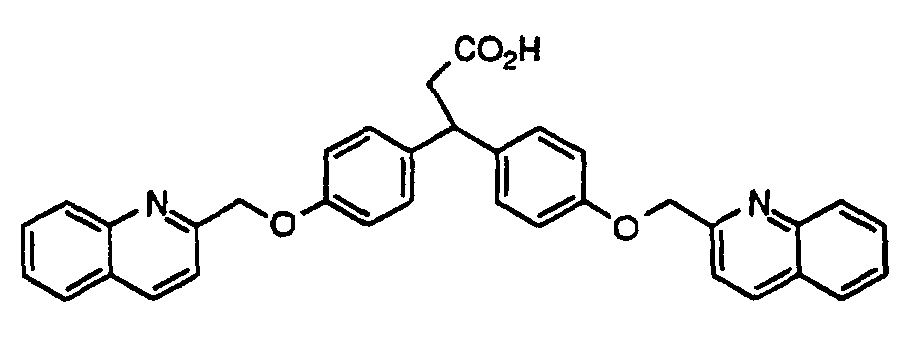
- The desired compound was prepared according to the procedure of Example 26, except substituting ethyl 3,3-diethoxypropionate in ethanol for methyl 3-carboxaldehyde-2,2-dimethyl propionate in methanol: mp 94-111°C; 1H NMR (300 MHz, DMSO-d6) d 2.93 (d, 2H, J = 7.5 Hz), 4.31 (t, 1H, J = 7.5 Hz), 5.31 (s, 4H), 6.95 (d, 4H, J = 8.0 Hz), 7.23 (d, 4H, J = 8.0 Hz), 7.62 (m, 4H), 7.78 (t, 2H, J = 7.5 Hz), 8.00 (t, 4H, J = 7.5 Hz), 8.40 (d, 2H, J = 7.5 Hz); MS (DCI-NH3) m/e 541 (M+H)+. Anal. Calc'd. for C35H28N2O4•H2O: C, 75.25; H, 5.41; N, 5.01. Found: C, 75.09; H, 5.19; N, 4.93.
- The desired compound was prepared according to the method of Example 2, except substituting 3,3-bis(4-(2-quinolylmethoxy)phenyl)propionic acid, prepared as in Example 33, for 4,4-bis(4-(2-quinolylmethoxy)phenyl)pentanoic acid: mp 224-232°C; 1H NMR (300 MHz, DMSO-d6) d 2.44 (d, 2H, J = 7.5 Hz), 4.31 (t, 1H, J = 7.5 Hz), 5.29 (s, 4H), 6.89 (d, 4H, J = 9.0 Hz), 7.12 (d, 4H, J = 9.0 Hz), 7.62 (m, 4H), 7.78 (t, 2H, J = 7.5 Hz), 8.00 (t, 4H, J = 7.5 Hz), 8.40 (d, 2H, J = 7.5 Hz); MS (DCI-NH3) m/e 541 (M+H)+.
-

- To a stirred solution in CH2Cl2 (0.5 mL), THF (20 mL), and pyridine (20 mL) of 2,2-bis(4-hydroxyphenyl)acetic acid (0.94 g, 3.85 mmol), prepared as in Example 31, was added 1-(3-dimethylaminopropyl)-3-ethylcarbodiimide (1.10 g, 5.76 mmol), glycine methyl ester hydrochloride (0.723 g, 5.76 mmol), and N-methylmorpholine (0.63 mL, 5,76 mmol) and the mixture was stirred overnight at room temperature. The reaction mixture was then diluted with ethyl acetate and aqueous 0.5 N HCl. The organic layer was washed with 0.5 N HCl (3X), saturated aqueous NaHCO3 (3X), and brine, dried over MgSO4, filtered, and concentrated in vacuo. The residue was dried to constant weight on high vacuum to give 1.05 g (87%) of 2,2-bis(4-hydroxyphenyl)acetic acid-N-carboxymethyl amide.
- The desired compound was prepared according to the method of Example 1, steps 1-3, except substituting 2,2-bis(4-hydroxyphenyl)acetic acid-N-carboxymethyl amide, prepared as in step 1, for 4,4-bis(4-hydroxyphenyl)pentanoic acid: mp 228-231°C; 1H NMR (300 MHz, DMSO-d6) d 3.79 (d, 2H, J = 6.5 Hz), 4.93 (s, 1H), 5.34 (s, 4H), 7.00 (d, 4H, J = 7.5 Hz), 7.22 (d, 4H, J = 7.5), 7.63 (m, 4H), 7.79 (t, 2H, J = 7.5 Hz), 8.01 (m, 4H), 8.44 (m, 3H), 12.52 (s, 1H); MS (DCI-NH3) m/e 584 (M+H)+. Anal. Calc'd. for C36H29N3O5: C, 74.08; H,5.01; N, 7.20. Found: C, 73.81; H, 5.20; N, 6.90.
-

- To a 0 °C solution in THF (40 mL) of 3,3-bis(4-(2-quinolylmethoxy)phenyl)-butanoic acid ethyl ester (3.2 g , 5.5 mmol), prepared as in Example 13, was added slowly a solution of LiAlH4 (1.0 M, 6 mL, 6.0 mmol). The mixture was stirred for 2 hours and water (15 mL) was added slowly followed by aqueous 1N NaOH. The reaction mixture was diluted with THF (20 mL) and the mixture was filtered through a celite pad. The filtrate was extracted with ether and the organic extract was washed with water and brine, dried over MgSO4, filtered, and concentrated in vacuo to provide 3,3-bis(4-(2-quinolylmethoxy)phenyl)butan-1-ol (2.4 g) as a pale yellow foam.
- The desired compound was prepared according to the method of Example 5, steps 1 and 2, except substituting 3,3-bis(4-(2-quinolylmethoxy)phenyl)butan-1-ol, prepared as in step 1, for 4,4-bis(4-(2-quinolylmethoxy)phenyl)pentan-1-ol.
- The desired compound was prepared according to the method of Example 6, except substituting O-[4,4-bis(4-(2-quinolylmethoxy)phenyl)but-1-yl]hydroxylamine for O-[4,4-bis(4-(2-quinolylmethoxy)phenyl)pent-1-yl]hydroxylamine: mp 94-96°C; 1H NMR (300 MHz, DMSO-d6), d 1.58 (s, 3H), 1.80 (s, 3H), 2.39 (m, 2H), 3.85 (m, 2H), 5.32 (s, 4H), 6.97 (d, 4H, J = 9 Hz), 7.11 (d, 4H, J = 9 Hz), 7.64 (m, 4H), 7.78 (m, 2H), 7.99 (t, 4H, J = 9 Hz), 8.41 (d, 2H, J = 9 Hz). MS (FAB) m/e 626 (M+H)+. Anal. Calc'd. for: C39H35N305•H20: C, 72.71; H, 5.47; N, 6.53. Found: C, 72.35; H, 5.42; N, 6.40.
- The following additional examples are prepared according to the method described in Example 1, except substituting the requisite heteroarylmethylhalide W-CH2X where X is Cl, Br, or I for 2-chloromethylquinoline hydrochloride.
-

-

-

-
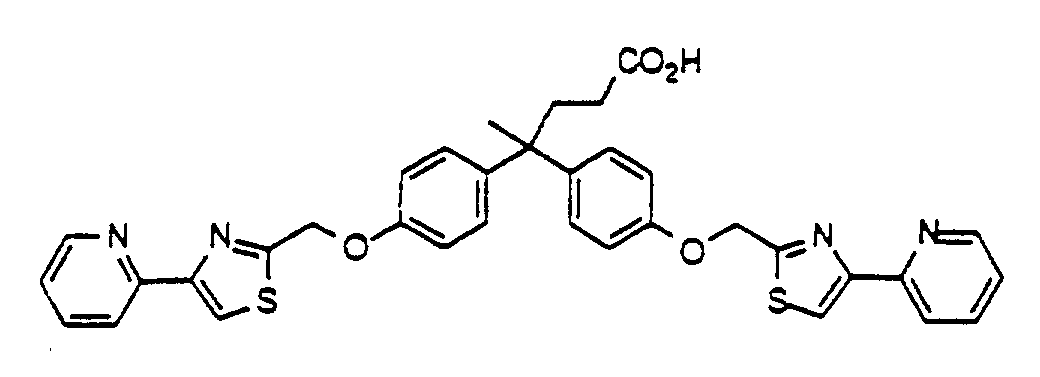
-
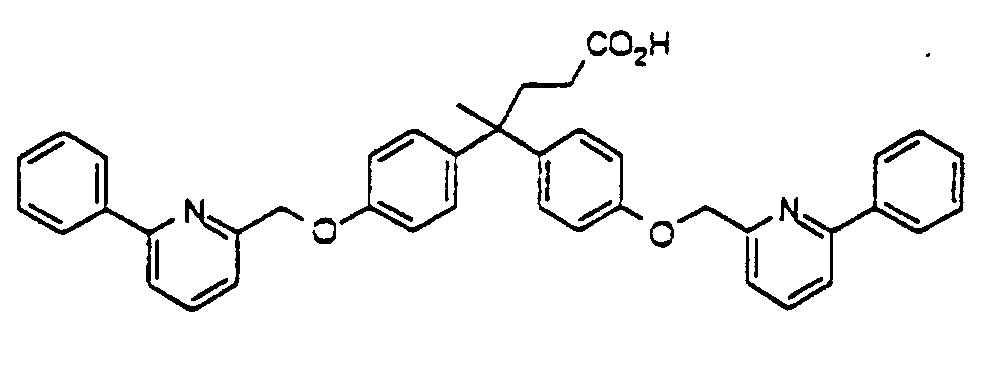
-
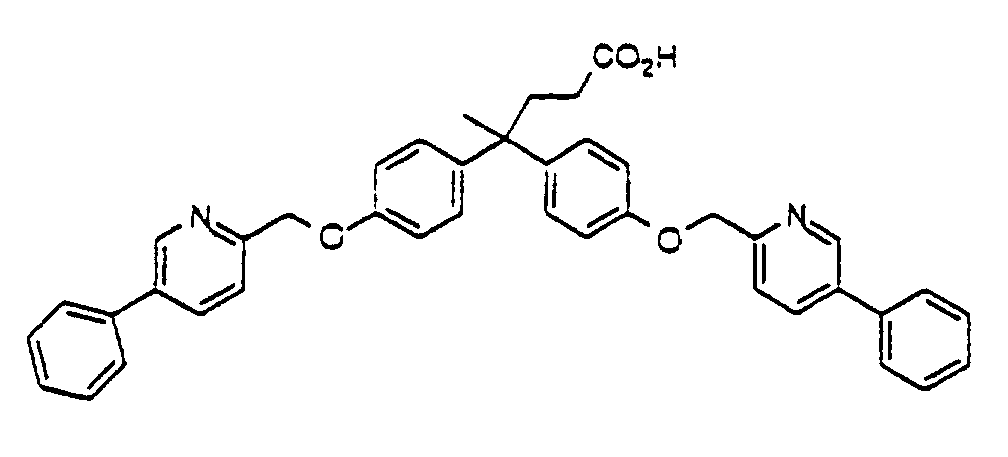
-
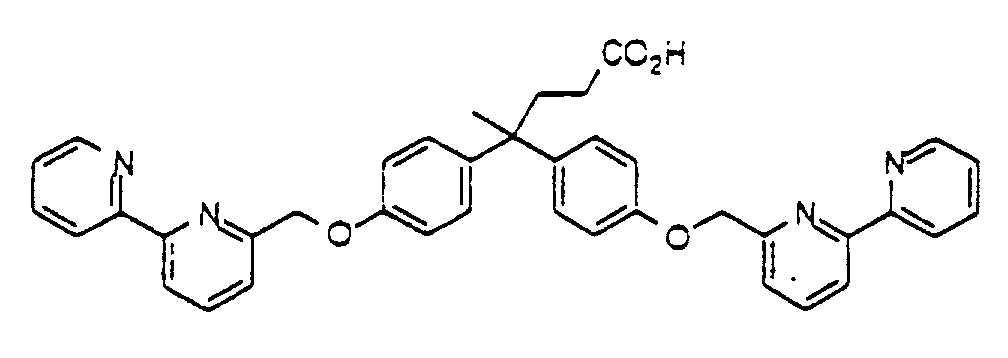
-

Claims (13)
- A compound of formula:or a pharmaceutically acceptable salt thereof:

whereinW is the same at each occurrence and is selected from the group consisting of(a) quinolyl;(b) quinolyl substituted with a substituent selected from the group consisting of:halogen,alkyl of one to six carbon atoms,phenyl,phenyl substituted with a substituent selected from the group consisting of:halogen,alkyl of one to six carbon atoms,haloalkyl of one to six carbon atoms, andalkoxy of one to six carbon atoms;pyridyl; andpyridyl substituted with a substituent selected from the group consisting of:halogen,alkyl of one to six carbon atoms, and,alkoxy of one to six carbon atoms,(c) benzothiazolyl;(d) benzothiazolyl substituted with a substituent selected from the group consisting of:halogen,alkyl of one to six carbon atoms,phenyl,phenyl substituted with a substituent selected from the group consisting of:halogen,alkyl of one to six carbon atoms,haloalkyl of one to six carbon atoms, andalkoxy of one to six carbon atoms,pyridyl, andpyridyl substituted with a substituent selected from the group consisting of:halogen,alkyl of one to six carbon atoms, andalkoxy of one to six carbon atoms;(e) benzoxazolyl;(f) benzoxazolyl substituted with a substituent selected from the group consisting of:halogen,alkyl of one to six carbon atoms,phenyl,phenyl substituted with a substituent selected from the group consisting of:halogen,alkyl of one to six carbon atoms,haloalkyl of one to six carbon atoms, andalkoxy of one to six carbon atoms,pyridyl, andpyridyl substituted with a substituent selected from the group consisting of:halogen,alkyl of one to six carbon atoms, andalkoxy of one to six carbon atoms;(g) benzimidazolyl;(h) benzimidazolyl substituted with a substituent selected from the group consisting of:halogen,alkyl of one to six carbon atoms,phenyl,phenyl substituted with a substituent selected from the group consisting of:halogen,alkyl of one to six carbon atoms,haloalkyl of one to six carbon atoms, andalkoxy of one to six carbon atoms,pyridyl, andpyridyl substituted with a substituent selected from the group consisting of:halogen,alkyl of one to six carbon atoms, andalkoxy of one to six carbon atoms;(i) quinoxalyl;(j) quinoxalyl substituted with a substituent selected from the group consisting of:halogen,alkyl of one to six carbon atoms,phenyl,phenyl substituted with a substituent selected from the group consisting of:halogen,alkyl of one to six carbon atoms,haloalkyl of one to six carbon atoms, andalkoxy of one to six carbon atoms,pyridyl, andpyridyl substituted with a substituent selected from the group consisting of:halogen,alkyl of one to six carbon atoms, andalkoxy of one to six carbon atoms;(k) pyridyl;(l) pyridyl substituted with a substituent selected from the group consisting of:phenyl,phenyl substituted with a substituent selected from the group consisting of:halogen,alkyl of one to six carbon atoms,haloalkyl of one to six carbon atoms, andalkoxy of one to six carbon atoms,pyridyl, andpyridyl substituted with a substituent selected from the group consisting of:halogen,alkyl of one to six carbon atoms, andalkoxy of one to six carbon atoms;(m) pyrimidyl;(n) pyrimidyl substituted with a substituent selected from the group consisting of:phenyl,phenyl substituted with a substituent selected from the group consisting of:halogen,alkyl of one to six carbon atoms,haloalkyl of one to six carbon atoms, andalkoxy of one to six carbon atoms,pyridyl, andpyridyl substituted with a substituent selected from the group consisting of:halogen,alkyl of one to six carbon atoms, andalkoxy of one to six carbon atoms;(o) thiazolyl, and(p) thiazolyl substituted with a substituent selected from the group consisting of:phenyl,phenyl substituted with a substituent selected from the group consisting of:halogen,alkyl of one to six carbon atoms,haloalkyl of one to six carbon atoms, andalkoxy of one to six carbon atoms,pyridyl, andpyridyl substituted with a substituent selected from the group consisting of:halogen,alkyl of one to six carbon atoms, andalkoxy of one to six carbon atoms;R1 and R2 are independently selected from the group consisting of:(a) hydrogen,(b alkyl of one to six carbon atoms,(c) halolalkyl of one to six carbon atoms,(d) alkoxy of one to six carbon atoms, and(e) halogen;R3 is selected from the group consisting of(a) hydrogen and(b) alkyl of one to six carbon atoms;X is absent or is selected from the group consisting of:(a) alkylene of one to six carbon atoms,(b) alkenylene of one to six carbon atoms, and(c) alkynylene of one to six carbon atoms;Z is selected from the group consisting of:(a) -COM,(b) -CH=N-O-A-COM,(c) -CH2-0-N=A-COM, and(d) -OR3 where R3 is hydrogen or alkyl of one to six carbon atoms whereinA is selected from the group consisting of(a) alkylene of one to six carbon atoms, and(b) cycloalkylene of three to eight carbon atoms; andM is selected from the group consisting of(a) -O- attached to a pharmaceutically acceptable metabolically cleavable group, which is readily cleaved in vivo from the compound bearing it, said group being selected from the group consisting of acetyl, propionyl, butyryl, benzoyl, ethoxycarbonyl, trimethylsilyl, triethylsilyl and succinyl,(b) -OR3 where R3 is selected from the group consisting of:hydrogen, andalkyl of one to six carbon atoms, and(c) -NR7R8 where R7 and R8 are independently selected from the group consisting of:or R7 and R8 taken together define a five- to eight-membered ring, with the proviso that R7 and R8 may not simultaneously be hydroxyl,hydrogen,alkyl of one to six carbon atoms,hydroxy, andalkoxy of one to six carbon atoms,(d) -NR3SO2R9 wherein R3 is as defined above and R9 is alkyl of one to six carbon atoms,(e) -NH-tetrazolyl, and(f) glycinyl. - A compound or pharmaceutically acceptable salt thereof as defined by Claim 1 wherein Z is selected from the group consisting of(a) COM,(b) CH=N-O-A-COM,(c) CH2-0-N=A-COM, and(d) OH wherein A is alkylene of one to six carbon atoms, and M is -OH.
- A compound or pharmaceutically acceptable salt thereof as defined by Claim 1 wherein Z is COM wherein M is -OH.
- A compound or pharmaceutically acceptable salt thereof as defined by Claim 3 wherein X is alkylene of one to six carbon atoms.
- A compound or pharmaceutically acceptable salt thereof as defined by Claim 2 or 4 wherein W is the same at each occurrence and is selected from the group consisting of:(a) pyridyl;(b) pyridyl substituted with a substituent selected from the group consisting of:phenyl,phenyl substituted with a substiment selected from the group consisting of:halogen,alkyl of one to six carbon atoms,haloalkyl of one to six carbon atoms, andalkoxy of one to six carbon atoms,pyridyl, andpyridyl substituted with a substituent selected from the group consisting of:halogen,alkyl of one to six carbon atoms, andalkoxy of one to six carbon atoms;(c) pyrimidyl;(d) pyrimidyl substituted with a substituent selected from the group consisting of:phenyl,phenyl substituted with a substituent selected from the group consisting of:halogen,alkyl of one to six carbon atoms,haloalkyl of one to six carbon atoms, andalkoxy of one to six carbon atoms,pyridyl, andpyridyl substituted with a substituent selected from the group consisting of:halogen,alkyl of one to six carbon atoms, andalkoxy of one to six carbon atoms;(e) thiazolyl, and(f) thiazolyl substituted with a substituent selected from the group consisting of:phenyl,phenyl substituted with a substituent selected from the group consisting of:halogen,alkyl of one to six carbon atoms,haloalkyl of one to six carbon atoms, andalkoxy of one to six carbon atoms,pyridyl, andpyridyl substituted with a substituent selected from the group consisting of:halogen,alkyl of one to six carbon atoms, andalkoxy of one to six carbon atoms.
- A compound or pharmaceutically acceptable salt thereof as defined by Claim 2 or 4 wherein W is the same at each occurrence and is selected from the group consisting of:(a) quinolyl;(b) quinolyl substituted with a substituent selected from the group consisting of:halogen,alkyl of one to six carbon atoms,phenyl,phenyl substituted with a substituent selected from the group consisting of:halogen,alkyl of one to six carbon atoms,haloalkyl of one to six carbon atoms, andalkoxy of one to six carbon atoms;pyridyl; andpyridyl substituted with a substituent selected from the group consisting of:halogen,alkyl of one to six carbon atoms, and,alkoxy of one to six carbon atoms,(c) benzothiazolyl;(d) benzothiazolyl substituted with a substituent selected from the group consisting of:halogen,alkyl of one to six carbon atoms,phenyl,phenyl substituted with a substituent selected from the group consisting of:halogen,alkyl of one to six carbon atoms,haloalkyl of one to six carbon atoms, andalkoxy of one to six carbon atoms,pyridyl, andpyridyl substituted with a substituent selected from the group consisting of:halogen,alkyl of one to six carbon atoms, andalkoxy of one to six carbon atoms;(e) benzoxazolyl;(f) benzoxazolyl substituted with a substituent selected from the group consisting of:halogen,alkyl of one to six carbon atoms,phenyl,phenyl substituted with a substituent selected from the group consisting of:halogen,alkyl of one to six carbon atoms,haloalkyl of one to six carbon atoms, andalkoxy of one to six carbon atoms,pyridyl, andpyridyl substituted with a substituent selected from the group consisting of:halogen,alkyl of one to six carbon atoms, andalkoxy of one to six carbon atoms;(g) benzimidazolyl;(h) benzimidazolyl substituted with a substituent selected from the group consisting of:halogen,alkyl of one to six carbon atoms,phenyl,phenyl substituted with a substituent selected from the group consisting of:halogen,alkyl of one to six carbon atoms,haloalkyl of one to six carbon atoms, andalkoxy of one to six carbon atoms,pyridyl, andpyridyl substituted with a substituent selected from the group consisting of:halogen,alkyl of one to six carbon atoms, andalkoxy of one to six carbon atoms;(i) quinoxalyl; and(j) quinoxalyl substituted with a substituent selected from the group consisting of:halogen,alkyl of one to six carbon atoms,phenyl,phenyl substituted with a substituent selected from the group consisting of:halogen,alkyl of one to six carbon atoms,haloalkyl of one to six carbon atoms, andalkoxy of one to six carbon atoms,pyridyl, andpyridyl substituted with a substituent selected from the group consisting of:halogen,alkyl of one to six carbon atoms, andalkoxy of one to six carbon atoms
- A compound or pharmaceutically acceptable salt thereof as defined by Claim 2 or 4 wherein W is the same at each occurrence and is selected from the group consisting of:(a) quinolyl;(b) quinolyl substituted with a substituent selected from the group consisting of:halogen,alkyl of one to six carbon atoms,phenyl,phenyl substituted with a substituent selected from the group consisting of:halogen,alkyl of one to six carbon atoms,haloalkyl of one to six carbon atoms, andalkoxy of one to six carbon atoms;pyridyl; andpyridyl substituted with a substituent selected from the group consisting of:halogen,alkyl of one to six carbon atoms, and,alkoxy of one to six carbon atoms,(c) benzothiazolyl; and(d) benzothiazolyl substituted with a substituent selected from the group consisting of:halogen,alkyl of one to six carbon atoms,phenyl,phenyl substituted with a substituent selected from the group consisting of:halogen,alkyl of one to six carbon atoms,haloalkyl of one to six carbon atoms, andalkoxy of one to six carbon atoms,pyridyl, andpyridyl substituted with a substituent selected from the group consisting of:halogen,alkyl of one to six carbon atoms, andalkoxy of one to six carbon atoms.
- A compound or pharmaceutically acceptable salt thereof as defined by Claim 7 wherein W is the same at each occurrence and is selected from the group consisting of:(a) quinolyl; and(b) quinolyl substituted with a substituent selected from the group consisting of:halogen,alkyl of one to six carbon atoms,phenyl,phenyl substituted with a substituent selected from the group consisting of:halogen,alkyl of one to six carbon atoms,haloalkyl of one to six carbon atoms, andalkoxy of one to six carbon atoms;pyridyl; andpyridyl substituted with a substituent selected from the group consisting of:halogen,alkyl of one to six carbon atoms, and,alkoxy of one to six carbon atoms.
- A compound or pharmaceutically acceptable salt thereof as defined by Claim 1 selected from the group consisting of:4,4-bis(4-(2-quinolylmethoxy)phenyl)pentanoic acid,4,4-bis(4-(2-quinolylmethoxy)phenyl)pentanoic acid sodium salt,4,4-bis(4-(2-quinolylmethoxy)phenyl) pentanoic acid magnesium salt,4,4-bis(4-(2-quinolylmethoxy)phenyl)pentan-1-ol,[4,4-bis(4-(2-quinolylmethoxy)phenyl)pent-1-yl]iminoxyacetic acid,[4,4-bis(4-(2-quinolylmethoxy)phenyl)pent- 1-yl]-2-iminoxypropionic acid,[4,4-bis(4-(2-quinolylmethoxy)phenyl)pent-1-yl]oximinoacetic acid,4,4-bis(4-(2-benzothiazoylmethoxy)phenyl)pentanoic acid,4,4-bis(4-(2-benzothiazoylmethoxy)phenyl)pentanoic acid sodium salt,4,4-bis(4-(7-chloro-2-quinolylmethoxy)phenyl)pentanoic acid,4,4-bis(4-(7-fluoro-2-quinolylmethoxy)phenyl)pentanoic acid sodium salt,2,2-bis(4-(2-quinolylmethoxy)phenyl)propionic acid,3,3-bis(4-(2-quinolylmethoxy)phenyl)butanoic acid,5,5-bis(4-(2-quinolylmethoxy)phenyl)hexanoic acid,5,5-bis(4-(2-quinolylmethoxy)phenyl)hexanoic acid sodium salt,4,4-bis-(4-(2-pyridylmethoxy)phenyl)pentanoic acid sodium salt,4,4-bis-(4-(2-quinoxylmethoxy)phenyl)pentanoic acid sodium salt,4,4-bis(4-(1-methyl-2-benzimidazolylmethoxy)phenyl)pentanoic acid,4,4-bis(4-(1-methyl-2-benzimidazolylmethoxy)phenyl)pentanoic acid sodium salt,4,4-bis(3-chloro-4-(2-quinolylmethoxy)phenyl)pentanoic acid,4,4-bis(3-chloro-4-(2-quinolylmethoxy)phenyl)pentanoic acid sodium salt,[4,4-bis(3-chloro-4-(2-quinolylmethoxy)phenyl)pent-1-yl]-2-iminoxypropionic acid sodium salt,4,4-bis(4-(2-quinolylmethoxy)phenyl)pentanoic acid N,N-diethylhydroxyl amine-O-ester,2,2-bis(4-(2-quinolylmethoxy)phenyl)butyric acid,1,1-bis(4-(2-quinolylmethoxy)phenyl)ethanol,2,2-dimethyl-3,3-bis(4-(2-quinolylmethoxy)phenyl)propionic acid sodium salt,[2,2-dimethyl-3,3-bis(4-(2-quinolylmethoxy)phenyl)prop-1-yl]oximinoacetic acid sodium salt,2,2-dimethyl-3,3-bis(4-(2-quinolylmethoxy)phenyl)-1-propyliminoxyacetic acid,2,2-bis(4-(2-quinolymethoxy)phenyl)acetic acid,2,2-bis(4-(6-fluoro-2-quinolymethoxy)phenyl)acetic acid,2,2-bis(4-(2-quinolylmethoxy)phenyl)eth-1-yloximinoacetic acid,2,2-bis(4-(2-quinolylmethoxy)phenyl)eth-1-yloximinoacetic acid sodium salt,3,3-bis(4-(2-quinolylmethoxy)phenyl)propionic acid,3,3-bis(4-(2-quinolylmethoxy)phenyl)propionic acid sodium salt,4,4-bis(4-(2-quinolylmethoxy)phenyl)acetic acid-N-carboxymethyl amide, and[3,3-bis-(2-quinolylmethoxyphenyl)but-1-yl]-2-iminoxypropionic acid.
- A compound or pharmaceutically acceptable salt thereof as defined by Claim 1 selected from the group consisting of:4,4-bis(4-(2-quinolylmethoxy)phenyl)pentanoic acid,4,4-bis(4-(2-quinolylmethoxy)phenyl)pentanoic acid sodium salt,4,4-bis(4-(2-quinolylmethoxy)phenyl) pentanoic acid magnesium salt,4,4-bis(4-(2-benzothiazoylmethoxy)phenyl)pentanoic acid,4,4-bis(4-(2-benzothiazoylmethoxy)phenyl)pentanoic acid sodium salt,4,4-bis(4-(7-chloro-2-quinolylmethoxy)phenyl)pentanoic acid,4,4-bis(4-(7-fluoro-2-quinolylmethoxy)phenyl)pentanoic acid sodium salt,2,2-bis(4-(2-quinolylmethoxy)phenyl)propionic acid,3,3-bis(4-(2-quinolylmethoxy)phenyl)butanoic acid,5,5-bis(4-(2-quinolylmethoxy)phenyl)hexanoic acid,5,5-bis(4-(2-quinolylmethoxy)phenyl)hexanoic acid sodium salt,4,4-bis(3-chloro-4-(2-quinolylmethoxy)phenyl)pentanoic acid,4,4-bis(3-chloro-4-(2-quinolylmethoxy)phenyl)pentanoic acid sodium salt,2,2-bis(4-(2-quinolylmethoxy)phenyl)butyric acid,2,2-dimethyl-3,3-bis(4-(2-quinolylmethoxy)phenyl)propionic acid sodium salt,2,2-bis(4-(2-quinolymethoxy)phenyl)acetic acid,2,2-bis(4-(6-fluoro-2-quinolymethoxy)phenyl)acetic acid,2,2-bis(4-(2-quinolylmethoxy)phenyl)propionic acid, and2,2-bis(4-(2-quinolylmethoxy)phenyl)propionic acid sodium salt.
- Use of a compound of Claim 1 for manufacturing a medicament for inhibiting lipoxygenase activity or leukotriene biosynthesis in a mammal in need of such treatment.
- A composition for inhibiting lipoxygenase activity or the biosynthesis of leukotrienes comprising a pharmaceutical carrier and a therapeutically effective amount of a compound of Claim 1.
- A compound of Claim 1 for use as a therapeutic agent.
Applications Claiming Priority (5)
| Application Number | Priority Date | Filing Date | Title |
|---|---|---|---|
| US470695P | 1995-10-03 | 1995-10-03 | |
| US4706P | 1995-10-03 | ||
| US703441 | 1996-09-17 | ||
| US08/703,441 US5795900A (en) | 1995-10-03 | 1996-09-17 | Symmetrical bis-heteroaryl-methoxy-phenylalkyl carboxylates as inhibitors of leukotriene biosynthesis |
| PCT/US1996/015345 WO1997012867A1 (en) | 1995-10-03 | 1996-09-25 | SYMMETRICAL bis-HETEROARYLMETHOXYPHENYLALKYL CARBOXYLATES AS INHIBITORS OF LEUKOTRIENE BIOSYNTHESIS |
Publications (2)
| Publication Number | Publication Date |
|---|---|
| EP0862557A1 EP0862557A1 (en) | 1998-09-09 |
| EP0862557B1 true EP0862557B1 (en) | 2002-11-27 |
Family
ID=26673354
Family Applications (1)
| Application Number | Title | Priority Date | Filing Date |
|---|---|---|---|
| EP96932335A Expired - Lifetime EP0862557B1 (en) | 1995-10-03 | 1996-09-25 | SYMMETRICAL bis-HETEROARYLMETHOXYPHENYLALKYL CARBOXYLATES AS INHIBITORS OF LEUKOTRIENE BIOSYNTHESIS |
Country Status (13)
| Country | Link |
|---|---|
| US (2) | US5795900A (en) |
| EP (1) | EP0862557B1 (en) |
| JP (1) | JP4098828B2 (en) |
| KR (1) | KR100424549B1 (en) |
| AT (1) | ATE228504T1 (en) |
| AU (1) | AU711352B2 (en) |
| CA (1) | CA2233550C (en) |
| DE (1) | DE69625080T2 (en) |
| DK (1) | DK0862557T3 (en) |
| ES (1) | ES2188788T3 (en) |
| IL (1) | IL123385A (en) |
| PT (1) | PT862557E (en) |
| WO (1) | WO1997012867A1 (en) |
Families Citing this family (17)
| Publication number | Priority date | Publication date | Assignee | Title |
|---|---|---|---|---|
| US5691351A (en) * | 1996-02-06 | 1997-11-25 | Abbott Laboratories | Bis-(Heteroarylmethoxyphenyl)cycloalkyl carboxylates as inhibitors of leukotriene biosynthesis |
| US5668150A (en) * | 1996-07-26 | 1997-09-16 | Abbott Laboratories | Non-symmetrical bis-heteroarylmethoxyphenylalkyl carboxylates as inhibitors of leukotriene biosynthesis |
| EA011010B1 (en) | 2004-02-27 | 2008-12-30 | Эмджен, Инк. | Compounds modulating of gpr40 receptor, pharmaceutical composition, method for treating diseases responsive to the modulation of gpr40 receptor (embodiments), method for modulating gpr40 function (embodiments) and method for modulating circulating insulin concentration |
| WO2006044602A2 (en) * | 2004-10-18 | 2006-04-27 | Merck & Co., Inc. | Diphenyl substituted alkanes as flap inhiibitors |
| US7465804B2 (en) | 2005-05-20 | 2008-12-16 | Amgen Inc. | Compounds, pharmaceutical compositions and methods for their use in treating metabolic disorders |
| EP1924546A1 (en) | 2005-09-14 | 2008-05-28 | Amgen, Inc | Conformationally constrained 3- (4-hydroxy-phenyl) - substituted-propanoic acids useful for treating metabolic disorders |
| EP1954128A4 (en) * | 2005-11-04 | 2010-09-22 | Merck Sharp & Dohme | DIPHENYLMETHANE DERIVATIVES AS INHIBITORS OF BIOSYNTHESIS OF LEUKOTRIENES |
| JP2010502615A (en) * | 2006-09-01 | 2010-01-28 | メルク エンド カムパニー インコーポレーテッド | Inhibitors of 5-lipoxygenase activating protein (FLAP) |
| AU2007293028B2 (en) | 2006-09-07 | 2012-05-31 | Amgen Inc. | Heterocyclic GPR40 modulators |
| US7687526B2 (en) | 2006-09-07 | 2010-03-30 | Amgen Inc. | Benzo-fused compounds for use in treating metabolic disorders |
| JP2010511632A (en) | 2006-11-30 | 2010-04-15 | アミラ ファーマシューティカルス,インコーポレーテッド | Compositions and methods of treatment comprising 5-lipoxygenase activated protein inhibitors and nitric oxide modulators |
| CA2683751C (en) | 2007-04-16 | 2013-01-08 | Amgen Inc. | Substituted biphenyl phenoxy-, thiophenyl- and aminophenylpropanoic acid gpr40 modulators |
| KR20100090249A (en) | 2007-10-10 | 2010-08-13 | 암젠 인크 | Substituted biphenyl gpr 40 modulators |
| US8450522B2 (en) | 2008-03-06 | 2013-05-28 | Amgen Inc. | Conformationally constrained carboxylic acid derivatives useful for treating metabolic disorders |
| US8748462B2 (en) | 2008-10-15 | 2014-06-10 | Amgen Inc. | Spirocyclic GPR40 modulators |
| WO2015120038A1 (en) | 2014-02-04 | 2015-08-13 | Bioscience Pharma Partners, Llc | Use of flap inhibitors to reduce neuroinflammation mediated injury in the central nervous system |
| IT201600089576A1 (en) | 2016-09-05 | 2018-03-05 | Itt Italia Srl | METHOD AND EQUIPMENT FOR THE STUDY AND DETERMINATION OF PHYSICAL-CHEMICAL CONDITIONS OF MEMBERSHIP BETWEEN A BRAKING ELEMENT AND A BRAKE ELEMENT |
Family Cites Families (9)
| Publication number | Priority date | Publication date | Assignee | Title |
|---|---|---|---|---|
| IE58870B1 (en) * | 1985-03-08 | 1993-11-17 | Leo Pharm Prod Ltd | Pyridine derivatives |
| DE3900261A1 (en) * | 1988-05-31 | 1989-12-07 | Bayer Ag | SUBSTITUTED 4- (CHINOLIN-2-YL-METHOXY) PHENYL-ACETIC ACID DERIVATIVES |
| EP0349062A1 (en) * | 1988-06-27 | 1990-01-03 | Merck Frosst Canada Inc. | Quinoline ether alkanoic acid |
| US5077409A (en) * | 1990-05-04 | 1991-12-31 | American Cyanamid Company | Method of preparing bis-aryl amide and urea antagonists of platelet activating factor |
| US5149703A (en) * | 1991-09-06 | 1992-09-22 | Merck Frosst Canada, Inc. | Quinoline-substituted chromans and related compounds as leukotriene antagonists |
| US5358955A (en) * | 1992-10-30 | 1994-10-25 | Abbott Laboratories | Aryl and heteroarylmethoxyphenyl inhibitors of leukotriene biosynthesis |
| US5326883A (en) * | 1992-12-18 | 1994-07-05 | Abbott Laboratories | Oxime ether derivatives having lipoxygenase inhibitory activity |
| US5438141A (en) * | 1993-05-21 | 1995-08-01 | Merck Frosst Canada, Inc. | Heteroaryl and haloaryl quinoline derivatives of cyclopropaneacetic acid as leukotriene antagonists |
| US5512581A (en) * | 1994-07-18 | 1996-04-30 | Abbott Laboratories | Iminoxycarboxylates and derivatives as inhibitors of leukotriene biosynthesis |
-
1996
- 1996-09-17 US US08/703,441 patent/US5795900A/en not_active Expired - Lifetime
- 1996-09-25 WO PCT/US1996/015345 patent/WO1997012867A1/en not_active Ceased
- 1996-09-25 JP JP51431097A patent/JP4098828B2/en not_active Expired - Lifetime
- 1996-09-25 IL IL12338596A patent/IL123385A/en not_active IP Right Cessation
- 1996-09-25 EP EP96932335A patent/EP0862557B1/en not_active Expired - Lifetime
- 1996-09-25 DE DE69625080T patent/DE69625080T2/en not_active Expired - Lifetime
- 1996-09-25 CA CA2233550A patent/CA2233550C/en not_active Expired - Lifetime
- 1996-09-25 DK DK96932335T patent/DK0862557T3/en active
- 1996-09-25 AU AU71182/96A patent/AU711352B2/en not_active Expired
- 1996-09-25 AT AT96932335T patent/ATE228504T1/en active
- 1996-09-25 PT PT96932335T patent/PT862557E/en unknown
- 1996-09-25 KR KR10-1998-0705117A patent/KR100424549B1/en not_active Expired - Lifetime
- 1996-09-25 ES ES96932335T patent/ES2188788T3/en not_active Expired - Lifetime
-
1997
- 1997-10-27 US US08/958,301 patent/US5843968A/en not_active Expired - Lifetime
Also Published As
| Publication number | Publication date |
|---|---|
| KR100424549B1 (en) | 2004-07-27 |
| CA2233550C (en) | 2010-06-22 |
| ES2188788T3 (en) | 2003-07-01 |
| DE69625080D1 (en) | 2003-01-09 |
| US5795900A (en) | 1998-08-18 |
| IL123385A (en) | 2003-07-31 |
| AU7118296A (en) | 1997-04-28 |
| IL123385A0 (en) | 1998-09-24 |
| PT862557E (en) | 2003-04-30 |
| KR19990064356A (en) | 1999-07-26 |
| US5843968A (en) | 1998-12-01 |
| EP0862557A1 (en) | 1998-09-09 |
| DK0862557T3 (en) | 2003-03-24 |
| JP4098828B2 (en) | 2008-06-11 |
| AU711352B2 (en) | 1999-10-14 |
| CA2233550A1 (en) | 1997-04-10 |
| JP2001504436A (en) | 2001-04-03 |
| DE69625080T2 (en) | 2003-10-09 |
| ATE228504T1 (en) | 2002-12-15 |
| WO1997012867A1 (en) | 1997-04-10 |
Similar Documents
| Publication | Publication Date | Title |
|---|---|---|
| US5714488A (en) | Bis-heteroarylylmethoxyphenyl ketone derivatives as inhibitors of leukotriene biosynthesis | |
| US5795900A (en) | Symmetrical bis-heteroaryl-methoxy-phenylalkyl carboxylates as inhibitors of leukotriene biosynthesis | |
| US5399699A (en) | Indole iminooxy derivatives which inhibit leukotriene biosynthesis | |
| US5358955A (en) | Aryl and heteroarylmethoxyphenyl inhibitors of leukotriene biosynthesis | |
| US5750558A (en) | Oxime derivatives of indole and indene compounds as inhibitors of prostaglandin biosynthesis | |
| US5512581A (en) | Iminoxycarboxylates and derivatives as inhibitors of leukotriene biosynthesis | |
| US5326787A (en) | Cycloalkyl N-hydroxy derivatives having lipoxygenase inhibitory activity | |
| US5691351A (en) | Bis-(Heteroarylmethoxyphenyl)cycloalkyl carboxylates as inhibitors of leukotriene biosynthesis | |
| US5420282A (en) | Thiopyrano(2,3,4-c,d) indolyloxime ether alkylcarboxylates | |
| US5668146A (en) | Symmetrical bis-heteroarylmethoxyphenyliminoxyalkyl carboxylates as inhibitors of leukotriene biosynthesis | |
| US5668150A (en) | Non-symmetrical bis-heteroarylmethoxyphenylalkyl carboxylates as inhibitors of leukotriene biosynthesis | |
| US5783586A (en) | Heteroarylmethoxyphenylthioalkyl carboxylates as inhibitors of leukotriene biosynthesis | |
| US5840758A (en) | Oxime derivatives of fenamates as inhibitors of prostaglandin biosynthesis | |
| US5516795A (en) | Heteroatom substituted propanyl derivatives having 5-lipoxygenase inhibitory activity | |
| US5432194A (en) | (4-alkoxypyran-4-yl) substituted arylalkylaryl-, aryalkenylaryl-, and aryalkynylarylurea inhibitors of 5-lipoxygenase | |
| US5268379A (en) | Ether-containing inhibitors of 5-lipoxygenase | |
| CZ453699A3 (en) | Process and intermediates for preparing inhibitors of 5-lipoxygenase | |
| US5863946A (en) | Iminoxyderivatives of fenamates as inhibitors of prostaglandin biosynthesis | |
| US5407959A (en) | (Trans-1,4-dialkoxycyclohexyl) substituted arylalkylaryl-arylalkenylaryl-, and arylalkynylarylurea inhibitors of 5-lipoxygenase | |
| US5446062A (en) | ((4-alkoxypyran-4-yl) substituted) ether, arylalkyl-, arylalkenyl-, and arylalkynyl)urea inhibitors of 5-lipoxygenase | |
| MXPA99000940A (en) | Non-symmetrical bis-heteroarylmethoxyphenylalkyl carboxylates as inhibitors of leukotriene biosynthesis |
Legal Events
| Date | Code | Title | Description |
|---|---|---|---|
| PUAI | Public reference made under article 153(3) epc to a published international application that has entered the european phase |
Free format text: ORIGINAL CODE: 0009012 |
|
| 17P | Request for examination filed |
Effective date: 19980330 |
|
| AK | Designated contracting states |
Kind code of ref document: A1 Designated state(s): AT BE CH DE DK ES FI FR GB GR IE IT LI LU NL PT SE |
|
| 17Q | First examination report despatched |
Effective date: 19991206 |
|
| GRAG | Despatch of communication of intention to grant |
Free format text: ORIGINAL CODE: EPIDOS AGRA |
|
| GRAG | Despatch of communication of intention to grant |
Free format text: ORIGINAL CODE: EPIDOS AGRA |
|
| GRAH | Despatch of communication of intention to grant a patent |
Free format text: ORIGINAL CODE: EPIDOS IGRA |
|
| GRAH | Despatch of communication of intention to grant a patent |
Free format text: ORIGINAL CODE: EPIDOS IGRA |
|
| GRAA | (expected) grant |
Free format text: ORIGINAL CODE: 0009210 |
|
| AK | Designated contracting states |
Kind code of ref document: B1 Designated state(s): AT BE CH DE DK ES FI FR GB GR IE IT LI LU NL PT SE |
|
| REF | Corresponds to: |
Ref document number: 228504 Country of ref document: AT Date of ref document: 20021215 Kind code of ref document: T |
|
| REG | Reference to a national code |
Ref country code: GB Ref legal event code: FG4D |
|
| REG | Reference to a national code |
Ref country code: CH Ref legal event code: EP |
|
| REG | Reference to a national code |
Ref country code: IE Ref legal event code: FG4D |
|
| REF | Corresponds to: |
Ref document number: 69625080 Country of ref document: DE Date of ref document: 20030109 |
|
| REG | Reference to a national code |
Ref country code: CH Ref legal event code: NV Representative=s name: A. BRAUN, BRAUN, HERITIER, ESCHMANN AG PATENTANWAE |
|
| REG | Reference to a national code |
Ref country code: DK Ref legal event code: T3 |
|
| REG | Reference to a national code |
Ref country code: GR Ref legal event code: EP Ref document number: 20030400561 Country of ref document: GR |
|
| REG | Reference to a national code |
Ref country code: PT Ref legal event code: SC4A Free format text: AVAILABILITY OF NATIONAL TRANSLATION Effective date: 20030225 |
|
| REG | Reference to a national code |
Ref country code: ES Ref legal event code: FG2A Ref document number: 2188788 Country of ref document: ES Kind code of ref document: T3 |
|
| ET | Fr: translation filed | ||
| PLBE | No opposition filed within time limit |
Free format text: ORIGINAL CODE: 0009261 |
|
| STAA | Information on the status of an ep patent application or granted ep patent |
Free format text: STATUS: NO OPPOSITION FILED WITHIN TIME LIMIT |
|
| 26N | No opposition filed |
Effective date: 20030828 |
|
| REG | Reference to a national code |
Ref country code: CH Ref legal event code: PFA Owner name: ABBOTT LABORATORIES Free format text: ABBOTT LABORATORIES#CHAD 0377/AP6D-2, 100 ABBOTT PARK ROAD#ABBOTT PARK, ILLINOIS 60064-3500 (US) -TRANSFER TO- ABBOTT LABORATORIES#CHAD 0377/AP6D-2, 100 ABBOTT PARK ROAD#ABBOTT PARK, ILLINOIS 60064-3500 (US) |
|
| REG | Reference to a national code |
Ref country code: PT Ref legal event code: PC4A Owner name: ABBVIE INC., US Effective date: 20130410 |
|
| REG | Reference to a national code |
Ref country code: ES Ref legal event code: PC2A Owner name: ABBVIE INC. Effective date: 20130618 Ref country code: ES Ref legal event code: PC2A Owner name: ABBVIE INC. Effective date: 20130624 |
|
| REG | Reference to a national code |
Ref country code: NL Ref legal event code: SD Effective date: 20130819 |
|
| REG | Reference to a national code |
Ref country code: GB Ref legal event code: 732E Free format text: REGISTERED BETWEEN 20130815 AND 20130821 |
|
| REG | Reference to a national code |
Ref country code: DE Ref legal event code: R082 Ref document number: 69625080 Country of ref document: DE Representative=s name: SCHIEBER - FARAGO, DE |
|
| REG | Reference to a national code |
Ref country code: CH Ref legal event code: PUE Owner name: ABBVIE INC., US Free format text: FORMER OWNER: ABBOTT LABORATORIES, US |
|
| REG | Reference to a national code |
Ref country code: FR Ref legal event code: TP Owner name: ABBVIE INC., US Effective date: 20130930 |
|
| REG | Reference to a national code |
Ref country code: DE Ref legal event code: R082 Ref document number: 69625080 Country of ref document: DE Representative=s name: SCHIEBER - FARAGO, DE Effective date: 20131001 Ref country code: DE Ref legal event code: R081 Ref document number: 69625080 Country of ref document: DE Owner name: ABBVIE INC. (N.D.GES.D. STAATES DELAWARE), NOR, US Free format text: FORMER OWNER: ABBOTT LABORATORIES, ABBOTT PARK, ILL., US Effective date: 20131001 Ref country code: DE Ref legal event code: R081 Ref document number: 69625080 Country of ref document: DE Owner name: ABBVIE INC. (N.D.GES.D. STAATES DELAWARE), US Free format text: FORMER OWNER: ABBOTT LABORATORIES, ABBOTT PARK, US Effective date: 20131001 |
|
| REG | Reference to a national code |
Ref country code: CH Ref legal event code: PCAR Free format text: NEW ADDRESS: HOLBEINSTRASSE 36-38, 4051 BASEL (CH) |
|
| REG | Reference to a national code |
Ref country code: FR Ref legal event code: PLFP Year of fee payment: 20 |
|
| PGFP | Annual fee paid to national office [announced via postgrant information from national office to epo] |
Ref country code: FR Payment date: 20150624 Year of fee payment: 20 |
|
| PGFP | Annual fee paid to national office [announced via postgrant information from national office to epo] |
Ref country code: IE Payment date: 20150826 Year of fee payment: 20 Ref country code: ES Payment date: 20150915 Year of fee payment: 20 Ref country code: CH Payment date: 20150724 Year of fee payment: 20 Ref country code: FI Payment date: 20150907 Year of fee payment: 20 Ref country code: GB Payment date: 20150825 Year of fee payment: 20 Ref country code: DK Payment date: 20150826 Year of fee payment: 20 Ref country code: PT Payment date: 20150826 Year of fee payment: 20 |
|
| PGFP | Annual fee paid to national office [announced via postgrant information from national office to epo] |
Ref country code: LU Payment date: 20151007 Year of fee payment: 20 Ref country code: GR Payment date: 20150828 Year of fee payment: 20 Ref country code: SE Payment date: 20150908 Year of fee payment: 20 Ref country code: AT Payment date: 20150825 Year of fee payment: 20 Ref country code: BE Payment date: 20150916 Year of fee payment: 20 |
|
| PGFP | Annual fee paid to national office [announced via postgrant information from national office to epo] |
Ref country code: IT Payment date: 20150914 Year of fee payment: 20 |
|
| PGFP | Annual fee paid to national office [announced via postgrant information from national office to epo] |
Ref country code: DE Payment date: 20150930 Year of fee payment: 20 |
|
| PGFP | Annual fee paid to national office [announced via postgrant information from national office to epo] |
Ref country code: NL Payment date: 20150930 Year of fee payment: 20 |
|
| REG | Reference to a national code |
Ref country code: DE Ref legal event code: R071 Ref document number: 69625080 Country of ref document: DE |
|
| REG | Reference to a national code |
Ref country code: DK Ref legal event code: EUP Effective date: 20160925 |
|
| REG | Reference to a national code |
Ref country code: NL Ref legal event code: MK Effective date: 20160924 |
|
| REG | Reference to a national code |
Ref country code: CH Ref legal event code: PL |
|
| REG | Reference to a national code |
Ref country code: GB Ref legal event code: PE20 Expiry date: 20160924 |
|
| PG25 | Lapsed in a contracting state [announced via postgrant information from national office to epo] |
Ref country code: GB Free format text: LAPSE BECAUSE OF EXPIRATION OF PROTECTION Effective date: 20160924 |
|
| REG | Reference to a national code |
Ref country code: SE Ref legal event code: EUG |
|
| REG | Reference to a national code |
Ref country code: IE Ref legal event code: MK9A |
|
| REG | Reference to a national code |
Ref country code: AT Ref legal event code: MK07 Ref document number: 228504 Country of ref document: AT Kind code of ref document: T Effective date: 20160925 |
|
| REG | Reference to a national code |
Ref country code: ES Ref legal event code: FD2A Effective date: 20170102 |
|
| PG25 | Lapsed in a contracting state [announced via postgrant information from national office to epo] |
Ref country code: IE Free format text: LAPSE BECAUSE OF EXPIRATION OF PROTECTION Effective date: 20160925 |
|
| REG | Reference to a national code |
Ref country code: GR Ref legal event code: MA Ref document number: 20030400561 Country of ref document: GR Effective date: 20160926 |
|
| PG25 | Lapsed in a contracting state [announced via postgrant information from national office to epo] |
Ref country code: ES Free format text: LAPSE BECAUSE OF EXPIRATION OF PROTECTION Effective date: 20160926 Ref country code: PT Free format text: LAPSE BECAUSE OF EXPIRATION OF PROTECTION Effective date: 20161004 |