EP0861892B1 - Stress protein epitopes - Google Patents
Stress protein epitopes Download PDFInfo
- Publication number
- EP0861892B1 EP0861892B1 EP98102990A EP98102990A EP0861892B1 EP 0861892 B1 EP0861892 B1 EP 0861892B1 EP 98102990 A EP98102990 A EP 98102990A EP 98102990 A EP98102990 A EP 98102990A EP 0861892 B1 EP0861892 B1 EP 0861892B1
- Authority
- EP
- European Patent Office
- Prior art keywords
- seq
- peptide
- amino acids
- amino acid
- epitope
- Prior art date
- Legal status (The legal status is an assumption and is not a legal conclusion. Google has not performed a legal analysis and makes no representation as to the accuracy of the status listed.)
- Expired - Lifetime
Links
Classifications
-
- C—CHEMISTRY; METALLURGY
- C07—ORGANIC CHEMISTRY
- C07K—PEPTIDES
- C07K14/00—Peptides having more than 20 amino acids; Gastrins; Somatostatins; Melanotropins; Derivatives thereof
- C07K14/37—Peptides having more than 20 amino acids; Gastrins; Somatostatins; Melanotropins; Derivatives thereof from fungi
- C07K14/39—Peptides having more than 20 amino acids; Gastrins; Somatostatins; Melanotropins; Derivatives thereof from fungi from yeasts
-
- A—HUMAN NECESSITIES
- A61—MEDICAL OR VETERINARY SCIENCE; HYGIENE
- A61P—SPECIFIC THERAPEUTIC ACTIVITY OF CHEMICAL COMPOUNDS OR MEDICINAL PREPARATIONS
- A61P31/00—Antiinfectives, i.e. antibiotics, antiseptics, chemotherapeutics
- A61P31/04—Antibacterial agents
-
- A—HUMAN NECESSITIES
- A61—MEDICAL OR VETERINARY SCIENCE; HYGIENE
- A61P—SPECIFIC THERAPEUTIC ACTIVITY OF CHEMICAL COMPOUNDS OR MEDICINAL PREPARATIONS
- A61P33/00—Antiparasitic agents
- A61P33/02—Antiprotozoals, e.g. for leishmaniasis, trichomoniasis, toxoplasmosis
-
- C—CHEMISTRY; METALLURGY
- C07—ORGANIC CHEMISTRY
- C07K—PEPTIDES
- C07K14/00—Peptides having more than 20 amino acids; Gastrins; Somatostatins; Melanotropins; Derivatives thereof
- C07K14/435—Peptides having more than 20 amino acids; Gastrins; Somatostatins; Melanotropins; Derivatives thereof from animals; from humans
- C07K14/46—Peptides having more than 20 amino acids; Gastrins; Somatostatins; Melanotropins; Derivatives thereof from animals; from humans from vertebrates
- C07K14/47—Peptides having more than 20 amino acids; Gastrins; Somatostatins; Melanotropins; Derivatives thereof from animals; from humans from vertebrates from mammals
-
- A—HUMAN NECESSITIES
- A61—MEDICAL OR VETERINARY SCIENCE; HYGIENE
- A61K—PREPARATIONS FOR MEDICAL, DENTAL OR TOILETRY PURPOSES
- A61K38/00—Medicinal preparations containing peptides
-
- Y—GENERAL TAGGING OF NEW TECHNOLOGICAL DEVELOPMENTS; GENERAL TAGGING OF CROSS-SECTIONAL TECHNOLOGIES SPANNING OVER SEVERAL SECTIONS OF THE IPC; TECHNICAL SUBJECTS COVERED BY FORMER USPC CROSS-REFERENCE ART COLLECTIONS [XRACs] AND DIGESTS
- Y02—TECHNOLOGIES OR APPLICATIONS FOR MITIGATION OR ADAPTATION AGAINST CLIMATE CHANGE
- Y02A—TECHNOLOGIES FOR ADAPTATION TO CLIMATE CHANGE
- Y02A50/00—TECHNOLOGIES FOR ADAPTATION TO CLIMATE CHANGE in human health protection, e.g. against extreme weather
- Y02A50/30—Against vector-borne diseases, e.g. mosquito-borne, fly-borne, tick-borne or waterborne diseases whose impact is exacerbated by climate change
Definitions
- This invention concerns stress protein epitopes intended inter alia for use in diagnosis and treatment of disease states in which stress proteins are produced.
- Burnie et al (GB 90307236.1, WO 92/01717), have found that stress proteins from both fungi and bacteria, for example, Candida albicans and Corynebacterium jeikium , comprise an immunodominant conserved antigen.
- the carboxy end of the Candidal stress protein has been sequenced and an antibody raised against the epitope LKVIRKNIVKKMIE (SEQ ID NO: 1) found to recognise both the 47 and 92Kd Candidal stress proteins in sera from patients suffering from systemic Candidal infection.
- the antibodies also recognised stress proteins in sera of patients suffering from other fungal infection, for example, the 40 and 88/84 Kd Aspergillus stress proteins, as well as stress proteins in sera from patients suffering from bacterial infection, for example, the 52 and 86Kd Coryneform stress proteins.
- Other peptide sequences from the Candidal stress protein were found to be immunogenic, for example, the epitopes LSREM, LKVIRK and STDEPAGESA (SEQ ID NOs: 2-4 respectively) reacted with sera from patients with systemic candidiasis.
- HSP90 human 89kDa heat shock protein
- a peptide identical to an epitope having the amino acid sequence NNLGTI there is provided a peptide identical to an epitope having the amino acid sequence NNLGTI.
- the peptide may be further characterised in that it cross-reacks with antibody raised against the HSP90 of Candida albicans, Candida guilliermondii, and Malaria.
- the fungal stress protein may comprise a Candida 47 KDa protein.
- the peptide according to the invention has a number of functional uses. In particular it may be used in the diagnosis and treatment of a number of diseases as an alternative and/or improvement to conventional diagnostic and therapeutic methods.
- the present invention may, for example, be used in the diagnosis and treatment of malaria. This is of topical importance because, as is well known, this disease is fast becoming resistant to current drug treatments, and, as a consequence, is becoming more prevalent throughout the world.
- the peptide may form the basis of i.e. be used in the manufacture of a diagnostic test for malaria or, fungal infection using an immunological test such as an enzyme-linked immunosorbant assay, a radioimmunoassay or a latex agglutination assay, essentially to determine whether antibodies specific for the epitope, and therefore the particular stress protein, are present in a host organism.
- the test may be generally formed by contacting body fluid from the host with an epitope and detecting any complexed material.
- the test may be for the HSP90 of Candida albicans, Candida guilliermondii and/or Malaria.
- the peptide according to the invention may be employed, using conventional techniques, for screening to obtain activity inhibiting agents for use in the treatment of malaria and fungal infections.
- the peptide according to the invention may be used to generate antibodies, ie. for use as an immunogen, by standard techniques, for example, by injecting any suitable host with the peptide and the serum collected to yield the desired polyclonal anti-epitope antibody after purification and/or concentration.
- the peptide Prior to injection of the host, the peptide may be formulated in a suitable vehicle to provide a composition comprising a peptide together with one or more pharmaceutically acceptable excipients.
- the antibodies may be monoclonal in origin and may in general belong to any immunoglobulin class, for example, IgG and/or IgM and/or IgA.
- the antibody may be of animal, for example, mammalian origin and may be of murine, rat or preferrably human origin, or may be a murine or rat humanised antibody.
- any anti-epitope antibody For purification of any anti-epitope antibody, use may be made of affinity chromatography employing an immobilised epitope of the invention as the affinity medium.
- Such anti-epitope antibodies may be used in both the diagnosis and treatment of fungal and bacterial infections and malaria.
- the anti-epitope antibodies may be used either alone or in combination with other pharmaceutical agents, for example, other anti-fungal agents or anti-malarial agents.
- such peptides may be used to produce other inhibitors of fungal or malarial stress proteins, for example, ribosymes and anti-sense RNA will inhibit the translation of stress protein mRNA.
- a potential use of such anti-epitope antibodies is in the supportive immunotherapy of, for example, HIV positive patients.
- HIV positive patients are prone to opportunistic infections due to their immune system being compromised.
- examples of such opportunistic infections include Candida, Aspergillus and Pneumocystis carnii .
- sera from HIV positive patients have been shown to be antibody positive to HSP90 of all of these organisms. It is thus proposed to provide such patients with antibody which will recognise HSP90 of these, and other infectous organisms, before these infections become establised and contribute to the death of such patients.
- mixtures of antibodies may be used for diagnosis or treatment, for example mixtures of antibodies of a different class, for example, mixtures of IgG, IgM and IgA antibodies recognizing the epitope.
- Possible immunodominant epitopes of the human HSP 90 have been investigated against sera from patients suffering from various types of diseases in an attempt to provide novel tools for both diagnosis and treatment of disease.
- the 716 amino acid residues were synthesised on polyethylene pins as a complete set of overlapping nona-peptides, in which peptide 1 consisted of residues 1-9, peptide 2 of residues 2-10, etc.
- Peptide synthesis was performed with Fmoc-protected amino acid esters.
- the polyethylene pins themselves were each coupled to Fmoc- ⁇ -alanine.
- Fmoc deprotection the first amino acid was coupled to each pin as dictated by the sequence to be synthesized.
- Hydrobenzotriazole-mediated coupling reactions were carried out overnight in a N,N-dimethyl-formamide solution of each side chain protected, Fmoc amino acid.
- Peptides were synthesized by successive cycles of Fmoc deprotection and addition of one amino acid per pin per day. After completion of the final coupling reaction, and removal of the Fmoc protecting group, the terminal amino group was acetylated in order to remove the unnatural charge of the N terminus of the peptide. Side chain protecting groups were removed by a mixture of trifluoroacetic acid: phenol: ethanedithiol (95: 2.5: 2.5, v/w/v).
- EIA enzyme immunoassay
- Pins were precoated for 1 hr., in microtitre plates containing 1% ovalbumin, 1% bovine serum albumin (BSA) in PBS-T (phosphate-buffered saline, 0.1% Tween 20). They were then incubated at 4°C in patient sera (1/200) washed four times with PBS-T and incubated for 1h with horseradish-peroxidase conjugated anti- immunoglobulin (1/1000; Sigma, Poole).
- BSA bovine serum albumin
- pins were immersed for 30 min in ABTS (0.5 mg/ml amino-di-3-ethylbenzthiazoline-6-sulphonate in pH 4.0 citrate buffer with 0.03% hydrogen peroxide) and A 405 measurements made in an EIA plate reader. Pins were cleaned by sonication.
- a reaction was considered to be specific if, over at least three wells, the OD was at least 2-fold above background.
- HSP 90 has bands at 92, 47, 40 KD (as disclosed in GB 2 034 504).
- A.fumigatus HSP 90 has bands at 88/84, 51 and 40 KD. HIV positive patients sera are antibody positive for Candida HSP90, Pneumocystis carnii HSP90 and Aspergillus.
- the monoclonal antibody described in GB 2 034 504 crossreacts with a S.faecalis immunodominant band at 90 KD as did the rabbit serum raised against this peptide (LKVIRKNIVKKMIE-cys-KLH) (SEQ ID NO: 26).
- SLE Systemic lupus erythematosis
- EPITOPE MAPPING OF HUMAN HSP 90 Epitope Human HSP 90 position Sequence Recognised by :- 1. 57 KIRY 1/3 invasive aspergillosis 1/1 aspergilloma 4/6 SLE sera 2. 101 NNLGTI 7/9 disseminated candidiasis 47 KDa + (including seroconversion patient ) 1/1 malaria 1/1 C.guilliermondii meningitis 3. 210 QFIGYPI 2/9 disseminated candidiasis 47 kDa + including seroconverted patient 3/3 invasive aspergillosis (survivors) 1/2 allergic broncho-pulmonary aspergillosis 1/6 SLE sera 4.
- 625 (Candida TTMSSY) NSTMGY 5/9 disseminated candidiasis including seroconversion patient 3/3 invasive aspergillosis (survivors) 1/3 invasive aspergillosis (fatal) 1/1 malaria 1/1 S.faecalis endocarditis 11. 642 (Candida PIIKE) PIVET 2/3 invasive aspergillosis 2/2 allergic bronchopulmonary aspergillosis 3/6 SLE 12.
- Epitopes 1,3,4,6,7,8,11 and 12 produced a positive response with sera from SLE patients, i.e. the epitope regognised an autoimmune antibody, and may be classed as autoantibody domains.
- Epitopes 2,5,9 and 10 appear to be fungal specific, with epitope 2 being a potential candidal epitope and epitope 9 a potential aspergillosis specific epitope.
- epitopes 2,5,9 and 10 may be candidates for potential malarial epitopes, and epitopes 9 and 10, potential S.faecalis epitopes.
- the peptide LKVIRKNIVKKMIE cys was used to raise the monoclonal sera used in GB 2 034 504. However, the detailed immunogenicity of this peptide is unknown. It was decided to investigate this by replacing each of the amino acids in the above peptide to see the effect, if any, on immunogenicity.
- the necessary peptides were first synthesised using conventional techniques and immunogenicity measured using the human sera containing the monoclonal antibody described above. It was also decided to examine a wider epitope, namely NKILKVIRKNIV.
- the total epitope is I R K N I V (SEQ ID NO: 32) with the underlined amino acids virtually impossible to replace.
- a library of immunoglobulin heavy and light chain variable (V) genes was prepared from the peripheral blood lymphocytes of a patient who had recovered from systemic candidiasis.
- the library was enriched and screened for activity to LKVIRKNIVKKMIE and NKILKVIRKNIVKK (SEQ ID NO: 33) and the resulting human recombinant antibodies examined for therapeutic activity in a mouse model of systemic candidiasis.
- the library was produced essentially as described by Marks et al (J Mol Biol 1991; 222 : 581-597) using the pCANTAB 5 vector, which is now commercially available as part of a kit from Pharmacia (Milton Keynes, UK).
- the heavy and light chain V genes obtained from cDNA prepared from the mRNA of peripheral blood lymphocytes of a patient recovering from systemic candidiasis, were randomly combined and subcloned into Not I/Sfi I digested pCANTAB 5.
- mice Female Balb/c mice were injected intravenously with a lethal dose of Candida albicans. Two different age groups were examined - mature mice weighing around 20 g (experiments 1 and 2) and young mice weighing around 12 g. Two different batches of human recombinant B were examined (experiment No. 1 against No's 2 and 3). In experiment 1 this recombinant antibody was compared against human recombinant antibody A and helper phage M13 K07, and 200 ⁇ l of saline, M13 K07 or human recombinant antibody was given approximately 2 hours after iv challenge with Candida . In experiments 2 and 3, 100 ul of saline or B3 was given 1 hours after iv challenge with Candida .
- Human recombinant antibodies B3 and A2 were examined for cross-reactivity against Streptococcus faecalis and Corynebacterium jeikeium.
- Human recombinant antibodies B3 and A2 cross- reacted with S.faecalis and C.jeikeium and may have therapeutic potential against these and other Gram- positive bacteria.
- Antigen detected by dot immunobinding with the B3 recombinant antibody distinguished control sera and sera from colonized patients from the sera of patients with systemic candidiasis.
- amino acids underlined below are vital, i.e. irreplaceable, to the function of the epitope as an immunogen.
- sera of patients with different diseases produce antibodies which recognise slightly different amino acids within the same epitope.
Landscapes
- Health & Medical Sciences (AREA)
- Chemical & Material Sciences (AREA)
- Life Sciences & Earth Sciences (AREA)
- Organic Chemistry (AREA)
- Medicinal Chemistry (AREA)
- General Health & Medical Sciences (AREA)
- Biochemistry (AREA)
- Biophysics (AREA)
- Gastroenterology & Hepatology (AREA)
- Genetics & Genomics (AREA)
- Mycology (AREA)
- Molecular Biology (AREA)
- Proteomics, Peptides & Aminoacids (AREA)
- Veterinary Medicine (AREA)
- Toxicology (AREA)
- Public Health (AREA)
- Microbiology (AREA)
- Zoology (AREA)
- Chemical Kinetics & Catalysis (AREA)
- General Chemical & Material Sciences (AREA)
- Nuclear Medicine, Radiotherapy & Molecular Imaging (AREA)
- Pharmacology & Pharmacy (AREA)
- Animal Behavior & Ethology (AREA)
- Oncology (AREA)
- Communicable Diseases (AREA)
- Tropical Medicine & Parasitology (AREA)
- Peptides Or Proteins (AREA)
- Saccharide Compounds (AREA)
- Medicines Containing Antibodies Or Antigens For Use As Internal Diagnostic Agents (AREA)
- Preparation Of Compounds By Using Micro-Organisms (AREA)
- Medicines That Contain Protein Lipid Enzymes And Other Medicines (AREA)
Abstract
Description
- This invention concerns stress protein epitopes intended inter alia for use in diagnosis and treatment of disease states in which stress proteins are produced.
- Environmental stress can induce an increase in the rate of synthesis of so-called heat shock, or stress, proteins in both procaryotic and eucaryotic cells (see for example Schlesinger et al (eds) in: Heat Shock from Bacteria to Man, Cold Spring Harbor, New York, (1972)). Although the function of the stress proteins has yet to be finally resolved, some have been reported to participate in assembly and structural stabilisation of certain cellular and viral proteins, and their presence at high concentration may have an additional stabilising effect during exposure to adverse conditions.
- Many pathogenic organisms have been shown to produce stress proteins (see Young et al, Proc. Natl. Acad. Sci. USA, 85, 4267-4270 (1988)). The proteins are thought to be produced in response to the stress of infection to help protect the invading pathogen. Thus, for example, the ability to produce stress proteins has been implicated in the survival of bacterial pathogens within macrophages (Christmas et al, Cell, 41, 753-762 (1985) and Morgan et al, Proc. Natl. Acad. Sci. USA, 83, 8059-8063 (1986)).
- Burnie et al, (GB 90307236.1, WO 92/01717), have found that stress proteins from both fungi and bacteria, for example, Candida albicans and Corynebacterium jeikium, comprise an immunodominant conserved antigen. The carboxy end of the Candidal stress protein has been sequenced and an antibody raised against the epitope LKVIRKNIVKKMIE (SEQ ID NO: 1) found to recognise both the 47 and 92Kd Candidal stress proteins in sera from patients suffering from systemic Candidal infection. In addition, the antibodies also recognised stress proteins in sera of patients suffering from other fungal infection, for example, the 40 and 88/84 Kd Aspergillus stress proteins, as well as stress proteins in sera from patients suffering from bacterial infection, for example, the 52 and 86Kd Coryneform stress proteins. Other peptide sequences from the Candidal stress protein were found to be immunogenic, for example, the epitopes LSREM, LKVIRK and STDEPAGESA (SEQ ID NOs: 2-4 respectively) reacted with sera from patients with systemic candidiasis.
- The entire human 89kDa heat shock protein (HSP90) gene has been sequenced (Hickey et al, Mol. Cell. Biol., 9, 2615-2626, 1989) and its amino acid sequence deduced and compared to that of heat shock proteins of other species. Although it appears that the class of heat shock proteins is highly conserved among species, direct comparison and identification of common functional sequences (i.e. epitopes) of the heat shock proteins have not been reported.
- It is now found that, notwithstanding the efficacy of the earlier described epitopes, routes to production, other than from the carboxy sequence of the candidal HSP90, can give equal or potentially superior results when used in diagnosis or therapy.
- According to the present invention there is provided a peptide identical to an epitope having the amino acid sequence NNLGTI.
- Relevant prior art is WO 92/01707 (discussed above), Immunology 74 (1) : 20-24; Molecular and Cellular Biology, 9 (6) : 2615-2626; Journal of Clinical Microbiology, 29(10): 2099-2106; WO 91/00351; Epidemiology and Infection, 107(2): 273-283; and Journal of Immunological Methods, 143: 73-79. These all disclose various stress proteins (heat shock proteins, also referred to a HSP90).
- The peptide may be further characterised in that it cross-reacks with antibody raised against the HSP90 of Candida albicans, Candida guilliermondii, and Malaria.
- The fungal stress protein may comprise a Candida 47 KDa protein.
- The peptide according to the invention has a number of functional uses. In particular it may be used in the diagnosis and treatment of a number of diseases as an alternative and/or improvement to conventional diagnostic and therapeutic methods. The present invention may, for example, be used in the diagnosis and treatment of malaria. This is of topical importance because, as is well known, this disease is fast becoming resistant to current drug treatments, and, as a consequence, is becoming more prevalent throughout the world.
- The peptide may form the basis of i.e. be used in the manufacture of a diagnostic test for malaria or, fungal infection using an immunological test such as an enzyme-linked immunosorbant assay, a radioimmunoassay or a latex agglutination assay, essentially to determine whether antibodies specific for the epitope, and therefore the particular stress protein, are present in a host organism. The test may be generally formed by contacting body fluid from the host with an epitope and detecting any complexed material. The test may be for the HSP90 of Candida albicans, Candida guilliermondii and/or Malaria.
- In another use, the peptide according to the invention may be employed, using conventional techniques, for screening to obtain activity inhibiting agents for use in the treatment of malaria and fungal infections.
- In a further use, the peptide according to the invention may be used to generate antibodies, ie. for use as an immunogen, by standard techniques, for example, by injecting any suitable host with the peptide and the serum collected to yield the desired polyclonal anti-epitope antibody after purification and/or concentration. Prior to injection of the host, the peptide may be formulated in a suitable vehicle to provide a composition comprising a peptide together with one or more pharmaceutically acceptable excipients.
- Alternatively, the antibodies may be monoclonal in origin and may in general belong to any immunoglobulin class, for example, IgG and/or IgM and/or IgA. The antibody may be of animal, for example, mammalian origin and may be of murine, rat or preferrably human origin, or may be a murine or rat humanised antibody.
- For purification of any anti-epitope antibody, use may be made of affinity chromatography employing an immobilised epitope of the invention as the affinity medium. Such anti-epitope antibodies may be used in both the diagnosis and treatment of fungal and bacterial infections and malaria. As inhibitors of the action of a stress protein, the anti-epitope antibodies may be used either alone or in combination with other pharmaceutical agents, for example, other anti-fungal agents or anti-malarial agents. In addition, such peptides may be used to produce other inhibitors of fungal or malarial stress proteins, for example, ribosymes and anti-sense RNA will inhibit the translation of stress protein mRNA.
- A potential use of such anti-epitope antibodies is in the supportive immunotherapy of, for example, HIV positive patients. Such patients are prone to opportunistic infections due to their immune system being compromised. Examples of such opportunistic infections include Candida, Aspergillus and Pneumocystis carnii. Indeed, sera from HIV positive patients have been shown to be antibody positive to HSP90 of all of these organisms. It is thus proposed to provide such patients with antibody which will recognise HSP90 of these, and other infectous organisms, before these infections become establised and contribute to the death of such patients.
- If desired, mixtures of antibodies may be used for diagnosis or treatment, for example mixtures of antibodies of a different class, for example, mixtures of IgG, IgM and IgA antibodies recognizing the epitope.
- The following examples illustrate the invention.
- Possible immunodominant epitopes of the human HSP 90 have been investigated against sera from patients suffering from various types of diseases in an attempt to provide novel tools for both diagnosis and treatment of disease.
- Sera examined included that from patients suffering from systemic candidiasis (47 kDa positive), invasive aspergillosis (88,40 kDa positive), allergic bronchopulmonary aspergillosis, aspergilloma, malaria, Streptococcus faecalis endocarditis, Corneybacterium jeikeium endocarditis and the autoimmune disease systemic lupus erythematosis (SLE).
- Epitope mapping of human HSP 90 was carried out against the derived amino acid sequence described in Hickey et al 1989, Mol. Cell. Biol., 9, 2615-2626.
- The 716 amino acid residues were synthesised on polyethylene pins as a complete set of overlapping nona-peptides, in which peptide 1 consisted of residues 1-9, peptide 2 of residues 2-10, etc. Peptide synthesis was performed with Fmoc-protected amino acid esters. The polyethylene pins themselves were each coupled to Fmoc-β-alanine. After Fmoc deprotection, the first amino acid was coupled to each pin as dictated by the sequence to be synthesized. Hydrobenzotriazole-mediated coupling reactions were carried out overnight in a N,N-dimethyl-formamide solution of each side chain protected, Fmoc amino acid. Peptides were synthesized by successive cycles of Fmoc deprotection and addition of one amino acid per pin per day. After completion of the final coupling reaction, and removal of the Fmoc protecting group, the terminal amino group was acetylated in order to remove the unnatural charge of the N terminus of the peptide. Side chain protecting groups were removed by a mixture of trifluoroacetic acid: phenol: ethanedithiol (95: 2.5: 2.5, v/w/v).
- The peptides, still coupled to the surface of the pins, were tested against sera by enzyme immunoassay (EIA). Pins were precoated for 1 hr., in microtitre plates containing 1% ovalbumin, 1% bovine serum albumin (BSA) in PBS-T (phosphate-buffered saline, 0.1% Tween 20). They were then incubated at 4°C in patient sera (1/200) washed four times with PBS-T and incubated for 1h with horseradish-peroxidase conjugated anti- immunoglobulin (1/1000; Sigma, Poole). After further washing, the pins were immersed for 30 min in ABTS (0.5 mg/ml amino-di-3-ethylbenzthiazoline-6-sulphonate in pH 4.0 citrate buffer with 0.03% hydrogen peroxide) and A405 measurements made in an EIA plate reader. Pins were cleaned by sonication.
- A reaction was considered to be specific if, over at least three wells, the OD was at least 2-fold above background. The large number of the peptides synthesized effectively acted as negative controls in each test. The mean absorbance of these peptides was low and was used to establish the background level (Geysen et al., 1987).
-
Number History 1. leukaemia, neutropenia, blood culture positive C.albicans. 2. post oesophagectomy, blood culture positive, C.albicans. 3. HIV positive, drug abuser, Candidal chorioretinitis. 4. Candidal peritonitis, chronic ambulatory peritoneal dialysis patient, blood culture positive C.albicans. 5. Post duodenal resection, positive for C.albicans in two sets of blood culture. 6. Pre (antibody negative), Post antibody positive. Positive for C.albicans in two sets of blood culture. Post cholecystectomy. 7. Post oesophagectomy, chest drain, blood culture positive C.albicans. 8. Hepatosplenic candidiasis, yeast seen on biopsy. 9. Chronic ambulatory peritoneal dialysis patient, peritonitis, abdominal abscess, positive for C. albicans in two sets of blood culture. Antibody profile Case Number Candida albicans Aspergillus fumigatus 1. M 47, 40 KD NIL G 47, 40 KD 2. M 47 KD 88, 84KD trace (M+G combined) G 47 KD 3. M 47, 48 KD NIL G NIL 4. M 47 KD NIL G 47 KD 5. M 47 KD NIL G 47 KD 6. Pre NIL NIL Post M 40, 47KD, Post G 40, 47KD 7. M 47 KD NIL G 47 KD 8. 11/12/91 NIL NIL 17/1/92 M+G 47 KD (positive when combined) 9. M 47 KD 88/84KD trace (M+G combined) G 47 KD
A.fumigatus HSP 90 has bands at 88/84, 51 and 40 KD.
HIV positive patients sera are antibody positive for Candida HSP90, Pneumocystis carnii HSP90 and Aspergillus. Thus, it is proposed to use the antibody in maintenance therapy of such patients, since loss of antibody in these patients may lead to opportunistic infections, such as Pneumocytis carnii and other organisms which produce antigen i.e. HSP90. -
Case Number History 10. Fatal, invasive aspergillosis, acute leukaemia 11. Fatal, invasive aspergillosis, acute leukaemia 12. Fatal, invasive aspergillosis, acute leukaemia 13. Survivor, invasive aspergillosis, acute leukaemia 14. Survivor, invasive aspergillosis, acute leukaemia 15. Survivor, invasive aspergillosis, acute leukaemia Antibody Profile Case Number Candida albicans Aspergillus fumigatus 10 NIL NIL 11 NIL NIL 12 NIL M 88,84KD, G 88,84KD 13 NIL M 88,84KD, G 88,84KD 14 NIL M 88,84KD, G 88,84KD 15 NIL M 88,84KD, G 88,84KD -
Case Number C.albicans Aspergillus fumigatus 16. NIL M 88,84KD, G 88,84KD 17. NIL M 88,84KD, G 88,84KD -
Case Number C.albicans Aspergillus fumigatus 18. NIL M 88,84KD, G 88,84KD -
19. C.albicans M 47 KD G 47 KD A.fumigatus 88, 51 KD - The monoclonal antibody described in GB 2 034 504 crossreacts with a S.faecalis immunodominant band at 90 KD as did the rabbit serum raised against this peptide (LKVIRKNIVKKMIE-cys-KLH) (SEQ ID NO: 26).
- Previous work (Burnie et al, 1985) identified this antigenic band as immunodominant in S.faecalis endocarditis, suggesting that it may form the basis of a test for culture negative endocarditis.
-
C.albicans A.fumigatus 20. M 92 KD G 47 KD 51, 40 KD -
C.albicans A.fumigatus 21. M 47KD G 47KD NIL -
C.albicans A.fumigatus 22. G 47KD NIL 23. NIL M 88, 84KD, G 88KD 24. G 47, 92KD NIL 25. M 47KD, G 47KD NIL 26. M 40,47KD G 40,47KD NIL 27. M 47KD, G 47KD M 88,84,51,40KD, G 88,84,51,40KD 28. NIL NIL -
C.albicans A.fumigatus 29. M40KD, G 40KD NIL M 47KD, G 47KD (trace) -
EPITOPE MAPPING OF HUMAN HSP 90 Epitope Human HSP 90 position Sequence Recognised by :- 1. 57 KIRY 1/3 invasive aspergillosis
1/1 aspergilloma
4/6 SLE sera2. 101 NNLGTI 7/9 disseminated candidiasis
47 KDa + (including seroconversion patient )
1/1 malaria
1/1 C.guilliermondii meningitis3. 210 QFIGYPI 2/9 disseminated candidiasis 47 kDa + including seroconverted patient
3/3 invasive aspergillosis (survivors)
1/2 allergic broncho-pulmonary aspergillosis
1/6 SLE sera4. 271 KKIK 5/9 disseminated candidiasis 47 kDa + including *seroconverted patient
2/3 invasive aspergillosis (survivors)
3/3 invasive aspergillosis (fatal)
1/1 aspergilloma
1/4 SLE sera
1/1 S.faecalis endocarditis5. 404c
(100% conserved candida)KILKVIRK
(SEQ ID NO: 27)5/9 disseminated candidiasis including seroconversion patient
3/3 invasive aspergillosis (survivors)
1/1 invasive aspergillosis (fatal, case no 12)
1/1 malaria6. 497
(Candida SIKAV)SKEQV 2/9 disseminated candidiasis
3/3 invasive aspergillosis (survivors)
1/3 invasive aspergillosis (fatal)
1/1 aspergilloma
3/6 SLE
1/1 malaria7. 549
(Candida FELEES)GLELPE 2/9 disseminated candidiasis including seroconversion patient
3/4 invasive aspergillosis (survivors)
1/2 allergic bronchopulmonary aspergillosis
1/1 aspergilloma
4/6 SLE
1/1 JK endorcarditis8. 580
(Candida LGDO)LDKK 5/9 disseminated candidiasis
1/1 invasive aspergillosis
4/6 SLE
1/1 malaria
1/1 S.faecalis endocarditis9. 607
(Candida WSAN)WTAN 2/9 disseminated candidiasis including seroconversion patient
3/3 invasive aspergillosis (survivors)
1/1 aspergilloma
1/1 malaria
1/1 S.faecalis endocarditis10. 625
(Candida TTMSSY)NSTMGY 5/9 disseminated candidiasis including seroconversion patient
3/3 invasive aspergillosis (survivors)
1/3 invasive aspergillosis (fatal)
1/1 malaria
1/1 S.faecalis endocarditis11. 642
(Candida PIIKE)PIVET 2/3 invasive aspergillosis
2/2 allergic bronchopulmonary aspergillosis
3/6 SLE12. 655
(Candida (AEDK)KNDK 4/9 disseminated candidiasis including seroconversion patient
3/3 invasive aspergillosis (survivors)
2/3 invasive aspergillosis (fatal)
2/2 allergic bronchopulmonary aspergillosis
1/1 aspergilloma
5/6 SLE - Conclusion: Epitopes 1,3,4,6,7,8,11 and 12 produced a positive response with sera from SLE patients, i.e. the epitope regognised an autoimmune antibody, and may be classed as autoantibody domains.
- Epitopes 2,5,9 and 10 appear to be fungal specific, with epitope 2 being a potential candidal epitope and epitope 9 a potential aspergillosis specific epitope. In addition, epitopes 2,5,9 and 10 may be candidates for potential malarial epitopes, and epitopes 9 and 10, potential S.faecalis epitopes.
- The peptide LKVIRKNIVKKMIE cys was used to raise the monoclonal sera used in GB 2 034 504. However, the detailed immunogenicity of this peptide is unknown. It was decided to investigate this by replacing each of the amino acids in the above peptide to see the effect, if any, on immunogenicity.
- The necessary peptides were first synthesised using conventional techniques and immunogenicity measured using the human sera containing the monoclonal antibody described above. It was also decided to examine a wider epitope, namely NKILKVIRKNIV.
- The protocols and antibody concentrations were the same as those described above in Example 1.So that in the total sequence the
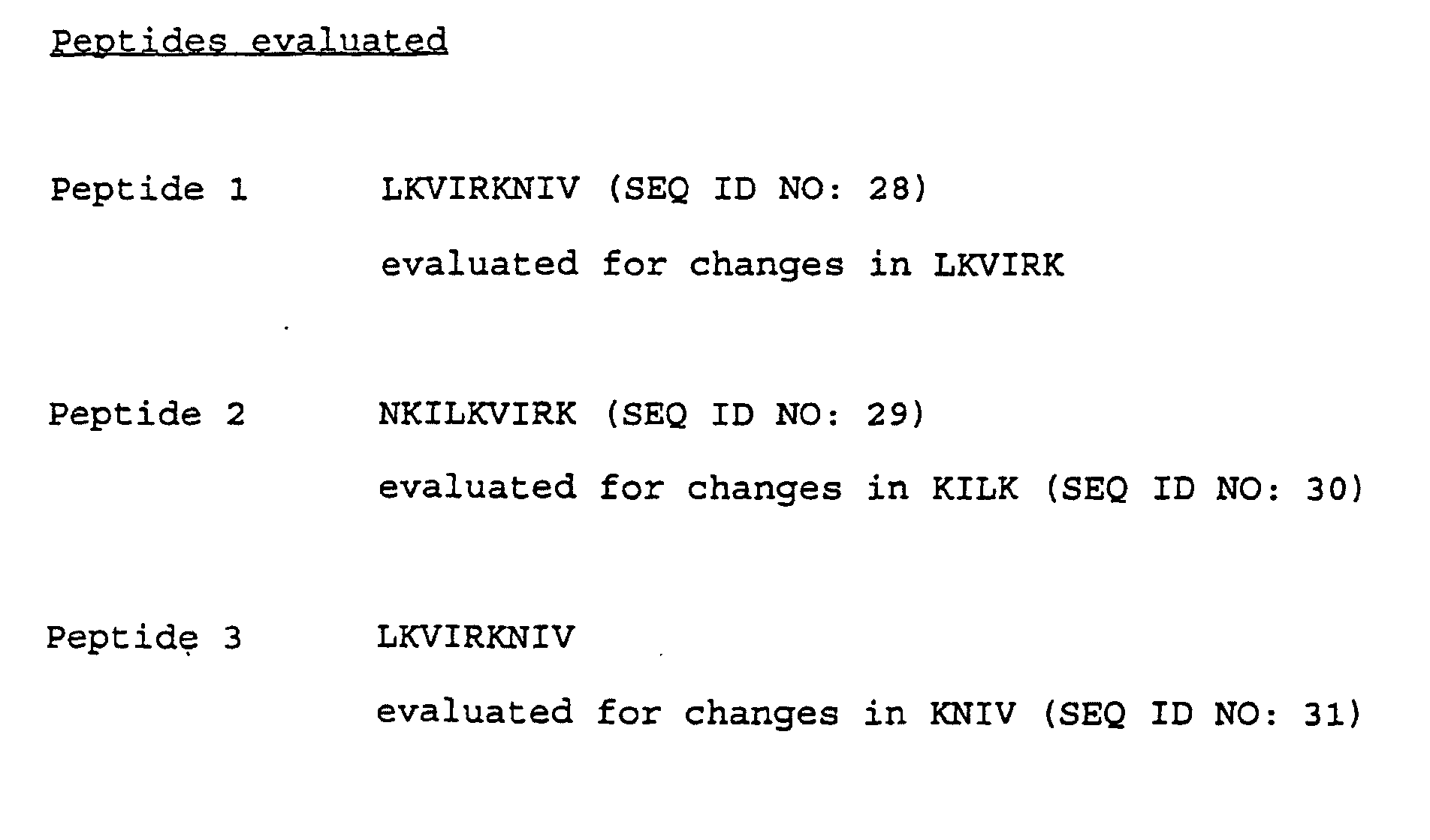 changes were examined
-
- 1. Monoclonal specific to LKVIRKNIVKKMIE - cys against peptides 1 and 3.
- 2. Human sera.
-
-
- ELISA values measured at 30 minutes, antibody dilution 1:200
- Control LKVIRKNIV average ELISA OD = 0.923
(controls) -
- These results show the importance of the amino acids IRK, with RK being irreplaceable, antibody binding being negligible upon subsitution of these amino acids.
-
- ELISA values measured at 30 minutes, antibody dilution 1:200
- Control LKVIRKNIV average ELISA OD = 0.842
-
- These results show the importance of amino acids KNIV.
- The total epitope is I R K N I V (SEQ ID NO: 32) with the underlined amino acids virtually impossible to replace.
- All ELISA performed combined IgM and IgG at 30 minutes. Antibody dilution 1:200
-
Patient Number Average ELISA Number of amino acids giving a reduction to a maximum of 70% control L K V I R K 2 1.01 14 4 14 16 5 8 6 Pre 0.1 not applicable Post 0.501 16 9 16 15 4 3 30 Pre 0.22 not applicable Post 0.752 9 0 11 15 2 1 31 Pre 0.1 not applicable Post 0.648 14 0 15 17 4 0 16 Pre 0.347 not applicable Post 0.647 10 2 17 12 2 0 33 1.18 6 1 12 15 2 0 34 0.6 12 0 6 6 0 0 35 1.24 8 2 7 7 2 2 20 1.3 10 1 8 8 1 1 24 0.379 not applicable -
Patient Number Average ELISA Number of amino acids giving a reduction to a maximum of 70% control K I L K 2 1.37 8 19 19 8 6 Pre 0.10 not applicable Post 0.33 not applicable 30 Pre 0.22 not applicable Post 0.62 10 18 17 1 31 Pre 0.11 not applicable Post 0.58 10 18 17 3 16 Pre 0.3115 not applicable Post 0.531 2 17 14 13 33 7 16 12 2 34 0.47 4 17 16 2 35 1.36 10 18 17 3 20 1.2 8 16 16 2 24 0.32 not applicable -
Patient Number Average ELISA Number of amino acids giving a reduction to a maximum of 70% control K N I V 2 0.89 0 0 0 0 6 Pre 0.01 not applicable Post 0.438 0 0 0 0 30 Pre 0.2 not applicable Post 0.52 0 0 3 3 31 Pre 0.35 not applicable Post 0.66 0 1 9 4 16 Pre 0.3 not applicable Post 0.59 3 8 15 11 33 1.03 1 13 11 7 34 0.566 3 15 14 12 35 1.437 0 8 10 3 20 1.18 8 14 15 15 24 0.37 not applicable - A library of immunoglobulin heavy and light chain variable (V) genes was prepared from the peripheral blood lymphocytes of a patient who had recovered from systemic candidiasis. The library was enriched and screened for activity to LKVIRKNIVKKMIE and NKILKVIRKNIVKK (SEQ ID NO: 33) and the resulting human recombinant antibodies examined for therapeutic activity in a mouse model of systemic candidiasis.
- The library was produced essentially as described by Marks et al (J Mol Biol 1991; 222: 581-597) using the pCANTAB 5 vector, which is now commercially available as part of a kit from Pharmacia (Milton Keynes, UK). The heavy and light chain V genes, obtained from cDNA prepared from the mRNA of peripheral blood lymphocytes of a patient recovering from systemic candidiasis, were randomly combined and subcloned into Not I/Sfi I digested pCANTAB 5. The resulting single chain Fv fragments (ScFv), expressed on the surface of phage, were enriched by panning against specific synthetic peptide epitopes, including LKVIRKNIVKKMIE and NKILKVIRKNIVKK. Then immunoblotting (see Example 4) was used to identify individual clones with activity against the 47 kd antigen of Candida albicans. Two strongly positive recombinant antibodies were selected for further study: A2 (panned against LKVIRKNIVKKMIE) and B3 (panned against NKILKVIRKNIVKK).
- Female Balb/c mice were injected intravenously with a lethal dose of Candida albicans. Two different age groups were examined - mature mice weighing around 20 g (experiments 1 and 2) and young mice weighing around 12 g. Two different batches of human recombinant B were examined (experiment No. 1 against No's 2 and 3). In experiment 1 this recombinant antibody was compared against human recombinant antibody A and helper phage M13 K07, and 200 µl of saline, M13 K07 or human recombinant antibody was given approximately 2 hours after iv challenge with Candida. In experiments 2 and 3, 100 ul of saline or B3 was given 1 hours after iv challenge with Candida.
-
Expt. No. CFU Av. Wt. of mice (9) Treatment Group (No. of mice) % mortality at 24h (No. dead) 1 108 21 ± 3g Saline (11) 73% (8) 108 21 ± 3g M13KO7 (17) 76% (13) 108 21 ± 3g A (16) 94% (15) 108 21 ± 3g B (10) 10% (1) 2 107 19 ± 2g Saline (10) 40% (4) 107 19 ± 2g B (10) 10% (1) 3 108 12 ± 2g Salione (16) 25% (4) 108 12 ± 2g B (16) 0% (0) - Younger mice appear to be relatively resistant to Candida albicans (an analogous situation occurs in humans). Human recombinant antibody B repeatedly showed therapeutic activity against Candida - unlike human recombinant antibody A.
- Human recombinant antibodies B3 and A2 were examined for cross-reactivity against Streptococcus faecalis and Corynebacterium jeikeium.
- Immunoblots of Candida albicans, Corynebacterium jeikeium and Streptococcus faecalis were prepared as previously described (Matthews, Epidemiol. Infect. 1991; 107: 273-283; Burnie et al, J. Clin. Path. 1987; 40: 1149- 1158). Free-protein binding sites were blocked with bovine serum albumin (BSA), prior to incubating each blot with the phage suspension (B3 or A2) for 2 hours at room temperature, with gentle agitation. They were then washed five times over 30 min in 0.05% Tween 20-Saline, and incubated for 90 minutes with anti-M13 antibody (commercially available from 5'-3', Inc. Boulder, USA), diluted 1:1000 in 3% BSA. Washing was repeated and then they were incubated with alkaline- phosphase conjugated anti-goat antibody (diluted 1:1000), from Sigma, for 1 hours. Washing was repeated and then the blots were developed with the colour substrate BCIP NBT as previously described (Matthews 1991).
- B3 and, to a less extent, A2, cross-reacted with Streptococcus faecalis and Corynebacterium jeikeium as well as Candida albicans. Several bands were produced. In the case of S.faecalis these were at about 112 kd, 88-90 kd and 32 kd. In the case of C.jeikeium bands occurred at about 160 kd, 52 kd, 47 kd and 40 kd. In the case of C.albicans a prominent band occurred at 47 kd.
- Human recombinant antibodies B3 and A2 cross- reacted with S.faecalis and C.jeikeium and may have therapeutic potential against these and other Gram- positive bacteria.
- 1 µl of human serum was dotted onto a sheet of nitrocellulose membrane (Biorad Laboratories, California). This was allowed to dry for 10 minutes. It was blocked for 1 hour at 37°C with 3% Bovine Serum Albumen in Tris-buffered saline pH 7.5. After being washed in 0.9%/weight/volume/saline - 0.05% Tween 80 five times over 30 minutes it was incubated for 1 hour at room temperature with the human recombinant antibody B3 diluted 1 in 5. It was then washed for 30 minutes, as described above, and further incubated with the anti-M13 horseradish peroxidase conjugate (Pharmacia Ltd), diluted 1 in 5,000 in 3% bovine serum albumin in Tris-buffered saline. After a further wash, this was developed with the 3-amino-9-ethylcarbazole substrate (0.67 ml of a solution of 0.4 gram 3-amino-9-ethylcarbazole/100 ml dimethyl formamide in 10 mls of 0.1 M sodium acetate (pH 5.2)). This was activated with 10 µl of 30% H2O2.H2O2. The blot was incubated for 30 minutes and washed. The results were compared with a positive control of 1 µl of candidal pressate (100 mg/ml) and graded as negative (nil), weakly positve (trace) and positive (equivalent to the result from the candidal extract).
- Control sera (sera from patients with no evidence of disseminated or oral candida, either with leukaemia or after major gastrointestinal surgery).
Titre: NIL Trace Positive No. of Sera: 79 2 NIL Colonized Patients (sera from patients with a colonized site either oral/wound/vaginal/intraveneous line/urine). Titre NIL Trace Positive Oral 6 1 Wound 1 Vaginal 1 Intravenous 3 Urine 2 1 - Defined as either (1) two sets of positive blood cultures taken at least 24 hours apart from two different intravenous sites or (2) cultural and histopathological evidence obtained at postmortem.
- Each patient is reported as the maximum antigen titre detected if a series of samples was available.
Causative yeast Maximum Antigen Titre Detected Nil Trace Positive Candida tropicalis 1 1 Torulopsis glabrata 1 Candida parapsilosis 1 Candida albicans 2 3 17 - Antigen detected by dot immunobinding with the B3 recombinant antibody distinguished control sera and sera from colonized patients from the sera of patients with systemic candidiasis.
- The amino acids underlined below are vital, i.e. irreplaceable, to the function of the epitope as an immunogen. In addition, sera of patients with different diseases produce antibodies which recognise slightly different amino acids within the same epitope.
- Case 24, an SLE patient acted as a positive control, as, although this patients sera was positive for the candidal 47KD protein, it did not recognise any of the 3 peptides of the epitope of the present invention.

- The monoclonal described in GB 2 034 504 reacts with an epitope which only represents part of the epitope for yeast infection (C.albicans/C.tropicalis/ C.parapsilosis). Infections due to C.tropicalis, A.fumigatus and malaria are more immunoreactive to the KILK epitope. Infections due to malaria and A.fumigatus also recognise an epitope containing NIV.
- Thus a more active antibody recognising stress proteins produced in a wider range of diseases than that described in GB 2 034 504 may be produced against the epitope NKILKVIRKNIV (i.e. antibody B3).
- The data demonstrate that antibodies raised against XXXLXVIRKXIV and/or XXILXVIXXXXX, where X is any amino acid, particularly human recombinant antibodies, show protection in the mouse model of systemic candidiasis.
- It will be appreciated that it is not intended to limit the invention to the above examples only, many variations, such as might readily occur to one skilled in the art, being possible, without departing from the scope thereof as defined by the appended claims.
-
- (1) GENERAL INFORMATION:
- (i) APPLICANT:
- (A) NAME: NeuTec Pharma plc
- (B) STREET: St James's Court, Brown Street
- (C) CITY: Manchester
- (E) COUNTRY: United Kingdom
- (F) POSTAL CODE (ZIP): M2 2JF
- (ii) TITLE OF INVENTION: Stress Protein Epitopes
- (iii) NUMBER OF SEQUENCES: 33
- (iv) COMPUTER READABLE FORM:
- (A) MEDIUM TYPE: Floppy disk
- (B) COMPUTER: IBM PC compatible
- (C) OPERATING SYSTEM: PC-DOS/MS-DOS
- (D) SOFTWARE: PatentIn Release #1.0, Version #1.30 (EPO)
- (vi) PRIOR APPLICATION DATA:
- (A) APPLICATION NUMBER: GB 9217542.1
- (B) FILING DATE: 18-AUG-1992
- (vi) PRIOR APPLICATION DATA:
- (A) APPLICATION NUMBER: EP 93918042.8
- (B) FILING DATE: 17-AUG-1993
- (2) INFORMATION FOR SEQ ID NO: 1:
- (i) SEQUENCE CHARACTERISTICS:
- (A) LENGTH: 14 amino acids
- (B) TYPE: amino acid
- (C) STRANDEDNESS:
- (D) TOPOLOGY: unknown
- (ii) MOLECULE TYPE: peptide
- (xi) SEQUENCE DESCRIPTION: SEQ ID NO: 1:

- (2) INFORMATION FOR SEQ ID NO: 2:
- (i) SEQUENCE CHARACTERISTICS:
- (A) LENGTH: 5 amino acids
- (B) TYPE: amino acid
- (C) STRANDEDNESS:
- (D) TOPOLOGY: unknown
- (ii) MOLECULE TYPE: peptide
- (xi) SEQUENCE DESCRIPTION: SEQ ID NO: 2:

- (2) INFORMATION FOR SEQ ID NO: 3:
- (i) SEQUENCE CHARACTERISTICS:
- (A) LENGTH: 6 amino acids
- (B) TYPE: amino acid
- (C) STRANDEDNESS:
- (D) TOPOLOGY: unknown
- (ii) MOLECULE TYPE: peptide
- (xi) SEQUENCE DESCRIPTION: SEQ ID NO: 3:

- (2) INFORMATION FOR SEQ ID NO: 4:
- (i) SEQUENCE CHARACTERISTICS:
- (A) LENGTH: 10 amino acids
- (B) TYPE: amino acid
- (C) STRANDEDNESS:
- (D) TOPOLOGY: unknown
- (ii) MOLECULE TYPE: peptide
- (xi) SEQUENCE DESCRIPTION: SEQ ID NO: 4:

- (2) INFORMATION FOR SEQ ID NO: 5:
- (i) SEQUENCE CHARACTERISTICS:
- (A) LENGTH: 12 amino acids
- (B) TYPE: amino acid
- (C) STRANDEDNESS:
- (D) TOPOLOGY: unknown
- (ii) MOLECULE TYPE: peptide
- (xi) SEQUENCE DESCRIPTION: SEQ ID NO: 5:

- (2) INFORMATION FOR SEQ ID NO: 6:
- (i) SEQUENCE CHARACTERISTICS:
- (A) LENGTH: 12 amino acids
- (B) TYPE: amino acid
- (C) STRANDEDNESS:
- (D) TOPOLOGY: unknown
- (ii) MOLECULE TYPE: peptide
- (xi) SEQUENCE DESCRIPTION: SEQ ID NO: 6:

- (2) INFORMATION FOR SEQ ID NO: 7:
- (i) SEQUENCE CHARACTERISTICS:
- (A) LENGTH: 12 amino acids
- (B) TYPE: amino acid
- (C) STRANDEDNESS:
- (D) TOPOLOGY: unknown
- (ii) MOLECULE TYPE: peptide
- (xi) SEQUENCE DESCRIPTION: SEQ ID NO: 7:

- (2) INFORMATION FOR SEQ ID NO: 8:
- (i) SEQUENCE CHARACTERISTICS:
- (A) LENGTH: 4 amino acids
- (B) TYPE: amino acid
- (C) STRANDEDNESS:
- (D) TOPOLOGY: unknown
- (ii) MOLECULE TYPE: peptide
- (xi) SEQUENCE DESCRIPTION: SEQ ID NO: 8:

- (2) INFORMATION FOR SEQ ID NO: 9:
- (i) SEQUENCE CHARACTERISTICS:
- (A) LENGTH: 6 amino acids
- (B) TYPE: amino acid
- (C) STRANDEDNESS:
- (D) TOPOLOGY: unknown
- (ii) MOLECULE TYPE: peptide
- (xi) SEQUENCE DESCRIPTION: SEQ ID NO: 9:

- (2) INFORMATION FOR SEQ ID NO: 10:
- (i) SEQUENCE CHARACTERISTICS:
- (A) LENGTH: 7 amino acids
- (B) TYPE: amino acid
- (C) STRANDEDNESS:
- (D) TOPOLOGY: unknown
- (ii) MOLECULE TYPE: peptide
- (xi) SEQUENCE DESCRIPTION: SEQ ID NO: 10:

- (2) INFORMATION FOR SEQ ID NO: 11:
- (i) SEQUENCE CHARACTERISTICS:
- (A) LENGTH: 4 amino acids
- (B) TYPE: amino acid
- (C) STRANDEDNESS:
- (D) TOPOLOGY: unknown
- (ii) MOLECULE TYPE: peptide
- (xi) SEQUENCE DESCRIPTION: SEQ ID NO: 11:

- (2) INFORMATION FOR SEQ ID NO: 12:
- (i) SEQUENCE CHARACTERISTICS:
- (A) LENGTH: 5 amino acids
- (B) TYPE: amino acid
- (C) STRANDEDNESS:
- (D) TOPOLOGY: unknown
- (ii) MOLECULE TYPE: peptide
- (xi) SEQUENCE DESCRIPTION: SEQ ID NO: 12:

- (2) INFORMATION FOR SEQ ID NO: 13:
- (i) SEQUENCE CHARACTERISTICS:
- (A) LENGTH: 5 amino acids
- (B) TYPE: amino acid
- (C) STRANDEDNESS:
- (D) TOPOLOGY: unknown
- (ii) MOLECULE TYPE: peptide
- (xi) SEQUENCE DESCRIPTION: SEQ ID NO: 13:

- (2) INFORMATION FOR SEQ ID NO: 14:
- (i) SEQUENCE CHARACTERISTICS:
- (A) LENGTH: 6 amino acids
- (B) TYPE: amino acid
- (C) STRANDEDNESS:
- (D) TOPOLOGY: unknown
- (ii) MOLECULE TYPE: peptide
- (xi) SEQUENCE DESCRIPTION: SEQ ID NO: 14:

- (2) INFORMATION FOR SEQ ID NO: 15:
- (i) SEQUENCE CHARACTERISTICS:
- (A) LENGTH: 6 amino acids
- (B) TYPE: amino acid
- (C) STRANDEDNESS:
- (D) TOPOLOGY: unknown
- (ii) MOLECULE TYPE: peptide
- (xi) SEQUENCE DESCRIPTION: SEQ ID NO: 15:

- (2) INFORMATION FOR SEQ ID NO: 16:
- (i) SEQUENCE CHARACTERISTICS:
- (A) LENGTH: 4 amino acids
- (B) TYPE: amino acid
- (C) STRANDEDNESS:
- (D) TOPOLOGY: unknown
- (ii) MOLECULE TYPE: peptide
- (xi) SEQUENCE DESCRIPTION: SEQ ID NO: 16:

- (2) INFORMATION FOR SEQ ID NO: 17:
- (i) SEQUENCE CHARACTERISTICS:
- (A) LENGTH: 4 amino acids
- (B) TYPE: amino acid
- (C) STRANDEDNESS:
- (D) TOPOLOGY: unknown
- (ii) MOLECULE TYPE: peptide
- (xi) SEQUENCE DESCRIPTION: SEQ ID NO: 17:

- (2) INFORMATION FOR SEQ ID NO: 18:
- (i) SEQUENCE CHARACTERISTICS:
- (A) LENGTH: 4 amino acids
- (B) TYPE: amino acid
- (C) STRANDEDNESS:
- (D) TOPOLOGY: unknown
- (ii) MOLECULE TYPE: peptide
- (xi) SEQUENCE DESCRIPTION: SEQ ID NO: 18:

- (2) INFORMATION FOR SEQ ID NO: 19:
- (i) SEQUENCE CHARACTERISTICS:
- (A) LENGTH: 4 amino acids
- (B) TYPE: amino acid
- (C) STRANDEDNESS:
- (D) TOPOLOGY: unknown
- (ii) MOLECULE TYPE: peptide
- (xi) SEQUENCE DESCRIPTION: SEQ ID NO: 19:

- (2) INFORMATION FOR SEQ ID NO: 20:
- (i) SEQUENCE CHARACTERISTICS:
- (A) LENGTH: 6 amino acids
- (B) TYPE: amino acid
- (C) STRANDEDNESS:
- (D) TOPOLOGY: unknown
- (ii) MOLECULE TYPE: peptide
- (xi) SEQUENCE DESCRIPTION: SEQ ID NO: 20:

- (2) INFORMATION FOR SEQ ID NO: 21:
- (i) SEQUENCE CHARACTERISTICS:
- (A) LENGTH: 6 amino acids
- (B) TYPE: amino acid
- (C) STRANDEDNESS:
- (D) TOPOLOGY: unknown
- (ii) MOLECULE TYPE: peptide
- (xi) SEQUENCE DESCRIPTION: SEQ ID NO: 21:

- (2) INFORMATION FOR SEQ ID NO: 22:
- (i) SEQUENCE CHARACTERISTICS:
- (A) LENGTH: 5 amino acids
- (B) TYPE: amino acid
- (C) STRANDEDNESS:
- (D) TOPOLOGY: unknown
- (ii) MOLECULE TYPE: peptide
- (xi) SEQUENCE DESCRIPTION: SEQ ID NO: 22:

- (2) INFORMATION FOR SEQ ID NO: 23:
- (i) SEQUENCE CHARACTERISTICS:
- (A) LENGTH: 5 amino acids
- (B) TYPE: amino acid
- (C) STRANDEDNESS:
- (D) TOPOLOGY: unknown
- (ii) MOLECULE TYPE: peptide
- (xi) SEQUENCE DESCRIPTION: SEQ ID NO: 23:

- (2) INFORMATION FOR SEQ ID NO: 24:
- (i) SEQUENCE CHARACTERISTICS:
- (A) LENGTH: 4 amino acids
- (B) TYPE: amino acid
- (C) STRANDEDNESS:
- (D) TOPOLOGY: unknown
- (ii) MOLECULE TYPE: peptide
- (xi) SEQUENCE DESCRIPTION: SEQ ID NO: 24:

- (2) INFORMATION FOR SEQ ID NO: 25:
- (i) SEQUENCE CHARACTERISTICS:
- (A) LENGTH: 4 amino acids
- (B) TYPE: amino acid
- (C) STRANDEDNESS:
- (D) TOPOLOGY: unknown
- (ii) MOLECULE TYPE: peptide
- (xi) SEQUENCE DESCRIPTION: SEQ ID NO: 25:

- (2) INFORMATION FOR SEQ ID NO: 26:
- (i) SEQUENCE CHARACTERISTICS:
- (A) LENGTH: 18 amino acids
- (B) TYPE: amino acid
- (C) STRANDEDNESS:
- (D) TOPOLOGY: unknown
- (ii) MOLECULE TYPE: peptide
- (xi) SEQUENCE DESCRIPTION: SEQ ID NO: 26:

- (2) INFORMATION FOR SEQ ID NO: 27:
- (i) SEQUENCE CHARACTERISTICS:
- (A) LENGTH: 8 amino acids
- (B) TYPE: amino acid
- (C) STRANDEDNESS:
- (D) TOPOLOGY: unknown
- (ii) MOLECULE TYPE: peptide
- (xi) SEQUENCE DESCRIPTION: SEQ ID NO: 27:

- (2) INFORMATION FOR SEQ ID NO: 28:
- (i) SEQUENCE CHARACTERISTICS:
- (A) LENGTH: 9 amino acids
- (B) TYPE: amino acid
- (C) STRANDEDNESS:
- (D) TOPOLOGY: unknown
- (ii) MOLECULE TYPE: peptide
- (xi) SEQUENCE DESCRIPTION: SEQ ID NO: 28:

- (2) INFORMATION FOR SEQ ID NO: 29:
- (i) SEQUENCE CHARACTERISTICS:
- (A) LENGTH: 9 amino acids
- (B) TYPE: amino acid
- (C) STRANDEDNESS:
- (D) TOPOLOGY: unknown
- (ii) MOLECULE TYPE: peptide
- (xi) SEQUENCE DESCRIPTION: SEQ ID NO: 29:

- (2) INFORMATION FOR SEQ ID NO: 30:
- (i) SEQUENCE CHARACTERISTICS:
- (A) LENGTH: 4 amino acids
- (B) TYPE: amino acid
- (C) STRANDEDNESS:
- (D) TOPOLOGY: unknown
- (ii) MOLECULE TYPE: peptide
- (xi) SEQUENCE DESCRIPTION: SEQ ID NO: 30:

- (2) INFORMATION FOR SEQ ID NO: 31:
- (i) SEQUENCE CHARACTERISTICS:
- (A) LENGTH: 4 amino acids
- (B) TYPE: amino acid
- (C) STRANDEDNESS:
- (D) TOPOLOGY: unknown
- (ii) MOLECULE TYPE: peptide
- (xi) SEQUENCE DESCRIPTION: SEQ ID NO: 31:

- (2) INFORMATION FOR SEQ ID NO: 32:
- (i) SEQUENCE CHARACTERISTICS:
- (A) LENGTH: 6 amino acids
- (B) TYPE: amino acid
- (C) STRANDEDNESS:
- (D) TOPOLOGY: unknown
- (ii) MOLECULE TYPE: peptide
- (xi) SEQUENCE DESCRIPTION: SEQ ID NO: 32:

- (2) INFORMATION FOR SEQ ID NO: 33:
- (i) SEQUENCE CHARACTERISTICS:
- (A) LENGTH: 14 amino acids
- (B) TYPE: amino acid
- (C) STRANDEDNESS:
- (D) TOPOLOGY: unknown
- (ii) MOLECULE TYPE: peptide
- (xi) SEQUENCE DESCRIPTION: SEQ ID NO: 33:

-
| Patient Number | Sera | Diagnosis |
| 2 | single | Post oesophagectomy, blood culture positive C.albicans. |
| 6 | paired | Post cholecystectomy, blood culture positive C.albicans in two sets of blood culture. |
| 30 | paired | Neutropenia, leukaemia, blood culture positive C.tropicalis in three sets of blood culture. |
| 31 | paired | Neutropenia, leukaemia, blood culture positive C.parapsilosis in two sets of blood culture. |
| 16 | paired | Survivor, invasive aspergillosis acute leukaemia. |
| 33 | single | P.vivax malaria |
| 34 | single | P.falciparum malaria |
| 35 | single | P.falciparum malaria |
| 20 | single | P.vivax malaria |
| 24 | single | SLE |
| ANTIBODY PROFILES | ||
| Patient No. | C.albicans | A.fumigatus |
| 2 | M 47KD, | M/G 88,84KD (trace) combined |
| G 47KD | ||
| 6 Post serum | M 40,47KD, | |
| G 40,47KD | NIL | |
| 30 Post serum | M 47KD, | |
| G 47KD | NIL | |
| 31 Post serum | M 47KD, | |
| G 47KD | G 40KD | |
| 16 | NIL | M 88,84KD, |
| G 88,84KD | ||
| 33 | M 47KD, | |
| G 47KD | NIL | |
| 34 | M 92,47KD, | |
| G 47KD | G 88KD | |
| 35 | M 47KD | NIL |
| 20 | M 92KD, | |
| G 47KD | G 51,40KD | |
| 24 | G 47KD | NIL |
| Substituted amino acid | ||||||
| L | K | V | I | R | K | |
| (resultant OD) | ||||||
| A | 0.875 | 1.102 | 0.594 | 0.526 | 0.111 | 0.132 |
| C | 0.849 | 0.797 | 0.527 | 0.324 | 0.125 | 0.119 |
| D | 0.909 | 1.208 | 0.730 | 0.195 | 0.126 | 0.138 |
| E | 1.005 | 1.183 | 1.021 | 0.977 | 0.141 | 0.135 |
| F | 1.052 | 0.760 | 0.512 | 0.483 | 0.116 | 0.108 |
| G | 0.054 | 1.016 | 0.525 | 0.161 | 0.131 | 0.133 |
| H | 0.798 | 0.926 | 0.905 | 0.454 | 0.107 | 0.190 |
| I | 1.021 | 0.714 | 0.491 | control | 0.117 | 0.12 |
| K | 0.392 | control | 0.881 | 0.486 | 0.092 | control |
| L | control | 0.946 | 0.673 | 0.659 | 0.122 | 0.114 |
| M | 0.836 | 1.075 | 0.508 | 0.715 | 0.118 | 0.364 |
| N | 0.764 | 1.223 | 0.769 | 0.306 | 0.124 | 0.137 |
| P | 0.77 | 0.662 | 0.612 | 0.489 | 0.095 | 0.132 |
| Q | 0.656 | 1.073 | 0.813 | 0.602 | 0.120 | 0.231 |
| R | 0.668 | 1.032 | 0.657 | 0.538 | control | 0.591 |
| S | 0.500 | 1.026 | 0.620 | 0.434 | 0.121 | 0.146 |
| T | 0.693 | 0.944 | 0.740 | 0.760 | 0.127 | 0.139 |
| V | 0.788 | 0.799 | control | 0.977 | 0.126 | 0.124 |
| W | 1.022 | 0.991 | 1.082 | 0.895 | 0.104 | 0.115 |
| Y | 0.584 (L) |
1.007 (K) |
1.196 (V) |
0.788 (I) |
0.110 (R) |
0.119 (K) |
| K | N | I | V | |
| A | 0.101 | 0.615 | 0.109 | 0.134 |
| C | 0.105 | 0.196 | 0.122 | 0.148 |
| D | 0.100 | 0.344 | 0.100 | 0.120 |
| G | 0.102 | 0.446 | 0.101 | 0.113 |
| F | 0.101 | 0.166 | 0.142 | 0.456 |
| G | 0.099 | 0.331 | 0.100 | 0.124 |
| H | 0.107 | 0.655 | 0.114 | 0.123 |
| I | 0.100 | 0.169 | control | 0.938 |
| K | control | 0.746 | 0.095 | 0.136 |
| L | 0.103 | 0.248 | 0.268 | 0.831 |
| M | 0.099 | 0.630 | 0.283 | 0.430 |
| N | 0.101 | control | 0.103 | 0.107 |
| P | 0.101 | 0.247 | 0.107 | 0.095 |
| Q | 0.103 | 0.596 | 0.103 | 0.112 |
| R | 0.192 | 0.819 | 0.105 | 0.121 |
| S | 0.104 | 0.942 | 0.127 | 0.128 |
| T | 0.101 | 0.691 | 0.181 | 0.227 |
| V | 0.100 | 0.210 | 0.765 | control |
| W | 0.098 | 0.139 | 0.106 | 0.123 |
| Y | 0.102 | 0.145 | 0.107 | 0.105 |
Claims (8)
- A peptide identical to an epitope having the amino acid sequence NNLGTI.
- A peptide according to claim 1, further characterised in that it cross-reacts with antibody raised against the HSP90 of Candida albicans, Candida guilliermondii, Plasmodium vivax and Plasmodium falciparum.
- A peptide according to claim 2, the Candidal HSP90 comprising a 47 KDa stress protein.
- A peptide according to any of claims 1-3, for use in a diagnostic test for parasitic or fungal infection.
- A peptide according to claim 4 for use in a diagnostic test for the HSP90 of Candida albicans, Candida guilliermondii, Plasmodium vivax and Plasmodium falciparum.
- The use of a peptide according to any of claims 1-3 in the manufacture of a diagnostic test for the HSP90 of Candida albicans, Candida guilliermondii, Plasmodium vivax and Plasmodium falciparum.
- A peptide according to any one of claims 4-6, wherein the diagnostic test is a dot immunosorbent assay, a radioimmunoassay or a latex agglutination assay.
- A peptide according to any of claims 1-3 for use in treating a disease state in which stress proteins are produced.
Applications Claiming Priority (3)
| Application Number | Priority Date | Filing Date | Title |
|---|---|---|---|
| GB9217542 | 1992-08-18 | ||
| GB9217542A GB2270076A (en) | 1992-08-18 | 1992-08-18 | Human HSP 90 Epitopes |
| EP93918042A EP0656945B1 (en) | 1992-08-18 | 1993-08-17 | Stress protein epitopes |
Related Parent Applications (1)
| Application Number | Title | Priority Date | Filing Date |
|---|---|---|---|
| EP93918042A Division EP0656945B1 (en) | 1992-08-18 | 1993-08-17 | Stress protein epitopes |
Publications (2)
| Publication Number | Publication Date |
|---|---|
| EP0861892A1 EP0861892A1 (en) | 1998-09-02 |
| EP0861892B1 true EP0861892B1 (en) | 2004-10-20 |
Family
ID=10720544
Family Applications (2)
| Application Number | Title | Priority Date | Filing Date |
|---|---|---|---|
| EP98102990A Expired - Lifetime EP0861892B1 (en) | 1992-08-18 | 1993-08-17 | Stress protein epitopes |
| EP93918042A Expired - Lifetime EP0656945B1 (en) | 1992-08-18 | 1993-08-17 | Stress protein epitopes |
Family Applications After (1)
| Application Number | Title | Priority Date | Filing Date |
|---|---|---|---|
| EP93918042A Expired - Lifetime EP0656945B1 (en) | 1992-08-18 | 1993-08-17 | Stress protein epitopes |
Country Status (12)
| Country | Link |
|---|---|
| US (1) | US5777083A (en) |
| EP (2) | EP0861892B1 (en) |
| JP (1) | JP3439213B2 (en) |
| AT (2) | ATE280227T1 (en) |
| AU (1) | AU4727593A (en) |
| DE (2) | DE69328489T2 (en) |
| DK (2) | DK0656945T3 (en) |
| ES (2) | ES2147560T3 (en) |
| GB (1) | GB2270076A (en) |
| GR (1) | GR3033809T3 (en) |
| PT (2) | PT656945E (en) |
| WO (1) | WO1994004676A1 (en) |
Families Citing this family (32)
| Publication number | Priority date | Publication date | Assignee | Title |
|---|---|---|---|---|
| US5997873A (en) | 1994-01-13 | 1999-12-07 | Mount Sinai School Of Medicine Of The City University Of New York | Method of preparation of heat shock protein 70-peptide complexes |
| US5750119A (en) * | 1994-01-13 | 1998-05-12 | Mount Sinai School Of Medicine Of The City University Of New York | Immunotherapeutic stress protein-peptide complexes against cancer |
| US5961979A (en) * | 1994-03-16 | 1999-10-05 | Mount Sinai School Of Medicine Of The City University Of New York | Stress protein-peptide complexes as prophylactic and therapeutic vaccines against intracellular pathogens |
| EP0739981A1 (en) | 1995-04-25 | 1996-10-30 | Vrije Universiteit Brussel | Variable fragments of immunoglobulins - use for therapeutic or veterinary purposes |
| US5985270A (en) * | 1995-09-13 | 1999-11-16 | Fordham University | Adoptive immunotherapy using macrophages sensitized with heat shock protein-epitope complexes |
| US5935576A (en) | 1995-09-13 | 1999-08-10 | Fordham University | Compositions and methods for the treatment and prevention of neoplastic diseases using heat shock proteins complexed with exogenous antigens |
| US5837251A (en) * | 1995-09-13 | 1998-11-17 | Fordham University | Compositions and methods using complexes of heat shock proteins and antigenic molecules for the treatment and prevention of neoplastic diseases |
| EP0877620A4 (en) * | 1996-01-16 | 1999-04-14 | Rensselaer Polytech Inst | Peptides for altering osteoblast adhesion |
| US5830464A (en) * | 1997-02-07 | 1998-11-03 | Fordham University | Compositions and methods for the treatment and growth inhibition of cancer using heat shock/stress protein-peptide complexes in combination with adoptive immunotherapy |
| US6017540A (en) | 1997-02-07 | 2000-01-25 | Fordham University | Prevention and treatment of primary and metastatic neoplastic diseases and infectious diseases with heat shock/stress protein-peptide complexes |
| GB9710762D0 (en) | 1997-05-23 | 1997-07-23 | Cancer Res Inst Royal | Binding complexes |
| US5948646A (en) | 1997-12-11 | 1999-09-07 | Fordham University | Methods for preparation of vaccines against cancer comprising heat shock protein-peptide complexes |
| ES2439014T3 (en) | 1998-02-20 | 2014-01-21 | The University Of Miami | Complex of antigenic peptide-modified heat shock protein |
| GB0008305D0 (en) * | 2000-04-06 | 2000-05-24 | Neutec Pharma Plc | Treatment of fungal infections |
| AU6669401A (en) | 2000-06-02 | 2001-12-11 | Univ Connecticut Health Ct | Complexes of alpha (2) macroglobulin and antigenic molecules for immunotherapy |
| US7491702B2 (en) * | 2001-04-18 | 2009-02-17 | The Open University | Polypeptides related to amyloid precursor protein, pharmaceutical compositions thereof, and methods of treatment using the same |
| US7622446B2 (en) * | 2001-04-18 | 2009-11-24 | The Open University | Polypeptides, derivatives and uses thereof |
| US6916626B1 (en) * | 2001-04-25 | 2005-07-12 | Rockeby Biomed Ltd. | Detection of Candida |
| PL375043A1 (en) | 2001-08-20 | 2005-11-14 | University Of Connecticut Health Center | Methods for preparing compositions comprising heat shock proteins or alpha-2-macroglobulin, useful for the treatment of cancer and infectious disease |
| DE10161051B4 (en) * | 2001-12-12 | 2005-09-15 | Wieland, Heinrich, Prof. Dr. | Diagnosis of malaria |
| US7959915B2 (en) * | 2003-03-12 | 2011-06-14 | Tufts University | Inhibitors of extracellular Hsp90 |
| US7807378B2 (en) * | 2005-12-29 | 2010-10-05 | Industrial Technology Research Institute (Itri) | Method of diagnosing myasthenia gravis and kits therefor |
| ATE509271T1 (en) * | 2006-01-04 | 2011-05-15 | Ind Tech Res Inst | METHOD FOR DIAGNOSIS OF MYASTHENIA GRAVIS |
| JP4283812B2 (en) * | 2006-01-06 | 2009-06-24 | 財団法人工業技術研究院 | Diagnostic method of myasthenia gravis and its kit |
| US20070207992A1 (en) * | 2006-02-21 | 2007-09-06 | Board Of Trustees Of Michigan State University | Geldanamycin derivatives and method of use thereof |
| US20100113355A1 (en) | 2007-04-27 | 2010-05-06 | Naresh Chennamsetty | Novel antibody molecules and nucleic acids binding to fungal stress protein hsp90 |
| EP2257301B1 (en) | 2008-03-03 | 2014-01-22 | The University of Miami | Allogeneic cancer cell-based immunotherapy |
| AU2009226077B2 (en) | 2008-03-20 | 2012-04-19 | University Of Miami | Heat shock protein gp96 vaccination and methods of using same |
| HUE053480T2 (en) | 2009-04-30 | 2021-06-28 | Ablynx Nv | Method for the production of domain antibodies |
| KR20170109582A (en) | 2015-02-06 | 2017-09-29 | 히트 바이오로직스, 인코퍼레이티드 | Vector co-expression vaccine and co-stimulatory molecule |
| CA3040123A1 (en) | 2016-10-11 | 2018-04-19 | University Of Miami | Vectors and vaccine cells for immunity against zika virus |
| US11548930B2 (en) | 2017-04-04 | 2023-01-10 | Heat Biologics, Inc. | Intratumoral vaccination |
Family Cites Families (4)
| Publication number | Priority date | Publication date | Assignee | Title |
|---|---|---|---|---|
| GB8915019D0 (en) * | 1989-06-30 | 1989-08-23 | Matthews Ruth C | Medicaments |
| US5188964A (en) * | 1990-04-12 | 1993-02-23 | Board Of Regents, The University Of Texas System | Method and kit for the prognostication of breast cancer patient via heat shock/stress protein determination |
| GB9016315D0 (en) * | 1990-07-25 | 1990-09-12 | Burnie James P | Medicaments |
| DE4201181A1 (en) * | 1992-01-17 | 1993-07-22 | Boehringer Mannheim Gmbh | PROCESS FOR STABILIZING PROTEINS |
-
1992
- 1992-08-18 GB GB9217542A patent/GB2270076A/en not_active Withdrawn
-
1993
- 1993-08-17 PT PT93918042T patent/PT656945E/en unknown
- 1993-08-17 AT AT98102990T patent/ATE280227T1/en not_active IP Right Cessation
- 1993-08-17 DE DE69328489T patent/DE69328489T2/en not_active Expired - Lifetime
- 1993-08-17 AT AT93918042T patent/ATE192192T1/en not_active IP Right Cessation
- 1993-08-17 DK DK93918042T patent/DK0656945T3/en active
- 1993-08-17 ES ES93918042T patent/ES2147560T3/en not_active Expired - Lifetime
- 1993-08-17 EP EP98102990A patent/EP0861892B1/en not_active Expired - Lifetime
- 1993-08-17 PT PT98102990T patent/PT861892E/en unknown
- 1993-08-17 WO PCT/GB1993/001745 patent/WO1994004676A1/en not_active Ceased
- 1993-08-17 ES ES98102990T patent/ES2231907T3/en not_active Expired - Lifetime
- 1993-08-17 AU AU47275/93A patent/AU4727593A/en not_active Abandoned
- 1993-08-17 EP EP93918042A patent/EP0656945B1/en not_active Expired - Lifetime
- 1993-08-17 DE DE69333673T patent/DE69333673T2/en not_active Expired - Lifetime
- 1993-08-17 JP JP50603894A patent/JP3439213B2/en not_active Expired - Fee Related
- 1993-08-17 DK DK98102990T patent/DK0861892T3/en active
- 1993-08-17 US US08/387,790 patent/US5777083A/en not_active Expired - Lifetime
-
2000
- 2000-06-28 GR GR20000401511T patent/GR3033809T3/en unknown
Also Published As
| Publication number | Publication date |
|---|---|
| JP3439213B2 (en) | 2003-08-25 |
| EP0656945A1 (en) | 1995-06-14 |
| WO1994004676A1 (en) | 1994-03-03 |
| AU4727593A (en) | 1994-03-15 |
| ES2147560T3 (en) | 2000-09-16 |
| ATE192192T1 (en) | 2000-05-15 |
| EP0656945B1 (en) | 2000-04-26 |
| GB2270076A (en) | 1994-03-02 |
| DE69333673D1 (en) | 2004-11-25 |
| DE69328489D1 (en) | 2000-05-31 |
| US5777083A (en) | 1998-07-07 |
| JPH08500016A (en) | 1996-01-09 |
| DE69328489T2 (en) | 2000-11-30 |
| PT861892E (en) | 2005-03-31 |
| GB9217542D0 (en) | 1992-09-30 |
| DE69333673T2 (en) | 2006-03-09 |
| GR3033809T3 (en) | 2000-10-31 |
| PT656945E (en) | 2000-08-31 |
| ES2231907T3 (en) | 2005-05-16 |
| DK0861892T3 (en) | 2005-02-14 |
| DK0656945T3 (en) | 2000-09-11 |
| ATE280227T1 (en) | 2004-11-15 |
| EP0861892A1 (en) | 1998-09-02 |
Similar Documents
| Publication | Publication Date | Title |
|---|---|---|
| EP0656945B1 (en) | Stress protein epitopes | |
| US5686248A (en) | Fungal stress proteins | |
| EP0616613B1 (en) | Fragments of prion proteins | |
| US6174528B1 (en) | Synthetic peptides and vaccines comprising same | |
| US6699973B1 (en) | Antibodies to peptides that target GIT receptors and related methods | |
| JP3747057B2 (en) | Bacterial stress protein | |
| AU679443B2 (en) | Methods and reagents for diagnosis of autoantibodies | |
| US6911208B2 (en) | Antigenic protein originating in malassezia | |
| JPWO1997021817A1 (en) | Antigenic proteins from Malassezia | |
| AU684009B2 (en) | Peptides for diagnostics | |
| JPH10505581A (en) | Vitronectin binding protein | |
| EP0998493A1 (en) | Epitopes of shigella like toxin and their use as vaccine and in diagnosis |
Legal Events
| Date | Code | Title | Description |
|---|---|---|---|
| PUAI | Public reference made under article 153(3) epc to a published international application that has entered the european phase |
Free format text: ORIGINAL CODE: 0009012 |
|
| 17P | Request for examination filed |
Effective date: 19980312 |
|
| AC | Divisional application: reference to earlier application |
Ref document number: 656945 Country of ref document: EP |
|
| AK | Designated contracting states |
Kind code of ref document: A1 Designated state(s): AT BE CH DE DK ES FR GB GR IE IT LI LU MC NL PT SE |
|
| 17Q | First examination report despatched |
Effective date: 20030715 |
|
| GRAP | Despatch of communication of intention to grant a patent |
Free format text: ORIGINAL CODE: EPIDOSNIGR1 |
|
| GRAS | Grant fee paid |
Free format text: ORIGINAL CODE: EPIDOSNIGR3 |
|
| GRAA | (expected) grant |
Free format text: ORIGINAL CODE: 0009210 |
|
| RIN1 | Information on inventor provided before grant (corrected) |
Inventor name: MATTHEWS, RUTH CHRISTINE Inventor name: BURNIE, JAMES PETER |
|
| RAP1 | Party data changed (applicant data changed or rights of an application transferred) |
Owner name: NEUTEC PHARMA PLC |
|
| AC | Divisional application: reference to earlier application |
Ref document number: 0656945 Country of ref document: EP Kind code of ref document: P |
|
| AK | Designated contracting states |
Kind code of ref document: B1 Designated state(s): AT BE CH DE DK ES FR GB GR IE IT LI LU MC NL PT SE |
|
| REG | Reference to a national code |
Ref country code: GB Ref legal event code: FG4D |
|
| REG | Reference to a national code |
Ref country code: CH Ref legal event code: EP |
|
| REG | Reference to a national code |
Ref country code: IE Ref legal event code: FG4D |
|
| REF | Corresponds to: |
Ref document number: 69333673 Country of ref document: DE Date of ref document: 20041125 Kind code of ref document: P |
|
| REG | Reference to a national code |
Ref country code: DK Ref legal event code: T3 |
|
| REG | Reference to a national code |
Ref country code: CH Ref legal event code: NV Representative=s name: ROTTMANN, ZIMMERMANN + PARTNER AG |
|
| REG | Reference to a national code |
Ref country code: GR Ref legal event code: EP Ref document number: 20050400208 Country of ref document: GR |
|
| REG | Reference to a national code |
Ref country code: SE Ref legal event code: TRGR |
|
| REG | Reference to a national code |
Ref country code: PT Ref legal event code: SC4A Free format text: AVAILABILITY OF NATIONAL TRANSLATION Effective date: 20050119 |
|
| REG | Reference to a national code |
Ref country code: ES Ref legal event code: FG2A Ref document number: 2231907 Country of ref document: ES Kind code of ref document: T3 |
|
| PLBE | No opposition filed within time limit |
Free format text: ORIGINAL CODE: 0009261 |
|
| STAA | Information on the status of an ep patent application or granted ep patent |
Free format text: STATUS: NO OPPOSITION FILED WITHIN TIME LIMIT |
|
| ET | Fr: translation filed | ||
| 26N | No opposition filed |
Effective date: 20050721 |
|
| PGFP | Annual fee paid to national office [announced via postgrant information from national office to epo] |
Ref country code: MC Payment date: 20090729 Year of fee payment: 17 Ref country code: IE Payment date: 20090818 Year of fee payment: 17 Ref country code: FR Payment date: 20090814 Year of fee payment: 17 Ref country code: ES Payment date: 20090902 Year of fee payment: 17 Ref country code: DK Payment date: 20090813 Year of fee payment: 17 |
|
| PGFP | Annual fee paid to national office [announced via postgrant information from national office to epo] |
Ref country code: SE Payment date: 20090806 Year of fee payment: 17 Ref country code: PT Payment date: 20090817 Year of fee payment: 17 Ref country code: NL Payment date: 20090803 Year of fee payment: 17 Ref country code: LU Payment date: 20090824 Year of fee payment: 17 Ref country code: GB Payment date: 20090812 Year of fee payment: 17 Ref country code: DE Payment date: 20090814 Year of fee payment: 17 Ref country code: CH Payment date: 20090814 Year of fee payment: 17 Ref country code: AT Payment date: 20090812 Year of fee payment: 17 |
|
| PGFP | Annual fee paid to national office [announced via postgrant information from national office to epo] |
Ref country code: BE Payment date: 20090825 Year of fee payment: 17 |
|
| PGFP | Annual fee paid to national office [announced via postgrant information from national office to epo] |
Ref country code: IT Payment date: 20090813 Year of fee payment: 17 |
|
| PGFP | Annual fee paid to national office [announced via postgrant information from national office to epo] |
Ref country code: GR Payment date: 20100719 Year of fee payment: 18 |
|
| REG | Reference to a national code |
Ref country code: PT Ref legal event code: MM4A Free format text: LAPSE DUE TO NON-PAYMENT OF FEES Effective date: 20110217 |
|
| BERE | Be: lapsed |
Owner name: *NEUTEC PHARMA P.L.C. Effective date: 20100831 |
|
| REG | Reference to a national code |
Ref country code: NL Ref legal event code: V1 Effective date: 20110301 |
|
| REG | Reference to a national code |
Ref country code: DK Ref legal event code: EBP |
|
| EUG | Se: european patent has lapsed | ||
| PG25 | Lapsed in a contracting state [announced via postgrant information from national office to epo] |
Ref country code: MC Free format text: LAPSE BECAUSE OF NON-PAYMENT OF DUE FEES Effective date: 20100831 |
|
| REG | Reference to a national code |
Ref country code: CH Ref legal event code: PL |
|
| GBPC | Gb: european patent ceased through non-payment of renewal fee |
Effective date: 20100817 |
|
| PG25 | Lapsed in a contracting state [announced via postgrant information from national office to epo] |
Ref country code: LI Free format text: LAPSE BECAUSE OF NON-PAYMENT OF DUE FEES Effective date: 20100831 Ref country code: CH Free format text: LAPSE BECAUSE OF NON-PAYMENT OF DUE FEES Effective date: 20100831 |
|
| REG | Reference to a national code |
Ref country code: FR Ref legal event code: ST Effective date: 20110502 |
|
| REG | Reference to a national code |
Ref country code: IE Ref legal event code: MM4A |
|
| PG25 | Lapsed in a contracting state [announced via postgrant information from national office to epo] |
Ref country code: AT Free format text: LAPSE BECAUSE OF NON-PAYMENT OF DUE FEES Effective date: 20100817 Ref country code: PT Free format text: LAPSE BECAUSE OF NON-PAYMENT OF DUE FEES Effective date: 20110217 Ref country code: NL Free format text: LAPSE BECAUSE OF NON-PAYMENT OF DUE FEES Effective date: 20110301 Ref country code: IT Free format text: LAPSE BECAUSE OF NON-PAYMENT OF DUE FEES Effective date: 20100817 |
|
| REG | Reference to a national code |
Ref country code: DE Ref legal event code: R119 Ref document number: 69333673 Country of ref document: DE Effective date: 20110301 |
|
| PG25 | Lapsed in a contracting state [announced via postgrant information from national office to epo] |
Ref country code: DE Free format text: LAPSE BECAUSE OF NON-PAYMENT OF DUE FEES Effective date: 20110301 Ref country code: BE Free format text: LAPSE BECAUSE OF NON-PAYMENT OF DUE FEES Effective date: 20100831 Ref country code: IE Free format text: LAPSE BECAUSE OF NON-PAYMENT OF DUE FEES Effective date: 20100817 Ref country code: FR Free format text: LAPSE BECAUSE OF NON-PAYMENT OF DUE FEES Effective date: 20100831 |
|
| PG25 | Lapsed in a contracting state [announced via postgrant information from national office to epo] |
Ref country code: GB Free format text: LAPSE BECAUSE OF NON-PAYMENT OF DUE FEES Effective date: 20100817 Ref country code: DK Free format text: LAPSE BECAUSE OF NON-PAYMENT OF DUE FEES Effective date: 20100831 |
|
| REG | Reference to a national code |
Ref country code: ES Ref legal event code: FD2A Effective date: 20111019 |
|
| PG25 | Lapsed in a contracting state [announced via postgrant information from national office to epo] |
Ref country code: ES Free format text: LAPSE BECAUSE OF NON-PAYMENT OF DUE FEES Effective date: 20100818 |
|
| REG | Reference to a national code |
Ref country code: GR Ref legal event code: ML Ref document number: 20050400208 Country of ref document: GR Effective date: 20120302 |
|
| PG25 | Lapsed in a contracting state [announced via postgrant information from national office to epo] |
Ref country code: GR Free format text: LAPSE BECAUSE OF NON-PAYMENT OF DUE FEES Effective date: 20120302 |
|
| PG25 | Lapsed in a contracting state [announced via postgrant information from national office to epo] |
Ref country code: LU Free format text: LAPSE BECAUSE OF NON-PAYMENT OF DUE FEES Effective date: 20100817 Ref country code: SE Free format text: LAPSE BECAUSE OF NON-PAYMENT OF DUE FEES Effective date: 20100818 |