EP0861854A1 - Process for preparing ethylenic polymer - Google Patents
Process for preparing ethylenic polymer Download PDFInfo
- Publication number
- EP0861854A1 EP0861854A1 EP97935831A EP97935831A EP0861854A1 EP 0861854 A1 EP0861854 A1 EP 0861854A1 EP 97935831 A EP97935831 A EP 97935831A EP 97935831 A EP97935831 A EP 97935831A EP 0861854 A1 EP0861854 A1 EP 0861854A1
- Authority
- EP
- European Patent Office
- Prior art keywords
- chromium
- catalyst
- polymerization
- molecular weight
- base polymer
- Prior art date
- Legal status (The legal status is an assumption and is not a legal conclusion. Google has not performed a legal analysis and makes no representation as to the accuracy of the status listed.)
- Withdrawn
Links
Images
Classifications
-
- C—CHEMISTRY; METALLURGY
- C08—ORGANIC MACROMOLECULAR COMPOUNDS; THEIR PREPARATION OR CHEMICAL WORKING-UP; COMPOSITIONS BASED THEREON
- C08F—MACROMOLECULAR COMPOUNDS OBTAINED BY REACTIONS ONLY INVOLVING CARBON-TO-CARBON UNSATURATED BONDS
- C08F10/00—Homopolymers and copolymers of unsaturated aliphatic hydrocarbons having only one carbon-to-carbon double bond
-
- C—CHEMISTRY; METALLURGY
- C08—ORGANIC MACROMOLECULAR COMPOUNDS; THEIR PREPARATION OR CHEMICAL WORKING-UP; COMPOSITIONS BASED THEREON
- C08F—MACROMOLECULAR COMPOUNDS OBTAINED BY REACTIONS ONLY INVOLVING CARBON-TO-CARBON UNSATURATED BONDS
- C08F110/00—Homopolymers of unsaturated aliphatic hydrocarbons having only one carbon-to-carbon double bond
- C08F110/02—Ethene
-
- C—CHEMISTRY; METALLURGY
- C08—ORGANIC MACROMOLECULAR COMPOUNDS; THEIR PREPARATION OR CHEMICAL WORKING-UP; COMPOSITIONS BASED THEREON
- C08F—MACROMOLECULAR COMPOUNDS OBTAINED BY REACTIONS ONLY INVOLVING CARBON-TO-CARBON UNSATURATED BONDS
- C08F10/00—Homopolymers and copolymers of unsaturated aliphatic hydrocarbons having only one carbon-to-carbon double bond
- C08F10/02—Ethene
-
- Y—GENERAL TAGGING OF NEW TECHNOLOGICAL DEVELOPMENTS; GENERAL TAGGING OF CROSS-SECTIONAL TECHNOLOGIES SPANNING OVER SEVERAL SECTIONS OF THE IPC; TECHNICAL SUBJECTS COVERED BY FORMER USPC CROSS-REFERENCE ART COLLECTIONS [XRACs] AND DIGESTS
- Y10—TECHNICAL SUBJECTS COVERED BY FORMER USPC
- Y10S—TECHNICAL SUBJECTS COVERED BY FORMER USPC CROSS-REFERENCE ART COLLECTIONS [XRACs] AND DIGESTS
- Y10S526/00—Synthetic resins or natural rubbers -- part of the class 520 series
- Y10S526/922—Polymerization process of ethylenic monomers using manipulative technique
Definitions
- This invention relates to a preparation method of an ethylene base polymer using a novel chromium catalyst, and more particularly, to a preparation method of an ethylene base polymer for use in film forming and blow molding which has a wide molecular weight distribution and is excellent in shock and environmental stress cracking resistances, and causes no melt fracture.
- a polymer of ethylene, and a copolymer comprising ethylene as a main portion and ⁇ -olefin (Hereafter, both compounds are called as an ethylene base polymer in this specification.)have been widely used as resin materials for various plastic products.
- Ethylene base polymers differ in required characteristics according to forming methods and applications each other. For example, polymers with a relatively low molecular weight and a narrow molecular weight distribution are suitable for products formed by injection molding and blow molding, whereas polymers with a relative high molecular weight and a wide molecular weight distribution are suitable for film forming and blow molding.
- Molecular weight distribution relates to the surface texture of film or blown products. It has been considered that the wider the molecular weight distribution is, the smaller the roughness of the surface texture of the formed products is. Namely, even with polymers with a high molecular weight, products of high quality with good fluidity and no melt fracture on the surface of the formed products can be obtained.
- one with a wider molecular weight distribution brings about ethylene base polymers with high density and, as a result, improves the mechanical strength of products.
- ESCR environmental stress cracking resistance
- an ethylene base polymer with a wide molecular weight distribution can be obtained using a catalyst, generally known as a Phillips catalyst, which is made by carrying chromium trioxide or any compounds containing chromium able to be oxidized and changed into chromium trioxide under a certain activation condition carried on a solid inorganic oxide such as silica.
- a catalyst generally known as a Phillips catalyst
- an ethylene base polymer which has been prepared by a Phillips catalyst has a molecular weight distribution (Mw/Mn) of about 8 to 30 which is expressed as the ratio of weighted average molecular weight (Mw) to numbered average molecular weight (Mn).
- Japanese Patent No. 2996/1969 U.S. Patent No. 3,324,095
- Japanese Patent No. 3827/1969 U.K. Patent No. 1,051,391
- Japanese Patent No. 1766/1972 U.K. Patent No. 1,332,510 disclose that an ethylene base polymer with a wide molecular weight distribution can also be obtained using a catalyst where an ester of a chromic acid was carried on a solid inorganic oxide such as silica.
- An ethylene base polymer prepared using the above catalyst has fairly a wide molecular weight distribution with about 20 to 60 Mw/Mn and higher ESCR than that obtained using a Phillips catalyst, but, as a defect, has low shock resistance and causes melt fracture when at film forming or blow molding . Therefore, this polymer has a problem in a practical application.
- U.S. Patent Nos. 5,104,841 and 5,137,997 disclose that an ethylene base polymer with a wide molecular weight distribution can also be obtained by using a catalyst where bis(trimethylsilyl)amide complex derived from a divalent chromium atom is carried on a solid inorganic oxide. Mw/Mn is as wide as 50 to 80. Though a molecular weight distribution is fairly wide, this catalyst is extremely low in polymerization activity so that there is a practical problem in productivity. Moreover, since bis(trimethylsilyl)amide complex derived from a divalent chromium atom is extremely sensitive to air, water, etc., it is very hard to handle so that this polymer has also a practical problem. In addition, this polymer has also another problem that the product has a low shock resistance.
- Japanese Patent Application Laid-open No. 503739/1995 International Publication Number WO93/9149 discloses that an ethylene base polymer with a wide molecular weight distribution can be obtained by changing the molar ratio of alumoxane to chromium at polymerization using either of a catalyst where chromium acetylacetonate was carried on silica or a catalyst system using alumoxane. But, the preparation method is very complicated in controlling a process so that the method has a practical problem.
- a principal objective of the present invention is to provide a method of effectively preparing an ethylene base polymer which solves the problems involved in the conventional methods and has a wide molecular weight distribution, and are excellent in shock and environmental stress cracking resistances, and causes no melt fracture simultaneously.
- the present inventors have made an intensive research and have solved the above-mentioned problems by using a catalyst which comprises an amide compound containing a trivalent chromium atom, a solid inorganic oxide calcined at a certain range of temperature and alumoxane.
- a catalyst which comprises an amide compound containing a trivalent chromium atom, a solid inorganic oxide calcined at a certain range of temperature and alumoxane. Namely, the present invention provides:
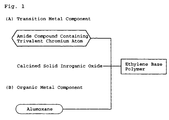
- Fig. 1 is a preparation flow chart of a catalyst used for the preparation method of an ethylene base polymer of the present invention.
- the first component of a catalyst component used in the present invention includes compounds containing a trivalent chromium atom represented by the following general formula (1), wherein R 1 , R 2 , R 3 , R 4 , R 5 , R 6 , R 7 , R 8 , R 9 , R 10 , R 11 , R 12 , R 13 , R 14 , R 15 , R 16 , R 17 and R 18 , with R's being same with or different from one another, are selected from among hydrogen or a C 1 - C 18 hydrocarbyl group, wherein M 1 , M 2 , M 3 , M 4 , M 5 and M 6 are carbon or silicon atoms.
- the specific examples of amide compounds represented by the general formula (1) include the following:
- the second component (a solid inorganic oxide) of a catalyst used in the present invention are oxides of metals of groups 2, 4, 13 and 14 of the periodic table.
- a solid inorganic oxide is calcined at a specified temperature and is removed of water adsorbed, before employed.
- Calcining of solid inorganic oxides is generally done in the dried flowing nitrogen gas gone through molecular sieves at 100 to 500 °C, preferably being 200 to 450 °C, for 30 minutes to 24 hours. It is preferred that the solid inorganic oxide is dried in a flowing state with a sufficient supply of nitrogen gas.
- oligomer e.g. 1-hexene as a trimer
- Alumoxane is a well known compound in the catalyst field and the preparation method and the structure thereof were described in detail in Polyhedron , 9, 429 - 453 (1990), Ziegler Catalysts, G. Fink etal. (Eds.) 57 - 82, Springer - Verlag (1995), etc.
- the third component, alumoxane, of a catalyst used in the present invention is represented by the general formula (2) or (3): wherein R 19 is a hydrocarbyl group such as a methyl group, an ethyl group, a propyl group, an n-butyl group, an isobutyl group, a hexyl group, an octyl group, etc., preferably being a methyl group and an isobutyl group.
- P is an integer of 1 to 100, preferably being over 4, and especially preferably being over 8.
- a salt with crystallization water such as copper sulfate hydrate and aluminum sulfate hydrate
- an inert hydrocarbon solvent such as pentane, hexane, heptane, cyclohexane, decane, benzene and toluene
- a method of reacting water in any form of a solid, a liquid and a gas with trialkylaluminum in a hydrocarbon solvent is a method of reacting water in any form of a solid, a liquid and a gas with trialkylaluminum in a hydrocarbon solvent.
- alumoxane represented by the general formula (4) or (5) may be used: wherein R 20 is a hydrocarbyl group such as a methyl group, an ethyl group, a propyl group, an n-butyl group, an isobutyl group, a hexyl group, and an octyl group, preferably being a methyl group and an isobutyl group, and wherein R 21 , being different for R 20 , is selected from among hydrocarbyl groups such as a methyl group, an ethyl group, a propyl group, an n-butyl group, an isobutyl group, a hexyl group and an octyl group, and halogens such as chlorine and bromine, as well as hydrogen and hydroxyl groups.
- R 20 is a hydrocarbyl group such as a methyl group, an ethyl group, a propyl group, an n-butyl
- a plurality of R 20 's and R 21 's present in a molecular may be same with or different from one another in each group.
- q is an integer of 1 to 100, preferably being over 3.
- q + r is an integer of 2 to 100, preferably being over 6.
- a unit described below may be combined either in block, in regular, irregular, i.e., random, arrangements.
- These alumoxanes can be prepared by repeating the same method as with the alumoxanes in the general formulae described before except that two kinds or more of trialkylaluminum, or a combination of a kind or more of trialkylaluminum and a kind or more of dialkylaluminum monohydride, or dialkylaluminum monohalide is used instead of a kind of trialkylaluminum.
- a catalyst can be prepared by chemical reactions among a chromium amide compound, a solid inorganic oxide and alumoxane.
- trihalogenated chromium such as chromium trichloride and chromium trichloride tetrahydrofuran complex (CrCl 3 ⁇ 3THF) is generally reacted with alkalimetalamide such as lithium bis(trimethylsilyl)amide in an ether type solvent such as tetrahydrofuran at the molar ratio of alkalimetal to chromium being 3.
- alkalimetalamide such as lithium bis(trimethylsilyl)amide
- ether type solvent such as tetrahydrofuran
- a salt thus precipitated is filtered out.
- the desired chromium amide compound is isolated through the recrystallization process or the like.
- an ether type solvent is taken off under a reduced pressure and then the residues may be dissolved in an inert hydrocarbon solvent such as pentane, hexane, heptane, decane, cyclohexane, benzene, toluene and xylene, so as to make a product of chromium amide compound.
- a chromium amide compound When a chromium amide compound is carried on a solid inorganic oxide, the operation is performed in an inert hydrocarbon such as pentane, hexane, heptane, decane, cyclohexane, benzene, toluene and xylene.
- an inert hydrocarbon such as pentane, hexane, heptane, decane, cyclohexane, benzene, toluene and xylene.
- the carrying ratio of chromium atom to solid inorganic oxide is 0.01 to 10 wt%, preferably being 0.03 to 5 wt% and the reaction temperature is -78 °C to the boiling point of the solvent used, preferably being -20 °C to 60 °C and the reaction time is 10 min. to 24 hrs., preferably being 30 min. to 5 hrs.
- a solid component with good fluidity can be obtained by means of either removing the solvent under a reduced pressure or isolation by filtering.
- reaction with alumoxane may be performed succeedingly.
- the solid component described above When the solid component described above is reacted with alumoxane, it is done in an inert hydrocarbon such as pentane, hexane, heptane, decane, cyclohexane, benzene, toluene and xylene. It is desirable that the reaction is done at the molar ratio of aluminum atom present in alumoxane to chromium atom present in a solid component being 1 to 1000, preferably being 5 to 300.
- an inert hydrocarbon such as pentane, hexane, heptane, decane, cyclohexane, benzene, toluene and xylene. It is desirable that the reaction is done at the molar ratio of aluminum atom present in alumoxane to chromium atom present in a solid component being 1 to 1000, preferably being 5 to 300.
- the reaction temperature is -78°C to the boiling point of the solvent used, preferably being -20 °C to 60 °C.
- the reaction time is 10 min. to 24 hrs., preferably being 30 min. to 5 hrs. After the reaction is terminated, either way is taken, one by removing the solvent under a reduced pressure or the other by isolation by filtering. Thus a catalyst with such a good fluidity as free flowing can be obtained.
- a method is desirable that, after suspending both a chromium salt and a solid inorganic oxide in an ether type solvent, a solid component carried with a chromium amide compound which was obtained by treating with a corresponding metalamide beforehand is reacted with alumoxane, leading to a catalyst.
- a chromium salt is chosen from trihalogenated chromium such as chromium trichloride, chromium trifluoride, chromium tribromide and chromium triiodide, preferably being chromium trichloride tetrahydrofuran complex(CrCl 3 ⁇ 3THF), as well as chromium trichloride.
- a chromium amide compound represented by a general formula (1) is obtained by reacting secondary amine or secondary silylamine with a metal in group 1 or 2 in the periodic table, the form of metalamide corresponding to each metal is used. At that time, lithium bis(trimethylsilyl)amide is preferred.
- An ether type solvent which is employed to suspend a chromium salt and a solid inorganic oxide is selected from among aliphatic or alicyclic ethers such as diethylether, diisopropylether, dioxane, 1,2-dimethoxyethane and tetrahydrofuran, preferably being diethyl ether and tetrahydrofuran.
- Addition ratio of a chromium salt to a solid inorganic oxide is 0.01 to 10 wt% in terms of a chromium atom to a solid inorganic oxide, preferably being 0.03 to 5 wt%.
- the reaction between the suspension and metalamide is preformed at the molar ratio of metalamide to chromium being 3.
- the reaction temperature is -78 °C to the boiling point of a solvent employed, preferably being -20 °C to 60 °C.
- the reaction time is 10 min. to 24 hrs., preferably being 30 min. to 5 hrs.
- Reaction of the said solid component with alumoxane is performed in an inert hydrocarbon such as pentane, hexane, heptane, decane, cyclohexane, benzene, toluene and xylene.
- an inert hydrocarbon such as pentane, hexane, heptane, decane, cyclohexane, benzene, toluene and xylene.
- it is desirable to adjust the volumes of the compound and the component such that the atomic ratio of aluminum atom in alumoxane to chromium atom in a solid component is 1 to 1000, preferably being 5 to 300.
- the reaction temperature is -78 °C to the boiling point of the solvent employed, preferably being -20 °C to 60 °C.
- the reaction time is 10 min. to 24 hrs., preferably being 30 min. to 5 hrs.
- a catalyst with such a good fluidity as free flowing can be obtained by either method of removing the solvent under a reduced pressure or separation by filtering.
- any of slurry polymerization, liquid phase polymerization such as solution polymerization and vapor phase polymerization is applicable.
- Liquid phase polymerization is generally performed in a hydrocarbon solvent.
- the hydrocarbon solvent is selected from among inert hydrocarbons such as propane, butane, isobutane, hexane, heptane, cyclohexane, benzene, toluene, xylene and a mixture thereof.
- Vapor phase polymerization can apply a polymerization method which is generally known as fluidized bed, stirring bed, etc. in the presence of an inert gas. In some cases vapor phase polymerization also can employ the method which allows the presence of a media to remove reaction heat, i.e., a condensing mode.
- the reaction temperature for liquid and vapor phase polymerizations is generally 0 to 300 °C, practically being 20 to 200 °C.
- a catalyst concentration and the ethylene pressure in a reactor may be optional as long as polymerization progresses satisfactorily. Hydrogen, etc. can also be present into the polymerization system in order to adjust the molecular weight.
- copolymerization can be performed by incorporating an ⁇ -olefin such as propylene, 1-butene, 1-hexene, 4-methy-1-pentene, 1-octene and a mixture thereof together with ethylene into the reactor.
- the amount of ⁇ -olefin in the copolymer is less than 10 mol%, preferably being less than 5 mol%.
- Number-average molecular weight (Mn) and weight-average molecular weight (Mw) were obtained from the product ethylene base polymers by means of gel permeation chromatography (GPC) under the following conditions:
- SR is shown in terms of expansion rate (%) of outer diameter of the extrudate to the diameter of the orifice which is measured at the same time when HLMFR is measured using the same apparatus as in HLMFR.
- the solvent was thoroughly removed under a reduced pressure after confirmed that chromium trichloride had completely disappeared.
- the resulting deep green block was added with 100 ml of hexane and dissolved therein and was then filtered with a glass wool screen, to remove lithium chloride generated as a byproduct.
- the chromium concentration of the resulting solution was 0.12 mmol - Cr/ml (6.2 mg - Cr/ml).
- silica #952 (a product of W. R. Grace, with average particle size of 80 ⁇ m, specific surface area of 300 m 2 /g and pore volume of 1.6 cm 3 /g) calcined at 300 °C for 8 hours were placed in a 100 ml flask which was purged with nitrogen in advance and was added with 30ml of hexane making the content be in a slurry state. The resulting slurry was added with 0.48ml (the amount of chromium atom carried is 0.10 wt%) of chromium amide solution prepared in the above-described (1) followed by stirring at 40°C for one hour.
- Example 1 Another catalyst was prepared and the polymerization using the catalyst thus obtained was performed by repeating the same procedure as set forth in Example 1 except that at Example 1(2) a 1.2 mol/l hexane solution (Prod. No. being MMAO-3A) of methylalumoxane (a product of Toso-Akzo Co.) having 10% of an isobutyl group was used instead of isobutylalumoxane . As a result, 162 g of polyethylene were obtained. Polymerization activity per 1 g of catalyst per 1 hour of polymerization time was 1350 g/g ⁇ hr. Measurements of physical properties are shown in Table 1.
- Example 1 (2) Another catalyst was prepared and the polymerization using the catalyst thus obtained was performed by repeating the same procedure as set forth in Example 1 except that at Example 1 (2), after carrying reaction of chromium amide, the solvent was removed under a reduced pressure and a free flowing solid component was obtained. 30 ml of toluene were added to the resulting solid component, followed by adding 2.2 ml of a 2.6 mol/l toluene solution of methylalumoxane (a product of Toso-Akzo Co.) instead of isobutylalumoxane . As a result, 138 g of polyethylene were obtained. Polymerization activity per 1 g of catalyst per 1 hour of polymerization time was 1150 g/g ⁇ hr. Physical properties of polyethylene are shown in Table 1.
- the solvent was thoroughly removed under a reduced pressure, after confirming that chromium trichloride had completely disappeared.
- the resulting deep brown block was added with 100 ml of hexane and dissolved therein and afterwards filtered with a glass wool screen to remove lithiumchloride produced as a byproduct.
- the chromium concentration of the resulting solvent was 0.10 mmol-Cr/ml (5.2 mg-Cr/ml).
- Polymerization was performed by repeating the same procedure as set forth in Example 1 except that the catalyst obtained by the above (1) instead of the catalyst of Example 1 was used. As a result, 145 g of polyethylene were obtained. Polymerization activity per 1 g of catalyst per 1 hour of polymerization time was 1210 g/g ⁇ hr. Physical properties of the polyethylene are shown in Table 1.
- a vertical vibration reactor was prepared in a similar way as has been employed when a flow bed reactor was prepared as was described in Eur . Polym . J ., Vol. 21, 245 (1985).
- the vertical vibration reactor had volume of 150 cm 3 , diameter of 50 mm, and vibration rate of 420 cycles/min (7 Hz) with vibration stroke of 6 cm.
- gas-phase polymerization was performed.
- Example 1 (2) 100 mg of a catalyst obtained in Example 1 (2) was sealed in a capsule under a nitrogen circumstance.
- the capsule was put in the reactor purged with nitrogen gas in advance, followed by heating at 87 °C, 5 kg/cm 2 of ethylene were pushed in with pressure in the reactor. After the reactor was shaken until the capsule therein was broken, a polymerization started.
- Example 1 Another polymerization was performed by repeating the same procedure as set forth in Example 1 except that 3 kg/cm 2 of hydrogen were additionally incorporated at the polymerization step of Example 1 (3). As a result, 143 g of polyethylene were obtained. Polymerization activity per 1 g of catalyst per 1 hour of polymerization time was 1190 g/g ⁇ hr. Physical properties of the polyethylene thus obtained are shown in Table 1.
- a comparative polymerization was performed by repeating the same procedure as set forth in Example 1 (3) except that the catalyst used was, being a Phillips catalyst, 969ID catalyst (a product of W. R. Grace, with chromium atom carried being 1.0 wt%) calcined at 600 °C for 30 hours and the polymerization temperature was 100 °C. As a result, 144 g of polyethylene were obtained. Polymerization activity per 1 g of catalyst per 1 hour of polymerization time was 1200 g/g ⁇ hr. Physical properties of polyethylene are shown in Table 1. It was founded that the molecular weight distribution was narrower than those obtained in Examples 1 to 11 and ESCR was very low.
- Bis(bistrimethysilylamide)chromium(II) ⁇ THF complex was prepared in accordance with the method described in Z . anorg . allg . Chem ., 457, 38(1979).
- Example 1 (2) Following the method described at Example 1 (2), instead of tris(bistrimethylsilylamide)chromium(III), 0.96 ml (with chromium atom carried being 0.10 wt%) of a 0.060 mol/l hexane solution of bis(bistrimethylsilylamide)chromium(II) ⁇ THF complex obtained in (1) above was added. After a reaction of carriage of above-described chromium amide compound, a drying process under a reduced pressure was taken to obtain a solid component. All procedures in Example 1 were repeated except that no reaction with isobutylalumoxane was performed in this case.
- Polymerization activity was extremely low compared with a product obtained by using isobutylalumoxane . Because of the low yield of the polymer thus obtained, physical properties of the polymer were unable to measure.
- the polymerization activity was extremely low compared with that obtained by using a trisamide compound derived from a trivalent chromium atom.
- Physical properties of polyethylene thus obtained are shown in Table 1. Both SR and tensile impact were lower than that obtained by using a trisamide compound derived from a trivalent chromium atom.
- a high quality ethylene base polymer with a wide molecular weight distribution, excellent shock and environmental stress cracking resistances, causing no melt fracture, and suitable for film forming and blow molding can be prepared effectively and advantageously in an industrial scale.
Landscapes
- Chemical & Material Sciences (AREA)
- Health & Medical Sciences (AREA)
- Chemical Kinetics & Catalysis (AREA)
- Medicinal Chemistry (AREA)
- Polymers & Plastics (AREA)
- Organic Chemistry (AREA)
- Transition And Organic Metals Composition Catalysts For Addition Polymerization (AREA)
- Polymerization Catalysts (AREA)
- Addition Polymer Or Copolymer, Post-Treatments, Or Chemical Modifications (AREA)
Abstract
An ethylene base polymer and a preparation method of an ethylene base polymer characterized in use of a catalyst comprising a chromium amide compound, a solid inroganic oxide calcined at 100 to 500 DEG C and alumoxane. According to the present invention, an ethylene base polymer with a wide molecular weight distribution, excellent shock and environmental stress cracking resistances, causing no melt fracture, and suitable for film forming and blow molding can be effectively prepared. <IMAGE>
Description
This invention relates to a preparation method of an
ethylene base polymer using a novel chromium catalyst, and more
particularly, to a preparation method of an ethylene base
polymer for use in film forming and blow molding which has a
wide molecular weight distribution and is excellent in shock
and environmental stress cracking resistances, and causes no
melt fracture.
A polymer of ethylene, and a copolymer comprising ethylene
as a main portion and α-olefin (Hereafter, both compounds are
called as an ethylene base polymer in this specification.)have
been widely used as resin materials for various plastic products.
Ethylene base polymers differ in required characteristics
according to forming methods and applications each other. For
example, polymers with a relatively low molecular weight and
a narrow molecular weight distribution are suitable for products
formed by injection molding and blow molding, whereas polymers
with a relative high molecular weight and a wide molecular weight
distribution are suitable for film forming and blow molding.
Molecular weight distribution relates to the surface
texture of film or blown products. It has been considered that
the wider the molecular weight distribution is, the smaller the
roughness of the surface texture of the formed products is.
Namely, even with polymers with a high molecular weight,
products of high quality with good fluidity and no melt fracture
on the surface of the formed products can be obtained. In
addition, when a comparison is made among polymers with same
molecular weight, one with a wider molecular weight distribution
brings about ethylene base polymers with high density and, as
a result, improves the mechanical strength of products.
Moreover, when a comparison is made among polymers with same
density, one with a wider molecular weight distribution improves
the environmental stress cracking resistance (ESCR) of products.
On the other hand, when a comparison is made among polymers
with same molecular weight, one with a wider molecular weight
distribution increases the density and crystallization and, as
a result, decreases shock resistance. Accordingly, an ethylene
base polymer with a wide molecular weight distribution which
is excellent in shock resistance, and environmental stress
cracking resistance (ESCR), and causes no melt fracture for
film forming and blow molding have long been waited for.
It has been known fact that an ethylene base polymer with
a wide molecular weight distribution can be obtained using a
catalyst, generally known as a Phillips catalyst, which is made
by carrying chromium trioxide or any compounds containing
chromium able to be oxidized and changed into chromium trioxide
under a certain activation condition carried on a solid
inorganic oxide such as silica. However, an ethylene base
polymer which has been prepared by a Phillips catalyst has a
molecular weight distribution (Mw/Mn) of about 8 to 30 which
is expressed as the ratio of weighted average molecular weight
(Mw) to numbered average molecular weight (Mn). But, in some
application, an ethylene base polymer with a wider molecular
weight distribution than the above polymer is required. And
also there is a problem in that ESCR is extremely low. Japanese
Patent No. 2996/1969 (U.S. Patent No. 3,324,095), Japanese
Patent No. 3827/1969 (U.K. Patent No. 1,051,391), and Japanese
Patent No. 1766/1972 (U.K. Patent No. 1,332,510) disclose that
an ethylene base polymer with a wide molecular weight
distribution can also be obtained using a catalyst where an ester
of a chromic acid was carried on a solid inorganic oxide such
as silica. An ethylene base polymer prepared using the above
catalyst has fairly a wide molecular weight distribution with
about 20 to 60 Mw/Mn and higher ESCR than that obtained using
a Phillips catalyst, but, as a defect, has low shock resistance
and causes melt fracture when at film forming or blow molding .
Therefore, this polymer has a problem in a practical
application.
U.S. Patent Nos. 5,104,841 and 5,137,997 disclose that an
ethylene base polymer with a wide molecular weight distribution
can also be obtained by using a catalyst where
bis(trimethylsilyl)amide complex derived from a divalent
chromium atom is carried on a solid inorganic oxide. Mw/Mn is
as wide as 50 to 80. Though a molecular weight distribution is
fairly wide, this catalyst is extremely low in polymerization
activity so that there is a practical problem in productivity.
Moreover, since bis(trimethylsilyl)amide complex derived from
a divalent chromium atom is extremely sensitive to air, water,
etc., it is very hard to handle so that this polymer has also
a practical problem. In addition, this polymer has also another
problem that the product has a low shock resistance.
Moreover, Japanese Patent Application Laid-open No.
503739/1995 (International Publication Number WO93/9149)
discloses that an ethylene base polymer with a wide molecular
weight distribution can be obtained by changing the molar ratio
of alumoxane to chromium at polymerization using either of a
catalyst where chromium acetylacetonate was carried on silica
or a catalyst system using alumoxane. But, the preparation
method is very complicated in controlling a process so that the
method has a practical problem.
Therefore, a principal objective of the present invention
is to provide a method of effectively preparing an ethylene base
polymer which solves the problems involved in the conventional
methods and has a wide molecular weight distribution, and are
excellent in shock and environmental stress cracking
resistances, and causes no melt fracture simultaneously.
The present inventors have made an intensive research and
have solved the above-mentioned problems by using a catalyst
which comprises an amide compound containing a trivalent
chromium atom, a solid inorganic oxide calcined at a certain
range of temperature and alumoxane. Namely, the present
invention provides:
Fig. 1 is a preparation flow chart of a catalyst used for
the preparation method of an ethylene base polymer of the present
invention.
Hereafter, the present invention will be described in
detail.
The first component of a catalyst component used in the
present invention includes compounds containing a trivalent
chromium atom represented by the following general formula (1),
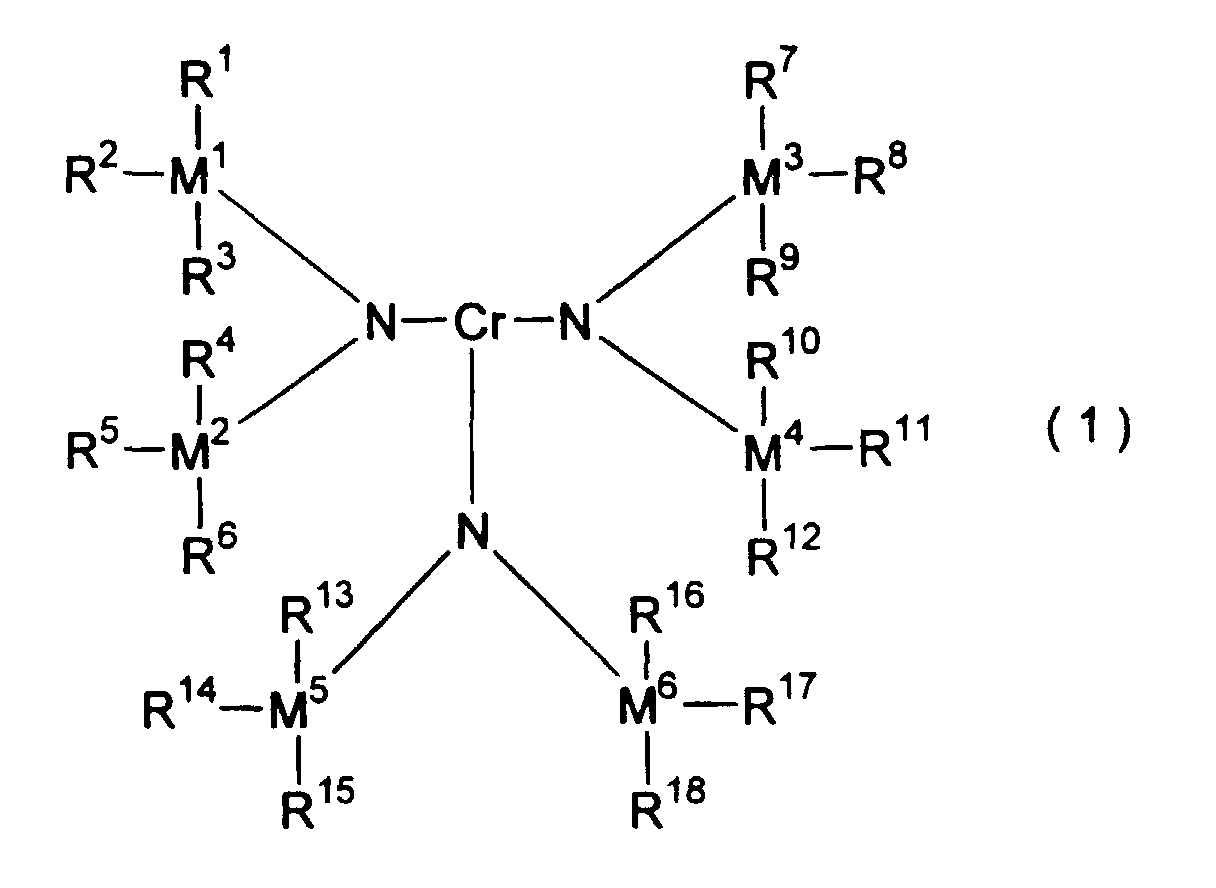 wherein R1, R2, R3, R4, R5, R6, R7, R8, R9, R10, R11, R12, R13,
R14, R15, R16, R17 and R18, with R's being same with or different
from one another, are selected from among hydrogen or a C1 -
C18 hydrocarbyl group, wherein M1, M2, M3, M4, M5 and M6 are carbon
or silicon atoms. The specific examples of amide compounds
represented by the general formula (1) include the following:
wherein R1, R2, R3, R4, R5, R6, R7, R8, R9, R10, R11, R12, R13,
R14, R15, R16, R17 and R18, with R's being same with or different
from one another, are selected from among hydrogen or a C1 -
C18 hydrocarbyl group, wherein M1, M2, M3, M4, M5 and M6 are carbon
or silicon atoms. The specific examples of amide compounds
represented by the general formula (1) include the following:
each with tris(bistrimethylsilylamide)chromium(III) being especially preferred.
The second component (a solid inorganic oxide) of a
catalyst used in the present invention are oxides of metals of
groups 2, 4, 13 and 14 of the periodic table.
The specific examples include the following:
It is preferred that a solid inorganic oxide is calcined
at a specified temperature and is removed of water adsorbed,
before employed.
Calcining of solid inorganic oxides is generally done in
the dried flowing nitrogen gas gone through molecular sieves
at 100 to 500 °C, preferably being 200 to 450 °C, for 30 minutes
to 24 hours. It is preferred that the solid inorganic oxide is
dried in a flowing state with a sufficient supply of nitrogen
gas.
If the calcining temperature exceeds 500 °C, the
polymerization activity of ethylene into high molecular weight
polyethylene decreases and, as a result, generation of an
oligomer (e.g. 1-hexene as a trimer) will increase unfavorably.
Alumoxane is a well known compound in the catalyst field and
the preparation method and the structure thereof were described
in detail in Polyhedron, 9, 429 - 453 (1990), Ziegler Catalysts,
G. Fink etal. (Eds.) 57 - 82, Springer - Verlag (1995), etc.
The third component, alumoxane, of a catalyst used in the
present invention is represented by the general formula (2) or
(3):
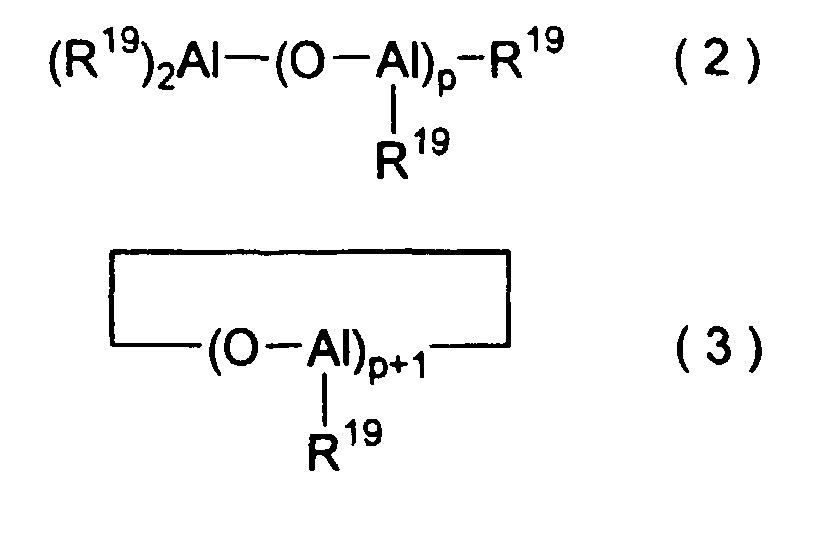 wherein R19 is a hydrocarbyl group such as a methyl group, an
ethyl group, a propyl group, an n-butyl group, an isobutyl group,
a hexyl group, an octyl group, etc., preferably being a methyl
group and an isobutyl group. P is an integer of 1 to 100,
preferably being over 4, and especially preferably being over
8.
wherein R19 is a hydrocarbyl group such as a methyl group, an
ethyl group, a propyl group, an n-butyl group, an isobutyl group,
a hexyl group, an octyl group, etc., preferably being a methyl
group and an isobutyl group. P is an integer of 1 to 100,
preferably being over 4, and especially preferably being over
8.
The preparation method of the above described compounds
are publicly well known and include:
A method of adding trialkylaluminum to a suspension of a
salt with crystallization water (such as copper sulfate hydrate
and aluminum sulfate hydrate) in an inert hydrocarbon solvent
such as pentane, hexane, heptane, cyclohexane, decane, benzene
and toluene; and
A method of reacting water in any form of a solid, a liquid
and a gas with trialkylaluminum in a hydrocarbon solvent.
In addition, alumoxane represented by the general formula
(4) or (5) may be used:
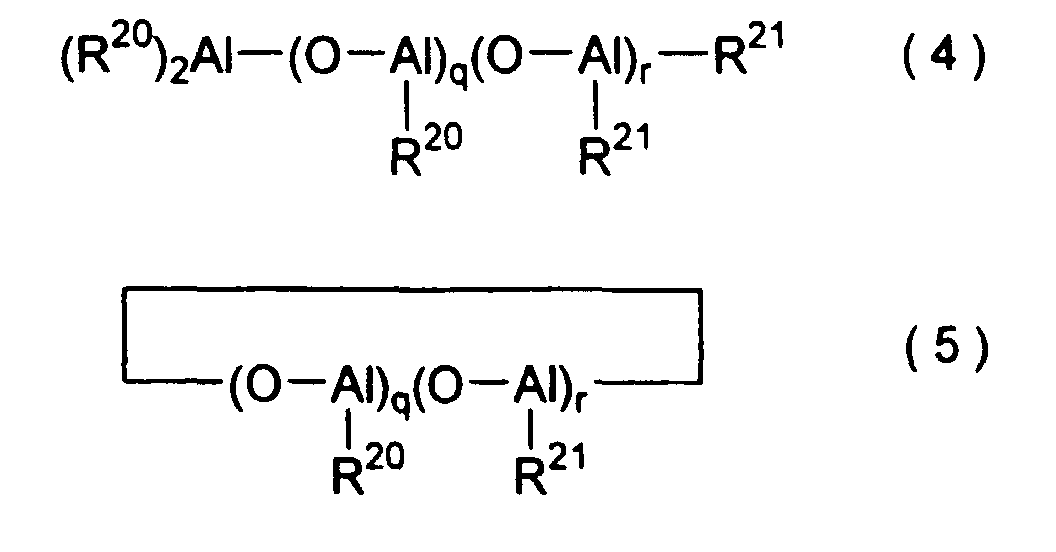 wherein R20 is a hydrocarbyl group such as a methyl group, an
ethyl group, a propyl group, an n-butyl group, an isobutyl group,
a hexyl group, and an octyl group, preferably being a methyl
group and an isobutyl group, and wherein R21, being different
for R20, is selected from among hydrocarbyl groups such as a
methyl group, an ethyl group, a propyl group, an n-butyl group,
an isobutyl group, a hexyl group and an octyl group, and halogens
such as chlorine and bromine, as well as hydrogen and hydroxyl
groups. A plurality of R20's and R21's present in a molecular
may be same with or different from one another in each group.
q is an integer of 1 to 100, preferably being over 3. q + r
is an integer of 2 to 100, preferably being over 6.
wherein R20 is a hydrocarbyl group such as a methyl group, an
ethyl group, a propyl group, an n-butyl group, an isobutyl group,
a hexyl group, and an octyl group, preferably being a methyl
group and an isobutyl group, and wherein R21, being different
for R20, is selected from among hydrocarbyl groups such as a
methyl group, an ethyl group, a propyl group, an n-butyl group,
an isobutyl group, a hexyl group and an octyl group, and halogens
such as chlorine and bromine, as well as hydrogen and hydroxyl
groups. A plurality of R20's and R21's present in a molecular
may be same with or different from one another in each group.
q is an integer of 1 to 100, preferably being over 3. q + r
is an integer of 2 to 100, preferably being over 6.
In the general formula (4) or (5), a unit described below
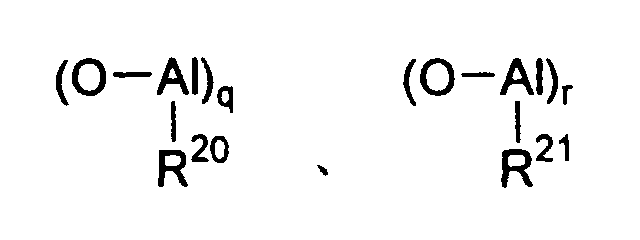 may be combined either in block, in regular, irregular, i.e.,
random, arrangements. These alumoxanes can be prepared by
repeating the same method as with the alumoxanes in the general
formulae described before except that two kinds or more of
trialkylaluminum, or a combination of a kind or more of
trialkylaluminum and a kind or more of dialkylaluminum
monohydride, or dialkylaluminum monohalide is used instead of
a kind of trialkylaluminum.
may be combined either in block, in regular, irregular, i.e.,
random, arrangements. These alumoxanes can be prepared by
repeating the same method as with the alumoxanes in the general
formulae described before except that two kinds or more of
trialkylaluminum, or a combination of a kind or more of
trialkylaluminum and a kind or more of dialkylaluminum
monohydride, or dialkylaluminum monohalide is used instead of
a kind of trialkylaluminum.
A catalyst can be prepared by chemical reactions among a
chromium amide compound, a solid inorganic oxide and alumoxane.
Namely, either one of the following two methods may be used:
In method (A), i.e., a synthesis method of a chromium amide
compound represented by the general formula (1), trihalogenated
chromium such as chromium trichloride and chromium trichloride
tetrahydrofuran complex (CrCl3·3THF) is generally reacted with
alkalimetalamide such as lithium bis(trimethylsilyl)amide in
an ether type solvent such as tetrahydrofuran at the molar ratio
of alkalimetal to chromium being 3. In the above reaction,
lithium chloride will be precipitated as a halogenated metal
when, for example, chromium trichloride and lithium
bis(trimethylsilyl)amide are reacted. A salt thus
precipitated is filtered out. After that, the desired chromium
amide compound is isolated through the recrystallization
process or the like. Or, without doing isolation, after the
halogenated alkali metal described above is removed, an ether
type solvent is taken off under a reduced pressure and then the
residues may be dissolved in an inert hydrocarbon solvent such
as pentane, hexane, heptane, decane, cyclohexane, benzene,
toluene and xylene, so as to make a product of chromium amide
compound.
When a chromium amide compound is carried on a solid
inorganic oxide, the operation is performed in an inert
hydrocarbon such as pentane, hexane, heptane, decane,
cyclohexane, benzene, toluene and xylene.
The carrying ratio of chromium atom to solid inorganic
oxide is 0.01 to 10 wt%, preferably being 0.03 to 5 wt% and the
reaction temperature is -78 °C to the boiling point of the solvent
used, preferably being -20 °C to 60 °C and the reaction time is
10 min. to 24 hrs., preferably being 30 min. to 5 hrs.
After the carrying reaction, a solid component with good
fluidity can be obtained by means of either removing the solvent
under a reduced pressure or isolation by filtering. As another
way, without removing the solvent, reaction with alumoxane may
be performed succeedingly.
When the solid component described above is reacted with
alumoxane, it is done in an inert hydrocarbon such as pentane,
hexane, heptane, decane, cyclohexane, benzene, toluene and
xylene. It is desirable that the reaction is done at the molar
ratio of aluminum atom present in alumoxane to chromium atom
present in a solid component being 1 to 1000, preferably being
5 to 300.
The reaction temperature is -78°C to the boiling point of
the solvent used, preferably being -20 °C to 60 °C. The reaction
time is 10 min. to 24 hrs., preferably being 30 min. to 5 hrs.
After the reaction is terminated, either way is taken, one by
removing the solvent under a reduced pressure or the other by
isolation by filtering. Thus a catalyst with such a good
fluidity as free flowing can be obtained.
In the method (B), a method is desirable that, after
suspending both a chromium salt and a solid inorganic oxide in
an ether type solvent, a solid component carried with a chromium
amide compound which was obtained by treating with a
corresponding metalamide beforehand is reacted with alumoxane,
leading to a catalyst.
A chromium salt is chosen from trihalogenated chromium such
as chromium trichloride, chromium trifluoride, chromium
tribromide and chromium triiodide, preferably being chromium
trichloride tetrahydrofuran complex(CrCl3·3THF), as well as
chromium trichloride.
When a chromium amide compound represented by a general
formula (1) is obtained by reacting secondary amine or secondary
silylamine with a metal in group 1 or 2 in the periodic table,
the form of metalamide corresponding to each metal is used. At
that time, lithium bis(trimethylsilyl)amide is preferred. An
ether type solvent which is employed to suspend a chromium salt
and a solid inorganic oxide is selected from among aliphatic
or alicyclic ethers such as diethylether, diisopropylether,
dioxane, 1,2-dimethoxyethane and tetrahydrofuran, preferably
being diethyl ether and tetrahydrofuran.
Addition ratio of a chromium salt to a solid inorganic oxide
is 0.01 to 10 wt% in terms of a chromium atom to a solid inorganic
oxide, preferably being 0.03 to 5 wt%. The reaction between the
suspension and metalamide is preformed at the molar ratio of
metalamide to chromium being 3.
The reaction temperature is -78 °C to the boiling point of
a solvent employed, preferably being -20 °C to 60 °C. The
reaction time is 10 min. to 24 hrs., preferably being 30 min.
to 5 hrs. By the reaction described above a chromium amide
compound is prepared and is immediately carried on a solid
inorganic oxide in the same reaction system. After the reaction
is terminated, a solid component with good fluidity can be
obtained by either method of removing the solvent under a reduced
pressure or separation by filtering.
Reaction of the said solid component with alumoxane is
performed in an inert hydrocarbon such as pentane, hexane,
heptane, decane, cyclohexane, benzene, toluene and xylene. At
the reaction, it is desirable to adjust the volumes of the
compound and the component such that the atomic ratio of aluminum
atom in alumoxane to chromium atom in a solid component is 1
to 1000, preferably being 5 to 300.
The reaction temperature is -78 °C to the boiling point of
the solvent employed, preferably being -20 °C to 60 °C. The
reaction time is 10 min. to 24 hrs., preferably being 30 min.
to 5 hrs. After the reaction is terminated, a catalyst with such
a good fluidity as free flowing can be obtained by either method
of removing the solvent under a reduced pressure or separation
by filtering.
When the preparation method of ethylene base polymers of
the present invention is performed using the above-described
catalyst, any of slurry polymerization, liquid phase
polymerization such as solution polymerization and vapor phase
polymerization is applicable. Liquid phase polymerization is
generally performed in a hydrocarbon solvent. At that time, the
hydrocarbon solvent is selected from among inert hydrocarbons
such as propane, butane, isobutane, hexane, heptane,
cyclohexane, benzene, toluene, xylene and a mixture thereof.
Vapor phase polymerization can apply a polymerization
method which is generally known as fluidized bed, stirring bed,
etc. in the presence of an inert gas. In some cases vapor phase
polymerization also can employ the method which allows the
presence of a media to remove reaction heat, i.e., a condensing
mode.
The reaction temperature for liquid and vapor phase
polymerizations is generally 0 to 300 °C, practically being 20
to 200 °C. A catalyst concentration and the ethylene pressure
in a reactor may be optional as long as polymerization progresses
satisfactorily. Hydrogen, etc. can also be present into the
polymerization system in order to adjust the molecular weight.
Moreover, as required and needed, copolymerization can be
performed by incorporating an α-olefin such as propylene,
1-butene, 1-hexene, 4-methy-1-pentene, 1-octene and a mixture
thereof together with ethylene into the reactor. The amount of
α-olefin in the copolymer is less than 10 mol%, preferably being
less than 5 mol%.
By embodying the method of the present invention, an
ethylene base polymer with the following characteristics can
be obtained:
Hereinafter, the present invention will be described in
more detail by examples and comparative examples. However, the
present invention is not limited to the examples.
Such physical properties as molecular weight , molecular
weight distribution, melt flow rate, density, die swell ratio,
tensile impact and ESCR of polymers obtained by the examples
and the comparative examples were measured by the following
method:
Number-average molecular weight (Mn) and weight-average
molecular weight (Mw) were obtained from the product ethylene
base polymers by means of gel permeation chromatography (GPC)
under the following conditions:
Measurement conditions of gel permeation chromatography:
- apparatus :
- WATERS 150C Model
- column :
- Shodex - HT806M
- solvent :
- 1,2,4-trichlorobenzene
- temperature :
- 135 °C
- concentration of sample:
- 2 mg / 5 ml
Universal assessment using monodisperse polystyrene
fraction was applied.
As far as the molecular weight distribution which is shown
in terms of the ratio of Mw to Mn (Mw / Mn) (where the larger
the Mw/Mn is, the wider the molecular weight distribution is.)
is concerned, actual measurements were corrected after n-alkane
and data of classified linear polyethylene with Mw/Mn being
equal to or less than 1.2 had been applied to the formula of
molecular weight and detector sensibility described in "Size
exclusion chromatography (High performance liquid
chromatography for polymers)" 96 page, Sadao Mori, Kyoritsu Pub.
Co. and then the sensitivity of molecular weight M had been
determined using the following formula:
Sensitivity of Molecular M = a + b / M,
wherein a and b, both being constant, are 1.032 and 189.2
respectively.
In accordance with Table 1, Condition 7 of JISK-7210 (1996),
measurements were performed under the conditions of the
temperature of 190 °C and load of 21.6 kgf and was shown in terms
of HLMFR.
In accordance with JIS K-7112 (1996), measurements were
performed.
SR is shown in terms of expansion rate (%) of outer diameter
of the extrudate to the diameter of the orifice which is measured
at the same time when HLMFR is measured using the same apparatus
as in HLMFR.
In accordance with ASTM D-1822, tensile impact is measured
at 23 °C and -40 °C. The measurements represent shock
resistance.
In accordance with JIS K-6760 (1996), test was done by the
method of BTL. F50 value is regarded as ESCR.
In accordance with the method described in J. Chem. Soc. (A),
1433 (1971), tris(bistrimethylsilylamide)chromium(III) was
synthesized.
1.93 g (12.2 mmol) of anhydrous chromium trichloride were
placed in a 200 ml flask which was purged with nitrogen in advance
and was added with 30 ml of tetrahydrofuran making the content
be in a slurry state. The resulting slurry was cooled to 0 to
3 °C in an ice bath and was then added with 36.6 ml (36.6 mmol
and molar ratio of amide to chromium being 3) of a 1.0 mol/l
lithium bis(trimethylsilyl)amide (a product of Aldrich Co.)
solution in hexane, followed by stirring at 25 °C for 4 hours.
The solvent was thoroughly removed under a reduced pressure
after confirmed that chromium trichloride had completely
disappeared. The resulting deep green block was added with 100
ml of hexane and dissolved therein and was then filtered with
a glass wool screen, to remove lithium chloride generated as
a byproduct. The chromium concentration of the resulting
solution was 0.12 mmol - Cr/ml (6.2 mg - Cr/ml).
3.0 g of silica #952 (a product of W. R. Grace, with average
particle size of 80 µm, specific surface area of 300 m2/g and
pore volume of 1.6 cm3/g) calcined at 300 °C for 8 hours were
placed in a 100 ml flask which was purged with nitrogen in advance
and was added with 30ml of hexane making the content be in a
slurry state. The resulting slurry was added with 0.48ml (the
amount of chromium atom carried is 0.10 wt%) of chromium amide
solution prepared in the above-described (1) followed by
stirring at 40°C for one hour. After that, the slurry was added
with 4.8 ml (molar ratio of aluminum / chromium is 100.) of a
1.2 mol/l isobutylalumoxane (a product of Toso-Akzo Co.)
solution in hexane, followed by stirring at 40 °C for 2 hours.
The solvent was removed under a reduced pressure and a free
flowing catalyst was obtained.
0.6 l of isobutane and 0.12 g of the catalyst prepared in
the above described (2) were placed in a 1.5 l autoclave and
the inside of the autoclave was heated to 90 °C. Then, ethylene
was pushed into the autoclave and left at 14 kg/cm2 of ethylene
partial pressure for one hour, allowing polymerization to
progress. After that, gas component of the content was
discharged and the polymerization was terminated. As a result,
154 g of polyethylene were obtained. The polymerization
activity per 1 g of catalyst per 1 hour of polymerization time
was 1280 g/g·hr. Measurements of molecular weight, molecular
weight distribution, melt flow rate, density, die swell ratio,
tensile impact and ESCR of the polyethylene thus obtained are
shown in Table 1.
Another catalyst was prepared and the polymerization using
the catalyst thus obtained was performed by repeating the same
procedure as set forth in Example 1 except that at Example 1(2)
a 1.2 mol/l hexane solution (Prod. No. being MMAO-3A) of methylalumoxane
(a product of Toso-Akzo Co.) having 10% of an isobutyl
group was used instead of isobutylalumoxane . As a result, 162
g of polyethylene were obtained. Polymerization activity per
1 g of catalyst per 1 hour of polymerization time was 1350 g/g·hr.
Measurements of physical properties are shown in Table 1.
Another catalyst was prepared and the polymerization using
the catalyst thus obtained was performed by repeating the same
procedure as set forth in Example 1 except that at Example 1
(2), after carrying reaction of chromium amide, the solvent was
removed under a reduced pressure and a free flowing solid
component was obtained. 30 ml of toluene were added to the
resulting solid component, followed by adding 2.2 ml of a 2.6
mol/l toluene solution of methylalumoxane (a product of
Toso-Akzo Co.) instead of isobutylalumoxane . As a result, 138
g of polyethylene were obtained. Polymerization activity per
1 g of catalyst per 1 hour of polymerization time was 1150 g/g·hr.
Physical properties of polyethylene are shown in Table 1.
Another catalyst was prepared and the polymerization using
the catalyst thus obtained was performed by repeating the same
procedure as set forth in Example 1 except that at Example 1(2),
the addition of chromium amide solution was changed into 0.96
ml (the amount of chromium atom carried is 0.20 wt%) and the
addition of isobutylalumoxane was changed into 9.6 ml (molar
ratio of aluminum/chromium is 100). As a result, 230 g of
polyethylene were obtained. The polymerization activity per 1
g of catalyst per 1 hour of polymerization time was 1920 g/g·hr.
Physical properties of the polyethylene are shown in Table
1.
Another catalyst was prepared and the polymerization using
the catalyst thus obtained was performed by repeating the same
procedure as set forth in Example 1 except that at Example 1(2),
the addition of isobutylalumoxane was 2.4 ml (molar ratio of
aluminum/chromium is 50). As a result, 148 g of polyethylene
were obtained. Polymerization activity per 1 g of catalyst per
1 hour of polymerization time was 1230 g/g·hr. Physical
properties of the polyethylene are shown in Table 1.
Another sample was prepared and the polymerization was
performed using the catalyst thus obtained by repeating the same
procedure as set forth in Example 1 except that at Example 1(2),
silica of Grade CARiACT P-3 (with average particle size of 35
µm, specific surface area of 720 m2/g and pore volume of 1.2
cm3/g )(a product of Fuji Silicia Co.) calcined at 300 °C for
8 hours was used instead of silica of Grade 952. As a result,
173 g of polyethylene were obtained. Polymerization activity
per 1 g of catalyst per 1 hour of polymerization time was 1440
g/g·hr. Physical properties of the polyethylene are shown in
Table 1.
1.93 g (12.2 mmol) of anhydrous chromium trichloride were
placed in a 200 ml flask which was purged with nitrogen beforehand
and was added with 30 ml of tetrahydrofuran making the content
into a slurry state. The resulting slurry was cooled to between
0 and 3 °C in an ice bath and was then added with 36.6 ml (36.6
mmol and the molar ratio of amide to chromium being 3) of a 1.0
mol/l tetrahydrofuran solution of lithium diisopropylamide ( a
product of Aldrich Co.), followed by stirring at 25 °C for 4 hours.
The solvent was thoroughly removed under a reduced pressure,
after confirming that chromium trichloride had completely
disappeared. The resulting deep brown block was added with 100
ml of hexane and dissolved therein and afterwards filtered with
a glass wool screen to remove lithiumchloride produced as a
byproduct. The chromium concentration of the resulting solvent
was 0.10 mmol-Cr/ml (5.2 mg-Cr/ml).
Another catalyst was prepared and the polymerization using
the catalyst thus obtained was performed by repeating the same
procedure as set forth in Example 1 except that at Example 1(2),
0.58 ml (chromium atom carried being 0.10 wt%) of hexane solution
of tris(diisopropylamide) chromium(III) obtained as in (1)
above was added instead of tris(bistrimethylsilylamide)chromium(III).
As a result, 135 g of polyethylene were obtained.
Polymerization activity per 1 g of catalyst per 1 hour of
polymerization time was 1130 g/g·hr. The physical properties
are shown in Table 1.
3.0 g of silica of Grade CARiACT P-3 (a product of Fuji
Silicia Co. with average particle size being 35 µm, specific
surface area being 720 m2/g and pore volume being 1.2 cm3/g)
calcined at 300 °C for 8 hours, 18.3 mg (chromium atom carried
being 0.20 wt%) of anhydrous chromium trichloride, and 30 ml
of tetrahydrofuran were placed in a 100 ml flask which had been
purged with nitrogen in advance, making the mixture of the above
three components be in a slurry state. While stirring the
resulting slurry at 25 °C, 0.35 ml (0.35 mmol and the molar ratio
of amide to chromium being 3) of a 1.0 mol/l hexane solution
of lithium bis(trimethylsilyl)amide (a product of Aldrich Co.)
was added to the slurry, followed by succeeding stirring at 25
°C for 2 hours. The solvent was then completely removed under
a reduced pressure so that a solid component was obtained. A
30 ml of hexane was added to the resulting solid component to
make the content be in a slurry state. 9.6 ml (molar ratio of
aluminum to chromium being 100) of a 1.2 mol/l hexane solution
of isobutylalumoxane (a product of Toso-Akzo Co.) was added to
the slurry, followed by stirring at 40 °C for 2 hours. The
solvent contained in the slurry was completely removed under
a reduced pressure and a free flowing catalyst was obtained.
Polymerization was performed by repeating the same
procedure as set forth in Example 1 except that the catalyst
obtained by the above (1) instead of the catalyst of Example
1 was used. As a result, 145 g of polyethylene were obtained.
Polymerization activity per 1 g of catalyst per 1 hour of
polymerization time was 1210 g/g·hr. Physical properties of the
polyethylene are shown in Table 1.
A vertical vibration reactor was prepared in a similar way
as has been employed when a flow bed reactor was prepared as
was described in Eur. Polym. J., Vol. 21, 245 (1985). The
vertical vibration reactor had volume of 150 cm3, diameter of
50 mm, and vibration rate of 420 cycles/min (7 Hz) with vibration
stroke of 6 cm. Using the vertical vibration reactor, gas-phase
polymerization was performed.
100 mg of a catalyst obtained in Example 1 (2) was sealed
in a capsule under a nitrogen circumstance. The capsule was put
in the reactor purged with nitrogen gas in advance, followed
by heating at 87 °C, 5 kg/cm2 of ethylene were pushed in with
pressure in the reactor. After the reactor was shaken until the
capsule therein was broken, a polymerization started.
In order to maintain an ethylene pressure in the reactor,
ethylene was continuously supplied through a flexible joint.
Ethylene was polymerized at 90 °C for one hour and then the supply
of ethylene was ceased. After the reactor was cooled down to
a room temperature, a remaining gas was purged. As a result,
43 g of polyethylene were obtained. Polymerization activity per
1 g of catalyst per 1 hour of polymerization time was 430 g/g·hr.
Physical properties of the polyethylene thus obtained are
shown in Table 1.
Another polymerization was performed by repeating the same
procedure as set forth in Example 1 except that 3 kg/cm2 of
hydrogen were additionally incorporated at the polymerization
step of Example 1 (3). As a result, 143 g of polyethylene were
obtained. Polymerization activity per 1 g of catalyst per 1 hour
of polymerization time was 1190 g/g·hr. Physical properties of
the polyethylene thus obtained are shown in Table 1.
Another polymerization was performed by repeating the same
procedure as set forth in Example 1 except that 10 ml of 1-hexene
were added with the help of pressure of ethylene at the
polymerization step of Example 1 (3) and effected a
copolymerization. As a result, 161 g of polyethylene were
obtained. Polymerization activity per 1 g of catalyst per 1 hour
of polymerization time was 1340 g/g·hr. Physical properties of
polyethylene are shown in Table 1.
A comparative polymerization was performed by repeating
the same procedure as set forth in Example 1 (3) except that
the catalyst used was, being a Phillips catalyst, 969ID
catalyst (a product of W. R. Grace, with chromium atom carried
being 1.0 wt%) calcined at 600 °C for 30 hours and the
polymerization temperature was 100 °C. As a result, 144 g of
polyethylene were obtained. Polymerization activity per 1 g of
catalyst per 1 hour of polymerization time was 1200 g/g·hr.
Physical properties of polyethylene are shown in Table 1. It
was founded that the molecular weight distribution was narrower
than those obtained in Examples 1 to 11 and ESCR was very low.
In accordance with U.S. Patent No. 2,863,891,
bis(triphenylsilyl)chromate was synthesized by reacting
chromium trioxide with triphenylsilanol.
3.0 g of Silica Grade 952 (a product of W.R. Grace, with
average particle size of 80 µm, specific surface area of 300
cm3/g and pore volume of 1.6 m3/g) calcined at 500 °C for 6 hours
were put in a 100 ml flask purged with nitrogen in advance and
was added with 30 ml of hexane, making the content be in a slurry
state. 1.15 ml (chromium atom carried was 0.20 wt%) of a 0.1
mol/l hexane solution of bis(triphenylsilyl)chromate obtained
in (1) were added to the slurry and stirred at 25 °C for one hour.
Succeedingly, 0.96ml ( molar ratio of aluminum to chromium being
10) of a 1.2 mol/l hexane solution of triethylaluminum (a product
of Toso-Akzo Co.) was added to the resulting solution and stirred
at 25 °C for one hour. A solvent was removed under a reduced
pressure and a free flowing catalyst was obtained.
Another polymerization was performed by repeating the same
procedure as set forth in Example 1 except that the catalyst
obtained in (2) above was used. As a result, 150 g of
polyethylene were obtained. Polymerization activity per 1 g of
catalyst per 1 hour of polymerization time was 1250 g/g·hr.
Physical properties of the polyethylene thus obtained are shown
in Table 1. Molecular weight distribution was wide. ESCR was
higher than that of Comparative Example 1. Tensile impact was
low. Since an extruded product caused a melt fracture at the
time of HLMFR measurements, SR was unable to measure.
Bis(bistrimethysilylamide)chromium(II)·THF complex was
prepared in accordance with the method described in Z. anorg.
allg. Chem., 457, 38(1979).
Following the method described at Example 1 (2), instead
of tris(bistrimethylsilylamide)chromium(III), 0.96 ml (with
chromium atom carried being 0.10 wt%) of a 0.060 mol/l hexane
solution of bis(bistrimethylsilylamide)chromium(II) · THF
complex obtained in (1) above was added. After a reaction of
carriage of above-described chromium amide compound, a drying
process under a reduced pressure was taken to obtain a solid
component. All procedures in Example 1 were repeated except
that no reaction with isobutylalumoxane was performed in this
case.
Another polymerization was performed by repeating the same
procedures as set forth in Example 1 except that 0.12 g of the
solid component obtained in (2) above and 1.0 ml of 1.0 mol/l
hexane solution of triethylaluminum (a product of Toso-Akzo Co.)
were put in an autoclave. As a result, 26 g of polyethylene were
obtained. Polymerization activity per 1 g of catalyst per 1 hour
of polymerization time was 220 g/g·hr. Physical properties of
the polyethylene thus obtained are shown in Table 1.
Polymerization activity was extremely lower than both a
trisamide compound derived from trivalent chromium and a product
derived from alumoxane. Tensile impact was also low.
Preparation of a catalyst and the succeeding
polymerization were performed by repeating the same procedure
as set forth in Example 1 except that 1.2 mol/l hexane solution
of triisobutylaluminum (a product of Toso-Akzo Co.) was employed
instead of isobutylalumoxane at Example 1 (2). As a result,
2 g of polyethylene were obtained. Polymerization activity per
1 g of catalyst per 1 hour of polymerization time was 17 g/g·hr.
Polymerization activity was extremely low compared with a
product obtained by using isobutylalumoxane . Because of the
low yield of the polymer thus obtained, physical properties of
the polymer were unable to measure.
Another polymerization was performed by repeating the same
procedure as set forth in Example 1 except that silica Grade
952 calcined at 600 °C instead of the same grade of silica calcined
at 300 °C was used. Moreover, 0.96 ml (with chromium atom carried
being 0.20 wt%) of chromium amide solution and 9.6 ml (with molar
ratio of aluminum to chromium being 100) of a 1.2 mol/l hexane
solution of isobutylalumoxane were added. As a result, though
ethylene supplied was consumed all the while polymerization was
going on, only 1.2 g of polyethylene were obtained. After the
polymerization reaction, a solvent was sampled and put into
analysis by a gas chromatography. It was founded that 32 g of
1-hexene were generated. Polymerization activity per 1 g of
catalyst per 1 hour of polymerization time was 10 g/g·hr.
Polymerization activity was extremely low compared with that
obtained using silica calcined at 300 °C. Trimer of ethylene,
i.e., 1-hexene, was the main product instead of polyethylene.
Because of the low yield of the polymer thus obtained, physical
properties of the polymer were unable to measure.
The other preparation of catalyst and succeeding
polymerization were performed by repeating the same procedure
as set forth in Example 1 except that 0.96 ml (with chromium
atom carried being 0.10 wt%) of a 0.060 mol/l hexane solution
of bis(bistrimethylsilylamide)chromium(II) · THF complex
obtained in Comparative Example 3(1) was employed instead of
tris(bistrimethylsilylamide)chromium(III). As a result, 25 g
of polyethylene were obtained. Polymerization activity per 1
g of catalyst per 1 hour of polymerization time was 210 g/g·hr.
The polymerization activity was extremely low compared with
that obtained by using a trisamide compound derived from a
trivalent chromium atom. Physical properties of polyethylene
thus obtained are shown in Table 1. Both SR and tensile impact
were lower than that obtained by using a trisamide compound
derived from a trivalent chromium atom.

According to the present invention, a high quality ethylene
base polymer with a wide molecular weight distribution,
excellent shock and environmental stress cracking resistances,
causing no melt fracture, and suitable for film forming and blow
molding can be prepared effectively and advantageously in an
industrial scale.
Claims (5)
- A preparation method of an ethylene base polymer characterizing in use of a catalyst comprising an amide compound containing a trivalent chromium atom, a solid inorganic oxide calcined at 100 to 500 °C and alumoxane.
- The preparation method of claim 1, wherein a solid inorganic oxide calcined at 200 to 450 °C is used.
- The preparation method of claim 1, wherein a catalyst obtained by carrying an amide compound containing a trivalent chromium atom on to a solid inorganic oxide, followed by reacting with alumoxane is used.
- The preparation method of claim 1, wherein an ethylene base polymer is polyethylene.
- The preparation method of claim 1, wherein an ethylene base polymer is a copolymer of ethylene and α-olefin.
Applications Claiming Priority (3)
| Application Number | Priority Date | Filing Date | Title |
|---|---|---|---|
| JP22020896 | 1996-08-21 | ||
| JP220208/96 | 1996-08-21 | ||
| PCT/JP1997/002881 WO1998007762A1 (en) | 1996-08-21 | 1997-08-20 | Process for preparing ethylenic polymer |
Publications (2)
| Publication Number | Publication Date |
|---|---|
| EP0861854A1 true EP0861854A1 (en) | 1998-09-02 |
| EP0861854A4 EP0861854A4 (en) | 2000-10-18 |
Family
ID=16747588
Family Applications (1)
| Application Number | Title | Priority Date | Filing Date |
|---|---|---|---|
| EP97935831A Withdrawn EP0861854A4 (en) | 1996-08-21 | 1997-08-20 | PROCESS FOR THE PREPARATION OF ETHYLENIC POLYMER |
Country Status (4)
| Country | Link |
|---|---|
| US (1) | US6040399A (en) |
| EP (1) | EP0861854A4 (en) |
| KR (1) | KR20000064271A (en) |
| WO (1) | WO1998007762A1 (en) |
Cited By (4)
| Publication number | Priority date | Publication date | Assignee | Title |
|---|---|---|---|---|
| WO1999020636A1 (en) * | 1997-10-20 | 1999-04-29 | Akzo Nobel N.V. | Process for preparing group vi metal-based olefin polymerization catalyst component |
| EP1041085A1 (en) * | 1999-04-01 | 2000-10-04 | Japan Polyolefins Co., Ltd. | Catalyst for the production of ethylene polymer and process for producing ethylene polymer |
| WO2005092503A1 (en) * | 2004-03-16 | 2005-10-06 | Union Carbide Chemicals & Plastics Technology Corporation | Aluminum phosphate-supported group 6 metal amide catalysts for oligomerization of ethylene |
| EP2826795A1 (en) * | 2013-07-18 | 2015-01-21 | ETH Zurich | Chromium(III) silicate catalysts suitable for PE synthesis |
Families Citing this family (5)
| Publication number | Priority date | Publication date | Assignee | Title |
|---|---|---|---|---|
| CN101309938A (en) * | 2005-11-17 | 2008-11-19 | 埃克森美孚化学专利公司 | Catalyst systems for the polymerization of olefins and polymers prepared therefrom |
| CN101679541A (en) * | 2007-05-16 | 2010-03-24 | 埃克森美孚化学专利公司 | Catalyst system for olefin polymerization and polymers made therefrom |
| JP5581305B2 (en) * | 2010-12-24 | 2014-08-27 | 日本ポリエチレン株式会社 | Catalyst for ethylene polymerization, method for producing polyethylene using the same, polyethylene for blow molded products, and polyethylene for large blow molded products |
| US11059916B2 (en) | 2016-12-07 | 2021-07-13 | Exxonmobil Chemical Patents Inc. | Chromium-based olefin polymerization catalysts |
| WO2018106349A1 (en) * | 2016-12-07 | 2018-06-14 | Exxonmobil Chemical Patents Inc. | Chromium-based olefin polymerization catalysts |
Family Cites Families (9)
| Publication number | Priority date | Publication date | Assignee | Title |
|---|---|---|---|---|
| US5376612A (en) * | 1989-08-10 | 1994-12-27 | Phillips Petroleum Company | Chromium catalysts and process for making chromium catalysts |
| US5137997A (en) * | 1991-04-22 | 1992-08-11 | Phillips Petroleum Company | Olefin polymerization catalysts and processes |
| US5744677A (en) * | 1991-10-16 | 1998-04-28 | Amoco Corporation | Ethylene oligomerization |
| DE69227919T2 (en) * | 1991-11-04 | 1999-05-12 | Chevron U.S.A. Inc., Philadelphia, Pa. | OLEFIN POLYMERIZATION BY ALUMINOXANE / CHROME CATALYST |
| TW354300B (en) * | 1993-02-17 | 1999-03-11 | Mitsubishi Chem Corp | Process for producing <alpha>-olefin oligomers |
| JPH08239330A (en) * | 1995-03-02 | 1996-09-17 | Mitsubishi Chem Corp | Process for producing α-olefin low polymer |
| JPH0920692A (en) * | 1995-07-06 | 1997-01-21 | Showa Denko Kk | Trimerization of ethylene |
| DE69602329T2 (en) * | 1995-09-14 | 1999-09-23 | Showa Denko K.K., Tokio/Tokyo | Catalyst for ethylenic polymerization |
| US6011127A (en) * | 1996-05-20 | 2000-01-04 | Showa Denko K.K. | Process for the production of ethylenic polymers |
-
1997
- 1997-08-20 US US09/043,872 patent/US6040399A/en not_active Expired - Fee Related
- 1997-08-20 EP EP97935831A patent/EP0861854A4/en not_active Withdrawn
- 1997-08-20 WO PCT/JP1997/002881 patent/WO1998007762A1/en not_active Ceased
- 1997-08-20 KR KR1019980702299A patent/KR20000064271A/en not_active Withdrawn
Cited By (6)
| Publication number | Priority date | Publication date | Assignee | Title |
|---|---|---|---|---|
| WO1999020636A1 (en) * | 1997-10-20 | 1999-04-29 | Akzo Nobel N.V. | Process for preparing group vi metal-based olefin polymerization catalyst component |
| EP1041085A1 (en) * | 1999-04-01 | 2000-10-04 | Japan Polyolefins Co., Ltd. | Catalyst for the production of ethylene polymer and process for producing ethylene polymer |
| US6518375B1 (en) | 1999-04-01 | 2003-02-11 | Japan Polyolefins Co., Ltd. | Catalyst for the production of ethylene polymer and process for producing ethylene polymer |
| WO2005092503A1 (en) * | 2004-03-16 | 2005-10-06 | Union Carbide Chemicals & Plastics Technology Corporation | Aluminum phosphate-supported group 6 metal amide catalysts for oligomerization of ethylene |
| EP2826795A1 (en) * | 2013-07-18 | 2015-01-21 | ETH Zurich | Chromium(III) silicate catalysts suitable for PE synthesis |
| WO2015007828A1 (en) * | 2013-07-18 | 2015-01-22 | Eth Zurich | Chromium(iii) silicate catalysts suitable for pe synthesis |
Also Published As
| Publication number | Publication date |
|---|---|
| WO1998007762A1 (en) | 1998-02-26 |
| KR20000064271A (en) | 2000-11-06 |
| EP0861854A4 (en) | 2000-10-18 |
| US6040399A (en) | 2000-03-21 |
Similar Documents
| Publication | Publication Date | Title |
|---|---|---|
| US5714555A (en) | Catalyst compositions and process for preparing polyolefins | |
| JP2557054B2 (en) | Alpha-olefin polymerization catalyst composition | |
| US4530912A (en) | Polymerization catalyst and method | |
| US6576583B1 (en) | Organometal catalyst composition | |
| JPS5827705A (en) | Polymerization catalyst and method | |
| US5064796A (en) | Support adjuvant for improved vanadium polymerization catalyst | |
| EP0808849A1 (en) | Process for the production of ethylenic polymers | |
| US6040399A (en) | Preparation method of ethylene base polymer | |
| JP2001510865A (en) | Highly active polyethylene catalyst | |
| US4559318A (en) | Supported vanadium dihalide-ether complex catalyst | |
| EP0123510B1 (en) | Preparation of olefin polymerization catalysts and their use | |
| JP2005535771A5 (en) | ||
| SU439990A1 (en) | The method of pucheni polymers or copolymers of ethylene | |
| EP1041085A1 (en) | Catalyst for the production of ethylene polymer and process for producing ethylene polymer | |
| US5006619A (en) | Polymerization catalyst and method | |
| EP0435627A2 (en) | Supported olefin polymerization catalyst | |
| RU2126424C1 (en) | Catalyst composition used for olefin polymerization | |
| JPH0721005B2 (en) | Catalyst composition for (co) polymerization of ethylene | |
| WO2000044795A1 (en) | A high activity olefin polymerization procatalyst, its preparation, catalyst system and use | |
| JPH1192522A (en) | Method for producing ethylene polymer | |
| EP0368344B1 (en) | Process for producing alpha-olefin polymers | |
| JPH02123109A (en) | Production of ethylene polymer | |
| EP0931796B1 (en) | Ethylenic polymers and process for the production thereof | |
| EP0567286B1 (en) | Process for producing ethylene polymers | |
| JPH10130319A (en) | Catalyst production for ethylene polymer and method for producing polymer |
Legal Events
| Date | Code | Title | Description |
|---|---|---|---|
| PUAI | Public reference made under article 153(3) epc to a published international application that has entered the european phase |
Free format text: ORIGINAL CODE: 0009012 |
|
| 17P | Request for examination filed |
Effective date: 19980522 |
|
| AK | Designated contracting states |
Kind code of ref document: A1 Designated state(s): DE FR GB IT |
|
| A4 | Supplementary search report drawn up and despatched |
Effective date: 20000906 |
|
| AK | Designated contracting states |
Kind code of ref document: A4 Designated state(s): DE FR GB IT |
|
| 17Q | First examination report despatched |
Effective date: 20010730 |
|
| STAA | Information on the status of an ep patent application or granted ep patent |
Free format text: STATUS: THE APPLICATION IS DEEMED TO BE WITHDRAWN |
|
| 18D | Application deemed to be withdrawn |
Effective date: 20060301 |