EP0860478B1 - Surface-modified metal oxide fine particles and process for producing the same - Google Patents
Surface-modified metal oxide fine particles and process for producing the same Download PDFInfo
- Publication number
- EP0860478B1 EP0860478B1 EP97102695A EP97102695A EP0860478B1 EP 0860478 B1 EP0860478 B1 EP 0860478B1 EP 97102695 A EP97102695 A EP 97102695A EP 97102695 A EP97102695 A EP 97102695A EP 0860478 B1 EP0860478 B1 EP 0860478B1
- Authority
- EP
- European Patent Office
- Prior art keywords
- fine particles
- group
- weight
- organopolysiloxane
- metal oxide
- Prior art date
- Legal status (The legal status is an assumption and is not a legal conclusion. Google has not performed a legal analysis and makes no representation as to the accuracy of the status listed.)
- Expired - Lifetime
Links
Classifications
-
- C—CHEMISTRY; METALLURGY
- C09—DYES; PAINTS; POLISHES; NATURAL RESINS; ADHESIVES; COMPOSITIONS NOT OTHERWISE PROVIDED FOR; APPLICATIONS OF MATERIALS NOT OTHERWISE PROVIDED FOR
- C09C—TREATMENT OF INORGANIC MATERIALS, OTHER THAN FIBROUS FILLERS, TO ENHANCE THEIR PIGMENTING OR FILLING PROPERTIES ; PREPARATION OF CARBON BLACK ; PREPARATION OF INORGANIC MATERIALS WHICH ARE NO SINGLE CHEMICAL COMPOUNDS AND WHICH ARE MAINLY USED AS PIGMENTS OR FILLERS
- C09C3/00—Treatment in general of inorganic materials, other than fibrous fillers, to enhance their pigmenting or filling properties
- C09C3/12—Treatment with organosilicon compounds
-
- C—CHEMISTRY; METALLURGY
- C09—DYES; PAINTS; POLISHES; NATURAL RESINS; ADHESIVES; COMPOSITIONS NOT OTHERWISE PROVIDED FOR; APPLICATIONS OF MATERIALS NOT OTHERWISE PROVIDED FOR
- C09C—TREATMENT OF INORGANIC MATERIALS, OTHER THAN FIBROUS FILLERS, TO ENHANCE THEIR PIGMENTING OR FILLING PROPERTIES ; PREPARATION OF CARBON BLACK ; PREPARATION OF INORGANIC MATERIALS WHICH ARE NO SINGLE CHEMICAL COMPOUNDS AND WHICH ARE MAINLY USED AS PIGMENTS OR FILLERS
- C09C1/00—Treatment of specific inorganic materials other than fibrous fillers; Preparation of carbon black
- C09C1/28—Compounds of silicon
- C09C1/30—Silicic acid
- C09C1/3081—Treatment with organo-silicon compounds
-
- C—CHEMISTRY; METALLURGY
- C09—DYES; PAINTS; POLISHES; NATURAL RESINS; ADHESIVES; COMPOSITIONS NOT OTHERWISE PROVIDED FOR; APPLICATIONS OF MATERIALS NOT OTHERWISE PROVIDED FOR
- C09C—TREATMENT OF INORGANIC MATERIALS, OTHER THAN FIBROUS FILLERS, TO ENHANCE THEIR PIGMENTING OR FILLING PROPERTIES ; PREPARATION OF CARBON BLACK ; PREPARATION OF INORGANIC MATERIALS WHICH ARE NO SINGLE CHEMICAL COMPOUNDS AND WHICH ARE MAINLY USED AS PIGMENTS OR FILLERS
- C09C1/00—Treatment of specific inorganic materials other than fibrous fillers; Preparation of carbon black
- C09C1/36—Compounds of titanium
- C09C1/3607—Titanium dioxide
- C09C1/3684—Treatment with organo-silicon compounds
-
- C—CHEMISTRY; METALLURGY
- C01—INORGANIC CHEMISTRY
- C01P—INDEXING SCHEME RELATING TO STRUCTURAL AND PHYSICAL ASPECTS OF SOLID INORGANIC COMPOUNDS
- C01P2004/00—Particle morphology
- C01P2004/50—Agglomerated particles
-
- C—CHEMISTRY; METALLURGY
- C01—INORGANIC CHEMISTRY
- C01P—INDEXING SCHEME RELATING TO STRUCTURAL AND PHYSICAL ASPECTS OF SOLID INORGANIC COMPOUNDS
- C01P2006/00—Physical properties of inorganic compounds
- C01P2006/12—Surface area
-
- C—CHEMISTRY; METALLURGY
- C01—INORGANIC CHEMISTRY
- C01P—INDEXING SCHEME RELATING TO STRUCTURAL AND PHYSICAL ASPECTS OF SOLID INORGANIC COMPOUNDS
- C01P2006/00—Physical properties of inorganic compounds
- C01P2006/22—Rheological behaviour as dispersion, e.g. viscosity, sedimentation stability
-
- C—CHEMISTRY; METALLURGY
- C01—INORGANIC CHEMISTRY
- C01P—INDEXING SCHEME RELATING TO STRUCTURAL AND PHYSICAL ASPECTS OF SOLID INORGANIC COMPOUNDS
- C01P2006/00—Physical properties of inorganic compounds
- C01P2006/90—Other properties not specified above
-
- Y—GENERAL TAGGING OF NEW TECHNOLOGICAL DEVELOPMENTS; GENERAL TAGGING OF CROSS-SECTIONAL TECHNOLOGIES SPANNING OVER SEVERAL SECTIONS OF THE IPC; TECHNICAL SUBJECTS COVERED BY FORMER USPC CROSS-REFERENCE ART COLLECTIONS [XRACs] AND DIGESTS
- Y10—TECHNICAL SUBJECTS COVERED BY FORMER USPC
- Y10T—TECHNICAL SUBJECTS COVERED BY FORMER US CLASSIFICATION
- Y10T428/00—Stock material or miscellaneous articles
- Y10T428/29—Coated or structually defined flake, particle, cell, strand, strand portion, rod, filament, macroscopic fiber or mass thereof
- Y10T428/2982—Particulate matter [e.g., sphere, flake, etc.]
- Y10T428/2991—Coated
- Y10T428/2993—Silicic or refractory material containing [e.g., tungsten oxide, glass, cement, etc.]
- Y10T428/2995—Silane, siloxane or silicone coating
-
- Y—GENERAL TAGGING OF NEW TECHNOLOGICAL DEVELOPMENTS; GENERAL TAGGING OF CROSS-SECTIONAL TECHNOLOGIES SPANNING OVER SEVERAL SECTIONS OF THE IPC; TECHNICAL SUBJECTS COVERED BY FORMER USPC CROSS-REFERENCE ART COLLECTIONS [XRACs] AND DIGESTS
- Y10—TECHNICAL SUBJECTS COVERED BY FORMER USPC
- Y10T—TECHNICAL SUBJECTS COVERED BY FORMER US CLASSIFICATION
- Y10T428/00—Stock material or miscellaneous articles
- Y10T428/29—Coated or structually defined flake, particle, cell, strand, strand portion, rod, filament, macroscopic fiber or mass thereof
- Y10T428/2982—Particulate matter [e.g., sphere, flake, etc.]
- Y10T428/2991—Coated
- Y10T428/2993—Silicic or refractory material containing [e.g., tungsten oxide, glass, cement, etc.]
- Y10T428/2996—Glass particles or spheres
-
- Y—GENERAL TAGGING OF NEW TECHNOLOGICAL DEVELOPMENTS; GENERAL TAGGING OF CROSS-SECTIONAL TECHNOLOGIES SPANNING OVER SEVERAL SECTIONS OF THE IPC; TECHNICAL SUBJECTS COVERED BY FORMER USPC CROSS-REFERENCE ART COLLECTIONS [XRACs] AND DIGESTS
- Y10—TECHNICAL SUBJECTS COVERED BY FORMER USPC
- Y10T—TECHNICAL SUBJECTS COVERED BY FORMER US CLASSIFICATION
- Y10T428/00—Stock material or miscellaneous articles
- Y10T428/29—Coated or structually defined flake, particle, cell, strand, strand portion, rod, filament, macroscopic fiber or mass thereof
- Y10T428/2982—Particulate matter [e.g., sphere, flake, etc.]
- Y10T428/2991—Coated
- Y10T428/2998—Coated including synthetic resin or polymer
Definitions
- the present invention relates to surface-modified metal oxide or silica fine particles and a process for producing the same.
- the surface-modified particles of the present invention are useful for liquid systems such as liquid resins and liquid rubbers as a thickening agent or a reinforcing filler, and also useful for powder systems such as powder paints and toners for electrophotography in improving flowability of the powder, preventing solidification of the powder and controlling electrification.
- Metal oxide or silica particles for use as a thickening agent or a reinforcing filler in organic liquids are usually modified on the particle surface with a silane coupling agent to give hydrophobicity to the surface.
- a silane coupling agent for example, Japanese Examined Patent Publication No. Sho. 61-50882 (50882/1986) discloses a surface modification by treating a high-temperature synthesized silicon dioxide with an organohalogensilane.
- an organopolysiloxane is more preferred as a surface-modifying agent than an alkylsilane, as exemplified in Japanese Examined Patent Publication No. Sho. 57-2641 (2641/1982).
- metal oxide or silica fine particles are surface-modified directly with a polymeric substance such as silicone oil, the resultant metal oxide fine particles tend to aggregate strongly.
- Japanese Unexamined Patent Publication No. Hei. 2-287459 discloses that an organopolysiloxane reacts with the surface of the metal oxide fine particles or is physically adsorbed to the surface by a two-step surface-modifying process using a silane coupling agent such as hexamethyldisilazane, vinyl triethoxysilane and dimethyldichlorosilane, and an organopolysiloxane compound such as dimethylsilicone oil, an alkyl-modified silicone oil and a fluorine-modified silicone oil.
- a silane coupling agent such as hexamethyldisilazane, vinyl triethoxysilane and dimethyldichlorosilane
- an organopolysiloxane compound such as dimethylsilicone oil, an alkyl-modified silicone oil and a fluorine-modified silicone oil.
- Bonding between conventional organopolysiloxane molecules and the hydrophobic surface of the metal oxide or silica fine particles treated with a silane coupling agent is considered to include not only weaker physical adsorption but also stronger chemical bonding; however, the proportion of chemical bonding to physical adsorption is low. This fact is demonstrated by a hexane extraction test. Specifically, on treating the surface-modified particles with hexane, most of the surface-modifying agents attached to the particle surface by physical adsorption are separated from the surface to migrate into hexane. For example, in the case of surface-treated fine particles obtained by treating metal oxide or silica fine particles directly with an organopolysiloxane, the extractability with hexane is about 20%. On the other hand, in applying a two-step surface-modifying process with a silane coupling agent and an organopolysiloxane, about 50% of the organopolysiloxane present on the particle surface is extracted with hexane.
- the present invention improves the stability of the surface-modifying effect against the elapse of time and the durability of metal oxide or silica fine particles treated with an organopolysiloxane as a surface-modifying agent by stably bonding organopolysiloxane molecules onto the surface of the powder particles.
- An object of the present invention is to provide surface-modified metal oxide or silica fine particles in which polysiloxane molecules are chemically bonded strongly to the particle surface by firstly treating the particles with a silane coupling agent to give hydrophobicity to the particles and secondly further treating the particles with an organopolysiloxane having a reactive functional group at each of both the terminals.
- the present invention provides:
- the above-described silane coupling agent for modifying the surface of metal oxide or silica fine particles is preferably represented by the following formula (II) or (III): Y 4-m SiR' m (II) R' 3 SiNHSiR' 3 (III) (In the above formula, Y represents a group selected from hydroxy group, an alkoxy group and a halogen atom; R' represents an alkyl group having 1 to 18 carbon atoms; and m represents an integer of 0 to 3.)
- the above surface-modified metal oxide or silica fine particles preferably have an extractability with normal hexane of 30% or lower.
- Metal oxide or silica fine particles for use a raw material for producing the surface-modifying particles of the present invention have a specific surface area of 5 to 500 m 2 /g, preferably 20 to 400 m 2 /g. If the particles have a specific surface area smaller than 5 m 2 /g, thickening effect and reinforcing effect are insufficient when adding the particles to a liquid resin. Metal oxide or silica fine particles having a specific surface area exceeding 500 m 2 /g aggregate so strongly that it makes difficult to disperse the particles in a liquid resin.
- Preferred examples of the metal oxide include titania and alumina.
- any known conventional method may be used. Specifically, metal oxide or silica fine particles formed by, for example, a vapor-phase high-temperature thermal decomposition method of a metal halide are placed in a mixer. While stirring the particles under a nitrogen atmosphere, a prescribed amount of a silane coupling agent, together with a solvent as needed, are dropwise added thereto or sprayed therein so as to sufficiently disperse the silane coupling agent. Then, the dispersion is heated and stirred at a temperature of 70 °C or higher for 0.1 to 5 hours, preferably 1 to 2 hours while the solvent and byproducts are evaporated to be removed, and cooled.
- the silane coupling agent for use in the present invention is not particularly limited.
- Preferred examples of the silane coupling agent include the alkylsilane compounds represented by the following formula (II) or (III).
- Y 4-m SiR' m (II) R' 3 SiNHSiR' 3 (III) (In the above formula, Y represents a group selected from a hydroxy group, alkoxy group and a halogen atom; R' represents an alkyl group having 1 to 18 carbon atoms; and m represents an integer of 0 to 3.)
- the addition amount of the silane coupling agent may be an amount generally required in modifying metal fine particles.
- a silane coupling agent is added in an amount of 1 to 50% by weight based on the metal oxide or silica fine particles to be modified. If the addition amount is smaller than 1% by weight, the effect of the modification is unclear. If the addition amount exceeds 50% by weight, the effect of the modification is saturated.
- the second modifying step of the process of the present invention is carried out as follows.
- the fine particles subjected to the first modifying step of treatment with a silane coupling agent are placed in a mixer. Under a nitrogen atmosphere, a prescribed amount of an organopolysiloxane having a reactive functional group at each of both the terminals described below, together with a solvent as needed, are dropwise added thereto or sprayed therein so as to sufficiently disperse the organopolysiloxane. Then, the dispersion is heated and stirred at a temperature of 70 °C or higher for 0.1 to 5 hours, preferably 1 to 2 hours while the solvent is removed. Uniformly surface-modified fine particles are obtained by the above-described two-step process of the present invention.
- the organopolysiloxane having a reactive group at each of both the terminals for use in the above second treatment is preferably has a viscosity at 25 °C of 0.2 to 20 cm 2 /s (20 to 2,000 cs) and is preferably represented by the following formula (I):
- substituents represented by R each is a group selected from methyl group and ethyl group, with the proviso that part of the substituents each may be a vinyl group, or an alkyl group containing a phenyl group or an amino group
- X represents a halogen atom, a hydroxy group or an alkoxy group
- p represents a degree of polymerization and is an integer of 15 to 500.
- the degree of polymerization (p) of the above organopolysiloxane is smaller than 15, the organopolysiloxane tends to volatilize easily due to the low molecular weight, so that it makes difficult to highly enhance the hydrophobicity of the fine particles.
- the degree of polymerization greater than 500 results in significant aggregation of the powder particles during the modifying process, so that the original characteristics of the fine particles disappear disadvantageously.
- organopolysiloxane having a reactive group at each of both the terminals according to the present invention include the followings:
- the surface-modified metal oxide or silica of the present invention is prepared by adding the above-described organopolysiloxane to hydrophobic metal oxide or silica fine particles in an amount of 1 to 50% by weight based on the weight of the hydrophobic fine particles to be modified. If the addition amount of the organopolysiloxane is smaller than 1% by weight, the effect of the modification is unclear. If the addition amount exceeds 50% by weight, the effect of the modification is saturated.
- This characteristic is measured to quantitatively evaluate chemical bonding between an organosilane compound or an organopolysiloxane compound and the particle surface.
- the measurement was carried out as follows.
- the normal hexane extractability is defined as a value obtained by dividing the weight of the extract by the weight increase of the particles after the second treatment in terms of 15 g of the sample, as represented by the following formula.
- normal hexane extractability ( % ) (the weight of the organic components extracted with normal hexane ) / ( the increase of the weight of the powder particles by the treatment with an organopolysiloxane ) ⁇ 100
- the amount of carbon contained in surface-modified metal oxide or silica fine particles was determined with a trace carbon microanalyzer (EMIA-110, Horiba, Ltd.) after thermally decomposing carbon atoms contained in the hydrophobic groups present on the surface of the fine particles into CO 2 at 1,100 °C in an oxygen atmosphere.
- EMIA-110 trace carbon microanalyzer
- the thixotropy index is to evaluate the effect on flowability of the addition of a sample to a liquid system (a liquid resin), and calculated from the viscosity of the sample. The measurement was carried out as follows.
- This measurement is to evaluate the effect on plasticity of the addition of a sample to a rubber. Specifically, after kneading 40 parts by weight of sample particles to 100 parts by weight of a silicone raw rubber (Siloprene VS, Bayer AG) for 20 minutes with a two-roll kneader, the plasticity of the sample was measured with a Williams plastometer.
- a silicone raw rubber Siloprene VS, Bayer AG
- This measurement is to evaluate the effect on flowability of the addition of a sample to a powder system, ie. a toner.
- the measurement was carried out as follows.
- a sample was added to a toner having a particle diameter of 7 ⁇ m in an amount of 0.3% and mixed.
- a measuring apparatus was prepared by placing a 48-mesh sieve (perforation size: 300 ⁇ m) on a 100-mesh sieve (perforation size: 150 ⁇ m).
- a sample was placed on the upper part of the apparatus, that is, the 48-mesh sieve, and screened using a shaker. The flowability was evaluated as the percentage of the amount of the toner that passed through the 100-mesh sieve to the total amount of the subjected toner.
- a hundred parts by weight of a fumed silica (Aerosil 130, Nippon Aerosil Co., Ltd.; specific surface area: 130 m 2 /g) was placed in a mixer. Under a nitrogen atmosphere, one part by weight of water and 15 parts by weight of hexamethyldisilazane were added dropwise while stirring. The mixture was heated and stirred at 200 °C for 1 hour, and cooled after removing ammonia to obtain a powder. The powder had a carbon amount of 1.5% by weight and an normal hexane extractability of 0%.
- a fumed silica (Aerosil 130, Nippon Aerosil Co., Ltd.; specific surface area: 130 m 2 /g) was placed in a mixer. Under a nitrogen atmosphere, one part by weight of water and 15 parts by weight of hexamethyldisilazane were added dropwise while stirring. The mixture was heated and stirred at 200 °C for 1 hour, and cooled after removing ammonia to obtain
- the mixture had a viscosity (at 2.5 rpm) of 169 Pa ⁇ s and a thixotropy index of 3.8.
- the sample had a Williams plasticity of 210.
- the plasticity after maintaining the sample at 25 for 3 months was 220.
- the flowability measured by using a toner having a particle diameter of 7 ⁇ m was 75%. Using this mixed toner, a copying test was carried out with a commercial electrophotocopier. As a result, good image characteristics were demonstrated without causing fogged images in spite of copying of more than 20,000 sheets.
- Example 2 The same process as in Example 1 was repeated except for using organopolysiloxane whose both terminals were terminated with a methyl group (KF96-50cs, Shin-Etsu Chemical Co, Ltd.) instead of the ⁇ , ⁇ -dihydroxydimethylpolysiloxane.
- organopolysiloxane whose both terminals were terminated with a methyl group (KF96-50cs, Shin-Etsu Chemical Co, Ltd.) instead of the ⁇ , ⁇ -dihydroxydimethylpolysiloxane.
- the resultant fumed silica had a carbon amount of 4.4% by weight and an normal hexane extractability of 50%.
- the mixture When adding the fumed silica to an epoxy resin, the mixture had a viscosity of 110 Pa ⁇ s and a thixotropy index of 3.0. After 3 months, the mixture had a viscosity of 100 Pa ⁇ s and a thixotropy index of 2.8.
- the sample had a Williams plasticity of 280. The plasticity after maintaining the sample at 25 °C for 3 months was 390.
- the flowability measured by using a toner having a particle diameter of 7 ⁇ m was 60%. Using this mixed toner, a copying test was carried out with a commercial electrophotocopier. A fogged image was formed upon copying of 10,400 sheets.
- a hundred parts by weight of a super fine titanium oxide particle (Titanium oxide P25, Nippon Aerosil Co., Ltd.; specific surface area: 50 m 2 /g) was placed in a mixer. Under a nitrogen atmosphere, one part by weight of water and 10 parts by weight of octyltrimethoxysilane were added dropwise while stirring. The mixture was heated and stirred at 100 °C for 1 hour, and cooled to obtain a powder. The powder had a carbon amount of 3.8% by weight and an normal hexane extractability of 2%.
- the mixed toner When mixing the fine particles with a toner having a particle diameter of 7 ⁇ m in an amount of 0.3%, the mixed toner exhibited a flowability of 71%.
- a copying test was carried out with a commercial electrophotocopier. As a result, good image characteristics were achieved without causing fogged images in spite of copying of more than 20,000 sheets.
- Example 2 The same process as in Example 2 was repeated except for using organopolysiloxane whose both terminals were terminated with a methyl group (KF96-100cs, Shin-Etsu Chemical Co, Ltd.) instead of the ⁇ , ⁇ -dihydroxydimethylpolysiloxane.
- the resultant super fine titanium oxide particle had a carbon amount of 6.5% by weight and an normal hexane extractability of 70%.
- the mixture When adding the powder to an epoxy resin, the mixture had a viscosity of 55 Pa ⁇ s and a thixotropy index of 1.2. After 3 months, the mixture had a viscosity of 50 Pa ⁇ s and a thixotropy index of 1.1.
- the mixed toner When mixing the fine particles with a toner having a particle diameter of 7 ⁇ m in an amount of 0.3%, the mixed toner exhibited a flowability of 35%.
- a copying test was carried out with a commercial electrophotocopier. A fogged image was formed upon copying of 16,000 sheets.
- a hundred parts by weight of a fumed silica (Aerosil 130, Nippon Aerosil Co., Ltd.; specific surface area: 130 m 2 /g) was placed in a mixer. Under a nitrogen atmosphere, 5 parts by weight of water and 7 parts by weight of dimethyldichlorosilane were added dropwise while stirring. The mixture was heated and stirred at 400 °C for 1 hour, and cooled to obtain a powder. The powder had a carbon amount of 0.8% by weight and an normal hexane extractability of 0%.
- a fumed silica (Aerosil 130, Nippon Aerosil Co., Ltd.; specific surface area: 130 m 2 /g) was placed in a mixer. Under a nitrogen atmosphere, 5 parts by weight of water and 7 parts by weight of dimethyldichlorosilane were added dropwise while stirring. The mixture was heated and stirred at 400 °C for 1 hour, and cooled to obtain a powder. The powder had a carbon amount of 0.8% by weight
- the sample had a Williams plasticity of 190 after adding it into silicone raw rubber and stirred.
- the plasticity after maintaining the sample at 25 °C for 3 months was 200.
- the mixed toner exhibited a flowability of 75%.
- a copying test was carried out with a commercial electrophotocopier. As a result, good image characteristics were achieved without causing fogged images in spite of copying of more than 20,000 sheets.
- Example 3 The same process as in Example 3 was repeated except for using organopolysiloxane whose both terminals were terminated with a methyl group (KF96-1000cs, Shin-Etsu Chemical Co, Ltd.) instead of the ⁇ , ⁇ -dihydroxydimethylpolysiloxane.
- the resultant fumed silica had a carbon amount of 3.6% by weight and an normal hexane extractability of 65%.
- the fumed silica When adding the fumed silica to an epoxy resin, the mixture had a viscosity of 105 Pa ⁇ s and a thixotropy index of 2.9. After 3 months, the mixture had a viscosity of 110 Pa ⁇ s and a thixotropy index of 2.7.
- the sample had a Williams plasticity of 265 after adding into silicone raw rubber and stirred.
- the plasticity after maintaining the sample at 25 °C for 3 months was 370.
- the mixed toner exhibited a flowability of 51%.
- a copying test was carried out with a commercial electrophotocopier. As a result, a fogged image was formed upon copying of 15,400 sheets.
- a hundred parts by weight of a fumed silica (Aerosil 200, Nippon Aerosil Co., Ltd.; specific surface area: 200 m 2 /g) was placed in a mixer. Under a nitrogen atmosphere, 8 parts by weight of water and 11 parts by weight of dimethyldichlorosilane were added dropwise while stirring. The mixture was heated and stirred at 400 °C for 1 hour, and cooled to obtain a powder. The powder had a carbon amount of 1.2% by weight and an normal hexane extractability of 0%.
- a fumed silica (Aerosil 200, Nippon Aerosil Co., Ltd.; specific surface area: 200 m 2 /g) was placed in a mixer. Under a nitrogen atmosphere, 8 parts by weight of water and 11 parts by weight of dimethyldichlorosilane were added dropwise while stirring. The mixture was heated and stirred at 400 °C for 1 hour, and cooled to obtain a powder. The powder had a carbon amount of 1.2% by weight
- the sample had a Williams plasticity of 250 after adding it into silicone raw rubber and stirred.
- the plasticity after maintaining the sample at 25 °C for 3 months was 265.
- the mixed toner exhibited a flowability of 70%.
- a copying test was carried out with a commercial electrophotocopier. As a result, good image characteristics were achieved without causing fogged images in spite of copying of more than 20,000 sheets.
- Example 4 The same process as in Example 4 was repeated except for using methylphenylpolysiloxane whose both terminals were terminated with a methyl group (KF54-400cs, Shin-Etsu Chemical Co, Ltd.) instead of the ⁇ , ⁇ -dihydroxymethylphenylpolysiloxane.
- the resultant fumed silica had a carbon amount of 4.9% by weight and an normal hexane extractability of 55%.
- the fumed silica When adding the fumed silica to an epoxy resin, the mixture had a viscosity of 130 Pa ⁇ s and a thixotropy index of 2.9. After 3 months, the mixture had a viscosity of 97 Pa ⁇ s and a thixotropy index of 2.5.
- the sample had a Williams plasticity of 295 after adding into silicone raw rubber and stirred.
- the plasticity after maintaining the sample at 25 °C for 3 months was 360.
- the mixed toner exhibited a flowability of 44%.
- a copying test was carried out with a commercial electrophotocopier. As a result, a fogged image was formed upon copying of 8,000 sheets.
- a hundred parts by weight of a fumed silica (Aerosil 300, Nippon Aerosil Co., Ltd.; specific surface area: 300 m 2 /g) was placed in a mixer. Under a nitrogen atmosphere, 12 parts by weight of water and 17 parts by weight of dimethyldichlorosilane were added dropwise while stirring. The mixture was heated and stirred at 400 °C for 1 hour, and cooled to obtain a powder.
- the powder had a carbon amount of 2.0% by weight and an normal hexane extractability of 0%.
- the sample had a Williams plasticity of 286 after adding into silicone raw rubber and stirred.
- the plasticity after maintaining the sample at 25 °C for 3 months was 298.
- the mixed toner exhibited a flowability of 78%.
- a copying test was carried out with a commercial electrophotocopier. As a result, good image characteristics were achieved without causing fogged images in spite of copying of more than 20,000 sheets.
- Example 5 The same process as in Example 5 was repeated except for using methylvinylsiloxydimethylpolysiloxane whose both terminals were terminated with a methyl group instead of the ⁇ , ⁇ -dihydroxymethylvinylpolysiloxane.
- the resultant fumed silica had a carbon amount of 4.5% by weight and an normal hexane extractability of 60%.
- the mixture When adding the fumed silica to an epoxy resin, the mixture had a viscosity of 118 Pa ⁇ s and a thixotropy index of 2.1. After 3 months, the mixture had a viscosity of 105 Pa ⁇ s and a thixotropy index of 1.8.
- the sample had a Williams plasticity of 328 after adding into silicone raw rubber and stirred.
- the plasticity after maintaining the sample at 25 °C for 3 months was 338.
- the mixed toner exhibited a flowability of 50%.
- a copying test was carried out with a commercial electrophotocopier. As a result, a fogged image was formed upon copying of 14,000 sheets.
- a hundred parts by weight of a fumed silica (Aerosil 50, Nippon Aerosil Co., Ltd.; specific surface area: 50 m 2 /g) was placed in a mixer. Under a nitrogen atmosphere, 2 parts by weight of water and 3 parts by weight of dimethyldichlorosilane were added dropwise while stirring. The mixture was heated and stirred at 400 °C for 1 hour, and cooled to obtain a powder. The powder had a carbon amount of 0.5% by weight and an normal hexane extractability of 0%. To the powder, 5 parts by weight of amino-modified silicone oil whose both terminals were terminated with an ethoxy group diluted with 25 parts by weight of hexane was further added dropwise.
- a fumed silica (Aerosil 50, Nippon Aerosil Co., Ltd.; specific surface area: 50 m 2 /g) was placed in a mixer. Under a nitrogen atmosphere, 2 parts by weight of water and 3 parts by weight of dimethyldich
- the mixture was then heated and stirred at 200 °C for 2 hours to remove the solvent.
- the fumed silica obtained had a carbon amount of 2.0% by weight and an normal hexane extractability of 10%.
- the mixed toner exhibited a flowability of 77%.
- a copying test was carried out with a commercial electrophotocopier. As a result, good image characteristics were achieved without causing fogged images in spite of copying of more than 20,000 sheets.
- Example 6 The same process as in Example 6 was repeated except for using a silicone oil having an amino group at the side chain whose both end terminals were terminated with a methyl group amino-modified silicone oil whose both terminals were terminated with a methyl group (KF865-90cs, Shin-Etsu Chemical Co, Ltd.) instead of the amino-modified silicone oil whose both end terminals were terminated with an ethoxy group.
- the resultant fumed silica had a carbon amount of 1.9% by weight and an normal hexane extractability of 62%.
- the mixed toner When mixing the fine particles with a toner having a particle diameter of 7 ⁇ m in an amount of 0.3%, the mixed toner exhibited a flowability of 40%.
- a copying test was carried out with a commercial electrophotocopier. As a result, a fogged image was formed upon copying of 12,500 sheets.
- the molecules of the organopolysiloxane, which is a modifying agent are stably bonded to the particle surface.
- the thickening effect on the resin is remarkable and stable against the elapse of time.
- excellent results are achieved with respect to plasticity, and the effect on plasticity is highly stable against the lapse of time.
- the values of the flowability achieved in all the Examples are as high as 70% or more, resulting in no fogged images in spite of copying of 20,000 sheets or more.
- the surface-modified metal oxide fine particles of the present invention are treated on the surface with an organopolysiloxane having a reactive group at each of both the terminals, base particles are chemically bonded strongly to the modifying agent, in contrast with the surface treatment by the conventional organopolysiloxane method. Therefore, mixing the surface-modified particles according to the present invention with a liquid resin, etc., does not cause any troubles such as the adverse effect on the characteristics of the resin, etc. due to elution of the modifying agent from the particles. Furthermore, the modifying effect according to the present invention is highly stable against the elapse of time.
- the surface-modified particles of the present invention can be used by mixing the particles with various powders such as a toner for electrophotography.
- the powder mixed with the particles of the present invention is excellent in flowability, chargeability and durability as compared with the conventional products.
- the stability against the elapse of time is also highly improved.
- Table 1 Carbon amount (WT%) Normal hexan extractability (%) Fluidic characteristics when adding powder to epoxy resin Plasticity when adding sample to silicone raw rubber Flowability of power when adding it Copy image characteristics (number of copies before fogging occurs) at the early stage of mixture 3 months after mixture Viscosity TI 1) Viscosity TI 1) early stage after 3 months Example 1 4.5 8 170 3.8 169 3.8 210 220 75% No fogged paper 2) Comparative Example 1 4.4 50 110 3.0 100 2,8 280 390 60% 10,400 Example 2 6.6 25 60 1.2 63 1.2 Not measured 71% No fogged paper Comparative Example 2 6.5 70 55 1.2 50 1.1 35% 16,000 Example 3 3.8 9 170 3.8 165 3.8 190 200 75% No fogged paper Comparative Example 3 3.6 65 105 2.9 110 2.8 265 370 51%
Landscapes
- Chemical & Material Sciences (AREA)
- Organic Chemistry (AREA)
- Compositions Of Macromolecular Compounds (AREA)
- Developing Agents For Electrophotography (AREA)
- Pigments, Carbon Blacks, Or Wood Stains (AREA)
Description
- The present invention relates to surface-modified metal oxide or silica fine particles and a process for producing the same. The surface-modified particles of the present invention are useful for liquid systems such as liquid resins and liquid rubbers as a thickening agent or a reinforcing filler, and also useful for powder systems such as powder paints and toners for electrophotography in improving flowability of the powder, preventing solidification of the powder and controlling electrification.
- Metal oxide or silica particles for use as a thickening agent or a reinforcing filler in organic liquids are usually modified on the particle surface with a silane coupling agent to give hydrophobicity to the surface. For example, Japanese Examined Patent Publication No. Sho. 61-50882 (50882/1986) discloses a surface modification by treating a high-temperature synthesized silicon dioxide with an organohalogensilane. In view of reducing residual adsorbents and silanol groups remaining on the surface, an organopolysiloxane is more preferred as a surface-modifying agent than an alkylsilane, as exemplified in Japanese Examined Patent Publication No. Sho. 57-2641 (2641/1982). However, in the case where metal oxide or silica fine particles are surface-modified directly with a polymeric substance such as silicone oil, the resultant metal oxide fine particles tend to aggregate strongly.
- Therefore, surface-modifying processes have been proposed in which metal oxide fine particles are treated with a silane coupling agent prior to the treatment with an organopolysiloxane. For example, Japanese Unexamined Patent Publication No. Hei. 2-287459 (287459/1990) discloses that an organopolysiloxane reacts with the surface of the metal oxide fine particles or is physically adsorbed to the surface by a two-step surface-modifying process using a silane coupling agent such as hexamethyldisilazane, vinyl triethoxysilane and dimethyldichlorosilane, and an organopolysiloxane compound such as dimethylsilicone oil, an alkyl-modified silicone oil and a fluorine-modified silicone oil.
- Bonding between conventional organopolysiloxane molecules and the hydrophobic surface of the metal oxide or silica fine particles treated with a silane coupling agent is considered to include not only weaker physical adsorption but also stronger chemical bonding; however, the proportion of chemical bonding to physical adsorption is low. This fact is demonstrated by a hexane extraction test. Specifically, on treating the surface-modified particles with hexane, most of the surface-modifying agents attached to the particle surface by physical adsorption are separated from the surface to migrate into hexane. For example, in the case of surface-treated fine particles obtained by treating metal oxide or silica fine particles directly with an organopolysiloxane, the extractability with hexane is about 20%. On the other hand, in applying a two-step surface-modifying process with a silane coupling agent and an organopolysiloxane, about 50% of the organopolysiloxane present on the particle surface is extracted with hexane.
- As described above, the proportion of chemical bonding between organopolysiloxane and metal oxide or silica fine particles treated with a silane coupling agent has still been practically insufficient. As a result, when using such a powder subjected to the conventional two-step modifying process mixed with a liquid resin or a rubber, about half of the polysiloxane surface-modifying agent present on the particle surface is eluted from the surface, resulting in alteration of the resin or rubber, or deterioration with the elapse of time in properties such as plasticity and viscosity. Furthermore, also in using for powder systems such as toners for electrophotography, the weak bonding between organopolysiloxane and the particle surface leads to abrasion of the surface layer to thereby impair durability and flowability.
- The present invention improves the stability of the surface-modifying effect against the elapse of time and the durability of metal oxide or silica fine particles treated with an organopolysiloxane as a surface-modifying agent by stably bonding organopolysiloxane molecules onto the surface of the powder particles.
- An object of the present invention is to provide surface-modified metal oxide or silica fine particles in which polysiloxane molecules are chemically bonded strongly to the particle surface by firstly treating the particles with a silane coupling agent to give hydrophobicity to the particles and secondly further treating the particles with an organopolysiloxane having a reactive functional group at each of both the terminals.
- Specifically, the present invention provides:
- a process for producing surface-modified metal oxide or silica fine particles, which comprises mixing a silane coupling agent with metal oxide or silica fine particles having a specific surface area of 5 to 500 m2/g in an amount of 1 to 50% by weight based on the fine particles, heating the mixture in order to evaporate the soluent and by-product, then adding thereto an organopolysiloxane having a reactive group at each of both the terminals in an amount of 1 to 50% by weight based on the fine particles and further heating the mixture.
- surface-modified metal oxide or silica fine particles obtainable by the process of (1) above, wherein
- the above-described organopolysiloxane having a reactive group at each of both the terminals for use as a surface-modifying agent for metal oxide or silica fine particles preferably has a viscosity at 25 °C of 0.2 to 20 cm2/s (20 to 2,000 cs) and is preferably represented by the following formula (I):
- The above-described silane coupling agent for modifying the surface of metal oxide or silica fine particles is preferably represented by the following formula (II) or (III):
Y4-mSiR'm (II)
R'3SiNHSiR'3 (III)
(In the above formula, Y represents a group selected from hydroxy group, an alkoxy group and a halogen atom; R' represents an alkyl group having 1 to 18 carbon atoms; and m represents an integer of 0 to 3.) - The above surface-modified metal oxide or silica fine particles preferably have an extractability with normal hexane of 30% or lower.
- Metal oxide or silica fine particles for use a raw material for producing the surface-modifying particles of the present invention have a specific surface area of 5 to 500 m2/g, preferably 20 to 400 m2/g. If the particles have a specific surface area smaller than 5 m2/g, thickening effect and reinforcing effect are insufficient when adding the particles to a liquid resin. Metal oxide or silica fine particles having a specific surface area exceeding 500 m2/g aggregate so strongly that it makes difficult to disperse the particles in a liquid resin. Preferred examples of the metal oxide include titania and alumina.
- As a first step of the process of the present invention, any known conventional method may be used. Specifically, metal oxide or silica fine particles formed by, for example, a vapor-phase high-temperature thermal decomposition method of a metal halide are placed in a mixer. While stirring the particles under a nitrogen atmosphere, a prescribed amount of a silane coupling agent, together with a solvent as needed, are dropwise added thereto or sprayed therein so as to sufficiently disperse the silane coupling agent. Then, the dispersion is heated and stirred at a temperature of 70 °C or higher for 0.1 to 5 hours, preferably 1 to 2 hours while the solvent and byproducts are evaporated to be removed, and cooled.
- The silane coupling agent for use in the present invention is not particularly limited. Preferred examples of the silane coupling agent include the alkylsilane compounds represented by the following formula (II) or (III).
Y4-mSiR'm (II)
R'3SiNHSiR'3 (III)
(In the above formula, Y represents a group selected from a hydroxy group, alkoxy group and a halogen atom; R' represents an alkyl group having 1 to 18 carbon atoms; and m represents an integer of 0 to 3.) - The addition amount of the silane coupling agent may be an amount generally required in modifying metal fine particles. In general, a silane coupling agent is added in an amount of 1 to 50% by weight based on the metal oxide or silica fine particles to be modified. If the addition amount is smaller than 1% by weight, the effect of the modification is unclear. If the addition amount exceeds 50% by weight, the effect of the modification is saturated.
- The second modifying step of the process of the present invention is carried out as follows. The fine particles subjected to the first modifying step of treatment with a silane coupling agent are placed in a mixer. Under a nitrogen atmosphere, a prescribed amount of an organopolysiloxane having a reactive functional group at each of both the terminals described below, together with a solvent as needed, are dropwise added thereto or sprayed therein so as to sufficiently disperse the organopolysiloxane. Then, the dispersion is heated and stirred at a temperature of 70 °C or higher for 0.1 to 5 hours, preferably 1 to 2 hours while the solvent is removed. Uniformly surface-modified fine particles are obtained by the above-described two-step process of the present invention.
- The organopolysiloxane having a reactive group at each of both the terminals for use in the above second treatment is preferably has a viscosity at 25 °C of 0.2 to 20 cm2/s (20 to 2,000 cs) and is preferably represented by the following formula (I):

- If the degree of polymerization (p) of the above organopolysiloxane is smaller than 15, the organopolysiloxane tends to volatilize easily due to the low molecular weight, so that it makes difficult to highly enhance the hydrophobicity of the fine particles. On the other hand, the degree of polymerization greater than 500 results in significant aggregation of the powder particles during the modifying process, so that the original characteristics of the fine particles disappear disadvantageously.
- Examples of the organopolysiloxane having a reactive group at each of both the terminals according to the present invention include the followings:
- Silanol-modified silicone oil (such as α,ω-dihydroxydimethylpolysiloxane)
- Alkoxy-modified silicone oil (such as α,ω-dialkoxydimethyl-polysiloxane)
- Alkoxyvinyl-modified silicone oil
- Alkoxyphenyl-modified silicone oil (such as α,ω-dihydroxy-methylphenylpolysiloxane)
- Alkoxyamino-modified silicone oil
- The surface-modified metal oxide or silica of the present invention is prepared by adding the above-described organopolysiloxane to hydrophobic metal oxide or silica fine particles in an amount of 1 to 50% by weight based on the weight of the hydrophobic fine particles to be modified. If the addition amount of the organopolysiloxane is smaller than 1% by weight, the effect of the modification is unclear. If the addition amount exceeds 50% by weight, the effect of the modification is saturated.
- Examples and Comparative Examples according to the present invention are set forth below.
- Various characteristics of the samples (surface-modified particles in Examples and Comparative Examples) were evaluated according to the following measurements.
- This characteristic is measured to quantitatively evaluate chemical bonding between an organosilane compound or an organopolysiloxane compound and the particle surface. The measurement was carried out as follows.
- To 15 g of a sample in a two-liter four-necked flask, 500 ml of normal hexane was added. After replacing the atmosphere in the system with nitrogen gas, the mixture was stirred and refluxed at 55 °C for 6 hours. After separating the hexane solution and evaporating hexane to be removed from the solution, the weight of the extract obtained was measured. The normal hexane extractability is defined as a value obtained by dividing the weight of the extract by the weight increase of the particles after the second treatment in terms of 15 g of the sample, as represented by the following formula. In the case of calculating the normal hexane extractability of the first treatment, the denominator in the formula is regarded as the difference between the weights of the powder particles before and after the first modifying treatment.

- The amount of carbon contained in surface-modified metal oxide or silica fine particles was determined with a trace carbon microanalyzer (EMIA-110, Horiba, Ltd.) after thermally decomposing carbon atoms contained in the hydrophobic groups present on the surface of the fine particles into CO2 at 1,100 °C in an oxygen atmosphere.
- The thixotropy index is to evaluate the effect on flowability of the addition of a sample to a liquid system (a liquid resin), and calculated from the viscosity of the sample. The measurement was carried out as follows.
- In 100 parts by weight of an epoxy resin (Epikote 807®), 5.6 parts by weight of a sample was dispersed using a dissolver at 3,000 rpm for 3 minutes. After keeping the dispersion at 22 °C for 2 hours, the viscosity at 2.5 rpm and 20 rpm of the dispersion were determined with an EDH model viscometer. The thixotropy index of the sample is obtained as a ratio of the viscosity at 2.5 rpm to the viscosity at 20 rpm.
- This measurement is to evaluate the effect on plasticity of the addition of a sample to a rubber. Specifically, after kneading 40 parts by weight of sample particles to 100 parts by weight of a silicone raw rubber (Siloprene VS, Bayer AG) for 20 minutes with a two-roll kneader, the plasticity of the sample was measured with a Williams plastometer.
- This measurement is to evaluate the effect on flowability of the addition of a sample to a powder system, ie. a toner. The measurement was carried out as follows.
- A sample was added to a toner having a particle diameter of 7 µm in an amount of 0.3% and mixed. A measuring apparatus was prepared by placing a 48-mesh sieve (perforation size: 300 µm) on a 100-mesh sieve (perforation size: 150 µm). A sample was placed on the upper part of the apparatus, that is, the 48-mesh sieve, and screened using a shaker. The flowability was evaluated as the percentage of the amount of the toner that passed through the 100-mesh sieve to the total amount of the subjected toner.
- A hundred parts by weight of a fumed silica (Aerosil 130, Nippon Aerosil Co., Ltd.; specific surface area: 130 m2/g) was placed in a mixer. Under a nitrogen atmosphere, one part by weight of water and 15 parts by weight of hexamethyldisilazane were added dropwise while stirring. The mixture was heated and stirred at 200 °C for 1 hour, and cooled after removing ammonia to obtain a powder. The powder had a carbon amount of 1.5% by weight and an normal hexane extractability of 0%. To the powder, 10 parts by weight of α,ω-dihydroxydimethylpolysiloxane [0.4 cm2/s (40 cs)] whose both terminals were terminated with a hydroxy group as a reactive group, diluted with 30 parts by weight of hexane was further added dropwise. The mixture was then heated and stirred at 300°C for 2 hours to remove the solvent. The powder obtained had a carbon amount of 4.5% by weight and an normal hexane extractability of 8%. When adding the powder to an epoxy resin, the mixture had a viscosity (at 2.5 rpm, hereinafter the same) of 170 Pa·s and a thixotropy index of 3.8. After 3 months, the mixture had a viscosity (at 2.5 rpm) of 169 Pa·s and a thixotropy index of 3.8. The sample had a Williams plasticity of 210. The plasticity after maintaining the sample at 25 for 3 months was 220. The flowability measured by using a toner having a particle diameter of 7 µm was 75%. Using this mixed toner, a copying test was carried out with a commercial electrophotocopier. As a result, good image characteristics were demonstrated without causing fogged images in spite of copying of more than 20,000 sheets.
- The same process as in Example 1 was repeated except for using organopolysiloxane whose both terminals were terminated with a methyl group (KF96-50cs, Shin-Etsu Chemical Co, Ltd.) instead of the α,ω-dihydroxydimethylpolysiloxane.
- The resultant fumed silica had a carbon amount of 4.4% by weight and an normal hexane extractability of 50%. When adding the fumed silica to an epoxy resin, the mixture had a viscosity of 110 Pa·s and a thixotropy index of 3.0. After 3 months, the mixture had a viscosity of 100 Pa·s and a thixotropy index of 2.8. The sample had a Williams plasticity of 280. The plasticity after maintaining the sample at 25 °C for 3 months was 390. The flowability measured by using a toner having a particle diameter of 7 µm was 60%. Using this mixed toner, a copying test was carried out with a commercial electrophotocopier. A fogged image was formed upon copying of 10,400 sheets.
- A hundred parts by weight of a super fine titanium oxide particle (Titanium oxide P25, Nippon Aerosil Co., Ltd.; specific surface area: 50 m2/g) was placed in a mixer. Under a nitrogen atmosphere, one part by weight of water and 10 parts by weight of octyltrimethoxysilane were added dropwise while stirring. The mixture was heated and stirred at 100 °C for 1 hour, and cooled to obtain a powder. The powder had a carbon amount of 3.8% by weight and an normal hexane extractability of 2%. To the powder, 10 parts by weight of α,ω-dihydroxydimethylpolysiloxane [0.9 cm2/s (90 cs)] diluted with 30 parts by weight of hexane was further added dropwise. The mixture was then heated and stirred at 150 °C for 2 hours to remove the solvent. The super fine titanium oxide particle obtained had a carbon amount of 6.6% by weight and an normal hexane extractability of 25%. When adding the powder to an epoxy resin, the mixture had a viscosity of 60 Pa·s and a thixotropy index of 1.2. After 3 months, the mixture had a viscosity of 63 Pa·s and a thixotropy index of 1.2. When mixing the fine particles with a toner having a particle diameter of 7 µm in an amount of 0.3%, the mixed toner exhibited a flowability of 71%. Using the mixed toner, a copying test was carried out with a commercial electrophotocopier. As a result, good image characteristics were achieved without causing fogged images in spite of copying of more than 20,000 sheets.
- The same process as in Example 2 was repeated except for using organopolysiloxane whose both terminals were terminated with a methyl group (KF96-100cs, Shin-Etsu Chemical Co, Ltd.) instead of the α,ω-dihydroxydimethylpolysiloxane. The resultant super fine titanium oxide particle had a carbon amount of 6.5% by weight and an normal hexane extractability of 70%. When adding the powder to an epoxy resin, the mixture had a viscosity of 55 Pa·s and a thixotropy index of 1.2. After 3 months, the mixture had a viscosity of 50 Pa·s and a thixotropy index of 1.1. When mixing the fine particles with a toner having a particle diameter of 7 µm in an amount of 0.3%, the mixed toner exhibited a flowability of 35%. Using the mixed toner, a copying test was carried out with a commercial electrophotocopier. A fogged image was formed upon copying of 16,000 sheets.
- A hundred parts by weight of a fumed silica (Aerosil 130, Nippon Aerosil Co., Ltd.; specific surface area: 130 m2/g) was placed in a mixer. Under a nitrogen atmosphere, 5 parts by weight of water and 7 parts by weight of dimethyldichlorosilane were added dropwise while stirring. The mixture was heated and stirred at 400 °C for 1 hour, and cooled to obtain a powder. The powder had a carbon amount of 0.8% by weight and an normal hexane extractability of 0%. To the powder, 10 parts by weight of α,ω-dihydroxydimethylpolysiloxane [10 cm2/s (1,000 cs)] diluted with 50 parts by weight of hexane was further added dropwise. The mixture was then heated and stirred at 300 °C for 2 hours to remove the solvent. The fumed silica obtained had a carbon amount of 3.8% by weight and an normal hexane extractability of 9%. When adding the powder to an epoxy resin, the mixture had a viscosity of 170 Pa·s and a thixotropy index of 3.8. After 3 months, the mixture had a viscosity of 165 Pa·s and a thixotropy index of 3.8. The sample had a Williams plasticity of 190 after adding it into silicone raw rubber and stirred. The plasticity after maintaining the sample at 25 °C for 3 months was 200. When mixing the fine particles with a toner having a particle diameter of 7 µm in an amount of 0.3%, the mixed toner exhibited a flowability of 75%. Using the mixed toner, a copying test was carried out with a commercial electrophotocopier. As a result, good image characteristics were achieved without causing fogged images in spite of copying of more than 20,000 sheets.
- The same process as in Example 3 was repeated except for using organopolysiloxane whose both terminals were terminated with a methyl group (KF96-1000cs, Shin-Etsu Chemical Co, Ltd.) instead of the α,ω-dihydroxydimethylpolysiloxane. The resultant fumed silica had a carbon amount of 3.6% by weight and an normal hexane extractability of 65%. When adding the fumed silica to an epoxy resin, the mixture had a viscosity of 105 Pa·s and a thixotropy index of 2.9. After 3 months, the mixture had a viscosity of 110 Pa·s and a thixotropy index of 2.7. The sample had a Williams plasticity of 265 after adding into silicone raw rubber and stirred. The plasticity after maintaining the sample at 25 °C for 3 months was 370. When mixing the fine particles with a toner having a particle diameter of 7 µm in an amount of 0.3%, the mixed toner exhibited a flowability of 51%. Using the mixed toner, a copying test was carried out with a commercial electrophotocopier. As a result, a fogged image was formed upon copying of 15,400 sheets.
- A hundred parts by weight of a fumed silica (Aerosil 200, Nippon Aerosil Co., Ltd.; specific surface area: 200 m2/g) was placed in a mixer. Under a nitrogen atmosphere, 8 parts by weight of water and 11 parts by weight of dimethyldichlorosilane were added dropwise while stirring. The mixture was heated and stirred at 400 °C for 1 hour, and cooled to obtain a powder. The powder had a carbon amount of 1.2% by weight and an normal hexane extractability of 0%. To the powder, 10 parts by weight of α,ω-dihydroxymethylphenylpolysiloxane [4 cm2/s (400 cs)] diluted with 50 parts by weight of hexane was further added dropwise. The mixture was then heated and stirred at 300 °C for 2 hours to remove the solvent. The fumed silica obtained had a carbon amount of 5.2% by weight and an normal hexane extractability of 8%. When adding the powder to an epoxy resin, the mixture had a viscosity of 176 Pa·s and a thixotropy index of 3.9. After 3 months, the mixture had a viscosity of 169 Pa·s and a thixotropy index of 3.7. The sample had a Williams plasticity of 250 after adding it into silicone raw rubber and stirred. The plasticity after maintaining the sample at 25 °C for 3 months was 265. When mixing the fine particles with a toner having a particle diameter of 7 µm in an amount of 0.3%, the mixed toner exhibited a flowability of 70%. Using the mixed toner, a copying test was carried out with a commercial electrophotocopier. As a result, good image characteristics were achieved without causing fogged images in spite of copying of more than 20,000 sheets.
- The same process as in Example 4 was repeated except for using methylphenylpolysiloxane whose both terminals were terminated with a methyl group (KF54-400cs, Shin-Etsu Chemical Co, Ltd.) instead of the α,ω-dihydroxymethylphenylpolysiloxane. The resultant fumed silica had a carbon amount of 4.9% by weight and an normal hexane extractability of 55%. When adding the fumed silica to an epoxy resin, the mixture had a viscosity of 130 Pa·s and a thixotropy index of 2.9. After 3 months, the mixture had a viscosity of 97 Pa·s and a thixotropy index of 2.5. The sample had a Williams plasticity of 295 after adding into silicone raw rubber and stirred. The plasticity after maintaining the sample at 25 °C for 3 months was 360. When mixing the fine particles with a toner having a particle diameter of 7 µm in an amount of 0.3%, the mixed toner exhibited a flowability of 44%. Using the mixed toner, a copying test was carried out with a commercial electrophotocopier. As a result, a fogged image was formed upon copying of 8,000 sheets.
- A hundred parts by weight of a fumed silica (Aerosil 300, Nippon Aerosil Co., Ltd.; specific surface area: 300 m2/g) was placed in a mixer. Under a nitrogen atmosphere, 12 parts by weight of water and 17 parts by weight of dimethyldichlorosilane were added dropwise while stirring. The mixture was heated and stirred at 400 °C for 1 hour, and cooled to obtain a powder. The powder had a carbon amount of 2.0% by weight and an normal hexane extractability of 0%. To the powder, 10 parts by weight of α,ω-dihydroxymethylvinylpolysiloxane [0.5 cm2/s (50 cs)] diluted with 20 parts by weight of hexane was further added dropwise. The mixture was then heated and stirred at 300 °C for 2 hours to remove the solvent. The fumed silica obtained had a carbon amount of 4.8% by weight and an normal hexane extractability of 11%. When adding the powder to an epoxy resin, the mixture had a viscosity of 128 Pa·s and a thixotropy index of 2.2. After 3 months, the mixture had a viscosity of 122 Pa·s and a thixotropy index of 2.2. The sample had a Williams plasticity of 286 after adding into silicone raw rubber and stirred. The plasticity after maintaining the sample at 25 °C for 3 months was 298. When mixing the fine particles with a toner having a particle diameter of 7 µm in an amount of 0.3%, the mixed toner exhibited a flowability of 78%. Using the mixed toner, a copying test was carried out with a commercial electrophotocopier. As a result, good image characteristics were achieved without causing fogged images in spite of copying of more than 20,000 sheets.
- The same process as in Example 5 was repeated except for using methylvinylsiloxydimethylpolysiloxane whose both terminals were terminated with a methyl group instead of the α,ω-dihydroxymethylvinylpolysiloxane. The resultant fumed silica had a carbon amount of 4.5% by weight and an normal hexane extractability of 60%. When adding the fumed silica to an epoxy resin, the mixture had a viscosity of 118 Pa·s and a thixotropy index of 2.1. After 3 months, the mixture had a viscosity of 105 Pa·s and a thixotropy index of 1.8. The sample had a Williams plasticity of 328 after adding into silicone raw rubber and stirred. The plasticity after maintaining the sample at 25 °C for 3 months was 338. When mixing the fine particles with a toner having a particle diameter of 7 µm in an amount of 0.3%, the mixed toner exhibited a flowability of 50%. Using the mixed toner, a copying test was carried out with a commercial electrophotocopier. As a result, a fogged image was formed upon copying of 14,000 sheets.
- A hundred parts by weight of a fumed silica (Aerosil 50, Nippon Aerosil Co., Ltd.; specific surface area: 50 m2/g) was placed in a mixer. Under a nitrogen atmosphere, 2 parts by weight of water and 3 parts by weight of dimethyldichlorosilane were added dropwise while stirring. The mixture was heated and stirred at 400 °C for 1 hour, and cooled to obtain a powder. The powder had a carbon amount of 0.5% by weight and an normal hexane extractability of 0%. To the powder, 5 parts by weight of amino-modified silicone oil whose both terminals were terminated with an ethoxy group diluted with 25 parts by weight of hexane was further added dropwise. The mixture was then heated and stirred at 200 °C for 2 hours to remove the solvent. The fumed silica obtained had a carbon amount of 2.0% by weight and an normal hexane extractability of 10%. When mixing the fine particles with a toner having a particle diameter of 7 µm in an amount of 0.3%, the mixed toner exhibited a flowability of 77%. Using the mixed toner, a copying test was carried out with a commercial electrophotocopier. As a result, good image characteristics were achieved without causing fogged images in spite of copying of more than 20,000 sheets.
- The same process as in Example 6 was repeated except for using a silicone oil having an amino group at the side chain whose both end terminals were terminated with a methyl group amino-modified silicone oil whose both terminals were terminated with a methyl group (KF865-90cs, Shin-Etsu Chemical Co, Ltd.) instead of the amino-modified silicone oil whose both end terminals were terminated with an ethoxy group. The resultant fumed silica had a carbon amount of 1.9% by weight and an normal hexane extractability of 62%. When mixing the fine particles with a toner having a particle diameter of 7 µm in an amount of 0.3%, the mixed toner exhibited a flowability of 40%. Using the mixed toner, a copying test was carried out with a commercial electrophotocopier. As a result, a fogged image was formed upon copying of 12,500 sheets.
- The results of the above Examples and Comparative Examples are summarized in Table 1. As shown in Table 1, the amounts of the surface modifying agent present on the particle surface in Examples each are almost the same as in the corresponding Comparative Examples, respectively (see the column of "Carbon Amount" in Table 1). However, in the Examples, which employ an organopolysiloxane according to the present invention, the hexane extractabilities each are quite low. The results show that most of the surface modifying agent molecules present on the particle surface are chemically bonded to the surface. On the other hand, all the hexane extractabilities in Comparative Examples, which employ the conventional organopolysiloxanes, are as high as 50% or more. The results show that in these particles, more than half of the organosiloxane molecules are present on the surface by physical adsorption, not by chemical bonding, or even if the organosiloxane molecules are chemically bonded to the surface, the stability of the bonding is low.
- As described above, in the powder particles which are surface-modified according to the present invention, the molecules of the organopolysiloxane, which is a modifying agent, are stably bonded to the particle surface. In the case of adding the particles to a resin or a rubber for practical uses, the thickening effect on the resin is remarkable and stable against the elapse of time. In the case of rubber, excellent results are achieved with respect to plasticity, and the effect on plasticity is highly stable against the lapse of time. Furthermore, in the case of mixing the particles with a toner, the values of the flowability achieved in all the Examples are as high as 70% or more, resulting in no fogged images in spite of copying of 20,000 sheets or more.
- Since the surface-modified metal oxide fine particles of the present invention are treated on the surface with an organopolysiloxane having a reactive group at each of both the terminals, base particles are chemically bonded strongly to the modifying agent, in contrast with the surface treatment by the conventional organopolysiloxane method. Therefore, mixing the surface-modified particles according to the present invention with a liquid resin, etc., does not cause any troubles such as the adverse effect on the characteristics of the resin, etc. due to elution of the modifying agent from the particles. Furthermore, the modifying effect according to the present invention is highly stable against the elapse of time. The surface-modified particles of the present invention can be used by mixing the particles with various powders such as a toner for electrophotography. The powder mixed with the particles of the present invention is excellent in flowability, chargeability and durability as compared with the conventional products. The stability against the elapse of time is also highly improved.
Table 1 Carbon amount (WT%) Normal hexan extractability (%) Fluidic characteristics when adding powder to epoxy resin Plasticity when adding sample to silicone raw rubber Flowability of power when adding it Copy image characteristics (number of copies before fogging occurs) at the early stage of mixture 3 months after mixture Viscosity TI1) Viscosity TI1) early stage after 3 months Example 1 4.5 8 170 3.8 169 3.8 210 220 75% No fogged paper 2) Comparative Example 1 4.4 50 110 3.0 100 2,8 280 390 60% 10,400 Example 2 6.6 25 60 1.2 63 1.2 Not measured 71% No fogged paper Comparative Example 2 6.5 70 55 1.2 50 1.1 35% 16,000 Example 3 3.8 9 170 3.8 165 3.8 190 200 75% No fogged paper Comparative Example 3 3.6 65 105 2.9 110 2.8 265 370 51% 15,400 Example 4 5.2 8 176 3.9 169 3.7 250 265 70% No fogged paper Comparative Example 4 4.9 55 130 2.9 97 2.5 295 360 44% 8,000 Example 5 4.8 11 128 2.2 122 2.2 286 298 78% No fogged paper Comparative Example 5 4.5 60 118 2.1 105 1.8 . 328 338 50% 14,000 Example 6 2.0 10 Not measured Not measured 77% No fogged paper Comparative Example 6 1.9 62 44% 12,500 Note 1): TI is an abbreviation of thixotropy index. Note 2): It means no fogged page appeared after taking copies over 20,000 sheets.

Claims (4)
- A process for producing surface-modified metal oxide or silica fine particles, which comprises mixing a silane coupling agent with metal oxide or silica fine particles having a specific surface area of 5 to 500 m2/g in an amount of 1 to 50% by weight based on the fine particles, heating the mixture in order to evaporate the solvent and by-product, then adding thereto an organopolysiloxane having a reactive group at each of both terminals in an amount of 1 to 50 % by weight based on the fine particles and further heating the mixture.
- Surface-modified metal oxide or silica fine particles obtainable by the process according to claim 1,
wherein the organopolysiloxane having a reactive group at each of both terminals has a viscosity at 25 °C of 0.2 to 20 cm2/s (20 to 2,000 cs) and is represented by the following formula (I):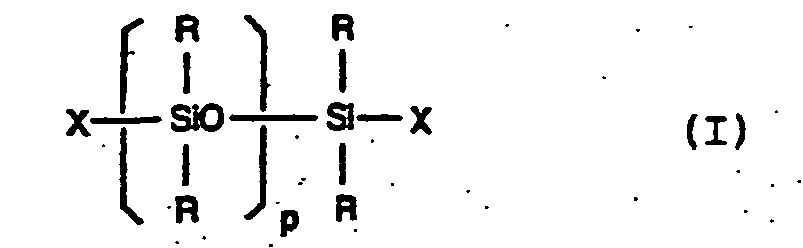
- The surface-modified fine particles as claimed in claim 2 , which have a normal hexane extractability of 30% or lower when extracting the fine particles treated with an organopolysiloxane having a reactive group at each of both the terminals, the normal hexane extractability being defined by the following formula:

- The surface-modified fine particles as claimed in claim 2 or 3, wherein the silane coupling agent is represented by the following formula (II) or (III):
Y4-mSiR'm (II)
R'3SiNHSiR'3 (III)
wherein Y is selected from the group consisting of hydroxy group, an alkoxy group and a halogen atom; R' represents an alkyl group having 1 to 18 carbon atoms; and m represents an integer of 0 to 3.
Priority Applications (4)
| Application Number | Priority Date | Filing Date | Title |
|---|---|---|---|
| JP23480295A JP3229174B2 (en) | 1995-08-21 | 1995-08-21 | Surface modified metal oxide fine powder and method for producing the same |
| US08/801,873 US5843525A (en) | 1995-08-21 | 1997-02-18 | Surface-modified metal oxide fine particles and process for producing the same |
| DE69736628T DE69736628T2 (en) | 1997-02-19 | 1997-02-19 | Surface-modified metal oxide fine particles and process for their preparation |
| EP97102695A EP0860478B1 (en) | 1995-08-21 | 1997-02-19 | Surface-modified metal oxide fine particles and process for producing the same |
Applications Claiming Priority (3)
| Application Number | Priority Date | Filing Date | Title |
|---|---|---|---|
| JP23480295A JP3229174B2 (en) | 1995-08-21 | 1995-08-21 | Surface modified metal oxide fine powder and method for producing the same |
| US08/801,873 US5843525A (en) | 1995-08-21 | 1997-02-18 | Surface-modified metal oxide fine particles and process for producing the same |
| EP97102695A EP0860478B1 (en) | 1995-08-21 | 1997-02-19 | Surface-modified metal oxide fine particles and process for producing the same |
Publications (2)
| Publication Number | Publication Date |
|---|---|
| EP0860478A1 EP0860478A1 (en) | 1998-08-26 |
| EP0860478B1 true EP0860478B1 (en) | 2006-09-06 |
Family
ID=27238149
Family Applications (1)
| Application Number | Title | Priority Date | Filing Date |
|---|---|---|---|
| EP97102695A Expired - Lifetime EP0860478B1 (en) | 1995-08-21 | 1997-02-19 | Surface-modified metal oxide fine particles and process for producing the same |
Country Status (3)
| Country | Link |
|---|---|
| US (1) | US5843525A (en) |
| EP (1) | EP0860478B1 (en) |
| JP (1) | JP3229174B2 (en) |
Cited By (1)
| Publication number | Priority date | Publication date | Assignee | Title |
|---|---|---|---|---|
| US8029761B2 (en) | 2006-09-01 | 2011-10-04 | Cabot Corporation | Surface-treated metal oxide particles |
Families Citing this family (46)
| Publication number | Priority date | Publication date | Assignee | Title |
|---|---|---|---|---|
| US6091476A (en) * | 1997-06-24 | 2000-07-18 | Nippon Shokubai Co., Ltd. | Liquid crystal display using spacers having hydrophobic inorganic particles attached to the spacer body |
| JP3978520B2 (en) * | 1997-10-22 | 2007-09-19 | 日本アエロジル株式会社 | Hydrophobic metal oxide fine powder and method for producing the same |
| JP3417291B2 (en) * | 1998-03-31 | 2003-06-16 | 日本アエロジル株式会社 | Method for producing external additive for electrophotographic toner |
| US6004714A (en) * | 1998-08-11 | 1999-12-21 | Xerox Corporation | Toner compositions |
| WO2001042372A1 (en) * | 1999-12-08 | 2001-06-14 | Nippon Aerosil Co., Ltd. | Fine metal oxide powder having high dispersibility and toner composition comprising the same |
| DE60018805T2 (en) * | 1999-12-24 | 2006-04-13 | Nippon Aerosil Co., Ltd. | SURFACE MODIFIED INORGANIC OXIDE POWDER, METHOD FOR THE PRODUCTION THEREOF AND THE USE THEREOF |
| US6503676B2 (en) * | 2000-04-28 | 2003-01-07 | Ricoh Company, Ltd. | Toner, external additive therefor and image forming method using the toner |
| JP2002023413A (en) * | 2000-05-02 | 2002-01-23 | Ricoh Co Ltd | External additive for electrophotographic toner, toner for electrophotography and electrophotographic developing device |
| TWI246924B (en) * | 2001-02-23 | 2006-01-11 | Kose Corp | Porous titanium oxide, organic polyorganosiloxane hybridized powder and titanium oxide, silicon oxide composite unit and matched cosmetic material thereof |
| ES2246677B1 (en) * | 2001-06-22 | 2006-12-01 | Asahi Kasei Kabushiki Kaisha | FLAME RETARDANT IN THE FORM OF PARTICLES GIVEN WITH COATING OR FOR A POLYMER. |
| JP2003107792A (en) * | 2001-09-28 | 2003-04-09 | Ricoh Co Ltd | Electrophotographic toner and image forming apparatus using the same |
| DE10150274A1 (en) * | 2001-10-12 | 2003-04-30 | Wacker Chemie Gmbh | Silica with a homogeneous silylating agent layer |
| US20050203214A1 (en) * | 2001-12-14 | 2005-09-15 | Nippon Aerosil Co., Ltd. | Surface modified inorganic oxide powder and its use |
| WO2003080743A2 (en) * | 2002-03-19 | 2003-10-02 | The Regents Of The University Of California | Stabilized inorganic particles |
| US6745871B2 (en) * | 2002-03-27 | 2004-06-08 | Chad D. Armstrong | Interlocking scaffold plank |
| KR100983209B1 (en) * | 2002-12-18 | 2010-09-20 | 에보닉 데구사 게엠베하 | Textured Silica |
| WO2004076547A1 (en) * | 2003-02-26 | 2004-09-10 | Dow Corning Toray Silicone Co.,Ltd. | Inorganic-powder treatment agent, inorganic powder treated with the same, and thermoplastic resin composition |
| JP4510437B2 (en) * | 2003-12-12 | 2010-07-21 | 株式会社Adeka | Metal oxide particles and method for producing the same |
| US7482382B2 (en) * | 2004-05-19 | 2009-01-27 | The Texas A&M University System | Process for preparing nano-sized metal oxide particles |
| US20060194910A1 (en) * | 2004-05-19 | 2006-08-31 | Nobuo Miyatake | Stabilization of polymers with zinc oxide nanoparticles |
| US20070004840A1 (en) * | 2004-05-19 | 2007-01-04 | Texas A&M University | Zinc oxide polymer nanocomposites and methods of producing zinc oxide polymer nanocomposites |
| EP1717278A1 (en) | 2005-04-26 | 2006-11-02 | Nuplex Resins B.V. | Coated particles and coating compositions comprising coated particles |
| US20080070146A1 (en) | 2006-09-15 | 2008-03-20 | Cabot Corporation | Hydrophobic-treated metal oxide |
| US8435474B2 (en) | 2006-09-15 | 2013-05-07 | Cabot Corporation | Surface-treated metal oxide particles |
| US8202502B2 (en) | 2006-09-15 | 2012-06-19 | Cabot Corporation | Method of preparing hydrophobic silica |
| US8455165B2 (en) | 2006-09-15 | 2013-06-04 | Cabot Corporation | Cyclic-treated metal oxide |
| WO2008101155A2 (en) * | 2007-02-15 | 2008-08-21 | Isotron Corporation | Inorganic-organic hybrid chemical resistant coating |
| US8344054B2 (en) * | 2007-07-24 | 2013-01-01 | The Texas A & M University System | Polymer nanocomposites including dispersed nanoparticles and inorganic nanoplatelets |
| US8080352B2 (en) * | 2007-10-04 | 2011-12-20 | Xerox Corporation | Grafting metal oxides onto polymer for toner |
| JP4676994B2 (en) * | 2008-02-04 | 2011-04-27 | 株式会社リコー | Electrophotographic toner, method for producing the same, and electrophotographic developing apparatus |
| JP2008158544A (en) * | 2008-02-04 | 2008-07-10 | Ricoh Co Ltd | Toner for electrophotography and method for producing the same |
| US20110177446A1 (en) | 2008-10-01 | 2011-07-21 | Nippon Aerosil Co., Ltd. | Hydrophobic silica microparticles and composition for electrophotographic toner |
| JP5504600B2 (en) * | 2008-10-01 | 2014-05-28 | 日本アエロジル株式会社 | Hydrophobic silica fine particles and electrophotographic toner composition |
| US20110244382A1 (en) | 2010-04-06 | 2011-10-06 | Christopher Alyson M | Hydrophobic silica particles and method of producing same |
| EP2561028B1 (en) * | 2010-04-20 | 2014-01-29 | 3M Innovative Properties Company | Pressure sensitive adhesives containing polymeric surface-modified nanoparticles |
| US9139737B1 (en) | 2011-11-21 | 2015-09-22 | Nanophase Technologies Corporation | Multifunctional coated powders and high solids dispersions |
| WO2013148241A1 (en) | 2012-03-26 | 2013-10-03 | Cabot Corporation | Treated fumed silica |
| TWI565732B (en) * | 2012-06-13 | 2017-01-11 | 財團法人工業技術研究院 | Organic-inorganic hybrid resin, method for forming the same, and transparent resin composition formed therefrom |
| EP2781558B1 (en) * | 2013-03-19 | 2016-12-14 | Evonik Degussa GmbH | Modified compound containing silicic acid and silicone rubber containing the said composition |
| CA2995196C (en) | 2015-07-27 | 2021-11-23 | Nanophase Technologies Corporation | Multifunctional coated powders and high solids dispersions |
| JP6520806B2 (en) * | 2016-04-20 | 2019-05-29 | 住友大阪セメント株式会社 | Surface-modified inorganic particle-containing dispersion, silicone resin composition, cured product, optical member, light-emitting device, and display device |
| US10570301B2 (en) | 2016-12-02 | 2020-02-25 | Inner Mongolia Xianhong Science Co., Ltd. | Solvent based inkjet ink composition |
| JP6855583B2 (en) * | 2017-02-27 | 2021-04-07 | ワッカー ケミー アクチエンゲゼルシャフトWacker Chemie AG | Manufacturing method of hydrophobic silica granules |
| US10555892B1 (en) | 2017-03-09 | 2020-02-11 | Nanophase Technologies Corporation | Functionalized siloxane or polysiloxane coated particles with enhanced light filtering properties |
| US10590278B2 (en) | 2017-04-10 | 2020-03-17 | Nanophase Technologies Corporation | Coated powders having high photostability |
| CN106964771B (en) * | 2017-05-16 | 2018-09-14 | 合肥学院 | Control method of oxygen content of superfine Mg powder and characterization method of oxidation resistance |
Family Cites Families (16)
| Publication number | Priority date | Publication date | Assignee | Title |
|---|---|---|---|---|
| JPS54101795A (en) | 1978-01-30 | 1979-08-10 | Toyo Soda Mfg Co Ltd | Hydrophobic rendering method for oxide fine powder |
| JPS606379B2 (en) * | 1979-09-10 | 1985-02-18 | 信越化学工業株式会社 | Surface modification method of silica powder |
| AU6934981A (en) * | 1980-05-05 | 1981-11-12 | Fmc Corporation | Stick confection extraction apparatus |
| DE3211431A1 (en) | 1982-03-27 | 1983-09-29 | Degussa Ag, 6000 Frankfurt | METHOD FOR HYDROPHOBIZING PYROGEN-PRODUCED SILICON DIOXIDE |
| JPS58185405A (en) * | 1982-04-26 | 1983-10-29 | Nippon Aerojiru Kk | Fine powder of surface-modified metal oxide |
| GB2128764B (en) * | 1982-08-23 | 1986-02-19 | Canon Kk | Electrostatographic developer |
| US4568625A (en) * | 1983-04-25 | 1986-02-04 | Canon Kabushiki Kaisha | Developer comprising a modified silicone oil and development process for electrophotography |
| JPS636062A (en) * | 1986-06-25 | 1988-01-12 | Toray Silicone Co Ltd | Method of modifying surface of fine silica powder |
| JPH02287459A (en) * | 1989-04-28 | 1990-11-27 | Canon Inc | Negatively chargeable magnetic developer |
| EP0506290B1 (en) * | 1991-03-25 | 1999-04-28 | Ecc International Limited | Mineral fillers |
| JP3079395B2 (en) * | 1991-06-26 | 2000-08-21 | 三好化成株式会社 | Organosilicon compound-treated pigment, its production method and cosmetics |
| JP2946896B2 (en) * | 1991-11-24 | 1999-09-06 | 三菱マテリアル株式会社 | Hydrophobic alumina |
| JP3318997B2 (en) * | 1993-02-03 | 2002-08-26 | 三菱マテリアル株式会社 | Hydrophobic silica powder, its production method and developer for electrophotography |
| JPH07118577A (en) * | 1993-10-22 | 1995-05-09 | Dow Corning Asia Kk | Composition for forming water-repellent and anti-mildew coating |
| DE19500674A1 (en) * | 1995-01-12 | 1996-07-18 | Degussa | Surface modified pyrogenic mixed oxides, process for their production and use |
| JPH08319400A (en) * | 1995-05-26 | 1996-12-03 | Matsushita Electric Works Ltd | Epoxy resin composition for sealing |
-
1995
- 1995-08-21 JP JP23480295A patent/JP3229174B2/en not_active Expired - Lifetime
-
1997
- 1997-02-18 US US08/801,873 patent/US5843525A/en not_active Expired - Lifetime
- 1997-02-19 EP EP97102695A patent/EP0860478B1/en not_active Expired - Lifetime
Cited By (1)
| Publication number | Priority date | Publication date | Assignee | Title |
|---|---|---|---|---|
| US8029761B2 (en) | 2006-09-01 | 2011-10-04 | Cabot Corporation | Surface-treated metal oxide particles |
Also Published As
| Publication number | Publication date |
|---|---|
| JP3229174B2 (en) | 2001-11-12 |
| US5843525A (en) | 1998-12-01 |
| JPH0959533A (en) | 1997-03-04 |
| EP0860478A1 (en) | 1998-08-26 |
Similar Documents
| Publication | Publication Date | Title |
|---|---|---|
| US5843525A (en) | Surface-modified metal oxide fine particles and process for producing the same | |
| EP1302444B1 (en) | Silica with low content of silanol groups | |
| US7109256B2 (en) | Surface-modified inorganic oxide powder, process for producing the same, and use thereof | |
| US4849022A (en) | Method for modifying the surface of finely divided silica | |
| EP0992857B1 (en) | Fine powder of hydrophobic metal oxide, method for producing it, and toner composition for electrophotography | |
| EP1304361B2 (en) | Method for Producing Silica with homogenous silylating agent coating | |
| EP1035450B1 (en) | External additive for electrostatically charged latent image developing toner | |
| US4221693A (en) | Composition free of surface cure inhibition and method for preparing the same | |
| JP4512872B2 (en) | Surface-modified silica fine powder and method for producing the same | |
| EP0949302B1 (en) | Fine powder of hydrophobic titanium oxide, and method for producing it | |
| DE3707226A1 (en) | METHOD FOR PRODUCING HIGHLY DISPERSAL METAL OXIDE WITH AMMONIUM-FUNCTIONAL ORGANOPOLYSILOXANE MODIFIED SURFACE AS A POSITIVELY CONTROLLING CHARGING AGENT FOR TONER | |
| EP1477532A2 (en) | Spherical silica-titania-based fine particles surface-treated with silane, production process therefor, and external additive for electrostatically charged image developing toner using same | |
| EP2824148A1 (en) | Highly disperse silica having a high positive surface charge | |
| JP4793784B2 (en) | Hydrophobized surface modified dry silica powder | |
| JP2002256173A (en) | Surface-modified inorganic oxide powder and its use | |
| JP4697569B2 (en) | Surface-modified silica fine powder and its use | |
| US20050203214A1 (en) | Surface modified inorganic oxide powder and its use | |
| JPH09110415A (en) | Efficient way to make inorganic powders hydrophobic | |
| JP4122566B2 (en) | Hydrophobic metal oxide fine powder, production method thereof, and toner composition for electrophotography | |
| JP4186254B2 (en) | Method for producing surface-modified metal oxide fine powder and method for producing electrophotographic toner composition | |
| JPH0393605A (en) | Improvement of flowability of metal oxide film powder | |
| DE69736628T2 (en) | Surface-modified metal oxide fine particles and process for their preparation | |
| JP3978520B2 (en) | Hydrophobic metal oxide fine powder and method for producing the same | |
| JPH11125927A (en) | Electrophotographic developer | |
| JPH07292280A (en) | Stable copper-containing pigment composition |
Legal Events
| Date | Code | Title | Description |
|---|---|---|---|
| PUAI | Public reference made under article 153(3) epc to a published international application that has entered the european phase |
Free format text: ORIGINAL CODE: 0009012 |
|
| AK | Designated contracting states |
Kind code of ref document: A1 Designated state(s): DE FR GB |
|
| 17P | Request for examination filed |
Effective date: 19990217 |
|
| AKX | Designation fees paid |
Free format text: DE FR GB |
|
| RBV | Designated contracting states (corrected) |
Designated state(s): DE FR GB |
|
| 17Q | First examination report despatched |
Effective date: 20000410 |
|
| GRAP | Despatch of communication of intention to grant a patent |
Free format text: ORIGINAL CODE: EPIDOSNIGR1 |
|
| GRAS | Grant fee paid |
Free format text: ORIGINAL CODE: EPIDOSNIGR3 |
|
| GRAA | (expected) grant |
Free format text: ORIGINAL CODE: 0009210 |
|
| AK | Designated contracting states |
Kind code of ref document: B1 Designated state(s): DE FR GB |
|
| REG | Reference to a national code |
Ref country code: GB Ref legal event code: FG4D |
|
| REF | Corresponds to: |
Ref document number: 69736628 Country of ref document: DE Date of ref document: 20061019 Kind code of ref document: P |
|
| ET | Fr: translation filed | ||
| PLBE | No opposition filed within time limit |
Free format text: ORIGINAL CODE: 0009261 |
|
| STAA | Information on the status of an ep patent application or granted ep patent |
Free format text: STATUS: NO OPPOSITION FILED WITHIN TIME LIMIT |
|
| 26N | No opposition filed |
Effective date: 20070607 |
|
| REG | Reference to a national code |
Ref country code: FR Ref legal event code: PLFP Year of fee payment: 20 |
|
| PGFP | Annual fee paid to national office [announced via postgrant information from national office to epo] |
Ref country code: DE Payment date: 20160218 Year of fee payment: 20 |
|
| PGFP | Annual fee paid to national office [announced via postgrant information from national office to epo] |
Ref country code: FR Payment date: 20160218 Year of fee payment: 20 Ref country code: GB Payment date: 20160217 Year of fee payment: 20 |
|
| REG | Reference to a national code |
Ref country code: DE Ref legal event code: R071 Ref document number: 69736628 Country of ref document: DE |
|
| REG | Reference to a national code |
Ref country code: GB Ref legal event code: PE20 Expiry date: 20170218 |
|
| PG25 | Lapsed in a contracting state [announced via postgrant information from national office to epo] |
Ref country code: GB Free format text: LAPSE BECAUSE OF EXPIRATION OF PROTECTION Effective date: 20170218 |