EP0860329B1 - Low odor permeable hose - Google Patents
Low odor permeable hose Download PDFInfo
- Publication number
- EP0860329B1 EP0860329B1 EP97114907A EP97114907A EP0860329B1 EP 0860329 B1 EP0860329 B1 EP 0860329B1 EP 97114907 A EP97114907 A EP 97114907A EP 97114907 A EP97114907 A EP 97114907A EP 0860329 B1 EP0860329 B1 EP 0860329B1
- Authority
- EP
- European Patent Office
- Prior art keywords
- hose
- molecular weight
- recited
- stabilizer
- lubricant
- Prior art date
- Legal status (The legal status is an assumption and is not a legal conclusion. Google has not performed a legal analysis and makes no representation as to the accuracy of the status listed.)
- Expired - Lifetime
Links
- 239000004014 plasticizer Substances 0.000 claims abstract description 43
- 239000003381 stabilizer Substances 0.000 claims abstract description 34
- 239000000945 filler Substances 0.000 claims abstract description 31
- 239000000314 lubricant Substances 0.000 claims abstract description 29
- VTYYLEPIZMXCLO-UHFFFAOYSA-L Calcium carbonate Chemical compound [Ca+2].[O-]C([O-])=O VTYYLEPIZMXCLO-UHFFFAOYSA-L 0.000 claims abstract description 22
- 239000000049 pigment Substances 0.000 claims abstract description 21
- 229910000019 calcium carbonate Inorganic materials 0.000 claims abstract description 11
- 229920005989 resin Polymers 0.000 claims abstract description 11
- 239000011347 resin Substances 0.000 claims abstract description 11
- QGJOPFRUJISHPQ-UHFFFAOYSA-N Carbon disulfide Chemical compound S=C=S QGJOPFRUJISHPQ-UHFFFAOYSA-N 0.000 claims description 42
- 239000005038 ethylene vinyl acetate Substances 0.000 claims description 37
- 229920001200 poly(ethylene-vinyl acetate) Polymers 0.000 claims description 36
- 239000004800 polyvinyl chloride Substances 0.000 claims description 25
- 229920000915 polyvinyl chloride Polymers 0.000 claims description 24
- 230000035699 permeability Effects 0.000 claims description 19
- 239000010865 sewage Substances 0.000 claims description 18
- 238000012360 testing method Methods 0.000 claims description 18
- GWEVSGVZZGPLCZ-UHFFFAOYSA-N Titan oxide Chemical compound O=[Ti]=O GWEVSGVZZGPLCZ-UHFFFAOYSA-N 0.000 claims description 12
- 238000000034 method Methods 0.000 claims description 11
- 235000021355 Stearic acid Nutrition 0.000 claims description 8
- QIQXTHQIDYTFRH-UHFFFAOYSA-N octadecanoic acid Chemical compound CCCCCCCCCCCCCCCCCC(O)=O QIQXTHQIDYTFRH-UHFFFAOYSA-N 0.000 claims description 8
- OQCDKBAXFALNLD-UHFFFAOYSA-N octadecanoic acid Natural products CCCCCCCC(C)CCCCCCCCC(O)=O OQCDKBAXFALNLD-UHFFFAOYSA-N 0.000 claims description 8
- 239000008117 stearic acid Substances 0.000 claims description 8
- MQIUGAXCHLFZKX-UHFFFAOYSA-N Di-n-octyl phthalate Chemical compound CCCCCCCCOC(=O)C1=CC=CC=C1C(=O)OCCCCCCCC MQIUGAXCHLFZKX-UHFFFAOYSA-N 0.000 claims description 6
- SHLNMHIRQGRGOL-UHFFFAOYSA-N barium zinc Chemical compound [Zn].[Ba] SHLNMHIRQGRGOL-UHFFFAOYSA-N 0.000 claims description 6
- 239000004408 titanium dioxide Substances 0.000 claims description 6
- 238000005452 bending Methods 0.000 claims description 3
- 238000012546 transfer Methods 0.000 claims description 2
- 229920001756 Polyvinyl chloride acetate Polymers 0.000 claims 1
- DQXBYHZEEUGOBF-UHFFFAOYSA-N but-3-enoic acid;ethene Chemical compound C=C.OC(=O)CC=C DQXBYHZEEUGOBF-UHFFFAOYSA-N 0.000 description 21
- 235000019645 odor Nutrition 0.000 description 14
- 239000000463 material Substances 0.000 description 9
- 230000005540 biological transmission Effects 0.000 description 8
- 238000005192 partition Methods 0.000 description 5
- 238000009472 formulation Methods 0.000 description 4
- 239000000203 mixture Substances 0.000 description 4
- 230000001473 noxious effect Effects 0.000 description 4
- OKKJLVBELUTLKV-UHFFFAOYSA-N Methanol Chemical compound OC OKKJLVBELUTLKV-UHFFFAOYSA-N 0.000 description 3
- 230000002411 adverse Effects 0.000 description 3
- 239000007789 gas Substances 0.000 description 3
- 229920000642 polymer Polymers 0.000 description 3
- 150000001875 compounds Chemical class 0.000 description 2
- 239000000470 constituent Substances 0.000 description 2
- 238000010276 construction Methods 0.000 description 2
- 230000000149 penetrating effect Effects 0.000 description 2
- 239000000126 substance Substances 0.000 description 2
- LFQSCWFLJHTTHZ-UHFFFAOYSA-N Ethanol Chemical compound CCO LFQSCWFLJHTTHZ-UHFFFAOYSA-N 0.000 description 1
- 230000004888 barrier function Effects 0.000 description 1
- 229920001577 copolymer Polymers 0.000 description 1
- 238000011161 development Methods 0.000 description 1
- 238000007599 discharging Methods 0.000 description 1
- 238000005516 engineering process Methods 0.000 description 1
- 230000007613 environmental effect Effects 0.000 description 1
- 239000000835 fiber Substances 0.000 description 1
- 239000011152 fibreglass Substances 0.000 description 1
- 238000007689 inspection Methods 0.000 description 1
- 238000004519 manufacturing process Methods 0.000 description 1
- QSHDDOUJBYECFT-UHFFFAOYSA-N mercury Chemical compound [Hg] QSHDDOUJBYECFT-UHFFFAOYSA-N 0.000 description 1
- 229910052753 mercury Inorganic materials 0.000 description 1
- 238000012986 modification Methods 0.000 description 1
- 230000004048 modification Effects 0.000 description 1
- 150000002825 nitriles Chemical class 0.000 description 1
- 230000002787 reinforcement Effects 0.000 description 1
- 150000004763 sulfides Chemical class 0.000 description 1
- 238000012956 testing procedure Methods 0.000 description 1
- 239000002699 waste material Substances 0.000 description 1
- XLYOFNOQVPJJNP-UHFFFAOYSA-N water Substances O XLYOFNOQVPJJNP-UHFFFAOYSA-N 0.000 description 1
Images
Classifications
-
- B—PERFORMING OPERATIONS; TRANSPORTING
- B60—VEHICLES IN GENERAL
- B60R—VEHICLES, VEHICLE FITTINGS, OR VEHICLE PARTS, NOT OTHERWISE PROVIDED FOR
- B60R15/00—Arrangements or adaptations of sanitation devices
- B60R15/04—Toilet facilities
-
- Y—GENERAL TAGGING OF NEW TECHNOLOGICAL DEVELOPMENTS; GENERAL TAGGING OF CROSS-SECTIONAL TECHNOLOGIES SPANNING OVER SEVERAL SECTIONS OF THE IPC; TECHNICAL SUBJECTS COVERED BY FORMER USPC CROSS-REFERENCE ART COLLECTIONS [XRACs] AND DIGESTS
- Y10—TECHNICAL SUBJECTS COVERED BY FORMER USPC
- Y10T—TECHNICAL SUBJECTS COVERED BY FORMER US CLASSIFICATION
- Y10T428/00—Stock material or miscellaneous articles
- Y10T428/13—Hollow or container type article [e.g., tube, vase, etc.]
- Y10T428/1352—Polymer or resin containing [i.e., natural or synthetic]
- Y10T428/1379—Contains vapor or gas barrier, polymer derived from vinyl chloride or vinylidene chloride, or polymer containing a vinyl alcohol unit
-
- Y—GENERAL TAGGING OF NEW TECHNOLOGICAL DEVELOPMENTS; GENERAL TAGGING OF CROSS-SECTIONAL TECHNOLOGIES SPANNING OVER SEVERAL SECTIONS OF THE IPC; TECHNICAL SUBJECTS COVERED BY FORMER USPC CROSS-REFERENCE ART COLLECTIONS [XRACs] AND DIGESTS
- Y10—TECHNICAL SUBJECTS COVERED BY FORMER USPC
- Y10T—TECHNICAL SUBJECTS COVERED BY FORMER US CLASSIFICATION
- Y10T428/00—Stock material or miscellaneous articles
- Y10T428/13—Hollow or container type article [e.g., tube, vase, etc.]
- Y10T428/1352—Polymer or resin containing [i.e., natural or synthetic]
- Y10T428/1386—Natural or synthetic rubber or rubber-like compound containing
-
- Y—GENERAL TAGGING OF NEW TECHNOLOGICAL DEVELOPMENTS; GENERAL TAGGING OF CROSS-SECTIONAL TECHNOLOGIES SPANNING OVER SEVERAL SECTIONS OF THE IPC; TECHNICAL SUBJECTS COVERED BY FORMER USPC CROSS-REFERENCE ART COLLECTIONS [XRACs] AND DIGESTS
- Y10—TECHNICAL SUBJECTS COVERED BY FORMER USPC
- Y10T—TECHNICAL SUBJECTS COVERED BY FORMER US CLASSIFICATION
- Y10T428/00—Stock material or miscellaneous articles
- Y10T428/13—Hollow or container type article [e.g., tube, vase, etc.]
- Y10T428/1352—Polymer or resin containing [i.e., natural or synthetic]
- Y10T428/139—Open-ended, self-supporting conduit, cylinder, or tube-type article
-
- Y—GENERAL TAGGING OF NEW TECHNOLOGICAL DEVELOPMENTS; GENERAL TAGGING OF CROSS-SECTIONAL TECHNOLOGIES SPANNING OVER SEVERAL SECTIONS OF THE IPC; TECHNICAL SUBJECTS COVERED BY FORMER USPC CROSS-REFERENCE ART COLLECTIONS [XRACs] AND DIGESTS
- Y10—TECHNICAL SUBJECTS COVERED BY FORMER USPC
- Y10T—TECHNICAL SUBJECTS COVERED BY FORMER US CLASSIFICATION
- Y10T428/00—Stock material or miscellaneous articles
- Y10T428/13—Hollow or container type article [e.g., tube, vase, etc.]
- Y10T428/1352—Polymer or resin containing [i.e., natural or synthetic]
- Y10T428/139—Open-ended, self-supporting conduit, cylinder, or tube-type article
- Y10T428/1393—Multilayer [continuous layer]
Definitions
- the invention is related to a vehicle toilet system, a flexible hose for such systems and a method of providing such systems.
- the term "SeaLand Sanitation Hose Permeability Test" as used in the present specification and claims means the test such as described in U.S. patent 5,442,952 (the disclosure of which is hereby incorporated by reference herein) in which the hose is first treated by introducing methyl alcohol into the hose sample and allowing the alcohol to stand for a day or more. Then one introduces into the hose sample (sealed at its ends, and with a barrier around it) a charge of carbon disulfide and other organic sulfide compounds. The sample is kept at about room temperature (e.g. about 72°F) and the sealed area around the hose is sensed for carbon disulfide. When a level of about 3 ppm carbon disulfide is sensed in the sealed volume surrounding the hose then it is considered that the hose has failed.
- room temperature e.g. about 72°F
- the AVS96 hose typically will not fail the SeaLand Sanitation Hose Permeability Test for eight days or more. While the AVS96 hose is the first hose to be successful from the odor permeation standpoint, for marine toilet system applications, it is very expensive, and its odor transmission resistance is not ideal.
- the formulation of the AVS96 hose is maintained as a trade secret by its manufacturer. While the AVS96 hose has been evaluated to determine its chemical constituents, those constituents cannot be precisely determined by reverse engineering, but it is believed that they comprise PVC with a low molecular weight plasticizer and a nitrile high molecular weight plasticizer.
- the construction according to the present invention uses ethylene-vinyl-acetate (EVA) copolymer as the high molecular weight plasticizer, that copolymer having very poor carbon disulfide solubility. While EVA is known as a plasticizer for PVC for some products such as pool liners, water bed envelopes, or the like, significant amounts of EVA have not been heretofore known in the construction of unreinforced flexible hose, particularly for sewage transmission purposes.
- EVA ethylene-vinyl-acetate
- a vehicle toilet system comprising: A toilet and a sewage holding tank mounted in a vehicle. And, a flexible hose for carrying sewage and operatively connected to at least one of the toilet and tank.
- the flexible hose comprising polyvinyl chloride, low molecular weight plasticizer, stabilizer, lubricant, and sufficient EVA high molecular weight plasticizer (which has poor carbon disulfide solubility) so that the hose will not fail the SeaLand Sanitation Hose Permeability Test for at least thirteen days.
- the high molecular weight plasticizer comprises at least 10% by weight EVA copolymer, and more preferably at least 30% by weight EVA copolymer.
- the hose typically also contains filler and pigment.
- the hose may comprise, or consist essentially of, by weight, about 40-55% PVC resin, about 30-40% ethylene-vinyl-acetate copolymer, about 2-30% low molecular weight plasticizer, about 1-20% filler, and about 0.5-5% each of stabilizer and pigment, and about .05-.5% lubricant.
- Even more EVA may be utilized to provide an even higher resistance to odor permeability, however EVA is relatively expensive and more than 40% is not necessary in order to, as a practical matter, achieve the desired results according to the invention.
- the EVA polymer price significantly decrease, or should particularly adverse environmental conditions for use of the flexible develop, more EVA can be used.
- a flexible hose per se capable of being used for the transfer of sewage which comprises: An unreinforced tubular body capable of bending to form a radius and comprising: at least about 40% by weight PVC resin; at least about 10% by weight ethylene-vinyl-acetate copolymer; and low molecular weight plasticizer, which hose has poor carbon disulfide solubility, so that said hose will not fail the Sealand Sanitation Hose Permeability Test for at least eight days.
- the hose typically comprises at least about 30% by weight EVA, and typically also contains stabilizer, lubricant, filler and pigment.
- flexible hose according to the invention may consist essentially of, by weight, about 40-55% PVC resin, about 30-40% ethylene-vinyl-acetate copolymer, about 2-30% low molecular weight plasticizer, about 1-20% filler, about 0.5-5% each of stabilizer, and pigment, and about .05-.5% lubricant.
- the hose according to the invention may comprise, by weight, at least about 40% PVC resin, at least about 30% ethylene-vinyl-acetate copolymer, at least about 2% low molecular weight plasticizer, at least about 1% filler, at least about 0.5% stabilizer, and at least about .05% lubricant.
- the lower molecular weight plasticizer, filler, stabilizer, lubricant, and -- if utilized -- pigment may comprise any suitable conventional materials for that purpose, literally dozens of each of which are available commercially.
- the low molecular weight plasticizer comprises Di-octyl phthalate
- the filler comprises calcium carbonate
- the stabilizer comprises barium zinc
- the lubricant comprises stearic acid.
- a hose may be provided wherein the low molecular weight plasticizer comprises about 5-10% Di-octyl phthalate, wherein the filler comprises about 5-15% calcium carbonate, wherein the stabilizer comprises about 1-2% barium zinc stabilizer, wherein the lubricant comprises about .1-.2% stearic acid, and further comprising about 1-2% titanium dioxide pigment.
- the flexible hose may consist of PVC, at least 10% by weight EVA, about 5-10% low molecular weight plasticizer, about 5-15% filler, about 1-2% stabilizer, about .1-.2% lubricant, and about 1-2% pigment.
- a method of operating a toilet system including a toilet, a sewage holding tank, a flexible hose connecting at least some of the components of the system, or in a pumpout system.
- the method comprises the step of: (a) Connecting at least one of the toilet and holding tank to each other and/or to other components of the system, or in a pumpoiut system, using flexible hose comprising polyvinyl chloride, and an EVA high molecular weight plasticizer which has poor carbon disulfide solubility, so that the hose will not fail the SeaLand Sanitation Hose Permeability Test for at least eight days (e.g. preferably for at least 13 days).
- Step (a) is typically further practiced by utilizing the details of the flexible hose as described above.
- a flexible hose according to the present invention may be used in any vehicle toilet system in which flexible hose is utilized.
- the hose according to the present invention will be described with respect to use in association with a vacuum toilet system, but that is representative of only one of several different types of toilet systems with which a flexible hose according to the invention may be utilized.
- At least one vacuum toilet 10 having a waste discharge on the bottom thereof is connected by a flexible PVC hose 11 to a vacuum tank 12, and mounted in a vehicle (e.g. boat, RV, caravan, plane, train, or the like).
- a vacuum level of about 8-10 inches (20-26 cm.) of mercury is maintained in the tank 12 by the vacuum pump 13, a conventional vacuum switch on the tank 12 operating the pump 13 to maintain an appropriate vacuum.
- the pump 13 is operated to replenish the vacuum in the vacuum tank 12
- sewage is pumped to the holding tank 14 via conduit 15.
- the sewage ultimately is discharged from the holding tank 14 via conduits 16 perhaps by using an optional sewage discharge pump 17 which is operated only when there is a mechanism for proper disposal of the sewage.
- the conduits 15, 16 also are preferably flexible PVC hose, and carry sewage.
- the exterior partition 18 in FIGURE 1 comprises an exterior partition of a boat, recreational vehicle, plane, train, or other vehicle, e.g. simulating the form of boat hull in the actual illustration in FIGURE 1.
- the exterior partition 18 is penetrated by termination 19 of the conduit 16 from the tank 14.
- the termination 19 is merely connected up to a pump-out facility at a dock, campsite, terminal, or the like.
- Conventional valves are provided to preclude sewage from being discharged from the tank 14 into hose 16 unless there is a motive force appropriate for discharging the sewage to a suitable location.
- a conventional vent 20 which may have a suitable filter therein such as shown in U.S. patent 5,139,655 with an end termination 22 of the conduit 20 penetrating the partition 18 to vent odoriferous gases from the holding tank 14 to the atmosphere.
- Another conventional vent 23 is typically also provided from the hose 16, typically penetrating another partition (e.g. boat deck) of the vehicle in which the toilet 10 is provided.
- FIGURE 2 An exemplary piece of hose 25 according to the present invention is seen in perspective view in FIGURE 2, and may be used for any of the hoses 11, 15, 16, or the like illustrated in FIGURE 1, or any other place where a flexible hose is necessary.
- the hose 25 comprises a preferably unreinforced (no fiberglass or other fiber reinforcements typically being necessary) tubular body 26, typically having open ends 27, 28, and capable of bending to form a radius, as illustrated schematically in FIGURE 2. While the thickness 29 of the wall of the tubular body 26 may vary widely, typically it is between about .1-.25 inches (about .25-.65 cm.), e.g. about .18 inches (about .45 cm).
- the diameter 30 also may vary widely depending upon the particular use to which the hose 25 is put, but the interior diameter 30 is typically about one to three inches (about 2.5 - 7.5 cm.), e. g. about 1.5 inches (about 4 cm.).
- the hose 25 may have a smooth exterior or interior surface configuration, or one or both may be "corrugated" as illustrated in FIGURE 5 where there are valleys 31 and peaks 32.
- the preferred formulation for the hose 25 according the present invention utilizes EVA as the high molecular weight plasticizer; EVA has exceptionally poor carbon disulfide solubility. Typically at least 10% by weight EVA, and preferably at least 30% by weight EVA, is utilized. Almost any suitable commercially available source of EVA copolymer may be utilized. One known acceptable commercially available form of EVA is sold by Dupont Chemical Company under the trademark "EVALLOY”.
- the hose 25 of the invention also typically contains the conventional PVC hose components of a low molecular weight plasticizer, a stabilizer, and a lubricant, and also normally uses a pigment.
- a filler is particularly desirable.
- the low molecular weight stabilizer utilized in the hose 25 according to the invention may be any one of dozens of commercially available low molecular weight plasticizers, and typically is in the weight percentage of about 2-30%.
- the amount of low molecular weight plasticizer used will depend upon how flexible ("soft") it is desired for the hose to be. For a normal use in the vehicle toilet system environment about 5 to 10% low molecular weight plasticizer is provided.
- One particularly suitable low molecular weight plasticizer, simply because of its ready availability and known desirable properties, that may be utilized is Di-octyl phthalate ("DOP").
- a filler is preferred to make the hose cost effective and to help achieve odor impermeability. Since the filler is utilized primarily to reduce cost it must be an inexpensive material that will not otherwise adversely affect the functionality of the flexible hose 25. Many of the literally dozens of commercially available suitable fillers that may be utilized are dense, and if a dense filler is utilized (such as calcium carbonate) that also adds slightly to the resistance to permeability of noxious gases provided by the hose 25. For example about 1-20% (preferably about 5-15%) calcium carbonate or a comparable filler will have a minor contribution to the ability of the hose 25 to resist noxious odor permeability.
- a dense filler such as calcium carbonate
- any suitable commercially available components may be provided, some examples utilized according to the invention comprising between about 0.5-5% stabilizer (such as barium zinc stabilizer) and pigment (such as titanium dioxide), and typically about .1-.2% lubricant being provided, such as stearic acid.
- Example I when tested utilizing the SeaLand Sanitation Hose Permeability Test did not fail typically for at least thirteen days, and sometimes not for as long as seventeen days.
- the material of Example II while not as successful as the material of Example I, did not fail the SeaLand Sanitation Hose Permeability Test for at least ten days.
- the hose of Example II because it has almost twice as much low molecular weight plasticizer as that of Example I, is significantly more flexible than hoses constructed of the material of Example I, although it would be expected to have less resistance to permeability by carbon disulfide gas.
- Hose 25 may be made of the materials of Examples I and II utilizing conventional extruding techniques for the manufacture of PVC hose.
- Hose 25 may consist essentially of at least about 40% PVC resin, at least about 10% (preferably at least about 30%) EVA copolymer, at least about 2% low molecular weight plasticizer, at least about 1% filler (preferably 5-15% or 5-20% dense filler such as calcium carbonate), at least about 0.5% each of stabilizer and pigment (e.g. about 0.5-5%), and at least about 0.5% lubricant (e.g. about 0.5-.5%).
- the invention may also be used as flexible hose in a dockside pumpout system for boat holding tanks, such as system being generally described in U. S. Patents 4,854,827 and 5,433,163.
- a vehicle toilet system and a method of operating a toilet system by connecting at least of the components of the system utilizing flexible hose, have been provided.
- a novel flexible hose per se, but particularly for use in sewage systems, is also provided.
- the hose, system, and method according to the present invention provide highly desirable odor transmission-resistant characteristics, so that it may expected that hose according to the present invention will not fail (for odor transmission) for the normal mechanical life of the hose, or the toilet system in which it is utilized.
Landscapes
- Health & Medical Sciences (AREA)
- Epidemiology (AREA)
- General Health & Medical Sciences (AREA)
- Public Health (AREA)
- Engineering & Computer Science (AREA)
- Mechanical Engineering (AREA)
- Rigid Pipes And Flexible Pipes (AREA)
- Materials For Medical Uses (AREA)
- Compositions Of Macromolecular Compounds (AREA)
Abstract
Description
- The invention is related to a vehicle toilet system, a flexible hose for such systems and a method of providing such systems.
- For decades one of the major problems associated with toilet systems for vehicles, such as boats, recreation vehicles, and the like, has been the relatively rapid failure of flexible hoses associated with said systems as far as the transmission of noxious odors are concerned. The flexible, typically PVC, hose associated with these toilet systems are sometimes in contact with sewage, particularly in adverse environments (such as tropical climates) fpr extended periods of time. In many circumstances the hose can fail in as little as three to six months in actual use, and when it does fail the noxious odors that it transmits can make the vehicle essentially unusable until the hose is replaced (the hose typically cannot be remediated once it has failed).
- It is because of the very significant practical problem that exists with such hoses that SeaLand Technology, Inc. of Big Prairie, Ohio has developed a testing procedure for hoses made of various materials to - in an accelerated manner - see if they can be expected to have a long life in the field, e.g. so that essentially hoses never have to be replaced because of odor permeation and transmission but only if they fail mechanically or the toilet system itself is replaced.
- The term "SeaLand Sanitation Hose Permeability Test" as used in the present specification and claims means the test such as described in U.S. patent 5,442,952 (the disclosure of which is hereby incorporated by reference herein) in which the hose is first treated by introducing methyl alcohol into the hose sample and allowing the alcohol to stand for a day or more. Then one introduces into the hose sample (sealed at its ends, and with a barrier around it) a charge of carbon disulfide and other organic sulfide compounds. The sample is kept at about room temperature (e.g. about 72°F) and the sealed area around the hose is sensed for carbon disulfide. When a level of about 3 ppm carbon disulfide is sensed in the sealed volume surrounding the hose then it is considered that the hose has failed.
- While literally dozens of hoses have been tested utilizing the SeaLand Sanitation Hose Permeability Test, until the invention the only hose that had acceptable odor transmission-resistant characteristics was one recently available from Australian Global Services Inc. of Perrysville, Ohio under the trade name AVS96 Marine Sanitation Hose. Conventional flexible PVC hose for vehicle toilet systems, when tested using the SeaLand Sanitation Hose Permeability Test, typically experiences hose failure in about two days (even though in real life situations the quickest failures are typically about three to six months). While it is not known whether there is a linear relationship between the failure under the SeaLand Sanitation Hose Permeability Test conditions and real life conditions, it is desired that in order to be relatively sure that a hose will not fail (that is transmit odors, particularly carbon disulfide) over its normal expected life in real life situations, it should not fail the SeaLand Sanitation Hose Permeability Test for at last eight days, and preferably for at least 12 days or more.
- The AVS96 hose typically will not fail the SeaLand Sanitation Hose Permeability Test for eight days or more. While the AVS96 hose is the first hose to be successful from the odor permeation standpoint, for marine toilet system applications, it is very expensive, and its odor transmission resistance is not ideal. The formulation of the AVS96 hose is maintained as a trade secret by its manufacturer. While the AVS96 hose has been evaluated to determine its chemical constituents, those constituents cannot be precisely determined by reverse engineering, but it is believed that they comprise PVC with a low molecular weight plasticizer and a nitrile high molecular weight plasticizer.
- By aggressively employing the testing methods of U.S. patent 5,442,952 to existing hoses, and instituting intense development work for new hose materials, the flexible hose odor transmission failure problem for a vehicle toilet system that has existed for decades has finally been cost effectively, and with a large margin of error, solved. According to the present invention a new hose formulation has been developed which is of lower cost than the AVS96 hose, and does not fail the SeaLand Sanitation Hose Permeability Test for a longer time than the AVS96 hose; that is it does not fail the test for at least eight days, and typically does not fail for thirteen days or more. The construction according to the present invention uses ethylene-vinyl-acetate (EVA) copolymer as the high molecular weight plasticizer, that copolymer having very poor carbon disulfide solubility. While EVA is known as a plasticizer for PVC for some products such as pool liners, water bed envelopes, or the like, significant amounts of EVA have not been heretofore known in the construction of unreinforced flexible hose, particularly for sewage transmission purposes.
- According to one aspect of the present invention a vehicle toilet system is provided comprising: A toilet and a sewage holding tank mounted in a vehicle. And, a flexible hose for carrying sewage and operatively connected to at least one of the toilet and tank. The flexible hose comprising polyvinyl chloride, low molecular weight plasticizer, stabilizer, lubricant, and sufficient EVA high molecular weight plasticizer (which has poor carbon disulfide solubility) so that the hose will not fail the SeaLand Sanitation Hose Permeability Test for at least thirteen days. According to the preferred embodiment of the present invention the high molecular weight plasticizer comprises at least 10% by weight EVA copolymer, and more preferably at least 30% by weight EVA copolymer. The hose typically also contains filler and pigment. For example the hose may comprise, or consist essentially of, by weight, about 40-55% PVC resin, about 30-40% ethylene-vinyl-acetate copolymer, about 2-30% low molecular weight plasticizer, about 1-20% filler, and about 0.5-5% each of stabilizer and pigment, and about .05-.5% lubricant. Even more EVA may be utilized to provide an even higher resistance to odor permeability, however EVA is relatively expensive and more than 40% is not necessary in order to, as a practical matter, achieve the desired results according to the invention. However should the EVA polymer price significantly decrease, or should particularly adverse environmental conditions for use of the flexible develop, more EVA can be used.
- According to another aspect of the present invention a flexible hose per se is provided capable of being used for the transfer of sewage which comprises: An unreinforced tubular body capable of bending to form a radius and comprising: at least about 40% by weight PVC resin; at least about 10% by weight ethylene-vinyl-acetate copolymer; and low molecular weight plasticizer, which hose has poor carbon disulfide solubility, so that said hose will not fail the Sealand Sanitation Hose Permeability Test for at least eight days. The hose typically comprises at least about 30% by weight EVA, and typically also contains stabilizer, lubricant, filler and pigment. For example flexible hose according to the invention may consist essentially of, by weight, about 40-55% PVC resin, about 30-40% ethylene-vinyl-acetate copolymer, about 2-30% low molecular weight plasticizer, about 1-20% filler, about 0.5-5% each of stabilizer, and pigment, and about .05-.5% lubricant.
- That is the hose according to the invention, may comprise, by weight, at least about 40% PVC resin, at least about 30% ethylene-vinyl-acetate copolymer, at least about 2% low molecular weight plasticizer, at least about 1% filler, at least about 0.5% stabilizer, and at least about .05% lubricant. The lower molecular weight plasticizer, filler, stabilizer, lubricant, and -- if utilized -- pigment, may comprise any suitable conventional materials for that purpose, literally dozens of each of which are available commercially. However in the preferred embodiment of the invention the low molecular weight plasticizer comprises Di-octyl phthalate, the filler comprises calcium carbonate, the stabilizer comprises barium zinc, and the lubricant comprises stearic acid. For example a hose may be provided wherein the low molecular weight plasticizer comprises about 5-10% Di-octyl phthalate, wherein the filler comprises about 5-15% calcium carbonate, wherein the stabilizer comprises about 1-2% barium zinc stabilizer, wherein the lubricant comprises about .1-.2% stearic acid, and further comprising about 1-2% titanium dioxide pigment. For example the flexible hose may consist of PVC, at least 10% by weight EVA, about 5-10% low molecular weight plasticizer, about 5-15% filler, about 1-2% stabilizer, about .1-.2% lubricant, and about 1-2% pigment.
- According to another aspect of the present invention a method of operating a toilet system, including a toilet, a sewage holding tank, a flexible hose connecting at least some of the components of the system, or in a pumpout system, is provided. The method comprises the step of: (a) Connecting at least one of the toilet and holding tank to each other and/or to other components of the system, or in a pumpoiut system, using flexible hose comprising polyvinyl chloride, and an EVA high molecular weight plasticizer which has poor carbon disulfide solubility, so that the hose will not fail the SeaLand Sanitation Hose Permeability Test for at least eight days (e.g. preferably for at least 13 days). Step (a) is typically further practiced by utilizing the details of the flexible hose as described above.
- It is the primary object of the present invention to provide a relatively low cost flexible hose which will not fail, in the sense of transmitting odors (particularly carbon disulfide), over its expected mechanical life in vehicle toilet systems. This and other objects of the invention will become clear from an inspection of the detailed description of the invention, and from the appended claims.
-
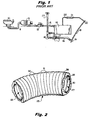
- FIGURE 1 is a schematic illustration of an exemplary vehicle toilet system utilizing the flexible hose according to the present invention; and
- FIGURE 2 is a perspective view of a section of flexible hose according to the present invention.
-
- A flexible hose according to the present invention may be used in any vehicle toilet system in which flexible hose is utilized. The hose according to the present invention will be described with respect to use in association with a vacuum toilet system, but that is representative of only one of several different types of toilet systems with which a flexible hose according to the invention may be utilized.
- In the conventional VACU-FLUSH® system as illustrated in FIGURE 1, at least one
vacuum toilet 10 having a waste discharge on the bottom thereof is connected by aflexible PVC hose 11 to avacuum tank 12, and mounted in a vehicle (e.g. boat, RV, caravan, plane, train, or the like). A vacuum level of about 8-10 inches (20-26 cm.) of mercury is maintained in thetank 12 by thevacuum pump 13, a conventional vacuum switch on thetank 12 operating thepump 13 to maintain an appropriate vacuum. When thepump 13 is operated to replenish the vacuum in thevacuum tank 12, sewage is pumped to theholding tank 14 viaconduit 15. The sewage ultimately is discharged from theholding tank 14 viaconduits 16 perhaps by using an optionalsewage discharge pump 17 which is operated only when there is a mechanism for proper disposal of the sewage. Theconduits - The
exterior partition 18 in FIGURE 1 comprises an exterior partition of a boat, recreational vehicle, plane, train, or other vehicle, e.g. simulating the form of boat hull in the actual illustration in FIGURE 1. Theexterior partition 18 is penetrated bytermination 19 of theconduit 16 from thetank 14. When thepump 17 is not used thetermination 19 is merely connected up to a pump-out facility at a dock, campsite, terminal, or the like. Conventional valves are provided to preclude sewage from being discharged from thetank 14 intohose 16 unless there is a motive force appropriate for discharging the sewage to a suitable location. - From the
holding tank 14 is aconventional vent 20, which may have a suitable filter therein such as shown in U.S. patent 5,139,655 with an end termination 22 of theconduit 20 penetrating thepartition 18 to vent odoriferous gases from theholding tank 14 to the atmosphere. Anotherconventional vent 23 is typically also provided from thehose 16, typically penetrating another partition (e.g. boat deck) of the vehicle in which thetoilet 10 is provided. - An exemplary piece of
hose 25 according to the present invention is seen in perspective view in FIGURE 2, and may be used for any of thehoses hose 25 comprises a preferably unreinforced (no fiberglass or other fiber reinforcements typically being necessary)tubular body 26, typically havingopen ends thickness 29 of the wall of thetubular body 26 may vary widely, typically it is between about .1-.25 inches (about .25-.65 cm.), e.g. about .18 inches (about .45 cm). Thediameter 30 also may vary widely depending upon the particular use to which thehose 25 is put, but theinterior diameter 30 is typically about one to three inches (about 2.5 - 7.5 cm.), e. g. about 1.5 inches (about 4 cm.). Thehose 25 may have a smooth exterior or interior surface configuration, or one or both may be "corrugated" as illustrated in FIGURE 5 where there arevalleys 31 andpeaks 32. - The preferred formulation for the
hose 25 according the present invention utilizes EVA as the high molecular weight plasticizer; EVA has exceptionally poor carbon disulfide solubility. Typically at least 10% by weight EVA, and preferably at least 30% by weight EVA, is utilized. Almost any suitable commercially available source of EVA copolymer may be utilized. One known acceptable commercially available form of EVA is sold by Dupont Chemical Company under the trademark "EVALLOY". - The
hose 25 of the invention also typically contains the conventional PVC hose components of a low molecular weight plasticizer, a stabilizer, and a lubricant, and also normally uses a pigment. A filler is particularly desirable. - The low molecular weight stabilizer utilized in the
hose 25 according to the invention may be any one of dozens of commercially available low molecular weight plasticizers, and typically is in the weight percentage of about 2-30%. The amount of low molecular weight plasticizer used will depend upon how flexible ("soft") it is desired for the hose to be. For a normal use in the vehicle toilet system environment about 5 to 10% low molecular weight plasticizer is provided. One particularly suitable low molecular weight plasticizer, simply because of its ready availability and known desirable properties, that may be utilized is Di-octyl phthalate ("DOP"). - A filler is preferred to make the hose cost effective and to help achieve odor impermeability. Since the filler is utilized primarily to reduce cost it must be an inexpensive material that will not otherwise adversely affect the functionality of the
flexible hose 25. Many of the literally dozens of commercially available suitable fillers that may be utilized are dense, and if a dense filler is utilized (such as calcium carbonate) that also adds slightly to the resistance to permeability of noxious gases provided by thehose 25. For example about 1-20% (preferably about 5-15%) calcium carbonate or a comparable filler will have a minor contribution to the ability of thehose 25 to resist noxious odor permeability. - For the stabilizer, lubricant, and pigment, any suitable commercially available components may be provided, some examples utilized according to the invention comprising between about 0.5-5% stabilizer (such as barium zinc stabilizer) and pigment (such as titanium dioxide), and typically about .1-.2% lubricant being provided, such as stearic acid.
- Two examples of particularly suitable formulations for the
hose 25 according to the present invention are as follows: -
COMPOUND PHR WT % PVC Resin 100 46.35 BaZn Stabilizer 2.5 1.16 Calcium Carbonate 25 11.59 EVA Polymer 70 32.45 DOP Plasticizer 15 6.95 Stearic Acid Lubricant 0.25 0.12 Titanium Dioxide Pigment 3 1.38 215.75 100% -
COMPOUND PHR WT% PVC 100 44.30 BaZn Stabilizer 2.5 1.11 Calcium Carbonate 25 11.07 EVA Polymer 70 31.01 DOP Plasticizer 25 11.07 Stearic Acid Lubricant 0.25 0.11 Titanium Dioxide Pigment 3 1.33 225.75 100% - The material of Example I when tested utilizing the SeaLand Sanitation Hose Permeability Test did not fail typically for at least thirteen days, and sometimes not for as long as seventeen days. The material of Example II, while not as successful as the material of Example I, did not fail the SeaLand Sanitation Hose Permeability Test for at least ten days. The hose of Example II, because it has almost twice as much low molecular weight plasticizer as that of Example I, is significantly more flexible than hoses constructed of the material of Example I, although it would be expected to have less resistance to permeability by carbon disulfide gas.
-
Hose 25 may be made of the materials of Examples I and II utilizing conventional extruding techniques for the manufacture of PVC hose. -
Hose 25 according to the present invention may consist essentially of at least about 40% PVC resin, at least about 10% (preferably at least about 30%) EVA copolymer, at least about 2% low molecular weight plasticizer, at least about 1% filler (preferably 5-15% or 5-20% dense filler such as calcium carbonate), at least about 0.5% each of stabilizer and pigment (e.g. about 0.5-5%), and at least about 0.5% lubricant (e.g. about 0.5-.5%). - The invention may also be used as flexible hose in a dockside pumpout system for boat holding tanks, such as system being generally described in U. S. Patents 4,854,827 and 5,433,163.
- It will thus be seen that according to the present invention a vehicle toilet system, and a method of operating a toilet system by connecting at least of the components of the system utilizing flexible hose, have been provided. Also a novel flexible hose, per se, but particularly for use in sewage systems, is also provided. The hose, system, and method according to the present invention provide highly desirable odor transmission-resistant characteristics, so that it may expected that hose according to the present invention will not fail (for odor transmission) for the normal mechanical life of the hose, or the toilet system in which it is utilized.
- While the invention has been herein shown and described in what is presently conceived to be the most practical and preferred embodiment thereof it will be apparent to those of ordinary skill in the art that many modifications may be made thereof within the scope of the invention, which scope is to be accorded the broadest interpretation of the appended claims.
Claims (20)
- A vehicle toilet system comprising:a toilet (10) and a sewage holding tank (12) mounted in a vehicle; anda flexible hose (25) for carrying sewage and operatively connected to at least one of said toilet and tank;said flexible hose comprising polyvinyl chloride, low molecular weight plasticizer, stabilizer, lubricant, and an ethylene-vinyl-acetate copolymer high molecular weight plasticizer, which has poor carbon disulfide solubility, so that said hose will not fail the SeaLand Sanitation Hose Permeability Test for at least thirteen days.
- A vehicle toilet system as recited in claim 1 wherein said hose comprises at least 10% by weight ethylene-vinyl-acetate copolymer.
- A vehicle toilet system as recited in claim 1 wherein said hose comprises at least 30% by weight ethylene-vinyl-acetate copolymer.
- A vehicle toilet system as recited in any preceding claim wherein said hose also contains by about 5-20% by weight dense filler.
- A vehicle toilet system as recited in any preceding claim wherein said hose comprises, by weight, about 40-55% PVC resin, about 30-40% ethylene-vinyl-acetate copolymer, about 2-30% low molecular weight plasticizer, about 5-20% filler, and about 0.5-5% each of stabilizer and pigment, and about .05-.5% lubricant.
- A vehicle toilet system as recited in any preceding claim wherein said hose includes only polyvinyl chloride, low molecular weight plasticizer, stabilizer, lubricant, ethylene-vinyl-acetate copolymer, filler, and pigment.
- A flexible hose (25) capable of being used for the transfer of sewage comprising:an unreinforced tubular body (28) capable of bending to form a radius and comprising: at least about 40% by weight PVC resin; at least about 10% by weight ethylene-vinyl-acetate copolymer; and low molecular weight plasticizer, which hose has poor carbon disulfide solubility, so that said hose will not fail the Sealand Sanitation Hose Permeability Test for at least eight days.
- A flexible hose as recited in claim 7 wherein said hose comprises at least about 30% by weight ethylene-vinyl-acetate copolymer, and at least 2% low molecular weight plasticizer.
- A flexible hose as recited in claims 7 or 8 wherein said hose also contains stabilizer, lubricant, filler and pigment.
- A flexible hose as recited in any one of claims 7-9 wherein said hose also contains 5-20% by weight dense filler.
- A flexible hose as recited in any one of claims 7-10 wherein said hose includes only, by weight, about 40-55% PVC resin, about 30-40% ethylene-vinyl-acetate copolymer, about 2-30% low molecular weight plasticizer, about 1-20% filler, about 0.5-5% each of stabilizer, and pigment, and about .05-.5% lubricant.
- A flexible hose as recited in any one of claims 7-10 wherein said hose comprises, by weight, at least about 40% PVC resin, at least about 30% ethylene-vinyl-acetate copolymer, at least about 2% low molecular weight plasticizer, at least about 1% filler, at least about 0.5% stabilizer, and at least about .05% lubricant.
- A flexible hose as recited in claim 12 wherein said low molecular weight plasticizer comprises Di-octyl phthalate, wherein said filler comprises calcium carbonate, wherein said stabilizer comprises barium zinc stabilizer, and wherein said lubricant comprises stearic acid.
- A flexible hose as recited in claim 12 wherein said low molecular weight plasticizer comprises about 5-10% Di-octyl phthalate, wherein said filler comprises about 5-15% calcium carbonate, wherein said stabilizer comprises about 1-2% barium zinc stabilizer, wherein said lubricant comprises about .1-.2% stearic acid, and further comprising about 1-2% titanium dioxide pigment.
- A flexible hose as recited in claim 12 comprising about 5-10% low molecular weight plasticizer, about 5-15% filler, about 1-2% stabilizer, about .1-.2% lubricant, and about 1-2% pigment.
- A flexible hose as recited in claim 8 further comprising, by weight, about 5-10% low molecular weight plasticizer, about 5-15% filler, about 1-2% stabilizer, and about .1-.2% lubricant.
- A method of providing a toilet system, including a toilet (10), a sewage holding tank (12), and flexible hose (25) connecting at least some of the components of the system, or a pumpout system, said method comprising the step of:(a) connecting at least one of the toilet and holding tank to each other and/or to other components of the system, or a pumpout system (at 19), using flexible hose (25) comprising polyvinyl chloride, and ethylene-vinyl-acetate copolymer high molecular weight plasticizer, which has poor carbon disulfide solubility, so that said hose will not fail the SeaLand Sanitation Hose Permeability Test for at least eight days.
- A method as recited in claim 17 wherein step (a) is further practiced by connecting components using flexible hose that also comprises low molecular weight plasticizer, a stabilizer, and a lubricant.
- A method as recited in claims 17 or 18 wherein step (a) is further practiced by connecting components using flexible hose comprising, by weight, at least about 40% PVC resin, at least about 30% ethylene-vinyl-acetate copolymer, at least about 2% low molecular weight plasticizer, at least about 1% filler, at least about 0.5% stabilizer, and at least about .1% lubricant.
- A method as recited in claims 17 or 18 wherein step (a) is further practiced by connecting components using flexible hose comprising, by weight, about 5-10% Di-octyl phthalate, about 5-15% calcium carbonate, about 1-2% barium zinc stabilizer, about .1-.2% stearic acid lubricant, and about 1-2% titanium dioxide pigment.
Applications Claiming Priority (2)
| Application Number | Priority Date | Filing Date | Title |
|---|---|---|---|
| US805803 | 1997-02-25 | ||
| US08/805,803 US5939160A (en) | 1997-02-25 | 1997-02-25 | Low odor permeable hose |
Publications (2)
| Publication Number | Publication Date |
|---|---|
| EP0860329A1 EP0860329A1 (en) | 1998-08-26 |
| EP0860329B1 true EP0860329B1 (en) | 2002-07-17 |
Family
ID=25192551
Family Applications (1)
| Application Number | Title | Priority Date | Filing Date |
|---|---|---|---|
| EP97114907A Expired - Lifetime EP0860329B1 (en) | 1997-02-25 | 1997-08-28 | Low odor permeable hose |
Country Status (4)
| Country | Link |
|---|---|
| US (2) | US5939160A (en) |
| EP (1) | EP0860329B1 (en) |
| AT (1) | ATE220615T1 (en) |
| DE (1) | DE69714005T2 (en) |
Families Citing this family (5)
| Publication number | Priority date | Publication date | Assignee | Title |
|---|---|---|---|---|
| US5939160A (en) * | 1997-02-25 | 1999-08-17 | Sealand Technology, Inc. | Low odor permeable hose |
| JP3099185B2 (en) * | 1997-05-26 | 2000-10-16 | 東拓工業株式会社 | Synthetic resin tube |
| US6804840B2 (en) | 2002-06-14 | 2004-10-19 | Thetford Corporation | Positive pressure waste transfer system |
| EP1837242A1 (en) * | 2006-03-21 | 2007-09-26 | ADCO Umweltdienste Holding GmbH | Transport vehicle for faeces |
| DE102016101715A1 (en) | 2016-02-01 | 2017-08-03 | Endress+Hauser Conducta Gmbh+Co. Kg | sensor arrangement |
Family Cites Families (16)
| Publication number | Priority date | Publication date | Assignee | Title |
|---|---|---|---|---|
| GB1175042A (en) * | 1966-03-11 | 1969-12-23 | Compoflex Co Ltd | Improvements in or relating to Flexible Hose or Tubing |
| US3936417A (en) * | 1968-07-23 | 1976-02-03 | Grandview Industries, Limited | Coilable polyvinyl chloride products and methods and compositions for producing the same |
| JPS5770149A (en) * | 1980-10-17 | 1982-04-30 | Toyo Soda Mfg Co Ltd | Resin composition |
| JPH0730183B2 (en) * | 1985-08-16 | 1995-04-05 | 株式会社ブリヂストン | Adhesion method between vulcanized rubber and other materials |
| JPS6257443A (en) * | 1985-09-05 | 1987-03-13 | Hitachi Cable Ltd | Chlorosulfonated polyethylene composition |
| JP2564540B2 (en) * | 1987-04-01 | 1996-12-18 | 株式会社日立製作所 | Immunoassay method |
| US5139655A (en) * | 1987-08-24 | 1992-08-18 | Sealand Technology, Inc. | Integrated system marine sanitation device |
| JPH01287159A (en) * | 1988-05-13 | 1989-11-17 | Nippon Synthetic Chem Ind Co Ltd:The | Halogen-containing thermoplastic resin composition |
| AU630884B2 (en) * | 1988-09-09 | 1992-11-12 | B.F. Goodrich Company, The | Polyvinyl chloride blends having improved physical properties |
| US5157076A (en) * | 1989-12-07 | 1992-10-20 | The B.F. Goodrich Company | Thermoplastic elastomers with improved abrasion resistance |
| JP3132661B2 (en) * | 1990-10-30 | 2001-02-05 | 東ソー株式会社 | Hose made of vinyl chloride resin |
| US5326602A (en) * | 1992-12-01 | 1994-07-05 | Union Carbide Chemicals & Plastics Technology Corporation | Polyethylene blends |
| DE4242806A1 (en) * | 1992-12-17 | 1994-06-23 | Siemens Ag | Sensor hose |
| US5442952A (en) * | 1994-08-11 | 1995-08-22 | Sealand Technology, Inc. | Testing of hoses |
| US5621924A (en) * | 1995-06-07 | 1997-04-22 | Sealand Ttechnology, Inc. | Vacuum tank construction for a vacuum toilet assembly |
| US5939160A (en) * | 1997-02-25 | 1999-08-17 | Sealand Technology, Inc. | Low odor permeable hose |
-
1997
- 1997-02-25 US US08/805,803 patent/US5939160A/en not_active Expired - Lifetime
- 1997-08-28 AT AT97114907T patent/ATE220615T1/en not_active IP Right Cessation
- 1997-08-28 EP EP97114907A patent/EP0860329B1/en not_active Expired - Lifetime
- 1997-08-28 DE DE69714005T patent/DE69714005T2/en not_active Expired - Lifetime
-
1998
- 1998-09-02 US US09/145,279 patent/US6216284B1/en not_active Expired - Fee Related
Also Published As
| Publication number | Publication date |
|---|---|
| EP0860329A1 (en) | 1998-08-26 |
| US6216284B1 (en) | 2001-04-17 |
| DE69714005T2 (en) | 2003-01-30 |
| US5939160A (en) | 1999-08-17 |
| DE69714005D1 (en) | 2002-08-22 |
| ATE220615T1 (en) | 2002-08-15 |
Similar Documents
| Publication | Publication Date | Title |
|---|---|---|
| US5939160A (en) | Low odor permeable hose | |
| EP0638750B1 (en) | Refrigerant transporting hose having inner tube and hose-connector combination | |
| US5265981A (en) | System and method for rehabilitating a manhole, and manhole rehabilitated thereby | |
| US20010041762A1 (en) | Thermoplastic elastomer composition having improved processability and tire using the same | |
| US6745796B2 (en) | Hydrogen fuel transporting hose for fuel-cell powered vehicle | |
| EP0160438B1 (en) | A water swellable caulking material for water-leakage prevention | |
| US4319366A (en) | Waste storage apparatus | |
| ES2098707T3 (en) | ACCUMULATOR FILLING SYSTEM. | |
| US6716377B1 (en) | Use of plastic foams containing swellable fillers for sealing wall channels | |
| US5581018A (en) | Pneumatic plug and method for hydrostatic testing of bathtub plumbing | |
| US5804269A (en) | Hose for use in the transport of refrigerants | |
| US8530013B2 (en) | Fuel hose | |
| KR101891552B1 (en) | A smart floating pipe of off-shore structure having self-compensation of buoyancy | |
| JP3700448B2 (en) | Rubber material for hose and hose for CO2 refrigerant | |
| JP2006144878A (en) | Marine hose | |
| KR20220121659A (en) | Static pressure shock absorber provided in piping for construction | |
| CN223609638U (en) | Glass fiber reinforced plastic pipeline convenient to fix and connect | |
| US20250313312A1 (en) | Emergency Airbag Float Device for Boats | |
| RU2331007C1 (en) | Floating pipeline | |
| JP2636584B2 (en) | High pressure rubber hose | |
| US20040044126A1 (en) | Security system | |
| GB2041110A (en) | Seals | |
| JPS6021219Y2 (en) | Pipe lining base material | |
| CN121038951A (en) | Long-chain polyamide pipes for onshore and offshore applications with enhanced barrier properties | |
| JPH10248749A (en) | Tank made of plastic |
Legal Events
| Date | Code | Title | Description |
|---|---|---|---|
| PUAI | Public reference made under article 153(3) epc to a published international application that has entered the european phase |
Free format text: ORIGINAL CODE: 0009012 |
|
| AK | Designated contracting states |
Kind code of ref document: A1 Designated state(s): AT BE CH DE DK ES FI FR GB GR IE IT LI LU MC NL PT SE |
|
| AX | Request for extension of the european patent |
Free format text: AL;LT;LV;SI |
|
| 17P | Request for examination filed |
Effective date: 19990120 |
|
| AKX | Designation fees paid |
Free format text: AT BE CH DE DK ES FI FR GB GR IE IT LI LU MC NL PT SE |
|
| RBV | Designated contracting states (corrected) |
Designated state(s): AT BE CH DE DK ES FI FR GB GR IE IT LI LU MC NL PT SE |
|
| RIC1 | Information provided on ipc code assigned before grant |
Free format text: 7B 29D 23/20 A, 7B 60R 15/04 B |
|
| GRAG | Despatch of communication of intention to grant |
Free format text: ORIGINAL CODE: EPIDOS AGRA |
|
| RIC1 | Information provided on ipc code assigned before grant |
Free format text: 7B 29D 23/20 A, 7B 60R 15/04 B |
|
| 17Q | First examination report despatched |
Effective date: 20010830 |
|
| GRAG | Despatch of communication of intention to grant |
Free format text: ORIGINAL CODE: EPIDOS AGRA |
|
| GRAH | Despatch of communication of intention to grant a patent |
Free format text: ORIGINAL CODE: EPIDOS IGRA |
|
| GRAH | Despatch of communication of intention to grant a patent |
Free format text: ORIGINAL CODE: EPIDOS IGRA |
|
| GRAA | (expected) grant |
Free format text: ORIGINAL CODE: 0009210 |
|
| AK | Designated contracting states |
Kind code of ref document: B1 Designated state(s): AT BE CH DE DK ES FI FR GB GR IE IT LI LU MC NL PT SE |
|
| PG25 | Lapsed in a contracting state [announced via postgrant information from national office to epo] |
Ref country code: LI Free format text: LAPSE BECAUSE OF FAILURE TO SUBMIT A TRANSLATION OF THE DESCRIPTION OR TO PAY THE FEE WITHIN THE PRESCRIBED TIME-LIMIT Effective date: 20020717 Ref country code: GR Free format text: LAPSE BECAUSE OF FAILURE TO SUBMIT A TRANSLATION OF THE DESCRIPTION OR TO PAY THE FEE WITHIN THE PRESCRIBED TIME-LIMIT Effective date: 20020717 Ref country code: CH Free format text: LAPSE BECAUSE OF FAILURE TO SUBMIT A TRANSLATION OF THE DESCRIPTION OR TO PAY THE FEE WITHIN THE PRESCRIBED TIME-LIMIT Effective date: 20020717 Ref country code: BE Free format text: LAPSE BECAUSE OF FAILURE TO SUBMIT A TRANSLATION OF THE DESCRIPTION OR TO PAY THE FEE WITHIN THE PRESCRIBED TIME-LIMIT Effective date: 20020717 Ref country code: AT Free format text: LAPSE BECAUSE OF FAILURE TO SUBMIT A TRANSLATION OF THE DESCRIPTION OR TO PAY THE FEE WITHIN THE PRESCRIBED TIME-LIMIT Effective date: 20020717 |
|
| REF | Corresponds to: |
Ref document number: 220615 Country of ref document: AT Date of ref document: 20020815 Kind code of ref document: T |
|
| REG | Reference to a national code |
Ref country code: GB Ref legal event code: FG4D |
|
| REG | Reference to a national code |
Ref country code: CH Ref legal event code: EP |
|
| PGFP | Annual fee paid to national office [announced via postgrant information from national office to epo] |
Ref country code: FI Payment date: 20020815 Year of fee payment: 6 |
|
| REG | Reference to a national code |
Ref country code: IE Ref legal event code: FG4D |
|
| REF | Corresponds to: |
Ref document number: 69714005 Country of ref document: DE Date of ref document: 20020822 |
|
| PG25 | Lapsed in a contracting state [announced via postgrant information from national office to epo] |
Ref country code: LU Free format text: LAPSE BECAUSE OF NON-PAYMENT OF DUE FEES Effective date: 20020828 Ref country code: IE Free format text: LAPSE BECAUSE OF NON-PAYMENT OF DUE FEES Effective date: 20020828 |
|
| PG25 | Lapsed in a contracting state [announced via postgrant information from national office to epo] |
Ref country code: SE Free format text: LAPSE BECAUSE OF FAILURE TO SUBMIT A TRANSLATION OF THE DESCRIPTION OR TO PAY THE FEE WITHIN THE PRESCRIBED TIME-LIMIT Effective date: 20021017 Ref country code: PT Free format text: LAPSE BECAUSE OF FAILURE TO SUBMIT A TRANSLATION OF THE DESCRIPTION OR TO PAY THE FEE WITHIN THE PRESCRIBED TIME-LIMIT Effective date: 20021017 Ref country code: DK Free format text: LAPSE BECAUSE OF FAILURE TO SUBMIT A TRANSLATION OF THE DESCRIPTION OR TO PAY THE FEE WITHIN THE PRESCRIBED TIME-LIMIT Effective date: 20021017 |
|
| ET | Fr: translation filed | ||
| PG25 | Lapsed in a contracting state [announced via postgrant information from national office to epo] |
Ref country code: ES Free format text: LAPSE BECAUSE OF FAILURE TO SUBMIT A TRANSLATION OF THE DESCRIPTION OR TO PAY THE FEE WITHIN THE PRESCRIBED TIME-LIMIT Effective date: 20030130 |
|
| REG | Reference to a national code |
Ref country code: CH Ref legal event code: PL |
|
| PG25 | Lapsed in a contracting state [announced via postgrant information from national office to epo] |
Ref country code: MC Free format text: LAPSE BECAUSE OF NON-PAYMENT OF DUE FEES Effective date: 20030301 |
|
| PLBE | No opposition filed within time limit |
Free format text: ORIGINAL CODE: 0009261 |
|
| STAA | Information on the status of an ep patent application or granted ep patent |
Free format text: STATUS: NO OPPOSITION FILED WITHIN TIME LIMIT |
|
| REG | Reference to a national code |
Ref country code: IE Ref legal event code: MM4A |
|
| 26N | No opposition filed |
Effective date: 20030422 |
|
| PG25 | Lapsed in a contracting state [announced via postgrant information from national office to epo] |
Ref country code: FI Free format text: LAPSE BECAUSE OF NON-PAYMENT OF DUE FEES Effective date: 20030828 |
|
| PGFP | Annual fee paid to national office [announced via postgrant information from national office to epo] |
Ref country code: GB Payment date: 20110819 Year of fee payment: 15 Ref country code: FR Payment date: 20110901 Year of fee payment: 15 Ref country code: DE Payment date: 20110823 Year of fee payment: 15 |
|
| PGFP | Annual fee paid to national office [announced via postgrant information from national office to epo] |
Ref country code: IT Payment date: 20110824 Year of fee payment: 15 Ref country code: NL Payment date: 20110825 Year of fee payment: 15 |
|
| REG | Reference to a national code |
Ref country code: NL Ref legal event code: V1 Effective date: 20130301 |
|
| GBPC | Gb: european patent ceased through non-payment of renewal fee |
Effective date: 20120828 |
|
| PG25 | Lapsed in a contracting state [announced via postgrant information from national office to epo] |
Ref country code: NL Free format text: LAPSE BECAUSE OF NON-PAYMENT OF DUE FEES Effective date: 20130301 |
|
| REG | Reference to a national code |
Ref country code: FR Ref legal event code: ST Effective date: 20130430 |
|
| PG25 | Lapsed in a contracting state [announced via postgrant information from national office to epo] |
Ref country code: IT Free format text: LAPSE BECAUSE OF NON-PAYMENT OF DUE FEES Effective date: 20120828 |
|
| PG25 | Lapsed in a contracting state [announced via postgrant information from national office to epo] |
Ref country code: DE Free format text: LAPSE BECAUSE OF NON-PAYMENT OF DUE FEES Effective date: 20130301 Ref country code: GB Free format text: LAPSE BECAUSE OF NON-PAYMENT OF DUE FEES Effective date: 20120828 |
|
| PG25 | Lapsed in a contracting state [announced via postgrant information from national office to epo] |
Ref country code: FR Free format text: LAPSE BECAUSE OF NON-PAYMENT OF DUE FEES Effective date: 20120831 |
|
| REG | Reference to a national code |
Ref country code: DE Ref legal event code: R119 Ref document number: 69714005 Country of ref document: DE Effective date: 20130301 |
|
| PG25 | Lapsed in a contracting state [announced via postgrant information from national office to epo] |
Ref country code: IT Free format text: LAPSE BECAUSE OF NON-PAYMENT OF DUE FEES Effective date: 20130828 |