EP0855919B1 - Induction of mucosal immune responses by vitamin d3 and antigen-encoding dna complexe to cationic lipid - Google Patents
Induction of mucosal immune responses by vitamin d3 and antigen-encoding dna complexe to cationic lipid Download PDFInfo
- Publication number
- EP0855919B1 EP0855919B1 EP96936786A EP96936786A EP0855919B1 EP 0855919 B1 EP0855919 B1 EP 0855919B1 EP 96936786 A EP96936786 A EP 96936786A EP 96936786 A EP96936786 A EP 96936786A EP 0855919 B1 EP0855919 B1 EP 0855919B1
- Authority
- EP
- European Patent Office
- Prior art keywords
- hiv
- dna
- antigen
- mucosal
- envelope
- Prior art date
- Legal status (The legal status is an assumption and is not a legal conclusion. Google has not performed a legal analysis and makes no representation as to the accuracy of the status listed.)
- Expired - Lifetime
Links
- -1 cationic lipid Chemical class 0.000 title claims abstract description 35
- QYSXJUFSXHHAJI-YRZJJWOYSA-N vitamin D3 Chemical compound C1(/[C@@H]2CC[C@@H]([C@]2(CCC1)C)[C@H](C)CCCC(C)C)=C\C=C1\C[C@@H](O)CCC1=C QYSXJUFSXHHAJI-YRZJJWOYSA-N 0.000 title claims abstract description 26
- 230000016379 mucosal immune response Effects 0.000 title claims abstract description 24
- 229940021056 vitamin d3 Drugs 0.000 title claims abstract description 20
- 230000006698 induction Effects 0.000 title description 11
- 102000036639 antigens Human genes 0.000 claims abstract description 50
- 108091007433 antigens Proteins 0.000 claims abstract description 50
- 239000000427 antigen Substances 0.000 claims abstract description 48
- 239000000203 mixture Substances 0.000 claims abstract description 23
- QYSXJUFSXHHAJI-XFEUOLMDSA-N Vitamin D3 Natural products C1(/[C@@H]2CC[C@@H]([C@]2(CCC1)C)[C@H](C)CCCC(C)C)=C/C=C1\C[C@@H](O)CCC1=C QYSXJUFSXHHAJI-XFEUOLMDSA-N 0.000 claims abstract description 19
- 235000005282 vitamin D3 Nutrition 0.000 claims abstract description 19
- 239000011647 vitamin D3 Substances 0.000 claims abstract description 19
- 230000001939 inductive effect Effects 0.000 claims abstract description 16
- OPCHFPHZPIURNA-MFERNQICSA-N (2s)-2,5-bis(3-aminopropylamino)-n-[2-(dioctadecylamino)acetyl]pentanamide Chemical compound CCCCCCCCCCCCCCCCCCN(CC(=O)NC(=O)[C@H](CCCNCCCN)NCCCN)CCCCCCCCCCCCCCCCCC OPCHFPHZPIURNA-MFERNQICSA-N 0.000 claims description 44
- GMRQFYUYWCNGIN-ZVUFCXRFSA-N 1,25-dihydroxy vitamin D3 Chemical compound C1([C@@H]2CC[C@@H]([C@]2(CCC1)C)[C@@H](CCCC(C)(C)O)C)=CC=C1C[C@@H](O)C[C@H](O)C1=C GMRQFYUYWCNGIN-ZVUFCXRFSA-N 0.000 claims description 17
- 238000004519 manufacturing process Methods 0.000 claims description 12
- LAGUSEHJTGJJRJ-UHFFFAOYSA-N 2,5-bis(3-aminopropylamino)-n-[2-(dioctadecylamino)-2-oxoethyl]pentanamide Chemical compound CCCCCCCCCCCCCCCCCCN(C(=O)CNC(=O)C(CCCNCCCN)NCCCN)CCCCCCCCCCCCCCCCCC LAGUSEHJTGJJRJ-UHFFFAOYSA-N 0.000 claims description 9
- 239000003814 drug Substances 0.000 claims description 6
- 238000000034 method Methods 0.000 abstract description 55
- 208000015181 infectious disease Diseases 0.000 abstract description 30
- 244000052769 pathogen Species 0.000 abstract description 21
- 125000002091 cationic group Chemical group 0.000 abstract description 15
- 101710121417 Envelope glycoprotein Proteins 0.000 abstract description 14
- 230000002209 hydrophobic effect Effects 0.000 abstract description 12
- 230000001717 pathogenic effect Effects 0.000 abstract description 9
- WSDRAZIPGVLSNP-UHFFFAOYSA-N O.P(=O)(O)(O)O.O.O.P(=O)(O)(O)O Chemical compound O.P(=O)(O)(O)O.O.O.P(=O)(O)(O)O WSDRAZIPGVLSNP-UHFFFAOYSA-N 0.000 abstract description 5
- 229910052757 nitrogen Inorganic materials 0.000 abstract description 5
- 244000052613 viral pathogen Species 0.000 abstract description 4
- 230000001588 bifunctional effect Effects 0.000 abstract description 3
- KWYHDKDOAIKMQN-UHFFFAOYSA-N N,N,N',N'-tetramethylethylenediamine Chemical compound CN(C)CCN(C)C KWYHDKDOAIKMQN-UHFFFAOYSA-N 0.000 abstract description 2
- XMBWDFGMSWQBCA-UHFFFAOYSA-N hydrogen iodide Chemical compound I XMBWDFGMSWQBCA-UHFFFAOYSA-N 0.000 abstract description 2
- 102100021696 Syncytin-1 Human genes 0.000 abstract 1
- 230000003278 mimic effect Effects 0.000 abstract 1
- 108020004414 DNA Proteins 0.000 description 136
- 241000725303 Human immunodeficiency virus Species 0.000 description 86
- 210000004027 cell Anatomy 0.000 description 74
- 230000003053 immunization Effects 0.000 description 61
- 238000002649 immunization Methods 0.000 description 58
- 230000002068 genetic effect Effects 0.000 description 46
- 230000004044 response Effects 0.000 description 46
- 101710090322 Truncated surface protein Proteins 0.000 description 37
- 208000031886 HIV Infections Diseases 0.000 description 34
- 241000699670 Mus sp. Species 0.000 description 34
- 241001465754 Metazoa Species 0.000 description 33
- 229940099472 immunoglobulin a Drugs 0.000 description 32
- 101800001690 Transmembrane protein gp41 Proteins 0.000 description 29
- 230000027455 binding Effects 0.000 description 27
- 230000003472 neutralizing effect Effects 0.000 description 26
- 210000002966 serum Anatomy 0.000 description 26
- 241000699666 Mus <mouse, genus> Species 0.000 description 25
- 238000001890 transfection Methods 0.000 description 25
- 241000700605 Viruses Species 0.000 description 24
- 229960005486 vaccine Drugs 0.000 description 23
- 230000036039 immunity Effects 0.000 description 22
- 230000035772 mutation Effects 0.000 description 22
- 241000713772 Human immunodeficiency virus 1 Species 0.000 description 21
- 108090000623 proteins and genes Proteins 0.000 description 21
- 239000013598 vector Substances 0.000 description 21
- 238000004458 analytical method Methods 0.000 description 20
- 230000002708 enhancing effect Effects 0.000 description 20
- 238000006386 neutralization reaction Methods 0.000 description 20
- 230000028993 immune response Effects 0.000 description 19
- 102100034349 Integrase Human genes 0.000 description 18
- 230000009885 systemic effect Effects 0.000 description 18
- 210000001519 tissue Anatomy 0.000 description 17
- 230000000694 effects Effects 0.000 description 16
- 230000014509 gene expression Effects 0.000 description 16
- 108090000765 processed proteins & peptides Proteins 0.000 description 16
- 102100036011 T-cell surface glycoprotein CD4 Human genes 0.000 description 15
- 230000006870 function Effects 0.000 description 15
- 230000002163 immunogen Effects 0.000 description 15
- 239000013612 plasmid Substances 0.000 description 15
- 108091061960 Naked DNA Proteins 0.000 description 14
- 238000001514 detection method Methods 0.000 description 13
- 238000010790 dilution Methods 0.000 description 13
- 239000012895 dilution Substances 0.000 description 13
- 210000004072 lung Anatomy 0.000 description 13
- 235000018102 proteins Nutrition 0.000 description 13
- 102000004169 proteins and genes Human genes 0.000 description 13
- 102000002260 Alkaline Phosphatase Human genes 0.000 description 11
- 108020004774 Alkaline Phosphatase Proteins 0.000 description 11
- LOKCTEFSRHRXRJ-UHFFFAOYSA-I dipotassium trisodium dihydrogen phosphate hydrogen phosphate dichloride Chemical compound P(=O)(O)(O)[O-].[K+].P(=O)(O)([O-])[O-].[Na+].[Na+].[Cl-].[K+].[Cl-].[Na+] LOKCTEFSRHRXRJ-UHFFFAOYSA-I 0.000 description 11
- 238000000338 in vitro Methods 0.000 description 11
- 210000004698 lymphocyte Anatomy 0.000 description 11
- 210000004877 mucosa Anatomy 0.000 description 11
- 210000003205 muscle Anatomy 0.000 description 11
- 239000002953 phosphate buffered saline Substances 0.000 description 11
- 230000028327 secretion Effects 0.000 description 11
- 208000037357 HIV infectious disease Diseases 0.000 description 10
- 238000011161 development Methods 0.000 description 10
- 230000018109 developmental process Effects 0.000 description 10
- 208000033519 human immunodeficiency virus infectious disease Diseases 0.000 description 10
- 238000010814 radioimmunoprecipitation assay Methods 0.000 description 10
- 230000003612 virological effect Effects 0.000 description 10
- 238000003556 assay Methods 0.000 description 9
- 230000002238 attenuated effect Effects 0.000 description 9
- 239000012528 membrane Substances 0.000 description 9
- 238000002255 vaccination Methods 0.000 description 9
- 241000713311 Simian immunodeficiency virus Species 0.000 description 8
- 150000001413 amino acids Chemical class 0.000 description 8
- 229960002685 biotin Drugs 0.000 description 8
- 239000011616 biotin Substances 0.000 description 8
- 238000009472 formulation Methods 0.000 description 8
- 238000001727 in vivo Methods 0.000 description 8
- 239000012071 phase Substances 0.000 description 8
- 230000001681 protective effect Effects 0.000 description 8
- XLYOFNOQVPJJNP-UHFFFAOYSA-N water Substances O XLYOFNOQVPJJNP-UHFFFAOYSA-N 0.000 description 8
- 241000283707 Capra Species 0.000 description 7
- 241000588724 Escherichia coli Species 0.000 description 7
- 229940033330 HIV vaccine Drugs 0.000 description 7
- 241001591005 Siga Species 0.000 description 7
- 210000001072 colon Anatomy 0.000 description 7
- 230000000295 complement effect Effects 0.000 description 7
- 230000007246 mechanism Effects 0.000 description 7
- 102000005962 receptors Human genes 0.000 description 7
- 108020003175 receptors Proteins 0.000 description 7
- 241000894007 species Species 0.000 description 7
- YBJHBAHKTGYVGT-ZKWXMUAHSA-N (+)-Biotin Chemical compound N1C(=O)N[C@@H]2[C@H](CCCCC(=O)O)SC[C@@H]21 YBJHBAHKTGYVGT-ZKWXMUAHSA-N 0.000 description 6
- IJGRMHOSHXDMSA-UHFFFAOYSA-N Atomic nitrogen Chemical compound N#N IJGRMHOSHXDMSA-UHFFFAOYSA-N 0.000 description 6
- 238000002965 ELISA Methods 0.000 description 6
- LFQSCWFLJHTTHZ-UHFFFAOYSA-N Ethanol Chemical compound CCO LFQSCWFLJHTTHZ-UHFFFAOYSA-N 0.000 description 6
- WSFSSNUMVMOOMR-UHFFFAOYSA-N Formaldehyde Chemical compound O=C WSFSSNUMVMOOMR-UHFFFAOYSA-N 0.000 description 6
- 102100034353 Integrase Human genes 0.000 description 6
- 229920001213 Polysorbate 20 Polymers 0.000 description 6
- 210000001744 T-lymphocyte Anatomy 0.000 description 6
- 230000036436 anti-hiv Effects 0.000 description 6
- 150000001720 carbohydrates Chemical group 0.000 description 6
- 210000000170 cell membrane Anatomy 0.000 description 6
- 230000000112 colonic effect Effects 0.000 description 6
- 230000001472 cytotoxic effect Effects 0.000 description 6
- 238000012217 deletion Methods 0.000 description 6
- 230000037430 deletion Effects 0.000 description 6
- 238000013461 design Methods 0.000 description 6
- 108010078428 env Gene Products Proteins 0.000 description 6
- 239000000499 gel Substances 0.000 description 6
- 230000008348 humoral response Effects 0.000 description 6
- 210000003819 peripheral blood mononuclear cell Anatomy 0.000 description 6
- 239000000256 polyoxyethylene sorbitan monolaurate Substances 0.000 description 6
- 235000010486 polyoxyethylene sorbitan monolaurate Nutrition 0.000 description 6
- 239000013641 positive control Substances 0.000 description 6
- 102000004196 processed proteins & peptides Human genes 0.000 description 6
- 230000017854 proteolysis Effects 0.000 description 6
- 239000000523 sample Substances 0.000 description 6
- 210000000952 spleen Anatomy 0.000 description 6
- 238000001262 western blot Methods 0.000 description 6
- 208000030507 AIDS Diseases 0.000 description 5
- 229920000936 Agarose Polymers 0.000 description 5
- 108010041397 CD4 Antigens Proteins 0.000 description 5
- 102100032768 Complement receptor type 2 Human genes 0.000 description 5
- 102000053602 DNA Human genes 0.000 description 5
- 102000004190 Enzymes Human genes 0.000 description 5
- 108090000790 Enzymes Proteins 0.000 description 5
- 239000000020 Nitrocellulose Substances 0.000 description 5
- 108010076504 Protein Sorting Signals Proteins 0.000 description 5
- PXIPVTKHYLBLMZ-UHFFFAOYSA-N Sodium azide Chemical compound [Na+].[N-]=[N+]=[N-] PXIPVTKHYLBLMZ-UHFFFAOYSA-N 0.000 description 5
- 239000007984 Tris EDTA buffer Substances 0.000 description 5
- 235000001014 amino acid Nutrition 0.000 description 5
- AVKUERGKIZMTKX-NJBDSQKTSA-N ampicillin Chemical compound C1([C@@H](N)C(=O)N[C@H]2[C@H]3SC([C@@H](N3C2=O)C(O)=O)(C)C)=CC=CC=C1 AVKUERGKIZMTKX-NJBDSQKTSA-N 0.000 description 5
- 229960000723 ampicillin Drugs 0.000 description 5
- 230000001580 bacterial effect Effects 0.000 description 5
- 239000000872 buffer Substances 0.000 description 5
- 239000013592 cell lysate Substances 0.000 description 5
- 231100000433 cytotoxic Toxicity 0.000 description 5
- 201000010099 disease Diseases 0.000 description 5
- 208000037265 diseases, disorders, signs and symptoms Diseases 0.000 description 5
- 238000001962 electrophoresis Methods 0.000 description 5
- 230000001965 increasing effect Effects 0.000 description 5
- 230000002458 infectious effect Effects 0.000 description 5
- 230000003993 interaction Effects 0.000 description 5
- 239000003446 ligand Substances 0.000 description 5
- 210000003097 mucus Anatomy 0.000 description 5
- 229920001220 nitrocellulos Polymers 0.000 description 5
- 239000000243 solution Substances 0.000 description 5
- 239000000758 substrate Substances 0.000 description 5
- QEIFSLUFHRCVQL-UHFFFAOYSA-N (5-bromo-4-chloro-1h-indol-3-yl) hydrogen phosphate;(4-methylphenyl)azanium Chemical compound CC1=CC=C(N)C=C1.C1=C(Br)C(Cl)=C2C(OP(O)(=O)O)=CNC2=C1 QEIFSLUFHRCVQL-UHFFFAOYSA-N 0.000 description 4
- QKNYBSVHEMOAJP-UHFFFAOYSA-N 2-amino-2-(hydroxymethyl)propane-1,3-diol;hydron;chloride Chemical compound Cl.OCC(N)(CO)CO QKNYBSVHEMOAJP-UHFFFAOYSA-N 0.000 description 4
- 206010012310 Dengue fever Diseases 0.000 description 4
- BWGNESOTFCXPMA-UHFFFAOYSA-N Dihydrogen disulfide Chemical compound SS BWGNESOTFCXPMA-UHFFFAOYSA-N 0.000 description 4
- 241000206602 Eukaryota Species 0.000 description 4
- 241000282412 Homo Species 0.000 description 4
- 241000282560 Macaca mulatta Species 0.000 description 4
- 108091028043 Nucleic acid sequence Proteins 0.000 description 4
- 241000725643 Respiratory syncytial virus Species 0.000 description 4
- FAPWRFPIFSIZLT-UHFFFAOYSA-M Sodium chloride Chemical compound [Na+].[Cl-] FAPWRFPIFSIZLT-UHFFFAOYSA-M 0.000 description 4
- 239000007983 Tris buffer Substances 0.000 description 4
- 239000002671 adjuvant Substances 0.000 description 4
- 125000000539 amino acid group Chemical group 0.000 description 4
- 238000010171 animal model Methods 0.000 description 4
- 230000005875 antibody response Effects 0.000 description 4
- 244000052616 bacterial pathogen Species 0.000 description 4
- 230000003115 biocidal effect Effects 0.000 description 4
- 230000005540 biological transmission Effects 0.000 description 4
- 230000001413 cellular effect Effects 0.000 description 4
- 238000010367 cloning Methods 0.000 description 4
- 208000025729 dengue disease Diseases 0.000 description 4
- 230000001419 dependent effect Effects 0.000 description 4
- 230000008030 elimination Effects 0.000 description 4
- 238000003379 elimination reaction Methods 0.000 description 4
- 238000011156 evaluation Methods 0.000 description 4
- GNBHRKFJIUUOQI-UHFFFAOYSA-N fluorescein Chemical compound O1C(=O)C2=CC=CC=C2C21C1=CC=C(O)C=C1OC1=CC(O)=CC=C21 GNBHRKFJIUUOQI-UHFFFAOYSA-N 0.000 description 4
- 239000012634 fragment Substances 0.000 description 4
- 230000003054 hormonal effect Effects 0.000 description 4
- 238000011065 in-situ storage Methods 0.000 description 4
- 238000011534 incubation Methods 0.000 description 4
- 150000002632 lipids Chemical class 0.000 description 4
- 239000007788 liquid Substances 0.000 description 4
- 238000000302 molecular modelling Methods 0.000 description 4
- RZXMPPFPUUCRFN-UHFFFAOYSA-N p-toluidine Chemical compound CC1=CC=C(N)C=C1 RZXMPPFPUUCRFN-UHFFFAOYSA-N 0.000 description 4
- YBYRMVIVWMBXKQ-UHFFFAOYSA-N phenylmethanesulfonyl fluoride Chemical compound FS(=O)(=O)CC1=CC=CC=C1 YBYRMVIVWMBXKQ-UHFFFAOYSA-N 0.000 description 4
- 239000013600 plasmid vector Substances 0.000 description 4
- 230000008439 repair process Effects 0.000 description 4
- 238000011160 research Methods 0.000 description 4
- 239000011780 sodium chloride Substances 0.000 description 4
- 239000000126 substance Substances 0.000 description 4
- 238000012546 transfer Methods 0.000 description 4
- LENZDBCJOHFCAS-UHFFFAOYSA-N tris Chemical compound OCC(N)(CO)CO LENZDBCJOHFCAS-UHFFFAOYSA-N 0.000 description 4
- XZKIHKMTEMTJQX-UHFFFAOYSA-N 4-Nitrophenyl Phosphate Chemical compound OP(O)(=O)OC1=CC=C([N+]([O-])=O)C=C1 XZKIHKMTEMTJQX-UHFFFAOYSA-N 0.000 description 3
- QTBSBXVTEAMEQO-UHFFFAOYSA-N Acetic acid Chemical compound CC(O)=O QTBSBXVTEAMEQO-UHFFFAOYSA-N 0.000 description 3
- 102100027211 Albumin Human genes 0.000 description 3
- 108010088751 Albumins Proteins 0.000 description 3
- 241000894006 Bacteria Species 0.000 description 3
- 241000606161 Chlamydia Species 0.000 description 3
- 101100185881 Clostridium tetani (strain Massachusetts / E88) mutS2 gene Proteins 0.000 description 3
- 208000001490 Dengue Diseases 0.000 description 3
- 241000713730 Equine infectious anemia virus Species 0.000 description 3
- 241000710831 Flavivirus Species 0.000 description 3
- 101710177291 Gag polyprotein Proteins 0.000 description 3
- YQEZLKZALYSWHR-UHFFFAOYSA-N Ketamine Chemical compound C=1C=CC=C(Cl)C=1C1(NC)CCCCC1=O YQEZLKZALYSWHR-UHFFFAOYSA-N 0.000 description 3
- 101710125418 Major capsid protein Proteins 0.000 description 3
- OKKJLVBELUTLKV-UHFFFAOYSA-N Methanol Chemical compound OC OKKJLVBELUTLKV-UHFFFAOYSA-N 0.000 description 3
- 238000012408 PCR amplification Methods 0.000 description 3
- 229910019142 PO4 Inorganic materials 0.000 description 3
- 241000282579 Pan Species 0.000 description 3
- 239000012980 RPMI-1640 medium Substances 0.000 description 3
- 241000700584 Simplexvirus Species 0.000 description 3
- 239000004098 Tetracycline Substances 0.000 description 3
- 239000013504 Triton X-100 Substances 0.000 description 3
- 229920004890 Triton X-100 Polymers 0.000 description 3
- 108010003533 Viral Envelope Proteins Proteins 0.000 description 3
- 230000000890 antigenic effect Effects 0.000 description 3
- 230000008901 benefit Effects 0.000 description 3
- 230000015572 biosynthetic process Effects 0.000 description 3
- 235000020958 biotin Nutrition 0.000 description 3
- 238000006243 chemical reaction Methods 0.000 description 3
- 229960005004 cholera vaccine Drugs 0.000 description 3
- 210000002919 epithelial cell Anatomy 0.000 description 3
- 210000002950 fibroblast Anatomy 0.000 description 3
- 239000011521 glass Substances 0.000 description 3
- 101150117187 glmS gene Proteins 0.000 description 3
- 230000013595 glycosylation Effects 0.000 description 3
- 238000006206 glycosylation reaction Methods 0.000 description 3
- 230000028996 humoral immune response Effects 0.000 description 3
- 239000001257 hydrogen Substances 0.000 description 3
- 229910052739 hydrogen Inorganic materials 0.000 description 3
- 230000005847 immunogenicity Effects 0.000 description 3
- 239000000411 inducer Substances 0.000 description 3
- 230000005764 inhibitory process Effects 0.000 description 3
- 210000001630 jejunum Anatomy 0.000 description 3
- 229960003299 ketamine Drugs 0.000 description 3
- 210000004185 liver Anatomy 0.000 description 3
- 230000007774 longterm Effects 0.000 description 3
- 239000006166 lysate Substances 0.000 description 3
- 230000001404 mediated effect Effects 0.000 description 3
- 238000012900 molecular simulation Methods 0.000 description 3
- 210000005087 mononuclear cell Anatomy 0.000 description 3
- 101150013854 mutS gene Proteins 0.000 description 3
- 230000003287 optical effect Effects 0.000 description 3
- NBIIXXVUZAFLBC-UHFFFAOYSA-K phosphate Chemical compound [O-]P([O-])([O-])=O NBIIXXVUZAFLBC-UHFFFAOYSA-K 0.000 description 3
- 239000010452 phosphate Substances 0.000 description 3
- 239000000047 product Substances 0.000 description 3
- 230000010076 replication Effects 0.000 description 3
- 230000003248 secreting effect Effects 0.000 description 3
- 238000002741 site-directed mutagenesis Methods 0.000 description 3
- 238000002415 sodium dodecyl sulfate polyacrylamide gel electrophoresis Methods 0.000 description 3
- 239000002904 solvent Substances 0.000 description 3
- 239000000725 suspension Substances 0.000 description 3
- 239000003826 tablet Substances 0.000 description 3
- 238000012360 testing method Methods 0.000 description 3
- 229960002180 tetracycline Drugs 0.000 description 3
- 229930101283 tetracycline Natural products 0.000 description 3
- 235000019364 tetracycline Nutrition 0.000 description 3
- 150000003522 tetracyclines Chemical class 0.000 description 3
- 230000032258 transport Effects 0.000 description 3
- 241000701447 unidentified baculovirus Species 0.000 description 3
- 230000001018 virulence Effects 0.000 description 3
- 239000011534 wash buffer Substances 0.000 description 3
- BPICBUSOMSTKRF-UHFFFAOYSA-N xylazine Chemical compound CC1=CC=CC(C)=C1NC1=NCCCS1 BPICBUSOMSTKRF-UHFFFAOYSA-N 0.000 description 3
- 229960001600 xylazine Drugs 0.000 description 3
- 108091032973 (ribonucleotides)n+m Proteins 0.000 description 2
- PIGCSKVALLVWKU-UHFFFAOYSA-N 2-Aminoacridone Chemical compound C1=CC=C2C(=O)C3=CC(N)=CC=C3NC2=C1 PIGCSKVALLVWKU-UHFFFAOYSA-N 0.000 description 2
- 108020004705 Codon Proteins 0.000 description 2
- 241000711573 Coronaviridae Species 0.000 description 2
- 101710104895 DNA replication protein 17 Proteins 0.000 description 2
- 206010061818 Disease progression Diseases 0.000 description 2
- KCXVZYZYPLLWCC-UHFFFAOYSA-N EDTA Chemical compound OC(=O)CN(CC(O)=O)CCN(CC(O)=O)CC(O)=O KCXVZYZYPLLWCC-UHFFFAOYSA-N 0.000 description 2
- 101710091045 Envelope protein Proteins 0.000 description 2
- 102000009109 Fc receptors Human genes 0.000 description 2
- 108010087819 Fc receptors Proteins 0.000 description 2
- 102000002464 Galactosidases Human genes 0.000 description 2
- 108010093031 Galactosidases Proteins 0.000 description 2
- DHMQDGOQFOQNFH-UHFFFAOYSA-N Glycine Chemical compound NCC(O)=O DHMQDGOQFOQNFH-UHFFFAOYSA-N 0.000 description 2
- 108090000288 Glycoproteins Proteins 0.000 description 2
- 102000003886 Glycoproteins Human genes 0.000 description 2
- 101000637792 Homo sapiens Solute carrier family 35 member G5 Proteins 0.000 description 2
- 241000712431 Influenza A virus Species 0.000 description 2
- 241000274177 Juniperus sabina Species 0.000 description 2
- 241000713666 Lentivirus Species 0.000 description 2
- TWRXJAOTZQYOKJ-UHFFFAOYSA-L Magnesium chloride Chemical compound [Mg+2].[Cl-].[Cl-] TWRXJAOTZQYOKJ-UHFFFAOYSA-L 0.000 description 2
- 241001529936 Murinae Species 0.000 description 2
- AFBPFSWMIHJQDM-UHFFFAOYSA-N N-methyl-N-phenylamine Natural products CNC1=CC=CC=C1 AFBPFSWMIHJQDM-UHFFFAOYSA-N 0.000 description 2
- 241000283973 Oryctolagus cuniculus Species 0.000 description 2
- 101710152616 Probable major capsid protein gp17 Proteins 0.000 description 2
- 102100030350 Prolactin-inducible protein Human genes 0.000 description 2
- 101710188315 Protein X Proteins 0.000 description 2
- 241000700159 Rattus Species 0.000 description 2
- 239000006146 Roswell Park Memorial Institute medium Substances 0.000 description 2
- 102100032019 Solute carrier family 35 member G5 Human genes 0.000 description 2
- 108010008038 Synthetic Vaccines Proteins 0.000 description 2
- 230000024932 T cell mediated immunity Effects 0.000 description 2
- 108010067390 Viral Proteins Proteins 0.000 description 2
- 230000001154 acute effect Effects 0.000 description 2
- 230000004075 alteration Effects 0.000 description 2
- 230000003321 amplification Effects 0.000 description 2
- 238000013459 approach Methods 0.000 description 2
- 206010003246 arthritis Diseases 0.000 description 2
- 210000003719 b-lymphocyte Anatomy 0.000 description 2
- 239000011324 bead Substances 0.000 description 2
- 230000009286 beneficial effect Effects 0.000 description 2
- 230000000903 blocking effect Effects 0.000 description 2
- 210000004899 c-terminal region Anatomy 0.000 description 2
- 239000002775 capsule Substances 0.000 description 2
- 230000005889 cellular cytotoxicity Effects 0.000 description 2
- 210000003756 cervix mucus Anatomy 0.000 description 2
- 230000008859 change Effects 0.000 description 2
- 238000003776 cleavage reaction Methods 0.000 description 2
- 239000011248 coating agent Substances 0.000 description 2
- 238000000576 coating method Methods 0.000 description 2
- 238000010276 construction Methods 0.000 description 2
- 239000006071 cream Substances 0.000 description 2
- 230000001351 cycling effect Effects 0.000 description 2
- 125000000151 cysteine group Chemical group N[C@@H](CS)C(=O)* 0.000 description 2
- 230000003013 cytotoxicity Effects 0.000 description 2
- 231100000135 cytotoxicity Toxicity 0.000 description 2
- 238000005034 decoration Methods 0.000 description 2
- 230000007123 defense Effects 0.000 description 2
- 230000002939 deleterious effect Effects 0.000 description 2
- 229940009976 deoxycholate Drugs 0.000 description 2
- KXGVEGMKQFWNSR-LLQZFEROSA-N deoxycholic acid Chemical compound C([C@H]1CC2)[C@H](O)CC[C@]1(C)[C@@H]1[C@@H]2[C@@H]2CC[C@H]([C@@H](CCC(O)=O)C)[C@@]2(C)[C@@H](O)C1 KXGVEGMKQFWNSR-LLQZFEROSA-N 0.000 description 2
- 238000009792 diffusion process Methods 0.000 description 2
- 230000005750 disease progression Effects 0.000 description 2
- 239000002552 dosage form Substances 0.000 description 2
- 231100000673 dose–response relationship Toxicity 0.000 description 2
- ZMMJGEGLRURXTF-UHFFFAOYSA-N ethidium bromide Chemical compound [Br-].C12=CC(N)=CC=C2C2=CC=C(N)C=C2[N+](CC)=C1C1=CC=CC=C1 ZMMJGEGLRURXTF-UHFFFAOYSA-N 0.000 description 2
- 229960005542 ethidium bromide Drugs 0.000 description 2
- 210000003527 eukaryotic cell Anatomy 0.000 description 2
- 238000013401 experimental design Methods 0.000 description 2
- 238000002474 experimental method Methods 0.000 description 2
- 239000000834 fixative Substances 0.000 description 2
- 230000002496 gastric effect Effects 0.000 description 2
- 238000011239 genetic vaccination Methods 0.000 description 2
- PCHJSUWPFVWCPO-UHFFFAOYSA-N gold Chemical compound [Au] PCHJSUWPFVWCPO-UHFFFAOYSA-N 0.000 description 2
- 239000010931 gold Substances 0.000 description 2
- 230000002710 gonadal effect Effects 0.000 description 2
- 239000008187 granular material Substances 0.000 description 2
- 239000001963 growth medium Substances 0.000 description 2
- 230000000423 heterosexual effect Effects 0.000 description 2
- 230000001744 histochemical effect Effects 0.000 description 2
- 230000007062 hydrolysis Effects 0.000 description 2
- 238000006460 hydrolysis reaction Methods 0.000 description 2
- 210000000987 immune system Anatomy 0.000 description 2
- 238000003365 immunocytochemistry Methods 0.000 description 2
- 230000002401 inhibitory effect Effects 0.000 description 2
- 238000007918 intramuscular administration Methods 0.000 description 2
- 231100000518 lethal Toxicity 0.000 description 2
- 230000001665 lethal effect Effects 0.000 description 2
- 210000000207 lymphocyte subset Anatomy 0.000 description 2
- 210000003563 lymphoid tissue Anatomy 0.000 description 2
- 239000012139 lysis buffer Substances 0.000 description 2
- 210000002540 macrophage Anatomy 0.000 description 2
- 239000000463 material Substances 0.000 description 2
- 239000002609 medium Substances 0.000 description 2
- 108020004999 messenger RNA Proteins 0.000 description 2
- 125000001570 methylene group Chemical group [H]C([H])([*:1])[*:2] 0.000 description 2
- 244000005700 microbiome Species 0.000 description 2
- 238000000329 molecular dynamics simulation Methods 0.000 description 2
- 230000000869 mutational effect Effects 0.000 description 2
- FSVCQIDHPKZJSO-UHFFFAOYSA-L nitro blue tetrazolium dichloride Chemical compound [Cl-].[Cl-].COC1=CC(C=2C=C(OC)C(=CC=2)[N+]=2N(N=C(N=2)C=2C=CC=CC=2)C=2C=CC(=CC=2)[N+]([O-])=O)=CC=C1[N+]1=NC(C=2C=CC=CC=2)=NN1C1=CC=C([N+]([O-])=O)C=C1 FSVCQIDHPKZJSO-UHFFFAOYSA-L 0.000 description 2
- 238000003199 nucleic acid amplification method Methods 0.000 description 2
- 238000005457 optimization Methods 0.000 description 2
- 229940127241 oral polio vaccine Drugs 0.000 description 2
- 210000000056 organ Anatomy 0.000 description 2
- 239000012188 paraffin wax Substances 0.000 description 2
- 230000008823 permeabilization Effects 0.000 description 2
- 230000002688 persistence Effects 0.000 description 2
- 239000008194 pharmaceutical composition Substances 0.000 description 2
- 125000002467 phosphate group Chemical group [H]OP(=O)(O[H])O[*] 0.000 description 2
- 210000004180 plasmocyte Anatomy 0.000 description 2
- 239000000843 powder Substances 0.000 description 2
- 230000001566 pro-viral effect Effects 0.000 description 2
- 230000006337 proteolytic cleavage Effects 0.000 description 2
- 238000000746 purification Methods 0.000 description 2
- 230000009257 reactivity Effects 0.000 description 2
- 229940124551 recombinant vaccine Drugs 0.000 description 2
- 238000011084 recovery Methods 0.000 description 2
- 230000003362 replicative effect Effects 0.000 description 2
- 210000003296 saliva Anatomy 0.000 description 2
- 230000007017 scission Effects 0.000 description 2
- 238000013207 serial dilution Methods 0.000 description 2
- 210000000813 small intestine Anatomy 0.000 description 2
- 230000002269 spontaneous effect Effects 0.000 description 2
- 238000010186 staining Methods 0.000 description 2
- 238000006467 substitution reaction Methods 0.000 description 2
- 239000006228 supernatant Substances 0.000 description 2
- 239000000829 suppository Substances 0.000 description 2
- 239000000375 suspending agent Substances 0.000 description 2
- 239000006188 syrup Substances 0.000 description 2
- 235000020357 syrup Nutrition 0.000 description 2
- 238000007910 systemic administration Methods 0.000 description 2
- 230000001988 toxicity Effects 0.000 description 2
- 231100000419 toxicity Toxicity 0.000 description 2
- 238000013518 transcription Methods 0.000 description 2
- 230000035897 transcription Effects 0.000 description 2
- 230000009466 transformation Effects 0.000 description 2
- 230000014616 translation Effects 0.000 description 2
- 238000013519 translation Methods 0.000 description 2
- 210000001215 vagina Anatomy 0.000 description 2
- 238000012800 visualization Methods 0.000 description 2
- 238000005406 washing Methods 0.000 description 2
- QCHFTSOMWOSFHM-WPRPVWTQSA-N (+)-Pilocarpine Chemical compound C1OC(=O)[C@@H](CC)[C@H]1CC1=CN=CN1C QCHFTSOMWOSFHM-WPRPVWTQSA-N 0.000 description 1
- ZGLHBRQAEXKACO-XJRQOBMKSA-N 1alpha,25-dihydroxyvitamin D2 Chemical compound C1(/[C@@H]2CC[C@@H]([C@]2(CCC1)C)[C@@H](\C=C\[C@H](C)C(C)(C)O)C)=C\C=C1\C[C@@H](O)C[C@H](O)C1=C ZGLHBRQAEXKACO-XJRQOBMKSA-N 0.000 description 1
- PCDWFBFHIIKIPM-UHFFFAOYSA-N 3-ethyl-2h-1,3-benzothiazole-2-sulfonic acid Chemical compound C1=CC=C2N(CC)C(S(O)(=O)=O)SC2=C1 PCDWFBFHIIKIPM-UHFFFAOYSA-N 0.000 description 1
- OPIFSICVWOWJMJ-AEOCFKNESA-N 5-bromo-4-chloro-3-indolyl beta-D-galactoside Chemical compound O[C@@H]1[C@@H](O)[C@@H](O)[C@@H](CO)O[C@H]1OC1=CNC2=CC=C(Br)C(Cl)=C12 OPIFSICVWOWJMJ-AEOCFKNESA-N 0.000 description 1
- QTBSBXVTEAMEQO-UHFFFAOYSA-M Acetate Chemical compound CC([O-])=O QTBSBXVTEAMEQO-UHFFFAOYSA-M 0.000 description 1
- 102000007469 Actins Human genes 0.000 description 1
- 108010085238 Actins Proteins 0.000 description 1
- 241000710929 Alphavirus Species 0.000 description 1
- 206010002091 Anaesthesia Diseases 0.000 description 1
- 241000712891 Arenavirus Species 0.000 description 1
- 229930091051 Arenine Natural products 0.000 description 1
- 108091003079 Bovine Serum Albumin Proteins 0.000 description 1
- 206010006187 Breast cancer Diseases 0.000 description 1
- 208000026310 Breast neoplasm Diseases 0.000 description 1
- BVKZGUZCCUSVTD-UHFFFAOYSA-L Carbonate Chemical compound [O-]C([O-])=O BVKZGUZCCUSVTD-UHFFFAOYSA-L 0.000 description 1
- 241000700198 Cavia Species 0.000 description 1
- 241000700199 Cavia porcellus Species 0.000 description 1
- 241000282693 Cercopithecidae Species 0.000 description 1
- 241001502567 Chikungunya virus Species 0.000 description 1
- 102000011412 Complement 3d Receptors Human genes 0.000 description 1
- 108010023729 Complement 3d Receptors Proteins 0.000 description 1
- 102000000989 Complement System Proteins Human genes 0.000 description 1
- 108010069112 Complement System Proteins Proteins 0.000 description 1
- 101710143772 Complement receptor type 2 Proteins 0.000 description 1
- 241000709687 Coxsackievirus Species 0.000 description 1
- OABOXRPGTFRBFZ-IMJSIDKUSA-N Cys-Cys Chemical compound SC[C@H](N)C(=O)N[C@@H](CS)C(O)=O OABOXRPGTFRBFZ-IMJSIDKUSA-N 0.000 description 1
- 230000004544 DNA amplification Effects 0.000 description 1
- 238000007399 DNA isolation Methods 0.000 description 1
- 230000033616 DNA repair Effects 0.000 description 1
- 108010014303 DNA-directed DNA polymerase Proteins 0.000 description 1
- 102000016928 DNA-directed DNA polymerase Human genes 0.000 description 1
- 238000012286 ELISA Assay Methods 0.000 description 1
- 102100038132 Endogenous retrovirus group K member 6 Pro protein Human genes 0.000 description 1
- 108010067770 Endopeptidase K Proteins 0.000 description 1
- 241000792859 Enema Species 0.000 description 1
- 241000709661 Enterovirus Species 0.000 description 1
- 241000283086 Equidae Species 0.000 description 1
- 108700039887 Essential Genes Proteins 0.000 description 1
- 206010015719 Exsanguination Diseases 0.000 description 1
- 241000282324 Felis Species 0.000 description 1
- 239000004471 Glycine Substances 0.000 description 1
- 241000606790 Haemophilus Species 0.000 description 1
- 241000589989 Helicobacter Species 0.000 description 1
- 208000005176 Hepatitis C Diseases 0.000 description 1
- 101001116388 Homo sapiens Melatonin-related receptor Proteins 0.000 description 1
- 108010001336 Horseradish Peroxidase Proteins 0.000 description 1
- 241000701085 Human alphaherpesvirus 3 Species 0.000 description 1
- 241000701044 Human gammaherpesvirus 4 Species 0.000 description 1
- 241000711920 Human orthopneumovirus Species 0.000 description 1
- UFHFLCQGNIYNRP-UHFFFAOYSA-N Hydrogen Chemical compound [H][H] UFHFLCQGNIYNRP-UHFFFAOYSA-N 0.000 description 1
- 108700002232 Immediate-Early Genes Proteins 0.000 description 1
- 206010061598 Immunodeficiency Diseases 0.000 description 1
- 208000029462 Immunodeficiency disease Diseases 0.000 description 1
- 108060003951 Immunoglobulin Proteins 0.000 description 1
- QNAYBMKLOCPYGJ-REOHCLBHSA-N L-alanine Chemical compound C[C@H](N)C(O)=O QNAYBMKLOCPYGJ-REOHCLBHSA-N 0.000 description 1
- 206010023927 Lassa fever Diseases 0.000 description 1
- 206010050551 Lupus-like syndrome Diseases 0.000 description 1
- 239000006137 Luria-Bertani broth Substances 0.000 description 1
- 229920000057 Mannan Polymers 0.000 description 1
- 241000712079 Measles morbillivirus Species 0.000 description 1
- 206010065764 Mucosal infection Diseases 0.000 description 1
- 241000711386 Mumps virus Species 0.000 description 1
- 230000004988 N-glycosylation Effects 0.000 description 1
- 241000588653 Neisseria Species 0.000 description 1
- 102000011931 Nucleoproteins Human genes 0.000 description 1
- 108010061100 Nucleoproteins Proteins 0.000 description 1
- CTQNGGLPUBDAKN-UHFFFAOYSA-N O-Xylene Chemical compound CC1=CC=CC=C1C CTQNGGLPUBDAKN-UHFFFAOYSA-N 0.000 description 1
- 241000713112 Orthobunyavirus Species 0.000 description 1
- 241000150452 Orthohantavirus Species 0.000 description 1
- 241000282577 Pan troglodytes Species 0.000 description 1
- 108091005804 Peptidases Proteins 0.000 description 1
- 206010034759 Petit mal epilepsy Diseases 0.000 description 1
- 102000004160 Phosphoric Monoester Hydrolases Human genes 0.000 description 1
- 108090000608 Phosphoric Monoester Hydrolases Proteins 0.000 description 1
- 241000709664 Picornaviridae Species 0.000 description 1
- 108010039918 Polylysine Proteins 0.000 description 1
- 101710124413 Portal protein Proteins 0.000 description 1
- 239000004365 Protease Substances 0.000 description 1
- 101710150344 Protein Rev Proteins 0.000 description 1
- 241000589516 Pseudomonas Species 0.000 description 1
- 206010037660 Pyrexia Diseases 0.000 description 1
- 239000012083 RIPA buffer Substances 0.000 description 1
- 108010092799 RNA-directed DNA polymerase Proteins 0.000 description 1
- 241000711798 Rabies lyssavirus Species 0.000 description 1
- 208000035415 Reinfection Diseases 0.000 description 1
- 241000713124 Rift Valley fever virus Species 0.000 description 1
- QCHFTSOMWOSFHM-UHFFFAOYSA-N SJ000285536 Natural products C1OC(=O)C(CC)C1CC1=CN=CN1C QCHFTSOMWOSFHM-UHFFFAOYSA-N 0.000 description 1
- 240000004808 Saccharomyces cerevisiae Species 0.000 description 1
- 241000607142 Salmonella Species 0.000 description 1
- 229920002684 Sepharose Polymers 0.000 description 1
- 238000012300 Sequence Analysis Methods 0.000 description 1
- 108010022999 Serine Proteases Proteins 0.000 description 1
- 102000012479 Serine Proteases Human genes 0.000 description 1
- 241000607768 Shigella Species 0.000 description 1
- 241000144282 Sigmodon Species 0.000 description 1
- XUIMIQQOPSSXEZ-UHFFFAOYSA-N Silicon Chemical compound [Si] XUIMIQQOPSSXEZ-UHFFFAOYSA-N 0.000 description 1
- 108091081024 Start codon Proteins 0.000 description 1
- 108010090804 Streptavidin Proteins 0.000 description 1
- 230000005867 T cell response Effects 0.000 description 1
- 108010006785 Taq Polymerase Proteins 0.000 description 1
- AYFVYJQAPQTCCC-UHFFFAOYSA-N Threonine Natural products CC(O)C(N)C(O)=O AYFVYJQAPQTCCC-UHFFFAOYSA-N 0.000 description 1
- 239000004473 Threonine Substances 0.000 description 1
- 102000006601 Thymidine Kinase Human genes 0.000 description 1
- 108020004440 Thymidine kinase Proteins 0.000 description 1
- 108091023040 Transcription factor Proteins 0.000 description 1
- 102000040945 Transcription factor Human genes 0.000 description 1
- 102100023935 Transmembrane glycoprotein NMB Human genes 0.000 description 1
- 241000700618 Vaccinia virus Species 0.000 description 1
- 241000607598 Vibrio Species 0.000 description 1
- 206010058874 Viraemia Diseases 0.000 description 1
- 108020005202 Viral DNA Proteins 0.000 description 1
- 208000036142 Viral infection Diseases 0.000 description 1
- 230000010530 Virus Neutralization Effects 0.000 description 1
- 241000710886 West Nile virus Species 0.000 description 1
- 241000710772 Yellow fever virus Species 0.000 description 1
- 241000607734 Yersinia <bacteria> Species 0.000 description 1
- 239000002250 absorbent Substances 0.000 description 1
- 230000002745 absorbent Effects 0.000 description 1
- 239000002253 acid Substances 0.000 description 1
- 230000002378 acidificating effect Effects 0.000 description 1
- 239000000654 additive Substances 0.000 description 1
- 230000000996 additive effect Effects 0.000 description 1
- 230000001464 adherent effect Effects 0.000 description 1
- 230000002411 adverse Effects 0.000 description 1
- 235000004279 alanine Nutrition 0.000 description 1
- WLDHEUZGFKACJH-UHFFFAOYSA-K amaranth Chemical compound [Na+].[Na+].[Na+].C12=CC=C(S([O-])(=O)=O)C=C2C=C(S([O-])(=O)=O)C(O)=C1N=NC1=CC=C(S([O-])(=O)=O)C2=CC=CC=C12 WLDHEUZGFKACJH-UHFFFAOYSA-K 0.000 description 1
- 150000001408 amides Chemical class 0.000 description 1
- 230000037005 anaesthesia Effects 0.000 description 1
- 239000003242 anti bacterial agent Substances 0.000 description 1
- 230000003466 anti-cipated effect Effects 0.000 description 1
- 230000030741 antigen processing and presentation Effects 0.000 description 1
- 210000000702 aorta abdominal Anatomy 0.000 description 1
- OHDRQQURAXLVGJ-HLVWOLMTSA-N azane;(2e)-3-ethyl-2-[(e)-(3-ethyl-6-sulfo-1,3-benzothiazol-2-ylidene)hydrazinylidene]-1,3-benzothiazole-6-sulfonic acid Chemical compound [NH4+].[NH4+].S/1C2=CC(S([O-])(=O)=O)=CC=C2N(CC)C\1=N/N=C1/SC2=CC(S([O-])(=O)=O)=CC=C2N1CC OHDRQQURAXLVGJ-HLVWOLMTSA-N 0.000 description 1
- IRERQBUNZFJFGC-UHFFFAOYSA-L azure blue Chemical compound [Na+].[Na+].[Na+].[Na+].[Na+].[Na+].[Na+].[Na+].[Al+3].[Al+3].[Al+3].[Al+3].[Al+3].[Al+3].[S-]S[S-].[O-][Si]([O-])([O-])[O-].[O-][Si]([O-])([O-])[O-].[O-][Si]([O-])([O-])[O-].[O-][Si]([O-])([O-])[O-].[O-][Si]([O-])([O-])[O-].[O-][Si]([O-])([O-])[O-] IRERQBUNZFJFGC-UHFFFAOYSA-L 0.000 description 1
- 102000005936 beta-Galactosidase Human genes 0.000 description 1
- 108010005774 beta-Galactosidase Proteins 0.000 description 1
- 239000011230 binding agent Substances 0.000 description 1
- 230000004071 biological effect Effects 0.000 description 1
- 230000008512 biological response Effects 0.000 description 1
- 238000001574 biopsy Methods 0.000 description 1
- 210000004369 blood Anatomy 0.000 description 1
- 239000008280 blood Substances 0.000 description 1
- KGBXLFKZBHKPEV-UHFFFAOYSA-N boric acid Chemical compound OB(O)O KGBXLFKZBHKPEV-UHFFFAOYSA-N 0.000 description 1
- 239000004327 boric acid Substances 0.000 description 1
- 229940098773 bovine serum albumin Drugs 0.000 description 1
- 201000008275 breast carcinoma Diseases 0.000 description 1
- 210000000621 bronchi Anatomy 0.000 description 1
- 239000007853 buffer solution Substances 0.000 description 1
- JWUBBDSIWDLEOM-DTOXIADCSA-N calcidiol Chemical compound C1(/[C@@H]2CC[C@@H]([C@]2(CCC1)C)[C@@H](CCCC(C)(C)O)C)=C\C=C1\C[C@@H](O)CCC1=C JWUBBDSIWDLEOM-DTOXIADCSA-N 0.000 description 1
- 239000000969 carrier Substances 0.000 description 1
- 210000004970 cd4 cell Anatomy 0.000 description 1
- 230000007910 cell fusion Effects 0.000 description 1
- 230000003833 cell viability Effects 0.000 description 1
- 230000002032 cellular defenses Effects 0.000 description 1
- 230000036755 cellular response Effects 0.000 description 1
- 238000005119 centrifugation Methods 0.000 description 1
- 239000003153 chemical reaction reagent Substances 0.000 description 1
- 239000003795 chemical substances by application Substances 0.000 description 1
- 208000035850 clinical syndrome Diseases 0.000 description 1
- 238000003501 co-culture Methods 0.000 description 1
- 230000000052 comparative effect Effects 0.000 description 1
- 102000006834 complement receptors Human genes 0.000 description 1
- 108010047295 complement receptors Proteins 0.000 description 1
- 230000009918 complex formation Effects 0.000 description 1
- 230000000536 complexating effect Effects 0.000 description 1
- 150000001875 compounds Chemical class 0.000 description 1
- 230000021615 conjugation Effects 0.000 description 1
- 108091036078 conserved sequence Proteins 0.000 description 1
- 238000007796 conventional method Methods 0.000 description 1
- 238000004132 cross linking Methods 0.000 description 1
- 235000018417 cysteine Nutrition 0.000 description 1
- 108010004073 cysteinylcysteine Proteins 0.000 description 1
- 230000009089 cytolysis Effects 0.000 description 1
- 230000000120 cytopathologic effect Effects 0.000 description 1
- 238000002784 cytotoxicity assay Methods 0.000 description 1
- 231100000263 cytotoxicity test Toxicity 0.000 description 1
- 230000034994 death Effects 0.000 description 1
- 230000007423 decrease Effects 0.000 description 1
- 230000008260 defense mechanism Effects 0.000 description 1
- 230000008021 deposition Effects 0.000 description 1
- 230000001627 detrimental effect Effects 0.000 description 1
- 238000007865 diluting Methods 0.000 description 1
- 239000003085 diluting agent Substances 0.000 description 1
- 239000012154 double-distilled water Substances 0.000 description 1
- 239000000975 dye Substances 0.000 description 1
- 239000012636 effector Substances 0.000 description 1
- 239000003995 emulsifying agent Substances 0.000 description 1
- 206010014599 encephalitis Diseases 0.000 description 1
- 108010030074 endodeoxyribonuclease MluI Proteins 0.000 description 1
- 239000007920 enema Substances 0.000 description 1
- 229940079360 enema for constipation Drugs 0.000 description 1
- 238000005516 engineering process Methods 0.000 description 1
- 239000003623 enhancer Substances 0.000 description 1
- 238000006911 enzymatic reaction Methods 0.000 description 1
- 210000000981 epithelium Anatomy 0.000 description 1
- 238000000605 extraction Methods 0.000 description 1
- 238000013213 extrapolation Methods 0.000 description 1
- 239000000796 flavoring agent Substances 0.000 description 1
- 238000000684 flow cytometry Methods 0.000 description 1
- 230000004927 fusion Effects 0.000 description 1
- 238000001415 gene therapy Methods 0.000 description 1
- 102000034356 gene-regulatory proteins Human genes 0.000 description 1
- 108091006104 gene-regulatory proteins Proteins 0.000 description 1
- 238000010353 genetic engineering Methods 0.000 description 1
- 125000003147 glycosyl group Chemical group 0.000 description 1
- 229910052737 gold Inorganic materials 0.000 description 1
- 210000002149 gonad Anatomy 0.000 description 1
- 210000004837 gut-associated lymphoid tissue Anatomy 0.000 description 1
- 230000036541 health Effects 0.000 description 1
- 238000010438 heat treatment Methods 0.000 description 1
- 208000006454 hepatitis Diseases 0.000 description 1
- 231100000283 hepatitis Toxicity 0.000 description 1
- 238000004128 high performance liquid chromatography Methods 0.000 description 1
- 229940088597 hormone Drugs 0.000 description 1
- 239000005556 hormone Substances 0.000 description 1
- 210000005260 human cell Anatomy 0.000 description 1
- 230000005661 hydrophobic surface Effects 0.000 description 1
- 230000000521 hyperimmunizing effect Effects 0.000 description 1
- 230000002519 immonomodulatory effect Effects 0.000 description 1
- 230000007813 immunodeficiency Effects 0.000 description 1
- 102000018358 immunoglobulin Human genes 0.000 description 1
- 229940027941 immunoglobulin g Drugs 0.000 description 1
- 238000003364 immunohistochemistry Methods 0.000 description 1
- 238000001114 immunoprecipitation Methods 0.000 description 1
- 238000007901 in situ hybridization Methods 0.000 description 1
- 238000010249 in-situ analysis Methods 0.000 description 1
- 230000002779 inactivation Effects 0.000 description 1
- 230000028709 inflammatory response Effects 0.000 description 1
- 206010022000 influenza Diseases 0.000 description 1
- 230000004941 influx Effects 0.000 description 1
- 239000003112 inhibitor Substances 0.000 description 1
- 239000007924 injection Substances 0.000 description 1
- 238000002347 injection Methods 0.000 description 1
- 238000011081 inoculation Methods 0.000 description 1
- 239000002054 inoculum Substances 0.000 description 1
- 238000003780 insertion Methods 0.000 description 1
- 230000037431 insertion Effects 0.000 description 1
- 230000000968 intestinal effect Effects 0.000 description 1
- 230000003834 intracellular effect Effects 0.000 description 1
- 238000010255 intramuscular injection Methods 0.000 description 1
- 239000007927 intramuscular injection Substances 0.000 description 1
- 150000002500 ions Chemical class 0.000 description 1
- 210000003734 kidney Anatomy 0.000 description 1
- 238000002372 labelling Methods 0.000 description 1
- 210000001821 langerhans cell Anatomy 0.000 description 1
- 210000002429 large intestine Anatomy 0.000 description 1
- 230000002045 lasting effect Effects 0.000 description 1
- 239000008297 liquid dosage form Substances 0.000 description 1
- 239000006210 lotion Substances 0.000 description 1
- 239000000314 lubricant Substances 0.000 description 1
- 210000001165 lymph node Anatomy 0.000 description 1
- 229920002521 macromolecule Polymers 0.000 description 1
- 229910001629 magnesium chloride Inorganic materials 0.000 description 1
- 230000014759 maintenance of location Effects 0.000 description 1
- 206010025482 malaise Diseases 0.000 description 1
- 238000013507 mapping Methods 0.000 description 1
- 229940041323 measles vaccine Drugs 0.000 description 1
- 238000005259 measurement Methods 0.000 description 1
- 230000010534 mechanism of action Effects 0.000 description 1
- 210000004779 membrane envelope Anatomy 0.000 description 1
- 239000002184 metal Substances 0.000 description 1
- 229910052751 metal Inorganic materials 0.000 description 1
- 230000001394 metastastic effect Effects 0.000 description 1
- 206010061289 metastatic neoplasm Diseases 0.000 description 1
- 244000000010 microbial pathogen Species 0.000 description 1
- 238000003032 molecular docking Methods 0.000 description 1
- 210000001616 monocyte Anatomy 0.000 description 1
- 210000000663 muscle cell Anatomy 0.000 description 1
- 238000002703 mutagenesis Methods 0.000 description 1
- 231100000350 mutagenesis Toxicity 0.000 description 1
- 231100000219 mutagenic Toxicity 0.000 description 1
- 230000003505 mutagenic effect Effects 0.000 description 1
- 239000006199 nebulizer Substances 0.000 description 1
- 230000001338 necrotic effect Effects 0.000 description 1
- 239000013642 negative control Substances 0.000 description 1
- PGSADBUBUOPOJS-UHFFFAOYSA-N neutral red Chemical compound Cl.C1=C(C)C(N)=CC2=NC3=CC(N(C)C)=CC=C3N=C21 PGSADBUBUOPOJS-UHFFFAOYSA-N 0.000 description 1
- JPXMTWWFLBLUCD-UHFFFAOYSA-N nitro blue tetrazolium(2+) Chemical compound COC1=CC(C=2C=C(OC)C(=CC=2)[N+]=2N(N=C(N=2)C=2C=CC=CC=2)C=2C=CC(=CC=2)[N+]([O-])=O)=CC=C1[N+]1=NC(C=2C=CC=CC=2)=NN1C1=CC=C([N+]([O-])=O)C=C1 JPXMTWWFLBLUCD-UHFFFAOYSA-N 0.000 description 1
- 239000002773 nucleotide Substances 0.000 description 1
- 125000003729 nucleotide group Chemical group 0.000 description 1
- 229920001542 oligosaccharide Polymers 0.000 description 1
- 150000002482 oligosaccharides Chemical class 0.000 description 1
- 229940126578 oral vaccine Drugs 0.000 description 1
- 230000008520 organization Effects 0.000 description 1
- 239000002245 particle Substances 0.000 description 1
- 230000008506 pathogenesis Effects 0.000 description 1
- 239000008188 pellet Substances 0.000 description 1
- 230000035515 penetration Effects 0.000 description 1
- 230000002093 peripheral effect Effects 0.000 description 1
- 125000005342 perphosphate group Chemical group 0.000 description 1
- 239000008177 pharmaceutical agent Substances 0.000 description 1
- 238000002135 phase contrast microscopy Methods 0.000 description 1
- 239000006187 pill Substances 0.000 description 1
- 229960001416 pilocarpine Drugs 0.000 description 1
- 229920003023 plastic Polymers 0.000 description 1
- 239000004033 plastic Substances 0.000 description 1
- 229920000729 poly(L-lysine) polymer Polymers 0.000 description 1
- 229920002401 polyacrylamide Polymers 0.000 description 1
- 230000008488 polyadenylation Effects 0.000 description 1
- 229920000656 polylysine Polymers 0.000 description 1
- 229920001184 polypeptide Polymers 0.000 description 1
- 231100000683 possible toxicity Toxicity 0.000 description 1
- 230000002516 postimmunization Effects 0.000 description 1
- 239000002244 precipitate Substances 0.000 description 1
- 238000002360 preparation method Methods 0.000 description 1
- 239000003755 preservative agent Substances 0.000 description 1
- 230000008569 process Effects 0.000 description 1
- 238000012545 processing Methods 0.000 description 1
- 230000000750 progressive effect Effects 0.000 description 1
- 230000000644 propagated effect Effects 0.000 description 1
- 235000019419 proteases Nutrition 0.000 description 1
- 230000002285 radioactive effect Effects 0.000 description 1
- 238000003156 radioimmunoprecipitation Methods 0.000 description 1
- 239000001044 red dye Substances 0.000 description 1
- 230000002829 reductive effect Effects 0.000 description 1
- 238000005057 refrigeration Methods 0.000 description 1
- 230000001105 regulatory effect Effects 0.000 description 1
- 210000005000 reproductive tract Anatomy 0.000 description 1
- 108091008146 restriction endonucleases Proteins 0.000 description 1
- 108700004030 rev Genes Proteins 0.000 description 1
- 238000002976 reverse transcriptase assay Methods 0.000 description 1
- 108010038196 saccharide-binding proteins Proteins 0.000 description 1
- 210000000582 semen Anatomy 0.000 description 1
- 239000008299 semisolid dosage form Substances 0.000 description 1
- 230000035945 sensitivity Effects 0.000 description 1
- 230000001568 sexual effect Effects 0.000 description 1
- 230000005582 sexual transmission Effects 0.000 description 1
- 230000037432 silent mutation Effects 0.000 description 1
- 229910052710 silicon Inorganic materials 0.000 description 1
- 239000010703 silicon Substances 0.000 description 1
- FLNVBBPBGKOJHN-KKAOYSRWSA-N sivmac Chemical compound O=C([C@H](C)NC(=O)[C@H](CO)NC(=O)[C@H]([C@@H](C)O)NC(=O)[C@@H]1CCCN1C(=O)[C@H](C)NC(=O)[C@H](C)NC(=O)[C@H]([C@@H](C)O)NC(=O)[C@H]([C@@H](C)O)NC(=O)[C@@H](NC(=O)[C@@H](NC(=O)[C@@H](NC(=O)[C@H](CO)NC(=O)[C@H](CO)NC(=O)[C@H](CCCCN)NC(=O)[C@@H](NC(=O)[C@H](CC(C)C)NC(=O)CNC(=O)[C@H](CC=1C2=CC=CC=C2NC=1)NC(=O)[C@H](CCCNC(N)=N)NC(=O)[C@H](CC(O)=O)NC(=O)[C@@H](NC(=O)[C@H](CCC(N)=O)NC(=O)[C@H](CO)NC(=O)[C@H](CCCCN)NC(=O)[C@H](CC(N)=O)NC(=O)[C@H](CS)NC(=O)[C@@H](N)CCCNC(N)=N)[C@@H](C)O)[C@@H](C)O)[C@@H](C)O)[C@@H](C)O)[C@@H](C)CC)N1CCC[C@H]1C(=O)N[C@@H](C(C)C)C(=O)N[C@@H](CO)C(=O)N[C@@H](CCC(O)=O)C(=O)N[C@@H](CCCCN)C(O)=O FLNVBBPBGKOJHN-KKAOYSRWSA-N 0.000 description 1
- 210000003491 skin Anatomy 0.000 description 1
- 239000007909 solid dosage form Substances 0.000 description 1
- 238000010532 solid phase synthesis reaction Methods 0.000 description 1
- 210000004988 splenocyte Anatomy 0.000 description 1
- 239000007921 spray Substances 0.000 description 1
- 210000002784 stomach Anatomy 0.000 description 1
- 229940031626 subunit vaccine Drugs 0.000 description 1
- 239000004094 surface-active agent Substances 0.000 description 1
- 208000010648 susceptibility to HIV infection Diseases 0.000 description 1
- 238000001308 synthesis method Methods 0.000 description 1
- 238000003786 synthesis reaction Methods 0.000 description 1
- 108700004027 tat Genes Proteins 0.000 description 1
- 230000008719 thickening Effects 0.000 description 1
- 239000002562 thickening agent Substances 0.000 description 1
- 125000003396 thiol group Chemical group [H]S* 0.000 description 1
- 125000000341 threoninyl group Chemical class [H]OC([H])(C([H])([H])[H])C([H])(N([H])[H])C(*)=O 0.000 description 1
- 150000004992 toluidines Chemical class 0.000 description 1
- 231100000331 toxic Toxicity 0.000 description 1
- 230000002588 toxic effect Effects 0.000 description 1
- 231100000041 toxicology testing Toxicity 0.000 description 1
- 238000003151 transfection method Methods 0.000 description 1
- 108091007466 transmembrane glycoproteins Proteins 0.000 description 1
- 238000011282 treatment Methods 0.000 description 1
- 230000010415 tropism Effects 0.000 description 1
- WFKWXMTUELFFGS-UHFFFAOYSA-N tungsten Chemical compound [W] WFKWXMTUELFFGS-UHFFFAOYSA-N 0.000 description 1
- 229910052721 tungsten Inorganic materials 0.000 description 1
- 239000010937 tungsten Substances 0.000 description 1
- 241000701161 unidentified adenovirus Species 0.000 description 1
- 241001529453 unidentified herpesvirus Species 0.000 description 1
- 241000712461 unidentified influenza virus Species 0.000 description 1
- 241001430294 unidentified retrovirus Species 0.000 description 1
- 210000004291 uterus Anatomy 0.000 description 1
- 229940125575 vaccine candidate Drugs 0.000 description 1
- 230000035899 viability Effects 0.000 description 1
- 230000029812 viral genome replication Effects 0.000 description 1
- 230000009385 viral infection Effects 0.000 description 1
- 210000002845 virion Anatomy 0.000 description 1
- 229940088594 vitamin Drugs 0.000 description 1
- 229930003231 vitamin Natural products 0.000 description 1
- 235000013343 vitamin Nutrition 0.000 description 1
- 239000011782 vitamin Substances 0.000 description 1
- 150000003722 vitamin derivatives Chemical class 0.000 description 1
- 239000001993 wax Substances 0.000 description 1
- 230000003442 weekly effect Effects 0.000 description 1
- 239000008096 xylene Substances 0.000 description 1
- 229940051021 yellow-fever virus Drugs 0.000 description 1
Images

Classifications
-
- A—HUMAN NECESSITIES
- A61—MEDICAL OR VETERINARY SCIENCE; HYGIENE
- A61K—PREPARATIONS FOR MEDICAL, DENTAL OR TOILETRY PURPOSES
- A61K31/00—Medicinal preparations containing organic active ingredients
- A61K31/59—Compounds containing 9, 10- seco- cyclopenta[a]hydrophenanthrene ring systems
- A61K31/593—9,10-Secocholestane derivatives, e.g. cholecalciferol, i.e. vitamin D3
-
- A—HUMAN NECESSITIES
- A61—MEDICAL OR VETERINARY SCIENCE; HYGIENE
- A61K—PREPARATIONS FOR MEDICAL, DENTAL OR TOILETRY PURPOSES
- A61K39/00—Medicinal preparations containing antigens or antibodies
- A61K39/12—Viral antigens
-
- A—HUMAN NECESSITIES
- A61—MEDICAL OR VETERINARY SCIENCE; HYGIENE
- A61K—PREPARATIONS FOR MEDICAL, DENTAL OR TOILETRY PURPOSES
- A61K39/00—Medicinal preparations containing antigens or antibodies
- A61K39/12—Viral antigens
- A61K39/21—Retroviridae, e.g. equine infectious anemia virus
-
- A—HUMAN NECESSITIES
- A61—MEDICAL OR VETERINARY SCIENCE; HYGIENE
- A61K—PREPARATIONS FOR MEDICAL, DENTAL OR TOILETRY PURPOSES
- A61K48/00—Medicinal preparations containing genetic material which is inserted into cells of the living body to treat genetic diseases; Gene therapy
-
- A—HUMAN NECESSITIES
- A61—MEDICAL OR VETERINARY SCIENCE; HYGIENE
- A61K—PREPARATIONS FOR MEDICAL, DENTAL OR TOILETRY PURPOSES
- A61K9/00—Medicinal preparations characterised by special physical form
- A61K9/10—Dispersions; Emulsions
- A61K9/127—Synthetic bilayered vehicles, e.g. liposomes or liposomes with cholesterol as the only non-phosphatidyl surfactant
- A61K9/1271—Non-conventional liposomes, e.g. PEGylated liposomes or liposomes coated or grafted with polymers
- A61K9/1272—Non-conventional liposomes, e.g. PEGylated liposomes or liposomes coated or grafted with polymers comprising non-phosphatidyl surfactants as bilayer-forming substances, e.g. cationic lipids or non-phosphatidyl liposomes coated or grafted with polymers
-
- A—HUMAN NECESSITIES
- A61—MEDICAL OR VETERINARY SCIENCE; HYGIENE
- A61P—SPECIFIC THERAPEUTIC ACTIVITY OF CHEMICAL COMPOUNDS OR MEDICINAL PREPARATIONS
- A61P31/00—Antiinfectives, i.e. antibiotics, antiseptics, chemotherapeutics
-
- A—HUMAN NECESSITIES
- A61—MEDICAL OR VETERINARY SCIENCE; HYGIENE
- A61P—SPECIFIC THERAPEUTIC ACTIVITY OF CHEMICAL COMPOUNDS OR MEDICINAL PREPARATIONS
- A61P31/00—Antiinfectives, i.e. antibiotics, antiseptics, chemotherapeutics
- A61P31/12—Antivirals
- A61P31/14—Antivirals for RNA viruses
- A61P31/18—Antivirals for RNA viruses for HIV
-
- A—HUMAN NECESSITIES
- A61—MEDICAL OR VETERINARY SCIENCE; HYGIENE
- A61K—PREPARATIONS FOR MEDICAL, DENTAL OR TOILETRY PURPOSES
- A61K39/00—Medicinal preparations containing antigens or antibodies
- A61K2039/51—Medicinal preparations containing antigens or antibodies comprising whole cells, viruses or DNA/RNA
- A61K2039/53—DNA (RNA) vaccination
-
- A—HUMAN NECESSITIES
- A61—MEDICAL OR VETERINARY SCIENCE; HYGIENE
- A61K—PREPARATIONS FOR MEDICAL, DENTAL OR TOILETRY PURPOSES
- A61K39/00—Medicinal preparations containing antigens or antibodies
- A61K2039/545—Medicinal preparations containing antigens or antibodies characterised by the dose, timing or administration schedule
-
- A—HUMAN NECESSITIES
- A61—MEDICAL OR VETERINARY SCIENCE; HYGIENE
- A61K—PREPARATIONS FOR MEDICAL, DENTAL OR TOILETRY PURPOSES
- A61K39/00—Medicinal preparations containing antigens or antibodies
- A61K2039/57—Medicinal preparations containing antigens or antibodies characterised by the type of response, e.g. Th1, Th2
-
- A—HUMAN NECESSITIES
- A61—MEDICAL OR VETERINARY SCIENCE; HYGIENE
- A61K—PREPARATIONS FOR MEDICAL, DENTAL OR TOILETRY PURPOSES
- A61K39/00—Medicinal preparations containing antigens or antibodies
- A61K2039/60—Medicinal preparations containing antigens or antibodies characteristics by the carrier linked to the antigen
- A61K2039/6018—Lipids, e.g. in lipopeptides
-
- C—CHEMISTRY; METALLURGY
- C12—BIOCHEMISTRY; BEER; SPIRITS; WINE; VINEGAR; MICROBIOLOGY; ENZYMOLOGY; MUTATION OR GENETIC ENGINEERING
- C12N—MICROORGANISMS OR ENZYMES; COMPOSITIONS THEREOF; PROPAGATING, PRESERVING, OR MAINTAINING MICROORGANISMS; MUTATION OR GENETIC ENGINEERING; CULTURE MEDIA
- C12N2740/00—Reverse transcribing RNA viruses
- C12N2740/00011—Details
- C12N2740/10011—Retroviridae
- C12N2740/16011—Human Immunodeficiency Virus, HIV
- C12N2740/16111—Human Immunodeficiency Virus, HIV concerning HIV env
- C12N2740/16134—Use of virus or viral component as vaccine, e.g. live-attenuated or inactivated virus, VLP, viral protein
Definitions
- the present invention is directed to mucosal immunity. Specifically, the invention is directed to inducing mucosal immunity in a subject. More specifically, the invention is directed to use of DNA complexed to a cationic lipid and vitamin D3 subject in the manufacture of a medicament for inducing mucosal immunity.
- Mucosal surfaces represent the major route of entry for most systemic pathogens with subsequent mucosal immunity usually providing long term protection against reinfection (25). Examples include the life-long immunity produced by the Sabin oral polio vaccine versus the relatively short-term protection provided by the Salk parenteral vaccine (48) and the single dose oral cholera vaccine with its improved safety profile versus the older multi-dose parenteral cholera vaccine (27). The best long-term mucosal and systemic protection against infection is provided by live, attenuated pathogens which simulate infection of the naive host but which are Incapable of inducing disease (28).
- mucosal immunity Despite the importance of mucosal immunity for an effective immunization strategy, the only FDA approved vaccine that induces mucosal immunity is the Sabin, live-attenuated oral polio vaccine. More recently, another development in the generation of mucosal immunity was the demonstration that the systemic administration of activated vitamin D3 (1,25-dihydroxycalciferol [1,25(OH) 2 D3]) with a conventional protein antigen triggers a mucosal response in addition to systemic immunity(2). Thus, the art is actively seeking ways to induce a mucosal immune response.
- the present invention meets a very important need in vaccine production by providing a composition for inducing in vivo mucosal immune responses to antigens of pathogens by the facilitated transfection of mucosa with a bacterial plasmid carrying the DNA sequence for the antigen.
- the invention provides use of vitamin D3 and antigen-encoding DNA effective to induce a mucosal immune response complexed to a transfection-facilitating cationic lipid in the manufacture of a medicament for inducing a mucosal immune response.
- the invention also provides use of antigen-encoding DNA effective to induce a mucosal immune response, complexed to a transfection-facilitating cationic lipid (e.g., lipospermine/lipospermidine, TEDBI, etc.), and an amount of 1,25(OH) 2 D3 in the manufacture of a medicament inducing for a mucosal immune response.
- a transfection-facilitating cationic lipid e.g., lipospermine/lipospermidine, TEDBI, etc.
- the antigen-encoding DNA can encode an antigen that is expressed on the surface of infected cells during the course of infection or is a surface attachment protein of the pathogen.
- the present invention should apply to all mucosally acquired pathogens in which receptors on mucosal cells recognize proteins of the pathogen providing an attachment site for entry systemically (i.e., most bacterial pathogens) or to actively gain intracellular entrance to target cells (i.e., viruses and some bacterial pathogens).
- DNA encoding the envelope glycoproteins of viral pathogens is a rational choice for use in the present method.
- Cationic lipids are a class of charged lipids capable of complexing with DNA by charge-charge interactions with its phosphate backbone.
- the lipid facilitates penetration of the plasma membrane of eukaryotic cells.
- Examples include lipospermines and lipospermidines, which are bifunctional molecules consisting of one or more hydrophobic chains covalently linked to a cationic grouping in which there is a coordination of three or more amide hydrogens with a phosphate oxygen of the DNA chain forming an ionic charge complex.
- a lipospermine is DOGS (dioctadecylamidoglycylspermine), Dioctadecylamidoglycylspermidine is another likely candidate, because it has the same structure as DOGS, but lacks one of the two arms having two non-essential cationic charges.
- DOGS dioctadecylamidoglycylspermine
- Dioctadecylamidoglycylspermidine is another likely candidate, because it has the same structure as DOGS, but lacks one of the two arms having two non-essential cationic charges.
- Another example is N,N,N',N'-tetramethyl N,N'-bis(2-hydroxyethyl)-2,3-dioleoyloxy-1,4-butanediammoniun iodide (TEDBI) (tfxTM-50 Reagent; Promega, Madison, WI). This cationic lipid also facilitates transfection in vitro and in
- the invention also provides a composition, comprising vitamin D3 and an antigen-encoding DNA, wherein the DNA is complexed to a transfection-facilitating cationic lipid.
- the DNA encodes an envelope antigen or envelope-associated antigen of a pathogen and the cationic lipid is lipospermine, lipospermidine or DOGS.
- the invention provides use of vitamin D3 and an antigen-encoding DNA effective to induce a mucosal immune response complexed to a transfection-facilitating cationic lipid in the manufacture of a medicament for inducing a mucosal immune response.
- the invention also provides use of antigen-encoding DNA effective to induce a mucosal immune response, complexed to a transfection-facilitating cationic lipid, and an amount of 1,25(OH) 2 D3 in the manufacture of a medicament of produce a mucosal response.
- the invention is applicable to pathogens generally, because expression of the pathogen antigen encoded by the antigen-encoding DNA results in exposure of the pathogen antigen on the surface of the transfected cell, mimicking either a portion of the replicative cycle of the pathogen or expressing antigens required for the initial attachment of the pathogen to the cell surface,
- viral pathogens include, but are not limited to, retroviruses (human immunodeficiency viruses), herpesviruses (herpes simplex virus; Epstein Barr virus; varicella zoster virus), orthomyxoviruses (influenza), paramyxoviruses (measles virus; mumps virus; respiratory syncytial virus), picornaviruses (Coxsackie viruses; rhinoviruses), hepatitis viruses (hepatitis C), bunyaviruses (hantavirus; Rift Valley fever virus), arenaviruses (Lassa fever virus), flaviviruses (dengue fever virus; yellow fever virus
- bacterial pathogens include, but are not limited to, species of the following genera: Salmonella, Shigella, Chlamydia, Helicobacter, Yersinia, Bordatella, Pseudomonas, Neisseria, Vibrio and Haemophilus , among others.
- the present invention can be applied to all mucosally acquired pathogens in which expression of antigen on the surface of a mucosal cell occurs during the course of natural infection or in which a surface antigen is required for attachment to mucosal cells.
- the antigen-encoding DNA can encode an antigen that is expressed on the surface of infected cells during the course of infection or is required for attachment to target cells of the host.
- the present method will result in the antigen encoded by the DNA being expressed on the surface of mucosal cells, where a mucosal immune response will develop or the hormonal induction of mucosal immunity from systemic transfected cells (e.g., muscle).
- the process for selecting antigen-encoding DNA for bacterial pathogens for use in the present method is routine.
- the major bacterial immunogens are epitopes on exposed bacterial surface structures, which serve to attach the bacterium to mucosal cells during infection (191).
- viral antigens in which this is the case, for example, HIV envelope to CD4 bearing cells.
- Antigens of other microbial pathogens are expressed as epitopes on cell surface structures.
- an "antigen" is a molecule that elicits an immune response and is used interchangeably with "immunogen”.
- DNA encoding the envelope glycoproteins (e.g ., gp160 HIV or its cleaved derivative proteins, gp41 and gp120) of viral pathogens is one rational choice for use in the present invention.
- Envelope-associated proteins, such as gp17 are also reasonable choices, because of their presentation on the cell surface of infected cells.
- a reasonable terminology to define a subset of viral antigens that will be effective in this method is "envelope and envelope-associated proteins.”
- Specific epitopes of these proteins that elicit an immune response in a subject can be selected by routine methods, including epitope mapping and analysis of conformational dependency (178). Particularly, epitopes that elicit neutralizing antibodies are important bases of the present method.
- Epitopes eliciting neutralizing antibodies can be selected by routine methods, including induction of monoclonal antibodies to specific epitopes coupled with analysis for specific neutralization in standard dose dependent assays (178). DNA encoding these antigens can be obtained by cloning and synthesis methods known in the art and. further described below.
- the antigen-encoding DNA can encode an antigen of a human immunodeficiency virus.
- the antigen-encoding DNA can encode a human immunodeficiency virus envelope glycoprotein.
- the envelope antigens are expected to be the main inducers of antibodies and cytotoxic lymphocytes (CTLs), there is literature evidence of CTLs against the gag ( i.e . internal antigen) of HIV.
- Antigen-encoding DNAs include gp160, gp120 and gp41 separately expressed ( i.e ., gp160 is normally cleaved by a host protease to gp120 and gp41).
- DNA encoding gp17 which is one of the gag proteins that is attached by a myristylation link to the envelope, and for which there is literature evidence for a neutralizing antibody epitope close to the myristylation site, can also be included.
- the antigen-encoding DNA can encode antigenic fragments of the envelope and envelope-associated proteins, for example, the V3 loop of a human immunodeficiency virus envelope glycoprotein.
- An antigen-encoding DMA should have a start codon, a signal peptide, a stop codon and should have a membrane anchor.
- a secreted antigen lacking a membrane anchor
- the sequences of antigen-encoding DNA can be mutated in one or more ways to preserve or enhance the antigenicity of the expressed antigen. If separate gp120 and gp41 immunogens are used, each should have a membrane anchor followed by a stop codon. Thus, a stop signal can be generated for gp120 as well as a membrane anchor at the C-terminal region of the translated protein.
- the known antibody enhancing domain of gp41 can be removed for both HIV and RSV as described in detail in the Examples.
- Numerous versions of the V3 region of the envelope glycoprotein can be made to reflect the major quasispecies found in viral isolates. For, example numerous HIV variants have been isolated and sequenced as described in the literature. These can then be administered in multiple genetic constructs, each containing a single transcribed ORF, or in a single or a few genetic constructs, each containing multiple transcribed ORFs. Genetic manipulations of this nature are known in the art (188) and specific examples described in the Examples.
- mutations can be produced using the p-Alter-1 kit from Promega, which incorporates antibiotic selection for selection of the desired mutations. It is necessary to use the ssDNA template procedure for reliable generation of desired mutations.
- a critical change from the kit protocol is the generation of the presently taught helper phage ssDNA.
- the ss Phage DNA isolation kit and procedure from Biolabs, Inc. is used for the production of pure ssDNA.
- Substitution of the Es 1301 mutS E. coli supplied with the kit with XL mutS E. coli for which the subject mutS mutations have been generated has also been successful. The latter are devoid of repair enzymes.
- the components of the above method are generally applicable to DNA encoding other antigens.
- Examples of gene engineering that are expected to be incorporated into a plasmid containing, for example, the HIV envelope for transfection of eukaryote cells and antigen expression on the cell surface include: 1) elimination of the HIV LTR control elements and placement under a more powerful promoter such as CMV, 2) elimination of the gp160 proteolytic cleavage site so that gp120 does not disassociate from the membrane anchored gp41 and 4) the elimination of the primary enhancing domain by point or deletion mutations which destroy this capacity.
- nt 1516 to nt 1527 results in a gp160 lacking the proteolytic cleavage site at the arginine-alanine sequence at residues 508-509 where proteolysis occurs.
- RDKR in frame deletion of nt 1516 to nt 1527
- the vectors used in the present invention can include promoters and regulatory sequences that are relevant to the antigen-encoding DMA.
- the vector must be a eukaryotic vector that is capable of replication in E. coli .
- the preferred vector contains a bacterial origin of replication, an antibiotic resistance selection gene, eukaryotic promoter, the gene to be transcribed in a eukaryotic cell and a polyadenylacion gene for efficient translation. Descriptions of vectors having these characteristics are common in the literature. Other vectors can be designed by the skilled artisan that do not share all of the above characteristics, yet permit transfection.
- the transfection-facilitating cationic lipids used in the invention are bifunctional molecules consisting of one or more hydrophobic chains covalently linked to a cationic grouping in which there is a cationic charge complex formed between the negative charge on a phosphate oxygen and one or more positive charges on the cationic lipid.
- a cationic charge complex formed between the negative charge on a phosphate oxygen and one or more positive charges on the cationic lipid.
- DOGS there is coordination of three or more amide hydrogens with a phosphate oxygen of the DNA chain forming an ionic charge complex.
- the cationic lipid can both protect the DNA, neutralize its negative net charge, and make it appear more hydrophobic to the cell membrane of the cell to be transfected.
- the charge interaction positions the hydrophobic arms along the major or minor groove of DNA (see Examples) providing a hydrophobic covering for the highly charged DNA macromolecule and affords facilitated cellular entry by association of the hydrophobic surface covering DNA with the hydrophobic component of the plasma membrane of the cell.
- DOGS Based upon molecular modeling using DOGS, it appears that the amino hydrogen of the peptide bond and adjacent amide hydrogens all coordinate on one phosphate oxygen ( i.e ., 1.91 to 2.0 ⁇ distance).
- a lipospermine is DOGS (dioctadecylamidoglycylspermine).
- DOGS dioctadecylamidoglycylspermine
- the lipospermine or lipospermidine could have a single hydrophobic side chain ( e.g ., monooctyl, monooctadecyl, monododecyl, etc.).
- the nature of the charge group can also be modified as can the saturation of the hydrophobic side chains as with TEDBI.
- molar cationic ratio of DOGS to DNA is about 5:1.
- this lipospermine can be complexed to DNA in a molar cationic ratio ranging from about 2 to about 10. Because the ionic interactions between the cationic lipid and the DMA is the same regardless of the antigen encoded, the present teaching with regard to the formulation of DNA-cationic lipid complexes is applicable to any antigen-encoding DNA.
- the invention also provides a composition, comprising vitamin D3 and an amount of DNA encoding an envelope antigen or envelope-associated antigen of a pathogen complexed to a lipospermine. More specifically, the invention provides a composition, comprising essentialmin D3 an amount of DNA encoding an envelope antigen of HIV complexed to a cationic lipid.
- the composition can comprise a plasmid described in the Examples. Other examples of antigen-encoding DNA are described herein and in the literature.
- the present invention utilizes vitamin D3 in conjunction with facilitated transfection using DNA and a cationic lipid.
- the combination of vitamin D3 and cationic lipid-complexed DNA results in a mucosal immune response even when administered intramuscularly.
- the vitamin D3 can be 1,25(OH) 2 D3 or the unhydroxylated form.
- the unhydroxylated form must be converted in the liver and kidneys to the hydroxylated (activated) form in order to induce mucosal immunity
- the amounts of activated vitamin D3 can be as described in the examples. Clearly, these amounts can be adapted to a particular administration protocol or a particular subject as well as to the other components in the vaccine. Because the use of unhydroxylated vitamin D3 is less efficient, significantly larger quantities will be needed. Optimization of dosages is a routine aspect of immunization protocols.
- Protective immunity is determined first using animal models for the relevant pathogens. Although protective immunity may be inferred by a vigorous humoral and/or cellular immune response to an administered vaccine candidate, demonstration of the protective capacity should be demonstrated in animal models where possible. For example, mice can be infected with Chlamydia . Thus, the present method using DNA encoding a Chlamydia antigen can be used to immunize mice, which can subsequently be challenged with the bacteria to demonstrate efficacy of the candidate vaccine. Other pathogens, however, are more difficult to demonstrate protective utility prior to human clinical trials due to the lack of a suitable surrogate animal model. For example, the only accepted animal surrogate for HIV-1 infection is the chimpanzee which is an endangered species.
- SIV can be used as an alternative for HIV-1 in rhesus macaque. Nevertheless, significant nucleotide sequence differences exist between HIV- 1 and SIV which make direct extrapolation to human infection with HIV-1 less than ideal. Similarly, some species differences in immune responses can be expected. Nevertheless, the mechanism of action of the present method is generally applicable to other hosts and pathogens. Thus, results with other animals and other pathogens are expected to be similar. In any case, these animal tests are routine given the present teaching of the immunization protocol.
- the antigen-encoding DMA in complex with a cationic lipid is delivered to the mucosa of the subject.
- the administration can be directly to the mucosa, in which case specific examples of the mucosal administration include nasal, oral, rectal and vaginal.
- Nasal administration can be by nasal lavage spray (see Examples) or nebulizer among well practiced methods.
- Rectal, vaginal, vulvar or perineal administration can be by a variety of methods, including lavage (douches, enemas, etc.), suppositories, creams, gels, etc.
- Systemic administration can also be used to trigger specific immune responses in the mucosa of the subject.
- Particularly effective is intramuscular injection of vitamin D3 with the DNA and other components of the vaccine formula as described in detail in the Examples.
- the compounds of the present invention can be in pharmaceutical compositions in the form of solid, semisolid or liquid dosage forms, such as, for example, tablets, suppositories, pills, capsules, powders, liquids, suspensions, lotions, creams, gels, or the like, preferably in unit dosage form suitable for single administration of a precise dosage.
- the compositions can include, as noted above, an effective amount of the DNA and, in addition, may include other pharmaceutically acceptable medicinal agents, pharmaceutical agents, carriers, adjuvants, diluents, etc.
- pharmaceutically acceptable is means a material that is not biologically or otherwise undesirable, i.e. , the material may be administered to an individual along with the antigen-encoding DNA without causing any undesirable biological effects or interacting in a deleterious manner with any of the other components of the pharmaceutical composition in which it is contained.
- the form can be fine powders or granules may contain diluting, dispersing, and/or surface active agents, and may be presented in water or in a syrup, in capsules or sachets in the dry state, or in a nonaqueous solution or suspension wherein suspending agents may be included, in tablets wherein binders and lubricants may be included, or in a suspension in water or a syrup. Where desirable or necessary, flavoring, preserving, suspending, thickening, or emulsifying agents may be included. Tablets and granules are preferred oral administration forms, and these may be coated. Actual methods of preparing such dosage forms are known, or will be apparent, to those skilled in this art for example, see Remington's Pharmaceutical Sciences (190).
- the DNA is complexed to cationic lipid and is administered to the subject as a single primary vaccination, and may be followed by one or more booster vaccinations at three week to three month intervals.
- the booster vaccination can be by the same or by a different mode as the primary vaccination.
- a primary intramuscular administration with activated vitamin D3 can be followed by mucosal administration of the booster with or without vitamin D3.
- Optimisation of the primary/booster administration regimen can be made using widely known and routine optimization procedures.
- the exact amount of DNA required can vary from subject to subject, depending on the age, weight and general condition of the subject, the particular formulation used, its mode of administration, and the like. Thus, it is not possible to specify an exact amount. However, an effective amount may be determined by one of ordinary skill in the art using only routine experimentation given the teachings herein. Thus, the amount of DNA administered can be any effective amount. There no reason to expect more that minor differences in a human immunizing dose vs. mouse dose, because there is no reason to expect that human cells are more or less susceptible to transfection than mouse cells. Typically, the preferred amount of DNA required for effective transfection is from about 10 ng to 10 ⁇ g. Variations in the transfection efficiency between humans and mice can be accommodated by routine adjustments in the dosage.
- the amount can range from 1.0 ng to 1 mg. Anything over 10 ⁇ g DNA becomes logistically difficult to handle, increases the risk of toxicity and is impractical.
- the amount of 1,25(OH)D3 typically will range from 10 ng to 10 ⁇ g and administered IM with the cationic lipid/DNA complex.
- the ability to simulate viral replication by transfection of non-replicating, transcription/translation-permissive viral DNA encoding viral proteins essential for a protective immune response by the host provides the advantages of an attenuated, live vaccine without the potential for reversion to virulence.
- Genetic immunization offers unique advantages to the vaccine field.
- DNA is easy to prepare and manipulate.
- a variety of eukaryotic promoters, signal sequences, and hydrophobic anchors can be constructed to maximize immune responses.
- Advantageous site-directed mutations are relatively easy to achieve.
- DNA is stable and requires no refrigeration in the field during mass population vaccinations.
- Genetic immunization produces both humoral and cellular immune responses similar to attenuated microorganisms.
- the most important advantage for an HIV vaccine is the relatively easy formulation of multiple sequence variations in a single genetic immunization, each of which will normally be expressed on the cell surface with the development of a wide repertoire of protective responses.
- the major disadvantage has been the relative massive quantities of DNA required.
- HIV has been mutability especially in the viral envelope of glycoproteins, gp120 and gp41.
- the high mutation rate in HIV is believed to be a function of the high error rate by reverse transcriptase in the conversion of viral 70S ss RNA into proviral DNA (estimated at 2 errors per viral copy).
- This high mutation rate is suggestive of a potential for phenotypic expression variants which may explain, in part, the high degree of interindividual variability to HIV infection.
- NKI phenotype i.e ., monocytotrophic virus unable to form syncytia in allogenic primary co-culture or in T-cell indicator cells
- SI syncytial inducing
- HIV transmitters exhibited substantial HIV sequence heterogeneity while there was marked HIV sequence homogeneity from the recent seroconvertors which corresponded to minor species in the transmitters.
- gp120 exhibited the greatest sequence homogeneity (> 99% similarity).
- V3 loop variable domain of gp120, a glycoprotein of HIV-1 which is fully exposed on the viral surface (172).
- the V3 loop is a disulfide-linked polypeptide composed of 34-37 amino acids with a conserved tetrad GPGR motif midway in its sequence (173).
- HIV-neutralizing epitopes an epitope being defined as the minimum number of amino acid residues, either linear or conformational, that can be bound by an antibody
- domains regions containing a cluster of epitopes
- Table 2 summarized in Table 2 with respect to the specific sequence identified (amino acid residues within designated Peptides being numbered according to the Los Alamos database (52), the specificity of the neutralizing response, the relative immunogenicity of the domain, and the role of these antibodies in blocking CD4 receptor binding.
- HIV MN is the most universally recognized strain of HIV in North America with respect to the frequency of HIV-infected subjects with neutralizing activity towards HIV MN and the geometric mean titer of all sera against HIV mn (72). Although the dominant antibody response is type-specific against linear epitopes, there may be some group-specific neutralizing response to the HIV MN V3 loop, perhaps to conformational epitopes involving the conserved sequence at residues 311-315.
- the identification of neutralizing domains has also been made easier by the production of monocolonal antibodies (MAbs) against the HIV.
- MAbs monocolonal antibodies
- Several anti-V3 loop MAbs have been produced that neutralize a specific virus isolate (91,92,108,109) as well as one MAb which also mediates cellular cytotoxicity (90). These include a number of murine MAbs (mu-MAbs) (108,109) and several human MAbs (hu-MAbs) (91,92).
- mu-MAbs murine MAbs
- hu-MAbs human MAbs
- Several neutralizing monoclonal antibodies to other regions of the HIV envelope have also been described, including amino acid residues 423-437 (63), residues 728-745 (186) and the CD4+ binding domain (91).
- Antibodies that enhance viral infectivity have been described for a number of viruses (112-126). The most frequently cited example involves enhancement of dengue virus infection (112-115). Results indicate that non-neutralizing antibodies can actually increase the number of infectious virions in vitro by binding virus to Fc receptors on monocytes and macrophages (118). In dengue infection, the degree of enhancing antibody present roughly correlates with disease severity (113). In addition to this Fc receptor-mediated mechanism, it has been shown that enhancement of infection by a flavivirus, West Nile virus, can be mediated by complement and complement receptors on cells (119).
- Enhancement has been demonstrated in vitro for a number of viruses including flaviviruses (116- 122), alphaviruses (123), rabies virus (124), Sinbdis virus (125), and coronavirus (126).
- flaviviruses 116- 122
- alphaviruses 123
- rabies virus 124
- Sinbdis virus 125
- coronavirus 126
- flaviviruses 116- 122
- alphaviruses 123
- rabies virus 124
- Sinbdis virus 125
- coronavirus 126
- aviruses a number of viruses
- a virus a virus
- 126 coronavirus
- Lentivirus enhancing antibodies were first described for HIV infection in 1987 (110). Subsequent reports have identified two mechanisms for enhancement that function in vitro . The first involves antibody to HIV in combination with complement proteins (157,158) and requires cells that bear both CD4 and complement receptor type 2(CR2)(139). The second mechanism required antibody to HI Vand cells bearing Fc reports (140). Since the Fc mechanism generally has only a two fold enhancement versus > 100 fold for complement-mediated antibody dependent enhancement (C'-ADE), the present research focuses on the latter phenomenon.
- C'-ADE complement-mediated antibody dependent enhancement
- C'-ADE it is known that the HIV envelope glycoproteins can activate complement and that antibody to HIV leads to increased fixation of complement component C3 on HIV or HIV-infected cells (141).
- This complement can bind HIV to CR2 and act to increase the amount of HIV in proximity to CD4+ cell surfaces resulting in a greater likelihood that the gp12- would interact with the CD4 receptor which mediates the entrance of HIV into the cell.
- Spear and his colleagues have directly shown that C'-ADE results in increased HI binding to target cells and an increased integrated proviral copy number (141).
- this group has shown that 30% of CD4 lymphocytes bear the CR2 receptor and that this CD4/CR2 lymphocyte is preferentially selected during the early phases of CD4 cell decline as a function of HIV infection (142).
- huMAbs against the HIV-1 envelope glycoprotein With the production of huMAbs against the HIV-1 envelope glycoprotein, it is possible to separate virus neutralization from enhancement. It was shown that several huMAbs against the HIV-1 envelope glycoproteins could enhance HIV-1 infection but did not neutralize HIV-1 in vitro (143). The ability of the huMAbs to enhance infection was not determined by the ability of the huMAbs to activate complement nor by the IgG subclass of the huMAbs (143,144). These enhancing huMAbs have been mapped to linear domains in the HIV-1 gp41 transmembrane glycoprotein.
- transfection DNAs used as the genetic immunogen was pHenv, a 9600 bp pBR322-based plasmid containing the entire HIV-1 envelope genome, functional tat and rev transactivator sequences and corresponding LTR TAR and RRE sequences, obtained originally from the NIH AIDS Reference Program.
- Figure 1 details the circular plasmid map. This plasmid on transfection has been shown to efficiently express the env proteins of HIV- 1 pNL4-3 resulting in extensive cell fusion with cells expressing CD4 (180).
- pACYC177 was used as an irrelevant DNA control immunogen. Plasmids were produced in E.
- the 3940 bp control plasmid, pACYC177 contains one BamHI site and two StaI fragments of 965 bp and 2305 bp. Concentrations of DNAs were based on OD/
- , 1cm) 1.
- mice Five- to six-week-old female Balb/c mice from Harlan industries were randomly sorted into groups of five mice each. The groups were arranged into three classes of DNA immunization plus irrelevant DNA immunogen and naive animal controls. Table 3 details the route of immunization, composition of immunogen, dose, number of immunizations, and total DNA dose exposure. Table 4 summarizes the antibody responses detected in the serum of mice as the result of transfection with DNA containing transcription competent HIV-1 env sequences. Naked DNA (100 ⁇ g) yielded HIV-specific serum IgG responses in 2 of 5 animals with a single IM exposure and 3 of 5 animals with 2 or 3 IM exposures. Naked DNA (10 ⁇ g) produced no HIV-specific immune responses with IM exposure.
- DNA (10 ⁇ g or 1 ⁇ g) complexed with dioctadecylamidoglycylspermidine (DOGS) produced HIV-specific immune responses in 80% of IM treated animals after one, two, or three exposure with the highest average titer occurring in the group receiving three exposures.
- Nasal lavage exposure to 10 ⁇ g DNA complexed with DOGS produced systemic HIV-specific immune responses in 20% of mice with one exposure and 40% of mice exposed two or three times.
- Nasal lavages with 1 ⁇ g DNA complex produced specific IgG responses in 20% of mice after one or two exposures and 80% of mice following the third exposure with an average titer f 1:850.
- DOGS Dioctadecylamidoglycylspermidine
- Western blot immunoreactivity in seroconverted animals was determined.
- Western blots were prepared by SDS-PAGE of HIV-1 IIIB infected H9 cell lysates with transfer to nitrocellulose achieved with a four-day passive diffusion transfer.
- Albumin blocked strips were prepared from nitrocellulose sheets and incubated 1 hour with 200 ⁇ l of a 1:40 dilution of mouse serum. Detection was achieved with an alkaline phosphatase conjugated antimouse antibody and developed with 5-bromo-4-chloro-3'-indolyphospate p-toluidine/nitro-blue tetrazolium chloride (BCIP/NBT, Pierce Chemical Company).
- BCIP/NBT 5-bromo-4-chloro-3'-indolyphospate p-toluidine/nitro-blue tetrazolium chloride
- Human Ig obtained from Fred Prince at the New York Blood Center was used as a human positive control with an anti-human alkaline phosphatase detection system.
- Mouse antisera generated against the terminal twelve amino acids of gp120 was used as a mouse positive control.
- This antiserum was produced by F-MOC peptide solid phase synthesis, purification of the peptide by HPLC on a C18 column using a TFA/H 2 O gradient, conjugation to KLH, and administration to mice by multiple intradermal injections using Freund's adjuvant.
- Western blot analysis indicated that the bulk of the humoral immune response was directed at gp41 demonstrating clear anti HIVenv systemic response to direct mucosal genetic immunizations.
- mice immunized with DOGS/HIVenv DNA nasal lavage was performed.
- Five-micron frozen sections were prepared from snap frozen (liquid nitrogen) lung and colon of nasal lavage immunized mice using a refrigerated microtome and adhered to standard silinized glass slides.
- To demonstrate mucosal antibodies specific for HIVenv determinants each section was incubated for 30 min to a 1:100 dilution of H9/IIIB cell lysate. The sections were extensively washed with T buffer and incubated with 100 ⁇ l of a 1:100 dilution of HIVIG.
- Binding of human Ig was detected after extensive washing in TE buffer with a goat anti-human IgG antiserum conjugated with alkaline phosphatase and developed with BCIP/NBT detection of mouse anti-HIV mucosal antibodies in lung and vaginal sections and goat anti-human IgG antiserum conjugated with fluorescein for detection of anti-HIV mucosal antibodies in jejunum and colon.
- Mucosal IgA antibodies were visualized in lung frozen sections using a goat anti-mouse IgA coupled with alkaline phosphatase or fluorescein.
- DOGS DOGS lipophilic chain
- DREIDING II force field Molecular Simulations, Inc.
- Silicon Graphics RISC-based computer Silicon Graphics RISC-based computer.
- the molecule is seen to bind to the major groove of DNA.
- Two of the four positive charges on the polar end of DOGS plus the peptide amide hydrogen symmetrically coordinate with a single phosphate on DNA.
- One hydrophobic arm extends from the phosphate while the second extends in the opposite direction along the major groove for several methylene groups then bends toward the first arm. This conformation places a sequence of 4-5 methylene groups exposed to solvent per phosphate.
- One of the DOGS lipophilic chains extends into solvent.
- the vector used for the pilot genetic immunization study, pHenv is a 9600 bp plasmid containing SV40 promoters.
- the HIV envelope sequences are contained within LTRs with fully functional tat and rev genes plus the RNA receptor sites TAR and RRE, respectively.
- the expression of gp160 is under LTR promoter control. It can now be determined whether this expression system is more advantageous for expressing the env proteins and for inducing functional immune responses than the use of other promoters (CMV) in constructs lacking function rev. Not only gp160 but gp120 and gp41 can be expressed separately or in combination.
- RRE-3C is designed to disrupt the binding site for Rev while RRE-4C will more extensively disrupt the entire RRE.
- Figure 2 illustrates the RRE and the mutagenized sites. pHenv was cut with SalI and EcoRI and the 4700 bp gp160 sequence isolated from agarose following electrophoresis.
- Figure 2 is a representation of the structural data for gp120 reported by Leonard et al. (174) in which disulfide pairings were identified by classical chemical methods and generic glycosylation patterns (sialated vs non-sialated) were assigned by enzymatic methods. Included in Figure 2 is the single disulfide present in gp41 and its N-linked glycosylation sites of unknown structures. These structural relationships are combined with the neutralizing and enhancing antibody binding domains reviewed by Robinson and Mitchell (178). There are nine disulfide bonds and one free sulfhydryl in gp120.
- mice Specific anti-HIV env responses have been generated in Balb/c mice by facilitated genetic immunization of mucosa. Mice are currently being immunizing against HIV-1 IIIB in order to obtain a mouse polyclonal control HIV neutralizing serum obtained by conventional methods. The quantitation of functional humoral responses towards HIV in humans can be done as taught herein and no difficulty is anticipated. Since genetic immunization has been shown to generate CTL responses, two unique cell lines have been obtained from Viagene Inc. (San Diego, CA) that can be used to evaluate cytotoxic lymphocyte (CTL) responses in Balb/c mice as a function of immunization (182).
- CTL cytotoxic lymphocyte
- the Hu/D d line is a CD4 expressing HeLa derivative that carries and expresses the D d MHC locus of the Balb/c mouse. This line can be infected with a wide variety of established and primary HIV isolates to be used as a target for Balb/c CTLs.
- the second cell line is a Balb/c fibroblast that has been permanently transfected with HIVenv (IIIB) sequences, which are expressed on the cell surface. This cell provides another suitable target for CTL analysis in Balb/c mice as a function of immunization against HIV.
- the initial evaluation used pHenv as the common vector in the direct comparison of mucosal and systemic responses to genetic immunization.
- Balb/c mice have been evaluated for serum titers of Igs, Western blot and radioimmunoprecipitation assay (RIPA) specificities of immune humoral responses, sIgA titers in parotid secretions, and direct visualization of mucosal antibodies specific for HIV.
- Neutralizing titer of serum and parotid antibodies and spleen CTL activity against 51 Cr labeled against target Bcenv and Hu/D d /HIV can also be determined routinely.
- DOGS/DNAenv complexes to induce a common mucosal response will be evaluated with nasal lavages, colonic exposure, vaginal exposure, and gastric delivered formulations. In each case a dose response analysis will be done using 10 ⁇ g DNA as the highest total DNA single dose exposure. Similarly an evaluation will be done of the responses as a function of one, two, or three genetic immunization schedules allowing 2 week and/or 3 month intervals between responses. The inclusion of the vitamin in the bolistic DNA/Au formulations can be evaluated in order to establish whether a single formulation is possible. The stability of the formulation can be routinely establish under various physical conditions.
- the thymidine kinase promoter for herpes simplex virus (HSV) is examined using pTKb (GenBank accession # U02438), the SV40 early promoter using pSVb (GenBank accession # U02435), the CMV immediate early gene promoter using pCMV-Lic (Contains CMV promoter/enhancer LIC cloning site, HGH polyadenylation site, and SV40 early promoter) or pCMvb (GenBank accession #U02451), and the adenovirus major late promoter (GenBank accession # U02442).
- gp160 lacking the LTRs, it can be evaluated which vector provides maximal expression in a variety of eukaryote cell lines, such as HeLa and SG181 (a human fibroblast) and human H9 as well as primary mouse lung, intestinal, and skin explant organ cultures. Those promoters providing the best consistent expression will be used in the subsequent vector constructs.
- vector constructs will be prepare which are designed to identify the best signal peptide sequences (i.e ., the HIV signal sequence versus TPA signal peptide, for example), expression from a vector carrying the RRE secondary structure, gp160 versus gp120 and/or gp41 containing the gp160 membrane anchor domain, and gp160 in which the gp160 cleavage site has been eliminated.
- the best constructs for genetic immunization a vector will be constructed with HIVenv sequences plus p17 since an N-terminal neutralization site has been identified in this HIV gag protein.
- the best plasmid vector construct can be determined in order to maximize both the quality and quantity following genetic immunization.
- V3 loop mutations on a pNL4-3 DNA envelope sequence can be generated that reflect the major macrophagetrophic and lymphotrophic variants of clade B viruses as well as those limited V3 loop sequences recognized to be the infectious variant from a multiplicity of potential infectious variants of the infecting donor (171).
- the effect on gp120/gp41 conformation can be examined by molecular modeling in order to anticipate alterations on group-specific conformational epitopes.
- the response to DNAenv cocktails containing multiple V3 loop species can be examined using the methods taught herein.
- Diotadecylamidoglycylspermine obtained from Promega as Transfectam® will be solubilized in 100% ethanol and complexed to DNA in H 2 O at a 5:1 molar cationic charge excess and diluted in Tris-saline to the immunization dose based on DNA concentration and administered immediately following formulation.
- DOGS Diotadecylamidoglycylspermine
- One hundred ⁇ l will be administered as a nasal lavage, gastric bolus, or colonic bath or 25 ⁇ l deposited intravaginally to anesthetized (ketamine/xylazine) female Balb/c mice of six weeks or six months age. All animals will be randomized into groups of five.
- Each animal will be euthanized by exsanguination under ketamine/xylazine anesthesia three weeks after the final immunization.
- Whole blood will be collected by abdominal aorta catheterization (#25 pediatric cut-down set).
- the spleen will be collected and teased for white pulp and PBMCs isolated on Hypaque-Ficol.
- Lungs, colon, small intestine, and vagina will be collected and snap frozen in liquid nitrogen for subsequent frozen section processing.
- CTLenv will be quantitated using the Hu/D d cell line infected with primary HIV isolates or the murine Bcenv line (HIV expressing) as described earlier under summary of results. Uninfected Hu/D d and BCgal (b galactosidase expressing) will be used as controls, respectively.
- Target cells will be intracellularly loaded with 51 Cr by incubation for 45 min under 5% CO 2 1.5 x 10 6 cells in RPMI 1640 with 150 ⁇ l Na 2 51 CrO 4 in PBS (1 mCi/ml, specific activity 400- 1200 Ci of Cr per gram from DuPont/NEN). Labeled cells are washed in cold RPMI/10% FCS x3 and kept on ice for cytotoxicity assay.
- Mouse spleen mononuclear cells isolated by Hypaque-Ficol are added to target cells (10 4 cells in 100 ⁇ l RPMI 1640/10% FCS) at effector:target ratios of 100:1, 50:1, 25:1, and 12.5:1, incubated at 37°C under 5% CO 2 for 4 hours, centrifuged, and 100 ⁇ l counted in a Gamma counter.
- Control target cells are lysed with 5% Triton X-100 to obtain maximal release values and cytotoxicity calculated by % cytotoxicity - ⁇
- Standard conditions for this gene product in a 50 ⁇ l volume is 35 cycles with 1 second ramp times between steps of 94°C for 60 s, 55°C for 60 s and 72°C for 120 s with cycling initiated following a 5-min incubation at 95°C and wax bead "hot start.”
- the PCR reaction used 0.2 ⁇ M of each primer in 50 mM KCl, 10 mM Tris-HCl (pH 8.3), 200 ⁇ M of each dNTP, 2.5 U Taq DNA polymerase and 1.5mM MgCl. Two to ten ul of the cell lysate is used as template.
- Amplified DNA is separated and identified by electrophoresis in 1.2% agarose or 6% polyacrylamide gels run in THE buffer (88 mM tris-borate, 89 mM boric acid, 2 mM EDTA) at 120 volts for 1 hr. DNA bands are identified by ethidium bromide straining and UV light detection. Primer specificity is verified by using pNL4-3 plasmid-derived DNA and total genomic obtained from ACH-2 cells (positive control).
- Deparaffinized slides are subjected to proteinase K permeabilization of the plasma membranes (10 ⁇ g/ml for 20 min at RT). Each membrane permeabilized slide is then placed on the hot stage (5°> primer melt temperatures) of the Perkin-Elmer In situ PCR slide Prep apparatus. Two sections serve as controls ( i.e ., one lacking primers as negative control and a second using a housekeeping gene amplification such as F-actin as positive control for membrane permeabilization).
- This procedure provides a hot start to minimize non-specific primer binding and polymerase extension during the procedure setup.
- detection is provided by streptavidin conjugated to alkaline phosphatase to detect specific sequence of the amplified DNA containing 5'-biotin.
- the water soluble substrate (nitrobluetetrazolium and 5-bormo-4-chloro-3'-indoylphosphate p toluidine) is precipitated at the site of enzyme catalyzed substrate hydrolysis forming a blue stain of transfected cells.
- This technology can utilize the Perkin-Elmer In Situ PCR equipment.
- HORMONAL IMMUNOMODULATED PERIPHERAL GENETIC IMMUNIZATION HORMONAL IMMUNOMODULATED PERIPHERAL GENETIC IMMUNIZATION (HIPGV)
- DOGS/Vitamin D3 facilitated transfection.
- 1,25(OH) 2 D3 serves as a molecular switch to add mucosal immune responses to the systemic response. More importantly, evidence that 1,25(OH) 2 D3 added to a facilitated genetic immunogen induces both systemic and mucosal responses is provided.
- pCMV-env160 containing an intact RRE humoral responses were induced by facilitated transfection of mouse muscle in which 1,25(OH) 2 D3 was included in the inoculum.
- HIV producer cell lines can be examined to try to eliminate this artifact.
- the DMA immunogen used a CMV promoter with a downstream gp160 insert expressing a native mRNA (+RRE) or a mutated mRNA lacking the RRE secondary structure (-RRE). All DNA immunogens were complexed with DOGS and contained 1 ⁇ g 1,25(OH) 2 D3. IgA titers were obtained as described in Table 5. No IgA anti-gp160 responses (i.e., ⁇ 10) were detected in naive animals.
- tissues were examined for qualitative evidence of gp160 binding at mucosal surfaces.
- Organs from mice immunized with CMV-Env160 (+RRE) and CMV-Env160 (-RRE) by muscle transfection of DNA/DOGS complexes in the presence of 1 ⁇ g 1,25(OH) 2 D3 were fixed in buffered formalin, embedded in paraffin, thin-sectioned to glass slides, and deparaffinized in graded alcohol.
- Sections were exposed for 1/2 hr to rgp160-biotin, washed x3 in Tris-HCl, pH 7.2, incubated with streptavidin- ⁇ -galactosidase, washed x3, and developed with X Gal (5-bromo-3 indoyl- ⁇ )-galactopyranoside at pH 7.6 (mammalian ⁇ -galactosidase is inactive at this pH) for 1/2 hr. Slides were counterstained with Fast Red.
- Table 7 illustrates systemic Ig responses at charge ratios of 3:1 and 4:1 (cationic lipid:DNA). This is the first example of the ability of this cationic lipid to facilitate DNA transfection in vivo .
- Table 8 shows Ig responses to doses of TEDBI complexed DNA.
- HIPGV appears to be the most effective. HIPGV uses facilitated transfection of muscle cells in which the HIV envelope sequences are expressed on the cell surface in a manner analogous to HIV-infected cells.
- the hormonal adjuvant - 1,25(OH) 2 D3 - appears to act as a molecule switch that results in the trafficking of HIV-specific B cells committed as IgA secreting plasma cells to the mucosa in a common mucosal response. It is reasonable to hypothesize that a similar phenomenon exists for T cells destined to mediate cytotoxic functions.
- CMV_env160 contains the full length gp160 including leader sequence, gp120/gp41 proteolysis site, intact RRE, enhancing domain, and the membrane anchor sequence.
- CMV_env1R160 is identical to CMV_env160 except that it contains a deletion 4 amino acid deletion at the proteolysis that renders the gp160 molecule resistant to proteolysis.
- CMV_env1R160 the remainder of the HIV-envelope genetic constructs will be produced into the proteolysis resistant mutant.
- the responses to gp120 can be bolstered while retaining the magnitude of gp41 responses.
- beneficial functional responses to both gp120 and gp41 can be maximized while minimizing deleterious functional responses to the enhancing domain.
- Mouse serum contains a powerful HIV neutralizing activity that can be inactivated by heating at 56°C for 1/2 hour.
- the standard neutralization protocol (185) to mouse mucosal secretions is adapted accordingly.
- p24 and RT assays in primary human PBMC cultures can be used to establish neutralization titers.
- the standard enhancing assay using human complement can be adapted to mucosal secretions. Binding activity of mucosal IgA and IgG to a 35 amino acid peptide which has been used previously that spans the enhancing domain (145) can be used to demonstrate abscence of enhancing epitopes.
- lymphocyte subpopulations in draining lymph nodes and at mucosal sites i.e., intraepithelial and lamnia basement
- lymphocytes with surface HIV-envelope receptors, regulatory proteins, and relevant surface adhesion molecules are evaluated. This data is relevant to understand the trafficking of HIV-env specific lymphocytes induced by 1,25(OH) 2 D3 and the B versus T cell responses responding to HIPGV.
- the relative densities of B cells, CD4, and CD8 cells as a function of HIPGV in formalin fixed tissues can be determined.
- mucosal and nodal lymphocytes can be examined for the presence of adhesion molecules known to be involved in mucosal homing such as VLA-4 ⁇ (189, 190).
- the method of Ni (192) will be used with fresh tissues to isolate mucosal lymphocytes and subject them to standard analysis by flow cytometry.
- the potential toxicity of the DNA immunogens with respect to the persistence of the genetic construct in muscle as a function of time and whether the genetic constructs can be detected in non-muscle tissues (gonads, liver, spleen, lung, etc.) can be determined.
- a basic impediment to FDA approval of any Phase I genetic immunogen is animal data establishing evidence of safety. Of particular importance to the FDA is proof that the genetic immunogen is localized to the vaccination site and cannot be found in non-muscle sites, especially gonadal sites.
- a Master Vector File will be established with the FDA for the purpose of obtaining RAC and FDA approvals.
- mice, rats, guinea pigs, and rabbits will be monitored for the development of antibodies to plasmid vector DNA using an ELISA format in which DNA is adhered to Immulon plates as previously described for peptide antigens and albumin blocked wells exposed to serum from transfected animals.
- Antibodies binding to DNA will be detected by anti-mouse (or rat, guinea pig, or rabbit) Ig conjugated to alkaline phosphatase. Quantitation will be based on enzyme yields minus control animal enzyme yields under conditions of substrate excess ( i.e ., to yield zero order kinetics). Mice will be the primary animal for safety evaluation. Depending on FDA advice, another species will be chosen as a second toxicity testing target.
- HIV envelope sequences are routinely PCR cloned into p-Alter or p-CMV vector by 5'-extensions of restriction sites for cloning into MCS of the plasmid vectors. Cloning envelope sequences from cloned primary isolates which can be obtained as they become available.
Landscapes
- Health & Medical Sciences (AREA)
- Life Sciences & Earth Sciences (AREA)
- Chemical & Material Sciences (AREA)
- Animal Behavior & Ethology (AREA)
- Veterinary Medicine (AREA)
- Public Health (AREA)
- Medicinal Chemistry (AREA)
- General Health & Medical Sciences (AREA)
- Pharmacology & Pharmacy (AREA)
- Virology (AREA)
- Epidemiology (AREA)
- Molecular Biology (AREA)
- Communicable Diseases (AREA)
- Mycology (AREA)
- Microbiology (AREA)
- Oncology (AREA)
- Chemical Kinetics & Catalysis (AREA)
- General Chemical & Material Sciences (AREA)
- Nuclear Medicine, Radiotherapy & Molecular Imaging (AREA)
- Organic Chemistry (AREA)
- Immunology (AREA)
- AIDS & HIV (AREA)
- Hematology (AREA)
- Tropical Medicine & Parasitology (AREA)
- Engineering & Computer Science (AREA)
- Biophysics (AREA)
- Biotechnology (AREA)
- Genetics & Genomics (AREA)
- Dispersion Chemistry (AREA)
- Medicines That Contain Protein Lipid Enzymes And Other Medicines (AREA)
- Medicines Containing Antibodies Or Antigens For Use As Internal Diagnostic Agents (AREA)
- Medicinal Preparation (AREA)
- Pharmaceuticals Containing Other Organic And Inorganic Compounds (AREA)
- Peptides Or Proteins (AREA)
- Acyclic And Carbocyclic Compounds In Medicinal Compositions (AREA)
Abstract
Description

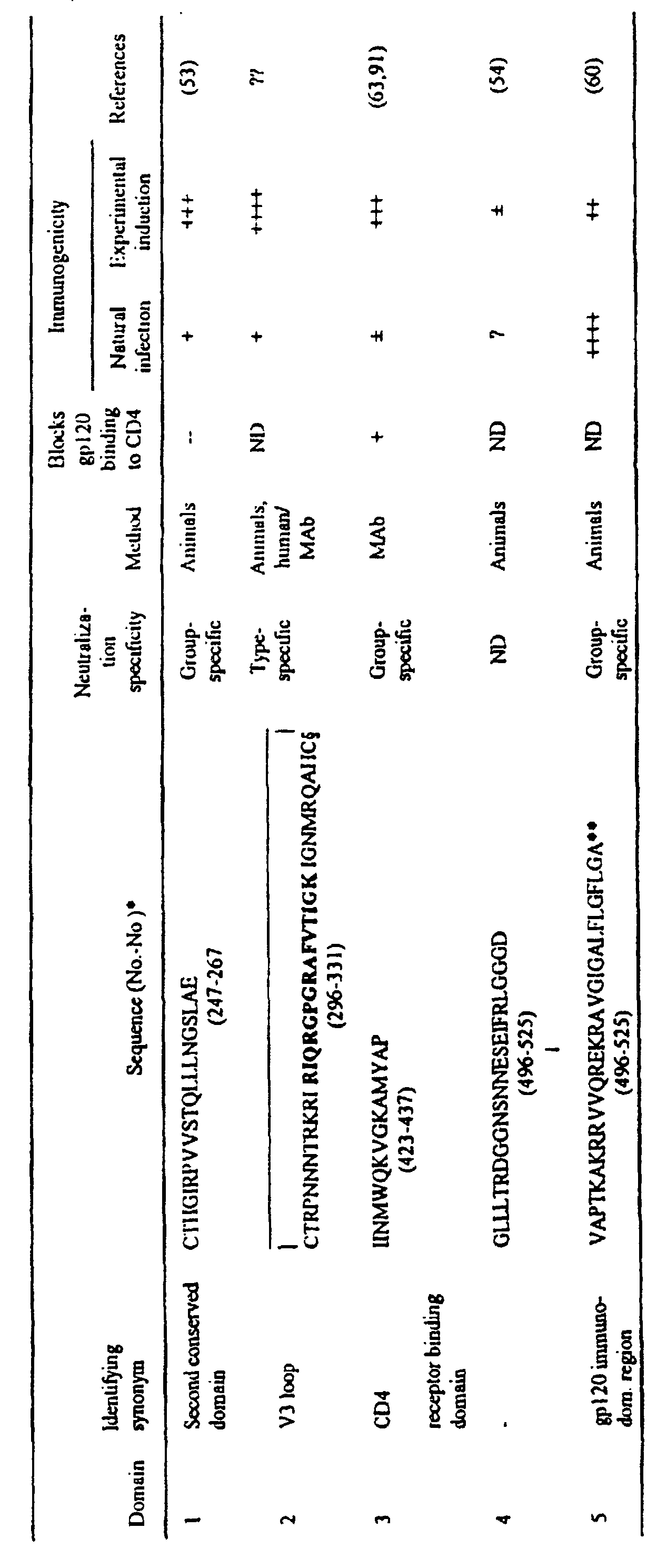

Moreover, this group has shown that 30% of CD4 lymphocytes bear the CR2 receptor and that this CD4/CR2 lymphocyte is preferentially selected during the early phases of CD4 cell decline as a function of HIV infection (142).
| DNA immunization schedule in 5- to 6-week-old female Balb/c mice. Exposure to immunogens every three weeks. IM = intramuscular in divided doses (100µl) between the hamstring muscles bilaterally. NA = nasal lavage administered in small aliquots to 100 µl final volume. Naked DNA refers to pHenv-DNA in water. Dioctadecylamidoglycylspermidine (DOGS) was obtained from Promega Corporation (Transfectam® IBF-Sepracor, France) and complexed to DNA at a 5:1 molar cationic charge excess according to the manufacturer's directions. Complexes were prepared and used immediately prior to immunization. pACYC177 DNA was used as an irrelevant control DNA. | ||||||
| Group # | Immunogen | Route of Immunization | Number of Immunizations | DNA/ | Total DNA | |
| 1 | Naked | 1M | 1 | 100µg | 100µg | |
| 2 | Naked | 1M | 2 | 100µg | 200µg | |
| 3 | Naked DNA env | 1M | 3 | 100µg | 300µg | |
| 4 | Naked | 1M | 1 | 10µg | 10µg | |
| 5 | Naked | 1M | 2 | 10µg | 20µg | |
| 6 | Naked DNA env | 1M | 3 | 10µg | 30µg | |
| 7 | Naked | 1M | 1 | 1µg | 1µg | |
| 8 | Naked | 1M | 2 | 1µg | 2µg | |
| 9 | Naked DNA env | 1M | 3 | 1µg | 3µg | |
| 10 | DOGS.DNAenv | 1M | 1 | 10µg | 10µg | |
| 11 | DOGS:DNAenv | 1M | 2 | 10µg | 20µg | |
| 12 | DOGS:DNAenv complex | 1M | 3 | 10µg | 30µg | |
| 13 | DOGS:DNAenv | 1M | 1 | 1µg | 1µg | |
| 14 | DOGS:DNAenv | 1M | 2 | 1µg | 2µg | |
| 15 | DOGS:DNAenv complex | 1M | 3 | 1µg | 3µg | |
| 16 | DOGS:DNAenv | NA | 1 | 10µg | 10µg | |
| 17 | DOGS:DNAenv | NA | 2 | 10µg | 20µg | |
| 18 | DOGS:DNAenv complex | NA | 3 | 10µg | 30µg | |
| 19 | DOGS:DNAenv | NA | 1 | 1µg | 1µg | |
| 20 | DOGS:DNAenv | NA | 2 | 1µg | 2µg | |
| 21 | DOGS:DNAenv complex | NA | 3 | 1µg | 3µg | |
| 22 | Naked control DNA | 1M | 3 | 100µg | 300µg | |
| 23 | DOGS:control DNA complex | 1M | 3 | 10µg | 30µg | |
| 24 | DOGS:control DNA complex | NA | 3 | 10µg | 30µg | |
| 25 | None | - | 0 | 0 | 0 |
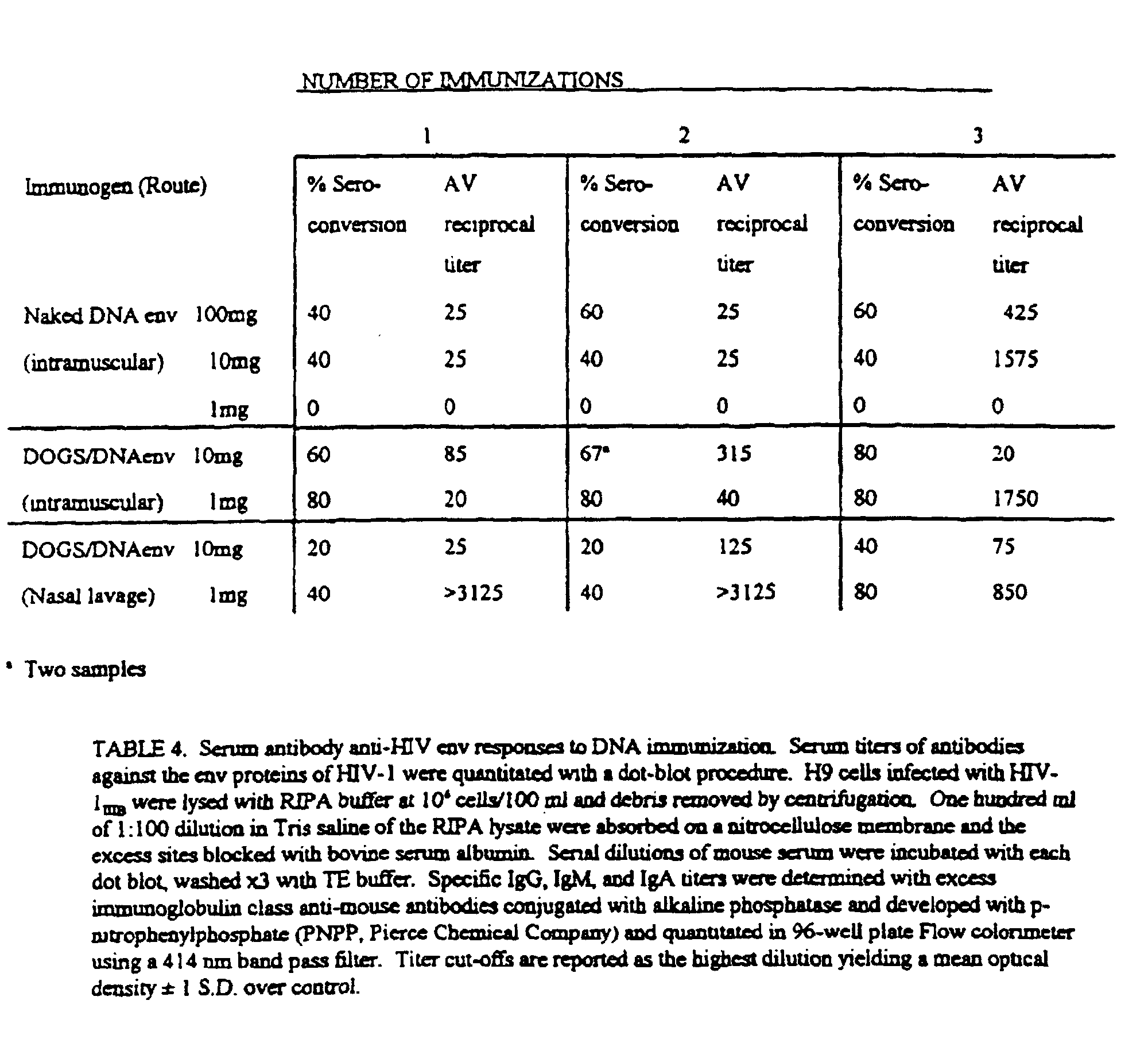
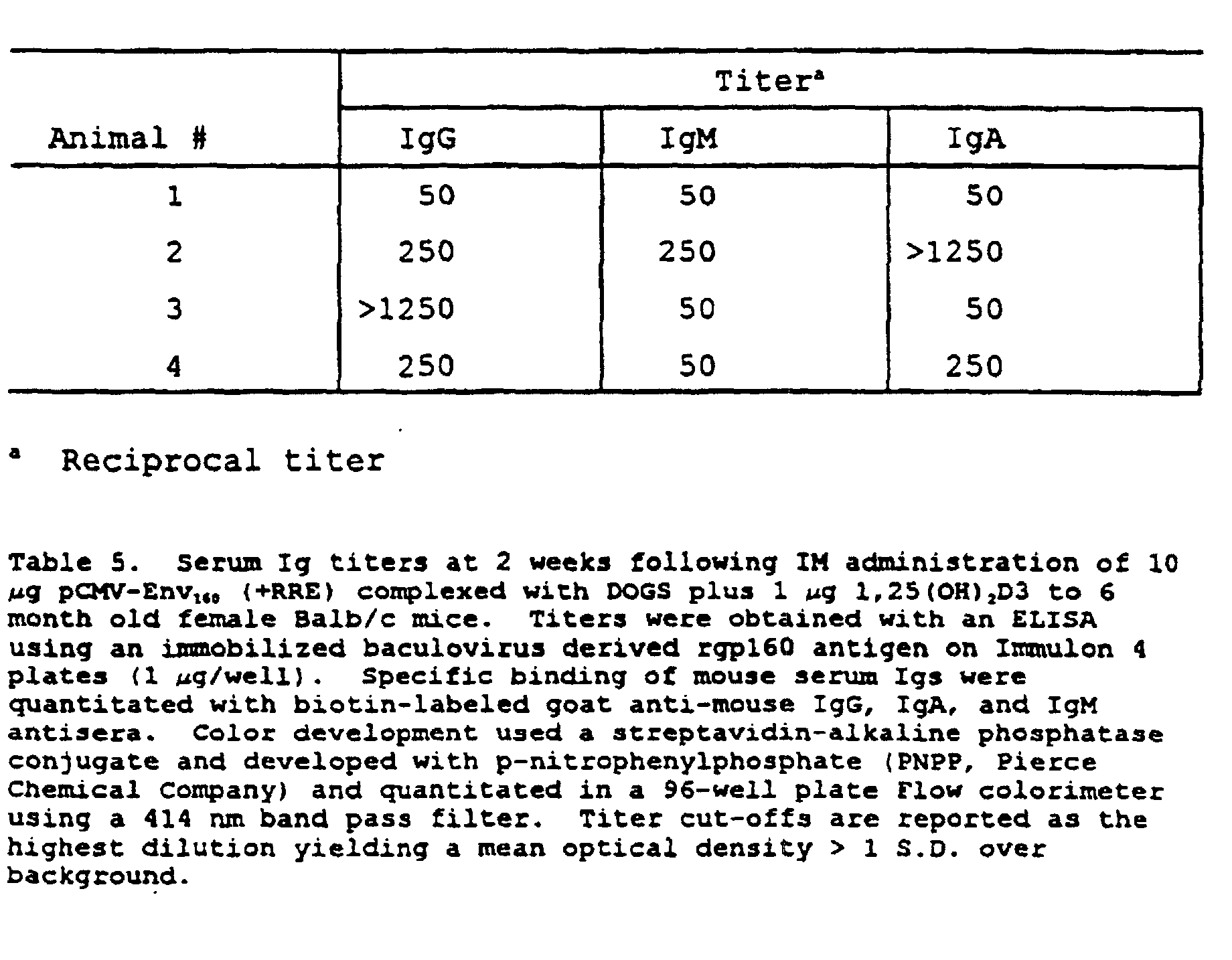
| Parotid IgA anti-HIV responses to DNA immunizations in 6 month old Balb/c mice. The DMA immunogen used a CMV promoter with a downstream gp160 insert expressing a native mRNA (+RRE) or a mutated mRNA lacking the RRE secondary structure (-RRE). All DNA immunogens were complexed with DOGS and contained | ||||||||
| 1,25(OH)2D3(1 µg) | ||||||||
| pCMV-env160 (-RRE) | pCMV-env160 (+RRE) | pCMV-env160 (+RRE) | ||||||
| Animal No. | Dose | Titer | Animal No. | Dose | Titer | Animal No. | Dose | Titer |
| A1 | 10µg | <10 | C1 | 10µg | >1250 | C | 10µg | <10 |
| A2 | 10µg | <10 | C2 | 10µg | 250 | CL1 | 10µg | <10 |
| A3 | 10µg | >1250 | C3 | 10µg | >1250 | CR1 | 10µg | <10 |
| A4 | 10µg | <10 | C4 | 10µg | >1250 | CR2 | 10µg | 10 |
| B1 | 1µg | <10 | D1 | 1µg | >1250 | D | 1µg | 10 |
| B2 | 1µg | 10 | D2 | 1µg | >1250 | DL1 | 1µg | 10 |
| B3 | 1µg | >1250 | D3 | 1µg | NT | DL2 | 1µg | 10 |
| D4 | 1µg | 250 | D4 | 1µg | >1250 | DR1 | 1µg | 10 |


Claims (10)
- Use of vitamin D3 and an antigen-encoding DNA, wherein the DNA is complexed to a transfection-facilitating cationic lipid in the manufacture of a medicament for inducing a mucosal immune response.
- The use of claim 1, wherein the cationic lipid is lipospermine, lipospermidine or dioctadecylamidoglycylspermine.
- The use of claim 1 or 2, wherein the DNA encodes an envelope antigen or envelope-associated antigen.
- The use of claim 3, wherein the DNA encodes an envelope antigen.
- The use of any of claims 1-4, wherein the vitamin D3 is 1,25(OH)2D3.
- A composition comprising vitamin D3 and an antigen-encoding DNA, wherein the DNA is complexed to a transfection-facilitating cationic lipid.
- The composition of claim 6, wherein the cationic lipid is lipospermine, lipospermidine or dioctadecylamidoglycylspermine.
- The composition of claim 6 or 7, wherein the DNA encodes an envelope antigen or envelope-associated antigen.
- The composition of claim 8, wherein the DNA encodes an envelope antigen.
- The composition of any of claims 7-10, wherein the vitamin D3 is 1,25(OH)2D3.
Applications Claiming Priority (3)
| Application Number | Priority Date | Filing Date | Title |
|---|---|---|---|
| US544575 | 1990-06-27 | ||
| US54457595A | 1995-10-18 | 1995-10-18 | |
| PCT/US1996/016845 WO1997014442A1 (en) | 1995-10-18 | 1996-10-17 | Hormone immunomodulated induction of mucosal immune responses |
Publications (3)
| Publication Number | Publication Date |
|---|---|
| EP0855919A1 EP0855919A1 (en) | 1998-08-05 |
| EP0855919A4 EP0855919A4 (en) | 2001-04-11 |
| EP0855919B1 true EP0855919B1 (en) | 2003-07-23 |
Family
ID=24172749
Family Applications (1)
| Application Number | Title | Priority Date | Filing Date |
|---|---|---|---|
| EP96936786A Expired - Lifetime EP0855919B1 (en) | 1995-10-18 | 1996-10-17 | Induction of mucosal immune responses by vitamin d3 and antigen-encoding dna complexe to cationic lipid |
Country Status (7)
| Country | Link |
|---|---|
| EP (1) | EP0855919B1 (en) |
| JP (1) | JP2000501381A (en) |
| AT (1) | ATE245453T1 (en) |
| AU (1) | AU696850B2 (en) |
| CA (1) | CA2233166C (en) |
| DE (1) | DE69629202T2 (en) |
| WO (1) | WO1997014442A1 (en) |
Families Citing this family (7)
| Publication number | Priority date | Publication date | Assignee | Title |
|---|---|---|---|---|
| WO1997044446A1 (en) * | 1996-05-24 | 1997-11-27 | University Of Maryland At Baltimore | Dna vaccines for eliciting a mucosal immune response |
| WO1998001570A2 (en) * | 1996-07-05 | 1998-01-15 | Vanderbilt University | Mutated antibody-dependent infection enhancing domains of hiv |
| AU9224398A (en) * | 1997-09-08 | 1999-03-29 | Promega Corporation | Method of (in vivo) transformation utilizing lipid vehicles |
| WO2009013972A1 (en) * | 2007-07-24 | 2009-01-29 | Dainichiseika Color & Chemicals Mfg. Co., Ltd. | Immunoadjuvant and method of assaying iga antibody |
| JP2009031001A (en) * | 2007-07-24 | 2009-02-12 | Dainichiseika Color & Chem Mfg Co Ltd | IgA antibody measurement method |
| JP5835741B2 (en) | 2010-02-26 | 2015-12-24 | 国立大学法人 長崎大学 | Antigen or drug delivery complex |
| EP4066824A1 (en) * | 2021-03-31 | 2022-10-05 | Dompe' Farmaceutici S.P.A. | Combination therapy for covid-19 vaccination |
Family Cites Families (2)
| Publication number | Priority date | Publication date | Assignee | Title |
|---|---|---|---|---|
| EP0702516A4 (en) * | 1993-06-01 | 1998-04-22 | Life Technologies Inc | GENETIC IMMUNIZATION USING CATIONIC LIPIDS |
| CA2222328C (en) * | 1995-06-07 | 2012-01-10 | Inex Pharmaceuticals Corporation | Lipid-nucleic acid particles prepared via a hydrophobic lipid-nucleic acid complex intermediate and use for gene transfer |
-
1996
- 1996-10-17 EP EP96936786A patent/EP0855919B1/en not_active Expired - Lifetime
- 1996-10-17 DE DE69629202T patent/DE69629202T2/en not_active Expired - Lifetime
- 1996-10-17 AU AU74620/96A patent/AU696850B2/en not_active Ceased
- 1996-10-17 JP JP9516083A patent/JP2000501381A/en not_active Ceased
- 1996-10-17 CA CA002233166A patent/CA2233166C/en not_active Expired - Fee Related
- 1996-10-17 WO PCT/US1996/016845 patent/WO1997014442A1/en not_active Ceased
- 1996-10-17 AT AT96936786T patent/ATE245453T1/en not_active IP Right Cessation
Also Published As
| Publication number | Publication date |
|---|---|
| CA2233166A1 (en) | 1997-04-24 |
| WO1997014442A1 (en) | 1997-04-24 |
| JP2000501381A (en) | 2000-02-08 |
| EP0855919A1 (en) | 1998-08-05 |
| AU696850B2 (en) | 1998-09-17 |
| EP0855919A4 (en) | 2001-04-11 |
| ATE245453T1 (en) | 2003-08-15 |
| AU7462096A (en) | 1997-05-07 |
| DE69629202D1 (en) | 2003-08-28 |
| DE69629202T2 (en) | 2004-04-22 |
| CA2233166C (en) | 2009-02-17 |
Similar Documents
| Publication | Publication Date | Title |
|---|---|---|
| Buge et al. | An adenovirus-simian immunodeficiency virus env vaccine elicits humoral, cellular, and mucosal immune responses in rhesus macaques and decreases viral burden following vaginal challenge | |
| Lu et al. | Simian immunodeficiency virus DNA vaccine trial in macaques | |
| Shibata et al. | Live, attenuated simian immunodeficiency virus vaccines elicit potent resistance against a challenge with a human immunodeficiency virus type 1 chimeric virus | |
| Bures et al. | Immunization with recombinant canarypox vectors expressing membrane-anchored glycoprotein 120 followed by glycoprotein 160 boosting fails to generate antibodies that neutralize R5 primary isolates of human immunodeficiency virus type 1 | |
| Coney et al. | Facilitated DNA inoculation induces anti-HIV-1 immunity in vivo | |
| ES2274566T3 (en) | SYNTHETIC GAG GENES OF HIV. | |
| Graham et al. | Candidate AIDS vaccines | |
| Girard et al. | Vaccine-induced protection of chimpanzees against infection by a heterologous human immunodeficiency virus type 1 | |
| Mascola et al. | Summary report: workshop on the potential risks of antibody-dependent enhancement in human HIV vaccine trials | |
| US6630455B1 (en) | Methods for inducing mucosal immune responses | |
| Montefiori et al. | Induction of neutralizing antibodies and gag-specific cellular immune responses to an R5 primary isolate of human immunodeficiency virus type 1 in rhesus macaques | |
| Song et al. | Induction of feline immunodeficiency virus-specific cytolytic T-cell responses from experimentally infected cats | |
| Polacino et al. | Role of immune responses against the envelope and the core antigens of simian immunodeficiency virus SIVmne in protection against homologous cloned and uncloned virus challenge in macaques | |
| Buge et al. | Factors associated with slow disease progression in macaques immunized with an adenovirus-simian immunodeficiency virus (SIV) envelope priming-gp120 boosting regimen and challenged vaginally with SIVmac251 | |
| JPH08500965A (en) | Hybrid virus expression vectors, their use and novel assays | |
| US7262270B2 (en) | Fusion protein construct and method for inducing HIV-specific serum IgG and secretory IgA antibodies in-vivo | |
| Fauci et al. | Development and evaluation of a vaccine for human immunodeficiency virus (HIV) infection | |
| CA2233166C (en) | Hormone immunomodulated induction of mucosal immune responses | |
| Hasenkrug et al. | Immunoprotective determinants in friend murine leukemia virus envelope protein | |
| Karzon et al. | Development of a vaccine for the prevention of AIDS, a critical appraisal | |
| Lockey et al. | Multi-envelope HIV vaccine safety and immunogenicity in small animals and chimpanzees | |
| Tobin et al. | Chimeric HIV-1 virus-like particles containing gp120 epitopes as a result of a ribosomal frameshift elicit Gag-and SU-specific murine cytotoxic T-lymphocyte activities | |
| Teeuwsen et al. | Production and characterization of a human monoclonal antibody, reactive with a conserved epitope on gp41 of human immunodeficiency virus type I | |
| Esparza et al. | HIV preventive vaccines: progress to date | |
| Rencher et al. | Eliciting HIV-1 envelope-specific antibodies with mixed vaccinia virus recombinants |
Legal Events
| Date | Code | Title | Description |
|---|---|---|---|
| PUAI | Public reference made under article 153(3) epc to a published international application that has entered the european phase |
Free format text: ORIGINAL CODE: 0009012 |
|
| 17P | Request for examination filed |
Effective date: 19980507 |
|
| AK | Designated contracting states |
Kind code of ref document: A1 Designated state(s): AT BE CH DE DK ES FI FR GB GR IE IT LI LU MC NL PT SE |
|
| A4 | Supplementary search report drawn up and despatched |
Effective date: 20010223 |
|
| AK | Designated contracting states |
Kind code of ref document: A4 Designated state(s): AT BE CH DE DK ES FI FR GB GR IE IT LI LU MC NL PT SE |
|
| RIC1 | Information provided on ipc code assigned before grant |
Free format text: 7A 61K 48/00 A, 7A 61K 31/59 B, 7A 61K 47/18 B, 7A 61K 47/28 B |
|
| 17Q | First examination report despatched |
Effective date: 20010917 |
|
| GRAH | Despatch of communication of intention to grant a patent |
Free format text: ORIGINAL CODE: EPIDOS IGRA |
|
| RIC1 | Information provided on ipc code assigned before grant |
Ipc: 7A 61K 47/28 B Ipc: 7A 61K 47/18 B Ipc: 7A 61K 31/59 B Ipc: 7A 61K 48/00 A |
|
| RTI1 | Title (correction) |
Free format text: INDUCTION OF MUCOSAL IMMUNE RESPONSES BY VIATMIN D3 AND ANTIGEN-ENCODING DNA COMPLEXE TO CATIONIC LIPID |
|
| RIC1 | Information provided on ipc code assigned before grant |
Ipc: 7A 61K 47/28 B Ipc: 7A 61K 47/18 B Ipc: 7A 61K 31/59 B Ipc: 7A 61K 48/00 A |
|
| RTI1 | Title (correction) |
Free format text: INDUCTION OF MUCOSAL IMMUNE RESPONSES BY VITAMIN D3 AND ANTIGEN-ENCODING DNA COMPLEXE TO CATIONIC LIPID |
|
| GRAH | Despatch of communication of intention to grant a patent |
Free format text: ORIGINAL CODE: EPIDOS IGRA |
|
| GRAA | (expected) grant |
Free format text: ORIGINAL CODE: 0009210 |
|
| AK | Designated contracting states |
Designated state(s): AT BE CH DE DK ES FI FR GB GR IE IT LI LU MC NL PT SE |
|
| PG25 | Lapsed in a contracting state [announced via postgrant information from national office to epo] |
Ref country code: NL Free format text: LAPSE BECAUSE OF FAILURE TO SUBMIT A TRANSLATION OF THE DESCRIPTION OR TO PAY THE FEE WITHIN THE PRESCRIBED TIME-LIMIT Effective date: 20030723 Ref country code: LI Free format text: LAPSE BECAUSE OF FAILURE TO SUBMIT A TRANSLATION OF THE DESCRIPTION OR TO PAY THE FEE WITHIN THE PRESCRIBED TIME-LIMIT Effective date: 20030723 Ref country code: IT Free format text: LAPSE BECAUSE OF FAILURE TO SUBMIT A TRANSLATION OF THE DESCRIPTION OR TO PAY THE FEE WITHIN THE PRESCRIBED TIME-LIMIT;WARNING: LAPSES OF ITALIAN PATENTS WITH EFFECTIVE DATE BEFORE 2007 MAY HAVE OCCURRED AT ANY TIME BEFORE 2007. THE CORRECT EFFECTIVE DATE MAY BE DIFFERENT FROM THE ONE RECORDED. Effective date: 20030723 Ref country code: FI Free format text: LAPSE BECAUSE OF FAILURE TO SUBMIT A TRANSLATION OF THE DESCRIPTION OR TO PAY THE FEE WITHIN THE PRESCRIBED TIME-LIMIT Effective date: 20030723 Ref country code: CH Free format text: LAPSE BECAUSE OF FAILURE TO SUBMIT A TRANSLATION OF THE DESCRIPTION OR TO PAY THE FEE WITHIN THE PRESCRIBED TIME-LIMIT Effective date: 20030723 Ref country code: BE Free format text: LAPSE BECAUSE OF FAILURE TO SUBMIT A TRANSLATION OF THE DESCRIPTION OR TO PAY THE FEE WITHIN THE PRESCRIBED TIME-LIMIT Effective date: 20030723 Ref country code: AT Free format text: LAPSE BECAUSE OF FAILURE TO SUBMIT A TRANSLATION OF THE DESCRIPTION OR TO PAY THE FEE WITHIN THE PRESCRIBED TIME-LIMIT Effective date: 20030723 |
|
| REG | Reference to a national code |
Ref country code: GB Ref legal event code: FG4D |
|
| REG | Reference to a national code |
Ref country code: CH Ref legal event code: EP |
|
| REG | Reference to a national code |
Ref country code: IE Ref legal event code: FG4D |
|
| REF | Corresponds to: |
Ref document number: 69629202 Country of ref document: DE Date of ref document: 20030828 Kind code of ref document: P |
|
| PG25 | Lapsed in a contracting state [announced via postgrant information from national office to epo] |
Ref country code: LU Free format text: LAPSE BECAUSE OF NON-PAYMENT OF DUE FEES Effective date: 20031017 Ref country code: IE Free format text: LAPSE BECAUSE OF NON-PAYMENT OF DUE FEES Effective date: 20031017 |
|
| PG25 | Lapsed in a contracting state [announced via postgrant information from national office to epo] |
Ref country code: SE Free format text: LAPSE BECAUSE OF FAILURE TO SUBMIT A TRANSLATION OF THE DESCRIPTION OR TO PAY THE FEE WITHIN THE PRESCRIBED TIME-LIMIT Effective date: 20031023 Ref country code: GR Free format text: LAPSE BECAUSE OF FAILURE TO SUBMIT A TRANSLATION OF THE DESCRIPTION OR TO PAY THE FEE WITHIN THE PRESCRIBED TIME-LIMIT Effective date: 20031023 Ref country code: DK Free format text: LAPSE BECAUSE OF FAILURE TO SUBMIT A TRANSLATION OF THE DESCRIPTION OR TO PAY THE FEE WITHIN THE PRESCRIBED TIME-LIMIT Effective date: 20031023 |
|
| PG25 | Lapsed in a contracting state [announced via postgrant information from national office to epo] |
Ref country code: MC Free format text: LAPSE BECAUSE OF NON-PAYMENT OF DUE FEES Effective date: 20031031 |
|
| PG25 | Lapsed in a contracting state [announced via postgrant information from national office to epo] |
Ref country code: ES Free format text: LAPSE BECAUSE OF FAILURE TO SUBMIT A TRANSLATION OF THE DESCRIPTION OR TO PAY THE FEE WITHIN THE PRESCRIBED TIME-LIMIT Effective date: 20031103 |
|
| NLV1 | Nl: lapsed or annulled due to failure to fulfill the requirements of art. 29p and 29m of the patents act | ||
| PG25 | Lapsed in a contracting state [announced via postgrant information from national office to epo] |
Ref country code: PT Free format text: LAPSE BECAUSE OF FAILURE TO SUBMIT A TRANSLATION OF THE DESCRIPTION OR TO PAY THE FEE WITHIN THE PRESCRIBED TIME-LIMIT Effective date: 20031223 |
|
| REG | Reference to a national code |
Ref country code: CH Ref legal event code: PL |
|
| PLBE | No opposition filed within time limit |
Free format text: ORIGINAL CODE: 0009261 |
|
| STAA | Information on the status of an ep patent application or granted ep patent |
Free format text: STATUS: NO OPPOSITION FILED WITHIN TIME LIMIT |
|
| ET | Fr: translation filed | ||
| 26N | No opposition filed |
Effective date: 20040426 |
|
| REG | Reference to a national code |
Ref country code: IE Ref legal event code: MM4A |
|
| PGFP | Annual fee paid to national office [announced via postgrant information from national office to epo] |
Ref country code: DE Payment date: 20091028 Year of fee payment: 14 |
|
| PGFP | Annual fee paid to national office [announced via postgrant information from national office to epo] |
Ref country code: GB Payment date: 20091026 Year of fee payment: 14 Ref country code: FR Payment date: 20091029 Year of fee payment: 14 |
|
| GBPC | Gb: european patent ceased through non-payment of renewal fee |
Effective date: 20101017 |
|
| PG25 | Lapsed in a contracting state [announced via postgrant information from national office to epo] |
Ref country code: FR Free format text: LAPSE BECAUSE OF NON-PAYMENT OF DUE FEES Effective date: 20101102 |
|
| REG | Reference to a national code |
Ref country code: FR Ref legal event code: ST Effective date: 20110630 |
|
| PG25 | Lapsed in a contracting state [announced via postgrant information from national office to epo] |
Ref country code: GB Free format text: LAPSE BECAUSE OF NON-PAYMENT OF DUE FEES Effective date: 20101017 |
|
| REG | Reference to a national code |
Ref country code: DE Ref legal event code: R119 Ref document number: 69629202 Country of ref document: DE Effective date: 20110502 |
|
| PG25 | Lapsed in a contracting state [announced via postgrant information from national office to epo] |
Ref country code: DE Free format text: LAPSE BECAUSE OF NON-PAYMENT OF DUE FEES Effective date: 20110502 |