EP0855401B1 - Nuclear magnetic resonance contrast compositions - Google Patents
Nuclear magnetic resonance contrast compositions Download PDFInfo
- Publication number
- EP0855401B1 EP0855401B1 EP97120436A EP97120436A EP0855401B1 EP 0855401 B1 EP0855401 B1 EP 0855401B1 EP 97120436 A EP97120436 A EP 97120436A EP 97120436 A EP97120436 A EP 97120436A EP 0855401 B1 EP0855401 B1 EP 0855401B1
- Authority
- EP
- European Patent Office
- Prior art keywords
- liver
- compound
- magnetic resonance
- tetraazamacrocyclic
- complex
- Prior art date
- Legal status (The legal status is an assumption and is not a legal conclusion. Google has not performed a legal analysis and makes no representation as to the accuracy of the status listed.)
- Expired - Lifetime
Links
- 0 C*P(CN1CCN(CP(*(C)C)(O)=O)CCN(CP(*(C)C)(O)=O)CCN(CP(O)=O)CC1)(O)=O Chemical compound C*P(CN1CCN(CP(*(C)C)(O)=O)CCN(CP(*(C)C)(O)=O)CCN(CP(O)=O)CC1)(O)=O 0.000 description 2
Images


Classifications
-
- C—CHEMISTRY; METALLURGY
- C07—ORGANIC CHEMISTRY
- C07F—ACYCLIC, CARBOCYCLIC OR HETEROCYCLIC COMPOUNDS CONTAINING ELEMENTS OTHER THAN CARBON, HYDROGEN, HALOGEN, OXYGEN, NITROGEN, SULFUR, SELENIUM OR TELLURIUM
- C07F9/00—Compounds containing elements of Groups 5 or 15 of the Periodic Table
- C07F9/02—Phosphorus compounds
- C07F9/547—Heterocyclic compounds, e.g. containing phosphorus as a ring hetero atom
- C07F9/6524—Heterocyclic compounds, e.g. containing phosphorus as a ring hetero atom having four or more nitrogen atoms as the only ring hetero atoms
-
- A—HUMAN NECESSITIES
- A61—MEDICAL OR VETERINARY SCIENCE; HYGIENE
- A61K—PREPARATIONS FOR MEDICAL, DENTAL OR TOILETRY PURPOSES
- A61K49/00—Preparations for testing in vivo
- A61K49/06—Nuclear magnetic resonance [NMR] contrast preparations; Magnetic resonance imaging [MRI] contrast preparations
-
- A—HUMAN NECESSITIES
- A61—MEDICAL OR VETERINARY SCIENCE; HYGIENE
- A61K—PREPARATIONS FOR MEDICAL, DENTAL OR TOILETRY PURPOSES
- A61K51/00—Preparations containing radioactive substances for use in therapy or testing in vivo
- A61K51/02—Preparations containing radioactive substances for use in therapy or testing in vivo characterised by the carrier, i.e. characterised by the agent or material covalently linked or complexing the radioactive nucleus
- A61K51/04—Organic compounds
-
- A—HUMAN NECESSITIES
- A61—MEDICAL OR VETERINARY SCIENCE; HYGIENE
- A61K—PREPARATIONS FOR MEDICAL, DENTAL OR TOILETRY PURPOSES
- A61K51/00—Preparations containing radioactive substances for use in therapy or testing in vivo
- A61K51/02—Preparations containing radioactive substances for use in therapy or testing in vivo characterised by the carrier, i.e. characterised by the agent or material covalently linked or complexing the radioactive nucleus
- A61K51/04—Organic compounds
- A61K51/0474—Organic compounds complexes or complex-forming compounds, i.e. wherein a radioactive metal (e.g. 111In3+) is complexed or chelated by, e.g. a N2S2, N3S, NS3, N4 chelating group
- A61K51/0482—Organic compounds complexes or complex-forming compounds, i.e. wherein a radioactive metal (e.g. 111In3+) is complexed or chelated by, e.g. a N2S2, N3S, NS3, N4 chelating group chelates from cyclic ligands, e.g. DOTA
-
- A—HUMAN NECESSITIES
- A61—MEDICAL OR VETERINARY SCIENCE; HYGIENE
- A61K—PREPARATIONS FOR MEDICAL, DENTAL OR TOILETRY PURPOSES
- A61K51/00—Preparations containing radioactive substances for use in therapy or testing in vivo
- A61K51/02—Preparations containing radioactive substances for use in therapy or testing in vivo characterised by the carrier, i.e. characterised by the agent or material covalently linked or complexing the radioactive nucleus
- A61K51/04—Organic compounds
- A61K51/0489—Phosphates or phosphonates, e.g. bone-seeking phosphonates
-
- C—CHEMISTRY; METALLURGY
- C07—ORGANIC CHEMISTRY
- C07D—HETEROCYCLIC COMPOUNDS
- C07D255/00—Heterocyclic compounds containing rings having three nitrogen atoms as the only ring hetero atoms, not provided for by groups C07D249/00 - C07D253/00
- C07D255/02—Heterocyclic compounds containing rings having three nitrogen atoms as the only ring hetero atoms, not provided for by groups C07D249/00 - C07D253/00 not condensed with other rings
-
- C—CHEMISTRY; METALLURGY
- C07—ORGANIC CHEMISTRY
- C07D—HETEROCYCLIC COMPOUNDS
- C07D257/00—Heterocyclic compounds containing rings having four nitrogen atoms as the only ring hetero atoms
- C07D257/02—Heterocyclic compounds containing rings having four nitrogen atoms as the only ring hetero atoms not condensed with other rings
-
- C—CHEMISTRY; METALLURGY
- C07—ORGANIC CHEMISTRY
- C07D—HETEROCYCLIC COMPOUNDS
- C07D259/00—Heterocyclic compounds containing rings having more than four nitrogen atoms as the only ring hetero atoms
-
- C—CHEMISTRY; METALLURGY
- C07—ORGANIC CHEMISTRY
- C07F—ACYCLIC, CARBOCYCLIC OR HETEROCYCLIC COMPOUNDS CONTAINING ELEMENTS OTHER THAN CARBON, HYDROGEN, HALOGEN, OXYGEN, NITROGEN, SULFUR, SELENIUM OR TELLURIUM
- C07F9/00—Compounds containing elements of Groups 5 or 15 of the Periodic Table
- C07F9/02—Phosphorus compounds
- C07F9/547—Heterocyclic compounds, e.g. containing phosphorus as a ring hetero atom
- C07F9/6515—Heterocyclic compounds, e.g. containing phosphorus as a ring hetero atom having three nitrogen atoms as the only ring hetero atoms
-
- A—HUMAN NECESSITIES
- A61—MEDICAL OR VETERINARY SCIENCE; HYGIENE
- A61K—PREPARATIONS FOR MEDICAL, DENTAL OR TOILETRY PURPOSES
- A61K2123/00—Preparations for testing in vivo
-
- Y—GENERAL TAGGING OF NEW TECHNOLOGICAL DEVELOPMENTS; GENERAL TAGGING OF CROSS-SECTIONAL TECHNOLOGIES SPANNING OVER SEVERAL SECTIONS OF THE IPC; TECHNICAL SUBJECTS COVERED BY FORMER USPC CROSS-REFERENCE ART COLLECTIONS [XRACs] AND DIGESTS
- Y10—TECHNICAL SUBJECTS COVERED BY FORMER USPC
- Y10T—TECHNICAL SUBJECTS COVERED BY FORMER US CLASSIFICATION
- Y10T436/00—Chemistry: analytical and immunological testing
- Y10T436/24—Nuclear magnetic resonance, electron spin resonance or other spin effects or mass spectrometry
Definitions
- the present invention relates to compositions and methods for enhancing contrast in imaging internal structures and functions of living subjects.
- Imaging of internal structures and functions of living subjects may be accomplished by applying electromagnetic radiation from external sources (as in conventional x-rays and computerized axial tomography) or internal sources (as in PET or positron emission tomography and radionuclide scans).
- external sources as in conventional x-rays and computerized axial tomography
- internal sources as in PET or positron emission tomography and radionuclide scans.
- Use of ionizing radiation is avoided in imaging with nuclear magnetic resonance (NMR) and untrasonography, making these methods advantageous for many applications.
- contrast agents are frequently metals which emit, absorb, or scatter energy or, as in the case with NMR agents, increase the image signal strength locally.
- agents must be localized. This may be accomplished, for example, by direct injection of contrast agent (as in myelograms or retrograde urethrograms), through metabolic uptake of an agent (as in PET), and by conjugation of contrast agents with monoclonal antibodies which tend to accumulate in certain tissues.
- contrast agent as in myelograms or retrograde urethrograms
- an agent as in PET
- conjugation of contrast agents with monoclonal antibodies which tend to accumulate in certain tissues.
- the latter process in particular has been used in NMR image enhancement with chelated metal ions. Though well known, the process has several shortcomings:
- an NMR contrast agent capable of greater localization would be clinically important. Such an agent would offer significant advantages over contrast agents of the prior art.
- the quality of the images obtained from an NMR scan is based on two properties: the proton densities of the various tissues and differences in proton relaxation rates.
- the proton density of tissues cannot be readily altered.
- Proton relaxation rates can be adjusted by adding a paramagnetic relaxation agent, more commonly known as a "contrast agent.” Contrast agents enhance the contrast in NMR images between magnetically similar but histologically dissimilar tissues.
- Gadolinium which has strong paramagnetic properties because of its seven unpaired electrons, has been tested as a contrast agent. It has a large magnetic moment which efficiently relaxes magnetic nuclei and increases tissue contrast in the region of the gadolinium.
- gadolinium as a contrast agent is its toxicity to animals, although a possible remedy for this problem is incorporation of gadolinium in a compound that would pass through the body and be excreted without releasing toxic gadolinium ions.
- the rare earth elements including gadolinium
- contrast agents which avoid the toxicity problems inherent in using gadolinium or another metal ion. Further, it is desirable that a contrast agent control or influence the distribution of chelated ions in the body.
- WO92/08725 discloses polyazamacrocylic compounds for the complexation of metal ions which are useful for enhancing a magnetic resonance image of a subject.
- the compounds are of the formula: where
- DOTEP DOTEP
- the present invention relates to a series of new phosphorous-containing tetraazamacrocyclic chelators which have inherent affinity for certain tissues. Following intravascular injection, chelates comprising these compositions preferentially accumulate in certain tissues, depending on the time after injection.
- 1,4,7,10 tetraazacyciododecane-1,4,7,10-tetra(methylenephosphonate nonobutyl ester) has a high affinity for liver tissue and the gastrointestinal tract (in that order). Chelates comprising this agent are thus suitable for liver imaging because of the lipophilic character imparted by the ester functionality. Such agents are not metabolized, and eventually pass out of the body via the urine of faeces.
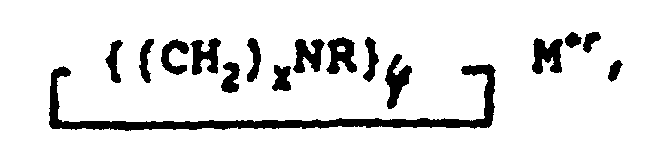
- the present invention provides a nuclear magnetic resonance contrast composition which comprises a tetraazamacrocyclic compound - paramagnetic lanthanide complex having the formula: where
- the present invention provides a tetraazamacrocylic compound - paramagnetic lanthanide complex having the formula: where
- the present invention provides use of a tetraazamacrocylic compound - paramagnetic lanthanide complex having the formula: where
- compositions of the present invention must be chelated with a metallic element.
- the element is preferably of the rare-earth series (preferably gadolinium), those skilled in the art will recognize that other metallic ions might also be useful for imaging.
- other metal chelates e.g. , chelates of radionuclides or heavy metals
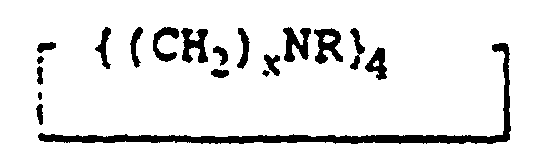
- Chelators of the present invention have the formula where
- This compound is complexed with a metal to be a polyazamacrocyclic compound-metal complex having the formula where
- the x is preferably 2, although 3 is feasible under many circumstances. Combinations of p 2(s) and q 3(s) for x are of course readily produced but the total of p + q must be 4 for the number of units in the polyaza macrocycle. H or CH 3 for R 1 are believed equivalent in use.
- p is 1 and q is 3, p is 2 and q is 2 or p is 3 and 1 is 1 and z is most preferably 1.
- x is 2, z is 1, R 1 is H and R 2 is butyl.
- the M +r is preferably a paramagnetic lanthanide, although other divalent or trivalent metal ions, including radionuclides and heavy metals, may also be so complexed.
- Figure 1 scnematically illustrates the structure of DOTEP.
- Figure 2 schematically illustrates the structure of DOTPMB.
- DOTEP shown in Figure 1
- 2 ml of dichloroethylphosphine was slowly mixed with ice to form the corresponding ethylphosphinic acid.
- 390 mg of 1,4,7,10-tetraazacyclododecane tetrahydrochloride (cyclen.4HCl) (Parrish Chem. Co., Ogden, Utah) was added and the mixture heated to boiling under a nitrogen atmosphere.
- a solution containing 157 mg of paraformaldehyde dissolved in 10 ml of 6M HCl was added at a rate of 0.5 ml/hr, while the mixture continued to reflux.
- Tetraaza-12-crown-4 ⁇ 4HCl (1 g, 3.14x10 -3 mol) was dissolved in water and the pH adjusted to 9.0 using 1M NaOH. The solvent was evaporated and the residue dried under vacuum for 1 hour. Formaldehyde (6.6 mL of 37% solution, 7.15 g, 0.24 mol) was added and the solution stirred for 30 minutes at room temperature. Dibutyl phosphite (5.10 mL of 96% purity, 0.025 mol) was then added and the reaction mixture stirred for 15 hours at room temperature (dipentyl and dihexyl phosphite are so used to produce dipentyl and dihexyl esters respectively). The resulting mixture consisted of two layers.
- the bottom layer was mostly excess formaldehyde, as indicated by 13 C NMR.
- the upper layer contained the product and excess phosphite. This layer was separated, concentrated and dried under vacuum for 1 hour.
- the resulting syrup was loaded onto a silica-gel column (2.5 x 11 cm).
- the excess phosphite was washed away with methylene chloride (250 mL).
- the product was eluted with 5% methanol in methylene chloride. 20 mL fractions were collected and monitored by TLC. The fractions containing the product were combined, concentrated, and dried under vacuum,. A pale yellow oil was obtained in 75% yield (2.34 g).
- liver activity at the 30 minute time point (1%) was minimal (see e.g. , Table I)
- the peak of liver localization passed within the prior 30 minutes. This is evident in an example of biodistribution 15 minutes after administration of chelated tracer, which is documented in Tables VIII and IX.
- mice 2 still had a significant liver concentration (66%) at the 15 minute point.
- a Sm(153)-DOTPMB complex was prepared as described above for gamma imaging of a Sprague-Dawley rat. Images were acquired at one minute intervals over a 16-minute period. The image sequence revealed concentration of the chelate in liver within one minute following injection. The complex is then rapidly transported from the liver to the stomach and small intestine. Tables V, VI and VII contain data taken at 1 hour, 24 hours and 72 hours after injection, showing movement of the agent from stomach and intestine to feces.
Landscapes
- Chemical & Material Sciences (AREA)
- Health & Medical Sciences (AREA)
- Organic Chemistry (AREA)
- Life Sciences & Earth Sciences (AREA)
- General Health & Medical Sciences (AREA)
- Animal Behavior & Ethology (AREA)
- Veterinary Medicine (AREA)
- Public Health (AREA)
- Epidemiology (AREA)
- Optics & Photonics (AREA)
- Molecular Biology (AREA)
- Medicinal Chemistry (AREA)
- Physics & Mathematics (AREA)
- Proteomics, Peptides & Aminoacids (AREA)
- Biochemistry (AREA)
- Pharmacology & Pharmacy (AREA)
- Biophysics (AREA)
- Nuclear Medicine, Radiotherapy & Molecular Imaging (AREA)
- Radiology & Medical Imaging (AREA)
- Medicines Containing Antibodies Or Antigens For Use As Internal Diagnostic Agents (AREA)
- Magnetic Resonance Imaging Apparatus (AREA)
- Catalysts (AREA)
- Nitrogen Condensed Heterocyclic Rings (AREA)
- Macromolecular Compounds Obtained By Forming Nitrogen-Containing Linkages In General (AREA)
- Polymers With Sulfur, Phosphorus Or Metals In The Main Chain (AREA)
Abstract
Description
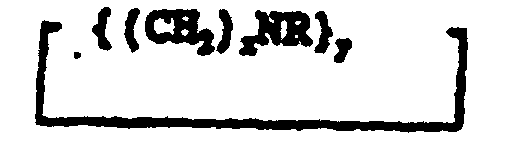

Accordingly, in one aspect the present invention provides a nuclear magnetic resonance contrast composition which comprises a tetraazamacrocyclic compound - paramagnetic lanthanide complex having the formula:


Chelators of the present invention have the formula

| TIME: 30 Minute Biodistribution | ||||
| DATE 8/6/91 | LIGAND DOTPMB-K, | METAL Gd-159, | COMMENTS 99% Complexation | |
| 4:1, LIG:MET Molar Ratio, (Metal = 3X10⁻⁴M) | ||||
| %DOSE/GRAM | ||||
| RAT 1 | RAT 2 | AVERAGE | +/- | |
| WEIGHT | 216.72 | 228.17 | 222.45 | 8.096 |
| BONE | 0.019 | 0.006 | 0.01 | 0.009 |
| TAIL | 0.077 | 0.068 | 0.07 | 0.007 |
| LIVER | 0.114 | 0.069 | 0.09 | 0.032 |
| KIDNEY | 0.169 | 0.126 | 0.15 | 0.031 |
| SPLEEN | 0.011 | 0.021 | 0.02 | 0.007 |
| MUSCLE | 0.007 | 0.005 | 0.01 | 0.001 |
| BLOOD | 0.021 | 0.017 | 0.02 | 0.003 |
| HEART | 0.014 | 0.000 | 0.01 | 0.010 |
| LUNG | 0.126 | 0.023 | 0.07 | 0.073 |
| BRAIN | 0.002 | 0.003 | 0.00 | 0.000 |
| 0.000 = NO ACTIVITY DETECTED | ||||
| DOSE | ||||
| BONE | 0.281 | 0.106 | 0.193 | 0.124 |
| TAIL | 0.212 | 0.191 | 0.201 | 0.015 |
| LIVER | 1.234 | 0.755 | 0.994 | 0.339 |
| KIDNEY | 0.392 | 0.299 | 0.346 | 0.066 |
| SPLEEN | 0.009 | 0.011 | 0.010 | 0.002 |
| MUSCLE | 0.658 | 0.506 | 0.582 | 0.108 |
| BLOOD | 0.299 | 0.250 | 0.274 | 0.035 |
| HEART | 0.011 | 0.000 | 0.006 | 0.008 |
| LUNG | 0.158 | 0.029 | 0.094 | 0.091 |
| BRAIN | 0.004 | 0.004 | 0.004 | 0.001 |
| STOMACH | 0.574 | 0.530 | 0.552 | 0.031 |
| SM INTES | 80.304 | 36.405 | 58.354 | 31.041 |
| LG INTES | 0.591 | 0.433 | 0.512 | 0.112 |
| (see legend for Table I) | ||||||
| DATA | COUNTS | ORGAN | N ENTER WT | BCKG COR | %DOSE/G | % DOSE |
| 1 | Std A | X Rat 1 Wt | 0 | |||
| 1 | Std B | X 216.72 | 0 | |||
| 2 | 414838 | Std C | av 414404.5 | 414405 | ||
| 3 | 480 | Bone | 0.60 | 47 | 1.87E-02 | 2.81E-01 |
| 4 | 1311 | Tail | 2.74 | 878 | 7.73E-02 | 2.12E-01 |
| 5 | 5546 | Liver | 10.86 | 5113 | 1.14E-01 | 1.23E+00 |
| 6 | 2058 | Kidney | 2.32 | 1625 | 1.69E-01 | 3.92E-01 |
| 7 | 469 | Spleen | 0.75 | 36 | 1.14E-02 | 8.57E-03 |
| 8 | 478 | Muscle | 1.52 | 45 | 7.06E-03 | 6.58E-01 |
| 9 | 576 | Blood | 1.62 | 143 | 2.12E-02 | 2.99E-01 |
| 10 | 481 | Heart | 0.82 | 48 | 1.40E-02 | 1.15E-02 |
| 11 | 1088 | Lung | 1.25 | 655 | 1.26E-01 | 1.58E-01 |
| 12 | 449 | Brain | 1.62 | 16 | 2.31E-03 | 3.74E-03 |
| 13 | 2811 | Stomach | 2378 | 5.74E-01 | ||
| 14 | 333215 | Sm Intes | 332782 | 8.03E+01 | ||
| 15 | 2883 | Lg Intes | 2450 | 5.91E-01 | ||
| 16 | 150310 | Urine | 149877 | 3.62E+01 | ||
| 17 | 400 | Urine | 0 | 0.00E+00 | ||
| 18 | 428 | Urine | 0 | 0.00E+00 | ||
| 19 | 443 | BKG | 228.17 | WT Rat 2 | ||
| 20 | 451 | Bone | 0.67 | 18 | 6.30E-03 | 1.06E-01 |
| 21 | 1225 | Tail | 2.82 | 792 | 6.77E-02 | 1.91E-01 |
| 22 | 3561 | Liver | 10.96 | 3128 | 6.89E-02 | 7.55E-01 |
| 23 | 1674 | Kidney | 2.38 | 1241 | 1.26E-01 | 2.99E-01 |
| 24 | 480 | Spleen | 0.53 | 47 | 2.12E0-02 | 1.12E-02 |
| 25 | 469 | Muscle | 1.66 | 36 | 5.16E-03 | 5.06E-01 |
| 26 | 559 | Blood | 1.80 | 126 | 1.68E-02 | 2.50E-01 |
| 27 | 430 | Heart | 0.85 | 0 | 0.00E+00 | 0.00E+00 |
| 28 | 554 | Lung | 1.28 | 121 | 2.27E-02 | 2.91E-02 |
| 29 | 452 | Brain | 1.55 | 19 | 2.88E-03 | 4.46E-03 |
| 30 | 2629 | Stomach | 2196 | 5.30E-01 | ||
| 151297 | Sm Intes | 150864 | 3.64E+01 | |||
| 2229 | Lg Intes | 1796 | 4.33E-01 | |||
| 116731 | Urine | 116298 | 2.81E+01 | |||
| 901 | Urine | 468 | 1.13E-01 | |||
| 423 | Urine | 0 | 0.00E+00 | |||
| 424 | BKG | 0 | ||||
| BKG AVG = 434 |
| TIME: 30 Minute Biodistribution | |||
| DATE 8/6/91 | LIGAND DOTPMB-K, | METAL Gd-159, | COMMENTS 99% Complexation |
| 4:1, LIG:MET Molar Ratio, (Metal = 3x10⁻⁴M) | |||
| %DOSE/GRAM RAT 3 | |||
| WEIGHT: 235.14 | |||
| Bone | 0.006 | ||
| Tail | 0.013 | ||
| Liver | 0.016 | ||
| Kidney | 0.121 | ||
| Spleen | 0.000 | ||
| Muscle | 0.000 | ||
| Blood | 0.000 | ||
| Heart | 0.000 | ||
| Lung | 0.009 | ||
| Brain | 0.004 | ||
| 0.000 = No Activity Detected | |||
| Bone | 0.109 | ||
| Tail | 0.038 | ||
| Liver | 0.196 | ||
| Kidney | 0.303 | ||
| Spleen | 0.000 | ||
| Muscle | 0.026 | ||
| Blood | 0.000 | ||
| Heart | 0.000 | ||
| Lung | 0.012 | ||
| Brain | 0.005 | ||
| Stomach | 0.012 | ||
| Sm Intes | 51.549 | ||
| Lg Intes | 2.232 |
| (see legend for Table III) | ||||||
| DATA | COUNTS | ORGAN | N ENTER WT | BCKG COR | %DOSE/G | % DOSE |
| 1 | Std A | X Rat 1 Wt | 0 | |||
| 1 | Std B | X 235.14 | 0 | |||
| 2 | 414367 | Std C | av 413946 | 413946 | ||
| 3 | 439 | Bone | 0.69 | 18 | 6.30E-03 | 1.09E.01 |
| 4 | 578 | Tail | 2.95 | 157 | 1.29E-02 | 3.79E-02 |
| 5 | 1232 | Liver | 11.96 | 811 | 1.64E-02 | 1.96E-01 |
| 6 | 1675 | Kidney | 2.51 | 1254 | 1.21E-01 | 3.03E-01 |
| 7 | 418 | Spleen | 0.66 | 0 | 0.00E+00 | 0.00E+00 |
| 8 | 423 | Muscle | 1.91 | 2 | 2.53E-04 | 2.56E-02 |
| 9 | 412 | Blood | 1.84 | 0 | 0.00E+00 | 0.00E+00 |
| 10 | 417 | Heart | 0.85 | 0 | 0.00E+00 | 0.00E+00 |
| 11 | 470 | Lung | 1.25 | 49 | 9.47E-03 | 1.18E-02 |
| 12 | 442 | Brain | 1.28 | 21 | 3.96E-03 | 5.07E-03 |
| 13 | 470 | Stomach | 49 | 1.18E-02 | ||
| 14 | 213806 | Sm Intes | 213385 | 5.15E+01 | ||
| 15 | 9661 | Lg Intes | 9240 | 2.23E+00 | ||
| 16 | 102818 | Urine | 102397 | 2.47E+01 | ||
| 17 | 12520 | Urine | 12099 | 2.92E+00 | ||
| 18 | 447 | Urine | 26 | 6.28E-03 | ||
| 19 | 421 | BKG | ||||
| BKG AVG = 421 |
| One Hour Biodistribution, Imaged Rat | |||
| TIME: One Hour biodistribution | |||
| DATE 8/8/91 | LIGAND DOTPMB-K, D. | METAL Sm=153 | COMMENTS 99% Complex |
| 4:1, LIG:MET Molar Ratio (Metal = 3X10⁻⁴M) | |||
| % DOSE/GRAM | % DOSE | ||
| WEIGHT: 263.82 | |||
| Bone | 0.004 | 0.067 | |
| Tail | 0.038 | 0.093 | |
| Liver | 0.014 | 0.144 | |
| Kidney | 0.084 | 0.245 | |
| Spleen | 0.016 | 0.011 | |
| Muscle | 0.001 | 0.078 | |
| Blood | 0.001 | 0.019 | |
| Stomach | 45.144 | ||
| Smll Int | 31.408 | ||
| Lrg Int | 0.003 |
| 24 Hour Biodistribution, Imaged Rat | |||
| TIME: 24 Hour biodistribution | |||
| DATE 8/8/91 | LIGAND DOTPMB-K | METAL Sm=153 | COMMENTS 99% Complex |
| 4:1, LIG:MET Molar Ratio (Metal = 3X10⁻⁴M) | |||
| % DOSE/GRAM | % DOSE | ||
| WEIGHT: 263.82 | |||
| Bone | 0.008 | 0.146 | |
| Tail | 0.015 | 0.036 | |
| Liver | 0.010 | 0.106 | |
| Kidney | 0.154 | 0.451 | |
| Spleen | 0.029 | 0.020 | |
| Muscle | 0.017 | 1.883 | |
| Blood | 0.000 | 0.004 | |
| Stomach | 0.053 | ||
| Smll Int | 2.109 | ||
| Smll Int | 19.611 | ||
| Lrg Int | 8.351 | ||
| Feces | 35.981 | ||
| Urine | 2.799 | ||
| Paper | 0.126 |
| Rat Injected: 8/8/91 | |||
| TIME: 72 hour biodistribution | |||
| DATE 8/12/91 | LIGAND DOTPMB-K | METAL Sm=153 | COMMENTS 99% Complex |
| 4:1, LIG:MET Molar Ratio (Metal = 3X10⁻⁴M) | |||
| % DOSE/GRAM | % DOSE | ||
| WEIGHT: 269.58 | |||
| Bone | 0.014 | 0.219 | |
| Tail | 0.002 | 0.005 | |
| Liver | 0.002 | 0.030 | |
| Kidney | 0.019 | 0.054 | |
| Spleen | 0.000 | 0.000 | |
| Muscle | 0.000 | 0.000 | |
| Blood | 0.000 | 0.000 | |
| Feces | 5.832 | ||
| Feces | 5.467 | ||
| Feces | 2.464 | ||
| Urine | 0.077 | ||
| Bladder | 0.242 |
| (Comparative) | |||
| File=BTY15STD Summary Standardized Data Mouse #2 (15 minute biodistribution), 99% complex, 25.0 UL dose Ca added to complex at 1;1 molar, lig: Ca | |||
| DATE 10/30/91 | LIGAND DOTPME-K | METAL Sm-15 | COMMENTS #08-07-91 |
| 2:1, Lig:Met Molar Ratio, (Metal=3x10⁻⁴M), pH 7-=8 | |||
| %DOSE/GRAM | |||
| MOUSE 1 | MOUSE 2 | AVERAGE | |
| WEIGHT | 15.854 | 10.702 | 13.278 |
| BONE | 0.171 | 3.169 | 1.670 |
| TAIL | 1.374 | 83.296 | 42.335 |
| LIVER | 3.979 | 66.441 | 35.210 |
| KIDNEY | 0.889 | 14.568 | 7.728 |
| SPLEEN | 1.260 | 0.831 | 1.046 |
| MUSCLE | 0.173 | 1.437 | 0.805 |
| BLOOD | 43.105 | 3.743 | 23.424 |
| HEART | 0.472 | 2.418 | 1.445 |
| LUNG | 0.697 | 2.735 | 1.716 |
| BRAIN | 0.023 | 0.139 | 0.081 |
| TUMOR | 0.648 | 4.844 | 2.746 |
| STOMACH | 14.272 | 4.343 | 9.308 |
| SMALL INT. | 88.504 | 40.343 | 64.423 |
| LARGE INT. | 3.320 | 2.298 | 2.809 |
| URINE | 0.000 | 0.000 | 0.000 |
| BODY 1 | 0.408 | 1.637 | 1.022 |
| BODY 2 | 0.148 | 5.594 | 2.871 |
| *MOUSE 2 DID NOT BECOME ACTIVE AFTER ANESTHESIA, HOWEVER ALIVE*** |
| (Comparative) | ||
| %DOSE | ||
| MOUSE 1 | MOUSE 2 | |
| BONE | 0.149 | 2.100 |
| LIVER | 3.379 | 37.732 |
| KIDNEY | 0.199 | 3.610 |
| SPLEEN | 0.095 | 0.039 |
| MUSCLE | 1.179 | 6.615 |
| BLOOD | 44.420 | 2.604 |
| HEART | 0.033 | 0.157 |
| LUNG | 0.090 | 0.210 |
| BRAIN | 0.010 | 0.054 |
| TUMOR | 0.062 | 0.237 |
| STOMACH | 3.565 | 0.586 |
| SMALL INT. | 86.734 | 27.837 |
| LARGE INT. | 2.994 | 1.145 |
| URINE | 12.857 | 0.007 |
| BODY 1 | 2.294 | 6.890 |
| BODY 2 | 0.585 | 17.147 |
Claims (18)
- A nuclear magnetic resonance contrast composition which comprises a tetraazamacrocyclic compound - paramagnetic lanthanide complex having the formula:where
 x is 2, 3 or a combination of p 2(s) andq 3(s) where p + q = 4;R is (CH2)zP(=O)OR1OR2;R1 is H or CH3;R2 is CnH1+2n;z is 1 to 3;r is 2 or 3;M is a paramagnetic lanthanide; andn is 4 to 6.
 - A composition as claimed in claim 1 where x is 2.
- A composition as claimed in claim 1 where p is 1 and q is 3, p is 2 and q is 2, or p is 3 and q is 1.
- A composition as claimed in claim 1 where z is 1.
- A composition as claimed in any one of the preceding claims wherein R2 is C4H9.
- A composition as claimed in any one of the preceding claims wherein the lanthanide is gadolinium.
- A tetraazamacrocyclic compound - paramagnetic lanthanide complex having the formula:where
 for use in increasing the contrast of nuclear magnetic resonance images in liver imaging in a subject.x is 2, 3 or a combination of p 2(s) andq 3(s) where p + q = 4;R is (CH2)zP(=O)OR1OR2;R1 is H or CH3;R2 is CnH1+2n;z is 1 to 3;r is 2 or 3;M is a paramagnetic lanthanide; andn is 4 to 6
 - A tetraazamacrocyclic compound - metal complex as claimed in claim 7 where x is 2.
- A tetraazamacrocyclic compound - metal complex as claimed in claim 7 where p is 1 and q is 3, p is 2 and q is 2, or p is 3 and q is 1.
- A tetraazamacrocyclic compound - metal complex as claimed in claim 7 where z is 1.
- A tetraazamacrocyclic compound - metal complex as claimed in any one of claims 7 to 10 where R2 is C4H9.
- A tetraazamacrocyclic compound - metal complex as claimed in any one of claims 7 to 11 where the lanthanide is gadolinium.
- Use of a tetraazamacrocyclic compound - paramagnetic lanthanide complex having the formula:where
 for the manufacture of a medicament for enhancing nuclear magnetic resonance contrast in liver imaging in a subject.x is 2, 3 or a combination of p 2(s) andq 3(s) where p + q = 4;y is 4;R is (CH2)zP(=O)OR1OR2;R1 is H or CH3;R2 is CnH1+2n;z is 1 to 3;r is 2 or 3;M is a paramagnetic lanthanide; andn is 4 to 6
 - The use as claimed in claim 13 where x is 2.
- The use as claimed in claim 13 where p is 1 and q is 3, p is 2 and q is 2, or p is 3 and q is 1.
- The use as claimed in claim 13 where z is 1.
- The use as claimed in any one of claims 13 to 16 where R2 is C4H9.
- The use as claimed in any one of claims 13 to 17 wherein the lanthanide is gadolinium.
Applications Claiming Priority (4)
| Application Number | Priority Date | Filing Date | Title |
|---|---|---|---|
| US06/662,075 US4639365A (en) | 1984-10-18 | 1984-10-18 | Gadolinium chelates as NMR contrast agents |
| US923715 | 1992-07-31 | ||
| US07/923,715 US5362476A (en) | 1984-10-18 | 1992-07-31 | Alkyl phosphonate polyazamacrocyclic cheates for MRI |
| EP93916827A EP0652885B1 (en) | 1984-10-18 | 1993-06-28 | Tetraazamacrocyclic metal complexes |
Related Parent Applications (2)
| Application Number | Title | Priority Date | Filing Date |
|---|---|---|---|
| EP93916827A Division EP0652885B1 (en) | 1984-10-18 | 1993-06-28 | Tetraazamacrocyclic metal complexes |
| EP93916827.4 Division | 1994-02-17 |
Publications (2)
| Publication Number | Publication Date |
|---|---|
| EP0855401A1 EP0855401A1 (en) | 1998-07-29 |
| EP0855401B1 true EP0855401B1 (en) | 2001-11-21 |
Family
ID=34922820
Family Applications (2)
| Application Number | Title | Priority Date | Filing Date |
|---|---|---|---|
| EP93916827A Expired - Lifetime EP0652885B1 (en) | 1984-10-18 | 1993-06-28 | Tetraazamacrocyclic metal complexes |
| EP97120436A Expired - Lifetime EP0855401B1 (en) | 1984-10-18 | 1993-06-28 | Nuclear magnetic resonance contrast compositions |
Family Applications Before (1)
| Application Number | Title | Priority Date | Filing Date |
|---|---|---|---|
| EP93916827A Expired - Lifetime EP0652885B1 (en) | 1984-10-18 | 1993-06-28 | Tetraazamacrocyclic metal complexes |
Country Status (19)
| Country | Link |
|---|---|
| US (2) | US5362476A (en) |
| EP (2) | EP0652885B1 (en) |
| JP (1) | JP3411919B2 (en) |
| CN (1) | CN1040750C (en) |
| AT (2) | ATE169827T1 (en) |
| AU (1) | AU4654893A (en) |
| CA (1) | CA2140557A1 (en) |
| DE (2) | DE69320481T2 (en) |
| DK (1) | DK0855401T3 (en) |
| ES (1) | ES2167667T3 (en) |
| FI (1) | FI950397A7 (en) |
| HU (1) | HUT70447A (en) |
| IL (1) | IL106164A0 (en) |
| MX (1) | MX9304624A (en) |
| NO (1) | NO306466B1 (en) |
| PH (1) | PH30934A (en) |
| PT (1) | PT855401E (en) |
| WO (1) | WO1994003464A1 (en) |
| ZA (1) | ZA935541B (en) |
Families Citing this family (24)
| Publication number | Priority date | Publication date | Assignee | Title |
|---|---|---|---|---|
| US5714604A (en) * | 1993-05-06 | 1998-02-03 | The Dow Chemical Company | Process for the preparation of azamacrocyclic or acyclic aminophosphonate ester derivatives |
| US7186688B1 (en) | 1994-03-08 | 2007-03-06 | Human Genome Sciences, Inc. | Methods of stimulating angiogenesis in a patient by administering vascular endothelial growth factor 2 |
| WO1997001360A2 (en) * | 1995-06-26 | 1997-01-16 | Concat, Ltd. | Compounds with chelation affinity and selectivity for first transition series elements and their use in medical therapy and diagnosis |
| US5834456A (en) * | 1996-02-23 | 1998-11-10 | The Dow Chemical Company | Polyazamacrocyclofluoromonoalkylphosphonic acids, and their complexes, for use as contrast agents |
| US5952732A (en) * | 1997-11-10 | 1999-09-14 | Scarpitti; Ernest A | Vehicle security system |
| EP1362861B1 (en) * | 1999-09-13 | 2005-12-14 | Bristol-Myers Squibb Pharma Company | Macrocyclic chelants for metallopharmaceuticals |
| US6685914B1 (en) | 1999-09-13 | 2004-02-03 | Bristol-Myers Squibb Pharma Company | Macrocyclic chelants for metallopharmaceuticals |
| CA2382057A1 (en) * | 1999-09-13 | 2001-03-22 | Bristol-Myers Squibb Pharma Company | Macrocyclic chelants for metallopharmaceuticals |
| US6565828B2 (en) * | 2000-04-07 | 2003-05-20 | Bristol-Myers Squibb Company | Macrocyclic chelants for metallopharmaceuticals |
| AU8475301A (en) * | 2000-08-07 | 2002-02-18 | Univ Vanderbilt | Detection of cox-2 activity and anandamide metabolites |
| US7048907B2 (en) * | 2001-02-05 | 2006-05-23 | Biophysics Assay Laboratory, Inc. | Synthesis, compositions and methods for the measurement of the concentration of stable-isotope labeled compounds in life forms and life form excretory products |
| AU2002323528C1 (en) * | 2001-09-04 | 2009-11-12 | Texas Tech University | Multi-use multimodal imaging chelates |
| WO2003035114A1 (en) * | 2001-10-22 | 2003-05-01 | Dow Global Technologies Inc. | Radiopharmaceutical agent for the treatment of early stage cancer |
| US20040034223A1 (en) * | 2002-02-07 | 2004-02-19 | Covalent Partners, Llc. | Amphiphilic molecular modules and constructs based thereon |
| US7432371B2 (en) * | 2002-02-07 | 2008-10-07 | Covalent Partners, Llc | Nanofilm and membrane compositions |
| US20040106741A1 (en) * | 2002-09-17 | 2004-06-03 | Kriesel Joshua W. | Nanofilm compositions with polymeric components |
| WO2006020779A2 (en) * | 2004-08-10 | 2006-02-23 | Dow Global Technologies Inc. | Targeting chelants and chelates |
| EP2097438B1 (en) | 2006-12-11 | 2015-08-26 | Bracco Imaging S.p.A | Fibrin binding peptide conjugates for diagnostic and therapeutic applications |
| EP2476703A1 (en) | 2011-01-14 | 2012-07-18 | Bracco Imaging S.p.A | Human antibodies cross-reacting with a bacterial and a self antigen from atherosclerotic plaques |
| US7595699B1 (en) * | 2008-03-04 | 2009-09-29 | Freescale Semiconductor, Inc. | Look loop circuit and method having improved lock time |
| EP2147684A1 (en) | 2008-07-22 | 2010-01-27 | Bracco Imaging S.p.A | Diagnostic Agents Selective Against Metalloproteases |
| BR112013000236B1 (en) * | 2010-07-06 | 2018-11-13 | Catexel Limited | method of producing a compound, and protonated salt |
| WO2012095516A1 (en) | 2011-01-14 | 2012-07-19 | Bracco Imaging Spa | Human antibodies cross-reacting with a bacterial and a self antigen from atherosclerotic plaques |
| BR112018015143A2 (en) | 2016-02-09 | 2018-12-18 | Bracco Suisse Sa | recombinant chimeric protein for selectin targeting |
Family Cites Families (33)
| Publication number | Priority date | Publication date | Assignee | Title |
|---|---|---|---|---|
| US3932451A (en) * | 1973-11-27 | 1976-01-13 | E. I. Du Pont De Nemours & Company | 1,4,7,10-Tetraazatetracyclo[5.5.1.04,13.010,13 ]tridecane and its conjugate acids |
| US3930867A (en) * | 1974-01-07 | 1976-01-06 | E. I. Du Pont De Nemours And Company | Macrocyclic polyamines as sensitizers for silver halide emulsions |
| US3987128A (en) * | 1975-08-22 | 1976-10-19 | E. I. Du Pont De Nemours And Company | Tetracyclic tetraamino phosphoranes and method of preparation |
| US3996276A (en) * | 1975-08-22 | 1976-12-07 | E. I. Du Pont De Nemours And Company | Bicyclic and tricyclic phosphorous triamides |
| US4038312A (en) * | 1975-08-22 | 1977-07-26 | E. I. Du Pont De Nemours And Company | Tricyclic phosphorous triamides |
| US4085106A (en) * | 1976-01-07 | 1978-04-18 | E. I. Du Pont De Nemours And Company | Bicyclic and tricyclic trisaminomethanes |
| DE2740170C2 (en) * | 1977-05-17 | 1982-02-04 | Tabushi, Iwao, Kyoto | Alkyl substituted cyclic tetraalkylene tetramines |
| US4337154A (en) * | 1979-04-04 | 1982-06-29 | Nippon Shokubai Kagaku Kogyo Co., Ltd. | Crosslinked composite semipermeable membrane |
| US4432907A (en) * | 1979-09-10 | 1984-02-21 | Analytical Radiation Corporation | Diamine acid fluorescent chelates |
| US4352751A (en) * | 1979-09-10 | 1982-10-05 | Analytical Radiation Corporation | Species-linked diamine triacetic acids and their chelates |
| DE3129906C3 (en) * | 1981-07-24 | 1996-12-19 | Schering Ag | Paramagnetic complex salts, their preparation and agents for use in NMR diagnostics |
| US4957939A (en) * | 1981-07-24 | 1990-09-18 | Schering Aktiengesellschaft | Sterile pharmaceutical compositions of gadolinium chelates useful enhancing NMR imaging |
| US4647447A (en) * | 1981-07-24 | 1987-03-03 | Schering Aktiengesellschaft | Diagnostic media |
| US4472509A (en) * | 1982-06-07 | 1984-09-18 | Gansow Otto A | Metal chelate conjugated monoclonal antibodies |
| US4421671A (en) * | 1982-06-18 | 1983-12-20 | General Electric Company | Rare-earth-doped yttria-gadolinia ceramic scintillators |
| SU1081169A1 (en) * | 1982-12-13 | 1984-03-23 | Ордена Ленина институт элементоорганических соединений им.А.Н.Несмеянова | N,n,n-tris(dioxyphosphorylmethyl-1,4,7-triazocyclononane) as complexone for selectively binding magnesium,zinc,copper and nickel cations |
| US4731239A (en) * | 1983-01-10 | 1988-03-15 | Gordon Robert T | Method for enhancing NMR imaging; and diagnostic use |
| NL194579C (en) * | 1983-01-21 | 2002-08-05 | Schering Ag | Diagnostic. |
| US4735796A (en) * | 1983-12-08 | 1988-04-05 | Gordon Robert T | Ferromagnetic, diamagnetic or paramagnetic particles useful in the diagnosis and treatment of disease |
| US4775522A (en) * | 1983-03-04 | 1988-10-04 | Children's Hospital Research Foundation, A Division Of Children's Hospital Medical Center | NMR compositions for indirectly detecting a dissolved gas in an animal |
| CA1317937C (en) * | 1984-10-18 | 1993-05-18 | A. Dean Sherry | Gadolinium chelates with carboxymethyl derivatives of polyazamacrocycles as nmr contrast agents |
| US5342606A (en) * | 1984-10-18 | 1994-08-30 | Board Of Regents, The University Of Texas System | Polyazamacrocyclic compounds for complexation of metal ions |
| US4639365A (en) * | 1984-10-18 | 1987-01-27 | The Board Of Regents, The University Of Texas System | Gadolinium chelates as NMR contrast agents |
| US4885363A (en) * | 1987-04-24 | 1989-12-05 | E. R. Squibb & Sons, Inc. | 1-substituted-1,4,7-triscarboxymethyl-1,4,7,10-tetraazacyclododecane and analogs |
| EP0232751B1 (en) * | 1986-01-23 | 1991-09-11 | E.R. Squibb & Sons, Inc. | 1-substituted-4,7,10-triscarboxymethyl-1,4,7,10-tetraazacyclododecane and analogs |
| FR2614020B1 (en) * | 1987-04-14 | 1989-07-28 | Guerbet Sa | NOVEL NITROGEN CYCLIC LIGANDS, METAL COMPLEXES FORMED BY SUCH LIGANDS, DIAGNOSTIC COMPOSITIONS CONTAINING THESE COMPLEXES AND PROCESS FOR PREPARING LIGANDS. |
| US4889931A (en) * | 1988-09-27 | 1989-12-26 | Salutar, Inc. | Manganese (II) chelate manufacture |
| BR8907277A (en) * | 1988-12-22 | 1991-03-26 | Dow Chemical Co | PROCESS TO PREPARE MONO-N-ALKYLATED POLYAZAMACROCYCLES |
| GB8903023D0 (en) * | 1989-02-10 | 1989-03-30 | Parker David | Chemical compounds |
| GB8914543D0 (en) * | 1989-06-23 | 1989-08-09 | Parker David | Chemical compounds |
| US5236695A (en) * | 1989-11-27 | 1993-08-17 | Concat, Ltd. | MRI image enhancement of bone and related tissue using complexes of paramagnetic cations and polyphosphonate ligands |
| DE4009119A1 (en) * | 1990-03-19 | 1991-09-26 | Schering Ag | 1,4,7,10-TETRAAZACYCLODODECANE-BUTYLTRIOLS, METHOD FOR THE PRODUCTION THEREOF AND PHARMACEUTICAL AGENTS CONTAINING THEM |
| DE4035760A1 (en) * | 1990-11-08 | 1992-05-14 | Schering Ag | MONO-N-SUBSTITUTED 1,4,7,10-TETRAAZACYCLODODECAN DERIVATIVES, METHOD FOR THE PRODUCTION THEREOF AND PHARMACEUTICAL AGENTS CONTAINING THEM |
-
1992
- 1992-07-31 US US07/923,715 patent/US5362476A/en not_active Expired - Fee Related
-
1993
- 1993-06-28 DK DK97120436T patent/DK0855401T3/en active
- 1993-06-28 DE DE69320481T patent/DE69320481T2/en not_active Expired - Fee Related
- 1993-06-28 ES ES97120436T patent/ES2167667T3/en not_active Expired - Lifetime
- 1993-06-28 EP EP93916827A patent/EP0652885B1/en not_active Expired - Lifetime
- 1993-06-28 CA CA002140557A patent/CA2140557A1/en not_active Abandoned
- 1993-06-28 JP JP50529794A patent/JP3411919B2/en not_active Expired - Fee Related
- 1993-06-28 DE DE69331203T patent/DE69331203T2/en not_active Expired - Fee Related
- 1993-06-28 WO PCT/US1993/006158 patent/WO1994003464A1/en not_active Ceased
- 1993-06-28 EP EP97120436A patent/EP0855401B1/en not_active Expired - Lifetime
- 1993-06-28 AT AT93916827T patent/ATE169827T1/en not_active IP Right Cessation
- 1993-06-28 FI FI950397A patent/FI950397A7/en unknown
- 1993-06-28 AT AT97120436T patent/ATE209211T1/en not_active IP Right Cessation
- 1993-06-28 HU HU9500283A patent/HUT70447A/en unknown
- 1993-06-28 PT PT97120436T patent/PT855401E/en unknown
- 1993-06-28 AU AU46548/93A patent/AU4654893A/en not_active Abandoned
- 1993-06-29 IL IL106164A patent/IL106164A0/en unknown
- 1993-07-30 CN CN93109352A patent/CN1040750C/en not_active Expired - Fee Related
- 1993-07-30 MX MX9304624A patent/MX9304624A/en not_active IP Right Cessation
- 1993-07-30 ZA ZA935541A patent/ZA935541B/en unknown
- 1993-07-30 PH PH46610A patent/PH30934A/en unknown
-
1994
- 1994-11-08 US US08/336,180 patent/US5630997A/en not_active Expired - Lifetime
-
1995
- 1995-01-30 NO NO950346A patent/NO306466B1/en not_active IP Right Cessation
Non-Patent Citations (1)
| Title |
|---|
| Adrien, A. "Selective Toxicity", 6th ed., Appendix II, Chapman and Hall, * |
Also Published As
| Publication number | Publication date |
|---|---|
| DE69320481T2 (en) | 1999-03-18 |
| US5630997A (en) | 1997-05-20 |
| MX9304624A (en) | 1994-08-31 |
| EP0652885B1 (en) | 1998-08-19 |
| DK0855401T3 (en) | 2002-05-21 |
| ES2167667T3 (en) | 2002-05-16 |
| US5362476A (en) | 1994-11-08 |
| FI950397L (en) | 1995-01-30 |
| DE69320481D1 (en) | 1998-09-24 |
| DE69331203D1 (en) | 2002-01-03 |
| NO306466B1 (en) | 1999-11-08 |
| ATE209211T1 (en) | 2001-12-15 |
| AU4654893A (en) | 1994-03-03 |
| WO1994003464A1 (en) | 1994-02-17 |
| CN1040750C (en) | 1998-11-18 |
| EP0652885A1 (en) | 1995-05-17 |
| NO950346L (en) | 1995-01-30 |
| JP3411919B2 (en) | 2003-06-03 |
| FI950397A0 (en) | 1995-01-30 |
| PH30934A (en) | 1997-12-23 |
| PT855401E (en) | 2002-04-29 |
| IL106164A0 (en) | 1993-10-20 |
| DE69331203T2 (en) | 2002-05-08 |
| HUT70447A (en) | 1995-10-30 |
| ZA935541B (en) | 1994-02-24 |
| CN1084514A (en) | 1994-03-30 |
| JPH08500346A (en) | 1996-01-16 |
| HU9500283D0 (en) | 1995-03-28 |
| EP0855401A1 (en) | 1998-07-29 |
| NO950346D0 (en) | 1995-01-30 |
| FI950397A7 (en) | 1995-01-30 |
| ATE169827T1 (en) | 1998-09-15 |
| CA2140557A1 (en) | 1994-02-17 |
Similar Documents
| Publication | Publication Date | Title |
|---|---|---|
| EP0652885B1 (en) | Tetraazamacrocyclic metal complexes | |
| EP0711300B1 (en) | 2-pyridylmethylenepolyazamacrocyclophosphonic acids, complexes and derivatives thereof, for use as contrast agents | |
| DE69434618T2 (en) | TRICYCLOPOLYAZAMACROCYCLOPHOSPHONIC ACIDS, THEIR COMPLEXES AND DERIVATIVES, FOR USE AS CONTRASTING AGENTS | |
| EP3206720B1 (en) | Conjugated bisphosphonates for the diagnosis and therapy of bone diseases | |
| JP2515929B2 (en) | Macrocyclic aminophosphonic acid complex, its production, formulation and use | |
| US5236695A (en) | MRI image enhancement of bone and related tissue using complexes of paramagnetic cations and polyphosphonate ligands | |
| US4104366A (en) | Compositions for preparation of aqueous solutions of low valence 99 technitium salts | |
| US4897254A (en) | Radioactive compositions for the treatment of calcific tumors | |
| US5409689A (en) | MRI image enhancement using complexes of paramagnetic cations and amine ligands containing a mixture of phosphonate and non-phosphonate pendant arms | |
| US4316883A (en) | Radioactive composition | |
| EP0565930A1 (en) | Tetraazacyclododecane tetraacetic acid derivatives and the use thereof as diagnostic agents | |
| KR100219965B1 (en) | Methods for treating and / or diagnosing soft tissue tumors | |
| EP0755385A1 (en) | Chelant compounds | |
| CA2044737A1 (en) | Use of macrocyclic aminophosphonic acid complexes as imaging agents | |
| JPH04120066A (en) | 10-(2'-hydroxy-3'-polyoxaalkyl)-1,4,7-triscarboxy- methyl-1,4,7,10-tetraazacyclododecane | |
| EP0692981B1 (en) | Chelators of type xn 1?s 1?x' for radioactive isotopes, their metal complexes and their diagnostic and therapeutical uses | |
| JP3300348B2 (en) | Compositions and methods for soft tissue tumors |
Legal Events
| Date | Code | Title | Description |
|---|---|---|---|
| PUAI | Public reference made under article 153(3) epc to a published international application that has entered the european phase |
Free format text: ORIGINAL CODE: 0009012 |
|
| 17P | Request for examination filed |
Effective date: 19971121 |
|
| AC | Divisional application: reference to earlier application |
Ref document number: 652885 Country of ref document: EP |
|
| AK | Designated contracting states |
Kind code of ref document: A1 Designated state(s): AT BE CH DE DK ES FR GB GR IE IT LI LU MC NL PT SE |
|
| 17Q | First examination report despatched |
Effective date: 19990811 |
|
| GRAG | Despatch of communication of intention to grant |
Free format text: ORIGINAL CODE: EPIDOS AGRA |
|
| GRAG | Despatch of communication of intention to grant |
Free format text: ORIGINAL CODE: EPIDOS AGRA |
|
| GRAH | Despatch of communication of intention to grant a patent |
Free format text: ORIGINAL CODE: EPIDOS IGRA |
|
| GRAH | Despatch of communication of intention to grant a patent |
Free format text: ORIGINAL CODE: EPIDOS IGRA |
|
| GRAA | (expected) grant |
Free format text: ORIGINAL CODE: 0009210 |
|
| AC | Divisional application: reference to earlier application |
Ref document number: 652885 Country of ref document: EP |
|
| AK | Designated contracting states |
Kind code of ref document: B1 Designated state(s): AT BE CH DE DK ES FR GB GR IE IT LI LU MC NL PT SE |
|
| PG25 | Lapsed in a contracting state [announced via postgrant information from national office to epo] |
Ref country code: GR Free format text: LAPSE BECAUSE OF FAILURE TO SUBMIT A TRANSLATION OF THE DESCRIPTION OR TO PAY THE FEE WITHIN THE PRESCRIBED TIME-LIMIT Effective date: 20011121 Ref country code: BE Free format text: LAPSE BECAUSE OF FAILURE TO SUBMIT A TRANSLATION OF THE DESCRIPTION OR TO PAY THE FEE WITHIN THE PRESCRIBED TIME-LIMIT Effective date: 20011121 |
|
| REF | Corresponds to: |
Ref document number: 209211 Country of ref document: AT Date of ref document: 20011215 Kind code of ref document: T |
|
| REG | Reference to a national code |
Ref country code: CH Ref legal event code: NV Representative=s name: FIAMMENGHI-FIAMMENGHI Ref country code: CH Ref legal event code: EP |
|
| REG | Reference to a national code |
Ref country code: IE Ref legal event code: FG4D |
|
| REG | Reference to a national code |
Ref country code: GB Ref legal event code: IF02 |
|
| REF | Corresponds to: |
Ref document number: 69331203 Country of ref document: DE Date of ref document: 20020103 |
|
| REG | Reference to a national code |
Ref country code: PT Ref legal event code: SC4A Free format text: AVAILABILITY OF NATIONAL TRANSLATION Effective date: 20020117 |
|
| ET | Fr: translation filed | ||
| REG | Reference to a national code |
Ref country code: ES Ref legal event code: FG2A Ref document number: 2167667 Country of ref document: ES Kind code of ref document: T3 |
|
| REG | Reference to a national code |
Ref country code: DK Ref legal event code: T3 |
|
| PG25 | Lapsed in a contracting state [announced via postgrant information from national office to epo] |
Ref country code: MC Free format text: LAPSE BECAUSE OF NON-PAYMENT OF DUE FEES Effective date: 20020628 |
|
| PLBE | No opposition filed within time limit |
Free format text: ORIGINAL CODE: 0009261 |
|
| STAA | Information on the status of an ep patent application or granted ep patent |
Free format text: STATUS: NO OPPOSITION FILED WITHIN TIME LIMIT |
|
| 26N | No opposition filed | ||
| PGFP | Annual fee paid to national office [announced via postgrant information from national office to epo] |
Ref country code: NL Payment date: 20030314 Year of fee payment: 11 |
|
| PGFP | Annual fee paid to national office [announced via postgrant information from national office to epo] |
Ref country code: SE Payment date: 20030319 Year of fee payment: 11 Ref country code: DK Payment date: 20030319 Year of fee payment: 11 Ref country code: CH Payment date: 20030319 Year of fee payment: 11 |
|
| PGFP | Annual fee paid to national office [announced via postgrant information from national office to epo] |
Ref country code: PT Payment date: 20030326 Year of fee payment: 11 |
|
| PGFP | Annual fee paid to national office [announced via postgrant information from national office to epo] |
Ref country code: AT Payment date: 20030403 Year of fee payment: 11 |
|
| PGFP | Annual fee paid to national office [announced via postgrant information from national office to epo] |
Ref country code: LU Payment date: 20030519 Year of fee payment: 11 |
|
| PGFP | Annual fee paid to national office [announced via postgrant information from national office to epo] |
Ref country code: ES Payment date: 20030602 Year of fee payment: 11 |
|
| PGFP | Annual fee paid to national office [announced via postgrant information from national office to epo] |
Ref country code: IE Payment date: 20030616 Year of fee payment: 11 |
|
| PG25 | Lapsed in a contracting state [announced via postgrant information from national office to epo] |
Ref country code: LU Free format text: LAPSE BECAUSE OF NON-PAYMENT OF DUE FEES Effective date: 20040628 Ref country code: IE Free format text: LAPSE BECAUSE OF NON-PAYMENT OF DUE FEES Effective date: 20040628 Ref country code: AT Free format text: LAPSE BECAUSE OF NON-PAYMENT OF DUE FEES Effective date: 20040628 |
|
| PG25 | Lapsed in a contracting state [announced via postgrant information from national office to epo] |
Ref country code: SE Free format text: LAPSE BECAUSE OF NON-PAYMENT OF DUE FEES Effective date: 20040629 Ref country code: ES Free format text: LAPSE BECAUSE OF NON-PAYMENT OF DUE FEES Effective date: 20040629 |
|
| PG25 | Lapsed in a contracting state [announced via postgrant information from national office to epo] |
Ref country code: LI Free format text: LAPSE BECAUSE OF NON-PAYMENT OF DUE FEES Effective date: 20040630 Ref country code: DK Free format text: LAPSE BECAUSE OF NON-PAYMENT OF DUE FEES Effective date: 20040630 Ref country code: CH Free format text: LAPSE BECAUSE OF NON-PAYMENT OF DUE FEES Effective date: 20040630 |
|
| PG25 | Lapsed in a contracting state [announced via postgrant information from national office to epo] |
Ref country code: PT Free format text: LAPSE BECAUSE OF NON-PAYMENT OF DUE FEES Effective date: 20041228 |
|
| PG25 | Lapsed in a contracting state [announced via postgrant information from national office to epo] |
Ref country code: NL Free format text: LAPSE BECAUSE OF NON-PAYMENT OF DUE FEES Effective date: 20050101 |
|
| REG | Reference to a national code |
Ref country code: DK Ref legal event code: EBP |
|
| EUG | Se: european patent has lapsed | ||
| EUG | Se: european patent has lapsed | ||
| REG | Reference to a national code |
Ref country code: CH Ref legal event code: PL |
|
| REG | Reference to a national code |
Ref country code: PT Ref legal event code: MM4A Free format text: LAPSE DUE TO NON-PAYMENT OF FEES Effective date: 20041228 |
|
| NLV4 | Nl: lapsed or anulled due to non-payment of the annual fee |
Effective date: 20050101 |
|
| PGFP | Annual fee paid to national office [announced via postgrant information from national office to epo] |
Ref country code: FR Payment date: 20050310 Year of fee payment: 13 |
|
| PGFP | Annual fee paid to national office [announced via postgrant information from national office to epo] |
Ref country code: GB Payment date: 20050330 Year of fee payment: 13 |
|
| REG | Reference to a national code |
Ref country code: IE Ref legal event code: MM4A |
|
| PGFP | Annual fee paid to national office [announced via postgrant information from national office to epo] |
Ref country code: DE Payment date: 20050422 Year of fee payment: 13 |
|
| PG25 | Lapsed in a contracting state [announced via postgrant information from national office to epo] |
Ref country code: IT Free format text: LAPSE BECAUSE OF NON-PAYMENT OF DUE FEES;WARNING: LAPSES OF ITALIAN PATENTS WITH EFFECTIVE DATE BEFORE 2007 MAY HAVE OCCURRED AT ANY TIME BEFORE 2007. THE CORRECT EFFECTIVE DATE MAY BE DIFFERENT FROM THE ONE RECORDED. Effective date: 20050628 |
|
| REG | Reference to a national code |
Ref country code: ES Ref legal event code: FD2A Effective date: 20040629 |
|
| PG25 | Lapsed in a contracting state [announced via postgrant information from national office to epo] |
Ref country code: GB Free format text: LAPSE BECAUSE OF NON-PAYMENT OF DUE FEES Effective date: 20060628 |
|
| PG25 | Lapsed in a contracting state [announced via postgrant information from national office to epo] |
Ref country code: DE Free format text: LAPSE BECAUSE OF NON-PAYMENT OF DUE FEES Effective date: 20070103 |
|
| GBPC | Gb: european patent ceased through non-payment of renewal fee |
Effective date: 20060628 |
|
| REG | Reference to a national code |
Ref country code: FR Ref legal event code: ST Effective date: 20070228 |
|
| PG25 | Lapsed in a contracting state [announced via postgrant information from national office to epo] |
Ref country code: FR Free format text: LAPSE BECAUSE OF NON-PAYMENT OF DUE FEES Effective date: 20060630 |