EP0850930B1 - A process for producing alicyclic hydrazine derivatives. - Google Patents
A process for producing alicyclic hydrazine derivatives. Download PDFInfo
- Publication number
- EP0850930B1 EP0850930B1 EP97310641A EP97310641A EP0850930B1 EP 0850930 B1 EP0850930 B1 EP 0850930B1 EP 97310641 A EP97310641 A EP 97310641A EP 97310641 A EP97310641 A EP 97310641A EP 0850930 B1 EP0850930 B1 EP 0850930B1
- Authority
- EP
- European Patent Office
- Prior art keywords
- hydrazine
- acid salt
- reaction
- aminopyrrolidine
- alicyclic
- Prior art date
- Legal status (The legal status is an assumption and is not a legal conclusion. Google has not performed a legal analysis and makes no representation as to the accuracy of the status listed.)
- Expired - Lifetime
Links
- -1 alicyclic hydrazine derivatives Chemical class 0.000 title claims description 78
- 238000000034 method Methods 0.000 title claims description 23
- 238000006243 chemical reaction Methods 0.000 claims description 109
- OAKJQQAXSVQMHS-UHFFFAOYSA-N Hydrazine Chemical compound NN OAKJQQAXSVQMHS-UHFFFAOYSA-N 0.000 claims description 94
- 239000002253 acid Substances 0.000 claims description 70
- 150000003839 salts Chemical class 0.000 claims description 65
- WERYXYBDKMZEQL-UHFFFAOYSA-N butane-1,4-diol Chemical compound OCCCCO WERYXYBDKMZEQL-UHFFFAOYSA-N 0.000 claims description 52
- 239000012452 mother liquor Substances 0.000 claims description 36
- RTZKZFJDLAIYFH-UHFFFAOYSA-N ether Substances CCOCC RTZKZFJDLAIYFH-UHFFFAOYSA-N 0.000 claims description 24
- 150000007522 mineralic acids Chemical class 0.000 claims description 24
- WYURNTSHIVDZCO-UHFFFAOYSA-N Tetrahydrofuran Chemical compound C1CCOC1 WYURNTSHIVDZCO-UHFFFAOYSA-N 0.000 claims description 14
- YLQBMQCUIZJEEH-UHFFFAOYSA-N tetrahydrofuran Natural products C=1C=COC=1 YLQBMQCUIZJEEH-UHFFFAOYSA-N 0.000 claims description 7
- 239000002904 solvent Substances 0.000 claims description 6
- LFQSCWFLJHTTHZ-UHFFFAOYSA-N Ethanol Chemical compound CCO LFQSCWFLJHTTHZ-UHFFFAOYSA-N 0.000 claims description 4
- 125000000219 ethylidene group Chemical group [H]C(=[*])C([H])([H])[H] 0.000 claims description 4
- 125000001570 methylene group Chemical group [H]C([H])([*:1])[*:2] 0.000 claims description 4
- 125000004430 oxygen atom Chemical group O* 0.000 claims description 4
- 229910017852 NH2NH2 Inorganic materials 0.000 claims description 2
- 229910052799 carbon Inorganic materials 0.000 claims description 2
- 125000005843 halogen group Chemical group 0.000 claims description 2
- 239000002244 precipitate Substances 0.000 claims 2
- 238000001556 precipitation Methods 0.000 claims 2
- OKKJLVBELUTLKV-UHFFFAOYSA-N Methanol Chemical compound OC OKKJLVBELUTLKV-UHFFFAOYSA-N 0.000 description 168
- 239000000203 mixture Substances 0.000 description 62
- BIVUUOPIAYRCAP-UHFFFAOYSA-N aminoazanium;chloride Chemical compound Cl.NN BIVUUOPIAYRCAP-UHFFFAOYSA-N 0.000 description 58
- 239000000243 solution Substances 0.000 description 47
- HEMHJVSKTPXQMS-UHFFFAOYSA-M Sodium hydroxide Chemical compound [OH-].[Na+] HEMHJVSKTPXQMS-UHFFFAOYSA-M 0.000 description 46
- KTVYGDJRKCXTRA-UHFFFAOYSA-N hydron;pyrrolidin-1-amine;chloride Chemical compound Cl.NN1CCCC1 KTVYGDJRKCXTRA-UHFFFAOYSA-N 0.000 description 44
- 239000013078 crystal Substances 0.000 description 41
- SBMSLRMNBSMKQC-UHFFFAOYSA-N pyrrolidin-1-amine Chemical compound NN1CCCC1 SBMSLRMNBSMKQC-UHFFFAOYSA-N 0.000 description 41
- 230000015572 biosynthetic process Effects 0.000 description 38
- VEXZGXHMUGYJMC-UHFFFAOYSA-N Hydrochloric acid Chemical compound Cl VEXZGXHMUGYJMC-UHFFFAOYSA-N 0.000 description 36
- LIAWOTKNAVAKCX-UHFFFAOYSA-N hydrazine;dihydrochloride Chemical compound Cl.Cl.NN LIAWOTKNAVAKCX-UHFFFAOYSA-N 0.000 description 36
- 238000011084 recovery Methods 0.000 description 27
- JQIZHNLEFQMDCQ-UHFFFAOYSA-N 1,2,3,4-tetrahydropyridazine Chemical compound C1CC=CNN1 JQIZHNLEFQMDCQ-UHFFFAOYSA-N 0.000 description 21
- HTFFABIIOAKIBH-UHFFFAOYSA-N diazinane Chemical compound C1CCNNC1 HTFFABIIOAKIBH-UHFFFAOYSA-N 0.000 description 18
- 239000011521 glass Substances 0.000 description 18
- 238000003786 synthesis reaction Methods 0.000 description 17
- 239000006227 byproduct Substances 0.000 description 16
- MTHSVFCYNBDYFN-UHFFFAOYSA-N diethylene glycol Chemical compound OCCOCCO MTHSVFCYNBDYFN-UHFFFAOYSA-N 0.000 description 15
- 238000003756 stirring Methods 0.000 description 15
- 239000000126 substance Substances 0.000 description 13
- 238000004817 gas chromatography Methods 0.000 description 12
- 238000002290 gas chromatography-mass spectrometry Methods 0.000 description 11
- 239000000047 product Substances 0.000 description 11
- 150000001875 compounds Chemical class 0.000 description 10
- 239000007858 starting material Substances 0.000 description 10
- 238000004448 titration Methods 0.000 description 10
- DNIAPMSPPWPWGF-VKHMYHEASA-N (+)-propylene glycol Chemical compound C[C@H](O)CO DNIAPMSPPWPWGF-VKHMYHEASA-N 0.000 description 9
- YPFDHNVEDLHUCE-UHFFFAOYSA-N 1,3-propanediol Substances OCCCO YPFDHNVEDLHUCE-UHFFFAOYSA-N 0.000 description 9
- 229940035437 1,3-propanediol Drugs 0.000 description 9
- 229920000166 polytrimethylene carbonate Polymers 0.000 description 9
- QGRRJTQMMXJUNP-UHFFFAOYSA-N 1-pyrrolidin-1-ylpyrrolidine Chemical compound C1CCCN1N1CCCC1 QGRRJTQMMXJUNP-UHFFFAOYSA-N 0.000 description 7
- NWZSZGALRFJKBT-KNIFDHDWSA-N (2s)-2,6-diaminohexanoic acid;(2s)-2-hydroxybutanedioic acid Chemical compound OC(=O)[C@@H](O)CC(O)=O.NCCCC[C@H](N)C(O)=O NWZSZGALRFJKBT-KNIFDHDWSA-N 0.000 description 6
- RSIWLHLUUQGERP-UHFFFAOYSA-N 1,2,3,4,6,7,8,9-octahydropyridazino[1,2-a]pyridazine Chemical compound C1CCCN2CCCCN21 RSIWLHLUUQGERP-UHFFFAOYSA-N 0.000 description 6
- RWRDLPDLKQPQOW-UHFFFAOYSA-N Pyrrolidine Chemical compound C1CCNC1 RWRDLPDLKQPQOW-UHFFFAOYSA-N 0.000 description 6
- IKDUDTNKRLTJSI-UHFFFAOYSA-N hydrazine monohydrate Substances O.NN IKDUDTNKRLTJSI-UHFFFAOYSA-N 0.000 description 6
- 239000007800 oxidant agent Substances 0.000 description 6
- USPWKWBDZOARPV-UHFFFAOYSA-N pyrazolidine Chemical compound C1CNNC1 USPWKWBDZOARPV-UHFFFAOYSA-N 0.000 description 6
- VEXUHGJGWQFFTB-UHFFFAOYSA-N pyrazolidine;hydrochloride Chemical compound Cl.C1CNNC1 VEXUHGJGWQFFTB-UHFFFAOYSA-N 0.000 description 6
- ALQSHHUCVQOPAS-UHFFFAOYSA-N Pentane-1,5-diol Chemical compound OCCCCCO ALQSHHUCVQOPAS-UHFFFAOYSA-N 0.000 description 5
- 238000004821 distillation Methods 0.000 description 5
- 238000004519 manufacturing process Methods 0.000 description 5
- 230000001590 oxidative effect Effects 0.000 description 5
- 230000002194 synthesizing effect Effects 0.000 description 5
- SXFJDZNJHVPHPH-UHFFFAOYSA-N 3-methylpentane-1,5-diol Chemical compound OCCC(C)CCO SXFJDZNJHVPHPH-UHFFFAOYSA-N 0.000 description 4
- FAPWRFPIFSIZLT-UHFFFAOYSA-M Sodium chloride Chemical compound [Na+].[Cl-] FAPWRFPIFSIZLT-UHFFFAOYSA-M 0.000 description 4
- HEDRZPFGACZZDS-MICDWDOJSA-N Trichloro(2H)methane Chemical compound [2H]C(Cl)(Cl)Cl HEDRZPFGACZZDS-MICDWDOJSA-N 0.000 description 4
- 125000002723 alicyclic group Chemical group 0.000 description 4
- 239000003054 catalyst Substances 0.000 description 4
- XXMIOPMDWAUFGU-UHFFFAOYSA-N hexane-1,6-diol Chemical compound OCCCCCCO XXMIOPMDWAUFGU-UHFFFAOYSA-N 0.000 description 4
- ZTNLXZOJUZAGRP-UHFFFAOYSA-N hydron;piperidin-1-amine;chloride Chemical compound Cl.NN1CCCCC1 ZTNLXZOJUZAGRP-UHFFFAOYSA-N 0.000 description 4
- 125000002887 hydroxy group Chemical group [H]O* 0.000 description 4
- 239000000543 intermediate Substances 0.000 description 4
- 229910000510 noble metal Inorganic materials 0.000 description 4
- 230000035484 reaction time Effects 0.000 description 4
- DHXVGJBLRPWPCS-UHFFFAOYSA-N Tetrahydropyran Chemical compound C1CCOCC1 DHXVGJBLRPWPCS-UHFFFAOYSA-N 0.000 description 3
- 150000007513 acids Chemical class 0.000 description 3
- 239000003905 agrochemical Substances 0.000 description 3
- 125000002947 alkylene group Chemical group 0.000 description 3
- 238000004458 analytical method Methods 0.000 description 3
- 229940079593 drug Drugs 0.000 description 3
- 239000003814 drug Substances 0.000 description 3
- MKQLBNJQQZRQJU-UHFFFAOYSA-N morpholin-4-amine Chemical compound NN1CCOCC1 MKQLBNJQQZRQJU-UHFFFAOYSA-N 0.000 description 3
- 238000006386 neutralization reaction Methods 0.000 description 3
- 238000007254 oxidation reaction Methods 0.000 description 3
- LWMPFIOTEAXAGV-UHFFFAOYSA-N piperidin-1-amine Chemical compound NN1CCCCC1 LWMPFIOTEAXAGV-UHFFFAOYSA-N 0.000 description 3
- WWVYVPBANLZUMV-UHFFFAOYSA-N pyrrolidin-1-amine;hydrobromide Chemical compound Br.NN1CCCC1 WWVYVPBANLZUMV-UHFFFAOYSA-N 0.000 description 3
- 238000000926 separation method Methods 0.000 description 3
- XLYOFNOQVPJJNP-UHFFFAOYSA-N water Substances O XLYOFNOQVPJJNP-UHFFFAOYSA-N 0.000 description 3
- JZRVLNUANYLZKW-UHFFFAOYSA-N 1,2,3,5,6,7-hexahydropyrazolo[1,2-a]pyrazole Chemical compound C1CCN2CCCN21 JZRVLNUANYLZKW-UHFFFAOYSA-N 0.000 description 2
- LBKDGROORAKTLC-UHFFFAOYSA-N 1,5-dichloropentane Chemical compound ClCCCCCCl LBKDGROORAKTLC-UHFFFAOYSA-N 0.000 description 2
- 238000005160 1H NMR spectroscopy Methods 0.000 description 2
- BMYNFMYTOJXKLE-UHFFFAOYSA-N 3-azaniumyl-2-hydroxypropanoate Chemical compound NCC(O)C(O)=O BMYNFMYTOJXKLE-UHFFFAOYSA-N 0.000 description 2
- QCQCHGYLTSGIGX-GHXANHINSA-N 4-[[(3ar,5ar,5br,7ar,9s,11ar,11br,13as)-5a,5b,8,8,11a-pentamethyl-3a-[(5-methylpyridine-3-carbonyl)amino]-2-oxo-1-propan-2-yl-4,5,6,7,7a,9,10,11,11b,12,13,13a-dodecahydro-3h-cyclopenta[a]chrysen-9-yl]oxy]-2,2-dimethyl-4-oxobutanoic acid Chemical compound N([C@@]12CC[C@@]3(C)[C@]4(C)CC[C@H]5C(C)(C)[C@@H](OC(=O)CC(C)(C)C(O)=O)CC[C@]5(C)[C@H]4CC[C@@H]3C1=C(C(C2)=O)C(C)C)C(=O)C1=CN=CC(C)=C1 QCQCHGYLTSGIGX-GHXANHINSA-N 0.000 description 2
- UQUHQKVINDTPNE-UHFFFAOYSA-N 4-methylpiperidin-1-amine Chemical compound CC1CCN(N)CC1 UQUHQKVINDTPNE-UHFFFAOYSA-N 0.000 description 2
- IOYHQSUCBRMYHG-UHFFFAOYSA-N 4-methylpiperidin-1-amine;hydrochloride Chemical compound Cl.CC1CCN(N)CC1 IOYHQSUCBRMYHG-UHFFFAOYSA-N 0.000 description 2
- DCBJCKDOZLTTDW-UHFFFAOYSA-N 5-chloropentan-1-ol Chemical compound OCCCCCCl DCBJCKDOZLTTDW-UHFFFAOYSA-N 0.000 description 2
- IAZDPXIOMUYVGZ-WFGJKAKNSA-N Dimethyl sulfoxide Chemical compound [2H]C([2H])([2H])S(=O)C([2H])([2H])[2H] IAZDPXIOMUYVGZ-WFGJKAKNSA-N 0.000 description 2
- 238000005481 NMR spectroscopy Methods 0.000 description 2
- WTKZEGDFNFYCGP-UHFFFAOYSA-N Pyrazole Chemical compound C=1C=NNC=1 WTKZEGDFNFYCGP-UHFFFAOYSA-N 0.000 description 2
- DKGAVHZHDRPRBM-UHFFFAOYSA-N Tert-Butanol Chemical compound CC(C)(C)O DKGAVHZHDRPRBM-UHFFFAOYSA-N 0.000 description 2
- UGBKOURNNQREPE-UHFFFAOYSA-N azepan-1-amine Chemical compound NN1CCCCCC1 UGBKOURNNQREPE-UHFFFAOYSA-N 0.000 description 2
- HAEQPHBCANNUPZ-UHFFFAOYSA-N azepan-1-amine hydrochloride Chemical compound Cl.NN1CCCCCC1 HAEQPHBCANNUPZ-UHFFFAOYSA-N 0.000 description 2
- HONIICLYMWZJFZ-UHFFFAOYSA-N azetidine Chemical compound C1CNC1 HONIICLYMWZJFZ-UHFFFAOYSA-N 0.000 description 2
- CDQSJQSWAWPGKG-UHFFFAOYSA-N butane-1,1-diol Chemical compound CCCC(O)O CDQSJQSWAWPGKG-UHFFFAOYSA-N 0.000 description 2
- 238000009903 catalytic hydrogenation reaction Methods 0.000 description 2
- 239000012535 impurity Substances 0.000 description 2
- PDYVQZRQSPMARU-UHFFFAOYSA-N methanol;pyrrolidin-1-amine Chemical compound OC.NN1CCCC1 PDYVQZRQSPMARU-UHFFFAOYSA-N 0.000 description 2
- 125000004433 nitrogen atom Chemical group N* 0.000 description 2
- 230000003647 oxidation Effects 0.000 description 2
- 239000012266 salt solution Substances 0.000 description 2
- 239000011780 sodium chloride Substances 0.000 description 2
- NAWXUBYGYWOOIX-SFHVURJKSA-N (2s)-2-[[4-[2-(2,4-diaminoquinazolin-6-yl)ethyl]benzoyl]amino]-4-methylidenepentanedioic acid Chemical compound C1=CC2=NC(N)=NC(N)=C2C=C1CCC1=CC=C(C(=O)N[C@@H](CC(=C)C(O)=O)C(O)=O)C=C1 NAWXUBYGYWOOIX-SFHVURJKSA-N 0.000 description 1
- OQJVXNHMUWQQEW-UHFFFAOYSA-N 1,2,3,4-tetrahydropyrazine Chemical compound C1CNC=CN1 OQJVXNHMUWQQEW-UHFFFAOYSA-N 0.000 description 1
- ITPYJYKCTJIIJW-UHFFFAOYSA-N 1,5-dichloro-3-methylpentane Chemical compound ClCCC(C)CCCl ITPYJYKCTJIIJW-UHFFFAOYSA-N 0.000 description 1
- FKRIQHHTLWHXBQ-UHFFFAOYSA-N 1,5-dihydropyrazolo[1,2-a]pyrazole Chemical compound C1C=CN2CC=CN21 FKRIQHHTLWHXBQ-UHFFFAOYSA-N 0.000 description 1
- OVISMSJCKCDOPU-UHFFFAOYSA-N 1,6-dichlorohexane Chemical compound ClCCCCCCCl OVISMSJCKCDOPU-UHFFFAOYSA-N 0.000 description 1
- RSGUDGMMSKFGLF-UHFFFAOYSA-N 5-chloro-3-methylpentan-1-ol Chemical compound OCCC(C)CCCl RSGUDGMMSKFGLF-UHFFFAOYSA-N 0.000 description 1
- JNTPTNNCGDAGEJ-UHFFFAOYSA-N 6-chlorohexan-1-ol Chemical compound OCCCCCCCl JNTPTNNCGDAGEJ-UHFFFAOYSA-N 0.000 description 1
- RCZYURQEORSXEM-UHFFFAOYSA-N C=CCCNN=C Chemical compound C=CCCNN=C RCZYURQEORSXEM-UHFFFAOYSA-N 0.000 description 1
- OKTJSMMVPCPJKN-UHFFFAOYSA-N Carbon Chemical compound [C] OKTJSMMVPCPJKN-UHFFFAOYSA-N 0.000 description 1
- CPELXLSAUQHCOX-UHFFFAOYSA-N Hydrogen bromide Chemical class Br CPELXLSAUQHCOX-UHFFFAOYSA-N 0.000 description 1
- 150000007824 aliphatic compounds Chemical class 0.000 description 1
- 125000000217 alkyl group Chemical group 0.000 description 1
- 239000007864 aqueous solution Substances 0.000 description 1
- 125000004429 atom Chemical group 0.000 description 1
- 238000009835 boiling Methods 0.000 description 1
- 125000004432 carbon atom Chemical group C* 0.000 description 1
- 230000003197 catalytic effect Effects 0.000 description 1
- 238000007796 conventional method Methods 0.000 description 1
- 238000001816 cooling Methods 0.000 description 1
- 230000007547 defect Effects 0.000 description 1
- 238000010790 dilution Methods 0.000 description 1
- 239000012895 dilution Substances 0.000 description 1
- 150000002009 diols Chemical class 0.000 description 1
- 239000000706 filtrate Substances 0.000 description 1
- 238000001914 filtration Methods 0.000 description 1
- 238000007429 general method Methods 0.000 description 1
- 150000002429 hydrazines Chemical class 0.000 description 1
- 229910017053 inorganic salt Inorganic materials 0.000 description 1
- 239000000463 material Substances 0.000 description 1
- 239000012046 mixed solvent Substances 0.000 description 1
- ITSSQWAMRMQHSF-UHFFFAOYSA-N morpholin-4-ylazanium;chloride Chemical compound Cl.NN1CCOCC1 ITSSQWAMRMQHSF-UHFFFAOYSA-N 0.000 description 1
- 229910052757 nitrogen Inorganic materials 0.000 description 1
- QJGQUHMNIGDVPM-UHFFFAOYSA-N nitrogen group Chemical group [N] QJGQUHMNIGDVPM-UHFFFAOYSA-N 0.000 description 1
- 125000000018 nitroso group Chemical group N(=O)* 0.000 description 1
- 230000036632 reaction speed Effects 0.000 description 1
- 230000008707 rearrangement Effects 0.000 description 1
- 239000000758 substrate Substances 0.000 description 1
- MUQNAPSBHXFMHT-UHFFFAOYSA-N tert-butylhydrazine Chemical compound CC(C)(C)NN MUQNAPSBHXFMHT-UHFFFAOYSA-N 0.000 description 1
- 230000001988 toxicity Effects 0.000 description 1
- 231100000419 toxicity Toxicity 0.000 description 1
Classifications
-
- C—CHEMISTRY; METALLURGY
- C07—ORGANIC CHEMISTRY
- C07D—HETEROCYCLIC COMPOUNDS
- C07D295/00—Heterocyclic compounds containing polymethylene-imine rings with at least five ring members, 3-azabicyclo [3.2.2] nonane, piperazine, morpholine or thiomorpholine rings, having only hydrogen atoms directly attached to the ring carbon atoms
- C07D295/22—Heterocyclic compounds containing polymethylene-imine rings with at least five ring members, 3-azabicyclo [3.2.2] nonane, piperazine, morpholine or thiomorpholine rings, having only hydrogen atoms directly attached to the ring carbon atoms with hetero atoms directly attached to ring nitrogen atoms
- C07D295/28—Nitrogen atoms
- C07D295/30—Nitrogen atoms non-acylated
-
- C—CHEMISTRY; METALLURGY
- C07—ORGANIC CHEMISTRY
- C07D—HETEROCYCLIC COMPOUNDS
- C07D237/00—Heterocyclic compounds containing 1,2-diazine or hydrogenated 1,2-diazine rings
- C07D237/02—Heterocyclic compounds containing 1,2-diazine or hydrogenated 1,2-diazine rings not condensed with other rings
- C07D237/04—Heterocyclic compounds containing 1,2-diazine or hydrogenated 1,2-diazine rings not condensed with other rings having less than three double bonds between ring members or between ring members and non-ring members
-
- C—CHEMISTRY; METALLURGY
- C07—ORGANIC CHEMISTRY
- C07D—HETEROCYCLIC COMPOUNDS
- C07D487/00—Heterocyclic compounds containing nitrogen atoms as the only ring hetero atoms in the condensed system, not provided for by groups C07D451/00 - C07D477/00
- C07D487/02—Heterocyclic compounds containing nitrogen atoms as the only ring hetero atoms in the condensed system, not provided for by groups C07D451/00 - C07D477/00 in which the condensed system contains two hetero rings
- C07D487/04—Ortho-condensed systems
Definitions
- the present invention relates to a process for producing alicyclic hydrazine derivatives, which are useful as intermediate starting materials for producing medicines and agricultural chemicals.
- the present inventors proposed a method for producing tert-butylhydrazine hydrohalogenic acid salt by reacting hydrazine hydrohalogenic acid salt and tert-butanol which are industrially or economically advantageous starting materials (Japanese Patent Publication No. 48823/1986).
- the prior art 1 relating to a method of producing an alicyclic hydrazine derivative or its hydrohalogenic acid salt has a problem that an economically expensive dihalogenobutane is required as a starting material.
- the prior art 2 is a general method of synthesizing alicyclic hydrazine, but the stability and toxicity of the nitroso body which is an intermediate pose a problem.
- the present invention overcomes the defects of the conventional techniques, and provides a method of producing an alicyclic hydrazine derivative or its hydrohalogenic acid salt industrially and economically advantageously from an inexpensive starting material which is easy to handle, namely a diol compound or an alicyclic ether compound.
- the present invention provides a method for producing an alicyclic hydrazine derivative and/or its hydrohalogenide which comprises reacting a hydrazine hydrohalogenic acid and/or a salt thereof with a diol compound and/or an alicyclic ether compound in the presence of excess inorganic acid and/or a salt thereof.
- the reaction of the present invention may be continued to provide a method for producing hexahydropyridazine; the extended method therefore comprises reacting hydrazine hydrohalogenic acid salt with butanediol or tetetrahydrofuran to synthesize 1-aminopyrrolidine, and then oxidizing 1-aminopyrrolidine with an oxidizing agent to synthesize tetrahydropyridazine, and thereafter hydrogenating the tetrahydropyridazine in the presence of a base.
- the reaction solution obtained by the above method is concentrated, and an alcohol solvent, etc. is added.
- the unreacted hydrazine hydrohalogenic acid salt precipitated as crystals are removed in a customary manner.
- the separated mother liquor is subjected to an ordinary method such as dilution or cooling, whereby an alicyclic. hydrazine derivative hydrohalogenic acid salt precipitated as crystals can be separated and recovered.
- the above separated mother liquor is neutralized with a base, and distilled to give an alicyclic hydrazine derivative.
- the diol compound or the alicyclic ether compound is reacted with the hydrazine hydrohalogenic acid salt in the presence of an excess of inorganic acid to give an alicyclic hydrazine derivative at once.
- the reaction of the present invention is novel and peculiar.
- the diol compound or the alicyclic ether compound, together with the hydrazine hydrohalogenic acid salt, is a starting material which is easily available and cheap.
- the invention can provide the alicyclic hydrazine derivative or its hydrohalogenic acid salt industrially advantageously.
- the excess of inorganic acid may be present in a free form or in the form of an acid addition salt.
- Hydrohalogenic acids are preferred as the inorganic acid.
- the hydrohalogenic acids may exist in the form of hydrazine hydrohalogenic acid.
- hydrohalogenic acids hydrochloric acid and hydrobromic acid are preferred.
- hydrochloride salt and hydrobromide salt may be used as the hydrazine hydrohalogenic acid salt.
- the hydrochloride salt is preferred.
- the hydrazine hydrohalogenic acid salt shown in the formula (1), namely hydrazine hydromonohalogenic acid salt, is preferred.
- the hydrazine hydrohalogenic acid salt may be relatively pure, or may contain an impurity.
- the hydrazine hydrohalogenic acid salt recovered from the mother liquor may be repeatedly used in the reaction.
- the hydrazine hydrodihalogenic acid salt used may be used as a starting material for hydrazine.
- the diol compound may be any compound which is an aliphatic compound having two hydroxyl groups.
- the number of carbons in the diol compound may be 3 to 8.
- the hydroxyl groups may be primary, secondary or tertiary hydroxyl groups, but in respect of the reactability, a primary hydroxyl group is preferred.
- the skeleton of the diol compound may be a straight chain alkylene group or a branched chain alkylene group. In this alkylene chain, atoms other than carbon, such as an ether oxygen atom, may be interposed.
- Suitable diol compounds may be those represented by general formula (2).
- Preferred examples include 1,3-propanediol, 1,4-butanediol, 1,5-pentanediol, 1,6-hexanediol, 3-methyl-1,5-pentanediol and diethyleneglycol.
- alicyclic ether compounds may be used instead of the diol compounds.
- the alicyclic ether compounds compounds having 4 to 5 carbon atoms and containing at least one ether oxygen atom within the ring are used.
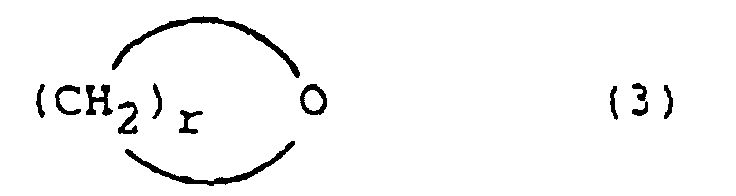
- Alicyclic ether compounds expressed by general formula (3) are preferred. Particularly preferred examples include tetrahydrofuran and tetrahydropyran. Tetrahydrofuran is most preferred.
- the hydrazine hydrohalogenic acid salt is reacted with the diol compound or the alicyclic ether compound in the presence of an excess of inorganic acid to form an alicyclic hydrazine derivative in the form of a hydrohalogenide salt.
- reaction A This overall process encompasses two specific reactions, namely, where one nitrogen atom of the hydrazine is taken into the ring (reaction A), and where two nitrogen atoms of the hydrazine are taken into the ring (reaction 8). These specific reactions are illustrated below.
- 1-aminopyrrolidine hydrohalogenic acid salt will be formed as shown in the following formula (6).
- 1-aminopiperidine hydrohalogenic acid salt When 1,5-pentanediol or tetrahydropyran is reacted with hydrazine hydrohalogenic acid salt in the presence of an inorganic acid, 1-aminopiperidine hydrohalogenic acid salt will be formed as shown by the formula (7).
- 1-aminohexamethyleneimine hydrohalogenic acid salt When 1,6-hexanediol is reacted with a hydrazine hydrohalogenic acid salt in the presence of an inorganic acid, 1-aminohexamethyleneimine hydrohalogenic acid salt will be formed as shown by the formula (9).
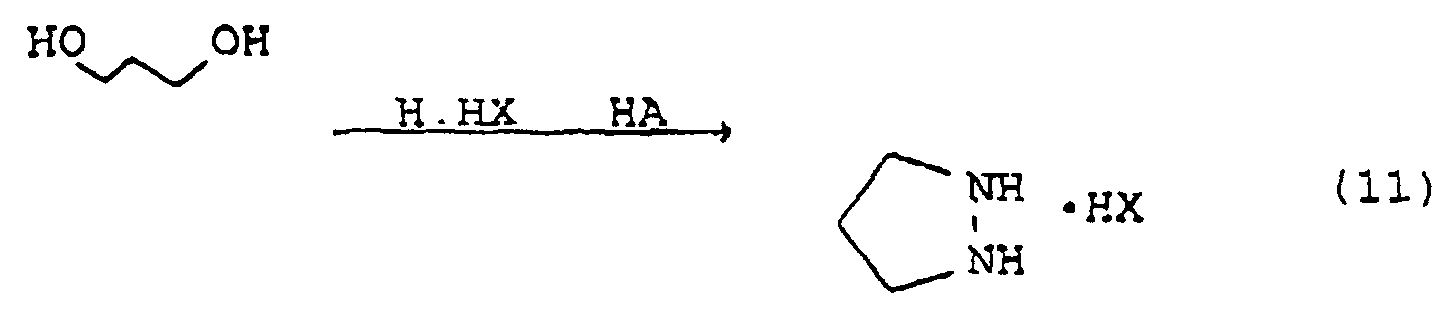
- a pyrazolidine hydrohalogenic acid salt When 1,3-propanediol is reacted with a hydrazine hydrohalogenic acid salt in the presence of an inorganic acid, a pyrazolidine hydrohalogenic acid salt will be formed as shown by the formula (11).
- the mole ratio of the diol compound or alicyclic ether compound: the hydrazine hydromonohalogenic acid salt (H.HX): the excess inorganic acid (HA) is 1:1-10:0.2-3.
- this mole ratio is 1:2-5:1-2.
- the reaction temperature is preferably 100 to 150°C, more preferably 110 to 140°C.
- the reaction pressure is preferably normal pressure to 10 Kg/cm 2 G, more preferably about 2 to 8 Kg/cm 2 G.
- the reaction time differs depending upon the intended alicyclic hydrazine derivative but is about 1 to 30 hours. In the case of reaction A, when the product is a 1-aminopyrrolidine hydrohalogenic acid salt, the reaction time is 3 to 10 hours.
- Water can be used as the solvent.
- a method will be available in which H.HX, the diol compound or the alicyclic ether compound, and the excess inorganic acid, or H.HX, the diol compound or the alicyclic ether compound and the hydrazine hydrodihalogenic acid salt are simultaneously charged in a reaction vessel and used in the reaction.
- Another method is to add the diol compound or the alicyclic ether compound, and the inorganic acid to the H.HX aqueous solution prepared from a hydrazine hydrate and a hydrohalogenic acid.
- H.HX In this reaction, to use H.HX in an excess amount to the diol compound or the alicyclic ether compound, H.HX must be separated from the alicyclic hydrazine derivative hydrohalogenic acid salt in order to obtain the alicyclic hydrazine derivative hydrohalogenic acid salt having a high purity.
- water used as the solvent is concentrated and an alcohol solvent such as methanol is added, and then the H.HX is crystallized and thereafter taken out as crystals. It is then separated from the intended alicyclic hydrazine derivative hydrohalogenic acid salt.
- the separating operation of H.HX may better be repeated several times.
- reaction residue from which H.HX has been removed is left to stand at room temperature whereby the alicyclic hydrazine derivative hydrohalogenic acid salt can be isolated as crystals.
- the isolated crystalline alicyclic hydrazine derivative hydrohalogenic acid salt was neutralized with a base such as sodium hydroxide and precisely distilled to obtain the desired alicyclic hydrazine derivative.
- reaction solution after separating H.HX is neutralized with a base such as sodium hydroxide, the resulting inorganic salt was separated by filtration, and the filtrate was precisely distilled whereby the desired alicyclic hydrazine derivative could be isolated.
- a base such as sodium hydroxide
- the amounts of by-products at the time of synthesizing the alicyclic hydrazine derivative hydrohalogenic acid salt are small, and the reaction selectivity is high.
- the 1-aminopyrrolidine 1 showed a high selectivity of more than 90%.
- the structures of these by-products were identified or assumed.
- Tetrahydropyridazine 2 and hexahydropyridazine 3 were compared and identified by GC with a standard sample.
- reaction in the first stage has been already mentioned before.
- diazene-hydrazone rearrangement occurs to form tetrahydropyridazine.
- This tetrahydropyridazine is hydrogenated in the presence of a base to form hexahydropyridazine.
- the hydrazine hydrohalogenic acid salt is reacted with the diol compound or the alicyclic ether compound,
- the 1-aminopyrrolidine hydrohalogenic acid salt obtained by this reaction or 1-aminopyrrolidine hydrohalogenic acid salt solution containing the mother liquor obtained in this reaction may be used as a synthesizing starting material of tetrahydropyridazine.
- the resulting tetrahydropyridazine may be hydrogenated in the presence of a base to form hexahydropyridazine.
- the hydrogenating reaction may be preferably carried out by using a noble metal catalyst.
- the catalytic hydrogenating reaction of tetrahydropyridazine using a noble metal catalyst gives a by-product of 1-aminopyrrolidine which is a starting material for tetrahydropyridazine in addition to hexahydropyridazine as a desired product.
- the reaction is shown by the following formula (15).
- tetrahydropyridazine is formed by an oxidation reaction of 1-aminopyrrolidine, and its reverse reaction is thought to occur; namely there is thought a reaction mechanism in which 1-aminopyrrolidine is formed as a by-product from tetrahydropyridazine by a reducing reaction. It is thought that the addition of the base will suppress this reverse reaction.
- the 1-aminopyrrolidine formed as a by-product may be converted to tetrahydropyridazine by oxidizing it with an oxidizing agent, and again used in the reducing reaction.
- the desired hexahydropyridazine can be isolated by precise distillation.
- alicyclic hydrazine derivatives useful as intermediates of medicines or agricultural chemicals may be produced with industrial or economical advantage.
- the reaction speed can be increased and the reaction time can be shortened drastically, and it is possible to increase the conversion of tetrahydropyridazine to at least 90% and the selectivity to hexahydropyridazine to at least 90%.
- the conversion of 1-aminopyrrolidine can be increased to at least 90%, and the selectivity to tetrahydropyridazine can be increased to at least about 60% or more. It is excellent that the reaction time can be shortened considerably, and an after-treatment is not necessary.
- the by-product during the production is only pyrrolidine.
- impurities existing in the starting 1-aminopyrrolidine can be decomposed by oxidation, it is extremely convenient.
- 1-aminopyrrolidine is synthesized from hydrazine hydrohalogenic acid salt and butane diol or tetrahydrofuran; and by oxidizing 1-aminopyrrolidine with an oxidizing agent tetrahydropyridazine may be formed, and then the tetrahydropyridazine may be hydrogenated by using a noble metal catalyst to produce with industrial and economical advantages hexahydropyridazine which is very useful as an intermediate for agricultural chemicals or medicines.
- the crystals obtained after concentrating the reaction solution which are obtained by reacting the hydrazine hydrohalogenic acid salt with the diol compound or the alicyclic ether compound, are a mixture of H.HX and H.2HX. Their composition was determined by titration analysis for H.HX. The recovery rate of H.HX is calculated based on a value obtained by subtracting the charge amount of a reaction substrate from the amount corresponding to H.HX.
- a 1-liter glass autoclave was charged with 226.1 g (3.30 moles) of hydrazine monohydrochloride, 111.4 g (1.10 moles) of concentrated hydrochloric acid, 99.1 g (1.10 moles) of 1,4-butanediol and 330.0 g of H 2 O. With stirring, they were reacted at 140°C and under 2.2 to 5.6 Kg/cm 2 G for 5 hours. After the reaction, the reaction solution was concentrated under reduced pressure, and a mixture of (hydrazine monohydrochloride + hydrazine dihydrochloride) was washed with methanol to separate 179.9 g of the product as crystals.
- the mixture had a composition which was determined by titration with 1N-NaOH and contained 77.40 % by weight [139.24 g (2.03 mols), recovery rate 92.27%] of hydrazine monohydrochloride and 20.82 % by weight [37.46 g (1.03 mols), recovery rate 93.29%] of HCl.
- the separated mother liquor contained 58.57 % by weight [14.87g (0.12 mole)] of 1-aminopyrrolidine hydrochloric acid salt remaining therein.
- the total yield of 1-aminopyrrolidine hydrochloric acid salt was 87.4%.
- 1,4-butanediol did not remain (GC analysis).
- the identification of 1-aminopyrrolidine was performed by showing that the holding time of a standard sample of 1-aminopyrrolidine agreed with the holding time of GC and by following NMR/ 1 H-NMR (a mixed solvent comprising DMSO-d 6 and CDCl 3 ) 1.83-2.26 (m, 4H, -CH 2 -) 3.23-3.67 (m, 4H, -CH 2 -) 7.88 (bs, 3H, -NH 2 , HCl) ⁇ D exchangeable
- a 1-liter glass autoclave was charged with 150.7 g (2.20 moles) of hydrazine monohydrochloride, 115.5 g (1.10 moles) of hydrazine dihydrochloride, 99.1 g (1.10 moles) of 1,4-butanediol, and 401.3 g of H 2 O. With stirring, they were reacted at 140°C for 3 hours.
- the reaction solution was concentrated under reduced pressure, and a mixture (hydrazine monohydrochloride + hydrazine dihydrochloride) was washed with methanol to separate 183.0 g of crystals.
- the composition of the mixture was titrated with 1N-NaOH and contained 77.92 % by weight [142.59 g (2.08 mols), recovery rate 94.61%] of hydrazine monohydrochloride and 19.72 % by weight[36.09 g (0.99 mol), recovery rate 89.88%] of HCl.
- the separated mother liquor contained 46.70 % by weight [10.09 g (0.082 mole)] of 1-amino-pyrrolidine hydrochloric acid salt remaining therein.
- the presence of a small amount of 1,4-butanediol was confirmed (GC analysis).
- the total yield of 1-aminopyrrolidine hydrochloric acid salt was 82.3%.
- a 1-liter glass autoclave was charged with 150.7 g (2.20 moles) of hydrazine monohydrochloride, 115.5 g (1.10 moles) of hyrazine dihydrochloride, 103.6 g (1.15 moles) of 1,4-butanediol and 401.3 g of H 2 O. With stirring, these substances were reacted at 140°C for 3.5 hours.
- reaction solution was concentrated under reduced pressure, and a mixture of (hydrazine monohydrochloride + hydrazine dihydrochloride) was washed with methanol to separate white crystals in an amount of 181.2 g.
- the composititon of the mixture was titrated with 1N-NaOH to give 76.60% by weight [138.80 g (2.03 moles), the recovery rate 94.42%] of hyrazine monohychloride, 21.79 % by weight [39.48 g (1.08 moles), the recovery rate 98.33%] of HCl.
- the mixture of (hydrazine monohydrochloride + hydrazine dihydrocloride) was separated.
- the 1-aminopyrrolidine hydrochloric acid salt in 445.7 g of the methanol mother liquor had a content of 28.92% as titrated, 128.90 g (1.05 moles), and the formation rate was 91.42%.
- 1,4-butanediol did not remain (GC analysis).
- the reaction selectivity was sought from the GC analysis of the methanol mother liquor.
- Four by-products existed in addition to 1-aminopyrrolidine.
- a GC-MS analysis one compound was determined to be hexahydropyridazine because it had a molecular weight of 86 and it had the same holding time (GC) as the standard sample.
- Another compound was determined to be tetrahydropyridazine because it had a molecular weight of 84, and it had the same holding time (GC) as a standard sample.
- the other two compounds were assumed to be 1,1-bipyrrolidine and octahydropyridazino[1,2-a]pyridazine because both had a molecular weight of 140.
- the reaction selectivities of the compounds in the methanol mother liquor were 90.17% of 1-aminopyrrolidine, 4.03% of hexahydropyridazine, 0.41% of tetrahydropyrazine, by-products having a molecular weight of 140, 4.72% of 1,1-bipyrrolidine, and 0.67% of octahydropyridazino[1,2-a]pyridazine, and the selective formation of 1-aminopyrrolidine was confirmed.
- a 1-liter glass autoclave was charged with 226.1 g (3.30 moles) of hydrazine monohydrochloride, 111.4 g (1.10 moles) of concentrated hydrochloric acid, 99.1 g (1.10 moles) of 1,4-butanediol and 330.0 g of H 2 O. With stirring, these compounds were reacted at 130°C for 5 hours.
- the reaction solution was concentrated under reduced pressure, and a mixture of (hydrazine monohydrochloride + hydrazine dihydrochloride) was washed with methanol to sepatate 179.9 g of white cyrscals.
- the composition of the mixture was determined by titration with 1N-NaOH and contained hydrazine monohydrochloride 86.54 % by weight, [155.69 g (2.27 moles), the recovery rate 103.18%], and HCl 20.88% by weight, 137.57 g (1.03 moles), the recovery rate 93.57%].
- a 1-liter glass autoclave was charged with 226.1 g (3.30 moles) of hydrazine monohydrochloride, 111.4 g (1.10 moles) of concentrated hydrochloric acid, 99.1 g (1.10 moles) of 1,4-butanediol. and 330.0 g of H 2 O. With stirring, the above compounds were reacted at a temperature of 120°C for 5 hours.
- the separated mother liquor contained 58.91 % by weight of 1-aminopyrrolidine hydrochloric acid salt [25.33 g (0.21 mole)] remaining therein. Incidentally, a small amount of 1,4-butanediol was confirmed (GC analysis). The total yield of 1-aminopyrrolidine hydrochloride salt was 61.0%.
- 1-Aminopyrrolidine hydrochloric acid salt white crystals Example 5, primary crystals 21.0 g (content: titrated 99.73%), secondary crystal 33.2 g (93.56%), Example 4, primary crystals 65.0 g (99.40%), secondary crystals 7.5 g (93.25%), Example 2, primary crystals 40.4 g (100.43%), and secondary crystals 20.5 g (97.03%) were dissolved in methanol, and the solution was neutralized with 60.0 g (1.50 moles) of NaOH. After neutralization, the precipitated sodium chloride was separated to give 207.2 g of a methanol solution of 1-aminopyrrolidine [1-aminopyrrolidine 44.80% by weight, 121.05 g (1.41 moles)].
- a 1-liter glass autoclave was charged with 274.0 g (4.00 moles) of hydrazine monohydrochloride, 105.5 g (1.00 mole) of hydrazine dihydrochloride, 90.1 g (1.00 mole) of 1, 4-butanediol and 364.8 g of H 2 O, and with stirring, these substances were reacted at 140°C for 4 hours.
- 1-aminopyrrolidine hydrochloric acid salt in 310.8 g of the methanol mother liquor was 115.15 g (0.94 mole) [content: titrated 37.05%] and the formation rate was 93.92%.
- the reaction selectivity in the methanol mother liquor was 91.89% of 1-aminopyrrolidine, 5.54% of hexahydropyridazine, a by-product having a molecular weight of 140, 2.28% of 1,1-bipyrrolidine and 0.29% of octahydropyridazino [1, 2-a]pyridazine, and the selective formation of 1-aminopyrrolidine was confirmed.
- 1,4-butanediol did not remain (GC analysis).
- a 1-liter glass autoclave was charged with 75.4 g (1.10 moles) of hydrazine monohydrochloride, 115.5 g (1.10 moles) of hydrazine dihydrochloride, 99.1 g (1.10 moles) of 1,4-butanediol and 401.3 g of H 2 O, and with stirring, the above compounds were reacted at 140°C for 4 hours.
- the reaction solution was concentrated under reduced pressure, and a mixture of (hydrazine monohydrochloride + hydrazine dihydrochloride) was washed with methanol to separate 122.0 g of white crystals.
- the composition of the mixture was determined by titration with 1N-NaOH and contained, 68.09% by weight of hydrazine monohydrochloride [83.07 g (1.21 moles), the recovery rate 110.23%] and 30.69% by weight of HCl [37.44 g (1.03 moles), the recovery rate 93.25%].
- 1-aminopyrrolidine hydrochloric acid salt in 362.4 g of the methanol mother liquor contained 109.48 g (0.89 mole) [content: titrated 30.21%], and the formation rate was 80.91%.
- the reaction selectivity in the methanol mother liquor was 88.30% of 1-aminopyrrolidine, 3.13% of hexahydropyridazine, a by-product having a molecular weight of 140, 6.40% of 1,1-bipyrrolidine and 0.83% of octahydropyridazino[1,2-a]pyridazine, and the selective formation of 1-aminopyrrolidine was confirmed.
- 1, 4-butanediol remained in a small amount (GC analysis).
- a 1-liter glass autoclave was charged with 115.5 g (1.10 moles) of hydrazine dihydrochloride, 99.1 g (1.10 moles) of 1,4-butanediol and 401.3 g of H 2 O, and with stirring, the above substances were reacted at 140°C for 3.5 hours.
- 1-aminopyrrolidine hydrochloric acid salt in 475.2 g of the methanol mother liquor was as follows: content: titrated 13.36%, 63.49 g (0.52 mole), and the formation rate 47.07%.
- the reaction selectivity in the methanol mother liquor was 81.22% of 1-aminopyrrolidine. 2.34% of hexahydropyridazine, a by-product having a molecular weight of 140, 8.12% of 1,1-bipyrrolidine, and 0.89% of octahydropyridazino[1,2-a]pyridazine. Incidentally, 1,4-butanediol remained in a small amount (GC analysis).
- a 1-liter glass autoclave was charged with 150.7 g (2.20 moles) of hydrazine monohydrochloride, 115.5 g (1.10 moles) of hydrazine dihydrochloride, 79.3 g (1.10 moles) of tetrahydrofuran and 401.3 g of H 2 O, and with stirring. the above substances were reacted at 140°C for 3.5 hours.
- the reaction concentrated solution (152.8 g) was allowed to stand to isolate 79.1 g of white primary crystals of 1-aminopyrrolidine hydrochloric acid salt [content:titrated 99.71% (0.65 mole)]. Furthermore, the separated mother liquor was concentrated to give 22.3 g of white secondary crystals of 1-aminopyrrolidine hydrochloric acid salt, content:titrated 94.79% (0.18 mole). The yield of 1-aminopyrrolidine hydrochloric acid salt crystals was 75.45%. In the separated mother liquor, 74.20 % by weight [17.07 g (0.14 mole)] of 1-aminopyrrolidine hydrochloric acid salt remained. The total yield of 1-aminopyrrolidine was 88.2%.
- a 200 ml pressure-resistant glass bomb was charged with 101.7 g (0.45 mole) of 50% hydrazine hyrobromide, 25.8 g (0.45 mole) of 47% hydrobromic acid, and 13.5 g (0.15 mole) of 1, 4-butanediol, and the above substances were reacted at 140°C for 3.5 hours.
- the selectivity in the reaction solution was 73.61% of 1-aminopyrrolidine hydrobromic acid salt, 5.66% of hexahydropyridazine, a by-product having a molecular weight of 140, 16.13% of 1,1-bipyrrolidine, and 3.50% of octahydropyridazino [1,2-a]pyridazine.
- 1,4-butanediol did not remain (GC analysis).
- 1-aminopyrrolidine hydrochloric acid salt solution 100 g of methanol, and the methanol solution was neutralized with 200.1 g (5.00 moles) of sodium hydroxide. After neutralization, 330.2 g of sodium chloride was separated. Thereafter, 969.6 g of 1-aminopyrrolidine methanol solution [composition: 1-aminopyrrolidine 29.43% by weight, 285.35 g (3.31 moles), hydrazine hydrate 4.90% by weight, 47.56 g (0.95 mole)] was obtained.
- a 200 ml pressure-resistant glass bomb was charged with 27.4 g (0.40 mole) of hydrazine monohydrochloride, 21.0 g (0.20 mole) of hydrazine dihydrochloride, 20.8 g (0.20 mole) of 1,5-pentanediol and 60.0 g of H 2 O, and by a shaking machine, the above substances were reacted at 140°C for 24 hours.
- reaction solution was separated into two layers. After separation, the upper layer and the lower layer were separately treated.
- the lower layer reaction solution was concentrated under reduced pressure, and a mixture of (hydrazine monohydrochloride + hydrazine dihydrochloride) was washed with methanol to separate 34.4 g of white crystals.
- the composition of the mixture was titrated with 1N-NaOH to give hydrazine monohydrochloride 84.24% by weight, 28.98 g (0.42 mole), the recovery rate 105.75% and HCl 13.15 % by weight, 4.52 g (0.12 mole), the recovery rate 62.0%.
- a 200 ml pressure-resistant glass bomb was charged with 27.4 g (0.40 mole) of hydrazine monohydrochloride, 21.0 g (0.20 mole) of hyrazine dihydrochloride, 17.2 g (0.20 mole) of tetrahydropyran and 60.0 g of H 2 O, and by a shaking machine, the above substances were reacted at 140°C for 24 hours.
- reaction solution was separated into two layers. After separating the solution, the upper layer and the lower layer were separately treated.
- the lower layer reaction solution was concentrated under reduced pressure, and a mixture of (hydrazine monohydrochloride + hydrazine dihydrochloride) was recovered to obtain 89.5 g of the reaction concentrated methanol mother liquor.
- 1-Aminopiperidine hydrochloric acid salt in the methanol mother liquor was 2.75% as titrated [2.46 g (0.07 mole)], the formation rate 33.8%].
- a 1-liter glass autoclave was charged with 226.1 g (3.30 moles) of hydrazine monohydrochloride, 111.4 g (1.10 moles) of concentrated hydrochloric acid, 127.8 g (1.10 moles) of 3-methyl-1,5-pentanediol and 400.0 g of H 2 O, and with stirring, the above substances were reacted at 140°C for 24 hours.
- the reaction solution was separated into two layers. Then, after separation, the upper layer and the lower layer were separately treated.
- a 1-liter glass autoclave was charged with 150.7 g (2.20 moles) of hydrazine monohydrochloride, 115.5 g (1.10 moles) of hydrazine dihydrochloride, 130.0 g (1.10 moles) of 1,6-hexanediol and 401.3 g of H 2 O, and with stirring, the above substances were reacted at 140°C for 22 hours.
- the reaction solution was separated into two layers. Then, after the separation, the upper layer and the lower layer were separately treated.
- the lower layer reaction solution was concentrated under reduced pressure, and a mixture of (hydrazine monohydrochloride + hydrazine dihydrochloride was washed with methanol to separate 134.7 g of white crystals.
- the composition of the mixture was determined by titration with 1N-NaOH to give 79.37% by weight of hydrazine monohydrochloride [106.9 g (1.56 moles), the recovery rate 70.95%], and 18.37% by weight of HCl [24.7 g (0.68 mole), the recovery rate 61.6%].
- a 1-liter glass autoclave was charged with 226.1 g (3.30 moles) of hydrazine monohydrochloride, 111.4 g (1.10 moles) of concentrated hydrochloric acid, 83.7 g (1.10 moles) of 1,3-propanediol and 400.0 g of H 2 O, and with stirring, the above substances were reacted at 140 °C for 5 hours.
- reaction solution was concentrated under reduced pressure, and a mixture of (hydrazine monohydrochloride + hydrazine dihydrochloride) was washed with methanol to recover white crystals.
- pyrazolidine hydrochloride in 393.1 g of the methanol mother liquor had a content of 20.16% (titrated), 79.25 g (0.73 mole), the formation rate 66.4%. Furthermore, the formation of tetrahydro-1H. 5H-pyrazolo-[1, 2-a]pyrazole as a by-product was confirmed. Pyrazolidine and tetrahydro-1H, 5H-pyrozolo-[1,2-a] pyrazole were identified by GC-MS.
- reaction selectivity was 79.01% of pyrazolidine and 17.76% of tetrahydro-1H, SH-pyrazolo-[1. 2-a]pyrazole, and 3.23% of 1, 3-propanediol remained (GC).
- a 1-liter glass autoclave was charged with 75.4 g (1.10 moles) of hydrazine monohydrochloride, 230.9 g (2.20 moles) of hydrazine dihydrochloride, 83.7 g (1.10 moles) of 1,3-propanediol and 400.0 g of H 2 O, and with stirring, the above substances were reacted at 140°C for 5 hours.
- a 1-liter glass autoclave was charged with 150.7 g (2.20 moles) of hydrazine monohydrochloride, 115.5 g (1.10 moles) of hydrazine dihydrochloride, 83.7 g (1.10 moles) of 1, 3-propanediol and 400.0 g of H 2 O, and with stirring, the above substances were reacted at 140°C for 5 hours.
- a 1-liter glass autoclave was charged with 150.2 g (3.00 moles) of hydrazine hydrate, 405.1 g (4.00 moles) of concentrated hydrochloric acid, and 106.1 g (1.00 mole) of diethylene glycol, and with stirring, the above substances were reacted at 140°C for 10 hours.
Landscapes
- Chemical & Material Sciences (AREA)
- Organic Chemistry (AREA)
- Organic Low-Molecular-Weight Compounds And Preparation Thereof (AREA)
- Low-Molecular Organic Synthesis Reactions Using Catalysts (AREA)
Description
- The present invention relates to a process for producing alicyclic hydrazine derivatives, which are useful as intermediate starting materials for producing medicines and agricultural chemicals.
- The present inventors proposed a method for producing tert-butylhydrazine hydrohalogenic acid salt by reacting hydrazine hydrohalogenic acid salt and tert-butanol which are industrially or economically advantageous starting materials (Japanese Patent Publication No. 48823/1986).
- However, it has not yet been known that a difunctional alcohol (diol) or an alicyclic ether compound reacts with a hydrazine hydrohalogenic acid salt to give an alicyclic hydrazine derivative hydrohalogenic acid salt.
- As a method for producing an alicyclic hydrazine derivative or its hydrohalogenic acid salt, there are known a method of reacting an alkyl dihalide with hydrazine hydrate [USSR Pat. 87-4337106], [J. Am.Chem. Soc. 88, 3959-3963 (1966)] (prior art 1), and a method of synthesizing alicyclic hydrazine by using an alicyclic amine as a starting material [U. S. Patent 3,317,607] (prior art 2).
- However, the prior art 1 relating to a method of producing an alicyclic hydrazine derivative or its hydrohalogenic acid salt has a problem that an economically expensive dihalogenobutane is required as a starting material. Furthermore, the prior art 2 is a general method of synthesizing alicyclic hydrazine, but the stability and toxicity of the nitroso body which is an intermediate pose a problem.
- The present invention overcomes the defects of the conventional techniques, and provides a method of producing an alicyclic hydrazine derivative or its hydrohalogenic acid salt industrially and economically advantageously from an inexpensive starting material which is easy to handle, namely a diol compound or an alicyclic ether compound.
- The present invention therfore provides a method for producing an alicyclic hydrazine derivative and/or its hydrohalogenide which comprises reacting a hydrazine hydrohalogenic acid and/or a salt thereof with a diol compound and/or an alicyclic ether compound in the presence of excess inorganic acid and/or a salt thereof.
- The reaction of the present invention, may be continued to provide a method for producing hexahydropyridazine; the extended method therefore comprises reacting hydrazine hydrohalogenic acid salt with butanediol or tetetrahydrofuran to synthesize 1-aminopyrrolidine, and then oxidizing 1-aminopyrrolidine with an oxidizing agent to synthesize tetrahydropyridazine, and thereafter hydrogenating the tetrahydropyridazine in the presence of a base.
- In a preferred embodiment of the present invention, it is desired that
- 1. the hydrazine hydrohalogenic acid salt be a hydrazine
hydromonohalogenic acid salt expressed by the formula (1)
- 2. the diol compound be a diol compound expressed by the
following formula (2)
- 3. the alicyclic ether compound be an alicyclic ether
compound shown by the formula (3)
wherein r is an integer of 4 or 5;
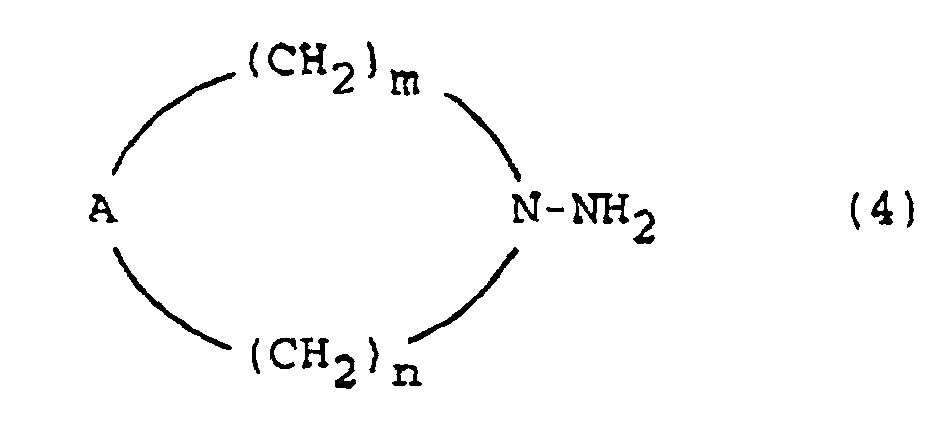
- 4. the alicyclic hydrazine derivative be an alicyclic
hydrazine derivative expressed by the formula (4)
wherein A represents an oxygen atom, a methylene group or an ethylidene group, and m and n are integers of 1 to 3,
or expressed by the formula (5)wherein p is an integer of 3 or 4;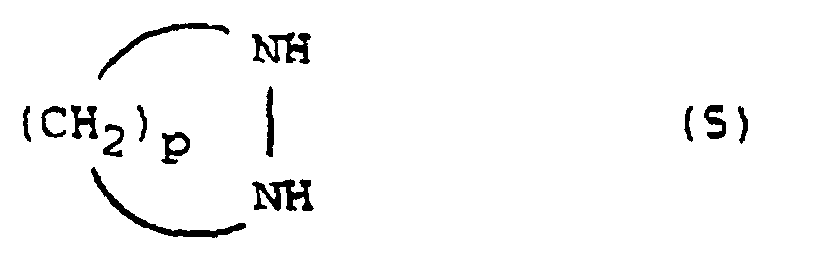
- 5. the excessive inorganic acid be a hydrohalogenic acid or its salt;
- 6. the excess inorganic acid be present in the form of a hydrazine hydrodihalogenic acid or its salt; and
- 7. the reaction be carried out at a temperature of 100 to 150°C under an elevated pressure while the mole ratio of the diol compound or the alicyclic ether compound:hydrazine hydromonohalogenic acid salt:excess inorganic acid is 1:1-10:0.2-3.
-
- The reaction solution obtained by the above method is concentrated, and an alcohol solvent, etc. is added. The unreacted hydrazine hydrohalogenic acid salt precipitated as crystals are removed in a customary manner. Then, the separated mother liquor is subjected to an ordinary method such as dilution or cooling, whereby an alicyclic. hydrazine derivative hydrohalogenic acid salt precipitated as crystals can be separated and recovered. Furthermore, the above separated mother liquor is neutralized with a base, and distilled to give an alicyclic hydrazine derivative.
- In the present invention, the diol compound or the alicyclic ether compound is reacted with the hydrazine hydrohalogenic acid salt in the presence of an excess of inorganic acid to give an alicyclic hydrazine derivative at once. In this regard, the reaction of the present invention is novel and peculiar.
- The diol compound or the alicyclic ether compound, together with the hydrazine hydrohalogenic acid salt, is a starting material which is easily available and cheap. In addition, since the handlability of these materials is easy during the reaction, the invention can provide the alicyclic hydrazine derivative or its hydrohalogenic acid salt industrially advantageously.
- The excess of inorganic acid may be present in a free form or in the form of an acid addition salt.
Hydrohalogenic acids are preferred as the inorganic acid. In this case, the hydrohalogenic acids may exist in the form of hydrazine hydrohalogenic acid. As the hydrohalogenic acids, hydrochloric acid and hydrobromic acid are preferred. - As the hydrazine hydrohalogenic acid salt hydrochloride salt and hydrobromide salt may be used. The hydrochloride salt is preferred. The hydrazine hydrohalogenic acid salt shown in the formula (1), namely hydrazine hydromonohalogenic acid salt, is preferred. The hydrazine hydrohalogenic acid salt may be relatively pure, or may contain an impurity. For example, the hydrazine hydrohalogenic acid salt recovered from the mother liquor may be repeatedly used in the reaction. Of course, the hydrazine hydrodihalogenic acid salt used may be used as a starting material for hydrazine.
- The diol compound may be any compound which is an aliphatic compound having two hydroxyl groups. The number of carbons in the diol compound may be 3 to 8. The hydroxyl groups may be primary, secondary or tertiary hydroxyl groups, but in respect of the reactability, a primary hydroxyl group is preferred. The skeleton of the diol compound may be a straight chain alkylene group or a branched chain alkylene group. In this alkylene chain, atoms other than carbon, such as an ether oxygen atom, may be interposed.
- Suitable diol compounds may be those represented by general formula (2). Preferred examples include 1,3-propanediol, 1,4-butanediol, 1,5-pentanediol, 1,6-hexanediol, 3-methyl-1,5-pentanediol and diethyleneglycol.
- In the present invention, alicyclic ether compounds may be used instead of the diol compounds. As the alicyclic ether compounds, compounds having 4 to 5 carbon atoms and containing at least one ether oxygen atom within the ring are used. Alicyclic ether compounds expressed by general formula (3) are preferred. Particularly preferred examples include tetrahydrofuran and tetrahydropyran. Tetrahydrofuran is most preferred.
- According to the present invention, the hydrazine hydrohalogenic acid salt is reacted with the diol compound or the alicyclic ether compound in the presence of an excess of inorganic acid to form an alicyclic hydrazine derivative in the form of a hydrohalogenide salt.
- This overall process encompasses two specific reactions, namely, where one nitrogen atom of the hydrazine is taken into the ring (reaction A), and where two nitrogen atoms of the hydrazine are taken into the ring (reaction 8). These specific reactions are illustrated below.
- When 1,4-butanediol or tetrahydrofuran is reacted with hydrazine hydrohalogenic acid salt in the presence of an inorganic acid. 1-aminopyrrolidine hydrohalogenic acid salt will be formed as shown in the following formula (6).

- When 1,5-pentanediol or tetrahydropyran is reacted with hydrazine hydrohalogenic acid salt in the presence of an inorganic acid, 1-aminopiperidine hydrohalogenic acid salt will be formed as shown by the formula (7).

- When 3-methyl-1,5-pentanediol is reacted with hydrazine hydrohalogenic acid salt in the presence of an inorganic acid, 1-amino-4-methylpiperidine hydrohalogenic acid salt will be formed as shown in the formula (8).

- When 1,6-hexanediol is reacted with a hydrazine hydrohalogenic acid salt in the presence of an inorganic acid, 1-aminohexamethyleneimine hydrohalogenic acid salt will be formed as shown by the formula (9).

- When diethylene glycol is reacted with a hydrazine hydrohalogenic acid salt in the presence of an inorganic acid, a 4-aminomorpholine hydrohalogenic acid salt will be formed as shown by the formula (10)

- When 1,3-propanediol is reacted with a hydrazine hydrohalogenic acid salt in the presence of an inorganic acid, a pyrazolidine hydrohalogenic acid salt will be formed as shown by the formula (11).
- As will be described later, when 1,4-butanediol is used as the starting material, it is recognized that hexahydropyridazine is also formed although its yield is low.
- In the present invention, the mole ratio of the diol compound or alicyclic ether compound: the hydrazine hydromonohalogenic acid salt (H.HX): the excess inorganic acid (HA) is 1:1-10:0.2-3. Preferably, this mole ratio is 1:2-5:1-2.
- The reaction temperature is preferably 100 to 150°C, more preferably 110 to 140°C. The reaction pressure is preferably normal pressure to 10 Kg/cm2 G, more preferably about 2 to 8 Kg/cm2 G. The reaction time differs depending upon the intended alicyclic hydrazine derivative but is about 1 to 30 hours. In the case of reaction A, when the product is a 1-aminopyrrolidine hydrohalogenic acid salt, the reaction time is 3 to 10 hours.
- Water can be used as the solvent. Industrially, a method will be available in which H.HX, the diol compound or the alicyclic ether compound, and the excess inorganic acid, or H.HX, the diol compound or the alicyclic ether compound and the hydrazine hydrodihalogenic acid salt are simultaneously charged in a reaction vessel and used in the reaction. Another method is to add the diol compound or the alicyclic ether compound, and the inorganic acid to the H.HX aqueous solution prepared from a hydrazine hydrate and a hydrohalogenic acid.
- In this reaction, to use H.HX in an excess amount to the diol compound or the alicyclic ether compound, H.HX must be separated from the alicyclic hydrazine derivative hydrohalogenic acid salt in order to obtain the alicyclic hydrazine derivative hydrohalogenic acid salt having a high purity. For that purpose, water used as the solvent is concentrated and an alcohol solvent such as methanol is added, and then the H.HX is crystallized and thereafter taken out as crystals. It is then separated from the intended alicyclic hydrazine derivative hydrohalogenic acid salt. When by one operation, H.HX cannot be fully removed from the reaction solution, the separating operation of H.HX may better be repeated several times.
- The reaction residue from which H.HX has been removed is left to stand at room temperature whereby the alicyclic hydrazine derivative hydrohalogenic acid salt can be isolated as crystals.
- Furthermore, the isolated crystalline alicyclic hydrazine derivative hydrohalogenic acid salt was neutralized with a base such as sodium hydroxide and precisely distilled to obtain the desired alicyclic hydrazine derivative.
- The reaction solution after separating H.HX is neutralized with a base such as sodium hydroxide, the resulting inorganic salt was separated by filtration, and the filtrate was precisely distilled whereby the desired alicyclic hydrazine derivative could be isolated.
- The amounts of by-products at the time of synthesizing the alicyclic hydrazine derivative hydrohalogenic acid salt are small, and the reaction selectivity is high.
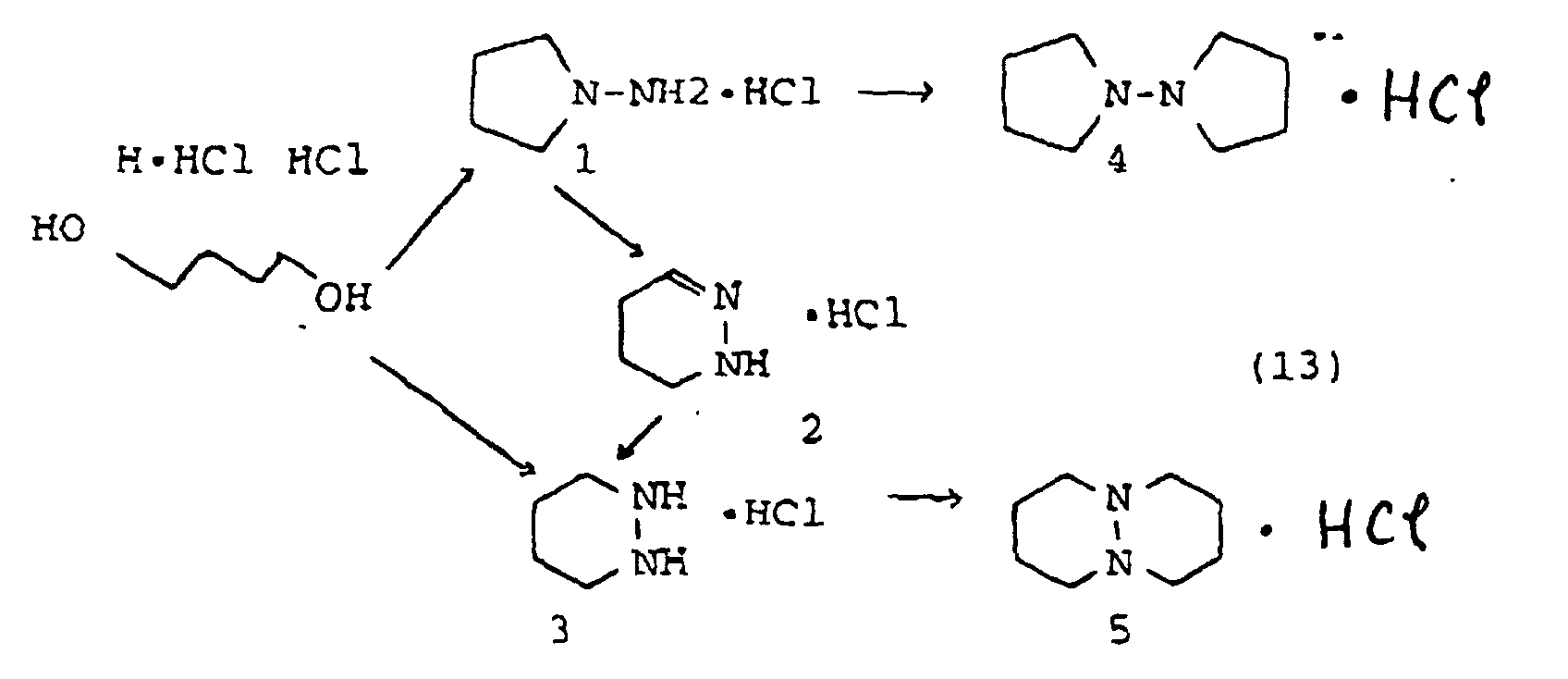
- For example, when 1,4-butanediol is reacted with hydrazine monohydrochloride salt in the presence of hydrochloric acid to produce 1-aminopyrrolidine hydrochloride salt, the by-products are shown in the following formula (12).

- Based on an analysis of gas chromatography, four by-products and the reaction selectivity are shown. The 1-aminopyrrolidine 1 showed a high selectivity of more than 90%. The structures of these by-products were identified or assumed. Tetrahydropyridazine 2 and hexahydropyridazine 3 were compared and identified by GC with a standard sample. Since the other two by-products had a molecular weight of 140 by GC-MS analysis, they were assumed to be 1,1-bipyrrolidine 4 produced by the reaction of 1-aminopyrrolidine and 1,4-butanediol and also to be octahydropyridazino[1,2-alpyridazine 5 formed by reaction of hexahydropyridazine 3 and 1,4-butanediol.
- The outline of the reaction mechanism is shown in the following formula (13). Especially. it has been found that 1-aminopyrrolidine hydrochloric acid salt is obtained peculiarly with a high selectivity and in a high yield.
- The reaction of the invention and the continuation thereof referred to above are shown by the formula (14).

- The reaction in the first stage has been already mentioned before. By oxidizing 1-aminopyrrolidine with an oxidizing agent, diazene-hydrazone rearrangement occurs to form tetrahydropyridazine. This tetrahydropyridazine is hydrogenated in the presence of a base to form hexahydropyridazine.
- As explained above, the hydrazine hydrohalogenic acid salt is reacted with the diol compound or the alicyclic ether compound, The 1-aminopyrrolidine hydrohalogenic acid salt obtained by this reaction or 1-aminopyrrolidine hydrohalogenic acid salt solution containing the mother liquor obtained in this reaction may be used as a synthesizing starting material of tetrahydropyridazine.
- The resulting tetrahydropyridazine may be hydrogenated in the presence of a base to form hexahydropyridazine. The hydrogenating reaction may be preferably carried out by using a noble metal catalyst.
- It is important that the catalytic hydrogenation reaction be carried out in the presence of a base.
- The catalytic hydrogenating reaction of tetrahydropyridazine using a noble metal catalyst gives a by-product of 1-aminopyrrolidine which is a starting material for tetrahydropyridazine in addition to hexahydropyridazine as a desired product. The reaction is shown by the following formula (15).

- As already stated, tetrahydropyridazine is formed by an oxidation reaction of 1-aminopyrrolidine, and its reverse reaction is thought to occur; namely there is thought a reaction mechanism in which 1-aminopyrrolidine is formed as a by-product from tetrahydropyridazine by a reducing reaction. It is thought that the addition of the base will suppress this reverse reaction.
- The 1-aminopyrrolidine formed as a by-product may be converted to tetrahydropyridazine by oxidizing it with an oxidizing agent, and again used in the reducing reaction.
- After the solvent is recovered from a reaction solution of hexahydropyridazine obtained by catalytic hydrogenation of tetrahydropyridazine using a noble metal catalyst, the desired hexahydropyridazine can be isolated by precise distillation.
- According to the present invention, by reacting hydrazine hydrohalogenic acid salt with a diol compound or an alicyclic ether compound in the presence of an excess of an inorganic acid, alicyclic hydrazine derivatives useful as intermediates of medicines or agricultural chemicals may be produced with industrial or economical advantage.
- Furthermore, according to the present invention, when tetrahydropyridazine is hydrogenated in the presence of a base, the reaction speed can be increased and the reaction time can be shortened drastically, and it is possible to increase the conversion of tetrahydropyridazine to at least 90% and the selectivity to hexahydropyridazine to at least 90%.
- Moreover, by oxidizing 1-aminopyrrolidine with an oxidizing agent, the conversion of 1-aminopyrrolidine can be increased to at least 90%, and the selectivity to tetrahydropyridazine can be increased to at least about 60% or more. It is excellent that the reaction time can be shortened considerably, and an after-treatment is not necessary. When oxidation is carried out by using an oxidizing agent, the by-product during the production is only pyrrolidine. In addition, since impurities existing in the starting 1-aminopyrrolidine can be decomposed by oxidation, it is extremely convenient.
- Thus, 1-aminopyrrolidine is synthesized from hydrazine hydrohalogenic acid salt and butane diol or tetrahydrofuran; and by oxidizing 1-aminopyrrolidine with an oxidizing agent tetrahydropyridazine may be formed, and then the tetrahydropyridazine may be hydrogenated by using a noble metal catalyst to produce with industrial and economical advantages hexahydropyridazine which is very useful as an intermediate for agricultural chemicals or medicines.
- The present invention will be specifically explained by the following Examples, but the present invention is not limited to these Examples.
- Analysis of alicyclic hydrazine derivatives including 1-aminopyrrolidine, tetrahydropyridazine and hexahydropyridazine has been conducted by gas chromatography, or neutralization titration using hydrochloric acid or sodium hydroxide.
- The crystals obtained after concentrating the reaction solution, which are obtained by reacting the hydrazine hydrohalogenic acid salt with the diol compound or the alicyclic ether compound, are a mixture of H.HX and H.2HX. Their composition was determined by titration analysis for H.HX. The recovery rate of H.HX is calculated based on a value obtained by subtracting the charge amount of a reaction substrate from the amount corresponding to H.HX.
- A 1-liter glass autoclave was charged with 226.1 g (3.30 moles) of hydrazine monohydrochloride, 111.4 g (1.10 moles) of concentrated hydrochloric acid, 99.1 g (1.10 moles) of 1,4-butanediol and 330.0 g of H2O. With stirring, they were reacted at 140°C and under 2.2 to 5.6 Kg/cm2G for 5 hours. After the reaction, the reaction solution was concentrated under reduced pressure, and a mixture of (hydrazine monohydrochloride + hydrazine dihydrochloride) was washed with methanol to separate 179.9 g of the product as crystals. The mixture had a composition which was determined by titration with 1N-NaOH and contained 77.40 % by weight [139.24 g (2.03 mols), recovery rate 92.27%] of hydrazine monohydrochloride and 20.82 % by weight [37.46 g (1.03 mols), recovery rate 93.29%] of HCl.
- Methanol (20 g) was added to 162.0 g of the reaction methanol solution concentrated. The mixture was allowed to stand at room temperature to give 79.8 g of white primary crystals of 1-aminopyrrolidine hydrochloric acid salt. (Content: titrated 101.87%, GC 99.66% (0.65 mole) was isolated.) Furthermore, the separated mother liquor was concentrated to give 23.9 g of white secondary crystals of 1-aminopyrrolidine hydrochloric acid salt. (Content: titrated 96.88%. GC 94.53% (0.19 mole) was isolated.) The yield of 1-aminopyrrolidine hydrochloric acid salt crystals was 76.40%. The separated mother liquor contained 58.57 % by weight [14.87g (0.12 mole)] of 1-aminopyrrolidine hydrochloric acid salt remaining therein. The total yield of 1-aminopyrrolidine hydrochloric acid salt was 87.4%. Furthermore, 1,4-butanediol did not remain (GC analysis).
- Incidentally, the identification of 1-aminopyrrolidine was performed by showing that the holding time of a standard sample of 1-aminopyrrolidine agreed with the holding time of GC and by following NMR/
1H-NMR (a mixed solvent comprising DMSO-d6 and CDCl3)
1.83-2.26 (m, 4H, -CH2-)
3.23-3.67 (m, 4H, -CH2-)
7.88 (bs, 3H, -NH2, HCl) ~ D exchangeable - A 1-liter glass autoclave was charged with 150.7 g (2.20 moles) of hydrazine monohydrochloride, 115.5 g (1.10 moles) of hydrazine dihydrochloride, 99.1 g (1.10 moles) of 1,4-butanediol, and 401.3 g of H2O. With stirring, they were reacted at 140°C for 3 hours.
- After the reaction, the reaction solution was concentrated under reduced pressure, and a mixture (hydrazine monohydrochloride + hydrazine dihydrochloride) was washed with methanol to separate 183.0 g of crystals. The composition of the mixture was titrated with 1N-NaOH and contained 77.92 % by weight [142.59 g (2.08 mols), recovery rate 94.61%] of hydrazine monohydrochloride and 19.72 % by weight[36.09 g (0.99 mol), recovery rate 89.88%] of HCl.
- Methanol (20 g) was added to the concentrated reaction solution, and 149.6 g of the methanol solution of the concentrated reaction solution was left to stand at room temperature to isolate 79.7 g of white primary crystals of 1-aminopyrrolidine hydrochloric acid salt, content: titrated 100.43%, GC98.40% (0.65 mole). Furthermore, the separated mother liquor was concentrated to give 21.9 g of white secondary crystals of 1-aminopyrrolidine hydrochloric acid salt, content: titrated 97.03%, GC92.70% (0.17 mole). The yield of 1-aminopyrrolidine hydrochloric acid salt crystals was 74.90%. The separated mother liquor contained 46.70 % by weight [10.09 g (0.082 mole)] of 1-amino-pyrrolidine hydrochloric acid salt remaining therein. The presence of a small amount of 1,4-butanediol was confirmed (GC analysis). The total yield of 1-aminopyrrolidine hydrochloric acid salt was 82.3%.
- A 1-liter glass autoclave was charged with 150.7 g (2.20 moles) of hydrazine monohydrochloride, 115.5 g (1.10 moles) of hyrazine dihydrochloride, 103.6 g (1.15 moles) of 1,4-butanediol and 401.3 g of H2O. With stirring, these substances were reacted at 140°C for 3.5 hours.
- After the reaction, the reaction solution was concentrated under reduced pressure, and a mixture of (hydrazine monohydrochloride + hydrazine dihydrochloride) was washed with methanol to separate white crystals in an amount of 181.2 g. The composititon of the mixture was titrated with 1N-NaOH to give 76.60% by weight [138.80 g (2.03 moles), the recovery rate 94.42%] of hyrazine monohychloride, 21.79 % by weight [39.48 g (1.08 moles), the recovery rate 98.33%] of HCl.
- The mixture of (hydrazine monohydrochloride + hydrazine dihydrocloride) was separated. The 1-aminopyrrolidine hydrochloric acid salt in 445.7 g of the methanol mother liquor had a content of 28.92% as titrated, 128.90 g (1.05 moles), and the formation rate was 91.42%. Incidentally, 1,4-butanediol did not remain (GC analysis).
- The reaction selectivity was sought from the GC analysis of the methanol mother liquor. Four by-products existed in addition to 1-aminopyrrolidine. By a GC-MS analysis, one compound was determined to be hexahydropyridazine because it had a molecular weight of 86 and it had the same holding time (GC) as the standard sample. Another compound was determined to be tetrahydropyridazine because it had a molecular weight of 84, and it had the same holding time (GC) as a standard sample. Furthermore, the other two compounds were assumed to be 1,1-bipyrrolidine and octahydropyridazino[1,2-a]pyridazine because both had a molecular weight of 140. The reaction selectivities of the compounds in the methanol mother liquor were 90.17% of 1-aminopyrrolidine, 4.03% of hexahydropyridazine, 0.41% of tetrahydropyrazine, by-products having a molecular weight of 140, 4.72% of 1,1-bipyrrolidine, and 0.67% of octahydropyridazino[1,2-a]pyridazine, and the selective formation of 1-aminopyrrolidine was confirmed.
- A 1-liter glass autoclave was charged with 226.1 g (3.30 moles) of hydrazine monohydrochloride, 111.4 g (1.10 moles) of concentrated hydrochloric acid, 99.1 g (1.10 moles) of 1,4-butanediol and 330.0 g of H2O. With stirring, these compounds were reacted at 130°C for 5 hours.
- After the reaction, the reaction solution was concentrated under reduced pressure, and a mixture of (hydrazine monohydrochloride + hydrazine dihydrochloride) was washed with methanol to sepatate 179.9 g of white cyrscals. The composition of the mixture was determined by titration with 1N-NaOH and contained hydrazine monohydrochloride 86.54 % by weight, [155.69 g (2.27 moles), the recovery rate 103.18%], and HCl 20.88% by weight, 137.57 g (1.03 moles), the recovery rate 93.57%].
- 128.1 g of the reaction concentrated methanol solution was allowed to stand at room temperature to isolate 65.8 g of white primary crystals of 1-aminopyrrolidine hydrochloric acid salt. Content: titrated 99.40%, GC98.58% (0.54 mole). Furthermore, the separated mother liquor was concentrated to give 8.9 g of white secondary crystals of 1-aminopyrrolidine hydrochloric acid salt, content: titrated 93.25%, GC94.36% (0.07 mole). The yield of 1-aminopyrrolidine hydrochloric acid salt crystals was 55.39%. The separated mother liquor contained 55.56 % by weight of 1-aminopyrrolidine hydrochloric acid salt, 18.50 g (0.15 mole) remaining therein. Incidentally, a small amount of 1,4-butanediol was confirmed (GC analysis). The total yield of 1-aminopyrrolidine hydrochloride was 69.1%.
- A 1-liter glass autoclave was charged with 226.1 g (3.30 moles) of hydrazine monohydrochloride, 111.4 g (1.10 moles) of concentrated hydrochloric acid, 99.1 g (1.10 moles) of 1,4-butanediol. and 330.0 g of H2O. With stirring, the above compounds were reacted at a temperature of 120°C for 5 hours.
- After the reaction, the reaction solution was concentrated under reduced pressure, and a mixture of (hydrazine monohydrochloride + hydrazine dihydrochloride) was washed with methanol to separate 205.0 g of white crystals. The composition of the mixture was titrated with 1N-NaOH to give hydrazine monohydrochloride 80.28 % by weight, 164.57 g (2.40 moles), the recovery rate 109.09%, and HCl 18.29 % by weight, 37.49 g (1.03 moles), the recovery rate 93 .38%.
- A small amount of methanol was added to 107.6 g of the reaction concentrated solution, and the mixture was left to stand at room temperature to isolate 22.9 g of white primary crystals of 1-aminopyrrolidine hydrochloric acid salt, content: titrated 99.73%, GC 99.13% (0.19 mole). Furthermore, the separated mother liquor was concentrated to obtain 36.5 g of white secondary crystals of 1-aminopyrrolidine hydrochloric acid salt, content: titrated 93.56%, GC95.10% (0.28 mole). The yield of 1-aminopyrrolidine hydrochloric acid salt crystal was 42.30%. The separated mother liquor contained 58.91 % by weight of 1-aminopyrrolidine hydrochloric acid salt [25.33 g (0.21 mole)] remaining therein. Incidentally, a small amount of 1,4-butanediol was confirmed (GC analysis). The total yield of 1-aminopyrrolidine hydrochloride salt was 61.0%.
- 1-Aminopyrrolidine hydrochloric acid salt white crystals, Example 5, primary crystals 21.0 g (content: titrated 99.73%), secondary crystal 33.2 g (93.56%), Example 4, primary crystals 65.0 g (99.40%), secondary crystals 7.5 g (93.25%), Example 2, primary crystals 40.4 g (100.43%), and secondary crystals 20.5 g (97.03%) were dissolved in methanol, and the solution was neutralized with 60.0 g (1.50 moles) of NaOH. After neutralization, the precipitated sodium chloride was separated to give 207.2 g of a methanol solution of 1-aminopyrrolidine [1-aminopyrrolidine 44.80% by weight, 121.05 g (1.41 moles)].
- A portion of this methanol solution was taken, and methanol was added to give 266.2 g (1.38 moles) of a methanol solution of 1-aminopyrrolidine. The above methanol solution was precisely distilled in a distillation tower filled with Helipack. After recovering methanol, 66.8 g (0.77 mole) of 1-aminopyrrolidine [content: 97.56% (GC)] was isolated at a boiling point of 128 to 130°C. The 1-aminopyrrolidine was identified with NMR.
- 1H-NMR (CDCl3)
- 1. 63-2.13 (m, 4H, -CH2-)
- 2. 57-2.96 (m, 4H, -CH2-)
- 3. 27 (bs, 3H, -NH2), ~ D exchangeable
-
- A 1-liter glass autoclave was charged with 274.0 g (4.00 moles) of hydrazine monohydrochloride, 105.5 g (1.00 mole) of hydrazine dihydrochloride, 90.1 g (1.00 mole) of 1, 4-butanediol and 364.8 g of H2O, and with stirring, these substances were reacted at 140°C for 4 hours.
- After the reaction, the reaction solution was concentrated under reduced pressure, and a mixture of (hydrazine monohydrochloride + hydrazine dihydrochloride) was washed with methanol to separate 301.8 g of white crystals. The composition of the mixture was determined by titration with 1N-NaOH to give hydrazine monohydrochloride 86.26% by weight, 260.33 g (3.80 moles), the recovery rate 95.00% and HCl 10.95 % by weight, 33.05 g (0.91 mole), the recovery rate 90.54%.
- After separating the mixture of (hydrazine monohydrochloride + hydrazine dihydrochloride), 1-aminopyrrolidine hydrochloric acid salt in 310.8 g of the methanol mother liquor was 115.15 g (0.94 mole) [content: titrated 37.05%] and the formation rate was 93.92%.
- The reaction selectivity in the methanol mother liquor was 91.89% of 1-aminopyrrolidine, 5.54% of hexahydropyridazine, a by-product having a molecular weight of 140, 2.28% of 1,1-bipyrrolidine and 0.29% of octahydropyridazino [1, 2-a]pyridazine, and the selective formation of 1-aminopyrrolidine was confirmed. Incidentally, 1,4-butanediol did not remain (GC analysis).
- A 1-liter glass autoclave was charged with 75.4 g (1.10 moles) of hydrazine monohydrochloride, 115.5 g (1.10 moles) of hydrazine dihydrochloride, 99.1 g (1.10 moles) of 1,4-butanediol and 401.3 g of H2O, and with stirring, the above compounds were reacted at 140°C for 4 hours.
- After the reaction, the reaction solution was concentrated under reduced pressure, and a mixture of (hydrazine monohydrochloride + hydrazine dihydrochloride) was washed with methanol to separate 122.0 g of white crystals. The composition of the mixture was determined by titration with 1N-NaOH and contained, 68.09% by weight of hydrazine monohydrochloride [83.07 g (1.21 moles), the recovery rate 110.23%] and 30.69% by weight of HCl [37.44 g (1.03 moles), the recovery rate 93.25%].
- After separating the mixture of (hydrazine monohydrochloride + hydrazine dihydrochloride), 1-aminopyrrolidine hydrochloric acid salt in 362.4 g of the methanol mother liquor contained 109.48 g (0.89 mole) [content: titrated 30.21%], and the formation rate was 80.91%.
- The reaction selectivity in the methanol mother liquor was 88.30% of 1-aminopyrrolidine, 3.13% of hexahydropyridazine, a by-product having a molecular weight of 140, 6.40% of 1,1-bipyrrolidine and 0.83% of octahydropyridazino[1,2-a]pyridazine, and the selective formation of 1-aminopyrrolidine was confirmed. Incidentally, 1, 4-butanediol remained in a small amount (GC analysis).
- A 1-liter glass autoclave was charged with 115.5 g (1.10 moles) of hydrazine dihydrochloride, 99.1 g (1.10 moles) of 1,4-butanediol and 401.3 g of H2O, and with stirring, the above substances were reacted at 140°C for 3.5 hours.
- After the reaction, the reaction solution was concentrated under reduced pressure, and a mixture of (hydrazine monohydrochloride + hydrazine dihydrochloride) was washed with methanol to separate 54.9 g of white crystals. The composition of the mixture was titrated with 1N-NaOH was as follows: hydrazine monohydrochloride 64.21% by weight, 35.25 g (0.51 mole), HCl 33.99% by weight, 18.66 g (0.51 mole).
- After separating the mixture of (hydrazine monohydrochloride + hydrazine dihydrochloride), 1-aminopyrrolidine hydrochloric acid salt in 475.2 g of the methanol mother liquor was as follows: content: titrated 13.36%, 63.49 g (0.52 mole), and the formation rate 47.07%.
- The reaction selectivity in the methanol mother liquor was 81.22% of 1-aminopyrrolidine. 2.34% of hexahydropyridazine, a by-product having a molecular weight of 140, 8.12% of 1,1-bipyrrolidine, and 0.89% of octahydropyridazino[1,2-a]pyridazine. Incidentally, 1,4-butanediol remained in a small amount (GC analysis).
- A 1-liter glass autoclave was charged with 150.7 g (2.20 moles) of hydrazine monohydrochloride, 115.5 g (1.10 moles) of hydrazine dihydrochloride, 79.3 g (1.10 moles) of tetrahydrofuran and 401.3 g of H2O, and with stirring. the above substances were reacted at 140°C for 3.5 hours.
- After the reaction, the reaction solution was concentrated under reduced pressure, and a mixture of (hydrazine monohydrochloride + hydrazine dihydrochloride) was washed with methanol to separate 187.6 g of white crystals. The composition of the mixture was determined by titration with 1N-NaOH with the following results. Hydrazine monohydrochloride 77.90 % by weight, 146.14 g (2.13 moles), the recovery rate 96.96%, HCl 20.05% by weight, 37.61 g (1.03 moles), and the recovery rate 93.68%.
- The reaction concentrated solution (152.8 g) was allowed to stand to isolate 79.1 g of white primary crystals of 1-aminopyrrolidine hydrochloric acid salt [content:titrated 99.71% (0.65 mole)]. Furthermore, the separated mother liquor was concentrated to give 22.3 g of white secondary crystals of 1-aminopyrrolidine hydrochloric acid salt, content:titrated 94.79% (0.18 mole). The yield of 1-aminopyrrolidine hydrochloric acid salt crystals was 75.45%. In the separated mother liquor, 74.20 % by weight [17.07 g (0.14 mole)] of 1-aminopyrrolidine hydrochloric acid salt remained. The total yield of 1-aminopyrrolidine was 88.2%.
- A 200 ml pressure-resistant glass bomb was charged with 101.7 g (0.45 mole) of 50% hydrazine hyrobromide, 25.8 g (0.45 mole) of 47% hydrobromic acid, and 13.5 g (0.15 mole) of 1, 4-butanediol, and the above substances were reacted at 140°C for 3.5 hours.
- After the reaction, the formation rate of 1-aminopyrrolidine hydrobromide during the reaction was 88.4% (quantitatively analyzed by GC).
- The selectivity in the reaction solution was 73.61% of 1-aminopyrrolidine hydrobromic acid salt, 5.66% of hexahydropyridazine, a by-product having a molecular weight of 140, 16.13% of 1,1-bipyrrolidine, and 3.50% of octahydropyridazino [1,2-a]pyridazine. Incidentally, 1,4-butanediol did not remain (GC analysis).
- After synthesizing 1-aminopyrrolidine hydrochloric acid salt, 656.5 g of a 1-aminopyrrolidine hydrochloric acid salt reaction solution [Composition: (1-aminopyrrolidine hydrochloric acid salt + hydrazine monohydrochloride) 83.05 % by weight, 545.22 g (4.45 moles), HCl 2.40 % by weight, 15.76 g (0.43 mole)] remaining after recovering a mixture (of hydrazine monohydrochloride + hydrazine dihydrochloride) was formed. To the above 1-aminopyrrolidine hydrochloric acid salt solution was added 100 g of methanol, and the methanol solution was neutralized with 200.1 g (5.00 moles) of sodium hydroxide. After neutralization, 330.2 g of sodium chloride was separated. Thereafter, 969.6 g of 1-aminopyrrolidine methanol solution [composition: 1-aminopyrrolidine 29.43% by weight, 285.35 g (3.31 moles), hydrazine hydrate 4.90% by weight, 47.56 g (0.95 mole)] was obtained. 912.1 g of 1-aminopyrrolidine methanol neutralized solution [composition: 1-aminopyrrolidine 29.43 % by weight, 268.4 g (3.12 moles), hydrazine hydrate 4.90% by weight, 45.1 g (0.90 mole), methanol 57.78% by weight, 527.0 g, H2O 7.86% by weight, 71.7 g] was precisely distilled by using a distillation tower packed with Helipack. After recovering methanol at normal pressure, methanol, water, hydrazine hydrate, and pyrrolidine fractions were removed under reduced pressure, and 99.3% (GC) of 1-aminopyrrolidine was isolated at 70 mmHg and 55 to 62°C.
- A 200 ml pressure-resistant glass bomb was charged with 27.4 g (0.40 mole) of hydrazine monohydrochloride, 21.0 g (0.20 mole) of hydrazine dihydrochloride, 20.8 g (0.20 mole) of 1,5-pentanediol and 60.0 g of H2O, and by a shaking machine, the above substances were reacted at 140°C for 24 hours.
- After the reaction, the reaction solution was separated into two layers. After separation, the upper layer and the lower layer were separately treated.
- By a GC-MS analysis of the upper layer reaction solution, the formation of 5-chloro-1-pentanol as a chlorinated product of 1,5-pentanediol, and 1,5-dichloropentane was ascertained.
- The lower layer reaction solution was concentrated under reduced pressure, and a mixture of (hydrazine monohydrochloride + hydrazine dihydrochloride) was washed with methanol to separate 34.4 g of white crystals. The composition of the mixture was titrated with 1N-NaOH to give hydrazine monohydrochloride 84.24% by weight, 28.98 g (0.42 mole), the recovery rate 105.75% and HCl 13.15 % by weight, 4.52 g (0.12 mole), the recovery rate 62.0%.
- The mixture of (hydrazine monohydrochloride + hydrazine dihydrochloride) was separated, and 1-aminopiperidine hydrochloric acid salt in 97.3 g of the methanol mother liquor was 14.93% (titrated), 14.53 g (0.11 mole), and the formation rate was 53.2%. 1-Aminopiperidine was identified by GC-MS and the fact that the holding time of GC of the standard sample coincided with the holding time of GC of the product. Incidentally, the reaction selectivity of 1-aminopiperidine was 92.9% (GC).
- A 200 ml pressure-resistant glass bomb was charged with 27.4 g (0.40 mole) of hydrazine monohydrochloride, 21.0 g (0.20 mole) of hyrazine dihydrochloride, 17.2 g (0.20 mole) of tetrahydropyran and 60.0 g of H2O, and by a shaking machine, the above substances were reacted at 140°C for 24 hours.
- After the reaction, the reaction solution was separated into two layers. After separating the solution, the upper layer and the lower layer were separately treated.
- In the upper layer, the formation of 5-chloro-1-pentanol which was a chlorinated product of 1,5-pentanediol, and 1,5-dichloropentane was confirmed.
- The lower layer reaction solution was concentrated under reduced pressure, and a mixture of (hydrazine monohydrochloride + hydrazine dihydrochloride) was recovered to obtain 89.5 g of the reaction concentrated methanol mother liquor. 1-Aminopiperidine hydrochloric acid salt in the methanol mother liquor was 2.75% as titrated [2.46 g (0.07 mole)], the formation rate 33.8%].
- Synthesis of 1-amino-4-methylpiperidine hydrochloric acid salt
- A 1-liter glass autoclave was charged with 226.1 g (3.30 moles) of hydrazine monohydrochloride, 111.4 g (1.10 moles) of concentrated hydrochloric acid, 127.8 g (1.10 moles) of 3-methyl-1,5-pentanediol and 400.0 g of H2O, and with stirring, the above substances were reacted at 140°C for 24 hours.
- After the reaction, the reaction solution was separated into two layers. Then, after separation, the upper layer and the lower layer were separately treated.
- By a GC-MS analysis of the upper layer reaction solution, the formation of 5-chloro-3-methyl-1-pentanol which was a chlorinated product of 3-methyl-1,5-pentanediol and 1,5-dichloro-3-methylpentane was confirmed.
- The lower layer reaction solution was concentrated under reduced pressure, and a mixture of (hydrazine monohydrochloride + hydrazine dihydrochloride) was recovered to give 174.4 g of the reaction concentrated methanol mother liquor. 1-Amino-4-methylpiperidine hydrochloric acid salt in the methanol mother liquor was 8.57% as titrated, 15.20 g (0.10 mole), and the formation rate was 9.2%. Incidentally, 1-amino-4-methylpiperidine was identified by GC-MS.
- A 1-liter glass autoclave was charged with 150.7 g (2.20 moles) of hydrazine monohydrochloride, 115.5 g (1.10 moles) of hydrazine dihydrochloride, 130.0 g (1.10 moles) of 1,6-hexanediol and 401.3 g of H2O, and with stirring, the above substances were reacted at 140°C for 22 hours.
- After the reaction, the reaction solution was separated into two layers. Then, after the separation, the upper layer and the lower layer were separately treated.
- By the GC-MS analysis of the upper layer reaction solution, the formation of 6-chloro-1-hexanol which was a chlorinated product of 1,6-hexanediol, and 1,6-dichlorohexane was confirmed.
- The lower layer reaction solution was concentrated under reduced pressure, and a mixture of (hydrazine monohydrochloride + hydrazine dihydrochloride was washed with methanol to separate 134.7 g of white crystals. The composition of the mixture was determined by titration with 1N-NaOH to give 79.37% by weight of hydrazine monohydrochloride [106.9 g (1.56 moles), the recovery rate 70.95%], and 18.37% by weight of HCl [24.7 g (0.68 mole), the recovery rate 61.6%].
- After separating the mixture of (hydrazine monohydrochloride + hydrazine dihydrochloride), the amount of 1-aminohexamethyleneimine hydrochloric acid salt in the methanol mother liquor was 6.26 g (0.055 mole), and the formation rate was 4.98%. 1-Aminohexamethyleneimine was identified by GC-MS and the fact that the holding time of GC of the standard sample coincided with the holding time of GC of the product.
- A 1-liter glass autoclave was charged with 226.1 g (3.30 moles) of hydrazine monohydrochloride, 111.4 g (1.10 moles) of concentrated hydrochloric acid, 83.7 g (1.10 moles) of 1,3-propanediol and 400.0 g of H2O, and with stirring, the above substances were reacted at 140 °C for 5 hours.
- After the reaction, the reaction solution was concentrated under reduced pressure, and a mixture of (hydrazine monohydrochloride + hydrazine dihydrochloride) was washed with methanol to recover white crystals.
- After separating the mixture of (hydrazine monohydrochloride + hydrazine dihydrochloride), pyrazolidine hydrochloride in 393.1 g of the methanol mother liquor had a content of 20.16% (titrated), 79.25 g (0.73 mole), the formation rate 66.4%. Furthermore, the formation of tetrahydro-1H. 5H-pyrazolo-[1, 2-a]pyrazole as a by-product was confirmed. Pyrazolidine and tetrahydro-1H, 5H-pyrozolo-[1,2-a] pyrazole were identified by GC-MS. The reaction selectivity was 79.01% of pyrazolidine and 17.76% of tetrahydro-1H, SH-pyrazolo-[1. 2-a]pyrazole, and 3.23% of 1, 3-propanediol remained (GC).
- In the presence of an inorganic acid, 1,4-butanediol was reacted with hydrazine hydrohalogenic acid salt to give 1-aminopyrrolidine. Accordingly, if the same reaction proceeded in the case of 1,3-propanediol, trimethyleneimine would be presumably formed. But it could not be confirmed by a GC-MS analysis. The product was pyrazolidine in which two nitrogens of hydrazine are incorporated in a 5-membered ring. The cause of this case is ascribable to the magnitude of a distortion energy of trimethyleneimine (formula 16).
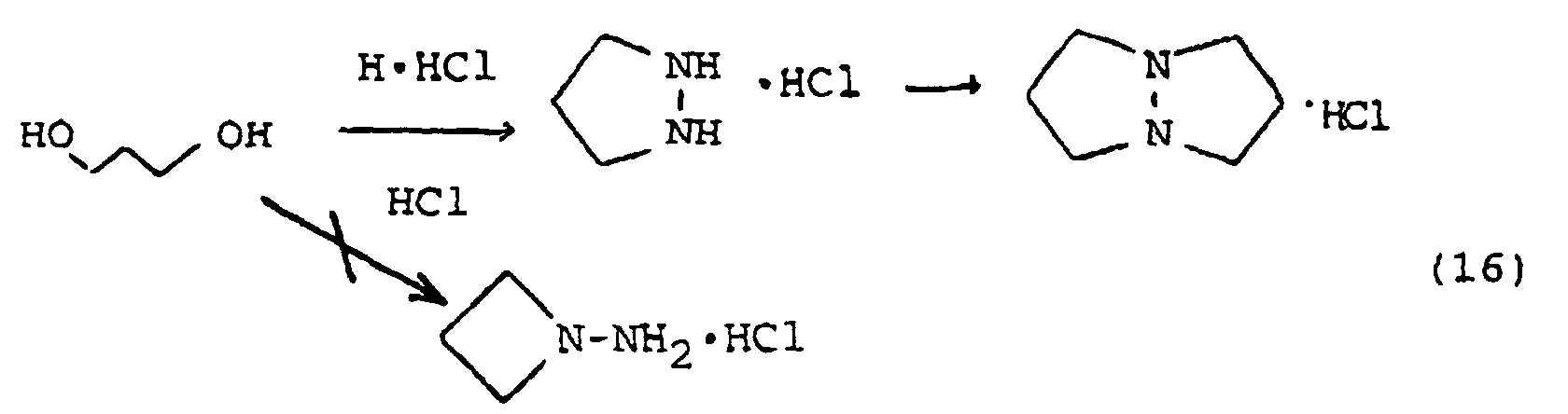
- A 1-liter glass autoclave was charged with 75.4 g (1.10 moles) of hydrazine monohydrochloride, 230.9 g (2.20 moles) of hydrazine dihydrochloride, 83.7 g (1.10 moles) of 1,3-propanediol and 400.0 g of H2O, and with stirring, the above substances were reacted at 140°C for 5 hours.
- After the reaction, the reaction solution was concentrated under reduced pressure, and a mixture of (hydrazine monohydrochloride + hydrazine dihydrochloride) was washed with methanol to separate 233.8 g of white crystals. The composition of the mixture was determined by titration with 1N-NaOH to give hydrazine monohydrochloride 65.24% by weight, [152.53 g (2.23 moles), the recovery rate 101.23%] and HCl 31.67% by weight, [74.04 g (2.03 moles), the recovery rate 92.23%].
- After separating the mixture of (hydrazine monohydrochloride + hydrazine dihydrochloride), pyrazolidine hydrochloride in 109.6 g of the methanol mother liquor was 61.26% (titrated), 67.14 g (0.62 mole), and the formation rate was 56.2%. The reaction selectivity was 75.69% of pyrazolidine and 24.31% of tetrahydro-1H, 5H-pyrazolo-(1,2-a]pyrazole. Incidentally, 1,3-propanediol did not remain (GC).
- A 1-liter glass autoclave was charged with 150.7 g (2.20 moles) of hydrazine monohydrochloride, 115.5 g (1.10 moles) of hydrazine dihydrochloride, 83.7 g (1.10 moles) of 1, 3-propanediol and 400.0 g of H2O, and with stirring, the above substances were reacted at 140°C for 5 hours.
- After the reaction, the reaction solution was concentrated under reduced pressure, and a mixture of (hydrazine monohydrochloride + hydrazine dihydrochloride) was washed with methanol to separate 201.2 g of white crystals. The composition of the mixture was determined by titration with 1N-NaOH to give 80.89% by weight of hydrazine monohydrochloride [162.75 g (2.38 moles), the recovery rate 108.00%], and 17.55% by weight of HCl, [35.30 g (0.97 mole), the recovery rate 87.91%].
- After separating the mixture of (hydrazine monohydrochloride + hydrazine dihydrochloride), pyrazolidine hydrochloride in 109.7 g of the methanol mother liquor was 57.64% (titrated), 63.23 g (0.58 mole), and the formation rate was 52.9%. The reaction selectivity was 77.22% of pyrazolidine and 20.81% of tetrahydro-1H, 5H-pyrazolo-[1,2-a]pyrazole. It was found that 1.97% of 1,3-propanediol remained (GC).
- A 1-liter glass autoclave was charged with 150.2 g (3.00 moles) of hydrazine hydrate, 405.1 g (4.00 moles) of concentrated hydrochloric acid, and 106.1 g (1.00 mole) of diethylene glycol, and with stirring, the above substances were reacted at 140°C for 10 hours.
- After the reaction, the reaction solution was concentrated under reduced pressure, and a mixture of (hydrazine monohydrochloride + hydrazine dihydrochloride) was washed with methanol to separate 144.4 g of white crystals. The composition of the mixture was titrated with 1N-NaOH to give hydrazine monohydrochloride 87.72% by weight, 119.45 g (1.74 moles), the recovery rate 87.18%, HCl 16.09% by weight, 23.23 g (0.64 mole), the recovery rate 63.65%.
- After separating the mixture of (hydrazine monohydrochloride + hydrazine dihydrochloride), a suitable amount of methanol was added to 133.2 g of the methanol mother liquor, and the hydrochloric acid content in the methanol mother liquor was neutralized with 35.5 g (0.89 mole) of sodium hydroxide. 4-Aminomorpholine in the methanol mother liquor was 4.47 g (0.044 mole), the formation rate 4.37%, diethylene glycol 67.7 g (0.638 mole), the conversion 36.2%. 4-Aminomorpholine and diethylene glycol were identified by GC-MS and the fact that the holding time of GC of the standard sample coincided with a holding time of GC of the product.
Claims (11)
- A process for producing an alicyclic hydrazine derivative and/or its hydrohalogenide, which comprises reacting a hydrazine hydrohalogenic acid and/or a salt thereof with a diol compound and/or an alicyclic ether compound in the presence of excess inorganic acid and/or a salt thereof.
- A process according to claim 1 wherein the hydrazine hydrohalogenic acid salt comprises a hydrazine hydromonohalogenic acid salt of formula (1)
- A process according to claim 1 or claim 2 wherein the diol compound is of formula (2)
- A process according to claim 1, 2 or 3 wherein the alicyclic ether compound is of formula (3)wherein r represents an integer of 4 or 5.
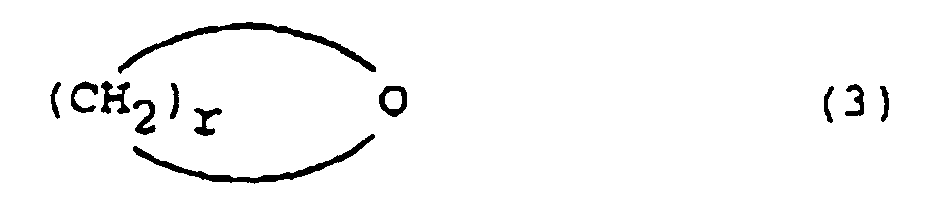
- A process according to any preceding claim wherein the alicyclic hydrazine derivative is of formula (4)wherein A represents an oxygen atom, a methylene group or an ethylidene group, and each of m and n, which maybe the same or different, represents an integer of 1 to 3.
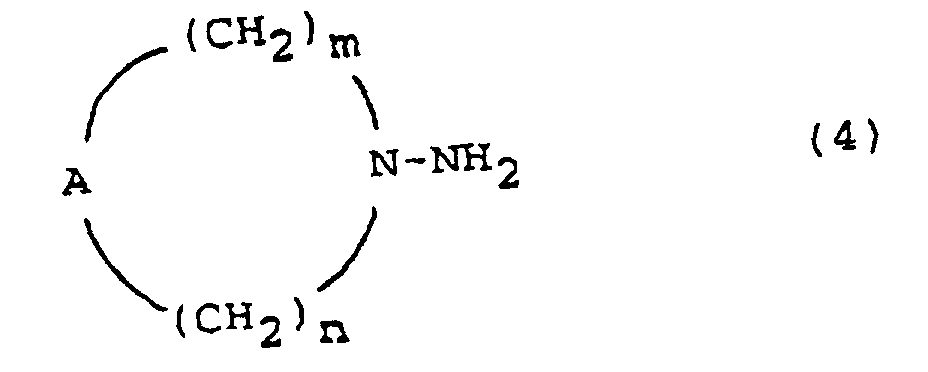
- A process according to any of claims 1 to 4 wherein the alicyclic hydrazine derivative is of formula (5)wherein p represents an integer of 3 to 4.

- A process according to claim 1 wherein the inorganic acid comprises a hydrohalogenic acid.
- A process according to claim 7 wherein the inorganic acid comprises hydrazine hydrodihalogenic acid.
- A process according to any preceding claim wherein the reaction is carried out at a mole ratio of the diol compound or alicyclic ether compound : hydrazine hydromonohalogenic acid and/or salt thereof : inorganic acid of 1 : 1-10 : 0.2-3, and at a temperature of 100 to 150°C, and at a pressure greater than atmospheric pressure.
- A process according to any preceding claim which additionally comprises:(a) concentrating a solution that results from the reaction and/or adding an alcohol solvent thereto, to cause precipitation of unreacted hydrazine hydrohalogenic acid and/or salt thereof;(b) removing precipitate from the solution; and (c) treating mother liquor resulting from that removal of precipitate to cause precipitation of alicyclic hydrazine derivative.
- A process according to any preceding claim wherein the diol compound comprises 1,4-butanediol and/or the alicyclic ether compound comprises tetrahydrofuran, and said alicyclic hydrazine derivative and/or its hydrohalogenic acid salt comprises 1-aminopyrriolidine and/or its hydrohalogenic acid salt, as the case may be.
Applications Claiming Priority (9)
| Application Number | Priority Date | Filing Date | Title |
|---|---|---|---|
| JP35114996 | 1996-12-27 | ||
| JP351148/96 | 1996-12-27 | ||
| JP351149/96 | 1996-12-27 | ||
| JP35114896 | 1996-12-27 | ||
| JP35114896 | 1996-12-27 | ||
| JP35114996A JP3737589B2 (en) | 1996-12-27 | 1996-12-27 | Method for producing alicyclic hydrazine derivatives |
| JP33469297 | 1997-12-04 | ||
| JP334692/97 | 1997-12-04 | ||
| JP9334692A JPH10237046A (en) | 1996-12-27 | 1997-12-04 | Method for producing hexahydropyridazine and tetrahydropyridazine |
Publications (3)
| Publication Number | Publication Date |
|---|---|
| EP0850930A2 EP0850930A2 (en) | 1998-07-01 |
| EP0850930A3 EP0850930A3 (en) | 1998-08-12 |
| EP0850930B1 true EP0850930B1 (en) | 2001-10-31 |
Family
ID=27340683
Family Applications (1)
| Application Number | Title | Priority Date | Filing Date |
|---|---|---|---|
| EP97310641A Expired - Lifetime EP0850930B1 (en) | 1996-12-27 | 1997-12-29 | A process for producing alicyclic hydrazine derivatives. |
Country Status (3)
| Country | Link |
|---|---|
| US (2) | US5977360A (en) |
| EP (1) | EP0850930B1 (en) |
| DE (1) | DE69707825T2 (en) |
Families Citing this family (8)
| Publication number | Priority date | Publication date | Assignee | Title |
|---|---|---|---|---|
| US5989440A (en) * | 1996-11-28 | 1999-11-23 | Kurita Water Industries Ltd. | Method of using oxygen scavenger and removing oxygen from water |
| EP0894788A1 (en) * | 1997-07-25 | 1999-02-03 | Otsuka Chemical Company, Limited | Process for the preparation of 1-aminopyrrolidine |
| FR2874013B1 (en) * | 2004-08-05 | 2006-09-29 | Sanofi Synthelabo | PROCESS FOR THE PREPARATION OF N-AMINOPIPERIDINE AND ITS SALTS |
| DE102005011050A1 (en) * | 2005-03-10 | 2006-09-21 | Degussa Ag | Process for the preparation of 1-aminopiperidine derivatives |
| CN100345828C (en) * | 2005-11-30 | 2007-10-31 | 中国科学院新疆理化技术研究所 | Process for preparing N-amino piperidine hydrochloride |
| CN102060781B (en) * | 2010-12-15 | 2012-09-19 | 浙江大学 | Method for preparing 1,4,5,6-tetrahydropyridazine |
| FR2999574B1 (en) * | 2012-12-18 | 2014-12-05 | Isochem Sa | PROCESS FOR SYNTHESIZING ENDOCYCLIC HYDRAZINES |
| CN118459425B (en) * | 2024-04-29 | 2025-11-14 | 南通华祥医药科技有限公司 | A method for preparing pyrrolidine-1-amine-dihydrochloride |
Family Cites Families (11)
| Publication number | Priority date | Publication date | Assignee | Title |
|---|---|---|---|---|
| US2953570A (en) * | 1957-06-13 | 1960-09-20 | Grace W R & Co | Method of making hydrazine derivatives |
| US3317607A (en) * | 1959-07-30 | 1967-05-02 | Fmc Corp | Chemical reduction of nitrosamines |
| US4202842A (en) * | 1973-11-12 | 1980-05-13 | Stauffer Chemical Company | Copolycondensation products of beta-haloalkyl phosphates and dialkyl phosphonates |
| IL53441A0 (en) | 1977-11-22 | 1978-01-31 | Teva Pharma | Methyladamantyl hydrazines their preparation and pharmaceutical compositions containing them |
| IL53440A0 (en) * | 1977-11-22 | 1978-01-31 | Teva Pharma | 2-adamantyl hydrazines their preparation and pharmaceutical compositions containing them |
| JPS59137453A (en) * | 1983-01-25 | 1984-08-07 | Nippon Hidorajin Kogyo Kk | Preparation of tert-butylhydrazine |
| CA1309716C (en) * | 1987-08-28 | 1992-11-03 | Jun Satow | Condensed heterocyclic derivative, process for their production and herbicides |
| GB8721165D0 (en) * | 1987-09-09 | 1987-10-14 | Beecham Group Plc | Chemical compounds |
| US5668271A (en) * | 1991-11-29 | 1997-09-16 | Banyu Pharmaceutical Co., Ltd. | Indolopyrrolocarbazole derivatives |
| KR100348225B1 (en) * | 1994-02-10 | 2002-11-13 | 이하라케미칼 고교가부시키가이샤 | Method for preparing hexahydropyridazine and hexahydropyridazine-1,2-dicarboxyl derivative |
| JPH08109170A (en) * | 1994-10-12 | 1996-04-30 | Kuraray Co Ltd | Method for producing hexahydropyridazine |
-
1997
- 1997-12-24 US US08/998,168 patent/US5977360A/en not_active Expired - Fee Related
- 1997-12-29 DE DE69707825T patent/DE69707825T2/en not_active Expired - Fee Related
- 1997-12-29 EP EP97310641A patent/EP0850930B1/en not_active Expired - Lifetime
-
1999
- 1999-06-21 US US09/337,607 patent/US6194577B1/en not_active Expired - Lifetime
Also Published As
| Publication number | Publication date |
|---|---|
| EP0850930A2 (en) | 1998-07-01 |
| DE69707825D1 (en) | 2001-12-06 |
| US6194577B1 (en) | 2001-02-27 |
| US5977360A (en) | 1999-11-02 |
| EP0850930A3 (en) | 1998-08-12 |
| DE69707825T2 (en) | 2002-04-11 |
Similar Documents
| Publication | Publication Date | Title |
|---|---|---|
| JP3974939B2 (en) | Process for producing aminoethylethanolamine and / or hydroxyethylpiperazine | |
| JP3962872B2 (en) | Method for synthesizing ketazine | |
| EP0437258B1 (en) | Method of manufacturing aromatic urethane | |
| JPS59184196A (en) | Manufacture of phosphinotricin | |
| US5977360A (en) | Process for producing cyclic hydrazine derivatives, tetra-hydropyridazine and hexahydropyridazine | |
| JPH0517413A (en) | Production of diamine | |
| US4119497A (en) | Process for the purification of acetonitrile | |
| US4067905A (en) | Preparation of 2-amino-n-butanol | |
| US4539403A (en) | Process for the preparation of a 2-alkyl-4-amino-5-aminomethylpyrimidine | |
| US5792880A (en) | Process for the preparation of N-lauroyl-L-glutamic acid di-n-butylamide | |
| JP3737589B2 (en) | Method for producing alicyclic hydrazine derivatives | |
| US20020183557A1 (en) | Process for producing fluorinated alkylamine compound | |
| JPH06179644A (en) | Method for producing N- (α-alkoxyethyl) formamide | |
| US6156941A (en) | Process for producing 1,2-propanediol | |
| US5053545A (en) | Method of preparing amino alcohols | |
| JP3319007B2 (en) | Method for producing N- (α-alkoxyethyl) formamide | |
| US5847216A (en) | Preparation of selegiline | |
| US4010160A (en) | Process for the manufacture of 1,3-bis-(β-ethylhexyl)-5-amino-5-methyl-hexahydropyrimidine | |
| JP4024882B2 (en) | Method for producing tertiary butyl hydrazine / hydrohalide | |
| US4997984A (en) | Process for preparation of N-(α-alkoxyethyl)-carboxylic acid amide | |
| JP3103447B2 (en) | N- (2-chloropyridin-5-yl-methyl) -ethylenediamine | |
| JPH0250101B2 (en) | ||
| JPH05255210A (en) | Preparation of tetramethyl diamino-polyoxyethylene | |
| JPH06298713A (en) | Process for producing N- (α-hydroxyethyl) formamide and N- (α-alkoxyethyl) formamide | |
| JP2558480B2 (en) | Method for producing N-ethylpiperazine |
Legal Events
| Date | Code | Title | Description |
|---|---|---|---|
| PUAI | Public reference made under article 153(3) epc to a published international application that has entered the european phase |
Free format text: ORIGINAL CODE: 0009012 |
|
| PUAL | Search report despatched |
Free format text: ORIGINAL CODE: 0009013 |
|
| AK | Designated contracting states |
Kind code of ref document: A2 Designated state(s): DE FR GB IT NL |
|
| AX | Request for extension of the european patent |
Free format text: AL;LT;LV;MK;RO;SI |
|
| AK | Designated contracting states |
Kind code of ref document: A3 Designated state(s): AT BE CH DE DK ES FI FR GB GR IE IT LI LU MC NL PT SE |
|
| AX | Request for extension of the european patent |
Free format text: AL;LT;LV;MK;RO;SI |
|
| 17P | Request for examination filed |
Effective date: 19981026 |
|
| AKX | Designation fees paid |
Free format text: DE FR GB IT NL |
|
| RBV | Designated contracting states (corrected) |
Designated state(s): DE FR GB IT NL |
|
| 17Q | First examination report despatched |
Effective date: 19991019 |
|
| GRAG | Despatch of communication of intention to grant |
Free format text: ORIGINAL CODE: EPIDOS AGRA |
|
| RTI1 | Title (correction) |
Free format text: A PROCESS FOR PRODUCING ALICYCLIC HYDRAZINE DERIVATIVES. |
|
| RTI1 | Title (correction) |
Free format text: A PROCESS FOR PRODUCING ALICYCLIC HYDRAZINE DERIVATIVES. |
|
| GRAG | Despatch of communication of intention to grant |
Free format text: ORIGINAL CODE: EPIDOS AGRA |
|
| GRAH | Despatch of communication of intention to grant a patent |
Free format text: ORIGINAL CODE: EPIDOS IGRA |
|
| GRAH | Despatch of communication of intention to grant a patent |
Free format text: ORIGINAL CODE: EPIDOS IGRA |
|
| GRAA | (expected) grant |
Free format text: ORIGINAL CODE: 0009210 |
|
| AK | Designated contracting states |
Kind code of ref document: B1 Designated state(s): DE FR GB IT NL |
|
| REF | Corresponds to: |
Ref document number: 69707825 Country of ref document: DE Date of ref document: 20011206 |
|
| REG | Reference to a national code |
Ref country code: GB Ref legal event code: IF02 |
|
| ET | Fr: translation filed | ||
| PLBE | No opposition filed within time limit |
Free format text: ORIGINAL CODE: 0009261 |
|
| STAA | Information on the status of an ep patent application or granted ep patent |
Free format text: STATUS: NO OPPOSITION FILED WITHIN TIME LIMIT |
|
| 26N | No opposition filed | ||
| PGFP | Annual fee paid to national office [announced via postgrant information from national office to epo] |
Ref country code: NL Payment date: 20061203 Year of fee payment: 10 |
|
| PGFP | Annual fee paid to national office [announced via postgrant information from national office to epo] |
Ref country code: FR Payment date: 20061208 Year of fee payment: 10 |
|
| PGFP | Annual fee paid to national office [announced via postgrant information from national office to epo] |
Ref country code: DE Payment date: 20061221 Year of fee payment: 10 |
|
| PGFP | Annual fee paid to national office [announced via postgrant information from national office to epo] |
Ref country code: GB Payment date: 20061227 Year of fee payment: 10 |
|
| PGFP | Annual fee paid to national office [announced via postgrant information from national office to epo] |
Ref country code: IT Payment date: 20061231 Year of fee payment: 10 |
|
| GBPC | Gb: european patent ceased through non-payment of renewal fee |
Effective date: 20071229 |
|
| NLV4 | Nl: lapsed or anulled due to non-payment of the annual fee |
Effective date: 20080701 |
|
| PG25 | Lapsed in a contracting state [announced via postgrant information from national office to epo] |
Ref country code: DE Free format text: LAPSE BECAUSE OF NON-PAYMENT OF DUE FEES Effective date: 20080701 |
|
| REG | Reference to a national code |
Ref country code: FR Ref legal event code: ST Effective date: 20081020 |
|
| PG25 | Lapsed in a contracting state [announced via postgrant information from national office to epo] |
Ref country code: NL Free format text: LAPSE BECAUSE OF NON-PAYMENT OF DUE FEES Effective date: 20080701 |
|
| PG25 | Lapsed in a contracting state [announced via postgrant information from national office to epo] |
Ref country code: GB Free format text: LAPSE BECAUSE OF NON-PAYMENT OF DUE FEES Effective date: 20071229 |
|
| PG25 | Lapsed in a contracting state [announced via postgrant information from national office to epo] |
Ref country code: FR Free format text: LAPSE BECAUSE OF NON-PAYMENT OF DUE FEES Effective date: 20071231 |
|
| PG25 | Lapsed in a contracting state [announced via postgrant information from national office to epo] |
Ref country code: IT Free format text: LAPSE BECAUSE OF NON-PAYMENT OF DUE FEES Effective date: 20071229 |