EP0850253B1 - Betaketosulfonic derivatives suitable to the use as polymerization photoinitiators and photopolymerizable systems containing the same - Google Patents
Betaketosulfonic derivatives suitable to the use as polymerization photoinitiators and photopolymerizable systems containing the same Download PDFInfo
- Publication number
- EP0850253B1 EP0850253B1 EP95933357A EP95933357A EP0850253B1 EP 0850253 B1 EP0850253 B1 EP 0850253B1 EP 95933357 A EP95933357 A EP 95933357A EP 95933357 A EP95933357 A EP 95933357A EP 0850253 B1 EP0850253 B1 EP 0850253B1
- Authority
- EP
- European Patent Office
- Prior art keywords
- betaketosulfonic
- formula
- inks
- compounds
- derivative selected
- Prior art date
- Legal status (The legal status is an assumption and is not a legal conclusion. Google has not performed a legal analysis and makes no representation as to the accuracy of the status listed.)
- Expired - Lifetime
Links
- 239000003211 polymerization photoinitiator Substances 0.000 title claims abstract description 5
- 239000000976 ink Substances 0.000 claims abstract description 34
- 238000000034 method Methods 0.000 claims abstract description 15
- 230000008569 process Effects 0.000 claims abstract description 12
- 239000000049 pigment Substances 0.000 claims abstract description 11
- 238000002360 preparation method Methods 0.000 claims abstract description 8
- 150000001875 compounds Chemical class 0.000 claims description 30
- 239000000203 mixture Substances 0.000 claims description 20
- -1 arylsulfonyl chloride Chemical compound 0.000 claims description 11
- UIIMBOGNXHQVGW-UHFFFAOYSA-M Sodium bicarbonate Chemical compound [Na+].OC([O-])=O UIIMBOGNXHQVGW-UHFFFAOYSA-M 0.000 claims description 6
- LTYMSROWYAPPGB-UHFFFAOYSA-N diphenyl sulfide Chemical compound C=1C=CC=CC=1SC1=CC=CC=C1 LTYMSROWYAPPGB-UHFFFAOYSA-N 0.000 claims description 6
- GEHJYWRUCIMESM-UHFFFAOYSA-L sodium sulfite Chemical compound [Na+].[Na+].[O-]S([O-])=O GEHJYWRUCIMESM-UHFFFAOYSA-L 0.000 claims description 6
- 125000000217 alkyl group Chemical group 0.000 claims description 5
- DGAQECJNVWCQMB-PUAWFVPOSA-M Ilexoside XXIX Chemical compound C[C@@H]1CC[C@@]2(CC[C@@]3(C(=CC[C@H]4[C@]3(CC[C@@H]5[C@@]4(CC[C@@H](C5(C)C)OS(=O)(=O)[O-])C)C)[C@@H]2[C@]1(C)O)C)C(=O)O[C@H]6[C@@H]([C@H]([C@@H]([C@H](O6)CO)O)O)O.[Na+] DGAQECJNVWCQMB-PUAWFVPOSA-M 0.000 claims description 4
- 238000006243 chemical reaction Methods 0.000 claims description 4
- 239000003960 organic solvent Substances 0.000 claims description 4
- 229910052708 sodium Inorganic materials 0.000 claims description 4
- 239000011734 sodium Substances 0.000 claims description 4
- 239000002253 acid Substances 0.000 claims description 3
- VSCWAEJMTAWNJL-UHFFFAOYSA-K aluminium trichloride Chemical compound Cl[Al](Cl)Cl VSCWAEJMTAWNJL-UHFFFAOYSA-K 0.000 claims description 3
- 229910000030 sodium bicarbonate Inorganic materials 0.000 claims description 3
- 235000017557 sodium bicarbonate Nutrition 0.000 claims description 3
- 235000010265 sodium sulphite Nutrition 0.000 claims description 3
- GVIJJXMXTUZIOD-UHFFFAOYSA-N thianthrene Chemical compound C1=CC=C2SC3=CC=CC=C3SC2=C1 GVIJJXMXTUZIOD-UHFFFAOYSA-N 0.000 claims description 3
- CPELXLSAUQHCOX-UHFFFAOYSA-M Bromide Chemical compound [Br-] CPELXLSAUQHCOX-UHFFFAOYSA-M 0.000 claims description 2
- 150000007513 acids Chemical class 0.000 claims description 2
- 229910052500 inorganic mineral Inorganic materials 0.000 claims description 2
- 239000011707 mineral Substances 0.000 claims description 2
- 235000010755 mineral Nutrition 0.000 claims description 2
- 239000002798 polar solvent Substances 0.000 claims description 2
- YMWUJEATGCHHMB-UHFFFAOYSA-N Dichloromethane Chemical compound ClCCl YMWUJEATGCHHMB-UHFFFAOYSA-N 0.000 description 12
- 238000004132 cross linking Methods 0.000 description 10
- 239000000178 monomer Substances 0.000 description 10
- XEKOWRVHYACXOJ-UHFFFAOYSA-N Ethyl acetate Chemical compound CCOC(C)=O XEKOWRVHYACXOJ-UHFFFAOYSA-N 0.000 description 9
- RTZKZFJDLAIYFH-UHFFFAOYSA-N Diethyl ether Chemical compound CCOCC RTZKZFJDLAIYFH-UHFFFAOYSA-N 0.000 description 8
- 125000003118 aryl group Chemical group 0.000 description 8
- GWEVSGVZZGPLCZ-UHFFFAOYSA-N Titan oxide Chemical compound O=[Ti]=O GWEVSGVZZGPLCZ-UHFFFAOYSA-N 0.000 description 7
- 239000000047 product Substances 0.000 description 7
- VYPSYNLAJGMNEJ-UHFFFAOYSA-N Silicium dioxide Chemical compound O=[Si]=O VYPSYNLAJGMNEJ-UHFFFAOYSA-N 0.000 description 6
- ZMANZCXQSJIPKH-UHFFFAOYSA-N Triethylamine Chemical compound CCN(CC)CC ZMANZCXQSJIPKH-UHFFFAOYSA-N 0.000 description 6
- 125000001931 aliphatic group Chemical group 0.000 description 6
- 229920000642 polymer Polymers 0.000 description 6
- 238000006116 polymerization reaction Methods 0.000 description 5
- 239000000126 substance Substances 0.000 description 5
- LWRBVKNFOYUCNP-UHFFFAOYSA-N 2-methyl-1-(4-methylsulfanylphenyl)-2-morpholin-4-ylpropan-1-one Chemical compound C1=CC(SC)=CC=C1C(=O)C(C)(C)N1CCOCC1 LWRBVKNFOYUCNP-UHFFFAOYSA-N 0.000 description 4
- PPBRXRYQALVLMV-UHFFFAOYSA-N Styrene Chemical compound C=CC1=CC=CC=C1 PPBRXRYQALVLMV-UHFFFAOYSA-N 0.000 description 4
- 239000000654 additive Substances 0.000 description 4
- QVGXLLKOCUKJST-UHFFFAOYSA-N atomic oxygen Chemical compound [O] QVGXLLKOCUKJST-UHFFFAOYSA-N 0.000 description 4
- 238000004519 manufacturing process Methods 0.000 description 4
- 239000011159 matrix material Substances 0.000 description 4
- 239000001301 oxygen Substances 0.000 description 4
- 229910052760 oxygen Inorganic materials 0.000 description 4
- 230000009257 reactivity Effects 0.000 description 4
- 0 *c(cc1)ccc1N=O Chemical compound *c(cc1)ccc1N=O 0.000 description 3
- YIKSHDNOAYSSPX-UHFFFAOYSA-N 1-propan-2-ylthioxanthen-9-one Chemical compound S1C2=CC=CC=C2C(=O)C2=C1C=CC=C2C(C)C YIKSHDNOAYSSPX-UHFFFAOYSA-N 0.000 description 3
- 238000005160 1H NMR spectroscopy Methods 0.000 description 3
- 239000004593 Epoxy Substances 0.000 description 3
- LRHPLDYGYMQRHN-UHFFFAOYSA-N N-Butanol Chemical compound CCCCO LRHPLDYGYMQRHN-UHFFFAOYSA-N 0.000 description 3
- DAKWPKUUDNSNPN-UHFFFAOYSA-N Trimethylolpropane triacrylate Chemical compound C=CC(=O)OCC(CC)(COC(=O)C=C)COC(=O)C=C DAKWPKUUDNSNPN-UHFFFAOYSA-N 0.000 description 3
- YPCHGLDQZXOZFW-UHFFFAOYSA-N [2-[[4-methyl-3-[[3-prop-2-enoyloxy-2,2-bis(prop-2-enoyloxymethyl)propoxy]carbonylamino]phenyl]carbamoyloxymethyl]-3-prop-2-enoyloxy-2-(prop-2-enoyloxymethyl)propyl] prop-2-enoate Chemical compound CC1=CC=C(NC(=O)OCC(COC(=O)C=C)(COC(=O)C=C)COC(=O)C=C)C=C1NC(=O)OCC(COC(=O)C=C)(COC(=O)C=C)COC(=O)C=C YPCHGLDQZXOZFW-UHFFFAOYSA-N 0.000 description 3
- VZTQQYMRXDUHDO-UHFFFAOYSA-N [2-hydroxy-3-[4-[2-[4-(2-hydroxy-3-prop-2-enoyloxypropoxy)phenyl]propan-2-yl]phenoxy]propyl] prop-2-enoate Chemical compound C=1C=C(OCC(O)COC(=O)C=C)C=CC=1C(C)(C)C1=CC=C(OCC(O)COC(=O)C=C)C=C1 VZTQQYMRXDUHDO-UHFFFAOYSA-N 0.000 description 3
- 150000001252 acrylic acid derivatives Chemical class 0.000 description 3
- RWCCWEUUXYIKHB-UHFFFAOYSA-N benzophenone Chemical compound C=1C=CC=CC=1C(=O)C1=CC=CC=C1 RWCCWEUUXYIKHB-UHFFFAOYSA-N 0.000 description 3
- 239000012965 benzophenone Substances 0.000 description 3
- 230000015572 biosynthetic process Effects 0.000 description 3
- 150000002148 esters Chemical class 0.000 description 3
- 229940093499 ethyl acetate Drugs 0.000 description 3
- 235000019439 ethyl acetate Nutrition 0.000 description 3
- 239000000945 filler Substances 0.000 description 3
- 238000001033 granulometry Methods 0.000 description 3
- 238000002329 infrared spectrum Methods 0.000 description 3
- 238000002844 melting Methods 0.000 description 3
- 230000008018 melting Effects 0.000 description 3
- FZUGPQWGEGAKET-UHFFFAOYSA-N parbenate Chemical compound CCOC(=O)C1=CC=C(N(C)C)C=C1 FZUGPQWGEGAKET-UHFFFAOYSA-N 0.000 description 3
- 239000003208 petroleum Substances 0.000 description 3
- 238000011417 postcuring Methods 0.000 description 3
- 239000000377 silicon dioxide Substances 0.000 description 3
- 238000003786 synthesis reaction Methods 0.000 description 3
- 150000003512 tertiary amines Chemical class 0.000 description 3
- 239000004408 titanium dioxide Substances 0.000 description 3
- 229940096522 trimethylolpropane triacrylate Drugs 0.000 description 3
- 238000002211 ultraviolet spectrum Methods 0.000 description 3
- XLYOFNOQVPJJNP-UHFFFAOYSA-N water Substances O XLYOFNOQVPJJNP-UHFFFAOYSA-N 0.000 description 3
- 238000004383 yellowing Methods 0.000 description 3
- OZAIFHULBGXAKX-UHFFFAOYSA-N 2-(2-cyanopropan-2-yldiazenyl)-2-methylpropanenitrile Chemical compound N#CC(C)(C)N=NC(C)(C)C#N OZAIFHULBGXAKX-UHFFFAOYSA-N 0.000 description 2
- SMZOUWXMTYCWNB-UHFFFAOYSA-N 2-(2-methoxy-5-methylphenyl)ethanamine Chemical compound COC1=CC=C(C)C=C1CCN SMZOUWXMTYCWNB-UHFFFAOYSA-N 0.000 description 2
- YOCIJWAHRAJQFT-UHFFFAOYSA-N 2-bromo-2-methylpropanoyl bromide Chemical compound CC(C)(Br)C(Br)=O YOCIJWAHRAJQFT-UHFFFAOYSA-N 0.000 description 2
- JDFDJNNXQVYWMX-UHFFFAOYSA-N 4-[2-(dimethylamino)ethyl]benzoic acid Chemical compound CN(C)CCC1=CC=C(C(O)=O)C=C1 JDFDJNNXQVYWMX-UHFFFAOYSA-N 0.000 description 2
- IJGRMHOSHXDMSA-UHFFFAOYSA-N Atomic nitrogen Chemical compound N#N IJGRMHOSHXDMSA-UHFFFAOYSA-N 0.000 description 2
- VEXZGXHMUGYJMC-UHFFFAOYSA-N Hydrochloric acid Chemical compound Cl VEXZGXHMUGYJMC-UHFFFAOYSA-N 0.000 description 2
- CERQOIWHTDAKMF-UHFFFAOYSA-N Methacrylic acid Chemical compound CC(=C)C(O)=O CERQOIWHTDAKMF-UHFFFAOYSA-N 0.000 description 2
- WHNWPMSKXPGLAX-UHFFFAOYSA-N N-Vinyl-2-pyrrolidone Chemical compound C=CN1CCCC1=O WHNWPMSKXPGLAX-UHFFFAOYSA-N 0.000 description 2
- UEEJHVSXFDXPFK-UHFFFAOYSA-N N-dimethylaminoethanol Chemical compound CN(C)CCO UEEJHVSXFDXPFK-UHFFFAOYSA-N 0.000 description 2
- XSQUKJJJFZCRTK-UHFFFAOYSA-N Urea Chemical class NC(N)=O XSQUKJJJFZCRTK-UHFFFAOYSA-N 0.000 description 2
- QYKIQEUNHZKYBP-UHFFFAOYSA-N Vinyl ether Chemical class C=COC=C QYKIQEUNHZKYBP-UHFFFAOYSA-N 0.000 description 2
- 238000013019 agitation Methods 0.000 description 2
- 229910052799 carbon Inorganic materials 0.000 description 2
- 239000003795 chemical substances by application Substances 0.000 description 2
- 238000004040 coloring Methods 0.000 description 2
- VVOLVFOSOPJKED-UHFFFAOYSA-N copper phthalocyanine Chemical compound [Cu].N=1C2=NC(C3=CC=CC=C33)=NC3=NC(C3=CC=CC=C33)=NC3=NC(C3=CC=CC=C33)=NC3=NC=1C1=CC=CC=C12 VVOLVFOSOPJKED-UHFFFAOYSA-N 0.000 description 2
- 239000002270 dispersing agent Substances 0.000 description 2
- 238000001035 drying Methods 0.000 description 2
- 239000003822 epoxy resin Substances 0.000 description 2
- LNEPOXFFQSENCJ-UHFFFAOYSA-N haloperidol Chemical compound C1CC(O)(C=2C=CC(Cl)=CC=2)CCN1CCCC(=O)C1=CC=C(F)C=C1 LNEPOXFFQSENCJ-UHFFFAOYSA-N 0.000 description 2
- QSHDDOUJBYECFT-UHFFFAOYSA-N mercury Chemical compound [Hg] QSHDDOUJBYECFT-UHFFFAOYSA-N 0.000 description 2
- CRVGTESFCCXCTH-UHFFFAOYSA-N methyl diethanolamine Chemical compound OCCN(C)CCO CRVGTESFCCXCTH-UHFFFAOYSA-N 0.000 description 2
- 230000008447 perception Effects 0.000 description 2
- 150000002978 peroxides Chemical class 0.000 description 2
- 238000006303 photolysis reaction Methods 0.000 description 2
- 230000015843 photosynthesis, light reaction Effects 0.000 description 2
- 230000019612 pigmentation Effects 0.000 description 2
- 229920000647 polyepoxide Polymers 0.000 description 2
- 229920000570 polyether Polymers 0.000 description 2
- 239000004814 polyurethane Substances 0.000 description 2
- 229920002635 polyurethane Polymers 0.000 description 2
- 230000005855 radiation Effects 0.000 description 2
- 238000010992 reflux Methods 0.000 description 2
- KFZUDNZQQCWGKF-UHFFFAOYSA-M sodium;4-methylbenzenesulfinate Chemical compound [Na+].CC1=CC=C(S([O-])=O)C=C1 KFZUDNZQQCWGKF-UHFFFAOYSA-M 0.000 description 2
- 239000002904 solvent Substances 0.000 description 2
- 230000003595 spectral effect Effects 0.000 description 2
- 238000012360 testing method Methods 0.000 description 2
- 210000003813 thumb Anatomy 0.000 description 2
- MFEWNFVBWPABCX-UHFFFAOYSA-N 1,1,2,2-tetraphenylethane-1,2-diol Chemical class C=1C=CC=CC=1C(C(O)(C=1C=CC=CC=1)C=1C=CC=CC=1)(O)C1=CC=CC=C1 MFEWNFVBWPABCX-UHFFFAOYSA-N 0.000 description 1
- GJZFGDYLJLCGHT-UHFFFAOYSA-N 1,2-diethylthioxanthen-9-one Chemical compound C1=CC=C2C(=O)C3=C(CC)C(CC)=CC=C3SC2=C1 GJZFGDYLJLCGHT-UHFFFAOYSA-N 0.000 description 1
- MLNJMYHEIDDMJJ-UHFFFAOYSA-N 2-bromo-1-[2-(2-bromo-2-methylpropanoyl)-1h-thianthren-2-yl]-2-methylpropan-1-one Chemical compound C1=CC=C2SC(CC(C=C3)(C(=O)C(C)(Br)C)C(=O)C(C)(C)Br)=C3SC2=C1 MLNJMYHEIDDMJJ-UHFFFAOYSA-N 0.000 description 1
- IIJARGXXQQCGCA-UHFFFAOYSA-N 2-bromo-1-[6-(2-bromo-2-methylpropanoyl)thianthren-2-yl]-2-methylpropan-1-one Chemical compound C1=CC=C(C(=O)C(C)(C)Br)C2=C1SC1=CC(C(=O)C(C)(Br)C)=CC=C1S2 IIJARGXXQQCGCA-UHFFFAOYSA-N 0.000 description 1
- GGDZHEUPZPBLMT-UHFFFAOYSA-N 2-bromo-2-methylbutanoyl bromide Chemical compound CCC(C)(Br)C(Br)=O GGDZHEUPZPBLMT-UHFFFAOYSA-N 0.000 description 1
- WYWIHOGMFBYHTB-UHFFFAOYSA-N 2-methyl-1-[2-[2-methyl-2-(4-methylphenyl)sulfonylpropanoyl]-1h-thianthren-2-yl]-2-(4-methylphenyl)sulfonylpropan-1-one Chemical compound C1=CC(C)=CC=C1S(=O)(=O)C(C)(C)C(=O)C1(C(=O)C(C)(C)S(=O)(=O)C=2C=CC(C)=CC=2)C=CC(SC=2C(=CC=CC=2)S2)=C2C1 WYWIHOGMFBYHTB-UHFFFAOYSA-N 0.000 description 1
- KATMXHACUWKCBH-UHFFFAOYSA-N 2-methyl-1-[6-[2-methyl-2-(4-methylphenyl)sulfonylpropanoyl]thianthren-2-yl]-2-(4-methylphenyl)sulfonylpropan-1-one Chemical compound C1=CC(C)=CC=C1S(=O)(=O)C(C)(C)C(=O)C1=CC=C(SC=2C(=CC=CC=2S2)C(=O)C(C)(C)S(=O)(=O)C=3C=CC(C)=CC=3)C2=C1 KATMXHACUWKCBH-UHFFFAOYSA-N 0.000 description 1
- RFRBGLIRLVDHBN-UHFFFAOYSA-N 2-methyl-2-(4-methylphenyl)sulfonyl-1-(4-methylsulfanylphenyl)propan-1-one Chemical compound C1=CC(SC)=CC=C1C(=O)C(C)(C)S(=O)(=O)C1=CC=C(C)C=C1 RFRBGLIRLVDHBN-UHFFFAOYSA-N 0.000 description 1
- 125000003903 2-propenyl group Chemical group [H]C([*])([H])C([H])=C([H])[H] 0.000 description 1
- IKOAVSIGNGDTNP-UHFFFAOYSA-N 3-hydroxy-1-phenylbutan-1-one Chemical compound CC(O)CC(=O)C1=CC=CC=C1 IKOAVSIGNGDTNP-UHFFFAOYSA-N 0.000 description 1
- SFCYMBAPKIRRBR-UHFFFAOYSA-N 4-(dimethylazaniumyl)-2-ethylbenzoate Chemical compound CCC1=CC(N(C)C)=CC=C1C(O)=O SFCYMBAPKIRRBR-UHFFFAOYSA-N 0.000 description 1
- YYROPELSRYBVMQ-UHFFFAOYSA-N 4-toluenesulfonyl chloride Chemical compound CC1=CC=C(S(Cl)(=O)=O)C=C1 YYROPELSRYBVMQ-UHFFFAOYSA-N 0.000 description 1
- HRPVXLWXLXDGHG-UHFFFAOYSA-N Acrylamide Chemical compound NC(=O)C=C HRPVXLWXLXDGHG-UHFFFAOYSA-N 0.000 description 1
- NLHHRLWOUZZQLW-UHFFFAOYSA-N Acrylonitrile Chemical compound C=CC#N NLHHRLWOUZZQLW-UHFFFAOYSA-N 0.000 description 1
- XDTMQSROBMDMFD-UHFFFAOYSA-N C1CCCCC1 Chemical compound C1CCCCC1 XDTMQSROBMDMFD-UHFFFAOYSA-N 0.000 description 1
- YZDQARFHYWZCOZ-UHFFFAOYSA-N CC(CCC(C1)N=O)C1Nc(cc1)c(C)cc1N=O Chemical compound CC(CCC(C1)N=O)C1Nc(cc1)c(C)cc1N=O YZDQARFHYWZCOZ-UHFFFAOYSA-N 0.000 description 1
- OKTJSMMVPCPJKN-UHFFFAOYSA-N Carbon Chemical compound [C] OKTJSMMVPCPJKN-UHFFFAOYSA-N 0.000 description 1
- 229920000049 Carbon (fiber) Polymers 0.000 description 1
- 239000004971 Cross linker Substances 0.000 description 1
- IMROMDMJAWUWLK-UHFFFAOYSA-N Ethenol Chemical compound OC=C IMROMDMJAWUWLK-UHFFFAOYSA-N 0.000 description 1
- 239000004262 Ethyl gallate Substances 0.000 description 1
- UFHFLCQGNIYNRP-UHFFFAOYSA-N Hydrogen Chemical compound [H][H] UFHFLCQGNIYNRP-UHFFFAOYSA-N 0.000 description 1
- 229920000877 Melamine resin Polymers 0.000 description 1
- 239000000020 Nitrocellulose Substances 0.000 description 1
- 239000004721 Polyphenylene oxide Substances 0.000 description 1
- 244000028419 Styrax benzoin Species 0.000 description 1
- 235000000126 Styrax benzoin Nutrition 0.000 description 1
- 235000008411 Sumatra benzointree Nutrition 0.000 description 1
- ZJCCRDAZUWHFQH-UHFFFAOYSA-N Trimethylolpropane Chemical compound CCC(CO)(CO)CO ZJCCRDAZUWHFQH-UHFFFAOYSA-N 0.000 description 1
- 229920001807 Urea-formaldehyde Polymers 0.000 description 1
- 238000000862 absorption spectrum Methods 0.000 description 1
- NIXOWILDQLNWCW-UHFFFAOYSA-N acrylic acid group Chemical group C(C=C)(=O)O NIXOWILDQLNWCW-UHFFFAOYSA-N 0.000 description 1
- 150000001253 acrylic acids Chemical class 0.000 description 1
- 239000002671 adjuvant Substances 0.000 description 1
- 230000032683 aging Effects 0.000 description 1
- XYLMUPLGERFSHI-UHFFFAOYSA-N alpha-Methylstyrene Chemical compound CC(=C)C1=CC=CC=C1 XYLMUPLGERFSHI-UHFFFAOYSA-N 0.000 description 1
- 150000001412 amines Chemical class 0.000 description 1
- 150000001414 amino alcohols Chemical class 0.000 description 1
- 230000002547 anomalous effect Effects 0.000 description 1
- PYKYMHQGRFAEBM-UHFFFAOYSA-N anthraquinone Natural products CCC(=O)c1c(O)c2C(=O)C3C(C=CC=C3O)C(=O)c2cc1CC(=O)OC PYKYMHQGRFAEBM-UHFFFAOYSA-N 0.000 description 1
- 150000004056 anthraquinones Chemical class 0.000 description 1
- 239000003963 antioxidant agent Substances 0.000 description 1
- 239000008346 aqueous phase Substances 0.000 description 1
- 229960002130 benzoin Drugs 0.000 description 1
- 239000001055 blue pigment Substances 0.000 description 1
- 239000006227 byproduct Substances 0.000 description 1
- 239000004202 carbamide Substances 0.000 description 1
- 239000006229 carbon black Substances 0.000 description 1
- 239000004917 carbon fiber Substances 0.000 description 1
- 239000000919 ceramic Substances 0.000 description 1
- 238000012512 characterization method Methods 0.000 description 1
- 239000007376 cm-medium Substances 0.000 description 1
- XLJKHNWPARRRJB-UHFFFAOYSA-N cobalt(2+) Chemical class [Co+2] XLJKHNWPARRRJB-UHFFFAOYSA-N 0.000 description 1
- 239000000470 constituent Substances 0.000 description 1
- 238000007334 copolymerization reaction Methods 0.000 description 1
- 230000000254 damaging effect Effects 0.000 description 1
- 230000007547 defect Effects 0.000 description 1
- ISAOCJYIOMOJEB-UHFFFAOYSA-N desyl alcohol Natural products C=1C=CC=CC=1C(O)C(=O)C1=CC=CC=C1 ISAOCJYIOMOJEB-UHFFFAOYSA-N 0.000 description 1
- 239000000975 dye Substances 0.000 description 1
- 125000001495 ethyl group Chemical group [H]C([H])([H])C([H])([H])* 0.000 description 1
- 230000007717 exclusion Effects 0.000 description 1
- 238000000605 extraction Methods 0.000 description 1
- 238000001914 filtration Methods 0.000 description 1
- 235000013305 food Nutrition 0.000 description 1
- 235000011087 fumaric acid Nutrition 0.000 description 1
- 150000002237 fumaric acid derivatives Chemical class 0.000 description 1
- 150000002238 fumaric acids Chemical class 0.000 description 1
- 239000011521 glass Substances 0.000 description 1
- 239000003365 glass fiber Substances 0.000 description 1
- 150000002334 glycols Chemical class 0.000 description 1
- 238000000227 grinding Methods 0.000 description 1
- 235000019382 gum benzoic Nutrition 0.000 description 1
- 239000001257 hydrogen Substances 0.000 description 1
- 229910052739 hydrogen Inorganic materials 0.000 description 1
- 125000004435 hydrogen atom Chemical group [H]* 0.000 description 1
- 150000002432 hydroperoxides Chemical class 0.000 description 1
- 239000003112 inhibitor Substances 0.000 description 1
- 230000002401 inhibitory effect Effects 0.000 description 1
- 230000005764 inhibitory process Effects 0.000 description 1
- 239000001023 inorganic pigment Substances 0.000 description 1
- 239000004922 lacquer Substances 0.000 description 1
- 150000002688 maleic acid derivatives Chemical class 0.000 description 1
- 150000002689 maleic acids Chemical class 0.000 description 1
- WPBNNNQJVZRUHP-UHFFFAOYSA-L manganese(2+);methyl n-[[2-(methoxycarbonylcarbamothioylamino)phenyl]carbamothioyl]carbamate;n-[2-(sulfidocarbothioylamino)ethyl]carbamodithioate Chemical compound [Mn+2].[S-]C(=S)NCCNC([S-])=S.COC(=O)NC(=S)NC1=CC=CC=C1NC(=S)NC(=O)OC WPBNNNQJVZRUHP-UHFFFAOYSA-L 0.000 description 1
- 239000000463 material Substances 0.000 description 1
- 230000007246 mechanism Effects 0.000 description 1
- 239000002609 medium Substances 0.000 description 1
- JDSHMPZPIAZGSV-UHFFFAOYSA-N melamine Chemical compound NC1=NC(N)=NC(N)=N1 JDSHMPZPIAZGSV-UHFFFAOYSA-N 0.000 description 1
- 229910052751 metal Inorganic materials 0.000 description 1
- 239000002184 metal Substances 0.000 description 1
- 150000002739 metals Chemical class 0.000 description 1
- 229920001220 nitrocellulos Polymers 0.000 description 1
- 229910052757 nitrogen Inorganic materials 0.000 description 1
- 230000003287 optical effect Effects 0.000 description 1
- 239000012074 organic phase Substances 0.000 description 1
- 239000012860 organic pigment Substances 0.000 description 1
- 238000004806 packaging method and process Methods 0.000 description 1
- 239000003973 paint Substances 0.000 description 1
- WXZMFSXDPGVJKK-UHFFFAOYSA-N pentaerythritol Chemical compound OCC(CO)(CO)CO WXZMFSXDPGVJKK-UHFFFAOYSA-N 0.000 description 1
- 150000002976 peresters Chemical class 0.000 description 1
- 239000012071 phase Substances 0.000 description 1
- 125000001997 phenyl group Chemical group [H]C1=C([H])C([H])=C(*)C([H])=C1[H] 0.000 description 1
- 238000007539 photo-oxidation reaction Methods 0.000 description 1
- 239000004033 plastic Substances 0.000 description 1
- 229920003023 plastic Polymers 0.000 description 1
- 229920000058 polyacrylate Polymers 0.000 description 1
- 229920000728 polyester Polymers 0.000 description 1
- 229920001228 polyisocyanate Polymers 0.000 description 1
- 239000005056 polyisocyanate Substances 0.000 description 1
- 229920000098 polyolefin Polymers 0.000 description 1
- 229920001296 polysiloxane Polymers 0.000 description 1
- KCTAWXVAICEBSD-UHFFFAOYSA-N prop-2-enoyloxy prop-2-eneperoxoate Chemical compound C=CC(=O)OOOC(=O)C=C KCTAWXVAICEBSD-UHFFFAOYSA-N 0.000 description 1
- 150000003254 radicals Chemical class 0.000 description 1
- 229920005989 resin Polymers 0.000 description 1
- 239000011347 resin Substances 0.000 description 1
- 230000004044 response Effects 0.000 description 1
- 230000001235 sensitizing effect Effects 0.000 description 1
- 159000000000 sodium salts Chemical class 0.000 description 1
- 239000003381 stabilizer Substances 0.000 description 1
- 230000006103 sulfonylation Effects 0.000 description 1
- 238000005694 sulfonylation reaction Methods 0.000 description 1
- 239000004753 textile Substances 0.000 description 1
- 238000007725 thermal activation Methods 0.000 description 1
- 238000012719 thermal polymerization Methods 0.000 description 1
- 239000003017 thermal stabilizer Substances 0.000 description 1
- 239000013008 thixotropic agent Substances 0.000 description 1
- WFKWXMTUELFFGS-UHFFFAOYSA-N tungsten Chemical compound [W] WFKWXMTUELFFGS-UHFFFAOYSA-N 0.000 description 1
- 229910052721 tungsten Inorganic materials 0.000 description 1
- 239000010937 tungsten Substances 0.000 description 1
- 229920006305 unsaturated polyester Polymers 0.000 description 1
- 239000003643 water by type Substances 0.000 description 1
- 239000000080 wetting agent Substances 0.000 description 1
- 239000002023 wood Substances 0.000 description 1
- 229910052724 xenon Inorganic materials 0.000 description 1
- FHNFHKCVQCLJFQ-UHFFFAOYSA-N xenon atom Chemical compound [Xe] FHNFHKCVQCLJFQ-UHFFFAOYSA-N 0.000 description 1
Classifications
-
- C—CHEMISTRY; METALLURGY
- C09—DYES; PAINTS; POLISHES; NATURAL RESINS; ADHESIVES; COMPOSITIONS NOT OTHERWISE PROVIDED FOR; APPLICATIONS OF MATERIALS NOT OTHERWISE PROVIDED FOR
- C09D—COATING COMPOSITIONS, e.g. PAINTS, VARNISHES OR LACQUERS; FILLING PASTES; CHEMICAL PAINT OR INK REMOVERS; INKS; CORRECTING FLUIDS; WOODSTAINS; PASTES OR SOLIDS FOR COLOURING OR PRINTING; USE OF MATERIALS THEREFOR
- C09D11/00—Inks
- C09D11/02—Printing inks
- C09D11/10—Printing inks based on artificial resins
- C09D11/101—Inks specially adapted for printing processes involving curing by wave energy or particle radiation, e.g. with UV-curing following the printing
-
- C—CHEMISTRY; METALLURGY
- C07—ORGANIC CHEMISTRY
- C07C—ACYCLIC OR CARBOCYCLIC COMPOUNDS
- C07C323/00—Thiols, sulfides, hydropolysulfides or polysulfides substituted by halogen, oxygen or nitrogen atoms, or by sulfur atoms not being part of thio groups
- C07C323/64—Thiols, sulfides, hydropolysulfides or polysulfides substituted by halogen, oxygen or nitrogen atoms, or by sulfur atoms not being part of thio groups containing thio groups and sulfur atoms, not being part of thio groups, bound to the same carbon skeleton
- C07C323/65—Thiols, sulfides, hydropolysulfides or polysulfides substituted by halogen, oxygen or nitrogen atoms, or by sulfur atoms not being part of thio groups containing thio groups and sulfur atoms, not being part of thio groups, bound to the same carbon skeleton containing sulfur atoms of sulfone or sulfoxide groups bound to the carbon skeleton
-
- C—CHEMISTRY; METALLURGY
- C07—ORGANIC CHEMISTRY
- C07D—HETEROCYCLIC COMPOUNDS
- C07D339/00—Heterocyclic compounds containing rings having two sulfur atoms as the only ring hetero atoms
- C07D339/08—Six-membered rings
-
- C—CHEMISTRY; METALLURGY
- C08—ORGANIC MACROMOLECULAR COMPOUNDS; THEIR PREPARATION OR CHEMICAL WORKING-UP; COMPOSITIONS BASED THEREON
- C08F—MACROMOLECULAR COMPOUNDS OBTAINED BY REACTIONS ONLY INVOLVING CARBON-TO-CARBON UNSATURATED BONDS
- C08F2/00—Processes of polymerisation
- C08F2/46—Polymerisation initiated by wave energy or particle radiation
- C08F2/48—Polymerisation initiated by wave energy or particle radiation by ultraviolet or visible light
- C08F2/50—Polymerisation initiated by wave energy or particle radiation by ultraviolet or visible light with sensitising agents
-
- G—PHYSICS
- G03—PHOTOGRAPHY; CINEMATOGRAPHY; ANALOGOUS TECHNIQUES USING WAVES OTHER THAN OPTICAL WAVES; ELECTROGRAPHY; HOLOGRAPHY
- G03F—PHOTOMECHANICAL PRODUCTION OF TEXTURED OR PATTERNED SURFACES, e.g. FOR PRINTING, FOR PROCESSING OF SEMICONDUCTOR DEVICES; MATERIALS THEREFOR; ORIGINALS THEREFOR; APPARATUS SPECIALLY ADAPTED THEREFOR
- G03F7/00—Photomechanical, e.g. photolithographic, production of textured or patterned surfaces, e.g. printing surfaces; Materials therefor, e.g. comprising photoresists; Apparatus specially adapted therefor
- G03F7/004—Photosensitive materials
- G03F7/027—Non-macromolecular photopolymerisable compounds having carbon-to-carbon double bonds, e.g. ethylenic compounds
- G03F7/028—Non-macromolecular photopolymerisable compounds having carbon-to-carbon double bonds, e.g. ethylenic compounds with photosensitivity-increasing substances, e.g. photoinitiators
- G03F7/031—Organic compounds not covered by group G03F7/029
Definitions
- the present invention concerns new betaketosulfonic derivatives suitable to the use as polymerization photoinitiators, the process for their praparation and the photopolymerizable systems containing the same.
- Said systems find application in the inks field and particularly in the field of the inks having high content in pigments.
- the photochemical polymerization of monomers and unsaturated prepolymers is a widespread technique used in various technological fields, such as those of paints and lacquers, of printing inks, in the making of printing plates and electronic circuits, stencils for ceramics and textile printing, and in the manufacture of dental apparatuses.
- the used photocross linkable systems are based on active monomers, such as derivatives of the acrylic and methacrylic acid, N-vinylpyrrolidone, vinyl ethers, styrene, allyl derivatives, maleic and fumaric acid derivatives; on ethylenic unsaturated polyester, polyether, polyurethane, silicone, epoxy oligomers and polymers; on pigments, fillers, additives, various auxiliares, on a photoinitiator or on a system composed of a mixture of photoinitiators, some of them particularly suitable to the pigmented system and other acting as adjuvants (benzophenone, benzyldimethylketale etc.).
- active monomers such as derivatives of the acrylic and methacrylic acid, N-vinylpyrrolidone, vinyl ethers, styrene, allyl derivatives, maleic and fumaric acid derivatives
- ethylenic unsaturated polyester polyether, polyurethane,
- the polymerization inhibition owing to oxygen is a problem particularly important for printing inks, considering their limited thickness and their high surface/volume ratio.
- aromatic aliphatic or entirely aliphatic amines are generally used, such as for instance triethylamine, N-methyldiethanolamine, N,N-dimethylethanolamine, p-dimethylaminoethylbenzoate, as is for instance described in the Patent US 4 318 791.
- IX isopropyl thioxanthone
- Some of the products belonging to such a class point out spectral requirements and reactivity suitable to the cross-linking of pigmented inks.
- the use of such compounds allow to obtain inks with a low yellowing degree, whether immediately after the exposure to the light sources, or by aging in the natural light; however the residual odour, even though not so marked as the previously cited cases, is a limit to their employment. Therefore the necessity is felt to find some products using which such residual odour after the photocross-linking is totally removed or remarkably reduced.
- the present invention concerns photopolymerizable systems containing at least one betaketosulfonic derivative selected from the compounds having formula I: wherein A is and II: wherein R, R 1 , R 2 , R 3 , R 4 each independently are H or C 1-4 linear or branched alkyl chain and n is 0 or 1 particularly when said systems are pigmented inks.
- Example of formula (I) is represented by the 4-4'-bis[2(4-methylphenylsulfonyl)-2-methyl-1-propanoyl]diphenyl sulfide, while an example of formula (II) corresponds to the 2,2-bis[2(4-methylphenylsulfonyl)-2-methyl-1-propanoyl]thianthrene.
- the invention concerns, besides the compounds (I) and (II), the process for their preparation.
- the compounds having formula (I) and (II) are used as photoinitiators in photopolymerizable systems, containing reactive monomers and oligomers.
- photopolymerizable system means in the present text a mixture of photopolymerizable or cross-linkable monomers and oligomers, at least one photoinitiator, fillers, pigments. dispersants and other additives of general use.
- photopolymerization is meant in broad sense and includes, for instance, also the further polymerization or cross-linking of polymeric material, for instance of prepolymers, the homopolymerization, and the copolymerization of simple monomers, and the combination of these kinds of reaction.
- the monomers suitable for the system of the present invention comprise the esters of the acrylic and methacrylic acid with aliphatic alcohols, glycols, polyhydroxylated compounds such as pentaerythritol or trimethylolpropane or aminoalcohols; acrylonitrile; acrylamide and their derivatives; esters of vinyl alcohol with aliphatic or acrylic acids; vinyl ethers; N-vinylpyrrolidone; mono and polyfunctional allyl ethers such as the trimethylolpropandiallyl ether; styrene and alphamethylstyrene; derivatives of maleic and fumaric acids.
- the reactive oligomers suitable for the present invention include polyesters, polyacrylates, polyurethanes, epoxy resins, polyethers containing acrylic, fumaric or maleic functionality.
- the pigments used comprise inorganic pigments such as the titanium dioxide and the "Carbon Black", organic pigments on azo, phtalocyanine, anthraquinone etc. base.
- the compounds (I) and (II) of the present invention act as photoinitiators and besides they may be used by themselves or in combination with other photoinitiators such as benzophenone, benzyldimethylketale, 2-hydroxypropylphenylketone, benzoin ethers etc.
- Particularly advantageous turns out the combination with tertiary amines which increase the cross-linking speed of the mixture, such as triethylamine, N-methyldiethanolamine, N,N-dimethylethanolamine, p-dimethylaminoethylbenzoate, in the way they are commonly used.
- sensitizing substances or coinitiators such as thioxanthones and their derivatives, in the way they are normally used.
- thermal stabilizers such as thermal stabilizers, inhibitors of the thermal polymerization, sensitizers, photo-oxidations stabilizers such as steric hindrance amines, antioxidants, atmospheric oxygen exclusion agents, thermal generators of radicals such as organic and inorganic peroxides, peresters, hydroperoxides, benzopinacols, azoderivatives such as azobisisobutyronitrile, metallic compounds such as cobalt (II) salts, manganese, surface levelling agents, fillers, dyes, glass and carbon fibers, thixotropic agents.
- thermal stabilizers such as inhibitors of the thermal polymerization, sensitizers, photo-oxidations stabilizers such as steric hindrance amines, antioxidants, atmospheric oxygen exclusion agents, thermal generators of radicals such as organic and inorganic peroxides, peresters, hydroperoxides, benzopinacols, azoderivatives such as azobisisobutyronitrile, metallic
- unphotopolymerizable polymers present as chemically inert substances, such as nitrocellulose, polyacrylic esters, polyolefines etc., or cross-linkable polymers by alternative systems such as peroxides and atmospheric oxygen, or by acid catalisys or thermal activation, such as for instance polyisocyanates, urea, melamine or epoxy resins.
- Such photopolymerizable systems may be either of transparent kind or pigmented, and they are used in the printing, graphic arts, plastic meterials, metals, wood, glass etc. fields. Their use in the inks field, above all those having high pigmentation level must be particularly underlined: in this case the pigments are present in an amount ranging from 10 to 60% by weight, and preferably between 15 and 40%.
- the compounds having formula (I) and (II) are generally used in a quantity between 0.01% and 20% by weight, and preferably between 0.5% and 5%; they show a great dispersibility in the photopolymerizable systems, to which they give a high photochemical reactivity and stability to light.
- the light sources used for the photopolymerization are high, medium or low-pressure mercury-vapor lamps or superactinic lamps, with emission bands in the region between 250 and 400 nm.
- the sunlight or other artificial sources such as xenon, tungsten lamps and laser sources are included.
- "doped" lamps with a particularly high emission between 350 and 450 nm are preferably used.
- the above mentioned compositions are ground on a three cilinders refiner till a granulometry between 0.1 and 2 ⁇ m and preferably lower than 1 ⁇ m is achieved.
- Such grinding may be carried out either formerly or subsequently to the addition by simple agitation of a photoinitiator and coinitiator mixture, wherein the photoinitiator is contained in an amount between 30 and 70%.
- the polymerization is obtained by known methods, by irradiation in the suitable wavelength range.
- Irgalite Blue BNSF®, CIBA blue pigment.
- Efka Polymer LP 8001®, EFKA CHEMICALS BV polyacrylic base dispersant. Verol 368®, LAMBERTI SpA: sulfosuccinic base wetting agent.
- composition of the matrix for the blue inks is a composition of the matrix for the blue inks:
- the compositions are grinded on a three cilinders refiner till a granulometry lower than one micron and photocross-linked by irradiation in the above reported conditions.
- composition of the matrix for the white inks is a composition of the matrix for the white inks:
- the compositions are grinded on a three cilinders refiner till a granulometry lower than one micron, and photocross-linked by irradiation in the above reported conditions.
- the characterization of the so obtained inks is carried out analysing the following parameters:
- the ink is applied at a thickness of 1 micron, by a mechanical coater equipped with head for offset applications, on a PVC support and then it is passed at a distance of 15 cm from the light source, under the UV radiation of a 80 W/cm medium pressure mercury-vapor lamp, of which a Steinmann® photocross-linker is equipped.
- the cross-linking speed measured in m/mim, is expressed as the maximum speed of the belt conveying the manufacture which allows the perfect ink cross-linking (tack free). The last is assured when, at the cross-linker outlet, the ink does not show superficial damagings after frictions with the edge of a folded sheet of paper or after repeated pressures and twists of the thumb well sticked on the surface (thumb twist test). In the above described conditions it is assumed that, if at the line velocity of 80 m/min the ink reaches the tack free conditions, it has a good applicative response.
- the tested inks supported on PVC specimens are passed under the indicated photocross-linker at a speed of 50 m/min to assure the complete polymerization and then the absence of odour due to the possible presence of unreacted acrylates, immediately ermetically and oven by one closed in jars and put in a thermostated oven at 60 °C. After 1 hour a group of 5 persons gives an opinion on the residual odour produced by the inked specimens signed in an anonymous way.
Landscapes
- Chemical & Material Sciences (AREA)
- Organic Chemistry (AREA)
- Physics & Mathematics (AREA)
- Materials Engineering (AREA)
- Wood Science & Technology (AREA)
- Life Sciences & Earth Sciences (AREA)
- Engineering & Computer Science (AREA)
- Spectroscopy & Molecular Physics (AREA)
- General Physics & Mathematics (AREA)
- Health & Medical Sciences (AREA)
- Chemical Kinetics & Catalysis (AREA)
- Medicinal Chemistry (AREA)
- Polymers & Plastics (AREA)
- Inks, Pencil-Leads, Or Crayons (AREA)
- Polymerisation Methods In General (AREA)
Abstract
Description
- The present invention concerns new betaketosulfonic derivatives suitable to the use as polymerization photoinitiators, the process for their praparation and the photopolymerizable systems containing the same.
- Said systems find application in the inks field and particularly in the field of the inks having high content in pigments.
- The photochemical polymerization of monomers and unsaturated prepolymers is a widespread technique used in various technological fields, such as those of paints and lacquers, of printing inks, in the making of printing plates and electronic circuits, stencils for ceramics and textile printing, and in the manufacture of dental apparatuses.
- In particular, in the production of printing inks, the used photocross linkable systems are based on active monomers, such as derivatives of the acrylic and methacrylic acid, N-vinylpyrrolidone, vinyl ethers, styrene, allyl derivatives, maleic and fumaric acid derivatives; on ethylenic unsaturated polyester, polyether, polyurethane, silicone, epoxy oligomers and polymers; on pigments, fillers, additives, various auxiliares, on a photoinitiator or on a system composed of a mixture of photoinitiators, some of them particularly suitable to the pigmented system and other acting as adjuvants (benzophenone, benzyldimethylketale etc.). The constituent parts of these systems of photoinitiators are generally:
- a) a photoinitiator at least, which must show an absorption spectrum in the spectral region where resins and pigments have a minimum in absorpion or reflection of the incident light (optical window) and where the light source used for the process emits a peak or a radiation band (light). For the photoinitiator systems at present in use, this region is located between 360 and 420 nm.
- b) a coinitiator at least, generally a tertiary amine with hydrogen atoms available on carbon in alpha position with respect to nitrogen, which is essential when the photoinitiator acts by a hydrogen extraction mechanism, such as benzophenone and thioxanthones. Said coinitiator in any case turns out to be very useful even in the case of photoinitiators acting by homolytic breaking: in fact the tertiary amines eliminate the oxygen inhibitory effect, increasing the speed of the whole photopolymerization process.
-
- The polymerization inhibition owing to oxygen is a problem particularly important for printing inks, considering their limited thickness and their high surface/volume ratio.
- For such purposes aromatic aliphatic or entirely aliphatic amines are generally used, such as for instance triethylamine, N-methyldiethanolamine, N,N-dimethylethanolamine, p-dimethylaminoethylbenzoate, as is for instance described in the Patent US 4 318 791.
- The photopolymerization of pigmented printing inks has always shown various technical problems connected to the existence of some necessities:
- attainment of drying rates lying in the 15-200 m/min range, compatible with the industrial application in printing and graphic arts;
- achievement of a perfectly cross-linked film, avoiding the variation of the tone of the pigments added to the system, such as an undesired yellowing of the obtained film;
- perfect covering of the support, to obtain which a high pigmentation is needed, about 20-60% by weight;
- safety in the working environment limiting the residual odour, due to photolysis products or to not reacted monomers, particularly to acrylates, and limiting the presence of volatile substances during the photopolymerization stages.
- Among the photoinitiators which have found grater use in the ink field there is the isopropyl thioxanthone (ITX), having the following formulaand similar derivatives (for instance the diethyl thioxanthone), as described in the American Patent US 4 434 035.
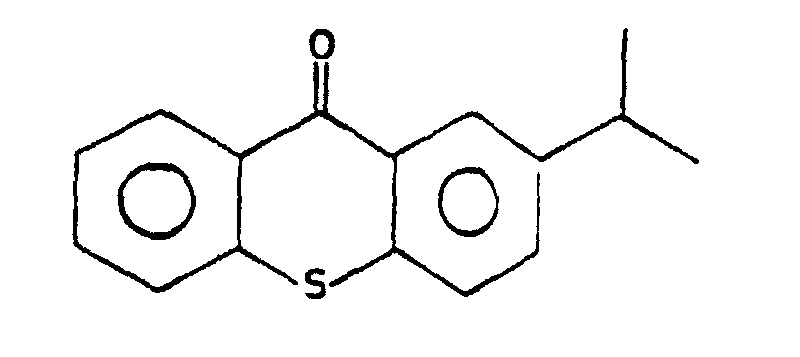
- However the compound has the drawback to be coloured and consequently to give an undesired colouring to the white or light tone inks. Some attempts to correct such defects have been carried out, as described in the European Patent EP 88050, with the introduction of the photoinitiators belonging to the class of the aminoketones, among which the 2-methyl-1-[4-(methylthio)phenyl]-2-morpholino-1-propanone (MMMP) has been developed.
- In this case the yellowing of the film turns out to be very low, but a serious limitation is presented by the residual odour due to the photolysis by-products of the photoinitiator after the irradiation process. Such odour is the cause of drawbacks during the productions in the working environment and persists in the processed goods; therefore the use of this product cannot be enlarged to the printing of the packagings destined to the food industry.
- The introduction of such products on the market has been therefore limited and at the present time the coexistence of ITX and MMMP is noticed.
- Recently the Applicant himself discovered a new family of photoinitiators of betaketosulfonic kind, described in the patent US 5 026 740.
- Some of the products belonging to such a class point out spectral requirements and reactivity suitable to the cross-linking of pigmented inks. The use of such compounds allow to obtain inks with a low yellowing degree, whether immediately after the exposure to the light sources, or by aging in the natural light; however the residual odour, even though not so marked as the previously cited cases, is a limit to their employment. Therefore the necessity is felt to find some products using which such residual odour after the photocross-linking is totally removed or remarkably reduced.
- Within the limits of the family of photoinitiators just described, some structures have been surprisingly discovered showing photoinitiating properties, without generation of residual odour after the irradiation process, or generation of anomalous colouring or variation of tone of the film.
- The present invention concerns photopolymerizable systems containing at least one betaketosulfonic derivative selected from the compounds having formula I:wherein A is
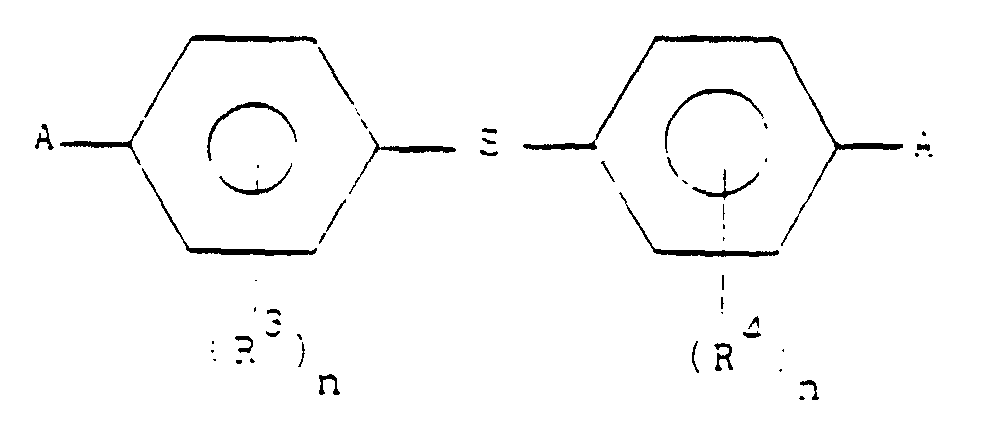 and II:
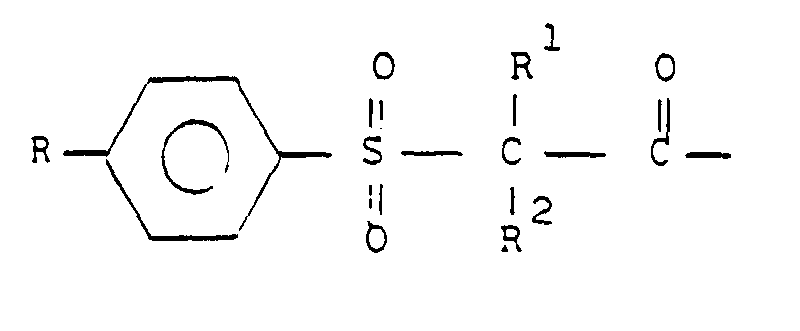 wherein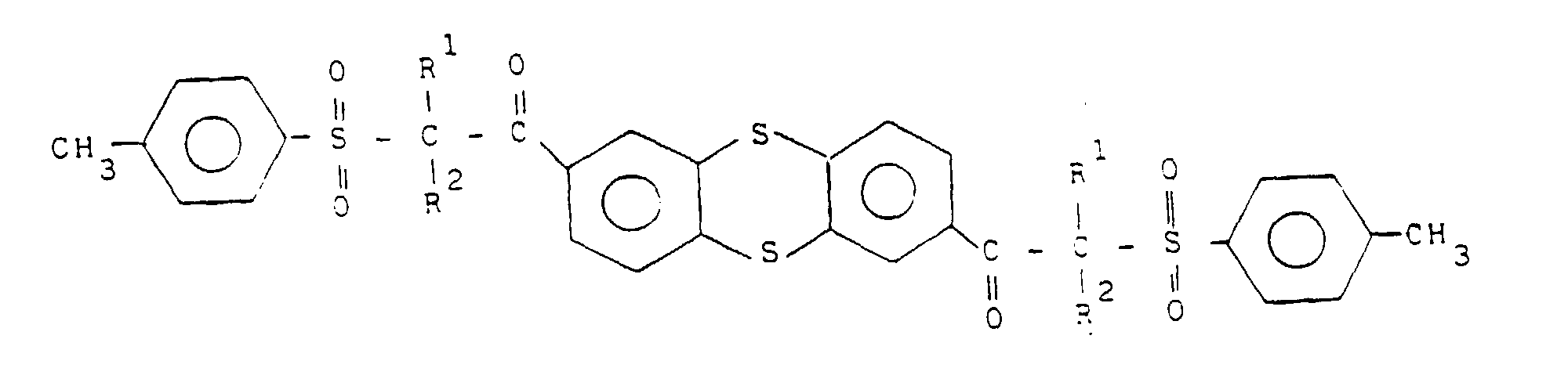
R, R1, R2, R3, R4 each independently are H or C1-4 linear or branched alkyl chain and n is 0 or 1 particularly when said systems are pigmented inks. - Example of formula (I) is represented by the 4-4'-bis[2(4-methylphenylsulfonyl)-2-methyl-1-propanoyl]diphenyl sulfide, while an example of formula (II) corresponds to the 2,2-bis[2(4-methylphenylsulfonyl)-2-methyl-1-propanoyl]thianthrene.
- The invention concerns, besides the compounds (I) and (II), the process for their preparation.
- According to the present invention, the compounds having formula (I) and (II) are used as photoinitiators in photopolymerizable systems, containing reactive monomers and oligomers. The word "photopolymerizable system" means in the present text a mixture of photopolymerizable or cross-linkable monomers and oligomers, at least one photoinitiator, fillers, pigments. dispersants and other additives of general use. The expression "photopolymerization" is meant in broad sense and includes, for instance, also the further polymerization or cross-linking of polymeric material, for instance of prepolymers, the homopolymerization, and the copolymerization of simple monomers, and the combination of these kinds of reaction. The monomers suitable for the system of the present invention comprise the esters of the acrylic and methacrylic acid with aliphatic alcohols, glycols, polyhydroxylated compounds such as pentaerythritol or trimethylolpropane or aminoalcohols; acrylonitrile; acrylamide and their derivatives; esters of vinyl alcohol with aliphatic or acrylic acids; vinyl ethers; N-vinylpyrrolidone; mono and polyfunctional allyl ethers such as the trimethylolpropandiallyl ether; styrene and alphamethylstyrene; derivatives of maleic and fumaric acids.
- The reactive oligomers suitable for the present invention include polyesters, polyacrylates, polyurethanes, epoxy resins, polyethers containing acrylic, fumaric or maleic functionality. The pigments used comprise inorganic pigments such as the titanium dioxide and the "Carbon Black", organic pigments on azo, phtalocyanine, anthraquinone etc. base.
- The compounds (I) and (II) of the present invention act as photoinitiators and besides they may be used by themselves or in combination with other photoinitiators such as benzophenone, benzyldimethylketale, 2-hydroxypropylphenylketone, benzoin ethers etc. Particularly advantageous turns out the combination with tertiary amines which increase the cross-linking speed of the mixture, such as triethylamine, N-methyldiethanolamine, N,N-dimethylethanolamine, p-dimethylaminoethylbenzoate, in the way they are commonly used. For the pigmented systems turns out particularly advantageous the use of sensitizing substances or coinitiators, such as thioxanthones and their derivatives, in the way they are normally used.
- In addition to the compounds having formula (I) and (II), many components may be included in the photopolymerizable system, such as thermal stabilizers, inhibitors of the thermal polymerization, sensitizers, photo-oxidations stabilizers such as steric hindrance amines, antioxidants, atmospheric oxygen exclusion agents, thermal generators of radicals such as organic and inorganic peroxides, peresters, hydroperoxides, benzopinacols, azoderivatives such as azobisisobutyronitrile, metallic compounds such as cobalt (II) salts, manganese, surface levelling agents, fillers, dyes, glass and carbon fibers, thixotropic agents. Other components are constituted by unphotopolymerizable polymers, present as chemically inert substances, such as nitrocellulose, polyacrylic esters, polyolefines etc., or cross-linkable polymers by alternative systems such as peroxides and atmospheric oxygen, or by acid catalisys or thermal activation, such as for instance polyisocyanates, urea, melamine or epoxy resins.
- Such photopolymerizable systems may be either of transparent kind or pigmented, and they are used in the printing, graphic arts, plastic meterials, metals, wood, glass etc. fields. Their use in the inks field, above all those having high pigmentation level must be particularly underlined: in this case the pigments are present in an amount ranging from 10 to 60% by weight, and preferably between 15 and 40%.
- The compounds having formula (I) and (II) are generally used in a quantity between 0.01% and 20% by weight, and preferably between 0.5% and 5%; they show a great dispersibility in the photopolymerizable systems, to which they give a high photochemical reactivity and stability to light. The light sources used for the photopolymerization are high, medium or low-pressure mercury-vapor lamps or superactinic lamps, with emission bands in the region between 250 and 400 nm.
- Among the possible sources even the sunlight or other artificial sources, such as xenon, tungsten lamps and laser sources are included. In the cross-linking of the inks containing titanium dioxide, "doped" lamps with a particularly high emission between 350 and 450 nm are preferably used.
- In the inks preparation, the above mentioned compositions are ground on a three cilinders refiner till a granulometry between 0.1 and 2 µm and preferably lower than 1 µm is achieved. Such grinding may be carried out either formerly or subsequently to the addition by simple agitation of a photoinitiator and coinitiator mixture, wherein the photoinitiator is contained in an amount between 30 and 70%. Finally the polymerization is obtained by known methods, by irradiation in the suitable wavelength range.
- In the preparation of the photoinitiators above shown, having formula (I) and (II), the use of many methods known in literature is possible. The process of sulfonylation of the respective halogenoketones, by the reaction of the halogenoketon with the sodium salt of the 4-alkylphenyl-sulfinic acid has been found particularly suitable. Generally the process consists of the following steps:
- a) the arylsulfonyl chloride of formula (III) is made to react with
sodium bicarbonate and sodium sulfite at a temperature between 50 and
90 °C, in a polar solvent, to give the corresponding sodium
arylsulfinate;

- b) the dialkylbromoacetyl bromide of formula (IV) is made to react
with the appropriate diphenyl sulfide of formula (V) (for the
compounds (I) or with thianthrene (for compounds (II)), in presence of
aluminum trichloride, in an organic solvent, at a temperature between
5 and 15°C, and the mixture is treated with mineral acids to give the
corresponding 2-bromoketones for instance 4,4'-bis(2-bromo-2-methyl-1-propanoyl)-diphenyl
sulfide (for the compounds (I)) or 2,6-bis(2-bromo-2-methyl-1-propanoyl)thianthrene
(for the compounds (II));

- c) a mixture of sodium arylsufinate obtained in the step a) and the appropriate 2-bromoketone for instance 4,4'bis(2-bromo-2-methyl-1-propanoyl)-diphenyl sulfide (for the compounds (I)) or 2,2-bis(2-bromo-2-methyl-1-propanoyl)thianthrene (for the compounds (II)), obtained by the step b), at a temperature between 80 and 120 °C in an organic solvent, is heated to give the final products (I) and (II). The following examples of the present invention are reported for illustrative but not limitative aim:
-
- Synthesis of the photoinitiator having formula (I): wherein n = O; R, R1, R2 =CH3; 3 R4 = H:
- 4,4'-bis[2(4-methylphenylsulfonyl)-2-methyl-1-propanoyl]-diphenyl sulphide (Ia).
- 480 g of demineralizated water, 106.6 g of sodium bicarbonate and 82.2 g of sodium sulfite are loaded in a 1 liter flask. The mixture is heated at 75 °C and 132.2 g of p-toluensulfonylchloride are loaded in 30'.
- At the end of the addition the mass is kept at 80 °C for 30', then it is cooled at 25 °C and filtered: 101 g of sodium p-toluensulfinate are thus recovered after drying. Then the preparation of the 4,4'-bis(2-bromo-2-methyl-1-propanoyl)-diphenyl sulfide is started:
- 200 g of methylene chloride, 46.6 g of diphenyl sulfide and 116.8 g of 2-bromoisobutyryl bromide are loaded in a 500 ml flask. In one hour, keeping the temperature between 0 °C and 10 °C, acting in an inert atmosphere, 70.0 g of aluminum trichloride are loaded.
- At the end of the addition the mass is maintained under agitation for one hour at 15 °C. The solution so obtained is poured in a mixture of hydrochloric acid at 30% (15 g), ice (188 g) and methylene chloride (40 g), maintaining the temperature between 15 and 20 °C.
- The two phases are separated, the aqueous phase is extracted with 40 g of solvent and the reunited organic phases are washed with 50 g of demineralizated water. The solvent is finally distilled, obtaining 117 g of 4,4'-bis(2-bromo-2-methyl-1-propanoyl)-diphenyl sulfide.
- In the same reaction flask 365 g of n-butyl alcohol, 101 g of sodium p-toluensulfinate formerly prepared are added, and the whole is taken under reflux. It is left to reflux for 1 hour, it is cooled at 90 °C and a wash is done with demineralizated water (60 g).
- Then the waters are removed and the solution is cooled. 138 g of 4,4'-bis[2(4-methylphenylsulfonyl)-2-methyl-1-propanoyl]diphenyl sulfide are thus obtained after filtration of the product.
1H-NMR 1.7 ppm (12H, s) aliphatic 4 CH3 2.5 ppm (6H, s) on aromatic 2 CH3 7.35-8.0 ppm (16H, m) aromatic 16 H IR Spectrum ν (cm-1) Attribution 1670 C=O 1590 CH=CH 1300-1320 SO2 1130-1150 CO2 UV Spectrum (CH2Cl2; 5.66 mg/l): εmolar at 318 nm=23550
εmolar at 230 nm=49340 - TLC (on silica, eluant: petroleum ether/ethyl acetate = 1/1): single spot at Rf = 0.43.
- Synthesis of the photoinitiator having formula (I) wherein n = O; R, R1 = CH3, R2 = CH2-CH3; R3, R4 = O);
- 4,4'-bis[2(4-methylphenylsulfonyl)-2-methyl-1-butyryl]-diphenyl sulphide (Ib)
- 120 g of the above photoinitiator (Ib) are obtained by a process analogous to that followed in the example 1, by the use of 120 g of 2-bromo-2-methyl-butyryl bromide in alternative to 2-bromoisobutyrylbromide
1H-NMR 0.80 ppm (6H, t) aliphatic 2CH3 -CH2 1.70 ppm (6H, s) aliphatic 2CH3 -C 2.48 ppm (6H, s) on aromatic 2CH3 2.40-2.54 ppm (4H, m) aliphatic 2CH2 -CH3 7.29-7.88 ppm (16H, m) aromatic 16 H IR Spectrum ν (cm-1) Attribution 1660 C=O 1300 CO2 1150 CO2 UV Spectrum (CH2Cl2 : 40 mg/l): εmolar at 241 nm=24395
εmolar at 311 nm=19187 - Melting point = about 60 °C
- TLC (on silica, eluant: petroleum ether/ethylacetate = 1/1): single spot at Rf = 0.84.
- Synthesis of the photoinitiator having formula (II R1=R2=CH3) :
- 2,6 - bis [2(4-methylphenylsulfonyl)-2-methyl-1-propanoyl]-thianthrene (IIa).
- 140 g of the photoinitiator (IIa) are obtained by a process analogous to which followed in the example 1, using in spite of diphenyl sulfide 54 g of thianthrene.
1H-NMR 1.7 ppm (12H, s) aliphatic 4 CH3 2.5 ppm ( 6H, s) on aromatic 2 CH3 7.2-8.1 ppm (14H, m) aromatic 14 H IR Spectrum ν (cm-1) Attribution 1670 C=O 1240-1310 SO2 1150 SO2 UV Spectrum (CH2Cl2; 10.2 mg/l): εmolar at 250 nm=35840
εmolar at 265 nm=29325
εmolar at 325 nm=5870 - Melting point = 118 °C.
- TLC (on silica, eluant: petroleum ether/ethyl acetate = 1/1):unitary spot at Rf = 0.51.
- The substances used in the following examples are commercialized with the following commercial denominations:
- Ebecryl 600®, UCB (Belgium): linear epoxyacrylate oligomer.
- Ebecryl 220®, UCB (Belgium): aromatic urethanoacrylate oligomer. Trimethylolpropanetriacrylate: base trifunctional monomer.
- Irgalite Blue BNSF®, CIBA: blue pigment.
- Efka Polymer LP 8001®, EFKA CHEMICALS BV: polyacrylic base dispersant. Verol 368®, LAMBERTI SpA: sulfosuccinic base wetting agent.
- Speedcure EDB®, LAMBSON LTD (UK): coinitiator, 4-dimethylamino-ethylbenzoate.
- The comparison reported in the following examples has been carried out testing the following compounds:
- betaketosulfonic derivative (Ia);
- betaketosulfonic derivative (Ib);
- betaketosulfonic derivative (IIa);
- compound (III), corresponding to the 2-methyl-1-[4-( methylthio) phenyl] -2-(4-methylphenylsulfonyl) 1-propanone (contained in the American Patent US 5 026 740);
- compound (IV), corresponding to the 2-methyl-1-[4-(methylthyo)phenyl]-2-morpholino-1-propanone (contained in the European Patent EP 88050) (MMMP).
- Composition of the matrix for the blue inks:
- reactive oligomers: (mixture of aromatic epoxy and
urethanoacrylates).
Ebecryl 600® 43.0 % Ebecryl 220® 11.5 % - Reactive monomers:
Trimethylolpropane triacrylate 22.0 % - Pigment:
Irgalite Blue BNSF® 22.0 % - Additives:
Efka Polymer LP 8001® 0.6 % Verol 368® 0.9 % - Preparation of the inks: the compositions are grinded on a three cilinders refiner till a granulometry lower than one micron and photocross-linked by irradiation in the above reported conditions.
- Composition of the matrix for the white inks:
- reactive oligomers: (mixture of epoxy and urethanoaromatic
acrylates).
Ebecryl 600® 26.6 % Ebecryl 220® 7.1 % - Reactive monomers:
Trimethylolpropane triacrylate 9.9 % - Pigment:
Titanium dioxide (rutile) 55.5 % - Additives:
Efka Polymer LP 8001® 0.35 % Verol 368® 0.55 % - Preparation of the inks: the compositions are grinded on a three cilinders refiner till a granulometry lower than one micron, and photocross-linked by irradiation in the above reported conditions. The characterization of the so obtained inks is carried out analysing the following parameters:
- The ink is applied at a thickness of 1 micron, by a mechanical coater equipped with head for offset applications, on a PVC support and then it is passed at a distance of 15 cm from the light source, under the UV radiation of a 80 W/cm medium pressure mercury-vapor lamp, of which a Steinmann® photocross-linker is equipped. The greater is the line speed, the lower is the energy needed for the cross-linking, then the grater is the efficacy of the photoinitiator.
- The cross-linking speed. measured in m/mim, is expressed as the maximum speed of the belt conveying the manufacture which allows the perfect ink cross-linking (tack free). The last is assured when, at the cross-linker outlet, the ink does not show superficial damagings after frictions with the edge of a folded sheet of paper or after repeated pressures and twists of the thumb well sticked on the surface (thumb twist test). In the above described conditions it is assumed that, if at the line velocity of 80 m/min the ink reaches the tack free conditions, it has a good applicative response.
- The tested inks supported on PVC specimens, as above described for the reactivity determination, are passed under the indicated photocross-linker at a speed of 50 m/min to assure the complete polymerization and then the absence of odour due to the possible presence of unreacted acrylates, immediately ermetically and oven by one closed in jars and put in a thermostated oven at 60 °C. After 1 hour a group of 5 persons gives an opinion on the residual odour produced by the inked specimens signed in an anonymous way.
- Then the persons give a qualitative opinion using a scale of empirical values between 1 and 5, where 1 means the minimum odour perception, and 5 means a strong perception.
- In order to measure the yellow index, the only PVC specimens on which the white ink has been applied, immediately after the cross-linking, are put in the specimen holder of a BYK® colorimeter and the yellow index is measured according to the ASTM E 313 specification.
RESULTS Blue Inks 1 2 3 4 5 Cross-linking velocity (m/min) >80 >80 >80 >80 >80 Post curing residual odour (average) 1 2-3 3-4 5 1 White Inks 6 7 8 9 Cross-linking velocity (m/min) >65 >65 >65 >65 Post curing residual odour (average) 1 2-3 3-4 5 Yellow Index 7.5 7.7 7.6 7.5 - As it is possible to notice from the just reported data, the presence of the betaketosulfonic derivatives (I) and (II) in the tested inks, in addition to assuring good applicative characteristics in terms either of line velocity or of yellow index, has the merit to give a scarce residual odour.
| Composition of the cross-linkable blue inks: | |||||
| 1 | 2 | 3 | 4 | 5 | |
| Matrix (%) | 92 | 92 | 92 | 92 | 92 |
| Compound (Ia) (%) | 4 | ||||
| Compound (Ib) (%) | 4 | ||||
| Compound (IIa) (%) | 4 | ||||
| Compound (III) (%) | 4 | ||||
| Compound (IV) (%) | 4 | ||||
| Speedcure EDB® (%) | 4 | 4 | 4 | 4 | 4 |
| Composition of the cross-linkable white inks: | ||||
| 6 | 7 | 8 | 9 | |
| Matrix (%) | 95 | 95 | 95 | 95 |
| Compound (Ia) (%) | 2.5 | |||
| Compound (IIa) (%) | 2.5 | |||
| Compound (III) (%) | 2.5 | |||
| Compound (IV) (%) | 2.5 | |||
| Speedcure EDB® (%) | 2.5 | 2.5 | 2.5 | 2.5 |
Claims (6)
- Photopolymerizable system containing at least a betaketosulfonic derivative selected from the compounds having formula (I) and (II):
 wherein A is
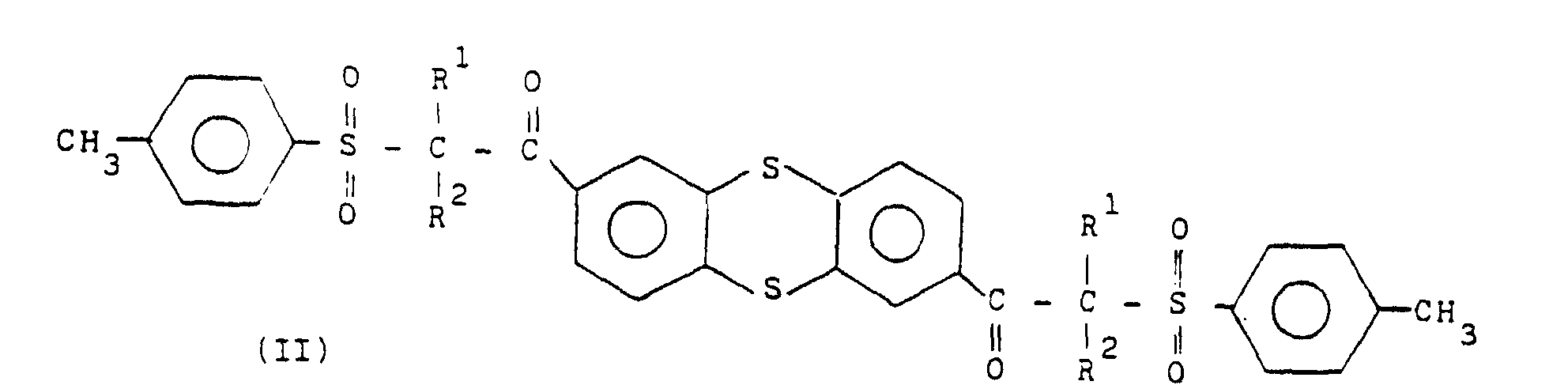 and R, R1, R2, R3 and R4 each independently are H or C1-4 linear or branched alkyl chain and n is 0 or 1
in an amount ranging from 0.01 to 20 % by weight. - Photopolymerizable system as claimed in claim 1, wherein said betaketosulfonic derivative is contained in an amount ranging from 0.5 and 5 % by weight.
- Pigmented ink containing at least a betaketosulfonic derivative selected from the compounds having formula (I) and (II):
 wherein A is
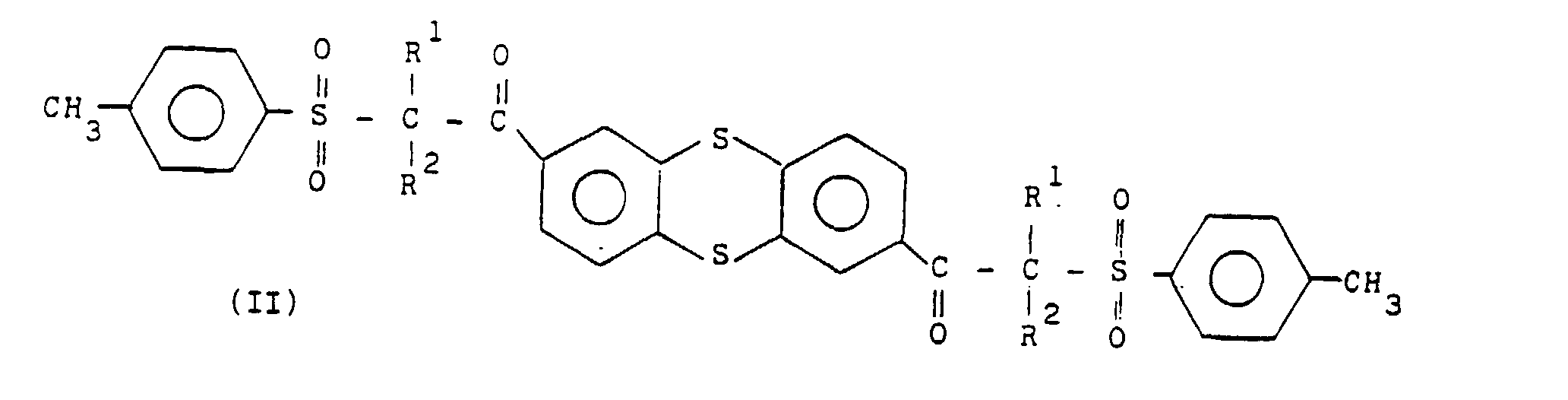 and R, R1, R2, R3 and R4 each independently are H or C1-4 linear or branched alkyl chain and n is 0 or 1
in an amount ranging from 0.01 to 20 % by weight. - Betaketosulfonic derivative selected from the group consisting of (I) and (II):
 wherein A is
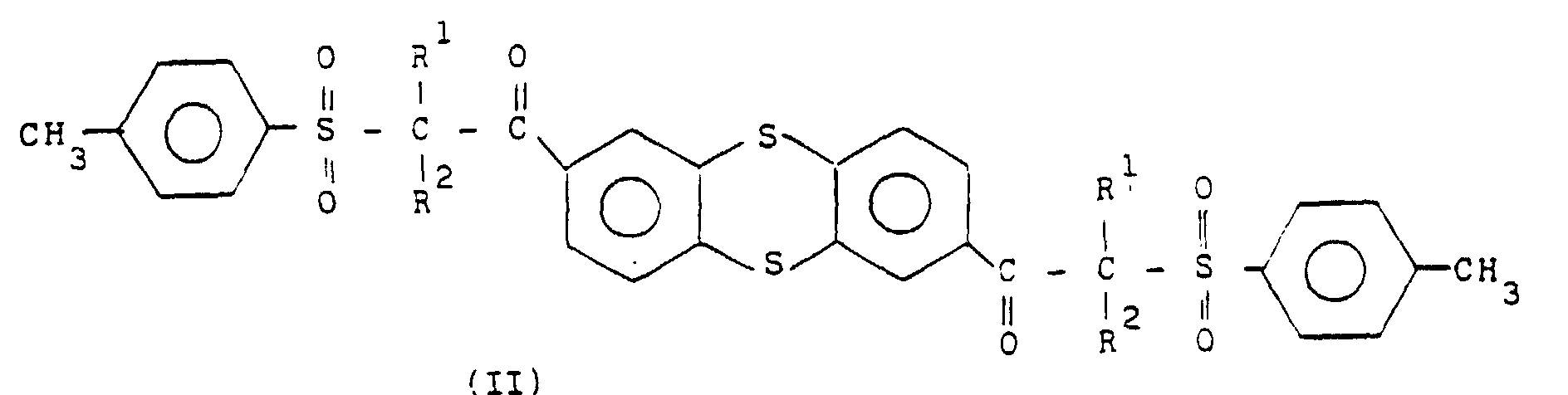 and R, R1, R2, R3 and R4 each independently are H or C1-4 linear or branched alkyl chain and n is 0 or 1
suitable to the use as polymerization photoinitiator. - Use of at least one betaketosulfonic derivative selected from the group consisting of (I) and (II) as claimed in claim 4, as polymerization photoinitiator for inks having high content in pigments.
- Process for the preparation of a betaketosulfonic derivative selected from the group consisting of (I)and II
 wherein
R, R1, R2, R3, R4 each independently are H or C1-4 linear or branched alkyl chain and n is O or 1 comprising the following reaction steps:a) a mixture of arylsulfonyl chloride of formula (III), sodium bicarbonate and sodium sulfite in a polar solvent, is made to react, obtaining the sodium arylsulfinate; b) the dialkylbromoacetyl bromide of formula (IV) is made to react with the diphenyl sulfide of formula (V) or with thianthrene, in presence of aluminum trichloride, in an organic solvent, and the mixture is neutralized with mineral acids to give the corresponding 2-bromoketones;
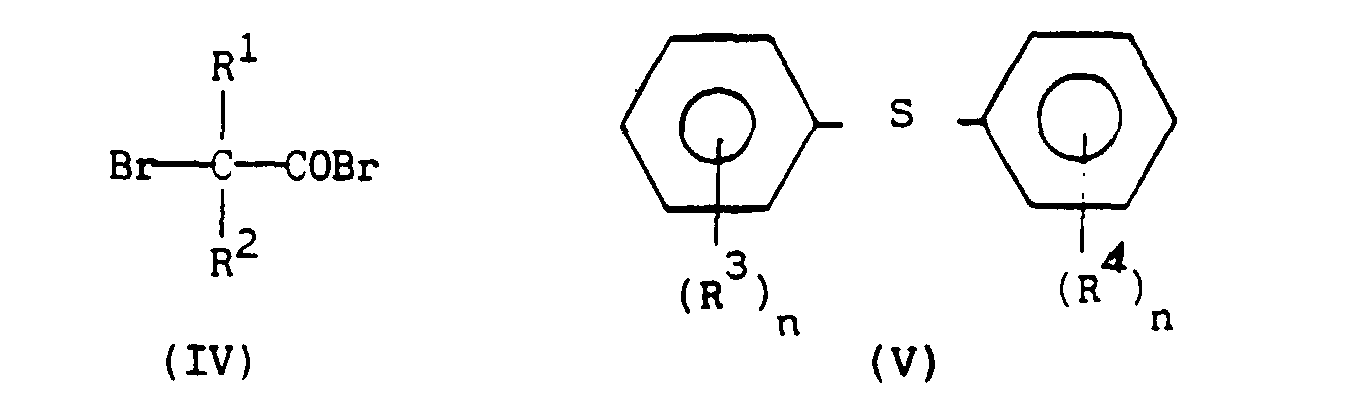 c) a mixture of sodium arylsulfinate obtained in the step a) and the 2-bromoketone obtained by the step b), in an organic solvent is heated to give the final products (I) or (II).
Priority Applications (1)
| Application Number | Priority Date | Filing Date | Title |
|---|---|---|---|
| AT95933357T ATE187179T1 (en) | 1995-09-11 | 1995-09-11 | BETAKETOSULFONIC ACID DERIVATIVES SUITABLE AS POLYMERIZATION PHOTOINITIATORS AND PHOTOPOLYMERIZABLE SYSTEMS THAT CONTAIN THEM |
Applications Claiming Priority (1)
| Application Number | Priority Date | Filing Date | Title |
|---|---|---|---|
| PCT/EP1995/003567 WO1997010270A1 (en) | 1995-09-11 | 1995-09-11 | Betaketosulfonic derivatives suitable to the use as polymerization photoinitiators and photopolymerizable systems containing the same |
Publications (2)
| Publication Number | Publication Date |
|---|---|
| EP0850253A1 EP0850253A1 (en) | 1998-07-01 |
| EP0850253B1 true EP0850253B1 (en) | 1999-12-01 |
Family
ID=8166097
Family Applications (1)
| Application Number | Title | Priority Date | Filing Date |
|---|---|---|---|
| EP95933357A Expired - Lifetime EP0850253B1 (en) | 1995-09-11 | 1995-09-11 | Betaketosulfonic derivatives suitable to the use as polymerization photoinitiators and photopolymerizable systems containing the same |
Country Status (5)
| Country | Link |
|---|---|
| US (1) | US6162841A (en) |
| EP (1) | EP0850253B1 (en) |
| AU (1) | AU3606195A (en) |
| DE (1) | DE69513692T2 (en) |
| WO (1) | WO1997010270A1 (en) |
Families Citing this family (3)
| Publication number | Priority date | Publication date | Assignee | Title |
|---|---|---|---|---|
| IT1303775B1 (en) * | 1998-11-19 | 2001-02-23 | Lamberti Spa | PHOTO INITIATORS THAT CAN BE USED IN PHOTOPOLYMERIZATION, AND RELATED FORMULATIONS. |
| ITVA20030028A1 (en) * | 2003-08-07 | 2005-02-08 | Lamberti Spa | TRANSPARENT PHOTOPOLYMIZED SYSTEMS FOR THE PREPARATION OF HIGH THICKNESS COATINGS. |
| CN112479945A (en) * | 2020-11-27 | 2021-03-12 | 山东第一医科大学(山东省医学科学院) | Method for synthesizing beta-ketosulfone by one-pot method |
Family Cites Families (6)
| Publication number | Priority date | Publication date | Assignee | Title |
|---|---|---|---|---|
| US3903322A (en) * | 1974-03-07 | 1975-09-02 | Continental Can Co | Photopolymerizable ethylenically unsaturated compounds photoinitiated with benzoyl derivatives of diphenyl sulfide and an organic amine compound |
| EP0003002B1 (en) * | 1977-12-22 | 1984-06-13 | Ciba-Geigy Ag | Use of aromatic-aliphatic ketones as photoinitiators, photopolymerisable systems containing such ketones and aromatic-aliphatic ketones |
| DE3008411A1 (en) * | 1980-03-05 | 1981-09-10 | Merck Patent Gmbh, 6100 Darmstadt | NEW AROMATIC-ALIPHATIC KETONES, THEIR USE AS PHOTOINITIATORS AND PHOTOPOLYMERIZABLE SYSTEMS CONTAINING SUCH KETONES |
| DE3010148A1 (en) * | 1980-03-15 | 1981-09-24 | Merck Patent Gmbh, 6100 Darmstadt | NEW MIXTURES BASED ON AROMATIC-ALIPHATIC KETONES, THEIR USE AS PHOTOINITIATORS AND PHOTOPOLYMERIZABLE SYSTEMS CONTAINING SUCH MIXTURES |
| EP0088050B1 (en) * | 1982-02-26 | 1986-09-03 | Ciba-Geigy Ag | Coloured photo-hardenable composition |
| IT1208494B (en) * | 1985-01-28 | 1989-07-10 | Lamberti Flli Spa | Polymerization. SULPHURATED DERIVATIVES OF AROMATIC-ALIPHATIC AND ALIPHATIC KETONES AS PHOTOINITIATORS OF |
-
1995
- 1995-09-11 US US09/033,808 patent/US6162841A/en not_active Expired - Fee Related
- 1995-09-11 EP EP95933357A patent/EP0850253B1/en not_active Expired - Lifetime
- 1995-09-11 AU AU36061/95A patent/AU3606195A/en not_active Abandoned
- 1995-09-11 DE DE69513692T patent/DE69513692T2/en not_active Expired - Fee Related
- 1995-09-11 WO PCT/EP1995/003567 patent/WO1997010270A1/en not_active Ceased
Also Published As
| Publication number | Publication date |
|---|---|
| DE69513692T2 (en) | 2000-03-16 |
| DE69513692D1 (en) | 2000-01-05 |
| WO1997010270A1 (en) | 1997-03-20 |
| EP0850253A1 (en) | 1998-07-01 |
| AU3606195A (en) | 1997-04-01 |
| US6162841A (en) | 2000-12-19 |
Similar Documents
| Publication | Publication Date | Title |
|---|---|---|
| KR102385824B1 (en) | Novel 3-ketocoumarins, their preparation and their use as photoinitiators in photopolymerization reactions | |
| JPS6281345A (en) | Copolymerizable photoinitiator | |
| Allen et al. | Photochemistry and photoinduced chemical crosslinking activity of type I & II co-reactive photoinitiators in acrylated prepolymers | |
| JPH0816123B2 (en) | Photocurable coloring composition | |
| TW200305582A (en) | Incorporable photoinitiator | |
| JP2012512819A (en) | Polymerizable photoinitiator and radiation curable composition | |
| EP2664629A1 (en) | Functionalised photoinitiators | |
| EP1131286B1 (en) | Bifunctional photoinitiators suitable for photopolymerization and photopolymerizable systems containing the same | |
| EP1523506A1 (en) | New difunctional photoinitiators | |
| JPH0316362B2 (en) | ||
| US11466161B2 (en) | Benzoyl-coumarin polymerizable photoinitiators | |
| EP1910425B1 (en) | Photopolymerisable systems containing low-extractable and low-volatile coinitiators | |
| CN111601795B (en) | Water-soluble 3-coumarone | |
| EP1670740B1 (en) | Clear photopolymerizable systems for the preparation of high thickness coatings | |
| US6162841A (en) | Betaketosulphones derivatives suitable to the use as polymerization photoinitiators and photopolymerizable systems containing the same | |
| EP3665162B1 (en) | Multifunctional polymeric photoinitiators | |
| US6781015B2 (en) | Aminobenzophenones and photopolymerizable compositions including the same | |
| ITMI941576A1 (en) | BETACHETOSOLPHONIC DERIVATIVES SUITABLE FOR USE AS PHOTO-INITIATORS OF POLYMERISATION AND PHOTOPOLYMERIZABLE SYSTEMS THAT CONTAIN THEM | |
| EP0003872A1 (en) | Substituted benzoic acid esters, compositions containing them, combinations thereof with photoinitiators and methods of making cured plastics compositions using them | |
| US8022111B2 (en) | Piperazino sensitisers |
Legal Events
| Date | Code | Title | Description |
|---|---|---|---|
| PUAI | Public reference made under article 153(3) epc to a published international application that has entered the european phase |
Free format text: ORIGINAL CODE: 0009012 |
|
| 17P | Request for examination filed |
Effective date: 19980324 |
|
| AK | Designated contracting states |
Kind code of ref document: A1 Designated state(s): AT BE CH DE ES FR GB IT LI |
|
| GRAG | Despatch of communication of intention to grant |
Free format text: ORIGINAL CODE: EPIDOS AGRA |
|
| 17Q | First examination report despatched |
Effective date: 19981112 |
|
| GRAG | Despatch of communication of intention to grant |
Free format text: ORIGINAL CODE: EPIDOS AGRA |
|
| GRAH | Despatch of communication of intention to grant a patent |
Free format text: ORIGINAL CODE: EPIDOS IGRA |
|
| GRAH | Despatch of communication of intention to grant a patent |
Free format text: ORIGINAL CODE: EPIDOS IGRA |
|
| GRAA | (expected) grant |
Free format text: ORIGINAL CODE: 0009210 |
|
| AK | Designated contracting states |
Kind code of ref document: B1 Designated state(s): AT BE CH DE ES FR GB IT LI |
|
| PG25 | Lapsed in a contracting state [announced via postgrant information from national office to epo] |
Ref country code: FR Free format text: LAPSE BECAUSE OF FAILURE TO SUBMIT A TRANSLATION OF THE DESCRIPTION OR TO PAY THE FEE WITHIN THE PRESCRIBED TIME-LIMIT Effective date: 19991201 Ref country code: ES Free format text: THE PATENT HAS BEEN ANNULLED BY A DECISION OF A NATIONAL AUTHORITY Effective date: 19991201 Ref country code: BE Free format text: LAPSE BECAUSE OF FAILURE TO SUBMIT A TRANSLATION OF THE DESCRIPTION OR TO PAY THE FEE WITHIN THE PRESCRIBED TIME-LIMIT Effective date: 19991201 Ref country code: AT Free format text: LAPSE BECAUSE OF FAILURE TO SUBMIT A TRANSLATION OF THE DESCRIPTION OR TO PAY THE FEE WITHIN THE PRESCRIBED TIME-LIMIT Effective date: 19991201 |
|
| REF | Corresponds to: |
Ref document number: 187179 Country of ref document: AT Date of ref document: 19991215 Kind code of ref document: T |
|
| REG | Reference to a national code |
Ref country code: CH Ref legal event code: NV Representative=s name: N&G PATENT SERVICES S.A. Ref country code: CH Ref legal event code: EP |
|
| REF | Corresponds to: |
Ref document number: 69513692 Country of ref document: DE Date of ref document: 20000105 |
|
| ITF | It: translation for a ep patent filed | ||
| EN | Fr: translation not filed | ||
| PG25 | Lapsed in a contracting state [announced via postgrant information from national office to epo] |
Ref country code: GB Free format text: LAPSE BECAUSE OF NON-PAYMENT OF DUE FEES Effective date: 20000911 |
|
| PLBE | No opposition filed within time limit |
Free format text: ORIGINAL CODE: 0009261 |
|
| STAA | Information on the status of an ep patent application or granted ep patent |
Free format text: STATUS: NO OPPOSITION FILED WITHIN TIME LIMIT |
|
| 26N | No opposition filed | ||
| GBPC | Gb: european patent ceased through non-payment of renewal fee |
Effective date: 20000911 |
|
| PGFP | Annual fee paid to national office [announced via postgrant information from national office to epo] |
Ref country code: CH Payment date: 20030925 Year of fee payment: 9 |
|
| PGFP | Annual fee paid to national office [announced via postgrant information from national office to epo] |
Ref country code: DE Payment date: 20031120 Year of fee payment: 9 |
|
| PG25 | Lapsed in a contracting state [announced via postgrant information from national office to epo] |
Ref country code: LI Free format text: LAPSE BECAUSE OF NON-PAYMENT OF DUE FEES Effective date: 20040930 Ref country code: CH Free format text: LAPSE BECAUSE OF NON-PAYMENT OF DUE FEES Effective date: 20040930 |
|
| PG25 | Lapsed in a contracting state [announced via postgrant information from national office to epo] |
Ref country code: DE Free format text: LAPSE BECAUSE OF NON-PAYMENT OF DUE FEES Effective date: 20050401 |
|
| REG | Reference to a national code |
Ref country code: CH Ref legal event code: PL |
|
| PG25 | Lapsed in a contracting state [announced via postgrant information from national office to epo] |
Ref country code: IT Free format text: LAPSE BECAUSE OF NON-PAYMENT OF DUE FEES;WARNING: LAPSES OF ITALIAN PATENTS WITH EFFECTIVE DATE BEFORE 2007 MAY HAVE OCCURRED AT ANY TIME BEFORE 2007. THE CORRECT EFFECTIVE DATE MAY BE DIFFERENT FROM THE ONE RECORDED. Effective date: 20050911 |