EP0849707B1 - Image creating apparatus - Google Patents
Image creating apparatus Download PDFInfo
- Publication number
- EP0849707B1 EP0849707B1 EP97122521A EP97122521A EP0849707B1 EP 0849707 B1 EP0849707 B1 EP 0849707B1 EP 97122521 A EP97122521 A EP 97122521A EP 97122521 A EP97122521 A EP 97122521A EP 0849707 B1 EP0849707 B1 EP 0849707B1
- Authority
- EP
- European Patent Office
- Prior art keywords
- image
- face
- component
- images
- components
- Prior art date
- Legal status (The legal status is an assumption and is not a legal conclusion. Google has not performed a legal analysis and makes no representation as to the accuracy of the status listed.)
- Expired - Lifetime
Links
Images










Classifications
-
- G—PHYSICS
- G06—COMPUTING OR CALCULATING; COUNTING
- G06T—IMAGE DATA PROCESSING OR GENERATION, IN GENERAL
- G06T11/00—Two-dimensional [2D] image generation
- G06T11/60—Creating or editing images; Combining images with text
-
- G—PHYSICS
- G06—COMPUTING OR CALCULATING; COUNTING
- G06T—IMAGE DATA PROCESSING OR GENERATION, IN GENERAL
- G06T11/00—Two-dimensional [2D] image generation
Definitions
- This invention relates to an image creating apparatus for creating an image in accordance with preselected classifications upon entry of data, and more particularly to an improved apparatus suitable for creating an image relating to a face of a person.
- a portrait is conventionally used in mass media such as newspapers, magazines and so forth, computers such as displays of icons in personal computers or insertion into writing documents in word processors.
- a single form is employed to chose or deform an image component based on a character quantity of an image component extracted from an entered image, so that portraits cannot be made in plural different kinds of forms based on an entered single face image which are different styles or facial expressions, that is, plural different kinds of portraits cannot be made about the same person.
- EP 0 603 790 A2 discloses a data processing apparatus for obtaining pattern-image data.
- the apparatus is provided with a part memory which stores a plurality of part patterns of each of components which compose an object.
- a video signal of an image of the object, a montage of which is to be composed, is entered through an image-data input unit to an image memory to be stored therein.
- Image data stored in the image memory includes component-image data corresponding to the components.
- the component-image data corresponding to a component is read out in accordance with basic position data of the component stored in a basic position memory.
- the plurality of part patterns stored in the part memory are compared with the component-image data in a pattern matching unit.
- the part patterns of the highest degree of resemblance are selected with respect to all the components, and are combined to be displayed as a portrait of a person on a display unit.
- EP 0 584 759 A2 discloses an image displaying apparatus in which a plurality of image data of parts are stored in a ROM, which parts are representative of elements of a portrait such as eyes, eyebrows, a nose, hair, an outline of a face and so on, image data of the parts selected by operation of a key input unit are read out from the ROM and are combined on a display unit of a dot matrix type, thereby a desired portrait being displayed thereon.
- a display position on the display unit where each of the image data combined into the above desired portrait is to be displayed is previously determined.
- the display position can be changed by operation of up/down keys or left/right keys provided in the key input unit. Using these keys, a wide variety of portraits which are rich in expression may be composed.
- an image creating apparatus which includes a storage device for storing images of a plurality of components included in a single composite image with distance data from a view point to the respective images, images of a plurality of small components which are divided about one or all of the components according to a distance from the view point with distance data from a view point to the respective images for each component, and an image composite device for executing an process for each pixel to select an image having the shortest distance from the view point in the images of a plurality of components or small components extracted from the storage device.
- the view point represents a view point of a person who watches the portrait.
- An image of a component placed in an area in a distance direction from the view point to the images of other component or other small component in the plurality of components is divided into images of a plurality of small components placed in front and back of the other component or the other small components.
- the composite image is a face image composed by a plurality of face components, and an image of hair is divided into images of small components placed in front and back of the face image.
- This image creating apparatus can express a composite image in three dimensions without increasing the number of images, whereby reproduction of portraits created based on the entered face image data is ensured.
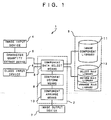
- FIG. 1 there is shown a schematic block diagram of an image creating apparatus 1 , which creates a portrait specifying one of a plurality of image classes such as brushwork, expressions and so forth based on a character quantity of a face component extracted from entered face image data.
- the face components includes eyes, noses, mouths, eyebrows, ears and hair.
- the brushwork means trends of exaggeration and deformation in respectively uniformed face components, and is different for each painter. The same painter makes different styles such as a comics character style, a handsome man style, a beautiful woman style, and a real style.
- the expressions represent a status of a face expressing feelings.
- the image creating apparatus 1 includes a control device 2 for creating a portrait by selecting, deforming and arranging each face component as an image component, a storage device 3 for storing a plurality of face component data therein, an image input device 4 such as a video camera for receiving image data, a character quantity extract device 5 for extracting a character quantity of a face component included in the received image data, a class input device 6 for receiving a selection-input for an image class such as brushwork, expression and so forth, and an image output device 7 such as a printer for outputting the created image.
- a control device 2 for creating a portrait by selecting, deforming and arranging each face component as an image component
- a storage device 3 for storing a plurality of face component data therein
- an image input device 4 such as a video camera for receiving image data
- a character quantity extract device 5 for extracting a character quantity of a face component included in the received image data
- a class input device 6 for receiving a selection-input for an image class such as brushwork
- the control device 2 controls the image input device 4, the character quantity extract device 5, the class input device 6 and the image output device 7.
- the device 2 includes a component data select means 8 for reading out a select rule, a deform rule and an arrange rule from the storage device 3 to further read out a face component from the storage device 3 according to the read out select rule, a component deform means 9 for deforming the face component according to the read out deform rule, and a component arrange means 10 for arranging the face component according to the arrange rule after the deformation.
- the storage device 3 stores face component data including face components and rules for selecting, deforming and arranging a face component.
- the device 3 includes a face image component library 11 storing a plurality of images about the respective face components which are classified for each image class, and a rule library 12 storing each rule group classified into each image class to be used for selecting, deforming and arranging a face component.
- the face component library 11 is composed of a plurality of image libraries 11a through 11g for the respective face components of eyes, noses, mouths, eyebrows, ears, contours and hair.
- the eye image library 11a stores an image group composed of a plurality of eye images each having different image elements about gradient and roundness for each image class.
- the image elements are an item for measuring a character quantity extracted from the entered image data.
- the select rule library 12a includes a select rule group for each image class.
- One select rule group consists of select rules such as a slant rule and a roundness rule about an eye to specify each image in the respective image libraries 11a to 11g of the face component library 11.
- Each rule may be represented by membership functions and fuzzy rules of fuzzy reasoning. For instance, in a membership function, an area including a measurement result of a character quantity about each image element is represented by a label of an antecedent of a fuzzy rule, and each image is represented by a consequent output of the fuzzy rule.
- Each rule may be composed by a table.
- the image input device 4 is composed of a video camera for taking an image of a face of a person, but may be represented by a scanner for reading a picture of a face.
- the character quantity extract device 5 image-processes face image data entered by the image input device 4 and extracts a character quantity of a face component after specifying a position of the face component in the processed face image data. For instance, measured values of slant, roundness (a ratio of length and breadth) and size about an eye are extracted as a character quantity of a face component.
- the class input device 6 is represented by a keyboard or a mouse to receive a selection-input of an image class such as brushwork, expression, age, sex and so forth.
- the image output device 7 is a printer outputting a composite image on paper.
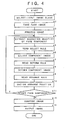
- Fig. 4 is a flow chart for creating an image in the image creating apparatus 1 of this embodiment.
- the control device 2 receives a selection-input for an image class by the class input device 6 (a step s1), and the image input device 4 takes a face image upon the entry of the selection of the image class (a step s2).
- the control device 2 applies a predetermined image process to the face image data taken by the image input device 4 (a step s3), and specifies a face component in the face image data after processing the face image to extract the character quantity (a step s4).
- control device 2 reads a select rule for selection of the face component image from the select rule library 12a of the storage device 3 based on the entered image class (a step s5), and selects a face component image from one of image libraries in the image component library 11 (a step S6).
- a deform rule for deforming the face component image is read out from the deform rule library 12b based on entered image class (a step s7), the face component image is deformed based on the read out deform rule and the extracted character quantity (a step s8), an arrange rule for an arrange position of the face component image is read out from the arrange rule library 12c based on the entered image class (a step a9), and an arrange position for the face component image is decided based on the read out arrange rule and the extracted character quantity (a step s10).
- the control device 2 executes the process from the step s4 to the step s10 about each face component (a step s11). After the decision of the selection, the deformation and the arrange position of the face component image is finished about all face components, the selected and deformed face component image is arranged at the decided arrange position to compose a face image (a step s12) and the composite face image is generated through the image output device 7 (a step s13).
- the control device 2 may be represented by a microcomputer, and the storage device 3 may be represented by a hard disk drive.
- the processing contents by the control device 2 and the storage contents of the storage device 3 may be supplied from the external through a storage media.
- Fig. 5 illustrates a process for selecting, deforming and arranging a face component image in the image creating apparatus 1.
- the deformation and the determination of an arrange position is processed by the process from the step s4 to the step s10 about an eye image as a face component, an eye is specified in the image data applied by a predetermined image process, and an angle " ⁇ " between a center line of eyes and a horizontal line, a width "x" of the eye, a height “y”, a spacing "d”, and a distance "h” from the center line of the eyes to a chin are measured as shown in Fig. 5 at (A).
- a select rule group to be used based on a previously selected class "i" is read out, the values of angle " ⁇ " and "x/y” are respectively applied to a slant rule of the eye and a roundness rule of the eye included in the select rule group to determine a label of a range including the measured values about the slant and the roundness of the eye as shown in Fig. 5 at (B).
- an image of the corresponding eyes is chosen from image group of eyes in the image class selected in the eye component library 11a as shown in Fig. 5 at (C).
- a deform rule group to be used is read out based on the class "i" selected beforehand, a size rule of eyes included in the deform rule group is applied by the width "x" of the eye and the height "y” of the eyes to determine a dilatation ratio and a contraction ratio of the eye image.
- An arrange rule group to be used is read out based on the class "i" selected beforehand, an arrange rule of eyes included in the arrange rule group is applied by the spacing "d" of the eyes and the distance "h” from the center line of eyes to the chin to determine an arrange position of the eyes within a contour of the face.
- a same operation as the foregoing operation is executed about other face components to determine selections, deformations and arrange positions about all of the face components.
- the deformations are executed only about face contours, eyes and a mouth but not executed about other face components. Eyes and mouth may be included into a selection process by storing different size images in the face component library 11.
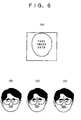
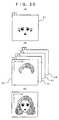
- images of face components and rules about selection, deformation and arrangement of face components are stored for each image class, selection-input for a desired image class is received, an image of a face component corresponding to the selected image class is selected, deformed and arranged by the rule corresponding to the image input to create a portrait by the selected image class. For instance, when the image classes are selectable from “laugh”, “cry” and “anger” and an image data shown in Fig. 6 at (A) is entered, portraits shown in Fig. 6 at (B) to (D) are created according to selection in the image classes.
- a portrait is selectively created from a beautiful woman style portrait by a painter A as shown in Fig. 7 at (B), a comics character style portrait by the painter A as shown in Fig. 7 at (C), an animal style portrait by the painter A as shown in Fig.7 at (D) and a real style portrait by a painter B as shown in Fig. 7 at (E).
- plural kinds of portraits having different brushwork are selectably created about the same person, and the same person may repeatedly create a portrait by selecting other brushwork than the formerly made brushwork, so that a frequency of use and an operation efficiency in the image creating apparatus are improved.
- a composite portrait composed by the selected animal may be created as shown in Fig. 8 at (C) and (D).
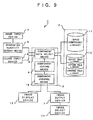
- Fig. 9 there is shown a schematic block diagram of an image creating apparatus configured to be used with the invention.
- the same components corresponding to those in the above-mentioned illustrative construction are given the same reference numerals and their explanation is omitted.
- the image creating apparatus of this embodiment is provided with a later-described image display device 13 and a later-described image select device 14.
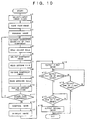
- Fig. 10 there is shown a flow chart for creating an image in the image creating apparatus of Fig. 9, wherein the same steps corresponding to those of Fig. 4 are given the same reference numerals and the steps executing processes similar to those of Fig. 4 are given the same reference numerals marked with dash markings.
- the control device 2 receives a selection-input for an image class by the class input device 6 (a step s1), and the image input device 4 takes a face image upon the entry of the selection of the image class (a step s2).
- the control device 2 applies a predetermined image process to the face image data taken by the image input device 4 (a step s3), and specifies a face component in the face image data after processing the face image to extract the character quantity (a step s4).
- control device 2 regards entered image class as a first image class and note-entered image class as a second image class, and reads a select rule for selection of the face component image from the select rule library 12a of the storage device 3 based on the first and second image classes (a step s5'), and selects a face component image from one of image libraries in the image component library 11 based on the read out select rule and the extracted character quantity (a step S6).
- the second image class is determined from a plurality of image classes stored beforehand under a single condition in which the second image class is a different image class from the first image class select-entered through the class input device 6. For instance, an image class whose predetermined priority is the second rank of the first image class may be selected.
- a deform rule for deforming the face component image is read out from the deform rule library 12b based on entered image class (a step s7), the face component image is deformed based on the read out deform rule and the extracted character quantity (a step s8), an arrange rule for an arrange position of the face component image is read out from the arrange rule library 12c based on the entered image class (a step s9), and an arrange position for the face component image is decided based on the read out arrange rule and the extracted character quantity (a step s10).
- the control device 2 executes the process from the step s4 to the step s10 about each face component for the first and the second image classes (a step s11'). After decision of the selection, the deformation and the arrange position of the face component image is finished about all face components for each of the first and second image classes, the selected and deformed face component image is arranged at the decided arrange position to compose a first face image of the first image class and a second image class of the second image class (a step s12') and the composited first and second images are displayed by the image display device 13 (a step s13').
- control device 2 actuates the image output device 7 to output the first face image (a step s14), and receives a selection-input whether or not the second face image is outputted in an output process of the first image (steps s15 and s16). If the output of the second face image is selected by manipulating the image select device 14 in an output processing of the first image, the image output device 7 generates the second image following to the completion of an output process of the first face image (steps s17 and s18).
- the control device 2 is represented by a microcomputer, and the storage device 3 is represented by a hard disk driver.
- the processing contents by the control device 2 and the storage of the storage device 3 may be supplied from the external.
- the image display device 13 represented by a display such as CRT, LCD or the like is composed of a pair of image display areas 13a and 13b.
- a portrait 13a having an expression of "laugh” is displayed in one image display area 13a of the image display device 13 as a first face image.
- a face image in the not-selected class for instance, a portrait having an expression "anger” is displayed in other image display area 13b of the image display device 13 as a second face image.
- the image select device 14 which is a key disposed on an operational panel is manipulated during the time when the image output device 7 outputs the portrait 13a having the expression "laugh", the portrait having the expression "anger” is outputted.
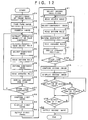
- Fig. 12 there is shown a modification of the sequence of Fig. 10, in which the second face image is created in the second image class during an output process of the first face image in the first image class (steps s41 to s53) and it is inquired if the second face image is outputted (step s51). Accordingly, it is possible to store a character quantity of a face component extracted when a face image in the first image class is created and to create an face image in the second image class.
- step s51 to s54 is repeated and still another face image is created to be displayed based on other image class than the first and second image classes, so that plural kinds of portraits with different brushwork and expressions are outputted.
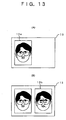
- a portrait having an expression of "laugh” displayed by the image output means 7 as a first face image is displayed in one image display area 13a of the image display device 13 as shown in Fig. 13 at (A).
- a face image in a non-chosen image class for instance, a portrait having an expression of "anger” is created as a second face image to be displayed in other image display area 13b of the image display device 13 as shown in Fig. 13 at (B).
- a composite portrait composed by the selected animal may be created as shown in Fig. 8 at (C) and (D).
- a condition for throwing money may be included in the selection process of the image classes (steps s1 and s21) and the selection process of output of the second image (steps s15 and s51).
- Fig. 14 is a schematic block diagram of an image creating apparatus 21 which does not form part of this invention and is shown for illustrative purposes, and the same components as those in the foregoing embodiments are given the same reference numbers.
- the image creating apparatus 21 creates a color portrait specifying brushwork, expression and so forth based on a character quantity of a face component extracted from entered color face image data.
- the face components are eyes, noses, mouths, eyebrows, ears and hair.
- the brushwork means trends of exaggeration and deformation in respectively uniformed face components, and is different for each painter. The same painter makes different styles such as a comics character style, a handsome man style, a beautiful woman style, and a real style.
- the expressions represent a status of a face expressing feelings.
- the image creating apparatus 21 includes a control device 22 for creating a portrait by selecting, deforming and arranging each face component as an image component, a storage device 3 for storing a plurality of face component data therein, an image input device 4' such as a video camera for receiving color image data, a character quantity extract device 5 for extracting a character quantity of a face component included in the received image data, a color extract device 23 for extracting color of hair and a cheek in the image data, a class input device 6 for receiving a selection-input for an image class such as brushwork, expression and so forth, and an image output device 27 such as a printer for outputting the created color image.
- a control device 22 for creating a portrait by selecting, deforming and arranging each face component as an image component
- a storage device 3 for storing a plurality of face component data therein
- an image input device 4' such as a video camera for receiving color image data
- a character quantity extract device 5 for extracting a character quantity of a face component included in the received
- the control device 22 controls the image input device 4', the character quantity extract device 5, a color extract device 23, the class input device 6, and the image output device 7.
- the device 22 includes a component data select means 8 to read out from the storage device 3 a select rule, a deform rule and an arrange rule which correspond to the entered image class and to further read out a face component from the storage device 3 according to the read out select rule and the character quantity extracted from the character extract device 5, a color correct means 24 for correcting a standard color of face contours and hair in the face components read out by the component data select means 8 based on a color extracted by the color extract device 23, a component deform means 29 for deforming the face component according to the read out deform rule, and a component arrange means 30 for arranging the face component according to the arrange rule after the deformation.
- the storage device 3 stores face component data including face component images and rules for selecting, deforming and arranging images of face components.
- the storage device 3 includes a face image component library 11 storing a plurality of images about the respective face components which are classified for each image class, and a rule library 12 storing each rule group classified into each image class to be used for selecting, deforming and arranging a face component.
- the face component library 11 is composed of a plurality of image libraries 11a through 11g for the respective face components of eyes, noses, mouths, eyebrows, ears, contours and hair as shown in Fig. 2.
- the eye image library 11a stores an image group composed of a plurality of eye images each having different image elements about gradient and roundness for each image class.
- the face contour image library 11f and the hair image library 11g are composed of a plurality of images of face contours and hair which are respectively different about a shape of a face representing a character quantity of face contours and a shape of hair representing a character quantity of hair, and each image is applied by a predetermined standard color.
- This standard color is a bright color corresponding to each image class, which is different from a color of a real face. For instance, in an image class of a comics character style, reddish pink may be a standard color in a face contour image, and yellow also may be a standard color in a hair image.
- the select rule library 12a includes a select rule group for each image class.
- One select rule group consists of select rules such as a slant rule and a roundness rule about an eye to specify each image in the respective image libraries 11a to 11g of the face component library 11 (see Fig. 5 at (B)).
- Each rule may be represented by membership functions and fuzzy rules of fuzzy reasoning. For instance, in a membership function, an area including a measurement result of a character quantity about each image element is represented by a label of an antecedent of a fuzzy rule, and each image is represented by a consequent output of the fuzzy rule (see Fig. 5 at (C)). Each rule may be composed by a table.
- the image input device 4' is composed of a video camera for taking an image of a face of a person, but may be represented by a scanner for reading a picture of a face.
- the character quantity extract device 5 image-processes face image data entered by the image input device 4' and extracts a character quantity of a face component after specifying a position of the face component in the processed face image data. For instance, measured values of slant, roundness (a ratio of length and breadth) and size about an eye are extracted as a character quantity of a face component.
- the class input device 6 is represented by a keyboard or a mouse to receive a selection-input of an image class such as brushwork, expression, age, sex and so forth.
- the image output device 27 is a printer outputting a composite image on paper.
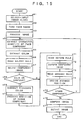
- Fig. 15 is a flow chart for creating an image in the image creating apparatus 21 of this embodiment.
- the control device 22 receives a selection-input for an image class by the class input device 6 (a step s61), and the image input device 24 takes a color face image upon the entry of the selection of the image class (a step s62).
- the control device 22 applies a predetermined image process to the color face image data taken by the image input device 4' (a step s63), and specifies a face component in the face image data after processing the face image to extract the character quantity (a step s64).
- the control device 22 extracts color of hair and face contours in the color face image data by a color extract device 23 (a step s65). The extracting process in the step s64 and the extracting process in the step s65 will be described later in detail.
- the control device 22 reads a select rule for selection of the face component image from the select rule library 12a of the storage device 3 based on the entered image class (a step s66), and selects a face component image from one of image libraries in the image component library 11 (a step S67).
- the images of hair and face contours in the face component images selected from the image library are applied by a predetermined standard color.
- the control device 22 corrects the standard color about the images of hair and face contours by the color correct means 24 based on the average values of the respective colors of RGB in a top area of a head and in a large area of a cheek entered by the color extract device 23 (steps s68 and s69).
- control device 22 judges if a cheek component should be added to a portrait based on an average value of an R color in a large area of the cheek and an average value of an R color in a small area of the cheek entered by the color extract device 23 (step s70).
- a correct process of the standard color in the step s69 and the addition process of the cheek component will be described in detail later.
- control device 22 reads out a deform rule for deforming the face component image from the deform rule library 12b based on entered image class (a step s71), deforms the face component image based on the read out deform rule and the determined character quantity (a step s72), reads out an arrange rule for an arrange position of the face component image from the arrange rule library 12c based on the entered image class (a step s73), and decides an arrange position for the face component image based on the read out arrange rule and the determined character quantity (a step s74).
- the control device 22 executes the process from the step s64 to the step s74 about each face component but only about the hair and face contours (a step s75). After the decision of the selection, the deformation and the arrange position of the face component image are finished about all face components, the selected and deformed face component image is arranged at the decided arrange position to compose a face image (a step s76) and the composite face image is generated through the image output device 27 (a step s77).
- the control device 22 may be represented by a microcomputer, and the storage device 3 may be represented by a hard disk drive.
- the processing contents by the control device 22 and the storage contents of the storage device 3 may be supplied from the external through a storage media.
- the character quantity extract device 5 specifies eyes in the face image data to measure an angle " ⁇ " between a center line of eyes and a horizontal line, a width "x" of the eye, a height “y”, a spacing “d”, and a distance "h” from the center line of the eyes to a chin as shown in Fig. 5 at (A).
- the character extract device 5 applies the measured character quantity " ⁇ " and "y/x" to the component data select means 8.
- the component data select means 8 reads out a select rule group to be used based on a class i selected and entered beforehand and applies the values of angle " ⁇ " and "x/y" to a slant rule of the eye and a roundness rule of the eye included in the select rule group to determine a label of a range including the measured values about the slant and the roundness of the eye as shown in Fig. 5 at (B).
- an image of the corresponding eyes is chosen from image group of eyes in the image class selected in the eye component library 11a as shown in Fig. 5 at (C).
- the component deform means 29 reads out a deform rule group to be used is read out based on the class i selected beforehand, a size rule of eyes included in the deform rule group is applied by the width "x" of the eye and the height "y” of the eye to determine a dilatation ratio and a contraction ratio of the eye image.
- the component arrange means 30 reads out an arrange rule group to be used is read out based on the class "i" selected beforehand, applies the character quantities "d” and "h” to the read out arrange rule group to determine an arrange position of the eyes within contours of the face.
- the color extract device 23 in the extract process of the step s65 of Fig. 15 reads out face image data after its image process from the image input device 4' (a step s81), detects an area of a top of a head in the face image data (a step s82), finds an average value of each color of three primary colors of additive mixture RGB about pixels in the detected area (a step s83), detects large and small areas of a cheek in the entered face image data (see Fig.
- step s84 extracts an average value of each color of RGB about pixels included in the detected large area (a step s85), extracts an average value of an R color about pixels included in the detected small area of cheek (a step s86), and outputs the extracted average values of each color of RGB in the top area of the head and each color of RGB in the large area of the cheek and R color in the small area of the cheek to the color correct means 24 of the control device 22 (a step s87).
- the color correct means 24 compares the average value of each color of RGB in the top area of head and the large area of cheek entered by the color extract device 24 with a standard value of Japanese to modify a ratio of the standard color of hair or face contours about a color having a difference larger than a predetermined quantity from the standard value of Japanese in its comparison result. For instance, when the average value of R color in the top area of head entered by the color extract device 23 is higher than the standard value of Japanese, the standard color added into the hair image chosen from the image library is corrected into more reddish color. As shown in Fig. 17 at (B), a plurality of standard colors about each of the hair and the face contours are so prepared that standard colors may be chosen to be the closest to the average values of each color of RGB in the top area of head and each color of RGB in the large area of cheek.
- red color cheek components having shapes shown in Fig. 17 at (C) are added into the cheeks of a portrait to create a portrait shown in Fig. 17 at (D).
- an age of the entered color face image data may be received to change cheek components according to the age. For instance, the cheek components shown in Fig. 17 at (C) are added when the entered age is young, and red color cheek components having a shape shown in Fig. 17 at (E) are added to create a portrait shown in Fig. 17 at (F) when the entered age is old.
- the positions, shapes and colors of the added components are not limited to the above.
- the image creating apparatus 21 extracts colors of hair and cheeks from the entered color face image data, and corrects the standard colors which are added beforehand into the images of hair and face contours according to image classes based on the extracted colors to create a portrait colored by image classes including characteristics in colors of its real face.
- Predetermined standard colors of other face components than the hair and face contours may be corrected according to colors extracted from color face image data.
- Fig. 18 shows a storage status about a contour image and a hair image in a face component library of an image creating apparatus according to the invention.
- the image creating apparatus employs the same block diagram as that of Fig. 9 including the image face component library 11 of Fig. 2 and the rule library Fig. 3.
- An operation of this apparatus has a same flow chart as that of Fig. 4 except that the composite face image composed in the step s12 is displayed in the image display device 13.
- Other components and explanation than those of the foregoing embodiments will be described hereinafter.
- each contour image is composed by arranging a contour image 32 of a face having a predetermined color at a predetermined position within an image frame 31 corresponding to a full screen of an image face.
- Image data of the predetermined color is written into pixels within the contour image 32 of the face in the image frame 31.
- Transparent image data is written into pixels of other portion than the face contour image 32 in the image frame 31.
- One of the pixels written by the transparent image data in the image frame 31 is shown at a reference point 33.
- the image frame 31 is provided with a layer number 34 of "3".
- the face images are composite images composed by a plurality of face component images which are composed by a plurality of layers having different distances from a view point, and each layer is provided with an image frame with a size corresponding to a full screen of an image face.
- the respective layers are provided with layer numbers "1, 2, 3" in order of the shortest distance from the view point.
- a face image is composited referring to a layer number assigned to each image frame 31.
- the layer number corresponds to distance information of this invention.
- the hair image library 11g stores a plurality of hair image groups for each image class.
- One hair image group is composed of a plurality of hair images.
- Each hair image is divided into an image of front hair positioned in front of face contours and an image of back hair positioned behind the face contours for storage.
- each hair image is composed by respectively arranging the front and back hair images 37 and 38 with a predetermined color at predetermined positions within a pair of image frames 35 and 36 corresponding to full screens of image faces.
- image data of the predetermined color is written into the pixels in the front hair image 37 and the back hair image 38 within the respective image frames 35 and 36.
- Image data of transparency is written into the pixels other than the front and back hair images 37 and 38 within the respective image frames 35 and 36.
- Reference points 39 end 40 are ones of pixels written by the transparent image data in the respective image frame 35 and 36, and are located at the same position as that of the reference point 33 of the image frame 31.
- the image frames 35 and 36 are respectively provided with a layer number 41 of "1 " and a layer number 42 of "2".
- Fig. 19 is a flow chart of an image composite process in the image creating apparatus, which presents details of the image composite process of Fig. 4.
- Fig. 20 shows a composite status of each composite image in the image composite process of Fig. 19.
- the control device 2 arranges the images of eyes, a nose, a mouth and eyebrows, which are chosen in the step s6 of Fig. 4 and deformed in the step s8 of Fig. 4, at the arrange position determined in the step s10 of Fig. 4 within an image frame 51 provided with a layer number "2" (a step s121). Then, as shown in Fig.
- the control device 2 piles up the image frame 51, the image frame 31 in which an image of contours chosen in the step s6 is arranged, and the image frames 35 and 36 in which the hair images are arranged by putting an image frame having a smaller number at an upper position wherein the positions of the pixels of the respective face components are adjusted by letting the reference points in the four image frames agreeing one after another (a step s122).
- the positions of the images of the respective image frames may be adjusted by the coordinate values so that the reference points of the respective image frames can be omitted.
- the control device 2 judges if image data of a color is assigned to each pixel in each image frame in order of a higher layer number (steps s123 to s127). A color of the image data with a higher layer number is determined as a color of the pixel (steps s128 to s131). When all image frames are not yet assigned by color image data, a predetermined background color is determined as a color of the pixel (a step s132). The control device 2 executes the process from the step s124 to the step s132 about each pixel included in an image frame, viz., a full screen of an image face (steps s133 to s136), and creates a single of a face image as shown in Fig. 20 at (C).
- the hair image representing one face component is divided into a pair of small component images of a front hair image and a back hair image to constitute a layer construction with the front and back hair images and the face contour image for storage, and the image data in the most upper layer is chosen about each pixel to composite a face image. Accordingly, irrelevant to any change of combination between the face contour image and the hair image to be composited, the hair image may be created in three-dimensions with positioning the front hair image in front of the face contours and the back hair image behind the face contours.
- the front hair image, the face contour image and the back hair image are arranged in order from top to down and the image data of an image residing at upper position is chosen about each pixel, so that the image data of the contour image in the area hidden by the front hair is avoided to be chosen as image data of a composite image.
- the contour image or the hair image is properly deformed according to the forms of the composited hair image or contour image, whereby a plurality of images agreeing with the forms of the hair and contour images to be composited are not required to be prepared for the same contour and hair images.
- a front portion of the hat When a hat is included as a component, a front portion of the hat is located in front of the hair, and a rear portion of the hat is located behind the hair. Accordingly, an area of the hat hidden by the hair image varies with the change of the hair image to be composited even if the hat is not changed. By contrast, an area of the hair image hidden by a front portion of the hat image varies with the change of the hat image to be composited even if the hair is not changed.
- an image of a hat in Fig. 21 at (A) is divided into a pair of small components of front and back hat portion images, wherein an image frame including the front hat portion image is given a higher level number than a layer number of an image frame including the hair image and an image frame including the back hat portion image is given a lower level number than a layer number of the image frame including the hair image to be stored.
- the hat image shown in Fig. 21 at (A) and the face image shown in Fig. 21 at (C) are composited to create a composite portrait shown in Fig. 21 at (D).
- components of the composite image include a background, a body part such as arms and other goods, layer numbers are assigned to images of the respective components and a same process as that of Fig. 19 is executed, whereby a composite portrait is easily created.
- advantages may be expected in other composite image composed by a plurality components than the above-mentioned creation of a portrait based on data of a face.
Landscapes
- Physics & Mathematics (AREA)
- General Physics & Mathematics (AREA)
- Engineering & Computer Science (AREA)
- Theoretical Computer Science (AREA)
- Processing Or Creating Images (AREA)
- Image Processing (AREA)
Description
- This invention relates to an image creating apparatus for creating an image in accordance with preselected classifications upon entry of data, and more particularly to an improved apparatus suitable for creating an image relating to a face of a person.
- A portrait is conventionally used in mass media such as newspapers, magazines and so forth, computers such as displays of icons in personal computers or insertion into writing documents in word processors.
- Drawing a portrait precisely expressing features of a face of a person is difficult because the drawer is required to have a good observation power of extracting a character of the face and a good representation power for exaggerating and reproducing the character. Accordingly, there is expected the development of an apparatus for automatically creating a portrait upon entry of an optional image.
- There has been proposed heretofore a technique for extracting character quantities of face components such as eyes, a nose, a mouth, eyebrows and ears in the entered image of a face, and choosing or deforming face components previously stored based on the extracted character quantities to be arranged to make a portrait. This technique may be applied to creation of an image which is composed of a single or a plurality of image components other than portraits.
- In this technique for automatically making an image such as a portrait, a single form is employed to chose or deform an image component based on a character quantity of an image component extracted from an entered image, so that portraits cannot be made in plural different kinds of forms based on an entered single face image which are different styles or facial expressions, that is, plural different kinds of portraits cannot be made about the same person.
- Yuauzhong Li and Hidefumi Kobatake, in Extraction of Facial Sketch Images and Expression Transformation Based on FACS, Proceedings of the International Conference on Image Processing (ICIP), US, LOS ALAMITOS, IEEE Comp. Soc. Press, 1995, pages 520-523, XP000623198 ISBN: 0-7803-3122-2 representing the closest prior art disclose a method in which extraction of facial sketch image consists of three processing steps. In the first step the approximate locations of eyes, mouth, and area of face are detected. In the second step regions of important face components are determined and their edges are detected- The third step concerns the approximation of edges of the characteristic parts of face with feature curves and the determination of feature points. Subsequently, expression transformation is performed by shifting of feature points to generate new feature curves. Therefore, a facial sketch image can be transformed into sketch images with various expressions.
-
EP 0 603 790 A2 discloses a data processing apparatus for obtaining pattern-image data. The apparatus is provided with a part memory which stores a plurality of part patterns of each of components which compose an object. A video signal of an image of the object, a montage of which is to be composed, is entered through an image-data input unit to an image memory to be stored therein. Image data stored in the image memory includes component-image data corresponding to the components. The component-image data corresponding to a component is read out in accordance with basic position data of the component stored in a basic position memory. The plurality of part patterns stored in the part memory are compared with the component-image data in a pattern matching unit. The part patterns of the highest degree of resemblance are selected with respect to all the components, and are combined to be displayed as a portrait of a person on a display unit. -
EP 0 584 759 A2 discloses an image displaying apparatus in which a plurality of image data of parts are stored in a ROM, which parts are representative of elements of a portrait such as eyes, eyebrows, a nose, hair, an outline of a face and so on, image data of the parts selected by operation of a key input unit are read out from the ROM and are combined on a display unit of a dot matrix type, thereby a desired portrait being displayed thereon. A display position on the display unit where each of the image data combined into the above desired portrait is to be displayed is previously determined. The display position can be changed by operation of up/down keys or left/right keys provided in the key input unit. Using these keys, a wide variety of portraits which are rich in expression may be composed. - It is a primary object of this invention to provide an improved image creating apparatus which may express a composite image in three dimensions without increasing the number of images, whereby reproduction of portraits created based on the entered face image data is improved.
- The invention is defined in
claims dependent claims - According to this invention, there is provided an image creating apparatus which includes a storage device for storing images of a plurality of components included in a single composite image with distance data from a view point to the respective images, images of a plurality of small components which are divided about one or all of the components according to a distance from the view point with distance data from a view point to the respective images for each component, and an image composite device for executing an process for each pixel to select an image having the shortest distance from the view point in the images of a plurality of components or small components extracted from the storage device. The view point represents a view point of a person who watches the portrait. An image of a component placed in an area in a distance direction from the view point to the images of other component or other small component in the plurality of components is divided into images of a plurality of small components placed in front and back of the other component or the other small components. The composite image is a face image composed by a plurality of face components, and an image of hair is divided into images of small components placed in front and back of the face image.
- This image creating apparatus can express a composite image in three dimensions without increasing the number of images, whereby reproduction of portraits created based on the entered face image data is ensured.
- Other objectives and advantages of this invention will be more readily apparent from the following detailed description provided in conjunction with the following figures, of which
- Fig. 1 is a schematic block diagram of an image creating apparatus shown for illustrative purposes;
- Fig. 2 represents stored data in a face image component library of a storage device employed in the image creating apparatus;
- Fig. 3 represents stored data in a rule library of a storage device employed in the image creating apparatus;
- Fig. 4 is a flow chart for creating an image in the image creating apparatus;
- Fig. 5 illustrates a process for selecting, deforming and arranging face component images in the image creating apparatus;
- Fig. 6 shows a creating status of a portrait to select an image class, "laugh", "cry or "anger";
- Fig. 7 shows a creating status of a portrait for each image class about the same person when brushwork by painters end style difference by the same painter may be selected as image classes in the image creating apparatus;
- Fig. 8 shows storage in the face component library and the rule library and a creating status of a portrait when animals may be selected as image classes in the image creating apparatus;
- Fig. 9 is a schematic block diagram of an image creating apparatus configured to be used with the invention;
- Fig. 10 is a flow chart for creating an image in the image creating apparatus of Fig. 9;
- Fig. 11 is a display status of a portrait made by the image creating apparatus of Fig. 9;
- Fig. 12 is a flow chart of creating an image by an image creating apparatus as a modification of the second embodiment of this invention;
- Fig. 13 is a display status of a portrait made by the image creating apparatus of Fig. 12;
- Fig. 14 is a schematic block diagram of an image creating apparatus which does not form part of the invention and is shown for illustrative purposes;
- Fig. 15 is a flow chart for creating an image in the image creating apparatus of Fig. 14;
- Fig. 16 is a flow chart for extracting a color in the image creating apparatus of Fig. 14;
- Fig. 17 illustrates a process for correcting a standard color and adaing a cheek component in the image creating apparatus of Fig. 14;
- Fig. 18 shows a storage status about a contour image and a hair image in a face component library of an image creating apparatus according to the present invention;
- Fig. 19 is a flow chart of an image composite process in the image creating apparatus;
- Fig. 20 is a status of a composite image in the image composite process of Fig. 19; and
- Fig. 21 is a status of a composite image in an image creating apparatus as a modification of Fig. 20.
-
- Referring, now, to Fig. 1, there is shown a schematic block diagram of an
image creating apparatus 1 , which creates a portrait specifying one of a plurality of image classes such as brushwork, expressions and so forth based on a character quantity of a face component extracted from entered face image data. The face components includes eyes, noses, mouths, eyebrows, ears and hair. The brushwork means trends of exaggeration and deformation in respectively uniformed face components, and is different for each painter. The same painter makes different styles such as a comics character style, a handsome man style, a beautiful woman style, and a real style. The expressions represent a status of a face expressing feelings. - The
image creating apparatus 1 includes acontrol device 2 for creating a portrait by selecting, deforming and arranging each face component as an image component, astorage device 3 for storing a plurality of face component data therein, animage input device 4 such as a video camera for receiving image data, a characterquantity extract device 5 for extracting a character quantity of a face component included in the received image data, aclass input device 6 for receiving a selection-input for an image class such as brushwork, expression and so forth, and animage output device 7 such as a printer for outputting the created image. - The
control device 2 controls theimage input device 4, the characterquantity extract device 5, theclass input device 6 and theimage output device 7. Thedevice 2 includes a component data select means 8 for reading out a select rule, a deform rule and an arrange rule from thestorage device 3 to further read out a face component from thestorage device 3 according to the read out select rule, a component deform means 9 for deforming the face component according to the read out deform rule, and a component arrange means 10 for arranging the face component according to the arrange rule after the deformation. - The
storage device 3 stores face component data including face components and rules for selecting, deforming and arranging a face component. Thedevice 3 includes a faceimage component library 11 storing a plurality of images about the respective face components which are classified for each image class, and arule library 12 storing each rule group classified into each image class to be used for selecting, deforming and arranging a face component. - As shown in Fig. 2, the
face component library 11 is composed of a plurality of image libraries 11a through 11g for the respective face components of eyes, noses, mouths, eyebrows, ears, contours and hair. Each image library corresponding to each face component stores a plurality of image groups classified to image classes "i=1 to n" in each of which image elements are different. For instance, the eye image library 11a stores an image group composed of a plurality of eye images each having different image elements about gradient and roundness for each image class. The image elements are an item for measuring a character quantity extracted from the entered image data. - As shown in Fig. 3, the
rule library 12 includes a select rule library 12a, a deform rule library 12b and an arrange rule library 12c, each of which stores a rule group consisting of a plurality of rules about each of image classes "i=1 to n" for each face component. For instance, the select rule library 12a includes a select rule group for each image class. One select rule group consists of select rules such as a slant rule and a roundness rule about an eye to specify each image in the respective image libraries 11a to 11g of theface component library 11. - Each rule may be represented by membership functions and fuzzy rules of fuzzy reasoning. For instance, in a membership function, an area including a measurement result of a character quantity about each image element is represented by a label of an antecedent of a fuzzy rule, and each image is represented by a consequent output of the fuzzy rule. Each rule may be composed by a table.
- The
image input device 4 is composed of a video camera for taking an image of a face of a person, but may be represented by a scanner for reading a picture of a face. The characterquantity extract device 5 image-processes face image data entered by theimage input device 4 and extracts a character quantity of a face component after specifying a position of the face component in the processed face image data. For instance, measured values of slant, roundness (a ratio of length and breadth) and size about an eye are extracted as a character quantity of a face component. Theclass input device 6 is represented by a keyboard or a mouse to receive a selection-input of an image class such as brushwork, expression, age, sex and so forth. Theimage output device 7 is a printer outputting a composite image on paper. - Fig. 4 is a flow chart for creating an image in the
image creating apparatus 1 of this embodiment. Thecontrol device 2 receives a selection-input for an image class by the class input device 6 (a step s1), and theimage input device 4 takes a face image upon the entry of the selection of the image class (a step s2). Thecontrol device 2 applies a predetermined image process to the face image data taken by the image input device 4 (a step s3), and specifies a face component in the face image data after processing the face image to extract the character quantity (a step s4). - Then, the
control device 2 reads a select rule for selection of the face component image from the select rule library 12a of thestorage device 3 based on the entered image class (a step s5), and selects a face component image from one of image libraries in the image component library 11 (a step S6). Moreover, a deform rule for deforming the face component image is read out from the deform rule library 12b based on entered image class (a step s7), the face component image is deformed based on the read out deform rule and the extracted character quantity (a step s8), an arrange rule for an arrange position of the face component image is read out from the arrange rule library 12c based on the entered image class (a step a9), and an arrange position for the face component image is decided based on the read out arrange rule and the extracted character quantity (a step s10). - The
control device 2 executes the process from the step s4 to the step s10 about each face component (a step s11). After the decision of the selection, the deformation and the arrange position of the face component image is finished about all face components, the selected and deformed face component image is arranged at the decided arrange position to compose a face image (a step s12) and the composite face image is generated through the image output device 7 (a step s13). - The
control device 2 may be represented by a microcomputer, and thestorage device 3 may be represented by a hard disk drive. The processing contents by thecontrol device 2 and the storage contents of thestorage device 3 may be supplied from the external through a storage media. - Fig. 5 illustrates a process for selecting, deforming and arranging a face component image in the
image creating apparatus 1. When the selection, the deformation and the determination of an arrange position is processed by the process from the step s4 to the step s10 about an eye image as a face component, an eye is specified in the image data applied by a predetermined image process, and an angle "" between a center line of eyes and a horizontal line, a width "x" of the eye, a height "y", a spacing "d", and a distance "h" from the center line of the eyes to a chin are measured as shown in Fig. 5 at (A). - Then, a select rule group to be used based on a previously selected class "i" is read out, the values of angle "" and "x/y" are respectively applied to a slant rule of the eye and a roundness rule of the eye included in the select rule group to determine a label of a range including the measured values about the slant and the roundness of the eye as shown in Fig. 5 at (B). By using the label determined about the slant and roundness of the eyes, an image of the corresponding eyes is chosen from image group of eyes in the image class selected in the eye component library 11a as shown in Fig. 5 at (C).
- Then, a deform rule group to be used is read out based on the class "i" selected beforehand, a size rule of eyes included in the deform rule group is applied by the width "x" of the eye and the height "y" of the eyes to determine a dilatation ratio and a contraction ratio of the eye image. An arrange rule group to be used is read out based on the class "i" selected beforehand, an arrange rule of eyes included in the arrange rule group is applied by the spacing "d" of the eyes and the distance "h" from the center line of eyes to the chin to determine an arrange position of the eyes within a contour of the face.
- A same operation as the foregoing operation is executed about other face components to determine selections, deformations and arrange positions about all of the face components. The deformations, however, are executed only about face contours, eyes and a mouth but not executed about other face components. Eyes and mouth may be included into a selection process by storing different size images in the
face component library 11. - Thus, images of face components and rules about selection, deformation and arrangement of face components are stored for each image class, selection-input for a desired image class is received, an image of a face component corresponding to the selected image class is selected, deformed and arranged by the rule corresponding to the image input to create a portrait by the selected image class. For instance, when the image classes are selectable from "laugh", "cry" and "anger" and an image data shown in Fig. 6 at (A) is entered, portraits shown in Fig. 6 at (B) to (D) are created according to selection in the image classes.
- When the image classes are selectable according to differences of brushwork for each painter and styles by the same painter and a face image data shown in Fig. 7 at (A) is entered, a portrait is selectively created from a beautiful woman style portrait by a painter A as shown in Fig. 7 at (B), a comics character style portrait by the painter A as shown in Fig. 7 at (C), an animal style portrait by the painter A as shown in Fig.7 at (D) and a real style portrait by a painter B as shown in Fig. 7 at (E). Thus, plural kinds of portraits having different brushwork are selectably created about the same person, and the same person may repeatedly create a portrait by selecting other brushwork than the formerly made brushwork, so that a frequency of use and an operation efficiency in the image creating apparatus are improved.
- When images replaced by animals such as a horse and a cat are stored in the
face component library 11 and rules for selecting, deforming and arranging an image corresponding to a character quantity extracted from image data are stored in therule library 12 for each animal as shown in Fig. 8 at (A) and (3), a composite portrait composed by the selected animal may be created as shown in Fig. 8 at (C) and (D). - When images different by an age and a sex as image classes are stored in the
face component library 11 and rules for selecting, deforming and arranging an image corresponding to a character quantity extracted from image data are stored in the rule library for each age and sex, a portrait corresponding to an age and a sex entered as image classes may be created. - In Fig. 9 there is shown a schematic block diagram of an image creating apparatus configured to be used with the invention. The same components corresponding to those in the above-mentioned illustrative construction are given the same reference numerals and their explanation is omitted. The image creating apparatus of this embodiment is provided with a later-described
image display device 13 and a later-described imageselect device 14. In Fig. 10, there is shown a flow chart for creating an image in the image creating apparatus of Fig. 9, wherein the same steps corresponding to those of Fig. 4 are given the same reference numerals and the steps executing processes similar to those of Fig. 4 are given the same reference numerals marked with dash markings. - The
control device 2 receives a selection-input for an image class by the class input device 6 (a step s1), and theimage input device 4 takes a face image upon the entry of the selection of the image class (a step s2). Thecontrol device 2 applies a predetermined image process to the face image data taken by the image input device 4 (a step s3), and specifies a face component in the face image data after processing the face image to extract the character quantity (a step s4). - Then, the
control device 2 regards entered image class as a first image class and note-entered image class as a second image class, and reads a select rule for selection of the face component image from the select rule library 12a of thestorage device 3 based on the first and second image classes (a step s5'), and selects a face component image from one of image libraries in theimage component library 11 based on the read out select rule and the extracted character quantity (a step S6). - The second image class is determined from a plurality of image classes stored beforehand under a single condition in which the second image class is a different image class from the first image class select-entered through the
class input device 6. For instance, an image class whose predetermined priority is the second rank of the first image class may be selected. - Moreover, a deform rule for deforming the face component image is read out from the deform rule library 12b based on entered image class (a step s7), the face component image is deformed based on the read out deform rule and the extracted character quantity (a step s8), an arrange rule for an arrange position of the face component image is read out from the arrange rule library 12c based on the entered image class (a step s9), and an arrange position for the face component image is decided based on the read out arrange rule and the extracted character quantity (a step s10).
- The
control device 2 executes the process from the step s4 to the step s10 about each face component for the first and the second image classes (a step s11'). After decision of the selection, the deformation and the arrange position of the face component image is finished about all face components for each of the first and second image classes, the selected and deformed face component image is arranged at the decided arrange position to compose a first face image of the first image class and a second image class of the second image class (a step s12') and the composited first and second images are displayed by the image display device 13 (a step s13'). - Then, the
control device 2 actuates theimage output device 7 to output the first face image (a step s14), and receives a selection-input whether or not the second face image is outputted in an output process of the first image (steps s15 and s16). If the output of the second face image is selected by manipulating the imageselect device 14 in an output processing of the first image, theimage output device 7 generates the second image following to the completion of an output process of the first face image (steps s17 and s18). - The
control device 2 is represented by a microcomputer, and thestorage device 3 is represented by a hard disk driver. The processing contents by thecontrol device 2 and the storage of thestorage device 3 may be supplied from the external. - An example of creating a portrait is omitted herein because it is described above in conjunction with Figs. 5 and 6,
- As shown in Fig. 11, the
image display device 13 represented by a display such as CRT, LCD or the like is composed of a pair of image display areas 13a and 13b. When "laugh" is chosen as an expression class in the step s1 of Fig. 10, a portrait 13a having an expression of "laugh" is displayed in one image display area 13a of theimage display device 13 as a first face image. Simultaneously, a face image in the not-selected class, for instance, a portrait having an expression "anger" is displayed in other image display area 13b of theimage display device 13 as a second face image. If the imageselect device 14 which is a key disposed on an operational panel is manipulated during the time when theimage output device 7 outputs the portrait 13a having the expression "laugh", the portrait having the expression "anger" is outputted. - In Fig. 12, there is shown a modification of the sequence of Fig. 10, in which the second face image is created in the second image class during an output process of the first face image in the first image class (steps s41 to s53) and it is inquired if the second face image is outputted (step s51). Accordingly, it is possible to store a character quantity of a face component extracted when a face image in the first image class is created and to create an face image in the second image class. If the output of the second face image is not chosen when the second face image is displayed for a predetermined time period, the sequence from step s51 to s54 is repeated and still another face image is created to be displayed based on other image class than the first and second image classes, so that plural kinds of portraits with different brushwork and expressions are outputted.
- When "laugh" is chosen as an expression class in the step s1 of Fig. 10, a portrait having an expression of "laugh" displayed by the image output means 7 as a first face image is displayed in one image display area 13a of the
image display device 13 as shown in Fig. 13 at (A). Then, during a time when the portrait of "laugh" is outputted, a face image in a non-chosen image class, for instance, a portrait having an expression of "anger" is created as a second face image to be displayed in other image display area 13b of theimage display device 13 as shown in Fig. 13 at (B). - When images replaced by animals such as a horse and a cat are stored in the
face component library 11 and rules for selecting, deforming and arranging an image corresponding to a character quantity extracted from image data are stored in therule library 12 for each animal as shown in Fig. 8 at (A) and (B), a composite portrait composed by the selected animal may be created as shown in Fig. 8 at (C) and (D). - When images different by an age and a sex as image classes are stored in the
face component library 11 and rules for selecting, deforming and arranging an image corresponding to a character quantity extracted from image data are stored in therule library 12 for each age and sex, a portrait corresponding to an age and a sex entered as image classes may be created. - In addition, if output of the portrait wants to be charged, a condition for throwing money may be included in the selection process of the image classes (steps s1 and s21) and the selection process of output of the second image (steps s15 and s51).
- Fig. 14 is a schematic block diagram of an
image creating apparatus 21 which does not form part of this invention and is shown for illustrative purposes, and the same components as those in the foregoing embodiments are given the same reference numbers. - The
image creating apparatus 21 creates a color portrait specifying brushwork, expression and so forth based on a character quantity of a face component extracted from entered color face image data. The face components are eyes, noses, mouths, eyebrows, ears and hair. The brushwork means trends of exaggeration and deformation in respectively uniformed face components, and is different for each painter. The same painter makes different styles such as a comics character style, a handsome man style, a beautiful woman style, and a real style. The expressions represent a status of a face expressing feelings. - The
image creating apparatus 21 includes acontrol device 22 for creating a portrait by selecting, deforming and arranging each face component as an image component, astorage device 3 for storing a plurality of face component data therein, an image input device 4' such as a video camera for receiving color image data, a characterquantity extract device 5 for extracting a character quantity of a face component included in the received image data, acolor extract device 23 for extracting color of hair and a cheek in the image data, aclass input device 6 for receiving a selection-input for an image class such as brushwork, expression and so forth, and animage output device 27 such as a printer for outputting the created color image. - The
control device 22 controls the image input device 4', the characterquantity extract device 5, acolor extract device 23, theclass input device 6, and theimage output device 7. Thedevice 22 includes a component data select means 8 to read out from the storage device 3 a select rule, a deform rule and an arrange rule which correspond to the entered image class and to further read out a face component from thestorage device 3 according to the read out select rule and the character quantity extracted from thecharacter extract device 5, a color correct means 24 for correcting a standard color of face contours and hair in the face components read out by the component data select means 8 based on a color extracted by thecolor extract device 23, a component deform means 29 for deforming the face component according to the read out deform rule, and a component arrange means 30 for arranging the face component according to the arrange rule after the deformation. - The
storage device 3 stores face component data including face component images and rules for selecting, deforming and arranging images of face components. Thestorage device 3 includes a faceimage component library 11 storing a plurality of images about the respective face components which are classified for each image class, and arule library 12 storing each rule group classified into each image class to be used for selecting, deforming and arranging a face component. - The
face component library 11 is composed of a plurality of image libraries 11a through 11g for the respective face components of eyes, noses, mouths, eyebrows, ears, contours and hair as shown in Fig. 2. Each image library corresponding to each face component stores a plurality of image groups classified to image classes "i=1 to n" in each of which image elements are different. For instance, the eye image library 11a stores an image group composed of a plurality of eye images each having different image elements about gradient and roundness for each image class. The face contour image library 11f and the hair image library 11g are composed of a plurality of images of face contours and hair which are respectively different about a shape of a face representing a character quantity of face contours and a shape of hair representing a character quantity of hair, and each image is applied by a predetermined standard color. This standard color is a bright color corresponding to each image class, which is different from a color of a real face. For instance, in an image class of a comics character style, reddish pink may be a standard color in a face contour image, and yellow also may be a standard color in a hair image. - As shown in Fig. 3, the
rule library 12 includes a select rule library 12a, a deform rule library 12b and an arrange rule library 12c, each of which stores a rule group consisting of a plurality of rules about each of image classes "i=1 to n" for each face component. For instance, the select rule library 12a includes a select rule group for each image class. One select rule group consists of select rules such as a slant rule and a roundness rule about an eye to specify each image in the respective image libraries 11a to 11g of the face component library 11 (see Fig. 5 at (B)). - Each rule may be represented by membership functions and fuzzy rules of fuzzy reasoning. For instance, in a membership function, an area including a measurement result of a character quantity about each image element is represented by a label of an antecedent of a fuzzy rule, and each image is represented by a consequent output of the fuzzy rule (see Fig. 5 at (C)). Each rule may be composed by a table.
- The image input device 4' is composed of a video camera for taking an image of a face of a person, but may be represented by a scanner for reading a picture of a face. The character
quantity extract device 5 image-processes face image data entered by the image input device 4' and extracts a character quantity of a face component after specifying a position of the face component in the processed face image data. For instance, measured values of slant, roundness (a ratio of length and breadth) and size about an eye are extracted as a character quantity of a face component. Theclass input device 6 is represented by a keyboard or a mouse to receive a selection-input of an image class such as brushwork, expression, age, sex and so forth. Theimage output device 27 is a printer outputting a composite image on paper. - Fig. 15 is a flow chart for creating an image in the
image creating apparatus 21 of this embodiment. Thecontrol device 22 receives a selection-input for an image class by the class input device 6 (a step s61), and theimage input device 24 takes a color face image upon the entry of the selection of the image class (a step s62). Thecontrol device 22 applies a predetermined image process to the color face image data taken by the image input device 4' (a step s63), and specifies a face component in the face image data after processing the face image to extract the character quantity (a step s64). Moreover, thecontrol device 22 extracts color of hair and face contours in the color face image data by a color extract device 23 (a step s65). The extracting process in the step s64 and the extracting process in the step s65 will be described later in detail. - Then, the
control device 22 reads a select rule for selection of the face component image from the select rule library 12a of thestorage device 3 based on the entered image class (a step s66), and selects a face component image from one of image libraries in the image component library 11 (a step S67). As described above, the images of hair and face contours in the face component images selected from the image library are applied by a predetermined standard color. Thecontrol device 22 corrects the standard color about the images of hair and face contours by the color correct means 24 based on the average values of the respective colors of RGB in a top area of a head and in a large area of a cheek entered by the color extract device 23 (steps s68 and s69). Next, thecontrol device 22 judges if a cheek component should be added to a portrait based on an average value of an R color in a large area of the cheek and an average value of an R color in a small area of the cheek entered by the color extract device 23 (step s70). A correct process of the standard color in the step s69 and the addition process of the cheek component will be described in detail later. - Moreovor, the
control device 22 reads out a deform rule for deforming the face component image from the deform rule library 12b based on entered image class (a step s71), deforms the face component image based on the read out deform rule and the determined character quantity (a step s72), reads out an arrange rule for an arrange position of the face component image from the arrange rule library 12c based on the entered image class (a step s73), and decides an arrange position for the face component image based on the read out arrange rule and the determined character quantity (a step s74). - The
control device 22 executes the process from the step s64 to the step s74 about each face component but only about the hair and face contours (a step s75). After the decision of the selection, the deformation and the arrange position of the face component image are finished about all face components, the selected and deformed face component image is arranged at the decided arrange position to compose a face image (a step s76) and the composite face image is generated through the image output device 27 (a step s77). - The
control device 22 may be represented by a microcomputer, and thestorage device 3 may be represented by a hard disk drive. The processing contents by thecontrol device 22 and the storage contents of thestorage device 3 may be supplied from the external through a storage media. - In the character extracting process of the step s64, for instance, when a character quantity about an eye image is determined as a face component, the character
quantity extract device 5 specifies eyes in the face image data to measure an angle "" between a center line of eyes and a horizontal line, a width "x" of the eye, a height "y", a spacing "d", and a distance "h" from the center line of the eyes to a chin as shown in Fig. 5 at (A). Thecharacter extract device 5 applies the measured character quantity "" and "y/x" to the component data select means 8. The component data select means 8 reads out a select rule group to be used based on a class i selected and entered beforehand and applies the values of angle "" and "x/y" to a slant rule of the eye and a roundness rule of the eye included in the select rule group to determine a label of a range including the measured values about the slant and the roundness of the eye as shown in Fig. 5 at (B). By using the label determined about the slant and roundness of the eyes, an image of the corresponding eyes is chosen from image group of eyes in the image class selected in the eye component library 11a as shown in Fig. 5 at (C). - Then, the component deform means 29 reads out a deform rule group to be used is read out based on the class i selected beforehand, a size rule of eyes included in the deform rule group is applied by the width "x" of the eye and the height "y" of the eye to determine a dilatation ratio and a contraction ratio of the eye image. The component arrange means 30 reads out an arrange rule group to be used is read out based on the class "i" selected beforehand, applies the character quantities "d" and "h" to the read out arrange rule group to determine an arrange position of the eyes within contours of the face.
- Same process as described above is executed about other face components to decide the selection, deformation and arrange position, wherein the deformation is executed only about the face contours, eyes and mouth, not other face components. The process of the eyes and mouth may be included into the selection process by storing images having different sizes in the
face component library 11. - As shown in Fig. 16, the
color extract device 23 in the extract process of the step s65 of Fig. 15 reads out face image data after its image process from the image input device 4' (a step s81), detects an area of a top of a head in the face image data (a step s82), finds an average value of each color of three primary colors of additive mixture RGB about pixels in the detected area (a step s83), detects large and small areas of a cheek in the entered face image data (see Fig. 17 at (A)) (a step s84), extracts an average value of each color of RGB about pixels included in the detected large area (a step s85), extracts an average value of an R color about pixels included in the detected small area of cheek (a step s86), and outputs the extracted average values of each color of RGB in the top area of the head and each color of RGB in the large area of the cheek and R color in the small area of the cheek to the color correct means 24 of the control device 22 (a step s87). - In the correct process of the standard color in the step s69 of Fig. 15, the color correct means 24 compares the average value of each color of RGB in the top area of head and the large area of cheek entered by the
color extract device 24 with a standard value of Japanese to modify a ratio of the standard color of hair or face contours about a color having a difference larger than a predetermined quantity from the standard value of Japanese in its comparison result. For instance, when the average value of R color in the top area of head entered by thecolor extract device 23 is higher than the standard value of Japanese, the standard color added into the hair image chosen from the image library is corrected into more reddish color. As shown in Fig. 17 at (B), a plurality of standard colors about each of the hair and the face contours are so prepared that standard colors may be chosen to be the closest to the average values of each color of RGB in the top area of head and each color of RGB in the large area of cheek. - In the process of addition of the cheek component in the step s70, when the average value of R color included in the small area of cheek extracted from the entered color face image data is high in comparison with the average value of R color in the large area of cheek, viz, when a center of the cheek is redder in comparison with an outside of the cheek in the color face image data, red color cheek components having shapes shown in Fig. 17 at (C) are added into the cheeks of a portrait to create a portrait shown in Fig. 17 at (D). If desired, an age of the entered color face image data may be received to change cheek components according to the age. For instance, the cheek components shown in Fig. 17 at (C) are added when the entered age is young, and red color cheek components having a shape shown in Fig. 17 at (E) are added to create a portrait shown in Fig. 17 at (F) when the entered age is old. The positions, shapes and colors of the added components are not limited to the above.
- Thus, the
image creating apparatus 21 extracts colors of hair and cheeks from the entered color face image data, and corrects the standard colors which are added beforehand into the images of hair and face contours according to image classes based on the extracted colors to create a portrait colored by image classes including characteristics in colors of its real face. - Predetermined standard colors of other face components than the hair and face contours may be corrected according to colors extracted from color face image data.
- Fig. 18 shows a storage status about a contour image and a hair image in a face component library of an image creating apparatus according to the invention. The image creating apparatus employs the same block diagram as that of Fig. 9 including the image
face component library 11 of Fig. 2 and the rule library Fig. 3. An operation of this apparatus has a same flow chart as that of Fig. 4 except that the composite face image composed in the step s12 is displayed in theimage display device 13. Other components and explanation than those of the foregoing embodiments will be described hereinafter. - Returning to Fig. 18, a storage in a part of the
face component library 11 of this embodiment is shown in detail. The image library of the contours 11f stores a plurality of contour image groups for each image class. One contour image group is composed of a plurality of contour images. As shown in Fig. 18 at (A), each contour image is composed by arranging acontour image 32 of a face having a predetermined color at a predetermined position within animage frame 31 corresponding to a full screen of an image face. Image data of the predetermined color is written into pixels within thecontour image 32 of the face in theimage frame 31. Transparent image data is written into pixels of other portion than theface contour image 32 in theimage frame 31. One of the pixels written by the transparent image data in theimage frame 31 is shown at areference point 33. Theimage frame 31 is provided with alayer number 34 of "3". - That is, the face images are composite images composed by a plurality of face component images which are composed by a plurality of layers having different distances from a view point, and each layer is provided with an image frame with a size corresponding to a full screen of an image face. The respective layers are provided with layer numbers "1, 2, 3..." in order of the shortest distance from the view point. Thus, a face image is composited referring to a layer number assigned to each
image frame 31. As described above, the layer number corresponds to distance information of this invention. - The hair image library 11g stores a plurality of hair image groups for each image class. One hair image group is composed of a plurality of hair images. Each hair image is divided into an image of front hair positioned in front of face contours and an image of back hair positioned behind the face contours for storage. As shown in Fig. 18 at (B), each hair image is composed by respectively arranging the front and
back hair images front hair image 37 and theback hair image 38 within the respective image frames 35 and 36. Image data of transparency is written into the pixels other than the front andback hair images end 40 are ones of pixels written by the transparent image data in therespective image frame reference point 33 of theimage frame 31. The image frames 35 and 36 are respectively provided with alayer number 41 of "1 " and alayer number 42 of "2". - Fig. 19 is a flow chart of an image composite process in the image creating apparatus, which presents details of the image composite process of Fig. 4. Fig. 20 shows a composite status of each composite image in the image composite process of Fig. 19. As shown in Fig. 20 at (A), the
control device 2 arranges the images of eyes, a nose, a mouth and eyebrows, which are chosen in the step s6 of Fig. 4 and deformed in the step s8 of Fig. 4, at the arrange position determined in the step s10 of Fig. 4 within animage frame 51 provided with a layer number "2" (a step s121). Then, as shown in Fig. 20 at (B), thecontrol device 2 piles up theimage frame 51, theimage frame 31 in which an image of contours chosen in the step s6 is arranged, and the image frames 35 and 36 in which the hair images are arranged by putting an image frame having a smaller number at an upper position wherein the positions of the pixels of the respective face components are adjusted by letting the reference points in the four image frames agreeing one after another (a step s122). - By agreeing the coordinate values of the respective pixels in each image frame, the positions of the images of the respective image frames may be adjusted by the coordinate values so that the reference points of the respective image frames can be omitted.
- The
control device 2 judges if image data of a color is assigned to each pixel in each image frame in order of a higher layer number (steps s123 to s127). A color of the image data with a higher layer number is determined as a color of the pixel (steps s128 to s131). When all image frames are not yet assigned by color image data, a predetermined background color is determined as a color of the pixel (a step s132). Thecontrol device 2 executes the process from the step s124 to the step s132 about each pixel included in an image frame, viz., a full screen of an image face (steps s133 to s136), and creates a single of a face image as shown in Fig. 20 at (C). - According to the image creating apparatus of this embodiment, when the image of hair is composed of a front hair image to be positioned in front of the face contours and a back hair image to be positioned behind the face contours, the hair image representing one face component is divided into a pair of small component images of a front hair image and a back hair image to constitute a layer construction with the front and back hair images and the face contour image for storage, and the image data in the most upper layer is chosen about each pixel to composite a face image. Accordingly, irrelevant to any change of combination between the face contour image and the hair image to be composited, the hair image may be created in three-dimensions with positioning the front hair image in front of the face contours and the back hair image behind the face contours.
- As the hair image to be composited to the same contour image is changed or the contour image to be composited to the same hair image is changed, an area of the face contours hidden by the front hair and an area of the back hair hidden by the face contour are changed. In this image creating apparatus, the front hair image, the face contour image and the back hair image are arranged in order from top to down and the image data of an image residing at upper position is chosen about each pixel, so that the image data of the contour image in the area hidden by the front hair is avoided to be chosen as image data of a composite image. Therefore, the contour image or the hair image is properly deformed according to the forms of the composited hair image or contour image, whereby a plurality of images agreeing with the forms of the hair and contour images to be composited are not required to be prepared for the same contour and hair images.
- When a hat is included as a component, a front portion of the hat is located in front of the hair, and a rear portion of the hat is located behind the hair. Accordingly, an area of the hat hidden by the hair image varies with the change of the hair image to be composited even if the hat is not changed. By contrast, an area of the hair image hidden by a front portion of the hat image varies with the change of the hat image to be composited even if the hair is not changed.
- For instance, an image of a hat in Fig. 21 at (A) is divided into a pair of small components of front and back hat portion images, wherein an image frame including the front hat portion image is given a higher level number than a layer number of an image frame including the hair image and an image frame including the back hat portion image is given a lower level number than a layer number of the image frame including the hair image to be stored. By executing thus storage process and a same process as that of Fig. 19, the hat image shown in Fig. 21 at (A) and the face image shown in Fig. 21 at (C) are composited to create a composite portrait shown in Fig. 21 at (D).
- When components of the composite image include a background, a body part such as arms and other goods, layer numbers are assigned to images of the respective components and a same process as that of Fig. 19 is executed, whereby a composite portrait is easily created. Thus advantages may be expected in other composite image composed by a plurality components than the above-mentioned creation of a portrait based on data of a face.
- While various particular features of the invention has been described, it will be apparent to those skilled in the art that modifications may be made without departing from the scope of the invention and it is, therefore, intended in the appended claims to cover all such changes and modifications.
Claims (4)
- An image creating apparatus comprising:characterized byan image input device (4) configured to receive input of image data,a character quantity extraction device (5) configured to extract character quantities of face components included in the received image dataa storage device (3) configured to store a plurality of data each having a different character quantity in each of a plurality of image classes which is provided with a different trend of character quantity, anda control device (22) configured to select, deform and arrange data from said storage device (3) based on a character quantity of an image component extracted by the character quantity extraction device (5) from the image data received by said image input device (4) and the image class selected to create an image,a class select device (6) configured to receive a selection-input for one of said plurality of image classes, wherein said storage device (3) is configured to store images of a plurality of components included in a single composite image with distance data from a view point to the respective images, and images of a plurality of small components divided about one or all of the components according to a distance from the view point for each component, andan image composite device configured to execute a process for each pixel to select an image having the shortest distance from the view point in the images of a plurality of components or small components extracted from said storage device (3).
- An image creating apparatus according to claim 1 in which an image of a component placed in an area in a distance direction from the view point to the images of other component or other small component in said plurality of components is divided into images of a plurality of small components placed in front and back of the other component or the other small components.
- An image creating apparatus according to claim 2 in which said composite image is a face image composed by a plurality of face components, and an image of hair is divided into images of small components (37 and 38) placed in front and back of the face image.
- An image creating method comprising the steps of :characterised byreceiving input of image data through an image input device (4),extracting a character quantity of an image component included in the received image data,storing in a storage device (3) a plurality of data each having a different character quantity in each of a plurality of image classifications which is provided with a different trend of character quantity,selecting, deforming and arranging data from said storage device (3) based on a character quantity of an image component extracted from the image data received by said image input device (4) and the image class selected,receiving a selection-input for one of said plurality of image classes, andstoring images of a plurality of components included in a single composite image with distance data from a view point to the respective images, and images of a plurality of small components divided about one or all of the components according to a distance from the view point for each component, andexecuting a process for each pixel to select an image having the shortest distance from the view point in the images of a plurality of components or small components extracted from said storage device (3).
Applications Claiming Priority (12)
| Application Number | Priority Date | Filing Date | Title |
|---|---|---|---|
| JP33924696 | 1996-12-19 | ||
| JP33924696 | 1996-12-19 | ||
| JP339246/96 | 1996-12-19 | ||
| JP34542696 | 1996-12-25 | ||
| JP34542496 | 1996-12-25 | ||
| JP345426/96 | 1996-12-25 | ||
| JP345424/96 | 1996-12-25 | ||
| JP34542396 | 1996-12-25 | ||
| JP34542396 | 1996-12-25 | ||
| JP345423/96 | 1996-12-25 | ||
| JP34542496 | 1996-12-25 | ||
| JP34542696 | 1996-12-25 |
Publications (3)
| Publication Number | Publication Date |
|---|---|
| EP0849707A2 EP0849707A2 (en) | 1998-06-24 |
| EP0849707A3 EP0849707A3 (en) | 2000-07-26 |
| EP0849707B1 true EP0849707B1 (en) | 2005-11-16 |
Family
ID=27480577
Family Applications (1)
| Application Number | Title | Priority Date | Filing Date |
|---|---|---|---|
| EP97122521A Expired - Lifetime EP0849707B1 (en) | 1996-12-19 | 1997-12-19 | Image creating apparatus |
Country Status (3)
| Country | Link |
|---|---|
| US (1) | US6661906B1 (en) |
| EP (1) | EP0849707B1 (en) |
| DE (1) | DE69734640T2 (en) |
Families Citing this family (42)
| Publication number | Priority date | Publication date | Assignee | Title |
|---|---|---|---|---|
| KR100385896B1 (en) * | 1999-12-28 | 2003-06-02 | 김남규 | Method and Apparatus for Providing and Using of 3 Dimensional Image Which Represents the User in Cyber-Space |
| KR20010091743A (en) * | 2000-03-17 | 2001-10-23 | 박호성 | A formation method of an automatic caricature |
| KR20010092618A (en) * | 2000-03-22 | 2001-10-26 | 이민호 | Automatic generation and output of caricature of a face using image information |
| KR20000037042A (en) * | 2000-04-06 | 2000-07-05 | 김정렬 | Automatic character producing system |
| US7106887B2 (en) * | 2000-04-13 | 2006-09-12 | Fuji Photo Film Co., Ltd. | Image processing method using conditions corresponding to an identified person |
| DE60141337D1 (en) * | 2000-06-27 | 2010-04-01 | Rami Orpaz | MAKE UP AND MODEL JEWELRY PROCESS AND SYSTEM |
| US6925205B2 (en) * | 2000-08-07 | 2005-08-02 | Digital Colour Measurement Limited | Methods, systems and computer program products for color matching |
| KR20000064110A (en) * | 2000-08-22 | 2000-11-06 | 이성환 | Device and method for automatic character generation based on a facial image |
| US10783528B2 (en) * | 2000-08-24 | 2020-09-22 | Facecake Marketing Technologies, Inc. | Targeted marketing system and method |
| JP2002175539A (en) * | 2000-12-06 | 2002-06-21 | Data Keekibeeka Kk | Image processing method, program thereof, and image processing apparatus |
| KR20020069595A (en) * | 2001-02-27 | 2002-09-05 | 강석령 | System and method for producing caricatures |
| JP3911527B2 (en) * | 2002-01-17 | 2007-05-09 | 富士通株式会社 | Portable terminal, portable terminal processing program, and portable terminal system |
| US20030200278A1 (en) * | 2002-04-01 | 2003-10-23 | Samsung Electronics Co., Ltd. | Method for generating and providing user interface for use in mobile communication terminal |
| JP2004005265A (en) * | 2002-05-31 | 2004-01-08 | Omron Corp | Image composition method, image composition apparatus, and image composition system |
| EP1434170A3 (en) * | 2002-11-07 | 2006-04-05 | Matsushita Electric Industrial Co., Ltd. | Method and apparatus for adding ornaments to an image of a person |
| US20040223649A1 (en) * | 2003-05-07 | 2004-11-11 | Eastman Kodak Company | Composite imaging method and system |
| US7505621B1 (en) * | 2003-10-24 | 2009-03-17 | Videomining Corporation | Demographic classification using image components |
| JP2007528626A (en) * | 2003-12-15 | 2007-10-11 | 松下電器産業株式会社 | Recording apparatus and method for supporting creation of video title, and control program therefor |
| WO2005101318A1 (en) * | 2004-04-15 | 2005-10-27 | Matsushita Electric Industrial Co., Ltd. | Face image creation device and method |
| JP3920889B2 (en) * | 2004-12-28 | 2007-05-30 | 沖電気工業株式会社 | Image synthesizer |
| US20070061694A1 (en) * | 2005-09-09 | 2007-03-15 | Nortrup John H | Communication interface for communication impaired individuals |
| US7809172B2 (en) * | 2005-11-07 | 2010-10-05 | International Barcode Corporation | Method and system for generating and linking composite images |
| JP2007193730A (en) * | 2006-01-23 | 2007-08-02 | Seiko Epson Corp | Printing apparatus, image processing apparatus, printing method, and image processing method |
| US20070171237A1 (en) * | 2006-01-25 | 2007-07-26 | Marco Pinter | System for superimposing a face image on a body image |
| KR101240261B1 (en) * | 2006-02-07 | 2013-03-07 | 엘지전자 주식회사 | The apparatus and method for image communication of mobile communication terminal |
| JP2007264828A (en) * | 2006-03-27 | 2007-10-11 | Fujifilm Corp | Image processing method and apparatus, and printer |
| JP2008040666A (en) * | 2006-08-03 | 2008-02-21 | Hitachi Ltd | Screen design support device |
| JP4986279B2 (en) * | 2006-09-08 | 2012-07-25 | 任天堂株式会社 | GAME PROGRAM AND GAME DEVICE |
| JP4289415B2 (en) * | 2007-03-27 | 2009-07-01 | セイコーエプソン株式会社 | Image processing for image transformation |
| JP4337064B2 (en) * | 2007-04-04 | 2009-09-30 | ソニー株式会社 | Information processing apparatus, information processing method, and program |
| US20090066697A1 (en) * | 2007-09-11 | 2009-03-12 | Vistaprint Technologies Limited | Caricature tool |
| JP2010183317A (en) * | 2009-02-05 | 2010-08-19 | Olympus Imaging Corp | Imaging device, image composition and display device, image composition and display method, and program |
| JP4924742B2 (en) * | 2010-06-30 | 2012-04-25 | カシオ計算機株式会社 | Image processing apparatus and method, and program |
| US20120182315A1 (en) * | 2011-01-18 | 2012-07-19 | Kenneth Alan Garzo | Make a Face |
| KR101635730B1 (en) * | 2014-10-08 | 2016-07-20 | 한국과학기술연구원 | Apparatus and method for generating montage, recording medium for performing the method |
| JP6476811B2 (en) * | 2014-12-11 | 2019-03-06 | カシオ計算機株式会社 | Image generating apparatus, image generating method, and program |
| ES2891150T3 (en) * | 2015-05-06 | 2022-01-26 | Reactive Reality Ag | Method and system for producing output images |
| KR20170134256A (en) * | 2016-05-26 | 2017-12-06 | 주식회사 시어스랩 | Method and apparatus for correcting face shape |
| CN106028136A (en) * | 2016-05-30 | 2016-10-12 | 北京奇艺世纪科技有限公司 | Image processing method and device |
| GB201710560D0 (en) * | 2017-06-30 | 2017-08-16 | Norwegian Univ Of Science And Tech (Ntnu) | Detection of manipulated images |
| CN111488759A (en) * | 2019-01-25 | 2020-08-04 | 北京字节跳动网络技术有限公司 | Image processing method and device for animal face |
| US11481232B2 (en) * | 2020-07-10 | 2022-10-25 | International Business Machines Corporation | Registry image management |
Family Cites Families (14)
| Publication number | Priority date | Publication date | Assignee | Title |
|---|---|---|---|---|
| US4308553A (en) * | 1980-03-03 | 1981-12-29 | Xerox Corporation | Method and apparatus for making monochrome facsimiles of color images on color displays |
| US5057019A (en) * | 1988-12-23 | 1991-10-15 | Sirchie Finger Print Laboratories | Computerized facial identification system |
| US5450504A (en) | 1992-05-19 | 1995-09-12 | Calia; James | Method for finding a most likely matching of a target facial image in a data base of facial images |
| US5542037A (en) | 1992-08-24 | 1996-07-30 | Casio Computer Co., Ltd. | Image displaying apparatus wherein selected stored image data is combined and the combined image data is displayed |
| US5557688A (en) * | 1992-11-18 | 1996-09-17 | Fuji Photo Film Co., Ltd. | Method of extracting characteristic image data and color data conversion device for image processing apparatus |
| JPH06187410A (en) | 1992-12-21 | 1994-07-08 | Casio Comput Co Ltd | Montage generating device |
| US5638502A (en) * | 1992-12-25 | 1997-06-10 | Casio Computer Co., Ltd. | Device for creating a new object image relating to plural object images |
| JP3334230B2 (en) * | 1993-03-18 | 2002-10-15 | カシオ計算機株式会社 | Montage image display control device and montage image display control method |
| JP3298242B2 (en) * | 1993-06-07 | 2002-07-02 | カシオ計算機株式会社 | Face image creation device and face image creation method |
| EP0649114B1 (en) * | 1993-10-14 | 2002-02-13 | Omron Corporation | Image processing device and method for identifying an input image and copier including same |
| JP3475468B2 (en) * | 1993-10-29 | 2003-12-08 | カシオ計算機株式会社 | Object image output device and object image output method |
| US5600767A (en) * | 1994-02-25 | 1997-02-04 | Casio Computer Co., Ltd. | Image creation device |
| IT1277993B1 (en) | 1994-09-30 | 1997-11-12 | Ist Trentino Di Cultura | PROCEDURE FOR STORING AND RETRIEVING IMAGES OF PEOPLE, FOR EXAMPLE IN PHOTOGRAPHIC ARCHIVES AND FOR THE CONSTRUCTION OF IDENTIKIT AND |
| US5850470A (en) * | 1995-08-30 | 1998-12-15 | Siemens Corporate Research, Inc. | Neural network for locating and recognizing a deformable object |
-
1997
- 1997-12-18 US US08/993,627 patent/US6661906B1/en not_active Expired - Lifetime
- 1997-12-19 DE DE69734640T patent/DE69734640T2/en not_active Expired - Lifetime
- 1997-12-19 EP EP97122521A patent/EP0849707B1/en not_active Expired - Lifetime
Also Published As
| Publication number | Publication date |
|---|---|
| DE69734640T2 (en) | 2006-08-10 |
| DE69734640D1 (en) | 2005-12-22 |
| US6661906B1 (en) | 2003-12-09 |
| EP0849707A3 (en) | 2000-07-26 |
| EP0849707A2 (en) | 1998-06-24 |
Similar Documents
| Publication | Publication Date | Title |
|---|---|---|
| EP0849707A2 (en) | Image creating apparatus | |
| US8055030B2 (en) | Image selection support system for supporting selection of well-photographed image from plural images | |
| CN1475969B (en) | Method and system for intensify human image pattern | |
| US5459819A (en) | System for custom imprinting a variety of articles with images obtained from a variety of different sources | |
| US5982999A (en) | Post card printing system, which orients multiple images symmetrically about a central point | |
| US20090027732A1 (en) | Image processing apparatus, image processing method, and computer program | |
| JP4029636B2 (en) | Object layout device, image layout device, object layout program, image layout program, object layout method, and image layout method | |
| US4956704A (en) | Image processing apparatus and methods for making a creative image from an original image | |
| US20100271513A1 (en) | Selection of decorative picture suitable for input picture | |
| EP0584759B1 (en) | Image displaying apparatus | |
| WO1994028490A1 (en) | Image editing system including masking capability | |
| US5671429A (en) | Document processing system providing facilitated modification of document images | |
| JP3185900B2 (en) | Image editing apparatus and method for image processing system | |
| WO1999056248A1 (en) | Method and apparatus for creating facial images | |
| JP2800672B2 (en) | Document processing device | |
| NZ264528A (en) | Merging digital images for transmission and display | |
| JP3444148B2 (en) | Eyebrow drawing method | |
| US7023448B1 (en) | Selecting rendering intent | |
| JP4275866B2 (en) | Apparatus and method for extracting character string pattern from color image | |
| JPH09197564A (en) | System and goods for making index print from photographic negative strip | |
| US5802535A (en) | Document processing apparatus for editing and generating documents | |
| Annum et al. | Image colouration in adobe photoshop: a digital painting technique for transforming grayscale photographs into colour mode | |
| US5572656A (en) | Portrait drawing apparatus having image data input function | |
| JPH10240920A (en) | Image creation device, image creation method, and image creation program storage medium | |
| JPH0823871B2 (en) | Make-up simulation system |
Legal Events
| Date | Code | Title | Description |
|---|---|---|---|
| PUAI | Public reference made under article 153(3) epc to a published international application that has entered the european phase |
Free format text: ORIGINAL CODE: 0009012 |
|
| AK | Designated contracting states |
Kind code of ref document: A2 Designated state(s): DE FR GB IT |
|
| AX | Request for extension of the european patent |
Free format text: AL;LT;LV;MK;RO;SI |
|
| PUAL | Search report despatched |
Free format text: ORIGINAL CODE: 0009013 |
|
| AK | Designated contracting states |
Kind code of ref document: A3 Designated state(s): AT BE CH DE DK ES FI FR GB GR IE IT LI LU MC NL PT SE |
|
| AX | Request for extension of the european patent |
Free format text: AL;LT;LV;MK;RO;SI |
|
| RIC1 | Information provided on ipc code assigned before grant |
Free format text: 7G 06T 7/00 A, 7G 06T 11/00 B |
|
| 17P | Request for examination filed |
Effective date: 20010126 |
|
| AKX | Designation fees paid |
Free format text: DE FR GB IT |
|
| 17Q | First examination report despatched |
Effective date: 20040825 |
|
| GRAP | Despatch of communication of intention to grant a patent |
Free format text: ORIGINAL CODE: EPIDOSNIGR1 |
|
| GRAS | Grant fee paid |
Free format text: ORIGINAL CODE: EPIDOSNIGR3 |
|
| GRAA | (expected) grant |
Free format text: ORIGINAL CODE: 0009210 |
|
| AK | Designated contracting states |
Kind code of ref document: B1 Designated state(s): DE FR GB IT |
|
| PG25 | Lapsed in a contracting state [announced via postgrant information from national office to epo] |
Ref country code: IT Free format text: LAPSE BECAUSE OF FAILURE TO SUBMIT A TRANSLATION OF THE DESCRIPTION OR TO PAY THE FEE WITHIN THE PRESCRIBED TIME-LIMIT;WARNING: LAPSES OF ITALIAN PATENTS WITH EFFECTIVE DATE BEFORE 2007 MAY HAVE OCCURRED AT ANY TIME BEFORE 2007. THE CORRECT EFFECTIVE DATE MAY BE DIFFERENT FROM THE ONE RECORDED. Effective date: 20051116 |
|
| REG | Reference to a national code |
Ref country code: GB Ref legal event code: FG4D |
|
| REF | Corresponds to: |
Ref document number: 69734640 Country of ref document: DE Date of ref document: 20051222 Kind code of ref document: P |
|
| PLBE | No opposition filed within time limit |
Free format text: ORIGINAL CODE: 0009261 |
|
| STAA | Information on the status of an ep patent application or granted ep patent |
Free format text: STATUS: NO OPPOSITION FILED WITHIN TIME LIMIT |
|
| 26N | No opposition filed |
Effective date: 20060817 |
|
| EN | Fr: translation not filed | ||
| PG25 | Lapsed in a contracting state [announced via postgrant information from national office to epo] |
Ref country code: FR Free format text: LAPSE BECAUSE OF FAILURE TO SUBMIT A TRANSLATION OF THE DESCRIPTION OR TO PAY THE FEE WITHIN THE PRESCRIBED TIME-LIMIT Effective date: 20070105 |
|
| PG25 | Lapsed in a contracting state [announced via postgrant information from national office to epo] |
Ref country code: FR Free format text: LAPSE BECAUSE OF FAILURE TO SUBMIT A TRANSLATION OF THE DESCRIPTION OR TO PAY THE FEE WITHIN THE PRESCRIBED TIME-LIMIT Effective date: 20051231 |
|
| PG25 | Lapsed in a contracting state [announced via postgrant information from national office to epo] |
Ref country code: FR Free format text: LAPSE BECAUSE OF FAILURE TO SUBMIT A TRANSLATION OF THE DESCRIPTION OR TO PAY THE FEE WITHIN THE PRESCRIBED TIME-LIMIT Effective date: 20051116 |
|
| REG | Reference to a national code |
Ref country code: GB Ref legal event code: 732E Free format text: REGISTERED BETWEEN 20110505 AND 20110511 |
|
| REG | Reference to a national code |
Ref country code: DE Ref legal event code: R081 Ref document number: 69734640 Country of ref document: DE Owner name: U KROWEL LLC, WILMINGTON, US Free format text: FORMER OWNER: OMRON CORP., KYOTO-SHI, JP Effective date: 20110429 Ref country code: DE Ref legal event code: R081 Ref document number: 69734640 Country of ref document: DE Owner name: U KROWEL LLC, US Free format text: FORMER OWNER: OMRON CORP., KYOTO-SHI, JP Effective date: 20110429 |
|
| PGFP | Annual fee paid to national office [announced via postgrant information from national office to epo] |
Ref country code: GB Payment date: 20161125 Year of fee payment: 20 |
|
| PGFP | Annual fee paid to national office [announced via postgrant information from national office to epo] |
Ref country code: DE Payment date: 20161220 Year of fee payment: 20 |
|
| REG | Reference to a national code |
Ref country code: DE Ref legal event code: R071 Ref document number: 69734640 Country of ref document: DE |
|
| REG | Reference to a national code |
Ref country code: GB Ref legal event code: PE20 Expiry date: 20171218 |
|
| PG25 | Lapsed in a contracting state [announced via postgrant information from national office to epo] |
Ref country code: GB Free format text: LAPSE BECAUSE OF EXPIRATION OF PROTECTION Effective date: 20171218 |